#questions-2
1 messages · Page 73 of 1
 young stag
 sharp vigil
Why Doesn't "nie" go to the end of the sentence?

 fervent kernel
Hallo hat jemand Deutsch Akademie besucht?
 spring shard
Ein moment
 woeful crypt
sharp vigil
Why Doesn't "nie" go to the end of the sentence?
woeful crypt
sharp vigil
Why Doesn't "nie" go to the end of the sentence?
because its like you want to tell someone a time when you do something so its in the middel
sharp vigil
Huh?
woeful crypt
its like time
when someone asks you when do you brush your theeth then you say nie
you understand
sharp vigil
woeful crypt
yes
Get your role from here

 frosty anchor
Hello, I can't access the chat room. Can you help me? It says I don't have access.
<@&305455824174710787>
 spiral vapor
frosty anchor
Hello, I can't access the chat room. Can you help me? It says I don't have acces...
spiral vapor
frosty anchor
Hello, I can't access the chat room. Can you help me? It says I don't have acces...
faq vc
 stoic mauveBOT
How to join Voice Chat
Please read the [Roles section](#getting-started message) in #getting-started for info on how to join VC and more!
 forest sluice
hello
 sacred vapor
hi,come
 frail glacier

Hello, I can't access the chat or send messages. Can you help me? It says I don't have access.
 half stump
hello, how do you germans say the affectionate term, honey or sugar
 nova sparrow
half stump
hello, how do you germans say the affectionate term, honey or sugar
nova sparrow
half stump
hello, how do you germans say the affectionate term, honey or sugar
Schatz (treasure)
Schätzchen (little treasure)
would be the most usual ones...
Liebling (sth like love)
and then you have the whole zoo like
Maus/Mäuschen (mouse)
Hase/Häschen (bunny)
Bärchen (little bear)
mostly with -chen -> diminuitiv
half stump
thanks a lot Bernie!!
 dawn oxide
nova sparrow
Schatz (treasure)
Schätzchen (little treasure)
would be the most usual ones...
L...
dawn oxide
nova sparrow
Schatz (treasure)
Schätzchen (little treasure)
would be the most usual ones...
L...
The whole zoo 🤣
 upbeat comet
Hallo, i would like to ask the position of "nicht" in sentence.
For example: ich arbeite bei BASF.
would be: Ich arbeite nicht bei BASF or Ich arbeite bei BASF nicht. ?
 halcyon willow
Nicht is unique in that it negates a part of the sentence, for the second phrase, Nicht negates everything that proceeds the word.
In the first sentence, Nicht is negates what is placed after the word.
Both can be correct, but the placement of Nicht can be used to negate certain parts of the sentence, or the whole sentence, and when you want to use it is abit more complicated.
In this case I would say either way is fine, you are negating either the whole phrase, or the object of the phrase.
Nicht can also be used ahead when there isnt a object, but a adverb or adjective you want to negate
For example,
Du bist nicht cool (you are not cool)
Nicht is ahead of the adjective/adverb. Because you are negating what is after Nicht.
You are not negating the entire phrase in this case, because if you did, you would also be negating the (You Are) Du Bist, which you are not trying to do in this phrase. Technically sure, you can, but sounds weird.
upbeat comet
halcyon willow
Nicht is unique in that it negates a part of the sentence, for the second phrase...
Thank you so much.
upbeat comet
halcyon willow
Nicht is unique in that it negates a part of the sentence, for the second phrase...
so in the first sentence nicht negates "bei BASF", while the second negates everything.
also want to ask which would be used frequently? i just want to express the meaning of : i did not work for BASF
nova sparrow
halcyon willow
Nicht is unique in that it negates a part of the sentence, for the second phrase...
@upbeat comet
Please use only the first negated sentence:
Ich arbeite nicht bei BASF.
Because: ich arbeite bei BASF nicht sounds totally off in this case.
nova sparrow
upbeat comet
so in the first sentence nicht negates "bei BASF", while the second negates ever...
Ich habe nicht/nie bei BASF gearbeitet.
halcyon willow
Yeah, first phrase in most case will be what is used, and sounds proper.
upbeat comet
thanks all.
i was stucked all the night on these position of "nicht".....
now clear
 balmy karma
Hallo
 velvet merlin
What's genetiv I'm struggling with it also I don't understand when to use darüber daher oder davon
 plain umbra
velvet merlin
What's genetiv I'm struggling with it also I don't understand when to use darüb...
plain umbra
velvet merlin
What's genetiv I'm struggling with it also I don't understand when to use darüb...
faq genitive
stoic mauveBOT
Genitive
The genitive case (der Genitiv) is one of the four cases of the German language. A case affects how a noun or noun phrase is inflected, and indicates the role of the noun or noun phrase in a clause.
How do I decline in the genitive case?
Nouns and adjective declension is completely different compared to the nominative case. Pronoun declension does exist but it is virtually never used. See >explain adjective declension for a full explanation.
Page 1/2
plain umbra
faq genitive
stoic mauveBOT
When do I use the genitive case?
The genitive case is mainly used:
- to link nouns, especially when showing possession
Dies ist der größte Bahnhof der Welt.
Die Hälfte des Kuchens gehört mir.
Es gibt noch einen Strahl der Hoffnung.
For proper names, the order is reversed and an 's' is attached to the proper name as long as it does not end with an 's' sound.
Deutschlands längster Fluss ist der Rhein.
- to mark the object of very few transitive verbs
Empfindliche Haut bedarf besonderer Pflege.
Heute gedenkt die Nation des Jahrestages der Verfassung.
Wir harren einer Antwort.
- after some prepositions
The following prepositions are commonly followed by the genitive case in written German, but usually with the dative case in spoken German:
(an)statt, trotz, während, wegen
Prepositions denoting position are usually followed by the genitive case:
außerhalb, innerhalb, oberhalb, unterhalb, jenseits
A great number of prepositions that are only used in formal German, such as:
angesichts, bezüglich, einschließlich, fernab, infolge, namens, seitens, zugunsten
- by adverbials of indefinite time
Eines Tages werde ich Deutsch beherrschen.
Sonntags sind wir meist unterwegs.
Eines Nachts hörte ihr Vater sie weinen.
Note the declension in the last sentence. Although it is die Nacht, it assumes a similar form as the rest.
Page 2/2
plain umbra
velvet merlin
What's genetiv I'm struggling with it also I don't understand when to use darüb...
For da-compounds: https://resources.german.lsa.umich.edu/grammatik/da/
Feel free to ask further questions if you get stuck after reading those.
 torpid panther
frail glacier
Hello, I can't access the chat or send messages. Can you help me? It says I don'...
torpid panther
frail glacier
Hello, I can't access the chat or send messages. Can you help me? It says I don'...
(Ich habe keinen Zugang.) Das ist es
velvet merlin
plain umbra
For da-compounds: https://resources.german.lsa.umich.edu/grammatik/da/
Denke
velvet merlin
plain umbra
>faq genitive
Danke
 feral zealot
Hello 👋
 radiant helm
hello
velvet merlin
Hello
 cold iris
"Ich ärgere mich über solche Sachen."
If I want to use "nicht" to make it mean the following "I don’t get angry over those things.", why does the "nicht" not go before the "über?"
My reasoning is that I think "über solche Sachen" is a Präpositionalergänzung, in which case my textbook says to put the "nicht" before it (most of the time). But the website I got the sentence from says to put the "nicht" at the end.
I don't understand why it's a Satznegation instead of a Teilnegation, when you could put a sondern after it I think.
The textbook I'm using is Übungsgrammatik für die Oberstufe-Max Hueber Verlag
nova sparrow
cold iris
"Ich ärgere mich über solche Sachen."
If I want to use "nicht" to make it mean ...
You can use both:
Ich ärgere mich nicht über solche Sachen
Ich ärgere mich über solche Sachen nicht
and in both cases you can put a: , sondern
after it.
 plush pelican
nova sparrow
You can use both:
Ich ärgere mich nicht über solche Sachen
Ich ärgere mich über ...
plush pelican
nova sparrow
You can use both:
Ich ärgere mich nicht über solche Sachen
Ich ärgere mich über ...
Which one is neutral vs. Which one emphasizes something?
Based on the word order from Grammatik Aktiv, the "neutral" one would be the first?
nova sparrow
plush pelican
Based on the word order from Grammatik Aktiv, the "neutral" one would be the fir...
Yes, I'd think so, and imho it's also more often used, but my "Sprachgefühl" tells me they are equal.
 willow socket
plush pelican
Based on the word order from Grammatik Aktiv, the "neutral" one would be the fir...
willow socket
plush pelican
Based on the word order from Grammatik Aktiv, the "neutral" one would be the fir...
interestingly, I also would've said the first sounds more natural (learned from Grammatik Aktiv), but my partner thinks nicht at the end is best
 leaden burrow
Hi guys can i ask whats the best study ressources to master Grammer
 glass hawk
leaden burrow
Hi guys can i ask whats the best study ressources to master Grammer
glass hawk
leaden burrow
Hi guys can i ask whats the best study ressources to master Grammer
There's no best resource really, but I very much appreciate Hammer's German Grammar & Usage—very thorough. It's more a reference book than anything else though—not something you'd tend to work through from front to back.
willow socket
There is a best: Grammatik Aktiv 😎
glass hawk
willow socket
There is a best: Grammatik Aktiv 😎
It's a fair entry into the arena, I'll give you that 😛
plain umbra
leaden burrow
Hi guys can i ask whats the best study ressources to master Grammer
I would recommend to be open to reading a variety of resources each time you cover a topic. That leads to getting the most well rounded grammar knowledge.
Also, do worksheets and practice writing.
cold iris
nova sparrow
You can use both:
Ich ärgere mich nicht über solche Sachen
Ich ärgere mich über ...
Danke.
nova sparrow
cold iris
Danke.
Keine Ursache, gern geschehen!
 drifting cypress
Ich habe eine Frage, ist die Verwendung von Präpositionen hauptsächlich mit Substantiven verbunden oder hängt sie vom Verb ab?
 night dagger
drifting cypress
Ich habe eine Frage, ist die Verwendung von Präpositionen hauptsächlich mit Subs...
night dagger
drifting cypress
Ich habe eine Frage, ist die Verwendung von Präpositionen hauptsächlich mit Subs...
beides
drifting cypress

night dagger
Es gibt sogenannte feste Verb-Nomen-Präposition-Kombinationen
 median river
Hallo
nova sparrow
median river
Hallo
Hallo zurück 😉
median river
nova sparrow
Hallo zurück 😉
Hello
nova sparrow
median river
Hello
I recently saw your introduction: if you're searching sb to chat, you can look into General discussion. #general
This area here#questions-2 is meant to ask questions abt German.
If you have a question, then ask away. ☺️
median river
nova sparrow
I recently saw your introduction: if you're searching sb to chat, you can look i...
Thanks
nova sparrow
median river
Thanks
yvw 🙇♂️
 vestal girder
hello guys i started laerning german 3 days ago any books recommandations or advise anything helps danke
 near folio
vestal girder
hello guys i started laerning german 3 days ago any books recommandations or adv...
near folio
vestal girder
hello guys i started laerning german 3 days ago any books recommandations or adv...
This server has a curated list of resources with some suggestions to textbooks and other books. It's found in #resources, but here is a direct link: https://docs.google.com/document/d/1J5PJK0qStw2DHQHdRHuKIfq_bJrZkFarQVT7fkz13tg/edit?tab=t.0#heading=h.84ua51tyvz2z

Google Docs
German Learning and Discussion Resource List The resource list of the German Learning and Discussion Discord server. Join us at https://discord.gg/german Contents Overview Beginner Resources Dictionaries General Resources Grammar Vocabulary & Pronunciation Practice Materials German Textbooks So...
 weak needle
Könnte jemand hier mein Schreiben überprüfen ? B2
 pseudo breach
Hey
Im at end of my A2.1 book
I made like 2500 vocabulary flashcards
But when I browse them I forgot a huge chunk
So I'm thinking of two options:
A-Forget about them get A2.2 book and keep progressing while making & focusing on new vocab
B-Rechange the decks into sentences instead of single words (English sentence on front, german on back) but will take time to make and memorize/review them
Personally I feel option B is better
willow socket
Option C: keep practicing them while continuing to A2.2.
If you use a software like Anki, it will take care of spacing them out properly and portioning them per-day for you.
Though I would recommend adding example sentences to your cards.
if you combine the power of moving on to encounter the words more often in the wild and flashcard-drilling, you'll see the best effects. If you're trying to learn 2500 words at once with just flashcards, no wonder you're having trouble. The flashcards should be supporting you, not your main vocab tool.
pseudo breach
ty
vestal girder
near folio
This server has a curated list of resources with some suggestions to textbooks a...
this is pure gold
nova sparrow
Oh, und bitte nicht in mehreren Kanälen gleichzeitig die Anfrage absetzen 🙏
pseudo breach
Hi
Ich habe es geschaft
rechzeitig fertig zu werden
this as whole translates to "I managed to finish on time"
but I dont understand whats happening on the second sentence
rechteitig : in time
Fertig zu werden : to become finished
glass hawk
pseudo breach
but I dont understand whats happening on the second sentence
You basically have the meaning of the components, and you have the translation as a whole. What specifically don't you understand?
pseudo breach
glass hawk
You basically have the meaning of the components, and you have the translation a...
doesn't rechzeitig complete the meaning ?
Ich habe es geschafft rechtzeitig
glass hawk
pseudo breach
Ich habe es geschafft rechtzeitig
Depending on the context, ‘Ich habe es rechtzeitig geschafft’ (note that ‘geschafft’ comes at the end; you can only put rechtzeitig after in your original example because rechtzeitig is in a new clause) could be enough to get a similar idea across. In some contexts, it might not work without the longer phrasing though. Do you have additional context beyond that one sentence?
pseudo breach
glass hawk
Depending on the context, ‘Ich habe es rechtzeitig geschafft’ (note that ‘gescha...
ah ok so the rest of sentence is there to complete the new claus by rechtzeitig
glass hawk
pseudo breach
Ich habe es geschafft rechtzeitig
But in terms of the specific example you asked about, we're working with the phrase ‘es schaffen, etwas zu tun’—‘to manage to do something’. So ‘es schaffen’ becomes ‘Ich habe es geschafft’ in the first clause, then the second clause is ‘etwas zu tun’ (to do something) replaced by what exactly you managed to do, which is ‘rechtzeitig fertig zu werden’—‘to finish up in time.’ The second clause is the specific action you managed, basically.
Could also, for example, say ‘Ich habe es geschafft, rechtzeitig nach Hause zu kommen.’
pseudo breach
glass hawk
But in terms of the specific example you asked about, we're working with the phr...
danke schön
 untold ridge
I've asked this to a couple other people but I'm still confused on it
What's the main context difference between Im, In, and Ins?
 rich prism
untold ridge
I've asked this to a couple other people but I'm still confused on it
What's th...
rich prism
untold ridge
I've asked this to a couple other people but I'm still confused on it
What's th...
im = in dem
ins = in das
 stray shell
dang so nice to see lolol still actuve
 bleak forge
near folio
This server has a curated list of resources with some suggestions to textbooks a...
bleak forge
near folio
This server has a curated list of resources with some suggestions to textbooks a...
dayum
plain umbra
 meager ore
I need anyone that can teach me Germany
meager ore
I need anyone that can teach me Germany
faq teach me
stoic mauveBOT
Can anyone teach me German
There are no private lessons or 1-on-1 tutoring offered here as everyone is a volunteer offering their help for free.
The purpose of this server is to help you put the skills you learn elsewhere into practice, for example by allowing you to chat in German, or by allowing you to receive help and feedback on your questions and work. As such, it's just one of many tools that can help you learn the language.
Are there still some kind of lessons here?
Yes! Our lovely volunteer hosts organise lessons and fun sessions from time to time. These are different from classroom lessons and are not meant to replace them. To find out more, check out #lesson-info!
How else can I use this server to learn German?
For more information about how the server works and how it can help you learn German, check out #info and #getting-started!
 tulip skiff
what's the difference between "was macht ..." and "was kostet ..."?
also only nouns are capitalized right? not pronouns
so was was only capitalized there because it was at the start of a sentence
plush pelican
tulip skiff
also only nouns are capitalized right? not pronouns
Well, the formal you (Sie) is capitalized.
And also its possessive form, oddly enough
So like
Ich gebe dir deine Tasche.
I give you your bag. (Informal you)
Ich gebe Ihnen Ihre Tasche.
I give you your bag. (Formal you)
tulip skiff
plush pelican
Well, the formal you (Sie) is capitalized.
is this to distinguish it from sie meaning she?
or is it just because
 tepid vault
tulip skiff
is this to distinguish it from sie meaning she?
tepid vault
tulip skiff
is this to distinguish it from sie meaning she?
yes
Sie = you formal
sie = she / they
tulip skiff
ugh
nova sparrow
diene (up to now) or diente (somewhere in the past)
Okay, let's look at informal she sie
and formal you Sie
It's important to get this right:
If you're addressing (in a formal way) several individuals
OR
if you're (formally) addressing a single individual you use
Sie
 buoyant cairn
Hello everyone
 winter shard
hello
 worthy lynx
Hallo
 eternal ruin
"Ich muss mich auf meine Arbeit vorbereiten." Ist die Grammatik korrekt?
nova sparrow
eternal ruin
"Ich muss mich auf meine Arbeit vorbereiten." Ist die Grammatik korrekt?
Ja, das klingt perfekt.
 lavish badge
Is there any easy way to learn nominativ,akkusativ and dativ
plain umbra
lavish badge
Is there any easy way to learn nominativ,akkusativ and dativ
Do you mean the declension? Or do you mean when to use them?
lavish badge
plain umbra
Do you mean the declension? Or do you mean when to use them?
Declension
plain umbra
lavish badge
Declension
Yes, that is fairly straight-forward to learn. But you should learn it one case at a time.
Do you know the nominative articles already?
lavish badge
plain umbra
Do you know the nominative articles already?
Yes
plain umbra
And what about accusative?
plain umbra
Okay, so...
The trick of accusative, is that it's identical to nominative, except for masculine.
So if you know nominative, then to learn accusative, you only need to learn masculine accusative.
Does that make sense?
lavish badge
Yes
And
About spreche
Can you have any tips for speaking properly without maybe translating in head
plain umbra
To memorise the whole declension ruleset, you can use this document:
faq adjective declension
stoic mauveBOT
Adjective Declension
A Brief Guide to Memorizing German Noun and Adjective Declension by Basementality
https://docs.google.com/document/d/1jWl5-kkqF3FQLDzrz8XLBJj7hvPFQK7MT5SYEDGK65E/edit
plain umbra
But if you're a beginner, I would recommend to go very slowly. Save adjectives for later and just start with the articles for now.
plain umbra
lavish badge
Can you have any tips for speaking properly without maybe translating in head
That just improves with practice. There's not really any trick to it.
Translating in your head is fine though. Don't stress if you still have to do that for a while.
As long as you keep practicing, it will improve on its own.
lavish badge
Do you have any worksheet for artikel?
plain umbra
lavish badge
Do you have any worksheet for artikel?
Grammar worksheets for teaching German - Arbeitsblätter zum Thema Grammatik für den Deutschunterricht.
worthy lynx
How do I know when to use “Ich auch”, “Mir auch” and “Ich mich auch”, like what do I have to look for in the context to know which one to use?
plain umbra
worthy lynx
How do I know when to use “Ich auch”, “Mir auch” and “Ich mich auch”, like what ...
It depends on the sentence you're replying to.
You just match the pronoun(s) of the original sentence.
Ich sehe einen Hund. I see a dog.
Ich auch. I (see a dog) too.
Der Hund sieht mich. The dog sees me.
Mich auch. (The dog sees) me too.
worthy lynx
plain umbra
You just match the pronoun(s) of the original sentence.
Oh-k
 jade hawk
Eine Frage was das Wort "Pillepalle" angeht. Sind diese zwei Übersetzungen von dict.cc richtig? Laut DW https://learngerman.dw.com/de/das-pillepalle/a-48252032 bedeutet dieses Wort etwas Unwichtiges/Nebensächlichkeit und der Beispielsatz stellt es als ärgerlich dar.
Im Gegenteil, dict.cc, mit seinen "piece of cake" und "easy-peasy" sagt mir, dass Pillepalle etwas Leichtes ist. So sieht es auch bei diesem gelöschten Benutzer, aber ich weiß nicht, ob der ein Muttersprachler war und es richtig verwendet hat


 zealous thunder
jade hawk
Eine Frage was das Wort "Pillepalle" angeht. Sind diese zwei Übersetzungen von d...
zealous thunder
jade hawk
Eine Frage was das Wort "Pillepalle" angeht. Sind diese zwei Übersetzungen von d...
Ich finde, die DW Erläuterung bringt es ganz gut auf den Punkt. "„Pillepalle“ wird umgangssprachlich eine unwichtige Kleinigkeit beziehungsweise Nebensächlichkeit bezeichnet. Ein Wort wie „Pillepalle“ benutzt man beispielsweise dann, wenn man sich über Nebensächlichkeiten aufregen will: ....".
Die "easy-peasy" und die "a piece of cake" Übersetzung, die ja eine englische Redewendung ist, die so etwas wie "sehr einfach, mühelos" bedeutet, sind auch richtige Übersetzungen z.B. "Der Test heute war pillepalle".
Es ist halt Umgangssprache und ist daher schwer zu erklären, aber die DW Übersetzung fasst es gut zusammen.
 wise hinge
I recently submitted a request for Telc to send me a Duplikat des Zertifikats directly, the exam was 3 months ago and the school still managed to lose my certificate and provided zero help in this regard, in the request i submitted i didn't provide the Prüfungsnummer is this acceptable by telc ?
And how long does it take to send it although i have specified that i have Ausländerbehörde termin very soon and i did the 40 euro payment and ready to pay extra if it would make the process faster.
 brazen mesa
Jemand empfahlen eine Gute podcast auf Youtube für A1/A2?
willow socket
wise hinge
I recently submitted a request for Telc to send me a Duplikat des Zertifikats di...
if the school lost your certificate, they should be liable and responsible for securing a new one. You should have already threatened legal action and pursued it if they failed to respond in a reasonable time frame. It sounds more like they fucked something up and there was no result to begin with, otherwise why wouldn't they have immediately ordered a new one upon realizing they were missing a vital document which you paid for???
At the very least they should provide you with an official proof that you took the course and exam. Idk how it's possible that they would have no record of the score, even if they lost the certificate. it honestly sounds like you got scammed, and the fact they are "zero help" confirms it.
plush pelican
Saw this line in a book:
»Ich werde meine Taten wiedergutmachen«, fauchte Jakob, dem die Stimme brach.
What's the difference between this and "dessen Stimme brach" or "wobei seine Stimme brach"?
plain umbra
plush pelican
Saw this line in a book:
> »Ich werde meine Taten wiedergutmachen«, fauchte Jak...
Is it the body part thing?
plush pelican
plain umbra
Is it the body part thing?
Dative of possession, yes, seems like it
Ihm brach die Stimme
Idk that I've seen it used in combination with a relative pronoun before, though 🤔
And then a few pages later, it happens again, but this time it's subtler and harder to realize what's happening:
Wieder fühlte er, wie ihm sein Mageninhalt die Kehle heraufstieg, dabei erschien es ihm kaum möglich, dass sein Magen überhaupt noch irgendetwas enthielt. Ein langer Faden bittere Galle hing von seiner Lippe, als er den Müll vom Tisch fegte, dem noch murmelnden Kopf einen Schubs gab, dass er über den staubigen Boden rollte, um dann hastig Krebbs großes Buch der Illusionen aufzuschlagen und mit zwei galleverklebten Fingern zur richtigen Seite zu blättern.
This book also uses "dass" = sodass, which is a fun little thing
plain umbra
Interesting.
plush pelican
dass = sodass is listed in DWDS as a valid definition

And then a few pages later, they do use dessen!
Ich hoffe, es war nicht zu schwierig«, sagte Frigo, dessen Gesicht im Feuerschein glänzte, während Sunny zusah, wie er mit seinem Schieber wieder einen Laib Brot in den Ofen verfrachtete.
I should note this is a German translation of a book originally written in English, that might make a difference.
 languid glen
Anyone knows if using the streaming website ororo.tv is allowed in Germany? I mean, it is not free, you pay a monthly subscription and I was using it for 10 years before moving here. I have Netflix, Amazon, Disney+ , but there are a lot of shows which are not on these streaming platforms. Would I get into a trouble if use it? Maybe there is a list of websites that are legal for streaming?
 delicate tiger
Piracy is not legal, but unless you are uploading/hosting (including torrenting) not prosecuted
 mental vector
plush pelican
Ihm brach die Stimme
mental vector
plush pelican
Ihm brach die Stimme
You got it! It’s not “whose voice broke” but “to whom/ for whom the voice broke”
Sometimes German does this like “Ich wasche mir die Hände” or “Das geht mir nicht aus dem Kopf”
Instead of saying meine Hände or meinen Kopf, you use the dative case and the definite article of the noun.
I think it’s called an ethical dative
mental vector
plush pelican
And then a few pages later, it happens again, but this time it's subtler and har...
Im curious about this. What’s the subject of the highlighted relative clause? Wer oder was gab dem Kopf einen Schubs? Or is it a continuation of the subordinate clause “als er… fegte und dem Kopf… gab” ?
plush pelican
mental vector
Im curious about this. What’s the subject of the highlighted relative clause? We...
I'm not entirely sure 😅
 regal wave
plush pelican
And then a few pages later, it happens again, but this time it's subtler and har...
regal wave
plush pelican
And then a few pages later, it happens again, but this time it's subtler and har...
this is...interesting. (wtf????)
it makes no sense.
plush pelican
Now I feel better about not fully understanding it 🤣
regal wave
if you know the context, perhaps it does.
but on the level of syntax it makes no sense.
and with the information given by means of the words I can't infer a meaning from it D:
plush pelican
The wizard is trying to break a spell on him that compels him to obey the female pope, but his attempt fails, he starts vomiting strongly (the spell brings on intense vomiting when you try to break it) and then gets punched in the face by a little girl. And then he has to obey the commands of a monk, who tells him to help the rest of the party, who are trapped in an illusion trap laid by an illusionist in an abandoned house.
you know, simple stuff 😄
regal wave
are we basically Harry Pottering? 😄
plush pelican
Joe Abercrombie'ing
regal wave
huehue
plush pelican
The only person who touches him at any point is the little girl punching him in the nose as he fails his attempt to break the spell
@regal wave what about the original question?
plush pelican
plush pelican
Saw this line in a book:
> »Ich werde meine Taten wiedergutmachen«, fauchte Jak...
this question
plush pelican
oh wait
regal wave
its just unintuitive
plush pelican
there is a chopped off head that they are using as a walkie-talkie
it might be referring to that head as well
between him (outside the abandoned house) and the majority of the party inside the house
regal wave
this is frankly just bad writing
plush pelican
you mean bad translation? The original is of course English, this is the German translation
(which interestingly enough was released at the same time as the English version 🤔 )
regal wave
plush pelican
(which interestingly enough was released at the same time as the English version...
.......dude XD
plush pelican
One gets the feeling that Abercrombie and his publisher are trying really hard to make a book directly with the intent to sell it to be made into a Marvel-esque team movie
regal wave
(also this was supposed to go to "this is a translation")
plush pelican
plush pelican
Saw this line in a book:
> »Ich werde meine Taten wiedergutmachen«, fauchte Jak...
So yeah, what about this question?
regal wave
plush pelican
Saw this line in a book:
> »Ich werde meine Taten wiedergutmachen«, fauchte Jak...
there are differences
the genitive/dative thing is something I frankly (being an amateur insofar that I never studied my own language) can only speculate on. My gut feeling is that the dative use is more immediate, the genitive (dessen...) feels more descriptive. the last option is breaking the mode of narration and I don't know why you included it as a "choice".
"wobei" means that something happens at the same time while doing something else
so we're elsewhere by means of narrative voice
plush pelican
regal wave
the genitive/dative thing is something I frankly (being an amateur insofar that ...
well, in English, we would've used a gerund thingy there: "he hissed, his voice breaking"
and the "wobei (verb)" is one option that imitates the progressive gerund thingy
regal wave
plush pelican
well, in English, we would've used a gerund thingy there: "he hissed, his voice...
"I shall redeem my deeds", Jakob, [...] <- you want the verb to be inserted here,?
regal wave
🤔
plush pelican
his voice isn't breaking after he says that, sondern during
regal wave
ja
plush pelican
Or how do you interpret the original text?
regal wave
(...first time in a decade having a hiccup, eww this is weird)
plush pelican
If the two actions are happening simultaneously, why is "wobei seine Stimme brach" different and "breaking the mode of narration"? I understand "wobei seine Stimme brach" as just another way of saying the same thing, namely, that the two actions are happening simultaneously.
I don't understand
or what about "wobei ihm die Stimme brach"?


I don't understand what the issue is, isn't this a valid usage of "wobei" to mean two actions are happening simultaneously?
regal wave
plush pelican
I don't understand what the issue is, isn't this a valid usage of "wobei" to mea...
I don't understand what the issue is, either.
What is your issue?
this is a weird usage, if you want to just state a matter of fact
plush pelican
In the original text, when it says "fauchte Jakob, dem die Stimme brach", those things are happening simultaneously, yes?
regal wave
plush pelican
In the original text, when it says "fauchte Jakob, dem die Stimme brach", those ...
absolutely
he did while his voice was breaking
plush pelican
and to say, "fauchte Jakob, wobei ihm die Stimme brach", for example, that would mean something different somehow?
Is it a difference of like writing tone/register or something?
does it mean that the actions themselves are different/happen in a different order than the original text?
You said there is a difference, but I don't understand what the difference is
regal wave
plush pelican
and to say, "fauchte Jakob, wobei ihm die Stimme brach", for example, that would...
this is functionally identical to "während", but it opts for a more immediate mode of voice, I think
I'd never use wobei in this sense, but it makes sense
plush pelican
So the examples from Hammer's German Grammar, you'd never use "wobei" like that?
regal wave
plush pelican
So the examples from Hammer's German Grammar, you'd never use "wobei" like that?
I don't know these examples and, frankly, when would you even use "Wobei`" in 2025?
(you'd not use it here)
plush pelican
regal wave
I don't know these examples and, frankly, when would you even use "Wobei`" in 20...
Are you saying using "wobei" sounds old-fashioned?
plush pelican
You're speaking as if I have a Sprachgefühl for it, which I don't. I have grammar knowledge 😄
regal wave
plush pelican
You're speaking as if I have a Sprachgefühl for it, which I don't. I have gramma...
isn't that actually ideal? 😄 I have a feeling, you have a will for rationalization
plush pelican
Can I ask if some other examples of "wobei" from this book sound natural?
regal wave
Can I ask for the book' s bibliographical information?
plush pelican
Sie zog sich ein Gebetstuch von einem Stand, als der Händler gerade nicht hinsah – für ihre Begriffe fiel das nicht unbedingt unter Diebstahl, sondern unter Reflex –, wickelte es sich um den Kopf und mischte sich unter die Büßenden, wobei sie sich alle Mühe gab, ebenfalls möglichst durchdringend zu jammern. Das war schon allein deswegen nicht weiter schwierig, weil ihr Bein heftig pochte und sie das Kribbeln der Gefahr im Nacken spürte.
regal wave
plush pelican
> Sie zog sich ein Gebetstuch von einem Stand, als der Händler gerade nicht hins...
this one is totally fine
wobei here would be = während dem
plush pelican
Die Dirigentin des Himmlischen Chors lächelte wie eine gütige Großmutter auf sie herab. »Ich glaube nicht, dass das eine große Rolle spielt …« Balthazar konnte seinen Unterkiefer nur mit Mühe dazu bringen, nicht bis aufs Brustbein herunterzuklappen. Diese Frau gehörte angeblich zu den weisesten Magierinnen in ganz Europa! Und jetzt stellte sich heraus, dass sie eine schlimmere Stümperin war als der verdammte Sukastra von Bivort. »Aber vielleicht so etwas wie …« Sie nahm den juwelenbesetzten Kreis, den sie um den Hals trug, und begann ihn gedankenverloren an ihrem Ärmel zu polieren, wobei sie zur Decke hinaufsah, als ob sie erst in diesem Augenblick wirklich darüber nachdachte. Die alte Ziege erfand die Zaubersprüche einfach aus dem Stegreif!
plush pelican
regal wave
wobei here would be = während dem
während dem?
regal wave
plush pelican
während dem?
let us not think further for the question at hand
plush pelican
https://www.duden.de/rechtschreibung/waehrenddem_binnen_inmitten_waehrend
Gebrauch: landschaftlich
🤔
regal wave
plush pelican
https://www.duden.de/rechtschreibung/waehrenddem_binnen_inmitten_waehrend
> Geb...
😄 told you to skip gen/dat wonderworld
plush pelican
Der Hübsche mit der Rüstung war wieder auf den Beinen, und das war schon bewundernswert, wenn man bedachte, dass ihm der angebissene Arm schlaff herunterhing und er schluchzte. Er hatte eine wichtige Lehre vermittelt bekommen. In einer Minute war man auf dem Hof die große Nummer, und eine Minute später hängt einem das Gesicht in roten Streifen runter und Blut läuft aus dem leeren Nasenloch. Sie sprang ihn an, und jetzt bekam sie seinen Kopf richtig zu fassen, nicht nur mit den Spaßzähnchen, sondern mit den Knochenknackern weiter hinten im Gebiss, und sie schüttelte ihn wie einen Lumpensack, wobei seine Rüstung klapperte wie der Wagen eines Pfannenhändlers, der über eine Klippe stürzt – etwas, das sie einmal mit angesehen zu haben glaubte.
regal wave
plush pelican
> Die Dirigentin des Himmlischen Chors lächelte wie eine gütige Großmutter auf s...
here wobei and während are literally synonyms...I do find the choice of word, frankly, interesting
wobei is mostly "while it happens"
"während dies geschieht"
it is totally old-fashioned if you write 😄
plush pelican
Jakob wirkte jedenfalls nicht besonders eingeschüchtert. »Sehr …«
»Sagt jetzt nicht frettchenhaft.«
»… wild entschlossen, aber ich denke, für Euch wäre es besser …« Er nahm ihr Handgelenk und drückte es nach unten, wobei sich der Dolch so drehte, dass die Klinge an ihrem Unterarm zu liegen kam. »Eure Gegner sollten erst merken, dass Ihr eine Waffe besitzt, wenn Ihr sie ihnen in den Bauch stoßt. Jetzt macht Euch mal ein bisschen kleiner und zieht ein ängstliches Gesicht. Könnt Ihr ein paar Tränen vergießen?«
I'm not sure if that last one is "wobei" as a conjunction or not, at least, in the sense that I mean it, an equivalent of a progressive tense thingy in English 🤔
regal wave
plush pelican
I'm not sure if that last one is "wobei" as a conjunction or not, at least, in t...
its always an adverb, I think.
while doing so
(or while being so)
which also makes perfekt sense in your quotation
plush pelican
Sein Blick wanderte zu der besagten Marionette, aber die sogenannte Prinzessin Alexia Pyrogennetos war völlig davon absorbiert, angestrengt Buchstaben auf einen Fetzen Papier zu kritzeln, wobei sie sich vor Konzentration die oberen Vorderzähne über die Unterlippe geschoben hatte; eine verschmierte Tintenspur zog sich über die hellen Sommersprossen ihrer Wange.
There is so much "wobei" in this book, it hadn't occurred to me that it could be seen as old-fashioned
regal wave
plush pelican
There is so much "wobei" in this book, it hadn't occurred to me that it could be...
what is that book lol
regal wave
also authors are authors 😄
plush pelican
I feel I've seen it in a number of books. Although admittedly, I read mostly Fantasy, which can sometimes use old-fashioned words for stylistic reasons
regal wave
ah totally
I operate from a default position of academic writing
which tries to get rid of aeshtetics, usually
plush pelican
Here is an example from the German translation of "The Long Way To A Small, Angry Planet", a sci-fi book:
»Das hier«, sagte Corbin, wobei er mit seinem knochigen Zeigefinger auf den Scribus zeigte, »soll wohl ein Scherz sein.«
plush pelican
In English, you would translate that by using a -ing gerund thingy
regal wave
if you file the word as "it exists in narration" I don't see it ever being a problem.
plush pelican
"This here", said Corbin, pointing with his bony pointer finger at the Scribus, "must be a joke."
regal wave
there's no way you'd ever use it in an actual conversation (...probably.)
plush pelican
regal wave
if you file the word as "it exists in narration" I don't see it ever being a pro...
So "wobei" sounds literary/old-fashioned?
regal wave
plush pelican
So "wobei" sounds literary/old-fashioned?
no
 brazen dawn
hii
pseudo breach
Hello
Is there a resource containing lots of data to practise speaking it / different sentences templates
I want to improve my speaking but I cant do that by speaking to myself as I keep repeating the same sentences
willow socket
pseudo breach
Is there a resource containing lots of data to practise speaking it / different ...
what do you mean? If you want to practice speaking sentences, you can just read them from any written material? Or copy sentences from videos?
pseudo breach
willow socket
what do you mean? If you want to practice speaking sentences, you can just read ...
they give you limited input
if you want to improve your speaking skills well you need many different sentences templates
willow socket
And you don't feel that the sentences other people speak or write would provide you with enough variety?
pseudo breach
willow socket
And you don't feel that the sentences other people speak or write would provide ...
Well my resources are mostly A2 level I dont have for B1-B2
willow socket
LEARN GERMAN WITH US:
💡 JOIN OUR COMMUNITY: https://www.easygerman.org/membership
🎧 LISTEN TO OUR PODCAST: http://www.easygerman.fm
📺 SUBSCRIBE ON YOUTUBE: https://goo.gl/sdP9nz
WATCH MORE:
➕ INSTAGRAM: https://www.instagram.com/easygermanvideos
➕ FACEBOOK: https://www.facebook.com/easygermanvideos
➕ TIKTOK: https://www.tiktok.co...
for example: repeat each sentence of this video after they say it
pseudo breach
there are lots of sentences structures like
Nicht nur.....sondern
Sowohl.....als auch
Konjunktiv 2
I follow this channel but I dont hear them use such sentences
willow socket
pseudo breach
I follow this channel but I dont hear them use such sentences
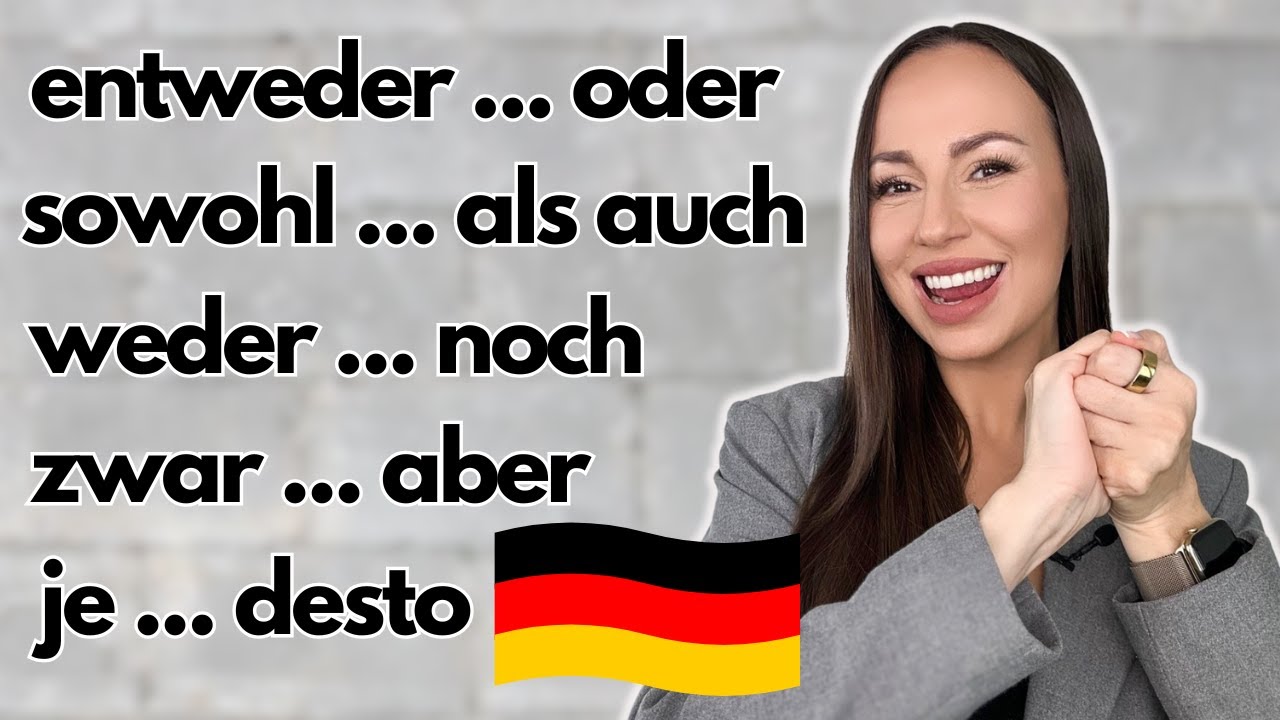
In diesem Video lernst du alles über Doppelkonnektoren im Deutschen (zweiteilige Konnektoren | Grammatik | B1 B2 C1 | Deutsch lernen | Learn German).
🎁Gratis PDF zum Video:
https://bit.ly/jetzt-pdf-herunterladen
Möchtest du dein Deutsch verbessern? Dann melde dich an:
📚Deutschkurse (A2 | B1 | B2 | C1):
https://dein-sprachcoach.de/deu...
alles was du aufgelistet hast sind Doppelkonnektoren -- außer Konjunktiv II (das findet man in fast jedem Video)
pseudo breach
willow socket
alles was du aufgelistet hast sind Doppelkonnektoren -- außer Konjunktiv II (das...
they were just an example
plain umbra
pseudo breach
there are lots of sentences structures like
Nicht nur.....sondern
Sowohl.....al...
If you want specific structures, I would recommend to try using textbooks for that.
They tend to present that kind of info in an ordered and sensible way.
pseudo breach
plain umbra
If you want specific structures, I would recommend to try using textbooks for th...
good suggestion thx
jade hawk
Was ist die Konnotation von "lass stecken"? Etwas wie "schwamm drüber" oder wirkt es mehr als ob der Sprecher geärgert wäre?
worthy lynx
Unrelated question but anyone know how to reduce school workload burnout?..tips are very needed.
willow socket
Do less work, take time off
spiral vapor
Hello language lovers
I came across an old ad for a shower gel in Polish that uses the word "Duschbad" with the meaning of shower gel
The word that is used today is "Duschgel" and according to Duden "Duschbad" has a completely different meaning but I wonder why the other meaning is not noted as it seemingly was used


https://de.wikipedia.org/wiki/Duschgel -- here Duschbad is referenced too
fun fact: the word for shower gel didn't exist in Polish back then so the German term was used in the ad
spiral vapor
spiral vapor
Hello language lovers
I came across an old ad for a shower gel in Polish that us...
@earnest arch french question, does "douche" on its own can mean a shower gel too? or was it used like that in the past?
 earnest arch
No only "gel douche". Douche alone is a shower
worthy lynx
willow socket
Do less work, take time off
wish I could tbh
 twin robin
Hallo Leute!
Könnte jemand mir bitte erklären: wann sollte man diesen Wörter benutzen?
Saubermachen, putzen, reinigen, aufräumen.
ich weiß, dass sie ähnlich, aber unterschiedlich sind. Ich würde gerne wissen, wann welches Wort richtig verwendet wird.
 teal cliff
twin robin
Hallo Leute!
Könnte jemand mir bitte erklären: wann sollte man diesen Wörter be...
teal cliff
twin robin
Hallo Leute!
Könnte jemand mir bitte erklären: wann sollte man diesen Wörter be...
aufräumen => putting stuff back to where it belongs
saubermachen, putzen, reinigen are synonyms i think
reinigen can also mean to cleanse i believe
saubermachen just literally means make clean
nova sparrow
jade hawk
Was ist die Konnotation von "lass stecken"? Etwas wie "schwamm drüber" oder wirk...
Es kommt wirklich auf den Kontext an: Es kann heißen
- lass uns nicht mehr darüber sprechen
- Das brauchst Du nicht noch mal erzählen, ich weiß schon Bescheid
- Nicht der Rede wert
- Schwamm drüber ( wie Du schon erwähnt hast)
- Hey, ich kann das ohne deine Hilfe regeln
nova sparrow
worthy lynx
Unrelated question but anyone know how to reduce school workload burnout?..tips ...
Just do homework regularly and not only if you feel like it 😮
worthy lynx
nova sparrow
Just do homework regularly and not only if you feel like it 😮
Aight
nova sparrow
worthy lynx
Unrelated question but anyone know how to reduce school workload burnout?..tips ...
you know I was only learning for tests myself, but that's not getting you optimal results
learning at a regular base keeps you prepared better...
worthy lynx
Kk, danke
 livid panther
willow socket
https://www.youtube.com/watch?v=rnBzBQ3lc7s
livid panther
willow socket
https://www.youtube.com/watch?v=rnBzBQ3lc7s
es gibt auch dieses video https://www.youtube.com/watch?v=y_cxgBBE6iA

In diesem Video erkläre ich dir im Detail alle wichtigen deutschen zweiteiligen Konnektoren; auch Doppelkonjunktionen genannt.
In this video I am going to explain you in detail all important German two-part connectors:
- When and how to use them
- Positioning
- Word order
Additional videos about German conjunctions (All A1 & A2 conjunctions)...
 wide crater
regal wave
it is totally old-fashioned if you write 😄
wide crater
regal wave
it is totally old-fashioned if you write 😄
hä, ich bin 20 und benutze das noch
 tribal sand
this is objectively a stupid question, but just out of curiosity—how known is the musical “cabaret” in germany? i rewatched it for the millionth time recently, and i’ve always wondered what the germans would think if it.
mental vector
wide crater
hä, ich bin 20 und benutze das noch
Als nicht mehr so junger Knabe geschieht dies bei mir ebenfalls an jedem Tage.
 gusty silo
tribal sand
this is objectively a stupid question, but just out of curiosity—how known is th...
gusty silo
tribal sand
this is objectively a stupid question, but just out of curiosity—how known is th...
regrettably i cant tell you the answer to this, but i can make a side note that the word cabaret itself (Kabarett in german) seems much more common in german than in english, but usually refers to politically/socially oriented satire/comedy (overlaps with stand-up comedy nowadays i'd say?)
this may be a minuscule addition to your knowledge about german, this could also be a hurdle in trying to ask germans about the topic, because they may imagine something specifically different
 hollow forge
tribal sand
this is objectively a stupid question, but just out of curiosity—how known is th...
hollow forge
tribal sand
this is objectively a stupid question, but just out of curiosity—how known is th...
Not stupid at all 😅 that’s actually a really interesting question I’ve heard a few mixed takes from people there. Wanna know what they usually say?
tribal sand
hollow forge
Not stupid at all 😅 that’s actually a really interesting question I’ve heard a...
yes i would… very much so…
hollow forge
tribal sand
yes i would… very much so…
Cool So from what I’ve seen, Germans know Cabaret, especially theater lovers, but it’s not as iconic there as it is in the U.S. Some people love the style and music, but others find it a bit over-the-top or dated. It’s kind of one of those musicals that sparks mixed reactions depending on who you ask
Honestly, I’d love to hear your take after watching it so many times
 crimson leaf
Why is 'Wüste' in the title "Der Tod in der Wüste" masculine all of a sudden? It really bothers me 💔
plush pelican
crimson leaf
Why is 'Wüste' in the title "Der Tod in der Wüste" masculine all of a sudden? It...
It isn't, it's in dative case
crimson leaf
Ofcourse it is 😞
plush pelican
(feminine, dative case) = der
(masculine, nominative case) = der
crimson leaf
Im going to bomb these articles i still understand nothing
plush pelican
It's like how masculine "ein" and neuter "ein" look the same in nominative case
ein Kind (das Kind)
ein Junge (der Junge)
German unfortunately re-uses stuff, which can lead to confusion
The preposition "in" forces its (object of the preposition) to either be in dative case or accusative case. Here, it requires dative case, and "die Wüste" is the (object of the preposition)
The articles (der, ein, kein) change form (are declined) depending on the gender, case and number

 silk hornet
Viele Dank
 small path
plush pelican
small path
plush pelican
This image is for “the” in the English language right?
Or a form of descriptive word along the line of that/the/their right?
small path
small path
This image is for “the” in the English language right?
Never mind I solved my issue thanks for providing this sheet
twin robin
teal cliff
aufräumen => putting stuff back to where it belongs
saubermachen, putzen, reinig...
vielen Dank!
twin robin
livid panther
es gibt auch dieses video https://www.youtube.com/watch?v=y_cxgBBE6iA
Ich liebe die Videos von diesen Männern 🙂 Luzi und Johannes sind so nett und hilfreich.
livid panther
twin robin
Ich liebe die Videos von diesen Männern 🙂 Luzi und Johannes sind so nett und hi...
Ich auch, sie haben mir ziemlich viel geholfen
 wide nymph
Hallo liebe Leute, ich habe eine Frage; Ich bin auf dem B2 Niveau, habe aber ein Problem mit dem Thema "nomen-verb Verbindungen". Es gibt sehr viele davon, ungefähr 1000 oder sogar mehr. Meine Frage ist also: Muss ich wirklich alle lernen oder nur die wichtigsten ?
jade hawk
Darf ich eine Leitplanke ein Geländer nennen oder hört sich das seltsam an
 robust glade
jade hawk
Darf ich eine Leitplanke ein Geländer nennen oder hört sich das seltsam an
robust glade
jade hawk
Darf ich eine Leitplanke ein Geländer nennen oder hört sich das seltsam an
Eher seltsam. Man würde zwar verstehen, was du meinst, aber bei einem Geländer denke ich eher an etwas Unsichereres (also halt etwas, was Menschen schützt und nicht Fahrzeuge)
jade hawk
Danke
 rustic dock
spiral vapor
Hello language lovers
I came across an old ad for a shower gel in Polish that us...
rustic dock
spiral vapor
Hello language lovers
I came across an old ad for a shower gel in Polish that us...
duschbad is still a very common term for shower gel
spiral vapor
rustic dock
duschbad is still a very common term for shower gel
Can I know which part of Germany you're from?
rustic dock
spiral vapor
Can I know which part of Germany you're from?
thuringia
spiral vapor
rustic dock
thuringia
hmm, interesting
fervent kernel
Hallo, hat jemand hier Erfahrung mit Italki? Wie war es? Würdest du es weiterempfehlen?
teal cliff
rustic dock
duschbad is still a very common term for shower gel
noch nie gehört LOL
teal cliff
fervent kernel
Hallo, hat jemand hier Erfahrung mit Italki? Wie war es? Würdest du es weiteremp...
kommt wahrscheinlich auf den lehrer an
rustic dock
teal cliff
noch nie gehört LOL
where i live that's like the main word we say for it LOL
i don't even know another one
what do you call it?
rustic dock
🤨
teal cliff
rustic dock
🤨
¯_(ツ)_/¯
spiral vapor
teal cliff
oder duschgel
und wo wohnst du?
mein Freund kommt aus BaWü und kannte den Begriff 'Duschbad' auch nicht
teal cliff
spiral vapor
mein Freund kommt aus BaWü und kannte den Begriff 'Duschbad' auch nicht
österreich
spiral vapor
jaaa okay
@worldly tinsel wie sagt man Duschgel in Österreich
ihr habt bestimmt ein lustiges Wort dafür
teal cliff
spiral vapor
<@202053500518137856> wie sagt man Duschgel in Österreich
ihr habt bestimmt ein ...
wenns ich doch gerade gesagt hab
😭
hoarwoschmiddü ginge auch
koobfwoschbuiwa
 worldly tinsel
spiral vapor
<@202053500518137856> wie sagt man Duschgel in Österreich
ihr habt bestimmt ein ...
worldly tinsel
spiral vapor
<@202053500518137856> wie sagt man Duschgel in Österreich
ihr habt bestimmt ein ...
ausnahmsweise ned. Einfach Duschbad
teal cliff
worldly tinsel
ausnahmsweise ned. Einfach Duschbad
wtf?
worldly tinsel
oder halt Duschbod im Dialekt
teal cliff
hawara wöcha mensch nennd aso eps duschbod ? 😭
worldly tinsel
Also bei uns olle
teal cliff
worldly tinsel
Also bei uns olle<:ARREMBESTMODXD:469930368972357634>
va wo bist du nuamoi 😭
worldly tinsel
Soizbuag
teal cliff
worldly tinsel
Soizbuag
hons vagässa duadma laad goi
teal cliff
worldly tinsel
Soizbuag
va da stod??
worldly tinsel
nana, Gott sei Donk ned
teal cliff
worldly tinsel
nana, Gott sei Donk ned
wo gäsd hi boist an naichn hoaschnied hom wüist?
(i mechad netta wissa wiast des wuat song duast)
spiral vapor
schwäbisch ischs wahre
worldly tinsel
teal cliff
(i mechad netta wissa wiast des wuat song duast)
wia moansd? do geht ma oafoch zum frisör oda?
teal cliff
worldly tinsel
wia moansd? do geht ma oafoch zum frisör oda?
sogst du frisör oda friseer?
worldly tinsel
friseer
teal cliff
worldly tinsel
friseer
vastä
jo na geit aunschainend an untaschiad ba mauchi de wos »friseer« song vs de de wos »hoarschnaida« song
i sog olli zwoa eingi 😭
is ma hiaz netta aigfoin waimma ywa hoar und schampoo gredt homd
worldly tinsel
hoarschneida hob i no nia gsog
rustic dock
teal cliff
hawara wöcha mensch nennd aso eps duschbod ? 😭
siehste!!!!!
teal cliff
rustic dock
siehste!!!!!
ich sehe gar nixe
 balmy axle
teal cliff
koobfwoschbuiwa
balmy axle
teal cliff
koobfwoschbuiwa
LMAO
balmy axle
teal cliff
jo na geit aunschainend an untaschiad ba mauchi de wos »friseer« song vs de de w...
"der glatzentischler"
teal cliff
balmy axle
"der glatzentischler"
😂😭😭😭
 plush pelican
From a book. The two characters have been shipwrecked and landed on a coast, but one of them lost his pants in the process:
»Na schön.« Baptiste nickte grimmig. »Dann gehen wir nach Osten. Finden erst einmal heraus, wo wir sind. Besorgen uns Vorräte.« Sie warf ihm einen Blick zu. »Und dir vielleicht auch ein paar Hosen.«
I feel like this is a translation error, but a subtle one. Wouldn't "ein paar Hosen" in German mean multiple pairs of pants?
But I'm fairly certain the original English sentence said something like, "And we'll get you some pants", which is meant actually as singular, one pair of pants.
 charred mist
im in the weather unit, is there a wrong way to describe the weather like ( es ist heute sonnig ) or ( es ist sonnig heute ) or are they all correct
 crude raft
charred mist
im in the weather unit, is there a wrong way to describe the weather like ( es i...
crude raft
charred mist
im in the weather unit, is there a wrong way to describe the weather like ( es i...
the two options you mentioned are both completly fine :))
rustic dock
first one sounds more natural though
 slender storm
I don't feel like one is more natural than the other to be honest.
rustic dock
well i do so i guess whe should settle this matter in a sword fight
rustic dock
🗡️
 fallow ledge
Wie sage ich
Ich hätte gern einen Platz (outside/inside)
passt da draußen und drinnen vielleicht?
 faint thistle
fallow ledge
Wie sage ich
Ich hätte gern einen Platz (outside/inside)
passt da draußen und ...
faint thistle
fallow ledge
Wie sage ich
Ich hätte gern einen Platz (outside/inside)
passt da draußen und ...
in what context, like a restaurant?
fallow ledge
faint thistle
in what context, like a restaurant?
Ja genau
Wie im Restaurant
delicate tiger
"Ich würde gerne draußen/drinnen sitzen"
fallow ledge
delicate tiger
"Ich würde gerne draußen/drinnen sitzen"
Danke 🙏
 smoky summit
teal cliff
is ma hiaz netta aigfoin waimma ywa hoar und schampoo gredt homd
smoky summit
teal cliff
is ma hiaz netta aigfoin waimma ywa hoar und schampoo gredt homd
what language is this broski
teal cliff
smoky summit
what language is this broski
(Austro-)Bavarian
rustic dock
fallow ledge
Wie sage ich
Ich hätte gern einen Platz (outside/inside)
passt da draußen und ...
what you said is also acceptable btw
delicate tiger
smoky summit
what language is this broski
"Ist mir nicht eingefallen, weil wir über Haar und Shampoo geredet haben" Not that bad once you speak Standard German well
plush pelican
delicate tiger
"Ist mir nicht eingefallen, weil wir über Haar und Shampoo geredet haben" Not th...
What's "hiaz"?
gar?
fallow ledge
rustic dock
what you said is also acceptable btw
Danke
teal cliff
plush pelican
What's "hiaz"?
"jetzt"
teal cliff
delicate tiger
"Ist mir nicht eingefallen, weil wir über Haar und Shampoo geredet haben" Not th...
Ist mir jetzt nur eingefallen*
teal cliff
delicate tiger
"Ist mir nicht eingefallen, weil wir über Haar und Shampoo geredet haben" Not th...
netta ≈ nur
plush pelican
teal cliff
"jetzt"
Now you're just making random sounds 😛
teal cliff
plush pelican
Now you're just making random sounds 😛
;-;
Da eins von den Google results ist ein Lied

 serene flame
plush pelican
Now you're just making random sounds 😛
serene flame
plush pelican
Now you're just making random sounds 😛
I thought jetzt meant now/currently
plush pelican
serene flame
I thought jetzt meant now/currently
It does, I'm saying that it's crazy how the words can change in dialect. He was saying that in his dialect, "jetzt" is "hiaz"
serene flame
Ohh okay
wide nymph
Hallo liebe Leute, ich habe eine Frage; Ich bin auf dem B2 Niveau, habe aber ein Problem mit dem Thema "nomen-verb Verbindungen". Es gibt sehr viele davon, ungefähr 1000 oder sogar mehr. Meine Frage ist also: Muss ich wirklich alle lernen oder nur die wichtigsten ? Ich habe ChatGPT gefragt und es hat mir gesagt
Bis zum Niveau B2 gibt es im Deutschen ungefähr 400 Nomen-Verb-Verbindungen, die man lernen sollte. Davon sind etwa 250–300 die am häufigsten verwendeten, die man auf dem B2-Niveau aktiv beherrschen sollte.
Ist das richtig?
Vielen Dank! Ja, deine Antwort hat mir wirklich sehr geholfen. Apropos, du hast völlig recht. Ich fühlte mich sehr schlecht, als ich sah, dass es 1125 Nomen-Verb-Verbindungen gibt.
ja bitte, also da gibt es alle NVV, die ich lernen muss ?
Hahaha ja also ich meinte "die - 300 wichtigsten".
Ich bin auf diese Seite gegangen aber konnte nicht drauf zugreifen.
Nein. Ich meinte, dass ich nicht auf die Wörter zugreifen konnte.
Es fragt nach meinen Kartendaten, wenn ich draufklicke "I want this!".
ja okay es ist kostenlos, aber es fragt trotzdem nach meinen Kartendaten.
 normal torrent
Wie kann ich deinen Link vertrauen? Möglicherweise hat es Schadsoftware...
Hallo KI...
wide nymph
Ja okay ich habe es getan aber das Problem ist, dass ich keine Kreditkarte habe.
Ich kann nicht eingeben
Man braucht da etwas eingeben, um es zu erhalten. Aber ich habe keine
Ja kann sein
schick es mir bitte Vielen Dank im Voraus!
Okay schick es mir einfach privat.
Ich habe dir eine Anfrage geschickt
 merry inlet
.
 flint nimbus
was ist eine gute Quelle für Deutschlandgeografie für Anfänger?
nova sparrow
flint nimbus
was ist eine gute Quelle für Deutschlandgeografie für Anfänger?
Bist Du an einer bestimmten Region besonders interessiert, oder möchtest Du erstmal einen Überblick verschaffen.
Du könntest hiermit starten und dann über Google-Suche "Kinderweltreise" die Themen vertiefen, die Dich besonders interessieren.
https://youtu.be/g7x9iur6kPg?si=Iusyb5Qfpl3DrVQX

Welche und wie viele Großlandschaften gibt es in Deutschland? Wie sieht es hier aus? Welche Flüsse, Seen, Inseln und Gebirge gibt es? Erfahre hier alles über Deutschland! Erdkunde leicht gemacht!
Inhalt:
00:00 Start
00:21 Wo liegt Deutschland?
00:45 Großlandschaften Deutschlands
02:31 Gebirge in Deutschland - Hochgebirge und Mittelgebirge
0...
flint nimbus
nova sparrow
Bist Du an einer bestimmten Region besonders interessiert, oder möchtest Du erst...
Ich will lernen über alle Länder
nova sparrow
flint nimbus
Ich will lernen über alle Länder
Alle Bundesländer?
nova sparrow
Ich glaube das Video und die Google-Suche sind genau das was Du brauchst um zu starten. 🤔
flint nimbus
nova sparrow
Ich glaube das Video und die Google-Suche sind genau das was Du brauchst um zu s...
ja, aber Fragen kostet nichts! Danke
nova sparrow
Na, klar, ich würde auch sagen, such Dir einen Atlas in einer Bibliothek und beschäftige Dich damit... 😉
flint nimbus
nova sparrow
Na, klar, ich würde auch sagen, such Dir einen Atlas in einer Bibliothek und bes...
ich glaube, diese Information würde es nicht in einem normalerweisen Atlas geben... Ist trotzdem nicht eine schlechte Idee!
ein deutscher Atlas, vielleicht
nova sparrow
Das kommt ein bisschen auch darauf an, was für ein Lerntyp Du bist, eher haptisch, dann kann Dir ein Atlas helfen, Himmelsrichtungen und den Bezug der einzelnen Regionen/Länder zueinander besser zu verstehen.
Bist Du eher der auditive Typ, ist sicher ein Video besser
flint nimbus
ich glaube nicht an Lerntypen
nova sparrow
flint nimbus
ein deutscher Atlas, vielleicht
Ich würde den Diercke Weltatlas nehmen, weil er schon seit Jahrzehnten auch in der Schule verwendet wird (also ich meine nicht, dass Du ihn gleich kaufen solltest, schau ihn Dir erst mal in einer Bibliothek an).
nova sparrow
flint nimbus
ich glaube nicht an Lerntypen
Das war nur eine Möglichkeit, festzulegen, in welcher Richtung Du weiterschauen könntest 🤷♂️
flint nimbus
ja, das ist gut!
Es ist ein Bisschen ärgende. Ich weiß, dass dw, die Lernseite, hat gute Information... nicht aber in einem Platz. Es ist verstreut über Kurse
so ist das Leben 🙂
nova sparrow
flint nimbus
ja, das ist gut!
Es ist ein Bisschen ärgende. Ich weiß, dass dw, die Lernseite, ...
Ich habe Deutschland in über 30 Jahren beruflich erlebt, von Berchtesgaden, über Lörrach, Saarbrücken, Trier, Aachen, Leer, Oldenburg, Bremen, Kiel, Lübeck, Rostock, Stralsund, Schwedt, Frankfurt/Oder, Dresden, Chemnitz, Regensburg, Passau, Traunstein ... 😉
flint nimbus
nova sparrow
Ich habe Deutschland in über 30 Jahren beruflich erlebt, von Berchtesgaden, über...
das ist ein sehr natürlich Weg, Geografie zu lernen!
nova sparrow
flint nimbus
das ist ein sehr natürlich Weg, Geografie zu lernen!
Sicher, Lernen durch eigene Erfahrung ☺️
fervent kernel
So sieht Umgangssprache aus?
nova sparrow
fervent kernel
So sieht Umgangssprache aus?
Wie? Wo? Worauf beziehst Du Dich?
fervent kernel
nova sparrow
Wie? Wo? Worauf beziehst Du Dich?
Wie kann man Slang lernen?.
nova sparrow
fervent kernel
Wie kann man Slang lernen?.
Oh, ich würde tatsächlich zwischen Umgangssprache und Slang unterscheiden (aber frag mich jetzt bitte nicht nach einer genauen Definition). Man lernt sie (um ein berühmtes Zitat von Luther zu verwenden), indem man dem Volk aufs Maul schaut. 🧑🎓
fervent kernel
Ich verstehe nur bahnhof
jade hawk
Umgangssprache and slang are two different things, they are best learnt by just observing how natives use it
Umgangssprache by reading/watching things which aren't 'official' (so for example not news reports or literary fiction novels, but rather contemporary TV shows or young adult fiction books), slang at best by reading social media posts of younger speakers
Umgangssprache is colloquial stuff that's still viable in a general conversation, but is on the lighter, more casual side
Slang is just new phrases and words that are relatively new and probably aren't going to be understood by older generations
 vital knot
Hallo Leute! Habt ihr irgendwelche Tipps zum Deutschlernen? Abgesehen davon, dass man Wörter gleich mit Artikeln lernen sollte, fange ich gerade erst an! Ich kenne ein paar grundlegende Sätze.
 timber yacht
vital knot
Hallo Leute! Habt ihr irgendwelche Tipps zum Deutschlernen? Abgesehen davon, das...
timber yacht
vital knot
Hallo Leute! Habt ihr irgendwelche Tipps zum Deutschlernen? Abgesehen davon, das...
faq beginner
stoic mauveBOT
How to get started
The simplest way to learn German is to find topics you don’t understand yet and search for explanations of them. This list provides you with a guide for which topics to learn if you are completely new to German. Type the topic into Google (or YouTube) and start learning!
Introduction
1: Alphabet (especially ä, ü, ö and ß)
2: Basic greetings (hello, goodbye, etc.)
Part 1 - Simple Sentence
1: Noun gender & plurals
2: Nominative case (What are cases?)
3: Nominative pronouns (I, you, he, she, etc.)
4: Verbs in present tense
5: Definite/indefinite articles
6: Accusative case (for nouns)
7: Accusative pronouns
8: Word order of simple sentences
9: How to ask questions
See Part 2 on the next page.
Tips
- Always learn the gender of a noun when you learn a new noun
- Learn to use a translation dictionary (e.g. dict.cc, leo.org)
- Use
>faq resourcesto see our list of German learning resources - For listening and pronunciation practice, try watching movies or videos (incl. YouTube)
- You can listen to pronunciation for words on websites like dict.cc, forvo.com, and others
- Practice writing sentences every day (and asking people to correct them)
- Ask as many questions as possible
- Don’t be scared to make mistakes!!!! If you don’t let yourself make mistakes, you will never be able to learn German
Page 1/2
vital knot
timber yacht
>faq beginner
danke!
timber yacht
vital knot
danke!
Gern geschehen. 🙂
Du kannst dir auch Nicos weg mal anschauen.
faq nicos
faq nicos
stoic mauveBOT
Nicos
Nicos Weg is a free online program aimed at helping people learn German. It includes video, audio, text, grammar explanations, notes, vocabulary, and exercises. It also includes very useful cultural and bureaucratic information, such as how to open a bank account, while teaching you the relevant grammar and vocabulary.
It’s fairly popular and well-recommended, but keep in mind that you can’t learn a language with only one resource, even if it’s a good one!
You can find the program here: https://learngerman.dw.com/en/nicos-weg/c-36519789
You can also see various other courses for learners by dw.com here: https://learngerman.dw.com/en/overview/
vital knot
timber yacht
Gern geschehen. 🙂
Du kannst dir auch Nicos weg mal anschauen.
>faq nicos
Ich habe mir die Site angesehen, sie sieht informativ aus, ich werde bei ihm lernen, vielen Dank!
 snow tulip
Do I use haben, sein or werden with 'heiraten'? This is the sentence:
Später [FILL IN WORD HERE] du bestimmt heiraten
'Later _ you definitely marry'
Will?
nova sparrow
snow tulip
Do I use haben, sein or werden with 'heiraten'? This is the sentence:
Später [FI...
werden!
snow tulip
nova sparrow
werden!
danke!!!
nova sparrow
snow tulip
danke!!!
Bitteschön!
 remote niche
How to use direct voice chat or call here
 rare jetty
faq vc
stoic mauveBOT
How to join Voice Chat
Please read the [Roles section](#getting-started message) in #getting-started for info on how to join VC and more!
 glacial trout
hello guys i have a question pls
nova sparrow
glacial trout
hello guys i have a question pls
If it's a question abt German you're in the right place 👍
glacial trout
yes plss
i wanna have information about ausbildung in fachinfomatiker in german
and i want tips for the goethe b2 prufung pls
delicate tiger
tribal sand
this is such a dumb question, but it’s been haunting me: do germans know about the tooth fairy?
 whole portal
Yes
tribal sand
whole portal
Yes
this is a joyous day and i am so pleased
 tacit compass
Hallo Leute, why Relativpronomen in dativ in this case? I dont get the meaning of the Relativsatzt, could someone help to explain? Viellen Dank
 plain umbra
tacit compass
Hallo Leute, why Relativpronomen in dativ in this case? I dont get the meaning o...
plain umbra
tacit compass
Hallo Leute, why Relativpronomen in dativ in this case? I dont get the meaning o...
Which clause? Both?
The use of dative in these clauses is the same as the phrases "mir ist langweilig" and "mir geht's gut".
Do you know those?
tacit compass
Yes, but the verb is wird
plain umbra
werden = to become
Mir ist langweilig. = I am bored.
Mir wird langweilig. = I am becoming bored.
tacit compass
So if dependently, it would be: Ihr wird ohne Action soforr langwelig?
tacit compass
plain umbra
Mir ist langweilig. = I am bored.
Mir wird langweilig. = I am becoming bored.
Oh cool, that is new to me, so wird goes with Dativ
plain umbra
tacit compass
So if dependently, it would be: Ihr wird ohne Action soforr langwelig?
Yeah.
plain umbra
tacit compass
Oh cool, that is new to me, so wird goes with Dativ
No, it doesn't.
tacit compass
plain umbra
No, it doesn't.
Echt 
plain umbra
Well, it depends how you mean it.
Typically you would say that sein and werden go with nominative.
tacit compass
Ah same case with sein when something make you change your mood, like sick, happy, sad... we use dativ
But in case Ich werde 30 nächstes Jahr, it is Nominativ
plain umbra
Yes, exactly. When you're describing how you're being affected by some circumstance/environment.
 plain umbra
tacit compass
But in case Ich werde 30 nächstes Jahr, it is Nominativ
plain umbra
tacit compass
But in case Ich werde 30 nächstes Jahr, it is Nominativ
I'm not sure if this is a good example. Is 30 considered a noun here? I have no idea.
Here's an example: ich bin/werde Arzt.
I think 30 there is considered an adjective, so it would be like "ich bin/werde alt" in which case no cases are used since it's a predicate adjective.
tacit compass
Stimmt, got it
 night pulsar
Can anyone help me with this question
Im in the lecture right now and im gonna get extra marks if i answer it but its super hard
I need to send the photo tho but i cant
willow socket
we aren't allowed to help you cheat
night pulsar
Its not cheating its an open book task
willow socket
does open book include asking others to answer it for you?
night pulsar
Yes people are working in pairs rn
But i dont have any friends in this lecture
Forget about it the lecture ended
willow socket
I would understand open book to mean access to lecture materials and external resources. If your professor lets you work in groups in the lecture, then you'd be working with people with access to the same knowledge as you. Asking people who already know German is sort of like getting someone to do a test for you. I obviously don't know 100% how to interpret the rules, only a mod could do that, but to me it would be well over the bounds of academic honesty
 glad kestrel
<@&305455824174710787> is this allowed
plain umbra
glad kestrel
<@&305455824174710787> is this allowed
No it's not. Thanks for the ping.
 tender current
Sodass is used for consequences after an event. Does this mean it can be interchangable with either deswegen or deshalb??
er ist spät ins Bett gegangen, deswegen kam er zu spät ins Büro
er ist spät ins Bett gegangen, sodass er zu spät ins Büro kam
 rustic trench
tender current
Sodass is used for consequences after an event. Does this mean it can be interch...
rustic trench
tender current
Sodass is used for consequences after an event. Does this mean it can be interch...
Yeah and no, because it doesn't express the same thing, like, Sodass is used to point out the result, while Deshalb/deswegen is used to point out the cause, even tho the two are used the same way, it's like when you say "I won, but I suffered", here you're putting more importance into the second part, you could say "I suffered, but I won", like it's also correct, but it's not the same vibe, you understood?
tender current
rustic trench
Yeah and no, because it doesn't express the same thing, like, Sodass is used to ...
yeah no sorry 😭
deshalb and deswegen literally means therefore and thats why right? Dont they point out the effect?
aside from that, in some cases I see sodass being used to point out a purpose like damit
ive been ignoring sodass for this reason, its just kinda confusing
 modest marten
tender current
yeah no sorry 😭
deshalb and deswegen literally means therefore and thats why ri...
modest marten
tender current
yeah no sorry 😭
deshalb and deswegen literally means therefore and thats why ri...
In German, there are a few ways where you can point out a part of a sentence which you consider more important. One easy to note way is the stress. If a word is (unusually) stressed in a sentence, the speaker wants to point to that word/part of the sentence (in writing often expressed by italics).
And there are some words which basically have the same meaning, but "point" to different other words. Both "sodass" and "deshalb"/"deswegen" are part of the clause that has the effect - but they point to different things in the sentence. "sodass" points to its own clause, the effect clause. And "deshalb"/"deswegen" point to the preceding clause where the cause is located. They set a different focus of what's the more important part of the sentence, even though they appear in the same place.
In English, I think this might be roughly comparable to the difference between "therefore" and "so (that)", like in
"It rained, therefore I got wet." and "It rained, so I got wet."
I think that's what @Yellow wanted to explain.
 warped oriole
tacit compass
Oh cool, that is new to me, so wird goes with Dativ
warped oriole
tacit compass
Oh cool, that is new to me, so wird goes with Dativ
"Ihr wird langweilig" means basically "Es wird ihr langweilig" or freely translated in english "It becomes broing to her"
Who or what becomes boring? It
to who it becomes boring? to her
So the verbs in this sentence don't require a single case like "danken" or "helfen" which always require dative. Here the dative "ihr" is just an addition to the sentence "Es ist langweilig"
 orchid fern
is eszette like B written like beta ??
 timid vector
orchid fern
is eszette like B written like beta ??
timid vector
orchid fern
is eszette like B written like beta ??
they look similar but beta has a longer tail
orchid fern
timid vector
they look similar but beta has a longer tail
ahhh ... okayy
orchid fern
so like a small tail betta
timid vector
ya sure if that helps you remember it
orchid fern
i just started learning
 rustic dock
the version on the left is usually only seen in print, people mostly write it like on the right
 finite void
How do i scsm people most efficiently
delicate tiger
<@&305455824174710787>
 long current
#beginner-german message
@lapis atlas This is the right place to ask questions.
As for your question, instead of Duolingo, I’m using Anki to learn the most common German words. I’m currently at ~250 words, and I can kind of understand what’s going on in #beginner-german .
Not sure if it’s as fast as you’d like, but it’s definitely faster than Duolingo.
The idea is to build up vocab asap, to be able to consume content in German.
 lapis atlas
long current
https://discord.com/channels/221708975698083841/381911915095654401/1434685982887...
lapis atlas
long current
https://discord.com/channels/221708975698083841/381911915095654401/1434685982887...
Ok thanks
Also mb for the channel confusion
long current
Not an issue!
lapis atlas
I wanna learn german to can get into a college in germany
I got 3 years
So i think its enough
long current
lapis atlas
I got 3 years
@brave sedge You may be able to help here, your German-learning skills transcend the limits of our known universe.
 brave sedge
why me
brave sedge
yeah
but I didnt really do magic
my tip is: study hard
sorry idk more than this 😭
long current
brave sedge
my tip is: study hard
@lapis atlas You’ve heard the goat.
 cloud hornet
orchid fern
i just started learning
cloud hornet
orchid fern
i just started learning
Well there’s your calling to learn Swiss German…
 dreamy reef
cloud hornet
Well there’s your calling to learn Swiss German…
dreamy reef
cloud hornet
Well there’s your calling to learn Swiss German…
How do you even learn swiss german?
By learning german first and just move to switzerland?
timid vector
it's a dialect so you'd likely become fairly fluent in standard german then either learn swiss german through immersion (living there) or hiring a specialized tutor
dreamy reef
timid vector
it's a dialect so you'd likely become fairly fluent in standard german then eith...
knew it
Thanks man
or woman
jade hawk
@plush pelican Can you post a link to that one grammar rule about Linksfeld Rechtsfeld Satzklammer whatever the name was that said that you can (though its used rarely) put the partizip 2 at the beginning, for example
Gegessen habe ich das nicht
I'd like to read more about it/save it somewhere
 steel sigil
help me please i wanna pass the degital testas but idk if the preparation material in the official site is enough if not where can i practice
plush pelican
jade hawk
<@216341703915864064> Can you post a link to that one grammar rule about Linksf...
Oh whoops, I meant to include the first pic, not 2 of the second:


It's not that rare, especially in written text
Position 1 is the topic
German has a logic of "topic-comment", aka "first I say what I'm talking about, then I say what the new information about it is"
Hast du den Hund gesehen, den wir gestern im Park erblickt haben?
Did you see the dog that we caught sight of yesterday in the park?
Den Hund habe ich nicht gesehen, aber eine Katze schon.
The dog, I haven't seen, but I did see a cat.
Gesehen habe ich den Hund nicht. Gehört habe ich ihn allerdings.
I haven't seen the dog. I have, however, heard it.
jade hawk
yeah thats what I wanted to know thanks youre the Ziege
plush pelican
I was listening to a podcast the other day where they were putting the verb in position 1 like every other sentence, I think to make it seem more poetic/literary. It was about travel in the Middle Ages, and was some officially produced podcast with like a voice actor reading stuff out for dramatic effect.
 jade hawk
yeah my native lang also has a much more free word order so I'm not really bound to the english one by nature
tbf you can do some wacky stuff with word order in english too, with inversion and cleft sentences
plush pelican
Yeah, cleft sentences are the English way of trying to make something into a topic at the start of the sentence, to do the same thing as this, despite English's stricter word order
plush pelican
jade hawk
<@216341703915864064> Can you post a link to that one grammar rule about Linksf...

Deutsche Grammatik 2.0
Normalerweise steht das Verb in einem deutschen Satz in Position 2, aber es gibt einige Satzarten, bei denen das Verb in Position 1 steht.
Frage- und Aufforderu


 limpid edge
Another preposition question. I’m hoping both of the options below are equally right so I don’t have to cry.
If I wanted to say that during X, Y happened. Are both während and auf correct?
For example:
ich habe mir auf einer Dschungelreise Malaria zugezogen.
And
Ich habe mir während einer Dschungelreise Malaria zugezogen.
My assumption is that both of these would be right and convey roughly the same idea. Is that true?
limpid edge
limpid edge
Another preposition question. I’m hoping both of the options below are equally r...
Oh and pt. 2, could you say bei also???
willow socket
limpid edge
Another preposition question. I’m hoping both of the options below are equally r...
auf einer Reise
plain umbra
limpid edge
Another preposition question. I’m hoping both of the options below are equally r...
Although I think it works in this case, I wouldn't say they're always interchangeable like that. I think you can always use "während" to mean "during", but not "auf".
nova sparrow
limpid edge
Oh and pt. 2, could you say bei also???
Yes, you can also use bei einer Reise -> Während/auf/bei works HERE interchangeable
limpid edge
Great! Thank you so much!!
 main cairn
Ich habe eine Frage: what's the difference between von...bis and vom...bis zum ??
i try to compare through sentences for both usage but i'm still confused lol, can someone help me go to the details with it
plain umbra
main cairn
Ich habe eine Frage: what's the difference between **von...bis** and **vom...bi...
vom = von dem
zum = zu dem


Maybe this helps.
main cairn
plain umbra
oh so from what im understanding, the usage of von...bis is used for nouns that don't need an article, am i correct? meanwhile vom...bis zum is the combination of von dem + zu dem therefore it's used for nouns that need an article, which is provided in the vom and bis zum
correct me if i'm wrong
plain umbra
main cairn
oh so from what im understanding, the usage of **von...bis** is used for nouns t...
Yes, you shouldn't worry about the von/vom and zu/zum difference. That's just whether or not the article dem is used or not. Like you could have zur if it's zu + der. So that part has nothing to do with the difference between the two things.
It's "von ... bis" vs "von ... bis zu".
main cairn
plain umbra
Yes, you shouldn't worry about the von/vom and zu/zum difference. That's just wh...
right so i just gotta match it up with the corresponding artikel and whether that sentence is akkusativ/dativ
plain umbra
main cairn
right so i just gotta match it up with the corresponding artikel and whether tha...
Sentences aren't accusative or dative. Only nouns/pronouns are accusative or dative.
Von is dative, bis is accusative, zu is dative.
Well, more precisely: they govern those cases, so their noun/pronoun will be in that case.
main cairn
plain umbra
Well, more precisely: they govern those cases, so their noun/pronoun will be in ...
I get it now! Thank you so much
main cairn
also hey guys just a question (i asked this in general but i think i asked in the wrong channel)
i noticed that this server provides B1 vocab lists usually for Lesen sessions and i want to use them for my studies. does anyone have the complete pile of the vocab files? where can i find them?
spiral vapor
main cairn
also hey guys just a question (i asked this in general but i think i asked in th...
hi! all materials we used in the lessons are usually posted in #985224391849807872
main cairn
spiral vapor
hi! all materials we used in the lessons are usually posted in <#985224391849807...
thank youu sm ill look into those :D
 latent wadi
long current
You said you got from A to C in 3 years IIRC
latent wadi
long current
You said you got from A to C in 3 years IIRC
Thats the realistic minimum 3 years
Anyone who says they did it faster is one of three categories 1. Living in Germany and actually using German daily 2. Very, very gifted 3. Lying or unaware of their actual abilities
 wet kayak
latent wadi
Anyone who says they did it faster is one of three categories 1. Living in Germa...
wet kayak
latent wadi
Anyone who says they did it faster is one of three categories 1. Living in Germa...
there's no such thing as "talent" but experience and consistency 🙂
timid vector
There are definitely people that can more easily pick up and learn foreign languages, same with math or art or chemistry etc
normal torrent
This is true, but talent alone can only take you so far. You need discipline to actually get anywhere
There's a good saying I heard once, "You may have a stallion, but any man on a donkey will go farther if you don't tame it."
latent wadi
wet kayak
there's no such thing as "talent" but experience and consistency 🙂
"Gifted" should come with the caveat that they have an innate desire to learn X skill, language, etc, yes. Because part of what makes one. have a natural ability is that they possess the desire to learn it in the first place (which is what many lack who otherwise may also be quite exceptional)
wet kayak
timid vector
There are definitely people that can more easily pick up and learn foreign langu...
it still requires hundreds of hours of studying. It's not like they get the knowledge out of nowhere
latent wadi
Most would go too far and say you are completely wrong but I mostly agree with that assessment. However a degree of "talent" does exist. In skateboarding for example you can absolutely tell when someone just "has it" - and its more than just years of expierence
wet kayak
latent wadi
"Gifted" should come with the caveat that they have an innate desire to learn X ...
i mean it generally bothers me when people use the terms gifted or talented, because they don't see how much effort someone puts to learn something. Just because one person didn't have enough courage to achieve something doesn't mean it was easy for someone else. That was my point 😅
and also when it's your 3rd or 4th language it's not about any special aptitudes but rather the experience in learning methods
latent wadi
If its your 3rd or 4th you are probably a little crazy in the head 
timid vector
wet kayak
it still requires hundreds of hours of studying. It's not like they get the know...
I'm not sure who said anything that goes against that
I'm not seeing it in anyone's messages
fact is 2 people can put in the same effort and one will have a much easier time learning and will end up at a more advanced level because they're better at learning languages due to how their brain is wired and their learning style
willow socket
latent wadi
"Gifted" should come with the caveat that they have an innate desire to learn X ...
Definitely not innate 😛
latent wadi
willow socket
Definitely not innate 😛
Der Mensch kann tun was er will; er kann aber nicht wollen was er will
Thats where Id say its innate
willow socket
The idea that someone is born with the desire to learn German or to learn the piano is not really supported by any science. I’m sure it was just a brain fart, but you implied that the desire to learn a specific skill would be innate.
latent wadi
There are certain examples which would make one believe that though
magnus carlsen and chess for example
willow socket
I don’t know why he would make me believe that. Chess wasn’t the first activity he showed acuity for and it was introduced to him externally.
latent wadi
Either way Im not saying the activity itself is innate I am saying that which draws one to the activity is what is innate
Hence: Der Mensch kann tun was er will; er kann aber nicht wollen was er will
willow socket
I disagree with that and I don’t believe it’s supported in the literature, but regardless, it was just unfortunate wording above then.
latent wadi
It is by determinism
willow socket
Determinism is a philosophy
latent wadi
And philosophy is just an explanation of existence
We can discuss whether science can point to why we are drawn to certain things but no one can refute that there are things that some do and/or have that others seem to not. It would be an impossibility for me to understand Physics in the way I can language so there has to be something more to it than simply having "learnt" something
willow socket
But we don’t need to blindly apply philosophy to a phenomenon that can be empirically studied. In that sense it’s purely your perspective or opinion. More of an ideology than anything.
latent wadi
Seems like an overly arrogant and erroneous conjecture to me cant lie
Empirically understanding something only proves its existence, it does not create it
The world wasnt flat before it was empirically "decided" to be round
willow socket
No one said it did 🤔 but if you just create your perspective with no view to evidence or existing research, then you can claim anything and remove yourself from the obligation of scientific standards. I don’t really want to have a philosophical debate at 9 in the morning, esp. about this. My point above was there is no “innate desire to learn German”, if you disagree great, if it was a wording issue and you meant more generally a desire to learn also great. Have a good one.
latent wadi
Innate potential for physical characters is a proven science immerhin
By your own logic you would disavow the existence of an innate desire to learn as well tho lol
But I can acquiesce that there is no specific "gene" attributed to one such as "desire to learn yoga." I am just describing a set of whatever qualities or what it is that is afforded to one that seems to draw them towards something to obsession
Which manifests to us as so
If that werent true one would be able to freely (without extrinsically motivated factors) be able to obsess over a certain thing
I think we can agree that that isnt possible
plain umbra
I think this topic goes outside the scope of #questions-2 .
latent wadi
🙏
 teal panther
how do you tell when you should use der die das / ein eine ein
wet kayak
faq gender
stoic mauveBOT
Grammatical gender
German nouns are sorted in three different genders: masculine, neuter and feminine. These have nothing to do with sex or social gender.
The first thing genders will influence are articles like der, das, die. Each word has its own and you better get it right: some words that look identical can have different meanings depending on the gender they're used with. For example:
die Band = the (musical) band,
der Band = the (book) volume,
das Band = the tape.
Some words, mainly trademarks and loanwords, have multiple acceptable genders while having no change in meaning:
der Jogurt = das Jogurt
das Virus = der Virus
These may vary by region or colloquiality.
💢 But WHY, German, WHY ⁉
Gender is actually quite useful! Since sentence structure is less rigid than in English, grammatical case helps you tell the various elements apart (with some practice), and that works through genders: each gender has its own forms, which makes everything a little less ambiguous. Besides, as you've seen with Band above, it allows us to make up words with different meanings that look the same but are not ambiguous, and if that's not magic, I don't know what is. ✨
🙀 But how am I supposed to tell them apart? 🙀
Check out >explain gender patterns. 😉
teal panther
ok thank you
 hidden niche
Wie lernt man am besten Deutsch? kann jemand helfen?
willow socket
hidden niche
Wie lernt man am besten Deutsch? kann jemand helfen?
faq beginner
stoic mauveBOT
How to get started
The simplest way to learn German is to find topics you don’t understand yet and search for explanations of them. This list provides you with a guide for which topics to learn if you are completely new to German. Type the topic into Google (or YouTube) and start learning!
Introduction
1: Alphabet (especially ä, ü, ö and ß)
2: Basic greetings (hello, goodbye, etc.)
Part 1 - Simple Sentence
1: Noun gender & plurals
2: Nominative case (What are cases?)
3: Nominative pronouns (I, you, he, she, etc.)
4: Verbs in present tense
5: Definite/indefinite articles
6: Accusative case (for nouns)
7: Accusative pronouns
8: Word order of simple sentences
9: How to ask questions
See Part 2 on the next page.
Tips
- Always learn the gender of a noun when you learn a new noun
- Learn to use a translation dictionary (e.g. dict.cc, leo.org)
- Use
>faq resourcesto see our list of German learning resources - For listening and pronunciation practice, try watching movies or videos (incl. YouTube)
- You can listen to pronunciation for words on websites like dict.cc, forvo.com, and others
- Practice writing sentences every day (and asking people to correct them)
- Ask as many questions as possible
- Don’t be scared to make mistakes!!!! If you don’t let yourself make mistakes, you will never be able to learn German
Page 1/2
hidden niche
willow socket
>faq beginner
Danke Schon
 open crown
stoic mauve
open crown
stoic mauve
Where do i check it :c
delicate tiger
you can use the FAQ bot in #botchannel
 short mirage
Hello dear
can i too find idea busy fun?? or you other meaning give than me?? and hope for us keep understand care take on way!!!!
 eternal kraken
Hallo
 junior wadi
Hallo , Kann mir jemand bei den telc-B2-Prüfungen helfen und die Musterprüfungen erleichtern - speziell in Frankreich oder allgemein in Europa !!!
 grand lantern
explain gender patterns
stoic mauveBOT
**Feminine words (die)**
- many words ending in
-e(die Nase, die Kiste) - words ending in:
---in(feminine professions/roles): die Verkäuferin, die Lehrerin
---eidie Fischerei, die Bäckerei
---schaftdie Mannschaft, die Gemeinschaft
---heit/-keitdie Freiheit, die Gerechtigkeit
---ungdie Bedeutung, die Achtung
---iondie Aktion, die Religion
---ikdie Logistik, die Logik
---anzwords of classical origin: die Allianz, die Toleranz
---urdie Natur, die Kultur
---tätdie Professionalität, die Kriminalität
Page 4/4
pseudo breach
Hey I have question about progress
Is there a general speaking ability that improves with time or anything you speak you had to have practised it prior ?
for example I learned to speak about few topics by practising few memorized sentences and modfying them a little but if I try to speak about a new topic its like Im starting again from zero and even if I use same grammars/structures it still feels kinda hard applying new words
Another very similar example are superlativ komparativ I probably used superlativ / komparativ forms for maybe 20 adjectives but I still lag a lot when I try to use it for a new adjective ?
So is it supposed to be something that will improve on its own or I have to expand my input ?
timid vector
I don't think you should be learning by trying to remember set sentences and phrases that only apply to one topic in the first place
The vocabulary and grammar should be your basis to be able to build sentences that cover a wide variety of topics as well as different verb tenses, grammatical cases etc
pseudo breach
timid vector
I don't think you should be learning by trying to remember set sentences and phr...
but it does make a big difference
timid vector
yet you aren't able to talk about topics that you haven't explicitly prepared memorized sentences for 🤷
pseudo breach
Yea thats what im asking about here
timid vector
yes and that's what i answered
pseudo breach
If I had to rely 100% on myself I only form simple half garbage sentences
it could count as speaking but very terrible
plain umbra
pseudo breach
If I had to rely 100% on myself I only form simple half garbage sentences
That's fine though. That's the stepping stone to improvement.
If you never practice, you won't get better.
Memorising sentences is a very different skill from speaking spontaneously. If you only practice one, then you won't improve at the other.
 warm robin
pseudo breach
Hey I have question about progress
Is there a general speaking ability that imp...
warm robin
pseudo breach
Hey I have question about progress
Is there a general speaking ability that imp...
I'm not very far in my German, but in English there's plenty of monologuing practice / storytelling / reading from a book out loud practice / public speaking practice.
Reciting poems and songs from memory does help organize your thoughts and allow you to emulate from the best.
Meme culture is pretty much a large-scale copying of known ideas and phrases, for example.
normal torrent
warm robin
I'm not very far in my German, but in English there's plenty of monologuing prac...
Reading text is a very different skill from producing language though. I'm struggling with the same thing - i can read text out loud fine but when it comes to spontaneous output, it's like my brain is a high ping internet connection...
Fundamentally the problem is recall speed. To speak fluently, you need to be able to recall words and phrases really fast. Which is something you improve with output (speaking or texting) practice and with flashcards (but testing speed, not just ability to remember it eventually)
It's incredibly frustrating because you know you are capable of speaking about something but when you try and actually do it, the words wont come out fast enough, and then you get anxious, and trip over grammar, and embarrass yourself in front of the class... totally not speaking from experience here 💀
But unfortunately yeah the only way to improve it is practice. Real output practice in addition to training words/phrases with flashcards
plain umbra
normal torrent
It's incredibly frustrating because you *know* you are capable of speaking about...
Yeah, but I'll just add that the speaking practice itself is very necessary for improving this skill. Whereas the flashcards are optional but potentially very helpful.
willow socket
warm robin
I'm not very far in my German, but in English there's plenty of monologuing prac...
I'm more in your camp here. I think people really underestimate how much of getting good at a language is rote imitation. Memorising and reciting and repeating things you read/hear is extremely useful and helps with everyday speech, too (everyday speech is itself mostly a series of scripts with pre-defined variations)
When I was learning German actively, I would read articles, write down constructions and words, then force myself to use them (from memory) exactly as they were used in the article to write a summary. Then crosscheck and correct. Then do the exact same thing in speech: try to recite using sentences/constructions from memory as they were written, not creatively.
pseudo breach
plain umbra
Memorising sentences is a very different skill from speaking spontaneously. If y...
danke schön
Ich muss mehr zeit verbringen damit spontan zu sprechen
jade hawk
damit verbringen, nicht umgekehrt
 ember lotus
pseudo breach
Hey I have question about progress
Is there a general speaking ability that imp...
ember lotus
pseudo breach
Hey I have question about progress
Is there a general speaking ability that imp...
From my personal experience (learning English and German), your speaking passively develops even when you aren’t specifically practicing it, and I was personally able to get from a point of near 0 speaking practice to speaking at a pretty high level within literally a week or two with both languages because of all of my prior input and experience with them
That being said, if you need to develop speaking skills quicker, it’s advisable to practice it
There are also some things that you can’t learn passively, like pronunciation and (maybe) intonation
And about memorisation, I’ve always been very against purposefully memorising something, I think through enough exposure some memorisation happens subconsciously though. Though I’ve heard some people preach memorisation and say it helped them a lot, it’s just not something I’ve ever needed or found too useful, so I think it depends on the person
pseudo breach
ember lotus
From my personal experience (learning English and German), your speaking passive...
memorization speeds up the process
and really most native speakers learned big chunk of their language by memorization considering their school subjects are taught in it
 warped herald
hallo laute i have a question i cant understand where to use der,die,das they all means THE only but the meaning change in sentences
i got it thxs 🙂
wet kayak
faq der die das
stoic mauveBOT
Grammatical gender
German nouns are sorted in three different genders: masculine, neuter and feminine. These have nothing to do with sex or social gender.
The first thing genders will influence are articles like der, das, die. Each word has its own and you better get it right: some words that look identical can have different meanings depending on the gender they're used with. For example:
die Band = the (musical) band,
der Band = the (book) volume,
das Band = the tape.
Some words, mainly trademarks and loanwords, have multiple acceptable genders while having no change in meaning:
der Jogurt = das Jogurt
das Virus = der Virus
These may vary by region or colloquiality.
💢 But WHY, German, WHY ⁉
Gender is actually quite useful! Since sentence structure is less rigid than in English, grammatical case helps you tell the various elements apart (with some practice), and that works through genders: each gender has its own forms, which makes everything a little less ambiguous. Besides, as you've seen with Band above, it allows us to make up words with different meanings that look the same but are not ambiguous, and if that's not magic, I don't know what is. ✨
🙀 But how am I supposed to tell them apart? 🙀
Check out >explain gender patterns. 😉
wet kayak
@warped herald
 ember iron
Das ist auch eine vielleicht ähnlich aber woher weiß ich ob ich z.B jener, einer, oder einem, oder einen verwenden muss?? Ich habe es nie so richtig verstanden. Ich weiß, dass manches so mit die Fälle zusammenhängt aber wie kann ich da nachfragen oder wissen was genau richtig ist? 🥲
Ich tuhe mich da vorallem beim Texte schrieben richtig schwer. Weil ich nicht genau weiß, was ich da nehmen muss.
 glossy lagoon
explain gender patterns
stoic mauveBOT
**Feminine words (die)**
- many words ending in
-e(die Nase, die Kiste) - words ending in:
---in(feminine professions/roles): die Verkäuferin, die Lehrerin
---eidie Fischerei, die Bäckerei
---schaftdie Mannschaft, die Gemeinschaft
---heit/-keitdie Freiheit, die Gerechtigkeit
---ungdie Bedeutung, die Achtung
---iondie Aktion, die Religion
---ikdie Logistik, die Logik
---anzwords of classical origin: die Allianz, die Toleranz
---urdie Natur, die Kultur
---tätdie Professionalität, die Kriminalität
Page 4/4
plain umbra
 little ermine
ich habe eine frage, wenn kann ich zu,zum,von,vom benutzen
little ermine
ich habe eine frage, wenn kann ich zu,zum,von,vom benutzen
zum = zu dem
vom = von dem
little ermine
plain umbra
zum = zu dem
vom = von dem
ich habe nicht verstanden...
plain umbra
little ermine
ich habe nicht verstanden...
Kannst du Englisch oder nur Deutsch?
little ermine
plain umbra
Kannst du Englisch oder nur Deutsch?
Ich spreche englisch aber ich möchte lerne deutsch

Also ich spreche englisch nicht das momentan
little ermine
Yeah but when i can use them? Its really hard to figure it out
plain umbra
Do you mean when can you use contractions?
plain umbra
Von and zu are not contractions.
little ermine
Nach is easy to be honest
plain umbra
Ah, so you mean, you want to know when to use each preposition?
little ermine
Yes
plain umbra
There's no simply answer to that.
plain umbra
You have to learn it for each scenario.
little ermine
plain umbra
You have to learn it for each scenario.

plain umbra
For example "what preposition do I use when talking about taking the bus?"
little ermine
Zum?
plain umbra
You can use this as a starting point: https://resources.german.lsa.umich.edu/grammatik/prepositions/#wohin
little ermine
Ohh thank you
 hasty stump
Zu. Infinitiv beispiel(das kaffe)
Zu+ m dativ (zum kaffe)
delicate tiger
(der Kaffee)
nova sparrow
delicate tiger
(der Kaffee)
Naja, oder das Lokal, in dem man Kaffee trinkt -> das Caf(f/é/e...)
regal wave
nova sparrow
Naja, oder das Lokal, in dem man Kaffee trinkt -> das Caf(f/é/e...)
please not Cafee. Das gibt's nicht 😄
nova sparrow
regal wave
please not Cafee. Das gibt's nicht 😄
^^ oder so^^
regal wave
little ermine
Ich spreche englisch aber ich möchte lerne deutsch
the most basic idea if you already know English is that its often eerily similar to German, but the verbs go to different places (in English: 2nd place is the verb, as in German, in the main clause type of sentence, but if you got two verbs, you slam all other verbs but the primary/auxiliary verb to the end of the sentence, and not after the aux. verb. That's the most fundamental difference in sentence structure. Hence, "ich möchte lerne[n] [D]eutsch" becomes "ich möchte Deutsch lernen", as opposed to "I want to learn German")
plain umbra
regal wave
the most basic idea if you already know English is that its often eerily similar...
Just to correct slightly: In English, the word order is SVO, not verb 2nd.
 inner oyster
 main ermine
Kann mir jemand sagen, ob in diesem Satz „half“ oder „halfen“ richtig ist? -> Sein strukturiertes Arbeiten und die Fähigkeit Menschen zu begeistern, half ihm dabei, die Arbeiten stets zu unserer vollsten Zufriedenheit umzusetzen.
willow socket
main ermine
Kann mir jemand sagen, ob in diesem Satz „half“ oder „halfen“ richtig ist? -> Se...
ich hätte halfen gesagt, weil strukturiertes Arbeiten und die Fähigkeit Menschen zu begeistern.
main ermine
Danke!
jade hawk
Ist Trotz der Tatsache, dass ein Anglizismus oder nicht? Sollte ich Trotz dessen, dass stattdessen sagen?
 misty atlas
jade hawk
Ist `Trotz der Tatsache, dass` ein Anglizismus oder nicht? Sollte ich `Trotz des...
misty atlas
jade hawk
Ist `Trotz der Tatsache, dass` ein Anglizismus oder nicht? Sollte ich `Trotz des...
Nein, es ist kein Anglizismus.
"Trotz der Tatsache, dass er zu spät ist, ..." kann man zwar sagen, es ist grammatikalisch richtig, aber es hört sich holprig an.
"Trotz dessen, dass" hört sich sehr holprig an, obwohl es grammatikalisch richtig ist.
Alternative: "Obwohl er zu spät ist, ..." - das würde man viel eher sagen.
Wenn du "trotz" verwenden willst, kann man es auch so sagen: "Trotz seiner Verspätung...".
rustic dock
jade hawk
Ist `Trotz der Tatsache, dass` ein Anglizismus oder nicht? Sollte ich `Trotz des...
beides ok
nova sparrow
rustic dock
beides ok
@jade hawk
Meiner Meinung nach ist trotz dessen gar nicht in Ordnung! 🤯
Ich sehe auch den Anglizismus bei "trotz der Tatsache, dass" nicht. 🤔 🔍
rustic dock
nova sparrow
<@287858481816403978>
Meiner Meinung nach ist trotz dessen gar nicht in Ordnung!...
„(Zum) Trotze dessen“
als Verkürzung mMn. in Ordnung
aber „trotz dem“ im Dativ ist natürlich gewöhnlicher
nova sparrow
rustic dock
„(Zum) Trotze dessen“
Zum Trotze WESSEN?
Korrekt könnte sein: dem Befehl zum Trotze...
rustic dock
denk doch mal drüber nach, was das bedeutet. in prinzip klingt das nicht wirklich falsch
regal wave
jade hawk
Ist `Trotz der Tatsache, dass` ein Anglizismus oder nicht? Sollte ich `Trotz des...
In welchem konkreten Satzgefüge wäre das nicht einfach "Trotzdem"? '_'
regal wave
rustic dock
aber „trotz dem“ im Dativ ist natürlich gewöhnlicher
Wichtig ist dabei ja, dass als Konjunktion "trotzdem" existiert, aber "trotzdessen" nicht.
 fringe mason
Ich habe alle deutschen Texte von A1 bis B2 aufgeschrieben. Wo kann ich jetzt die Aussprache der deutschen Wörter anhören? Welche Apps oder Webseiten könnt ihr mir empfehlen?
 vernal sky
i have a question about plurals. so i've been following this guide (https://germanwithlaura.com/plurals/) to figure out the rules around forming plurals. i'm looking at the word beispiel, which ends in -el, so i assumed it wouldn't change in plural (since it's not one of the two exceptions mentioned), but it's actually beispiele.
does someone know why that is? is it because the -el is not a suffix and instead part of the root? is that a thing?
 wet kayak
vernal sky
i have a question about plurals. so i've been following this guide (https://germ...
wet kayak
vernal sky
i have a question about plurals. so i've been following this guide (https://germ...
because it's sp-ie-l where ie is one sound that is pronounced as i
e doesn't belong to the el ending
i don't really know how to explain it properly
vernal sky
🤔
willow socket
vernal sky
i have a question about plurals. so i've been following this guide (https://germ...
you're correct, it's because -el just happens to be the two letters at the end of Spiel, this rule only applies to the suffix
wet kayak
willow socket
you're correct, it's because -el just happens to be the two letters at the end o...
I don't quite get this nomenclature
in the word "Apfel" -el is not a suffix
there's no such stem as "Apf" is there
the whole word "apfel" is a word root
-el is just ending of the word not a suffix
willow socket
wet kayak
I don't quite get this nomenclature
what do you mean, are we not saying the same thing?
Apfel changes in plural
wet kayak
willow socket
what do you mean, are we not saying the same thing?
i mean suffix is something you add to a stem
willow socket
yes that is (I think) what Juli and I are saying, too
Though it requires me to shove down years of education on formal languages
wet kayak
willow socket
yes that is (I think) what Juli and I are saying, too
okay actually never mind 🥀
 small flume
do i use ist or sein in a sentence?
plain umbra
small flume
do i use ist or sein in a sentence?
Yes.
plain umbra
small flume
im confused, ist mean is correct? what does sein mean?
Sein is the infinitive form.
Like "to be" in English.
So you would say, for example:
Ich bin reich. I am rich.
Er ist reich. He is rich.
Ich will reich sein. I want to be rich.
vernal sky
small flume
do i use ist or sein in a sentence?
if you want more explanation, you can try reading this. you don't have to read the whole thing, you can also just look at the first table.
https://germanwithlaura.com/sein-conjugation/

‘Sein’ conjugations translate to ‘I am / was / will be, etc.’ The infinitive verb ‘sein’ (‘to be’ in English) is one of the very first German verbs you should learn. ‘Sein’ is a very commonly used German verb because it’s also involved in formulating various tenses & moods for other verbs.
 toxic storm
hallo
 grim goblet
hallo zusammen
 cinder spruce
hallo !!
nova sparrow
cinder spruce
hallo !!
Hallo indygo
cinder spruce
nova sparrow
Hallo indygo
Hallo Bernie
 fickle belfry
.
 flint ice
hallo
 visual plaza
flint ice
hallo
visual plaza
flint ice
hallo
Hi
 reef swan
Seas
 oblique vigil
Hallo Leute ich möchte eine frau haben
 south tapir
oblique vigil
Hallo Leute ich möchte eine frau haben
south tapir
oblique vigil
Hallo Leute ich möchte eine frau haben
Hier stehen keine Bräute zum Verkauf mein Bester. Davon mal abgesehen ist das nicht einmal eine Frage – wie wäre es, wenn du hier eine Frage über Deutsch oder das Deutschlernen stellst?
rustic dock
 obtuse matrix
Wie kann ich an der Sprachdiskussion teilnehmen?
obtuse matrix
Wie kann ich an der Sprachdiskussion teilnehmen?
faq vc
stoic mauveBOT
How to join Voice Chat
Please read the [Roles section](#getting-started message) in #getting-started for info on how to join VC and more!
 mental jacinth
In welchen Situationen verwende ich die Wörter„der“, „die“ und „das“?
rustic dock
faq gender
stoic mauveBOT
Grammatical gender
German nouns are sorted in three different genders: masculine, neuter and feminine. These have nothing to do with sex or social gender.
The first thing genders will influence are articles like der, das, die. Each word has its own and you better get it right: some words that look identical can have different meanings depending on the gender they're used with. For example:
die Band = the (musical) band,
der Band = the (book) volume,
das Band = the tape.
Some words, mainly trademarks and loanwords, have multiple acceptable genders while having no change in meaning:
der Jogurt = das Jogurt
das Virus = der Virus
These may vary by region or colloquiality.
💢 But WHY, German, WHY ⁉
Gender is actually quite useful! Since sentence structure is less rigid than in English, grammatical case helps you tell the various elements apart (with some practice), and that works through genders: each gender has its own forms, which makes everything a little less ambiguous. Besides, as you've seen with Band above, it allows us to make up words with different meanings that look the same but are not ambiguous, and if that's not magic, I don't know what is. ✨
🙀 But how am I supposed to tell them apart? 🙀
Check out >explain gender patterns. 😉
 cursive moth
south tapir
Hier stehen keine Bräute zum Verkauf mein Bester. Davon mal abgesehen ist das ni...
cursive moth
south tapir
Hier stehen keine Bräute zum Verkauf mein Bester. Davon mal abgesehen ist das ni...
Versuchen kann ers ja mal xD
Hab mich gerade weggeschmissen vor lachen als ich das gelesen habe
rustic dock
mit mayo oder ketchup?
cursive moth
mental jacinth
In welchen Situationen verwende ich die Wörter„der“, „die“ und „das“?
Im Deutschen gibt es drei Wörter für "the":
- der = für männliche Wörter
- die = für weibliche Wörter
- das = für sächliche Wörter (neutral)
Beispiele: - der Tisch (maskulin)
- die Lampe (feminin)
- das Auto (neutral)
Leider gibt es im Deutschen nicht immer klare Regeln. Man muss also eigentlich den Artikel mit dem Wort zusammen lernen.
Was ich dir aber als Tipp geben kann ist folgendes:
Meistens kannst du von den Endungen auch sagen was es ist, allerdings trifft es nicht immer zu.
Der -> oft bei Endung -er ( oft aber nicht immer) Beispiel: der Computer, der Lehrer, etc / oder auch bei Jahreszeiten, Monaten und Tagen Beispiel: der Montag, der Juli, der Sommer, etc / ein Beispiel wo es oft zutrifft aber nicht immer sind alkoholische Getränke wo es zutrifft: der Wein, der Whisky, aber und jetzt kommen wir zur Ausnahme: das Bier es endet auf -er aber hat als Artikel das.
Die -> Oft bei Wörtern mit Endungen wie -ung (die Wohnung), -heit (die Freiheit, die Sicherheit), -keit (die Krankheit), -schaft (die Freundschaft, die Feindschaft), -ion (die Nation), -tät (die Universität), -ei (die Bäckerei) (es gibt aber auch wieder Ausnahmen)
Das -> Oft bei Wörtern mit -chen oder -lein (Verkleinerung/Verniedlichung) Beispiel: das Mädchen, das Häuschen / Bei Wörtern mit Endung -ment (das Instrument), -um (das Zentrum), - tum (das Eigentum (wobei es hier auch Ausnahmen gibt) / Und wenn du Verben zu Nomen machst Beispiel: das Essen, das Trinken, das Lesen
Ich hoffe du verstehst es jetzt etwas besser, bei Fragen kannst du mir gerne schreiben. Ich weiß Deutsch ist kompliziert aber ich habe es so verständlich wie möglich versucht. Also wie du siehst Regeln gibt es nicht wikrlich, aber dafür jede Menge Ausnahmen. ^^
Da es meistens zutrifft und nicht immer, immer Artikel+ Wort lernen
 warped shale
rustic dock
mit mayo oder ketchup?
warped shale
rustic dock
mit mayo oder ketchup?
Ketchup ist für mich gut. Keine mayonnaise, danke!
 verbal pumice
explain gender patterns
stoic mauveBOT
Gender patterns
Unfortunately, many German words don't have immediately clear clues that reveal it, but thankfully, many common words do follow patterns that reveal their gender.
In general, you are advised to learn the article together with the word (and its plural!).
Plural forms always use die and follow plural declension rules, which are the same for all genders (yay 🎉).
For compound words, remember that only the last word matters.
Type >explain grammatical gender for an explanation on grammatical gender.
Here's a list of patterns to recognise word gender.
Note that exceptions may apply.
Page 1/4
mental jacinth


 empty matrix
Can someone explain me sentence formation in German and how we can translate it
willow socket
empty matrix
Can someone explain me sentence formation in German and how we can translate it
maybe you could make your question a bit more specific. Sentence formation in German would basically be mastering the entire grammar.
and translating it is dependent on the language you wish to translate into, not German itself
empty matrix
I want translate it in english
When I see the sentence in German , sometimes their verbs are at the end sometimes it is in between the sentence
I am confused about it
willow socket
empty matrix
I am confused about it
in a main clause, the conjugated verb goes in the second position. In a subordinate clause (Nebensatz), the conjugated verb is at the end.
empty matrix
Okay thanks ☺️
 indigo trench
explain grammatical gender
stoic mauveBOT
Grammatical gender
German nouns are sorted in three different genders: masculine, neuter and feminine. These have nothing to do with sex or social gender.
The first thing genders will influence are articles like der, das, die. Each word has its own and you better get it right: some words that look identical can have different meanings depending on the gender they're used with. For example:
die Band = the (musical) band,
der Band = the (book) volume,
das Band = the tape.
Some words, mainly trademarks and loanwords, have multiple acceptable genders while having no change in meaning:
der Jogurt = das Jogurt
das Virus = der Virus
These may vary by region or colloquiality.
💢 But WHY, German, WHY ⁉
Gender is actually quite useful! Since sentence structure is less rigid than in English, grammatical case helps you tell the various elements apart (with some practice), and that works through genders: each gender has its own forms, which makes everything a little less ambiguous. Besides, as you've seen with Band above, it allows us to make up words with different meanings that look the same but are not ambiguous, and if that's not magic, I don't know what is. ✨
🙀 But how am I supposed to tell them apart? 🙀
Check out >explain gender patterns. 😉
night dagger
stoic mauve
@plain umbra maybe this could be reviewed; there’s definitely a difference between der virus vs das virus, not sure which dialect uses them interchangeably
willow socket
night dagger
<@217080185252478987> maybe this could be reviewed; there’s definitely a differe...
what is the difference?
night dagger
willow socket
what is the difference?
well according to Duden there is no difference but in my experience: das virus means something biological and der virus means something with technology but 🤷♂️
willow socket
night dagger
well according to Duden there is no difference <:ARREMBESTMODXD:4699303689723576...
interesting! I wonder if it lines up with the difference duden discusses. Biology="educated" version, computer virus coming more out of the colloquial usage
night dagger
interesting
well I learned something new today even tho I’ve never heard someone say das virus for a computer virus, at least not that I can remember; same goes for hearing der virus for a biological virus
I will still continue making the distinction tho as I have been
plain umbra
night dagger
<@217080185252478987> maybe this could be reviewed; there’s definitely a differe...
This is one of the oldest FAQs so it's probably worth reviewing it anyway. I'll put it on my to do list.
Wrong channel.
 sudden depot
oops sorry
 delicate bridge
Wie lerne sie Genitiv präpositionen
willow socket
du kannst die Liste auswendig lernen. So lang ist sie nicht
warm robin
I thought I was getting the two way preposition thing. And then....
Auf den anderen Seite muss man auch bedenken, dass die Zeit schon knapp ist.
den????
Okay, so 'anderen' is accusative, because we are motion-towares the other-side.
plain umbra
warm robin
den????
I think that's just a typo.
warm robin
plain umbra
I think that's just a typo.
Oh wow. If so I'm getting good enough to catch typos lol.
plain umbra
I think it should be: auf der anderen Seite ...
Seite is feminine so "den" is not possible in singular form.
And just as a note, den anderen Seiten would also be possible as a typo, but I think plural doesn't make sense here anyway.
plain umbra
warm robin
So I'm still wrong, it's Dativ lol
Yes and set phrases like this you can also check on dict.cc.
plush pelican
warm robin
Oh wow. If so I'm getting good enough to catch typos lol.
Yeah, once you get good enough, you start to play a game: "Is this a typo, or some entirely new grammar thing that I haven't yet encountered?"
🙃
 viral ibex
difference in nuance for these two words? and how much is this difference really felt irl, would most people find the first actually disrespectful?
 delicate tiger
First is neutral, second is left wing trivializing language
rustic dock
with that word in particular i never understood the point either
even as a native this feels weird
viral ibex
Thank you, good to know
main cairn
hey so today i did my b1 sprechen and a lot happened. is it ok if i write down the entire chronology about the exam i took and ask for someone's opinion?
warm robin
main cairn
hey so today i did my b1 sprechen and a lot happened. is it ok if i write down t...
Just do it!
If no one responds, at least you already have it written down and can possibly make a topic for it in questions.
nova sparrow
main cairn
hey so today i did my b1 sprechen and a lot happened. is it ok if i write down t...
I'd post this in #942470380692590632 with the correct headline: I see ppl asking there what happens in those tests...
 unique dune
viral ibex
difference in nuance for these two words? and how much is this difference really...
unique dune
viral ibex
difference in nuance for these two words? and how much is this difference really...
i agree with the two previous replies, but to answer your first question, Geflüchtete/r is the more "politically correct" term as the ending -ling often has negative connotations (ie Feigling) and also describes more of a state than an action (compared to Geflüchtete/r), so people argue it reduces refugees to their current state 
nova sparrow
unique dune
i agree with the two previous replies, but to answer your first question, Geflü...
How is Geflüchtete/Vertriebene/Obdachlose (some war destroyed their homes)/Heimatvertiebene the "better"/more "political correct" term? their homes got destroyed, and they fled the combat zone -> Flüchtling fits there, doesn't it?
unique dune
nova sparrow
How is Geflüchtete/Vertriebene/Obdachlose (some war destroyed their homes)/Heima...
i just explained the -ling connotation. and im not gonna have a discussion about this because im not the one who decided its the PC term, nor do i necessarily agree
you can google this and find sites that explain it better than i do
plain umbra
nova sparrow
How is Geflüchtete/Vertriebene/Obdachlose (some war destroyed their homes)/Heima...
If people want to discuss the topic any further, they will have to do so in sensitive topics forum. I think the current responses are sufficient to answer the original question.
nova sparrow
plain umbra
If people want to discuss the topic any further, they will have to do so in sens...
sorry for the inconvenience I didn't get how Neuling and Neue(r) are terms that are somehow different in political correctness 🤔
plain umbra
nova sparrow
sorry for the inconvenience I didn't get how Neuling and Neue(r) are terms that ...
All good. Feel free to start a thread in the sensitive topics forum about it if you wish.
nova sparrow
plain umbra
All good. Feel free to start a thread in the sensitive topics forum about it if ...
I better not, I think it attracts the "wrong" ppl. 🫣
viral ibex
unique dune
i agree with the two previous replies, but to answer your first question, Geflü...
oh that’s good info about the particle connotation, thank you
unique dune
anytime 
dawn oxide
viral ibex
oh that’s good info about the particle connotation, thank you
I don't think that's necessarily true btw, there's also words like Säugling, Liebling, Lehrling, Eindringling, etc.
I think it just depends on how the word itself is used whether it has a negative connotation or not ^^ words such as Schwächling are more negative, while words such as Liebling are more positive, Zwilling/Säugling/Lehrling etc. are more neutral, Eindringling is a negative word I guess? But Idk if I'd say it has a negative connotation
Hope this counts as talking about the grammar :) this isn't about the topic itself, just trying to explain that we use the -ling ending in different ways so just be mindful about that and don't just think every -ling word = bad
rustic dock
the ending -ling itself does not carry negative connotation and social issues are hardly resolved by grammar. i think this word in particular is part of a subset of words where news agencies and government TV either have a guideline to use only one (Geflüchtete) or do so by personal choice, but in real life Flüchtlinge is the more common on, but both get used (although with Geflüchtete it does seem like the person is trying to make a political statement sometimes).
rustic dock
dawn oxide
Hope this counts as talking about the grammar :) this isn't about the topic itse...
agreeing with this. it is a very common ending in germanic languages and doesn’t have an inherent connotation
 thorn zodiac
Guten Morgen schöne Menschen, habe eine Frage.
Habe diesen Text unten in meinem Buch gesehen, aber ich verstehe nicht ganz, was damit los ist.
Ich habe gemerkt, dass diese Form sich auf die Anredeform bezieht, aber bin mir noch nicht sicher, warum es nicht "eure (pl) oder euren Leben" ist.
"Euer Vater hat euer aller Leben riskiert"
Danke im Voraus. Hoffentlich habe ich gut genug erklärt aber ehrlich gesagt verstehe ich nicht vollständig, was ich frage
rustic dock
it’s an archaic phrasing and is mostly confined to writing nowadays. it is somewhat poetic or dramatic.
all it does is add severity or an air of dramatic relief, and is mostly used only in conjunction with „unser“ or „euer“
plush pelican
thorn zodiac
Guten Morgen schöne Menschen, habe eine Frage.
Habe diesen Text unten in meinem...
Y'all's dad risked all of y'all's lives
rustic dock
lmao
nova sparrow
thorn zodiac
Guten Morgen schöne Menschen, habe eine Frage.
Habe diesen Text unten in meinem...
Euer Vater hat nicht nur das Leben von einem oder zwei von euch, sondern von euch allen riskiert.
So würde man das vmtl. heute formulieren.💡
nova sparrow
rustic dock
wieso nicht einfach "all eure Leben"
dann bleibt der "dramatische Effekt" auf der Strecke 😉
plush pelican
Idk, coming from American English (specifically from the South), I didn't even think of this expression as weird, because we have that equivalent already and use it often
rustic dock
this is not at all done in german though
i even feel some kind of awkwardness when people say "hallo alle zusammen" in here. while that is done in some contexts, it's not really as common as "hey everyone" in english
so saying "ihr alle" is only really done when the totality of a group is stressed, it's not just thrown in there like "y'all" in english
nova sparrow
rustic dock
i even feel some kind of awkwardness when people say "hallo alle zusammen" in he...
Hmm, maybe it's a regional thing, but when meeting for e.g. rehearsals (groups over 30 ppl) and you've been held up, you (or others) would just use: Hallo zusammen! with a friendly wave 👋 . With more time you go around and greet everyone personally 🤝
rustic dock
i only see people do that in work emails sometimes but i never hear someone say it
so maybe it is regional
delicate tiger
It's better if you go a bit dialectal "tach zesame"
rustic dock
griaßt's eich
fervent kernel
mein Knusperzaubertraumfrau die kenne ich noch lernt und Süßes Süßeli freunde , ich habe frag wie kann ich uberhaut das scheißapp verwenden um deutschsprach zubeherschen , ich hab noch niemand kenngelernt ?
 pure walrus
Was bedeutet dieser Satz(richten und so zugrunde):
Sie richten die Welt
zumindest nicht so zugrunde wie wir Menschen.
Danke im Voraus.
dawn oxide
pure walrus
Was bedeutet dieser Satz(richten und so zugrunde):
Sie richten die Welt
zumindes...
'etw. zugrunde richten' is one construction
Übersetzungen für den Begriff 'zugrunde richten' im Englisch-Deutsch-Wörterbuch
Lol xd
Could've left it 😆
Anyway, it means something like destroy or ruin basically
half stump
Morn wie kann ich sagen ' here I am to make you rock and roll....
delicate bridge
Fast food kann man süchtig machen
willow socket
delicate bridge
Fast food kann man süchtig machen
'man' funktioniert nur als Subjekt. Dieser Satz impliziert, dass eine Person ("man") Fast-Food süchtig macht.
richtig wäre: Fast Food macht süchtig.
oder
Fast Food kann süchtig machen.
 young forge
I'm sorry if I'm using English, but does anyone here have finished like C1 German prufung?
willow socket
young forge
I'm sorry if I'm using English, but does anyone here have finished like C1 Germa...
People with blue usernames consider themselves C1+, and are likely to have taken a C1 Sprachprüfung.
young forge
willow socket
People with blue usernames consider themselves C1+, and are likely to have taken...
What is it like? Is the test on base like b1 or b2?
willow socket
young forge
What is it like? Is the test on base like b1 or b2?
You can find model tests online. It is different from B1 or B2 tests (assuming it's a test which is split by level. There are tests like TestDaF which are one test where the score determines level)
young forge
willow socket
You can find model tests online. It is different from B1 or B2 tests (assuming i...
Random question, what's ur opinion on C1 Prüfung?
Not like theoretically but mentally
willow socket
I have absolutely no idea what that means 
young forge
When you do C1 Prüfung, how do you feel about it? Scary or like fun in a weird way?
I'm planning to learn German till B2, but currently considering C1
 crimson peak
what do u guys think about zfa ausbildung is it good
willow socket
I wrote it once, passed with good scores. I was nervous when I took it but not so much that it affected my performance negatively. It's expensive, so I wouldn't recommend doing it for fun unless you have the money to spare.
But overall the C1 certificate is the most "worthwhile" certificate to attain. It will mostly qualify you for everything work and study related in Germany.
crimson peak
willow socket
<#1033125270217048246>
thank you
young forge
willow socket
I wrote it once, passed with good scores. I was nervous when I took it but not s...
Thank you lolo
 main flare
young forge
I'm planning to learn German till B2, but currently considering C1
main flare
young forge
I'm planning to learn German till B2, but currently considering C1
Hot take I don’t think you should set a cap for yourself. Like imagine that with any other skill, „I wanna play the guitar but only to an intermediate level”. I think you should just strive to improve, full stop, whatever you pass that’s great
But don’t limit yourself
young forge
main flare
Hot take I don’t think you should set a cap for yourself. Like imagine that with...
To be honest, this is a really good tip, thanks friend
Yeah, why should I stop at C1, I should think on "how to improve myself more"
 vernal crane
young forge
Yeah, why should I stop at C1, I should think on "how to improve myself more"
vernal crane
young forge
Yeah, why should I stop at C1, I should think on "how to improve myself more"
i stopped english at c1 bc i finished learning what i needed and i want to learn other languages too but it all depends on preference
 woven prism
main flare
Hot take I don’t think you should set a cap for yourself. Like imagine that with...
woven prism
main flare
Hot take I don’t think you should set a cap for yourself. Like imagine that with...
I don't necessarily agree with this, having a clear goal makes things easier. You know EXACTLY what you need
main flare
woven prism
I don't necessarily agree with this, having a clear goal makes things easier. Yo...
Well yeah but don’t limit yourself to that goal only
viral ibex
just curious, is omitting the "das" in a phrase like this "jedenfalls klingt, was das Töpfchen fabriziert" (vs "... klingt das, was das..." considered just as correct or is it a colloquial shortcut?
nova sparrow
viral ibex
just curious, is omitting the "das" in a phrase like this "jedenfalls klingt, wa...
I'd say you can even drop the 2nd das:
Jedenfalls klingt, was Töpfchen fabriziert...
viral ibex
nova sparrow
I'd say you can even drop the 2nd das:
Jedenfalls klingt, was Töpfchen fabrizier...
with "Töpfchen" being generic or even when it's a specific one we're talking about?
nova sparrow
When it's a specific one I'd like to think it depends on the context. 🤔
viral ibex
okok, interesting
 spiral sage
Guyssss does anyone know a good german app
Free, reliable and doesn't have too many ads?
delicate tiger
Please ask only in one channel at a time
 wispy yarrow
spiral sage
Guyssss does anyone know a good german app
Free, reliable and doesn't have too m...
spiral sage
delicate tiger
Please ask only in one channel at a time
wispy yarrow
spiral sage
Guyssss does anyone know a good german app
Free, reliable and doesn't have too m...
spiral sage
delicate tiger
Please ask only in one channel at a time
Oh, yeah sorry
Didn't know that wasn't allowed?
Just needed a reply asap so thought one channel could be active while the other was not so did both bcz I didn't know which was active since I was busy atm
plush pelican
spiral sage
Oh, yeah sorry
Didn't know that wasn't allowed?
Just needed a reply asap so thou...
In general, #questions is the more active of the two. If you want a fast response, post there
 severe marsh
does anyone have the standard german pronunciation for lebkuchen
i keep hearing it differently and im 🤨
dawn oxide
severe marsh
i keep hearing it differently and im 🤨
huh what are you hearing lol
is pretty accurate
or here https://www.dwds.de/wb/Lebkuchen

DWDS
DWDS – Digitales Wörterbuch der deutschen Sprache
 rough sorrel
How can I understand the content when the verb (for example in Nebensatz) or prefix of the verb in the end of the sentence when I listen to it? Danke vielmals !
plain umbra
rough sorrel
How can I understand the content when the verb (for example in Nebensatz) or pre...
Basically you just get used to it with more practice.
A huge part of language fluency is that you know the language well enough to "guess" what comes next.
You don't do it consciously. It's subconscious.
So as you hear each word, your brain is filtering down the options.
 lusty hornet
How do you use the word "Zwar"?
near folio
lusty hornet
How do you use the word "Zwar"?
It mostly draws attention to the fact that while the noun/sentence following it may be true, something else is also true, i.e. "he may be young, but he is experienced" --> Er ist zwar jung, aber er ist schon recht erfahren.
plush pelican
lusty hornet
How do you use the word "Zwar"?

The adverb zwar may seem elusive. It has no single functional equivalent in English, but its usage in context shows two basic, easily identifiable meanings.
jade hawk
- Ja, bis du abgehauen bist. The show must go on.

Seine Stimme war kühl. Provozierend entspannt. Für Unangenehmes wechselt er gern ins Englische```

Was ist dieses `Für Unangenehmes`, dieses "für + nominalisiertet Adjektiv"? Wie sollte ich es verstehen? Ein Ersatz von `Bei unangenehmen Situationen wechselte er gern ins Englische [um sich zu beruhigen]/When things get unpleasant, he likes to switch to english [to calm himself down]` oder so was wie `Dazu, um die schon schwierigen Situationen unangenehmer zu machen, wechselt er gern ins Englische/To make things more unpleasant, he likes to switch to English`the first explanation is correct, I believe
Like for unpleasant situations or saying unpleasant things he likes to switch to english
jade hawk
So like Für Wichtiges verschiebe ich alles immer bis auf den letzten Moment would be another example, yeah?
When it comes to important stuff, I always procrastrinate until the very last moment
 thin oak
Hi guys, does "zu" mean "too" and "at" both?
Cause I know "too cold" is "zu kalt"
And now Duolingo is showing me a sentence having "zu Hause" meaning "at home"
plush pelican
thin oak
Hi guys, does "zu" mean "too" and "at" both?
Cause I know "too cold" is "zu kal...
how come "get" means so many things?
I get what you're saying, get = verstehen, understand
I get paid, get = werden, become
I always get a milkshake, get = kaufen, buy
The answer is that most words do not have a single definition, but many
whole portal
Yes, zu has multiple meanings, both as a preposition and particle but also as an adverb and most importantly as a conjunction (vgl. "Infinitiv mit zu")
https://www.dwds.de/wb/zu
plush pelican
imagine a spider web with the word at the center, and branching out there are a bunch of different definitions all around it
When you take that word with its, say, 8 definitions, and then try to translate it into another language
The other language won't have used the same word for all 8 definitions
They have chosen to split things up differently
and so one word in English will have multiple different translations into German, depending on which definition of the English word you are using
and vice-versa
thin oak
Alrighty! Thanks guys!
 iron basalt
I rarely ask questions anymore, but when I do, that's one of the only questions I ever ask in here. I ask native speakers to actually explain the use of a word bc a dictionary only goes so far and sometimes online examples are outdated, archaic, or just strange
 dense bay
Hallo
plain umbra
Not inherently. There are plenty of words that are easier to learn by translation. For example, it's pretty sufficient to say that die Katze means "cat". Rather than learning that it means "A carnivorous, four-legged, generally furry domesticated species (Felis catus) of feline animal, commonly kept as a house pet."
But in this context where you're talking about prepositions, the difference is that you have to learn them by context rather than translation, since prepositions cannot be translated on their own.
plain umbra
@brazen mortar I deleted your comment since it's against the rules.
 brazen mortar
Just to not repeat. Which rule?
plain umbra
But as to the part about finding other definitions, yeah, that's easier to do with translations.
plain umbra
brazen mortar
Just to not repeat. Which rule?
The AI part.
 lilac dagger
Is it even worth it to learn standard German if your goal is to be able to fluent in Switzerland?
And are there any good programs which teach swiss german?
iron basalt
lilac dagger
Is it even worth it to learn standard German if your goal is to be able to fluen...
It's definitely not impossible to learn Swiss German and forgoe learning standard, however it's absolutely not a good idea. Switzerland still has its own version of standard German. And you will need to learn that to live there too.