#botchannel
1 messages · Page 23 of 1
 wind stream
 tender trellis
faq Relativsätze
 lean flickerBOT
FAQ not found. Try >explain all.
tender trellis
faq relative clause
lean flickerBOT
FAQ not found. Try >explain all.
tender trellis
faq all
lean flickerBOT
See a listed FAQ with >faq [name]
:small_blue_diamond: Absentive
Aliases: Absentiv
:small_blue_diamond: Accusative
Aliases: Akkusativ
:small_blue_diamond: Adjective Declension
Aliases: Adjektivdeklination, Adjective endings
:small_blue_diamond: AI in language learning
Aliases: ai, chatgpt
:small_blue_diamond: Anki
Aliases: Flashcards
:small_blue_diamond: Beide vs. Beides
Aliases: Beides vs. Beide, Beides, Beide
:small_blue_diamond: Best way to learn German
Aliases: Fastest way to learn, Learn fast, Most efficient way to learn, Learn efficiently, Best way to learn, Learn German fast
:small_blue_diamond: Can anyone teach me German
Aliases: Private tutors, Teach me, Teach me German, Teach German, Private lessons, Private teachers
:small_blue_diamond: Cases
Aliases: Grammatical case, Case
:small_blue_diamond: CEFR levels
Aliases: CEFR, CERF
:small_blue_diamond: Conjugation
Aliases: Konjugation, Praesens, Verbs, Verb conjugation, Present tense, Präsens
:small_blue_diamond: Contractions
Aliases: Verschmelzung, Schmelzwort, Vom
:small_blue_diamond: DACH
:small_blue_diamond: Dative
Aliases: Dativ
:small_blue_diamond: Doch
Page 1/5 (67 entries)
tender trellis
faq Best way to learn
lean flickerBOT
Factors that influence learning a language
The following factors (and many others) can influence how easily or quickly you learn German. Remember that everyone is different and these factors will influence different people in different ways.
Native language
As an example, if your native language is English, you may need more time than someone who speaks Dutch.
Previous language learning
Some learners find it easier to learn German if they have already learned a foreign language, or if they have a natural ability to learn languages.
Methods
Some are able to identify what type of learner they are, and leverage that to their benefit.
Discipline and Motivation
Learning a language is fun and exciting at first, but it can be easy to lose motivation and become less disciplined very quickly.
Consistency
Learning a little bit each day every week is generally considered better than studying for several hours, one day per week.
Grammar
The time needed to acquire grammar passively is quite large, so German learners who actively study grammar typically make less grammar mistakes as they progress.
Exposure and immersion
Interacting with native speakers and consuming native content such as the news, magazines, books, movies, podcasts, etc. can help tremendously with achieving an idiomatic usage of the language.
Training each ability equally
Listening, reading, speaking, writing, translating and interpreting are all various abilities associated with language learning. Training these abilities equally is important to ensure that a person can not only pass a language test, but also have the ability to use the language in various contexts while demonstrating great control over grammar.
Page 3/3
tender trellis
faq
lean flickerBOT
:x: The required argument name is missing.
tender trellis
faq all
lean flickerBOT
See a listed FAQ with >faq [name]
:small_blue_diamond: Weak Nouns
Aliases: N-Declension, N-Deklination, Weak noun
:small_blue_diamond: Weil, denn, da
:small_blue_diamond: What does GLaD mean
Aliases: GLaD
:small_blue_diamond: What does this word mean
Aliases: Duden, Meaning, Dict, Dictionary, Definition
:small_blue_diamond: Wissen and kennen
Aliases: Kennen vs. wissen, Wissen vs. kennen
:small_blue_diamond: Word Order for Nouns & Pronouns
:small_blue_diamond: Word Order for Verbs
Aliases: Word order verbs, Word order of verbs
Page 5/5 (67 entries)
tender trellis
faq
lean flickerBOT
:x: The required argument name is missing.
tender trellis
faq Nico
lean flickerBOT
FAQ not found. I found the following similar entry: Nicos (1)
Select one of the values in the brackets to directly open the suggested FAQ.
tender trellis
faq NIcos
lean flickerBOT
Nicos
Nicos Weg is a free online program aimed at helping people learn German. It includes video, audio, text, grammar explanations, notes, vocabulary, and exercises. It also includes very useful cultural and bureaucratic information, such as how to open a bank account, while teaching you the relevant grammar and vocabulary.
It’s fairly popular and well-recommended, but keep in mind that you can’t learn a language with only one resource, even if it’s a good one!
You can find the courses here: https://learngerman.dw.com/en/overview/
You can also see various other courses for learners by dw.com here: https://www.dw.com/en/learn-german/s-2469/
 chilly topaz
faq anki
lean flickerBOT
Anki
What is Anki?
Anki is a free and very versatile flashcard program that is often used for learning new vocabulary. You can import spreadsheets to quickly create your own flashcards, and you can add your own images and audio for highly custom flashcard decks. You can also access and use a wide range of community created and shared flashcard decks all for free*.
Note: Anki uses a method of learning called spaced repetition. Flashcards and spaced repetition are one of many techniques used for language learning. However, we all learn differently and while these methods work for many people, they may not necessarily work for you. Give it a try, but don’t be disheartened if these methods aren’t right for you. Even if flashcards and spaced repetition work for you, don’t forget to incorporate other forms of practice. E.g. try using your new vocabulary to write your own practice sentences.
Where To Get It
It is available here on PC, Mac, Linux, iPhone, and Android. You can also find the browser AnkiWeb version here.
Manually adding basic cards is quite simple, but making custom templates is a bit more complex. Basementality has put together this handy guide for making custom card types and decks. You can also find Anki’s documentation / instruction guide here.
*The iPhone app AnkiMobile costs $24.99 USD on the iTunes store. The Android app and all other platforms are completely free. The mobile browser version of AnkiWeb is still available for free on iPhones.
See the next page for some helpful tips on creating your flashcards.
Page 1/2
chilly topaz
faq Best way to learn
lean flickerBOT
Best way to learn German
Should I study all these skills every day?
If you want to study them all every day, you can, but some people may find it easier to focus on particular skills on particular days. For example, on Monday you might choose to do a lot of writing practice, and then on Tuesday you might plan some conversation practice with some speaking partners.
If you try to cover too many different things in one day, then you might be jumping around all over the place and not able to focus on each individual task. It’s also a really good idea to have a different schedule or set of tasks each day to keep things from getting boring. So setting a special schedule or set of tasks for each day of the week - like the Monday writing day, or every Friday you do some grammar exercises followed by watching TV shows, or any other combination you like – is a really good way to go.
How much time should I dedicate to studying?
Everyone has a different schedule and everyone learns at a different pace. It is recommended to study every day, preferably for 30 minutes or more, but taking 1-2 days off is okay. More important is how many hours you study in a week.
A casual pace will be roughly around 5-8 hours a week, a steady pace would be around 10-14 hours a week, and a fast pace (around the same pace as a university subject) will be 15-20 hours a week.
Anything less than 5 hours and you may find it hard to keep improving steadily (but feel free to try it and see how it works for you), while studying one subject for over 25 hours a week may quickly lead to burnout.
How you choose to spread those hours out over the week is not that important; for example, if you have a lot of time on the weekend but not during the week, it’s fine to do short study sessions on weekdays and then dedicate a bunch of time on Saturday and Sunday.
On the next page
• Factors that influence learning a language.
Page 2/3
chilly topaz
faq resources
lean flickerBOT
Resources
Here's a link to our curated list of resources: https://bit.ly/gladresources. Check out #resources if you want to submit some yourself!
chilly topaz
faq beginner
lean flickerBOT
How to get started - Part 2
Please make sure to read Part 1 before starting Part 2!
Part 2 – Beyond a Simple Sentence
1: Conjunctions (coordinating and subordinating)
2: Subordinate clause word order
3: Dative case
4: Dative verbs
5: Verbs with two objects (e.g. geben)
6: Prepositions (accusative, dative, and two-way)
7: Spoken past tense (Perfekt)
8: Written past tense (Präteritum)
9: Genitive case
10: Relative clauses
11: Adjective declension
Tips
- Make sure to practice writing and reading simple texts
- Some of these concepts are confusing to start with, so it’s a good idea to ask for help in #questions when you’re unsure
- You should use a declension chart to help with declension to start with, because you won’t be able to memorize it straight away
- After you feel confident with creating sentences, you can start learning the adjective declension properly by using the command >faq adjective declension and reading the guide provided
Page 2/2
chilly topaz
help
lean flickerBOT
Stargazing commands
:small_blue_diamond: **📒 star**
Provides stargazing functionality for the server. The stargazing system highlights memorable moments from the server. The starboard can be configured dynamically, temporarily locked and posts from it can be displayed.
Page 6/18 (18 entries)
 winged sedge
@mint willow
 mint willow
noun genders
lean flickerBOT
:tools: An error happened. This has been logged and reported.
lean flickerBOT
Grammatical gender
German nouns are sorted in three different genders: masculine, neuter and feminine. These have nothing to do with sex or social gender.
The first thing genders will influence are articles like der, das, die. Each word has its own and you better get it right: some words that look identical can have different meanings depending on the gender they're used with. For example:
die Band = the (musical) band,
der Band = the (book) volume,
das Band = the tape.
Some words, mainly trademarks and loanwords, have multiple acceptable genders while having no change in meaning:
der Jogurt = das Jogurt
das Virus = der Virus
These may vary by region or colloquiality.
💢 But WHY, German, WHY ⁉
Gender is actually quite useful! Since sentence structure is less rigid than in English, grammatical case helps you tell the various elements apart (with some practice), and that works through genders: each gender has its own forms, which makes everything a little less ambiguous. Besides, as you've seen with Band above, it allows us to make up words with different meanings that look the same but are not ambiguous, and if that's not magic, I don't know what is. ✨
🙀 But how am I supposed to tell them apart? 🙀
Check out >explain gender patterns. 😉
winged sedge
help
lean flickerBOT
Reminders commands
:small_blue_diamond: **📒 remind** <time> <message>
Has the bot remind you about things. You can specify a time in a short time format (e.g., 1y, 7w, 2mo, 1h30m) or a long format (e.g, 2020-12-31 23:59 CET) and a message for your reminder text.
Page 3/18 (18 entries)
winged sedge
faq list
lean flickerBOT
See a listed FAQ with >faq [name]
:small_blue_diamond: Imperative
Aliases: imperativ
:small_blue_diamond: Impersonal Verbs
Aliases: Unpersönliche Verben, Impersonal es
:small_blue_diamond: IPA
Aliases: Pronunciation, Sound transcription, International Phonetic Alphabet
:small_blue_diamond: Languages in <#221708975698083841>
:small_blue_diamond: Lessons
Aliases: Sessions, Activities
:small_blue_diamond: Looking for information
Aliases: correct channel, information, right place to ask, right channel
:small_blue_diamond: Negation
Aliases: Nicht, Kein
:small_blue_diamond: Nicos
Aliases: Nicos Weg
:small_blue_diamond: Nominative
Aliases: Nominativ
:small_blue_diamond: Omission of movement verbs
:small_blue_diamond: Other languages
Aliases: languages
:small_blue_diamond: Passive
Aliases: Passiv
:small_blue_diamond: Past Tense
Aliases: perfekt, präteritum, praeteritum, present perfect, simple past
:small_blue_diamond: Prepositions of Place Part 1
Aliases: Nach-In-Auf-Zu
:small_blue_diamond: Resources
Aliases: Resource list
Page 3/5 (67 entries)
winged sedge
faq past tense
lean flickerBOT
Past Tense
German has two basic past tenses: Perfekt and Präteritum.
What’s the difference? Which one should I use?
To put it simply: Perfekt is used for spoken and casual German, and Präteritum is used for formal writing such as novels. For anything in between or if you’re unsure, it’s best to simply ask a native speaker. But most of the time, you will be using Perfekt, so it’s recommended that you learn that first!
However, even when you are using the Perfekt tense, a few verbs are often still used in Präteritum. This varies by region! Some native speakers use 100% Perfekt tense when they speak, but most people use at least a few words with Präteritum in their speech.
The main verbs commonly used in Präteritum form even when using Perfekt are:
• haben (e.g. ich hatte instead of ich habe gehabt)
• sein (e.g. ich war instead of ich bin gewesen)
• modal verbs
• wissen, denken (e.g. ich wusste, ich dachte)
The following are sometimes also used in Präteritum form but not as pervasively:
• bleiben, brauchen, finden, geben, gehen, laufen, liegen, rufen, sehen, sitzen, stehen, tun
Page 1/2
lean flickerBOT
See a listed FAQ with >faq [name]
:small_blue_diamond: Weak Nouns
Aliases: N-Declension, N-Deklination, Weak noun
:small_blue_diamond: Weil, denn, da
:small_blue_diamond: What does GLaD mean
Aliases: GLaD
:small_blue_diamond: What does this word mean
Aliases: Duden, Meaning, Dict, Dictionary, Definition
:small_blue_diamond: Wissen and kennen
Aliases: Kennen vs. wissen, Wissen vs. kennen
:small_blue_diamond: Word Order for Nouns & Pronouns
:small_blue_diamond: Word Order for Verbs
Aliases: Word order verbs, Word order of verbs
Page 5/5 (67 entries)
 pastel umbra
faq beginner
lean flickerBOT
How to get started
The simplest way to learn German is to find topics you don’t understand yet and search for explanations of them. This list provides you with a guide for which topics to learn if you are completely new to German. Type the topic into Google (or YouTube) and start learning!
Introduction
1: Alphabet (especially ä, ü, ö and ß)
2: Basic greetings (hello, goodbye, etc.)
Part 1 - Simple Sentence
1: Noun gender & plurals
2: Nominative case (What are cases?)
3: Nominative pronouns (I, you, he, she, etc.)
4: Verbs in present tense
5: Definite/indefinite articles
6: Accusative case (for nouns)
7: Accusative pronouns
8: Word order of simple sentences
9: How to ask questions
See Part 2 on the next page.
Tips
- Always learn the gender of a noun when you learn a new noun
- Learn to use a translation dictionary (e.g. dict.cc, leo.org)
- Use
>faq resourcesto see our list of German learning resources - For listening and pronunciation practice, try watching movies or videos (incl. YouTube)
- You can listen to pronunciation for words on websites like dict.cc, forvo.com, and others
- Practice writing sentences every day (and asking people to correct them)
- Ask as many questions as possible
- Don’t be scared to make mistakes!!!! If you don’t let yourself make mistakes, you will never be able to learn German
Page 1/2
pastel umbra
faq resources
lean flickerBOT
Resources
Here's a link to our curated list of resources: https://bit.ly/gladresources. Check out #resources if you want to submit some yourself!
 twin agate
faq resources
lean flickerBOT
Resources
Here's a link to our curated list of resources: https://bit.ly/gladresources. Check out #resources if you want to submit some yourself!
tender trellis
faq all
lean flickerBOT
See a listed FAQ with >faq [name]
:small_blue_diamond: Absentive
Aliases: Absentiv
:small_blue_diamond: Accusative
Aliases: Akkusativ
:small_blue_diamond: Adjective Declension
Aliases: Adjektivdeklination, Adjective endings
:small_blue_diamond: AI in language learning
Aliases: ai, chatgpt
:small_blue_diamond: Anki
Aliases: Flashcards
:small_blue_diamond: Beide vs. Beides
Aliases: Beides vs. Beide, Beides, Beide
:small_blue_diamond: Best way to learn German
Aliases: Fastest way to learn, Learn fast, Most efficient way to learn, Learn efficiently, Best way to learn, Learn German fast
:small_blue_diamond: Can anyone teach me German
Aliases: Private tutors, Teach me, Teach me German, Teach German, Private lessons, Private teachers
:small_blue_diamond: Cases
Aliases: Grammatical case, Case
:small_blue_diamond: CEFR levels
Aliases: CEFR, CERF
:small_blue_diamond: Conjugation
Aliases: Konjugation, Praesens, Verbs, Verb conjugation, Present tense, Präsens
:small_blue_diamond: Contractions
Aliases: Verschmelzung, Schmelzwort, Vom
:small_blue_diamond: DACH
:small_blue_diamond: Dative
Aliases: Dativ
:small_blue_diamond: Doch
Page 1/5 (67 entries)
tender trellis
faq all
lean flickerBOT
See a listed FAQ with >faq [name]
:small_blue_diamond: Absentive
Aliases: Absentiv
:small_blue_diamond: Accusative
Aliases: Akkusativ
:small_blue_diamond: Adjective Declension
Aliases: Adjektivdeklination, Adjective endings
:small_blue_diamond: AI in language learning
Aliases: ai, chatgpt
:small_blue_diamond: Anki
Aliases: Flashcards
:small_blue_diamond: Beide vs. Beides
Aliases: Beides vs. Beide, Beides, Beide
:small_blue_diamond: Best way to learn German
Aliases: Fastest way to learn, Learn fast, Most efficient way to learn, Learn efficiently, Best way to learn, Learn German fast
:small_blue_diamond: Can anyone teach me German
Aliases: Private tutors, Teach me, Teach me German, Teach German, Private lessons, Private teachers
:small_blue_diamond: Cases
Aliases: Grammatical case, Case
:small_blue_diamond: CEFR levels
Aliases: CEFR, CERF
:small_blue_diamond: Conjugation
Aliases: Konjugation, Praesens, Verbs, Verb conjugation, Present tense, Präsens
:small_blue_diamond: Contractions
Aliases: Verschmelzung, Schmelzwort, Vom
:small_blue_diamond: DACH
:small_blue_diamond: Dative
Aliases: Dativ
:small_blue_diamond: Doch
Page 1/5 (67 entries)
tender trellis
faq all
lean flickerBOT
See a listed FAQ with >faq [name]
:small_blue_diamond: Duolingo
Aliases: Duo
:small_blue_diamond: Eszett
Aliases: Scharfes S, ẞ, ß
:small_blue_diamond: FAQ
:small_blue_diamond: Formal and informal speech
Aliases: Sie, Du vs. Sie, Formal, Du, Siezen, Duzen vs. siezen, Du vs. sie, Informal
:small_blue_diamond: Gender patterns
:small_blue_diamond: Genitive
Aliases: Genitiv
:small_blue_diamond: German letters
Aliases: German keyboard, Keyboard
:small_blue_diamond: Grammar terms
Aliases: Glossary, Grammatical terms
:small_blue_diamond: Grammatical gender
Aliases: der-die-das, Genders, Gender
:small_blue_diamond: Help
:small_blue_diamond: How long does it take to learn German
Aliases: Time required, How long to learn
:small_blue_diamond: How to ask a question
Aliases: Translation, Homework, hw, questions
:small_blue_diamond: How to get started
Aliases: Starting out, Beginner
:small_blue_diamond: How to join Voice Chat
Aliases: VC-pending, VC pending, Limited Permissions, VC
:small_blue_diamond: How to use writing
Page 2/5 (67 entries)
tender trellis
faq Genitive
lean flickerBOT
When do I use the genitive case?
The genitive case is mainly used:
- to link nouns, especially when showing possession
Dies ist der größte Bahnhof der Welt.
Die Hälfte des Kuchens gehört mir.
Es gibt noch einen Strahl der Hoffnung.
For proper names, the order is reversed and an 's' is attached to the proper name as long as it does not end with an 's' sound.
Deutschlands längster Fluss ist der Rhein.
- to mark the object of very few transitive verbs
Empfindliche Haut bedarf besonderer Pflege.
Heute gedenkt die Nation des Jahrestages der Verfassung.
Wir harren einer Antwort.
- after some prepositions
The following prepositions are commonly followed by the genitive case in written German, but usually with the dative case in spoken German:
(an)statt, trotz, während, wegen
Prepositions denoting position are usually followed by the genitive case:
außerhalb, innerhalb, oberhalb, unterhalb, jenseits
A great number of prepositions that are only used in formal German, such as:
angesichts, bezüglich, einschließlich, fernab, infolge, namens, seitens, zugunsten
- by adverbials of indefinite time
Eines Tages werde ich Deutsch beherrschen.
Sonntags sind wir meist unterwegs.
Eines Nachts hörte ihr Vater sie weinen.
Note the declension in the last sentence. Although it is die Nacht, it assumes a similar form as the rest.
Page 2/2
tender trellis
faq all
lean flickerBOT
See a listed FAQ with >faq [name]
:small_blue_diamond: Imperative
Aliases: imperativ
:small_blue_diamond: Impersonal Verbs
Aliases: Unpersönliche Verben, Impersonal es
:small_blue_diamond: IPA
Aliases: Pronunciation, Sound transcription, International Phonetic Alphabet
:small_blue_diamond: Languages in <#221708975698083841>
:small_blue_diamond: Lessons
Aliases: Sessions, Activities
:small_blue_diamond: Looking for information
Aliases: correct channel, information, right place to ask, right channel
:small_blue_diamond: Negation
Aliases: Nicht, Kein
:small_blue_diamond: Nicos
Aliases: Nicos Weg
:small_blue_diamond: Nominative
Aliases: Nominativ
:small_blue_diamond: Omission of movement verbs
:small_blue_diamond: Other languages
Aliases: languages
:small_blue_diamond: Passive
Aliases: Passiv
:small_blue_diamond: Past Tense
Aliases: perfekt, präteritum, praeteritum, present perfect, simple past
:small_blue_diamond: Prepositions of Place Part 1
Aliases: Nach-In-Auf-Zu
:small_blue_diamond: Resources
Aliases: Resource list
Page 3/5 (67 entries)
lean flickerBOT
Grammatical gender
German nouns are sorted in three different genders: masculine, neuter and feminine. These have nothing to do with sex or social gender.
The first thing genders will influence are articles like der, das, die. Each word has its own and you better get it right: some words that look identical can have different meanings depending on the gender they're used with. For example:
die Band = the (musical) band,
der Band = the (book) volume,
das Band = the tape.
Some words, mainly trademarks and loanwords, have multiple acceptable genders while having no change in meaning:
der Jogurt = das Jogurt
das Virus = der Virus
These may vary by region or colloquiality.
💢 But WHY, German, WHY ⁉
Gender is actually quite useful! Since sentence structure is less rigid than in English, grammatical case helps you tell the various elements apart (with some practice), and that works through genders: each gender has its own forms, which makes everything a little less ambiguous. Besides, as you've seen with Band above, it allows us to make up words with different meanings that look the same but are not ambiguous, and if that's not magic, I don't know what is. ✨
🙀 But how am I supposed to tell them apart? 🙀
Check out >explain gender patterns. 😉
 junior leaf
explain gender patterns
lean flickerBOT
Gender patterns
Unfortunately, many German words don't have immediately clear clues that reveal it, but thankfully, many common words do follow patterns that reveal their gender.
In general, you are advised to learn the article together with the word (and its plural!).
Plural forms always use die and follow plural declension rules, which are the same for all genders (yay 🎉).
For compound words, remember that only the last word matters.
Type >explain grammatical gender for an explanation on grammatical gender.
Here's a list of patterns to recognise word gender.
Note that exceptions may apply.
Page 1/4
 zealous isle
faq beginner
lean flickerBOT
How to get started
The simplest way to learn German is to find topics you don’t understand yet and search for explanations of them. This list provides you with a guide for which topics to learn if you are completely new to German. Type the topic into Google (or YouTube) and start learning!
Introduction
1: Alphabet (especially ä, ü, ö and ß)
2: Basic greetings (hello, goodbye, etc.)
Part 1 - Simple Sentence
1: Noun gender & plurals
2: Nominative case (What are cases?)
3: Nominative pronouns (I, you, he, she, etc.)
4: Verbs in present tense
5: Definite/indefinite articles
6: Accusative case (for nouns)
7: Accusative pronouns
8: Word order of simple sentences
9: How to ask questions
See Part 2 on the next page.
Tips
- Always learn the gender of a noun when you learn a new noun
- Learn to use a translation dictionary (e.g. dict.cc, leo.org)
- Use
>faq resourcesto see our list of German learning resources - For listening and pronunciation practice, try watching movies or videos (incl. YouTube)
- You can listen to pronunciation for words on websites like dict.cc, forvo.com, and others
- Practice writing sentences every day (and asking people to correct them)
- Ask as many questions as possible
- Don’t be scared to make mistakes!!!! If you don’t let yourself make mistakes, you will never be able to learn German
Page 1/2
tender trellis
faq beginner
lean flickerBOT
How to get started
The simplest way to learn German is to find topics you don’t understand yet and search for explanations of them. This list provides you with a guide for which topics to learn if you are completely new to German. Type the topic into Google (or YouTube) and start learning!
Introduction
1: Alphabet (especially ä, ü, ö and ß)
2: Basic greetings (hello, goodbye, etc.)
Part 1 - Simple Sentence
1: Noun gender & plurals
2: Nominative case (What are cases?)
3: Nominative pronouns (I, you, he, she, etc.)
4: Verbs in present tense
5: Definite/indefinite articles
6: Accusative case (for nouns)
7: Accusative pronouns
8: Word order of simple sentences
9: How to ask questions
See Part 2 on the next page.
Tips
- Always learn the gender of a noun when you learn a new noun
- Learn to use a translation dictionary (e.g. dict.cc, leo.org)
- Use
>faq resourcesto see our list of German learning resources - For listening and pronunciation practice, try watching movies or videos (incl. YouTube)
- You can listen to pronunciation for words on websites like dict.cc, forvo.com, and others
- Practice writing sentences every day (and asking people to correct them)
- Ask as many questions as possible
- Don’t be scared to make mistakes!!!! If you don’t let yourself make mistakes, you will never be able to learn German
Page 1/2
 spark aurora
faq word order
lean flickerBOT
FAQ not found. I found the following similar entries: Word Order for Verbs (1), Word order of verbs (2), Word Order for Nouns & Pronouns (3), Word order verbs (4)
Select one of the values in the brackets to directly open the suggested FAQ.
spark aurora
lean flicker
FAQ not found. I found the following similar entries: **Word Order for Verbs** (...
@deft flicker try those faqs
faq word order for verbs
lean flickerBOT
Word Order for Verbs
Word Order - Verbs
The placement of the finite verb (or conjugated verb) is very important to the structure of a German sentence. While most other elements in a sentence can be moved, the position of the finite verb is fixed.
🔸 Main clause
A main clause is an independent clause that makes sense by itself. Here the finite verb is always the second element.
Der Mann gibt der Frau das Buch.
An auxiliary/modal verb (e.g. müssen) replaces the original verb (called the main verb) as the finite verb and results in the main verb being placed at the end of the clause. Additionally, the main verb is returned to its infinitive or past participle form, depending on the tense.
Der Mann muss der Frau das Buch geben.
🔸 Questions & Statements
The finite verb is always the first element.
Siehst du den Ausgang?
Interrogative words (or w-words) are considered to be in the zeroth position.
Worauf wartet ihr?
Auxiliary/modal verbs have the same effect as before:
Kannst du den Ausgang sehen?
Worauf habt ihr gewartet?
🔸 Subordinate clause
A subordinate clause depends on a main clause to make sense. It is often introduced by a conjunction as the first element and the finite verb is usually the last element.
Ich bin nicht zur Arbeit gefahren, weil ich krank war.
Du könntest ihm helfen, statt dich nur zu beschweren!
When a single auxiliary modal verb is introduced, it becomes the finite verb and the main verb is placed before it::
Er ist sich immer noch nicht sicher, ob er ihr alles erzählen soll.
If a double infintive is present, it is placed at the end and the finite verb comes before it.
Das ist das Haus, das ich hätte verkaufen sollen.
lean flickerBOT
How to get started
The simplest way to learn German is to find topics you don’t understand yet and search for explanations of them. This list provides you with a guide for which topics to learn if you are completely new to German. Type the topic into Google (or YouTube) and start learning!
Introduction
1: Alphabet (especially ä, ü, ö and ß)
2: Basic greetings (hello, goodbye, etc.)
Part 1 - Simple Sentence
1: Noun gender & plurals
2: Nominative case (What are cases?)
3: Nominative pronouns (I, you, he, she, etc.)
4: Verbs in present tense
5: Definite/indefinite articles
6: Accusative case (for nouns)
7: Accusative pronouns
8: Word order of simple sentences
9: How to ask questions
See Part 2 on the next page.
Tips
- Always learn the gender of a noun when you learn a new noun
- Learn to use a translation dictionary (e.g. dict.cc, leo.org)
- Use
>faq resourcesto see our list of German learning resources - For listening and pronunciation practice, try watching movies or videos (incl. YouTube)
- You can listen to pronunciation for words on websites like dict.cc, forvo.com, and others
- Practice writing sentences every day (and asking people to correct them)
- Ask as many questions as possible
- Don’t be scared to make mistakes!!!! If you don’t let yourself make mistakes, you will never be able to learn German
Page 1/2
 long stag
faq resources
lean flickerBOT
Resources
Here's a link to our curated list of resources: https://bit.ly/gladresources. Check out #resources if you want to submit some yourself!
 worldly wave
faq beginner
lean flickerBOT
How to get started - Part 2
Please make sure to read Part 1 before starting Part 2!
Part 2 – Beyond a Simple Sentence
1: Conjunctions (coordinating and subordinating)
2: Subordinate clause word order
3: Dative case
4: Dative verbs
5: Verbs with two objects (e.g. geben)
6: Prepositions (accusative, dative, and two-way)
7: Spoken past tense (Perfekt)
8: Written past tense (Präteritum)
9: Genitive case
10: Relative clauses
11: Adjective declension
Tips
- Make sure to practice writing and reading simple texts
- Some of these concepts are confusing to start with, so it’s a good idea to ask for help in #questions when you’re unsure
- You should use a declension chart to help with declension to start with, because you won’t be able to memorize it straight away
- After you feel confident with creating sentences, you can start learning the adjective declension properly by using the command >faq adjective declension and reading the guide provided
Page 2/2
 weary seal
faq all
lean flickerBOT
See a listed FAQ with >faq [name]
:small_blue_diamond: Weak Nouns
Aliases: N-Declension, N-Deklination, Weak noun
:small_blue_diamond: Weil, denn, da
:small_blue_diamond: What does GLaD mean
Aliases: GLaD
:small_blue_diamond: What does this word mean
Aliases: Duden, Meaning, Dict, Dictionary, Definition
:small_blue_diamond: Wissen and kennen
Aliases: Kennen vs. wissen, Wissen vs. kennen
:small_blue_diamond: Word Order for Nouns & Pronouns
:small_blue_diamond: Word Order for Verbs
Aliases: Word order verbs, Word order of verbs
Page 5/5 (67 entries)
 deft flicker
spark aurora
<@778688247110697002> try those faqs
deft flicker
spark aurora
<@778688247110697002> try those faqs
thank you so much
 winged oak
lean flickerBOT
winged oak
lean flickerBOT
Nicos
Nicos Weg is a free online program aimed at helping people learn German. It includes video, audio, text, grammar explanations, notes, vocabulary, and exercises. It also includes very useful cultural and bureaucratic information, such as how to open a bank account, while teaching you the relevant grammar and vocabulary.
It’s fairly popular and well-recommended, but keep in mind that you can’t learn a language with only one resource, even if it’s a good one!
You can find the courses here: https://learngerman.dw.com/en/overview/
You can also see various other courses for learners by dw.com here: https://www.dw.com/en/learn-german/s-2469/
 fluid flower
faq begginer
lean flickerBOT
How to get started
The simplest way to learn German is to find topics you don’t understand yet and search for explanations of them. This list provides you with a guide for which topics to learn if you are completely new to German. Type the topic into Google (or YouTube) and start learning!
Introduction
1: Alphabet (especially ä, ü, ö and ß)
2: Basic greetings (hello, goodbye, etc.)
Part 1 - Simple Sentence
1: Noun gender & plurals
2: Nominative case (What are cases?)
3: Nominative pronouns (I, you, he, she, etc.)
4: Verbs in present tense
5: Definite/indefinite articles
6: Accusative case (for nouns)
7: Accusative pronouns
8: Word order of simple sentences
9: How to ask questions
See Part 2 on the next page.
Tips
- Always learn the gender of a noun when you learn a new noun
- Learn to use a translation dictionary (e.g. dict.cc, leo.org)
- Use
>faq resourcesto see our list of German learning resources - For listening and pronunciation practice, try watching movies or videos (incl. YouTube)
- You can listen to pronunciation for words on websites like dict.cc, forvo.com, and others
- Practice writing sentences every day (and asking people to correct them)
- Ask as many questions as possible
- Don’t be scared to make mistakes!!!! If you don’t let yourself make mistakes, you will never be able to learn German
Page 1/2
winged sedge
faq vocative
lean flickerBOT
FAQ not found. Try >explain all.
 elder geode
faq cefr
 static valve
sessions
lean flickerBOT
There are no sessions currently scheduled.
 still spoke
faq beginner
lean flickerBOT
How to get started - Part 2
Please make sure to read Part 1 before starting Part 2!
Part 2 – Beyond a Simple Sentence
1: Conjunctions (coordinating and subordinating)
2: Subordinate clause word order
3: Dative case
4: Dative verbs
5: Verbs with two objects (e.g. geben)
6: Prepositions (accusative, dative, and two-way)
7: Spoken past tense (Perfekt)
8: Written past tense (Präteritum)
9: Genitive case
10: Relative clauses
11: Adjective declension
Tips
- Make sure to practice writing and reading simple texts
- Some of these concepts are confusing to start with, so it’s a good idea to ask for help in #questions when you’re unsure
- You should use a declension chart to help with declension to start with, because you won’t be able to memorize it straight away
- After you feel confident with creating sentences, you can start learning the adjective declension properly by using the command >faq adjective declension and reading the guide provided
Page 2/2
 south zealot
faq beginner
lean flickerBOT
How to get started
The simplest way to learn German is to find topics you don’t understand yet and search for explanations of them. This list provides you with a guide for which topics to learn if you are completely new to German. Type the topic into Google (or YouTube) and start learning!
Introduction
1: Alphabet (especially ä, ü, ö and ß)
2: Basic greetings (hello, goodbye, etc.)
Part 1 - Simple Sentence
1: Noun gender & plurals
2: Nominative case (What are cases?)
3: Nominative pronouns (I, you, he, she, etc.)
4: Verbs in present tense
5: Definite/indefinite articles
6: Accusative case (for nouns)
7: Accusative pronouns
8: Word order of simple sentences
9: How to ask questions
See Part 2 on the next page.
Tips
- Always learn the gender of a noun when you learn a new noun
- Learn to use a translation dictionary (e.g. dict.cc, leo.org)
- Use
>faq resourcesto see our list of German learning resources - For listening and pronunciation practice, try watching movies or videos (incl. YouTube)
- You can listen to pronunciation for words on websites like dict.cc, forvo.com, and others
- Practice writing sentences every day (and asking people to correct them)
- Ask as many questions as possible
- Don’t be scared to make mistakes!!!! If you don’t let yourself make mistakes, you will never be able to learn German
Page 1/2
south zealot
woah that's so neat i might just go through that whole list
 rigid flare
faq Learn efficiently
lean flickerBOT
Best way to learn German
Should I study all these skills every day?
If you want to study them all every day, you can, but some people may find it easier to focus on particular skills on particular days. For example, on Monday you might choose to do a lot of writing practice, and then on Tuesday you might plan some conversation practice with some speaking partners.
If you try to cover too many different things in one day, then you might be jumping around all over the place and not able to focus on each individual task. It’s also a really good idea to have a different schedule or set of tasks each day to keep things from getting boring. So setting a special schedule or set of tasks for each day of the week - like the Monday writing day, or every Friday you do some grammar exercises followed by watching TV shows, or any other combination you like – is a really good way to go.
How much time should I dedicate to studying?
Everyone has a different schedule and everyone learns at a different pace. It is recommended to study every day, preferably for 30 minutes or more, but taking 1-2 days off is okay. More important is how many hours you study in a week.
A casual pace will be roughly around 5-8 hours a week, a steady pace would be around 10-14 hours a week, and a fast pace (around the same pace as a university subject) will be 15-20 hours a week.
Anything less than 5 hours and you may find it hard to keep improving steadily (but feel free to try it and see how it works for you), while studying one subject for over 25 hours a week may quickly lead to burnout.
How you choose to spread those hours out over the week is not that important; for example, if you have a lot of time on the weekend but not during the week, it’s fine to do short study sessions on weekdays and then dedicate a bunch of time on Saturday and Sunday.
On the next page
• Factors that influence learning a language.
Page 2/3
rigid flare
faq Learn efficiently
lean flickerBOT
Factors that influence learning a language
The following factors (and many others) can influence how easily or quickly you learn German. Remember that everyone is different and these factors will influence different people in different ways.
Native language
As an example, if your native language is English, you may need more time than someone who speaks Dutch.
Previous language learning
Some learners find it easier to learn German if they have already learned a foreign language, or if they have a natural ability to learn languages.
Methods
Some are able to identify what type of learner they are, and leverage that to their benefit.
Discipline and Motivation
Learning a language is fun and exciting at first, but it can be easy to lose motivation and become less disciplined very quickly.
Consistency
Learning a little bit each day every week is generally considered better than studying for several hours, one day per week.
Grammar
The time needed to acquire grammar passively is quite large, so German learners who actively study grammar typically make less grammar mistakes as they progress.
Exposure and immersion
Interacting with native speakers and consuming native content such as the news, magazines, books, movies, podcasts, etc. can help tremendously with achieving an idiomatic usage of the language.
Training each ability equally
Listening, reading, speaking, writing, translating and interpreting are all various abilities associated with language learning. Training these abilities equally is important to ensure that a person can not only pass a language test, but also have the ability to use the language in various contexts while demonstrating great control over grammar.
Page 3/3
rigid flare
faq beginner
lean flickerBOT
How to get started
The simplest way to learn German is to find topics you don’t understand yet and search for explanations of them. This list provides you with a guide for which topics to learn if you are completely new to German. Type the topic into Google (or YouTube) and start learning!
Introduction
1: Alphabet (especially ä, ü, ö and ß)
2: Basic greetings (hello, goodbye, etc.)
Part 1 - Simple Sentence
1: Noun gender & plurals
2: Nominative case (What are cases?)
3: Nominative pronouns (I, you, he, she, etc.)
4: Verbs in present tense
5: Definite/indefinite articles
6: Accusative case (for nouns)
7: Accusative pronouns
8: Word order of simple sentences
9: How to ask questions
See Part 2 on the next page.
Tips
- Always learn the gender of a noun when you learn a new noun
- Learn to use a translation dictionary (e.g. dict.cc, leo.org)
- Use
>faq resourcesto see our list of German learning resources - For listening and pronunciation practice, try watching movies or videos (incl. YouTube)
- You can listen to pronunciation for words on websites like dict.cc, forvo.com, and others
- Practice writing sentences every day (and asking people to correct them)
- Ask as many questions as possible
- Don’t be scared to make mistakes!!!! If you don’t let yourself make mistakes, you will never be able to learn German
Page 1/2
rigid flare
faq beginner
lean flickerBOT
How to get started - Part 2
Please make sure to read Part 1 before starting Part 2!
Part 2 – Beyond a Simple Sentence
1: Conjunctions (coordinating and subordinating)
2: Subordinate clause word order
3: Dative case
4: Dative verbs
5: Verbs with two objects (e.g. geben)
6: Prepositions (accusative, dative, and two-way)
7: Spoken past tense (Perfekt)
8: Written past tense (Präteritum)
9: Genitive case
10: Relative clauses
11: Adjective declension
Tips
- Make sure to practice writing and reading simple texts
- Some of these concepts are confusing to start with, so it’s a good idea to ask for help in #questions when you’re unsure
- You should use a declension chart to help with declension to start with, because you won’t be able to memorize it straight away
- After you feel confident with creating sentences, you can start learning the adjective declension properly by using the command >faq adjective declension and reading the guide provided
Page 2/2
 ember herald
faq resources
lean flickerBOT
Resources
Here's a link to our curated list of resources: https://bit.ly/gladresources. Check out #resources if you want to submit some yourself!
 elder widget
shootdog help
lean flickerBOT
:x: Member 'help' not found.
elder widget
shootdog -help
lean flickerBOT
:x: Member '-help' not found.
elder widget
shootdog --help
lean flickerBOT
:x: Member '--help' not found.
elder widget
help shootdog
lean flickerBOT
shootdog <member>
Shoot the given member's dog, like the monster you are.
Module: Meme
elder widget
help shootcat
lean flickerBOT
shootcat <member>
Shoot the given member's cat, like the monster you are.
Module: Meme
tender trellis
help
lean flickerBOT
Meme 2/2 commands
:small_blue_diamond: **patcow** <member>
Pats the given member's cow.
:small_blue_diamond: **petdog** <member>
Pets the given member's dog.
:small_blue_diamond: **shootcat** <member>
Shoot the given member's cat, like the monster you are.
:small_blue_diamond: **shootdog** <member>
Shoot the given member's dog, like the monster you are.
Page 8/18 (18 entries)
tender trellis
help
lean flickerBOT
Bans commands
:small_blue_diamond: **isbanned** <user>
Checks whether the given user is banned.
Page 18/18 (18 entries)
 gaunt wigeon
faq past tense
lean flickerBOT
Perfekt
How to form the Perfekt tense
The Perfekt tense is formed by combining an auxiliary verb (haben or sein) with the past participle form of the main verb.
For example, if I want to write the past tense of “essen”/“to eat”, such as in the English sentence “I ate”, I first need to know the auxiliary verb that goes with essen (which happens to be haben), and the past participle form of essen (which is gegessen).
I can then combine them with the usual verb conjugation and word order rules, as such:
Ich habe gegessen. -> I ate. / I have eaten.
Ich habe das Brot gegessen. -> I ate the bread. / I have eaten the bread.
How to determine the past participle?
Just look it up in the dictionary! There are a few general patterns you can also learn about, but a dictionary will pretty much always list the past participle somewhere near the verb itself.
When to use haben and when to use sein as the auxiliary verb?
The basic rules are:
• Transitive verbs (verbs which take an accusative object) use haben
• Intransitive verbs which describe a change of location or change of state use sein
• Other intransitive verbs use haben
This may not be a 100% reliable set of rules, so if in doubt, you can always use a dictionary to verify the correct auxiliary. Also note that there are a few regional variations.
Page 2/2
tender trellis
faq Dativ
lean flickerBOT
When do I use the dative case?
The dative case has a great number of usages, many of which are idiomatic, but is mainly used:
- to mark the indirect object of many transitive verbs (the indirect objectis that which receives the result of an action)
Ich habe dir ein Bier gekauft.
Sie gibt dem Mann das Buch.
Er zeigte ihm seinen Führerschein.
- to mark the object of some transitive verbs:
Dir fehlen die richtigen Materialien.
Es fällt mir bestimmt gleich wieder ein.
Das gefällt ihr gar nicht.
- after some prepositions:
Ich komme aus den USA.
Komm mit mir.
Ich lerne seit vielen Jahren Deutsch.
The following prepositions are always followed by the dative case:
aus, außer, bei, gegenüber, mit, nach, seit, von, zu
- after two-way prepositions when they do not indicate movement:
Das Bild hängt jetzt an der Wand.
Er joggt im Wald. (he is jogging in the woods)
Sie steht vor mir.
- to show possession, mainly of clothing or body parts:
Ich habe mir in die Finger geschnitten.
Er hat ihr die Nase gebrochen.
Die Mütze fiel mir vom Kopf.
- with many adjectives:
Ich war mir nicht sicher.
Ist dir kalt? (See >ex impersonal verbs for why there is no subject here.)
Er ist seinem Bruder sehr ähnlich.
Page 2/2
 hollow summit
help
lean flickerBOT
Groups commands
:small_blue_diamond: **📒 group**
Commands for the bot's group system. You can use these to join and leave groups.
Group moderators can also start sessions, ping members and manage group membership.
Page 15/18 (18 entries)
hollow summit
verb haben
lean flickerBOT

Netzverb Wörterbuch
Konjugation Verb haben: im Präsens, Präteritum, Konjunktiv, Perfekt, ... viele Beispiele, Grammatik, Regeln erklärt, Übersetzung, Übungen, Bedeutung und kostenlose Downloads.
hollow summit
verb haben präsens
lean flickerBOT
:x: Infinitives only contain letters!
hollow summit
faq imperativ
lean flickerBOT
Imperative
Overview
The imperative is one of the three grammatical moods in German (the other two being the indicative and the subjunctive) and is used to express commands and requests.
Usage
Since commands are given directly to other people, the imperative is used only in the second person.
Examples:
du kommst -> Komm! (2nd person singular)
ihr kommt -> Kommt! (2nd person plural)
Sie kommen -> Kommen Sie! (formal, singular or plural)
A request can be made more polite by adding bitte
Examples:
Mach bitte die Tür zu!
Bitte hilf mir!
Sometimes modal particles (especially mal and doch) may also be used to make a request sound less harsh
Examples:
Kommen Sie doch bitte herein!
Bring mal die Stühle in den Garten!
On the next page: Structure of the imperative
Page 1/3
tender trellis
faq Akkusativ
lean flickerBOT
When do I use the accusative case?
The accusative case is mainly used:
- to mark the direct object of many transitive verbs
Ich lese einen Roman.
Er hat die schöne Frau ermordet.
Sie besitzen kein Auto.
- after some prepositions
Danke für deine Hilfe!
Ohne dich kann ich nicht leben.
Sie hatten keine Einwände gegen den Plan.
The following prepositions are always followed by the accusative case:
bis, durch, für, gegen, ohne, um
- to indicate movement in a particular direction in two-way prepositions
Er steigt auf den Gipfel.
Sie hängt das Bild an die Wand.
Ich gehe gleich ins Bett. (ins = in das)
- by adverbials of time and measurement
A definite length or point in time:
Ich habe den ganzen Tag geschlafen.
Sie kommt nächste Woche zurück.
A measurement:
Das Kind ist vier Jahre alt.
Das Tier ist einen Meter groß.
Expressing distance with verbs of motion:
Ich ging die Treppe hinauf.
Ich lief den ganzen Weg zu Fuß.
- in common greetings and wishes
Guten Morgen/Tag/Abend!
Gute Besserung!
Herzlichen Glückwunsch!
Here there is an implicit verb such as 'wünschen', where the greeting/wish is the direct object.
Page 2/2
tender trellis
faq resources
lean flickerBOT
Resources
Here's a link to our curated list of resources: https://bit.ly/gladresources. Check out #resources if you want to submit some yourself!
 nimble merlin
faq cefr
lean flickerBOT
CEFR levels
If you see something like A1, B2 or C1, these represent the proficiency of a speaker in a language they're not native in, and are called CEFR levels. They are valid for any language, not only German!
Roughly speaking, A levels are beginners and C levels are experts. Remember that CEFR level are self-assessed and indicative!
You can see more specific names and descriptions on the Wikipedia page:
https://en.wikipedia.org/wiki/Common_European_Framework_of_Reference_for_Languages
🗨 How do I know what level I am?
If the table on Wikipedia is too generic for you, you can try using this one here:
https://rm.coe.int/168045bb52
Just check each column one at a time: if you can do all it describes, move to the next column. Your level is the highest where you can do the most things.
Alternatively, you can use this questionnaire to estimate your level more accurately:
https://rm.coe.int/self-assessment-checklists-from-the-swiss-version-of-the-european-lang/1680492f8e
static valve
sessions
lean flickerBOT
There are no sessions currently scheduled.
 grim carbon
faq Nicos Weg
lean flickerBOT
Nicos
Nicos Weg is a free online program aimed at helping people learn German. It includes video, audio, text, grammar explanations, notes, vocabulary, and exercises. It also includes very useful cultural and bureaucratic information, such as how to open a bank account, while teaching you the relevant grammar and vocabulary.
It’s fairly popular and well-recommended, but keep in mind that you can’t learn a language with only one resource, even if it’s a good one!
You can find the courses here: https://learngerman.dw.com/en/overview/
You can also see various other courses for learners by dw.com here: https://www.dw.com/en/learn-german/s-2469/
 rotund osprey
faq beginner
lean flickerBOT
How to get started - Part 2
Please make sure to read Part 1 before starting Part 2!
Part 2 – Beyond a Simple Sentence
1: Conjunctions (coordinating and subordinating)
2: Subordinate clause word order
3: Dative case
4: Dative verbs
5: Verbs with two objects (e.g. geben)
6: Prepositions (accusative, dative, and two-way)
7: Spoken past tense (Perfekt)
8: Written past tense (Präteritum)
9: Genitive case
10: Relative clauses
11: Adjective declension
Tips
- Make sure to practice writing and reading simple texts
- Some of these concepts are confusing to start with, so it’s a good idea to ask for help in #questions when you’re unsure
- You should use a declension chart to help with declension to start with, because you won’t be able to memorize it straight away
- After you feel confident with creating sentences, you can start learning the adjective declension properly by using the command >faq adjective declension and reading the guide provided
Page 2/2
 robust gulch
faq gender patterns
lean flickerBOT
**Neuter words (das)**
- nominalised verbs (das Leben, das Lesen)
- metals (das Gold, das Kupfer)
- babies and cubs (das Baby, das Lamm)
- diminutives in
-chen/-lein(das Hündchen) - words ending in:
---mentdas Experiment, das Sakrament
---ma(usually of Greek origin) das Komma, das Thema
Page 3/4
 coarse spindle
faq cefr
lean flickerBOT
CEFR levels
If you see something like A1, B2 or C1, these represent the proficiency of a speaker in a language they're not native in, and are called CEFR levels. They are valid for any language, not only German!
Roughly speaking, A levels are beginners and C levels are experts. Remember that CEFR level are self-assessed and indicative!
You can see more specific names and descriptions on the Wikipedia page:
https://en.wikipedia.org/wiki/Common_European_Framework_of_Reference_for_Languages
🗨 How do I know what level I am?
If the table on Wikipedia is too generic for you, you can try using this one here:
https://rm.coe.int/168045bb52
Just check each column one at a time: if you can do all it describes, move to the next column. Your level is the highest where you can do the most things.
Alternatively, you can use this questionnaire to estimate your level more accurately:
https://rm.coe.int/self-assessment-checklists-from-the-swiss-version-of-the-european-lang/1680492f8e
static valve
faq beginner
lean flickerBOT
How to get started
The simplest way to learn German is to find topics you don’t understand yet and search for explanations of them. This list provides you with a guide for which topics to learn if you are completely new to German. Type the topic into Google (or YouTube) and start learning!
Introduction
1: Alphabet (especially ä, ü, ö and ß)
2: Basic greetings (hello, goodbye, etc.)
Part 1 - Simple Sentence
1: Noun gender & plurals
2: Nominative case (What are cases?)
3: Nominative pronouns (I, you, he, she, etc.)
4: Verbs in present tense
5: Definite/indefinite articles
6: Accusative case (for nouns)
7: Accusative pronouns
8: Word order of simple sentences
9: How to ask questions
See Part 2 on the next page.
Tips
- Always learn the gender of a noun when you learn a new noun
- Learn to use a translation dictionary (e.g. dict.cc, leo.org)
- Use
>faq resourcesto see our list of German learning resources - For listening and pronunciation practice, try watching movies or videos (incl. YouTube)
- You can listen to pronunciation for words on websites like dict.cc, forvo.com, and others
- Practice writing sentences every day (and asking people to correct them)
- Ask as many questions as possible
- Don’t be scared to make mistakes!!!! If you don’t let yourself make mistakes, you will never be able to learn German
Page 1/2
hollow summit
verb Sieben
lean flickerBOT
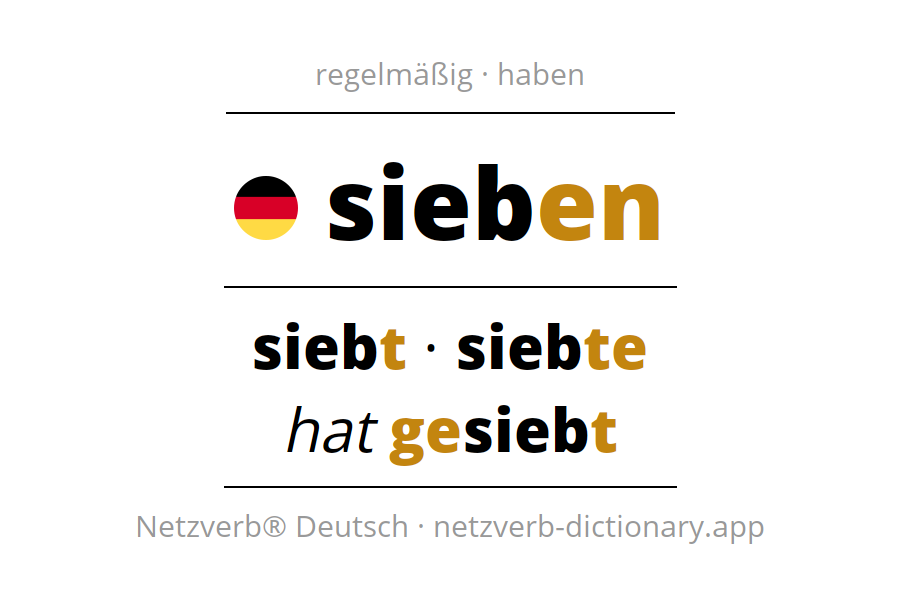
Netzverb Wörterbuch
Konjugation Verb sieben: im Präsens, Präteritum, Konjunktiv, Perfekt, ... viele Beispiele, Grammatik, Regeln erklärt, Übersetzung, Übungen, Bedeutung und kostenlose Downloads.
hollow summit
verb seit
lean flickerBOT
:x: All infinitives end with 'n'!
hollow summit
verb sein
lean flickerBOT

Netzverb Wörterbuch
Konjugation Verb sein: im Präsens, Präteritum, Konjunktiv, Perfekt, ... viele Beispiele, Grammatik, Regeln erklärt, Übersetzung, Übungen, Bedeutung und kostenlose Downloads.
 slow perch
faq anki
 timber cosmos
faq cefr
lean flickerBOT
CEFR levels
If you see something like A1, B2 or C1, these represent the proficiency of a speaker in a language they're not native in, and are called CEFR levels. They are valid for any language, not only German!
Roughly speaking, A levels are beginners and C levels are experts. Remember that CEFR level are self-assessed and indicative!
You can see more specific names and descriptions on the Wikipedia page:
https://en.wikipedia.org/wiki/Common_European_Framework_of_Reference_for_Languages
🗨 How do I know what level I am?
If the table on Wikipedia is too generic for you, you can try using this one here:
https://rm.coe.int/168045bb52
Just check each column one at a time: if you can do all it describes, move to the next column. Your level is the highest where you can do the most things.
Alternatively, you can use this questionnaire to estimate your level more accurately:
https://rm.coe.int/self-assessment-checklists-from-the-swiss-version-of-the-european-lang/1680492f8e
 patent flame
faq beginner
lean flickerBOT
How to get started
The simplest way to learn German is to find topics you don’t understand yet and search for explanations of them. This list provides you with a guide for which topics to learn if you are completely new to German. Type the topic into Google (or YouTube) and start learning!
Introduction
1: Alphabet (especially ä, ü, ö and ß)
2: Basic greetings (hello, goodbye, etc.)
Part 1 - Simple Sentence
1: Noun gender & plurals
2: Nominative case (What are cases?)
3: Nominative pronouns (I, you, he, she, etc.)
4: Verbs in present tense
5: Definite/indefinite articles
6: Accusative case (for nouns)
7: Accusative pronouns
8: Word order of simple sentences
9: How to ask questions
See Part 2 on the next page.
Tips
- Always learn the gender of a noun when you learn a new noun
- Learn to use a translation dictionary (e.g. dict.cc, leo.org)
- Use
>faq resourcesto see our list of German learning resources - For listening and pronunciation practice, try watching movies or videos (incl. YouTube)
- You can listen to pronunciation for words on websites like dict.cc, forvo.com, and others
- Practice writing sentences every day (and asking people to correct them)
- Ask as many questions as possible
- Don’t be scared to make mistakes!!!! If you don’t let yourself make mistakes, you will never be able to learn German
Page 1/2
patent flame
faq getting started
lean flickerBOT
FAQ not found. I found the following similar entry: How to get started (1)
Select one of the values in the brackets to directly open the suggested FAQ.
lean flickerBOT
How to get started
The simplest way to learn German is to find topics you don’t understand yet and search for explanations of them. This list provides you with a guide for which topics to learn if you are completely new to German. Type the topic into Google (or YouTube) and start learning!
Introduction
1: Alphabet (especially ä, ü, ö and ß)
2: Basic greetings (hello, goodbye, etc.)
Part 1 - Simple Sentence
1: Noun gender & plurals
2: Nominative case (What are cases?)
3: Nominative pronouns (I, you, he, she, etc.)
4: Verbs in present tense
5: Definite/indefinite articles
6: Accusative case (for nouns)
7: Accusative pronouns
8: Word order of simple sentences
9: How to ask questions
See Part 2 on the next page.
Tips
- Always learn the gender of a noun when you learn a new noun
- Learn to use a translation dictionary (e.g. dict.cc, leo.org)
- Use
>faq resourcesto see our list of German learning resources - For listening and pronunciation practice, try watching movies or videos (incl. YouTube)
- You can listen to pronunciation for words on websites like dict.cc, forvo.com, and others
- Practice writing sentences every day (and asking people to correct them)
- Ask as many questions as possible
- Don’t be scared to make mistakes!!!! If you don’t let yourself make mistakes, you will never be able to learn German
Page 1/2
 silver solstice
patent flame
Schau mal <@1150696840174501912>
silver solstice
patent flame
Schau mal <@1150696840174501912>
Dankeschön ❤️
rigid flare
explain all
lean flickerBOT
See a listed FAQ with >faq [name]
:small_blue_diamond: Roles
:small_blue_diamond: Seeing verbs
Aliases: Sehen, Schauen
:small_blue_diamond: So and also
:small_blue_diamond: Stative Passive
Aliases: Zustandspassiv, Statal passive
:small_blue_diamond: Structure of Konjunktiv II
Aliases: KII 2
:small_blue_diamond: Study Vocabulary
Aliases: Unterrichten, Studieren, Lernen, Beibringen
:small_blue_diamond: Swiss German
Aliases: gsw
:small_blue_diamond: Switzerland
Aliases: Schweiz, CH
:small_blue_diamond: Two-way prepositions
Aliases: Two way prepositions, Dual prepositions
:small_blue_diamond: Umlauts
Aliases: Umlaute, Umlaut, ä, ö, ü
:small_blue_diamond: Usage of Freund and Freundin
Aliases: Freundin, Friend, Friend vs. Boyfriend, Friend vs. Girlfriend, Boyfriend, Girlfriend, Freund
:small_blue_diamond: Usage of Konjunktiv II
Aliases: KII 1
:small_blue_diamond: Usage of zu
Aliases: Um zu
:small_blue_diamond: Verbs with prepositions
Aliases: Verb prepositions, Pferd's verb list
:small_blue_diamond: Vorgangspassiv
Page 4/5 (67 entries)
rigid flare
explain all
lean flickerBOT
See a listed FAQ with >faq [name]
:small_blue_diamond: Absentive
Aliases: Absentiv
:small_blue_diamond: Accusative
Aliases: Akkusativ
:small_blue_diamond: Adjective Declension
Aliases: Adjektivdeklination, Adjective endings
:small_blue_diamond: AI in language learning
Aliases: ai, chatgpt
:small_blue_diamond: Anki
Aliases: Flashcards
:small_blue_diamond: Beide vs. Beides
Aliases: Beides vs. Beide, Beides, Beide
:small_blue_diamond: Best way to learn German
Aliases: Fastest way to learn, Learn fast, Most efficient way to learn, Learn efficiently, Best way to learn, Learn German fast
:small_blue_diamond: Can anyone teach me German
Aliases: Private tutors, Teach me, Teach me German, Teach German, Private lessons, Private teachers
:small_blue_diamond: Cases
Aliases: Grammatical case, Case
:small_blue_diamond: CEFR levels
Aliases: CEFR, CERF
:small_blue_diamond: Conjugation
Aliases: Konjugation, Praesens, Verbs, Verb conjugation, Present tense, Präsens
:small_blue_diamond: Contractions
Aliases: Verschmelzung, Schmelzwort, Vom
:small_blue_diamond: DACH
:small_blue_diamond: Dative
Aliases: Dativ
:small_blue_diamond: Doch
Page 1/5 (67 entries)
rigid flare
explain Dativ
lean flickerBOT
When do I use the dative case?
The dative case has a great number of usages, many of which are idiomatic, but is mainly used:
- to mark the indirect object of many transitive verbs (the indirect objectis that which receives the result of an action)
Ich habe dir ein Bier gekauft.
Sie gibt dem Mann das Buch.
Er zeigte ihm seinen Führerschein.
- to mark the object of some transitive verbs:
Dir fehlen die richtigen Materialien.
Es fällt mir bestimmt gleich wieder ein.
Das gefällt ihr gar nicht.
- after some prepositions:
Ich komme aus den USA.
Komm mit mir.
Ich lerne seit vielen Jahren Deutsch.
The following prepositions are always followed by the dative case:
aus, außer, bei, gegenüber, mit, nach, seit, von, zu
- after two-way prepositions when they do not indicate movement:
Das Bild hängt jetzt an der Wand.
Er joggt im Wald. (he is jogging in the woods)
Sie steht vor mir.
- to show possession, mainly of clothing or body parts:
Ich habe mir in die Finger geschnitten.
Er hat ihr die Nase gebrochen.
Die Mütze fiel mir vom Kopf.
- with many adjectives:
Ich war mir nicht sicher.
Ist dir kalt? (See >ex impersonal verbs for why there is no subject here.)
Er ist seinem Bruder sehr ähnlich.
Page 2/2
rigid flare
explain KII 1
lean flickerBOT
Usage of Konjunktiv II
Konjunktiv II: Usage
Konjunktiv II is a grammatical mood that expresses irreality - it describes something that isn't guaranteed to happen.
(1) Wenn ich Millionen Dollar hätte, würde ich alle Speisen der ganzen Welt probieren. = “If I had million dollars, I would try all dishes around the world.”
(2) Wäre ich Mod, würde ich alle bannen. = “If I were a Mod, I would ban everybody.”
Konjunktiv II is also used as a form of politeness.
(3) Könnten Sie mir bitte helfen? = “Could you help me, please?”
And it also replaces Konjunktiv I (see >explain Konjunktiv I) when the conjugation of Konjunktiv I is ambiguous. For example, when it matches Präsens:
(4) Sie sagte, ich brauche sie. ➡️ Sie sagte, ich würde sie brauchen.
Now that we have explained the usage of Konjunktiv II, let’s see how it’s built!
Type >explain Structure of Konjunktiv II to read the second part.
rigid flare
explain cases
lean flickerBOT
Cases
Cases
German has four grammatical cases (der Fall or der Kasus in German): nominative, accusative, dative, and genitive. A case alters a noun, pronoun, adjective, etc., in some way to mark its grammatical function in a phrase, clause, or sentence. For example, the main function of the nominative (der Nominativ) case is to mark the subject in a sentence:
Ich liebe die deutsche Sprache!
In this sentence, the pronoun ich represents the first person subject and is in the nominative case. Every noun, pronoun, adjective, etc. has form in every case and it is very important to learn all of them. For example, the accusative form of ich is mich:
Die deutsche Sprache liebt mich!
See >explain adjective declension to get started on that. Don't get discouraged by how much there is, it takes some time master.
To see an explanation of the usages of every case, see their individual articles:
>explain nominative
>explain accusative
>explain dative
>explain genitive
rigid flare
faq beginner
lean flickerBOT
How to get started - Part 2
Please make sure to read Part 1 before starting Part 2!
Part 2 – Beyond a Simple Sentence
1: Conjunctions (coordinating and subordinating)
2: Subordinate clause word order
3: Dative case
4: Dative verbs
5: Verbs with two objects (e.g. geben)
6: Prepositions (accusative, dative, and two-way)
7: Spoken past tense (Perfekt)
8: Written past tense (Präteritum)
9: Genitive case
10: Relative clauses
11: Adjective declension
Tips
- Make sure to practice writing and reading simple texts
- Some of these concepts are confusing to start with, so it’s a good idea to ask for help in #questions when you’re unsure
- You should use a declension chart to help with declension to start with, because you won’t be able to memorize it straight away
- After you feel confident with creating sentences, you can start learning the adjective declension properly by using the command >faq adjective declension and reading the guide provided
Page 2/2
rigid flare
faq
lean flickerBOT
:x: The required argument name is missing.
rigid flare
faq all
lean flickerBOT
See a listed FAQ with >faq [name]
:small_blue_diamond: Roles
:small_blue_diamond: Seeing verbs
Aliases: Sehen, Schauen
:small_blue_diamond: So and also
:small_blue_diamond: Stative Passive
Aliases: Zustandspassiv, Statal passive
:small_blue_diamond: Structure of Konjunktiv II
Aliases: KII 2
:small_blue_diamond: Study Vocabulary
Aliases: Unterrichten, Studieren, Lernen, Beibringen
:small_blue_diamond: Swiss German
Aliases: gsw
:small_blue_diamond: Switzerland
Aliases: Schweiz, CH
:small_blue_diamond: Two-way prepositions
Aliases: Two way prepositions, Dual prepositions
:small_blue_diamond: Umlauts
Aliases: Umlaute, Umlaut, ä, ö, ü
:small_blue_diamond: Usage of Freund and Freundin
Aliases: Freundin, Friend, Friend vs. Boyfriend, Friend vs. Girlfriend, Boyfriend, Girlfriend, Freund
:small_blue_diamond: Usage of Konjunktiv II
Aliases: KII 1
:small_blue_diamond: Usage of zu
Aliases: Um zu
:small_blue_diamond: Verbs with prepositions
Aliases: Verb prepositions, Pferd's verb list
:small_blue_diamond: Vorgangspassiv
Page 4/5 (67 entries)
 gleaming vine
help
lean flickerBOT
Groups commands
:small_blue_diamond: **📒 group**
Commands for the bot's group system. You can use these to join and leave groups.
Group moderators can also start sessions, ping members and manage group membership.
Page 15/18 (18 entries)
 lunar plaza
explain all
lean flickerBOT
See a listed FAQ with >faq [name]
:small_blue_diamond: Absentive
Aliases: Absentiv
:small_blue_diamond: Accusative
Aliases: Akkusativ
:small_blue_diamond: Adjective Declension
Aliases: Adjektivdeklination, Adjective endings
:small_blue_diamond: AI in language learning
Aliases: ai, chatgpt
:small_blue_diamond: Anki
Aliases: Flashcards
:small_blue_diamond: Beide vs. Beides
Aliases: Beides vs. Beide, Beides, Beide
:small_blue_diamond: Best way to learn German
Aliases: Fastest way to learn, Learn fast, Most efficient way to learn, Learn efficiently, Best way to learn, Learn German fast
:small_blue_diamond: Can anyone teach me German
Aliases: Private tutors, Teach me, Teach me German, Teach German, Private lessons, Private teachers
:small_blue_diamond: Cases
Aliases: Grammatical case, Case
:small_blue_diamond: CEFR levels
Aliases: CEFR, CERF
:small_blue_diamond: Conjugation
Aliases: Konjugation, Praesens, Verbs, Verb conjugation, Present tense, Präsens
:small_blue_diamond: Contractions
Aliases: Verschmelzung, Schmelzwort, Vom
:small_blue_diamond: DACH
:small_blue_diamond: Dative
Aliases: Dativ
:small_blue_diamond: Doch
Page 1/5 (67 entries)
lunar plaza
explain Best way to learn German
lean flickerBOT
Factors that influence learning a language
The following factors (and many others) can influence how easily or quickly you learn German. Remember that everyone is different and these factors will influence different people in different ways.
Native language
As an example, if your native language is English, you may need more time than someone who speaks Dutch.
Previous language learning
Some learners find it easier to learn German if they have already learned a foreign language, or if they have a natural ability to learn languages.
Methods
Some are able to identify what type of learner they are, and leverage that to their benefit.
Discipline and Motivation
Learning a language is fun and exciting at first, but it can be easy to lose motivation and become less disciplined very quickly.
Consistency
Learning a little bit each day every week is generally considered better than studying for several hours, one day per week.
Grammar
The time needed to acquire grammar passively is quite large, so German learners who actively study grammar typically make less grammar mistakes as they progress.
Exposure and immersion
Interacting with native speakers and consuming native content such as the news, magazines, books, movies, podcasts, etc. can help tremendously with achieving an idiomatic usage of the language.
Training each ability equally
Listening, reading, speaking, writing, translating and interpreting are all various abilities associated with language learning. Training these abilities equally is important to ensure that a person can not only pass a language test, but also have the ability to use the language in various contexts while demonstrating great control over grammar.
Page 3/3
tender trellis
faq akkusativ
lean flickerBOT
When do I use the accusative case?
The accusative case is mainly used:
- to mark the direct object of many transitive verbs
Ich lese einen Roman.
Er hat die schöne Frau ermordet.
Sie besitzen kein Auto.
- after some prepositions
Danke für deine Hilfe!
Ohne dich kann ich nicht leben.
Sie hatten keine Einwände gegen den Plan.
The following prepositions are always followed by the accusative case:
bis, durch, für, gegen, ohne, um
- to indicate movement in a particular direction in two-way prepositions
Er steigt auf den Gipfel.
Sie hängt das Bild an die Wand.
Ich gehe gleich ins Bett. (ins = in das)
- by adverbials of time and measurement
A definite length or point in time:
Ich habe den ganzen Tag geschlafen.
Sie kommt nächste Woche zurück.
A measurement:
Das Kind ist vier Jahre alt.
Das Tier ist einen Meter groß.
Expressing distance with verbs of motion:
Ich ging die Treppe hinauf.
Ich lief den ganzen Weg zu Fuß.
- in common greetings and wishes
Guten Morgen/Tag/Abend!
Gute Besserung!
Herzlichen Glückwunsch!
Here there is an implicit verb such as 'wünschen', where the greeting/wish is the direct object.
Page 2/2
tender trellis
faq Dativ
lean flickerBOT
When do I use the dative case?
The dative case has a great number of usages, many of which are idiomatic, but is mainly used:
- to mark the indirect object of many transitive verbs (the indirect objectis that which receives the result of an action)
Ich habe dir ein Bier gekauft.
Sie gibt dem Mann das Buch.
Er zeigte ihm seinen Führerschein.
- to mark the object of some transitive verbs:
Dir fehlen die richtigen Materialien.
Es fällt mir bestimmt gleich wieder ein.
Das gefällt ihr gar nicht.
- after some prepositions:
Ich komme aus den USA.
Komm mit mir.
Ich lerne seit vielen Jahren Deutsch.
The following prepositions are always followed by the dative case:
aus, außer, bei, gegenüber, mit, nach, seit, von, zu
- after two-way prepositions when they do not indicate movement:
Das Bild hängt jetzt an der Wand.
Er joggt im Wald. (he is jogging in the woods)
Sie steht vor mir.
- to show possession, mainly of clothing or body parts:
Ich habe mir in die Finger geschnitten.
Er hat ihr die Nase gebrochen.
Die Mütze fiel mir vom Kopf.
- with many adjectives:
Ich war mir nicht sicher.
Ist dir kalt? (See >ex impersonal verbs for why there is no subject here.)
Er ist seinem Bruder sehr ähnlich.
Page 2/2
 hollow berry
faq genders
lean flickerBOT
Grammatical gender
German nouns are sorted in three different genders: masculine, neuter and feminine. These have nothing to do with sex or social gender.
The first thing genders will influence are articles like der, das, die. Each word has its own and you better get it right: some words that look identical can have different meanings depending on the gender they're used with. For example:
die Band = the (musical) band,
der Band = the (book) volume,
das Band = the tape.
Some words, mainly trademarks and loanwords, have multiple acceptable genders while having no change in meaning:
der Jogurt = das Jogurt
das Virus = der Virus
These may vary by region or colloquiality.
💢 But WHY, German, WHY ⁉
Gender is actually quite useful! Since sentence structure is less rigid than in English, grammatical case helps you tell the various elements apart (with some practice), and that works through genders: each gender has its own forms, which makes everything a little less ambiguous. Besides, as you've seen with Band above, it allows us to make up words with different meanings that look the same but are not ambiguous, and if that's not magic, I don't know what is. ✨
🙀 But how am I supposed to tell them apart? 🙀
Check out >explain gender patterns. 😉
hollow berry
explain gender patterns
lean flickerBOT
Gender patterns
Unfortunately, many German words don't have immediately clear clues that reveal it, but thankfully, many common words do follow patterns that reveal their gender.
In general, you are advised to learn the article together with the word (and its plural!).
Plural forms always use die and follow plural declension rules, which are the same for all genders (yay 🎉).
For compound words, remember that only the last word matters.
Type >explain grammatical gender for an explanation on grammatical gender.
Here's a list of patterns to recognise word gender.
Note that exceptions may apply.
Page 1/4
 karmic peak
How join vc
lean flickerBOT
@karmic peak, please read the Roles section in #getting-started for info on how to join VC and more.
lean flickerBOT
@karmic peak, please read the Roles section in #getting-started for info on how to join VC and more.
tender trellis
Walt 15 min
 keen grail
faq cefr
lean flickerBOT
CEFR levels
If you see something like A1, B2 or C1, these represent the proficiency of a speaker in a language they're not native in, and are called CEFR levels. They are valid for any language, not only German!
Roughly speaking, A levels are beginners and C levels are experts. Remember that CEFR level are self-assessed and indicative!
You can see more specific names and descriptions on the Wikipedia page:
https://en.wikipedia.org/wiki/Common_European_Framework_of_Reference_for_Languages
🗨 How do I know what level I am?
If the table on Wikipedia is too generic for you, you can try using this one here:
https://rm.coe.int/168045bb52
Just check each column one at a time: if you can do all it describes, move to the next column. Your level is the highest where you can do the most things.
Alternatively, you can use this questionnaire to estimate your level more accurately:
https://rm.coe.int/self-assessment-checklists-from-the-swiss-version-of-the-european-lang/1680492f8e
 marsh basin
example
 rigid mist
sessions
lean flickerBOT
There are no sessions currently scheduled.
lean flickerBOT
:x: The required argument input is missing.
German, like all natural languages, enables you to accurately express your thoughts, convey information, and state your intentions to other humans.
 torn aspen
faq beginner
lean flickerBOT
How to get started
The simplest way to learn German is to find topics you don’t understand yet and search for explanations of them. This list provides you with a guide for which topics to learn if you are completely new to German. Type the topic into Google (or YouTube) and start learning!
Introduction
1: Alphabet (especially ä, ü, ö and ß)
2: Basic greetings (hello, goodbye, etc.)
Part 1 - Simple Sentence
1: Noun gender & plurals
2: Nominative case (What are cases?)
3: Nominative pronouns (I, you, he, she, etc.)
4: Verbs in present tense
5: Definite/indefinite articles
6: Accusative case (for nouns)
7: Accusative pronouns
8: Word order of simple sentences
9: How to ask questions
See Part 2 on the next page.
Tips
- Always learn the gender of a noun when you learn a new noun
- Learn to use a translation dictionary (e.g. dict.cc, leo.org)
- Use
>faq resourcesto see our list of German learning resources - For listening and pronunciation practice, try watching movies or videos (incl. YouTube)
- You can listen to pronunciation for words on websites like dict.cc, forvo.com, and others
- Practice writing sentences every day (and asking people to correct them)
- Ask as many questions as possible
- Don’t be scared to make mistakes!!!! If you don’t let yourself make mistakes, you will never be able to learn German
Page 1/2
 ornate cradle
faq beginner
lean flickerBOT
How to get started
The simplest way to learn German is to find topics you don’t understand yet and search for explanations of them. This list provides you with a guide for which topics to learn if you are completely new to German. Type the topic into Google (or YouTube) and start learning!
Introduction
1: Alphabet (especially ä, ü, ö and ß)
2: Basic greetings (hello, goodbye, etc.)
Part 1 - Simple Sentence
1: Noun gender & plurals
2: Nominative case (What are cases?)
3: Nominative pronouns (I, you, he, she, etc.)
4: Verbs in present tense
5: Definite/indefinite articles
6: Accusative case (for nouns)
7: Accusative pronouns
8: Word order of simple sentences
9: How to ask questions
See Part 2 on the next page.
Tips
- Always learn the gender of a noun when you learn a new noun
- Learn to use a translation dictionary (e.g. dict.cc, leo.org)
- Use
>faq resourcesto see our list of German learning resources - For listening and pronunciation practice, try watching movies or videos (incl. YouTube)
- You can listen to pronunciation for words on websites like dict.cc, forvo.com, and others
- Practice writing sentences every day (and asking people to correct them)
- Ask as many questions as possible
- Don’t be scared to make mistakes!!!! If you don’t let yourself make mistakes, you will never be able to learn German
Page 1/2
 agile temple
 tawdry fossil
lean flickerBOT
tawdry fossil
lean flickerBOT
How to get started - Part 2
Please make sure to read Part 1 before starting Part 2!
Part 2 – Beyond a Simple Sentence
1: Conjunctions (coordinating and subordinating)
2: Subordinate clause word order
3: Dative case
4: Dative verbs
5: Verbs with two objects (e.g. geben)
6: Prepositions (accusative, dative, and two-way)
7: Spoken past tense (Perfekt)
8: Written past tense (Präteritum)
9: Genitive case
10: Relative clauses
11: Adjective declension
Tips
- Make sure to practice writing and reading simple texts
- Some of these concepts are confusing to start with, so it’s a good idea to ask for help in #questions when you’re unsure
- You should use a declension chart to help with declension to start with, because you won’t be able to memorize it straight away
- After you feel confident with creating sentences, you can start learning the adjective declension properly by using the command >faq adjective declension and reading the guide provided
Page 2/2
winged sedge
faq how to learn german fast
lean flickerBOT
FAQ not found. I found the following similar entries: How long does it take to learn German, Best way to learn German, How long to learn, Learn fast, Learn German fast, Fastest way to learn.
winged sedge
faq learn fast
lean flickerBOT
Best way to learn German
There isn’t only one “best” way to learn German, especially since different methods work better for different people. However, this FAQ will outline the main aspects of learning efficiently, which you can cater to your needs.
If you’re a beginner, type >faq beginner in #botchannel to see our beginner guide.
Cover all skills
There are many combinations of activities you can use to study and practice a language. How do you know which combinations are suitable? The key is to make sure you cover each of the main skills with at least one activity. Some activities only train one skills, while some train multiple – either is fine, as long as all the 6 skills are covered somewhere in your studies.
The skills
• Reading
• Writing
• Listening
• Speaking
• Grammar
• Vocabulary
Which resources should I use?
It doesn’t really matter which resources you use, as long as you can follow along, and the information is correct and reliable. If you have any doubts about whether a resource is correct, feel free to ask. You do not need to find just one resource and stick to it – in fact, to learn best, it’s recommended that you use a large variety of resources and switch between them when needed.
Type >faq resources in #botchannel to see our list of resources.
On the next page
• Should I study all these skills every day?
• How much time should I dedicate to studying?
Page 1/3
winged sedge
@knotty shard
 knotty shard
danke
winged sedge
faq remind 60
lean flickerBOT
FAQ not found. Try >explain all.
winged sedge
remind 60
lean flickerBOT
:x: The argument time (60) is malformed.
winged sedge
remind 60s
lean flickerBOT
:x: The required argument message is missing.
hollow summit
ex grammer terms
lean flickerBOT
Grammar terms
When learning languages, it's useful to know some grammatical terms.
Note that these are very simplified definitions aimed at giving you a general idea: do your own research if you need details.
- Adjective: a word that describes a name: the dog is old or the smart kid.
- Adverb: something that aids the verb or other part of the sentence, or words that don't fall into other categories: yes, I've done it swiftly or he's very good.
- Affix: a small word piece attached to another word to change its meaning. If it comes before the word it's a prefix: __in__credible, after it it's a suffix: time__ly__.
- Article: a word that tells you if a name is specific or generic: the apple, an apple.
- Case: the form of a word depending on its role: he and him refer to the same person, but he gives an apple to him.
- Clause: each unit that has one conjugated verb. Those before and after the comma are each a clause: Berzi said something, but I didn't understand.
- Conjugation: the form a verb takes depending on when it happens and who does it: I go, he goes, he went are all conjugations of the same verb.
- Conjunction: a word that connects two clauses together: he went there but I didn't.
- Declension: the form a word takes depending on its case: der Mann is a subject, den Mann is an object.
- Noun: the name of a thing, such as table or dog.
- Object: the one at the receiving end of the verb, or being affected by it directly: he touched me, she gave her an apple.
- Pronoun: a word that stands in for a name: he gave me a ring. I like it.
- Subject: the one that enacts the verb in first person: I saw a dog or a dog saw me.
- Tense: the form of a verb depending on when it happens: I see: present, I will see: future.
- Verb: a word describing an action: I go running every day.
lean flickerBOT
There are no sessions currently scheduled.
 deft edge
faq beginner
lean flickerBOT
How to get started - Part 2
Please make sure to read Part 1 before starting Part 2!
Part 2 – Beyond a Simple Sentence
1: Conjunctions (coordinating and subordinating)
2: Subordinate clause word order
3: Dative case
4: Dative verbs
5: Verbs with two objects (e.g. geben)
6: Prepositions (accusative, dative, and two-way)
7: Spoken past tense (Perfekt)
8: Written past tense (Präteritum)
9: Genitive case
10: Relative clauses
11: Adjective declension
Tips
- Make sure to practice writing and reading simple texts
- Some of these concepts are confusing to start with, so it’s a good idea to ask for help in #questions when you’re unsure
- You should use a declension chart to help with declension to start with, because you won’t be able to memorize it straight away
- After you feel confident with creating sentences, you can start learning the adjective declension properly by using the command >faq adjective declension and reading the guide provided
Page 2/2
 obsidian raft
help
lean flickerBOT
Meme 2/2 commands
:small_blue_diamond: **patcow** <member>
Pats the given member's cow.
:small_blue_diamond: **petdog** <member>
Pets the given member's dog.
:small_blue_diamond: **shootcat** <member>
Shoot the given member's cat, like the monster you are.
:small_blue_diamond: **shootdog** <member>
Shoot the given member's dog, like the monster you are.
Page 8/18 (18 entries)
 placid thistle
faq cefr
lean flickerBOT
CEFR levels
If you see something like A1, B2 or C1, these represent the proficiency of a speaker in a language they're not native in, and are called CEFR levels. They are valid for any language, not only German!
Roughly speaking, A levels are beginners and C levels are experts. Remember that CEFR level are self-assessed and indicative!
You can see more specific names and descriptions on the Wikipedia page:
https://en.wikipedia.org/wiki/Common_European_Framework_of_Reference_for_Languages
🗨 How do I know what level I am?
If the table on Wikipedia is too generic for you, you can try using this one here:
https://rm.coe.int/168045bb52
Just check each column one at a time: if you can do all it describes, move to the next column. Your level is the highest where you can do the most things.
Alternatively, you can use this questionnaire to estimate your level more accurately:
https://rm.coe.int/self-assessment-checklists-from-the-swiss-version-of-the-european-lang/1680492f8e
tender trellis
faq beginner
lean flickerBOT
How to get started
The simplest way to learn German is to find topics you don’t understand yet and search for explanations of them. This list provides you with a guide for which topics to learn if you are completely new to German. Type the topic into Google (or YouTube) and start learning!
Introduction
1: Alphabet (especially ä, ü, ö and ß)
2: Basic greetings (hello, goodbye, etc.)
Part 1 - Simple Sentence
1: Noun gender & plurals
2: Nominative case (What are cases?)
3: Nominative pronouns (I, you, he, she, etc.)
4: Verbs in present tense
5: Definite/indefinite articles
6: Accusative case (for nouns)
7: Accusative pronouns
8: Word order of simple sentences
9: How to ask questions
See Part 2 on the next page.
Tips
- Always learn the gender of a noun when you learn a new noun
- Learn to use a translation dictionary (e.g. dict.cc, leo.org)
- Use
>faq resourcesto see our list of German learning resources - For listening and pronunciation practice, try watching movies or videos (incl. YouTube)
- You can listen to pronunciation for words on websites like dict.cc, forvo.com, and others
- Practice writing sentences every day (and asking people to correct them)
- Ask as many questions as possible
- Don’t be scared to make mistakes!!!! If you don’t let yourself make mistakes, you will never be able to learn German
Page 1/2
robust gulch
faq genitiv
lean flickerBOT
When do I use the genitive case?
The genitive case is mainly used:
- to link nouns, especially when showing possession
Dies ist der größte Bahnhof der Welt.
Die Hälfte des Kuchens gehört mir.
Es gibt noch einen Strahl der Hoffnung.
For proper names, the order is reversed and an 's' is attached to the proper name as long as it does not end with an 's' sound.
Deutschlands längster Fluss ist der Rhein.
- to mark the object of very few transitive verbs
Empfindliche Haut bedarf besonderer Pflege.
Heute gedenkt die Nation des Jahrestages der Verfassung.
Wir harren einer Antwort.
- after some prepositions
The following prepositions are commonly followed by the genitive case in written German, but usually with the dative case in spoken German:
(an)statt, trotz, während, wegen
Prepositions denoting position are usually followed by the genitive case:
außerhalb, innerhalb, oberhalb, unterhalb, jenseits
A great number of prepositions that are only used in formal German, such as:
angesichts, bezüglich, einschließlich, fernab, infolge, namens, seitens, zugunsten
- by adverbials of indefinite time
Eines Tages werde ich Deutsch beherrschen.
Sonntags sind wir meist unterwegs.
Eines Nachts hörte ihr Vater sie weinen.
Note the declension in the last sentence. Although it is die Nacht, it assumes a similar form as the rest.
Page 2/2
robust gulch
faq
lean flickerBOT
:x: The required argument name is missing.
robust gulch
faq list
lean flickerBOT
See a listed FAQ with >faq [name]
:small_blue_diamond: Roles
:small_blue_diamond: Seeing verbs
Aliases: Sehen, Schauen
:small_blue_diamond: So and also
:small_blue_diamond: Stative Passive
Aliases: Zustandspassiv, Statal passive
:small_blue_diamond: Structure of Konjunktiv II
Aliases: KII 2
:small_blue_diamond: Study Vocabulary
Aliases: Unterrichten, Studieren, Lernen, Beibringen
:small_blue_diamond: Swiss German
Aliases: gsw
:small_blue_diamond: Switzerland
Aliases: Schweiz, CH
:small_blue_diamond: Two-way prepositions
Aliases: Two way prepositions, Dual prepositions
:small_blue_diamond: Umlauts
Aliases: Umlaute, Umlaut, ä, ö, ü
:small_blue_diamond: Usage of Freund and Freundin
Aliases: Freundin, Friend, Friend vs. Boyfriend, Friend vs. Girlfriend, Boyfriend, Girlfriend, Freund
:small_blue_diamond: Usage of Konjunktiv II
Aliases: KII 1
:small_blue_diamond: Usage of zu
Aliases: Um zu
:small_blue_diamond: Verbs with prepositions
Aliases: Verb prepositions, Pferd's verb list
:small_blue_diamond: Vorgangspassiv
Page 4/5 (67 entries)
tender trellis
faq resources
lean flickerBOT
Resources
Here's a link to our curated list of resources: https://bit.ly/gladresources. Check out #resources if you want to submit some yourself!
 halcyon bronze
faq cefr
lean flickerBOT
CEFR levels
If you see something like A1, B2 or C1, these represent the proficiency of a speaker in a language they're not native in, and are called CEFR levels. They are valid for any language, not only German!
Roughly speaking, A levels are beginners and C levels are experts. Remember that CEFR level are self-assessed and indicative!
You can see more specific names and descriptions on the Wikipedia page:
https://en.wikipedia.org/wiki/Common_European_Framework_of_Reference_for_Languages
🗨 How do I know what level I am?
If the table on Wikipedia is too generic for you, you can try using this one here:
https://rm.coe.int/168045bb52
Just check each column one at a time: if you can do all it describes, move to the next column. Your level is the highest where you can do the most things.
Alternatively, you can use this questionnaire to estimate your level more accurately:
https://rm.coe.int/self-assessment-checklists-from-the-swiss-version-of-the-european-lang/1680492f8e
 modest lintel
faq weak nouns
lean flickerBOT
Weak Nouns
Weak nouns are called this way because they receive the same endings as adjectives inflected with weak endings. They take an additional ending -n in every case except nominative singular. This is also known as N-Declension and affects almost exclusively masculine nouns.
Nominativ: der Junge, die Junge__n__
Genitiv: des Junge__n__, der Junge__n__
Dativ: dem Junge__n__, den Junge__n__
Akkusativ: den Junge__n__, die Junge__n__
Some nouns end with a suffix -en to make the pronunciation easier:
der Mensch, den Mensch__en__
‼ Das Herz is the only non-masculine (neuter) noun with N-Declension❣
So how do we recognize these nouns? We can divide them into 3 big groups:
- nouns of Greek and Latin origin,
- nouns ending with
-e(most of these refer to people or animals), - other random German nouns (Mensch, Herr, Student, Nachbar, Prinz etc.)
Another way to divide the groups could be:
- nouns denoting male beings in general (der Bauer, der Knabe, der Herr, der Junge, der Kunde etc.)
- nouns indicating nationality or religious affiliation (der Chinese, der Russe, der Türke, der Jude, der Katholik, der Protestant)
- nouns designating male beings and ending in the foreign suffixes (
-ant,-arch,-ast,-ege,-ent,-ist,-oge,-om,-oph,-ot: der Kollege, der Student, der Psychologe, der Polizist, der Philosoph)
‼ der Käse and words ending with -ee aren’t weak nouns.
Genitive of Weak Nouns
You might have noticed from the examples above that weak nouns don’t have the additional -s in genitive like other masculine nouns.
Some exceptions are das Herz and nouns of group 3 that don’t refer to people nor animals (Name, Wille, Glaube, Buchstabe etc.), which take both the -n and -s endings.
Example: der Name, des Name__ns__.
robust gulch
faq n deklination
lean flickerBOT
Weak Nouns
Weak nouns are called this way because they receive the same endings as adjectives inflected with weak endings. They take an additional ending -n in every case except nominative singular. This is also known as N-Declension and affects almost exclusively masculine nouns.
Nominativ: der Junge, die Junge__n__
Genitiv: des Junge__n__, der Junge__n__
Dativ: dem Junge__n__, den Junge__n__
Akkusativ: den Junge__n__, die Junge__n__
Some nouns end with a suffix -en to make the pronunciation easier:
der Mensch, den Mensch__en__
‼ Das Herz is the only non-masculine (neuter) noun with N-Declension❣
So how do we recognize these nouns? We can divide them into 3 big groups:
- nouns of Greek and Latin origin,
- nouns ending with
-e(most of these refer to people or animals), - other random German nouns (Mensch, Herr, Student, Nachbar, Prinz etc.)
Another way to divide the groups could be:
- nouns denoting male beings in general (der Bauer, der Knabe, der Herr, der Junge, der Kunde etc.)
- nouns indicating nationality or religious affiliation (der Chinese, der Russe, der Türke, der Jude, der Katholik, der Protestant)
- nouns designating male beings and ending in the foreign suffixes (
-ant,-arch,-ast,-ege,-ent,-ist,-oge,-om,-oph,-ot: der Kollege, der Student, der Psychologe, der Polizist, der Philosoph)
‼ der Käse and words ending with -ee aren’t weak nouns.
Genitive of Weak Nouns
You might have noticed from the examples above that weak nouns don’t have the additional -s in genitive like other masculine nouns.
Some exceptions are das Herz and nouns of group 3 that don’t refer to people nor animals (Name, Wille, Glaube, Buchstabe etc.), which take both the -n and -s endings.
Example: der Name, des Name__ns__.
 thick gazelle
faq beginner
lean flickerBOT
How to get started
The simplest way to learn German is to find topics you don’t understand yet and search for explanations of them. This list provides you with a guide for which topics to learn if you are completely new to German. Type the topic into Google (or YouTube) and start learning!
Introduction
1: Alphabet (especially ä, ü, ö and ß)
2: Basic greetings (hello, goodbye, etc.)
Part 1 - Simple Sentence
1: Noun gender & plurals
2: Nominative case (What are cases?)
3: Nominative pronouns (I, you, he, she, etc.)
4: Verbs in present tense
5: Definite/indefinite articles
6: Accusative case (for nouns)
7: Accusative pronouns
8: Word order of simple sentences
9: How to ask questions
See Part 2 on the next page.
Tips
- Always learn the gender of a noun when you learn a new noun
- Learn to use a translation dictionary (e.g. dict.cc, leo.org)
- Use
>faq resourcesto see our list of German learning resources - For listening and pronunciation practice, try watching movies or videos (incl. YouTube)
- You can listen to pronunciation for words on websites like dict.cc, forvo.com, and others
- Practice writing sentences every day (and asking people to correct them)
- Ask as many questions as possible
- Don’t be scared to make mistakes!!!! If you don’t let yourself make mistakes, you will never be able to learn German
Page 1/2
 autumn fulcrum
help
lean flickerBOT
Help commands
:small_blue_diamond: **help** [term]
Displays help information for modules and individual commands. The optional argument term is the search term to use. If no value is provided, the bot will display a list of all available modules. Otherwise, it will attempt to find information about the given term.
Page 1/18 (18 entries)
 eager mantle
faq accusative
lean flickerBOT
Accusative
The accusative case (der Akkusativ) is one of the four cases of the German language. A case affects how a noun or noun phrase is inflected, and indicates the role of the noun or noun phrase in a clause.
How do I decline in the accusative case?
Feminine and neuter nouns and adjectives are the same as nominative. Masculine determiners, adjectives, and weak nouns gain an -en ending::
Ich esse den/einen/keinen kleinen Apfel.
Personal pronouns differ for:
ich --> mich
du --> dich
er --> ihn
wir --> uns
ihr --> euch
For a full explanation see >explain adjective declension
Page 1/2
hollow summit
ex grammar terms
lean flickerBOT
Grammar terms
When learning languages, it's useful to know some grammatical terms.
Note that these are very simplified definitions aimed at giving you a general idea: do your own research if you need details.
- Adjective: a word that describes a name: the dog is old or the smart kid.
- Adverb: something that aids the verb or other part of the sentence, or words that don't fall into other categories: yes, I've done it swiftly or he's very good.
- Affix: a small word piece attached to another word to change its meaning. If it comes before the word it's a prefix: __in__credible, after it it's a suffix: time__ly__.
- Article: a word that tells you if a name is specific or generic: the apple, an apple.
- Case: the form of a word depending on its role: he and him refer to the same person, but he gives an apple to him.
- Clause: each unit that has one conjugated verb. Those before and after the comma are each a clause: Berzi said something, but I didn't understand.
- Conjugation: the form a verb takes depending on when it happens and who does it: I go, he goes, he went are all conjugations of the same verb.
- Conjunction: a word that connects two clauses together: he went there but I didn't.
- Declension: the form a word takes depending on its case: der Mann is a subject, den Mann is an object.
- Noun: the name of a thing, such as table or dog.
- Object: the one at the receiving end of the verb, or being affected by it directly: he touched me, she gave her an apple.
- Pronoun: a word that stands in for a name: he gave me a ring. I like it.
- Subject: the one that enacts the verb in first person: I saw a dog or a dog saw me.
- Tense: the form of a verb depending on when it happens: I see: present, I will see: future.
- Verb: a word describing an action: I go running every day.
 outer portal
faq beginner
lean flickerBOT
How to get started
The simplest way to learn German is to find topics you don’t understand yet and search for explanations of them. This list provides you with a guide for which topics to learn if you are completely new to German. Type the topic into Google (or YouTube) and start learning!
Introduction
1: Alphabet (especially ä, ü, ö and ß)
2: Basic greetings (hello, goodbye, etc.)
Part 1 - Simple Sentence
1: Noun gender & plurals
2: Nominative case (What are cases?)
3: Nominative pronouns (I, you, he, she, etc.)
4: Verbs in present tense
5: Definite/indefinite articles
6: Accusative case (for nouns)
7: Accusative pronouns
8: Word order of simple sentences
9: How to ask questions
See Part 2 on the next page.
Tips
- Always learn the gender of a noun when you learn a new noun
- Learn to use a translation dictionary (e.g. dict.cc, leo.org)
- Use
>faq resourcesto see our list of German learning resources - For listening and pronunciation practice, try watching movies or videos (incl. YouTube)
- You can listen to pronunciation for words on websites like dict.cc, forvo.com, and others
- Practice writing sentences every day (and asking people to correct them)
- Ask as many questions as possible
- Don’t be scared to make mistakes!!!! If you don’t let yourself make mistakes, you will never be able to learn German
Page 1/2
 solar drum
faq cefr
lean flickerBOT
CEFR levels
If you see something like A1, B2 or C1, these represent the proficiency of a speaker in a language they're not native in, and are called CEFR levels. They are valid for any language, not only German!
Roughly speaking, A levels are beginners and C levels are experts. Remember that CEFR level are self-assessed and indicative!
You can see more specific names and descriptions on the Wikipedia page:
https://en.wikipedia.org/wiki/Common_European_Framework_of_Reference_for_Languages
🗨 How do I know what level I am?
If the table on Wikipedia is too generic for you, you can try using this one here:
https://rm.coe.int/168045bb52
Just check each column one at a time: if you can do all it describes, move to the next column. Your level is the highest where you can do the most things.
Alternatively, you can use this questionnaire to estimate your level more accurately:
https://rm.coe.int/self-assessment-checklists-from-the-swiss-version-of-the-european-lang/1680492f8e
 median fox
faq cefr
lean flickerBOT
CEFR levels
If you see something like A1, B2 or C1, these represent the proficiency of a speaker in a language they're not native in, and are called CEFR levels. They are valid for any language, not only German!
Roughly speaking, A levels are beginners and C levels are experts. Remember that CEFR level are self-assessed and indicative!
You can see more specific names and descriptions on the Wikipedia page:
https://en.wikipedia.org/wiki/Common_European_Framework_of_Reference_for_Languages
🗨 How do I know what level I am?
If the table on Wikipedia is too generic for you, you can try using this one here:
https://rm.coe.int/168045bb52
Just check each column one at a time: if you can do all it describes, move to the next column. Your level is the highest where you can do the most things.
Alternatively, you can use this questionnaire to estimate your level more accurately:
https://rm.coe.int/self-assessment-checklists-from-the-swiss-version-of-the-european-lang/1680492f8e
median fox
faq cefr A
lean flickerBOT
FAQ not found. I found the following similar entry: CEFR (1)
Select one of the values in the brackets to directly open the suggested FAQ.
median fox
faq cefr 1
lean flickerBOT
FAQ not found. I found the following similar entry: CEFR (1)
Select one of the values in the brackets to directly open the suggested FAQ.
median fox
faq cefr A1
lean flickerBOT
FAQ not found. I found the following similar entry: CEFR (1)
Select one of the values in the brackets to directly open the suggested FAQ.
median fox
faq cefr @level A1
lean flickerBOT
FAQ not found. I found the following similar entry: CEFR levels (1)
Select one of the values in the brackets to directly open the suggested FAQ.
 red zodiac
faq beginner
lean flickerBOT
How to get started
The simplest way to learn German is to find topics you don’t understand yet and search for explanations of them. This list provides you with a guide for which topics to learn if you are completely new to German. Type the topic into Google (or YouTube) and start learning!
Introduction
1: Alphabet (especially ä, ü, ö and ß)
2: Basic greetings (hello, goodbye, etc.)
Part 1 - Simple Sentence
1: Noun gender & plurals
2: Nominative case (What are cases?)
3: Nominative pronouns (I, you, he, she, etc.)
4: Verbs in present tense
5: Definite/indefinite articles
6: Accusative case (for nouns)
7: Accusative pronouns
8: Word order of simple sentences
9: How to ask questions
See Part 2 on the next page.
Tips
- Always learn the gender of a noun when you learn a new noun
- Learn to use a translation dictionary (e.g. dict.cc, leo.org)
- Use
>faq resourcesto see our list of German learning resources - For listening and pronunciation practice, try watching movies or videos (incl. YouTube)
- You can listen to pronunciation for words on websites like dict.cc, forvo.com, and others
- Practice writing sentences every day (and asking people to correct them)
- Ask as many questions as possible
- Don’t be scared to make mistakes!!!! If you don’t let yourself make mistakes, you will never be able to learn German
Page 1/2
 vernal patio
help
lean flickerBOT
Session Schedule commands
:small_blue_diamond: **📒 session**
Commands for the bot's session scheduling system.
Group moderators can edit and delete existing sessions for their group.
Page 11/18 (18 entries)
lean flickerBOT
Bans commands
:small_blue_diamond: **isbanned** <user>
Checks whether the given user is banned.
Page 18/18 (18 entries)
vernal patio
help resources
lean flickerBOT
No command or module called resources found.
vernal patio
help resource
lean flickerBOT
No entries are currently available.
vernal patio
help dialect
lean flickerBOT
No command or module called dialect found.
vernal patio
faq
lean flickerBOT
:x: The required argument name is missing.
vernal patio
faq dialects
lean flickerBOT
FAQ not found. Try >explain all.
vernal patio
explain all
lean flickerBOT
See a listed FAQ with >faq [name]
:small_blue_diamond: Imperative
Aliases: imperativ
:small_blue_diamond: Impersonal Verbs
Aliases: Unpersönliche Verben, Impersonal es
:small_blue_diamond: IPA
Aliases: Pronunciation, Sound transcription, International Phonetic Alphabet
:small_blue_diamond: Languages in <#221708975698083841>
:small_blue_diamond: Lessons
Aliases: Sessions, Activities
:small_blue_diamond: Looking for information
Aliases: correct channel, information, right place to ask, right channel
:small_blue_diamond: Negation
Aliases: Nicht, Kein
:small_blue_diamond: Nicos
Aliases: Nicos Weg
:small_blue_diamond: Nominative
Aliases: Nominativ
:small_blue_diamond: Omission of movement verbs
:small_blue_diamond: Other languages
Aliases: languages
:small_blue_diamond: Passive
Aliases: Passiv
:small_blue_diamond: Past Tense
Aliases: perfekt, präteritum, praeteritum, present perfect, simple past
:small_blue_diamond: Prepositions of Place Part 1
Aliases: Nach-In-Auf-Zu
:small_blue_diamond: Resources
Aliases: Resource list
Page 3/5 (67 entries)
vernal patio
faq resources
lean flickerBOT
Resources
Here's a link to our curated list of resources: https://bit.ly/gladresources. Check out #resources if you want to submit some yourself!
 hollow plank
faq gender
lean flickerBOT
Grammatical gender
German nouns are sorted in three different genders: masculine, neuter and feminine. These have nothing to do with sex or social gender.
The first thing genders will influence are articles like der, das, die. Each word has its own and you better get it right: some words that look identical can have different meanings depending on the gender they're used with. For example:
die Band = the (musical) band,
der Band = the (book) volume,
das Band = the tape.
Some words, mainly trademarks and loanwords, have multiple acceptable genders while having no change in meaning:
der Jogurt = das Jogurt
das Virus = der Virus
These may vary by region or colloquiality.
💢 But WHY, German, WHY ⁉
Gender is actually quite useful! Since sentence structure is less rigid than in English, grammatical case helps you tell the various elements apart (with some practice), and that works through genders: each gender has its own forms, which makes everything a little less ambiguous. Besides, as you've seen with Band above, it allows us to make up words with different meanings that look the same but are not ambiguous, and if that's not magic, I don't know what is. ✨
🙀 But how am I supposed to tell them apart? 🙀
Check out >explain gender patterns. 😉
hollow plank
explain gender patterns`
lean flickerBOT
FAQ not found. I found the following similar entries: Gender patterns (1), Gender (2)
Select one of the values in the brackets to directly open the suggested FAQ.
hollow plank
explain gender patterns
lean flickerBOT
**Feminine words (die)**
- many words ending in
-e(die Nase, die Kiste) - words ending in:
---in(feminine professions/roles): die Verkäuferin, die Lehrerin
---eidie Fischerei, die Bäckerei
---schaftdie Mannschaft, die Gemeinschaft
---heit/-keitdie Freiheit, die Gerechtigkeit
---ungdie Bedeutung, die Achtung
---iondie Aktion, die Religion
---ikdie Logistik, die Logik
---anzwords of classical origin: die Allianz, die Toleranz
---urdie Natur, die Kultur
---tätdie Professionalität, die Kriminalität
Page 4/4
 chrome pollen
help
lean flickerBOT
Generic commands
:small_blue_diamond: **info** [user]
Displays information about the given user. If no user is specified, information about you will be displayed.
:small_blue_diamond: **quote** <message>
Quotes a message in the channel you are in.
As input specify the mention or name of the channel that the message was originally posted in and provide the message id of the message (accessible if you turn on developer mode in your Discord settings).
Instead of channel and message id you may also specify a message link.
:small_blue_diamond: **roles**
Lists all roles on the server.
:small_blue_diamond: **serverinfo**
Shows information about the current guild.
:small_blue_diamond: **showcolor** <hex code>
Shows an image of the given color hex code.
Page 9/18 (18 entries)
 unique snow
faq beginner
lean flickerBOT
How to get started
The simplest way to learn German is to find topics you don’t understand yet and search for explanations of them. This list provides you with a guide for which topics to learn if you are completely new to German. Type the topic into Google (or YouTube) and start learning!
Introduction
1: Alphabet (especially ä, ü, ö and ß)
2: Basic greetings (hello, goodbye, etc.)
Part 1 - Simple Sentence
1: Noun gender & plurals
2: Nominative case (What are cases?)
3: Nominative pronouns (I, you, he, she, etc.)
4: Verbs in present tense
5: Definite/indefinite articles
6: Accusative case (for nouns)
7: Accusative pronouns
8: Word order of simple sentences
9: How to ask questions
See Part 2 on the next page.
Tips
- Always learn the gender of a noun when you learn a new noun
- Learn to use a translation dictionary (e.g. dict.cc, leo.org)
- Use
>faq resourcesto see our list of German learning resources - For listening and pronunciation practice, try watching movies or videos (incl. YouTube)
- You can listen to pronunciation for words on websites like dict.cc, forvo.com, and others
- Practice writing sentences every day (and asking people to correct them)
- Ask as many questions as possible
- Don’t be scared to make mistakes!!!! If you don’t let yourself make mistakes, you will never be able to learn German
Page 1/2
 willow geyser
Hallo
 vivid drum
lean flickerBOT
vivid drum
lean flickerBOT
How to get started
The simplest way to learn German is to find topics you don’t understand yet and search for explanations of them. This list provides you with a guide for which topics to learn if you are completely new to German. Type the topic into Google (or YouTube) and start learning!
Introduction
1: Alphabet (especially ä, ü, ö and ß)
2: Basic greetings (hello, goodbye, etc.)
Part 1 - Simple Sentence
1: Noun gender & plurals
2: Nominative case (What are cases?)
3: Nominative pronouns (I, you, he, she, etc.)
4: Verbs in present tense
5: Definite/indefinite articles
6: Accusative case (for nouns)
7: Accusative pronouns
8: Word order of simple sentences
9: How to ask questions
See Part 2 on the next page.
Tips
- Always learn the gender of a noun when you learn a new noun
- Learn to use a translation dictionary (e.g. dict.cc, leo.org)
- Use
>faq resourcesto see our list of German learning resources - For listening and pronunciation practice, try watching movies or videos (incl. YouTube)
- You can listen to pronunciation for words on websites like dict.cc, forvo.com, and others
- Practice writing sentences every day (and asking people to correct them)
- Ask as many questions as possible
- Don’t be scared to make mistakes!!!! If you don’t let yourself make mistakes, you will never be able to learn German
Page 1/2
 radiant python
faq Präteritum
lean flickerBOT
Past Tense
German has two basic past tenses: Perfekt and Präteritum.
What’s the difference? Which one should I use?
To put it simply: Perfekt is used for spoken and casual German, and Präteritum is used for formal writing such as novels. For anything in between or if you’re unsure, it’s best to simply ask a native speaker. But most of the time, you will be using Perfekt, so it’s recommended that you learn that first!
However, even when you are using the Perfekt tense, a few verbs are often still used in Präteritum. This varies by region! Some native speakers use 100% Perfekt tense when they speak, but most people use at least a few words with Präteritum in their speech.
The main verbs commonly used in Präteritum form even when using Perfekt are:
• haben (e.g. ich hatte instead of ich habe gehabt)
• sein (e.g. ich war instead of ich bin gewesen)
• modal verbs
• wissen, denken (e.g. ich wusste, ich dachte)
The following are sometimes also used in Präteritum form but not as pervasively:
• bleiben, brauchen, finden, geben, gehen, laufen, liegen, rufen, sehen, sitzen, stehen, tun
Page 1/2
 lapis plume
faq präteritum
lean flickerBOT
Perfekt
How to form the Perfekt tense
The Perfekt tense is formed by combining an auxiliary verb (haben or sein) with the past participle form of the main verb.
For example, if I want to write the past tense of “essen”/“to eat”, such as in the English sentence “I ate”, I first need to know the auxiliary verb that goes with essen (which happens to be haben), and the past participle form of essen (which is gegessen).
I can then combine them with the usual verb conjugation and word order rules, as such:
Ich habe gegessen. -> I ate. / I have eaten.
Ich habe das Brot gegessen. -> I ate the bread. / I have eaten the bread.
How to determine the past participle?
Just look it up in the dictionary! There are a few general patterns you can also learn about, but a dictionary will pretty much always list the past participle somewhere near the verb itself.
When to use haben and when to use sein as the auxiliary verb?
The basic rules are:
• Transitive verbs (verbs which take an accusative object) use haben
• Intransitive verbs which describe a change of location or change of state use sein
• Other intransitive verbs use haben
This may not be a 100% reliable set of rules, so if in doubt, you can always use a dictionary to verify the correct auxiliary. Also note that there are a few regional variations.
Page 2/2
lapis plume
explain gender patterns
lean flickerBOT
**Neuter words (das)**
- nominalised verbs (das Leben, das Lesen)
- metals (das Gold, das Kupfer)
- babies and cubs (das Baby, das Lamm)
- diminutives in
-chen/-lein(das Hündchen) - words ending in:
---mentdas Experiment, das Sakrament
---ma(usually of Greek origin) das Komma, das Thema
Page 3/4
 graceful creek
faq beginner
lean flickerBOT
How to get started
The simplest way to learn German is to find topics you don’t understand yet and search for explanations of them. This list provides you with a guide for which topics to learn if you are completely new to German. Type the topic into Google (or YouTube) and start learning!
Introduction
1: Alphabet (especially ä, ü, ö and ß)
2: Basic greetings (hello, goodbye, etc.)
Part 1 - Simple Sentence
1: Noun gender & plurals
2: Nominative case (What are cases?)
3: Nominative pronouns (I, you, he, she, etc.)
4: Verbs in present tense
5: Definite/indefinite articles
6: Accusative case (for nouns)
7: Accusative pronouns
8: Word order of simple sentences
9: How to ask questions
See Part 2 on the next page.
Tips
- Always learn the gender of a noun when you learn a new noun
- Learn to use a translation dictionary (e.g. dict.cc, leo.org)
- Use
>faq resourcesto see our list of German learning resources - For listening and pronunciation practice, try watching movies or videos (incl. YouTube)
- You can listen to pronunciation for words on websites like dict.cc, forvo.com, and others
- Practice writing sentences every day (and asking people to correct them)
- Ask as many questions as possible
- Don’t be scared to make mistakes!!!! If you don’t let yourself make mistakes, you will never be able to learn German
Page 1/2
 gusty estuary
faq beginner
lean flickerBOT
How to get started - Part 2
Please make sure to read Part 1 before starting Part 2!
Part 2 – Beyond a Simple Sentence
1: Conjunctions (coordinating and subordinating)
2: Subordinate clause word order
3: Dative case
4: Dative verbs
5: Verbs with two objects (e.g. geben)
6: Prepositions (accusative, dative, and two-way)
7: Spoken past tense (Perfekt)
8: Written past tense (Präteritum)
9: Genitive case
10: Relative clauses
11: Adjective declension
Tips
- Make sure to practice writing and reading simple texts
- Some of these concepts are confusing to start with, so it’s a good idea to ask for help in #questions when you’re unsure
- You should use a declension chart to help with declension to start with, because you won’t be able to memorize it straight away
- After you feel confident with creating sentences, you can start learning the adjective declension properly by using the command >faq adjective declension and reading the guide provided
Page 2/2
 unkempt bough
faq Freund
lean flickerBOT
What does Freund/Freundin mean?
Does it mean *"friend"*, *"boyfriend/girlfriend"* or both?
It can mean both, although the meaning depends on the context in which the word is used. There are, however, a few commonly used ways to make its meaning clearer:
***ein* Freund/*eine* Freundin (von mir)**
Means a friend (of mine) = one of many.
In most cases it's clear that it refers to a friend and not a partner. Adding von mir emphasizes that even more.
Examples:
Eine Freundin von mir ist Ingenieurin. - A friend of mine is an engineer.
Ich habe einen Freund getroffen. - I met a friend.
but: Sie hat einen Freund. - She has a boyfriend.
_ _
_ _
***mein* Freund/*meine* Freundin**
Means my boyfriend/girlfriend.
In most cases this would refer to a partner.
Examples:
Meine Freundin ist endlich zu mir gezogen. Wir sind seit einem Jahr zusammen.
My girlfriend finally moved in with me. We've been together for a year.
but: Meine gute Freundin Arrem macht ausgezeichnete Pizza.
My good friend Arrem makes excellent pizza.
_ _
_ _
**fester Freund/feste Freundin**
In this case it's clear that it's referring to a partner and not a friend.
Examples:
Ich habe einen festen Freund, aber leider nur in meinen Träumen.
I have a boyfriend, but sadly only in my dreams.
 storm mulch
faq beginner
lean flickerBOT
How to get started
The simplest way to learn German is to find topics you don’t understand yet and search for explanations of them. This list provides you with a guide for which topics to learn if you are completely new to German. Type the topic into Google (or YouTube) and start learning!
Introduction
1: Alphabet (especially ä, ü, ö and ß)
2: Basic greetings (hello, goodbye, etc.)
Part 1 - Simple Sentence
1: Noun gender & plurals
2: Nominative case (What are cases?)
3: Nominative pronouns (I, you, he, she, etc.)
4: Verbs in present tense
5: Definite/indefinite articles
6: Accusative case (for nouns)
7: Accusative pronouns
8: Word order of simple sentences
9: How to ask questions
See Part 2 on the next page.
Tips
- Always learn the gender of a noun when you learn a new noun
- Learn to use a translation dictionary (e.g. dict.cc, leo.org)
- Use
>faq resourcesto see our list of German learning resources - For listening and pronunciation practice, try watching movies or videos (incl. YouTube)
- You can listen to pronunciation for words on websites like dict.cc, forvo.com, and others
- Practice writing sentences every day (and asking people to correct them)
- Ask as many questions as possible
- Don’t be scared to make mistakes!!!! If you don’t let yourself make mistakes, you will never be able to learn German
Page 1/2
lean flickerBOT
CEFR levels
If you see something like A1, B2 or C1, these represent the proficiency of a speaker in a language they're not native in, and are called CEFR levels. They are valid for any language, not only German!
Roughly speaking, A levels are beginners and C levels are experts. Remember that CEFR level are self-assessed and indicative!
You can see more specific names and descriptions on the Wikipedia page:
https://en.wikipedia.org/wiki/Common_European_Framework_of_Reference_for_Languages
🗨 How do I know what level I am?
If the table on Wikipedia is too generic for you, you can try using this one here:
https://rm.coe.int/168045bb52
Just check each column one at a time: if you can do all it describes, move to the next column. Your level is the highest where you can do the most things.
Alternatively, you can use this questionnaire to estimate your level more accurately:
https://rm.coe.int/self-assessment-checklists-from-the-swiss-version-of-the-european-lang/1680492f8e
 rancid pebble
faq beginner
lean flickerBOT
How to get started - Part 2
Please make sure to read Part 1 before starting Part 2!
Part 2 – Beyond a Simple Sentence
1: Conjunctions (coordinating and subordinating)
2: Subordinate clause word order
3: Dative case
4: Dative verbs
5: Verbs with two objects (e.g. geben)
6: Prepositions (accusative, dative, and two-way)
7: Spoken past tense (Perfekt)
8: Written past tense (Präteritum)
9: Genitive case
10: Relative clauses
11: Adjective declension
Tips
- Make sure to practice writing and reading simple texts
- Some of these concepts are confusing to start with, so it’s a good idea to ask for help in #questions when you’re unsure
- You should use a declension chart to help with declension to start with, because you won’t be able to memorize it straight away
- After you feel confident with creating sentences, you can start learning the adjective declension properly by using the command >faq adjective declension and reading the guide provided
Page 2/2
lean flickerBOT
There are no sessions currently scheduled.
 junior oak
faq linq
lean flickerBOT
FAQ not found. Try >explain all.
junior oak
explain all
lean flickerBOT
See a listed FAQ with >faq [name]
:small_blue_diamond: Absentive
Aliases: Absentiv
:small_blue_diamond: Accusative
Aliases: Akkusativ
:small_blue_diamond: Adjective Declension
Aliases: Adjektivdeklination, Adjective endings
:small_blue_diamond: AI in language learning
Aliases: ai, chatgpt
:small_blue_diamond: Anki
Aliases: Flashcards
:small_blue_diamond: Beide vs. Beides
Aliases: Beides vs. Beide, Beides, Beide
:small_blue_diamond: Best way to learn German
Aliases: Fastest way to learn, Learn fast, Most efficient way to learn, Learn efficiently, Best way to learn, Learn German fast
:small_blue_diamond: Can anyone teach me German
Aliases: Private tutors, Teach me, Teach me German, Teach German, Private lessons, Private teachers
:small_blue_diamond: Cases
Aliases: Grammatical case, Case
:small_blue_diamond: CEFR levels
Aliases: CEFR, CERF
:small_blue_diamond: Conjugation
Aliases: Konjugation, Praesens, Verbs, Verb conjugation, Present tense, Präsens
:small_blue_diamond: Contractions
Aliases: Verschmelzung, Schmelzwort, Vom
:small_blue_diamond: DACH
:small_blue_diamond: Dative
Aliases: Dativ
:small_blue_diamond: Doch
Page 1/5 (67 entries)
junior oak
faq apps to learn German
lean flickerBOT
Best way to learn German
There isn’t only one “best” way to learn German, especially since different methods work better for different people. However, this FAQ will outline the main aspects of learning efficiently, which you can cater to your needs.
If you’re a beginner, type >faq beginner in #botchannel to see our beginner guide.
Cover all skills
There are many combinations of activities you can use to study and practice a language. How do you know which combinations are suitable? The key is to make sure you cover each of the main skills with at least one activity. Some activities only train one skills, while some train multiple – either is fine, as long as all the 6 skills are covered somewhere in your studies.
The skills
• Reading
• Writing
• Listening
• Speaking
• Grammar
• Vocabulary
Which resources should I use?
It doesn’t really matter which resources you use, as long as you can follow along, and the information is correct and reliable. If you have any doubts about whether a resource is correct, feel free to ask. You do not need to find just one resource and stick to it – in fact, to learn best, it’s recommended that you use a large variety of resources and switch between them when needed.
Type >faq resources in #botchannel to see our list of resources.
On the next page
• Should I study all these skills every day?
• How much time should I dedicate to studying?
Page 1/3
junior oak
faq duolingo
lean flickerBOT
Duolingo
Duolingo is a decent resource to start with if you're a complete beginner, but it's neither efficient nor comprehensive!
What Duolingo will teach you about grammar is very limited, and none of the systems they use will help you practise much of it.
You can learn some vocabulary with it, but their method (based on the concept of spaced repetition) doesn't work for everybody, and the way Duolingo teaches is not very effective compared to the amount of time it requires from you.
So, if you find it useful, by all means keep using it, but remember not to fall for its gamification of language learning, and move past it when it stops being beneficial. Ignore the streaks.
In any case, keep in mind that Duolingo is not enough to learn a language, ever.
If you're looking for guidance or alternatives, check out >faq beginner in our #botchannel .
junior oak
help
lean flickerBOT
Eval commands
:small_blue_diamond: **eval** <code>
Evaluate the given code using an external compilation service. Any attempt to abuse this command will lead to a permanent blacklist.
Supported languages are: csharp (cs), java, python (py), c, c++ (cpp), haskell (hs), perl, nasm, javascript (js), lisp, kotlin (kt), brainfuck (bf) and rust (rs).
To use the command, specify a code block with your language of choice and provide any desired input in the same message, after the code block.
Example invocation with input:
```py
print('Hello,', input())
```
Barnabus Sandlers```
*Note: write out the command yourself, the example won't work if you copy it, due to Discord's formatting.*
:small_blue_diamond: Language specific notes:
- C# - the namespace and class must be called `Rextester` and `Program` respectively.
- Java - the class must be called `Rextester`
Page 4/18 (18 entries)
 quasi elm
faq beginner
lean flickerBOT
How to get started
The simplest way to learn German is to find topics you don’t understand yet and search for explanations of them. This list provides you with a guide for which topics to learn if you are completely new to German. Type the topic into Google (or YouTube) and start learning!
Introduction
1: Alphabet (especially ä, ü, ö and ß)
2: Basic greetings (hello, goodbye, etc.)
Part 1 - Simple Sentence
1: Noun gender & plurals
2: Nominative case (What are cases?)
3: Nominative pronouns (I, you, he, she, etc.)
4: Verbs in present tense
5: Definite/indefinite articles
6: Accusative case (for nouns)
7: Accusative pronouns
8: Word order of simple sentences
9: How to ask questions
See Part 2 on the next page.
Tips
- Always learn the gender of a noun when you learn a new noun
- Learn to use a translation dictionary (e.g. dict.cc, leo.org)
- Use
>faq resourcesto see our list of German learning resources - For listening and pronunciation practice, try watching movies or videos (incl. YouTube)
- You can listen to pronunciation for words on websites like dict.cc, forvo.com, and others
- Practice writing sentences every day (and asking people to correct them)
- Ask as many questions as possible
- Don’t be scared to make mistakes!!!! If you don’t let yourself make mistakes, you will never be able to learn German
Page 1/2
 tiny sky
hello USA🦅🦅🦅🦅🦅🦅🦅🦅🦅
 misty girder
hallo
 proven radish
faq beginner
lean flickerBOT
:x: The required argument name is missing.
lean flickerBOT
See a listed FAQ with >faq [name]
:small_blue_diamond: Imperative
Aliases: imperativ
:small_blue_diamond: Impersonal Verbs
Aliases: Unpersönliche Verben, Impersonal es
:small_blue_diamond: IPA
Aliases: Pronunciation, Sound transcription, International Phonetic Alphabet
:small_blue_diamond: Languages in <#221708975698083841>
:small_blue_diamond: Lessons
Aliases: Sessions, Activities
:small_blue_diamond: Looking for information
Aliases: correct channel, information, right place to ask, right channel
:small_blue_diamond: Negation
Aliases: Nicht, Kein
:small_blue_diamond: Nicos
Aliases: Nicos Weg
:small_blue_diamond: Nominative
Aliases: Nominativ
:small_blue_diamond: Omission of movement verbs
:small_blue_diamond: Other languages
Aliases: languages
:small_blue_diamond: Passive
Aliases: Passiv
:small_blue_diamond: Past Tense
Aliases: perfekt, präteritum, praeteritum, present perfect, simple past
:small_blue_diamond: Prepositions of Place Part 1
Aliases: Nach-In-Auf-Zu
:small_blue_diamond: Resources
Aliases: Resource list
Page 3/5 (67 entries)
tender trellis
faq beginner
lean flickerBOT
How to get started - Part 2
Please make sure to read Part 1 before starting Part 2!
Part 2 – Beyond a Simple Sentence
1: Conjunctions (coordinating and subordinating)
2: Subordinate clause word order
3: Dative case
4: Dative verbs
5: Verbs with two objects (e.g. geben)
6: Prepositions (accusative, dative, and two-way)
7: Spoken past tense (Perfekt)
8: Written past tense (Präteritum)
9: Genitive case
10: Relative clauses
11: Adjective declension
Tips
- Make sure to practice writing and reading simple texts
- Some of these concepts are confusing to start with, so it’s a good idea to ask for help in #questions when you’re unsure
- You should use a declension chart to help with declension to start with, because you won’t be able to memorize it straight away
- After you feel confident with creating sentences, you can start learning the adjective declension properly by using the command >faq adjective declension and reading the guide provided
Page 2/2
 silent dome
faq beginner
lean flickerBOT
How to get started
The simplest way to learn German is to find topics you don’t understand yet and search for explanations of them. This list provides you with a guide for which topics to learn if you are completely new to German. Type the topic into Google (or YouTube) and start learning!
Introduction
1: Alphabet (especially ä, ü, ö and ß)
2: Basic greetings (hello, goodbye, etc.)
Part 1 - Simple Sentence
1: Noun gender & plurals
2: Nominative case (What are cases?)
3: Nominative pronouns (I, you, he, she, etc.)
4: Verbs in present tense
5: Definite/indefinite articles
6: Accusative case (for nouns)
7: Accusative pronouns
8: Word order of simple sentences
9: How to ask questions
See Part 2 on the next page.
Tips
- Always learn the gender of a noun when you learn a new noun
- Learn to use a translation dictionary (e.g. dict.cc, leo.org)
- Use
>faq resourcesto see our list of German learning resources - For listening and pronunciation practice, try watching movies or videos (incl. YouTube)
- You can listen to pronunciation for words on websites like dict.cc, forvo.com, and others
- Practice writing sentences every day (and asking people to correct them)
- Ask as many questions as possible
- Don’t be scared to make mistakes!!!! If you don’t let yourself make mistakes, you will never be able to learn German
Page 1/2
winged sedge
explain dative
lean flickerBOT
When do I use the dative case?
The dative case has a great number of usages, many of which are idiomatic, but is mainly used:
- to mark the indirect object of many transitive verbs (the indirect objectis that which receives the result of an action)
Ich habe dir ein Bier gekauft.
Sie gibt dem Mann das Buch.
Er zeigte ihm seinen Führerschein.
- to mark the object of some transitive verbs:
Dir fehlen die richtigen Materialien.
Es fällt mir bestimmt gleich wieder ein.
Das gefällt ihr gar nicht.
- after some prepositions:
Ich komme aus den USA.
Komm mit mir.
Ich lerne seit vielen Jahren Deutsch.
The following prepositions are always followed by the dative case:
aus, außer, bei, gegenüber, mit, nach, seit, von, zu
- after two-way prepositions when they do not indicate movement:
Das Bild hängt jetzt an der Wand.
Er joggt im Wald. (he is jogging in the woods)
Sie steht vor mir.
- to show possession, mainly of clothing or body parts:
Ich habe mir in die Finger geschnitten.
Er hat ihr die Nase gebrochen.
Die Mütze fiel mir vom Kopf.
- with many adjectives:
Ich war mir nicht sicher.
Ist dir kalt? (See >ex impersonal verbs for why there is no subject here.)
Er ist seinem Bruder sehr ähnlich.
Page 2/2
 granite jolt
sessions
lean flickerBOT
There are no sessions currently scheduled.
 alpine sand
faq beginner
lean flickerBOT
How to get started
The simplest way to learn German is to find topics you don’t understand yet and search for explanations of them. This list provides you with a guide for which topics to learn if you are completely new to German. Type the topic into Google (or YouTube) and start learning!
Introduction
1: Alphabet (especially ä, ü, ö and ß)
2: Basic greetings (hello, goodbye, etc.)
Part 1 - Simple Sentence
1: Noun gender & plurals
2: Nominative case (What are cases?)
3: Nominative pronouns (I, you, he, she, etc.)
4: Verbs in present tense
5: Definite/indefinite articles
6: Accusative case (for nouns)
7: Accusative pronouns
8: Word order of simple sentences
9: How to ask questions
See Part 2 on the next page.
Tips
- Always learn the gender of a noun when you learn a new noun
- Learn to use a translation dictionary (e.g. dict.cc, leo.org)
- Use
>faq resourcesto see our list of German learning resources - For listening and pronunciation practice, try watching movies or videos (incl. YouTube)
- You can listen to pronunciation for words on websites like dict.cc, forvo.com, and others
- Practice writing sentences every day (and asking people to correct them)
- Ask as many questions as possible
- Don’t be scared to make mistakes!!!! If you don’t let yourself make mistakes, you will never be able to learn German
Page 1/2
alpine sand
faq resources
lean flickerBOT
Resources
Here's a link to our curated list of resources: https://bit.ly/gladresources. Check out #resources if you want to submit some yourself!
 last ermine
explain dativ
lean flickerBOT
When do I use the dative case?
The dative case has a great number of usages, many of which are idiomatic, but is mainly used:
- to mark the indirect object of many transitive verbs (the indirect objectis that which receives the result of an action)
Ich habe dir ein Bier gekauft.
Sie gibt dem Mann das Buch.
Er zeigte ihm seinen Führerschein.
- to mark the object of some transitive verbs:
Dir fehlen die richtigen Materialien.
Es fällt mir bestimmt gleich wieder ein.
Das gefällt ihr gar nicht.
- after some prepositions:
Ich komme aus den USA.
Komm mit mir.
Ich lerne seit vielen Jahren Deutsch.
The following prepositions are always followed by the dative case:
aus, außer, bei, gegenüber, mit, nach, seit, von, zu
- after two-way prepositions when they do not indicate movement:
Das Bild hängt jetzt an der Wand.
Er joggt im Wald. (he is jogging in the woods)
Sie steht vor mir.
- to show possession, mainly of clothing or body parts:
Ich habe mir in die Finger geschnitten.
Er hat ihr die Nase gebrochen.
Die Mütze fiel mir vom Kopf.
- with many adjectives:
Ich war mir nicht sicher.
Ist dir kalt? (See >ex impersonal verbs for why there is no subject here.)
Er ist seinem Bruder sehr ähnlich.
Page 2/2
last ermine
explain adjective declension
lean flickerBOT
Adjective Declension
A Brief Guide to Memorizing German Noun and Adjective Declension by Basementality
https://docs.google.com/document/d/1jWl5-kkqF3FQLDzrz8XLBJj7hvPFQK7MT5SYEDGK65E/edit
last ermine
explain
lean flickerBOT
:x: The required argument name is missing.
last ermine
commands
tender trellis
faq beginner
lean flickerBOT
How to get started
The simplest way to learn German is to find topics you don’t understand yet and search for explanations of them. This list provides you with a guide for which topics to learn if you are completely new to German. Type the topic into Google (or YouTube) and start learning!
Introduction
1: Alphabet (especially ä, ü, ö and ß)
2: Basic greetings (hello, goodbye, etc.)
Part 1 - Simple Sentence
1: Noun gender & plurals
2: Nominative case (What are cases?)
3: Nominative pronouns (I, you, he, she, etc.)
4: Verbs in present tense
5: Definite/indefinite articles
6: Accusative case (for nouns)
7: Accusative pronouns
8: Word order of simple sentences
9: How to ask questions
See Part 2 on the next page.
Tips
- Always learn the gender of a noun when you learn a new noun
- Learn to use a translation dictionary (e.g. dict.cc, leo.org)
- Use
>faq resourcesto see our list of German learning resources - For listening and pronunciation practice, try watching movies or videos (incl. YouTube)
- You can listen to pronunciation for words on websites like dict.cc, forvo.com, and others
- Practice writing sentences every day (and asking people to correct them)
- Ask as many questions as possible
- Don’t be scared to make mistakes!!!! If you don’t let yourself make mistakes, you will never be able to learn German
Page 1/2
 sharp cargo
faq Nicos Weg
lean flickerBOT
Nicos
Nicos Weg is a free online program aimed at helping people learn German. It includes video, audio, text, grammar explanations, notes, vocabulary, and exercises. It also includes very useful cultural and bureaucratic information, such as how to open a bank account, while teaching you the relevant grammar and vocabulary.
It’s fairly popular and well-recommended, but keep in mind that you can’t learn a language with only one resource, even if it’s a good one!
You can find the courses here: https://learngerman.dw.com/en/overview/
You can also see various other courses for learners by dw.com here: https://www.dw.com/en/learn-german/s-2469/
hollow summit
faq datif
lean flickerBOT
Dative
The dative case (der Dativ) is one of the four cases of the German language. A case affects how a noun or noun phrase is inflected, and indicates the role of the noun or noun phrase in a clause.
How do I decline in the dative case?
Nouns, pronouns, and adjective declension is completely different compared to the nominative case. See >explain adjective declension for a full explanation.
Page 1/2
hollow summit
explain dative
lean flickerBOT
Dative
The dative case (der Dativ) is one of the four cases of the German language. A case affects how a noun or noun phrase is inflected, and indicates the role of the noun or noun phrase in a clause.
How do I decline in the dative case?
Nouns, pronouns, and adjective declension is completely different compared to the nominative case. See >explain adjective declension for a full explanation.
Page 1/2
hollow summit
explain adjective declension
lean flickerBOT
Adjective Declension
A Brief Guide to Memorizing German Noun and Adjective Declension by Basementality
https://docs.google.com/document/d/1jWl5-kkqF3FQLDzrz8XLBJj7hvPFQK7MT5SYEDGK65E/edit
 austere dagger
faq Modalpartikel
lean flickerBOT
FAQ not found. Try >explain all.
austere dagger
faq doch
lean flickerBOT
Doch
⭐ doch for beginners ⭐
Germans tend to use the word doch in lots of different situations. But what does it mean, and when do you use it? ⁉
🔆 Using doch to contradict negative statements 🔆
You can use doch to contradict a negative statement/question in the same manner as you would use nein to contradict a positive statement.
(1) Laura hat keinen Fernseher, oder? - Doch, sie hat einen Fernseher!
Laura doesn't have a TV, does she? - Yes, she does!
(2) Du kannst kein Schach spielen! - Doch, das kann ich!
You can't play chess! - Yes, I can!
💡 With doch, correctly answering negative questions (with positive tags) has never been easier. Isn't that awesome? Doch, it is! 😏
🔅 Using doch as an adversative conjunction 🔅
You can also use doch as an adversative conjunction (yet, however, ...).
(3) Du hattest genug Zeit, doch du hast nicht für die Prüfung gelernt.
You had enough time, yet you didn't study for the exam.
(4) Es ist noch nicht Sommer, doch es ist fast genauso heiß.
It is not yet summer, it is, however, almost as hot.
‼ Keep in mind that doch as an adversative conjunction doesn't change the word order. ‼
🔅 Using doch as a subjunctive 🔅
Furthermore, you can use doch in concessive clauses.
(5) Auch wenn wir erwarteten, zu verlieren, so haben wir das Spiel doch gewonnen.
Though we expected to lose, we still won the game.
(6) Obwohl sie sehr nett ist, findet sie doch keine neuen Freunde.
Although she's very kind, she doesn't make new friends.
 pulsar nebula
faq beginner
lean flickerBOT
How to get started
The simplest way to learn German is to find topics you don’t understand yet and search for explanations of them. This list provides you with a guide for which topics to learn if you are completely new to German. Type the topic into Google (or YouTube) and start learning!
Introduction
1: Alphabet (especially ä, ü, ö and ß)
2: Basic greetings (hello, goodbye, etc.)
Part 1 - Simple Sentence
1: Noun gender & plurals
2: Nominative case (What are cases?)
3: Nominative pronouns (I, you, he, she, etc.)
4: Verbs in present tense
5: Definite/indefinite articles
6: Accusative case (for nouns)
7: Accusative pronouns
8: Word order of simple sentences
9: How to ask questions
See Part 2 on the next page.
Tips
- Always learn the gender of a noun when you learn a new noun
- Learn to use a translation dictionary (e.g. dict.cc, leo.org)
- Use
>faq resourcesto see our list of German learning resources - For listening and pronunciation practice, try watching movies or videos (incl. YouTube)
- You can listen to pronunciation for words on websites like dict.cc, forvo.com, and others
- Practice writing sentences every day (and asking people to correct them)
- Ask as many questions as possible
- Don’t be scared to make mistakes!!!! If you don’t let yourself make mistakes, you will never be able to learn German
Page 1/2
lean flickerBOT
There are no sessions currently scheduled.
 frosty ember
faq bitte
lean flickerBOT
FAQ not found. Try >explain all.
frosty ember

frosty ember
explain all
lean flickerBOT
See a listed FAQ with >faq [name]
:small_blue_diamond: Absentive
Aliases: Absentiv
:small_blue_diamond: Accusative
Aliases: Akkusativ
:small_blue_diamond: Adjective Declension
Aliases: Adjektivdeklination, Adjective endings
:small_blue_diamond: AI in language learning
Aliases: ai, chatgpt
:small_blue_diamond: Anki
Aliases: Flashcards
:small_blue_diamond: Beide vs. Beides
Aliases: Beides vs. Beide, Beides, Beide
:small_blue_diamond: Best way to learn German
Aliases: Fastest way to learn, Learn fast, Most efficient way to learn, Learn efficiently, Best way to learn, Learn German fast
:small_blue_diamond: Can anyone teach me German
Aliases: Private tutors, Teach me, Teach me German, Teach German, Private lessons, Private teachers
:small_blue_diamond: Cases
Aliases: Grammatical case, Case
:small_blue_diamond: CEFR levels
Aliases: CEFR, CERF
:small_blue_diamond: Conjugation
Aliases: Konjugation, Praesens, Verbs, Verb conjugation, Present tense, Präsens
:small_blue_diamond: Contractions
Aliases: Verschmelzung, Schmelzwort, Vom
:small_blue_diamond: DACH
:small_blue_diamond: Dative
Aliases: Dativ
:small_blue_diamond: Doch
Page 1/5 (67 entries)
frosty ember
faw best way to learn german
FAQ best way to learn german
faq best way to learn german
lean flickerBOT
Factors that influence learning a language
The following factors (and many others) can influence how easily or quickly you learn German. Remember that everyone is different and these factors will influence different people in different ways.
Native language
As an example, if your native language is English, you may need more time than someone who speaks Dutch.
Previous language learning
Some learners find it easier to learn German if they have already learned a foreign language, or if they have a natural ability to learn languages.
Methods
Some are able to identify what type of learner they are, and leverage that to their benefit.
Discipline and Motivation
Learning a language is fun and exciting at first, but it can be easy to lose motivation and become less disciplined very quickly.
Consistency
Learning a little bit each day every week is generally considered better than studying for several hours, one day per week.
Grammar
The time needed to acquire grammar passively is quite large, so German learners who actively study grammar typically make less grammar mistakes as they progress.
Exposure and immersion
Interacting with native speakers and consuming native content such as the news, magazines, books, movies, podcasts, etc. can help tremendously with achieving an idiomatic usage of the language.
Training each ability equally
Listening, reading, speaking, writing, translating and interpreting are all various abilities associated with language learning. Training these abilities equally is important to ensure that a person can not only pass a language test, but also have the ability to use the language in various contexts while demonstrating great control over grammar.
Page 3/3
frosty ember
faq anki
lean flickerBOT
Flashcard Tips
When creating flashcards it is not enough to just have a single german word on one side, and a single word translation on the other side of the card. You want to provide details that match your learning style and help you better understand what the word means.
For nouns
At the very least, include the gender and the plural form. E.g. Der Mann | Die Männer or Der Mann -:er Whichever form helps you recognise the plural ending and any vowel changes. You may also want to add a note for weak masculine nouns. (See >explain N-Declension.)
For verbs
Include the infinitive, the preterite (simple past) and the past participle (perfect form). E.g. rennen | rannte | gerannt or for a separable verb anrufen | rief an | angerufen. For irregular verbs, you may want to list all present tense conjugations. You may also want to include if the verb uses haben or sein as its auxiliary.
For all words
Adding an example sentence is important for helping you understand the usage and context of a word (dwds.de and linguee.com are good sources of example sentences). You may also want to add multiple translations for words that have multiple meanings. E.g. Die Auflage can mean both a requirement, and the edition of a book. You may also want to try picture cues or audio recordings (possible sources for voice recordings include dict.cc, linguee.com, duden.de, and wiktionary.de).
Close Passages
Flashcards based on close passages can be a very effective way to learn new vocabulary. E.g. put Ich kaufe Lebensmittel im [blank] ein. on one side of the flashcard, and Ich kaufe Lebensmittel im *Markt* ein; der Markt, die Märkte - market. This places vocabulary in context to help you understand its meaning and usages, and also provides you with whole phrases that help jolt your memory when trying to remember an individual word.
Recall vs. Reproduction
Flashcards are most effective when they train your ability to reproduce knowledge. I.e. Seeing the word Baum and recognising it as tree is a lot less effective than being able to look at a picture of a tree and know it means der Baum. Taking that a step further you want to be able to also know that that while die Struktur also means 'tree', it doesn't actually mean the plant. When creating flashcards, try to design them with these concepts in mind. E.g. Using minimal or no flashcards that show you a german word and ask you to recall what it means in english, and instead focus on the other way around: giving you an english word and asking you to recall what it means in german.
Page 2/2
lean flickerBOT
:x: This command can only be used by a staff member.
tender trellis
translate atmet
lean flickerBOT
:x: The required argument phrase is missing.
tender trellis
translate "atmet"
lean flickerBOT
:x: The required argument phrase is missing.
tender trellis
help
lean flickerBOT
German commands
:small_blue_diamond: **lookup** <target> <phrase>
Translates the given phrase into the specified target language using dict.cc. Specify either en or de as targets.
:small_blue_diamond: **noun** <noun>
Provides a link to the declension of the given noun.
:small_blue_diamond: **verb** <infinitive>
Provides a link to the conjugation of the given infinitive.
:small_blue_diamond: **words**
A command that helps you train vocabulary using dict.cc.
Page 13/18 (18 entries)
tender trellis
lookup atmet
lean flickerBOT
:x: The required argument phrase is missing.
tender trellis
lookup en atmet
lean flickerBOT
Translations for atmet:
**:small_blue_diamond:** sb. breathes
jd. atmet
**:small_blue_diamond:** sb. inhales
jd. atmet ein
**:small_blue_diamond:** sb. sth. respires
jd. etw. atmet auf
**:small_blue_diamond:** breathed gentle fragrance
Ich atmet' einen linden Duft [G. Mahler]
karmic peak
how enter vc
lean flickerBOT
@karmic peak, please read the Roles section in #getting-started for info on how to join VC and more.
lean flickerBOT
@karmic peak, please read the Roles section in #getting-started for info on how to join VC and more.
karmic peak
how enter chat
 jagged thunder
frag cefr
 vale mulch
faq cefr
lean flickerBOT
CEFR levels
If you see something like A1, B2 or C1, these represent the proficiency of a speaker in a language they're not native in, and are called CEFR levels. They are valid for any language, not only German!
Roughly speaking, A levels are beginners and C levels are experts. Remember that CEFR level are self-assessed and indicative!
You can see more specific names and descriptions on the Wikipedia page:
https://en.wikipedia.org/wiki/Common_European_Framework_of_Reference_for_Languages
🗨 How do I know what level I am?
If the table on Wikipedia is too generic for you, you can try using this one here:
https://rm.coe.int/168045bb52
Just check each column one at a time: if you can do all it describes, move to the next column. Your level is the highest where you can do the most things.
Alternatively, you can use this questionnaire to estimate your level more accurately:
https://rm.coe.int/self-assessment-checklists-from-the-swiss-version-of-the-european-lang/1680492f8e
 sand ridge
explain TeKaMoLo
lean flickerBOT
FAQ not found. Try >explain all.
lean flickerBOT
FAQ not found. Try >explain all.
sand ridge
explain all
lean flickerBOT
See a listed FAQ with >faq [name]
:small_blue_diamond: Roles
:small_blue_diamond: Seeing verbs
Aliases: Sehen, Schauen
:small_blue_diamond: So and also
:small_blue_diamond: Stative Passive
Aliases: Zustandspassiv, Statal passive
:small_blue_diamond: Structure of Konjunktiv II
Aliases: KII 2
:small_blue_diamond: Study Vocabulary
Aliases: Unterrichten, Studieren, Lernen, Beibringen
:small_blue_diamond: Swiss German
Aliases: gsw
:small_blue_diamond: Switzerland
Aliases: Schweiz, CH
:small_blue_diamond: Two-way prepositions
Aliases: Two way prepositions, Dual prepositions
:small_blue_diamond: Umlauts
Aliases: Umlaute, Umlaut, ä, ö, ü
:small_blue_diamond: Usage of Freund and Freundin
Aliases: Freundin, Friend, Friend vs. Boyfriend, Friend vs. Girlfriend, Boyfriend, Girlfriend, Freund
:small_blue_diamond: Usage of Konjunktiv II
Aliases: KII 1
:small_blue_diamond: Usage of zu
Aliases: Um zu
:small_blue_diamond: Verbs with prepositions
Aliases: Verb prepositions, Pferd's verb list
:small_blue_diamond: Vorgangspassiv
Page 4/5 (67 entries)
sand ridge
help
lean flickerBOT
Reminders commands
:small_blue_diamond: **📒 remind** <time> <message>
Has the bot remind you about things. You can specify a time in a short time format (e.g., 1y, 7w, 2mo, 1h30m) or a long format (e.g, 2020-12-31 23:59 CET) and a message for your reminder text.
Page 3/18 (18 entries)
frosty ember
explain n-declension
lean flickerBOT
Weak Nouns
Weak nouns are called this way because they receive the same endings as adjectives inflected with weak endings. They take an additional ending -n in every case except nominative singular. This is also known as N-Declension and affects almost exclusively masculine nouns.
Nominativ: der Junge, die Junge__n__
Genitiv: des Junge__n__, der Junge__n__
Dativ: dem Junge__n__, den Junge__n__
Akkusativ: den Junge__n__, die Junge__n__
Some nouns end with a suffix -en to make the pronunciation easier:
der Mensch, den Mensch__en__
‼ Das Herz is the only non-masculine (neuter) noun with N-Declension❣
So how do we recognize these nouns? We can divide them into 3 big groups:
- nouns of Greek and Latin origin,
- nouns ending with
-e(most of these refer to people or animals), - other random German nouns (Mensch, Herr, Student, Nachbar, Prinz etc.)
Another way to divide the groups could be:
- nouns denoting male beings in general (der Bauer, der Knabe, der Herr, der Junge, der Kunde etc.)
- nouns indicating nationality or religious affiliation (der Chinese, der Russe, der Türke, der Jude, der Katholik, der Protestant)
- nouns designating male beings and ending in the foreign suffixes (
-ant,-arch,-ast,-ege,-ent,-ist,-oge,-om,-oph,-ot: der Kollege, der Student, der Psychologe, der Polizist, der Philosoph)
‼ der Käse and words ending with -ee aren’t weak nouns.
Genitive of Weak Nouns
You might have noticed from the examples above that weak nouns don’t have the additional -s in genitive like other masculine nouns.
Some exceptions are das Herz and nouns of group 3 that don’t refer to people nor animals (Name, Wille, Glaube, Buchstabe etc.), which take both the -n and -s endings.
Example: der Name, des Name__ns__.
 atomic gulch
faq beginner
lean flickerBOT
How to get started
The simplest way to learn German is to find topics you don’t understand yet and search for explanations of them. This list provides you with a guide for which topics to learn if you are completely new to German. Type the topic into Google (or YouTube) and start learning!
Introduction
1: Alphabet (especially ä, ü, ö and ß)
2: Basic greetings (hello, goodbye, etc.)
Part 1 - Simple Sentence
1: Noun gender & plurals
2: Nominative case (What are cases?)
3: Nominative pronouns (I, you, he, she, etc.)
4: Verbs in present tense
5: Definite/indefinite articles
6: Accusative case (for nouns)
7: Accusative pronouns
8: Word order of simple sentences
9: How to ask questions
See Part 2 on the next page.
Tips
- Always learn the gender of a noun when you learn a new noun
- Learn to use a translation dictionary (e.g. dict.cc, leo.org)
- Use
>faq resourcesto see our list of German learning resources - For listening and pronunciation practice, try watching movies or videos (incl. YouTube)
- You can listen to pronunciation for words on websites like dict.cc, forvo.com, and others
- Practice writing sentences every day (and asking people to correct them)
- Ask as many questions as possible
- Don’t be scared to make mistakes!!!! If you don’t let yourself make mistakes, you will never be able to learn German
Page 1/2
 steel oracle
lean flickerBOT
steel oracle
lean flickerBOT
Resources
Here's a link to our curated list of resources: https://bit.ly/gladresources. Check out #resources if you want to submit some yourself!
frosty ember
faq
lean flickerBOT
:x: The required argument name is missing.
frosty ember
explain all
lean flickerBOT
See a listed FAQ with >faq [name]
:small_blue_diamond: Roles
:small_blue_diamond: Seeing verbs
Aliases: Sehen, Schauen
:small_blue_diamond: So and also
:small_blue_diamond: Stative Passive
Aliases: Zustandspassiv, Statal passive
:small_blue_diamond: Structure of Konjunktiv II
Aliases: KII 2
:small_blue_diamond: Study Vocabulary
Aliases: Unterrichten, Studieren, Lernen, Beibringen
:small_blue_diamond: Swiss German
Aliases: gsw
:small_blue_diamond: Switzerland
Aliases: Schweiz, CH
:small_blue_diamond: Two-way prepositions
Aliases: Two way prepositions, Dual prepositions
:small_blue_diamond: Umlauts
Aliases: Umlaute, Umlaut, ä, ö, ü
:small_blue_diamond: Usage of Freund and Freundin
Aliases: Freundin, Friend, Friend vs. Boyfriend, Friend vs. Girlfriend, Boyfriend, Girlfriend, Freund
:small_blue_diamond: Usage of Konjunktiv II
Aliases: KII 1
:small_blue_diamond: Usage of zu
Aliases: Um zu
:small_blue_diamond: Verbs with prepositions
Aliases: Verb prepositions, Pferd's verb list
:small_blue_diamond: Vorgangspassiv
Page 4/5 (67 entries)
frosty ember
faq um zu
lean flickerBOT
Usage of zu
Usage of ZU
Zu is a word that has a lot of uses.
As a preposition it means “to/towards”. (see >ex Dative and >ex Prepositions of Place Part 1)
But it can also be used to indicate an infinitive/gerund in a sentence, for example:
(1) Es ist schwierig, Deutsch zu lernen. = “Learning German is hard.” or ”It’s hard to learn German.”
As you can see, the zu is placed before the infinitive verb that has no prefix or a non-separable prefix. For verbs with a separable prefix, the zu goes between the prefix and the verb with no space in between:
(2) Ich habe heute bloß vor, Essen einzukaufen. = I only plan to buy food today.
You can also see it in the um...zu structure, where it means ”in order to”.
The um goes to the beginning of the phrase and zu works the same way as explained above.
(3) Wir sind zum Supermarkt gegangen, um etwas Brot zu kaufen. = We went to the shop (in order) to buy some bread.
(4) Ich lerne Deutsch, um mit Deutschen reden zu können. = I am learning German (in order) to be able to speak to Germans.
‼you can use um...zu only if the people doing both actions are the same. So in the examples above:
• in (3) we go and we buy bread
• in (4) I learn and I speak
❌ *ich gebe ihm ein Geschenk, um er glücklich zu sein - This and other weird stuffs are WRONG!
🌟 Bonus: When you want to say in order to, but the subjects are different, you use the subordinate conjunction damit.
frosty ember
ex prepositions
lean flickerBOT
FAQ not found. I found the following similar entries: Prepositions of Place Part 1, Dual prepositions, Two-way prepositions, Verb prepositions, Two way prepositions, Verbs with prepositions.
frosty ember
ex prepositions of place part 1
lean flickerBOT
Prepositions of Place Part 1
Generally you use the preposition nach when talking about going to countries, cities or directions, for example:
(1) Ich fahre nach Berlin. (I’m going to Berlin.)
(2) Ich gehe nach Westen. (I’m going west.)
(3) Ich fahre nach Deutschland. (I'm going to Germany.)
‼ Note that nach does not work with countries or regions that take an article. In this case you need to replace it with in, for example: Ich fahre in die Schweiz. (I’m going to Switzerland.)
In addition to that you will need to use auf for specific islands, for example: Ich fliege auf die Balearen. (I fly to the Balearic Islands.)
Here you can find a map with countries that take an article: http://i.imgur.com/QRFA2WI.png
🌟 nach is also idiomatically used in nach Hause gehen (to go home)
The preposition zu is used when talking about going to people, or places with a proper name, for example:
(4) Ich gehe zu ihm. (I go to him.)
(5) Ich gehe zum [zu dem] Arzt. (I go to the doctor.)
(6) Ich gehe zu Aldi. (I go to Aldi.)
You use in if you will end up inside a place or location, for example:
(7) Ich gehe in die Kirche. (I go to church.)
(8) Ich gehe ins [in das] Kino. (I go to the cinema.)
You use auf if you will end up on something, or for going to formal events, for example:
(9) Ich klettere auf den Berg. (I climb up the mountain.)
(10) Ich gehe auf die Toilette. (I go to the toilet.)
(11) Ich gehe auf eine Party. (I go to a party.)
🌟 When in doubt, use zu, since you can often replace in and auf with zu, for example:
(12) Ich gehe zur Kirche. (I go to the church.) [but not necessarily inside]
(13) Ich gehe zu einer Party. (I go to a party.)
‼ However, note that you cannot replace zu with in if it would be absurd to speak of going inside:
(14) Ich fahre in die Kirche. (I drive into the church.)
tender trellis
lean flicker
FAQ not found. I found the following similar entries: **Prepositions of Place Pa...
wtf, cristobal colon
tender trellis
faq beginner
lean flickerBOT
How to get started
The simplest way to learn German is to find topics you don’t understand yet and search for explanations of them. This list provides you with a guide for which topics to learn if you are completely new to German. Type the topic into Google (or YouTube) and start learning!
Introduction
1: Alphabet (especially ä, ü, ö and ß)
2: Basic greetings (hello, goodbye, etc.)
Part 1 - Simple Sentence
1: Noun gender & plurals
2: Nominative case (What are cases?)
3: Nominative pronouns (I, you, he, she, etc.)
4: Verbs in present tense
5: Definite/indefinite articles
6: Accusative case (for nouns)
7: Accusative pronouns
8: Word order of simple sentences
9: How to ask questions
See Part 2 on the next page.
Tips
- Always learn the gender of a noun when you learn a new noun
- Learn to use a translation dictionary (e.g. dict.cc, leo.org)
- Use
>faq resourcesto see our list of German learning resources - For listening and pronunciation practice, try watching movies or videos (incl. YouTube)
- You can listen to pronunciation for words on websites like dict.cc, forvo.com, and others
- Practice writing sentences every day (and asking people to correct them)
- Ask as many questions as possible
- Don’t be scared to make mistakes!!!! If you don’t let yourself make mistakes, you will never be able to learn German
Page 1/2
 glass roost
faq beginner
lean flickerBOT
How to get started
The simplest way to learn German is to find topics you don’t understand yet and search for explanations of them. This list provides you with a guide for which topics to learn if you are completely new to German. Type the topic into Google (or YouTube) and start learning!
Introduction
1: Alphabet (especially ä, ü, ö and ß)
2: Basic greetings (hello, goodbye, etc.)
Part 1 - Simple Sentence
1: Noun gender & plurals
2: Nominative case (What are cases?)
3: Nominative pronouns (I, you, he, she, etc.)
4: Verbs in present tense
5: Definite/indefinite articles
6: Accusative case (for nouns)
7: Accusative pronouns
8: Word order of simple sentences
9: How to ask questions
See Part 2 on the next page.
Tips
- Always learn the gender of a noun when you learn a new noun
- Learn to use a translation dictionary (e.g. dict.cc, leo.org)
- Use
>faq resourcesto see our list of German learning resources - For listening and pronunciation practice, try watching movies or videos (incl. YouTube)
- You can listen to pronunciation for words on websites like dict.cc, forvo.com, and others
- Practice writing sentences every day (and asking people to correct them)
- Ask as many questions as possible
- Don’t be scared to make mistakes!!!! If you don’t let yourself make mistakes, you will never be able to learn German
Page 1/2
 livid grail
faq Präsens
lean flickerBOT
Conjugation
Präsens (Present Tense)
When you use a verb in a sentence (or clause), you have to conjugate it (change the form) to match the subject of the sentence (or clause).
For example, in English, we write I eat but he/she eats. The verb has a different ending! The concept is the same in German, except German has more endings.
The first thing you need to know in order to conjugate verbs is: which ending fits which subject? Here is a simple verb “trinken” (to drink) as an example:
trinken
ich trinke
du trinkst
er/sie/es trinkt
wir trinken
ihr trinkt
sie trinken / Sie trinken
(Note: the conjugation for sie (they) and Sie (formal you) is always the same)
Vowel/Stem Changes
There are a few variations and exceptions, but the most important is vowel changes (also called stem changes). Some verbs get a vowel change, which only affects the du and er/sie/es forms of the verb. (However, modal verbs and wissen have their own special pattern, which also has a vowel change in the ich form.)
Example: ich schlafe, du schläfst
Other Changes
There are various other differences but I can’t describe them all here, so please read these websites or use Google to find more information: https://www.vistawide.com/german/grammar/german_verbs_present_tense.htm
https://www.thoughtco.com/german-present-tense-verbs-4074838
http://www.dartmouth.edu/~deutsch/Grammatik/PresentTense/Present.html
livid grail
help
lean flickerBOT
German commands
:small_blue_diamond: **lookup** <target> <phrase>
Translates the given phrase into the specified target language using dict.cc. Specify either en or de as targets.
:small_blue_diamond: **noun** <noun>
Provides a link to the declension of the given noun.
:small_blue_diamond: **verb** <infinitive>
Provides a link to the conjugation of the given infinitive.
:small_blue_diamond: **words**
A command that helps you train vocabulary using dict.cc.
Page 13/18 (18 entries)
livid grail
lookup en ins
lean flickerBOT
Translations for ins:
**:small_blue_diamond:** into (the)
ins [in das]
**:small_blue_diamond:** into abstruseness
ins Abstruse
**:small_blue_diamond:** into touch *[football]*
ins Aus
**:small_blue_diamond:** abroad *[to* *foreign* *country* *or* *to* *foreign* *countries]*
ins Ausland
**:small_blue_diamond:** overseas *[to* *foreign* *country]*
ins Ausland
Page 1/2 (10 entries)
livid grail
lookup de ins
lean flickerBOT
Translations for ins:
**:small_blue_diamond:** In-countries <Ins> *[Länder,* *die* *die* *EU-Konvergenzkriterien* *erfüllen]*
"in" countries <Ins>
**:small_blue_diamond:** Add-ins
add-ins
**:small_blue_diamond:** Einbrüche
break-ins [burglaries]
**:small_blue_diamond:** Einbaumöbel
built-ins
**:small_blue_diamond:** Einbauten
built-ins
Page 1/2 (10 entries)
livid grail
lookup en gehe
lean flickerBOT
Translations for gehe:
**:small_blue_diamond:** Go!
Gehe!
**:small_blue_diamond:** am going.
Ich gehe.
**:small_blue_diamond:** Gehe Foundation
Gehe-Stiftung
**:small_blue_diamond:** am going shopping.
Ich gehe einkaufen.
**:small_blue_diamond:** I'm off.
Ich gehe jetzt.
Page 1/2 (10 entries)
livid grail
lookup en tier
lean flickerBOT
Translations for tier:
**:small_blue_diamond:** animal *[attr.]*
Tier-
**:small_blue_diamond:** pet *[attr.]* *[e.g.* *cemetery,* *clothing,* *food,* *lover,* *shop]*
Tier- [Heimtier-] [z. B. Friedhof, Kleidung, Nahrung, Freund, Handlung]
**:small_blue_diamond:** animal *[also:* *fig]*
Tier [auch: fig.]
**:small_blue_diamond:** beast
Tier
**:small_blue_diamond:** brute
Tier
Page 1/2 (10 entries)
livid grail
lookup en sein
lean flickerBOT
:x: The required argument phrase is missing.
livid grail
lookup en sein
lean flickerBOT
Translations for sein:
**:small_blue_diamond:** his *[determiner]*
sein
**:small_blue_diamond:** *[we]* are
[wir] sein [regional] [sind]
**:small_blue_diamond:** its *[determiner]*
sein
**:small_blue_diamond:** his *[possessive]*
sein [poetisch veraltet]
**:small_blue_diamond:** their *[non-gender-specific]* *[after* *an* *indefinite* *singular* *antecedent* *in* *place* *of* *"his"* *or* *"her"* *or* *"his* *or* *her"]*
[geschlechtsneutral, statt „sein“ oder „ihr“ oder „sein oder ihr“]
Page 1/2 (10 entries)
Invalid target language. Specify en or de.
livid grail
lookup en könnte
lean flickerBOT
Translations for könnte:
**:small_blue_diamond:** sb. might
jd. könnte
**:small_blue_diamond:** sb. sth. may *[might]*
jd. etw. könnte
**:small_blue_diamond:** sb. sth. could *[would* *be* *able]*
jd. etw. könnte
**:small_blue_diamond:** sb. would be able
jd. könnte
**:small_blue_diamond:** *[I]* couldn't *[would* *not* *be* *able]*
[ich] könnte nicht
Page 1/2 (10 entries)
livid grail
lookup en sein könnte
lean flickerBOT
Translations for sein könnte:
**:small_blue_diamond:** There is chance ...
Es könnte sein ...
**:small_blue_diamond:** sth. may be necessary
etw. könnte notwendig sein
**:small_blue_diamond:** He might have died. *[It's* *possibility* *that* *he* *did]*
Er könnte gestorben sein.
**:small_blue_diamond:** Worse things happen at sea.
Es könnte schlimmer sein.
**:small_blue_diamond:** It is possible that ...
Es könnte sein, dass ...
Page 1/2 (10 entries)
livid grail
lookup en wäre
lean flickerBOT
Translations for wäre:
**:small_blue_diamond:** sb. sth. were *[subjunctive]*
jd. etw. wäre
**:small_blue_diamond:** sb. would be
jd. wäre
**:small_blue_diamond:** The perfect case would be ...
Ideal wäre ...
**:small_blue_diamond:** Which is what?
Welches wäre?
**:small_blue_diamond:** What would that be?
Das da wäre?
Page 1/2 (10 entries)
livid grail
lookup en heiße
lean flickerBOT
Translations for heiße:
**:small_blue_diamond:** The name is ... *[coll.]*
Ich heiße ...
**:small_blue_diamond:** hot issues
heiße Aktien
**:small_blue_diamond:** hot ash
heiße Asche
**:small_blue_diamond:** heated atmosphere
heiße Atmosphäre
**:small_blue_diamond:** fox *[Am.]* *[sl.]* *[attractive* *woman]*
heiße Braut [ugs.]
Page 1/2 (10 entries)
livid grail
lookup en Wenn ich ein Tier sein könnte
lean flickerBOT
Translations for Wenn ich ein Tier sein könnte:
**:small_blue_diamond:** But if think about that, can't recall any.
Wenn ich überlege, fällt mir aber gerade keiner ein.
**:small_blue_diamond:** love it when plan comes together. *[The* *A-Team]*
Ich liebe es, wenn ein Plan funktioniert. [Das A-Team]
**:small_blue_diamond:** would like see him, but only for few hours.
Ich würde ihn gern sehen, wenn auch nur für ein paar Stunden.
**:small_blue_diamond:** would like see him, if only for few hours.
Ich würde ihn gern sehen, auch wenn es nur für ein paar Stunden ist.
**:small_blue_diamond:** ceased be child.
Ich hörte auf, ein Kind zu sein.
Page 2/2 (10 entries)
livid grail
lookup de Wenn ich ein Tier sein könnte
lean flickerBOT
Translations for Wenn ich ein Tier sein könnte:
**:small_blue_diamond:** Ich bin stolz darauf, sagen zu können: "Ich bin ein Berliner"!
take pride in the words "Ich bin ein Berliner"! [John F. Kennedy]
**:small_blue_diamond:** das Sein
the Sein
**:small_blue_diamond:** äquivalentes Eingangsrauschen
equivalent input noise <EIN>
**:small_blue_diamond:** *[Identifikationsnummer* *des* *Arbeitgebers* *in* *den* *USA.* *Um* *Mitarbeiter* *beschäftigen* *zu* *dürfen,* *muss* *eine* *US-Firma* *diese* *EIN* *beantragen.]*
employer identification number <EIN> [Am.]
**:small_blue_diamond:** Vier-Schichten-Architektur <4-Schichten-Architektur>
four-tier architecture <4-tier architecture>
Page 1/2 (10 entries)
winged sedge
faq Keyboard
lean flickerBOT
German letters
Being able to type German letters is quite important!
- Schon = already. Schön = beautiful.
- Mutter = mother. Mütter = mothers.
How to? There are several options.
🔸 Use a program like AutoHotkey. Download the program from https://www.autohotkey.com/ and read the pinned message in #resources for instructions on how to set it up. It can be used with any keyboard layout and the hotkeys can be customised.
🔸 US International layout: this is basically just a US keyboard layout with extra characters, so if you're using a US-style keyboard or something similar, the transition is very easy! Everything stays as you know it, except that some of the symbol keys can be used to create the special characters. For example " + a = ä. You can also do RightAlt + s = ß.
To use US International on Windows, look for the Region & Language options and switch your selected keyboard layout to US International.
🔸 If you are on Mac, there are two simple possibilities:
- The accent menu - Pressing and holding a letter key will display multiple variants of the letter, including umlauts, which can then be selected using the number keys.
- Dead keys - Pressing
Option + u, then pressinga,u, oro, respectively, will display the umlaut variant of that letter. You can also pressOption + sto enterß.
See this support article for more information:
https://support.apple.com/guide/mac-help/enter-characters-with-accent-marks-on-mac-mh27474/mac
See the next page for more alternatives.
Page 1/2
 summer hound
faq
lean flickerBOT
:x: The required argument name is missing.
summer hound
faq keyboard
 stuck dune
faq beginner
lean flickerBOT
How to get started - Part 2
Please make sure to read Part 1 before starting Part 2!
Part 2 – Beyond a Simple Sentence
1: Conjunctions (coordinating and subordinating)
2: Subordinate clause word order
3: Dative case
4: Dative verbs
5: Verbs with two objects (e.g. geben)
6: Prepositions (accusative, dative, and two-way)
7: Spoken past tense (Perfekt)
8: Written past tense (Präteritum)
9: Genitive case
10: Relative clauses
11: Adjective declension
Tips
- Make sure to practice writing and reading simple texts
- Some of these concepts are confusing to start with, so it’s a good idea to ask for help in #questions when you’re unsure
- You should use a declension chart to help with declension to start with, because you won’t be able to memorize it straight away
- After you feel confident with creating sentences, you can start learning the adjective declension properly by using the command >faq adjective declension and reading the guide provided
Page 2/2
 summer ginkgo
faq Präteritum
lean flickerBOT
Perfekt
How to form the Perfekt tense
The Perfekt tense is formed by combining an auxiliary verb (haben or sein) with the past participle form of the main verb.
For example, if I want to write the past tense of “essen”/“to eat”, such as in the English sentence “I ate”, I first need to know the auxiliary verb that goes with essen (which happens to be haben), and the past participle form of essen (which is gegessen).
I can then combine them with the usual verb conjugation and word order rules, as such:
Ich habe gegessen. -> I ate. / I have eaten.
Ich habe das Brot gegessen. -> I ate the bread. / I have eaten the bread.
How to determine the past participle?
Just look it up in the dictionary! There are a few general patterns you can also learn about, but a dictionary will pretty much always list the past participle somewhere near the verb itself.
When to use haben and when to use sein as the auxiliary verb?
The basic rules are:
• Transitive verbs (verbs which take an accusative object) use haben
• Intransitive verbs which describe a change of location or change of state use sein
• Other intransitive verbs use haben
This may not be a 100% reliable set of rules, so if in doubt, you can always use a dictionary to verify the correct auxiliary. Also note that there are a few regional variations.
Page 2/2
summer ginkgo
faq Perfekt
lean flickerBOT
Perfekt
How to form the Perfekt tense
The Perfekt tense is formed by combining an auxiliary verb (haben or sein) with the past participle form of the main verb.
For example, if I want to write the past tense of “essen”/“to eat”, such as in the English sentence “I ate”, I first need to know the auxiliary verb that goes with essen (which happens to be haben), and the past participle form of essen (which is gegessen).
I can then combine them with the usual verb conjugation and word order rules, as such:
Ich habe gegessen. -> I ate. / I have eaten.
Ich habe das Brot gegessen. -> I ate the bread. / I have eaten the bread.
How to determine the past participle?
Just look it up in the dictionary! There are a few general patterns you can also learn about, but a dictionary will pretty much always list the past participle somewhere near the verb itself.
When to use haben and when to use sein as the auxiliary verb?
The basic rules are:
• Transitive verbs (verbs which take an accusative object) use haben
• Intransitive verbs which describe a change of location or change of state use sein
• Other intransitive verbs use haben
This may not be a 100% reliable set of rules, so if in doubt, you can always use a dictionary to verify the correct auxiliary. Also note that there are a few regional variations.
Page 2/2
 humble walrus
emojistats user 366602364888809473
lean flickerBOT
User Emoji Stats for cosmamaus#0000
Total Amount Of Emoji Uses
11906
Total Amount Of Emoji Reaction Uses
4706
Top Emojis
 (1630 uses, 14%, 2.93 uses/day)
 (1422 uses, 12%, 2.7 uses/day)
 (887 uses, 7%, 1.05 use/day)
 (636 uses, 5%, 0.75 uses/day)
 (538 uses, 5%, 0.9 uses/day)
 (517 uses, 4%, 1.89 use/day)
 (424 uses, 4%, 0.59 uses/day)
 (420 uses, 4%, 0.5 uses/day)
 (388 uses, 3%, 0.65 uses/day)
 (376 uses, 3%, 0.45 uses/day)
Top Reaction Emojis
- (912 uses, 19% 1.64 use/day)
- (394 uses, 8% 0.47 uses/day)
- (210 uses, 4% 0.4 uses/day)
- (209 uses, 4% 0.29 uses/day)
 (166 uses, 4% 0.2 uses/day)
 (157 uses, 3% 0.57 uses/day)
 (144 uses, 3% 0.23 uses/day)
- (140 uses, 3% 0.23 uses/day)
- (138 uses, 3% 0.16 uses/day)
- (134 uses, 3% 0.16 uses/day)
 balmy citrus
help
lean flickerBOT
Bans commands
:small_blue_diamond: **isbanned** <user>
Checks whether the given user is banned.
Page 18/18 (18 entries)
 ionic hearth
faq beginner
lean flickerBOT
How to get started - Part 2
Please make sure to read Part 1 before starting Part 2!
Part 2 – Beyond a Simple Sentence
1: Conjunctions (coordinating and subordinating)
2: Subordinate clause word order
3: Dative case
4: Dative verbs
5: Verbs with two objects (e.g. geben)
6: Prepositions (accusative, dative, and two-way)
7: Spoken past tense (Perfekt)
8: Written past tense (Präteritum)
9: Genitive case
10: Relative clauses
11: Adjective declension
Tips
- Make sure to practice writing and reading simple texts
- Some of these concepts are confusing to start with, so it’s a good idea to ask for help in #questions when you’re unsure
- You should use a declension chart to help with declension to start with, because you won’t be able to memorize it straight away
- After you feel confident with creating sentences, you can start learning the adjective declension properly by using the command >faq adjective declension and reading the guide provided
Page 2/2
lean flickerBOT
Common usages of impersonal subject es
Impersonal es is commonly used:
- with verbs referring to weather
Es wird morgen sehr wahrscheinlich regnen.
Bei Temperaturen über 0°C taut es.
Jetzt blitzt es wieder.
- with verbs referring to natural phenomena
Wie viel Zeit habe ich, wenn es in meiner Wohnung brennt?
Hier zieht es ganz fürchterlich, mach bitte die Tür zu.
Es riecht nach Algen vom Meer und nach gebrannten Mandeln.
These verbs can have an agent, but are used impersonally if the agent is unclear or unknown.
- with verbs referring to noises
Es klopfte an der Tür.
Es krachte gewaltig, als das Haus einstürzte.
Es brodelte und zischte im Inneren des Kessels und dünne Dampfwolken stiegen empor.
These verbs can have an agent, but are used impersonally if the agent is unclear or unknown.
- with verbs referring to sensations and emotions
Es friert mich.
Es graut mir vor der Prüfung.
Es hält ihn hier nicht länger.
With these verbs, the impersonal es denotes an unknown or unclear force causing the sensation and an accusative object indicates who is experiencing the action.
- with sein or werden and a dative object to indicate a sensation
Ist (es) dir kalt?
Mir wird schwindlig.
ich trank einen heißen Tee und mir war sofort warm.
Unless it is in the first postion of a clause, the impersonal es is often omitted with these verbs.
- with reflexive verbs and the impersonal passive
Es wurde mir empfohlen, mit dir zu reden.
Es wurde der Toten gedacht.
Es lebt sich gut in und um Darmstadt herum.
In this usage, the impersonal es is always the first element in a clause or is hidden by other elements which take its place.
=- in various idiomatic constructions*
Einen besseren Weg gibt es nicht.
Ich hoffe, dass es dir gut geht.
Es handelt sich nicht um deinen Job.
Page 2/2
lean flickerBOT
How to get started - Part 2
Please make sure to read Part 1 before starting Part 2!
Part 2 – Beyond a Simple Sentence
1: Conjunctions (coordinating and subordinating)
2: Subordinate clause word order
3: Dative case
4: Dative verbs
5: Verbs with two objects (e.g. geben)
6: Prepositions (accusative, dative, and two-way)
7: Spoken past tense (Perfekt)
8: Written past tense (Präteritum)
9: Genitive case
10: Relative clauses
11: Adjective declension
Tips
- Make sure to practice writing and reading simple texts
- Some of these concepts are confusing to start with, so it’s a good idea to ask for help in #questions when you’re unsure
- You should use a declension chart to help with declension to start with, because you won’t be able to memorize it straight away
- After you feel confident with creating sentences, you can start learning the adjective declension properly by using the command >faq adjective declension and reading the guide provided
Page 2/2
 naive atlas
faq resources
 regal junco
faq Beginner
lean flickerBOT
How to get started - Part 2
Please make sure to read Part 1 before starting Part 2!
Part 2 – Beyond a Simple Sentence
1: Conjunctions (coordinating and subordinating)
2: Subordinate clause word order
3: Dative case
4: Dative verbs
5: Verbs with two objects (e.g. geben)
6: Prepositions (accusative, dative, and two-way)
7: Spoken past tense (Perfekt)
8: Written past tense (Präteritum)
9: Genitive case
10: Relative clauses
11: Adjective declension
Tips
- Make sure to practice writing and reading simple texts
- Some of these concepts are confusing to start with, so it’s a good idea to ask for help in #questions when you’re unsure
- You should use a declension chart to help with declension to start with, because you won’t be able to memorize it straight away
- After you feel confident with creating sentences, you can start learning the adjective declension properly by using the command >faq adjective declension and reading the guide provided
Page 2/2
robust gulch
faq konjunktiv ii
lean flickerBOT
Usage of Konjunktiv II
Konjunktiv II: Usage
Konjunktiv II is a grammatical mood that expresses irreality - it describes something that isn't guaranteed to happen.
(1) Wenn ich Millionen Dollar hätte, würde ich alle Speisen der ganzen Welt probieren. = “If I had million dollars, I would try all dishes around the world.”
(2) Wäre ich Mod, würde ich alle bannen. = “If I were a Mod, I would ban everybody.”
Konjunktiv II is also used as a form of politeness.
(3) Könnten Sie mir bitte helfen? = “Could you help me, please?”
And it also replaces Konjunktiv I (see >explain Konjunktiv I) when the conjugation of Konjunktiv I is ambiguous. For example, when it matches Präsens:
(4) Sie sagte, ich brauche sie. ➡️ Sie sagte, ich würde sie brauchen.
Now that we have explained the usage of Konjunktiv II, let’s see how it’s built!
Type >explain Structure of Konjunktiv II to read the second part.
robust gulch
faq konjunktiv i
lean flickerBOT
FAQ not found. I found the following similar entries: Structure of Konjunktiv II (1), Usage of Konjunktiv II (2)
Select one of the values in the brackets to directly open the suggested FAQ.
robust gulch
explain konjunktiv i
lean flickerBOT
FAQ not found. I found the following similar entries: Structure of Konjunktiv II (1), Usage of Konjunktiv II (2)
Select one of the values in the brackets to directly open the suggested FAQ.
 tall totem
lean flickerBOT
tall totem
lean flickerBOT
How to get started
The simplest way to learn German is to find topics you don’t understand yet and search for explanations of them. This list provides you with a guide for which topics to learn if you are completely new to German. Type the topic into Google (or YouTube) and start learning!
Introduction
1: Alphabet (especially ä, ü, ö and ß)
2: Basic greetings (hello, goodbye, etc.)
Part 1 - Simple Sentence
1: Noun gender & plurals
2: Nominative case (What are cases?)
3: Nominative pronouns (I, you, he, she, etc.)
4: Verbs in present tense
5: Definite/indefinite articles
6: Accusative case (for nouns)
7: Accusative pronouns
8: Word order of simple sentences
9: How to ask questions
See Part 2 on the next page.
Tips
- Always learn the gender of a noun when you learn a new noun
- Learn to use a translation dictionary (e.g. dict.cc, leo.org)
- Use
>faq resourcesto see our list of German learning resources - For listening and pronunciation practice, try watching movies or videos (incl. YouTube)
- You can listen to pronunciation for words on websites like dict.cc, forvo.com, and others
- Practice writing sentences every day (and asking people to correct them)
- Ask as many questions as possible
- Don’t be scared to make mistakes!!!! If you don’t let yourself make mistakes, you will never be able to learn German
Page 1/2
 tidal elbow
tender trellis
tidal elbow
tender trellis
faq cefr
lean flickerBOT
CEFR levels
If you see something like A1, B2 or C1, these represent the proficiency of a speaker in a language they're not native in, and are called CEFR levels. They are valid for any language, not only German!
Roughly speaking, A levels are beginners and C levels are experts. Remember that CEFR level are self-assessed and indicative!
You can see more specific names and descriptions on the Wikipedia page:
https://en.wikipedia.org/wiki/Common_European_Framework_of_Reference_for_Languages
🗨 How do I know what level I am?
If the table on Wikipedia is too generic for you, you can try using this one here:
https://rm.coe.int/168045bb52
Just check each column one at a time: if you can do all it describes, move to the next column. Your level is the highest where you can do the most things.
Alternatively, you can use this questionnaire to estimate your level more accurately:
https://rm.coe.int/self-assessment-checklists-from-the-swiss-version-of-the-european-lang/1680492f8e
austere dagger
faq fastest way to learn
lean flickerBOT
Best way to learn German
There isn’t only one “best” way to learn German, especially since different methods work better for different people. However, this FAQ will outline the main aspects of learning efficiently, which you can cater to your needs.
If you’re a beginner, type >faq beginner in #botchannel to see our beginner guide.
Cover all skills
There are many combinations of activities you can use to study and practice a language. How do you know which combinations are suitable? The key is to make sure you cover each of the main skills with at least one activity. Some activities only train one skills, while some train multiple – either is fine, as long as all the 6 skills are covered somewhere in your studies.
The skills
• Reading
• Writing
• Listening
• Speaking
• Grammar
• Vocabulary
Which resources should I use?
It doesn’t really matter which resources you use, as long as you can follow along, and the information is correct and reliable. If you have any doubts about whether a resource is correct, feel free to ask. You do not need to find just one resource and stick to it – in fact, to learn best, it’s recommended that you use a large variety of resources and switch between them when needed.
Type >faq resources in #botchannel to see our list of resources.
On the next page
• Should I study all these skills every day?
• How much time should I dedicate to studying?
Page 1/3
How to get started - Part 2
Please make sure to read Part 1 before starting Part 2!
Part 2 – Beyond a Simple Sentence
1: Conjunctions (coordinating and subordinating)
2: Subordinate clause word order
3: Dative case
4: Dative verbs
5: Verbs with two objects (e.g. geben)
6: Prepositions (accusative, dative, and two-way)
7: Spoken past tense (Perfekt)
8: Written past tense (Präteritum)
9: Genitive case
10: Relative clauses
11: Adjective declension
Tips
- Make sure to practice writing and reading simple texts
- Some of these concepts are confusing to start with, so it’s a good idea to ask for help in #questions when you’re unsure
- You should use a declension chart to help with declension to start with, because you won’t be able to memorize it straight away
- After you feel confident with creating sentences, you can start learning the adjective declension properly by using the command >faq adjective declension and reading the guide provided
Page 2/2
 brisk swan
faq Nicos Weg
lean flickerBOT
Nicos
Nicos Weg is a free online program aimed at helping people learn German. It includes video, audio, text, grammar explanations, notes, vocabulary, and exercises. It also includes very useful cultural and bureaucratic information, such as how to open a bank account, while teaching you the relevant grammar and vocabulary.
It’s fairly popular and well-recommended, but keep in mind that you can’t learn a language with only one resource, even if it’s a good one!
You can find the courses here: https://learngerman.dw.com/en/overview/
You can also see various other courses for learners by dw.com here: https://www.dw.com/en/learn-german/s-2469/
 red cave
faq
lean flickerBOT
:x: The required argument name is missing.
red cave
faq omission of movement
lean flickerBOT
FAQ not found. I found the following similar entry: Omission of movement verbs (1)
Select one of the values in the brackets to directly open the suggested FAQ.
red cave
faq omission of movement verbs
lean flickerBOT
Omission of movement verbs
When it's obvious that a verb of movement is meant, it is implied:
- ich muss zur Toilette
- ich will nach Deutschland
This happens when there's
- a preposition of movement, and
- a modal verb.
Without any of these two, the sentence is too generic and you can't infer what's happening.
It comes in handy since movement verbs in german are rather specific (you either go on foot, fly, or go with a vehicle, you can't just generically gosomewhere).
So if the target is a country, like nach Deutschland, this helps you get away with not mentioning whether you're going to fly there, drive or go by train, or cross the border on foot: you just say ich muss nach Deutschland, I have [to go] to Germany.
red cave
faq help
lean flickerBOT
Help
You probably meant >help faq. You can also run >faq all to see a list of all FAQ articles.
red cave
faq all
lean flickerBOT
See a listed FAQ with >faq [name]
:small_blue_diamond: Imperative
Aliases: imperativ
:small_blue_diamond: Impersonal Verbs
Aliases: Unpersönliche Verben, Impersonal es
:small_blue_diamond: IPA
Aliases: Pronunciation, Sound transcription, International Phonetic Alphabet
:small_blue_diamond: Languages in <#221708975698083841>
:small_blue_diamond: Lessons
Aliases: Sessions, Activities
:small_blue_diamond: Looking for information
Aliases: correct channel, information, right place to ask, right channel
:small_blue_diamond: Negation
Aliases: Nicht, Kein
:small_blue_diamond: Nicos
Aliases: Nicos Weg
:small_blue_diamond: Nominative
Aliases: Nominativ
:small_blue_diamond: Omission of movement verbs
:small_blue_diamond: Other languages
Aliases: languages
:small_blue_diamond: Passive
Aliases: Passiv
:small_blue_diamond: Past Tense
Aliases: perfekt, präteritum, praeteritum, present perfect, simple past
:small_blue_diamond: Prepositions of Place Part 1
Aliases: Nach-In-Auf-Zu
:small_blue_diamond: Resources
Aliases: Resource list
Page 3/5 (67 entries)
tender trellis
faq beginner
lean flickerBOT
How to get started - Part 2
Please make sure to read Part 1 before starting Part 2!
Part 2 – Beyond a Simple Sentence
1: Conjunctions (coordinating and subordinating)
2: Subordinate clause word order
3: Dative case
4: Dative verbs
5: Verbs with two objects (e.g. geben)
6: Prepositions (accusative, dative, and two-way)
7: Spoken past tense (Perfekt)
8: Written past tense (Präteritum)
9: Genitive case
10: Relative clauses
11: Adjective declension
Tips
- Make sure to practice writing and reading simple texts
- Some of these concepts are confusing to start with, so it’s a good idea to ask for help in #questions when you’re unsure
- You should use a declension chart to help with declension to start with, because you won’t be able to memorize it straight away
- After you feel confident with creating sentences, you can start learning the adjective declension properly by using the command >faq adjective declension and reading the guide provided
Page 2/2
tender trellis
faq resources
lean flickerBOT
Resources
Here's a link to our curated list of resources: https://bit.ly/gladresources. Check out #resources if you want to submit some yourself!
 spare harness
faq beginner
lean flickerBOT
How to get started
The simplest way to learn German is to find topics you don’t understand yet and search for explanations of them. This list provides you with a guide for which topics to learn if you are completely new to German. Type the topic into Google (or YouTube) and start learning!
Introduction
1: Alphabet (especially ä, ü, ö and ß)
2: Basic greetings (hello, goodbye, etc.)
Part 1 - Simple Sentence
1: Noun gender & plurals
2: Nominative case (What are cases?)
3: Nominative pronouns (I, you, he, she, etc.)
4: Verbs in present tense
5: Definite/indefinite articles
6: Accusative case (for nouns)
7: Accusative pronouns
8: Word order of simple sentences
9: How to ask questions
See Part 2 on the next page.
Tips
- Always learn the gender of a noun when you learn a new noun
- Learn to use a translation dictionary (e.g. dict.cc, leo.org)
- Use
>faq resourcesto see our list of German learning resources - For listening and pronunciation practice, try watching movies or videos (incl. YouTube)
- You can listen to pronunciation for words on websites like dict.cc, forvo.com, and others
- Practice writing sentences every day (and asking people to correct them)
- Ask as many questions as possible
- Don’t be scared to make mistakes!!!! If you don’t let yourself make mistakes, you will never be able to learn German
Page 1/2
 iron panther
faq cefr
lean flickerBOT
CEFR levels
If you see something like A1, B2 or C1, these represent the proficiency of a speaker in a language they're not native in, and are called CEFR levels. They are valid for any language, not only German!
Roughly speaking, A levels are beginners and C levels are experts. Remember that CEFR level are self-assessed and indicative!
You can see more specific names and descriptions on the Wikipedia page:
https://en.wikipedia.org/wiki/Common_European_Framework_of_Reference_for_Languages
🗨 How do I know what level I am?
If the table on Wikipedia is too generic for you, you can try using this one here:
https://rm.coe.int/168045bb52
Just check each column one at a time: if you can do all it describes, move to the next column. Your level is the highest where you can do the most things.
Alternatively, you can use this questionnaire to estimate your level more accurately:
https://rm.coe.int/self-assessment-checklists-from-the-swiss-version-of-the-european-lang/1680492f8e
 drifting torrent
faq beginner
lean flickerBOT
How to get started
The simplest way to learn German is to find topics you don’t understand yet and search for explanations of them. This list provides you with a guide for which topics to learn if you are completely new to German. Type the topic into Google (or YouTube) and start learning!
Introduction
1: Alphabet (especially ä, ü, ö and ß)
2: Basic greetings (hello, goodbye, etc.)
Part 1 - Simple Sentence
1: Noun gender & plurals
2: Nominative case (What are cases?)
3: Nominative pronouns (I, you, he, she, etc.)
4: Verbs in present tense
5: Definite/indefinite articles
6: Accusative case (for nouns)
7: Accusative pronouns
8: Word order of simple sentences
9: How to ask questions
See Part 2 on the next page.
Tips
- Always learn the gender of a noun when you learn a new noun
- Learn to use a translation dictionary (e.g. dict.cc, leo.org)
- Use
>faq resourcesto see our list of German learning resources - For listening and pronunciation practice, try watching movies or videos (incl. YouTube)
- You can listen to pronunciation for words on websites like dict.cc, forvo.com, and others
- Practice writing sentences every day (and asking people to correct them)
- Ask as many questions as possible
- Don’t be scared to make mistakes!!!! If you don’t let yourself make mistakes, you will never be able to learn German
Page 1/2
tender trellis
faq beginner
lean flickerBOT
How to get started
The simplest way to learn German is to find topics you don’t understand yet and search for explanations of them. This list provides you with a guide for which topics to learn if you are completely new to German. Type the topic into Google (or YouTube) and start learning!
Introduction
1: Alphabet (especially ä, ü, ö and ß)
2: Basic greetings (hello, goodbye, etc.)
Part 1 - Simple Sentence
1: Noun gender & plurals
2: Nominative case (What are cases?)
3: Nominative pronouns (I, you, he, she, etc.)
4: Verbs in present tense
5: Definite/indefinite articles
6: Accusative case (for nouns)
7: Accusative pronouns
8: Word order of simple sentences
9: How to ask questions
See Part 2 on the next page.
Tips
- Always learn the gender of a noun when you learn a new noun
- Learn to use a translation dictionary (e.g. dict.cc, leo.org)
- Use
>faq resourcesto see our list of German learning resources - For listening and pronunciation practice, try watching movies or videos (incl. YouTube)
- You can listen to pronunciation for words on websites like dict.cc, forvo.com, and others
- Practice writing sentences every day (and asking people to correct them)
- Ask as many questions as possible
- Don’t be scared to make mistakes!!!! If you don’t let yourself make mistakes, you will never be able to learn German
Page 1/2
tender trellis
faq resources
lean flickerBOT
Resources
Here's a link to our curated list of resources: https://bit.ly/gladresources. Check out #resources if you want to submit some yourself!
 quaint crane
avatar
lean flickerBOT
:x: This command can only be used by a staff member.
 azure portal
faq beginner
lean flickerBOT
How to get started
The simplest way to learn German is to find topics you don’t understand yet and search for explanations of them. This list provides you with a guide for which topics to learn if you are completely new to German. Type the topic into Google (or YouTube) and start learning!
Introduction
1: Alphabet (especially ä, ü, ö and ß)
2: Basic greetings (hello, goodbye, etc.)
Part 1 - Simple Sentence
1: Noun gender & plurals
2: Nominative case (What are cases?)
3: Nominative pronouns (I, you, he, she, etc.)
4: Verbs in present tense
5: Definite/indefinite articles
6: Accusative case (for nouns)
7: Accusative pronouns
8: Word order of simple sentences
9: How to ask questions
See Part 2 on the next page.
Tips
- Always learn the gender of a noun when you learn a new noun
- Learn to use a translation dictionary (e.g. dict.cc, leo.org)
- Use
>faq resourcesto see our list of German learning resources - For listening and pronunciation practice, try watching movies or videos (incl. YouTube)
- You can listen to pronunciation for words on websites like dict.cc, forvo.com, and others
- Practice writing sentences every day (and asking people to correct them)
- Ask as many questions as possible
- Don’t be scared to make mistakes!!!! If you don’t let yourself make mistakes, you will never be able to learn German
Page 1/2
brisk swan
faq cefr
lean flickerBOT
CEFR levels
If you see something like A1, B2 or C1, these represent the proficiency of a speaker in a language they're not native in, and are called CEFR levels. They are valid for any language, not only German!
Roughly speaking, A levels are beginners and C levels are experts. Remember that CEFR level are self-assessed and indicative!
You can see more specific names and descriptions on the Wikipedia page:
https://en.wikipedia.org/wiki/Common_European_Framework_of_Reference_for_Languages
🗨 How do I know what level I am?
If the table on Wikipedia is too generic for you, you can try using this one here:
https://rm.coe.int/168045bb52
Just check each column one at a time: if you can do all it describes, move to the next column. Your level is the highest where you can do the most things.
Alternatively, you can use this questionnaire to estimate your level more accurately:
https://rm.coe.int/self-assessment-checklists-from-the-swiss-version-of-the-european-lang/1680492f8e
brisk swan
faq beginner
lean flickerBOT
How to get started
The simplest way to learn German is to find topics you don’t understand yet and search for explanations of them. This list provides you with a guide for which topics to learn if you are completely new to German. Type the topic into Google (or YouTube) and start learning!
Introduction
1: Alphabet (especially ä, ü, ö and ß)
2: Basic greetings (hello, goodbye, etc.)
Part 1 - Simple Sentence
1: Noun gender & plurals
2: Nominative case (What are cases?)
3: Nominative pronouns (I, you, he, she, etc.)
4: Verbs in present tense
5: Definite/indefinite articles
6: Accusative case (for nouns)
7: Accusative pronouns
8: Word order of simple sentences
9: How to ask questions
See Part 2 on the next page.
Tips
- Always learn the gender of a noun when you learn a new noun
- Learn to use a translation dictionary (e.g. dict.cc, leo.org)
- Use
>faq resourcesto see our list of German learning resources - For listening and pronunciation practice, try watching movies or videos (incl. YouTube)
- You can listen to pronunciation for words on websites like dict.cc, forvo.com, and others
- Practice writing sentences every day (and asking people to correct them)
- Ask as many questions as possible
- Don’t be scared to make mistakes!!!! If you don’t let yourself make mistakes, you will never be able to learn German
Page 1/2
brisk swan
faq resources
lean flickerBOT
Resources
Here's a link to our curated list of resources: https://bit.ly/gladresources. Check out #resources if you want to submit some yourself!
tender trellis
help
tender trellis
purpose 248522213127487488
lean flickerBOT
Information about Bot
Bot
A nice bot that helps Admins to run the server.
Enter >help in #botchannel to see how to use its various commands.
tender trellis
noice
 soft canyon
faq beginner
lean flickerBOT
How to get started
The simplest way to learn German is to find topics you don’t understand yet and search for explanations of them. This list provides you with a guide for which topics to learn if you are completely new to German. Type the topic into Google (or YouTube) and start learning!
Introduction
1: Alphabet (especially ä, ü, ö and ß)
2: Basic greetings (hello, goodbye, etc.)
Part 1 - Simple Sentence
1: Noun gender & plurals
2: Nominative case (What are cases?)
3: Nominative pronouns (I, you, he, she, etc.)
4: Verbs in present tense
5: Definite/indefinite articles
6: Accusative case (for nouns)
7: Accusative pronouns
8: Word order of simple sentences
9: How to ask questions
See Part 2 on the next page.
Tips
- Always learn the gender of a noun when you learn a new noun
- Learn to use a translation dictionary (e.g. dict.cc, leo.org)
- Use
>faq resourcesto see our list of German learning resources - For listening and pronunciation practice, try watching movies or videos (incl. YouTube)
- You can listen to pronunciation for words on websites like dict.cc, forvo.com, and others
- Practice writing sentences every day (and asking people to correct them)
- Ask as many questions as possible
- Don’t be scared to make mistakes!!!! If you don’t let yourself make mistakes, you will never be able to learn German
Page 1/2
 timber fable
help
lean flickerBOT
Purpose commands
:small_blue_diamond: **📒 purpose** <input>
Gives information about a role or channel.
Page 5/18 (18 entries)
timber fable
purpose helper
lean flickerBOT
Information about Helper
Helper
A helper aids moderators in ensuring that the server stays a welcoming and helpful place. They have a few extra permissions to enable this, such as the ability to mute people.
 undone lodge
lean flickerBOT
undone lodge
lean flickerBOT
There are no sessions currently scheduled.
hollow summit
faq contractions
lean flickerBOT
Contractions
A contraction (Verschmelzung or Schmelzwort) is a shortened form of a word or group of words created by omitting letters and sounds. Common examples of contractions in English are:
I'm = I am
won't = will not
let's = let us
-'re = are (e.g. we're walking home)
Contractions are often used in German, especially with prepositions and definite articles that take the accusative or dative (never the genitive). For example, zu dem is often shortened to zum, as seen here:
Pferd geht zum Zahnarzt.
Some contractions with prepositions are so common (see below) that they are effectively manadatory in normal speech. Writing the full form has the effect of emphasising the definite article, indicating that you are referring to a specific object. For example:
Pferd geht zu dem Zahnarzt, der ihm gestern empfohlen wurde.
Common contractions in German
These contractions are used very often and are acceptable in formal German.
ans = an das
am = an dem
beim = bei dem
im = in dem
ins = in das
vom = von dem
zum = zu dem
zur = zu der
Additionally, the pronoun es is often contracted when it comes directly after the verb in certain set phrases. For example, the greeting Wie geht es dir? is often contracted to Wie geht's dir?
Contractions in informal German
Contracting the article das to -s in prepositions is very commonly used in informal, spoken German, and sometimes appears in formal German in set phrases.
aufs = auf das
durchs = durch das
fürs = für das
übers = über das
ums = um das
unters = unter das
Contracting the article dem to -m is relatively common in spoken German with almost all prepositions. For example:
hinterm = hinter dem
überm = über dem
unterm = unter dem
Contracting the other articles can also occur, but this is relatively rare.
 outer pilot
faq beginner
lean flickerBOT
How to get started
The simplest way to learn German is to find topics you don’t understand yet and search for explanations of them. This list provides you with a guide for which topics to learn if you are completely new to German. Type the topic into Google (or YouTube) and start learning!
Introduction
1: Alphabet (especially ä, ü, ö and ß)
2: Basic greetings (hello, goodbye, etc.)
Part 1 - Simple Sentence
1: Noun gender & plurals
2: Nominative case (What are cases?)
3: Nominative pronouns (I, you, he, she, etc.)
4: Verbs in present tense
5: Definite/indefinite articles
6: Accusative case (for nouns)
7: Accusative pronouns
8: Word order of simple sentences
9: How to ask questions
See Part 2 on the next page.
Tips
- Always learn the gender of a noun when you learn a new noun
- Learn to use a translation dictionary (e.g. dict.cc, leo.org)
- Use
>faq resourcesto see our list of German learning resources - For listening and pronunciation practice, try watching movies or videos (incl. YouTube)
- You can listen to pronunciation for words on websites like dict.cc, forvo.com, and others
- Practice writing sentences every day (and asking people to correct them)
- Ask as many questions as possible
- Don’t be scared to make mistakes!!!! If you don’t let yourself make mistakes, you will never be able to learn German
Page 1/2
lean flickerBOT
:x: The required argument name is missing.
Resources
Here's a link to our curated list of resources: https://bit.ly/gladresources. Check out #resources if you want to submit some yourself!
FAQ not found. Try >explain all.
See a listed FAQ with >faq [name]
:small_blue_diamond: Duolingo
Aliases: Duo
:small_blue_diamond: Eszett
Aliases: Scharfes S, ẞ, ß
:small_blue_diamond: FAQ
:small_blue_diamond: Formal and informal speech
Aliases: Sie, Du vs. Sie, Formal, Du, Siezen, Duzen vs. siezen, Du vs. sie, Informal
:small_blue_diamond: Gender patterns
:small_blue_diamond: Genitive
Aliases: Genitiv
:small_blue_diamond: German letters
Aliases: German keyboard, Keyboard
:small_blue_diamond: Grammar terms
Aliases: Glossary, Grammatical terms
:small_blue_diamond: Grammatical gender
Aliases: der-die-das, Genders, Gender
:small_blue_diamond: Help
:small_blue_diamond: How long does it take to learn German
Aliases: Time required, How long to learn
:small_blue_diamond: How to ask a question
Aliases: Translation, Homework, hw, questions
:small_blue_diamond: How to get started
Aliases: Starting out, Beginner
:small_blue_diamond: How to join Voice Chat
Aliases: VC-pending, VC pending, Limited Permissions, VC
:small_blue_diamond: How to use writing
Page 2/5 (67 entries)
How long does it take to learn German?
According to the U.S. Foreign Service Institute (FSI), a person is estimated to require 750-900 hours of guided learning to reach B2 in German. However, study habits and other factors can drastically affect this estimation. These factors include your native language, previous language learning experience, the methods you use, your discipline and motivation, consistency, grammar, exposure and immersion, and training each ability equally. You can find an overview of these factors on page 3 of >faq best way to learn.
ℹ *Note*
The term "guided learning hours" refers to time spent learning with a more advanced language partner (such as a tutor), while making use of language materials (tools, texts and other resources). Guided learning hours, while very helpful, are not necessarily required to learn German. Many people learn German by self-studying, however, self-study hours are too variable to measure, and are consequently excluded from this definition and estimate.
Best way to learn German
There isn’t only one “best” way to learn German, especially since different methods work better for different people. However, this FAQ will outline the main aspects of learning efficiently, which you can cater to your needs.
If you’re a beginner, type >faq beginner in #botchannel to see our beginner guide.
Cover all skills
There are many combinations of activities you can use to study and practice a language. How do you know which combinations are suitable? The key is to make sure you cover each of the main skills with at least one activity. Some activities only train one skills, while some train multiple – either is fine, as long as all the 6 skills are covered somewhere in your studies.
The skills
• Reading
• Writing
• Listening
• Speaking
• Grammar
• Vocabulary
Which resources should I use?
It doesn’t really matter which resources you use, as long as you can follow along, and the information is correct and reliable. If you have any doubts about whether a resource is correct, feel free to ask. You do not need to find just one resource and stick to it – in fact, to learn best, it’s recommended that you use a large variety of resources and switch between them when needed.
Type >faq resources in #botchannel to see our list of resources.
On the next page
• Should I study all these skills every day?
• How much time should I dedicate to studying?
Page 1/3
How to get started
Welcome to the interactive paginator!
This interactively allows you to see pages of text by navigating with reactions. They are as follows:
:track_previous: Goes to the first page.
:arrow_backward: Goes to the previous page.
:arrow_forward: Goes to the next page.
:track_next: Goes to the last page.
:stop_button: Stops the interactive pagination session.
:information_source: Shows this message.
React with ℹ again to hide this message.
sand ridge
faq prapostion
lean flickerBOT
FAQ not found. Try >explain all.
sand ridge
faq präposition
lean flickerBOT
FAQ not found. Try >explain all.
karmic peak
faq preposition
lean flickerBOT
FAQ not found. I found the following similar entries: Dual prepositions (1), Two-way prepositions (2), Verb prepositions (3), Two way prepositions (4), Verbs with prepositions (5)
Select one of the values in the brackets to directly open the suggested FAQ.
karmic peak
@sand ridge
 pseudo magnet
remind 17/10/23 bonk rin
lean flickerBOT
:x: The argument time (17/10/23) is malformed.
pseudo magnet
remind 17-10-23 bonk rin
lean flickerBOT
:x: The argument time (17-10-23) is malformed.
 opal flume
faq cefr
lean flickerBOT
CEFR levels
If you see something like A1, B2 or C1, these represent the proficiency of a speaker in a language they're not native in, and are called CEFR levels. They are valid for any language, not only German!
Roughly speaking, A levels are beginners and C levels are experts. Remember that CEFR level are self-assessed and indicative!
You can see more specific names and descriptions on the Wikipedia page:
https://en.wikipedia.org/wiki/Common_European_Framework_of_Reference_for_Languages
🗨 How do I know what level I am?
If the table on Wikipedia is too generic for you, you can try using this one here:
https://rm.coe.int/168045bb52
Just check each column one at a time: if you can do all it describes, move to the next column. Your level is the highest where you can do the most things.
Alternatively, you can use this questionnaire to estimate your level more accurately:
https://rm.coe.int/self-assessment-checklists-from-the-swiss-version-of-the-european-lang/1680492f8e
sand ridge
faq preposition
lean flickerBOT
Two-way prepositions
Two-way prepositions (or dual prepositions) are prepositions that govern the accusative or dative case. Ten prepositions have this property, namely:
an     auf      entlang    hinter    in
neben  über     unter      vor       zwischen
Generally, these prepositions are used with the accusative if they express a direction or change of position. They are used with the dative if they express location.
For example, the verb etw. an etw. hängen can be used to express both meanings depending on the intention:
Ich hänge das Bild an die Wand. (I am hanging the picture on the wall.)
Das Bild hängt an der Wand. (The picture is hanging on the wall.)
Expressing direction vs. location
It is important to note that the accusative should only be used if something has moved from one position to another. If movement has been indicated, but the location has not changed, then the dative should be used. For example,
Der Hund läuft in den Park. (The dog ran (from somewhere) into the park.)
Der Hund läuft im Park (herum). (The dog is running in the park.)
The dative is usually used with verbs of arriving, appearing and disappearing
Even though these verbs indicate direction, they are still used with dative rather than accusative.
Sie kamen am Bahnhof an.
Sie landeten auf dem Mond.
Das Pferd verschwand hinter dem Berg.
sand ridge
karmic peak
<@826853423772074015>
danke schoen
lean flickerBOT
Two-way prepositions
Two-way prepositions (or dual prepositions) are prepositions that govern the accusative or dative case. Ten prepositions have this property, namely:
an     auf      entlang    hinter    in
neben  über     unter      vor       zwischen
Generally, these prepositions are used with the accusative if they express a direction or change of position. They are used with the dative if they express location.
For example, the verb etw. an etw. hängen can be used to express both meanings depending on the intention:
Ich hänge das Bild an die Wand. (I am hanging the picture on the wall.)
Das Bild hängt an der Wand. (The picture is hanging on the wall.)
Expressing direction vs. location
It is important to note that the accusative should only be used if something has moved from one position to another. If movement has been indicated, but the location has not changed, then the dative should be used. For example,
Der Hund läuft in den Park. (The dog ran (from somewhere) into the park.)
Der Hund läuft im Park (herum). (The dog is running in the park.)
The dative is usually used with verbs of arriving, appearing and disappearing
Even though these verbs indicate direction, they are still used with dative rather than accusative.
Sie kamen am Bahnhof an.
Sie landeten auf dem Mond.
Das Pferd verschwand hinter dem Berg.
Verbs with prepositions
Linked is a table of verbs with prepositional objects, and nouns and adjectives that are paired with certain prepositions. Examples sentences are given for (almost) every word.
https://docs.google.com/spreadsheets/d/14sOz9dpsht9aw7_z2hVhjCj-5tMc0MxshWbnerdcRPs/edit#gid=0
This table is curated by @ruby gale. Feel free to ping him directly if you have words or examples of your own or have noticed a mistake.
robust gulch
faq absentiv
lean flickerBOT
The grammar of the absentiv
The abesentive takes the form: [subject] + [conjugated sein] + [infinitive of action verb] (e.g. Theo ist einkaufen).
The action verb is typically an intransitive verb, but can also be a transitive verb. It is additionally important to note that the absentiv should not have any local adverbs, or other syntactic indications of absence. I.e. weg and (weg)gegangen are not found in sentences that use the absentive. Additionally, the absentiv cannot be formed in combination with progressive forms such as am Einkaufen, beim Einkaufen, etc. Finally, the absentiv is typically built in the preterite (präteritum) and present tense.
E.g.
Er war arbeiten - He was away at work.
Ich bin pinkeln - I am away peeing.
More information
Unfortunately the amount of information available on the absentiv is fairly limited as it's both only typically used in spoken language, and is a fairly recent development within german language research. Thus explanations in grammar books are scarce, and the absentiv is typically not taught in Deutsch als Fremdsprache classes. However, you can read a bit about the absentiv here in Alle sind Deutschland … außer Fritz Eckenga – der ist einkaufen!, König 2009.
Page 2/2
tender trellis
faq beginner
lean flickerBOT
How to get started
The simplest way to learn German is to find topics you don’t understand yet and search for explanations of them. This list provides you with a guide for which topics to learn if you are completely new to German. Type the topic into Google (or YouTube) and start learning!
Introduction
1: Alphabet (especially ä, ü, ö and ß)
2: Basic greetings (hello, goodbye, etc.)
Part 1 - Simple Sentence
1: Noun gender & plurals
2: Nominative case (What are cases?)
3: Nominative pronouns (I, you, he, she, etc.)
4: Verbs in present tense
5: Definite/indefinite articles
6: Accusative case (for nouns)
7: Accusative pronouns
8: Word order of simple sentences
9: How to ask questions
See Part 2 on the next page.
Tips
- Always learn the gender of a noun when you learn a new noun
- Learn to use a translation dictionary (e.g. dict.cc, leo.org)
- Use
>faq resourcesto see our list of German learning resources - For listening and pronunciation practice, try watching movies or videos (incl. YouTube)
- You can listen to pronunciation for words on websites like dict.cc, forvo.com, and others
- Practice writing sentences every day (and asking people to correct them)
- Ask as many questions as possible
- Don’t be scared to make mistakes!!!! If you don’t let yourself make mistakes, you will never be able to learn German
Page 1/2
 brazen shuttle
faq
lean flickerBOT
:x: The required argument name is missing.
austere dagger
faq Nicos Weg
lean flickerBOT
Nicos
Nicos Weg is a free online program aimed at helping people learn German. It includes video, audio, text, grammar explanations, notes, vocabulary, and exercises. It also includes very useful cultural and bureaucratic information, such as how to open a bank account, while teaching you the relevant grammar and vocabulary.
It’s fairly popular and well-recommended, but keep in mind that you can’t learn a language with only one resource, even if it’s a good one!
You can find the courses here: https://learngerman.dw.com/en/overview/
You can also see various other courses for learners by dw.com here: https://www.dw.com/en/learn-german/s-2469/
 wheat kite
faq beginner
lean flickerBOT
How to get started - Part 2
Please make sure to read Part 1 before starting Part 2!
Part 2 – Beyond a Simple Sentence
1: Conjunctions (coordinating and subordinating)
2: Subordinate clause word order
3: Dative case
4: Dative verbs
5: Verbs with two objects (e.g. geben)
6: Prepositions (accusative, dative, and two-way)
7: Spoken past tense (Perfekt)
8: Written past tense (Präteritum)
9: Genitive case
10: Relative clauses
11: Adjective declension
Tips
- Make sure to practice writing and reading simple texts
- Some of these concepts are confusing to start with, so it’s a good idea to ask for help in #questions when you’re unsure
- You should use a declension chart to help with declension to start with, because you won’t be able to memorize it straight away
- After you feel confident with creating sentences, you can start learning the adjective declension properly by using the command >faq adjective declension and reading the guide provided
Page 2/2
 gusty hollow
faq podcast
lean flickerBOT
FAQ not found. Try >explain all.
gusty hollow
explain all
lean flickerBOT
See a listed FAQ with >faq [name]
:small_blue_diamond: Absentive
Aliases: Absentiv
:small_blue_diamond: Accusative
Aliases: Akkusativ
:small_blue_diamond: Adjective Declension
Aliases: Adjektivdeklination, Adjective endings
:small_blue_diamond: AI in language learning
Aliases: ai, chatgpt
:small_blue_diamond: Anki
Aliases: Flashcards
:small_blue_diamond: Beide vs. Beides
Aliases: Beides vs. Beide, Beides, Beide
:small_blue_diamond: Best way to learn German
Aliases: Fastest way to learn, Learn fast, Most efficient way to learn, Learn efficiently, Best way to learn, Learn German fast
:small_blue_diamond: Can anyone teach me German
Aliases: Private tutors, Teach me, Teach me German, Teach German, Private lessons, Private teachers
:small_blue_diamond: Cases
Aliases: Grammatical case, Case
:small_blue_diamond: CEFR levels
Aliases: CEFR, CERF
:small_blue_diamond: Conjugation
Aliases: Konjugation, Praesens, Verbs, Verb conjugation, Present tense, Präsens
:small_blue_diamond: Contractions
Aliases: Verschmelzung, Schmelzwort, Vom
:small_blue_diamond: DACH
:small_blue_diamond: Dative
Aliases: Dativ
:small_blue_diamond: Doch
Page 1/5 (67 entries)
gusty hollow
faq recommendations
lean flickerBOT
FAQ not found. Try >explain all.
 sick forge
faq
lean flickerBOT
:x: The required argument name is missing.
sick forge
faq podcasts
lean flickerBOT
FAQ not found. Try >explain all.
sick forge
explain all
lean flickerBOT
See a listed FAQ with >faq [name]
:small_blue_diamond: Weak Nouns
Aliases: N-Declension, N-Deklination, Weak noun
:small_blue_diamond: Weil, denn, da
:small_blue_diamond: What does GLaD mean
Aliases: GLaD
:small_blue_diamond: What does this word mean
Aliases: Duden, Meaning, Dict, Dictionary, Definition
:small_blue_diamond: Wissen and kennen
Aliases: Kennen vs. wissen, Wissen vs. kennen
:small_blue_diamond: Word Order for Nouns & Pronouns
:small_blue_diamond: Word Order for Verbs
Aliases: Word order verbs, Word order of verbs
Page 5/5 (67 entries)
gusty hollow
faq resources
lean flickerBOT
Resources
Here's a link to our curated list of resources: https://bit.ly/gladresources. Check out #resources if you want to submit some yourself!
lean flickerBOT
CEFR levels
If you see something like A1, B2 or C1, these represent the proficiency of a speaker in a language they're not native in, and are called CEFR levels. They are valid for any language, not only German!
Roughly speaking, A levels are beginners and C levels are experts. Remember that CEFR level are self-assessed and indicative!
You can see more specific names and descriptions on the Wikipedia page:
https://en.wikipedia.org/wiki/Common_European_Framework_of_Reference_for_Languages
🗨 How do I know what level I am?
If the table on Wikipedia is too generic for you, you can try using this one here:
https://rm.coe.int/168045bb52
Just check each column one at a time: if you can do all it describes, move to the next column. Your level is the highest where you can do the most things.
Alternatively, you can use this questionnaire to estimate your level more accurately:
https://rm.coe.int/self-assessment-checklists-from-the-swiss-version-of-the-european-lang/1680492f8e
 paper fox
explain all
lean flickerBOT
See a listed FAQ with >faq [name]
:small_blue_diamond: Absentive
Aliases: Absentiv
:small_blue_diamond: Accusative
Aliases: Akkusativ
:small_blue_diamond: Adjective Declension
Aliases: Adjektivdeklination, Adjective endings
:small_blue_diamond: AI in language learning
Aliases: ai, chatgpt
:small_blue_diamond: Anki
Aliases: Flashcards
:small_blue_diamond: Beide vs. Beides
Aliases: Beides vs. Beide, Beides, Beide
:small_blue_diamond: Best way to learn German
Aliases: Fastest way to learn, Learn fast, Most efficient way to learn, Learn efficiently, Best way to learn, Learn German fast
:small_blue_diamond: Can anyone teach me German
Aliases: Private tutors, Teach me, Teach me German, Teach German, Private lessons, Private teachers
:small_blue_diamond: Cases
Aliases: Grammatical case, Case
:small_blue_diamond: CEFR levels
Aliases: CEFR, CERF
:small_blue_diamond: Conjugation
Aliases: Konjugation, Praesens, Verbs, Verb conjugation, Present tense, Präsens
:small_blue_diamond: Contractions
Aliases: Verschmelzung, Schmelzwort, Vom
:small_blue_diamond: DACH
:small_blue_diamond: Dative
Aliases: Dativ
:small_blue_diamond: Doch
Page 1/5 (67 entries)
 fiery rivet
help
lean flickerBOT
FAQ commands
:small_blue_diamond: **📒 faq** <name>
Provides commands for looking up explanations about popular learning-related topics. Use >faq <name> to see the entry with the given name.
Page 12/18 (18 entries)
fiery rivet
faq
lean flickerBOT
:x: The required argument name is missing.
fiery rivet
faq fastest way to learn
lean flickerBOT
Factors that influence learning a language
The following factors (and many others) can influence how easily or quickly you learn German. Remember that everyone is different and these factors will influence different people in different ways.
Native language
As an example, if your native language is English, you may need more time than someone who speaks Dutch.
Previous language learning
Some learners find it easier to learn German if they have already learned a foreign language, or if they have a natural ability to learn languages.
Methods
Some are able to identify what type of learner they are, and leverage that to their benefit.
Discipline and Motivation
Learning a language is fun and exciting at first, but it can be easy to lose motivation and become less disciplined very quickly.
Consistency
Learning a little bit each day every week is generally considered better than studying for several hours, one day per week.
Grammar
The time needed to acquire grammar passively is quite large, so German learners who actively study grammar typically make less grammar mistakes as they progress.
Exposure and immersion
Interacting with native speakers and consuming native content such as the news, magazines, books, movies, podcasts, etc. can help tremendously with achieving an idiomatic usage of the language.
Training each ability equally
Listening, reading, speaking, writing, translating and interpreting are all various abilities associated with language learning. Training these abilities equally is important to ensure that a person can not only pass a language test, but also have the ability to use the language in various contexts while demonstrating great control over grammar.
Page 3/3
fiery rivet
faq teach me
lean flickerBOT
Can anyone teach me German?
There are no private lessons or 1-on-1 tutoring offered here as this server is a community effort and everyone is a volunteer.
Are there still some kind of lessons here?
Yes! Our lovely volunteer hosts organise lessons from time to time. To find out more, check out #lesson-info.
How else can I use this server to learn German?
For more information about how the server works and how it can help you learn German, check out #info and #getting-started.
fiery rivet
faq beginner
lean flickerBOT
How to get started - Part 2
Please make sure to read Part 1 before starting Part 2!
Part 2 – Beyond a Simple Sentence
1: Conjunctions (coordinating and subordinating)
2: Subordinate clause word order
3: Dative case
4: Dative verbs
5: Verbs with two objects (e.g. geben)
6: Prepositions (accusative, dative, and two-way)
7: Spoken past tense (Perfekt)
8: Written past tense (Präteritum)
9: Genitive case
10: Relative clauses
11: Adjective declension
Tips
- Make sure to practice writing and reading simple texts
- Some of these concepts are confusing to start with, so it’s a good idea to ask for help in #questions when you’re unsure
- You should use a declension chart to help with declension to start with, because you won’t be able to memorize it straight away
- After you feel confident with creating sentences, you can start learning the adjective declension properly by using the command >faq adjective declension and reading the guide provided
Page 2/2
fiery rivet
faq resources
lean flickerBOT
Resources
Here's a link to our curated list of resources: https://bit.ly/gladresources. Check out #resources if you want to submit some yourself!
 near basalt
help
lean flickerBOT
Session Schedule commands
:small_blue_diamond: **📒 session**
Commands for the bot's session scheduling system.
Group moderators can edit and delete existing sessions for their group.
Page 11/18 (18 entries)
near basalt
faq Literatur
lean flickerBOT
FAQ not found. Try >explain all.
near basalt
explain all
lean flickerBOT
See a listed FAQ with >faq [name]
:small_blue_diamond: Weak Nouns
Aliases: N-Declension, N-Deklination, Weak noun
:small_blue_diamond: Weil, denn, da
:small_blue_diamond: What does GLaD mean
Aliases: GLaD
:small_blue_diamond: What does this word mean
Aliases: Duden, Meaning, Dict, Dictionary, Definition
:small_blue_diamond: Wissen and kennen
Aliases: Kennen vs. wissen, Wissen vs. kennen
:small_blue_diamond: Word Order for Nouns & Pronouns
:small_blue_diamond: Word Order for Verbs
Aliases: Word order verbs, Word order of verbs
Page 5/5 (67 entries)
 wild shore
faq
lean flickerBOT
:x: The required argument name is missing.
wild shore
help
lean flickerBOT
Eval commands
:small_blue_diamond: **eval** <code>
Evaluate the given code using an external compilation service. Any attempt to abuse this command will lead to a permanent blacklist.
Supported languages are: csharp (cs), java, python (py), c, c++ (cpp), haskell (hs), perl, nasm, javascript (js), lisp, kotlin (kt), brainfuck (bf) and rust (rs).
To use the command, specify a code block with your language of choice and provide any desired input in the same message, after the code block.
Example invocation with input:
```py
print('Hello,', input())
```
Barnabus Sandlers```
*Note: write out the command yourself, the example won't work if you copy it, due to Discord's formatting.*
:small_blue_diamond: Language specific notes:
- C# - the namespace and class must be called `Rextester` and `Program` respectively.
- Java - the class must be called `Rextester`
Page 4/18 (18 entries)
wild shore
eval
import requests
print(requests.get("https://ifconfig.me").text)
 kafalarkarisik
Evaluation failed
Traceback (most recent call last):
  File "2121880301/source.py", line 1, in <module>
    import requests
ModuleNotFoundError: No module named 'requests'
 austere pawn
faq gender patterns
lean flickerBOT
**Feminine words (die)**
- many words ending in
-e(die Nase, die Kiste) - words ending in:
---in(feminine professions/roles): die Verkäuferin, die Lehrerin
---eidie Fischerei, die Bäckerei
---schaftdie Mannschaft, die Gemeinschaft
---heit/-keitdie Freiheit, die Gerechtigkeit
---ungdie Bedeutung, die Achtung
---iondie Aktion, die Religion
---ikdie Logistik, die Logik
---anzwords of classical origin: die Allianz, die Toleranz
---urdie Natur, die Kultur
---tätdie Professionalität, die Kriminalität
Page 4/4
 still flame
faq
lean flickerBOT
:x: The required argument name is missing.
lean flickerBOT
FAQ not found. I found the following similar entry: der-die-das (1)
Select one of the values in the brackets to directly open the suggested FAQ.
still flame
help
lean flickerBOT
Help commands
:small_blue_diamond: **help** [term]
Displays help information for modules and individual commands. The optional argument term is the search term to use. If no value is provided, the bot will display a list of all available modules. Otherwise, it will attempt to find information about the given term.
Page 1/18 (18 entries)
lean flickerBOT
FAQ not found. I found the following similar entries: Dative (1), Nominative (2)
Select one of the values in the brackets to directly open the suggested FAQ.
 vagrant saddle
tender trellis
vagrant saddle
tender trellis
faq duolingo
lean flickerBOT
Duolingo
Duolingo is a decent resource to start with if you're a complete beginner, but it's neither efficient nor comprehensive!
What Duolingo will teach you about grammar is very limited, and none of the systems they use will help you practise much of it.
You can learn some vocabulary with it, but their method (based on the concept of spaced repetition) doesn't work for everybody, and the way Duolingo teaches is not very effective compared to the amount of time it requires from you.
So, if you find it useful, by all means keep using it, but remember not to fall for its gamification of language learning, and move past it when it stops being beneficial. Ignore the streaks.
In any case, keep in mind that Duolingo is not enough to learn a language, ever.
If you're looking for guidance or alternatives, check out >faq beginner in our #botchannel .
 misty lagoon
faq beginner
lean flickerBOT
How to get started
The simplest way to learn German is to find topics you don’t understand yet and search for explanations of them. This list provides you with a guide for which topics to learn if you are completely new to German. Type the topic into Google (or YouTube) and start learning!
Introduction
1: Alphabet (especially ä, ü, ö and ß)
2: Basic greetings (hello, goodbye, etc.)
Part 1 - Simple Sentence
1: Noun gender & plurals
2: Nominative case (What are cases?)
3: Nominative pronouns (I, you, he, she, etc.)
4: Verbs in present tense
5: Definite/indefinite articles
6: Accusative case (for nouns)
7: Accusative pronouns
8: Word order of simple sentences
9: How to ask questions
See Part 2 on the next page.
Tips
- Always learn the gender of a noun when you learn a new noun
- Learn to use a translation dictionary (e.g. dict.cc, leo.org)
- Use
>faq resourcesto see our list of German learning resources - For listening and pronunciation practice, try watching movies or videos (incl. YouTube)
- You can listen to pronunciation for words on websites like dict.cc, forvo.com, and others
- Practice writing sentences every day (and asking people to correct them)
- Ask as many questions as possible
- Don’t be scared to make mistakes!!!! If you don’t let yourself make mistakes, you will never be able to learn German
Page 1/2
misty lagoon
faq best way to learn
lean flickerBOT
Factors that influence learning a language
The following factors (and many others) can influence how easily or quickly you learn German. Remember that everyone is different and these factors will influence different people in different ways.
Native language
As an example, if your native language is English, you may need more time than someone who speaks Dutch.
Previous language learning
Some learners find it easier to learn German if they have already learned a foreign language, or if they have a natural ability to learn languages.
Methods
Some are able to identify what type of learner they are, and leverage that to their benefit.
Discipline and Motivation
Learning a language is fun and exciting at first, but it can be easy to lose motivation and become less disciplined very quickly.
Consistency
Learning a little bit each day every week is generally considered better than studying for several hours, one day per week.
Grammar
The time needed to acquire grammar passively is quite large, so German learners who actively study grammar typically make less grammar mistakes as they progress.
Exposure and immersion
Interacting with native speakers and consuming native content such as the news, magazines, books, movies, podcasts, etc. can help tremendously with achieving an idiomatic usage of the language.
Training each ability equally
Listening, reading, speaking, writing, translating and interpreting are all various abilities associated with language learning. Training these abilities equally is important to ensure that a person can not only pass a language test, but also have the ability to use the language in various contexts while demonstrating great control over grammar.
Page 3/3
 tidal river
faq beginner
lean flickerBOT
How to get started
The simplest way to learn German is to find topics you don’t understand yet and search for explanations of them. This list provides you with a guide for which topics to learn if you are completely new to German. Type the topic into Google (or YouTube) and start learning!
Introduction
1: Alphabet (especially ä, ü, ö and ß)
2: Basic greetings (hello, goodbye, etc.)
Part 1 - Simple Sentence
1: Noun gender & plurals
2: Nominative case (What are cases?)
3: Nominative pronouns (I, you, he, she, etc.)
4: Verbs in present tense
5: Definite/indefinite articles
6: Accusative case (for nouns)
7: Accusative pronouns
8: Word order of simple sentences
9: How to ask questions
See Part 2 on the next page.
Tips
- Always learn the gender of a noun when you learn a new noun
- Learn to use a translation dictionary (e.g. dict.cc, leo.org)
- Use
>faq resourcesto see our list of German learning resources - For listening and pronunciation practice, try watching movies or videos (incl. YouTube)
- You can listen to pronunciation for words on websites like dict.cc, forvo.com, and others
- Practice writing sentences every day (and asking people to correct them)
- Ask as many questions as possible
- Don’t be scared to make mistakes!!!! If you don’t let yourself make mistakes, you will never be able to learn German
Page 1/2
eager mantle
faq fastest way
lean flickerBOT
Best way to learn German
There isn’t only one “best” way to learn German, especially since different methods work better for different people. However, this FAQ will outline the main aspects of learning efficiently, which you can cater to your needs.
If you’re a beginner, type >faq beginner in #botchannel to see our beginner guide.
Cover all skills
There are many combinations of activities you can use to study and practice a language. How do you know which combinations are suitable? The key is to make sure you cover each of the main skills with at least one activity. Some activities only train one skills, while some train multiple – either is fine, as long as all the 6 skills are covered somewhere in your studies.
The skills
• Reading
• Writing
• Listening
• Speaking
• Grammar
• Vocabulary
Which resources should I use?
It doesn’t really matter which resources you use, as long as you can follow along, and the information is correct and reliable. If you have any doubts about whether a resource is correct, feel free to ask. You do not need to find just one resource and stick to it – in fact, to learn best, it’s recommended that you use a large variety of resources and switch between them when needed.
Type >faq resources in #botchannel to see our list of resources.
On the next page
• Should I study all these skills every day?
• How much time should I dedicate to studying?
Page 1/3
tender trellis
faq beginner
lean flickerBOT
How to get started
The simplest way to learn German is to find topics you don’t understand yet and search for explanations of them. This list provides you with a guide for which topics to learn if you are completely new to German. Type the topic into Google (or YouTube) and start learning!
Introduction
1: Alphabet (especially ä, ü, ö and ß)
2: Basic greetings (hello, goodbye, etc.)
Part 1 - Simple Sentence
1: Noun gender & plurals
2: Nominative case (What are cases?)
3: Nominative pronouns (I, you, he, she, etc.)
4: Verbs in present tense
5: Definite/indefinite articles
6: Accusative case (for nouns)
7: Accusative pronouns
8: Word order of simple sentences
9: How to ask questions
See Part 2 on the next page.
Tips
- Always learn the gender of a noun when you learn a new noun
- Learn to use a translation dictionary (e.g. dict.cc, leo.org)
- Use
>faq resourcesto see our list of German learning resources - For listening and pronunciation practice, try watching movies or videos (incl. YouTube)
- You can listen to pronunciation for words on websites like dict.cc, forvo.com, and others
- Practice writing sentences every day (and asking people to correct them)
- Ask as many questions as possible
- Don’t be scared to make mistakes!!!! If you don’t let yourself make mistakes, you will never be able to learn German
Page 1/2
 gleaming swift
faq begginer
lean flickerBOT
How to get started
The simplest way to learn German is to find topics you don’t understand yet and search for explanations of them. This list provides you with a guide for which topics to learn if you are completely new to German. Type the topic into Google (or YouTube) and start learning!
Introduction
1: Alphabet (especially ä, ü, ö and ß)
2: Basic greetings (hello, goodbye, etc.)
Part 1 - Simple Sentence
1: Noun gender & plurals
2: Nominative case (What are cases?)
3: Nominative pronouns (I, you, he, she, etc.)
4: Verbs in present tense
5: Definite/indefinite articles
6: Accusative case (for nouns)
7: Accusative pronouns
8: Word order of simple sentences
9: How to ask questions
See Part 2 on the next page.
Tips
- Always learn the gender of a noun when you learn a new noun
- Learn to use a translation dictionary (e.g. dict.cc, leo.org)
- Use
>faq resourcesto see our list of German learning resources - For listening and pronunciation practice, try watching movies or videos (incl. YouTube)
- You can listen to pronunciation for words on websites like dict.cc, forvo.com, and others
- Practice writing sentences every day (and asking people to correct them)
- Ask as many questions as possible
- Don’t be scared to make mistakes!!!! If you don’t let yourself make mistakes, you will never be able to learn German
Page 1/2
tender trellis
explain impersonal verbs
lean flickerBOT
Common usages of impersonal subject es
Impersonal es is commonly used:
- with verbs referring to weather
Es wird morgen sehr wahrscheinlich regnen.
Bei Temperaturen über 0°C taut es.
Jetzt blitzt es wieder.
- with verbs referring to natural phenomena
Wie viel Zeit habe ich, wenn es in meiner Wohnung brennt?
Hier zieht es ganz fürchterlich, mach bitte die Tür zu.
Es riecht nach Algen vom Meer und nach gebrannten Mandeln.
These verbs can have an agent, but are used impersonally if the agent is unclear or unknown.
- with verbs referring to noises
Es klopfte an der Tür.
Es krachte gewaltig, als das Haus einstürzte.
Es brodelte und zischte im Inneren des Kessels und dünne Dampfwolken stiegen empor.
These verbs can have an agent, but are used impersonally if the agent is unclear or unknown.
- with verbs referring to sensations and emotions
Es friert mich.
Es graut mir vor der Prüfung.
Es hält ihn hier nicht länger.
With these verbs, the impersonal es denotes an unknown or unclear force causing the sensation and an accusative object indicates who is experiencing the action.
- with sein or werden and a dative object to indicate a sensation
Ist (es) dir kalt?
Mir wird schwindlig.
ich trank einen heißen Tee und mir war sofort warm.
Unless it is in the first postion of a clause, the impersonal es is often omitted with these verbs.
- with reflexive verbs and the impersonal passive
Es wurde mir empfohlen, mit dir zu reden.
Es wurde der Toten gedacht.
Es lebt sich gut in und um Darmstadt herum.
In this usage, the impersonal es is always the first element in a clause or is hidden by other elements which take its place.
=- in various idiomatic constructions*
Einen besseren Weg gibt es nicht.
Ich hoffe, dass es dir gut geht.
Es handelt sich nicht um deinen Job.
Page 2/2
tender trellis
help
lean flickerBOT
Bans commands
:small_blue_diamond: **isbanned** <user>
Checks whether the given user is banned.
Page 18/18 (18 entries)
tender trellis
explain reflexive verbs
lean flickerBOT
FAQ not found. Try >explain all.
tender trellis
explain all
lean flickerBOT
See a listed FAQ with >faq [name]
:small_blue_diamond: Absentive
Aliases: Absentiv
:small_blue_diamond: Accusative
Aliases: Akkusativ
:small_blue_diamond: Adjective Declension
Aliases: Adjektivdeklination, Adjective endings
:small_blue_diamond: AI in language learning
Aliases: ai, chatgpt
:small_blue_diamond: Anki
Aliases: Flashcards
:small_blue_diamond: Beide vs. Beides
Aliases: Beides vs. Beide, Beides, Beide
:small_blue_diamond: Best way to learn German
Aliases: Fastest way to learn, Learn fast, Most efficient way to learn, Learn efficiently, Best way to learn, Learn German fast
:small_blue_diamond: Can anyone teach me German
Aliases: Private tutors, Teach me, Teach me German, Teach German, Private lessons, Private teachers
:small_blue_diamond: Cases
Aliases: Grammatical case, Case
:small_blue_diamond: CEFR levels
Aliases: CEFR, CERF
:small_blue_diamond: Conjugation
Aliases: Konjugation, Praesens, Verbs, Verb conjugation, Present tense, Präsens
:small_blue_diamond: Contractions
Aliases: Verschmelzung, Schmelzwort, Vom
:small_blue_diamond: DACH
:small_blue_diamond: Dative
Aliases: Dativ
:small_blue_diamond: Doch
Page 1/5 (67 entries)
tender trellis
explain all
lean flickerBOT
See a listed FAQ with >faq [name]
:small_blue_diamond: Roles
:small_blue_diamond: Seeing verbs
Aliases: Sehen, Schauen
:small_blue_diamond: So and also
:small_blue_diamond: Stative Passive
Aliases: Zustandspassiv, Statal passive
:small_blue_diamond: Structure of Konjunktiv II
Aliases: KII 2
:small_blue_diamond: Study Vocabulary
Aliases: Unterrichten, Studieren, Lernen, Beibringen
:small_blue_diamond: Swiss German
Aliases: gsw
:small_blue_diamond: Switzerland
Aliases: Schweiz, CH
:small_blue_diamond: Two-way prepositions
Aliases: Two way prepositions, Dual prepositions
:small_blue_diamond: Umlauts
Aliases: Umlaute, Umlaut, ä, ö, ü
:small_blue_diamond: Usage of Freund and Freundin
Aliases: Freundin, Friend, Friend vs. Boyfriend, Friend vs. Girlfriend, Boyfriend, Girlfriend, Freund
:small_blue_diamond: Usage of Konjunktiv II
Aliases: KII 1
:small_blue_diamond: Usage of zu
Aliases: Um zu
:small_blue_diamond: Verbs with prepositions
Aliases: Verb prepositions, Pferd's verb list
:small_blue_diamond: Vorgangspassiv
Page 4/5 (67 entries)
lean flickerBOT
Doch
⭐ doch for beginners ⭐
Germans tend to use the word doch in lots of different situations. But what does it mean, and when do you use it? ⁉
🔆 Using doch to contradict negative statements 🔆
You can use doch to contradict a negative statement/question in the same manner as you would use nein to contradict a positive statement.
(1) Laura hat keinen Fernseher, oder? - Doch, sie hat einen Fernseher!
Laura doesn't have a TV, does she? - Yes, she does!
(2) Du kannst kein Schach spielen! - Doch, das kann ich!
You can't play chess! - Yes, I can!
💡 With doch, correctly answering negative questions (with positive tags) has never been easier. Isn't that awesome? Doch, it is! 😏
🔅 Using doch as an adversative conjunction 🔅
You can also use doch as an adversative conjunction (yet, however, ...).
(3) Du hattest genug Zeit, doch du hast nicht für die Prüfung gelernt.
You had enough time, yet you didn't study for the exam.
(4) Es ist noch nicht Sommer, doch es ist fast genauso heiß.
It is not yet summer, it is, however, almost as hot.
‼ Keep in mind that doch as an adversative conjunction doesn't change the word order. ‼
🔅 Using doch as a subjunctive 🔅
Furthermore, you can use doch in concessive clauses.
(5) Auch wenn wir erwarteten, zu verlieren, so haben wir das Spiel doch gewonnen.
Though we expected to lose, we still won the game.
(6) Obwohl sie sehr nett ist, findet sie doch keine neuen Freunde.
Although she's very kind, she doesn't make new friends.
 past ravine
faq noch
lean flickerBOT
FAQ not found. Try >explain all.
past ravine
explain all
lean flickerBOT
See a listed FAQ with >faq [name]
:small_blue_diamond: Absentive
Aliases: Absentiv
:small_blue_diamond: Accusative
Aliases: Akkusativ
:small_blue_diamond: Adjective Declension
Aliases: Adjektivdeklination, Adjective endings
:small_blue_diamond: AI in language learning
Aliases: ai, chatgpt
:small_blue_diamond: Anki
Aliases: Flashcards
:small_blue_diamond: Beide vs. Beides
Aliases: Beides vs. Beide, Beides, Beide
:small_blue_diamond: Best way to learn German
Aliases: Fastest way to learn, Learn fast, Most efficient way to learn, Learn efficiently, Best way to learn, Learn German fast
:small_blue_diamond: Can anyone teach me German
Aliases: Private tutors, Teach me, Teach me German, Teach German, Private lessons, Private teachers
:small_blue_diamond: Cases
Aliases: Grammatical case, Case
:small_blue_diamond: CEFR levels
Aliases: CEFR, CERF
:small_blue_diamond: Conjugation
Aliases: Konjugation, Praesens, Verbs, Verb conjugation, Present tense, Präsens
:small_blue_diamond: Contractions
Aliases: Verschmelzung, Schmelzwort, Vom
:small_blue_diamond: DACH
:small_blue_diamond: Dative
Aliases: Dativ
:small_blue_diamond: Doch
Page 1/5 (67 entries)
past ravine
faq cefr
lean flickerBOT
CEFR levels
If you see something like A1, B2 or C1, these represent the proficiency of a speaker in a language they're not native in, and are called CEFR levels. They are valid for any language, not only German!
Roughly speaking, A levels are beginners and C levels are experts. Remember that CEFR level are self-assessed and indicative!
You can see more specific names and descriptions on the Wikipedia page:
https://en.wikipedia.org/wiki/Common_European_Framework_of_Reference_for_Languages
🗨 How do I know what level I am?
If the table on Wikipedia is too generic for you, you can try using this one here:
https://rm.coe.int/168045bb52
Just check each column one at a time: if you can do all it describes, move to the next column. Your level is the highest where you can do the most things.
Alternatively, you can use this questionnaire to estimate your level more accurately:
https://rm.coe.int/self-assessment-checklists-from-the-swiss-version-of-the-european-lang/1680492f8e
lean flickerBOT
Best way to learn German
There isn’t only one “best” way to learn German, especially since different methods work better for different people. However, this FAQ will outline the main aspects of learning efficiently, which you can cater to your needs.
If you’re a beginner, type >faq beginner in #botchannel to see our beginner guide.
Cover all skills
There are many combinations of activities you can use to study and practice a language. How do you know which combinations are suitable? The key is to make sure you cover each of the main skills with at least one activity. Some activities only train one skills, while some train multiple – either is fine, as long as all the 6 skills are covered somewhere in your studies.
The skills
• Reading
• Writing
• Listening
• Speaking
• Grammar
• Vocabulary
Which resources should I use?
It doesn’t really matter which resources you use, as long as you can follow along, and the information is correct and reliable. If you have any doubts about whether a resource is correct, feel free to ask. You do not need to find just one resource and stick to it – in fact, to learn best, it’s recommended that you use a large variety of resources and switch between them when needed.
Type >faq resources in #botchannel to see our list of resources.
On the next page
• Should I study all these skills every day?
• How much time should I dedicate to studying?
Page 1/3
 storm ingot
clyde bist du da
 calm crane
sessions
lean flickerBOT
There are no sessions currently scheduled.
calm crane
faq resources
lean flickerBOT
Resources
Here's a link to our curated list of resources: https://bit.ly/gladresources. Check out #resources if you want to submit some yourself!
tender trellis
faq all
lean flickerBOT
See a listed FAQ with >faq [name]
:small_blue_diamond: Weak Nouns
Aliases: N-Declension, N-Deklination, Weak noun
:small_blue_diamond: Weil, denn, da
:small_blue_diamond: What does GLaD mean
Aliases: GLaD
:small_blue_diamond: What does this word mean
Aliases: Duden, Meaning, Dict, Dictionary, Definition
:small_blue_diamond: Wissen and kennen
Aliases: Kennen vs. wissen, Wissen vs. kennen
:small_blue_diamond: Word Order for Nouns & Pronouns
:small_blue_diamond: Word Order for Verbs
Aliases: Word order verbs, Word order of verbs
Page 5/5 (67 entries)
tender trellis
faq study vocabulary
lean flickerBOT
Study Vocabulary
Study Vocabulary
Let’s take a look at differences in meanings between studieren, lernen, unterrichten, lehren and beibringen.
So what does studieren mean? Pfff, to study ofc, duh. Well, NO! Studieren is used only in the sense of studying at a university (or college).
(1) Ich studiere Mathematik. = “I study math as a uni student.”
To study as in to learn, to practice etc. translates to lernen.
(2) Ich lerne Mathematik. = “I’m learning/practicing math (for school).”
Now let’s compare the rest of the verbs - unterrichten, lehren and beibringen. They all mean to teach but are used in different contexts.
Unterrichten means to teach at an institute (school, language school) or some other formal way of teaching (private tutoring).
(3) Meine Schwester unterrichtet Deutsch am Goethe Institut = “My sister teaches German at the Goethe Institute.”
Lehren means to teach but as a tutor at a university.
(4) Herr Arrem lehrt die Kunst der Memes an der Nationalmemeuniversität Wien. = “Mister Arrem teaches the Art of Memes at the National Meme University of Vienna.”
Beibringen is more general, usually used with skills that you learn outside of an institute.
(5) Mein Vater hat mir beigebracht, wie man Fahrrad fährt. = “My father taught me how to ride a bike.”
🌟 Bonus verb üben: to practice is üben in German, not praktizieren.
tender trellis
faq how long does it take to learn german
lean flickerBOT
How long does it take to learn German?
According to the U.S. Foreign Service Institute (FSI), a person is estimated to require 750-900 hours of guided learning to reach B2 in German. However, study habits and other factors can drastically affect this estimation. These factors include your native language, previous language learning experience, the methods you use, your discipline and motivation, consistency, grammar, exposure and immersion, and training each ability equally. You can find an overview of these factors on page 3 of >faq best way to learn.
ℹ *Note*
The term "guided learning hours" refers to time spent learning with a more advanced language partner (such as a tutor), while making use of language materials (tools, texts and other resources). Guided learning hours, while very helpful, are not necessarily required to learn German. Many people learn German by self-studying, however, self-study hours are too variable to measure, and are consequently excluded from this definition and estimate.
tender trellis
faq anki
lean flickerBOT
Flashcard Tips
When creating flashcards it is not enough to just have a single german word on one side, and a single word translation on the other side of the card. You want to provide details that match your learning style and help you better understand what the word means.
For nouns
At the very least, include the gender and the plural form. E.g. Der Mann | Die Männer or Der Mann -:er Whichever form helps you recognise the plural ending and any vowel changes. You may also want to add a note for weak masculine nouns. (See >explain N-Declension.)
For verbs
Include the infinitive, the preterite (simple past) and the past participle (perfect form). E.g. rennen | rannte | gerannt or for a separable verb anrufen | rief an | angerufen. For irregular verbs, you may want to list all present tense conjugations. You may also want to include if the verb uses haben or sein as its auxiliary.
For all words
Adding an example sentence is important for helping you understand the usage and context of a word (dwds.de and linguee.com are good sources of example sentences). You may also want to add multiple translations for words that have multiple meanings. E.g. Die Auflage can mean both a requirement, and the edition of a book. You may also want to try picture cues or audio recordings (possible sources for voice recordings include dict.cc, linguee.com, duden.de, and wiktionary.de).
Close Passages
Flashcards based on close passages can be a very effective way to learn new vocabulary. E.g. put Ich kaufe Lebensmittel im [blank] ein. on one side of the flashcard, and Ich kaufe Lebensmittel im *Markt* ein; der Markt, die Märkte - market. This places vocabulary in context to help you understand its meaning and usages, and also provides you with whole phrases that help jolt your memory when trying to remember an individual word.
Recall vs. Reproduction
Flashcards are most effective when they train your ability to reproduce knowledge. I.e. Seeing the word Baum and recognising it as tree is a lot less effective than being able to look at a picture of a tree and know it means der Baum. Taking that a step further you want to be able to also know that that while die Struktur also means 'tree', it doesn't actually mean the plant. When creating flashcards, try to design them with these concepts in mind. E.g. Using minimal or no flashcards that show you a german word and ask you to recall what it means in english, and instead focus on the other way around: giving you an english word and asking you to recall what it means in german.
Page 2/2
 spare fossil
faq
lean flickerBOT
:x: The required argument name is missing.
spare fossil
faq help
lean flickerBOT
Help
You probably meant >help faq. You can also run >faq all to see a list of all FAQ articles.
spare fossil
faq all
lean flickerBOT
See a listed FAQ with >faq [name]
:small_blue_diamond: Absentive
Aliases: Absentiv
:small_blue_diamond: Accusative
Aliases: Akkusativ
:small_blue_diamond: Adjective Declension
Aliases: Adjektivdeklination, Adjective endings
:small_blue_diamond: AI in language learning
Aliases: ai, chatgpt
:small_blue_diamond: Anki
Aliases: Flashcards
:small_blue_diamond: Beide vs. Beides
Aliases: Beides vs. Beide, Beides, Beide
:small_blue_diamond: Best way to learn German
Aliases: Fastest way to learn, Learn fast, Most efficient way to learn, Learn efficiently, Best way to learn, Learn German fast
:small_blue_diamond: Can anyone teach me German
Aliases: Private tutors, Teach me, Teach me German, Teach German, Private lessons, Private teachers
:small_blue_diamond: Cases
Aliases: Grammatical case, Case
:small_blue_diamond: CEFR levels
Aliases: CEFR, CERF
:small_blue_diamond: Conjugation
Aliases: Konjugation, Praesens, Verbs, Verb conjugation, Present tense, Präsens
:small_blue_diamond: Contractions
Aliases: Verschmelzung, Schmelzwort, Vom
:small_blue_diamond: DACH
:small_blue_diamond: Dative
Aliases: Dativ
:small_blue_diamond: Doch
Page 1/5 (67 entries)
spare fossil
faq cases
lean flickerBOT
Cases
Cases
German has four grammatical cases (der Fall or der Kasus in German): nominative, accusative, dative, and genitive. A case alters a noun, pronoun, adjective, etc., in some way to mark its grammatical function in a phrase, clause, or sentence. For example, the main function of the nominative (der Nominativ) case is to mark the subject in a sentence:
Ich liebe die deutsche Sprache!
In this sentence, the pronoun ich represents the first person subject and is in the nominative case. Every noun, pronoun, adjective, etc. has form in every case and it is very important to learn all of them. For example, the accusative form of ich is mich:
Die deutsche Sprache liebt mich!
See >explain adjective declension to get started on that. Don't get discouraged by how much there is, it takes some time master.
To see an explanation of the usages of every case, see their individual articles:
>explain nominative
>explain accusative
>explain dative
>explain genitive
spare fossil
faq all
lean flickerBOT
See a listed FAQ with >faq [name]
:small_blue_diamond: Absentive
Aliases: Absentiv
:small_blue_diamond: Accusative
Aliases: Akkusativ
:small_blue_diamond: Adjective Declension
Aliases: Adjektivdeklination, Adjective endings
:small_blue_diamond: AI in language learning
Aliases: ai, chatgpt
:small_blue_diamond: Anki
Aliases: Flashcards
:small_blue_diamond: Beide vs. Beides
Aliases: Beides vs. Beide, Beides, Beide
:small_blue_diamond: Best way to learn German
Aliases: Fastest way to learn, Learn fast, Most efficient way to learn, Learn efficiently, Best way to learn, Learn German fast
:small_blue_diamond: Can anyone teach me German
Aliases: Private tutors, Teach me, Teach me German, Teach German, Private lessons, Private teachers
:small_blue_diamond: Cases
Aliases: Grammatical case, Case
:small_blue_diamond: CEFR levels
Aliases: CEFR, CERF
:small_blue_diamond: Conjugation
Aliases: Konjugation, Praesens, Verbs, Verb conjugation, Present tense, Präsens
:small_blue_diamond: Contractions
Aliases: Verschmelzung, Schmelzwort, Vom
:small_blue_diamond: DACH
:small_blue_diamond: Dative
Aliases: Dativ
:small_blue_diamond: Doch
Page 1/5 (67 entries)
 stray prawn
explain all
lean flickerBOT
See a listed FAQ with >faq [name]
:small_blue_diamond: Imperative
Aliases: imperativ
:small_blue_diamond: Impersonal Verbs
Aliases: Unpersönliche Verben, Impersonal es
:small_blue_diamond: IPA
Aliases: Pronunciation, Sound transcription, International Phonetic Alphabet
:small_blue_diamond: Languages in <#221708975698083841>
:small_blue_diamond: Lessons
Aliases: Sessions, Activities
:small_blue_diamond: Looking for information
Aliases: correct channel, information, right place to ask, right channel
:small_blue_diamond: Negation
Aliases: Nicht, Kein
:small_blue_diamond: Nicos
Aliases: Nicos Weg
:small_blue_diamond: Nominative
Aliases: Nominativ
:small_blue_diamond: Omission of movement verbs
:small_blue_diamond: Other languages
Aliases: languages
:small_blue_diamond: Passive
Aliases: Passiv
:small_blue_diamond: Past Tense
Aliases: perfekt, präteritum, praeteritum, present perfect, simple past
:small_blue_diamond: Prepositions of Place Part 1
Aliases: Nach-In-Auf-Zu
:small_blue_diamond: Resources
Aliases: Resource list
Page 3/5 (67 entries)
tender trellis
faq ai
lean flickerBOT
**AI-generated text**
This FAQ explains rules and advice for using text AI tools such as ChatGPT.
🔹 **Server rules regarding this topic:**
- Do not answer any questions by using AI-generated text.
- Do not ask for AI-generated text to be corrected.
🔹 **Problems with using AI for answers and corrections**
-
No fact-checking: Tools like ChatGPT are very good at writing texts and often provide answers that sound good, but they are not capable of fact-checking their own answers.
-
Fake information: It’s very common for these programs to make up fake or incomplete information, which is explained convincingly but is mostly wrong.
-
Non-deterministic: The information is also partially randomly generated, meaning that if you ask the same question multiple times, you will usually end up with different answers.
-
No language knowledge: It shouldn't be used for grammar or vocabulary questions, as it doesn't understand linguistics, nuance, or how a native speaker might actually use a given word or grammar point.
-
Missing context: When correcting texts it needs to understand what the writer was trying to express. As such it may miss mistakes or correct things that don't need to be corrected.
🔹 **Reasons NOT to use generative AI for learning**
-
It delays the development of important skills in language learning.
Relying too much on AI generated texts or solutions may get in the way of learning the necessary skills of language acquisition, such as how to look up words or phrases in a dictionary, using critical thinking, or actually applying learned concepts. -
AI is not designed to guide learners.
If you ask an AI a question, it will provide you with information, whereas if you ask a human, they will ideally ask you to show your understanding and offer advice on how to find the answer. -
AI output requires scrutiny
AI output must be verified, but beginners to German or to language learning often lack the knowledge or experience to do so.
🔹 **Good uses of AI-generated text**
- Ask ChatGPT to come up with some story ideas that you can write about.
hollow summit
faq two-way prepositions
lean flickerBOT
Two-way prepositions
Two-way prepositions (or dual prepositions) are prepositions that govern the accusative or dative case. Ten prepositions have this property, namely:
an     auf      entlang    hinter    in
neben  über     unter      vor       zwischen
Generally, these prepositions are used with the accusative if they express a direction or change of position. They are used with the dative if they express location.
For example, the verb etw. an etw. hängen can be used to express both meanings depending on the intention:
Ich hänge das Bild an die Wand. (I am hanging the picture on the wall.)
Das Bild hängt an der Wand. (The picture is hanging on the wall.)
Expressing direction vs. location
It is important to note that the accusative should only be used if something has moved from one position to another. If movement has been indicated, but the location has not changed, then the dative should be used. For example,
Der Hund läuft in den Park. (The dog ran (from somewhere) into the park.)
Der Hund läuft im Park (herum). (The dog is running in the park.)
The dative is usually used with verbs of arriving, appearing and disappearing
Even though these verbs indicate direction, they are still used with dative rather than accusative.
Sie kamen am Bahnhof an.
Sie landeten auf dem Mond.
Das Pferd verschwand hinter dem Berg.
lean flickerBOT
:x: The required argument name is missing.
lean flickerBOT
FAQ not found. Try >explain all.
 mental hornet
explain all
lean flickerBOT
See a listed FAQ with >faq [name]
:small_blue_diamond: Absentive
Aliases: Absentiv
:small_blue_diamond: Accusative
Aliases: Akkusativ
:small_blue_diamond: Adjective Declension
Aliases: Adjektivdeklination, Adjective endings
:small_blue_diamond: AI in language learning
Aliases: ai, chatgpt
:small_blue_diamond: Anki
Aliases: Flashcards
:small_blue_diamond: Beide vs. Beides
Aliases: Beides vs. Beide, Beides, Beide
:small_blue_diamond: Best way to learn German
Aliases: Fastest way to learn, Learn fast, Most efficient way to learn, Learn efficiently, Best way to learn, Learn German fast
:small_blue_diamond: Can anyone teach me German
Aliases: Private tutors, Teach me, Teach me German, Teach German, Private lessons, Private teachers
:small_blue_diamond: Cases
Aliases: Grammatical case, Case
:small_blue_diamond: CEFR levels
Aliases: CEFR, CERF
:small_blue_diamond: Conjugation
Aliases: Konjugation, Praesens, Verbs, Verb conjugation, Present tense, Präsens
:small_blue_diamond: Contractions
Aliases: Verschmelzung, Schmelzwort, Vom
:small_blue_diamond: DACH
:small_blue_diamond: Dative
Aliases: Dativ
:small_blue_diamond: Doch
Page 1/5 (67 entries)
lean flickerBOT
Can anyone teach me German?
There are no private lessons or 1-on-1 tutoring offered here as this server is a community effort and everyone is a volunteer.
Are there still some kind of lessons here?
Yes! Our lovely volunteer hosts organise lessons from time to time. To find out more, check out #lesson-info.
How else can I use this server to learn German?
For more information about how the server works and how it can help you learn German, check out #info and #getting-started.
 ember agate
faq conjugation
lean flickerBOT
Conjugation
Präsens (Present Tense)
When you use a verb in a sentence (or clause), you have to conjugate it (change the form) to match the subject of the sentence (or clause).
For example, in English, we write I eat but he/she eats. The verb has a different ending! The concept is the same in German, except German has more endings.
The first thing you need to know in order to conjugate verbs is: which ending fits which subject? Here is a simple verb “trinken” (to drink) as an example:
trinken
ich trinke
du trinkst
er/sie/es trinkt
wir trinken
ihr trinkt
sie trinken / Sie trinken
(Note: the conjugation for sie (they) and Sie (formal you) is always the same)
Vowel/Stem Changes
There are a few variations and exceptions, but the most important is vowel changes (also called stem changes). Some verbs get a vowel change, which only affects the du and er/sie/es forms of the verb. (However, modal verbs and wissen have their own special pattern, which also has a vowel change in the ich form.)
Example: ich schlafe, du schläfst
Other Changes
There are various other differences but I can’t describe them all here, so please read these websites or use Google to find more information: https://www.vistawide.com/german/grammar/german_verbs_present_tense.htm
https://www.thoughtco.com/german-present-tense-verbs-4074838
http://www.dartmouth.edu/~deutsch/Grammatik/PresentTense/Present.html
 mossy stump
Wer (wollt-wollen-willst-will)?
What should i choose and why?
tender trellis
faq conjugation
lean flickerBOT
Conjugation
Präsens (Present Tense)
When you use a verb in a sentence (or clause), you have to conjugate it (change the form) to match the subject of the sentence (or clause).
For example, in English, we write I eat but he/she eats. The verb has a different ending! The concept is the same in German, except German has more endings.
The first thing you need to know in order to conjugate verbs is: which ending fits which subject? Here is a simple verb “trinken” (to drink) as an example:
trinken
ich trinke
du trinkst
er/sie/es trinkt
wir trinken
ihr trinkt
sie trinken / Sie trinken
(Note: the conjugation for sie (they) and Sie (formal you) is always the same)
Vowel/Stem Changes
There are a few variations and exceptions, but the most important is vowel changes (also called stem changes). Some verbs get a vowel change, which only affects the du and er/sie/es forms of the verb. (However, modal verbs and wissen have their own special pattern, which also has a vowel change in the ich form.)
Example: ich schlafe, du schläfst
Other Changes
There are various other differences but I can’t describe them all here, so please read these websites or use Google to find more information: https://www.vistawide.com/german/grammar/german_verbs_present_tense.htm
https://www.thoughtco.com/german-present-tense-verbs-4074838
http://www.dartmouth.edu/~deutsch/Grammatik/PresentTense/Present.html
tender trellis
explain conjugation gehen
lean flickerBOT
FAQ not found. I found the following similar entries: Conjugation (1), Verb conjugation (2), Konjugation (3)
Select one of the values in the brackets to directly open the suggested FAQ.
tender trellis
explain conjugation
lean flickerBOT
Conjugation
Präsens (Present Tense)
When you use a verb in a sentence (or clause), you have to conjugate it (change the form) to match the subject of the sentence (or clause).
For example, in English, we write I eat but he/she eats. The verb has a different ending! The concept is the same in German, except German has more endings.
The first thing you need to know in order to conjugate verbs is: which ending fits which subject? Here is a simple verb “trinken” (to drink) as an example:
trinken
ich trinke
du trinkst
er/sie/es trinkt
wir trinken
ihr trinkt
sie trinken / Sie trinken
(Note: the conjugation for sie (they) and Sie (formal you) is always the same)
Vowel/Stem Changes
There are a few variations and exceptions, but the most important is vowel changes (also called stem changes). Some verbs get a vowel change, which only affects the du and er/sie/es forms of the verb. (However, modal verbs and wissen have their own special pattern, which also has a vowel change in the ich form.)
Example: ich schlafe, du schläfst
Other Changes
There are various other differences but I can’t describe them all here, so please read these websites or use Google to find more information: https://www.vistawide.com/german/grammar/german_verbs_present_tense.htm
https://www.thoughtco.com/german-present-tense-verbs-4074838
http://www.dartmouth.edu/~deutsch/Grammatik/PresentTense/Present.html
 serene beacon
faq nicht vs kein
lean flickerBOT
Negation
Negations or negative sentences in German are formed with either kein or nicht.
You use kein if you want to negate nouns with an indefinite article or without an article, for example:
(1) Ich besitze kein Auto. (I don't own a car.)
(2) Ich habe keinen Hunger. (I'm not hungry.)
‼ kein is always placed right before the noun you want to negate. Also note that you need to decline kein.
If you want to negate anything else you use nicht, for example:
(3) Ich schlafe nicht. (I don't sleep.) [verb]
(4) Ich habe gestern nicht geduscht. (I didn't shower yesterday.) [verb]
(5) Ich gehe nicht gerne schwimmen. (I don't like to go swimming.) [adverb]
(6) Es ist nicht heiß. (It's not hot.) [adjective]
(7) Ich habe nicht dich, sondern ihn gerufen. (I didn't call you, but him.) [pronoun]
(8) Das ist nicht Peters Fahrrad, sondern meins. (This isn't Peters bicycle, but mine.) [proper noun]
(9) Der Zug kommt nicht um 18 Uhr an. (The train doesn't arrive at 6pm.) [preposition]
(10) Ich habe nicht das Essen bezahlt, sondern die Getränke. (I didn't pay for the food, but for the drinks.) [definite article]
‼ Note that nicht almost always comes before the word it negates, unless you want to negate a verb.
If that's the case, it depends on the tense of the verb and on whether there is an auxiliary verb or not. nicht is placed right after the verb if the verb is in present or past tense. For compound tenses or when the sentence has an auxiliary it is placed before the verb.
🌟 Confused by the terminology? See >ex Grammar terms
 zealous rain
faq beginner
lean flickerBOT
How to get started
The simplest way to learn German is to find topics you don’t understand yet and search for explanations of them. This list provides you with a guide for which topics to learn if you are completely new to German. Type the topic into Google (or YouTube) and start learning!
Introduction
1: Alphabet (especially ä, ü, ö and ß)
2: Basic greetings (hello, goodbye, etc.)
Part 1 - Simple Sentence
1: Noun gender & plurals
2: Nominative case (What are cases?)
3: Nominative pronouns (I, you, he, she, etc.)
4: Verbs in present tense
5: Definite/indefinite articles
6: Accusative case (for nouns)
7: Accusative pronouns
8: Word order of simple sentences
9: How to ask questions
See Part 2 on the next page.
Tips
- Always learn the gender of a noun when you learn a new noun
- Learn to use a translation dictionary (e.g. dict.cc, leo.org)
- Use
>faq resourcesto see our list of German learning resources - For listening and pronunciation practice, try watching movies or videos (incl. YouTube)
- You can listen to pronunciation for words on websites like dict.cc, forvo.com, and others
- Practice writing sentences every day (and asking people to correct them)
- Ask as many questions as possible
- Don’t be scared to make mistakes!!!! If you don’t let yourself make mistakes, you will never be able to learn German
Page 1/2
zealous rain
faq resources
lean flickerBOT
Resources
Here's a link to our curated list of resources: https://bit.ly/gladresources. Check out #resources if you want to submit some yourself!
serene beacon
faq dies
lean flickerBOT
FAQ not found. Try >explain all.
serene beacon
explain all
lean flickerBOT
See a listed FAQ with >faq [name]
:small_blue_diamond: Duolingo
Aliases: Duo
:small_blue_diamond: Eszett
Aliases: Scharfes S, ẞ, ß
:small_blue_diamond: FAQ
:small_blue_diamond: Formal and informal speech
Aliases: Sie, Du vs. Sie, Formal, Du, Siezen, Duzen vs. siezen, Du vs. sie, Informal
:small_blue_diamond: Gender patterns
:small_blue_diamond: Genitive
Aliases: Genitiv
:small_blue_diamond: German letters
Aliases: German keyboard, Keyboard
:small_blue_diamond: Grammar terms
Aliases: Glossary, Grammatical terms
:small_blue_diamond: Grammatical gender
Aliases: der-die-das, Genders, Gender
:small_blue_diamond: Help
:small_blue_diamond: How long does it take to learn German
Aliases: Time required, How long to learn
:small_blue_diamond: How to ask a question
Aliases: Translation, Homework, hw, questions
:small_blue_diamond: How to get started
Aliases: Starting out, Beginner
:small_blue_diamond: How to join Voice Chat
Aliases: VC-pending, VC pending, Limited Permissions, VC
:small_blue_diamond: How to use writing
Page 2/5 (67 entries)
lean flickerBOT
:x: This command can only be used by a staff member.
 atomic tendon
faq beginner
lean flickerBOT
How to get started - Part 2
Please make sure to read Part 1 before starting Part 2!
Part 2 – Beyond a Simple Sentence
1: Conjunctions (coordinating and subordinating)
2: Subordinate clause word order
3: Dative case
4: Dative verbs
5: Verbs with two objects (e.g. geben)
6: Prepositions (accusative, dative, and two-way)
7: Spoken past tense (Perfekt)
8: Written past tense (Präteritum)
9: Genitive case
10: Relative clauses
11: Adjective declension
Tips
- Make sure to practice writing and reading simple texts
- Some of these concepts are confusing to start with, so it’s a good idea to ask for help in #questions when you’re unsure
- You should use a declension chart to help with declension to start with, because you won’t be able to memorize it straight away
- After you feel confident with creating sentences, you can start learning the adjective declension properly by using the command >faq adjective declension and reading the guide provided
Page 2/2
spare fossil
faq anki
lean flickerBOT
Anki
What is Anki?
Anki is a free and very versatile flashcard program that is often used for learning new vocabulary. You can import spreadsheets to quickly create your own flashcards, and you can add your own images and audio for highly custom flashcard decks. You can also access and use a wide range of community created and shared flashcard decks all for free*.
Note: Anki uses a method of learning called spaced repetition. Flashcards and spaced repetition are one of many techniques used for language learning. However, we all learn differently and while these methods work for many people, they may not necessarily work for you. Give it a try, but don’t be disheartened if these methods aren’t right for you. Even if flashcards and spaced repetition work for you, don’t forget to incorporate other forms of practice. E.g. try using your new vocabulary to write your own practice sentences.
Where To Get It
It is available here on PC, Mac, Linux, iPhone, and Android. You can also find the browser AnkiWeb version here.
Manually adding basic cards is quite simple, but making custom templates is a bit more complex. Basementality has put together this handy guide for making custom card types and decks. You can also find Anki’s documentation / instruction guide here.
*The iPhone app AnkiMobile costs $24.99 USD on the iTunes store. The Android app and all other platforms are completely free. The mobile browser version of AnkiWeb is still available for free on iPhones.
See the next page for some helpful tips on creating your flashcards.
Page 1/2
spare fossil
@stiff depot ☝️ In regards to your question about Anki
serene beacon
faq mistakes
lean flickerBOT
FAQ not found. Try >explain all.
serene beacon
faq making mistakes
lean flickerBOT
FAQ not found. Try >explain all.
serene beacon
We need to make one for this.
 fossil elk
faq beginner
lean flickerBOT
How to get started
The simplest way to learn German is to find topics you don’t understand yet and search for explanations of them. This list provides you with a guide for which topics to learn if you are completely new to German. Type the topic into Google (or YouTube) and start learning!
Introduction
1: Alphabet (especially ä, ü, ö and ß)
2: Basic greetings (hello, goodbye, etc.)
Part 1 - Simple Sentence
1: Noun gender & plurals
2: Nominative case (What are cases?)
3: Nominative pronouns (I, you, he, she, etc.)
4: Verbs in present tense
5: Definite/indefinite articles
6: Accusative case (for nouns)
7: Accusative pronouns
8: Word order of simple sentences
9: How to ask questions
See Part 2 on the next page.
Tips
- Always learn the gender of a noun when you learn a new noun
- Learn to use a translation dictionary (e.g. dict.cc, leo.org)
- Use
>faq resourcesto see our list of German learning resources - For listening and pronunciation practice, try watching movies or videos (incl. YouTube)
- You can listen to pronunciation for words on websites like dict.cc, forvo.com, and others
- Practice writing sentences every day (and asking people to correct them)
- Ask as many questions as possible
- Don’t be scared to make mistakes!!!! If you don’t let yourself make mistakes, you will never be able to learn German
Page 1/2
fossil elk
faq resources
lean flickerBOT
Resources
Here's a link to our curated list of resources: https://bit.ly/gladresources. Check out #resources if you want to submit some yourself!
fossil elk
faq nicos weg
lean flickerBOT
Nicos
Nicos Weg is a free online program aimed at helping people learn German. It includes video, audio, text, grammar explanations, notes, vocabulary, and exercises. It also includes very useful cultural and bureaucratic information, such as how to open a bank account, while teaching you the relevant grammar and vocabulary.
It’s fairly popular and well-recommended, but keep in mind that you can’t learn a language with only one resource, even if it’s a good one!
You can find the courses here: https://learngerman.dw.com/en/overview/
You can also see various other courses for learners by dw.com here: https://www.dw.com/en/learn-german/s-2469/
serene beacon
faq formal
lean flickerBOT
Formal and informal speech
You may have heard of du vs. Sie. What's the difference?
Du is informal speech, and you use it when talking to friends, family, children, young people, and on the internet. The verb meaning to be on du-basis with someone is duzen, and you can use it to ask whether it's ok to switch from Sie to du. While talking to multiple people on informal basis, the plural pronoun is ihr.
- Hast du Hunger?
- Du bist ein Idiot.
- Ich komme mit dir.
- Was macht ihr?
Sie (note that the capitalisation is important here) is formal speech, and it's used with strangers, older people, on the workplace (unless you've agreed to use du instead), and in other formal situations. The counterpart to duzen is siezen. This pronoun can be used both for singular and plural, so, when you're addressing multiple people formally, you use Sie. Grammatically, Sie declines like the 3rd person plural pronoun sie, even when talking to just one person.
- Haben Sie Hunger?
- Sie sind ein Idiot.
- Ich komme mit Ihnen.
- Was machen Sie?
serene beacon
faq benutzen verwenden
lean flickerBOT
FAQ not found. Try >explain all.
serene beacon
faq benutzen
lean flickerBOT
FAQ not found. Try >explain all.
 void berry
faq cefr
lean flickerBOT
CEFR levels
If you see something like A1, B2 or C1, these represent the proficiency of a speaker in a language they're not native in, and are called CEFR levels. They are valid for any language, not only German!
Roughly speaking, A levels are beginners and C levels are experts. Remember that CEFR level are self-assessed and indicative!
You can see more specific names and descriptions on the Wikipedia page:
https://en.wikipedia.org/wiki/Common_European_Framework_of_Reference_for_Languages
🗨 How do I know what level I am?
If the table on Wikipedia is too generic for you, you can try using this one here:
https://rm.coe.int/168045bb52
Just check each column one at a time: if you can do all it describes, move to the next column. Your level is the highest where you can do the most things.
Alternatively, you can use this questionnaire to estimate your level more accurately:
https://rm.coe.int/self-assessment-checklists-from-the-swiss-version-of-the-european-lang/1680492f8e
lean flickerBOT
How to get started
The simplest way to learn German is to find topics you don’t understand yet and search for explanations of them. This list provides you with a guide for which topics to learn if you are completely new to German. Type the topic into Google (or YouTube) and start learning!
Introduction
1: Alphabet (especially ä, ü, ö and ß)
2: Basic greetings (hello, goodbye, etc.)
Part 1 - Simple Sentence
1: Noun gender & plurals
2: Nominative case (What are cases?)
3: Nominative pronouns (I, you, he, she, etc.)
4: Verbs in present tense
5: Definite/indefinite articles
6: Accusative case (for nouns)
7: Accusative pronouns
8: Word order of simple sentences
9: How to ask questions
See Part 2 on the next page.
Tips
- Always learn the gender of a noun when you learn a new noun
- Learn to use a translation dictionary (e.g. dict.cc, leo.org)
- Use
>faq resourcesto see our list of German learning resources - For listening and pronunciation practice, try watching movies or videos (incl. YouTube)
- You can listen to pronunciation for words on websites like dict.cc, forvo.com, and others
- Practice writing sentences every day (and asking people to correct them)
- Ask as many questions as possible
- Don’t be scared to make mistakes!!!! If you don’t let yourself make mistakes, you will never be able to learn German
Page 1/2
 simple marsh
faq
lean flickerBOT
:x: The required argument name is missing.
lean flickerBOT
FAQ not found. Try >explain all.
simple marsh
explain all
lean flickerBOT
See a listed FAQ with >faq [name]
:small_blue_diamond: Absentive
Aliases: Absentiv
:small_blue_diamond: Accusative
Aliases: Akkusativ
:small_blue_diamond: Adjective Declension
Aliases: Adjektivdeklination, Adjective endings
:small_blue_diamond: AI in language learning
Aliases: ai, chatgpt
:small_blue_diamond: Anki
Aliases: Flashcards
:small_blue_diamond: Beide vs. Beides
Aliases: Beides vs. Beide, Beides, Beide
:small_blue_diamond: Best way to learn German
Aliases: Fastest way to learn, Learn fast, Most efficient way to learn, Learn efficiently, Best way to learn, Learn German fast
:small_blue_diamond: Can anyone teach me German
Aliases: Private tutors, Teach me, Teach me German, Teach German, Private lessons, Private teachers
:small_blue_diamond: Cases
Aliases: Grammatical case, Case
:small_blue_diamond: CEFR levels
Aliases: CEFR, CERF
:small_blue_diamond: Conjugation
Aliases: Konjugation, Praesens, Verbs, Verb conjugation, Present tense, Präsens
:small_blue_diamond: Contractions
Aliases: Verschmelzung, Schmelzwort, Vom
:small_blue_diamond: DACH
:small_blue_diamond: Dative
Aliases: Dativ
:small_blue_diamond: Doch
Page 1/5 (67 entries)
simple marsh
explain all
lean flickerBOT
See a listed FAQ with >faq [name]
:small_blue_diamond: Duolingo
Aliases: Duo
:small_blue_diamond: Eszett
Aliases: Scharfes S, ẞ, ß
:small_blue_diamond: FAQ
:small_blue_diamond: Formal and informal speech
Aliases: Sie, Du vs. Sie, Formal, Du, Siezen, Duzen vs. siezen, Du vs. sie, Informal
:small_blue_diamond: Gender patterns
:small_blue_diamond: Genitive
Aliases: Genitiv
:small_blue_diamond: German letters
Aliases: German keyboard, Keyboard
:small_blue_diamond: Grammar terms
Aliases: Glossary, Grammatical terms
:small_blue_diamond: Grammatical gender
Aliases: der-die-das, Genders, Gender
:small_blue_diamond: Help
:small_blue_diamond: How long does it take to learn German
Aliases: Time required, How long to learn
:small_blue_diamond: How to ask a question
Aliases: Translation, Homework, hw, questions
:small_blue_diamond: How to get started
Aliases: Starting out, Beginner
:small_blue_diamond: How to join Voice Chat
Aliases: VC-pending, VC pending, Limited Permissions, VC
:small_blue_diamond: How to use writing
Page 2/5 (67 entries)
lean flickerBOT
See a listed FAQ with >faq [name]
:small_blue_diamond: Weak Nouns
Aliases: N-Declension, N-Deklination, Weak noun
:small_blue_diamond: Weil, denn, da
:small_blue_diamond: What does GLaD mean
Aliases: GLaD
:small_blue_diamond: What does this word mean
Aliases: Duden, Meaning, Dict, Dictionary, Definition
:small_blue_diamond: Wissen and kennen
Aliases: Kennen vs. wissen, Wissen vs. kennen
:small_blue_diamond: Word Order for Nouns & Pronouns
:small_blue_diamond: Word Order for Verbs
Aliases: Word order verbs, Word order of verbs
Page 5/5 (67 entries)
simple marsh
faq word order
lean flickerBOT
Word Order for Nouns & Pronouns
Word Order - Nouns & Pronouns
The placement of nouns and pronouns in a German sentence is dependent on their case and is flexible, but still tends to come in a particular order. When placed outside this neutral word order, the noun/pronoun is often emphasised.
🔸 Nouns Only
Sentence with only nouns: Nominativ -> Dativ -> Akkusativ
Der Mann gibt der Frau das Buch.
Heute muss der Mann der Frau das Buch geben.
🔸 Pronouns Only
Sentence with only personal pronouns: Nominativ -> Akkusativ -> Dativ
Er gibt es ihr.
Heute gibt er es ihr.
🔸 Nouns & Pronouns
Pronouns tend to go before nouns. If a noun is the topic (the focus of the sentence), then it's always the first element in a main clause and the pronoun does not go before it.
Er gibt der Frau das Buch.
Der Mann gibt ihr das Buch.
Der Mann gibt es der Frau.
If something else is the topic, then pronouns tend to precede nouns:
Heute gibt er der Frau das Buch.
Heute gibt ihr der Mann das Buch.
Heute gibt es der Mann der Frau.
‼ However, a pronoun object (i.e. Akkusativ/Dativ) can also go after the noun subject (and only the noun subject) when confusion is possible. Compare these two sentences:
Heute ruft die Journalistin sie an.
Heute ruft sie die Journalistin an.
They will not be interpreted to mean the same thing, so you need to be careful.
🔸 Other Pronouns
Demonstrantive pronouns (das, der, dies, etc.) always go after personal pronouns, irrespective of case.
Heute gibt er mir das.
Reflexive pronouns follow the same order as personal pronouns (Akk -> Dat) and tend to also precede nouns. Sometimes it can be very important to stick to this rule, as seen here:
Gestern hat er sich mir vorgestellt. (He introduced himself to me yesterday.)
Gestern hat er es sich vorgestellt. (He imagined it yesterday.)
tender trellis
Nein
 dry knot
faq beginner
lean flickerBOT
How to get started
The simplest way to learn German is to find topics you don’t understand yet and search for explanations of them. This list provides you with a guide for which topics to learn if you are completely new to German. Type the topic into Google (or YouTube) and start learning!
Introduction
1: Alphabet (especially ä, ü, ö and ß)
2: Basic greetings (hello, goodbye, etc.)
Part 1 - Simple Sentence
1: Noun gender & plurals
2: Nominative case (What are cases?)
3: Nominative pronouns (I, you, he, she, etc.)
4: Verbs in present tense
5: Definite/indefinite articles
6: Accusative case (for nouns)
7: Accusative pronouns
8: Word order of simple sentences
9: How to ask questions
See Part 2 on the next page.
Tips
- Always learn the gender of a noun when you learn a new noun
- Learn to use a translation dictionary (e.g. dict.cc, leo.org)
- Use
>faq resourcesto see our list of German learning resources - For listening and pronunciation practice, try watching movies or videos (incl. YouTube)
- You can listen to pronunciation for words on websites like dict.cc, forvo.com, and others
- Practice writing sentences every day (and asking people to correct them)
- Ask as many questions as possible
- Don’t be scared to make mistakes!!!! If you don’t let yourself make mistakes, you will never be able to learn German
Page 1/2
dry knot
faq resources
lean flickerBOT
Resources
Here's a link to our curated list of resources: https://bit.ly/gladresources. Check out #resources if you want to submit some yourself!
lean flickerBOT
FAQ not found. Try >explain all.
mint willow
faq präteritum
lean flickerBOT
Past Tense
German has two basic past tenses: Perfekt and Präteritum.
What’s the difference? Which one should I use?
To put it simply: Perfekt is used for spoken and casual German, and Präteritum is used for formal writing such as novels. For anything in between or if you’re unsure, it’s best to simply ask a native speaker. But most of the time, you will be using Perfekt, so it’s recommended that you learn that first!
However, even when you are using the Perfekt tense, a few verbs are often still used in Präteritum. This varies by region! Some native speakers use 100% Perfekt tense when they speak, but most people use at least a few words with Präteritum in their speech.
The main verbs commonly used in Präteritum form even when using Perfekt are:
• haben (e.g. ich hatte instead of ich habe gehabt)
• sein (e.g. ich war instead of ich bin gewesen)
• modal verbs
• wissen, denken (e.g. ich wusste, ich dachte)
The following are sometimes also used in Präteritum form but not as pervasively:
• bleiben, brauchen, finden, geben, gehen, laufen, liegen, rufen, sehen, sitzen, stehen, tun
Page 1/2
 dry quartz
faq beginner
lean flickerBOT
How to get started
The simplest way to learn German is to find topics you don’t understand yet and search for explanations of them. This list provides you with a guide for which topics to learn if you are completely new to German. Type the topic into Google (or YouTube) and start learning!
Introduction
1: Alphabet (especially ä, ü, ö and ß)
2: Basic greetings (hello, goodbye, etc.)
Part 1 - Simple Sentence
1: Noun gender & plurals
2: Nominative case (What are cases?)
3: Nominative pronouns (I, you, he, she, etc.)
4: Verbs in present tense
5: Definite/indefinite articles
6: Accusative case (for nouns)
7: Accusative pronouns
8: Word order of simple sentences
9: How to ask questions
See Part 2 on the next page.
Tips
- Always learn the gender of a noun when you learn a new noun
- Learn to use a translation dictionary (e.g. dict.cc, leo.org)
- Use
>faq resourcesto see our list of German learning resources - For listening and pronunciation practice, try watching movies or videos (incl. YouTube)
- You can listen to pronunciation for words on websites like dict.cc, forvo.com, and others
- Practice writing sentences every day (and asking people to correct them)
- Ask as many questions as possible
- Don’t be scared to make mistakes!!!! If you don’t let yourself make mistakes, you will never be able to learn German
Page 1/2
austere dagger
faq kein und nicht
lean flickerBOT
Negation
Negations or negative sentences in German are formed with either kein or nicht.
You use kein if you want to negate nouns with an indefinite article or without an article, for example:
(1) Ich besitze kein Auto. (I don't own a car.)
(2) Ich habe keinen Hunger. (I'm not hungry.)
‼ kein is always placed right before the noun you want to negate. Also note that you need to decline kein.
If you want to negate anything else you use nicht, for example:
(3) Ich schlafe nicht. (I don't sleep.) [verb]
(4) Ich habe gestern nicht geduscht. (I didn't shower yesterday.) [verb]
(5) Ich gehe nicht gerne schwimmen. (I don't like to go swimming.) [adverb]
(6) Es ist nicht heiß. (It's not hot.) [adjective]
(7) Ich habe nicht dich, sondern ihn gerufen. (I didn't call you, but him.) [pronoun]
(8) Das ist nicht Peters Fahrrad, sondern meins. (This isn't Peters bicycle, but mine.) [proper noun]
(9) Der Zug kommt nicht um 18 Uhr an. (The train doesn't arrive at 6pm.) [preposition]
(10) Ich habe nicht das Essen bezahlt, sondern die Getränke. (I didn't pay for the food, but for the drinks.) [definite article]
‼ Note that nicht almost always comes before the word it negates, unless you want to negate a verb.
If that's the case, it depends on the tense of the verb and on whether there is an auxiliary verb or not. nicht is placed right after the verb if the verb is in present or past tense. For compound tenses or when the sentence has an auxiliary it is placed before the verb.
🌟 Confused by the terminology? See >ex Grammar terms
 south gate
faq beginner
lean flickerBOT
How to get started
The simplest way to learn German is to find topics you don’t understand yet and search for explanations of them. This list provides you with a guide for which topics to learn if you are completely new to German. Type the topic into Google (or YouTube) and start learning!
Introduction
1: Alphabet (especially ä, ü, ö and ß)
2: Basic greetings (hello, goodbye, etc.)
Part 1 - Simple Sentence
1: Noun gender & plurals
2: Nominative case (What are cases?)
3: Nominative pronouns (I, you, he, she, etc.)
4: Verbs in present tense
5: Definite/indefinite articles
6: Accusative case (for nouns)
7: Accusative pronouns
8: Word order of simple sentences
9: How to ask questions
See Part 2 on the next page.
Tips
- Always learn the gender of a noun when you learn a new noun
- Learn to use a translation dictionary (e.g. dict.cc, leo.org)
- Use
>faq resourcesto see our list of German learning resources - For listening and pronunciation practice, try watching movies or videos (incl. YouTube)
- You can listen to pronunciation for words on websites like dict.cc, forvo.com, and others
- Practice writing sentences every day (and asking people to correct them)
- Ask as many questions as possible
- Don’t be scared to make mistakes!!!! If you don’t let yourself make mistakes, you will never be able to learn German
Page 1/2
robust gulch
faq doch
lean flickerBOT
Doch
⭐ doch for beginners ⭐
Germans tend to use the word doch in lots of different situations. But what does it mean, and when do you use it? ⁉
🔆 Using doch to contradict negative statements 🔆
You can use doch to contradict a negative statement/question in the same manner as you would use nein to contradict a positive statement.
(1) Laura hat keinen Fernseher, oder? - Doch, sie hat einen Fernseher!
Laura doesn't have a TV, does she? - Yes, she does!
(2) Du kannst kein Schach spielen! - Doch, das kann ich!
You can't play chess! - Yes, I can!
💡 With doch, correctly answering negative questions (with positive tags) has never been easier. Isn't that awesome? Doch, it is! 😏
🔅 Using doch as an adversative conjunction 🔅
You can also use doch as an adversative conjunction (yet, however, ...).
(3) Du hattest genug Zeit, doch du hast nicht für die Prüfung gelernt.
You had enough time, yet you didn't study for the exam.
(4) Es ist noch nicht Sommer, doch es ist fast genauso heiß.
It is not yet summer, it is, however, almost as hot.
‼ Keep in mind that doch as an adversative conjunction doesn't change the word order. ‼
🔅 Using doch as a subjunctive 🔅
Furthermore, you can use doch in concessive clauses.
(5) Auch wenn wir erwarteten, zu verlieren, so haben wir das Spiel doch gewonnen.
Though we expected to lose, we still won the game.
(6) Obwohl sie sehr nett ist, findet sie doch keine neuen Freunde.
Although she's very kind, she doesn't make new friends.
tidal elbow
faq
lean flickerBOT
:x: The required argument name is missing.
tidal elbow
faq dsopa
lean flickerBOT
FAQ not found. Try >explain all.
tidal elbow
explain all
lean flickerBOT
See a listed FAQ with >faq [name]
:small_blue_diamond: Absentive
Aliases: Absentiv
:small_blue_diamond: Accusative
Aliases: Akkusativ
:small_blue_diamond: Adjective Declension
Aliases: Adjektivdeklination, Adjective endings
:small_blue_diamond: AI in language learning
Aliases: ai, chatgpt
:small_blue_diamond: Anki
Aliases: Flashcards
:small_blue_diamond: Beide vs. Beides
Aliases: Beides vs. Beide, Beides, Beide
:small_blue_diamond: Best way to learn German
Aliases: Fastest way to learn, Learn fast, Most efficient way to learn, Learn efficiently, Best way to learn, Learn German fast
:small_blue_diamond: Can anyone teach me German
Aliases: Private tutors, Teach me, Teach me German, Teach German, Private lessons, Private teachers
:small_blue_diamond: Cases
Aliases: Grammatical case, Case
:small_blue_diamond: CEFR levels
Aliases: CEFR, CERF
:small_blue_diamond: Conjugation
Aliases: Konjugation, Praesens, Verbs, Verb conjugation, Present tense, Präsens
:small_blue_diamond: Contractions
Aliases: Verschmelzung, Schmelzwort, Vom
:small_blue_diamond: DACH
:small_blue_diamond: Dative
Aliases: Dativ
:small_blue_diamond: Doch
Page 1/5 (67 entries)
tender trellis
faq duolingo
lean flickerBOT
Duolingo
Duolingo is a decent resource to start with if you're a complete beginner, but it's neither efficient nor comprehensive!
What Duolingo will teach you about grammar is very limited, and none of the systems they use will help you practise much of it.
You can learn some vocabulary with it, but their method (based on the concept of spaced repetition) doesn't work for everybody, and the way Duolingo teaches is not very effective compared to the amount of time it requires from you.
So, if you find it useful, by all means keep using it, but remember not to fall for its gamification of language learning, and move past it when it stops being beneficial. Ignore the streaks.
In any case, keep in mind that Duolingo is not enough to learn a language, ever.
If you're looking for guidance or alternatives, check out >faq beginner in our #botchannel .
serene beacon
faq konjunktiv ii
lean flickerBOT
Structure of Konjunktiv II
Structure of Konjunktiv II
In the first part, we explained the usage of Konjunktiv II. (see >explain Usage of Konjunktiv II)
Now let’s see how it’s built!
We can create KII through Präteritum - slap an Umlaut on the verb and add the suffixes of Konjunktiv I (or basically suffixes of Präteritum without the -t-).
(5) Ich äße gern mehr, aber ich bin schon satt. = “I would love to eat more but I’m already full.”
(6) Wäre ich nicht arm, ginge ich ab und zu außer Haus essen = “If I wasn’t poor, I would eat out now and then.”
(7) Ich probierte diese Speisen gern, wenn sie nicht ein Vermögen kosten. = “I’d love to try these dishes if they didn’t cost a fortune.”
⁉️ Wait, what?! Isn’t the verb in example (7) in Präteritum?!
Well, yeah, building KII through Präteritum works well with strong verbs, but it doesn’t show in weak verbs because the forms are the same in both Konjunktiv II and Präteritum.
So how do we distinguish between these two?
For weak verb, the würden-structure is used. Würden (= werden in KII) acts as an auxiliary verb with infinitive. The meaning doesn’t change, it’s just clearer what we want to say.
So if we rewrite (7):
(8) Ich würde diese Speisen gern probieren, wenn sie nicht ein Vermögen kosten.
As you can see, würden stays at the second position and the infinitive goes to the end of a clause.
lean flickerBOT
Factors that influence learning a language
The following factors (and many others) can influence how easily or quickly you learn German. Remember that everyone is different and these factors will influence different people in different ways.
Native language
As an example, if your native language is English, you may need more time than someone who speaks Dutch.
Previous language learning
Some learners find it easier to learn German if they have already learned a foreign language, or if they have a natural ability to learn languages.
Methods
Some are able to identify what type of learner they are, and leverage that to their benefit.
Discipline and Motivation
Learning a language is fun and exciting at first, but it can be easy to lose motivation and become less disciplined very quickly.
Consistency
Learning a little bit each day every week is generally considered better than studying for several hours, one day per week.
Grammar
The time needed to acquire grammar passively is quite large, so German learners who actively study grammar typically make less grammar mistakes as they progress.
Exposure and immersion
Interacting with native speakers and consuming native content such as the news, magazines, books, movies, podcasts, etc. can help tremendously with achieving an idiomatic usage of the language.
Training each ability equally
Listening, reading, speaking, writing, translating and interpreting are all various abilities associated with language learning. Training these abilities equally is important to ensure that a person can not only pass a language test, but also have the ability to use the language in various contexts while demonstrating great control over grammar.
Page 3/3
dry quartz
faq resources
lean flickerBOT
Resources
Here's a link to our curated list of resources: https://bit.ly/gladresources. Check out #resources if you want to submit some yourself!
 granite glacier
faq beginner
lean flickerBOT
How to get started
The simplest way to learn German is to find topics you don’t understand yet and search for explanations of them. This list provides you with a guide for which topics to learn if you are completely new to German. Type the topic into Google (or YouTube) and start learning!
Introduction
1: Alphabet (especially ä, ü, ö and ß)
2: Basic greetings (hello, goodbye, etc.)
Part 1 - Simple Sentence
1: Noun gender & plurals
2: Nominative case (What are cases?)
3: Nominative pronouns (I, you, he, she, etc.)
4: Verbs in present tense
5: Definite/indefinite articles
6: Accusative case (for nouns)
7: Accusative pronouns
8: Word order of simple sentences
9: How to ask questions
See Part 2 on the next page.
Tips
- Always learn the gender of a noun when you learn a new noun
- Learn to use a translation dictionary (e.g. dict.cc, leo.org)
- Use
>faq resourcesto see our list of German learning resources - For listening and pronunciation practice, try watching movies or videos (incl. YouTube)
- You can listen to pronunciation for words on websites like dict.cc, forvo.com, and others
- Practice writing sentences every day (and asking people to correct them)
- Ask as many questions as possible
- Don’t be scared to make mistakes!!!! If you don’t let yourself make mistakes, you will never be able to learn German
Page 1/2
 pastel ember
faq beginner
lean flickerBOT
How to get started
The simplest way to learn German is to find topics you don’t understand yet and search for explanations of them. This list provides you with a guide for which topics to learn if you are completely new to German. Type the topic into Google (or YouTube) and start learning!
Introduction
1: Alphabet (especially ä, ü, ö and ß)
2: Basic greetings (hello, goodbye, etc.)
Part 1 - Simple Sentence
1: Noun gender & plurals
2: Nominative case (What are cases?)
3: Nominative pronouns (I, you, he, she, etc.)
4: Verbs in present tense
5: Definite/indefinite articles
6: Accusative case (for nouns)
7: Accusative pronouns
8: Word order of simple sentences
9: How to ask questions
See Part 2 on the next page.
Tips
- Always learn the gender of a noun when you learn a new noun
- Learn to use a translation dictionary (e.g. dict.cc, leo.org)
- Use
>faq resourcesto see our list of German learning resources - For listening and pronunciation practice, try watching movies or videos (incl. YouTube)
- You can listen to pronunciation for words on websites like dict.cc, forvo.com, and others
- Practice writing sentences every day (and asking people to correct them)
- Ask as many questions as possible
- Don’t be scared to make mistakes!!!! If you don’t let yourself make mistakes, you will never be able to learn German
Page 1/2
 coarse bison
faq Präteritum
lean flickerBOT
Perfekt
How to form the Perfekt tense
The Perfekt tense is formed by combining an auxiliary verb (haben or sein) with the past participle form of the main verb.
For example, if I want to write the past tense of “essen”/“to eat”, such as in the English sentence “I ate”, I first need to know the auxiliary verb that goes with essen (which happens to be haben), and the past participle form of essen (which is gegessen).
I can then combine them with the usual verb conjugation and word order rules, as such:
Ich habe gegessen. -> I ate. / I have eaten.
Ich habe das Brot gegessen. -> I ate the bread. / I have eaten the bread.
How to determine the past participle?
Just look it up in the dictionary! There are a few general patterns you can also learn about, but a dictionary will pretty much always list the past participle somewhere near the verb itself.
When to use haben and when to use sein as the auxiliary verb?
The basic rules are:
• Transitive verbs (verbs which take an accusative object) use haben
• Intransitive verbs which describe a change of location or change of state use sein
• Other intransitive verbs use haben
This may not be a 100% reliable set of rules, so if in doubt, you can always use a dictionary to verify the correct auxiliary. Also note that there are a few regional variations.
Page 2/2
 serene kiln
lean flickerBOT
serene kiln
lean flickerBOT
Two-way prepositions
Two-way prepositions (or dual prepositions) are prepositions that govern the accusative or dative case. Ten prepositions have this property, namely:
an     auf      entlang    hinter    in
neben  über     unter      vor       zwischen
Generally, these prepositions are used with the accusative if they express a direction or change of position. They are used with the dative if they express location.
For example, the verb etw. an etw. hängen can be used to express both meanings depending on the intention:
Ich hänge das Bild an die Wand. (I am hanging the picture on the wall.)
Das Bild hängt an der Wand. (The picture is hanging on the wall.)
Expressing direction vs. location
It is important to note that the accusative should only be used if something has moved from one position to another. If movement has been indicated, but the location has not changed, then the dative should be used. For example,
Der Hund läuft in den Park. (The dog ran (from somewhere) into the park.)
Der Hund läuft im Park (herum). (The dog is running in the park.)
The dative is usually used with verbs of arriving, appearing and disappearing
Even though these verbs indicate direction, they are still used with dative rather than accusative.
Sie kamen am Bahnhof an.
Sie landeten auf dem Mond.
Das Pferd verschwand hinter dem Berg.
 wraith anchor
faq beginner
 jaunty zealot
faq beginner
lean flickerBOT
How to get started
The simplest way to learn German is to find topics you don’t understand yet and search for explanations of them. This list provides you with a guide for which topics to learn if you are completely new to German. Type the topic into Google (or YouTube) and start learning!
Introduction
1: Alphabet (especially ä, ü, ö and ß)
2: Basic greetings (hello, goodbye, etc.)
Part 1 - Simple Sentence
1: Noun gender & plurals
2: Nominative case (What are cases?)
3: Nominative pronouns (I, you, he, she, etc.)
4: Verbs in present tense
5: Definite/indefinite articles
6: Accusative case (for nouns)
7: Accusative pronouns
8: Word order of simple sentences
9: How to ask questions
See Part 2 on the next page.
Tips
- Always learn the gender of a noun when you learn a new noun
- Learn to use a translation dictionary (e.g. dict.cc, leo.org)
- Use
>faq resourcesto see our list of German learning resources - For listening and pronunciation practice, try watching movies or videos (incl. YouTube)
- You can listen to pronunciation for words on websites like dict.cc, forvo.com, and others
- Practice writing sentences every day (and asking people to correct them)
- Ask as many questions as possible
- Don’t be scared to make mistakes!!!! If you don’t let yourself make mistakes, you will never be able to learn German
Page 1/2
 ornate cradle
faq beginner
lean flickerBOT
How to get started - Part 2
Please make sure to read Part 1 before starting Part 2!
Part 2 – Beyond a Simple Sentence
1: Conjunctions (coordinating and subordinating)
2: Subordinate clause word order
3: Dative case
4: Dative verbs
5: Verbs with two objects (e.g. geben)
6: Prepositions (accusative, dative, and two-way)
7: Spoken past tense (Perfekt)
8: Written past tense (Präteritum)
9: Genitive case
10: Relative clauses
11: Adjective declension
Tips
- Make sure to practice writing and reading simple texts
- Some of these concepts are confusing to start with, so it’s a good idea to ask for help in #questions when you’re unsure
- You should use a declension chart to help with declension to start with, because you won’t be able to memorize it straight away
- After you feel confident with creating sentences, you can start learning the adjective declension properly by using the command >faq adjective declension and reading the guide provided
Page 2/2
 mighty steeple
 lean flickerBOT
FAQ not found. Try >explain all.
lean flickerBOT
FAQ not found. I found the following similar entry: Learn fast (1)
Select one of the values in the brackets to directly open the suggested FAQ.
 bleak torrent
faq material for a1 German learning
lean flickerBOT
FAQ not found. Try >explain all.
 naive glen
faq keyboard
lean flickerBOT
German letters
Being able to type German letters is quite important!
- Schon = already. Schön = beautiful.
- Mutter = mother. Mütter = mothers.
How to? There are several options.
🔸 Use a program like AutoHotkey. Download the program from https://www.autohotkey.com/ and read the pinned message in #resources for instructions on how to set it up. It can be used with any keyboard layout and the hotkeys can be customised.
🔸 US International layout: this is basically just a US keyboard layout with extra characters, so if you're using a US-style keyboard or something similar, the transition is very easy! Everything stays as you know it, except that some of the symbol keys can be used to create the special characters. For example " + a = ä. You can also do RightAlt + s = ß.
To use US International on Windows, look for the Region & Language options and switch your selected keyboard layout to US International.
🔸 If you are on Mac, there are two simple possibilities:
- The accent menu - Pressing and holding a letter key will display multiple variants of the letter, including umlauts, which can then be selected using the number keys.
- Dead keys - Pressing
Option + u, then pressinga,u, oro, respectively, will display the umlaut variant of that letter. You can also pressOption + sto enterß.
See this support article for more information:
https://support.apple.com/guide/mac-help/enter-characters-with-accent-marks-on-mac-mh27474/mac
See the next page for more alternatives.
Page 1/2
serene beacon
faq faq
lean flickerBOT
FAQ
Q: What does FAQ mean?
A: Frequently Asked Questions.
Q: How does it relate to this server?
A: You can use a command to see answers to FAQs regarding German grammar, vocabulary, the culture of German-speaking countries, and some topics specifically related to this server.
Q: How do I use this command?
A: Type >faq <faq name> (or alternatively >ex or >explain instead of >faq).
Example: >faq beginner
Q: Where do I use this command?
A: Please use #botchannel for the FAQs.
Q: I can’t find an answer to my question.
A: Use >faq <topic name> and the results will either show you related searches, or automatically add your questions to our suggestion list. Alternatively you can suggest an article in #community-discussion or write one yourself!
Q: I want to write an FAQ entry, how do I do it?
A: Try writing something in the same style as other FAQs and bring it up in #community-discussion.
Q: I found some mistakes/typos in an FAQ entry or want to make a suggestion, where do I bring them up?
A: You can bring them up in #community-discussion, but you are also welcome to use #report-issue to contact the moderators privately.
Q: I don’t understand some parts of an FAQ entry.
A: Depending on the topic you can ask in:
- #942470380692590632 and #questions for questions related to German
- #1033125270217048246 for questions related to culture
- #community-discussion for questions related to the server
You are also welcome to use #report-issue to contact the moderators privately.
serene beacon
faq informal
lean flickerBOT
Formal and informal speech
You may have heard of du vs. Sie. What's the difference?
Du is informal speech, and you use it when talking to friends, family, children, young people, and on the internet. The verb meaning to be on du-basis with someone is duzen, and you can use it to ask whether it's ok to switch from Sie to du. While talking to multiple people on informal basis, the plural pronoun is ihr.
- Hast du Hunger?
- Du bist ein Idiot.
- Ich komme mit dir.
- Was macht ihr?
Sie (note that the capitalisation is important here) is formal speech, and it's used with strangers, older people, on the workplace (unless you've agreed to use du instead), and in other formal situations. The counterpart to duzen is siezen. This pronoun can be used both for singular and plural, so, when you're addressing multiple people formally, you use Sie. Grammatically, Sie declines like the 3rd person plural pronoun sie, even when talking to just one person.
- Haben Sie Hunger?
- Sie sind ein Idiot.
- Ich komme mit Ihnen.
- Was machen Sie?
serene beacon
faq
lean flickerBOT
:x: The required argument name is missing.
serene beacon
faq list
lean flickerBOT
See a listed FAQ with >faq [name]
:small_blue_diamond: Absentive
Aliases: Absentiv
:small_blue_diamond: Accusative
Aliases: Akkusativ
:small_blue_diamond: Adjective Declension
Aliases: Adjektivdeklination, Adjective endings
:small_blue_diamond: AI in language learning
Aliases: ai, chatgpt
:small_blue_diamond: Anki
Aliases: Flashcards
:small_blue_diamond: Beide vs. Beides
Aliases: Beides vs. Beide, Beides, Beide
:small_blue_diamond: Best way to learn German
Aliases: Fastest way to learn, Learn fast, Most efficient way to learn, Learn efficiently, Best way to learn, Learn German fast
:small_blue_diamond: Can anyone teach me German
Aliases: Private tutors, Teach me, Teach me German, Teach German, Private lessons, Private teachers
:small_blue_diamond: Cases
Aliases: Grammatical case, Case
:small_blue_diamond: CEFR levels
Aliases: CEFR, CERF
:small_blue_diamond: Conjugation
Aliases: Konjugation, Praesens, Verbs, Verb conjugation, Present tense, Präsens
:small_blue_diamond: Contractions
Aliases: Verschmelzung, Schmelzwort, Vom
:small_blue_diamond: DACH
:small_blue_diamond: Dative
Aliases: Dativ
:small_blue_diamond: Doch
Page 1/5 (67 entries)
serene beacon
faq doch
lean flickerBOT
Doch
⭐ doch for beginners ⭐
Germans tend to use the word doch in lots of different situations. But what does it mean, and when do you use it? ⁉
🔆 Using doch to contradict negative statements 🔆
You can use doch to contradict a negative statement/question in the same manner as you would use nein to contradict a positive statement.
(1) Laura hat keinen Fernseher, oder? - Doch, sie hat einen Fernseher!
Laura doesn't have a TV, does she? - Yes, she does!
(2) Du kannst kein Schach spielen! - Doch, das kann ich!
You can't play chess! - Yes, I can!
💡 With doch, correctly answering negative questions (with positive tags) has never been easier. Isn't that awesome? Doch, it is! 😏
🔅 Using doch as an adversative conjunction 🔅
You can also use doch as an adversative conjunction (yet, however, ...).
(3) Du hattest genug Zeit, doch du hast nicht für die Prüfung gelernt.
You had enough time, yet you didn't study for the exam.
(4) Es ist noch nicht Sommer, doch es ist fast genauso heiß.
It is not yet summer, it is, however, almost as hot.
‼ Keep in mind that doch as an adversative conjunction doesn't change the word order. ‼
🔅 Using doch as a subjunctive 🔅
Furthermore, you can use doch in concessive clauses.
(5) Auch wenn wir erwarteten, zu verlieren, so haben wir das Spiel doch gewonnen.
Though we expected to lose, we still won the game.
(6) Obwohl sie sehr nett ist, findet sie doch keine neuen Freunde.
Although she's very kind, she doesn't make new friends.
serene beacon
faq partizip
lean flickerBOT
FAQ not found. Try >explain all.
serene beacon
explain all
lean flickerBOT
See a listed FAQ with >faq [name]
:small_blue_diamond: Roles
:small_blue_diamond: Seeing verbs
Aliases: Sehen, Schauen
:small_blue_diamond: So and also
:small_blue_diamond: Stative Passive
Aliases: Zustandspassiv, Statal passive
:small_blue_diamond: Structure of Konjunktiv II
Aliases: KII 2
:small_blue_diamond: Study Vocabulary
Aliases: Unterrichten, Studieren, Lernen, Beibringen
:small_blue_diamond: Swiss German
Aliases: gsw
:small_blue_diamond: Switzerland
Aliases: Schweiz, CH
:small_blue_diamond: Two-way prepositions
Aliases: Two way prepositions, Dual prepositions
:small_blue_diamond: Umlauts
Aliases: Umlaute, Umlaut, ä, ö, ü
:small_blue_diamond: Usage of Freund and Freundin
Aliases: Freundin, Friend, Friend vs. Boyfriend, Friend vs. Girlfriend, Boyfriend, Girlfriend, Freund
:small_blue_diamond: Usage of Konjunktiv II
Aliases: KII 1
:small_blue_diamond: Usage of zu
Aliases: Um zu
:small_blue_diamond: Verbs with prepositions
Aliases: Verb prepositions, Pferd's verb list
:small_blue_diamond: Vorgangspassiv
Page 4/5 (67 entries)
 woven gust
faq beitreten
lean flickerBOT
FAQ not found. Try >explain all.
woven gust
explain all
lean flickerBOT
See a listed FAQ with >faq [name]
:small_blue_diamond: Roles
:small_blue_diamond: Seeing verbs
Aliases: Sehen, Schauen
:small_blue_diamond: So and also
:small_blue_diamond: Stative Passive
Aliases: Zustandspassiv, Statal passive
:small_blue_diamond: Structure of Konjunktiv II
Aliases: KII 2
:small_blue_diamond: Study Vocabulary
Aliases: Unterrichten, Studieren, Lernen, Beibringen
:small_blue_diamond: Swiss German
Aliases: gsw
:small_blue_diamond: Switzerland
Aliases: Schweiz, CH
:small_blue_diamond: Two-way prepositions
Aliases: Two way prepositions, Dual prepositions
:small_blue_diamond: Umlauts
Aliases: Umlaute, Umlaut, ä, ö, ü
:small_blue_diamond: Usage of Freund and Freundin
Aliases: Freundin, Friend, Friend vs. Boyfriend, Friend vs. Girlfriend, Boyfriend, Girlfriend, Freund
:small_blue_diamond: Usage of Konjunktiv II
Aliases: KII 1
:small_blue_diamond: Usage of zu
Aliases: Um zu
:small_blue_diamond: Verbs with prepositions
Aliases: Verb prepositions, Pferd's verb list
:small_blue_diamond: Vorgangspassiv
Page 4/5 (67 entries)
woven gust
help
lean flickerBOT
Help commands
:small_blue_diamond: **help** [term]
Displays help information for modules and individual commands. The optional argument term is the search term to use. If no value is provided, the bot will display a list of all available modules. Otherwise, it will attempt to find information about the given term.
Page 1/18 (18 entries)
woven gust
help faq
lean flickerBOT
faq
**Aliases: **ex, explain
Provides commands for looking up explanations about popular learning-related topics. Use >faq <name> to see the entry with the given name.
:small_blue_diamond: **faq all**
**Aliases: **faq show, faq list
Displays all FAQ entries that are currently available.
:small_blue_diamond: **faq** <name>
**Aliases: **ex, explain
Provides commands for looking up explanations about popular learning-related topics. Use >faq <name> to see the entry with the given name.
:small_blue_diamond: **faq info** <name>
Displays meta information about the FAQ entry with the given name.
:small_blue_diamond: **faq search** <name>
Retrieves all FAQ entries whose names or aliases roughly match the given name.
Module: FAQ
woven gust
help command
lean flickerBOT
No command or module called command found.
bleak torrent
faq biggener
lean flickerBOT
FAQ not found. Try >explain all.
bleak torrent
faq biggener in German
lean flickerBOT
FAQ not found. Try >explain all.
bleak torrent
faq search biggener in German
lean flickerBOT
No results found. Try a different search term.
serene beacon
faq digger
lean flickerBOT
FAQ not found. Try >explain all.
 fluid bough
faq Akkusativ
lean flickerBOT
Accusative
The accusative case (der Akkusativ) is one of the four cases of the German language. A case affects how a noun or noun phrase is inflected, and indicates the role of the noun or noun phrase in a clause.
How do I decline in the accusative case?
Feminine and neuter nouns and adjectives are the same as nominative. Masculine determiners, adjectives, and weak nouns gain an -en ending::
Ich esse den/einen/keinen kleinen Apfel.
Personal pronouns differ for:
ich --> mich
du --> dich
er --> ihn
wir --> uns
ihr --> euch
For a full explanation see >explain adjective declension
Page 1/2
tender trellis
faq adjective declension
lean flickerBOT
Adjective Declension
A Brief Guide to Memorizing German Noun and Adjective Declension by Basementality
https://docs.google.com/document/d/1jWl5-kkqF3FQLDzrz8XLBJj7hvPFQK7MT5SYEDGK65E/edit
 manic geode
faq beginner
lean flickerBOT
How to get started
The simplest way to learn German is to find topics you don’t understand yet and search for explanations of them. This list provides you with a guide for which topics to learn if you are completely new to German. Type the topic into Google (or YouTube) and start learning!
Introduction
1: Alphabet (especially ä, ü, ö and ß)
2: Basic greetings (hello, goodbye, etc.)
Part 1 - Simple Sentence
1: Noun gender & plurals
2: Nominative case (What are cases?)
3: Nominative pronouns (I, you, he, she, etc.)
4: Verbs in present tense
5: Definite/indefinite articles
6: Accusative case (for nouns)
7: Accusative pronouns
8: Word order of simple sentences
9: How to ask questions
See Part 2 on the next page.
Tips
- Always learn the gender of a noun when you learn a new noun
- Learn to use a translation dictionary (e.g. dict.cc, leo.org)
- Use
>faq resourcesto see our list of German learning resources - For listening and pronunciation practice, try watching movies or videos (incl. YouTube)
- You can listen to pronunciation for words on websites like dict.cc, forvo.com, and others
- Practice writing sentences every day (and asking people to correct them)
- Ask as many questions as possible
- Don’t be scared to make mistakes!!!! If you don’t let yourself make mistakes, you will never be able to learn German
Page 1/2
 knotty geode
faq
lean flickerBOT
:x: The required argument name is missing.
lean flickerBOT
FAQ not found. Try >explain all.
knotty geode
faq pronouns
lean flickerBOT
FAQ not found. Try >explain all.
lean flickerBOT
FAQ not found. Try >explain all.
knotty geode
explain all
lean flickerBOT
See a listed FAQ with >faq [name]
:small_blue_diamond: Absentive
Aliases: Absentiv
:small_blue_diamond: Accusative
Aliases: Akkusativ
:small_blue_diamond: Adjective Declension
Aliases: Adjektivdeklination, Adjective endings
:small_blue_diamond: AI in language learning
Aliases: ai, chatgpt
:small_blue_diamond: Anki
Aliases: Flashcards
:small_blue_diamond: Beide vs. Beides
Aliases: Beides vs. Beide, Beides, Beide
:small_blue_diamond: Best way to learn German
Aliases: Fastest way to learn, Learn fast, Most efficient way to learn, Learn efficiently, Best way to learn, Learn German fast
:small_blue_diamond: Can anyone teach me German
Aliases: Private tutors, Teach me, Teach me German, Teach German, Private lessons, Private teachers
:small_blue_diamond: Cases
Aliases: Grammatical case, Case
:small_blue_diamond: CEFR levels
Aliases: CEFR, CERF
:small_blue_diamond: Conjugation
Aliases: Konjugation, Praesens, Verbs, Verb conjugation, Present tense, Präsens
:small_blue_diamond: Contractions
Aliases: Verschmelzung, Schmelzwort, Vom
:small_blue_diamond: DACH
:small_blue_diamond: Dative
Aliases: Dativ
:small_blue_diamond: Doch
Page 1/5 (67 entries)
knotty geode
faq [Dach]
lean flickerBOT
FAQ not found. I found the following similar entry: DACH (1)
Select one of the values in the brackets to directly open the suggested FAQ.
knotty geode
faq Dach
lean flickerBOT
DACH
The letters D, A and CH are very common abbreviations for the countries Germany (Deutschland, its German name), Austria (Austria, its Latin name) and Switzerland (Confoederatio Helvetica, its Latin name). These abbreviations are found, for example, on licence plates. Germany and Austria also have two-letter abbreviations, which are DE and AT. These, alongside the Swiss one, are used among other things in URLs.
Incidentally, the word Dach is German for “roof”, so the name of the channel #archived-culture-study-visa is a pun: it literally means “living under the roof”, which can be seen as a metaphor for the cultural similarities between these countries.
Despite not included in the abbreviation, DACH may also include other German-speaking countries, especially Liechtenstein.
knotty geode
explain all
lean flickerBOT
See a listed FAQ with >faq [name]
:small_blue_diamond: Absentive
Aliases: Absentiv
:small_blue_diamond: Accusative
Aliases: Akkusativ
:small_blue_diamond: Adjective Declension
Aliases: Adjektivdeklination, Adjective endings
:small_blue_diamond: AI in language learning
Aliases: ai, chatgpt
:small_blue_diamond: Anki
Aliases: Flashcards
:small_blue_diamond: Beide vs. Beides
Aliases: Beides vs. Beide, Beides, Beide
:small_blue_diamond: Best way to learn German
Aliases: Fastest way to learn, Learn fast, Most efficient way to learn, Learn efficiently, Best way to learn, Learn German fast
:small_blue_diamond: Can anyone teach me German
Aliases: Private tutors, Teach me, Teach me German, Teach German, Private lessons, Private teachers
:small_blue_diamond: Cases
Aliases: Grammatical case, Case
:small_blue_diamond: CEFR levels
Aliases: CEFR, CERF
:small_blue_diamond: Conjugation
Aliases: Konjugation, Praesens, Verbs, Verb conjugation, Present tense, Präsens
:small_blue_diamond: Contractions
Aliases: Verschmelzung, Schmelzwort, Vom
:small_blue_diamond: DACH
:small_blue_diamond: Dative
Aliases: Dativ
:small_blue_diamond: Doch
Page 1/5 (67 entries)
knotty geode
explain all
lean flickerBOT
See a listed FAQ with >faq [name]
:small_blue_diamond: Imperative
Aliases: imperativ
:small_blue_diamond: Impersonal Verbs
Aliases: Unpersönliche Verben, Impersonal es
:small_blue_diamond: IPA
Aliases: Pronunciation, Sound transcription, International Phonetic Alphabet
:small_blue_diamond: Languages in <#221708975698083841>
:small_blue_diamond: Lessons
Aliases: Sessions, Activities
:small_blue_diamond: Looking for information
Aliases: correct channel, information, right place to ask, right channel
:small_blue_diamond: Negation
Aliases: Nicht, Kein
:small_blue_diamond: Nicos
Aliases: Nicos Weg
:small_blue_diamond: Nominative
Aliases: Nominativ
:small_blue_diamond: Omission of movement verbs
:small_blue_diamond: Other languages
Aliases: languages
:small_blue_diamond: Passive
Aliases: Passiv
:small_blue_diamond: Past Tense
Aliases: perfekt, präteritum, praeteritum, present perfect, simple past
:small_blue_diamond: Prepositions of Place Part 1
Aliases: Nach-In-Auf-Zu
:small_blue_diamond: Resources
Aliases: Resource list
Page 3/5 (67 entries)
lean flickerBOT
Nicos
Nicos Weg is a free online program aimed at helping people learn German. It includes video, audio, text, grammar explanations, notes, vocabulary, and exercises. It also includes very useful cultural and bureaucratic information, such as how to open a bank account, while teaching you the relevant grammar and vocabulary.
It’s fairly popular and well-recommended, but keep in mind that you can’t learn a language with only one resource, even if it’s a good one!
You can find the courses here: https://learngerman.dw.com/en/overview/
You can also see various other courses for learners by dw.com here: https://www.dw.com/en/learn-german/s-2469/
knotty geode
explain all
lean flickerBOT
See a listed FAQ with >faq [name]
:small_blue_diamond: Roles
:small_blue_diamond: Seeing verbs
Aliases: Sehen, Schauen
:small_blue_diamond: So and also
:small_blue_diamond: Stative Passive
Aliases: Zustandspassiv, Statal passive
:small_blue_diamond: Structure of Konjunktiv II
Aliases: KII 2
:small_blue_diamond: Study Vocabulary
Aliases: Unterrichten, Studieren, Lernen, Beibringen
:small_blue_diamond: Swiss German
Aliases: gsw
:small_blue_diamond: Switzerland
Aliases: Schweiz, CH
:small_blue_diamond: Two-way prepositions
Aliases: Two way prepositions, Dual prepositions
:small_blue_diamond: Umlauts
Aliases: Umlaute, Umlaut, ä, ö, ü
:small_blue_diamond: Usage of Freund and Freundin
Aliases: Freundin, Friend, Friend vs. Boyfriend, Friend vs. Girlfriend, Boyfriend, Girlfriend, Freund
:small_blue_diamond: Usage of Konjunktiv II
Aliases: KII 1
:small_blue_diamond: Usage of zu
Aliases: Um zu
:small_blue_diamond: Verbs with prepositions
Aliases: Verb prepositions, Pferd's verb list
:small_blue_diamond: Vorgangspassiv
Page 4/5 (67 entries)
 final spire
faq chatgpt
lean flickerBOT
**AI-generated text**
This FAQ explains rules and advice for using text AI tools such as ChatGPT.
🔹 **Server rules regarding this topic:**
- Do not answer any questions by using AI-generated text.
- Do not ask for AI-generated text to be corrected.
🔹 **Problems with using AI for answers and corrections**
-
No fact-checking: Tools like ChatGPT are very good at writing texts and often provide answers that sound good, but they are not capable of fact-checking their own answers.
-
Fake information: It’s very common for these programs to make up fake or incomplete information, which is explained convincingly but is mostly wrong.
-
Non-deterministic: The information is also partially randomly generated, meaning that if you ask the same question multiple times, you will usually end up with different answers.
-
No language knowledge: It shouldn't be used for grammar or vocabulary questions, as it doesn't understand linguistics, nuance, or how a native speaker might actually use a given word or grammar point.
-
Missing context: When correcting texts it needs to understand what the writer was trying to express. As such it may miss mistakes or correct things that don't need to be corrected.
🔹 **Reasons NOT to use generative AI for learning**
-
It delays the development of important skills in language learning.
Relying too much on AI generated texts or solutions may get in the way of learning the necessary skills of language acquisition, such as how to look up words or phrases in a dictionary, using critical thinking, or actually applying learned concepts. -
AI is not designed to guide learners.
If you ask an AI a question, it will provide you with information, whereas if you ask a human, they will ideally ask you to show your understanding and offer advice on how to find the answer. -
AI output requires scrutiny
AI output must be verified, but beginners to German or to language learning often lack the knowledge or experience to do so.
🔹 **Good uses of AI-generated text**
- Ask ChatGPT to come up with some story ideas that you can write about.
 pastel kindle
faq beginner
lean flickerBOT
How to get started
The simplest way to learn German is to find topics you don’t understand yet and search for explanations of them. This list provides you with a guide for which topics to learn if you are completely new to German. Type the topic into Google (or YouTube) and start learning!
Introduction
1: Alphabet (especially ä, ü, ö and ß)
2: Basic greetings (hello, goodbye, etc.)
Part 1 - Simple Sentence
1: Noun gender & plurals
2: Nominative case (What are cases?)
3: Nominative pronouns (I, you, he, she, etc.)
4: Verbs in present tense
5: Definite/indefinite articles
6: Accusative case (for nouns)
7: Accusative pronouns
8: Word order of simple sentences
9: How to ask questions
See Part 2 on the next page.
Tips
- Always learn the gender of a noun when you learn a new noun
- Learn to use a translation dictionary (e.g. dict.cc, leo.org)
- Use
>faq resourcesto see our list of German learning resources - For listening and pronunciation practice, try watching movies or videos (incl. YouTube)
- You can listen to pronunciation for words on websites like dict.cc, forvo.com, and others
- Practice writing sentences every day (and asking people to correct them)
- Ask as many questions as possible
- Don’t be scared to make mistakes!!!! If you don’t let yourself make mistakes, you will never be able to learn German
Page 1/2
pastel kindle
faq resources
lean flickerBOT
Resources
Here's a link to our curated list of resources: https://bit.ly/gladresources. Check out #resources if you want to submit some yourself!
serene beacon
faq faq
lean flickerBOT
FAQ
Q: What does FAQ mean?
A: Frequently Asked Questions.
Q: How does it relate to this server?
A: You can use a command to see answers to FAQs regarding German grammar, vocabulary, the culture of German-speaking countries, and some topics specifically related to this server.
Q: How do I use this command?
A: Type >faq <faq name> (or alternatively >ex or >explain instead of >faq).
Example: >faq beginner
Q: Where do I use this command?
A: Please use #botchannel for the FAQs.
Q: I can’t find an answer to my question.
A: Use >faq <topic name> and the results will either show you related searches, or automatically add your questions to our suggestion list. Alternatively you can suggest an article in #community-discussion or write one yourself!
Q: I want to write an FAQ entry, how do I do it?
A: Try writing something in the same style as other FAQs and bring it up in #community-discussion.
Q: I found some mistakes/typos in an FAQ entry or want to make a suggestion, where do I bring them up?
A: You can bring them up in #community-discussion, but you are also welcome to use #report-issue to contact the moderators privately.
Q: I don’t understand some parts of an FAQ entry.
A: Depending on the topic you can ask in:
- #942470380692590632 and #questions for questions related to German
- #1033125270217048246 for questions related to culture
- #community-discussion for questions related to the server
You are also welcome to use #report-issue to contact the moderators privately.
tender trellis
faq Arbeitsbuch
lean flickerBOT
FAQ not found. Try >explain all.
tender trellis
explain all Arbeitsbuch
lean flickerBOT
See a listed FAQ with >faq [name]
:small_blue_diamond: Absentive
Aliases: Absentiv
:small_blue_diamond: Accusative
Aliases: Akkusativ
:small_blue_diamond: Adjective Declension
Aliases: Adjektivdeklination, Adjective endings
:small_blue_diamond: AI in language learning
Aliases: ai, chatgpt
:small_blue_diamond: Anki
Aliases: Flashcards
:small_blue_diamond: Beide vs. Beides
Aliases: Beides vs. Beide, Beides, Beide
:small_blue_diamond: Best way to learn German
Aliases: Fastest way to learn, Learn fast, Most efficient way to learn, Learn efficiently, Best way to learn, Learn German fast
:small_blue_diamond: Can anyone teach me German
Aliases: Private tutors, Teach me, Teach me German, Teach German, Private lessons, Private teachers
:small_blue_diamond: Cases
Aliases: Grammatical case, Case
:small_blue_diamond: CEFR levels
Aliases: CEFR, CERF
:small_blue_diamond: Conjugation
Aliases: Konjugation, Praesens, Verbs, Verb conjugation, Present tense, Präsens
:small_blue_diamond: Contractions
Aliases: Verschmelzung, Schmelzwort, Vom
:small_blue_diamond: DACH
:small_blue_diamond: Dative
Aliases: Dativ
:small_blue_diamond: Doch
Page 1/5 (67 entries)
serene beacon
faq formal
lean flickerBOT
Formal and informal speech
You may have heard of du vs. Sie. What's the difference?
Du is informal speech, and you use it when talking to friends, family, children, young people, and on the internet. The verb meaning to be on du-basis with someone is duzen, and you can use it to ask whether it's ok to switch from Sie to du. While talking to multiple people on informal basis, the plural pronoun is ihr.
- Hast du Hunger?
- Du bist ein Idiot.
- Ich komme mit dir.
- Was macht ihr?
Sie (note that the capitalisation is important here) is formal speech, and it's used with strangers, older people, on the workplace (unless you've agreed to use du instead), and in other formal situations. The counterpart to duzen is siezen. This pronoun can be used both for singular and plural, so, when you're addressing multiple people formally, you use Sie. Grammatically, Sie declines like the 3rd person plural pronoun sie, even when talking to just one person.
- Haben Sie Hunger?
- Sie sind ein Idiot.
- Ich komme mit Ihnen.
- Was machen Sie?
serene beacon
faq doch
lean flickerBOT
Doch
⭐ doch for beginners ⭐
Germans tend to use the word doch in lots of different situations. But what does it mean, and when do you use it? ⁉
🔆 Using doch to contradict negative statements 🔆
You can use doch to contradict a negative statement/question in the same manner as you would use nein to contradict a positive statement.
(1) Laura hat keinen Fernseher, oder? - Doch, sie hat einen Fernseher!
Laura doesn't have a TV, does she? - Yes, she does!
(2) Du kannst kein Schach spielen! - Doch, das kann ich!
You can't play chess! - Yes, I can!
💡 With doch, correctly answering negative questions (with positive tags) has never been easier. Isn't that awesome? Doch, it is! 😏
🔅 Using doch as an adversative conjunction 🔅
You can also use doch as an adversative conjunction (yet, however, ...).
(3) Du hattest genug Zeit, doch du hast nicht für die Prüfung gelernt.
You had enough time, yet you didn't study for the exam.
(4) Es ist noch nicht Sommer, doch es ist fast genauso heiß.
It is not yet summer, it is, however, almost as hot.
‼ Keep in mind that doch as an adversative conjunction doesn't change the word order. ‼
🔅 Using doch as a subjunctive 🔅
Furthermore, you can use doch in concessive clauses.
(5) Auch wenn wir erwarteten, zu verlieren, so haben wir das Spiel doch gewonnen.
Though we expected to lose, we still won the game.
(6) Obwohl sie sehr nett ist, findet sie doch keine neuen Freunde.
Although she's very kind, she doesn't make new friends.
 last shore
faq learn german
lean flickerBOT
Best way to learn German
There isn’t only one “best” way to learn German, especially since different methods work better for different people. However, this FAQ will outline the main aspects of learning efficiently, which you can cater to your needs.
If you’re a beginner, type >faq beginner in #botchannel to see our beginner guide.
Cover all skills
There are many combinations of activities you can use to study and practice a language. How do you know which combinations are suitable? The key is to make sure you cover each of the main skills with at least one activity. Some activities only train one skills, while some train multiple – either is fine, as long as all the 6 skills are covered somewhere in your studies.
The skills
• Reading
• Writing
• Listening
• Speaking
• Grammar
• Vocabulary
Which resources should I use?
It doesn’t really matter which resources you use, as long as you can follow along, and the information is correct and reliable. If you have any doubts about whether a resource is correct, feel free to ask. You do not need to find just one resource and stick to it – in fact, to learn best, it’s recommended that you use a large variety of resources and switch between them when needed.
Type >faq resources in #botchannel to see our list of resources.
On the next page
• Should I study all these skills every day?
• How much time should I dedicate to studying?
Page 1/3
last shore
faq beginner
lean flickerBOT
How to get started
The simplest way to learn German is to find topics you don’t understand yet and search for explanations of them. This list provides you with a guide for which topics to learn if you are completely new to German. Type the topic into Google (or YouTube) and start learning!
Introduction
1: Alphabet (especially ä, ü, ö and ß)
2: Basic greetings (hello, goodbye, etc.)
Part 1 - Simple Sentence
1: Noun gender & plurals
2: Nominative case (What are cases?)
3: Nominative pronouns (I, you, he, she, etc.)
4: Verbs in present tense
5: Definite/indefinite articles
6: Accusative case (for nouns)
7: Accusative pronouns
8: Word order of simple sentences
9: How to ask questions
See Part 2 on the next page.
Tips
- Always learn the gender of a noun when you learn a new noun
- Learn to use a translation dictionary (e.g. dict.cc, leo.org)
- Use
>faq resourcesto see our list of German learning resources - For listening and pronunciation practice, try watching movies or videos (incl. YouTube)
- You can listen to pronunciation for words on websites like dict.cc, forvo.com, and others
- Practice writing sentences every day (and asking people to correct them)
- Ask as many questions as possible
- Don’t be scared to make mistakes!!!! If you don’t let yourself make mistakes, you will never be able to learn German
Page 1/2
last shore
faq resources
lean flickerBOT
Resources
Here's a link to our curated list of resources: https://bit.ly/gladresources. Check out #resources if you want to submit some yourself!
 rancid beacon
faq doch
lean flickerBOT
Doch
⭐ doch for beginners ⭐
Germans tend to use the word doch in lots of different situations. But what does it mean, and when do you use it? ⁉
🔆 Using doch to contradict negative statements 🔆
You can use doch to contradict a negative statement/question in the same manner as you would use nein to contradict a positive statement.
(1) Laura hat keinen Fernseher, oder? - Doch, sie hat einen Fernseher!
Laura doesn't have a TV, does she? - Yes, she does!
(2) Du kannst kein Schach spielen! - Doch, das kann ich!
You can't play chess! - Yes, I can!
💡 With doch, correctly answering negative questions (with positive tags) has never been easier. Isn't that awesome? Doch, it is! 😏
🔅 Using doch as an adversative conjunction 🔅
You can also use doch as an adversative conjunction (yet, however, ...).
(3) Du hattest genug Zeit, doch du hast nicht für die Prüfung gelernt.
You had enough time, yet you didn't study for the exam.
(4) Es ist noch nicht Sommer, doch es ist fast genauso heiß.
It is not yet summer, it is, however, almost as hot.
‼ Keep in mind that doch as an adversative conjunction doesn't change the word order. ‼
🔅 Using doch as a subjunctive 🔅
Furthermore, you can use doch in concessive clauses.
(5) Auch wenn wir erwarteten, zu verlieren, so haben wir das Spiel doch gewonnen.
Though we expected to lose, we still won the game.
(6) Obwohl sie sehr nett ist, findet sie doch keine neuen Freunde.
Although she's very kind, she doesn't make new friends.
Beide vs. Beides
Both Beide and Beides mean both, then how to differentiate them?
🔸 Use beide if the items are of the same kind.
🔸 If the items are different, use beides.
- Ich will beide Äpfel!
- Möchten Sie Ketchup oder Mayo?
- Beides, danke.
🔸 With people you always use beide.
🔸 Article or no article?
An article is used when the people described are doing something together.
- Die beiden sind verlobt. (they are engaged to one another)
- Beide sind verlobt. (they are both engaged, each to their own significant other)
Note: other forms of beid* like beidem or beiden depend on grammatical case, see >explain case.
last shore
faq friend for leaning
lean flickerBOT
FAQ not found. Try >explain all.
 spice abyss
faq beginer
lean flickerBOT
How to get started
The simplest way to learn German is to find topics you don’t understand yet and search for explanations of them. This list provides you with a guide for which topics to learn if you are completely new to German. Type the topic into Google (or YouTube) and start learning!
Introduction
1: Alphabet (especially ä, ü, ö and ß)
2: Basic greetings (hello, goodbye, etc.)
Part 1 - Simple Sentence
1: Noun gender & plurals
2: Nominative case (What are cases?)
3: Nominative pronouns (I, you, he, she, etc.)
4: Verbs in present tense
5: Definite/indefinite articles
6: Accusative case (for nouns)
7: Accusative pronouns
8: Word order of simple sentences
9: How to ask questions
See Part 2 on the next page.
Tips
- Always learn the gender of a noun when you learn a new noun
- Learn to use a translation dictionary (e.g. dict.cc, leo.org)
- Use
>faq resourcesto see our list of German learning resources - For listening and pronunciation practice, try watching movies or videos (incl. YouTube)
- You can listen to pronunciation for words on websites like dict.cc, forvo.com, and others
- Practice writing sentences every day (and asking people to correct them)
- Ask as many questions as possible
- Don’t be scared to make mistakes!!!! If you don’t let yourself make mistakes, you will never be able to learn German
Page 1/2
lean flickerBOT
FAQ not found. Try >explain all.
 nimble hemlock
explain all
lean flickerBOT
See a listed FAQ with >faq [name]
:small_blue_diamond: Absentive
Aliases: Absentiv
:small_blue_diamond: Accusative
Aliases: Akkusativ
:small_blue_diamond: Adjective Declension
Aliases: Adjektivdeklination, Adjective endings
:small_blue_diamond: AI in language learning
Aliases: ai, chatgpt
:small_blue_diamond: Anki
Aliases: Flashcards
:small_blue_diamond: Beide vs. Beides
Aliases: Beides vs. Beide, Beides, Beide
:small_blue_diamond: Best way to learn German
Aliases: Fastest way to learn, Learn fast, Most efficient way to learn, Learn efficiently, Best way to learn, Learn German fast
:small_blue_diamond: Can anyone teach me German
Aliases: Private tutors, Teach me, Teach me German, Teach German, Private lessons, Private teachers
:small_blue_diamond: Cases
Aliases: Grammatical case, Case
:small_blue_diamond: CEFR levels
Aliases: CEFR, CERF
:small_blue_diamond: Conjugation
Aliases: Konjugation, Praesens, Verbs, Verb conjugation, Present tense, Präsens
:small_blue_diamond: Contractions
Aliases: Verschmelzung, Schmelzwort, Vom
:small_blue_diamond: DACH
:small_blue_diamond: Dative
Aliases: Dativ
:small_blue_diamond: Doch
Page 1/5 (67 entries)
nimble hemlock
faq cases
lean flickerBOT
Cases
Cases
German has four grammatical cases (der Fall or der Kasus in German): nominative, accusative, dative, and genitive. A case alters a noun, pronoun, adjective, etc., in some way to mark its grammatical function in a phrase, clause, or sentence. For example, the main function of the nominative (der Nominativ) case is to mark the subject in a sentence:
Ich liebe die deutsche Sprache!
In this sentence, the pronoun ich represents the first person subject and is in the nominative case. Every noun, pronoun, adjective, etc. has form in every case and it is very important to learn all of them. For example, the accusative form of ich is mich:
Die deutsche Sprache liebt mich!
See >explain adjective declension to get started on that. Don't get discouraged by how much there is, it takes some time master.
To see an explanation of the usages of every case, see their individual articles:
>explain nominative
>explain accusative
>explain dative
>explain genitive
nimble hemlock
explain accusative
lean flickerBOT
Accusative
The accusative case (der Akkusativ) is one of the four cases of the German language. A case affects how a noun or noun phrase is inflected, and indicates the role of the noun or noun phrase in a clause.
How do I decline in the accusative case?
Feminine and neuter nouns and adjectives are the same as nominative. Masculine determiners, adjectives, and weak nouns gain an -en ending::
Ich esse den/einen/keinen kleinen Apfel.
Personal pronouns differ for:
ich --> mich
du --> dich
er --> ihn
wir --> uns
ihr --> euch
For a full explanation see >explain adjective declension
Page 1/2
nimble hemlock
explain adjective declension
lean flickerBOT
Adjective Declension
A Brief Guide to Memorizing German Noun and Adjective Declension by Basementality
https://docs.google.com/document/d/1jWl5-kkqF3FQLDzrz8XLBJj7hvPFQK7MT5SYEDGK65E/edit
 high briar
faq cefr
lean flickerBOT
CEFR levels
If you see something like A1, B2 or C1, these represent the proficiency of a speaker in a language they're not native in, and are called CEFR levels. They are valid for any language, not only German!
Roughly speaking, A levels are beginners and C levels are experts. Remember that CEFR level are self-assessed and indicative!
You can see more specific names and descriptions on the Wikipedia page:
https://en.wikipedia.org/wiki/Common_European_Framework_of_Reference_for_Languages
🗨 How do I know what level I am?
If the table on Wikipedia is too generic for you, you can try using this one here:
https://rm.coe.int/168045bb52
Just check each column one at a time: if you can do all it describes, move to the next column. Your level is the highest where you can do the most things.
Alternatively, you can use this questionnaire to estimate your level more accurately:
https://rm.coe.int/self-assessment-checklists-from-the-swiss-version-of-the-european-lang/1680492f8e
high briar
faq beginner
lean flickerBOT
How to get started - Part 2
Please make sure to read Part 1 before starting Part 2!
Part 2 – Beyond a Simple Sentence
1: Conjunctions (coordinating and subordinating)
2: Subordinate clause word order
3: Dative case
4: Dative verbs
5: Verbs with two objects (e.g. geben)
6: Prepositions (accusative, dative, and two-way)
7: Spoken past tense (Perfekt)
8: Written past tense (Präteritum)
9: Genitive case
10: Relative clauses
11: Adjective declension
Tips
- Make sure to practice writing and reading simple texts
- Some of these concepts are confusing to start with, so it’s a good idea to ask for help in #questions when you’re unsure
- You should use a declension chart to help with declension to start with, because you won’t be able to memorize it straight away
- After you feel confident with creating sentences, you can start learning the adjective declension properly by using the command >faq adjective declension and reading the guide provided
Page 2/2
 jagged mango
faq beginner
lean flickerBOT
How to get started
The simplest way to learn German is to find topics you don’t understand yet and search for explanations of them. This list provides you with a guide for which topics to learn if you are completely new to German. Type the topic into Google (or YouTube) and start learning!
Introduction
1: Alphabet (especially ä, ü, ö and ß)
2: Basic greetings (hello, goodbye, etc.)
Part 1 - Simple Sentence
1: Noun gender & plurals
2: Nominative case (What are cases?)
3: Nominative pronouns (I, you, he, she, etc.)
4: Verbs in present tense
5: Definite/indefinite articles
6: Accusative case (for nouns)
7: Accusative pronouns
8: Word order of simple sentences
9: How to ask questions
See Part 2 on the next page.
Tips
- Always learn the gender of a noun when you learn a new noun
- Learn to use a translation dictionary (e.g. dict.cc, leo.org)
- Use
>faq resourcesto see our list of German learning resources - For listening and pronunciation practice, try watching movies or videos (incl. YouTube)
- You can listen to pronunciation for words on websites like dict.cc, forvo.com, and others
- Practice writing sentences every day (and asking people to correct them)
- Ask as many questions as possible
- Don’t be scared to make mistakes!!!! If you don’t let yourself make mistakes, you will never be able to learn German
Page 1/2
 dense epoch
faq brot
lean flickerBOT
FAQ not found. Try >explain all.
dense epoch
faq bröt
lean flickerBOT
FAQ not found. Try >explain all.
 bold swallow
faq cefr