#groups-rings-fields
406252 messages · Page 682 of 407
 delicate orchid
for free abelian that's true yeah
 pastel cliff
should i bother with proving that cosets of a subgroup partition the group or just take it as a fact
 coral shale
prove it
delicate orchid
pastel cliff
should i bother with proving that cosets of a subgroup partition the group or ju...
do it do it now
coral shale
its not much
 chilly ocean
ur saying abelian and ab=e?
chilly ocean
bruh
coral shale
ok i see what you said
chilly ocean
what
coral shale
anything AND abelian
coral shale
But I was wondering what about not abelian
chilly ocean
any relation and abelian implies there will be finite subgroups
coral shale
Can you give me an explicit example
chilly ocean
coral shale
But I was wondering what about not abelian
too many coujter examples
yeah
D_infty
coral shale
No cus the generator s has order 2
chilly ocean
thats my point
 terse crystal
What is the original question…?
coral shale
$$\langle a, b \mid R\rangle$$
 cloud walrusBOT
𝐒𝐡𝐮𝐫𝐢𝟐𝟎𝟔𝟎
 chilly ocean
what lol
coral shale
order of a and b are infinite
coral shale
Question: can there be finite non-trivial subgroups
terse crystal
Subgroup of what?
coral shale
cloud walrus
**𝐒𝐡𝐮𝐫𝐢𝟐𝟎𝟔𝟎**
.
If you kill the order of a or b, yes that makes this trivial, but what if you don't.
terse crystal
Of <a,b>?
coral shale
 delicate orchid
over the free group its trivial to show but I think they're talking about infinite abelian groups
delicate orchid
good thing I'm not joining in then
terse crystal
coral shale
Question: can there be finite non-trivial subgroups
Subgroups of what…?
 terse crystal
What is R?
pastel cliff
delicate orchid
do it do it now
is it enough to show it on G \leq G 
coral shale
Any relations that preserve the infinite order of a and b
delicate orchid
pastel cliff
is it enough to show it on G \leq G <:KEK:586240877358350341>
literally what are you talking about
are you mental bruv
coral shale
For example, $$\langle a, b \mid ab\rangle$$
pastel cliff
 cloud walrusBOT
𝐒𝐡𝐮𝐫𝐢𝟐𝟎𝟔𝟎
 coral shale
this preserves the infinite order of a and b
are there any finite non-trivial subgroups
delicate orchid
pastel cliff
"is it enough to show it on G to prove it for G"
durr hurr uehhhh uuehrherrr
pastel cliff
i um uhhhi uhhh ummm
coral shale
coral shale
are there any finite non-trivial subgroups
I feel like there can't be in general
terse crystal
If Your question is for any R, there exists… then no
Your example is a counterexample right?
coral shale
how
terse crystal
It’s isomorphic to Z
coral shale
a = b^-1
terse crystal
<a,b:ab=e> is isomorphic to Z
 barren sierra
o
coral shale
its just <a>
 coral shale
Claim:
Forall R that preserves the infinite order of a and b, <a, b | R> has no non-trivial subgroups
coral shale
example 🙏
coral shale
ima draw this, ty
terse crystal
Yes
pastel cliff
and the set of all cosets is every element of G times H
terse crystal
e is contained in <ab>
pastel cliff
so their union will have every element of G times 1 so just G
mr wew lads hurr durr me now 

me now that ive proven a simple thing
barren sierra
Can anyone quickly check a proof?
very short proof


mainly used this fact from my notes which I can take for granted
 pastel cliff
so their union will have every element of G times 1 so just G
pastel cliff
pastel cliff
so their union will have every element of G times 1 so just G
*disjoint union
coral shale
@delicate orchid im sorry to disappoint but for an automorphism f, f(x^G) = x^G does not imply f is an inner automorphism
D:
I asked to be sure
For groups where this holds true, it's called the Grossman property
pastel cliff
is there anything important about cosets that are equal
we went over two ways to show that that is the case in class so just wondering
terse crystal
Two cosets are equal iff they have non-empty intersection
pastel cliff
terse crystal
Two cosets are equal iff they have non-empty intersection
yeah im asking about the usefulness of this
coral shale
you want to show the cosets partition G
coral shale
if the cosets did not partition, we would have problems
delicate orchid
coral shale
<@!233993116418441216> im sorry to disappoint but for an automorphism f, f(x^G)...
I'm going to poopy my pants... how is this so?
coral shale
The given example in there is good
(just note alpha and beta are switched)
Let $G = \tn{Sym }\bZ$ (symmetric group of $\bZ$).\
Let $H = \tn{Sym}_f\bZ$ be the permutations with finite support (permute a finite number of elements).\
Let $\beta\in G$, with $\beta(n) = n + 1$ for $n\in\bZ$.\
Let $\sigma_\beta\in\tn{Aut }G$, with $\sigma_\beta(\alpha) = \beta\alpha\beta^{-1}$ for $\alpha\in G$\
Claim:
$$(\forall\alpha\in H)(\beta\alpha\beta^{-1}\in H)$$
but $\sigma_\beta\not\in\tn{Inn } H$.
written badly but hope its ok 
coral shale
wrote that wrong
G just has to be a permutation group
Symmetric group of Z
Let $G = \tn{Sym }\bZ$ (symmetric group of $\bZ$).\
Let $H = \tn{Sym}_f\bZ \trianglelefteq G$ be the permutations with finite support (permute a finite number of elements).\
Let $\beta\in G$, with $\beta(n) = n + 1$ for $n\in\bZ$.\
Let $\sigma_\beta\in\tn{Aut }G$, with $\sigma_\beta(\alpha) = \beta\alpha\beta^{-1}$ for $\alpha\in G$\
Claim:
$$(\forall\alpha\in H)(\beta\alpha\beta^{-1}\in H)$$
and for each $\alpha$, the permutations $\alpha, \beta\alpha\beta^{-1}$ are conjugate in $H$,\
but $\sigma_\beta\not\in\tn{Inn } H$.


 maiden heath
Does anyone have any advice about finding subrepresentations by hand (not using character theory), is there any way to approach this, or do I just make guesses of what I think could potentially be one?
delicate orchid
first thing I try and do is look for subspaces that are invariant under the representation
that implies the representation is a direct sum of some representation over that space and a kernel space by Maschke's (unless you're working over some wacky field)
coral shale
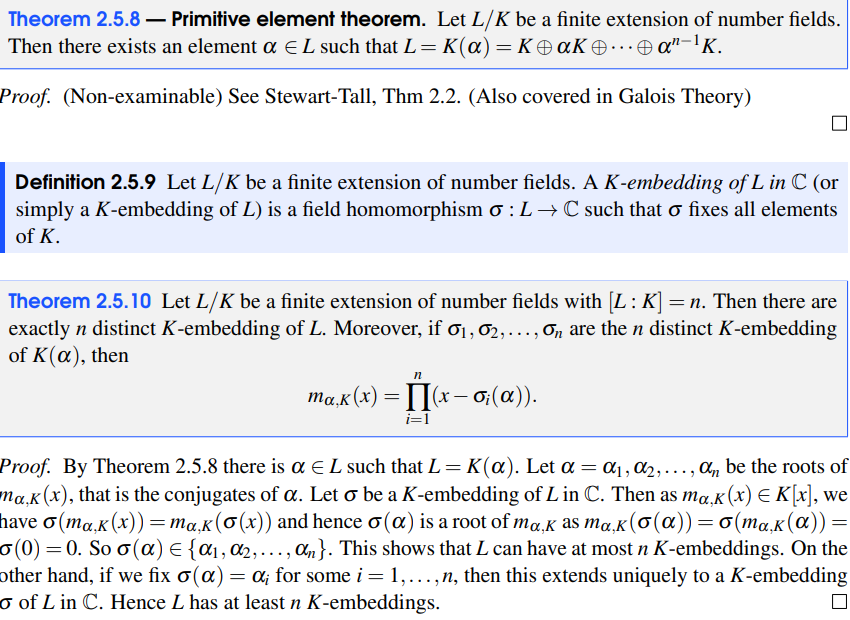
2.5.10, Algebraic NT notes
'Moreover, if f1, f2, ..., fn are the n distinct K-emeddings of K(a), then ...'
The necessary and sufficient conditions for ^ to happen are...
K(a) splits the minimal polynomial of a
or
K(a) : K is normal
And a condition of separability?
Right? (Haven't got to this bit in Galois but want to know 🙏)
 next obsidian
I think it’s that it’s separable???
coral shale
Oh, only separable?
next obsidian
Or maybe normal as well…
I know having n-distinct embedding into k-bar is equivalent to separable
coral shale
Ok, so K-embeddings in these notes
mean L -> C
So I think just separable
But if it was L -> L instead
next obsidian
Idk, you might want normal too
coral shale
then I think we need normal
next obsidian
I just am thinking that like
a can only go to one of its conjugates
And that determines the entire automorpjism
So you’re bounded by the number of conjugates
Also these are number fields so separable is automatic lmao
It must be normal then
coral shale
I think you always have n in the closure
next obsidian
So you said embeddings into C?
coral shale
But if you instead consider L -> L is also what I'm interested in ig
next obsidian
an open source textbook and reference work on algebraic geometry
If you glance through thi
Lemma 9.2.10 and 9.2.11 is what you want
I think
coral shale
Ah thanks !
next obsidian
I am bad at field theory
cloud walrusBOT
𝐒𝐡𝐮𝐫𝐢𝟐𝟎𝟔𝟎
 coral shale
I'm guessing K-hom, F -> Fbar
next obsidian
It’s the maps K -> F-bar fixing F
next obsidian

coral shale
Can we say how many maps we lose from inseparability?
I feel like it's precisely the number of repeats in the minimal polynomial
I'm not sure if something like this makes a difference\$(x-\alpha)^2(x-\beta)^5$ vs $(x-\alpha)^3(x-\beta)^4$
🤔
cloud walrusBOT
𝐒𝐡𝐮𝐫𝐢𝟐𝟎𝟔𝟎
 chilly ocean
yeah
oh i remember
seperable extensions are those which elements are representable as linear combinations
cloud walrusBOT
Great Icosiheptapeton

 trim grove
form elementary divisors how can i show two given finite abelian groups are isomorphic?
trim grove
 lethal dune
you'll need more info
lethal dune
you'll need more info
can you please tell me what are other conditions we need to show they are isomorphic?
lethal dune
u can show they have same invariant factors and free rank, but if you only know the elementary divisors, I don't think there's much you can do
trim grove
so one thing is clear that if they don't have same E.D then they never going to be iso?
trim grove
lethal dune
u can show they have same invariant factors and free rank, but if you only know ...
^
lethal dune
yes
 spice whale
why is Lagrange's theorem useful
when you could just use the counting formula
next obsidian

maiden heath
How do you find subrepresentations without using character theory?
 iron vessel
Hey guys, for this proof my argument was by contradiction. Initially I supposed that there was such an alpha, which in turn meant that there was a polynomial f in K_0 such that alpha was a root of it, and f is also monic. This meant that since alpha is not in K_0, then we must have that f is irreducible of degree at least 2 in K_0, which is a contradiction as K_0 is and algebraic closure of K and thus algebraically closed; meaning that all polynomials must split entirely into linear factors. Is my argument faulty?

 median valve
Can someone help me understand slices? I am trying to understand these class notes -

@chilly ocean
iron vessel
iron vessel
Hey guys, for this proof my argument was by contradiction. Initially I supposed ...
Anyone available for just a quick feedback?
terse crystal
I think it’s correct
iron vessel
Ok perfect, thanks
 toxic zephyr
just to clarify, a semigroup is a set with one binary operation which is associative. but there is no guarantee of an identity or inverse element?
and so to prove that a set with that operation is a semigroup i just have to show that the operation is associative?
coral shale
yes and perhaps show that function is indeed a binary operation
 toxic scaffold
it must be closed under the operation too
toxic zephyr
cool thanks
delicate orchid
I'm on the verge of crying in the club once more chat
I hate finite fields so much it's unreal
pastel cliff
L
delicate orchid
I might have to admit defeat on my funny representations of C_p over F_p excursion
like does anyone have any idea how diagonalizability works for matricies over finite fields?
cause every matrix I try and work with seems to be diagonalizable
 tribal moss
$\begin{pmatrix}1&1\0&1\end{pmatrix}$?
cloud walrusBOT
Troposphere
 delicate orchid
am I diagonalizing things wrong?
tribal moss
P^{-1}AP should be diagonal for some invertible matrix P.
delicate orchid
the characteristic polynomial (1-x)^2-1 = x^2+2x definitely has non-repeated roots (except for char 2) so you should be able to diagonalize it?
tribal moss
delicate orchid
the characteristic polynomial (1-x)^2-1 = x^2+2x definitely has non-repeated roo...
No, the characteristic polynomial is (x-1)^2 + 0·1 =(x-1)^2.
delicate orchid
oh yeah lol
god my brain is so frazzled I've been at this for 4 hours
can I just ask a series of stupidly easy and probably obvious yes or no questions
tribal moss
Sure, though I have to go in about 5-10 minutes.
delicate orchid
firstly, are elementary row/column operations expressible through conjugation by another matrix
like adding one row to another
tribal moss
No, row operations is multiplying an elementary matrix from the right left only.
delicate orchid
that definitely matches with what I found
and over char 0 it's obvious because the character of the representation isn't preserved so the matricies cannot be conjugates of each other
tribal moss
(In principle diagonalization can be described as doing some row operations, and then also doing the same operations as column operations -- but I don't know a way to make that picture actually helpful, intuitively)
delicate orchid
oh yeah that's what I've been trying to do
and what I did, before I realised that I can't do it via conjugation
which broke everything
oh I know why I thought that it's because over C you can do a change of basis to diagonalize it
tribal moss
Well, P^{-1}AP is a conjugation all right. And since P is invertible, it can be factored into elementary matrices. I just don't know a way to figure out those elementary operations one by one with diagonalization as the goal.
Change of basis to diagonalize still works over other fields.
tribal moss
If (and only if) you can find a basis consisting entirely of eigenvectors, that will diagonalize the matrix.
tribal moss
What you can't do over arbitrary fields is hope to get an orthogonal basis change, because F^n in positive characteristic doesn't have a well-behaved inner product to normalize the eigenvectors by.
delicate orchid
yeah the lack of an inner product is... annoying
anyway thanks for your help tropo
tribal moss
yw
 sharp turret
Can someone verify my work for this homework problem? Seems more simplistic than my other problems but worth a lot of credit so just wanted to make sure I wasn't missing something obvious, thanks
 delicate orchid
looks good to me
sharp turret
god bless 🙏🙏🙏
next obsidian
One thing to note here is that
If you just adjust this proof accordingly, you can assume that b^n = 0
For any n
This is a useful thing to know sometimes
delicate orchid
yeah this is a special case of a more general theorem
 lethal cipher
Okay, so let's say I have two extension fields: $\Q(\sqrt{2},\sqrt{3})$ and $\Q(\sqrt{2}+\sqrt{3})$, how would I show that these two are the same?
cloud walrusBOT
dackid
 lethal cipher
I do know that the first extension field is the smallest subfield containing those roots, so we have one inclusion, but what about the other?
There is a hint about looking at the inverse of rt(2)+rt(3), which is in the first field, but I am not entirely too sure how that helps.
 south patrol
You can use minimality in the other direction I believe, too
coral shale
Theres 2 ways I've heard of
south patrol
In fact I feel you've proven the harder inclusion lol
coral shale
The naive way is to create a system of equations
lethal cipher
That first inclusion luckily follows from a lemma we have done
south patrol
Basically i just mean both are extensions containing both square roots and their sum, conclude by mininality
lethal cipher
Yes
 lethal cipher
Okay, so what about the other direction makes it trivial?
coral shale
So let me get this straight
You have shown
Q(rt2 + rt3) subset of Q(rt2, rt3)
Or the other one
lethal cipher
Other way
lethal cipher
Q(rt2,rt3) is a subset of Q(rt2+rt3)
coral shale
How does that lemma show it tho
south patrol
The latter contains rt 2 and rt 3 with a tiny bit of work
lethal cipher
actually yeah, good point. Gotta put a little extra bit of work to show Q(rt2+rt3) actually contains rt 2 and rt3
So not quite there yet
lethal cipher
Anyways, what makes the other direction trivial?
coral shale
you can show rt2+rt3 is in Q(rt2, rt3)?
south patrol
If a field contains sqrt(2) and sqrt(3) then it contains their sum
coral shale
closure under addition
coral shale
right, so the challenge is the other direction
So the first general method of showing this (if you are told it is true):
$$\sqrt[n]a, \sqrt[m]b \in K(a + b)$$
if $n, m$ aren't too big is to consider powers of $(a+b)$. This generates a system of linear equations with variables you need to eliminate
cloud walrusBOT
𝐒𝐡𝐮𝐫𝐢𝟐𝟎𝟔𝟎
 coral shale
If you call x = a^{1/n}, y = a^{1/m}
Then the a+b is a 'constant'
x, y are unknowns you need to find
the powers of x and y are unknowns you need to eliminate
lethal cipher
Isn't this trivial since 2 and 3 are already in Q?
We already know the field contains Q
south patrol
Sorry, sqrt(2) and sqrt(3), typo
lethal cipher
So you end up with 5+2rt(6)
lethal cipher
So where does the multiplicative inverse of rt(2)+rt(3) come in?
coral shale
in this method it doesn't.
Let k = a+b
Let x = rt2
Let y = rt3
k = x + y
k^2 = 5 + 2xy
south patrol
Oh ignore me
coral shale
coral shale
k = x + y
k^2 = 5 + 2xy
no nvm im not. 2 equations 2 unknowns, proceed.
lethal cipher
Oh, we can show rt(2) and rt(3) are in this field. Since we are in a field, the element rt(2)+rt(3) has an inverse: Namely rt(3)-rt(2). So subtracting both of these and dividing by 1/2 gives rt(2), and adding both of them together and dividing by 1/2 gives rt(3)
coral shale
whoa whoa
 sturdy marsh
Z is a PID so Noetherian 
lethal cipher
lethal cipher
Oh, we can show rt(2) and rt(3) are in this field. Since we are in a field, the ...
So since we have shown the field contains both elements, we can apply the lemma
coral shale
not sure it works out so nicely in other examples 🤔
lethal cipher
coral shale
not sure it works out so nicely in other examples 🤔
There is one small kink, say you had $\Q(\sqrt{a}+\sqrt{b})$, then [ \frac{1}{2} ((\sqrt{a}+\sqrt{b})+(a^2-b^2)(\sqrt{a}+\sqrt{b})^{-1})] will give one of the roots
cloud walrusBOT
dackid
 lethal cipher
And then subtracting instead of adding will give the other one
coral shale
looks ok for sqrts I guess 👌
lethal cipher
And that's all I need for the moment
coral shale
cloud walrus
**dackid**
you probably meant a - b
sturdy marsh
but not entirely obvious
lethal cipher
Ye I did. My bad
coral shale
lethal cipher
Ye I did. My bad
If you wanna look ahead the 'Primitive Element Theorem' generalises this idea
$$K(a + cb) = K(a, b)$$
cloud walrusBOT
𝐒𝐡𝐮𝐫𝐢𝟐𝟎𝟔𝟎
 coral shale
It tells you precisely when this occurs for algebraic a, b
lethal cipher
Out of curiosity, what would be a situation where this fails? Apart from when c is equal to 0
south patrol
Another way ig is that also Q(sqrt(2) + sqrt(3)) is a deg 4 Q- extension by considering its min poly
lethal cipher
coral shale
you probably meant a - b
Oh actually I didn't. I just wrote (rt(a)+rt(b))^-1 instead of the rationalized form
lethal cipher
south patrol
Another way ig is that also Q(sqrt(2) + sqrt(3)) is a deg 4 Q- extension by cons...
The min poly is going to come from the next part, so I am trying to avoid that (since it wants us to use info from this and that [Q(rt(2),rt(3)]=4
south patrol
Sure, just considering the inverse is faster too
lethal cipher
Yea, this inverse trick got me there fast. In the end, I just needed to show that the lemma holds in both directions, and that I didn't quite understand right off the bat.
sturdy marsh
Oh rip I thought they were talking about abelian groups
the problem is about abelian groups 
coral shale
lethal cipher
Out of curiosity, what would be a situation where this fails? Apart from when c ...
I believe its this statement but im not 100%
Let $L:K$ be an extension. Let $a, b\in L$ algebraic and separable.
$$(\forall a', b')\quad c\neq-\frac{a - a'}{b - b'}\implies K(a + cb) = K(a, b)$$
cloud walrusBOT
𝐒𝐡𝐮𝐫𝐢𝟐𝟎𝟔𝟎
 coral shale
where a', b' are conjugates of a, b (not equal to them), respectively
conjugate meaning root conjugate
The roots of an irreducible polynomial are considered to be 'conjugates' of each other
You probably know what algebraic means. For now, you can consider stuff in Q, R, C separable 🤔
sturdy marsh
tG isnt even a group in general if G isnt abelian
Z is noetherian, submodules of finitely generated modules over a Noetherian ring are finitely generated
delicate orchid
That an incredible proof lol
lethal cipher
Thanks for the help ryc and shuri. Much appreciated
tribal moss
Yes.
next obsidian
Does it??
 upper pivot
this is just <ab,b>
next obsidian
I’m pretty sure that’s the entire thing
upper pivot
yeah it is oops
next obsidian
You need to do something more clever
upper pivot
the correct way to reason about this is by covering spaces, find a countable cover of the rose on 2 elements
hatcher has good pics
tribal moss
<ab,b> is too large -- it contains b, which the subgroup defined by Leaf doesn't.
upper pivot
(ab)^{-1} (abb)
tribal moss
Oh, bah, you're right.
upper pivot

here are some subgroups of F2
(10) and (11) in particular are infinite generator free groups
delicate orchid
love these diagrams
next obsidian
Okay yeah b^nab^-n is the one I was thinking of
 uncut girder
upper pivot
uncut girder
upper pivot
Very pretty
lethal cipher
Okay, I need help. I somehow need to show that $\sqrt{3-\sqrt{-2}}\in \Q(\sqrt{3+\sqrt{-2}})$.
cloud walrusBOT
dackid
 lethal cipher
Well, I need to show that field is a splitting field, but this condition needs to happen in order for that to work
coral shale
I think try figuring out the minimal polynomial
essentially 'guess' a quartic
That would be my appreciation ach at least
lethal cipher
Yea, I know the min poly
lethal cipher
Nevermind I got it!
The issue is not that it is the minimal poly, the issue is making sure that element is in the field.
I actually need to show $\sqrt{2-\sqrt{-5}}$ is in $\Q(\sqrt{2+\sqrt{5}})$ and I can do this by showing the inverse of $\sqrt{2-\sqrt{-5}}$ is in the field.
cloud walrusBOT
dackid
 lethal cipher
And I was having trouble seeing how to do it, but I just got to be a bit smarter with how I simplify things since $(\sqrt{2-\sqrt{-5}})(\sqrt{2+\sqrt{-5}})=3$.
cloud walrusBOT
dackid

 plush wasp
Quick question, why is Z/nZ not a subring of Z for n ≥ 2?
Ig it has sth to do with the definition or I'm just tripping 
is it because, say for Z/3Z, 2 x 2 = 4 is not in Z/3Z?
 paper flint
It would be, unless you require the rings to have unity.
Wait hold on
Z/nZ
They don't even have the same operations 
You're adding mod n in Z/nZ
It's not the operation inherited from Z
plush wasp
right, so 2 + 2 = 4 is also not in Z/3Z
paper flint
Correct
paper flint
plush wasp
wait <:devastation:898725325335298088> 2 + 2 = 1 is perfectly in Z/3Z so it **is...
True, but you need to change the operation for that
At that point it seizes to be a "substructure" of Z in a sense
 makes sense
plush wasp
makes sense
plush wasp
Got you ✓ 2 + 2 = 4 and not 1 🙅
paper flint

Probably slightly more pedantic but Z/nZ is also not a subset of Z, strictly speaking. Z/nZ consists of equivalence classes of integers, not integers themselves.
 subtle ivy
um, also more obviously, subrings are additive subgroups, so... it may not even be embedded in Z. lol.
plush wasp
paper flint
Probably slightly more pedantic but Z/nZ is also not a subset of Z, strictly spe...
why not
{0, 1, 2} is not a subset?

paper flint
0 is representative of the equivalence class of integers that are congruent to 0 mod 3
plush wasp
okayyyyy- so 0 is not really an integer per se
paper flint
In this context, yes. To not cause confusion some textbooks write equivalence classes with an overline
Like a bar above 0 to denote the equivalence class of integers that are congruent to 0 mod n, or so on.
plush wasp
Daaaamn, that really changes my outlook on Z/nZ by a hell lot. Ty for warning me before hand 
 wooden ember
You can also consider Z/nZ as a structure that lives apart from the integer (so that you can call its elements things that please you better instead of equivalence class) that inherits a “less detailed” form of its operations
Though I guess this is better for groups than rings
plush wasp
Also, can you hint me to proving:
A finite division ring is necessarily a field.
wooden ember
Since cyclic groups are sometimes better to think about without reference to Z
wooden ember
plush wasp
Also, can you hint me to proving:
>>> A finite division ring is necessarily a f...
I think this is a rather hard problem if I’m not mistaken
The easier one is showing that a finite commutative integral domain is a field
Lemme check
plush wasp
Yeah I just showed that any finite integral domain is a field
plush wasp
plush wasp
Yeah I just showed that any finite integral domain is a field
commutative wasn't necessary, finite was sufficient
wooden ember
Commutative is necessary
Otherwise you just show it’s a division ring
And wedderburn finishes it off
But wedderburn is not trivial to show
paper flint
Hmm, apparently this is Wedderburn's little theorem: the main theorem proves the result for finite domains, the little theorem proves it for division rings.
wooden ember
Yeah the wiki proof seems complicated
wooden ember
paper flint
Hmm, apparently this is Wedderburn's little theorem: the main theorem proves the...
Huh okay
paper flint
Or maybe I got confused, nevermind
paper flint
Right
plush wasp
Hmm. That thing's exactly where I need to be (ヘ・_・)ヘ┳━┳
Unfortunately, I need to go through the whole thing to reach there smh
wooden ember
Why do you need to be able to prove wedderburn?
plush wasp
our batch's already done with Field Theory and they're half way into the Galois Theory
It's not like I need to be able to prove it, but at the bare minimum.. I should be able to understand it..
Anyways, I'm starting with like Ring Theory ... hopefully can cover some stuff before I'm totally overwhelmed 
wooden ember
Oh I mean I’m sure you should be able to understand it yeah
It’s seems like the background material isn’t too intense
It’s just a bit long
plush wasp
 tysm
tysm
lethal dune
plush wasp
our batch's already done with Field Theory and they're half way into the Galois ...

the feeling of being left out
plush wasp
 the feeling of having midsem up your ass
lethal dune
end sem in weeks,
plush wasp
in 3 days-
lethal dune
my modsem just ended
plush wasp
Lmao gl
plush wasp
Umm,
If R is a subring of a field F that contains the identity of F then R is an integral domain.
say 'a' is a zero divisior, that is, there exists b such that ab = 0
1(ab) = 0 = (ab)1
1 is a zero divisor in R, which which is :pain:
hence, R must be an integral domain?
wooden ember
plush wasp
1 is a zero divisor in R, which <:catThink:526983414226747393> which is :pain:
So yeah this works
Well no
wooden ember
plush wasp
say 'a' is a zero divisior, that is, there exists b such that ab = 0
1(ab) = 0...
This doesn’t work
This doesn’t show that 1 is a zero divisor
Since ab=0
plush wasp
bruh, ryt
wooden ember
All you have to do is suppose there is a b such that ab=0, then a^-1 * ab = a^-1 * 0 => b=0
So a is not a zero divisor when invertible
plush wasp
umm, fields are integral domains right?
wooden ember
plush wasp
umm, fields are integral domains right?
And you show this by what I said earlier
plush wasp
I'm very concerned atm
What is a field norm?
I'm following Dummit n Foote, it keeps giving me facts first and proofs later on smh
wooden ember
A field norm is an application N: F -> R such that N(ab) = N(a)N(b) and N(0)=0 iirc lemme check my definitions again I always mix it up with vector space norms
plush wasp
is reading on Vector spaces compulsory to follow up with field theory?
I've came across the term bases several times, so I kinda feel like if I'm gonna read on splitting fields n extensions, vector spaces would be the prerequisite
wooden ember
wooden ember
A field norm is an application N: F -> R such that N(ab) = N(a)N(b) and N(0)=0 i...
Yeah no this is so wrong lol
An integral domain norm N takes R -> \bN with N(0) = 0
wooden ember
plush wasp
I've came across the term bases several times, so I kinda feel like if I'm gonna...
You definitely ought to be familiar with vector spaces yes
I mean
Surely you’ve had a linear algebra course before field theory 🤔
If you don’t know what a basis is that’s a problem I’d say yeah
plush wasp
I mean, yes I do understand what basis is, on a very beginner level but understanding something like this.
 wooden ember
What is it you don’t understand
 woven flume
reposting from getting-help due to no response. how do I find the generator(s) of GF(2^m)? for example, let's take GF(2^3) with irreducible polynomial 1011. I know that it its order is 8. I know that I can generate all the elements by exponentiating the generator 0 to 7 times, e.g. f^0 = 1st element ... f^7 = last element. however, what is the general approach of determining the generator to use? also, does it make sense to talk about order of each element (polynomial) in GF(2^m)?
 hidden haven
Is GF(2^m) the Galois group of the field with 2^m elements over 𝔽_2?
woven flume
yes
hidden haven
Then it is cyclic of order m, generated by the frobenius automorphism x ↦ x²
hidden haven
x ↦ x² is an element of the Galois group
woven flume
so, how do I find the generator(s) of GF(2^m)?
hidden haven
That generates the whole group
hidden haven
hidden haven
x ↦ x² is an element of the Galois group
You can prove that this automorphism has order m
And since the Galois group has order m as well, this must generate the entire group
woven flume
so is it x or x^2?
woven flume
as I said, I do not speak mathemateese
woven flume
alright. thanks
terse crystal
Oh a generator of Gal(F_2^n/F_2)… I thought you meant generator of (F_2^n)*😂
Yeah Gal(F_p^n/F_p)=<φ:x—>x^p> and Any m|n we have a galois correspondence Inv(φ^m)=F_p^m
trim grove
Can someone please give me a simple definition of Derived series of a group, i am confused in definition available on Google. Thankyou
delicate orchid
you just keep applying the commuter to the group to get new terms in the series
wooden ember
The dérivée series is just an iteration of taking commutator subgroups
Derived*
So the factors of the series gives you a measure of how your group fails to be abelian
delicate orchid
like, say $G = S_4$
then $G_1 = [S_4, S_4] = A_4$, $G_2 = [A_4, A_4] = C_2 \times C_2$, $G_3 = [C_2 \times C_2, C_2 \times C_2] = {e}$
cloud walrusBOT
Wew Lads Tbh (200 🍇) ✓
 delicate orchid
so the derived series is $S_4, A_4, C_2 \times C_2, {e}$
cloud walrusBOT
Wew Lads Tbh (200 🍇) ✓
 delicate orchid
wooden ember
So the factors of the series gives you a measure of how your group fails to be a...
delicate orchid
wooden ember
So the factors of the series gives you a measure of how your group fails to be a...
this is a good way to think about why we'd care about the derived series, for example the derived series of all abelian groups immediately terminate at the identity group after 1 step (although in general the series does not have to terminate at the identity group)
trim grove
delicate orchid
like, say $G = S_4$
then $G_1 = [S_4, S_4] = A_4$, $G_2 = [A_4, A_4] = C_2 \tim...
Thankyou ,now this is very much clear to me by this example.
trim grove
delicate orchid
this is a good way to think about why we'd care about the derived series, for ex...
So basically this is a tool to verify the given group is abelian ( can we say this)?
delicate orchid
trim grove
So basically this is a tool to verify the given group is abelian ( can we say th...
a group is abelian if and only if it's commuter is trivial yeah
wooden ember
trim grove
So basically this is a tool to verify the given group is abelian ( can we say th...
To be absolutely precise a derived series tells us whether a group is solvable or not
Ie it terminates iff the group is solvable
The case where it terminates after one step tells us the group is abelian
coral shale
wooden ember
Ie it terminates iff the group is solvable
I thought terminates at {e} iff solvable?
delicate orchid
S_5's derived series terminates at A_5 an S_5 is not solvable, so yeah
coral shale
delicate orchid
S_5's derived series terminates at A_5 an S_5 is not solvable, so yeah
oh so quintics do have a formula ig
delicate orchid
there's a specific way you can go from a derived series to the nice funny field extension pretty easily but I cannot remember it
trim grove
delicate orchid
there's a specific way you can go from a derived series to the nice funny field ...
Looks like something related to Galois tower
coral shale
which quintic has corresponding galois A5
delicate orchid
reverse galois problem 
coral shale
is it not easy to write down 👀
delicate orchid
I can barely compute galois groups from polynomials let alone the other way around
 distant rain
I have likely a silly claim with a likely silly proof for the claim. Suppose $R$ is a non-unital ring of real-valued functions (the details are probably not so important, but correct me if I am wrong). Suppose I have a generic element $\sum_{i=1}^nf_i\otimes g_i$ in the tensor product $R\otimes_RR$ such that $\sum_{i=1}^nf_ig_i$ is a zero function, namely $\sum_{i=1}^nf_i(x)g_i(x)$ is identically zero on the domain $D$.
Is it correct if I claim the tensor $\sum_{i=1}^nf_i\otimes g_i$ is
then zero in the tensor product?
My (silly) reasoning goes as follows, since $\mathbb R\otimes_\mathbb R\mathbb R=\mathbb R$, then $\sum_{i=1}^nf_i(x)\otimes_\mathbb R g_i(x)$ is identically zero on $D$. We can actually view (this is where my doubt lies in) $\sum_{i=1}^nf_i\otimes g_i$ as a function on $D$ with target $\mathbb R\otimes_\mathbb R\mathbb R$: $x\mapsto \sum_{i=1}^nf_i(x)\otimes_\mathbb R g_i(x)$ hence the claim follows. Is there anything wrong with my reasoning here?
cloud walrusBOT
τφκ
 wooden ember
coral shale
I thought terminates at {e} iff solvable?
wooden ember
coral shale
I thought terminates at {e} iff solvable?
That’s what I meant yeah
I don’t consider it terminates if it gets into a loop
But fair your terminology makes more sense
delicate orchid
I mean, you can keep computing more terms of the series even if it reaches {e}, it just loops back to {e}
Same goes for every perfect group
wooden ember
Yeah that’s fair
 median pawn

I'm proving (1 implies 2)
and I need help understanding the meaning of (2)
What is a maximal element under inclusion?
 chilly radish
Isn't that just zorn?
 lavish nexus
what is $Cl^0(V,Q)$? Is it the subset of clifford algebra on which the grading automorphism evaluates to 0?
median pawn
chilly radish
Isn't that just zorn?
The proof uses AOC
chilly radish
It's just a maximal element when looking at the partial ordering of inclusion. That is, it's a submodule in the set such that no other submodule in that set contains it
Yea I just mean 1 implies 2 is a direct application of zorn
cloud walrusBOT
Iteribus
 median pawn
chilly radish
It's just a maximal element when looking at the partial ordering of inclusion. T...
median pawn
chilly radish
It's just a maximal element when looking at the partial ordering of inclusion. T...
I see
So if some submodule is not a maximal element
then there necessarily exists a larger submodule containing it?
chilly radish
Yes
median pawn
Great, I can see a proof by AOC now
lavish nexus
wait you can't evaluate to 0
evaluates to 1?
median pawn
chilly radish
Great!
Thanks!
chilly radish
Np
median pawn

I don't understand the part in yellow, because the definition of a Noetherian ring says that it is not possible to have an infinite ascending chain of ideals
next obsidian
No
Well… yes
But these are separate chains
For each n, there exists a chain of length > n
median pawn
Oh okay wait, so "arbitrarily long" means that we can find a chain C_n of length >n for every n
Gotcha, my bad. Thanks!
next obsidian
Right
People didn’t realize this was a thing for a while I think
And Nagata constructed an example of a Noetherian ring with infinite Krull dimension
tribal moss
Even in Z we have (p^n) subsetneq (p^{n-1}) subsetneq (p^{n-2}) subsetneq ... of arbitrary length.
wooden ember
next obsidian
For each n, there exists a chain of length > n
That’s weird wording, you’d expect “arbitrary” to include any ordinal
maiden heath
are all non trivial irreducible subrepresentations isomorphic to the trivial, standard or sign representations? I can't think of a easy counter example
delicate orchid
What is the standard representation
Also of which group lol
Cause I can give you a degree 2 irreducible of D_3 acting on a triangle and a degree 3 irreducible of A_4 acting on a tetrahedron
delicate orchid
ah ok
maiden heath
ahh cheers
delicate orchid
in that case definitely not, the number of conjugacy classes in S_n is the number of paritions of n as Todd said and they're in a 1 to 1 correspondence with the number of irreducibles - so for n > 3 there are more than 3 different irreducible representations
 lapis gyro
Hello. I am not sure if this is the right channel to ask but... how can a quintic equation have only 3 solutions? why aren't there 5 solutions?
chilly ocean
A quintic polynomial has exactly 5 roots, but some of them might not be real roots
also some roots can have multiplicity > 1
lapis gyro
I see. The reason I am asking is because I'm working with one equation like this that I'm solving numerically in Python via newton and it only gives me back 3 roots
 rapid bramble
lapis gyro
I see. The reason I am asking is because I'm working with one equation like this...
rapid bramble
lapis gyro
I see. The reason I am asking is because I'm working with one equation like this...
are the other 2 roots complex?
lapis gyro
They probably are tbh but my code doesn't give me 5 roots, only 3, so I probably have to tweak it until something happens and I get all 5.
coral shale
this isnt what #groups-rings-fields is about btw
 desert marsh
lapis gyro
They probably are tbh but my code doesn't give me 5 roots, only 3, so I probably...
desert marsh
lapis gyro
They probably are tbh but my code doesn't give me 5 roots, only 3, so I probably...
If two of the remaining roots are complex, then you won't get them. Similarly, if the multiplicity of a root is 3, or two roots have multiplicity 2 each and the rest 1, then also you won't get more roots. Consider expressions like (x-1)³(x-2)(x-3) or (x-1)²(x-2)²(x-3).
Also, as others have mentioned, Abstract Algebra is different. You can head over to #prealg-and-algebra, #precalculus or #computing-software depending on what you intend to ask.
pastel cliff
not exactly alg but i got nowhere to ask and im doing alg hw so - what does $\mathbb{R}^\times$ usually mean
cloud walrusBOT
μ₂
 pastel cliff
 chilly ocean
I don't exactly know why the codomain would be R star, but that usually denotes the set of invertible elements in a ring
pastel cliff
yeah i dunno ¯_(ツ)_/¯
south patrol
The multiplicative group R^x I assume here but then there's a typo lol
pastel cliff
maybe author meant $x$...?
delicate orchid
no that should be the set of invertible real numbers
$\langle \bR, + \rangle \mapsto \langle \bR^{\times}, + \rangle$
cloud walrusBOT
Wew Lads Tbh (200 🍇) ✓
 delicate orchid
dunno how this is a group homomorphism though
pastel cliff
classmate thinks it's ordered pairs of reals
but then if it was it'd just be \R \times \R and not this buffoonery
 devout crow
yeah (R^x, +) isn't even a group, the most likely thing is they meant to write f(x)f(y)
chilly radish
You should.probably just ask your prof
delicate orchid
yeah I even initally wrote \times as the group operator out of habit
chilly radish
Additive functions f(x+y)=f(x)+f(y) from R to R^x can't even exist
Since we must have f(0)=0
pastel cliff
delicate orchid
no that should be the set of invertible real numbers
not a group with this definition right?
delicate orchid
not under + no
pastel cliff
delicate orchid
it might be the old "hahaha lets use + to denote any abelian group operation" in which case I'm jumping off of a bridge
pastel cliff
this isnt even my prof's fault for once, it's textbook lol
pastel cliff
i had to prove this for my last homework
 spice whale
and contains id
pastel cliff
yeah i just mean it's the most obvious thing, ive been getting weird hw's
lavish nexus
spice whale
and contains id
with the two conditions it automatically contains id
 sharp sonnet
its the kernel of det, which is a homomorphism 
pastel cliff
loch is shiny and blue now 
pastel cliff
the operation of two groups doesnt matter in an isomorphism right
like one group can have addition and the other can have fucking concatenation or some shit idk
what i mean is there can be an iso between those right?
sharp sonnet
there can be, yes
pastel cliff
sharp sonnet
the free group is usually constructed via concatenation
but on e.g. 1 generator its just Z

 mighty spade
lavish nexus
what are the weight spaces here
mighty spade
lavish nexus
what are the weight spaces here
Unless I’m being stupid, shouldn’t it be all the products of the eigenspaces generated by the diagonal entries of the matrices? That is, the weight space of the subgroup of G generated by one element is just the eigenspace of that element, and the group itself is an infinite product of such subgroups. You can then say that the corresponding sub-representations are all products of eigenspaces.
lavish nexus
mighty spade
Unless I’m being stupid, shouldn’t it be all the products of the eigenspaces gen...
I thought a weight space is some eigenspace of the corresponding Lie algebra?
mighty spade
lavish nexus
I thought a weight space is some eigenspace of the corresponding Lie algebra?
An eigenspace of a Lie algebra is a weight space, but you can have weight spaces that aren’t obviously eigenspaces of Lie algebras. A weight space of an algebra is just the space generated by the one dimensional representations of the algebra over its corresponding field.
That doesn’t require your algebra to be Lie, although it may be true that you can create a Lie algebra with an identical weight space given a weight space. I’m not sure.
How does your book define it?
lavish nexus
mighty spade
An eigenspace of a Lie algebra is a weight space, but you can have weight spaces...
I'm using whatever Brocker tom Dieck is using as it goes along and it hasn't been defined in the general case yet
my prof never defined it rigorously
 hybrid island
can someone look over one of my proofs?
rapid bramble
hybrid island
can someone look over one of my proofs?
Better to just post it and ask, rather than asking to ask
 latent anvil
looks good!
delicate orchid
topology in abstract-alg
no worries boss lol, you might be able to get a quicker answer in #point-set-topology
chilly ocean
guys
what is a group presentation?
im kinda confused on how to approach this problem
 coral shale
,, \langle a \mid a^n\rangle

 coral shale
Have you seen this before?
coral shale
Yes, but this is known as a 'group presentation'
chilly ocean
i put C_3 = <a,a^3 =1>
coral shale
Alright.
Similarly all groups can be presented in such a way.
You list the generators
Then you list the relations they follow.
chilly ocean
would this be a correct
coral shale
(look up group presentation for a better explanation than mine - im just trying to give an idea)
 cloud walrusBOT
 coral shale
with the usual operation
now.........
I'm just thinking to myself here
if it is right
chilly ocean
take your time bro
coral shale
cloud walrus
My approach would be to identify generators of this
(a, e), (e, b)
As you have implicitly done sounds like a good approach
Their order is indeed 3
and ab = ba is necessary
So the question is if you have left out anything else (I feel you haven't for now)
What would be convincing is if you construct an isomorphism between the two
To show a morphism in general, if you decide where the generators map, it will fix everything else
So I would go about showing an isomorphism between that group you have written down and $C_3\times C_3$
cloud walrusBOT
 coral shale
Decide where the generators map to, then show the homomorphism property holds.
coral shale
You haven't named S
so I'm not sure
Hmmmm what you've written doesn't sound complete to me
chilly ocean
okay what parts of my attempt is good then
 white jackal
how do you prove relations
coral shale
Let $G = \langle a, b \mid a^3, b^3, aba^{-1}b^{-1}\rangle$\
Let $H = C_3\times C_3 = {(c, d):c,d\in C_3}$\
Let $f:G\to H$ with $f(a) = (a, e)$, $f(b) = (e, b)$
This would be my start
cloud walrusBOT
 cloud walrusBOT
 coral shale
And you show this is a well defined homomorphism on all members of G
and show bijective
(I feel like I could have written this explanation better but )
coral shale
cloud walrus
(this is for any n, m, and you note the abelian relation in G makes this well defined)
chilly ocean
so H would be my group representation right

 chilly ocean
coral shale
And you show this is a well defined homomorphism on all members of G
chilly ocean
coral shale
And you show this is a well defined homomorphism on all members of G
do i just do this by showing bijective?
one more question, when it says find a group presentation what exactly am i supposed to do? I kinda just guessed to do mine
like how do i know if its a valid group presentation
coral shale
chilly ocean
do i just do this by showing bijective?
show homomorphism
show bijection
coral shale
chilly ocean
like how do i know if its a valid group presentation
By constructing an isomorphism explicitly
If you want to prove it beyond a doubt
Perhaps if you look up presentations of common groups, though
you will get some intuition for it
Your guess wasn't just any old guess
You listed the order relations. And the commutativity relation --- both are necessary in that direct product
The question then is a matter of convincing yourself you haven't left anything out
chilly ocean
which is why we create a homomorphism
then make sure that is isomorphic?
and how do i know which homomorphism to make?
coral shale
You created your presentation in such a way that the isomorphism you want is obvious
map the obvious generators to each other
(there really isn't much choice of homomorphism that has a hope of working you could try here)
hidden haven
You can read this explanation
coral shale
@hidden haven can I have an opinion 🙏 #advanced-lounge
#advanced-lounge message
just a 'its possible or impossible' would be plenty 😄
hidden haven
I didn't quite get it, you are considering doing a project in cat theory and you want to know if that would be possible for you?
hidden haven
Ye it should be good
hidden haven
coral shale
Like I have no idea how steep the learning curve is
That differs
But I think you are at a point where it is reasonable to learn cat theory
And you should learn cat theory as soon as possible, it is very worth it
coral shale
👌 thanks. Will speak with my tutor then
terse crystal
chilly ocean
do i just do this by showing bijective?
Just read those two pictures…
I can send them again if you can’t find that channel…


π here is your f, C_3 I denote it Z/3Z
terse crystal
Subgroups of commutators might be at beginning sections of their text book, since he is reading presentation , he must have learned subgroups of commutators already.
coral shale
I highly suspect this lives in #real-complex-analysis
I haven't seen horseshoes in algebra yet
next obsidian
This is complex analysis yeah
chilly ocean
Hello
I was wondering if a Dihedral Group $D_n$ is actually a union of the rotational symmetry group and the mirror reflection group?
$D_n = R_n$ U $M_n$
cloud walrusBOT
Pencil
 delicate orchid
By mirror reflection group do you mean the group of just the identity and the reflection or the set of all symmetries with a reflection in them?
chilly ocean
Identity+reflection
delicate orchid
Then no it’s not the union, it’s the semi direct product of the two
delicate orchid
It is the union of the latter, they’re the cosets of the group of all rotations
delicate orchid
No worries
 agile stratus
I learned about the dual numbers...
maybe a month ago
and I find them very cool 🙂
For you all who have never heard of the duals, a dual number z is an ordered pair of real numbers (x, y) where ε² = 0 and ε =/ 0. A dual number is usually denoted in the form a+bε
cloud walrusBOT
Wyatt The Baguette
 delicate orchid
Woah R[x]/x^2
 lapis trail
So a field has no proper ideals. Can we still mod something out?
coral shale
e no 0
coral shale
lapis trail
So a field has no proper ideals. Can we still mod something out?
trivial ideal
lapis trail
Si
agile stratus
a very powerful property is it's property of automatic differientiation
cloud walrusBOT
Wyatt The Baguette
 agile stratus
For example,
f(x)=x^2
(x+e)²
x²+2ex+e²
now, we know that e² = 0
so, x² + 2ex
now, we divide the terms with e by e to get the derivative
2x
so, when we plug a dual number into a real function, we get that function plus it's derivative (times whatever e is multiplied by)
delicate orchid
agile stratus
now, we divide the terms with e by e to get the derivative
Dividing by a zero divisor 🤨
delicate orchid
cloud walrus
**Wyatt The Baguette**
This is definitely true and is cool
But you can’t have a zero divisor be a unit
Pop quiz prove that a zero divisor can’t be a unit
agile stratus
spice whale
1/epsilon doesn't exist
I just meant that that the term with e is the derivative when e isn't there
spice whale
yeah definitely
spice whale
delicate orchid
Pop quiz prove that a zero divisor can’t be a unit
1/epsilon = 1/epsilon + 0/epsilon = 1/epsilon + epsilon
canceling out 1/epsilon we get
epsilon = 0
which is false
delicate orchid
1/ for multiplicative inverse
spice whale
i shall be better
delicate orchid
Also not sure about that proof
delicate orchid
a^-1 + 0a = a^-1+a?
spice whale
no
delicate orchid
That’s what you wrote
spice whale
what
lemme do it in latex
$a^{-1} = 1 a^{-1} = (1+0) a^{-1} = a^{-1} + 0 a^{-1} = a^{-1} + a\$
(cancellation) $\to 0 = a$ which is a contradiction
cloud walrusBOT
all functions are alison
 delicate orchid
I still do not agree with $0a^-1 = a$
cloud walrusBOT
Wew Lads Tbh (200 🍇) ✓
 agile stratus
epic latex fail
delicate orchid
lemme do mine
spice whale
$aa = 0 \to a = 0a^{-1}$
cloud walrusBOT
all functions are alison
 delicate orchid
Why does a^2 have to be 0
spice whale
oh
delicate orchid
It could be any element of the ring times a equal to 0
spice whale
my head was stuck in dual numbers
i can just slightly modify it then
$a^{-1} = 1 a^{-1} = (1+0) a^{-1} = a^{-1} + 0 a^{-1} = a^{-1} + b$ for $b \neq 0\$
(cancellation) $\to 0 = b$ which is a contradiction
cloud walrusBOT
all functions are alison
 delicate orchid
$ab = 0$ with a and b non zero
Assume there exists a $c$ such that $ac = 1 \Rightarrow ac+ab = 1 \Rightarrow a(c+b) = 1 \Rightarrow c+b = c \Rightarrow b = 0$ contradiction
cloud walrusBOT
Wew Lads Tbh (200 🍇) ✓
 spice whale
you additively cancel a^-1
delicate orchid
Ah never mind I see it now
coral shale
e is a 0 divisor indeed
delicate orchid
Had to look all the way from one side of my monitor to the other that’s craszzzyyy
coral shale
please dont do hacks
coral shale
agile stratus
(x+e)²
what hast thou donest here
me no get
f(x+e) = xx + 2ex
i follow to here
what next
coral shale
huh?
agile stratus
coral shale
f(x+e) = xx + 2ex
this is the last step
f(x+e) = x² + 2xe
x² is function, 2x is derivative, so yopu get function and derivative with one calcluation
coral shale
define ef'(x) to be
f(x+e) - f(x)
is this what ur saying or did i misread
agile stratus
coral shale
define ef'(x) to be
f(x+e) - f(x)
is this what ur saying or did i misread
ye
 delicate orchid
You don’t need to actually take the inverse
coral shale
this definition alone doesnt convince me
spice whale
wikipedia beats both of us
 coral shale
we dont?
delicate orchid
spice whale
wikipedia beats both of us
I’m going to cry
agile stratus
coral shale
this definition alone doesnt convince me
by e inverse you mean 1/e
okay
so
delicate orchid
coral shale
we dont?
It’s a 2 dim vector space over R, if you’ve got a pure real part plus a pure e part you can be sure they’re not linearly dependent
coral shale
 delicate orchid
Allowing you to clearly separate f’(x) from f(x)
agile stratus
you can't divide by e, but can you divide by a dual number where a =/ 0
coral shale
0 + ef'(x) := f(x+e) - f(x)
delicate orchid
Another cool thought I’ve had is that you can kind of separate the nth derivatives by taking f(x+e) with e^n = 0
coral shale
coral shale
0 + ef'(x) := f(x+e) - f(x)
is it this?
delicate orchid
YurrrrrR
spice whale
delicate orchid
Another cool thought I’ve had is that you can kind of separate the nth derivativ...
and you can take arbitrary derivatives in a formal power series ring
coral shale
formal derivative lets go
delicate orchid
spice whale
and you can take arbitrary derivatives in a formal power series ring <:sotrue:82...
True but I don’t CARE
I just do not CARE
spice whale
wew you have hurt me
delicate orchid
I mean sure you can take those derivatives... but you can’t do it with the f(x+e) swaggg
delicate orchid
Yeah it’s not a clean separation anymore
spice whale
it's just f(x + e)
delicate orchid
Instead of R[X]/(X^n) we probably will have to take R[X_1, ... X_n]/(X_1^2, X_2^3 ..., X_n^(n+1))
agile stratus
e^a when a > 1 is 0
agile stratus
I am tryna think of some cool properties
spice whale
for $R[[X]], f(a + X) = \sum_{n\geq 0} X^n D^n (f(a))$

 spice whale
cloud walrus
**Wyatt The Baguette**
spice whale
cloud walrus
**Wyatt The Baguette**
ye this one is cool
agile stratus
e^(a+b(varepsilon)) = e^a + e^a * b(varepsilon)
which means that e^(a+(varepsilon)) = e^a + e^a * varepsilon, which defends the fact that d/dx e^x = e^x
spice whale
yep
agile stratus
there is also a matrix representation


 spice whale
$(a + b\eps)^n = a^n + a^{n-1} b \eps$
cloud walrusBOT
all functions are alison
 coral shale
cloud walrus
**all functions are alison**
coral shale
cloud walrus
**all functions are alison**
n
spice whale
so
$\sqrt{\eps} = (0 + \eps)^{\frac{1}{2}} = 0^{\frac{1}{2}} + 0^{-\frac{1}{2}} \eps$ is undefined
cloud walrusBOT
all functions are alison
 coral shale
spice whale
$(a + b\eps)^n = a^n + a^{n-1} b \eps$
coral shale
spice whale
$(a + b\eps)^n = a^n + a^{n-1} b \eps$
u missed the binom
cloud walrusBOT
all functions are alison
 agile stratus
this doesn't apply to epsilon by itself
spice whale
yeah
agile stratus
e^n = e or 0 (for positive integers)
agile stratus
*vareps
spice whale
\eps is what i use for varepsilon
agile stratus
when what do you use for epsilon
delicate orchid
delicate orchid
I mean sure you can take those derivatives... but you can’t do it with the f(x+e...
Yeah this is what I was getting at
spice whale
$f(x+\eps) = \sum_{n \geq 0}^k \eps^n D^n f(x)$
cloud walrusBOT
all functions are alison
 spice whale
yeah
delicate orchid
I was thinking about not being able to wretch them out via linear independence
delicate orchid
Although maybe you can... lemme think....
 spice whale
if you let k limit to infty
spice whale
spice whale
if you let k limit to infty
you get a formal power series ring
trim grove
What are maximal ideals in C[x,y] , any hint?
 waxen hedge
trim grove
What are maximal ideals in C[x,y] , any hint?
waxen hedge
trim grove
What are maximal ideals in C[x,y] , any hint?
It's related to the Nullstellensatz
Maximal ideals of C[x,y] are the ideals (x-a, y-b) for complex numbers a and b
trim grove
waxen hedge
Maximal ideals of C[x,y] are the ideals (x-a, y-b) for complex numbers a and b
This will also help ,but if you can guide me how to reach to this conclusion?
waxen hedge
To be honest I don't remember the proof
sharp sonnet
you do not need the nullstellensatz, you can use the fact that C[x, y] = C[x][y] and C[x] is a PID
then classify all maximal ideals in R[y] for a PID R
you use something like contraction of maximal ideal is maximal
and gauss lemma
(you maybe saw this done for Z[x] once, the proof should be similar)
(nullstellensatz works too though)
trim grove
sharp sonnet
(nullstellensatz works too though)
I have come accross this word alot of times , so it will be better to check this out
trim grove
sharp sonnet
you do not need the nullstellensatz, you can use the fact that C[x, y] = C[x][y]...
Thankyou
sharp sonnet
the nullstellensatz is a lot more powerful
delicate orchid
weak nullstellensatz my beloved
sharp sonnet
it classifies all maximal ideals in C[x_1, ..., x_n]
(or any algebraically closed field)
trim grove
sharp sonnet
the nullstellensatz is a lot more powerful
Yes somewhere it is mentioned that it is like a bridge between algebra and algebric geometey ( dont know i am right)
sharp sonnet
yes
trim grove
delicate orchid
weak nullstellensatz my beloved
I can't even pronounce it correctly
sharp sonnet
it is german
delicate orchid
it's german if that helps
sharp sonnet
"theorem of the roots"
delicate orchid
I thought it's "zero place theorem/statement"
trim grove
sharp sonnet
"theorem of the roots"
Looks like related to zeros of multivariale functions 😅
delicate orchid
I trust your translation more than mine though, loch
delicate orchid
trim grove
Looks like related to zeros of multivariale functions 😅
welcome to alg geo
sharp sonnet
well, nullstelle is zero/root (of a polynomial)
literally "place of zero"
you can probably make some connection to places (also called stellen in german) if you want
sharp sonnet
mine is pretty ok, dont worry about it
coral shale
Is there some quick intuition for why Char 0/Char 0 extension => separable
or wishful thinking 👀
delicate orchid
something something every irreducible over char 0 is separable something something so every field extension of char 0 is seperable
terse crystal
coral shale
Is there some quick intuition for why Char 0/Char 0 extension => separable
Because f’ doesn’t equal 0
f irreducible, (f,f’) divides f, (f,f’) has to be 1, f and f’ are coprime, so f and f’ doesn’t have common root in the splitting field of f, so f is separable
(nx^(n-1) doesn’t equal 0 since characteristics is 0)
chilly ocean
What's the analogue of semidirect products for rings? Like what can you do, if anything, to present, say, Z[x]/(p(x)g(x)) nicely where those two polynomials are not coprime and chinese remainder theorem doesn't hold?
Is that the best you can do? Just leave it like that?
lavish nexus
In any ring is it true that a non unit must have a prime factor
latent anvil
lavish nexus
In any ring is it true that a non unit must have a prime factor
no, take Z/6Z and the element 3. The only ways to write 3 as a product (up to ordering) are 3 = 3*1, 3 = 3*3, and 3 = 3 * 5. But 3 is a zero divisor and 1,5 are units, so none of them are primes
In general the idea of "prime factors" doesn't work very well outside of PIDs. Sometimes factoring into irreducible elements makes sense, but there's a lot of rings where factoring just isn't sensible
In the ring Q[t^2, t^3] the elements t^2 and t^3 are both irreducible, which is like a generalization of prime elements, but t^6 has two irreducible factorizations, as t^2 * t^2 * t^2 or t^3 * t^3
lavish nexus

I'm thinking about what these P_\alpha are
and I feel like they're principal ideals generated by a prime element
latent anvil
Not in general, no
lavish nexus
or I can just claim any x in UP_alpha is in a prime ideal
latent anvil
So if S = R \ (union of P_α), what can you say about the relationship between S and a single P_β?
lavish nexus
nvm there's a proposition saying xR can be embedded in a prime ideal P such that S\hat P = empty
ty
latent anvil
yep!
coral shale
chilly ocean
What's the analogue of semidirect products for rings? Like what can you do, if a...
+1 curious
terse crystal
chilly ocean
What's the analogue of semidirect products for rings? Like what can you do, if a...
Cross product of a group and a ring sounds like an analogue
But I never really used it, only saw it sometime when reading about second homological groups or something
coral shale
terse crystal
f irreducible, (f,f’) divides f, (f,f’) has to be 1, f and f’ are coprime, so f ...
Thanks, that was enlightening
So I'm thinking about the other case --- if char = p
Then I reckon f is inseparable only when (f, f') = f. This happens only if f' = 0
And f has to be of the form
$$\sum^n_{k = 0}a_ix^{kp}$$
cloud walrusBOT
