#groups-rings-fields
406252 messages · Page 681 of 407
 pastel cliff

 coral shale
ok lemme stare at it again
 delicate orchid
show me the money
 hidden haven
Nice
pastel cliff
imma go watch dragon ball and avoid my problems
coral shale

I was told to read the proof in this
by algebraic nt lecturer (just stated the thm)
delicate orchid
warwick 
hidden haven
delicate orchid
show me the money
c shouldn't be of the form (a - a')/(b - b') where a' is a conjugate of a and b' of b
Or maybe it was the reciprocal of this
Just make sure that it isn't either
delicate orchid
that's a lot more specific then I thought
does this generalise to longer sums in a nice way?
hidden haven
Induction
delicate orchid
I thought so
hidden haven

coral shale

 delicate orchid
so that just has to hold pairwise for all elements in the sum
coral shale
I don't think they state the condition in the proof
oh they kinda do
so we're looking at......
 hidden haven
Ye they make that an implicit relation
coral shale

coral shale
i see i see.
coral shale
what are 'these'
delicate orchid
nuts
 plush wasp
"these" nuts answers
coral shale
shh
hidden haven
Good professors 
coral shale
moldi, tell us how you do it
delicate orchid
moldi knows what's good
coral shale
are you an AI
hidden haven

coral shale
hidden haven
Good professors <:bhappy:924710573885755422>
lend me some
ill give them back to you in the same condition
delicate orchid
I imagine moldi's course on galois theory wasn't cancelled by their hack fraud university 3 months before I was due to start it
hidden haven
😼
coral shale
well tbh im not even halfway through my galois course
maybe i will be 10% as smart after it
delicate orchid
comparing yourselves to others 
plush wasp

coral shale
$$K(a + cb) = K(a, b) \iff (\forall a', b')\quad c\neq\frac{a - a'}{b - b'}$$
Did I get that right moldi
 cloud walrusBOT
𝐒𝐡𝐮𝐫𝐢𝟐𝟎𝟔𝟎
 hidden haven
c = 0 doesn't work because a = a'
coral shale
but if b is a conjugate of a
or something dumb
what are the conditions on a and b
K is a field
a, b algebraic
?
coral shale
Let $L:K$ be an extension. Let $a, b\in L$ algebraic.
$$K(a + cb) = K(a, b) \iff (\forall a', b')\quad c\neq\frac{a - a'}{b - b'}$$
cloud walrusBOT
𝐒𝐡𝐮𝐫𝐢𝟐𝟎𝟔𝟎
 hidden haven
oof
 hidden haven
Yeah maybe you can tweak it somehow so it's not strictly necessary here
coral shale
I'm just thinking about the case when a, b are cube roots of unity say........
and then K(a) = K(a + 0b) = K(a, b)
delicate orchid
coral shale
I'm just thinking about the case when a, b are cube roots of unity say........
not again 
coral shale
i think it is only a reverse implication
hidden haven
coral shale
and then K(a) = K(a + 0b) = K(a, b)
Ye it's just reverse
coral shale
or am i thinking dumb
D:
oki oki
Let $L:K$ be an extension. Let $a, b\in L$ algebraic and separable.
$$(\forall a', b')\quad c\neq\frac{a - a'}{b - b'}\implies K(a + cb) = K(a, b)$$
cloud walrusBOT
𝐒𝐡𝐮𝐫𝐢𝟐𝟎𝟔𝟎
 coral shale
So is this good 👀 (edit maybe I forgot a minus sign, am unsure for now^)
hidden haven
It doth look good
coral shale
waw
hidden haven
Ofc b ≠ b'
coral shale
(I like symbols, what are words again?)
hidden haven
Since in denominator
delicate orchid
slightly confused by the forall 😵💫 don't numbers only have one conjugate?
hidden haven
No
coral shale
conjugate in the polynomial sense...
hidden haven
This is not complex conjugate
delicate orchid
I wasn't thinking complex conjugate
coral shale
If you have a minimal polynomial f
All roots are considered to be 'conjugates' of each other
right?
yay
hidden haven
delicate orchid
oh right yes of course
coral shale
But that said, I don't think the conjugates partition do they.....
or maybe they do 🤔
aaa
delicate orchid
partition what
coral shale
uh so
hidden haven

coral shale
f = (x-a)g(x)
h = (x-a)k(x)
Is it possible for f and h to both be minimal polynomials
in some uh
field?
hidden haven
Minimal polynomial is unique
coral shale
Let f, h, g, k in L[x]
f = (x-a)g(x)
h = (x-a)k(x)
Can f and h both be minimal for something in K[x]
not necessarily a
hidden haven
Irreducible polynomials can't share a factor
coral shale
yh thats my Q
coral shale
So it comes from the fact F[x] is an ED
coral shale
hmm ima think about this
hidden haven
So you get factorisations of both
Basically you have to prove that gcd doesn't change if you go to a larger field
hidden haven
delicate orchid
moldi... what's a polynomial...
coral shale
x
hidden haven
bro....
delicate orchid
bro like....
squaring things...? what if like... dude they're... like rectangles instead bro...
hidden haven
An element of the free commutative R algebra over a singleton is a polynomial in 1 variable over R
delicate orchid
you failed moldi I actually know exactly what that means
hidden haven
Alternatively the free pointed ring on R
delicate orchid
ok now you've done it
hidden haven
coral shale
back to before, so if L : K, if we take a ~ a' in K[x]
This relation partitions everything in L that is algebraic over K
right?
hidden haven
Yes
coral shale
is it an interesting partition 👀
coral shale
A name?
coral shale
D:
hidden haven
Prove that any K-homomorphism from an algebraic extension F/K to itself is an isomorphism
coral shale
WIll try, ty
I am used to seeing F : K
Me for a small while: F/K, F/K, what is this quotient
coral shale
I think I done this exercise in a homework
delicate orchid
hidden haven
Oh F
*Oh F/K
hidden haven
As my prof said 5 times every lecture
Roots go to roots, and any root can go to any root
Important to remember when working with algebraic extensions 😌
hidden haven
coral shale
you show **think**
Didn't you have it write
hidden haven
Yes
hidden haven
coral shale
f(a) = 0 <=> phi(f(a)) = 0 <=> f(phi(a)) = 0
I think this is the steps to showing it
hidden haven
coral shale
hidden haven
Roots go to roots, and any root can go to any root
right I was mulling over this and don't think I've fully grasped it yet
If L : K is an algebraic extension, if we take a ~ a' in K[x]
Then any K-homomorphism from L to L must leave these classes invariant
Like kinda
$\varphi:L/\sim \to L/\sim$ is the identity map
delicate orchid
use \sim
cloud walrusBOT
𝐒𝐡𝐮𝐫𝐢𝟐𝟎𝟔𝟎
 coral shale
\simp
delicate orchid
_ _
 hidden haven
cloud walrus
**𝐒𝐡𝐮𝐫𝐢𝟐𝟎𝟔𝟎**
hidden haven
cloud walrus
**𝐒𝐡𝐮𝐫𝐢𝟐𝟎𝟔𝟎**
Ye
coral shale
Like I might think about K(a)
And the K-homomorphisms permute a, a', ...
but not about other elements
hidden haven
Yes
And given any pair (a, a') with a ~ a', you can find some endomorphism of the extension which maps a to a'
coral shale
I feel like there must be some kindof partition of K-homomorphisms... how to describe it.
hidden haven
hidden haven
And given any pair (a, a') with a ~ a', you can find some endomorphism of the ex...
Assuming algebraic extension
coral shale
If 3 of them map a1 to a2.
Then 3 of them must also map a1 to a3
Which means if the degree of the minimal polynomial of a is coprime with the degree of the extension
hidden haven
Yes
hidden haven
Conjugates behave similar to each other
hidden haven
hidden haven
And given any pair (a, a') with a ~ a', you can find some endomorphism of the ex...
Because there's always an isomorphism of the field with this property
coral shale
yh been meaning to get my head around this
hmmmmmmm
L : K
We can consider K-homomorphisms from L -> L (elements of the galois group)
We can also consider K-homomorphisms from L -> L' (L' being the closure of L)
I've been trying to get my mind around the difference (for me, the top crops up in Galois, the bottom in Algebraic NT)
hidden haven
They're the same if your extension is normal
In particular if your extension is Galois
coral shale
I am familiar with normal, Galois haven't seen it yet
But I can see how it 'makes sense'
hidden haven
Ye since you have all the roots there anyway
Galois = normal + separable
You have all the roots and no repeated roots
coral shale
I have been thinking all my examples in Q, R, C so it's a bit of a struggle to internalise separable.
hidden haven
Char 0 everything is separable
coral shale
Right, the example I saw was F_p(t) : F_p(t^p)
hidden haven
Ye
coral shale
X^p - t^p
hidden haven
Because finite fields also everything is separable
coral shale
Is there some 'intuition' for the concept of separable?
hidden haven
And that's the simplest infinite char non zero field
hidden haven
hidden haven
And that's the simplest infinite char non zero field
'good'
coral shale
I think I am familiar with a linear algebra analogy kinda
hidden haven
coral shale
Is there some 'intuition' for the concept of separable?
I mean this
 lethal dune
what's infinite char field?
hidden haven
Lol
lethal dune
hidden haven
lethal dune
what's infinite char field?
Infinite, char non 0
coral shale
waiiiiiit wait wait
hidden haven
Is what I meant
coral shale
😂
lethal dune
oh
hidden haven
Lol
lethal dune

coral shale
trolling
hidden haven
coral shale
I think an analogy for separable is Jordan Normal
Separable is like diagonalizable
non-separable you get 1's in jordan normal
idk if thats a good analogy (maybe not at all)
lethal dune
coral shale
whats triangulable again ( 🤔 )
lethal dune
what is
hidden haven
Shuri-Jordan lemma
coral shale
wat
lethal dune
🙈
hidden haven
lethal dune
nice
lethal dune
coral shale
whats triangulable again ( 🤔 )
there is a basis wrt which the matrix is upper (lower) triangular
coral shale
I think my Linear Algebra is too weak (it literally stops at eigenvectors, diagonalisation, jordan-normal lel)
i thought you could do that for all matrices
lethal dune
it comes before jordan
hidden haven
I just intuit linear algebra
coral shale
lethal dune
there is a basis wrt which the matrix is upper (lower) triangular
You don't mean diagonalisable by this???
 cursive temple
i like thinking about separable like you can separate double roots
in nonseparable fields they stay stuck
lethal dune
coral shale
You *don't* mean diagonalisable by this???
No
coral shale
cursive temple
i like thinking about separable like you can separate double roots
Like you can keep extending the field and they'll always be stuck? Or wrong
cursive temple
i mean like if your polynomial has a double root then you can separate them :D
lethal dune
u can take algebraic closure
hidden haven
cursive temple
i mean like if your polynomial has a double root then you can separate them :D
You can't tho
delicate orchid
Eigenvalues
Eigenvalues when the field is algebraically closed 
coral shale
lethal dune
No
I can't find the term 'triangulable'
delicate orchid
cursive temple
i mean like if your polynomial has a double root then you can separate them :D
Isn’t this like, the exact condition required for non-separability lol
cursive temple
Yeah i brainfarted it
coral shale
oh yh so if we have non-separable
(x - a)^2 being minimal polynomial
And we consider K-homomorphisms
a can map to itself but not force the identity map
is that the idea?
Wrote that bad lel
===
K(a) : K
min_a(K) = (x-a)^2
K-hom f : K(a) -> K(a)
hidden haven
coral shale
`a` can map to itself but not force the identity map
If the extension is generated by a, then it will force identity
coral shale
Ok so K(a) === K[x]/((x-a)^2)
Normally when you quotient by a irreducible quadratic
You will have (x-a)(x-b)
And your galois group will have order divisible by 2
or just 2
hidden haven
coral shale
Ok so K(a) === K[x]/((x-a)^2)
K[x]
hidden haven
coral shale
or just 2
Yes
hidden haven
coral shale
But |Gal| = 1
When non sep ye
Separated would be a better name I think
Roots are separated
coral shale
Ok I think I get the idea though
hidden haven
From each other
coral shale
If the roots cannot be separated
You have elements of the Galois group
'glued together'
kinda
a mapping to itself forces the identity
 hidden haven

 lapis trail
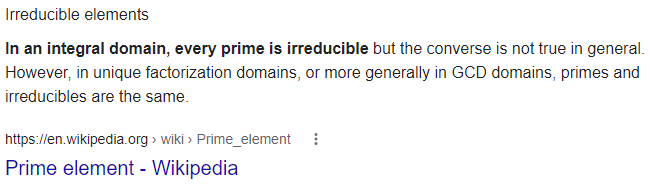
As long as you are in a ufd you don't have to worry about the difference between primes and irreducibles? Ping when answering thanks
delicate orchid
lapis trail
As long as you are in a ufd you don't have to worry about the difference between...
yus
coral shale
delicate orchid
wow CHEATING
coral shale
😢
 rigid cave
PID is sufficient right?
lapis trail
Thanks
coral shale
I was trying to look for sufficiency
UFD is a sufficient condition I think
PID => UFD
rigid cave
aren't irreducibles primes in a PID?
coral shale
PID implies UFD
delicate orchid
they are but PID is a stronger condition than required
coral shale
I think UFD is as low as you can go?
rigid cave
right right
delicate orchid
GCD domains are slightly lower
coral shale
Does (prime <=> irreducible) imply the ring is UFD?
delicate orchid
cause then you can still do the funny bezout's (iirc)
delicate orchid
lapis trail
PID is every ideal generated by an irreducible is maximal
yeah
lapis trail
Oh ok cool
coral shale
coral shale
Does (prime <=> irreducible) imply the ring is UFD?
Can someone fix my statement
delicate orchid
(2) is not maximal in Z[X] for instance
lapis trail
I got a quiz in a few hours
delicate orchid
coral shale
Can someone fix my statement
(prime <=> irreducible) => ring is a GCD domain
lethal dune
there's a gcd domain? 
 delicate orchid
lethal dune
there's a gcd domain? <:monkey:651816857153699840>
delicate orchid
lethal dune
there's a gcd domain? <:monkey:651816857153699840>
there are so many stupid ring domains
hidden haven
Call it stupid one more time and det will haunt you
rigid cave
domain domain when
delicate orchid
I imagine they do the proof that UFDs mean irreducibles are primes and then are like "oh we technically just need a notion of a gcd so lets define gcd domains and now this result is slightly more general"
lapis trail
Is gcdd>ufd>PID>Ed then
delicate orchid
yeah
delicate orchid
with bezout domains in there somewhere
coral shale
lethal dune
like what if we have unique factorization for all but one
someones going to prove this is impossible just for you, i bet
hidden haven
Exceptional domain
lapis trail
I hate not being in a ufd
delicate orchid
coral shale
someones going to prove this is impossible just for you, i bet
I was about to try
coral shale
lapis trail
I hate not being in a ufd
I remember not long ago
we were fcking about in Z[x]
and had no clue
lethal dune
unique factorization but not commutative
delicate orchid
Z-algebras
lethal dune
coral shale
(2, 3x+1) <-- 'is this maximallllllllllllll' or some sht
delicate orchid
oh I remember that
coral shale
me: lets try euclidean on it
hidden haven
It do be maximal tho do it not
coral shale
me: wtf how do we do that
delicate orchid
hidden haven
It do be maximal tho do it not
yeah I just gave up and showed the quotient was a field
hidden haven
How is that giving up
delicate orchid
it's literally cheating
hidden haven
Bruh
coral shale
isomorphism
hidden haven
 lapis trail
delicate orchid
yeah I just gave up and showed the quotient was a field
lapis trail
delicate orchid
yeah I just gave up and showed the quotient was a field
Lol if this is wrong I don't want to be right
delicate orchid
lethal dune
my book doesn't even require commutativity to be a field
R[Q_8] be like YES FUCKIN FINALLY LETS GOOOOO
hidden haven
lethal dune
like the author calls a skew-field module a vector space
coral shale
lethal dune
my book doesn't even require commutativity to be a field
ok seriously, what?
delicate orchid
lethal dune
like the author calls a skew-field module a vector space
it just ISN'T
lethal dune
yes
coral shale
addition would kill lel
delicate orchid
addition is always an abelian group
hidden haven
delicate orchid
it just ISN'T
That one I am fine with
lethal dune
die
delicate orchid
moldi when uhh
hidden haven
Modules over division rings are sometimes called vector spaces
coral shale
wait wait whats an example of a non-commutative field
hidden haven
Their study is much more similar to vector spaces
 prisma ibex
skew-fields are fine but it's very bad to call them fields
coral shale
these things are called skew-fields?
delicate orchid
(Av)^T != v^TA^T (^T being transpose chat chat that means transpose)
I think, if it's non-commutitive
prisma ibex
yeah skew fields are non commutative fields
delicate orchid
yeah we're talking about skew vector spaces
coral shale
souns like crazy sheet
lethal dune
prisma ibex
skew-fields are fine but it's very bad to call them fields
what about non commutative integral domains?
 south patrol

hidden haven

delicate orchid
lethal dune
what about non commutative integral domains?
GL_2(Z)
I think
moldi are there zero divisors in that bithc
prisma ibex
lethal dune
what about non commutative integral domains?
yeah, these are just called domains
rigid cave
skewb domains
hidden haven
Not closed under add lmao
lethal dune
no i mean should u call a non commutative .... a integral domain
delicate orchid
prisma ibex
yeah, these are just called domains
@rigid cave domain domain just dropped
prisma ibex
the integer quaternions are an example of a domain which is not an integral domain
rigid cave
omg pog
lapis trail
Are zero divisors a pain or are they cool
delicate orchid
a pain
prisma ibex
they can be a pain
delicate orchid
a complete nightmare
prisma ibex
but they are important to consider sometimes
hidden haven
I've seen Lang call non commutative domains "entire" rings
lapis trail
I think they're cool just because it's different
delicate orchid
prisma ibex
but they are important to consider sometimes
yeah they're incredibly important to be aware of
might end up dividing by 0 omegaLUL
coral shale
when i see the word quaternion I think physics. Is this just a big no. or quantum mechanics something
prisma ibex
quaternions do show up in physics
delicate orchid
coral shale
when i see the word quaternion I think physics. Is this just a big no. or quantu...
quaternonic representations 
prisma ibex
so do octonions
coral shale
hidden haven
wat da physicicists doin
prisma ibex
octonions are kinda awful
lapis trail
That's algebra I want to learn probably after galois
lethal dune
onion when
prisma ibex
they're non-associative but still close to associative in a precise way
delicate orchid
they're anti-associative
hidden haven
oh this is ryu
delicate orchid
right?
hidden haven
delicate orchid
cross product type memes
prisma ibex
no it's like
hidden haven
Pfp change is tragic
 maiden ocean
any subgroup generated by 2 elements is associative
prisma ibex
yeah
maiden ocean
Well the options are like R C and H so lol
prisma ibex
that's what you have to do for octonion computations, you always like, pick a pair of elements and then do computations inside this associative subalgebra
it's nutty

lapis trail
Doesn't it model behavior at a quantum level?
prisma ibex
so there's some like
nutty construction for the standard model particle generations in terms of octonions
although I'm not sure that this is like
necessarily the best way to think about it
delicate orchid
I thought it was spin group memes
prisma ibex
it's related yeah
rigid cave
lmao wew pfp change
delicate orchid
and I know there are quaternionic representations (of some) of the spin groups
lapis trail
That's just wild that our constituent particles are just algebra
prisma ibex
yeah
there's a very general principle that relates classification of particles with representation theory
coral shale
algebra > all
lapis trail
Symmetries and rotations
prisma ibex
but yeah octonions come up any time you deal with the exceptional Lie groups
that's the sense in which they're natural
lapis trail
Irreducible means that f=gh implies g or h is a unit, right?
lapis trail
Oh ok
coral shale
'Irreducible' only applies to non-units, and non-0 for my notes

Think that makes sense. You want prime <=> irreducible in GCD domain and you don't want to think of units as primes in general
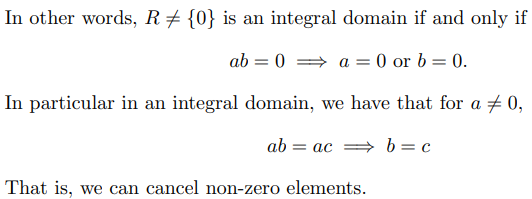
being dumb, how does the below follow D:
ab = ac => b = c
lapis trail
Hmmm oh
lapis trail
a(b-c)=0
 lapis trail
Or b is c
lethal dune
coral shale
https://i.imgur.com/vjnN7LJ.png
see this definition doesn't require it to be commutative

coral shale
ic ic
lethal dune
ya but most (all) authors do require commutativity
lethal dune

hidden haven
gnir
coral shale
$\vbox{\ialign{\hfil$#$\hfil\crcr r_i\crcr\noalign{\kern-.6ex}g!{\font~cmr12 at15pt\lower.4ex\hbox{~n}}!\crcr}}$
cloud walrusBOT
𝐒𝐡𝐮𝐫𝐢𝟐𝟎𝟔𝟎
 lethal dune
 ornate arch
i know theres no algorithm to find automorphisms, but is there a mthod i can use to identify inner automorphisms from automorphisms
coral shale
Given an automorphism (somehow), identify whether/not it is an inner automorphism?
or did I misunderstand
delicate orchid
check if it maps conjugacy classes to themselves
if it does for every conjugacy class it's an inner automorphism I do believe yes quite
ornate arch
coral shale
Given an automorphism (somehow), identify whether/not it is an inner automorphis...
yep
ornate arch
delicate orchid
check if it maps conjugacy classes to themselves
could u give me an example, im a little confused by that statement
coral shale
call the automorphism f
I think you are looking at what repeatedly applying f on an element does
f(x), ff(x), fff(x), ...
That would be the orbit of f
delicate orchid
oohh group action memes I like it
coral shale
Now why is this helpful... god knows




I think this is the relevant bits for thought 🤔
 delicate orchid
we established last time we talked about this that outer automorphisms act on the conjugacy classes right?
coral shale
I wasnt too awake
delicate orchid
lol
delicate orchid
ok yeah so Inn(G) is the identity element in Aut(G)/Inn(G)
coral shale
is the id map
delicate orchid
so if an automorphism maps conjugacy classes to themselves it must be inner
(as all automorphisms preserve conjugacy relations (x ~ y => y = gxg^-1 => f(y) = f(gxg^-1) = f(g)f(x)f(g)^-1 so f(x) ~ f(y))
 coral shale
i think you would need to check the classes of the generators of G only?
delicate orchid
not quite
since automorphisms are bijections we should only need to check permutation of conjugacy classes that are the same size? right?
delicate orchid
coral shale
i think you would need to check the classes of the generators of G only?
wait yeah I think so, that's clevar
oh ho ho ho ho shuri you've done it again
coral shale
im only guessing around
(who proves stuff smh, just intuit and get things wrong half the time)
delicate orchid
uhh waitttt ttt
what if the generators are conjugates
eh whatever
it'll work out I'm sure of it
coral shale
doesnt that imply......... something
hidden haven
deep
delicate orchid
$\Rightarrow$ something
cloud walrusBOT
Wew Lads Tbh (200 🍇) ✓
 delicate orchid
idk!
coral shale
i knew it
coral shale
maybe generators is no good now i think about it
Given $x^G$, what do we know about $(x^2)^G$?
cloud walrusBOT
𝐒𝐡𝐮𝐫𝐢𝟐𝟎𝟔𝟎
 delicate orchid
yes linear characters yes... constant on conjugacy classes just like inner automorphisms yess yes we must map the inner automorphism group of abelian groups to the irreducible characters yes yes bijection
wait fuck this is just a proof that Inn(G) is trivial when G is abelian holy hell I'm an idiot 
y = gxg^{-1} => y^2 = gx^2g^{-1}
spoookkyyy
so y ~ x => y^2 ~ x^2
coral shale
$x^Gy^G = (xy)^G$
cloud walrusBOT
𝐒𝐡𝐮𝐫𝐢𝟐𝟎𝟔𝟎
 cloud walrusBOT
𝐒𝐡𝐮𝐫𝐢𝟐𝟎𝟔𝟎
 delicate orchid
isomorphism type beat
y = gxg^{-1} => y^-1 = g^{-1}xg
yeah ok I'll believe you but I don't trust you
coral shale
huh what
ornate arch
wait
coral shale
does it not follow from the algebra
coral shale
delicate orchid
y = gxg^{-1} => y^-1 = g^{-1}xg
u typoed
ornate arch
delicate orchid
ok yeah so Inn(G) is the identity element in Aut(G)/Inn(G)
do we care about this
delicate orchid
I care
it basically means that if the automorphism swaps any two conjugacy classes it cannot be inner
coral shale
cloud walrus
**𝐒𝐡𝐮𝐫𝐢𝟐𝟎𝟔𝟎**
doesnt this show conjugacy classes form a group or am I being silly
delicate orchid
there's no binary operation between conjugacy classes there
ornate arch
seems like you two are saying diff things
 delicate orchid
literally everything there is within one conjugacy class

 ornate arch
wth
coral shale
what went wrong there
ornate arch
isnt there smth we can do like
delicate orchid
coral shale
y = x^-1
ornate arch
finding isomorphisms to Aut(g) and then its related to its normal group
coral shale
ok ok i wrote it wrong completely lul
coral shale
yh yh yh
ornate arch
😕
ornate arch
what yall talking about man
delicate orchid
does "gxg^-1hyh^-1" look like a conjugation to you?
coral shale
being dumbbbbbbb
ornate arch
alrighty im out
hidden haven
delicate orchid
ornate arch
what yall talking about man
I speak the truth and nothin but the truth
coral shale
x ~ y
x^n ~ y^n
ornate arch
yall gonna confuse me before my exams
delicate orchid
except for polynomial and integer multiplication I don't cover that
ornate arch
hahaha
coral shale
ornate arch
yall gonna confuse me before my exams
sry lel
What we do know is Out(G) := Aut(G)/Inn(G) acts on conjugacy classes
ornate arch
ornate arch
finding isomorphisms to Aut(g) and then its related to its normal group
do u guy sknow about smth like this
delicate orchid
yeah it permutes those mfs
delicate orchid
ornate arch
do u guy sknow about smth like this
what do you mean "its normal group"? is inn(g) the only normal group chat chat is it the only normal one?
I have concluded that it is
coral shale
Inn(G) is the identity element in Out(G)
coral shale
All of the automorphisms in Aut(G) can be classified using Out(G)
Out(G) acts on {x^G : x in G}, the conjugacy classes of G
Now suddenly I'm unsure
@delicate orchid when u back help D:
delicate orchid
no
coral shale
nvm nvm nvm nvm nvm
Let $f\in \textnormal{Aut}G$
$$f(x^G) = f({gxg^{-1} : g\in G})$$
$$= {f(gxg^{-1}) : g\in G}$$
$$= {f(g)f(x)f(g^{-1}) : g\in G}$$
$$= {gf(x)g^{-1} : g\in f^{-1}(G)}$$
$$= f(x)^G$$
 chilly ocean
checks out
cloud walrusBOT
𝐒𝐡𝐮𝐫𝐢𝟐𝟎𝟔𝟎
 chilly ocean
idk what x^G means tho
coral shale
The definition is written in the first line
chilly ocean
unless thats ur notation for all conjugations of x
coral shale
yh
chilly ocean
never saw it until today
chilly ocean
why does f(g)=g?
chilly ocean
oh
 chilly ocean
i see tho
coral shale
But this holds cus f is an automorphism
chilly ocean
i guess it isnt that f(g)=g
its more of a substitution
but it seems slightly misleading to have same variables ig
coral shale
I'm like viewing g in f^-1(G)
coral shale
its no sub actually
chilly ocean
call em g’ or something
coral shale
coral shale
no no, its the same g
chilly ocean
it isnt tho
coral shale
it is tho
coral shale
or is it not
chilly ocean
lol
coral shale
chilly ocean
i can see why my bad lol
coral shale
 chilly ocean
yeah
coral shale
staring staring
chilly ocean
your second line is the g such that g in f^-1(G)
coral shale
basically if f wasn't an automorphism this would fail in one direction or the other
f(g) in G
equiv
g in f^-1(G)
chilly ocean
yeah
u were just rewriting it
oh
ur showing this ^G action of conjugation is a homomorphism?
coral shale
im just thinking if this kinda writing works for preimages rn 🤔
chilly ocean
what are u trying to prove?
coral shale
cloud walrus
**𝐒𝐡𝐮𝐫𝐢𝟐𝟎𝟔𝟎**
I was convincing myself all automorphisms act on conjugation classes
Hence Out G = Aut G / Inn G also does
In particular I want to show f in Inn G iff f is an identity action on the conjugation classes
chilly ocean
oh ok
chilly ocean
coral shale
In particular I want to show f in Inn G iff f is an identity action on the conju...
yeah ok
i guess i forget
chilly ocean
coral shale
In particular I want to show f in Inn G iff f is an identity action on the conju...
this is ur next step?
coral shale
yh
chilly ocean
well one direction is obvious
coral shale
Let $f\in \textnormal{Aut}G$
$$f(x^G) = f({gxg^{-1} : g\in G})$$
$$= {f(gxg^{-1}) : g\in G}$$
$$= {f(g)f(x)f(g^{-1}) : g\in G}$$
$$= {gf(x)g^{-1} : g\in f(G)}$$
$$= f(x)^G$$
I think I wrote the above wrong lel

tripping myself up by sticking to set notation
cloud walrusBOT
𝐒𝐡𝐮𝐫𝐢𝟐𝟎𝟔𝟎
 cloud walrusBOT
𝐒𝐡𝐮𝐫𝐢𝟐𝟎𝟔𝟎
 chilly ocean
yuh
for integers
it comes down to partitioning by a multiple of some number
so think of a number n
we knows nZ is a subset of Z
pastel cliff
and a subgroup
chilly ocean
have yoy learned about quotients b4 i continue
pastel cliff
yesnt
chilly ocean
because this is where they come in handy
ok
well
say we have 3 in Z
and we look at the set 3+nZ
what does that look like you might ask
well nZ is the set of multiples of n
and +3 is adding each element by 3
now what happens if we look at 4+nZ
or n+nZ
well 4 is like last time and is just adding each element by 4
but n is adding each element by n
pastel cliff
n+nZ is in nZ
chilly ocean
but if we do that we are still in nZ
yea
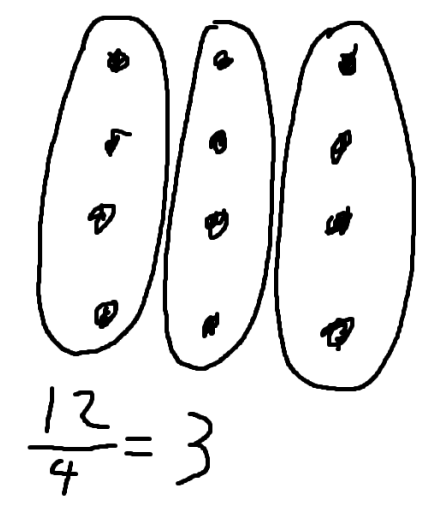
it turns out that if you look at the set of all cosets
its not only a set, it has a multiplication also
it gives the set of cosets of a subgroup a group structure
pastel cliff
is that a thm
chilly ocean
well it depends on the subgroup you are looking at
chilly ocean
they have a condition called normal which means it stays fixed under conjugation, but it isnt important
it is a theorem
infact this group structture makes something called a quotient group
 chilly ocean
yeah its grouping
coral shale
You do the same for abstract structures as you do for numbers
chilly ocean
quotienting only works on a special type of subset called a normal subset though
chilly ocean
pastel cliff
quotient groups are two weeks from now :/
yeah you probably need to cover conjugation and normality to talk about it next
chilly ocean
pastel cliff
damn i just checked syllabus
what else in ur slyabus screenshot?
pastel cliff
 chilly ocean
pastel cliff
chilly ocean
pastel cliff
what in the speed run is this
pastel cliff
@delicate orchid would you like to keep shitting on my prof
delicate orchid
not right now sorry I'm busy making a mockery of latex
chilly ocean
i remember spending a lot of time on symmetric groups/group actions/sylow subgroups
what are you supposed to take away from ur class?
pastel cliff
oh this isnt the full thing
chilly ocean
the straight jump to ring theory to a cocktease of galois theory at the end
pastel cliff
pastel cliff
that's starting from week 6
chilly ocean
yeah
pastel cliff
though 1-5 weren't the best either tbh
chilly ocean
but im sure u didnt talk about group actions at all
chilly ocean
a group action on a set is a function F:G x X -> X
pastel cliff
chilly ocean
have u seen it b4
pastel cliff
in this channel yeah
delicate orchid
we didn't do group actions in our first group theory course
chilly ocean
i applied for that school too
pastel cliff
dont.
chilly ocean
wht the fuck
isnt group actions main way people think about groups
because symmetries on objects
pastel cliff
ok coset though, can i just think of it for now as like multiples of a subgroup
delicate orchid
I see
chilly ocean
it also is very helpful to study group actions
delicate orchid
pastel cliff
ok coset though, can i just think of it for now as like multiples of a subgroup
cosets are just a set of mofos multiplied by some mofo
chilly ocean
like its only way to talk about symmetries of surfaces without sounding handwavy
delicate orchid
chilly ocean
it also is very helpful to study group actions
yes but in a first course?
pastel cliff
delicate orchid
cosets are just a set of mofos multiplied by some mofo
times of the thing is the thing of times
delicate orchid
I do think they should be in there but towards the end
chilly ocean
i did that in a first course
delicate orchid
pastel cliff
times of the thing is the thing of times
yes but this time that's literally all there is to it, a coset of a subgroup is just some element times that subgroup
delicate orchid
group axiomz
chilly ocean
thats all
chilly ocean
bruh wasted 6 weeks
pastel cliff
i iwish
delicate orchid
no, no you don't
lethal dune
truth algebra
delicate orchid
lethal dune
truth algebra
boolean "algebras" or as I like to call them, fields, are a fake construction
chilly ocean
structure theorem of fin abelian groups was last topic i did in my first course
delicate orchid
wtf lol
chilly ocean
we were based i guess
delicate orchid
I learnt about that through the structure theorem of Z modules
delicate orchid
horrifying and yet ZASED
pastel cliff
delicate orchid
yes but this time that's literally all there is to it, a coset of a subgroup is ...
or plus right?
chilly ocean
and i was confused because i didnt know it at time
chilly ocean
pastel cliff
or plus right?
yeah
operations arw arbitrary
plus notationally implies you are in abelian group
times implies not necessarily abelin
delicate orchid
pastel cliff
or plus right?
same thing
literally same thing
could be fuckin
uhhh
pastel cliff
ACKCHUALLY
chilly ocean
there is just linguistic context i guess
rigid cave
Just use :checkmark:
pastel cliff
rigid cave
Just use :checkmark:
plague
delicate orchid
let <a, a♫12 = e> be the group of chromatic notes under the operation of transposition up by a semitone
pastel cliff
 delicate orchid
I wrote a little paper about group actions in music actually
for latex practice
turns out all symmetries of the chromatic scale is $C_12 \times C_2$
cloud walrusBOT
Wew Lads Tbh (200 🍇) ✓
 delicate orchid
wow looks like that latex practice was fuckin worthless
chilly ocean
,w unmanly
cloud walrusBOT


 Requested by Toysem Teans#6295
pastel cliff
Requested by Toysem Teans#6295
pastel cliff
wait random thought
coral shale
_{..}
pastel cliff
by definition if H is a subgroup of G then order of H is less than G right
chilly ocean
pastel cliff
by definition if H is a subgroup of G then order of H is less than G right
no
think about integers
coral shale
pastel cliff
by definition if H is a subgroup of G then order of H is less than G right
if A is a subset of B, then |A| \leq |B| (assuming finite)
infinite, a similar statement about cardinality can be said
chilly ocean
coral shale
if A is a subset of B, then |A| \leq |B| (assuming finite)
infinite, a similar s...
yeah
pastel cliff
okay nvm
chilly ocean
no
delicate orchid
were you going to construct a chain perhaps
going to apply zorn's lemon were we?
chilly ocean
for infinite groups it gets weird
pastel cliff
i was gonna make a sea shanty
chilly ocean
they are all necessarily infinite
but the cardinalities can either be equal or less than
delicate orchid
chilly ocean
they are all necessarily infinite
I'm not sure about this
delicate orchid
coral shale
{e} is a subgroup of any infinite group
even simpler, I was thinking $\bZ/2 \leq \bZ/2 \bigoplus \bZ$
chilly ocean
e is trivial
coral shale
$\abs{A}\leq\abs{B}$
cloud walrusBOT
𝐒𝐡𝐮𝐫𝐢𝟐𝟎𝟔𝟎
 coral shale
I mean, this notation is still well defined for infinite sets
it just means something slightly different
coral shale
why the big one lel
cloud walrusBOT
Wew Lads Tbh (200 🍇) ✓
 delicate orchid
coral shale
why the big one lel
delicate orchid
coral shale
why the big one lel
big big chungus big chungus big chunugs
chilly ocean
its still not true
coral shale
there are no non-trivial finite subgroups?
chilly ocean
i need more conditions
coral shale
oh
=...=
If the order of all the generators are infinite
then maybe we can say something
chilly ocean
yeah
chilly ocean
there cant be finite order generators but then thats trivially saying that the group is infinite and has no finite subgroups
coral shale
I think this has finite subgroup
cloud walrusBOT
𝐒𝐡𝐮𝐫𝐢𝟐𝟎𝟔𝟎
 chilly ocean
like free group and ab=e?
coral shale
yh yh
chilly ocean
abab=e?
coral shale
yh
chilly ocean
bruh lol
coral shale
am i writing dumb
chilly ocean
yeah
chilly ocean
so if it isnt necessarily true
coral shale
This is the lattice in Z^2 right
chilly ocean
yeah
cloud walrusBOT
𝐒𝐡𝐮𝐫𝐢𝟐𝟎𝟔𝟎
 chilly ocean
which one?
coral shale
idk
chilly ocean
we do not
chilly ocean
free groups work
chilly ocean
idk if its possible yea
chilly ocean
any finite relation you put on generators implies the group has finite generators
after the abelian part
coral shale
$$\langle a, b \mid R\rangle = \langle a, b\rangle/\langle\langle R\rangle\rangle$$
cloud walrusBOT
𝐒𝐡𝐮𝐫𝐢𝟐𝟎𝟔𝟎
 delicate orchid
langle my rangle
coral shale
Must any finite subgroup of the left
be a finite subgroup of <a, b>
?
🤔
maybe not again.....
chilly ocean
shuri
i can prove that any abelian group with finite condition on generators is not abelian
or maybe i can go one step above
chilly ocean
chilly ocean
i can prove that any abelian group with finite condition on generators is not ab...
this is gibberish
ignore me ill be back
coral shale
im chucking the idea of abelian, I don't know if we need to talk about those
coral shale
cloud walrus
**𝐒𝐡𝐮𝐫𝐢𝟐𝟎𝟔𝟎**
.
chilly ocean
well like
coral shale
i was tryna think in general
delicate orchid
cloud walrus
**𝐒𝐡𝐮𝐫𝐢𝟐𝟎𝟔𝟎**
me when R = {a^2, b}
coral shale
🙏
chilly ocean
lots of non abelian groups are counter examples
coral shale
yeah so we can't have restrictions that kill the order of a , b
chilly ocean
yeah
delicate orchid
yeah cause then you just take the subgroup generated by that element boom finite
chilly ocean
and we know because of structure theorem thet any additional conditions besides commuatative puts a finite condition
chilly ocean
yeah