#groups-rings-fields
406252 messages · Page 680 of 407
 dull root
Well, lets suppose Re(a) and Im(a) are both rational
 small bison
in that case i think you can make a- once you have a in your field
cause like a - Re(a) = i * Im(a)
and then you can do a - 2i * Im(a) to get a- right?
dull root
yea, then the degree is 1.
small bison
hmm in general i think it depends on the rationality of a
actually in the general case idk if it's clear that the degree is 1 or 2
cause you would need |a|^2 to be in Q(a) right?
dull root
yea, nvm then.... I don't know if that degree is even bounded then
 tribal moss
We can use the Lindemann-Weierstrass theorem to find an a whose conjugate is transcendental over Q(a), if only we can find an algebraic a where the degree is more than 1.
 chilly ocean
Is there a list of presumed knowledge to learn Galois theory?
dull root
Hmm, so in my specific case, I want to find the extension of Q by all complex roots of x^3 - 2. It is not hard to see there are two such complex roots, namely a = (-1 + i \sqrt 3) /(2^(2/3)) and its complex conjugate. The issue I have is how to see what [Q(a,\bar{b}: Q(a))] is
I know for sure the degree is either 2 or 3, but I can't see which one is impossible here
dull root
Well, that would say that the minimal polynomial of a and its complex conjugate are the same over Q
 inner acorn
chilly ocean
Is there a list of presumed knowledge to learn Galois theory?
inner acorn
chilly ocean
Is there a list of presumed knowledge to learn Galois theory?
basic group theory, linear algebra, and some elementary number theory?
 coral shale
ring thry
inner acorn
most texts that I know on intro galois theory cover ring theory
coral shale
there's barely any linear algebra
dull root
But how does that help us here. We know the minimal polynomial of \bar{a} over Q(a) only divides the minimal polynomial over Q, so it only bounds the degree of the extension above
inner acorn
I mean, you often consider field extensions as a vector space over the base field
sorta where the whole tower law comes in etc...
coral shale
Yes but that's it
inner acorn
also most of your examples of rings/field/etc... are matrix examples xD
not necessarily for galois theory, but again
coral shale
You need stuff in lag up to what a basis is
inner acorn
introductory texts use galois theory to introduce rings/fields
coral shale
You need stuff from ring theory to understand what K[x]/(f) is
inner acorn
My point is, if you're going to learn Galois theory from scratch, 9 times out of 10 the text will also cover rings & fields too
and authors almost always expect a knowledge of linear algebra & basic number theory
you'll see all sorts of matrix rings etc...
coral shale
dull root
But how does that help us here. We know the minimal polynomial of \bar{a} over Q...
ah nvm, I guess I misthought
Now I think about it, I don't think you can say much
I think I can construct examples for every degree
or maybe not 
I believe if you take f(x) = x^n - 2
and a to be one of the non-real roots
Then [Q(a, a-) : Q(a)] should be n-1............................
Q(a) only adjoins one root of f
Q(a, a-) splits f
@dull root^
Oh wait I need n prime up there
But that still generates a lot of examples
You certainly can have examples of Q(a) that splits the minimal polynomial of a, in which case the degree will be 1
And these examples should exist for every degree of polynomial
I am thinking about the primitive element theorem, here.
 upper cape
Does the absolute galois group being cyclic imply that any finite extension is cyclic?
It's obvious if the algebraic closure is a finite extension, but I just want to make sure that it is true in general, since I haven't done much infinite galois theory
chilly ocean
guys i want to show that the product of 2 cyclic groups results in a cyclic group implies the gcd(m,n) = 1
 next obsidian
Figure out a formula for the order of an element (a,b) inside the product of two groups in terms of the order of a, and the order of b
The reason this matters is that for Z/nZ x Z/mZ to be cyclic you require a generator, aka an element of order mn
next obsidian
Yuh
If you can’t think of what it might be, just try a couple explicit examples
Or take m,n coprime, and find the generator of Z/nZ x Z/mZ
You might notice what’s going on
coral shale

This comes from my algebraic number theory notes
In my Galois notes, it talks about K-homomorphisms L -> L (which are subsequently proven to be automorphisms)
I'm thinking and comparing the 2 🤔
And uhhhhhh not much progress - is there something obvious about the difference between the 2 I can say?
(Note a Number Field K is a finite field extension K : ℚ)
===
I'm thinking there is a 1 to 1 correspondence between:
The K-embeddings of L in C
The K-homomorphisms M -> M where M : L is the splitting field extension (not sure if I phrased the idea I had rightly)
But not sure
(An aside - what does Gal(C : Q) look like???)
next obsidian
That’s not a finite extension, I think more than likely nobody knows
But I’m not certain
 barren sierra
need help on 7 but 3 and 5 have the relevant definitions

really the first part of 7 is what I need help with
so if x in N(R) then we have x^n = 0 for some n
so then consider 1 + xr in 1 + xR
I want to show that 1 + xr is a unit
clearly x^n is in J(R) because 1 is a unit and 1 + x^n R = 1
next obsidian
N(R) is the intersection of all prime ideals
Or well all you need is 6 for 7
Once you show J(R) is contained in all maximal ideals, N(R) < J(R) is automatic from@6
Because any maximal idea is prime
Oh well
You actually need to know that J(R) = intersection of all maximal ideals
Not just contained in it

Okay for the start of 7
Show that unit + nilpotent is a unit
barren sierra
I haven't considered the intersection part
barren sierra
next obsidian
Note that xr is nilpotent
yes
barren sierra
next obsidian
Show that unit + nilpotent is a unit
well isn't that the whole point of the problem
next obsidian
Well show it lol
It’s just like
An identity that you do, I can’t really tell you it or there’s no work left
Just like
a is a unit, b is nilpotent
next obsidian
Then b^n = 0 for some large n
barren sierra
yea I think I know what identity to use
next obsidian
Yeah idk
barren sierra
lemme try to whiteboard it out
next obsidian
What’s your idea?
barren sierra
1/(1 + xr) -> geometric series
next obsidian
Swag
next obsidian
Or wel
next obsidian
You have to replace 1 with an arbitrary unit
But this is the idea
You can also look at difference of powers
barren sierra
do I?
barren sierra
next obsidian
You can also look at difference of powers
I was thinking about this but couldn't come up with a suitable difference
barren sierra
x^n r^n - x^n?
next obsidian
Okay so this is easy right
a^-1(a + b) = 1 + a^-1b
a^-1b is still nilpotent
So now 1 + a^-1b has an inverse, call it u
Then a^-1u(a + b) = u(1 + a^-1b) = 1
Oh for that one
So if b is nilpotent
So is -b
So look at a^n - (-b)^n = (a + b)(Sum a^n-i-1 b^i)
But notice that the LHS is just a^n
So we can multiply by a^-n
And now you have an inverse for a + b
I think this is like exactly what the geometric series thing gives you lol
barren sierra
yea lol
that's what I was realizing and writing out on a whiteboard as you were typing it lmfao
 cloud walrusBOT
Hausdorff
 next obsidian
Yeah so it’s just the roots of p
 median pawn
yes
cloud walrusBOT
Hausdorff
 median pawn
so essentially we care about the maximal ideals in R, i think
next obsidian
Yes
So that’s what I was missing!
The maximal ideals aren’t the simple things
It’s the quotients by them
And by the nullstellensatz the maximal ideals of that ring are (x-a,y-b) where (a,b) is a root of p
median pawn
hmm so idk what nullstellensatz is
chilly ocean
median pawn
hmm so idk what nullstellensatz is
your new favorite theorem
next obsidian
Oh
Uh well it says that maximal ideals of k[x1,…,xn] are of the form (x1 - a1,…, xn - an) when k is algebraically closed
And then f is in that ideal iff f(a1,…,an) = 0
So the statement follows
So it’s clear from algebraic closure that C[x]’s maximal ideals are of the form (x - a)
Because it’s a PID so every maximal ideal is generated by 1 thing
And that has to be irreducible, but the only irreducible polynomial are linear
But to go to two variables…
I’m not sure if the 2-variable case has a nice proof
median pawn
cloud walrus
**Hausdorff**
here R is not k[x,y] tho, it is k[x,y] quotiented by an ideal
next obsidian
Yes but
Maximal ideals of the quotient are the same as maximal ideals containing that ideal
And once you know the maximal ideals look like (x-a,y-b) you can show that f is in that iff f(a,b) = 0
median pawn
ok cool let me try that. thanks!
next obsidian
The biggest hiccup is proving the Nullstellensatz for C[x,y]
I don’t know how to do that without just proving the nullstellensatz
chilly ocean
there is an analytic version of the nullstellensatz. just slice off a few terms from the series and you're good
chilly ocean
I need sanity check
maps from one localization of R-modules to another are uniquely defined by where they send 1/a_i where a_i are generators of domain?
this is a hunch
idk if this is true or not
 hidden haven
1/a_i is not a well defined thing
a_i is an element of the module
you can only put elements of the set you are localising at in the denominator
chilly ocean
yeah my big oopsie
say we are localizing by elements
uh
i need to be more exact with my words
wait what?
i thought when you localize in modules the denominators are elementa in multiplicatively closed set of the ring
so a_i are elements of some closed set in the ring?
because at first I was thinking in specific context when we localize by elements
what if there is a notion of generators of multiplicatively closed sets
and we just let those be a_i
i was trying to generalize R_f->R_g where f,g are elements in R
hidden haven
So you need to know what all the elements of the module itself go first
hidden haven
chilly ocean
i was trying to generalize R_f->R_g where f,g are elements in R
This is for ring homomorphisms right?
As long as you know what happens to m_i/s_j you should be good, where the m_i are the generators of M and s_i of S
chilly ocean
i was hoping it translates the same for module homomorphisms
the initial context was exercise 3.23ii) in atiyah macdonald
the restriction homomorphism
notation wise X_f=Spec(A)-V(f) so like if you have U= X_f,U’=X_g then define A(U)=A_f=S^-1A where S={1,f,f^2,…} then A(U)->A(U’) given by restriction homomorphism is uniquely defined by where 1/f gets sent
I have proof id like verified ill write down and send pic
also you are familiar with notation im assuming?
idk how much atiyah macdonald strays from standard notation
median pawn
chilly ocean
there is an analytic version of the nullstellensatz. just slice off a few terms ...
what's that
 chilly ocean
median pawn
what's that
chilly ocean
median pawn
what's that
nullstellensatz but for analytic functions
the version i know from complex analysis is: if f_1, ..., f_k are analytic and have no common zeroes, then \sum f_i g_i = 1 for some analytic g_i.
the proof uses some mittag-leffler type stuff. i wonder if you could look at the proof in the case that the f_i's are polynomials and somehow get that the g_i's can be chosen polynomials. that'd be the (weak) nullstellensatz over C
but this is the algebra channel, so i shouldn't go any further
ok yeah im pretty sure im not crazy
besides for me saying multiplicative closed sets should have generators
next obsidian
chilly ocean
the version i know from complex analysis is: if f_1, ..., f_k are analytic and h...
This just follows by the nullstellensatz
Oh I see
chilly ocean
is there a shorter way to say nullstellensat
next obsidian
You’re saying maybe you can prove the Nullstellensatz that way
chilly ocean
like nss or something?
next obsidian
I’ve never seen anyone shorten it
chilly ocean
its goofily long even though its someones name
next obsidian
It isn’t someone’s name
chilly ocean
is it a word in german?
next obsidian
Yes
next obsidian
I think so
chilly ocean
wikipedia says theorem of zeros
not bad ig
theorem of zeros sounds better in english
chilly ocean
I have a question on Group Rings if anyone is familiar with those. Let A be a commutative Ring. Let G be a finite group and let K be a field. I'm interested in the group algebra defined by K[G]={a{1} b{g{1}} + ... + a{n} b_{g_n} | a_i in A}. For the usual definition for addition and multiplication, see here : https://www.maa.org/sites/default/files/pdf/upload_library/22/Ford/Passman.pdf
Now I cannot for the life of me solve this easy following problem. I want to say that the sums of b_g are a divisor of zero in KG, ie there exists a d in A such that ad=da=0. If G is cyclic, (1-g) would be a good candidate, but what if G is not cyclic? Let's look at easy and small exemples. If G = Z/2Z, it feels like (b_1-b_0) is a good candidate, I think? But what if G = Z/2Z x Z/2Z? The article is trying to explain it in that case but I cannot understand the algebra he's quickly skipping over. Maybe I'm just being dumb and not understanding the product definition? Any help is appreciated!
I also got another hint : If I write S=the sum of b_g, I should maybe evaluate b_g times S? But I don't see how that can work.
tribal moss
Let g and h be any two different elements of G, you can then set d = 1g+(-1)h.
(You don't need d to be in A; it merely has to be in K[G]).
(Hmm, actually it looks like you haven't decided firmly whether A is an alternative name for K or for K[G]).
chilly ocean
It's K[G], sorry for the confusion on the notation. I merely used A for the definition. Let me try your d.
I would be interested to see how you picked up that intuition for d however?
tribal moss
The key fact is that Sg = S for every g in G -- it's the sum of all the same elements, just in a different order.
 inland otter
chilly ocean
is it descriptive?
inland otter
chilly ocean
is it descriptive?
it litterally means null=zero, stellen=points and satz=theorem lol
 chilly radish
Is there a case where the tensor product of nonzero algebras over an infinite field ends up being 0?
feels like this shouldn't happen
hidden haven
Dimensions multiply
 maiden ocean
What about the infinite dimensional case 
hidden haven
Cardinal multiplication 
chilly radish
hidden haven
Dimensions multiply
right, I forgot that algebras were vector spaces lmao
I was thinking of the case of like, tensor of modules
which can vanish
but vector spaces are vewy nice
also tensor product of vector spaces having a basis implies that there is no way to write zero from nonzero terms right? In particular, if $a\otimes b=0$ then $a=0$ or $b=0$
cloud walrusBOT
ShiN
 hidden haven
chilly radish
right, I forgot that algebras were vector spaces lmao
hidden haven
chilly radish
right, I forgot that algebras were vector spaces lmao
And just as importantly, tensor of algebras happens to have underlying vector space as tensor of their underlying spaces
hidden haven
cloud walrus
**ShiN**
Ye
hidden haven
You construct bilinear map for any given (a,b), so that this pair is non zero
You do this by extending a and b to bases of the 2 spaces
And then we know how to construct bilinear maps on those
chilly radish
bilinear map into what space
hidden haven
Any
Take it to be underlying field
Like if you want to show that a given tensor is non zero
chilly radish
oh yea I see what you're saying
hidden haven
It suffices to find a bilinear map out of direct product which maps that tensor's preimage under the universal map to non 0
hidden haven
😼
 wooden ember
Can we generalize p-adic integers by considering the discrete valuation $\nu_p(p^i\frac{a}{b})= i$ on the field of fractions of a general principal ideal domain with p a generator of a prime ideal?
cloud walrusBOT
𝓛ittle ℕarwhal ✓
 wooden ember
oh is that what localization is all about
 delicate orchid
when I think about generalising the p-adics my mind immediately jumps to localisation/completion at a prime ideal
maybe because I got taught about completion before p-adics 
wooden ember
im a bit confused as to why people online say that Z_p and Z_(p) arent the same
i mean Z_p being the valuation ring of v_p, it's the rationals a/b such that b is coprime to p no?
and that's the same as Z_(p)?
chilly radish
wiki says Z_p is the completion of Z_(p)
wooden ember
maybe i have the wrong definition of p-adics
because they say it's uncountable
but i have it as a discrete valuation ring on Q
which can only be countable
oh yeah the post i read even says completion
i just didnt read properly never mind
alright so if i can understand p-adics i might be able to intuit localization
delicate orchid
I feel like localisation is pretty easy to intuit from the definition alone
going via the p-adics means you'll also have to get comfortable with completion as well which is far more wacky as a concept imo
wooden ember
i mean p-adics in the sense i was thinking
median pawn
next obsidian
And once you know the maximal ideals look like (x-a,y-b) you can show that f is ...
okay soooo

 median pawn
so how do i take it from here?
next obsidian
Show that f is in (x-a,y-b) iff f(a,b) = 0
 prisma shuttle
do u guys know how i can get links to the references in the bibliography in overleaf
like the red letters here

i tried use the normal \label and \ref commands but it didn't work
 ornate arch
Ineed to learn how to do this:
find some examples of outer automorphisms, and try to prove that indeed they are not inner.
can somoene help me find some example problems
next obsidian
Take any abelian group
It has no inner auto morphisms besides the trivial one
Take any automorphism that isn’t trivial
prisma shuttle
i thought trivial was everything going to 0
prisma shuttle
oh right
ornate arch
who are u replying to
prisma shuttle
ornate arch
the identity mapping is the trivial one im assuming
was replying to this
next obsidian
I was replying to JustKeepRunning saying the zero map
The trivial automorpjism is indeed the identity
ornate arch
okay
so lets say I take Z_3 group
what are the automorphisms
im a little lost tbh
next obsidian
You can write down every single map from Z_3 to itself just by brute forcing it
And you need bijective ones
There’s only 6 of these
next obsidian
Just write down every bijective map and see which ones are grpup homomorphism
Hint: 0 needs to go to 0 so there’s actually even less than 6 you need to look at
ornate arch
idk what the bijective maps are
next obsidian
My man
Just send 0 to something
Send 1 to something else
Send 2 to something else
ornate arch
i know
next obsidian
There’s only 6 ways to do this
ornate arch
but how are there 6
next obsidian
Because 3! = 6
Just write them down
3 options for the first element go to
2 for the next
1 for the last one
ornate arch
0->0, 1->1, 2->2
0->1, 1->2, 2->0
0->2, 1->0, 2->1
0->0, 1->2, 2->1
0->2, 1->1, 2->2
0->1, 1->2, 2->2
next obsidian
Now verify which ones are group homomorphisms
You even know for any group homomorphism that the identity has to go to the identity
So this rules out 4 of these immediately
next obsidian
Shouldn’t be a , unles that’s what you use for the operation
next obsidian
ornate arch
<@!146419489083228160>
No, you want the maps where 0 -> 0
Because you need f(1) = f(0 + 1) = f(0) + f(1)
You can cancel the f(1) to see that f(0) = 0
Depends on what you consider interesting
ornate arch
oh
next obsidian
There is work with them, yeah
next obsidian
But it is a bit weird, it’s different than the other structures with more axioms
So now you just have to verify if those both are group homomorphisms
ornate arch
how come f(1+2) doesnt matter
next obsidian
ornate arch
how come f(1+2) doesnt matter
It does
You have to test if that’s the same as f(1) + f(2)
ornate arch
f(1+2) = 0
next obsidian
That’s what I meant by verify if it’s a group homomorphism
I don’t know. I just know that there is work with them, but I don’t know any of the details
ornate arch
f(1) + f(2) = 0 too
in Z_3
So for both they are group homomorphisms
what does that let us imply
until now we've: Taken a group, found every bijective map, and found which are homomorphisms
these are the automorphisms?
now if we want inner automorhphisms 𝑔∈𝐺 , 𝑖(𝑥)=𝑔𝑥𝑔^−1 for all 𝑥∈𝐺.
@next obsidian
next obsidian
So you've found a non-trivial automorphism
the one that sends 0 -> 0, 1 -> 2, 2 -> 1
ornate arch
yeah
next obsidian
but notice that given an inner automorphism i, that i(x) = gxg^-1
but Z_3 is abelian
so gxg^-1 = gg^-1x = x
ornate arch
yeah exactly
next obsidian
so every inner automorphism is trivial
ornate arch
if its abelian then all automoprhisms are always inner
next obsidian
next obsidian
the one that sends 0 -> 0, 1 -> 2, 2 -> 1
this is an example of a non-inner automorphism
because if it were inner, 1 would have to map to 1
ornate arch
so which is the actual inner automorphism, the one that sends it to a copy of itself?
even though trivial
So to sum up:
next obsidian
wdym the actual inner automorphism? all the inner automorphisms are just the identity
next obsidian
next obsidian
so gxg^-1 = gg^-1x = x
via this computation
ornate arch
To find the automorphisms of a group:
Find every bijective map that sends it to itself
and to find the inner automorphisms: check the homomorphisms. However, if abelian, then every inner automoprhism is trivial
does this work for all groups
next obsidian
I don't understand what step 2 means
and step 1 is probably bad
I only suggested that method because Z_3 is very small
ornate arch
my bad dude seems to be going over my head
ornate arch
true
next obsidian
in general you have to be more clever to classify the automorphisms
ornate arch
that was gonna be my next question lol how could u do it when u cant brute force it
ornate arch
i see
could u possibly tell me where to find some eg problems so i can work on it
i cant find anything myself
next obsidian
about what?
ornate arch
well just to be able to do this
next obsidian
what is "this"
ornate arch
"given outer automorphisms, try to prove that indeed they are not inner."
next obsidian
uhhh, idk
that's really too specific a question
at this point I think you should just like
make your own problems
Take some small groups you know
ornate arch
lol how do i check if theyre right tho lol
next obsidian
That's a part of learning math
you have to be able to sniff out if you're right
that being said
you're in luck with this specifically
there's a website, https://groupprops.subwiki.org/wiki/Main_Page
This has a lot of information about a lot of finite groups
 spice whale
i like that wiki
next obsidian
for example here's the quaternion group
it includes the automorphism group
so you can check your answers here
spice whale
it's very helpful
i just used it to get all the elements of A4 for this
 next obsidian

here you see that it lists its automorphism group, inner automorphism group, and outer automorphism group
spice whale
spice whale
it's very helpful
i just used it to get all the elements of A4 for this
is there a better way to do this than explicit computation
spice whale
yeah
next obsidian
this is a very specific subgroup and asks you to explicitly write out the cosets
spice whale
ok good
next obsidian
this is just gonna be a computation
I don't think you can really avoid a computation
spice whale
i didn't write out a bunch of permutations of 1234 for nothing
next obsidian
You can at least tell how many cosets there has to be
so at least like
once you list out all of them
you can be sure you're done
so rather than multiplying in all 12 elements of A_4
spice whale
yeah
next obsidian
lol
ornate arch
next obsidian
there's a website, https://groupprops.subwiki.org/wiki/Main_Page
ok thanks
spice whale
I've gotten 5⁵/5! for this because each element can be in one of five subsets, but these subsets are only unique up to permutation
only thing is, 5⁵/5! isn't an integer 

not sure where I've gone wrong tbh
delicate orchid
Groupprops my beloved
delicate orchid
spice whale
I've gotten 5⁵/5! for this because each element can be in one of five subsets, b...
This is more combinatorics but I’ll give it a think, I think your error comes from the fact that you have to have x ~ x
Either that or transitivity
spice whale
oh hm
delicate orchid
It’s definitely not a free choice though
delicate orchid
Yeah, I’m saying it’s not a free choice where you can put an element in that partition
It’s just how it’s not free
Wait the number of equivalence relations is in bijection with the number of partitions
So it’s just P(5) = 7 surely
spice whale
there's more than 7 partitions
delicate orchid
And then you multiply by something cause rearrangements of elements within those partitions so we’re not done
spice whale
ah
delicate orchid
Hmmm
spice whale
what i did was all 5-digit base 5 numbers
5⁵
but then divide by permutation of specific digits
5!
delicate orchid
So for the class where everything is equivalent to everything else we’d have one choice, for the class with a 4+1 partitions we have 5 choices, for the class with 3+1+1 we have
Ah I think it’s to do with 5 choose something
spice whale
ohh
delicate orchid
(The numbers in the sum are the sizes of the set btw)
It’s just partitions like 2+2+1 that are weird
delicate orchid
Hmm
spice whale
ohhh
wait
it's not 3 as a coefficient on the 4th entry
it's 2
because 2+2+1 is equivalent to 2+1+2
delicate orchid
Which is equivalent to 1+2+2
delicate orchid
So we divide the choose function by the number of subsets factorial
delicate orchid
For 5 = 5 there’s exactly one way to do it
5 = 4+1 there’s 5 ways (determined by the choice of the lone element)
5 = 3+1+1 10 ways? 5c2 is 10 probably
5 = 3+2 is 5 I think, we get 10 ways but we want {x1, x2} = {x2, x1} so we divide by 2?
And so on
spice whale
5C2
delicate orchid
Yeah
spice whale
1+5+10+10+10+30+1
delicate orchid
It’s 52
delicate orchid
Noooooooo
spice whale
i calced it as 67
delicate orchid
I looked up the answer but I literally only know the number
I like to know where I’m heading in this dark turbulent world
spice whale
here's my working
 delicate orchid
We’ve over shot by 15
Did you take into account the 2+2+1 = 2+1+2 in that partition?
delicate orchid
5!/(2!*2!*1!*2)
ornate arch
and 0->0, 1->3, 2->2, 3->1, right? @next obsidian
spice whale
we have to divide the thing for 2+2+1 by 2! because the 2+2 can be in any order
delicate orchid
Yeah
delicate orchid
delicate orchid
5!/(2!*2!*1!*2)
When in doubt just start with 5 factorial and start dividing
spice whale
uh the partition function for n is already hopelessly complicated
this seems very difficult
spice whale
hm
delicate orchid
idk lol it might be an recurrance relation like the partition function is
it seems really hard and I have actual work to do unfortuantely
those two do not mix
spice whale
the function would involve the partition function and a million other things i imagine
 upbeat swift
So, we just started Quotient Groups and I am still confused as to what it means (kinda). I am currently working on this problem, would anyone kindly guide me?
G is a group and H is a normal subgroup
 next obsidian
An element of G/H looks like xH where x is in G, and xH = yH when xy^-1 is in H
so to know if xH is the identity you can plug in e for y, and you see that the condition is just that xH is the identity when x is in H
So now, to determine that xH has finite order, we want to know there’s an n so that (xH)^n = identity
But (xH)^n = x^nH
This is most of the work, do you see how the rest of it will probably go?
upbeat swift
I recognize the first part as a theorem
next obsidian
I would say it’s more a definition
But it doesn’t matter how you want to describe the result
Does the part about when xH is the identity make sense?
upbeat swift
Well I guess my book addressed it as a theorem and proved it. Anyways, it does make sense, that part
upbeat swift
next obsidian
So now, to determine that xH has finite order, we want to know there’s an n so t...
Yes, by the given part of the problem, that if we use the definition, we want to prove that x^n has finite order
next obsidian
Right but really I want to aim for a stronger statement than this problem
This is about “every element of G”
Let’s focus just on a single x
I guess really I want to show that xH being of finite order is equivalent to having some n so that x^n is in H
The actual problem there follows from this
upbeat swift
Okay, so it's like saying if xH has finite order, then so does x^nH?
next obsidian
Or well
It says that xH having finite order means x^nH = eH
That’s the definition of xH having finite order right?
But now, definitionally (or by a theorem in your textbook), what does x^nH = eH mean?
next obsidian
No, it won’t actually say that x has finite order
When is x^nH the identity?
This was the second point I initially made in my response
upbeat swift
xH
next obsidian
I mean just apply your theorem about when xH = yH
Except here x is really x^n and y = e
next obsidian
next obsidian
An element of G/H looks like xH where x is in G, and xH = yH when xy^-1 is in H
I want to circle back to these points I made
upbeat swift
Isn't G/H a set that consists of all cosets in H?
next obsidian
Yes
But I don’t see how that’s relevant to what’s at hand
Just because xH has finite order doesn’t mean x has finite order
upbeat swift
I was just confirming that because yeah 😅
next obsidian
Ah okay
next obsidian
next obsidian
But now, definitionally (or by a theorem in your textbook), what does x^nH = eH ...
Let’s just handle this
upbeat swift
Okay
next obsidian
So you have a theorem / definition about what it means for two things to be equal as cosets
xH = yH if and only if…
upbeat swift
ab^-1 is in H
next obsidian
Right
So let’s apply that to x^nH = eH (remember, this is equivalent to xH having finite order)
upbeat swift
So then x^ne^-1 is just x^n?
next obsidian
Yup
upbeat swift
x^nH=H
tribal moss
Shouldn't it be x^-1y in H, with the inverse on the left side, by the way? (I accept this is immaterial once we assume H is normal, but since we're talking about basic definitions....)
next obsidian
upbeat swift
ab^-1 is in H
Right here
next obsidian
tribal moss
Shouldn't it be x^-1y in H, with the inverse on the left side, by the way? (I ac...
Idrc, the thing is normal
technically that’s true but I think it’s better to ignore this
next obsidian
next obsidian
Right here
We want to apply this where a = x^n and b = e
upbeat swift
tribal moss
Shouldn't it be x^-1y in H, with the inverse on the left side, by the way? (I ac...
if you wanna have a look at what it says in my textbook
 upbeat swift
x^nH=H
upbeat swift
upbeat swift
x^nH=H
This?
next obsidian
Right
So we know this
And now applying (b)
In theorem 5
We get to conclude what?
upbeat swift
x^n has finite order
upbeat swift
x^n is in H
next obsidian
right, so that’s the key thing we want
We have the following chain of equivalencies
xH has finite order <==> there exists n such that (xH)^n = H <==> there exists n such that x^n is in H
So we now have established a connection between when a power of x is in H, and when xH has finite order
upbeat swift
Quick question, how do you know (xH)^n is the same as x^nH?
next obsidian
That’s by definition
upbeat swift
(might be a dumb question but I wanna make sure)
next obsidian
That’s how the operation works inside of quotient groups
upbeat swift
Oh okay
next obsidian
So now you can do the original problem
It said that if for every x, there exists n such that x^n is in H, then every element of G/H has finite order
So take an arbitrary element of G/H, it looks like xH
By assumption, there’s an n so that x^n is in H
We know this is equivalent to xH having finite order
So every element of G/H has finite order
coral shale
upbeat swift
So, we just started Quotient Groups and I am still confused as to what it means ...
Intuition:
All mathematical quotients that I know of can be thought as 'gluing'.
You 'glue' things together with an equivalence relation. The glued things are now considered to be 1 point/class.
When you calculate 12/4, you can consider drawing a grid of dots, then circle the columns to 'glue' them together. Then you have 3 groups of points.
The same idea applies to quotients in abstract algebra. You glue stuff together and want to preserve some structure in the new thing (a quotient group is a group). To preserve Group structure, you need to quotient by a Normal Subgroup (it acts like the identity).
 upbeat swift
Ngl Shuri, you typing made me nervous xD was thinking "what's she typing"
But thank you very much for that
upbeat swift
next obsidian
So every element of G/H has finite order
So that's for the first part
?
next obsidian
Right
But the other direction follows similarly
The key is we know that xH has finite order is equivalent to there being an n such that x^n is in H
For the other direction you start with x in G, consider xH
By assumption xH has finite order, and so…
next obsidian

 white jackal
for this problem, i've proved it if gcd = 1 then it is a cyclic group. how would i go about the other way?
 next obsidian
Find the formula of the order of (a,b) in terms of the order of a, and order of b
tribal moss
It might be simplest to show the contrapositive: if the gcd > 1, then the group cannot be cyclic.
next obsidian
Once you do this, if you have an element of order mn you will be able to conclude the gcd(m,n) = 1

Idk, I think doing it via contrapositive or directly will use basically the exact same elementary number theory facts
white jackal
do i use the formula for the |a| and |b| with the gcd
i dont remember the formula exactly
chilly radish
Derive it
Try to think about the least number k so that (a,b)^k=(e,e). What does it have to satisfy
white jackal
is it the |a^k| = n/gcd(n,k)
chilly radish
No
white jackal
if k = 0 then it will give the identity right
chilly radish
Well, that might help you later, but it's not what you need for chmonkey's hint
Yes but by definition the order is some number k>0
white jackal
next obsidian
Once you do this, if you have an element of order mn you will be able to conclud...
this is how i started: let a,b be elements of group G. Then a has order m and b has order n. How do i show the ord(ab) = mn?
barren sierra
I have a question about a note in my homework for this week

ok so this says this is question 7.5.1 from Dummit and Foote

here's the question
so lets look at Theorem 15

How does this theorem relate at all to what was asked on my HW 
chilly radish
They probably just made a mistake with the problem number
This is just localisation
Alternatively, they are using a different edition
barren sierra
this is the right edition
very strange
idk what localization is but I'll probably figure that out doing this question lmfao
 proud bear
barren sierra
proud bear
barren sierra
looks like it's a typo. should say 7.6.1 i think
barren sierra
ahhhh
coral shale
Any tips for eisenstein substitution?
$$x^3+x^2+2$$
cloud walrusBOT
𝐒𝐡𝐮𝐫𝐢𝟐𝟎𝟔𝟎
 coral shale
I need to do this one, but I never got the hang of it
A hint for a systematic approach in general would be appreciated
(Or am I meant to just do this one by long division - I can see the factor must be (x+-1) or (x+-2) if it exists)
or wait factor theorem
for -2, -1, 1, 2
But anyways - is this doable by eisenstein substitution (idk how to tell)? 🤔
 south patrol
In (x+a)^3 + (x+a) ^2 +2 note the x^2 coeff is 3a + 1 and x coeff is 3a^2 + 2a, ig those two are coprime (the second is the product of numbers coprime to 3a+1) so eisenstein sub won't work (if this is what you mean) (at least for integer a)
But it's degree <= 3 so factor theorem is usually a good bet
south patrol
ye nws
south patrol
Isn't that what you mean by Eisenstein sub?
coral shale
yes it is
south patrol
So ye
coral shale
I couldn't remember completely
south patrol
Dw dw
coral shale
I thought maybe you had to try x -> ax + b
south patrol
I mean in this case it's cute too as if there were an integer root we'd have x^2(x+1) = -2 lol
coral shale
aha yes
coral shale
south patrol
In (x+a)^3 + (x+a) ^2 +2 note the x^2 coeff is 3a + 1 and x coeff is 3a^2 + 2a,...
But yes thanks for reminding me, I forgot you could generally sub x -> x + a (I kept just thinking specific a)
south patrol
Np
 kindred jay
any suggestions on how to proceed?

 upper pivot
hint is to in the multiplication of all the elements, consider inverses
kindred jay
to in the multiplication of all the elements?
ohh i see
thank you, will try that out
prisma shuttle
do ya gyus know how i can "italicize" automatically italized text in overleaf
like proposition, its auto italicized
and idk how to "unitalicize" it
white jackal
for this problem I've defined a map phi(g,g') = (gN, g'N'). but how do i show its surjective
 next obsidian
I mean, everything looks like that inside (G/N) x (G-tilde/N-tilde)
Because everything in G/N looks like gN
And everything in G-tilde/N-tilde looks like g’N-tilde
Okay, Wew, you’re right. That deserved a
“How to show it’s surjective”
“Uhh, well everything is in the image”
delicate orchid
yeah tbf
it is kinda a proof by "look at it"
could just go for the throat and show that there's a well defined inverse straight up
coral shale
Algebraic Number Theory
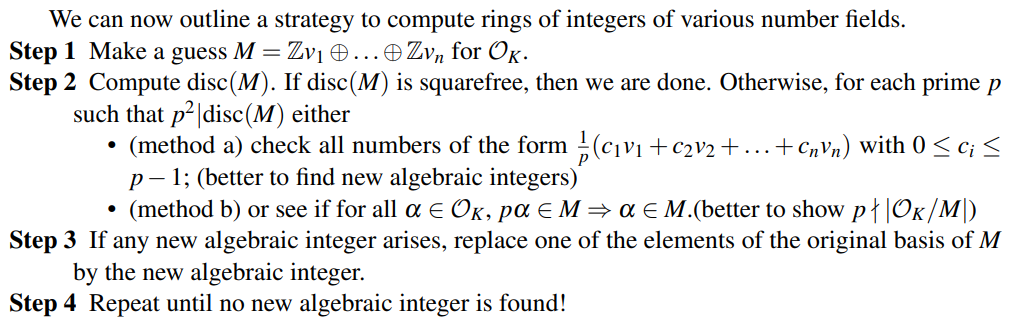
I'm lost af
If anyone is familiar with this algorithm
I have examples in my notes and I can't follow them
white jackal
next obsidian
“How to show it’s surjective”
“Uhh, well everything is in the image”
hahahha tyty i
 uncut girder
coral shale
https://i.imgur.com/9EYAe2g.png
uncut girder
coral shale
https://i.imgur.com/9EYAe2g.png
Thats kinda sick
 lapis trail
chilly ocean
lapis trail
chilly ocean
one of them is off
chilly ocean
yes
chilly ocean
any PID is a noetherian domain, but you can have a non-UFD noetherian domain, so i dunno where you'd stick those
ornate arch
whqt does it have to do with finding the automorphisms though
any auto of integers
need to send gen to gen
generator*
so therefore there can only be 2 automorphisms
but where is everything else sent
 cyan raft
ornate arch
but where is everything else sent
cyan raft
ornate arch
but where is everything else sent
everything else can be written in terms of generators?
ornate arch
well the automoprhsims are
the trivial one
and then phi: z_6->z_6 s.t phi(n) = 5n
question is
how can i show they are not inner automoorphisms?
@cyan raft
we know that since its abelian all of the inner's are trivial
<@&286206848099549185>
cyan raft
ornate arch
and then phi: z_6->z_6 s.t phi(n) = 5n
uh, that's not trivial
so it's not an inner auto?
ornate arch
the inner automorphisms are trivial
all im saying
oh ur saying that since phi(n) is not trivial
it has to be outer
ornate arch
ornate arch
<@&286206848099549185>
because of this
am i making sense im tired asf
@teal dew
cyan raft
ornate arch
it has to be outer
yea
ornate arch
ok ig integer groups are p easy to find autos of
median pawn
next obsidian
Show that f is in (x-a,y-b) iff f(a,b) = 0
I have shown that (it's actually obvious) if f is in (x-a, y-b) then f(a,b) = 0. What about the other direction?
i.e. how do I show that if f(a,b) = 0, then (x-a,y-b) is a maximal ideal of C[x,y] containing <f(x,y)>?
next obsidian
Express (x-a,y-b) as the kernel of a certain map to k
median pawn
next obsidian
Express (x-a,y-b) as the kernel of a certain map to k
The obvious choice is $\phi: k[x,y] \to k$ where $\phi(x) = a, \phi(y) = b$
cloud walrusBOT
Hausdorff
 next obsidian
From there it's obvious that if f does not vanish at (a,b) then f isnt contai ed in that ideal
median pawn
next obsidian
From there it's obvious that if f does not vanish at (a,b) then f isnt contai ed...
ok no it's not obvious
next obsidian
Oh, I guess your question was about showing that if it vanishes then its in the ideal
But from the characterization of that ideal as the kernel of that map
f is in the ideal iff f(a,b) = 0
Your map is literally "plug in (a,b)"
all you've done is replace every instance of x with a, every instance of y with b
and then fix everything else
that's just sending f(x,y) to f(a,b)
median pawn
ahhh i see how this solves the problem, but, i have a question still
cloud walrusBOT
Hausdorff
 median pawn
but what about the other inclusion
next obsidian
Well
take an f in the kernel
We want to show f is in the left ideal yeah?
Call that leftmost ideal I
Look at f’s image in k[x,y]/I
When we look mod I, x = a, and y = b yes?
Technically these should be like
x-bar
a-bar
But whatever
This lets you just conclude that f(x,y) + I = f(a,b) + I = 0 + I
But this says f(x,y) is in I
cloud walrusBOT
Hausdorff
 median pawn
next obsidian
Look at f’s image in k[x,y]/I
median pawn
next obsidian
Look at f’s image in k[x,y]/I
Now what do you mean by this?
cloud walrusBOT
CHMOLUMBIA
 next obsidian
The point is just that mod I we can replace x with a, and y with b
median pawn
next obsidian
You just look at f + I
ok sure
next obsidian
And then by assumption you can see that the thing is 0 mod I
median pawn
next obsidian
The point is just that mod I we can replace x with a, and y with b
alright let me figure this out, the rest is cool
ok i think i got it, please let me know if I am right

 median pawn
right?
cloud walrusBOT
Hausdorff
 median pawn
cloud walrus
**Hausdorff**
median pawn
cloud walrus
**Hausdorff**
and the sum of these two is clearly in the ideal
@next obsidian i'm just using the remainder theorem from one-variable
i hope the application is correct
next obsidian
Uhhh
I think of it more like this
x + I = a + I
from here, it follows that x^n + I = a^n + I
and so cx^n + I = ca^n
like...
once you know that x + I = a + I
you can just substitute a + I wherever x + I was
but you could do it that way if you want yeah
it's a clever way to reduce to the single variable case
I hadn't though of doing it this way before
median pawn
ahh thanks for your explanation!! it makes sense
median pawn
next obsidian
it's a clever way to reduce to the single variable case
which way? the one where i split up f(x,y) - f(a,b)?
chilly ocean
quick question
next obsidian
Right
chilly ocean
what is difference between directed system and directed limits?
is directed limit the object itself
chilly ocean
the system is just the tuple defining the morphism of the relation and the objects for each index?
next obsidian
It's like a collection of sets vs their union
chilly ocean
atiyah macdonald is first time i worked withem
i really like this book
the exercises build so nicely off eachother
next obsidian
I hate A-M lol
chilly ocean
what do you like better?
eisenbud or smth?
bruh
i sleep when i read thet
i tried reading it once and i took a 5 hour map
i started at 11pm tho
todd what do you study
@chilly ocean
,ti todd
cloud walrusBOT
This user hasn't set their timezone! Ask them to set it using ,ti --set.
chilly ocean
rip
oh wow so freaking cool
you know a little about symplectic manifolds?
what is coolest thing to you in differential geometry
oh yeah i wish i could learn more about it
but i feel like i need to relearn my basic algebraic topology b4 i move on
oh cool
seems useful
idk what metric geometry is
besides makybe looking at geomtry of different metrics
but idk what this entails
ty for overview
wooden ember
Grobner bases are pretty wack

 coral shale
coral shale
coral shale
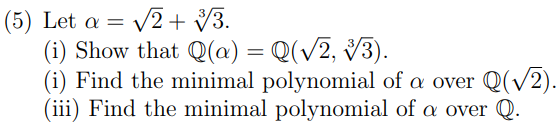
This is the answer to the 2nd part, I think
Not sure how to proceed to the last using this (should I multiply out 🤔)


 coral shale
Just unsure of what the 'correct' process is meant to be
delicate orchid
that definitely cannot be the minimal polynomial over Q it's got a sqrt(2) in it
my guess would've been (x^2-2)^3-3 personally
but now I'm seeing how that fails hmm
coral shale
delicate orchid
my guess would've been (x^2-2)^3-3 personally
This is the answer to the 2nd part
no?
oh wait you changed
delicate orchid
coral shale
theres no sqrt 2
true
coral shale
coral shale
I multiplied, grouped the sqrt 2's then killed it by multiplying by conjugate (difference of 2 squares)
Not sure 'why' this is meant to get me the minimal poly
$x^6-6x^4 +6x^3+ 12x^2+36x+1$
cloud walrusBOT
𝐒𝐡𝐮𝐫𝐢𝟐𝟎𝟔𝟎
 coral shale
When expanded its this
but 🤔
well at least wolfram tells me the roots are not integers
so minimal indeed
but im missing the why for why this process is good
delicate orchid
thank you wolfram very cool

 fast minnow
coral shale
but im missing the why for why this process is good
fast minnow
coral shale
but im missing the why for why this process is good
Maybe you can argue that the degree of the minimal polynomial has to be 6 because of the degree of the field extension, clearly it is in Q and alpha is a root. So it has to be the minimal polynomial
delicate orchid
yeah uhh the real roots of this bad boy do not seem to be sqrt(2)+3^1/3
coral shale
wut
delicate orchid
lemme double check I didn't mistype it
coral shale
,w (2^0.5 + 3^(1/3))^6-6(2^0.5 + 3^(1/3))^4 +6(2^0.5 + 3^(1/3))^3+ 12(2^0.5 + 3^(1/3))^2+36(2^0.5 + 3^(1/3))+1
cloud walrusBOT


 Requested by Shuri2060#9525
coral shale
Requested by Shuri2060#9525
coral shale
yeah u didnt.
delicate orchid
hm
coral shale

delicate orchid
fast minnow
Maybe you can argue that the degree of the minimal polynomial has to be 6 becaus...
I do agree that it has to be a degree 6 though
coral shale

Well alpha has to be a root of this
All I did was multiply this out
and multiply by another polynomial
probably arithmetic error
coral shale
yeah i made error multiplying out
coral shale
coral shale
on this
cloud walrusBOT
 Requested by Shuri2060#9525
delicate orchid
Requested by Shuri2060#9525
delicate orchid
trolled...?
hidden haven

coral shale
i shall hunt for my error then ask lmao
delicate orchid
I'll see if alpha is a root of this bad boy
cloud walrusBOT
𝐒𝐡𝐮𝐫𝐢𝟐𝟎𝟔𝟎
 coral shale
delicate orchid
,w sqrt(2)+3^(1/3)
cloud walrusBOT

 Requested by Wew Lads Tbh#0864
coral shale
Requested by Wew Lads Tbh#0864
coral shale
,w evaluate x^3 + 6x -3 (3x^2+2)sqrt2 at (sqrt2 + 3^(1/3))
delicate orchid
cloud walrus
**𝐒𝐡𝐮𝐫𝐢𝟐𝟎𝟔𝟎**
ok alpha is a root of this
thank you wolfram very cool
 coral shale
Ok, and then i multiplied by its uh 'conjugate'
delicate orchid
yeah that should still be 0 at alpha
coral shale
$\left((x^3 + 6x - 3) - (3x^2 + 2)\sqrt2\right)\left((x^3 + 6x - 3) + (3x^2 + 2)\sqrt2\right)$
cloud walrusBOT
𝐒𝐡𝐮𝐫𝐢𝟐𝟎𝟔𝟎
 delicate orchid
I think the method is fine it's just calc errors
coral shale
,w expand ((x^3 + 6x - 3) - (3x^2 + 2)\sqrt2)((x^3 + 6x - 3) + (3x^2 + 2)\sqrt2)
cloud walrusBOT
 Requested by Shuri2060#9525
coral shale
Requested by Shuri2060#9525
coral shale
what i wrote earlier

ah yh fcking sign
🤦
Ok I guess expanding is dumb - doesn't help
delicate orchid
bingo
 delicate orchid
what you mean
coral shale
 delicate orchid
bro you literally just found it
coral shale
Im just convincing myself the minimal polynomial has to be degree 6
tower law
yes yes
ok ok ok
😂
delicate orchid
the uh degree of the memer is the product of the degrees of the submemers
coral shale
For the 1st part, I square and cube alpha
then eliminate (got 3 equations, 3 unknowns). 2^0.5, 3^0.3333 are x and y, then x, y, y^2 are unknowns
Is that da wai?
delicate orchid
coral shale
just noticed there's no (ii)
delicate orchid
crimes
coral shale
I haven't really done practice Qs, mainly just understanding theory
delicate orchid
I have done neither
moldi what was that galois book you were telling me about
I know you're lurking
 pastel cliff
practice? just understand it lol
hidden haven
Milne's notes 
delicate orchid
ty
pastel cliff
pastel cliff
practice? just understand it lol
me, who has an algebra exam in 5 days
coral shale
moldi can i borrow your brains
delicate orchid
perfect
 coral shale



 hidden haven
Just one more exam bro
hidden haven
Do you know primitive element theorem
coral shale
i do yes
hidden haven

delicate orchid
I mean cube root of three isn't a FINITE linear combination of powers of sqrt(2) so u just smash them together that's my theorem
coral shale
Are you suggesting to do the same method in the proof of primitive element?
pastel cliff
delicate orchid
I mean cube root of three isn't a FINITE linear combination of powers of sqrt(2)...
trolling
coral shale
I only vaguely seen it (not understood it completely yet)
 plush wasp

hidden haven
The proof gives you a criterion for when a + cb generates F(a,b)
coral shale
yeah i didnt understand that.