#botchannel
1 messages · Page 29 of 1
 arctic schooner
 lean flickerBOT

Information about Kulturkreuzer
Name
@arctic schooner
ID
1213743271038419005
Joined
<t:1709451330> (1 day, 16 minutes and 26 seconds ago)
Account created
<t:1709449346> (1 day, 49 minutes and 30 seconds ago)
1213743271038419005
arctic schooner
help
lean flickerBOT
German commands
:small_blue_diamond: **lookup** <target> <phrase>
Translates the given phrase into the specified target language using dict.cc. Specify either en or de as targets.
:small_blue_diamond: **noun** <noun>
Provides a link to the declension of the given noun.
:small_blue_diamond: **verb** <infinitive>
Provides a link to the conjugation of the given infinitive.
:small_blue_diamond: **words**
A command that helps you train vocabulary using dict.cc.
Page 13/18 (18 entries)
arctic schooner
lookup de best
lean flickerBOT
Translations for best:
**:small_blue_diamond:** beste
best
**:small_blue_diamond:** günstigste
best [most favourable]
**:small_blue_diamond:** gut *[besonderen* *Anlässen* *vorbehalten]*
best [suit, room, etc.]
**:small_blue_diamond:** am besten
best
**:small_blue_diamond:** am liebsten
best
Page 1/2 (10 entries)
 zinc thistle
faq beginner
lean flickerBOT
How to get started
The simplest way to learn German is to find topics you don’t understand yet and search for explanations of them. This list provides you with a guide for which topics to learn if you are completely new to German. Type the topic into Google (or YouTube) and start learning!
Introduction
1: Alphabet (especially ä, ü, ö and ß)
2: Basic greetings (hello, goodbye, etc.)
Part 1 - Simple Sentence
1: Noun gender & plurals
2: Nominative case (What are cases?)
3: Nominative pronouns (I, you, he, she, etc.)
4: Verbs in present tense
5: Definite/indefinite articles
6: Accusative case (for nouns)
7: Accusative pronouns
8: Word order of simple sentences
9: How to ask questions
See Part 2 on the next page.
Tips
- Always learn the gender of a noun when you learn a new noun
- Learn to use a translation dictionary (e.g. dict.cc, leo.org)
- Use
>faq resourcesto see our list of German learning resources - For listening and pronunciation practice, try watching movies or videos (incl. YouTube)
- You can listen to pronunciation for words on websites like dict.cc, forvo.com, and others
- Practice writing sentences every day (and asking people to correct them)
- Ask as many questions as possible
- Don’t be scared to make mistakes!!!! If you don’t let yourself make mistakes, you will never be able to learn German
Page 1/2
zinc thistle
faq cefr
lean flickerBOT
CEFR levels
If you see something like A1, B2 or C1, these represent the proficiency of a speaker in a language they're not native in, and are called CEFR levels. They are valid for any language, not only German!
Roughly speaking, A levels are beginners and C levels are experts. Remember that CEFR level are self-assessed and indicative!
You can see more specific names and descriptions on the Wikipedia page:
https://en.wikipedia.org/wiki/Common_European_Framework_of_Reference_for_Languages
🗨 How do I know what level I am?
If the table on Wikipedia is too generic for you, you can try using this one here:
https://rm.coe.int/168045bb52
Just check each column one at a time: if you can do all it describes, move to the next column. Your level is the highest where you can do the most things.
Alternatively, you can use this questionnaire to estimate your level more accurately:
https://rm.coe.int/self-assessment-checklists-from-the-swiss-version-of-the-european-lang/1680492f8e
lean flickerBOT
See a listed FAQ with >faq [name]
:small_blue_diamond: Absentive
Aliases: Absentiv
:small_blue_diamond: Accusative
Aliases: Akkusativ
:small_blue_diamond: Adjective Declension
Aliases: Adjektivdeklination, Adjective endings
:small_blue_diamond: AI in language learning
Aliases: ai, chatgpt
:small_blue_diamond: Anki
Aliases: Flashcards
:small_blue_diamond: Beide vs. Beides
Aliases: Beides vs. Beide, Beides, Beide
:small_blue_diamond: Best way to learn German
Aliases: Fastest way to learn, Learn fast, Most efficient way to learn, Learn efficiently, Best way to learn, Learn German fast
:small_blue_diamond: Can anyone teach me German
Aliases: Private tutors, Teach me, Teach me German, Teach German, Private lessons, Private teachers
:small_blue_diamond: Cases
Aliases: Grammatical case, Case
:small_blue_diamond: CEFR levels
Aliases: CEFR, CERF
:small_blue_diamond: Conjugation
Aliases: Konjugation, Praesens, Verbs, Verb conjugation, Present tense, Präsens
:small_blue_diamond: Contractions
Aliases: Verschmelzung, Schmelzwort, Vom
:small_blue_diamond: DACH
:small_blue_diamond: Dative
Aliases: Dativ
:small_blue_diamond: Digga
Aliases: Digger
Page 1/5 (68 entries)
lean flickerBOT
Best way to learn German
Should I study all these skills every day?
If you want to study them all every day, you can, but some people may find it easier to focus on particular skills on particular days. For example, on Monday you might choose to do a lot of writing practice, and then on Tuesday you might plan some conversation practice with some speaking partners.
If you try to cover too many different things in one day, then you might be jumping around all over the place and not able to focus on each individual task. It’s also a really good idea to have a different schedule or set of tasks each day to keep things from getting boring. So setting a special schedule or set of tasks for each day of the week - like the Monday writing day, or every Friday you do some grammar exercises followed by watching TV shows, or any other combination you like – is a really good way to go.
How much time should I dedicate to studying?
Everyone has a different schedule and everyone learns at a different pace. It is recommended to study every day, preferably for 30 minutes or more, but taking 1-2 days off is okay. More important is how many hours you study in a week.
A casual pace will be roughly around 5-8 hours a week, a steady pace would be around 10-14 hours a week, and a fast pace (around the same pace as a university subject) will be 15-20 hours a week.
Anything less than 5 hours and you may find it hard to keep improving steadily (but feel free to try it and see how it works for you), while studying one subject for over 25 hours a week may quickly lead to burnout.
How you choose to spread those hours out over the week is not that important; for example, if you have a lot of time on the weekend but not during the week, it’s fine to do short study sessions on weekdays and then dedicate a bunch of time on Saturday and Sunday.
On the next page
• Factors that influence learning a language.
Page 2/3
 tender trellis
faq beginner
lean flickerBOT
How to get started
The simplest way to learn German is to find topics you don’t understand yet and search for explanations of them. This list provides you with a guide for which topics to learn if you are completely new to German. Type the topic into Google (or YouTube) and start learning!
Introduction
1: Alphabet (especially ä, ü, ö and ß)
2: Basic greetings (hello, goodbye, etc.)
Part 1 - Simple Sentence
1: Noun gender & plurals
2: Nominative case (What are cases?)
3: Nominative pronouns (I, you, he, she, etc.)
4: Verbs in present tense
5: Definite/indefinite articles
6: Accusative case (for nouns)
7: Accusative pronouns
8: Word order of simple sentences
9: How to ask questions
See Part 2 on the next page.
Tips
- Always learn the gender of a noun when you learn a new noun
- Learn to use a translation dictionary (e.g. dict.cc, leo.org)
- Use
>faq resourcesto see our list of German learning resources - For listening and pronunciation practice, try watching movies or videos (incl. YouTube)
- You can listen to pronunciation for words on websites like dict.cc, forvo.com, and others
- Practice writing sentences every day (and asking people to correct them)
- Ask as many questions as possible
- Don’t be scared to make mistakes!!!! If you don’t let yourself make mistakes, you will never be able to learn German
Page 1/2
tender trellis
faq Best way to learn German
lean flickerBOT
Factors that influence learning a language
The following factors (and many others) can influence how easily or quickly you learn German. Remember that everyone is different and these factors will influence different people in different ways.
Native language
As an example, if your native language is English, you may need more time than someone who speaks Dutch.
Previous language learning
Some learners find it easier to learn German if they have already learned a foreign language, or if they have a natural ability to learn languages.
Methods
Some are able to identify what type of learner they are, and leverage that to their benefit.
Discipline and Motivation
Learning a language is fun and exciting at first, but it can be easy to lose motivation and become less disciplined very quickly.
Consistency
Learning a little bit each day every week is generally considered better than studying for several hours, one day per week.
Grammar
The time needed to acquire grammar passively is quite large, so German learners who actively study grammar typically make less grammar mistakes as they progress.
Exposure and immersion
Interacting with native speakers and consuming native content such as the news, magazines, books, movies, podcasts, etc. can help tremendously with achieving an idiomatic usage of the language.
Training each ability equally
Listening, reading, speaking, writing, translating and interpreting are all various abilities associated with language learning. Training these abilities equally is important to ensure that a person can not only pass a language test, but also have the ability to use the language in various contexts while demonstrating great control over grammar.
Page 3/3
How to get started - Part 2
Please make sure to read Part 1 before starting Part 2!
Part 2 – Beyond a Simple Sentence
1: Conjunctions (coordinating and subordinating)
2: Subordinate clause word order
3: Dative case
4: Dative verbs
5: Verbs with two objects (e.g. geben)
6: Prepositions (accusative, dative, and two-way)
7: Spoken past tense (Perfekt)
8: Written past tense (Präteritum)
9: Genitive case
10: Relative clauses
11: Adjective declension
Tips
- Make sure to practice writing and reading simple texts
- Some of these concepts are confusing to start with, so it’s a good idea to ask for help in #questions when you’re unsure
- You should use a declension chart to help with declension to start with, because you won’t be able to memorize it straight away
- After you feel confident with creating sentences, you can start learning the adjective declension properly by using the command >faq adjective declension and reading the guide provided
Page 2/2
lean flickerBOT
Resources
Here's a link to our curated list of resources: https://bit.ly/gladresources. Check out #resources if you want to submit some yourself!
 cosmic garnet
faq digger
lean flickerBOT
Digger / Digga
You might have heard a native say this or otherwise stumbled across it, but are you sure about its meaning and usage in sentences?
Digger, also spelt Digga, is an informal word similar in usage to bro in colloquial English.
It likely comes from the Hamburger-dialect version of the word Dicker, literally fatty; note however that in this case it is closer in meaning to buddy than a comment on a person's build.
-
🇩🇪 | "Was ist los, Digger?"
-
🇬🇧 | "What's up, bro?"
-
🇩🇪 | "Ich hatte viel zu tun, tut mir leid, Digger."
-
🇬🇧 | "I was busy, sorry bro."
-
🇩🇪 | "Klar, Digga."
-
🇬🇧 | "Sure, bro."
-
🇩🇪 | "Willst du einen Film sehen, Digga?"
-
🇬🇧 | "Do you want to watch a film, bro?"
 hollow summit
faq anki
lean flickerBOT
Anki
What is Anki?
Anki is a free and very versatile flashcard program that is often used for learning new vocabulary. You can import spreadsheets to quickly create your own flashcards, and you can add your own images and audio for highly custom flashcard decks. You can also access and use a wide range of community created and shared flashcard decks all for free*.
Note: Anki uses a method of learning called spaced repetition. Flashcards and spaced repetition are one of many techniques used for language learning. However, we all learn differently and while these methods work for many people, they may not necessarily work for you. Give it a try, but don’t be disheartened if these methods aren’t right for you. Even if flashcards and spaced repetition work for you, don’t forget to incorporate other forms of practice. E.g. try using your new vocabulary to write your own practice sentences.
Where To Get It
It is available here on PC, Mac, Linux, iPhone, and Android. You can also find the browser AnkiWeb version here.
Manually adding basic cards is quite simple, but making custom templates is a bit more complex. Basementality has put together this handy guide for making custom card types and decks. You can also find Anki’s documentation / instruction guide here.
*The iPhone app AnkiMobile costs $24.99 USD on the iTunes store. The Android app and all other platforms are completely free. The mobile browser version of AnkiWeb is still available for free on iPhones.
See the next page for some helpful tips on creating your flashcards.
Page 1/2
 spark aurora
@fluid steeple try doing those https://deutsch.lingolia.com/de/grammatik/pronomen/relativpronomen/uebungen they're made for your level.
hollow summit
faq anki
lean flickerBOT
Flashcard Tips
When creating flashcards it is not enough to just have a single german word on one side, and a single word translation on the other side of the card. You want to provide details that match your learning style and help you better understand what the word means.
For nouns
At the very least, include the gender and the plural form. E.g. Der Mann | Die Männer or Der Mann -:er Whichever form helps you recognise the plural ending and any vowel changes. You may also want to add a note for weak masculine nouns. (See >explain N-Declension.)
For verbs
Include the infinitive, the preterite (simple past) and the past participle (perfect form). E.g. rennen | rannte | gerannt or for a separable verb anrufen | rief an | angerufen. For irregular verbs, you may want to list all present tense conjugations. You may also want to include if the verb uses haben or sein as its auxiliary.
For all words
Adding an example sentence is important for helping you understand the usage and context of a word (dwds.de and linguee.com are good sources of example sentences). You may also want to add multiple translations for words that have multiple meanings. E.g. Die Auflage can mean both a requirement, and the edition of a book. You may also want to try picture cues or audio recordings (possible sources for voice recordings include dict.cc, linguee.com, duden.de, and wiktionary.de).
Close Passages
Flashcards based on close passages can be a very effective way to learn new vocabulary. E.g. put Ich kaufe Lebensmittel im [blank] ein. on one side of the flashcard, and Ich kaufe Lebensmittel im *Markt* ein; der Markt, die Märkte - market. This places vocabulary in context to help you understand its meaning and usages, and also provides you with whole phrases that help jolt your memory when trying to remember an individual word.
Recall vs. Reproduction
Flashcards are most effective when they train your ability to reproduce knowledge. I.e. Seeing the word Baum and recognising it as tree is a lot less effective than being able to look at a picture of a tree and know it means der Baum. Taking that a step further you want to be able to also know that that while die Struktur also means 'tree', it doesn't actually mean the plant. When creating flashcards, try to design them with these concepts in mind. E.g. Using minimal or no flashcards that show you a german word and ask you to recall what it means in english, and instead focus on the other way around: giving you an english word and asking you to recall what it means in german.
Page 2/2
 fluid steeple
spark aurora
<@758907689643409410> try doing those <https://deutsch.lingolia.com/de/grammatik...
fluid steeple
spark aurora
<@758907689643409410> try doing those <https://deutsch.lingolia.com/de/grammatik...
Danke
tender trellis
faq beginner
lean flickerBOT
How to get started - Part 2
Please make sure to read Part 1 before starting Part 2!
Part 2 – Beyond a Simple Sentence
1: Conjunctions (coordinating and subordinating)
2: Subordinate clause word order
3: Dative case
4: Dative verbs
5: Verbs with two objects (e.g. geben)
6: Prepositions (accusative, dative, and two-way)
7: Spoken past tense (Perfekt)
8: Written past tense (Präteritum)
9: Genitive case
10: Relative clauses
11: Adjective declension
Tips
- Make sure to practice writing and reading simple texts
- Some of these concepts are confusing to start with, so it’s a good idea to ask for help in #questions when you’re unsure
- You should use a declension chart to help with declension to start with, because you won’t be able to memorize it straight away
- After you feel confident with creating sentences, you can start learning the adjective declension properly by using the command >faq adjective declension and reading the guide provided
Page 2/2
tender trellis
faq resources
lean flickerBOT
Resources
Here's a link to our curated list of resources: https://bit.ly/gladresources. Check out #resources if you want to submit some yourself!
 smoky thicket
faq beginner
lean flickerBOT
How to get started - Part 2
Please make sure to read Part 1 before starting Part 2!
Part 2 – Beyond a Simple Sentence
1: Conjunctions (coordinating and subordinating)
2: Subordinate clause word order
3: Dative case
4: Dative verbs
5: Verbs with two objects (e.g. geben)
6: Prepositions (accusative, dative, and two-way)
7: Spoken past tense (Perfekt)
8: Written past tense (Präteritum)
9: Genitive case
10: Relative clauses
11: Adjective declension
Tips
- Make sure to practice writing and reading simple texts
- Some of these concepts are confusing to start with, so it’s a good idea to ask for help in #questions when you’re unsure
- You should use a declension chart to help with declension to start with, because you won’t be able to memorize it straight away
- After you feel confident with creating sentences, you can start learning the adjective declension properly by using the command >faq adjective declension and reading the guide provided
Page 2/2
 woeful forge
faq beginner
lean flickerBOT
How to get started
The simplest way to learn German is to find topics you don’t understand yet and search for explanations of them. This list provides you with a guide for which topics to learn if you are completely new to German. Type the topic into Google (or YouTube) and start learning!
Introduction
1: Alphabet (especially ä, ü, ö and ß)
2: Basic greetings (hello, goodbye, etc.)
Part 1 - Simple Sentence
1: Noun gender & plurals
2: Nominative case (What are cases?)
3: Nominative pronouns (I, you, he, she, etc.)
4: Verbs in present tense
5: Definite/indefinite articles
6: Accusative case (for nouns)
7: Accusative pronouns
8: Word order of simple sentences
9: How to ask questions
See Part 2 on the next page.
Tips
- Always learn the gender of a noun when you learn a new noun
- Learn to use a translation dictionary (e.g. dict.cc, leo.org)
- Use
>faq resourcesto see our list of German learning resources - For listening and pronunciation practice, try watching movies or videos (incl. YouTube)
- You can listen to pronunciation for words on websites like dict.cc, forvo.com, and others
- Practice writing sentences every day (and asking people to correct them)
- Ask as many questions as possible
- Don’t be scared to make mistakes!!!! If you don’t let yourself make mistakes, you will never be able to learn German
Page 1/2
woeful forge
faq resiurces
lean flickerBOT
FAQ not found. I found the following similar entry: Resources (1)
Select one of the values in the brackets to directly open the suggested FAQ.
woeful forge
faq resources
lean flickerBOT
Resources
Here's a link to our curated list of resources: https://bit.ly/gladresources. Check out #resources if you want to submit some yourself!
 gloomy hawk
faq beginner
lean flickerBOT
How to get started
The simplest way to learn German is to find topics you don’t understand yet and search for explanations of them. This list provides you with a guide for which topics to learn if you are completely new to German. Type the topic into Google (or YouTube) and start learning!
Introduction
1: Alphabet (especially ä, ü, ö and ß)
2: Basic greetings (hello, goodbye, etc.)
Part 1 - Simple Sentence
1: Noun gender & plurals
2: Nominative case (What are cases?)
3: Nominative pronouns (I, you, he, she, etc.)
4: Verbs in present tense
5: Definite/indefinite articles
6: Accusative case (for nouns)
7: Accusative pronouns
8: Word order of simple sentences
9: How to ask questions
See Part 2 on the next page.
Tips
- Always learn the gender of a noun when you learn a new noun
- Learn to use a translation dictionary (e.g. dict.cc, leo.org)
- Use
>faq resourcesto see our list of German learning resources - For listening and pronunciation practice, try watching movies or videos (incl. YouTube)
- You can listen to pronunciation for words on websites like dict.cc, forvo.com, and others
- Practice writing sentences every day (and asking people to correct them)
- Ask as many questions as possible
- Don’t be scared to make mistakes!!!! If you don’t let yourself make mistakes, you will never be able to learn German
Page 1/2
 zealous bough
 glass tundra
lean flickerBOT
glass tundra
lean flickerBOT
How to get started
The simplest way to learn German is to find topics you don’t understand yet and search for explanations of them. This list provides you with a guide for which topics to learn if you are completely new to German. Type the topic into Google (or YouTube) and start learning!
Introduction
1: Alphabet (especially ä, ü, ö and ß)
2: Basic greetings (hello, goodbye, etc.)
Part 1 - Simple Sentence
1: Noun gender & plurals
2: Nominative case (What are cases?)
3: Nominative pronouns (I, you, he, she, etc.)
4: Verbs in present tense
5: Definite/indefinite articles
6: Accusative case (for nouns)
7: Accusative pronouns
8: Word order of simple sentences
9: How to ask questions
See Part 2 on the next page.
Tips
- Always learn the gender of a noun when you learn a new noun
- Learn to use a translation dictionary (e.g. dict.cc, leo.org)
- Use
>faq resourcesto see our list of German learning resources - For listening and pronunciation practice, try watching movies or videos (incl. YouTube)
- You can listen to pronunciation for words on websites like dict.cc, forvo.com, and others
- Practice writing sentences every day (and asking people to correct them)
- Ask as many questions as possible
- Don’t be scared to make mistakes!!!! If you don’t let yourself make mistakes, you will never be able to learn German
Page 1/2
 forest shell
quote
lean flickerBOT
:x: The required argument message is missing.
forest shell
help
lean flickerBOT
Meme 1/2 commands
:small_blue_diamond: **bonk** <member>
Bonks the given member.
:small_blue_diamond: **cat**
Display a random cat image.
:small_blue_diamond: **dog**
Display a random dog image.
:small_blue_diamond: **inspireme**
Displays an AI-generated inspirational quote.
:small_blue_diamond: **patcat** <member>
Pats the given member's cat.
Page 7/18 (18 entries)
 serene beacon
isbanned 715515750726500403
lean flickerBOT
Seraph of Nocturne has not been banned on this server.
 jolly panther
verb klingeln
lean flickerBOT

Netzverb Wörterbuch
Konjugation Verb klingeln: im Präsens, Präteritum, Konjunktiv, Perfekt, ... viele Beispiele, Grammatik, Regeln erklärt, Übersetzung, Übungen, Bedeutung und kostenlose Downloads.
jolly panther
verb duschen
lean flickerBOT
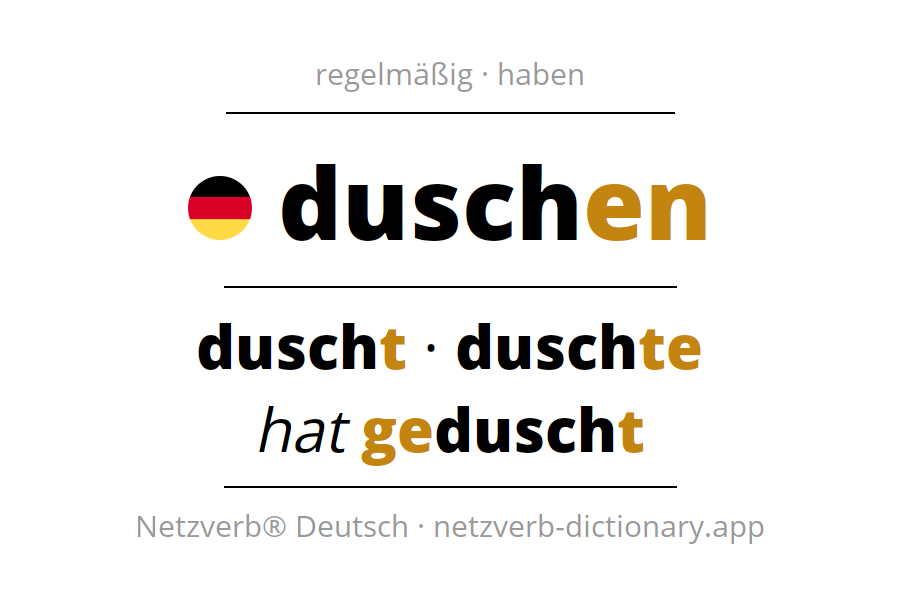
Netzverb Wörterbuch
Konjugation Verb duschen: im Präsens, Präteritum, Konjunktiv, Perfekt, ... viele Beispiele, Grammatik, Regeln erklärt, Übersetzung, Übungen, Bedeutung und kostenlose Downloads.
 shy ermine
faq cefr
lean flickerBOT
CEFR levels
If you see something like A1, B2 or C1, these represent the proficiency of a speaker in a language they're not native in, and are called CEFR levels. They are valid for any language, not only German!
Roughly speaking, A levels are beginners and C levels are experts. Remember that CEFR level are self-assessed and indicative!
You can see more specific names and descriptions on the Wikipedia page:
https://en.wikipedia.org/wiki/Common_European_Framework_of_Reference_for_Languages
🗨 How do I know what level I am?
If the table on Wikipedia is too generic for you, you can try using this one here:
https://rm.coe.int/168045bb52
Just check each column one at a time: if you can do all it describes, move to the next column. Your level is the highest where you can do the most things.
Alternatively, you can use this questionnaire to estimate your level more accurately:
https://rm.coe.int/self-assessment-checklists-from-the-swiss-version-of-the-european-lang/1680492f8e
shy ermine
faq beginner
lean flickerBOT
How to get started
The simplest way to learn German is to find topics you don’t understand yet and search for explanations of them. This list provides you with a guide for which topics to learn if you are completely new to German. Type the topic into Google (or YouTube) and start learning!
Introduction
1: Alphabet (especially ä, ü, ö and ß)
2: Basic greetings (hello, goodbye, etc.)
Part 1 - Simple Sentence
1: Noun gender & plurals
2: Nominative case (What are cases?)
3: Nominative pronouns (I, you, he, she, etc.)
4: Verbs in present tense
5: Definite/indefinite articles
6: Accusative case (for nouns)
7: Accusative pronouns
8: Word order of simple sentences
9: How to ask questions
See Part 2 on the next page.
Tips
- Always learn the gender of a noun when you learn a new noun
- Learn to use a translation dictionary (e.g. dict.cc, leo.org)
- Use
>faq resourcesto see our list of German learning resources - For listening and pronunciation practice, try watching movies or videos (incl. YouTube)
- You can listen to pronunciation for words on websites like dict.cc, forvo.com, and others
- Practice writing sentences every day (and asking people to correct them)
- Ask as many questions as possible
- Don’t be scared to make mistakes!!!! If you don’t let yourself make mistakes, you will never be able to learn German
Page 1/2
shy ermine
purpose Reading
lean flickerBOT
Information about Reading
Reading
This role is for members of the Reading group. Members of this group will be pinged with updates regarding reading sessions. This involves reading a text in German and (usually) translating it into English. This activity is aimed at all levels.
Enter >sub reading in #botchannel to get pings about sessions.
shy ermine
sub reading
 robust panther
faq resources
lean flickerBOT
Resources
Here's a link to our curated list of resources: https://bit.ly/gladresources. Check out #resources if you want to submit some yourself!
robust panther
sub reading
 cinder quail
faq beginner
lean flickerBOT
How to get started
The simplest way to learn German is to find topics you don’t understand yet and search for explanations of them. This list provides you with a guide for which topics to learn if you are completely new to German. Type the topic into Google (or YouTube) and start learning!
Introduction
1: Alphabet (especially ä, ü, ö and ß)
2: Basic greetings (hello, goodbye, etc.)
Part 1 - Simple Sentence
1: Noun gender & plurals
2: Nominative case (What are cases?)
3: Nominative pronouns (I, you, he, she, etc.)
4: Verbs in present tense
5: Definite/indefinite articles
6: Accusative case (for nouns)
7: Accusative pronouns
8: Word order of simple sentences
9: How to ask questions
See Part 2 on the next page.
Tips
- Always learn the gender of a noun when you learn a new noun
- Learn to use a translation dictionary (e.g. dict.cc, leo.org)
- Use
>faq resourcesto see our list of German learning resources - For listening and pronunciation practice, try watching movies or videos (incl. YouTube)
- You can listen to pronunciation for words on websites like dict.cc, forvo.com, and others
- Practice writing sentences every day (and asking people to correct them)
- Ask as many questions as possible
- Don’t be scared to make mistakes!!!! If you don’t let yourself make mistakes, you will never be able to learn German
Page 1/2
 ivory heart
help
lean flickerBOT
Bans commands
:small_blue_diamond: **isbanned** <user>
Checks whether the given user is banned.
Page 18/18 (18 entries)
ivory heart
commands
tender trellis
faq best way to start learning german
lean flickerBOT
Factors that influence learning a language
The following factors (and many others) can influence how easily or quickly you learn German. Remember that everyone is different and these factors will influence different people in different ways.
Native language
As an example, if your native language is English, you may need more time than someone who speaks Dutch.
Previous language learning
Some learners find it easier to learn German if they have already learned a foreign language, or if they have a natural ability to learn languages.
Methods
Some are able to identify what type of learner they are, and leverage that to their benefit.
Discipline and Motivation
Learning a language is fun and exciting at first, but it can be easy to lose motivation and become less disciplined very quickly.
Consistency
Learning a little bit each day every week is generally considered better than studying for several hours, one day per week.
Grammar
The time needed to acquire grammar passively is quite large, so German learners who actively study grammar typically make less grammar mistakes as they progress.
Exposure and immersion
Interacting with native speakers and consuming native content such as the news, magazines, books, movies, podcasts, etc. can help tremendously with achieving an idiomatic usage of the language.
Training each ability equally
Listening, reading, speaking, writing, translating and interpreting are all various abilities associated with language learning. Training these abilities equally is important to ensure that a person can not only pass a language test, but also have the ability to use the language in various contexts while demonstrating great control over grammar.
Page 3/3
tender trellis
explain present tense
lean flickerBOT
Conjugation
Präsens (Present Tense)
When you use a verb in a sentence (or clause), you have to conjugate it (change the form) to match the subject of the sentence (or clause).
For example, in English, we write I eat but he/she eats. The verb has a different ending! The concept is the same in German, except German has more endings.
The first thing you need to know in order to conjugate verbs is: which ending fits which subject? Here is a simple verb “trinken” (to drink) as an example:
trinken
ich trinke
du trinkst
er/sie/es trinkt
wir trinken
ihr trinkt
sie trinken / Sie trinken
(Note: the conjugation for sie (they) and Sie (formal you) is always the same)
Vowel/Stem Changes
There are a few variations and exceptions, but the most important is vowel changes (also called stem changes). Some verbs get a vowel change, which only affects the du and er/sie/es forms of the verb. (However, modal verbs and wissen have their own special pattern, which also has a vowel change in the ich form.)
Example: ich schlafe, du schläfst
Other Changes
There are various other differences but I can’t describe them all here, so please read these websites or use Google to find more information: https://www.vistawide.com/german/grammar/german_verbs_present_tense.htm
https://www.thoughtco.com/german-present-tense-verbs-4074838
http://www.dartmouth.edu/~deutsch/Grammatik/PresentTense/Present.html
tender trellis
explain future tense
lean flickerBOT
FAQ not found. Try >explain all.
tender trellis
explain all
lean flickerBOT
See a listed FAQ with >faq [name]
:small_blue_diamond: Absentive
Aliases: Absentiv
:small_blue_diamond: Accusative
Aliases: Akkusativ
:small_blue_diamond: Adjective Declension
Aliases: Adjektivdeklination, Adjective endings
:small_blue_diamond: AI in language learning
Aliases: ai, chatgpt
:small_blue_diamond: Anki
Aliases: Flashcards
:small_blue_diamond: Beide vs. Beides
Aliases: Beides vs. Beide, Beides, Beide
:small_blue_diamond: Best way to learn German
Aliases: Fastest way to learn, Learn fast, Most efficient way to learn, Learn efficiently, Best way to learn, Learn German fast
:small_blue_diamond: Can anyone teach me German
Aliases: Private tutors, Teach me, Teach me German, Teach German, Private lessons, Private teachers
:small_blue_diamond: Cases
Aliases: Grammatical case, Case
:small_blue_diamond: CEFR levels
Aliases: CEFR, CERF
:small_blue_diamond: Conjugation
Aliases: Konjugation, Praesens, Verbs, Verb conjugation, Present tense, Präsens
:small_blue_diamond: Contractions
Aliases: Verschmelzung, Schmelzwort, Vom
:small_blue_diamond: DACH
:small_blue_diamond: Dative
Aliases: Dativ
:small_blue_diamond: Digga
Aliases: Digger
Page 1/5 (68 entries)
lean flickerBOT
Conjugation
Präsens (Present Tense)
When you use a verb in a sentence (or clause), you have to conjugate it (change the form) to match the subject of the sentence (or clause).
For example, in English, we write I eat but he/she eats. The verb has a different ending! The concept is the same in German, except German has more endings.
The first thing you need to know in order to conjugate verbs is: which ending fits which subject? Here is a simple verb “trinken” (to drink) as an example:
trinken
ich trinke
du trinkst
er/sie/es trinkt
wir trinken
ihr trinkt
sie trinken / Sie trinken
(Note: the conjugation for sie (they) and Sie (formal you) is always the same)
Vowel/Stem Changes
There are a few variations and exceptions, but the most important is vowel changes (also called stem changes). Some verbs get a vowel change, which only affects the du and er/sie/es forms of the verb. (However, modal verbs and wissen have their own special pattern, which also has a vowel change in the ich form.)
Example: ich schlafe, du schläfst
Other Changes
There are various other differences but I can’t describe them all here, so please read these websites or use Google to find more information: https://www.vistawide.com/german/grammar/german_verbs_present_tense.htm
https://www.thoughtco.com/german-present-tense-verbs-4074838
http://www.dartmouth.edu/~deutsch/Grammatik/PresentTense/Present.html
 frail nexus
faq past tense
lean flickerBOT
Perfekt
How to form the Perfekt tense
The Perfekt tense is formed by combining an auxiliary verb (haben or sein) with the past participle form of the main verb.
For example, if I want to write the past tense of “essen”/“to eat”, such as in the English sentence “I ate”, I first need to know the auxiliary verb that goes with essen (which happens to be haben), and the past participle form of essen (which is gegessen).
I can then combine them with the usual verb conjugation and word order rules, as such:
Ich habe gegessen. -> I ate. / I have eaten.
Ich habe das Brot gegessen. -> I ate the bread. / I have eaten the bread.
How to determine the past participle?
Just look it up in the dictionary! There are a few general patterns you can also learn about, but a dictionary will pretty much always list the past participle somewhere near the verb itself.
When to use haben and when to use sein as the auxiliary verb?
The basic rules are:
• Transitive verbs (verbs which take an accusative object) use haben
• Intransitive verbs which describe a change of location or change of state use sein
• Other intransitive verbs use haben
This may not be a 100% reliable set of rules, so if in doubt, you can always use a dictionary to verify the correct auxiliary. Also note that there are a few regional variations.
Page 2/2
 barren mesa
faq beginner
lean flickerBOT
How to get started
The simplest way to learn German is to find topics you don’t understand yet and search for explanations of them. This list provides you with a guide for which topics to learn if you are completely new to German. Type the topic into Google (or YouTube) and start learning!
Introduction
1: Alphabet (especially ä, ü, ö and ß)
2: Basic greetings (hello, goodbye, etc.)
Part 1 - Simple Sentence
1: Noun gender & plurals
2: Nominative case (What are cases?)
3: Nominative pronouns (I, you, he, she, etc.)
4: Verbs in present tense
5: Definite/indefinite articles
6: Accusative case (for nouns)
7: Accusative pronouns
8: Word order of simple sentences
9: How to ask questions
See Part 2 on the next page.
Tips
- Always learn the gender of a noun when you learn a new noun
- Learn to use a translation dictionary (e.g. dict.cc, leo.org)
- Use
>faq resourcesto see our list of German learning resources - For listening and pronunciation practice, try watching movies or videos (incl. YouTube)
- You can listen to pronunciation for words on websites like dict.cc, forvo.com, and others
- Practice writing sentences every day (and asking people to correct them)
- Ask as many questions as possible
- Don’t be scared to make mistakes!!!! If you don’t let yourself make mistakes, you will never be able to learn German
Page 1/2
barren mesa
faq resources
lean flickerBOT
Resources
Here's a link to our curated list of resources: https://bit.ly/gladresources. Check out #resources if you want to submit some yourself!
 flint moat
lessons
lean flickerBOT
Upcoming Sessions
:calendar: Want to add our sessions schedule to your Google calendar?
:small_blue_diamond: (Your time: <t:1709755200:F>) held by Rin
[ID: 281] (Reading)
Ein Tag im Nationalpark
Recommended level(s):
Type >session info [ID#] e.g. >session info 3 for more detail about a specific session.
flint moat
faq beginner
lean flickerBOT
How to get started
The simplest way to learn German is to find topics you don’t understand yet and search for explanations of them. This list provides you with a guide for which topics to learn if you are completely new to German. Type the topic into Google (or YouTube) and start learning!
Introduction
1: Alphabet (especially ä, ü, ö and ß)
2: Basic greetings (hello, goodbye, etc.)
Part 1 - Simple Sentence
1: Noun gender & plurals
2: Nominative case (What are cases?)
3: Nominative pronouns (I, you, he, she, etc.)
4: Verbs in present tense
5: Definite/indefinite articles
6: Accusative case (for nouns)
7: Accusative pronouns
8: Word order of simple sentences
9: How to ask questions
See Part 2 on the next page.
Tips
- Always learn the gender of a noun when you learn a new noun
- Learn to use a translation dictionary (e.g. dict.cc, leo.org)
- Use
>faq resourcesto see our list of German learning resources - For listening and pronunciation practice, try watching movies or videos (incl. YouTube)
- You can listen to pronunciation for words on websites like dict.cc, forvo.com, and others
- Practice writing sentences every day (and asking people to correct them)
- Ask as many questions as possible
- Don’t be scared to make mistakes!!!! If you don’t let yourself make mistakes, you will never be able to learn German
Page 1/2
 prisma jackal
faq beginner
lean flickerBOT
How to get started - Part 2
Please make sure to read Part 1 before starting Part 2!
Part 2 – Beyond a Simple Sentence
1: Conjunctions (coordinating and subordinating)
2: Subordinate clause word order
3: Dative case
4: Dative verbs
5: Verbs with two objects (e.g. geben)
6: Prepositions (accusative, dative, and two-way)
7: Spoken past tense (Perfekt)
8: Written past tense (Präteritum)
9: Genitive case
10: Relative clauses
11: Adjective declension
Tips
- Make sure to practice writing and reading simple texts
- Some of these concepts are confusing to start with, so it’s a good idea to ask for help in #questions when you’re unsure
- You should use a declension chart to help with declension to start with, because you won’t be able to memorize it straight away
- After you feel confident with creating sentences, you can start learning the adjective declension properly by using the command >faq adjective declension and reading the guide provided
Page 2/2
cinder quail
help
lean flickerBOT
Help commands
:small_blue_diamond: **help** [term]
Displays help information for modules and individual commands. The optional argument term is the search term to use. If no value is provided, the bot will display a list of all available modules. Otherwise, it will attempt to find information about the given term.
Page 1/18 (18 entries)
 surreal mural
help
lean flickerBOT
Help commands
:small_blue_diamond: **help** [term]
Displays help information for modules and individual commands. The optional argument term is the search term to use. If no value is provided, the bot will display a list of all available modules. Otherwise, it will attempt to find information about the given term.
Page 1/18 (18 entries)
lean flickerBOT
How to get started
The simplest way to learn German is to find topics you don’t understand yet and search for explanations of them. This list provides you with a guide for which topics to learn if you are completely new to German. Type the topic into Google (or YouTube) and start learning!
Introduction
1: Alphabet (especially ä, ü, ö and ß)
2: Basic greetings (hello, goodbye, etc.)
Part 1 - Simple Sentence
1: Noun gender & plurals
2: Nominative case (What are cases?)
3: Nominative pronouns (I, you, he, she, etc.)
4: Verbs in present tense
5: Definite/indefinite articles
6: Accusative case (for nouns)
7: Accusative pronouns
8: Word order of simple sentences
9: How to ask questions
See Part 2 on the next page.
Tips
- Always learn the gender of a noun when you learn a new noun
- Learn to use a translation dictionary (e.g. dict.cc, leo.org)
- Use
>faq resourcesto see our list of German learning resources - For listening and pronunciation practice, try watching movies or videos (incl. YouTube)
- You can listen to pronunciation for words on websites like dict.cc, forvo.com, and others
- Practice writing sentences every day (and asking people to correct them)
- Ask as many questions as possible
- Don’t be scared to make mistakes!!!! If you don’t let yourself make mistakes, you will never be able to learn German
Page 1/2
 eternal maple
faq keyboard
lean flickerBOT
German letters
Being able to type German letters is quite important!
- Schon = already. Schön = beautiful.
- Mutter = mother. Mütter = mothers.
How to? There are several options.
🔸 Use a program like AutoHotkey. Download the program from https://www.autohotkey.com/ and read the pinned message in #resources for instructions on how to set it up. It can be used with any keyboard layout and the hotkeys can be customised.
🔸 US International layout: this is basically just a US keyboard layout with extra characters, so if you're using a US-style keyboard or something similar, the transition is very easy! Everything stays as you know it, except that some of the symbol keys can be used to create the special characters. For example " + a = ä. You can also do RightAlt + s = ß.
To use US International on Windows, look for the Region & Language options and switch your selected keyboard layout to US International.
🔸 If you are on Mac, there are two simple possibilities:
- The accent menu - Pressing and holding a letter key will display multiple variants of the letter, including umlauts, which can then be selected using the number keys.
- Dead keys - Pressing
Option + u, then pressinga,u, oro, respectively, will display the umlaut variant of that letter. You can also pressOption + sto enterß.
See this support article for more information:
https://support.apple.com/guide/mac-help/enter-characters-with-accent-marks-on-mac-mh27474/mac
See the next page for more alternatives.
Page 1/2
 vague panther
faq beginner
lean flickerBOT
How to get started
The simplest way to learn German is to find topics you don’t understand yet and search for explanations of them. This list provides you with a guide for which topics to learn if you are completely new to German. Type the topic into Google (or YouTube) and start learning!
Introduction
1: Alphabet (especially ä, ü, ö and ß)
2: Basic greetings (hello, goodbye, etc.)
Part 1 - Simple Sentence
1: Noun gender & plurals
2: Nominative case (What are cases?)
3: Nominative pronouns (I, you, he, she, etc.)
4: Verbs in present tense
5: Definite/indefinite articles
6: Accusative case (for nouns)
7: Accusative pronouns
8: Word order of simple sentences
9: How to ask questions
See Part 2 on the next page.
Tips
- Always learn the gender of a noun when you learn a new noun
- Learn to use a translation dictionary (e.g. dict.cc, leo.org)
- Use
>faq resourcesto see our list of German learning resources - For listening and pronunciation practice, try watching movies or videos (incl. YouTube)
- You can listen to pronunciation for words on websites like dict.cc, forvo.com, and others
- Practice writing sentences every day (and asking people to correct them)
- Ask as many questions as possible
- Don’t be scared to make mistakes!!!! If you don’t let yourself make mistakes, you will never be able to learn German
Page 1/2
 winged sedge
faq past tense
lean flickerBOT
Past Tense
German has two basic past tenses: Perfekt and Präteritum.
What’s the difference? Which one should I use?
To put it simply: Perfekt is used for spoken and casual German, and Präteritum is used for formal writing such as novels. For anything in between or if you’re unsure, it’s best to simply ask a native speaker. But most of the time, you will be using Perfekt, so it’s recommended that you learn that first!
However, even when you are using the Perfekt tense, a few verbs are often still used in Präteritum. This varies by region! Some native speakers use 100% Perfekt tense when they speak, but most people use at least a few words with Präteritum in their speech.
The main verbs commonly used in Präteritum form even when using Perfekt are:
• haben (e.g. ich hatte instead of ich habe gehabt)
• sein (e.g. ich war instead of ich bin gewesen)
• modal verbs
• wissen, denken (e.g. ich wusste, ich dachte)
The following are sometimes also used in Präteritum form but not as pervasively:
• bleiben, brauchen, finden, geben, gehen, laufen, liegen, rufen, sehen, sitzen, stehen, tun
Page 1/2
winged sedge
lean flicker
@trail pebble
 eternal steeple
help
lean flickerBOT
Session Schedule commands
:small_blue_diamond: **📒 session**
Commands for the bot's session scheduling system.
Group moderators can edit and delete existing sessions for their group.
Page 11/18 (18 entries)
 brittle zodiac
faq beginner
lean flickerBOT
How to get started
The simplest way to learn German is to find topics you don’t understand yet and search for explanations of them. This list provides you with a guide for which topics to learn if you are completely new to German. Type the topic into Google (or YouTube) and start learning!
Introduction
1: Alphabet (especially ä, ü, ö and ß)
2: Basic greetings (hello, goodbye, etc.)
Part 1 - Simple Sentence
1: Noun gender & plurals
2: Nominative case (What are cases?)
3: Nominative pronouns (I, you, he, she, etc.)
4: Verbs in present tense
5: Definite/indefinite articles
6: Accusative case (for nouns)
7: Accusative pronouns
8: Word order of simple sentences
9: How to ask questions
See Part 2 on the next page.
Tips
- Always learn the gender of a noun when you learn a new noun
- Learn to use a translation dictionary (e.g. dict.cc, leo.org)
- Use
>faq resourcesto see our list of German learning resources - For listening and pronunciation practice, try watching movies or videos (incl. YouTube)
- You can listen to pronunciation for words on websites like dict.cc, forvo.com, and others
- Practice writing sentences every day (and asking people to correct them)
- Ask as many questions as possible
- Don’t be scared to make mistakes!!!! If you don’t let yourself make mistakes, you will never be able to learn German
Page 1/2
 spare walrus
faq resources
lean flickerBOT
Resources
Here's a link to our curated list of resources: https://bit.ly/gladresources. Check out #resources if you want to submit some yourself!
 onyx socket
faq imperative
lean flickerBOT
Extra information about the imperative
With irregular verbs the umlaut in the 2nd person singular disappears
Examples:
laufen: du läufst -> Lauf!
fahren: du fährst -> Fahr!
schlafen: du schläfst -> Schlaf!
But: aufräumen: du räumst auf -> Räum auf!
In the past, the imperative in the 2nd person singular used to end with -e. This form is barely used today, however some verbs, especially those ending with -d, -t and -ig still use it for easier pronunciation
Examples:
entschuldigen: du entschuldigst -> Entschuldige mich bitte!
bitten: du bittest -> Bitte ihn doch zu kommen!
rechnen: du rechnest -> Rechne bitte alles zusammen!
Some verbs can't be used in the imperative or are very uncommon. That's especially the case if the action is not in the control of the thing/person being commanded. That includes impersonal and modal verbs
Examples:
Möchtest du Pizza essen? -> Möchte Pizza essen! ❌
Es regnet. -> Regne! ❌
Die Blumen duften -> Dufte! ❌
Verbs ending with -eln have special forms, most notably the e disappears
Examples:
lächeln: du lächelst -> Lächle doch mal!
handeln: du handelst -> Handle richtig!
wechseln: du wechselst -> Wechsle doch den Job!
Page 3/3
onyx socket
faq imperative
lean flickerBOT
Structure of the imperative
In the imperative, the verb is always in the first position and is derived from the present tense. Additionally, du and ihr disappear.
**Imperative forms**
With du:
This form is derived by removing the conjugated ending of the verb in the 2nd person singular.
Examples:
du fragst -> Frag!
du nimmst -> Nimm!
du arbeitest -> Arbeite!
Note: The auxiliary verbs in the 2nd person singular have special forms:
haben: du hast -> Hab keine Angst!
sein: du bist -> Sei ganz ruhig!
werden: du wirst -> Werd nur nicht böse!
With ihr:
The verb is the same as in the 2nd person plural.
Examples:
Ihr fragt -> Fragt!
Ihr nehmt -> Nehmt!
Ihr arbeitet -> Arbeitet!
With Sie (singular or plural):
The verb is the same as in the 3rd person plural. The pronoun comes after the verb.
Examples:
sie fragen -> Fragen Sie!
sie nehmen -> Nehmen Sie!
sie arbeiten -> Arbeiten Sie!
Separable verbs
In the imperative form, sentences start with the root of the verb and the prefix is placed at the end.
Examples:
aufsteigen: du steigst auf -> Steig auf!
mitkommen: ihr kommt mit -> Kommt mit!
zumachen: sie machen zu -> Machen Sie bitte die Tür zu!
On the next page: Extra information
Page 2/3
 candid coral
ex vc
lean flickerBOT
How to join Voice Chat
Please read the [Roles section](#getting-started message) in #getting-started for info on how to join VC and more!
 vapid garnet
faq future tense
lean flickerBOT
FAQ not found. Try >explain all.
vapid garnet
faq beginner
lean flickerBOT
How to get started - Part 2
Please make sure to read Part 1 before starting Part 2!
Part 2 – Beyond a Simple Sentence
1: Conjunctions (coordinating and subordinating)
2: Subordinate clause word order
3: Dative case
4: Dative verbs
5: Verbs with two objects (e.g. geben)
6: Prepositions (accusative, dative, and two-way)
7: Spoken past tense (Perfekt)
8: Written past tense (Präteritum)
9: Genitive case
10: Relative clauses
11: Adjective declension
Tips
- Make sure to practice writing and reading simple texts
- Some of these concepts are confusing to start with, so it’s a good idea to ask for help in #questions when you’re unsure
- You should use a declension chart to help with declension to start with, because you won’t be able to memorize it straight away
- After you feel confident with creating sentences, you can start learning the adjective declension properly by using the command >faq adjective declension and reading the guide provided
Page 2/2
 undone rain
help
lean flickerBOT
Reminders commands
:small_blue_diamond: **📒 remind** <time> <message>
Has the bot remind you about things. You can specify a time in a short time format (e.g., 1y, 7w, 2mo, 1h30m) or a long format (e.g, 2020-12-31 23:59 CET) and a message for your reminder text.
Page 3/18 (18 entries)
lean flickerBOT
No command or module called konjunktiv found.
undone rain
help subjunctive
lean flickerBOT
No command or module called subjunctive found.
undone rain
help
lean flickerBOT
FAQ commands
:small_blue_diamond: **📒 faq** <name>
Provides commands for looking up explanations about popular learning-related topics. Use >faq <name> to see the entry with the given name.
Page 12/18 (18 entries)
undone rain
faq subjunctive
lean flickerBOT
FAQ not found. Try >explain all.
undone rain
faq Konjunktiv
lean flickerBOT
Usage of Konjunktiv II
Konjunktiv II: Usage
Konjunktiv II is a grammatical mood that expresses irreality - it describes something that isn't guaranteed to happen.
(1) Wenn ich Millionen Dollar hätte, würde ich alle Speisen der ganzen Welt probieren. = “If I had million dollars, I would try all dishes around the world.”
(2) Wäre ich Mod, würde ich alle bannen. = “If I were a Mod, I would ban everybody.”
Konjunktiv II is also used as a form of politeness.
(3) Könnten Sie mir bitte helfen? = “Could you help me, please?”
And it also replaces Konjunktiv I (see >explain Konjunktiv I) when the conjugation of Konjunktiv I is ambiguous. For example, when it matches Präsens:
(4) Sie sagte, ich brauche sie. ➡️ Sie sagte, ich würde sie brauchen.
Now that we have explained the usage of Konjunktiv II, let’s see how it’s built!
Type >explain Structure of Konjunktiv II to read the second part.
undone rain
explain Structure of Konjunktiv II
lean flickerBOT
Structure of Konjunktiv II
Structure of Konjunktiv II
In the first part, we explained the usage of Konjunktiv II. (see >explain Usage of Konjunktiv II)
Now let’s see how it’s built!
We can create KII through Präteritum - slap an Umlaut on the verb and add the suffixes of Konjunktiv I (or basically suffixes of Präteritum without the -t-).
(5) Ich äße gern mehr, aber ich bin schon satt. = “I would love to eat more but I’m already full.”
(6) Wäre ich nicht arm, ginge ich ab und zu außer Haus essen = “If I wasn’t poor, I would eat out now and then.”
(7) Ich probierte diese Speisen gern, wenn sie nicht ein Vermögen kosten. = “I’d love to try these dishes if they didn’t cost a fortune.”
⁉️ Wait, what?! Isn’t the verb in example (7) in Präteritum?!
Well, yeah, building KII through Präteritum works well with strong verbs, but it doesn’t show in weak verbs because the forms are the same in both Konjunktiv II and Präteritum.
So how do we distinguish between these two?
For weak verb, the würden-structure is used. Würden (= werden in KII) acts as an auxiliary verb with infinitive. The meaning doesn’t change, it’s just clearer what we want to say.
So if we rewrite (7):
(8) Ich würde diese Speisen gern probieren, wenn sie nicht ein Vermögen kosten.
As you can see, würden stays at the second position and the infinitive goes to the end of a clause.
undone rain
faq Subjunktion
lean flickerBOT
FAQ not found. Try >explain all.
undone rain
faq subordinating conjunctions
lean flickerBOT
FAQ not found. Try >explain all.
undone rain
explain all
lean flickerBOT
See a listed FAQ with >faq [name]
:small_blue_diamond: Vorgangspassiv
:small_blue_diamond: Weak Nouns
Aliases: N-Declension, N-Deklination, Weak noun
:small_blue_diamond: Weil, denn, da
:small_blue_diamond: What does GLaD mean
Aliases: GLaD
:small_blue_diamond: What does this word mean
Aliases: Duden, Meaning, Dict, Dictionary, Definition
:small_blue_diamond: Wissen and kennen
Aliases: Kennen vs. wissen, Wissen vs. kennen
:small_blue_diamond: Word Order for Nouns & Pronouns
:small_blue_diamond: Word Order for Verbs
Aliases: Word order verbs, Word order of verbs
Page 5/5 (68 entries)
undone rain
faq declension
lean flickerBOT
Adjective Declension
A Brief Guide to Memorizing German Noun and Adjective Declension by Basementality
https://docs.google.com/document/d/1jWl5-kkqF3FQLDzrz8XLBJj7hvPFQK7MT5SYEDGK65E/edit
 warm solar
faq dativ
lean flickerBOT
When do I use the dative case?
The dative case has a great number of usages, many of which are idiomatic, but is mainly used:
- to mark the indirect object of many transitive verbs (the indirect objectis that which receives the result of an action)
Ich habe dir ein Bier gekauft.
Sie gibt dem Mann das Buch.
Er zeigte ihm seinen Führerschein.
- to mark the object of some transitive verbs:
Dir fehlen die richtigen Materialien.
Es fällt mir bestimmt gleich wieder ein.
Das gefällt ihr gar nicht.
- after some prepositions:
Ich komme aus den USA.
Komm mit mir.
Ich lerne seit vielen Jahren Deutsch.
The following prepositions are always followed by the dative case:
aus, außer, bei, gegenüber, mit, nach, seit, von, zu
- after two-way prepositions when they do not indicate movement:
Das Bild hängt jetzt an der Wand.
Er joggt im Wald. (he is jogging in the woods)
Sie steht vor mir.
- to show possession, mainly of clothing or body parts:
Ich habe mir in die Finger geschnitten.
Er hat ihr die Nase gebrochen.
Die Mütze fiel mir vom Kopf.
- with many adjectives:
Ich war mir nicht sicher.
Ist dir kalt? (See >ex impersonal verbs for why there is no subject here.)
Er ist seinem Bruder sehr ähnlich.
Page 2/2
 full bramble
explain all
lean flickerBOT
See a listed FAQ with >faq [name]
:small_blue_diamond: Vorgangspassiv
:small_blue_diamond: Weak Nouns
Aliases: N-Declension, N-Deklination, Weak noun
:small_blue_diamond: Weil, denn, da
:small_blue_diamond: What does GLaD mean
Aliases: GLaD
:small_blue_diamond: What does this word mean
Aliases: Duden, Meaning, Dict, Dictionary, Definition
:small_blue_diamond: Wissen and kennen
Aliases: Kennen vs. wissen, Wissen vs. kennen
:small_blue_diamond: Word Order for Nouns & Pronouns
:small_blue_diamond: Word Order for Verbs
Aliases: Word order verbs, Word order of verbs
Page 5/5 (68 entries)
 tropic mortar
faq beginner
lean flickerBOT
How to get started
The simplest way to learn German is to find topics you don’t understand yet and search for explanations of them. This list provides you with a guide for which topics to learn if you are completely new to German. Type the topic into Google (or YouTube) and start learning!
Introduction
1: Alphabet (especially ä, ü, ö and ß)
2: Basic greetings (hello, goodbye, etc.)
Part 1 - Simple Sentence
1: Noun gender & plurals
2: Nominative case (What are cases?)
3: Nominative pronouns (I, you, he, she, etc.)
4: Verbs in present tense
5: Definite/indefinite articles
6: Accusative case (for nouns)
7: Accusative pronouns
8: Word order of simple sentences
9: How to ask questions
See Part 2 on the next page.
Tips
- Always learn the gender of a noun when you learn a new noun
- Learn to use a translation dictionary (e.g. dict.cc, leo.org)
- Use
>faq resourcesto see our list of German learning resources - For listening and pronunciation practice, try watching movies or videos (incl. YouTube)
- You can listen to pronunciation for words on websites like dict.cc, forvo.com, and others
- Practice writing sentences every day (and asking people to correct them)
- Ask as many questions as possible
- Don’t be scared to make mistakes!!!! If you don’t let yourself make mistakes, you will never be able to learn German
Page 1/2
 mellow vector
faq beginner
lean flickerBOT
How to get started
The simplest way to learn German is to find topics you don’t understand yet and search for explanations of them. This list provides you with a guide for which topics to learn if you are completely new to German. Type the topic into Google (or YouTube) and start learning!
Introduction
1: Alphabet (especially ä, ü, ö and ß)
2: Basic greetings (hello, goodbye, etc.)
Part 1 - Simple Sentence
1: Noun gender & plurals
2: Nominative case (What are cases?)
3: Nominative pronouns (I, you, he, she, etc.)
4: Verbs in present tense
5: Definite/indefinite articles
6: Accusative case (for nouns)
7: Accusative pronouns
8: Word order of simple sentences
9: How to ask questions
See Part 2 on the next page.
Tips
- Always learn the gender of a noun when you learn a new noun
- Learn to use a translation dictionary (e.g. dict.cc, leo.org)
- Use
>faq resourcesto see our list of German learning resources - For listening and pronunciation practice, try watching movies or videos (incl. YouTube)
- You can listen to pronunciation for words on websites like dict.cc, forvo.com, and others
- Practice writing sentences every day (and asking people to correct them)
- Ask as many questions as possible
- Don’t be scared to make mistakes!!!! If you don’t let yourself make mistakes, you will never be able to learn German
Page 1/2
 vivid rampart
faq akkusativ
lean flickerBOT
Accusative
The accusative case (der Akkusativ) is one of the four cases of the German language. A case affects how a noun or noun phrase is inflected, and indicates the role of the noun or noun phrase in a clause.
How do I decline in the accusative case?
Feminine and neuter nouns and adjectives are the same as nominative. Masculine determiners, adjectives, and weak nouns gain an -en ending::
Ich esse den/einen/keinen kleinen Apfel.
Personal pronouns differ for:
ich --> mich
du --> dich
er --> ihn
wir --> uns
ihr --> euch
For a full explanation see >explain adjective declension
Page 1/2
vivid rampart
faq kasus
lean flickerBOT
FAQ not found. Try >explain all.
vivid rampart
explain all
lean flickerBOT
See a listed FAQ with >faq [name]
:small_blue_diamond: Absentive
Aliases: Absentiv
:small_blue_diamond: Accusative
Aliases: Akkusativ
:small_blue_diamond: Adjective Declension
Aliases: Adjektivdeklination, Adjective endings
:small_blue_diamond: AI in language learning
Aliases: ai, chatgpt
:small_blue_diamond: Anki
Aliases: Flashcards
:small_blue_diamond: Beide vs. Beides
Aliases: Beides vs. Beide, Beides, Beide
:small_blue_diamond: Best way to learn German
Aliases: Fastest way to learn, Learn fast, Most efficient way to learn, Learn efficiently, Best way to learn, Learn German fast
:small_blue_diamond: Can anyone teach me German
Aliases: Private tutors, Teach me, Teach me German, Teach German, Private lessons, Private teachers, "private teacher", teacher
:small_blue_diamond: Cases
Aliases: Grammatical case, Case
:small_blue_diamond: CEFR levels
Aliases: CEFR, CERF
:small_blue_diamond: Conjugation
Aliases: Konjugation, Praesens, Verbs, Verb conjugation, Present tense, Präsens
:small_blue_diamond: Contractions
Aliases: Verschmelzung, Schmelzwort, Vom
:small_blue_diamond: DACH
:small_blue_diamond: Dative
Aliases: Dativ
:small_blue_diamond: Digga
Aliases: Digger
Page 1/5 (68 entries)
vivid rampart
faq Digga
lean flickerBOT
Digger / Digga
You might have heard a native say this or otherwise stumbled across it, but are you sure about its meaning and usage in sentences?
Digger, also spelt Digga, is an informal word similar in usage to bro in colloquial English.
It likely comes from the Hamburger-dialect version of the word Dicker, literally fatty; note however that in this case it is closer in meaning to buddy than a comment on a person's build.
-
🇩🇪 | "Was ist los, Digger?"
-
🇬🇧 | "What's up, bro?"
-
🇩🇪 | "Ich hatte viel zu tun, tut mir leid, Digger."
-
🇬🇧 | "I was busy, sorry bro."
-
🇩🇪 | "Klar, Digga."
-
🇬🇧 | "Sure, bro."
-
🇩🇪 | "Willst du einen Film sehen, Digga?"
-
🇬🇧 | "Do you want to watch a film, bro?"
vivid rampart
explain all
lean flickerBOT
See a listed FAQ with >faq [name]
:small_blue_diamond: Vorgangspassiv
:small_blue_diamond: Weak Nouns
Aliases: N-Declension, N-Deklination, Weak noun
:small_blue_diamond: Weil, denn, da
:small_blue_diamond: What does GLaD mean
Aliases: GLaD
:small_blue_diamond: What does this word mean
Aliases: Duden, Meaning, Dict, Dictionary, Definition
:small_blue_diamond: Wissen and kennen
Aliases: Kennen vs. wissen, Wissen vs. kennen
:small_blue_diamond: Word Order for Nouns & Pronouns
:small_blue_diamond: Word Order for Verbs
Aliases: Word order verbs, Word order of verbs
Page 5/5 (68 entries)
 uncut leaf
faq Sackgesicht
lean flickerBOT
FAQ not found. Try >explain all.
 white lodge
faq cefr
lean flickerBOT
CEFR levels
If you see something like A1, B2 or C1, these represent the proficiency of a speaker in a language they're not native in, and are called CEFR levels. They are valid for any language, not only German!
Roughly speaking, A levels are beginners and C levels are experts. Remember that CEFR level are self-assessed and indicative!
You can see more specific names and descriptions on the Wikipedia page:
https://en.wikipedia.org/wiki/Common_European_Framework_of_Reference_for_Languages
🗨 How do I know what level I am?
If the table on Wikipedia is too generic for you, you can try using this one here:
https://rm.coe.int/168045bb52
Just check each column one at a time: if you can do all it describes, move to the next column. Your level is the highest where you can do the most things.
Alternatively, you can use this questionnaire to estimate your level more accurately:
https://rm.coe.int/self-assessment-checklists-from-the-swiss-version-of-the-european-lang/1680492f8e
 lilac pond
faq Genitiv
lean flickerBOT
FAQ not found. I found the following similar entry: Genitiv (1)
Select one of the values in the brackets to directly open the suggested FAQ.
lilac pond
faq Genitiv
lean flickerBOT
When do I use the genitive case?
The genitive case is mainly used:
- to link nouns, especially when showing possession
Dies ist der größte Bahnhof der Welt.
Die Hälfte des Kuchens gehört mir.
Es gibt noch einen Strahl der Hoffnung.
For proper names, the order is reversed and an 's' is attached to the proper name as long as it does not end with an 's' sound.
Deutschlands längster Fluss ist der Rhein.
- to mark the object of very few transitive verbs
Empfindliche Haut bedarf besonderer Pflege.
Heute gedenkt die Nation des Jahrestages der Verfassung.
Wir harren einer Antwort.
- after some prepositions
The following prepositions are commonly followed by the genitive case in written German, but usually with the dative case in spoken German:
(an)statt, trotz, während, wegen
Prepositions denoting position are usually followed by the genitive case:
außerhalb, innerhalb, oberhalb, unterhalb, jenseits
A great number of prepositions that are only used in formal German, such as:
angesichts, bezüglich, einschließlich, fernab, infolge, namens, seitens, zugunsten
- by adverbials of indefinite time
Eines Tages werde ich Deutsch beherrschen.
Sonntags sind wir meist unterwegs.
Eines Nachts hörte ihr Vater sie weinen.
Note the declension in the last sentence. Although it is die Nacht, it assumes a similar form as the rest.
Page 2/2
lilac pond
faq cefr
lean flickerBOT
CEFR levels
If you see something like A1, B2 or C1, these represent the proficiency of a speaker in a language they're not native in, and are called CEFR levels. They are valid for any language, not only German!
Roughly speaking, A levels are beginners and C levels are experts. Remember that CEFR level are self-assessed and indicative!
You can see more specific names and descriptions on the Wikipedia page:
https://en.wikipedia.org/wiki/Common_European_Framework_of_Reference_for_Languages
🗨 How do I know what level I am?
If the table on Wikipedia is too generic for you, you can try using this one here:
https://rm.coe.int/168045bb52
Just check each column one at a time: if you can do all it describes, move to the next column. Your level is the highest where you can do the most things.
Alternatively, you can use this questionnaire to estimate your level more accurately:
https://rm.coe.int/self-assessment-checklists-from-the-swiss-version-of-the-european-lang/1680492f8e
 sterile hare
faq cefr
lean flickerBOT
CEFR levels
If you see something like A1, B2 or C1, these represent the proficiency of a speaker in a language they're not native in, and are called CEFR levels. They are valid for any language, not only German!
Roughly speaking, A levels are beginners and C levels are experts. Remember that CEFR level are self-assessed and indicative!
You can see more specific names and descriptions on the Wikipedia page:
https://en.wikipedia.org/wiki/Common_European_Framework_of_Reference_for_Languages
🗨 How do I know what level I am?
If the table on Wikipedia is too generic for you, you can try using this one here:
https://rm.coe.int/168045bb52
Just check each column one at a time: if you can do all it describes, move to the next column. Your level is the highest where you can do the most things.
Alternatively, you can use this questionnaire to estimate your level more accurately:
https://rm.coe.int/self-assessment-checklists-from-the-swiss-version-of-the-european-lang/1680492f8e
sterile hare
faq beginner
lean flickerBOT
How to get started
The simplest way to learn German is to find topics you don’t understand yet and search for explanations of them. This list provides you with a guide for which topics to learn if you are completely new to German. Type the topic into Google (or YouTube) and start learning!
Introduction
1: Alphabet (especially ä, ü, ö and ß)
2: Basic greetings (hello, goodbye, etc.)
Part 1 - Simple Sentence
1: Noun gender & plurals
2: Nominative case (What are cases?)
3: Nominative pronouns (I, you, he, she, etc.)
4: Verbs in present tense
5: Definite/indefinite articles
6: Accusative case (for nouns)
7: Accusative pronouns
8: Word order of simple sentences
9: How to ask questions
See Part 2 on the next page.
Tips
- Always learn the gender of a noun when you learn a new noun
- Learn to use a translation dictionary (e.g. dict.cc, leo.org)
- Use
>faq resourcesto see our list of German learning resources - For listening and pronunciation practice, try watching movies or videos (incl. YouTube)
- You can listen to pronunciation for words on websites like dict.cc, forvo.com, and others
- Practice writing sentences every day (and asking people to correct them)
- Ask as many questions as possible
- Don’t be scared to make mistakes!!!! If you don’t let yourself make mistakes, you will never be able to learn German
Page 1/2
lean flickerBOT
How to join Voice Chat
Please read the [Roles section](#getting-started message) in #getting-started for info on how to join VC and more!
sterile hare
faq cefr
lean flickerBOT
CEFR levels
If you see something like A1, B2 or C1, these represent the proficiency of a speaker in a language they're not native in, and are called CEFR levels. They are valid for any language, not only German!
Roughly speaking, A levels are beginners and C levels are experts. Remember that CEFR level are self-assessed and indicative!
You can see more specific names and descriptions on the Wikipedia page:
https://en.wikipedia.org/wiki/Common_European_Framework_of_Reference_for_Languages
🗨 How do I know what level I am?
If the table on Wikipedia is too generic for you, you can try using this one here:
https://rm.coe.int/168045bb52
Just check each column one at a time: if you can do all it describes, move to the next column. Your level is the highest where you can do the most things.
Alternatively, you can use this questionnaire to estimate your level more accurately:
https://rm.coe.int/self-assessment-checklists-from-the-swiss-version-of-the-european-lang/1680492f8e
lean flickerBOT
FAQ not found. I found the following similar entry: CEFR (1)
Select one of the values in the brackets to directly open the suggested FAQ.
sterile hare
CEFR
 sullen badge
cat
lean flickerBOT

 snow oar
faq beginner
 young zinc
explain all
lean flickerBOT
See a listed FAQ with >faq [name]
:small_blue_diamond: Absentive
Aliases: Absentiv
:small_blue_diamond: Accusative
Aliases: Akkusativ
:small_blue_diamond: Adjective Declension
Aliases: Adjektivdeklination, Adjective endings
:small_blue_diamond: AI in language learning
Aliases: ai, chatgpt
:small_blue_diamond: Anki
Aliases: Flashcards
:small_blue_diamond: Beide vs. Beides
Aliases: Beides vs. Beide, Beides, Beide
:small_blue_diamond: Best way to learn German
Aliases: Fastest way to learn, Learn fast, Most efficient way to learn, Learn efficiently, Best way to learn, Learn German fast
:small_blue_diamond: Can anyone teach me German
Aliases: Private tutors, Teach me, Teach me German, Teach German, Private lessons, Private teachers, "private teacher", teacher
:small_blue_diamond: Cases
Aliases: Grammatical case, Case
:small_blue_diamond: CEFR levels
Aliases: CEFR, CERF
:small_blue_diamond: Conjugation
Aliases: Konjugation, Praesens, Verbs, Verb conjugation, Present tense, Präsens
:small_blue_diamond: Contractions
Aliases: Verschmelzung, Schmelzwort, Vom
:small_blue_diamond: DACH
:small_blue_diamond: Dative
Aliases: Dativ
:small_blue_diamond: Digga
Aliases: Digger
Page 1/5 (68 entries)
young zinc
faq Conjugation
lean flickerBOT
Conjugation
Präsens (Present Tense)
When you use a verb in a sentence (or clause), you have to conjugate it (change the form) to match the subject of the sentence (or clause).
For example, in English, we write I eat but he/she eats. The verb has a different ending! The concept is the same in German, except German has more endings.
The first thing you need to know in order to conjugate verbs is: which ending fits which subject? Here is a simple verb “trinken” (to drink) as an example:
trinken
ich trinke
du trinkst
er/sie/es trinkt
wir trinken
ihr trinkt
sie trinken / Sie trinken
(Note: the conjugation for sie (they) and Sie (formal you) is always the same)
Vowel/Stem Changes
There are a few variations and exceptions, but the most important is vowel changes (also called stem changes). Some verbs get a vowel change, which only affects the du and er/sie/es forms of the verb. (However, modal verbs and wissen have their own special pattern, which also has a vowel change in the ich form.)
Example: ich schlafe, du schläfst
Other Changes
There are various other differences but I can’t describe them all here, so please read these websites or use Google to find more information: https://www.vistawide.com/german/grammar/german_verbs_present_tense.htm
https://www.thoughtco.com/german-present-tense-verbs-4074838
http://www.dartmouth.edu/~deutsch/Grammatik/PresentTense/Present.html
young zinc
explain all
lean flickerBOT
See a listed FAQ with >faq [name]
:small_blue_diamond: Doch
:small_blue_diamond: Duolingo
Aliases: Duo
:small_blue_diamond: Eszett
Aliases: Scharfes S, ẞ, ß
:small_blue_diamond: FAQ
:small_blue_diamond: Formal and informal speech
Aliases: Sie, Du vs. Sie, Formal, Du, Siezen, Duzen vs. siezen, Du vs. sie, Informal
:small_blue_diamond: Gender patterns
:small_blue_diamond: Genitive
Aliases: Genitiv
:small_blue_diamond: German letters
Aliases: German keyboard, Keyboard
:small_blue_diamond: Grammar terms
Aliases: Glossary, Grammatical terms
:small_blue_diamond: Grammatical gender
Aliases: der-die-das, Genders, Gender
:small_blue_diamond: Help
:small_blue_diamond: How long does it take to learn German
Aliases: Time required, How long to learn
:small_blue_diamond: How to ask a question
Aliases: Translation, Homework, hw, questions
:small_blue_diamond: How to get started
Aliases: Starting out, Beginner
:small_blue_diamond: How to join Voice Chat
Aliases: VC-pending, VC pending, Limited Permissions, VC
Page 2/5 (68 entries)
young zinc
faq Duolingo
lean flickerBOT
Duolingo
Duolingo is a decent resource to start with if you're a complete beginner, but it's neither efficient nor comprehensive!
What Duolingo will teach you about grammar is very limited, and none of the systems they use will help you practise much of it.
You can learn some vocabulary with it, but their method (based on the concept of spaced repetition) doesn't work for everybody, and the way Duolingo teaches is not very effective compared to the amount of time it requires from you.
So, if you find it useful, by all means keep using it, but remember not to fall for its gamification of language learning, and move past it when it stops being beneficial. Ignore the streaks.
In any case, keep in mind that Duolingo is not enough to learn a language, ever.
If you're looking for guidance or alternatives, check out >faq beginner in our #botchannel .
young zinc
faq doch
lean flickerBOT
Doch
⭐ doch for beginners ⭐
Germans tend to use the word doch in lots of different situations. But what does it mean, and when do you use it? ⁉
🔆 Using doch to contradict negative statements 🔆
You can use doch to contradict a negative statement/question in the same manner as you would use nein to contradict a positive statement.
(1) Laura hat keinen Fernseher, oder? - Doch, sie hat einen Fernseher!
Laura doesn't have a TV, does she? - Yes, she does!
(2) Du kannst kein Schach spielen! - Doch, das kann ich!
You can't play chess! - Yes, I can!
💡 With doch, correctly answering negative questions (with positive tags) has never been easier. Isn't that awesome? Doch, it is! 😏
🔅 Using doch as an adversative conjunction 🔅
You can also use doch as an adversative conjunction (yet, however, ...).
(3) Du hattest genug Zeit, doch du hast nicht für die Prüfung gelernt.
You had enough time, yet you didn't study for the exam.
(4) Es ist noch nicht Sommer, doch es ist fast genauso heiß.
It is not yet summer, it is, however, almost as hot.
‼ Keep in mind that doch as an adversative conjunction doesn't change the word order. ‼
🔅 Using doch as a subjunctive 🔅
Furthermore, you can use doch in concessive clauses.
(5) Auch wenn wir erwarteten, zu verlieren, so haben wir das Spiel doch gewonnen.
Though we expected to lose, we still won the game.
(6) Obwohl sie sehr nett ist, findet sie doch keine neuen Freunde.
Although she's very kind, she doesn't make new friends.
young zinc
explain all
lean flickerBOT
See a listed FAQ with >faq [name]
:small_blue_diamond: How to use writing
:small_blue_diamond: Imperative
Aliases: imperativ
:small_blue_diamond: Impersonal Verbs
Aliases: Unpersönliche Verben, Impersonal es
:small_blue_diamond: IPA
Aliases: Pronunciation, Sound transcription, International Phonetic Alphabet
:small_blue_diamond: Languages in <#221708975698083841>
:small_blue_diamond: Lessons
Aliases: Sessions, Activities
:small_blue_diamond: Looking for information
Aliases: correct channel, information, right place to ask, right channel
:small_blue_diamond: Negation
Aliases: Nicht, Kein
:small_blue_diamond: Nicos
Aliases: Nicos Weg
:small_blue_diamond: Nominative
Aliases: Nominativ
:small_blue_diamond: Omission of movement verbs
:small_blue_diamond: Other languages
Aliases: languages
:small_blue_diamond: Passive
Aliases: Passiv
:small_blue_diamond: Past Tense
Aliases: perfekt, präteritum, praeteritum, present perfect, simple past
:small_blue_diamond: Prepositions of Place Part 1
Aliases: Nach-In-Auf-Zu
Page 3/5 (68 entries)
young zinc
faq Past Tense
lean flickerBOT
Past Tense
German has two basic past tenses: Perfekt and Präteritum.
What’s the difference? Which one should I use?
To put it simply: Perfekt is used for spoken and casual German, and Präteritum is used for formal writing such as novels. For anything in between or if you’re unsure, it’s best to simply ask a native speaker. But most of the time, you will be using Perfekt, so it’s recommended that you learn that first!
However, even when you are using the Perfekt tense, a few verbs are often still used in Präteritum. This varies by region! Some native speakers use 100% Perfekt tense when they speak, but most people use at least a few words with Präteritum in their speech.
The main verbs commonly used in Präteritum form even when using Perfekt are:
• haben (e.g. ich hatte instead of ich habe gehabt)
• sein (e.g. ich war instead of ich bin gewesen)
• modal verbs
• wissen, denken (e.g. ich wusste, ich dachte)
The following are sometimes also used in Präteritum form but not as pervasively:
• bleiben, brauchen, finden, geben, gehen, laufen, liegen, rufen, sehen, sitzen, stehen, tun
Page 1/2
 timber fable
faq locked out
lean flickerBOT
FAQ not found. Try >explain all.
 small stump
explain all
 vivid ingot
faq dativ
lean flickerBOT
When do I use the dative case?
The dative case has a great number of usages, many of which are idiomatic, but is mainly used:
- to mark the indirect object of many transitive verbs (the indirect objectis that which receives the result of an action)
Ich habe dir ein Bier gekauft.
Sie gibt dem Mann das Buch.
Er zeigte ihm seinen Führerschein.
- to mark the object of some transitive verbs:
Dir fehlen die richtigen Materialien.
Es fällt mir bestimmt gleich wieder ein.
Das gefällt ihr gar nicht.
- after some prepositions:
Ich komme aus den USA.
Komm mit mir.
Ich lerne seit vielen Jahren Deutsch.
The following prepositions are always followed by the dative case:
aus, außer, bei, gegenüber, mit, nach, seit, von, zu
- after two-way prepositions when they do not indicate movement:
Das Bild hängt jetzt an der Wand.
Er joggt im Wald. (he is jogging in the woods)
Sie steht vor mir.
- to show possession, mainly of clothing or body parts:
Ich habe mir in die Finger geschnitten.
Er hat ihr die Nase gebrochen.
Die Mütze fiel mir vom Kopf.
- with many adjectives:
Ich war mir nicht sicher.
Ist dir kalt? (See >ex impersonal verbs for why there is no subject here.)
Er ist seinem Bruder sehr ähnlich.
Page 2/2
 jagged merlin
faq beginner
lean flickerBOT
How to get started
The simplest way to learn German is to find topics you don’t understand yet and search for explanations of them. This list provides you with a guide for which topics to learn if you are completely new to German. Type the topic into Google (or YouTube) and start learning!
Introduction
1: Alphabet (especially ä, ü, ö and ß)
2: Basic greetings (hello, goodbye, etc.)
Part 1 - Simple Sentence
1: Noun gender & plurals
2: Nominative case (What are cases?)
3: Nominative pronouns (I, you, he, she, etc.)
4: Verbs in present tense
5: Definite/indefinite articles
6: Accusative case (for nouns)
7: Accusative pronouns
8: Word order of simple sentences
9: How to ask questions
See Part 2 on the next page.
Tips
- Always learn the gender of a noun when you learn a new noun
- Learn to use a translation dictionary (e.g. dict.cc, leo.org)
- Use
>faq resourcesto see our list of German learning resources - For listening and pronunciation practice, try watching movies or videos (incl. YouTube)
- You can listen to pronunciation for words on websites like dict.cc, forvo.com, and others
- Practice writing sentences every day (and asking people to correct them)
- Ask as many questions as possible
- Don’t be scared to make mistakes!!!! If you don’t let yourself make mistakes, you will never be able to learn German
Page 1/2
 teal kettle
faq cefr
lean flickerBOT
CEFR levels
If you see something like A1, B2 or C1, these represent the proficiency of a speaker in a language they're not native in, and are called CEFR levels. They are valid for any language, not only German!
Roughly speaking, A levels are beginners and C levels are experts. Remember that CEFR level are self-assessed and indicative!
You can see more specific names and descriptions on the Wikipedia page:
https://en.wikipedia.org/wiki/Common_European_Framework_of_Reference_for_Languages
🗨 How do I know what level I am?
If the table on Wikipedia is too generic for you, you can try using this one here:
https://rm.coe.int/168045bb52
Just check each column one at a time: if you can do all it describes, move to the next column. Your level is the highest where you can do the most things.
Alternatively, you can use this questionnaire to estimate your level more accurately:
https://rm.coe.int/self-assessment-checklists-from-the-swiss-version-of-the-european-lang/1680492f8e
teal kettle
@Level B ist für Fortgeschrittene
 tired shuttle
help
lean flickerBOT
German commands
:small_blue_diamond: **lookup** <target> <phrase>
Translates the given phrase into the specified target language using dict.cc. Specify either en or de as targets.
:small_blue_diamond: **noun** <noun>
Provides a link to the declension of the given noun.
:small_blue_diamond: **verb** <infinitive>
Provides a link to the conjugation of the given infinitive.
:small_blue_diamond: **words**
A command that helps you train vocabulary using dict.cc.
Page 13/18 (18 entries)
 sudden rivet
faq cefr
lean flickerBOT
CEFR levels
If you see something like A1, B2 or C1, these represent the proficiency of a speaker in a language they're not native in, and are called CEFR levels. They are valid for any language, not only German!
Roughly speaking, A levels are beginners and C levels are experts. Remember that CEFR level are self-assessed and indicative!
You can see more specific names and descriptions on the Wikipedia page:
https://en.wikipedia.org/wiki/Common_European_Framework_of_Reference_for_Languages
🗨 How do I know what level I am?
If the table on Wikipedia is too generic for you, you can try using this one here:
https://rm.coe.int/168045bb52
Just check each column one at a time: if you can do all it describes, move to the next column. Your level is the highest where you can do the most things.
Alternatively, you can use this questionnaire to estimate your level more accurately:
https://rm.coe.int/self-assessment-checklists-from-the-swiss-version-of-the-european-lang/1680492f8e
vapid garnet
explain adjective declesion
lean flickerBOT
Adjective Declension
A Brief Guide to Memorizing German Noun and Adjective Declension by Basementality
https://docs.google.com/document/d/1jWl5-kkqF3FQLDzrz8XLBJj7hvPFQK7MT5SYEDGK65E/edit
cinder quail
dog
lean flickerBOT
 lean flickerBOT
Cases
Cases
German has four grammatical cases (der Fall or der Kasus in German): nominative, accusative, dative, and genitive. A case alters a noun, pronoun, adjective, etc., in some way to mark its grammatical function in a phrase, clause, or sentence. For example, the main function of the nominative (der Nominativ) case is to mark the subject in a sentence:
Ich liebe die deutsche Sprache!
In this sentence, the pronoun ich represents the first person subject and is in the nominative case. Every noun, pronoun, adjective, etc. has form in every case and it is very important to learn all of them. For example, the accusative form of ich is mich:
Die deutsche Sprache liebt mich!
See >explain adjective declension to get started on that. Don't get discouraged by how much there is, it takes some time master.
To see an explanation of the usages of every case, see their individual articles:
>explain nominative
>explain accusative
>explain dative
>explain genitive
 weak juniper
explain dative
lean flickerBOT
When do I use the dative case?
The dative case has a great number of usages, many of which are idiomatic, but is mainly used:
- to mark the indirect object of many transitive verbs (the indirect objectis that which receives the result of an action)
Ich habe dir ein Bier gekauft.
Sie gibt dem Mann das Buch.
Er zeigte ihm seinen Führerschein.
- to mark the object of some transitive verbs:
Dir fehlen die richtigen Materialien.
Es fällt mir bestimmt gleich wieder ein.
Das gefällt ihr gar nicht.
- after some prepositions:
Ich komme aus den USA.
Komm mit mir.
Ich lerne seit vielen Jahren Deutsch.
The following prepositions are always followed by the dative case:
aus, außer, bei, gegenüber, mit, nach, seit, von, zu
- after two-way prepositions when they do not indicate movement:
Das Bild hängt jetzt an der Wand.
Er joggt im Wald. (he is jogging in the woods)
Sie steht vor mir.
- to show possession, mainly of clothing or body parts:
Ich habe mir in die Finger geschnitten.
Er hat ihr die Nase gebrochen.
Die Mütze fiel mir vom Kopf.
- with many adjectives:
Ich war mir nicht sicher.
Ist dir kalt? (See >ex impersonal verbs for why there is no subject here.)
Er ist seinem Bruder sehr ähnlich.
Page 2/2
full bramble
faq medical advice
lean flickerBOT
FAQ not found. Try >explain all.
tender trellis
faq medical advice
lean flickerBOT
FAQ not found. Try >explain all.
tender trellis
faq medical
lean flickerBOT
FAQ not found. Try >explain all.
 pallid root
faq ressources
lean flickerBOT
FAQ not found. I found the following similar entry: Resources (1)
Select one of the values in the brackets to directly open the suggested FAQ.
pallid root
faq resources
lean flickerBOT
Resources
Here's a link to our curated list of resources: https://bit.ly/gladresources. Check out #resources if you want to submit some yourself!
sullen badge
cat
lean flickerBOT

 fresh mason

 hallow basin
lessons
lean flickerBOT
There are no sessions currently scheduled.
 exotic spoke
faq Pferd's Verb
lean flickerBOT
Verbs with prepositions
Linked is a table of verbs with prepositional objects, and nouns and adjectives that are paired with certain prepositions. Examples sentences are given for (almost) every word.
https://docs.google.com/spreadsheets/d/14sOz9dpsht9aw7_z2hVhjCj-5tMc0MxshWbnerdcRPs/edit#gid=0
This table is curated by @ruby gale. Feel free to ping him directly if you have words or examples of your own or have noticed a mistake.
lean flickerBOT
catskates has not been banned on this server.
arctic schooner
help
lean flickerBOT
Generic commands
:small_blue_diamond: **info** [user]
Displays information about the given user. If no user is specified, information about you will be displayed.
:small_blue_diamond: **quote** <message>
Quotes a message in the channel you are in.
As input specify the mention or name of the channel that the message was originally posted in and provide the message id of the message (accessible if you turn on developer mode in your Discord settings).
Instead of channel and message id you may also specify a message link.
:small_blue_diamond: **roles**
Lists all roles on the server.
:small_blue_diamond: **serverinfo**
Shows information about the current guild.
:small_blue_diamond: **showcolor** <hex code>
Shows an image of the given color hex code.
Page 9/18 (18 entries)
lean flickerBOT
See a listed FAQ with >faq [name]
:small_blue_diamond: Absentive
Aliases: Absentiv
:small_blue_diamond: Accusative
Aliases: Akkusativ
:small_blue_diamond: Adjective Declension
Aliases: Adjektivdeklination, Adjective endings
:small_blue_diamond: AI in language learning
Aliases: ai, chatgpt
:small_blue_diamond: Anki
Aliases: Flashcards
:small_blue_diamond: Beide vs. Beides
Aliases: Beides vs. Beide, Beides, Beide
:small_blue_diamond: Best way to learn German
Aliases: Fastest way to learn, Learn fast, Most efficient way to learn, Learn efficiently, Best way to learn, Learn German fast
:small_blue_diamond: Can anyone teach me German
Aliases: Private tutors, Teach me, Teach me German, Teach German, Private lessons, Private teachers, "private teacher", teacher
:small_blue_diamond: Cases
Aliases: Grammatical case, Case
:small_blue_diamond: CEFR levels
Aliases: CEFR, CERF
:small_blue_diamond: Conjugation
Aliases: Konjugation, Praesens, Verbs, Verb conjugation, Present tense, Präsens
:small_blue_diamond: Contractions
Aliases: Verschmelzung, Schmelzwort, Vom
:small_blue_diamond: DACH
:small_blue_diamond: Dative
Aliases: Dativ
:small_blue_diamond: Digga
Aliases: Digger
Page 1/5 (68 entries)
Factors that influence learning a language
The following factors (and many others) can influence how easily or quickly you learn German. Remember that everyone is different and these factors will influence different people in different ways.
Native language
As an example, if your native language is English, you may need more time than someone who speaks Dutch.
Previous language learning
Some learners find it easier to learn German if they have already learned a foreign language, or if they have a natural ability to learn languages.
Methods
Some are able to identify what type of learner they are, and leverage that to their benefit.
Discipline and Motivation
Learning a language is fun and exciting at first, but it can be easy to lose motivation and become less disciplined very quickly.
Consistency
Learning a little bit each day every week is generally considered better than studying for several hours, one day per week.
Grammar
The time needed to acquire grammar passively is quite large, so German learners who actively study grammar typically make less grammar mistakes as they progress.
Exposure and immersion
Interacting with native speakers and consuming native content such as the news, magazines, books, movies, podcasts, etc. can help tremendously with achieving an idiomatic usage of the language.
Training each ability equally
Listening, reading, speaking, writing, translating and interpreting are all various abilities associated with language learning. Training these abilities equally is important to ensure that a person can not only pass a language test, but also have the ability to use the language in various contexts while demonstrating great control over grammar.
Page 3/3
DACH
The letters D, A and CH are very common abbreviations for the countries Germany (Deutschland, its German name), Austria (Austria, its Latin name) and Switzerland (Confoederatio Helvetica, its Latin name). These abbreviations are found, for example, on licence plates. Germany and Austria also have two-letter abbreviations, which are DE and AT. These, alongside the Swiss one, are used among other things in URLs.
Incidentally, the word Dach is German for “roof”, so the name of the channel #archived-culture-study-visa is a pun: it literally means “living under the roof”, which can be seen as a metaphor for the cultural similarities between these countries.
Despite not included in the abbreviation, DACH may also include other German-speaking countries, especially Liechtenstein.
**AI-generated text**
This FAQ explains rules and advice for using text AI tools such as ChatGPT.
🔹 **Server rules regarding this topic:**
- Do not answer any questions by using AI-generated text.
- Do not ask for AI-generated text to be corrected.
🔹 **Problems with using AI for answers and corrections**
-
No fact-checking: Tools like ChatGPT are very good at writing texts and often provide answers that sound good, but they are not capable of fact-checking their own answers.
-
Fake information: It’s very common for these programs to make up fake or incomplete information, which is explained convincingly but is mostly wrong.
-
Non-deterministic: The information is also partially randomly generated, meaning that if you ask the same question multiple times, you will usually end up with different answers.
-
No language knowledge: It shouldn't be used for grammar or vocabulary questions, as it doesn't understand linguistics, nuance, or how a native speaker might actually use a given word or grammar point.
-
Missing context: When correcting texts it needs to understand what the writer was trying to express. As such it may miss mistakes or correct things that don't need to be corrected.
🔹 **Reasons NOT to use generative AI for learning**
-
It delays the development of important skills in language learning.
Relying too much on AI generated texts or solutions may get in the way of learning the necessary skills of language acquisition, such as how to look up words or phrases in a dictionary, using critical thinking, or actually applying learned concepts. -
AI is not designed to guide learners.
If you ask an AI a question, it will provide you with information, whereas if you ask a human, they will ideally ask you to show your understanding and offer advice on how to find the answer. -
AI output requires scrutiny
AI output must be verified, but beginners to German or to language learning often lack the knowledge or experience to do so.
🔹 **Good uses of AI-generated text**
- Ask ChatGPT to come up with some story ideas that you can write about.
Digger / Digga
You might have heard a native say this or otherwise stumbled across it, but are you sure about its meaning and usage in sentences?
Digger, also spelt Digga, is an informal word similar in usage to bro in colloquial English.
It likely comes from the Hamburger-dialect version of the word Dicker, literally fatty; note however that in this case it is closer in meaning to buddy than a comment on a person's build.
-
🇩🇪 | "Was ist los, Digger?"
-
🇬🇧 | "What's up, bro?"
-
🇩🇪 | "Ich hatte viel zu tun, tut mir leid, Digger."
-
🇬🇧 | "I was busy, sorry bro."
-
🇩🇪 | "Klar, Digga."
-
🇬🇧 | "Sure, bro."
-
🇩🇪 | "Willst du einen Film sehen, Digga?"
-
🇬🇧 | "Do you want to watch a film, bro?"
See a listed FAQ with >faq [name]
:small_blue_diamond: Resources
Aliases: Resource list
:small_blue_diamond: Roles
:small_blue_diamond: Seeing verbs
Aliases: Sehen, Schauen
:small_blue_diamond: So and also
:small_blue_diamond: Stative Passive
Aliases: Zustandspassiv, Statal passive
:small_blue_diamond: Structure of Konjunktiv II
Aliases: KII 2
:small_blue_diamond: Study Vocabulary
Aliases: Unterrichten, Studieren, Lernen, Beibringen
:small_blue_diamond: Swiss German
Aliases: gsw
:small_blue_diamond: Switzerland
Aliases: Schweiz, CH
:small_blue_diamond: Two-way prepositions
Aliases: Two way prepositions, Dual prepositions
:small_blue_diamond: Umlauts
Aliases: Umlaute, Umlaut, ä, ö, ü
:small_blue_diamond: Usage of Freund and Freundin
Aliases: Freundin, Friend, Friend vs. Boyfriend, Friend vs. Girlfriend, Boyfriend, Girlfriend, Freund
:small_blue_diamond: Usage of Konjunktiv II
Aliases: KII 1
:small_blue_diamond: Usage of zu
Aliases: Um zu
:small_blue_diamond: Verbs with prepositions
Aliases: Verb prepositions, Pferd's verb list
Page 4/5 (68 entries)
Study Vocabulary
Study Vocabulary
Let’s take a look at differences in meanings between studieren, lernen, unterrichten, lehren and beibringen.
So what does studieren mean? Pfff, to study ofc, duh. Well, NO! Studieren is used only in the sense of studying at a university (or college).
(1) Ich studiere Mathematik. = “I study math as a uni student.”
To study as in to learn, to practice etc. translates to lernen.
(2) Ich lerne Mathematik. = “I’m learning/practicing math (for school).”
Now let’s compare the rest of the verbs - unterrichten, lehren and beibringen. They all mean to teach but are used in different contexts.
Unterrichten means to teach at an institute (school, language school) or some other formal way of teaching (private tutoring).
(3) Meine Schwester unterrichtet Deutsch am Goethe Institut = “My sister teaches German at the Goethe Institute.”
Lehren means to teach but as a tutor at a university.
(4) Herr Arrem lehrt die Kunst der Memes an der Nationalmemeuniversität Wien. = “Mister Arrem teaches the Art of Memes at the National Meme University of Vienna.”
Beibringen is more general, usually used with skills that you learn outside of an institute.
(5) Mein Vater hat mir beigebracht, wie man Fahrrad fährt. = “My father taught me how to ride a bike.”
🌟 Bonus verb üben: to practice is üben in German, not praktizieren.
See a listed FAQ with >faq [name]
:small_blue_diamond: Vorgangspassiv
:small_blue_diamond: Weak Nouns
Aliases: N-Declension, N-Deklination, Weak noun
:small_blue_diamond: Weil, denn, da
:small_blue_diamond: What does GLaD mean
Aliases: GLaD
:small_blue_diamond: What does this word mean
Aliases: Duden, Meaning, Dict, Dictionary, Definition
:small_blue_diamond: Wissen and kennen
Aliases: Kennen vs. wissen, Wissen vs. kennen
:small_blue_diamond: Word Order for Nouns & Pronouns
:small_blue_diamond: Word Order for Verbs
Aliases: Word order verbs, Word order of verbs
Page 5/5 (68 entries)
Weak Nouns
Weak nouns are called this way because they receive the same endings as adjectives inflected with weak endings. They take an additional ending -n in every case except nominative singular. This is also known as N-Declension and affects almost exclusively masculine nouns.
Nominativ: der Junge, die Junge__n__
Genitiv: des Junge__n__, der Junge__n__
Dativ: dem Junge__n__, den Junge__n__
Akkusativ: den Junge__n__, die Junge__n__
Some nouns end with a suffix -en to make the pronunciation easier:
der Mensch, den Mensch__en__
‼ Das Herz is the only non-masculine (neuter) noun with N-Declension❣
So how do we recognize these nouns? We can divide them into 3 big groups:
- nouns of Greek and Latin origin,
- nouns ending with
-e(most of these refer to people or animals), - other random German nouns (Mensch, Herr, Student, Nachbar, Prinz etc.)
Another way to divide the groups could be:
- nouns denoting male beings in general (der Bauer, der Knabe, der Herr, der Junge, der Kunde etc.)
- nouns indicating nationality or religious affiliation (der Chinese, der Russe, der Türke, der Jude, der Katholik, der Protestant)
- nouns designating male beings and ending in the foreign suffixes (
-ant,-arch,-ast,-ege,-ent,-ist,-oge,-om,-oph,-ot: der Kollege, der Student, der Psychologe, der Polizist, der Philosoph)
‼ der Käse and words ending with -ee aren’t weak nouns.
Genitive of Weak Nouns
You might have noticed from the examples above that weak nouns don’t have the additional -s in genitive like other masculine nouns.
Some exceptions are das Herz and nouns of group 3 that don’t refer to people nor animals (Name, Wille, Glaube, Buchstabe etc.), which take both the -n and -s endings.
Example: der Name, des Name__ns__.
Doch
⭐ doch for beginners ⭐
Germans tend to use the word doch in lots of different situations. But what does it mean, and when do you use it? ⁉
🔆 Using doch to contradict negative statements 🔆
You can use doch to contradict a negative statement/question in the same manner as you would use nein to contradict a positive statement.
(1) Laura hat keinen Fernseher, oder? - Doch, sie hat einen Fernseher!
Laura doesn't have a TV, does she? - Yes, she does!
(2) Du kannst kein Schach spielen! - Doch, das kann ich!
You can't play chess! - Yes, I can!
💡 With doch, correctly answering negative questions (with positive tags) has never been easier. Isn't that awesome? Doch, it is! 😏
🔅 Using doch as an adversative conjunction 🔅
You can also use doch as an adversative conjunction (yet, however, ...).
(3) Du hattest genug Zeit, doch du hast nicht für die Prüfung gelernt.
You had enough time, yet you didn't study for the exam.
(4) Es ist noch nicht Sommer, doch es ist fast genauso heiß.
It is not yet summer, it is, however, almost as hot.
‼ Keep in mind that doch as an adversative conjunction doesn't change the word order. ‼
🔅 Using doch as a subjunctive 🔅
Furthermore, you can use doch in concessive clauses.
(5) Auch wenn wir erwarteten, zu verlieren, so haben wir das Spiel doch gewonnen.
Though we expected to lose, we still won the game.
(6) Obwohl sie sehr nett ist, findet sie doch keine neuen Freunde.
Although she's very kind, she doesn't make new friends.
Wissen and kennen
The verbs wissen and kennen both translate to know. However, in most cases they cannot be used interchangeably.
You should use wissen with information or facts, for example:
(1) Ich weiß, dass er Peter heißt. (I know his name is Peter.)
(2) Ich weiß nicht, wie alt er ist. (I don't know how old he is.)
(3) Ich weiß, wo er wohnt. (I know where he lives.)
(4) Ich weiß es. (I know it.)
🌟Note that wissen almost always requires a subordinate clause which starts with either dass, wie, wann, wo, wer, or warum.
The verb kennen is used to express that you are familiar with a person, place or simply a thing, for example:
(5) Ich kenne Maria. (I know Maria.)
(6) Ich kenne diesen Fluss. (I know that river.)
(7) Ich kenne das Buch. (I know the book.)
(8) Ich kenne ihn. (I know him.)
🌟 Note that kennen almost always refers to a noun or pronoun.
‼ As with every rule, there are certain exceptions, in which you can use either, for example:
(9) Ich weiß/kenne den Weg. (I know the way.)
(10) Ich weiß/kenne deinen Namen (I know your name.)
Although they are often used interchangeably in this context, the general rules explained above still apply to them.
The wissen sentence is purely about knowing the way/name, while the kennen sentence also means that you already went that way a few times or have heard that name somewhere before.
When do I use the dative case?
The dative case has a great number of usages, many of which are idiomatic, but is mainly used:
- to mark the indirect object of many transitive verbs (the indirect objectis that which receives the result of an action)
Ich habe dir ein Bier gekauft.
Sie gibt dem Mann das Buch.
Er zeigte ihm seinen Führerschein.
- to mark the object of some transitive verbs:
Dir fehlen die richtigen Materialien.
Es fällt mir bestimmt gleich wieder ein.
Das gefällt ihr gar nicht.
- after some prepositions:
Ich komme aus den USA.
Komm mit mir.
Ich lerne seit vielen Jahren Deutsch.
The following prepositions are always followed by the dative case:
aus, außer, bei, gegenüber, mit, nach, seit, von, zu
- after two-way prepositions when they do not indicate movement:
Das Bild hängt jetzt an der Wand.
Er joggt im Wald. (he is jogging in the woods)
Sie steht vor mir.
- to show possession, mainly of clothing or body parts:
Ich habe mir in die Finger geschnitten.
Er hat ihr die Nase gebrochen.
Die Mütze fiel mir vom Kopf.
- with many adjectives:
Ich war mir nicht sicher.
Ist dir kalt? (See >ex impersonal verbs for why there is no subject here.)
Er ist seinem Bruder sehr ähnlich.
Page 2/2
Adjective Declension
A Brief Guide to Memorizing German Noun and Adjective Declension by Basementality
https://docs.google.com/document/d/1jWl5-kkqF3FQLDzrz8XLBJj7hvPFQK7MT5SYEDGK65E/edit
snow oar
faq help
tender trellis
snow oar
>faq help
help
lean flickerBOT
Help commands
:small_blue_diamond: **help** [term]
Displays help information for modules and individual commands. The optional argument term is the search term to use. If no value is provided, the bot will display a list of all available modules. Otherwise, it will attempt to find information about the given term.
Page 1/25 (25 entries)
tender trellis
I hope this helps!
Feel free to check out >faq all in #botchannel as well to see all of the existing FAQs we have to offer
snow oar
tender trellis
I hope this helps!
Feel free to check out ``>faq all`` in <#248530603165614080> ...
Dankeee!!
tender trellis
snow oar
Dankeee!!
Of course, don't mention it 
serene beacon
isbanned 1209267650635628586
lean flickerBOT
[26576] ᎦᏕᎦ was banned by pfui.
 shut hinge
faq resources
lean flickerBOT
Resources
Here's a link to our curated list of resources: https://bit.ly/gladresources. Check out #resources if you want to submit some yourself!
 tidal condor
faq beginner
lean flickerBOT
How to get started
The simplest way to learn German is to find topics you don’t understand yet and search for explanations of them. This list provides you with a guide for which topics to learn if you are completely new to German. Type the topic into Google (or YouTube) and start learning!
Introduction
1: Alphabet (especially ä, ü, ö and ß)
2: Basic greetings (hello, goodbye, etc.)
Part 1 - Simple Sentence
1: Noun gender & plurals
2: Nominative case (What are cases?)
3: Nominative pronouns (I, you, he, she, etc.)
4: Verbs in present tense
5: Definite/indefinite articles
6: Accusative case (for nouns)
7: Accusative pronouns
8: Word order of simple sentences
9: How to ask questions
See Part 2 on the next page.
Tips
- Always learn the gender of a noun when you learn a new noun
- Learn to use a translation dictionary (e.g. dict.cc, leo.org)
- Use
>faq resourcesto see our list of German learning resources - For listening and pronunciation practice, try watching movies or videos (incl. YouTube)
- You can listen to pronunciation for words on websites like dict.cc, forvo.com, and others
- Practice writing sentences every day (and asking people to correct them)
- Ask as many questions as possible
- Don’t be scared to make mistakes!!!! If you don’t let yourself make mistakes, you will never be able to learn German
Page 1/2
 torpid heart
faq beginner
lean flickerBOT
How to get started - Part 2
Please make sure to read Part 1 before starting Part 2!
Part 2 – Beyond a Simple Sentence
1: Conjunctions (coordinating and subordinating)
2: Subordinate clause word order
3: Dative case
4: Dative verbs
5: Verbs with two objects (e.g. geben)
6: Prepositions (accusative, dative, and two-way)
7: Spoken past tense (Perfekt)
8: Written past tense (Präteritum)
9: Genitive case
10: Relative clauses
11: Adjective declension
Tips
- Make sure to practice writing and reading simple texts
- Some of these concepts are confusing to start with, so it’s a good idea to ask for help in #questions when you’re unsure
- You should use a declension chart to help with declension to start with, because you won’t be able to memorize it straight away
- After you feel confident with creating sentences, you can start learning the adjective declension properly by using the command >faq adjective declension and reading the guide provided
Page 2/2
tender trellis
faq cefr
lean flickerBOT
CEFR levels
If you see something like A1, B2 or C1, these represent the proficiency of a speaker in a language they're not native in, and are called CEFR levels. They are valid for any language, not only German!
Roughly speaking, A levels are beginners and C levels are experts. Remember that CEFR level are self-assessed and indicative!
You can see more specific names and descriptions on the Wikipedia page:
https://en.wikipedia.org/wiki/Common_European_Framework_of_Reference_for_Languages
🗨 How do I know what level I am?
If the table on Wikipedia is too generic for you, you can try using this one here:
https://rm.coe.int/168045bb52
Just check each column one at a time: if you can do all it describes, move to the next column. Your level is the highest where you can do the most things.
Alternatively, you can use this questionnaire to estimate your level more accurately:
https://rm.coe.int/self-assessment-checklists-from-the-swiss-version-of-the-european-lang/1680492f8e
 errant niche
help
lean flickerBOT
FAQ commands
:small_blue_diamond: **📒 faq** <name>
Provides commands for looking up explanations about popular learning-related topics. Use >faq <name> to see the entry with the given name.
Page 12/18 (18 entries)
lean flickerBOT
:x: The required argument name is missing.
errant niche
help faq
lean flickerBOT
faq
**Aliases: **ex, explain
Provides commands for looking up explanations about popular learning-related topics. Use >faq <name> to see the entry with the given name.
:small_blue_diamond: **faq all**
**Aliases: **faq show, faq list
Displays all FAQ entries that are currently available.
:small_blue_diamond: **faq** <name>
**Aliases: **ex, explain
Provides commands for looking up explanations about popular learning-related topics. Use >faq <name> to see the entry with the given name.
:small_blue_diamond: **faq info** <name>
Displays meta information about the FAQ entry with the given name.
:small_blue_diamond: **faq search** <name>
Retrieves all FAQ entries whose names or aliases roughly match the given name.
Module: FAQ
errant niche
faq all
lean flickerBOT
See a listed FAQ with >faq [name]
:small_blue_diamond: Absentive
Aliases: Absentiv
:small_blue_diamond: Accusative
Aliases: Akkusativ
:small_blue_diamond: Adjective Declension
Aliases: Adjektivdeklination, Adjective endings
:small_blue_diamond: AI in language learning
Aliases: ai, chatgpt
:small_blue_diamond: Anki
Aliases: Flashcards
:small_blue_diamond: Beide vs. Beides
Aliases: Beides vs. Beide, Beides, Beide
:small_blue_diamond: Best way to learn German
Aliases: Fastest way to learn, Learn fast, Most efficient way to learn, Learn efficiently, Best way to learn, Learn German fast
:small_blue_diamond: Can anyone teach me German
Aliases: Private tutors, Teach me, Teach me German, Teach German, Private lessons, Private teachers, "private teacher", teacher
:small_blue_diamond: Cases
Aliases: Grammatical case, Case
:small_blue_diamond: CEFR levels
Aliases: CEFR, CERF
:small_blue_diamond: Conjugation
Aliases: Konjugation, Praesens, Verbs, Verb conjugation, Present tense, Präsens
:small_blue_diamond: Contractions
Aliases: Verschmelzung, Schmelzwort, Vom
:small_blue_diamond: DACH
:small_blue_diamond: Dative
Aliases: Dativ
:small_blue_diamond: Digga
Aliases: Digger
Page 1/5 (68 entries)
lean flickerBOT
How to get started - Part 2
Please make sure to read Part 1 before starting Part 2!
Part 2 – Beyond a Simple Sentence
1: Conjunctions (coordinating and subordinating)
2: Subordinate clause word order
3: Dative case
4: Dative verbs
5: Verbs with two objects (e.g. geben)
6: Prepositions (accusative, dative, and two-way)
7: Spoken past tense (Perfekt)
8: Written past tense (Präteritum)
9: Genitive case
10: Relative clauses
11: Adjective declension
Tips
- Make sure to practice writing and reading simple texts
- Some of these concepts are confusing to start with, so it’s a good idea to ask for help in #questions when you’re unsure
- You should use a declension chart to help with declension to start with, because you won’t be able to memorize it straight away
- After you feel confident with creating sentences, you can start learning the adjective declension properly by using the command >faq adjective declension and reading the guide provided
Page 2/2
errant niche
help faq 2
lean flickerBOT
faq
**Aliases: **ex, explain
Provides commands for looking up explanations about popular learning-related topics. Use >faq <name> to see the entry with the given name.
:small_blue_diamond: **faq all**
**Aliases: **faq show, faq list
Displays all FAQ entries that are currently available.
:small_blue_diamond: **faq** <name>
**Aliases: **ex, explain
Provides commands for looking up explanations about popular learning-related topics. Use >faq <name> to see the entry with the given name.
:small_blue_diamond: **faq info** <name>
Displays meta information about the FAQ entry with the given name.
:small_blue_diamond: **faq search** <name>
Retrieves all FAQ entries whose names or aliases roughly match the given name.
Module: FAQ
errant niche
faq all
lean flickerBOT
See a listed FAQ with >faq [name]
:small_blue_diamond: Doch
:small_blue_diamond: Duolingo
Aliases: Duo
:small_blue_diamond: Eszett
Aliases: Scharfes S, ẞ, ß
:small_blue_diamond: FAQ
:small_blue_diamond: Formal and informal speech
Aliases: Sie, Du vs. Sie, Formal, Du, Siezen, Duzen vs. siezen, Du vs. sie, Informal
:small_blue_diamond: Gender patterns
:small_blue_diamond: Genitive
Aliases: Genitiv
:small_blue_diamond: German letters
Aliases: German keyboard, Keyboard
:small_blue_diamond: Grammar terms
Aliases: Glossary, Grammatical terms
:small_blue_diamond: Grammatical gender
Aliases: der-die-das, Genders, Gender
:small_blue_diamond: Help
:small_blue_diamond: How long does it take to learn German
Aliases: Time required, How long to learn
:small_blue_diamond: How to ask a question
Aliases: Translation, Homework, hw, questions, translate
:small_blue_diamond: How to get started
Aliases: Starting out, Beginner
:small_blue_diamond: How to join Voice Chat
Aliases: VC-pending, VC pending, Limited Permissions, VC
Page 2/5 (68 entries)
errant niche
faq Duolingo
lean flickerBOT
Duolingo
Duolingo is a decent resource to start with if you're a complete beginner, but it's neither efficient nor comprehensive!
What Duolingo will teach you about grammar is very limited, and none of the systems they use will help you practise much of it.
You can learn some vocabulary with it, but their method (based on the concept of spaced repetition) doesn't work for everybody, and the way Duolingo teaches is not very effective compared to the amount of time it requires from you.
So, if you find it useful, by all means keep using it, but remember not to fall for its gamification of language learning, and move past it when it stops being beneficial. Ignore the streaks.
In any case, keep in mind that Duolingo is not enough to learn a language, ever.
If you're looking for guidance or alternatives, check out >faq beginner in our #botchannel .
 crude salmon
faq beginner
lean flickerBOT
How to get started - Part 2
Please make sure to read Part 1 before starting Part 2!
Part 2 – Beyond a Simple Sentence
1: Conjunctions (coordinating and subordinating)
2: Subordinate clause word order
3: Dative case
4: Dative verbs
5: Verbs with two objects (e.g. geben)
6: Prepositions (accusative, dative, and two-way)
7: Spoken past tense (Perfekt)
8: Written past tense (Präteritum)
9: Genitive case
10: Relative clauses
11: Adjective declension
Tips
- Make sure to practice writing and reading simple texts
- Some of these concepts are confusing to start with, so it’s a good idea to ask for help in #questions when you’re unsure
- You should use a declension chart to help with declension to start with, because you won’t be able to memorize it straight away
- After you feel confident with creating sentences, you can start learning the adjective declension properly by using the command >faq adjective declension and reading the guide provided
Page 2/2
lean flickerBOT
Resources
Here's a link to our curated list of resources: https://bit.ly/gladresources. Check out #resources if you want to submit some yourself!
 brazen pecan
faq duo
lean flickerBOT
Duolingo
Duolingo is a decent resource to start with if you're a complete beginner, but it's neither efficient nor comprehensive!
What Duolingo will teach you about grammar is very limited, and none of the systems they use will help you practise much of it.
You can learn some vocabulary with it, but their method (based on the concept of spaced repetition) doesn't work for everybody, and the way Duolingo teaches is not very effective compared to the amount of time it requires from you.
So, if you find it useful, by all means keep using it, but remember not to fall for its gamification of language learning, and move past it when it stops being beneficial. Ignore the streaks.
In any case, keep in mind that Duolingo is not enough to learn a language, ever.
If you're looking for guidance or alternatives, check out >faq beginner in our #botchannel .
brazen pecan
faq beginner
lean flickerBOT
How to get started
The simplest way to learn German is to find topics you don’t understand yet and search for explanations of them. This list provides you with a guide for which topics to learn if you are completely new to German. Type the topic into Google (or YouTube) and start learning!
Introduction
1: Alphabet (especially ä, ü, ö and ß)
2: Basic greetings (hello, goodbye, etc.)
Part 1 - Simple Sentence
1: Noun gender & plurals
2: Nominative case (What are cases?)
3: Nominative pronouns (I, you, he, she, etc.)
4: Verbs in present tense
5: Definite/indefinite articles
6: Accusative case (for nouns)
7: Accusative pronouns
8: Word order of simple sentences
9: How to ask questions
See Part 2 on the next page.
Tips
- Always learn the gender of a noun when you learn a new noun
- Learn to use a translation dictionary (e.g. dict.cc, leo.org)
- Use
>faq resourcesto see our list of German learning resources - For listening and pronunciation practice, try watching movies or videos (incl. YouTube)
- You can listen to pronunciation for words on websites like dict.cc, forvo.com, and others
- Practice writing sentences every day (and asking people to correct them)
- Ask as many questions as possible
- Don’t be scared to make mistakes!!!! If you don’t let yourself make mistakes, you will never be able to learn German
Page 1/2
serene beacon
isbanned 1213835649229262929
lean flickerBOT
[26590] 123321qqww was banned by Primax.
serene beacon
Thanks Primax. 
 warm garnet
faq resources
lean flickerBOT
Resources
Here's a link to our curated list of resources: https://bit.ly/gladresources. Check out #resources if you want to submit some yourself!
ivory heart
faq beginner
lean flickerBOT
How to get started
The simplest way to learn German is to find topics you don’t understand yet and search for explanations of them. This list provides you with a guide for which topics to learn if you are completely new to German. Type the topic into Google (or YouTube) and start learning!
Introduction
1: Alphabet (especially ä, ü, ö and ß)
2: Basic greetings (hello, goodbye, etc.)
Part 1 - Simple Sentence
1: Noun gender & plurals
2: Nominative case (What are cases?)
3: Nominative pronouns (I, you, he, she, etc.)
4: Verbs in present tense
5: Definite/indefinite articles
6: Accusative case (for nouns)
7: Accusative pronouns
8: Word order of simple sentences
9: How to ask questions
See Part 2 on the next page.
Tips
- Always learn the gender of a noun when you learn a new noun
- Learn to use a translation dictionary (e.g. dict.cc, leo.org)
- Use
>faq resourcesto see our list of German learning resources - For listening and pronunciation practice, try watching movies or videos (incl. YouTube)
- You can listen to pronunciation for words on websites like dict.cc, forvo.com, and others
- Practice writing sentences every day (and asking people to correct them)
- Ask as many questions as possible
- Don’t be scared to make mistakes!!!! If you don’t let yourself make mistakes, you will never be able to learn German
Page 1/2
 light plaza
faq beginner
lean flickerBOT
How to get started
The simplest way to learn German is to find topics you don’t understand yet and search for explanations of them. This list provides you with a guide for which topics to learn if you are completely new to German. Type the topic into Google (or YouTube) and start learning!
Introduction
1: Alphabet (especially ä, ü, ö and ß)
2: Basic greetings (hello, goodbye, etc.)
Part 1 - Simple Sentence
1: Noun gender & plurals
2: Nominative case (What are cases?)
3: Nominative pronouns (I, you, he, she, etc.)
4: Verbs in present tense
5: Definite/indefinite articles
6: Accusative case (for nouns)
7: Accusative pronouns
8: Word order of simple sentences
9: How to ask questions
See Part 2 on the next page.
Tips
- Always learn the gender of a noun when you learn a new noun
- Learn to use a translation dictionary (e.g. dict.cc, leo.org)
- Use
>faq resourcesto see our list of German learning resources - For listening and pronunciation practice, try watching movies or videos (incl. YouTube)
- You can listen to pronunciation for words on websites like dict.cc, forvo.com, and others
- Practice writing sentences every day (and asking people to correct them)
- Ask as many questions as possible
- Don’t be scared to make mistakes!!!! If you don’t let yourself make mistakes, you will never be able to learn German
Page 1/2
tender trellis
faq cases
lean flickerBOT
Cases
Cases
German has four grammatical cases (der Fall or der Kasus in German): nominative, accusative, dative, and genitive. A case alters a noun, pronoun, adjective, etc., in some way to mark its grammatical function in a phrase, clause, or sentence. For example, the main function of the nominative (der Nominativ) case is to mark the subject in a sentence:
Ich liebe die deutsche Sprache!
In this sentence, the pronoun ich represents the first person subject and is in the nominative case. Every noun, pronoun, adjective, etc. has form in every case and it is very important to learn all of them. For example, the accusative form of ich is mich:
Die deutsche Sprache liebt mich!
See >explain adjective declension to get started on that. Don't get discouraged by how much there is, it takes some time master.
To see an explanation of the usages of every case, see their individual articles:
>explain nominative
>explain accusative
>explain dative
>explain genitive
tender trellis
explain nominative
lean flickerBOT
Nominative
The nominative case (der Nominativ) is one of the four cases of the German language. A case affects how a noun or noun phrase is inflected, and indicates the role of the noun or noun phrase in a clause.
How do I decline in the nominative case?
Definite articles: der, die, das
Indefinite articles: ein, eine, ein
Personal pronouns:
ich - I
du - you
er - he
es - it
sie - she/they
wir - we
ihr - you guys
Sie - (formal) you/you guys
For a full explanation, including adjectives, see >explain adjective declension
Page 1/2
tender trellis
explain accusative
lean flickerBOT
Accusative
The accusative case (der Akkusativ) is one of the four cases of the German language. A case affects how a noun or noun phrase is inflected, and indicates the role of the noun or noun phrase in a clause.
How do I decline in the accusative case?
Feminine and neuter nouns and adjectives are the same as nominative. Masculine determiners, adjectives, and weak nouns gain an -en ending::
Ich esse den/einen/keinen kleinen Apfel.
Personal pronouns differ for:
ich --> mich
du --> dich
er --> ihn
wir --> uns
ihr --> euch
For a full explanation see >explain adjective declension
Page 1/2
tender trellis
explain adjective declension
lean flickerBOT
Adjective Declension
A Brief Guide to Memorizing German Noun and Adjective Declension by Basementality
https://docs.google.com/document/d/1jWl5-kkqF3FQLDzrz8XLBJj7hvPFQK7MT5SYEDGK65E/edit
lean flickerBOT
FAQ not found. I found the following similar entry: CEFR levels (1)
Select one of the values in the brackets to directly open the suggested FAQ.
 boreal canopy
faq beginner
lean flickerBOT
How to get started
The simplest way to learn German is to find topics you don’t understand yet and search for explanations of them. This list provides you with a guide for which topics to learn if you are completely new to German. Type the topic into Google (or YouTube) and start learning!
Introduction
1: Alphabet (especially ä, ü, ö and ß)
2: Basic greetings (hello, goodbye, etc.)
Part 1 - Simple Sentence
1: Noun gender & plurals
2: Nominative case (What are cases?)
3: Nominative pronouns (I, you, he, she, etc.)
4: Verbs in present tense
5: Definite/indefinite articles
6: Accusative case (for nouns)
7: Accusative pronouns
8: Word order of simple sentences
9: How to ask questions
See Part 2 on the next page.
Tips
- Always learn the gender of a noun when you learn a new noun
- Learn to use a translation dictionary (e.g. dict.cc, leo.org)
- Use
>faq resourcesto see our list of German learning resources - For listening and pronunciation practice, try watching movies or videos (incl. YouTube)
- You can listen to pronunciation for words on websites like dict.cc, forvo.com, and others
- Practice writing sentences every day (and asking people to correct them)
- Ask as many questions as possible
- Don’t be scared to make mistakes!!!! If you don’t let yourself make mistakes, you will never be able to learn German
Page 1/2
 potent trout
faq resources
lean flickerBOT
Resources
Here's a link to our curated list of resources: https://bit.ly/gladresources. Check out #resources if you want to submit some yourself!
 tropic wharf
faq begineers
lean flickerBOT
FAQ not found. Try >explain all.
tropic wharf
faq begineer
lean flickerBOT
How to get started
The simplest way to learn German is to find topics you don’t understand yet and search for explanations of them. This list provides you with a guide for which topics to learn if you are completely new to German. Type the topic into Google (or YouTube) and start learning!
Introduction
1: Alphabet (especially ä, ü, ö and ß)
2: Basic greetings (hello, goodbye, etc.)
Part 1 - Simple Sentence
1: Noun gender & plurals
2: Nominative case (What are cases?)
3: Nominative pronouns (I, you, he, she, etc.)
4: Verbs in present tense
5: Definite/indefinite articles
6: Accusative case (for nouns)
7: Accusative pronouns
8: Word order of simple sentences
9: How to ask questions
See Part 2 on the next page.
Tips
- Always learn the gender of a noun when you learn a new noun
- Learn to use a translation dictionary (e.g. dict.cc, leo.org)
- Use
>faq resourcesto see our list of German learning resources - For listening and pronunciation practice, try watching movies or videos (incl. YouTube)
- You can listen to pronunciation for words on websites like dict.cc, forvo.com, and others
- Practice writing sentences every day (and asking people to correct them)
- Ask as many questions as possible
- Don’t be scared to make mistakes!!!! If you don’t let yourself make mistakes, you will never be able to learn German
Page 1/2
serene beacon
faq du
lean flickerBOT
Formal and informal speech
You may have heard of du vs. Sie. What's the difference?
Du is informal speech, and you use it when talking to friends, family, children, young people, and on the internet. The verb meaning to be on du-basis with someone is duzen, and you can use it to ask whether it's ok to switch from Sie to du. While talking to multiple people on informal basis, the plural pronoun is ihr.
- Hast du Hunger?
- Du bist ein Idiot.
- Ich komme mit dir.
- Was macht ihr?
Sie (note that the capitalisation is important here) is formal speech, and it's used with strangers, older people, on the workplace (unless you've agreed to use du instead), and in other formal situations. The counterpart to duzen is siezen. This pronoun can be used both for singular and plural, so, when you're addressing multiple people formally, you use Sie. Grammatically, Sie declines like the 3rd person plural pronoun sie, even when talking to just one person.
- Haben Sie Hunger?
- Sie sind ein Idiot.
- Ich komme mit Ihnen.
- Was machen Sie?
 calm oriole
help
lean flickerBOT
Reminders commands
:small_blue_diamond: **📒 remind** <time> <message>
Has the bot remind you about things. You can specify a time in a short time format (e.g., 1y, 7w, 2mo, 1h30m) or a long format (e.g, 2020-12-31 23:59 CET) and a message for your reminder text.
Page 3/18 (18 entries)
calm oriole
help faq
lean flickerBOT
faq
**Aliases: **ex, explain
Provides commands for looking up explanations about popular learning-related topics. Use >faq <name> to see the entry with the given name.
:small_blue_diamond: **faq all**
**Aliases: **faq show, faq list
Displays all FAQ entries that are currently available.
:small_blue_diamond: **faq** <name>
**Aliases: **ex, explain
Provides commands for looking up explanations about popular learning-related topics. Use >faq <name> to see the entry with the given name.
:small_blue_diamond: **faq info** <name>
Displays meta information about the FAQ entry with the given name.
:small_blue_diamond: **faq search** <name>
Retrieves all FAQ entries whose names or aliases roughly match the given name.
Module: FAQ
calm oriole
faq search doch
lean flickerBOT
Search results for doch
:small_blue_diamond: Doch
calm oriole
faq doch
lean flickerBOT
Doch
⭐ doch for beginners ⭐
Germans tend to use the word doch in lots of different situations. But what does it mean, and when do you use it? ⁉
🔆 Using doch to contradict negative statements 🔆
You can use doch to contradict a negative statement/question in the same manner as you would use nein to contradict a positive statement.
(1) Laura hat keinen Fernseher, oder? - Doch, sie hat einen Fernseher!
Laura doesn't have a TV, does she? - Yes, she does!
(2) Du kannst kein Schach spielen! - Doch, das kann ich!
You can't play chess! - Yes, I can!
💡 With doch, correctly answering negative questions (with positive tags) has never been easier. Isn't that awesome? Doch, it is! 😏
🔅 Using doch as an adversative conjunction 🔅
You can also use doch as an adversative conjunction (yet, however, ...).
(3) Du hattest genug Zeit, doch du hast nicht für die Prüfung gelernt.
You had enough time, yet you didn't study for the exam.
(4) Es ist noch nicht Sommer, doch es ist fast genauso heiß.
It is not yet summer, it is, however, almost as hot.
‼ Keep in mind that doch as an adversative conjunction doesn't change the word order. ‼
🔅 Using doch as a subjunctive 🔅
Furthermore, you can use doch in concessive clauses.
(5) Auch wenn wir erwarteten, zu verlieren, so haben wir das Spiel doch gewonnen.
Though we expected to lose, we still won the game.
(6) Obwohl sie sehr nett ist, findet sie doch keine neuen Freunde.
Although she's very kind, she doesn't make new friends.
 north stream
faq beginner
lean flickerBOT
How to get started
The simplest way to learn German is to find topics you don’t understand yet and search for explanations of them. This list provides you with a guide for which topics to learn if you are completely new to German. Type the topic into Google (or YouTube) and start learning!
Introduction
1: Alphabet (especially ä, ü, ö and ß)
2: Basic greetings (hello, goodbye, etc.)
Part 1 - Simple Sentence
1: Noun gender & plurals
2: Nominative case (What are cases?)
3: Nominative pronouns (I, you, he, she, etc.)
4: Verbs in present tense
5: Definite/indefinite articles
6: Accusative case (for nouns)
7: Accusative pronouns
8: Word order of simple sentences
9: How to ask questions
See Part 2 on the next page.
Tips
- Always learn the gender of a noun when you learn a new noun
- Learn to use a translation dictionary (e.g. dict.cc, leo.org)
- Use
>faq resourcesto see our list of German learning resources - For listening and pronunciation practice, try watching movies or videos (incl. YouTube)
- You can listen to pronunciation for words on websites like dict.cc, forvo.com, and others
- Practice writing sentences every day (and asking people to correct them)
- Ask as many questions as possible
- Don’t be scared to make mistakes!!!! If you don’t let yourself make mistakes, you will never be able to learn German
Page 1/2
calm oriole
faq noch
lean flickerBOT
FAQ not found. Try >explain all.
calm oriole
explain all
lean flickerBOT
See a listed FAQ with >faq [name]
:small_blue_diamond: How to use writing
:small_blue_diamond: Imperative
Aliases: imperativ
:small_blue_diamond: Impersonal Verbs
Aliases: Unpersönliche Verben, Impersonal es
:small_blue_diamond: IPA
Aliases: Pronunciation, Sound transcription, International Phonetic Alphabet
:small_blue_diamond: Languages in <#221708975698083841>
:small_blue_diamond: Lessons
Aliases: Sessions, Activities
:small_blue_diamond: Looking for information
Aliases: correct channel, information, right place to ask, right channel
:small_blue_diamond: Negation
Aliases: Nicht, Kein
:small_blue_diamond: Nicos
Aliases: Nicos Weg
:small_blue_diamond: Nominative
Aliases: Nominativ
:small_blue_diamond: Omission of movement verbs
:small_blue_diamond: Other languages
Aliases: languages
:small_blue_diamond: Passive
Aliases: Passiv
:small_blue_diamond: Past Tense
Aliases: perfekt, präteritum, praeteritum, present perfect, simple past
:small_blue_diamond: Prepositions of Place Part 1
Aliases: Nach-In-Auf-Zu
Page 3/5 (68 entries)
calm oriole
faq How to use writing
lean flickerBOT
How to use writing
How to use writing
#writing is intended for texts that need to be corrected. They should be placed inside a Google document to facilitate easy access to the document and in-line corrections of mistakes. Discussion of texts should be done in #corrections.
How to post a text
- Create a Google document and place your text inside it.
- In the top-right hand corner, click on "Share". A small pop-up should appear.
- In the "Get link" window, click on "Change".
- Change "Viewer" to "Editor" and "Commenter".
- Click "Copy link".
- Paste the link in #writing. You must paste this link (and not from the address bar in the browser) otherwise it will not work.
- If Discord does not produce a preview of the link, then you may have not done it correctly. Check the steps again. Alternatively, check if you have the "preview links" option in Discord disabled.
You're done! A nice member of the community will take a look at your text. Please be patient as this can take some time.
For a more detailed explanation, see here.
 vale walrus
faq n-deklination
lean flickerBOT
Weak Nouns
Weak nouns are called this way because they receive the same endings as adjectives inflected with weak endings. They take an additional ending -n in every case except nominative singular. This is also known as N-Declension and affects almost exclusively masculine nouns.
Nominativ: der Junge, die Junge__n__
Genitiv: des Junge__n__, der Junge__n__
Dativ: dem Junge__n__, den Junge__n__
Akkusativ: den Junge__n__, die Junge__n__
Some nouns end with a suffix -en to make the pronunciation easier:
der Mensch, den Mensch__en__
‼ Das Herz is the only non-masculine (neuter) noun with N-Declension❣
So how do we recognize these nouns? We can divide them into 3 big groups:
- nouns of Greek and Latin origin,
- nouns ending with
-e(most of these refer to people or animals), - other random German nouns (Mensch, Herr, Student, Nachbar, Prinz etc.)
Another way to divide the groups could be:
- nouns denoting male beings in general (der Bauer, der Knabe, der Herr, der Junge, der Kunde etc.)
- nouns indicating nationality or religious affiliation (der Chinese, der Russe, der Türke, der Jude, der Katholik, der Protestant)
- nouns designating male beings and ending in the foreign suffixes (
-ant,-arch,-ast,-ege,-ent,-ist,-oge,-om,-oph,-ot: der Kollege, der Student, der Psychologe, der Polizist, der Philosoph)
‼ der Käse and words ending with -ee aren’t weak nouns.
Genitive of Weak Nouns
You might have noticed from the examples above that weak nouns don’t have the additional -s in genitive like other masculine nouns.
Some exceptions are das Herz and nouns of group 3 that don’t refer to people nor animals (Name, Wille, Glaube, Buchstabe etc.), which take both the -n and -s endings.
Example: der Name, des Name__ns__.
 vagrant vessel
faq weak noun
lean flickerBOT
Weak Nouns
Weak nouns are called this way because they receive the same endings as adjectives inflected with weak endings. They take an additional ending -n in every case except nominative singular. This is also known as N-Declension and affects almost exclusively masculine nouns.
Nominativ: der Junge, die Junge__n__
Genitiv: des Junge__n__, der Junge__n__
Dativ: dem Junge__n__, den Junge__n__
Akkusativ: den Junge__n__, die Junge__n__
Some nouns end with a suffix -en to make the pronunciation easier:
der Mensch, den Mensch__en__
‼ Das Herz is the only non-masculine (neuter) noun with N-Declension❣
So how do we recognize these nouns? We can divide them into 3 big groups:
- nouns of Greek and Latin origin,
- nouns ending with
-e(most of these refer to people or animals), - other random German nouns (Mensch, Herr, Student, Nachbar, Prinz etc.)
Another way to divide the groups could be:
- nouns denoting male beings in general (der Bauer, der Knabe, der Herr, der Junge, der Kunde etc.)
- nouns indicating nationality or religious affiliation (der Chinese, der Russe, der Türke, der Jude, der Katholik, der Protestant)
- nouns designating male beings and ending in the foreign suffixes (
-ant,-arch,-ast,-ege,-ent,-ist,-oge,-om,-oph,-ot: der Kollege, der Student, der Psychologe, der Polizist, der Philosoph)
‼ der Käse and words ending with -ee aren’t weak nouns.
Genitive of Weak Nouns
You might have noticed from the examples above that weak nouns don’t have the additional -s in genitive like other masculine nouns.
Some exceptions are das Herz and nouns of group 3 that don’t refer to people nor animals (Name, Wille, Glaube, Buchstabe etc.), which take both the -n and -s endings.
Example: der Name, des Name__ns__.
north stream
faq learn fast
lean flickerBOT
Best way to learn German
Should I study all these skills every day?
If you want to study them all every day, you can, but some people may find it easier to focus on particular skills on particular days. For example, on Monday you might choose to do a lot of writing practice, and then on Tuesday you might plan some conversation practice with some speaking partners.
If you try to cover too many different things in one day, then you might be jumping around all over the place and not able to focus on each individual task. It’s also a really good idea to have a different schedule or set of tasks each day to keep things from getting boring. So setting a special schedule or set of tasks for each day of the week - like the Monday writing day, or every Friday you do some grammar exercises followed by watching TV shows, or any other combination you like – is a really good way to go.
How much time should I dedicate to studying?
Everyone has a different schedule and everyone learns at a different pace. It is recommended to study every day, preferably for 30 minutes or more, but taking 1-2 days off is okay. More important is how many hours you study in a week.
A casual pace will be roughly around 5-8 hours a week, a steady pace would be around 10-14 hours a week, and a fast pace (around the same pace as a university subject) will be 15-20 hours a week.
Anything less than 5 hours and you may find it hard to keep improving steadily (but feel free to try it and see how it works for you), while studying one subject for over 25 hours a week may quickly lead to burnout.
How you choose to spread those hours out over the week is not that important; for example, if you have a lot of time on the weekend but not during the week, it’s fine to do short study sessions on weekdays and then dedicate a bunch of time on Saturday and Sunday.
On the next page
• Factors that influence learning a language.
Page 2/3
frail nexus
faq beginner
lean flickerBOT
How to get started - Part 2
Please make sure to read Part 1 before starting Part 2!
Part 2 – Beyond a Simple Sentence
1: Conjunctions (coordinating and subordinating)
2: Subordinate clause word order
3: Dative case
4: Dative verbs
5: Verbs with two objects (e.g. geben)
6: Prepositions (accusative, dative, and two-way)
7: Spoken past tense (Perfekt)
8: Written past tense (Präteritum)
9: Genitive case
10: Relative clauses
11: Adjective declension
Tips
- Make sure to practice writing and reading simple texts
- Some of these concepts are confusing to start with, so it’s a good idea to ask for help in #questions when you’re unsure
- You should use a declension chart to help with declension to start with, because you won’t be able to memorize it straight away
- After you feel confident with creating sentences, you can start learning the adjective declension properly by using the command >faq adjective declension and reading the guide provided
Page 2/2
 glad yarrow
remind
lean flickerBOT
:x: The required argument time is missing.
 vapid yew
glad yarrow
>remind: 1 hour bonk
vapid yew
glad yarrow
>remind: 1 hour bonk
remind 1 hour bonk
lean flickerBOT
:x: The argument time (1) is malformed.
vapid yew
remind 1h bonk
vapid yew
vapid yew
>remind 1h bonk
@glad yarrow
 digital shell
faq beginner
lean flickerBOT
How to get started
The simplest way to learn German is to find topics you don’t understand yet and search for explanations of them. This list provides you with a guide for which topics to learn if you are completely new to German. Type the topic into Google (or YouTube) and start learning!
Introduction
1: Alphabet (especially ä, ü, ö and ß)
2: Basic greetings (hello, goodbye, etc.)
Part 1 - Simple Sentence
1: Noun gender & plurals
2: Nominative case (What are cases?)
3: Nominative pronouns (I, you, he, she, etc.)
4: Verbs in present tense
5: Definite/indefinite articles
6: Accusative case (for nouns)
7: Accusative pronouns
8: Word order of simple sentences
9: How to ask questions
See Part 2 on the next page.
Tips
- Always learn the gender of a noun when you learn a new noun
- Learn to use a translation dictionary (e.g. dict.cc, leo.org)
- Use
>faq resourcesto see our list of German learning resources - For listening and pronunciation practice, try watching movies or videos (incl. YouTube)
- You can listen to pronunciation for words on websites like dict.cc, forvo.com, and others
- Practice writing sentences every day (and asking people to correct them)
- Ask as many questions as possible
- Don’t be scared to make mistakes!!!! If you don’t let yourself make mistakes, you will never be able to learn German
Page 1/2
tender trellis
faq cefr
snow oar
Faq beginner
lean flickerBOT
How to get started
The simplest way to learn German is to find topics you don’t understand yet and search for explanations of them. This list provides you with a guide for which topics to learn if you are completely new to German. Type the topic into Google (or YouTube) and start learning!
Introduction
1: Alphabet (especially ä, ü, ö and ß)
2: Basic greetings (hello, goodbye, etc.)
Part 1 - Simple Sentence
1: Noun gender & plurals
2: Nominative case (What are cases?)
3: Nominative pronouns (I, you, he, she, etc.)
4: Verbs in present tense
5: Definite/indefinite articles
6: Accusative case (for nouns)
7: Accusative pronouns
8: Word order of simple sentences
9: How to ask questions
See Part 2 on the next page.
Tips
- Always learn the gender of a noun when you learn a new noun
- Learn to use a translation dictionary (e.g. dict.cc, leo.org)
- Use
>faq resourcesto see our list of German learning resources - For listening and pronunciation practice, try watching movies or videos (incl. YouTube)
- You can listen to pronunciation for words on websites like dict.cc, forvo.com, and others
- Practice writing sentences every day (and asking people to correct them)
- Ask as many questions as possible
- Don’t be scared to make mistakes!!!! If you don’t let yourself make mistakes, you will never be able to learn German
Page 1/2
 austere dagger
There you go. ;)
lean flickerBOT
How to get started - Part 2
Please make sure to read Part 1 before starting Part 2!
Part 2 – Beyond a Simple Sentence
1: Conjunctions (coordinating and subordinating)
2: Subordinate clause word order
3: Dative case
4: Dative verbs
5: Verbs with two objects (e.g. geben)
6: Prepositions (accusative, dative, and two-way)
7: Spoken past tense (Perfekt)
8: Written past tense (Präteritum)
9: Genitive case
10: Relative clauses
11: Adjective declension
Tips
- Make sure to practice writing and reading simple texts
- Some of these concepts are confusing to start with, so it’s a good idea to ask for help in #questions when you’re unsure
- You should use a declension chart to help with declension to start with, because you won’t be able to memorize it straight away
- After you feel confident with creating sentences, you can start learning the adjective declension properly by using the command >faq adjective declension and reading the guide provided
Page 2/2
 icy dragon
lean flickerBOT
icy dragon
lean flickerBOT
How to get started
The simplest way to learn German is to find topics you don’t understand yet and search for explanations of them. This list provides you with a guide for which topics to learn if you are completely new to German. Type the topic into Google (or YouTube) and start learning!
Introduction
1: Alphabet (especially ä, ü, ö and ß)
2: Basic greetings (hello, goodbye, etc.)
Part 1 - Simple Sentence
1: Noun gender & plurals
2: Nominative case (What are cases?)
3: Nominative pronouns (I, you, he, she, etc.)
4: Verbs in present tense
5: Definite/indefinite articles
6: Accusative case (for nouns)
7: Accusative pronouns
8: Word order of simple sentences
9: How to ask questions
See Part 2 on the next page.
Tips
- Always learn the gender of a noun when you learn a new noun
- Learn to use a translation dictionary (e.g. dict.cc, leo.org)
- Use
>faq resourcesto see our list of German learning resources - For listening and pronunciation practice, try watching movies or videos (incl. YouTube)
- You can listen to pronunciation for words on websites like dict.cc, forvo.com, and others
- Practice writing sentences every day (and asking people to correct them)
- Ask as many questions as possible
- Don’t be scared to make mistakes!!!! If you don’t let yourself make mistakes, you will never be able to learn German
Page 1/2
 wintry cradle
faq beginner
lean flickerBOT
How to get started - Part 2
Please make sure to read Part 1 before starting Part 2!
Part 2 – Beyond a Simple Sentence
1: Conjunctions (coordinating and subordinating)
2: Subordinate clause word order
3: Dative case
4: Dative verbs
5: Verbs with two objects (e.g. geben)
6: Prepositions (accusative, dative, and two-way)
7: Spoken past tense (Perfekt)
8: Written past tense (Präteritum)
9: Genitive case
10: Relative clauses
11: Adjective declension
Tips
- Make sure to practice writing and reading simple texts
- Some of these concepts are confusing to start with, so it’s a good idea to ask for help in #questions when you’re unsure
- You should use a declension chart to help with declension to start with, because you won’t be able to memorize it straight away
- After you feel confident with creating sentences, you can start learning the adjective declension properly by using the command >faq adjective declension and reading the guide provided
Page 2/2
 rigid stump
By a book for german
Like collins complete dictionary 3 in 1 (cant remember the name)
They provide explanations on grammar
Gender etc
 raven violet
faq cases
lean flickerBOT
Cases
Cases
German has four grammatical cases (der Fall or der Kasus in German): nominative, accusative, dative, and genitive. A case alters a noun, pronoun, adjective, etc., in some way to mark its grammatical function in a phrase, clause, or sentence. For example, the main function of the nominative (der Nominativ) case is to mark the subject in a sentence:
Ich liebe die deutsche Sprache!
In this sentence, the pronoun ich represents the first person subject and is in the nominative case. Every noun, pronoun, adjective, etc. has form in every case and it is very important to learn all of them. For example, the accusative form of ich is mich:
Die deutsche Sprache liebt mich!
See >explain adjective declension to get started on that. Don't get discouraged by how much there is, it takes some time master.
To see an explanation of the usages of every case, see their individual articles:
>explain nominative
>explain accusative
>explain dative
>explain genitive
 prime knot
>faq getting started
 fervent drum
faq beginner
lean flickerBOT
How to get started
The simplest way to learn German is to find topics you don’t understand yet and search for explanations of them. This list provides you with a guide for which topics to learn if you are completely new to German. Type the topic into Google (or YouTube) and start learning!
Introduction
1: Alphabet (especially ä, ü, ö and ß)
2: Basic greetings (hello, goodbye, etc.)
Part 1 - Simple Sentence
1: Noun gender & plurals
2: Nominative case (What are cases?)
3: Nominative pronouns (I, you, he, she, etc.)
4: Verbs in present tense
5: Definite/indefinite articles
6: Accusative case (for nouns)
7: Accusative pronouns
8: Word order of simple sentences
9: How to ask questions
See Part 2 on the next page.
Tips
- Always learn the gender of a noun when you learn a new noun
- Learn to use a translation dictionary (e.g. dict.cc, leo.org)
- Use
>faq resourcesto see our list of German learning resources - For listening and pronunciation practice, try watching movies or videos (incl. YouTube)
- You can listen to pronunciation for words on websites like dict.cc, forvo.com, and others
- Practice writing sentences every day (and asking people to correct them)
- Ask as many questions as possible
- Don’t be scared to make mistakes!!!! If you don’t let yourself make mistakes, you will never be able to learn German
Page 1/2
serene beacon
prime knot
``>faq getting started``
faq getting started
lean flickerBOT
How to get started
The simplest way to learn German is to find topics you don’t understand yet and search for explanations of them. This list provides you with a guide for which topics to learn if you are completely new to German. Type the topic into Google (or YouTube) and start learning!
Introduction
1: Alphabet (especially ä, ü, ö and ß)
2: Basic greetings (hello, goodbye, etc.)
Part 1 - Simple Sentence
1: Noun gender & plurals
2: Nominative case (What are cases?)
3: Nominative pronouns (I, you, he, she, etc.)
4: Verbs in present tense
5: Definite/indefinite articles
6: Accusative case (for nouns)
7: Accusative pronouns
8: Word order of simple sentences
9: How to ask questions
See Part 2 on the next page.
Tips
- Always learn the gender of a noun when you learn a new noun
- Learn to use a translation dictionary (e.g. dict.cc, leo.org)
- Use
>faq resourcesto see our list of German learning resources - For listening and pronunciation practice, try watching movies or videos (incl. YouTube)
- You can listen to pronunciation for words on websites like dict.cc, forvo.com, and others
- Practice writing sentences every day (and asking people to correct them)
- Ask as many questions as possible
- Don’t be scared to make mistakes!!!! If you don’t let yourself make mistakes, you will never be able to learn German
Page 1/2
fervent drum
faq resources
lean flickerBOT
Resources
Here's a link to our curated list of resources: https://bit.ly/gladresources. Check out #resources if you want to submit some yourself!
serene beacon
Can't write it like this, we just do that so it doesn't activate.
 plucky flame
h
lean flickerBOT
When do I use the genitive case?
The genitive case is mainly used:
- to link nouns, especially when showing possession
Dies ist der größte Bahnhof der Welt.
Die Hälfte des Kuchens gehört mir.
Es gibt noch einen Strahl der Hoffnung.
For proper names, the order is reversed and an 's' is attached to the proper name as long as it does not end with an 's' sound.
Deutschlands längster Fluss ist der Rhein.
- to mark the object of very few transitive verbs
Empfindliche Haut bedarf besonderer Pflege.
Heute gedenkt die Nation des Jahrestages der Verfassung.
Wir harren einer Antwort.
- after some prepositions
The following prepositions are commonly followed by the genitive case in written German, but usually with the dative case in spoken German:
(an)statt, trotz, während, wegen
Prepositions denoting position are usually followed by the genitive case:
außerhalb, innerhalb, oberhalb, unterhalb, jenseits
A great number of prepositions that are only used in formal German, such as:
angesichts, bezüglich, einschließlich, fernab, infolge, namens, seitens, zugunsten
- by adverbials of indefinite time
Eines Tages werde ich Deutsch beherrschen.
Sonntags sind wir meist unterwegs.
Eines Nachts hörte ihr Vater sie weinen.
Note the declension in the last sentence. Although it is die Nacht, it assumes a similar form as the rest.
Page 2/2
austere dagger
faq contractions
lean flickerBOT
Contractions
A contraction (Verschmelzung or Schmelzwort) is a shortened form of a word or group of words created by omitting letters and sounds. Common examples of contractions in English are:
I'm = I am
won't = will not
let's = let us
-'re = are (e.g. we're walking home)
Contractions are often used in German, especially with prepositions and definite articles that take the accusative or dative (never the genitive). For example, zu dem is often shortened to zum, as seen here:
Pferd geht zum Zahnarzt.
Some contractions with prepositions are so common (see below) that they are effectively manadatory in normal speech. Writing the full form has the effect of emphasising the definite article, indicating that you are referring to a specific object. For example:
Pferd geht zu dem Zahnarzt, der ihm gestern empfohlen wurde.
Common contractions in German
These contractions are used very often and are acceptable in formal German.
ans = an das
am = an dem
beim = bei dem
im = in dem
ins = in das
vom = von dem
zum = zu dem
zur = zu der
Additionally, the pronoun es is often contracted when it comes directly after the verb in certain set phrases. For example, the greeting Wie geht es dir? is often contracted to Wie geht's dir?
Contractions in informal German
Contracting the article das to -s in prepositions is very commonly used in informal, spoken German, and sometimes appears in formal German in set phrases.
aufs = auf das
durchs = durch das
fürs = für das
übers = über das
ums = um das
unters = unter das
Contracting the article dem to -m is relatively common in spoken German with almost all prepositions. For example:
hinterm = hinter dem
überm = über dem
unterm = unter dem
Contracting the other articles can also occur, but this is relatively rare.
tender trellis
faq subjunctive
lean flickerBOT
FAQ not found. Try >explain all.
tender trellis
explain all
lean flickerBOT
See a listed FAQ with >faq [name]
:small_blue_diamond: Vorgangspassiv
:small_blue_diamond: Weak Nouns
Aliases: N-Declension, N-Deklination, Weak noun
:small_blue_diamond: Weil, denn, da
:small_blue_diamond: What does GLaD mean
Aliases: GLaD
:small_blue_diamond: What does this word mean
Aliases: Duden, Meaning, Dict, Dictionary, Definition
:small_blue_diamond: Wissen and kennen
Aliases: Kennen vs. wissen, Wissen vs. kennen
:small_blue_diamond: Word Order for Nouns & Pronouns
:small_blue_diamond: Word Order for Verbs
Aliases: Word order verbs, Word order of verbs
Page 5/5 (68 entries)
tender trellis
faq Duo
lean flickerBOT
Duolingo
Duolingo is a decent resource to start with if you're a complete beginner, but it's neither efficient nor comprehensive!
What Duolingo will teach you about grammar is very limited, and none of the systems they use will help you practise much of it.
You can learn some vocabulary with it, but their method (based on the concept of spaced repetition) doesn't work for everybody, and the way Duolingo teaches is not very effective compared to the amount of time it requires from you.
So, if you find it useful, by all means keep using it, but remember not to fall for its gamification of language learning, and move past it when it stops being beneficial. Ignore the streaks.
In any case, keep in mind that Duolingo is not enough to learn a language, ever.
If you're looking for guidance or alternatives, check out >faq beginner in our #botchannel .
tender trellis
faq beginner
lean flickerBOT
How to get started - Part 2
Please make sure to read Part 1 before starting Part 2!
Part 2 – Beyond a Simple Sentence
1: Conjunctions (coordinating and subordinating)
2: Subordinate clause word order
3: Dative case
4: Dative verbs
5: Verbs with two objects (e.g. geben)
6: Prepositions (accusative, dative, and two-way)
7: Spoken past tense (Perfekt)
8: Written past tense (Präteritum)
9: Genitive case
10: Relative clauses
11: Adjective declension
Tips
- Make sure to practice writing and reading simple texts
- Some of these concepts are confusing to start with, so it’s a good idea to ask for help in #questions when you’re unsure
- You should use a declension chart to help with declension to start with, because you won’t be able to memorize it straight away
- After you feel confident with creating sentences, you can start learning the adjective declension properly by using the command >faq adjective declension and reading the guide provided
Page 2/2
onyx socket
faq gender pattern
lean flickerBOT
FAQ not found. I found the following similar entries: Gender patterns (1), Gender (2)
Select one of the values in the brackets to directly open the suggested FAQ.
onyx socket
faq Gender patterns
lean flickerBOT
**Feminine words (die)**
- many words ending in
-e(die Nase, die Kiste) - words ending in:
---in(feminine professions/roles): die Verkäuferin, die Lehrerin
---eidie Fischerei, die Bäckerei
---schaftdie Mannschaft, die Gemeinschaft
---heit/-keitdie Freiheit, die Gerechtigkeit
---ungdie Bedeutung, die Achtung
---iondie Aktion, die Religion
---ikdie Logistik, die Logik
---anzwords of classical origin: die Allianz, die Toleranz
---urdie Natur, die Kultur
---tätdie Professionalität, die Kriminalität
Page 4/4
serene beacon
isbanned 484041270705127465
lean flickerBOT
Иво has not been banned on this server.
 tepid jolt
sessions
lean flickerBOT
There are no sessions currently scheduled.
 calm mulch
faq beginner
lean flickerBOT
How to get started - Part 2
Please make sure to read Part 1 before starting Part 2!
Part 2 – Beyond a Simple Sentence
1: Conjunctions (coordinating and subordinating)
2: Subordinate clause word order
3: Dative case
4: Dative verbs
5: Verbs with two objects (e.g. geben)
6: Prepositions (accusative, dative, and two-way)
7: Spoken past tense (Perfekt)
8: Written past tense (Präteritum)
9: Genitive case
10: Relative clauses
11: Adjective declension
Tips
- Make sure to practice writing and reading simple texts
- Some of these concepts are confusing to start with, so it’s a good idea to ask for help in #questions when you’re unsure
- You should use a declension chart to help with declension to start with, because you won’t be able to memorize it straight away
- After you feel confident with creating sentences, you can start learning the adjective declension properly by using the command >faq adjective declension and reading the guide provided
Page 2/2
vapid yew
faq doch
lean flickerBOT
Doch
⭐ doch for beginners ⭐
Germans tend to use the word doch in lots of different situations. But what does it mean, and when do you use it? ⁉
🔆 Using doch to contradict negative statements 🔆
You can use doch to contradict a negative statement/question in the same manner as you would use nein to contradict a positive statement.
(1) Laura hat keinen Fernseher, oder? - Doch, sie hat einen Fernseher!
Laura doesn't have a TV, does she? - Yes, she does!
(2) Du kannst kein Schach spielen! - Doch, das kann ich!
You can't play chess! - Yes, I can!
💡 With doch, correctly answering negative questions (with positive tags) has never been easier. Isn't that awesome? Doch, it is! 😏
🔅 Using doch as an adversative conjunction 🔅
You can also use doch as an adversative conjunction (yet, however, ...).
(3) Du hattest genug Zeit, doch du hast nicht für die Prüfung gelernt.
You had enough time, yet you didn't study for the exam.
(4) Es ist noch nicht Sommer, doch es ist fast genauso heiß.
It is not yet summer, it is, however, almost as hot.
‼ Keep in mind that doch as an adversative conjunction doesn't change the word order. ‼
🔅 Using doch as a subjunctive 🔅
Furthermore, you can use doch in concessive clauses.
(5) Auch wenn wir erwarteten, zu verlieren, so haben wir das Spiel doch gewonnen.
Though we expected to lose, we still won the game.
(6) Obwohl sie sehr nett ist, findet sie doch keine neuen Freunde.
Although she's very kind, she doesn't make new friends.
 tall anchor
faq beginner
lean flickerBOT
How to get started
The simplest way to learn German is to find topics you don’t understand yet and search for explanations of them. This list provides you with a guide for which topics to learn if you are completely new to German. Type the topic into Google (or YouTube) and start learning!
Introduction
1: Alphabet (especially ä, ü, ö and ß)
2: Basic greetings (hello, goodbye, etc.)
Part 1 - Simple Sentence
1: Noun gender & plurals
2: Nominative case (What are cases?)
3: Nominative pronouns (I, you, he, she, etc.)
4: Verbs in present tense
5: Definite/indefinite articles
6: Accusative case (for nouns)
7: Accusative pronouns
8: Word order of simple sentences
9: How to ask questions
See Part 2 on the next page.
Tips
- Always learn the gender of a noun when you learn a new noun
- Learn to use a translation dictionary (e.g. dict.cc, leo.org)
- Use
>faq resourcesto see our list of German learning resources - For listening and pronunciation practice, try watching movies or videos (incl. YouTube)
- You can listen to pronunciation for words on websites like dict.cc, forvo.com, and others
- Practice writing sentences every day (and asking people to correct them)
- Ask as many questions as possible
- Don’t be scared to make mistakes!!!! If you don’t let yourself make mistakes, you will never be able to learn German
Page 1/2
 neat ibex
help
lean flickerBOT
Help commands
:small_blue_diamond: **help** [term]
Displays help information for modules and individual commands. The optional argument term is the search term to use. If no value is provided, the bot will display a list of all available modules. Otherwise, it will attempt to find information about the given term.
Page 1/18 (18 entries)
 vocal pelican
sessions
lean flickerBOT
There are no sessions currently scheduled.
 midnight warren
faq dative
lean flickerBOT
Dative
The dative case (der Dativ) is one of the four cases of the German language. A case affects how a noun or noun phrase is inflected, and indicates the role of the noun or noun phrase in a clause.
How do I decline in the dative case?
Nouns, pronouns, and adjective declension is completely different compared to the nominative case. See >explain adjective declension for a full explanation.
Page 1/2
tired shuttle
help
lean flickerBOT
Meme 1/2 commands
:small_blue_diamond: **bonk** <member>
Bonks the given member.
:small_blue_diamond: **cat**
Display a random cat image.
:small_blue_diamond: **dog**
Display a random dog image.
:small_blue_diamond: **inspireme**
Displays an AI-generated inspirational quote.
:small_blue_diamond: **patcat** <member>
Pats the given member's cat.
Page 7/18 (18 entries)
tired shuttle
dog
lean flickerBOT
 tired shuttle
dog
lean flickerBOT
 tired shuttle
awesome
 vague charm
dog
lean flickerBOT
 vague charm
amazing
 orchid mountain
 static sequoia
faq grammer
lean flickerBOT
FAQ not found. Try >explain all.
lean flickerBOT
:x: The required argument name is missing.
static sequoia
faq explain all
lean flickerBOT
FAQ not found. Try >explain all.
static sequoia
explain all
lean flickerBOT
See a listed FAQ with >faq [name]
:small_blue_diamond: Absentive
Aliases: Absentiv
:small_blue_diamond: Accusative
Aliases: Akkusativ
:small_blue_diamond: Adjective Declension
Aliases: Adjektivdeklination, Adjective endings
:small_blue_diamond: AI in language learning
Aliases: ai, chatgpt
:small_blue_diamond: Anki
Aliases: Flashcards
:small_blue_diamond: Beide vs. Beides
Aliases: Beides vs. Beide, Beides, Beide
:small_blue_diamond: Best way to learn German
Aliases: Fastest way to learn, Learn fast, Most efficient way to learn, Learn efficiently, Best way to learn, Learn German fast
:small_blue_diamond: Can anyone teach me German
Aliases: Private tutors, Teach me, Teach me German, Teach German, Private lessons, Private teachers, "private teacher", teacher
:small_blue_diamond: Cases
Aliases: Grammatical case, Case
:small_blue_diamond: CEFR levels
Aliases: CEFR, CERF
:small_blue_diamond: Conjugation
Aliases: Konjugation, Praesens, Verbs, Verb conjugation, Present tense, Präsens
:small_blue_diamond: Contractions
Aliases: Verschmelzung, Schmelzwort, Vom
:small_blue_diamond: DACH
:small_blue_diamond: Dative
Aliases: Dativ
:small_blue_diamond: Digga
Aliases: Digger
Page 1/5 (68 entries)
static sequoia
faq Conjugation
lean flickerBOT
Conjugation
Präsens (Present Tense)
When you use a verb in a sentence (or clause), you have to conjugate it (change the form) to match the subject of the sentence (or clause).
For example, in English, we write I eat but he/she eats. The verb has a different ending! The concept is the same in German, except German has more endings.
The first thing you need to know in order to conjugate verbs is: which ending fits which subject? Here is a simple verb “trinken” (to drink) as an example:
trinken
ich trinke
du trinkst
er/sie/es trinkt
wir trinken
ihr trinkt
sie trinken / Sie trinken
(Note: the conjugation for sie (they) and Sie (formal you) is always the same)
Vowel/Stem Changes
There are a few variations and exceptions, but the most important is vowel changes (also called stem changes). Some verbs get a vowel change, which only affects the du and er/sie/es forms of the verb. (However, modal verbs and wissen have their own special pattern, which also has a vowel change in the ich form.)
Example: ich schlafe, du schläfst
Other Changes
There are various other differences but I can’t describe them all here, so please read these websites or use Google to find more information: https://www.vistawide.com/german/grammar/german_verbs_present_tense.htm
https://www.thoughtco.com/german-present-tense-verbs-4074838
http://www.dartmouth.edu/~deutsch/Grammatik/PresentTense/Present.html
lean flickerBOT
How to get started - Part 2
Please make sure to read Part 1 before starting Part 2!
Part 2 – Beyond a Simple Sentence
1: Conjunctions (coordinating and subordinating)
2: Subordinate clause word order
3: Dative case
4: Dative verbs
5: Verbs with two objects (e.g. geben)
6: Prepositions (accusative, dative, and two-way)
7: Spoken past tense (Perfekt)
8: Written past tense (Präteritum)
9: Genitive case
10: Relative clauses
11: Adjective declension
Tips
- Make sure to practice writing and reading simple texts
- Some of these concepts are confusing to start with, so it’s a good idea to ask for help in #questions when you’re unsure
- You should use a declension chart to help with declension to start with, because you won’t be able to memorize it straight away
- After you feel confident with creating sentences, you can start learning the adjective declension properly by using the command >faq adjective declension and reading the guide provided
Page 2/2
 compact juniper
faq cefr
lean flickerBOT
CEFR levels
If you see something like A1, B2 or C1, these represent the proficiency of a speaker in a language they're not native in, and are called CEFR levels. They are valid for any language, not only German!
Roughly speaking, A levels are beginners and C levels are experts. Remember that CEFR level are self-assessed and indicative!
You can see more specific names and descriptions on the Wikipedia page:
https://en.wikipedia.org/wiki/Common_European_Framework_of_Reference_for_Languages
🗨 How do I know what level I am?
If the table on Wikipedia is too generic for you, you can try using this one here:
https://rm.coe.int/168045bb52
Just check each column one at a time: if you can do all it describes, move to the next column. Your level is the highest where you can do the most things.
Alternatively, you can use this questionnaire to estimate your level more accurately:
https://rm.coe.int/self-assessment-checklists-from-the-swiss-version-of-the-european-lang/1680492f8e
 bronze minnow
faq beginner
lean flickerBOT
How to get started
The simplest way to learn German is to find topics you don’t understand yet and search for explanations of them. This list provides you with a guide for which topics to learn if you are completely new to German. Type the topic into Google (or YouTube) and start learning!
Introduction
1: Alphabet (especially ä, ü, ö and ß)
2: Basic greetings (hello, goodbye, etc.)
Part 1 - Simple Sentence
1: Noun gender & plurals
2: Nominative case (What are cases?)
3: Nominative pronouns (I, you, he, she, etc.)
4: Verbs in present tense
5: Definite/indefinite articles
6: Accusative case (for nouns)
7: Accusative pronouns
8: Word order of simple sentences
9: How to ask questions
See Part 2 on the next page.
Tips
- Always learn the gender of a noun when you learn a new noun
- Learn to use a translation dictionary (e.g. dict.cc, leo.org)
- Use
>faq resourcesto see our list of German learning resources - For listening and pronunciation practice, try watching movies or videos (incl. YouTube)
- You can listen to pronunciation for words on websites like dict.cc, forvo.com, and others
- Practice writing sentences every day (and asking people to correct them)
- Ask as many questions as possible
- Don’t be scared to make mistakes!!!! If you don’t let yourself make mistakes, you will never be able to learn German
Page 1/2
 brisk brook
faq beginner
lean flickerBOT
How to get started - Part 2
Please make sure to read Part 1 before starting Part 2!
Part 2 – Beyond a Simple Sentence
1: Conjunctions (coordinating and subordinating)
2: Subordinate clause word order
3: Dative case
4: Dative verbs
5: Verbs with two objects (e.g. geben)
6: Prepositions (accusative, dative, and two-way)
7: Spoken past tense (Perfekt)
8: Written past tense (Präteritum)
9: Genitive case
10: Relative clauses
11: Adjective declension
Tips
- Make sure to practice writing and reading simple texts
- Some of these concepts are confusing to start with, so it’s a good idea to ask for help in #questions when you’re unsure
- You should use a declension chart to help with declension to start with, because you won’t be able to memorize it straight away
- After you feel confident with creating sentences, you can start learning the adjective declension properly by using the command >faq adjective declension and reading the guide provided
Page 2/2
tender trellis
faq beginner
lean flickerBOT
How to get started
The simplest way to learn German is to find topics you don’t understand yet and search for explanations of them. This list provides you with a guide for which topics to learn if you are completely new to German. Type the topic into Google (or YouTube) and start learning!
Introduction
1: Alphabet (especially ä, ü, ö and ß)
2: Basic greetings (hello, goodbye, etc.)
Part 1 - Simple Sentence
1: Noun gender & plurals
2: Nominative case (What are cases?)
3: Nominative pronouns (I, you, he, she, etc.)
4: Verbs in present tense
5: Definite/indefinite articles
6: Accusative case (for nouns)
7: Accusative pronouns
8: Word order of simple sentences
9: How to ask questions
See Part 2 on the next page.
Tips
- Always learn the gender of a noun when you learn a new noun
- Learn to use a translation dictionary (e.g. dict.cc, leo.org)
- Use
>faq resourcesto see our list of German learning resources - For listening and pronunciation practice, try watching movies or videos (incl. YouTube)
- You can listen to pronunciation for words on websites like dict.cc, forvo.com, and others
- Practice writing sentences every day (and asking people to correct them)
- Ask as many questions as possible
- Don’t be scared to make mistakes!!!! If you don’t let yourself make mistakes, you will never be able to learn German
Page 1/2
 old hamlet
lean flickerBOT
old hamlet
lean flickerBOT
Resources
Here's a link to our curated list of resources: https://bit.ly/gladresources. Check out #resources if you want to submit some yourself!
 silk crow
faq beginner
lean flickerBOT
How to get started
The simplest way to learn German is to find topics you don’t understand yet and search for explanations of them. This list provides you with a guide for which topics to learn if you are completely new to German. Type the topic into Google (or YouTube) and start learning!
Introduction
1: Alphabet (especially ä, ü, ö and ß)
2: Basic greetings (hello, goodbye, etc.)
Part 1 - Simple Sentence
1: Noun gender & plurals
2: Nominative case (What are cases?)
3: Nominative pronouns (I, you, he, she, etc.)
4: Verbs in present tense
5: Definite/indefinite articles
6: Accusative case (for nouns)
7: Accusative pronouns
8: Word order of simple sentences
9: How to ask questions
See Part 2 on the next page.
Tips
- Always learn the gender of a noun when you learn a new noun
- Learn to use a translation dictionary (e.g. dict.cc, leo.org)
- Use
>faq resourcesto see our list of German learning resources - For listening and pronunciation practice, try watching movies or videos (incl. YouTube)
- You can listen to pronunciation for words on websites like dict.cc, forvo.com, and others
- Practice writing sentences every day (and asking people to correct them)
- Ask as many questions as possible
- Don’t be scared to make mistakes!!!! If you don’t let yourself make mistakes, you will never be able to learn German
Page 1/2
 grizzled ether
faq cefr
lean flickerBOT
CEFR levels
If you see something like A1, B2 or C1, these represent the proficiency of a speaker in a language they're not native in, and are called CEFR levels. They are valid for any language, not only German!
Roughly speaking, A levels are beginners and C levels are experts. Remember that CEFR level are self-assessed and indicative!
You can see more specific names and descriptions on the Wikipedia page:
https://en.wikipedia.org/wiki/Common_European_Framework_of_Reference_for_Languages
🗨 How do I know what level I am?
If the table on Wikipedia is too generic for you, you can try using this one here:
https://rm.coe.int/168045bb52
Just check each column one at a time: if you can do all it describes, move to the next column. Your level is the highest where you can do the most things.
Alternatively, you can use this questionnaire to estimate your level more accurately:
https://rm.coe.int/self-assessment-checklists-from-the-swiss-version-of-the-european-lang/1680492f8e
serene beacon
emojistats
lean flickerBOT
Server Emoji Stats
Total Amount Of Emoji Uses
769014
Total Amount Of Emoji Reaction Uses
224418
Top Emojis
 (56712 uses, 7%, 55.45 uses/day)
 (54016 uses, 7%, 67.12 uses/day)
 (46146 uses, 6%, 45.12 uses/day)
 (46131 uses, 6%, 45.11 uses/day)
 (45857 uses, 6%, 61.25 uses/day)
 (35126 uses, 5%, 34.35 uses/day)
 (32463 uses, 4%, 31.74 uses/day)
 (28004 uses, 4%, 38.11 uses/day)
 (19836 uses, 3%, 19.4 uses/day)
 (15641 uses, 2%, 17.32 uses/day)
Top Reaction Emojis
- (18824 uses, 8% 18.41 uses/day)
- (18241 uses, 8% 24.36 uses/day)
- (13670 uses, 6% 16.99 uses/day)
- (12232 uses, 5% 16.65 uses/day)
 (9528 uses, 4% 9.32 uses/day)
- (8423 uses, 4% 8.24 uses/day)
 (7894 uses, 4% 7.72 uses/day)
 (6841 uses, 3% 6.69 uses/day)
- (6213 uses, 3% 6.08 uses/day)
- (5963 uses, 3% 5.83 uses/day)
serene beacon
stats
lean flickerBOT
Server Command Stats
Total Amount Of Command Invocations
152548
Top Commands
:first_place:: info (27348 uses)
:second_place:: faq (22193 uses)
:third_place:: wörtle (6774 uses)
:medal:: play (6631 uses)
:medal:: tts (6498 uses)
Top Commands Today
:first_place:: info (29 uses)
:second_place:: faq (24 uses)
:third_place:: patcat (14 uses)
:medal:: patcow (11 uses)
:medal:: wörtle (9 uses)
Top Command Users
:first_place:: @proud obsidian (18061 uses)
:second_place:: @desert mural (15243 uses)
:third_place:: @upbeat compass (14504 uses)
:medal:: @latent talon (14395 uses)
:medal:: @prime fjord (8133 uses)
Top Command Users Today
:first_place:: @desert mural (18 uses)
:second_place:: @serene beacon (14 uses)
:third_place:: @next crow (8 uses)
:medal:: @prime fjord (7 uses)
:medal:: @sullen badge (7 uses)
Successful Invocations
100%
Successful Invocations Today
100%
 pastel sand
faq dativ
lean flickerBOT
When do I use the dative case?
The dative case has a great number of usages, many of which are idiomatic, but is mainly used:
- to mark the indirect object of many transitive verbs (the indirect objectis that which receives the result of an action)
Ich habe dir ein Bier gekauft.
Sie gibt dem Mann das Buch.
Er zeigte ihm seinen Führerschein.
- to mark the object of some transitive verbs:
Dir fehlen die richtigen Materialien.
Es fällt mir bestimmt gleich wieder ein.
Das gefällt ihr gar nicht.
- after some prepositions:
Ich komme aus den USA.
Komm mit mir.
Ich lerne seit vielen Jahren Deutsch.
The following prepositions are always followed by the dative case:
aus, außer, bei, gegenüber, mit, nach, seit, von, zu
- after two-way prepositions when they do not indicate movement:
Das Bild hängt jetzt an der Wand.
Er joggt im Wald. (he is jogging in the woods)
Sie steht vor mir.
- to show possession, mainly of clothing or body parts:
Ich habe mir in die Finger geschnitten.
Er hat ihr die Nase gebrochen.
Die Mütze fiel mir vom Kopf.
- with many adjectives:
Ich war mir nicht sicher.
Ist dir kalt? (See >ex impersonal verbs for why there is no subject here.)
Er ist seinem Bruder sehr ähnlich.
Page 2/2
serene beacon
stats
lean flickerBOT
Server Command Stats
Total Amount Of Command Invocations
152571
Top Commands
:first_place:: info (27356 uses)
:second_place:: faq (22197 uses)
:third_place:: wörtle (6775 uses)
:medal:: play (6631 uses)
:medal:: tts (6498 uses)
Top Commands Today
:first_place:: info (37 uses)
:second_place:: faq (28 uses)
:third_place:: patcat (14 uses)
:medal:: patcow (11 uses)
:medal:: wörtle (10 uses)
Top Command Users
:first_place:: @proud obsidian (18061 uses)
:second_place:: @desert mural (15243 uses)
:third_place:: @upbeat compass (14504 uses)
:medal:: @latent talon (14398 uses)
:medal:: @prime fjord (8144 uses)
Top Command Users Today
:first_place:: @prime fjord (18 uses)
:second_place:: @desert mural (18 uses)
:third_place:: @serene beacon (17 uses)
:medal:: @next crow (10 uses)
:medal:: @pseudo magnet (7 uses)
Successful Invocations
100%
Successful Invocations Today
100%
ivory heart
hi
 somber bridge
faq beginner
lean flickerBOT
How to get started
The simplest way to learn German is to find topics you don’t understand yet and search for explanations of them. This list provides you with a guide for which topics to learn if you are completely new to German. Type the topic into Google (or YouTube) and start learning!
Introduction
1: Alphabet (especially ä, ü, ö and ß)
2: Basic greetings (hello, goodbye, etc.)
Part 1 - Simple Sentence
1: Noun gender & plurals
2: Nominative case (What are cases?)
3: Nominative pronouns (I, you, he, she, etc.)
4: Verbs in present tense
5: Definite/indefinite articles
6: Accusative case (for nouns)
7: Accusative pronouns
8: Word order of simple sentences
9: How to ask questions
See Part 2 on the next page.
Tips
- Always learn the gender of a noun when you learn a new noun
- Learn to use a translation dictionary (e.g. dict.cc, leo.org)
- Use
>faq resourcesto see our list of German learning resources - For listening and pronunciation practice, try watching movies or videos (incl. YouTube)
- You can listen to pronunciation for words on websites like dict.cc, forvo.com, and others
- Practice writing sentences every day (and asking people to correct them)
- Ask as many questions as possible
- Don’t be scared to make mistakes!!!! If you don’t let yourself make mistakes, you will never be able to learn German
Page 1/2
 lilac zodiac
@lean flicker
 glad sable
faq beginner
lean flickerBOT
How to get started - Part 2
Please make sure to read Part 1 before starting Part 2!
Part 2 – Beyond a Simple Sentence
1: Conjunctions (coordinating and subordinating)
2: Subordinate clause word order
3: Dative case
4: Dative verbs
5: Verbs with two objects (e.g. geben)
6: Prepositions (accusative, dative, and two-way)
7: Spoken past tense (Perfekt)
8: Written past tense (Präteritum)
9: Genitive case
10: Relative clauses
11: Adjective declension
Tips
- Make sure to practice writing and reading simple texts
- Some of these concepts are confusing to start with, so it’s a good idea to ask for help in #questions when you’re unsure
- You should use a declension chart to help with declension to start with, because you won’t be able to memorize it straight away
- After you feel confident with creating sentences, you can start learning the adjective declension properly by using the command >faq adjective declension and reading the guide provided
Page 2/2
glad sable
faq duolingo
lean flickerBOT
Duolingo
Duolingo is a decent resource to start with if you're a complete beginner, but it's neither efficient nor comprehensive!
What Duolingo will teach you about grammar is very limited, and none of the systems they use will help you practise much of it.
You can learn some vocabulary with it, but their method (based on the concept of spaced repetition) doesn't work for everybody, and the way Duolingo teaches is not very effective compared to the amount of time it requires from you.
So, if you find it useful, by all means keep using it, but remember not to fall for its gamification of language learning, and move past it when it stops being beneficial. Ignore the streaks.
In any case, keep in mind that Duolingo is not enough to learn a language, ever.
If you're looking for guidance or alternatives, check out >faq beginner in our #botchannel .
 modest dust
explain all
lean flickerBOT
See a listed FAQ with >faq [name]
:small_blue_diamond: Absentive
Aliases: Absentiv
:small_blue_diamond: Accusative
Aliases: Akkusativ
:small_blue_diamond: Adjective Declension
Aliases: Adjektivdeklination, Adjective endings
:small_blue_diamond: AI in language learning
Aliases: ai, chatgpt
:small_blue_diamond: Anki
Aliases: Flashcards
:small_blue_diamond: Beide vs. Beides
Aliases: Beides vs. Beide, Beides, Beide
:small_blue_diamond: Best way to learn German
Aliases: Fastest way to learn, Learn fast, Most efficient way to learn, Learn efficiently, Best way to learn, Learn German fast
:small_blue_diamond: Can anyone teach me German
Aliases: Private tutors, Teach me, Teach me German, Teach German, Private lessons, Private teachers, "private teacher", teacher
:small_blue_diamond: Cases
Aliases: Grammatical case, Case
:small_blue_diamond: CEFR levels
Aliases: CEFR, CERF
:small_blue_diamond: Conjugation
Aliases: Konjugation, Praesens, Verbs, Verb conjugation, Present tense, Präsens
:small_blue_diamond: Contractions
Aliases: Verschmelzung, Schmelzwort, Vom
:small_blue_diamond: DACH
:small_blue_diamond: Dative
Aliases: Dativ
:small_blue_diamond: Digga
Aliases: Digger
Page 1/5 (68 entries)
modest dust
faq Absentive
lean flickerBOT
Absentiv
What on earth is absentiv?
Theo ist einkaufen
Absentiv (or absentive in english) is a grammatical aspect (like how konjunktiv ii is also an aspect) in German. It is used quite commonly in spoken / colloquial standard german, and almost never in formal / written german. As the name 'absentive' might suggest, it is used to express someone's absence in combination with an activity that is the reason for their absence. Key parts of this include the implication that the person will eventually return from their absence, and that the action they're partaking is is something that they do regularly. E.g. hobbies, occupations, etc.
The absentiv is not a progressive tense
Unlike the 'am-progress' Theo ist am einkaufen, the absentiv makes no comment on the state of progress or completion of the activity the subject is doing. It only states that they are not in the current location due to the mentioned activity: for all we know Theo might have already finished shopping and currently be on his way home, or he might only just have arrived at the store.
Page 1/2
tender trellis
faq beginner
lean flickerBOT
How to get started
The simplest way to learn German is to find topics you don’t understand yet and search for explanations of them. This list provides you with a guide for which topics to learn if you are completely new to German. Type the topic into Google (or YouTube) and start learning!
Introduction
1: Alphabet (especially ä, ü, ö and ß)
2: Basic greetings (hello, goodbye, etc.)
Part 1 - Simple Sentence
1: Noun gender & plurals
2: Nominative case (What are cases?)
3: Nominative pronouns (I, you, he, she, etc.)
4: Verbs in present tense
5: Definite/indefinite articles
6: Accusative case (for nouns)
7: Accusative pronouns
8: Word order of simple sentences
9: How to ask questions
See Part 2 on the next page.
Tips
- Always learn the gender of a noun when you learn a new noun
- Learn to use a translation dictionary (e.g. dict.cc, leo.org)
- Use
>faq resourcesto see our list of German learning resources - For listening and pronunciation practice, try watching movies or videos (incl. YouTube)
- You can listen to pronunciation for words on websites like dict.cc, forvo.com, and others
- Practice writing sentences every day (and asking people to correct them)
- Ask as many questions as possible
- Don’t be scared to make mistakes!!!! If you don’t let yourself make mistakes, you will never be able to learn German
Page 1/2
 lucid sand
faq verschmelzung
lean flickerBOT
Contractions
A contraction (Verschmelzung or Schmelzwort) is a shortened form of a word or group of words created by omitting letters and sounds. Common examples of contractions in English are:
I'm = I am
won't = will not
let's = let us
-'re = are (e.g. we're walking home)
Contractions are often used in German, especially with prepositions and definite articles that take the accusative or dative (never the genitive). For example, zu dem is often shortened to zum, as seen here:
Pferd geht zum Zahnarzt.
Some contractions with prepositions are so common (see below) that they are effectively manadatory in normal speech. Writing the full form has the effect of emphasising the definite article, indicating that you are referring to a specific object. For example:
Pferd geht zu dem Zahnarzt, der ihm gestern empfohlen wurde.
Common contractions in German
These contractions are used very often and are acceptable in formal German.
ans = an das
am = an dem
beim = bei dem
im = in dem
ins = in das
vom = von dem
zum = zu dem
zur = zu der
Additionally, the pronoun es is often contracted when it comes directly after the verb in certain set phrases. For example, the greeting Wie geht es dir? is often contracted to Wie geht's dir?
Contractions in informal German
Contracting the article das to -s in prepositions is very commonly used in informal, spoken German, and sometimes appears in formal German in set phrases.
aufs = auf das
durchs = durch das
fürs = für das
übers = über das
ums = um das
unters = unter das
Contracting the article dem to -m is relatively common in spoken German with almost all prepositions. For example:
hinterm = hinter dem
überm = über dem
unterm = unter dem
Contracting the other articles can also occur, but this is relatively rare.
modest dust
help
lean flickerBOT
Eval commands
:small_blue_diamond: **eval** <code>
Evaluate the given code using an external compilation service. Any attempt to abuse this command will lead to a permanent blacklist.
Supported languages are: csharp (cs), java, python (py), c, c++ (cpp), haskell (hs), perl, nasm, javascript (js), lisp, kotlin (kt), brainfuck (bf) and rust (rs).
To use the command, specify a code block with your language of choice and provide any desired input in the same message, after the code block.
Example invocation with input:
```py
print('Hello,', input())
```
Barnabus Sandlers```
*Note: write out the command yourself, the example won't work if you copy it, due to Discord's formatting.*
:small_blue_diamond: Language specific notes:
- C# - the namespace and class must be called `Rextester` and `Program` respectively.
- Java - the class must be called `Rextester`
Page 4/18 (18 entries)
modest dust
faq beginner
lean flickerBOT
How to get started
The simplest way to learn German is to find topics you don’t understand yet and search for explanations of them. This list provides you with a guide for which topics to learn if you are completely new to German. Type the topic into Google (or YouTube) and start learning!
Introduction
1: Alphabet (especially ä, ü, ö and ß)
2: Basic greetings (hello, goodbye, etc.)
Part 1 - Simple Sentence
1: Noun gender & plurals
2: Nominative case (What are cases?)
3: Nominative pronouns (I, you, he, she, etc.)
4: Verbs in present tense
5: Definite/indefinite articles
6: Accusative case (for nouns)
7: Accusative pronouns
8: Word order of simple sentences
9: How to ask questions
See Part 2 on the next page.
Tips
- Always learn the gender of a noun when you learn a new noun
- Learn to use a translation dictionary (e.g. dict.cc, leo.org)
- Use
>faq resourcesto see our list of German learning resources - For listening and pronunciation practice, try watching movies or videos (incl. YouTube)
- You can listen to pronunciation for words on websites like dict.cc, forvo.com, and others
- Practice writing sentences every day (and asking people to correct them)
- Ask as many questions as possible
- Don’t be scared to make mistakes!!!! If you don’t let yourself make mistakes, you will never be able to learn German
Page 1/2
modest dust
faq Conjunctions
lean flickerBOT
Contractions
A contraction (Verschmelzung or Schmelzwort) is a shortened form of a word or group of words created by omitting letters and sounds. Common examples of contractions in English are:
I'm = I am
won't = will not
let's = let us
-'re = are (e.g. we're walking home)
Contractions are often used in German, especially with prepositions and definite articles that take the accusative or dative (never the genitive). For example, zu dem is often shortened to zum, as seen here:
Pferd geht zum Zahnarzt.
Some contractions with prepositions are so common (see below) that they are effectively manadatory in normal speech. Writing the full form has the effect of emphasising the definite article, indicating that you are referring to a specific object. For example:
Pferd geht zu dem Zahnarzt, der ihm gestern empfohlen wurde.
Common contractions in German
These contractions are used very often and are acceptable in formal German.
ans = an das
am = an dem
beim = bei dem
im = in dem
ins = in das
vom = von dem
zum = zu dem
zur = zu der
Additionally, the pronoun es is often contracted when it comes directly after the verb in certain set phrases. For example, the greeting Wie geht es dir? is often contracted to Wie geht's dir?
Contractions in informal German
Contracting the article das to -s in prepositions is very commonly used in informal, spoken German, and sometimes appears in formal German in set phrases.
aufs = auf das
durchs = durch das
fürs = für das
übers = über das
ums = um das
unters = unter das
Contracting the article dem to -m is relatively common in spoken German with almost all prepositions. For example:
hinterm = hinter dem
überm = über dem
unterm = unter dem
Contracting the other articles can also occur, but this is relatively rare.
modest dust
faq Noun gender & plurals
lean flickerBOT
FAQ not found. Try >explain all.
modest dust
faq Noun gender
lean flickerBOT
Grammatical gender
German nouns are sorted in three different genders: masculine, neuter and feminine. These have nothing to do with sex or social gender.
The first thing genders will influence are articles like der, das, die. Each word has its own and you better get it right: some words that look identical can have different meanings depending on the gender they're used with. For example:
die Band = the (musical) band,
der Band = the (book) volume,
das Band = the tape.
Some words, mainly trademarks and loanwords, have multiple acceptable genders while having no change in meaning:
der Jogurt = das Jogurt
das Virus = der Virus
These may vary by region or colloquiality.
💢 But WHY, German, WHY ⁉
Gender is actually quite useful! Since sentence structure is less rigid than in English, grammatical case helps you tell the various elements apart (with some practice), and that works through genders: each gender has its own forms, which makes everything a little less ambiguous. Besides, as you've seen with Band above, it allows us to make up words with different meanings that look the same but are not ambiguous, and if that's not magic, I don't know what is. ✨
🙀 But how am I supposed to tell them apart? 🙀
Check out >explain gender patterns. 😉
 bronze coyote
faq beginner
lean flickerBOT
How to get started - Part 2
Please make sure to read Part 1 before starting Part 2!
Part 2 – Beyond a Simple Sentence
1: Conjunctions (coordinating and subordinating)
2: Subordinate clause word order
3: Dative case
4: Dative verbs
5: Verbs with two objects (e.g. geben)
6: Prepositions (accusative, dative, and two-way)
7: Spoken past tense (Perfekt)
8: Written past tense (Präteritum)
9: Genitive case
10: Relative clauses
11: Adjective declension
Tips
- Make sure to practice writing and reading simple texts
- Some of these concepts are confusing to start with, so it’s a good idea to ask for help in #questions when you’re unsure
- You should use a declension chart to help with declension to start with, because you won’t be able to memorize it straight away
- After you feel confident with creating sentences, you can start learning the adjective declension properly by using the command >faq adjective declension and reading the guide provided
Page 2/2
 fleet pivot
<@&305455824174710787> how to use vc?
serene beacon
fleet pivot
<@&305455824174710787> how to use vc?
This has already been explained to you, please refer to the Roles section in #getting-started.
serene beacon
isbanned 1219336725751533619
lean flickerBOT
[26707] HOTVIDEOSPREAD was banned by Primax.
serene beacon
Thanks Primax.
 cosmic valley
faq beginner
lean flickerBOT
How to get started
The simplest way to learn German is to find topics you don’t understand yet and search for explanations of them. This list provides you with a guide for which topics to learn if you are completely new to German. Type the topic into Google (or YouTube) and start learning!
Introduction
1: Alphabet (especially ä, ü, ö and ß)
2: Basic greetings (hello, goodbye, etc.)
Part 1 - Simple Sentence
1: Noun gender & plurals
2: Nominative case (What are cases?)
3: Nominative pronouns (I, you, he, she, etc.)
4: Verbs in present tense
5: Definite/indefinite articles
6: Accusative case (for nouns)
7: Accusative pronouns
8: Word order of simple sentences
9: How to ask questions
See Part 2 on the next page.
Tips
- Always learn the gender of a noun when you learn a new noun
- Learn to use a translation dictionary (e.g. dict.cc, leo.org)
- Use
>faq resourcesto see our list of German learning resources - For listening and pronunciation practice, try watching movies or videos (incl. YouTube)
- You can listen to pronunciation for words on websites like dict.cc, forvo.com, and others
- Practice writing sentences every day (and asking people to correct them)
- Ask as many questions as possible
- Don’t be scared to make mistakes!!!! If you don’t let yourself make mistakes, you will never be able to learn German
Page 1/2
cosmic valley
faq resources
lean flickerBOT
Resources
Here's a link to our curated list of resources: https://bit.ly/gladresources. Check out #resources if you want to submit some yourself!
 queen juniper
faq beginners
lean flickerBOT
How to get started
The simplest way to learn German is to find topics you don’t understand yet and search for explanations of them. This list provides you with a guide for which topics to learn if you are completely new to German. Type the topic into Google (or YouTube) and start learning!
Introduction
1: Alphabet (especially ä, ü, ö and ß)
2: Basic greetings (hello, goodbye, etc.)
Part 1 - Simple Sentence
1: Noun gender & plurals
2: Nominative case (What are cases?)
3: Nominative pronouns (I, you, he, she, etc.)
4: Verbs in present tense
5: Definite/indefinite articles
6: Accusative case (for nouns)
7: Accusative pronouns
8: Word order of simple sentences
9: How to ask questions
See Part 2 on the next page.
Tips
- Always learn the gender of a noun when you learn a new noun
- Learn to use a translation dictionary (e.g. dict.cc, leo.org)
- Use
>faq resourcesto see our list of German learning resources - For listening and pronunciation practice, try watching movies or videos (incl. YouTube)
- You can listen to pronunciation for words on websites like dict.cc, forvo.com, and others
- Practice writing sentences every day (and asking people to correct them)
- Ask as many questions as possible
- Don’t be scared to make mistakes!!!! If you don’t let yourself make mistakes, you will never be able to learn German
Page 1/2
 worthy pulsar
faq beginner
lean flickerBOT
How to get started
The simplest way to learn German is to find topics you don’t understand yet and search for explanations of them. This list provides you with a guide for which topics to learn if you are completely new to German. Type the topic into Google (or YouTube) and start learning!
Introduction
1: Alphabet (especially ä, ü, ö and ß)
2: Basic greetings (hello, goodbye, etc.)
Part 1 - Simple Sentence
1: Noun gender & plurals
2: Nominative case (What are cases?)
3: Nominative pronouns (I, you, he, she, etc.)
4: Verbs in present tense
5: Definite/indefinite articles
6: Accusative case (for nouns)
7: Accusative pronouns
8: Word order of simple sentences
9: How to ask questions
See Part 2 on the next page.
Tips
- Always learn the gender of a noun when you learn a new noun
- Learn to use a translation dictionary (e.g. dict.cc, leo.org)
- Use
>faq resourcesto see our list of German learning resources - For listening and pronunciation practice, try watching movies or videos (incl. YouTube)
- You can listen to pronunciation for words on websites like dict.cc, forvo.com, and others
- Practice writing sentences every day (and asking people to correct them)
- Ask as many questions as possible
- Don’t be scared to make mistakes!!!! If you don’t let yourself make mistakes, you will never be able to learn German
Page 1/2
worthy pulsar
faq
lean flickerBOT
:x: The required argument name is missing.
worthy pulsar
faq help
lean flickerBOT
Help
You probably meant >help faq. You can also run >faq all to see a list of all FAQ articles.
worthy pulsar
faq all
lean flickerBOT
See a listed FAQ with >faq [name]
:small_blue_diamond: Vorgangspassiv
:small_blue_diamond: Weak Nouns
Aliases: N-Declension, N-Deklination, Weak noun
:small_blue_diamond: Weil, denn, da
:small_blue_diamond: What does GLaD mean
Aliases: GLaD
:small_blue_diamond: What does this word mean
Aliases: Duden, Meaning, Dict, Dictionary, Definition
:small_blue_diamond: Wissen and kennen
Aliases: Kennen vs. wissen, Wissen vs. kennen
:small_blue_diamond: Word Order for Nouns & Pronouns
:small_blue_diamond: Word Order for Verbs
Aliases: Word order verbs, Word order of verbs
Page 5/5 (68 entries)
tender trellis
purpose
lean flickerBOT
:x: The required argument input is missing.
 muted spear
faq beginner
tender trellis
muted spear
>faq beginner
faq beginner
lean flickerBOT
How to get started
The simplest way to learn German is to find topics you don’t understand yet and search for explanations of them. This list provides you with a guide for which topics to learn if you are completely new to German. Type the topic into Google (or YouTube) and start learning!
Introduction
1: Alphabet (especially ä, ü, ö and ß)
2: Basic greetings (hello, goodbye, etc.)
Part 1 - Simple Sentence
1: Noun gender & plurals
2: Nominative case (What are cases?)
3: Nominative pronouns (I, you, he, she, etc.)
4: Verbs in present tense
5: Definite/indefinite articles
6: Accusative case (for nouns)
7: Accusative pronouns
8: Word order of simple sentences
9: How to ask questions
See Part 2 on the next page.
Tips
- Always learn the gender of a noun when you learn a new noun
- Learn to use a translation dictionary (e.g. dict.cc, leo.org)
- Use
>faq resourcesto see our list of German learning resources - For listening and pronunciation practice, try watching movies or videos (incl. YouTube)
- You can listen to pronunciation for words on websites like dict.cc, forvo.com, and others
- Practice writing sentences every day (and asking people to correct them)
- Ask as many questions as possible
- Don’t be scared to make mistakes!!!! If you don’t let yourself make mistakes, you will never be able to learn German
Page 1/2
tender trellis
There you go, I hope this helps!
serene beacon
isbanned 1162676210963320862
lean flickerBOT
[26685] hiko was banned by 🌞 Basementality 🐈.
tender trellis
faq
lean flickerBOT
:x: The required argument name is missing.
tender trellis
faq all
lean flickerBOT
See a listed FAQ with >faq [name]
:small_blue_diamond: Vorgangspassiv
:small_blue_diamond: Weak Nouns
Aliases: N-Declension, N-Deklination, Weak noun
:small_blue_diamond: Weil, denn, da
:small_blue_diamond: What does GLaD mean
Aliases: GLaD
:small_blue_diamond: What does this word mean
Aliases: Duden, Meaning, Dict, Dictionary, Definition
:small_blue_diamond: Wissen and kennen
Aliases: Kennen vs. wissen, Wissen vs. kennen
:small_blue_diamond: Word Order for Nouns & Pronouns
:small_blue_diamond: Word Order for Verbs
Aliases: Word order verbs, Word order of verbs
Page 5/5 (68 entries)
tender trellis
faq bot
lean flickerBOT
FAQ not found. Try >explain all.
tender trellis
explain all
lean flickerBOT
See a listed FAQ with >faq [name]
:small_blue_diamond: Absentive
Aliases: Absentiv
:small_blue_diamond: Accusative
Aliases: Akkusativ
:small_blue_diamond: Adjective Declension
Aliases: Adjektivdeklination, Adjective endings
:small_blue_diamond: AI in language learning
Aliases: ai, chatgpt
:small_blue_diamond: Anki
Aliases: Flashcards
:small_blue_diamond: Beide vs. Beides
Aliases: Beides vs. Beide, Beides, Beide
:small_blue_diamond: Best way to learn German
Aliases: Fastest way to learn, Learn fast, Most efficient way to learn, Learn efficiently, Best way to learn, Learn German fast
:small_blue_diamond: Can anyone teach me German
Aliases: Private tutors, Teach me, Teach me German, Teach German, Private lessons, Private teachers, "private teacher", teacher
:small_blue_diamond: Cases
Aliases: Grammatical case, Case
:small_blue_diamond: CEFR levels
Aliases: CEFR, CERF
:small_blue_diamond: Conjugation
Aliases: Konjugation, Praesens, Verbs, Verb conjugation, Present tense, Präsens
:small_blue_diamond: Contractions
Aliases: Verschmelzung, Schmelzwort, Vom
:small_blue_diamond: DACH
:small_blue_diamond: Dative
Aliases: Dativ
:small_blue_diamond: Digga
Aliases: Digger
Page 1/5 (68 entries)
serene beacon
faq akkusativ
lean flickerBOT
Accusative
The accusative case (der Akkusativ) is one of the four cases of the German language. A case affects how a noun or noun phrase is inflected, and indicates the role of the noun or noun phrase in a clause.
How do I decline in the accusative case?
Feminine and neuter nouns and adjectives are the same as nominative. Masculine determiners, adjectives, and weak nouns gain an -en ending::
Ich esse den/einen/keinen kleinen Apfel.
Personal pronouns differ for:
ich --> mich
du --> dich
er --> ihn
wir --> uns
ihr --> euch
For a full explanation see >explain adjective declension
Page 1/2
 frail palm
faq correction
lean flickerBOT
FAQ not found. Try >explain all.
frail palm
faq fuck you
lean flickerBOT
FAQ not found. Try >explain all.
serene beacon
frail palm
>faq fuck you

lean flickerBOT
Server Command Stats
Total Amount Of Command Invocations
152883
Top Commands
:first_place:: info (27415 uses)
:second_place:: faq (22251 uses)
:third_place:: wörtle (6785 uses)
:medal:: play (6631 uses)
:medal:: bonk (6507 uses)
Top Commands Today
:first_place:: faq (17 uses)
:second_place:: bonk (7 uses)
:third_place:: shootcat (6 uses)
:medal:: patcat (5 uses)
:medal:: info (4 uses)
Top Command Users
:first_place:: @proud obsidian (18062 uses)
:second_place:: @desert mural (15288 uses)
:third_place:: @upbeat compass (14504 uses)
:medal:: @latent talon (14455 uses)
:medal:: @prime fjord (8146 uses)
Top Command Users Today
:first_place:: @next crow (21 uses)
:second_place:: @serene beacon (8 uses)
:third_place:: @desert mural (8 uses)
:medal:: @quaint sluice (6 uses)
:medal:: @sullen badge (6 uses)
Successful Invocations
100%
Successful Invocations Today
100%
serene beacon
tender trellis
>stats
How did you get 21 command uses? 
tender trellis
serene beacon
How did you get 21 command uses? <:huh:1154024105411104859>
Mwah 
serene beacon
tender trellis
Mwah <:kittyblush:993241786304696410>
That doesn't answer the question.
vale walrus
faq trennbar
lean flickerBOT
FAQ not found. Try >explain all.
vale walrus
faq trennbare verben
lean flickerBOT
FAQ not found. Try >explain all.
vale walrus
faq all
lean flickerBOT
See a listed FAQ with >faq [name]
:small_blue_diamond: Vorgangspassiv
:small_blue_diamond: Weak Nouns
Aliases: N-Declension, N-Deklination, Weak noun
:small_blue_diamond: Weil, denn, da
:small_blue_diamond: What does GLaD mean
Aliases: GLaD
:small_blue_diamond: What does this word mean
Aliases: Duden, Meaning, Dict, Dictionary, Definition
:small_blue_diamond: Wissen and kennen
Aliases: Kennen vs. wissen, Wissen vs. kennen
:small_blue_diamond: Word Order for Nouns & Pronouns
:small_blue_diamond: Word Order for Verbs
Aliases: Word order verbs, Word order of verbs
Page 5/5 (68 entries)
lean flickerBOT
How to get started
The simplest way to learn German is to find topics you don’t understand yet and search for explanations of them. This list provides you with a guide for which topics to learn if you are completely new to German. Type the topic into Google (or YouTube) and start learning!
Introduction
1: Alphabet (especially ä, ü, ö and ß)
2: Basic greetings (hello, goodbye, etc.)
Part 1 - Simple Sentence
1: Noun gender & plurals
2: Nominative case (What are cases?)
3: Nominative pronouns (I, you, he, she, etc.)
4: Verbs in present tense
5: Definite/indefinite articles
6: Accusative case (for nouns)
7: Accusative pronouns
8: Word order of simple sentences
9: How to ask questions
See Part 2 on the next page.
Tips
- Always learn the gender of a noun when you learn a new noun
- Learn to use a translation dictionary (e.g. dict.cc, leo.org)
- Use
>faq resourcesto see our list of German learning resources - For listening and pronunciation practice, try watching movies or videos (incl. YouTube)
- You can listen to pronunciation for words on websites like dict.cc, forvo.com, and others
- Practice writing sentences every day (and asking people to correct them)
- Ask as many questions as possible
- Don’t be scared to make mistakes!!!! If you don’t let yourself make mistakes, you will never be able to learn German
Page 1/2
 limber axle
purpose
lean flickerBOT
:x: The required argument input is missing.
 hoary aurora
faq beginner
lean flickerBOT
How to get started
The simplest way to learn German is to find topics you don’t understand yet and search for explanations of them. This list provides you with a guide for which topics to learn if you are completely new to German. Type the topic into Google (or YouTube) and start learning!
Introduction
1: Alphabet (especially ä, ü, ö and ß)
2: Basic greetings (hello, goodbye, etc.)
Part 1 - Simple Sentence
1: Noun gender & plurals
2: Nominative case (What are cases?)
3: Nominative pronouns (I, you, he, she, etc.)
4: Verbs in present tense
5: Definite/indefinite articles
6: Accusative case (for nouns)
7: Accusative pronouns
8: Word order of simple sentences
9: How to ask questions
See Part 2 on the next page.
Tips
- Always learn the gender of a noun when you learn a new noun
- Learn to use a translation dictionary (e.g. dict.cc, leo.org)
- Use
>faq resourcesto see our list of German learning resources - For listening and pronunciation practice, try watching movies or videos (incl. YouTube)
- You can listen to pronunciation for words on websites like dict.cc, forvo.com, and others
- Practice writing sentences every day (and asking people to correct them)
- Ask as many questions as possible
- Don’t be scared to make mistakes!!!! If you don’t let yourself make mistakes, you will never be able to learn German
Page 1/2
 mental vigil
faq keyboard
lean flickerBOT
German letters
Being able to type German letters is quite important!
- Schon = already. Schön = beautiful.
- Mutter = mother. Mütter = mothers.
How to? There are several options.
🔸 Use a program like AutoHotkey. Download the program from https://www.autohotkey.com/ and read the pinned message in #resources for instructions on how to set it up. It can be used with any keyboard layout and the hotkeys can be customised.
🔸 US International layout: this is basically just a US keyboard layout with extra characters, so if you're using a US-style keyboard or something similar, the transition is very easy! Everything stays as you know it, except that some of the symbol keys can be used to create the special characters. For example " + a = ä. You can also do RightAlt + s = ß.
To use US International on Windows, look for the Region & Language options and switch your selected keyboard layout to US International.
🔸 If you are on Mac, there are two simple possibilities:
- The accent menu - Pressing and holding a letter key will display multiple variants of the letter, including umlauts, which can then be selected using the number keys.
- Dead keys - Pressing
Option + u, then pressinga,u, oro, respectively, will display the umlaut variant of that letter. You can also pressOption + sto enterß.
See this support article for more information:
https://support.apple.com/guide/mac-help/enter-characters-with-accent-marks-on-mac-mh27474/mac
See the next page for more alternatives.
Page 1/2
tender trellis
faq beginner
lean flickerBOT
How to get started - Part 2
Please make sure to read Part 1 before starting Part 2!
Part 2 – Beyond a Simple Sentence
1: Conjunctions (coordinating and subordinating)
2: Subordinate clause word order
3: Dative case
4: Dative verbs
5: Verbs with two objects (e.g. geben)
6: Prepositions (accusative, dative, and two-way)
7: Spoken past tense (Perfekt)
8: Written past tense (Präteritum)
9: Genitive case
10: Relative clauses
11: Adjective declension
Tips
- Make sure to practice writing and reading simple texts
- Some of these concepts are confusing to start with, so it’s a good idea to ask for help in #questions when you’re unsure
- You should use a declension chart to help with declension to start with, because you won’t be able to memorize it straight away
- After you feel confident with creating sentences, you can start learning the adjective declension properly by using the command >faq adjective declension and reading the guide provided
Page 2/2
tender trellis
faq time
lean flickerBOT
FAQ not found. Try >explain all.
tender trellis
explain all
lean flickerBOT
See a listed FAQ with >faq [name]
:small_blue_diamond: Absentive
Aliases: Absentiv
:small_blue_diamond: Accusative
Aliases: Akkusativ
:small_blue_diamond: Adjective Declension
Aliases: Adjektivdeklination, Adjective endings
:small_blue_diamond: AI in language learning
Aliases: ai, chatgpt
:small_blue_diamond: Anki
Aliases: Flashcards
:small_blue_diamond: Beide vs. Beides
Aliases: Beides vs. Beide, Beides, Beide
:small_blue_diamond: Best way to learn German
Aliases: Fastest way to learn, Learn fast, Most efficient way to learn, Learn efficiently, Best way to learn, Learn German fast
:small_blue_diamond: Can anyone teach me German
Aliases: Private tutors, Teach me, Teach me German, Teach German, Private lessons, Private teachers, "private teacher", teacher
:small_blue_diamond: Cases
Aliases: Grammatical case, Case
:small_blue_diamond: CEFR levels
Aliases: CEFR, CERF
:small_blue_diamond: Conjugation
Aliases: Konjugation, Praesens, Verbs, Verb conjugation, Present tense, Präsens
:small_blue_diamond: Contractions
Aliases: Verschmelzung, Schmelzwort, Vom
:small_blue_diamond: DACH
:small_blue_diamond: Dative
Aliases: Dativ
:small_blue_diamond: Digga
Aliases: Digger
Page 1/5 (68 entries)
tender trellis
faq how much time
lean flickerBOT
FAQ not found. Try >explain all.
 rigid dew
lean flickerBOT
rigid dew
lean flickerBOT
Doch
⭐ doch for beginners ⭐
Germans tend to use the word doch in lots of different situations. But what does it mean, and when do you use it? ⁉
🔆 Using doch to contradict negative statements 🔆
You can use doch to contradict a negative statement/question in the same manner as you would use nein to contradict a positive statement.
(1) Laura hat keinen Fernseher, oder? - Doch, sie hat einen Fernseher!
Laura doesn't have a TV, does she? - Yes, she does!
(2) Du kannst kein Schach spielen! - Doch, das kann ich!
You can't play chess! - Yes, I can!
💡 With doch, correctly answering negative questions (with positive tags) has never been easier. Isn't that awesome? Doch, it is! 😏
🔅 Using doch as an adversative conjunction 🔅
You can also use doch as an adversative conjunction (yet, however, ...).
(3) Du hattest genug Zeit, doch du hast nicht für die Prüfung gelernt.
You had enough time, yet you didn't study for the exam.
(4) Es ist noch nicht Sommer, doch es ist fast genauso heiß.
It is not yet summer, it is, however, almost as hot.
‼ Keep in mind that doch as an adversative conjunction doesn't change the word order. ‼
🔅 Using doch as a subjunctive 🔅
Furthermore, you can use doch in concessive clauses.
(5) Auch wenn wir erwarteten, zu verlieren, so haben wir das Spiel doch gewonnen.
Though we expected to lose, we still won the game.
(6) Obwohl sie sehr nett ist, findet sie doch keine neuen Freunde.
Although she's very kind, she doesn't make new friends.
tender trellis
faq how long to learn
tender trellis
tender trellis
>faq how long to learn
faq how long to learn
lean flickerBOT
How long does it take to learn German?
According to the U.S. Foreign Service Institute (FSI), a person is estimated to require 750-900 hours of guided learning to reach B2 in German. However, study habits and other factors can drastically affect this estimation. These factors include your native language, previous language learning experience, the methods you use, your discipline and motivation, consistency, grammar, exposure and immersion, and training each ability equally. You can find an overview of these factors on page 3 of >faq best way to learn.
ℹ *Note*
The term "guided learning hours" refers to time spent learning with a more advanced language partner (such as a tutor), while making use of language materials (tools, texts and other resources). Guided learning hours, while very helpful, are not necessarily required to learn German. Many people learn German by self-studying, however, self-study hours are too variable to measure, and are consequently excluded from this definition and estimate.
lean flickerBOT
Server Command Stats
Total Amount Of Command Invocations
153090
Top Commands
:first_place:: info (27448 uses)
:second_place:: faq (22288 uses)
:third_place:: wörtle (6796 uses)
:medal:: play (6631 uses)
:medal:: bonk (6533 uses)
Top Commands Today
:first_place:: faq (27 uses)
:second_place:: remind (14 uses)
:third_place:: bonk (11 uses)
:medal:: info (11 uses)
:medal:: patcow (8 uses)
Top Command Users
:first_place:: @proud obsidian (18064 uses)
:second_place:: @desert mural (15297 uses)
:third_place:: @latent talon (14512 uses)
:medal:: @upbeat compass (14504 uses)
:medal:: @prime fjord (8148 uses)
Top Command Users Today
:first_place:: @next crow (13 uses)
:second_place:: @latent talon (12 uses)
:third_place:: @serene beacon (10 uses)
:medal:: @quaint sluice (7 uses)
:medal:: @sullen badge (7 uses)
Successful Invocations
100%
Successful Invocations Today
100%
lean flickerBOT
Information about Locked Out
Locked Out
This role means that a member has been restricted from all channels except for the Server category. They cannot read or write in the channels which are restricted.
serene beacon
stats
lean flickerBOT
Server Command Stats
Total Amount Of Command Invocations
153093
Top Commands
:first_place:: info (27448 uses)
:second_place:: faq (22289 uses)
:third_place:: wörtle (6796 uses)
:medal:: play (6631 uses)
:medal:: bonk (6534 uses)
Top Commands Today
:first_place:: faq (28 uses)
:second_place:: remind (14 uses)
:third_place:: bonk (12 uses)
:medal:: info (11 uses)
:medal:: patcow (8 uses)
Top Command Users
:first_place:: @proud obsidian (18064 uses)
:second_place:: @desert mural (15297 uses)
:third_place:: @latent talon (14512 uses)
:medal:: @upbeat compass (14504 uses)
:medal:: @prime fjord (8148 uses)
Top Command Users Today
:first_place:: @serene beacon (13 uses)
:second_place:: @next crow (13 uses)
:third_place:: @latent talon (12 uses)
:medal:: @quaint sluice (8 uses)
:medal:: @sullen badge (7 uses)
Successful Invocations
100%
Successful Invocations Today
100%
serene beacon

tender trellis
stats
lean flickerBOT
Server Command Stats
Total Amount Of Command Invocations
153096
Top Commands
:first_place:: info (27448 uses)
:second_place:: faq (22289 uses)
:third_place:: wörtle (6796 uses)
:medal:: play (6631 uses)
:medal:: bonk (6534 uses)
Top Commands Today
:first_place:: faq (28 uses)
:second_place:: remind (14 uses)
:third_place:: bonk (12 uses)
:medal:: info (11 uses)
:medal:: patcow (8 uses)
Top Command Users
:first_place:: @proud obsidian (18064 uses)
:second_place:: @desert mural (15297 uses)
:third_place:: @latent talon (14512 uses)
:medal:: @upbeat compass (14504 uses)
:medal:: @prime fjord (8148 uses)
Top Command Users Today
:first_place:: @next crow (16 uses)
:second_place:: @serene beacon (13 uses)
:third_place:: @latent talon (12 uses)
:medal:: @quaint sluice (8 uses)
:medal:: @sullen badge (7 uses)
Successful Invocations
100%
Successful Invocations Today
100%
tender trellis
😌
serene beacon
tender trellis
😌
You deep-fried American pizza with extra pineapple! 
Who's messages did you even delete? 
tender trellis
serene beacon
You deep-fried American pizza with extra pineapple! <:im_angy:962977879984054282...
Oh if it isn't the undercooked radish ravioli again
||I find it too hard to keep on switching between DMs and this channel, let's finish talking one place and then move on to another  ||
||
serene beacon
remind list
lean flickerBOT
Your long-term reminders:
In 4 weeks, 2 days and 17 hours
[ID: 475231] Vérifier la progression.
In 4 years, 11 months and 2 weeks
[ID: 468747] Check if 1191047267428343954 is reading Faust yet.
In 1 week, 6 days and 23 hours
[ID: 475304] Check in with 1194254088150450229.
hoary aurora
faq cefr
lean flickerBOT
CEFR levels
If you see something like A1, B2 or C1, these represent the proficiency of a speaker in a language they're not native in, and are called CEFR levels. They are valid for any language, not only German!
Roughly speaking, A levels are beginners and C levels are experts. Remember that CEFR level are self-assessed and indicative!
You can see more specific names and descriptions on the Wikipedia page:
https://en.wikipedia.org/wiki/Common_European_Framework_of_Reference_for_Languages
🗨 How do I know what level I am?
If the table on Wikipedia is too generic for you, you can try using this one here:
https://rm.coe.int/168045bb52
Just check each column one at a time: if you can do all it describes, move to the next column. Your level is the highest where you can do the most things.
Alternatively, you can use this questionnaire to estimate your level more accurately:
https://rm.coe.int/self-assessment-checklists-from-the-swiss-version-of-the-european-lang/1680492f8e
winged sedge
faq cases
lean flickerBOT
Cases
Cases
German has four grammatical cases (der Fall or der Kasus in German): nominative, accusative, dative, and genitive. A case alters a noun, pronoun, adjective, etc., in some way to mark its grammatical function in a phrase, clause, or sentence. For example, the main function of the nominative (der Nominativ) case is to mark the subject in a sentence:
Ich liebe die deutsche Sprache!
In this sentence, the pronoun ich represents the first person subject and is in the nominative case. Every noun, pronoun, adjective, etc. has form in every case and it is very important to learn all of them. For example, the accusative form of ich is mich:
Die deutsche Sprache liebt mich!
See >explain adjective declension to get started on that. Don't get discouraged by how much there is, it takes some time master.
To see an explanation of the usages of every case, see their individual articles:
>explain nominative
>explain accusative
>explain dative
>explain genitive
winged sedge
winged sedge
>faq cases
@grizzled ether
candid coral
help
lean flickerBOT
Generic commands
:small_blue_diamond: **info** [user]
Displays information about the given user. If no user is specified, information about you will be displayed.
:small_blue_diamond: **quote** <message>
Quotes a message in the channel you are in.
As input specify the mention or name of the channel that the message was originally posted in and provide the message id of the message (accessible if you turn on developer mode in your Discord settings).
Instead of channel and message id you may also specify a message link.
:small_blue_diamond: **roles**
Lists all roles on the server.
:small_blue_diamond: **serverinfo**
Shows information about the current guild.
:small_blue_diamond: **showcolor** <hex code>
Shows an image of the given color hex code.
Page 9/18 (18 entries)
tender trellis
help
lean flickerBOT
Meme 2/2 commands
:small_blue_diamond: **patcow** <member>
Pats the given member's cow.
:small_blue_diamond: **petdog** <member>
Pets the given member's dog.
:small_blue_diamond: **shootcat** <member>
Shoot the given member's cat, like the monster you are.
:small_blue_diamond: **shootdog** <member>
Shoot the given member's dog, like the monster you are.
Page 8/18 (18 entries)
tender trellis
faq beginner
lean flickerBOT
How to get started
The simplest way to learn German is to find topics you don’t understand yet and search for explanations of them. This list provides you with a guide for which topics to learn if you are completely new to German. Type the topic into Google (or YouTube) and start learning!
Introduction
1: Alphabet (especially ä, ü, ö and ß)
2: Basic greetings (hello, goodbye, etc.)
Part 1 - Simple Sentence
1: Noun gender & plurals
2: Nominative case (What are cases?)
3: Nominative pronouns (I, you, he, she, etc.)
4: Verbs in present tense
5: Definite/indefinite articles
6: Accusative case (for nouns)
7: Accusative pronouns
8: Word order of simple sentences
9: How to ask questions
See Part 2 on the next page.
Tips
- Always learn the gender of a noun when you learn a new noun
- Learn to use a translation dictionary (e.g. dict.cc, leo.org)
- Use
>faq resourcesto see our list of German learning resources - For listening and pronunciation practice, try watching movies or videos (incl. YouTube)
- You can listen to pronunciation for words on websites like dict.cc, forvo.com, and others
- Practice writing sentences every day (and asking people to correct them)
- Ask as many questions as possible
- Don’t be scared to make mistakes!!!! If you don’t let yourself make mistakes, you will never be able to learn German
Page 1/2
tender trellis
faq resources
lean flickerBOT
Resources
Here's a link to our curated list of resources: https://bit.ly/gladresources. Check out #resources if you want to submit some yourself!
lean flickerBOT
Help commands
:small_blue_diamond: **help** [term]
Displays help information for modules and individual commands. The optional argument term is the search term to use. If no value is provided, the bot will display a list of all available modules. Otherwise, it will attempt to find information about the given term.
Page 1/18 (18 entries)
 keen hornet
faq advanced
lean flickerBOT
FAQ not found. Try >explain all.
keen hornet
explain all
lean flickerBOT
See a listed FAQ with >faq [name]
:small_blue_diamond: Absentive
Aliases: Absentiv
:small_blue_diamond: Accusative
Aliases: Akkusativ
:small_blue_diamond: Adjective Declension
Aliases: Adjektivdeklination, Adjective endings
:small_blue_diamond: AI in language learning
Aliases: ai, chatgpt
:small_blue_diamond: Anki
Aliases: Flashcards
:small_blue_diamond: Beide vs. Beides
Aliases: Beides vs. Beide, Beides, Beide
:small_blue_diamond: Best way to learn German
Aliases: Fastest way to learn, Learn fast, Most efficient way to learn, Learn efficiently, Best way to learn, Learn German fast
:small_blue_diamond: Can anyone teach me German
Aliases: Private tutors, Teach me, Teach me German, Teach German, Private lessons, Private teachers, "private teacher", teacher
:small_blue_diamond: Cases
Aliases: Grammatical case, Case
:small_blue_diamond: CEFR levels
Aliases: CEFR, CERF
:small_blue_diamond: Conjugation
Aliases: Konjugation, Praesens, Verbs, Verb conjugation, Present tense, Präsens
:small_blue_diamond: Contractions
Aliases: Verschmelzung, Schmelzwort, Vom
:small_blue_diamond: DACH
:small_blue_diamond: Dative
Aliases: Dativ
:small_blue_diamond: Digga
Aliases: Digger
Page 1/5 (68 entries)
keen hornet
how to have lessons here
lean flickerBOT
Weak Nouns
Weak nouns are called this way because they receive the same endings as adjectives inflected with weak endings. They take an additional ending -n in every case except nominative singular. This is also known as N-Declension and affects almost exclusively masculine nouns.
Nominativ: der Junge, die Junge__n__
Genitiv: des Junge__n__, der Junge__n__
Dativ: dem Junge__n__, den Junge__n__
Akkusativ: den Junge__n__, die Junge__n__
Some nouns end with a suffix -en to make the pronunciation easier:
der Mensch, den Mensch__en__
‼ Das Herz is the only non-masculine (neuter) noun with N-Declension❣
So how do we recognize these nouns? We can divide them into 3 big groups:
- nouns of Greek and Latin origin,
- nouns ending with
-e(most of these refer to people or animals), - other random German nouns (Mensch, Herr, Student, Nachbar, Prinz etc.)
Another way to divide the groups could be:
- nouns denoting male beings in general (der Bauer, der Knabe, der Herr, der Junge, der Kunde etc.)
- nouns indicating nationality or religious affiliation (der Chinese, der Russe, der Türke, der Jude, der Katholik, der Protestant)
- nouns designating male beings and ending in the foreign suffixes (
-ant,-arch,-ast,-ege,-ent,-ist,-oge,-om,-oph,-ot: der Kollege, der Student, der Psychologe, der Polizist, der Philosoph)
‼ der Käse and words ending with -ee aren’t weak nouns.
Genitive of Weak Nouns
You might have noticed from the examples above that weak nouns don’t have the additional -s in genitive like other masculine nouns.
Some exceptions are das Herz and nouns of group 3 that don’t refer to people nor animals (Name, Wille, Glaube, Buchstabe etc.), which take both the -n and -s endings.
Example: der Name, des Name__ns__.
 plush pelican
help
lean flickerBOT
German commands
:small_blue_diamond: **lookup** <target> <phrase>
Translates the given phrase into the specified target language using dict.cc. Specify either en or de as targets.
:small_blue_diamond: **noun** <noun>
Provides a link to the declension of the given noun.
:small_blue_diamond: **verb** <infinitive>
Provides a link to the conjugation of the given infinitive.
:small_blue_diamond: **words**
A command that helps you train vocabulary using dict.cc.
Page 13/18 (18 entries)
plush pelican
help
lean flickerBOT
Bans commands
:small_blue_diamond: **isbanned** <user>
Checks whether the given user is banned.
Page 18/18 (18 entries)
plush pelican
words
lean flickerBOT
**Wrong.** What does *to seize sb./sth.* mean?
:regional_indicator_a: jdn./etw. kapern
:regional_indicator_b: jdn./etw. beschneiden
:regional_indicator_c: etw. abbrechen
:regional_indicator_d: konstipieren
plush pelican
words
lean flickerBOT
**Correct!** What does *committee* mean?
:regional_indicator_a: Notsitz
:regional_indicator_b: Kommission
:regional_indicator_c: Taiwanrötel
:regional_indicator_d: Sonnenterrasse
See a listed FAQ with >faq [name]
:small_blue_diamond: Absentive
Aliases: Absentiv
:small_blue_diamond: Accusative
Aliases: Akkusativ
:small_blue_diamond: Adjective Declension
Aliases: Adjektivdeklination, Adjective endings
:small_blue_diamond: AI in language learning
Aliases: ai, chatgpt
:small_blue_diamond: Anki
Aliases: Flashcards
:small_blue_diamond: Beide vs. Beides
Aliases: Beides vs. Beide, Beides, Beide
:small_blue_diamond: Best way to learn German
Aliases: Fastest way to learn, Learn fast, Most efficient way to learn, Learn efficiently, Best way to learn, Learn German fast
:small_blue_diamond: Can anyone teach me German
Aliases: Private tutors, Teach me, Teach me German, Teach German, Private lessons, Private teachers, "private teacher", teacher
:small_blue_diamond: Cases
Aliases: Grammatical case, Case
:small_blue_diamond: CEFR levels
Aliases: CEFR, CERF
:small_blue_diamond: Conjugation
Aliases: Konjugation, Praesens, Verbs, Verb conjugation, Present tense, Präsens
:small_blue_diamond: Contractions
Aliases: Verschmelzung, Schmelzwort, Vom
:small_blue_diamond: DACH
:small_blue_diamond: Dative
Aliases: Dativ
:small_blue_diamond: Digga
Aliases: Digger
Page 1/5 (68 entries)
Best way to learn German
There isn’t only one “best” way to learn German, especially since different methods work better for different people. However, this FAQ will outline the main aspects of learning efficiently, which you can cater to your needs.
If you’re a beginner, type >faq beginner in #botchannel to see our beginner guide.
Cover all skills
There are many combinations of activities you can use to study and practice a language. How do you know which combinations are suitable? The key is to make sure you cover each of the main skills with at least one activity. Some activities only train one skills, while some train multiple – either is fine, as long as all the 6 skills are covered somewhere in your studies.
The skills
• Reading
• Writing
• Listening
• Speaking
• Grammar
• Vocabulary
Which resources should I use?
It doesn’t really matter which resources you use, as long as you can follow along, and the information is correct and reliable. If you have any doubts about whether a resource is correct, feel free to ask. You do not need to find just one resource and stick to it – in fact, to learn best, it’s recommended that you use a large variety of resources and switch between them when needed.
Type >faq resources in #botchannel to see our list of resources.
On the next page
• Should I study all these skills every day?
• How much time should I dedicate to studying?
Page 1/3
How to get started - Part 2
Please make sure to read Part 1 before starting Part 2!
Part 2 – Beyond a Simple Sentence
1: Conjunctions (coordinating and subordinating)
2: Subordinate clause word order
3: Dative case
4: Dative verbs
5: Verbs with two objects (e.g. geben)
6: Prepositions (accusative, dative, and two-way)
7: Spoken past tense (Perfekt)
8: Written past tense (Präteritum)
9: Genitive case
10: Relative clauses
11: Adjective declension
Tips
- Make sure to practice writing and reading simple texts
- Some of these concepts are confusing to start with, so it’s a good idea to ask for help in #questions when you’re unsure
- You should use a declension chart to help with declension to start with, because you won’t be able to memorize it straight away
- After you feel confident with creating sentences, you can start learning the adjective declension properly by using the command >faq adjective declension and reading the guide provided
Page 2/2
See a listed FAQ with >faq [name]
:small_blue_diamond: Doch
:small_blue_diamond: Duolingo
Aliases: Duo
:small_blue_diamond: Eszett
Aliases: Scharfes S, ẞ, ß
:small_blue_diamond: FAQ
:small_blue_diamond: Formal and informal speech
Aliases: Sie, Du vs. Sie, Formal, Du, Siezen, Duzen vs. siezen, Du vs. sie, Informal
:small_blue_diamond: Gender patterns
:small_blue_diamond: Genitive
Aliases: Genitiv
:small_blue_diamond: German letters
Aliases: German keyboard, Keyboard
:small_blue_diamond: Grammar terms
Aliases: Glossary, Grammatical terms
:small_blue_diamond: Grammatical gender
Aliases: der-die-das, Genders, Gender
:small_blue_diamond: Help
:small_blue_diamond: How long does it take to learn German
Aliases: Time required, How long to learn
:small_blue_diamond: How to ask a question
Aliases: Translation, Homework, hw, questions, translate
:small_blue_diamond: How to get started
Aliases: Starting out, Beginner
:small_blue_diamond: How to join Voice Chat
Aliases: VC-pending, VC pending, Limited Permissions, VC
Page 2/5 (68 entries)
How long does it take to learn German?
According to the U.S. Foreign Service Institute (FSI), a person is estimated to require 750-900 hours of guided learning to reach B2 in German. However, study habits and other factors can drastically affect this estimation. These factors include your native language, previous language learning experience, the methods you use, your discipline and motivation, consistency, grammar, exposure and immersion, and training each ability equally. You can find an overview of these factors on page 3 of >faq best way to learn.
ℹ *Note*
The term "guided learning hours" refers to time spent learning with a more advanced language partner (such as a tutor), while making use of language materials (tools, texts and other resources). Guided learning hours, while very helpful, are not necessarily required to learn German. Many people learn German by self-studying, however, self-study hours are too variable to measure, and are consequently excluded from this definition and estimate.
How to get started
The simplest way to learn German is to find topics you don’t understand yet and search for explanations of them. This list provides you with a guide for which topics to learn if you are completely new to German. Type the topic into Google (or YouTube) and start learning!
Introduction
1: Alphabet (especially ä, ü, ö and ß)
2: Basic greetings (hello, goodbye, etc.)
Part 1 - Simple Sentence
1: Noun gender & plurals
2: Nominative case (What are cases?)
3: Nominative pronouns (I, you, he, she, etc.)
4: Verbs in present tense
5: Definite/indefinite articles
6: Accusative case (for nouns)
7: Accusative pronouns
8: Word order of simple sentences
9: How to ask questions
See Part 2 on the next page.
Tips
- Always learn the gender of a noun when you learn a new noun
- Learn to use a translation dictionary (e.g. dict.cc, leo.org)
- Use
>faq resourcesto see our list of German learning resources - For listening and pronunciation practice, try watching movies or videos (incl. YouTube)
- You can listen to pronunciation for words on websites like dict.cc, forvo.com, and others
- Practice writing sentences every day (and asking people to correct them)
- Ask as many questions as possible
- Don’t be scared to make mistakes!!!! If you don’t let yourself make mistakes, you will never be able to learn German
Page 1/2
See a listed FAQ with >faq [name]
:small_blue_diamond: Resources
Aliases: Resource list
:small_blue_diamond: Roles
:small_blue_diamond: Seeing verbs
Aliases: Sehen, Schauen
:small_blue_diamond: So and also
:small_blue_diamond: Stative Passive
Aliases: Zustandspassiv, Statal passive
:small_blue_diamond: Structure of Konjunktiv II
Aliases: KII 2
:small_blue_diamond: Study Vocabulary
Aliases: Unterrichten, Studieren, Lernen, Beibringen
:small_blue_diamond: Swiss German
Aliases: gsw
:small_blue_diamond: Switzerland
Aliases: Schweiz, CH
:small_blue_diamond: Two-way prepositions
Aliases: Two way prepositions, Dual prepositions
:small_blue_diamond: Umlauts
Aliases: Umlaute, Umlaut, ä, ö, ü
:small_blue_diamond: Usage of Freund and Freundin
Aliases: Freundin, Friend, Friend vs. Boyfriend, Friend vs. Girlfriend, Boyfriend, Girlfriend, Freund
:small_blue_diamond: Usage of Konjunktiv II
Aliases: KII 1
:small_blue_diamond: Usage of zu
Aliases: Um zu
:small_blue_diamond: Verbs with prepositions
Aliases: Verb prepositions, Pferd's verb list
Page 4/5 (68 entries)
Study Vocabulary
Study Vocabulary
Let’s take a look at differences in meanings between studieren, lernen, unterrichten, lehren and beibringen.
So what does studieren mean? Pfff, to study ofc, duh. Well, NO! Studieren is used only in the sense of studying at a university (or college).
(1) Ich studiere Mathematik. = “I study math as a uni student.”
To study as in to learn, to practice etc. translates to lernen.
(2) Ich lerne Mathematik. = “I’m learning/practicing math (for school).”
Now let’s compare the rest of the verbs - unterrichten, lehren and beibringen. They all mean to teach but are used in different contexts.
Unterrichten means to teach at an institute (school, language school) or some other formal way of teaching (private tutoring).
(3) Meine Schwester unterrichtet Deutsch am Goethe Institut = “My sister teaches German at the Goethe Institute.”
Lehren means to teach but as a tutor at a university.
(4) Herr Arrem lehrt die Kunst der Memes an der Nationalmemeuniversität Wien. = “Mister Arrem teaches the Art of Memes at the National Meme University of Vienna.”
Beibringen is more general, usually used with skills that you learn outside of an institute.
(5) Mein Vater hat mir beigebracht, wie man Fahrrad fährt. = “My father taught me how to ride a bike.”
🌟 Bonus verb üben: to practice is üben in German, not praktizieren.
Resources
Here's a link to our curated list of resources: https://bit.ly/gladresources. Check out #resources if you want to submit some yourself!
tender trellis
faq so and also
lean flickerBOT
So and also
The German “also”
This word means “so, therefore”. It is used in the beginning of a sentence to show that what you’re about to say follows from what you said before:
(1) Er war müde, also ging er schlafen. (He was tired, so he went to sleep.)
You can put it in the middle of a sentence too, then it shows that you’re going back a topic or are reminding of it:
(2) Ich habe also mit ihm geredet… (and so/as I said, I spoke to him…)
A very similar use is also to start a sentence with a dragged out aaalso (=aaanyway).
⚠ You cannot use so in these sentences!
The German “so”
So has a few uses. Most of them correspond pretty directly to English “like this/that”. Perhaps the most normal use of it is to answer a “how” (wie) question:
(3) Wie geht das? — So! (How does one do that? — Like this!)
You can of course also use it this way if no one asked you a question:
(4) Er lief so herum. (He walked around like that. [could indicate e.g. walking style or clothing, depends on context])
Together with an indefinite noun it indicates that you care about the properties of that noun, and not the noun itself:
(5) Ich will so ein Haus. (I want a house like that [but not necessarily this particular one].)
Note that here, the proper question is not wie but was für ein:
(6) Was für ein Spiel willst du spielen? — So eins. (What kind of game do you want to play? — One like that)
Another very common way to use it is for emphasizing a size or amount. Just like in English, you may drag out the so for a bit to emphasize it even more:
(7) Das ist so schön! (This is so beautiful!)
The English “also”
English “also/too” straigtforwardly translates to German auch. There is no relation to German so/also here:
(8) Ich habe ihn auch gesehen. (I also saw him. / I saw him too.)
tender trellis
emojistats
lean flickerBOT
Server Emoji Stats
Total Amount Of Emoji Uses
773241
Total Amount Of Emoji Reaction Uses
225684
Top Emojis
- (56973 uses, 7%, 55.51 uses/day)
- (54307 uses, 7%, 67.18 uses/day)
- (46469 uses, 6%, 45.28 uses/day)
- (46247 uses, 6%, 45.06 uses/day)
- (46234 uses, 6%, 61.45 uses/day)
- (35292 uses, 5%, 34.39 uses/day)
- (32604 uses, 4%, 31.77 uses/day)
- (28130 uses, 4%, 38.1 uses/day)
- (19873 uses, 3%, 19.36 uses/day)
- (15687 uses, 2%, 17.3 uses/day)
Top Reaction Emojis
- (18911 uses, 8% 18.43 uses/day)
- (18327 uses, 8% 24.36 uses/day)
- (13775 uses, 6% 17.04 uses/day)
- (12290 uses, 5% 16.64 uses/day)
- (9535 uses, 4% 9.29 uses/day)
- (8440 uses, 4% 8.22 uses/day)
- (7911 uses, 4% 7.71 uses/day)
- (6854 uses, 3% 6.68 uses/day)
- (6234 uses, 3% 6.07 uses/day)
- (5982 uses, 3% 5.83 uses/day)
lean flickerBOT
Server Emoji Stats
Total Amount Of Emoji Uses
773242
Total Amount Of Emoji Reaction Uses
225684
Top Emojis
- (56973 uses, 7%, 55.51 uses/day)
- (54307 uses, 7%, 67.18 uses/day)
- (46469 uses, 6%, 45.28 uses/day)
- (46247 uses, 6%, 45.06 uses/day)
- (46234 uses, 6%, 61.45 uses/day)
- (35292 uses, 5%, 34.39 uses/day)
- (32604 uses, 4%, 31.77 uses/day)
- (28130 uses, 4%, 38.1 uses/day)
- (19873 uses, 3%, 19.36 uses/day)
- (15687 uses, 2%, 17.3 uses/day)
Top Reaction Emojis
- (18911 uses, 8% 18.43 uses/day)
- (18327 uses, 8% 24.36 uses/day)
- (13775 uses, 6% 17.04 uses/day)
- (12290 uses, 5% 16.64 uses/day)
- (9535 uses, 4% 9.29 uses/day)
- (8440 uses, 4% 8.22 uses/day)
- (7911 uses, 4% 7.71 uses/day)
- (6854 uses, 3% 6.68 uses/day)
- (6234 uses, 3% 6.07 uses/day)
- (5982 uses, 3% 5.83 uses/day)
tender trellis
emojistats user 1106246181325131797
lean flickerBOT
User Emoji Stats for aleoubi#0000
Total Amount Of Emoji Uses
5398
Total Amount Of Emoji Reaction Uses
1192
Top Emojis
- (694 uses, 13%, 0.68 uses/day)
 (617 uses, 11%, 0.85 uses/day)
- (511 uses, 9%, 1.98 use/day)
- (413 uses, 8%, 0.4 uses/day)
 (362 uses, 7%, 0.35 uses/day)
- (320 uses, 6%, 0.31 uses/day)
- (219 uses, 4%, 0.21 uses/day)
- (173 uses, 3%, 0.23 uses/day)
- (150 uses, 3%, 0.21 uses/day)
- (142 uses, 3%, 0.14 uses/day)
Top Reaction Emojis
- (227 uses, 19% 0.88 uses/day)
- (132 uses, 11% 0.13 uses/day)
- (120 uses, 10% 0.17 uses/day)
- (100 uses, 8% 0.1 uses/day)
- (92 uses, 8% 0.11 uses/day)
- (61 uses, 5% 0.06 uses/day)
- (54 uses, 5% 0.07 uses/day)
- (52 uses, 4% 0.05 uses/day)
- (50 uses, 4% 0.05 uses/day)
- (48 uses, 4% 0.05 uses/day)
serene beacon
emojistats user 994707559858585685
lean flickerBOT
User Emoji Stats for scientia_sit_potentia#0000
Total Amount Of Emoji Uses
8373
Total Amount Of Emoji Reaction Uses
3291
Top Emojis
- (1125 uses, 13%, 4.35 uses/day)
- (1097 uses, 13%, 1.41 use/day)
- (506 uses, 6%, 0.63 uses/day)
- (445 uses, 5%, 0.43 uses/day)
- (421 uses, 5%, 0.56 uses/day)
- (418 uses, 5%, 0.41 uses/day)
- (325 uses, 4%, 0.32 uses/day)
 (319 uses, 4%, 0.49 uses/day)
- (300 uses, 4%, 0.42 uses/day)
- (299 uses, 4%, 0.29 uses/day)
Top Reaction Emojis
- (515 uses, 16% 1.99 use/day)
- (395 uses, 12% 0.49 uses/day)
- (232 uses, 7% 0.23 uses/day)
- (221 uses, 7% 0.22 uses/day)
- (214 uses, 7% 0.21 uses/day)
- (197 uses, 6% 0.27 uses/day)
- (194 uses, 6% 0.19 uses/day)
 (183 uses, 6% 0.43 uses/day)
- (117 uses, 4% 0.16 uses/day)
- (108 uses, 3% 0.14 uses/day)
tender trellis
I ought to really step up my emote game
serene beacon
stats
lean flickerBOT
Server Command Stats
Total Amount Of Command Invocations
153212
Top Commands
:first_place:: info (27475 uses)
:second_place:: faq (22308 uses)
:third_place:: wörtle (6801 uses)
:medal:: play (6631 uses)
:medal:: bonk (6539 uses)
Top Commands Today
:first_place:: faq (15 uses)
:second_place:: info (7 uses)
:third_place:: faq all (4 uses)
:medal:: help (3 uses)
:medal:: bonk (3 uses)
Top Command Users
:first_place:: @proud obsidian (18065 uses)
:second_place:: @desert mural (15302 uses)
:third_place:: @latent talon (14556 uses)
:medal:: @upbeat compass (14504 uses)
:medal:: @prime fjord (8150 uses)
Top Command Users Today
:first_place:: @robust ledge (10 uses)
:second_place:: @desert mural (5 uses)
:third_place:: @plush pelican (5 uses)
:medal:: @next crow (4 uses)
:medal:: @keen hornet (3 uses)
Successful Invocations
100%
Successful Invocations Today
100%
tender trellis
So competitive
serene beacon
Why does 785887188587118612 already have more command uses than the mods?
serene beacon
tender trellis
So competitive
I'm just curious. Wish GLaD had a message counter like the French server for checking how many messages everyone's sent recently.
tender trellis
You are more than welcome to suggest this in #suggestions, I was meaning to make a suggestion of my own too nowadays
serene beacon
tender trellis
You are more than welcome to suggest this in <#258608634575978496>, I was meanin...
I've already done two to be honest, both ideas have been suggested by other people in the same #suggestions run and I don't know what the mods' policy is for that, it just takes so long to write them though.
tender trellis
serene beacon
I've already done two to be honest, ~~both ideas have been suggested by other pe...
As did I, I do not see the problem with making more suggestions. There isn't a concrete limit.
Both have been copied and I don't know what the mods' policy is for that.
That does not make your suggestion any less valid, suggestions submitted later that are similar to yours will be considered replicas as far as my knowledge goes. It won't hinder its approval rate.
Ah, that's fair. It does take a while to write them 
serene beacon
tender trellis
As did I, I do not see the problem with making more suggestions. There isn't a c...
Fair enough. I'll write one for it in a bit.
lean flickerBOT

Server Emoji Stats
Total Amount Of Emoji Uses
3609 uses, 3.52 uses/day
Top Reaction Emojis
826 uses, 0.8 uses/day
serene beacon
tender trellis
Take your time, there is no rush.
Thanks, I've got quite a few other things I'd like to suggest, will try and do it later. 
emojistats emoji
 lean flickerBOT

Server Emoji Stats
Total Amount Of Emoji Uses
641 uses, 0.62 uses/day
Top Reaction Emojis
149 uses, 0.15 uses/day
serene beacon
emojistats emoji
 lean flickerBOT

Server Emoji Stats
Total Amount Of Emoji Uses
306 uses, 0.3 uses/day
Top Reaction Emojis
63 uses, 0.06 uses/day
lean flickerBOT
:x: Emote ':blobheart_1:' not found.
serene beacon
emojistats emoji
lean flickerBOT

Server Emoji Stats
Total Amount Of Emoji Uses
9953 uses, 38.52 uses/day
Top Reaction Emojis
4721 uses, 18.27 uses/day
tender trellis
emojistats emoji
lean flickerBOT

Server Emoji Stats
Total Amount Of Emoji Uses
9969 uses, 9.71 uses/day
Top Reaction Emojis
3923 uses, 3.82 uses/day
serene beacon
emojistats emoji
lean flickerBOT

Server Emoji Stats
Total Amount Of Emoji Uses
9867 uses, 9.61 uses/day
Top Reaction Emojis
6854 uses, 6.68 uses/day
tender trellis
emojistats emoji
lean flickerBOT

Server Emoji Stats
Total Amount Of Emoji Uses
12928 uses, 17.85 uses/day
Top Reaction Emojis
2751 uses, 3.8 uses/day
tender trellis
My favourite emote
serene beacon
lean flicker
The statistics say otherwise.
 lean flickerBOT

Server Emoji Stats
Total Amount Of Emoji Uses
816 uses, 0.8 uses/day
Top Reaction Emojis
149 uses, 0.15 uses/day
tender trellis
emojistats emoji
lean flickerBOT

Server Emoji Stats
Total Amount Of Emoji Uses
941 uses, 0.92 uses/day
Top Reaction Emojis
308 uses, 0.3 uses/day
serene beacon
lean flicker
That looks really cursed when it's that large. 
lean flickerBOT

Server Emoji Stats
Total Amount Of Emoji Uses
1849 uses, 2.95 uses/day
Top Reaction Emojis
568 uses, 0.91 uses/day
tender trellis
emojistats emoji
 lean flickerBOT

Server Emoji Stats
Total Amount Of Emoji Uses
378 uses, 10.08 uses/day
Top Reaction Emojis
21 uses, 0.56 uses/day
serene beacon
emojistats emoji
lean flickerBOT

Server Emoji Stats
Total Amount Of Emoji Uses
13092 uses, 12.76 uses/day
Top Reaction Emojis
2304 uses, 2.24 uses/day
serene beacon
emojistats user 599471534289059840
lean flickerBOT
User Emoji Stats for kai3870#0000
Total Amount Of Emoji Uses
21898
Total Amount Of Emoji Reaction Uses
8142
Top Emojis
 (2738 uses, 13%, 2.67 uses/day)
- (2544 uses, 12%, 3.38 uses/day)
 (1611 uses, 7%, 3.53 uses/day)
- (1305 uses, 6%, 1.77 use/day)
- (1277 uses, 6%, 1.58 use/day)
 (1074 uses, 5%, 1.05 use/day)
- (1047 uses, 5%, 1.15 use/day)
- (848 uses, 4%, 0.83 uses/day)
 (776 uses, 4%, 0.76 uses/day)
- (752 uses, 3%, 0.73 uses/day)
Top Reaction Emojis
- (1532 uses, 19% 2.07 uses/day)
- (1017 uses, 12% 1.35 use/day)
- (859 uses, 11% 0.84 uses/day)
- (576 uses, 7% 0.56 uses/day)
- (395 uses, 5% 0.38 uses/day)
- (388 uses, 5% 0.38 uses/day)
- (339 uses, 4% 0.37 uses/day)
- (284 uses, 3% 0.28 uses/day)
- (196 uses, 2% 0.19 uses/day)
- (185 uses, 2% 0.18 uses/day)
tender trellis
emojistats emoji
lean flickerBOT

Server Emoji Stats
Total Amount Of Emoji Uses
28132 uses, 38.1 uses/day
Top Reaction Emojis
12295 uses, 16.65 uses/day
serene beacon
emojistats user 217080185252478987
lean flickerBOT
User Emoji Stats for basementality#0000
Total Amount Of Emoji Uses
3666
Total Amount Of Emoji Reaction Uses
179
Top Emojis
- (537 uses, 15%, 0.52 uses/day)
- (353 uses, 10%, 0.34 uses/day)
 (287 uses, 8%, 0.28 uses/day)
- (252 uses, 7%, 0.25 uses/day)
 (246 uses, 7%, 0.32 uses/day)
 (231 uses, 6%, 0.23 uses/day)
- (207 uses, 6%, 0.26 uses/day)
- (198 uses, 5%, 0.27 uses/day)
 (164 uses, 4%, 0.16 uses/day)
- (133 uses, 4%, 0.13 uses/day)
Top Reaction Emojis
- (40 uses, 22% 0.04 uses/day)
- (18 uses, 10% 0.02 uses/day)
- (15 uses, 8% 0.01 uses/day)
- (11 uses, 6% 0.01 uses/day)
- (10 uses, 6% 0.01 uses/day)
- (9 uses, 5% 0.01 uses/day)
- (8 uses, 4% 0.03 uses/day)
- (6 uses, 3% 0.01 uses/day)
- (6 uses, 3% 0.01 uses/day)
- (6 uses, 3% 0.01 uses/day)
tender trellis
emojistats emoji
 lean flickerBOT

Server Emoji Stats
Total Amount Of Emoji Uses
3895 uses, 3.8 uses/day
Top Reaction Emojis
706 uses, 0.69 uses/day
serene beacon
emojistats emoji
lean flickerBOT
Server Emoji Stats
Total Amount Of Emoji Uses
3609 uses, 3.52 uses/day
Top Reaction Emojis
826 uses, 0.8 uses/day
tender trellis
emojistats emoji
lean flickerBOT

Server Emoji Stats
Total Amount Of Emoji Uses
54311 uses, 67.19 uses/day
Top Reaction Emojis
13781 uses, 17.05 uses/day
serene beacon
emojistats emoji
lean flickerBOT

Server Emoji Stats
Total Amount Of Emoji Uses
1643 uses, 8.99 uses/day
Top Reaction Emojis
488 uses, 2.67 uses/day
serene beacon
I've got to go for a little bit, hope your walk goes well.
tender trellis
Aw, thank you!
serene beacon
isbanned 1204367055072141313
lean flickerBOT
:x: User '1204367055072141313' not found.
serene beacon
isbanned 1133134428634353744
lean flickerBOT
life has not been banned on this server.
 stray dome
sessions
lean flickerBOT
There are no sessions currently scheduled.
stray dome
danke! 🙂
tender trellis
help
lean flickerBOT
Eval commands
:small_blue_diamond: **eval** <code>
Evaluate the given code using an external compilation service. Any attempt to abuse this command will lead to a permanent blacklist.
Supported languages are: csharp (cs), java, python (py), c, c++ (cpp), haskell (hs), perl, nasm, javascript (js), lisp, kotlin (kt), brainfuck (bf) and rust (rs).
To use the command, specify a code block with your language of choice and provide any desired input in the same message, after the code block.
Example invocation with input:
```py
print('Hello,', input())
```
Barnabus Sandlers```
*Note: write out the command yourself, the example won't work if you copy it, due to Discord's formatting.*
:small_blue_diamond: Language specific notes:
- C# - the namespace and class must be called `Rextester` and `Program` respectively.
- Java - the class must be called `Rextester`
Page 4/25 (25 entries)
serene beacon
emojistats emoji 🇫🇷
lean flickerBOT
:x: Emote '🇫🇷' not found.
serene beacon
bonk 650820493557104671
lean flickerBOT
serene beacon
>bonk 650820493557104671
You have prescribed 125 bonks to @lean flicker. 
tender trellis
eval
print('Hello will this work, ' , input())
Barnabus Sandlers
lean flickerBOT
 aleoubi
Evaluated code
Hello will this work, Barnabus Sandlers
Absolute running time: 0.17 sec, cpu time: 0.03 sec, memory peak: 8 Mb, absolute service time: 0,28 sec
 serene beacon
lean flicker
serene beacon
lean flicker
What do they define as "abusing" the command though?
tender trellis
Let's find out, shall we?
serene beacon
You go first.
tender trellis
No, you. Ladies first
serene beacon
tender trellis
No, you. Ladies first <:kittyblush:993241786304696410>

eval
py print('Glory to Greek Baklava,', input())
lean flickerBOT
:x: No code block was found in your input.
tender trellis
You godless heathen, how could you
serene beacon
eval
print ('Glory to Greek Baklava,', input())
 viscid shadow
you have to write the input
lean flickerBOT
:x: Evaluation timed out. Please note that abusing this command will get you blocked from the bot.
serene beacon
lean flicker
:x: Evaluation timed out. Please note that abusing this command will get you blo...
I'll get blocked from Bottfried for being dumb.
viscid shadow
input() asks for a user input that you need to provide in the same message after the code block
serene beacon
viscid shadow
input() asks for a user input that you need to provide in the same message after...
Ahh okay, so the input doesn't go inside the actual function?
viscid shadow
no, input() is the function
input() is a function call which if you run in a compiler, will give you a prompt to input something
serene beacon
eval
print ('Glory to Greek Baklava,', input())
Testing.
lean flickerBOT
 scientia_sit_potentia
Evaluated code
Glory to Greek Baklava, Testing.
Absolute running time: 0.16 sec, cpu time: 0.03 sec, memory peak: 8 Mb, absolute service time: 0,2 sec
viscid shadow
but since that isn't possible here, you need to provide it beforehand, and since you don't have an input, the program times out after waiting for the non-existant input
tender trellis
Ah, I didn't think you would actually overuse it. We are going to get banned at this rate.
|| just for clarification, we both are jesting around, aren't we? ||
serene beacon
viscid shadow
but since that isn't possible here, you need to provide it beforehand, and since...
Ahh okay, thank you.
tender trellis
lean flicker
Never speak to me again
serene beacon
tender trellis
Ah, I didn't think you would actually overuse it. We are going to get banned at ...
||Are we? ||
viscid shadow
serene beacon
Ahh okay, thank you.
np, you can read up on the input function too, but I believe what I wrote is correct
well I hope so
tender trellis
serene beacon
||Are we? <:saynomore:937498664539156490> ||
|| I was very much so  ||
||
serene beacon
eval
print ('As Schiller once wrote,', input())
Freude, schöner Götterfunken,
Tochter aus Elysium,
Wir betreten feuertrunken,
Himmlische, dein Heiligtum!
Deine Zauber binden wieder
Was die Mode streng geteilt;
Alle Menschen werden Brüder
Wo dein sanfter Flügel weilt.
lean flickerBOT
scientia_sit_potentia
Evaluated code
As Schiller once wrote, Freude, schöner Götterfunken,
Absolute running time: 0.16 sec, cpu time: 0.03 sec, memory peak: 8 Mb, absolute service time: 0,24 sec
serene beacon
lean flicker
Oh, it's too long for Bottfried.
serene beacon
viscid shadow
well I hope so <:ARREMBESTMODXD:469930368972357634>
Thank you Ves.
serene beacon
tender trellis
Never speak to me again
You have already spoken to me again since this message.
viscid shadow
serene beacon
Oh, it's too long for Bottfried. <:sadge:937490536833613914>
I think it's coz it's a newline and the program reads the first line and detects a new line and thinks, oh yeah this is the input the proceeds to run with only the first line
serene beacon
viscid shadow
I think it's coz it's a newline and the program reads the first line and detects...
Ahh okay.
tender trellis
serene beacon
You have already spoken to me again since this message. <:saynomore:937498664539...
Be damned, you fluorescent ube
serene beacon
eval
print ('As Schiller once wrote,', input())
Freude, schöner Götterfunken, Tochter aus Elysium, Wir betreten feuertrunken, Himmlische, dein Heiligtum! Deine Zauber binden wieder, Was die Mode streng geteilt; Alle Menschen werden Brüder, Wo dein sanfter Flügel weilt.
lean flickerBOT
scientia_sit_potentia
Evaluated code
As Schiller once wrote, Freude, schöner Götterfunken, Tochter aus Elysium, Wir betreten feuertrunken, Himmlische, dein Heiligtum! Deine Zauber binden wieder, Was die Mode streng geteilt; Alle Menschen werden Brüder, Wo dein sanfter Flügel weilt.
Absolute running time: 0.16 sec, cpu time: 0.03 sec, memory peak: 8 Mb, absolute service time: 0,23 sec
serene beacon
Ahh yeah, thanks Ves.
viscid shadow
eval
print("Schiller:", input())
Freude, schöner Götterfunken, Tochter aus Elysium, Wir betreten feuertrunken, Himmlische, dein Heiligtum! Deine Zauber binden wieder
lean flickerBOT
 vesssss
Evaluated code
Schiller: Freude, schöner Götterfunken, Tochter aus Elysium, Wir betreten feuertrunken, Himmlische, dein Heiligtum! Deine Zauber binden wieder
Absolute running time: 0.16 sec, cpu time: 0.03 sec, memory peak: 8 Mb, absolute service time: 0,25 sec
serene beacon
viscid shadow
oh lmao you already did it
I do know how to code, just have no experience of Python.
viscid shadow
serene beacon
I do know how to code, just have no experience of Python. <:peepocry:81133068565...
omg get started today!
serene beacon
tender trellis
Be damned, you fluorescent ube <:idiotbulli:816023702143369256>
What the hell is an Ube?
serene beacon
viscid shadow
omg get started today!
I want to learn C++ for Uni though.
serene beacon
viscid shadow
lemme try a way to print it like you wanted to
Does this support Markdown?
viscid shadow
eval
inputlist = []
for i in range(8):
  inp = input()
  inputlist.append(inp)

print("As Schiller once wrote, \n")
for j in range(8):
  print(inputlist[i])
FUCK NO
lean flickerBOT
:x: Evaluation timed out. Please note that abusing this command will get you blocked from the bot.
viscid shadow
serene beacon
Does this support Markdown?
I don't know
viscid shadow
serene beacon
I want to learn C++ for Uni though. <:idiotbulli:816023702143369256>
OMG do ittt
I'm learning it rn too
serene beacon
viscid shadow
I'm learning it rn too
viscid shadow
eval
inputlist = []
for i in range(8):
  inputlist[i] = input()

print("As Schiller once wrote, \n")
for j in range(8):
  print(inputlist[i])
Freude, schöner Götterfunken,
Tochter aus Elysium,
Wir betreten feuertrunken,
Himmlische, dein Heiligtum!
Deine Zauber binden wieder
Was die Mode streng geteilt;
Alle Menschen werden Brüder
Wo dein sanfter Flügel weilt.
lean flickerBOT
vesssss
Evaluated code
As Schiller once wrote,

Wo dein sanfter Flügel weilt.
Wo dein sanfter Flügel weilt.
Wo dein sanfter Flügel weilt.
Wo dein sanfter Flügel weilt.
Wo dein sanfter Flügel weilt.
Wo dein sanfter Flügel weilt.
Wo dein sanfter Flügel weilt.
Wo dein sanfter Flügel weilt.
Absolute running time: 0.16 sec, cpu time: 0.03 sec, memory peak: 8 Mb, absolute service time: 0,22 sec
viscid shadow
serene beacon
lean flicker
I don't think that's what he wrote.
viscid shadow
I made a sumb mistake
serene beacon
viscid shadow
>eval
```py
inputlist = []
for i in range(8):
inputlist[i] = input()
print("A...
Ohh, is it only selecting what's in the 8th range or am I being dumb dumb?
tender trellis
eval
print(`As Harold once proclaimed, ' , input())
Damned are the creatures who spread the fallacy of Baklava's origin to be Greek. Yes, I am talking about you, Mori.
lean flickerBOT
aleoubi
Evaluation failed
  File "1625696967/source.py", line 1
    print(`As Harold once proclaimed, ' , input())
          ^
SyntaxError: invalid syntax
But isn't "Wo dein sanfter Flügel weilt." in the 8th one?
serene beacon
viscid shadow
list index starts from 0, and range takes 0 to num-1
Ohh okay.
viscid shadow
eval
inputlist = []
for i in range(8):
  inputlist[i] = input()

print("As Schiller once wrote, \n")
for j in range(8):
  print(inputlist[i])
Freude, schöner Götterfunken,
Tochter aus Elysium,
Wir betreten feuertrunken,
Himmlische, dein Heiligtum!
Deine Zauber binden wieder
Was die Mode streng geteilt;
Alle Menschen werden Brüder
Wo dein sanfter Flügel weilt.
lean flickerBOT
vesssss
Evaluation failed
Traceback (most recent call last):
  File "1085069916/source.py", line 3, in <module>
    inputlist[i] = input()
IndexError: list assignment index out of range
hae
viscid shadow
serene beacon
Ohh okay.
jap
tender trellis
lean flicker
How did I mess up
serene beacon
tender trellis
>eval
```py
print(`As Harold once proclaimed, ' , input())
```
Damned are the cr...
It's true though.
viscid shadow
tender trellis
<:idiotbulli:816023702143369256>
How did I mess up
you wrote ` instead of '
serene beacon
tender trellis
<:idiotbulli:816023702143369256>
How did I mess up
` instead of ' and I don't think he can support emojis.
tender trellis
eval
print(`As Harold once proclaimed, ' , input())
Damned are the creatures who spread the fallacy of Baklava's origin to be Greek. Yes, I am talking about you, Mori.
lean flickerBOT
aleoubi
Evaluation failed
  File "2009539507/source.py", line 1
    print(`As Harold once proclaimed, ' , input())
          ^
SyntaxError: invalid syntax
Still there.
viscid shadow
eval
inputlist = []
for i in range(8):
  inp = ""
  inp = input()
  inputlist.append(inp)

print("As Schiller once wrote, \n")
for j in range(8):
  print(inputlist[i])
Freude, schöner Götterfunken,
Tochter aus Elysium,
Wir betreten feuertrunken,
Himmlische, dein Heiligtum!
Deine Zauber binden wieder
Was die Mode streng geteilt;
Alle Menschen werden Brüder
Wo dein sanfter Flügel weilt.
lean flickerBOT
vesssss
Evaluated code
As Schiller once wrote,

Wo dein sanfter Flügel weilt.
Wo dein sanfter Flügel weilt.
Wo dein sanfter Flügel weilt.
Wo dein sanfter Flügel weilt.
Wo dein sanfter Flügel weilt.
Wo dein sanfter Flügel weilt.
Wo dein sanfter Flügel weilt.
Wo dein sanfter Flügel weilt.
Absolute running time: 0.16 sec, cpu time: 0.03 sec, memory peak: 8 Mb, absolute service time: 0,32 sec
viscid shadow
okay I understand
 proud obsidian
viscid shadow
>eval
```py
inputlist = []
for i in range(8):
inputlist[i] = input()
print("A...
proud obsidian
viscid shadow
>eval
```py
inputlist = []
for i in range(8):
inputlist[i] = input()
print("A...
stupid
serene beacon
tender trellis
>eval
```py
print(`As Harold once proclaimed, ' , input())
```
Damned are the cr...
eval
print(`As Harold once proclaimed, ' , input())

Damned are the creatures who spread the fallacy of Baklava's origin to be Greek. Yes, I am talking about you, Mori. :im_angy:
Evaluation failed
  File "1305368616/source.py", line 1
    print(`As Harold once proclaimed, ' , input())
          ^
SyntaxError: invalid syntax
I copied too closely
viscid shadow
tender trellis
>eval
```py
print(`As Harold once proclaimed, ' , input())
```
Damned are the cr...
'As Harold... insead of `As Harold...
tender trellis
eval
print(`As Harold once proclaimed, ' , input())
Damned are the creatures who spread the fallacy of Baklava's origin to be Greek. Yes, I am talking about you, Mori.
serene beacon
eval
print('As Harold once proclaimed, ' , input())

Damned are the creatures who spread the fallacy of Baklava's origin to be Greek. Yes, I am talking about you, Mori. :im_angy:
Evaluation failed
  File "1518922249/source.py", line 1
    print(`As Harold once proclaimed, ' , input())
          ^
SyntaxError: invalid syntax
Evaluation failed
  File "1311286160/source.py", line 3
    Damned are the creatures who spread the fallacy of Baklava's origin to be Greek. Yes, I am talking about you, Mori. :im_angy:
             ^
SyntaxError: invalid syntax
I love how you're not seeing it.
viscid shadow
proud obsidian
stupid
I can't do split() can I
serene beacon
proud obsidian
I love how you're not seeing it.
Sorry for destroying Bottfried Arrem.
tender trellis
Thank god I am not learning CS
proud obsidian
viscid shadow
I can't do split() can I
You can do whatever you want, it's a python interpreter. But what you actually need to do is look at this and find your idiot 0 IQ mistake lol. #botchannel message
viscid shadow
proud obsidian
You can do whatever you want, it's a python interpreter. But what you actually n...
OMG LMAO
arrim 😭
arrem pls throw me off a building
proud obsidian
with pleasure at this point
viscid shadow
eval
inputlist = []
for i in range(8):
  inp = ""
  inp = input()
  inputlist.append(inp)

print("As Schiller once wrote, \n")
for j in range(8):
  print(inputlist[j])
Freude, schöner Götterfunken,
Tochter aus Elysium,
Wir betreten feuertrunken,
Himmlische, dein Heiligtum!
Deine Zauber binden wieder
Was die Mode streng geteilt;
Alle Menschen werden Brüder
Wo dein sanfter Flügel weilt.
lean flickerBOT
vesssss
Evaluated code
As Schiller once wrote,

Freude, schöner Götterfunken,
Tochter aus Elysium,
Wir betreten feuertrunken,
Himmlische, dein Heiligtum!
Deine Zauber binden wieder
Was die Mode streng geteilt;
Alle Menschen werden Brüder
Wo dein sanfter Flügel weilt.
Absolute running time: 0.16 sec, cpu time: 0.03 sec, memory peak: 8 Mb, absolute service time: 0,22 sec
viscid shadow
OH GOTT
viscid shadow
proud obsidian
with pleasure at this point
pls put me out of misery pls
serene beacon
eval
int main() {
  cout << "I'm bad at C++.";
  cout << "Also bad at CS.";
  return 0;
}
Evaluation failed
365530300/source.cpp: In function ‘int main()’:
365530300/source.cpp:2:3: error: ‘cout’ was not declared in this scope
   cout << "I'm bad at C++.";
   ^~~~
Yes, you've suffered enough.
serene beacon
eval
using namespace std;

int main() {
  cout << "I'm bad at C++.";
  cout << "Also bad at CS.";
  return 0;
}
Evaluation failed
756678855/source.cpp: In function ‘int main()’:
756678855/source.cpp:4:3: error: ‘cout’ was not declared in this scope
   cout << "I'm bad at C++.";
   ^~~~
I'm still dumb.
viscid shadow
include <iostream>
serene beacon
eval
#include <iostream>
using namespace std;

int main() {
  cout << "I'm bad at C++.";
  cout << "Also bad at CS.";
  return 0;
}
Evaluated code
I'm bad at C++.Also bad at CS.
Compilation time: 0.42 sec, absolute running time: 0.16 sec, cpu time: 0.01 sec, memory peak: 5 Mb, absolute service time: 0,68 sec
viscid shadow
proud obsidian
Yes, you've suffered enough. <:sadge:937490536833613914>
you have
proud obsidian
True.
viscid shadow
proud obsidian
this whole chat needs to be banned
me first, I deserve it
viscid shadow
serene beacon
>eval
```c++
using namespace std;
int main() {
cout << "I'm bad at C++.";
c...
#include <iostream>
serene beacon
lean flicker
eval
#include <iostream>
using namespace std;

int main() {
  cout << "I'm bad at C++. \n";
  cout << "Also bad at CS.";
  return 0;
}
Evaluated code
I'm bad at C++.
Also bad at CS.
Compilation time: 0.32 sec, absolute running time: 0.16 sec, cpu time: 0.01 sec, memory peak: 6 Mb, absolute service time: 0,56 sec
viscid shadow
I'm dumb
proud obsidian
viscid shadow
I'm dumb
(no )
viscid shadow
the functions are stored in those files
viscid shadow
proud obsidian
(no <:acid_do_mathematics:684519255798185991>)
OMG yes
serene beacon
proud obsidian
this whole chat needs to be banned
I haven't coded in years, leave me alone.
proud obsidian
Contrary to popular Indian belief, you do not need an internet connection to use C++.
viscid shadow
😭
tender trellis
eval
print(`As Harold once proclaimed , ' , input())
Damned are the creatures who spread the fallacy of Baklava's origin to be Greek. Yes, I am talking about you, Mori. ( I swear to god if I mess up again I will go hibernate in my crypt )
lean flickerBOT
aleoubi
Evaluation failed
  File "1989846526/source.py", line 1
    print(`As Harold once proclaimed , ' , input())
          ^
SyntaxError: invalid syntax
That's it, I am done
proud obsidian
GLaD struggles to understand the concept of using the same quote twice.
viscid shadow
tender trellis
That's it, I am done
you're using `
serene beacon
eval
#include <iostream>
using namespace std;

int main() {
  cout << "As Harold once proclaimed, \n";
  cout << "Damned are the creatures who spread the fallacy of Baklava's origin to be Greek. Yes, I am talking about you, Mori.";
  return 0;
}
Evaluated code
As Harold once proclaimed,
Damned are the creatures who spread the fallacy of Baklava's origin to be Greek. Yes, I am talknig about you, Mori.
Compilation time: 0.32 sec, absolute running time: 0.16 sec, cpu time: 0.01 sec, memory peak: 6 Mb, absolute service time: 0,57 sec
tender trellis
eval
print('As Harold once proclaimed, ' , input())
Damned are the creatures who spread the fallacy of Baklava's origin to be Greek. Yes, I am talking about you, Mori.
lean flickerBOT
aleoubi
Evaluated code
As Harold once proclaimed, Damned are the creatures who spread the fallacy of Baklava's origin to be Greek. Yes, I am talking about you, Mori. 
Absolute running time: 0.16 sec, cpu time: 0.02 sec, memory peak: 8 Mb, absolute service time: 0,27 sec
tender trellis
OH MY GOD FINALLY
serene beacon
tender trellis
OH MY GOD FINALLY
I won't lose my Bottfried privileges if I mess around with >eval here too much, right?
viscid shadow
proud obsidian
Contrary to popular Indian belief, you do not need an internet connection to use...
with "OMG yes" I meant I'm dumb and the library is basically a predefined block of code that when you #include will give it's functionallity to ur program and stuff, right? 😭 It links you to those programs that do certain work that you want ur program to do
tender trellis
serene beacon
What the hell is an Ube?<:alya_what_the_hell:901972136166572052>
It's a purple potato
proud obsidian
We recommend using a local compiler instead of spamming the eval command. It's fine to use it to discuss code or show off a quick block of code, but if you spam it and the service whose API we're stealing blocks our IP, the command is dead forever and there's nothing I can do about it.
serene beacon
proud obsidian
We recommend using a local compiler instead of spamming the eval command. It's f...
Ohh okay, fair enough.
viscid shadow
proud obsidian
We recommend using a local compiler instead of spamming the eval command. It's f...
you're stealing API  that's so cool
serene beacon
Do you have any recommendations for good IDEs outside of Visual Studio by the way @proud obsidian? It's abandoning Mac support soon and I really hate Visual Studio Code.
tender trellis
Wait, you can find out people's IP with this?
serene beacon
tender trellis
Wait, you can find out people's IP with this?
That's not what he meant.
proud obsidian
viscid shadow
you're stealing API <:flooshedzimtschnecke:993241750799912980> that's so cool
It's a paid API, but I'm pretending to be a browser and using the endpoint that they use for their own website. I'm incredibly surprised that it's continued working for years.
serene beacon
Basically if the service which they're using to evaluate this finds out they're abusing it, they can ban Bottfried from utilising it. (I think.)
viscid shadow
viscid shadow
with "OMG yes" I meant I'm dumb <:ARREMBESTMODXD:469930368972357634> and the lib...
and namespace std means check out std namespace if you encounter weird variable coz it's defined in that?
tender trellis
Ahh. It seems like along with being an idiot, I am also stupid
serene beacon
viscid shadow
and namespace std means check out std namespace if you encounter weird variable ...
Why is C++ so confusing?
viscid shadow
proud obsidian
It's a paid API, but I'm pretending to be a browser and using the endpoint that ...
ohhh lmofa that's actually genius
proud obsidian
serene beacon
Do you have any recommendations for good IDEs outside of Visual Studio by the wa...
I just use Jetbrains IDEs for literally everything. Opinions differ, some find them too complex for beginners, I don't necessarily agree with that point, but yes overall it's a very powerful IDE with tons of features, and you'll probably not do more than type and hit run as a beginner.
serene beacon
tender trellis
Ahh. It seems like along with being an idiot, I am also stupid
Nah, CS is just often very un-self-explanatory.
 errant reef
what's the easiest coding language
viscid shadow
serene beacon
Do you have any recommendations for good IDEs outside of Visual Studio by the wa...
just don't do cs
this is a joke for joke reasons
serene beacon
errant reef
what's the easiest coding language
I'd say Python to be honest, at least among main stream ones.
proud obsidian
errant reef
what's the easiest coding language
Outsourcing to ves. It just might take a year or two to get the result.
errant reef
ughhh why didn't i take the python classes a teacher was offering for free in 9th grade
viscid shadow
proud obsidian
I just use Jetbrains IDEs for literally everything. Opinions differ, some find t...
I think I downloaded that then I was afraid to break my pc again coz it was right after the incident when python stopped working on vs code and then I deleted it
viscid shadow
proud obsidian
Outsourcing to ves. It just might take a year or two to get the result.
6 months if money is involved 
serene beacon
proud obsidian
I just use Jetbrains IDEs for literally everything. Opinions differ, some find t...
Ohh nice, thanks. Am just worried that it'll be extremely expensive now that VS is abandoning Mac.
tender trellis
errant reef
ughhh why didn't i take the python classes a teacher was offering for free in 9t...
I also have some Python courses at my educational institute but I am too busy with Biology to care
errant reef
are you planning to do bio?
viscid shadow
errant reef
ughhh why didn't i take the python classes a teacher was offering for free in 9t...
there's enough yt resources now! You could still learn for free
errant reef
(in uni)
tender trellis
In all honesty, I have no clue
errant reef
viscid shadow
there's enough yt resources now! You could still learn for free
racist
viscid shadow
I did a coursera very beginners python course and it was free and it was also informative ever tho my python still sucks
serene beacon
Do we need to move out of #botchannel, seeing as we're not using any commands at the moment?
serene beacon
errant reef
bye
Hope it goes well!
proud obsidian
errant reef
i need to move out of discord because i should be studying calculus
Ves too except CS.
tender trellis
tender trellis
In all honesty, I have no clue
My grandmother wants me to go into medicine or civil service, but I want to study cinematography/ the arts
proud obsidian
It's true, I definitely want her to go into medicine.
tender trellis
errant reef
bye
Goodbye, take care and good luck with your Maths!
serene beacon
proud obsidian
It's true, I definitely want her to go into medicine.
Not CS?
proud obsidian
No, I already have one CS child and it's going terribly.
errant reef
it is actually: peepohappy2: i started with a really basic textbook (it explains the stuff like it would to a teapot) and it's a good way to go about studying in general, setting a good foundation first
serene beacon
errant reef
it is actually: peepohappy2: i started with a really basic textbook (it explains...
Sounds wonderful!
errant reef
the bad thing is that i need to know shit like trigonometry and i need to know triangle shit for that
proud obsidian
https://www.instagram.com/reel/C4LQ7TJSZDR/
Me at alombs
tender trellis
Grandma, please don't abandon me if I decide to choose cinematography or writing instead
proud obsidian
Tf are you gonna do with cinematography. Who has ever gotten rich by making mov- oh wait. No nevermind ok fine.
viscid shadow
proud obsidian
Ves too except CS.
actually yeah, I have exams soon and my teacher gave us little to no material so I took questions from another class and I will solve them and hope that's enough
tender trellis
Mwah, danke
errant reef
errant reef
the bad thing is that i need to know shit like trigonometry and i need to know t...
i spent the entirety of yesterday after class studying geometry and i do not like geometry at all
proud obsidian
viscid shadow
actually yeah, I have exams soon and my teacher gave us little to no material so...
ok go show us what you're doing
viscid shadow
proud obsidian
No, I already have one CS child and it's going terribly.
glad to live upto expectations
serene beacon
errant reef
<:peepocry:811330685658202202>
viscid shadow
proud obsidian
ok go show us what you're doing
you wanna see all programs? Well I haven't started yet but after I write one, okay
spark aurora
I knew someone who studied cinematography. Last news she's selling candies in a candyshop.
viscid shadow
should I make a pdf and show you all my shit programs
serene beacon
viscid shadow
you wanna see all programs? Well I haven't started yet <:ARREMBESTMODXD:46993036...
Can I see too?
errant reef
spark aurora
I knew someone who studied cinematography. Last news she's selling candies in a ...
okay 50 cent
viscid shadow
errant reef
the bad thing is that i need to know shit like trigonometry and i need to know t...
the wrost part is you gotta remember formulas like 2sinAsinB = cos(A-B) - cos(A+B)
viscid shadow
serene beacon
Can I see too? <:flort:1055051132029911134>
yes
errant reef
ooh i did not know that one
viscid shadow
there were 3 pages of formulas I had to remember in cram school
errant reef
one i know is sin (90°-x°) = cos x°
but that's like a rule
viscid shadow
I still have trauma
viscid shadow
errant reef
one i know is sin (90°-x°) = cos x°
but that's like a rule
yeah there's more like these
good luck ali
errant reef
in limits there's stuff like x → (π/4)
and the function has cos and sin
and that's easy
but what's not easy is fucking memorizing stuff
spark aurora
errant reef
the bad thing is that i need to know shit like trigonometry and i need to know t...
That is ok I heard analysis is worse
serene beacon
eval
#include <iostream>
#include <cmath>
using namespace std;

int main() {
  cout << sqrt(2468):
  return 0;
}
Evaluation failed
670632656/source.cpp: In function ‘int main()’:
670632656/source.cpp:6:21: error: expected ‘;’ before ‘:’ token
   cout << sqrt(2468):
                     ^
Damn typos.
errant reef
spark aurora
That is ok I heard analysis is worse
analytical geometry?
serene beacon
viscid shadow
yes
Thank you.
viscid shadow
errant reef
and the function has cos and sin
uhuh, yeah, do u have formulas for those in syllabus too?
like for limits
there's some rules there too
errant reef
yeah
spark aurora
errant reef
analytical geometry?
Oh you were not talking about what I thought
spark aurora
viscid shadow
but mostly with e^x and shit
You are writing things I qm trying to erase from my brain
errant reef
x^(log(x)(y)) = y
amirite
viscid shadow
spark aurora
You are writing things I qm trying to erase from my brain
you can neverrrr run away
viscid shadow
errant reef
x^(log(x)(y)) = y
amirite
no, not this
spark aurora
At this point I don't even know why I hated it anymore but I still hate it
errant reef
lol i know
tender trellis
spark aurora
I knew someone who studied cinematography. Last news she's selling candies in a ...
Uh, are there chocolates too?
spark aurora
Yes
errant reef
i'm at the library and a girl just fell down in her chair and i looked at her then i just looked away in the opposite direction because i'm trying not to laugh help sldjksjdl
should i have went over and asked if she was okay? i'm a bad person
spark aurora
errant reef
x^(log(x)(y)) = y
amirite
You write log()
errant reef
i don't fucking know how to demonstrate logarithmics on here, i can write them
viscid shadow
errant reef
x^(log(x)(y)) = y
amirite
stuff like this

when you get a 0/0 form or an inifity/infinity form
errant reef
mmhm
viscid shadow
I think the one I was talking about was a 1^infinity form
for which there was a formula
errant reef
errant reef
should i have went over and asked if she was okay? i'm a bad person
man i suck omg
viscid shadow
errant reef
man i suck omg
nah
if it were me, I'd be more embarrassed if somebody asked