#archived-code-advanced
1 messages · Page 171 of 1
 maiden turtle

GitHub
Plugin-Based C# Code Generator. Contribute to AntonC9018/Kari development by creating an account on GitHub.
It works pretty well for me
 sudden idol
I'm not sure that it's necessary since all I have to do is write something like this for new types of events
public IntGameEvent Event;
protected override GameEvent<int> GetEvent() {
return Event;
}
}```
but thank you final steeple
Yeah ultimately I wouldn't use code generation for this myself
Unity actually does support serializing generics (i.e., using GameEventListener<int> directly instead of a subclass) but I don't think that applies to storing them as assets currently
Generic serialization support was added in... 2020.1 I think
sudden idol
What do you mean by serializing generics in this context? My IntGameEventListener is a monobehaviour That I need to attach to gameobjects. It there a way to do that without creating IntGameEventListner and using the base class? (GameEventListner<int>)
final steeple
Unfortunately it's not supported for MonoBehaviours or ScriptableObjects at the moment, just regular classes and structs
sudden idol
got it
final steeple
So no, to my knowledge there is no way around this other than coming up with another design
It's just an unfortunate quirk of Unity
 granite viper
You may be able to use [SerializeReference]
final steeple
That wouldn't work for a component unfortunately
UnityEngine.Object types are already serialized by reference
[SerializeReference] is for custom class types
Unity's whole serialization system is just a janky mess
 compact ingot
Just do it like everyone else and make a nongeneric derived class like it has been suggested, this discussion is pointless
final steeple
I don't think it's a pointless discussion -- imo that pattern sucks and we only really do it because Unity doesn't give us many alternatives
So it can be worthwhile to discuss other ways to approach the design
compact ingot
it has been discussed 1000 times, we don’t need to know you think it’s crap
sudden idol
Thank you for your input @compact ingot we definitely needed to know what you think of this discussion
My problem is solved for now. Thanks for the help guys
compact ingot
sudden idol
Thank you for your input <@!544260011430248467> we definitely needed to know wha...
you are welcome
maiden turtle
https://docs.unity3d.com/2021.2/Documentation/ScriptReference/Events.UnityEvent.RemoveListener.html
What don't the docs say what happens if the delegate is not attached to there?
 maiden turtle
What will happen tho?
granite viper
mimics a real delegate
final steeple
If it behaves like a regular C# event (i.e., Delegate.Remove) nothing should happen
maiden turtle
Is there a way to check if the delegate is in the delegate queue?
I want to debug.assert that
That method doesn't even return true or false indicating whether it removed one or not
granite viper
why does it matter
maiden turtle
makes 0 sense
final steeple
Normal C# delegates have GetInvocationList to allow you to do stuff like this
UnityEvent doesn't expose any public API for this, as far as I can tell
granite viper
if you want to prevent doubling up you can remove-then-add
final steeple
Okay so, UnityEventBase has an internal InvokableCallList field (m_Calls), gonna investigate what you can do with reflection here
maiden turtle
granite viper
if you want to prevent doubling up you can remove-then-add
No I just want to make sure with a debug assert that my program works correctly
final steeple
Yeah, looking at this code it appears that if you remove a delegate that doesn't exist, it just ignores it. So it's at least consistent with expected C#/.NET behaviour
Here's the base code for UnityEvents
 frozen crypt
hi, i just finished writing the server and client code for a chess game, everything works fine except when I try to disconnect the client, I get the debug.log message but an error after it regarding the native list
Can anyone help me fixing the issue?
https://gist.github.com/Winter-r/1ed80c577fd9703660b71ebbba27caf4 here's the code
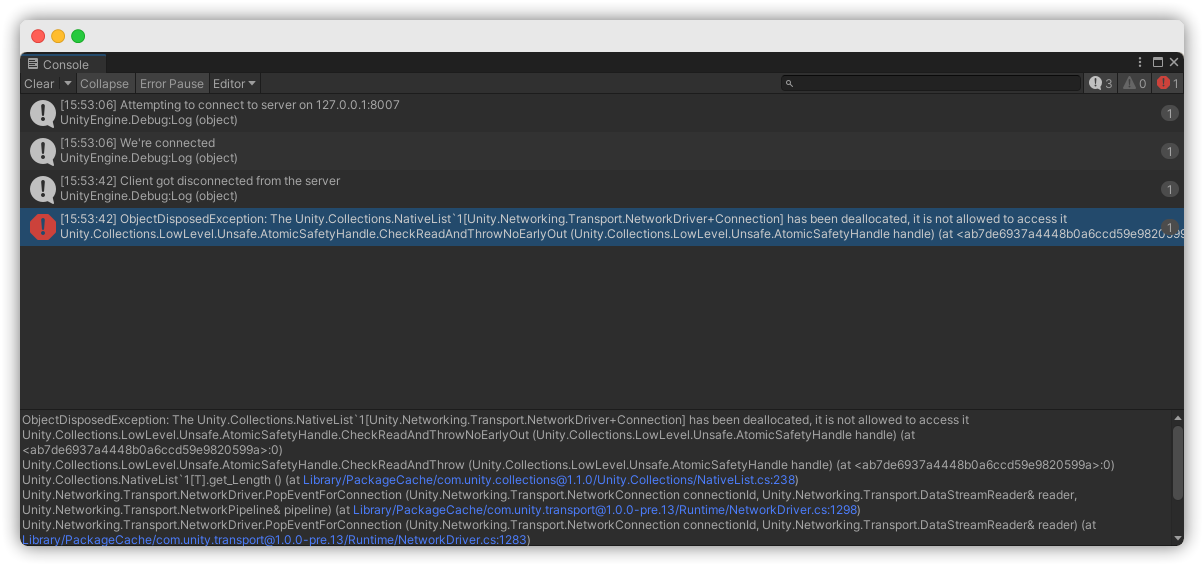
here's the error
 drifting galleon
frozen crypt
hi, i just finished writing the server and client code for a chess game, everyth...
drifting galleon
frozen crypt
hi, i just finished writing the server and client code for a chess game, everyth...
you're trying to access a deallocated native list.
frozen crypt
how can i fix the issue then?
also what differs a deallocated native list from just a native list?
hello?
final steeple
You can think of "deallocated" like "deleted"
For all intents and purposes, the list no longer exists
You tried to access it after something deleted it
 blissful peak
When I add a object to a list in a separate thread and then using it in the main thread the object is null! The Object is not null in the separate thread. Would love to get some help


Ok I fixed the problem by locking the list while modifying and using the list:)
 undone coral
frozen crypt
https://images-ext-2.discordapp.net/external/skZSHiHt_dNFJe8ye3N3PJfWNAfOprzKkX9...
undone coral
frozen crypt
https://images-ext-2.discordapp.net/external/skZSHiHt_dNFJe8ye3N3PJfWNAfOprzKkX9...
you probably wanna use mirror
oh
nevermind
frozen crypt
whats that?
undone coral
maiden turtle
No I just want to make sure with a debug assert that my program works correctly
you can use a different publish-subscribe approach if you need that
maiden turtle
undone coral
you can use a different publish-subscribe approach if you need that
= roll my own custom thing?
undone coral
maiden turtle
= roll my own custom thing?
no you can use UniRx
reactivex like the rest of the world
use a parent constraint for interactions like this
try using cinemachine for cameras if you need custom camera behavior
i think you meant uint instID = UNITY_GET_INSTANCE_ID(v)
but i don't think you're doing this right
you're supposed to use UNITY_TRANSFER_INSTANCE_ID
 hushed sparrow
hey how bad of an idea is this

 zenith ginkgo
Don't cross post. Explain an actual problem
 sly grove
hushed sparrow
hey how bad of an idea is this
sly grove
hushed sparrow
hey how bad of an idea is this
- Why even have a parameter if you just overwrite it in the first line of the method?
- Why would you ever pass a string around to represent a bool in code that isn't just a parser?
 humble leaf
@somber zodiac Stop crossposting.
 regal olive
is it possible to get rid of this fog?
 sly grove
regal olive
is it possible to get rid of this fog?
sly grove
regal olive
is it possible to get rid of this fog?
wrong channel
regal olive
where should i put thist then?
sly grove
regal olive
sly grove
<#497873924504420362>
its non active
hushed sparrow
sly grove
- Why even have a parameter if you just overwrite it in the first line of the me...
im setting up a sort of lane-based card game and instead of coding each card individually id rather try and set up a string for setting the formula for each one in the prefab
sly grove
regal olive
its non active
it's plenty active and even if it wasn't you can't just post things in the wrong channel.
sly grove
hushed sparrow
im setting up a sort of lane-based card game and instead of coding each card ind...
This is not the right way to go about that
You would do all your syntax-treeification up front
and that doesn't answer the question about why you have a useless parameter
hushed sparrow
because the string value in the function is part of an interface
sly grove
Clearly a poorly designed one
hushed sparrow
yes
 spare lava
hi, I'd like to have a MeshRenderer masked by a SpriteMask. is there any way?
sly grove
spare lava
hi, I'd like to have a MeshRenderer masked by a SpriteMask. is there any way?
nope
spare lava
ok so no way with custom shader or anything. just not possible. okay thanks 😢
sly grove
spare lava
ok so no way with custom shader or anything. just not possible. okay thanks 😢
I think you want a stencil shader
You can get a similar effect - just not with a SpriteMask as you asked
SpriteMasks pretty explicitly only mask sprites
spare lava
ok I see. I'm making a custom particle system with persistent particles (using mesh renderer), so I wanted to mix it with masks
 cerulean dune
How do I make an object in URP render behind everything?
hushed sparrow
sly grove
Clearly a poorly designed one
Realized it wouldn’t allow to get the other actual card so I changed it up to a more manageable script

 flint sage
Another poorly designed thing :hidethepain:
maiden turtle
hushed sparrow
Realized it wouldn’t allow to get the other actual card so I changed it up to a ...
please rename your variables
 raw lily
Hey! So I'm trying to make a selection 3D "UI" that would allow the player to select one of multiple 3D GameObjects. It can have multiple options of a varying number. They will most likely always only one row horizontally but something more flexible than this could be nice. What are some of the more flexible ways to go about aligning them? The rest I can probably figure out!
 sly grove
raw lily
Hey! So I'm trying to make a selection 3D "UI" that would allow the player to se...
sly grove
raw lily
Hey! So I'm trying to make a selection 3D "UI" that would allow the player to se...
You can use HorizontalLayoutGroup or GridLayoutGroup. I know these are billed as UI things but they can/do actually work with 3d objects as well
raw lily
@sly grove ohh thanks, definitely thought theses weren't usable for 3D Objects, I'll look into it!
 valid flame
hushed sparrow
Realized it wouldn’t allow to get the other actual card so I changed it up to a ...
valid flame
hushed sparrow
Realized it wouldn’t allow to get the other actual card so I changed it up to a ...
why do you abbreviate everything, its impossible to read
 fierce oracle
private float speed, newspeed, control;
    private float drop = 0.0f;
    private Vector2 vec;
    private void ApplyFriction()
    {
        vec = new Vector2(_moveDirection.x, _moveDirection.z); // Equivalent to: VectorCopy();

        speed = vec.magnitude;

        speed = Mathf.Sqrt(_moveDirection.x * _moveDirection.x + _moveDirection.z * _moveDirection.z);
should I use vec.magnitude or just manually calculate the magnitude of the vector?
which one would be faster?
I assume that vec.magnitude runs faster since unity's vector is a struct and written in c++
 odd lodge
fierce oracle
I assume that vec.magnitude runs faster since unity's vector is a struct and wri...
odd lodge
fierce oracle
I assume that vec.magnitude runs faster since unity's vector is a struct and wri...
it's a fair assumption that any optimization you can think of the unity devs also thought of when they wrote the .magnitude function in c++
compact ingot
Should be noted that there is no intrinsic reason that makes c++ code faster than c# code, they compile to the same instruction and both can be equally fast with c++ merely providing supremely dedicated programmes the opportunity to optimise a program a bit more for very particular use-cases.
sly grove
fierce oracle
should I use vec.magnitude or just manually calculate the magnitude of the vecto...
you should use .magnitude
 misty glade
I want to automate my (development) build pipeline. It has to:
- Build and deploy the Windows Unity client. Don't care where it's deployed, so long as it's accessible by the team (I currently manually zip this and drop it in Google Drive, share the link to the team in Slack).
- Build and deploy a C# console app standalone to a VM in Azure (I currently copy and paste the files via RDP and restart the server myself). I need the ability to stop the running console app and start the new build.
- Build and deploy a Razor app to an azure App Service (no VM). I currently do this via the "publish" button in visual studio.
- Preferably notify the team via Slack (really nice would be an embedded link they could download the client with).
Any obvious candidate tools, aside from rolling my own batch file monstrosity?
github has something that can do this, yeah? Git Actions or something?
 quartz stratus
misty glade
I want to automate my (development) build pipeline. It has to:
* Build and depl...
quartz stratus
misty glade
I want to automate my (development) build pipeline. It has to:
* Build and depl...
I mean you can definitely handle step 1 with UCB. I’m no help with the rest of the work, sounds like reason enough for a DevOps hire
valid flame
Anybody know how to allow Reshade access to depth or normal buffer?
 jade rivet
misty glade
I want to automate my (development) build pipeline. It has to:
* Build and depl...
jade rivet
misty glade
I want to automate my (development) build pipeline. It has to:
* Build and depl...
stuff you need to sort out for a build pipeline, with terminology so you can do some googling, plus a few common examples (also unity themselves provide some of these as hosted services):
- version control. this is git or perforce or whatever
- artifact store / artifact repository. this is where you put your built stuff. this is artifactory, github releases, s3 buckets, and yeah even google drive works, it has an api you can us for automation.
- ci server. this runs your builds and tests and other tasks. this is github actions, jenkins, circleci, etc. github actions are pretty nice and simple and might be the way to go, at least initially. jenkins is the super popular open source thing that has plugins for everything, but it can also be a gigantic pain to administrate and can get very complicated very fast if you're not careful. basically all of these tools support sending slack notifications and such.
- build scripts. this is a makefile, or batch files, or some shell scripts, or python scripts, or whatever. these are the glue you put in between all the other tools. these can turn into a real mess, keep them as simple and minimal as possible.
- containers (optional). if you're deploying any sort of game server or services, its really convenient to build them into containers. you do this with a dockerfile usually.
- infrastructure as code. this is for when you deploy stuff. terraform, ansible, puluumi, etc. you use these to deploy stuff and control state and configuration. this is what you'd use for deploying an app to a VM and automatically restart it.
i recommend reading the Continuous Delivery book (https://martinfowler.com/books/continuousDelivery.html) for general concepts, plus just doing whatever other reading you can on continuous integration, continuous delivery, build engineering, infrastructure automation, etc. just don't go any deeper than you really need to, it's a bottomless pit of complexity.
 wooden cedar
misty glade
I want to automate my (development) build pipeline. It has to:
* Build and depl...
wooden cedar
misty glade
I want to automate my (development) build pipeline. It has to:
* Build and depl...
I use team city for this - easy to setup and free. It does exactly this in its dependencies and deployment steps. And has add-ons for unity now and slack. It also does multiplatform pretty easily.
maiden turtle
misty glade
I want to automate my (development) build pipeline. It has to:
* Build and depl...
I recommend you never do anything complicated in batch files or declarative config files. Always do scripts in a normal language. I like D for this, it's really convenient for scripts, the only problem with it is that if you need some specific API, you'll probably have to roll out your own thing, or link to C, there aren't enough maintained packages. Like, for example, if you need YouTube API, you'll probably have to work at a low level to integrate it, or link to C. Python sucks for scripts IMO, because the build process is not standardized and is usually super complicated, plus, I cannot take languages without static typing seriously.
maiden turtle
Is there a way to add a button to my component editor in the inspector that would execute a certain method? Let me give you an example too
[InspectorFunction]
private void DeleteSaves()
{
    foreach (var prefabInfo in _carPrefabInfos)
    {
        var displayInfo = prefabInfo.prefab.GetComponent<DisplayCarInfoComponent>().info;
        var saveFileFullPath = GetFilePath(displayInfo.name);
        if (File.Exists(saveFileFullPath))
            File.Delete(saveFileFullPath);
    }
}
And the prefab infos are assigned in the editor
 somber swift
maiden turtle
```csharp
[InspectorFunction]
private void DeleteSaves()
{
foreach (var pref...
somber swift
maiden turtle
```csharp
[InspectorFunction]
private void DeleteSaves()
{
foreach (var pref...
so youd like to call this from editor by clicking a button?
somber swift
maiden turtle
```csharp
[InspectorFunction]
private void DeleteSaves()
{
foreach (var pref...
so is this part of monobehaviour script?
maiden turtle
yes

I guess I could do a custom editor and inspect the serialized properties there, but that's too much work
For something this simple
I guess I could do a context menu, that should work too
somber swift
maiden turtle
I guess I could do a custom editor and inspect the serialized properties there, ...
well that's what I was about to suggest. I don't know what would be simpler than that. if you call base.OnInspectorGUI, you don't need to reimplement the stuff you have so far, but you can just add new things on top of it (well underneath the deafult stuffs exactly as you want to)
context menu could work too but that would not be that fast to access
maiden turtle
[ContextMenuItem("Delete Saves", nameof(DeleteSaves))]
[SerializeField] internal CarPrefabInfo[] _carPrefabInfos;
 somber swift
it would make more sense to have button there
maiden turtle
Context menu item works for me
maiden turtle
I'm using reflection to query attributes at runtime in my code. Specifically, I'm using RangeAttribute. I'm wondering if it will get stripped via this mechanism https://docs.unity3d.com/Manual/ManagedCodeStripping.html
Ultimately, I'm planning to generate code to replace reflection anyway, I'm just curious
final steeple
It'd be nice if Unity made TypeCache available at runtime
and I believe trimming will remove the attributes yeah, though you can tell the trimmer to preserve them
For stuff like RuntimeInitializeOnLoadAttribute Unity stores a list of them inside _Data/globalgamemanagers rather than discovering them at runtime, you can use a similar mechanism using TypeCache to get all the type and member paths during the build process
maiden turtle
I did subclass InspectorNameAttribute which I'm also using, and I have applied UnityEngine.Scripting.PreserveAttribute to it, which should keep that one non-stripped. The problem with RangeAttribute is that they made it sealed
final steeple
Attributes should be sealed whenever possible
If they're not sealed they come with performance penalties
maiden turtle
I'll read on the TypeCache thing, thank you
final steeple
If you want an example use case of TypeCache, I have one here: https://github.com/NewBloodInteractive/com.newblood.engine-internals/blob/main/Editor/EditorSymbols.cs#L82
TypeCache was added in Unity 2019.2, though it only supports getting attributes on methods there, support for fields was added in 2020.1
The editor caches the attributes and other information upon loading the DLLs, so it's nice and fast to access
maiden turtle
So does this code essentially do manual linking for fields marked with EditorImportAttribute? Looks awful lol
Fields which are delegates
maiden turtle
Yeah makes sense
final steeple
maiden turtle
I'd definitely do it with a code generator tho
final steeple
Unity has internal callbacks (editor-only) you can listen to for when a component is created
A code generator can't help here
You could certainly use one, but it wouldn't make it more performant or convenient
maiden turtle
Why not? Instead of marking each of the fields with that, you'd just have a static class marked with it, and then you'd generate code that would assign each of them
Each of the funtion pointers
final steeple
That would be even slower since you still have to scan for all the attributes in order to generate the code to begin with
maiden turtle
(delegates)
final steeple
And then you generate code on top of that
maiden turtle
I don't mean emitting IL
final steeple
I know
maiden turtle
And parsing with Roslyn is reasonably fast
final steeple
Right but it'd just be pointless for this
Since it would be doing more work than it is currently
maiden turtle
Even parsing everything every time from scratch is not that bad
final steeple
This is code that runs in the editor during initialization, the code generator would need to run there too
maiden turtle
Oh yeah right
final steeple
But it'd basically be doing the exact same thing but instead of assigning the fields, it'd be generating code to do the same thing
maiden turtle
Makes sense
final steeple
So it's just adding overhead
But if this was something supported at runtime, yes, code generation could be useful
 novel plinth
maiden turtle
Why not? Instead of marking each of the fields with that, you'd just have a stat...
novel plinth
maiden turtle
Why not? Instead of marking each of the fields with that, you'd just have a stat...
if you're fine with it running like a snail, then it's fine I guess...
novel plinth
final steeple
That would be even slower since you still have to scan for all the attributes in...
well, he beats me
maiden turtle
So is this code only runnable in the editor?
final steeple
Yeah
maiden turtle
right
final steeple
It works because the editor ships with PDBs, so it has access to the symbols
maiden turtle
I see
final steeple
It's possible to support it for builds, you'd just need to load the player's PDB, get the function RVAs and store them somewhere (probably in a ScriptableObject)
Though the APIs I generally need to call with this system don't exist in the player
So I haven't had much reason to implement it yet
It could be useful for exposing the TypeTree API in the player though
Which is the internal C++ version of SerializedObject/SerializedProperty
maiden turtle
I'm wondering whether it makes any sense to use UnityEvent with readonly structs. I bet is does boxing / copying anyway, I bet there is no way to force it to pass it by ref, and I'm pretty sure it's impossible to achieve even in C# with generics, unless you do extension methods for firing the callbacks, which UnityEvent afaik does not
flint sage
I think in normal C# you can do Method(in struct input) which might make it work
No idea about UnityEvents though unfortunately
final steeple
maiden turtle
I'm wondering whether it makes any sense to use `UnityEvent` with `readonly` str...
I'd need to see an example of what you mean
in T value will pass by readonly ref but it has implicit copying whenever you do something that could mutate the value
readonly struct SomeStruct is basically just equivalent to marking everything inside the struct as readonly (sorta like C++ const functions), so it avoids the copies
flint sage
flint sage
I think in normal C# you can do `Method(in struct input)` which might make it wo...
Unfortunately you can't subscribe this to an Action<struct>
maiden turtle
public readonly struct CarStatsChangedEventInfo
{
    public readonly CarProperties carProperties;
    public readonly int statIndex;

    public CarStatsChangedEventInfo(CarProperties carProperties, int statIndex)
    {
        this.carProperties = carProperties;
        this.statIndex = statIndex;
    }
}

[SerializeField] public UnityEvent<CarStatsChangedEventInfo> OnStatsChanged;

internal void TriggerStatsChangedEvent(int statChangedIndex = -1)
{
    var info = new CarStatsChangedEventInfo(
        carProperties: this,
        statIndex: statChangedIndex);
    OnStatsChanged.Invoke(info);
    _currentIsDirty = true;
}
Yeah, you can't pass by ref in that example unfortunately
Well
As long as the values remain on the stack you could use pointers
maiden turtle
Yeah pointers are great, but I think those will look too freakin ugly in C#
final steeple
public unsafe readonly struct Pointer<T>
    where T : unmanaged
{
    public readonly T* Value;

    public Pointer(T* value)
    {
        Value = value;
    }
}
public UnityEvent<Pointer<CarStatsChangedEventInfo>> OnStatsChanged;
var info = new CarStatsChangedEvent(carProperties: this, statIndex: statChangedIndex);
OnStatsChanged?.Invoke(new Pointer<CarStatsChangedEvent>(&info));
Pointer<T> can alternatively be:
public unsafe readonly struct Pointer<T>
    where T : unmanaged
{
    public readonly T* Address;

    public ref T Value => ref *Address;

    public Pointer(T* value)
    {
        Address = value;
    }
}
This is illegal 😀
maiden turtle
Yeah I was thinking about making everything unsafe and passing pointers directly
But this way it's better, beacuse the unsafe doesn't spread
I agree
final steeple
You have to use a Pointer<T> wrapper type if you want to use generics, since pointers can't be used as generic arguments
maiden turtle
Oh
final steeple
So it's less me trying to avoid unsafe, I'm just forced to 😄
maiden turtle
right
final steeple
If I could, I'd have just used UnityEvent<CarStatsChangedEventInfo*>
Which might actually be possible in .NET 7
As will UnityEvent<ref CarStatsChangedEventInfo>
maiden turtle
I guess the best bet here is to generate a non-generic pointer wrapper for every type that I want to use
final steeple
Is there a problem with it being generic?
maiden turtle
So that you don't have to do info.Value.whatever but simply info.Whatever with a getter
maiden turtle
It's too much noise basically
final steeple
At best you could add implicit casts to Pointer<T> but then you lose the ref-ness
maiden turtle
What for? I'd just take non-generic types in the events, it's totally fine
final steeple
Yeah I'm just talking about if you stuck to Pointer<T>
When transparent structs get added to .NET it'll be less of a problem
Since you can mark Pointer<T> as being transparent to T*
And then you can indeed just do info.Whatever
or rather, info->Whatever
final steeple
It's an unfortunate syntax inherited from C due to operator precedence
C# didn't really need to inherit it, I agree
Fun fact: if you define extension methods on pointers, you call them via value.X()
You can't define extension methods on pointers in C#, but you can write them in IL and C# supports using them
https://github.com/dotnet/csharplang/discussions/5367 I have a request here about relaxing that restriction
maiden turtle
btw unmanaged
Doesn't it mean it cannot contains classes?
Is simply struct not going to work there?
where T : unmanaged
Cannot take the address of, get the size of, or declare a pointer to a managed type
Is there a way to get around this?
@final steeple
final steeple
unmanaged means a struct that does not contain reference types or references
So yes, you can't use a class for a type parameter constrained that way
maiden turtle
I can't even take the address of such a type
I've found this tho

Stack Overflow
Why oh why is this not allowed:
private static unsafe byte[] ConvertStruct<T>(T str) where T: struct
{
    T* ptr = &str;
    int size = Marshal.SizeOf(str);
    var ...
Got an example?
maiden turtle
You can kind of cheese it
final steeple
That particular example uses marshaling
It copies and converts the data
Rather than being an actual reference
final steeple
So
there is a way you can do this
but it's only safe if you are really careful to never give it a reference to something that isn't on the stack
so
var someClass = new ...();
that someClass variable is safe, but if it was a field in a class it's not safe
You need access to the System.Runtime.CompilerServices.Unsafe class for what I'm about to suggest, note
public readonly struct StackRef<T>
{
    public readonly void* Address;

    public ref T Value => ref Unsafe.AsRef<T>(Address);

    public StackRef<T>(ref T value)
    {
        Address = Unsafe.AsPointer(ref value);
    }
}
var value = new SomeClass();
InvokeEvent(new StackRef<SomeClass>(ref value));
The event can even do stackRef.Value = new SomeClass(); and it will overwrite the value in the variable too
 still glade
How can i trigger an animation thats inside a .fbx file from a a certain point inside a script?
sly grove
still glade
How can i trigger an animation thats inside a .fbx file from a a certain point i...
set up your animator state machine to transition to that particular animation based on some parameters and set those parameters
still glade
I did set up everything but i had problems accessing the animation clip from the script, but i had the wrong method, i took SetTrigger() but i was in need of Play()
I got warnings that the clips were not accessible with SetTrigger
maiden turtle
using System.Runtime.CompilerServices;

public readonly unsafe ref struct StackRef<T>
{
    public readonly void* Address;

    public ref T Value => ref Unsafe.AsRef<T>(Address);

    public StackRef(ref T value)
    {
        Address = Unsafe.AsPointer(ref value);
    }
}

public class A
{
    public int i;
}

public readonly struct Info
{
    public readonly A a;
    public Info(A a) { this.a = a; }
}

public class Program
{
    public static void Main(string[] args)
    {
        var a = new A();
        var info = new Info(a);
        var stackRef = new StackRef<Info>(ref info);
        stackRef.Value.a.i = 5;
        System.Console.WriteLine(a.i);
    }
}
@final steeple this prints 5 under .NET 6, haven't tried it under Unity, but it should work. Note that I'm taking the address of the struct, and I made the struct itself into a ref struct (I think Unity has that) so that it doesn't escape from the stack. I'm not misunderstaning it, right, this should work for structs too?
final steeple
Yes, that will work for structs
And it'll work in Unity too (that StackRef is based on a type I have in one of my own internal libraries)
maiden turtle
What do you think the performance implications of this would be?
final steeple
It's about as fast as it can be
maiden turtle
Like that being unsafe and the casting
final steeple
Those casts are basically free
final steeple
btw, the Unsafe class isn't available out of the box in Unity, since it's not part of .NET Standard 2.0 or 2.1
But you can get the package from NuGet and copy the DLL in
https://www.nuget.org/packages/System.Runtime.CompilerServices.Unsafe/ Just hit the Download package link and grab the dll (and the xml too) from lib/netstandard2.0/

Provides the System.Runtime.CompilerServices.Unsafe class, which provides generic, low-level functionality for manipulating pointers.
Commonly Used Types:
System.Runtime.CompilerServices.Unsafe
(the nupkg file is just a zip file)
 velvet mirage
I’m working with a modding community, and due to limitations in asset ripping software not being capable of ripping scripts, there are a lot of things in our game that we’re unable to analyze in unity editor, which is causing some serious challenges with a few things
So what I’m trying to look into now, is there a way to serialize a gameObject hierarchy into a format which can be opened up by unity’s editor?
We work in a game that relies heavily on random generation to make levels, but when the game updates this random generation changes in a way that makes preserving custom levels impossible between updates
So what I’d like to do is export the entire level’s gameobject hierarchy into a serialized file which we would bypass level generation to load
final steeple
Sure, there are plenty of approaches you can take to that
You can even just generate the YAML for a Unity scene yourself
Grab the Scene and call GetRootGameObjects(), from there you just need to handle the bookkeeping of assigning GUIDs and LocalFileIdentifiers to things as you generate the YAML
You'll also need to have a way to determine the GUIDs of components on each game object, so you'll need some external database of sorts that the generator loads
velvet mirage
Alright, thanks a lot. I was having a difficult time finding any answers online, this is probably a very niche issue hahaha
final steeple
For sure lol
I've had to study this stuff a lot because I work on an official modding SDK for a Unity game
In my case it's even more painful though because I have to actively work against Unity half the time, since the modding SDK tries to be as detached from Unity as possible
velvet mirage
I’m probably not going to touch this for a little while, but when I do I’ll probably be back here with more detailed questions later. Just having a starting point for what to research here is extremely helpful though, so thanks
final steeple
Sure thing, no problem
final steeple
@maiden turtle I forgot to mention, for reference types you will also want to GC.KeepAlive them
final steeple
So instead of:
// store from field to local so it's safe to get a stack ref
SomeClass local = field;
var stackRef = new StackRef<SomeClass>(ref local);
InvokeEvent(stackRef);
You want:
// store from field to local so it's safe to get a stack ref
SomeClass local = field;
var stackRef = new StackRef<SomeClass>(ref local);
InvokeEvent(stackRef);
GC.KeepAlive(local);
The GC is free to collect an object mid-method if nothing is referencing it
StackRef is not seen as a root because it just stores a void*, the GC doesn't track it
maiden turtle
Oh you mean that
final steeple
Mid-method collection won't happen in debug mode but it will in release
maiden turtle
Well, I store the struct I want to pass on the stack
final steeple
Yeah for structs (as long as they contain no reference type fields) it's fine
It's just classes you need to do it for
(and any class fields of a struct)
maiden turtle
So what you're saying is that the temporary gets sort of inlined in release
And turns just into a pointer
final steeple
Moreso that the GC will look at where in the method it is referenced
And after the last reference, it will consider it free for collection
maiden turtle
oh yikes
final steeple
As soon as a reference type is converted to an unmanaged pointer, it's invisible to the GC, so StackRef won't count as a root
Which is why you need to GC.KeepAlive the object
The example you posted earlier is actually safe without KeepAlive because you have a Console.WriteLine call at the end which keeps it alive
maiden turtle
So what should I do with managed struct? Call keepalive for every managed field?
final steeple
If the struct is unmanaged, it contains no reference type fields
So you don't need to do anything special
final steeple
For a managed struct you need to keepalive the managed fields yeah
maiden turtle
ok thanks
final steeple
In .NET you can actually call KeepAlive on the struct itself and it will work (it's an intrinsic and no box will be created)
maiden turtle
I can do that with another autogened helper
final steeple
Not sure about Unity's Mono
Not everything here will apply to Mono, but the comment above KeepAlive in the source explains the gist: https://source.dot.net/#System.Private.CoreLib/src/System/GC.cs,238
It talks a lot about finalizers too but it applies to all objects, not just finalizable ones (finalizers are just an example of something that can go wrong)
maiden turtle
I could do this with a using, actually, and a Dispose method. It's the most friendly way, I think
final steeple
That will ensure things are kept alive, yeah
I don't think you need to even GC.KeepAlive anything when you do that
Keep in mind though that using expands to try/finally, which has a performance cost
Not a big enough cost to matter when you're just dispatching events though
It's more of a "try not to do that inside the body of a really performance-sensitive loop"
final steeple
final steeple
I don't think you need to even `GC.KeepAlive` anything when you do that
You might need to mark the Dispose method with [MethodImpl(MethodImplOptions.NoInlining)] though
maiden turtle
No I thought about putting the keepalives in the dispose method
final steeple
I'm not sure if it's necessary to do that since afaik the dispose call itself will keep the whole struct (and therefore its fields) alive
[MethodImpl(MethodImplOptions.NoInlining)]
public static void KeepAlive<T>(ref T value)
    where T : struct
{
}
would also work
The GC will see that a ref to the struct was taken and thus the struct's fields will also be kept alive because the GC has to assume that they're also needed
(Strictly speaking, it doesn't need to even take a ref, passing by value would also work, but for a large struct it'd be less efficient)
maiden turtle
Yeah thanks, I'll figure it out now for sure when I do this.
final steeple
Np
(And just to make it extra clear: NoInlining is needed since KeepAlive could get inlined and since it doesn't actually do anything, it would no longer keep anything alive because there is no longer any call being made. That's why even GC.KeepAlive is marked NoInlining, so that it still works even on a runtime that doesn't have intrinsic knowledge about the function)
maiden turtle
Yeah I undertand that
final steeple
A Dispose method that does GC.KeepAlive calls would work though of course, it's just extra work since you need to generate it
Just dumping as much info as I can lmao
But yeah, I think that's basically all that would need to be considered in order to use StackRef safely
maiden turtle
Essentially, I will need this struct only to dispatch the event, so I could just generate a wrapper that would take the UnityEvent and call Invoke, with all that keepalive business hidden within
final steeple
It being such a dangerous type is why I don't include it in my public libraries
One of these days I should write a Roslyn analyzer that catches unsafe usages of it, then I'd be more comfortable making it a public API
Shouldn't be too hard, just look for constructor calls and verify that the ref is on the stack or originates from a pointer
Properly catching cases where KeepAlive is needed would be a bit harder, but not impossible
final steeple
or internal yeah
Luckily it being a ref struct protects against the other problems
So as long as the API that hands out the StackRef values does the right thing, it should be safe
maiden turtle
Well, I bet I would've never encountered this problem myself in production. I tend to avoid heap allocating temporary objects, because why
Never -> small chance
final steeple
It's actually not as big a deal in .NET compared to Unity
Unity just has an awful allocator, GC and JIT 😔
 gleaming hatch
Does anyone know how to parse this data in Unity? {"-MxA4Cq7qTGhQRWmqhOB":{"icon":127,"pos":{"x":0,"y":0,"z":0},"ring":-1},"-MxA4TC-ro6SdVLCFzWs":{"icon":62,"pos":{"x":0,"y":0,"z":0},"ring":-1},"-MxA5CJcA64oxVlPbJ1I":{"icon":131,"pos":{"x":0,"y":0,"z":0},"ring":-1},"-MxA5W5FSSZjy8OVdXrb":{"icon":22,"pos":{"x":0,"y":0,"z":0},"ring":-1},"-MxAHQ2sxth8ia7lDsxc":{"icon":75,"pos":{"x":0,"y":0,"z":0},"ring":-1}}
maiden turtle
If you plan to allocate these, you will likely need to pool them anyway
maiden turtle
gleaming hatch
Does anyone know how to parse this data in Unity? ```{"-MxA4Cq7qTGhQRWmqhOB":{"...
It's json
gleaming hatch
Yes, but how to parse it in Unity? JsonUtility doesn't like it because it's multiple children.
final steeple
Oh and here are the actual stack ref types I use: https://gist.github.com/DaZombieKiller/777c2ce29c98c48fcf125eca0838c04b (minus the namespace lol)
maiden turtle
People usually use Newtonsoft for this
final steeple
Had to go hunting to grab those
sly grove
gleaming hatch
Does anyone know how to parse this data in Unity? ```{"-MxA4Cq7qTGhQRWmqhOB":{"...
you'll need a Json lib that is capable of parsing dictionaries for this
maiden turtle
At least I feellike that one's the most popular
final steeple
JsonUtility is extremely limited, it's basically only useful for really simple serialization (or when you need to serialize a native object in the editor)
gleaming hatch
Any suggestions on a full featured package? There's a lot of options out there and it's hard to tell what's good.
misty glade
@quartz stratus @jade rivet @maiden turtle Thanks for the responses above (re: CI). For what it's worth, I already have version control (github) in place with workflow (gitflow) for branch management; but the rest is all manual (artifact repo, builds, and virtualization). I'm not going to build to containers right now - I think that's more complexity than I want to bite off, since the server itself is pretty simple - just requires dotnet 6. I'll look into TeamCity as well - although an early review of Github Actions seems really promising, especially since there's some unity client build support via "gameci".
final steeple
You'll want to use Newtonsoft.Json as suggested above, or System.Text.Json
Note that the latter currently has issues with IL2CPP, but Unity has a fix on the way for that last I heard
System.Text.Json is going to be the fastest if your input comes in the form of UTF-8 text
Newtonsoft.Json is otherwise a solid bet and is a proven library
gleaming hatch
I tried using this: https://assetstore.unity.com/packages/tools/input-management/json-net-for-unity-11347 But there's no documentation at all.

Get the JSON .NET For Unity package from parentElement, LLC and speed up your game development process. Find this & other Input Management options on the Unity Asset Store.
sly grove
gleaming hatch
I tried using this: https://assetstore.unity.com/packages/tools/input-managemen...
look for newtonsoft json for unity on github
final steeple
I would not use asset store packages for this
sly grove
jillejr owns it
final steeple

Json.NET is a popular high-performance JSON framework for .NET
You can download the assemblies from here and place them in your project
novel plinth
final steeple
You'll want to use Newtonsoft.Json as suggested above, or System.Text.Json
Note to this, only the one in package manager work with il2cpp
final steeple
The one in the package manager is also very outdated
And was only really intended for use internally at Unity
 chrome vine
If some one can try help me Ty:)
https://discord.com/channels/489222168727519232/948593127999033364
sly grove
gleaming hatch
I tried using this: https://assetstore.unity.com/packages/tools/input-managemen...
I recommend this:
https://github.com/jilleJr/Newtonsoft.Json-for-Unity
novel plinth
@final steeple the standard Unity System.Text doesn't support Span<T> does it?
novel plinth
oh, good to know that
 sacred orchid
Should I place my question in #archived-networking ? Sorry if it’s in the wrong spot
final steeple
That's likely a better spot yeah
Simply because it's a specialized channel so people with specific knowledge will hang out there
sacred orchid
Thanks
gleaming hatch
I'm getting a conflict with "com.unity.nuget.newtonsoft-json": "2.0.0", which I don't see in the package manager.
sly grove
gleaming hatch
I'm getting a conflict with "com.unity.nuget.newtonsoft-json": "2.0.0", which I ...
it's being transitively included from one of the other packages
I often have that issue - and have to remove my manually installed newtonsoft
the bright side is you can just use it from there without any installation
drifting galleon
sly grove
I often have that issue - and have to remove my manually installed newtonsoft
you are discouraged from using the manual version anyway since newtonsoft is now integrated into unity by default
 frozen imp
They did finally start recommend it officially, a recent development. It has new update as well, on the next page. https://forum.unity.com/threads/conflict-between-assets-newtonsoft-and-packagemanagers-newtonsoft.843898/#post-7865422
drifting galleon
but i'm glad they'll be switching to System.Text.Json in the future
 sleek gulch
frozen imp
They did finally start recommend it officially, a recent development. It has new...
sleek gulch
frozen imp
They did finally start recommend it officially, a recent development. It has new...
That's great to hear. I was always turned off by Newtonsoft Json Unity Package 2.0.2 documentation that states, "This is a package intended for internal Unity Development Projects and as such this package is not supported. Use at your own risk." https://docs.unity3d.com/Packages/com.unity.nuget.newtonsoft-json@2.0/manual/index.html
 lapis arch
Hey guys
I'm tryna make a dynamic level selector, that automatically counts how many levels exist inside a folder. Do you know how I could count that through script?
 fresh salmon
A folder on your filesystem?
If yes, you can use the Directory.GetDirectories method that returns an array of the directories at the specified path. You can then get its length.
lapis arch
fresh salmon
If yes, you can use the `Directory.GetDirectories` method that returns an array ...
This will still work after build right?
fresh salmon
Given that the path exists, yes
lapis arch
Because the player won't have the same file structure
fresh salmon
It's up to you to determine the path you want to feed to GetDirectories. As long as it's valid and it exists, it won't throw
lapis arch
fresh salmon
It's up to you to determine the path you want to feed to `GetDirectories`. As lo...
So let's say I wanna go to Assets/Scenes/Levels
fresh salmon
Well, that's inside a Unity project files
lapis arch
That folder does exist on my machine, but when I send it to someone who doesn't have the project, but only the build, it won't exist
final steeple
Addressables or asset bundles in general are how you can solve this if you don't want to make your own level format, yes
lapis arch
@final steeple So this is what is usually done in bigger games with lots of levels?
I mean, I don't suppose they have a fixed "NumberOfAllLevels" variable somewhere
final steeple
For games that support DLC or need to download content (eg, mobile games) yeah
lapis arch
pfff I've been messing with addressables and it's so hard to understand
everyone talks about optimization
But this is not what I care about
final steeple
Addressables is quite a complex system, yeah
I'd recommend reading up on asset bundles and getting the hang of them first
Addressables is basically an extension of that
undone coral
lapis arch
I'm tryna make a dynamic level selector, that automatically counts how many leve...
do you anticipate giving others your source project to build levels in unity?
if levels are text files, it's fine to read them from a folder
undone coral
gleaming hatch
Does anyone know how to parse this data in Unity? ```{"-MxA4Cq7qTGhQRWmqhOB":{"...
if you don't need to deserialize to a typed object, simplejson is fine.
normally JSON serialized stuff has a corresponding class / model, especially if it comes from e.g. a tile map editor
gleaming hatch
I just manually convert it to the class.
undone coral
yeah that's sort of your prerogative
gleaming hatch
I couldn't make it work the other way.
undone coral
you probably want to use newtonsoft json and resolve your issue
you probably just laready have a newtonsoft json dll in your assets directory somewhere
but if manually assigning fields is fine just roll with it, this stuff doesn't really matter 🙂
gleaming hatch
Yeah, it works well enough.
 formal lichen
newtonsoft json dlls conflict with Unity on newer versions because they decided to include it inside unity
 lusty sonnet
is there a way to make an empty ui gameobject which triggers EventSystem.IsPointerOverGameObject because i need to "blackout" an area of the mobile screen to make the joystick usable. otherwise ass soon as the player slips over the joystick with the finger the game is gonna trigger a tap. I already tried to make empty buttons with Event triggers on them but they just dont count.
 granite viper
@lapis arch if all your levels will be baked into the game at runtime, there's nothing stopping you from indexing all of the levels when building using a build preprocessor
can create a scriptable object that just contains a list of levels
undone coral
lusty sonnet
is there a way to make an empty ui gameobject which triggers ```EventSystem.IsPo...
add an iamge to the button with a color of fully transparent
 hollow garden
np
valid flame
using System;
using System.Runtime.InteropServices;
using System.Runtime.CompilerServices;

public static class PInvoke
{
    [DllImport("user32", ExactSpelling = true)]
    public static extern IntPtr GetDesktopWindow();

    [DllImport("user32", ExactSpelling = true)]
    public static extern IntPtr GetDC(IntPtr hWnd);

    [DllImport("gdi32", ExactSpelling = true)]
    public static extern uint GetPixel(IntPtr hdc, int x, int y);

    [MethodImpl(MethodImplOptions.AggressiveInlining)]
    public static byte GetRValue(uint rgb) => (byte)((ushort)rgb & 0xFF);

    [MethodImpl(MethodImplOptions.AggressiveInlining)]
    public static byte GetGValue(uint rgb) => (byte)((ushort)(rgb >> 8) & 0xFF);

    [MethodImpl(MethodImplOptions.AggressiveInlining)]
    public static byte GetBValue(uint rgb) => (byte)((ushort)(rgb >> 16) & 0xFF);
}
@final steeple can you point me to the resources you found this/learn more about how to use it?
Like, is this just a boilerplate script or should I know how to make this lol
 thin merlin
So, say I want to shoot an object to the right with x speed (in 2D). right vector 2 * the speed. Now say I want to shoot it in the same speed, but at a different aimed direction. How do I get that vector2?
ie, the object is rotated and I want to shoot it in the "forward" direction according to the rotation
valid flame
regal olive
A locked door and a key to open it
dont think this is an advanced topic
regal olive
Dam
sacred orchid
@regal olive also I would ask for help with a script you're trying to make not just asking for one.
valid flame
regal olive
No one helps me
last time you posted code it was absolutely filled with syntax errors
valid flame
you've also crossposted across 3 different channels after vertx told you not to
thin merlin
I feel like there's an easy solution to my question, I just can't seem to find it on my own.
 wooden cedar
thin merlin
I feel like there's an easy solution to my question, I just can't seem to find i...
wooden cedar
thin merlin
I feel like there's an easy solution to my question, I just can't seem to find i...
Well, usually, you have a gun & bullet spawn. So the rotation of the gun is handled one place, then the bullet spawns at the guns transform.forward
regal olive
@valid flame I’m stupid lol that’s why I need help
:AZCat_spincolorsfast:
Dam my nitro is gone
valid flame
regal olive
<@!188827493971525633> I’m stupid lol that’s why I need help
you should learn c# first
wooden cedar
regal olive
<@!188827493971525633> I’m stupid lol that’s why I need help
That's still not a #archived-code-advanced question. That's a 'take a tutorial first' answer.
regal olive
I’ve took so many tutorials
valid flame
and definitely shouldn't be in this channel
valid flame
regal olive
I’ve took so many tutorials
there's not a single opening bracket in that screen shot
thin merlin
wooden cedar
Well, usually, you have a gun & bullet spawn. So the rotation of the gun is han...
The fun thing? I'm not trying to fire a projectile (yet, but I will at some point so that's still good info), I'm making a Sonic-like game and trying to make a dash move that dashes in the player's current direction when grounded. I'm using the Ge2D engine from the asset store as a base, so basic movement is in. I have a dash move in place, but it doesn't account for when the player is running up/down a wall, etc. That's what I need to know how to do.
regal olive
valid flame
there's not a *single* opening bracket in that screen shot
Well when I tried to do it it wouldn’t work
I’m a bit I’m going to try again and I’ll see if I fix it
thin merlin
https://assetstore.unity.com/packages/templates/packs/ge2d-platform-runner-72278 this is what I'm using as a base, for reference

Use Ge2D Platform Runner from racionisoft to elevate your next project. Find this & more Packs and templates on the Unity Asset Store.
valid flame
regal olive
Well when I tried to do it it wouldn’t work

Codecademy
Codecademy is the easiest way to learn how to code. It's interactive, fun, and you can do it with your friends.
wooden cedar
thin merlin
The fun thing? I'm not trying to fire a projectile (yet, but I will at some poin...
If it helps, there is transform.left but to get the other direction just multiply it by -1 transform.left * -1f;
valid flame
regal olive
C
Not C, C#
valid flame
so sorry for your compiler
thin merlin
wooden cedar
If it helps, there is `transform.left` but to get the other direction just multi...
getting left is easy, I just use a vector2 from the Controller2D itself. The problem is that isn't accounting for angle changes, only which way the character is facing relative to their rotation (ie, like running on a ceiling to the right means the player is facing left in the game's logic, etc.)
thin merlin
wooden cedar
It's hard to explain over discord :D.
Yeeeaaaah ^^'
the project isn't super far along that I wouldn't mind sharing the files for the purpose of figuring this out, if that would help
valid flame
Expected: Color not always white
Actual: Color always white
Last time it worked: never
Tried: moving windows around, making sure nothing on my screen is white
private void SampleScreenColors()
    {
        uint[] rgbs = new uint[4];

        for (int i = 0; i < rgbs.Length; i++)
        {
            rgbs[i] = PInvoke.GetPixel(PInvoke.GetDesktopWindow(), 500 + (i * 100), 500 + (i * 100));
        }

        for (int i = 0; i < rgbs.Length; i++)
        {
            colors[i].r = PInvoke.GetRValue(rgbs[i]);
            colors[i].g = PInvoke.GetGValue(rgbs[i]);
            colors[i].b = PInvoke.GetBValue(rgbs[i]);
        }

        for (int i = 0; i < colors.Length; i++)
        {
            Color color = colors[i];
            color.a = 1;
        }
    }
I can post PInvoke if needed
wooden cedar
thin merlin
the project isn't super far along that I wouldn't mind sharing the files for the...
Yeh but if I open Unity it'll just remind me I need to complete a bunch of work and I'll probably not be able to look at it for a week :(
thin merlin
hrm
valid flame
valid flame
Expected: Color not always white
Actual: Color always white
Last time it worked:...
maybe it just doesn't work outside of build?
I think my problem might be too specific for anyone to help..
except maybe @final steeple
sacred orchid
I need to add a prefab to a script at runtime I'm placing this here because it is using photon
    void Start()
    {
        GameObject[] players = GameObject.FindGameObjectsWithTag("Player");

        foreach(GameObject player in players)
        {
            if (photonView.IsMine)
            {
                this.playerCharacter.transform.position = player.transform.position;
                break;
            }
        }
    }
That's my code to get the player and attach it to the camera, but it's not working for me. Any ideas?
sly grove
Are you meaning to check your own PhotonView or the player object's PhotonView?
Because right now it's checking the one on this script's GameObject
sacred orchid
Yeah so I guess that's where I'm getting confused, maybe I'm overthinking it. I need to add the prefab player to the camera at runtime. Let me show the inspector
 sly grove
What's confusing you?
Also you're assigning the position in your code, not the player character reference
Which obviously won't work if the ref is starting as null
This kinda seems like a #💻┃code-beginner question TBH 😔
sacred orchid
I mean kind of, but the Photon view has to be specific to the player that it gets
There is more than just grabbing the player which is why I placed it here.
sly grove
It's a simple GetComponent call
sacred orchid
Right, which isn't working for me at the moment.
Wait let me move the Get call
and try another way
sly grove
Most likely you're just calling it on the wrong object.
You're currently looking at the wrong photon view so you're likely making a similar mistake with GetComponent
sacred orchid
Been a long day lol, so maybe. I'm taking a look now
sacred orchid
@sly grove I got it working, had to switch up some logic and move a couple things around. One thing was being called on the wrong object
Forgot to message back, figured I'd update at least lol
final steeple
valid flame
except maybe <@!124710273368981505>
You passed the wrong pointer to GetPixel, it should be GetPixel(GetDC(GetDesktopWindow())) not GetPixel(GetDesktopWindow())
final steeple
valid flame
Like, is this just a boilerplate script or should I know how to make this lol
Generally you should write blittable P/Invokes but I don't know of a central resource to explain what that means
As for how I wrote that example, I looked at the documentation pages for those functions to see what their parameters were, and the Windows header files for GetRValue, GetGValue and GetBValue
valid flame
final steeple
You passed the wrong pointer to `GetPixel`, it should be `GetPixel(GetDC(GetDesk...
it's already been solved sorry
final steeple
If you want more information on writing P/Invokes I recommend joining the C# Discord and hopping into the #lowlevel channel, stuff like that is regularly covered there
valid flame
https://discord.com/channels/489222168727519232/948779348465430528 I got help in this thread
I was actually really close to finding that out but I was like one mistake away
Works perfectly now
final steeple
Nice
undone coral
valid flame
Expected: Color not always white
Actual: Color always white
Last time it worked:...
i think try search grep.app for the method names you are p/invoking
and find sample code
oh
it worked
nvm
final steeple
I wouldn't recommend doing that, myself
A lot of people write really bad or wrong P/Invokes
So random sample code isn't super reliable to look through
I also recommend never going on the pinvoke.net site, almost everything on there is wrong or inefficient
 placid robin
I'm looking for a way to hook up to the build-process for Windows Standalone. I'd like to add a target in the Assembly-CSharp.csproj or add a .props file to the project but changes seem to get ignored and the file gets restored when opening the editor. I'd like to avoid having to export the VS project and doing it there. Is there a way?
 green rock
are there any recommendation for software architecture specifically for ui frameworks?
compact ingot
green rock
are there any recommendation for software architecture specifically for ui frame...
There is MVC, MVP, MVVM, Layers, OOP in general, immediate mode GUI, retained mode GUI, DOM, Markup, Data Binding, Dependency Injection and others. It’s a rather large subject and depends a lot on your specific project. Often a specific framework combines multiple architecture styles.
green rock
compact ingot
There is MVC, MVP, MVVM, Layers, OOP in general, immediate mode GUI, retained mo...
Thanks for this list. I'm actually trying to find the right combinations of architecture styles to work with. We have this window based ui for our real-time 3d application (made in unity) and the current one we're only using is MVC whereas views are the ones attached to one UI (for example, an inspector tab). However, this rendered all developers to create each of their own handlers when selecting an object in the 3d scene (and some other things) and have seen a lot of repetitive codes around which rendered the already existing architecture useless or misused.
I'm thinking of a command based approach where when UI events are dispatch, we fire an event to execute a command that does a small thing (adding element to a list view for example) and can be reused in other ui windows.
however I kind of see it blowing up if we get into like, if we get a thousand specific commands to perform small tasks
then we're back to the same problem all over again
compact ingot
green rock
I'm thinking of a command based approach where when UI events are dispatch, we f...
Sounds like you want to transition from MVC to MVP or MVVM to fix that. In any case you should separate data access from your views. MVVM (data binding) is probably what you are after with your ‘command’ pattern
maiden turtle
placid robin
I'm looking for a way to hook up to the build-process for Windows Standalone. I'...
afaik the msbuild projects only exist for tool integration, so I'm pretty sure you can't do that
moreover, msbuild is trash anyway, don't tie yourself to that
You can call the build from the console though, I've seen it done somewhere
maiden turtle
wdym?
compact ingot
maiden turtle
wdym?
nvm, misread
 cursive horizon
green rock
I'm thinking of a command based approach where when UI events are dispatch, we f...
cursive horizon
green rock
I'm thinking of a command based approach where when UI events are dispatch, we f...
It sounds like you might not be fully splitting data from rendering it (which I do advise), but otherwise what you propose here is basically how 'flux' inspired ui state management libs work. Look at Redux for the immutable functional version and Vuex for the mutation version to see how they handle it. It's simpler in unity though since a lot of the difficult stuff those frameworks have to reason about is 'when to rerender' and since unity is already rendering anyway, you might be able to skip a lot of that initially.
This is where the caveat about 'putting all your state one one big store' is bad goes, but I don't think it holds much water. Do it if it makes sense for your project. You will have a lot of 'commands', but redux also lets you build stores as 'modules' so that you can keep things more organized, which you could reproduce. Just remember that local state should also exist and makes more sense for some things, even if it's not your default. e.g. 'form' style interactions can be nice to encapsulate and submit when 'ready' rather than being data bound to the store itself.
If what you're building is less 'scattered views into some data' and more 'tree where siblings might want shared data' you can look at how react context works. The idea is to insert 'contexts' at different points in your tree and 'inject' their data into components beneath who request it. This pattern can be nice in unity because you can represent a context as a Monobehavior and just attach it to the parent at the point in the tree where that state should 'live'. Then you have something which keeps your contexts in sync once and your rendering code can read from each synced context accordingly.
green rock
cursive horizon
It sounds like you might not be fully splitting data from rendering it (which I ...
Ah, believe me data is heavily spit with the views. The only concerning would be other developers handling those data and presenting it in the view (say a list of words to a text view). I have thought of doing a 'context' based approach like how android development would do it (can't quote me on this though because I can only vaguely remember it). Thank you for defining it as well, I do know that there's already tech that is similar, I just don't know what they are called. I believe handling ui in a functional sense is a brilliant idea, I'll look into those things that you mentioned.
As per the caveat of having many commands, we are basically making a runtime version of unity editor (I have seen some editor in the asset store and didn't quite like it). But then, I haven't really defined these 'commands' or even tried to abstract it. I just assumed that since we have a big scope, then it will correlates to how many commands we will need.
cursive horizon
green rock
Ah, believe me data is heavily spit with the views. The only concerning would be...
If your data is already split, it sounds like the first step is just an abstraction around 'reading data'. Either "Selectors" which take in some context (like a store or module) and return a subset of it, or some more kind of query builder. To me the start of solving a problem of 'devs are fetching the same data in different ways' should be 'make queries nameable, composable, and reusable'. From there it's much easier to cache or memoize them if repeated queries start to be an issue. First make sure they are all fetching the same thing in the same way, then optimize those cases.
for smaller projects I literally have a static class called Selectors which contains pure selector functions that take in the GameState and return some information
(but you could just as easily use extension methods or plain old methods on the state class for that if you wanted, since reading data is pretty safe)
also remember that you are using C#, so you can use partial classes and/or extension methods for organization
final steeple
maiden turtle
afaik the msbuild projects only exist for tool integration, so I'm pretty sure y...
This is correct
 magic vigil
If I store procedurally generated mesh data in a prefab, do instances of this prefab present in the scene add the size of this data to the scene size or do they just say "use what the prefab has"
the mesh data is a struct since unity doesn't serialise meshes in mesh filters/colliders when they're on prefabs
final steeple
magic vigil
If I store procedurally generated mesh data in a prefab, do instances of this pr...
You need to show the code so we can see how it's being serialized, but from what I can tell, it sounds like your current setup will duplicate the memory in each instance yes
If you want to have shared data between objects you'll need to mess with [SerializeReference] or use a scriptable object
magic vigil
final steeple
If you want to have shared data between objects you'll need to mess with `[Seria...
I've never heard of SerializeReference, interesting
its weird for it to duplicate the structures for each instance because they are all exact copies so I'd have assumed prefabs only store the changes
 final steeple
Structures are in-line in memory, it could not share them regardless
final steeple
In the case of a Mesh reference it will share it, yes
Those arrays will be duplicated though
magic vigil
so if I have a script on my prefabs:

 warm glen
Quick question. Does MonoBehaviour come from the Mono Scripting Backend or am I just getting confused?
final steeple
If you want to serialize a mesh as part of a prefab, it needs to be a sub-object
magic vigil
this will copy the SerialisableMesh for each identical instance?
final steeple
That will share the references between the instances yeah
But then you need somewhere for that reference to exist to begin with
Which puts you back at square one where you wanted to embed a Mesh object
When you create the prefab you can do AssetDatabase.AddObjectToAsset(mesh, pathToPrefab)
magic vigil
ah, I assumed that when unity saves the scene, prefabs are just serialised as references + changes
my situation might make that difficult
final steeple
If you have [SerializeField] Mesh someMesh;, that is treated as a reference to an existing mesh
So if the mesh isn't also stored as an asset like the prefab is, that reference will be lost
magic vigil
pretty much this is used for any part of my game where meshes are pre-generated in the editor, so for example destructible walls, procedurally generated fences/walls/roofs/etc, and so on. Sometimes they are unique objects saved as part of the scene and other times they are saved to prefabs for re-use.
so I should save the mesh as an asset?
final steeple
Yes
As long as the mesh exists somewhere as an asset, the reference will save properly in the prefab
and instances will share it
magic vigil
okay, so now I need to figure out how to properly remove those assets once they are no longer being used
also I'm not sure if it's a good idea to store each mesh as an individual asset
since a single building might be composed of let's say 1000 chunks
final steeple
That's why AddObjectToAsset exists
It stores it as an embedded asset within another asset
magic vigil
aah, I see
final steeple
That's how, for example, an .fbx has materials, textures, etc contained in a single asset
magic vigil
so I'd have one asset for the building and all its generated meshes would be stored inside that
final steeple
Yeah
Note that I'm not actually sure if prefabs can have sub-assets, so you may still need to store the meshes on something else
But either way, the only way to ensure the mesh is saved and stored is to keep it around as an asset
magic vigil
so the plan is:
-when a mesh is generated, use GetComponentInParent to figure out if we are part of a saved mesh collection or not
-if yes, make the collection get or create its asset and then add our mesh to it or replace the existing old mesh
-if not, add the saved mesh collection component to ourselves and do the same thing
 radiant pasture
Hey.
is there a way to export manifest.json file to custom .unitypackage package?
I am trying to create dependency to some UPM packages from .unitypackage .
I know I can link ProjectSettings files, but it seems I can't link manifest.json
placid robin
maiden turtle
afaik the msbuild projects only exist for tool integration, so I'm pretty sure y...
That's what I'm trying to do. I'm working on a tool I'd like to set up during the build process and outside of the editor strictly speaking.
In my case I want to fetch the .pdbs after Unity is done doing it's thing and store them somewhere without having to spawn a new process from within the editor in some sort of build post process.
maiden turtle
placid robin
That's what I'm trying to do. I'm working on a tool I'd like to set up during th...
Unity doesn't use msbuild to build the thing tho
It just lists the files there
so that ides could work correctly
placid robin
maiden turtle
Unity doesn't use msbuild to build the thing tho
It has
<!-- To modify your build process, add your task inside one of the targets below and uncomment it. Other similar extension points exist, see Microsoft.Common.targets.
<Target Name="BeforeBuild">
</Target>
<Target Name="AfterBuild">
</Target>
-->
at the end of the Assembly-CSharp.proj so I was thinking they were there for exactly that kind of stuff.
final steeple
That's just part of the default csproj template
They have plans to switch to the new csproj format so maybe they'll finally use the proper .NET SDK stuff to build projects eventually
Here's where they discussed switching to modern csproj + msbuild: https://forum.unity.com/threads/unity-future-net-development-status.1092205/page-13#post-7923634
Unity Forum
When you say ".NET Core" you mean 3.1 not .NET 5 or 6 that's right? So, as I understand
No, sorry that is not clear. By ".NET Core", I mean the .NET...
I'm really looking forward to that, the new csproj format is so nice to work with
having full control over the build will be a godsend
 carmine agate
So, since my last question has been answered so fast, i'll try my next.
I have a problem with a compute shader. I want to model individual agents moving on paths, but everything just goes crazy and the objects are jumping all over the place.
The odd thing is, that i tested my logic already in C# (since debugger=love), translated it 1:1 twice and it works there flawlessly. So my guess is that the error is coming from somewhere else. My setup is this : I have Structs to manage the agent data. For the Path i have an edge array per agent that is flattened to it fits into a structuredbuffer (i tested the flattened accessing and writing as well) and (of course) on buffer to hold the original array lengths. My theory is that the buffers maybe mess with the order of its content. It sounds silly but i have no other explanation at the moment. Do you have any idea ? Code provided if needed.
placid robin
final steeple
They have plans to switch to the new csproj format so maybe they'll finally use ...
That's some happy news together with some sad news.
undone coral
carmine agate
So, since my last question has been answered so fast, i'll try my next.
I have ...
your theory sounds right because if you translated it, the biggest difference will be the way data is structured and not the logic
are you doing something out of the literature?
carmine agate
No, or not as i know specificly
sly grove
carmine agate
So, since my last question has been answered so fast, i'll try my next.
I have ...
All kinds of things could be going wrong. First thing to do is double/triple check that the data marshalling between CPU/GPU world is perfect. Nothing causes chaotic results like some misaligned buffers
undone coral
yeah
i mean it's not going to be out of order, but you will probably have an issue reading/writing them
also yeah you could still have a logic problem
some things are called X and really do Y
carmine agate
sly grove
All kinds of things could be going wrong. First thing to do is double/triple che...
That sounds fun, i guess i will pasebin my code here so we talk about the same stuff.
undone coral
hard to say though what moving on paths means without a specific algorithm to talk about though
that's why it will be sort of hard to look at your code and understand what's going on
are you just saying you are doing N tweens with time t and list of vertices Path
in a compute shader?
so Vector3 MoveOnPathPure(float time, float constantSpeed, List<Vector3> path)?
except, N invocations of that?
carmine agate
undone coral
except, N invocations of that?
Yes the idea is the same.
The Shader Code : https://pastebin.com/UKqfGnM9
Shader managing code : https://pastebin.com/VWjHqBJA
But i am 99% percent sure that it is something with reading and writing the data, sice i tested the same code with a jobsystem (just replaced distance(a,b) to Vector3.Distance, normalize and float3 to Vector3)
Pastebin
Pastebin.com is the number one paste tool since 2002. Pastebin is a website where you can store text online for a set period of time.
Pastebin
Pastebin.com is the number one paste tool since 2002. Pastebin is a website where you can store text online for a set period of time.
To the marshalling suggestion, i am using
System.Runtime.InteropServices.Marshal.SizeOf(typeof(TC));
To get the size of by structs that i pass into the buffer
sly grove
carmine agate
Yes the idea is the same.
The Shader Code : https://pastebin.com/UKqfGnM9
Shad...
you need to show the C# structs too
carmine agate
sly grove
you need to show the C# structs too
Of course ! https://pastebin.com/PpNNLgfQ
Pastebin
Pastebin.com is the number one paste tool since 2002. Pastebin is a website where you can store text online for a set period of time.
final steeple
You shouldn't use Marshal.SizeOf, it gives you the size of the struct when used for marshalling which isn't the same as the actual size of the struct
You can just use sizeof
In this particular case the marshalled size and the normal size should actually be equivalent, but it's something to keep in mind
Hmm, I don't see any obvious issues here, can you post the full C# code?
carmine agate
i will try sizeof asap - currently im not on my ide. i postet anything related to the shader
but thanks for the idea
final steeple
I don't see the objectData field in that code
sizeof probably won't make a difference in this particular case
carmine agate
well if you want i can post all classes in full with base classes
final steeple
Basically just seeing the full class for the example above should be enough I think
carmine agate
ok
So here are the shader calling classes : https://pastebin.com/jWDFqQeR
Static methods that call outwards are tested in other systems
Pastebin
Pastebin.com is the number one paste tool since 2002. Pastebin is a website where you can store text online for a set period of time.
final steeple
If you constrain T to unmanaged, you can use sizeof(T) in an unsafe context
public abstract class HLSLSimulationRunner<T> : SimulationRunner
    where T : unmanaged
{
    // ...
}
Then you can initialize the ComputeBuffer like:
public unsafe virtual void Start()
{
    shaderBuffer = new ComputeBuffer(objectAmount, sizeof(T));
    // ...
}
Also you're just immediately querying the data in LateUpdate, there's no guarantee that the shader has actually finished running by that point
You need to use a graphics fence to ensure that it's done
carmine agate
that might be a thing
sly grove
final steeple
You need to use a graphics fence to ensure that it's done
Is that true? I thought Dispatch was synchronous?
final steeple
It is not synchronous, no
sly grove
How do you wait then? I have a whole project where I'm assuming it's synchronous 😱 (which works fine 🤔 )
final steeple
A graphics fence
Okay it appears I'm slightly mistaken -- Dispatch is not synchronous, but GetData will forcefully wait for completion
sly grove
Oh in my project I don't ever read the data back. I just use it later in a shader
final steeple
Yeah generally GetData shouldn't be used
Unfortunately I'm not experienced enough with compute shaders to really know what's going wrong here though
undone coral
okay
@carmine agate so what i'm a little confused about is
can your cars change speed? can they change paths?
it sounds like you have something of the form
well
it's really complicated
can i see your C# version?
i think the error is probably in that you are holding onto state in your C# version that you're not communicating to the computebuffer
so the logic is indeed wrong
because what you're really trying to do - have a bunch of cars move around with possibly changing paths, and animate them frame by frame
is really complicated
creating a pure function for that is complicated
by the way, you're reinventing particles... i think you should just use VFX graph for this
but that could be even harder
this is super challenging
you can encode the path in the form
rows: vehicles
columns: zero zero zero, followed by a list of path position x, path position y, total time to arrive here
then generate a texture that is the gradient of those positions (i.e., "lerping")
rows: vehicles
columns: position at time v
then, the particle will sample its position with time = u on that texture, particle id = v on that texture
so for example, your path buffer
[0 0 0], [1 3 4]
[0 0 0], [3 2 2], [5 2 4]
two vehicles of differently length cycling paths? are they cycling? maybe not 0 0 0 then
then you'd get a gradient
[0,0,0] [.1,.3, .4] [.2, .3, .8] ... [1, 3 4] [1, 3 4] [1, 3 4]
[0,0,0] [.3, .2, .2] [.6, .4, .4] ... [5 2 4] [5 2 4] [5 2 4]
then sample it
going from the path encoding to the gradient is challenging
otherwise you should really find something in the literature / preexisting for this
because particles can already sample paths this way
you woul dhave to consult a shader cookbook @carmine agate
 inland halo
having this error cant find what i dit wrong

 carmine agate
undone coral
okay
carmine agate
undone coral
okay
Wow, thats a long answer... no they do not change path. they have one path generated on start and then cycle through this
I can give you the c# implementation in a bit if you want also with the runner
the thing is, i want to compare different types of computation of an algorithm to each other, so monobehaviours vs jobs vs hlsl vs cuda vs .... so if i change the approach or model completely the comparison becomes obsulete. My other (simler) models work fine with this model - i hope cuda doesn't bitch as much around as the shader
sly grove
inland halo
having this error cant find what i dit wrong
the line number doesn't match with the code, so i guess you changed something
But maybe enemyManager.enemiesInTrigger is null or something
undone coral
carmine agate
the thing is, i want to compare different types of computation of an algorithm t...
i see
do you have a research advisor?
inland halo
 carmine agate
undone coral
do you have a research advisor?
carmine agate
undone coral
do you have a research advisor?
yes but none with experience with shader code
But i guess i will wrap this up for today and get my head free maybe i will have a diferent idea tomorrow. Thanks for the effort, if you want i can keep you updated
undone coral
sure, good luck!
carmine agate
thanks good evening for you
 thin mesa
inland halo
thin mesa
inland halo
most likely the enemy is null from whatever enemyManager.enemiesInTrigger is
what is enemiesInTrigger and how is it populated?
inland halo
 thin mesa
so what is calling those methods?
inland halo
the gun script
made in the gun script a public EnemyManager enemyManager;
so i can reach to EnemyManager
thin mesa
you should share the entire Gun class, see #854851968446365696 for how to correctly share code. because you haven't actually shown where those methods are being called
inland halo
thin mesa
you spelled your OnTriggerEnter/Exit methods wrong
thin mesa
the only lines where those two methods are declared
thin mesa
yes
inland halo
but how do i fix it if i take a look i wont see a problem
thin mesa
you need to spell it correctly. notice how your spelling doesn't quite match what i typed here #archived-code-advanced message
thin mesa
make sure VS Code is properly configured using the steps linked in #854851968446365696 so that it will autocomplete stuff like that so you don't misspell it again
 devout hare
VS Code doesn't autocorrect those method names, at least not with the default configuration
inland halo
okay

does this error means that it is it cant find the object it is suppose to look for
when i press shoot button error only Occurss
devout hare
If the code is the same as earlier, it means enemiesInTrigger has some empty slots
or destroyed gameobjects

 thin mesa
show the Gun object's trigger collider since that is what determines which enemies are added to the list
devout hare
inland halo
all the enemy's should be in the enemyManager?
Probably... it's your game
if you're following a tutorial, see what it does
inland halo
 thin mesa
looks like there are no enemies in that collider
 snow flint
hi guys, im going to have a json file that represents different stuff for my game for example..
  "tiles": [
    {
      "id":"BAC5F3F9-9030-460A-B0E7-239387D4C7DB",
      "tileName": "grass",
      "movementSpeedFactor": 1.0
    },
    {
      "id":"7B3D4075-D0E5-4C2B-9131-2825F701264A",
      "tileName": "stone",
      "movementSpeedFactor": 1.3
    }
  ]
}```

a json that represents tiles and various stats about that... the tutorial i followed from what i could tell just had hard coded GUIDS, wondering what the best way the generate them and reference them would be? hoenstly probably could just no use them..you can create guids using... new GUID
i don't know if you need them though
snow flint
undone coral
you can create guids using... `new GUID`
whoa, thats simple, i wonder what i was googling wrong..
yeah i agree, ill work without them for now and see how i go
thanks!
 river musk
I need to cast a ray forward from the player. However, we are using no root animations so the transform.forward is always in 1 direction. How do I work around this?
thin merlin
public class LevelScriptableObjectEditor : Editor
{
    public override void OnInspectorGUI(){
        serializedObject.Update();

        LevelScriptableObject levelScriptableObject = (LevelScriptableObject)target;

FloorScriptableObject[] floors = new FloorScriptableObject[levelScriptableObject.numOfFloors];

        for (int floorIndex = 0;floorIndex<levelScriptableObject.numOfFloors;floorIndex++){
            // Draw floor
            GUILayout.Label("Floor "+(floorIndex+1).ToString("00"), new GUIStyle { fontStyle = FontStyle.Bold });
            floors[floorIndex].tiles = new TileScriptableObject[levelScriptableObject.floorWidth,levelScriptableObject.floorHeight]; // Getting an error right here where it says Object reference not set to an instance of an object.
        }
        serializedObject.ApplyModifiedProperties();
    }```
```[CreateAssetMenu(menuName = "Serializable Objects/Level")]
public class LevelScriptableObject : ScriptableObject
{
    // [Header("Graphics")]
    public Sprite floorTileSprite = null;
    public Sprite wallTileSprite = null;

    public int numOfFloors;
    public int floorWidth;
    public int floorHeight;

    // [Header("Floors")]
    public FloorScriptableObject[] floors;
}```
```public class FloorScriptableObject : ScriptableObject
{
    public TileScriptableObject[,] tiles;
}```
```public class TileScriptableObject : ScriptableObject{
    public ScriptableTileType tileType;

    public Sprite tileSprite;

    public bool isDoor;
}

public enum ScriptableTileType { Floor = 0, Wall = 1, Hole = 2, Door = 3 }
``` Trying to figure out why I'm getting an error at the floors[floorIndex].tiles line. Can anyone help me out?it's telling you. the error is probably a null reference excpetion
it's null
i don't think you can serialize public TileScriptableObject[,] tiles;
what's your objective?
this stuff already exists
thin merlin
I'm trying to make a game with grid-based movement and small levels to be stored as data. I'm working on an editor to accomplish this.
granite viper
unity can't serialize multidimensional arrays
thin merlin
so I need to make a tilerow class after all ...
granite viper
have you narrowed down which variable is causing the null reference exception
@thin merlin you do not
you can encode a 2d array linearly
// create your 1d array:
TileScriptableObject[] tiles;

// to retrieve the tile at x, y
var tile = tiles[ y * gridWidth + x ];
for what I'm trying to accomplish, picture this. Now imagine each tile can be modified to have a different type. Optimally, you'd be able to click on the tile and have it pop open a small window where the tile's data can be edited, but I'm not sure how to do that yet
 granite viper
I'm picking up what you're putting down
you don't need a 2d array
and read this to help with your null reference issue: #💻┃code-beginner message
thin merlin
yeah, it's a case where I knew what the error was but the situation prevented me from getting a good grasp on the error
granite viper
mk
 kind sigil
river musk
I need to cast a ray forward from the player. However, we are using no root anim...
kind sigil
river musk
I need to cast a ray forward from the player. However, we are using no root anim...
Not sure if you found your solution, but what you can do is attach a game object to a part of the character controlled by animation (like the head or something on the head), then use global forward from that object to represent player forward for your raycast
river musk
kind sigil
Not sure if you found your solution, but what you can do is attach a game object...
what is global forward?
kind sigil
river musk
what is global forward?
Not local
thin merlin
transform.forward
kind sigil
Yes.
river musk
thin merlin
```transform.forward```
awe ok
thin merlin
I know that because I was dealing with that, up, and right earlier 😛
river musk
So it needs to be on an animation part, got it. let me try this. Thanks
Because I have it as a child, but its not part of the animation body parts
kind sigil
It doesn’t matter if it is part of animation parts or not. Only thing that matters is the object that you are choosing is accurately “facing” the way you want to use as forward for your player facing direction.
river musk
I'll explain a bit more. So I'm using transform.forward for the direction of the ray and it seems to be casting it always in Vector3.forward direction. Then I looked at the player as I rotate him, the transform.forward is not rotating with the player.
kind sigil
The script is sitting on the player root?
river musk
The script is a child of the player GameObject
kind sigil
Ok, then create a game object to represent your forward anchor. Child that object to a part of your character that will visually face the direction you want your player forward to represent.
Create a reference field in your player script to that anchor.
Then use that anchorForward.transform.forward as your forward in your ray cast.
river musk
awe interesting ok thanks!
snow flint
hi guys, not sure if this is advanced or not.. but im trying to associate tiles with some data... by adding them to a dictionary and i get this error.. ArgumentException: An item with the same key has already been added. Key: TX Tileset Grass 15 (UnityEngine.Tilemaps.Tile)
here is my code.. i think i need to break that inner for loop?
        {
            _dataFromTiles = new Dictionary<TileBase, Tile>();
            var tiles = unitOfWork.Tiles.GetAll();

            foreach (var pos in map.cellBounds.allPositionsWithin)
            {
                if (map.GetTile(pos) == null)
                {
                    return;
                }

                foreach (var tileData in tiles)
                {
                    if (map.GetTile(pos).name.Contains(tileData.tileName))
                    {
                        _dataFromTiles.Add(map.GetTile(pos), tileData);
                    }
                }
            }
}```You know that different spots in your Tilemap that use the same tile will all return the same TileBase right?
So having a Dictionary<TileBase, Tile> is not going to work - it will only let you store one Tile reference per tile type in your tilemap
Dictionary<Vector2Int, Tile> would be more reasonable
snow flint
sly grove
Dictionary<Vector2Int, Tile> would be more reasonable
sorry, how do i then get the tile? i dont think there is a gettile that returns a vector2 int?
snow flint
sly grove
`pos` should already be a Vector2Int
its a vector3
sly grove
possibly a Vector3Int because unity is funny like that
https://docs.unity3d.com/ScriptReference/Tilemaps.Tilemap.GetTile.html < this accepts a Vector3Int
so presumably you already have a Vector3Int
use that
(this is the hazard of using var everywhere - you have no idea what types your variables are)
snow flint
just transform it into a vector2?
snow flint
sorry was confused for a sec, got it all working, thank you!
carmine agate
@undone coral Good morning : I had a look at my shader code problem again and changed my logic to test if its that or something with the passing of the edges and i guess its that.
My new logic looks like this :
Edge edge = GetPathEdge(cars[id.x], cars[id.x].pathIndex);
cars[id.x].position = edge.from;
cars[id.x].pathIndex++;
if (cars[id.x].pathIndex >= pathLengths[cars[id.x].id])
  cars[id.x].pathIndex = 0;
The result should be that each car jumps to the next path node each frame. Since i only assign passed positions of my edges the result should be that they stay on their paths. If the order is messed up they might jump across paths but should have a position on any path anyway. But my result is that they land on very odd locations that have nothing to do with any path positions. So the passed edges are completely wrong inside of the shader
warm glen
quick question. What's the use of a first pass assembly script on unity? I read it can only communicate with other first pass scripts but whats the use for it?
compact ingot
warm glen
quick question. What's the use of a first pass assembly script on unity? I read ...
It’s used to compile plugins that rarely change. So your overall build of project specific scripts will be faster. It is largely superseded by assembly definitions that allow you to create an arbitrary number of such separate assemblies.
warm glen
alright, thanks
raw lily
So I put a Grid Layout containing 3D Objects within a Scroll Rect. Nothing happens when I try to drag, what step am I missing?


(the viewport should read Collection Scroll)
 shadow seal
I don't see how your scroll rect issue is even remotely related to code
More like #📲┃ui-ux really, don't you think?
raw lily
shadow seal
I don't see how your scroll rect issue is even remotely related to code
Alright, will do, sorry!
undone coral
carmine agate
<@!247793168056057857> Good morning : I had a look at my shader code problem ag...
probably pathIndex is from a car that's not cars[id.x]
 austere agate
Hey there! I have a question about architecture. I am using a system where i use the Animator state machine to transition between Idle, Move, Jump, Attack etc states and then handle the game logic of those states via the Built-in State Behavior scripts. Its a system i found out about via a tutorial online but it seems a bit fragile cause messing up the animator transitions slightly can break the entire project apart. Do you think a system like that can work or should i abandon it and try something else now that its still early in the project?
undone coral
austere agate
Hey there! I have a question about architecture. I am using a system where i use...
what kind of game is it?
austere agate
undone coral
what kind of game is it?
Its a metroidvania type but its only the prototype so for the moment i plan on doing just one big level but i m trying to do it in a clean expandable manner in case i want to create a full game out of it
it will have chained combo attacks, movement skills etc
undone coral
austere agate
Its a metroidvania type but its only the prototype so for the moment i plan on d...
maybe study the moremountains corgi engine 2.5d asset
to see the scope of this
austere agate
i do have the asset, but didnt want to use it for now cause i m still learning and feels like cheating myself
undone coral
for a lot of metroidvania-style behaviors you are going to be controlling animations frame by frame in your own scripts
austere agate
undone coral
for a lot of metroidvania-style behaviors you are going to be controlling animat...
i m not sure how this works. For now i use a custom function to play most of the animations without using the mechanim system and use some transitions in the mechanim system for combo hits
do you have a link so i can check what do you mean by controllinmg them frame by frame?
undone coral
it really depends on how traditional you want to get
there isn't really a link, but what i'm talking about is
Application.targetFrameRate = 60, and then in an Update you increment an integer and set the sprite renderer's sprite to the next image
because that's how SNES games work
austere agate
i should mention its a 2.5d game cause i could find 3d assets easier
can i still do that in 3d?
like playing the next frame of the animation like that?
undone coral
yeah, anything is possible. it really depends on what your goals are
personally i think writing things this way is really cantankerous, but personally i don't like metroidvania games
i don't find that kind of frame-by-frame gameplay interesting
so if someone put a gun to my head and said, make a platformer, i'd use corgi engine
and it wouldn't have a lot of those extremely nuanced hardcore metroidvania details
because i don't find them interesting at all
corgi engine already does everything except the super hardcore details
maybe you're not aware of them
austere agate
well to be honest it has most features i would like to have in the game
undone coral
there's stuff like, the exact frame of samus and the exact height needed on that particular frame to connect with an edge or whatever
to people who play these games, that stuff is really important
just like how people who are really into super smash play with a 20 year old controller
austere agate
yeah i havent thought into that part
undone coral
and talk about the exact frames and glitches and stuff
austere agate
i guess you are right
undone coral
well that's the biggest factor in the engineering
if those super hardcore details aren't important, you should definitely use the tools unity provides
for animation and such
austere agate
cool so what i ll keep from this is to better check the corgi engine thoroughly first
and probably try to expand on that if i need specific things
undone coral
yes, it already does "everything but the super hardcore metroidvania details"
austere agate
cool thank you very much for the chat
 lavish plume
How could I get the value of the enum selected in a dropdown to use as an argument for the GiveMaterialsFootstep function? Thanks!
using System.Collections;
using System.Collections.Generic;
using UnityEngine;
using UnityEditor;

[CustomEditor(typeof(FootstepModifier))]
public class FootstepModifier : Editor
{
    public GameObject WorldGameObject;
    public List<Material> MaterialsForThisFootstep = new List<Material>();

    public enum MaterialToUse{
        Concrete = 0,
        Wood = 11,
        Metal = 26,
        Grass = 7,
        FallGrass = 31,
        Bark = 8,
        MinesDirt = 14,
        Snow = 32,
        Pillow = 3
    }

    public override void OnInspectorGUI()
    {
        base.OnInspectorGUI();


        if(GUILayout.Button("Generate Footsteps For This Material"))
        {

        }
    }
}

public class FootstepModifierFunctions: Editor
{
    void GiveMaterialsFootsteps(GameObject WorldGO, List<Material> MaterialsForThisStep, ResultOfEnumDropdown?)
    {
        Renderer[] Mats = WorldGO.GetComponentsInChildren<Renderer>();

        for(int I = 0; I < Mats.Length; I++)
        {
            for(int X = 0; I < MaterialsForThisStep.Count; I++)
            {
                if(Mats[I] == MaterialsForThisStep[X])
                {
                    if(Mats[I].gameObject.GetComponent<GorillaSurfaceOverride>())
                    {
                        Mats[I].gameObject.GetComponent<GorillaSurfaceOverride>().overrideIndex = 2;
                    }
                }
            }
        }
    }
}
you can cast an enum to an int to retrieve that value
that you assign
lavish plume
Sorry I'm a bit new to lists and stuff. How would that work?
So just something like
(int)MaterialToUse?
undone coral
maybe ask in #💻┃code-beginner
 ancient pilot
hmnmm how could i fix this
 thin mesa
ancient pilot
hmnmm how could i fix this
thin mesa
ancient pilot
hmnmm how could i fix this
not an advanced issue, but you never define writer you only declare it
frozen imp
@ancient pilot Debugging guide is pinned in #💻┃code-beginner and ^^
ancient pilot
thank you
tbh.. this is quite advanced for me.. cuz i havent worked with servers tillt his point
thin mesa
also from what i see, driver.BeginSend() doesn't have an output param but does return DataStreamWriter that was older documentation actually i was wrong
frozen imp
For the network related stuff you would have better chance getting an answer in #archived-networking
ancient pilot
thin mesa
not an advanced issue, but you never define `writer` you only declare it
DataStreamWriter writer; ?
thin mesa
that's where it is being declared. it is supposed to be defined by the BeginSend method, but since it is returning null that means the connection is likely not successful. You'll probably want to print the value returned by BeginSend() so you know why it is erroring
you can change the BeginSend line to Error.StatusCode statusCode = (Error.StatusCode)driver.BeginSend(connection, out writer);
then when you print it you can compare it to the descriptions here to find out what is going wrong https://docs.unity3d.com/Packages/com.unity.transport@1.0/api/Unity.Networking.Transport.Error.StatusCode.html
frozen imp
This looks like the third manual for this thing and this one uses latest updated name for it I think https://docs-multiplayer.unity3d.com/transport/1.0.0/api/Unity.Networking.Transport.NetworkDriver.Concurrent/#beginsendnetworkconnection-out-datastreamwriter-int32
ancient pilot
frozen imp
<@!264051759188672513> Debugging guide is pinned in <#497874004401586176> and ^^
fixed the problem.. the problem was about writing the code inside a different class, so the class didnt work properly kekw
would be handy if I write code on the correct class
frozen imp
@ancient pilot Make sure you have intellisense installed ( #854851968446365696 ) That you should've had straight up warning for from IDE.
 sinful fossil
Hey, does anyone know if there is a way to determine if the accessor of a class field is outside the class or inside the class?
public class Test1
{
    public float x;
    public void Update()
    {
        x += 9; // INSIDE THE CLASS
    }
}

public class Test2
{
    public Test1 test1;
    public void Update()
    {
        test1.x += 9; // OUTSIDE THE CLASS
    }
}
I need to do this in code. I could explain why but that will make this too confusing for now, even for me.
Thanks
Also I am not sure if "accessor" is the right word. I just mean the scope maybe
sly grove
sinful fossil
Hey, does anyone know if there is a way to determine if the accessor of a class ...
no. but it's easy to enforce that code outside the class cannot access certain things, or ahs to access them through an intermediary such as a property
sinful fossil
sly grove
no. but it's easy to enforce that code outside the class cannot access certain t...
I am trying to make a system where when an object accesses its own data, it reads the actually data. But when object accesses another objects data, it reads a "copy" of the data.
This copy would be created at the start of each frame
My goal is to make a system where the programming stays the same in workflow but the result is that all the objects run code in parallel (sudo parallel)
so like if you have a(1) and b(0) and a looks at b and says if b is 0 than set myself to 0, and b looks at a and says if a is 1 then set myself to 1. Then when you run it, only a will switch
sly grove
sinful fossil
so like if you have a(1) and b(0) and a looks at b and says if b is 0 than set m...
class Test {
  private float real;
  private float copy;
  int lastFrameChecked;

  public float TheData {
    get {
      if (Time.frameCount != lastFrameChecked) {
        lastFrameChecked = Time.frameCount;
        copy = real;
      }

      return copy;
    }
    set {
      copy = value; // not sure if you want to allow this?
    }
  }
}```something like this?
properties are your friend
not really clear on your goals here
sinful fossil
so no thats not what I mean, and yes, properties are my friend, and thats where I am trying to get it to determin whos accesing it
sly grove
you can't dettermine who is accessing it unless you force a parameter
sinful fossil
    private float x;
    private float _x;
    public float X
    {
        get
        {
            // I want in here to return x if accessor is this object and return _x if accessor is another object
            return x;
        }

        set
        {
            x = value;
        }
    }
public float GetTheData(object source) {
  if (source == this) return realData;
  return copyOfData;
}``` something like this?not possible
sinful fossil
for real....
sly grove
Why not just have the things access different properties/fields?
Are you talking about different instances of the same class reading each other's data? Or other code entirely?
sinful fossil
for user experience and continuity reasons
sinful fossil
sly grove
Are you talking about different instances of the same class reading each other's...
Ill try to explain
@sly grove When working with simulations, you are at the will of the iteration loop. So if you have a list of 5 particles that all need to move according to the gravity felt by all the other particles, then after you update the first particles data in the loop, now every other particle is looking at different data from the start of the frame. X and Y are not the same anymore so the sim is lopsided.
To fix this we can introduce copies of the data from the beginning of the frame. So that you read from the copy but you write to the real one. This is pretty easy to do manually but I was trying to make it such that you only need to reference the "real" one and the system handles it.
HOWEVER, when I made this work in javascript, I realized that when and object accesses its OWN data, it needs to be the real one and not the copy. So that's where I am at.
I am confusing myself but I know that there is a route to what I want here and I am trying to find it. And if I can't then I will fall back onto just manually doing it. Say with a particle having and x and y field and also an x_copy and y_copy field
sly grove
sinful fossil
<@!179367739574583296> When working with simulations, you are at the will of th...
I mean the simple way to do this is just make it a two step operation.
This is the approach sebastian lague takes in his solar system video
sinful fossil
enlighten me with this two step operation
sly grove
but you essentially do:
foreach (body in allbodies) {
  body.CalculateForcesThisFrame();
}

foreach body in allbodies) {
  body.Move();
}```Any way to get a position of contact from a OnTriggerStay?
sly grove
river musk
Any way to get a position of contact from a OnTriggerStay?
nope your best bet is Collider.ClosestPoint or something like that
sly grove
sinful fossil
enlighten me with this two step operation
I recommend watching this video if you haven't https://www.youtube.com/watch?v=7axImc1sxa0

Experimenting with gravity and attempting to make a miniature, explorable solar system.
Watch the next solar system video here: https://youtu.be/lctXaT9pxA0
Project Files:
The Unity project is available on github here: https://github.com/SebLague/Solar-System/tree/Episode_01
If you'd like to support my work and get early access to new projects...
sinful fossil
Oh yeah, thats sort of what I am talking about. Since when you call CalculateForces, you have to store the forces somewhere. A sudo copy. And lets say you have a lot of these two step moments, then its more beneficial to just have a copy of the data
I have watched it but thanks
sly grove
sinful fossil
Oh yeah, thats sort of what I am talking about. Since when you call CalculateFor...
Well you could store them all in an array, or in a field on each body
sinful fossil
yeah thats what my fall back is. Thanks for trying to help
 hollow glacier
i love the soothing voice of sebastian
river musk
I've been at this for a few hours. The player has a small trigger in front of him to climb things. I need him to face directly at the climb object. The climb object uses a box collider. How can I get the player to face directly at the climb object that the trigger is hitting? Now picture the box as a wall, if I'm to the far left of the wall, using Lookat will face me at an angle on the wall cause the center of the wall is to the right. I need him to face directly at the wall at any position on the wall.
 novel raptor
can anyone help me with my save and load system?
undone coral
river musk
I've been at this for a few hours. The player has a small trigger in front of hi...
set the player's forward to the opposite of the wall's normal
🤯
undone coral
sly grove
but you essentially do:
```cs
foreach (body in allbodies) {
body.CalculateForc...
in unity, could i visit each rigidbody and calculate net gravitational force pre fixed update, then add the force i store in fixed update?
is there a pre fixed update?
 split sierra
How do i write a code that selects 1 of 3 resources based on how much % of the overall resources it is?
like if i have very little of one resource it should have a higher chance to get selected so it evens out after time
undone coral
i see
undone coral
sinful fossil
<@!179367739574583296> When working with simulations, you are at the will of th...
are you trying to emulate gravitational force?
granite viper
@split sierra look up weighted random
river musk
undone coral
set the player's forward to the opposite of the wall's normal
wait nvm this wont work.
granite viper
give lower % a higher weight
river musk
The box collider has 4 sides, I need you to face the side you are on.
undone coral
there are a few approaches to that
to figure out what face of a collider you are closest to
you probably already have a raycast
so you already have the normal of the collider's face
the hit angle
you can project the hit vector onto xz, then player.transform.forward = -projectedVector
granite viper
@river musk why wouldn't using the normal work
raycast to the wall, use the normal
it will change depending on the side of the wall you're on
river musk
granite viper
<@!864732717673742346> why wouldn't using the normal work
whats the line of code for using the normal?
i know how to raycast, just show me the normal part
granite viper
Raycast hit = /* ... do the raycast */

player.transform.forward = hit.normal;
you'll probably have to tweak it depending on how you want to rotate
river musk
awe interesting ok ill try this
granite viper
but the normal is what you want
river musk
well i just want you to face the box on whatever side you are on
granite viper
right, so I'm saying that if transform.forward doesn't give you the direction you want, you can tweak the final rotation by some amount to get it to be the right direction
river musk
ok thank you!
undone coral
sinful fossil
<@!179367739574583296> When working with simulations, you are at the will of th...
so for example
IEnumerator Start() {
 while (Application.isPlaying) {
  var forces = GetGravitationalForces( ... );
  ApplyForces(forces);
  yield return new WaitForFixedUpdate();
 }
}
@sinful fossil why not just use x within the class and X everywhere else? You aren't required to use the property
if it doesn't have errors what's the issue
river musk
granite viper
right, so I'm saying that if transform.forward doesn't give you the direction yo...
just wanted you to know it works perfectly now! Thank you!
granite viper
woo
 hazy epoch
I know this isn't a Unity specific issue, but I'm grasping at straws here. So I'm hoping someone in this channel can help. Any idea what would cause the code below (in the red box) to execute just fine on a standard Windows OS machine, but not on a Windows OS machine that is set up to be a dedicated server (i.e. no GPU and no Direct X)? ...and yes, the Game.exe is built using Unity's Dedicated Server build options.

 small latch
hazy epoch
I know this isn't a Unity specific issue, but I'm grasping at straws here. So I'...
small latch
hazy epoch
I know this isn't a Unity specific issue, but I'm grasping at straws here. So I'...
Since this isn't a Unity specific issues, I'd recommend either taking it to #497872469911404564 or the C# discord
hazy epoch
small latch
Since this isn't a Unity specific issues, I'd recommend either taking it to <#49...
Didn't know there was a C# Discord. 😲
undone coral
hazy epoch
I know this isn't a Unity specific issue, but I'm grasping at straws here. So I'...
there's no tty so redirect standard input could fail
also you have to start it with -nographics -batchmode etc
 tough tulip
hazy epoch
I know this isn't a Unity specific issue, but I'm grasping at straws here. So I'...
tough tulip
hazy epoch
I know this isn't a Unity specific issue, but I'm grasping at straws here. So I'...
IL2CPP doesnt support System.Diagnostics.Process
tough tulip
small latch
Since this isn't a Unity specific issues, I'd recommend either taking it to <#49...
It is a unity problem. Nothing wrong in Mono/.NET/C#
Try this. Should work on windows.
https://www.pinvoke.net/default.aspx/kernel32.createprocess
 tawny bridge
Hello, can someone help me with this. I updated my package manager despite Unity being in 2020. @ me with response please, thanks.
 novel plinth
tough tulip
Try this. Should work on windows.
<https://www.pinvoke.net/default.aspx/kernel32...
novel plinth
tough tulip
Try this. Should work on windows.
<https://www.pinvoke.net/default.aspx/kernel32...
just saying, too many misleading usages of pinvoke on pinvoke.net... some still fine tho
 latent moss
: ()
frozen imp
@latent moss #📖┃code-of-conduct Use forums for job posts
latent moss
ohh ok, i didnt know this, thank you 👍
final steeple
tough tulip
Try this. Should work on windows.
<https://www.pinvoke.net/default.aspx/kernel32...
This P/Invoke is incorrect and can lead to memory corruption because it marshals a normal string to lpCommandLine, which CreateProcess will mutate
pinvoke.net provide a correct p/invoke for once challenge (impossible)
final steeple
hazy epoch
I know this isn't a Unity specific issue, but I'm grasping at straws here. So I'...
public unsafe struct STARTUPINFOW
{
    public uint cb;
    public ushort* lpReserved;
    public ushort* lpDesktop;
    public ushort* lpTitle;
    public uint dwX;
    public uint dwY;
    public uint dwXSize;
    public uint dwYSize;
    public uint dwXCountChars;
    public uint dwYCountChars;
    public uint dwFillAttribute;
    public uint dwFlags;
    public ushort wShowWindow;
    public ushort cbReserved2;
    public byte* lpReserved2;
    public void* hStdInput;
    public void* hStdOutput;
    public void* hStdError;
}

public unsafe struct PROCESS_INFORMATION
{
    public void* hProcess;
    public void* hThread;
    public uint dwProcessId;
    public uint dwThreadId;
}

public static unsafe class PInvoke
{
    [DllImport("kernel32", ExactSpelling = true, SetLastError = true)]
    public static extern int CreateProcessW(ushort* lpApplicationName, ushort* lpCommandLine, void* lpProcessAttributes, void* lpThreadAttributes, int bInheritHandles, uint dwCreationFlags, void* lpEnvironment, ushort* lpCurrentDirectory, STARTUPINFOW* lpStartupInfo, PROCESS_INFORMATION* lpProcessInformation);
}

// ...
STARTUPINFOW si = default;
PROCESS_INFORMATION pi = default;

fixed (char* pFileName = @"C:\...\Game.exe")
{
    if (PInvoke.CreateProcessW((ushort*)pFileName, null, null, null, 0, 0, null, null, &si, &pi) == 0)
    {
        Marshal.ThrowExceptionForHR(Marshal.GetHRForLastWin32Error());
    }
}
You can use this
If you want to pass in command-line parameters, you need to allocate a mutable buffer to pass to CreateProcess:
STARTUPINFOW si = default;
PROCESS_INFORMATION pi = default;

fixed (char* pFileName = @"C:\...\Game.exe")
{
    var pCommandLine = (ushort*)Marshal.StringToHGlobalUni(commandLine);

    try
    {
        if (PInvoke.CreateProcessW((ushort*)pFileName, pCommandLine, null, null, 0, 0, null, null, &si, &pi) == 0)
        {
            Marshal.ThrowExceptionForHR(Marshal.GetHRForLastWin32Error());
        }
    }
    finally
    {
        Marshal.FreeHGlobal((IntPtr)pCommandLine);
    }
}
(and of course, you need to enable unsafe code in your project settings or assembly definition)
tough tulip
final steeple
This P/Invoke is incorrect and can lead to memory corruption because it marshals...
string marshalling is not dangerous if handled properly in the native side, which windows obviously does
https://docs.microsoft.com/en-us/dotnet/framework/interop/specifying-a-character-set
final steeple
It's not the string marshalling that is dangerous
It's the fact that it's being used on lpCommandLine
Even the P/Invoke for CreateProcess inside the runtime libraries does not marshal that, because it needs a pointer to mutable data
.NET strings are immutable
Even the Windows API documentation calls this out:
The Unicode version of this function, CreateProcessW, can modify the contents of this string. Therefore, this parameter cannot be a pointer to read-only memory (such as a const variable or a literal string). If this parameter is a constant string, the function may cause an access violation.
(and CreateProcessW is what will be resolved for CreateProcess in the majority of cases)
So basically, if you marshal a .NET string to it, it will receive a pointer to the string's data and potentially mutate it, corrupting that string in the eyes of the runtime
The same applies to the ANSI version CreateProcessA, but that one won't end up mutating the .NET string because the marshaller needs to allocate a new string buffer with the correct encoding, but CreateProcessA shouldn't really be used because it means your code won't support unicode paths
The P/Invoke on pinvoke.net uses CharSet.Auto so it will end up calling CreateProcessW and therefore corrupt the input string (if you pass it one for that parameter)
Just a bit more info to add to my wall of text lol: https://docs.microsoft.com/en-us/dotnet/framework/interop/default-marshaling-for-strings#strings-used-in-platform-invoke
When the CharSet is Unicode or a string argument is explicitly marked as [MarshalAs(UnmanagedType.LPWSTR)] and the string is passed by value (not ref or out), the string is pinned and used directly by native code.
CharSet.Autois equivalent toCharSet.Unicodeon Windows, so it will indeed just pin the string and pass a pointer to its data to the function
 urban warren
I am trying to generate plant models using splines, however I can't figure out how to curve/position a spline based on a float/slider.
Basically I want to have a float value that determines how much a spline (leaf) curves/bends downwards or upwards. Another way to say it is how effective 'gravity' is on it.
I am also trying to figure out how to create a spiral of a spline.
As I expect the answer to be a longer one I am more looking for what to lookup since I just can't figure it out for this one.
compact ingot
urban warren
I am trying to generate plant models using splines, however I can't figure out h...
you would have to modify the spline's control points based on those parameters. what exactly you have to do depends on how your generator is set up.
basically this, but in 3D. you may have bezier-splines, there the control points are a bit different, but the principle is the same.
 urban warren
compact ingot
you would have to modify the spline's control points based on those parameters. ...
urban warren
compact ingot
you would have to modify the spline's control points based on those parameters. ...
Yeah I got that part, what I am unsure of is the math/logic to use to appropriately place them. I would also want to place the anchor point of one end of the spline as well as the control points.
compact ingot
urban warren
Yeah I got that part, what I am unsure of is the math/logic to use to appropriat...
its maybe most productive to play around with the control points / handles visually for a bit until you have some intuition for how the curve shape responds
approaching it from a math standpoint is just semi-helpful, in most cases the math behind them doesn't matter much and your handle positions are a very neat abstraction
there are some nice yt videos explaining the math and actual non-math origin of splines https://www.youtube.com/watch?v=pnYccz1Ha34

This video covers the basics of Bezier curves :
- Linear Bezier curves
- Quadratic Bezier curves
- Cubic Bezier curves
Twitter: https://twitter.com/GuidevOfficial
Sponsor:
For video games porting, optimization, and co-development please visit : https://pixelwings.co.uk/
urban warren
Yeah, I understand the math behind them (lerping between the points). I guess I am more unsure of how to place the control points to get 'mathematically correct' curves if that makes sense.
compact ingot
urban warren
Yeah, I understand the math behind them (lerping between the points). I guess I ...
you can only get piecewise polynomic curves with splines, they can never truly match anything that is non-polynomic, like a circle, sine curve or catenary, there will always be some error, but in practice (gamedev/design) that does not matter.
urban warren
compact ingot
you can only get piecewise polynomic curves with splines, they can never truly m...
What I mean is the top one looks more 'right' than the bottom one
 compact ingot
it will always be a judgmement call, you'll have to figure out how to mimic the "correct" curve with spline control points
urban warren
compact ingot
it will always be a judgmement call, you'll have to figure out how to mimic the ...
That is what I was kind of asking of how to do 😛
But I guess I will just try messing around with it more, haha
compact ingot
urban warren
But I guess I will just try messing around with it more, haha
do your splines have a visual editor?
if not, you can just use a vector drawing app
 urban warren
compact ingot
do your splines have a visual editor?
urban warren
compact ingot
do your splines have a visual editor?
Yeah, I got Affinity Designer. But also I am using Unity's new Splines so yes either way haha
 gilded wing
will the compiler pick the smallest possible underlying type for an enum? like i've been assuming they're int unless specified otherwise, and manually specifying them as byte or whatever depending on how many different values they hold and just realized that might be pointless
or i mean it's likely to be an unneeded optimization in any case since i'm not blasting through millions of them but just wondering
 agile yoke
They are ints unless otherwise specified. https://docs.microsoft.com/en-us/dotnet/csharp/language-reference/builtin-types/enum
You are also correct that it's not likely to make a difference to make them smaller, unless you have very specific use cases where that's important
gilded wing
thanks, yeah, just one of those things that feels nice to do anyway
as long as it's at least technically doing something
hazy epoch
tough tulip
IL2CPP doesnt support System.Diagnostics.Process
Heh. While I appreciate all the input, especially the intriguing debate it spurred with @final steeple , @novel plinth , and @tough tulip ; but this isn't the cause of the issue. As I said, the application launches just fine on one system, but not on another.