#groups-rings-fields
406252 messages · Page 692 of 407
 next fulcrum


 delicate orchid
Good golly miss molly 
 heavy dagger
Is it possible to construct an infinite order cyclic group <a> with identity as the limit point of the sequence {a^r} ?
delicate orchid
every infinite cyclic group is isomorphic to Z so I doubt it
 subtle ivy
heavy dagger
Is it possible to construct an infinite order cyclic group <a> with identity as ...
subtle ivy
heavy dagger
Is it possible to construct an infinite order cyclic group <a> with identity as ...
Z with the trivial topology satisfies.
the question is a lil funny. you have to narrow what spaces you're interested in.
heavy dagger
subtle ivy
Z with the trivial topology satisfies.
But like, with an actual metric
heavy dagger
delicate orchid
every infinite cyclic group is isomorphic to Z so I doubt it
Hmm I get the intuition a little but topological properties are not preserved in an isomorphism, are they?
heavy dagger
I meant like even though the elements of the group correspond, how close they are w.r.t to their metrics will differ
So limit points don't have to correspond
subtle ivy
the answer is obviously no, again by just imposing a non metrizable topology on the group.
subtle ivy
heavy dagger
But like, with an actual metric
take the metric to be the inverse of the standard metric on Z, i think.
heavy dagger
inverse as in?
heavy dagger
Sorry what was the standard metric on Z?
heavy dagger
oh okk
delicate orchid
my main problem is I still have no idea what {a^r} is, lol
are we taking a to infinity?
r?
delicate orchid
wait we're not taking a limit of groups
subtle ivy
.<
delicate orchid
#point-set-topology leave 
heavy dagger
subtle ivy
bruh it is the infinite cyclic group generated by a
yeah lim a^r
delicate orchid
ok so r is going to infinity got it
ok this is actually a lot more approachable than I thought
heavy dagger
noice
subtle ivy
ok so good news what i suggested is actually a metric
so i think we are done.
erg wait
heavy dagger
1/|x-y| ?
subtle ivy
uh yes it is on all sets
delicate orchid
I lost my train of thought
subtle ivy
subtle ivy
ok so good news what i suggested is actually a metric
yeah so this is totally wrong lol
heavy dagger
Okie tag if anyone has some idea
heavy dagger
A person from my uni answered it, consider (Z,+) with the metric |1/x - 1/y| and d(x,0) = d(0,x) = |1/x| and d(0,0) = 0
heavy dagger
It is, isnt ?
 lethal dune
lemmi see
delicate orchid
axiom checking time 
heavy dagger
Satisfies the triange boi
lethal dune
ig it is then
delicate orchid
is that not just the standard Euclidean metric on [-1, 1] lol
or, equivalent to
yeah
heavy dagger
yems
lethal dune

subtle ivy
that is weird
lethal dune
you mean after composing with 1/x?
delicate orchid
way I'm viewing it is that |x-y| is a metric for all real numbers so if you just write x = 1/k, y = 1/n then |1/k-1/n| is also a metric (after considering what happens if they're 0 obvs)
heavy dagger
samesies
 full panther
my prof notes says for any semisimple lie algebra g, [g,g] = g
i thought this was only true for simple lie algebras
i know that semisimple ones are isomorphic to direct sum of simple
 coral shale
What's the motivation for studying Finite Fields - anything in particular? (Galois theory context, Frobenius Map, (In)separability)
 next obsidian
Number theory
 plucky torrent
I'm doing Galois theory, and am showing that the Galois group of x^p - 1 is the cyclic group of order p-1 for p a prime. What I don't understand is, why do we get a group of order p-1 if the degree of the extension we are condsidering ( Q adjoin omega, a primitive pth root of unity / Q ) is surely p (we have basis for the vector space of our extension that is 1, omega, omega^2, ... , omega^p-1). Isn't the degree of the extension supposed to equal the order of the Galois group? Have I computed one of the two incorrectly? Any help would be appreciated.
lethal dune
if an extension is galois then yes
plucky torrent
what makes this extension not Galois?
 latent anvil
plucky torrent
what makes this extension not Galois?
latent anvil
plucky torrent
what makes this extension not Galois?
it is galois, because x^p - 1 splits over Q(omega). I'm not sure how to reconcile this with what you said
thinking
oh wait x^p - 1 factors
plucky torrent
ah
plucky torrent
yes
latent anvil
I think you're counting 1 an extra time or something, thinking once again
right yeah the set you wrote is linearly dependent
because $1 + \omega + \omega^2 + \ldots + \omega^{p-1} = 0$
 cloud walrusBOT
Enmaidened Shamrock
 latent anvil
does that make sense?
latent anvil
yep!
plucky torrent
thanks
 limber vale
After having finished dummit and foote, how far is the road to actual research level algebra? I heard Langs book is the standard for grad school, is there still more algebra after this?
limber vale
haha
 sharp sonnet
you can look at like arxiv articles tagged algebra
limber vale
I am almost done with undergrad, I think research sounds like a great future but the problem is i have no idea what is out there
sharp sonnet
see how many words you recognize
 urban moth
what does p +q \leq 1 means in the context of C*-algebra?

 thorn delta
urban moth
what does p +q \leq 1 means in the context of C*-algebra?
thorn delta
urban moth
what does p +q \leq 1 means in the context of C*-algebra?
wild and totally not certain guess, but maybe it could mean r(p + q) <= 1, where r is the spectral radius?
 sharp turret
what does this symbol mean
 thorn delta
"proper subset of"
sharp turret
ok thats what i thought i was used to just the top curve with no line to mean that
thanks
thorn delta
np
thorn delta
thorn delta
wild and totally not certain guess, but maybe it could mean r(p + q) <= 1, where...
and this notational idea would carry over for p(p+q) <= p: if, r(p + q) <= 1, then since multiplication is analytic, sigma(p(p+q)) = p * sigma(p + q)
so r(p(p+q)) = p*r(p+q) <= p, but again im just spitballing ideas here.
Hm, no nvm, the stuff I wrote down doesn’t quite make sense
 patent crescent
How can the order of a semidirect product be the product of the order of the two groups if the semidirect product is isomorphic to NH?
Because the order of NH is not necessarily the product of the order of N and H right?
 south patrol
|NH| = |N||H|/|N intersect H| in general and we require N intersect H to be trivial for an internal semidirect product so we get the result you state, |NH| = |N| |H|
 pastel cliff
quotient groups are inherently subgroups righ
south patrol
No and what is 'inherently' meant to mean there
south patrol
Sure dw
delicate orchid
for finitely generated abelian groups this holds
south patrol
In what sense?
I mean (Z,+) has no subgroup isomorphic to (Z/2Z,+) for example unless I'm being thick
pastel cliff
no that's right
bc (Z,+) has no cyclic subgroups
but he specified finitely generated
south patrol
- all subgroups of (Z,+) are cyclic
- Z is finitely generated
pastel cliff
unless that means something besides what im assuming
delicate orchid
sorry, finite finitely generated abelian groups
south patrol
Oh sure
pastel cliff
south patrol
1) all subgroups of (Z,+) are cyclic
2) Z is finitely generated
double 
im on a roll
south patrol
Sorry lol I shouldn't've put it that way
pastel cliff
you're fine
south patrol
But yeah remember cyclic groups can be infinite, but then they're always isomorphic to Z
Kind of cute as it means when you work with cyclic groups you can just consider quotients of Z
pastel cliff
studying algebra feels like there's so many just like
random facts i should have memorized
pastel cliff
the waht
south patrol
I'd say yes algebra can feel very discretised into random facts but eventually when the structures begin to click a lot more and you learn the bigger picture stuff like that it becomes easier
pastel cliff
ahh
im assuming that just takes time 
cuz i can see how everything fits nicely together sometimes
south patrol
There's a theorem that (roughly) says every finitely generated Abelian group is isomorphic to a direct product of Z/nZs and Zs
pastel cliff
but i still also feel like it takes me a good deal of effort to put things together/remember stuff
south patrol
But for example, for a finite abelian groups G say of order N, then we have G isomorphic to a direct product of some Z/nZ where n is a power of a prime and the product of the ns is N
e.g. abelian groups of order 4 are isomorphic to Z/4Z or Z/2Z x Z/2Z
abelian group sorder 6 are all Z/6Z or Z/2Z x Z/3Z, etc etc
delicate orchid
"Z/6Z or Z/6Z"
south patrol
good point lol that was poitnless and went against what I said above, too sleepy ig
delicate orchid
the numbers need to divide the previous numbers
so like
C_2 x C_4 and C_2 x C_2 x C_2 work for order 8
south patrol
Eh for the invariant form they do but this is the primary form i was talking about ig
coral shale
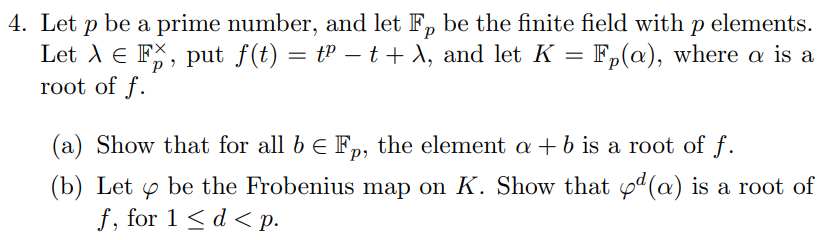
Is part (a) doable by avoiding Fermat's little (or similar reasoning)? 🤔
I'm guessing not
south patrol
it essentially implies Fermat's little theorem so ye you should probably use it
coral shale
I was thinking like an inductive approach
but I might end up just proving Fermat
idk, is it the same?
It feels like that avoids it
south patrol
is there a reason you want to avoid it, it's a fairly basic fact
coral shale
ehhhhhhhhhhhhhh
just running away from number theory
$$f(\alpha + 1) = (\alpha+1)^p-\alpha - 1 + \lambda$$
$$=\alpha^p-\alpha + \lambda+1^p - 1 = 0$$
cloud walrusBOT
 coral shale
yh this works right? But am I just proving fermat
south patrol
seems like just proving fermat ye
coral shale
never seen a proof like this 🤔
south patrol
I mean Fermat is just lagrange's theorem on F_p right so eh
coral shale
Fermat by finite induction
coral shale
south patrol
I mean Fermat is just lagrange's theorem on F_p right so eh
oh it is 
 chilly radish
On F_p^x actually
south patrol
Yes lol oops
coral shale
For part (b), that ^d should mean composition d times?
apply phi to alpha d times
$\varphi^d(\alpha)=\alpha^{p^d}$
right?
cloud walrusBOT
 coral shale
If so, I seem to have some error. . .
 void cosmos
coral shale
For part (b), that ^d should mean composition d times?
void cosmos
coral shale
For part (b), that ^d should mean composition d times?
yes
coral shale
,align \varphi(\alpha)&=\alpha^p=\alpha-\lambda\
\varphi^2(\alpha)&=\varphi(\alpha)-\varphi(\lambda)=\alpha-\lambda-\varphi(\lambda)\
\varphi^3(\alpha)&=\varphi(\alpha)-\varphi(\lambda)-\varphi^2(\lambda)=\alpha-\lambda-\varphi(\lambda)-\varphi^2(\lambda)\
\cdots\
\varphi^d(\alpha)&=\alpha-\sum^{d-1}_{i=0}\varphi^i(\lambda)\
cloud walrusBOT
 coral shale
I reckon this
,align f(\varphi^d(\alpha)) &= \phi\left(\alpha-\sum^{d-1}{i=0}\varphi^i(\lambda)\right)-\left(\alpha-\sum^{d-1}{i=0}\varphi^i(\lambda)\right)+\lambda\
&=\alpha^p+(-1)^p\sum^{d}{i=1}\varphi^i(\lambda)-\alpha+\sum^{d-1}{i=0}\varphi^i(\lambda)+\lambda\
&=-\sum^{d}{i=1}\varphi^i(\lambda)+\sum^{d-1}{i=0}\varphi^i(\lambda)\
&=-\varphi^d(\lambda)+\lambda\
&=-\lambda^{p^d}+\lambda\
&=-\lambda^d+\lambda\
cloud walrusBOT
 coral shale
But that last thing isn't necessarily 0
So must have error somewhere
oh im dumb, that last line is the error 
ahhhhhh ive got it
😅
void cosmos
good
do you know about modules
specifically
are u good with computing cerrtain stuff
like Hom
im tryuing to ask
something
Hom_R(C,C) where R is matrices of the form (a,b,0,c)
and C is complex numbers
cloud walrusBOT
 coral shale
void cosmos
Hom_R(C,C) where R is matrices of the form (a,b,0,c)
coral shale
void cosmos
Hom_R(C,C) where R is matrices of the form (a,b,0,c)
I could have a think, but doubt I would get far.
Can you define Hom_R(C, C) for me?
coral shale
cloud walrus
All the linear transformations represented by matrices of this form with complex entries?
void cosmos
yes
no
C module(vec space)
R-module
think of C as this R-module
and i want the homomorphisms
from C to C
cloud walrusBOT
 void cosmos
Yes
coral shale
So when you multiply by this matrix
z in R^2 really
Sorry if I misunderstood

I'm just not 100% on what this scalar multiplication is
Is it matrix multiplication on the cartesian form of the complex number
,,\mat{a&b\0&c}\mat{x\y}
cloud walrusBOT
 coral shale
tower law
I will write this Q(a, b) in the same order
[Q(a) : Q] is a degree 4 extension
[Q(a, b) : Q(a)] is a degree 2 extension... this is harder to see
You need to figure out what the minimal polynomial of b in Q(a)[t] is
2
coral shale
coral shale
You need to figure out what the minimal polynomial of `b` in Q(a)[t] is
figure this out and then you will get the answer
As for the basis vectors...
It will be products like so
,, a^mb^n
cloud walrusBOT
 coral shale
m = 0, 1, 2, 3
n = 0, 1
@void cosmos sorry so did we have this?

And a, b, c are real entries, or are they complex?
and x, y represents the complex number (real entries)?
confused 😵
no no, surely they have to be real entries
unless I misunderstand this completely
Deciding where the basis vectors map to determine your homomorphism if we can find a basis 🤔. If the scalar multiplication is as above, there's no basis for this one
 tall jay
If $G$ is an abelian group, how can I argue that the set$$ K = { a \in G: \abs{a} \leq 2 } \leq G? $$
cloud walrusBOT
beeswax
 tall jay
|a|= order of a
lethal dune
note (ab)²=a²b²
tall jay
Since e is in G, then e is in K bc it has order 1
 valid basin
yeah
also, for any a,b in K, show that the product ab is also in K
and also show that for any a in K, the inverse of a is also in K
tall jay
Right, but what I'm a little shaky on is that why does ab have order less or equal to 2?
valid basin
lethal dune
note (ab)²=a²b²
you can use this fact
since in an Abelian group, we have that (ab)^2=a^2b^2 for any a,b
this is useful because, since a and b are from the set K, they have order 2 or less
which means a^2=b^2=identity
tall jay
meaning a²b²=e?
valid basin
it implies that (ab)²=a²b²=e
which means the order of ab must be less than or equal to 2
and from the definition of K, we must have that ab is in K.
tall jay
Okay, let me try to repeat to see if I understood
So, if we assume that a,b is in K, then the order of those 2 elements are each less than or equal to 2.
Since G is an abelian, then for a,b in G in K, (ab)²=a²b²=e. This implies ab has order less or equal to 2.
valid basin
yeah nice
one small thing to point out - in the second line, we are considering a,b in K (not a,b in G)
tall jay
Ah
Okay, I understand it better, but now I am not 100% on
(ab)²=a²b²=e ---> ab has order less or equal to 2
valid basin
yup
since when you square it, ab returns to the identity
so ab must have an order of 2 or less
valid basin
after showing that the product ab is in K, the final step is to show that if we have some a in K, then a^-1 is also in K
tall jay
Well if a is in G and has order 2, then a inverse will also be in G argue why a inverse has order 2 then done.
valid basin
sounds good to me
 prisma shuttle
hey guys
can someone explain why we need the power of $n$ in the expression $(\mathbb{Z}/p^i\mathbb{Z})^n$?
cloud walrusBOT
JustKeepRunning
 prisma shuttle

cuz if its just plugging the values into a univariate polynomial why do u need to plug an ordered pair in
 hidden haven
prisma shuttle
cuz if its just plugging the values into a univariate polynomial why do u need t...
hidden haven
prisma shuttle
cuz if its just plugging the values into a univariate polynomial why do u need t...
f isn't univariate though 
 barren sierra
Is the only difference between direct product and direct sums of modules is that direct ones have strictly finitely many non -zero entries?
Why is one called "product" and the other called "sum"? Just curious about the naming lol
 oblique leaf
Is it true that $$K^p\subseteq K$$ when K is infinite and of characteristic p? Or is this fact only true for finite fields
cloud walrusBOT
alyosha
 lethal dune
barren sierra
Why is one called "product" and the other called "sum"? Just curious about the n...
lethal dune
barren sierra
Why is one called "product" and the other called "sum"? Just curious about the n...
they are same in case of finite sums/products
the difference comes in case of infinite prods and sums
it's called product as it comes from categorical product in R-mod
direct sums are co-product in category, idk why they are called direct sums
lethal dune
oblique leaf
Is it true that $$K^p\subseteq K$$ when K is infinite and of characteristic p? O...
take Zp(x) and see what happens
oblique leaf
sorry what is Zp(x)?
lethal dune
well u only cate about subset right?
oblique leaf
yeah i want to know if K^p is going to be contained in K
lethal dune
oblique leaf
sorry what is Zp(x)?
field of fractions on Z_p[x]
oblique leaf
okok
lethal dune
oblique leaf
yeah i want to know if K^p is going to be contained in K
why not, K is a field so closed under multiplication
oblique leaf
I don't know, I am trying to figure out why the Frobenius automorphism is not an automorphism for K being infinite
it seems that it is only surjective in the finite case
lethal dune
yes
oblique leaf
why is that?
oblique leaf
not really ..., but essentially you are saying that we can have K^p contained in K AND the map being injective and still not have surjectivity?
lethal dune
no that's not what I said at all
I am asking, can you tell me an example of an infinite field of char p
oblique leaf
ok wait thats all wrong sorry
lethal dune

oblique leaf
ok but K^p is always contained in K regardless of finiteness correct?
since fields should be closed under multiplication
oblique leaf
and the map is injective
delicate orchid
yeah just taking the infinite direct product of F_p should work
lethal dune
any hom from field is injective or 0
oblique leaf
true
lethal dune
delicate orchid
yeah just taking the infinite direct product of F_p should work
product in fields
delicate orchid
like some kinda completion type beat
oblique leaf
but so then somehow, this injective map going from K into K^p (that is at most as big as K) is NOT surjective
lethal dune
yes
I was trying to give you a counter ex
but looks like you don't know what Z_p(x) js
oblique leaf
yeah, i actually only have to prove why it is surjective in the finite case
lethal dune
do you know polynomial rings over a field?
oblique leaf
lethal dune
do you know polynomial rings over a field?
yes
lethal dune
oblique leaf
yeah, i actually only have to prove why it is surjective in the finite case
well since it's finite...
lethal dune
oblique leaf
yes
do you know field of fractions over an integral domain?
oblique leaf
no
lethal dune
u divide by non zero elements and create a bigger set
which turns out to be a field
like Z is an ID, divide by non zero integers and you get Q
oblique leaf
hm ok
lethal dune
same thing u do with Z_p[x] so your elements are kf the form p(x)/q(x) where q ≠0
which gives us a field
of char p (which u can check)
lethal dune
yea
now can u show that the frobenius map in this field is not surjective?
use irreducibility
oblique leaf
x^p-a is irreducible? where a is not in K^p
 oblique leaf
ok lol
lethal dune
do you see now?
oblique leaf
no
lethal dune

oblique leaf
lol thank you!
 wooden ember
What am I doing wrong here: working in $F_2[t]/(t^3)$ i get $(t+t^2)(t+t^2)(t)=(t+t^2)(t^2)=t$ on one hand but on the other hand it is $(t+t^2)(t)=t^2$ since $t+t^2$ is idempotent??
cloud walrusBOT
𝓛ittle ℕarwhal ✓
 south patrol
(t+t^2)^2 = t^2 right
wooden ember
t^2 + t^3 + t^3 + t^4 -> t+ t^2 no?
wooden ember
god im a massive fool you're right
south patrol
In fact the first term should just be 0 too so yeah
wooden ember
ugh i have zero motivation to do this all over again ree
 potent briar
book I'm reading says
More precisely, a scalar-valued function w on W is a bilinear form if
      w(a1x1 + a2x2, y) = a1w(x1, y) + a2w(x2, y)
and
      w(x, a1y1 + a2y2) = a1w(x, y1) + a2w(x, y2)
identically in the vectors and scalars involved.
my first question is what does "identically in the vectors and scalars involved" mean??
south patrol
it just means 'this holds for all possible scalars and vectors' vik
wooden ember
wooden ember
ugh i have zero motivation to do this all over again ree
ig at least i learned that cyclic multiplication aint good for rings then
south patrol
wdym by cyclic multiplication?
wooden ember
in the sense that i was basically cycling through the orders like i would in a cyclic group
south patrol
oh ok
wooden ember
i dont mean anything rigorous by it since i had nilpotent elements anyways
south patrol
Sure
pastel cliff
any suggestions on online resources to learn about lie algebras? besides reading the wiki
no access to a book rn but if anyone's got suggestions about that i can find pdf's as well
actually i'll ask some better questions
def reads "A Lie algebra is a vector space g over a field F"
why do we say say "over" another thing
 maiden ocean
I mean that's just the standard term?
delicate orchid
cause it's... over the field? lol?
south patrol
unless you mean why do we use that terminology for vector spaces in the first place lol
delicate orchid
you're applying a set of vectors + scalar multiplication to a field so it's "over" the field I guess?
south patrol
but i guess the idea is that the field in some sense forms the basis of the structure lol
pastel cliff
south patrol
unless you mean why do we use that terminology for vector spaces in the first pl...
yeah more along this line, i get that it's standard i was just asking like what's the idea of using that term specifically
pastel cliff
south patrol
but i guess the idea is that the field in some sense forms the basis of the stru...
like this
so it's just a statement about what the elements of the vector space look like right
maiden ocean
Possessing a lie algebra structure?
maiden ocean
It's not really a property so much as it is just that being a vector space isnt defined without reference to a given field?
delicate orchid
yeah, it just means the vector space has that field as its set of scalars
pastel cliff
delicate orchid
I guess it's kind of a short hand for writing a vector space "that acts on via a group action on" a field
chilly radish
pastel cliff
no access to a book rn but if anyone's got suggestions about that i can find pdf...
Humphreys
Lie Algebras and representation theory
is there a reason that Gauss' Lemma is usually stated for UFDs? I'm pretty sure the proof really only uses the fact that irreducibles are prime, so wouldn't it work over a GCD domain?
 pastel cliff
prof defined SL like this but isn't it usually matrices s.t. det(A) = 1??

and afaik trace = 0 does not imply det = 1
pastel cliff
 upper pivot
you can show that differentiating the det=1 condition shows trace=0
not really, the point is little sl (usually written in some fancy font like frak) is the lie algebra of SL, so you want to be able to relate these
pastel cliff
his handwriting is so ass that i just assumed he overlooked capitalizing lol
duly noted tho
pastel cliff
upper pivot
the lie algebra of SL
does this imply they still have det(A) = 1 tho?
upper pivot
nope
 tranquil parcel
No. Consider the zero matrix
upper pivot
right so how much do you know about lie groups/lie algebras
and if not how about like, manifolds
pastel cliff
upper pivot
right so how much do you know about lie groups/lie algebras
day 1 of trying to learn it lol
pastel cliff
upper pivot
and if not how about like, manifolds
the basics but probably/hopefully enough?
upper pivot
right so do you know like, what tangent spaces and vector fields are?
pastel cliff
i started looking into that recently but got confused with the basis of tangent spaces being the partials
i overthink things easily though
upper pivot
i see
ok so the easiest way to say it for now would be that to each lie group G you can associate functorially a lie algebra g
this turns out to be simply T_1 (G) or the space of left-invariant vector field, but dw too much about this for now ig your book will define this
pastel cliff
i know im punching a bit above my weight but how is this related to manifolds tho? im doing this for some independent study with a prof and i did think it odd that he introduced the idea of manifolds and then (seemingly) randomly switched to algebra
upper pivot
well lie groups are manifolds with group structure right
 upper pivot
its a class of manifold where a lot of things end up working out nicely
tranquil parcel
for example, the circle
upper pivot
so ithink its like, a good way to ease into like, diff geo or w/e
pastel cliff
:O
upper pivot
altho i will say it is probably more useful to see this after you know a bit about tangent spaces and vector fields imo
cause otherwise things like this sl is a bit random
pastel cliff
pastel cliff
prof defined SL like this but isn't it usually matrices s.t. det(A) = 1??
yeah he just gave me this as an exercise and promised more details later
upper pivot
i see, yeah thats just confirming the details
dont forget to show that the lie bracket is indeed defined, i.e [A,B] also has trace 0
pastel cliff
oop
 prisma ibex
(it's easy to show this is well defined for 2x2 matrices by a direct computation; what if you're looking at sl_n more generally? what property of the trace can you use to show this is well-defined?)
tranquil parcel
I (think) I want to map $F(a,b) \to G_2$ and prove the kernel is the normal closure of $\langle abab^{-1}\rangle$ abusing the first homomorphism theorem. I can determine the map by sending a,b and then just extending it to the unique homomorphism (universal property of the free group). The issue is, I don't know where to send a nor b. My thought is to make the image of $abab^{-1}$ be $c^2d^2$, but I don't think this works.
 cloud walrusBOT
Michael Harp
 pastel cliff
prisma ibex
(it's easy to show this is well defined for 2x2 matrices by a direct computation...
pastel cliff
prisma ibex
(it's easy to show this is well defined for 2x2 matrices by a direct computation...
silly algebra man
im curious about this
silly algebra man = wew lads
tranquil parcel
me too man
prisma ibex
you use that Tr(AB)=Tr(BA), even if A and B do not commute
delicate orchid
I know fuck all about lie groups
pastel cliff
"fuck all"
delicate orchid
something something sums of eigenvalues
no seriously
I've never worked with them
 delicate orchid
anyway back to seeing if the substitution test works
prisma ibex
(btw this does not imply that trace is invariant under permutations, only cyclic permutations)
delicate orchid
tfw
tranquil parcel
i even assumed abab^{-1} = a^2b^2 and tried to see if i could get a work-backwards solution and left empty handed
delicate orchid
ok, so abab^-1 implies that a and b are kinda anti commutative right
like you can swap ab = ba^-1
could do something with this
unless I'm tripping hard
tranquil parcel
no that's totally right
a is kinda a conjugate of its inverse
a b-conjugate specifically
delicate orchid
yeah yeah good
delicate orchid
tranquil parcel
i even assumed abab^{-1} = a^2b^2 and tried to see if i could get a work-backwar...
I'm trying to do this, btw
kind of
tranquil parcel
ok wait
delicate orchid
oml I've managed to get abab^{-1} = b^{-2}a^{-2} they're actually trolling me
and now I've reduced that to a^{-2}b^2 
tranquil parcel
nope never mind
i made an error haha
i just derived the same thing you did yikes
delicate orchid
zoinks
lemme try again
I had to do something very similar to this for THREE relators a couple of days ago
pure agony
tranquil parcel
yeah that sounds bad
barren sierra
I do not understand tensors 
 tranquil parcel
would you have guessed this is a topology class
delicate orchid
it was the same conjugate inverse type deal as well
no lmfao what kinda topology class is this
tranquil parcel
It's labelled topology 2 but we basically cover algebraic topology fundamentals. like fundamental groups, connected sums and wedge products, the weird unions of two open sets theorem
forgot its name
but it gives you the fundamental group of the union of two spaces under certain conditions
barren sierra
what is trace again?
pastel cliff
yes
delicate orchid
yup
barren sierra
is that sum of diagonals?
tranquil parcel
The trace of an nxn matrix is the sum of the diagonal entries
delicate orchid
barren sierra
what is trace again?
dIaGoNaL SuM
barren sierra
ya then yes
delicate orchid
but who uses that lol
barren sierra
^
delicate orchid
it's the sum of the eigenvalues
tranquil parcel
it is?
barren sierra
again tho what is the use
pastel cliff
pastel cliff
prof defined SL like this but isn't it usually matrices s.t. det(A) = 1??
i want this to be less annoying
barren sierra
tranquil parcel
it is?
ye it's kind of nice
tranquil parcel
characters? as in the homorphisms from groups into the units of a particular field F characters?
delicate orchid
you can completely reconstruct a (complex) representation of a group just from knowing its trace
delicate orchid
tranquil parcel
characters? as in the homorphisms from groups into the units of a particular fie...
those are... 1 dimensional characters I thinkkk
yeah
linear characters
same thing just in a restricted scope
tranquil parcel
Ah, so yo consider affine spaces over fields too
barren sierra
also does anyone have any idea with the tensor question I sent above 💀
delicate orchid
these are all derived from linear transformations, it just that the trace a matrix is only a linear function when the matrix is one dimensional
hence, linear characters
delicate orchid
barren sierra
also does anyone have any idea with the tensor question I sent above 💀
wtf is a quotient field
barren sierra
field of fractions
tranquil parcel
The field of units that can complete an integral domain
barren sierra
idk why they call it that either
barren sierra
it's just like the definition of a tensor product is very contrived as far as I can tell
and i have absolutely no idea what elements of this product look like
tranquil parcel
You just wanna turn bilinear maps into linear maps
delicate orchid
first things I need to understand the structure of Q/R as an R-module
then it'll probably be easy to see
tranquil parcel
An example would be R^2 tensor R^3, which would be formed by a standard basis of 2x3 matrices
delicate orchid
R^6
delicate orchid
barren sierra
so I mean each element in Q/R takes the form a/b + R but after that
can we represent each one of those equivalence classes with just 1/b+R for some b?
tranquil parcel
$\mathbb{Q}/\mathbb{Z}$ is a funky group to think about. It's an infinite order torsion group, with unbounded torsion,
cloud walrusBOT
Michael Harp
 barren sierra
hm
tranquil parcel
oops i see
delicate orchid
but thinking about it more I believe you
there must be something we can shove in that R or the quotient would just be Q
 proud bear
I think you can say like [\frac ab\otimes\frac cd=\frac{ad}{bd}\otimes\frac cd=\frac a{bd}\otimes\frac{c}1=\frac a{bd}\otimes0=0]
cloud walrusBOT
 barren sierra
wait what how
first to second one I get
I think my issue is more I do not understand what tensors are or how they work
and reading over the notes I have is not helping
delicate orchid
ok, so we can reduce elements of $Q \otimes_R Q$ from $a/b \otimes_R c/d = ac(1/b \otimes_R 1/d)$ ok coollll
so if we quotient this by R now we get that elements of $(Q \otimes_R Q)/R$ are (1/b \otimes_R 1/d), can we then say that $(Q \otimes_R Q)/R \cong (Q/R \otimes_R Q/R)$?
cloud walrusBOT
Wew "Quaternonic" Tbh (201🧊) ✓
Compile Error! Click the  reaction for more information.
(You may edit your message to recompile.)
 delicate orchid
cause if we could that would be rather nice
delicate orchid
cloud walrus
oh good god that's clever
I like it
I feel like I was trying to do basically that but with the whole space at once
barren sierra
ngl I do not get how any of those manipulations work
delicate orchid
ok so, a/b ~ ad/bd by definition of field of fractions
move the factor of d on the top outside the tensor (cause da O b = d(a O b))
and then move it back in on the other side (d(a O b) = a O db)
cancel
boom
c/1 is in R
double boom
barren sierra
ohhhhhhhhhhhh
delicate orchid
kablammo
delicate orchid
I tried to see something like that but I was missing the ad/bd step
delicate orchid
cloud walrus
**Wew "Quaternonic" Tbh (201🧊) ✓**
Compile Error! Click the <:errors:5042665560...
as you can see here
barren sierra
jeez yea I have no intuition for tensors
next obsidian
This is a much easier computation than what you all did
barren sierra
like I kinda understand parts of this but manipulating it is all 
 next obsidian
(a/b (x) c/d) = (ad/bd (x) c/d) = (a/bd (x) dc/d) = (a/bd (x) c) = (a/bd (x) 0) = 0
barren sierra
yea that's what @proud bear did
next obsidian
Ah
So you don’t even need two Q/R’s
In general, this computation shows that if M is torsion, then Q (x)_R M = 0
And Q/R is all torsion
delicate orchid
barren sierra
like I kinda understand parts of this but manipulating it is all <a:thinkspin:58...
I just remember 1, 2, 3 tbh
barren sierra
how does this use the fact that Q/R is torsion
delicate orchid
and of course the funny quotient def
barren sierra
delicate orchid
I just remember 1, 2, 3 tbh
I do not understand how 1, 2, 3 are used
in like defining elements
next obsidian
barren sierra
how does this use the fact that Q/R is torsion
You used the fact that on the right, c/d is killed if I can multiply it by a d
So what I did was on the left, multiply by a d/d, then moved the top d across the tensor

 chilly ocean
prisma shuttle
can someone explain wut the notation used here means
chilly ocean
prisma shuttle
can someone explain wut the notation used here means
the integral might be defined elsewhere
but its saying that you are integrating over the ideal pZp to the n’th power where Zp is are p-adic integers and p is a prime
chilly ocean
prisma shuttle
can someone explain wut the notation used here means
what book is this from
chilly ocean
I was reading involutive algebra or *-algebra. Just for confirmation, in that structure, we have a ring R being commutative, where an associative algebra A is present over R. I don't understand the over R part. In associative algebra, we have associative Multiplication amd addition operations forming a Ring; and addition and scalar Multiplication operations forming a Vector space over a field K. Is this over K being replaced by over Ring R in involutive algebra? Or is it something different?
Any hints for proving that if the index of a center of a group is n, the most elements any conjugacy class of that group can have is n elements?
oblique leaf
I have to use field theory to prove that $$\phi_n(x) $$ and $$\phi_{2n}(x)$$ have the same degree. We can only use cyclotomic polynomials, but we cannot use the standard argument that $$\phi(nm)=\phi(n)\phi(m)$$ when $$gcd(n,m)=1$$
cloud walrusBOT
alyosha

 steady axle
IF we have a short exact sequence 0 -> A -> B -> C -> 0 such that A is direct summand of B non canonically, does it imply that B is direct sum of A and C
hidden haven
No
0 → 2ℤ → ℤ → ℤ/2ℤ → 0
is not split, even though 2ℤ ≅ ℤ is a summand of ℤ
lethal dune
why don't epimorphisms in Ring don't mean onto ring homomorphism?
hidden haven
ℤ → ℚ is epi
lethal dune

next obsidian
There’s a remarkable fact about this summand thingy
If you have any SES of the form
0 -> A -> A (+) B -> B -> 0 where A,B are finitely generated modules over a commutative Noetherian ring, this diagram is split
It doesn’t have to be the canonical maps
wooden ember
where am I going wrong here? If $I$ and $J$ are principal prime ideals (not necessarily coprime) then $IJ = I \cap J$. To see this take $I=(x), J=(y), IJ=(xy)$. We want to show $I\cap J \subset IJ$, ie that if $x | a$ and $y | a$, then $xy | a$. Write $a=px=qy$ to see that $y|p$ since $(y)$ is prime, and hence $px=kxy=a$ so that $xy|a$ as required
cloud walrusBOT
𝓛ittle ℕarwhal ✓
 hidden haven
y could divide x instead of p
wooden ember
oh right i should have also added that x and y are irreducible
though i guess then only one of them need to be
hidden haven
y=x still is a counterexample
wooden ember
fair enough
hidden haven
Irreducibility of x and y follows from their ideals being prime
wooden ember
thanks, i was mainly asking for the specific case of x and y in F[x,y] for which the argument is true then
wooden ember
hidden haven
we are not in PID
yeah not necessarily
hidden haven
F
wooden ember
so does this coputation work then? I want to compute the nilradical of F[x,y]/(x^2y^3) for F a field
i just compute that rad(x^2y^3) is (xy)
by noting that if x^2y^3 divides P then x and y divides P so xy divides P
and the opposite inclusion is clear
and so the nilradical is (xy) + (x^2y^3)?
hidden haven
Sounds legit
wooden ember
coolio thanks
wooden ember
what does the notation $\mathbb{F}_p[\mathbb{Z}/p\mathbb{Z}]$ mean?
cloud walrusBOT
𝓛ittle ℕarwhal ✓
 wooden ember
i have to do stuff with it in an exercise series but i cant find any place where the prof defined it
unless he means a group ring 🤔
yeah nvm im a fool this is a group ring
 devout crow
what proportion of finite groups are commutative? when listed by order or something
wooden ember
devout crow
what proportion of finite groups are commutative? when listed by order or someth...
id expect it grows far slower than the number of finite groups
for p groups for example you already have a lot more non-abelian than abelian groups
from what i can tell there's a lot of research on the asymptotics of these numbers though
so we can say stuff about which ideals to quotient by to get no zero divisors (prime ideals) or no nilpotency (nilradical), but what about ideals such that the quotient isnt a product?
a related question is what ideals to quotient by such that there's no idempotency, but can we get tighter than this?
chilly ocean
Why does this hold..
 chilly ocean
Why 1 is not in M@chilly radish
chilly radish
Because M is a proper ideal
Maximal ideals are proper
If 1 was in M it would be the whole ring
devout crow
1 in M => r=r.1 in M for all r in R, so M=R
devout crow
wooden ember
from what i can tell there's a lot of research on the asymptotics of these numbe...
huh i couldn't find anything on first search, what do i need to look for?
 frail perch
Suppose F(s),F(t) are transcendental extensions of a field F, how can I describe the primes of the tensor product F(s) x F(t) over F?
chilly ocean
chilly ocean
I was reading involutive algebra or \*-algebra. Just for confirmation, in that s...
Pls help
wooden ember
devout crow
huh i couldn't find anything on first search, what do i need to look for?
this could be a good starting point https://mathoverflow.net/questions/21265/how-many-groups-of-size-at-most-n-are-there-what-is-the-asymptotic-growth-rate

MathOverflow
Question. How many (isomorphism types of) finite groups of size at most n are there? What is the asymptotic growth rate? And the same question for rings,
fields, graphs, partial orders, etc.
the asymptotics for abelian groups should be a lot more precise given we have the fundamental theorem of finitely generated abelian groups to help us count them
chilly radish
For abelian groups this just boils down to the number of nontrivial factorisations of a number
 celest mantle
If A is a cohomogically trivial G-module, and N is a torsion free G-module, how would i go about proving that Hom(N,A) is also cohomogically trivial pls ? I know it's a torsion free G-module, maybe finding a short exact sequence where it fits with 2 others cohomogically trivial G-modules would be good perhaps, idk
 chilly radish
I need help understanding what they even mean by c being an identity, considering c is just an element of the algebra of nxn generic matrices, not a polynomial in noncommuting variables. I assume they mean the associated central polynomial, in which case I don't understand why it's so easy to see that this is an identity for M_n-1. So basically, we have a polynomial in noncommuting variables, such that for every evaluation in nxn matrices, you get a scalar matrix, and this is supposed to imply that for every evaluation in n-1xn-1 matrices, you get 0. Any ideas?


 terse crystal
chilly radish
I need help understanding what they even mean by c being an identity, considerin...
terse crystal
chilly radish
I need help understanding what they even mean by c being an identity, considerin...
What book is it from?
chilly radish
terse crystal
What book is it from?
It's a paper, quasi-identities on matrices and the Cayley-Hamilton polynomial
terse crystal
Thank you
chilly radish
Np
 tribal moss
Is it implicit here that the polynomials have no constant term? Otherwise, say, c=2 would seem to be a counterexample.
chilly radish
if you mean in the theorem, it is explicit in the statement of theorem 2.2
it
it's still weird to me that they refer to elements of Z_n as if they were polynomials themselves
I think something is going on here that i'm missing, maybe this identification is known to be bijective so it's okay to make
tribal moss
Oh, right.
 echo orbit
I have a free group on three generators a, b, c.
I am trying to take the quotient of this group by the normalizer of the cyclic subgroup <a^2bcb^-1c^-1>.
I need to find the presentation of this quotient group. I'm having a little trouble with this.
tribal moss
chilly radish
I need help understanding what they even mean by c being an identity, considerin...
Evaluate the polynomial on a set of block matrices of the form $\begin{bmatrix}X_i\&0_{1\times 1}\end{bmatrix}$ where $X_i$ are arbitrary $(n-1)\times(n-1)$ matrices. This produces $\begin{bmatrix}c(X_1,\ldots,X_k)\&0_{1\times 1}\end{bmatrix}$, but the only way for that to be a scalar is if it vanishes completely.
cloud walrusBOT
Troposphere
 chilly ocean
Suppose A is a Dedekind domain and B is a domain containing A that is finitely generated as a module over A.
I need to prove that B is also a Dedekind domain, so far I've been able to prove that it's noetherian and that every non-zero prime ideal is maximal, but I can't seem to be able to use the fact that A is integrally closed to prove that B is.
Can anybody give me a hint?
use that B is finitely generated over A
next obsidian
It isn’t true @chilly ocean
tribal moss
echo orbit
I am trying to take the quotient of this group by the normalizer of the cyclic s...
Is that normalizer even a normal subgroup?
next obsidian
Look at Z[sqrt(5)]
chilly ocean
next obsidian
Look at Z[sqrt(5)]
oh, thank you. It was in my professor's notes so I didn't think about finding a counterexample.
next obsidian
So the like
Using Krull-Akizuki you can say something which I assume is what they wanted to say
Which is that if L is a finite extension of Frac(A)
Then the integral closure of A in L is a Dedekind domain
You show that the integral closure is a dim 1 Noetherian ring using Krull-Akizuki
And then being integrally closed is free because the thing is the integral closure of A
echo orbit
tribal moss
Is that normalizer even a normal subgroup?
the normalizer of it is.
tribal moss
How do you know? Normalizers are not automatically normal.
In fact, I think the normalizer in the case is the same as the subgroup itself, which is definitely not normal.
Perhaps the question should have said "normal closure" instead of "normalizer"?
tranquil parcel
I have tried so far to find a map $F(a,b) \to G_2$ with kernel equal to the normal closure of the first presentation's relation. I don't even know where to send $a,b$. I do know this uniquely determines a homomorphism, which we can then use the first isomorphism theorem to give us $G_1 \cong F(a,b) / \ker(\varphi) \cong G_2$.
cloud walrusBOT
Michael Harp


 indigo ravine
You can try a bunch of combination of c and d for phi(a) and phi(b) until you find one such that phi(a)*phi(b)*phi(a)*phi(b)^(-1) = ccdd .
I think || a -> cd b -> dc || works ?
barren sierra
normalizer of <(1 2 3 4)> in S_4 is itself right?
or no elements like (1 2) are in the normalizer right? as is (1 2 3)?
wait nvm no it doesn't
so it's just itself
tranquil parcel
Yeah any two 4-cycles are conjugate
specifically they are conjugated by the permutation of the entries in the cycle
barren sierra
yea
chilly ocean
How can I figure out if the quotient group formed by the center of a group is cyclic or not?
I'm not sure how I to use cosets to figure out whether I can generate all cosets from a single coset
 woven delta
indigo ravine
You can try a bunch of combination of c and d for `phi(a)` and `phi(b)` until yo...
woven delta
indigo ravine
You can try a bunch of combination of c and d for `phi(a)` and `phi(b)` until yo...
I wasn't able to show the one you posted worked, but I was able to show that the map ||(a,b)\mapsto (cd,d)|| works
 lavish nexus
I've shown R((x)) = S^(-1)R[[x]], S = {x^n|n in N}
how do I show R((x)) = K^(-1)R[[x]], K = {power series with no constant terms}?
or maybe there's another way to show if R is a field then R((x)) is a field
woven delta
Can you state this as formal Laurent series with a finite tail (eventually 0 in negative coefficients)
Anyway you can give an algorithm for division in the ring of formal finite tailed Laurent series. Let $f=a_0x^n+...+a_kx^k+...$ be a formal finite tailed Laurent series with $a_0\neq 0$. We want to show that there is some corresponding g with $g=b_0+...+b_kx^k+...$ with $fg=1$
cloud walrusBOT
Emma
 woven delta
This gives us an infinite sequence of equations we can solve inductively to find g
@lavish nexus
cloud walrusBOT
Emma
 woven delta
The equations we have are given by the fact that $fg=1$ so the 0 degree coefficients of $fg$ is 1, and all of the other degree coefficients are 0
cloud walrusBOT
Emma
 woven delta
And then you can recursively find the coefficients of g by starting from the bottom and solving each equation individually, then plugging your solutions into the next equation
woven delta
(I edited above to assume that f is a power series with a_0 not 0, since we can divide or multiply by x^n to get every other element)
So this is just applying the fact that power series with nonzero constant term are units
If you already know that you can skip the above
lavish nexus
Yeah I know that algorithm for finite termed Laurent series but not for something with infinite negative power terms
barren sierra

I'm pretty stuck on (b)
So my understanding is that S is this subring of polynomials such that the terms without any y's also have no x's (i.e. are just constants from the underlying field F)
from that I'm not sure how to leverage that into proving (b)
woven delta
lavish nexus
Yeah I know that algorithm for finite termed Laurent series but not for somethin...
That ring is finite termed Laurent series
That's what adding in x^-n for each n does
Oof I should have asked before I gave exposition
Ah well
 carmine fossil
barren sierra
from that I'm not sure how to leverage that into proving (b)
carmine fossil
barren sierra
from that I'm not sure how to leverage that into proving (b)
So f(x,y) being in the ideal means each f_i is a combination of {1,x,x^2,....x^{k-1}} except for f_0 which has to be 0
So first cancel f_n(x)
You know {1,y,y^2...y^n} are all elements in S
barren sierra
how can you cancel f_n(x)?
woven delta
lavish nexus
Yeah I know that algorithm for finite termed Laurent series but not for somethin...
Anyway you can't even have a ring of formal power series with infinitely many negative power terms, multiplication isn't well defined
carmine fossil
carmine fossil
You know {1,y,y^2...y^n} are all elements in S
So using this you consider {y^n,xy^n,x^2y^n...}
Now some linear combination of this has to cancel f_n otherwise you can't reduce f_n to 0(and hence the whole thing to 0)
woven delta
Not without a notion of convergence, and even then you need more then that I think
carmine fossil
carmine fossil
Now some linear combination of this has to cancel f_n otherwise you can't reduce...
Because only x^k y^m terms can cancel x^k y^m terms by subtraction
barren sierra
oh you just mean cancel by subtracting
carmine fossil
Yea
woven delta
The reason why products of formal power series work is there is only a finite sum of coefficients for each degree, in the infinitely many in the negative case you have an infinite (indexed by Z) sum for each coefficient
 regal carbon
Hi, I'm very much afraid of abstract algebra. I've completed learning proof of contradiction, Contra positive and direct proofs but I haven't completed proof of induction. Still I am very very much afraid I don't know from where to start. I am very much of just about prerequisites such as mathematical induction, functions sets and relations I think I am overlearning. I am really struggling with the functions theorems. I am unable to understand really feeling discouraged. Currently I am reading "mathematical proofs: a transition to advanced math" textbook, it is very big that I am unable to complete it. I think I have completed 4 chapters from it.
Again it is very much discouraging for me for not understanding functions theorems.
Experience nearly 3 months I have completed the proof techniques. I completely forgot I think I have to recap it now! Should I directly jump into the actual subject ?
tranquil parcel
Well, to learn abstract algebra, you would want some basic set theory and proof techniques (precisely all the ones you listed above - including induction). But after that you should be totally ready. Honestly, the only thing you need to know about functions before you start abstract algebra is that they have inputs from a domain and outputs in a codomain, cardinality, what surjectivity and injectivity are (or what onto and one-to-one are, respectively), bijectivity (onto and one-to-one), and pre-images. But even these are all usually covered in an introductory algebra text.
regal carbon
Oh really?
tranquil parcel
You sound mostly ready though if you've been working on proofs in another subject. The main emphasis is that you are comfortable with proof structure.
regal carbon
tranquil parcel
You sound mostly ready though if you've been working on proofs in another subjec...

This is the book I've read
I've practiced sir
barren sierra
carmine fossil
Now some linear combination of this has to cancel f_n otherwise you can't reduce...
I'm lost as to why we are looking at the n-th term
carmine fossil
Well, There's actually no reason actually when I think about it
You can just cancel f_1(x) directly
barren sierra
?
carmine fossil
Consider {y,xy,x^2y,...x^{k-1}y}
Some linear combination of this will have to cancel f_1(x)y
barren sierra
oh basically show that if deg f_1 >= k then there is no additive inverse in S?
carmine fossil
Well,yea
 sly crescent
Are HNN extensions commutative?
hidden haven
If you start with a non abelian group, it will embed into its extension so the extension can't be abelian
 broken stirrup
Hi, how do you prove A_1 and A_2 are isomorphic?
 sly crescent
hidden haven
If you start with a non abelian group, it will embed into its extension so the e...
sly crescent
hidden haven
If you start with a non abelian group, it will embed into its extension so the e...
Not what I meant
If you reverse the order of the associated subgroups, do you always get an isomorphic group?
next obsidian
broken stirrup
Hi, how do you prove A_1 and A_2 are isomorphic?
You can break up both of them as Z_p^2 (+) Z/pZ in different ways
broken stirrup
next obsidian
You can break up both of them as Z_p^2 (+) Z/pZ in different ways
Can i map the generators to generators?
Let's say there is a mapping which sends (p,0,0) to (p,0,1) and (0,0,1) to (0,p,0)
would they be isomorphic?
broken stirrup
this another one that i got stuck


I know that it's universal property and I'm free to choose A whatever I want but got nothing so far
terse crystal
broken stirrup
this another one that i got stuck
Suppose there are a_j such that Σa_j l(x_j)=0 .Let f:X—>R^n. Mapping x_j to (0,…,0,1,0,…,0) (the j-th element is 1), mapping X \ {x_1,..,x_n} to zero
broken stirrup
oh so (r_1,...,r_n)=(0,...,0) thus r_i=0
brilliant
thanks
I took A as a free R-module but didn't consider it as direct sum of copies
 trim grove
Someone Can give an example of Infinite Field With Finite Characteristic (not zero).
 delicate bloom
rational polynomials with coefficients in a field of finite characteristic, F(x)
trim grove
delicate bloom
rational polynomials with coefficients in a field of finite characteristic, F(x)
What is they way of representing this?
Any special notation?
tribal moss
Usually just the same notation as rational functions over the reals, e.g, (x³+1)/(x²+x+1)
trim grove
tribal moss
Usually just the same notation as rational functions over the reals, e.g, (x³+1)...
$\mathbb{F}_{p}(x)$ ?
cloud walrusBOT
Solution
 tribal moss
Ah yes, the name for the entire field. Yes, that's it.
heavy dagger
Are the following statements true-
- When |alpha| = 1 and alpha has an argument that doesn't divide 2pi, Z[alpha] is dense in a wierd subset of C whereas if the argument divides 2pi it's dense only in Z[alpha]
- When alpha is an algebraic complex number, Z[alpha] is bijective to the set of equivalence classes (of polynomials with integer coeffs) based on the value they take at alpha
?
tribal moss
(1) No -- for example if alpha is a primitive 5th root of unity, then Z[alpha] is still dense in C.
heavy dagger
Any hints on how I can go about showing that?
tribal moss
Still for the 5th root of unity, alpha + alpha^4 is a real that is smaller than 1; therefore Z[alpha] contains arbitrarily small positive reals, and so its intersection with R is dense in R.
heavy dagger
Wait 2cos(pi/5) is greater than 1 right?
tribal moss
In fact assuming |alpha|=1, the only way for Z[alpha] not to be dense in C is if alpha^4=1 or alpha^6=1 (in which case it will be a lattice). Any other divisor will lead to a way to make numbers with modulus strictly between 0 and 1, and then you inevitably get a dense set.
The sum is 2cos(2pi/5) = 0.618.
heavy dagger
Oh right
tribal moss
heavy dagger
Are the following statements true-
1. When |alpha| = 1 and alpha has an argument...
(2) looks right, though.
heavy dagger
tribal moss
In fact assuming |alpha|=1, the only way for Z[alpha] _not_ to be dense in C is ...
Why is this statement true?
As in the any other divisor statement
tribal moss
Divisors 1,2,3,4,6 give nice lattices according to my claim.
5 we've just handled.
And if the divisor is greater than 6, then |alpha-1|<1.
tribal moss
~~In the case where the argument of alpha is not a rational multiple of pi, then alpha is transcendental, and the evaluation map Z[X]->Z[alpha] is an isomophism. This doesn't seem to be immediately obvious (someone prove me wrong, please!) but follows from the https://en.wikipedia.org/wiki/Gelfond–Schneider_theorem~~
Oops, I missed one of the assumptions of the theorem.
trim grove
Upto isomorphism how may algebrically closed finite fields are there? please explain.
tribal moss
Zero.
trim grove
tribal moss
Zero.
can you please help me with this, how can i show this?
tribal moss
If the elements of the field are a1,a2,...,an, then consider the polynomial (x-a1)(x-a2)···(x-an)+1.
trim grove
tribal moss
If the elements of the field are a1,a2,...,an, then consider the polynomial (x-a...
how this will help me to solve , can you please elaborate ?
tribal moss
It will show you that a finite field cannot be algebraically closed.
trim grove
tribal moss
It will show you that a finite field cannot be algebraically closed.
Thankyou
coral shale
tribal moss
It will show you that a finite field cannot be algebraically closed.
did not know this
delicate bloom
it's clever cause you immediately think "ahh I could have thought of that cause I know euclid's proof of infinitely many primes!"
chilly ocean
Mero 
broken stirrup
so I already showed that {f_1,f_2} generates R, but how are they linearly independent?
 tribal moss
The multiplication i R is function composition?
chilly radish
Anyone know what the reduced trace might refer to?
tribal moss
Assume f1r+ f2s = 0 for r,s in R, and prove r(en) and s(en) must both be 0.
(This assumes we're viewing R as a right R-module. The claim doesn't seem to be true for the corresponding left module).
broken stirrup
tribal moss
The multiplication i R is function composition?
yes sir
broken stirrup
tribal moss
(This assumes we're viewing R as a *right* R-module. The claim doesn't seem to b...
oh yes i was doing multiplication from the left and got nothing
and from right, it's easy to see that they are independent
maybe there's a problem in the statement of the problem
tribal moss
I'd say it does. The left module cannot possibly have two independent elements.
(At least not when K is a field. Module endomorphisms are too tricky for me to commit to the claim in the general case...)
Wait, that's not even true in the field case. It's just the particular f1 and f2 that don't work.
pastel cliff
is it accurate to say that a normal subgroup of G is just one that is like
closed under conjugation
ik the def of a normal subgroup but that wording isnt used in my book i just wanna make sure it doesnt miss anything/is wrong
coral shale
forall g, gN = Ng
forall g, gNg^-1 = N
yeah sounds ok to me.
You can say conjugation by any element in G acts on a normal subgroup I think?
Just remember N has to be a subgroup in addition to this condition
pastel cliff
yeah i mean it's w regard to normal subgroups so
is there any point to talking about normal groups that arent subgroups
chmonkey said sumn about this the other day 
coral shale
coral shale
You can say conjugation by any element in G acts on a normal subgroup I think?
Another way of phrasing it is
A subgroup N is a normal iff all inner automorphisms of G act on it
I think? If I haven't remembered my terminology wrong
pastel cliff
that "normalness" is a statement about how H lives inside G
coral shale
And we have a special type of normal subgroup
characteristic subgroups
if all automorphisms of G
act on it
N subgroup G is normal iff Inn(G) acts on N
N subgroup G is characteristic iff Aut(G) acts on N
Think we have this
broken stirrup
is direct sum of two finitely generated modules finitely generated?
terse crystal
broken stirrup
is direct sum of two finitely generated modules finitely generated?
yeah
By definition
broken stirrup
 pastel cliff
moldilocks
hidden haven
Try proving that if N is a submodule of M, then
M is noetherian iff N and M/N are both noetherian
The result you posted then follows from induction
broken stirrup
I believe I'm supposed to prove the fact by following instructions and we haven't covered M is noetherian iff N and M/N are both noetherian
 pastel cliff
moldi why should i care about normal subgroups
i know what they are and that "i can quotient them" but like
why
hidden haven
They don't really give much lol those are the usual definitions. The reason you'd come up with the lemma I stated is that induction is the natural thing to try here, and if you try using induction then you should see why you need what I stated
hidden haven
pastel cliff
moldi why should i care about normal subgroups
They the kernels
Why should you care about subgroups
pastel cliff
why do i care about any of this 
hidden haven
Just one more week bro
Quotienting is important because you can study maps that "behave the same way" on some part of the group
If you wanna study collections of maps that behave the same way, you start by studying collections of maps that behave the trivial way on a part of the group
That's what quotienting allows you to do
Normal subgroups are just parts of the group on which maps can act trivially
pastel cliff
hmmm
but this refers to maps from the group to itself right?
also the fact that cosets of a normal subgroup forma another group seems important?
ive talked about this before but algebra feels like so many just
hidden haven
In the sense that if you ask for maps that act trivially on a subset S of the group, that's the same as asking for maps that act trivially on the normal subgroup generated by S
pastel cliff
facts
hidden haven
pastel cliff
but this refers to maps from the group to itself right?
I don't get it
My messages are delayed I think
pastel cliff
they def are
hidden haven

hidden haven
pastel cliff
also the fact that cosets of a normal subgroup forma another group seems importa...
Yes
Did you read the first iso thread
pastel cliff
not in it's entirety
hidden haven

pastel cliff
hidden haven
T!cat
pastel cliff
honestly same
pastel cliff
hidden haven
They the kernels
oh wait a group cant have two different normal subgroups
them shits are isomorphic
interesting
next obsidian
pastel cliff
oh wait a group cant have two different normal subgroups
What do you mean
pastel cliff
uhhhh
normal subgroups of thte same group are isomorphic
or am i mistaken about that
terse crystal
broken stirrup
I believe I'm supposed to prove the fact by following instructions and we haven'...
R is a noetherian ring therefore a noetherian module . so R^n is a noetherian module .And any submodule of a noetherian module is finitely generated (any submodule M of a noetherian module T, let A be the set of all finitely generated submodules of M, since T is noetherian there exists a maximal one in A, that maximum must be M, otherwise you can construct a bigger one
pastel cliff
oh wait nvm, conjugate subgroups are isomorphic
wait but
confusion
normal subgroups are conjugate subgroups arent they
pastel cliff
hidden haven
They the kernels
also the kernel changes depending on the map?
next obsidian
pastel cliff
normal subgroups are conjugate subgroups arent they
No
Normal means that it is conjugate only to itself
pastel cliff
im getting mixed up then my b
 cursive temple
pastel cliff
moldi why should i care about normal subgroups
cursive temple
pastel cliff
moldi why should i care about normal subgroups
butting in, gowers has a nice blogpost about normal subgroups with some nice motivation https://gowers.wordpress.com/2011/11/20/normal-subgroups-and-quotient-groups/

The traditional presentation of normal subgroups and quotient groups goes something like this. First, you define a subgroup to be normal if it satisfies a certain funny condition. Then, given a gro…
lavish nexus
Do we get 6 dimensions?

oh wait actually no
seems to be 4
2 from W + 0 -> 0 + W and 0 + W -> W + 0
another 2 from E_k + E_k' = W + W -> W + W
hidden haven
pastel cliff
normal subgroups are conjugate subgroups arent they
That sounds a lot like "prove that A and B are isomorphic" "A is isomorphic, and B is isomorphic, therefore both A and B are isomorphic"
 vestal snow
Sanity check, the kernel of a map can be expressed as the colimit indexed by the empty category right?
chilly ocean
Let $(G,\cdot)$ be a group and $H$ be a subset of $G$. Does anyone know if there is a name for the smallest nonnegative ineger $n$ (if it exists) such that ${a_1\cdot a_2\cdot \cdots \cdot a_n: a_1,a_2,\ldots, a_n\in H}=G$?
 coral shale
Can we define \ominus by quotienting to reverse \oplus?
A\oplus B = C
C \ominus B = A
=========
For groups, vector spaces, etc.
woven delta
Not if you want nice properties under isomorphism
But also we just use the quotient symbol for that
I don't see why using a different symbol would matter
 dreamy fiber
For a more I guess philosophical standpoint, subtractions are addition of the additive inverses, you can’t really find a nice additive inverse with respect to direct sum
coral shale
woven delta
But also we just use the quotient symbol for that
I feel the same about oplus though
dont we use that in place of cartesian product for the same reason
woven delta
No
oplus is more than a Cartesian product
A Cartesian product is only defined for sets
coral shale
i mean direct product
woven delta
Oh
coral shale
but i suppose theyre not the same
woven delta
You haven't seen infinite direct products
coral shale
only finite combinations with oplus
But for the finite case they are synonymous right
coral shale
which makes me feel... idk \ominus would make sense
coral shale
direct product vs quotient
direct sum vs 'direct minus'
woven delta
So oplus is defined for all isomorphism classes of groups
Your ominus is heavily dependent on that B is a subgroup (substructure) of A
So you don't really have an invariant definition of ominus for isomorphism classes of groups
coral shale
no, but the same could be said of the quotient operation on groups
woven delta
Yes
But oplus is defined on isomorphism classes of groups
And we would want ominus to be as well I think
coral shale
Just because how \ooperation is usually used?
woven delta
Yes
coral shale
👌
woven delta
I guess it's not just that though
This is also only defined when you have that B is a normal subgroup of A, and so the domain of this operation would be Groups in the first coordinate, and normal subgroup of the first coordinate in the second coordinate
and also the quotient analogy for the operation makes a lot of sense
Much more than the minus analogy
For minus I would expect set minus
coral shale
This quotient is defined for more general structures than groups right? ik it works for groups, vector spaces, havent thought further
yh nvm it is
since it is the same as direct product for finite case
Oh wait, ig infinite case matters too
I can 'see' the quotient should naturally exist I think
woven delta
For for quotient the basic idea is of collapsing equivalence classes to points
woven delta
Which is what division is
coral shale
If a module has a basis, then does a submodule also necessarily have one?
woven delta
You're asking if submodules of free modules are free?
woven delta
Well then you can do the ring Z/(6) and the ideal (2)/(6) (={0,2,4}) inside Z/(6)
So the ideal generated by 2
coral shale
huh but neither are free right?
coral shale
oh I see
woven delta
So yeah in the finite case any proper ideal is not going to be free
And being free is a very rare property
(among modules)
In the vector space case everything is free
coral shale
ah ok, found this
 coral shale
PID is quite a strong requirement