#groups-rings-fields
406252 messages · Page 674 of 407
 chilly ocean
 hidden haven
Do I need to be country to be the best
chilly ocean
yes
 pastel cliff
djibouti
hidden haven

 delicate orchid
idk I just think writing that and then saying "let a = Id" is waffly and overly verbose
chilly ocean
all number ones own number twos
pastel cliff
delicate orchid
idk I just think writing that and then saying "let a = Id" is waffly and overly ...
i have a tendency to be verbose...
hidden haven
I own a laptop
pastel cliff
i own deez nuts
hidden haven
Or do you mean shit literally
pastel cliff
some days im an adult
hidden haven
cringe
pastel cliff
some days im an adult mod 12
chilly ocean
this is getting off topic
pastel cliff
welcome to #groups-rings-fields
hidden haven

chilly ocean
i dont want to enter poop talk territory
 lavish nexus
why is the center of SU(n) in the center of GLn(C)
chilly ocean
but i can if god wills it
pastel cliff
algebraic poop
chilly ocean
lavish nexus
why is the center of SU(n) in the center of GLn(C)
SU(n) is A+A^T=0?
and det 1?
hidden haven
multiplication not addition
hidden haven
And conjugate transpose not transpose
delicate orchid
SU = SO?
chilly ocean
o
lavish nexus
AA*=I
delicate orchid
delicate orchid
SU = SO?
if this is the case it's because the centre of GL_n(C) is a subset of SU so restricting the centre to SU changes nothing about the centre
lavish nexus
det A = 1
hidden haven
Taking subgroups can make the center bigger
pastel cliff
SU = S
delicate orchid
hidden haven
Taking subgroups can make the center bigger
oh yeah lol
something something abelianalisation of GL
 pastel cliff
does showing that homomorphisms preserve inverses require first showing that the identity is preserved
i coincidentally did identity first and can only verify that inverses are preserved using that
delicate orchid
I think so?
pastel cliff
yeah yeah times of thing is thing of times
hidden haven
The standard way would be to do that, I do not know about requiring it
 delicate orchid
hidden haven
The standard way would be to do that, I do not know about requiring it
delicate orchid
hidden haven
The standard way would be to do that, I do not know about requiring it
how would you define the identity in the codomain if not by the image of the homomorphism?
hidden haven
I don't get it
The requiring a lemma thing feels a lot like homotopy type theory lol
delicate orchid
delicate orchid
how would you define the identity in the codomain if not by the image of the hom...
like, you need to make sure that the inverse multiplies with whatever it's an inverse of to give you the identity
but how do you do that without knowing the identity
pastel cliff
is there any reason why i should care about the dihedral group beyond it being a pedagogical tool 
hidden haven
Idk maybe you can prove that nothing else can give you identity lmao
delicate orchid
true
pastel cliff
did i do a dumb
hidden haven
D_n just shows up randomly is all I know
pastel cliff
rotations and flips of n-gons?
hidden haven
And if you see it you can just haha look this group is D_n
hidden haven
pastel cliff
rotations and flips of n-gons?
Not in that form
delicate orchid
I've encountered some D_n-esque groups appearing randomly
hidden haven
But isomorphic to that
 hidden haven
It shows up a bit in galois theory
 coral shale
👀 hi
hidden haven
Hello
coral shale
i see 'semi direct product' mentioned a few times from yesterday
never seen it
should i know it? 🤔
hidden haven
Semi direct product
coral shale
doing galois and algebraic nt rn
hidden haven
Might be useful to know it for Galois theory
coral shale
cus i saw you said yesterday for x^5 - 2
hidden haven
You can use it to break down larger groups into smaller ones
coral shale
and i had no idea what that group was
hidden haven
Right
delicate orchid
ok what is this x^5-2 meme
delicate orchid
were you trying to find the splitting field/galois group?
coral shale
it is.
delicate orchid
LOL
hidden haven
The idea is that when you have subgroups N and H of G such that every element of G is uniquely of the form nh, you would hope that maybe multiplication is also easy
Like (nh)(n'h') = nn'hh'?
If this happens, then G is isomorphic to N × H
But sadly this don't always happen
 cursive temple
delicate orchid
Q(2^1/5, fifth root of unity) :packwatch:
cursive temple
delicate orchid
Q(2^1/5, fifth root of unity) :packwatch:
wat how is this wrong
hidden haven
And the multiplication can be weird
hidden haven
delicate orchid
Q(2^1/5, fifth root of unity) :packwatch:
It's correct
cursive temple
lol
hidden haven
So in direct product N × H
Notice that both N and H are normal subgroups of this product
Automatically
coral shale
agreed.
pastel cliff
if isomorphisms are bijective homomorphisms that seems really powerful, can i get an abridged version of the thread
hidden haven
So we can try to generalise this slightly, by requiring that only one of N and H be normal, and here you can guess why I chose N and H
coral shale
let N be non-normal, let H be normal
hidden haven
In this case, we do get a nice multiplication law, unlike when both are not normal
Actually there are multiple choices of multiplication laws in such a case. Exactly one for each choice of homomorphism H → Aut(N)
And we call of these choices of multiplication the semi direct product
coral shale
This term 'multiplication law' is new to me... but I get the idea
hidden haven
I mean we are trying to define a multiplication on this set
coral shale
ah ok.
hidden haven
And we want N to be normal in the larger group that we get
coral shale
So we have N ? H = {(n, h)} and we are trying to make this into a group with N normal
hidden haven
So now I'm forgetting there's an ambient group G, and trying to reconstruct the multiplication operation on it from knowing that every element is uniquely nh, and N is normal
hidden haven
coral shale
So we have N ? H = {(n, h)} and we are trying to make this into a group with N n...
Yes
And G can't be uniquely constructed because there are multiple groups that satisfy these conditions
coral shale
oki, that makes a lot more sense to me now
from my skimming I saw inner and outer and was ?
hidden haven
The idea is that since N is normal, H acts on N by conjugation
Which gives a homomorphism H → Aut(N)
Now given such an ambient group G, try to derive the multiplication formula in terms of this conjugation
To be more precise
Suppose I give you a group G such that
- N, H are subgroups, N normal
- Every element of G can be written uniquely as nh where n ∈ N and h ∈ H
- You know what h^-1nh is for every n and h (and this product is forced to be in N by normality, so is an action of H on N), and how to multiply 2 elements of N or 2 elements of H
Can you write the multiplication (nh)(n'h') in terms of this?
coral shale
I'll have a go after I eat. 🙇♂️ ty
hidden haven
So these 3 pieces of information are all that are needed to recover G. And then you ask, here we took a homomorphism H → Aut N (the conjugation action of H on N). Does every homomorphism give you a group structure with these conditions, if you use the formula you derive in the above situation? Turns out yes
hidden haven
hidden haven
Suppose I give you a group G such that
- N, H are subgroups, N normal
- Every el...
This is an internal semi direct product, where you write a group as a semi direct product of its subgroups
hidden haven
hidden haven
So these 3 pieces of information are all that are needed to recover G. And then ...
This is external, you use the formula you got from the first case to abstractly construct a new group satisfying those conditions
 pastel cliff
is there any intuition for why GL_n is relevant
 next obsidian
Aut(K^n)
pastel cliff
ive seen it has to do w lie stuff but i havent gotten there
well yeah, set of all invertible matrices means they all have nonzero det
next obsidian
It’s Aut(K^n)
pastel cliff
automorphism...?
what is K
ngl i dont know the relevance of either of those things yet
im admittedly groping around
 bright marsh

quick question what do I actually have to show for this to be true?
I can break it up into it's basis vectors
x(1, 0) + y(0, 1), but then how do I make it convincing that it's the actual rotation of theta
like if i rotate (1, 0) by a theta,
i can't just say it's (sin theta, cos theta) or smthng like that
lavish nexus
it is (D_ (g,x)a)(0,v)
I read D_ (g,x)(a(0,v))
lavish nexus
bright marsh
quick question what do I actually have to show for this to be true?
before rotating you have {(1,0), (0,1)}
as the basis
after rotating the plane you have another {e_1, e_2} as basis
express your old basis as some combination of the new basis
bright marsh
okay, but how do I show that the expression of my old basis, wit a new basis is valid?
 thorn delta
bright marsh
thorn delta
bright marsh
so, clearly the rotation matrix rotates the basis vectors (1,0) and (0,1) an angle of theta cc about the origin. If you can also show that rotation about the origin is linear, then, it follows that all other vectors in R2 are rotated cc by an angle theta under the action of that matrix.
Alternatively, you can use high school geometry to derive the rotated coordinates of a vector 
i can't think of how to make the first option work, i.e. show that rotation about the origin is linear
bright marsh
like for all i could know
i could express my old basis as
(cos theta - sin theta, 0), (0, cos theta - sin theta)
thorn delta
huh?
coral shale
Thanks @hidden haven, think I clocked it.
Let $\sigma_h(n) = hnh^{-1}$.
$$(nh)(n'h') = (n\sigma_h(n'))(hh')$$
So we will write
$$G\cong N\rtimes H := {(n, h):n\in N, h\in H}$$
$$(n_1,h_1)(n_2, h_2) := (n_1\sigma_{h_1}(n_2),h_1h_2)$$
 cloud walrusBOT
Shuri2060
 bright marsh
o i was going on Iteribus's idea
cloud walrusBOT
Shuri2060
 coral shale
I will look up the rest (edit, ah more than this, sigma_h needs to be an automorphism of N)
thorn delta
bright marsh
o i was going on Iteribus's idea
the matrix they wrote down sends (1,0) to (cos, sin) and (0,1) to (-sin, cos). Changing bases would just complicate things
bright marsh
ahhhh ok
 frail zealot
showing that it rotates the standard basis is all that you need to show because you can just scale those vectors up or down
bright marsh
right i get that
but it's the showing that it rotates standard basis is the hard part
coral shale
We can get abelian normal subgroups that aren't a subgroup of the center? I think? Haven't got an example
An element is in the center if it commutes with everything, but the elements within the abelian normal subgroup only need to commute within themselves
 waxen hedge
coral shale
We can get abelian normal subgroups that aren't a subgroup of the center? I thin...
waxen hedge
coral shale
We can get abelian normal subgroups that aren't a subgroup of the center? I thin...
Try to look for a counter-example with a symmetric group
Since their center is trivial
coral shale
Oh I think C2
delicate orchid
is <t> in D_n normal
coral shale
👌
waxen hedge
waxen hedge
Try to look for a counter-example with a symmetric group
S_3 would probably work
coral shale
Cn will always be an abelian subgroup
delicate orchid
it might not be normal
coral shale
just got to look for a normal example
Like in D2n, if you take just the rotations, that's normal
delicate orchid
there we go
waxen hedge
waxen hedge
S_3 would probably work
Take the subgroup of cardinal 3
It's index is 2 so it's a normal subgroup
coral shale
👌
delicate orchid
thinking about this now
I wonder how we'd characterise all groups that have an abelian normal subgroup
coral shale
rn I'm trying to internalise the semidirect product
thinking of random things
I think D2n is a good example
coral shale
am I? can't remember how I got here lel
delicate orchid
did you get here by considering what normal subgroups of the semidirect product look like?
delicate orchid
well if we consider the outer semidirect product, $G = N \rtimes H$, and then use the fact that in the definition of the inner semidirect product N must be a normal subgroup of G...
you may see where this is going
cloud walrusBOT
Wew Lads Tbh (200 🍓) ✓
 coral shale
👌 ill have a look
I'm thinking rn if we can spot a semidirect product from the group presentation
Should be able.... I think..................
delicate orchid
going back over this stuff is reminding me why the semidirect product makes sense too tbh
coral shale
Didn't know of it before, and I agree it makes a lot of sense
useless group theory course
delicate orchid
coral shale
I'm thinking rn if we can spot a semidirect product from the group presentation
most of the time you'll get a aba^-1 = some function of b in the presentation
due to the conjugation in the definition of the semidirect group multiplication
delicate orchid
I don't know if that connection is rigorous though because you can have any number of presentations for the same group
coral shale
but you also need every element
able to be written in the form a'b' uniquely
kinda
delicate orchid
coral shale
aba^-1 = b^5
yeah, I think so
coral shale
ehhh ill have a think on this but maybe it wont be so easy to spot
If you have a few generators, then ok
more, not so
hmmmmmm
Then finally I have to get back to z^5 - 2

delicate orchid
coral shale
Then finally I have to get back to z^5 - 2
need 2^1/5 add it in 
need the complex roots  add it in
pastel cliff
mow many wew lads make a wew lad
delicate orchid
this isn't an algebra question
I'll be right back in 14 minuites and 20-30 seconds
pastel cliff
set of wew lads
coral shale


consistency 101
uhhh I feel like
xgx^-1
makes the most sense as the default conjugation action..... but idk is there any convention about this?
delicate orchid
coral shale
uhhh I feel like
xgx^-1
makes the most sense as the default conjugation action....
that's what I think as the default but thinking about it the other way produces identical results so 
coral shale
Hmmm so for the semidirect product, I think the most intuitive way I see is
H is isomorphic to G/N with the isomorphism being the natural map H -> G/N
next obsidian
Semi direct product = split exact sequence
coral shale
cloud walrus
**Wew Lads Tbh (200 🍓) ✓**
not quite getting this though
next obsidian
It’s a special sort of isomorphism like that
coral shale
next obsidian
Semi direct product = split exact sequence
I have seen on wiki, but not come across those D:
next obsidian
In that you have a map H -> G/N
The point is just that you can find a group homomorphism one-sided inverse
Because you can just map H into N \semidirect H in the second coordinate
Like h -> (e,h)
This makes this different than the usual sorts of maps G -> G/N
Because those might not have a one-sided inverse
coral shale
👌 this I understand
 delicate orchid
normal ones
coral shale
I've written down some algebra but uh
delicate orchid
chmonkey basically said it all though
coral shale
more think, i will do
pastel cliff

Symmetric groups are some of the most essential types of finite groups. A symmetric group is the group of permutations on a set. The group of permutations on a set of n-elements is denoted S_n.
Symmetric groups capture the history of abstract algebra, provide a wide range of examples in group theory, are useful when writing software to study ...
prof took a whole lecture to explain this with matrices
 delicate orchid
PERMUATION MATRICIES OMG
CAYLEY'S THEOREM.... WE GET GUARENTEED REPRESENTATIONS OF ALL FINITE GROUPS THROUGH PERMUTATION MATRICIES CALL THAT THE REGULAR REPRESENTATION
why the fuck you'd use permutations of basis set to teach S_n though
that's beyond brain dead
delicate orchid
pastel cliff
havent done cayleys yet lol
every finite group is isomorphic to a subgroup of some S_n
not surprised it isn't
it's used like
twice
ever
pastel cliff
sounds neat at least
delicate orchid
that's a lie it's used constantly in combinatorics
delicate orchid
thrice
pastel cliff
mice
delicate orchid
dice
delicate orchid
just turn off permastudy 
coral shale
Bah I'm still thinking about hunting for normal subgroups thing and don't have it
maybe I took what you said the wrong way
Are we looking for normal subgroups in any G
or a specific G that is the semidirect product of N and H
coral shale
😂
I wasn't sure if you were referring to constructing new normal subgroups for N or H
or something else
delicate orchid
although if G is a semidirect product there has to be a normal subgroup so simple groups cannot be semidirect products
that's quite nifty imo imo
pastel cliff
delicate orchid
just turn off permastudy <:monkey:651816857153699840>
NEVER
pastel cliff
.
coral shale
oh right no interesting normal, yes, i read that not 30 mins ago
delicate orchid
trying to think if we take normal subgroups $H_n \trianglelefteq H$ then is $(N, H_n) \trianglelefteq N \rtimes H$?
cloud walrusBOT
Wew Lads Tbh (200 🍓) ✓
 delicate orchid
I'm gonna go with..... maybe
coral shale
phi : G -> G/N
phi : H -> G/N is iso
correspondence thm. Subgroups of G/N correspond to subgroups of G containing N
I think.
and then................
delicate orchid
correspondence thm
sheer agony
I can never remember that it's a thing (For groups)
coral shale
wait what
coral shale
cloud walrus
**Wew Lads Tbh (200 🍓) ✓**
why do u take normal subgroups of H
delicate orchid
because who cares about N we already know it's normal in the direct product
coral shale
oh nvm misread
pastel cliff
is S_n a subgroup of D_8
coral shale
So we're saying G = (N x Hn) x H/Hn
Probably some isomorphism thm spits this out
those x are semidirect (I hope)
pastel cliff
who me
delicate orchid
no not you boss
pastel cliff
le boss
delicate orchid
pastel cliff
is S_n a subgroup of D_8
consider n >= 4
delicate orchid
D_8 is isomorphic to a subgroup of S_4
coral shale
S_n is always a supergroup for anything finite Any finite group must be a subgroup of S_n for some n (down to isomorphism)
delicate orchid
*for some ns
coral shale
This case in particular D2n contains specific permutations of n-gons. Sn contains all permutations of n points
You can show D2n is isomorphic to some subgroup of Sn
 delicate orchid
have... you not seen the elements of D_8 as permutations?
pastel cliff
maybe?? ngl ive been dozing off in lecture
not completely but to the point where im zombified
it's not my fault lecture is bland
looking through notes rn tho one sec
 stone fulcrum
Start paying attention class gets real
pastel cliff
nah bro this class is sumn else
delicate orchid
stealing this from my presentation
 delicate orchid
stone fulcrum
Start paying attention class gets real
delicate orchid
stone fulcrum
Start paying attention class gets real
his syllabus and lecturer are crank frauds
I don't blame him for zoning out
stone fulcrum
Wait whot? Whom?
pastel cliff
oh im not gonna doxx myself or him he's just wack and bland
stone fulcrum
That kinda sucks haha. This class should be a good time
delicate orchid
stone fulcrum
Why so crank
decided to introduce S_n through permutation matricies
delicate orchid
no, no it doesn't
stone fulcrum
You're better off having the action in your mind
 delicate orchid
yes but you can just think about the action on the set {1, ..., n}
stone fulcrum
There's cycle notation in the top there
delicate orchid
and wow now permutation notation makes sense! the composition isn't N BY N MATRIX MULTIPLICATIONNN
delicate orchid
stone fulcrum
There's cycle notation in the top there
wow lying to me are we @pastel cliff
banned
stone fulcrum
You can very well be taught it but not know about it
pastel cliff
i wrote that afterwards lol
stone fulcrum
"This is cycle notation. Now for the important permutation matricies"
pastel cliff
he did teach cycle notation the lecture after introducing S_n
and also the hw is in permutation matrices
which is fine just yucky ig
stone fulcrum
Sad. Almost none of the theory is actually talked about in terms of matricies
delicate orchid
who tffff thinks about S_n as the matricies though that's so unwieldy
delicate orchid
stone fulcrum
Sad. Almost none of the theory is actually talked about in terms of matricies
oh yes lets teach intro rep theory at the same time as intro group theory (?!?!?!)
stone fulcrum
Maybe students were struggling to get that Sn is a set of "things you do"? It is kind of abstract
stone fulcrum
You know a toddler that does group theory?
delicate orchid
now visualising swapping basis vectors in high dimensional space is a lot harder
stone fulcrum
Get them over here
delicate orchid
stone fulcrum
You know a toddler that does group theory?
you're talkin to em buster
stone fulcrum
Prodigy
pastel cliff
stone fulcrum
Maybe students were struggling to get that Sn is a set of "things you do"? It is...
he hasn't even expressed this idea tho, at least not in lecture
maybe he's assuming it's implied??
which ig it is but idk
coral shale
we should teach group theory to toddlers
stone fulcrum
Worth knowing this version of Sn, especially when group theory gets more "action-y"
delicate orchid
residentSleeper
stone fulcrum
If I swap block 1 with block 3, what I've done is an element of S_3
delicate orchid
yes, it's worth knowing but it is an awful teaching method for an introductory class
stone fulcrum
No I mean it is worth knowing the "swap elements" version
delicate orchid
I'm speaking from experience btw, my 3rd year group theory course was all matrices
and it was awful
coral shale
How is Sn done with matrices?
delicate orchid
permutation matricies
delicate orchid
yeah
delicate orchid
see how easy it is to go the other way around, kaynex?
pastel cliff
coral shale
that sounds like a lot of 0's and 1's
so many
stone fulcrum
I wouldn't even bring it there.
[1 0]
[0 1]
And
[0 1]
[1 0]
Are the two elements of S2. Multiplying them together gives the operation
coral shale
whats so good about seeing it this way?
delicate orchid
not even an irreducible representation residentSleeper
stone fulcrum
delicate orchid
rather than permutation -> abstract?
I'm not disagreeing haha. It's clearly the better way
delicate orchid
coral shale
whats so good about seeing it this way?
kaynex is right about it being a very useful way to see Sn
coral shale
do u know what dihedral group is
pastel cliff
but is there any like subtle relevance
coral shale
delicate orchid
kaynex is right about it being a very useful way to see Sn
i dont see how for now hmm
delicate orchid
coral shale
do u know what dihedral group is
they've seen it as matricies
and only matricies
pastel cliff
matrices then in general
coral shale
lets start from the top shall we...
delicate orchid
pastel cliff
but is there any like subtle relevance
it follows from the action of D_8 on the corners (or edges) of a square
pastel cliff
like fuckin 2 lectures later
delicate orchid
mspaint time
stone fulcrum
It's a very computational way. Determinant gives even/odd which is sick. But It's stupid to think about.
coral shale
dihedral group 2n is the symmetry group of a regular n-gon
delicate orchid
stone fulcrum
It's a very computational way. Determinant gives even/odd which is sick. But It'...
sign character my beloved
coral shale
so d8 is symmetries of a square
delicate orchid
delicate orchid
stealing this from my presentation
see this
coral shale
delicate orchid
stealing this from my presentation
oh i thought you would use a nxn matrix for Sn
delicate orchid
the whole point is to avoid matricies
and you do
this is a representation specific to D_8
delicate orchid
if you wrote a program you'd use the matrix form
delicate orchid
- Label the corners of the n-gon
- Consider how elements of D_2n permute these labels
- write these permuations in cycle form
boom
done
pastel cliff
that's what im trying to do lol
but i wanna make sure im not missing something silly before asking
delicate orchid
it's like a baby version of the proof cayley's theorem (that I've got in my head atm) 🥺
pastel cliff
ok fine i'll just ask - set of corners of a square is {a (top left),b (top right),c (bottom left), d(bottom right)} - a permutation might be {b, a, c, d} - what elements of D_8 do this
delicate orchid
there isn't an element of D_8 that does that
coral shale
The only things in D2n are rotations and reflections
You have to keep the edge relations
pastel cliff
so im not dumb
delicate orchid
D_8 is isomorphic to a subgroup of S_4 not S_4 itself
pastel cliff
delicate orchid
the only cases when D_n = S_n are n = 3 (or n = 1 and n = 2 if you want to be weird, don't be weird)
pastel cliff
i am sick in the head
coral shale
D0
pastel cliff
ok im gonna go be dumb in private i'll be back in a min
delicate orchid
here's D_3 as permutations

in this case it just so happens to be S_3 but ignore that
pastel cliff
unrelated but should i spend much time on alternating groups
delicate orchid
pop quiz what's the group of rotations of this bad boy
 coral shale
s4?
delicate orchid
A_4
coral shale
uhhhh
pastel cliff
"A_n is the set of nxn permutation matrices with det = 1"
coral shale
why are reflections no good?
pastel cliff
is this analogous
coral shale
yes, even permutations
delicate orchid
pastel cliff
"A_n is the set of nxn permutation matrices with det = 1" <:devastation:89872532...
yeah, but fuck me holy shit why
delicate orchid
coral shale
why are reflections no good?
what reflections
pastel cliff
im not even gonna bother digging into that
coral shale
how do i even describe it
delicate orchid
delicate orchid
yeah, but fuck me holy shit why
WHY define A_n as the kernel of the sign character
stone fulcrum
An is the group of actions that can be done with an even number of two-object swaps
coral shale
you just switch 2 of the points
and leave the other 2 alone
this can be done by reflection cant it?
use a knife to chop it in half
stone fulcrum
Or, sorry, an EVEN number, right?
delicate orchid
even number yeah
delicate orchid
coral shale
this can be done by reflection cant it?
you'd have to reflect about a plane
3 points define a plane
coral shale
whats wrong with this
delicate orchid

 delicate orchid
it doesn't preserve order
coral shale
wat
delicate orchid
I dunno though, dropping the trolling act
coral shale
take one of the edges
delicate orchid
maybe if you reflect in a plane orthogonal to one of the edges it can work
coral shale
and the midpoint of the edge opposite
that gives you where to chop
or put your plane
delicate orchid
you'd have to pick a corner and the midpoint of the edge opposite, no?
delicate orchid
fixing the midpoint of two edges results in a 180 degree rotation
a corner and the midpoint though? I can definitely see that being a reflection
coral shale
delicate orchid
fixing the midpoint of two edges results in a 180 degree rotation
almost this
is what im referring to
delicate orchid
time to use my rep theory power point again
coral shale
you are able to permute 2 points via reflection

 pastel cliff
what are these slides 👀
coral shale
delicate orchid
delicate orchid
time to use my rep theory power point again
_ _
pastel cliff
 pastel cliff
i can offer you seven wulongs
delicate orchid
tempting
coral shale
it is in combinatorics
delicate orchid
fixed point memes come up sometimes in c-
coral shale
idk about group theory
pastel cliff
isnt that just Sn
delicate orchid
coral shale
it is in combinatorics
NO definitely not
coral shale
huh what
delicate orchid
fr though fixed points come up in some group action theorems
delicate orchid
pastel cliff
isnt that just Sn
(12) in S_3 fixes 3
delicate orchid
haha fermat's little theorem is a corollary of the fixed point theorem
that's funny
number theorists btfo'd
delicate orchid
nice
pastel cliff
only time ive said that today
delicate orchid
I think the fixed point theorem follows from orb-stab which is a funny name
I scrolled too far down on the wikipedia page

 azure seal
think so
delicate orchid
it's isomorphic to one
delicate orchid
D_8 is defined using the funny presentation <a, b : a^4=b^2=1, bab = a^-1>
plus
ok
an actual reason is that the permutations you get depend on the labelling of the square
you pick different labels? different permutations
pastel cliff
ok i was thinking in the sense that it's generated by a flip and a rotation
coral shale
We rarely refer to equality in group theory
azure seal
ye, take a = (1 2 3 4) and b = (1 3)
pastel cliff
and those are definitely in S_4
coral shale
Things are the 'same' if they are isomorphic
delicate orchid
delicate orchid
you pick different labels? different permutations
turns out all of the "different" labellings each give you a coset of D_8 in S_4 :troll:
iirc
delicate orchid
delicate orchid
turns out all of the "different" labellings each give you a coset of D_8 in S_4 ...
you can think about this as first applying any permutation a from S_4 to the labels and then applying D_8 to them, you get aD_8
of course this still is coset representative dependant but I can't be bothered you know how it is
delicate orchid
pastel cliff
wew lads i might ask you to hop in vc tm if that's aight
sure
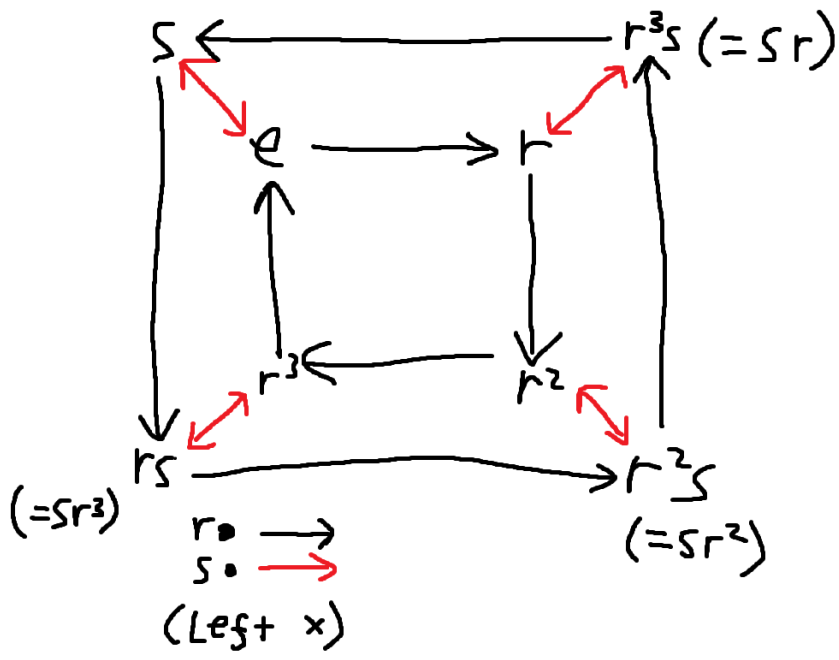 delicate orchid
coral shale
https://imgur.com/RexWqu7
delicate orchid
coral shale
https://imgur.com/RexWqu7
 pastel cliff
,av wew lads
 frail zealot
symmetry group of cube? 
delicate orchid
with reflections?
coral shale
delicate orchid
you can think about this as first applying any permutation a from S_4 to the lab...
ahhh i getchu
delicate orchid
frail zealot
symmetry group of cube? <:AWOOKEN:559786743080157184>
S_4 without reflections S_4xC_2 with reflections
got bored of waiting so there's both!
delicate orchid
coral shale
ahhh i getchu
this guy gets it
pastel cliff
pastel cliff
ok i was thinking in the sense that it's generated by a flip and a rotation
was this the wrong way to think
like
frail zealot
I have a question, how would you go about showing that O(n) is the symmetry group of a n-1 sphere
pastel cliff
then why cant we say D_8 is a subgroup
azure seal
pastel cliff
then why cant we say D_8 is a subgroup
it is
coral shale
isnt
azure seal
bruh
coral shale
its just technically wrong
delicate orchid
it's isomorphic to a subgroup by cayley's
coral shale
theyre starting out in group theory, get things right
delicate orchid
coral shale
theyre starting out in group theory, get things right
brutual
coral shale
wat
pastel cliff
i am sick in the head
azure seal
the "right" way is the up to isomorphism way
delicate orchid
frail zealot
I have a question, how would you go about showing that O(n) is the symmetry grou...
NUMBER 1! show that any reflections are generated by just a fixed reflection and some combinations of rotations
NUMBER 2! uhhhhhhhhhhhhhhhhhhhhhhHHHHHHHHHHHHH
pastel cliff
pastel cliff
i am sick in the head
this video is omnipresent in my mind
frail zealot
coral shale
pastel cliff
this video is omnipresent in my mind
When we have to groups that look the same, we dont say they are equal
we say they are isomorphic
delicate orchid
I mean... SO(n) is just.... rotations  they all.. rotate
pastel cliff
coral shale
When we have to groups that look the same, we dont say they are equal
i get that
delicate orchid
coral shale
When we have to groups that look the same, we dont say they are equal
tbf I usually do
coral shale
Thats why D8 is not a subgroup of S4. It is isomorphic to one of its subgroups
delicate orchid
I'm just being incredibly pedantic
pastel cliff
ok are the elements of D_8 in S_4 as well
azure seal
well for me at least D8 is only defined up to isomorphism so "D8 is a subgroup of S4" is fine
pastel cliff
ohhhhhhhhhhhhhhhhhhhhhhhhhhhhhhhhhhhhhhhhhhhhhhhhhhhhhhhhhhhhhhhhhhhhhhhhhhhhhhhhhhhhhhhhhhhhhhhhhhhhhhhhhhhhhhhhhhhhhhhhhhhhhhhhhhhhhhhhhhhhhhhhhhhhhhhhhhhhhhhhhhhhhhhhhhhhhhhhhhhhhhhhhhhhhhhhhhhhhhhhhhhhhhhhhhhhhhhhhhhhhhhhhhhhhhhhhhhhhhhhhhhhhhhhhhhhhhhhhhhhhhhhhh
in the case where S_4 holds the corners of a square it's a subgroup
not in general?
delicate orchid
delicate orchid
I mean... SO(n) is just.... rotations <:sadcat:547124024585486359> they all.. <:...
idea! concept! plan! @frail zealot if you can show that all SO(n) matricies are some rotation of the sphere and combine it with the "any reflections are generated by just a fixed reflection and some combinations of rotations" meme then you're done, right? Well consider that all linear transformations can be decomposed into rotation and scaling via the eigenvalue decomposition thingy (M = PDP^-1), but we know that the determinant is 1 cause it's in SO(n), so it must be a pure rotation (equivalenently, it scales space by it's determinant which is just 1 - so it's an isometry)
coral shale
pastel cliff
in the case where S_4 holds the corners of a square it's a subgroup
thats the idea more or less, ig.
pastel cliff
epic
coral shale
D8 also doesnt have to be the 4 corners of a square as well
azure seal
pastel cliff
not in general?
still true in general, but a d8 subgroup wont be literal rotations and reflections any more, just an abstract d8 group
coral shale
this can be viewed as matrices... like your lecturer did...
delicate orchid
coral shale
D8 also doesnt have to be the 4 corners of a square as well
could be every other corner of an octahedron :troll:
pastel cliff
that's what i mean
frail zealot
delicate orchid
idea! concept! plan! <@!881615914636804166> if you can show that all SO(n) matri...

coral shale
Well as long as you understand this
then yh sure D8 is a subgroup of S4, you can casually say this
frail zealot
So SO(n) are the rotations and then you can represent the rest of the elements of O(n) just as pure reflections
delicate orchid
you can think of O(n) as being SO(n)+reflection*SO(n) (indeed these are the cosets in O(n)/SO(n))
so you actually only need ONE "pure reflection"
delicate orchid
frail zealot
(-1 0
0 I )?
sounds good to me
I should now inform the class that this is, unfortunately, not the group of symmetries of the sphere it's the group of isometries of the sphere
frail zealot
pastel cliff
I AM MENTAL
delicate orchid
but technically I could map any point on the sphere to any other and still get a sphere
pastel cliff
I AM A NUTTER
delicate orchid
delicate orchid
but technically I could map any point on the sphere to any other and still get a...
something something axiom of choice, btw
coral shale
delicate orchid
something something axiom of choice, btw
you could look at the isometries of a sphere and suddenly find 2 of them
frail zealot
delicate orchid
coral shale
~~you could look at the isometries of a sphere and suddenly find 2 of them~~
however, by the axiom of choice, I shall simply choose not to do so
pastel cliff

ok so when trying to describe the relations that generate S_n
do you just refer to each element as s_i...?
i dont wanna do it with matrices lol
coral shale
you name them what u want
pastel cliff
"deez" and "nuts"
coral shale
exactly
delicate orchid
consider the cycle decomposition of representations
coral shale
no matrices
delicate orchid
that's all I'm gonna say
pastel cliff
coral shale
lul ok wasnt sure what u were referring to with naming
pastel cliff
cloud walrusBOT
Wew Lads Tbh (200 🍓) ✓
 pastel cliff
let sugma be an element of S_n
frail zealot
that reminds me of these lectures on topology i was watching and the prof was like there's no Letter for Real projective space so you can name it what you want and i call it butthole space because they way he draws it is as a sphere with a mobius strip glued on but it makes it look like a butthole
delicate orchid
delicate orchid
consider the cycle decomposition of representations
do you know about this? btw?
coral shale
Usually you consider Sn to act on {1, 2, ..., n}
pastel cliff
delicate orchid
do you know about this? btw?
most likely not
this feels like so much man
delicate orchid
like, (a_1a_2a_3...a_n) = (a_1a_2)(a_1a_3)...(a_1a_n)
coral shale
bruh
delicate orchid
pastel cliff
this feels like so much man
we're jumping between like 5 topics
coral shale
just call them 1...n lel
coral shale
o thats what u were writing
delicate orchid
yeah $a_i \in {1, \dots, n}$
cloud walrusBOT
Wew Lads Tbh (200 🍓) ✓
 pastel cliff
delicate orchid
we're jumping between like 5 topics
pastel cliff
delicate orchid
we're jumping between like 5 topics
i feel slightly less bad lol
but goddamn justaskjfhaklsbflakshbdflkhasbdlhksabdfbas
coral shale
(1234) means
1 -> 2
2 -> 3
3 -> 4
4 -> 1
delicate orchid
pastel cliff
i feel slightly less bad lol
considering the generators for S_n is kinda non-trivial if you don't think to use cycle decomp
although now my head is thinkin.... me noggin... is joggin
pastel cliff
pastel cliff
i mean since he used matrices as the generators of S_n
the first thing he did was state the relations
delicate orchid
pastel cliff
i mean since he *used matrices as the generators of S_n*
oh yeah you've literally got the permutations written under
pastel cliff
which actually make sense with matrices
frail zealot
i mean were they matrices or just the notation for permuations
pastel cliff
matrices
delicate orchid
the whollleee schbang
delicate orchid
anyway my noggin is joggin because I am convinced there's a theorem somewhere that says every finite group can be written with 2 generators at most
uhhh
pastel cliff
oh wow
delicate orchid
permutation with
uhh
p-cycle q-cycle, gcd(p, q) = 1
repeat
whole group
there we go
ok ramble over
wow I actually had to think there
very scary
coral shale
delicate orchid
anyway my noggin is joggin because I am convinced there's a theorem somewhere th...
??? wat
delicate orchid
oh lord apparently it relies on the classification of finite simple groups
frail zealot
just do the groups with prime order and then it's easy
delicate orchid
trying to think of a counter example to the non-simple case
delicate orchid
delicate orchid
trying to think of a counter example to the non-simple case
can't be bothered
that's enough for tonight
pastel cliff
mr wew lads could you summarize relevant S_n shit
delicate orchid
time to relax by going through my presentation again
ok
uhh
the S stands for "Swag"
because it is a very cool group
idk what to say other than it's the group of all permutations of n objects
frail zealot
symmetric group because of cayleys theorem. the group is all possible (finite) symmetries
pastel cliff
delicate orchid
idk what to say other than it's the group of all permutations of n objects
so im overthinking this
oh what fun
idk uhhhhh
pastel cliff
dont do this to me
delicate orchid
ok wise guy, it's the group of all SET AUTOMORPHIS- ok I couldn't keep a straight face for that one
 delicate orchid
pastel cliff
so im overthinking this
delicate orchid
pastel cliff
so im overthinking this
what are you confused about
how you compose permutations?
pastel cliff
idek i think ive been staring at things for too long
im just gonna finish up some easy notes and call it a night
delicate orchid
fairs
 delicate orchid
no patience required to chat shite
pastel cliff
oh one quick thing
how should i think about the relations that exist in S_n
like sigma^2 = id
delicate orchid
now this is fun
pastel cliff
actually do those hold for all n
delicate orchid
say you have a permutation like
(123)(4657)
no wait
(12)(354)
something smaller first
the order of this element is lcm(2, 3) = 6
isn't that funny
pastel cliff
delicate orchid
the order of this element is lcm(2, 3) = 6
the fuck
delicate orchid
if a permutation is the product of a n_1 cycle with a n_2 cycle, the order is lcm(n_1, n_2)
and then you can use induction (with slight modification)
so if a permutation is the product of a n_1 cycle, n_2 cycle, n_3 cycle, n_4 cycle... then the order is lcm(n_1, n_2, ..., )
delicate orchid
delicate orchid
(123)(4657)
in this (4657) is a 4 cycle, (123) is a 3 cycle
delicate orchid
n-cycles have order n
this is kinda true for regular group elements as well, btw
pastel cliff
wait yeah that makes sense then
delicate orchid
if a is order n and b is order m then the order of ab is lcm(n, m)
you can prove this using permutations quite easily and then CAYLEY'S THEOREM
pastel cliff
how does this tie back to sigma^2 = id tho 
delicate orchid
consider that 2 is prime
so it has to be a product of 2 cycles
or else the lcm won't be 2
for example, say you have an n-cycle and a 2 cycle, then the order of this element is lcm(n, 2) >= n > 2
pastel cliff
ok rq
delicate orchid
my favourite visual example of this is in... ||sheet music ||
 delicate orchid
it's not simple :troll:
 pastel cliff
you're right that y looks ugly
delicate orchid
yeah that looks fine
delicate orchid
delicate orchid
my favourite visual example of this is in... ||sheet music <:KEK:586240877358350...
anyway I've launched sibelius so I might as well explain nvm don't want to shit up the channel
 barren sierra

How is this different to G being solvable?
so then all solvable groups are nilpotent?
and all nilpotent groups are solvable?
 barren sierra
sounds right?

 viscid pewter
because, assuming group properties, the top two things give that i^3 = j^3 = 1
thorn delta
maybe it means G_i is normal in G for all 0 <= i <= r
viscid pewter
but then the bottom thing gives that i and j are inverses
barren sierra
oh you know what that might be it
thorn delta
this is a bit stronger than being solvable
thorn delta
right
viscid pewter
yeah so this is absolutely trivial if you even have the four group criteria
idk how you stretch this into a 38 minute video
lavish nexus
do a group ring
barren sierra
viscid pewter
idk how you stretch this into a 38 minute video
they might be appending this to the integers or something
or reals
viscid pewter
maybe
viscid pewter
oh, right
barren sierra
however I am pulling this out of my ass I have not watch the video
lavish nexus
which is a group ring
viscid pewter
yeah i'll have a look
barren sierra
yea
viscid pewter
idk what a group ring is, so
viscid pewter
i just saw 'hey this looks like a group presentation'
barren sierra
R[G] is all elements of the form r_1 g_1 + r_2 g_2 + ... + r_n g_n
with coordinate wise addition
viscid pewter
that makes sense
barren sierra
and distribution to give you multiplication
viscid pewter
so G is C3, but R[G] might be interesting?
barren sierra
yea
viscid pewter
right
viscid pewter
no, yeah
barren sierra
just learned about group rings today in class, how fun
barren sierra
ye
delicate orchid
barren sierra
just learned about group rings today in class, how fun
they are swag
barren sierra
they're not too much at the front of my mind
cause uh
midterm Wednesday
and we have done
Free Groups
Automorphisms
Group Actions
Sylow's Theorems and Classification
Composition Series, Solvable, Nilpotent Groups
delicate orchid
wait and you're on group rings?
barren sierra
yea we started ring theory on Friday
delicate orchid
have you taken an advanced lin alg course before hand or something?
lavish nexus
Note that H is not a group ring of Q8
delicate orchid
barren sierra
this is a graduate level algebra course lol
ok... then why are group actions and sylow theorems in there
sounds very based though
barren sierra
well they weren't introduced in my undergrad level lmfao
delicate orchid
devastating
delicate orchid
universal properties
lavish nexus
A long long time ago
barren sierra
lavish nexus
I had him for my 416H
everytime I talk to him its like meeting him for the first time
it's so strange
I talk with him after class, go to his OH
and it's just as awkward every time
also the man writes so fast and not fast at the same time lmao
I'm happy I'm taking the course with him it's just I hope the course has a curve
lavish nexus
Actually since when did they start offering 500 in spring
lavish nexus
Not when I was there
They’ll curve bigly it’s a grad class
You do things you get B
half of the people get A
chilly ocean
um
for proving that each coset gK where G is a group and K a kernel of a homomorphism have the same number of elements
would you argue that
K has a fixed number of elements which you're multiplying each g by
 bleak abyss
Pretty much, show that's a bijection then gg
And now I'm hijacking this channel to do some Weil rep stuff
Iteribus stay it'll be fun 🙂
chilly ocean
Simone Weil?
lavish nexus
😂
 prisma ibex
you going through Gan's notes tonight haha
bleak abyss
Prasad's
prisma ibex
oh cool
prisma ibex
yeah these are better


 bleak abyss
This is the Schrodinger rep
Nice theorem here is by Stone and von Neumann
Heisenberg group has up to iso one irrep acting by a given central character
 neat valley
If F is a field of characteristic zero and A is an abelian group, then
F ⊗_Z A = F^rank(A)
why is this true?
bleak abyss
Is A finitely generated?
If so then it boils down to showing tensor product commutes with direct sums
Any ring tensor with Z is itself
And then you'd show char 0 field tensor torsion abelian group is just 0. Which is just oh take a pure tensor scale it by a number which is invertible in the field (thanks to char 0) but murders the group (thanks to torsion)
cloud walrusBOT
Several Sloths
 bleak abyss
Let's denote the intertwining equation by *
So $\rho_{\psi}(gw,t) \cdot \omega_{\psi}(g) = \omega_{\psi}(g) \cdot \rho_{\psi}(w,t)$

 bleak abyss
So we have an exact sequence

 bleak abyss
Now let's do some computations

 bleak abyss
Focus is struggling rn
 uneven folio
 next obsidian
The idea is, but you should write more clearly
For example, you introduce a and b but don’t specify what that means
Granted, I know you mean that the element (a,b) has order lcm(|a|,|b|), but you should write that
Also maybe you want to justify why the largest possible order is lcm(m,n)
chilly ocean
I will adjust my proofs accordingly. Thanks
bleak abyss
Let's try again
bleak abyss
cloud walrus
**Several Sloths**
So question is why that's the case
cloud walrusBOT
Several Sloths
 bleak abyss
Or better yet
So we have our symplectic basis
So we just verify commutation relation


 cloud walrusBOT
Several Sloths
 hidden haven
coral shale
Let $\sigma_h(n) = hnh^{-1}$.
$$(nh)(n'h') = (n\sigma_h(n'))(hh')$$
So we will...
hidden haven
coral shale
Let $\sigma_h(n) = hnh^{-1}$.
$$(nh)(n'h') = (n\sigma_h(n'))(hh')$$
So we will...
That's it nice
For external, you don't need to define sigma, it's a homomorphism H → Aut N and the claim is that the same formula always defines a group structure
barren sierra
what is the quick way of doing 6ii?

C(x) is the centralizer of the element x and Cl(x) is the orbit of x
6i was easy. So if you want C( (1 2) ) then that's the powers of (1 2) of which there are 2 or the elements that are disjoint from (1 2) which there are I believe 5?
 terse crystal
You just calculate it by definition…
For example |C(x)| for a x in S_n =Π(λ_i !)i^λ_i
|C(x)| in A_n need to be divided by 2 if there exists an odd b commutative with x
Where x has λ_i many i-cycles
C_n trivial
|Cl(x)| = 1/1/2/2/2 in Q_8 if my calculation didn’t go wrong
barren sierra
terse crystal
You just calculate it by definition…
I'm talking about identification
so like S_n has 120 elements, the number of 2 cycles is 5 choose 2 = 10 so by orbit stabilizer C( (1, 2) ) = 120 / 10 = 12
but then what group is C( (1 2) )
like idk what more I can say than < (1 2) > x S_3
terse crystal
You just … by definition
A permutation b satisfying ab=ba must map any cycle of a to another cycle of a
Order preserving also
Like say you want to determine C(x) in S_7 where x=(146)(25)(37) , then y mapping 1,4,6 to 4,6,1, mapping 2,5 to 7,3 mapping 3,7 to 2,5 is from C(x)
barren sierra
sure
so for that cycle type 3 + 2 + 2 there are (3^1 * 1!) * (2^2 * 2!) = 24 elements of that cycle type
terse crystal
Yeah
barren sierra
so then C(x) = 24
terse crystal
||=24, yeah
barren sierra
but
C(x) is isomorphic to ????
that's what I was asking lol
like C(x) is a group and I want to classify it
that's what that problem is asking
is it just S_2 x S_2 x S_3?
terse crystal
Oh I see not hard
It is isomorphic to
Direct product of S_λ_i and λ_i copies of Z/iZ
And direct product in terms of i again
So Π(S_λ_i Π(Z/iZ)^λ_i)
Since permutation of λ_i i-cycles, and i ways mapping a i- cycle to another i-cycle
barren sierra
Hmmmmm that is annoying lol
terse crystal
But it satisfies the condition, only symmetric groups and cyclic groups used
So it was my English reading problem… I thought you were going to calculate |C(x)| for those S_n,A_n,…😂
terse crystal
Oh I forgot to mention, direct product of (S_λ_i Π(Z/iZ)^λ_i) in terms of i of non-zero λ_i , I forgot non-zero
So
Z/5Z
Z/4Z
Z/3Z times Z/2Z
S_2 times Z/3Z
S_2 times Z/2Z times Z/2Z
S_3 times Z/2Z
S_5
coral shale
$$(F[x]/(x^5-2))[y]/(1+y+y^2+y^3+y^4)$$
$$\cong F[x,y]/(x^5-2, 1+y+y^2+y^3+y^4)$$
cloud walrusBOT
Shuri2060
 coral shale
This should be true right?
next obsidian
Yes
This follows because if I is an ideal of A, A[x]/IA[x] = (A/I)[x]
Take A = F[x], I = (x^5 - 2)
And then you’re using the 3rd isomorphism theorem
Or maybe the 2nd
But I think the 3rd
coral shale
Thanks
coral shale
next obsidian
This follows because if I is an ideal of A, A[x]/IA[x] = (A/I)[x]
Why IA[x] as opposed to I[x]
next obsidian
same thing
coral shale
Am I right in thinking left and right Cayley graphs should be isomorphic?
Left, right multiplication, same generators
delicate orchid
graph theory monkaS
coral shale
Ah I think I got it. G^-1 is isomorphic to G. Map the generators to their inverses (ab)^-1 = b^-1a^-1
coral shale
Hmmm I can't seem to find this anywhere which makes me unsure 🤔
 stoic rose
Yeah it's true that a group is always isomorphic to its opposite via g -> g^-1
coral shale
I'm thinking about isomorphism of graphs and I think the above shows it
next obsidian
stoic rose
Yeah it's true that a group is always isomorphic to its opposite via g -> g^-1
no
this isn't a homomorphism unless G is abelian
oh wait
its opposite