
#questions-2
1 messages · Page 37 of 1

 icy flax
Danke Dir, @plush pelican! Als Standard fange ich ab jetzt an, Hammer nachzuschlagen, bevor ich hier Frage stelle. (:
Dann ist es KII. Was mich nun verwirrt, ist dieses "also brauchen wir (...) einzuschalten". Da wird brauchen als Modalverb benutzt.
 plush pelican
icy flax
Danke Dir, <@216341703915864064>! Als Standard fange ich ab jetzt an, Hammer nac...
plush pelican
icy flax
Danke Dir, <@216341703915864064>! Als Standard fange ich ab jetzt an, Hammer nac...
https://www.colanguage.com/double-infinitive-german
Es stellt sich heraus, "brauchen" ist ein Verb mit Ersatzinfinitiv.
Das bedeutet, unter anderem, dass man es mit einem Infinitivsatz ohne "zu" benutzt.
in Hammer's steht, dass es ein "semi-auxiliary verb" ist


Noch mehr 😮
icy flax
eyy, @plush pelican, ist das 7. Ausgabe, die du da vom Hammer hast?
plush pelican
11.3.1(a):

 vernal ermine
Can anyone tell me what is ""renate"" in German? Bitte.
 long whale
vernal ermine
Can anyone tell me what is ""renate"" in German? Bitte.
long whale
vernal ermine
Can anyone tell me what is ""renate"" in German? Bitte.
Doesn't seem to be an English word:

Unless you mean Renate, which is a woman's first name in German, in which case I will tell you once again: capitalization is important!
vernal ermine
I got that while doing exercise, what you think?
 vernal ermine
Can I consider it as mobile number of some person?
Is there any mobile / telephone number with 6 digits in Deutschland?
@long whale So I write, Bitte geben Sie mir die Handy Nummer von Renate. Ja, Das ist 459837.
Am I right?
 delicate tiger
vernal ermine
Can I consider it as mobile number of some person?
delicate tiger
vernal ermine
Can I consider it as mobile number of some person?
landline, not mobile
vernal ermine
vernal ermine
<@612557923192799249> So I write, Bitte geben Sie mir die Handy Nummer von Rena...
How can I replace that in this sentence? @delicate tiger
delicate tiger
"Festnetznummer"
vernal ermine
delicate tiger
"Festnetznummer"
Danke.
vernal ermine
Bitte geben Sie mir den Apfel.
Bitte geben Sie den Apfel für mich.
Does these 2 sentences are same?
plush pelican
vernal ermine
Bitte geben Sie mir den Apfel.
Bitte geben Sie den Apfel für mich.
Does these...
"Are these 2 sentences the same?"
And no, I believe the 2nd sentence doesn't work grammatically.
You cannot always substitute "für mich" for "mir".
vernal ermine
plush pelican
"Are these 2 sentences the same?"
And no, I believe the 2nd sentence doesn't wo...
Why? Bro
plush pelican
vernal ermine
Why? Bro
🤷♂️ If you want to know "why" when asking questions about a language, you'd have to ask a linguist.
vernal ermine
@plush pelican how about the meaning? Is it fine.
plush pelican
Like I said, I believe the 2nd sentence is grammatically invalid
it doesn't work
Wait for a native to confirm this, but I'm about 80% sure it doesn't work
 solid thistle
Bitte geben Sie den Apfel für mich.
Hier wird „für mich“ nicht als Dativobjekt, sondern als Präpositionalobjekt mit der Präposition „für“ verwendet.
„Für“ in Kombination mit Akkusativ (hier „mich“) wird typischerweise verwendet, um den Nutzen oder Zweck einer Aktion zu beschreiben, nicht den direkten Empfänger.
In diesem Kontext klingt es, als ob der Apfel für einen bestimmten Zweck oder für eine spätere Verwendung für Sie bestimmt ist, nicht dass Sie direkt der Empfänger des Apfels sind.
Also es klingt nicht schön und der Satz hat eine andere Bedeutung
 warped oriole
plush pelican
"Are these 2 sentences the same?"
And no, I believe the 2nd sentence doesn't wo...
warped oriole
plush pelican
"Are these 2 sentences the same?"
And no, I believe the 2nd sentence doesn't wo...
Für mich ist in diesem Fall wie:
Bitte staubsaug für mich.
Bitte tu das für mich.
Bitte gib (ihm) den Apfel für mich.
Also es ist grammatisch richtig, aber normalerweise fehlt noch zu wem man den Apfel gibt.
plush pelican
warped oriole
Für mich ist in diesem Fall wie:
Bitte staubsaug für mich.
Bitte tu das für mich...
Aber auf jeden Fall ist es nicht das, was er meint
warped oriole
plush pelican
Aber auf jeden Fall ist es nicht das, was er meint
Genau. Ist nicht gleich wie "mir"
vernal ermine
solid thistle
> Bitte geben Sie den Apfel für mich.
Hier wird „für mich“ nicht als Dativobjek...
Vielen Dank❤
Does heirat and verheirat are same.
solid thistle
heiraten ist ein Verb, verheiratet ist ein Adjektiv
vernal ermine
solid thistle
heiraten ist ein Verb, verheiratet ist ein Adjektiv
If it like verheiraten, what will be difference?
solid thistle
Ich heirate in einer Woche, (Verb) Ich bin seit 4 Jahren verheiratet (Adjektiv)
long whale
jdn [mit jdm] verheiraten = to marry sb off [to sb]
solid thistle
heiraten = to marry sb, verheiratet = married
plush pelican
solid thistle
heiraten = to marry sb, verheiratet = married
Er fragte, was ist der Unterschied, wenn man "verheiraten" als Verb benutzt.
long whale
That... not quite, I'd say. a) the usual verb for what the person officiating (priest, vicar, clerk/Standesbeamter) at a wedding ceremony does is "trauen" b) "jdn [mit jdm] verheiraten" tends to only crop up in the context of arranged (or even forced) marriages, i.e. when a father marries his daughter off [to somebody].
plush pelican
long whale
That... not quite, I'd say. a) the usual verb for what the person officiating (p...
This is why I didn't answer earlier...
plush pelican
long whale
That... not quite, I'd say. a) the usual verb for what the person officiating (p...
So wait, are you saying even the native German's explanation was off?
long whale
plush pelican
So wait, are you saying even the native German's explanation was off?
Precisely.
plush pelican
okay, I guess I'm deleting that, then 😅
solid thistle
plush pelican
Er fragte, was ist der Unterschied, wenn man "verheiraten" als *Verb* benutzt.
Ja ich weiß, es wurde ja schon beantwortet und da verheiratet und verheiraten sehr ähnlich sind, macht es Sinn, es auch zu erklären
plush pelican
What about "sich verheiraten"?
sich mit jdm. verheiraten = jdn. heiraten?
long whale
plush pelican
What about "sich verheiraten"?
sich mit jdm. verheiraten = jdn. heiraten?
That... might be technically possible, but it sounds so extremely unidiomatic to me, I'd basically say it's wrong. 🤷
plush pelican
long whale
😄 I was going to add: you may find examples for that on DWDS, but...
plush pelican
So you're saying that even examples on DWDS may be so weird as to sound flat-out wrong? How can I trust DWDS? 😵💫
Wiktionary lists "In ihrem Leben hat sie sich bereits dreimal verheiratet, davon zweimal mit dem gleichen Mann."
Is that weird?
long whale
plush pelican
So you're saying that even examples on DWDS may be so weird as to sound flat-out...
Well, if you look at the examples taken from literature/newspapers on DWDS, they all use a form of "verheiratet sein", except one which is about marrying off a girl.
plush pelican
What about the examples they themselves give?
long whale
plush pelican
Wiktionary lists "In ihrem Leben hat sie sich bereits dreimal verheiratet, davon...
IMO, it's not something people would choose to say. 🤷
plush pelican
er hat sich mit einer jungen Agronomin verheiratet
sie hat sich gut, wieder, schon zum dritten Male verheiratet
long whale
I said "technically possible", remember?
plush pelican
Okay, but like, if I don't have a German native handy, how am I supposed to tell which definitions are, "completely normal" and which ones are "technically possible..archaically"
long whale
plush pelican
> er hat sich mit einer jungen Agronomin verheiratet
> sie hat sich gut, wieder,...
IMO, these days, people would say "sie hat reich geheiratet" instead of "sie hat sich gut verheiratet".
long whale
plush pelican
Okay, but like, if I don't have a German native handy, how am I supposed to tell...
By checking the curated quotes on DWDS, I'd say.
plush pelican
And apparently, I can't trust upvoted answers from GuteFrage...
long whale
plush pelican
And apparently, I can't trust upvoted answers from GuteFrage...
Yeah, well, arranged marriages not being a thing among Germans, I'm not really surprised people agreed with the answer given on Gute Frage. I suppose for any normal conversation, #questions-2 message is basically all you need to know. 🤷
plush pelican
long whale
Yeah, well, arranged marriages not being a thing among Germans, I'm not really s...
For reference, one of the answers on GuteFrage said
Das eine macht man selbst, das andere wird gemacht.
Ich heirate meinen Partner.
Der Standesbeamte verheiratet uns.
long whale
plush pelican
For reference, one of the answers on GuteFrage said
> Das eine macht man selbs...
Well, that isn't wrong, is it?
plush pelican
long whale
Well, that isn't *wrong*, is it?
You said you don't use "verheiraten" there, you use "trauen"
you said "verheiraten" was only used in the context of forced marriages
long whale
plush pelican
You said you don't use "verheiraten" there, you use "trauen"
Look, I didn't say "no" when you posted that answer, did I? I said "not quite", and "the usual verb... is trauen" and "tends to only crop up" - I mean, how much more carefully can I actually word my answers before they become entirely incomprehensible? 🥹
plush pelican
You said their explanation was off
long whale
plush pelican
You said their explanation was off
And you disagree?
plush pelican
I don't know what to believe right now
plush pelican
long whale
Yeah, well, arranged marriages not being a thing among Germans, I'm not really s...
Like even here you were hitting the point about "verheiraten is related to arranged marriages, not other things"
If you could make up percentile numbers:
How often is the verb "trauen" used versus "verheiraten" for the priest/official marrying the couple?
long whale
plush pelican
For reference, one of the answers on GuteFrage said
> Das eine macht man selbs...
Look, if they'd replaced Der Standesbeamte with "jemand", I probably wouldn't even have found it necessary to comment on this further. And it's not even really wrong with "der Standesbeamte", it's technically possible. It's just a really uncommon way of putting it.
plush pelican
so like, 95%/5%?
long whale
plush pelican
so like, 95%/5%?
That's always really tricky, but I'd say it's closer to 99% - 100%.
plush pelican
That's high
So then why did the GuteFrage answers not mention, "you should probably never use this word?"
long whale
Yes. It is. Because the ceremony itself is called "die Trauung" in German.
"die Hochzeit" is the whole shebang.
plush pelican
Are there regional differences in trauen vs. verheiraten?
long whale
plush pelican
So then why did the GuteFrage answers not mention, "you should probably never us...
Because people are vaguely aware "verheiraten" exists as a transitive verb (apart from its normal Zustandspassiv). But if the question were "Would you rather say Der Standesbeamte/Pfarrer hat uns verheiratet or Der Standesbeamte/Pfarrer hat uns getraut?" I'm pretty sure people would go for the 2nd.
long whale
plush pelican
Are there regional differences in trauen vs. verheiraten?
If there are, I'm not aware of them.
@plush pelican I don't use google, but if you do, perhaps you could just compare the number of results for "Er hat uns verheiratet" vs. "Er hat uns getraut"?
(Although I guess machine translations usually go for "jdn verheiraten")
plush pelican
"Er hat uns getraut" = 2,95 Millionen Ergebnisse
"Er hat uns verheiratet" = 32,2 Millionen
🥴
Wait, I'll do it with quotation marks for exact matches
""Er hat uns getraut"" = 41 Ergebnisse
""Er hat uns verheiratet"" = 7 Ergebnisse
long whale
😅 That's more like what I'd expected to see.
plush pelican
LOL
 warped oriole
Ich sag lieber: Der Priester hat uns verheiratet.
Getraut hört sich so nach dem anderen Trauen an. Der Priester hat sich getraut uns zu trauen 😄
plush pelican
warped oriole
Ich sag lieber: Der Priester hat uns verheiratet.
Getraut hört sich so nach dem ...
Woher kommst du?
Und ungefähr wie alt bist du? unter/über 30?
warped oriole
Ich denke vielleicht sagen jüngere Leute eher verheiraten anstatt trauen. Bin unter 30. Komme aus Deutschland.
plush pelican
😛 Ich meine aus welchem Bundesland, Digga
warped oriole
NRW diggah brudi ich schwöre wallah
plush pelican
Ich glaube, Frosty Bell ist das Gegenteil von dir, 🤔
Vielleicht gibt es doch regionale Unterschiede
warped oriole
Ja es gibt immer regionale Unterschiede.
plush pelican
Ich meine insbesondere bzgl. trauen oder verheiraten
warped oriole
plush pelican
Ich meine insbesondere bzgl. trauen oder verheiraten
Kann auch sein, dass ich nur komisch bin xD
warped oriole
plush pelican
Woher kommst du?
Woher kommst du denn?
plush pelican
warped oriole
Woher kommst du denn?
Ich bin Amerikaner, ich lerne Deutsch
long whale
Probably. 😹 I was wondering whether to add it might be a question of demography, particularly as to the answers you'd be likely to get on discord: lots of young, i.e. probably unmarried people, plus people who are pretty familiar with English -> they tend to think "marry" = "heiraten" -> He married us -> Er hat uns verheiratet. 🤷
Seems logical.
 warped oriole
plush pelican
Jetzt muss ich dringend ins Bett
warped oriole
plush pelican
Jetzt muss ich dringend ins Bett
Wie spät ist es denn bei dir?
Und gute Nacht.
plush pelican
3:40
 fervent kernel
Klingt "Ich verherrliche Meinung, dass [...]" komisch, im Vergleich zu Alternativen wie "Meines Erachtens/meiner Meinung nach [...]"?
Ich habe gerade den Teil SA von TestDaF abgelegt and aus irgendeinem Grund so einen Satz verwendet, als ich wollte, meine eigene Meinung zu formulieren.
Also funktioniert das zumindest?
fervent kernel
I will blow my brains out lol, beloved dwds seems to suggest mayyybe, but I'm no feudal despot from 1700s.
long whale
fervent kernel
Klingt "Ich verherrliche Meinung, dass [...]" komisch, im Vergleich zu Alternati...
*die Meinung. You usually idolize people, or at most ideologies, but not opinions (that does sound very, very weird to me). -> No. Maybe you were thinking of "Ich vertrete die Meinung, dass..."
*... als ich wollte, meine eigene Meinung zu formulieren wollte (OR ... um meine eigene Meinung wiederzugeben/zu formulieren).
fervent kernel
Is it ich hab Lust zum Redem/um zu Reden/zu reden?
long whale
fervent kernel
Is it ich hab Lust zum Redem/um zu Reden/zu reden?
"zu reden" is excellent, "zum Reden" is common in colloquial German. You cannot use "um... zu + inf." if the English version of your sentence doesn't work with "in order to" -> since "I feel like in order to talk" is basically nonsense, Ich hab[e] Lust um zu reden doesn't work at all.
fervent kernel
long whale
"zu reden" is excellent, "zum Rede**n**" is common in colloquial German. You can...
Danke
fervent kernel
long whale
***die** Meinung. You usually idolize people, or at most ideologies, but not opi...
Yup, the article is there of course, heat of the moment thing, and thanks for the corrections! I find that English gets in the way sometimes, not fun.
 outer edge
hi why is it here "die Braunen" Schuhe?
im confused with the mix of die and braunen

 amber plover
Hello ! I'm a beginner in deutsch, and I can't understand what my teacher wrote, can somebody help me please ?
it's just one word
 charred harbor
outer edge
hi why is it here "die Braunen" Schuhe?
im confused with the mix of die and brau...
charred harbor
outer edge
hi why is it here "die Braunen" Schuhe?
im confused with the mix of die and brau...
It’s to do with the plurality. Basically, with a “die” (as a plural) + adjective the adjective takes an -en ending.
outer edge
and are the shoes in nominative?
outer edge
thanks
charred harbor
Just remember that it’s exclusive to plural form & exclusive to when there’s a definite article
Like “good kids” is “gute Kinder”, it only becomes “guten” when there’s a definite article
 tacit axle
Oh I can't put the picture 😦
long whale
tacit axle
Oh I can't put the picture 😦
That's because you're new and have limited permissions. Read #role-directory and... wait. 🧁
amber plover
oh okey thanks
 gaunt heart
currently i am learning german in school. do you guys think it would be smart to learn some german on my own? i am in German 1 right now and i am planning to go to German 5/AP
 plain umbra
gaunt heart
currently i am learning german in school. do you guys think it would be smart to...
plain umbra
gaunt heart
currently i am learning german in school. do you guys think it would be smart to...
Yeah, definitely. It's important to learn on your own, even when you're taking a course.
 leaden cobalt
can someone put the English and German names of each of the tenses side by side for me I keep getting them all mixed up (my tutor hasnt taught me the German names for the tenses) I know the conditional tense is praktikum II but that's it
plain umbra
leaden cobalt
can someone put the English and German names of each of the tenses side by side ...
English - German
future - Futur I
present - Präsens
simple past / preterite - Präteritum
present perfect - Perfekt
past perfect - Plusquamperfekt
future perfect - Futur II
leaden cobalt
plain umbra
English - German
future - Futur I
present - Präsens
simple past / preterite - Pr...
vielen dank!!!!!
plain umbra
leaden cobalt
vielen dank!!!!!
Those are the tenses. Did you also want the moods?
leaden cobalt
that would be wonderful too yes please!!!
plain umbra
indicative - Indikativ
imperative - Imperativ
conditional (past subjunctive) - Konjunktiv II
present subjunctive - Konjunktiv I
But note that we don't really use Konjunktiv I equivalent in English.
So people usually just say subjunctive in English and they mostly mean what German uses for Konjunktiv II.
You used the word Praktikum earlier. I think you got your vocab mixed up there.
Das Praktikum means an internship, like for a job.
 slender coral
if we want to say : I always behave good with people.
Immer verhalte ich mich gut mit Leuten ?
what is wrong here?
long whale
slender coral
if we want to say : I always behave good with people.
Immer verhalte ich mich gu...
It isn't really wrong, it's just that yours is a pretty literal translation, so, I kind of understand what you wanted to say, but it seems rather unidiomatic to me. For one thing, "sich verhalten" feels more like "to act" to me -> I'd preferably use "sich benehmen", and that's usually used with "jdm (Dativ) gegenüber" (towards sb.)
fervent kernel
Hi, i got a question with the word 'besonder', and that is, how do i know if using 'besonder', 'besondere', or 'besonders'??
long whale
fervent kernel
Hi, i got a question with the word 'besonder', and that is, how do i know if usi...
besonders = especially
-> besonders teuer = especially/particularly expensive.
fervent kernel
and besondere?
long whale
fervent kernel
and besondere?
= special -> normal Adjektivdeklination/adjective declension applies: besondere Pflanzen = special plants
fervent kernel
Danke c:
 frail harness
Hi, so I know that if a noun ends in -e or -ung then its probably femenine.
But are there any similar indicators to help identify masculine and neuter nouns?
long whale
frail harness
Hi, so I know that if a noun ends in -e or -ung then its *probably* femenine.
...
The -ung ending is a reliable indicator for feminine nouns, -e is not. For other such "indicators", check >faq gender patterns in #botchannel , but please be aware there is no way around memorizing everyday vocab with its gender (instead of: Hund = dog, learn: der Hund, die -e = dog/s, since German plurals are also unpredictable) - not if you ever wish to become halfway fluent. 🍪
frail harness
Thank you
Also I just want to confirm if this is correct.
Talking to one person formally -> Sie
Talking to several people formally -> Sie
Talking to several people casually -> ihr
Talking about several people -> sie (plural)
long whale
frail harness
Also I just want to confirm if this is correct.
Talking to one person formally ...
Yes.
frail harness
long whale
Yes.
Thank you, and thanks again for showing me the bot commands those were really helpfull too
 clever grove
what does wo do to word order
plush pelican
clever grove
what does wo do to word order
You need to be more specific
Do you mean when the sentence is a question?
"Wo gehst du hin?"
clever grove
plush pelican
You need to be more specific
I go to the canteen, where i eat
plush pelican
clever grove
I go to the canteen, where i eat
Ah, then you're talking about Relativsätze
Introduction to Relativsätze: https://www.youtube.com/watch?v=sHtLxUax7Qc
Relativsätze with "wo": https://www.youtube.com/watch?v=z--oZ4_Cyfo
 zinc dock
Warum ist die Antwort ihnen?
 plush pelican
zinc dock
Warum ist die Antwort ihnen?
plush pelican
zinc dock
Warum ist die Antwort ihnen?
In the sentence "Er kauft ihnen Schokolade", there are two objects in that sentence.
"ihnen" and "Schokolade"
But you don't necessarily have every object in the same case
So what you likely learned was, "kaufen as verb means that the object is in accusative case"
zinc dock
plush pelican
In the sentence "Er kauft ihnen Schokolade", there are two objects in that sente...
Haha, ich habe die Antwort falsch gelesen, jetzt verstehe ich es
plush pelican
But do you know why it's in dative?
zinc dock
plush pelican
So what you likely learned was, "kaufen as verb means that the object is in accu...
Ich meinte den zweiten Satz. Ich habe ihre Antwort in den Antworten falsch gelesen
plush pelican
okay
zinc dock
dankw
outer edge
hi
Manchmal kombiniert er sein Outfit auch mit einer grünen Mütze.
why is it "einer grünen Mütze"
I don't understand that declension
 steel patrol
outer edge
hi
Manchmal kombiniert er sein Outfit auch mit einer grünen Mütze.
why is it "ei...
steel patrol
outer edge
hi
Manchmal kombiniert er sein Outfit auch mit einer grünen Mütze.
why is it "ei...
The noun “Mütze” is feminine (die Mütze), but in the Dative case die/eine becomes der/einer. And whatever adjective is in the Dative case, regardless of noun gender or number (singular or plural) always takes an -en ending.
When it’s used with an article
outer edge
oh thanks
 plush pelican
outer edge
hi
Manchmal kombiniert er sein Outfit auch mit einer grünen Mütze.
why is it "ei...
plush pelican
outer edge
hi
Manchmal kombiniert er sein Outfit auch mit einer grünen Mütze.
why is it "ei...
I like this website's charts, which show examples of each declension:
https://www.germanveryeasy.com/adjective-declension#Mixed-declension

 sharp cradle
plush pelican
I like this website's charts, which show examples of each declension:
https://w...
sharp cradle
plush pelican
I like this website's charts, which show examples of each declension:
https://w...
vielen dank ! it really helped me alot, cuz its coming on my german test on Monday 😂
 prisma magnet
Bitte verwenden sie "er/ihm/sein“ für meine pronomen.
Wondering what this would directly translate to? I want to let someone know on my pronouns and am not really picky but want to use proper grammar to say "please use x for my pronouns"? Basically I want to say I want to be referred to by male pronouns "he/him/his".
I constantly struggle as someone that uses they/them in English but I'd prefer he/him in German as there is nothing such for singular they/them
 sage canyon
there is actually a "non-binary" pronoun that is roughly the equivalent of they/them. That's xier/xien/xiem (nom/acc/dative)
however, if you're more comfortable with using he/him in german, you could just say "Bitte verwenden Sie er/ihm pronomen."
plush pelican
The problem is, there are multiple suggested things for "they/them"...and absolutely none of them enjoy widespread support among the average German.
 whole portal
The short and simple answer is that there is no concept of ungendered language that has any widespread acceptance, yeah
This is an evolving topic (as language is in general) but it's very slow moving
Multiple if not hundreds of concepts exist, some with more popularity but when I say 'popular' that means maybe 10 % support it and 3 % would actually use it
long whale
prisma magnet
Bitte verwenden sie "er/ihm/sein“ für meine pronomen.
---
Wondering what this w...
I guess you could say "Bitte verwenden Sie bei mir/für mich die maskulinen Pronomen ["er/ihm/sein“]."
prisma magnet
long whale
I guess you could say "Bitte verwenden **S**ie bei mir/für mich die maskulinen P...
Ah ty all. I think it's insightful to know what the conversation is around this.
 dense forum
Heya! I've got a question. In the sentence
Sie machen zusammen Hausaufgaben und dann gehen sie in die Disko.
Why is it gehen sie, and not sie gehen? Also, why is the s not capitalized?
 wet ridge
Sie is not capitalised because it's plural. It's only capitalised if it's for formal speech
dense forum
dense forum
Heya! I've got a question. In the sentence
Sie machen zusammen Hausaufgaben und...
Also, what uses are there to the word doch? I've seen it get used as "but", but I'm pretty sure there's other meanings to it
dense forum
wet ridge
Sie is not capitalised because it's plural. It's only capitalised if it's for fo...
But Sie can be plural as well, right? Or is it only when you're addressing multiple people formally?
wet ridge
dense forum
But Sie can be plural as well, right? Or is it only when you're addressing multi...
You have sie (Plural) and Sie (formal). That's the only difference, the verb will still be in infinitive form, and you can tell from the context up (they did homework together, them, plural) that it refers to the plural
dense forum
wet ridge
You have sie (Plural) and Sie (formal). That's the only difference, the verb wil...
Ahhh
Vielen Dank!
 grand adder
Hallo, gibt es hier jemanden, der am Au-pair-Programm in Deutschland teilnimmt?
wet ridge
dense forum
Heya! I've got a question. In the sentence
Sie machen zusammen Hausaufgaben und...
Okay so about the denn thing. There are certain conjunctions, that don’t start subclauses. After those conjunctions, the sentence structure is the normal subject - verb - object. There are five of those conjunctions, and you can memorize them with the word ADUSO. They are:
Aber
Denn
Und
Sondern
Oder
wet ridge
Oh wait sorry my bad, I didn't pay attention and just thought it's denn. What I told you is the exception!
All the rest, like wenn, als, ob, dass; with those the sentence structure is different. The rule here is verb is placed at the end of a sentence
long whale
dense forum
But after the dann, the subject appears after the verb
That's not the way we see it, actually.
The thing is: "dann" takes Pos.1, followed by the verb, which is in Pos. 2, as per usual.
dense forum
long whale
The thing is: "dann" takes Pos.1, followed by the verb, which is in Pos. 2, as p...
I'm still confused as to what is position 1 and 2
long whale
dense forum
I'm still confused as to what is position 1 and 2
Ich esse heute Abend Pizza.
Heute Abend esse ich Pizza.
Pizza esse ich heute Abend.
All of the above are equally valid (although not equally common, the third version would require special context)
The important thing is: the conjugated verb (= esse) must be in Pos. 2.
dense forum
OHHH, so like the order in which it's placed
long whale
Since "heute Abend" is like "this evening", i.e. you can't put anything between those 2 words, they kind of constitute a "unit", this takes Position 1.
And that's why we say Position 2, not "2nd word", see?
long whale
So, V2 = [conjugated] verb in Position 2 is the most important rule for any main clause.
Of course, not all sentences are that simple. You get connecting words, conjunctions.
And for those, unfortunately, you have to memorize the word order of the clause they introduce.
dense forum
So what you're saying is, if it's not an exception, such as the sentence being preceded by a conjunction, the verb is always in P2, right?
long whale
dense forum
So what you're saying is, if it's not an exception, such as the sentence being p...
Basically, yes.
(And of course, questions - ? - and exclamations - ! - have their own word order, but the change is rather similar to what happens in English, so, people tend not to notice so much. ;) )
 prisma magnet
Wenn es nur nicht so kalt wäre... Verzeihen Sie meine Grammatik. Ich lerne immer noch Deutsch.
Is my grammar correct on this?
Starting to make sense of sentence structure and meine vs mein but still unsure
plush pelican
prisma magnet
Starting to make sense of sentence structure and meine vs mein but still unsure
"meine" vs. "mein" has to do with the Grammatical Gender of Nouns.
Do you know that each noun has an inherent grammatical gender?
 pure crescent
prisma magnet
Wenn es nur nicht so kalt wäre... Verzeihen Sie meine Grammatik. Ich lerne immer...
pure crescent
prisma magnet
Wenn es nur nicht so kalt wäre... Verzeihen Sie meine Grammatik. Ich lerne immer...
Grammar is correct, however it is not idiomatic. "immer noch" can't be used as "still" in this context. you would have to say something like "Mein Deutsch ist noch nicht perfekt" or something like that for the meaning you want to get across.
plush pelican
pure crescent
Grammar is correct, however it is not idiomatic. "immer noch" can't be used as "...
"immer noch" can't be used as "still" in this context
Why can't it be used?
Can you use just "noch"?
 ember lotus
plush pelican
> "immer noch" can't be used as "still" in this context
Why can't it be used?
...
ember lotus
plush pelican
> "immer noch" can't be used as "still" in this context
Why can't it be used?
...
I think immer noch implies you’re learning right now or something along those lines
I’m not sure if it can be directly translated in English
 eternal karma
ich vermisse, dass meine Muttersprache sprechen
ist grammatik richtig oder ?
delicate tiger
"Ich vermisse es, meine Muttersprache zu sprechen"
plush pelican
eternal karma
ich vermisse, dass meine Muttersprache sprechen
ist grammatik richtig oder ?
Deinem zweiten Satz fehlt ein Subjekt.
Du kannst einen Infinitivsatz haben, wie Hilarious vorgeschlagen hat. Infinitivsätze haben kein Subjekt (bzw. sie benutzen das Subjekt des vorigen Satzes)
Aber "dass" ist eine unterordnende Konjunktion. Die Nebensätze, die mit "dass" eingeleitet werden, brauchen ein Subjekt.
 cold iris
Anyone familiar with the podcast Geschichten aus der Geschichte? Can anyone tell me what the person in the intro is saying? I think the first part is something like Wir lernen uns 'n bissel Geschichte.
Here is the website: https://www.geschichte.fm/. Just hit the Play button and after a couple seconds the intro will start. It might start a bit loud btw

Der Geschichte Podcast, in dem sich Richard und Daniel gegenseitig seit über sieben Jahren wöchentlich eine Geschichte erzählen.
leaden cobalt
there's only 2 past tenses in German, but I've learned 3? so confused
past perfect, simple past and pluperfect? so confused
charred harbor
leaden cobalt
there's only 2 past tenses in German, but I've learned 3? so confused
past perf...
The past perfect and pluperfect refer to the same thing
 gusty silo
yeah what people mean by "there's 2" is that there's two of comparable or identical meaning
Ich ging and Ich bin gegangen are both regular past tenses, those are the ones people generally mean because it's important to learn the relation of these two.
the Plusquamperfekt Ich war gegangen is "I had left (by the time something else we're now talking about happened)"
so that refers to something that happened before our point of reference, whereas the other two are both for the actual points of reference that are in the past
confusion easily arises when mixing the terminologies of german and english, because english makes more distinctions in its verb tenses
"past perfect" in particular seems downright unwise to use for german, because the term that would be contrasted with - present perfect - is very misleading for any german tense
(because in german the thing we call our Perfekt is decidedly a past tense, even though it looks like it's formed the same way as the english present perfect - that may be where the confusion of terminology arose)
 autumn violet
can "Prost" be used in a similar manner as "cheers" in English?
as in, can I say "prost" instead of "danke"?
gusty silo
autumn violet
as in, can I say "prost" instead of "danke"?
nope
autumn violet
unfortunate; thanks
vernal ermine
What is ulrike?Bitte
cold iris
vernal ermine
What is ulrike?Bitte
wiktionary says it's a female given name
vernal ermine
cold iris
wiktionary says it's a female given name
Danke
 timber yacht
cold iris
Anyone familiar with the podcast *Geschichten aus der Geschichte*? Can anyone te...
timber yacht
cold iris
Anyone familiar with the podcast *Geschichten aus der Geschichte*? Can anyone te...
Original, österreichisch:
Lernen S' bisserl G'schichte, dann werd'n S' seh'n, Herr Reporter, wie das in Österreich sich damals im Parlament entwickelt hat.
Hochdeutsch:
Lernen Sie ein bisschen Geschichte, dann werden Sie sehen, Herr Reporter, wie sich das damals in Österreich im Parlament entwickelt hat.
 cold iris
timber yacht
Original, österreichisch:
Lernen S' bisserl G'schichte, dann werd'n S' seh'n, He...
cold iris
timber yacht
Original, österreichisch:
Lernen S' bisserl G'schichte, dann werd'n S' seh'n, He...
ahhh. Danke!
 jade hawk
Er hat das indirekt gesagt = Er hat das durch die Blume gesagt. Am I understanding this durch die blume idiom correctly? To say something in an indirect or roundabout way?
vernal ermine
Ihr Termin bei der Arbeitsagentur ist am Montag.
Am Montag ist ihr Termin bei der Arbeitsagentur.
Do both are same? And are both sentences are correct?
long whale
jade hawk
` Er hat das indirekt gesagt` = `Er hat das durch die Blume gesagt`. Am I unders...
Yes, exactly. 💐 For finding out about that kind of thing, https://www.redensarten-index.de/suche.php?suchbegriff=durch+die+Blume+sagen&bool=relevanz&gawoe=an&sp0=rart_ou&sp1=rart_varianten_ou is excellent.
(Just don't go thinking everything you'll find in there is equally used. I'd say it's more for looking up idioms you've encountered "in the wild".)
pure crescent
vernal ermine
Ihr Termin bei der Arbeitsagentur ist am Montag.
Am Montag ist ihr Termin be...
Depends on what you mean: your appointment or her appointment? The first sentence could mean either. The second sentence is her only.
vernal ermine
pure crescent
Depends on what you mean: *your* appointment or *her* appointment? The first sen...
Danke
vernal ermine
Does bis and zu comes nearby at the same time in a sentence? Bitte.
plush pelican
vernal ermine
Does bis and zu comes nearby at the same time in a sentence? Bitte.
They can
vernal ermine
plush pelican
They can
How bro? They both are prepositions. Which situation they come together?
plush pelican
It's best to think of "bis zu" as a single preposition that is used slightly differently than just "bis"
Let me link some stuff


So yeah, "bis zu" often translates as "up to" or "until"
vernal ermine
plush pelican
It's best to think of "bis zu" as a single preposition that is used slightly dif...
I feel bis is like till and bis zu is like upto.
plush pelican
vernal ermine
I feel bis is like till and bis zu is like upto.
I think you're right
vernal ermine
@plush pelican bis is Akkusativ preposition and zu is Dativ but what about bis zu? Which case it is?
plush pelican
vernal ermine
<@216341703915864064> bis is Akkusativ preposition and zu is Dativ but what a...
The first screenshot from Hammer's actually talked about this:
In practice, bis is rarely used as a preposition in its own right. It is never followed by an article (or any determiner), and it is used on its own only with names, adverbs and some time phrases. **Otherwise it is followed by another preposition which determines the case of the following noun. **
The other preposition, the second preposition, determines the case, so "zu" for "bis zu"
ember lotus
plush pelican
The first screenshot from Hammer's actually talked about this:
> In practice, b...
Honestly I could never understand bis
Why is it always followed by a preposition
plush pelican
🤷♂️ It's just one of the "Higher Mysteries" of learning German, 😄
ember lotus
plush pelican
🤷♂️ It's just one of the "Higher Mysteries" of learning German, 😄
I’m putting it in the same category as pronouncing Ski I guess
vernal ermine
@plush pelican Vielen Dank ❤
I have this question for a long time. Consider a map with a person whose facing direction is not explained properly in the question. How will you know which direction the person is facing? Bitte you see there are 3 points in the map.
 plush pelican
vernal ermine
I have this question for a long time. Consider a map with a person whose facing...
plush pelican
vernal ermine
I have this question for a long time. Consider a map with a person whose facing...
Remember, "question", not "doubt"
I've had this question for a long time.
plush pelican
vernal ermine
I have this question for a long time. Consider a map with a person whose facing...
I guess it would depend on the directions implying what direction they were starting out with, like are they going north or south on "Goethestraße"? Are they going east or west on "Schillerstraße"?
plush pelican
vernal ermine
I have this question for a long time. Consider a map with a person whose facing...
Or are you asking about how to give directions, if you don't know what direction they're starting with?
yeah, I mean, if they're the red dot, and they need to go down to the yellow dot, just use the cardinal directions: west, north, south, east.
"Fahren Sie auf der Schillerstraße nach Westen."
Drive west on Schillerstraße
ember lotus
plush pelican
yeah, I mean, if they're the red dot, and they need to go down to the yellow dot...
Could you tell them to “face the mall” for example
Like “mit dem Gesicht zum Einkaufszentrum und dann umdrehen…”
plush pelican
Or you give the cardinal direction starting out, and then for the rest of the trip, you'll know which direction they're facing, because they are following your path.
"Fahren Sie auf der Goethestraße nach Süden, dann rechts abbiegen auf Schillerstraße. Touristeninformation wird auf deiner linken Seite sein."
plush pelican
plush pelican
Or you give the cardinal direction starting out, and then for the rest of the tr...

If you ever want to work on directions, try setting Google Maps to German on your phone and then having the voice give you directions as you're driving, 😄
Note that the type of sentence used in directions like that is an unusual one, it's like the quasi-imperative infinitive.
vernal ermine
plush pelican
I guess it would depend on the directions implying what direction they were star...
I give you an exercise. I want to know how you solve this. But I finished this exercise and checked but I made many mistakes. This made me think very much.

 plush pelican
vernal ermine
plush pelican
vernal ermine
Oh, lord. Maybe this is good; I, too, need to work on this kind of stuff 😅
Did you use the word bank upside down on the bottom?
vernal ermine
plush pelican
Did you use the word bank upside down on the bottom?
Yes,that is the word you have to fill up.
plush pelican
vernal ermine
Where is the "Parkstraße"?
delicate tiger
you can sort the words by category, there are only two nouns (and two spaces where they can fit)
vernal ermine
plush pelican
Where is the "Parkstraße"?
Parkhaus is the Parkstraße. Printing mistake is there in this book
plush pelican
vernal ermine
Parkhaus is the Parkstraße. Printing mistake is there in this book
interesting
vernal ermine
delicate tiger
you can sort the words by category, there are only two nouns (and two spaces whe...
May I know whom you are telling?
plush pelican
delicate tiger
you can sort the words by category, there are only two nouns (and two spaces whe...
Can you take a look at this and solve it? I'm so confused by the options given
This is what I got, but the directions don't make any sense to me.
 vernal ermine
plush pelican
This is what I got, but the directions don't make any sense to me.
vernal ermine
plush pelican
This is what I got, but the directions don't make any sense to me.
Your answers are correct
fervent kernel
delicate tiger
you can sort the words by category, there are only two nouns (and two spaces whe...
Das Leben passiert. Ist’s zu spät, dich wieder zu ihm zu melden? Does this make sense?
plush pelican
vernal ermine
Your answers are correct
Looking at that map, these directions don't seem to make sense 🤷♂️ I'm just putting in which words "fit" in which space
vernal ermine
plush pelican
Looking at that map, these directions don't seem to make sense 🤷♂️ I'm just pu...
Me too same problem.
@plush pelican How about 2 nd question. Have you tried that?
 plush pelican
vernal ermine
Parkhaus is the Parkstraße. Printing mistake is there in this book
plush pelican
vernal ermine
Parkhaus is the Parkstraße. Printing mistake is there in this book
"Parkstraße" is NOT the Parkhaus
The areas with "......" are where you're giving directions to
Let me draw a map of the 2nd question
vernal ermine
plush pelican
This is also correct
plush pelican
 plush pelican
plush pelican
plush pelican
Still don't get how #1 works, though
vernal ermine
@plush pelican here über comes in what meaning?
Gehen sie über die Schiller Straße in die Goethestraße.
plush pelican
vernal ermine
<@216341703915864064> here über comes in what meaning?
🤔 "über den Kürschnerweg" is like "across it", I suppose
so perpendicular to traffic
"in die Goethestraße" = into the Goethestraße
vernal ermine
plush pelican
🤔 "über den Kürschnerweg" is like "across it", I suppose
Does there any difference with über die Schiller Straße. It is not perpendicular like Kürschnerweg.
plush pelican
vernal ermine
Does there any difference with über die Schiller Straße. It is not perpendicular...
sure it is

car traffic goes on the blue lines, north/south für Kürschnerweg (whereas you are going east), and traffic goes east/west für Schillerstraße (whereas you are going north)
delicate tiger
fervent kernel
Das Leben passiert. Ist’s zu spät, dich wieder zu ihm zu melden? Does this make...
"sich bei jemandem melden", what do you want to say?
plush pelican
vernal ermine
@delicate tiger Can you look at the first picture here and compare it to the map? The instructions it gives don't seem to make sense.
The intended goal, as I understand it, is the street on the left with the "......" instead of a name.
Either the book is wrong, OR I've massively misunderstood something
plush pelican
vernal ermine
Here is the map
fervent kernel
delicate tiger
"sich bei jemandem melden", what do you want to say?
Life happens. Is it too late to reach out to him again?
vernal ermine
@plush pelican I have finished this exercise also . There are 3 questions to find out. But I made 1 mistake in that. I want to know the map drawing.

@plush pelican using same map bro
plush pelican
vernal ermine
<@216341703915864064> I have finished this exercise also . There are 3 question...
That sentence...did not make a ton of sense, man 😅
What are you saying?
vernal ermine
plush pelican
What are you saying?
Now I edited
plush pelican
vernal ermine
<@216341703915864064> I have finished this exercise also . There are 3 question...
What did you select?
vernal ermine
plush pelican
What did you select?
You find that bro, that is good for you too .
I will tell the answer after that
Same dots like in previous questions.
plush pelican
vernal ermine
 plush pelican
If you know the answers, then you know which option I chose
vernal ermine
F
plush pelican
yep
The instructions are kind of shit, to be honest
But then again, in real life instructions are likely to be shit, so that's realistic
vernal ermine
plush pelican
But then again, in real life instructions are likely to be shit, so that's reali...
I didn't understand. Do German won't give instructions like that given in the book in real life?
plush pelican
vernal ermine
I didn't understand. Do German won't give instructions like that given in the bo...
What I mean is, the instructions given in (F) are incomplete. He doesn't actually tell you how to get there all the way, he just says, "at this point, you'll be able to see it, it's to the right of the train station"
But that is realistic, because in real life people will give you incomplete instructions
 vernal ermine
plush pelican
What I mean is, the instructions given in (F) are incomplete. He doesn't actuall...
vernal ermine
plush pelican
What I mean is, the instructions given in (F) are incomplete. He doesn't actuall...
Yes it stops at Schillerstraße.
vernal ermine
plush pelican
What was #2?
E
plush pelican
...that was a long pause
vernal ermine
No I just comparing your map. In that I have a doubt.
plush pelican
You know I'm not supposed to give you answers to homework, I'm only supposed to help you understand the answers
vernal ermine
plush pelican
You know I'm not supposed to give you answers to homework, I'm only supposed to ...
Yes bro the next one is c for 3
plush pelican
 vernal ermine
For the second one, über die marketplatz that means like going over perpendicular to marketplatz but your drawings is not going like that?
plush pelican
vernal ermine
For the second one, über die marketplatz that means like going over perpendicula...
yeah, I mean the first line I drew is directly "über" die Salzstraße, but it turned out he meant a sort of diagonal "über" die Salzstraße
Again, the directions are not precise, but then again in real life directions are often not precise, so that's realistic
I figured out he meant diagonal because he says to go "am Museum vorbei", so you go past the Museum
You can only go past the museum by walking along the right side of it, so he must have meant to walk along there
vernal ermine
Third drawing is clearly understandable bro.
plush pelican
clearly understood
or you could say, "it's clearly understandable"/"easy to understand"
I still don't understand #1 from the first exercise
If you understand the Parkstraße is that "...." street and the bank is the "...." building on that street next to the Kirche, everything makes sense except for "und dann rechts in die Schillerstraße"
vernal ermine
plush pelican
If you understand the Parkstraße is that "...." street and the bank is the ".......
Yes bro that big "........ " Is Parkstraße and small "..... " is Bank
@plush pelican
I drew the map

How is my map @plush pelican
plush pelican
But in the sentence, it says, "Da gehen Sie an der Ampel über den Kürschnerweg und dann rechts in die Schillerstraße"
So you cross Kürschnerweg, at which point it's not "right" into Schillerstraße, it's "straight" along Schillerstraße
vernal ermine
plush pelican
But in the sentence, it says, "Da gehen Sie an der Ampel über den Kürschnerweg u...
I think we have to upto to the traffic light that is on the Kürschnerweg and there we have to take right and go straight in the Schillerstraße and on our right side, first street is the Parkstraße. Am I correct?
plush pelican
yeah, but notice you said "go straight" not "go right"
There's 2 possibilities:
- I don't fully understand the sentence.
- The book has an error.
Both of these are very possible 😅
vernal ermine
@plush pelican Vielen Dank bro ❤
Wie komme ich in die Parkstraße? Is it correct to use preposition " in " in this place. Does some other preposition fits here well ? bro @plush pelican
 rocky forum
Struggling a lot with giving the language meaning in my head, not specifically nouns but I feel like im more translating in my head rather than thinking in german, any tips to help with this? I cant tell if it's normal when you don't know huge amounts or if it'd holding me back
 dark raptor
rocky forum
Struggling a lot with giving the language meaning in my head, not specifically n...
dark raptor
rocky forum
Struggling a lot with giving the language meaning in my head, not specifically n...
Hallo, Jake. Ich glaube dass du langsam gehen müsst. Denken 'sauber' ist sehr schwierig in unsere Muttersprache, eher in Deutsch.
About things you can do about it... I think it depends on your level. If you're baby stepping, watching videos, summarizing, reviewing them and interactive reading material (or being very engaged with any reading material) should be pretty fine. If you can manage conversations, put yourself out there. It's uncomfortable, but highly rewarding.
Frustration is part of the process!
cold iris
rocky forum
Struggling a lot with giving the language meaning in my head, not specifically n...
Read a lot; as much as you can. Eventually you'll find yourself understanding things even without easily/quickly being able to translate it to your native language.
plain umbra
rocky forum
Struggling a lot with giving the language meaning in my head, not specifically n...
It's not a big deal. Translating is fine. Not being able to think in German as a beginner is fine. The main thing that's important in that regard is to accept that English and German are different languages and German is not just English with different words. As long as you can get yourself to avoid word-for-word translating, that's the important thing.
Translating in general in your head is not a problem though.
If you think of the word "Hund" and it translates to "dog" in your head before you think of a dog, no problem, that kind of thing will develop with time.
 south zenith
cold iris
Read a lot; as much as you can. Eventually you'll find yourself understanding th...
south zenith
cold iris
Read a lot; as much as you can. Eventually you'll find yourself understanding th...
I second this, with reading its translating vs. the flow of reading, as you internalize it more and more youll want to build flow instead of stopping after every sentence to translate it and just move on to the next one
rocky forum
Thanks everyone! This gives me a lot of motivation actually xD
vernal ermine
Do "das" can be treated as plural? Bitte
ember lotus
vernal ermine
Do "das" can be treated as plural? Bitte
Give an example
vernal ermine
ember lotus
Give an example
Habt ihr noch mehr Fotos?
Nein, das_____ alle.
Answer here ist sind.
vernal ermine
ember lotus
Yeah
How?
ember lotus
Das sind alle (Fotos)
Like “Those are all the photos.”
As you’re speaking about something in plural you need to put the verb in plural
It’s the same in English actually
You conjugate the photos, not the das
vernal ermine
Why we can't use die instead of das since it is plural?
ember lotus
vernal ermine
Why we can't use die instead of das since it is plural?
Das means this
You could replace it with dies and the conjugation remains the same
If you use “die” instead you’d be using it as a closer meaning to “sie”
Like:
Diese Fotos gefallen mir nicht. Die sind alle von schlechter Qualität.
vernal ermine
ember lotus
Like:
Diese Fotos gefallen mir nicht. Die sind alle von schlechter Qualität.
Here in the sentence, die is coming in the meaning of sie(they). Am I right?
vernal ermine
Which one is better to use as they or those ?(in German?)
ember lotus
vernal ermine
Here in the sentence, die is coming in the meaning of sie(they). Am I right?
Yeah. It’s basically saying Die Fotos, but you drop the Fotos as it’s obvious what you’re talking about
Also the same way you can have plural with das and dies, you can also have plural with es
fervent kernel
Is there any German native?
How do German cases work?
How the German Declension works?
fervent kernel
vernal ermine
Which one is better to use as they or those ?(in German?)
Depends on the context I would say
vernal ermine
fervent kernel
Depends on the context I would say
How can we determine that according to context?
ember lotus
vernal ermine
How can we determine that according to context?
I’d say just don’t overthink it
Say what comes to mind, both can replace each other most of the time
fervent kernel
when you use "Diese Fotos" they're usually in front of you and you point at them
ember lotus
Das is more common
fervent kernel
ember lotus
Say what comes to mind, both can replace each other most of the time
Best advice
vernal ermine
Danke @ember lotus @fervent kernel
fervent kernel
fervent kernel
Is there any German native?
How do German cases work?
How the German Declension...
You can't explain that in a few words 🤣🤣 it'll take a bit longer than that
long whale
fervent kernel
Is there any German native?
How do German cases work?
How the German Declension...
Perhaps have a look at this thread: #1198051528351682671 message
There is also >faq cases in #botchannel
vernal ermine
Does immer and oft are same?
 midnight mica
vernal ermine
Does immer and oft are same?
midnight mica
vernal ermine
Does immer and oft are same?
i might be wrong, but aren't they "always" and "often"? in that case sure they aren't the same
fervent kernel
vernal ermine
Does immer and oft are same?
immer means always and oft - often
fervent kernel
midnight mica
i might be wrong, but aren't they "always" and "often"? in that case sure they a...
yes
vernal ermine
fervent kernel
immer means always and oft - often
But what is the difference?
fervent kernel
hum ?
jade hawk
2 different words
always means something happens 100% of the time, often means it happens a lot but not 100% of the time
fervent kernel
exactly
vernal ermine
If I am telling that ich gehe immer mit meinem Fahrrad zu meiner Arbeit.
Is it right to use immer here?
jade hawk
yeah
and if you usually use a bicycle but sometimes you take the bus, then you'd use oft
vernal ermine
jade hawk
yeah
But how we can tell that I am using Fahrrad on all the days(100%) that I went to work.
jade hawk
because you said so
the other person wont know whether you are lying or not. You just said that you always use a bicycle to get to work
vernal ermine
jade hawk
always means something happens 100% of the time, often means it happens a lot bu...
@jade hawk Vielen Dank ❤
charred harbor
vernal ermine
If I am telling that ich gehe immer mit meinem Fahrrad zu meiner Arbeit.
I think people would usually say “Ich fahre immer mit dem Fahrrad zur Arbeit”
vernal ermine
charred harbor
I think people would usually say “Ich fahre immer mit dem Fahrrad zur Arbeit”
Danke
 obsidian bolt
What is an Alabama-Frage?
ember lotus
Someone answer him!
delicate tiger
ember lotus
I wanna know too!
obsidian bolt
Found in "Around the World in 80 Days", and I was confused.
 ember lotus
delicate tiger
<https://en.wikipedia.org/wiki/Alabama_Claims> ?
ember lotus
delicate tiger
<https://en.wikipedia.org/wiki/Alabama_Claims> ?
Might be this actually
obsidian bolt
"Diese Frage der Reise um die Erde wurde mit ebensoviel Leidenschaft und Hitze erläutert, besprochen, zergliedert, als handle sich's um eine neue Alabama-Frage."
ember lotus
Die Alabamafrage (engl. Alabama claims: „Alabamaforderungen“) bezeichnet einen Konflikt zwischen dem Vereinigten Königreich von Großbritannien und Irland und den Vereinigten Staaten nach dem Ende des Sezessionskriegs. Namensgebend war ein Kaperschiff der Südstaaten, die Alabama. Die USA machten geltend, dass Großbritannien für die Schäden haftba...
Yeah I think that’s exactly it
obsidian bolt
"This question of traveling around the world was explained, discussed, dissected with as much passion and heat as if it were a new Alabama question."
That makes since, the book takes place in 1873.
vernal ermine
What is the best adjective for loose? Bitte. like in case of The pant is very loose because the size is very big.
 near folio
vernal ermine
What is the best adjective for loose? Bitte. like in case of The pant is ver...
near folio
vernal ermine
What is the best adjective for loose? Bitte. like in case of The pant is ver...
vielleicht "locker": Die Hose ist zu locker
 vague rain
Hallo, I am practicing adjectives in Dativ, this is a silly question but is using "alten" in both of these sentences correct?
ist das Foto von deiner alten Schuldirektorin?
ist das Foto von deinem alten Schuldirektor?
vernal ermine
near folio
vielleicht "locker": Die Hose ist zu locker
Danke
long whale
vague rain
Hallo, I am practicing adjectives in Dativ, this is a silly question but is usin...
Yes.
vernal ermine
@near folio where I can learn opposites in German.
vague rain
ok vielen dank 😅
near folio
vernal ermine
<@300969717701541889> where I can learn opposites in German.
Was meinst du damit? Antonyme?
vernal ermine
near folio
Was meinst du damit? Antonyme?
Yes, antonyms
near folio
vernal ermine
Yes, antonyms
https://www.buchstaben.com/gegenteil
wiktionary hat auch manchmal Antonyme für ein Wort.
Einfach Gegenteile von deutschen Wörtern finden - Hier online nachschlagen und Antonyme von Wörtern finden. Klicken Sie hier.
vernal ermine
near folio
https://www.buchstaben.com/gegenteil
wiktionary hat auch manchmal Antonyme für e...
How to use it bro? Is it an App.?
near folio
wikitionary? Es ist wie eine Suchmaschine: https://de.wiktionary.org/wiki/locker
Wiktionary

 celest scroll
yes, for the various meanings of "locker"
vernal ermine
celest scroll
yes, for the various meanings of "locker"
Danke
whole portal
lose is also a word
 stable kite
Hi guys I need help I can’t really understand a video in German can someone explain it to me ?
long whale
stable kite
Hi guys I need help I can’t really understand a video in German can someone expl...
Please don't ask the same question in more than one channel. 🍪
vernal ermine
Friends I got depressed with learning German language? What to do?
fervent kernel
vernal ermine
Friends I got depressed with learning German language? What to do?
Be happy
plush pelican
vernal ermine
Friends I got depressed with learning German language? What to do?
Do things involving the language that are more fun?
Try listening to Easy German Podcast or watching a movie in German or something. Idk how much you'll understand, but it'll be more fun than reviewing grammar.
ember lotus
vernal ermine
Friends I got depressed with learning German language? What to do?
Step 1 - try learning another new language
Step 2 - figure out that all languages suck and construct a plan to make a global Lingua Franca so that no one else has to suffer like you did
Step 3 - realise that’s too hard to come up with a new language and to impose it on every community in the world
Step 4 - go back to German because it’s considerably easier
vernal ermine
plush pelican
Do things involving the language that are more fun?
I feel like that I got stuck in a middle of the ocean.
vernal ermine
I gave up my job to learn this language and this also hurts me.
ember lotus
I was going to make a probably funny joke here but my moral compass is telling me that now is probably not the time to make jokes so I am simply going to go to sleep
Good luck figuring it out man, just don’t rush it and you should be fine
And remember that there are people out there who are learning French, so there is always a lower low
 barren aurora
Haha yea i know buddy @vernal ermine it's hard but don't forget this learning a new language is a great thing for you so keep going with your head up. 🫡
 silver delta
 neon summit
Is it possible for me to have too many resources when german? Like using to many sources, like a few apps, and online resources? Is it best to pick one resource for reading, one for grammar, one for speaking etc? I think I am trying to figure out the most efficient way to spend my time learning and on what resources etc.
charred harbor
vernal ermine
I feel like that I got stuck in a middle of the ocean.
That’s what the intermediate stage is. Everyone’s been there. I’m still there right now, seeing words I don’t understand. I’d wager most of the people in this server are at this level.
The only difference between people who become fluent and people who don’t is perseverance.
charred harbor
neon summit
Is it possible for me to have too many resources when german? Like using to man...
In my opinion, yes
plain umbra
neon summit
Is it possible for me to have too many resources when german? Like using to man...
Not really. Of course you shouldn’t spend too much time thinking “Is this the best resource?” But generally it’s better to use a variety, not only because it gives you broader exposure but also because it stays more interesting. Of course feel free to go by personal preference instead.
Usually every resource lacks something and using a variety helps you cover the gaps.
fervent kernel
vernal ermine
Friends I got depressed with learning German language? What to do?
imagine you spent all your time learning the English grammar as a way to learn English.
it is not healthy.
grammar feels stupid across all languages.
You learnt English via (probably) films, songs, conversations.
And not from the Vocabulary lessons in Grammarschool.
fervent kernel
neon summit
Is it possible for me to have too many resources when german? Like using to man...
There are already too many resources.
You are just using them.
Even if you don't use the resources, you will still have access to them.
I try very hard to avoid this "shiny object syndrome".
All that matters is the baby steps you take today.
Specificity matters.
instead of
"Studying German"
I now
"practice Tenses"
"build 20 sentences"
"conversate for 30 minutes"
Do you see my point?
plain umbra
fervent kernel
imagine you spent all your time learning the English grammar as a way to learn E...
Actually avoiding grammar study is what causes problems for most learners in German.
fervent kernel
only focusing on Grammar study is also what makes people hate this language
don't look at it from our frame.
We have already learnt a lot, so we think it is necessary for them to learn the Grammar so meticulously.
plain umbra
fervent kernel
only focusing on Grammar study is also what makes people hate this language
It’s rare to see someone doing that though.
fervent kernel
I see otherwise.
Thing is it is a language.
just like our mother tongues.
We love and feel comfortable in our mother tongues because of the connection to the language.
that is equally (if not more) important than passing tests.
once we get our certifications, that passion does not leave.
 tight flame
i lese "um...zu" und es bedeutet "in order to be". Ist dieser Satz richtig? I laufe 5 mal pro Woche, um meine Beine zu zunehmen.
delicate tiger
Letztes Wort passt nicht, z.B. "... um meine Beine zu stärken"
vernal ermine
In which situation we use denen? Bitte.
near folio
vernal ermine
In which situation we use denen? Bitte.
Als Relativpronomen, siehe hier: https://www.dartmouth.edu/~deutsch/Grammatik/WordOrder/relatives.html
vernal ermine
near folio
Als Relativpronomen, siehe hier: https://www.dartmouth.edu/~deutsch/Grammatik/Wo...
Danke
long whale
tight flame
i lese "um...zu" und es bedeutet "in order to be". Ist dieser Satz richtig? I la...
You have the right idea, yes. um... zu + infinitive = in order to
Ich laufe 5 Mal pro Woche, um meine Beine zu trainieren/kräftigen
zunehmen (intransitive verb = no Akkusativobjekt/direct object is possible) = to gain weight; to grow; to increase -> Ich nehme zu = I'm gaining weight - Der Mond nimmt zu = The moon is waxing; the moon is getting bigger
vernal ermine
What is the difference between manche and einige? Do both are same?
tight flame
long whale
You have the right idea, yes. um... zu + infinitive = in order to
danke. ill take note of intransitive verbs.
i have confusion when do i use zu + infinitive verb. i know this one is right. Ich mag am Wochende schwimmen. but sometimes (not this sentence in particular) i hear zu + infinitive verb and im not sure if it means the same.
or im just hearing a separable verb
long whale
tight flame
i have confusion when do i use zu + infinitive verb. i know this one is right. I...
It depends on the 1st verb (or expression), and I'm afraid you basically have to memorize at least some of it. Modal verbs (können/can, müssen/must, dürfen/may etc.) require an infinitive without "zu": ich kann/muss/darf schwimmen. Many other verbs, and expressions like "es fällt mir schwer/it is hard for me" require an infinitive with "zu": Es fällt mir schwer, Deutsch zu lernen (literally: It is hard for me to learn German)
Does that help?
tight flame
long whale
It depends on the 1st verb (or expression), and I'm afraid you basically have to...
got it with the modal verbs not using zu for the infinitive. i will look into the second one and thank you for the explanation. its getting clearer bit by bit
long whale
As a side note, please don't use mögen + verb/activity. We basically use "mögen" with nouns or people: Ich mag Schokolade (I like chocolate). With verbs/activities, we use "gern": Ich esse gern Schokolade (I like eating chocolate), resp. Ich schwimme gern (I like swimming) @tight flame
tight flame
long whale
As a side note, please don't use mögen + verb/activity. We basically use "mögen"...
ahhh. i see. thanks for pointing that. id stick with the modal verbs in this case or use the alternatives (your samples)
neon summit
fervent kernel
instead of
"Studying German"
I now
"practice Tenses"
"build 20 sentences"
"conv...
I gotchu thank you
tight flame
Kann ich Partizip II benutzen, wenn ich benutze "noch nicht"?** Ich habe das Problem noch nicht geantwortet**. Ist es besser, ob ich diesen Satz mache:** Ich antworte das Problem noch nicht.**
long whale
tight flame
Kann ich Partizip II benutzen, wenn ich benutze "noch nicht"?** Ich habe das Pro...
Basically, yes. However, your sentence doesn't work, because "antworten" is a) not the right verb and b) requires a different construction. Try again by using the verb "lösen", instead.
And no, your 2nd version doesn't work at all. If you used the right verb, you'd effectively be saying "I am not solving the problem yet", and that makes as little sense in German as it does in English.
tight flame
long whale
Basically, yes. However, your sentence doesn't work, because "antworten" is a) n...
lösen. Ich habe das Problem noch nicht gelöst. got it. and noted on the second one, ill avoid making those when I use noch nicht. again. Much appreciated
 rugged chasm
Hallo zusammen, ich suche einen Partner, mit dem ich Deutsch sprechen kann. Es wäre schön, jemanden zu finden, der gemeinsam mit mir die deutsche Sprache üben und verbessern möchte. Wenn du Interesse daran hast, freue ich mich darauf, von dir zu hören und gemeinsam unsere Deutschkenntnisse zu vertiefen.
lets get connected
long whale
rugged chasm
Hallo zusammen, ich suche einen Partner, mit dem ich Deutsch sprechen kann. Es w...
If you post this in #1065443550004781067 , your chances of finding someone will be a lot higher (and also, the question channels are specifically for questions about the German language). 🧁
 balmy fable
rugged chasm
Hallo zusammen, ich suche einen Partner, mit dem ich Deutsch sprechen kann. Es w...
balmy fable
rugged chasm
Hallo zusammen, ich suche einen Partner, mit dem ich Deutsch sprechen kann. Es w...
ich würde mit dir gerne üben, ich habe in 2 woche sprachprüfung
balmy fable
ja ich bin vielleicht b2
rugged chasm
sehr schoen
lass uns verbinden.. self learning haha correct me
Ich fände es schön, wenn wir Freunde werden könnten. Wenn du magst, können wir uns besser kennenlernen.
balmy fable
Ich möchte meine Enttäuschung über die schlechten Bedingungen ausdrücken.
is über the correct preposition?
long whale
balmy fable
is über the correct preposition?
Yes.
balmy fable
danke
is there some way to know when to use über, an, um etc, other than just remembering them for each verb? i always get them mixed
long whale
balmy fable
is there some way to know when to use über, an, um etc, other than just remember...
In this particular case, it's not so much a verb-preposition combination, but rather a noun-preposition combination: https://de.pons.com/übersetzung/englisch-deutsch/disappointment, that's why you'll find it under "disappointment", rather than under "express/ausdrücken". The most comprehensive dictionary for this is DWDS. Here, it's in the examples under 4.: https://www.dwds.de/wb/ausdrücken There's also a pretty good list in #botchannel, where you'd need to check ">faq Pferd's verb list"
balmy fable
thank you 
long whale
balmy fable
is there some way to know when to use über, an, um etc, other than just remember...
Ah - I see I kind of misunderstood your question. No, if you don't know, you can look it up in a dictionary, but otherwise, you just need to memorize the combinations, I'm afraid. 🧁
You learn it with the noun: don't learn "dog = Hund", learn "dog = der Hund" (and if you're about it, add in the plural as well: die Hunde, since German plurals are irregular). For everyday vocab, there is really no other way. For some noun suffixes, there are rules/patterns, though: check >faq gender patterns in #botchannel 🧁
ember lotus
long whale
You learn it with the noun: don't learn "dog = Hund", learn "dog = der Hund" (an...
Honestly people should not worry thaat much about genders
I don’t know what the original question was but a thing I see pretty often is people briefly stopping to think about what gender the noun is
 unique prism
whats an easy thema to speak about when doing a gesprach test
ember lotus
I think a native speaker would be more likely to notice the pause than the fact that you messed the gender of the word up
ember lotus
unique prism
whats an easy thema to speak about when doing a gesprach test
No one knows what areas of speech you’re competent in
unique prism
ember lotus
No one knows what areas of speech you’re competent in
generally
celest scroll
ember lotus
Honestly people should not worry thaat much about genders
the gender is important though for fluency
the pause is less grating to listen to than "die Tisch" or something :) but i'm not native
long whale
ember lotus
Honestly people should not worry thaat much about genders
I think you can't have thought this through. I mean, yes, of course, I will understand you fine when you say sth like "Der Apfel schmeckt gut", whatever gender you give to the apple. But as soon as you start making longer sentences, e.g. with relative clauses, or just talking about something more extensively, mixing the genders becomes incredibly confusing for the listener.
ember lotus
long whale
I think you can't have thought this through. I mean, yes, of course, I will unde...
I’m talking about people more towards the beginner side of things, not knowing genders can be a huge demotivator for some. In an ideal world you would (and should) learn both
But at the start (especially when trying to get confident at speaking) the most important thing is to put yourself out there
long whale
ember lotus
I’m talking about people more towards the beginner side of things, not knowing g...
Mm... the thing is, we do get enough people here saying things like "Oh god, why didn't anyone tell me how important noun gender is?? I didn't bother to learn noun gender for a long time, because, you know, what for? And then, I had to go back and learn all of the words again, this time with the gender, and it drove me crazy!" 🤷
ember lotus
long whale
Mm... the thing is, we do get enough people here saying things like "Oh god, why...
I guess my experience was the exact opposite
I overstressed on learning every word with the gender and got mad when I made even a tiny mistake
Eventually a learner should also start to develop feel for what the gender of a word should be according to how it sounds
You can’t memorise every word by heart
balmy fable
I really struggle with remembering this, cos I don't really learn words as such, i just learn them from exposure but I don't always remember the gender and yes, it's annoying and im always checking when I write something
Its the one thing that just hasn't clicked for me with German...
But it's helpful to remember the endings which usually go with each one, there's especially a lot of feminine endings such as -ung, -keit, -schaft
long whale
ember lotus
You can’t memorise **every** word by heart
... said the person who only has to see a word once or twice to remember it forever... 😄
 cobalt forum
i have a question can someone give me a simple explanation about this context?
Ich habe gehort, dass du ein Auto gekauft habest (sorry i don't have umlaut installed on my typing app yet)
is habest really a word that we can use and not hast?
still trying to grasp 1 or 2 things about germany and this confused me real bad
long whale
cobalt forum
i have a question can someone give me a simple explanation about this context?
...
Yes, "du habest" exists - just check verbformen.de under Konjunktiv 1. However, Konjunktiv 1 is really only used in official communication where there are legal implications if statements are wrongly attributed to someone. Using K1 in everyday speech is really rare, except in some fixed expressions. In your example, you'd usually use "hast" or "hättest" instead of "habest". Does that help?
ember lotus
long whale
... said the person who only has to see a word once or twice to remember it fore...
Sadly it’s not forever.. everyone forgets, I can just internalise it quicker, I still need to hear it from time to time to not forget the meaning
cobalt forum
long whale
Yes, "du habest" exists - just check verbformen.de under Konjunktiv 1. However, ...
oh i see thanks a lot mate that really helps
clever grove
is this correct german: ich darf nicht trage einen kreuz?
delicate tiger
clever grove
is this correct german: ich darf nicht trage einen kreuz?
see #questions , please ask only in one channel
 cunning nova
Does this ganzen need a capital letter?
Viele Deutsche fahren in den Feiertagen oft hierhin, während die Niederländer*innen zum Einkaufen nach Deutschland gehen. Dadurch entsteht die Möglichkeit, dass Kinder, die im Osten der Niederlande aufwachsen, die deutsche Sprache besser beherrschen, als im Allgemeinen von ihrer Altersgruppe oder Stufe erwartet wird. Diese allgemeine Erwartung basiert nämlich auf den Niederlanden im ganzen, nicht nur auf dem Osten.
plush pelican
cunning nova
Does this ganzen need a capital letter?
Viele Deutsche fahren in den Feiertagen...
I think so, yeah
I mean, "im" = in + dem
for a prepositional phrase, you have to have an object of the preposition, aka a noun. And nouns need to be capitalized.
You can also look up "im Ganzen"
cunning nova
Ya, that’s what I thought, but my teacher corrected it like this without capital :’)
plush pelican
I think the exception would be if "ganzen" is an adjective and there's an omitted noun afterwards, which in this case would have to be masculine or neuter because of the "dem"
so maybe "im ganzen (Land)"?
idk
but at least to me, it seems like "im Ganzen" isn't wrong
Wait for a native speaker to confirm this, though
 reef moss
plush pelican
Wait for a native speaker to confirm this, though
reef moss
plush pelican
Wait for a native speaker to confirm this, though
It is debated amongst academics whether or not it should be capitalized
plush pelican
reef moss
It is debated amongst academics whether or not it should be capitalized
I mean, do academics debate "im Großen und ganzen"?
cunning nova
So it’s better if I just leave it like that? Because my teacher corrected me like this and she will also give me my mark
reef moss
plush pelican
I mean, do academics debate "im Großen und ganzen"?
Coventionally, it's capitalized there, but general words that function as nouns, but are in the form of adjectives are debateable
delicate tiger
fervent kernel
Why the channels are not working
 tawdry pecan
hat jemand etwas über passiv mit werden oder passiv mit sein
plush pelican
tawdry pecan
hat jemand etwas über passiv mit werden oder passiv mit sein
Hast du versucht das zu googeln?
long whale
tawdry pecan
hat jemand etwas über passiv mit werden oder passiv mit sein
English explanation: https://www.dartmouth.edu/~deutsch/Grammatik/Passive/Passiv.html
tawdry pecan
ich suche für übungen
tawdry pecan
long whale
English explanation: https://www.dartmouth.edu/~deutsch/Grammatik/Passive/Passiv...
dankeschön
long whale
tawdry pecan
ich suche für übungen
Passiv mit sein = Zustandspassiv; Passiv mit werden = Vorgangspassiv -> #resources or google "Vorgangspassiv Zustandspassiv Übungen"
plain umbra
ember lotus
I overstressed on learning every word with the gender and got mad when I made ev...
I think you are mixing things up here. Just because you personally were having issues with perfectionism doesn't mean that other people shouldn't learn genders. The perfectionism is a personal issue of your own, that has nothing to do with the topic itself. You can learn genders, learn every word's gender, and be pedantic about mistakes, without also taking a negative towards making mistakes. The problem is that you view a mistake as negative instead of just a learning experience. So instead of advising others "don't bother with gender" your real advice from your experience should be "don't get upset about making mistakes because that's a normal part of learning".
leaden cobalt
still struggling to find the line between the past tenses (simple past, past perfect, pluperfect) previous explanations were so helpful i'm just not very bright sometimes </3 its totally on me for not understanding
plain umbra
leaden cobalt
still struggling to find the line between the past tenses (simple past, past per...
What's your current understanding?
leaden cobalt
simple past: ich ging
past perfect: ich bin gegangen
pluperfect: ich war gegangen
@plain umbra
but ive been told past perfect and pluperfect are the same tense which confuses me a bit
plain umbra
Ahh, okay.
Easy mistake.
Second one is called present perfect in English but Perfekt in German. Past perfect is Plusquamperfekt.
The "present" and "past" part of present/past perfect refers to the tense of the conjugated verb.
Ich bin -> Present tense
Ich war -> Simple past
Therefore:
Ich bin gegangen -> Present perfect
Ich war gegangen -> Past perfect
plain umbra
Yeah, but like I said, it's an easy mistake. The English names are confusing if you don't know them.
leaden cobalt
thats what i'm trying to get my head around so i can learn them, exactly
Präteritum (simple past/imperfect): ich ging
Plusquamperfekt (past perfect): ich war gegangen
Präsens (present): ich gehe
Perfekt (present perfect): ich bin gegangen
Futur I (future): ich werde gehen
Futur II (future perfect) ich werde gegangen sein (haven't learned this one yet)
@plain umbra is this all correct? have i finally figured it all out?
fervent kernel
seems correct to me
plain umbra
leaden cobalt
Präteritum (simple past/imperfect): ich ging
Plusquamperfekt (past perfect): ich...
Plusquamperfekt (past perfect/simple past)
Why do you have simple past in this one?
fervent kernel
They weren't sure, I suppose
plush pelican
leaden cobalt
but ive been told past perfect and pluperfect are the same tense which confuses ...
To be clear, Perfekt (Ich bin zur Schule gegangen) and Präteritum (Ich ging zur Schule) express the same meaning, they both refer to the past.
Perfekt is used more in speaking and some other stuff, Präteritum is used more for certain kinds of writing, books, news articles, etc. But they have the same actual meaning.
Plusquamperfekt (Ich war gegangen) expresses a "past before the past". So when you have 2 things that happened in the past, and one happened before the other, you can use Plusquamperfekt to talk about that.
Ich hatte den ganzen Tag gearbeitet. Danach bin ich einkaufen gegangen.
I had worked all day. Afterwards, I went shopping
leaden cobalt
oh that is so helpful THANK YOU VERY MUCHHHHHHHHH
 quiet meadow
Anyone know where I can find German speakers in Melbourne, Australia?
tight flame
Kann ich das Wort "kaputt" auf alles benutzen? Ich spreche kaputtes Deutsch.
charred harbor
tight flame
Kann ich das Wort "kaputt" auf alles benutzen? **Ich spreche kaputtes Deutsch.**
I think there people would usually use gebrochen
tight flame
i see. thanks for the info.
 unique anvil
tight flame
Kann ich das Wort "kaputt" auf alles benutzen? **Ich spreche kaputtes Deutsch.**
unique anvil
tight flame
Kann ich das Wort "kaputt" auf alles benutzen? **Ich spreche kaputtes Deutsch.**
Kaputt is mostly for physical things
e.g. der kaputte Stuhl - the broken chair
charred harbor
Actually kaput is a word in English and we use it the same way
A computer or vending machine or a car could be kaput but you couldn’t say your German is kaput
It would always be “broken”
charred harbor
gebrochenes
tight flame
danke
quiet meadow
Ah gotcha
 tired nimbus
What's a good german learning app for free?
 timid vector
tired nimbus
What's a good german learning app for free?
timid vector
tired nimbus
What's a good german learning app for free?
anki will get you the furthest but you actually have to do more work with it. Seedlang is a good one that is already set up
long whale
tired nimbus
What's a good german learning app for free?
Best check >faq Nicos Weg in #botchannel - it's the best one I know of. 🍪
timid vector
they have an app for that? 😮
long whale
Oh, oops! 😄 Not sure.
 distant sonnet
Deutsche Welle does have an app (for Android at least) to learn German, but I don't know if Nicos Weg is also in it
timid vector
ope I was excited too haha still a good rec
distant sonnet
Oh I just checked: Nicos Weg is also in it 
vernal ermine
What meaning does Da gives when used in the beginning of the sentence? Bitte.
timid vector
It can mean many things but if it's being used as a conjunction then it means "for", "because" or "since"
depends on the sentence though, might be referring to a location or smth
vernal ermine
timid vector
It can mean many things but if it's being used as a conjunction then it means "f...
Vielen Dank❤
 limpid trout
I can't find any clear upfront exact answer to this question online, so...
does German differentiate between the (determiner) possessive adjective and the (substantive) possessive pronoun in any particular way?
i.e. english their vs. theirs, your vs. yours
long whale
limpid trout
I can't find any clear upfront exact answer to this question online, so...
does...
Yes, it does.
limpid trout
how, specifically?
long whale
Compare. Poss. determiners: https://language-easy.org/wp-content/uploads/2019/12/German-Possessive-Pronouns.jpg
long whale
@limpid trout Yikes! I see there are lots of errors in this! 🤕
Let me find a different one...
limpid trout
ough
 limpid trout
which one is this? the substantive possessive pronoun?
long whale
limpid trout
which one is this? the substantive possessive pronoun?
The pronouns: mine, yours, theirs
limpid trout
ah, ty
balmy fable
Hello, i have a writing question. I wrote a text, but I'm not looking for corrections, im just interested in if someone who has done at least a B2 exam can advise me if it is roughly acceptable for a pass at B2 level. I'm aware of the many grammar mistakes, im working on it, but I'm so nervous 
https://docs.google.com/document/d/12B48snqWURyNuGZlIhJSBNJ2kToqiuAC-yVMESdEqsk/edit?usp=sharing

Google Docs
long whale
balmy fable
Hello, i have a writing question. I wrote a text, but I'm not looking for correc...
I'd most warmly recommend familiarizing yourself with adjective declension (faq for this in #botchannel, tons of youtube videos available), then start practising. Another topic you ought to revise is type 2 conditional sentences/Konditionalsätze (Wenn ich Geld hätte, [dann] würde ich eine Weltreise machen). I can't tell you how B2 German exams are graded, but I feel you'd have a good chance of passing, probably with quite a good grade, if you didn't get adjective endings so consistently wrong. 🤷
 last valley
ist das richtig Leute?
ich habe ihr angeboten, einen Ausflug nach... zu machen
long whale
last valley
ist das richtig Leute?
ich habe ihr angeboten, einen Ausflug nach... zu machen
It isn't wrong. However, I think you ought to put in "with her", if you're going to accompany her. ;)
last valley
long whale
It isn't wrong. However, I think you ought to put in "with her", if you're going...
dann wie sollte ich besser sagen?
long whale
last valley
dann wie sollte ich besser sagen?
I'd say just put the "with her" after the comma.
last valley
long whale
I'd say just put the "with her" after the comma.
ich habe ihr angeboten mit, einen Ausflug nach... zu machen
hmm
balmy fable
long whale
I'd most warmly recommend familiarizing yourself with adjective declension (faq ...
Thank you, I feel better now that it's mainly just this 😅 I've been trying to understand them for the past hours and I think I made progress 
icy flax
kein ersichtlicher Grund
Sagt man auch "kein sichtbarer/verständlicher Grund"?
long whale
icy flax
> kein ersichtlicher Grund
Sagt man auch "kein sichtbarer/verständlicher Grund"?
Since a reason is rarely something you can actually see, using your 👀, I wouldn't use "sichtbar" here. 🤷
plush pelican
long whale
Since a reason is rarely something you can actually *see*, using your 👀, I woul...
And yet, in English, we say, "I see" to say we understand, 😅
long whale
Yes, but we don't. 😄
plush pelican
What about the phrase, "etwas locker sehen"
That's figurative and not literal, right?
icy flax
long whale
Yes, but *we* don't. 😄
Selbst nicht einmal "ich sehe es ein"? Ich hab mal sowas gehört, und im Kontext verstande ich es als "ich verstehe es".
icy flax
long whale
Since a reason is rarely something you can actually *see*, using your 👀, I woul...
Danke dir immer noch (:
near folio
icy flax
Selbst nicht einmal "ich sehe es ein"? Ich hab mal sowas gehört, und im Kontext ...
das bedeutet eher, dass jemand von etwas überzeugt wurde.
long whale
Ehh - the word I objected to wasn't "sehen", it was "sichtbar", visible, see-able. 🥹 For which DWDS gives the definition "mit den Augen wahrnehmbar".
long whale
icy flax
Danke dir immer noch (:
Trotzdem?
icy flax
Oh jaa, besser als immer noch
Immer wenn ich etwas an dich schreibe und mir ein komisches Gefühl kommt, dass ich nicht ganz sicher von einem oder anderem Wort bin, besteht da ne 100% Wahrscheinlichkeit, es ist falsch und du wirst es mir bald zeigen hahaha
Wie lustig
Naaajaa (: gut dass es dich gibt (:
fervent kernel
Hi
 copper relic
Hello, I have a question. I read this in a book, "Sehen die die Frau dort?", why there are two times "die" here and what does it mean?
long whale
copper relic
Hello, I have a question. I read this in a book, "Sehen die die Frau dort?", why...
You can use the def. article as a demonstrative pronoun (for things and people), although this happens mainly in speaking. Since the verb is in plural, "die" must mean "they; those ones". Can you now translate the sentence yourself?
copper relic
long whale
You can use the def. article as a demonstrative pronoun (for things and people),...
Thanks for explaining🙂, now I get it. So it should translate to, "Do they/you see that woman there?", right?
long whale
copper relic
Thanks for explaining🙂, now I get it. So it should translate to, "Do they/you s...
"you"?? "die" can never mean "you".
Do those ones see the woman over there?
copper relic
long whale
"you"?? "die" can __never__ mean "you".
Ah okay, I see. Danke schön. 🙂
vernal ermine
Was ist los? Is this an expressions?
ember lotus
vernal ermine
Was ist los? Is this an expressions?
Yeah. What is happening?
last valley
Leute, was ist der Untershied zwichen Entscheidung und Beschließen ?
plush pelican
last valley
Leute, was ist der Untershied zwichen Entscheidung und Beschließen ?
Ich habe nie zuvor "Beschließen" als Nomen gesehen. Das ist ein Unterschied, 😄
last valley
plush pelican
Ich habe nie zuvor "Beschließen" als Nomen gesehen. Das ist ein Unterschied, 😄
wirklich? dann wie kann ich besser sagen (i decided todo it
plush pelican
last valley
wirklich? dann wie kann ich besser sagen (i decided todo it
well, there you're using "decide" as a verb, not "decision" the noun, my dude
last valley
wirklich? dann wie kann ich besser sagen (i decided todo it / ich habe beschlossen, es zu machen
plush pelican
For the verb, you can use:
- entscheiden
- beschließen
- entschließen
There's a video on the differences, but it's unfortunately in German: https://www.youtube.com/watch?v=k7d0euIwCk4
I can try to translate the key points for you
 thorn needle
last valley
wirklich? dann wie kann ich besser sagen (i decided todo it / ich habe beschloss...
thorn needle
last valley
wirklich? dann wie kann ich besser sagen (i decided todo it / ich habe beschloss...
Ich habe beschlossen is quite good
plush pelican
Probably "entscheiden", I think 🤔
thorn needle
Or “Ich habe den Beschluss gefasst x zu machen”
“Ich habe mich dazu entschieden/entschlossen x zu machen”
There are a lot of ways to say it
But beschlossen sounds the best imo


 thorn needle
Do you translate videos?
I just watch them tbh
And then look up words I don’t understand
plush pelican
@last valley
- entscheiden - works in many situations
- sich entscheiden - the subject of the sentence makes a decision for themself
- beschließen - especially when a group discusses a topic and comes to a decision on it, appears frequently for official decisions
- sich entschließen - the subject makes a decision for themself, the decision was difficult/took a long time to make.
plush pelican
thorn needle
Do you translate videos?
I'm trying to translate for an A-level dude
I just watch the video, I can understand it
thorn needle
Oh lol, I see
last valley
plush pelican
<@577031965597892608>
* entscheiden - works in many situations
* sich entschei...
german has such a deep vocabluery like in english
anyway im gonna write two of them cuz its too much ahah
thanks for the explonation
thorn needle
English has wayyy more words If I’m not mistaken
warped oriole
thorn needle
English has wayyy more words If I’m not mistaken
How do I find compareable numbers? If I look for numbers every source says something different.
plush pelican
warped oriole
How do I find compareable numbers? If I look for numbers every source says somet...
You can't really find good numbers, because at a certain point the question of "what counts as a word?" becomes ridiculous
The other day, I discovered that the noun version of "surmise" is "surmise". I've literally never heard that in my entire life. But it's in the dictionary. I doubt 90% of native speakers have ever heard of "surmise" as a noun. Is it a word? 🤷♂️
warped oriole
plush pelican
The other day, I discovered that the noun version of "surmise" is "surmise". I'v...
I didn't even hear surmise at all in the first place 😂
I always used assume. In which context you would use surmise?
plush pelican
warped oriole
I didn't even hear surmise at all in the first place 😂
I always used assume. In...
When you want to sound fancy, 😄
plain umbra
warped oriole
I didn't even hear surmise at all in the first place 😂
I always used assume. In...
Well, surmise and assume are different for sure.
plush pelican
🤔 Yeah, "surmise" is to tentatively draw a conclusion/presume, right?
plain umbra
Surmise is basically like something in between guess and deduce.
plush pelican
Whereas "assume" is more a priori, you're like taking something as true before considering other things?
warped oriole
plain umbra
Surmise is basically like something in between guess and deduce.
My brain can't comprehent something between guess and deduce 🤯
Is it something inbetween or a mix of both?
plain umbra
warped oriole
My brain can't comprehent something between guess and deduce 🤯
Is it something ...
"When the informant didn't call at 5pm as they had planned, the detective surmised that someone had caught on to their plans and intervened." This kind of scenario. There's no solid evidence to say your conclusion is true but it's not a totally random guess either.
warped oriole
plain umbra
"When the informant didn't call at 5pm as they had planned, the detective surmis...
Ok Dankeschön
plush pelican
warped oriole
My brain can't comprehent something between guess and deduce 🤯
Is it something ...
"deduce" means that you are coming to a conclusion based on facts or something.
there's evidence leading you to that conclusion
a "guess" can be completely without evidence, though
last valley
Guys what's that main meaning of "Holen"? Get or bring?

 lyric python
hey was ist der Unterschied zwischen keineswegs und keinesfalls?
charred harbor
lyric python
hey was ist der Unterschied zwischen keineswegs und keinesfalls?
Native answer
https://forum.wordreference.com/threads/keinesw...

I'd say that there's no difference and that both words are indeed rather used in written language. In spoken language I would use "auf keinen Fall".

But it has to be said that both words are translated differently:
http://www.dict.cc/?s=keineswegs
http://www.dict.cc/?s=keinesfalls```I'd say: not at all; certainly/definitely not vs. not under any/under no circumstances -> they both amount to an emphatic negative, but if you said "Ich hoffe, ich störe dich nicht" (I hope I'm not interrupting you), I'd reply by saying "Keineswegs", not "Keinesfalls". 🤷
lyric python
is 'laut' should be used in genitiv when we mean 'according to'?
long whale
lyric python
is 'laut' should be used in genitiv when we mean 'according to'?
It's usually used with Genitiv, yes, but Dativ also works.
tight flame
how do i write "I forgot to buy food." Is there were i try to turn "to buy food" into a noun?
delicate tiger
no, but you need a comma
||"Ich habe vergessen, Essen zu kaufen."||
 tough belfry
Hat deine Band in der Garage gespielt, Garage is die Garage right, what makes it dative here
delicate tiger
faq two way prepositions
 stoic mauveBOT
Two-way prepositions
Two-way prepositions (or dual prepositions) are prepositions that govern the accusative or dative case. Ten prepositions have this property, namely:
an     auf      entlang    hinter    in
neben  über     unter      vor       zwischen
Generally, these prepositions are used with the accusative if they express a direction or change of position. They are used with the dative if they express location.
For example, the verb etw. an etw. hängen can be used to express both meanings depending on the intention:
Ich hänge das Bild an die Wand. (I am hanging the picture on the wall.)
Das Bild hängt an der Wand. (The picture is hanging on the wall.)
Expressing direction vs. location
It is important to note that the accusative should only be used if something has moved from one position to another. If movement has been indicated, but the location has not changed, then the dative should be used. For example,
Der Hund läuft in den Park. (The dog ran (from somewhere) into the park.)
Der Hund läuft im Park (herum). (The dog is running in the park.)
The dative is usually used with verbs of arriving, appearing and disappearing
Even though these verbs indicate direction, they are still used with dative rather than accusative.
Sie kamen am Bahnhof an.
Sie landeten auf dem Mond.
Das Pferd verschwand hinter dem Berg.
limpid trout
if [verb] müssen means "to have to [verb]"
and nicht [verb] müssen means "not to have to [verb]" or "to not have to [verb]"
then what is the preferred method of expressing "to have to not [verb]"?
also, random secondary question, how does one refer to a prior verb? as in, english's "to do that". is it just das machen/tun?
plush pelican
limpid trout
if [verb] müssen means "to have to [verb]"
and nicht [verb] müssen means "not to...
it's swapped between "müssen" and "dürfen"
müssen = you have an obligation
müssen nicht = you don't have an obligation, you don't have to do it.
dürfen = you are allowed to
dürfen nicht = you are not allowed to, you must not do it
limpid trout
danke schön!
plush pelican
limpid trout
if [verb] müssen means "to have to [verb]"
and nicht [verb] müssen means "not to...
Give me an example of "refer to a prior verb"?
Do you mean like.
"I have to work out"
"You don't have to do that."
Ich muss Sport machen.
Das musst du nicht tun.
or "Du musst das nicht tun."
fervent kernel
Was ist der Unterschied zwischen anbieten und bieten?
long whale
plush pelican
or "Du musst **das** nicht **tun**."
resp. Du brauchst das nicht zu tun ;)
 mental kite
fervent kernel
Was ist der Unterschied zwischen anbieten und bieten?
mental kite
fervent kernel
Was ist der Unterschied zwischen anbieten und bieten?
Anbieten an eine Person direkt, bieten generell
fervent kernel
Kann bieten hier stattdessen stehen
 long whale
fervent kernel
Kann bieten hier stattdessen stehen
long whale
fervent kernel
Kann bieten hier stattdessen stehen
No.
fervent kernel
long whale
No.
Erklär mir mehr bitte
long whale
"bieten" has various meanings/can be used in various contexts, but the only context I can think of where you could confuse it with "anbieten" is in the context of "offering amenities", where you'd basically translate "bieten" as "to have".
fervent kernel
long whale
"bieten" has various meanings/can be used in various contexts, but the only cont...
Ah ok danke
plush pelican
long whale
resp. Du brauchst das nicht **zu** tun ;)
Are you saying that's a more accurate translation of it?
Or just an alternative?
long whale
plush pelican
Are you saying that's a more accurate translation of it?
I'd say it depends on whether you feel there's a difference between no obligation, and no need to do sth. 🤷
plush pelican
Ah
so...which is which?
Das brauchst du nicht zu tun = you don't need to
Das musst du nicht tun = you have no obligation?
 echo sleet
to me "muss" sounds like "you don't have to/I don't wanna force you but I'd appreciate it if you do"
and "brauchen" sounds like "nono I'm all good by myself" or "I did it myself so there's no need" or whatever
long whale
plush pelican
Or just an alternative?
Apparently, it's officially considered an alternative: https://learngerman.dw.com/de/brauchen-zu-infinitiv/l-38573517/gr-39134268
plush pelican
long whale
Apparently, it's officially considered an alternative: https://learngerman.dw.co...
Thanks for finding that. Then again, The DW Learn German stuff is more aimed at beginners. It might be that what you described is a like higher-level distinction that they simply don't make at the level that they're teaching.
Hmm, that page is from the B1 course 🤔
long whale
plush pelican
Thanks for finding that. Then again, The DW Learn German stuff is more aimed at ...
The thing is, I was taught "nicht müssen" didn't exist in Standard German, it was a purely regional/dialectal/colloquial thing. However, I'm very much aware you probably won't find m/any native speakers (anymore), who'd agree with this. 🤷
plush pelican
long whale
The thing is, I was taught "nicht müssen" didn't exist in Standard German, it wa...
whaaa?
Hammer's 15.5.2(c) talks about negating müssen. The only thing is says about regionalisms is that using "nicht müssen" in the same sense as English uses it, e.g. "You mustn't park here" (a prohibition on action) is a northern regionalism.


 long whale
 forest ravine
Hier das Verb ist konjugiert durch das pronomen
forest ravine
Hier das Verb ist konjugiert durch das pronomen
I'm not sure what you're asking about? The verb (green) is always conjugated in accordance with the subject (blue).
der Film (er) = the film (it) -> verb in 3rd person singular: der Film beginnt = the film starts
 primal berry
can anyone recommend good workbooks for learning German?
 uncut valve
hey
can anyone help ELI5 me the dativ case
i read and checked a lot of sources about it
and i just cant uderstand it
long whale
uncut valve
can anyone help ELI5 me the dativ case
But you do understand Akkusativ? What a direct object/Akkusativobjekt is? That it's basically the thing the verb is about? The thing receiving the action?
uncut valve
i understand it yes
long whale
uncut valve
i understand it yes
Great. So, you can say "I'm giving/gifting a book", right? And you just get the Akkusativobjekt, the book, right?
uncut valve
ich gebe ein buech right?
long whale
uncut valve
ich gebe ein buech right?
Buch, yes. (Well, for "to gift", we usually use "schenken": ich schenke ein Buch, but never mind that now.)
uncut valve
the e was because of the omlet
long whale
So, you may want to add info about who you're giving the book to, right?
long whale
Yeah. And that info is going to be in Dativ.
uncut valve
so i thought i got that untill i read about it and saw an example and got completely confused
long whale
uncut valve
so i thought i got that untill i read about it and saw an example and got comple...
Well, the thing is: you've already realized that English and German don't just map 1:1, right?
uncut valve
long whale
Well, the thing is: you've already realized that English and German don't just m...
wdym (im not a native english speaker)
long whale
Ah. Because what I told you above is the ELI5 version - so you understand what the principle of Dativ is about. And you say you do get that.
long whale
uncut valve
wdym (im not a native english speaker)
Never mind that, then. How was I to know?
uncut valve
because i thought i did but i dont get that example
uncut valve
long whale
Never mind that, then. How was I to know?
you weren't
long whale
uncut valve
das buch (s) gehoert (v) dem Mann (o)
Fortunately, this verb works just the same as it does in English: The book belongs to the man.
You can't say "The book belongs the man". Why not? It's just the way English works.
plain umbra
uncut valve
because i thought i did but i dont get that example
There are 4 different situations where you have to learn a different rule for dative:
- verbs with 1 object
- verbs with 2 objects
- dative prepositions
- two-way prepositions
uncut valve
long whale
You can't say "The book belongs the man". Why not? It's just the way English wor...
right
plain umbra
For verbs with 2 objects, you can use accusative for the direct object and dative for the indirect object, like explained above by Frosty Bell.
But with verbs with 1 objects, like gehören, you have to memorise it.
Usually a verb with one object has the object as accusative, but you have to memorise the few that use dative.
Like helfen for example.
Ich helfe dir.
You just memorise that helfen is with dative.
Here's a list: http://germanforenglishspeakers.com/reference/dative-verbs/
As a reminder, these are verbs that can take a dative object even without an accusative object or a dative preposition. (See V.13 for more.) The best way to remember them is a short phrase with a dative pronoun or … Continue reading →
You can just pick the ones you want to learn and memorise those.
uncut valve
so that case was just because of the kind of verb?
plain umbra
uncut valve
so that case was just because of the kind of verb?
Yep. Gehören just needs dative. There's not really a rule. You just memorise that.
uncut valve
i do know some words like mit will always be akkusativ
 wet quarry
HALLO Guten Tag ich bin Nawar
plain umbra
Mit is always with dative.
uncut valve
omg thanks you so much
plain umbra
Those are dative prepositions. Dative prepositions you can just memorise as always going with dative.
long whale
uncut valve
i do know some words like mit will always be akkusativ
Ehh - mit + DATIV
uncut valve
long whale
Ehh - mit + **DATIV**
oh im dumb
plain umbra
But there are also prepositions called "two-way prepositions" and you have to learn a rule for that.
wet quarry
Iich bin neu hier
wet quarry
Ich bin ein deutschlernen
uncut valve
plain umbra
But there are also prepositions called "two-way prepositions" and you have to le...
i will read about that
thank you a lot
wet quarry
Hallo
plain umbra
uncut valve
thank you a lot
No problem. I hope it's helpful. Feel free to ask if you get stuck again. And feel free to take it slowly and just one step at a time.
long whale
wet quarry
Ich bin ein deutschlernen
Welcome to the server! Please note #questions is for questions about the German language (grammar, vocab, usage) ;)
plain umbra
Like it's fine to start with just the verbs and worry about prepositions later.
uncut valve
plain umbra
No problem. I hope it's helpful. Feel free to ask if you get stuck again. And fe...
thank you
uncut valve
plain umbra
Like it's fine to start with just the verbs and worry about prepositions later.
yeah i will settle that info well in my head and try and learn new info later
wet quarry
long whale
Welcome to the server! Please note <#221709483284496394> is for questions about ...
Keine Englisch bitte weil ich möchte meinem Deutsc erweitern
Hallo ich suche nach einen deutsch lerner einen tendompartner
long whale
wet quarry
Keine Englisch bitte weil ich möchte meinem Deutsc erweitern
-> #beginner-german
or #german-only
forest ravine
long whale
der Film (er) = the film (it) -> verb in 3rd person singular: der Film beginn**t...
ah danke
 rotund forge
Hey there quick grammatical questions : in the sentence "Tun mir meine Arms weh." , why are the words in that order ? I came across that sentence and even tho i was able to understand it i'm still wondering why it wasn't "Meine Arms tun mir weh"
long whale
rotund forge
Hey there quick grammatical questions : in the sentence "Tun mir meine Arms weh....
*Arme (is the plural of "der Arm", not Arms) - I have no idea. Maybe it wasn't written by a native speaker? Or maybe there is something missing? "Meine Arme tun mir weh" would indeed be the right word order if it's just "My arms hurt/are sore" 🍪
rotund forge
long whale
*Arm**e** (is the plural of "der Arm", not ~~Arms~~) - I have no idea. Maybe it ...
Alright, thanks for the answer (and the correction, don't know why i put an "s" there lol)
warped oriole
rotund forge
Hey there quick grammatical questions : in the sentence "Tun mir meine Arms weh....
Was it after a comma?
pure crescent
rotund forge
Hey there quick grammatical questions : in the sentence "Tun mir meine Arms weh....
Where did you come across this? Do you have a screenshot?
fervent kernel
5.1 has to be "die". Otherwise correct. 
 sour yacht
fervent kernel
5.1 has to be "die". Otherwise correct. <:blobblush:957741618088251462>
sour yacht
fervent kernel
5.1 has to be "die". Otherwise correct. <:blobblush:957741618088251462>
thanks
fervent kernel
sour yacht
thanks
np
long whale
fervent kernel
5.1 has to be "die". Otherwise correct. <:blobblush:957741618088251462>
It's really great you're helping people here, so, please don't think I want to critizise you, okay? It's just... surprisingly often, people are quite happy if you just point out their mistakes instead of providing the correct answer. ❤️
fervent kernel
long whale
It's really great you're helping people here, so, please don't think I want to c...
Will do that in the future, my bad.
sour yacht
guys i tried making this but i find it hard can soemone correct this and help me understand
 long whale
sour yacht
guys i tried making this but i find it hard can soemone correct this and help me...
long whale
sour yacht
guys i tried making this but i find it hard can soemone correct this and help me...
If you have a look at the 2nd sentence, what is your subject?
charred harbor
At first glance the thing jumping out at me most is that you’re using dative forms for “es gibt…” constructions when you should be using accusative.
 wispy relic
whats the difference between bieten und anbieten?
fervent kernel
wispy relic
whats the difference between bieten und anbieten?
You can bid on sth "auf etwas bieten" or offer or sell sth "anbieten"
An alternate meaning for bieten would be "to have sth to offer" as in special skills or qualities
long whale
wispy relic
whats the difference between bieten und anbieten?
Please don't ask the same question in more than one channel. People won't realize a question has been answered/discussed elsewhere -> waste of time and effort. ;)
long whale
sour yacht
bank?
"in front of every bank" is the subject? You sure?
sour yacht
long whale
"in front of every bank" is the subject? You sure?
Oh its you Suzanne how are you its been a while. and i think its geldautomat
long whale
@fervent kernel Heyyy - not your fault! 😽
charred harbor
sour yacht
guys i tried making this but i find it hard can soemone correct this and help me...
I looked through the list and underlined all the ones that I think need changes:
 sour yacht
charred harbor
I looked through the list and underlined all the ones that I think need changes:
sour yacht
charred harbor
I looked through the list and underlined all the ones that I think need changes:
okay thanks i wll remake them
long whale
sour yacht
Oh its you Suzanne how are you its been a while. and i think its geldautomat
Thanks, I'm fine. ;) Yes, correct.
And the subject is in which case?
sour yacht
long whale
And the subject is in which case?
akkusativ?
charred harbor
No. Akkusativ is mostly for direct objects.
sour yacht
even if the subject is at the end?
long whale
sour yacht
akkusativ?
The subject is the one the verb is conjugated for. As in "Ich liebe dich"
long whale
sour yacht
even if the subject is at the end?
That doesn't have anything to do with it. German word order is not SVO, it's V2 - the conjugated verb must be in 2nd position (as it is). The rest is mostly flexible. ;)
sour yacht
long whale
That doesn't have anything to do with it. German word order is not SVO, it's V2 ...
okay thanks for the tips ima redo it and see
long whale
@sour yacht Perhaps have a look at #questions message to make sure you chose the right case for the preposition. ;)
vernal ermine
Da ist im Moment niemand da. Does this sentence correct?
Can anybody tell me why 2 da were used here?
delicate tiger
"Dort ist im Moment niemand anwesend."
vernal ermine
delicate tiger
"Dort ist im Moment niemand anwesend."
I can't understand you.
delicate tiger
I replaced them with synonyms
vernal ermine
delicate tiger
I replaced them with synonyms
But why you used anwesend there? Can I know it?
@delicate tiger I think if nichts is used. We don't need anwesend. Am I right ?
wispy relic
long whale
Please don't ask the same question in more than one channel. People won't realiz...
sure
delicate tiger
vernal ermine
<@272832445529718785> I think if nichts is used. We don't need anwesend. Am I r...
"nichts" doesn't work
vernal ermine
delicate tiger
"nichts" doesn't work
How hilari?
I think 2nd Da comes in the meaning of present that we usually use in English for denoting the presence of a person. What you think?
Dankeschön @delicate tiger
ember lotus
vernal ermine
Da ist im Moment niemand da. Does this sentence correct?
dasein is a verb i think and it means “to be present” or “to be there”
It’s a separable verb so the da goes to the end
vernal ermine
ember lotus
dasein is a verb i think and it means “to be present” or “to be there”
Thanks
balmy fable
hello, which is more correct
einen Bereich studieren
oder
in einem Bereich studieren
long whale
balmy fable
hello, which is more correct
einen Bereich studieren
oder
in einem Bereich studi...
I think it's usually "ein Fach studieren"...
balmy fable
what about when its referring to the field of a degree at university?
long whale
balmy fable
what about when its referring to the field of a degree at university?
I'm not quite sure what you mean? "studieren" is used exclusively for studying at a university.
balmy fable
i mean when you want to say that you study in a certain field
long whale
balmy fable
i mean when you want to say that you study in a certain field
Do research, you mean?
balmy fable
this was the original sentence:
Ich habe viele Freunde an der Universität kennengelernt. Ich glaube, dass es leicht ist, weil alle ein gemeinsames Interesse haben, nämlich der Bereich, in dem wir studieren.
long whale
balmy fable
this was the original sentence:
Ich habe viele Freunde an der Universität kennen...
... nämlich das Fach, das wir studieren (unless you don't all study medicine, for example?)
delicate tiger
"...nämlich unseren Studiengang."
balmy fable
ok danke
 thin crescent
What's the difference between "Wie geht es dir" and "Wie geht's"?
fervent kernel
thin crescent
What's the difference between "Wie geht es dir" and "Wie geht's"?
"Wie geht es dir" is more formal/polite.
"Wie geht's?" is the casual shortened form.
thin crescent
Danke!
fervent kernel
thin crescent
Danke!
Always a pleasure.
 distant bison
thin crescent
What's the difference between "Wie geht es dir" and "Wie geht's"?
distant bison
thin crescent
What's the difference between "Wie geht es dir" and "Wie geht's"?
Es gibt auch andere Redensarten wie z.B. wie geht's wie steht's und alles fit im Schritt
 eternal river
sour yacht
guys i tried making this but i find it hard can soemone correct this and help me...
eternal river
sour yacht
guys i tried making this but i find it hard can soemone correct this and help me...
hey
where did you get this test
ı really need it too
could you help me please
fervent kernel
eternal river
could you help me please
What do you need help with? For general advice, you can use '>faq homework' in the botchannel
sour yacht
eternal river
hey
its a private site thingy so you cant get these sorry
long whale
This ought to help you find the corresponding indef. article: https://deutschlernerblog.de/wp-content/uploads/2015/11/Adjektivdeklination_alle_Deklinationstypen_in_einer_Tabelle.png
 sour yacht
long whale
This ought to help you find the corresponding indef. article: https://deutschler...
sour yacht
long whale
This ought to help you find the corresponding indef. article: https://deutschler...
thank you as always Susana
long whale
Apart from the 2 you left blank, I can see only 1 error: 4th line from the bottom: Sie ist __ Bahn, die an... -> "ein" only works for masc. and neuter nouns, not for "Bahn"... @sour yacht
sour yacht
long whale
Apart from the 2 you left blank, I can see only 1 error: 4th line from the botto...
so its eine
sour yacht
long whale
Apart from the 2 you left blank, I can see only 1 error: 4th line from the botto...
🤗 👍
 drifting plume
lol its private ??? 😄 i thought people here would help each other
 verbal girder
maybe it's on his school's website
 pearl knot
i was doing this listening exercise and i answered the question in the pop up screen 20. does it say in the highlighted area on the text she was just turning 21 at the time? if so wouldnt it be still she being 20 at that time?

 autumn marsh
pearl knot
i was doing this listening exercise and i answered the question in the pop up sc...
autumn marsh
pearl knot
i was doing this listening exercise and i answered the question in the pop up sc...
well she says that she just turned 21 in the moment they are talking, yes, but that's like ... a mistake that might happen, i guess
she should be saying: "ich war gerade 21 geworden", but from context it's clear i think
like, she says: i was 20 - nope, wrong, 21!
but yea grammatically it's a mess 😅
tl;dr: the message she's giving doesn't match the grammar, but i feel from context it's kinda clear, isn't it? it's just a mistake that you'll often see in spoken german, as we're so used to only using Präsenz + Perfekt 
pearl knot
thank you @autumn marsh 
tight flame
Wie schreibe ich "It has been a long time."? Es war eine lange Zeit oder Es hatte eine lange Zeit?
pure crescent
tight flame
Wie schreibe ich "It has been a long time."? **Es war eine lange Zeit** oder **E...
What do you think it should be? 🙂
tight flame
pure crescent
What do you think it should be? 🙂
i believe the second one if its a direct translation, but there are grey areas in that regard
pure crescent
tight flame
i believe the second one if its a direct translation, but there are grey areas i...
Well, why do you use "has been" in English here? Because it's present perfect, if I'm not mistaken? So if you wanna translate it, you'd want to use the German tense that corresponds to the present perfect in English, and then form the sentence based on how it works.
tight flame
pure crescent
Well, why do you use "has been" in English here? Because it's present perfect, i...
Es ist eine lange Zeit geworden.
pure crescent
tight flame
Es ist eine lange Zeit geworden.<:peeposus:891719707755937842>
Perfekt isn't a bad choice, that's true.
Well, unfortunately neither of your original ideas was correct. It has been a long time = Es ist lange her[, dass X passierte/passiert ist.]
tight flame
pure crescent
Perfekt isn't a bad choice, that's true.
Well, unfortunately neither of your o...
ach so. i missed the whole thing. thanks for letting me think a bunch. I need a lot of those.
vernal ermine
Friends, In which condition, we use indefinite pronoun einer, eins, eine, eine?
plush pelican
vernal ermine
Friends, In which condition, we use indefinite pronoun einer, eins, eine, eine?
When you say "one of the X"
One of the dogs
Er ist einer der Hunde.
He is one of the dogs.
Ich helfe einem der Hunde.
I help one of the dogs.
Note: "der Hunde" is Genitive. But "einer" takes the case a noun would in the same situation.
Er ist ein Hund
Ich helfe einem Hund.
You also use "einer/eins/eine" when specifying like:
Which animal is a dog?
Max is one. (Points to a dog named Max)
"Welches Tier ist ein Hund?
Max ist einer."
vernal ermine
plush pelican
When you say "one of the X"
One of the dogs
Er ist einer der Hunde.
He is one o...
Thanks bro.

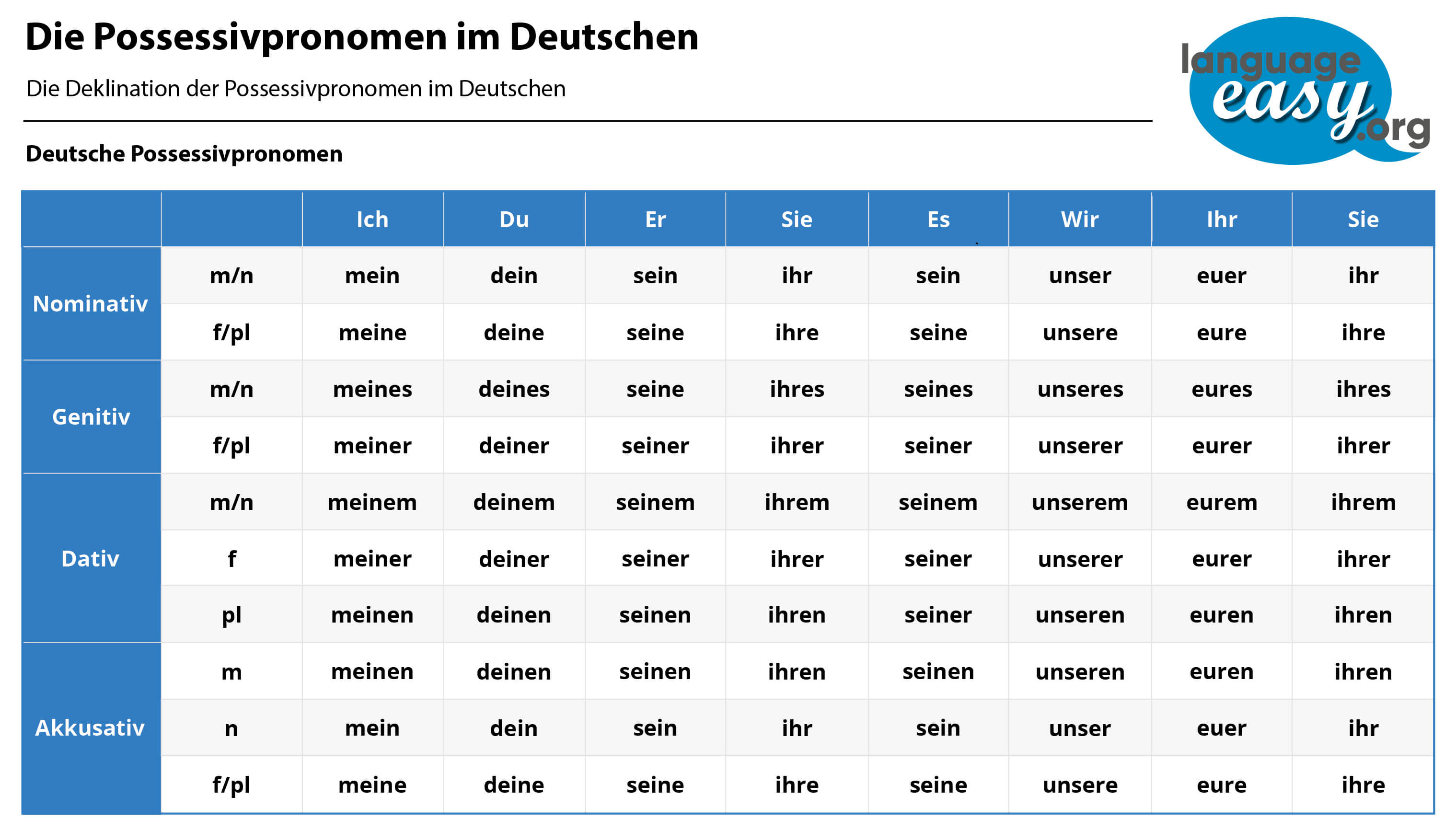

 plush pelican
Which part? All of it?
This might help show it better:
Personal Pronouns (I, you, …), possessive pronouns (my, your, …), declension of pronouns
vernal ermine
 plush pelican
vernal ermine
plush pelican
vernal ermine
Did you read the full Google Doc? She talks about 2 versions of endings, "soft" endings and "hard" endings
She says all of those pronouns take the "hard" endings, and later gives the chart for hard:
 vernal ermine
plush pelican
Did you read the full Google Doc? She talks about 2 versions of endings, "soft" ...
vernal ermine
plush pelican
Did you read the full Google Doc? She talks about 2 versions of endings, "soft" ...
Yes that also I want to ask you.
plush pelican
Hast du einen Bleistift? (der Bleistift)
Do you have a pencil?
Ich habe diesen.
I have this one.
Note "diesen"
Matching with (masculine, accusative) = -en
Wirst du den Männern helfen?
Will you help the men?
Ich helfe schon diesem.
I'm already helping this one.
Jeder spielt Fußball.
Everyone plays football.
Ich helfe jedem, der Hilfe braucht.
I help everyone who needs help.
I gotta go to bed 😴
vernal ermine
@plush pelican thanks bro. I have some questions also . You sleep well.
balmy fable
Is it ok to say Lebensraum in the context of an animal habitat, or best to use a different word? what is usually used?
long whale
balmy fable
Is it ok to say Lebensraum in the context of an animal habitat, or best to use a...
For animals, "der Lebensraum" is the word you need, yes. ("das Habitat" also works, at least if your readers are biologists ;) )
balmy fable
thanks
last valley
hey
is it ok? er hat mich wegen Geld betrogen?
autumn marsh
last valley
hey
is it ok? er hat mich wegen Geld betrogen?
https://www.dwds.de/wb/wegen#d-1-1-2
wegen always demands genitiv
"wegen Geldes" sounds a little weird/is an unnatural collaction, the more natural collocation is "wegen des Geldes"
 frozen trail
Hallo zusammen könnten Sie mir bitte behilflich sein was die Behörde hier meint?
 autumn marsh
frozen trail
Hallo zusammen könnten Sie mir bitte behilflich sein was die Behörde hier meint?
autumn marsh
frozen trail
Hallo zusammen könnten Sie mir bitte behilflich sein was die Behörde hier meint?
von wann bis wann du wo gearbeitet hast
innerhalb der letzten 5 jahre
gerechnet ab dem letzten zeitpunkt einer Antragsstellung
zb: arbeitslos gemeldet (mit antrag) bis 2020, dann gearbeitet ab april 2020 bis dezemer 2023, neuer antrag ab januar 2024