#botchannel
1 messages · Page 32 of 1
 serene beacon
 tender trellis
@latent talonCan I get it too? 👀
 latent talon
tender trellis
<@946155050600915005>Can I get it too? 👀
latent talon
tender trellis
<@946155050600915005>Can I get it too? 👀
No
tender trellis
latent talon
No
I didn't know the mods have favourites. 😔
 muted peak
faq beginner
 lean flickerBOT
How to get started - Part 2
Please make sure to read Part 1 before starting Part 2!
Part 2 – Beyond a Simple Sentence
1: Conjunctions (coordinating and subordinating)
2: Subordinate clause word order
3: Dative case
4: Dative verbs
5: Verbs with two objects (e.g. geben)
6: Prepositions (accusative, dative, and two-way)
7: Spoken past tense (Perfekt)
8: Written past tense (Präteritum)
9: Genitive case
10: Relative clauses
11: Adjective declension
Tips
- Make sure to practice writing and reading simple texts
- Some of these concepts are confusing to start with, so it’s a good idea to ask for help in #questions when you’re unsure
- You should use a declension chart to help with declension to start with, because you won’t be able to memorize it straight away
- After you feel confident with creating sentences, you can start learning the adjective declension properly by using the command >faq adjective declension and reading the guide provided
Page 2/2
 plush rain
faq two-way prepositions
lean flickerBOT
Two-way prepositions
Two-way prepositions (or dual prepositions) are prepositions that govern the accusative or dative case. Ten prepositions have this property, namely:
an     auf      entlang    hinter    in
neben  über     unter      vor       zwischen
Generally, these prepositions are used with the accusative if they express a direction or change of position. They are used with the dative if they express location.
For example, the verb etw. an etw. hängen can be used to express both meanings depending on the intention:
Ich hänge das Bild an die Wand. (I am hanging the picture on the wall.)
Das Bild hängt an der Wand. (The picture is hanging on the wall.)
Expressing direction vs. location
It is important to note that the accusative should only be used if something has moved from one position to another. If movement has been indicated, but the location has not changed, then the dative should be used. For example,
Der Hund läuft in den Park. (The dog ran (from somewhere) into the park.)
Der Hund läuft im Park (herum). (The dog is running in the park.)
The dative is usually used with verbs of arriving, appearing and disappearing
Even though these verbs indicate direction, they are still used with dative rather than accusative.
Sie kamen am Bahnhof an.
Sie landeten auf dem Mond.
Das Pferd verschwand hinter dem Berg.
 narrow isle
lessons
lean flickerBOT
There are no sessions currently scheduled.
lean flickerBOT
Reminders commands
:small_blue_diamond: **📒 remind** <time> <message>
Has the bot remind you about things. You can specify a time in a short time format (e.g., 1y, 7w, 2mo, 1h30m) or a long format (e.g, 2020-12-31 23:59 CET) and a message for your reminder text.
Page 3/18 (18 entries)
 sleek lion
faq beginer
lean flickerBOT
How to get started
The simplest way to learn German is to find topics you don’t understand yet and search for explanations of them. This list provides you with a guide for which topics to learn if you are completely new to German. Type the topic into Google (or YouTube) and start learning!
Introduction
1: Alphabet (especially ä, ü, ö and ß)
2: Basic greetings (hello, goodbye, etc.)
Part 1 - Simple Sentence
1: Noun gender & plurals
2: Nominative case (What are cases?)
3: Nominative pronouns (I, you, he, she, etc.)
4: Verbs in present tense
5: Definite/indefinite articles
6: Accusative case (for nouns)
7: Accusative pronouns
8: Word order of simple sentences
9: How to ask questions
See Part 2 on the next page.
Tips
- Always learn the gender of a noun when you learn a new noun
- Learn to use a translation dictionary (e.g. dict.cc, leo.org)
- Use
>faq resourcesto see our list of German learning resources - For listening and pronunciation practice, try watching movies or videos (incl. YouTube)
- You can listen to pronunciation for words on websites like dict.cc, forvo.com, and others
- Practice writing sentences every day (and asking people to correct them)
- Ask as many questions as possible
- Don’t be scared to make mistakes!!!! If you don’t let yourself make mistakes, you will never be able to learn German
Page 1/2
sleek lion
faq resources
lean flickerBOT
Resources
Here's a link to our curated list of resources: https://bit.ly/gladresources. Check out #resources if you want to submit some yourself!
 prime timber
lessons
lean flickerBOT
There are no sessions currently scheduled.
lean flickerBOT
Invalid target language. Specify en or de.
 rich mural
translate de study material
lean flickerBOT
Translations for study material:
**:small_blue_diamond:** Kostenminimierungsstudie *[auch:* *Kosten-Minimierungsstudie,* *Kosten-Minimierungs-Studie]*
cost-minimisation study <CM study> [Br.]
**:small_blue_diamond:** Krankheitskostenstudie
cost-of-illness study <COI study>
**:small_blue_diamond:** Kostenminimierungsstudie *[auch:* *Kosten-Minimierungsstudie,* *Kosten-Minimierungs-Studie]*
cost-minimization study <CM study>
**:small_blue_diamond:** Material-Nummer <Material-Nr., Mat.-Nr.>
material number <material no., mat. no.>
**:small_blue_diamond:** beobachten
study
Page 2/2 (10 entries)
 candid coral
cat
lean flickerBOT
 serene beacon
isbanned 851277150027382795
lean flickerBOT
[27194] Finn Dorian (cuh boys) was banned by 🌞 Basementality 🐈.
lean flickerBOT

 long swan
faq beginner
lean flickerBOT
How to get started
The simplest way to learn German is to find topics you don’t understand yet and search for explanations of them. This list provides you with a guide for which topics to learn if you are completely new to German. Type the topic into Google (or YouTube) and start learning!
Introduction
1: Alphabet (especially ä, ü, ö and ß)
2: Basic greetings (hello, goodbye, etc.)
Part 1 - Simple Sentence
1: Noun gender & plurals
2: Nominative case (What are cases?)
3: Nominative pronouns (I, you, he, she, etc.)
4: Verbs in present tense
5: Definite/indefinite articles
6: Accusative case (for nouns)
7: Accusative pronouns
8: Word order of simple sentences
9: How to ask questions
See Part 2 on the next page.
Tips
- Always learn the gender of a noun when you learn a new noun
- Learn to use a translation dictionary (e.g. dict.cc, leo.org)
- Use
>faq resourcesto see our list of German learning resources - For listening and pronunciation practice, try watching movies or videos (incl. YouTube)
- You can listen to pronunciation for words on websites like dict.cc, forvo.com, and others
- Practice writing sentences every day (and asking people to correct them)
- Ask as many questions as possible
- Don’t be scared to make mistakes!!!! If you don’t let yourself make mistakes, you will never be able to learn German
Page 1/2
 worn willow
faq cefr
lean flickerBOT
CEFR levels
If you see something like A1, B2 or C1, these represent the proficiency of a speaker in a language they're not native in, and are called CEFR levels. They are valid for any language, not only German!
Roughly speaking, A levels are beginners and C levels are experts. Remember that CEFR level are self-assessed and indicative!
You can see more specific names and descriptions on the Wikipedia page:
https://en.wikipedia.org/wiki/Common_European_Framework_of_Reference_for_Languages
🗨 How do I know what level I am?
If the table on Wikipedia is too generic for you, you can try using this one here:
https://rm.coe.int/168045bb52
Just check each column one at a time: if you can do all it describes, move to the next column. Your level is the highest where you can do the most things.
Alternatively, you can use this questionnaire to estimate your level more accurately:
https://rm.coe.int/self-assessment-checklists-from-the-swiss-version-of-the-european-lang/1680492f8e
serene beacon
dog
rich mural
noun lernmittel
lean flickerBOT

Netzverb Wörterbuch
Deklination Substantiv Lernmittel: im Plural, Genitiv, allen Kasus, ... mit Beispielen, Bedeutungen, Übersetzungen, Sprachausgabe und Downloads.
 knotty stump
faq beginner
lean flickerBOT
How to get started - Part 2
Please make sure to read Part 1 before starting Part 2!
Part 2 – Beyond a Simple Sentence
1: Conjunctions (coordinating and subordinating)
2: Subordinate clause word order
3: Dative case
4: Dative verbs
5: Verbs with two objects (e.g. geben)
6: Prepositions (accusative, dative, and two-way)
7: Spoken past tense (Perfekt)
8: Written past tense (Präteritum)
9: Genitive case
10: Relative clauses
11: Adjective declension
Tips
- Make sure to practice writing and reading simple texts
- Some of these concepts are confusing to start with, so it’s a good idea to ask for help in #questions when you’re unsure
- You should use a declension chart to help with declension to start with, because you won’t be able to memorize it straight away
- After you feel confident with creating sentences, you can start learning the adjective declension properly by using the command >faq adjective declension and reading the guide provided
Page 2/2
lean flickerBOT
CEFR levels
If you see something like A1, B2 or C1, these represent the proficiency of a speaker in a language they're not native in, and are called CEFR levels. They are valid for any language, not only German!
Roughly speaking, A levels are beginners and C levels are experts. Remember that CEFR level are self-assessed and indicative!
You can see more specific names and descriptions on the Wikipedia page:
https://en.wikipedia.org/wiki/Common_European_Framework_of_Reference_for_Languages
🗨 How do I know what level I am?
If the table on Wikipedia is too generic for you, you can try using this one here:
https://rm.coe.int/168045bb52
Just check each column one at a time: if you can do all it describes, move to the next column. Your level is the highest where you can do the most things.
Alternatively, you can use this questionnaire to estimate your level more accurately:
https://rm.coe.int/self-assessment-checklists-from-the-swiss-version-of-the-european-lang/1680492f8e
 rich depot
faq beginner
lean flickerBOT
How to get started - Part 2
Please make sure to read Part 1 before starting Part 2!
Part 2 – Beyond a Simple Sentence
1: Conjunctions (coordinating and subordinating)
2: Subordinate clause word order
3: Dative case
4: Dative verbs
5: Verbs with two objects (e.g. geben)
6: Prepositions (accusative, dative, and two-way)
7: Spoken past tense (Perfekt)
8: Written past tense (Präteritum)
9: Genitive case
10: Relative clauses
11: Adjective declension
Tips
- Make sure to practice writing and reading simple texts
- Some of these concepts are confusing to start with, so it’s a good idea to ask for help in #questions when you’re unsure
- You should use a declension chart to help with declension to start with, because you won’t be able to memorize it straight away
- After you feel confident with creating sentences, you can start learning the adjective declension properly by using the command >faq adjective declension and reading the guide provided
Page 2/2
rich depot
faq nicos
lean flickerBOT
Nicos
Nicos Weg is a free online program aimed at helping people learn German. It includes video, audio, text, grammar explanations, notes, vocabulary, and exercises. It also includes very useful cultural and bureaucratic information, such as how to open a bank account, while teaching you the relevant grammar and vocabulary.
It’s fairly popular and well-recommended, but keep in mind that you can’t learn a language with only one resource, even if it’s a good one!
You can find the courses here: https://learngerman.dw.com/en/overview/
You can also see various other courses for learners by dw.com here: https://www.dw.com/en/learn-german/s-2469/
 sonic jolt
purpose booster
lean flickerBOT
Information about Booster
Booster
A role that is automatically given by Discord to users who boost the server.
sonic jolt
purpose milkman
lean flickerBOT
Information about Milkman
Milkman
No information is currently available.
 uncut light
faq Verb mit preposition
lean flickerBOT
Verbs with prepositions
Linked is a table of verbs with prepositional objects, and nouns and adjectives that are paired with certain prepositions. Examples sentences are given for (almost) every word.
https://docs.google.com/spreadsheets/d/14sOz9dpsht9aw7_z2hVhjCj-5tMc0MxshWbnerdcRPs/edit#gid=0
This table is curated by @ruby gale. Feel free to ping him directly if you have words or examples of your own or have noticed a mistake.
uncut light
faq verbs with prepositions
lean flickerBOT
Verbs with prepositions
Linked is a table of verbs with prepositional objects, and nouns and adjectives that are paired with certain prepositions. Examples sentences are given for (almost) every word.
https://docs.google.com/spreadsheets/d/14sOz9dpsht9aw7_z2hVhjCj-5tMc0MxshWbnerdcRPs/edit#gid=0
This table is curated by @ruby gale. Feel free to ping him directly if you have words or examples of your own or have noticed a mistake.
 frozen axle
faq duolingo
lean flickerBOT
Duolingo
Duolingo is a decent resource to start with if you're a complete beginner, but it's neither efficient nor comprehensive!
What Duolingo will teach you about grammar is very limited, and none of the systems they use will help you practise much of it.
You can learn some vocabulary with it, but their method (based on the concept of spaced repetition) doesn't work for everybody, and the way Duolingo teaches is not very effective compared to the amount of time it requires from you.
So, if you find it useful, by all means keep using it, but remember not to fall for its gamification of language learning, and move past it when it stops being beneficial. Ignore the streaks.
In any case, keep in mind that Duolingo is not enough to learn a language, ever.
If you're looking for guidance or alternatives, check out >faq beginner in our #botchannel .
frozen axle
faq beginner
lean flickerBOT
How to get started - Part 2
Please make sure to read Part 1 before starting Part 2!
Part 2 – Beyond a Simple Sentence
1: Conjunctions (coordinating and subordinating)
2: Subordinate clause word order
3: Dative case
4: Dative verbs
5: Verbs with two objects (e.g. geben)
6: Prepositions (accusative, dative, and two-way)
7: Spoken past tense (Perfekt)
8: Written past tense (Präteritum)
9: Genitive case
10: Relative clauses
11: Adjective declension
Tips
- Make sure to practice writing and reading simple texts
- Some of these concepts are confusing to start with, so it’s a good idea to ask for help in #questions when you’re unsure
- You should use a declension chart to help with declension to start with, because you won’t be able to memorize it straight away
- After you feel confident with creating sentences, you can start learning the adjective declension properly by using the command >faq adjective declension and reading the guide provided
Page 2/2
tender trellis
faq deutsch
lean flickerBOT
FAQ not found. Try >explain all.
tender trellis
explain all
lean flickerBOT
See a listed FAQ with >faq [name]
:small_blue_diamond: How to use writing
:small_blue_diamond: Imperative
Aliases: imperativ
:small_blue_diamond: Impersonal Verbs
Aliases: Unpersönliche Verben, Impersonal es
:small_blue_diamond: IPA
Aliases: Pronunciation, Sound transcription, International Phonetic Alphabet
:small_blue_diamond: Languages in <#221708975698083841>
:small_blue_diamond: Lessons
Aliases: Sessions, Activities
:small_blue_diamond: Looking for information
Aliases: correct channel, information, right place to ask, right channel
:small_blue_diamond: Negation
Aliases: Nicht, Kein
:small_blue_diamond: Nicos
Aliases: Nicos Weg
:small_blue_diamond: Nominative
Aliases: Nominativ
:small_blue_diamond: Omission of movement verbs
:small_blue_diamond: Other languages
Aliases: languages
:small_blue_diamond: Passive
Aliases: Passiv
:small_blue_diamond: Past Tense
Aliases: perfekt, präteritum, praeteritum, present perfect, simple past
:small_blue_diamond: Prepositions of Place Part 1
Aliases: Nach-In-Auf-Zu
Page 3/5 (68 entries)
tender trellis
faq languages in general
lean flickerBOT
FAQ not found. I found the following similar entry: languages (1)
Select one of the values in the brackets to directly open the suggested FAQ.
tender trellis
faq languages
lean flickerBOT
Other languages
By default only German and English are allowed on the server, including in voice channels, unless specified otherwise!
If you want to speak other languages, you can use #other-languages or #languages.
lean flickerBOT
Why is everyone speaking English in <#221708975698083841>?
In short, because both English and German are allowed here, and because people might prefer speaking English for a variety of reasons.
If you want to stick to German, you can go to #german-only or #beginner-german instead.
serene beacon
tender trellis
>faq Languages in <#221708975698083841>
faq why english
lean flickerBOT
Why is everyone speaking English in <#221708975698083841>?
In short, because both English and German are allowed here, and because people might prefer speaking English for a variety of reasons.
If you want to stick to German, you can go to #german-only or #beginner-german instead.
tender trellis

serene beacon
tender trellis
<:PauseChamp:1161649891240587339>
Marginally shorter. 
tender trellis

serene beacon
isbanned 1154306681426161674
lean flickerBOT
[27216] Lionel Messi was banned by Arrem.
serene beacon
Thank you Arrem. 
 quaint sluice
patcat @sullen badge
lean flickerBOT
quaint sluice
>patcat <@1189809805834067989>
You have administered 381 pats to @sullen badge's feline companion.
 sullen badge
serene beacon
Thank you Arrem. <:blobheart:1126632141548171294>
sullen badge
serene beacon
Thank you Arrem. <:blobheart:1126632141548171294>
:D
sullen badge
quaint sluice
>patcat <@1189809805834067989>
Thanks
 coarse quest
help
lean flickerBOT
Eval commands
:small_blue_diamond: **eval** <code>
Evaluate the given code using an external compilation service. Any attempt to abuse this command will lead to a permanent blacklist.
Supported languages are: csharp (cs), java, python (py), c, c++ (cpp), haskell (hs), perl, nasm, javascript (js), lisp, kotlin (kt), brainfuck (bf) and rust (rs).
To use the command, specify a code block with your language of choice and provide any desired input in the same message, after the code block.
Example invocation with input:
```py
print('Hello,', input())
```
Barnabus Sandlers```
*Note: write out the command yourself, the example won't work if you copy it, due to Discord's formatting.*
:small_blue_diamond: Language specific notes:
- C# - the namespace and class must be called `Rextester` and `Program` respectively.
- Java - the class must be called `Rextester`
Page 4/18 (18 entries)
lean flickerBOT
How to get started
The simplest way to learn German is to find topics you don’t understand yet and search for explanations of them. This list provides you with a guide for which topics to learn if you are completely new to German. Type the topic into Google (or YouTube) and start learning!
Introduction
1: Alphabet (especially ä, ü, ö and ß)
2: Basic greetings (hello, goodbye, etc.)
Part 1 - Simple Sentence
1: Noun gender & plurals
2: Nominative case (What are cases?)
3: Nominative pronouns (I, you, he, she, etc.)
4: Verbs in present tense
5: Definite/indefinite articles
6: Accusative case (for nouns)
7: Accusative pronouns
8: Word order of simple sentences
9: How to ask questions
See Part 2 on the next page.
Tips
- Always learn the gender of a noun when you learn a new noun
- Learn to use a translation dictionary (e.g. dict.cc, leo.org)
- Use
>faq resourcesto see our list of German learning resources - For listening and pronunciation practice, try watching movies or videos (incl. YouTube)
- You can listen to pronunciation for words on websites like dict.cc, forvo.com, and others
- Practice writing sentences every day (and asking people to correct them)
- Ask as many questions as possible
- Don’t be scared to make mistakes!!!! If you don’t let yourself make mistakes, you will never be able to learn German
Page 1/2
 narrow solstice
faq resources
lean flickerBOT
Resources
Here's a link to our curated list of resources: https://bit.ly/gladresources. Check out #resources if you want to submit some yourself!
narrow solstice
faq cefr
lean flickerBOT
CEFR levels
If you see something like A1, B2 or C1, these represent the proficiency of a speaker in a language they're not native in, and are called CEFR levels. They are valid for any language, not only German!
Roughly speaking, A levels are beginners and C levels are experts. Remember that CEFR level are self-assessed and indicative!
You can see more specific names and descriptions on the Wikipedia page:
https://en.wikipedia.org/wiki/Common_European_Framework_of_Reference_for_Languages
🗨 How do I know what level I am?
If the table on Wikipedia is too generic for you, you can try using this one here:
https://rm.coe.int/168045bb52
Just check each column one at a time: if you can do all it describes, move to the next column. Your level is the highest where you can do the most things.
Alternatively, you can use this questionnaire to estimate your level more accurately:
https://rm.coe.int/self-assessment-checklists-from-the-swiss-version-of-the-european-lang/1680492f8e
narrow solstice
faq cefr
lean flickerBOT
CEFR levels
If you see something like A1, B2 or C1, these represent the proficiency of a speaker in a language they're not native in, and are called CEFR levels. They are valid for any language, not only German!
Roughly speaking, A levels are beginners and C levels are experts. Remember that CEFR level are self-assessed and indicative!
You can see more specific names and descriptions on the Wikipedia page:
https://en.wikipedia.org/wiki/Common_European_Framework_of_Reference_for_Languages
🗨 How do I know what level I am?
If the table on Wikipedia is too generic for you, you can try using this one here:
https://rm.coe.int/168045bb52
Just check each column one at a time: if you can do all it describes, move to the next column. Your level is the highest where you can do the most things.
Alternatively, you can use this questionnaire to estimate your level more accurately:
https://rm.coe.int/self-assessment-checklists-from-the-swiss-version-of-the-european-lang/1680492f8e
narrow solstice
faq cefr
lean flickerBOT
CEFR levels
If you see something like A1, B2 or C1, these represent the proficiency of a speaker in a language they're not native in, and are called CEFR levels. They are valid for any language, not only German!
Roughly speaking, A levels are beginners and C levels are experts. Remember that CEFR level are self-assessed and indicative!
You can see more specific names and descriptions on the Wikipedia page:
https://en.wikipedia.org/wiki/Common_European_Framework_of_Reference_for_Languages
🗨 How do I know what level I am?
If the table on Wikipedia is too generic for you, you can try using this one here:
https://rm.coe.int/168045bb52
Just check each column one at a time: if you can do all it describes, move to the next column. Your level is the highest where you can do the most things.
Alternatively, you can use this questionnaire to estimate your level more accurately:
https://rm.coe.int/self-assessment-checklists-from-the-swiss-version-of-the-european-lang/1680492f8e
narrow solstice
help
lean flickerBOT
Purpose commands
:small_blue_diamond: **📒 purpose** <input>
Gives information about a role or channel.
Page 5/18 (18 entries)
narrow solstice
help ranks
lean flickerBOT
No command or module called ranks found.
lean flickerBOT
:x: The required argument input is missing.
narrow solstice
purpose role
lean flickerBOT
:x: 'role' is not a channel or a role.
narrow solstice
purpose A`1
lean flickerBOT
:x: 'A`1' is not a channel or a role.
narrow solstice
purpose A1
lean flickerBOT
:x: 'A1' is not a channel or a role.
rich mural
noun bruder
lean flickerBOT

Netzverb Wörterbuch
Deklination Substantiv Bruder: im Plural, Genitiv, allen Kasus, ... mit Beispielen, Bedeutungen, Übersetzungen, Sprachausgabe und Downloads.
 barren lantern
faq beginner
lean flickerBOT
How to get started - Part 2
Please make sure to read Part 1 before starting Part 2!
Part 2 – Beyond a Simple Sentence
1: Conjunctions (coordinating and subordinating)
2: Subordinate clause word order
3: Dative case
4: Dative verbs
5: Verbs with two objects (e.g. geben)
6: Prepositions (accusative, dative, and two-way)
7: Spoken past tense (Perfekt)
8: Written past tense (Präteritum)
9: Genitive case
10: Relative clauses
11: Adjective declension
Tips
- Make sure to practice writing and reading simple texts
- Some of these concepts are confusing to start with, so it’s a good idea to ask for help in #questions when you’re unsure
- You should use a declension chart to help with declension to start with, because you won’t be able to memorize it straight away
- After you feel confident with creating sentences, you can start learning the adjective declension properly by using the command >faq adjective declension and reading the guide provided
Page 2/2
barren lantern
faq vc
lean flickerBOT
How to join Voice Chat
Welcome to the interactive paginator!
This interactively allows you to see pages of text by navigating with reactions. They are as follows:
:track_previous: Goes to the first page.
:arrow_backward: Goes to the previous page.
:arrow_forward: Goes to the next page.
:track_next: Goes to the last page.
:stop_button: Stops the interactive pagination session.
:information_source: Shows this message.
React with ℹ again to hide this message.
barren lantern
faq vc
lean flickerBOT
How to join Voice Chat
Please read the [Roles section](#getting-started message) in #getting-started for info on how to join VC and more!
barren lantern
faq afk
lean flickerBOT
FAQ not found. Try >explain all.
barren lantern
explain all
lean flickerBOT
See a listed FAQ with >faq [name]
:small_blue_diamond: Absentive
Aliases: Absentiv
:small_blue_diamond: Accusative
Aliases: Akkusativ
:small_blue_diamond: Adjective Declension
Aliases: Adjektivdeklination, Adjective endings
:small_blue_diamond: AI in language learning
Aliases: ai, chatgpt
:small_blue_diamond: Anki
Aliases: Flashcards
:small_blue_diamond: Beide vs. Beides
Aliases: Beides vs. Beide, Beides, Beide
:small_blue_diamond: Best way to learn German
Aliases: Fastest way to learn, Learn fast, Most efficient way to learn, Learn efficiently, Best way to learn, Learn German fast
:small_blue_diamond: Can anyone teach me German
Aliases: Private tutors, Teach me, Teach me German, Teach German, Private lessons, Private teachers, "private teacher", teacher
:small_blue_diamond: Cases
Aliases: Grammatical case, Case
:small_blue_diamond: CEFR levels
Aliases: CEFR, CERF
:small_blue_diamond: Conjugation
Aliases: Konjugation, Praesens, Verbs, Verb conjugation, Present tense, Präsens
:small_blue_diamond: Contractions
Aliases: Verschmelzung, Schmelzwort, Vom
:small_blue_diamond: DACH
:small_blue_diamond: Dative
Aliases: Dativ
:small_blue_diamond: Digga
Aliases: Digger
Page 1/5 (68 entries)
 stable aurora
faq beginner
lean flickerBOT
How to get started
The simplest way to learn German is to find topics you don’t understand yet and search for explanations of them. This list provides you with a guide for which topics to learn if you are completely new to German. Type the topic into Google (or YouTube) and start learning!
Introduction
1: Alphabet (especially ä, ü, ö and ß)
2: Basic greetings (hello, goodbye, etc.)
Part 1 - Simple Sentence
1: Noun gender & plurals
2: Nominative case (What are cases?)
3: Nominative pronouns (I, you, he, she, etc.)
4: Verbs in present tense
5: Definite/indefinite articles
6: Accusative case (for nouns)
7: Accusative pronouns
8: Word order of simple sentences
9: How to ask questions
See Part 2 on the next page.
Tips
- Always learn the gender of a noun when you learn a new noun
- Learn to use a translation dictionary (e.g. dict.cc, leo.org)
- Use
>faq resourcesto see our list of German learning resources - For listening and pronunciation practice, try watching movies or videos (incl. YouTube)
- You can listen to pronunciation for words on websites like dict.cc, forvo.com, and others
- Practice writing sentences every day (and asking people to correct them)
- Ask as many questions as possible
- Don’t be scared to make mistakes!!!! If you don’t let yourself make mistakes, you will never be able to learn German
Page 1/2
stable aurora
faq cefr
lean flickerBOT
CEFR levels
If you see something like A1, B2 or C1, these represent the proficiency of a speaker in a language they're not native in, and are called CEFR levels. They are valid for any language, not only German!
Roughly speaking, A levels are beginners and C levels are experts. Remember that CEFR level are self-assessed and indicative!
You can see more specific names and descriptions on the Wikipedia page:
https://en.wikipedia.org/wiki/Common_European_Framework_of_Reference_for_Languages
🗨 How do I know what level I am?
If the table on Wikipedia is too generic for you, you can try using this one here:
https://rm.coe.int/168045bb52
Just check each column one at a time: if you can do all it describes, move to the next column. Your level is the highest where you can do the most things.
Alternatively, you can use this questionnaire to estimate your level more accurately:
https://rm.coe.int/self-assessment-checklists-from-the-swiss-version-of-the-european-lang/1680492f8e
 remote patio
faq resources
lean flickerBOT
Resources
Here's a link to our curated list of resources: https://bit.ly/gladresources. Check out #resources if you want to submit some yourself!
sullen badge
faq formal
lean flickerBOT
Formal and informal speech
You may have heard of du vs. Sie. What's the difference?
Du is informal speech, and you use it when talking to friends, family, children, young people, and on the internet. The verb meaning to be on du-basis with someone is duzen, and you can use it to ask whether it's ok to switch from Sie to du. While talking to multiple people on informal basis, the plural pronoun is ihr.
- Hast du Hunger?
- Du bist ein Idiot.
- Ich komme mit dir.
- Was macht ihr?
Sie (note that the capitalisation is important here) is formal speech, and it's used with strangers, older people, on the workplace (unless you've agreed to use du instead), and in other formal situations. The counterpart to duzen is siezen. This pronoun can be used both for singular and plural, so, when you're addressing multiple people formally, you use Sie. Grammatically, Sie declines like the 3rd person plural pronoun sie, even when talking to just one person.
- Haben Sie Hunger?
- Sie sind ein Idiot.
- Ich komme mit Ihnen.
- Was machen Sie?
tender trellis
faq keyboard
lean flickerBOT
German letters
Being able to type German letters is quite important!
- Schon = already. Schön = beautiful.
- Mutter = mother. Mütter = mothers.
How to? There are several options.
🔸 Use a program like AutoHotkey. Download the program from https://www.autohotkey.com/ and read the pinned message in #resources for instructions on how to set it up. It can be used with any keyboard layout and the hotkeys can be customised.
🔸 US International layout: this is basically just a US keyboard layout with extra characters, so if you're using a US-style keyboard or something similar, the transition is very easy! Everything stays as you know it, except that some of the symbol keys can be used to create the special characters. For example " + a = ä. You can also do RightAlt + s = ß.
To use US International on Windows, look for the Region & Language options and switch your selected keyboard layout to US International.
🔸 If you are on Mac, there are two simple possibilities:
- The accent menu - Pressing and holding a letter key will display multiple variants of the letter, including umlauts, which can then be selected using the number keys.
- Dead keys - Pressing
Option + u, then pressinga,u, oro, respectively, will display the umlaut variant of that letter. You can also pressOption + sto enterß.
See this support article for more information:
https://support.apple.com/guide/mac-help/enter-characters-with-accent-marks-on-mac-mh27474/mac
See the next page for more alternatives.
Page 1/2
 tulip stream
faq beginner
lean flickerBOT
How to get started
The simplest way to learn German is to find topics you don’t understand yet and search for explanations of them. This list provides you with a guide for which topics to learn if you are completely new to German. Type the topic into Google (or YouTube) and start learning!
Introduction
1: Alphabet (especially ä, ü, ö and ß)
2: Basic greetings (hello, goodbye, etc.)
Part 1 - Simple Sentence
1: Noun gender & plurals
2: Nominative case (What are cases?)
3: Nominative pronouns (I, you, he, she, etc.)
4: Verbs in present tense
5: Definite/indefinite articles
6: Accusative case (for nouns)
7: Accusative pronouns
8: Word order of simple sentences
9: How to ask questions
See Part 2 on the next page.
Tips
- Always learn the gender of a noun when you learn a new noun
- Learn to use a translation dictionary (e.g. dict.cc, leo.org)
- Use
>faq resourcesto see our list of German learning resources - For listening and pronunciation practice, try watching movies or videos (incl. YouTube)
- You can listen to pronunciation for words on websites like dict.cc, forvo.com, and others
- Practice writing sentences every day (and asking people to correct them)
- Ask as many questions as possible
- Don’t be scared to make mistakes!!!! If you don’t let yourself make mistakes, you will never be able to learn German
Page 1/2
tulip stream
noun wasser
lean flickerBOT
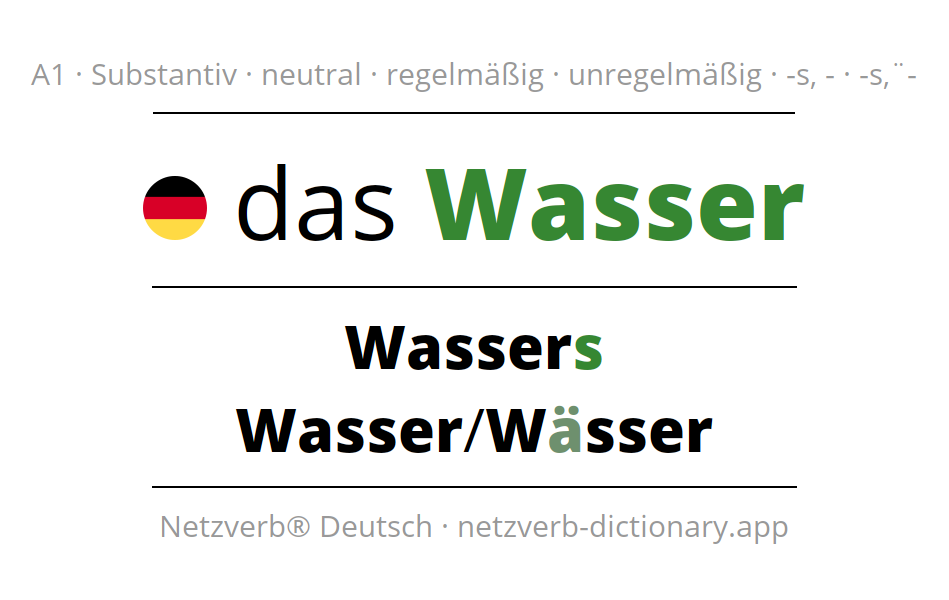
Netzverb Wörterbuch
Deklination Substantiv Wasser: im Plural, Genitiv, allen Kasus, ... mit Beispielen, Bedeutungen, Übersetzungen, Sprachausgabe und Downloads.
 worldly lava
faq cefr
lean flickerBOT
CEFR levels
If you see something like A1, B2 or C1, these represent the proficiency of a speaker in a language they're not native in, and are called CEFR levels. They are valid for any language, not only German!
Roughly speaking, A levels are beginners and C levels are experts. Remember that CEFR level are self-assessed and indicative!
You can see more specific names and descriptions on the Wikipedia page:
https://en.wikipedia.org/wiki/Common_European_Framework_of_Reference_for_Languages
🗨 How do I know what level I am?
If the table on Wikipedia is too generic for you, you can try using this one here:
https://rm.coe.int/168045bb52
Just check each column one at a time: if you can do all it describes, move to the next column. Your level is the highest where you can do the most things.
Alternatively, you can use this questionnaire to estimate your level more accurately:
https://rm.coe.int/self-assessment-checklists-from-the-swiss-version-of-the-european-lang/1680492f8e
candid coral
cat
lean flickerBOT

 mild crown
faq accusative
lean flickerBOT
Accusative
The accusative case (der Akkusativ) is one of the four cases of the German language. A case affects how a noun or noun phrase is inflected, and indicates the role of the noun or noun phrase in a clause.
How do I decline in the accusative case?
Feminine and neuter nouns and adjectives are the same as nominative. Masculine determiners, adjectives, and weak nouns gain an -en ending::
Ich esse den/einen/keinen kleinen Apfel.
Personal pronouns differ for:
ich --> mich
du --> dich
er --> ihn
wir --> uns
ihr --> euch
For a full explanation see >explain adjective declension
Page 1/2
mild crown
faq beginner
lean flickerBOT
How to get started
The simplest way to learn German is to find topics you don’t understand yet and search for explanations of them. This list provides you with a guide for which topics to learn if you are completely new to German. Type the topic into Google (or YouTube) and start learning!
Introduction
1: Alphabet (especially ä, ü, ö and ß)
2: Basic greetings (hello, goodbye, etc.)
Part 1 - Simple Sentence
1: Noun gender & plurals
2: Nominative case (What are cases?)
3: Nominative pronouns (I, you, he, she, etc.)
4: Verbs in present tense
5: Definite/indefinite articles
6: Accusative case (for nouns)
7: Accusative pronouns
8: Word order of simple sentences
9: How to ask questions
See Part 2 on the next page.
Tips
- Always learn the gender of a noun when you learn a new noun
- Learn to use a translation dictionary (e.g. dict.cc, leo.org)
- Use
>faq resourcesto see our list of German learning resources - For listening and pronunciation practice, try watching movies or videos (incl. YouTube)
- You can listen to pronunciation for words on websites like dict.cc, forvo.com, and others
- Practice writing sentences every day (and asking people to correct them)
- Ask as many questions as possible
- Don’t be scared to make mistakes!!!! If you don’t let yourself make mistakes, you will never be able to learn German
Page 1/2
 heady furnace
faq beginner
lean flickerBOT
Help commands
:small_blue_diamond: **help** [term]
Displays help information for modules and individual commands. The optional argument term is the search term to use. If no value is provided, the bot will display a list of all available modules. Otherwise, it will attempt to find information about the given term.
Page 1/18 (18 entries)
mild crown
faq resources
lean flickerBOT
Resources
Here's a link to our curated list of resources: https://bit.ly/gladresources. Check out #resources if you want to submit some yourself!
 hollow oriole
faq keyboard
lean flickerBOT
German letters
Being able to type German letters is quite important!
- Schon = already. Schön = beautiful.
- Mutter = mother. Mütter = mothers.
How to? There are several options.
🔸 Use a program like AutoHotkey. Download the program from https://www.autohotkey.com/ and read the pinned message in #resources for instructions on how to set it up. It can be used with any keyboard layout and the hotkeys can be customised.
🔸 US International layout: this is basically just a US keyboard layout with extra characters, so if you're using a US-style keyboard or something similar, the transition is very easy! Everything stays as you know it, except that some of the symbol keys can be used to create the special characters. For example " + a = ä. You can also do RightAlt + s = ß.
To use US International on Windows, look for the Region & Language options and switch your selected keyboard layout to US International.
🔸 If you are on Mac, there are two simple possibilities:
- The accent menu - Pressing and holding a letter key will display multiple variants of the letter, including umlauts, which can then be selected using the number keys.
- Dead keys - Pressing
Option + u, then pressinga,u, oro, respectively, will display the umlaut variant of that letter. You can also pressOption + sto enterß.
See this support article for more information:
https://support.apple.com/guide/mac-help/enter-characters-with-accent-marks-on-mac-mh27474/mac
See the next page for more alternatives.
Page 1/2
 mellow maple
faq duolingo
lean flickerBOT
Duolingo
Duolingo is a decent resource to start with if you're a complete beginner, but it's neither efficient nor comprehensive!
What Duolingo will teach you about grammar is very limited, and none of the systems they use will help you practise much of it.
You can learn some vocabulary with it, but their method (based on the concept of spaced repetition) doesn't work for everybody, and the way Duolingo teaches is not very effective compared to the amount of time it requires from you.
So, if you find it useful, by all means keep using it, but remember not to fall for its gamification of language learning, and move past it when it stops being beneficial. Ignore the streaks.
In any case, keep in mind that Duolingo is not enough to learn a language, ever.
If you're looking for guidance or alternatives, check out >faq beginner in our #botchannel .
mellow maple
faq beginner
lean flickerBOT
How to get started
The simplest way to learn German is to find topics you don’t understand yet and search for explanations of them. This list provides you with a guide for which topics to learn if you are completely new to German. Type the topic into Google (or YouTube) and start learning!
Introduction
1: Alphabet (especially ä, ü, ö and ß)
2: Basic greetings (hello, goodbye, etc.)
Part 1 - Simple Sentence
1: Noun gender & plurals
2: Nominative case (What are cases?)
3: Nominative pronouns (I, you, he, she, etc.)
4: Verbs in present tense
5: Definite/indefinite articles
6: Accusative case (for nouns)
7: Accusative pronouns
8: Word order of simple sentences
9: How to ask questions
See Part 2 on the next page.
Tips
- Always learn the gender of a noun when you learn a new noun
- Learn to use a translation dictionary (e.g. dict.cc, leo.org)
- Use
>faq resourcesto see our list of German learning resources - For listening and pronunciation practice, try watching movies or videos (incl. YouTube)
- You can listen to pronunciation for words on websites like dict.cc, forvo.com, and others
- Practice writing sentences every day (and asking people to correct them)
- Ask as many questions as possible
- Don’t be scared to make mistakes!!!! If you don’t let yourself make mistakes, you will never be able to learn German
Page 1/2
mellow maple
faq resources
lean flickerBOT
Resources
Here's a link to our curated list of resources: https://bit.ly/gladresources. Check out #resources if you want to submit some yourself!
FAQ not found. Try >explain all.
 late latch
faq beginner
lean flickerBOT
How to get started
The simplest way to learn German is to find topics you don’t understand yet and search for explanations of them. This list provides you with a guide for which topics to learn if you are completely new to German. Type the topic into Google (or YouTube) and start learning!
Introduction
1: Alphabet (especially ä, ü, ö and ß)
2: Basic greetings (hello, goodbye, etc.)
Part 1 - Simple Sentence
1: Noun gender & plurals
2: Nominative case (What are cases?)
3: Nominative pronouns (I, you, he, she, etc.)
4: Verbs in present tense
5: Definite/indefinite articles
6: Accusative case (for nouns)
7: Accusative pronouns
8: Word order of simple sentences
9: How to ask questions
See Part 2 on the next page.
Tips
- Always learn the gender of a noun when you learn a new noun
- Learn to use a translation dictionary (e.g. dict.cc, leo.org)
- Use
>faq resourcesto see our list of German learning resources - For listening and pronunciation practice, try watching movies or videos (incl. YouTube)
- You can listen to pronunciation for words on websites like dict.cc, forvo.com, and others
- Practice writing sentences every day (and asking people to correct them)
- Ask as many questions as possible
- Don’t be scared to make mistakes!!!! If you don’t let yourself make mistakes, you will never be able to learn German
Page 1/2
late latch
How long will that take
 timber fable
isbanned life5720
lean flickerBOT
:x: User 'life5720' not found.
timber fable
isbanned 1133134428634353744
lean flickerBOT
[27174] life was banned by 🌞 Basementality 🐈.
timber fable
lean flicker
[27174] life was banned by 🌞 Basementality 🐈.
👀
lean flickerBOT
[27243] Adolf Hitler was banned by Syronoid.
 earnest smelt
.
 long wave
faq beginner
lean flickerBOT
How to get started - Part 2
Please make sure to read Part 1 before starting Part 2!
Part 2 – Beyond a Simple Sentence
1: Conjunctions (coordinating and subordinating)
2: Subordinate clause word order
3: Dative case
4: Dative verbs
5: Verbs with two objects (e.g. geben)
6: Prepositions (accusative, dative, and two-way)
7: Spoken past tense (Perfekt)
8: Written past tense (Präteritum)
9: Genitive case
10: Relative clauses
11: Adjective declension
Tips
- Make sure to practice writing and reading simple texts
- Some of these concepts are confusing to start with, so it’s a good idea to ask for help in #questions when you’re unsure
- You should use a declension chart to help with declension to start with, because you won’t be able to memorize it straight away
- After you feel confident with creating sentences, you can start learning the adjective declension properly by using the command >faq adjective declension and reading the guide provided
Page 2/2
tender trellis
@sharp geyser
 merry moon
roles
lean flickerBOT
Available roles
:small_blue_diamond: Activities
:small_blue_diamond: Activity Permissions
:small_blue_diamond: Admin
:small_blue_diamond: AdvancedGrammar
:small_blue_diamond: AdvancedReading
:small_blue_diamond: Art
:small_blue_diamond: Booster
:small_blue_diamond: Bot
:small_blue_diamond: BotGames
:small_blue_diamond: Bulli's Session Holder Role
:small_blue_diamond: Coding
:small_blue_diamond: Curator
:small_blue_diamond: Dialects
:small_blue_diamond: Food
:small_blue_diamond: GLaD Member
:small_blue_diamond: Gaming
:small_blue_diamond: Grammar
:small_blue_diamond: Helper
:small_blue_diamond: Heritage Speaker
:small_blue_diamond: Level A
Type `>purpose <role>` e.g. `>purpose Level A` for more detail about a role.
lean flickerBOT
Available roles
:small_blue_diamond: Activities
:small_blue_diamond: Activity Permissions
:small_blue_diamond: Admin
:small_blue_diamond: AdvancedGrammar
:small_blue_diamond: AdvancedReading
:small_blue_diamond: Art
:small_blue_diamond: Booster
:small_blue_diamond: Bot
:small_blue_diamond: BotGames
:small_blue_diamond: Bulli's Session Holder Role
:small_blue_diamond: Coding
:small_blue_diamond: Curator
:small_blue_diamond: Dialects
:small_blue_diamond: Food
:small_blue_diamond: GLaD Member
:small_blue_diamond: Gaming
:small_blue_diamond: Grammar
:small_blue_diamond: Helper
:small_blue_diamond: Heritage Speaker
:small_blue_diamond: Level A
Type `>purpose <role>` e.g. `>purpose Level A` for more detail about a role.
merry moon
purpose Heritage Speaker
lean flickerBOT
Information about Heritage Speaker
Heritage Speaker
Indicates members who are Heritage Speakers of German.
This means that they were exposed to the language from a very young age (e.g. by their parents) but usually don't consider it their native language and never learned German in a formal school setting, for example.
You cannot assign yourself this role. You must request it by clicking the appropriate button [here](#get-roles message).
 vital basin
faq cede
lean flickerBOT
FAQ not found. Try >explain all.
vital basin
faq cefr
lean flickerBOT
CEFR levels
If you see something like A1, B2 or C1, these represent the proficiency of a speaker in a language they're not native in, and are called CEFR levels. They are valid for any language, not only German!
Roughly speaking, A levels are beginners and C levels are experts. Remember that CEFR level are self-assessed and indicative!
You can see more specific names and descriptions on the Wikipedia page:
https://en.wikipedia.org/wiki/Common_European_Framework_of_Reference_for_Languages
🗨 How do I know what level I am?
If the table on Wikipedia is too generic for you, you can try using this one here:
https://rm.coe.int/168045bb52
Just check each column one at a time: if you can do all it describes, move to the next column. Your level is the highest where you can do the most things.
Alternatively, you can use this questionnaire to estimate your level more accurately:
https://rm.coe.int/self-assessment-checklists-from-the-swiss-version-of-the-european-lang/1680492f8e
 opal yew
faq beginner
lean flickerBOT
How to get started - Part 2
Please make sure to read Part 1 before starting Part 2!
Part 2 – Beyond a Simple Sentence
1: Conjunctions (coordinating and subordinating)
2: Subordinate clause word order
3: Dative case
4: Dative verbs
5: Verbs with two objects (e.g. geben)
6: Prepositions (accusative, dative, and two-way)
7: Spoken past tense (Perfekt)
8: Written past tense (Präteritum)
9: Genitive case
10: Relative clauses
11: Adjective declension
Tips
- Make sure to practice writing and reading simple texts
- Some of these concepts are confusing to start with, so it’s a good idea to ask for help in #questions when you’re unsure
- You should use a declension chart to help with declension to start with, because you won’t be able to memorize it straight away
- After you feel confident with creating sentences, you can start learning the adjective declension properly by using the command >faq adjective declension and reading the guide provided
Page 2/2
 vale walrus
faq kennen
lean flickerBOT
FAQ not found. I found the following similar entries: Kennen vs. wissen (1), Wissen and kennen (2), Wissen vs. kennen (3)
Select one of the values in the brackets to directly open the suggested FAQ.
 weary lintel
help
lean flickerBOT
Session Schedule commands
:small_blue_diamond: **📒 session**
Commands for the bot's session scheduling system.
Group moderators can edit and delete existing sessions for their group.
Page 11/18 (18 entries)
weary lintel
cat
lean flickerBOT

 charred violet
faq kennen vs wissen
lean flickerBOT
Wissen and kennen
The verbs wissen and kennen both translate to know. However, in most cases they cannot be used interchangeably.
You should use wissen with information or facts, for example:
(1) Ich weiß, dass er Peter heißt. (I know his name is Peter.)
(2) Ich weiß nicht, wie alt er ist. (I don't know how old he is.)
(3) Ich weiß, wo er wohnt. (I know where he lives.)
(4) Ich weiß es. (I know it.)
🌟Note that wissen almost always requires a subordinate clause which starts with either dass, wie, wann, wo, wer, or warum.
The verb kennen is used to express that you are familiar with a person, place or simply a thing, for example:
(5) Ich kenne Maria. (I know Maria.)
(6) Ich kenne diesen Fluss. (I know that river.)
(7) Ich kenne das Buch. (I know the book.)
(8) Ich kenne ihn. (I know him.)
🌟 Note that kennen almost always refers to a noun or pronoun.
‼ As with every rule, there are certain exceptions, in which you can use either, for example:
(9) Ich weiß/kenne den Weg. (I know the way.)
(10) Ich weiß/kenne deinen Namen (I know your name.)
Although they are often used interchangeably in this context, the general rules explained above still apply to them.
The wissen sentence is purely about knowing the way/name, while the kennen sentence also means that you already went that way a few times or have heard that name somewhere before.
lean flickerBOT
FAQ not found. Try >explain all.
 wary ibex
faq du vs dich
lean flickerBOT
Formal and informal speech
You may have heard of du vs. Sie. What's the difference?
Du is informal speech, and you use it when talking to friends, family, children, young people, and on the internet. The verb meaning to be on du-basis with someone is duzen, and you can use it to ask whether it's ok to switch from Sie to du. While talking to multiple people on informal basis, the plural pronoun is ihr.
- Hast du Hunger?
- Du bist ein Idiot.
- Ich komme mit dir.
- Was macht ihr?
Sie (note that the capitalisation is important here) is formal speech, and it's used with strangers, older people, on the workplace (unless you've agreed to use du instead), and in other formal situations. The counterpart to duzen is siezen. This pronoun can be used both for singular and plural, so, when you're addressing multiple people formally, you use Sie. Grammatically, Sie declines like the 3rd person plural pronoun sie, even when talking to just one person.
- Haben Sie Hunger?
- Sie sind ein Idiot.
- Ich komme mit Ihnen.
- Was machen Sie?
charred violet
faq also vs so
lean flickerBOT
So and also
The German “also”
This word means “so, therefore”. It is used in the beginning of a sentence to show that what you’re about to say follows from what you said before:
(1) Er war müde, also ging er schlafen. (He was tired, so he went to sleep.)
You can put it in the middle of a sentence too, then it shows that you’re going back a topic or are reminding of it:
(2) Ich habe also mit ihm geredet… (and so/as I said, I spoke to him…)
A very similar use is also to start a sentence with a dragged out aaalso (=aaanyway).
⚠ You cannot use so in these sentences!
The German “so”
So has a few uses. Most of them correspond pretty directly to English “like this/that”. Perhaps the most normal use of it is to answer a “how” (wie) question:
(3) Wie geht das? — So! (How does one do that? — Like this!)
You can of course also use it this way if no one asked you a question:
(4) Er lief so herum. (He walked around like that. [could indicate e.g. walking style or clothing, depends on context])
Together with an indefinite noun it indicates that you care about the properties of that noun, and not the noun itself:
(5) Ich will so ein Haus. (I want a house like that [but not necessarily this particular one].)
Note that here, the proper question is not wie but was für ein:
(6) Was für ein Spiel willst du spielen? — So eins. (What kind of game do you want to play? — One like that)
Another very common way to use it is for emphasizing a size or amount. Just like in English, you may drag out the so for a bit to emphasize it even more:
(7) Das ist so schön! (This is so beautiful!)
The English “also”
English “also/too” straigtforwardly translates to German auch. There is no relation to German so/also here:
(8) Ich habe ihn auch gesehen. (I also saw him. / I saw him too.)
lean flickerBOT
Zigaretten has not been banned on this server.
serene beacon
isbanned 1133134428634353744
lean flickerBOT
[27174] life was banned by 🌞 Basementality 🐈.
serene beacon
lean flicker
[27174] life was banned by 🌞 Basementality 🐈.
@ivory heart @tender trellis
tender trellis
isbanned soupdaniel1
lean flickerBOT
jin has not been banned on this server.
serene beacon
lean flicker
jin has not been banned on this server.

tender trellis
faq cases
lean flickerBOT
Cases
Cases
German has four grammatical cases (der Fall or der Kasus in German): nominative, accusative, dative, and genitive. A case alters a noun, pronoun, adjective, etc., in some way to mark its grammatical function in a phrase, clause, or sentence. For example, the main function of the nominative (der Nominativ) case is to mark the subject in a sentence:
Ich liebe die deutsche Sprache!
In this sentence, the pronoun ich represents the first person subject and is in the nominative case. Every noun, pronoun, adjective, etc. has form in every case and it is very important to learn all of them. For example, the accusative form of ich is mich:
Die deutsche Sprache liebt mich!
See >explain adjective declension to get started on that. Don't get discouraged by how much there is, it takes some time master.
To see an explanation of the usages of every case, see their individual articles:
>explain nominative
>explain accusative
>explain dative
>explain genitive
tender trellis
explain adjective declension
lean flickerBOT
Adjective Declension
A Brief Guide to Memorizing German Noun and Adjective Declension by Basementality
https://docs.google.com/document/d/1jWl5-kkqF3FQLDzrz8XLBJj7hvPFQK7MT5SYEDGK65E/edit
tender trellis
explain genitive
lean flickerBOT
When do I use the genitive case?
The genitive case is mainly used:
- to link nouns, especially when showing possession
Dies ist der größte Bahnhof der Welt.
Die Hälfte des Kuchens gehört mir.
Es gibt noch einen Strahl der Hoffnung.
For proper names, the order is reversed and an 's' is attached to the proper name as long as it does not end with an 's' sound.
Deutschlands längster Fluss ist der Rhein.
- to mark the object of very few transitive verbs
Empfindliche Haut bedarf besonderer Pflege.
Heute gedenkt die Nation des Jahrestages der Verfassung.
Wir harren einer Antwort.
- after some prepositions
The following prepositions are commonly followed by the genitive case in written German, but usually with the dative case in spoken German:
(an)statt, trotz, während, wegen
Prepositions denoting position are usually followed by the genitive case:
außerhalb, innerhalb, oberhalb, unterhalb, jenseits
A great number of prepositions that are only used in formal German, such as:
angesichts, bezüglich, einschließlich, fernab, infolge, namens, seitens, zugunsten
- by adverbials of indefinite time
Eines Tages werde ich Deutsch beherrschen.
Sonntags sind wir meist unterwegs.
Eines Nachts hörte ihr Vater sie weinen.
Note the declension in the last sentence. Although it is die Nacht, it assumes a similar form as the rest.
Page 2/2
rich mural
verb reden
lean flickerBOT

Netzverb Wörterbuch
Konjugation Verb reden: im Präsens, Präteritum, Konjunktiv, Perfekt, ... viele Beispiele, Grammatik, Regeln erklärt, Übersetzung, Übungen, Bedeutung und kostenlose Downloads.
tulip stream
verb sagen
lean flickerBOT

Netzverb Wörterbuch
Konjugation Verb sagen: im Präsens, Präteritum, Konjunktiv, Perfekt, ... viele Beispiele, Grammatik, Regeln erklärt, Übersetzung, Übungen, Bedeutung und kostenlose Downloads.
serene beacon
isbanned 1185460953286983760
lean flickerBOT
Samurai has not been banned on this server.
lean flickerBOT
How to get started
The simplest way to learn German is to find topics you don’t understand yet and search for explanations of them. This list provides you with a guide for which topics to learn if you are completely new to German. Type the topic into Google (or YouTube) and start learning!
Introduction
1: Alphabet (especially ä, ü, ö and ß)
2: Basic greetings (hello, goodbye, etc.)
Part 1 - Simple Sentence
1: Noun gender & plurals
2: Nominative case (What are cases?)
3: Nominative pronouns (I, you, he, she, etc.)
4: Verbs in present tense
5: Definite/indefinite articles
6: Accusative case (for nouns)
7: Accusative pronouns
8: Word order of simple sentences
9: How to ask questions
See Part 2 on the next page.
Tips
- Always learn the gender of a noun when you learn a new noun
- Learn to use a translation dictionary (e.g. dict.cc, leo.org)
- Use
>faq resourcesto see our list of German learning resources - For listening and pronunciation practice, try watching movies or videos (incl. YouTube)
- You can listen to pronunciation for words on websites like dict.cc, forvo.com, and others
- Practice writing sentences every day (and asking people to correct them)
- Ask as many questions as possible
- Don’t be scared to make mistakes!!!! If you don’t let yourself make mistakes, you will never be able to learn German
Page 1/2
Resources
Here's a link to our curated list of resources: https://bit.ly/gladresources. Check out #resources if you want to submit some yourself!
tender trellis
explain all
lean flickerBOT
See a listed FAQ with >faq [name]
:small_blue_diamond: Absentive
Aliases: Absentiv
:small_blue_diamond: Accusative
Aliases: Akkusativ
:small_blue_diamond: Adjective Declension
Aliases: Adjektivdeklination, Adjective endings
:small_blue_diamond: AI in language learning
Aliases: ai, chatgpt
:small_blue_diamond: Anki
Aliases: Flashcards
:small_blue_diamond: Beide vs. Beides
Aliases: Beides vs. Beide, Beides, Beide
:small_blue_diamond: Best way to learn German
Aliases: Fastest way to learn, Learn fast, Most efficient way to learn, Learn efficiently, Best way to learn, Learn German fast
:small_blue_diamond: Can anyone teach me German
Aliases: Private tutors, Teach me, Teach me German, Teach German, Private lessons, Private teachers, "private teacher", teacher
:small_blue_diamond: Cases
Aliases: Grammatical case, Case
:small_blue_diamond: CEFR levels
Aliases: CEFR, CERF
:small_blue_diamond: Conjugation
Aliases: Konjugation, Praesens, Verbs, Verb conjugation, Present tense, Präsens
:small_blue_diamond: Contractions
Aliases: Verschmelzung, Schmelzwort, Vom
:small_blue_diamond: DACH
:small_blue_diamond: Dative
Aliases: Dativ
:small_blue_diamond: Digga
Aliases: Digger
Page 1/5 (68 entries)
tender trellis
Most efficient way to learn
ok buddy work the command
Best way to learn German
faq
lean flickerBOT
:x: The required argument name is missing.
tender trellis
explain nominative
lean flickerBOT
Nominative
The nominative case (der Nominativ) is one of the four cases of the German language. A case affects how a noun or noun phrase is inflected, and indicates the role of the noun or noun phrase in a clause.
How do I decline in the nominative case?
Definite articles: der, die, das
Indefinite articles: ein, eine, ein
Personal pronouns:
ich - I
du - you
er - he
es - it
sie - she/they
wir - we
ihr - you guys
Sie - (formal) you/you guys
For a full explanation, including adjectives, see >explain adjective declension
Page 1/2
vale walrus
faq duzen
lean flickerBOT
FAQ not found. I found the following similar entry: Duzen vs. siezen (1)
Select one of the values in the brackets to directly open the suggested FAQ.
tender trellis
faq Duzen vs. siezen
lean flickerBOT
Formal and informal speech
You may have heard of du vs. Sie. What's the difference?
Du is informal speech, and you use it when talking to friends, family, children, young people, and on the internet. The verb meaning to be on du-basis with someone is duzen, and you can use it to ask whether it's ok to switch from Sie to du. While talking to multiple people on informal basis, the plural pronoun is ihr.
- Hast du Hunger?
- Du bist ein Idiot.
- Ich komme mit dir.
- Was macht ihr?
Sie (note that the capitalisation is important here) is formal speech, and it's used with strangers, older people, on the workplace (unless you've agreed to use du instead), and in other formal situations. The counterpart to duzen is siezen. This pronoun can be used both for singular and plural, so, when you're addressing multiple people formally, you use Sie. Grammatically, Sie declines like the 3rd person plural pronoun sie, even when talking to just one person.
- Haben Sie Hunger?
- Sie sind ein Idiot.
- Ich komme mit Ihnen.
- Was machen Sie?
 fast nimbus
faq beginner
lean flickerBOT
How to get started
The simplest way to learn German is to find topics you don’t understand yet and search for explanations of them. This list provides you with a guide for which topics to learn if you are completely new to German. Type the topic into Google (or YouTube) and start learning!
Introduction
1: Alphabet (especially ä, ü, ö and ß)
2: Basic greetings (hello, goodbye, etc.)
Part 1 - Simple Sentence
1: Noun gender & plurals
2: Nominative case (What are cases?)
3: Nominative pronouns (I, you, he, she, etc.)
4: Verbs in present tense
5: Definite/indefinite articles
6: Accusative case (for nouns)
7: Accusative pronouns
8: Word order of simple sentences
9: How to ask questions
See Part 2 on the next page.
Tips
- Always learn the gender of a noun when you learn a new noun
- Learn to use a translation dictionary (e.g. dict.cc, leo.org)
- Use
>faq resourcesto see our list of German learning resources - For listening and pronunciation practice, try watching movies or videos (incl. YouTube)
- You can listen to pronunciation for words on websites like dict.cc, forvo.com, and others
- Practice writing sentences every day (and asking people to correct them)
- Ask as many questions as possible
- Don’t be scared to make mistakes!!!! If you don’t let yourself make mistakes, you will never be able to learn German
Page 1/2
fast nimbus
faq resources
lean flickerBOT
Resources
Here's a link to our curated list of resources: https://bit.ly/gladresources. Check out #resources if you want to submit some yourself!
lean flickerBOT
:x: The required argument target is missing.
 balmy crescent
faq gender
lean flickerBOT
Grammatical gender
German nouns are sorted in three different genders: masculine, neuter and feminine. These have nothing to do with sex or social gender.
The first thing genders will influence are articles like der, das, die. Each word has its own and you better get it right: some words that look identical can have different meanings depending on the gender they're used with. For example:
die Band = the (musical) band,
der Band = the (book) volume,
das Band = the tape.
Some words, mainly trademarks and loanwords, have multiple acceptable genders while having no change in meaning:
der Jogurt = das Jogurt
das Virus = der Virus
These may vary by region or colloquiality.
💢 But WHY, German, WHY ⁉
Gender is actually quite useful! Since sentence structure is less rigid than in English, grammatical case helps you tell the various elements apart (with some practice), and that works through genders: each gender has its own forms, which makes everything a little less ambiguous. Besides, as you've seen with Band above, it allows us to make up words with different meanings that look the same but are not ambiguous, and if that's not magic, I don't know what is. ✨
🙀 But how am I supposed to tell them apart? 🙀
Check out >explain gender patterns. 😉
balmy crescent
explain gender patterns
lean flickerBOT
Gender patterns
Unfortunately, many German words don't have immediately clear clues that reveal it, but thankfully, many common words do follow patterns that reveal their gender.
In general, you are advised to learn the article together with the word (and its plural!).
Plural forms always use die and follow plural declension rules, which are the same for all genders (yay 🎉).
For compound words, remember that only the last word matters.
Type >explain grammatical gender for an explanation on grammatical gender.
Here's a list of patterns to recognise word gender.
Note that exceptions may apply.
Page 1/4
balmy crescent
explain grammatical gender
lean flickerBOT
Grammatical gender
German nouns are sorted in three different genders: masculine, neuter and feminine. These have nothing to do with sex or social gender.
The first thing genders will influence are articles like der, das, die. Each word has its own and you better get it right: some words that look identical can have different meanings depending on the gender they're used with. For example:
die Band = the (musical) band,
der Band = the (book) volume,
das Band = the tape.
Some words, mainly trademarks and loanwords, have multiple acceptable genders while having no change in meaning:
der Jogurt = das Jogurt
das Virus = der Virus
These may vary by region or colloquiality.
💢 But WHY, German, WHY ⁉
Gender is actually quite useful! Since sentence structure is less rigid than in English, grammatical case helps you tell the various elements apart (with some practice), and that works through genders: each gender has its own forms, which makes everything a little less ambiguous. Besides, as you've seen with Band above, it allows us to make up words with different meanings that look the same but are not ambiguous, and if that's not magic, I don't know what is. ✨
🙀 But how am I supposed to tell them apart? 🙀
Check out >explain gender patterns. 😉
serene beacon
isbanned 1209388293549195265
lean flickerBOT
[27269] THE GOD was banned by Primax.
lean flickerBOT
German letters
Being able to type German letters is quite important!
- Schon = already. Schön = beautiful.
- Mutter = mother. Mütter = mothers.
How to? There are several options.
🔸 Use a program like AutoHotkey. Download the program from https://www.autohotkey.com/ and read the pinned message in #resources for instructions on how to set it up. It can be used with any keyboard layout and the hotkeys can be customised.
🔸 US International layout: this is basically just a US keyboard layout with extra characters, so if you're using a US-style keyboard or something similar, the transition is very easy! Everything stays as you know it, except that some of the symbol keys can be used to create the special characters. For example " + a = ä. You can also do RightAlt + s = ß.
To use US International on Windows, look for the Region & Language options and switch your selected keyboard layout to US International.
🔸 If you are on Mac, there are two simple possibilities:
- The accent menu - Pressing and holding a letter key will display multiple variants of the letter, including umlauts, which can then be selected using the number keys.
- Dead keys - Pressing
Option + u, then pressinga,u, oro, respectively, will display the umlaut variant of that letter. You can also pressOption + sto enterß.
See this support article for more information:
https://support.apple.com/guide/mac-help/enter-characters-with-accent-marks-on-mac-mh27474/mac
See the next page for more alternatives.
Page 1/2
 languid karma
faq keyboard
lean flickerBOT
German letters
Being able to type German letters is quite important!
- Schon = already. Schön = beautiful.
- Mutter = mother. Mütter = mothers.
How to? There are several options.
🔸 Use a program like AutoHotkey. Download the program from https://www.autohotkey.com/ and read the pinned message in #resources for instructions on how to set it up. It can be used with any keyboard layout and the hotkeys can be customised.
🔸 US International layout: this is basically just a US keyboard layout with extra characters, so if you're using a US-style keyboard or something similar, the transition is very easy! Everything stays as you know it, except that some of the symbol keys can be used to create the special characters. For example " + a = ä. You can also do RightAlt + s = ß.
To use US International on Windows, look for the Region & Language options and switch your selected keyboard layout to US International.
🔸 If you are on Mac, there are two simple possibilities:
- The accent menu - Pressing and holding a letter key will display multiple variants of the letter, including umlauts, which can then be selected using the number keys.
- Dead keys - Pressing
Option + u, then pressinga,u, oro, respectively, will display the umlaut variant of that letter. You can also pressOption + sto enterß.
See this support article for more information:
https://support.apple.com/guide/mac-help/enter-characters-with-accent-marks-on-mac-mh27474/mac
See the next page for more alternatives.
Page 1/2
 vestal rain
faq nicos
lean flickerBOT
Nicos
Nicos Weg is a free online program aimed at helping people learn German. It includes video, audio, text, grammar explanations, notes, vocabulary, and exercises. It also includes very useful cultural and bureaucratic information, such as how to open a bank account, while teaching you the relevant grammar and vocabulary.
It’s fairly popular and well-recommended, but keep in mind that you can’t learn a language with only one resource, even if it’s a good one!
You can find the courses here: https://learngerman.dw.com/en/overview/
You can also see various other courses for learners by dw.com here: https://www.dw.com/en/learn-german/s-2469/
 bleak grotto
faq help
lean flickerBOT
Help
You probably meant >help faq. You can also run >faq all to see a list of all FAQ articles.
bleak grotto
faq all
lean flickerBOT
See a listed FAQ with >faq [name]
:small_blue_diamond: Doch
:small_blue_diamond: Duolingo
Aliases: Duo
:small_blue_diamond: Eszett
Aliases: Scharfes S, ẞ, ß
:small_blue_diamond: FAQ
:small_blue_diamond: Formal and informal speech
Aliases: Sie, Du vs. Sie, Formal, Du, Siezen, Duzen vs. siezen, Du vs. sie, Informal
:small_blue_diamond: Gender patterns
:small_blue_diamond: Genitive
Aliases: Genitiv
:small_blue_diamond: German letters
Aliases: German keyboard, Keyboard
:small_blue_diamond: Grammar terms
Aliases: Glossary, Grammatical terms
:small_blue_diamond: Grammatical gender
Aliases: der-die-das, Genders, Gender
:small_blue_diamond: Help
:small_blue_diamond: How long does it take to learn German
Aliases: Time required, How long to learn
:small_blue_diamond: How to ask a question
Aliases: Translation, Homework, hw, questions, translate
:small_blue_diamond: How to get started
Aliases: Starting out, Beginner
:small_blue_diamond: How to join Voice Chat
Aliases: VC-pending, VC pending, Limited Permissions, VC
Page 2/5 (68 entries)
bleak grotto
faq how to get started
lean flickerBOT
How to get started
The simplest way to learn German is to find topics you don’t understand yet and search for explanations of them. This list provides you with a guide for which topics to learn if you are completely new to German. Type the topic into Google (or YouTube) and start learning!
Introduction
1: Alphabet (especially ä, ü, ö and ß)
2: Basic greetings (hello, goodbye, etc.)
Part 1 - Simple Sentence
1: Noun gender & plurals
2: Nominative case (What are cases?)
3: Nominative pronouns (I, you, he, she, etc.)
4: Verbs in present tense
5: Definite/indefinite articles
6: Accusative case (for nouns)
7: Accusative pronouns
8: Word order of simple sentences
9: How to ask questions
See Part 2 on the next page.
Tips
- Always learn the gender of a noun when you learn a new noun
- Learn to use a translation dictionary (e.g. dict.cc, leo.org)
- Use
>faq resourcesto see our list of German learning resources - For listening and pronunciation practice, try watching movies or videos (incl. YouTube)
- You can listen to pronunciation for words on websites like dict.cc, forvo.com, and others
- Practice writing sentences every day (and asking people to correct them)
- Ask as many questions as possible
- Don’t be scared to make mistakes!!!! If you don’t let yourself make mistakes, you will never be able to learn German
Page 1/2
tender trellis
Hi
 unique skiff
hi
 candid wyvern
faq beginner
lean flickerBOT
How to get started - Part 2
Please make sure to read Part 1 before starting Part 2!
Part 2 – Beyond a Simple Sentence
1: Conjunctions (coordinating and subordinating)
2: Subordinate clause word order
3: Dative case
4: Dative verbs
5: Verbs with two objects (e.g. geben)
6: Prepositions (accusative, dative, and two-way)
7: Spoken past tense (Perfekt)
8: Written past tense (Präteritum)
9: Genitive case
10: Relative clauses
11: Adjective declension
Tips
- Make sure to practice writing and reading simple texts
- Some of these concepts are confusing to start with, so it’s a good idea to ask for help in #questions when you’re unsure
- You should use a declension chart to help with declension to start with, because you won’t be able to memorize it straight away
- After you feel confident with creating sentences, you can start learning the adjective declension properly by using the command >faq adjective declension and reading the guide provided
Page 2/2
 worldly sorrel
lessons
lean flickerBOT
There are no sessions currently scheduled.
 glad yarrow
inspireme
lean flickerBOT
glad yarrow
>inspireme

https://inspirobot.me/
lean flickerBOT
glad yarrow
>inspireme

https://inspirobot.me/
serene beacon
lean flicker

 steady sapphire
Was ist die unterschied swichen nominativ, accusativ und dativ
candid coral
steady sapphire
Was ist die unterschied swichen nominativ, accusativ und dativ
faq cases
lean flickerBOT
Cases
Cases
German has four grammatical cases (der Fall or der Kasus in German): nominative, accusative, dative, and genitive. A case alters a noun, pronoun, adjective, etc., in some way to mark its grammatical function in a phrase, clause, or sentence. For example, the main function of the nominative (der Nominativ) case is to mark the subject in a sentence:
Ich liebe die deutsche Sprache!
In this sentence, the pronoun ich represents the first person subject and is in the nominative case. Every noun, pronoun, adjective, etc. has form in every case and it is very important to learn all of them. For example, the accusative form of ich is mich:
Die deutsche Sprache liebt mich!
See >explain adjective declension to get started on that. Don't get discouraged by how much there is, it takes some time master.
To see an explanation of the usages of every case, see their individual articles:
>explain nominative
>explain accusative
>explain dative
>explain genitive
candid coral

 latent flicker
faq cases
lean flickerBOT
Cases
Cases
German has four grammatical cases (der Fall or der Kasus in German): nominative, accusative, dative, and genitive. A case alters a noun, pronoun, adjective, etc., in some way to mark its grammatical function in a phrase, clause, or sentence. For example, the main function of the nominative (der Nominativ) case is to mark the subject in a sentence:
Ich liebe die deutsche Sprache!
In this sentence, the pronoun ich represents the first person subject and is in the nominative case. Every noun, pronoun, adjective, etc. has form in every case and it is very important to learn all of them. For example, the accusative form of ich is mich:
Die deutsche Sprache liebt mich!
See >explain adjective declension to get started on that. Don't get discouraged by how much there is, it takes some time master.
To see an explanation of the usages of every case, see their individual articles:
>explain nominative
>explain accusative
>explain dative
>explain genitive
latent flicker
explain nominative
lean flickerBOT
Nominative
The nominative case (der Nominativ) is one of the four cases of the German language. A case affects how a noun or noun phrase is inflected, and indicates the role of the noun or noun phrase in a clause.
How do I decline in the nominative case?
Definite articles: der, die, das
Indefinite articles: ein, eine, ein
Personal pronouns:
ich - I
du - you
er - he
es - it
sie - she/they
wir - we
ihr - you guys
Sie - (formal) you/you guys
For a full explanation, including adjectives, see >explain adjective declension
Page 1/2
latent flicker
explain adjective declension
lean flickerBOT
Adjective Declension
A Brief Guide to Memorizing German Noun and Adjective Declension by Basementality
https://docs.google.com/document/d/1jWl5-kkqF3FQLDzrz8XLBJj7hvPFQK7MT5SYEDGK65E/edit
sullen badge
latent flicker
>explain adjective declension
There is also the second page.
 celest hatch
faq cases
lean flickerBOT
Cases
Cases
German has four grammatical cases (der Fall or der Kasus in German): nominative, accusative, dative, and genitive. A case alters a noun, pronoun, adjective, etc., in some way to mark its grammatical function in a phrase, clause, or sentence. For example, the main function of the nominative (der Nominativ) case is to mark the subject in a sentence:
Ich liebe die deutsche Sprache!
In this sentence, the pronoun ich represents the first person subject and is in the nominative case. Every noun, pronoun, adjective, etc. has form in every case and it is very important to learn all of them. For example, the accusative form of ich is mich:
Die deutsche Sprache liebt mich!
See >explain adjective declension to get started on that. Don't get discouraged by how much there is, it takes some time master.
To see an explanation of the usages of every case, see their individual articles:
>explain nominative
>explain accusative
>explain dative
>explain genitive
celest hatch
explain accusative
lean flickerBOT
When do I use the accusative case?
The accusative case is mainly used:
- to mark the direct object of many transitive verbs
Ich lese einen Roman.
Er hat die schöne Frau ermordet.
Sie besitzen kein Auto.
- after some prepositions
Danke für deine Hilfe!
Ohne dich kann ich nicht leben.
Sie hatten keine Einwände gegen den Plan.
The following prepositions are always followed by the accusative case:
bis, durch, für, gegen, ohne, um
- to indicate movement in a particular direction in two-way prepositions
Er steigt auf den Gipfel.
Sie hängt das Bild an die Wand.
Ich gehe gleich ins Bett. (ins = in das)
- by adverbials of time and measurement
A definite length or point in time:
Ich habe den ganzen Tag geschlafen.
Sie kommt nächste Woche zurück.
A measurement:
Das Kind ist vier Jahre alt.
Das Tier ist einen Meter groß.
Expressing distance with verbs of motion:
Ich ging die Treppe hinauf.
Ich lief den ganzen Weg zu Fuß.
- in common greetings and wishes
Guten Morgen/Tag/Abend!
Gute Besserung!
Herzlichen Glückwunsch!
Here there is an implicit verb such as 'wünschen', where the greeting/wish is the direct object.
Page 2/2
 cloud basalt
faq keyboard
lean flickerBOT
German letters
Being able to type German letters is quite important!
- Schon = already. Schön = beautiful.
- Mutter = mother. Mütter = mothers.
How to? There are several options.
🔸 Use a program like AutoHotkey. Download the program from https://www.autohotkey.com/ and read the pinned message in #resources for instructions on how to set it up. It can be used with any keyboard layout and the hotkeys can be customised.
🔸 US International layout: this is basically just a US keyboard layout with extra characters, so if you're using a US-style keyboard or something similar, the transition is very easy! Everything stays as you know it, except that some of the symbol keys can be used to create the special characters. For example " + a = ä. You can also do RightAlt + s = ß.
To use US International on Windows, look for the Region & Language options and switch your selected keyboard layout to US International.
🔸 If you are on Mac, there are two simple possibilities:
- The accent menu - Pressing and holding a letter key will display multiple variants of the letter, including umlauts, which can then be selected using the number keys.
- Dead keys - Pressing
Option + u, then pressinga,u, oro, respectively, will display the umlaut variant of that letter. You can also pressOption + sto enterß.
See this support article for more information:
https://support.apple.com/guide/mac-help/enter-characters-with-accent-marks-on-mac-mh27474/mac
See the next page for more alternatives.
Page 1/2
tender trellis
inspireme
lean flickerBOT
tender trellis
>inspireme

https://inspirobot.me/
 heavy tusk
explain all
lean flickerBOT
See a listed FAQ with >faq [name]
:small_blue_diamond: Vorgangspassiv
:small_blue_diamond: Weak Nouns
Aliases: N-Declension, N-Deklination, Weak noun
:small_blue_diamond: Weil, denn, da
:small_blue_diamond: What does GLaD mean
Aliases: GLaD
:small_blue_diamond: What does this word mean
Aliases: Duden, Meaning, Dict, Dictionary, Definition
:small_blue_diamond: Wissen and kennen
Aliases: Kennen vs. wissen, Wissen vs. kennen
:small_blue_diamond: Word Order for Nouns & Pronouns
:small_blue_diamond: Word Order for Verbs
Aliases: Word order verbs, Word order of verbs
Page 5/5 (68 entries)
lean flickerBOT
tender trellis
>inspireme

https://inspirobot.me/
tender trellis
Wear a condom when you sleep. 🤔
 dusk drum
faqbeginner
tender trellis
dusk drum
>faqbeginner
faq beginner
lean flickerBOT
How to get started - Part 2
Please make sure to read Part 1 before starting Part 2!
Part 2 – Beyond a Simple Sentence
1: Conjunctions (coordinating and subordinating)
2: Subordinate clause word order
3: Dative case
4: Dative verbs
5: Verbs with two objects (e.g. geben)
6: Prepositions (accusative, dative, and two-way)
7: Spoken past tense (Perfekt)
8: Written past tense (Präteritum)
9: Genitive case
10: Relative clauses
11: Adjective declension
Tips
- Make sure to practice writing and reading simple texts
- Some of these concepts are confusing to start with, so it’s a good idea to ask for help in #questions when you’re unsure
- You should use a declension chart to help with declension to start with, because you won’t be able to memorize it straight away
- After you feel confident with creating sentences, you can start learning the adjective declension properly by using the command >faq adjective declension and reading the guide provided
Page 2/2
dusk drum
tender trellis
>faq beginner
Danke
tender trellis
Your welcome. :)
 cobalt fulcrum
faq keyboard
lean flickerBOT
German letters
Being able to type German letters is quite important!
- Schon = already. Schön = beautiful.
- Mutter = mother. Mütter = mothers.
How to? There are several options.
🔸 Use a program like AutoHotkey. Download the program from https://www.autohotkey.com/ and read the pinned message in #resources for instructions on how to set it up. It can be used with any keyboard layout and the hotkeys can be customised.
🔸 US International layout: this is basically just a US keyboard layout with extra characters, so if you're using a US-style keyboard or something similar, the transition is very easy! Everything stays as you know it, except that some of the symbol keys can be used to create the special characters. For example " + a = ä. You can also do RightAlt + s = ß.
To use US International on Windows, look for the Region & Language options and switch your selected keyboard layout to US International.
🔸 If you are on Mac, there are two simple possibilities:
- The accent menu - Pressing and holding a letter key will display multiple variants of the letter, including umlauts, which can then be selected using the number keys.
- Dead keys - Pressing
Option + u, then pressinga,u, oro, respectively, will display the umlaut variant of that letter. You can also pressOption + sto enterß.
See this support article for more information:
https://support.apple.com/guide/mac-help/enter-characters-with-accent-marks-on-mac-mh27474/mac
See the next page for more alternatives.
Page 1/2
 bold atlas
faq cefr
lean flickerBOT
CEFR levels
If you see something like A1, B2 or C1, these represent the proficiency of a speaker in a language they're not native in, and are called CEFR levels. They are valid for any language, not only German!
Roughly speaking, A levels are beginners and C levels are experts. Remember that CEFR level are self-assessed and indicative!
You can see more specific names and descriptions on the Wikipedia page:
https://en.wikipedia.org/wiki/Common_European_Framework_of_Reference_for_Languages
🗨 How do I know what level I am?
If the table on Wikipedia is too generic for you, you can try using this one here:
https://rm.coe.int/168045bb52
Just check each column one at a time: if you can do all it describes, move to the next column. Your level is the highest where you can do the most things.
Alternatively, you can use this questionnaire to estimate your level more accurately:
https://rm.coe.int/self-assessment-checklists-from-the-swiss-version-of-the-european-lang/1680492f8e
bold atlas
faq beginner
lean flickerBOT
How to get started
The simplest way to learn German is to find topics you don’t understand yet and search for explanations of them. This list provides you with a guide for which topics to learn if you are completely new to German. Type the topic into Google (or YouTube) and start learning!
Introduction
1: Alphabet (especially ä, ü, ö and ß)
2: Basic greetings (hello, goodbye, etc.)
Part 1 - Simple Sentence
1: Noun gender & plurals
2: Nominative case (What are cases?)
3: Nominative pronouns (I, you, he, she, etc.)
4: Verbs in present tense
5: Definite/indefinite articles
6: Accusative case (for nouns)
7: Accusative pronouns
8: Word order of simple sentences
9: How to ask questions
See Part 2 on the next page.
Tips
- Always learn the gender of a noun when you learn a new noun
- Learn to use a translation dictionary (e.g. dict.cc, leo.org)
- Use
>faq resourcesto see our list of German learning resources - For listening and pronunciation practice, try watching movies or videos (incl. YouTube)
- You can listen to pronunciation for words on websites like dict.cc, forvo.com, and others
- Practice writing sentences every day (and asking people to correct them)
- Ask as many questions as possible
- Don’t be scared to make mistakes!!!! If you don’t let yourself make mistakes, you will never be able to learn German
Page 1/2
candid coral
isbanned 964977618728403066
lean flickerBOT
Anwenden has not been banned on this server.
sullen badge
faq keyboard
lean flickerBOT
More alternatives
🔸 Alternatively, you can memorise the altcodes for German characters. Learning them is easier than you might think! Simply hold Alt and type the numbers on your numpad:
ä = 132; Ä = 142
ö = 148; Ö = 153
ü = 129; Ü = 154
ß = 225
🔸 If all else fails, you can use ASCII conventions for the characters: add an e to other vowels, and write ss or sz for ß. For example:
ae = ä
oe = ö
ue = ü
ss = ß
But this is discouraged since it's harder to read and... looks ugly. It is only done in situations where alternatives are impossible (fonts with no unicode etc).
Page 2/2
bold atlas
faq beginner
lean flickerBOT
How to get started
The simplest way to learn German is to find topics you don’t understand yet and search for explanations of them. This list provides you with a guide for which topics to learn if you are completely new to German. Type the topic into Google (or YouTube) and start learning!
Introduction
1: Alphabet (especially ä, ü, ö and ß)
2: Basic greetings (hello, goodbye, etc.)
Part 1 - Simple Sentence
1: Noun gender & plurals
2: Nominative case (What are cases?)
3: Nominative pronouns (I, you, he, she, etc.)
4: Verbs in present tense
5: Definite/indefinite articles
6: Accusative case (for nouns)
7: Accusative pronouns
8: Word order of simple sentences
9: How to ask questions
See Part 2 on the next page.
Tips
- Always learn the gender of a noun when you learn a new noun
- Learn to use a translation dictionary (e.g. dict.cc, leo.org)
- Use
>faq resourcesto see our list of German learning resources - For listening and pronunciation practice, try watching movies or videos (incl. YouTube)
- You can listen to pronunciation for words on websites like dict.cc, forvo.com, and others
- Practice writing sentences every day (and asking people to correct them)
- Ask as many questions as possible
- Don’t be scared to make mistakes!!!! If you don’t let yourself make mistakes, you will never be able to learn German
Page 1/2
tulip stream
faq cases
lean flickerBOT
Cases
Cases
German has four grammatical cases (der Fall or der Kasus in German): nominative, accusative, dative, and genitive. A case alters a noun, pronoun, adjective, etc., in some way to mark its grammatical function in a phrase, clause, or sentence. For example, the main function of the nominative (der Nominativ) case is to mark the subject in a sentence:
Ich liebe die deutsche Sprache!
In this sentence, the pronoun ich represents the first person subject and is in the nominative case. Every noun, pronoun, adjective, etc. has form in every case and it is very important to learn all of them. For example, the accusative form of ich is mich:
Die deutsche Sprache liebt mich!
See >explain adjective declension to get started on that. Don't get discouraged by how much there is, it takes some time master.
To see an explanation of the usages of every case, see their individual articles:
>explain nominative
>explain accusative
>explain dative
>explain genitive
tulip stream
explain nominative
lean flickerBOT
When do I use the nominative case?
The nominative case is mainly used:
- to mark the subject of the finite verb
Ich lese einen Roman.
Der Mann hat die schöne Frau ermordet.
Sie besitzen kein Auto.
- for the predicate complement of copular verbs (a verb that links the subject to the object)
Eine Maus ist ein kleines Tier.
Wir wurden gute Freunde.
Du bleibst immer mein Freund.
- for nouns or pronouns used in isolation, such as in exclamations or when addressing people
Ein schöner Tag heute, nicht?
So geht es nicht, du Idiot.
Ach meine Güte!
Page 2/2
tulip stream
explain dative
lean flickerBOT
When do I use the dative case?
The dative case has a great number of usages, many of which are idiomatic, but is mainly used:
- to mark the indirect object of many transitive verbs (the indirect objectis that which receives the result of an action)
Ich habe dir ein Bier gekauft.
Sie gibt dem Mann das Buch.
Er zeigte ihm seinen Führerschein.
- to mark the object of some transitive verbs:
Dir fehlen die richtigen Materialien.
Es fällt mir bestimmt gleich wieder ein.
Das gefällt ihr gar nicht.
- after some prepositions:
Ich komme aus den USA.
Komm mit mir.
Ich lerne seit vielen Jahren Deutsch.
The following prepositions are always followed by the dative case:
aus, außer, bei, gegenüber, mit, nach, seit, von, zu
- after two-way prepositions when they do not indicate movement:
Das Bild hängt jetzt an der Wand.
Er joggt im Wald. (he is jogging in the woods)
Sie steht vor mir.
- to show possession, mainly of clothing or body parts:
Ich habe mir in die Finger geschnitten.
Er hat ihr die Nase gebrochen.
Die Mütze fiel mir vom Kopf.
- with many adjectives:
Ich war mir nicht sicher.
Ist dir kalt? (See >ex impersonal verbs for why there is no subject here.)
Er ist seinem Bruder sehr ähnlich.
Page 2/2
serene beacon
isbanned 1227439953324019804
lean flickerBOT
[27319] Germany will be great again was banned by Primax.
serene beacon
isbanned 801912041069740073
lean flickerBOT
hallö_hierchen has not been banned on this server.
 stuck sorrel
faq beginner
lean flickerBOT
How to get started - Part 2
Please make sure to read Part 1 before starting Part 2!
Part 2 – Beyond a Simple Sentence
1: Conjunctions (coordinating and subordinating)
2: Subordinate clause word order
3: Dative case
4: Dative verbs
5: Verbs with two objects (e.g. geben)
6: Prepositions (accusative, dative, and two-way)
7: Spoken past tense (Perfekt)
8: Written past tense (Präteritum)
9: Genitive case
10: Relative clauses
11: Adjective declension
Tips
- Make sure to practice writing and reading simple texts
- Some of these concepts are confusing to start with, so it’s a good idea to ask for help in #questions when you’re unsure
- You should use a declension chart to help with declension to start with, because you won’t be able to memorize it straight away
- After you feel confident with creating sentences, you can start learning the adjective declension properly by using the command >faq adjective declension and reading the guide provided
Page 2/2
bold atlas
faq beginner
lean flickerBOT
How to get started - Part 2
Please make sure to read Part 1 before starting Part 2!
Part 2 – Beyond a Simple Sentence
1: Conjunctions (coordinating and subordinating)
2: Subordinate clause word order
3: Dative case
4: Dative verbs
5: Verbs with two objects (e.g. geben)
6: Prepositions (accusative, dative, and two-way)
7: Spoken past tense (Perfekt)
8: Written past tense (Präteritum)
9: Genitive case
10: Relative clauses
11: Adjective declension
Tips
- Make sure to practice writing and reading simple texts
- Some of these concepts are confusing to start with, so it’s a good idea to ask for help in #questions when you’re unsure
- You should use a declension chart to help with declension to start with, because you won’t be able to memorize it straight away
- After you feel confident with creating sentences, you can start learning the adjective declension properly by using the command >faq adjective declension and reading the guide provided
Page 2/2
 magic cipher
purpose
lean flickerBOT
:x: The required argument input is missing.
 snow verge
voicechanel
 crimson cypress
faq cefr
lean flickerBOT
CEFR levels
If you see something like A1, B2 or C1, these represent the proficiency of a speaker in a language they're not native in, and are called CEFR levels. They are valid for any language, not only German!
Roughly speaking, A levels are beginners and C levels are experts. Remember that CEFR level are self-assessed and indicative!
You can see more specific names and descriptions on the Wikipedia page:
https://en.wikipedia.org/wiki/Common_European_Framework_of_Reference_for_Languages
🗨 How do I know what level I am?
If the table on Wikipedia is too generic for you, you can try using this one here:
https://rm.coe.int/168045bb52
Just check each column one at a time: if you can do all it describes, move to the next column. Your level is the highest where you can do the most things.
Alternatively, you can use this questionnaire to estimate your level more accurately:
https://rm.coe.int/self-assessment-checklists-from-the-swiss-version-of-the-european-lang/1680492f8e
tender trellis
inspireme
lean flickerBOT
tender trellis
>inspireme

https://inspirobot.me/
tulip stream
explain accusative
lean flickerBOT
Accusative
The accusative case (der Akkusativ) is one of the four cases of the German language. A case affects how a noun or noun phrase is inflected, and indicates the role of the noun or noun phrase in a clause.
How do I decline in the accusative case?
Feminine and neuter nouns and adjectives are the same as nominative. Masculine determiners, adjectives, and weak nouns gain an -en ending::
Ich esse den/einen/keinen kleinen Apfel.
Personal pronouns differ for:
ich --> mich
du --> dich
er --> ihn
wir --> uns
ihr --> euch
For a full explanation see >explain adjective declension
Page 1/2
tulip stream
explain accusative
lean flickerBOT
When do I use the accusative case?
The accusative case is mainly used:
- to mark the direct object of many transitive verbs
Ich lese einen Roman.
Er hat die schöne Frau ermordet.
Sie besitzen kein Auto.
- after some prepositions
Danke für deine Hilfe!
Ohne dich kann ich nicht leben.
Sie hatten keine Einwände gegen den Plan.
The following prepositions are always followed by the accusative case:
bis, durch, für, gegen, ohne, um
- to indicate movement in a particular direction in two-way prepositions
Er steigt auf den Gipfel.
Sie hängt das Bild an die Wand.
Ich gehe gleich ins Bett. (ins = in das)
- by adverbials of time and measurement
A definite length or point in time:
Ich habe den ganzen Tag geschlafen.
Sie kommt nächste Woche zurück.
A measurement:
Das Kind ist vier Jahre alt.
Das Tier ist einen Meter groß.
Expressing distance with verbs of motion:
Ich ging die Treppe hinauf.
Ich lief den ganzen Weg zu Fuß.
- in common greetings and wishes
Guten Morgen/Tag/Abend!
Gute Besserung!
Herzlichen Glückwunsch!
Here there is an implicit verb such as 'wünschen', where the greeting/wish is the direct object.
Page 2/2
 sweet forum
faq cefr
lean flickerBOT
CEFR levels
If you see something like A1, B2 or C1, these represent the proficiency of a speaker in a language they're not native in, and are called CEFR levels. They are valid for any language, not only German!
Roughly speaking, A levels are beginners and C levels are experts. Remember that CEFR level are self-assessed and indicative!
You can see more specific names and descriptions on the Wikipedia page:
https://en.wikipedia.org/wiki/Common_European_Framework_of_Reference_for_Languages
🗨 How do I know what level I am?
If the table on Wikipedia is too generic for you, you can try using this one here:
https://rm.coe.int/168045bb52
Just check each column one at a time: if you can do all it describes, move to the next column. Your level is the highest where you can do the most things.
Alternatively, you can use this questionnaire to estimate your level more accurately:
https://rm.coe.int/self-assessment-checklists-from-the-swiss-version-of-the-european-lang/1680492f8e
 regal torrent
@lean flicker how to join voice chat bc it’s locked
lean flickerBOT
@regal torrent, please read the Roles section in #getting-started for info on how to join VC and more.
tulip stream
noun katze
lean flickerBOT

Netzverb Wörterbuch
Deklination Substantiv Katze: im Plural, Genitiv, allen Kasus, ... mit Beispielen, Bedeutungen, Übersetzungen, Sprachausgabe und Downloads.
tulip stream
noun apfel
lean flickerBOT

Netzverb Wörterbuch
Deklination Substantiv Apfel: im Plural, Genitiv, allen Kasus, ... mit Beispielen, Bedeutungen, Übersetzungen, Sprachausgabe und Downloads.
 sweet quest
faq beginner
lean flickerBOT
How to get started
The simplest way to learn German is to find topics you don’t understand yet and search for explanations of them. This list provides you with a guide for which topics to learn if you are completely new to German. Type the topic into Google (or YouTube) and start learning!
Introduction
1: Alphabet (especially ä, ü, ö and ß)
2: Basic greetings (hello, goodbye, etc.)
Part 1 - Simple Sentence
1: Noun gender & plurals
2: Nominative case (What are cases?)
3: Nominative pronouns (I, you, he, she, etc.)
4: Verbs in present tense
5: Definite/indefinite articles
6: Accusative case (for nouns)
7: Accusative pronouns
8: Word order of simple sentences
9: How to ask questions
See Part 2 on the next page.
Tips
- Always learn the gender of a noun when you learn a new noun
- Learn to use a translation dictionary (e.g. dict.cc, leo.org)
- Use
>faq resourcesto see our list of German learning resources - For listening and pronunciation practice, try watching movies or videos (incl. YouTube)
- You can listen to pronunciation for words on websites like dict.cc, forvo.com, and others
- Practice writing sentences every day (and asking people to correct them)
- Ask as many questions as possible
- Don’t be scared to make mistakes!!!! If you don’t let yourself make mistakes, you will never be able to learn German
Page 1/2
 grave iris
faq beginner
lean flickerBOT
How to get started
The simplest way to learn German is to find topics you don’t understand yet and search for explanations of them. This list provides you with a guide for which topics to learn if you are completely new to German. Type the topic into Google (or YouTube) and start learning!
Introduction
1: Alphabet (especially ä, ü, ö and ß)
2: Basic greetings (hello, goodbye, etc.)
Part 1 - Simple Sentence
1: Noun gender & plurals
2: Nominative case (What are cases?)
3: Nominative pronouns (I, you, he, she, etc.)
4: Verbs in present tense
5: Definite/indefinite articles
6: Accusative case (for nouns)
7: Accusative pronouns
8: Word order of simple sentences
9: How to ask questions
See Part 2 on the next page.
Tips
- Always learn the gender of a noun when you learn a new noun
- Learn to use a translation dictionary (e.g. dict.cc, leo.org)
- Use
>faq resourcesto see our list of German learning resources - For listening and pronunciation practice, try watching movies or videos (incl. YouTube)
- You can listen to pronunciation for words on websites like dict.cc, forvo.com, and others
- Practice writing sentences every day (and asking people to correct them)
- Ask as many questions as possible
- Don’t be scared to make mistakes!!!! If you don’t let yourself make mistakes, you will never be able to learn German
Page 1/2
latent talon
latent talon
I feel like the name matches perfectly with the vibe of the cat
lean flickerBOT
See a listed FAQ with >faq [name]
:small_blue_diamond: Resources
Aliases: Resource list
:small_blue_diamond: Roles
:small_blue_diamond: Seeing verbs
Aliases: Sehen, Schauen
:small_blue_diamond: So and also
:small_blue_diamond: Stative Passive
Aliases: Zustandspassiv, Statal passive
:small_blue_diamond: Structure of Konjunktiv II
Aliases: KII 2
:small_blue_diamond: Study Vocabulary
Aliases: Unterrichten, Studieren, Lernen, Beibringen
:small_blue_diamond: Swiss German
Aliases: gsw
:small_blue_diamond: Switzerland
Aliases: Schweiz, CH
:small_blue_diamond: Two-way prepositions
Aliases: Two way prepositions, Dual prepositions
:small_blue_diamond: Umlauts
Aliases: Umlaute, Umlaut, ä, ö, ü
:small_blue_diamond: Usage of Freund and Freundin
Aliases: Freundin, Friend, Friend vs. Boyfriend, Friend vs. Girlfriend, Boyfriend, Girlfriend, Freund
:small_blue_diamond: Usage of Konjunktiv II
Aliases: KII 1
:small_blue_diamond: Usage of zu
Aliases: Um zu
:small_blue_diamond: Verbs with prepositions
Aliases: Verb prepositions, Pferd's verb list
Page 4/5 (68 entries)
 woeful bison
faq Verb prepositions
lean flickerBOT
Verbs with prepositions
Linked is a table of verbs with prepositional objects, and nouns and adjectives that are paired with certain prepositions. Examples sentences are given for (almost) every word.
https://docs.google.com/spreadsheets/d/14sOz9dpsht9aw7_z2hVhjCj-5tMc0MxshWbnerdcRPs/edit#gid=0
This table is curated by @ruby gale. Feel free to ping him directly if you have words or examples of your own or have noticed a mistake.
 mild valley
faq cefr
lean flickerBOT
CEFR levels
If you see something like A1, B2 or C1, these represent the proficiency of a speaker in a language they're not native in, and are called CEFR levels. They are valid for any language, not only German!
Roughly speaking, A levels are beginners and C levels are experts. Remember that CEFR level are self-assessed and indicative!
You can see more specific names and descriptions on the Wikipedia page:
https://en.wikipedia.org/wiki/Common_European_Framework_of_Reference_for_Languages
🗨 How do I know what level I am?
If the table on Wikipedia is too generic for you, you can try using this one here:
https://rm.coe.int/168045bb52
Just check each column one at a time: if you can do all it describes, move to the next column. Your level is the highest where you can do the most things.
Alternatively, you can use this questionnaire to estimate your level more accurately:
https://rm.coe.int/self-assessment-checklists-from-the-swiss-version-of-the-european-lang/1680492f8e
 sand spade
faq beginner
lean flickerBOT
How to get started
The simplest way to learn German is to find topics you don’t understand yet and search for explanations of them. This list provides you with a guide for which topics to learn if you are completely new to German. Type the topic into Google (or YouTube) and start learning!
Introduction
1: Alphabet (especially ä, ü, ö and ß)
2: Basic greetings (hello, goodbye, etc.)
Part 1 - Simple Sentence
1: Noun gender & plurals
2: Nominative case (What are cases?)
3: Nominative pronouns (I, you, he, she, etc.)
4: Verbs in present tense
5: Definite/indefinite articles
6: Accusative case (for nouns)
7: Accusative pronouns
8: Word order of simple sentences
9: How to ask questions
See Part 2 on the next page.
Tips
- Always learn the gender of a noun when you learn a new noun
- Learn to use a translation dictionary (e.g. dict.cc, leo.org)
- Use
>faq resourcesto see our list of German learning resources - For listening and pronunciation practice, try watching movies or videos (incl. YouTube)
- You can listen to pronunciation for words on websites like dict.cc, forvo.com, and others
- Practice writing sentences every day (and asking people to correct them)
- Ask as many questions as possible
- Don’t be scared to make mistakes!!!! If you don’t let yourself make mistakes, you will never be able to learn German
Page 1/2
stuck sorrel
explain dativ
lean flickerBOT
Dative
The dative case (der Dativ) is one of the four cases of the German language. A case affects how a noun or noun phrase is inflected, and indicates the role of the noun or noun phrase in a clause.
How do I decline in the dative case?
Nouns, pronouns, and adjective declension is completely different compared to the nominative case. See >explain adjective declension for a full explanation.
Page 1/2
stuck sorrel
explain adjective declension
lean flickerBOT
Adjective Declension
A Brief Guide to Memorizing German Noun and Adjective Declension by Basementality
https://docs.google.com/document/d/1jWl5-kkqF3FQLDzrz8XLBJj7hvPFQK7MT5SYEDGK65E/edit
tender trellis
inspireme
lean flickerBOT
tender trellis
>inspireme

https://inspirobot.me/
tender trellis
lean flicker

serene beacon
lean flicker

tender trellis
lean flicker

tender trellis
lean flicker

serene beacon
inspireme
lean flickerBOT
serene beacon
>inspireme

https://inspirobot.me/
serene beacon
tender trellis
What were those two quotes? <:alya_what_the_hell:901972136166572052>
We'll never know. 
serene beacon
tender trellis
Fiddle?
It's an instrument I think.
serene beacon
lean flicker

serene beacon
lean flicker

tender trellis
lean flicker
I love how positive the first two characteristics are and than the last characteristic simply is "has nothing to live for".
tender trellis
lean flicker
Do cuddles and pistachio ice-cream come along with the package? 
lean flickerBOT
 serene beacon
cat
lean flickerBOT
 serene beacon
The chat has now been cleansed.
tender trellis
Oh my god look at those sweet little things.
serene beacon
inspireme
lean flickerBOT
serene beacon
>inspireme

https://inspirobot.me/
serene beacon
lean flicker
tender trellis
serene beacon

tender trellis
I have nothing left to say for myself, I shall escort myself out.
serene beacon
lean flicker
First true thing he's said today.
tender trellis
I didn't see, what did it read?
serene beacon
tender trellis
I didn't see, what did it read?
"You shouldn't have woken up today and reinvented ugliness."
tender trellis
serene beacon
lean flicker
That's three things, Bottfried.
tender trellis
That was exactly what I needed to hear.
serene beacon
patcat 1106246181325131797
lean flickerBOT
serene beacon
>patcat 1106246181325131797
You have administered 137 pats to @tender trellis's feline companion.
tender trellis
inspireme
lean flickerBOT
tender trellis
>inspireme

https://inspirobot.me/
tender trellis
FINALLY!
serene beacon
lean flicker
Is this true? 
lean flickerBOT
tender trellis
>inspireme

https://inspirobot.me/
serene beacon
tender trellis
No, all I do is eat and cry.

tender trellis
lean flicker
Bold of you to assume I have one.
serene beacon
lean flicker
Don't marry either.
tender trellis
lean flicker
That's all I did, now look at me. 
serene beacon
tender trellis
That's all I did, now look at me. <:idiotbulli:816023702143369256>
Hm?
tender trellis
lean flicker
Lmfaoo.
tender trellis
lean flicker
serene beacon
lean flickerBOT
 serene beacon
cat
lean flickerBOT
 serene beacon
lean flicker
serene beacon
lean flicker

tender trellis
Aw, such adorable cinnamon rolls.
serene beacon
dog
lean flickerBOT

 chilly carbon
inspireme
lean flickerBOT
chilly carbon
>inspireme

https://inspirobot.me/
tender trellis
inspireme
lean flickerBOT
tender trellis
>inspireme

https://inspirobot.me/
tender trellis
lean flicker
tender trellis
lean flicker
So true.
lean flickerBOT
User Emoji Stats for le.er#0000
Total Amount Of Emoji Uses
15231
Total Amount Of Emoji Reaction Uses
5684
Top Emojis
- (1562 uses, 10%, 1.48 use/day)
- (1246 uses, 8%, 1.18 use/day)
- (1202 uses, 8%, 1.57 use/day)
 (1068 uses, 7%, 1.01 use/day)
 (956 uses, 6%, 1.19 use/day)
 (759 uses, 5%, 0.91 uses/day)
 (680 uses, 4%, 0.65 uses/day)
 (643 uses, 4%, 0.61 uses/day)
 (497 uses, 3%, 0.47 uses/day)
 (361 uses, 2%, 0.49 uses/day)
Top Reaction Emojis
- (726 uses, 13% 0.87 uses/day)
- (715 uses, 13% 0.94 uses/day)
- (388 uses, 7% 0.37 uses/day)
- (380 uses, 7% 0.36 uses/day)
- (299 uses, 5% 0.28 uses/day)
- (298 uses, 5% 0.28 uses/day)
 (269 uses, 5% 0.37 uses/day)
- (233 uses, 4% 0.22 uses/day)
- (212 uses, 4% 0.2 uses/day)
- (179 uses, 3% 0.17 uses/day)
serene beacon
emojistats user scientia_sit_potentia
lean flickerBOT
User Emoji Stats for scientia_sit_potentia#0000
Total Amount Of Emoji Uses
11406
Total Amount Of Emoji Reaction Uses
4400
Top Emojis
- (1414 uses, 12%, 1.75 use/day)
- (1389 uses, 12%, 4.88 uses/day)
- (644 uses, 6%, 0.61 uses/day)
- (634 uses, 6%, 0.76 uses/day)
 (542 uses, 5%, 0.8 uses/day)
- (534 uses, 5%, 0.51 uses/day)
- (471 uses, 4%, 0.6 uses/day)
- (377 uses, 3%, 0.51 uses/day)
- (362 uses, 3%, 0.34 uses/day)
 (361 uses, 3%, 0.48 uses/day)
Top Reaction Emojis
- (663 uses, 15% 2.33 uses/day)
- (495 uses, 11% 0.59 uses/day)
- (375 uses, 9% 0.36 uses/day)
- (317 uses, 7% 0.3 uses/day)
- (285 uses, 6% 0.27 uses/day)
- (262 uses, 6% 0.34 uses/day)
- (229 uses, 5% 0.22 uses/day)
 (192 uses, 4% 0.42 uses/day)
- (146 uses, 3% 0.19 uses/day)
- (145 uses, 3% 0.69 uses/day)
sullen badge
emojistats user hlvk
lean flickerBOT
User Emoji Stats for hlvk#0000
Total Amount Of Emoji Uses
5365
Total Amount Of Emoji Reaction Uses
2424
Top Emojis
- (769 uses, 14%, 0.92 uses/day)
- (522 uses, 10%, 1.83 use/day)
- (402 uses, 7%, 0.38 uses/day)
- (349 uses, 7%, 0.33 uses/day)
- (320 uses, 6%, 0.4 uses/day)
- (286 uses, 5%, 0.59 uses/day)
- (276 uses, 5%, 0.26 uses/day)
- (264 uses, 5%, 0.25 uses/day)
 (234 uses, 4%, 0.69 uses/day)
- (130 uses, 2%, 0.19 uses/day)
Top Reaction Emojis
- (599 uses, 25% 2.1 uses/day)
- (589 uses, 24% 0.71 uses/day)
- (219 uses, 9% 0.21 uses/day)
- (103 uses, 4% 0.1 uses/day)
- (102 uses, 4% 0.3 uses/day)
- (93 uses, 4% 0.14 uses/day)
- (54 uses, 2% 0.05 uses/day)
 (51 uses, 2% 0.05 uses/day)
- (38 uses, 2% 0.04 uses/day)
- (38 uses, 2% 0.04 uses/day)
serene beacon
inspireme
lean flickerBOT
serene beacon
>inspireme

https://inspirobot.me/
serene beacon
lean flicker
sullen badge
inspireme
lean flickerBOT
sullen badge
>inspireme

https://inspirobot.me/
tender trellis
lean flicker
This reminds me, the prediction I made regarding your astrological signs, it was correct.
serene beacon
tender trellis
This reminds me, the prediction I made regarding your astrological signs, it was...
True, I suppose my boringness gave it away.
tender trellis
serene beacon
True, I suppose my boringness gave it away. <:thisisanneirl:726890596626726994>
Water signs are not boring.
lean flickerBOT
User Emoji Stats for aleoubi#0000
Total Amount Of Emoji Uses
6023
Total Amount Of Emoji Reaction Uses
1266
Top Emojis
- (766 uses, 13%, 0.73 uses/day)
- (632 uses, 10%, 0.84 uses/day)
- (521 uses, 9%, 1.83 use/day)
 (431 uses, 7%, 0.41 uses/day)
 (388 uses, 6%, 0.37 uses/day)
- (368 uses, 6%, 0.35 uses/day)
- (220 uses, 4%, 0.21 uses/day)
- (193 uses, 3%, 0.25 uses/day)
 (183 uses, 3%, 0.17 uses/day)
 (169 uses, 3%, 0.19 uses/day)
Top Reaction Emojis
- (248 uses, 20% 0.87 uses/day)
- (138 uses, 11% 0.13 uses/day)
- (120 uses, 9% 0.16 uses/day)
- (100 uses, 8% 0.1 uses/day)
- (94 uses, 7% 0.11 uses/day)
- (73 uses, 6% 0.07 uses/day)
- (57 uses, 5% 0.07 uses/day)
- (55 uses, 4% 0.05 uses/day)
- (52 uses, 4% 0.05 uses/day)
- (49 uses, 4% 0.05 uses/day)
serene beacon
sullen badge
attractive <:gigachad:876567194933284884> adventurous <:peepohappy:8460836895822...
I am only the third of these, I have failed my sign.
dog
lean flickerBOT
 sullen badge
serene beacon
I am only the third of these, I have failed my sign. <:thisisanneirl:72689059662...
sullen badge
serene beacon
I am only the third of these, I have failed my sign. <:thisisanneirl:72689059662...
The first one?
cat
lean flickerBOT
 serene beacon
sullen badge
*The first one?* <:saynomore:937498664539156490>
serene beacon
sullen badge
*The first one?* <:saynomore:937498664539156490>
The third one.
sullen badge
emojistats user basementality
lean flickerBOT
User Emoji Stats for basementality#0000
Total Amount Of Emoji Uses
3694
Total Amount Of Emoji Reaction Uses
180
Top Emojis
- (538 uses, 15%, 0.51 uses/day)
- (353 uses, 10%, 0.34 uses/day)
 (287 uses, 8%, 0.27 uses/day)
- (255 uses, 7%, 0.24 uses/day)
 (251 uses, 7%, 0.31 uses/day)
 (231 uses, 6%, 0.22 uses/day)
- (215 uses, 6%, 0.26 uses/day)
- (201 uses, 5%, 0.26 uses/day)
 (164 uses, 4%, 0.16 uses/day)
- (133 uses, 4%, 0.13 uses/day)
Top Reaction Emojis
- (40 uses, 22% 0.04 uses/day)
- (18 uses, 10% 0.02 uses/day)
- (16 uses, 9% 0.02 uses/day)
- (11 uses, 6% 0.01 uses/day)
- (10 uses, 6% 0.01 uses/day)
- (9 uses, 5% 0.01 uses/day)
- (8 uses, 4% 0.03 uses/day)
 (6 uses, 3% 0.01 uses/day)
- (6 uses, 3% 0.01 uses/day)
- (6 uses, 3% 0.01 uses/day)
tender trellis
lean flicker
I would say that my emote would be either , , or  .
.
lean flickerBOT
User Emoji Stats for le.er#0000
Total Amount Of Emoji Uses
15234
Total Amount Of Emoji Reaction Uses
5684
Top Emojis
- (1562 uses, 10%, 1.48 use/day)
- (1247 uses, 8%, 1.18 use/day)
- (1202 uses, 8%, 1.57 use/day)
- (1068 uses, 7%, 1.01 use/day)
- (956 uses, 6%, 1.19 use/day)
- (759 uses, 5%, 0.91 uses/day)
- (680 uses, 4%, 0.65 uses/day)
- (643 uses, 4%, 0.61 uses/day)
- (497 uses, 3%, 0.47 uses/day)
- (361 uses, 2%, 0.49 uses/day)
Top Reaction Emojis
- (726 uses, 13% 0.87 uses/day)
- (715 uses, 13% 0.94 uses/day)
- (388 uses, 7% 0.37 uses/day)
- (380 uses, 7% 0.36 uses/day)
- (299 uses, 5% 0.28 uses/day)
- (298 uses, 5% 0.28 uses/day)
- (269 uses, 5% 0.37 uses/day)
- (233 uses, 4% 0.22 uses/day)
- (212 uses, 4% 0.2 uses/day)
- (179 uses, 3% 0.17 uses/day)
sullen badge
inspireme
lean flickerBOT
sullen badge
>inspireme

https://inspirobot.me/
serene beacon
lean flicker
 idle nexus
dog
lean flickerBOT
 sullen badge
owl
serene beacon
inspireme please boost my mood.
lean flickerBOT
serene beacon
>inspireme please boost my mood. <:thisisanneirl:726890596626726994>

https://inspirobot.me/
serene beacon
lean flicker
serene beacon
lean flicker
idle nexus
cat
lean flickerBOT
 idle nexus
cat
lean flickerBOT
 tender trellis
inspireme
lean flickerBOT
tender trellis
>inspireme

https://inspirobot.me/
tender trellis
lean flicker
serene beacon
lean flicker
tender trellis
lean flicker
tender trellis
I am not quite sure whether Ryan suits him. Perhaps Dylan?
serene beacon
tender trellis
I am not quite sure whether Ryan suits him. Perhaps Dylan?
Dylan would be pretty hot, I do just associate that name with less than compassionate people though.
tender trellis
serene beacon
Dylan would be pretty hot, I do just associate that name with less than compassi...
Ah. What about Etienne?
tender trellis
Lo and behold, Etienne our beloved.
serene beacon
tender trellis
Speaking of Ettiene..there is a French reel made by a person who has a similar name and oh my are they beautiful.
serene beacon
tender trellis
Speaking of Ettiene..there is a French reel made by a person who has a similar n...
I don't know it.
tender trellis
Give me a minute, I'll show you.
serene beacon
Does he speak in French as well?
tender trellis
tender trellis
Give me a minute, I'll show you.

 serene beacon
My Lord.
tender trellis
I love how we both are simping for French people, we have no self respect.
serene beacon
tender trellis
I love how we both are simping for French people, we have no self respect.
What's wrong with French people? ~~And he's hot, I can't help it. ~~
tender trellis
serene beacon
What's wrong with French people? ~~And he's hot, I can't help it. <:idiotbulli:8...
Ah, I wasn't intending for my message to have a derogatory undertone targeting the French, it was more or so how we are shamelessly simping for others.
Damn, us moment.
serene beacon
tender trellis
Ah, I wasn't intending for my message to have a derogatory undertone targeting t...
inspireme
lean flickerBOT
serene beacon
>inspireme

https://inspirobot.me/
serene beacon
lean flicker
tender trellis
lean flicker
serene beacon
lean flicker
tender trellis
lean flicker
Such an adorable little kedi.
serene beacon
tender trellis
Such an adorable little kedi.
tender trellis
Why the emote?
serene beacon
tender trellis
Why the emote? <:alya_what_the_hell:901972136166572052>
You said that after a very concerning one.
 tulip badge
tender trellis
serene beacon
You said that after a very concerning one.<:alya_what_the_hell:90197213616657205...
Oh?
serene beacon
lean flicker
tender trellis
lean flicker
Oh my.
tulip badge
serene beacon
Hi.
bigest tia?
serene beacon
lean flicker
serene beacon
tender trellis
Oh?
This one: #botchannel message
tender trellis
serene beacon
This one: https://discord.com/channels/221708975698083841/248530603165614080/122...
Oh.
tender trellis
I'll get going now, I have been itching to go on a walk for the longest time.
serene beacon
tender trellis
I'll get going now, I have been itching to go on a walk for the longest time.
Have a good walk. 
tender trellis
serene beacon
Have a good walk. <:blobheart:1228067197172060160>
Aw, thank you!
Ta ta for now, let me know whenever Etienne decides to visit.
serene beacon
tender trellis
Aw, thank you!
Ta ta for now, let me know whenever Etienne decides to visit.
I will.
 unkempt spire
faq stützen
lean flickerBOT
FAQ not found. Try >explain all.
 vernal bough
.
 sullen sky
 paper fractal
faq cefr
lean flickerBOT
CEFR levels
If you see something like A1, B2 or C1, these represent the proficiency of a speaker in a language they're not native in, and are called CEFR levels. They are valid for any language, not only German!
Roughly speaking, A levels are beginners and C levels are experts. Remember that CEFR level are self-assessed and indicative!
You can see more specific names and descriptions on the Wikipedia page:
https://en.wikipedia.org/wiki/Common_European_Framework_of_Reference_for_Languages
🗨 How do I know what level I am?
If the table on Wikipedia is too generic for you, you can try using this one here:
https://rm.coe.int/168045bb52
Just check each column one at a time: if you can do all it describes, move to the next column. Your level is the highest where you can do the most things.
Alternatively, you can use this questionnaire to estimate your level more accurately:
https://rm.coe.int/self-assessment-checklists-from-the-swiss-version-of-the-european-lang/1680492f8e
tender trellis
faq cefr
lean flickerBOT
CEFR levels
If you see something like A1, B2 or C1, these represent the proficiency of a speaker in a language they're not native in, and are called CEFR levels. They are valid for any language, not only German!
Roughly speaking, A levels are beginners and C levels are experts. Remember that CEFR level are self-assessed and indicative!
You can see more specific names and descriptions on the Wikipedia page:
https://en.wikipedia.org/wiki/Common_European_Framework_of_Reference_for_Languages
🗨 How do I know what level I am?
If the table on Wikipedia is too generic for you, you can try using this one here:
https://rm.coe.int/168045bb52
Just check each column one at a time: if you can do all it describes, move to the next column. Your level is the highest where you can do the most things.
Alternatively, you can use this questionnaire to estimate your level more accurately:
https://rm.coe.int/self-assessment-checklists-from-the-swiss-version-of-the-european-lang/1680492f8e
 rancid cairn
explain all
lean flickerBOT
See a listed FAQ with >faq [name]
:small_blue_diamond: Absentive
Aliases: Absentiv
:small_blue_diamond: Accusative
Aliases: Akkusativ
:small_blue_diamond: Adjective Declension
Aliases: Adjektivdeklination, Adjective endings
:small_blue_diamond: AI in language learning
Aliases: ai, chatgpt
:small_blue_diamond: Anki
Aliases: Flashcards
:small_blue_diamond: Beide vs. Beides
Aliases: Beides vs. Beide, Beides, Beide
:small_blue_diamond: Best way to learn German
Aliases: Fastest way to learn, Learn fast, Most efficient way to learn, Learn efficiently, Best way to learn, Learn German fast
:small_blue_diamond: Can anyone teach me German
Aliases: Private tutors, Teach me, Teach me German, Teach German, Private lessons, Private teachers, "private teacher", teacher
:small_blue_diamond: Cases
Aliases: Grammatical case, Case
:small_blue_diamond: CEFR levels
Aliases: CEFR, CERF
:small_blue_diamond: Conjugation
Aliases: Konjugation, Praesens, Verbs, Verb conjugation, Present tense, Präsens
:small_blue_diamond: Contractions
Aliases: Verschmelzung, Schmelzwort, Vom
:small_blue_diamond: DACH
:small_blue_diamond: Dative
Aliases: Dativ
:small_blue_diamond: Digga
Aliases: Digger
Page 1/5 (68 entries)
rancid cairn
faq genitive
lean flickerBOT
Genitive
The genitive case (der Genitiv) is one of the four cases of the German language. A case affects how a noun or noun phrase is inflected, and indicates the role of the noun or noun phrase in a clause.
How do I decline in the genitive case?
Nouns and adjective declension is completely different compared to the nominative case. Pronoun declension does exist but it is virtually never used. See >explain adjective declension for a full explanation.
Page 1/2
 plucky kernel
faq beginner
lean flickerBOT
How to get started
The simplest way to learn German is to find topics you don’t understand yet and search for explanations of them. This list provides you with a guide for which topics to learn if you are completely new to German. Type the topic into Google (or YouTube) and start learning!
Introduction
1: Alphabet (especially ä, ü, ö and ß)
2: Basic greetings (hello, goodbye, etc.)
Part 1 - Simple Sentence
1: Noun gender & plurals
2: Nominative case (What are cases?)
3: Nominative pronouns (I, you, he, she, etc.)
4: Verbs in present tense
5: Definite/indefinite articles
6: Accusative case (for nouns)
7: Accusative pronouns
8: Word order of simple sentences
9: How to ask questions
See Part 2 on the next page.
Tips
- Always learn the gender of a noun when you learn a new noun
- Learn to use a translation dictionary (e.g. dict.cc, leo.org)
- Use
>faq resourcesto see our list of German learning resources - For listening and pronunciation practice, try watching movies or videos (incl. YouTube)
- You can listen to pronunciation for words on websites like dict.cc, forvo.com, and others
- Practice writing sentences every day (and asking people to correct them)
- Ask as many questions as possible
- Don’t be scared to make mistakes!!!! If you don’t let yourself make mistakes, you will never be able to learn German
Page 1/2
glad yarrow
faq negation
lean flickerBOT
Negation
Negations or negative sentences in German are formed with either kein or nicht.
You use kein if you want to negate nouns with an indefinite article or without an article, for example:
(1) Ich besitze kein Auto. (I don't own a car.)
(2) Ich habe keinen Hunger. (I'm not hungry.)
‼ kein is always placed right before the noun you want to negate. Also note that you need to decline kein.
If you want to negate anything else you use nicht, for example:
(3) Ich schlafe nicht. (I don't sleep.) [verb]
(4) Ich habe gestern nicht geduscht. (I didn't shower yesterday.) [verb]
(5) Ich gehe nicht gerne schwimmen. (I don't like to go swimming.) [adverb]
(6) Es ist nicht heiß. (It's not hot.) [adjective]
(7) Ich habe nicht dich, sondern ihn gerufen. (I didn't call you, but him.) [pronoun]
(8) Das ist nicht Peters Fahrrad, sondern meins. (This isn't Peters bicycle, but mine.) [proper noun]
(9) Der Zug kommt nicht um 18 Uhr an. (The train doesn't arrive at 6pm.) [preposition]
(10) Ich habe nicht das Essen bezahlt, sondern die Getränke. (I didn't pay for the food, but for the drinks.) [definite article]
‼ Note that nicht almost always comes before the word it negates, unless you want to negate a verb.
If that's the case, it depends on the tense of the verb and on whether there is an auxiliary verb or not. nicht is placed right after the verb if the verb is in present or past tense. For compound tenses or when the sentence has an auxiliary it is placed before the verb.
🌟 Confused by the terminology? See >ex Grammar terms
serene beacon
inspireme
lean flickerBOT
serene beacon
>inspireme

https://inspirobot.me/
serene beacon
lean flicker

serene beacon
lean flicker

sullen badge
inspireme very angy quotes
lean flickerBOT
sullen badge
>inspireme very angy quotes

https://inspirobot.me/
sullen badge
emojistats user oknitram
lean flickerBOT
User Emoji Stats for oknitram#0000
Total Amount Of Emoji Uses
1324
Total Amount Of Emoji Reaction Uses
337
Top Emojis
- (408 uses, 31%, 0.52 uses/day)
- (274 uses, 21%, 0.96 uses/day)
 (172 uses, 13%, 2.7 uses/day)
- (163 uses, 12%, 0.2 uses/day)
- (86 uses, 6%, 0.08 uses/day)
 (33 uses, 2%, 0.52 uses/day)
- (33 uses, 2%, 0.04 uses/day)
- (32 uses, 2%, 0.03 uses/day)
- (29 uses, 2%, 0.04 uses/day)
 (23 uses, 2%, 0.02 uses/day)
Top Reaction Emojis
- (154 uses, 46% 0.2 uses/day)
- (43 uses, 13% 0.05 uses/day)
- (32 uses, 9% 0.5 uses/day)
- (26 uses, 8% 0.02 uses/day)
- (22 uses, 7% 0.08 uses/day)
- (13 uses, 4% 0.02 uses/day)
- (11 uses, 3% 0.01 uses/day)
 (9 uses, 3% 0.01 uses/day)
- (6 uses, 2% 0.01 uses/day)
- (5 uses, 1% 0.08 uses/day)
sullen badge
emojistats user helvik1
lean flickerBOT
User Emoji Stats for helvik1#0000
Total Amount Of Emoji Uses
185
Total Amount Of Emoji Reaction Uses
87
Top Emojis
- (41 uses, 22%, 0.04 uses/day)
- (26 uses, 14%, 0.02 uses/day)
- (22 uses, 12%, 0.05 uses/day)
- (21 uses, 11%, 0.06 uses/day)
 (9 uses, 5%, 0.02 uses/day)
- (9 uses, 5%, 0.01 uses/day)
- (7 uses, 4%, 0.01 uses/day)
 (7 uses, 4%, 0.02 uses/day)
 (6 uses, 3%, 0.01 uses/day)
 (4 uses, 2%, 0.0 uses/day)
Top Reaction Emojis
- (19 uses, 22% 0.02 uses/day)
- (7 uses, 8% 0.02 uses/day)
- (5 uses, 6% 0.01 uses/day)
 (4 uses, 5% 0.0 uses/day)
- (4 uses, 5% 0.0 uses/day)
 (4 uses, 5% 0.0 uses/day)
 (3 uses, 3% 0.0 uses/day)
- (3 uses, 3% 0.0 uses/day)
 (2 uses, 2% 0.0 uses/day)
- (2 uses, 2% 0.0 uses/day)
sullen badge
inspireme
lean flickerBOT
sullen badge
>inspireme

https://inspirobot.me/
serene beacon
inspireme
lean flickerBOT
serene beacon
>inspireme

https://inspirobot.me/
lean flickerBOT
User Emoji Stats for recounterclockwise#0000
Total Amount Of Emoji Uses
62
Total Amount Of Emoji Reaction Uses
99
Top Emojis
- (20 uses, 32%, 0.02 uses/day)
- (10 uses, 16%, 0.01 uses/day)
- (8 uses, 13%, 0.01 uses/day)
- (6 uses, 10%, 0.01 uses/day)
 (5 uses, 8%, 0.0 uses/day)
- (4 uses, 6%, 0.01 uses/day)
 (4 uses, 6%, 0.0 uses/day)
 (1 use, 2%, 0.0 uses/day)
 (1 use, 2%, 0.0 uses/day)
 (1 use, 2%, 0.0 uses/day)
Top Reaction Emojis
- (23 uses, 23% 0.02 uses/day)
- (11 uses, 11% 0.01 uses/day)
- (10 uses, 10% 0.01 uses/day)
 (7 uses, 7% 0.01 uses/day)
- (5 uses, 5% 0.0 uses/day)
 (5 uses, 5% 0.0 uses/day)
- (5 uses, 5% 0.0 uses/day)
- (3 uses, 3% 0.0 uses/day)
 (3 uses, 3% 0.0 uses/day)
 (3 uses, 3% 0.0 uses/day)
serene beacon
lean flicker
Of course it is.
 brazen apex
explain keyboard
lean flickerBOT
German letters
Being able to type German letters is quite important!
- Schon = already. Schön = beautiful.
- Mutter = mother. Mütter = mothers.
How to? There are several options.
🔸 Use a program like AutoHotkey. Download the program from https://www.autohotkey.com/ and read the pinned message in #resources for instructions on how to set it up. It can be used with any keyboard layout and the hotkeys can be customised.
🔸 US International layout: this is basically just a US keyboard layout with extra characters, so if you're using a US-style keyboard or something similar, the transition is very easy! Everything stays as you know it, except that some of the symbol keys can be used to create the special characters. For example " + a = ä. You can also do RightAlt + s = ß.
To use US International on Windows, look for the Region & Language options and switch your selected keyboard layout to US International.
🔸 If you are on Mac, there are two simple possibilities:
- The accent menu - Pressing and holding a letter key will display multiple variants of the letter, including umlauts, which can then be selected using the number keys.
- Dead keys - Pressing
Option + u, then pressinga,u, oro, respectively, will display the umlaut variant of that letter. You can also pressOption + sto enterß.
See this support article for more information:
https://support.apple.com/guide/mac-help/enter-characters-with-accent-marks-on-mac-mh27474/mac
See the next page for more alternatives.
Page 1/2
tender trellis
inspireme
lean flickerBOT
tender trellis
>inspireme

https://inspirobot.me/
tender trellis
help
lean flickerBOT
Stargazing commands
:small_blue_diamond: **📒 star**
Provides stargazing functionality for the server. The stargazing system highlights memorable moments from the server. The starboard can be configured dynamically, temporarily locked and posts from it can be displayed.
Page 9/25 (25 entries)
tender trellis
inspireme
lean flickerBOT
tender trellis
>inspireme

https://inspirobot.me/
lean flickerBOT
tender trellis
>inspireme

https://inspirobot.me/
tender trellis
Äh?
 dry surge
lean flicker
dry surge
lean flicker
wtf
tender trellis
faq vc
lean flickerBOT
How to join Voice Chat
Please read the [Roles section](#getting-started message) in #getting-started for info on how to join VC and more!
lean flickerBOT
More alternatives
🔸 Alternatively, you can memorise the altcodes for German characters. Learning them is easier than you might think! Simply hold Alt and type the numbers on your numpad:
ä = 132; Ä = 142
ö = 148; Ö = 153
ü = 129; Ü = 154
ß = 225
🔸 If all else fails, you can use ASCII conventions for the characters: add an e to other vowels, and write ss or sz for ß. For example:
ae = ä
oe = ö
ue = ü
ss = ß
But this is discouraged since it's harder to read and... looks ugly. It is only done in situations where alternatives are impossible (fonts with no unicode etc).
Page 2/2
 edgy sage
faq voice
lean flickerBOT
FAQ not found. Try >explain all.
 sleek vigil
faq how long to learn
lean flickerBOT
How long does it take to learn German
Welcome to the interactive paginator!
This interactively allows you to see pages of text by navigating with reactions. They are as follows:
:track_previous: Goes to the first page.
:arrow_backward: Goes to the previous page.
:arrow_forward: Goes to the next page.
:track_next: Goes to the last page.
:stop_button: Stops the interactive pagination session.
:information_source: Shows this message.
React with ℹ again to hide this message.
 scenic hatch
faq keyboard
lean flickerBOT
German letters
Being able to type German letters is quite important!
- Schon = already. Schön = beautiful.
- Mutter = mother. Mütter = mothers.
How to? There are several options.
🔸 Use a program like AutoHotkey. Download the program from https://www.autohotkey.com/ and read the pinned message in #resources for instructions on how to set it up. It can be used with any keyboard layout and the hotkeys can be customised.
🔸 US International layout: this is basically just a US keyboard layout with extra characters, so if you're using a US-style keyboard or something similar, the transition is very easy! Everything stays as you know it, except that some of the symbol keys can be used to create the special characters. For example " + a = ä. You can also do RightAlt + s = ß.
To use US International on Windows, look for the Region & Language options and switch your selected keyboard layout to US International.
🔸 If you are on Mac, there are two simple possibilities:
- The accent menu - Pressing and holding a letter key will display multiple variants of the letter, including umlauts, which can then be selected using the number keys.
- Dead keys - Pressing
Option + u, then pressinga,u, oro, respectively, will display the umlaut variant of that letter. You can also pressOption + sto enterß.
See this support article for more information:
https://support.apple.com/guide/mac-help/enter-characters-with-accent-marks-on-mac-mh27474/mac
See the next page for more alternatives.
Page 1/2
tender trellis
help
lean flickerBOT
Bans commands
:small_blue_diamond: **isbanned** <user>
Checks whether the given user is banned.
Page 18/18 (18 entries)
 lucid basin
faq beginner
lean flickerBOT
How to get started - Part 2
Please make sure to read Part 1 before starting Part 2!
Part 2 – Beyond a Simple Sentence
1: Conjunctions (coordinating and subordinating)
2: Subordinate clause word order
3: Dative case
4: Dative verbs
5: Verbs with two objects (e.g. geben)
6: Prepositions (accusative, dative, and two-way)
7: Spoken past tense (Perfekt)
8: Written past tense (Präteritum)
9: Genitive case
10: Relative clauses
11: Adjective declension
Tips
- Make sure to practice writing and reading simple texts
- Some of these concepts are confusing to start with, so it’s a good idea to ask for help in #questions when you’re unsure
- You should use a declension chart to help with declension to start with, because you won’t be able to memorize it straight away
- After you feel confident with creating sentences, you can start learning the adjective declension properly by using the command >faq adjective declension and reading the guide provided
Page 2/2
tulip stream
faq declension
lean flickerBOT
FAQ not found. I found the following similar entries: N-Declension (1), Adjective Declension (2)
Select one of the values in the brackets to directly open the suggested FAQ.
tulip stream
explain declensions
lean flickerBOT
Adjective Declension
A Brief Guide to Memorizing German Noun and Adjective Declension by Basementality
https://docs.google.com/document/d/1jWl5-kkqF3FQLDzrz8XLBJj7hvPFQK7MT5SYEDGK65E/edit
 dense arch
faq vc
lean flickerBOT
How to join Voice Chat
Please read the [Roles section](#getting-started message) in #getting-started for info on how to join VC and more!
tender trellis
faq beginner
lean flickerBOT
How to get started - Part 2
Please make sure to read Part 1 before starting Part 2!
Part 2 – Beyond a Simple Sentence
1: Conjunctions (coordinating and subordinating)
2: Subordinate clause word order
3: Dative case
4: Dative verbs
5: Verbs with two objects (e.g. geben)
6: Prepositions (accusative, dative, and two-way)
7: Spoken past tense (Perfekt)
8: Written past tense (Präteritum)
9: Genitive case
10: Relative clauses
11: Adjective declension
Tips
- Make sure to practice writing and reading simple texts
- Some of these concepts are confusing to start with, so it’s a good idea to ask for help in #questions when you’re unsure
- You should use a declension chart to help with declension to start with, because you won’t be able to memorize it straight away
- After you feel confident with creating sentences, you can start learning the adjective declension properly by using the command >faq adjective declension and reading the guide provided
Page 2/2
 dawn grail
faq beginner
lean flickerBOT
How to get started
The simplest way to learn German is to find topics you don’t understand yet and search for explanations of them. This list provides you with a guide for which topics to learn if you are completely new to German. Type the topic into Google (or YouTube) and start learning!
Introduction
1: Alphabet (especially ä, ü, ö and ß)
2: Basic greetings (hello, goodbye, etc.)
Part 1 - Simple Sentence
1: Noun gender & plurals
2: Nominative case (What are cases?)
3: Nominative pronouns (I, you, he, she, etc.)
4: Verbs in present tense
5: Definite/indefinite articles
6: Accusative case (for nouns)
7: Accusative pronouns
8: Word order of simple sentences
9: How to ask questions
See Part 2 on the next page.
Tips
- Always learn the gender of a noun when you learn a new noun
- Learn to use a translation dictionary (e.g. dict.cc, leo.org)
- Use
>faq resourcesto see our list of German learning resources - For listening and pronunciation practice, try watching movies or videos (incl. YouTube)
- You can listen to pronunciation for words on websites like dict.cc, forvo.com, and others
- Practice writing sentences every day (and asking people to correct them)
- Ask as many questions as possible
- Don’t be scared to make mistakes!!!! If you don’t let yourself make mistakes, you will never be able to learn German
Page 1/2
 eternal imp
faq beginner
tender trellis
eternal imp
>faq beginner
faq beginner
lean flickerBOT
How to get started
The simplest way to learn German is to find topics you don’t understand yet and search for explanations of them. This list provides you with a guide for which topics to learn if you are completely new to German. Type the topic into Google (or YouTube) and start learning!
Introduction
1: Alphabet (especially ä, ü, ö and ß)
2: Basic greetings (hello, goodbye, etc.)
Part 1 - Simple Sentence
1: Noun gender & plurals
2: Nominative case (What are cases?)
3: Nominative pronouns (I, you, he, she, etc.)
4: Verbs in present tense
5: Definite/indefinite articles
6: Accusative case (for nouns)
7: Accusative pronouns
8: Word order of simple sentences
9: How to ask questions
See Part 2 on the next page.
Tips
- Always learn the gender of a noun when you learn a new noun
- Learn to use a translation dictionary (e.g. dict.cc, leo.org)
- Use
>faq resourcesto see our list of German learning resources - For listening and pronunciation practice, try watching movies or videos (incl. YouTube)
- You can listen to pronunciation for words on websites like dict.cc, forvo.com, and others
- Practice writing sentences every day (and asking people to correct them)
- Ask as many questions as possible
- Don’t be scared to make mistakes!!!! If you don’t let yourself make mistakes, you will never be able to learn German
Page 1/2
tender trellis
There you go!
sullen badge
inspireme
lean flickerBOT
sullen badge
>inspireme

https://inspirobot.me/
 molten pendant
faq
lean flickerBOT
:x: The required argument name is missing.
molten pendant
faq all
lean flickerBOT
See a listed FAQ with >faq [name]
:small_blue_diamond: Resources
Aliases: Resource list
:small_blue_diamond: Roles
:small_blue_diamond: Seeing verbs
Aliases: Sehen, Schauen
:small_blue_diamond: So and also
:small_blue_diamond: Stative Passive
Aliases: Zustandspassiv, Statal passive
:small_blue_diamond: Structure of Konjunktiv II
Aliases: KII 2
:small_blue_diamond: Study Vocabulary
Aliases: Unterrichten, Studieren, Lernen, Beibringen
:small_blue_diamond: Swiss German
Aliases: gsw
:small_blue_diamond: Switzerland
Aliases: Schweiz, CH
:small_blue_diamond: Two-way prepositions
Aliases: Two way prepositions, Dual prepositions
:small_blue_diamond: Umlauts
Aliases: Umlaute, Umlaut, ä, ö, ü
:small_blue_diamond: Usage of Freund and Freundin
Aliases: Freundin, Friend, Friend vs. Boyfriend, Friend vs. Girlfriend, Boyfriend, Girlfriend, Freund
:small_blue_diamond: Usage of Konjunktiv II
Aliases: KII 1
:small_blue_diamond: Usage of zu
Aliases: Um zu
:small_blue_diamond: Verbs with prepositions
Aliases: Verb prepositions, Pferd's verb list
Page 4/5 (68 entries)
molten pendant
faq Pferd's verb list
lean flickerBOT
Verbs with prepositions
Linked is a table of verbs with prepositional objects, and nouns and adjectives that are paired with certain prepositions. Examples sentences are given for (almost) every word.
https://docs.google.com/spreadsheets/d/14sOz9dpsht9aw7_z2hVhjCj-5tMc0MxshWbnerdcRPs/edit#gid=0
This table is curated by @ruby gale. Feel free to ping him directly if you have words or examples of your own or have noticed a mistake.
molten pendant
faq verb mit prepositions
lean flickerBOT
Verbs with prepositions
Linked is a table of verbs with prepositional objects, and nouns and adjectives that are paired with certain prepositions. Examples sentences are given for (almost) every word.
https://docs.google.com/spreadsheets/d/14sOz9dpsht9aw7_z2hVhjCj-5tMc0MxshWbnerdcRPs/edit#gid=0
This table is curated by @ruby gale. Feel free to ping him directly if you have words or examples of your own or have noticed a mistake.
molten pendant
faq Verbs with prepositions
lean flickerBOT
Verbs with prepositions
Linked is a table of verbs with prepositional objects, and nouns and adjectives that are paired with certain prepositions. Examples sentences are given for (almost) every word.
https://docs.google.com/spreadsheets/d/14sOz9dpsht9aw7_z2hVhjCj-5tMc0MxshWbnerdcRPs/edit#gid=0
This table is curated by @ruby gale. Feel free to ping him directly if you have words or examples of your own or have noticed a mistake.
 lean flickerBOT
How to get started
The simplest way to learn German is to find topics you don’t understand yet and search for explanations of them. This list provides you with a guide for which topics to learn if you are completely new to German. Type the topic into Google (or YouTube) and start learning!
Introduction
1: Alphabet (especially ä, ü, ö and ß)
2: Basic greetings (hello, goodbye, etc.)
Part 1 - Simple Sentence
1: Noun gender & plurals
2: Nominative case (What are cases?)
3: Nominative pronouns (I, you, he, she, etc.)
4: Verbs in present tense
5: Definite/indefinite articles
6: Accusative case (for nouns)
7: Accusative pronouns
8: Word order of simple sentences
9: How to ask questions
See Part 2 on the next page.
Tips
- Always learn the gender of a noun when you learn a new noun
- Learn to use a translation dictionary (e.g. dict.cc, leo.org)
- Use
>faq resourcesto see our list of German learning resources - For listening and pronunciation practice, try watching movies or videos (incl. YouTube)
- You can listen to pronunciation for words on websites like dict.cc, forvo.com, and others
- Practice writing sentences every day (and asking people to correct them)
- Ask as many questions as possible
- Don’t be scared to make mistakes!!!! If you don’t let yourself make mistakes, you will never be able to learn German
Page 1/2
 cyan crystal
faq beginner
lean flickerBOT
How to get started
The simplest way to learn German is to find topics you don’t understand yet and search for explanations of them. This list provides you with a guide for which topics to learn if you are completely new to German. Type the topic into Google (or YouTube) and start learning!
Introduction
1: Alphabet (especially ä, ü, ö and ß)
2: Basic greetings (hello, goodbye, etc.)
Part 1 - Simple Sentence
1: Noun gender & plurals
2: Nominative case (What are cases?)
3: Nominative pronouns (I, you, he, she, etc.)
4: Verbs in present tense
5: Definite/indefinite articles
6: Accusative case (for nouns)
7: Accusative pronouns
8: Word order of simple sentences
9: How to ask questions
See Part 2 on the next page.
Tips
- Always learn the gender of a noun when you learn a new noun
- Learn to use a translation dictionary (e.g. dict.cc, leo.org)
- Use
>faq resourcesto see our list of German learning resources - For listening and pronunciation practice, try watching movies or videos (incl. YouTube)
- You can listen to pronunciation for words on websites like dict.cc, forvo.com, and others
- Practice writing sentences every day (and asking people to correct them)
- Ask as many questions as possible
- Don’t be scared to make mistakes!!!! If you don’t let yourself make mistakes, you will never be able to learn German
Page 1/2
 errant reef
you can click ▶️ for the next page
cyan crystal
I c vielen danke
serene beacon
inspireme
lean flickerBOT
serene beacon
>inspireme

https://inspirobot.me/
serene beacon
lean flicker
tender trellis
faq all
lean flickerBOT
See a listed FAQ with >faq [name]
:small_blue_diamond: How to use writing
:small_blue_diamond: Imperative
Aliases: imperativ
:small_blue_diamond: Impersonal Verbs
Aliases: Unpersönliche Verben, Impersonal es
:small_blue_diamond: IPA
Aliases: Pronunciation, Sound transcription, International Phonetic Alphabet
:small_blue_diamond: Languages in <#221708975698083841>
:small_blue_diamond: Lessons
Aliases: Sessions, Activities
:small_blue_diamond: Looking for information
Aliases: correct channel, information, right place to ask, right channel
:small_blue_diamond: Negation
Aliases: Nicht, Kein
:small_blue_diamond: Nicos
Aliases: Nicos Weg
:small_blue_diamond: Nominative
Aliases: Nominativ
:small_blue_diamond: Omission of movement verbs
:small_blue_diamond: Other languages
Aliases: languages
:small_blue_diamond: Passive
Aliases: Passiv
:small_blue_diamond: Past Tense
Aliases: perfekt, präteritum, praeteritum, present perfect, simple past
:small_blue_diamond: Prepositions of Place Part 1
Aliases: Nach-In-Auf-Zu
Page 3/5 (68 entries)
tender trellis
faq prepositions
lean flickerBOT
FAQ not found. I found the following similar entries: Prepositions of Place Part 1, Dual prepositions, Two-way prepositions, Verb prepositions, Two way prepositions, Verbs with prepositions.
lean flickerBOT
See a listed FAQ with >faq [name]
:small_blue_diamond: Absentive
Aliases: Absentiv
:small_blue_diamond: Accusative
Aliases: Akkusativ
:small_blue_diamond: Adjective Declension
Aliases: Adjektivdeklination, Adjective endings
:small_blue_diamond: AI in language learning
Aliases: ai, chatgpt
:small_blue_diamond: Anki
Aliases: Flashcards
:small_blue_diamond: Beide vs. Beides
Aliases: Beides vs. Beide, Beides, Beide
:small_blue_diamond: Best way to learn German
Aliases: Fastest way to learn, Learn fast, Most efficient way to learn, Learn efficiently, Best way to learn, Learn German fast
:small_blue_diamond: Can anyone teach me German
Aliases: Private tutors, Teach me, Teach me German, Teach German, Private lessons, Private teachers, "private teacher", teacher
:small_blue_diamond: Cases
Aliases: Grammatical case, Case
:small_blue_diamond: CEFR levels
Aliases: CEFR, CERF
:small_blue_diamond: Conjugation
Aliases: Konjugation, Praesens, Verbs, Verb conjugation, Present tense, Präsens
:small_blue_diamond: Contractions
Aliases: Verschmelzung, Schmelzwort, Vom
:small_blue_diamond: DACH
:small_blue_diamond: Dative
Aliases: Dativ
:small_blue_diamond: Digga
Aliases: Digger
Page 1/5 (68 entries)
tender trellis
faq dach
lean flickerBOT
DACH
The letters D, A and CH are very common abbreviations for the countries Germany (Deutschland, its German name), Austria (Austria, its Latin name) and Switzerland (Confoederatio Helvetica, its Latin name). These abbreviations are found, for example, on licence plates. Germany and Austria also have two-letter abbreviations, which are DE and AT. These, alongside the Swiss one, are used among other things in URLs.
Incidentally, the word Dach is German for “roof”, so the name of the channel #archived-culture-study-visa is a pun: it literally means “living under the roof”, which can be seen as a metaphor for the cultural similarities between these countries.
Despite not included in the abbreviation, DACH may also include other German-speaking countries, especially Liechtenstein.
 civic stone
faq beginner
lean flickerBOT
How to get started
The simplest way to learn German is to find topics you don’t understand yet and search for explanations of them. This list provides you with a guide for which topics to learn if you are completely new to German. Type the topic into Google (or YouTube) and start learning!
Introduction
1: Alphabet (especially ä, ü, ö and ß)
2: Basic greetings (hello, goodbye, etc.)
Part 1 - Simple Sentence
1: Noun gender & plurals
2: Nominative case (What are cases?)
3: Nominative pronouns (I, you, he, she, etc.)
4: Verbs in present tense
5: Definite/indefinite articles
6: Accusative case (for nouns)
7: Accusative pronouns
8: Word order of simple sentences
9: How to ask questions
See Part 2 on the next page.
Tips
- Always learn the gender of a noun when you learn a new noun
- Learn to use a translation dictionary (e.g. dict.cc, leo.org)
- Use
>faq resourcesto see our list of German learning resources - For listening and pronunciation practice, try watching movies or videos (incl. YouTube)
- You can listen to pronunciation for words on websites like dict.cc, forvo.com, and others
- Practice writing sentences every day (and asking people to correct them)
- Ask as many questions as possible
- Don’t be scared to make mistakes!!!! If you don’t let yourself make mistakes, you will never be able to learn German
Page 1/2
sullen badge
serene beacon
<:huh:1154024105411104859>
The first and the second things are true, but the last one?
serene beacon
sullen badge
The first and the second things are true, but the last one? <:huh:11540241054111...
tender trellis
faq negation
lean flickerBOT
Negation
Negations or negative sentences in German are formed with either kein or nicht.
You use kein if you want to negate nouns with an indefinite article or without an article, for example:
(1) Ich besitze kein Auto. (I don't own a car.)
(2) Ich habe keinen Hunger. (I'm not hungry.)
‼ kein is always placed right before the noun you want to negate. Also note that you need to decline kein.
If you want to negate anything else you use nicht, for example:
(3) Ich schlafe nicht. (I don't sleep.) [verb]
(4) Ich habe gestern nicht geduscht. (I didn't shower yesterday.) [verb]
(5) Ich gehe nicht gerne schwimmen. (I don't like to go swimming.) [adverb]
(6) Es ist nicht heiß. (It's not hot.) [adjective]
(7) Ich habe nicht dich, sondern ihn gerufen. (I didn't call you, but him.) [pronoun]
(8) Das ist nicht Peters Fahrrad, sondern meins. (This isn't Peters bicycle, but mine.) [proper noun]
(9) Der Zug kommt nicht um 18 Uhr an. (The train doesn't arrive at 6pm.) [preposition]
(10) Ich habe nicht das Essen bezahlt, sondern die Getränke. (I didn't pay for the food, but for the drinks.) [definite article]
‼ Note that nicht almost always comes before the word it negates, unless you want to negate a verb.
If that's the case, it depends on the tense of the verb and on whether there is an auxiliary verb or not. nicht is placed right after the verb if the verb is in present or past tense. For compound tenses or when the sentence has an auxiliary it is placed before the verb.
🌟 Confused by the terminology? See >ex Grammar terms
tender trellis
faq passive
lean flickerBOT
Passive Voice
In English and German, a verb can have one of two voices which describe the relationship between the verb and the subject. These voices are the active voice and passive voice.
Typically, we use the active voice, where the subject is the doer or agent of the action. For example:
The man eats the apple.
In this sentence, the agent (the man) is acting upon (by eating) the object (the apple).
In the passive voice, the subject is the receiver or patient of the action. This typically places the emphasis on the patient or action, and the agent can be left out altogether if it is unknown or irrelevant. For example, the above sentence converted into the passive voice becomes:
The apple is being eaten.
In this example, the patient (the apple) is being acted upon (by being eaten) by an unknown agent.
Vorgangspassiv and Zustandspassiv
German offers two passive forms: the Vorgangspassiv and the Zustandspassiv. The Vorgangspassiv refers to the process of an action, while the Zustandspassiv refers to the state of an action. The Vorgangspassiv is more often used and relates closely to the active voice. See >explain Vorgangspassiv for an explanation of the Vorgangspassiv, and see >explain Stative Passive for an explanation of Zustandspassiv.
See Also
https://bit.ly/2Nqu84t (dartmouth university)
https://bit.ly/3sSXs9A (leo.org)
https://bit.ly/2RyEodX (Passive Voice on Pferd's blog)
tender trellis
faq stative passive
lean flickerBOT
Stative Passive
Stative Passive (Zustandspassiv)
The passive voice with werden (Vorgangspassiv) refers to the process of an action; it indicates that an action is taking place. The resulting state of this action can be indicated with a different version of the passive voice called the Stative Passive (Zustandspassiv). This form uses sein instead of werden as its auxiliary verb. For example:
Das Fenster ist zerbrochen. (The window is broken)
Transitive verbs that are valid in the Vorgangspassiv can typically be used in the Zustandspassiv and vice versa. The Zustandspassiv, however, tends to prefer verbs that have a clear end state, such as: zerstören, öffnen, schließen.
Vorgangspassiv vs Zustandspassiv
The difference between the two passive voice forms is best illustrated with an example:
Der Tresor war verschlossen, aber wir haben nicht gesehen, wie er verschlossen wurde.
The safe was locked but we did not see how it was locked.
In the first clause, the state of the safe is being discussed. The process of locking the safe was completed and the safe reached a condition of being locked. The last clause concentrates on the process of locking the safe, namely how it was done. The safe has somehow reached a state of being locked, but this process was not observed.
As the Vorgangspassiv discusses a process, it often relates to the English progressive aspect, but this is never true for the Zustandspassiv. For example, the English sentence:
The product is being packed.
Can be translated as:
Die Ware wird verpackt.
But cannot be translated as:
Die Ware ist verpackt.
This loses the implication of a process, which the English progressive aspect and Vorgangspassiv possess. Instead, this sentence indicates that this process is complete and the product is now packed. Thus, it would be an acceptable translation for:
The product has been packed.
serene beacon
inspireme
lean flickerBOT
serene beacon
>inspireme

https://inspirobot.me/
serene beacon
lean flickerBOT
tender trellis
>inspireme

https://inspirobot.me/
tender trellis

serene beacon
tender trellis
And that's why you learn Biology.
It's too late to switch.
serene beacon
lean flicker
tender trellis
lean flicker
tender trellis
inspireme
lean flickerBOT
tender trellis
>inspireme

https://inspirobot.me/
serene beacon
I shall now disappear before anyone hits me on the head.
tender trellis
lean flicker
That only tempts me more.
tender trellis
serene beacon
I shall now disappear before anyone hits me on the head. <:thisisanneirl:7268905...
Ta ta!
tender trellis
lean flicker
tender trellis
lean flicker

lean flickerBOT
See a listed FAQ with >faq [name]
:small_blue_diamond: Resources
Aliases: Resource list
:small_blue_diamond: Roles
:small_blue_diamond: Seeing verbs
Aliases: Sehen, Schauen
:small_blue_diamond: So and also
:small_blue_diamond: Stative Passive
Aliases: Zustandspassiv, Statal passive
:small_blue_diamond: Structure of Konjunktiv II
Aliases: KII 2
:small_blue_diamond: Study Vocabulary
Aliases: Unterrichten, Studieren, Lernen, Beibringen
:small_blue_diamond: Swiss German
Aliases: gsw
:small_blue_diamond: Switzerland
Aliases: Schweiz, CH
:small_blue_diamond: Two-way prepositions
Aliases: Two way prepositions, Dual prepositions
:small_blue_diamond: Umlauts
Aliases: Umlaute, Umlaut, ä, ö, ü
:small_blue_diamond: Usage of Freund and Freundin
Aliases: Freundin, Friend, Friend vs. Boyfriend, Friend vs. Girlfriend, Boyfriend, Girlfriend, Freund
:small_blue_diamond: Usage of Konjunktiv II
Aliases: KII 1
:small_blue_diamond: Usage of zu
Aliases: Um zu
:small_blue_diamond: Verbs with prepositions
Aliases: Verb prepositions, Pferd's verb list
Page 4/5 (68 entries)
tender trellis
faq contractions
lean flickerBOT
Contractions
A contraction (Verschmelzung or Schmelzwort) is a shortened form of a word or group of words created by omitting letters and sounds. Common examples of contractions in English are:
I'm = I am
won't = will not
let's = let us
-'re = are (e.g. we're walking home)
Contractions are often used in German, especially with prepositions and definite articles that take the accusative or dative (never the genitive). For example, zu dem is often shortened to zum, as seen here:
Pferd geht zum Zahnarzt.
Some contractions with prepositions are so common (see below) that they are effectively manadatory in normal speech. Writing the full form has the effect of emphasising the definite article, indicating that you are referring to a specific object. For example:
Pferd geht zu dem Zahnarzt, der ihm gestern empfohlen wurde.
Common contractions in German
These contractions are used very often and are acceptable in formal German.
ans = an das
am = an dem
beim = bei dem
im = in dem
ins = in das
vom = von dem
zum = zu dem
zur = zu der
Additionally, the pronoun es is often contracted when it comes directly after the verb in certain set phrases. For example, the greeting Wie geht es dir? is often contracted to Wie geht's dir?
Contractions in informal German
Contracting the article das to -s in prepositions is very commonly used in informal, spoken German, and sometimes appears in formal German in set phrases.
aufs = auf das
durchs = durch das
fürs = für das
übers = über das
ums = um das
unters = unter das
Contracting the article dem to -m is relatively common in spoken German with almost all prepositions. For example:
hinterm = hinter dem
überm = über dem
unterm = unter dem
Contracting the other articles can also occur, but this is relatively rare.
tender trellis
faq ipa
lean flickerBOT
IPA
The International Phonetic Alphabet is a system for writing sounds regardless of the language: one sound will have only one letter for it, so it's really helpful for learning pronunciation in any language without relying on approximations.
IPA has a lot of symbols, but you don't need to learn them all.
🔸 What are those // and [] I see around?
Symbols in slashes (like /r/) represent so-called phonemes, units of sound. Each phoneme can be pronounced in different ways depending on where it is in the word. For example, the phoneme /r/ is pronounced [ʁ] in most situations, but [ɐ] after vowels. As you can see, square brackets (like [ʁ]) represent actual sounds. Finally, pointy brackets like ⟨r⟩ represent how a sound is written, which can vary from language to language.
Example: ⟨sprechen⟩ /sprεçən/ [ʃpʁε.çn̩]
🔸 So how to learn it?
All you need to learn is the few symbols used by the language you're interested in. For German, you can look up the relevant letters on Wikipedia: https://en.wikipedia.org/wiki/Help:IPA/Standard_German. Notice the Help:IPA/Language_Name pattern in the URL.
There, you will find a table of symbols with an approximation, but you can also click on each specific symbol to learn exactly how to pronounce it studying the Features section, for example: https://en.wikipedia.org/wiki/Voiceless_palatal_fricative#Features
🔸 Which IPA letters are important for German?
Sounds you are likely to have trouble with are ⟨x⟩, ⟨ç⟩, ⟨ʁ⟩, ⟨ɐ⟩ and several vowels. These are all described in the Wiki link above.
You can use this website to transcribe German words if your dictionary doesn't give an IPA transcription:
http://tom.brondsted.dk/text2phoneme/
tender trellis
faq kll 1
lean flickerBOT
FAQ not found. Try >explain all.
lean flickerBOT
Structure of Konjunktiv II
Structure of Konjunktiv II
In the first part, we explained the usage of Konjunktiv II. (see >explain Usage of Konjunktiv II)
Now let’s see how it’s built!
We can create KII through Präteritum - slap an Umlaut on the verb and add the suffixes of Konjunktiv I (or basically suffixes of Präteritum without the -t-).
(5) Ich äße gern mehr, aber ich bin schon satt. = “I would love to eat more but I’m already full.”
(6) Wäre ich nicht arm, ginge ich ab und zu außer Haus essen = “If I wasn’t poor, I would eat out now and then.”
(7) Ich probierte diese Speisen gern, wenn sie nicht ein Vermögen kosten. = “I’d love to try these dishes if they didn’t cost a fortune.”
⁉️ Wait, what?! Isn’t the verb in example (7) in Präteritum?!
Well, yeah, building KII through Präteritum works well with strong verbs, but it doesn’t show in weak verbs because the forms are the same in both Konjunktiv II and Präteritum.
So how do we distinguish between these two?
For weak verb, the würden-structure is used. Würden (= werden in KII) acts as an auxiliary verb with infinitive. The meaning doesn’t change, it’s just clearer what we want to say.
So if we rewrite (7):
(8) Ich würde diese Speisen gern probieren, wenn sie nicht ein Vermögen kosten.
As you can see, würden stays at the second position and the infinitive goes to the end of a clause.
tender trellis
faq so and also
lean flickerBOT
So and also
The German “also”
This word means “so, therefore”. It is used in the beginning of a sentence to show that what you’re about to say follows from what you said before:
(1) Er war müde, also ging er schlafen. (He was tired, so he went to sleep.)
You can put it in the middle of a sentence too, then it shows that you’re going back a topic or are reminding of it:
(2) Ich habe also mit ihm geredet… (and so/as I said, I spoke to him…)
A very similar use is also to start a sentence with a dragged out aaalso (=aaanyway).
⚠ You cannot use so in these sentences!
The German “so”
So has a few uses. Most of them correspond pretty directly to English “like this/that”. Perhaps the most normal use of it is to answer a “how” (wie) question:
(3) Wie geht das? — So! (How does one do that? — Like this!)
You can of course also use it this way if no one asked you a question:
(4) Er lief so herum. (He walked around like that. [could indicate e.g. walking style or clothing, depends on context])
Together with an indefinite noun it indicates that you care about the properties of that noun, and not the noun itself:
(5) Ich will so ein Haus. (I want a house like that [but not necessarily this particular one].)
Note that here, the proper question is not wie but was für ein:
(6) Was für ein Spiel willst du spielen? — So eins. (What kind of game do you want to play? — One like that)
Another very common way to use it is for emphasizing a size or amount. Just like in English, you may drag out the so for a bit to emphasize it even more:
(7) Das ist so schön! (This is so beautiful!)
The English “also”
English “also/too” straigtforwardly translates to German auch. There is no relation to German so/also here:
(8) Ich habe ihn auch gesehen. (I also saw him. / I saw him too.)
tender trellis
faq um zu
lean flickerBOT
Usage of zu
Usage of ZU
Zu is a word that has a lot of uses.
As a preposition it means “to/towards”. (see >ex Dative and >ex Prepositions of Place Part 1)
But it can also be used to indicate an infinitive/gerund in a sentence, for example:
(1) Es ist schwierig, Deutsch zu lernen. = “Learning German is hard.” or ”It’s hard to learn German.”
As you can see, the zu is placed before the infinitive verb that has no prefix or a non-separable prefix. For verbs with a separable prefix, the zu goes between the prefix and the verb with no space in between:
(2) Ich habe heute bloß vor, Essen einzukaufen. = I only plan to buy food today.
You can also see it in the um...zu structure, where it means ”in order to”.
The um goes to the beginning of the phrase and zu works the same way as explained above.
(3) Wir sind zum Supermarkt gegangen, um etwas Brot zu kaufen. = We went to the shop (in order) to buy some bread.
(4) Ich lerne Deutsch, um mit Deutschen reden zu können. = I am learning German (in order) to be able to speak to Germans.
‼you can use um...zu only if the people doing both actions are the same. So in the examples above:
• in (3) we go and we buy bread
• in (4) I learn and I speak
❌ *ich gebe ihm ein Geschenk, um er glücklich zu sein - This and other weird stuffs are WRONG!
🌟 Bonus: When you want to say in order to, but the subjects are different, you use the subordinate conjunction damit.
tender trellis
faq all
lean flickerBOT
See a listed FAQ with >faq [name]
:small_blue_diamond: Vorgangspassiv
:small_blue_diamond: Weak Nouns
Aliases: N-Declension, N-Deklination, Weak noun
:small_blue_diamond: Weil, denn, da
:small_blue_diamond: What does GLaD mean
Aliases: GLaD
:small_blue_diamond: What does this word mean
Aliases: Duden, Meaning, Dict, Dictionary, Definition
:small_blue_diamond: Wissen and kennen
Aliases: Kennen vs. wissen, Wissen vs. kennen
:small_blue_diamond: Word Order for Nouns & Pronouns
:small_blue_diamond: Word Order for Verbs
Aliases: Word order verbs, Word order of verbs
Page 5/5 (68 entries)
tender trellis
faq weak nouns
lean flickerBOT
Weak Nouns
Weak nouns are called this way because they receive the same endings as adjectives inflected with weak endings. They take an additional ending -n in every case except nominative singular. This is also known as N-Declension and affects almost exclusively masculine nouns.
Nominativ: der Junge, die Junge__n__
Genitiv: des Junge__n__, der Junge__n__
Dativ: dem Junge__n__, den Junge__n__
Akkusativ: den Junge__n__, die Junge__n__
Some nouns end with a suffix -en to make the pronunciation easier:
der Mensch, den Mensch__en__
‼ Das Herz is the only non-masculine (neuter) noun with N-Declension❣
So how do we recognize these nouns? We can divide them into 3 big groups:
- nouns of Greek and Latin origin,
- nouns ending with
-e(most of these refer to people or animals), - other random German nouns (Mensch, Herr, Student, Nachbar, Prinz etc.)
Another way to divide the groups could be:
- nouns denoting male beings in general (der Bauer, der Knabe, der Herr, der Junge, der Kunde etc.)
- nouns indicating nationality or religious affiliation (der Chinese, der Russe, der Türke, der Jude, der Katholik, der Protestant)
- nouns designating male beings and ending in the foreign suffixes (
-ant,-arch,-ast,-ege,-ent,-ist,-oge,-om,-oph,-ot: der Kollege, der Student, der Psychologe, der Polizist, der Philosoph)
‼ der Käse and words ending with -ee aren’t weak nouns.
Genitive of Weak Nouns
You might have noticed from the examples above that weak nouns don’t have the additional -s in genitive like other masculine nouns.
Some exceptions are das Herz and nouns of group 3 that don’t refer to people nor animals (Name, Wille, Glaube, Buchstabe etc.), which take both the -n and -s endings.
Example: der Name, des Name__ns__.
 worthy bison
faq beginner
lean flickerBOT
How to get started
The simplest way to learn German is to find topics you don’t understand yet and search for explanations of them. This list provides you with a guide for which topics to learn if you are completely new to German. Type the topic into Google (or YouTube) and start learning!
Introduction
1: Alphabet (especially ä, ü, ö and ß)
2: Basic greetings (hello, goodbye, etc.)
Part 1 - Simple Sentence
1: Noun gender & plurals
2: Nominative case (What are cases?)
3: Nominative pronouns (I, you, he, she, etc.)
4: Verbs in present tense
5: Definite/indefinite articles
6: Accusative case (for nouns)
7: Accusative pronouns
8: Word order of simple sentences
9: How to ask questions
See Part 2 on the next page.
Tips
- Always learn the gender of a noun when you learn a new noun
- Learn to use a translation dictionary (e.g. dict.cc, leo.org)
- Use
>faq resourcesto see our list of German learning resources - For listening and pronunciation practice, try watching movies or videos (incl. YouTube)
- You can listen to pronunciation for words on websites like dict.cc, forvo.com, and others
- Practice writing sentences every day (and asking people to correct them)
- Ask as many questions as possible
- Don’t be scared to make mistakes!!!! If you don’t let yourself make mistakes, you will never be able to learn German
Page 1/2
 chrome wave
faq beginner
lean flickerBOT
How to get started - Part 2
Please make sure to read Part 1 before starting Part 2!
Part 2 – Beyond a Simple Sentence
1: Conjunctions (coordinating and subordinating)
2: Subordinate clause word order
3: Dative case
4: Dative verbs
5: Verbs with two objects (e.g. geben)
6: Prepositions (accusative, dative, and two-way)
7: Spoken past tense (Perfekt)
8: Written past tense (Präteritum)
9: Genitive case
10: Relative clauses
11: Adjective declension
Tips
- Make sure to practice writing and reading simple texts
- Some of these concepts are confusing to start with, so it’s a good idea to ask for help in #questions when you’re unsure
- You should use a declension chart to help with declension to start with, because you won’t be able to memorize it straight away
- After you feel confident with creating sentences, you can start learning the adjective declension properly by using the command >faq adjective declension and reading the guide provided
Page 2/2
vale walrus
faq ch
lean flickerBOT
Switzerland
Languages of Switzerland
Officially, Switzerland has four languages: German, French, Italian and Romansh. These languages are however not all spoken in the same region and most Swiss people are not properly multilingual (with the exception of English, which is of course widely spoken throughout Western Europe as a second language). On top of these, there are more minority languages like Lombard and Franco-Provençal, which most people have not even heard of. Here’s a map of the official languages: https://i.imgur.com/MtCDzXZ.png>
German in Switzerland
In Switzerland, most German speakers natively speak a dialect called Swiss German. This dialect is generally spoken in everyday conversation, regardless of the level of formality, and there is no stigma associated with it. Meanwhile, school is held in Standard German from year one onwards, so German speaking Swiss are generally proficient in speaking Standard German. However, many feel that they cannot express themselves as well and try to avoid it if possible. Outside of school, Standard German is used in Switzerland primarily for writing and more generally in media. However, even there Swiss German is commonly encountered. For more information on Swiss German, check out >faq Swiss German
vale walrus
faq all
lean flickerBOT
See a listed FAQ with >faq [name]
:small_blue_diamond: Vorgangspassiv
:small_blue_diamond: Weak Nouns
Aliases: N-Declension, N-Deklination, Weak noun
:small_blue_diamond: Weil, denn, da
:small_blue_diamond: What does GLaD mean
Aliases: GLaD
:small_blue_diamond: What does this word mean
Aliases: Duden, Meaning, Dict, Dictionary, Definition
:small_blue_diamond: Wissen and kennen
Aliases: Kennen vs. wissen, Wissen vs. kennen
:small_blue_diamond: Word Order for Nouns & Pronouns
:small_blue_diamond: Word Order for Verbs
Aliases: Word order verbs, Word order of verbs
Page 5/5 (68 entries)
chrome wave
faq beginner
lean flickerBOT
How to get started - Part 2
Please make sure to read Part 1 before starting Part 2!
Part 2 – Beyond a Simple Sentence
1: Conjunctions (coordinating and subordinating)
2: Subordinate clause word order
3: Dative case
4: Dative verbs
5: Verbs with two objects (e.g. geben)
6: Prepositions (accusative, dative, and two-way)
7: Spoken past tense (Perfekt)
8: Written past tense (Präteritum)
9: Genitive case
10: Relative clauses
11: Adjective declension
Tips
- Make sure to practice writing and reading simple texts
- Some of these concepts are confusing to start with, so it’s a good idea to ask for help in #questions when you’re unsure
- You should use a declension chart to help with declension to start with, because you won’t be able to memorize it straight away
- After you feel confident with creating sentences, you can start learning the adjective declension properly by using the command >faq adjective declension and reading the guide provided
Page 2/2
 devout belfry
faq Beginner
lean flickerBOT
How to get started - Part 2
Please make sure to read Part 1 before starting Part 2!
Part 2 – Beyond a Simple Sentence
1: Conjunctions (coordinating and subordinating)
2: Subordinate clause word order
3: Dative case
4: Dative verbs
5: Verbs with two objects (e.g. geben)
6: Prepositions (accusative, dative, and two-way)
7: Spoken past tense (Perfekt)
8: Written past tense (Präteritum)
9: Genitive case
10: Relative clauses
11: Adjective declension
Tips
- Make sure to practice writing and reading simple texts
- Some of these concepts are confusing to start with, so it’s a good idea to ask for help in #questions when you’re unsure
- You should use a declension chart to help with declension to start with, because you won’t be able to memorize it straight away
- After you feel confident with creating sentences, you can start learning the adjective declension properly by using the command >faq adjective declension and reading the guide provided
Page 2/2
tender trellis
faq beginner
lean flickerBOT
How to get started
The simplest way to learn German is to find topics you don’t understand yet and search for explanations of them. This list provides you with a guide for which topics to learn if you are completely new to German. Type the topic into Google (or YouTube) and start learning!
Introduction
1: Alphabet (especially ä, ü, ö and ß)
2: Basic greetings (hello, goodbye, etc.)
Part 1 - Simple Sentence
1: Noun gender & plurals
2: Nominative case (What are cases?)
3: Nominative pronouns (I, you, he, she, etc.)
4: Verbs in present tense
5: Definite/indefinite articles
6: Accusative case (for nouns)
7: Accusative pronouns
8: Word order of simple sentences
9: How to ask questions
See Part 2 on the next page.
Tips
- Always learn the gender of a noun when you learn a new noun
- Learn to use a translation dictionary (e.g. dict.cc, leo.org)
- Use
>faq resourcesto see our list of German learning resources - For listening and pronunciation practice, try watching movies or videos (incl. YouTube)
- You can listen to pronunciation for words on websites like dict.cc, forvo.com, and others
- Practice writing sentences every day (and asking people to correct them)
- Ask as many questions as possible
- Don’t be scared to make mistakes!!!! If you don’t let yourself make mistakes, you will never be able to learn German
Page 1/2
tender trellis
faq recourses
lean flickerBOT
FAQ not found. Try >explain all.
tender trellis
faq resources
lean flickerBOT
Resources
Here's a link to our curated list of resources: https://bit.ly/gladresources. Check out #resources if you want to submit some yourself!
sullen badge
lessons
lean flickerBOT
There are no sessions currently scheduled.
sullen badge
inspireme
lean flickerBOT
sullen badge
>inspireme

https://inspirobot.me/
lean flickerBOT

https://inspirobot.me/

https://inspirobot.me/

https://inspirobot.me/

https://inspirobot.me/
cyan crystal
faq beginner
lean flickerBOT
How to get started - Part 2
Please make sure to read Part 1 before starting Part 2!
Part 2 – Beyond a Simple Sentence
1: Conjunctions (coordinating and subordinating)
2: Subordinate clause word order
3: Dative case
4: Dative verbs
5: Verbs with two objects (e.g. geben)
6: Prepositions (accusative, dative, and two-way)
7: Spoken past tense (Perfekt)
8: Written past tense (Präteritum)
9: Genitive case
10: Relative clauses
11: Adjective declension
Tips
- Make sure to practice writing and reading simple texts
- Some of these concepts are confusing to start with, so it’s a good idea to ask for help in #questions when you’re unsure
- You should use a declension chart to help with declension to start with, because you won’t be able to memorize it straight away
- After you feel confident with creating sentences, you can start learning the adjective declension properly by using the command >faq adjective declension and reading the guide provided
Page 2/2
 empty pagoda
faq beginner
lean flickerBOT
How to get started - Part 2
Please make sure to read Part 1 before starting Part 2!
Part 2 – Beyond a Simple Sentence
1: Conjunctions (coordinating and subordinating)
2: Subordinate clause word order
3: Dative case
4: Dative verbs
5: Verbs with two objects (e.g. geben)
6: Prepositions (accusative, dative, and two-way)
7: Spoken past tense (Perfekt)
8: Written past tense (Präteritum)
9: Genitive case
10: Relative clauses
11: Adjective declension
Tips
- Make sure to practice writing and reading simple texts
- Some of these concepts are confusing to start with, so it’s a good idea to ask for help in #questions when you’re unsure
- You should use a declension chart to help with declension to start with, because you won’t be able to memorize it straight away
- After you feel confident with creating sentences, you can start learning the adjective declension properly by using the command >faq adjective declension and reading the guide provided
Page 2/2
serene beacon
lean flicker
@tender trellis Étienne is back.
tender trellis
serene beacon
<@456226577798135808> Étienne is back. <:flooshedzimtschnecke:993241750799912980...
I opened my Discord just now and this was the first thing I saw, bless you.
serene beacon
emojistats user Raxy
lean flickerBOT
User Emoji Stats for rebineco#0000
Total Amount Of Emoji Uses
0
Total Amount Of Emoji Reaction Uses
0
Top Emojis
No data
Top Reaction Emojis
No data
lean flickerBOT
User Emoji Stats for draculairvana#0000
Total Amount Of Emoji Uses
263
Total Amount Of Emoji Reaction Uses
63
Top Emojis
- (54 uses, 21%, 0.05 uses/day)
- (37 uses, 14%, 0.04 uses/day)
- (32 uses, 12%, 0.04 uses/day)
- (27 uses, 10%, 0.03 uses/day)
 (22 uses, 8%, 0.02 uses/day)
- (19 uses, 7%, 0.02 uses/day)
- (15 uses, 6%, 0.01 uses/day)
- (10 uses, 4%, 0.03 uses/day)
- (7 uses, 3%, 0.01 uses/day)
- (6 uses, 2%, 0.01 uses/day)
Top Reaction Emojis
- (13 uses, 21% 0.05 uses/day)
- (9 uses, 14% 0.01 uses/day)
- (9 uses, 14% 0.01 uses/day)
- (6 uses, 10% 0.01 uses/day)
- (5 uses, 8% 0.0 uses/day)
- (4 uses, 6% 0.02 uses/day)
- (4 uses, 6% 0.0 uses/day)
- (3 uses, 5% 0.0 uses/day)
- (2 uses, 3% 0.0 uses/day)
- (1 use, 2% 0.0 uses/day)
sullen badge
emojistats user recounterclockwise
lean flickerBOT
User Emoji Stats for recounterclockwise#0000
Total Amount Of Emoji Uses
70
Total Amount Of Emoji Reaction Uses
132
Top Emojis
- (26 uses, 37%, 0.03 uses/day)
- (11 uses, 16%, 0.01 uses/day)
- (8 uses, 11%, 0.01 uses/day)
- (6 uses, 9%, 0.01 uses/day)
- (5 uses, 7%, 0.0 uses/day)
- (4 uses, 6%, 0.0 uses/day)
- (4 uses, 6%, 0.01 uses/day)
- (1 use, 1%, 0.0 uses/day)
- (1 use, 1%, 0.0 uses/day)
- (1 use, 1%, 0.0 uses/day)
Top Reaction Emojis
- (54 uses, 41% 0.06 uses/day)
- (11 uses, 8% 0.01 uses/day)
- (10 uses, 8% 0.01 uses/day)
- (7 uses, 5% 0.01 uses/day)
- (6 uses, 5% 0.01 uses/day)
- (6 uses, 5% 0.01 uses/day)
- (5 uses, 4% 0.0 uses/day)
- (4 uses, 3% 0.0 uses/day)
- (3 uses, 2% 0.0 uses/day)
- (3 uses, 2% 0.0 uses/day)
sullen badge
emojistats user zizobtw
lean flickerBOT
User Emoji Stats for zizobtw#0000
Total Amount Of Emoji Uses
3852
Total Amount Of Emoji Reaction Uses
656
Top Emojis
- (579 uses, 15%, 0.55 uses/day)
- (462 uses, 12%, 0.44 uses/day)
- (373 uses, 10%, 1.3 use/day)
- (238 uses, 6%, 0.7 uses/day)
- (208 uses, 5%, 0.2 uses/day)
- (187 uses, 5%, 0.22 uses/day)
- (146 uses, 4%, 0.16 uses/day)
- (134 uses, 3%, 0.13 uses/day)
- (129 uses, 3%, 0.27 uses/day)
- (118 uses, 3%, 0.18 uses/day)
Top Reaction Emojis
- (103 uses, 16% 0.36 uses/day)
- (97 uses, 15% 0.09 uses/day)
- (86 uses, 13% 0.08 uses/day)
- (66 uses, 10% 0.08 uses/day)
- (55 uses, 8% 0.05 uses/day)
- (28 uses, 4% 0.06 uses/day)
- (24 uses, 4% 0.02 uses/day)
- (20 uses, 3% 0.09 uses/day)
- (20 uses, 3% 0.03 uses/day)
- (12 uses, 2% 0.02 uses/day)
serene beacon
sullen badge
>emojistats user recounterclockwise
Told you it'd just be .
sullen badge
serene beacon
Told you it'd just be <:peeposus:891719707755937842>. <:idiotbulli:8160237021433...
inspireme
lean flickerBOT
sullen badge
>inspireme

https://inspirobot.me/
tender trellis
inspireme
lean flickerBOT
tender trellis
>inspireme

https://inspirobot.me/
tender trellis
serene beacon
tender trellis
<:gogglybluwu:794379275482562610>
Listening to a Russian troll while watching this is very surreal.
tender trellis
A troll?
serene beacon
tender trellis
A troll?
Keeps talking in Russian with a voice changer and trying to figure out if I am one.
 sullen dune
lessons
lean flickerBOT
There are no sessions currently scheduled.
tender trellis
faq beginner
lean flickerBOT
How to get started
The simplest way to learn German is to find topics you don’t understand yet and search for explanations of them. This list provides you with a guide for which topics to learn if you are completely new to German. Type the topic into Google (or YouTube) and start learning!
Introduction
1: Alphabet (especially ä, ü, ö and ß)
2: Basic greetings (hello, goodbye, etc.)
Part 1 - Simple Sentence
1: Noun gender & plurals
2: Nominative case (What are cases?)
3: Nominative pronouns (I, you, he, she, etc.)
4: Verbs in present tense
5: Definite/indefinite articles
6: Accusative case (for nouns)
7: Accusative pronouns
8: Word order of simple sentences
9: How to ask questions
See Part 2 on the next page.
Tips
- Always learn the gender of a noun when you learn a new noun
- Learn to use a translation dictionary (e.g. dict.cc, leo.org)
- Use
>faq resourcesto see our list of German learning resources - For listening and pronunciation practice, try watching movies or videos (incl. YouTube)
- You can listen to pronunciation for words on websites like dict.cc, forvo.com, and others
- Practice writing sentences every day (and asking people to correct them)
- Ask as many questions as possible
- Don’t be scared to make mistakes!!!! If you don’t let yourself make mistakes, you will never be able to learn German
Page 1/2
 paper moth
faq beginner
lean flickerBOT
How to get started
The simplest way to learn German is to find topics you don’t understand yet and search for explanations of them. This list provides you with a guide for which topics to learn if you are completely new to German. Type the topic into Google (or YouTube) and start learning!
Introduction
1: Alphabet (especially ä, ü, ö and ß)
2: Basic greetings (hello, goodbye, etc.)
Part 1 - Simple Sentence
1: Noun gender & plurals
2: Nominative case (What are cases?)
3: Nominative pronouns (I, you, he, she, etc.)
4: Verbs in present tense
5: Definite/indefinite articles
6: Accusative case (for nouns)
7: Accusative pronouns
8: Word order of simple sentences
9: How to ask questions
See Part 2 on the next page.
Tips
- Always learn the gender of a noun when you learn a new noun
- Learn to use a translation dictionary (e.g. dict.cc, leo.org)
- Use
>faq resourcesto see our list of German learning resources - For listening and pronunciation practice, try watching movies or videos (incl. YouTube)
- You can listen to pronunciation for words on websites like dict.cc, forvo.com, and others
- Practice writing sentences every day (and asking people to correct them)
- Ask as many questions as possible
- Don’t be scared to make mistakes!!!! If you don’t let yourself make mistakes, you will never be able to learn German
Page 1/2
paper moth
faq beginner
lean flickerBOT
How to get started - Part 2
Please make sure to read Part 1 before starting Part 2!
Part 2 – Beyond a Simple Sentence
1: Conjunctions (coordinating and subordinating)
2: Subordinate clause word order
3: Dative case
4: Dative verbs
5: Verbs with two objects (e.g. geben)
6: Prepositions (accusative, dative, and two-way)
7: Spoken past tense (Perfekt)
8: Written past tense (Präteritum)
9: Genitive case
10: Relative clauses
11: Adjective declension
Tips
- Make sure to practice writing and reading simple texts
- Some of these concepts are confusing to start with, so it’s a good idea to ask for help in #questions when you’re unsure
- You should use a declension chart to help with declension to start with, because you won’t be able to memorize it straight away
- After you feel confident with creating sentences, you can start learning the adjective declension properly by using the command >faq adjective declension and reading the guide provided
Page 2/2
tender trellis
faq dach
lean flickerBOT
DACH
The letters D, A and CH are very common abbreviations for the countries Germany (Deutschland, its German name), Austria (Austria, its Latin name) and Switzerland (Confoederatio Helvetica, its Latin name). These abbreviations are found, for example, on licence plates. Germany and Austria also have two-letter abbreviations, which are DE and AT. These, alongside the Swiss one, are used among other things in URLs.
Despite not included in the abbreviation, DACH may also include other German-speaking countries, especially Liechtenstein.
tender trellis
inspireme
lean flickerBOT
tender trellis
>inspireme

https://inspirobot.me/
lean flickerBOT
tender trellis
>inspireme

https://inspirobot.me/
tender trellis
lean flicker
tender trellis
lean flicker
I would like to see them try.
serene beacon
lean flicker
Will have to try that.
serene beacon
lean flicker
lean flickerBOT
 serene beacon
lean flicker
serene beacon
lean flicker

lean flickerBOT
tender trellis
>inspireme

https://inspirobot.me/
tender trellis
Etienne, please come visit.
serene beacon
lean flicker
tender trellis
Assimilate?
serene beacon
tender trellis
Assimilate?
To assimilate something is like to consume it, to absorb it into a larger thing.
serene beacon
lean flicker
tender trellis
serene beacon
To assimilate something is like to consume it, to absorb it into a larger thing.
Ah, I gotcha. Thank you!
serene beacon
tender trellis
Etienne, please come visit.
Typical motorcycle gangs, no loyalty. 
tender trellis
serene beacon
Typical motorcycle gangs, no loyalty. <:breadhatpensivesoitsinthesearch:82821943...
Do not bring the biker boys into this.
tender trellis
lean flicker
I am filled with that to the absolute brim, where the hell is my money?
serene beacon
tender trellis
I am filled with that to the absolute brim, where the hell is my money? <:idiotb...
serene beacon
faq beginner
lean flickerBOT
How to get started
The simplest way to learn German is to find topics you don’t understand yet and search for explanations of them. This list provides you with a guide for which topics to learn if you are completely new to German. Type the topic into Google (or YouTube) and start learning!
Introduction
1: Alphabet (especially ä, ü, ö and ß)
2: Basic greetings (hello, goodbye, etc.)
Part 1 - Simple Sentence
1: Noun gender & plurals
2: Nominative case (What are cases?)
3: Nominative pronouns (I, you, he, she, etc.)
4: Verbs in present tense
5: Definite/indefinite articles
6: Accusative case (for nouns)
7: Accusative pronouns
8: Word order of simple sentences
9: How to ask questions
See Part 2 on the next page.
Tips
- Always learn the gender of a noun when you learn a new noun
- Learn to use a translation dictionary (e.g. dict.cc, leo.org)
- Use
>faq resourcesto see our list of German learning resources - For listening and pronunciation practice, try watching movies or videos (incl. YouTube)
- You can listen to pronunciation for words on websites like dict.cc, forvo.com, and others
- Practice writing sentences every day (and asking people to correct them)
- Ask as many questions as possible
- Don’t be scared to make mistakes!!!! If you don’t let yourself make mistakes, you will never be able to learn German
Page 1/2
serene beacon
@paper moth
tender trellis
faq beginner
lean flickerBOT
How to get started
The simplest way to learn German is to find topics you don’t understand yet and search for explanations of them. This list provides you with a guide for which topics to learn if you are completely new to German. Type the topic into Google (or YouTube) and start learning!
Introduction
1: Alphabet (especially ä, ü, ö and ß)
2: Basic greetings (hello, goodbye, etc.)
Part 1 - Simple Sentence
1: Noun gender & plurals
2: Nominative case (What are cases?)
3: Nominative pronouns (I, you, he, she, etc.)
4: Verbs in present tense
5: Definite/indefinite articles
6: Accusative case (for nouns)
7: Accusative pronouns
8: Word order of simple sentences
9: How to ask questions
See Part 2 on the next page.
Tips
- Always learn the gender of a noun when you learn a new noun
- Learn to use a translation dictionary (e.g. dict.cc, leo.org)
- Use
>faq resourcesto see our list of German learning resources - For listening and pronunciation practice, try watching movies or videos (incl. YouTube)
- You can listen to pronunciation for words on websites like dict.cc, forvo.com, and others
- Practice writing sentences every day (and asking people to correct them)
- Ask as many questions as possible
- Don’t be scared to make mistakes!!!! If you don’t let yourself make mistakes, you will never be able to learn German
Page 1/2
serene beacon
tender trellis
Ah, I was late.
lean flickerBOT
How to get started - Part 2
Please make sure to read Part 1 before starting Part 2!
Part 2 – Beyond a Simple Sentence
1: Conjunctions (coordinating and subordinating)
2: Subordinate clause word order
3: Dative case
4: Dative verbs
5: Verbs with two objects (e.g. geben)
6: Prepositions (accusative, dative, and two-way)
7: Spoken past tense (Perfekt)
8: Written past tense (Präteritum)
9: Genitive case
10: Relative clauses
11: Adjective declension
Tips
- Make sure to practice writing and reading simple texts
- Some of these concepts are confusing to start with, so it’s a good idea to ask for help in #questions when you’re unsure
- You should use a declension chart to help with declension to start with, because you won’t be able to memorize it straight away
- After you feel confident with creating sentences, you can start learning the adjective declension properly by using the command >faq adjective declension and reading the guide provided
Page 2/2
serene beacon
inspireme
lean flickerBOT
serene beacon
>inspireme

https://inspirobot.me/
serene beacon
candid coral
serene beacon
candid coral
serene beacon
cat
lean flickerBOT
 lean flickerBOT
CEFR levels
If you see something like A1, B2 or C1, these represent the proficiency of a speaker in a language they're not native in, and are called CEFR levels. They are valid for any language, not only German!
Roughly speaking, A levels are beginners and C levels are experts. Remember that CEFR level are self-assessed and indicative!
You can see more specific names and descriptions on the Wikipedia page:
https://en.wikipedia.org/wiki/Common_European_Framework_of_Reference_for_Languages
🗨 How do I know what level I am?
If the table on Wikipedia is too generic for you, you can try using this one here:
https://rm.coe.int/168045bb52
Just check each column one at a time: if you can do all it describes, move to the next column. Your level is the highest where you can do the most things.
Alternatively, you can use this questionnaire to estimate your level more accurately:
https://rm.coe.int/self-assessment-checklists-from-the-swiss-version-of-the-european-lang/1680492f8e
 faint leaf
faq beginner
lean flickerBOT
How to get started - Part 2
Please make sure to read Part 1 before starting Part 2!
Part 2 – Beyond a Simple Sentence
1: Conjunctions (coordinating and subordinating)
2: Subordinate clause word order
3: Dative case
4: Dative verbs
5: Verbs with two objects (e.g. geben)
6: Prepositions (accusative, dative, and two-way)
7: Spoken past tense (Perfekt)
8: Written past tense (Präteritum)
9: Genitive case
10: Relative clauses
11: Adjective declension
Tips
- Make sure to practice writing and reading simple texts
- Some of these concepts are confusing to start with, so it’s a good idea to ask for help in #questions when you’re unsure
- You should use a declension chart to help with declension to start with, because you won’t be able to memorize it straight away
- After you feel confident with creating sentences, you can start learning the adjective declension properly by using the command >faq adjective declension and reading the guide provided
Page 2/2
candid coral
cat
lean flickerBOT

 rancid stone
faq beginer
lean flickerBOT
How to get started
The simplest way to learn German is to find topics you don’t understand yet and search for explanations of them. This list provides you with a guide for which topics to learn if you are completely new to German. Type the topic into Google (or YouTube) and start learning!
Introduction
1: Alphabet (especially ä, ü, ö and ß)
2: Basic greetings (hello, goodbye, etc.)
Part 1 - Simple Sentence
1: Noun gender & plurals
2: Nominative case (What are cases?)
3: Nominative pronouns (I, you, he, she, etc.)
4: Verbs in present tense
5: Definite/indefinite articles
6: Accusative case (for nouns)
7: Accusative pronouns
8: Word order of simple sentences
9: How to ask questions
See Part 2 on the next page.
Tips
- Always learn the gender of a noun when you learn a new noun
- Learn to use a translation dictionary (e.g. dict.cc, leo.org)
- Use
>faq resourcesto see our list of German learning resources - For listening and pronunciation practice, try watching movies or videos (incl. YouTube)
- You can listen to pronunciation for words on websites like dict.cc, forvo.com, and others
- Practice writing sentences every day (and asking people to correct them)
- Ask as many questions as possible
- Don’t be scared to make mistakes!!!! If you don’t let yourself make mistakes, you will never be able to learn German
Page 1/2
 chrome current
inspireme
lean flickerBOT
chrome current
>inspireme
https://inspirobot.me/
tender trellis
faq
lean flickerBOT
:x: The required argument name is missing.
tender trellis
faq beginner
lean flickerBOT
How to get started
The simplest way to learn German is to find topics you don’t understand yet and search for explanations of them. This list provides you with a guide for which topics to learn if you are completely new to German. Type the topic into Google (or YouTube) and start learning!
Introduction
1: Alphabet (especially ä, ü, ö and ß)
2: Basic greetings (hello, goodbye, etc.)
Part 1 - Simple Sentence
1: Noun gender & plurals
2: Nominative case (What are cases?)
3: Nominative pronouns (I, you, he, she, etc.)
4: Verbs in present tense
5: Definite/indefinite articles
6: Accusative case (for nouns)
7: Accusative pronouns
8: Word order of simple sentences
9: How to ask questions
See Part 2 on the next page.
Tips
- Always learn the gender of a noun when you learn a new noun
- Learn to use a translation dictionary (e.g. dict.cc, leo.org)
- Use
>faq resourcesto see our list of German learning resources - For listening and pronunciation practice, try watching movies or videos (incl. YouTube)
- You can listen to pronunciation for words on websites like dict.cc, forvo.com, and others
- Practice writing sentences every day (and asking people to correct them)
- Ask as many questions as possible
- Don’t be scared to make mistakes!!!! If you don’t let yourself make mistakes, you will never be able to learn German
Page 1/2
tender trellis
explain gender patterns
lean flickerBOT
**Feminine words (die)**
- many words ending in
-e(die Nase, die Kiste) - words ending in:
---in(feminine professions/roles): die Verkäuferin, die Lehrerin
---eidie Fischerei, die Bäckerei
---schaftdie Mannschaft, die Gemeinschaft
---heit/-keitdie Freiheit, die Gerechtigkeit
---ungdie Bedeutung, die Achtung
---iondie Aktion, die Religion
---ikdie Logistik, die Logik
---anzwords of classical origin: die Allianz, die Toleranz
---urdie Natur, die Kultur
---tätdie Professionalität, die Kriminalität
Page 4/4
 vast cave
faq
lean flickerBOT
:x: The required argument name is missing.
sullen badge
emojistats user cosmamaus
lean flickerBOT
User Emoji Stats for cosmamaus#0000
Total Amount Of Emoji Uses
16232
Total Amount Of Emoji Reaction Uses
6033
Top Emojis
- (2370 uses, 15%, 3.08 uses/day)
- (1939 uses, 12%, 2.62 uses/day)
- (1280 uses, 8%, 1.21 use/day)
- (967 uses, 6%, 1.99 use/day)
- (918 uses, 6%, 0.87 uses/day)
- (680 uses, 4%, 0.84 uses/day)
- (576 uses, 4%, 0.55 uses/day)
- (568 uses, 3%, 0.61 uses/day)
- (464 uses, 3%, 0.57 uses/day)
- (451 uses, 3%, 0.43 uses/day)
Top Reaction Emojis
- (1283 uses, 21% 1.67 use/day)
- (514 uses, 9% 0.49 uses/day)
- (256 uses, 4% 0.35 uses/day)
 (250 uses, 4% 0.51 uses/day)
- (241 uses, 4% 0.26 uses/day)
- (195 uses, 3% 0.18 uses/day)
- (190 uses, 3% 0.39 uses/day)
- (187 uses, 3% 0.18 uses/day)
- (174 uses, 3% 0.21 uses/day)
- (167 uses, 3% 0.16 uses/day)
sullen badge
@spark aurora so you took 3653 notes
 gusty fog

 lean flickerBOT
How to get started
The simplest way to learn German is to find topics you don’t understand yet and search for explanations of them. This list provides you with a guide for which topics to learn if you are completely new to German. Type the topic into Google (or YouTube) and start learning!
Introduction
1: Alphabet (especially ä, ü, ö and ß)
2: Basic greetings (hello, goodbye, etc.)
Part 1 - Simple Sentence
1: Noun gender & plurals
2: Nominative case (What are cases?)
3: Nominative pronouns (I, you, he, she, etc.)
4: Verbs in present tense
5: Definite/indefinite articles
6: Accusative case (for nouns)
7: Accusative pronouns
8: Word order of simple sentences
9: How to ask questions
See Part 2 on the next page.
Tips
- Always learn the gender of a noun when you learn a new noun
- Learn to use a translation dictionary (e.g. dict.cc, leo.org)
- Use
>faq resourcesto see our list of German learning resources - For listening and pronunciation practice, try watching movies or videos (incl. YouTube)
- You can listen to pronunciation for words on websites like dict.cc, forvo.com, and others
- Practice writing sentences every day (and asking people to correct them)
- Ask as many questions as possible
- Don’t be scared to make mistakes!!!! If you don’t let yourself make mistakes, you will never be able to learn German
Page 1/2
candid coral
emojistats user xverwirrte
lean flickerBOT
User Emoji Stats for xverwirrte#0000
Total Amount Of Emoji Uses
10270
Total Amount Of Emoji Reaction Uses
1614
Top Emojis
- (2085 uses, 20%, 2.49 uses/day)
- (1986 uses, 19%, 1.88 use/day)
- (1331 uses, 13%, 1.26 use/day)
- (585 uses, 6%, 0.55 uses/day)
- (584 uses, 6%, 0.55 uses/day)
- (569 uses, 6%, 0.54 uses/day)
- (551 uses, 5%, 0.52 uses/day)
 (323 uses, 3%, 0.31 uses/day)
- (281 uses, 3%, 0.27 uses/day)
- (192 uses, 2%, 0.18 uses/day)
Top Reaction Emojis
- (553 uses, 34% 0.52 uses/day)
- (272 uses, 17% 0.32 uses/day)
- (127 uses, 8% 0.12 uses/day)
- (96 uses, 6% 0.09 uses/day)
- (91 uses, 6% 0.09 uses/day)
- (79 uses, 5% 0.07 uses/day)
- (49 uses, 3% 0.05 uses/day)
- (31 uses, 2% 0.03 uses/day)
- (28 uses, 2% 0.03 uses/day)
- (25 uses, 2% 0.02 uses/day)
candid coral
 pallid thistle
faq writing
lean flickerBOT
How to use writing
How to use writing
#writing is intended for texts that need to be corrected. They should be placed inside a Google document to facilitate easy access to the document and in-line corrections of mistakes. Discussion of texts should be done in #corrections.
How to post a text
- Create a Google document and place your text inside it.
- In the top-right hand corner, click on "Share". A small pop-up should appear.
- In the "Get link" window, click on "Change".
- Change "Viewer" to "Editor" and "Commenter".
- Click "Copy link".
- Paste the link in #writing. You must paste this link (and not from the address bar in the browser) otherwise it will not work.
- If Discord does not produce a preview of the link, then you may have not done it correctly. Check the steps again. Alternatively, check if you have the "preview links" option in Discord disabled.
You're done! A nice member of the community will take a look at your text. Please be patient as this can take some time.
For a more detailed explanation, see here.
tender trellis
inspireme
lean flickerBOT
tender trellis
>inspireme

https://inspirobot.me/
serene beacon
tender trellis
lean flicker
tender trellis
lean flicker
serene beacon
inspireme
lean flickerBOT
serene beacon
>inspireme

https://inspirobot.me/
serene beacon
lean flicker
tender trellis
lean flicker
But peacocks are so pretty.
serene beacon
lean flicker
tender trellis
lean flicker
Oh god.
serene beacon
lean flicker
tender trellis
lean flicker
serene beacon
lean flicker
serene beacon
lean flicker
I must agree.
tender trellis
lean flicker
You can't even comprehend it. 😔
serene beacon
lean flicker

serene beacon
tender trellis
You can't even comprehend it. 😔
serene beacon
lean flicker
tender trellis
serene beacon
<:very_angery:967135639680204880>
Why the anger, was I wrong? 😔
serene beacon
tender trellis
Why the anger, was I wrong? 😔
So similar.
tender trellis
Oh my god.
tender trellis
lean flicker

serene beacon
tender trellis
<:angrycry:788135963255373846>
But Étienne.
serene beacon
lean flicker
tender trellis
Étienne..
serene beacon
tender trellis
Étienne.. <:flooshedzimtschnecke:993241750799912980>
He's not visited in a while.
serene beacon
lean flicker
lean flickerBOT
tender trellis
>inspireme

https://inspirobot.me/
tender trellis
lean flicker
tender trellis
lean flicker
serene beacon
lean flicker
tender trellis
lean flicker
tender trellis
lean flicker
Ian.
lean flickerBOT
serene beacon
>inspireme

https://inspirobot.me/
serene beacon
Aspartame?
serene beacon
lean flicker
tender trellis
lean flicker
serene beacon
lean flicker
Okay.
tender trellis
lean flicker
So pretty.
serene beacon
serene beacon
lean flicker
tender trellis
lean flicker
I am doing the world a favour, then why are my efforts of keeping it clean being approached with disdain rather than appreciation?
serene beacon
tender trellis
I am doing the world a favour, then why are my efforts of keeping it clean being...
tender trellis
inspireme
lean flickerBOT
tender trellis
>inspireme

https://inspirobot.me/
serene beacon
lean flicker
True.
serene beacon
lean flicker
tender trellis
lean flicker
serene beacon
Bottfried stop being haram bro.
tender trellis
Yes please.
tender trellis
lean flicker
tender trellis
lean flicker
serene beacon
lean flicker
Why does Oscar Wilde keep giving such strange philosophical advice?
serene beacon
lean flicker
tender trellis
lean flicker
I agree with the former.
serene beacon
tender trellis
I agree with the former.
Doch.
tender trellis
lean flicker
So pretty.
tender trellis
lean flicker
serene beacon
lean flicker
Biological warfare.
serene beacon
lean flicker
serene beacon
lean flicker
tender trellis
lean flicker
As you wish.
serene beacon
lean flicker
Have it already.
tender trellis
lean flicker
Check, check and check.
serene beacon
cat because this chat needs cleansing after Bottfried's haram-ness.
lean flickerBOT
 lean flickerBOT
 lean flickerBOT
tender trellis
>inspireme
lean flickerBOT
tender trellis
>inspireme

https://inspirobot.me/
serene beacon
lean flicker
tender trellis
lean flicker
tender trellis
lean flicker
Hello.
tender trellis
I approve.
serene beacon
tender trellis
The ritual worked!
tender trellis
Étienne bakes such good lasagne.
serene beacon
tender trellis
Étienne bakes such good lasagne.
He can cook as well?
tender trellis
serene beacon
He can cook as well? <:flooshedzimtschnecke:993241750799912980>
Oh, haven't you heard?
serene beacon
cat
lean flickerBOT
 tender trellis
Oh my, such a pretty girl.
serene beacon
lean flicker
tender trellis
Okay, I shall disappear for now. Cigarettes After Sex is playing and I have to complete my daily crying session. Au revoir!
serene beacon
tender trellis
Okay, I shall disappear for now. Cigarettes After Sex is playing and I have to c...
Have a good evening!
serene beacon
isbanned 1220670157584597052
lean flickerBOT
FE de las JONS has not been banned on this server.
 shut pebble
inspireme
lean flickerBOT
shut pebble
>inspireme

https://inspirobot.me/
lean flickerBOT
shut pebble
>inspireme

https://inspirobot.me/
shut pebble
lean flicker
Well as far as pride is a name of car here, i think i am able to do it
inspireme
lean flickerBOT
shut pebble
>inspireme

https://inspirobot.me/
shut pebble
inspireme
lean flickerBOT
shut pebble
>inspireme

https://inspirobot.me/
serene beacon
If you want to switch it, you can press the 🔄 reaction by the way.
shut pebble
serene beacon
If you want to switch it, you can press the 🔄 reaction by the way.
inspireme
inspireme
lean flickerBOT
shut pebble
>inspireme

https://inspirobot.me/
shut pebble
serene beacon
lean flicker
shut pebble
serene beacon
<:kittyblush:993241786304696410>
Thats
 jaunty hull
Bottfried ist so weise
 sullen rapids
faq beginner
lean flickerBOT
How to get started - Part 2
Please make sure to read Part 1 before starting Part 2!
Part 2 – Beyond a Simple Sentence
1: Conjunctions (coordinating and subordinating)
2: Subordinate clause word order
3: Dative case
4: Dative verbs
5: Verbs with two objects (e.g. geben)
6: Prepositions (accusative, dative, and two-way)
7: Spoken past tense (Perfekt)
8: Written past tense (Präteritum)
9: Genitive case
10: Relative clauses
11: Adjective declension
Tips
- Make sure to practice writing and reading simple texts
- Some of these concepts are confusing to start with, so it’s a good idea to ask for help in #questions when you’re unsure
- You should use a declension chart to help with declension to start with, because you won’t be able to memorize it straight away
- After you feel confident with creating sentences, you can start learning the adjective declension properly by using the command >faq adjective declension and reading the guide provided
Page 2/2
charred violet
faq da words
lean flickerBOT
FAQ not found. Try >explain all.
charred violet
explain all
lean flickerBOT
See a listed FAQ with >faq [name]
:small_blue_diamond: Absentive
Aliases: Absentiv
:small_blue_diamond: Accusative
Aliases: Akkusativ
:small_blue_diamond: Adjective Declension
Aliases: Adjektivdeklination, Adjective endings
:small_blue_diamond: AI in language learning
Aliases: ai, chatgpt
:small_blue_diamond: Anki
Aliases: Flashcards
:small_blue_diamond: Beide vs. Beides
Aliases: Beides vs. Beide, Beides, Beide
:small_blue_diamond: Best way to learn German
Aliases: Fastest way to learn, Learn fast, Most efficient way to learn, Learn efficiently, Best way to learn, Learn German fast
:small_blue_diamond: Can anyone teach me German
Aliases: Private tutors, Teach me, Teach me German, Teach German, Private lessons, Private teachers, "private teacher", teacher
:small_blue_diamond: Cases
Aliases: Grammatical case, Case
:small_blue_diamond: CEFR levels
Aliases: CEFR, CERF
:small_blue_diamond: Conjugation
Aliases: Konjugation, Praesens, Verbs, Verb conjugation, Present tense, Präsens
:small_blue_diamond: Contractions
Aliases: Verschmelzung, Schmelzwort, Vom
:small_blue_diamond: DACH
:small_blue_diamond: Dative
Aliases: Dativ
:small_blue_diamond: Digga
Aliases: Digger
Page 1/5 (68 entries)
lean flickerBOT
FAQ not found. Try >explain all.
charred violet
faq Wo
lean flickerBOT
FAQ not found. Try >explain all.
lean flickerBOT
FAQ not found. Try >explain all.
charred violet
explain all
lean flickerBOT
See a listed FAQ with >faq [name]
:small_blue_diamond: Doch
:small_blue_diamond: Duolingo
Aliases: Duo
:small_blue_diamond: Eszett
Aliases: Scharfes S, ẞ, ß
:small_blue_diamond: FAQ
:small_blue_diamond: Formal and informal speech
Aliases: Sie, Du vs. Sie, Formal, Du, Siezen, Duzen vs. siezen, Du vs. sie, Informal
:small_blue_diamond: Gender patterns
:small_blue_diamond: Genitive
Aliases: Genitiv
:small_blue_diamond: German letters
Aliases: German keyboard, Keyboard
:small_blue_diamond: Grammar terms
Aliases: Glossary, Grammatical terms
:small_blue_diamond: Grammatical gender
Aliases: der-die-das, Genders, Gender
:small_blue_diamond: Help
:small_blue_diamond: How long does it take to learn German
Aliases: Time required, How long to learn
:small_blue_diamond: How to ask a question
Aliases: Translation, Homework, hw, questions, translate
:small_blue_diamond: How to get started
Aliases: Starting out, Beginner
:small_blue_diamond: How to join Voice Chat
Aliases: VC-pending, VC pending, Limited Permissions, VC
Page 2/5 (68 entries)
lean flickerBOT
How long does it take to learn German?
According to the U.S. Foreign Service Institute (FSI), a person is estimated to require 750-900 hours of guided learning to reach B2 in German. However, study habits and other factors can drastically affect this estimation. These factors include your native language, previous language learning experience, the methods you use, your discipline and motivation, consistency, grammar, exposure and immersion, and training each ability equally. You can find an overview of these factors on page 3 of >faq best way to learn.
ℹ *Note*
The term "guided learning hours" refers to time spent learning with a more advanced language partner (such as a tutor), while making use of language materials (tools, texts and other resources). Guided learning hours, while very helpful, are not necessarily required to learn German. Many people learn German by self-studying, however, self-study hours are too variable to measure, and are consequently excluded from this definition and estimate.
charred violet
faq best way to learn
lean flickerBOT
Best way to learn German
There isn’t only one “best” way to learn German, especially since different methods work better for different people. However, this FAQ will outline the main aspects of learning efficiently, which you can cater to your needs.
If you’re a beginner, type >faq beginner in #botchannel to see our beginner guide.
Cover all skills
There are many combinations of activities you can use to study and practice a language. How do you know which combinations are suitable? The key is to make sure you cover each of the main skills with at least one activity. Some activities only train one skills, while some train multiple – either is fine, as long as all the 6 skills are covered somewhere in your studies.
The skills
• Reading
• Writing
• Listening
• Speaking
• Grammar
• Vocabulary
Which resources should I use?
It doesn’t really matter which resources you use, as long as you can follow along, and the information is correct and reliable. If you have any doubts about whether a resource is correct, feel free to ask. You do not need to find just one resource and stick to it – in fact, to learn best, it’s recommended that you use a large variety of resources and switch between them when needed.
Type >faq resources in #botchannel to see our list of resources.
On the next page
• Should I study all these skills every day?
• How much time should I dedicate to studying?
Page 1/3
 vocal wind
faq beginner
lean flickerBOT
How to get started
The simplest way to learn German is to find topics you don’t understand yet and search for explanations of them. This list provides you with a guide for which topics to learn if you are completely new to German. Type the topic into Google (or YouTube) and start learning!
Introduction
1: Alphabet (especially ä, ü, ö and ß)
2: Basic greetings (hello, goodbye, etc.)
Part 1 - Simple Sentence
1: Noun gender & plurals
2: Nominative case (What are cases?)
3: Nominative pronouns (I, you, he, she, etc.)
4: Verbs in present tense
5: Definite/indefinite articles
6: Accusative case (for nouns)
7: Accusative pronouns
8: Word order of simple sentences
9: How to ask questions
See Part 2 on the next page.
Tips
- Always learn the gender of a noun when you learn a new noun
- Learn to use a translation dictionary (e.g. dict.cc, leo.org)
- Use
>faq resourcesto see our list of German learning resources - For listening and pronunciation practice, try watching movies or videos (incl. YouTube)
- You can listen to pronunciation for words on websites like dict.cc, forvo.com, and others
- Practice writing sentences every day (and asking people to correct them)
- Ask as many questions as possible
- Don’t be scared to make mistakes!!!! If you don’t let yourself make mistakes, you will never be able to learn German
Page 1/2