#questions
1 messages · Page 8 of 1
 stiff kraken
 astral yoke
and in normal context:
Ich habe ihn über den Sachverhalt aufgeklärt
and
Ich habe ihm den Sachverhalt erklärt
is not really the same
stiff kraken
astral yoke
and in normal context:
Ich habe ihn über den Sachverhalt aufgeklärt
and
Ich hab...
wie würdest du denn den unterschied beschreiben
astral yoke
Im ersten Fall ist es weniger erklären als feststellen, Tatsachen beschreiben ...
 magic token
aufklären kann auch ein Substantiv sein: die Aufklärung -- Synonym für den Sexualkundeunterricht, oder Eltern erklären ihren Kindern wie es so geht mit dem Storch, klären kann auch bedeuten : wir klären ein Problem (lösen ein Problem oder eine Differenz in unseren Meinungen), klären kann man Flüssigkeiten zum Beispiel von Schwebstoffen / aufklären" can also be a noun: die Aufklärung — a synonym for sex education, or when parents explain to their children how things work with
the stork.
"klären" can also mean: we resolve a problem (solve a problem or a difference of opinion), and you can also clarify liquids, for example by
removing suspended particles
Die Aufklärung (The Enlightenment) - 1650-1800
astral yoke
magic token
aufklären kann auch ein Substantiv sein: die Aufklärung -- Synonym für den Sex...
aufklären kann KEIN Substantiv sein, denn das Substantiv lautet die Aufklärung ‼️
 ivory chasm
Hello I'm new here, I wanna learn German where do i start 😁
astral yoke
ivory chasm
Hello I'm new here, I wanna learn German where do i start 😁
faq beginner
 livid steepleBOT
How to get started
The simplest way to learn German is to find topics you don’t understand yet and search for explanations of them. This list provides you with a guide for which topics to learn if you are completely new to German. Type the topic into Google (or YouTube) and start learning!
Introduction
1: Alphabet (especially ä, ü, ö and ß)
2: Basic greetings (hello, goodbye, etc.)
Part 1 - Simple Sentence
1: Noun gender & plurals
2: Nominative case (What are cases?)
3: Nominative pronouns (I, you, he, she, etc.)
4: Verbs in present tense
5: Definite/indefinite articles
6: Accusative case (for nouns)
7: Accusative pronouns
8: Word order of simple sentences
9: How to ask questions
See Part 2 on the next page.
Tips
- Always learn the gender of a noun when you learn a new noun
- Learn to use a translation dictionary (e.g. dict.cc, leo.org)
- Use
>faq resourcesto see our list of German learning resources - For listening and pronunciation practice, try watching movies or videos (incl. YouTube)
- You can listen to pronunciation for words on websites like dict.cc, forvo.com, and others
- Practice writing sentences every day (and asking people to correct them)
- Ask as many questions as possible
- Don’t be scared to make mistakes!!!! If you don’t let yourself make mistakes, you will never be able to learn German
Page 1/2
ivory chasm
astral yoke
>faq beginner
Alr thnx
magic token
astral yoke
aufklären kann KEIN Substantiv sein, denn das Substantiv lautet die Aufklärung ‼...
OK das war kein feiner deutsch , hier die Korrektur ---aufklären kann in Synonymen auch zum Substantiv werden
 empty vale
@astral yoke lernst du Spanisch
astral yoke
empty vale
<@511612952940642354> lernst du Spanisch
Nur Seeehr extensiv, aber ein bisschen verstehe und spreche ich...
astral yoke
empty vale
<@511612952940642354> lernst du Spanisch
Warum fragst du?
empty vale
Weil ich Spanisch lerne
astral yoke
empty vale
Weil ich Spanisch lerne
Ich hatte mich mal vor ca 35 Jahren damit beschäftigt und Parallelen zu Englisch, Französisch und Latein/Italienisch festgestellt, das waren meine Anfänge.
 remote crane
Kann jemand mir bitte erklären, wenn man Bescheid benutzt?
remote crane
Ich habe ein paar Erklärung im Chatverlauf gefunden
ivory chasm
faq resources
magic token
Bescheid geben -- über einen Sachverhalt informieren
astral yoke
remote crane
Kann jemand mir bitte erklären, wenn man Bescheid benutzt?
Hier gibt es die Bedeutungsübersicht UND Beispiele:
https://www.dwds.de/wb/Bescheid

DWDS
DWDS – Digitales Wörterbuch der deutschen Sprache
 tawny flower
faq beginner
livid steepleBOT
How to get started - Part 2
Please make sure to read Part 1 before starting Part 2!
Part 2 – Beyond a Simple Sentence
1: Conjunctions (coordinating and subordinating)
2: Subordinate clause word order
3: Dative case
4: Dative verbs
5: Verbs with two objects (e.g. geben)
6: Prepositions (accusative, dative, and two-way)
7: Spoken past tense (Perfekt)
8: Written past tense (Präteritum)
9: Genitive case
10: Relative clauses
11: Adjective declension
Tips
- Make sure to practice writing and reading simple texts
- Some of these concepts are confusing to start with, so it’s a good idea to ask for help in #questions when you’re unsure
- You should use a declension chart to help with declension to start with, because you won’t be able to memorize it straight away
- After you feel confident with creating sentences, you can start learning the adjective declension properly by using the command >faq adjective declension and reading the guide provided
Page 2/2
astral yoke
tawny flower
>faq beginner
If you don't answer a question, pls use those 'links' in #botchannel 🙇♂️
tawny flower
Oh mb sorry I don’t know how to really use these things
astral yoke
tawny flower
Oh mb sorry I don’t know how to really use these things
Try the #botchannel with > explain all 😉
 hollow umbra
Sie räumen auf, nicht ab. Sie kochen ihren Schöpfern die Mahlzeiten, bauen Pflanzen an usw. Wobei, ich bin jetzt pingelig, "anbauen" ist eher auf einem Feld. Wenn sie Heilpflanzen in einem Blumentopf wachsen lassen, passt anbauen nicht so richtig.
Und: "Sie sind sanftmütige Leute", ohne "eine". Leute ist Plural. Es ginge aber auch: "Sie sind eine sanftmütige Art/Sippe/Rasse"
 simple prism
Danke noch einmal!
 wintry coral
@green echo sag vallah du bist keiner verdammte salapipi ?
 gusty frost
wintry coral
<@1482082370248118282> sag vallah du bist keiner verdammte salapipi ?
gusty frost
wintry coral
<@1482082370248118282> sag vallah du bist keiner verdammte salapipi ?
Arab?
 silent plover
Are there acronyms in German? Or contractions?
Well obviously there are contractions but
Are there acronyms
magic token
silent plover
Are there acronyms in German? Or contractions?
Yes, German has plenty of acronyms. Acronyms (Abkürzungen/Akronyme) Very common, just like in English:
- BRD — Bundesrepublik Deutschland
- GmbH — Gesellschaft mit beschränkter Haftung (like "Ltd.")
- AG — Aktiengesellschaft (public company)
- PKW — Personenkraftwagen (car)
- LKW — Lastkraftwagen (truck)
magic token
silent plover
Are there acronyms in German? Or contractions?
German actually loves compound words, so acronyms often compress very long compound nouns into something manageable (GmbH being a classic example like Ldt.)
hollow umbra
Aküfi = Abkürzungsfimmel 😉
 flint solstice
HBF= hauptbahnhof (main train station)
astral yoke
magic token
Yes, German has plenty of acronyms. Acronyms (Abkürzungen/Akronyme) Very ...
Siehe "MFG - Mit freundlichen Grüßen" von 'Die Fantastischen Vier'
 frigid tinsel
astral yoke
Siehe "MFG - Mit freundlichen Grüßen" von 'Die Fantastischen Vier'
frigid tinsel
astral yoke
Siehe "MFG - Mit freundlichen Grüßen" von 'Die Fantastischen Vier'
Die da?!?

⚠️ Neuaufnahme verfügbar: https://youtu.be/WIrzPXOMTak
Am 7. September 1992 wurde einer der größten Hits der Fantastischen Vier veröffentlicht.
Die erste Single-Auskopplung aus dem zweiten Studioalbum “4 gewinnt” war einer der ersten kommerziell erfolgreichen Deutschrap-Songs und erreichte am 28.11.1992 #2 der deutschen Single-Chart...
It's the only song I know from them, lol. Maybe I should listen to more recent songs....
astral yoke
frigid tinsel
It's the only song I know from them, lol. Maybe I should listen to more recent s...
🤯
it's from 1999, so not really recent... 😜
silent plover
Whats the difference between zu and du?
 glacial crag
silent plover
Whats the difference between zu and du?
glacial crag
silent plover
Whats the difference between zu and du?
zu is a dative preposition, it's general meaning is „to“ but it can change depending on context
Ich gehe zur Arbeit- I'm going to work
Ich gehe zu Fuß- I'm going on foot
Ich bin zu Hause- I'm at home
du is the 2nd personal informal personal pronoun in the nominative case
it means you
du bist so nett! - you're so nice!
glaubst du an mich?- do you believe in me?
 thick hull
hallo! ich habe eine Frage über Deutsch.
Ich habe diesen Satz geschrieben: "Meine Arbeit gibt mir sehr viele Geld nicht"
aber ChatGPT korriegiert mich und has gesagt "Meine Arbeit gibt mir nicht sehr viel Geld".
Meine Frage ist, mein Satz ist richtig oder nicht wie ChatGPT hat gesagt
silent plover
glacial crag
Ich gehe zur Arbeit- I'm going to work
Ich gehe zu Fuß- I'm going on foot
Ich bi...
Oh! Thank you
I misunderstood what zu was
I kept thinking people were using du and zu interchangeably since wherever "du" went
Zu would just randomly appear at times
glacial crag
thick hull
hallo! ich habe eine Frage über Deutsch.
Ich habe diesen Satz geschrieben: "Mein...
#rules #8 AI chat related to language learning isn't allowed on this server

but yes, you need to place nicht before sehr and omit the e from viele
viele- many
viel- much / a lot
thick hull
ohh Entschuldigung! Ich habe die Regeln nicht gelesen (wie sehen können)
thick hull
glacial crag
<#551474458930577412> #8 AI chat related to language learning isn't allowed on t...
Warrum diese Regel?
thick hull
glacial crag
but yes, you need to place nicht before sehr and omit the e from viele
viele- ma...
Danke, ich verstehe!
glacial crag
silent plover
Oh! Thank you
I misunderstood what zu was
I kept thinking people were using du a...
you might also encounter it in zu clauses
Wir haben versucht, dieses Lied mitzusingen. Ich habe vergessen, meine Hausaufgaben zu machen
or um,,,, zu clauses
Wir brauchen ein neues Gerät, um wichtige Nachrichten an unsere Freunde zu schicken
glacial crag
thick hull
Warrum diese Regel?
idk
just the rules of the server, ai can be misleading a lot of the time. The mods of this server don't want learners to absorb false knowledge
thick hull
mmmm ok Ich würde sagen dass es meistens nützlich und richtig Information gibt. Jetzt benutze ich es um die Order des Wörter meine Satze zu korrigieren 👍 .
 plush locust
thick hull
hallo! ich habe eine Frage über Deutsch.
Ich habe diesen Satz geschrieben: "Mein...
plush locust
thick hull
hallo! ich habe eine Frage über Deutsch.
Ich habe diesen Satz geschrieben: "Mein...
Beide sind falsches Deutsch und ergeben keinen Sinn.
(Und da ChatGPT das nicht begreift, nun, darum sind LLMs halt oft nutzlos.)
thick hull
wie würdest du es sagen?
plush locust
thick hull
wie würdest du es sagen?
"Ich verdiene nicht gut."
[...in meinem Job]
Du kannst auch sagen, "Ich verdiene schlecht", aber ich weiß nicht, wie schlecht 🙂
verdienen ist das wichtige Verb hier
thick hull
ahh danke! Nun, ich sage oft, dass das Wichtigste ist, dass die anderen meine Nachrichten verstehen können! 🙂 🙂 Aus Fehler lerne ich 👍
astral yoke
thick hull
ahh danke! Nun, ich sage oft, dass das Wichtigste ist, dass die anderen meine Na...
... aus Fehlern lerne ich -> look up the cases pls...
thick hull
Das hat ein bisschen unhöflich geklungen aber danke!
plush locust
Tat es.
astral yoke
thick hull
Das hat ein bisschen unhöflich geklungen aber danke!
that wasn't my intention 🤷♂️
plush locust
Kasusfehler sind normal und nicht durch ein "learn the cases" zu korrigieren.
thick hull
Keine sorge! 🙂
klar... Ich weiß die Kasus, aber ich brauche* noch sehr viel Praktik um sie zu "naturilizieren" (ich weiß nicht wie das sagen)
plush locust
thick hull
klar... Ich weiß die Kasus, aber ich brauche* noch sehr viel Praktik um sie zu "...
Was ist deine Muttersprache?
thick hull
Spanisch
plush locust
Ok, dann gibt es Englisch nicht XD
thick hull
I speak english fluently :v
Aber Englisch wissen sehr hilft nicht um Deutsch zu lernen...
plush locust
thick hull
I speak english fluently :v
But would it help you more as a meta-language to talk about German than just speaking in German?
plush locust
thick hull
Aber Englisch wissen sehr hilft nicht um Deutsch zu lernen...
Es hilft bis zu einem gewissen Punkt.
Ich meinte, es gibt kein Englisch, weil Du halt zuerst Spanisch gelernt hast.
Also, kein Englisch, um Dir (!) Deutsch zu erklären 😄
thick hull
plush locust
Es hilft bis zu einem gewissen Punkt.
ja, zum beispiel, alle videos die habe ich gesehen waren auf Deutsch. Außerdem, gibt es einige Wörter die sind änhliche
plush locust
thick hull
ja, zum beispiel, alle videos die habe ich gesehen waren auf Deutsch. Außerdem, ...
Hast Du schon Sprachprüfungen bestanden?
thick hull
auf Englisch?
plush locust
Für Deutsch!
thick hull
nein, ich interessiert mich nicht. Ich lerne es nur weil mag ich diese Sprache
plush locust
thick hull
nein, ich interessiert mich nicht. Ich lerne es nur weil mag ich diese Sprache
Dann solltest du die wundervolle Idee lernen, die Deutsche "Nebensatz" nennen
thick hull
plush locust
But would it help you more as a meta-language to talk about German than just spe...
Yes of course, I'm just trying to speak all in german because I want to practice this language haha
plush locust
"Ich lerne es nur weil mag ich diese Sprache" -> "Ich lerne es nur, weil ich diese Sprache mag."
important is where the comma is and how the word order is after the comma
thick hull
ah ja! ich habe es schon gelernt! 🙂 ich brauche mehr Praktik 😄
plush locust
thick hull
ah ja! ich habe es schon gelernt! 🙂 ich brauche mehr Praktik 😄
Super! 😄 "Nebensatz" ist so wichtig.
thick hull
ja! natürlich!
plush locust
Aber ok, wir sprechen davon, dass dein Job scheiße ist? 😄
 pure harbor
Hallo Leute, ich sehe ,dass sie über Arbeit sprechen.
plush locust
pure harbor
Hallo Leute, ich sehe ,dass sie über Arbeit sprechen.
Think about the cases - and conjugations - once more / Denke noch einmal über die Fälle - ach, alles - nach.
(I'll give you the correct version once you did give a ver. 2)
pure harbor
ist es nun richtig?
plush locust
pure harbor
ist es nun richtig?
wer spricht?
pure harbor
plush locust
wer spricht?
ich
plush locust
Aber in dem Satz, "Hallo Leute, ich sehe ,dass sie über Arbeit sprechen" ?
pure harbor
oh , ich meine du und jupy
plush locust
Ja, aber ich meine Deutsch 😛
pure harbor
ich lerne noch, also es gibt wirklich viel fehler
plush locust
pure harbor
ich lerne noch, also es gibt wirklich viel fehler
Du brauchst Frieren, oder?
pure harbor
was bedeutet das
plush locust
hahaha
plush locust
pure harbor
was bedeutet das
ok, warum heißt du Himmel?
pure harbor
denn Himmel bedeutet sky. Und ich habe diese Name zufällig gewählt.
plush locust
Sorry 🙂
"Hallo Leute, ich sehe, dass sie über Arbeit sprechen." <- your sentence
-> "Hallo Leute, ich sehe, dass ihr über Arbeit sprecht."
pure harbor
plush locust
Sorry 🙂
i just realised u meant the anime haha. sorry for confusion
plush locust
pure harbor
i just realised u meant the anime haha. sorry for confusion
so you know it? 😄
pure harbor
plush locust
so you *know* it? 😄
yeah i know it, u said frieren i thought it s a german verb
cause they all end with 'en'
plush locust
pure harbor
yeah i know it, u said frieren i thought it s a german verb
I capitalized it, but I should have gone for italics* 😄
pure harbor
plush locust
-> "Hallo Leute, ich sehe, dass ihr über Arbeit sprecht."
danke für die Hilfe
pure harbor
plush locust
I *capitalized* it, but I should have gone for italics* 😄
haha my bad
plush locust
pure harbor
danke für die Hilfe
mich interessiert ja nur: verstehst du es? dann ok!
pure harbor
ja ich verstehe. hast du einige Tipps für mich so ich gut deutsch lernen ?
thick hull
plush locust
Aber ok, wir sprechen davon, dass dein Job scheiße ist? 😄
ah haha nein, ich erstelle zufällige Sätze um Deutsch zu uben. Man kann sagen dass ich allein spreche 😝
 fair hedge
Struggling with doing questions that include Kennen and Werden
Like for example, " Ja, natürlich. Wo ist Bachs Geburtsort? (blank) ihr das?"
shouldn't it be 'Kennt'?
or no, Wisst?
astral yoke
fair hedge
Like for example, " Ja, natürlich. Wo ist Bachs Geburtsort? (blank) ihr das?"
Bei Kennt müsste der ganze Satz lauten:
Kenn ihr den (Geburtsort)?
fair hedge
ist es dann "Wo is Bachs Geburtsort? wisst ihr das?"
fair hedge
Ich lerne noch Deutsch, these are from my textbook, this is about as hard as English to me
silent plover
If word order is flexible why can't I always put the verb before a noun and it be correct?
empty vale
silent plover
If word order is flexible why can't I always put the verb before a noun and it b...
The verb just has to be in second position
 scenic obsidian
silent plover
If word order is flexible why can't I always put the verb before a noun and it b...
scenic obsidian
silent plover
If word order is flexible why can't I always put the verb before a noun and it b...
word order is semi-flexible
some things are flexible, others are not
one of the things that is least flexible, is the position of the verb(s)
but for example, you can have the subject before or after the verb in a main clause, you can have the object after or before the verb in a main clause
Ich habe ihm geholfen.
Ihm habe ich geholfen.
Both valid.
fair hedge
Question is "Mein Geburtstag ist im Juni. Dann (blank) ich 23 Jahre alt." What am I meant to put after Dann?
 indigo bear
fair hedge
Question is "Mein Geburtstag ist im Juni. Dann (blank) ich 23 Jahre alt." What a...
indigo bear
fair hedge
Question is "Mein Geburtstag ist im Juni. Dann (blank) ich 23 Jahre alt." What a...
Well if you were just going to say "I am 23 years old" by itself, how would you say it?
fair hedge
Ich bin 23 jahre alt?
indigo bear
Yes. Here it may sound better to use "werde" though, I'm not sure.
plush locust
indigo bear
Yes. Here it may sound better to use "werde" though, I'm not sure.
It has to be "Ich werde 23" based on the context of the sentences.
Es ist in der Zukunft.
indigo bear
plush locust
It has to be "Ich werde 23" based on the context of the sentences.
Okay, I see. Even with "dann"?
plush locust
Ja.
indigo bear
plush locust
Es ist in der Zukunft.
Present tense is very often used for future expressions in German though.
More often than not.
plush locust
Ich würde "werde" vorziehen.
Ich weiß.
Aber hier würde ich das nicht tun.
Das "Ich habe Geburtstag" ist dabei etwas special
indigo bear
Sure, I'm not disputing your suggestion towards the sentence. Just the explanation "Es ist in der Zukunft."
plush locust
"Ich werde nächste Woche 30" ist einfach, wie man darüber spricht, dass man in der Zukunft Geburtstag hat.
"Ich habe morgen Geburtstag [und werde 27]." = "Ich werde morgen 27".
 sleek pebble
isn’t that the same construction as in pretty much every european language
even in english you’d say „i’m turning 27 tomorrow“
you wouldn’t bat an eye at the fact that „i’m turning“ technically describes a continuous action in the present
plush locust
sleek pebble
even in english you’d say „i’m turning 27 tomorrow“
literally it would be "I will be 27 tomorrow."
sleek pebble
my thinking is that if another word covers the temporal aspect of what you’re implying, then tenses are not that important as it’s clear anway
like why say „ich werde morgen 27 werden“ or „ich werde morgen 27 sein“ when „morgen“ already tells you it’s in the future
plush locust
sleek pebble
like why say „ich werde morgen 27 werden“ or „ich werde morgen 27 sein“ when „mo...
ja
most languages do this (e.g., English)
(or, literally the only way in Japanese to talk about anything past now)
its also the reason why in languages where you can say future things it's usually weird to actually say them
sleek pebble
there are a lot of languages that lack a future tense entirelly but it’s never a problem because, like pretty much every language, there are words that describe a place in time
plush locust
sleek pebble
there are a lot of languages that lack a future tense entirelly but it’s never a...
Ja, wie auch auf Deutsch "Ich gehe morgen einkaufen"
sleek pebble
yeah
sleek pebble
plush locust
its also the reason why in languages where you *can* say future things it's usua...
i don’t think it’s weird just because, it’s moreso that using the future tense has a different connotation
plush locust
sleek pebble
i don’t think it’s weird just because, it’s moreso that using the future tense h...
we can debate what I meant with "weird"
(actually, please don't)
sleek pebble
like saying „i WILL be turning 27 tomorrow“ sounds like there is weird emphasis on it, as if you are to say that it’s your personal choice and nothing can deter you from the path you’ve chosen
as opposed to just leaving it away
or someone else has decided it for you
plush locust
sleek pebble
like saying „i WILL be turning 27 tomorrow“ sounds like there is weird emphasis ...
but why is it not "I will turn 27"?
sleek pebble
it’s just irrelevant to overstate it like that
plush locust
(in English, that just becomes "I turn 27")
sleek pebble
plush locust
but why is it not "I will turn 27"?
idk it sounds like it’s either a result of a causal link or like there’s some determination in it
or also like you’re stating something existential
but i think that has moreso to do with the word „will“ itself
kind of odd that the word that handles the constructed future „tense“ is a word that implies intent
which is another thing
plush locust
it's also the point where I'd like to ask people grown up in an English environment
sleek pebble
you said that thing about japanese just now
but really, are constructed tenses (those with auxiliary verbs) real tenses?
it’s just the present tense conjugation of „will“ with another verb
it’s just as much of a roundabout
plush locust
ah I see where you may want to go
sleek pebble
it semantically always implies the future but it doesn’t seem like a real tense either
plush locust
I'd suggest that a real "future tense" (in German, this can only be said as "Ich werde gehen" etcpp.) would be a narrative mode (that doesn't make much sense, but its still possible)
plush locust
ok I'll steal real haha
sleek pebble
the verb cambiar (to chance) would in 3rd person singular future tense be cambiará
meaning „it will change“
or he or she
but that’s an actual future tense conjugation without an auxiliary verb in the present tense
plush locust
sleek pebble
meaning „it will change“
can you use it to say "it will change tomorrow, in a minute" etc.?
plush locust
sleek pebble
but that’s an actual future tense conjugation without an auxiliary verb in the p...
not the problem though.
sleek pebble
i think they would opt for „ir a“ + infinite verb for the immediate future
ir a means „go to“
plush locust
sleek pebble
ir a means „go to“
Deutsch verstehe ich eher...
sleek pebble
so „voy a cambiar“ would mean „i am going to change (momentarily)“
plush locust
sleek pebble
so „voy a cambiar“ would mean „i am going to change (momentarily)“
A sentence, that, without context, is just meaningless 😄
sleek pebble
what i’m saying is though that it’s an incredibly common thing in language to just use the present tense and constructed formulas to imply the future
plush locust
(not a critique btw, because I'd like to know what the hell the meaning is)
sleek pebble
i just took any verb lmao
plush locust
(or can be)
sleek pebble
to form a simple sentence
plush locust
sleek pebble
what i’m saying is though that it’s an incredibly common thing in language to ju...
oh absolutely that
sleek pebble
(„Cambiará.“ is a complete sentence in spanish)
plush locust
which raises the question of "...what is this future tense thing?"
plush locust
sleek pebble
(„Cambiará.“ is a complete sentence in spanish)
Was bedeutet das?
sleek pebble
in my opinion, constructed tenses that need auxiliary verbs aren’t real tenses to begin with
sleek pebble
plush locust
Was bedeutet das?
he/she/it will change
plush locust
sleek pebble
he/she/it will change
Wann sagst du das?
sleek pebble
plush locust
Wann sagst du das?
it doesn’t matter, you can do this with any verb, because spanish doesn’t need a subject (the verb implies the subject) and since it’s not a transitive verb, neither does it need an object, making it a complete sentence
but my focus was moreso on the fact that spanish has a morphological future tense that gets used as such while no matter how you express the future in german or english, it always involves a verb conjugated for the present
both in using a verb that isn’t „werden“ and using the „future tense,“ which conjugates „werden“ for the present
 zenith trail
sleek pebble
in my opinion, constructed tenses that need auxiliary verbs aren’t real tenses t...
zenith trail
sleek pebble
in my opinion, constructed tenses that need auxiliary verbs aren’t real tenses t...
interesting take, why do you think this
 main lynx
hey, im looking for an A1 study buddy is anyone looking for one toooo?
im not sure where exactly to find the space to look for anyone
nevermind i found the community post :)
glacial crag
Teilen sich Deutsch und Englisch diesen Ausdruck?
Dies ist der Schlüsselmoment - this is the key moment
Dieses Thema ist der Schlüssel - this topic is key
 static tendon
Hello, can I get access to the study groups please?
 hollow pasture
spricht man der "n" in „Saiso__n__“ aus?
astral yoke
not from them, but from others 🤷♂️
 tawny fractal
hollow pasture
spricht man der "n" in „Saiso__n__“ aus?
tawny fractal
hollow pasture
spricht man der "n" in „Saiso__n__“ aus?
No, cause it's French
hollow pasture
tawny fractal
No, cause it's French
aber manche Wörter werden auf Deutsch nicht wie Franzözisch ausgesprochen, nein?
wie interessant
tawny fractal
glacial crag
Teilen sich Deutsch und Englisch diesen Ausdruck?
Dies ist der Schlüsselmoment -...
First one yea, second one kinda depends. I think the way you use it in English is a bit different cause in German you use the article with it so it carries a bit of a different meaning
tawny fractal
hollow pasture
aber manche Wörter werden auf Deutsch nicht wie Franzözisch ausgesprochen, nein?...
Ja das stimmt, manche sind etwas eingedeutscht
astral yoke
hollow pasture
aber manche Wörter werden auf Deutsch nicht wie Franzözisch ausgesprochen, nein?...
Das ist richtig, aber Saison gehört nicht dazu.
tawny fractal
Saison aber eher nicht, aber gibt bestimmt auch Leute die das n aussprechen lol
astral yoke
hollow pasture
aber manche Wörter werden auf Deutsch nicht wie Franzözisch ausgesprochen, nein?...
Ich habe schon öfter gehört, dass es auch wie im englischen Wort 'song' ausgesprochen wird (denn im Französischen ist die Endung on ein Nasallaut, den manche so versuchen zu imitieren)
hollow pasture
astral yoke
Ich habe schon öfter gehört, dass es auch wie im englischen Wort 'song' ausgesp...
in Saison?
ach ja Wiktionary sagt dass /zɛˈzɔŋ/ geht
static tendon
Hello, I can't join voice channels. Can I get access please?
livid steepleBOT
@static tendon, please read the Roles section in #getting-started for info on how to join VC and more.
hollow pasture
ja ich war verwirrt als ich erstmal "Pommes Frites" gehört habe, wie pom-frit, aber dann habe ich auch "Pomm__es__" gehört
astral yoke
hollow pasture
ja ich war verwirrt als ich erstmal "Pommes Frites" gehört habe, wie *pom-frit*,...
Ja, Pommes ist die "eingedeutschte" Variante, aber nur solange man das ~~frites ~~dann weglässt.
 inland sluice
wait why the hell
are they even called that
pommes = apples
frites = fried
???
hollow pasture
pommes de terre
inland sluice
ohhh
hollow pasture
Erdapfel
astral yoke
hollow pasture
Erdapfel
oder Plural -> Erdäpfel
astral yoke
hollow pasture
hallo, ich hätte gern gebratenen Erdäpfel bitte
... gebratenen
Aber auch hier im Plural (sonst bekommst du vllt nur eine(n) 😉 )
oder frittierte Erdäpfel
hollow pasture
fritterte = gebratene?
astral yoke
hollow pasture
fritterte = gebratene?
Frittiert ist in Fett ausgebacken, gebraten ist in der Pfanne (auch mit Fett, aber deutlich weniger)
hollow pasture
ach so
astral yoke
 astral yoke
astral yoke
astral yoke
Das sind definitiv keine Pommes 😉 sondern Bratkartoffeln
hollow pasture
kann man sagen tieffrittiert für 'deepfried'
oder bedeutet frittiert bereits 'deepfried'
astral yoke
hollow pasture
kann man sagen *tieffrittiert* für 'deepfried'
bei uns gibt es den Begriff nicht 🤷♂️
Im Gegensatz zu tiefgefroren oder tiefgekühlt
hollow pasture
macht sinn
glacial crag
tawny fractal
First one yea, second one kinda depends. I think the way you use it in English i...
thank you so much :D
 jovial remnant
Today I was chatting with somebody and i mentioned that I was in a DDR museum
they said "ich komme aus der ehemaligen DDR"
I would rather say "aus der damaligen DDR" and I was wondering why that would sound off
like vorherigen DDR sounds also good to my non native ears but probably wrong
could somebody help me understand what it would imply with other forms
astral yoke
jovial remnant
Today I was chatting with somebody and i mentioned that I was in a DDR museum
th...
I'd say it's like a fixed expression as of today, if you want to avoid the 'DDR' you can say
... aus den neuen Bundesländern ...
 pliant scarab
Hallo Zusammen, ich hätte eine Übung, die ich nicht ganz verstehe. Oder besser - ist mir nicht klar, ob die von mir angegebenen Versionen richtig wären
was ich eingegeben habe

die vom System erwartete Lösungen

die N1 ist 100% falsch, da wenigstens ,,mir´´ und die Verneinung umgetauscht werden sollen. Aber wäre das auch ggf. richtig?
astral yoke
pliant scarab
die N1 ist 100% falsch, da wenigstens ,,mir´´ und die Verneinung umgetauscht wer...
Nein, es sollte so aussehen:
du musst mir nicht helfen. Oh, ich glaube das wir ja die Frage:
So kann man es jedenfalls formulieren.
astral yoke
pliant scarab
was ich eingegeben habe
Nr 6) die Verneinung kommt hinter Herrn Brehm:
du brauchst Herrn Brehm nicht ...abzuholen
pliant scarab
verstehe. Dankeschön
astral yoke
pliant scarab
verstehe. Dankeschön
Bitteschön, gern geschehen.
Gibt es noch Fragen zu den anderen Aufgaben?
pliant scarab
Ich hab mir noch einmal das gelesen https://easy-deutsch.de/position-nicht/ und bin immer zweifelhaft darüber. Ich sehe ja ein, dass im Satz N.6 die Verneinung vor den Ergänzungen besser klingt. Was denn aber, falls ich den Namen des Herrn verhört habe und NICHT Herrn Brehm abholen muss, sondern jemanden anderen?

EasyDeutsch
Position von „nicht“ | Wo steht „nicht“? | Wann kommt „nicht“ ans Satzende? | Verneinung von Adverbien, Satzteilen, Artikel, Pronomen | Übungen
Du brauchst Herrn Brehm nicht abzuholen --> er braucht niemanden, der ihn abholt
Du brauchst nicht Herrn Brehm abzuholen --> Du solltest ihn nicht abholen, sondern David
astral yoke
... brauchst nicht Herrn Brehm abzuholen, sondern David
...du brauchst nicht Herrn Brehm sondern David abzuholen
pliant scarab
also die Beiden sind tatsächlich richtig😬
im Beispiel wird halt verneint, vowon der Herr abgeholt werden muss
astral yoke
pliant scarab
im Beispiel wird halt verneint, vowon der Herr abgeholt werden muss
Man KANN natürlich auch so formulieren:
Du brauchst Herrn Brehm nicht abzuholen, sondern David.
Aber ich finde das klingt 'holprig'
 vocal zinc
how does the sentence "alle waren schwimmen" work
alle waren beim schwinnen sounds okay but
i heard the phrase in a cartoon
astral yoke
 south trout
How we study with nicos weg.
south trout
How we study with nicos weg.
Have you seen that there's not only videos but sheets as well?
jovial remnant
Natives, could you tell me on what occasions you start your sentence with a verb?
I sent a meme and said "what a wonderful goal" and I got
"muss ich zugeben ..." from a friend
I don't quite understand. I know so far only three cases in which a verb can be used in position one.
1- Conditional sentence
Werden Kühe müde, (so/dann) schlafen sie im stehen
2- Imperative
Sei ruhig
3- irreale Wunsch
hätte ich doch ein Auto
None of those explains this phenomenon
astral yoke
jovial remnant
Natives, could you tell me on what occasions you start your sentence with a verb...
He also could have answered:
... meine ich auch -> (das) meine ich auch
But the das is omitted.
 pure needle
warum sagt man "gelbes haus" aber auch "das gelbe haus"
astral yoke
pure needle
warum sagt man "gelbe**s** haus" aber auch "das gelbe haus"
Hast du schon von
bestimmtem Artikel -> der/die/das
und unbestimmtem Artikel -> ein/eine/ein gehört?
livid steepleBOT
FAQ not found. Try >explain all.
astral yoke
pure needle
ah also das ist der grund
If you want to 'investigate' further just switch to #botchannel and type >explain all
 digital pagoda
to those who learn consistently, how many hours a day do you put in?
stiff kraken
digital pagoda
to those who learn consistently, how many hours a day do you put in?
in my prime like 3-4
scenic obsidian
vocal zinc
how does the sentence "alle waren schwimmen" work
That's Absentiv, it's like C1+ level grammar.
You can read more about it here:
#questions message
But really, you shouldn't even worry about it until at least B2, if not later.
scenic obsidian
pure needle
warum sagt man "gelbe**s** haus" aber auch "das gelbe haus"
Because there's different rules for adjective endings depending on what's in front of the adjective:
Adjective declension is one of the most complicated things in German. Sometimes they are declined (there are three types of declensions) and other times not. But don’t worry; we will explain it so that you can understand easily
 misty trench
Qusstion
 vernal estuary
digital pagoda
to those who learn consistently, how many hours a day do you put in?
vernal estuary
digital pagoda
to those who learn consistently, how many hours a day do you put in?
for me max 2 hrs, but I only realistically hit 1 hr most days 😔 I have a lot of Uni coursework as a computer science student
 calm steeple
Hi guys! Which one is correct?
"Ich sehe meinen Flugzeug"
Or "Ich sehe mein Flugzeug" ?
astral yoke
calm steeple
Hi guys! Which one is correct?
"Ich sehe meinen Flugzeug"
Or "Ich sehe mein Flug...
It's the second one bc -> das Flugzeug - mein Flugzeug
ich you choose -> der Flieger - meinen Flieger
astral yoke
calm steeple
Ah Flugzeug is neutral?
remember in German always learn the noun with it's gender ☺️
calm steeple
Yes I'm familiar with genders as I speak French and Arabic
I just assumed it's masculine 😂😂
But ye I'll pay more attention to genders
Thank you!!
Especially that French and Arabic don't have neutral one
So I gotta keep it in mind
astral yoke
calm steeple
Especially that French and Arabic don't have neutral one
tres bien ! 😉
 spiral axle
what’s the difference between “ich habe…” and “habe ich…”
same thing for “du hast…” and “hast du…” and etc
astral yoke
this is abt word order in German, that is quite different to English word order...
What are you confused abt???
astral yoke
spiral axle
same thing for “du hast…” and “hast du…” and etc
^^
 versed verge
"Habe ich" and "hast du" aren't always questions?
 thin pollen
Any difference between sich umziehen and sich anziehen?
spiral axle
astral yoke
this is abt word order in German, that is quite different to English word order....
like why do you switch around the order? and when do you switch it around?
are “ich habe ein pizza” and “habe ich ein pizza” the same thing?
which one is used for questions vs statements i guess
frigid tinsel
spiral axle
are “ich habe ein pizza” and “habe ich ein pizza” the same thing?
The second is a yes/no question.
spiral axle
frigid tinsel
The second is a yes/no question.
so the verb goes first when asking a question?
frigid tinsel
Two kinds of questions: w-questions and yes/no questions.
For yes/no questions, verb comes first.
For w-questions, it's W-word first, verb second then everything else.
Was habe ich?
W-word might be multiple words (Wie viel, or some others). But the gist is "question word first". (Maybe question-phrase first to cover the multi word scenario?)
spiral axle
frigid tinsel
For w-questions, it's W-word first, verb second then everything else.
OMG so for example “warum hast du die hausaufgaben?” would be proper to say and so would “hast du die hausaufgaben?” as well? only diff is that the second one is a yes/no
and “du hast die hausaufgaben” is just the simple statement
frigid tinsel
Yup, seems like you got it
spiral axle
frigid tinsel
Yup, seems like you got it
bless u
i hope u find a $20 on the ground next time u leave ur home
scenic obsidian
spiral axle
what’s the difference between “ich habe…” and “habe ich…”
This depends on what you are talking about
Yes, there is the thing where if the verb is in position 1, that may be a question
spiral axle
 scenic obsidian
But there is also a thing that a lot of Germans do colloquially, where if the noun in position 1 is like, "ich, du, das, es", then Germans simply omit it
Wie sieht's aus mit deinen Hausaufgaben?
How does it look with your homework?
(das) Habe ich schon gemacht.
I've already done (it)
Was machst du heute?
What are you doing today?
(ich) Gehe zum Supermarkt, um Lebensmittel zu kaufen.
(I'm) going to the super market to buy groceries.
we do something similar in English
Note: This isn't done in formal situations or on tests, just when speaking casually
spiral axle
vielen dank for explaining
scenic obsidian
So yeah, sometimes it only looks like the verb is in position 1, when really, it's just that the noun in position 1 has been omitted
spiral axle
scenic obsidian
So yeah, sometimes it only *looks* like the verb is in position 1, when really, ...
so how do i know if they’re asking a question vs just saying a statement with an omission?
i’m sure that it’s usually based off of context clues
and if i’m talking to someone, i can tell by the inflection in their voice when they ask a question
but what about if i’m texting a person
or should i not worry about that at an A1 lvl yet
frigid tinsel
spiral axle
so how do i know if they’re asking a question vs just saying a statement with an...
Sometimes normal-looking statements can be turned into questions with the correct... inflection?
frigid tinsel
spiral axle
or should i not worry about that at an A1 lvl yet
You probably just just be aware that A1 / A2 / B1 grammar is "stricter", mostly on behalf of our beginner minds. Real world German has a ton of colloqialisms and rules breaking. Just like any other language.
B1 is considered the first "conversational" level for a reason. It really does take a long time / a lot of study before you're ready for a typical back-and-forth discussion.
spiral axle
understood, danke
glacial crag
digital pagoda
to those who learn consistently, how many hours a day do you put in?
2 at minimum, 4-5 when possible
tho it's hard to get even an hour on some days, but mostly 2 minimum
choose quality over quantity and a valid time that that corresponds with both your current limit (how long you can study without burning out) and your work/school life :)
if your max is an hour, or even 30 minutes, that's perfectly fine. The important thing is remaining consistent throughout your learning
frigid tinsel
@spiral axle Do you have a grammar book with exercises? Its one thing to learn the theory, but it usually takes a few practice problems before I'm able to consistently apply a new German Grammar concept.
And even with practice exercises, I make mistakes and need tons of corrections.
frigid tinsel
digital pagoda
to those who learn consistently, how many hours a day do you put in?
Lets see... 30 minutes of driving (== 30 minutes of songs / German passive listening), around 30 minutes to 1 hour of Anki (I'm slow, +5 words/day. But I do lots of dictionary lookups as part of my daily Anki learning). Maybe 30 minutes Grammatik aktiv, daily. So ~1 hour minimum plus various extra tidbits (reading, listening, watching German Youtube) on top of that. But passive listening isn't much "work" for me.
1 hour minimum daily, if I'm being honest. I don't think I've gone any lower than that.
glacial crag
frigid tinsel
And even with practice exercises, I make mistakes and need tons of corrections.
I recommend writing + speaking a lot on this server, or with anyone really. Grammar exercises are definitely good, but creating your own unique sentences is where most of the internalizing happens :)
frigid tinsel
Das stimmt. Ich schreibe manchmal ein Sätz. Ich soll mehrer oft (ofter??) schreiben.
glacial crag
frigid tinsel
Das stimmt. Ich schreibe manchmal ein Sätz. Ich soll mehrer oft (ofter??) schrei...
einen Satz / Sätze
Ich sollte öfter schreiben
see, just like that
frigid tinsel
Aber ich habe Angst, es zu sprechen.
Ah, yes. Konjunctiv II
that makes sense.
accusative == einen, right?
glacial crag
frigid tinsel
Aber ich habe Angst, es zu sprechen.
Ich habe Angst, (mehr / mit Leuten) zu sprechen
glacial crag
frigid tinsel
accusative == einen, right?
yes, given that the noun is masculine
and just like that, you corrected 3 mistakes
don't be afraid, operating at the edge of your ability is exactly what you want for growth
okay i gtg
frigid tinsel
Thx!
glacial crag
but speak more! You are building very good sentences already and will improve much quicker with lots of output 👍
and input
 distant verge
frigid tinsel
Aber ich habe Angst, es zu sprechen.
distant verge
frigid tinsel
Aber ich habe Angst, es zu sprechen.
Wenn du Angst hast, um hier mit Leuten zu sprechen, dann kannst du einfach irgendwelche Spielservern finden. Z.b. für CS 2, aber auf Deutsch 
frigid tinsel
Hoffenlich SC:BW. Wenn spielen ich CS:2, denn zwei (problems?) Probleme wir** haben.
Ich wurde (dizzy??) mit FPS.
distant verge
frigid tinsel
Hoffenlich SC:BW. Wenn spielen ich CS:2, denn zwei ~~(problems?)~~ Probleme wir*...
die Probleme ist plural von das Problem
distant verge
distant verge
die Probleme ist plural von das Problem
und bin nicht ganz sicher, aber vllt "wenn ich CS2 spiele, dann habe ich zwei Probleme"
distant verge
frigid tinsel
Ich wurde (dizzy??) mit FPS.
Du kannst auch z.b. Peak Spiel spielen, oder andere Spiele, die haben Kooperative-Modus
frigid tinsel
Das erste Problem ist, das ich schlect Deutsch spreche*. Das zweite Problem ist, das ich schlect FPS spiele**!
(Note: I still haven't practiced** relative clauses yet lol. I'll... get there.....)
distant verge
frigid tinsel
Das erste Problem ist, das ich schlect Deutsch spreche*. Das zweite Problem ist,...
Es ist aber kein Problem. Du kannst immer sagen, dass dein Deutsch noch nicht gut ist, und andere Leute werden mit dir einfacher oder langsamer sprechen (wenn sie es natürlich wollten)
indigo bear
frigid tinsel
(Note: I still haven't practiced** relative clauses yet lol. I'll... get there.....
If you're talking about the sentence you just wrote, it wouldn't include any relative clauses.
frigid tinsel
Is it just a normal subordinate clause in this case?
 mellow blaze
ah now i no wat the clarity about the relative pronoun question
so for relative pronouns
is it like
das ist die Persone, die ich gesehen habe
or das ist die Persone, die von mir gesehen war
thats where i got confused with using dass as about the same meaning
das is die Persone, dass ich gesehen habe
i was wondering if relative pronouns had to be the subject still, or it can be changed into the object/indirect object
indigo bear
mellow blaze
i was wondering if relative pronouns had to be the subject still, or it can be c...
Relative pronouns are a subject or object. It plays the same role as a noun in the sentence.
But "dass" does not do that. Dass is just a conjunction. It's like a filler word with no meaning by itself, that's just there to make the sentence work.
So in your example:
Das ist die Person, die ich gesehen habe.
The "die" refers to a person, you can define exactly what it refers to.
Ich denke, dass Katzen süß sind.
Here, you can't identify that "dass" refers to any specific thing. It's just some meaningless word that provides a connection between the two clauses.
mellow blaze
oh
hollow pasture
anyone know a place i could refer to for internet slang/abbreviation in german
i see so many abbreviations that i just cant figure out
 winter kayak
hollow pasture
i see so many abbreviations that i just cant figure out
winter kayak
hollow pasture
i see so many abbreviations that i just cant figure out
Abbreviations (Abkürzungen), pretty exhaustive list
but Abkürzungen aren't necessarily or even usually 'slang', so perhaps it doesn't answer your question.
winter kayak
hollow pasture
like vielleicht -> vllt
Diese Seite listet eine Auswahl von Abkürzungen und Akronymen aus dem Netzjargon auf. Es handelt sich um Internetakronyme, die im deutschen Sprachraum häufig in Sozialen Medien, Chats, Instant Messengern, Diskussionsforen, E-Mails, SMS usw. verwendet werden oder wurden. Oft stammen sie aus dem Englischen. Alle Abkürzungen können in der Schre...
astral yoke
spiral axle
like why do you switch around the order? and when do you switch it around?
faq word order
livid steepleBOT
FAQ not found. I found the following similar entries: Word Order for Verbs (1), Word order of verbs (2), Word Order for Nouns & Pronouns (3), Word order verbs (4)
Select one of the values in the brackets to directly open the suggested FAQ.
astral yoke
spiral axle
like why do you switch around the order? and when do you switch it around?
so you could go to #botchannel and look up those 4 topics if you need to learn more abt them ^^
vocal zinc
how does the sentence "alle waren schwimmen" work
alle waren beim schwinnen sounds okay but i heard the phrase in a cartoon
indigo bear
vocal zinc
how does the sentence "alle waren schwimmen" work
alle waren beim schwinnen sou...
This is an advanced grammar topic called Absentiv.
faq absentiv
livid steepleBOT
Absentiv
What on earth is absentiv?
Theo ist einkaufen
Absentiv (or absentive in english) is a grammatical aspect (like how konjunktiv ii is also an aspect) in German. It is used quite commonly in spoken / colloquial standard german, and almost never in formal / written german. As the name 'absentive' might suggest, it is used to express someone's absence in combination with an activity that is the reason for their absence. Key parts of this include the implication that the person will eventually return from their absence, and that the action they're partaking is is something that they do regularly. E.g. hobbies, occupations, etc.
The absentiv is not a progressive tense
Unlike the 'am-progress' Theo ist am einkaufen, the absentiv makes no comment on the state of progress or completion of the activity the subject is doing. It only states that they are not in the current location due to the mentioned activity: for all we know Theo might have already finished shopping and currently be on his way home, or he might only just have arrived at the store.
Page 1/2
astral yoke
vocal zinc
how does the sentence "alle waren schwimmen" work
alle waren beim schwinnen sou...
@scenic obsidian answered your question already yesterday 10:44 AM 🤷♂️
indigo bear
Beginners shouldn't worry about learning this.
vocal zinc
astral yoke
<@216341703915864064> answered your question already yesterday 10:44 AM 🤷♂️
Sorry i didnt notice that
vocal zinc
indigo bear
This is an advanced grammar topic called Absentiv.
Thanks as well
 nova wedge
I know ie usually makes it say E name
What about EI? Did I just pronounce it by the sound of the letter or do I say I name
vocal zinc
ei is similar to english "I"
nova wedge
The sound or name
vocal zinc
im not surr what you mean by that but thr answer is probably the sound
I am a human
Like the way youd say that
nova wedge
Like bei does it sound like the English word? By
vocal zinc
Yes it sounds like it
nova wedge
Practicing with some new words
Die Fledermaus sieht den Vogel und sitzt bei ihm.
Kann ich bei dir sitzen? (this was confusing to learn.)
Der Vogel sitzt beim Mann.
hollow pasture
winter kayak
https://de.wikipedia.org/wiki/Liste_von_Abk%C3%BCrzungen_(Netzjargon)
dankee
 native hemlock
Was ist die beste App zum Deutschlernen?
 dusk umbra
Hello, can someone please teach me the difference of the cases? Dative, Nominative, Accusative, Genitive. I still can't understand them no matter how hard I try :(
indigo bear
dusk umbra
Hello, can someone please teach me the difference of the cases? Dative, Nominati...
What do you know so far?
dusk umbra
I know that we have a Nominative case when there's a direct object, Accusative for an indirect one, Dative I think when we claim something is ours and Genitive for pretty much the reason as Dative I think. However, I still can't understand when do we have a direct object, an indirect one, etc.
And I know there's a certain article that applies to each individual combination of the case, gender, and number.
nova wedge
Only thing I know about that is if you see something it becomes a object
Der Mann sieht den Vogel.
native hemlock
What is the difference between Mein Name ist ~ and Ich Heiße ~ ?
nova wedge
It’s just how German normal talk. The other one is I am called.
I could be wrong though
They usually say things that sound the best
dusk umbra
native hemlock
What is the difference between Mein Name ist ~ and Ich Heiße ~ ?
Hmmm I'm not sure
There is a differrence but I'm not sure what it's called
nova wedge
Like in German, you can say my favorite animal are, but they usually say it my beloved animal are
Mein Lieblingstier sind
frigid tinsel
nova wedge
I know ie usually makes it say E name
What about EI? Did I just pronounce it by ...
How do you pronounce "Eisenhower"?
President #34, creator of the modern US Highway system?
German ei is identical to Eisenhower.
frigid tinsel
dusk umbra
I know that we have a Nominative case when there's a direct object, Accusative f...
I gave you the ball. The English concept is that the "verb" has the property of what and when to use direct vs indirect objects. (In this case" give takes both a direct and indirect object).
German courses should be ordered to teach you "easier" verbs first in A1 where you don't have to worry about this as much... But if you are self studying you will have to make sure you memorize how to use verbs as you learn them.
German is actually very similar to English conceptually. But the exact properties need to be rememorized per verb.
Your typical day 1 of German has "Wie geht es Ihnen?", which is actually a Dativ example from the start. And you just have to memorize it
dusk umbra
if it takes both a direct and indirect object doesn't that make it both Nominative and Accusative? And if it does, then how will I know which article to place from the table?
glacial crag
dusk umbra
I know that we have a Nominative case when there's a direct object, Accusative f...
could you try build a sentence that contains both a direct and indirect object?
hold up I'll send a vid
or,
faq cases
livid steepleBOT
Cases
Cases
German has four grammatical cases (der Fall or der Kasus in German): nominative, accusative, dative, and genitive. A case alters a noun, pronoun, adjective, etc., in some way to mark its grammatical function in a phrase, clause, or sentence. For example, the main function of the nominative (der Nominativ) case is to mark the subject in a sentence:
Ich liebe die deutsche Sprache!
In this sentence, the pronoun ich represents the first person subject and is in the nominative case. Every noun, pronoun, adjective, etc. has form in every case and it is very important to learn all of them. For example, the accusative form of ich is mich:
Die deutsche Sprache liebt mich!
See >explain adjective declension to get started on that. Don't get discouraged by how much there is, it takes some time master.
To see an explanation of the usages of every case, see their individual articles:
>explain nominative
>explain accusative
>explain dative
>explain genitive
glacial crag
(https://www.youtube.com/watch?v=I7vsv8DN9EE&t=321s
https://www.youtube.com/watch?v=fPKH95g_9cs&t=533s
https://www.youtube.com/watch?v=G-dgLzu18EU&t=433s
https://www.youtube.com/watch?v=94VLf1y7eyY&t=683s)
What is a German case? What is nominative? What's the nominative meaning? How do you determine the nominative? What are the German articles? For all these questions you will find answers in this video. German nominative case explained.
First I will tell you all the German cases, explain you what a case is and what's the meaning of nominative. ...

Was ist Akkusativ? What is actually the meaning of this German case called accusative? When do you have to use it? Was ist ein Akkusativobjekt?
These are all questions which very often come up for beginner students who learn the basics of the German language. With this video I try to solve the mysterious German grammar problem once and for all ...

Was ist Dativ? How do you explain the German dative case and which German verbs use dative and why? In this video you will hopefully find answers to the German problem Dativ.
It's the third case in German grammar and probably also the third one you come across when learning German. Dative is used after specific verbs and prepositions. About pre...
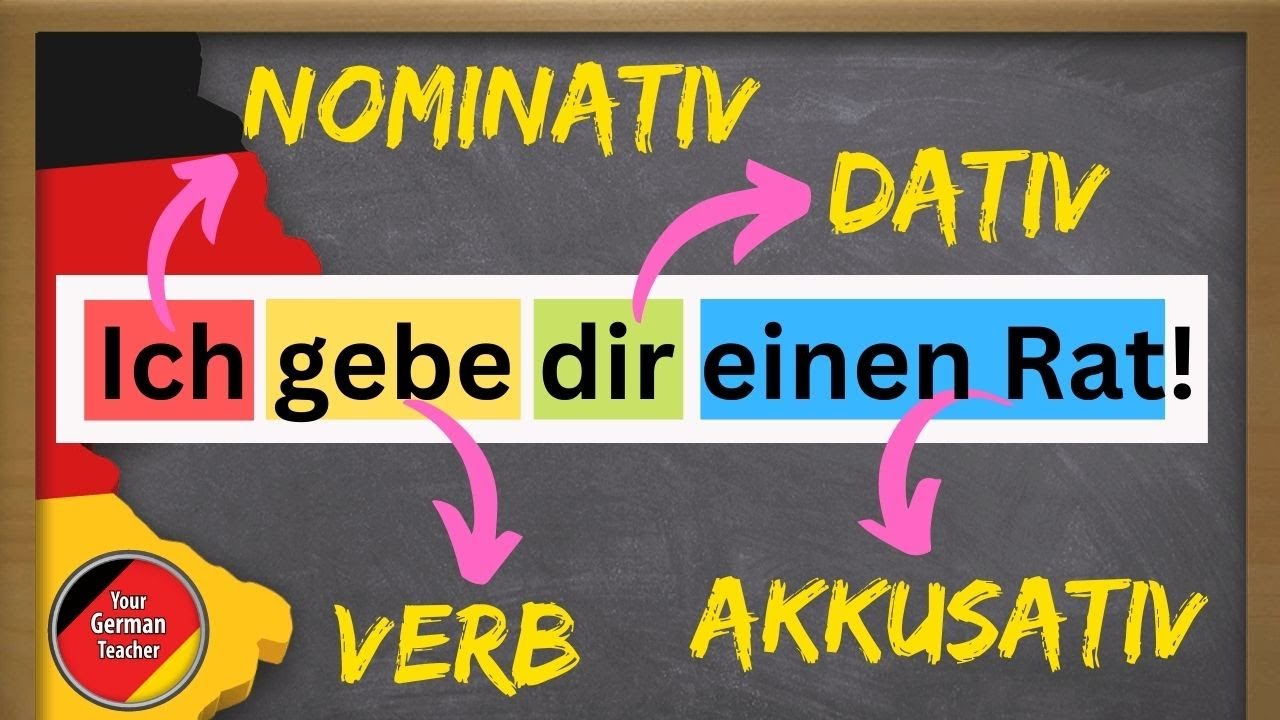
Let's analyze TOGETHER a German text in detail so you can understand the German grammar better.
I will take a day in my life and explain you word by word my diary. What is the subject, the verb and objects AND what CASES you need to use for each and WHY. This is an exercise I use already very successfully for many years with my students and in...
winter kayak
dusk umbra
I know that we have a Nominative case when there's a direct object, Accusative f...
You have a mistake. If we use the 1:1 comparison, the German accusative is comparable to a direct object. And dative is comparable to an indirect object. Genitive objects of verbs are exceedingly rare and more of a C1 topic.
A few verbs take nominative: sein, werden, bleiben
Many verbs take accusative: haben, sehen, essen, usw.
Some verbs take dative: helfen, entgehen, folgen,...
And some verbs take both accusative and dative. These pretty much always involve an object (accusative) and a receiver (dative).
Ich gebe meinem Bruder einen Hund.
The brother receives (dative), the object being given is the dog (accusative)
Ich habe dir ein Brötchen gekauft.
You (indirect object, dative) receive the roll (direct object, accusative).
frigid tinsel
dusk umbra
if it takes both a direct and indirect object doesn't that make it both Nominati...
Nominative is "the subject". Like "I". In English, we have direct objects and indirect objects ("me"), there's a subtle difference but in most cases it doesn't matter.
That's why we have to work with specific (English) sentences (ex: "I gave my brother the dog", taking lolo's example), which sets up a direct object + indirect object situation in English.
dusk umbra
danke schun 
dusk umbra
I wanna learn how to differentiate the cases now in German sentences. My guess is that the first sentence (until the question mark) is genitive because it's used to identify whose the clock is and the second sentence is also Genitive
 glacial crag
dusk umbra
I wanna learn how to differentiate the cases now in German sentences. My guess i...
glacial crag
dusk umbra
I wanna learn how to differentiate the cases now in German sentences. My guess i...
no, this is the nominative case
glacial crag
winter kayak
You have a mistake. If we use the 1:1 comparison, the German accusative is compa...
like lolo said, there's a few verbs that take the nominative, and one of them is sein
Ist > 3rd person singular of the verb sein
so in this field, you'd put die or eine
Ist das (die/eine) Uhr?
Ja, das ist (die/eine) Uhr
dusk umbra
is sein a verb?
dusk umbra
ohhhh
dusk umbra
so sein only takes nominative?
 dusk umbra
like exclusively?
glacial crag
well, the verb has different functions
it's also used to form the past tense (haben also does this in some verbs)
Ich bin gegangen > I have gone
dusk umbra
also the exercise is about possessive pronouns I forgot to mention that my bad
glacial crag
but for now, you don't need to learn this
dusk umbra
 dusk umbra
glacial crag
but for now, you don't need to learn this
dusk umbra
glacial crag
but for now, you don't need to learn this
Okay
dusk umbra
So if it's in nominative then that means hmm..
glacial crag
hint: Uhr is a feminine noun
dusk umbra

So..
According to this table
If Uhr is Feminine , in singular and first person (ich)
then i'm guessing mein?
glacial crag
dusk umbra
refer to this table, the one you sent has some errors
 glacial crag
👏
 glacial crag
dusk umbra
I really appreciate the help
glacial crag
dusk umbra
I really appreciate the help
but,,, you should be careful with where you get your grammar tables from
dusk umbra
I mean on exercise 1
glacial crag
dusk umbra
is the second sentence also in nominative?
yes
dusk umbra
glacial crag
but,,, you should be careful with where you get your grammar tables from
Yup
dusk umbra
glacial crag
yes
so it would be deine?
glacial crag
correct
dusk umbra
Alrightt
First part of the sentence I think is in nominative here, on question 2 because it simply states the subject "_ Auto" which means it would be sein, because it's in singular form and also neuter.

I hope I got it correct 
glacial crag
dusk umbra
First part of the sentence I think is in nominative here, on question 2 because ...
good! Sein Auto is correct
Also, you should do all the work and send it at once :)
dusk umbra
okayyy
frigid tinsel
dusk umbra
so sein only takes nominative?
It does in (older) English. In grade school I was taught "That person is I"
Colloquial / modern English doesn't seem to do this anymore though.
A change that happened within my lifetime....
dusk umbra
damn the fact that I understand the cases pretty well in Greek but stomp when I see them in English or German ooif
 edgy forum
I umm I had a question
Soo do people even use gern geschehen?
I've heard bitte schön alot
Is gern geschehen even used in real life or it's just a textbook stuff?
dusk umbra
So here, I was wondering, isn't the second part of the sentence possessive, therefore in genitive? "My bicycle"?
 winter kayak
dusk umbra
So here, I was wondering, isn't the second part of the sentence possessive, ther...
winter kayak
dusk umbra
So here, I was wondering, isn't the second part of the sentence possessive, ther...
It is actually just a possessive article. The case is still nominative.
Genitive would be like: Die Farbe meines Fahrrades
Or even: Die Farbe des Fahrrades (just to emphasize that genitive doesn't have to do with the article)
dusk umbra
Oh my that's confusing
I think I still haven't grasped how the cases work
but I don't want to give up
glacial crag
dusk umbra
I think I still haven't grasped how the cases work
dw, that's a different type of intuition you develop overtime :)
after getting the very basics of cases down
glacial crag
winter kayak
You have a mistake. If we use the 1:1 comparison, the German accusative is compa...
so pretty much what lolo said
dusk umbra
glacial crag
so pretty much what lolo said
I didn't understand what Lolo meant here
explain nominative
livid steepleBOT
Nominative
The nominative case (der Nominativ) is one of the four cases of the German language. A case affects how a noun or noun phrase is inflected, and indicates the role of the noun or noun phrase in a clause.
How do I decline in the nominative case?
Definite articles: der, die, das
Indefinite articles: ein, eine, ein
Personal pronouns:
ich - I
du - you
er - he
es - it
sie - she/they
wir - we
ihr - you guys
Sie - (formal) you/you guys
For a full explanation, including adjectives, see >explain adjective declension
Page 1/2
winter kayak
dusk umbra
but I don't want to give up
You should start by just understanding nominative and accusative, with simple common verbs. Then dative. Then genitive later on.
livid steepleBOT
Accusative
The accusative case (der Akkusativ) is one of the four cases of the German language. A case affects how a noun or noun phrase is inflected, and indicates the role of the noun or noun phrase in a clause.
How do I decline in the accusative case?
Feminine and neuter nouns and adjectives are the same as nominative. Masculine determiners, adjectives, and weak nouns gain an -en ending::
Ich esse den/einen/keinen kleinen Apfel.
Personal pronouns differ for:
ich --> mich
du --> dich
er --> ihn
wir --> uns
ihr --> euch
For a full explanation see >explain adjective declension
Page 1/2
winter kayak
Unfortunately, in your most recent example, there are several things going on that might make it confusing. First the fact that a possessive article like 'mein' doesn't equate to genitive. Second, the fact that in a comparative clause (the part with the 'wie....Fahrrad'), the case of the noun is determined by the case of what it's being compared to. In this case, you're comparing 'sein Auto' with 'mein Fahrrad.' Sein Auto is the subject of the sentence, and is in nominative. So 'mein Fahrrad' is also in nominative.
dusk umbra
So if I'm comparing two things and one is in nominative then 100% the other is in nominative too?
winter kayak
dusk umbra
So if I'm comparing two things and one is in nominative then 100% the other is i...
Yes, as long as the thing outside of the wie/als clause is in nominative, the thing within it should also be in nominative. Some examples:
Du bist so groß wie ich.
Dein Fahrrad ist nicht halb so schön wie mein Fahrrad.
Meine Tochter wird eines Tages so groß wie ihre Mutter.
dusk umbra
and what does wie/als mean?
scenic obsidian
dusk umbra
So here, I was wondering, isn't the second part of the sentence possessive, ther...
So the case describes what role the noun plays in the sentence
Der Hund beißt den Mann.
The dog bites the man.
Der Hund = subject, it's in nominative
Den Mann = object (of the verb beißen), it's in accusative
We can change what's in front of the noun, without changing the case, because the role of the noun in the sentence hasn't changed.
Therefore:
Mein Hund beißt meinen Mann.
My dog bites my man (or rather, my husband).
It would only be in genitive case if the noun itself had a role requiring genitive
scenic obsidian
For example
Der Hund des Mannes
The dog of the man
Der Hund meines Mannes
The dog of my man (my husband)
scenic obsidian
dusk umbra
Also Den Mann means The man right?
Yes
dusk umbra
scenic obsidian
Yes
Doesn't that make it a subject too?
dusk umbra
What makes it different from "The dog"?
scenic obsidian
The difference is in the German itself
dusk umbra
Ohhhh
dusk umbra
I thought they were two small sentences. Der Hund and Dem Mann
scenic obsidian
Der Hund beißt den Mann.
The dog bites the man.
In English, we rely on word order to know which noun is the subject vs which is the object
In German, the thing before the noun shows this, through cases
So for example, you could write:
Den Mann beißt der Hund.
That also means "The dog bites the man"
nova wedge
Ich trinke mein Getränk.
Is funny to me
scenic obsidian
"der" = nominative = subject
"den" = accusative = object
Even if the word order is switched, it doesn't matter, the definite article shows which one is subject vs. Object
dusk umbra
So in "Das Mädchen spielt mit ihrem Hund" the subject is the girl and the object is the dog? And it's in accusative?
scenic obsidian
The subject is the girl
dusk umbra
scenic obsidian
"der" = nominative = subject
"den" = accusative = object
Even if the word ord...
Okayy
scenic obsidian
"mit" is a preposition
"her dog" is an object, but not an object of the verb, but an object of the preposition, the preposition "mit'
dusk umbra
how do I know if it's an object of the preposition or of the verb?
scenic obsidian
A big hint is if there is a preposition right before the noun 😄
"mit ihrem Hund"
dusk umbra
okay and what happens if it's an object of the preposition rather the verb?
scenic obsidian
Also, technically speaking, it should be "Das Mädchen spielt mit seinem Hund"
Because "Mädchen" is grammatically neuter, and the neuter possessive pronoun is "sein"
Literally: the girl plays with its dog
scenic obsidian
dusk umbra
okay and what happens if it's an object of the preposition rather the verb?
Then the preposition itself controls what case the noun needs
dusk umbra
Ohhhh
scenic obsidian
"mit" Always requires its object of the preposition to be in dative case
Hence
"Mit seinem Hund"
The -em shows dative case
Alright, I gotta go
dusk umbra
Okayy thank you
 serene island
"Als Max bei der anschließenden Party Marie küsst, wendet sich der eifersüchtige Benjamin wutentbrannt von ihm ab. "
Dieser Satz ist unter der Beschreibung des Handlung des Films "Wo am I ? Kein System is sicher." auf Wikipedia gegeben.
folgende Sätz steht dort auch
"Dabei trifft er den charismatischen Max, der sofort auf eine Zusammenarbeit erpicht ist, als er von Benjamins Programmierfähigkeiten erfährt"
Meine Frage lautet warum benutzt man in den beiden Sätzen 'als' im Präsens. Dürfte man hier statt als auch wenn schreiben.
Könnte mir jemand den Grund klären.
hollow umbra
serene island
"Als Max bei der anschließenden Party Marie küsst, wendet sich der eifersüchtige...
"wenn" wäre eher "jedesmal wenn", als ob das öfter passiert
Eigentlich sollte es eher in der Vergangenheit stehen, aber bei solchen Filmbeschreibungen benutzen sie oft den Präsens.
sleek pebble
scenic obsidian
Der Hund beißt den Mann.
The dog bites the man.
good movie
serene island
Darf ich fragen, ob Sie ein Muttersprachler sind? @hollow umbra
hollow umbra
serene island
Darf ich fragen, ob Sie ein Muttersprachler sind? <@848543944232665098>
Ja bin ich, habe eben endlich mal versucht, die Rolle zu bekommen
serene island
Vielen Dank. weil Sie Muttersprachler sind, macht Ihre Erklärung etwas aus. Deswegen habe ich gefragt
nova wedge
Some practice sentences with some new words how do you do?
Kann ich mein Getränk trinken?
Ich trinke mein Getränk.
Ich Möchte ein Getränk.
Ich Möchte eine Nummer eins.
Der Mann hat mein Getränk.
hollow umbra
nova wedge
Some practice sentences with some new words how do you do?
Kann ich mein Getränk...
Du musst "möchte" klein schreiben 😊
"Ich möchte eine Nummer eins", soll das die Nummer des Gerichts auf der Karte sein?
Da sagt man z.B. "einmal die Eins, bitte"
nova wedge
Oh
Yeah, supposed to be like a menu number like if you go to McDonald’s and order the number one combo
hollow umbra
"Eine Vierzehn mit wenig Sieben" 😁 https://youtu.be/ByTG1fexb_s

Hape Kerkeling - Italienisches Restaurant
hollow umbra
nova wedge
Oh
Yeah, supposed to be like a menu number like if you go to McDonald’s and ord...
Here's a whole sketch about this concept
nova wedge
I don’t know enough to understand it
hollow umbra
"Pommes sind die Nummer Null Acht Fünfzehn" https://de.wikipedia.org/wiki/08/15_(Redewendung)
08/15 ([nʊlʔaxtˈfʏnft͡seːn] ; berlinisch nullachtfuffzehn [nʊlʔaxtˈfʊft͡sn̩]) ist eine umgangssprachliche Redewendung, die oft abwertend benutzt wird.
Der Ausdruck ist im deutschsprachigen Raum gebräuchlich und kann wertfrei oder pejorativ (abwertend) gemeint bzw. verstanden werden. Benutzt wird der Ausdruck im Sinne von „ganz gew...
hollow umbra
nova wedge
I don’t know enough to understand it
You can turn on the subtitles, they're not at all bad
frigid tinsel
hollow umbra
Da sagt man z.B. "einmal die Eins, bitte"
Huh. That's how I play-ordered a train ticket in class. Cool to see that it's a fast food thing too.
Einmal nach Berlin, bitte.
For more tickets, is it a separated word btw?
Zweimal nach Berlin? Zwei mal die Eins. ???
Zweiten die Eins?
Assuming ex: I have friends or family with me and I'm ordering more things.
frigid tinsel
Wow, I'm realizing I haven't asked a grammar question in a while. But here's a new one for me....
Gott sei Dank
Wiktionary says it's either Konjunctiv I or Imperitive. So I'm thinking Konjunctiv I.
I realize this is a fixed expression ("Thank God") but I still feel like I want to learn the literal meaning too.
frigid tinsel
I guess my current literal understanding is roughly: "God could be thanked"
astral yoke
frigid tinsel
I guess my current literal understanding is roughly: "God could be thanked"
... rather shall be thanked -> Imperative
frigid tinsel
Oh, huh. Not what I was expecting.
hollow umbra
frigid tinsel
Zweimal nach Berlin? Zwei mal die Eins. ???
Ja, wir hätten dann gerne zweimal das Menü Eins 😁
thin pollen
Is there a difference between sich anziehen and anziehen when talking abt clothes ?
astral yoke
thin pollen
Is there a difference between sich anziehen and anziehen when talking abt clothe...
sure there is:
Ich ziehe mich an. (I put {some/any} clothes on)
Was soll ich anziehen? (what should I wear?)
thin pollen
astral yoke
sure there is:
Ich ziehe mich an. (I put {some/any} clothes on)
Was soll ich anz...
ngl i forgot the actual question i wanted to ask but it was related to ziehen with reflexive/seperable verbs
i dont think it was this one
idk
it had to do with umziehen
sich umziehen
and anziehen
astral yoke
thin pollen
and anziehen
Sich umziehen is changing clothes (from sports to leisure e.g.)
But umziehen (not reflexive) means to move
Maybe it is best if you look up the words you're curious abt in a dictionary
AND best would be a German one with examples -> you still have us to ask if you're not sure abt some meanings.
https://www.dwds.de/wb/umziehen

DWDS
DWDS – Digitales Wörterbuch der deutschen Sprache
thin pollen
astral yoke
Sich umziehen is changing clothes (from sports to leisure e.g.)
But umziehen (no...
Alr ty
frigid tinsel
Wiktionary is easier for us English speakers. However, it's not as comprehensive as dwds.
indigo bear
astral yoke
... rather shall be thanked -> Imperative
@frigid tinselNo it is Konj I.
astral yoke
frigid tinsel
Wiktionary is easier for us English speakers. However, it's not as comprehensive...
The great problem - as I see it - is, wiktionary SEEMS to have only the most important meanings listed.
Therefore you don't get the small details that could help you to get to the ground of nuances 🤷♂️
astral yoke
indigo bear
<@274005614244659210>No it is Konj I.
How do you come to this conclusion? 🤔
indigo bear
astral yoke
How do you come to this conclusion? 🤔


The last image is from https://germanstudiesdepartmenaluser.host.dartmouth.edu/Subjunctive/KonjunktivI.html
astral yoke
indigo bear
Hmm, then I might have misunderstood my late father who 'translated' Gott sei Dank into Gott sei ('/e)s getrommelt und gepfiffen which I identified as Imperative. 🤷♂️
indigo bear
astral yoke
Hmm, then I might have misunderstood my late father who 'translated' Gott sei Da...
The main difference is that imperative doesn't have any 3rd person forms and these sentences are in 3rd person.
astral yoke
indigo bear
The main difference is that imperative doesn't have any 3rd person forms and the...
OKAY, my understanding was the form comes from:
Gott sei es gedankt -> Gott sei Dank 🙇♂️
 winter stream
this is true it's just a conjunctive 1 in both cases
or like. this is not very different from being true
indigo bear
astral yoke
OKAY, my understanding was the form comes from:
Gott sei es gedankt -> Gott sei ...
Isn't that still 3rd person or am I missing something?
winter stream
it's formally identical to the imperative, and crucially both this use of the conjunctive 1 and the imperative express wishes
so its not very different in meaning, but grammatically 'es sei Gott Dank' (=es sei Dank bei Gott, er möge Dank empfangen, es möge Dank für ihn geben) is 3rd person
the lack of 3rd person imperative forms is also why a command to formal Sie is technically in the conjunctive 1
even though i certainly never think about this consciously
Legen Sie das da ab <- conjunctive 1, third person plural. but obviously has a (formal) second person imperative sense
(the actual plural of the imperative would be legt after all)
(and you can tell that it's conjunctive because it doesnt delete the subject pronoun!)
frigid tinsel
astral yoke
The great problem - as I see it - is, wiktionary SEEMS to have only the most imp...
Yeah, I barely can read DWDS, A2ish just isn't enough for it to be understood. But the tidbits I can read are very good for detail. As I get better in German it hopefully becomes a better tool.
astral yoke
frigid tinsel
Yeah, I barely can read DWDS, A2ish just isn't enough for it to be understood. B...
I feel you! When I was first inroduced in a English -English dictionary, I was confused also. But I can tell from experience, you get used to it with every word you look up. 🤯 🤷♂️
 olive flare
So I was reading a book, and it has written:
"Diese Schulaufführungen sind fast immer Musicals, und das Letyte, was ich bruache, ist es, vor der gesamten Schule solo singen zu müssen"
Why is there an "Es" in the "ist es" clause?
astral yoke
olive flare
So I was reading a book, and it has written:
"Diese Schulaufführungen sind fast...
"Es" must be here a piece of music, that has been mentioned before.
olive flare
Ah ok
 drifting glacier
Small question (sorry if this isn't the right place/type of question for here), but when talking about like a pretty sunset, would "schön" the be correct term? or is there a term that fits better/expresses the visual nature of it more?
astral yoke
drifting glacier
Small question (sorry if this isn't the right place/type of question for here), ...
You can use 'schön' here or some other adjectives that fit, like:
atemberaubend (breathtaking)
Wundervoll (wonderfull)
hinreissend (adorable)
golden/in Gold getaucht (golden/golden hued)
überwältigend (overwhelming)
spektakulär (spectacular)
phänomenal (phenomenal)
unbeschreiblich (undescribable)
faszinierend (fascinating)
märchenhaft (fabled)
erhaben (sublime/statly)
ehrfurchtgebietend (sublime)
verzaubernd (enchanting)
überwältigend (stunning)
ehrfurchtgebietend (awestriking)
ethereal (überirdisch)
majestätisch (majestic)
... pick your poison 🤷♂️
I hope that my selection is helpful 🙇♂️
indigo bear
astral yoke
The great problem - as I see it - is, wiktionary SEEMS to have only the most imp...
Wiktionary has a lot of really cool, specific facts about words and word usage though. It's a great resource.
And since the discussion was about usefulness for beginners, it's worth considering that beginners only need the "most important meanings" most of the time.
astral yoke
indigo bear
And since the discussion was about usefulness for beginners, it's worth consider...
You're right! for starters it's the first step(s), but I often see questions like
What's the difference beween
ziehen, umziehen, anziehen...
and then you must dig deeper 🤷♂️
indigo bear
astral yoke
You're right! for starters it's the first step(s), but I often see questions lik...
Hmmmm, but I'm not sure a beginner could even get that info out of something like DWDS. It would be pretty confusing.
astral yoke
indigo bear
Hmmmm, but I'm not sure a beginner could even get that info out of something lik...
That's why I'm trying to get them to look there and after that ask here for clarification, if they need it. I think learning should be out of curiosity - it helps to get a maximum of the attention to a 'new' subject
scenic obsidian
sleek pebble
good movie
Is this a reference to something?
 flint bolt
indigo bear
And since the discussion was about usefulness for beginners, it's worth consider...
flint bolt
indigo bear
And since the discussion was about usefulness for beginners, it's worth consider...
personally i reccomend going from wiktionary (english) to wiktionary(deutsch) then DWDS
DWDS is a bit intimidating imo
its true it is more comprehensive but as a beginner you usually want the most general usage
serene island
"Benjamin gibt sich im Darknet als MRX aus und bekennt sich zu dessen Verrat an Krypton. Der erboste MRX fällt darauf herein und ermöglicht Benjamin so die Rückverfolgung seiner Spur."
Warum benutzt man hier dessen Verrät an Krypton . Ich verstehe diese Struktur nicht.
Ähnlicherweise hat man in den folgenden Satz deren Veranlagung zu benutzt. Könnte mir jemand den Grund dafür erklären (mit anderen Beispiel Sätzen bitte. )
"Lindberg, die nun rehabilitiert ist, erinnert sich inzwischen an einige Ungereimtheiten in Benjamins Erzählung...Vom Psychiater von Benjamins Mutter erfährt sie, dass Benjamin deren Veranlagung zu dissoziativer Identitätsstörung geerbt haben könnte."
sleek pebble
scenic obsidian
Is this a reference to something?

Man Bites Dog (French: C'est arrivé près de chez vous, literally "It Happened Near Your Home") is a 1992 French-language Belgian black comedy crime mockumentary film written, produced and directed by Rémy Belvaux, André Bonzel and Benoît Poelvoorde, who are also the film's co-editor, cinematographer and lead actor respectively.
The film fol...
 valid hedge
guys, this is the answer page of Schreiben Teil 1 & 2 of Goethe B2 official Modelsatz.
Can someone tell me why in teil 2, it's: "weil ich ein Problem mit meinen Kollegin habe"

shouldn't it be meiner Kollegin? or is there something I don't know yet?
and then in the next sentence the Kollegin is referred to using 'Er', are these obvious typos? I didn't excpect this from an official goethe modeltest
 oblique snow
It's an example of what level of writing is expected of you and contains errors in basically every sentence
valid hedge
oblique snow
It's an example of what level of writing is expected of you and contains errors ...
can i atleast pass if i write something similar to this?
sleek pebble
it’s not an example for good german
what you’re looking at are examples for teachers to grade and assess L2 speakers’ german level
so don’t study this
it contains many mistakes
valid hedge
sleek pebble
it’s not an example for good german
I don't mean exactly this, but something similar
Can I pass the exam?
sleek pebble
i don’t know, you would have to ask an examiner that
serene island
"Benjamin gibt sich im Darknet als MRX aus und bekennt sich zu dessen Verrat an Krypton. Der erboste MRX fällt darauf herein und ermöglicht Benjamin so die Rückverfolgung seiner Spur."
Warum benutzt man hier dessen Verrät an Krypton . Ich verstehe diese Struktur nicht.
Ähnlicherweise hat man in den folgenden Satz deren Veranlagung zu benutzt. Könnte mir jemand den Grund dafür erklären (mit anderen Beispiel Sätzen bitte. )
"Lindberg, die nun rehabilitiert ist, erinnert sich inzwischen an einige Ungereimtheiten in Benjamins Erzählung...Vom Psychiater von Benjamins Mutter erfährt sie, dass Benjamin deren Veranlagung zu dissoziativer Identitätsstörung geerbt haben könnte."
sleek pebble
it’s the declension of a relative pronoun
https://en.wiktionary.org/wiki/der#German (scroll down a bit)

genitive
so „dessen Verrat“ in that sentence means „MRX’ Verrat,“ it refers back to it
think of it like „its“ in english — „the company and its eagerness to turn a profit“
serene island
Ok thanks for replying 🙏 @sleek pebble
 pastel merlin
The verbs that take both Akkusativ and Dativ don't need to be learned as their usage is obvious with the direct and indirect object concept. Am I right?
Secondly, please correct my explanation:
There are 3 kinds of verbs:
-
Verbs mit nur Akkusativ - Here we have only 2 persons/things, the subject is nominativ and object is akkusativ.
-
Verbs mit nur Dativ - Here we also have only 2 persons/things. The subject is nominativ and object is dativ and these verbs are about 50 in total german and must be learned by heart.
-
Verben mit Dativ und Akkusativ - Here we have direct/indirect object and the case is clear according to that. No need to learn by heart.

 ember marsh
too much info for a card?
 ember marsh
I think I gotta split it up, at least for the sich version
 idle sable
would make sense, yes
empty vale
ember marsh
too much info for a card?
Yes you should do the bare minimum but then also supplement it with reading and regular immersion to develop your own sense of meaning
Just relying on definitions solely violates a lot of how actual people speak, or simply said the language arts
Stfu
<@&305455824174710787>
indigo bear
empty vale
Stfu
Don't make comments like that please.
dusk umbra
Is the sentence “He kissed his wife” nominative and accusative?
indigo bear
dusk umbra
Is the sentence “He kissed his wife” nominative and accusative?
Yes, if you write the sentence in German, then "he" will be nominative and "his wife" will be accusative.
dusk umbra
Perfect okay
indigo bear
Of course in English it's not, because English doesn't use those cases.
dusk umbra
Im trynna understand it in English first and then German
dusk umbra
indigo bear
Of course in English it's not, because English doesn't use those cases.
Yep
indigo bear
dusk umbra
Im trynna understand it in English first and then German
I recommend the first 2 worksheets on this page: https://www.nthuleen.com/teach/grammar.html
Grammar worksheets for teaching German - Arbeitsblätter zum Thema Grammatik für den Deutschunterricht.
dusk umbra
And also in the sentence “He loves the color of his car” is it in Nominative (He) and then Genitive (his car) if translated in German?
 hexed forge
Besprenge dein Gesicht mit kaltem Wasser
Does this make snese? I want to say "splash your face with cold water"
I don't know if this is idiomatic
indigo bear
dusk umbra
And also in the sentence “He loves the color of his car” is it in Nominative (H...
Yes.
he -> nom
the color -> akk
his car -> genitive
dusk umbra
Danke!
hexed forge
hexed forge
Besprenge dein Gesicht mit kaltem Wasser
This is a deepl translation. But dictionary says besprengen means sprinkle not splash
dusk umbra
“My bag is full of your candies”
My - Nominative
your candies - Accusative
So that makes it:
“Mein Tosche ist von vull deine Süßigkeiten”?
I’m trying to get the hang of it until I can do some exercises
pastel merlin
pastel merlin
The verbs that take both Akkusativ and Dativ don't need to be learned as their u...
@indigo bear
indigo bear
pastel merlin
The verbs that take both Akkusativ and Dativ don't need to be learned as their u...
Yes that's correct.
There are some other categories though.
pastel merlin
indigo bear
There are some other categories though.
Is this fine for A2 level? And please link me to those other categories
indigo bear
pastel merlin
Is this fine for A2 level? And please link me to those other categories
Other categories:
Copular verbs (e.g. sein, they take nominative only)
Genitive verbs (verbs with only a genitive object)
Lehren has 2 accusative objects
Beginners need the first one of those, but they don't need genitive verbs.
pastel merlin
indigo bear
Other categories:
Copular verbs (e.g. sein, they take nominative only)
Genitive ...
Can you please explain with an example about how lehren takes 2 akkusativ objects? and is this an exception?
indigo bear
pastel merlin
Can you please explain with an example about how lehren takes 2 akkusativ object...
Meine Großmutter lehrte mich das Stricken.
Yes, it's an exception.
There are only a few double accusative verbs.
pastel merlin
ok, right
also I have another query that with liegen, which is the correct auxialiary for the perfekt. In the yourgermanteacher compiled list, I see it is sein but when deepL translates that same sentence, it uses haben.

 indigo bear
pastel merlin
also I have another query that with liegen, which is the correct auxialiary for ...
indigo bear
pastel merlin
also I have another query that with liegen, which is the correct auxialiary for ...
From Wiktionary: "The most common auxiliary with liegen is haben: Ich habe gelegen. In northern and central Germany, this form is strongly predominant and in some regions exclusive. In southern Germany, Austria, and Switzerland, sein is usual in the vernacular and also, alternatively, in standard usage: Ich bin gelegen."
pastel merlin
so let me just stick with haben then
sleek pebble
indigo bear
From Wiktionary: "The most common auxiliary with liegen is haben: Ich habe geleg...
note: this does not hold true for liegen in the sense of being situated somewhere when describing whereabouts
„Das Hotel ist südlich gelegen“
„Vor dem Wiederaufbau war das Postamt weiter nördlich gelegen.“
but i think there might be a nuance with more theoretical concepts like administrative units (cities, countries) and geographical descriptions, not very sure though, i will think about this later
dusk umbra
dusk umbra
“My bag is full of your candies”
My - Nominative
your candies - Accusative
So t...
. whenever somebody can plz!
thin pollen
dusk umbra
. whenever somebody can plz!
not sure of the preposition but if it's von, then i think it should be:
Meine Tasche ist voll von deinen Süßigkeiten
thin pollen
dusk umbra
But isn’t bag masculine?
No it's feminine. It's die Tasche
dusk umbra
ohhh
thin pollen
dusk umbra
and candies in plural?
Yeah
 thin pollen
dusk umbra
isn’t it Deine Akkusativ Plural?
thin pollen
dusk umbra
isn’t it Deine Akkusativ Plural?
No the preposition von follows the Dativ case here
dusk umbra
Ohhhh
dusk umbra
How do I know it follows dative?
thin pollen
dusk umbra
How do I know it follows dative?
You have to learn the cases of the prepositions
The prepositions are either akkusativ only, dativ only or both
dusk umbra
Yeahh that’s what I’m currently learning right now but how do I know if they’re in akkusativ only dativ only or both?
thin pollen
dusk umbra
Yeahh that’s what I’m currently learning right now but how do I know if they’re ...
the one way prepositions are fixed they always follow the dativ/akkusativ but the two way prepositions depend on how they're used
prepositions
dusk umbra
two way are two prepositions in a row right?
thin pollen
help prepositions
livid steepleBOT
No command or module called prepositions found.
livid steepleBOT
FAQ not found. I found the following similar entries: Prepositions of Place Part 1, Dual prepositions, Two-way prepositions, Verb prepositions, Two way prepositions, Verbs with prepositions.
livid steepleBOT
Two-way prepositions
Two-way prepositions (or dual prepositions) are prepositions that govern the accusative or dative case. Ten prepositions have this property, namely:
an     auf      entlang    hinter    in
neben  über     unter      vor       zwischen
Generally, these prepositions are used with the accusative if they express a direction or change of position. They are used with the dative if they express location.
For example, the verb etw. an etw. hängen can be used to express both meanings depending on the intention:
Ich hänge das Bild an die Wand. (I am hanging the picture on the wall.)
Das Bild hängt an der Wand. (The picture is hanging on the wall.)
Expressing direction vs. location
It is important to note that the accusative should only be used if something has moved from one position to another. If movement has been indicated, but the location has not changed, then the dative should be used. For example,
Der Hund läuft in den Park. (The dog ran (from somewhere) into the park.)
Der Hund läuft im Park (herum). (The dog is running in the park.)
The dative is usually used with verbs of arriving, appearing and disappearing
Even though these verbs indicate direction, they are still used with dative rather than accusative.
Sie kamen am Bahnhof an.
Sie landeten auf dem Mond.
Das Pferd verschwand hinter dem Berg.
thin pollen
@dusk umbra
 magic minnow
whats the difference between gehen and kommen?
thin pollen
gehen means to go/walk
kommen means to come
 opal robin
Hallo, I'm learning some german basics, and I wanted to know how a german would pronunciate some sentences... For example I have this text below I want to say:
Guten abend, es tut mir leid. Wo bin ich? Wie komme ich nach Gernsbach? Ich bin verloren. Konnen sie mir helfen?
How would a native speaker ask these questions? Not the words itself, but the question mark intonation in a sentence
thin pollen
magic minnow
easy to tell in translations but they can kind of be synonymous in sentences
not really they're kinda opposite directions
opal robin
I already watched some videos but they speak so fast that I can't understand how I could imitate using that sample text 😅
winter kayak
opal robin
Hallo, I'm learning some german basics, and I wanted to know how a german would ...
genau so wie im Englischen
astral yoke
opal robin
Hallo, I'm learning some german basics, and I wanted to know how a german would ...
First I would rephrase the sentences, I guess they are literally translated from english and that does not work well in all cases:
Guten Abend, entschuldigen Sie bitte. Wo bin ich? Ich habe mich verirrt. Wie komme ich nach Gernsbach? Können Sie mir helfen?
opal robin
I can understand that probably is the same in English, but my main problem is for longer sentences I can't put the intonation because I lost many time trying to pronounce every word correctly that when I end up and the end of the sentence it just becomes weird to put the question intonation
I think it's just a lack of practice, but I was just wondering if you have any tips
opal robin
astral yoke
First I would rephrase the sentences, I guess they are literally translated from...
Oh yeah, indeed, my bad! Danke
winter kayak
opal robin
I can understand that probably is the same in English, but my main problem is fo...
yes, I know what you mean. You're stumbling so much and it's very choppy, so it doesn't really "flow" naturally like a question. I wouldn't worry about it all too much. Just keep trying to practice, and eventually it will get less choppy and you'll naturally imitate what you hear.
opal robin
I forget many of the words are upper case
opal robin
winter kayak
yes, I know what you mean. You're stumbling so much and it's very choppy, so it ...
Yeah exactly! It's a hard language to learn from beginning and I'm probably trying to jump faster than I can afford at this rate
I appreciate your help
astral yoke
opal robin
Oh yeah, indeed, my bad! Danke
No problem, it was my pleasure ☺️
winter kayak
opal robin
Yeah exactly! It's a hard language to learn from beginning and I'm probably tryi...
maybe you already saw this, but I think it has some great examples (with english subtitles) of natives asking questions

GET EXERCISES FOR THIS VIDEO: https://www.easygerman.org/membership
LEARN GERMAN WITH OUR APP: https://www.seedlang.com
OUR WEEKLY PODCAST: http://www.easygerman.fm
SUBSCRIBE TO EASY GERMAN: https://goo.gl/sdP9nz
FACEBOOK: https://www.facebook.com/easygermanvideos
INSTAGRAM: https://www.instagram.com/easygermanvideos
WEBSITE: https://www.easyger...
astral yoke
opal robin
I forget many of the words are upper case
All nouns are capitalized and if you're used to it, it makes reading faster 😉
opal robin
winter kayak
maybe you already saw this, but I think it has some great examples (with english...
Yeah, I like that channel, it helps a lot! I will watch it again, thanks
opal robin
astral yoke
All nouns are capitalized and if you're used to it, it makes reading faster 😉
Yeah, the problem is that I need to get more vocabulary in order to say that the word X in german means a noun or not 😅
I have to practice more
astral yoke
opal robin
Yeah, the problem is that I need to get more vocabulary in order to say that the...
Maybe just compare it for that issue with English, a noun is a noun like in German.
astral yoke
opal robin
Yeah, the problem is that I need to get more vocabulary in order to say that the...
Oh, and while you learn new words, remember to memorize also the gender of each noun (der/die/das -> male/female/neuter)
opal robin
Yeah that's funny too, some words in English have a male gender while in german it is female, and vice versa
astral yoke
opal robin
Yeah that's funny too, some words in English have a male gender while in german ...
Yeah, big 'machines' like ships for example are female in English while das Schiff is neuter.
indigo bear
dusk umbra
Yeahh that’s what I’m currently learning right now but how do I know if they’re ...
Orange ones are two-way prepositions. Two-way means they can be either dative or accusative depending on which meaning you're using.
 nova wedge
Bitte! - Is “ you’re welcome”?
Bitte. - Is “please”?
Bitte? - “what that?”
Is that correct?
astral yoke
nova wedge
Bitte! - Is “ you’re welcome”?
Bitte. - Is “please”?
Bitte? - “what that?”
Is th...
partial, it always depends on the context and you can for example do the following:
Gib mir die Milch, bitte! -> give me the milk, please!
 digital needle
nova wedge
Bitte! - Is “ you’re welcome”?
Bitte. - Is “please”?
Bitte? - “what that?”
Is th...
digital needle
nova wedge
Bitte! - Is “ you’re welcome”?
Bitte. - Is “please”?
Bitte? - “what that?”
Is th...
in what situation would "bitte" mean "thank you"? Do you mean "you're welcome"?
digital needle
and just to be sure, with the third one you specifically mean "What's that?" as in "Could you repeat that?", yes?
dusk umbra
indigo bear
Orange ones are two-way prepositions. Two-way means they can be either dative or...
So if we have a sentence with the red ones then it's exclusively in Accusative and if we have one sentence with the yellow ones then it's exclusively in Dative?
 scenic isle
Ich habe den Deutschen begrüßt, und er hat mir statt „Hallo“ etwas wie „Lusty“ gesagt, was bedeutet das, ist das auch eine Begrüßung?
winter kayak
scenic isle
Ich habe den Deutschen begrüßt, und er hat mir statt „Hallo“ etwas wie „Lusty“ g...
kann es sein, das er 'grüß dich'/'grüß Sie' oder 'grüezi' gesagt hat?
scenic isle
winter kayak
kann es sein, das er 'grüß dich'/'grüß Sie' oder 'grüezi' gesagt hat?
Grüß dich wahrscheinlich, weil es eher klingt
Danke!
 rough grail
Wann benutzt man "verwenden" und "benutzen"? Was ist der Unterschied zwischen?
indigo bear
dusk umbra
So if we have a sentence with the red ones then it's exclusively in Accusative a...
Yes but it's not for the whole sentence. Cases only apply to individual nouns and pronouns. Every noun/pronoun has its own case, depending on if it's the subject or which type of object it is.
winter kayak
rough grail
Wann benutzt man "verwenden" und "benutzen"? Was ist der Unterschied zwischen?
Verwenden und benutzen sind sehr ähnlich. An deiner Stelle würde ich mir keinen großen Kopf darüber machen 😉 verwenden ist vielleicht ein bisschen technischer.
dusk umbra
indigo bear
Yes but it's not for the whole sentence. Cases only apply to individual nouns an...
Correct but if we happen to have a dative or accusative preposition right before a noun then we don't have to worry about finding if it's a direct object, indirect object, etc, right?
indigo bear
dusk umbra
Correct but if we happen to have a dative or accusative preposition right before...
Yes, objects of prepositions cannot be direct or indirect objects. They are just objects of prepositions. They're their own category.
dusk umbra
Okay so if I see for example bis before a noun then it's 100% in Akkusativ?
rough grail
winter kayak
Verwenden und benutzen sind sehr ähnlich. An deiner Stelle würde ich mir keinen ...
Im Französischen gibt es 3 Möglichkeiten, dieses Verb zu verwenden 
indigo bear
dusk umbra
Okay so if I see for example bis before a noun then it's 100% in Akkusativ?
Yep, as long as it's being used as a preposition.
dusk umbra
indigo bear
Yep, as long as it's being used as a preposition.
And one last thing, if it's the orange ones in the diagram you sent me then I have to decide whether or not the noun moved from one place to another or remained in one place. For instance, "Die Kinder laufen in den Garten" is accusative because the children ran into the garden from another place and "Die Kinder laufen im Garten" is dative because the children, despite their running remained in the garden and weren't coming from another area.
indigo bear
dusk umbra
And one last thing, if it's the orange ones in the diagram you sent me then I ha...
Die Kinder, das Kind.
But yeah, you got the idea of two-way prepositions.
Although what you described is just for real physical things. There's also abstract usages which you have to memorise as set phrases. But that's an advanced topic you can learn later once you're used to all the rest.
 cloud badge
Hallo, I have been trying to learn German (A1) on my own and I am following Deutsche Welle Nicos Weg for it, Is it good or you guys can suggest some other precious free resources?
indigo bear
cloud badge
Hallo, I have been trying to learn German (A1) on my own and I am following Deut...
faq resources
livid steepleBOT
Resources
Here's a link to our curated list of resources: https://bit.ly/gladresources. Check out #resources if you want to submit some yourself!
indigo bear
faq beginner
livid steepleBOT
How to get started
The simplest way to learn German is to find topics you don’t understand yet and search for explanations of them. This list provides you with a guide for which topics to learn if you are completely new to German. Type the topic into Google (or YouTube) and start learning!
Introduction
1: Alphabet (especially ä, ü, ö and ß)
2: Basic greetings (hello, goodbye, etc.)
Part 1 - Simple Sentence
1: Noun gender & plurals
2: Nominative case (What are cases?)
3: Nominative pronouns (I, you, he, she, etc.)
4: Verbs in present tense
5: Definite/indefinite articles
6: Accusative case (for nouns)
7: Accusative pronouns
8: Word order of simple sentences
9: How to ask questions
See Part 2 on the next page.
Tips
- Always learn the gender of a noun when you learn a new noun
- Learn to use a translation dictionary (e.g. dict.cc, leo.org)
- Use
>faq resourcesto see our list of German learning resources - For listening and pronunciation practice, try watching movies or videos (incl. YouTube)
- You can listen to pronunciation for words on websites like dict.cc, forvo.com, and others
- Practice writing sentences every day (and asking people to correct them)
- Ask as many questions as possible
- Don’t be scared to make mistakes!!!! If you don’t let yourself make mistakes, you will never be able to learn German
Page 1/2
dusk umbra
indigo bear
Although what you described is just for real physical things. There's also abstr...
What do you mean by "real physical things"?
frigid tinsel
dusk umbra
What do you mean by "real physical things"?
Its pretty easy to learn the real-world uses of prepositions in German. Auf vs an (both translating to "on" in English) actually is "on top" vs "hangs on", for example.
The really hard thing about German is remembering that its "sprechen auf Deutsch" (ie: Speak "on" German), not "Speak with German" like in English. Or helfen bei Putzen (Help "by" cleaning, but it "actually means" help with cleaning).
English vs German has mixed up the prepositions on many "abstract" ideas (help, speaking, etc. etc.).
The solution to this is that by A2, B1 or so... you just start memorizing verb + preposition combinations (like "bei etwas helfen"). But at absolute beginner stages, just try to focus on the basic and most easiest uses of prepositions.
dusk umbra
alrightt
jovial remnant
what is the difference between nachschauen and anschauen?
I suggested a place to someone but they didn't realize it's an actual place you can visit. This is the context and I don't know which one fits better
schau mal [auf Google Maps] Berlin Story Bunker nach
schau dir [auf Google Maps] berlin story bunker an
or would you phrase it differently?
astral yoke
jovial remnant
what is the difference between nachschauen and anschauen?
I suggested a place t...
imho only anschauen works here, nachschauen is rather to look whether sth is there or to gain some information like from a manual
and if it's text to read then you can use nachlesen
 tidal sandal
Ich habe eine Hund
 frank quiver
can I find a company to learn germany in here?
jovial remnant
frank quiver
can I find a company to learn germany in here?
have a look at # find-study-partners
 barren panther
Hallo
 lucid torrent
is all groups are locked or just i don't have permission to join
hollow umbra
jovial remnant
what is the difference between nachschauen and anschauen?
I suggested a place t...
I slightly disagree with @astral yoke, "nachschauen" is "look up", so if you just want to look up in Google Maps where that thing is, you can use nachschauen. "Anschauen" is look at something, so if you look at photos and reviews, this fits better
astral yoke
🤷♂️
astral yoke
hollow umbra
I slightly disagree with <@511612952940642354>, "nachschauen" is "look up", so i...
DWDS
DWDS – Digitales Wörterbuch der deutschen Sprache
nova wedge
For Wassermelone
Can you just say Melone to mean the same thing like you can in English?
astral yoke
nova wedge
For Wassermelone
Can you just say Melone to mean the same thing like you can in ...
You can but there is a big variety of Melons out there
Honigmelone, Galiamelone, Wassermelone, Netzmelone... and a hat
 astral yoke
🤷♂️
nova wedge
If I had the watermelon in my hand, I said my Melone it would be recognizable right?
flint solstice
in the context of you holding a watermelon saying meine melone
astral yoke
nova wedge
If I had the watermelon in my hand, I said my Melone it would be recognizable ri...
Sure, if you don't have the hat on at the same time 😜
nova wedge
X3
flint solstice
or if youre a woman you shouldnt say the plural version
meine melonen
there could be misunderstandings
😭
nova wedge
Die Melone ist süß.
 urban ingot
Hi, if someone could check out my question forum on how to get into TU Munich that'd be amazing. It's a bit of a read but I just want confirmation if I'm doing things right. I'm an American student, a highschool Sophomore (10th grade), and I'm going to be studying German intensely for the next year and a half, but I need to know what milestones to hit once I'm more fluent.
nova wedge
nova wedge
Die Melone ist süß.
Now the question is the watermelon sweet or is the hat cute
lol
flint solstice
die melone cant be the hat
because of the article die
no wait
i might be trippin actually
astral yoke
flint solstice
because of the article die
the hat is called die Melone
flint solstice
yea i noticed aswell
never heard anyone call that thing melone 💀
der melonen hut would be a better match
astral yoke
 astral yoke
Es gibt sogar einen Wikipedia-Eintrag, 1849 erfunden...
nova wedge
Now this makes me think. What will you call a watermelon hat like a hat that looks like a watermelon
 latent mulch
Das ist das erste Mal, dass ich das sehe
why does dass work here?
should it be "in dem ich das sehe"
astral yoke
latent mulch
should it be "in dem ich das sehe"
not really ^^ 🤷♂️
 pine quest
nova wedge
Now this makes me think. What will you call a watermelon hat like a hat that loo...
pine quest
nova wedge
Now this makes me think. What will you call a watermelon hat like a hat that loo...
Wassermelonenmelone oder so
 tight relic
pine quest
Wassermelonenmelone oder so
tight relic
pine quest
Wassermelonenmelone oder so
ja, Wassermelonen-Melone
tight relic
latent mulch
Das ist das erste Mal, dass ich das sehe
why does dass work here?
dass introduces the clause that specifies the action, dass starts a subordinate clause, verb goes to end
basically sounds more natural to use dass
indigo bear
dusk umbra
What do you mean by "real physical things"?
I mean like locations, like a garden. An abstract example would be like "auf jdn warten".
Ich warte auf dich. = I'm waiting for you.
 stoic sphinx
Hello , can you enable my account ?
hollow umbra
latent mulch
Das ist das erste Mal, dass ich das sehe
why does dass work here?
You could also say simpler: "Das sehe ich zum ersten Mal"
frigid tinsel
latent mulch
should it be "in dem ich das sehe"
Have you studied subordinate clauses yet? The "dass" clause here is a subordinate clause, but there's many many ways of making those.
frigid tinsel
hollow umbra
You could also say simpler: "Das sehe ich zum ersten Mal"
I wonder if the study material is trying to introduce subordinate clauses here...
latent mulch
frigid tinsel
Have you studied subordinate clauses yet? The "dass" clause here is a subordinat...
i do know what they are
astral yoke
 pearl horizon
rein bedeutet in?
pearl horizon
rein bedeutet in?
hinein or herein depending on your point of view
 vast flax
Was sind die großte unterschied zwischen Schweizer Deutsch und Deutsche Deutsch?
 gaunt vale
vast flax
Was sind die großte unterschied zwischen Schweizer Deutsch und Deutsche Deutsch?
gaunt vale
vast flax
Was sind die großte unterschied zwischen Schweizer Deutsch und Deutsche Deutsch?
Schweiß Deutsch?
vast flax
gaunt vale
Schweiß Deutsch?
ja, ich meine ich weiß dass die Schweiße mit ein akzent spricht aber ich wollte wissen was andere unterschiede gibt
weil zu beispiel die leute von bayern haben seinem eigenes wörterbuch für das bayerisches Deutsch
gaunt vale
Schweizer Deutsch meinst du ehr
vast flax
ahhh
gaunt vale
Wegen Schweiz das Land
vast flax
gaunt vale
Schweizer Deutsch meinst du ehr
Mein Fehler, danke für das korrektion
gaunt vale
Schweiß ist das was dein Körper produziert
gaunt vale
das Wasser zum abkühlen das dein Körper bei der Körpertemperatur bleibt
gaunt vale
vast flax
ahhhh von schwitzen
genau
vast flax
jetzt "Schweiß Deutsch" hört sich lüstig aus
gaunt vale
das ist das was passiert und schweiß ist das wasser
empty vale
vast flax
Was sind die großte unterschied zwischen Schweizer Deutsch und Deutsche Deutsch?
Die Aussprachen vor allem
Man versteht sich nicht
silent plover
Do the endings go onto nouns or only on the articles
Ein, dein, ect
empty vale
Übrigens lautet es Schweizerdeutsch
empty vale
silent plover
Do the endings go onto nouns or only on the articles
Ein, dein, ect
Wdym endings
silent plover
Feminine masculine and plural
empty vale
That doesn‘t really explain much
Do you mean indicators for plural
Der Mann die Männer
Die Frau die Frauen
Das Mädchen die Mädchen
silent plover
Cause they have endings for articles
Einem, einer, deine
But does that carry over to nouns?
Everything I look up or see on German sites don't really explain this
empty vale
Wdym carry over
scenic obsidian
silent plover
Do the endings go onto nouns or only on the articles
Ein, dein, ect
It's mostly on the thing before the noun:
Definite article
der Hund
die Katze
Possessive pronoun
mein Hund
meine Katze
Indefinite article
ein Hund
eine Katze
But sometimes, the noun itself changes
empty vale
Do you mean something like „mit einem Mannem“
scenic obsidian
empty vale
Do you mean something like „mit einem Mannem“
Mit den kleinen Männern
silent plover
Like
If I say
Kind
Would I also add an ending to it too
Kinde, kinder, ect
(Eine kinde)
Or
(Eine kind)
scenic obsidian
silent plover
Like
If I say
Kind
Would I also add an ending to it too
Kinde, kinder, ect
(Ei...
Generally, no.
But sometimes, yes
des Mannes
empty vale
Also it‘s das Kind
empty vale
scenic obsidian
Generally, no.
But sometimes, yes
That‘s genitive though
empty vale
He‘s a beginner I don‘t think he knows what genitive is
I‘m just saying for him not for you
silent plover
It's possession 😭
empty vale
Yes but there are rules for it
scenic obsidian
silent plover
It's possession 😭
No, not necessarily
scenic obsidian
@silent plover here, this should help:
Adjective declension is one of the most complicated things in German. Sometimes they are declined (there are three types of declensions) and other times not. But don’t worry; we will explain it so that you can understand easily
empty vale
scenic obsidian
Mit den kleinen Männer*n*
Wie kommst du drauf
?
Hab da gar nix mit kleinen Männern gesagt
scenic obsidian
empty vale
Wie kommst du drauf
Das Nomen selbst wird vom Kasus/Geschlecht bzw Plural beeinflusst. Die Frage war, "wird das Nomen je geändert bzw. kriegt das Nomen je eine Endung wegen Kasus/Geschlecht?"
Die Antwort ist, "meistens, nein, doch gelegentlich schon"
Das ist ein Beispiel dafür
silent plover
I might as well start from scratch though and see where I go from there since my German Is twisted in a way where I would have to relearn everything I had learned T T
empty vale
Unless that‘s another word that I am not knowing of
scenic obsidian
silent plover
I might as well start from scratch though and see where I go from there since my...
Did you check the charts on that website?
It shows you exactly how things change or don't change for the noun itself
empty vale
silent plover
I might as well start from scratch though and see where I go from there since my...
Read a grammar book
I can give some recommendations
scenic obsidian
empty vale
Unless that‘s another word that I am not knowing of
"that I am not knowing of" feels like a weird usage of continuous
Just say, "that I don't know of"
empty vale
Lol I know
I just came back from 4 hours of titration 😭😭😭🙏
I’m so tired, I can’t even speak English properly haha
scenic obsidian
Who did you titrate? 😄
scenic obsidian
For some industrial process?
empty vale
Nooo for a uni course
silent plover
scenic obsidian
Did you check the charts on that website?
I am
Declensions is definitely a new one for me
Or maybe it isn't and it's just the first time I'm seeing it called that
It looks familiar but the way it's explained makes it seem like something I have never seen before
empty vale
@silent plover if you’re genuinely serious about learning the language, I would highly recommend learning the grammar properly through a course or a grammar book. Especially because the pedagogical values are already applied for someone to properly learn the language.
scenic obsidian
silent plover
I am
Declensions is definitely a new one for me
Or maybe it isn't and it's just ...
Declension IS "endings on stuff that changes based on the gender of the noun/the case of the noun (i.e. nominative, accusative, dative, genitive)"
empty vale
It seems like you’ve been learning it for a bit but things are slipping out
scenic obsidian
You said it's your 3rd year; how have you learnt so far? In a class or course?
empty vale
scenic obsidian
Declension IS "endings on stuff that changes based on the gender of the noun/the...
Also declension can be on certain nouns, depending on the case
Ich sehe den kleinen Jungen
scenic obsidian
empty vale
<@669074783941558272> if you’re genuinely serious about learning the language, I...
What does "the pedagogical values are already applied" mean?
empty vale
Ich gebe dem großen Jungen ein Geschenk
silent plover
empty vale
It seems like you’ve been learning it for a bit but things are slipping out
It's embarrassing how things actually do slip out because half the stuff I don't know
I wrote it in my notes at least 5 times
While learning it in class and should know
But I forgot it
scenic obsidian
empty vale
Also declension can be on certain nouns, depending on the case
Yeah, that's what I was saying earlier
empty vale
scenic obsidian
What does "the pedagogical values are already applied" mean?
Well the books I’ve read pedagogists have properly designed the book to fit for a learner
Explanations, exercises, etc all contribute to the pedagogy
empty vale
silent plover
It's embarrassing how things actually do slip out because half the stuff I don't...
It takes practice, structure, and dedication
scenic obsidian
I don't think I know what the word "pedagogy" really means
Despite being a native English speaker
empty vale
I mean I don’t know the word super well either, it’s just the way you learn simply said
silent plover
And I'm like starting to seriously lock in and learn it and now while I'm understanding the language more
Along with the cases
There's so much I still have to relearn so I can actually commit to memory
empty vale
Like education sort of
scenic obsidian
silent plover
And I'm like starting to *seriously* lock in and learn it and now while I'm unde...
YouTube
In this playlist you can find all information about one of the most important German grammar topics: German cases! The first one you learn when starting lear...


Try this channel
empty vale
silent plover
And I'm like starting to *seriously* lock in and learn it and now while I'm unde...
I mean I think if you have a book or something like a course to rely on then it can be nice to look back on
silent plover
I have about 55 pages worth of German notes thats all words, grammar, sentences, endings and genders
frigid tinsel
Hmmmm, the false beginner problem. The bane of all language learners.
silent plover
scenic obsidian
https://youtube.com/playlist?list=PLKCEuz6wxDQk_EIj2hea3GbXiBdXfd3MW&si=_Ye7KUwd...
Oh yes!
Actually this could answer the question because
While of course we got the nominative "he"
Accusative "him"
Dative (reciever, like giving it to her and her would be the dative pronoun)
And genitive would be his
This question will probably be answered when I watch these
Okay I just remembered yeah there is more to just pronouns for cases
frigid tinsel
@silent plover have you heard of Grammatik aktiv?
empty vale
silent plover
Oh yes!
Actually this could answer the question because
While of course we got...
That’s one way of seeing it but do realize that’s not the only way of seeing cases with verbs
frigid tinsel
85 lessons, from A1 through the end of B1. If you do a lesson per day, you can cover the whole of the beginner levels in just a few months.