#archived-code-general
1 messages · Page 249 of 1
 astral relic
 quartz folio
Yes
astral relic
i actually tried that. but its so bad like that, because the translation would be affected by the scale.
astral relic
quartz folio
Yes
unlikely
quartz folio
Well, the translation shouldn't be affected by the rotation
astral relic
yes.
im not sure. maybe unity does it in a different way or sth ?
i actually tried all the possible combinations. none acted right.
            //_localMatrix = translationMatrix * scaleMatrix * rotationMatrix;
            //_localMatrix = translationMatrix * rotationMatrix * scaleMatrix;
            //_localMatrix = scaleMatrix * translationMatrix * rotationMatrix;
            //_localMatrix = scaleMatrix * rotationMatrix * translationMatrix;
            //_localMatrix = rotationMatrix * translationMatrix * scaleMatrix;
            //_localMatrix = rotationMatrix * scaleMatrix * translationMatrix;
 fervent furnace
you are right, should be (T*R*S)*P
quartz folio
Yeah, should be. The problem is in that code though, Unity does what makes sense
Actually pretty sure it should be T * (R * S)
mul(translationTransform, mul(rotationTransform, scaleTransform)).
astral relic
let me think and see
 nimble cairn
    bool CanShootCheck() {
        bool check = Physics.Raycast(camera.ViewportPointToRay(new(0.5f, 0.5f, 0)), out RaycastHit hit, 2.5f, groundMask);

        if (hit.transform && hit.transform.CompareTag("Sphere")) {

            if (hit.transform.GetComponent<Rigidbody>()) return check;
            else return !check;

        } else return !check;
    }
Do you guys think you could help me optimize this function?
quartz folio
Is there a performance issue with it...?
nimble cairn
No, it just feels a little sloppy
I'd like to see what I maybe could of done different 🙂
astral relic
quartz folio
Actually pretty sure it should be T * (R * S)
not rly.
quartz folio
I suppose the Unity mathematics package is just wrong then https://docs.unity3d.com/Packages/com.unity.mathematics@1.2/api/Unity.Mathematics.float4x4.TRS.html
fervent furnace
if the hit.transfrom not null then check must be true?
 gray mural
nimble cairn
```C#
bool CanShootCheck() {
bool check = Physics.Raycast(camera.Vie...
gray mural
nimble cairn
```C#
bool CanShootCheck() {
bool check = Physics.Raycast(camera.Vie...
it may throw a NullReferenceException
 latent latch
nimble cairn
```C#
bool CanShootCheck() {
bool check = Physics.Raycast(camera.Vie...
latent latch
nimble cairn
```C#
bool CanShootCheck() {
bool check = Physics.Raycast(camera.Vie...
you can fallout of the statement and still return !check but otherwise nothing really to optimize here and I wouldnt worry about it
astral relic
quartz folio
I suppose the Unity mathematics package is just wrong then https://docs.unity3d....
maybe. but then unity's classic TRS returns the "right" or rather the "intuitive" position ? im a bit confused
nimble cairn
@gray mural How so? Are you referring to if (hit.transform)?
gray mural
nimble cairn
<@1025482839954821222> How so? Are you referring to ``if (hit.transform)``?
yes
nimble cairn
@latent latch Could you please provide an example?
nimble cairn
gray mural
yes
Already checked for this, no problems here!
latent latch
you return !check twice but you only need to do that once
gray mural
nimble cairn
Already checked for this, no problems here!
you can get !hit, can't you?
nimble cairn
@latent latch I have to do that because not all paths return
quartz folio
astral relic
maybe. but then unity's classic TRS returns the "right" or rather the "intuitive...
That's what I've been saying. Unity's output makes sense
I haven't looked into your numerics TRS logic, but it doesn't make sense that the position you get out of TRS would be anything other that what you put in
 somber nacelle
nimble cairn
```C#
bool CanShootCheck() {
bool check = Physics.Raycast(camera.Vie...
somber nacelle
nimble cairn
```C#
bool CanShootCheck() {
bool check = Physics.Raycast(camera.Vie...
you want to return true if nothing is hit?
gray mural
nimble cairn
```C#
bool CanShootCheck() {
bool check = Physics.Raycast(camera.Vie...
if hit is null, then hit.transform throws an exception. With if (check) you make sure it doesn't happen
somber nacelle
gray mural
if `hit` is `null`, then `hit.transform` throws an exception. With `if (check)` ...
hit cannot be null, it is a struct
nimble cairn
gray mural
if `hit` is `null`, then `hit.transform` throws an exception. With `if (check)` ...
Don't worry, this does not occur 🙂
fervent furnace
if(check){
  return hit.transform && hit.transform.CompareTag("Sphere")&&hit.transform.GetComponent<Rigidbody>();
}else{
  return true;
}
I see, you're right
nimble cairn
@fervent furnace Let's try this out!
fervent furnace
oh, i am wrong
nimble cairn
😮
fervent furnace
let me think about it
if hit.transform !=null then check is true, that means if transform.comparetage is falas it returns !true=false
if they are true then return true if there is rigidbody, !true if no
so transform&&tag&&rb should be correct, if trsnsform is null that means check is false, return !false=true
quartz folio
Checking hit.transform is redundant if you've checked check
If it hit something, it has a transform
fervent furnace
you are right, remove the hit.transform
fervent furnace
return !check||hit.transform.CompareTag("Sphere")&&hit.rigidbody;
```one lineAlso didn't hit have a rigid body field?
fervent furnace
yes
nimble cairn
fervent furnace
```cs
return !check||hit.transform.CompareTag("Sphere")&&hit.rigidbody;
```one l...
I was just writing this xD
Thanks!
Awesome, this is great!
 swift falcon
Hello! Im trying to set a variable of an instantiated gameObject, but unfortunately I keep getting this error. Can anyone help me a little?


 knotty sun
It might help if you included lines numbers. also !code
 tawny elkBOT

Posting code
📃 Large Code Blocks
Use links to services like:
https://gdl.space/, https://paste.ofcode.org/, https://hatebin.com/, https://paste.myst.rs/, https://hastebin.com/
📃 Inline Code
Surround code with three backquotes. Not quotation marks.
To format as C#, add cs to the first line:
```cs
// Your code here
```
Add a comment with a line number if there is an error message.
fervent furnace
not code general
is line 22 answer.text=text?
swift falcon
updated

 knotty sun
so answer is null
fervent furnace
have you set it in inspector?
swift falcon
i thought so
swift falcon
fervent furnace
have you set it in inspector?
line 35, second script
knotty sun
that sets a local varaible
fervent furnace
dont just think, check it
second script is irrelevant
swift falcon
should I make it public?
knotty sun
how do you declare answer in the first script
swift falcon
knotty sun
how do you declare answer in the first script
check first line in there
knotty sun
so how do you expect it to contain a value?
fervent furnace
so did you make the variable reference an actual TMP_Text object (component)?
swift falcon
fervent furnace
so did you make the variable reference an actual TMP_Text object (component)?
i forgot to set it in inspector, since its a prefab, should I use GameObject.find?
fervent furnace
is the text on the prefab or some gameobject on world eg canvas
swift falcon
fervent furnace
is the text on the prefab or some gameobject on world eg canvas
on prefab
an I like used a canvas on the prefab in order to add the text is that okay?!
knotty sun
you might be better using dependency injection.
Can the second script which does the Instantaite get a reference to the first script?
swift falcon
knotty sun
you might be better using dependency injection.
Can the second script which does...
whats that
fervent furnace
he says the text on the prefab so he can just drag the component and drop it to the field
swift falcon
fervent furnace
he says the text on the prefab so he can just drag the component and drop it to ...
so theres no need for a canvas
knotty sun
but he want a reference to the instantiated object not the prefab
swift falcon
how can I have a text without a canvas, or is that evenm possible?
knotty sun
@swift falcon Dependency Injection
...
Script1 needs a reference to answer
Script2 instantiates answer
Gets a reference to Script1
script1.answer = answer
Yes, TMP has a non canvas Text version
swift falcon
knotty sun
Yes, TMP has a non canvas Text version
teach me
knotty sun
 knotty sun
should still work
swift falcon
knotty sun
<@456226577798135808> Dependency Injection
...
Script1 needs a reference to answ...
doesnt work, also script 1 is ran on the instantiated object and I want to modify the text being its child object
 delicate rampart
No active UnityEngine.XR.ARSubsystems.XRCameraSubsystem is available.
Anyone knows how to correct this error?
knotty sun
swift falcon
doesnt work, also script 1 is ran on the instantiated object and I want to modif...
then you can just set it in the inspector of the prefab. you should have mentioned this important fact earlier
swift falcon
knotty sun
then you can just set it in the inspector of the prefab. you should have mention...
yea, but even with the text set, it wont work
its an issue with the txt string
since I looked at an instantiated object, it had the answer value set
knotty sun
so the null ref has now gone?
knotty sun
then it has nothing to do with the text string
show the inspector of the script
this is not a code problem, it is a setup problem
swift falcon
Spawns the answer https://paste.ofcode.org/W6DKufUYJvSenjTYcTWfTZ
Runs on every answer https://paste.ofcode.org/fYUXriVyBqq8CghEvVu25G
swift falcon
knotty sun
show the inspector of the script
alright one sec
in the second script from above, its value is set
 knotty sun
and answer has not been set
swift falcon
swift falcon
in the second script from above, its value is set
*I meant answer here
knotty sun
you need to set variables here
 swift falcon
they are set at the beginning of start()
 knotty sun
which is obviously not working, set answer in the inspector and not in code
swift falcon
knotty sun
which is obviously not working, set answer in the inspector and not in code
it worked, but why???
why not in code?
fervent furnace
you get NRE => your code not work
knotty sun
obviously something wrong with your logic of where the component is
fervent furnace
run doesnt mean work
knotty sun
btw hardcoding like that is very bad practice and often prone to break as you have found
 delicate flicker
I have a problem. I throw Raycasthit2D.hit.point at some part of the gameobject (a platform for example) and apply it to Springjoint2D.connectedAnchor. This is how i implement a grappling hook. But problem is, when this platform is moving, my player stays on the same position and i need to move it with the platform. Transform.position of this platform is not a solution, because it is the position exactly on the center of the platform, whereas i was attached on the corner of the platform, for example. How can i update connectedAnchor accordingly with the movement of the platform?
 trim rivet
anyone know how to edit post process volume settings at runtime?
can't seem to find good info on this online
 cold egret
- How can i change the float value type to int? I'm not looking for casting, that'd mess up the bits order within the float. I need to preserve the bits sequence while changing their type to int
- The only solution i can think of rn is a struct with explicit memory layout. Any other solution?
 late lion
cold egret
\- The only solution i can think of rn is a struct with explicit memory layout. ...
late lion
cold egret
\- The only solution i can think of rn is a struct with explicit memory layout. ...
You can use System.Runtime.CompilerServices.Unsafe.As or Unity.Collections.LoweLevel.Unsafe.UnsafeUtility.As to reinterpret cast:
float f = 0.55122f;
int i = Unsafe.As<float, int>(ref f);
 wise ermine
Hey everyone, I have a git question.
I added the first .gitignore file I found on Google but now when I run git status I see the following weird files/directories:
ProjectSettings/EditorBuildSettings.assetAdaptive Performance/Adaptive Performance.meta
Are .meta files and the rest of the listed ones necessary to be tracked in git?
 rigid island
.meta files are very important
 narrow nebula
    public List<BuffTarget> buffTarget;
    public List<int> buffAmp;```
any way to "combine" variables so I wont have to fiddle with 3 different lists?impossible if you cant cast one to other or using object everywhere
fervent furnace
cold egret
\- How can i change the float value type to int? I'm not looking for casting, th...
btw i remember this way should work, let me check
float x=???;
int y=*((int*)&x);
 rancid jolt
The animation is running but after completion it is not coming back to the idle state. The normalizedTime condition looks right?

 late lion
narrow nebula
``` public List<BuffManager.Buffs> buff;
public List<BuffTarget> buffTarg...
late lion
narrow nebula
``` public List<BuffManager.Buffs> buff;
public List<BuffTarget> buffTarg...
Unless I'm misunderstanding the question, you can use a tuple or a struct that contains each variable:
public List<(BuffManager.Buffs buffs, BuffTarget target, int amp)> buffs;
or
public struct BuffInfo
{
    public BuffManager.Buffs buffs;
    public BuffTarget target;
    public int amp;
}
...
public List<BuffInfo> buffs;
you can warp like this but you need additional check
unless he want to group the value together
wise ermine
rigid island
.meta files are very important
What about Adaptive Performance?
late lion
wise ermine
What about `Adaptive Performance`?
It's probably a folder where settings related to Adaptive Performance will be stored, which you want to track.
 limber raft
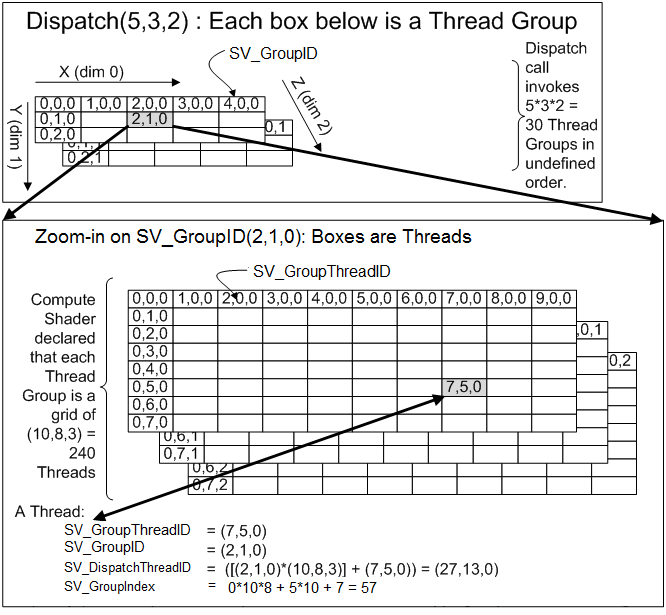
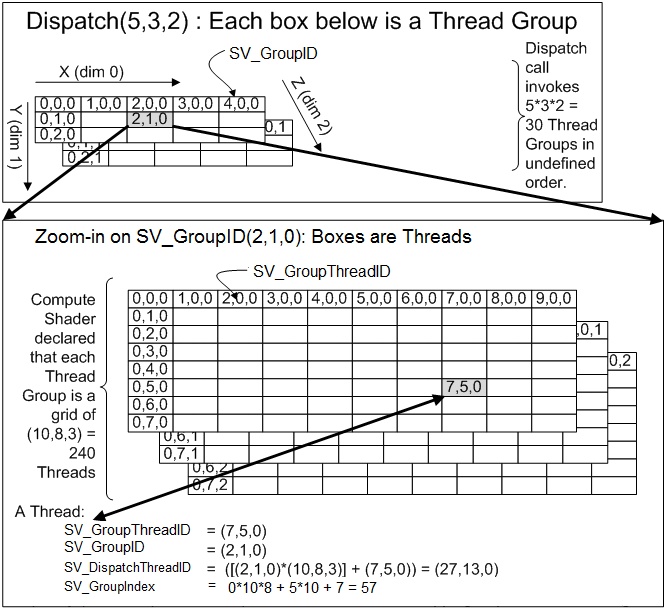
I'm trying to learn compute shaders, but I can't figure out how to calculate the range that SV_DispatchThreadID will give. The Microsoft docs give a formula, but trying it in Wolfram Alpha doesn't work. I'm probably using the wrong operations, so does anyone know the right ones?
 leaden ice
limber raft
I'm trying to learn compute shaders, but I can't figure out how to calculate the...
leaden ice
limber raft
I'm trying to learn compute shaders, but I can't figure out how to calculate the...
Isn't it just based on the xyz dimensions you pass in here? https://docs.unity3d.com/ScriptReference/ComputeShader.Dispatch.html
 limber raft
leaden ice
Isn't it just based on the xyz dimensions you pass in here? https://docs.unity3d...
limber raft
leaden ice
Isn't it just based on the xyz dimensions you pass in here? https://docs.unity3d...
According to the Microsoft hlsl docs:
SV_DispatchThreadID is the sum of SV_GroupID * numthreads and GroupThreadID
leaden ice
Right so it's basically the (x,y,z) from your kernel itself scaled by the xyz you pass into dispatch?
It's been a while since I used compute shaders
cold egret
fervent furnace
btw i remember this way should work, let me check
```cs
float x=???;
int y=*((in...
- Iirc unsafe context won't compile in unity?
limber raft
leaden ice
Right so it's basically the (x,y,z) from your kernel itself scaled by the xyz yo...
I think so. I get where the numbers are coming from, but this picture from the microsoft docs disagrees with the result from wolfram alpha
 fervent furnace
Unity.Collections.LoweLevel.Unsafe.UnsafeUtility, full of pointer stuff
latent latch
sounds pretty unsafe
knotty sun
fervent furnace
Unity.Collections.LoweLevel.Unsafe.UnsafeUtility, full of pointer stuff
basically C programming
limber raft
leaden ice
Right so it's basically the (x,y,z) from your kernel itself scaled by the xyz yo...
I think I figured out that it's just supposed to be the Hadamard product

In mathematics, the Hadamard product (also known as the element-wise product, entrywise product: ch. 5 or Schur product) is a binary operation that takes in two matrices of the same dimensions and returns a matrix of the multiplied corresponding elements. This operation can be thought as a "naive matrix multiplication" and is different from the...
leaden ice
limber raft
I think I figured out that it's just supposed to be the [Hadamard product](https...
Right which is what I meant by scale
limber raft
oh that makes more sense
leaden ice
 hard viper
As far as assemblies go, is there a simple way for me to make one asmdef that is then equivalent to what I currently have in my project, which is C#-assembly default assembly?
my plan is: 1) make my own giant equivalent C# assembly, 2) slowly break it up into smaller assemblies where each assembly I add keeps everything working properly
leaden ice
hard viper
As far as assemblies go, is there a simple way for me to make one asmdef that is...
If you put an asmdef at the root folder of where all your scripts are you'll get this
hard viper
i tried, but DOTween is not happy with this because it has its own .dll
i think I’ll give it another shot tho
so... all my scripts are in subfolders of Assets. Therefore, if I put an asmdef in Assets directly, everything should still work?
leaden ice
Yeah I'd just move all your own scripts into a folder not mixed with any packages or assets
DOTween will need an asmdef too though
hard viper
step 1 is to make a giant assembly where everything is working. Then slowly split everything up in a way this is non-stupid
leaden ice
And you'll need to reference it
 stone rock
Hello, are there any peformance differences between Physics.Linecast and Physics.Raycast?
If the length is specified they would be practically equal right?
rigid island
stone rock
Hello, are there any peformance differences between Physics.Linecast and Physics...
probably the last thing you should be worrying about tbh
stone rock
yeah, just wondering if there are differences
 bright token
Im trying to connect a mysql database to my unity game, so I imported the connector mysql.data.dll file and the system.data.dll file but I get the error message:
 stone rock
they do the same thing in the end only the parameters are a little different
latent latch
what's the difference
rigid island
stone rock
they do the same thing in the end only the parameters are a little different
yeah they just do different things
latent latch
seems like linecast just returns a bool?
knotty sun
bright token
Im trying to connect a mysql database to my unity game, so I imported the connec...
which version of MySql.data ? Version 3.5 is the best version for unity projects
 simple egret
I'd say they can be used interchangeably, it depends on what data you have as input.
Raycast takes in a start point, direction, and distance
Linecast takes in a start point and an end point
latent latch
so performance probably doesn't matter if you use nonalloc
bright token
knotty sun
which version of MySql.data ? Version 3.5 is the best version for unity projects
my connector shows NET 8.2.0
latent latch
oh, wait there is a overload method with a rayhit
knotty sun
bright token
my connector shows NET 8.2.0
no way that is gonna work
knotty sun
yes, if you cant find it, DM me and I'll send you a copy

 bright token
knotty sun
which is .Net Framework 3.5
bright token
knotty sun
which is .Net Framework 3.5
about that, my unity only shows 2.1 and Net framework
i dont have 4.x or 3.5
hard viper
I put an asmdef in the root Assets folder, but now none of my scripts can see anything in Packages, and it doesn't look like unity lets me add an asmdef to it. Is there a way to make the packages a dependency?
or do I just need to manually add every single package in my project as a dependency of a given package asmdef or something?
rigid island
bright token
about that, my unity only shows 2.1 and Net framework
.net standard includes 3.5 or 4.x
.net standard is not the same as .NET
leaden ice
hard viper
I put an asmdef in the root Assets folder, but now none of my scripts can see an...
you have to manually add every package you want to use
hard viper
ok. that sucks, but at least I have a plan.
delicate flicker
How to get position of some part of the gameobject? transform.position return the center of this gameobject and i can throw raycast to some part that not the center and i need to return this as local position on this gameobject
hard viper
you need to have some way to reference it
rigid island
delicate flicker
How to get position of some part of the gameobject? transform.position return th...
which part of it you want?
hard viper
like using the bounds of a collider, or a separate child gameobject, or a fixed offset vector saved for that gameobject
collider bounds is kind of shit, so I will frequently go by the dimensions and offset of the collider
eg: transform.position + boxCollider.offset + boxCollider.size….
or whatever
delicate flicker
@rigid island for example, i throw raycast that hit this gameobject (a platform object, to be precise), return .point as Vector2. I hit closely to the corner of this platform. I send this to Springjoint2D.connectedAnchor. This is how a grappling hook works. BUT when the platform moves, my player stays on that point which i hit previously on the world space and not with the platform.
hard viper
it sounds like you need a conversion between local and world space
delicate flicker
I can bind it to transform.position, so when it moves it updates to it, but is it the center of this platform, and i need to update position exactly on that part i hit on the platform
hard viper
ok there’s a lot to unpack here
if you have a springjoint2D, then it should be linked to a rigidbody
rigid island
delicate flicker
<@968604165150507078> for example, i throw raycast that hit this gameobject (a p...
create the offset and when you move make sure you move the point with platform
hard viper
it sounds like you just want the springjoint2D to be offset to target a specific point relative to rigidbody position
delicate flicker
Recently the mechanic doesn't rely on the rigidbody and connectedBody property. I need to update connectedAnchor
delicate flicker
hard viper
the platform has a kinematic rigidbody2D?
Dynamic, it moves
And has velocity update
hard viper
is connectedanchorpoint in local space or world space? I’m not too familiar since i’ve had to scrap joints before
if you need to recompute the point every frame, you just need to use a transform method to convert
delicate flicker
hard viper
is connectedanchorpoint in local space or world space? I’m not too familiar sinc...
World
hard viper
that is bizarre, since I feel like that defeats the purpose of a joint2d
but either way:
platformTransform.InverseTransformPoint(pointYouHitInWorldSpace) gives you the local space point of where you hit. and you would save this as the grappling hook’s offset
hard viper
platformTransform.TransformPoint(localPoint) gives the world pos
hard viper
delicate flicker
It launches my player into cosmos
then the connected anchor point does not sound like world space
delicate flicker
It is, raycasthit2d.point returns exactly this
hard viper
the whole point of a Joint2D is to apply constraints that affect DURING physics simulation. It would be nonsensical if you had to specify the joint to target a spot in worldspace
hard viper
delicate flicker
It is, raycasthit2d.point returns exactly this
yes, but we’re talking about the joint’s connectedAnchor point
raycast will always give world space, because physics queries always exist in world space
the joint should only care about relative space
delicate flicker
Ok i see now, connectedAnchor is local
hard viper
Joint2D don’t have business dealing in world space
i just didn’t know how the field output it
either way, you need to take your hit position (world pos of grappling hook), and convert to local space of platform with platformTransform.InverseTransformPoint
this gives the point in local space of grappling hook, which is also the offset for the spot we need to connect
delicate flicker
I checked, it says that connectedanchor is world pos when no rigidbody connected
And my springjoint doesnt connect to rigidbody
hard viper
that makes no sense
delicate flicker
I get confusion
hard viper
because you said it breaks when your platform moves
but why are you moving your platform if it lacks a rigidbody
delicate flicker
Yes, but it doesn't apply as connectedBody
hard viper
i don’t see what the problem is
if you move the platform, it needs a rigidbody.
if you want to joint your dynamic rb to a kinematic rb, the joint needs to know both RBs as targets
then when both move during physics sim, simulate will apply a constraint between the two RBs to apply force between them, as it tries to satisfy all the conditions of your system (eg position, velocity, time, force, mass, collisions….)z
does this make sense?
 tacit swan
is there something equivalent to quaternion.identity for a 90 degree rotation or 180 degree rotation?
hard viper
tacit swan
is there something equivalent to quaternion.identity for a 90 degree rotation or...
90 degree rotation doesn’t make sense in 3D. Do you mean 2D?
tacit swan
oh yea
hard viper
either way, I think there is Quaternion.Euler
tacit swan
im just using Quaternion.Euler(0,0,90) rn
tacit swan
ah
 heady iris
You could make a static class with some preset values, I guess
hard viper
quaternions can multiply btw
tacit swan
also does Vector2.down depend on the rotation of the gameobject or does it always just point down relative to the world space?
hard viper
transform.rotation *= Quaternion.Euler(0,0,90f);
tacit swan
ah is there a way to get the direction that the gameobject is facing?
hard viper
transform.up, transform.left…
heady iris
transform.TransformDirection(Vector3.down)
-transform.up
These are equivalent.
tacit swan
hard viper
transform.up, transform.left…
ty
delicate flicker
hard viper
does this make sense?
Absolutely makes. But as i said, my mechanics of the grappling hook only relies on connectedAnchor, i doesn't apply to connectedBody, i never connect to any rigidbody EVEN though these platforms have rigidbody and moves. Because i attach my hook to raycasthit2D.point which is world position. I don't want to rewrite this mechanic, and that's why i ask how to update position to connectedAnchor relatively to the moving platform
heady iris
annoyingly, there is no transform.left or .down or .back
tacit swan
rip
hard viper
delicate flicker
Absolutely makes. But as i said, my mechanics of the grappling hook only relies ...
use an if statement lmao
tacit swan
heady iris
annoyingly, there is no `transform.left` or `.down` or `.back`
so do u just need to rotate the transform manually then?
like do transform.up and then rotate based on what u want?
hard viper
if (attaching to moving platform) set rigidbody and calculate local position;
else connect to world pos
you do not want to connect two rigidbodies together, by shittily just tracking behind some position.
delicate flicker
Ok, i'll try
heady iris
tacit swan
so do u just need to rotate the transform manually then?
i don't know what you're aksing
tacit swan
for example if i wanted to get transform.right
heady iris
if you want to get the direction you're facing, just do transform.right or transform.forward or whatever is the "facing direction"
hard viper
i can guarantee that what you were asking for (recalculating world pos every frame without jointing the RBs) will lead to jank
tacit swan
sorry i misunderstood
 raven basalt
I have a ramp that uses the Floor physics materrial. No matter what I adjust the static friction to, the player either slides off the ramp if the static friction is too high, or the player starts moving backward when I try to make it go forward if the static friction is too low.
 heady iris
if the dynamic friction is zero, that means that moving objects will be frictionless
note how you've set Friction Combine to "Minimum"
so no matter what the friction is on the other object, you're getting 0 dynamic friction at all
(assuming that one's physic material is set to Average)
raven basalt
But if the dynamic friciton is anything greater than 0, when I try to make the player go forward, the player instead goes backward because of the friction
hard viper
unity friction is ass. i basically always set it to zero
but this also means having to set gravity to zero on slopes/grounded
 crystal creek
does anyone know what causes all the materials in my asset bundle to be loaded invisible while using universal render pipeline? and is there a way i can load it or build it differently possibly to not have this issue?
 raven basalt
hard viper
unity friction is ass. i basically always set it to zero
raven basalt
hard viper
unity friction is ass. i basically always set it to zero
Are these the values that you set for the rigidbody of a floor?
 crystal creek
why does your floor have a rigidbody if its static?
raven basalt
Tbh I forgot the original reason as to why I put it there. Should I remove it?
raven basalt
Do these values look good for the physics material?
 raven basalt
I want to apply it for a ramp that the player can walk on. No matter what I adjust the static friction to, the player either slides off the ramp if the static friction is too high, or the player starts moving backward when I try to make it go forward if the static friction is too low.
And same goes for the dynamic friction
crystal creek
it might be better to apply the physics material to the player itself then
and keep all other ones as is
you can adjust/swap out the physics materials based on the players moving state too then
raven basalt
I currently have a player physics material applied to the player
 crystal creek
just use that, reset the other one
and set the friction on both settings for the player to 0
raven basalt
But now the player slides off the ramp
crystal creek
raven basalt
But now the player slides off the ramp
so, replace the physics material on the player so that when they arent moving, the friction is increased to 1
raven basalt
so the player's physics material is going to change depending on if it is moving or not?
crystal creek
raven basalt
so the player's physics material is going to change depending on if it is moving...
yeah
raven basalt
Should I do it based on input, like if the player is currently holding down the key that causes the player to move, the player's phyiscs material switches, or should I detect if the player's rigidbody is currently moving, and then switch physics materials based on that?
 onyx oriole
hard viper
raven basalt
Are these the values that you set for the rigidbody of a floor?
onyx oriole
hard viper
raven basalt
Are these the values that you set for the rigidbody of a floor?
i use rigidbody2D
very different
onyx oriole
I have a controller for the cube to rotate for example 90 degrees right if im moving right , 90 degrees forward if im moving forward, and an animation separately to give it a jump animation but it doesnt seem to work
it just goes lower and lower into the platform
latent latch
should just post the code
onyx oriole
{
isMoving = true;
playerAnimator.speed = 1*(1 / moveDuration); // Synchronizes the speed of the animation to match the speed at wich the player moves
playerAnimator.SetTrigger("Jump"); // Adds the jump animation (y from 0 to 1 and back to 0)
Vector3 initial_pos = player.position;
Vector3 target_pos = player.position + direction;
Quaternion initial_rot = Quaternion.Euler(player.eulerAngles);
Quaternion target_rot = Quaternion.Euler(new Vector3(direction.z*90, 0, -direction.x*90));
float duration = moveDuration;
float elapsed_time = 0f;
while(elapsed_time < duration)
{
player.position = Vector3.Lerp(initial_pos, target_pos, elapsed_time / duration);
player.rotation = Quaternion.Lerp(initial_rot, target_rot, elapsed_time / duration);
elapsed_time += Time.deltaTime;
yield return null;
}
player.position = target_pos;
player.rotation = Quaternion.Euler(Vector3.zero);
isMoving = false;
}``` round violet
is there a way to debug and "see"/know what is modifying my player position
i checked all scripts, rigidbodies and colliders, and my player is moving down in a moment were it shouldn't, i cant find what is "making it going down"
latent latch
onyx oriole
without any of the rotation, it seems like your animation keyframe starts in the middle and ends lower than the first
onyx oriole

starts at 0

ends at y 0
in the middle its y:1
i removed rotation it still goes down
let me see if i just do the animation no movement
Oh i think i found it
latent latch
if you look at the blend tree it starts at the middle
but the next iterations start at the beginning
(also the fact it never completes a full animation cycle) oh, Im looking at the wrong block, half asleep here
 onyx oriole
Oh i think i found it
onyx oriole
onyx oriole
Oh i think i found it
i thought it had to do with the direction i passed in the coroutine but it is normalized so it wasnt that
 latent latch
yeah im not too sure, but the animation is from 0 to 1, but your first iteration goes for 0.8 to -0.2
what makes it confusing is you're doing some positional logic in the animator but some in code
so perhaps there's some confliction on the timing/positional values between the two
what I'd do is trigger the jump, await the clip, then proceed with the rotation and movement to the next spot
or perhaps just make them both animation clips
 kindred cairn
Hey guys, how are you? Can anyone help me with a question, or advise me on my project: I'm creating an EnemyIA that will use A* pathfinding to find the target, so far so good. My problem is how can I do it for large maps, as it would take a long time to return the calculation and this could cause slowness. The idea I had was to create several grids, each representing a region of the map, so I wanted to find a tutorial that could shed some light on this and also here on the discord channel.
fervent furnace
it is called hierarchical search
almost all methods for reducing run time of graph algorithm is to reduce number of vertices and edge
kindred cairn
Hierarchical search, does it have another name? Because I'll try to find out on YouTube or Google.
heady iris
It sounds familiar to me, but I'm not sure what to call it
It's almost like LODs for your navmesh
one big low-fidelity graph for long-range calculations
kindred cairn
I found it, but it's not about create a map and divide it in grids, i'm looking for the name of this process
heady iris
and then another high-fidelity graph for navigating up close
 rotund niche
https://www.youtube.com/watch?v=hKGzSYXPQwY&t=84s&ab_channel=SasquatchBStudios im using this video to learn to use unity at 2:08 is a script and when i copy it in unity it says its wrong why

Unity Asset Store BLACK FRIDAY Sale - EVERYTHING on this page is 70% off:
https://assetstore.unity.com/?flashdeals=true&aid=1100lwgBQ
Join our Discord Community! - https://discord.com/invite/aHjTSBz3jH
Show your Support & Get Exclusive Benefits on Patreon (Including Access to this project's Source Files + Code) - https://www.patreon.com/sasquat...
heady iris
that is extremely vague

 heady iris
the second screenshot has quite a bit of code that isn't in the first one..
rotund niche
heady iris
the second screenshot has quite a bit of code that isn't in the first one..
what is the codeee?
thats missing
heady iris
heady iris
the second screenshot has quite a bit of code that isn't in the first one..
and line 28 is half-finished in your second screenshot. that's not a complete expression
heady iris
rotund niche
what is the codeee?
are you unable to compare the two scripts yourself?

 kindred cairn
heady iris
It's almost like LODs for your navmesh
kindred cairn
heady iris
It's almost like LODs for your navmesh
Ok, thank you, if you know more about, just call me
rotund niche
@heady iris look at both my codes whats wrong with them?
i used chatgpt and it said the code has nothing wrong with it
heady iris
rotund niche
you changed your script in between sending this image and the new image. line 28 now looks okay
however, it also looks like !ide is not configured. please follow the instructions in the bot message below:
tawny elkBOT
💡 IDE Configuration
If your IDE is not autocompleting code
or underlining errors, please configure it.
Select one:
• Visual Studio (Installed via Unity Hub)
• Visual Studio (Installed manually)
• VS Code
• JetBrains Rider
• Other/None
rotund niche
heady iris
you changed your script in between sending this image and the new image. line 28...
no i just didnt send full screenshot
heady iris
actually...i'm bad with colors
rotund niche
damm
using System.Collections;
using System.Collections.Generic;
using UnityEngine;
using UnityEngine.InputSystem;
public class FlyBehavior : MonoBehaviour
{
[SerializeField] private float _velocity = 1.5f;
[SerializeField] private float _rotationSpeed = 10f;
private Rigidbody2D _rb;

private void Start()
{
    _rb = GetComponent<Rigidbody2D>();
}

private void Update()
{
    if (Mouse.current.leftButton.wasPressedThisFrame)
    {
        _rb.velocity = Vector2.up * _velocity;
    }
}

private void FixedUpdate()
{
     transform.rotation = Quaternion.Euler(0, 0, _rb.velocity.y * _rotationSpeed);
}
}
this the code
heady iris
Which of these is your code? I don't know which one is yours and which one is from the tutorial.
i think that answers my question, haha

 heady iris
rotund niche
heady iris
rotund niche
Your code editor is not configured properly. You should be getting auto-complete when typing, and errors should be highlighted with red squiggles.

 rotund niche
heady iris
Your code editor is not configured properly. You should be getting auto-complete...
rotund niche
heady iris
Your code editor is not configured properly. You should be getting auto-complete...
why is that not happening? and how to fix?
heady iris
my IDE is on the right. notice how i've got colors


 spring creek
rotund niche
spring creek
rotund niche
!code
tawny elkBOT
Posting code
📃 Large Code Blocks
Use links to services like:
https://gdl.space/, https://paste.ofcode.org/, https://hatebin.com/, https://paste.myst.rs/, https://hastebin.com/
📃 Inline Code
Surround code with three backquotes. Not quotation marks.
To format as C#, add cs to the first line:
```cs
// Your code here
```
Add a comment with a line number if there is an error message.
spring creek
Oh damn. You're checking the IDE
Sorry, screenshots make sense in that case
rotund niche
spring creek
Oh damn. You're checking the IDE
Sorry, screenshots make sense in that case
yeah
rotund niche
heady iris
my IDE is on the right. notice how i've got colors
i already have it installed the unity and c# on my visual code
should i just install visual studio community?
heady iris
First, go back and make sure you've followed every step
rotund niche
heady iris
First, go back and make sure you've followed **every step**
i have
99% since i did it twice
heady iris
Go back and check each step.
Make it 100%.
Then close VSCode and click this in the External Tools settings screen

If it still isn't working, show me screenshots of your package manager and of the External Tools settings
rotund niche
alr
rotund niche
heady iris
Then close VSCode and click this in the External Tools settings screen
in unity?
or vs?
heady iris
If you don't know where that settings screen is, I don't think you followed all of the instructions.
rotund niche
heady iris
If you don't know where that settings screen is, I don't think you followed all ...
i dont think thats before 2:10
in the video
heady iris
This has absolutely nothing to do with the video
rotund niche
oh
rotund niche
heady iris
I am asking you to **follow these instructions**
alr


@heady iris
what does that mean

@heady iris
why has this happened now
(i fixed the code)
 normal fulcrum
Hi folks - is there a way to retroactively apply a root namespace after applying it in project settings in unity? Can't seem to find an answer to this one on other postings. I have all my scripts in my Script folder and subfolders, but is there a way to add that root namespace en mass?
 faint brook
I recently added this code into my project: ```c#
public void Login()
{
Debug.Log("here");
IList<object> names = GetColumnValues(sheetsService, spreadsheetId, "Sheet1", "A");
int row = names.IndexOf(usernameInput.text);
string correctPassword = GetCellValue(sheetsService, spreadsheetId, $"B{row}");
passwordEncrypted = GetHashString(Password.text);
Debug.Log(correctPassword);
}

 leaden ice
faint brook
I recently added this code into my project: ```c#
public void Login()
{
Debu...
leaden ice
faint brook
I recently added this code into my project: ```c#
public void Login()
{
Debu...
Sounds like you forgot to add an Event System into your scene
faint brook
I was looking at the event system and realized when I was clicking on the login button I was actually interacting with a ui elament that behind it. But now I am confused becuase it belongs to a diffrent canvas group that is disabled (alpha = 0 and is not interactable)
 tranquil canopy
does someone knows how could i resize the right boxhelp in realtime with the left boxhelp? this is the code of both of them https://paste.ofcode.org/8YEY8kfyrSEqxptRJyjQgn

 eternal dome
why when i call the method nothing happens i want to change the weight of this but nothing happens

 leaden ice
eternal dome
why when i call the method nothing happens i want to change the weight of this b...
leaden ice
eternal dome
why when i call the method nothing happens i want to change the weight of this b...
I mean the first thing to do would be to add Debug.Log or attach the dbeugger and make sure the code is running
leaden ice
eternal dome
why when i call the method nothing happens i want to change the weight of this b...
oh - data is a struct. You need to copy it, make your changes, then assign it back again.
structs are not references, they are value types
simple egret
Wonder why it isn't erroring like it would when doing transform.position.x = 42
Is data not a property?
eternal dome
not for me?
 leaden ice
not for you what? Those messages are definitely for you
simple egret
Maybe it's like the particle system module shenanigans lol, where it magically references the original data
eternal dome
leaden ice
not for you what? Those messages are definitely for you
okay
 soft shard
tranquil canopy
does someone knows how could i resize the right boxhelp in realtime with the lef...
soft shard
tranquil canopy
does someone knows how could i resize the right boxhelp in realtime with the lef...
You could give it a GUILayout.Height and store the value as a variable so you can use it on both, or put both in a EditorGUILayout.HorizontalGroup and set both the left and right to GUILayout.ExpandHeight(true), then they should match whatever height you set the horizontal group to - there is also a #↕️┃editor-extensions channel you can try for more suggestions - and as a small sidenote, you can use scopes instead of "begin/end" for layouts, such as
using (new GUILayout.VerticalScope(...))
{

}
Where the "..." would be where you can define GUILayout stuff and optionally an EditorStyle, its a bit more organized, and in VS you can collapse these scopes, I believe it may also have some performance gain if that becomes a concern for you, since you can cache them as well
tranquil canopy
soft shard
You could give it a `GUILayout.Height` and store the value as a variable so you ...
Oh, I'll try it... Thanks for that advice hehe, now it's too difficult for me to know where every begin/end are located on the code... It's a bit chaos... Thank you so much 😁😉
raven basalt
My player is able to walk on flat surfaces, but it is unable to walk up sloped surfaces. How do i fix this?
    private void FixedUpdate()
    {

        if (inputMovement == 0)
        {
            // Set the gameObject's Collider physics material to stationaryPlayer
            collider.material= stationaryPlayer;
        }
        else
        {
            // Set the gameObject's Collider physics material to movingPlayer
            collider.material = movingPlayer;
        }

        // Movement
        rbody.velocity = new Vector3(inputMovement * walkSpeed, rbody.velocity.y, 0);
        ............


    }

 leaden ice
raven basalt
My player is able to walk on flat surfaces, but it is unable to walk up sloped s...
leaden ice
raven basalt
My player is able to walk on flat surfaces, but it is unable to walk up sloped s...
well you have a crapload of friction
that's going to make it difficult
 normal quest
this tutorial helped me a lot to deal with slopes, maybe you will have to adjust some stuff from your player controller but it is worth to watch it
https://www.youtube.com/watch?v=QPiZSTEuZnw

Discord Server:
https://discord.gg/uHQrf7K
Project Files:
Github: https://github.com/Bardent/Rigidbody2D-Slopes-Unity
Google Drive: https://drive.google.com/drive/folders/1qxFq3EBkU0JLu_iwXOtEc9-dW6_C1SpL?usp=sharing
If you wish to support me more:
https://www.patreon.com/Bardent
---------------------------------------------------------------...
raven basalt
normal quest
this tutorial helped me a lot to deal with slopes, maybe you will have to adjust...
Does this tutorial also work for 3D space?
normal quest
it can work for 3D but you will have to listen carefully to the youtuber explaining why things don't work and how he fixes them, there's nothing you can't do with a little thinking
 shell scarab
https://docs.unity3d.com/2020.1/Documentation/ScriptReference/Tilemaps.Tilemap.DeleteCells.html
Why does this method delete every single tile in my tilemap?
room.Tilemap.DeleteCells(new Vector3Int(1,1), 1, 1, 1);
even when I have a lot more in the room.
soft shard
raven basalt
Does this tutorial also work for 3D space?
The biggest problems with slopes is, generally your trying to move perfectly horizonal, into an incline, and gravity wants to push you back down, in most cases, youll want to try to move along the slope, rather than "into" the slope, im sure that video may mention that, for 3D you can take a look at ProjectOnPlane: https://docs.unity3d.com/ScriptReference/Vector3.ProjectOnPlane.html - though this may only be part of the solution
leaden ice
shell scarab
https://docs.unity3d.com/2020.1/Documentation/ScriptReference/Tilemaps.Tilemap.D...
Try passing in 0 for the last param not 1?
shell scarab
leaden ice
Try passing in 0 for the last param not 1?
I tried, but then nothing happens D:
leaden ice
shell scarab
I tried, but then nothing happens D:
should only delete 1 cube afaik
shell scarab
well I'm pretty sure that's the method to delete actual rows and columns
leaden ice
maybe share your code?
shell scarab
public class Starter : MonoBehaviour
{
  public Room room;

  void Start()
  {
    room.Tilemap.DeleteCells(new Vector3Int(1,1), 1, 1, 1);
  }
}

public class Room : MonoBehaviour
{
  [SerializeField] private Tilemap m_tilemap;
  public Tilemap Tilemap => m_tilemap;
}
 dense rock
Hey, in my Option class I want to have a list of conditions. Each condition has one ScriptableObject which it compares to another SO (these SOs each only have a value). Each SO is either IntValue, BoolValue, etc.
Currently they don't inherit from a base class and neither do they implement an interface. Same goes for the conditions, IntCondition, BoolCondition, etc.
Now it makes my life hard, having to implement a list for each type of Condition/SO I have.
Condition classes should have a public bool method, which says if the condition is met. I only need multiple classes for each datatype, because they have different comparison operators... I would like to have conditions implement an interface, but then how would I be able to edit the List<ICondition> in the inspector? Is there an easier method than to just add tons of lists for each condition type?
public class DialogueOption
{
    // want to have all of them in one list
    // for expandability and structural reasons
    public List<IntCondition> intConditions;
    public List<BoolCondition> boolConditions;
}
public class IntCondition : ICondition
{
    public GlobalIntValue firstValue; // GlobalIntValue is an SO
    public IntComparison op; // enum to choose from (<, >, ==, >=, etc.)
                             // this enum is what seperates conditions
    public GlobalIntValue compareVariable;

    public bool ConditionIsMet()
    {
        switch(op) { ... }
    }
}
public class BoolCondition : ICondition
{
    public GlobalBoolValue firstValue; // GlobalBoolValue is also an SO
    public GlobalBoolValue compareVariable;

    public bool ConditionIsMet()
    {
        return firstValue.Value == compareVariable.Value;
    }
}
You need to mark your classes as [Serializable], and if you want them in a List using interfaces you can only use [SerializeReference], which by default will draw nothing for the null elements, so either you'll have to make a property drawer for them, or use a generic drawer for SerializeReference like mine.
 lost mirage
Reposting here because I haven't really gotten a good answer or explanation in #📲┃ui-ux
I'm trying to recreate Yugioh Master Duel's deck builder UI. But I'm having trouble on the best way to implement it.
To me, it looks like most of it should be done using Unity's UI System. However, my cards are World Space Game Objects.
I want to programmatically create Game Objects of cards and display them in the UI container on the right, similar to Yugioh Master Duel's UI
In the screen shot, the White Boxes are UI Images, which work as expected. If I add enough White Boxes, the container will begin to scroll
However, the Red Circles are World Space Game Objects. They do not affect the UI Container at all. If I keep adding Red Circles, the UI Container will not scroll.

 latent latch
What are 2D game objects? You want to use rectTransforms with images
lost mirage
They're world space game objects
As if you created them from 2D Object -> Sprites -> Circle
latent latch
But don't you still use rectTransforms on a world canvas, I'm not understanding
Or are you using a normal canvas but somehow childing actual transforms onto it
in that case you shouldnt and instead be using UI Images and taking a references from those world objects
lost mirage
There's a scroll view. The White Squares are UI Images, so when I add them, they automatically get displaced by the 10 px padding. If I keep adding them, the scroll bar will be able to scroll. But the Red Circles are World Space Game Objects, so they don't affect the scroll view at all and just appear on top
lost mirage
latent latch
in that case you shouldnt and instead be using UI Images and taking a references...
What do you mean by this? If you mean to just show my card sprite inside of a UI Image, that won't work because my cards are complex objects with several child objects and sprites. That'll essentially just show the card artwork, but nothing else
Here's what my prefab looks like btw
 latent latch
Sprite components shouldnt be on the UI. Sprite is Unity's way of batching 2D objects in the scene, but if you're using UI then you should be using UI components like Images
lost mirage
Yeah so that's where I'm confused
When you're actually playing the game, it's going to be using regular 2D objects in world space. Not UI
But in the Deck Builder, it clearly looks like UI to me
And if I want it to be responsive, then I think I should use UI
latent latch
Then you have both, UI Images and 2D sprites but reference the same "Imported Image" for both components
lost mirage
But my card prefab is not UI, so I guess I need to mix and match them somehow?
quartz folio
Make two versions
Or have a fun time and calculate the world space positions and scales from UI objects and place the 3D versions there as if they were in the UI. Get the update order with UGUI layout correct (a nightmare), and avoid all cases where sorting with the UI is a thing
lost mirage
So I should create a replica of my MonsterCard prefab using UI components?
quartz folio
That is what I have done in the past
latent latch
Is Yugioh's card game made in Unity? I know Hearthstone is if you've not checked that out.
lost mirage
Not sure what Yugioh is made in. Hearthstone is made in Unity, but their deck builder has a completely different design
quartz folio
Hearthstone also avoided UGUI iirc, just did it using meshes
latent latch
Yeah, I know the game field is meshes, but I thought the deck builder was UGUI
but ive not played it for a while
 frail nest
Not sure if this is the right channel, but it does have something to do with programming.
If I merge two branches locally, and other person merged the same branches locally, will it cause conflict when the merged branches get merged in the future?
leaden ice
frail nest
Not sure if this is the right channel, but it does have something to do with pro...
As long as you don't have any conflicting changes to any files you won't have conflicts
frail nest
leaden ice
As long as you don't have any conflicting changes to any files you won't have co...
Alright thanks
 vital oracle
How would you go about creating a grid and then having data associated with each grid location, i.e. (0, 0), (12, 15)?
In the past I've used a two dimensional array, but always have trouble with how to then associate the appropriate data for each array position. How would you store this data? Say for example you want each tile location to have a tile type associated with it. Land, ocean, etc.
fervent furnace
2d array or flatten 1d array
and what is the problem of associate the data to index?
fancy way is to use quadtree
nimble cairn
// Change pitch based on camera angle
float currentCameraAngle = camera.transform.rotation.x;

audioSource[0].clip = audioClips[0];
audioSource[0].volume = 0.75f;

if (audioSource[0].pitch > 2.5f) audioSource[0].pitch = 0.3f;
if (audioSource[0].pitch < 0.3f) audioSource[0].pitch = Random.Range(0.3f, 0.75f);
if (previousCameraAngle < currentCameraAngle) audioSource[0].pitch -= 0.065f;
if (previousCameraAngle >= currentCameraAngle) audioSource[0].pitch += 0.065f;

audioSource[0].Play();

previousCameraAngle = currentCameraAngle;
Hi again folks, just wondering if anyone could help me optimize this absolute spaghetti code. I've tried a method with Mathf.Clamp but I can't seem to get it right.
It works perfectly, but every time I look at this section I get the heebie-jeebies.
leaden ice
nimble cairn
```C#
// Change pitch based on camera angle
float currentCameraAngle = camera.tr...
transform.rotation.x is nonsense
Have you actually tried debug.logging that?
It's not what you think it is
nimble cairn
I only want to change the pitch whilst the camera goes up/down
That's not the part that I'm really worried about tbh.
leaden ice
nimble cairn
That's not the part that I'm really worried about tbh.
It should be
It's fundamental to the whole thing
nimble cairn
if (audioSource[0].pitch > 2.5f) audioSource[0].pitch = 0.3f;
if (audioSource[0].pitch < 0.3f) audioSource[0].pitch = Random.Range(0.3f, 0.75f);
if (previousCameraAngle < currentCameraAngle) audioSource[0].pitch -= 0.065f;
if (previousCameraAngle >= currentCameraAngle) audioSource[0].pitch += 0.065f;
This is literally the only part I have a problem with.
leaden ice
Believe me you have a problem with the rotation.x part too
Anyway it's really unclear what you want the relationship between the camera pitch and the sound pitch to be
But rotation.x is NOT any kind of angle around anything at all.
It is what?
nimble cairn
leaden ice
But rotation.x is NOT any kind of angle around anything at all.
Well it is.
nimble cairn
It's a clamped value between -90f and 90f
leaden ice
It's a quaternion component
And will only give you a value between -1 and 1, and it doesn't represent an angle at all
Debug.Log it, you'll see
nimble cairn
No, it gives me a value between -90f and 90f
leaden ice
Prove it, I don't believe you
nimble cairn
I don't need to --- I just want help fixing those four if statements.
Just change camera angle to foo and bar if it helps.
The camera angle is not an issue here 😆
leaden ice
Well I addressed that part too #archived-code-general message
nimble cairn
if (audioSource[0].pitch > 2.5f) audioSource[0].pitch = 0.3f;
if (audioSource[0].pitch < 0.3f) audioSource[0].pitch = Random.Range(0.3f, 0.75f);
if (foo < bar) audioSource[0].pitch -= 0.065f;
if (foo >= bar) audioSource[0].pitch += 0.065f;
This is literally the only part I have a problem with.
leaden ice
You'd have to explain what you want the relationship to be
foo and bar aren't making this anymore clear
nimble cairn
Okay as the camera looks up/down, the pitch of my gun SFX goes up and down with the movement.
leaden ice
But with what relationship?
nimble cairn
And has a reset value at a max of 2.5f, and a min of 0.3f
leaden ice
From that description just sounds like a basic remapping function

Unity Forum
What would be the closest thing to this in unity? (js or c#)
from other language:
//Re-maps a number from one range to another.
float m = map(value,...
nimble cairn
No -- that's not what I'm looking for sadly.
leaden ice
Well you haven't explained clearly what you are looking for
fervent furnace
do you know what are else and ternary operator? google them
lost mirage
If you just want the pitch to change at a constant rate with the camera movement, why can't it be a simple mathematical formula?
fervent furnace
btw idk why it minus/plus a constant no matter how the delta angle is
lost mirage
There's some other weirdness going on in there
nimble cairn
lost mirage
If you just want the pitch to change at a constant rate with the camera movement...
If you could point me in the right direction this would be great!
nimble cairn
fervent furnace
btw idk why it minus/plus a constant no matter how the delta angle is
It's not "no matter" it's based on whether or not the camera is pointing further "up" since the last time you shot. If so, it will increase the pitch. Otherwise it will lower the pitch.
nimble cairn
It works perfectly fine 🙂 I was only hoping to see how I could of maybe achieved this result differently.
lost mirage
Could be something like this
function (var currentCameraAngle)
{
    const absMaxCameraAngle = 100;
    const absMaxPitch = .9;

    var percentage = currentCameraAngle / absMaxCameraAngle;
    return absMaxPitch * percentage; // new pitch
}
 dense tusk
all my fellas, i require assistance. i'm using a character controller component to for my player object, and i want the player to increase in speed when the button is pushed to walk, and decrease in speed when the button is released. i've gotten this to work by taking advantage of the input manager and manipulating the settings there, but i'm struggling to get the movement normalized.
here i tried to use a method i'd seen online, it did not work.
https://paste.ofcode.org/NjkBb6ER6qS6MT2heMfxmL
and this does normalize, but it doesn't preserve the acceleration and deceleration when they move. it just becomes an instant stop and start
https://paste.ofcode.org/nWg7jmGGBpq2tp4Xv9d6JE
any insight would be appreciated lads.
leaden ice
dense tusk
all my fellas, i require assistance. i'm using a character controller component ...
Well that first link you're just ignoring the normalized vector entirely.
In the second link you're using it.
But I don't understand your question at all. If you want a smooth acceleration why would you normalize the vector?
Normalizing it is completely at odds with anything except full speed at all times
dense tusk
because i don't want the speed to increase more than intended when the player moves diagonally. i assumed normalizing was the simplest way to fix that
leaden ice
dense tusk
because i don't want the speed to increase more than intended when the player mo...
The correct way to do that is with https://docs.unity3d.com/ScriptReference/Vector3.ClampMagnitude.html
dense tusk
thanks for the info. what does normalizing do that's different?
leaden ice
Do you know what normalizing means?
dense tusk
apparently not since i was using it in the wrong place
leaden ice
A normalized vector is a vector in the same direction but with magnitude of 1. So if it was shorter than 1, or becomes 1 and if it was longer than 1 it becomes 1.
In your case you want to make vectors longer than 1 to be length 1, but you should leave vectors shorter than 1 alone
Normalize won't leave those shorter vectors alone, but ClampMagnitude will
dense tusk
so normalize just works in 0's and 1's then? it doesn't use anything that falls between them?
leaden ice
dense tusk
so normalize just works in 0's and 1's then? it doesn't use anything that falls ...
The definition of a normalized vector is a vector of length 1
 dawn nebula
dense tusk
so normalize just works in 0's and 1's then? it doesn't use anything that falls ...
dawn nebula
dense tusk
so normalize just works in 0's and 1's then? it doesn't use anything that falls ...
The values within a normalized vector will be between 0 and 1. It's just the length will always equal 1.
dense tusk
oh that is different. now i see. thanks y'all
dawn nebula
dense tusk
oh that is different. now i see. thanks y'all

It forces the vector to land somewhere on the unit circle.
dense tusk
damn normalize really just says "fuck your number, you're getting a one"
vital oracle
Any tips on how I can procedurally generate a shape like this. I have a grid array already, but want to have a method generate a shape like this and then assign the values to each position, i.e. water and land. For now to keep it simple, I'm just using an int based grid so 0 = water and 1 = land.
I tried a few methods like creating it line by line with random ranges for the length of each row, but I can't get anything that looks natural.
 dawn nebula
I've got an architectural question. Really simple setup. Let's say I have some Money value, and a script called MoneyTrigger that wants to tick up the value of money whenever the player walks into a specific trigger collider.
I also have a MoneyManager script that handles the modulation of Money, (getting money, spending it, saving the value etc).
How best should I connect the MoneyTrigger and MoneyManager? I'd rather not require MoneyTrigger to have to slot in the Manager class in the inspector. I'd also not want MoneyTrigger to do something like FindObjectOfType. Making MoneyManager a singleton is also not really preferable.
dawn nebula
vital oracle
Any tips on how I can procedurally generate a shape like this. I have a grid arr...
The answer to most of these land generation questions is noise.
Lots of layered noise.
Sebastian Lague has a pretty good video series on the concepts. https://www.youtube.com/watch?v=WP-Bm65Q-1Y&list=PLFt_AvWsXl0eBW2EiBtl_sxmDtSgZBxB3&index=2&ab_channel=SebastianLague

Welcome to this series on procedural landmass generation. In this episode we create a grid of perlin noise values and render them to the screen as a texture.
The source code for this episode can be found here:
https://github.com/SebLague/Procedural-Landmass-Generation
If you'd like to support these videos, I have a Patreon page over here: http...
fervent furnace
is your moneytrigger spawned in play mode? (not in world initially
dawn nebula
fervent furnace
is your moneytrigger spawned in play mode? (not in world initially
Depends on the situation. Some yes, some no.
fervent furnace
https://unity.huh.how/references/simple-dependency-injection
if some of them in the world already then i probably use findobjectsoftype to automate the process
dawn nebula
fervent furnace
https://unity.huh.how/references/simple-dependency-injection
if some of them in ...
Right now I sort of have a Pubsub set up. The MoneyTrigger can publish an event which contains the amount of money to be added. The MoneyManager listens for these events and updates its state based on the values in the event object.
If the Manager isn't even in the scene, then nothing happens.
leaden ice
dawn nebula
I've got an architectural question. Really simple setup. Let's say I have some `...
A static event is an option
As long as you manage the subscriptions properly
quartz folio
I was about to say: though note that if you accidentally don't unsubscribe, static events are a fantastic way to get a leak
leaden ice
You could also use a ScriptableObject they both reference as an intermediary.
dawn nebula
leaden ice
You could also use a ScriptableObject they both reference as an intermediary.
Funnily enough I wrap the PubSub itself in a scriptableobject 😛
Usually if communication is needed across a gameobject or to its children, I just use a serialized reference.
If communication is needed to a gameobject's parent, I use a UnityEvent or a C# event.
If communication is needed across "domains" (Game entities to Managers, Managers to UI etc), I use PubSub events.
 white crater
anyone know what would be causing this
when i first pickup the weapon it goes into the right spot, but after i drop it and try to pick it back up it doesnt
dense tusk
white crater
anyone know what would be causing this
you'll have to send the code in order for anyone to be able to help you. i'm going to guess the problem will be wherever you have the picking up and putting down programmed.
white crater
white crater
dense tusk
you'll have to send the code in order for anyone to be able to help you. i'm goi...
here's the code
dawn nebula
white crater
here's the code
Oh here's a method that might be useful.
https://docs.unity3d.com/ScriptReference/Component.TryGetComponent.html
Will help cleanup some of those null checks.
 pure sonnet
Hello i have an asset called Gamversion.asset and when making a build i want to increase the version(key value pair). How can i do that in Unity, i would like a static method i can call before making a bunch of builds?
Asset looks kind of like this
%YAML 1.1
...
MonoBehaviour:
...
Major: 0
Revision: 7 ``` sour atlas
using the advanced search, is there a way to select items with no components? I'm trying to batch grab all empty root gameobjects with no components attached. I can use "is:root is:leaf" to start, but not sure is there a 'not' option for e.g. 't:' ?
 tepid plover
my files are gone in editor but in file exploror they are still there what happened help pls
i was just switching to webgl so i could put a build on itch.io for playtesting and they all dissapeared
but my game still works

someone please help me get htem back
 tidal lichen
Open and close unity ?
tepid plover
already done that
tidal lichen
Reimport the project. Do you know how to do that ?
tepid plover
right click and reimport all
tidal lichen
Yes
tepid plover
will that mess anything up though?
 trim schooner
This isn't a code issue. Should be in #💻┃unity-talk
tepid plover
will everything still work as it did before
tidal lichen
I think so
tepid plover
trim schooner
This isn't a code issue. Should be in <#497872424281440267>
u arent a mod
 deft thorn
Hello
i am having some trouble with the toggles
trim schooner
Re-import all just ... re-imports everything, it won't break anything
tidal lichen
Sometimes it does
deft thorn
like isOn field is false
tidal lichen
Yes now it will start reimporting everything
 light cloud
Hi guys, i'm kind of stuck and would need your advice.
I'm working on a personal project where i'm trying to blend two cubemap Skyboxes (day / night) and make it cycle from day to night in function of the IRL time (so the system time). I have the shader / blending part working. Altho, i'm stuck on the part where i need the "Blend transition slider" to slide to the right value. The slider can move between 0 and 1 max. So i had to normalized the time to get the right value between 0 and 1 (If it's 22:00 irl, it should be around 0.8 / 0.9 on the slider). But it doesn't seem to work right as it is 11:00 now and my cursor is randomizing around 0.003 and it should be around 0.5 since it's almost mid day. Since Day / night last the same, but Dusk and Dawn have smaller windows time, someone told me to use AnimationCurve, but can you really mix AnimationCurve and Shader Properties in a C# script ? To be honest i tried a lot of things and i think i confused myself.
Bonus : Mathf.PingPong is doing exactly what i want, but can't manage to make it happen slower (so related to irl time). Doesn't accept any surcharges of the function. Here is my C# code for the moment : https://hastebin.com/share/wataleneke.csharp
Thanks for the help
Hastebin is a free web-based pastebin service for storing and sharing text and code snippets with anyone. Get started now.
tepid plover
everything works now thanks
wise ermine
I'm getting the following error when trying to attach the script: The script is an editor script.
The script is not in the Editor folder, it worked just fine yesterday, and if I just copy the contents to a different script with a different name it works fine.
Is this some ridiculous problem with the metadata of the script?
 fluid geyser
Where abouts in this code do I need to add a 'mathf.clamp' to limit the rotation when I move left/right?
 trim schooner
wise ermine
I'm getting the following error when trying to attach the script: `The script is...
trim schooner
wise ermine
I'm getting the following error when trying to attach the script: `The script is...
!code show it to us. You could also try just re-importing that file
tawny elkBOT
Posting code
📃 Large Code Blocks
Use links to services like:
https://gdl.space/, https://paste.ofcode.org/, https://hatebin.com/, https://paste.myst.rs/, https://hastebin.com/
📃 Inline Code
Surround code with three backquotes. Not quotation marks.
To format as C#, add cs to the first line:
```cs
// Your code here
```
Add a comment with a line number if there is an error message.
wise ermine
trim schooner
!code show it to us. You could also try just re-importing that file
TL;DR: The error was trying to attach a generic class that does not inherit from MonoBehavior to a game object. The error was message was completely wrong.
Tried it, tried resetting in git and whatever else, in the end the error was:
- I was trying to attach a script to a game object.
- The class in the script was generic and did not inherit from MonoBehaviour.
To this the editor raised the error "The script is an editor script", when I suspected that not inheriting from MonoBehavior was the issue I tried to inherit and it just said that the class name does not match the file name (even though in actuality the problem was that Unity does not allow generic classes to inherit from MonoBehavior).
 languid hound
Why on this one particular day is this singleton null for a few frames at first? Trying to add to the interestingObjects list when OnEnable is called in another script says that the game instance is null
using System.Collections;
using System.Collections.Generic;
using UnityEngine;

public class Game : MonoBehaviour
{
    public List<InterestingObject> interestingObjects = new List<InterestingObject>();
    public static Game instance;

    public void Awake()
    {
        if (instance != null && instance != this)
        {
            Debug.LogError("Game singleton already exists! Destroying this copy...");
            Destroy(this);
        }

        else
        {
            instance = this;
        }
    }

    public void Update()
    {
        Debug.Log(instance);
    }
}
Awake does run before OnEnable which is why this is puzzling
fervent furnace
the scripts run like this:
A awake->A onenable->B awake->B onenable
awake runs before onenble is correct, but it may run after others onenable
languid hound
That's really annoying. Is there a way to change this at all?
fervent furnace
change script execution order/access it in start, start is guaranteed run after all awake were run
languid hound
Never really fiddled with script execution order but I'll have a look around. Cheers
late lion
The compiler is not included outside the editor. There is no reason for it to be included.
 upper pilot
https://docs.unity3d.com/2019.2/Documentation/Manual/webgl-debugging.html
FS.syncfs(false, function (err) {
    console.log('Error: syncfs failed!');
 });
They say to write this code, but there is no other information about it, what is FS?

 light cloud
Guys, how can that return 0  : (actual time = 14.0f)
hour = ActualTime / 12.0f;
upper pilot
ActualTime is an integer probably
light cloud
it is not
upper pilot
or hour is an integer
light cloud
Not too
upper pilot
then actuaTime is not 14.0f
light cloud
I swear, i tried everything, it still returns 0
upper pilot
then type 14.0f / 12.0f and see the result
light cloud
Returning me the right float with decimals. BUT HOW.
light cloud
I'm gonna hard paste that here
look
[Header("24h Format")][Tooltip("24h format")] public float ActualTime = 14.0f;
[ReadOnly][Header("12h Format")] public float hour;
I even tried casting the variable in float by doing (float)ActualTime / 12.0f. Still 0
upper pilot
Use debugger
light cloud
No errors.
light cloud
by putting breakpoints ?
upper pilot
yes
quartz folio
light cloud
[Header("24h Format")][Tooltip("24h format")] public float ActualTime = 14.0f;
[...
You've declared it as 14, but what value is in the inspector?
light cloud
quartz folio
You've declared it as 14, but what value is in the inspector?
0 currently...
quartz folio
Well there you go. Not complicated
upper pilot
oh it serialized it to first value you set it to
[NonSerializable] would fix it probably
light cloud
Let me try
No way. Since when does it serialized it by default or either take the value from the inspector before the hard coded value ?
(It worked)
upper pilot
afaik any value you give it at the start and then compile will be serialized
it should only apply if you have a value serialized in the inspector(defautl behavior for public variables)
public int Hour;
[SerializeField] private int Hour;
Those are seriaized(visible in the inspector)
[NoSerializable] public int Hour;
private int Hour;
Those are not serialized(not visible in the inspector)
leaden ice
light cloud
No way. Since when does it serialized it by default or either take the value fro...
Always
light cloud
So, to make my variable take the changes i do in the code, it would need to be hide in the inspector so no serializable ? what the hell
upper pilot
yes, because if you use inspector to setup some numbers, you dont want them to be lost when you make some changes in your code.
light cloud
leaden ice
Always
I don't remember having those issues on the projects i worked earlier. Changes to variable in the code was working
upper pilot
you can also not use MonoBehaviour if you dont want automatic seriaization afaik
You'd need to set [Serializable] on your regular class to enable it again
light cloud
upper pilot
yes, because if you use inspector to setup some numbers, you dont want them to b...
I mean, inspector is just here to show me what's inside the code, the variable, during launchtime.
upper pilot
public class Account : MonoBehaviour
{
   public Person person;
   public HiddenPerson hiddenPerson;
}

[Serializable]
public class Person
{
  public int age;
}

public class HiddenPerson
{
  public int hiddenAge;
}
 tired elk
You probably didn't initialize it the 1st time, making it serialized to the type default value (0 here) and modified your code later. If you reset your component, it should go back to 14.
upper pilot
light cloud
I mean, inspector is just here to show me what's inside the code, the variable, ...
Inspector is not there to show you whats inside the code, not sure if thats even possible to do.
But the easy fix it so set defult values in Awake
light cloud
upper pilot
Inspector is not there to show you whats inside the code, not sure if thats ev...
I meant, show me what's inside variables.
upper pilot
public class Person
{
  public int Age = 14;

  private void Awake()
  {
    Age = 23;
  }
}
This behavior has not changed in 15 years of Unity
light cloud
Not the whole code
tired elk
But if you want something to show without being serialized, you could consider doing a custom attribute drawer
light cloud
tired elk
But if you want something to show without being serialized, you could consider d...
Oh...
I did...
Maybe that's why..
upper pilot
Use Awake/Start or Init function to setup default values
light cloud
Na, ActualTime haven't my custom attribute drawer so can't be it..
light cloud
upper pilot
Use Awake/Start or Init function to setup default values
Yeah i think i'm gonna do that
upper pilot
For debugging purposes use Debug.Log or draw on UI or have secondary variabe visible in the inspector.
tired elk
I didn't mean the issue could come from a custom attribute drawer, I meant that you could use one for the purpose of readonly data in play mode ^^'
light cloud
upper pilot
For debugging purposes use Debug.Log or draw on UI or have secondary variabe vi...
I was debugging already. I'm always doing xD but it wasn't working tho
upper pilot
Why do you need them visible in the inspector?
I thought its for debugging purposes
during development
Unless you are actually using them with prefabs and such
 arctic hornet
Hey all, I am looking for any information on creating a kinematic character controller. I have started dissecting various repos but am having trouble understanding some of the logic relating to collision detection and translation. Any resources would be greatly appreciated 🙂
light cloud
Nah, just want to see what variable have insides without having ten thousands log in debug console since i'm doing my code in the Update() function
So i decided to have a ReadOnly attribute drawer. Now it let me see the variables and what's inside
upper pilot
light cloud
Nah, just want to see what variable have insides without having ten thousands lo...
You can show debug.log every 5 seconds too
or w/e you want
also you can collapse logs(not recommended)
quartz folio
You can do that by switching the inspector to debug mode, and you can use trace points (breakpoints that don't halt) to print values in your IDE without adding logs
upper pilot
Oh I havent used inspector debug mode much, what is it good for?
light cloud
upper pilot
You can show debug.log every 5 seconds too
Yeah didn't thought about it tbh.. I wanted to have a space with all my properties changing in real time with the rights titles etc.. easier then having ten debug log hard coded that i'll had to erase or comment later if you know what i men
light cloud
quartz folio
You can do that by switching the inspector to debug mode, and you can use trace ...
Oh damn
upper pilot
You shoudnt really have a lot of debug logs all at the same time
quartz folio
I rarely ever log anything, I just use tracepoints
upper pilot
tracepoints?
light cloud
Alright need to go back to business, thanks for the help
quartz folio
I only really use logs for things that need to be tested in release builds for whatever reason

Set tracepoints to log info to Output without modifying or stopping your code. Just specify an output string under the Action checkbox in Breakpoint Settings.
(but I use Rider, not VS)
upper pilot
oh wow
 undone mason
i have a problem
upper pilot
thats basically a debug log but without extra code 😄
quartz folio
With Rider it even logs to Unity's console now
undone mason
like here i am lerping player to that transform but it stops in 0.00001 before that
 leaden ice
undone mason
like here i am lerping player to that transform but it stops in 0.00001 before t...
leaden ice
undone mason
like here i am lerping player to that transform but it stops in 0.00001 before t...
you're not using Lerp correctly
if you want to write the code this way, you should use either Vector3.MoveTowards or Vector3.SmoothDamp
tawny elkBOT
💡 IDE Configuration
If your IDE is not autocompleting code
or underlining errors, please configure it.
Select one:
• Visual Studio (Installed via Unity Hub)
• Visual Studio (Installed manually)
• VS Code
• JetBrains Rider
• Other/None
undone mason
VS code
undone mason
leaden ice
if you want to write the code this way, you should use either `Vector3.MoveTowar...
smooth daming is not working giving same result and moveForward is snappy and lerp as well
moveforward worked with time.deltatime
Its fine now thanks
upper pilot
Is there a way to test if a property exists?
I am doing save/load system and if we add new properties I want to test for a property if it exists before I read it
string saveData = File.ReadAllText(filePath);
GameSave gameSave = JsonUtility.FromJson<GameSave>(saveData);
Gold = gameSave.Gold;
In this example, I would like to test if .Gold exists in the save file
fervent furnace
read the code of GameSave class
tired elk
You mean to check if it exist in the save file ?
upper pilot
Save file might not have Gold saved if its from older version of the game etc.
yes
In Js you could do gameSave["Gold"] != null
not sure if its possible here?
fervent furnace
i remember json is compatible for this, wont throw exception
upper pilot
Guess I can only test and see :c
oh you mean that Json will return default value
GameSave gameSave = JsonUtility.FromJson<GameSave>(saveData);
Because this will create an instance of a class and then overwrite values from save file
that makes sense if it works this way
So I dont need to do any checks
as long as I read from a class
leaden ice
upper pilot
```csharp
string saveData = File.ReadAllText(filePath);
GameSave gameSave = Json...
what do you mean by "test if it exists"? Do you want to know if the json actually has the field in it? Or perhaps if the value is not some default value?
fervent furnace
the value (data in disk) wont be overwritten
leaden ice
upper pilot
In Js you could do `gameSave["Gold"] != null`
float cannot be null. it's a struct
upper pilot
Yes that was the idea, to check if the json has a value saved
leaden ice
upper pilot
Yes that was the idea, to check if the json has a value saved
Not with JsonUtility
other serializers would let you do this, such as newtonsoft, but I don't think it's worth your time
upper pilot
yeah its not 😄
leaden ice
If you need to know this, you're better off with an approach like a separate bool field
upper pilot
I just need to test for default value and do nothing if its default
leaden ice
or a custom "Optional" class that holds the value plus a bool
upper pilot
that makes sense
but if I check for a default value I can just ignore it
if(gameSave.Gold == float.default) continue;
leaden ice
what if the value is legitimately 0 because the user spent all their gold?
upper pilot
the game will load it as 0
in game logic
save load is supposed to apply new values after the game is loaded
oh
its the same
if user spent all gold, it will be 0, but you do make a good point
if we start a game with some gold
hard viper
maybe load with negative gold
this way anytime gold is negative, you immediately know something is wrong, and can assert it is nonnegative
round violet
is there a way to debug and "see"/know what is modifying my player position
i checked all scripts, rigidbodies, animator and colliders, and my player is moving down in a moment were it shouldn't, i cant find what is "making it going down"
i also went in play mode and disabled one-by-one each component and gameobject of my whole scene and the issue was still there
hard viper
public const int UNASSIGNED_GOLD = -1;
hard viper
round violet
is there a way to debug and "see"/know what is modifying my player position
i ch...
is it dynamic?
start the motion when the audio source’s play gets called
or coroutine to delay them
does the audio file have blank time
and are both audio source and player movement enabled at the same time
have you also looked into PlayDelayed?
i suspect this is an issue with your own script for managing the timing
but you said the audio file has a delay
if the audio file has a delay, how would unity know when audio is supposed to start
round violet
hard viper
is it dynamic?
"dynamic" what ? the player ?
also after some debug, removing the player rigidbody makes him not moving, so i think the issue is the rigidbody
the thing is, the gravity is disabled, and when disabling my c# script it still goes down
what could make my rigidbody go down ?
hard viper
round violet
"dynamic" what ? the player ?
also after some debug, removing the player rigidb...
if you don’t know what i mean by dynamic rigidbody, you need to look into dynamic vs kinematic vs static rigidbodies before touching unity physics
i feel like the audio file should start with no delay, and delay is added via code, because then you can’t make the delay shorter
also moving objects so music will start at the right time is a very hacky solution
round violet
hard viper
if you don’t know what i mean by dynamic rigidbody, you need to look into dynami...
okay so you were talking about my rigidbody, the question was unclear.
yes my rb is dynamic
also i fixed my problem, the issue was some Y velocity staying
hard viper
still struggling with assembly definitions to get access to scripts in Packages. is there an example of someone defining this?
I tried making an .asmdef which references asmdef and dll from Packages, making an asmdef in my Scripts folder and setting it to reference the packages asmdef above. but idk what I’m doing wrong
tired elk
Did you put the .dll in the right array ?
hard viper
what do you mean?
tired elk
There's Assembly Definition References and assembly references
hard viper
currently have no assembly reference assets
tired elk
The dll is supposed to be put in the Assembly References one
hard viper
in my packages asmdef, i click override references to be able to add some .dll. and that asmdef also contains references to some asmdef files, which I think are in packages
tired elk
It's the part that handles "external stuff"
hard viper
oh
let me get this straight. I’m going to just start by deleting all the of asmdef I made to have a blank slate.
I make an assembly reference for externals, and fill it with references to things in my Packages folder. Then I make an asmdef in my own script folder (at root), and set it to reference my newly made external packages reference?
you’re telling me this should work?
tired elk
You should have something like this

The 1st part is asmdef you define yourself mostly
The second is compiled stuff such as dll
hard viper
and this is what my script folder asmdef should look like
tired elk
IIRC this video explains it a little bit https://www.youtube.com/watch?v=k3wHqPZUldw

Ever wonder what that loading bar is actually doing?
Visit:
To join the discord!
00:00 - Introduction
00:12 - Exploring the Unity Project Directory
00:28 - Understanding Script Assemblies
01:16 - Examining Assembly-CSharp.dll
02:00 - Multiple Assembly-CSharp.dll Files
04:08 - Using Assembly Definitions
0...
hard viper
i have watched several videos, but most of them glance over the external package part
they just drop some asmdefs into their folders, and go “ta dah”
tired elk
ah
hard viper
that’s why i’m confused on how to execute
hard viper
tired elk
You should have something like this
i think i’m a bit confused. this would be one asmdef in my root asset folder, it takes an assembly def reference which is an asmdef in my scripts folder. and as assembly reference I put my Packages .dll?
heady iris
if you need to refer to a precompiled DLL, put it in Assembly References.
if you need to refer to a DLL that unity is going to generate when it compiles the game, put it in Assembly Definition References
hard viper
and I do not need an assembly definition reference file to do that?
or maybe I should just make an assembly definition reference file as shorthand for that big list of dlls? Knowing this file isn’t actually needed?
heady iris
hard viper
and I do not need an assembly definition reference file to do that?
to do what?
 indigo hound
Hey there, so in my game you can have different powerups. Some of the powerups grant new abilities like let's say hovering or climbing walls, which other powerups dont have. My question is regarding state machines. Would it be best to make a state machine for each individual powerup or not?
hard viper
heady iris
to do what?
to reference all Package dlls. I mean an assembly def reference can just be a convenient bucket for all the dlls, which other assemblies could reference manually OR just reference my assembly def reference. Is this accurate?
heady iris
there's a name collision there
An Assembly Definition Reference asset is used to put another folder into an existing Assembly Definition asset
hard viper
indigo hound
Hey there, so in my game you can have different powerups. Some of the powerups g...
Depends on how you want to implement it, but not one state machine for each powerup
heady iris
e.g.
 hard viper
I would have a powerup state enum, and potentially one state machine, which lets you know which states you can go to on different triggers
heady iris
assembly definitions have "Assembly Definition References" -- a list of other assembly definitions -- and "Assembly References" -- a list of precompiled DLLs
 heady iris
hard viper
to reference all Package dlls. I mean an assembly def reference can just be a co...
heady iris
hard viper
to reference all Package dlls. I mean an assembly def reference can just be a co...
Ah, I get what you're asking now. I think that's valid, yes.
If A references a bunch of assemblies, and B references A, then B will see all of those assemblies
hard viper
hard viper
Depends on how you want to implement it, but not one state machine for each powe...
like, if you have a powerup SO, it might have have a an enum fields for: Block powerup change to any of these when touching a powerup with the given powerup, Send to this powerup state on take damage. Then specific powerup logic can be handled by individual classes
heady iris
but I would want to check that
hard viper
heady iris
assembly definitions have "Assembly Definition References" -- a list of other as...
and if I populate this field in asset1 with a ref to asset2, then that makes asset1 depend on asset2?
indigo hound
hard viper
like, if you have a powerup SO, it might have have a an enum fields for: Block p...
Hmm okay I see, thanks for the tips 🙂
hard viper
hard viper
like, if you have a powerup SO, it might have have a an enum fields for: Block p...
just for reference, it’s because if you touch one powerup with a “higher” powerup state, you normally block it.
fire mario ignores mushrooms, and turns to super mario when hit, for example.
indigo hound
Yeah
heady iris
heady iris
If A references a bunch of assemblies, and B references A, then B will see all o...
okay, this was wrong.
you must explicitly reference every assembly you use
I created Foo, Bar, and Baz, which were in FooAsm, BarAsm, and BazAsm
BarAsm referenced FooAsm and BazAsm referenced BarAsm
Baz couldn't see the Foo type.
hard viper
point being, the one big state machine can be made by tacking on logic from each individial powerup SO. or you can put like a power level int system where “if new powerup level > current powerup level, ignore”
that is more restrictive, but depends on what you want to make, since you could follow mario rules, or do whatever
indigo hound
I'll see what works best for me, but I think the enum fields you mentioned are gonna work the best
hard viper
you could also use a different enum to put powerups into different caragories, and allow interchanging between powerups based on category
latent latch
I'd do like two sets of enum states if powerups affect movement
heady iris
heady iris
Baz couldn't see the Foo type.
This also held true for Assembly References.
hard viper
(enum to put powerups into different caragories, and allow changing powerup state based on category)
like “helmet type” (shellmet), “mid level” (super shroom), “high level” (fire flower), “override all” (Pballoon)
latent latch
jumping is already a state, but if you've a powerup that modifies the jump than you need to check a powerup state
heady iris
Note that, by default, every Assembly Definition asset references every precompiled DLL, so this only matters if you turn on "Override References" and manually choose the ones you want.
hard viper
latent latch
jumping is already a state, but if you've a powerup that modifies the jump than ...
he’s already using strategy pattern for custom move logic. he’s asking right now to optimize logic to swap powerups. i think
indigo hound
latent latch
jumping is already a state, but if you've a powerup that modifies the jump than ...
Yeah I've been using the strategy pattern Loup&Snoop recommended me which works perfect 🙂
latent latch
ah, guess you can implement ICompare against it all
assumign some powerups have a priority
hard viper
depends on how mario like he wants it, vs making up his own rules
hard viper
hard viper
(enum to put powerups into different caragories, and allow changing powerup stat...
this is probably a good middleground to give more flexibility than mario, without requiring you to update old files as you add new powerups
which you really want to avoid
indigo hound
Alright thanks for the tips, I'm gonna see what I can do!
hard viper
good luck
indigo hound
thx!
 narrow summit
Anybody has some handy code with them which allows to extend the editor toolbar to make a dropdown (not multiselect) like this. Basically another one besides this
 hard viper
heady iris
This also held true for Assembly References.
hard viper
heady iris
This also held true for Assembly References.
I have this asmdef in my main Assets folder. Packages.External is in a Plugins subfolder of Assets. Files in non-plugin subfolders can no longer see files in my main Packages folder. Why?


specifially, I cannot see attributes in Naughty attributes
heady iris
References aren’t inherited. I spoke incorrectly when i first answered
heady iris
heady iris
you must explicitly reference every assembly you use
See here
hard viper
woah, that got rid of a bunch of errors
so you're telling me every one of my asmdefs needs to manually call out NaughtyAttributes?
can't I make a reference to automatically include all of my little packages centrally?
tranquil canopy
You could give it a GUILayout.Height
hard viper
heady iris
BarAsm referenced FooAsm and BazAsm referenced BarAsm
I feel like there needs to be a more stupid-proof way to do this
because this wouldn't scale to a project with lots of asmdef
 glossy mortar
What’s the difference between C# and Python?
latent latch
syntax
hard viper
as far as I understand, I think assembly definition reference just makes the contents of one folder count as though it is in the folder of the referenced asmdef, as far as assemblies are concerned
hard viper
glossy mortar
What’s the difference between C# and Python?
everything
glossy mortar
hard viper
everything
…?
fervent furnace
i like this answer
hard viper
it's a simpler question to ask what they have in common
they are both turing-complete programming languages used in modern day.
glossy mortar
Tell me some diffences
fervent furnace
literally everything is difference, the only common probably is they are programming language (or other one is snake)
tranquil canopy
Hi everyone... does someone knows how could i resize the right boxhelp in realtime with the left boxhelp? this is the code of both of them https://paste.ofcode.org/8YEY8kfyrSEqxptRJyjQgn. This is the whole code if you need it https://paste.ofcode.org/xT9puUU84FTwjSs4pnBr6G

 floral hearth
how do i download files of free unity assets
on the website i dont see a download button
floral hearth
yes but i dont have the files
glossy mortar
fervent furnace
literally everything is difference, the only common probably is they are program...
But like I can write
if (testVariable1 == testVariable2)
{
}
in both languages?
hard viper
This makes my code work again. Is there a way for me to make a more central collection of references to asmdef of packages I use, without defining them in every single asmdef I make for my own scripts
 hard viper
glossy mortar
But like I can write
if (testVariable1 == testVariable2)
{
}
in both languages...
hard viper
glossy mortar
But like I can write
if (testVariable1 == testVariable2)
{
}
in both languages...
no. you can't. because their syntax is different. Both have if statements, but you can't just copy paste python code in C# or visa versa. it will not work
because they are different languages
it's like asking what is the difference between spanish and chinese
 stark sinew
tranquil canopy
Hi everyone... does someone knows how could i resize the right boxhelp in realti...
stark sinew
tranquil canopy
Hi everyone... does someone knows how could i resize the right boxhelp in realti...
What exactly do you mean? Should the right box simply expand it's height?
tranquil canopy
stark sinew
What exactly do you mean? Should the right box simply expand it's height?
yeah, at the same time the left box does... it is going to be constantly changing it's height...
stark sinew
In your Code, you are using GUILayout.Height for one of the boxes but not for the other one, why not simply use the same height for both?
Another thing you could do is to have a horizontal layout with a given height and make both boxes be a vertical layout with ExpandHeight inside it.
tranquil canopy
stark sinew
In your Code, you are using GUILayout.Height for one of the boxes but not for th...


 tranquil canopy
stark sinew
In your Code, you are using GUILayout.Height for one of the boxes but not for th...
tranquil canopy
stark sinew
In your Code, you are using GUILayout.Height for one of the boxes but not for th...
cause i don't want the first one to have always the same height
heady iris
hard viper
as far as I understand, I think assembly definition reference just makes the con...
Yes. That’s what that asset does.
But you haven’t shown us an Assembly Definition Reference asset
heady iris
heady iris
there's a name collision there
see this
stark sinew
tranquil canopy
cause i don't want the first one to have always the same height
As I said, you can use a horizontal layout with the height you want it to have, and then make both boxes a vertical layout that expands their height
tranquil canopy
stark sinew
As I said, you can use a horizontal layout with the height you want it to have, ...
lemme try
hard viper
heady iris
But you haven’t shown us an Assembly Definition Reference asset
I haven't made one
I made everything work now, but I think i need a better way to scale it.
putting this asmdef into my root assets folder makes my whole project work. but I want to be able to add asmdefs down below without copy-pasting all those asmdefs every time
 stark sinew
tranquil canopy
lemme try
stark sinew
tranquil canopy
lemme try
Pseudo Example
BeginHorizontal(GUILayout.Height(...));

BeginVertical(GUILayout.ExpandHeight(true));
// Left Content
EndVertical();

BeginVertical(GUILayout.ExpandHeight(true));
// Right Content
EndVertical();

EndHorizontal();
I think it should work even better without specifying a height in the Horizontal layout, but not sure, I'm not in front of my PC rn.
Has been a while since I did Editor Stuff like that, but I remember it being pretty easy to Layout
 tame spruce
Hello all. I'm releasing a .unitypackage and it relies on TMP. What's the best practice around that? Should I do, in my package.json, this:
  "dependencies": {
    "com.unity.textmeshpro": "3.2.0-pre.7"
  },
And, even if I do that, I still get that pop-up that tells me to import TMP Essentials, and creates a TextMesh Pro folder under my Assets root folder.
In order to skip this step, can I just ship TextMesh Pro folder within my package? Could that lead into more problems?
stark sinew
I'm not sure, I think you aren't allowed to ship TMP within your package, but you'd be better off reading the TMP and/or AssetStore Licenses.
What's the problem in having the TMP pop-up appear when importing your package? It's pretty common that you have to "install" some dependencies when using external Packages.
Maybe, just to get some insight, you could download some free Asset that has TMP as it's dependency and see how they handled it, or have some kind of "Installer" window for your Package that would import TMP and your Contents with a single button click and without making the pop-up appear
tame spruce
stark sinew
I'm not sure, I think you aren't allowed to ship TMP within your package, but yo...
Understood. I just wanted my asset to be easily usable without annoyances but I guess it's okay for that usual window to pop-up. Thanks for your input
stark sinew
tame spruce
Understood. I just wanted my asset to be easily usable without annoyances but I ...
You're welcome.
Creating some kind of "Installer" Window would probably be the most user-friendly thing to do 🙂
round violet
hi
so i am calling a coroutine function to lerp between 2 positions (only changing the players y), this was all good and smooth
(2) i edited the function so my player is moving forward at the same time, because MovePosition wasn't affecting my player because the transform was overridden by this coroutine (this is my guess)
the code in the coroutine:
        float time = 0;
        float duration = 0.5f;
        float nbLoops = 0f;
        Vector3 start = transform.position;
        Vector3 goal = new Vector3(transform.position.x, (transform.position.y - 0.5f), transform.position.z);
        while (time < duration)
        {
            transform.position = Vector3.Lerp(start, goal, time / duration) + (new Vector3(1, 0, 0) * Time.deltaTime * _ziplineMoveSpeed) * nbLoops;
            time += Time.deltaTime;
            nbLoops += 1;
            yield return null;
        }
this is what i added for (2)
+ (new Vector3(1, 0, 0) * Time.deltaTime * _ziplineMoveSpeed) * nbLoops
why ?
because before doing all of this y lerping, i was doing the following to make the player go forward:
_rigidbody.MovePosition(_rigidbody.position + new Vector3(1, 0, 0) * Time.deltaTime *_ziplineMoveSpeed);
but it wasnt working as said in (2)
the issue is, at some moments while the lerp, my player is like teleporting a bit to forward/backwards, making the lerp not smooth
any suggestions ?
round violet
round violet
hi
so i am calling a coroutine function to lerp between 2 positions (only changi...
issue gif:
 heady iris
You shouldn't be modifying the transform directly if you've got a Rigidbody on you
If you want to manually set the player's position, you can set _rigidbody.position or _rigidbody.rotation
onyx oriole
latent latch
or perhaps just make them both animation clips
thx i found it easier to do all the positional animations in code heres how i did the jump if anyone else needs it:
player.position = new Vector3(Mathf.Lerp(initial_pos.x, target_pos.x, interpolation),
** Mathf.Lerp(initial_pos.y, initial_pos.y + jumpHeight, Mathf.SmoothStep(0, 1, Mathf.PingPong(interpolation*2, 1))),** //This is the line that controls y value (jump)
Mathf.Lerp(initial_pos.z, target_pos.z, interpolation));
round violet
heady iris
If you want to manually set the player's position, you can set `_rigidbody.posit...
okay ty
i still have the issue, and its arround the x manipulation
when i change only y i got no issues
onyx oriole
round violet
issue gif:
waht do you use to record a gif like this
i used obs to record short clip of my problem
round violet
screentogif
onyx oriole
but this seems easier
 unborn fern
Does anyone know how to make the camera background transparent so you can see the desktop and also clickthrough, but also make the ui clickable?
hard viper
you mean like a trojan?
 valid jolt
hello, I have a big problem, I'm making a 2d racing game, I'm with the AI driving, and when it's time to start, the AI goes all the way to the right, I pass the 3 scripts that have to do with the AI, the AIPathWay script, it's the one that creates the line for the AI to follow https://github.com/eduarddo2888/scriptss/blob/main/AIPathWay.cs https://github.com/eduarddo2888/scriptss/blob/main/AICars.cs https://github.com/eduarddo2888/scriptss/blob/main/AIMomevent.cs
heady iris
unborn fern
Does anyone know how to make the camera background transparent so you can see th...
You would need to capture the desktop and draw it in your game.
unborn fern
heady iris
You would need to capture the desktop and draw it in your game.
i already did it
unborn fern
hard viper
you mean like a trojan?
no
valid jolt
A hand an hour ago I'm asking for help please guys
sour atlas
Probuilder question - I'm having some troubles with UV editing, specifically being unable to move vertices, and scaling seeming to be centered on the origin (I think?) - video attached. Am I missing something??
simple egret
Ask in #🛠️┃probuilder
sour atlas
simple egret
Ask in <#892763390563467326>
Ah thanks
valid jolt
hi, pls
the AI instead of following the route, which the route has its own script, the AI car ignores it and only rotates in circles in the center of the map
hard viper
valid jolt
A hand an hour ago I'm asking for help please guys
you’ll get better turnout if you ask a very specific question rather than throwing out 3 scripts hoping someone to find a problem in one
valid jolt
hi, I have a big problem, I'm making a 2D racing game, I'm with the AI driving, and when it's time to start, the AI goes all the way to the right, circles towards the coordinates of the folders where they have all the waypoints, instead of following the waypoints that are marked, I pass the 3 scripts that have to do with AI, the AIPathWay script, is the one that creates the line for the AI to follow https://github.com/eduarddo2888/scriptss/blob/main/AIPathWay.cs https://github.com/eduarddo2888/scriptss/blob/main/AICars.cs https://github.com/eduarddo2888/scriptss/blob/main/AIMomevent.cs
 humble spoke
Hi guys. Can someone help me with these errors? I want to build APK
 humble spoke
Okay
valid jolt
I really need help, I don't know what to do anymore to get some attention
leaden ice
valid jolt
I really need help, I don't know what to do anymore to get some attention
the problem is you basically dumped a huge amount of code and just said "the ai goes to the right". You need to do some of your own debugging and get to the root of your issue. Nobody is going to dive into all that code and try to understand it.
knotty sun
Also after waiting a total of 10 minutes and asking for attention is a sure fire way of not getting any attention
heady iris
leaden ice
the problem is you basically dumped a huge amount of code and just said "the ai ...
perhaps #854851968446365696 should be consulted here
knotty sun
nah, over entitlement problem 101
dawn nebula
What happens to Debug calls in build?
Does the engine actually call shit or does it know to just do nothing?
Like if I construct a string and throw that into a Debug.Log, the string construction definitely still happens regardless.
Right?
somber nacelle
Debug.Log still prints in a build, it just prints to the player log
but if you go and manually change the setting that makes it work in builds, then yes the string is still constructed. the method just doesn't do anything with it afaik
knotty sun
dawn nebula
Does the engine actually call shit or does it know to just do nothing?
in development build , they are written to player.log
leaden ice
dawn nebula
Like if I construct a string and throw that into a Debug.Log, the string constru...
Yes, one option is something stupid and annoying like:
#if DEVELOPMENT_BUILD
  Debug.Log("Hi " + i);
#endif```if you care enough
dawn nebula
somber nacelle
but if you go and manually change the setting that makes it work in builds, then...
Hmmm. Is it recommended to clean up logs before releasing a build? I imagine they do cause minor performance losses.
quartz folio
Another is to use the [Conditional] attribute
leaden ice
Tell us more!
knotty sun
better yet, implement your own conditional debug.log
quartz folio
Make a wrapper function with the Conditional attribute applied and call that instead
dawn nebula
knotty sun
better yet, implement your own conditional debug.log
I feel like abstracting unity debugs into your own logger class is good practice.
knotty sun
dawn nebula
I feel like abstracting unity debugs into your own logger class is good practice...
absolutely
quartz folio
I always have a build tool that sets the stack trace level for builds and resets it afterwards
(it is awful it's the same setting as the console window)
Because the stack trace is a major part of the logs' cost
dawn nebula
knotty sun
absolutely
Would you wrap that in something like a ScriptableObject?
And just toss it to who needs it?
quartz folio
quartz folio
Because the stack trace is a major part of the logs' cost
(and size)
knotty sun
no, a static class
dawn nebula
knotty sun
no, a static class
Then you can only have 1 logger 🤔
knotty sun
dawn nebula
Then you can only have 1 logger 🤔
why would you need more than 1 ?
dawn nebula
knotty sun
why would you need more than 1 ?
Idk, maybe you want ones for different domains.
Logger for UI elements, game entities, managers etc.
quartz folio
Just have an atypical singleton then, and allow construction of instances
knotty sun
dawn nebula
Idk, maybe you want ones for different domains.
this is what I use in all of my systems
    public class ErrMsg
    {
        public static bool Trace = true;

        public static void Log(string msg, bool force = false)
        {
            if (Trace || force)
#if (UNITY)
                Debug.Log(msg);
#else
                Console.WriteLine(msg);
#endif
        }
    }
Also note, if you just use tracepoints instead of logs for debugging then you have a whole lot less to do if you want to clean up. Personally I keep logs in builds, just don't have stack traces on for info level.
Logs are where I get info about what lead up to an error in release builds
If I want to find something out in detail in another kind of build, the debugger can do that
Most of the point of a domain-specific logger is to add prefixes and formatted state
soft shard
dawn nebula
Logger for UI elements, game entities, managers etc.
You could make a static log and extend it to whatever classes you need it in, for example:
public static class GameLog
{
public static Log(this Behaviour obj, string context)
{
Debug.Log($"{nameof(obj)}: {context}");
}
}

public class SomeScript : Mono
{
void SomeFunc() {GameLog.Log("hi");} //outputs "SomeScript: hi"
}
You could also make a dictionary of the types if you really wanted to have different log files for different types though imo that may be overkill unless your doing very specific debugging
 somber sparrow
so i just used linux to install unity on my chromebook. believe it or not it actually works but im getting a bunch of error codes all about events, did i forget to install something?
simple egret
somber sparrow
so i just used linux to install unity on my chromebook. believe it or not it act...
You need to post the error messages along with your original message to get help faster, next time
 hexed oak
TLDR Chromebooks are a huge pain to deal with, best to stick with a cheap pc that ran windows
Everything I've found states that ChromeOS will always run alongside your linux OS. Haven't found anything saying you can actually flash the whole computer to only run linux
Found one guy who supposedly did it: https://superuser.com/questions/662927/is-there-a-way-to-completely-delete-chrome-os-on-a-chromebook-and-install-linu
If you've toyed around with rooting an android, you might see some similarities and have the same reservations when it comes to following a guide--likely your device is different enough that those steps are not relevant
 kindred copper
I applied for a job and they sent me a unity project to code
They supplied an API (Below) and told me to complete the game of tic tac toe.
I was unfortunately rejected, they said that my code architecture needed more work and that it could have been more abstract
I am kind of confused on what they mean and was hoping someone could look through my code and let me know what can be improved in the architecture or in general
UserActionEvents
- UserActionEvents_TileClicked
- UserActionEvents_StartGameClicked
- UserActionEvents_LoadStateClicked
- UserActionEvents_SaveStateClicked
GameView
- ChangeTurn
- StartGame
- SetTileSign
- GameWon
- GameTie
- ChangeTurn
- StartGame
https://pastebin.com/raw/hvBVSLBt
I also wrote GameStateModel which is a class with properties so that I could serialize and deserialize specific variables in my class, i didnt include it because I didnt think it was important. if it is ill include it.
latent latch
I don't know what people expect from a game like tic tac toe lol
kindred copper
me neither I was caught off guard when they said the code needed improvement in its architecture I really thought I did a great job
hard viper
is there a way to make my project tab show all .asset files tied to a specific SO class?
latent latch
mostly interviewers who have zero coding knowledge and are going back a sheet of paper looking for buzzwords
hard viper
synnergistic assemblies
team-oriented githubs
My biggest weakness is dealing with Burst Intrinsics
kindred copper
alright ill take what they said with a big grain of salt and just move on >.<
Also transformice was a great game, your pfp really sparked some memories LOL
and thanks ofc 🙂
latent latch
looks fine to me honestly /shrug
hard viper
My old boss once asked me to deal with an extremely complicated Dynamically Allocated Array. It took me a few days, but I eventually came back to him with a complete implementation of a Doubly Linked List of Structs.
And everyone clapped
hexed oak
They probably just wanted you to have a middleman class that calls an interface that defines those methods
UserActionEvents_TileClicked
UserActionEvents_StartGameClicked
UserActionEvents_LoadStateClicked
UserActionEvents_SaveStateClicked
and then have your GameBoardLogic class implement that interface (which it does anyways...but just doesn't derive from an interface)
dawn nebula
hard viper
My old boss once asked me to deal with an extremely complicated Dynamically Allo...
congrats bro
hard viper
latent latch
mostly interviewers who have zero coding knowledge and are going back a sheet of...
I was just mocking these interviewers @dawn nebula
dawn nebula
hard viper
I was just mocking these interviewers <@185166127985459200>
I know. A doubly linked list of structs is basic af and also kind of a shit structure anyway.
hexed oak
"Dynamically Allocated Array"
so... an arraylist? lol
hard viper
just wait until I hit him with the unsigned longs
dawn nebula
I always wondered why LinkedLists were featured so prominently in early programming education.
latent latch
worst ones are those asking you to do some specific binary trees or some recursive stuff
somber nacelle
hard viper
is there a way to make my project tab show all .asset files tied to a specific S...
if you mean you want to see all of the asset instances of your SO you can use t: to search by type
dawn nebula
Considering they're pretty awful.
latent latch
and im like let me just google real quick
 warm swallow
where is the best place to post a specific unity question here?
quartz folio
!support
tawny elkBOT
Where can I get help?
Take a look at #🔎┃find-a-channel
:warning: This is not a channel for official support.
Please do not ping admins, moderators, or staff with Unity issues.
hard viper
somber nacelle
if you mean you want to see all of the asset instances of your SO you can use `t...
ty
warm swallow
quartz folio
!support
does this mean no questions? :p just trying to follow the rules
latent latch
warm swallow
where is the best place to post a specific unity question here?
if it's very specific to the editor you can consder #💻┃unity-talk
warm swallow
ok thank u
quartz folio
warm swallow
does this mean no questions? \:p just trying to follow the rules
Did you read what it says at the very top of #🔎┃find-a-channel ?
dawn nebula
hard viper
just wait until I hit him with the unsigned longs
oooo baybee
quartz folio
I would be doing tic tac toe with bitmasks, but there's nothing wrong with the above approach 😄
warm swallow
latent latch
if it's very specific to the editor you can consder <#497872424281440267>
ok i asked there! thank you friend
kindred copper
Thank you again for your input guys 🙂
You have the appriciation of some random person on the internet now
hexed oak
what like a 2D array of bits and each move masks the coordinate?
 simple mountain
can somoene here help me with my open gl code?
latent latch
unless it's specifically using Unity's Mesh library