#iot
1 messages · Page 2 of 1
 severe socket
https://docs.microsoft.com/en-us/azure/iot-central/core/overview-iot-central#create-device-templates

Azure IoT Central is an IoT application platform that simplifies the creation of IoT solutions and helps to reduce the burden and cost of IoT management operations, and development. This article provides an overview of the features of Azure IoT Central.
severe socket
I'll be around on here 9-5pm EST tomorrow to discuss more, can also email or voice chat 🙂 . It's something I've wanted since originally writing the guide.
@sullen field I need to update that guide. Will be updating it soon.
 lucid flame
@severe socket I'll ask! I don't know what the certification process is, but I know the people who will know.
severe socket
@lucid flame perfect - do let me know (I can shoot you my email over DM if that'd be easier). Speeding up the process for spinning up a new device on Azure IoT is the goal, templating seems like the fastest way
 sullen field
PnP templates for the PyPortal woudl be a huge win
lucid flame
I agree. I'm hoping we can do something
 wide parrot
First line is the string produced by json.dumps() on the dictionary I created
Any ideas? I'm afraid I can't easily decipher that section of the library...
Should I be posting this in #help-with-circuitpython instead?
 merry helm
Hello
Does anyone have any suggestions for a LORA module?
In particular an AS923 compatable one?
Currently I am using a RAK811, but would prefer something from a better vendor
 white junco
Since this is the AdaFruit Discord, I'd tend to think of the AdaFruit modules like https://www.adafruit.com/product/3073

"You see, wire telegraph is a kind of a very, very long cat. You pull his tail in New York and his head is meowing in Los Angeles. Do you understand this? And radio operates ...
merry helm
Yeah no, not that.
 trail pagoda
I was also going to suggest the RFM9xW modules. Can you clarify why you don't like them?
merry helm
I want an SPI/UART interface, I do not want the uC filled with code to deal with lora.
Tried it already.
I want a simple module which is self contained, and ideally easily assembled for prototyping
Leaving the main uC to do the main logic, overall control of things
LORA playing up? reset. Sorted.
I should say lorawan to be more precice.
trail pagoda
Ah, so you want a module with its own microcontroller that accepts like an AT command set? Don't have any recommendations there, but they likely exist.
merry helm
They do, as in the RAK811, or RN series.
But AS923 is sort of unique
I might look into the microchip SAM series later, as it's a uC with an RF module on board, but is in an awkward package and needs external bamdpaass filters and all sorts of drama.
Definately not a stand alone module, but a potential thing going forward
severe socket
@merry helm I've heard good things about the RAK modules
merry helm
Yeah they work, but they changed their firmware randomly, and their new firmware spews out the app key over serial on power up, so not very secure.
 spare ferry
Could somebody help me how to write circuit python code to send data to iot via mqtt or json. I have GPS and I want to send this data via wifi.so, I can connect wifi and also I can send data to adafruit io. But I don't know how to send this data to other iot like freeboard. I will be appreciated if help me.
 dim agate
Hi @spare ferry have you looked at the CircuitPython tutorial for MQTT ?
https://learn.adafruit.com/mqtt-in-circuitpython

Adafruit Learning System
Learn how to connect your CircuitPython devices to the internet with this lightweight publish/subscribe protocol.
spare ferry
@dim agateyes, I did. I can send data to adafruit io. But I can't send data to other iot like freeboard, and I can't send to dweet.io.
dim agate
Hi @spare ferry I have not heard of Freeboard or Dweet, but I looked into it a bit. Freeboard is a dashboard site that displays data it does not appear to have an HTTP API or MQTT broker to which you send data. It sits on top of other services such as Dweet. Dweet.io has an HTTP API (scroll down to Dweeting https://dweet.io/). It is not an MQTT broker. They do not have a CircuitPython library for Dweet published. If you want to use Dweet you'll need to learn to post data to their URL as they show in their example. You can do this using CircuitPython Requests https://github.com/adafruit/Adafruit_CircuitPython_Requests

GitHub
Requests-like interface for web interfacing. Contribute to adafruit/Adafruit_CircuitPython_Requests development by creating an account on GitHub.
There is some documentation for CP Requests here: https://circuitpython.readthedocs.io/projects/requests/en/latest/
And some sample code here: https://circuitpython.readthedocs.io/projects/requests/en/latest/examples.html
You're not worried about the JSON stuff. You will want to use response = request.post(DWEET_URL) and the response should come back as in the Dweet docs.
I hope that helps and let us know how it goes.
merry helm
Potatos.
 copper lark
fyi wifitest.adafruit.com looks like it's responding with a 403 error now, not the standard test that's in learn guides
 hot seal
hmm -- well - it still demonstrates that WiFi is working 😉
copper lark
http://wifitest.adafruit.com/ is what I saw in examples, maybe I was mistaken and missed a path somewhere. That is still 403. Your link does work. @severe socket
severe socket
@copper lark a lot of the examples append the testwifi on
 civic sand
May I ask what is your recommended LTE/4G module to be used in Canada?
I am looking at LARA-R202 and SARA-R410, both from uBlox, but there has been few uses cases I found.
Has anyone made IOT projects using LTE/4G modules from Quectel, Telic, Simcom or any other LTE modem manufacturers?
 charred mountain
From what little I have done uBlox seems to be the way for hobbyist
Idk about specifically canada, they should share the same GSM/LTE frequencies as US
dim agate
Hi @civic sand are you designing your own board, or trying to pick a board which has one of those LTE modules?
(curious)
But, the general thing is the ITU Region (North and South America is Region 2) and sometimes they will call out specific carriers they support.
Adafruit's Fona line is good to checkout.
https://learn.adafruit.com/adafruit-fona-mini-gsm-gprs-cellular-phone-module/overview#f-a-q-s
civic sand
Idk about specifically canada, they should share the same GSM/LTE frequencies as US
@charred mountain which module from ublox did you use? would you be able to share some references?
charred mountain
They dont make it anymore, but like @dim agate I would say fona is also a great option
civic sand
Hi @civic sand are you designing your own board, or trying to pick a board which has one of those LTE modules?
@dim agate I am working on a HW IoT project using an available LTE module that is compatible with Canadian telcos. It looks like the LTE modules with AT&T is better to use than Verizon. My list now include: uBlox SARA-R410, uBlox LARA-R203, and Telit ME910C1-WW. These all work with Hologram.io too.
dim agate
Off the shelf boards with LTE I am aware of:

aliexpress.com
Smarter Shopping, Better Living! Aliexpress.com
And the DiGi
Digi XBee 3 Cellular LTE-M/NB-IoT
There is also Pycom and Photon
charred mountain
Darn, I keep seeing dev boards on the back of a 18650 holder, I thought my PCB was being clever 😫 😜
 sly roost
Yeah, I guess there's a whole battery of them now.
civic sand
Can I use a regular phone LTE sim to these LTE modules?
I was looking at different Telcos in Canada and they seem to offer the LTE-M only for businesses.
white junco
I suspect that would work. Here in the US, there are companies that will give away SIMs for existing customers for low usage data (<200MB/month).
 stoic arrow
@civic sand LTE-M and NB-IoT requires special configured SIM cards so I don't think regular LTE SIM's work for LTE-M and Nb-IoT devices. Afaik LTE-M and Nb-IoT is currently very early so I reckon they will release it for private use in a year or two.
It should also be noted that LTE-M (CAT-M1) and Nb-IoT have different sets of channels than regular LTE. In the case of CAT-M they have a new downlink channel called mPDCCH and in the case of Nb-IoT they have two new uplink channels (NPUSCH and NPRACH). These channels are entirely separate from regular LTE channels and requires new hardware to decode.
civic sand
I suspect that would work. Here in the US, there are companies that will give away SIMs for existing customers for low usage data (<200MB/month).
@white junco I finally got my LTE Pi Hat (using LARA-R203) to connect with Rogers Wireless in Western Canada using my Hologram.io sim. It says LTE connected in Hologram’s dashboard but my m-Center software for uBlox LTE module says GPRS.
I also found that Telus is offering LTE-M with 100mb for C$35 monthly which is cheaper than the current setup. Thanks @white junco for responding.
Thanks @stoic arrow.
 kindred rapids
Hey, this is my first attempt at IoT stuff (I've mostly been in the 3D printing channel) and I'm trying to get the Adafruit AirLift coprocessor working with the SparkFun Artemis module which I am using for machine learning (it would be great to see Adafruit come out with a similar module, but that is for another topic). I am trying to get Adafruit's WiFiNINA library working with it but it gives the error that "Client.h" is missing. After delving into the files of the library to attempt to fix this myself, I couldn't find a header file called "Client". Has this been somehow abstracted out?
trail pagoda
That may be referring to the base Arduino networking Client.h library, usually listed as part of the Ethernet support.
kindred rapids
@trail pagoda Thanks for the quick response, with that information, I was able to find the files in the AVR core and copied them over to my project, I'll post an update on how it goes. Thanks again!
kindred rapids
That did the trick. For future reference if anyone runs into this same error, copying "Client.h", "Udp.h" (there are 2 files, use the one with an uppercase 'U'), and "Server.h" from the Arduino core into your WiFiNINA library solves the issue.
trail pagoda
Awesome, thanks for circling back with the solution! 💯
 wicked elbow
@dark vector Can you post relevant code? It may be a mismatch between the URL and the Channel Settings.
 dark vector
I understand the problem , thx
stoic arrow
Anyone here got experience with the waveshare nbiot/lte-m/gps hat for rpi?
I bought it a while ago but in my country the operators dont give out nbiot configured sims to just anyone so I have not been able to hook it up yet to see how it works. Have anyone else played around with this thing? Do you feel that it works good?
Link for reference: https://www.waveshare.com/product/iot-communication/long-range-wireless/nb-iot-lora/sim7080g-cat-m-nb-iot-hat.htm
NB-IoT/Cat-M(eMTC)/GNSS HAT for Raspberry Pi, Based on SIM7080G, Globally Applicable
severe socket
https://clusterduckprotocol.org/ < @hot seal this may be interesting to you
It's a new mesh network protocol which uses a combined network of LoRa, WiFi or bluetooth links
hot seal
Thanks!
 little arch
anyone know any iot kit for beginners ?
lucid flame
What are you wanting to do with it? Just code a device and control things/gather data, or actually connect to the cloud to do internet stuffs?
How beginner do you need as well?
As in never done anything, coder but new to IoT...
 flint token
Which device(s) would best be used to get readings of blue and red light wavelength from LED bulbs and from the readings get to control the LED bulbs?
trail pagoda
For the sensing, perhaps either https://www.adafruit.com/product/1334 or https://www.adafruit.com/product/3595 ?

Your electronics can now see in dazzling color with this lovely color light sensor. We found the best color sensor on the market, the TCS34725, which has RGB and Clear light sensing ...

This breakout is chock full o' sensors! Add basic gesture sensing, RGB color sensing, proximity sensing, or ambient light sensing to your project with the Adafruit APDS9960 ...
flint token
Thanks! 👍 @trail pagoda . Can the RGB Color Sensor with IR filter and White LED be adjusted to get readings only for a given range frequency or wavelength of light?
trail pagoda
@flint token No, they just have fixed wavelengths set by the optical color filters. If you need a little more precision without jumping up to a real spectrometer, AMS has some sensors with 6, 8, or 18 color bands. I don't think Adafruit has breakout boards for those, but Sparkfun does.
 blissful perch
Hi all, I hope that this is the right chat to ask this question: i would like to create a LoRa mesh in which people can connect to it via their phone so that they can send small amount of information e.g. what food they need. and for that to be communicated back to the main device/computer. Is this possible? I have been inspired by project OWL Ibm call for code. I want to achieve something similar to do and that would be much appreciated.
Please @blissful perch if you respond
trail pagoda
@blissful perch I'm not really understanding the need for LoRa. If people are already using their phones, wouldn't you just use the cellular network for communication?
 hard canopy
@blissful perch how are people going to connect to the LoRa with their phone?
@trail pagoda They won't connect with their phone over cellular, the idea of project owl, afaik, is to have something deployable in the world when those services go down
I think what he's talking about is trying to make something that people can connect to with their phone in the absence of cellular. Unfortunately I think there's some confusion because there is no phone that I know of which has lora
trail pagoda
Ah, I see. For the phones to connect, I guess you'd want to have WiFi access points with a LoRa backend.
trail pagoda
Or just a public terminal where people can walk to it and type messages, maybe, since it'll be inherently short-range and low-bandwidth as a hotspot anyway.
hard canopy
That would probably work too
blissful perch
Yes, something like this, do you have any suggestions on how this can be achiveed.
flint token
@trail pagoda what did you mean when you meant by AMS?
trail pagoda
@flint token That's the name of the company: https://ams.com/spectral-sensing
 wintry bison
Hi, to all IOT developers
We are trying to develop a software defined radio specifically for IOT protocols
just to give a feel we recently able to loopback signals over the air using gnuradio
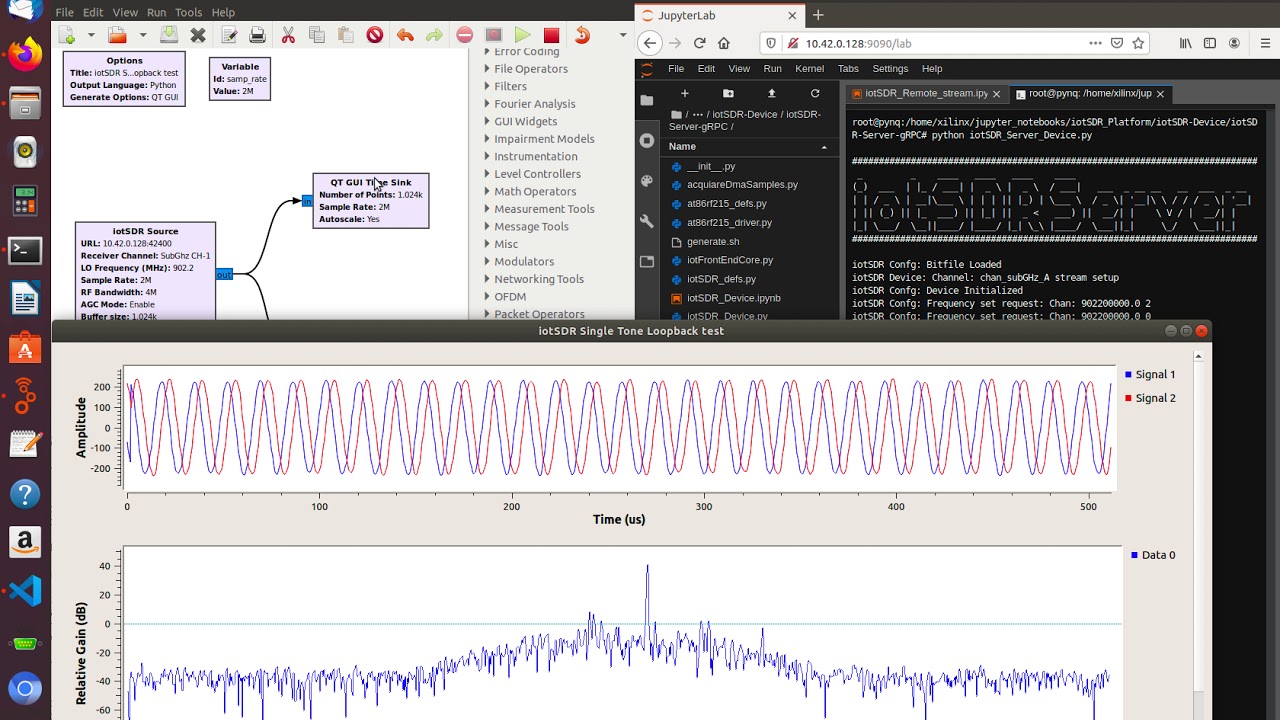
This video Shows the iotSDR Server side logs when running gnuradio flow graph, all the init settings are pushed once and then streaming started from server which is plotted in gnu-radio sinks
on the other side we will give full support of Python APIs and examples with Jupyter Notebook
severe socket
neat!
 dry trail

FCC ID
IQ Panel 2 Home Security Panel Internal photos details for FCC ID 2AAJXQS-IQPANEL2 made by Qolsys, Inc.. Document Includes Internal Photos IQ Panel 2 Internal Photos
heres a better photo
 cosmic pike
For IoT temperature/humidity sensing throughout my house I've gone two different routes: Arduino MKR WIFI 1010 with ENV SHIELD and Raspberry Pi Zero W with the Enviro pHAT. Both solutions are ~$60. For the bathroom, where the humidity reading triggers the fan to come on, I like the Enviro pHAT with its little LCD screen. Elsewhere, it doesn't need to look pretty or provide any feedback (at least not at this point in the project) I noticed that https://www.adafruit.com/product/4566 was only $4.50 and that the Feature HUZZAH is $19.95, which is a LOT cheaper than $60. Add $7 for the power supply and it's basically half price. Is there an even cheaper board than the Huzzah that could do WIFI and I2C for this?

The AHT20 is a nice but inexpensive temperature and humidity sensor from the same folks that brought us the DHT22. You can take sensor readings as often as you like, and it uses standard I2C ...
wicked elbow
@cosmic pike Hard to beat the price of the Zero W. The Enviro pHAT is somewhat expensive. If you just need temp and humidity and don't require a hat form factor, you could use many different temp/hum sensors on I2C, depending on your requirements for accuracy. To shave off more cost, I think you'd have to go to bargain ESP32 modules... more DIY and not necessarily well-supported. Under development is the ESP32s2... we don't know prices of Feathers or other Adafruit kit yet, but the Espressif dev board is only $8 (Espressif IDF, CircuitPython alpha code no wifi yet, Arduino I believe coming in the future).
cosmic pike
@wicked elbow thanks for that info. I think perhaps an ESP32 module is a little more than I'm prepared for at the moment. I think Zero W plus SD Card is within spitting distance of the Huzzah. At that point I think then it's about whether I want a device that has a full Linux install (and both awesome of a full system and drawback of maintenance and potential card corruption) or an Arduino or CircuitPython device (and all the awesome and drawbacks - no SSH, harder to debug, etc). It is a strange world we find ourselves in where a dev board and a full computer (albeit an anemic one) are roughly the same price.
wicked elbow
@cosmic pike Very true, there are very enticing devices at this price level, quite different in characteristics. I'm working on a project, not really parallel functionality but similar objective, on both ESP32/Arduino and Raspbery Pi Zero W, and I struggle with the same trade-offs. I find the ESP32s rock-solid, they'll run for months, whereas the RPi takes a lot more to keep it stable... systemd for when the code inevitably stops, etc., but easier to make changes to the code and can't beat headless with ssh.
sly roost
You might want to check off ESPHome. My home setup is an ESP8266 in my geekroom and an ESP32 out on my back patio and just wiring up discrete sensors to the I2C bus worked out really well.
I kinda got burned because I got a Pimori RainbowHAT and it has a temperature sensor but I couldn't ever get a really accurate reading with my Pi3 because it's too hot.
cosmic pike
thanks for the suggestion @sly roost . I'll see with this one. THeir code on github does have a correction factor for the CPU
 sullen frigate
Raspberry Pi, 4G HAT, also include RS485 support, For IOT application
 tacit bane
Is there a library for MCUs with native USB that implements Ethernet over USB? I'd like to explore some ideas in that area.
I do know I can do this with a Pi Zero W. But curious if I can go bare metal.
charred mountain
TinyUSB is currently working in support for a RNDIS driver but I have no idea how good it is, if its what you want, or if its complete

GitHub
An open source cross-platform USB stack for embedded system - hathach/tinyusb
 glacial fable
About the tinyusb github source:
last official is: 0.6.0 - 2019.03.30
But the frequently commits based on issues are done very well. Last commit is 2 days ago.
The changelog is 3 month old. I think he has the same issue with documentation as every coder ;-)
https://github.com/hathach/tinyusb/blob/master/changelog.md
GitHub
An open source cross-platform USB stack for embedded system - hathach/tinyusb
tacit bane
TinyUSB is currently working in support for a RNDIS driver but I have no idea how good it is, if its what you want, or if its complete
@charred mountain
Aah yes this would be nice. TinyUSB also supports ESP32-S2 right? My dealer says he can score a few by mid-August and I've asked him to reserve a couple 😄
Honestly, life would be so much better if there were cheap Linux development boards which came with native ADCs. And maybe expensive versions of the same that had a super low power consumption lol.
charred mountain
I think you would be blown away by what you can run linux on. According to the github page it does support the S2 but the guys working on the S2 only got USB working recently so would just understand it might not be 100% bug free and will get better over time like wine @tacit bane
tacit bane
@charred mountain yeah Linux runs absolutely everywhere lol. Just that it's hard to find decent documentation for a lot of boards, which is why RPiF makes lots of money and others struggle to push their technically superior but undocumented products. I got an Orange Pi for super cheap but I couldn't figure out what direction they were counting pins from. It was from the left for one row and from the right for a different row. Super weird.
I'll keep my eyes out on TinyUSB on the S2.
The dealer I spoke to told me he's taken orders from larger clients (>200 MOQ) for ESP32-S2 modules from Ai Thinker and delivered a batch already, with another one expected soon, but their website doesn't even list ESP32-S2 boards. Super early times lol.
 true venture
in io.adafruit.com I am seeing this...
Free Usage
Feeds: 7 of 10
Dashboards: 1 of 5
Rate: 30 / minute
Current Usage: 0 / min
Storage: 30 days
Hourly ban rate: 3 / hour
what is the "Hourly ban rate" ?
and an Rate of "30 / minute" means 30 updates per minute per sensor? or total for account?
 shut kindle
Hi all, I am attempting to make a smart hot water tank/heater for my campervan that im building. I was thinking of us esp 32 s2 so that i can have low energy usage and post stats to a server that will display my usage in some web interface ill build to control the camper van with. Should i use the esp32-s2 or can someone recommend something better for the application?
trail pagoda
If you want WiFi and a microcontroller, the ESP32 is a pretty decent choice. I'm a little fuzzy on the tradeoffs of the S2 versus the original model, though... it's not necessarily a clear-cut upgrade.
shut kindle
from my understanding the s2 is much more efficient at wifi
among many other improvments
im basically looking for the most efficient/smallest wifi microcontroller, since it will do very basic things for this application
hot seal
Note that the s2 does not have BLE if that matters.
shut kindle
nope doesn't matter, infact thats better
now i just have to find a place to buy the esp32s2 in canada, i have a few esp8266 that ill probably prototype with
charred mountain
@trail pagoda just for future reference, it isn't really an "upgrade" but rather an alternative, the S2 lacks bluetooth, has less ram & flash, lacks CAN & SD, has a single application processor, but adds more IO, half the sleep current, better ADC, time of flight capability, RISC-V ULP processor, and ability to have 1Gb external flash
trail pagoda
Thanks for the summary!
white junco
However, I think it has native USB as well, making it a candidate for CircuitPython
wicked elbow
Yes, the ESP32-S2 runs CircuitPython 6.0.0-alpha, currently including digitalio, busio/I2C/SPI, displayio, and more. Wi-Fi and other peripherals under active development.
charred mountain
Oh yes, I forgot the most important tidbit, built in USB! 😜
 fossil mural
what is IoT?
 subtle jungle
The Internet of things (IoT) is a system of interrelated computing devices, mechanical and digital machines provided with unique identifiers (UIDs) and the ability to transfer data over a network without requiring human-to-human or human-to-computer interaction.The definition ...
fossil mural
ok
white junco
<@&327289013561982976>
 dusky lichen
Any self-hosted free dashboard solution you can vouch for?
I have a RPi which sends sensor data. This sensor is sold to many customers. I want to create a dashboard to view sensor data.
What do you guys think about Thingsboard?
charred mountain
I havnt seen thingsboard before but as someone who works on similar solutions it looks quite nice
Looks like what you need
Normally Im quite disappointed with solutions like that
dusky lichen
@charred mountain why? Do you work in IoT?
I'm looking for an introduction to these stuff..Is there an online course or good book? Like why MQTT instead of REST
charred mountain
I do, I am always disappointed because many solutions fall short either on data transport, provisioning, control, ability to integrate with other solutions, security, etc etc. And its not like the engineers making the solutions know better or worse, a lot of solutions seem driven by a bean counter instead of technically what is a good foundation to build devices on. And I mean a lot of this you can find good resources online, MQTT is used because you can send messages bidirectionally
HTTP (REST) forces your devices to poll the api constantly
dusky lichen
@charred mountain Are u a more like a web-dev guy or embedded guy? Did u study software/cs?
wicked elbow
@charred mountain I'm intrigued by WebSockets, but haven't done much. Do they give (at least at a lower level) some of what people may be going to MQTT for?
charred mountain
Embedded guy, and no I dont have a degree.
wicked elbow
I'm hoping we can have WebSockets in CP
charred mountain
And websockets are meant to be used between the browser and device, there is no reason to use websockets over MQTT in this situation, MQTT is very lightweight, has a topic system, little overhead, auth, and various QoS settings
You could used WS if you wanted to @wicked elbow but I dont see why youd choose it
wicked elbow
Just seems to me that since WebSockets is a lower level protocol, I can bend it more to my will 😉
charred mountain
Sure, but that means you will need to put layers on top of it, creating extra overhead
dusky lichen
@charred mountain But for these stuff, higher level stacks are more important right? Django/Vuejs and the like
charred mountain
Idk what you mean @dusky lichen
dusky lichen
@charred mountain For developing a dashboard in IoT, one must be a webdev, right?
charred mountain
Yes, I dont work on the dashboards, the thingsboard is both the dashboard solution and backend it appears
dusky lichen
Yes backend is written in Java, front in Angular
@charred mountain Are u in cali bay area?
charred mountain
No, Im in Maine
dusky lichen
I'm really REALLY suspicious of the whole IoT fad. I think they are butchering privacy, reliability and the like...but what could I do...everywhere they are talking about iot, blockchain and buzzword_currentyear
dusky lichen
Industry 4.0 😒
charred mountain
Yep, lol. Glad someone shares that opionon
Curious why they chose java, I guess its really not an issue but I love golang for writing backends for connected embedded, the language really fits the use case
charred mountain
Would like to note, one thing I dont like is the security model for device claiming, but not many solutions do it better so not really a reason not to use it ig
dim agate
@charred mountain How do you feel about devices having X.509 certificate based IDs which are then used to connect device to services \ accounts. (I.e., this ID goes to this Customer)
charred mountain
Well not for an ID, usually with IDs I try to base it off a hardware ID, normally the serial number of a flash or crypto IC on the product
But the device should have a root key, which will at some point use X.509
But a IoT system should make some assumptions about security, communication shouldnt be trusted to be secure, cloud infrastructure gets hacked, single compromised devices shouldnt effect the whole network, employees and users make mistakes, and all trust should be established using cryptographic means.
charred mountain
Oh another good reason not to use websockets for large scale installations @wicked elbow is the scalability, MQTT is a broker protocol and most backends use an AMQP broker with a MQTT interface so all device messages come in as an MQTT message, but then go into AMQP queues so you can have many distributed applications consume the data concurrently using the featureset of AMQP. But for a few clients WS would work just fine, and yes you could techniaclly use a load balancer but theres additional issues with that and WS. (And yes you use a LB with MQTT listeners too)
wicked elbow
@charred mountain Ah, thanks. I'm just thinking about my own house 😉 For five years, I've been just using HTTP to my own server for IoT stuff, and it seems WS could give me more flexibility. I generally don't like the commercial offerings, for a variety of reasons.
(and it's fun to do my own 🙂 )
charred mountain
Ah, well Im confused on what "more flexability" WS would give you, but for things like your house it will work wonderfully.
wicked elbow
persistent full-duplex is the main thing that attracts me
charred mountain
Well these things are never truly full duplex since TCP is being used. What do you mean by persistent?
sly roost
Yah, I think the WS stuff is mostly handy if you expect a browser to be one of the ends.
charred mountain
MQTT over UDP can be "full duplex"
But even then using most QoS settings you still have that overhead TCP provides
In fact, if this is in your own house on a local network, may as well just use TCP or UDP sockets
wicked elbow
persistent meaning open connection
sly roost
And WS can kinda-sorta-ish act like HTTP so you get the benefits of HTTP and stuff, but, again, if you try to use it against any of the software load balancer type things it might eat up connections too fast.
charred mountain
You mean retaining a single TCP connection?
wicked elbow
just being bidirectional over a connection that can stay open for some time
maybe I'm reading too much into what it can do, haven't really played with it yet
charred mountain
That trait is shared by both MQTT and WS, the only real benifit I can come up with is with WS you wont need a broker if you just want to connect directly to an application
wicked elbow
Yeah, keep it simple. MQTT is fine I'm sure, I just don't need all that. Or maybe I do, haven't played with that one yet either.
charred mountain
Well when you start playing with all of it I would be curious to hear what you experience was
 pallid solstice
I've been trying Circuitpython, Arduino and the ESF toolchain to no avail so far. Any boilerplate code doesn't seem to work yet. I've tried to use what's in this repo: https://github.com/espressif/esp-aws-iot and I was able to build it with some modifications but it seems the code needs some refactoring to get it to work, which is above my C chops at this point.
 hardy sage
I have been looking for a IoT specific discord server and have not been able to find one so I made one. If anyone wants to join it I will DM you the invite
 dense panther
Hi all, I have Pi 4, and I want to play with it in Cybersecurity subject, any ideas?
 pine furnace
@hardy sage Home Assistant has a huge server
 covert mortar
hi can anyone tell me how to install opencv on Pi4
hot seal
There are several tutorials out there google "opencv Raspberry pi 4" I followed this one https://www.pyimagesearch.com/2019/09/16/install-opencv-4-on-raspberry-pi-4-and-raspbian-buster/
lucid flame
I struggled with that guide as the Pip install wasn't working. I had to install a few other bits. My working version of an install guide (which I still need to clean up to reduce dependencies) is here as part of a lab on OCR - https://github.com/microsoft/iot-curriculum/tree/main/labs/ai-edge/vision/ocr#set-up-your-python-environment

GitHub
Hands on labs and content for teaching the Internet of Things at schools and universities - microsoft/iot-curriculum
 native terrace
hELLO, Im new here, anyone can help me sort out what is hapening to m FONA SIM 808 3G +GPS board??
In terms of Wiring and Li-po battery
white junco
Did you get that sorted?
 low grotto
we are in suspense at #help-with-projects ...
white junco
I suspected as much, as it looked like there was crossposting going on, but the most recent traffic seemed to be on a different matter.
 tired magnet
Does anyone know if arduino IoT cloud is compatible with wpa2 enterprise networks?
charred mountain
@tired magnet the cloud doesnt really care what kind of network you have as long as your micro can communicate to the internet
 urban spruce
I think he's asking if the wifi module is wpa2 enterprise security compatible
which I'm pretty sure it is
because it's marketed for enterprise uses.
charred mountain
Ah, then I think a better question would be if the Arduino MKR supports WPA2 enterprise
I assume that is the board they are using
urban spruce
I'm not familiar with all the wifi capable arduino boards
tired magnet
yeah sorry, i know the board can but i wasn't really sure how i'd use that with the iot libraries as the one on the website only uses ssid and password
charred mountain
The website itself does not use the ssid and password
Arduino doesnt care what your wifi creds are
 merry sluice
We have extended our campaign. Very few early bird left for our 7020 model. Visit the link and grab one before it ends. https://www.crowdsupply.com/embedinn/iotsdr

Crowd Supply
A versatile dev board with everything you need to design custom IoT protocols & gateways
charred mountain
Aw, I wish I had the money to burn 🥺
 shell dragon
RTK for 300$ plus a bunch of other possibilities
wow
What's the predicted location precision? Temporal precision? Could it be turned into an accurate PTP server?
I'm just asking because I've long thought about building a device that does this for me. Current solutions are, frankly, half-assed and/or proprietary and/or super expensive.
hardy sage
Hey guys! What is going on in the IoT world?
lucid flame
Lots of cool things!
 raven socket
Hello, I'm trying to connect my app to Adafruit io using PAHO. It does connect with the server but every time when I try to subscribe, adafruit io shows an error that is "MQTT ERROR: paho1014700107263649 202.5.36.164 SUBSCRIBE to topic /feeds/temperature/ rejected, resource not available or not authorized"...My token is correct as well as the topic. What should I do now ?
 north swallow
can anyone tell me how to use esp8266?
hot seal
@north swallow What are you trying to use it for?
 reef ledge
Do you already own a esp8266 board or are you looking to get one? Wha'ts your budget? The classic esp8266 is cheap, but some of the newer boards / packaging make it a lot easier to program / more gipo pins for control. I really like the Adafruit Feather M0 Wifi since it has a bunch of gipo pins, has wifi, and has a batttery charging circuit and plug for a battery.
 winter saffron
hello everyone new to the discord but looking to grow my knowledge and also share

recently built this but having some issues with hosting my own webpage to display the bme280 sensor data
currently it utilizes snprintf and outputs json
however the driver i'm using for the bme280 is not parsing correctly
I also want to ditch this method and go with a more css polished look
wicked elbow
IFTTT just made itself a lot less useful to hobbyists. Only 3 applets in the free tier.
 sly flume
anybody work with the twitch api before? I want to make something that reacts to new/returning subs.
 grave crystal
Honestly, I had a terrible time with the original ESP8266, thank God for Adafruit’s more accessible and usable options
charred mountain
@grave crystal yeah its not exactly a favorite around here, popular with the newbies but it causes a lot of issues
grave crystal
IFTTT just made itself a lot less useful to hobbyists. Only 3 applets in the free tier.
@wicked elbow wow that very much sucks, Guess I'm done with them.
 calm token
Hey Guys!
I'm working on this programmable DIY home automation/environmental sensor. It has a battery life of up to 5 years and can measure 8 different data points. Its compatible with Arduino, ESP-IDF and home assistant. 😎 🤓
Check out the sensor here and subscribe for updates!! -> https://kubosensor.editorx.io/kubo
Kubo
trail pagoda
That's pretty neat. Kudos for getting that kind of battery life with a WiFi device! 🔋
severe socket
Sneak Peek of a new IoT project I've been workin' on


Make your next IoT project a snap with @adafruitio #wippersnapper.
#itsnotoutyet .@adafruit https://t.co/4MCs90DHW2
 Twitter
 oblique hawk
I'm new to adafruitio Where do i find my your_big_huge_super_long_aio_key
 manic carbon

I am doing this video with two led's and 2 channel relay switch and buzzer. You can turn on and off your devises in your home from anywhere in the world.First of all you have to download "Blynk App" and download the libraries for your Arduino IDE.
Step by step tutorial on how...
 wispy topaz
Good morning all - have a Seeed Grove sensor board that was initially sold as a board to connect to IFTTT but they have since discontinued their connector so I’m thinking I need to develop something (a python script?) to send data to Adafruit IO
Needing help on coding and/or if there is a plug and play option like IFTTT that would allow me to put in the URLs for each sensor and then map them to Adafruit
 hard marlin
Some new very nice chips, terribly small, with Lora, and an STM32 M4 + SX162X
https://www.seeedstudio.com/LoRa-E5-Wireless-Module-p-4745.html

LoRa-E5 LoRaWAN module is designed with ST system-level package chip STM32WLE5JC, ARM Cortex M4 ultra-low-power MCU and LoRa SX126X. It supports (G)FSK mode and LoRa. 62.5kHz, 125kHz, 250kHz, and 500kHz bandwidth can be used in LoRa® mode, making it suitable for the design of ...
severe socket
Yeah, I want one in a devboard format with an external antenna
and charging circuitry
hard marlin
Solar if at all possible ❤️
I've just got a tiny CN generic "mini" solar charger that is <$5 in CR. Need to test if they are any good.
severe socket
@hard marlin ooh
hard marlin

(CR-ican provider, so it probably better to get them elsewhere)
Tonight I'll solder a bit, and see if I can get a cheap 3.5w solar panel to handle a ttgo esp32 with meshtastic with a 1200mah batt. ( < $100 in CR)
 feral kettle
My nephew aged 11 is wishing for RGB LED strips for Christmas and I wonder if I can give him something like that. Naturally I am thinking a dotstar strip controlled from a microbit - which he has already. Then I learned that he has a Google Nest Mini. So the natural thought: Would it be possible to connect a Nest with a Microbit through Bluetooth?
severe socket
@feral kettle It may be possible through a 3rd party service like IFTTT.com
I'm not certain though, haven't seen any guides about this before
feral kettle
thanks for the input @severe socket however I found this that might make my quest a bit more challenging:
https://www.gearbrain.com/google-nest-ifttt-support-termination-2636574697.html

Gearbrain
Works with Nest platform will be shuttered at the end of August, Google says, ending support for third-party integration.
what if I could make my microbit connect to the nest as a bluetooth speaker, and use the play/pause etc functionality to control the light
feral kettle
That went out the door as the NRF51822 on the microbit is BLE only...
charred mountain
@feral kettle would a $10 pi zero work?
feral kettle
@charred mountain My nephew already has a microbit. and it has just been lying around. My idea is to present another application for this board. Just to use what he already knows - and with his newly aqcuired Google Nest, it could be fun to tie those together. the latter not being possible though.
I think I will move forward with the concept of using a bluetooth serial terminal app on a smartphone to connect with the microbit to control the lights.
charred mountain
@feral kettle it should be possible if you add a Pi, and you could do other stuff with it like host a grafana stack for nice graphs of sensor outputs
Just a thought
feral kettle
I know the possibilities of the Pi, but this is for my newphew to control when I am not around. He knows a little about the pi. This will be a nice opportunity for him to learn a little more
sorry. he know about the microbit
 misty badger
SOS
Any ubuntu core on raspberry Pi tutorials
 solemn bobcat
misty badger
SOS
Any ubuntu core on raspberry Pi tutorials
solemn bobcat
misty badger
SOS
Any ubuntu core on raspberry Pi tutorials
yes there is a lot of support for that
@misty badger as it is a linux distro you can use linux commands
misty badger
solemn bobcat
<@!778821620839481376> as it is a linux distro you can use linux commands
Thanks yo
 vast rover
I just wanted to share my go to iot setup. I highly suggest using Johnny-Five with a Raspberry Pi Zero W and configure it with Auto Hotspot. With Johnny-Five you can leverage NodeJS + Express + pusher and control your Raspberry Pi over a web app. Your Raspberry Pi will automatically create a hotspot if you don’t connect it to a network which allows you to access that web app even without a network. The reason why I prefer NodeJS for iot instead of Python is because of the amount of NPM packages and APIs you can leverage.
misty badger
vast rover
I just wanted to share my go to iot setup. I highly suggest using Johnny-Five wi...
I'm noob... Don't know nodejs.... Failed using nodered... Error in terminal: port is busy .
But browser directs to nodered ...
 broken pebble
Does anybody know whether the ATECC608 can generate a six digit 2FA number? (like Google Authenticator)
charred mountain
@broken pebble since it has no concept of time, Im not sure how it would
You might be able to use the crypto functions to make a otp auth implementation im not sure, but the chip cannot just spit that out for you
There are much better ways to authenticate a device
white junco
I wonder how the U2F Zero works
broken pebble
Yeah, I was just reacting to a project where the author had a warning about putting a secrets.h file on a Circuit Python drive which somebody could attach a USB cable to.
charred mountain
@broken pebble that is what the IC is for, to keep the secrets on the chip, and only perform crypto operations on it so you dont leak secrets
Try using one of the asymmetric authentication operations on it for security
broken pebble
Yeah, I'll have to see if there's example code that seems pertinent to the service(s) I want to connect to. Thanks for your help.
charred mountain
@broken pebble you asked about the OTP auth method, that means you were looking at some user auth not a device authentication standard, make sure to read through the dev docs of your service to figure out how to connect devices
broken pebble
@charred mountain Yeah, I'm probably getting two projects mixed up or wanted the device to impersonate me for some management function. I'll come back when I have a better idea what I want to know. Thanks again.
solemn bobcat
misty badger
Thanks yo
🙂
solemn bobcat
misty badger
I'm noob... Don't know nodejs.... Failed using nodered... Error in terminal: por...
I recommend formatting your pi and reinstalling
misty badger
solemn bobcat
I recommend formatting your pi and reinstalling
👍
solemn bobcat
🙂
tired magnet
Hey, does anyone here have experience with the Arduino 1400 GSM? I was wondering whether you would cause damage to it by turning it on with the antenna unplugged
 hybrid zealot
Transmitting without an antenna connected can possibly cause damage as all of the power is reflected back.
An antenna provides a load, absorbing energy travelling down the line. If that energy is reflected, it has the potential to double the voltage seen at the transmitter, which could blue smoke it.
If you were not transmitting at the time, it would be fine with it unplugged.
tl;dr (non-committal hand waving gesture)
tired magnet
hybrid zealot
Transmitting without an antenna connected can possibly cause damage as all of th...
Thank you! So it was loaded with the "send SMS" sketch but wasn't actively using the module (was probably waiting for a phone mumber to be entered) but would it still be pinging a tower or doing some background transmitting/receiving? Just want to be sure it's not damaged to save some future troubleshooting. For some reason arduino haven't hooked up the antenna detection pin :/
white junco
Some units detect high SWR and protect themselves by lowering power if there's a mismatch (such as no antenna). Other units do not have the protection circuitry and will be damaged.
tired magnet
Ah got it:) Wonder if there's a way to test how good the connection is. There doesn't seem to be much documentation apart from ublox's own datasheets but i'd be interested in the mkrgsm library
 inner iris
Temporarily replace the antenna with a 50 ohm resistor.
sly roost
Wow, it really is something you can find out on your ohm.
tired magnet
inner iris
Temporarily replace the antenna with a 50 ohm resistor.
Wait why?
inner iris
To reduce SWR. The power reflected from an open antenna port could destroy the RF power amplifier. To test, a 50ohm resistor will mimic the antenna and not radiate, at least not much.
tired magnet
Ah man I think I understand but I'm very new to this. I initially thought to ask as I know that rc drone video transmitters will be damaged if you have high output power but forget to plug in the antenna... that's about all I know
Now I'd just like to see if I can figure this gsm stuff out
I assume a gsm module isn't sending stuff constantly in the same way a vtx is? I'm not sure. I figured it might just send small bursts which isn't enough to cause heat damage to the module
white junco
The transmitter amplifier is fairly small, even a short burst could damage it with sufficient SWR
tired magnet
Ah okay:/ Well hopefully it won't cause issues in the future, i assume the only thing it could have been doing was pinging a tower but i don't really understand the module/library
I'd be interested in seeing whether i could use the board to make a voice call
white junco
I've used some GSM boards to make voice calls, but not that particular one.
tired magnet
Oh awesome, does it require a lot of processing power and memory? Did you use libraries or did you write from scratch? The mkr boards seem to be pretty powerful, i just assume the DAC/ADC would be pretty busy
white junco
I started with the AdaFruit libraries, but hacked them up to fit in smaller memory and add a few functions. Voice is just a pass-through, so the CPU doesn't have to do much other than originate the call.
tired magnet
I'll have to check it out, which adafruit board did you use?
white junco
I've been using the FONA 808

Cellular + GPS tracking, all in one? Oh yes! Introducing Adafruit FONA 808 MiniGSM + GPS, an all-in-one cellular phone module with that lets you add location-tracking, voice, text, SMS and ...
tired magnet
Awesome! Looks like i should've got one of those instead
white junco
They're an older standard, I don't think a lot of carriers support them any more.
 forest cypress
Anyone know of a good free JSON REST word of the day API?
 golden notch
Does Adafruit sell an ESP32(WiFi+BT) in the Uno layout like the Adafruit Metro ESP32-S2?

What's Metro shaped and has an ESP32-S2 WiFi module? What has a STEMMA QT connector for I2C devices, and a Lipoly charger circuit? What's finishing up testing and nearly ready for ...
urban spruce
They might end up selling one with the ESP32-S3 but there hasn’t been any formal announcement
 ancient light
Has anyone worked with the PMSA003I Air quality (PM2.5) sensor from Adafruit? I'm having issues with it wreaking havoc across the entire I2C bus. It works fine for me on its own but as soon as I wire up other sensors I get all kinds of random combinations of "input/output error", "unsupported operation", "SCL/SDA needs pullup" errors
hot seal
@golden notch there is some BLE support available for the metro_m4_airlift -- you have update the firmware.
golden notch
@hot seal I'm looking for a board that comes in the Uno form factor like the Adafruit Metro ESP32-S2.
I want to use it(ESP32) with my Arduino Grove Kit
hot seal
OK -- Probably not what you want, but the metro_m4_airlift is in the Uno form factor and uses an ESP32 as a wifi co-processor -- the latest firmware also has BLE support.

Adafruit Learning System
Give your project an AirLift with a Metro board with WiFi and BLE
 sharp brook
Hi. Anyone know how to properly implement uart_server.read() in circuitpython? I.e., parameters, how to format/print the output, etc.? Also, uart_server is an instance of UARTService().
 royal gorge
you can readline() to get anything until a newline occur, or read(n) with n being the number of bytes you want to read
you have also uart_server.in_waiting that tell you how much bytes are in the receive buffer
@sharp brook (I didn't see question was 2 days ago)
sharp brook
royal gorge
you can `readline()` to get anything until a newline occur, or `read(n)` with n ...
I've noticed these read() methods are able to read from the Bluefruit app when I manually send a message in UART mode. But my hope was that there was a method that allowed output fed into the app from io.adafruit.com to automatically be displayed into my console. Similar to how data sent via uart_server.write() can be Rx'd to an io feed continuously via MQTT mode. Thanks!
 nocturne jackal
Hi, I'm testing MQTT with MagTag, could anyone help with this error: AttributeError: 'module' object has no attribute 'ESP_CS'
 undone plaza
@nocturne jackal its probably telling you that the board prop ESP_CS is invalid (you seem to be trying to access board.ESP_CS). Try using the pin directly. if you put this, you should see all the board info in your monitor
print(dir(board))
i.e. you probs want something like esp32_cs = DigitalInOut(board.D10) << or whatever pin you are using
wicked elbow
I think it got resolved elsewhere... (trying to use ESP32SPI library on ESP32-S2 MagTag, but also MQTT support is in development for ESP32-S2)
undone plaza
lol, so many multi-posts im losing track 😬
 young sun
got a question about the interaction between the SMD51 and the ESP32 on the Matrix Portal.
I know that the SAMD51 handles the matrix board and the ESP32 the IoT side.
Lets say I want to have a multifunctional RGB matrix display and I need to make complex data structures built with multiple instance of objects and I feed those instance of data from an API, which side is handling that complex structure of data ?
dim agate
CircuitPython is running on the SMD. The esp32 is there just for networking.
The CP on the SMD access the network available via the ESP32 over SPI.
Have a look at the WiFi library for the Matrix Portal

GitHub
CircuitPython helper for Adafruit MatrixPortal M4, Adafruit RGB Matrix Shield + Metro M4 Airlift Lite, and Adafruit RGB Matrix FeatherWings - adafruit/Adafruit_CircuitPython_MatrixPortal
Specifically check out the imports ...
adafruit_esp32spi is how the network is accessed.
I hope that helps @young sun
young sun
@dim agate thank you so much !!!!!
dim agate
Happy to help!
young sun
Hi, it's me again !!!. would there be an easy way to flash the ESP32 to load my own code ?
wicked elbow
I think it's theoretically possible, but it's challenging in a device like a Matrix Portal where the ESP32 is integrated. It would likely involve using "passthrough" code on the SAMD51 https://learn.adafruit.com/upgrading-esp32-firmware/upgrade-an-airlift-all-in-one-board, and then developing a custom firmware image for the ESP32, and writing new code on both sides to communicate between the processors. I'm not sure if anyone has done it before.
young sun
Thank you so much bud !!!
 near crater
would this be the correct room to ask a pyportal question?
or is there a more appropriate one?
 lilac crater
near crater
would this be the correct room to ask a pyportal question?
lilac crater
near crater
would this be the correct room to ask a pyportal question?
If your question is about the code, then #help-with-circuitpython would be better. If it's with the hardware, #help-with-projects would be better.
 orchid folio
yo im looking to build some bluetooth earbuds from scratch, mainly because I want to program it to interact in a specific way with a raspberry pi
any ideas on where to get started?
Oh scratch as in premade chips no circuit design or PCB stuff (unless its necessary)
trail pagoda
orchid folio
any ideas on where to get started?
Identifying the chipset you want to use would probably be the best first step. The easiest would probably be a Bluetooth "audio SoC", as they're built for this sort of application, though it depends on how much you want to customize the behavior.
It looks like Microchip, Cypress, and Qualcomm (who acquired the Cambridge Silicon Radio portfolio) have some relevant product lines.
 trail light
Does anybody know what happened to the sainsmart's 16 channel 5V relay modules
 mental fable
is it possible to do hardware serial between an esp 32 and a 8266?
trail pagoda
Almost certainly, yes. They both have hardware UARTs, which shouldn't have any trouble talking to each other.
 shy rock
hey guys - I hope this is the right place. I would like to track hip rotations (think hula hoop), can anyone tell me what kind of sensor I would need or if it's even possible? I have done some reading but I still can't figure out if it's even possible
trail pagoda
Sure, that seems quite possible with an accelerometer or similar inertial motion sensor.
shy rock
how would that work with an accelerometer?
trail pagoda
shy rock
how would that work with an accelerometer?
It would basically be a like a sideways pedometer, where you'd be able to count the "steps" of the hips moving from side to side. The data signal would more or less look like a sine curve, so you would count the peaks and valleys. Some accelerometer chips have that sort of analysis built in specifically for step counting, or you could do it yourself in software.
 ornate anchor
Heyo. How well could I use UWB for indoor location tracking? In the XYZ coordinates of the building. So different floors as well. People walking on it,
Some specs

Honestly, I'm mostly a designer and UX researcher for IoT, so I don't really know from just reading the specs
This still a wireframe
But the eventual goal is to see different people per floor
 dim agate
@ornate anchor location is one use case for UWB (and BLE, RFID, and several other technologies) UWB uses Time Difference of Arrival. So basically pings happen and the time it takes for those pings to arrive is used to calculate a position based on known positions (your fixed devices). There are a lot of UWB based location articles if you search online, and your UWB hardware vendor should have documentation how to implement it if they support it. I hope that helps.
ornate anchor
I guess this is some of the architecture that is currently used
I guess the UWB fits in the device layer?
dim agate
Yep.
ornate anchor
Thanks, I'll look more into it!
 deep adder
Anybody worked with any long-range low power transmission tech?
I'd like to find something that can transmit around a mile or so. Essentially I'd like to make something akin to cellular trail cameras without needing a cell network - low bandwidth is fine as even if it takes an hour to transmit a photo that'd be ok
LoRa looks promising but not finding a ton of info on it
trail pagoda
Yeah, LoRa is kind of the go-to option for long range free-spectrum operation. Getting a mile out of it is possible, give or take the data rate you pick, how much of a line of sight you have, antenna choice, etc. There ought to be a decent amount of info out there. Adafruit has several boards using the RFM95 transceiver module, for instance.
 frail orchid
I am working on project in that I am using 4 voltage sensor , 4 temperature sensor and 1 current sensor.
So total 9 analog sensor.
How I can get all 9 analog sensor value shown on website or web server.
If there is code available for this then share to me.
 leaden fulcrum
frail orchid
I am working on project in that I am using 4 voltage sensor , 4 temperature sens...
leaden fulcrum
frail orchid
I am working on project in that I am using 4 voltage sensor , 4 temperature sens...
That's a perfect application for Adafruit.io! You can push (and fetch!) data to their servers either through MQTT or their REST API. https://learn.adafruit.com/welcome-to-adafruit-io

Adafruit Learning System
Want to connect your project to the Internet? Start Here!
If you want to go a more home-brew route, you could also give Anvil.works a try. You'll have to configure your own endpoints, and they don't support MQTT.
(You could get MQTT working on Anvil if you're willing to run a process on a PC somewhere. It would be a bit of a slog, though.)
frail orchid
Which controller should I use?
leaden fulcrum
That's a big question. What are your priorities?
frail orchid
I want to read 9 analog sensor value so controller should have more analog pin and show sensor value on website.
leaden fulcrum
Sure, that's the scope of the project, but if you're asking for microcontroller selection advice, you'll have to be more specific. Are you prioritizing price, processor speed, size, CircuitPython support, stock availability?
frail orchid
Esp8266 , Esp32 , Arduino mega
leaden fulcrum
Well, for Adafruit products, you have a wide selection of Feathers that'll do the trick. Most of them are out of stock. UnexpectedMaker's FeatherS2 is the most available thing right now, pretty much in any store I check regularly. https://www.adafruit.com/product/4769

Introducing the FeatherS2 - The full-featured ESP32-S2 based development board in a Feather format from Unexpected Maker. The FeatherS2 is a power house, fully souped up with 16 MB of Flash ...
But to get a 32 or 8266, I don't think there's anything you can buy at the moment from Adafruit.
frail orchid
How many Analog pin are there in it?
frail orchid
It works on python language??
leaden fulcrum
Yep, the FeatherS2 is supported by CircuitPython! https://circuitpython.readthedocs.io/en/latest/docs/supported_ports.html
frail orchid
I don't know so it is a problem
leaden fulcrum
Just be aware that computing is done by the S2, it's not a coprocessor.
So while you're sending data to the cloud, you won't be reading from your sensors.
It's only a problem if you require true analog from your board.
Depending on sample requirements, you can do some tricks with capacitors, and maybe PWM?
frail orchid
Is there any other controller board which supports 9 to 10 analog pin and Arduino language with WiFi?
leaden fulcrum
I'm not an Arduino guy, so I'm not sure. Why don't you take a look at Adafruit's Arduino category, find something that seems like it fits, and ask specific questions about it in the #help-with-projects or #help-with-arduino channels?
Adafruit Industries, Unique & fun DIY electronics and kits : Arduino - Tools Gift Certificates Arduino Cables Sensors LEDs Books Breakout Boards Power EL Wire/Tape/Panel Components & Parts LCDs & Displays Wearables Prototyping Raspberry Pi Wireless Young Engineers 3D printing NeoPixels Kits & Projects Robotics & CNC Accessories Cosplay/Costuming...
Keep in mind that you can pick a microcontroller without wifi and add an ESP32 breakout board.
frail orchid
Yes I trying that... But programing become more complex
leaden fulcrum
That's a function of talking to the internet. Switching to an integrated board won't really help. If you're using libraries "properly," you'll just specify some I2C details in the setup code, then treat everything else pretty much the same. Maybe you're working with a library I'm not familiar with, and this advice doesn't hold true.
If you already have a board and a coprocessor, I'd definitely recommend hitting up #help-with-arduino to make sure you're doing things the easiest way.
frail orchid
Thanks 👍
leaden fulcrum
frail orchid
Thanks 👍
Best of luck!
 marsh rivet
hello everyone!
has anyone ever had any experience setting up a Particle Argon integrated with a webhook for discord? I am hoping for some advice, Ive gotten somewhere but it isn't where I want. can provide source code etc upon request/discussion! My issue is I have gotten it to send messages to my selected channel, but only a pre-scripted message, not any variables or information. I would like to be able to display information like air quality and temp in a discord message, maybe embed when it is functional.
dim agate
marsh rivet
hello everyone!
Hey there, I don't want to shoo you away, but you might find more Particle Argon folks in the Particle community. https://community.particle.io/c/hardware/4
As well as their samples for their boards.
https://docs.particle.io/tutorials/hardware-projects/hardware-examples/argon/#read-your-photo-sensor-function-and-variable

Particle
Questions and discussions about Particle hardware, including development kits, SoMs, and accessories.
marsh rivet
dim agate
Hey there, I don't want to shoo you away, but you might find more Particle Argon...
Alrighty thank you for the leads!
 ivory gale
hi folks, sorry if this is the wrong place to ask - just joining this server. Where would I find a low cost board that supports WiFi, Lipo battery, and circuit python? I’m trying to drive about 120 neopixels using api data, and wanted to get some low cost boards to do this. I’m mainly concerned about having enough memory to support my use case while being able to acquire these cheaply enough to make my final product affordable. Thanks for any pointers!
 crisp stump
The unexpected maker feather S2 covers everything but "cheaply", they are around 20 dollars a piece. The cheaper CP boards don't do wifi and are low on RAM #general-tech or #help-with-projects or #help-with-circuitpython would also be good places to ask about this 🙂
ivory gale
thanks! yes, I was looking at the S2 and it looks very well made, but that’s double the budget I have for each board. I’m aiming to find something $10 or less (not sure how realistic this is).
crisp stump
Yeah wifi ups the board prices a bit it seems
dim agate
ivory gale
thanks! yes, I was looking at the S2 and it looks very well made, but that’s dou...
Check out the SAOLA ESP32-S2 .. I can't speak for the ability to drive a lot of LEDs.
https://www.digikey.com/en/products/detail/espressif-systems/ESP32-S2-SAOLA-1R/11613138
Order Espressif Systems ESP32-S2-SAOLA-1R (1965-ESP32-S2-SAOLA-1R-ND) at DigiKey. Check stock and pricing, view product specifications, and order online.
 sour nymph
@ivory gale If you don't need circuitpython an esp8266 might be able to do what you need
 supple wave
Can esp32 work with amazon alexa without a dirty hack like it being simulated as a hue device or something?
charred mountain
supple wave
Can esp32 work with amazon alexa without a dirty hack like it being simulated as...
Lmao, a quick good search and that seems to be pretty close to what this guy did, it simulates a Belkin Wemo Device https://randomnerdtutorials.com/alexa-echo-with-esp32-and-esp8266/

In this project, you're going to learn how to control the ESP8266 or the ESP32 with voice commands using Alexa (Amazon Echo Dot). As an example, we'll control two 12V lamps connected to a relay module. We'll also add two 433 MHz RF wall panel switches to physically control the lamps.
supple wave
@charred mountain thanks but this is literally the same result with a different method
I'm looking for something that allows me to do a little more than a single function like 'on and off'
simulation of other devices is kind of a turn off
again thanks for the help though
charred mountain
Well you said simulating a hue device, which I thought was kinda similar, there is a legitimate way to do this using Alexa skills through AWS if you really want to do custom functions
If I remember right, this can work across the local network like the hue with Alexa
supple wave
i know there is this
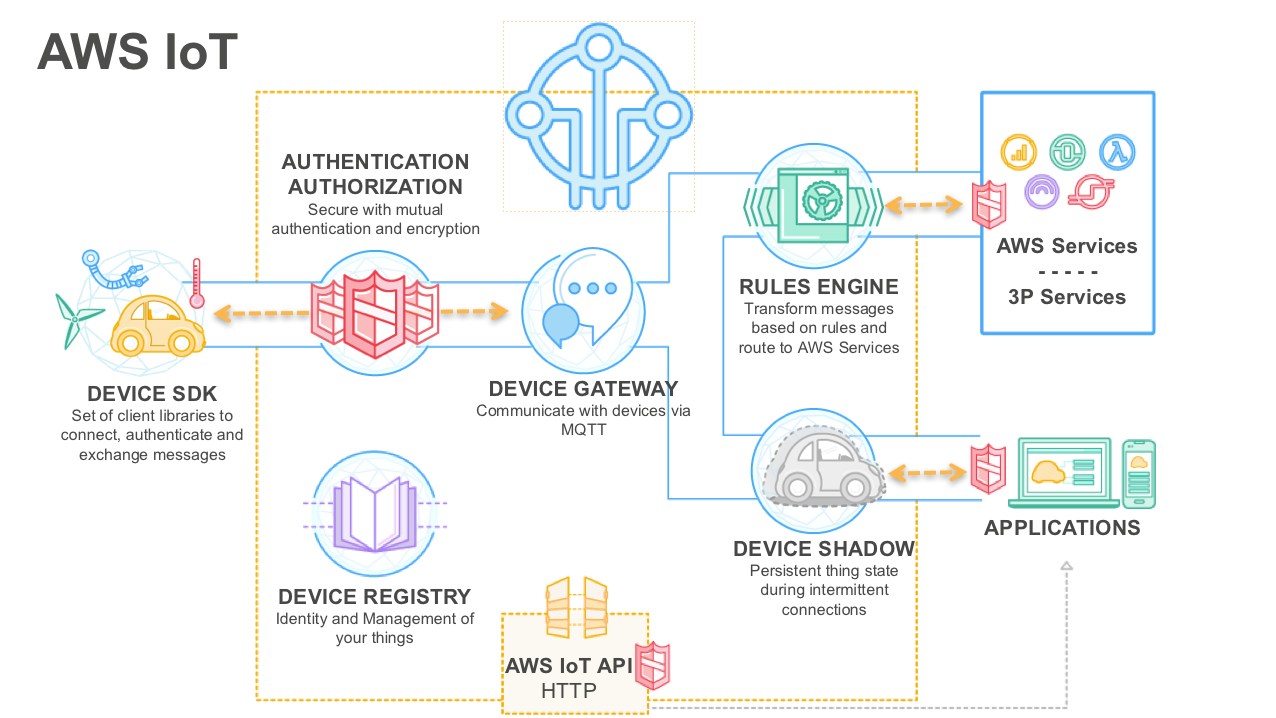
Amazon Apps & Services Developer Portal
but it's geared toward a pipeline meant for product development
aws is not cheap
https://aws.amazon.com/iot-core/pricing/ this ain't bad for a full free year though!

Amazon Web Services, Inc.
With AWS IoT Core Pricing, you pay only for what you use with no minimum fees or mandatory service usage.
charred mountain
You also get free VMs and other stuff for a year
Or credit to do so, been a while since I had my trial
Alexa is a closed ecosystem, which I understand is frustrating
supple wave
i used to do aws things for work, i know it gets expensive fast after that first year
lol
charred mountain
You can host the expensive stuff off AWS, just the Alexa skill and some silly lambada or however you spell it function shouldnt be too bad. If you really decide to go full AWS everything yeah it gets expensive. I wouldnt even use IoT core, I thought there was the ability in a Alexa skill to make a mDNS lookup and HTTP request on the local network
If you can, then just run a HTTP server on the ESP32 and mDNS responder
supple wave
charred mountain
You can host the expensive stuff off AWS, just the Alexa skill and some silly la...
if there is i'll definitely try to figure that out. sounds easy enough. great idea
 iron mulch
Anyone on here with I2C ADC experience?
 shadow onyx
Hi, I am new and I hope I am posting this in the right forum. I want to create several RGB Leds controlled via voice commands and interconnected via bluetooth to one Arduino controller.. is that possible and with which modules? I.e, 1 RGB LED + Battery + Bluetooth (multiple locations) all communicating with one controller via bluetooth + voice commands.
urban spruce
I’d say ask in #help-with-projects as that will help you more broadly
Though this channel isn’t a bad place to start for discussions around the IoT portion
 empty thicket
So I just ran across what I think is the coolest thing for some of my projects, and I just need to share it with someone who might appreciate it. These guys make the NoteCard a $49 cellular board that comes complete with 10years/500mb included: https://blues.io/
Blues Wireless makes cellular IoT simple with the Notecard and Notehub.
lilac crater
That's nice!
Woah! There's a feather compatible format one!??! "Notecarrier AF"
https://blues.io/products#notecarrier
Blues Wireless makes cellular IoT simple with the Notecard and Notehub.
Just a bit pricier, but dang! Such a cool find @empty thicket, thanks for sharing!
So I see 2 names related to this company that tells this is a good thing...
- Brandon Satrom, who's been around the IoT space for some time, and formerly at Particle if memory serves
- Ray Ozzie, former Chief Software Architect at Microsoft, also formed Groove Networks, started Lotus Notes (they can't all be winners!), and helped found Safecast.
 lucid hinge
I am trying to use this library for MQTT on a raspberry pi. https://github.com/LiamBindle/MQTT-C I figured I would try just subscribing to my welcome-feed as a starting point however I keep getting "Name or service not known" which seems to be a specific address problem. I feel like I tracked it down to getaddrinfo. Granted I am not 100% sure how my url is supposed to look with the api and username

GitHub
A portable MQTT C client for embedded systems and PCs alike. - LiamBindle/MQTT-C
on this site it seems to suggest that the connection url is mqtts://[Username]:[API-Key]@io.adafruit.com
https://learn.adafruit.com/adafruit-io/mqtt-api
however it doesn't seem to want to work while using that. I tried without the mqtts:// as well and that didn't work

also I would like to mention that I did build and test the MQTT-C example, and was able to get two terminals to talk with each other through MQTT test.mosquitto.org
However connecting to the adafruit IO service seems to be a bit harder at the moment.
charred mountain
lucid hinge
I am trying to use this library for MQTT on a raspberry pi. https://github.com/L...
That is an error returned from linux, it was unable to resolve the DNS name you provided
lucid hinge
Right which just makes me think I have the incorrect format for the url or something along those lines.
What is the correct format for the URL with the username and api key?
charred mountain
lucid hinge
What is the correct format for the URL with the username and api key?
Sorry for the late reply, normally MQTT libraries provide a method for setting a username and password and that should be used
 tidal path
Setting up some iot projects that include gps and I want to mount them in project boxes. I haven't really dealt with gps since the days when the Garmins first came out and I remember that it was crucial to have the device or at least its antenna having a clear site up to the sky. Is this still a requirement? The small antenna leads that come with these gps modules lead me to believe it's not a hard requirement anymore. Anyone have some opinions on this?
 ornate sage
Does anyone know what happened to DK IoT Studio from Digi-Key? Does that still exist?
Any link I can find in tutorials or in DK's own content leads to 404 errors
dim agate
tidal path
Setting up some iot projects that include gps and I want to mount them in projec...
Generally, yes. Your antenna must have a clear view of the sky. Some GPS modules support and external antenna. I prefer these.
I've experimented with ones that have an onboard antenna and that first fix required them being put in the window to work at all.
Inside, they would never get a fix.
 plucky helm
dim agate
Generally, yes. Your antenna must have a clear view of the sky. Some GPS modules...
plucky helm
dim agate
Generally, yes. Your antenna must have a clear view of the sky. Some GPS modules...
What's a typical maximum length of the cable from the GPS unit to the base of the antenna? A few meters?
dim agate
I only have used one antenna so my sample size is one. Its the same as this one at 5 meters.
https://www.adafruit.com/product/960
You can check on DigiKey or Mouser though to see if other lengths are common.
I've never had to determine if the GPS could handle or not a longer cable.

Give your Ultimate GPS V3 a boost with this external active antenna. This GPS antenna draws about 10mA and will give you an additional 28 dB of gain. It's got a 5 meter long cable so it ...
plucky helm
Ah, thanks!
severe socket
ornate sage
Does anyone know what happened to DK IoT Studio from Digi-Key? Does that still ...
It's been deprecated
They suggested moving to Atmosphere IoT

Engineering and Component Solution Forum - TechForum │ Digi-Key
DK IoT Studio has now migrated to Atmosphere IoT Studio. The functionality will be the same, the main difference is the look of the branding. All of the boards and sensors that were available in DK IoT Studio will still be available in the Atmosphere version. Atmosphere has a vast amount of resources available for assistance, which can be fou...
ornate sage
severe socket
They suggested moving to Atmosphere IoT
Thanks @severe socket !
 near falcon
Is there a version of the HUZZAH ESP8266 that has USB C ? (Or a device of similar function, wifi & built in battery management, with USB C?)
 low fable
near falcon
Is there a version of the HUZZAH ESP8266 that has USB C ? (Or a device of simil...
low fable
near falcon
Is there a version of the HUZZAH ESP8266 that has USB C ? (Or a device of simil...
there's Unexpected Maker's FeatherS2 https://feathers2.io/ https://www.adafruit.com/product/4769
near falcon
low fable
there's Unexpected Maker's FeatherS2 <https://feathers2.io/> <https://www.adafru...
Awesome! Thank you. I'm not super familiar with IoT stuff (new to this, bit of Arduino mostly servo and sonar stuff, and Pi) is the ESP32 as easy to learn/work with as I hear the ESP8266 is? (Am I reading that right that the FeatherS2 is ESP32?)
wicked elbow
@near falcon The FeatherS2 is an ESP32-S2, a newer variant of the ESP32. Single-core, Wi-Fi-only (no BLE), lots of RAM and flash, more GPIO, Arduino and CircuitPython.
near falcon
wicked elbow
<@!394736862918475788> The FeatherS2 is an ESP32-S2, a newer variant of the ESP3...
That sounds dope. Is it pretty easy to learn on?
wicked elbow
I haven't done Arduino on it so I can't speak to that, but it's a great board for CircuitPython
near falcon
wicked elbow
I haven't done Arduino on it so I can't speak to that, but it's a great board fo...
That's good to hear! I'll have to give it a try. Thank you both for the input.
wicked elbow
https://feathers2.io this says the Arduino support is still early... presumably at some point it will be released and it will be just another board to choose from in the released Arduino IDE
low fable
Unexpected Maker has a discord if you have questions on the Arduino support, I think he can tall you more
near falcon
low fable
Unexpected Maker has a discord if you have questions on the Arduino support, I t...
Oh sweet.
wicked elbow
I'm sure there are other boards that fit the Arduino+WiFi+battery requirements, including the Feather ESP32 (a little easier now than ESP8266 in Arduino, I think, due to TLS support). I think Arduino has a couple.
low fable
they were asking about USB-C boards
the TTGO has a battery connector I think, but I don't know what the specs are for it
near falcon
wicked elbow
I'm sure there are other boards that fit the Arduino+WiFi+battery requirements, ...
I've been hearing more and more about CircuitPython, so I think this Feather S2 will be a good learning tool to try it out, since it fits my build desires. Thank y'all for the info, it's also been cool to see how helpful and quick this discord is.
low fable
(there's more than one, there's a few ESP32 models and at least one S2 with a screen)
wicked elbow
I just ordered a couple of esp32-s2 TTGO w/TFT ...I'll see them in a month
low fable
wicked elbow
@low fable while you're here... you have one of the S2 ones, right? is the TF card compatible with micro SD?
low fable
the battery connector on the S2 is smaller than the one used by Adafruit
I haven't tried that
wicked elbow
so polarity and voltage levels are an exercise for the reader too
low fable
Battery Input 3.7-4.2V
JST Connector 2Pin 1.25mm
I don't see the polarity on the pinout 🤔
wicked elbow
I'm looking forward to the screen. I've been using Cucumber for development since it has the dual USB connectors and all pins exposed
like Saola++
low fable
it's nice to have a on-board screen for wifi things
trail pagoda
I'd be thinking something like SLIP.
 long kite
Does anyone have a recommendation on the best Feather with Wifi? I was looking at the FeatherS2 - ESP32-S2, but didn't know if it would be better to do a Feather M4 (or RP2040) and then add an Airlift Wing.
long kite
long kite
Does anyone have a recommendation on the best Feather with Wifi? I was looking a...
Also if there is a better channel to ask in let me know and I can move my question over there
 winged gate
long kite
Also if there is a better channel to ask in let me know and I can move my questi...
winged gate
long kite
Also if there is a better channel to ask in let me know and I can move my questi...
You'd be better served in #help-with-projects . We discourage cross-posting in general, but I'm suggesting it in this case.
 eternal cloud
are there any similar alternatives to nextion tfts?
 lyric dune
I need to log in to my account and have my 2fa disabled. I need help asap. Thanks
hot seal
@lyric dune -- responded in #general-chat Please do not crosspost.
 ionic kayak
has anyone applied blockchain security to IoT devices?
 regal pelican
Does anyone have any starter pack recommendations for learning about IoT and for building beginner projects?
 sudden narwhal
@ionic kayak Elaborate...
sudden narwhal
@ionic kayak I'll locate a direct link of something helpful and share.
 tacit ridge
Hi Does anybody have a good suggestion for a n affordable CAT4 LTE module. I see that the SIM7600G-H are the only ones that are semi-affordable. I’m wondering if there are other alternatives out there. Also, one without GPS module would be nice. Thanks.
ionic kayak
@sudden narwhal sorry for not answering soon, i was very busy yesterday.
I thinking abou if there is useful info or resources to apply IoT device using a raspberry or arduino through a Python Blockchain code, for security purposes since ive read iot lacks security
I've been investigating but haven't found anything solid besides theoretical studies
 pallid anchor
Hey there, is anyone familiar with the Particle Argon?
hot seal
What information regarding the Argon are you looking for? I have used them in the past.
pallid anchor
So im trying to send telemetry data from a TMP36 with the argon to microsoft Azure
I flashed the script which I thought would work, but instead crashed the Argon's firmware
I factory reset the Argon like 20 times and nothing helped. Thats before I realized it was a firmware error though so I reset the firmware
you wouldnt have any experience with using the Argon with Azure would you?
besides that I fixed what I was going to ask for help with
hot seal
No, Sorry -- I do not use Azure.
pallid anchor
ill just do more googling lol
hot seal
Good luck !
pallid anchor
thanks
 midnight spear
My post from help-with-arduino: Still not sure if this is the place to ask this but there is another BIG wrinkle to what I'm trying to do (WRT connecting an ESP32 to the eInk Breakout Friend). I'm hacking a solution. I'm trying to drive a Pimoroni eInk What (4.2" RBW) by connecting the EPD ribbon cable to the eInk BreakoutFriend. I'm not sure what the manufacturer is for the EPD so, it's basically a crap shoot. Thoughts? Should I move this question?
hot seal
@midnight spear I would suggest asking this in #help-with-projects
dim agate
pallid anchor
I factory reset the Argon like 20 times and nothing helped. Thats before I reali...
Are you running PyCom’s version of Micropython?
pallid anchor
no idea what that is lol
pallid anchor
@hot sealHey there. hopefully you dont mind me @ing you. Have you used anything like a particle sensor in the past when you worked with particle devices?
I have a PMS5003 sensor im trying to get connected to my particle, and then publish info from it onto their cloud
Ive never done anything like this and the example code they gave is all serial stuff which im not sure helps me
dim agate
pallid anchor
no idea what that is lol
Sorry, I said Pycom... I meant Particle.
Particle's Device OS is its own version of MicroPython. For help I suggest you try their forum https://community.particle.io/
Particle
Discourse about Particle devices, the Particle cloud, and all things related to connected devices in the IoT era.
hot seal
@pallid anchor sorry, I have not used the PMS5003.
blissful perch
What are people's thoughts on the ODroid? How well does it interface with hardware and GPIO stuff?
I have one lying around that (Odroid XU-4) I'm considering using for a little project that involves monitoring climate in my home. It's possible I might avoid buying a specific sensor specced for SBCs, and might just hack some off-the-shelf electronic sensors from the hardware store, and stick it into the GPIO pins (I like a challenge). Regardless, how is is the community support for the ODroid, and general stability? am I better off just going with a Raspberry Pi?
(Please @ me if you plan on replying to this)
plucky helm
blissful perch
What are people's thoughts on the ODroid? How well does it interface with hardwa...
@blissful perch, I've not tried the ODroid specifically, but I have quite a few of the various fruit and vegetable SBCs, and while they have GPIOs it's important to note that "GPIO" is not a Pi-specific term, that unless it's *explicitly stated *as being a Pi-compatible GPIO bus, and that's been independenty confirmed (several of the boards I have are sold by dishonest players in this regard), you shouldn't assume the GPIO in the ODroid actually works for your usage. It may, it may not. E.g., on one of my boards the I2C pins are in the right places for both of the two I2C buses on the Pi, but they've swapped bus #0 for bus #1 (pins 3 and 5 are swapped for pins 27 and 28). Since I'm using a number of software libaries that don't allow for such a swap that SBC won't work for my I2C peripherals. Some of these things can be fixed in software, some not. And this is just I2C; there are a whole lot of potential disqualifiers for compatibility. First thing is check the GPIO pin layout, then if that's still "Pi compatible" you'll need to read the documentation for the ODroid and compare it with the Pi.
blissful perch
@plucky helm Thanks for that!
blissful perch
blissful perch
What are people's thoughts on the ODroid? How well does it interface with hardwa...
The GPIOs on the Odroid-XU4 are 1.8V. This is different to the Raspberry Pi which has 3.3V GPIOs. Depending on what you would like to connect to the GPIOs, level shifters may be needed. The ADC inputs on the Odroid-XU4 are limited to 1.8V too.
blissful perch
Pardon the self-promo, but I finally got around to writing up the kluge by which I have persuaded the Stemma Soil Sensor to work nicely with ESPHome, and I thought it might be of interest to some of y'all:
https://randombytes.substack.com/p/using-the-adafruit-stemma-soil-sensor
Moist. Got to stay moist.
 fervent plover
wow nice, I just got that sensor to use with my esphome!
your guide will help me 🙏
 desert depot
On a similar note, I got the stemma soil sensor to kinda-work with i2c-tools on the raspberry pi as well.
Have you got much useful results from the sensor? Maybe my soil just hasn't dried out yet.
sudden narwhal
Can someone point me in the right direction, looking for a sensor that would be able to monitor Oil, to go further Oil level in a Pipe. I've come across water measuring via sensor etc but not other fluid...and does the sensor that measures fluid have to be specific to a particular fluid or once it measures one fluid it can measure any liquid?
trail pagoda
sudden narwhal
Can someone point me in the right direction, looking for a sensor that would be ...
It probably depends on how the sensor works. For measuring fluid levels, there are several options that come to mind: (1) ultrasonic distance measurement of the top of the fluid level, measured from above, (2) submerged pressure sensor to measure the weight of the fluid above it, (3) linear capacitive sensor along the outside of the pipe to determine where the level line is, assuming it's non-metallic.
sudden narwhal
Thank you @trail pagoda That's very helpful and informative.
inner iris
Ultrasonic sensor at the bottom aimed up will also work. Further more, that will also work in the ocean allowing an FFT to calculate wave motion.
trail pagoda
Good point, thanks!
inner iris
Fairly easy to modify a fish finder.
sudden narwhal
Thanks @inner iris ✨
 rancid sapphire
https://poemtechnology.com makes oil tank monitors
 hardy shadow
Hey guys i need help connecting the Arduino Nano RP2040 Connect to AWS via MQTT - can someone help?
The issue is that WiFININA connects just fine, but as soon as I want to connect to AWS IoT via MQTT it doesn't connect
 wise shadow
You know what I'd like? A WipperSnapper beta invite!
desert depot
I think people often ask for that in the adafruit-io channel. Just a heads up because I'm not sure where it has to be posted to be seen by the people who can get you the invite
(maybe they look here)
hot seal
yes -- ask in #help-with-wippersnapper-and-adafruitio -- see this log post for more information https://blog.adafruit.com/2021/07/12/adafruit-io-wippersnapper-update-support-for-more-esp32-s2-development-boards-and-beta-information-iot-adafruit-adafruitio/
severe socket
wise shadow
You know what I'd like? A WipperSnapper beta invite!
Please ask for this within #help-with-wippersnapper-and-adafruitio
 sage edge

Clubhouse
With Sai Prakash Belkeri, Rahul Ramesh, Rajesh Kumar, Sumit ., and 3 others, hosted by BelkIoT - IoT Everything.
blissful perch
hello, is there anyone available to chat about some IoT stuff?
ok so what i basically want to do is to be able to control the arduino I/Os or NodeMCU's GPIOs with the help of the TUYA smart life app, i have installed the off the shelf tuya smart switches and smart plugs into my house and now i'm planning to build myself a custom sliding gate opener and i want this gate opener to be able to controlled by the TUYA app so i don't have to have a separate app just for the gate opener
so is there anybody know how can i do this?
 regal torrent
blissful perch
ok so what i basically want to do is to be able to control the arduino I/Os or N...
regal torrent
blissful perch
ok so what i basically want to do is to be able to control the arduino I/Os or N...
I don’t know about adding it to TUYA, but Home Assistant can communicate with both TUYA and NodeMCUs (via ESPHome) and can be controlled from a single Home Assistant app or web interface.
 gray fiber
Tuya do have a developer program https://developer.tuya.com/en/docs/iot/firmware-upgrade-operation-guide?id=K93ixsft1w3to
If a device is integrated with MCU general firmware or IPC SDK, you can upd......
 kind epoch
This might sound dumb but How do I clear out data from a feed in adafruit IO?
I want to keep the feed but I want the data to expire
surprisingly difficult to google
kind epoch
I guess I can get a list of all data and loop over it... ooofff aight I guess I have a plan
 fair pike
hey guys, does the famous webserver
// Web server running on port 80
WebServer server(80);
works as interrupts or as a task on arduino?
Im trying to organize all my tasks on FreeRTOS
?
 wheat imp
Hi guys are there any open projects which provide us free real time data from the sensors? like say solar panel, air quality etc. I want some data to start on a research paper
 zealous prism
@wheat imp - check out https://sensor.community/en/ which used to be https://luftdaten.info/ which is crowd-sourcing air quality data.

 slim vault
Question about a very specific iot project: does anybody (like @waxen niche perhaps) know how to fix the requests module errors that pop up in the Multi-Sensor IoT Environmental Sensor Box With CircuitPython project? I think the lib files were updated/changed since the project was first published. Here's the error:
Traceback (most recent call last):
File "code.py", line 33, in <module>
File "aio.py", line 63, in init
AttributeError: 'module' object has no attribute 'set_interface'
wicked elbow
@slim vault What hardware and CircuitPython version are you using? Libraries are all up to date?
slim vault
Adafruit feather M4 express attached to an Airlift ESP32 running 7.x. Libraries are up to date. The python code that seems to be having trouble is importing adafruit_requests and calling set_interface. But the adafruit_requests file I located doesn't have set_interface.
Scratch that... its trying "import adafruit_esp32spi.adafruit_esp32spi_requests as requests" but adafruit_esp32spi_requests either doesn't have "set_interface" or it doesn't have "get" which the program also needs. Can't remember which one it has and which it doesn't.
slim vault
Sorry, messed up the error again. The error is "incompatible.mpy file." I think it is outdated but I can't find a clean replacement.
wicked elbow
the ‘incompatible’ exception i think is often either using 6.x libraries with 7.x, or vice versa, or corruption.
Double check your circuitpython version, and you could even delete all your libraries and reinstall them from scratch with versions to match your circuitpython version
if it’s corruption, the best thing to do is erase your flash and reinstall everything from scratch, I’ll post more detail when I’m back at my computer later unless somebody gets to it first
slim vault
Thanks, @wicked elbow I'll look into it. I might just Frankenstein some other iot sensor project codes together with whatever requests .mpy is standard for 7.x
wicked elbow
the ‘set_interface’ exception could well be something changed in one of the libraries and the guide needs a tweak
But the first step is to make sure your device is good, and you have a circuitpython and libraries that match in version
slim vault
I believe you are right. I just started using feathers and iot, so I'm not sure, but it looks like something substantial changed with requests and/or sockets since the project was published in 2019 (https://learn.adafruit.com/remote-iot-environmental-sensor/overview). I was hoping their was one library alternative that included the same methods that the original library was using but I haven't found one. I think I'm just going to have to tweak a little here and there. It'll be a good excuse for me to dig into microcontrollers and iot, though.
wicked elbow
there are some good basic examples of requests https://github.com/adafruit/Adafruit_CircuitPython_Requests/blob/main/examples/requests_simpletest.py , but then adding on protocol or device libraries adds layers of abstraction. (the wifitest.adafruit.com URL doesn't work for me in that example, but the other two do)
wicked elbow
Just for completeness, here's the link to erasing flash: https://learn.adafruit.com/welcome-to-circuitpython/troubleshooting (storage.erase_filesystem()); Fresh CircuitPython UF2 files to flash are here: https://circuitpython.org/downloads; and fresh libraries for CP 6 and CP 7 are here: https://circuitpython.org/libraries.
 waxen niche
I've never bothered erasing flash in this situation, but I make a habit of deleting everything in the lib directory, emptying trash, and copying new file into lib whenever I grab a new version of the bundle. I've automated the process (and more): https://github.com/dastels/circuitpython_deploy
GitHub
Deployment script for CircuitPython projects. Contribute to dastels/circuitpython_deploy development by creating an account on GitHub.
low fable
waxen niche
I've never bothered erasing flash in this situation, but I make a habit of delet...
have you looked at circup freeze and circup install -r ?
waxen niche
low fable
have you looked at `circup freeze` and `circup install -r` ?
Meh. I like my approach better. Also it handles code as well as things like images, fonts, etc. And I don't care for the freeze ability. I keep everything up to date. Little fixes along the way beats massive efforts that can happen if you do a major library update.
 simple narwhal
waxen niche
I've never bothered erasing flash in this situation, but I make a habit of delet...
simple narwhal
waxen niche
I've never bothered erasing flash in this situation, but I make a habit of delet...
Hey man, cool work! I'd love to have something similar on windows :p
waxen niche
simple narwhal
Hey man, cool work! I'd love to have something similar on windows :p
It should work on WIndows. Some folks that use windows (and mac) have done some work to have it work there.
 dull thicket
How would a person with impaired vision connect the esp32 device to the wifi network?
 meager elm
That's a fairly broad question. Are you asking for a solution for a consumer or a developer?
From a developer's perspective, if they can hardcode the network credentials into the code, it's done. For a consumer, you'll have to come up with some creative accessibility options akin to that of any other prompt-for-data-entry task...
dull thicket
I suppose WPS is an easy answer. Connect to a host computer to configure it would also work. I wonder how many buttons and knobs it would take to allow direct entry of the password. You could have a spoken menu of available access points.
trail pagoda
Many ESP32 chips have Bluetooth too, so often you can have a scheme to share the WiFi credentials from a phone app. I think Espressif even has a sample app to do that.
 glossy swan
Hello, does anyone know how to properly form the BLE data packets? I have read that it should be "!B10Å" Where ! starts the packet, B defines it as a button press, 1 is the button number, 0 is the press (1 would be release), and the Å is the checksum. But I get a ValueError: Bad checksum so I think I am missing something....
winged gate
glossy swan
Hello, does anyone know how to properly form the BLE data packets? I have read ...
Please avoid cross-posting in multiple channels. The #help-with-circuitpython was the best choice for this question. Please be patient with folks as most folks here are community members who volunteer their time to help others. Thanks!
glossy swan
winged gate
Please avoid cross-posting in multiple channels. The <#537365702651150357> was t...
Ok, my apologies. It wasn't from a expedience standpoint but rather I thought the question might be a better fit here.
winged gate
glossy swan
Ok, my apologies. It wasn't from a expedience standpoint but rather I thought t...
Fair enough! Thanks for acknowledging. You had it right with the help-with choice. 🙂

 bronze sapphire
Quick question about Whippersnapper: it looks like in its current form it’s tied to adafruit’s online resources. This is super convenient for new users, but I’m hoping to have my smart home work without any external network access. Is there a plan to enable the whippersnapper service to run in docker or on a raspberry pi in the future?
blissful perch
Does anyone know how to send the row number inside HTTP request if I want to PUT or DELETE a certain line in google sheet
i am able to do this via Postman App by adding to body Section like {"row":2} but how to add this to http request inside the Arduino
dim agate
@blissful perch Is this an Arduino question? You'll want to ask for help with that over in #help-with-arduino
 unique valve
Is there a way to time how long a pin is high or low in micro seconds,(in 1uS increments) from 0 to over a million?
trail pagoda
unique valve
Is there a way to time how long a pin is high or low in micro seconds,(in 1uS in...
Yes, a 32-bit timer peripheral in many common MCUs can handle that.
unique valve
I want to connect a(741 type) comparator to a pin on an esp8266/32 and measure it's pulse width in 1 uS increments. I need a comparator with a 1 million step input resolution as well.
trail pagoda
I'm unfamiliar with the ESP8266, but the ESP32 should be able to do that with the MCPWM peripheral: https://docs.espressif.com/projects/esp-idf/en/latest/esp32/api-reference/peripherals/mcpwm.html#capture
unique valve
I am trying to make an ADC who's output is decimal, not binary.. to 6 digits resolution..
trail pagoda
Just in case, I'll mention that you can buy 24-bit ADCs off the shelf.
unique valve
Yep, but you have to map binary to decimal and don't get exact 1 uV steps.. which is what I am trying to do.. If you feed a test voltage into 1 side of a comparator and a atriangle wave into the other, the output is a pulsewidth of how much of the triangle wave is above or below the test voltage. If I measure that pulse, I can know the test voltage in 1 uV increments.
trail pagoda
And your triangle wave is accurate to 1uV?
unique valve
That is what I don't know yet.. I am trying to solve each part of this, but it might even be beyond the resolution of existing parts...
The method I am using outputs decimal directly without converting from binary
trail pagoda
Honestly I think you're overthinking that part of it. Usually the noise of the measurement itself will be a bigger source of error than a base conversion... or just add on a couple of extra bits of precision and don't worry about it. A 24-bit binary ADC will be able to give a 6-decimal digit answer, for instance, as it has an extra factor of 16 in resolution.
unique valve
Thanks for your help.. I am the (Think outside the box) kind of person. Looking for different/(possibly better) ways of doing things.
unique valve
wow... (2^24)÷(1.6^6)=1000000 where 1.6 is the difference between base 10 and base 16
But it still looks like I am gonna get fuzzy results mapping (2^24) to (10^6) or is that ((10^7)-1)? (all 9's)
Does mapping make the entire range fuzzy or just the least significant digit?
How do 24 bit ADCs work? Do they count through every value until they get a match, or do they do some kind of bubble sort starting with the highest bit (which would find a match in 24 steps)
trail pagoda
unique valve
wow... (2^24)÷(1.6^6)=1000000 where 1.6 is the difference between base 10 and ba...
I'm not sure what you mean by "fuzzy". ADC architectures vary, but yes, commonly they will do the 24-step procedure with comparisons against a series of voltages. That's called a SAR (successive approximation) ADC.
unique valve
Fuzzy (if you convert every number from (1 to 10) to (1 to 16) the only integer in the result would be 8..
trail pagoda
True. But if you're talking about physical measurement, you start from "this voltage is somewhere between 0.512762 and 0.512768 volts", so any binary or decimal representation of a voltage in that span is pretty much as good as you can get.
unique valve
OK, I want to try to come up with a (Proof of Concept).. Even if the parts don't have the accuracy. Coming up with a 6 digit BCD ADC would be cool.
Back to my original question.
Can a esp pin be timed accurately to 1uS increments? Where each increment is exactly the same throughout the entire range?
(If not, do you know if there is a 1MHz 6 digit BCD counter with i2c output) and a comparator that has a 1 million step resolution?
The counter would need
(count enable, latch, read value, clear)
trail pagoda
unique valve
OK, I want to try to come up with a (Proof of Concept).. Even if the parts don't...
Yes, the MCPWM peripheral should be able to do that, running from the CPU clock.
unique valve
These parts may be way out of spec from what I am trying, but I would get a triangle wave from a 555 timer and feed that into (-) input of a 741, then time the output with the esp.. Then convert uS to uV...
trail pagoda
The waveform produced by the 555 won't be exactly a triangle wave... it's more like pieces of an exponential capacitor charge/discharge curve. So you'll get better accuracy with some math on the timings you measure.
Note that the 741 has an input offset voltage of a few millivolts, too, which drifts by 15uV per degree over temperature. So getting 1 uV accuracy is going to be tough with these parts.
unique valve
The other way is use a constant current diode to charge a Cap. This would result in a linear rise time sawtooth.
YES, that is why I was asking if there was a more accurate comparator than the 741. One with a 1 million step accuracy.
trail pagoda
Yep, I'm sure there are better parts out there. Just depends on how much you want to spend, heh heh.
unique valve
The triangle wave would be at around 1 Hz(give or take), that way the 1Hz PWM output could be calibrated to match 1uV/1uS.
 dusky geyser
the jst connector on the feather rp2040 can take up to 5v input voltage?
winged gate
dusky geyser
the jst connector on the feather rp2040 can take up to 5v input voltage?
Hello. Please don't post the same question in multiple. channels. Folks see all the channels, so you only need to ask once, and then be patient. Most folks here are community members volunteering their time to assist others. #help-with-projects is a good channel for questions like this.
 loud belfry
Does the image converter service still exist on Adafruit IO?
I see some guides mention it, but I can't find it
winged gate
loud belfry
Does the image converter service still exist on Adafruit IO?
It does. I don't know how to get to it or do anything with it though. I will have a link later (the dev I checked in with needs a bit to get me the link).
loud belfry
oh neat, thanks!
winged gate
Also for future reference, use #help-with-wippersnapper-and-adafruitio for AIO questions - you're more likely to get an answer 🙂
loud belfry
oops, lol, thanks
winged gate
loud belfry
oh neat, thanks!
So this is the only place we know of it being used. Sorry I don't have anything clearer. https://github.com/adafruit/Adafruit_CircuitPython_PyPortal/blob/61eef786695f4f51b929977bdd744d69503c7648/adafruit_pyportal/network.py#L43
Hope that helps!
loud belfry
Interesting - thank you! I'll see if I can get this to work. 🙂
winged gate
Here's a guide that uses it https://learn.adafruit.com/pyportal-cutefuzz-image-viewer/code-the-cutefuzz-image-viewer

Adafruit Learning System
Non-stop cute fuzzy animals, displayed right on your PyPortal!
But I think you had already found guides that used it.
loud belfry
I did! I'm trying to make it work on a MatrixPortal and I want to pass an image URL and have it converted to a BMP so I can show it on a 64x64 matrix
winged gate
Well, hopefully the PyPortal code will get you going!
blissful perch
What does iot mean
trail pagoda
blissful perch
What does iot mean
It's an abbreviation for "Internet of Things", which would include various types of sensors, appliances, and smart devices that connect to the internet but which aren't full-fledged computers or smartphones.
blissful perch
Coolnthx
 untold pawn
I want to use pin 25,26,27 of esp32 as analog input, But in miropython if use ADC for anolog input it is invalid pin. ADC only support pin 32-39. Anyone can help me how can I use 25, 26 and 27 pin as analog input? Or Is it possible in circuiPython? I am using esp wroom 32
 dawn lynx
untold pawn
I want to use pin 25,26,27 of esp32 as analog input, But in miropython if use AD...
dawn lynx
untold pawn
I want to use pin 25,26,27 of esp32 as analog input, But in miropython if use AD...
CircuitPython does not support the plain ESP32, because it doesn't have native USB. The second ADC is on pins 25-27:

but you're right, MicroPython doesn't support that. I think you may be out of luck. You could use Arduino, I suppose.
Apparently ADC2 is not available if WiFi is running: https://github.com/micropython/micropython/issues/6219
low fable
oh yeah, I remember looking into that, somebody asked about it: the learn guide for the esp32 feather has a contradictory statement at the end here: https://learn.adafruit.com/adafruit-huzzah32-esp32-feather/pinouts and yeah ADC2 cannot be used when wifi is running (confirmed from other sources)
wicked elbow
✔️ feedback left on page
low fable
(I don't remember if I did that at the time)
 red quail
Scanning available topics, this room seemed the closest fit. Please redirect if I missed a more appropriate channel.
I am interested in adding a control interface to the 5.25" bay of my home server. It would be combining a simple display capable of rendering a line or two of text with a couple of buttons (ideally a dial and a button / clickable dial) and a cable reaching to the back of the machine for USB power & data.
The goal is to have an audio-receiver-like interface for a couple of scripts I would run on the server - interfacing via USB.
I have been unable to locate a pre-existing solution quite like that but am very interested in whatever can get me as close as possible before I need to break out a soldering iron. Anyone here aware of existing work here? If not a finished product then perhaps a kit of some sort?
white junco
red quail
Scanning available topics, this room seemed the closest fit. Please redirect if ...
There are a variety of projects and products available, here's one: https://www.crystalfontz.com/products/lcd-drive-bay-kits.php
Crystalfontz America manufactures, supplies, and supports LCDs, TFT LCDs, OLEDs and ePaper Displays.
 spiral plume
Hey y'all - first post here 🙂
Anyone know if there will be any nRF53 feathers released anytime soon? I've been looking for low-power boards that will work with Matter/Thread, and ended up on nRF52/53.
I've read that debugging can be tricky with nRF52, because it disrupts the radio (unless you have a segger j-link, which is sold out atm). I guess the nRF53's don't have the same problems, because RF runs on a separate core.
I saw the nRF52 board that runs myNewt - which might be easier to debug; however, that SoC doesn't support Thread/Matter.
 opaque spade
white junco
There are a variety of projects and products available, here's one: https://www...
opaque spade
white junco
There are a variety of projects and products available, here's one: https://www...
wow, I had no idea these existed, and, now I want to get some... for... Uh. Wait, maybe I should finish all these other projects first... 😄
dawn lynx
spiral plume
Hey y'all - first post here 🙂
Anyone know if there will be any nRF53 feathers...
there are no nRF53 boards in the works right now; getting CircuitPython to run on them would be a substantial amount of work
spiral plume
dawn lynx
there are no nRF53 boards in the works right now; getting CircuitPython to run o...
gotcha - so Adafruit tends not to launch products without CircuitPython support?
I can understand that I guess
dawn lynx
we might launch, but the support would not be far behind. The nRF53 has a substantially different software base: zephyr instead of SoftDevice, etc., so even for Arduino, it would be an issue. Is there Arduino support for the nRF53 now?
spiral plume
I see - yeah I was just thinking of using Zephyr, so hadn't considered Arduino.
Not sure - I'll look it up though!
One of their dev kits is hardware compatible with Arduino (https://www.nordicsemi.com/Products/Development-hardware/nRF5340-DK), but don't see any mention of Arduino board support packages. Nothing listed on https://github.com/arduino/Arduino/wiki/Unofficial-list-of-3rd-party-boards-support-urls#list-of-3rd-party-boards-support-urls
That'd certainly limit your customer base.
dawn lynx
yes, no strong reason to build a board that has no support other than the official nRF SDK.
red quail
white junco
There are a variety of projects and products available, here's one: https://www...
Whoa those look absolutely perfect! Mindblowing how they didn't show up anywhere near my search terms. Thank you so much 🙂
 idle crag
My apartment climate monitor (using adafruit.io) picked up the overpressure wave from the volcano this weekend.
 trail pagoda
idle crag
My apartment climate monitor (using adafruit.io) picked up the overpressure wave...
trail pagoda
idle crag
My apartment climate monitor (using adafruit.io) picked up the overpressure wave...
Nice! Roughly how far away from the eruption are you?
idle crag
I’m in Oakland, CA 😳
 warped marsh
Hello- first post- apologies in advance for any missteps. I'm trying to develop an IoT thing that meets the following criteria:
micropython or circuit python, I2C, ethernet with POE that powers the processor, and small
I've started with a feather RP2040 with the ethernet featherwing, but it needs the the POE splitter to power the board which doubles the size and seems pretty hacky. Is there a better way to do this? I'm only trying to read a basic sensor, so processing power and I/O are not too critical. I'm just trying to keep it simple and small, but within a well supported, hobbyist-friendly environment like circuit python or micropython.
Thanks in advance for any guidance!
meager elm
https://www.tindie.com/products/silicognition/poe-featherwing/
https://www.tindie.com/products/silicognition/m4-shim/
@warped marsh This looks to be a killer combo for anyone trying to build a PoE-capable device in a minimal footprint.
warped marsh
Ok, so completely cool- and they even do circuit python- thank you!!!!!!
One more question- how are you aware of these? I don't get to spend as much time on this hobby as I'd like, and I just couldn't find a manageable way to survey the gazillions of products out there...
meager elm
Let's just say I got bored one day and did a LOT of online window shopping...
warped marsh
Cool- I get it 🙂 I just put a pair on order. I'm so excited to get this project fired up, and also to have a basic configuration to add other data collection - thanks again!
 vagrant plume
Will this work with adafruit’s Bluetooth iOS app? https://www.amazon.com/dp/B00WGPKZ8Y/ref=cm_sw_em_r_mt_dp_1B08TTB9Y2FJ78S2892H?_encoding=UTF8&psc=1

HiLetgo 2pcs CC2540 CC2541 AT-09 Serial Wireless Module BLE 4.0 Bluetooth Module Compatible HM-10
The ones Adafruit stocks are a little too big since this is for a cosplay with very limited space
I need to be able to have a wireless button
I am using an arduino nano already and I can’t change the micro as it’s glued in with superglue
This would just be an add on
untold pawn
class MachineInfo:
def init(self):
self.allowance = 0.0
self.smv = 0.0
self.sessior_cut = 0
self.trigger_voltage = 0
self.mac = 0
self.device_id = 0
self.status = 0
self.mode = 0
self.break_down_id = 0
self.break_down_name = 0
self.style_id = 0
self.style_name = 0
self.operator_id = 0
self.operator_name = 0
self.line_id = 0
self.line_name = 0
self.line_start_time = 0
self.line_lunch_time = 0
@property
def getMachineInfo(self):
   return {"allowence":self.allowance, "smv":self.smv}
I want to get value "smv" and "allowence" individually. How can I do this?
if I type
machine = MachineInfo()
amchine.getMachineInfo
it provide whole return value
I want to get the two value individually and want to use different function
trail pagoda
To access the individual values, you'd provide a key for the dict return value, likesmv = machine.getMachineInfo["smv"]
untold pawn
Thanks
dawn lynx
untold pawn
Thanks
You could also just do machine.smv. There is nothing preventing you from accessing the attribute dirctly.
warped marsh
Hello to all. So it looks like bricked my Feather M4 Express (don't ask)- the Arduino IDE sees it for 'board info', but can't load to it ('no device found')- 3 pages info in verbose mode. Double tapping the reset button makes it show up as a drive, but the repair resources I'm finding involve the JTAG/SWD Debugger that doesn't seem to be in stock anywhere. Just curious if anyone has any experience fixing a UF2 Bootloader. Thanks in advance for any advice 🙂
 livid sonnet
If you have the xxxBOOT drive, try using a bootloader updater from https://GitHub.com/adafruit/uf2-samdx1/releases

GitHub
MSC bootloader (based on UF2) for SAMD21. Contribute to adafruit/uf2-samdx1 development by creating an account on GitHub.
warped marsh
thanks @livid sonnet I got it working with circuitpython, so I guess it's not completely broken. I'll try your suggestion after i work through another issue
dawn lynx
warped marsh
Hello to all. So it looks like bricked my Feather M4 Express (don't ask)- the Ar...
when uploading from Arduino, make sure you select the right port from the Port menu. On Windows, the board will show up as several different COM ports, depending on whether you it is running CircuitPython, an Arduino program, or is showing the BOOT drive.
warped marsh
Thanks danh- I noticed that
 pulsar berry
Hey, is there a adafruit Io app for Android?
 real iris
there's no IO app at all 🙂 the website is designed to be mobile friendly
 fossil hill
hello, can anyone tell me which is the maximum distance (in reality) to which I can transmit a packet with adafruit feather m0 rfm9x
?
hot seal
fossil hill
hello, can anyone tell me which is the maximum distance (in reality) to which I ...
There are so many variables. There have been reports of up to 20KM!! but that was with very specialized antennae. I typically get a few hundred meters with simple wires from inside my house to outside with houses and trees around. 1 to 2 KM should be attainable with direct line of sight. According to the Adafruit guide The RFM9x radios have a range of approx. 2 km line of sight with tuned uni-directional antennas. Depending on obstructions, frequency, antenna and power output, you will get lower ranges - especially if you are not line of sight.
hot seal
I think it will take some experimentation.
Are you using 915MHz or 433MHz?
There is a wealth of information about LoRa here https://stuartsprojects.github.io
 west plover
Does anyone have any active projects using BLE? I have a lot of experience and I’m happy to help out.
winged gate
west plover
Does anyone have any active projects using BLE? I have a lot of experience and I...
There's a discussion going on right now in #help-with-projects about a BLE project someone is having issues with. Perhaps you can assist there!
west plover
winged gate
There's a discussion going on right now in <#330406777009209346> about a BLE pro...
That was fun! Thanks for letting me know.
west plover
Hi everyone, I’m looking for beta testers/feedback for a software project I’m working on. It’s a web app that I built to make it easier to test Bluetooth devices. If this sounds interesting to you, reply or DM through here and I can give you a walkthrough and access (also cross posted in #general-tech, approved by admin)
 small shoal
Hi all! Eric Skiff from NYC Resistor here - I've been working with https://heatseek.org/ for a number of years iterating on on a cheap, open, and effective way to read temperature, store it in memory (SD or flash) and then send it up to our server via wifi or cell.
In the past we've used feathers stacked with adaloggers, and then stacked with our own custom PCB for the temp sensor and optional cell chip.
This year, we're hoping to build on the Feather ESP32-S2 Stemma, as it makes it even cheaper and easier to get Wifi, flash storage, and connect to the AHT20 stemma breakout board.

Heat Seek
Heat Seek's sensors monitor heat for New York City tenants during heat season. Learn how we help New Yorkers avoid and solve heat complaints.
Our biggest worry right now is that there won't be enough made / in stock in time for the cold season 2022-23 (we need about 160)
the 2nd worry is that I've got the devices going into deep sleep, but they seem to have some constant power draw even if I have them on a much slower wake-up cycle (the devices lasted 4 days regardless of whether i was waking them to transmit via wifi every 30 seconds or once an hour). I noticed that the ESP32-S2 QT py had a power draw issue. Is it possible that same issue is happening on the ESP32-S2 Feather?
Before Feb 28, 2022 - Please note there is a hardware bug in the current revision of the PCB that causes deep sleep to draw ~6mA,
As of Monday, February 28th, 2022, the onboard antenna has been rotated to give a better response. We've also fixed low power sleep mode, so deep sleep can get down to 70uA
But also WOW I love these boards and CircuitPython so much - it's amazing how great both the devices and ecosystem have gotten over the past few years.
low fable
small shoal
the 2nd worry is that I've got the devices going into deep sleep, but they seem ...
similar thing with the feather, but less:
https://www.youtube.com/watch?v=z9lXg_z0zko
The non-TFT version of the ESP32-S2 Feather has been out of stock for a few weeks because we made a design error in rev B and want to fix it before putting back in the shop. We used a P-Channel FET to enable/disable the Stemma QT / I2C power but kept the pullups connected to 3.3V (this was on purpose because the onboard LC709 battery monitor is ...
(700mA in deep sleep)
small shoal
@low fable Oooh yes good spotting! That's it, so they are working on Rev-C that fixes it. Yay!!
 sleek egret
So, not usually on discord very much. Thought I would share an idea I had after snagging myself a couple of the new QTPy-S2's. I love these little dudes, but thought that I'm missing one crucial feature now from these tiny powerhouses...BLE! Was thinking about submitting the idea through the main @celest lintel website, but thought I'd see just how many other users would enjoy seeing a Nordic-based BLE QT-PY. Any thoughts @pine furnace (he/him) ? I don't want to use a XIAO BLE, I want me a QT-PY with it's sweet little Stemma connector!  💯 👀
💯 👀
 wintry palm
sleek egret
So, not usually on discord very much. Thought I would share an idea I had after ...
wintry palm
sleek egret
So, not usually on discord very much. Thought I would share an idea I had after ...
There was a video Lady Ada did not too long ago where she was showing off a QT Py with an ESP32-S3, which has BLE as well as Classic Bluetooth and Bluetooth 5. https://youtu.be/Z8HI28LfmtY The QT Py ESP32-C3 that was released and sold out this week has BLE as well. https://youtu.be/c_7gLLxe6ts For the ESP32-C3 version, I suggest getting on the notification list. I did that for one of the feather boards, and they got 86 of them yesterday, that are now sold out again...
There's also a blog post about coming out with a QT PY with an ESP32 (no dash anything) with Bluetooth.
sleek egret
wintry palm
There's also a blog post about coming out with a QT PY with an ESP32 (no dash an...
Interesting...I did see the blog post mentioning the C3, but I don't believe there is any Circuitpython support for that as of yet (or at least stable). As far as the S3 goes, I did snag one of the new TinyS3's from @civic sail. Haven't gotten much time to mess around with it yet. I can assume the CP code to set up bluetooth radio would be different than that of Nordic chips, and I just haven't had much time to mess around with it 🙃
low fable
yeah C3/S3 support is in alpha, bluetooth on ESP is in alpha
there's hopefully no reason for the python code to be different
pine furnace
bluetooth on ESP is started but can't do gatt servers or bonding atm
 scarlet talon
is there an equivalent of the EN pin for the qt py rp2040?
hot seal
scarlet talon
is there an equivalent of the EN pin for the qt py rp2040?
on the schematic https://learn.adafruit.com/assets/101678 the EN to the regulator is tied to 5V.
So I think that is a no.
scarlet talon
hot seal
So I think that is a no.
ok, good to know
 reef cove
Hey all , I would like to correct GPS via the lora radio, I think I need around 4.5kbps for rtcm , can this be achieved with the adafruit packet radio with message size 252 bytes per call? I'm also open to other ideas too.
trail pagoda
reef cove
Hey all , I would like to correct GPS via the lora radio, I think I need around...
Yes, LoRa can handle that kind of bit rate, with suitable channel bandwidth and spreading-parameter settings. Though the range will be lower than it would with some of the really long-distance, slow-speed options.
reef cove
trail pagoda
Yes, LoRa can handle that kind of bit rate, with suitable channel bandwidth and ...
Thank you kindly, sounds perfect 👌
Anyone know the adafruit lora radio range with the simple spring antenna? Or do you like a better one?
 pure sandal

 sage osprey
Hi, I am having an issue with my SSID not being broadcast. I am using the IDF not Arduino. The debug logs seem to say everything is find and running. I have used the softap_example_main.c code as a starting point. This is on an ESP32-S2. Any gotcha's I should look at? Thanks.
wicked elbow
@sage osprey What board is this? It may help to post your code. You could also try it in Arduino or CircuitPython to see if it works there.
sage osprey
Just tried some Arduino code and could not see the SSID. I've tried an Adafruit ESP32-S2 and an Expressive ESP32-S2 devkit. I am wondering if its something in my environment stopping the SSID from being seen. Tried different channels etc. What I will do next is setup an ESP32 to connect to the AP to see if that works. It feels like the WIFI is not being turned on. All a bit odd.
sage osprey
I've got one ESP32 scanning and it never sees the other ESP32. They are about 12 inches apart. I have some non S2 modules, will try one of these. Maybe the examples are out of date for S2? 🤔 I need the SSID advertisings to work as the ESP32-S2 is going into a product for a customer that is potted into box that is strapped to a spinning shaft.
sage osprey
wicked elbow
<@344840408884576257> What board is this? It may help to post your code. You cou...
Can't upload code, discord says no;
It is this example in the IDF ./esp/esp-idf/examples/wifi/getting_started/softAP/main/softap_example_main.c
wicked elbow
The examples are usually pretty solid, default channel = 1 which should be pretty universal, I can't think of anything external that would be a problem absent active jamming. It's possible the AP and scanning station are too close... I've seen some comments to that effect before, though I don't see that problem in my dense testing environment.
if you get the "wifi_init_softap finished. SSID:%s password:%s channel:%d" message in the debug console, then I would also think it's good, at a loss for why a wifi scan wouldn't see it
If you're adventurous, you could try the CircuitPython version and see if the result is any different. The code for that is here, should be similar to the Espressif example: https://github.com/adafruit/circuitpython/blob/69605b5325060ec598395755bc9caf4b073cce39/ports/espressif/common-hal/wifi/Radio.c#L195
sage osprey
wicked elbow
The examples are usually pretty solid, default channel = 1 which should be prett...
Thanks for the feedback. 🙂 Yes will try the circuitpython code. Also will grab a battery and test it when I take the dog for a walk. 🙂 I have a lot of kit in my office / home. I'm in the UK and there are a few BT wifi hotspots nearby that could be over powering the ESP32. The environment that they will be deployed in will not have much RF from out side as it's in a big metal can.
(the AP and STATION will be close with just an air gap)
sage osprey
Ok, working now. It was what I had suspected. With a longer USB cable I moved the ESP32-S2 to the windowsill and now can see it's SSID. I always leave the 'blame the environment' option to last as it's so hard to be sure that this is the issue. Easier and more studious to check code and ask others for feedback. Thanks for your help @wicked elbow Anecdata. 😃
 south obsidian
I just ordered a ESP32-C3 RISC V Developer Board - 4 MB SPI Flash - DevKitC-02 ESP32-C3-WROOM-02 to control neopixels with MQTT, and also to play with BLE. However I thought it was just a flavor of ESP32 until I read the description on the site that it's different because it's RISC-V based. I really just want something 1) I can learn with and not be pulling out my hair with UART drivers or whatever and 2) has Bluetooth LE. Did I get the right one or does Adafruit offer a better choice for that?
I could have put this in #help-with-projects I guess
dawn lynx
south obsidian
I just ordered a ESP32-C3 RISC V Developer Board - 4 MB SPI Flash - DevKitC-02 E...
The nRF52840 boards have proven software, and are well shaken out.
south obsidian
oh! I'll check for that. Looks like a lot of feathers...
dawn lynx
also Circuit Playground Bluefruit and the Itsy Bitsy
south obsidian
they just have so much, thanks for sending me in the right direction!
 quartz hound
I’m building an IOT project to monitor for water leaks under my house. I’m using a QTPy ESP32S2 with a BFF strapped to it, with power is being supplied by a 4000 mAh LiPo battery connected to the BFF and being recharged by a 5v solar panel plugged into the USB-C on the QTPy. I’m using a BME680 sensor and feed the data up to a RP400 via MQTT into an Mosquito/Telegraf/Influx/Grafana stack. That said, everything has been working well, but I have been getting sporadic hangups on the QTPy side.
The first issue was the connection from the QTPy to the MQTT broker was sometimes not happening. I could manually reset the QTPy and that always solved the issue. To solve this programmatically, I set up a watchdog timer to do a reset on the QTPy in the event of the broker connection hanging, and that appears to be working. But today I’m seeing a second issue, which I think is a low voltage dropout which I’ve seen during my initial development.
I have five of these units running; four outside in ‘live’ mode and a fifth ‘development’ unit connected to my laptop. I’ve not seen the issue lately on the ‘development’ unit, and I have no visibility into the ‘production’ units outside, I can only see their data or lack thereof if they hang up.
In earlier development, I had seen low voltage dropout hang units, mostly when they were running off the battery and the battery was getting low, but not below the operational voltage required for the processor. I think there are voltage spikes triggering the condition by dipping below the processor’s low voltage threshold. I was seeing error messages in the serial data from the unit connected to my laptop.
So here’s my question, I want to see if I can filter out the spikes with a capacitor, but I’m not sure where I should put the cap. I’m leaning towards a combination of a 1 uF and 0.01 uF to smooth the power. I’d rather have them tied to the BFF and not the QTPy itself.
Anyone here ever see this issue, and better yet, solved it?
 flat snow
Here's the development unit.

 gloomy vigil
Hi folks, I have a LoRa+IMU+GPS hooked up to my ESP32 (all using the Vusb and V3.3 provided by the ESP32 to power it) and sometimes I’m getting random board reset (setup state is printed multiple times). Any idea to why that is?
Thought it could be the current spike that resets it…but these are low power equipment unlike a water pump system…and don’t have an oscilloscope.
Also, sometimes I have to unplug my LoRa in order to be able to flash new code onto it, otherwise getting error stating cannot auto detect flash-size, but might be two separate issue.