#help-26
226100 messages · Page 254 of 227
 topaz sinewBOT
Channel closed
Closed by @steady ocean
Use .reopen if this was a mistake.
 Available help channel!
Send your question here to claim the channel.
Remember:
• Ask your math question in a clear, concise manner.
• Show your work, and if possible, explain where you are stuck.
• After 15 minutes, feel free to ping <@&286206848099549185>.
• Type the command .close to free the channel when you're done.
• Be polite and have a nice day!
Read #❓how-to-get-help for further information on how to ask a good question, and about conduct in the question channels.
 odd pagoda
well first off, x can only be equal to one number at a time
it depends on context which you can use. the first will probably never be wrong. the second one is kind of short hand. sometimes ok
can you give the specific example you are thinking of?
the second can be used if you want to say something like "and now we sum over x=1, ..., 17"
or "for x=1...17 we have that x^2 <= 300"
ehhh. well if you use it correctly I guess. but in either of the examples I gave you could still use "x in {...}"
if you "should" use it more? impossible to answer
yes. I'm struggling to think of a situation where the second one is definitely wrong
topaz sinewBOT
Channel closed
Closed by @brave dove
Use .reopen if this was a mistake.
Available help channel!
Send your question here to claim the channel.
Remember:
• Ask your math question in a clear, concise manner.
• Show your work, and if possible, explain where you are stuck.
• After 15 minutes, feel free to ping <@&286206848099549185>.
• Type the command .close to free the channel when you're done.
• Be polite and have a nice day!
Read #❓how-to-get-help for further information on how to ask a good question, and about conduct in the question channels.
 fierce zealot
Is K a subgroup of R^2?
 topaz sinewBOT
fierce zealot
Is K a subgroup of R^2?
fierce zealot
topaz sinewBOT
fierce zealot
Is K a subgroup of R^2?
fierce zealot
So the identity of R^2 is (0,0)
fierce zealot
(0,1) (1,0) (0,-1) (-1,0)
 wind elm
nice, now try adding some of them. Are their sums still in K?
wind elm
yep
fierce zealot
Ok, but I still wanted to ask
If the identity of K need to be the same as R^2
It should be right?
wind elm
yeah it would be; the identiy element of a subgroup is always the same as the identiy of the thing its a subgroup of
fierce zealot
since identity is unique
wind elm
so yeah thats another way to see its not a subgroup
fierce zealot
right. So another counter example is to see that (0,0) which is identity of R^2 is not the identity of K
wind elm
yeah
topaz sinewBOT
Channel closed
Closed by @fierce zealot
Use .reopen if this was a mistake.
Available help channel!
Send your question here to claim the channel.
Remember:
• Ask your math question in a clear, concise manner.
• Show your work, and if possible, explain where you are stuck.
• After 15 minutes, feel free to ping <@&286206848099549185>.
• Type the command .close to free the channel when you're done.
• Be polite and have a nice day!
Read #❓how-to-get-help for further information on how to ask a good question, and about conduct in the question channels.
 neon iron

 mellow venture
?
topaz sinewBOT
Channel closed
Closed due to timeout
Use .reopen if this was a mistake.
topaz sinewBOT
Available help channel!
Send your question here to claim the channel.
Remember:
• Ask your math question in a clear, concise manner.
• Show your work, and if possible, explain where you are stuck.
• After 15 minutes, feel free to ping <@&286206848099549185>.
• Type the command .close to free the channel when you're done.
• Be polite and have a nice day!
Read #❓how-to-get-help for further information on how to ask a good question, and about conduct in the question channels.
 sinful sparrow
So I was reading this book 'Calculus' by Tom M Apostol Volume 1 second edition. Still in the introductory section.
To my question we have two series. Sn and sn as defined in the first screenshot of the book. And in the second screenshot a statement is made that b3/3 is the only positive number between sn and Sn for all positive number n.
The problem is that I found contradictions to this statement which was well proved in the book. And I will brief through it now.
We can start by looking at the inequality in the third screenshot. We see that n3/3 is between the two series. But by the property of the real numbers, we know that an infinite number of real numbers which can replace n3/3. One of them includes n2/2 for example (this can be proved but I don't suppose it is necessary).
So there are an infinite number of reals let's say r such that s1 < r < s2
where s1 and s2 denote the series in screenshot 3.
Now all we have to do is to multiply through by b3/n3 and we have that there is an infinite number of reals (b3 * r)/n3 such that
sn < (b3 * r)/n3 < Sn
but this suggest that the statement in the second screenshot is wrong. But of course that does not help my study.
Could someone please help me look into this, perhaps there is something wrong with my argument that I failed to notice


 topaz sinewBOT
sinful sparrow
So I was reading this book 'Calculus' by Tom M Apostol Volume 1 second edition. ...
topaz sinewBOT
sinful sparrow
So I was reading this book 'Calculus' by Tom M Apostol Volume 1 second edition. ...
 thorny flameBOT
AimaneSN
 sinful sparrow
I do understand that but the same can be said about n2/2
thorny flameBOT
AimaneSN
 sinful sparrow
forgive me but I do not understand what you mean by 'it becomes ...'
Like n+1, n+2, ... How?
Hello @neon iron , still there?
topaz sinewBOT
@sinful sparrow Has your question been resolved?
topaz sinewBOT
Channel closed
Closed due to timeout
Use .reopen if this was a mistake.
Available help channel!
Send your question here to claim the channel.
Remember:
• Ask your math question in a clear, concise manner.
• Show your work, and if possible, explain where you are stuck.
• After 15 minutes, feel free to ping <@&286206848099549185>.
• Type the command .close to free the channel when you're done.
• Be polite and have a nice day!
Read #❓how-to-get-help for further information on how to ask a good question, and about conduct in the question channels.
sinful sparrow
No
topaz sinewBOT
sinful sparrow
No
sinful sparrow
.reopen
<@&286206848099549185>
So I was reading this book 'Calculus' by Tom M Apostol Volume 1 second edition. Still in the introductory section.
To my question we have two series. Sn and sn as defined in the first screenshot of the book. And in the second screenshot a statement is made that b3/3 is the only positive number between sn and Sn for all positive number n.
The problem is that I found contradictions to this statement which was well proved in the book. And I will brief through it now.
We can start by looking at the inequality in the third screenshot. We see that n3/3 is between the two series. But by the property of the real numbers, we know that an infinite number of real numbers which can replace n3/3. One of them includes n2/2 for example (this can be proved but I don't suppose it is necessary).
So there are an infinite number of reals let's say r such that s1 < r < s2
where s1 and s2 denote the series in screenshot 3.
Now all we have to do is to multiply through by b3/n3 and we have that there is an infinite number of reals (b3 * r)/n3 such that
sn < (b3 * r)/n3 < Sn
but this suggest that the statement in the second screenshot is wrong. But of course that does not help my study.
Could someone please help me look into this, perhaps there is something wrong with my argument that I failed to notice


 alpine mist
I guess my first question is, what's b? any real number? positive integer? rational?
sinful sparrow
alpine mist
I guess my first question is, what's b? any real number? positive integer? ratio...
b is the length of the base of the parabolic segment that we want to calculate it's area.
alpine mist
second, the part of the proof you posted only says b^3/3 is some number between the two series. They say they'll show later than it is the only value. So I assume that part is later in the proof
sinful sparrow
alpine mist
second, the part of the proof you posted only says b^3/3 is *some* number betwee...
That proof is in the book, but the main thing here is the statement and not the proof. That is why I didn't bother showing it.
sinful sparrow
alpine mist
second, the part of the proof you posted only says b^3/3 is *some* number betwee...
Do you understand what the problem is about?
alpine mist
sinful sparrow
That proof is in the book, but the main thing here is the statement and not the ...
so, the problem I see is that you're looking at particular values for n and saying 'infinite values can be between them'
Which is true
but the statement holds for 'all n'
So effectively you're talking about a limit
Both Sn and sn converge to b^3/3
you're examples of n^3/3 or n^2/3 depend on n, so they aren't a singular number between the two series for all n
they change as n changes
sinful sparrow
alpine mist
Both Sn and sn converge to b^3/3
Oh
I understand better
Thank you for that
'They change as n changes' is what I needed
Thank you so much for your time
I really appreciate it
. close
. close
sinful sparrow
.close
topaz sinewBOT
Channel closed
Closed by @sinful sparrow
Use .reopen if this was a mistake.
Available help channel!
Send your question here to claim the channel.
Remember:
• Ask your math question in a clear, concise manner.
• Show your work, and if possible, explain where you are stuck.
• After 15 minutes, feel free to ping <@&286206848099549185>.
• Type the command .close to free the channel when you're done.
• Be polite and have a nice day!
Read #❓how-to-get-help for further information on how to ask a good question, and about conduct in the question channels.
 bleak raptor
ahh i'm failing math
topaz sinewBOT
bleak raptor
ahh i'm failing math
 empty sail
bleak raptor
ahh i'm failing math
empty sail
bleak raptor
ahh i'm failing math
Not the purpose of a help channel
bleak raptor
empty sail
Not the purpose of a help channel
srry
empty sail
bleak raptor
srry
Then close this channel
bleak raptor
!close
 past kayak
.close
bleak raptor
.close
topaz sinewBOT
Channel closed
Closed by @bleak raptor
Use .reopen if this was a mistake.
Available help channel!
Send your question here to claim the channel.
Remember:
• Ask your math question in a clear, concise manner.
• Show your work, and if possible, explain where you are stuck.
• After 15 minutes, feel free to ping <@&286206848099549185>.
• Type the command .close to free the channel when you're done.
• Be polite and have a nice day!
Read #❓how-to-get-help for further information on how to ask a good question, and about conduct in the question channels.
 slate ibex
hi! so I need to prove this
 topaz sinewBOT
slate ibex
hi! so I need to prove this
slate ibex
topaz sinewBOT
slate ibex
hi! so I need to prove this
slate ibex
I tried some stuff but I'm not sure I'm doing anything right

and now I'm not even sure, if it's supposed to be equal or not
topaz sinewBOT
@slate ibex Has your question been resolved?
topaz sinewBOT
@slate ibex Has your question been resolved?
odd pagoda
lets start with the beginning. how did you define |z| in class ?
@slate ibex
and what other properties have you already proved which you can use
especially related to conjugation
do you know that $\overline{z_1z_2} = \overline{z_1}\cdot\overline{z_2}$ ?
thorny flameBOT
Denascite
 odd pagoda
or have you proved that $|z_1z_2|=|z_1|\cdot|z_2|$?
thorny flameBOT
Denascite
 topaz sinewBOT
Channel closed
Closed due to timeout
Use .reopen if this was a mistake.
Available help channel!
Send your question here to claim the channel.
Remember:
• Ask your math question in a clear, concise manner.
• Show your work, and if possible, explain where you are stuck.
• After 15 minutes, feel free to ping <@&286206848099549185>.
• Type the command .close to free the channel when you're done.
• Be polite and have a nice day!
Read #❓how-to-get-help for further information on how to ask a good question, and about conduct in the question channels.
 weak jungle
hi! I'm trying to solve this equation and I don't understand how to go from left to right. could someone please help me? thank you very much ^-^
 topaz sinewBOT
weak jungle
hi! I'm trying to solve this equation and I don't understand how to go from left...
topaz sinewBOT
weak jungle
hi! I'm trying to solve this equation and I don't understand how to go from left...
 split igloo
weak jungle
hi! I'm trying to solve this equation and I don't understand how to go from left...
split igloo
weak jungle
hi! I'm trying to solve this equation and I don't understand how to go from left...
just expand the lhs
weak jungle
but that's not what i get when expanding it though... and i'm not sure how we get two lines from expanding
split igloo
can you share your work
odd pagoda
if z=x+iy=0, then x=0 and y=0. basically both real and imaginary part have to be 0
that's two conditions
weak jungle
odd pagoda
if z=x+iy=0, then x=0 and y=0. basically both real and imaginary part have to be...
thank you!
weak jungle
split igloo
can you share your work
i will re-do it and share if there's still a problem
okay i understand i simply needed to factorise by i after developing it, so I could then put it in a system where real part = 0 and imaginary part = 0 !
thank you both of you! 😁
.close
topaz sinewBOT
Channel closed
Closed by @weak jungle
Use .reopen if this was a mistake.
topaz sinewBOT
Available help channel!
Send your question here to claim the channel.
Remember:
• Ask your math question in a clear, concise manner.
• Show your work, and if possible, explain where you are stuck.
• After 15 minutes, feel free to ping <@&286206848099549185>.
• Type the command .close to free the channel when you're done.
• Be polite and have a nice day!
Read #❓how-to-get-help for further information on how to ask a good question, and about conduct in the question channels.
 languid marten
The distance from A to B is 72 km. bicycle rider went out from A in a constant velocity in order to arrive to point B in a pre decided time. after 3 hours of riding he slowed down in 2 kph from his original velocity. due to that he late and 1 hour after the scheduled time he was 6 km from B. What was his velocity in the first 3 hours
topaz sinewBOT
languid marten
The distance from A to B is 72 km. bicycle rider went out from A in a constant v...
languid marten
this is what I did so far:

I'm not a native English speaker so I'm sorry if my handwrite writing is not clear so just tell me if something is not understandable
i'm not sure what should I do now tho
languid marten
 digital heart
<@160168299399741440> he went with (x-2) for 1 hr
digital heart
<@160168299399741440> he went with (x-2) for 1 hr
why 1 hour?
digital heart
total distance is 72 km
digital heart
languid marten
why 1 hour?
it's given in the question
languid marten
where? I don't see any mention of how long he was riding in the slower velocity
@digital heart maybe thats not understand from the way I translated but as I understand it, the rider has should arrive in the decided time if he was going all the way in x KPH. but since he slowed down even after this time passed he still got distance left
digital heart
let's say he was supposed to arrive in t hr
in t+1 hr he was (72-6)km from initial point
digital heart
hmmmmm
languid marten
like, I have a video with exact instructors of how to solve it but I want to try to solve it myself
digital heart
yeah right
digital heart
maybe we can try 66=d1+d2
digital heart
yes I got it
languid marten
if we set velocity as x
digital heart
languid marten
but we can't set d2 since we don't have the time
time for d2 would be t=(72-6-3x)/x
languid marten
how come?
languid marten
digital heart
time for d2 would be t=(72-6-3x)/x
/x-2 isn't?
digital heart
it will form a quadratic i guess, try solving that
digital heart
languid marten
/x-2 isn't?
oh yes sorry
digital heart
no dude
languid marten
why not? we comparing times
digital heart
digital heart
72 = d1 + d2 + 6
that just proved 0=0
i feel like there is some data missing
digital heart
languid marten
so (72/x) +1 = ((66-3x)/(x-2))
how did you get that?
that value is not equal to (t+1)
languid marten
because in the constants velocity he ride 1 hour less. so in order it would be an equivalent we should add 1 to the smaller one
but I might be wrong in the thing we should made as our equation
digital heart
@languid marten is the answer 9.6?
languid marten
@digital heart 8 kph
@digital heart YES! I did it!

@digital heart thanks a lot man! I couldn't do it without your help.
digital heart
languid marten
<@336436866305884161> thanks a lot man! I couldn't do it without your help.
your welcome! i learned something too
you can close the ticket thing now
languid marten
.close
topaz sinewBOT
Channel closed
Closed by @languid marten
Use .reopen if this was a mistake.
Available help channel!
Send your question here to claim the channel.
Remember:
• Ask your math question in a clear, concise manner.
• Show your work, and if possible, explain where you are stuck.
• After 15 minutes, feel free to ping <@&286206848099549185>.
• Type the command .close to free the channel when you're done.
• Be polite and have a nice day!
Read #❓how-to-get-help for further information on how to ask a good question, and about conduct in the question channels.
 paper notch
Hi I solved the first one but I am not sure how to solve the second one. Do I need to solve the equation on the right first?
 topaz sinewBOT
paper notch
Hi I solved the first one but I am not sure how to solve the second one. Do I ne...
paper notch
topaz sinewBOT
paper notch
Hi I solved the first one but I am not sure how to solve the second one. Do I ne...
paper notch
can you factorize when there is no x in -6?
right side would be I2(x+2)I but that doesnt really help me
 tepid roost
paper notch
tepid roost
paper notch
if I factorize the right side it would be -(x+squareroot of 6)^2 right?
sorry I'm trying but I do not get it
can I write it without the modulus brackets? (I....I)
I know how it's done with easier examples but I don't get what to do with the -6
normally its like (a + b)^2 = a^2 + ab + ba + b^2 right?
sorry for not understanding I did my highschool degree in 2015 and just got back to University so I forgot a lot of stuff
r=3 ?
no wait that doesnt make sense
how do I know when to use (a+b)(a-b) instead of (a+b)(a+b) whenever the second case doesnt work or is there a way to see it?
maybe whenever there is 2 negative signs in the equation?
so now I have I2(x+2)I=(x+2)(x-3) do i get rid of the I...I from modulus function now?
 manic elk
a different method is to separate the problem into 2: when 2x+4>=0 and when 2x+4<0
and from there on it's just simplifying and solving
topaz sinewBOT
@paper notch Has your question been resolved?
paper notch
so it's 2 cases right? 1. x>=-2 and 2. x<-2 ?
manic elk
paper notch
so it's 2 cases right? 1. x>=-2 and 2. x<-2 ?
yeah, and then you solve both cases and combine the solutions
paper notch
with quadratic formula right?
manic elk
sure, that or factorization if u know how
paper notch
it's x^2+x-2=0 and second case x^2-3x-10=0 right? and then solve both and see which fulfill the statement?
manic elk
solve both and both solutions are correct
but then you have to think about when x=2 and it's a little more complicated
which solution?
i think i see it
but i don't see where u considered it
quick question, are 'modulus brackets' talking about absolute value?
paper notch
so case 1 is x1= 1 and x2=-2 so both are right and case 2 is x3=5 and x4=-2 which means x4 is not a solution right?
paper notch
alright I think I understood it thank you! I need to take a look at factorizing again tho I think in some cases it could be easier to factorize but for this I feel like doing it the long way worked better for me
manic elk
should i not write it out?

 topaz sinewBOT
Channel closed
Closed by @paper notch
Use .reopen if this was a mistake.
Available help channel!
Send your question here to claim the channel.
Remember:
• Ask your math question in a clear, concise manner.
• Show your work, and if possible, explain where you are stuck.
• After 15 minutes, feel free to ping <@&286206848099549185>.
• Type the command .close to free the channel when you're done.
• Be polite and have a nice day!
Read #❓how-to-get-help for further information on how to ask a good question, and about conduct in the question channels.
 topaz lynx

 marsh mortar
you want the shortest distance from C to the line
 fluid fiber
You should be able to find the direction vector of the line $l$. Let's call that direction vector $\vec{r}$. Take the vector $\overrightarrow{CA}$ and project it on $\vec{r}$, and call the result $\vec{s}$. Then $\overrightarrow{CM} = \overrightarrow{CA} - \vec{s}$. Can you take it from here?
thorny flameBOT
pi over four
 topaz lynx
im not sure what project it means
fluid fiber
topaz lynx
im not sure what project it means
It is the orthogonal projection onto a vector. If you want to project $\vec{a}$ onto $\vec{b}$, then the projection is $\operatorname{Proj}_{\vec{b}}(\vec{a}) = \dfrac{\langle \vec{a}, \vec{b}\rangle}{|\vec{b}|^2} \vec{b}$.
thorny flameBOT
pi over four
 topaz lynx
i think that method is a bit above me
however, what you have said has given me an idea
so im gonna try smthn
try and form a vector from co to then om
maybe
fluid fiber
Do you know about parametric equations of straight lines?
fluid fiber
topaz lynx
try and form a vector from co to then om
That could work, haven't tried it yet
marsh mortar
Using the parametric equation of the line, try to create a distance function which gives the distance from point C to any point on the line
topaz sinewBOT
@topaz lynx Has your question been resolved?
topaz lynx
ok im trying to do that and i got 3 parametric eqs in terms of lambda
and i wanna get
hmm
lambda to be minimum
what i also want is this line to be perpendicular to the other two
hmm
aha
ive come up with 2 ways to do it
ok so
i found this in the ms

which is what i was about to do but
i find it a bit weird how it is done
because normally you just dot the direction
aka the numbers infront of lambda
the the 3, -2 and 2 being there make it weird
im tryna understand how ti works
topaz sinewBOT
@topaz lynx Has your question been resolved?
marsh mortar
topaz lynx
So your parametric equations for the line are $(3-3\lambda, 3\lambda-2,3\lambda+2)$
thorny flameBOT
azeem321
 marsh mortar
and how do you find the distance between two points?
topaz lynx
marsh mortar
and how do you find the distance between two points?
we can do the 3d pythag thing ofc
the minimize it
but im curious how this dot product thing works
marsh mortar
ohhh
uhh
If you dot product two vectors and get 0, that means they are perpendicular
topaz lynx
marsh mortar
If you dot product two vectors and get 0, that means they are perpendicular
i get that, but i thought you just dot the direction vector
which is just lambda, right?
but the 3, -2 and 2 is included in the thing we dot
marsh mortar
I believe you could also do it the direction vector method
but it doesnt matter
you can dot the line
as it just represents all the points on that line
topaz lynx
allllr its all good all good,
just a little thing i need to remember just incase for tomorrow
.close
topaz sinewBOT
Channel closed
Closed by @topaz lynx
Use .reopen if this was a mistake.
Available help channel!
Send your question here to claim the channel.
Remember:
• Ask your math question in a clear, concise manner.
• Show your work, and if possible, explain where you are stuck.
• After 15 minutes, feel free to ping <@&286206848099549185>.
• Type the command .close to free the channel when you're done.
• Be polite and have a nice day!
Read #❓how-to-get-help for further information on how to ask a good question, and about conduct in the question channels.
weak jungle
hi! i was wondering:
I've been given a point to place on the trigonometric circle with coordinates cos(pi/2 - x) and sin(pi/2 - x). What is the method to place the point here with both cos and sin given ?
topaz sinewBOT
weak jungle
hi! i was wondering:
I've been given a point to place on the trigonometric circl...
weak jungle
- as note, I know how to place a point for example P(pi/2 - alpha), but I don't know what I'm supposed to do when I'm given both cos and sin separately
topaz sinewBOT
@weak jungle Has your question been resolved?
topaz sinewBOT
Channel closed
Closed due to timeout
Use .reopen if this was a mistake.
Available help channel!
Send your question here to claim the channel.
Remember:
• Ask your math question in a clear, concise manner.
• Show your work, and if possible, explain where you are stuck.
• After 15 minutes, feel free to ping <@&286206848099549185>.
• Type the command .close to free the channel when you're done.
• Be polite and have a nice day!
Read #❓how-to-get-help for further information on how to ask a good question, and about conduct in the question channels.
 rain mist
I got to [dy/dx = (dr/dtheta) * cos(theta)] but idk if thats righ

 sweet shard
rain mist
I got to [dy/dx = (dr/dtheta) * cos(theta)] but idk if thats righ
sweet shard
rain mist
I got to [dy/dx = (dr/dtheta) * cos(theta)] but idk if thats righ
Are you trying to calculate $dy/d\theta$ ?
thorny flameBOT
riemann
 rain mist
that and dx/dtheta
i have dx/dtheta = [(dr/dtheta)*cos(theta)-rsin(theta)]
i redid it
neon iron
Mmmm calculus
sweet shard
isn't $dx/d\theta$ given
thorny flameBOT
riemann
 sweet shard
where is your $dy/d\theta$ ?
thorny flameBOT
riemann
 neon iron
I love calculus
rain mist
thorny flame
**riemann**
i have not done it yet
rain mist
sweet shard
isn't $dx/d\theta$ given
umm
sweet shard
rain mist
I got to [dy/dx = (dr/dtheta) * cos(theta)] but idk if thats righ
how did you get $dy/dx$ without $dy/d\theta$ ?
thorny flameBOT
riemann
 rain mist
its asking me to differentiate $x=rcos\theta$ and $y=rsin\theta$
thorny flameBOT
! │Qωєятуisм_
 rain mist
the work on the problem is for the x equation
sweet shard
this was in your first question
 rain mist
yea
i realized that was wrong
oh
wait
let me send the correct one
$dx/d\theta = dr/d\theta * cos\theta - rsin\theta$
thorny flameBOT
! │Qωєятуisм_
 rain mist
thats what i got
I just want to know if im doing my work right
or getting the right results atleast
sweet shard
it matches
 rain mist
ok
also
the question asks to express it purely in terms of theta
how would i do that
sweet shard
worry about that after you get $dy/d\theta$
thorny flameBOT
riemann
 thorny flameBOT
! │Qωєятуisм_
 thorny flameBOT
! │Qωєятуisм_
 topaz sinewBOT
Channel closed
Closed by @rain mist
Use .reopen if this was a mistake.
topaz sinewBOT
Available help channel!
Send your question here to claim the channel.
Remember:
• Ask your math question in a clear, concise manner.
• Show your work, and if possible, explain where you are stuck.
• After 15 minutes, feel free to ping <@&286206848099549185>.
• Type the command .close to free the channel when you're done.
• Be polite and have a nice day!
Read #❓how-to-get-help for further information on how to ask a good question, and about conduct in the question channels.
neon iron
 empty sail
neon iron
because the inverse is the opposite
empty sail
neon iron
because the inverse is the opposite
Not exactly
empty sail
To find the inverse of a function, swap x and y, and set it back equal to y
 sturdy oracle
x = 5f(x)
neon iron
empty sail
To find the inverse of a function, swap x and y, and set it back equal to y
ok so
5y =x
which is y=1/5x
right

 empty sail
Yes, you could do that way
neon iron
empty sail
Yes, you could do that way
ok
empty sail
B?
empty sail
I don't know where the choices are coming from

 neon iron
empty sail
I don't know where the choices are coming from
neon iron
empty sail
I don't know where the choices are coming from
better?
the bottom box are the choices
1-4
i chose 2
1/5(5x-25)+5
neon iron
.close
 fleet turtle
.close
topaz sinewBOT
Channel closed
Closed by @indigo pumice
Use .reopen if this was a mistake.
Available help channel!
Send your question here to claim the channel.
Remember:
• Ask your math question in a clear, concise manner.
• Show your work, and if possible, explain where you are stuck.
• After 15 minutes, feel free to ping <@&286206848099549185>.
• Type the command .close to free the channel when you're done.
• Be polite and have a nice day!
Read #❓how-to-get-help for further information on how to ask a good question, and about conduct in the question channels.
 queen sinew
Hi, i am having a math problem. I wanted to create a sliding physics and wanted to use the original formula for sliding + friction. Yet it doesn't work but an explanation on the internet did work. If someone who knows physics could give me an explanation how this formula is created https://answers.unity.com/questions/1358491/character-controller-slide-down-slope.html
Unity is the ultimate game development platform. Use Unity to build high-quality 3D and 2D games, deploy them across mobile, desktop, VR/AR, consoles or the Web, and connect with loyal and enthusiastic players and customers.
topaz sinewBOT
queen sinew
Hi, i am having a math problem. I wanted to create a sliding physics and wanted ...
queen sinew
<@&286206848099549185>
topaz sinewBOT
@queen sinew Has your question been resolved?
topaz sinewBOT
@queen sinew Has your question been resolved?
queen sinew
.close
topaz sinewBOT
Channel closed
Closed by @queen sinew
Use .reopen if this was a mistake.
Available help channel!
Send your question here to claim the channel.
Remember:
• Ask your math question in a clear, concise manner.
• Show your work, and if possible, explain where you are stuck.
• After 15 minutes, feel free to ping <@&286206848099549185>.
• Type the command .close to free the channel when you're done.
• Be polite and have a nice day!
Read #❓how-to-get-help for further information on how to ask a good question, and about conduct in the question channels.
 urban heart
 topaz sinewBOT
urban heart
topaz sinewBOT
urban heart
 worthy storm
i bet you're not really hardstuck
what's the length of the diagonal of a face?
the face is a x by x square
urban heart
the diagonal we can get from pythagreum right?
worthy storm
right
urban heart
I don't really get what "express D as a function of the edge x" means
worthy storm
well if the cube size grows then the diagonal will grow right?
so it's a function of x
urban heart
hm ok
ok so y as a function of x
should be
uh
processing
y = sqrt(x^2 + x^2)
ok I think I get it
lemme write it on sketch

is that the right idea
idk what I'm doing tbh
worthy storm
the two sides of the square are x
and y is the diagonal
so by pythagoras, don't you simply have x^2 + x^2 = y^2?
urban heart
we do y^2 plus x^2
worthy storm
what is the second line
worthy storm
yes
urban heart
the second line is x
worthy storm
second line is d
urban heart
wait what
urban heart
uh d is between 2 opposite vertices
worthy storm
d^2 = x^2 + y^2
worthy storm
yeah, just taking square roots we get d = sqrt(x^2 + y^2), where y^2 = 2x^2
looks correct
but it can be simplified:
d = sqrt(x^2 + y^2) = sqrt(x^2 + 2x^2) = sqrt(3x^2) = sqrt(3)x
 worthy storm
yes
sqrt(3x^2), or you can pull the x^2 out from under the square root (so it becomes x) which gives you x sqrt(3)
urban heart
oh I see
worthy storm
either way is fine imo
worthy storm
pleasure
topaz sinewBOT
Channel closed
Closed by @urban heart
Use .reopen if this was a mistake.
topaz sinewBOT
Available help channel!
Send your question here to claim the channel.
Remember:
• Ask your math question in a clear, concise manner.
• Show your work, and if possible, explain where you are stuck.
• After 15 minutes, feel free to ping <@&286206848099549185>.
• Type the command .close to free the channel when you're done.
• Be polite and have a nice day!
Read #❓how-to-get-help for further information on how to ask a good question, and about conduct in the question channels.
 buoyant girder
how do i solve this?
 topaz sinewBOT
buoyant girder
how do i solve this?
topaz sinewBOT
buoyant girder
how do i solve this?
 swift rose
What are you asked to find?
The angle x⁰?
Lets call top corner A, bottom left B point in the center C and point on the bottom right D
Then
ACB=66
And thus ACD=114
So ACD+CDA+CAD=180
CAD+CDA=66
CAD=33
x=33
topaz sinewBOT
@buoyant girder Has your question been resolved?
topaz sinewBOT
Channel closed
Closed due to timeout
Use .reopen if this was a mistake.
Available help channel!
Send your question here to claim the channel.
Remember:
• Ask your math question in a clear, concise manner.
• Show your work, and if possible, explain where you are stuck.
• After 15 minutes, feel free to ping <@&286206848099549185>.
• Type the command .close to free the channel when you're done.
• Be polite and have a nice day!
Read #❓how-to-get-help for further information on how to ask a good question, and about conduct in the question channels.
 errant cosmos
 topaz sinewBOT
errant cosmos
errant cosmos
topaz sinewBOT
errant cosmos
errant cosmos

I used the equation for finding area of the triangle and then the rectangle
Is 45 correct?
Question c ^
 coarse sierra
errant cosmos
Is 45 correct?
coarse sierra
errant cosmos
Is 45 correct?
seems right
topaz sinewBOT
Channel closed
Closed by @errant cosmos
Use .reopen if this was a mistake.
Available help channel!
Send your question here to claim the channel.
Remember:
• Ask your math question in a clear, concise manner.
• Show your work, and if possible, explain where you are stuck.
• After 15 minutes, feel free to ping <@&286206848099549185>.
• Type the command .close to free the channel when you're done.
• Be polite and have a nice day!
Read #❓how-to-get-help for further information on how to ask a good question, and about conduct in the question channels.
 clear minnow
 topaz sinewBOT
clear minnow
clear minnow
topaz sinewBOT
clear minnow
clear minnow
okay
clear minnow
yea
 abstract wadi
Cool.
clear minnow
wait
abstract wadi
Yes?
clear minnow
still a bit lost
abstract wadi
For ADX?
 clear minnow
BDA ive marked 63
abstract wadi
How much is DAX?
clear minnow
cuz isosceles triangle
abstract wadi
No, you don't know if it's the angle bisector.
You can't say it's 63 for sure. I think.
abstract wadi
abstract wadi
How much is DAX?
First off, well?
clear minnow
I dont know how to find that
abstract wadi
Oh.
CAX is a straight line segment.
Is it not?
All the angles on a straight line add up to 180 degrees.
clear minnow
yeah
clear minnow
dax is 126
clear minnow
yeah
they asked for ABC
cant we say its 54?
Since CDY = ABC (Alternate segment theorem)?
abstract wadi
No.
You're using the theorem wrong lol.
The “segment” should be the same.
You changed the segment lol.
clear minnow
ohh
errant cosmos
U wrote it down the segemnt theorem thing
clear minnow
yeah
errant cosmos
CDY = CBD
abstract wadi
errant cosmos
CDY = CBD
Already done.
errant cosmos
Yeah
 clear minnow
yeah yeah my bad i thought theyre the same thing
abstract wadi
There's slight difference.
abstract wadi
clear minnow
yeah yeah my bad i thought theyre the same thing
Yeah it's fine happens with everyone.
errant cosmos
clear minnow
i thought ABC is CBD
@abstract wadi
abstract wadi
errant cosmos
<@748029603087384657>
What about it?
errant cosmos
Nothing just ur name fitted the thing that happened
clear minnow
lmao
abstract wadi

abstract wadi
clear minnow
lmao
That also happens with everyone.
errant cosmos
Yeah its alright everyone does mistakes
abstract wadi
Is AC the diameter, do you have any such prior information?
clear minnow
to find ABC cant we utilize the fact that theyve said 2 sides are equal?
abstract wadi
Cause that would make the problem ten times easier lol.
abstract wadi
Yeah alright.
abstract wadi
clear minnow
to find ABC cant we utilize the fact that theyve said 2 sides are equal?
Yes that's exactly what we'd use but we don't know any of those angles yet.
clear minnow
so ur saying DCB = 180 - 54?
errant cosmos
There is 4 points touching the circle they form... a cyclic qaderateirial kfjfj where as opposite sides add up to 180
Exactly
errant cosmos
It will
clear minnow
ok how
errant cosmos
It will help u find cdb
clear minnow
yea
errant cosmos
So what iss CDB?
abstract wadi
DCB isn't 180-54
errant cosmos
How?
errant cosmos
It is, a cyclic quaderateral has its opposite sides adding up to 180.. since DAB is 54 (from the 63 isocles triangle)
180-54
abstract wadi
Who said DAB is 54?
errant cosmos
Gives us whatever it is
errant cosmos
clear minnow
.
abstract wadi
That's wrong.
errant cosmos
Oh
abstract wadi
clear minnow
This is the question.
errant cosmos
Got it got it
topaz sinewBOT
@clear minnow Has your question been resolved?
Channel closed
Closed by @clear minnow
Use .reopen if this was a mistake.
Available help channel!
Send your question here to claim the channel.
Remember:
• Ask your math question in a clear, concise manner.
• Show your work, and if possible, explain where you are stuck.
• After 15 minutes, feel free to ping <@&286206848099549185>.
• Type the command .close to free the channel when you're done.
• Be polite and have a nice day!
Read #❓how-to-get-help for further information on how to ask a good question, and about conduct in the question channels.
buoyant girder
how do i do this?
 topaz sinewBOT
buoyant girder
how do i do this?
topaz sinewBOT
buoyant girder
how do i do this?
 delicate imp
@buoyant girder
basically playing with the ratios
top triangle and bottom triangle are similar in their angles so their sides' rations are the same respectively
7m ~ 17.5m
4m ~ GE
which we can solve and we get GE = 10m
bottom triangle are middle triangle are also similar therefore
EF ~ 2.5m
GE ~ ED = 10m ~ 2m
we get that EF = 12.5m
back to the first 2 triangles(up and bottom)
EF ~ BC = 12.5m ~ BC
17.5m ~ 7m
we get that BC = 5m
therefore BF = BC + CE + EF = 5m + 2.5m + 12.5m = 20m
topaz sinewBOT
@buoyant girder Has your question been resolved?
topaz sinewBOT
Channel closed
Closed due to timeout
Use .reopen if this was a mistake.
Available help channel!
Send your question here to claim the channel.
Remember:
• Ask your math question in a clear, concise manner.
• Show your work, and if possible, explain where you are stuck.
• After 15 minutes, feel free to ping <@&286206848099549185>.
• Type the command .close to free the channel when you're done.
• Be polite and have a nice day!
Read #❓how-to-get-help for further information on how to ask a good question, and about conduct in the question channels.
 subtle totem
hello i would just like to check if my answers are right that both a and b are continuous :>
 topaz sinewBOT
subtle totem
hello i would just like to check if my answers are right that both a and b are c...
topaz sinewBOT
subtle totem
hello i would just like to check if my answers are right that both a and b are c...

 gleaming thunder
- you should also check whether f is differentiable
- it's 1-x not x-1, so go through a=2 again
subtle totem
oH okay thanks ill go through it again
Oh uhm what do you mean by differentiable
Oh and i did a=2
 gleaming thunder
It's in the question, you should know what it means
f is differentiable at x=a iff f'(a) is defined and has some finite value
topaz sinewBOT
Channel closed
Closed by @subtle totem
Use .reopen if this was a mistake.
Available help channel!
Send your question here to claim the channel.
Remember:
• Ask your math question in a clear, concise manner.
• Show your work, and if possible, explain where you are stuck.
• After 15 minutes, feel free to ping <@&286206848099549185>.
• Type the command .close to free the channel when you're done.
• Be polite and have a nice day!
Read #❓how-to-get-help for further information on how to ask a good question, and about conduct in the question channels.
 topaz sinewBOT
 wheat robin
can someone help with this please
wheat robin
wheat robin
can someone help with this please
wheat robin
not sure how to find the ?
wheat robin
yes which means that they are similar, but idk where to go from there
coz im confused on where the second pair of angles go
which ones similar of both triangles
topaz sinewBOT
Channel closed
Closed by @wheat robin
Use .reopen if this was a mistake.
topaz sinewBOT
Available help channel!
Send your question here to claim the channel.
Remember:
• Ask your math question in a clear, concise manner.
• Show your work, and if possible, explain where you are stuck.
• After 15 minutes, feel free to ping <@&286206848099549185>.
• Type the command .close to free the channel when you're done.
• Be polite and have a nice day!
Read #❓how-to-get-help for further information on how to ask a good question, and about conduct in the question channels.
 eager sail
I watched a youtube video where he showed how to determine if a vector field with 3 variables is conservative or not
now I read on pauls notes that we don't have a way (yet) of determining if a three-dimensional vector field is conservative or not.
so which one is it?
topaz sinewBOT
eager sail
I watched a youtube video where he showed how to determine if a vector field wit...
eager sail

A vector field is conservative if the line integral is independent of the choice of path between two fixed endpoints. We have previously seen this is equivalent of the Field being able to be written as the gradient of a scalar potential function. In this video we will derive a simple test to see whether a field is indeed conservative. We discove...
 wide berry
eager sail
I watched a youtube video where he showed how to determine if a vector field wit...
wide berry
eager sail
I watched a youtube video where he showed how to determine if a vector field wit...
The first one. In the second one he just meant that he didn't cover it yet, not that the method does not exist yet
eager sail
ah okay
so the method in the video will work?
same method as with two variables, just extended to three looks like
because I saw something about the region being simply connected and open or not, he didn't mention anything about how to find that out
eager sail
wide berry
The first one. In the second one he just meant that he didn't cover it yet, not ...
doesn't one need to check if vector field is on an open and simply-connected region then?
if so, is there a simple way to do that
topaz sinewBOT
@eager sail Has your question been resolved?
eager sail
<@&286206848099549185>
eager sail
.close
topaz sinewBOT
Channel closed
Closed by @eager sail
Use .reopen if this was a mistake.
topaz sinewBOT
Available help channel!
Send your question here to claim the channel.
Remember:
• Ask your math question in a clear, concise manner.
• Show your work, and if possible, explain where you are stuck.
• After 15 minutes, feel free to ping <@&286206848099549185>.
• Type the command .close to free the channel when you're done.
• Be polite and have a nice day!
Read #❓how-to-get-help for further information on how to ask a good question, and about conduct in the question channels.
 wild inlet
 topaz sinewBOT
wild inlet
wild inlet
topaz sinewBOT
wild inlet
wild inlet
Is this the correct vector notation for the line x=6
split igloo
no
topaz sinewBOT
Channel closed
Closed by @wild inlet
Use .reopen if this was a mistake.
Available help channel!
Send your question here to claim the channel.
Remember:
• Ask your math question in a clear, concise manner.
• Show your work, and if possible, explain where you are stuck.
• After 15 minutes, feel free to ping <@&286206848099549185>.
• Type the command .close to free the channel when you're done.
• Be polite and have a nice day!
Read #❓how-to-get-help for further information on how to ask a good question, and about conduct in the question channels.
 empty epoch
at x=0, the derivative using implicit differentiation is 0, but how come x=0 is not a stationary point on the graph?
 topaz sinewBOT
empty epoch
at x=0, the derivative using implicit differentiation is 0, but how come x=0 is ...
topaz sinewBOT
topaz sinewBOT
empty epoch
at x=0, the derivative using implicit differentiation is 0, but how come x=0 is ...
topaz sinewBOT
Channel closed
Closed by @empty epoch
Use .reopen if this was a mistake.
Available help channel!
Send your question here to claim the channel.
Remember:
• Ask your math question in a clear, concise manner.
• Show your work, and if possible, explain where you are stuck.
• After 15 minutes, feel free to ping <@&286206848099549185>.
• Type the command .close to free the channel when you're done.
• Be polite and have a nice day!
Read #❓how-to-get-help for further information on how to ask a good question, and about conduct in the question channels.
 worn inlet
for a quadratic equation in R, Newton's algorithm wouldn't approximate anything if you pick exactly the vertex x-value right?
topaz sinewBOT
worn inlet
for a quadratic equation in R, Newton's algorithm wouldn't approximate anything ...
neon iron
worn inlet
for a quadratic equation in R, Newton's algorithm wouldn't approximate anything ...
 probably
unless if the zeros is the vertex value
but otherwise it wouldnt even move
coz the slope is 0
 plain nebula
yep, if you pick the vertex x-value and draw a horizontal line through it, it will never intersect with the x axis
then Newton's method fails
neon iron
there are other things u can do in those cases ig tho
manipulations to the orginal method

topaz sinewBOT
@worn inlet Has your question been resolved?
worn inlet
okie okie
worn inlet
plain nebula
yep, if you pick the vertex x-value and draw a horizontal line through it, it wi...
okie
worn inlet
neon iron
coz the slope is 0
yeah right
topaz sinewBOT
Channel closed
Closed by @worn inlet
Use .reopen if this was a mistake.
Available help channel!
Send your question here to claim the channel.
Remember:
• Ask your math question in a clear, concise manner.
• Show your work, and if possible, explain where you are stuck.
• After 15 minutes, feel free to ping <@&286206848099549185>.
• Type the command .close to free the channel when you're done.
• Be polite and have a nice day!
Read #❓how-to-get-help for further information on how to ask a good question, and about conduct in the question channels.
worn inlet
if I have a quadratic equation in C, which range would Newton's method fail and which range would not?
(I guess I am asking how would newton's method graphically look like with quadratic equation in C.....)
topaz sinewBOT
worn inlet
if I have a quadratic equation in C, which range would Newton's method fail and ...
 keen venture
Newton's method should always eventually succeed at finding a root of a quadratic
worn inlet
I know in R it wouldn't work for a vertex.....would there be sort of a range in C that it wouldn't work?
<@&286206848099549185>
QwQ
topaz sinewBOT
@worn inlet Has your question been resolved?
sweet shard
worn inlet
sweet shard
https://mathsci2.appstate.edu/~wmcb/Class/5160/ClassNotes151/Newton%20Basins/New...
ah this really helps, thank youuuuu
topaz sinewBOT
@worn inlet Has your question been resolved?
Channel closed
Closed by @worn inlet
Use .reopen if this was a mistake.
topaz sinewBOT
Available help channel!
Send your question here to claim the channel.
Remember:
• Ask your math question in a clear, concise manner.
• Show your work, and if possible, explain where you are stuck.
• After 15 minutes, feel free to ping <@&286206848099549185>.
• Type the command .close to free the channel when you're done.
• Be polite and have a nice day!
Read #❓how-to-get-help for further information on how to ask a good question, and about conduct in the question channels.
 sterile laurel
 topaz sinewBOT
sterile laurel
sterile laurel
topaz sinewBOT
sterile laurel
sterile laurel
Can someone help me with numbers 8
empty sail
sterile laurel
You have all the necessary info to find arc LR
sterile laurel
I don't 😂
empty sail
Hint: sum of arc measures for a circle equals 360
sterile laurel
I just need to know rule or how to do it
empty sail
sterile laurel
I don't 😂
Yes you do
You can find arc LR
With the given info I just stated
sterile laurel
Is it 48?
empty sail
Yes, that is the measure of arc LR
sterile laurel
I can't understand anything bro this first time I done home this year and it's about to end 🤣
Am trying my best
Oh
Yay!!
empty sail
You should be able to find angle K, applying the same concept you used in question 7
empty sail
The concept you used for question 7, to find angle R, use that concept to find angle K in question 8
 dense cosmos
7 and 8 are literally the same thing
sterile laurel
So 48 isn't the final answer?
dense cosmos
look at how you solved 7 and then look at 8
empty sail
sterile laurel
If I should get the k then why did I get the lj
Because in question 7, you had arc PV and QT, which you used to find angle R
empty sail
In question 8, you needed to find the measure of arc LR, then you can find the measure of angle K
empty sail
sterile laurel
Over 2?
Yes
empty sail
Yes
sterile laurel
Thank you so much 💞
Now for 11
😂
I mean if you want to?
It's okay if you don't want to help anymore I can get someone else
<@&286206848099549185>
empty sail
So if I did it correctly, you can draw in the lines, like this

Because those lines are tangent
Lines DE and AE to be exact
That shape, is a quadrilateral, meaning that the sum of angles in quadrilateral equals 360
empty sail
You have 3 of the angles, you can find that last angle
dense cosmos
there is also another way to think about it
sterile laurel
I thought I got rest or something
dense cosmos
OE is the bisector of DOE and DEA
sterile laurel
That is so hard to understand
empty sail
Then you can find the measure of arc DPA using the fact that sum of arc measurements equals 360
sterile laurel
So the small triangle u draw have the sum of 360
dense cosmos
Lines tangent to the circle are perpendicular to the radius
 dense cosmos
do you know what a quadrilateral is?
empty sail
You want to find the purple angle
empty sail
Using what I stated above
That shape, is a quadrilateral, meaning that the sum of angles in quadrilateral equals 360
dense cosmos
sterile laurel
No
all of the angles of a quadrilateral add up to 360
sterile laurel
That is a lot of math to do
dense cosmos
it's not
empty sail
Lines DE and AE are perpendicular to the radius
You have 3 angles, you can find the last angle in the quadrilateral
dense cosmos
sterile laurel
All I can come up with that the purple is 96
that's what you had to do
sterile laurel
So de and are is 84
dense cosmos
what do u mean de and are is 84
empty sail
sterile laurel
All I can come up with that the purple is 96
Using that measure, you can now find arc DPA
sterile laurel
DxPxA?
empty sail
No
The arc DPA
That's what you're looking for
You have multiple ways to find that arc, one is applying the same concept as question 7 and 8 and finding the missing angle
empty sail
Or because that purple angle is a central angle, that means arc DA has the same measure, and then applying the concept of sum of arc measures equals 360, you can find arc DPA
empty sail
No
empty sail
No
sterile laurel
:(
empty sail
empty sail
Or because that purple angle is a central angle, that means arc DA has the same ...
.
empty sail
That would be the easiest way
sterile laurel
It came out 180 :(
dense cosmos
empty sail
look at this picture again
dense cosmos
180 is literally a straight line
empty sail
because that purple angle is a central angle, that means arc DA has the same measure, and then applying the concept of sum of arc measures equals 360, you can find arc DPA
dense cosmos
what
sterile laurel
?
dense cosmos
sterile laurel
Again what was ae and de?
ae and de are 2lines
sterile laurel
There were both same number right?
dense cosmos
they have no number
sterile laurel
Wait
dense cosmos
sterile laurel
There were both same number right?
angles are measured in degrees. you know that angle AED is 84degrees
sterile laurel
Is it 6
empty sail
empty sail
Literally, this here is most useful
sterile laurel
empty sail
Literally, this here is most useful
I don't understand what it means
sterile laurel
empty sail
How?
96-84 over 2
dense cosmos
what why
empty sail
Listen carefully
sterile laurel
Okay
empty sail
Use the image
empty sail
Notice how lines DE and AE are tangent lines
dense cosmos
what do you not understand about the image
empty sail
Meaning that they are perpendicular to the radius
sterile laurel
empty sail
Notice how lines DE and AE are tangent lines
Yeah
dense cosmos
which part of it do you not understand
sterile laurel
All of it
empty sail
Perpendicular means 90 degrees
sterile laurel
Like what does it mean
empty sail
So in that image, the orange angles are 90 degrees
sterile laurel
Oh
empty sail
You have a quadrilateral, meaning sum of angles in a quadrilateral equals 360
You now have 3 angles, you can find that purple angle, in that image
Once you find that purple angle, there are 2 methods to find arc DPA
That purple angle is a central angle, meaning that intercepting arc, arc DA has the same measure as the central angle
The first method, you can apply is, the same concept you used in questions 7 and 8
The second method, in my opinion is a bit easier, is you know that the sum of arc measures equals 360
You have the arc DA
You can find arc DPA
empty sail
I have given you the step by step method(s) to finding the arc that you are looking for
empty sail
What specifically?
sterile laurel
AE AND DE AND 84 AND 96
empty sail
Going step by step, you don't know what the purple angle is, that is what you are looking for
sterile laurel
Isn't it 96
empty sail
Yes
sterile laurel
What
empty sail
That purple angle is 96
empty sail
empty sail
You have a quadrilateral, meaning sum of angles in a quadrilateral equals 360
Literally read what I said, from here
empty sail
empty sail
You now have 3 angles, you can find that purple angle, in that image
You did this already
empty sail
empty sail
That purple angle is a central angle, meaning that intercepting arc, arc DA has ...
Next is applying this
sterile laurel
ಠಗಠ
empty sail
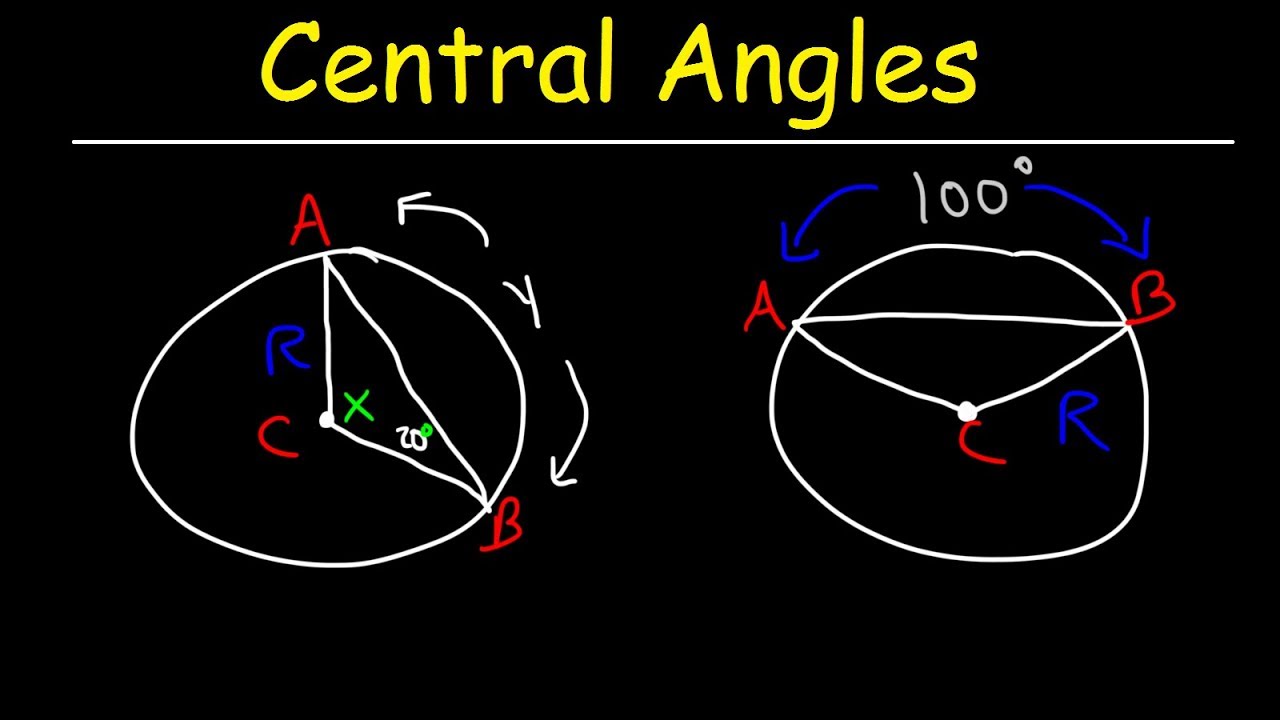
This geometry video tutorial provides a basic introduction into central angles, circle arcs, and angle measurement. It explains the difference between a major arc and a minor arc. A central angle always form a minor arc which is less than 180 degrees in angle measure. The major arc is greater than 180 degrees. A semicircle has an intercepted...
sterile laurel
Umm 90
empty sail
Literally this first 2 minutes explains what a central angle and arc is
sterile laurel
Is the answer 90
empty sail
No
If you want an example, exactly like yours, here's a video I just found
https://youtu.be/NJuNB0N-kP0?t=155
Starts at where I linked, ends around the 4:30 mark

Video on how to find angles/arcs when two tangents intersect outside a circle.
empty sail
Stop pinging me
empty sail
sterile laurel
What was the Minor arc
You tell me
empty sail
That's for you to determine
empty sail
sterile laurel
I did 360 - 96
Then type this into a calculator again
sterile laurel
If I know it now I will know it forever
empty sail
Because it's not equal to 266
empty sail
sterile laurel
I did 360 - 96
But this was the correct process
empty sail
And question 12, which also has question marks, is going to be the same process that you applied for question 11
sterile laurel
Noooooooooo
empty sail
Except you won't need to do the 360 minus the minor arc
empty sail
empty sail
You have a quadrilateral, meaning sum of angles in a quadrilateral equals 360
.
Those two steps
empty sail
Same process as 11
empty sail
If you drew the lines, like how I did in q11, you can find that purple angle
sterile laurel
Just solve it man
sterile laurel
I will do if you solve it
And understand how you did it
But this way it all goes with each other
empty sail
I told you what to do already, apply what you did in q11
sterile laurel
I don't remember how I did
Only need to get the 96
214
?
Right?
@empty sail
empty sail
Didn't I tell you to not ping me?
sterile laurel
:(
empty sail
sterile laurel
Is 214 right?
No
sterile laurel
146 :)
empty sail
What did you do to get that?
empty sail
sterile laurel
90 plus 90 plus 34
How does this equal 107?
empty sail
I was asking how you got the value of 146
empty sail
👍
empty sail
Thumbs up means good
sterile laurel
:D