#help-26
226100 messages · Page 239 of 227
 chrome glen
 frail gyro
how do we do that
chrome glen
Lemme try an example
frail gyro
alright
chrome glen
I get 24 dollars per foot
You get 3 dollars per inch
You make 3 dollars per inch * 12 inches per foot = 36 dollars per foot
frail gyro
yes
chrome glen
So you make 12 more dollars per foot than me
frail gyro
yea
oh okay so we need to know the conversion factor
of km to miles
or other way around
chrome glen
Depends which one youre converting
Lemme do a fraction example
No units
You have 3 numbers a b and c
$\frac{a}{c} \cdot \frac{?}{?} = \frac{a}{b}$
 thorny flameBOT
PapaBread
 chrome glen
If a is dollars
c is km
And b is miles
Thatd be exactly what you do to convert from $/km to $/mile
You multiply by km per mile
chrome glen
Ye
frail gyro
so 1) convert to correct units
- conversion factor
okok thats simple! Thank you bro!
You're the best
now i will ace my math test.
i cant believe in im grade 10 and i dont know this..
ok adios
.close!
.close
 topaz sinewBOT
Channel closed
Closed by @frail gyro
Use .reopen if this was a mistake.
chrome glen
Adios
topaz sinewBOT
 Available help channel!
Send your question here to claim the channel.
Remember:
• Ask your math question in a clear, concise manner.
• Show your work, and if possible, explain where you are stuck.
• After 15 minutes, feel free to ping <@&286206848099549185>.
• Type the command .close to free the channel when you're done.
• Be polite and have a nice day!
Read #❓how-to-get-help for further information on how to ask a good question, and about conduct in the question channels.
 neon iron
how to be good in ln calculus
topaz sinewBOT
neon iron
how to be good in ln calculus
 past kayak
Practice
past kayak
Calculus is a dense subject
But every "trick" has some justification behind why it works
topaz sinewBOT
Channel closed
Closed by @steep vigil
Use .reopen if this was a mistake.
Available help channel!
Send your question here to claim the channel.
Remember:
• Ask your math question in a clear, concise manner.
• Show your work, and if possible, explain where you are stuck.
• After 15 minutes, feel free to ping <@&286206848099549185>.
• Type the command .close to free the channel when you're done.
• Be polite and have a nice day!
Read #❓how-to-get-help for further information on how to ask a good question, and about conduct in the question channels.
 sweet bear
 topaz sinewBOT
sweet bear
topaz sinewBOT
sweet bear
 loud raven
Wow that’s advanced math
I don’t know man sorry

Could you help me please
I really need bro
Is this correct the length of.
X
topaz sinewBOT
@sweet bear Has your question been resolved?

 neon iron
yeah this is correct
sweet bear
so mine is right?
neon iron
yes
sweet bear
alright, i still feel like i did something wrong tho cuz when i put it in a calculator it gives this after doing partial fractions
 topaz sinewBOT
@sweet bear Has your question been resolved?
 grim jacinth
sweet bear
alright, i still feel like i did something wrong tho cuz when i put it in a calc...
grim jacinth
sweet bear
alright, i still feel like i did something wrong tho cuz when i put it in a calc...
That somewhat makes sense for the PFD
That is more easily integrable than the original problem
sweet bear
grim jacinth
That is more easily integrable than the original problem
yea but i dont know hwo to get to that step
grim jacinth
Partial fraction decomposition
 sweet shard
sweet bear
sweet shard
sweet bear
where's the original question
sweet bear
sweet shard
where's the original question
the top is what ive gotten it down to
ill send th e orgiinal

The top one
I did polynomial long division

oh did i do the partial fractions wrong
cuz it needs to be Cx+D right
because bottom is a quadratic
topaz sinewBOT
Channel closed
Closed due to timeout
Use .reopen if this was a mistake.
Available help channel!
Send your question here to claim the channel.
Remember:
• Ask your math question in a clear, concise manner.
• Show your work, and if possible, explain where you are stuck.
• After 15 minutes, feel free to ping <@&286206848099549185>.
• Type the command .close to free the channel when you're done.
• Be polite and have a nice day!
Read #❓how-to-get-help for further information on how to ask a good question, and about conduct in the question channels.
 cyan lion
 cyan lion
can someone help me out with these? I'm not sure what to do
 wooden matrix
1 is just show all the axioms hold
2 is just show it meets the definition
3 is just do the same algorithm like any other example
topaz sinewBOT
@cyan lion Has your question been resolved?
cyan lion
wooden matrix
1 is just show all the axioms hold
I'm not sure what you mean in 1 and 2, I think I get 3 after looking it over
 vital relic
review what the rules/axioms for a vector space is.
topaz sinewBOT
@cyan lion Has your question been resolved?
Channel closed
Closed by @cyan lion
Use .reopen if this was a mistake.
Available help channel!
Send your question here to claim the channel.
Remember:
• Ask your math question in a clear, concise manner.
• Show your work, and if possible, explain where you are stuck.
• After 15 minutes, feel free to ping <@&286206848099549185>.
• Type the command .close to free the channel when you're done.
• Be polite and have a nice day!
Read #❓how-to-get-help for further information on how to ask a good question, and about conduct in the question channels.
 graceful elk
I got the right equation but my answer is 102km/h
 topaz sinewBOT
graceful elk
I got the right equation but my answer is 102km/h
graceful elk
topaz sinewBOT
graceful elk
I got the right equation but my answer is 102km/h
graceful elk
somehow its wrong though and its actually 108
topaz sinewBOT
@graceful elk Has your question been resolved?
grim jacinth
340/x = 360/(x + 6)
@graceful elk Do you have work for your solving of this equation?
graceful elk
yes
this is how I did it
340=340x+2040
-340x
20x=2040
20x/20=2040/20
I got x=102
@grim jacinth
grim jacinth
graceful elk
340=340x+2040
You mean 360x on the LHS
grim jacinth
That looks right to me
Although in the screenshot you sent above it doesn’t look like they asked for you to find speed
Just the equation
graceful elk
@grim jacinth
 graceful elk
but its wrong
x=108
was right
idk if that was a mistake on the teachers end but ya
grim jacinth
They made a mistake
Oh nah
They’re right
They’re asking for the speed of the other person
Yanaisa is faster than Lantay (102)
@graceful elk
topaz sinewBOT
@graceful elk Has your question been resolved?
topaz sinewBOT
Channel closed
Closed due to timeout
Use .reopen if this was a mistake.
topaz sinewBOT
Available help channel!
Send your question here to claim the channel.
Remember:
• Ask your math question in a clear, concise manner.
• Show your work, and if possible, explain where you are stuck.
• After 15 minutes, feel free to ping <@&286206848099549185>.
• Type the command .close to free the channel when you're done.
• Be polite and have a nice day!
Read #❓how-to-get-help for further information on how to ask a good question, and about conduct in the question channels.
 jaunty vector
 topaz sinewBOT
jaunty vector
jaunty vector
topaz sinewBOT
jaunty vector
jaunty vector
I've simplified it to log4(1/3) + log4(7/8)
log4(7/24)
log(7/24)/log(4)
wooden matrix
you seem to have ignored the entire rest of the sum
and only looked at the terms explicitly written
jaunty vector
do you mean the ...
wooden matrix
yes
jaunty vector
how do i find the rest of the sums?
jaunty vector
so i dont need to find the rest of the sums?
if so, is my previous work correct?
uhh. i multiply the logs together to get 1/3 and 7/8
past kayak
There are 11 whole other terms being added
jaunty vector
wdym
jaunty vector
ok. uh so what should i do to the other terms?
past kayak
wooden matrix
the ... implies the rest of the terms follow the same pattern
^
They all follow the same pattern
jaunty vector
wait do i try to find the pattern?
past kayak
If I have 1 + 2 + ... + 9 + 10, is that sum equal to 22?
jaunty vector
yes
jaunty vector
oh.. no then
past kayak
We just don't write them to save space
Similarly, log(1/2) + log(2/3) + ... + log(14/15) + log(15/16) isn't log(1/2) + log(2/3) + log(14/15) + log(15/16)
jaunty vector
ohh.. then what i should do instead of adding them up?
thats the part im stuck on (the ...)
past kayak
How would you solve 1 + 2 + ... + 9 + 10?
jaunty vector
figure out what terms go into the ...
past kayak
And how would you do that?
jaunty vector
+1
jaunty vector
do i have to find the whole sum?
past kayak
I don't know if there's any simplifications that can be made on your problem
I only wanted to address the ...
jaunty vector
it just said elevate and requires decimals or whole numbers
past kayak
You just have to calculate the sum
jaunty vector
since the whole sum is a pettern, i dont really have to find the whole sum?
past kayak
You do. How else would you calculate 1 + 2 + ... + 9 + 10 if you didn't have a formula like n(n+1)/2?
jaunty vector
can the pattern be multiplication?
past kayak
Considering nothing is being multiplied in your sum...
Look, try writing out the whole sum
topaz sinewBOT
Channel closed
Closed by @jaunty vector
Use .reopen if this was a mistake.
Available help channel!
Send your question here to claim the channel.
Remember:
• Ask your math question in a clear, concise manner.
• Show your work, and if possible, explain where you are stuck.
• After 15 minutes, feel free to ping <@&286206848099549185>.
• Type the command .close to free the channel when you're done.
• Be polite and have a nice day!
Read #❓how-to-get-help for further information on how to ask a good question, and about conduct in the question channels.
 vague sapphire
 topaz sinewBOT
vague sapphire
vague sapphire
topaz sinewBOT
vague sapphire
vague sapphire
Could someone explain part c
grim jacinth
It’s just algebraic manipulation (completing the square)
vague sapphire
oh i see it, i am just not familiar with non monic completing the sqaure so the B threw me of
.close
topaz sinewBOT
Channel closed
Closed by @vague sapphire
Use .reopen if this was a mistake.
Available help channel!
Send your question here to claim the channel.
Remember:
• Ask your math question in a clear, concise manner.
• Show your work, and if possible, explain where you are stuck.
• After 15 minutes, feel free to ping <@&286206848099549185>.
• Type the command .close to free the channel when you're done.
• Be polite and have a nice day!
Read #❓how-to-get-help for further information on how to ask a good question, and about conduct in the question channels.
 frigid zenith
I'm really not sure how to go about this one
 topaz sinewBOT
frigid zenith
I'm really not sure how to go about this one
grim jacinth
topaz sinewBOT
frigid zenith
I'm really not sure how to go about this one
grim jacinth
You can do change in position / change in time for the given intervals
You can find position at any given time given y = (stuff)
frigid zenith
How would that look like? Sorry, I'm still fresh with these kind of questions
grim jacinth
You can do:
position at t = 3.01 minus position at t = 3
Take that, and divide that by:
3.01 - 3
frigid zenith
so i'd essentially be diving 3 by .01 for that first answer?
3.01-0.01 =3. 3/0.01 = find this answer
woops sorry typo
but you get my point
and then for the other time intervals I would just need to substitute the .01 in my equation for the new time itnerval?
grim jacinth
$\frac{y(3.01) - y(3)}{3.01 - 3}$
thorny flameBOT
Shen
 frigid zenith
if im not mistaken that just gives y right?
topaz sinewBOT
@frigid zenith Has your question been resolved?
topaz sinewBOT
Channel closed
Closed due to timeout
Use .reopen if this was a mistake.
Available help channel!
Send your question here to claim the channel.
Remember:
• Ask your math question in a clear, concise manner.
• Show your work, and if possible, explain where you are stuck.
• After 15 minutes, feel free to ping <@&286206848099549185>.
• Type the command .close to free the channel when you're done.
• Be polite and have a nice day!
Read #❓how-to-get-help for further information on how to ask a good question, and about conduct in the question channels.
 near mist
can someone please check for me if my calculation is correct or not?

 chilly kestrel
that's correct
topaz sinewBOT
Channel closed
Closed by @near mist
Use .reopen if this was a mistake.
Available help channel!
Send your question here to claim the channel.
Remember:
• Ask your math question in a clear, concise manner.
• Show your work, and if possible, explain where you are stuck.
• After 15 minutes, feel free to ping <@&286206848099549185>.
• Type the command .close to free the channel when you're done.
• Be polite and have a nice day!
Read #❓how-to-get-help for further information on how to ask a good question, and about conduct in the question channels.
 deft bloom
I'm having trouble understanding this question
topaz sinewBOT
deft bloom
I'm having trouble understanding this question
deft bloom
 topaz sinewBOT
@deft bloom Has your question been resolved?
topaz sinewBOT
@deft bloom Has your question been resolved?
topaz sinewBOT
Channel closed
Closed due to timeout
Use .reopen if this was a mistake.
topaz sinewBOT
Available help channel!
Send your question here to claim the channel.
Remember:
• Ask your math question in a clear, concise manner.
• Show your work, and if possible, explain where you are stuck.
• After 15 minutes, feel free to ping <@&286206848099549185>.
• Type the command .close to free the channel when you're done.
• Be polite and have a nice day!
Read #❓how-to-get-help for further information on how to ask a good question, and about conduct in the question channels.
 thorny bison
hello i need some help with some homework
topaz sinewBOT
thorny bison
hello i need some help with some homework
 leaden tusk
what have you tried
thorny bison
well if i remeber correctly
you want to do the d/dx to both sides
then split it into several d/dx's
then it turns into a big mess and i get lost
leaden tusk
if you're unsure of how to do implicit differentiation i suggest a youtube video
thorny bison
well we learned this in class today its just 1 problem took up an entire sheet of paper lmao
 thin vigil
If you're getting lost in your work try doing each side separately first or writing down your steps neatly
thin vigil
thorny bison
well we learned this in class today its just 1 problem took up an entire sheet o...
Try the RHS first
thorny bison
but was i doing it right the way i described or is that not how i do this problem
thin vigil
Yes
thorny bison
then the 6 goes away and what happens to the y^2 ?
or do you just do the constant rule and put 2y
thin vigil
y is a function of x, so really it's [y(x)]^2
thorny bison
so d/dx [y(x)]^2
thin vigil
Yes keep going, you don't need to ask for validation every step, we'll tell you if something is incorrect
thin vigil
How would take the derivative of say sin^2(x)
thin vigil
Have you learned about the chain rule yet?
thin vigil
Do you know when to use the chain rule?
thorny bison
nope
thin vigil
$$(f\circ g)'=f'(g(x))*g'(x)$$
thorny flameBOT
Tronsi
 thorny bison
would it be 2[y(x)] * y(1)
thin vigil
For the derivative wrt to x for y^2?
thin vigil
Whats y(1)?
thorny bison
you do the outside as f' and the inside as g'
y(1) would be the derrivative of y(x) the inside ?
thin vigil
d/dx [y(x)] by definition is dy/dx. You can't just take the derivative of the x inside just like how d/dx sin(x) is not sin(1)
thorny bison
oh
thin vigil
So yes d/dx [y(x)]^2 would be 2y dy/dx
Now you need to do the LHS
Which is a bit more complicated but follows the same basic logic as the RHS
thin vigil
Well first you need to apply the product rule, remember unlike addition or subtraction, you can't just break multiplications or divisions apart for derivatives
As a reminder $$(f*g)' = f'g+fg'$$
thorny flameBOT
Tronsi
 thorny bison
ah
ill just have to stop by my teachers office hours so i can get some one on one learning thank you for your help my memory is just shit
.close
topaz sinewBOT
Channel closed
Closed by @thorny bison
Use .reopen if this was a mistake.
topaz sinewBOT
Available help channel!
Send your question here to claim the channel.
Remember:
• Ask your math question in a clear, concise manner.
• Show your work, and if possible, explain where you are stuck.
• After 15 minutes, feel free to ping <@&286206848099549185>.
• Type the command .close to free the channel when you're done.
• Be polite and have a nice day!
Read #❓how-to-get-help for further information on how to ask a good question, and about conduct in the question channels.
neon iron
heyy
topaz sinewBOT
neon iron
heyy
neon iron
It’s a small exercice of limits if anyone could help me would be rlly nice

I’m trying to do the first one I have my theory next to me
 stuck lintel
What's your particular issue at this time?
neon iron
right now
I did this

So I guess I already have a small part of the answer
but now I have infini - infini
And here Idk what I should do @stuck lintel
thorny flameBOT
Remavas
 neon iron
when x -> +infini its +infini-infini
and that doesnt exist so I need to go more deeper in my ex
 vale jacinth
You understand that ax^n+bx^(n-1)+cx^(n-2)+…=x^n(a+b(1/x)+c(1/x)^2+…) right?
Eventually only the coefficient of the first term a really matters
neon iron
vale jacinth
You understand that ax^n+bx^(n-1)+cx^(n-2)+…=x^n(a+b(1/x)+c(1/x)^2+…) right?
what?
vale jacinth
What “what” ?
And (a+b(1/x)+c(1/x)^2+…) goes to a when x approach infinity x^n will get bigger and bigger
neon iron
thorny flame
**Remavas**
.
vale jacinth
So whether it diverges to positive infinity or negative infinity depends on the sign of a
neon iron
vale jacinth
So whether it diverges to positive infinity or negative infinity depends on the ...
whats a here?
Im pretty sure it was a calcul that was 3-4lines
vale jacinth
3x^2-2x+4=x^2(3-2(1/x)+4(1/x)^2)
Now better?
3 is positive so it diverges to positive infinity
vale jacinth
Not 3x^2+4 goes to positive infinity, but -2x goes to negative infinity so I don’t know which one it is, but just the sign of the coefficient of the first term
neon iron
and he told me we take the sign of the x w the highest exposant
vale jacinth
Then we said the same thing
Not exactly the same I mean the sign of the coefficient of x^n where n is the greatest one
stuck lintel
thorny flame
**Remavas**
In this case
vale jacinth
Negative infinity
stuck lintel
mhm
And so when x goes to +infty, the lim is -infty - infty
Which gives you - infty
vale jacinth
No
I just considered the sign of the coefficient of x^n where n is the largest one
In this case -9
stuck lintel
and you can use the same though process for when goes to -infty
topaz sinewBOT
@neon iron Has your question been resolved?
topaz sinewBOT
Channel closed
Closed due to timeout
Use .reopen if this was a mistake.
Available help channel!
Send your question here to claim the channel.
Remember:
• Ask your math question in a clear, concise manner.
• Show your work, and if possible, explain where you are stuck.
• After 15 minutes, feel free to ping <@&286206848099549185>.
• Type the command .close to free the channel when you're done.
• Be polite and have a nice day!
Read #❓how-to-get-help for further information on how to ask a good question, and about conduct in the question channels.
 final sierra
brushing up on logs, where do I go from here?
topaz sinewBOT
final sierra
brushing up on logs, where do I go from here?
final sierra

I'm not sure how to simplify it further or where to find a list of log rules 😅
I think I can simplify the first term to just 2
actually I found a list of log properties and rules!
.close
topaz sinewBOT
Channel closed
Closed by @final sierra
Use .reopen if this was a mistake.
Available help channel!
Send your question here to claim the channel.
Remember:
• Ask your math question in a clear, concise manner.
• Show your work, and if possible, explain where you are stuck.
• After 15 minutes, feel free to ping <@&286206848099549185>.
• Type the command .close to free the channel when you're done.
• Be polite and have a nice day!
Read #❓how-to-get-help for further information on how to ask a good question, and about conduct in the question channels.
 smoky light
How do you convert a non-homogeneous second order ode to a first order system? Equation I'm trying to convert is this:
 topaz sinewBOT
smoky light
How do you convert a non-homogeneous second order ode to a first order system? E...
smoky light
topaz sinewBOT
smoky light
How do you convert a non-homogeneous second order ode to a first order system? E...
smoky light
Just confused on where the g(t) goes in the matrix
topaz sinewBOT
@smoky light Has your question been resolved?
smoky light
<@&286206848099549185>
sweet shard
smoky light
<@&286206848099549185>
see example 4 here
https://tutorial.math.lamar.edu/classes/de/systemsde.aspx
In this section we will look at some of the basics of systems of differential equations. We show how to convert a system of differential equations into matrix form. In addition, we show how to convert an nth order differential equation into a system of differential equations.
smoky light
sweet shard
see example 4 here
https://tutorial.math.lamar.edu/classes/de/systemsde.aspx
Thank you!
.close
topaz sinewBOT
Channel closed
Closed by @smoky light
Use .reopen if this was a mistake.
topaz sinewBOT
Available help channel!
Send your question here to claim the channel.
Remember:
• Ask your math question in a clear, concise manner.
• Show your work, and if possible, explain where you are stuck.
• After 15 minutes, feel free to ping <@&286206848099549185>.
• Type the command .close to free the channel when you're done.
• Be polite and have a nice day!
Read #❓how-to-get-help for further information on how to ask a good question, and about conduct in the question channels.
 hot sigil
 hot sigil
can anyone help with this?
topaz sinewBOT
@hot sigil Has your question been resolved?
topaz sinewBOT
Channel closed
Closed due to timeout
Use .reopen if this was a mistake.
Available help channel!
Send your question here to claim the channel.
Remember:
• Ask your math question in a clear, concise manner.
• Show your work, and if possible, explain where you are stuck.
• After 15 minutes, feel free to ping <@&286206848099549185>.
• Type the command .close to free the channel when you're done.
• Be polite and have a nice day!
Read #❓how-to-get-help for further information on how to ask a good question, and about conduct in the question channels.
Channel closed
Closed due to the original message being deleted
Available help channel!
Send your question here to claim the channel.
Remember:
• Ask your math question in a clear, concise manner.
• Show your work, and if possible, explain where you are stuck.
• After 15 minutes, feel free to ping <@&286206848099549185>.
• Type the command .close to free the channel when you're done.
• Be polite and have a nice day!
Read #❓how-to-get-help for further information on how to ask a good question, and about conduct in the question channels.
 prisma prairie
 topaz sinewBOT
prisma prairie
https://cdn.discordapp.com/attachments/496784996510466057/946241830176051260/unk...
prisma prairie
topaz sinewBOT
prisma prairie
https://cdn.discordapp.com/attachments/496784996510466057/946241830176051260/unk...
prisma prairie
how do they get from c'(t) to |c'(t)|?
I tried doing it but the terms don't cancel as nicely?
.close
topaz sinewBOT
Channel closed
Closed by @prisma prairie
Use .reopen if this was a mistake.
Available help channel!
Send your question here to claim the channel.
Remember:
• Ask your math question in a clear, concise manner.
• Show your work, and if possible, explain where you are stuck.
• After 15 minutes, feel free to ping <@&286206848099549185>.
• Type the command .close to free the channel when you're done.
• Be polite and have a nice day!
Read #❓how-to-get-help for further information on how to ask a good question, and about conduct in the question channels.
 burnt swift
 topaz sinewBOT
burnt swift
burnt swift
topaz sinewBOT
burnt swift
burnt swift
how would i go about solving this?
my first instinct is to cancel something out and use one of the formulae provided to me
but doesnt look like thats possible
 hearty narwhal
try partial fraction decomposition
burnt swift
i did partial fraction decomp, now what?
i got 1/k^2 for one of them and the other is very similar
 burnt swift
yes
 topaz sinewBOT
Channel closed
Closed by @burnt swift
Use .reopen if this was a mistake.
topaz sinewBOT
Available help channel!
Send your question here to claim the channel.
Remember:
• Ask your math question in a clear, concise manner.
• Show your work, and if possible, explain where you are stuck.
• After 15 minutes, feel free to ping <@&286206848099549185>.
• Type the command .close to free the channel when you're done.
• Be polite and have a nice day!
Read #❓how-to-get-help for further information on how to ask a good question, and about conduct in the question channels.
 icy pilot
why can't there be a negative number in the radical? (for example in the equation below)
topaz sinewBOT
icy pilot
why can't there be a negative number in the radical? (for example in the equatio...
icy pilot
$$f(x)=a\sqrt{x-h}+k$$
thorny flameBOT
geoxcaliber
 icy pilot
Second question: If there is no h or k visible, does that mean their both 0? My teacher said that's true of the h, not sure about k
 tulip prism
icy pilot
why can't there be a negative number in the radical? (for example in the equatio...
tulip prism
icy pilot
why can't there be a negative number in the radical? (for example in the equatio...
Well, for example, what do you think the square root of -4 would be?
topaz sinewBOT
@icy pilot Has your question been resolved?
icy pilot
tulip prism
Well, for example, what do you think the square root of -4 would be?
so for square root it can’t be anything
but for cube
if you had say -64 that’d work bc -4 will get you that?
tulip prism
Yes, with the cube root it works
In general, if you take the nth root, your radical must be positive if n is even, and can be anything if n is odd
for n positive natural number obviously
icy pilot
Thanks

do you have any tips for finding the 'a'? in this case, -2
it went +1 then -2
if you did 1 / -2 that'd be -.5. Would you do -2/1? if so, why? does the top down movement go first
oh, rise over run
icy pilot
Can somebody explain how
 worn inlet
u want to find the a right?
generally speaking, if you know the vertex of a parabola, it's much easier to find it using the vertex form
icy pilot
Yes
worn inlet
so it would be a(x-1)^2 +8
now sub one of the pairs in, I am using (3,0)
a(3-1)^2+8=0
4a=-8
a=-2
thorny flameBOT
geoxcaliber
 thorny flameBOT
geoxcaliber
 icy pilot
what takes place
for the radical to be removed in the left side
so
does the square root half the 2
then the 2 exponent bring it back? or, better question, what happens first, exponent or square root?
$$\sqrt{x+2}^2=10$$ I meant
thorny flameBOT
geoxcaliber
 topaz sinewBOT
@icy pilot Has your question been resolved?
icy pilot
worn inlet
sorry for replying late
it's fine
Did you read my question? that isn't what I asked
worn inlet
ummmm
square root
and power of 2
are invertible
like you can reverse them
by using the other one
topaz sinewBOT
Channel closed
Closed by @icy pilot
Use .reopen if this was a mistake.
Available help channel!
Send your question here to claim the channel.
Remember:
• Ask your math question in a clear, concise manner.
• Show your work, and if possible, explain where you are stuck.
• After 15 minutes, feel free to ping <@&286206848099549185>.
• Type the command .close to free the channel when you're done.
• Be polite and have a nice day!
Read #❓how-to-get-help for further information on how to ask a good question, and about conduct in the question channels.
 lime verge
Hi ! Would you happen to know how to determinate if an angle between two 2D vectors is positive or negative ? Thank you in advance.
topaz sinewBOT
lime verge
Hi ! Would you happen to know how to determinate if an angle between two 2D vect...
sweet shard
lime verge
Hi ! Would you happen to know how to determinate if an angle between two 2D vect...
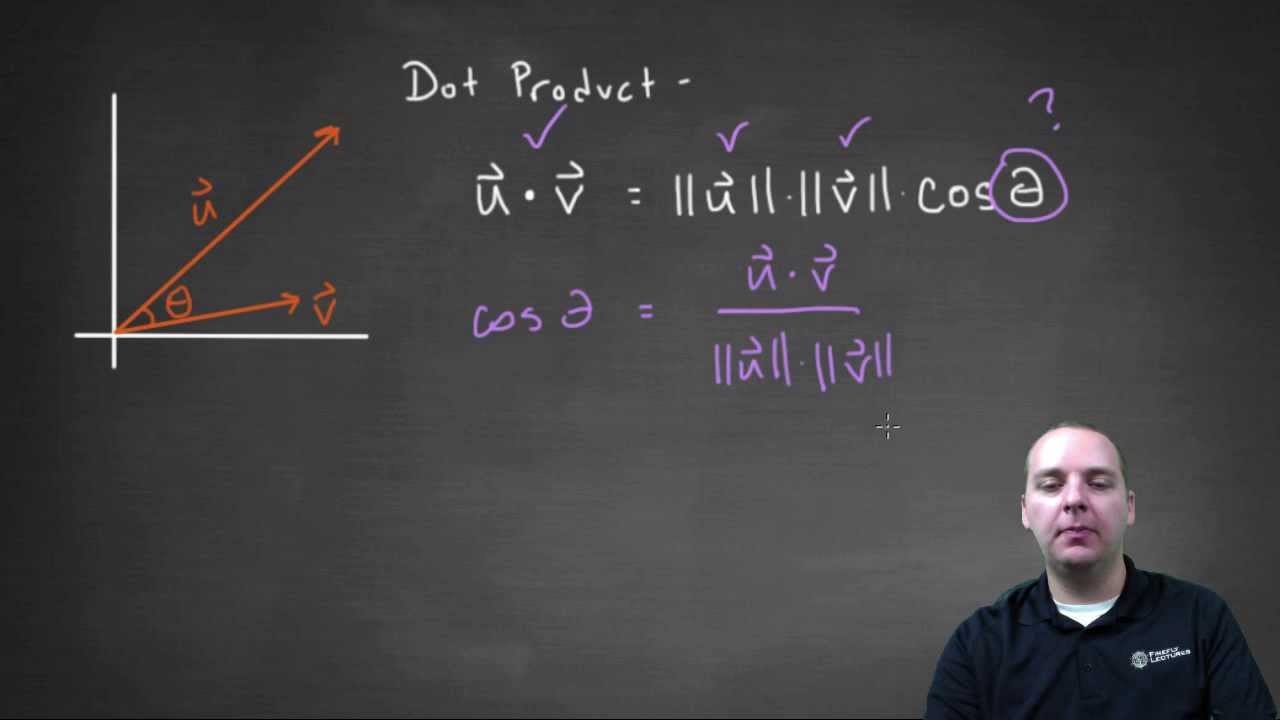
Using Dot Product to Find the Angle Between Two Vectors. You can use one of the dot product formulas to actually compute the angle between two vectors. Here we show how to use this formula to find an angle theta between two vectors Subscribe on YouTube: http://bit.ly/1bB9ILD
Leave some love on RateMyProfessor: http://bit.ly/1dUTHTw
Send us a c...
lime verge
Thank you but this is not what I asked.
lime verge
sweet shard
See
https://youtu.be/4hIh8ujylWE
For example, on this picture, the angle between V1 and V2 is positive. The angle between V2 and V1 is negative. I would like to know if there is a formula which would allow me to know which way it goes.

In a 2D plane, of course.
topaz sinewBOT
@lime verge Has your question been resolved?
lime verge
Welp
sweet shard
Why would one be negative and the other be positive?
Are you assigning it by a rule you made up?
past kayak
If anything, I would think that it'd be the other way around, since positive angles go CCW.
topaz sinewBOT
@lime verge Has your question been resolved?
topaz sinewBOT
Channel closed
Closed due to timeout
Use .reopen if this was a mistake.
Available help channel!
Send your question here to claim the channel.
Remember:
• Ask your math question in a clear, concise manner.
• Show your work, and if possible, explain where you are stuck.
• After 15 minutes, feel free to ping <@&286206848099549185>.
• Type the command .close to free the channel when you're done.
• Be polite and have a nice day!
Read #❓how-to-get-help for further information on how to ask a good question, and about conduct in the question channels.
 lilac grail
Hey can I get some help?
topaz sinewBOT
lilac grail
Hey can I get some help?
leaden tusk
topaz sinew
read
lilac grail

I'm not really sure how to go about calculating it with out prices
<@&286206848099549185>
leaden tusk
topaz sinew
you already pinged helpers, and read
• After 15 minutes, feel free to ping @Helpers.
 vernal vale
👀
lilac grail
I'm sorry it's just that it's been >15 minutes,
vernal vale
ye they waited
 lilac grail
It's fine, I'll just leave the server...
vernal vale
wait
i wanna answer your question
im just trying to remember basic econ

yea ngl i dont remember
wed write the linear combination right?
so like jak can catch 8 fish or find 12 pineapples
then each fish he forgoes catching gives him opportunity to find another 1.5 pineapple
so $\frac 1 8 F + \frac{1}{12} P = 1$
thorny flameBOT
jan Niku
 vernal vale
assuming he uses his whole day
lilac grail
So for the second it would be 2?
vernal vale
second?
lilac grail
Daxter
vernal vale
well theyd each have 2 costs, i believe
so 4 total answers
i think
no one is helping so i wanna try
you have some marginal cost for fish
its in terms of pineapples
and visa versa
since pineapples are the thing you give up to get fish
make sense?
lilac grail
sort of
vernal vale
like just assume they spend a full day doing stuff
they arent sitting around doing nothing
they can either spend time fishing, or spend time getting pineapples
only so many hours in the day
if you decide that youd like to have 3 pineapples, thats fine
but you have to spend time finding them
during that time, you could have caught 2 fish
so thats your marginal cost for pineapple
to increase your production of pineapple by 1, you give up 2/3 fish
you usually just think about it like
well i do
as creating this function

this gives you how much it costs to produce either a fish or a pineapple, since they each take time and you only have one day
then you think how many of one do i have to give up to get one of the other
thats marginal cost
idk do you have specific confusion? @lilac grail
topaz sinewBOT
@lilac grail Has your question been resolved?
topaz sinewBOT
Channel closed
Closed due to timeout
Use .reopen if this was a mistake.
Available help channel!
Send your question here to claim the channel.
Remember:
• Ask your math question in a clear, concise manner.
• Show your work, and if possible, explain where you are stuck.
• After 15 minutes, feel free to ping <@&286206848099549185>.
• Type the command .close to free the channel when you're done.
• Be polite and have a nice day!
Read #❓how-to-get-help for further information on how to ask a good question, and about conduct in the question channels.
 daring oak
could someone help me with this one pls
 topaz sinewBOT
daring oak
could someone help me with this one pls
topaz sinewBOT
daring oak
could someone help me with this one pls
 static void
u subsitution right
daring oak
what would I sub u for?
daring oak
and then where would i go from there?
daring oak
by finding the derivative of u?
daring oak
du would just be e^x, right?
static void
yes
du = e^x dx
@daring oak i think im wrong
so we'll have to see if someone else knows
 mortal thunder
._.
can't you just differentiate the options?

- for example, is outright incorrect !
daring oak
like im supposed to do everything in the most efficient way possible
(i mean the question itself is not graded, its just practice)
please ping me if anyone knows
neon iron
daring oak
could someone help me with this one pls
Not sure but the first step is propably to take that adding pi/2 rotating by 90 degress we know that tan(x+π/2) = -cot(x) so ur function f(x) can be written as -cot(e^x) that's all I can think of until now
And e^x is a value between 0 and π/2
Including 0 and π/2
 wheat kindle
Am I misundertanding? Why isn't it just d by the fundamental theorem of calculus? No need to work anything out.
neon iron
wheat kindle
Am I misundertanding? Why isn't it just d by the fundamental theorem of calculus...
Fun fact I just read option d now and was like
neon iron
daring oak
(i mean the question itself is not graded, its just practice)
Something about what she means here
Probably
topaz sinewBOT
@daring oak Has your question been resolved?
Channel closed
Closed by @daring oak
Use .reopen if this was a mistake.
topaz sinewBOT
Available help channel!
Send your question here to claim the channel.
Remember:
• Ask your math question in a clear, concise manner.
• Show your work, and if possible, explain where you are stuck.
• After 15 minutes, feel free to ping <@&286206848099549185>.
• Type the command .close to free the channel when you're done.
• Be polite and have a nice day!
Read #❓how-to-get-help for further information on how to ask a good question, and about conduct in the question channels.
 latent tusk
 topaz sinewBOT
latent tusk
latent tusk
topaz sinewBOT
latent tusk
latent tusk
Hello, my friend and I struggle with this question ://
im still stuck on questions a & b
sweet shard
show your current work

 cerulean shale
Are you bad or good at math Wally?
latent tusk
I'm pretty neutral i guess?
cerulean shale
oh okay cool
 crisp anvil
So that means you now have two equations $y=3x+2$ and $y=-\frac{x}{4}-\frac{21}{4}$
thorny flameBOT
Mango
 crisp anvil
I would multiply both sides of C by something so that you get nice integers instead of annoying fractions
latent tusk
ah alright
topaz sinewBOT
@latent tusk Has your question been resolved?
latent tusk
Yep
topaz sinewBOT
Channel closed
Closed due to timeout
Use .reopen if this was a mistake.
Available help channel!
Send your question here to claim the channel.
Remember:
• Ask your math question in a clear, concise manner.
• Show your work, and if possible, explain where you are stuck.
• After 15 minutes, feel free to ping <@&286206848099549185>.
• Type the command .close to free the channel when you're done.
• Be polite and have a nice day!
Read #❓how-to-get-help for further information on how to ask a good question, and about conduct in the question channels.
neon iron
Hello there! So I got super sick and missed school and apparently we just started a new unit and I don’t even know where to start.
topaz sinewBOT
neon iron
Hello there! So I got super sick and missed school and apparently we just starte...
 topaz sinewBOT
Channel closed
Closed by @primal oasis
Use .reopen if this was a mistake.
Available help channel!
Send your question here to claim the channel.
Remember:
• Ask your math question in a clear, concise manner.
• Show your work, and if possible, explain where you are stuck.
• After 15 minutes, feel free to ping <@&286206848099549185>.
• Type the command .close to free the channel when you're done.
• Be polite and have a nice day!
Read #❓how-to-get-help for further information on how to ask a good question, and about conduct in the question channels.
 toxic dust
In a meeting, there are $12k$ people, each one of them know $3k+6$ people, and for any 2 people, there are $n$ people know them, how many people in this meeting?
topaz sinewBOT
toxic dust
In a meeting, there are $12k$ people, each one of them know $3k+6$ people, and f...

 topaz sinewBOT
@toxic dust Has your question been resolved?
topaz sinewBOT
@toxic dust Has your question been resolved?
vale jacinth
Just a little thought. I denoted those people vertices, I connected them with blue edges if they know each other, red edges otherwise. I tried calculating the number of triangles who have two blue edges and one red edge in equivalent ways. But I got nowhere… that number could be 12k(9k-7)n/2 right? But I didn’t find another equivalent way to calculate that number so that I could get an equation…. Maybe discrete-math channel or combinatorial-structure channel could help you…
topaz sinewBOT
@toxic dust Has your question been resolved?
topaz sinewBOT
Channel closed
Closed by @toxic dust
Use .reopen if this was a mistake.
topaz sinewBOT
Available help channel!
Send your question here to claim the channel.
Remember:
• Ask your math question in a clear, concise manner.
• Show your work, and if possible, explain where you are stuck.
• After 15 minutes, feel free to ping <@&286206848099549185>.
• Type the command .close to free the channel when you're done.
• Be polite and have a nice day!
Read #❓how-to-get-help for further information on how to ask a good question, and about conduct in the question channels.
 true crow
In how many ways can you choose the first 20 positive integers such that no two are consecutive integers
topaz sinewBOT
true crow
In how many ways can you choose the first 20 positive integers such that no two ...
Please don't occupy multiple help channels.
true crow
true crow
In how many ways can you choose the first 20 positive integers such that no two ...
。
Anyone know
Bro
In how many ways can you choose the first 20 positive integers such that no two are consecutive integers
sweet shard
Did you learn pigeon hole principle yet
true crow
sweet shard
Did you learn pigeon hole principle yet
wrote question wrong

this is question
topaz sinewBOT
@true crow Has your question been resolved?
topaz sinewBOT
Channel closed
Closed due to timeout
Use .reopen if this was a mistake.
topaz sinewBOT
Available help channel!
Send your question here to claim the channel.
Remember:
• Ask your math question in a clear, concise manner.
• Show your work, and if possible, explain where you are stuck.
• After 15 minutes, feel free to ping <@&286206848099549185>.
• Type the command .close to free the channel when you're done.
• Be polite and have a nice day!
Read #❓how-to-get-help for further information on how to ask a good question, and about conduct in the question channels.
 mellow venture
how can u find if the series sin(npi+(1/n) is convergent or divergent
topaz sinewBOT
mellow venture
how can u find if the series sin(npi+(1/n) is convergent or divergent
thorny flameBOT
 mellow venture
yes
mortal thunder

First, notice this is simply: $$\sum_{n=1}^{\infty} (-1)^{n} \sin \qty(\frac{1}{n})$$
thorny flameBOT
 mortal thunder
now, use ratio test 
mellow venture
what if it was sin(2npi+1/n)
mortal thunder
same thing
mortal thunder
not quite
$$\sum_{n=1}^{\infty} \sin \qty(2n\pi + \frac{1}{n}) = \sum_{n=1}^{\infty}\sin \qty(\frac{1}{n})$$
thorny flameBOT
 mellow venture
because 2npi is always 0?
mortal thunder
because 2pi is the period
mellow venture
for cos(npi+1/n) it would be cos(1/n)? which would just be divergent
topaz sinewBOT
@mellow venture Has your question been resolved?
topaz sinewBOT
Channel closed
Closed due to timeout
Use .reopen if this was a mistake.
Available help channel!
Send your question here to claim the channel.
Remember:
• Ask your math question in a clear, concise manner.
• Show your work, and if possible, explain where you are stuck.
• After 15 minutes, feel free to ping <@&286206848099549185>.
• Type the command .close to free the channel when you're done.
• Be polite and have a nice day!
Read #❓how-to-get-help for further information on how to ask a good question, and about conduct in the question channels.
 static crest
 topaz sinewBOT
static crest
static crest
topaz sinewBOT
static crest
static crest
I am stuck at I and II
I know the definition of union
But I don’t know what assumption we still have to make before applying the definition of union
topaz sinewBOT
@static crest Has your question been resolved?
static crest
<@&286206848099549185>
topaz sinewBOT
@static crest Has your question been resolved?
topaz sinewBOT
@static crest Has your question been resolved?
static crest
<@&286206848099549185>
Please help me I have been stucking here for a day already
Oh
So the question is about showing the union of the power set of C and the power set of D is a subset of the power set of the union of C and D
And the question is like fill in the blanks
Each of the roman number represents some words, expressions or even calculations
I guess (I) is the assumption part of the question but I am not sure what exactly it could be
static crest
<@&286206848099549185> but what assumption I still have to make in (I)? It doesn’t really sounds like I have to pick an element inside S
sweet shard
S is an element of the left hand side
$S\in \mathcal{P}(B) \cup \mathcal{P}(C)$ should do it
thorny flameBOT
riemann
 static crest
sweet shard
S is an element of the left hand side
static crest
sweet shard
S is an element of the left hand side
Oic
Suppose C,D are sets.
Pick any object S.
Let $S\in \mathcal{P}(C) \cup \mathcal{P}(D)$
Then $S\in \mathcal{P}(C)$ or $S\in \mathcal{P}(D)$, by the definition of union.
thorny flameBOT
Trenton
 static crest
sweet shard
S is an element of the left hand side
static crest
sweet shard
S is an element of the left hand side
Do u mean by this?
static crest
Suppose $S\in \mathcal{P}(C)$. Then S is a subset of C by the definition of power set.
thorny flameBOT
Trenton
 static crest
We verify that $S$ is a subset of $C\cup D$ (according to the definition of subset relation and union):
thorny flameBOT
Trenton
 static crest
Pick any object $x$. Suppose $x\in S$.
thorny flameBOT
Trenton
 static crest
Since $S$ is a subset of $C\cup D$ and $x \in S$. Then by the definition of subset relation, $x \in C\cup D$.
thorny flameBOT
Trenton
 static crest
Therefore by the definition of union, we have $x\in C$ or $x\in D$.
thorny flameBOT
Trenton
 static crest
@sweet shard But now I stuck at VIII. I am not sure how to turn the things into power set, or is there actually any theorem to apply.
static crest
<@&286206848099549185> can anyone help me about what should I do next ? What should I make in (VIII)?
topaz sinewBOT
@static crest Has your question been resolved?
 elfin sparrow
@static crest
You've just shown that $(x\in S)\implies(x\in C\cup D)$. This is the definition of a subset.
thorny flameBOT
tatpoj
 topaz sinewBOT
Channel closed
Closed due to timeout
Use .reopen if this was a mistake.
static crest
.reopen
topaz sinewBOT
✅
static crest
elfin sparrow
You've just shown that $(x\in S)\implies(x\in C\cup D)$. This is the definition ...
Yes I shown that but I am going to figure out what VIII is. So we need to use the power set notation.
Yet I just don’t know what I can do next to make the prove logically make sense at VIII
Can anyone help me?
static crest
<@&286206848099549185> can anyone help me please
static crest
<@&286206848099549185> please help me
static crest
<@&286206848099549185> sorry for pinning again and again but I really don’t know what should I do next. So I know x in S and x in C U D. But why we can conclude that S is in the power set of (the union of C U D)?
I mean the part (VIII) in the question
sweet shard
static crest
<@&286206848099549185> sorry for pinning again and again but I really don’t know...
What's your full proof so far? I don't know what's remaining to show
static crest
Suppose C,D are sets.
Pick any object S.
Let $S\in \mathcal{P}(C) \cup \mathcal{P}(D)$
Then $S\in \mathcal{P}(C)$ or $S\in \mathcal{P}(D)$, by the definition of union.
thorny flameBOT
Trenton
 static crest
Suppose $S\in \mathcal{P}(C)$. Then S is a subset of C by the definition of power set. We verify that $S$ is a subset of $C\cup D$ (according to the definition of subset relation and union):
thorny flameBOT
Trenton
 static crest
Pick any object $x$. Suppose $x\in S$. Since $S$ is a subset of $C\cup D$ and $x \in S$. Then by the definition of subset relation, $x \in C\cup D$. Therefore by the definition of union, we have $x\in C$ or $x\in D$.
thorny flameBOT
Trenton
 static crest

This is my question
So now I finished (I) to (VII) already
And I stuck at (VIII)
I guess (IX) is “$S\in \mathcal{P}(C\cup D)$”
thorny flameBOT
Trenton
 static crest
So I just don’t know how to relate the aforementioned to (IX)
static crest
sweet shard
Or x in S and S is a subset of the union
Ok thank you, get it
static crest
.close
topaz sinewBOT
Channel closed
Closed by @static crest
Use .reopen if this was a mistake.
static crest
.reopen
topaz sinewBOT
✅

 static crest
So I figured out some statements successfully:
(I): if $(x\in A \cap B)$ then $(x\in A)$
thorny flameBOT
Trenton
 static crest
(II): Suppose $x\in A\cap B$
thorny flameBOT
Trenton
 static crest
(III): $x\in A$ and $x\in B$
thorny flameBOT
Trenton
 static crest
(IV): $x\in A$
thorny flameBOT
Trenton
 static crest
(V): For any object $x$, if $(x \in A)$ then $(x\in A\cap B)$
thorny flameBOT
Trenton
 static crest
(VI): Pick any object $x$. Suppose $x\in A$.
thorny flameBOT
Trenton
 static crest
(VII) $x\in A$
thorny flameBOT
Trenton
 static crest
(VIII): $x\in A$ and $x\in B$
thorny flameBOT
Trenton
 static crest
(IX): $x\in A\cap B$
thorny flameBOT
Trenton
 static crest
(X): $A\cap B\subset A$
thorny flameBOT
Trenton
 static crest
(XI): $A\cap B=A$
thorny flameBOT
Trenton
 static crest
(XII): For any object $x$, if $(x \in A)$ then $(x \in B)$.
thorny flameBOT
Trenton
 static crest
(XIII): $x \in A\cap B$
thorny flameBOT
Trenton
 static crest
I doubt (XIII) is correct or not
And also I cant figure out what (XIV) is
Can anyone help me?

 elfin sparrow
I probably can, let me read through what you've got already, one sec
static crest
elfin sparrow
I probably can, let me read through what you've got already, one sec
Thank you
thorny flameBOT
tatpoj
 elfin sparrow
That, by itself, does not prove that x is also in B
The wording suggests we should be using the subset relation
I think this would make more sense:
Since $A \subset B$, we have $x\in B$ by definition of the subset
thorny flameBOT
tatpoj
 elfin sparrow
Does that make sense to you?
static crest
Yes. I just forget to mention A is a subset of B
elfin sparrow
IX and X are good. Give me a sec to read through the last part
static crest
Ok thank you
elfin sparrow
XIII is not correct.
static crest
Yes I think that is kinda strange
elfin sparrow
In this part, we are trying to prove that $A \subset B$, so making the assumption $x\in A \cap B$ doesn't get us anywhere
thorny flameBOT
tatpoj
 static crest
Yes I think that is kinda strange
static crest
static crest
Yes I think that is kinda strange
It is repeated and appearing in both the assumption and conclusion
elfin sparrow
Since we're trying to prove that A is a subset of B, we should assume x is in A, and then prove that x is in B.
Does that give you a clue as to what we want in XIII?
static crest
No, it is my words too lengthy
elfin sparrow
For XIII?
static crest
What if I write $x\in A$ for XIII
thorny flameBOT
Trenton
 elfin sparrow
Exactly
static crest
Ok
elfin sparrow
This is how we prove that A is a subset of B. Assume x is in A, then prove x is in B
static crest
So for the XIV part I just apply the assumption of $A\cap B=A$ and $x\in A$ ?
thorny flameBOT
Trenton
 elfin sparrow
Yes. I think it's sufficient to just put $A \cap B = A$ for XIV
thorny flameBOT
tatpoj
 static crest
Ok thx
Then for the XV, I apply the definition of intersection, such that $x\in A$ and $x\in B$
thorny flameBOT
Trenton
 elfin sparrow
Yes
static crest
Umm but then I am not sure what should I put in the XVI
Which is the “In particular”
elfin sparrow
Remember what our goal is.
We want to prove that A is a subset of B. We assumed x is in A, now we need to show x is in B.
static crest
Umm so I specify “for any object $x$, if $x\in A$ then $x\in B$”
thorny flameBOT
Trenton
 elfin sparrow
Not quite
elfin sparrow
I think, since we just stated $x \in A$ and $x \in B$, now it makes sense to say, "In particular, $x \in B$."
thorny flameBOT
tatpoj
 elfin sparrow
Since what we wanted to ultimately show was that x is in B
elfin sparrow
No problem
static crest
.close
topaz sinewBOT
Channel closed
Closed by @static crest
Use .reopen if this was a mistake.
Available help channel!
Send your question here to claim the channel.
Remember:
• Ask your math question in a clear, concise manner.
• Show your work, and if possible, explain where you are stuck.
• After 15 minutes, feel free to ping <@&286206848099549185>.
• Type the command .close to free the channel when you're done.
• Be polite and have a nice day!
Read #❓how-to-get-help for further information on how to ask a good question, and about conduct in the question channels.
static crest
 topaz sinewBOT
static crest
topaz sinewBOT
static crest
 thorny flameBOT
Trenton
 static crest
(II): $subset$ relation
thorny flameBOT
Trenton
 static crest
(III): $x\in B$
thorny flameBOT
Trenton
 static crest
(IV): $x\in A$
thorny flameBOT
Trenton
 static crest
(V): $since$
thorny flameBOT
Trenton
 static crest
(VI): $x\in B$
thorny flameBOT
Trenton
 static crest
(VII): $and$
thorny flameBOT
Trenton
 static crest
elfin sparrow
No problem
static crest
elfin sparrow
No problem
Sorry can you help me for this
I got confused in this question
The question include $x\not\in B$
thorny flameBOT
Trenton
 static crest
But I cant find where can I deduce that
topaz sinewBOT
@static crest Has your question been resolved?
static crest
<@&286206848099549185> can anyone help me about it
static crest
<@&286206848099549185> can anyone help? I am not sure about the assumption part (I) is correct or not
 loud dawn
Just trying to match these up
god this cookie cutter fill-in-the-blank thing is so lazy
Ok so it looks like
man @static crest are you sure you can't just write your own proof
genuinely, seriously, it might be easier to just write a proof yourself and then try to fill in these stupid blanks
neon iron
Yeah fill in the blank math is just 😮💨
static crest
loud dawn
genuinely, seriously, it might be easier to just write a proof yourself and then...
I also want to… but such thing is my homework
loud dawn
ok so just write your own proof, and loosely follow whatever framework they're using
if they say proof by contradition, do a proof by contradiction
and then it'll be easy to fill in the blanks
static crest
Ok
static crest
loud dawn
and then it'll be easy to fill in the blanks
Ok I tried but I don’t get what kind of contradiction the question want me to do
So there is actually three assumptions
$A\subset B$ $A\subset C$ $B\subset C$
thorny flameBOT
Trenton
 static crest
But neither of them such that the complements the sets are C\B or C\A
static crest
<@&286206848099549185> can anyone help
I really cant think how to make contradiction
static crest
<@&286206848099549185> So how can I use the method of contradiction to show that C\B is a subset of C\A?
Can anyone give me some hints 
static crest
<@&286206848099549185> sorry for pinning again and again but I really want to get this problem solved. I am going to have exam very soon but I still not familiar with this stuff
 thorny flameBOT
Trenton
 mortal thunder
Is that fine?
static crest
I am not sure
mortal thunder
$x \in C - B$
thorny flameBOT
Ansh
 static crest
Ok
mortal thunder
or C \ B
according to your notations
what do you think would make most sense for (II)?
static crest
Oh so (II) should be “complement”?
static crest
Umm so we have $x\in C$ and $x\not\inB$
thorny flameBOT
Trenton
Compile Error! Click the  reaction for more information.
(You may edit your message to recompile.)
 static crest
Umm idk if it make sense
mortal thunder
Do you not read english and know a little set theory?
static crest
Umm you mean I use the set language?

 mortal thunder
so combine that with your "by definition of compliment" and it does not make any sense
static crest
Umm
How about apply subset relation definition
All but then I don’t know how to continue, seems I am in the wrong track
mortal thunder
Anyways, if you cannot guess, can you read the next line for me please?
static crest

Pick any object x, suppose $x\in C-B$. By the definition of subset relation, we have $x\in C-A$.
thorny flameBOT
Trenton
 static crest
Alright I guess it is quite problematic, as I am using the assumption part
static crest
mortal thunder
Anyways, if you cannot guess, can you read the next line for me please?
Perhaps the set I choose in (I) already not correct
static crest
Yes…..
mortal thunder
Let's talk after an hr if you need to chill 
mortal thunder
static crest
Alright I guess it is quite problematic, as I am using the assumption part
assumption part was that A subset of B. For your proof, you're picking an x from C - B, and by definition of set difference, x is not in B. Then the context hints you that you'll be verifying that x is not in A either, by proof of contradiction in the next paraphrase
mortal thunder
static crest
<#342850939306246145>
no, I mean, give your brain some time to chill if you've been working on this for a while.. It's common to stress out and skip trivial arguments when you're overheated
static crest
mortal thunder
no, I mean, give your brain some time to chill if you've been working on this fo...
I see haha
static crest
mortal thunder
assumption part was that A subset of B. For your proof, you're picking an x from...
Ok


 mortal thunder
No you're clearly not
static crest
Oh I make a mistake
mortal thunder
$$x \in C - B \implies x \in A \land x \notin B$$?
thorny flameBOT
Ansh
 mortal thunder
what?

 static crest
So the first line should be “Suppose $x\in A$”?
thorny flameBOT
Trenton
 static crest
Oh so the next line we can apply the definition of the subset relation
topaz sinewBOT
@static crest Has your question been resolved?


 thorny flameBOT
Trenton
 static crest
@mortal thunder is this what you mean?
mortal thunder
static crest
Till here, yes
I'd have to read after that to reassure you but I'm busy rn
static crest
Ok thx
mortal thunder
btw yes, that makes sense
that'd verify x is not in A
which was the intended approach
VIII should be x \notin A
thorny flameBOT
Trenton
 static crest
Hence by the definition of complement, we have $x\in C-A$.
thorny flameBOT
Trenton
 static crest
It follows that $A\subset B$.
thorny flameBOT
Trenton
 static crest
 thorny flameBOT
Trenton

Trenton

Trenton

Trenton

Trenton

Trenton

Trenton

Trenton

Trenton
 static crest
mortal thunder
VIII should be x \notin A
static crest
mortal thunder
VIII should be x \notin A
When you are free, feel free to take a look. Thanks
topaz sinewBOT
@static crest Has your question been resolved?
topaz sinewBOT
@static crest Has your question been resolved?