#help-13
428200 messages · Page 485 of 429
 rigid pelican
 hazy trench
Go on
hazy trench
Power of 3
rigid pelican
That means that number X 3 right?
rigid pelican
Ohhhh
So it's essentially sqrt
But instead of multiplying the number by itself you multiply the number by itself three times
So for example 3x3x3
hazy trench
Yeah, but in this case, we're not multiplying the number but the unit which is cm
Exactly
hazy trench
Take a look at this: https://www.youtube.com/watch?v=M2g3KQ_Uaag

Corbettmaths - A video explaining how to find the volume of a cuboid or cube.
Got it?
@rigid pelican ?
hazy trench
Yes
rigid pelican
Which is 0.94 X 0.61 X 0.21
rigid pelican
That gives us 0.120414
hazy trench
Yeah, 0.120414 m^3
rigid pelican
Yep
 hazy trench
We don't measure to the nearest cm, the values are measured to the nearest cm
That's the answer
0.120414 m^3
hazy trench
That's because they rounded the answer

That's the verification

No clue why the book suggests that 0.12 is the answer
High-five
rigid pelican
🙌
Ok that's all well and good. Maybe we were meant to leave out any numbers after and including 0?
rigid pelican
The book also suggests a weird method here in the answers
hazy trench
Throw in a pic
rigid pelican
 hazy trench
Wh...what?
rigid pelican
I'm confused too
rigid pelican
What would the next estimated value be though?
Just looked back in the book and found this
 rigid pelican
Anyways we pretty much got the right answer, I'm gonna need to go now but thanks for your help!
.close
 cedar kilnBOT
Channel closed
Closed by @rigid pelican
Use .reopen if this was a mistake.
cedar kilnBOT
 Available help channel!
Send your question here to claim the channel.
Remember:
• Ask your math question in a clear, concise manner.
• Show your work, and if possible, explain where you are stuck.
• After 15 minutes, feel free to ping <@&286206848099549185>.
• Type the command .close to free the channel when you're done.
• Be polite and have a nice day!
Read #❓how-to-get-help for further information on how to ask a good question, and about conduct in the question channels.
 void pecan
Im trying to prove that for all prime p and for all a {0,...,p-1} there exists a unique x {0,...,p-1} such that ax is congruant to 1 mod p
cedar kilnBOT
void pecan
Im trying to prove that for all prime p and for all a {0,...,p-1} there exists a...
void pecan
Ive managed to prove that the x exists but im unsure how to prove that its unique
I did it by using bezouts identity by the way
 terse roost
void pecan
Ive managed to prove that the x exists but im unsure how to prove that its uniqu...
terse roost
void pecan
Ive managed to prove that the x exists but im unsure how to prove that its uniqu...
Suppose that you have $y$ in $[![0,p-1]!]$ such that $ay\equiv 1 [p]$. Then $ay\equiv ax [p]$ and $a(x-y)\equiv 0 [p]$. That means that $p$ is a factor of $a(x-y)$, so the only possibility is $a(x-y)=0$ (because $p$ is prime) which means $x=y$. Hence $x$ is unique.
 wraith daggerBOT
Silfer
 void pecan
thank you, clearly wasnt thinking that was pretty obvious lol thanks
terse roost
np
its ofter a good way to prove something is unique
suppose y verifies the property and prove y = x
void pecan
while im here im using this as part of a proof of wilsons theorem and im kinda stuck as to why when i pair each term in (p-1)! mod p with its inverse im left with (p-1)*(1), like i can see why thatd be true but im not sure how to prove it
terse roost
hum
I have to think a bit
this theorem isnt trivial to prove
well, when you have (p-1)*(1) you know it's congruent to p-1 which is to -1
but I forgot one of the steps to get there
Oh yeah I remember now
void pecan
Yeah i know thats why i can see that to be true but i just dont know how to show that youre left with those 2 terms
terse roost
i'm writing it
void pecan
because im actually not trying to prove wilsons theorem so i cant state like this gives -1 as desired
terse roost
You have $(p-1)!$ which is the product of every $k$ between 1 and $p-1$, separate the product into 2 products $P_1$ and $P_2$, $P_1$ contains the integers which are their own inverse.
\\
Suppose $a$ is its own inverse, thus $a^2 \equiv 1[p]$ which bring $a\equiv 1 [p]$ or $a\equiv -1 [p]$. To prove this, you just say that $a^2 - 1 = (a-1)(a+1)$ and use the fact that $p$ has to be a factor of it. Therefore, $P_1 = 1\times (p-1)=p-1$
\\
Then, about $P_2$, every number in there also finds its inverse in there, thus $P_2\equiv 1 [p]$.
\\
Conclusion : $(p-1)!=P_1\times P_2\equiv p-1 [p]$, so $$(p-1)!\equiv -1 [p]$$
wraith daggerBOT
Silfer
 void pecan
Ahh that makes sense thank you! I could see from just trying some examples i shouldve been left with p-1 but i couldnt think of a way to actually show that, that makes sense though so thank you
.close
cedar kilnBOT
Channel closed
Closed by @void pecan
Use .reopen if this was a mistake.
Available help channel!
Send your question here to claim the channel.
Remember:
• Ask your math question in a clear, concise manner.
• Show your work, and if possible, explain where you are stuck.
• After 15 minutes, feel free to ping <@&286206848099549185>.
• Type the command .close to free the channel when you're done.
• Be polite and have a nice day!
Read #❓how-to-get-help for further information on how to ask a good question, and about conduct in the question channels.
 toxic flame
when we square root an inequality, do we have to swich the direction of the inequality sign?
cedar kilnBOT
toxic flame
when we square root an inequality, do we have to swich the direction of the ineq...


 dapper cargo
it doesn't
(something)^2 greater than or equal to 0 means something can be any integer or fraction(negative or positive)
 toxic flame
dapper cargo
(something)^2 greater than or equal to 0 means something can be any integer or ...
toxic flame
dapper cargo
(something)^2 greater than or equal to 0 means something can be any integer or ...
would it be correct to say that this tells us nothing
dapper cargo
well u can only find intervals that satisfies that inequality
toxic flame
would that not be all real values?
 gloomy minnow
toxic flame
gloomy minnow
toxic flame
both the expressions in the roots can be expressed as a square of a polynomial
dapper cargo
yessir
toxic flame
yep
dapper cargo
was that ur actual question or was it the inequality
 gloomy minnow
yes
gloomy minnow
you need to handle the cases for when x-3 or x+1 is negative cuz square root is always positive
 dusty hazel
Exactly.
dapper cargo
yea that's why i asked him
dusty hazel
$$\sqrt{x^2-6x+9} \neq (x-3)$$
It's
$$|x-3|$$
toxic flame
no domain give
dapper cargo
solve for both cases then
gloomy minnow
you need to solve the cases x<-1, -1<x<3 and x>3
wraith daggerBOT
What the hell am I doing here?
 toxic flame
because we also have (-x+3)^2 ?
dusty hazel
Right, but that is done to ensure the sqrt is positive
toxic flame
so when x < 3 then we consider this case
toxic flame
yep
cedar kilnBOT
Channel closed
Closed by @toxic flame
Use .reopen if this was a mistake.
Available help channel!
Send your question here to claim the channel.
Remember:
• Ask your math question in a clear, concise manner.
• Show your work, and if possible, explain where you are stuck.
• After 15 minutes, feel free to ping <@&286206848099549185>.
• Type the command .close to free the channel when you're done.
• Be polite and have a nice day!
Read #❓how-to-get-help for further information on how to ask a good question, and about conduct in the question channels.
 stiff kraken
 cedar kilnBOT
stiff kraken
cedar kilnBOT
stiff kraken
 glad kestrel
why would it be 0 to 1
stiff kraken
ik on a unit circle its pi/2 but this isn't really a unit cirlce
cause thats point is 1
(0,1)
glad kestrel
?
 cedar kilnBOT
Channel closed
Closed by @stiff kraken
Use .reopen if this was a mistake.
toxic flame
stiff kraken
.close
did you find out why?
cedar kilnBOT
Available help channel!
Send your question here to claim the channel.
Remember:
• Ask your math question in a clear, concise manner.
• Show your work, and if possible, explain where you are stuck.
• After 15 minutes, feel free to ping <@&286206848099549185>.
• Type the command .close to free the channel when you're done.
• Be polite and have a nice day!
Read #❓how-to-get-help for further information on how to ask a good question, and about conduct in the question channels.
cedar kilnBOT
toxic flame
did you find out why?
toxic flame
.close
cedar kilnBOT
Channel closed
Closed by @toxic flame
Use .reopen if this was a mistake.
Available help channel!
Send your question here to claim the channel.
Remember:
• Ask your math question in a clear, concise manner.
• Show your work, and if possible, explain where you are stuck.
• After 15 minutes, feel free to ping <@&286206848099549185>.
• Type the command .close to free the channel when you're done.
• Be polite and have a nice day!
Read #❓how-to-get-help for further information on how to ask a good question, and about conduct in the question channels.
 ember phoenix
 cedar kilnBOT
ember phoenix
ember phoenix
cedar kilnBOT
ember phoenix
ember phoenix
this is the question
and im struggling to understand how to draw the x^2+y^2+4z^2 ≤ 1
could someone help me with this
cedar kilnBOT
@ember phoenix Has your question been resolved?
cedar kilnBOT
@ember phoenix Has your question been resolved?
 dire geode
ember phoenix
and im struggling to understand how to draw the x^2+y^2+4z^2 ≤ 1
dire geode
ember phoenix
and im struggling to understand how to draw the x^2+y^2+4z^2 ≤ 1
Description of the ellipsoid with interactive graphics that illustrate cross sections and the effect of changing parameters.
ember phoenix
.close
cedar kilnBOT
Channel closed
Closed by @ember phoenix
Use .reopen if this was a mistake.
cedar kilnBOT
Available help channel!
Send your question here to claim the channel.
Remember:
• Ask your math question in a clear, concise manner.
• Show your work, and if possible, explain where you are stuck.
• After 15 minutes, feel free to ping <@&286206848099549185>.
• Type the command .close to free the channel when you're done.
• Be polite and have a nice day!
Read #❓how-to-get-help for further information on how to ask a good question, and about conduct in the question channels.
 proper mesa
 cedar kilnBOT
proper mesa
proper mesa
cedar kilnBOT
proper mesa
proper mesa
im not sure how to approach this problem
is this a matrix function?
and input is a matrix? im not sure what to do here
 torpid python
@proper mesa product of 2 matrices
proper mesa
so A * 3B?
torpid python
Yup
torpid python
For matrix multiplication use row x column
cedar kilnBOT
Channel closed
Closed by @proper mesa
Use .reopen if this was a mistake.
Available help channel!
Send your question here to claim the channel.
Remember:
• Ask your math question in a clear, concise manner.
• Show your work, and if possible, explain where you are stuck.
• After 15 minutes, feel free to ping <@&286206848099549185>.
• Type the command .close to free the channel when you're done.
• Be polite and have a nice day!
Read #❓how-to-get-help for further information on how to ask a good question, and about conduct in the question channels.
 rustic ridge
im having a hard time understanding the FTC part 1
rustic ridge
im not rly grasping the idea as to why when we differentiate the integral we get back the function
 azure horizon

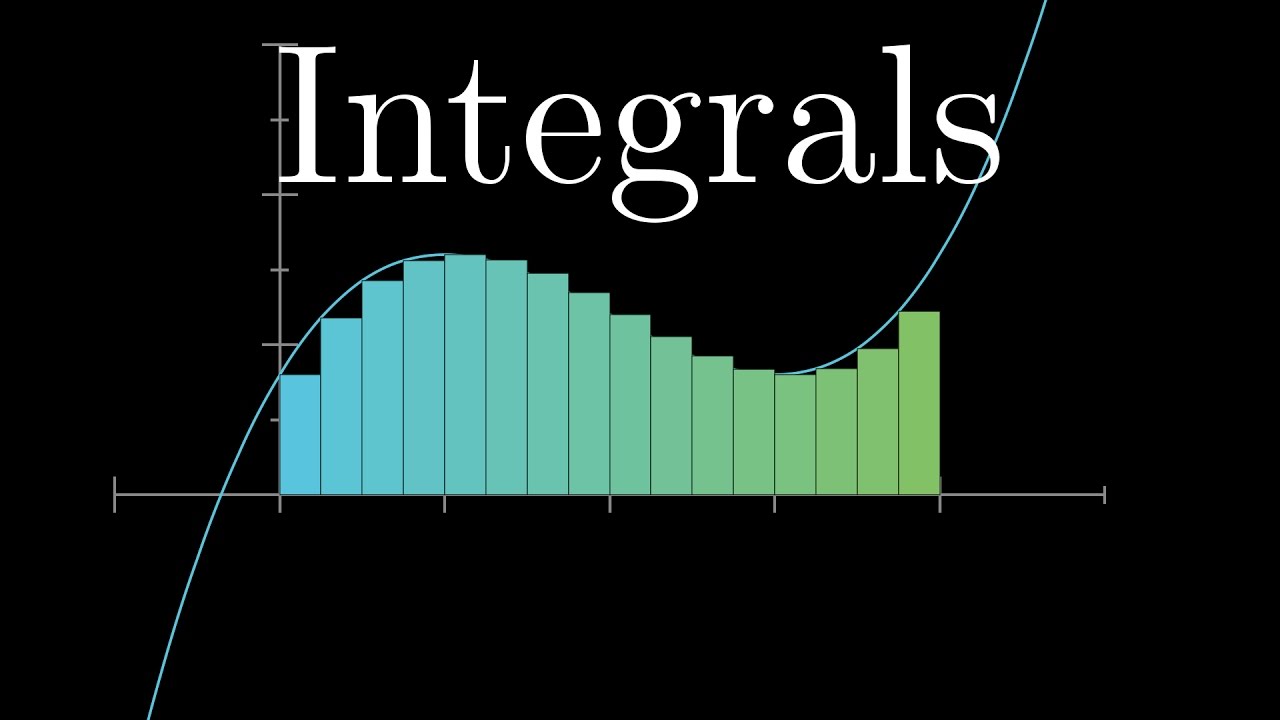
What is an integral? How do you think about it?
Help fund future projects: https://www.patreon.com/3blue1brown
An equally valuable form of support is to simply share some of the videos.
Special thanks to these supporters: http://3b1b.co/lessons/integration#thanks
Check out the Art of Problem Solving: https://aops.com/3blue1brown
--------------...
cedar kilnBOT
@rustic ridge Has your question been resolved?
rustic ridge
azure horizon
https://www.youtube.com/watch?v=rfG8ce4nNh0
thank u very much! ill watch this
 upper abyss
Let A(x) be the area under f(t) between (a,x)
For a small enough interval, this is approximately a rectangle. That is,
A(x + h) - A(x) = hf(x)
But that's the definition of the derivative in disguise!
A'(x) = f(x)
upper abyss
Length of rectangle × height of rectangle
upper abyss
h × f(x)
upper abyss
Another good intuition, if a function is really tall, the area under it is increasing fast.
rustic ridge
but the hell do i go from the integral to hf(x)
upper abyss
A(x + h) - A(x) = hf(x)
[A(x + h) - A(x)] / h = f(x)
For an infinitesimal h, left is the definition of the derivative.
A'(x) = f(x)
Or if you will, ∫ f(x) dx gives an area function
upper abyss
I didn't kek
rustic ridge
upper abyss
Let A(x) be the area under f(t) between (a,x)
For a small enough interval, this...
i mean this
i dont know how to explain my question
like how did u end up with A(x+h)-A(x)=hf(x)
upper abyss
Left is the area under f between (x, x+h). This is a small interval and is approximately rectangular
So we embrace that. The area is length×width = h×f(x)
rustic ridge
oh
rustic ridge
still not understanding the definition with the constant going up to x of f(t) dt
i just dont see how it goes from differentiation to integration
azure horizon
try the video
rustic ridge
kay thank u both, if i have more questions ull probably find me back !
upper abyss
So I defined A(x) as "the area between a to x under f(t)"
rustic ridge
yes
upper abyss
Using the correct notation, that's just
∫ f(t) dt between a and x
rustic ridge
yes
upper abyss
The argument established that taking the derivative of this, gives back f(x)
Ergo, first FToC
rustic ridge
o
cedar kilnBOT
@rustic ridge Has your question been resolved?
cedar kilnBOT
Channel closed
Closed due to timeout
Use .reopen if this was a mistake.
Available help channel!
Send your question here to claim the channel.
Remember:
• Ask your math question in a clear, concise manner.
• Show your work, and if possible, explain where you are stuck.
• After 15 minutes, feel free to ping <@&286206848099549185>.
• Type the command .close to free the channel when you're done.
• Be polite and have a nice day!
Read #❓how-to-get-help for further information on how to ask a good question, and about conduct in the question channels.
 hazy sleet
Does this seem right? I’m pretty dumb
 cedar kilnBOT
hazy sleet
Does this seem right? I’m pretty dumb
hazy sleet
cedar kilnBOT
hazy sleet
Does this seem right? I’m pretty dumb
hazy sleet
There’s also a part B saying (How many times faster is the speed of light than the speed of sound
For part A I just subtracted

This is part B
 upper abyss
So that's:
300000000
-
340
The speed of light is so large that subtracting the speed of sound from it does nothing.
hazy sleet
Ohh ok
upper abyss
You basically need to convert back from scientific notation to add/subtract
hazy sleet
Alright
upper abyss

SparkNotes
Scientific Notation quizzes about important details and events in every section of the book.
hazy sleet
Ok ima check it out
I also have notes on scientific notation


Thanks for the help
.close
cedar kilnBOT
Channel closed
Closed by @hazy sleet
Use .reopen if this was a mistake.
cedar kilnBOT
Available help channel!
Send your question here to claim the channel.
Remember:
• Ask your math question in a clear, concise manner.
• Show your work, and if possible, explain where you are stuck.
• After 15 minutes, feel free to ping <@&286206848099549185>.
• Type the command .close to free the channel when you're done.
• Be polite and have a nice day!
Read #❓how-to-get-help for further information on how to ask a good question, and about conduct in the question channels.
 forest dust
Consider the sequence 60,71,82,93,…,11n+5.
How many terms are there in the sequence? Your answer will be in terms of n.
What is the second-to-last term?
Find the sum of all the terms in the sequence, in terms of n.
cedar kilnBOT
forest dust
Consider the sequence 60,71,82,93,…,11n+5.
How many terms are there in the seque...
forest dust
i dont get it why would this sequence ever have to end?
 wicked brook
Let's say n=100
Where does the sequence end?
How long is the sequence?
What is the second to last term
What is the sum
forest dust
why are you setting n = 100
wicked brook
To show an example
For any n the last term is 11n+5
So if n is 10, the last term is 115
If n is 11, the last term is 126
Etc.
The problem revolves around the fact that n is finite
So eventually we will reach an end of the sequence
forest dust
ok but then how would i answer a problem like this in terms of n
wicked brook
The second to last will be with n-1 right
forest dust
yes
wicked brook
So plug that in and you get 11(n-1)+5
To get how many you need to ask what n gives 60
forest dust
well n = 5 gives 60
forest dust
honestly kind of lost me there
wicked brook
yea
finally we do the sum
its [11(5) + 5] + [11(6) + 5] + ... + [11(n) + 5]
so the first thing to notice is that there are (n-4) fives
so we have 11(5) + 11(6) + ... + 11(n) + 5(n-4)
what do you think the next step is?
wicked brook
well let's check
if we factor out 11
11(5 + 6 + ... + n) + 5(n-4)
does that help you?
forest dust
not really, sorry
wicked brook
do you know how to evaluate 1 + 2 + 3 + ... + n? @forest dust
wicked brook
\sum
wraith daggerBOT
M00NLIG7
 forest dust
yeah my bad im new to TeXit
wicked brook
ok so you know $$\sum_{n=1}^{k} n = \frac{k(k+1)}{2}$$
So do you see that: $$\sum_{k=1}^{n}k = \sum_{k=1}^{4} k + \sum_{k=5}^{n} k$$

 wicked brook
Also, do you see why this is useful to the question we're trying to answer?
forest dust
Well it kind of makes sense but its useful to the question were tryign to answer because our sum is 11(5 + 6 + ... + n) + 5(n-4) and this is basically the part inside of the 11(...)
forest dust
I think im getting closer im just having trouble with the summation format. I only know $\sum_{n=1}^{k} n = \frac{k(k+1)}{2}$ because we went over it in class
wraith daggerBOT
M00NLIG7
 wicked brook
wraith dagger
**ohNoiAmHere**
wicked brook
wraith dagger
**ohNoiAmHere**
so what i did here is I said: $$1 + 2 + 3 + 4 + 5 + .... + n = (1 + 2 + 3 + 4) + (5 + 6 + 7 + ... + n)$$
wraith daggerBOT
ohNoiAmHere
 wicked brook
and I can evaluate each seperately
bring one side over and (5 + 6 + 7 +....+ n) = (1 + 2 + ... + n) - (1 + 2 + 3 + 4)
forest dust
so $$11((n(n+1))/2 -10)+5(n-4)$$
wraith daggerBOT
M00NLIG7
 wicked brook
yea
forest dust
so ${\sum_{k=1}^{4} }k$ is just saying at the numbers starting at 1 (k) until it reaches 4 (n). So n in that case is essentially the limit?
wraith daggerBOT
M00NLIG7
 wicked brook
yes
forest dust
ok thank you
cedar kilnBOT
@forest dust Has your question been resolved?
Channel closed
Closed by @forest dust
Use .reopen if this was a mistake.
Available help channel!
Send your question here to claim the channel.
Remember:
• Ask your math question in a clear, concise manner.
• Show your work, and if possible, explain where you are stuck.
• After 15 minutes, feel free to ping <@&286206848099549185>.
• Type the command .close to free the channel when you're done.
• Be polite and have a nice day!
Read #❓how-to-get-help for further information on how to ask a good question, and about conduct in the question channels.
 dense wing
I have a collected set of data (82,25,4,2) and from that I found a maximum likelyhood estimator and got expected frequency of the data to be (in same order) (78.6,28.5,5.2,0.7)
How would I explain if the initial modelling was reasonable/accurate/whatever by comparing the list of numbers
cedar kilnBOT
dense wing
I have a collected set of data (82,25,4,2) and from that I found a maximum likel...
dense wing
Question for reference, though mainly asking about the general idea, specifics of the question aren't as important to me
 cedar kilnBOT
@dense wing Has your question been resolved?
 astral crown
dense wing
I have a collected set of data (82,25,4,2) and from that I found a maximum likel...
astral crown
dense wing
I have a collected set of data (82,25,4,2) and from that I found a maximum likel...
Maybe a chi squared test?
dense wing
What's a chi squared test?
astral crown
It basically gives you how good some distribution fits onto a set of values
dense wing
Is there a way to do it just comparing values?
Rather not go above the content we have access to.
astral crown
dense wing
Rather not go above the content we have access to.
Yea fair
astral crown
dense wing
Is there a way to do it just comparing values?
Not sure
I don't know of any
cedar kilnBOT
Channel closed
Closed by @dense wing
Use .reopen if this was a mistake.
Available help channel!
Send your question here to claim the channel.
Remember:
• Ask your math question in a clear, concise manner.
• Show your work, and if possible, explain where you are stuck.
• After 15 minutes, feel free to ping <@&286206848099549185>.
• Type the command .close to free the channel when you're done.
• Be polite and have a nice day!
Read #❓how-to-get-help for further information on how to ask a good question, and about conduct in the question channels.
 fleet kernel
idk how to do this
 cedar kilnBOT
fleet kernel
idk how to do this
fleet kernel
cedar kilnBOT
fleet kernel
idk how to do this
fleet kernel
do i just plug the bounds in
fleet kernel
i dont understand how to do that though
 bright surge
fleet kernel
i dont understand how to do that though
bright surge
fleet kernel
i dont understand how to do that though
rewrite integrand
 bold vine
^^
fleet kernel
9ye^-2y
bright surge
fleet kernel
9ye^-2y
yeah, then do ibp
fleet kernel
i've only seen the way to do it with tabular notation
but im not very sure how that works either
bold vine
ye
fleet kernel
so would it be -9/2ye^-2y-9/4e^-2y+C
fleet kernel
bold vine
ye
?
bold vine
Idk I haven't done the integration myself
You can always check integrals online though
fleet kernel
i've done it correctly according to this calculator but how do i plug in the bounds?
bold vine
FTOC Part 2
Just evaluate the antiderivative at the upper bound - subtract it evaluated at the lower bound
If you've done any definite integrals that's what you'd do
fleet kernel
so you just do it how you normally would
i've done that and it says that the answer is incorrect
cedar kilnBOT
@fleet kernel Has your question been resolved?
fleet kernel
.close
cedar kilnBOT
Channel closed
Closed by @fleet kernel
Use .reopen if this was a mistake.
Available help channel!
Send your question here to claim the channel.
Remember:
• Ask your math question in a clear, concise manner.
• Show your work, and if possible, explain where you are stuck.
• After 15 minutes, feel free to ping <@&286206848099549185>.
• Type the command .close to free the channel when you're done.
• Be polite and have a nice day!
Read #❓how-to-get-help for further information on how to ask a good question, and about conduct in the question channels.
 shut summit
Help bruh how can it be π, it should be 2π clearly since it has power 1 ie. Odd?
 cedar kilnBOT
shut summit
Help bruh how can it be π, it should be 2π clearly since it has power 1 ie. Odd?
cedar kilnBOT
shut summit
Help bruh how can it be π, it should be 2π clearly since it has power 1 ie. Odd?
 crimson sedge
shut summit
Help bruh how can it be π, it should be 2π clearly since it has power 1 ie. Odd?
crimson sedge
shut summit
Help bruh how can it be π, it should be 2π clearly since it has power 1 ie. Odd?
I don't get what you mean, could you explain?
anyway sin(x) has period of 2pi
so sin(2x) should have period of pi
 balmy ivy
the coefficient (2 here) changes the period. what you see with the odd even powers only apply if theres coefficient is 1
 cedar kilnBOT
Channel closed
Closed by @shut summit
Use .reopen if this was a mistake.
Available help channel!
Send your question here to claim the channel.
Remember:
• Ask your math question in a clear, concise manner.
• Show your work, and if possible, explain where you are stuck.
• After 15 minutes, feel free to ping <@&286206848099549185>.
• Type the command .close to free the channel when you're done.
• Be polite and have a nice day!
Read #❓how-to-get-help for further information on how to ask a good question, and about conduct in the question channels.
cedar kilnBOT
@sinful bear Has your question been resolved?
 bold hinge
cedar kilnBOT
bold hinge
cedar kilnBOT
@sinful bear Has your question been resolved?
dire geode
i and ii look unrelated
C stands for continuous function
What is the original question
cedar kilnBOT
@sinful bear Has your question been resolved?
cedar kilnBOT
@sinful bear Has your question been resolved?
 cold oasis
Can anyone help me solve this?

 vernal palm
@cold oasis #❓how-to-get-help
crimson sedge
the function in the root in denominator has only odd powers of x
maybe a sub?
(it seems one-to-one)
actually the numerator has d/dx of that expression
hm
dire geode
crimson sedge
the function in the root in denominator has only odd powers of x
take it to a new channel. this one's occupied
dire geode
crimson sedge
you mean to respond to <@!260975264987611137>
i don't see how anything you said answers
#help-13 message
crimson sedge
@cold oasis Change channel to an available one and ping me
cedar kilnBOT
Channel closed
Closed due to timeout
Use .reopen if this was a mistake.
Available help channel!
Send your question here to claim the channel.
Remember:
• Ask your math question in a clear, concise manner.
• Show your work, and if possible, explain where you are stuck.
• After 15 minutes, feel free to ping <@&286206848099549185>.
• Type the command .close to free the channel when you're done.
• Be polite and have a nice day!
Read #❓how-to-get-help for further information on how to ask a good question, and about conduct in the question channels.
 carmine pilot
Anyone have idea about how to proof this? Please help me to find it out
cedar kilnBOT
carmine pilot
Anyone have idea about how to proof this? Please help me to find it out
carmine pilot

 celest ledge
That is the coefficient of x^(n-1) in (1+x)^2n
I mean, you compare the coefficient of x^(n-1) both sides of the equation (1+x)^n (1+x)^n=(1+x)^2n
cedar kilnBOT
@carmine pilot Has your question been resolved?
cedar kilnBOT
Channel closed
Closed due to timeout
Use .reopen if this was a mistake.
carmine pilot
Thx for helping I am still working on it
cedar kilnBOT
Available help channel!
Send your question here to claim the channel.
Remember:
• Ask your math question in a clear, concise manner.
• Show your work, and if possible, explain where you are stuck.
• After 15 minutes, feel free to ping <@&286206848099549185>.
• Type the command .close to free the channel when you're done.
• Be polite and have a nice day!
Read #❓how-to-get-help for further information on how to ask a good question, and about conduct in the question channels.
 astral moon
 cedar kilnBOT
astral moon
astral moon
cedar kilnBOT
astral moon
astral moon
I'm unsure how the second and third terms of line two combine into the second term of line 3
astral moon
I understand what happened to the first term of line 3@dire geode but how did the second term of line 3 come about
dire geode
plug in n=0 and n=1 to see
cedar kilnBOT
Channel closed
Closed by @astral moon
Use .reopen if this was a mistake.
Available help channel!
Send your question here to claim the channel.
Remember:
• Ask your math question in a clear, concise manner.
• Show your work, and if possible, explain where you are stuck.
• After 15 minutes, feel free to ping <@&286206848099549185>.
• Type the command .close to free the channel when you're done.
• Be polite and have a nice day!
Read #❓how-to-get-help for further information on how to ask a good question, and about conduct in the question channels.
Please don't occupy multiple help channels.
glad kestrel
i don't even know whether or not to bother the mods
cedar kilnBOT
Channel closed
Closed due to the original message being deleted
wicked brook
<@&268886789983436800>

 calm sierra
ty
cedar kilnBOT
Available help channel!
Send your question here to claim the channel.
Remember:
• Ask your math question in a clear, concise manner.
• Show your work, and if possible, explain where you are stuck.
• After 15 minutes, feel free to ping <@&286206848099549185>.
• Type the command .close to free the channel when you're done.
• Be polite and have a nice day!
Read #❓how-to-get-help for further information on how to ask a good question, and about conduct in the question channels.
crimson sedge
<@&286206848099549185> yo help ITS URGENT
 cedar kilnBOT
crimson sedge
<@&286206848099549185> yo help ITS URGENT
glad kestrel
cedar kilnBOT
crimson sedge
<@&286206848099549185> yo help ITS URGENT
glad kestrel
• After 15 minutes, feel free to ping @Helpers.
glad kestrel
stop pinging helpers
crimson sedge
glad kestrel
`• After 15 minutes, feel free to ping @Helpers.`
...
15 MINUTES <@&286206848099549185>
 glad kestrel
still hasn't been 15 minutes
- you already pinged helpers
stop pinging helpers
<@&268886789983436800>
calm sierra
ty
wicked brook
@crimson sedge whats this problem for?
cedar kilnBOT
@crimson sedge Has your question been resolved?
cedar kilnBOT
Channel closed
Closed due to timeout
Use .reopen if this was a mistake.
Available help channel!
Send your question here to claim the channel.
Remember:
• Ask your math question in a clear, concise manner.
• Show your work, and if possible, explain where you are stuck.
• After 15 minutes, feel free to ping <@&286206848099549185>.
• Type the command .close to free the channel when you're done.
• Be polite and have a nice day!
Read #❓how-to-get-help for further information on how to ask a good question, and about conduct in the question channels.
 frosty oxide
just a quick question, do I have to use integration by parts to prove every reduction formula?
cedar kilnBOT
frosty oxide
just a quick question, do I have to use integration by parts to prove every redu...
frosty oxide
Or is it possible to prove it without integration by parts
Maybe it's possible for some but not others?
glad kestrel
if there is another way to prove them i'm not aware of it 
frosty oxide
Oh I think I know where I saw something
it was tan^n of x
they just used an identity
wicked brook
I can tell you that by parts will always work, but you can might a different reduction formula if you dont integrate by parts for trig functions. Namely, if you have $\int cos^nx\ dx$, you can split it up as $\int cos^2x \cdot cos^{n-2}x\ dx$ And use $$cos^2x = \frac{1+cos2x}{2}$$ I don't know if this leads to anything, but you can try it.
wraith daggerBOT
ohNoiAmHere
 frosty oxide
oh interesting
glad kestrel
frosty oxide
it was tan^n of x
ah yeah i guess an identity does work there
frosty oxide
ok so if an identity works then thats fine, if not then integration by parts
I see now
thank you guys!
glad kestrel
are you only asking about trig reduction btw
frosty oxide
well I guess in general
glad kestrel
cause i'm sure other reduction formulas could be derived otherwise
frosty oxide
we just learned reduction formula today
wicked brook
there can be identities with exponents that you can use too if you wanted to integrate log^n(x)
frosty oxide
I'm still trying to understand it properly
glad kestrel
some of those reduction formulas look gross
frosty oxide
we'll have to prove it before using so I guess that's one less thing to have to memorize
which is nice

 frosty oxide
wicked brook
there can be identities with exponents that you can use too if you wanted to int...
frosty oxide
wicked brook
there can be identities with exponents that you can use too if you wanted to int...
I'm gonna do a bunch of problems today and try doing some basic ones on my own
cedar kilnBOT
Channel closed
Closed by @frosty oxide
Use .reopen if this was a mistake.
Available help channel!
Send your question here to claim the channel.
Remember:
• Ask your math question in a clear, concise manner.
• Show your work, and if possible, explain where you are stuck.
• After 15 minutes, feel free to ping <@&286206848099549185>.
• Type the command .close to free the channel when you're done.
• Be polite and have a nice day!
Read #❓how-to-get-help for further information on how to ask a good question, and about conduct in the question channels.
 willow hill
Here's a really simple one. I want to solve for x in y = (x)(6 - x). I expect there to be a +/- and a sqrt somewhere but I cannot for the life of me find a way to phrase this as x = ...
cedar kilnBOT
willow hill
Here's a really simple one. I want to solve for x in `y = (x)(6 - x)`. I expect ...
willow hill
I tried solving for the vertex and i got something using that and point testing, but it was a bit wonky and I want something i can do without a second thought on the exam (plus I'm not sure how reliable my strategy is with other polynomials)
My ultimate goal is to rotate (x)(6 - x) around the y axis though but I couldn't find a more direct way to do it so I'm just trying to solve for x and I remember nothing from Grade X when we learned this I guess
cedar kilnBOT
@willow hill Has your question been resolved?
 mighty drift
you forgot about the quadratic formula ?
just complete the square so x is only present once, and work your way to isolating it. The result you get is the quadratic formula
 umbral jackal
can I help a bit
mighty drift
that's still the quadratic formula, except now c is a variable
frosty oxide
That's fair
umbral jackal
 willow hill
hmm
it wasn't super intuitive as to how i could apply QF until you mentioned completing the square
so im imagining something like
y = 9 - (x - 3)^2
(x - 3)^2 = 9 - y => x - 3 = +/- sqrt(9 - y) => x = 3 +/- sqrt(9 - y)
alright, a bit painful but sounds good
completing the square is always scary
as you know
T_T
.close
cedar kilnBOT
Channel closed
Closed by @willow hill
Use .reopen if this was a mistake.
cedar kilnBOT
Available help channel!
Send your question here to claim the channel.
Remember:
• Ask your math question in a clear, concise manner.
• Show your work, and if possible, explain where you are stuck.
• After 15 minutes, feel free to ping <@&286206848099549185>.
• Type the command .close to free the channel when you're done.
• Be polite and have a nice day!
Read #❓how-to-get-help for further information on how to ask a good question, and about conduct in the question channels.
 silent imp
can someone help
cedar kilnBOT
silent imp
can someone help
silent imp
I dont know how to do the next problem ill write it
It says "State one solution to the system" y<2x-1 & y>=10-x
<@&286206848099549185> pls help
wraith daggerBOT
sunflame
 umbral jackal
$y /geq 10-x$
wraith daggerBOT
sunflame
 wraith daggerBOT
sunflame
 umbral jackal
solve both
 livid hound
consider graphing and shading in each region
umbral jackal
any point in the overlapped region would work
 silent imp
I don't get what exactly I should do
It tells me to state on solution so am I supposed to put an order pair from the double shaded area
umbral jackal
yes
cedar kilnBOT
Channel closed
Closed by @silent imp
Use .reopen if this was a mistake.
Available help channel!
Send your question here to claim the channel.
Remember:
• Ask your math question in a clear, concise manner.
• Show your work, and if possible, explain where you are stuck.
• After 15 minutes, feel free to ping <@&286206848099549185>.
• Type the command .close to free the channel when you're done.
• Be polite and have a nice day!
Read #❓how-to-get-help for further information on how to ask a good question, and about conduct in the question channels.
 gusty lotus
Hi
cedar kilnBOT
gusty lotus
Hi
gusty lotus
How would I do the chain rule for cos^5 (x)
it's not even a composite function
or is it?
 steel canopy
(cos(x))^5
 twin coral
cedar kilnBOT
twin coral
cedar kilnBOT
Channel closed
Closed by @gusty lotus
Use .reopen if this was a mistake.
cedar kilnBOT
Available help channel!
Send your question here to claim the channel.
Remember:
• Ask your math question in a clear, concise manner.
• Show your work, and if possible, explain where you are stuck.
• After 15 minutes, feel free to ping <@&286206848099549185>.
• Type the command .close to free the channel when you're done.
• Be polite and have a nice day!
Read #❓how-to-get-help for further information on how to ask a good question, and about conduct in the question channels.
 verbal grove
Hello can someone help me with this please? I need to f and e
 verbal grove
Oh wait i think i found it
Can someone help me with this one, i need to find b and a
 cedar kilnBOT
@verbal grove Has your question been resolved?
cedar kilnBOT
@verbal grove Has your question been resolved?
 dreamy plume
cedar kilnBOT
dreamy plume
cedar kilnBOT
Channel closed
Closed by @verbal grove
Use .reopen if this was a mistake.
Available help channel!
Send your question here to claim the channel.
Remember:
• Ask your math question in a clear, concise manner.
• Show your work, and if possible, explain where you are stuck.
• After 15 minutes, feel free to ping <@&286206848099549185>.
• Type the command .close to free the channel when you're done.
• Be polite and have a nice day!
Read #❓how-to-get-help for further information on how to ask a good question, and about conduct in the question channels.
 still hawk
how would i figure this out
cedar kilnBOT
still hawk
how would i figure this out
still hawk
find x y and z in terms of a and b
 umbral jackal
x+y+z=360º-a-b
still hawk
uhhh
so
i dont know what a or b are
tho
x + y + z is equal to 360 - 144 (because 360 / 5 is 72)
?
im confused
so x = 72, y = 72, z = 72?
umbral jackal
did it say a=b
glad kestrel
post the question
 wraith daggerBOT
 still hawk
so
cedar kilnBOT
@still hawk Has your question been resolved?
cedar kilnBOT
@still hawk Has your question been resolved?
cedar kilnBOT
Channel closed
Closed due to timeout
Use .reopen if this was a mistake.
Available help channel!
Send your question here to claim the channel.
Remember:
• Ask your math question in a clear, concise manner.
• Show your work, and if possible, explain where you are stuck.
• After 15 minutes, feel free to ping <@&286206848099549185>.
• Type the command .close to free the channel when you're done.
• Be polite and have a nice day!
Read #❓how-to-get-help for further information on how to ask a good question, and about conduct in the question channels.
 midnight owl
@flint plinth Just wanted to make sure I did it right. I got 1 additional officer.
cedar kilnBOT
midnight owl
<@!761155030513352705> Just wanted to make sure I did it right. I got 1 addition...
midnight owl
(9 total)
midnight owl
np
 flint plinth
t(p) = 56 - 4p
midnight owl
I'll send a pic sec
midnight owl

 flint plinth
one second, I'll go through it with my notation and then compare with yours
midnight owl
ya np 😄
flint plinth
and we want to maximize N(p)
so naively taking the derivative (even though p is an integer variable, not continuous...)
N'(p) = 56 - 8p
set that equal to zero
56 - 8p = 0
8p = 56
p = 7
uh oh
flint plinth
we're in that gray area where we were wondering, does this formula even apply if p < 8?
midnight owl
I'm assuming you're right because you can't add a negative person lol
What did I do wrong though in mine?
I took the foiled binomial from online and didn't check if it's right
could be why
 midnight owl
hmm the binomial looks right
midnight owl
flint plinth
btw here's a plot of N(p) vs p:
is that pymatlab?
flint plinth
yours is right except (as I think you mentioned) that final answer should be x = -1 not 1
and your x = -1 is the same as # of officers = 7
since your x is the number of additional officers
flint plinth
no, mine is just # of officers total
midnight owl
so -1 is definitely right then
flint plinth
it's only valid if the rule still applies when you remove officers
midnight owl
it has to be right
flint plinth
i.e. if you remove officers does their average number of tickets go UP by 4?
midnight owl
good thing is this professor doesn't really check if the answer is right just wants to make sure if you do all of them lol
midnight owl
There were 10 sections due last week and I purposely left out like 10 problems total throughout the sections just because I couldn't figure them out lol
still gave me a 20/20 though
flint plinth
the math is right but only assuming that the formula can still be applied for # of officers less than 8
midnight owl
eh too much work if the math is right I trust it lol
midnight owl
Yea just keep it the same
flint plinth
then calculus doesn't actually give you the solution, the answer is just 8
midnight owl
^^
flint plinth
which you can see from the graph
flint plinth
just plain matlab
flint plinth
i've used matplotlib in python, and what's the other one... bokeh
midnight owl
If you're willing to check my answer when I'm done?
flint plinth
@midnight owl I'm gonna tune out for a while to watch tv so maybe DM me when you're done (I think the channel will go away eventually)
cedar kilnBOT
@midnight owl Has your question been resolved?
Channel closed
Closed by @midnight owl
Use .reopen if this was a mistake.
cedar kilnBOT
Available help channel!
Send your question here to claim the channel.
Remember:
• Ask your math question in a clear, concise manner.
• Show your work, and if possible, explain where you are stuck.
• After 15 minutes, feel free to ping <@&286206848099549185>.
• Type the command .close to free the channel when you're done.
• Be polite and have a nice day!
Read #❓how-to-get-help for further information on how to ask a good question, and about conduct in the question channels.
 mental mesa
Hi @harsh relic you are very helpful is this correct

 harsh relic
correct
 mental mesa
Oh -3
harsh relic
yes
 tired charm
mental mesa
tired charm
mental mesa
heres a simpler approach
(a-b)(a+b) = a^2-b^2
hope this helps
nevermind
im just blind
💀
mental mesa
Is this correct @harsh relic
 harsh relic
wrong
dusty hazel
Is your question,
$$(\sqrt{x+2})(\sqrt{2x+3})$$
If it is, then your work is wrong.
harsh relic
in step 2, you should multiply (x+2) and (2x+3) instead of adding up
wraith daggerBOT
What the hell am I doing here?
 harsh relic
or it is adding up instead of multiplying?
dusty hazel
Right.
harsh relic
then square both sides
dusty hazel
$$\sqrt{x+2} + \sqrt{2x+3}=0$$
wraith daggerBOT
What the hell am I doing here?
 tired charm
oh
tired charm
x+2=-2x-3?
dusty hazel
No.
harsh relic
dusty hazel
There are no solutions to this.
why shift to right and squaring both sides cannot work?
dusty hazel
harsh relic
why shift to right and squaring both sides cannot work?
No. It won't.
We have the domain
x+2≥0
2x+3 ≥0
So yea.
mental mesa
It doesn’t work?
dusty hazel
Think of it as, sqrt of something is always non negative.
Sum of two non negative numbers can only be 0, when both of them are zero.
And x+2 and 2x+3 can't be simultaneously zero.
tired charm
oh yea
dusty hazel
Then, there is no solution, read whatever I wrote.
Ask if anything does not make sense.
 mental mesa
So there is no solutions
dusty hazel
Right.
 uneven steeple
Wait
dusty hazel
...
uneven steeple
I don't get why we can't shift one of the square roots to the right and then square both sides though
dusty hazel
Because
mental mesa
That’s. what I was thinking
mental mesa
 dusty hazel
It does not work mate.
uneven steeple
Yeah so wouldn't it be like x+2 = 2x+3 afterwards?
mental mesa
Ok so I will put down no solution
dusty hazel
Answer is not important, realising why there's no solution is.
Mate.
√x+2 is positive.
√2x+3 is also positive.
So if you take it to the other side
√(x+2) = -√(2x+3)
uneven steeple
Yeah
uneven steeple
Wouldnt it be like -(√(2x+3))
uneven steeple
oh
dusty hazel
That is why you get answers.
It's incorrect though.
Since the first one is our original question.
mental mesa

Learn how to Solve Challenging Radical and Exponential Equations that involve cube roots, square roots, and more than One Radical. Also, check your answer for extraneous solutions. Step-by-Step Explanation by PreMath.com
dusty hazel
dusty hazel
2≠-2
But 2²=(-2)²
Squaring is dangerous.
As you can see, horrors of squaring.
dusty hazel
uneven steeple
Yeah no i took another look at the equation and it hit me
Right.
uneven steeple
Isnt there something where like if u square root a number you can get a negative number somehow though?
Like an imaginary number
dusty hazel
That's what my pfp says.
uneven steeple
Oh
dusty hazel
Mwahahahaha
 mental mesa
I don’t know to be honest
harsh relic
firstly, you will need to know the domain for sqrt x
cedar kilnBOT
@mental mesa Has your question been resolved?
dusty hazel
That is all they need to know.
dusty hazel
mental mesa
I don’t know to be honest
Domain means, the accepted value for the input. The ones which make sense.
For example the domain of y=1/x would be all real values, except x=0.
Since the denominator can't be zero.
For square roots, like sqrt{x} x here can NOT be negative.
Right?
harsh relic
yes
cedar kilnBOT
Channel closed
Closed due to timeout
Use .reopen if this was a mistake.
cedar kilnBOT
Available help channel!
Send your question here to claim the channel.
Remember:
• Ask your math question in a clear, concise manner.
• Show your work, and if possible, explain where you are stuck.
• After 15 minutes, feel free to ping <@&286206848099549185>.
• Type the command .close to free the channel when you're done.
• Be polite and have a nice day!
Read #❓how-to-get-help for further information on how to ask a good question, and about conduct in the question channels.
 junior kestrel
for this, we could use a limit comparison test but couldnt we also use a direct comparison
 cedar kilnBOT
junior kestrel
for this, we could use a limit comparison test but couldnt we also use a direct ...
junior kestrel
cedar kilnBOT
junior kestrel
for this, we could use a limit comparison test but couldnt we also use a direct ...
junior kestrel
say, this

which is clearly bigger, and simplifies to 1/n^2 which converges
so you dont even have to compare their limits right?
 split mirage
The problem is that it's not clear why that is bigger.
split mirage
No, because we know that n/(n³ + 6n + 3) < n/n³, but when we add 1 to the numerator, we aren't sure any more.
junior kestrel
Isn't it a thing where you can disregard the +1 since its just a small constant
pretty sure we do that sometimes for direct comparison but i might be wrong
split mirage
Not really. In this case though, you can still use direct comparison as (n + 1)/(n³ + 6n + 3) < (n + 1)/n³ = 1/n² + 1/n³ < 2/n².
But you can't compare to 1/n².
junior kestrel
oh yea just thought of that
i see
yea looking through my direct comparisons rn and youre right
ty
.close
cedar kilnBOT
Channel closed
Closed by @junior kestrel
Use .reopen if this was a mistake.
Available help channel!
Send your question here to claim the channel.
Remember:
• Ask your math question in a clear, concise manner.
• Show your work, and if possible, explain where you are stuck.
• After 15 minutes, feel free to ping <@&286206848099549185>.
• Type the command .close to free the channel when you're done.
• Be polite and have a nice day!
Read #❓how-to-get-help for further information on how to ask a good question, and about conduct in the question channels.
crimson sedge
I need help with logarithmic equations
cedar kilnBOT
crimson sedge
I need help with logarithmic equations
crimson sedge
so for example
I get normal logarithms
like log2(4) is obviously 2
but then there are things like log3(sqrt27) that I just don't get
dense wing
Why is log_2(4)=2?
cedar kilnBOT
@crimson sedge Has your question been resolved?
crimson sedge
dense wing
Why is log_2(4)=2?
because 2^2=4
I don't know whether I'm writing it correctly or not
but a^x=b translates into loga(b)=x
dense wing
crimson sedge
but a^x=b translates into loga(b)=x
This is correct
Apply that idea to log_3(sqrt(27))
crimson sedge
yea so 2^2=4 translates to log2(4)
crimson sedge
dense wing
Apply that idea to log_3(sqrt(27))
3 to the power of 3 is 27
but we need the square root of 27
crimson sedge
dense wing
Apply that idea to log_3(sqrt(27))
I mean, the correct answer is 3^3/2
but I don't think I understand why
crimson sedge
dense wing
log_3(sqrt(27))=x iff 3^x=sqrt(27)
yup
log3(sqrt27)
3^x=sqrt27
but how does that get me any further
<@&286206848099549185>
dense wing
What's sqrt(27) as 3^something...?
crimson sedge
dense wing
What's sqrt(27) as 3^something...?
not sure
that's why I'm asking
I've got no idea
 jaunty mural
sqrt 2 = 2^0.5
crimson sedge
oh
so 3^1/2 is sqrt3
but we want sqrt 27
so we simply do 1/2*3
which is 3/2
so 3^3/2=sqrt27
crimson sedge
3/2
crimson sedge
dense wing
So what's x?
what happens when we use a negative number
dense wing
Exponent laws
crimson sedge
dense wing
Exponent laws
how do they work
dense wing
cedar kilnBOT
Channel closed
Closed by @fringe gust
Use .reopen if this was a mistake.
Available help channel!
Send your question here to claim the channel.
Remember:
• Ask your math question in a clear, concise manner.
• Show your work, and if possible, explain where you are stuck.
• After 15 minutes, feel free to ping <@&286206848099549185>.
• Type the command .close to free the channel when you're done.
• Be polite and have a nice day!
Read #❓how-to-get-help for further information on how to ask a good question, and about conduct in the question channels.
 gilded nest
So, I’m in school right now, I’m doing an continuation of an algebra 2 test in a few periods, I need to find compound interest with contributions for a word problem and it’s worth more than a quarter of the grade, I do not know how to find compound interest when accounting for contributions
cedar kilnBOT
gilded nest
So, I’m in school right now, I’m doing an continuation of an algebra 2 test in a...
gilded nest
The question is something like “max wants to buy a car when he turns 17, he starts saving at 14. He uses an account that adds 3.6% interest monthly, and he puts $100 into it each month, how much does he have after 36 months?”
I know how to compound interest with P(1+r^t=A
But my teacher never taught how to add contributions
cedar kilnBOT
@gilded nest Has your question been resolved?
gilded nest
<@&286206848099549185>
upper abyss
That's an annuity. You sure you don't have a formula for that?
gilded nest
I don’t believe I was given one
gilded nest
.close
cedar kilnBOT
Channel closed
Closed by @gilded nest
Use .reopen if this was a mistake.
gilded nest
.reopen
cedar kilnBOT
✅
junior kestrel
gilded nest
.reopen
why do we naerly have the same name
cedar kilnBOT
@gilded nest Has your question been resolved?
cedar kilnBOT
Channel closed
Closed due to timeout
Use .reopen if this was a mistake.
Available help channel!
Send your question here to claim the channel.
Remember:
• Ask your math question in a clear, concise manner.
• Show your work, and if possible, explain where you are stuck.
• After 15 minutes, feel free to ping <@&286206848099549185>.
• Type the command .close to free the channel when you're done.
• Be polite and have a nice day!
Read #❓how-to-get-help for further information on how to ask a good question, and about conduct in the question channels.
 night pumice
I need a bit of help with this question (sorry but the image is way more blurry)
How do I find 'x' in
1⅔:x=1/24
cedar kilnBOT
night pumice
I need a bit of help with this question (sorry but the image is way more blurry)...
night pumice
if image is required i will send it
dusty hazel
Your question
$$1\frac{2}{3} : x=\frac{1}{24}$$
 dusty hazel
Alright.
night pumice
part (a) (ii)
dusty hazel
Got it.
wraith daggerBOT
What the hell am I doing here?
 night pumice
yea this question
dusty hazel
Convert into improper fraction first.
night pumice
so 5/3 :x = 1/24?
night pumice
mhm
night pumice
is it 40?
dusty hazel
What, the answer?
night pumice
yea
night pumice
yea just ratio i guess
dusty hazel
So you should know, it represents same thing.
night pumice
i see, im pretty sure i have forgotten about it
dusty hazel
That's alright, not anymore!
night pumice
Thank you so much!
dusty hazel
You're welcome!
night pumice
.close
cedar kilnBOT
Channel closed
Closed by @night pumice
Use .reopen if this was a mistake.
Available help channel!
Send your question here to claim the channel.
Remember:
• Ask your math question in a clear, concise manner.
• Show your work, and if possible, explain where you are stuck.
• After 15 minutes, feel free to ping <@&286206848099549185>.
• Type the command .close to free the channel when you're done.
• Be polite and have a nice day!
Read #❓how-to-get-help for further information on how to ask a good question, and about conduct in the question channels.
 carmine fern
aren't both examples of f discontinuous because of [x]?

 cedar kilnBOT
carmine fern
aren't both examples of f discontinuous because of [x]?
cedar kilnBOT
carmine fern
aren't both examples of f discontinuous because of [x]?
@carmine fern Has your question been resolved?
carmine fern
<@&286206848099549185>
it was probably a typo in the book unless I'm missing something
dire geode
carmine fern
aren't both examples of f discontinuous because of [x]?
What are you trying to show
carmine fern
I'm trying to understand how the f they give is continuous, it seems discontinuous to me
dire geode
carmine fern
I'm trying to understand how the f they give is continuous, it seems discontinuo...
Depends on A
It can be continuous on an A
carmine fern
since it says "a continuous and bounded function" but the function they give isn't continuous (it has a jump at every nonzero integer)
i guess
they said A was arbitrary though
dire geode
carmine fern
they said A was arbitrary though
Where
cedar kilnBOT
@carmine fern Has your question been resolved?
cedar kilnBOT
Channel closed
Closed due to timeout
Use .reopen if this was a mistake.
cedar kilnBOT
Available help channel!
Send your question here to claim the channel.
Remember:
• Ask your math question in a clear, concise manner.
• Show your work, and if possible, explain where you are stuck.
• After 15 minutes, feel free to ping <@&286206848099549185>.
• Type the command .close to free the channel when you're done.
• Be polite and have a nice day!
Read #❓how-to-get-help for further information on how to ask a good question, and about conduct in the question channels.
crimson sedge
Ηελπ
cedar kilnBOT
crimson sedge
Ηελπ
crimson sedge
Help
So
Im trying to solve this problem here
that has to do with venn diagrams
E= whole numbers from 1 to 100
A= multiplies of 5
B= multiplies of 7
a) n(A)= 20
n(B) =14
Also there is another set C which is AUC=nothing empty basically and
B U C= B so c Is in B
C=AUB. Explain why n(C) is 34??/
hello?
cedar kilnBOT
@crimson sedge Has your question been resolved?
crimson sedge
:(?
cedar kilnBOT
@crimson sedge Has your question been resolved?
cedar kilnBOT
Channel closed
Closed due to timeout
Use .reopen if this was a mistake.
cedar kilnBOT
Available help channel!
Send your question here to claim the channel.
Remember:
• Ask your math question in a clear, concise manner.
• Show your work, and if possible, explain where you are stuck.
• After 15 minutes, feel free to ping <@&286206848099549185>.
• Type the command .close to free the channel when you're done.
• Be polite and have a nice day!
Read #❓how-to-get-help for further information on how to ask a good question, and about conduct in the question channels.
 valid nexus
What is the difference between these two equations?
valid nexus
 glad kestrel
they're rearranged differently
glad kestrel
yes, a function of x in terms of y
cedar kilnBOT
Channel closed
Closed by @valid nexus
Use .reopen if this was a mistake.