#help-13
428200 messages · Page 453 of 429
 cedar kilnBOT
Channel closed
Closed by @little wave
Use .reopen if this was a mistake.
 Available help channel!
Send your question here to claim the channel.
Remember:
• Ask your math question in a clear, concise manner.
• Show your work, and if possible, explain where you are stuck.
• After 15 minutes, feel free to ping <@&286206848099549185>.
• Type the command .close to free the channel when you're done.
• Be polite and have a nice day!
Read #❓how-to-get-help for further information on how to ask a good question, and about conduct in the question channels.
 fallen bison
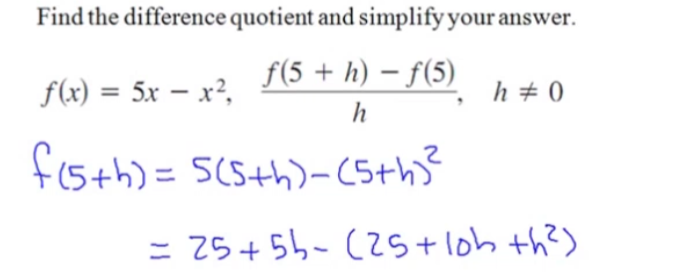
quick explanation question, where in the hell did the "10h" come from in line 3. This is in my explanation video and I can't work out where they got that
https://i.imgur.com/dGdFxru.png
 cedar kilnBOT
fallen bison
quick explanation question, where in the hell did the "10h" come from in line 3....
cedar kilnBOT
fallen bison
quick explanation question, where in the hell did the "10h" come from in line 3....
 analog leaf
You get it from expanding the (5+h)^2
If you foil (5+h) times (5+h) you'll get 25 +5h+5h+h^2
Then when you combine like terms you'll end up with 25+10h+h^2
 ebon sparrow
$$ (a + b )^2= a^2 + b^2 + 2ab$$
 wraith daggerBOT
nassim
 analog leaf
Thanks nassim.
cedar kilnBOT
Channel closed
Closed by @fallen bison
Use .reopen if this was a mistake.
Available help channel!
Send your question here to claim the channel.
Remember:
• Ask your math question in a clear, concise manner.
• Show your work, and if possible, explain where you are stuck.
• After 15 minutes, feel free to ping <@&286206848099549185>.
• Type the command .close to free the channel when you're done.
• Be polite and have a nice day!
Read #❓how-to-get-help for further information on how to ask a good question, and about conduct in the question channels.
 tardy ocean
Lol
 odd perch
cedar kilnBOT
odd perch
cedar kilnBOT
Channel closed
Closed due to the original message being deleted
tardy ocean
.close
cedar kilnBOT
Available help channel!
Send your question here to claim the channel.
Remember:
• Ask your math question in a clear, concise manner.
• Show your work, and if possible, explain where you are stuck.
• After 15 minutes, feel free to ping <@&286206848099549185>.
• Type the command .close to free the channel when you're done.
• Be polite and have a nice day!
Read #❓how-to-get-help for further information on how to ask a good question, and about conduct in the question channels.
 frigid coral
Quadratic equation
cedar kilnBOT
frigid coral
Quadratic equation
 cedar kilnBOT
Channel closed
Closed by @frigid coral
Use .reopen if this was a mistake.
cedar kilnBOT
Available help channel!
Send your question here to claim the channel.
Remember:
• Ask your math question in a clear, concise manner.
• Show your work, and if possible, explain where you are stuck.
• After 15 minutes, feel free to ping <@&286206848099549185>.
• Type the command .close to free the channel when you're done.
• Be polite and have a nice day!
Read #❓how-to-get-help for further information on how to ask a good question, and about conduct in the question channels.
 jade latch
after solving quadratic inequality and i have 2 x values how do i find wether they are > or < the x value ?
cedar kilnBOT
jade latch
after solving quadratic inequality and i have 2 x values how do i find wether th...
 jade latch
well i made it a quadratic and solved for 2 x values
 gentle lintel
jade latch
well i made it a quadratic and solved for 2 x values
gentle lintel
jade latch
well i made it a quadratic and solved for 2 x values
you did it wrong
it’s linear
jade latch
the solution also makes it a quadratic giving 2 x values i just want to know how to plot them < or >
gentle lintel
this is NOT quadratic
jade latch
you multiple both sides by the bottom squared?
gentle lintel
jade latch
you multiple both sides by the bottom squared?
why
just the bottom is enough
gentle lintel
jade latch
(2x + 10)/(x + 3) = 2 + 4/(x + 3)
4/(x + 3) ≥ -1
x + 3 ≤ -4
i would do it like this
jade latch
ok well im following my book and they do it differently..

i just want to know how to put x values > or < to the numbers i get
gentle lintel
what do you get again, 2 (x + 5) (x + 3) ≥ (x + 3)²?
jade latch
i get what i posted its just the last part
jade latch
yes
gentle lintel
gentle lintel
(2x + 10)/(x + 3) = 2 + 4/(x + 3)
4/(x + 3) ≥ -1
x + 3 ≤ -4
also forget this it’s somehow wrong lol
gentle lintel
jade latch
yes
x² + 10x + 21 is U shaped right
gentle lintel
so the roots are at -7, -3
jade latch
right
gentle lintel
ie its shape dives below x axis at -7, then comes back up at -3
since the leading coefficient is positive
gentle lintel
jade latch
then this follows
jade latch
but how do i know x > -3 and x <= -7
gentle lintel
gentle lintel
ie its shape dives below x axis at -7, then comes back up at -3
do you understand this
jade latch
yes i know what it looks like
gentle lintel
looks like this right
 jade latch
yep
gentle lintel
which is x ≤ -7 and x ≥ -3
jade latch
its > -3
gentle lintel
yea
cedar kilnBOT
Channel closed
Closed by @jade latch
Use .reopen if this was a mistake.
Available help channel!
Send your question here to claim the channel.
Remember:
• Ask your math question in a clear, concise manner.
• Show your work, and if possible, explain where you are stuck.
• After 15 minutes, feel free to ping <@&286206848099549185>.
• Type the command .close to free the channel when you're done.
• Be polite and have a nice day!
Read #❓how-to-get-help for further information on how to ask a good question, and about conduct in the question channels.
 trail radish
help
 cedar kilnBOT
trail radish
help
jade latch
cedar kilnBOT
trail radish
help
jade latch
so you know the equation of the line ?
parralel lines have the same slope so m = 1/2
and the y intercept = -5 as given in the question


 graceful karma
You're not allowed to get help on tests
 toxic steeple
lol
trail radish
its not a test
graceful karma
Why does it say test
trail radish
coz the guy who set it doesnt know how to change the namelol
cedar kilnBOT
@trail radish Has your question been resolved?
Channel closed
Closed by @trail radish
Use .reopen if this was a mistake.
Available help channel!
Send your question here to claim the channel.
Remember:
• Ask your math question in a clear, concise manner.
• Show your work, and if possible, explain where you are stuck.
• After 15 minutes, feel free to ping <@&286206848099549185>.
• Type the command .close to free the channel when you're done.
• Be polite and have a nice day!
Read #❓how-to-get-help for further information on how to ask a good question, and about conduct in the question channels.
 torn perch
hey guys, i still don’t understand how to neccesarily solve the question
torn perch
Find the equation of a line that passes through the point (1,5) and has a gradient of 4.
Leave your answer in the form
y
m
x
+
c
i understand there is subsituting i have to do
could someone explain step by step
 dense wing
cedar kilnBOT
dense wing
cedar kilnBOT
@torn perch Has your question been resolved?
Channel closed
Closed by @torn perch
Use .reopen if this was a mistake.
cedar kilnBOT
Available help channel!
Send your question here to claim the channel.
Remember:
• Ask your math question in a clear, concise manner.
• Show your work, and if possible, explain where you are stuck.
• After 15 minutes, feel free to ping <@&286206848099549185>.
• Type the command .close to free the channel when you're done.
• Be polite and have a nice day!
Read #❓how-to-get-help for further information on how to ask a good question, and about conduct in the question channels.
 pliant orbit
 cedar kilnBOT
pliant orbit
pliant orbit
cedar kilnBOT
pliant orbit
pliant orbit

it says its the highest of the degrees. Then it says the degree of a term is the sum of the exponents.. Does this mean it’s a term and not a polynomial??
 jaunty mural
$$f(x, y, z) = x^2yz^3+xy+xy^5z$$
wraith daggerBOT
Shuri2060
 jaunty mural
The degree of the 3 terms here is
2+1+3 = 6
1+1 =2
1+5+1 = 7
so the polynomial is degree 7
pliant orbit
pliant orbit
So that means this is a single term
jaunty mural
no.
Each term
if you take 1 term
there is no addition or subtraction inside
(x + 1)(x - 2)
To find the terms in this
you must multiply out
x^2 - x - 2
Now these are the terms. x^2, -x, -2
x+1, x-2 is not a term.
jaunty mural
pliant orbit
============
They did 2 + 1 = 3 because they just look at what will be the highest exponent after multiplying out. It will be x^2 times x
So the term will be x^(2 + 1)
pliant orbit
How do you multiply that out
So I’m guessing x^2 becomes (x - 0)
(x - 0) (x - 2)
or x^2 (x - 2)
cedar kilnBOT
@pliant orbit Has your question been resolved?
cedar kilnBOT
Channel closed
Closed due to timeout
Use .reopen if this was a mistake.
cedar kilnBOT
Available help channel!
Send your question here to claim the channel.
Remember:
• Ask your math question in a clear, concise manner.
• Show your work, and if possible, explain where you are stuck.
• After 15 minutes, feel free to ping <@&286206848099549185>.
• Type the command .close to free the channel when you're done.
• Be polite and have a nice day!
Read #❓how-to-get-help for further information on how to ask a good question, and about conduct in the question channels.
 sweet dawn
i need help
cedar kilnBOT
sweet dawn
i need help
graceful karma
Don't we all
sweet dawn
true but i really need help
 glad kestrel
yeah me too :/

 obsidian coral
What did you try?
cedar kilnBOT
@sweet dawn Has your question been resolved?
 crimson sedge
sweet dawn
is it 10.630
crimson sedge
sweet dawn
is it 10.630
yes because by pyth thm
jaunty mural
why do u need help if you can get the right answer
cedar kilnBOT
@sweet dawn Has your question been resolved?
sweet dawn
what is formula
 sweet dawn
i dont know how to do
 void karma
V=pi * 7.5 *26/3
sweet dawn
im confused
jaunty mural
what
 wraith crypt
Use pythagoras
wraith crypt
You have a height and a base diameter
cedar kilnBOT
@sweet dawn Has your question been resolved?
cedar kilnBOT
Channel closed
Closed due to timeout
Use .reopen if this was a mistake.
cedar kilnBOT
Available help channel!
Send your question here to claim the channel.
Remember:
• Ask your math question in a clear, concise manner.
• Show your work, and if possible, explain where you are stuck.
• After 15 minutes, feel free to ping <@&286206848099549185>.
• Type the command .close to free the channel when you're done.
• Be polite and have a nice day!
Read #❓how-to-get-help for further information on how to ask a good question, and about conduct in the question channels.
 oak drift
how would I start this?
 cedar kilnBOT
oak drift
how would I start this?
oak drift
cedar kilnBOT
oak drift
how would I start this?
oak drift
.close
cedar kilnBOT
Channel closed
Closed by @oak drift
Use .reopen if this was a mistake.
oak drift
.reopen
cedar kilnBOT
✅
oak drift
<@&286206848099549185>
cedar kilnBOT
@oak drift Has your question been resolved?
cedar kilnBOT
Channel closed
Closed due to timeout
Use .reopen if this was a mistake.
Available help channel!
Send your question here to claim the channel.
Remember:
• Ask your math question in a clear, concise manner.
• Show your work, and if possible, explain where you are stuck.
• After 15 minutes, feel free to ping <@&286206848099549185>.
• Type the command .close to free the channel when you're done.
• Be polite and have a nice day!
Read #❓how-to-get-help for further information on how to ask a good question, and about conduct in the question channels.
 thorn temple
how do i find the rate of change in this equation: y = 35x + 25? I have no idea where to start.
cedar kilnBOT
thorn temple
how do i find the rate of change in this equation: y = 35x + 25? I have no idea ...
 bright surge
thorn temple
how do i find the rate of change in this equation: y = 35x + 25? I have no idea ...
bright surge
thorn temple
how do i find the rate of change in this equation: y = 35x + 25? I have no idea ...
for lines, it's the m in y=mx+c
cedar kilnBOT
Channel closed
Closed by @thorn temple
Use .reopen if this was a mistake.
Available help channel!
Send your question here to claim the channel.
Remember:
• Ask your math question in a clear, concise manner.
• Show your work, and if possible, explain where you are stuck.
• After 15 minutes, feel free to ping <@&286206848099549185>.
• Type the command .close to free the channel when you're done.
• Be polite and have a nice day!
Read #❓how-to-get-help for further information on how to ask a good question, and about conduct in the question channels.
 tidal crow
 cedar kilnBOT
tidal crow
tidal crow
cedar kilnBOT
tidal crow
tidal crow
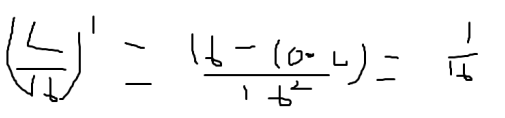
I know for a fact that this derivative is wrong (at least according to a derivative calculator), but I'm also unsure what I could be doing differently
Could anyone point out what I'm missing?
glad kestrel
honestly i don't follow your work
tidal crow
glad kestrel
honestly i don't follow your work
How so?
tidal crow
glad kestrel
it doesn't make sense
Where doesn't it make sense?
 livid hound
everything after the first line makes no sense
 chrome edge
tidal crow
chrome edge
tidal crow
did you draw that with a trackpad
livid hound
plagued with algebraic errors and improper application of derivative laws
livid hound
firstly the derivative of a product isn't the same as the product of the derivatives
jaunty mural
OH that's a dash
tidal crow
jaunty mural
What's the original question.
Optimization problem (the reason I used l instead of x)
 livid hound
$(fg)' \neq f'g'$
jaunty mural
I kept thinking why is there ^ 1 everywhere
wraith daggerBOT
ℝamonov
 tidal crow
I was under the impression it was, thank you for letting me know
livid hound
and even in applying the improper rule there, you still messed up the algebra
jaunty mural
 jaunty mural
https://i.imgur.com/5NUacVN.png
jaunty mural
jaunty mural
https://i.imgur.com/5NUacVN.png
this is kinda crazy
You don't need the quotient rule.
livid hound
you also unnecessarily went complete overkill and applied quotient rule where it wasn't needed
you should first consider looking up the product rule
jaunty mural
$$(uv)' = u'v + uv'$$
wraith daggerBOT
Shuri2060
 livid hound
and then constant factor rule as that will save you a lot of work
tidal crow
livid hound
you should first consider looking up the product rule
I could be wrong, but I think not recognizing I could use the product rule is what screwed me up (outside of errors but they were in stuff that was already wrong)
Thank you for bringing this up, I'm going to apply the product rule and see where I can get
livid hound
I was under the impression it was,
every expression can be expressed as a product of 1 and itself
if that were true, you're implying that the derivative of pretty much anything is 0
cedar kilnBOT
@tidal crow Has your question been resolved?
Channel closed
Closed by @tidal crow
Use .reopen if this was a mistake.
 proud oak
I NEED HELP
cedar kilnBOT
Available help channel!
Send your question here to claim the channel.
Remember:
• Ask your math question in a clear, concise manner.
• Show your work, and if possible, explain where you are stuck.
• After 15 minutes, feel free to ping <@&286206848099549185>.
• Type the command .close to free the channel when you're done.
• Be polite and have a nice day!
Read #❓how-to-get-help for further information on how to ask a good question, and about conduct in the question channels.
 pulsar canyon
Could I please get some help to understand how to do this?
 cedar kilnBOT
pulsar canyon
Could I please get some help to understand how to do this?
cedar kilnBOT
pulsar canyon
Could I please get some help to understand how to do this?
@pulsar canyon Has your question been resolved?
pulsar canyon
<@&286206848099549185>
cedar kilnBOT
@pulsar canyon Has your question been resolved?
 rain vessel
Show what you have considered, tried, etc.
cedar kilnBOT
@pulsar canyon Has your question been resolved?
cedar kilnBOT
Channel closed
Closed due to timeout
Use .reopen if this was a mistake.
cedar kilnBOT
Available help channel!
Send your question here to claim the channel.
Remember:
• Ask your math question in a clear, concise manner.
• Show your work, and if possible, explain where you are stuck.
• After 15 minutes, feel free to ping <@&286206848099549185>.
• Type the command .close to free the channel when you're done.
• Be polite and have a nice day!
Read #❓how-to-get-help for further information on how to ask a good question, and about conduct in the question channels.
 bronze berry
how i find the h if i have the radius and the volume ?

 reef laurel
same process as the question I answered for you before
find the formula for the volume and solve for h
bronze berry
for the volume is ACircle * height
wraith daggerBOT
Luca
 bronze berry
yes
reef laurel
so how would you single out h?
bronze berry
( 2V ) / ( b* h ) ?
reef laurel
nono, the 2 in the previous example came from the 1/2
we multiplied both sides by 2
in this case you need to get rid of A_circle on the right side
so what action do you need to take on both sides
bronze berry
i don't know :x
reef laurel
what happens if you divide both sides with A_circle
the equation stays true as long as you do the exact same thing to both sides
bronze berry
i don't know 
bronze berry
h ?
reef laurel
$\frac{V}{A_{\text{circle}} = \frac{\cancel{A_{\text{circle}}}\cdot h}{\cancel{A_{\text{circle}}}$
bronze berry
rip
wraith daggerBOT
Luca
$\frac{V}{A_{\text{circle}} = \frac{\cancel{A_{\text{circle}}}\cdot h}{\cancel{A_{\text{circle}}}$
```Compilation error:```! File ended while scanning use of \frac .
<inserted text>
\par
<*> 212479607071440896.tex
I suspect you have forgotten a `}', causing me
to read past where you wanted me to stop.
I'll try to recover; but if the error is serious,
you'd better type `E' or `X' now and fix your file.``` reef laurel
$\frac{V}{A{\text{circle}}} =$
wraith daggerBOT
Luca
 bronze berry
=h
reef laurel
$\frac{V}{A{\text{circle}}} = \frac{\cancel{A{\text{circle}}}\cdot h}{\cancel{A_{\text{circle}}}}=h$
ha
there we go
you understand?
bronze berry
yes
wraith daggerBOT
Luca
 reef laurel
does this answer you question
bronze berry
and if i want find the Acircle i do V / h ?
reef laurel
what is the formula for A_circle?
bronze berry
r*r *pi
reef laurel
so $A_{\text{circle}}=r^2\pi$
wraith daggerBOT
Luca
 bronze berry
but how to find r ?
bronze berry
find the Acircle ?
reef laurel
so whats bothering you on the right side is pi right
because you want to single out r
bronze berry
yes
reef laurel
so how do you get rid of pi on the right side?
bronze berry
Acircle / pi ?
bronze berry
okay nice
wraith daggerBOT
Luca
 bronze berry
yes
reef laurel
but now you have r^2 and not r
so we need to take another step
whats the inverse action of squaring a number?
bronze berry
√ r*r ?
reef laurel
yes
bronze berry
okaay good
reef laurel
$\sqrt{\frac{A_{\text{circle}}}{\pi}}=r$
bronze berry
i understand
wraith daggerBOT
Luca
 bronze berry
okay thx you 
reef laurel
no problem!
bronze berry
.close
cedar kilnBOT
Channel closed
Closed by @bronze berry
Use .reopen if this was a mistake.
Available help channel!
Send your question here to claim the channel.
Remember:
• Ask your math question in a clear, concise manner.
• Show your work, and if possible, explain where you are stuck.
• After 15 minutes, feel free to ping <@&286206848099549185>.
• Type the command .close to free the channel when you're done.
• Be polite and have a nice day!
Read #❓how-to-get-help for further information on how to ask a good question, and about conduct in the question channels.
 zenith vector
In this line
Is sin-1 = sin1 or any other logic is used?
 reef laurel
$\sin(-x) = -\sin(x)$
wraith daggerBOT
Luca
 cedar kilnBOT
Channel closed
Closed by @zenith vector
Use .reopen if this was a mistake.
Available help channel!
Send your question here to claim the channel.
Remember:
• Ask your math question in a clear, concise manner.
• Show your work, and if possible, explain where you are stuck.
• After 15 minutes, feel free to ping <@&286206848099549185>.
• Type the command .close to free the channel when you're done.
• Be polite and have a nice day!
Read #❓how-to-get-help for further information on how to ask a good question, and about conduct in the question channels.
 flint hull
In the problems below, determine how many complex zeros the functions have.
$f(x) = x^{7}-6x^{5}+3$
$g(x) = x^{2}(x^{2}+4x+1)(x-3)^{4}$
I said 7 complex 0s for the first equation, and 8 for the second. But my teacher says there are 0 complex 0s for the second equation, which puzzles me. That isn't even possible, because real zeros are also classified as complex zeros, right?
cedar kilnBOT
flint hull
In the problems below, determine how many complex zeros the functions have.
$f(...
flint hull
$f(x) = x^{7}-6x^{5}+3$
wraith daggerBOT
Stack Of Doggos
 flint hull
$g(x) = x^{2}(x^{2}+4x+1)(x-3)^{4}$
wraith daggerBOT
Stack Of Doggos
 flint hull
oh also here's justification for my response, a polynomial with n degree will have n roots
 elder parrot
For the first function you will defenitly have 7 "0s" but they do not have to lay in the complex plain. they are only complex "0s" if you have f(x)=0 with x beeing a negative root.
flint hull
are real numbers not also complex?
Interesting, how would you find the number of complex zeros in the first question? (the second one is easy, just split up the equation, etc.)
elder parrot
I mean the real numbers are a part of the complex numbers. But that does not mean that every complex number is also a real number. I mean not every rational number is a integer number.
flint hull
flint hull
Interesting, how would you find the number of complex zeros in the first questio...
.
elder parrot
polynomial divison
flint hull
by what
elder parrot
You first have to find one "0s", by guessing and then use this "0" for the divison. There is no other way.
flint hull
interesting, I'll check the answer key
yep it says 7 complex zeros
because all real zeros are also complex with imaginary part 0
after u respond ill just close the channel
thx!
elder parrot
Yeah you are right i think. I understood you wrong at the beginning
cedar kilnBOT
Channel closed
Closed by @flint hull
Use .reopen if this was a mistake.
Available help channel!
Send your question here to claim the channel.
Remember:
• Ask your math question in a clear, concise manner.
• Show your work, and if possible, explain where you are stuck.
• After 15 minutes, feel free to ping <@&286206848099549185>.
• Type the command .close to free the channel when you're done.
• Be polite and have a nice day!
Read #❓how-to-get-help for further information on how to ask a good question, and about conduct in the question channels.
crimson sedge
 cedar kilnBOT
crimson sedge
cedar kilnBOT
crimson sedge


 glossy halo
r^2 = x^2+y^2, plug that into the bottom instead
cedar kilnBOT
Channel closed
Closed by @left scarab
Use .reopen if this was a mistake.
Available help channel!
Send your question here to claim the channel.
Remember:
• Ask your math question in a clear, concise manner.
• Show your work, and if possible, explain where you are stuck.
• After 15 minutes, feel free to ping <@&286206848099549185>.
• Type the command .close to free the channel when you're done.
• Be polite and have a nice day!
Read #❓how-to-get-help for further information on how to ask a good question, and about conduct in the question channels.
 fading inlet
 cedar kilnBOT
fading inlet
cedar kilnBOT
fading inlet
 short blade
@pallid sapphire don't give out answers :)
 pallid sapphire
sorry ok
short blade
@fading inlet do you know the properties of a rhombus?
short blade
can you name a few important ones?
cedar kilnBOT
@fading inlet Has your question been resolved?
cedar kilnBOT
Channel closed
Closed by @short blade
Use .reopen if this was a mistake.
Available help channel!
Send your question here to claim the channel.
Remember:
• Ask your math question in a clear, concise manner.
• Show your work, and if possible, explain where you are stuck.
• After 15 minutes, feel free to ping <@&286206848099549185>.
• Type the command .close to free the channel when you're done.
• Be polite and have a nice day!
Read #❓how-to-get-help for further information on how to ask a good question, and about conduct in the question channels.
 tardy stream
Giuseppe invests $3000 in a 2-year GIC. The interest rate is 4% per year.
a) How much interest does she earn (use simple interest)?
cedar kilnBOT
tardy stream
Giuseppe invests $3000 in a 2-year GIC. The interest rate is 4% per year.
a) How...
short blade
.close
cedar kilnBOT
Channel closed
Closed by @short blade
Use .reopen if this was a mistake.
Available help channel!
Send your question here to claim the channel.
Remember:
• Ask your math question in a clear, concise manner.
• Show your work, and if possible, explain where you are stuck.
• After 15 minutes, feel free to ping <@&286206848099549185>.
• Type the command .close to free the channel when you're done.
• Be polite and have a nice day!
Read #❓how-to-get-help for further information on how to ask a good question, and about conduct in the question channels.
 warm glacier
 cedar kilnBOT
warm glacier
warm glacier
cedar kilnBOT
warm glacier
warm glacier
I don't understand, isn't it deltaY/deltaX?
just the slope between the 2 points?
(4 - 1) / (5 - 2)
3 / 3
short blade
do you know what |AB| means
short blade
it's the magnitude of the vector
short blade
yes, but you need to start by finding the vector
short blade
yes
warm glacier
which would be deltay and delta x
short blade
yes
cedar kilnBOT
Channel closed
Closed by @warm glacier
Use .reopen if this was a mistake.
cedar kilnBOT
✅
warm glacier

Can someone explain the question for me, I'm having difficulty understanding it

this is what I understand
that there is a veector from 3,0 to 0,2
short blade
shift that vector down by 2 units
warm glacier
why?
short blade
then find the angle it makes with the x axis (or the vector [1, 0])
because that positions it at the origin
short blade
it's the same vector in a different position
 short blade
yes
 short blade
warm glacier
But isn't that a different vector?
short blade
warm glacier
But isn't that a different vector?
keep in mind that vectors are magnitudes and directions, not immediately tied to a position. so although we're shifting the vector down, it's magnitude and direction are the same
not the yellow area
the yellow angle
warm glacier
under the x axis
ok i understand the question now
because I have trouble visualizing it
So the magnitude of the x component would be 3
and the magnitude of the y component would be 2
I would use tan(theta) = 2/3
and then the angle would be equal to arctan(2/3)
Which I got 33.6900675
degrees
short blade
the measure of the angle is that, but they probably want the answer as a negative number
since it's going down from the x-axis
or clockwise
warm glacier
so i should assume this is based on rotational axis thing?
so it would be arctan(-2/3)
jaunty mural
what defines a vector is magnitude and orientation. Not position.
 warm glacier
it says same direction as
a vector that joins x and y intercepts
tail at x
so it's towards (0,0) right
 short blade
yes, but relocate the vector so the tail is at the origin
warm glacier
why is the tail at the origin?
short blade
so then we can more easily compute the angle between the vector and the x-axis
warm glacier
so it does not matter if I flip the vector
short blade
it does matter
before we got 33.69 as the answer, but now we're going to get something different
warm glacier
How come?

wouldn't it be the same as before finding the angle between the x axis and the angle?
short blade
 warm glacier
Oh
short blade
the blue angle and the red angle are different
warm glacier
you mean to shift the vector up
short blade
short blade
yes, but relocate the vector so the tail is at the origin
put the tail at the origin
yeah
short blade
yes
which you can find exactly like you did with the blue angle
but you'll have different y and x values
 short blade
so what would the angle be?
warm glacier
-33.6900675
and then I can do
180 -33.6900675
short blade
no
warm glacier
which is 146.309933
short blade
-33 was for arctan(-2/3)
oh sorry yes
i did arctan(3/2) my bad
the angle looks good
cedar kilnBOT
Channel closed
Closed by @warm glacier
Use .reopen if this was a mistake.
Available help channel!
Send your question here to claim the channel.
Remember:
• Ask your math question in a clear, concise manner.
• Show your work, and if possible, explain where you are stuck.
• After 15 minutes, feel free to ping <@&286206848099549185>.
• Type the command .close to free the channel when you're done.
• Be polite and have a nice day!
Read #❓how-to-get-help for further information on how to ask a good question, and about conduct in the question channels.
 torn mortar
Hi. I'm looking for an online tool that'll help me solve:
16a+12b+7c+4d+3e <= 51, where the sum of the variables add up to 6 (in whole numbers)
I'm going to try to get results for different sums too, so I don't need answers done here. Just a tip on where I can generate my own.
Pretty basic, I know. But I'm trying to work out an efficiency issue and I've been out of touch with math tools for a few years. Thanks very much.
cedar kilnBOT
torn mortar
Hi. I'm looking for an online tool that'll help me solve:
16a+12b+7c+4d+3e <= 51...
graceful karma
To solve for n variables you will typically need n equations
So 5 variables, 5 equations
torn mortar
One answer for instance is 16(0) + 12(3) + 7(1) + 4(1) + 3(1) = 50
torn mortar
Any of the variables can equal 0, I'm just looking for the most efficient ways to get close to 51
I know I'm missing something in the way of understanding. I'm just really rusty with this
graceful karma
Is there a practical application for this?
Like would one variable be more efficient than the next
torn mortar
I'm generally interested in sums that add up to 49, 50, or 51
cedar kilnBOT
@torn mortar Has your question been resolved?
cedar kilnBOT
@torn mortar Has your question been resolved?
cedar kilnBOT
Channel closed
Closed due to timeout
Use .reopen if this was a mistake.
cedar kilnBOT
Available help channel!
Send your question here to claim the channel.
Remember:
• Ask your math question in a clear, concise manner.
• Show your work, and if possible, explain where you are stuck.
• After 15 minutes, feel free to ping <@&286206848099549185>.
• Type the command .close to free the channel when you're done.
• Be polite and have a nice day!
Read #❓how-to-get-help for further information on how to ask a good question, and about conduct in the question channels.
cedar kilnBOT
 austere maple
I need help
austere maple
austere maple
I need help
austere maple

how the hell.
here on the example, the standard form was (x-3)^2+(y+5)^2. then it turned into a general form, (x^2-6x+9+y^2+10y+25=25
how
like how
standard form into the general form
 violet flume
looks like just some algebra
distribution and grouping
are you confused about any particular piece?
cedar kilnBOT
@austere maple Has your question been resolved?
austere maple
yes
i dont get it
from standard to general form
why did my standard form turned into a complicated solving into general form.
violet flume
austere maple
why did my standard form turned into a complicated solving into general form.
since standard form is nicer written here
its nice squares
less terms
theres no real magic to it, its just algebra to move between one or the other
sometimes general will be messy sometimes not
 hardy prawn
austere maple
standard form into the general form
hardy prawn
austere maple
standard form into the general form
im not sure what you mean by standard and general form but based on what you said im assuming general form is expanded and doesn't need brackets/parantheses and standard form is the shorter version is that right
cedar kilnBOT
@austere maple Has your question been resolved?
cedar kilnBOT
Channel closed
Closed due to timeout
Use .reopen if this was a mistake.
cedar kilnBOT
Available help channel!
Send your question here to claim the channel.
Remember:
• Ask your math question in a clear, concise manner.
• Show your work, and if possible, explain where you are stuck.
• After 15 minutes, feel free to ping <@&286206848099549185>.
• Type the command .close to free the channel when you're done.
• Be polite and have a nice day!
Read #❓how-to-get-help for further information on how to ask a good question, and about conduct in the question channels.
crimson sedge
Did I set this up right?
 cedar kilnBOT
crimson sedge
Did I set this up right?
cedar kilnBOT
crimson sedge
Did I set this up right?
@crimson sedge Has your question been resolved?
gentle lintel
was that an integral?
crimson sedge
gentle lintel
was that an integral?
No it's a derivative of polar coordinates
gentle lintel
cant help then sorry
cedar kilnBOT
@crimson sedge Has your question been resolved?
cedar kilnBOT
@crimson sedge Has your question been resolved?
crimson sedge
. close
cedar kilnBOT
Channel closed
Closed due to timeout
Use .reopen if this was a mistake.
Available help channel!
Send your question here to claim the channel.
Remember:
• Ask your math question in a clear, concise manner.
• Show your work, and if possible, explain where you are stuck.
• After 15 minutes, feel free to ping <@&286206848099549185>.
• Type the command .close to free the channel when you're done.
• Be polite and have a nice day!
Read #❓how-to-get-help for further information on how to ask a good question, and about conduct in the question channels.
 crude garnet
 cedar kilnBOT
crude garnet
crude garnet
cedar kilnBOT
crude garnet
crude garnet
And I need to use AM-GM some way
i dont know where to start
I did get that if you expand the right out completely and use am-gm, you get $$a^2+b^2+c^2+\frac{2a}{b}+\frac{2b}{c}+\frac{2c}{a}+\frac{1}{a^2}+\frac{1}{b^2}+\frac{1}{c^2} \geq 9\sqrt[3]{2}$$
wraith daggerBOT
Epicmania
 cedar kilnBOT
@crude garnet Has your question been resolved?
 pallid arrow
are you required to use AM-GM?
cedar kilnBOT
@crude garnet Has your question been resolved?
crude garnet
pallid arrow
are you required to use AM-GM?
yeah it is what we are studying, but i dont have to use it where i used it
most likely i have to make some new variable but idk where to go
you can give me a hint without it and itll be fine its just if i can I want to
pallid arrow
oh i asked because this is a pretty famous problem and i dont believe the solution uses AM-GM
try thinking cauchy-schwarz
cedar kilnBOT
@crude garnet Has your question been resolved?
crude garnet
ok
jaunty mural

I hate these lol
$$\frac{x+y+z}{3} \geq \left(xyz\right)^\frac{1}{3}$$
that's the AM GM that's probably relevant right?
wraith daggerBOT
Shuri2060
 jaunty mural
I will attempt in #latex-testing
cedar kilnBOT
@crude garnet Has your question been resolved?
Channel closed
Closed by @crude garnet
Use .reopen if this was a mistake.
Available help channel!
Send your question here to claim the channel.
Remember:
• Ask your math question in a clear, concise manner.
• Show your work, and if possible, explain where you are stuck.
• After 15 minutes, feel free to ping <@&286206848099549185>.
• Type the command .close to free the channel when you're done.
• Be polite and have a nice day!
Read #❓how-to-get-help for further information on how to ask a good question, and about conduct in the question channels.
crimson sedge
ho
cedar kilnBOT
crimson sedge
ho
jaunty mural
is this
 foggy merlin

jaunty mural
crimson sedge
how
just play around with trig identities
thats what these questions test
anyways, confused
(sin + cos) / sin = cos / 2sin
this aint true
oh wait is that cot (x/2)
???
=.......=
 light charm
t formula should kill it
wraith daggerBOT
Shuri2060
 jaunty mural
Is it this???
crimson sedge
1 + cos is together
wraith daggerBOT
Shuri2060
 crimson sedge
which one
jaunty mural
dont ask which one
you need to try and see
in an exam they aint gonna tell u which to use, u gotta try
crimson sedge
i got a test on this but its open book LOL
jaunty mural
light charm
t formula should kill it
if u have/know your half angle formulas, u can use it
crimson sedge
We didnt learn half angle
jaunty mural
But if not, first thing I'd try is double angle on cos and sin
cus thats the most logical to get x/2 ?
light charm
jaunty mural
if u have/know your half angle formulas, u can use it
fair
jaunty mural
$$\frac{1+\cos^2\frac{x}{2} - \sin^2\frac{x}{2}}{2\cos \frac{x}{2}\sin \frac{x}{2}} = \cot\frac{x}{2}$$
like idk, this is the first thing id try
and see if i can make the 2 sides meet
crimson sedge
wha
wraith daggerBOT
Shuri2060
 jaunty mural
wraith dagger
**Shuri2060**
jaunty mural
wraith dagger
**Shuri2060**
all ive done is apply 2 double angle formulae
crimson sedge
how did u do that to sin
crimson sedge
but the bottom was just sin?
jaunty mural
sin x
crimson sedge
but i thought it had to be sin2s
jaunty mural
sin x = sin2(x/2)
crimson sedge
sin2x
jaunty mural
??
im literally just substituting
x/2
into the formula
if i dont do this
how am i gonna get angles of x/2 on the left hand side
obsidian coral
You don't substitute when proving trig equations
jaunty mural
im just showing what i would try to do
which is make both sides meet
and then write a forwards proof
?
obsidian coral
My first step, is split the fraction
jaunty mural
everyone has their own approach 🤷♂️
crimson sedge
im sorry im just really bad
obsidian coral
Your approach is confusing
jaunty mural
$$\frac{1+\cos x}{\sin x}=\frac{1+\cos^2\frac{x}{2} - \sin^2\frac{x}{2}}{2\cos \frac{x}{2}\sin \frac{x}{2}}$$
crimson sedge
i learned this 3 days ago
wraith daggerBOT
Shuri2060
 crimson sedge
and im trying hard
jaunty mural
This is what I would do
jaunty mural
obsidian coral
Your approach is confusing
what is your 1st step?
obsidian coral
Split the fraction
obsidian coral
And 1/sinx = cscx
jaunty mural
that helps?
crimson sedge
im so confused
jaunty mural
wraith dagger
**Shuri2060**
im pretty sure this is the way

Do you get what I've done here?
$$\frac{1+\cos x}{\sin x}=\frac{1+\cos\left(2\frac{x}{2}\right)}{\sin\left(2\frac{x}{2}\right)}=\frac{1+\cos^2\frac{x}{2} - \sin^2\frac{x}{2}}{2\cos \frac{x}{2}\sin \frac{x}{2}}$$
wraith daggerBOT
Shuri2060
 crimson sedge
why can you use the double angle on sinx
i thought it had to be sin2x
thats why im confused
wraith daggerBOT
Shuri2060
 jaunty mural
You realise I can substitute anything for a here
and it holds true?
$$\sin 2a\equiv 2\sin a\cos a$$
wraith daggerBOT
Shuri2060
 jaunty mural
I should write equivalence, since its an identity
it holds no matter your choice of a
So i will write a = x/2
?
$$\sin x\equiv 2\sin \frac{x}{2}\cos \frac{x}{2}$$
wraith daggerBOT
Shuri2060
 obsidian coral
crimson sedge
i thought it had to be sin2x
obsidian coral
crimson sedge
i thought it had to be sin2x
They're doing a substitution where u = x/2 so x = 2u making sin(2u)
wraith daggerBOT
Shuri2060
 jaunty mural
it doesn't matter what I put
crimson sedge
obsidian coral
They're doing a substitution where u = x/2 so x = 2u making sin(2u)
but how do u know you can do this
is it cause of the cotx/2
jaunty mural
in the identity

'a' is literally any number
WHY I'm doing it
is because cot(x/2)
its impossible for me to get an angle
of x/2
unless I do something like this
crimson sedge
but its missing the 2
jaunty mural
 obsidian coral
As I said, substitution
jaunty mural
How do you propose to get x/2 in the final answer?

^ you can call 'a' ANYTHING
in here
and this identity is true
because its an identity
$$\sin 2(123213213)=2\sin (123213213)\cos (123213213)$$
wraith daggerBOT
Shuri2060
 jaunty mural
This is true
So I just put 'x / 2'
in there
that is just another number/expression
obsidian coral
crimson sedge
but how do u know you can do this
You can do anything in math, if it still results in true. Like I can say 1 + 2 = 3 and say a = 1 which then says a + 2 = 3.
Probably not the greatest example, but it should help you understand
jaunty mural
jaunty mural
Try it yourself. Set a = x/2. What is the resulting identity
 hollow osprey
wraith dagger
**Shuri2060**
hollow osprey
wraith dagger
**Shuri2060**
by the way this is not the way
like dldh06 said, you wanna let u = x/2 and then expand the sin/cos double angles.
then it is pretty straightfoward from there
jaunty mural
hollow osprey
like dldh06 said, you wanna let u = x/2 and then expand the sin/cos double angle...
isnt that what I did?
im just not bothering to write u = x/2
crimson sedge
can you show me splitting the frac
wraith daggerBOT
Shuri2060
 jaunty mural
I am now going to call a
as x/2 now
so a = x/2
$$\sin \left(2\frac{x}{2}\right)\equiv 2\sin \frac{x}{2}\cos \frac{x}{2}$$
obsidian coral
crimson sedge
can you show me splitting the frac
Do what shuri is showing
wraith daggerBOT
Shuri2060
 jaunty mural
Now I have a new identity
and the left
simplifies to sin x
$$\sin x\equiv 2\sin \frac{x}{2}\cos \frac{x}{2}$$
wraith daggerBOT
Shuri2060
 jaunty mural
if this is all confusing. You can also write u = x/2
from the very start
so x = 2u
$$\frac{1+\cos x}{\sin x} = \cot\frac{x}{2}$$
wraith daggerBOT
Shuri2060
 jaunty mural
This is your original problem
x = 2u
so now
$$\frac{1+\cos 2u}{\sin 2u} = \cot u$$
wraith daggerBOT
Shuri2060
 jaunty mural
It doesn't rlly matter which you do, both are the same idea.
jaunty mural
👌
obsidian coral
jaunty mural
$$\frac{1+\cos 2u}{\sin 2u} = \cot u$$
This looks cleaner
obsidian coral
jaunty mural
$$\frac{1+\cos x}{\sin x}=\frac{1+\cos\left(2\frac{x}{2}\right)}{\sin\left(2\fra...
Then this
crimson sedge
wraith dagger
**Shuri2060**
im trying to figure out how to simplify
jaunty mural
yh i guess lol. I just have habit of never subbing unless i rlly need to
jaunty mural
crimson sedge
im trying to figure out how to simplify
Take their tip of writing u = x/2 for cleaner algebra
🙂
obsidian coral
jaunty mural
yh i guess lol. I just have habit of never subbing unless i rlly need to
I have the habit of not rounding. I use like 5 decimals places. Calculators, all the decimals. I sub to make life easier
hollow osprey
jaunty mural
Take their tip of writing u = x/2 for cleaner algebra
less writing = better
that's my moral lol
jaunty mural
for me it sometimes obfuscates the problem
hollow osprey
wouldn't subbing make it simpler?
jaunty mural
but if u have $\sin(x+2+x^2+x^10+\frac{y}{3})$
wraith daggerBOT
Shuri2060
 jaunty mural
then sure, sub and save writing
jaunty mural
hollow osprey
wouldn't subbing make it simpler?
idk does it D:
obsidian coral
jaunty mural
but if u have $\sin(x+2+x^2+x^10+\frac{y}{3})$
$x^{10}$?
wraith daggerBOT
dldh06
 jaunty mural
yh
hollow osprey
jaunty mural
idk does it D:
well when does it make it harder
i guess is a better question
jaunty mural
idk when i do reverse differentiation
for integration
like f'(x)/f(x)
i dont sub
I see that derivative and rearrange towards it
hollow osprey
that still fits the moral tho
less writing = better
once u hav the integral in a form you already know you don't have to write anything more
jaunty mural
u have to sub in, then sub out
Well kinda same here I guess?
I dont wanna bother subbing in and out
hollow osprey
nah you have
jaunty mural
for an x/2
hollow osprey
$\int \frac{1}{f(x)} df(x)$
wraith daggerBOT
Yottachad
 jaunty mural
I'm not necessarily saying its already in the right form
hollow osprey
,w (1+cos(x))/sin(x) = cot(x/2)
wraith daggerBOT


 Requested by Yottachad#0445
hollow osprey
Requested by Yottachad#0445
hollow osprey
it was an identity the whole time!
jaunty mural
to 'show' the identity
hollow osprey
then we can say we r done
hollow osprey
but you could make all previous steps shorter by just letting u = x/2
(writing wise)
wraith daggerBOT
Shuri2060
 jaunty mural
Like for this, are you going to sub u = x^3?
I wouldnt
Or for differentiation with the chain rule, I don't bother subbing u = ???
So I guess this is where that habit comes from
obsidian coral
jaunty mural
Like for this, are you going to sub u = x^3?
I mean no because x^2/x^3 = 1/x
wraith daggerBOT
Shuri2060
 jaunty mural
fixed? better example
obsidian coral
jaunty mural
fixed? better example
Not really, because I would factor then PFD(partial fractions)
jaunty mural
obsidian coral
Not really, because I would factor then PFD(partial fractions)
ok, but the top is a multiple of the derivative of the bottom
obsidian coral
jaunty mural
ok, but the top is a multiple of the derivative of the bottom
Not really, because dy/dx x^3 + 3x = 3x^2 + 3. It's a fractional multiple, if that's what you meant
cedar kilnBOT
@crimson sedge Has your question been resolved?
Channel closed
Closed by @misty jacinth
Use .reopen if this was a mistake.
cedar kilnBOT
Available help channel!
Send your question here to claim the channel.
Remember:
• Ask your math question in a clear, concise manner.
• Show your work, and if possible, explain where you are stuck.
• After 15 minutes, feel free to ping <@&286206848099549185>.
• Type the command .close to free the channel when you're done.
• Be polite and have a nice day!
Read #❓how-to-get-help for further information on how to ask a good question, and about conduct in the question channels.
 faint ridge
 cedar kilnBOT
faint ridge
faint ridge
cedar kilnBOT
faint ridge
faint ridge
in the illustration above given:
AC = BD AD = BC
(the angles and the coloring done by me)
prove:
$$\angle A = \angle B$$
wraith daggerBOT
eitiel
 faint ridge
there is also advice saying I should try connect the segment DC but I cant see it helps me
I thought if I could somehow prove
$$ AC-EC = BD-ED \Rightarrow AE =BE $$
wraith daggerBOT
eitiel
 faint ridge
then I'll have two edges and the angle between them and It's done
 tropic oxide
but E is not known to lie on AB, and it certainly does not appear that it does in your diagram.
faint ridge
but they say according to the illustration and according to that there has to be an intersect between BD and AC
I just sign it as point E
@tropic oxide
tropic oxide
faint ridge
but they say according to the illustration and according to that there has to b...
this is news to anyone other than you.
faint ridge
what do you mean?
tropic oxide
you didn't say until now that E is supposed to be the intersection of BD and AC
faint ridge
faint ridge
in the illustration above given:
AC = BD AD = BC
(the angles and the coloring do...
I know last time I shorted the translation and it make problems so this time that the most exact translation I had no data left
faint ridge
tropic oxide
you didn't say until now that E is supposed to be the intersection of BD and AC
it does because it's according to the illustration
tropic oxide
no
your illustration shows clearly that E does not lie on AC
AE and EC as you drew them are not part of the same straight line
and no, the equal angles you marked are not sufficient to rectify that.
tropic oxide
faint ridge
I thought if I could somehow prove
$$ AC-EC = BD-ED \Rightarrow AE =BE $$
IF your diagram is indeed as poorly made as i think it is, and E is indeed the intersection of AC and BD, then this line of reasoning will hold.
faint ridge
yeah well my illustratrion made by Geogebra so I could copy and add coloring all this stuff so it my be a little crooked but on the book it does
 tropic oxide
well this is accurate yes
faint ridge
so
faint ridge
wraith dagger
**eitiel**
can I somehow prove that?
faint ridge
faint ridge
there is also advice saying I should try connect the segment DC but I cant see i...
or maybe use that
@tropic oxide
tropic oxide
you can prove triangles ADC and BCD are congruent
since you have three pairs of matching sides between them
AC=BD, AD=BC, DC=DC
cedar kilnBOT
Channel closed
Closed by @faint ridge
Use .reopen if this was a mistake.
Available help channel!
Send your question here to claim the channel.
Remember:
• Ask your math question in a clear, concise manner.
• Show your work, and if possible, explain where you are stuck.
• After 15 minutes, feel free to ping <@&286206848099549185>.
• Type the command .close to free the channel when you're done.
• Be polite and have a nice day!
Read #❓how-to-get-help for further information on how to ask a good question, and about conduct in the question channels.
 swift bluff
 cedar kilnBOT
swift bluff
swift bluff
cedar kilnBOT
swift bluff
swift bluff
how there could be two values I didn't understand
because there is a square in the formula I get it there has to be two values
but when I tried it the result happened to be wrong
 south tundra
You should pick the positive value since distance is defined to be positive
swift bluff
but in the answers there two positive answers
I didn't understood how I could get the answers
south tundra
Then there are two solutions for AC, you can imagine one acute triangle with the same AB = 4, BC = 3 and BAC = pi/9 and then obtuse triangle with the same properties, clearly AC has different values in both of them
Here we can start out by applying the law of cosines
BC^2 = AB^2 + AC^2 - 2AB*ACcos(BAC)
3^2 = 4^2 + AC^2 - 8ACcos(pi/9)
AC^2 - 8ACcos(pi/9) + 7 = 0
So we have a quadratic equation in terms of AC
Which should be easy to solve
swift bluff
ok thank you
cedar kilnBOT
@swift bluff Has your question been resolved?
Channel closed
Closed by @swift bluff
Use .reopen if this was a mistake.
Available help channel!
Send your question here to claim the channel.
Remember:
• Ask your math question in a clear, concise manner.
• Show your work, and if possible, explain where you are stuck.
• After 15 minutes, feel free to ping <@&286206848099549185>.
• Type the command .close to free the channel when you're done.
• Be polite and have a nice day!
Read #❓how-to-get-help for further information on how to ask a good question, and about conduct in the question channels.
 zinc mural
 cedar kilnBOT
zinc mural
zinc mural
cedar kilnBOT
zinc mural
zinc mural
So i got
AB = -i -j+k
BC = 2i +4j -4k
cos(Θ) = (a.b)/(|a||b|)
cos(Θ) = (-10)/(6 sqrt[3])
Θ= 164.2
Not sure how to find the area of scalene triangle by 3 lengths and on angle
Well more specifically idk how to find the height

Kinda like this
[please ping me]
 astral crown
zinc mural
So i got
AB = -i -j+k
BC = 2i +4j -4k
cos(Θ) = (a.b)/(|a||b|)
cos(Θ) = (-10)/(...
astral crown
zinc mural
So i got
AB = -i -j+k
BC = 2i +4j -4k
cos(Θ) = (a.b)/(|a||b|)
cos(Θ) = (-10)/(...
1/2 ab sin(C)
If you have the right lengths


 astral crown
Yea cross product works
cedar kilnBOT
Channel closed
Closed by @zinc mural
Use .reopen if this was a mistake.
Available help channel!
Send your question here to claim the channel.
Remember:
• Ask your math question in a clear, concise manner.
• Show your work, and if possible, explain where you are stuck.
• After 15 minutes, feel free to ping <@&286206848099549185>.
• Type the command .close to free the channel when you're done.
• Be polite and have a nice day!
Read #❓how-to-get-help for further information on how to ask a good question, and about conduct in the question channels.
zinc mural
astral crown
1/2 ab sin(C)
Sorry but could you explain how you got this
cedar kilnBOT
zinc mural
Sorry but could you explain how you got this
cedar kilnBOT
Channel closed
Closed by @zinc mural
Use .reopen if this was a mistake.
Available help channel!
Send your question here to claim the channel.
Remember:
• Ask your math question in a clear, concise manner.
• Show your work, and if possible, explain where you are stuck.
• After 15 minutes, feel free to ping <@&286206848099549185>.
• Type the command .close to free the channel when you're done.
• Be polite and have a nice day!
Read #❓how-to-get-help for further information on how to ask a good question, and about conduct in the question channels.
 wet lily
prove that all the possible $x_n$ is a natural number in the sequence $x_{n+1}=5x_n+\sqrt{24x^2_n+1}$ such that $x_1=0$
cedar kilnBOT
wet lily
prove that all the possible $x_n$ is a natural number in the sequence $x_{n+...
wraith daggerBOT
 wet lily
can I get a hint?
tropic oxide
"all the possible x_n"?
is this a mistranslation or does the problem actually state exactly that
wet lily
it is a mistranslation, the question meant all the possible x_i from the sequence, for the exampe x_6 x_15 x_25 etc
my fault, sorry
tropic oxide
so to say it without the odd phrasing
you have a sequence defined by $x_1 = 0$ and $x_{n+1} = 5x_n + \sqrt{24x_n^2 + 1}$ and you are asked to prove that this sequence consists entirely of integers.
wraith daggerBOT
Ann
 wet lily
yes
tropic oxide
have you made any progress on this?
wet lily
no, I don't have any idea to solve that problem
tropic oxide
so you have not even done any calculations of the first few terms or anything like that?
wet lily
tropic oxide
so you have not even done any calculations of the first few terms or anything li...
ofc I did these
tropic oxide
and what did you get?
wet lily
0,1,10 etc
wet lily
yes
tropic oxide
okay
my intuition says that instead of proving that x_n ∈ N, we should be trying to prove that all terms of our sequence satisfy some stronger property than merely being natural
namely i think we might need to prove that $x_n \in S$, where $$S = { n \in \bN \mid 5n + \sqrt{24n^2 + 1} \in \bN}$$
maybe?
wraith daggerBOT
Ann
 wet lily
so I have to prove 24n^2+1 is a perfect square?
tropic oxide
,calc 24*2^2 + 1
wraith daggerBOT
Result:
97
it's not always a perfect square that's the thing
wet lily
can you explain more please
tropic oxide
you cannot prove 24n^2 + 1 is a perfect square for all n, because it's not true.
wet lily
I got that part, I am confused how I can prove your statement
wet lily
sure
 dense hollow
Please can someone help me with this
Prove that log a − log b depends solely on the ratio a/b. Hence give an interpretation of logarithmic graph paper; that is where the plot is f(x) against x on a log scale.
What is the link to a piano keyboard?
wet lily
dense hollow
Please can someone help me with this ...
this channel is occupied
cedar kilnBOT
@wet lily Has your question been resolved?
Channel closed
Closed by @wet lily
Use .reopen if this was a mistake.
Available help channel!
Send your question here to claim the channel.
Remember:
• Ask your math question in a clear, concise manner.
• Show your work, and if possible, explain where you are stuck.
• After 15 minutes, feel free to ping <@&286206848099549185>.
• Type the command .close to free the channel when you're done.
• Be polite and have a nice day!
Read #❓how-to-get-help for further information on how to ask a good question, and about conduct in the question channels.
 harsh copper
 cedar kilnBOT
@harsh copper Has your question been resolved?
crimson sedge
@harsh copper what progress u have got so far
Im getting a really weird polynomial
Trying to solve that
cedar kilnBOT
Channel closed
Closed due to timeout
Use .reopen if this was a mistake.
Available help channel!
Send your question here to claim the channel.
Remember:
• Ask your math question in a clear, concise manner.
• Show your work, and if possible, explain where you are stuck.
• After 15 minutes, feel free to ping <@&286206848099549185>.
• Type the command .close to free the channel when you're done.
• Be polite and have a nice day!
Read #❓how-to-get-help for further information on how to ask a good question, and about conduct in the question channels.
 dusky pond
hia
cedar kilnBOT
dusky pond
hia
dusky pond
so
how do i find the lengths of the opposite and adjacent in a right angled triangle
the querstion is: " A square has diagonals ofg length 10cm. Find the sides of the sqaure
dusky pond
well yes
crimson sedge
Bisecting it makes it 45°
dusky pond
yep
crimson sedge
So the half triangle is an isosceles triangle
Hence the two sides opposite to equal angles are equal
dusky pond
it would yes
crimson sedge
Then just use Pythagoras theorem
U know remaining two sides are equal
U know they are perpendicular
dusky pond
but you only have the angle wich is 45° and the hyp's length 910)