
#help-13
428200 messages · Page 447 of 429
 rustic ridge
 cedar kilnBOT
Channel closed
Closed due to timeout
Use .reopen if this was a mistake.
cedar kilnBOT
 Available help channel!
Send your question here to claim the channel.
Remember:
• Ask your math question in a clear, concise manner.
• Show your work, and if possible, explain where you are stuck.
• After 15 minutes, feel free to ping <@&286206848099549185>.
• Type the command .close to free the channel when you're done.
• Be polite and have a nice day!
Read #❓how-to-get-help for further information on how to ask a good question, and about conduct in the question channels.
 lean sail
 lean sail
<@&286206848099549185>
cedar kilnBOT
@lean sail Has your question been resolved?
 faint dirge
ok so, you have a right triangle
you want to find the rate of change of the hypotenuse
one leg is the vertical distance between the radar and the bird (5km)
the other leg is the horizontal distance between the radar and the bird. After 1/6th of an hour, that's 7km
$x^2+y^2=z^2$
 wraith daggerBOT
Scythe
 faint dirge
x is the horizontal, y is the vertical, z is the hypotenuse/distance from radar to bird
lean sail
oh
faint dirge
with me so far?
we don't want a distance, we want a rate
so we differentiate this!
faint dirge
$2xdx+2ydy=2zdz$
wraith daggerBOT
Scythe
 faint dirge
this is still unhelpful, we don't want a change in distance, we want a change in distance over time. so divide by dt (and divide by 2)
$x\frac{dx}{dt}+y\frac{dy}{dt}=z\frac{z}{dt}$
ok so, now we have 6 variables
wraith daggerBOT
Scythe
 lean sail
oh
faint dirge
we know x: it's 7km after 1/6th of an hour /10mins.
we know dx/dt: it's 42km/hr
we know y: it's 5km
we know dy/dt: it's 0km/hr (constant)
we know z: it's the hypotenuse of a triangle with sides 5km and 7km (so sqrt74 km)
$742+50=\sqrt{74}\frac{dz}{dt}$
wraith daggerBOT
Scythe
 faint dirge
34.1768 km/hr
lean sail
thank u so much
faint dirge
glad I could help
lean sail
faint dirge
34.1768 km/hr
thjis is the final answer right
lean sail
how do I do b
faint dirge
since you sent the image sideways
lean sail
faint dirge
since you sent the image sideways
issok i think ur right
faint dirge
well you do the same thing
you get 0*42+5*0=5*dz/dt, thus dz/dt = 0
since it's directly over for that moment its rate of change of distance is going from negative to positive, as it approaches and then leaves
cedar kilnBOT
Channel closed
Closed due to timeout
Use .reopen if this was a mistake.
cedar kilnBOT
Available help channel!
Send your question here to claim the channel.
Remember:
• Ask your math question in a clear, concise manner.
• Show your work, and if possible, explain where you are stuck.
• After 15 minutes, feel free to ping <@&286206848099549185>.
• Type the command .close to free the channel when you're done.
• Be polite and have a nice day!
Read #❓how-to-get-help for further information on how to ask a good question, and about conduct in the question channels.
 craggy pagoda
Im having an issue with a statistics question. I dont know how to attempt it
cedar kilnBOT
craggy pagoda
Im having an issue with a statistics question. I dont know how to attempt it
 lethal edge
what is the question exactly?
craggy pagoda

its this
Im not sure how to do the square regression line
<@&286206848099549185> hi can someone please assist me with this question? :))
cedar kilnBOT
@craggy pagoda Has your question been resolved?
cedar kilnBOT
@craggy pagoda Has your question been resolved?
cedar kilnBOT
@craggy pagoda Has your question been resolved?
cedar kilnBOT
@craggy pagoda Has your question been resolved?
cedar kilnBOT
Channel closed
Closed due to timeout
Use .reopen if this was a mistake.
cedar kilnBOT
Available help channel!
Send your question here to claim the channel.
Remember:
• Ask your math question in a clear, concise manner.
• Show your work, and if possible, explain where you are stuck.
• After 15 minutes, feel free to ping <@&286206848099549185>.
• Type the command .close to free the channel when you're done.
• Be polite and have a nice day!
Read #❓how-to-get-help for further information on how to ask a good question, and about conduct in the question channels.
 oblique lynx
@smoky grove Sorry for ping, Ive had to use another channel but this is where it came from
 cedar kilnBOT
oblique lynx
<@921256105349378128> Sorry for ping, Ive had to use another channel but this is...
oblique lynx
cedar kilnBOT
oblique lynx
<@921256105349378128> Sorry for ping, Ive had to use another channel but this is...
oblique lynx
this is from my theses and its a trigonometric series
cedar kilnBOT
@oblique lynx Has your question been resolved?
cedar kilnBOT
@oblique lynx Has your question been resolved?
cedar kilnBOT
@oblique lynx Has your question been resolved?
oblique lynx
btw the question is what does the R(C) means
cedar kilnBOT
@oblique lynx Has your question been resolved?
cedar kilnBOT
Channel closed
Closed due to timeout
Use .reopen if this was a mistake.
Available help channel!
Send your question here to claim the channel.
Remember:
• Ask your math question in a clear, concise manner.
• Show your work, and if possible, explain where you are stuck.
• After 15 minutes, feel free to ping <@&286206848099549185>.
• Type the command .close to free the channel when you're done.
• Be polite and have a nice day!
Read #❓how-to-get-help for further information on how to ask a good question, and about conduct in the question channels.
 crimson sedge
 cedar kilnBOT
Channel closed
Closed due to timeout
Use .reopen if this was a mistake.
Available help channel!
Send your question here to claim the channel.
Remember:
• Ask your math question in a clear, concise manner.
• Show your work, and if possible, explain where you are stuck.
• After 15 minutes, feel free to ping <@&286206848099549185>.
• Type the command .close to free the channel when you're done.
• Be polite and have a nice day!
Read #❓how-to-get-help for further information on how to ask a good question, and about conduct in the question channels.
 tough nacelle
Can anyone help please?
 cedar kilnBOT
tough nacelle
Can anyone help please?
cedar kilnBOT
tough nacelle
Can anyone help please?
 cinder garnet
tough nacelle
Can anyone help please?
cinder garnet
tough nacelle
Can anyone help please?
v(t) =t²/2 -8t +c
As v(0)=3 at t=0 therefore c=3
v(t) =t²/2 -8t +3
S(t)=t³/6 -8t²/2 +3t +c
At t=0 ,s(0)=5. c=5
Therefore s(t) =t³/6 -4t²+3t+5
Just keep integrating with taking c into consideration
tough nacelle
how’d you figure that out😲
cinder garnet
tough nacelle
how’d you figure that out😲
There was a reason why v(0) and s(0) was give that's how
(B) part is same keep integrating keeping c in consideration
tough nacelle
ohh i see. Can i ask how you got t^2/2
tough nacelle
cinder garnet
(B) part is same keep integrating keeping c in consideration
oh i see
cinder garnet
tough nacelle
ohh i see. Can i ask how you got t^2/2
Integration of t is t²/2
cinder garnet
You may also say it as anti derivative
cinder garnet
Yep
tough nacelle
ok!
i understand!! thank u so much!
Could u help with B in 5 min? ill write A out really quickly
but it should be the same right
except its just cos(x)
cinder garnet
Ye
 cinder garnet
Yep
cinder garnet
You should
tough nacelle
how would it look?
i know the integral sign but idk what’d be the top and bottom number
cinder garnet
Just in case your teacher give marks on formulas you should
tough nacelle
0 for both?
cinder garnet
What
cinder garnet
Kk
 cinder garnet
Yep
tough nacelle
cool!
so then for b. I start eith cos(x)

this is the first one how does it look @cinder garnet
then i do the others?
cinder garnet
F''(x)=sinx+c
F''(0)=sin0 +c=a
c=a
F''(x)=sinx +a
F'(x)=-cosx+ax+c
F'(0)=-cos(0)+c=b
F'(0)=c=b+1
F'(x)= -cosx+ax+b+1
F(x)=-sinx+ax²/2+bx+x+c
F(0)=0+c=f
F(x)=-sinx+ax²/2+bx+x+c
Check yourself I gotta go bye
cedar kilnBOT
@tough nacelle Has your question been resolved?
Channel closed
Closed by @tough nacelle
Use .reopen if this was a mistake.
Available help channel!
Send your question here to claim the channel.
Remember:
• Ask your math question in a clear, concise manner.
• Show your work, and if possible, explain where you are stuck.
• After 15 minutes, feel free to ping <@&286206848099549185>.
• Type the command .close to free the channel when you're done.
• Be polite and have a nice day!
Read #❓how-to-get-help for further information on how to ask a good question, and about conduct in the question channels.
 wintry wasp
Is there a difference between multivariable functions and parametric curves? If so, what is it?
cedar kilnBOT
wintry wasp
Is there a difference between multivariable functions and parametric curves? If ...
 calm sierra
wintry wasp
Is there a difference between multivariable functions and parametric curves? If ...
calm sierra
wintry wasp
Is there a difference between multivariable functions and parametric curves? If ...
parametric curves express coordinates as functions of 1 variable, x(t), y(t), etc. multivariable functions have multiple variable inputs eg f(x,y)
cedar kilnBOT
@wintry wasp Has your question been resolved?
cedar kilnBOT
Channel closed
Closed due to timeout
Use .reopen if this was a mistake.
Available help channel!
Send your question here to claim the channel.
Remember:
• Ask your math question in a clear, concise manner.
• Show your work, and if possible, explain where you are stuck.
• After 15 minutes, feel free to ping <@&286206848099549185>.
• Type the command .close to free the channel when you're done.
• Be polite and have a nice day!
Read #❓how-to-get-help for further information on how to ask a good question, and about conduct in the question channels.
 crisp jay
how does one go about proving:\ $2k^2 > (k+1)^2 \ \forall \ k\geq 3$ \ Context: this was a proof by induction question but i've got to here
cedar kilnBOT
crisp jay
how does one go about proving:\\ $2k^2 > (k+1)^2 \ \forall \ k\geq 3$ \\ Context...
wraith daggerBOT
i laik turtles
 crisp jay
only use the lhs
i know it might be something to do with writing lhs as
k^2 + k^2 then changing one of the k's to 2 or 1 so that you can write another inequality expression
but its not working
cedar kilnBOT
@crisp jay Has your question been resolved?
cedar kilnBOT
@crisp jay Has your question been resolved?
crisp jay
 dense wing
You have all k, not all integers k
dense wing
You have all k, not all integers k
sorry, i forgot to mention all k's are integers.
and it was an induction question, initially being 2^(n+1) > n^2, for n≥3
crisp jay
.close
cedar kilnBOT
Channel closed
Closed by @crisp jay
Use .reopen if this was a mistake.
Available help channel!
Send your question here to claim the channel.
Remember:
• Ask your math question in a clear, concise manner.
• Show your work, and if possible, explain where you are stuck.
• After 15 minutes, feel free to ping <@&286206848099549185>.
• Type the command .close to free the channel when you're done.
• Be polite and have a nice day!
Read #❓how-to-get-help for further information on how to ask a good question, and about conduct in the question channels.
crimson sedge
hi i was wondering how i should go about to solve this following question: determine the derivative function to the function f. this is my first question of this type and im completely lost
 cedar kilnBOT
crimson sedge
hi i was wondering how i should go about to solve this following question: deter...
cedar kilnBOT
crimson sedge
hi i was wondering how i should go about to solve this following question: deter...
 floral thistle
i assume you’re using the limit definition of the derivative?
wait
i don’t think you can do this using the limit definition
since it’s a fractional power
crimson sedge
sorry if my english is off, but yes i am if that is the step i do since the exponent isnt an even number i need to find x>0. but now that the equasion it self isnt even im a bit lost
wraith daggerBOT
quantum
 crimson sedge
no i can send you an example of a previous question
sorry if its a bit unclear but it should be clear to understand the point of it . in the book it tells me i need to solve the question in this style.
 floral thistle
so you need to use derivative rules
crimson sedge
yes
floral thistle
well you can pull out the constant
and multiply that back in afterwards
$\dv{x}x^n = nx^{n-1}$
wraith daggerBOT
quantum
 crimson sedge
okay thank you
floral thistle
if you’re done, do .close
crimson sedge
.close
cedar kilnBOT
Channel closed
Closed by @misty mural
Use .reopen if this was a mistake.
Available help channel!
Send your question here to claim the channel.
Remember:
• Ask your math question in a clear, concise manner.
• Show your work, and if possible, explain where you are stuck.
• After 15 minutes, feel free to ping <@&286206848099549185>.
• Type the command .close to free the channel when you're done.
• Be polite and have a nice day!
Read #❓how-to-get-help for further information on how to ask a good question, and about conduct in the question channels.
 misty sedge
 cedar kilnBOT
misty sedge
misty sedge
cedar kilnBOT
misty sedge
misty sedge
currently working it through again. I have expanded and removed the parentheses
rn I have sin^2(t)=10/23
to remove ^2 I squared both sides?
so now I have sin(t)= +/- rad10/23
dense wing
That would make 4th powers
misty sedge
sry I mean square root
cedar kilnBOT
@misty sedge Has your question been resolved?
 bright river
misty sedge
so now I have sin(t)= +/- rad10/23
bright river
misty sedge
so now I have sin(t)= +/- rad10/23
So you have $\sin(t) = \pm \sqrt{\frac{10}{23}}$ right ?
wraith daggerBOT
Twentycents
 bright river
Well there is no "simple" answer besides the one that uses arcsinus function
misty sedge
like this
theta=arcsin rad10/23 ?
bright river
Yep
misty sedge
ok simple enough, so I got 41.3
bright river
The other solution being not of interest here since t>0
bright river
misty sedge
ok simple enough, so I got 41.3
Then I guess you can enter that number 👍
misty sedge
Okay let me try, I think I already have and it was rejected
nope got it wrong, I have to include 41.3, 138.7, 221.3, 318.7 etc
ugh, I fucking hate this prof
thanks for your help
bright river
Oooh ok
misty sedge
in other problems, he'll use the same exact working but we get it wrong if we dont put it like this "41.3deg+360degk" etc
he fucks us
bright river
Yeah I guess that would be from that step $\sin(t) = \pm \sqrt{\frac{10}{23}}$ to the next step
misty sedge
literally no diff in the wording
wraith daggerBOT
Twentycents
 bright river
You should have included those 360degk indeed
My bad I haven't read the beginning of the question (he asked for solution_s_)
bright river
Yeah 😅 well next time you'll think about those details 👍
misty sedge
I did. I even solved it correctly with all the angles before I even posted here. His terrible attention to detail and lack of english is the problem.
cedar kilnBOT
@misty sedge Has your question been resolved?
Channel closed
Closed by @misty sedge
Use .reopen if this was a mistake.
Available help channel!
Send your question here to claim the channel.
Remember:
• Ask your math question in a clear, concise manner.
• Show your work, and if possible, explain where you are stuck.
• After 15 minutes, feel free to ping <@&286206848099549185>.
• Type the command .close to free the channel when you're done.
• Be polite and have a nice day!
Read #❓how-to-get-help for further information on how to ask a good question, and about conduct in the question channels.
 bronze swan
I'm stuck at the first part
cedar kilnBOT
bronze swan
I'm stuck at the first part
bronze swan

 slow shuttle
 bronze swan
@slow shuttle channel occupied
 upper abyss
Any thoughts on the question so far?
 slow shuttle
Not yet
upper abyss
That doesn't make any sense, it needs parenthesis
bronze swan
upper abyss
That doesn't make any sense, it needs parenthesis
AND has greater precedence than OR, no?
the braces are implied
upper abyss
If that is the case, then you are done
bronze swan
upper abyss
If that is the case, then you are done
..no? My expression does not fulfil the requirements of CNF
upper abyss
Or, sorry it's backwards
bronze swan
To be clear, what I got is $\lnot p \lor (q \land p) \lor (\lnot q \land r) \lor r$
wraith daggerBOT
Tāhā
 bronze swan
This is in DNF isn't it
upper abyss
You can convert from one to the other using a double DeMorgan's application
Been a while since I've done it, haha. I suggest Google to get that fully
bronze swan
let me try
cedar kilnBOT
@bronze swan Has your question been resolved?
Channel closed
Closed by @bronze swan
Use .reopen if this was a mistake.
Available help channel!
Send your question here to claim the channel.
Remember:
• Ask your math question in a clear, concise manner.
• Show your work, and if possible, explain where you are stuck.
• After 15 minutes, feel free to ping <@&286206848099549185>.
• Type the command .close to free the channel when you're done.
• Be polite and have a nice day!
Read #❓how-to-get-help for further information on how to ask a good question, and about conduct in the question channels.
 sand jungle
How do I solve this problem? I legit have no ideas.

 violet flume
wow it took me a hot second to decipher this
 elder tapir
use multiple time thales
it's just thales and thales and thales all the way
you know when you got a triangle and a line in it (here DE) if DE||AC then you have basic formula
like AC/DE = AE/DB =CB/EB
sand jungle
.close
cedar kilnBOT
Channel closed
Closed by @sand jungle
Use .reopen if this was a mistake.
cedar kilnBOT
Available help channel!
Send your question here to claim the channel.
Remember:
• Ask your math question in a clear, concise manner.
• Show your work, and if possible, explain where you are stuck.
• After 15 minutes, feel free to ping <@&286206848099549185>.
• Type the command .close to free the channel when you're done.
• Be polite and have a nice day!
Read #❓how-to-get-help for further information on how to ask a good question, and about conduct in the question channels.
Channel closed
Closed due to the original message being deleted
cedar kilnBOT
Available help channel!
Send your question here to claim the channel.
Remember:
• Ask your math question in a clear, concise manner.
• Show your work, and if possible, explain where you are stuck.
• After 15 minutes, feel free to ping <@&286206848099549185>.
• Type the command .close to free the channel when you're done.
• Be polite and have a nice day!
Read #❓how-to-get-help for further information on how to ask a good question, and about conduct in the question channels.
 cobalt meadow
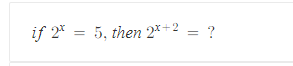
Hi folks. If 2^x = 5, then what is 2^x+2?
cedar kilnBOT
cobalt meadow
Hi folks. If 2^x = 5, then what is 2^x+2?
cobalt meadow
I can't seem to get around to solving this. I'm getting a little confused.
 crisp jackal
If 2^x = 5 then if we add +2 on both sides we get 2^x + 2 = 5 + 2 = 7 meaning we have 2^x + 2 = 7 ?
$$ 2^x=5 \iff 2^x + 2 = 5 + 2 \iff 2^x + 2 = 7 $$
wraith daggerBOT
mrbrown
 cobalt meadow
Not that.
Let me write the question rq.
cobalt meadow
crisp jackal
If 2^x = 5 then if we add +2 on both sides we get 2^x + 2 = 5 + 2 = 7 meaning we...
 cobalt meadow
No problem, I was able to get the solution with my calculator but I need to know how I should solve it manually
 graceful karma
You'd say that like 2^(x+2) 
cobalt meadow
first time writing maths equations on a keyboard :P
one of the first anyway
my bad
 bright surge
cobalt meadow
https://i.clouds.tf/elis/15zs.png
bright surge
cobalt meadow
https://i.clouds.tf/elis/15zs.png
hint: $a^b \times a^c=a^{b+c}$
wraith daggerBOT
Kanga Gang ¬Sam
 bright surge
@graceful karma why bring up logs?
bright surge
logs
 graceful karma
cobalt meadow
so i've got 2^(2x+2)

okay let me try the hint differently? 
isn't there a specific rule where if the base = base then power = power?
wait no
alright i'm lost
today's not a day for my maths brain 
graceful karma
wraith dagger
**Kanga Gang ¬Sam**
This should be the only rule you need
bright surge
graceful karma
This should be the only rule you need
repost (no, that isnt it.)
 tranquil oracle
bright surge
repost (no, that isnt it.)
tranquil oracle
bright surge
repost (no, that isnt it.)
wait what
bright surge
wait no
bright surge
tranquil oracle
wait what
why did i say +
tranquil oracle
idk
cobalt meadow

wraith daggerBOT
Kanga Gang ¬Sam
 cobalt meadow
so do i multiply 2^x with 2^(x+2)?
graceful karma
$2^{b+c} =2^b \times 2^c$
wraith daggerBOT
PapaBread
 graceful karma
Indeed
cobalt meadow
that got confusing for me
graceful karma
I think it was just because the formula was """backwards"""
You were trying to apply it left to right
Instead of right to left
cobalt meadow
maybe
alright, thank you guys a lot!
i actually wonder what you feel when you see some people struggling at a maths question that you probably consider easy :P
thanks again :)
.close
cedar kilnBOT
Channel closed
Closed by @cobalt meadow
Use .reopen if this was a mistake.
Available help channel!
Send your question here to claim the channel.
Remember:
• Ask your math question in a clear, concise manner.
• Show your work, and if possible, explain where you are stuck.
• After 15 minutes, feel free to ping <@&286206848099549185>.
• Type the command .close to free the channel when you're done.
• Be polite and have a nice day!
Read #❓how-to-get-help for further information on how to ask a good question, and about conduct in the question channels.
crimson sedge
Hiii
I have a question related to the D.I. method
So i have $\int \qty(\frac{e^{-kx}}{x}+\frac{e^{-kx}}{kx^2})dx$
cedar kilnBOT
crimson sedge
Hiii
I have a question related to the D.I. method
So i have $\int \qty(\frac{e^{...
wraith daggerBOT
Insert nerdy name
 crimson sedge
And if you try to integrate with the traditional integration by parts the uv - int u'v one
Its easily solvable
Because int u'v of the first integrand is the same as the second so they subtract each other out
But if I try to do that with the D.I. method its not really obvious at first
I'd like to know how to spot conditions like that if im not clear with my question then pls ping me
<@&286206848099549185>
cedar kilnBOT
@crimson sedge Has your question been resolved?
crimson sedge
.close
cedar kilnBOT
Channel closed
Closed by @near holly
Use .reopen if this was a mistake.
Available help channel!
Send your question here to claim the channel.
Remember:
• Ask your math question in a clear, concise manner.
• Show your work, and if possible, explain where you are stuck.
• After 15 minutes, feel free to ping <@&286206848099549185>.
• Type the command .close to free the channel when you're done.
• Be polite and have a nice day!
Read #❓how-to-get-help for further information on how to ask a good question, and about conduct in the question channels.
 opaque sluice
i need help with calc
cedar kilnBOT
opaque sluice
i need help with calc
opaque sluice
it says Write Eq (3) in terms of A and B to derive Rule (3)
this is eq:3 cos(a+b)+cos(a-b)=2cosacosb

this
dense wing
A=a+b and B=a-b.
opaque sluice
dense wing
A=a+b and B=a-b.
thats it?
dense wing
yes.
opaque sluice
wait there is no working out?

 opaque sluice
it said terms of A and B
wait, is there a way for me to get the solving, not just the answer?
Upper
dense wing
The solving is just look at what you need the sub to be to turn eqn 3 into rule 3.
opaque sluice
what does that mean-
dense wing
a and A are different variables.
opaque sluice
dense wing
The solving is just look at what you need the sub to be to turn eqn 3 into rule ...
i dont know what a sub is
opaque sluice
can I upload a document here? maybe itll make more sense
opaque sluice
dense wing
You're in calc and have never done a sub before???
I dont understand my teacher
dense wing
opaque sluice
I dont understand my teacher
Never understood any of your teachers?
opaque sluice
opaque sluice
dense wing
Never understood **any** of your teachers?
I understand my algebra teacher
but calculus is hard fsr
dense wing
subbing stuff is an algebra concept
dense wing
Yeah part b is literally what I said.
opaque sluice
I did b, i had help from someone
dense wing
so c is obvious.
opaque sluice
i just need to figure out the rest
opaque sluice
dense wing
so c is obvious.
it is?
dense wing
apply what you just derived..
opaque sluice
im gonna be dead honest right now
i dont understand ANYTHING youre saying
from sub to derive
god i hate this
how do i close the channel?
i dont want to solve this anymore
.close
cedar kilnBOT
Channel closed
Closed by @opaque sluice
Use .reopen if this was a mistake.
Available help channel!
Send your question here to claim the channel.
Remember:
• Ask your math question in a clear, concise manner.
• Show your work, and if possible, explain where you are stuck.
• After 15 minutes, feel free to ping <@&286206848099549185>.
• Type the command .close to free the channel when you're done.
• Be polite and have a nice day!
Read #❓how-to-get-help for further information on how to ask a good question, and about conduct in the question channels.
 fierce egret
 cedar kilnBOT
fierce egret
cedar kilnBOT
fierce egret
 quaint otter
Bruh
fierce egret
Exactly bruh
quaint otter
I was here dude
quaint otter
Issok
 crisp jackal
@fierce egret I'd start by summarizing the two fractions on the right hand side into one fraction
fierce egret
You need to solve for the one on the right
crisp jackal
yeah
oh right
first get the expression 1/de = .................
and then summarize the two fractions
and then you can take the reciproce value
fierce egret
crisp jackal
and then summarize the two fractions
Trying to summarize them is the hardest part
Don't I have to get common denominators to subtract them
crisp jackal
yes exactly! 🙂
fierce egret

Basically it becomes this
ofc I can factor these
But then I don't know how to actually subtract them becuase theres a fraction over a fraction
crisp jackal
you can use this $$ \frac{1}{a} = \frac{1}{b}- \frac{1}{c} \iff \frac{1}{a} = \frac{c}{bc} - \frac{b}{bc} \iff \frac{1}{a} = \frac{c-b}{bc} \iff a = \frac{bc}{c-b} $$
wraith daggerBOT
mrbrown

 calm yoke
yoo how do u use texit? do i have to learn how to write in it?
crisp jackal
wait a second 😅 we are working on Voximity's problem atm here
calm yoke
im relative new here, sorry if its dumb question and not the theme
crisp jackal
you can use one of the 'free" help channels
calm yoke
yesss okok
crisp jackal
🙂
@fierce egret I will assume you already got to this part, right? $$ \frac{1}{d_e} = \frac{1}{f} - \frac{1}{d_i} $$
wraith daggerBOT
mrbrown
 crisp jackal
let's summarize the two fractions on the right handside
crisp jackal
$$ \frac{1}{f} - \frac{1}{d_i} = \frac{d_i}{d_i f} - \frac{f}{fd_i} = \frac{d_i - f}{fd_i} $$
wraith daggerBOT
mrbrown
 crisp jackal
now let's insert the bad bois 😄
$$ \frac{1}{d_e} = \frac{\frac{x^2+2x-3}{2x^2 + 10}- \frac{x^2-9}{x^2+x-2}}{\frac{x^2-9}{x^2+x-2} \frac{x^2+2x-3}{2x^2 + 10}} $$
wraith daggerBOT
mrbrown
 crisp jackal
surely it is possible to simplify this further
i am not sure yet but we can try to factorize things, hopefully some terms will cancel out each other
no, actually it doens'T look like much will cancel each other out
we can try to rewrite it
$$ \frac{1}{d_e} = \frac{(x^2+2x-3)(x^2+x-2) - (x^2-9)(2x^2+10)}{(x^2-9)(x^2+2x-3)} $$
wraith daggerBOT
mrbrown

 crisp jackal
looks good!
crisp jackal
yeah it doesn't look like it can be simplified much further
fierce egret
Thanks for your help man @crisp jackal
Been struggling on this for a good 2hours
😂
crisp jackal
no problem :D:D
i have similar issues haha, the day before yesterday i was sitting at a problem for 5 hours lol
cedar kilnBOT
Channel closed
Closed by @fierce egret
Use .reopen if this was a mistake.
Available help channel!
Send your question here to claim the channel.
Remember:
• Ask your math question in a clear, concise manner.
• Show your work, and if possible, explain where you are stuck.
• After 15 minutes, feel free to ping <@&286206848099549185>.
• Type the command .close to free the channel when you're done.
• Be polite and have a nice day!
Read #❓how-to-get-help for further information on how to ask a good question, and about conduct in the question channels.
 wet gorge
This is a Desmos graphic calculator question. My z_step function contains an action V->V+tA where V is a list, t is a number, and A is a list. This action does not have an error, but it doesn't execute, even if I put it on its own line. I think this is because A is defined as such:
Is there a way to fix this? Link for reference: https://www.desmos.com/calculator/aybjlzytr5


Desmos
cedar kilnBOT
wet gorge
This is a Desmos graphic calculator question. My z_step function contains an act...
wet gorge
If there is another way to calculate acceleration in a way that desmos allows to be used in an action, that would be fine
A list that is simply a set of numbers CAN be used in an action, but A is still a list so it should work as far as I know
cedar kilnBOT
@wet gorge Has your question been resolved?
calm yoke
what was the question ?
wet gorge
calm yoke
what was the question ?
how do I fix the z_step function to have the velocity action work
cedar kilnBOT
@wet gorge Has your question been resolved?
wet gorge
I'm assuming I don't ping helpers again?
cedar kilnBOT
@wet gorge Has your question been resolved?
cedar kilnBOT
Channel closed
Closed due to timeout
Use .reopen if this was a mistake.
Available help channel!
Send your question here to claim the channel.
Remember:
• Ask your math question in a clear, concise manner.
• Show your work, and if possible, explain where you are stuck.
• After 15 minutes, feel free to ping <@&286206848099549185>.
• Type the command .close to free the channel when you're done.
• Be polite and have a nice day!
Read #❓how-to-get-help for further information on how to ask a good question, and about conduct in the question channels.
 open cedar
how to get from this to that
 cedar kilnBOT
open cedar
how to get from this to that
open cedar
cedar kilnBOT
open cedar
how to get from this to that
open cedar
i dont know what they did'
open cedar
ok but where does 6x come from
 normal wraith
,tex $(x^2+3)^2=x^4+6x^2+9$
wraith daggerBOT
Brun。
 wet gorge
.reopen
cedar kilnBOT
@open cedar Has your question been resolved?
Channel closed
Closed by @open cedar
Use .reopen if this was a mistake.
Available help channel!
Send your question here to claim the channel.
Remember:
• Ask your math question in a clear, concise manner.
• Show your work, and if possible, explain where you are stuck.
• After 15 minutes, feel free to ping <@&286206848099549185>.
• Type the command .close to free the channel when you're done.
• Be polite and have a nice day!
Read #❓how-to-get-help for further information on how to ask a good question, and about conduct in the question channels.
crimson sedge
So does anyone know how to find the area and volume of a three sided prisms using the diagonal of the side?
cedar kilnBOT
crimson sedge
So does anyone know how to find the area and volume of a three sided prisms usin...
crimson sedge
I got 9√3/4 x 6√2. And i do not know how to solve that
cedar kilnBOT
@crimson sedge Has your question been resolved?
crimson sedge
<@&286206848099549185>
dense wing
crimson sedge
lol everyone has got at least 1 answer other than me
yeah.. cause your question is vague as hell.
No prism with 3 sides exists
crimson sedge
yes, a prism with 2 bases and 3 sides
crimson sedge
Ah well i have been waiting for a response
so the diagonal of the side is 9 cm
like a base side is 3 cm
I need to calculate volume and area
<@&286206848099549185>
Of a triangular prism
cedar kilnBOT
@crimson sedge Has your question been resolved?
cedar kilnBOT
@crimson sedge Has your question been resolved?
cedar kilnBOT
Channel closed
Closed due to timeout
Use .reopen if this was a mistake.
Available help channel!
Send your question here to claim the channel.
Remember:
• Ask your math question in a clear, concise manner.
• Show your work, and if possible, explain where you are stuck.
• After 15 minutes, feel free to ping <@&286206848099549185>.
• Type the command .close to free the channel when you're done.
• Be polite and have a nice day!
Read #❓how-to-get-help for further information on how to ask a good question, and about conduct in the question channels.
 teal thorn
Is this true for all A and B if the angles can form a closed triangle?
Is this just implied to be true due to the construction of the triangle?
 cedar kilnBOT
teal thorn
Is this true for all A and B if the angles can form a closed triangle?
Is this j...
bright surge
teal thorn
Is this true for all A and B if the angles can form a closed triangle?
Is this j...
cedar kilnBOT
teal thorn
Is this true for all A and B if the angles can form a closed triangle?
Is this j...
bright surge
teal thorn
Is this true for all A and B if the angles can form a closed triangle?
Is this j...
there's not enough information (in some cases)
 teal thorn
let theta 1 be 50 degrees, A be 1, B be 1.5
good to know, and thanks for the response, @bright surge
.close
cedar kilnBOT
Channel closed
Closed by @teal thorn
Use .reopen if this was a mistake.
bright surge
welp-
for your case, there are no triangles like that(here) (also @teal thorn do you understand why i'm drawing these?)
 cedar kilnBOT
Available help channel!
cedar kilnBOT
Available help channel!
Send your question here to claim the channel.
Remember:
• Ask your math question in a clear, concise manner.
• Show your work, and if possible, explain where you are stuck.
• After 15 minutes, feel free to ping <@&286206848099549185>.
• Type the command .close to free the channel when you're done.
• Be polite and have a nice day!
Read #❓how-to-get-help for further information on how to ask a good question, and about conduct in the question channels.
teal thorn
I get its not a solid triangle.
Original problem is an offset crank, @bright surge
cedar kilnBOT
teal thorn
I get its not a solid triangle.
Original problem is an offset crank, <@684674576...
teal thorn
.close
cedar kilnBOT
Channel closed
Closed by @teal thorn
Use .reopen if this was a mistake.
cedar kilnBOT
Available help channel!
Send your question here to claim the channel.
Remember:
• Ask your math question in a clear, concise manner.
• Show your work, and if possible, explain where you are stuck.
• After 15 minutes, feel free to ping <@&286206848099549185>.
• Type the command .close to free the channel when you're done.
• Be polite and have a nice day!
Read #❓how-to-get-help for further information on how to ask a good question, and about conduct in the question channels.
 hollow basin
Hello, I am given the basis (1,1),(1,0)
(or any basis where this is the matrix )
( a a)
(b +1 b )
and I am asked to find a similar basis such as (2,1)’s first coordinate is 0. How do I do this?
cedar kilnBOT
hollow basin
Hello, I am given the basis (1,1),(1,0)
(or any basis where this is the matrix ...
hollow basin
The correction states that this is just the equivalent of saying that (2,1) is a scalar multiplication of (b+1, b)
But it’s like ???
cedar kilnBOT
@hollow basin Has your question been resolved?
hollow basin
<@&286206848099549185>
cedar kilnBOT
@hollow basin Has your question been resolved?
 mighty drift
The trick would be to notice that (2,1) is of the form (x+1, x) for x=1, and that this can be expressed as (0,0) + (1+1,1) = 0.A + 1.B (with A,B the basis vectors).
Otherwise you can just setup the system: x = 2 = a + b + 1 and y = 1 = a + b, from which the solutions are clear ( (0,1) is solution)
cedar kilnBOT
Channel closed
Closed due to timeout
Use .reopen if this was a mistake.
cedar kilnBOT
Available help channel!
Send your question here to claim the channel.
Remember:
• Ask your math question in a clear, concise manner.
• Show your work, and if possible, explain where you are stuck.
• After 15 minutes, feel free to ping <@&286206848099549185>.
• Type the command .close to free the channel when you're done.
• Be polite and have a nice day!
Read #❓how-to-get-help for further information on how to ask a good question, and about conduct in the question channels.
cedar kilnBOT
dense wing
<@&268886789983436800>
cedar kilnBOT
Channel closed
Closed due to the original message being deleted
Available help channel!
Send your question here to claim the channel.
Remember:
• Ask your math question in a clear, concise manner.
• Show your work, and if possible, explain where you are stuck.
• After 15 minutes, feel free to ping <@&286206848099549185>.
• Type the command .close to free the channel when you're done.
• Be polite and have a nice day!
Read #❓how-to-get-help for further information on how to ask a good question, and about conduct in the question channels.
 mental tangle
I never got how the square root of 4x^2 is 2x. Why isnt it 4x
dense wing
square root of 4 is what?
bright surge
mental tangle
I never got how the square root of 4x^2 is 2x. Why isnt it 4x
try doing (4x)^2
do you get 4x^2?
mental tangle
No
bright surge
mental tangle
No
so should 4x^2's square root be 4x?
mental tangle
Nah
bright surge
also, you can use this very handy thing:
$\sqrt{ab}=\sqrt{a}\sqrt{b}$
wraith daggerBOT
Kanga Gang ¬Sam
 bright surge
(both are the positive square root of ab, if you don't believe me, just try squaring them)
anyways, for this problem, you must find $\sqrt{4x^2} = \sqrt{4}\sqrt{x^2}$
wraith daggerBOT
Kanga Gang ¬Sam
 bright surge
i hope you can take it from here
cedar kilnBOT
@mental tangle Has your question been resolved?
 bold vine
mental tangle
I never got how the square root of 4x^2 is 2x. Why isnt it 4x
bold vine
mental tangle
I never got how the square root of 4x^2 is 2x. Why isnt it 4x
2x • 2x = 4x^2
But 4x • 4x = 16x^2
cedar kilnBOT
Channel closed
Closed due to timeout
Use .reopen if this was a mistake.
Available help channel!
Send your question here to claim the channel.
Remember:
• Ask your math question in a clear, concise manner.
• Show your work, and if possible, explain where you are stuck.
• After 15 minutes, feel free to ping <@&286206848099549185>.
• Type the command .close to free the channel when you're done.
• Be polite and have a nice day!
Read #❓how-to-get-help for further information on how to ask a good question, and about conduct in the question channels.
 distant gale
Help
cedar kilnBOT
distant gale
Help
distant gale
 upper abyss
Do you have a formula for sin(a + b)?

 cedar kilnBOT
@distant gale Has your question been resolved?
 worldly iron
 heavy igloo
This channel is occupied
ask your question somewhere else in the available channels
@heavy igloo
cedar kilnBOT
@distant gale Has your question been resolved?
cedar kilnBOT
Channel closed
Closed due to timeout
Use .reopen if this was a mistake.
cedar kilnBOT
Available help channel!
Send your question here to claim the channel.
Remember:
• Ask your math question in a clear, concise manner.
• Show your work, and if possible, explain where you are stuck.
• After 15 minutes, feel free to ping <@&286206848099549185>.
• Type the command .close to free the channel when you're done.
• Be polite and have a nice day!
Read #❓how-to-get-help for further information on how to ask a good question, and about conduct in the question channels.
 high flare
Hey! Anyone able to help me with these 3 questions, been practicing and don't understand these questions:
 cedar kilnBOT
high flare
Hey! Anyone able to help me with these 3 questions, been practicing and don't un...
cedar kilnBOT
high flare
Hey! Anyone able to help me with these 3 questions, been practicing and don't un...
 teal field
lol i also need help but i think i can do this
lets say 5x+40 + 2x = 180 cus abc is also 5x (corres. angles) and they ar3 linear pair now, x = 20

5:
2x+1 = 85 (alternate interior angles)
solve for x
then solve for y since u know 2x+1 is 85 degrees, 180 - 85 = 3y + 5
6:
2m = 4m - 120 (corresponding angles)
once u get M, whatever 4m-120 is equals 5n cus vertical angle
@high flare
cedar kilnBOT
@high flare Has your question been resolved?
 kindred storm
cedar kilnBOT
kindred storm
cedar kilnBOT
Channel closed
Closed by @kindred storm
Use .reopen if this was a mistake.
cedar kilnBOT
Available help channel!
Send your question here to claim the channel.
Remember:
• Ask your math question in a clear, concise manner.
• Show your work, and if possible, explain where you are stuck.
• After 15 minutes, feel free to ping <@&286206848099549185>.
• Type the command .close to free the channel when you're done.
• Be polite and have a nice day!
Read #❓how-to-get-help for further information on how to ask a good question, and about conduct in the question channels.
 round mauve
 cedar kilnBOT
round mauve
cedar kilnBOT
round mauve
 south tundra
I think he just made common denominators
round mauve
really?
south tundra
Yeah
round mauve
ok i see it now
lol it seemed so foreign
it must be because of the brackets
these square brackets dont mean anything else do they?
south tundra
Nope, you can view them as regular brackets
south tundra
Long story
cedar kilnBOT
Channel closed
Closed by @round mauve
Use .reopen if this was a mistake.
Available help channel!
Send your question here to claim the channel.
Remember:
• Ask your math question in a clear, concise manner.
• Show your work, and if possible, explain where you are stuck.
• After 15 minutes, feel free to ping <@&286206848099549185>.
• Type the command .close to free the channel when you're done.
• Be polite and have a nice day!
Read #❓how-to-get-help for further information on how to ask a good question, and about conduct in the question channels.
 shell seal
 cedar kilnBOT
shell seal
shell seal
cedar kilnBOT
shell seal
shell seal
Help?
 glad kestrel
with what exactly
shell seal
I don't know how to solve it
glad kestrel
are you solving for y
shell seal
Both x and y
glad kestrel
huh
bold vine
System of equations
glad kestrel
oh
bold vine
Solve for one variable in one equation in terms of the other
 prime flint
u have 2 variables in 2 equations
bold vine
Plug this expression into the other equation for the variable you solved for
prime flint
this should be doable
bold vine
bold vine
Plug this expression into the other equation for the variable you solved for
This should yields an equation with just one variable.
You can then solve for this variable.
prime flint
so maybe try to rearrange one of the equations in terms of 1 variable, then substitute that for the same variable in the OTHER equation
bold vine
Once you get the value of this variable, you can then plug its value into either one of the original equations to solve for the other variable
cedar kilnBOT
@shell seal Has your question been resolved?
cedar kilnBOT
Channel closed
Closed due to timeout
Use .reopen if this was a mistake.
Available help channel!
Send your question here to claim the channel.
Remember:
• Ask your math question in a clear, concise manner.
• Show your work, and if possible, explain where you are stuck.
• After 15 minutes, feel free to ping <@&286206848099549185>.
• Type the command .close to free the channel when you're done.
• Be polite and have a nice day!
Read #❓how-to-get-help for further information on how to ask a good question, and about conduct in the question channels.
crimson sedge
 cedar kilnBOT
crimson sedge
cedar kilnBOT
crimson sedge
 cerulean star
B
Exponential:

Use u-substitution where u = -x. All this will do is negate the non-constant term
crimson sedge
$\int{2^{-x}}dx \implies u=-x, du=-dx \implies -\int{2^u}du = -\bigg[\frac{2^u}{\ln(2)}+C\bigg] \implies -\bigg[\frac{2^{-x}}{\ln(2)}+C\bigg] \implies -\frac{2^{-x}}{\ln(2)}+C$
wraith daggerBOT
Fang
 dense wing
crimson sedge
$\int{2^{-x}}dx \implies u=-x, du=-dx \implies -\int{2^u}du = -\bigg[\frac{2^u}{...
dense wing
crimson sedge
$\int{2^{-x}}dx \implies u=-x, du=-dx \implies -\int{2^u}du = -\bigg[\frac{2^u}{...
dont just give answers.
crimson sedge
i was expanding on what disorganized said because they just gave an answer
dense wing
Theirs is less of an answer, you posted the entire solution.
cedar kilnBOT
@crimson sedge Has your question been resolved?
Channel closed
Closed by @lunar bloom
Use .reopen if this was a mistake.
Available help channel!
Send your question here to claim the channel.
Remember:
• Ask your math question in a clear, concise manner.
• Show your work, and if possible, explain where you are stuck.
• After 15 minutes, feel free to ping <@&286206848099549185>.
• Type the command .close to free the channel when you're done.
• Be polite and have a nice day!
Read #❓how-to-get-help for further information on how to ask a good question, and about conduct in the question channels.
crimson sedge
Let $f(x) = Ax + B$ and $g(x) = Bx + A$, where $A \neq B$. If $f(g(x)) - g(f(x)) = B - A$, what is $A + B$?
cedar kilnBOT
crimson sedge
Let $f(x) = Ax + B$ and $g(x) = Bx + A$, where $A \neq B$. If $f(g(x)) - g(f(x))...
wraith daggerBOT
crabbo
 crimson sedge
i got $abx^2+a^2x+b=b-a$
wraith daggerBOT
crabbo
 crimson sedge
how do i continue
 peak relic
I guess I'm confused as to how you got an x^2 term. When I plug g(x) info f I get f(g(x)) = A(Bx + A) + B. This won't end up with an x^2 term. Similarly for g(f(x)).
cedar kilnBOT
@crimson sedge Has your question been resolved?
 sly iris
A(Bx+A)+B - B(Ax+B)+A
crimson sedge
peak relic
I guess I'm confused as to how you got an x^2 term. When I plug g(x) info f I g...
f(g(x)) = Ax(Bx + A) + B
dense wing
yes.
crimson sedge
so ABx+A^2+B=B-A
crimson sedge
sly iris
A(Bx+A)+B - B(Ax+B)+A
how did you get this?
crimson sedge
sly iris
That's f(g) - g(f)
oh right
A(Bx+a)-B(Ax+B)=0
solve time
this means that
Ax=-B
and Bx=-A
or
A=0
or B=0
i need help on how to continue
 livid hound
crimson sedge
this means that
livid hound
crimson sedge
this means that
where's all that coming from
crimson sedge
livid hound
where's all that coming from
from this #help-13 message
oh
math error
A(Bx+a)-B(Ax+B)=-2A
livid hound
steps were skipped but
A(Bx+a)-B(Ax+B)=0
looks ok
what did you do after that
where's all that coming from
where's Ax=-B
and everything that follows coming from
crimson sedge
livid hound
> where's all that coming from
where's Ax=-B
and everything that follows coming ...
oh
i see
either
Ax+B=Bx+A
or A = 0
or B = 0
livid hound
that's what you're saying but what's leading you to those conclusions
i.e where's Ax + B = Bx + A coming from
 leaden otter
It's like saying if m+n=0 then m=0, n=0. That's the wrong conclusion. You can't assume anything like this.
livid hound
where's
orA=0
or B=0
coming from
show all work and/or reasoning leading to your statements
crimson sedge
i dont know how to solve it
leaden otter
Nothing stopping you from expanding the brackets.
crimson sedge
leaden otter
Nothing stopping you from expanding the brackets.
A(Bx+A)-B(Ax+B)=0
ABx+A^2-BAx+B^2=0
A^2+B^2=0
is the answer 0
A+B=0?
leaden otter
crimson sedge
A(Bx+A)-B(Ax+B)=0
ABx+A^2-BAx+B^2=0
The last term is -B² and not +B²
crimson sedge
leaden otter
The last term is -B² and not +B²
oh
so
(A+B)(A-B)=0
either A-B=0
or A+B=0
crimson sedge
leaden otter
But notice A-B can't be equal to 0
why not?
livid hound
read the question
cedar kilnBOT
Channel closed
Closed by @little wave
Use .reopen if this was a mistake.
cedar kilnBOT
Available help channel!
Send your question here to claim the channel.
Remember:
• Ask your math question in a clear, concise manner.
• Show your work, and if possible, explain where you are stuck.
• After 15 minutes, feel free to ping <@&286206848099549185>.
• Type the command .close to free the channel when you're done.
• Be polite and have a nice day!
Read #❓how-to-get-help for further information on how to ask a good question, and about conduct in the question channels.
 teal heath
hello I am struggling with this question
cedar kilnBOT
teal heath
hello I am struggling with this question
teal heath

 soft cloak
i mean, have you tried each of them?
soft cloak
yup
teal heath
d is -1 so not true
soft cloak
indeed
teal heath
e is not true it is 1
soft cloak
yes
soft cloak
yeah, i was for a second as well
and i think this is just the question being overly finnicky with the definition of "the limit exists"
because technically, if it tends to infinity it diverges so the implied finite limit doesn't exist
but usually you would disambiguate this by saying "converges towards a finite limit"
or something
teal heath
i think it was b because e^x exists for all values so there is a limit of 0
soft cloak
yep, the others are simply false, and for this one i can see how you could play with the definitions to make it work
but if someone actually expected someone to answer b) without any hesitation i'd slap them
figure of speech, but still
Things going to ±∞ are in general "kinda convergent". Like yeah it doesn't tend towards any particular real value, but c'mon it's regular, it's not like sin(n) or anything
teal heath
so why is the answer for b not exist because as that function approaches 0 from the right it gets closer to negative infinity
soft cloak
The only way i see the question working is if you say "-∞ isn't a number so the limit doesn't exist"
because limits are often understood to be finite values
 soft cloak
and you're right
if you ask 100 mathematicians what this limit is, 99 will answer "-∞"
teal heath
im just confused because as it approaches 0 from the right it goes toward negative infinity, it never really hits 0
soft cloak
Just like when x approaches -∞ in e^-x, it never really hits -∞
Limits don't deal in "what happens at the value", you have a wonderful tool for that called a calculator
Limits deal in "what happens if i get arbitrarily close to this value"
so yeah, you never reach 0, but that wasn't the point
cedar kilnBOT
Channel closed
Closed by @teal heath
Use .reopen if this was a mistake.
cedar kilnBOT
Available help channel!
Send your question here to claim the channel.
Remember:
• Ask your math question in a clear, concise manner.
• Show your work, and if possible, explain where you are stuck.
• After 15 minutes, feel free to ping <@&286206848099549185>.
• Type the command .close to free the channel when you're done.
• Be polite and have a nice day!
Read #❓how-to-get-help for further information on how to ask a good question, and about conduct in the question channels.
 dusty stone
how many event possible in random experience
cedar kilnBOT
dusty stone
how many event possible in random experience
 ornate mortar
dusty stone
how many event possible in random experience
ornate mortar
dusty stone
how many event possible in random experience
what do you mean it depends on the question
dusty stone
the question ask if the number of possible events could be greater than the fondamental set
issued results
dense wing
Post the question verbatum
dusty stone
is the numbers of events associed to a random exprience greater than number of results in the fundamental set of that experience.
dense wing
Fundamental set is something from ODEs... it sounds like you're trying to talk about probability
dusty stone
yes
dense wing
So... what's fundamental set in this context...?
dusty stone
there is non
dense wing
???
dusty stone
just a question
dusty stone
well it is not me who posing the question it is the teacher
dense wing
No, it's getting lost in translation...
Given your broken English, you're translating the question
dusty stone
yes indeed
 fickle trellis
Hassan, um what language is the original question in?
dusty stone
french
cedar kilnBOT
@dusty stone Has your question been resolved?
 olive geyser
dusty stone
french
olive geyser
dusty stone
french
mdr un fr
cedar kilnBOT
Channel closed
Closed by @dusty stone
Use .reopen if this was a mistake.
Available help channel!
Send your question here to claim the channel.
Remember:
• Ask your math question in a clear, concise manner.
• Show your work, and if possible, explain where you are stuck.
• After 15 minutes, feel free to ping <@&286206848099549185>.
• Type the command .close to free the channel when you're done.
• Be polite and have a nice day!
Read #❓how-to-get-help for further information on how to ask a good question, and about conduct in the question channels.
 cedar kilnBOT
 rugged tusk
rugged tusk
rugged tusk
can someone help me prove this statement ?
cedar kilnBOT
@rugged tusk Has your question been resolved?
cedar kilnBOT
@rugged tusk Has your question been resolved?
south tundra
Define set non-empty A such that the statement a is true for only numbers in the A set and similarly define non-empty B such that the statement b is true for only numbers in the B set
This is basically what we conclude from (∃x a(x) ∨ ∃x b(x))
Then ∃x (a(x) ∨ b(x)) is clearly true, because we can choose x to be in the set $A\cup{B}$
Wait how do I write union in LaTeX
wraith daggerBOT
Touch Our Beans
 south tundra
Oh thanks
cedar kilnBOT
Channel closed
Closed by @rugged tusk
Use .reopen if this was a mistake.
Available help channel!
Send your question here to claim the channel.
Remember:
• Ask your math question in a clear, concise manner.
• Show your work, and if possible, explain where you are stuck.
• After 15 minutes, feel free to ping <@&286206848099549185>.
• Type the command .close to free the channel when you're done.
• Be polite and have a nice day!
Read #❓how-to-get-help for further information on how to ask a good question, and about conduct in the question channels.
 clever jewel
I know this is wrong, but where is it wrong?
 cedar kilnBOT
clever jewel
I know this is wrong, but where is it wrong?
cedar kilnBOT
clever jewel
I know this is wrong, but where is it wrong?
@clever jewel Has your question been resolved?
south tundra
View $\frac{x - 1}{x + 1}$ as $1 - \frac{2}{x + 1}$
wraith daggerBOT
Touch Our Beans
 clever jewel
I know this is wrong, but where is it wrong?
clever jewel
clever jewel
I know this is wrong, but where is it wrong?
but like, where is it wrong in this image?
south tundra
$\lim_{x\to\infty}(\frac{1 - \frac{2}{x} + \frac{1}{x^2}}{1 - \frac{1}{x^2}})^x \ne 1$
wraith daggerBOT
Touch Our Beans
 south tundra
Only this part
clever jewel
can't I simply take each of those fractions as a separate limit and evaluate them separately?
and then plug in the values
south tundra
No, I can give you an example where such conclusion fails
$e = \lim_{n\to\infty}(1 + \frac{1}{n})^n$
wraith daggerBOT
Touch Our Beans
 clever jewel
hmm
yeah, I know it's e
but like, what's stopping me from breaking that limit into smaller limits?
can't the limit of some addition be broken into an addition of 2 limits?
south tundra
Yes (1 + 1/n)^n is the same as (1 + 1/n) being multiplied n times
But the limit should be the value that the expression approaches as n gets arbitrarily large
We can't even guarantee that it's a natural number in the first place
To break (1 + 1/n)^n into (1 + 1/n) being taken n times
It's almost the same mistake as writing $\sum_{k=0}^N{k} = k\sum_{k=0}^N{1}$
wraith daggerBOT
Touch Our Beans
 south tundra
I hope it's clear now
south tundra
wraith dagger
**Touch Our Beans**
Did you try this yet?
clever jewel
yeah, it works
what I was about to say
was that I thought I could do something like this:

but it only works if g(x) is a constant
south tundra
I think it works as long as limits for f and g exist generally
clever jewel
oh
south tundra
g doesn't have to necessarily be constant function

 clever jewel
wraith dagger
**Touch Our Beans**
clever jewel
wraith dagger
**Touch Our Beans**
honestly, I still don't understand why this wouldn't work
if the limit can be broken into separate ones
dense wing
wraith dagger
**Touch Our Beans**
cause you ignored the power entirely
clever jewel
so I can't just evaluate the function inside the paranthesis and then worry about the power?
clever jewel
clever jewel
was that I thought I could do something like this:
like this
dense wing
yes
clever jewel
clever jewel
was that I thought I could do something like this:
so this doesn't work at all?
dense wing
That I'm aware no, however those type of limits (ex. e's definition) require log tricks
dense wing
$L:=\lim_{x\to a}(f^g)(x) \ \ln(L)=\lim_{x\to a}g(x)\ln(f(x))$
wraith daggerBOT
Mosh
 dense wing
yeah but you never have that
dense wing
you have like 1.001^(something not 1 WLOG)
 elfin hemlock
You were saying 1^inf=1 but that is false
elfin hemlock
elfin hemlock
You were saying 1^inf=1 but that is false
So you were in fact saying this
clever jewel
ohhh
I see
alright, it's crystal clear now
can't separately evaluate the paranthesis and then the exponent, they both affect each other
clever jewel
I see
well, thanks a lot @south tundra, @dense wing and @elfin hemlock ! :P
.close
cedar kilnBOT
Channel closed
Closed by @clever jewel
Use .reopen if this was a mistake.
Available help channel!
Send your question here to claim the channel.
Remember:
• Ask your math question in a clear, concise manner.
• Show your work, and if possible, explain where you are stuck.
• After 15 minutes, feel free to ping <@&286206848099549185>.
• Type the command .close to free the channel when you're done.
• Be polite and have a nice day!
Read #❓how-to-get-help for further information on how to ask a good question, and about conduct in the question channels.
crimson sedge
so i gotta minimise (a-1+1/a)(2-a+1/(3-a)) where 0<=a<=2
 main needle
there's a symmetry that makes (a-1+1/a) and (2-a+1/(3-a)) the same thing
and the minimum will just be the center of the symmetry
main needle
hmmm I'm not entirely sure
something about the limit at a=0 and a=3 being +infinity, and the degree of the polynomial meaning it can only turn once
crimson sedge

 junior iron
shift it to the origin and apply the definition of symmetry
crimson sedge
crimson sedge
 it does make sense, just that idk how to convince someone that the minimum will be at the middle
crimson sedge
junior iron
shift it to the origin and apply the definition of symmetry
so like x'=x+1.5?
crimson sedge
crimson sedge
<:swagthink:724712868909416570> it does make sense, just that idk how to convinc...
oh oops, its symmetric so at the middle point it must have an extrema
yea thanks got it
.close
cedar kilnBOT
Channel closed
Closed by @radiant plinth
Use .reopen if this was a mistake.
Available help channel!
Send your question here to claim the channel.
Remember:
• Ask your math question in a clear, concise manner.
• Show your work, and if possible, explain where you are stuck.
• After 15 minutes, feel free to ping <@&286206848099549185>.
• Type the command .close to free the channel when you're done.
• Be polite and have a nice day!
Read #❓how-to-get-help for further information on how to ask a good question, and about conduct in the question channels.
 silk hazel
I forgot how to this, Am i suppose to give the highest exponent or give the sum of degrees
 cedar kilnBOT
silk hazel
I forgot how to this, Am i suppose to give the highest exponent or give the sum ...
crimson sedge
silk hazel
I forgot how to this, Am i suppose to give the highest exponent or give the sum ...
cedar kilnBOT
silk hazel
I forgot how to this, Am i suppose to give the highest exponent or give the sum ...
crimson sedge
silk hazel
I forgot how to this, Am i suppose to give the highest exponent or give the sum ...
Sum.
crimson sedge
silk hazel
Alright thanks
cedar kilnBOT
Channel closed
Closed by @silk hazel
Use .reopen if this was a mistake.
Available help channel!
Send your question here to claim the channel.
Remember:
• Ask your math question in a clear, concise manner.
• Show your work, and if possible, explain where you are stuck.
• After 15 minutes, feel free to ping <@&286206848099549185>.
• Type the command .close to free the channel when you're done.
• Be polite and have a nice day!
Read #❓how-to-get-help for further information on how to ask a good question, and about conduct in the question channels.
 boreal mist
i need help with this <@&286206848099549185>
 cedar kilnBOT
boreal mist
i need help with this <@&286206848099549185>
floral thistle
cedar kilnBOT
boreal mist
i need help with this <@&286206848099549185>
floral thistle
don’t immediately ping helpers
south tundra
When he was walking 800m NE, you could conclude that he walked 800/sqrt(2) due to N (and 800/sqrt(2) due to eE)
So since he's walked 800/sqrt(2) due to N already and he wants to have walked 1000m
He now would need to walk 1000 - 800/sqrt(2) in the direction of North
(Feel free to rationalize the denominator in 800/sqrt(2))
boreal mist
ok
cedar kilnBOT
@boreal mist Has your question been resolved?
cedar kilnBOT
Channel closed
Closed due to timeout
Use .reopen if this was a mistake.
Available help channel!
Send your question here to claim the channel.
Remember:
• Ask your math question in a clear, concise manner.
• Show your work, and if possible, explain where you are stuck.
• After 15 minutes, feel free to ping <@&286206848099549185>.
• Type the command .close to free the channel when you're done.
• Be polite and have a nice day!
Read #❓how-to-get-help for further information on how to ask a good question, and about conduct in the question channels.
 ionic peak
I need to map a function onto a torus
cedar kilnBOT
ionic peak
I need to map a function onto a torus
 radiant topaz
You want to map a function?
 grizzled nacelle
ionic peak
I need to map a function onto a torus
grizzled nacelle
ionic peak
I need to map a function onto a torus
Let $T$ be the torus defined with $[0,1]\times[0,1]$ (for example)
Define a function $f : \R^n \to T$
One such way to do this is to make the function 1-periodic
wraith daggerBOT
kirby
 ionic peak
radiant topaz
You want to map a function?
ionic peak
radiant topaz
You want to map a function?
Hi, yes I do
I want to use stereographic projection to map the x and y values of a function onto a torus
The circle going around the top being the y-axis, and the circle going around the sides being the x-axis
So you can sorta see the whole infinite function in a finite space
cedar kilnBOT
@ionic peak Has your question been resolved?
cedar kilnBOT
@ionic peak Has your question been resolved?
Channel closed
Closed by @ionic peak
Use .reopen if this was a mistake.
cedar kilnBOT
Available help channel!
Send your question here to claim the channel.
Remember:
• Ask your math question in a clear, concise manner.
• Show your work, and if possible, explain where you are stuck.
• After 15 minutes, feel free to ping <@&286206848099549185>.
• Type the command .close to free the channel when you're done.
• Be polite and have a nice day!
Read #❓how-to-get-help for further information on how to ask a good question, and about conduct in the question channels.
crimson sedge
Define the function $g(x)=3x+2$. If $g(x)=2f^{-1}(x)$ and $f^{-1}(x)$ is the inverse of the function $f(x)=ax+b$, find $\dfrac{a+b}{2}$.
cedar kilnBOT
crimson sedge
Define the function $g(x)=3x+2$. If $g(x)=2f^{-1}(x)$ and $f^{-1}(x)$ is the inv...
wraith daggerBOT
crabbo
 livid hound
x not y
bright surge
crimson sedge
<@!684674576998858770> $f^{-1}(x)=\frac{x-b}{a}$
and that is equal to....
crimson sedge
livid hound
x not y
ah right
wraith daggerBOT
crabbo
Compile Error! Click the  reaction for more information.
(You may edit your message to recompile.)
 crimson sedge
bright surge
and that is equal to....
crimson sedge
bright surge
and that is equal to....
that is the inverse of f(x)
bright surge
crimson sedge
that is the inverse of f(x)
and it is equal to...
livid hound
and then use the information given about g(x)
crimson sedge
$\frac{3x+2}{2}=\frac{x-b}{a}$
wraith daggerBOT
crabbo
 bright surge
wraith dagger
**crabbo**
bright surge
wraith dagger
**crabbo**
yep!
crimson sedge
bright surge
yep!
now i know what $f^{-1}$ is equal to
wraith daggerBOT
crabbo
 crimson sedge
bright surge
and so you can find f, right?
crimson sedge
bright surge
and so you can find f, right?
6x-2?
bright surge
crimson sedge
6x-2?
hmmm
no
livid hound
equate coefficients and constants to determine the values of a and b
crimson sedge
2x+2?
livid hound
forget about finding f(x)
equate coefficients and constants to determine the values of a and b
livid hound
how are you getting that?
crimson sedge
im equating coefficients and constants
crimson sedge
crimson sedge
based on this
^^^^^^
livid hound
show all work
crimson sedge
ig its wrong
crimson sedge
livid hound
> equate coefficients and constants to determine the values of **a** and **b**
how exactly do you want me to do that?
which expressions should i work with
livid hound
by actually equating the coefficients of x and the constant terms
perhaps it would be easier to see if you split your fractions
to explicitly identify the coefficients and constants
just because a is the denominator on one side and there is a 2 in the denominator on the other side, that doesn't necessarily mean that a is 2
nor is that in anyway equating the coefficients and/or constants
crimson sedge
livid hound
perhaps it would be easier to see if you split your fractions
you mean split my fraction, by splitting the numerator and the denominator
livid hound
no
crimson sedge
im confused
crimson sedge
i just dont understand what you want me to do
livid hound
$\frac{3x+2}{2}$
wraith daggerBOT
ℝamonov
 livid hound
split that fraction and express that as a sum of your x term and a constant
crimson sedge
livid hound
split that fraction and express that as a sum of your x term and a constant
there are no like terms
or
livid hound
who said anything about like terms