Channel closed
Closed by @slim plume
Use .reopen if this was a mistake.
1 messages · Page 220 of 1
 cedar kilnBOT
Closed by @slim plume
Use .reopen if this was a mistake.
 Available help channel!
Send your question here to claim the channel.
Remember:
• Ask your math question in a clear, concise manner.
• Show your work, and if possible, explain where you are stuck.
• After 15 minutes, feel free to ping <@&286206848099549185>.
• Type the command .close to free the channel when you're done.
• Be polite and have a nice day!
Read #❓how-to-get-help for further information on how to ask a good question, and about conduct in the question channels.
 tawny drum
On a certain math exam, $10%$ of the students got $70$ points, $25%$ got $80$ points, $20%$ got $85$ points, $15%$ got $90$ points, and the rest got $95$ points. What is the difference between the mean and the median score on this exam?
cedar kilnBOT
tawny drum
On a certain math exam, $10\%$ of the students got $70$ points, $25\%$ got $80$ ...
 wraith daggerBOT
龖
 tawny drum
do you do 100-10-25-20-15=30
so 30% of total is 95
so the medium has to be 85 right
idk how to do the mean
 sleek condor
weighted average
multiply the percentages with the scores
and add up
0.1x70+ 0.25x80....
sleek condor
percentages
are numbers between 0 and 1
10%=0.1
percent means "by hundred" in latin
it means 10/100
or in other words 0.1
but yeah its the same as dividing by 100
at the end
tawny drum
so 86
is
the averge?
nvm
i got the answer
Bill is sent to a donut shop to purchase exactly six donuts. If the shop has four kinds of donuts and Bill is to get at least one of each kind, how many combinations will satisfy Bill's order requirements?
how to do this
<@&286206848099549185>
 grizzled gazelle
I think that, while this may not be correct, 4 of the six have to be included, so there are 2 slots left, each with 4 options. This would be the number of options for the first multiplied by the number of options for the second. This would be 16
did this help?
grizzled gazelle
does the order matter?
tawny drum
um
Solution:
Bill is required to get at least 1 of each of the 4 kinds. Once he has done that, he has two donuts left to buy with no restrictions. He can do this by buying 2 of the same kind, which can be done in 4 ways, or he can do this by buying two donuts which are different kinds. If he buys donuts of different kinds, there are 4 options for the type of the first donut and 3 options for the second donut, but since the order that he selects them in doesn't matter we need to divide by two to get to a final count of $\dfrac{4\cdot3}{2}=6$ ways to buy two distinct donuts. This gives us a total of $6+4=10$ ways to buy the last 2 donuts once he has bought one of each kind, so $\boxed{10}$ is our answer.
this was the solution
wraith daggerBOT
龖

 astral bay
there are 4 different types of donuts that you could buy 2 of
let's just call the types A, B, C, D
then you could buy four of one type (AA, BB, CC, DD) or two different types (AB, AC, AD, BC, BD, CD), AB and BA are the same because order doesn't matter
which is 10 ways in total
tawny drum
oh
yeah
thanks
The sum of all the digits used to write the whole numbers $10$ through $13$ is $1 + 0 + 1 + 1 + 1 + 2 + 1 + 3 = 10$. What is the sum of all the digits used to write the whole numbers $1$ through $110$, inclusive?
wraith daggerBOT
龖
 tawny drum
i dont understand this question
what does "the sum of all digits used to write the whole numbers 10 through 13 is..." mean
astral bay
well the numbers 10 through 13 are 10, 11, 12, 13
so the digits used to write those are 1, 0, 1, 1, 1, 2, 1, 3
tawny drum
ohh
astral bay
so they're asking you to compute 1 + 2 + 3 + 4 + 5 + 6 + 7 + 8 + 9 + 1+0 + 1+1 + 1+2 + ... + 1+0+9 + 1+1+0
astral bay
think about each... place in the number, individually
astral bay
the sum of all the ones digits is just going to be several of "1 + 2 + 3 + 4 + 5 + 6 + 7 + 8 + 9 + 0"
the sum of all the tens digits has this pattern where it's the same number ten times in a row and then goes up by one
for the hundreds digits it's mostly 0 and then at the end you have 11 numbers that are >= 100 which all have a 1 there
astral bay
well i got 1001, and the actual answer is apparently 957
there's a lot of possible off-by-one errors here
...ah i see
the issue with what you did is the 145
tawny drum
oh
astral bay
which i assume is meant to be the sum for {100, 101, 102, 103, 104, 105, 106, 107, 108, 109}
cedar kilnBOT
Closed by @tawny drum
Use .reopen if this was a mistake.
Available help channel!
Send your question here to claim the channel.
Remember:
• Ask your math question in a clear, concise manner.
• Show your work, and if possible, explain where you are stuck.
• After 15 minutes, feel free to ping <@&286206848099549185>.
• Type the command .close to free the channel when you're done.
• Be polite and have a nice day!
Read #❓how-to-get-help for further information on how to ask a good question, and about conduct in the question channels.
 plucky pier
How to type using the Latex bot?
cedar kilnBOT
plucky pier
How to type using the Latex bot?
 royal loom
plucky pier
How to type using the Latex bot?
royal loom
plucky pier
How to type using the Latex bot?
Try #latex-help instead, these channels are for math questions
There's probably a few guides pinned in there somewhere
plucky pier
I actually had trouble with answering a user's question.
royal loom
What are you trying to type
plucky pier
Sin/cos type expressions looked better in Latex. His question was about a trig identity.
royal loom
$\sin{(x)}$
wraith daggerBOT
Austin
$\sin{(x)}$

 dull oxide
$\sin^2\theta+\cos^2\theta=1$
wraith daggerBOT
SWR
 dull oxide
plucky pier
Please feel free to ask any pre university question.
dull oxide
plucky pier
Please feel free to ask any pre university question.
You have it backwards. People who have questions will open a help channel, and you come to answer them. You, the helper, do not open a channel for people to ask you questions.
royal loom
we also do have pre-university math channels that you can browse for questions
but yes, this is for people who have questions to open
so if you don't have one then please close the channel
 hollow minnow
.close
cedar kilnBOT
Closed by @hollow minnow
Use .reopen if this was a mistake.
Available help channel!
Send your question here to claim the channel.
Remember:
• Ask your math question in a clear, concise manner.
• Show your work, and if possible, explain where you are stuck.
• After 15 minutes, feel free to ping <@&286206848099549185>.
• Type the command .close to free the channel when you're done.
• Be polite and have a nice day!
Read #❓how-to-get-help for further information on how to ask a good question, and about conduct in the question channels.
 fringe mauve
 cedar kilnBOT
fringe mauve
fringe mauve
cedar kilnBOT
fringe mauve
fringe mauve
,rotate
wraith daggerBOT
 cedar kilnBOT
Closed by @fringe mauve
Use .reopen if this was a mistake.
cedar kilnBOT
Available help channel!
Send your question here to claim the channel.
Remember:
• Ask your math question in a clear, concise manner.
• Show your work, and if possible, explain where you are stuck.
• After 15 minutes, feel free to ping <@&286206848099549185>.
• Type the command .close to free the channel when you're done.
• Be polite and have a nice day!
Read #❓how-to-get-help for further information on how to ask a good question, and about conduct in the question channels.
cedar kilnBOT
@crimson sedge Has your question been resolved?
cedar kilnBOT
@crimson sedge Has your question been resolved?
cedar kilnBOT
@crimson sedge Has your question been resolved?
Closed by @restive vessel
Use .reopen if this was a mistake.
Available help channel!
Send your question here to claim the channel.
Remember:
• Ask your math question in a clear, concise manner.
• Show your work, and if possible, explain where you are stuck.
• After 15 minutes, feel free to ping <@&286206848099549185>.
• Type the command .close to free the channel when you're done.
• Be polite and have a nice day!
Read #❓how-to-get-help for further information on how to ask a good question, and about conduct in the question channels.
fringe mauve
 cedar kilnBOT
fringe mauve
fringe mauve
cedar kilnBOT
fringe mauve
fringe mauve
im so bad at these integrals with a fraction that i cant do anything with
 humble karma
You can do partial fractions here.
fringe mauve
whast that
humble karma
When you write 1/[(ax+b)(cx+d)] = A/(ax+b) + B/(cx+d).
fringe mauve
wahts ur a b c d
humble karma
The linear coefficients.
cedar kilnBOT
@fringe mauve Has your question been resolved?
Closed by @fringe mauve
Use .reopen if this was a mistake.
Available help channel!
Send your question here to claim the channel.
Remember:
• Ask your math question in a clear, concise manner.
• Show your work, and if possible, explain where you are stuck.
• After 15 minutes, feel free to ping <@&286206848099549185>.
• Type the command .close to free the channel when you're done.
• Be polite and have a nice day!
Read #❓how-to-get-help for further information on how to ask a good question, and about conduct in the question channels.
 dry dirge
 dry dirge
how to do this ?
 gritty galleon
if {b_n} is bounded, it means it will have a maximum value, correct?
dry dirge
yes
 south tundra
gritty galleon
if {b_n} is bounded, it means it will have a maximum value, correct?
south tundra
gritty galleon
if {b_n} is bounded, it means it will have a maximum value, correct?
 Upper and lower bounds rather than a maximum value
dry dirge
south tundra
<:hmmCat:831508801646755850> Upper and lower bounds rather than a maximum value
correct
gritty galleon
south tundra
<:hmmCat:831508801646755850> Upper and lower bounds rather than a maximum value
true
dry dirge
south tundra
So a_nb_n is bounded between two constant multiples of a_n
what constant multiples of a_n means?
south tundra
 I think we need to consider the points where a_n is positive and where it's negative
south tundra
dry dirge
what constant multiples of a_n means?
ca_n for some constant c
dry dirge
south tundra
ca_n for some constant c
what ca_n means? a_n is not a number?
south tundra
It's some constant times a_n
And what did I say that implies a_n not to be a number?
Anyway, let L be the positive number such that |b_n| < L for all n, use the definition of limits here
south tundra
Let epsilon_1 = epsilon_2/L and choose corresponding N for it, show that for all n > N you have |a_nb_n| < eps_2
dry dirge
i cant choose proper N
cedar kilnBOT
Closed by @dry dirge
Use .reopen if this was a mistake.
Available help channel!
Send your question here to claim the channel.
Remember:
• Ask your math question in a clear, concise manner.
• Show your work, and if possible, explain where you are stuck.
• After 15 minutes, feel free to ping <@&286206848099549185>.
• Type the command .close to free the channel when you're done.
• Be polite and have a nice day!
Read #❓how-to-get-help for further information on how to ask a good question, and about conduct in the question channels.
 crimson sedge
heyo, i got a lesson in diophantine equation earlier and i still can't understand it, can anybody help me understand its concept or how it works?
cedar kilnBOT
crimson sedge
heyo, i got a lesson in diophantine equation earlier and i still can't understan...
gritty galleon
do u have a specific problem? ie a specific equation we can help with? explaining a topic isnt what we do 'round here, we are theere to help with specific problems
@crimson sedge
crimson sedge
gritty galleon
<@456226577798135808>
it's this equation: x = x_0 + b/gcd(a,b) * t, y = y_0 - a/gcd(a,b)t, where t element of Z
gritty galleon
hmmm
crimson sedge
 gritty galleon
,rcw
wraith daggerBOT
 gritty galleon
wraith dagger
gritty galleon
wraith dagger
u want an explanation for why is it so?
crimson sedge
gritty galleon
u want an explanation for why is it so?
yeah
gritty galleon
Someone should show up, if they r free
crimson sedge
gritty galleon
Someone should show up, if they r free
alright thanks man
 fallen moat
hihi
crimson sedge
hi
fallen moat
wraith dagger
I would try to sub the x and y in the answer set back to the equation to see
that's it make sense first
and try to understand on that procedure
crimson sedge
fallen moat
I would try to sub the x and y in the answer set back to the equation to see
wdym by sub?
like I put the entirety of those equations to x and y?
fallen moat
yes
crimson sedge
wait what does x_0 means?
fallen moat
x_0 and y_0 means the solutions you've found
lemme grab an example
,w Solve Diophantine equation 3x+5y=11
fallen moat
wraith dagger
as you can see there are many solution sets
crimson sedge
yeah why
fallen moat
x_0 and y_0 are just the one that you initially found out
crimson sedge
fallen moat
x_0 and y_0 are just the one that you initially found out

so they're the first solutions?
crimson sedge
crimson sedge
so they're the first solutions?
i mean the first two solutions i found
fallen moat
crimson sedge
so they're the first solutions?
they are the first that you find after solving the Diophantine equation
yes
after that
you can add (minus) coorespdoning values to get more solutions
crimson sedge
fallen moat
they are the first that you find after solving the Diophantine equation
hold on how do i get a solution from the diophantine equation?
fallen moat
crimson sedge
hold on how do i get a solution from the diophantine equation?
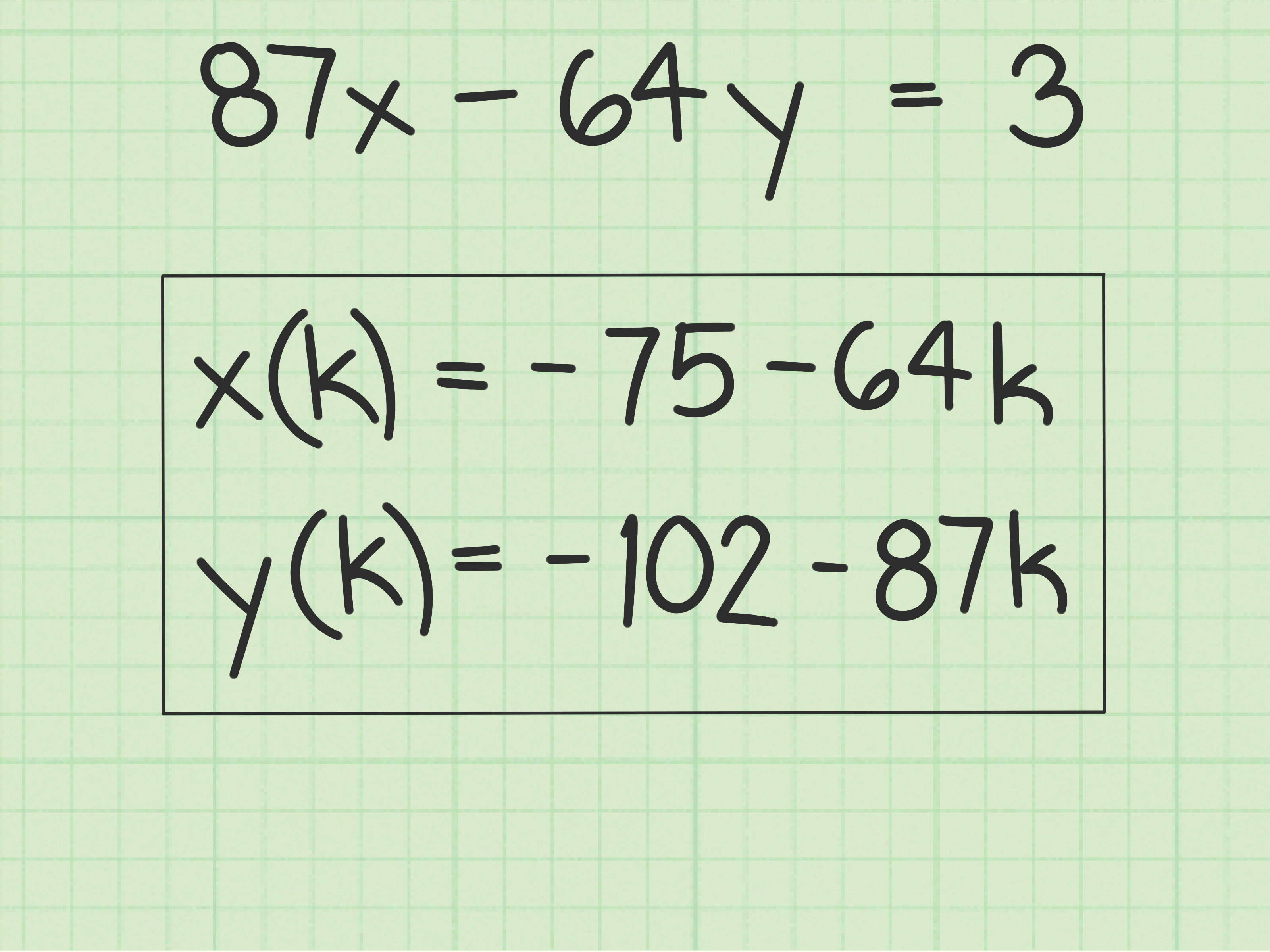
Solving a linear Diophantine equation means that you need to find solutions for the variables x and y that are integers only. Finding integral solutions is more difficult than a standard solution and requires an ordered pattern of steps....
crimson sedge
fallen moat
https://www.wikihow.com/Solve-a-Linear-Diophantine-Equation
oh that stuff
a = qb + r?
fallen moat
usually for small numbers, I'll just guess the numbers lol
fallen moat
crimson sedge
a = qb + r?
yea
crimson sedge
that's where i get my greatest common divisor, right?
fallen moat
hmmm i think no
gcd(a,b) is just gcd(a,b)
given a,b you can find gcd(a,b)
integers of course
fallen moat
fallen moat
https://www.wikihow.com/Solve-a-Linear-Diophantine-Equation
it's a long post
if you are ready, you can check it out
it's not easy at first
crimson sedge
like
53 = 7(q) + r
53 = 7(7) + 4
7 = 4(1) + 3
no solution
wait for example
a = 144, b = 11
144 = 11(13) + 1
13 = 1(13) + 0
so therefore the answer is 13?
because there's no remainder
fallen moat
the initial answer should be x_0 and y_0
crimson sedge
fallen moat
the initial answer should be x_0 and y_0
i don't get it
fallen moat
crimson sedge
144 = 11(13) + 1
13 = 1(13) + 0
lemme get an easier example
3x+2y=1
3=2(1)+1
so, we have 3-2=1
3(1)+2(-1)=1
so we found
x=1, y=-1 is a solution
now
gcd(3,2)=1
(no common factor except 1)
(coprime)
then we have
x=1+2t/1 , y=-1-3t/1
that is
x=1+2t, y=-1-3t
see if you understand
crimson sedge
fallen moat
3=2(1)+1
where (1) came from?
fallen moat
crimson sedge
where (1) came from?
2×1=1
fallen moat
crimson sedge
where (1) came from?
it's like 3÷2=1...1
fallen moat
fallen moat
it's like 3÷2=1...1
we just rewrite it as
3=2(1)+1
crimson sedge
fallen moat
so we found
x=1, y=-1 is a solution
the solution of x is opposite of that to y?
fallen moat
fallen moat
3(1)+2(-1)=1
3(1)+2(-1)=1
3(x)+2(y)=1
fallen moat
crimson sedge
the solution of x is opposite of that to y?
nope
crimson sedge
i still don't get what and where x_0 is
is it the constant?
wait
x_0 = 1
1 + b / gcd(a,b) *t
1 + 2 / 1 * t
1 + 2t
@fallen moat
fallen moat
👍
crimson sedge
y_0 = 1
1 - 3 / 1 * t
fallen moat
y_0 is -1
crimson sedge
wait why tho
crimson sedge
fallen moat
originally its
3-2=1
where'd 3-2=1 come from?
fallen moat
we found it by 3÷2=1 remaining 1
crimson sedge
omg I still couldnt get it 
fallen moat
do you know we can rewrite Division like
a÷b=q with r remainder
a=bq+r
crimson sedge
fallen moat
https://www.wikihow.com/Solve-a-Linear-Diophantine-Equation
i couldn't even rely on the post because it uses too many examples
fallen moat
crimson sedge
i couldn't even rely on the post because it uses too many examples
ouch
maybe you should try aome videos on YouTube for examples of solving linear Diophantine first
cedar kilnBOT
@crimson sedge Has your question been resolved?
crimson sedge
No
crimson sedge
fallen moat
maybe you should try aome videos on YouTube for examples of solving linear Dioph...
one question, where did (-1) come from?
ykw fuck it
.close
cedar kilnBOT
Closed by @twin thunder
Use .reopen if this was a mistake.
cedar kilnBOT
Available help channel!
Send your question here to claim the channel.
Remember:
• Ask your math question in a clear, concise manner.
• Show your work, and if possible, explain where you are stuck.
• After 15 minutes, feel free to ping <@&286206848099549185>.
• Type the command .close to free the channel when you're done.
• Be polite and have a nice day!
Read #❓how-to-get-help for further information on how to ask a good question, and about conduct in the question channels.
 marsh spindle
Im having problems with finding discontinuities of this function
 marsh spindle
i get that x != kpi
but dont know how to proceed with it. I assume kpi is being suspected of beinga discontinuity point?
the limit of f(x) at 0 i 1/2
crimson sedge
marsh spindle
Im having problems with finding discontinuities of this function
Well when is a function discontinuous?
Like did you learn what makes a function dc
crimson sedge
marsh spindle
i get that x != kpi
[
x \ne k \f{\pi}4 \q k \in \Z
]
wraith daggerBOT
 crimson sedge
to be clear
marsh spindle
right
well function is discontinius at a point if that point is a cluster point of the domain but is not in the domain
crimson sedge
Yes well
crimson sedge
Also the types of discontinuity
crimson sedge
2 more
marsh spindle
removable
crimson sedge
Yep, I think that's all you're taught in class
marsh spindle
yea, it was told there are plenty more
crimson sedge
The fourth one is oscillating dc but I don't think you were taught that
crimson sedge
marsh spindle
yea, it was told there are plenty more
Yeah, do remember oscillating
Yep
When x tends to
marsh spindle
0 i believe
crimson sedge
No...
crimson sedge
Yes
That's better
So yeah
Just identity which one of these suite your question
And solve it
You can use desmos you want to graph some functions
Or any graphing calc for that matter
crimson sedge
marsh spindle
Im having problems with finding discontinuities of this function
Where do you think that is DC
Or rather when
What do you think makes that function DC
marsh spindle
x->0, then limf(x) = 1/2
crimson sedge
because it would be C if we had fx = sin 2x
marsh spindle
well points not in the domain
when sin4x = 0
cause overall that function is continius, right?
crimson sedge
Yes
marsh spindle
its made of a couple of elementary functions
marsh spindle
and its discontinius at x=kpi/4
crimson sedge
Solve for this and that's ur answer
crimson sedge
K is the variable
crimson sedge
You can't remove it
Unless you throw out all the points where sin 4x is 0
Removing all those points would make the function continuous
marsh spindle
i mean yea, i dont want to remove it, just have to state what type it is
cedar kilnBOT
@marsh spindle Has your question been resolved?
cedar kilnBOT
@marsh spindle Has your question been resolved?
cedar kilnBOT
Closed due to timeout
Use .reopen if this was a mistake.
Available help channel!
Send your question here to claim the channel.
Remember:
• Ask your math question in a clear, concise manner.
• Show your work, and if possible, explain where you are stuck.
• After 15 minutes, feel free to ping <@&286206848099549185>.
• Type the command .close to free the channel when you're done.
• Be polite and have a nice day!
Read #❓how-to-get-help for further information on how to ask a good question, and about conduct in the question channels.
 heavy charm
<@&286206848099549185>
How to solve the expected frequencies in Chi-Square Goodness-of-Fit Test?
cedar kilnBOT
heavy charm
<@&286206848099549185>
How to solve the expected frequencies in Chi-Square Goo...
heavy charm
I'm having problems solving this one:

According to the book, the observe and expected frequencies are:

@cedar kiln
<@&286206848099549185>
 spiral thorn
well, by finding the central measures of tendencies like mode median or mean to be close enough to each other we can say that the last years distribution of responses 'fits' this years
heavy charm
I want to know how to solve the expected frequencies for the chi-square goodness of fit test?
That's where I'm stuck at, i know how to solve the chi-square but not the expected frequency
is there a formula for that?
spiral thorn
i dont really understand where youre stuck at. could you try explaining it again?
heavy charm
Okay
Here is the sample problem:

The topic is: Chi-Square Goodness-of-Fit Test
Now we are tasked to identify the expected frequency per category
<@&286206848099549185>
Given that the observe frequencies are:
And the Expected Frequencies are:
Now we need to know how did you get the answers to the expected frequency? How did they come to be? What is the formula and solution for expected frequencies in Chi-Square Goodness-of-Fit Test?
cedar kilnBOT
@heavy charm Has your question been resolved?
heavy charm
pls help
cedar kilnBOT
@heavy charm Has your question been resolved?
heavy charm
<@&286206848099549185>
cedar kilnBOT
@heavy charm Has your question been resolved?
cedar kilnBOT
@heavy charm Has your question been resolved?
cedar kilnBOT
@heavy charm Has your question been resolved?
 lethal jackal
heavy charm
I'm having problems solving this one:
lethal jackal
heavy charm
I'm having problems solving this one:
can you send pictures of the page before the problem and the page after the problem?
as well as a complete picture of the problemp age
cedar kilnBOT
Closed due to timeout
Use .reopen if this was a mistake.
cedar kilnBOT
Available help channel!
Send your question here to claim the channel.
Remember:
• Ask your math question in a clear, concise manner.
• Show your work, and if possible, explain where you are stuck.
• After 15 minutes, feel free to ping <@&286206848099549185>.
• Type the command .close to free the channel when you're done.
• Be polite and have a nice day!
Read #❓how-to-get-help for further information on how to ask a good question, and about conduct in the question channels.
 silk carbon
Could someone walk me through this?
 cedar kilnBOT
silk carbon
Could someone walk me through this?
cedar kilnBOT
silk carbon
Could someone walk me through this?
 dusk goblet
rewrite sec theta
in terms of simpler trig functions
then evaluate the limit from there
silk carbon
1/cos theta
dusk goblet
mhm and what is the limit as x approaches pi/2 of cos
silk carbon
So my question is, when we have a limit approaching from the right or left, what are the steps to follow?
dusk goblet
from the right take values greater than the number it approaches
so how does cos behave slightly past pi/2
u know it’ll be close to zero
right
but is it positive or negative
silk carbon
Cos decrease past pi/2 and increases at pi
dusk goblet
well i mean is it cos positive or negative after pi/2
think about it pi/2 is between which two quadrants
a little before pi/2 or 90 degrees is which quadrant
we know cos is the x value of the unit circle
correct
silk carbon
It’s in the top left
silk carbon
Negative
dusk goblet
if cos corresponds to the x value
yup
so u know it’s close to zero
but negative
so what’s 1/0 in terms of limits
obviously undefined but when we evaluate the limit
what will it approach
silk carbon
1/0 is an infinity
dusk goblet
yes
silk carbon
But with cos being negative, it’s a negative infinity?
silk carbon
Nice, thank you!
dusk goblet
and notice that from the left
cos would be positive still because it’s in the top right
so from the left it would approach positive infinity
dusk goblet
silk carbon
Nice, thank you!
yea no problem
silk carbon
Wait if it’s approaching from the right
That means the answer should be positive infinity?
dusk goblet
nono
so
from the right
or from the left
simply means
r we taking values to right on the number line or greater than that value
from the left would mean we take values smaller
silk carbon
Got it! Nice
dusk goblet
or left of the nunber on the number line
silk carbon
I got a little confused there lol
dusk goblet
yea ik because right means positive when thinking of unit circle quadrants
for limits it simply means greater than or less than the value
because right or left on the number line
dusk goblet
no problem
silk carbon
.close
cedar kilnBOT
Closed by @silk carbon
Use .reopen if this was a mistake.
cedar kilnBOT
Available help channel!
Send your question here to claim the channel.
Remember:
• Ask your math question in a clear, concise manner.
• Show your work, and if possible, explain where you are stuck.
• After 15 minutes, feel free to ping <@&286206848099549185>.
• Type the command .close to free the channel when you're done.
• Be polite and have a nice day!
Read #❓how-to-get-help for further information on how to ask a good question, and about conduct in the question channels.
cedar kilnBOT
 urban shell
help i dont knwo who to do this
urban shell
urban shell
help i dont knwo who to do this
urban shell
we have to find what x, y and z are
and x, y and z are integers
<@&286206848099549185>
nvm gtg
crimson sedge
x, y, z < 4
urban shell
.close
cedar kilnBOT
Closed by @urban shell
Use .reopen if this was a mistake.
Available help channel!
Send your question here to claim the channel.
Remember:
• Ask your math question in a clear, concise manner.
• Show your work, and if possible, explain where you are stuck.
• After 15 minutes, feel free to ping <@&286206848099549185>.
• Type the command .close to free the channel when you're done.
• Be polite and have a nice day!
Read #❓how-to-get-help for further information on how to ask a good question, and about conduct in the question channels.
crimson sedge
circle c passes through 2 points P (-8, 0) and Q (-5, 9). The centre of C lies on the straight line L: x+y=1. Find the coordinates of the centre of c
cedar kilnBOT
crimson sedge
circle c passes through 2 points P (-8, 0) and Q (-5, 9). The centre of C lies o...
@crimson sedge Has your question been resolved?
crimson sedge
<@&286206848099549185>
 livid hound
!status
cedar kilnBOT
What step are you on?
1. I don't know where to begin.
2. I have begun but got stuck midway.
3. I got an answer but I was told that it's wrong.
4. I got an answer and would like my work checked.
5. I have a question about someone else's work/solution.
6. I have completed the problem and don't need help anymore. Thank you.
7. None of the above
@crimson sedge Has your question been resolved?
cedar kilnBOT
Closed due to timeout
Use .reopen if this was a mistake.
Available help channel!
Send your question here to claim the channel.
Remember:
• Ask your math question in a clear, concise manner.
• Show your work, and if possible, explain where you are stuck.
• After 15 minutes, feel free to ping <@&286206848099549185>.
• Type the command .close to free the channel when you're done.
• Be polite and have a nice day!
Read #❓how-to-get-help for further information on how to ask a good question, and about conduct in the question channels.
 sonic saddle
could someone explain why P(m) is true if the conditional statement P(m - 1) -> P(m) is true
 cedar kilnBOT
sonic saddle
could someone explain why P(m) is true if the conditional statement P(m - 1) -> ...
sonic saddle
cedar kilnBOT
sonic saddle
could someone explain why P(m) is true if the conditional statement P(m - 1) -> ...
sonic saddle
is it because
nvm
well actually how do we know that the statement P(m - 1) -> P(m) is true?
is it because we are assuming that P(k) -> P(k+1) is true?
and so P(m - 1) -> P(m) must be a true statement as well
humble karma
Induction comes from the definition of the natural numbers.
sonic saddle
since P(m - 1) is true
humble karma
The point of N is that it is defined entirely by the fact that :
So if you show that the set of numbers for which statement P(n) holds contains 1 (that is P(1) holds)
and then show that if n is in that set, n+1 is in it (equivalent to P(n) => P(n+1)))
then it follows that that set of natural numbers must've been N to begin with.
 crimson delta
P(k)->P(k+1) is true for all choices of k, so it is also true for the choice k=m-1
sonic saddle
humble karma
then it follows that that set of natural numbers must've been N to begin with.
this makes sense thank you
sonic saddle
crimson delta
P(k)->P(k+1) is true for all choices of k, so it is also true for the choice k=m...
and thank you for your help as well
.close
cedar kilnBOT
Closed by @sonic saddle
Use .reopen if this was a mistake.
Available help channel!
Send your question here to claim the channel.
Remember:
• Ask your math question in a clear, concise manner.
• Show your work, and if possible, explain where you are stuck.
• After 15 minutes, feel free to ping <@&286206848099549185>.
• Type the command .close to free the channel when you're done.
• Be polite and have a nice day!
Read #❓how-to-get-help for further information on how to ask a good question, and about conduct in the question channels.
 glad wraith
What am i doing wrong ?
cedar kilnBOT
glad wraith
What am i doing wrong ?
 silver fable
$\lim_{x\to a } \frac{f(x)-f(a)}{x-a} = f'(a)$
wraith daggerBOT
Adam Chebil
 glad wraith
and i can use only
 cedar kilnBOT
@glad wraith Has your question been resolved?
 modern compass
???
 modern compass
glad wraith
What am i doing wrong ?
modern compass
glad wraith
What am i doing wrong ?
that's not how exponents work
modern compass
you started to have a workable idea here:
 silver fable
you just need to evaluate the derivative of $2^{\sin x}$ at $x=0$
wraith daggerBOT
Adam Chebil
 cedar kilnBOT
@glad wraith Has your question been resolved?
cedar kilnBOT
@glad wraith Has your question been resolved?
Closed by @glad wraith
Use .reopen if this was a mistake.
Available help channel!
Send your question here to claim the channel.
Remember:
• Ask your math question in a clear, concise manner.
• Show your work, and if possible, explain where you are stuck.
• After 15 minutes, feel free to ping <@&286206848099549185>.
• Type the command .close to free the channel when you're done.
• Be polite and have a nice day!
Read #❓how-to-get-help for further information on how to ask a good question, and about conduct in the question channels.
 radiant mulch
$\frac{\sqrt[3]{x}(\sqrt{x} + 1)}{\sqrt{x}}$
cedar kilnBOT
radiant mulch
$\frac{\sqrt[3]{x}(\sqrt{x} + 1)}{\sqrt{x}}$
radiant mulch
can i simplify something here?
wraith daggerBOT
odokawa
 radiant mulch
$\frac{x^{1/3}(x^{1/2} + 1)}{x^{1/2}}$
radiant mulch
 hollow trail
rewrite the roots as exponents
hollow trail
rewrite the roots as exponents
this is what yo umean
 near aurora
Need help with this
 hollow trail
radiant mulch
this is what yo umean
hollow trail
radiant mulch
this is what yo umean
yes but the exponent for cube root is wrong
wraith daggerBOT
odokawa
 radiant mulch
...
hollow trail
you can also use the properties of exponents to rewrite the denominator as a negative exponent
then combine them
cedar kilnBOT
Closed by @radiant mulch
Use .reopen if this was a mistake.
hollow trail
$\frac {a^b} {a^c} = a^{b-c}$
wraith daggerBOT
cloud
 cedar kilnBOT
Available help channel!
cedar kilnBOT
Available help channel!
Send your question here to claim the channel.
Remember:
• Ask your math question in a clear, concise manner.
• Show your work, and if possible, explain where you are stuck.
• After 15 minutes, feel free to ping <@&286206848099549185>.
• Type the command .close to free the channel when you're done.
• Be polite and have a nice day!
Read #❓how-to-get-help for further information on how to ask a good question, and about conduct in the question channels.
 wintry crypt
given 2 points on graph does anyone know how to calculate the closest distance when you draw a line to a third point? example the blue is what i want to calculate
 cedar kilnBOT
wintry crypt
given 2 points on graph does anyone know how to calculate the closest distance w...
cedar kilnBOT
wintry crypt
given 2 points on graph does anyone know how to calculate the closest distance w...
 umbral dew
you can if you know the cords of the point and the eq of the line
wintry crypt
well i do know the 2 point coordinates, what would be the equation though?
umbral dew
so you know the coordinates of the red point only?
wintry crypt
sorry, i meant i know the coords of all 3 point
umbral dew
so you can make the equation
of the line
with the help of the cords of the 2
orange points
,,\frac{y-y_1}{x-x_1}=\frac{y_2-y_1}{x_2-x_1}
wraith daggerBOT
ഴajat
 wintry crypt
alright let me try
wintry crypt
wraith dagger
**ഴajat**
x, y is the red point, x1, y1 and x2, y2 is the orange point right?
wintry crypt
ops forgot to ping
umbral dew
x_1 and y_1 are coords of either one of the orange point
and x_2 and y_2 are the coords of the other orange point
and you use x and y because we are making a line here

👉 Learn how to write the equation of a line given two points on the line. The equation of a line is such that its highest exponent on its variable(s) is 1. (i.e. there are no exponents on its variable(s)). There are various forms which we can write the equation of a line: the point-slope form, the slope-intercept form, the standard form, etc.
T...
quick small video
might help
cedar kilnBOT
@wintry crypt Has your question been resolved?
wintry crypt
umbral dew
https://www.youtube.com/watch?v=4yy94rZCT-4&pp=ygU7aG93IHRvIG1ha2UgYW4gZXF1YXRpb...
i mean i understand slope, but i think im applying it wrong here

 slow jewel
wintry crypt
i mean i understand slope, but i think im applying it wrong here
slow jewel
wintry crypt
i mean i understand slope, but i think im applying it wrong here
The shortest distance?
wintry crypt
yes
umbral dew
oh sorri idk why i ignored the ping lmao
so is y=6x-5 the equation of the line @wintry crypt
wintry crypt
i see, so what's next?
wintry crypt
hmm i mean it's not gonna be always 90 degree tho
wintry crypt
oh, now i realize
umbral dew
yea also the equation of line would be x=6y-5
cedar kilnBOT
Closed by @wintry crypt
Use .reopen if this was a mistake.
Available help channel!
Send your question here to claim the channel.
Remember:
• Ask your math question in a clear, concise manner.
• Show your work, and if possible, explain where you are stuck.
• After 15 minutes, feel free to ping <@&286206848099549185>.
• Type the command .close to free the channel when you're done.
• Be polite and have a nice day!
Read #❓how-to-get-help for further information on how to ask a good question, and about conduct in the question channels.
 finite raven
How to show that $|X\cup Y| + |X\cap Y | = |X| + |Y|$
wraith daggerBOT
tales
 finite raven
Usually when we want to prove $|X| = |Y|$, we show that there is a bijection between X and Y
wraith daggerBOT
tales
 finite raven
but now we are adding cardinalities
finite raven
finite raven
How to show that $|X\cup Y| + |X\cap Y | = |X| + |Y|$
X,Y are finite sets
I can show that when $X\cap Y = \emptyset$, we have $|X\cup Y| = |X| + |Y|$
wraith daggerBOT
tales

 clever sinew
Maybe its helpful to rearange: $|X\cup Y| = |X| + |Y| - |X\cap Y|$
wraith daggerBOT
Tobi
 clever sinew
The proof in word is then pretty easy
or in visuall
Caridnallity are natural numbers thus there is subtraction
 midnight hatch

clever sinew
Ye but no need for a ring here.
finite raven
Okay
clever sinew
this rearangment should highlight the intuition why this sould be true
clever sinew
If you do a union you count every element possibly twice hence you subtract the intersection. Which sould always be less then both sets combined hence we wont escape the natruals by subtraction
Thus : $|X| + |Y| \geq |X \cap Y|$
wraith daggerBOT
Tobi
 finite raven
wraith dagger
**Tobi**
finite raven
wraith dagger
**Tobi**
$|X| + |Y| \geq |X \cup Y|$
wraith daggerBOT
tales
 finite raven
I agree
clever sinew
Wups yeah wrong sign. Yes now you actually just need to formalize the description. I thing there are a few options to do this.
midnight hatch
Well no need for inequalities you actually already have the answer, using your first case and the fact that $A\smallsetminus B$ and $B$ are disjoint and that $|A\cup B| = |(A\smallsetminus B)\cup B|$
wraith daggerBOT
Azenx
 finite raven
$|(A-B) \cup B | = |A-B| + |B|$
wraith daggerBOT
tales
 midnight hatch
Now what's $|A\smallsetminus B| + |A \cap B|$ ?
wraith daggerBOT
Azenx
 finite raven
They are
finite raven
$|A-B| + |A\cap B| = |(A-B)\cup (A\cap B)|$
wraith daggerBOT
tales
 midnight hatch
Yes
What's that equal to
Compute the set inside of ||
A-B : x in A and not in B
A cap B : x in A and in B
the union : X in A
So basically the set is A
finite raven
$|A-B| + |A\cap B| = |(A-B)\cup (A\cap B)| = |A|$
wraith daggerBOT
tales
 midnight hatch
And you'd be done
finite raven
That is smart
I was setting $A = \left{ (1, x) : ; : x\in X\right} \cup \left{ (2, y) : ; : y\in Y\right}$
wraith daggerBOT
tales
 finite raven
Then $|A| = |X| + |Y|$
wraith daggerBOT
tales
 cedar kilnBOT
Closed by @finite raven
Use .reopen if this was a mistake.
Available help channel!
Send your question here to claim the channel.
Remember:
• Ask your math question in a clear, concise manner.
• Show your work, and if possible, explain where you are stuck.
• After 15 minutes, feel free to ping <@&286206848099549185>.
• Type the command .close to free the channel when you're done.
• Be polite and have a nice day!
Read #❓how-to-get-help for further information on how to ask a good question, and about conduct in the question channels.
 jovial snow
I need help with a volume of a solid question:
 cedar kilnBOT
jovial snow
I need help with a volume of a solid question:
jovial snow
cedar kilnBOT
jovial snow
I need help with a volume of a solid question:
jovial snow

this is the region.
My question lies in the second Area to "integrate", that is to say the bounds are pi/4 to pi/2.
cross section area is equal to pi*(big radius - small radius)^2
I am having troubles setting up the big radius and small redius
cedar kilnBOT
@jovial snow Has your question been resolved?
jovial snow
.close
cedar kilnBOT
Closed by @jovial snow
Use .reopen if this was a mistake.
cedar kilnBOT
Available help channel!
Send your question here to claim the channel.
Remember:
• Ask your math question in a clear, concise manner.
• Show your work, and if possible, explain where you are stuck.
• After 15 minutes, feel free to ping <@&286206848099549185>.
• Type the command .close to free the channel when you're done.
• Be polite and have a nice day!
Read #❓how-to-get-help for further information on how to ask a good question, and about conduct in the question channels.
 glass sky
Can I evaluate it in terms of m
 cedar kilnBOT
glass sky
Can I evaluate it in terms of m
glass sky
cedar kilnBOT
glass sky
Can I evaluate it in terms of m
glass sky
Was the above equal to this
 crimson delta
no
crimson delta
now you have the harmonic sum
which doesnt have a closed form
which means that our original one doesnt have one either
glass sky
So like we can't conclude it into m ?
crimson delta
you cant just write a simple formula into which you can plug m and get the value of the sum
cedar kilnBOT
Closed by @glass sky
Use .reopen if this was a mistake.
Available help channel!
Send your question here to claim the channel.
Remember:
• Ask your math question in a clear, concise manner.
• Show your work, and if possible, explain where you are stuck.
• After 15 minutes, feel free to ping <@&286206848099549185>.
• Type the command .close to free the channel when you're done.
• Be polite and have a nice day!
Read #❓how-to-get-help for further information on how to ask a good question, and about conduct in the question channels.
 gilded rapids
Could anyone help me construct a highest possible type grammar from this language?
particularly confused about making something like m=5 and k=1
 cedar kilnBOT
gilded rapids
Could anyone help me construct a highest possible type grammar from this languag...
cedar kilnBOT
gilded rapids
Could anyone help me construct a highest possible type grammar from this languag...
@gilded rapids Has your question been resolved?
gilded rapids
<@&286206848099549185>
 dawn junco
well an idea here is to
1/ construct all the a and c's simultaneously at the beginning (cause they have to be linked), then
2/ add all the b's in the middle at the end @gilded rapids
as for your confusion
imagine you have a word a^m c^k with m+k = 2a (a is an integer)
in what ways can you add letters to that word to get a word of the form a^m' c^k' with m'+k' = 2a+2 ?
i.e. how can you jump from m+k being some even number to the next even number ?
cedar kilnBOT
@gilded rapids Has your question been resolved?
gilded rapids
dawn junco
i.e. how can you jump from m+k being some even number to the next even number ?
hmm m has to increase by 2, k has to increase by 2 or m increases by 1 and k increases by 1
dawn junco
yeah
gilded rapids
ah, is it so that basically the case m=5 and k=1 cannot even occur?
dawn junco
that's the basic steps you can take to increase your number of a and c's within the allowed rules
dawn junco
gilded rapids
ah, is it so that basically the case m=5 and k=1 cannot even occur?
but you can apply these rules as many times you want
gilded rapids
m increases by 2, m increases by 2, and both increase by 1 . .
gilded rapids
aahh i see
wait, lemme try to construct the grammar

something like this? @dawn junco
dawn junco
almost
you'd have to end your string of b's at some point
B -> bB | epsilon
and zero b's is allowed
gilded rapids
completely right, forgot about that
 gilded rapids
dawn junco
and zero b's is allowed
gilded rapids
dawn junco
and zero b's is allowed
now im confused about another thing, say we have only
B -> bB | lamda (or epsilon)
isn't B -> bB -> b lambda == b?
as in b concatenated with an empty string is still b?
dawn junco
yes
gilded rapids
so actually bB | epsilon is enough right?
 cyan wagon
.
gilded rapids
.close
cedar kilnBOT
Closed by @gilded rapids
Use .reopen if this was a mistake.
Available help channel!
Send your question here to claim the channel.
Remember:
• Ask your math question in a clear, concise manner.
• Show your work, and if possible, explain where you are stuck.
• After 15 minutes, feel free to ping <@&286206848099549185>.
• Type the command .close to free the channel when you're done.
• Be polite and have a nice day!
Read #❓how-to-get-help for further information on how to ask a good question, and about conduct in the question channels.
 strange imp
can anyone help me finish this table?
 cedar kilnBOT
strange imp
can anyone help me finish this table?
strange imp
cedar kilnBOT
strange imp
can anyone help me finish this table?
strange imp
yes, sorry i didnt clear that up, i was not present when this was taught
 supple nimbus
It's kinda inbetween.. But I'll take quadrant 4. Ref. angle would be 90° from q3, and 0° from q4
I think q4 is better
strange imp
okay okay ill change it up
supple nimbus
Ref angle : u want to find the angle between the line and the point of reference (north for q1, east for q2, south for q3, west for q4)
So for 1), 200° is in q3, north and south is difference of 180°, minus off and you get 20°
For 2), imagine the line from centre to north going anti-clockwise, it's 1 ¼ cycles, which will point west, hence ref angle is 0°, q4
strange imp
okay got it
supple nimbus
3), It goes clockwise, 530°, which is 1 cycle and another 170°. 170° clockwise from north is 80° from east (point of reference for q2), hence ref angle is 80°
You should be able to finish the rest..
cedar kilnBOT
Closed by @strange imp
Use .reopen if this was a mistake.
Available help channel!
Send your question here to claim the channel.
Remember:
• Ask your math question in a clear, concise manner.
• Show your work, and if possible, explain where you are stuck.
• After 15 minutes, feel free to ping <@&286206848099549185>.
• Type the command .close to free the channel when you're done.
• Be polite and have a nice day!
Read #❓how-to-get-help for further information on how to ask a good question, and about conduct in the question channels.
 somber blade
Hi I have a question about my math homework
cedar kilnBOT
somber blade
Hi I have a question about my math homework
somber blade
Okay so
My question is
Imagine you got this equation
x+y=5
if i want the angular coefficient i already have it
bc it's 1? Or Is 0, bc there Is nothing???
thanks
 static owl
somber blade
bc it's 1? Or Is 0, bc there Is nothing???
static owl
somber blade
bc it's 1? Or Is 0, bc there Is nothing???
Not sure I understand this part, sorry.
somber blade
sorry if I wrote badly. Knowing this equation x+y=5, how can I find the angular coefficient of the line??
static owl
somber blade
sorry if I wrote badly. Knowing this equation x+y=5, how can I find the angular ...
The first thing that we do is to write y in terms of x.
x + y = 5, thus y = 5 -x.
If you think about it, the constant term (5) doesn't influence at all the angular coefficient / slope of the line. It just tells us how "up" or "down" it is.
static owl
Do you know about derivatives ? It's okay if not, we can do it without them too.
somber blade
no i don't, sorry
static owl
It's okay. Think a bit intuitively about the slope of the line - it tells us how much, if we vary the x argument, y varies, right ? If the slope / "steepness" of the line very large, then, even if we vary x a little, y varies a lot. If the slope is smaller, then, on the same interval of x as before, y varies far less. If the slope is negative, then, instead of increasing y, it actually decreases.
Now, if we reflect a bit on this way to think about the slope / angular coefficient, we can see that it is the ratio of how much y varies over how much x varies, over any interval of x.
Thus, let's pick an arbitrary length of the interval (say a). Then the angular coefficient would be how much y varies over how much x varies - thus (y(x + a) - y(x) / (x + a) - x), thus, y(x + a) - y(x) / a.
In our case, since y(x) = 5 - x, what would the slope be ?
static owl
static owl
It's okay. Think a bit intuitively about the slope of the line - it tells us how...
Does this make sense ? I can try to show a drawing to make it clearer.
somber blade
No no the thing i didn't undertand Is if we want to calculate the m (angular coefficient) of this equation x+y=5
We can just calculate It by using this formula--> -a/b
Bc in implicit form the equation of the line would be ax+by+c=0
Where "a" and "b" Is a Number and x and y are variables and c it's the point where the line starts on the y line.
The doubt came to me when I saw x+y=5
bc writing It in implicit form we have
x+y-5=0
now if we calculate the m.
The m will be -1??
Bc before x and y there Is nothing
That "nothing" it's a 1?? Or it's a 0??
Idk if u get it
static owl
somber blade
now if we calculate the m.
The m will be -1??
Bc before x and y there Is nothin...
m being the angular coefficient ?
If yes, then yes, m is indeed -1.
somber blade
Yes yes
static owl
Yup, m is -1.
static owl
It is -1, since, if you graph the line, it goes downwards (which is why it is negative).
Basically it has negative steepness, so to speak.
static owl
Glad I helped!
somber blade
Hey if i need any help are you free? not like i wanna disturb bc this mathematics topic it's kind hard for me
static owl
static owl
It's okay. Think a bit intuitively about the slope of the line - it tells us how...
(Though just as a pro tip, remember this method (even if you won't use it now) because it will make derivatives feel way more intuitive when you will learn about them - they are the same thing but for "infinitely small" intervals of x - you will see 😉)
static owl
somber blade
Hey if i need any help are you free? not like i wanna disturb bc this mathematic...
Ugh, yes, however ask on channels on this server so that others can answer too if I am not free.
cedar kilnBOT
@somber blade Has your question been resolved?
Closed by @somber blade
Use .reopen if this was a mistake.
cedar kilnBOT
Available help channel!
Send your question here to claim the channel.
Remember:
• Ask your math question in a clear, concise manner.
• Show your work, and if possible, explain where you are stuck.
• After 15 minutes, feel free to ping <@&286206848099549185>.
• Type the command .close to free the channel when you're done.
• Be polite and have a nice day!
Read #❓how-to-get-help for further information on how to ask a good question, and about conduct in the question channels.
 wraith estuary
 cedar kilnBOT
wraith estuary
wraith estuary
cedar kilnBOT
wraith estuary
wraith estuary
How do I convert that to point slope form
cedar kilnBOT
@wraith estuary Has your question been resolved?
Closed by @wraith estuary
Use .reopen if this was a mistake.
Available help channel!
Send your question here to claim the channel.
Remember:
• Ask your math question in a clear, concise manner.
• Show your work, and if possible, explain where you are stuck.
• After 15 minutes, feel free to ping <@&286206848099549185>.
• Type the command .close to free the channel when you're done.
• Be polite and have a nice day!
Read #❓how-to-get-help for further information on how to ask a good question, and about conduct in the question channels.
 floral arrow
On Desmos, is there a trick to get the full graph of this?
floral arrow
$\frac12 \left(\sqrt[3]{2\sqrt{x^2-x}-2x+1} + \frac{1}{\sqrt[3]{2\sqrt{x^2-x}-2x+1}} + 1\right)$
wraith daggerBOT
Nel
 floral arrow
Note how it doesn't display between 0 and 1
Context: this is the inverse of 3x^2 - 2x^3
WolframAlpha happily graphs the full thing
I'm mainly interested in displaying the part in the square [0,1] [0,1] (which I found from somewhere else)
cedar kilnBOT
@floral arrow Has your question been resolved?
cedar kilnBOT
@floral arrow Has your question been resolved?
 soft valley
wraith estuary
soft valley
wraith estuary
you see,
y=mx+c is a general equation for a line
Where m=slope
Since the line passes through (-8,1), the point (-8,1) will satisfy the equation of y=mx+c
So,
(y)=m(x)+c
(1)=m(-8)+c, since (x,y) passes through (-8,1)
m= 3/4
, put every values and you get
y=mx+c
(1)=(3/4)(-8)+c
From here you can find the value of constant "c"
Now, you found the constant c, the value of slope(m) is already given in the question
Now just substitute both of them (m and c) to find the answer
If you want the solution I'll write this down for you
|| y=mx+c
c=1+(3/4)8
c=7
Now substitute m and c in
y=mx+c
y=(3/4)x+(7)
Answer:
4y=3x+28 ||
Pardon me if there are any calculation mistakes
cedar kilnBOT
@floral arrow Has your question been resolved?
cedar kilnBOT
Closed due to timeout
Use .reopen if this was a mistake.
Available help channel!
Send your question here to claim the channel.
Remember:
• Ask your math question in a clear, concise manner.
• Show your work, and if possible, explain where you are stuck.
• After 15 minutes, feel free to ping <@&286206848099549185>.
• Type the command .close to free the channel when you're done.
• Be polite and have a nice day!
Read #❓how-to-get-help for further information on how to ask a good question, and about conduct in the question channels.
crimson sedge
just a quick question dy/dx of xy (implicit)
cedar kilnBOT
crimson sedge
just a quick question dy/dx of xy (implicit)
crimson sedge
is that y + xdy/dx
i think im a little bit confused on like differentating y implicitly still
 pastel vault
crimson sedge
just a quick question dy/dx of xy (implicit)
pastel vault
crimson sedge
just a quick question dy/dx of xy (implicit)
yes
crimson sedge
if it was like let say dy/dx of like 2y
is that like 2dy/dx?
actually i think i can figure it out, thanks for the clarification c:
.close
cedar kilnBOT
Closed by @soft ridge
Use .reopen if this was a mistake.
Available help channel!
Send your question here to claim the channel.
Remember:
• Ask your math question in a clear, concise manner.
• Show your work, and if possible, explain where you are stuck.
• After 15 minutes, feel free to ping <@&286206848099549185>.
• Type the command .close to free the channel when you're done.
• Be polite and have a nice day!
Read #❓how-to-get-help for further information on how to ask a good question, and about conduct in the question channels.
crimson sedge
for this one tell me if im on the right track
so just writing out the top part i got
((x+h)^2 - 9(x+h)+12) - (x^2+9x+12)
am i right so far?
so for the 2nd part - F(x)
i just swap the symbols?
or do i only swap the minus to positives
because rn i got (X^2 + h^2 - 9x - 9h + 12) - (x^2 + 9x + 12)
like would these 2 12's cancel out?
or is the +12 in the 2nd part supposed to be -12
 cedar kilnBOT
crimson sedge
for this one tell me if im on the right track
so just writing out the top part i...
cedar kilnBOT
crimson sedge
for this one tell me if im on the right track
so just writing out the top part i...
Please don't occupy multiple help channels.
 austere hull
!1c
cedar kilnBOT
Please stick to your channel.
austere hull
close your other channel
crimson sedge
i did
crimson sedge
.close
cedar kilnBOT
Closed by @sour meadow
Use .reopen if this was a mistake.
Available help channel!
Send your question here to claim the channel.
Remember:
• Ask your math question in a clear, concise manner.
• Show your work, and if possible, explain where you are stuck.
• After 15 minutes, feel free to ping <@&286206848099549185>.
• Type the command .close to free the channel when you're done.
• Be polite and have a nice day!
Read #❓how-to-get-help for further information on how to ask a good question, and about conduct in the question channels.
 amber pier
 cedar kilnBOT
amber pier
amber pier
cedar kilnBOT
amber pier
amber pier
why does this limit not exist?
 flint plinth
what do you think it should be?
flint plinth
if x is large (bigger than 2) then 4-x^2 is negative
and you're taking the square root of a negative number
amber pier
oooooooooo
 wanton ginkgo
in simple terms
amber pier
so basically its undefined because infinity is just not a part of it
wanton ginkgo
-x^2 would be a complex number?
flint plinth
for the limit as x->infinity to exist, you have to be able to evaluate the function for arbitrarily large values of x
that's not the case here
cedar kilnBOT
Closed by @amber pier
Use .reopen if this was a mistake.
cedar kilnBOT
Available help channel!
Send your question here to claim the channel.
Remember:
• Ask your math question in a clear, concise manner.
• Show your work, and if possible, explain where you are stuck.
• After 15 minutes, feel free to ping <@&286206848099549185>.
• Type the command .close to free the channel when you're done.
• Be polite and have a nice day!
Read #❓how-to-get-help for further information on how to ask a good question, and about conduct in the question channels.
 ebon pulsar
i need to find a retraction formula for a palindrome consisting of the letters A B C of length 2N so that the letter A does not appear twice in a row
cedar kilnBOT
ebon pulsar
i need to find a retraction formula for a palindrome consisting of the letters A...
cedar kilnBOT
@ebon pulsar Has your question been resolved?
cedar kilnBOT
Closed due to timeout
Use .reopen if this was a mistake.
Available help channel!
Send your question here to claim the channel.
Remember:
• Ask your math question in a clear, concise manner.
• Show your work, and if possible, explain where you are stuck.
• After 15 minutes, feel free to ping <@&286206848099549185>.
• Type the command .close to free the channel when you're done.
• Be polite and have a nice day!
Read #❓how-to-get-help for further information on how to ask a good question, and about conduct in the question channels.
 warm coral
is this correct?
cedar kilnBOT
warm coral
is this correct?
warm coral

its a Inverse Trigonometric Functions
MIDLINE: y=2
AMPLITUDE: A = -3/2
RANGE: [-3/2, 3/2]
PERIOD: P = 2pi/3
FIRST PERIOD: { -pi/6, 5pi/6]
hollow trail
i don't think it makes much sense for a function to have negative amplitude
hollow trail
the - is really doing a phase shift, you can use the absolute value for the amplitude
also the range is incorrect - it should be centered on the midline
warm coral
but the period and first period is correctt?
hollow trail
the period is not correct
 opal schooner
I'm not sure what your teacher classifies as amplitude but amplitude is usually taken as the absolute value of the coefficient
warm coral
its moree on self study at my school
hollow trail
hollow trail
the period is not correct
the coefficient of x is always (2/period)
to find the first period, try solving for:
(inside of the sine function) = 0
and
(inside of the sine function) = 2π
hollow trail
midline and range are fine, but the domain, period, and first period need work
warm coral
hollow trail
midline and range are fine, but the domain, period, and first period need work
thankk youuu!
.close
cedar kilnBOT
Closed by @warm coral
Use .reopen if this was a mistake.
Available help channel!
Send your question here to claim the channel.
Remember:
• Ask your math question in a clear, concise manner.
• Show your work, and if possible, explain where you are stuck.
• After 15 minutes, feel free to ping <@&286206848099549185>.
• Type the command .close to free the channel when you're done.
• Be polite and have a nice day!
Read #❓how-to-get-help for further information on how to ask a good question, and about conduct in the question channels.
 steep steeple
how would i do ths question?
 cedar kilnBOT
steep steeple
how would i do ths question?
cedar kilnBOT
steep steeple
how would i do ths question?
@steep steeple Has your question been resolved?
 median wolf
@steep steeple are you familiar with the CAST system?

The question is asking you for which angles in radians is tan(x) = 1
steep steeple
median wolf
im afraid not
median wolf
Okay
so in the first quadrant, all trigonometric ratios will be positive
the CAST system tells you in which quadrants which ratios will be positive
steep steeple
i see
median wolf
So it makes sense that for 2 positive values being compared, sin, cos, and tan are all positive in quadrant 1
in quadrant 2, there is a negative x value and positive y value, but sin will be positive there because it is the value of the height in terms of y
So the sin of the angle in quadrant two will yield a positive result, whereas cos(x) will be negative because it will be cos(x) = -x/h.
Sin, on the other hand will be sin(x) = y/h, which will be positive
Tan will be tan(x) = y/-x, which means it will be negative
Does that make sense?
median wolf
So in quadrant 2, we're heading left, and as you do such, the value of x increases in the negative value
ie x = -1, x = -2, .. x = -1,000
But we're still above the x axis, so y = 1, y =2, ... y = 1,000
Do you see how that occurs?
steep steeple
heading diagonally up/left?
median wolf
Yea
That is the behaviour of your x and y values in quadrant 2
What about in quadrant 3?
Would you be able to describe what happens to both x and y in quadrant 3?
steep steeple
down/left
median wolf
And what is happening to the x value as we go left?
steep steeple
but why does tan go into q3?
steep steeple
median wolf
And what is happening to the x value as we go left?
down?
median wolf
And is it going to get bigger positively or negatively?
steep steeple
negatively
median wolf
what about y?
steep steeple
negatively as well
median wolf
Right
So, the CAST system basically tells you which of the three trig ratios will be positive
so, what is tan(x) equal to?
Here is a little hint 😉

Oops I did not think the letters would show as dark, but I think you should still be able to read it, my bad
median wolf
That's okay
It isn't exactly intuitive stuff
So basically, tangent is the ratio of the opposite side of an angle over the adjacent side of an angle
the opposite to an angle will always be the y value
steep steeple
-tan?
median wolf
for tan, yes
and the adjacent is always the x value
so tan(x) = y/x
do you see how I got there?
steep steeple
yep
median wolf
I would try to use the bot more but I am still learning
That is good
and you know sin(x) = y/h?
h for hypotenuse?
steep steeple
yep
median wolf
and cos(x) = x/h
steep steeple
yep
median wolf
Perfect
steep steeple
and the inverse functions too
median wolf
Perfect even better
so in quadrant three, the x and y values are both negative
so tan(x) = -y/-x
which means two negatives being divided, so the value will be positive, BUT
sin(x) = -y/h
so it will be negative
and cos(x) = -x/h, so it too will be negative
Do you see how I got that?
steep steeple
yes
median wolf
It will be positive in q2, yes
but what about in q4?
is y positive or negative in q4?
steep steeple
x/-y
steep steeple
-x/y
median wolf
cos(x) = x/h, right?
steep steeple
in which qudrant?
median wolf
Just in general, cosine is the x value over the hypotenuse?
steep steeple
a/h
steep steeple
lmao
median wolf
Yea, so in quadrant 4, x is +/-?
steep steeple
x is negative
median wolf
In quadrant 4?
median wolf
that's oki
steep steeple
posivie
steep steeple
in q4, a/-h
median wolf
so always note, h is never going to be a negative value
h is the value of the hypotenuse's length
steep steeple
ah
median wolf
so distance is always greater than or equal to 0
steep steeple
gtochaa
steep steeple
negative
median wolf
do you see why that is?
steep steeple
i might be wrong about this but, they are inverses of each other?
median wolf
sin and cosine are not inverses of each other, rather they are two different ratios of trigonometry
steep steeple
ah
median wolf
Sin is y/x


