#linear-algebra
2 messages · Page 205 of 1
 dusky epoch
im referring to this
 wintry steppe
Yes me too
dusky epoch
write U := {a1(1,0,1,0) + a2(0,1,0,1) | a1, a2 in R} for brevity
youre showing U ⊆ range(T)
dusky epoch
no you have it backwards
dusky epoch
if you let x in range(T) and show that x is in U
this proves range(T) ⊆ U
which is the other direction
wintry steppe
Oh, never mind you are right.
So I have a vector of the form (a1,a2,a1,a2)
I need to show that this can be written as (a+c,b+c,a+c,b+c)
For real a,b,c,
wintry steppe
Hmm, okay. What if I wanted to do what I wish?
dusky epoch
the other direction?
wintry steppe
Showing that it can be written in the form above
dusky epoch
i mean
if you really wanted to
you could set up a system of equations in a, b and c
and find a particular solution to it
which i did for you by inspection
wintry steppe
How? We have too many variables
dusky epoch
no we don't?
a1 and a2 are treated as known
arbitrary but known
with a, b and c expressed in terms of them
wintry steppe
Oh okay
dusky epoch
you're overthinking things
wintry steppe
How do we solve it?
dusky epoch
solve what
wintry steppe
The system of equations..
 stoic pythonBOT
Ann
 wintry steppe
Yes lol
dusky epoch
treat c as a free variable
you get a = a1 - c and b = a2 - c
so the general solution will be $(a_1 - c, a_2 - c, c)$
stoic pythonBOT
Ann
 dusky epoch
why couldn't we
are you following some kind of conduct which forbids you from using the techniques and terminology associated with linear systems to solve a linear system?
wintry steppe
Let S and T be linear maps from U to V, both of which are vector spaces over C. Prove that null S cap null T = null S + T cap null S - T
We have to show that null S cap null T subset null S + T null S - T
So let x in null S cap null T. Then x has to be in both null S and null T, which implies that Tx = 0 and Sx = 0
Therefore Sx + Tx = (S + T)(x) = 0
Which means that x is in null (S + T)
 lavish jewel
could you use latex?
wintry steppe
Similarly, Sx - Tx = (S - T)(x) = 0, so x is in null (S - T)(x)
I will after this next line. But latex doesn't have a command like \null which makes it annoying.
 gray dust
we do have \ker
wintry steppe
Since we've shown that $x \in \mathrm{null~}(S-T)$ and $x \in \mathrm{null~}(S + T)$ it follows that $x$ is in their intersection, so we have shown that $\mathrm{null~}S \cap \mathrm{null~}T \subseteq \mathrm{null~}S + T \cap \mathrm{null~} S - T$
stoic pythonBOT
n/c
 wintry steppe
Now we will show that $\ker S +T \cap \ker S - T \subseteq \ker S \cap \ker T$
stoic pythonBOT
n/c
 wintry steppe
Let $x \in \ker S +T \cap \ker S - T$. Then $x \in \ker S +T$ and $x \in \ker S - T$
stoic pythonBOT
n/c
 wintry steppe
This implies that $(S + T)(x) = 0$ and $(S - T)(x) = 0$
stoic pythonBOT
n/c
 wintry steppe
But by definition, $(S+T)(x) = Sx + Tx$ and $(S-T)(x) = Sx - Tx$ and so $Sx + Tx = 0$ and $Sx - Tx = 0$
stoic pythonBOT
n/c
 wintry steppe
Hence $Sx + Tx = Sx - Tx$. Adding $- Sx$ to both sides, we get $Tx = -Tx$ or $2Tx = 0$ so $Tx = 0$
stoic pythonBOT
n/c
 wintry steppe
This also tells us that $Sx = 0$ which means $x \in \ker S$ and $x \in \ker T$
stoic pythonBOT
n/c
 gray dust
@wintry steppe it works
dusky epoch
this works over any field of characteristic not 2, i think...
the only place where it matters that our base field is $\bC$ is when you divide by 2, because you don't want $1+1=0$ to be true in your field
stoic pythonBOT
Ann
 gray dust
@wintry steppe late reply but it affects the logic in the 2nd to last tex. as said above, a field having characteristic 2 means 2=1+1=0, so if x is a vector then 2x=0 doesn't necessarily mean x=0
wintry steppe
Okay
So basically if Sx = 0, but the field is Z/2Z
Then it could just be the map x^2 + x
But x = 1 in this field
When calculating the best approximation to vector b, in a subspace V. Do you have to use the standard basis or the orthogonal basis of V, in your proj_v(b) formula?
 native rampart
Should be orthogonal
wintry steppe
ok, thanks
 versed hearth
for a matrix $X$ and a vector $v$, how can $\norm{X^Tv}^2 = Tr(XX^Tvv^T)$ ? there Tr is the trace
stoic pythonBOT
lyinch
 native rampart
What is the inner product?
I think you use tr(AB)=tr(BA) smh
and tr(ABC)=tr(BCA)=tr(CAB)
 carmine dune
Hey what can we say about the ratios of a triangle's altitudes?

We know that the altitudes would be concurrent
but why is it that the ratios of lengths FA/CE = BC/BA holds?
versed hearth
for a vector $v$ it makes sense that $\norm{v}^2 = Tr (v^Tv)$ but when I plug in $v = X^Tw$ then I get that $\norm{X^Tw}^2 = Tr(w^TXX^Tw)$ which is close, but still not what I need
stoic pythonBOT
lyinch
 carmine dune
oops sorry
native rampart
You use Tr(ABCD)=Tr(BCDA)
carmine dune
didn't knwo there was a discussion going on
versed hearth
but $w$ is a vector, doesn't this identity require that ABCD are square? Or is it only the requirement that their product is square
stoic pythonBOT
lyinch
 versed hearth
no
native rampart
versed hearth
but $w$ is a vector, doesn't this identity require that ABCD are square? Or is i...
It requires that both products are well defined
A(BCD) and (BCD)(A) should both be well defined
i.e,should have the correct number of rows and columns
versed hearth
X is nxd and w is nx1
okay I'll check if it works out with the dimensions
seems to work work with Tr(ABCD)=Tr(BCDA), thanks
but I've never seen that rule 🙂
native rampart

Mathematics Stack Exchange
I'm working with trace of matrices. Trace is defined for square matrix and there are some useful rule, i.e. $\text{tr}(AB) = \text{tr}(BA)$, with $A$ and $B$ square, and more in general trace is
That's like the defining property of trace
trace is the only linear functional on matrices that does that
versed hearth
oh very nice
 hoary venture
math pros
carmine dune
hi
so in this type of triangle we know that the altitudes are concurrent, but what can we say about the ratios?

why is it that the ratios of lengths FA/CE = BC/BA holds?
where FA & CE are altitudes, and BC is a side of a parallelogram and BA is a diagonal of a parallelogram
 nocturne jewel
 coral skiff
hey this question stumped me and @wintry steppe
nobody can figure it out so far

I have two points, p1 and p2 at (x1, y1, z1) and (x2, y2, z2)
I have rotation matrices R1 and R2 describing the orientation at each of those points
i extend a line of length l1 from p1 along the x axis at p1
and a line of length l2 from p2 along the x axis at p2
i then join p1 to p2 with a straight line, and the ends of the two lines with another straight line, forming a rectilinear panel
i would like to obtain the rotation matrix at a point p3 on the surface of this panel
wintry steppe
Let $P: V \to V$ be a linear map, and suppose that $P^2 = P$. Let $N = \ker P$ and $R = \text{range }P$. Show that $N \cap R = { 0 }$.
stoic pythonBOT
n/c
 wintry steppe
I have been trying to do this for an hour or more, and I don't know how
native rampart
Let x be in N \inter R then Px=0 and there is a u such that Pu=x
That implies P^2 u=0
But Pu=P^2 u
Which implies x=0
wintry steppe
How does it imply x = 0?
wintry steppe
Yeah, so?
stoic pythonBOT
n/c
 wintry steppe
I always struggle with showing that V is a subset of the otherset
In this case, $V \subseteq \text{span}(Pv_1,v_2)$
Where v_1 in N and v_2 in R
stoic pythonBOT
n/c

 hexed spade
wintry steppe
<@!284655838075813889> mine?
hexed spade
wintry steppe
<@!284655838075813889> mine?
oh no, not you
was talking to the other beef guy
gray dust
let x in V, write x as a sum of a vector in N & a vector in R
 bitter cape
Could someone help me with a linear algebra question?
lavish jewel
perhaps. what's the question?
bitter cape
I'm learning this in a language other than English so lemme know if any term doesn't make sense.
I have that T: R³ -> R² (linear transformation). In which T goes like (x, y + z). [T(1, 1, 1)) = (1, 2). T(1, 1, 0) = (1, 1). Etc]
It's asking whether Nuc(T) [kernel] is a line of R², R³ or R³ in itself, and I can't figure out the reasoning to get there
wintry steppe
What is Nuc?
bitter cape
Nucleus
wintry steppe
So kernel or null space?
lavish jewel
hmm could you provide a definition for this? i think it's kernel in english but i wanna make sure
bitter cape
I believe it's kernel, yes
lavish jewel
is it all the vectors v for which T(v) = 0?
bitter cape
Yes
lavish jewel
yep, kernel, then
bitter cape
Sorry I didn't know the name 😅 it is kernel indeed
lavish jewel
no problem
nocturne jewel
$T[(x,y,z)]=(x,y+z)=(0,0)$
stoic pythonBOT
Mosh
 lavish jewel
i would say the null space is all vectors of the form t*(0,-1,1)
nocturne jewel
Edd you mean span of
lavish jewel
sure
 dire thunder
and this basically is line
lavish jewel
the span of (0,-1,1)
dire thunder
(0, x, y(x)), y(x)=-x
nocturne jewel
$Ker(T)=span([0,-1,1])$
stoic pythonBOT
Mosh
 lavish jewel
so t*(0,-1,1) is the null space
nocturne jewel
yes
dire thunder
@bitter cape
lavish jewel
if you recall the vector definition of a line, it is L = p_0 + t*v
for a scalar t, a vector v, and a point on the line p_0
bitter cape
So this is a line in R³, right?
nocturne jewel
yes
dire thunder
yes
lavish jewel
if you set p_0 = 0, you get L = t*v, v = (0,-1,1) which is a line in R^3
nocturne jewel
span of a single vector is a line which goes through the origin
lavish jewel
no probl
nocturne jewel
similarly if you had span of 2 vectors it'd be a plane
dire thunder
only if they are independent
wintry steppe
gray dust
let x in V, write x as a sum of a vector in N & a vector in R
Yeah I don't know how.
c1v1' + c2v2' = a1Pv1 + a2v2
I am just so confused..
gray dust
this is a load of meaningless letters
we must show V=N+R, ie every vector in V is the sum of a vector in N & a vector in R
use the fact that P^2=P
bitter cape
Is there any chance the answer to the question I asked could be a plan in r³? (plane/surface?)
dire thunder
what
bitter cape
bitter cape
I'm learning this in a language other than English so lemme know if any term doe...
This one.
dire thunder
well
wym nullity as surface
and it could be plane yes, if you have nullity of two vectors (spanned by two independent vectors)
bitter cape
Got it. Alright, thank you
dire thunder
consider T(x,y,z)=(z,0)
then nullity is given by span {0,1,0}, {1,0,0} which is plane
 tame mural
Is the relationship between cyclic group and cyclic graphs just a coincidence in naming?
Even though finite cyclic groups form a cycle
I ask because the infinite cyclic group doesn't look the same
dire thunder
you can define cyclic graph as graph which is a cycle essentially
or a graph that contains cycle
which definition do you use for cyclic graph?
tame mural
A 1-generated group
dire thunder

tame mural
Is that wrong?
dire thunder
i am asking abt graph
tame mural
oh oops
dire thunder
anyway for finite cyclic group of order n we have all elements in group = x^m for 0 <= m <= n
tame mural
A cycle is a non-empty trail where only the "first" and the "last" vertices are connected
But I'm wondering about the infinite one
C_∞
dire thunder
define G=(V,E) to be graph with V = {1, x, ..., x^n} and (x^m, x^n) being an edge iff x^n = x^{m+1} then it is cyclic graph
i doubt that you can generalize it to infinite case
like consider group generated by x with infinite order
for drawing cyclic graph for it you should have 1 = x^m
but this implies finite order
tame mural
I see
mmm
Hmm, this definition of cyclic graph seems slightly different from the one I know
but it does make everything fit again
 rose umbra
Be invertible matrix A that has eigenvalue of λ , how to proof that 1/λ is the eigenvalue of A^-1 ?
dusky epoch
take an eigenvector of A and call it v
it happens that v will also be an eigenvector for A^-1
rose umbra
dusky epoch
it happens that v will also be an eigenvector for A^-1
how do you know that?
dusky epoch
well take Av = λv and left-multiply both sides by A^-1
rose umbra
dusky epoch
well take Av = λv and left-multiply both sides by A^-1
I cant see that, what next?
dusky epoch
what do you get?
rose umbra
V= A^-1 * λ * V
rose umbra
dusky epoch
it happens that v will also be an eigenvector for A^-1
ok got it i see now my proof, but I cant see that
wait
dusky epoch
A^-1 v = (1/λ)v...
wintry steppe
but what if lambda = 0 
rose umbra
booom
dusky epoch
if 0 is an eigenvalue of A then A^-1 does not exist lol
gray dust
@hybrid charm knock it off
feel free to ping helpers
last chance. knock it off
to toge not you
and curb your degeneracy
i told toge to ping helpers, not you
wintry steppe

gray dust
go ahead
 faint dune
How do you guys call the lectures where you deal with polynom interpolation and approximation?
We call it numerics, couldnt find the english word for that. It combines linear algebra and calculus, but whenever its LA heavy I ask the question here.
 lean swift
numerical analysis?
lavish jewel
these are called homogeneous coordinates
 celest slate
I don’t get why [1 0 0|0 0 r|0 1/r 0] times [x|y|1] gives [x| 1/r | y/r] instead of [x| r | y/r]
I don’t get why he multiplies the vector by r/y and says it’s equal
lavish jewel
by convetion in homogeneous coords, you want the last dimension to be 1
celest slate
I’m fine with the last dimension being 1
lavish jewel
you only care about projections on a 2D plane at z=1
celest slate
I just don’t get the actual transformation, not to mention how it equates to a transformation from a circle to a hyperbola
lavish jewel
celest slate
I don’t get why [1 0 0|0 0 r|0 1/r 0] times [x|y|1] gives [x| 1/r | y/r] instead...
i do agree with this
celest slate
wdym you agree with it
like you agree with him that that’s what it gives or you agree with me that it’s confusing
celest slate
what I want to be able to do
I want to be able to take a hyperbola (ideally of the form xy=c, but if it has to be x^2 - y^2 that’s probably okay too) and transform it into a circle
in such a way that I can choose a point on the hyperbola and see where it lands on the circle
I thought maybe I could use the inverse of this matrix if I could figure it out, and I also tried taking the hyperbola xy=1, doubling it, and subtracting it from the line (x+y)^2 = 3, to get x^2 + y^2 = 1, but I can’t figure out what that looks like geometrically or how to track individual points
I’m not even sure if subtracting equations like that has a meaningful interpretation geometrically
lavish jewel
inverting the transformation should work
but you'll have to double-check whether the third column is correct
celest slate
I also feel like I need an understanding of why it works
Since I’m going to need to “rotate” it 45 degrees, I’ll need to figure out where I want to do that
and how
but I don’t understand that third column, or why it gets multiplied by r/y, or how it corresponds to a circle-hyperbola transformation
lavish jewel
the rotation should be easier, since you could apply a rotation matrix to both sides of the equation
celest slate
yeah but
lavish jewel
celest slate
but I don’t understand that third column, or why it gets multiplied by r/y, or h...
for this, you'll have to go study projective geometries/homogeneous coordinates
celest slate
my larger goal is
I take a hyperbola, I transform it into a circle. If I know that there are K integer points on the hyperbola, I want to have a circle with a number of integer points that is dependent on K
lavish jewel
by integer did you mean discrete? like discretize the hyperbola and find the corresponding points on the circle?
celest slate
yeah
and if I rotate the hyperbola, I think that messes with the discrete points on it, so trying to go directly from a hyperbola with a diagonal transverse axis to a circle might be easier
lavish jewel
to be fair, aside from this possible mistake on the third column of the transformation, the website you shared already explains everything
celest slate
well it doesn’t because
at one point it goes from [x 1/r y/r] = [rx/y 1/y 1]
and those two things aren’t equal, he multiplied by r/y, which I understand is a valid thing to do but I’d think it would mess with the coordinates, and even if it doesn’t I don’t get why he says it’s equal
lavish jewel
celest slate
I’m fine with the last dimension being 1
you said this, but you didn't understand it, then
you will first have to read what homogeneous coordinates are
and then you can walk through the geometric explanation given on the website from the beginning
all the steps are there
lavish jewel
you can work it out yourself following the steps given at the top...
celest slate
even if I don’t understand it, I can probably just multiply it by a rotation matrix & then use it
I think it’s supposed to be 1/r
right?
if the goal is to get [rx/y | 1/y] then it has to be 1/r, I think, which means it’s supposed to be 1/r? But why did they put r, was it just a typo they didn’t fix?
native rampart
What did you get the basis for Ker A-2I as?
Consider pick a vector v in V/Ker(A-2I)
Try looking at span {v,Tv}
Ok, That's weird
You sure that's correct?
Because Ker(T^2+1) should have atleast 2 elements in basis
Because you can find a vector v such that T^2+1 is the minimal polynomial
So,v Tv will be a LI set
That's kernel of A
Not Ker(A-2I)
one sec
A(1,0,0)=(0,1,1)
So, (A-2I)(1,0,0) is not zero
Should be same thing
lavish jewel
,w rank {{0,-2,1},{1,-2,2},{1,-4,4}}
stoic pythonBOT


 native rampart
nvm That's A
I think you should be doing column reduction
{(-2,1,1),(-2,-4,-4),(1,2,2)} span your null space
So basis should be {(-1,0,0),(1,2,2)}?
Weird
Yes
(1,0,0) is definitely not an eigenvector
If your eigenvector of value 2 is (x,y,z),you get -2y+z=0 and x=0
So, it's (0,1,2) only
lavish jewel
why does this look so complicated
native rampart
Because squirtel forgot about matrix multiplication
I think a good approach to finding a basis of ker(T^2+I) is pretend we are in C and find a basis for Ker(T-iI) and Ker(T+iI)
and then find a basis for Ker(T+iI)+Ker(T-iI) which only has real coefficients
wintry steppe
If I wanted to find the matrix for the differentiation map for polynomials D in L(R_3[x],R_2[x]) where the subscript denotes degree of or less than
But I used (1,x,x^2,x^3) as the basis for the domain and (2,2x,2x^2) as a basis for the codomain
Would the matrix then be given by
$\begin{pmatrix} 0 & 1/2 & 0 & 0 \ 0 & 0 & 1 & 0 \ 0 & 0 & 0 & 3/2 \end{pmatrix}$
stoic pythonBOT
n/c
 native rampart
Seems correct
wintry steppe
Thanks
Now consider the basis (x,x^2) for the codomain
Then the matrix would just be $\begin{pmatrix} 0 & 0 & 2 & 0 \\ 0 & 0 & 0 & 3 \end{pmatrix}$
stoic pythonBOT
n/c
 wintry steppe
Right?
native rampart
What's your operation?
wintry steppe
Dp = p'
native rampart
You would miss some elements. So that's not the codomain of D
Like 2x gets map to 2 ,but 2 is not in your span
wintry steppe
I know
The matrix with (1,x,x^2) as a basis for codomain would be
$\begin{pmatrix} 0 & 1 & 0 & 0 \ 0 & 0 & 2 & 0 \ 0 & 0 & 0 & 3 \end{pmatrix}$
stoic pythonBOT
n/c
 wintry steppe
So why isn't the one I wrote above correct, if we remove 1 from the basis of the codomain?
native rampart
You will have to change your domain then
wintry steppe
Why?
native rampart
For every element in domain,there has to be a element in codomain
If {x,x^2} was your basis 2 has no corresponding element in the codomaim
wintry steppe
Oh I see
Our basis has dimension 3
For the codomain
Sorry edited, don't know why I said span
I get it now thank you
I think I understand matrices
When we add two matrices, what kind of operation are we using?
Do we define $+: F^{m,n} \times F^{m,n} \to F^{m,n}$
stoic pythonBOT
n/c
 native rampart
That's the usual convention
So,you are familiar with linear transforms but not matrices?
wintry steppe
That's how the book goes
native rampart
You understand given a basis,the isomorphism between linear maps and matrices?
wintry steppe
No isomorphisms are the next subchapter
But yes I do understand there's a bijection
Since linear maps are unique
native rampart
Matrix addition and multiplication are defined such that the bijection becomes an isomorphism
You want a • operation such that [T]•[U]=[ToU]
Because composition is the "product" wrt linear maps
You would want a + operation such that [T]+[U]=[T+U]
Where RHS is normal addition on functions
You only know the domain and range of +
You also want + to have that property
wintry steppe
But to prove that [T] + [U] = [T + U], we can just prove that it holds for a singular column right?
That is
$M_k(S) + M_k(T) = Sv_k + Tv_k = \sum_{j=1}^m A_{j,k}w_j + \sum_{j=1}^m B_{j,k} w_j = \sum_{j=1}^m (A_{j,k} + B_{j,k})w_j = M_k(S + T)$
stoic pythonBOT
n/c
 wintry steppe
That's how I proved it to be true for a column, and so we can then define the operation to do that without thinking just about a single column
dusky epoch
wintry steppe
So why isn't the one I wrote above correct, if we remove 1 from the basis of the...
it stops being a basis
wintry steppe
dusky epoch
it stops being a basis
I know thank you
dusky epoch
wintry steppe
Do we define $+: F^{m,n} \times F^{m,n} \to F^{m,n}$
yes
assuming you are using F^{m,n} to refer to the set of all m by n matrices over F
wintry steppe
I am
wintry steppe
native rampart
K,I was talking more about motivating the definition of +
I see, thank you
Yes the motivation is basically to make it intuitive 😄
native rampart
I don't think your book will cover this,but Matrices and linear maps are isomorphic as algebras
native rampart
mb

 limber sierra
why
 zealous junco
stupid question but if $(A-\lambda I)v = 0$ then why must v be in the span of $A-\lambda I$
stoic pythonBOT
Anticipation
 zealous junco
i.e. why must there be a w so that $(A-\lambda I) w = v$
stoic pythonBOT
Anticipation
 zealous junco
i dont think this is true always, (v nonzero)
wintry steppe
limber sierra
why
How is the set of all functions from K to U Vi a vector space in any natural way?
wintry steppe
zealous junco
i dont think this is true always, (v nonzero)
who told you that? Let A = \lambda I for example then no nonzero v is image (if thats what you mean by span)
zealous junco
im dealing with some ODE stuff so maybe its a special case
but if theres like a 2D ODE and I got a repeated root with 1D eigenspace
then apparantly thats true

 limber sierra
note that the Sigmas are interchanged
wintry steppe
Yeah exactly
limber sierra
[\sum_{r=1}^{n} C_{r, k} \sum_{j=1}^{m} A_{j, r}w_j = \sum_{r=1}^{n} \sum_{j=1}^{m} C_{r, k}A_{j, r}w_j = \sum_{j=1}^{m} \sum_{r=1}^{n} C_{r, k}A_{j, r}w_j][= \sum_{j=1}^{m} w_j \sum_{r=1}^{n} C_{r, k}A_{j, r}]
bleh cut off
one sec
@wintry steppe
its just repeatedly applying distributivity
wintry steppe
Where did your k's go?
stoic pythonBOT
Namington
 limber sierra
they shouldnt have went anywhere
i dont even know how that happened
i just copy-pasted
i didn't do any index fuckery or anything like that
just apply distributivity, swap the sums, apply distributivity again
swapping the sums allows us to factor out w_j since now j is fixed (within the scope of the r=1-to-n sum)
since the sum indexing j is on the outside
limber sierra
first =: distribute C_r, k into each term of the inside sum (note that r, k is fixed since k is a fixed variable and r is the index of the outside sum)
second =: think about it; we can think of this sum as adding together every possible pairing of r, j for 1 ≤ r ≤ n and 1 ≤ j ≤ m, so order shouldnt change anything
third =: factor out w_j from each term of the inside sum (note that j is fixed since it is the index of the outside sum)
but yes, writing this out with some small values (say n = 2, m = 3) can make it easier to follow
wintry steppe
limber sierra
but yes, writing this out with some small values (say n = 2, m = 3) can make it ...
thanks for writing it out
I found a mistake in my work (took forever to find)
But now it finally makes sense hahaha
 sly wedge
hi can someone help me with understanding the simplex method? dm me please thank you !!
celest slate
lavish jewel
you can work it out yourself following the steps given at the top...
It’s supposed to be r
I can’t prove it but I can verify it experimentally
Okay, now I’m able to transform from a hyperbola with transverse axis y = -x into a circle... let’s see if I can do anything with this or if I’ve been working on hours on nothing lol
not nothing, it’s a fantastic learning experience
I may be able to prove it acrually but I don’t want to bother, that seems like a lot of easy-to-mess up algebra
wintry steppe
Suppose V and W are finite-dimensional and T in L(V,W). Show that with respect to each choice of bases of V and W, the matrix of T has at least dim range T nonzero entries.
By definition, the matrix of T has entries in column k A1k,A2k,...,Amk given by sum i=1^m Aik wi
Where we assume that dim W = m and dim V = n
We can now suppose that dim range T = alpha. This implies that Tvi ≠ 0 for i ≥ alpha, as the zero vector is linearly dependent and would not contribute to the dimension of the range of T. Thus, Tvi = ciwi for c in F and wi in W.
As ciwi ≠ 0, ci ≠ 0 by an earlier exercise, and so [T] has at least alpha = dim raneg T nonzero entries.
Changing the basis will not change the dimension of each respective basis, and so it will not change our proof.
Does that argument work?
wintry steppe
I guess I need to change it a little bit
Since I am assuming it's equal to some vector wi in W but actually wi is a linear combination of vectors in W
Though it definitely doesn't seem like I am using it in that way
 arctic stone
So, quadratic forms can be represented with the usual x^T M x, I was wondering, is it possible to represent cubic forms in a similar way by using rank 3 tensors?
arctic stone
Nvm, I found a way to make it actually work, not sure how useful it'd be but discovering it was quite fun
celest slate
yeah it didn’t work for what I hoped it would but it was still an enlightening exercise
I was hoping I could map a hyperbola xy=c onto a circle, in such a way that lattice points on the hyperbola translate to something interesting on the circle that could give insight into factoring problems
the issue is that the y coordinate a point maps onto has a “c” term in it, and the x term has a “square root of c” term in it, and they’re both divided by “x-y”, which really makes just about everything useless
 wind pasture
if i have lin. dep. vectors, does one of them have to be a scalar multiple of another one?
no right? one vector just has to be a linear combination of the other 2 vectors
celest slate
correct
wind pasture
if a linear system Ax = b is consistent, at least one solution must be in row(A) right?
@celest slate
celest slate
I am not familiar with the notation row(A) sorry
wind pasture
actually i think what i said is wrong
if 2 functions are linearly independent, are their derivatives also lin. indep.?
function in the form e^x
 dreamy iron
i wrote this a year ago. and i don't know what i did, but im almost sure i flubbed up the last half by flipping my \bigcaps, and turning them upsidedown into \bigcups

Google Docs
Axler 1.C. Subspaces 11. The intersection of every collection of subspaces of a vector space is a subspace of . Proof: We need to prove that if some set is the collection of every subspace of some ambient vector space, then it is also a subspace of the ambient vector space. Recall the d...
which is to say, this is all wrong, right? i need to flip the cup into a cap?
 dusky epoch
yes
rose umbra
why does geometic multiplicity of eagevalue<= algebraic multiplicity of eagenvalue ?
i could get 2 eagenvectors of one eagenvalue
dusky epoch
it's spelled eigen, just for reference
anyway, the geometric multiplicity is the dimension of the eigenspace, so you would need two linearly independent eigenvectors
something you may not have
loosely speaking, you can pick a basis for the eigenspace (consisting of as many vectors as the geo mult, by defn) and extend it into a nice enough basis of the whole space wrt which your operator will be block-triangular, with the top left block diagonal - thus showing the determinant has (x - λ)^(geo mult) as a factor
rose umbra
got it thx

 nocturne jewel
set of solutions to $2x_1+x_2-x_3=0$ form a plane
stoic pythonBOT
Mosh
 nocturne jewel
and a plane is defined by the span of 2 vectors
 waxen flume
thank you!


how would I do this?
I know I have to use a projection vector but not sure for my setup
dusky epoch
is there any reason why you are screenshotting one line at a time
anyway you want to project (2,1,1) onto S
waxen flume
thanks I already figured it out
and nah
i just thought it was neater
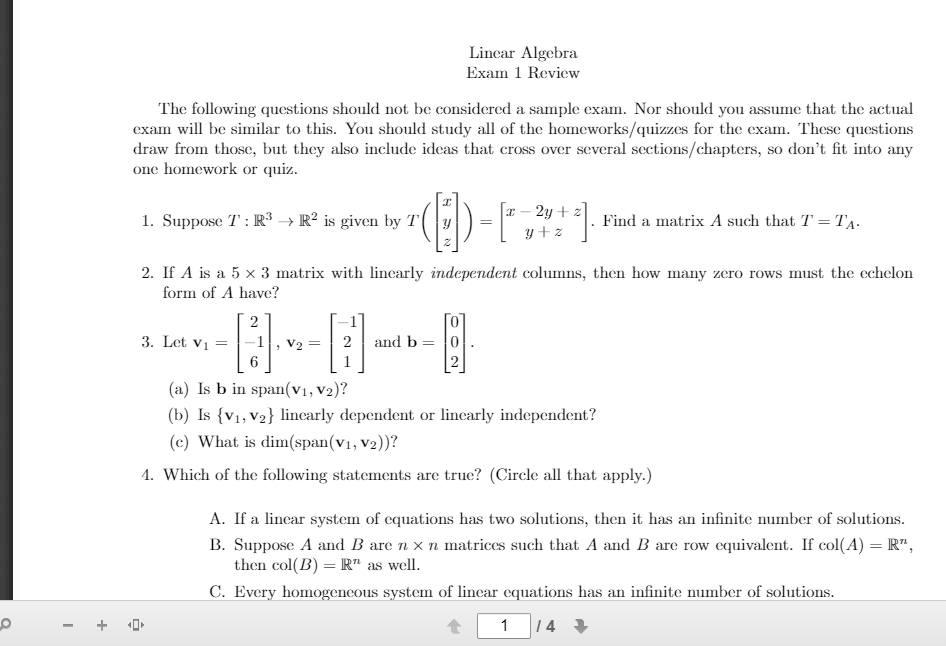
thats where its from if you wanted to know
 short coral
How to think of adjoint of a matrix geometrically?
 mossy lodge
does anyone know the basis for quadratic polynomials
I don't know if its just {1,x,x^2} or an infinite set
wind pasture
if i have kerT = span(
1 0 0 0
0 0 0 1
)
those are 2 matrices
whats dim(kerT)?
wind pasture
@nocturne jewel but im interested in the span of two matrices not vectors
nocturne jewel
yeah, matrices can be vectors
wind pasture
ok
nocturne jewel
$\mathbb{R}^{m\times n}$ is the R-vector space of m by n matrices
stoic pythonBOT
Mosh
 nocturne jewel
so the kernel of T is defined as the span of 2 vectors, so dim(ker(T)) = 2
wintry steppe
anybody care to explain?

please tag me, as i will be searching for the answer elsewhere
nocturne jewel
wintry steppe
anybody care to explain?
which part dont you get?
wintry steppe
nocturne jewel
which part dont you get?
7,9,-2,4; why?
nocturne jewel
yeah shouldnt be that vector
wintry steppe
well, the answer sheet tells me that's the answer
and im very sure its not an error
nocturne jewel
yes cause a piece of paper will always be right. . .
wintry steppe
well, you solve it then, does the point (1,0,2,1) lie on the line between (-2,1,1,0) and (3,1,0,4)?
or if you can explain to me how to apply rref to 3 dimensional systems, that would be fine as well, and i suspect this is quite a bit easier
nocturne jewel
it's not on the line.
wintry steppe
yeah but why
nocturne jewel
find the equation of the line, then show that the parameter has to be different per component
wintry steppe
what is the equation of the line
nocturne jewel
Find it out yourself
wintry steppe
i dont know how, i would not be here
nocturne jewel
Check the answer sheet
wintry steppe
wintry steppe
anybody care to explain?
answer sheet is what i have in the picture
wintry steppe
nocturne jewel
find the equation of the line, then show that the parameter has to be different ...
answer sheet says its ${\left(\begin{matrix}-2\1\1\0\end{matrix}\right)+\left(\begin{matrix}7\9\-2\4\end{matrix}\right)*t|t\in\mathbb R}$, which you disagree with
stoic pythonBOT
Betelguse
 nocturne jewel
Yes, and you say it's right and were firm on that
so go with what the answer sheet says since it's apparently right
wintry steppe
i do not understand it
wintry steppe
nocturne jewel
so go with what the answer sheet says since it's apparently right
i am also open to the possibility that it is wrong. if you come up with a solution that would solve the problem and contradicts with the answer, i obviously will be willing to accept that
i am not prioritising you or the answer sheet, i just need an answer that i understand, or an explanation that would make me understand
nocturne jewel
You did prioritize the answer sheet.
and the way you came off was disrespectful, so you got the amount of help I am willing to give.
wintry steppe
nocturne jewel
and the way you came off was disrespectful, so you got the amount of help I am w...
well, answer sheet has an answer and you dont.
you should refrain from engaging conversations on the internet, as the slightest implication that someone else other than you might be right offended you.
nocturne jewel
You asked for help, I gave you help, you wrote it off as "I doubt the answer sheet is wrong"
wintry steppe
i will not suck you off so that you give me an answer. i am guilty of nothing that requires apologising. if you do not have an answer, do not come in and challenge the only answer i have.
nocturne jewel
Ok then gl
wintry steppe
thanks
anybody care to explain?
answer sheet might be wrong, but please come with a proof.

i specifically do not understand why the free element is (7,9,-2,4). how does one get there?
alright, found it

(7,9,-2,4)*t is parallel to the line given in the question, and you just need to translate it by (-2,1,1,0) to get there
 odd kite
is it though?
notice the points have the same y value
adding 9t to y is going to change y
for any t besides 0
wintry steppe
wintry steppe
alright, found it
see the explanation here.
a free vector of a line from point a to point b is $\begin{pmatrix}b_x - a_x\b_y - a_y \ \vdots \ b_{dimension} - a_{dimension} \end{pmatrix}$, and translating it to the right place gives you the exact same vector.
stoic pythonBOT
Betelguse
 wintry steppe
so free vector starts from origin and is parallel to the line
thats why you need to translate it
wintry steppe
odd kite
adding 9t to y is going to change y
what do you mean? can you rephrase
odd kite
$$\begin{pmatrix}3\1\0\4\end{pmatrix} -\begin{pmatrix} -2\1\1\0\end{pmatrix} =\begin{pmatrix}5\0\-1\4\end{pmatrix}$$
stoic pythonBOT
Timon
 odd kite
The answer is wrong, maybe they changed the problem and forgot to update the answer or something
wintry steppe
thanks a lot man, i am embarrassed to not have noticed it before
@nocturne jewel you were right
odd kite
@untold pier wrong channel, use one of the pre-university ones like #prealg-and-algebra
wind pasture
$$\begin{bmatrix}
1 & 1 \
-1 & 1 \
\sqrt2 & \sqrt2
\end{bmatrix}$$
stoic pythonBOT
ABCDE
 wind pasture
how can I calculate the standard matrix of the orthogonal projection onto Row(A)?
matrix above is A
gray dust
pick an orthonormal basis $(e_1,\ldots,e_n)$ of Row$(A)$. writing vectors as column vectors, the projection of any $x$ onto Row$(A)$ is
$$\sum_{i=1}^n(x\cdot e_i)e_i=\sum_{i=1}^n(e_i\cdot x)e_i=\sum_{i=1}^ne_ie_i^Tx=\br{\sum_{i=1}^ne_ie_i^T}x$$
so $\sum_{i=1}^ne_ie_i^T$ is a matrix representation of the projection
stoic pythonBOT
RokabeJintaro
 wind pasture
if a linear system Ax = b is consistent, does it have to have a solution in row(A)?
dusky epoch
does that even make sense?
if A is m × n, then elements of its rowspace have size m while the solutions of Ax=b have size n
lavish jewel
you sure about that one?
wind pasture
good point
lavish jewel
i'd say the elements of the column space have size m, while those of the row space are of size n
lavish jewel
i think as long as by solution they meant the vector x, it should be right
dusky epoch
still i dont see why x should be in row(A)
like, an element of row(A) is a vector of the form uA for u a suitably sized row vector
while x is a column
so why would x be A^T times something
lavish jewel
i'm pretty sure by row space they mean to address the orthogonal complement of the null space
if Ax = b is consistent, it has at least one solution, and it corresponds to the projection of x onto the row space
it might have infinitely many solutions, in which case the solution is the projection of x onto the row space + anything from the null space
wind pasture
so is my statement true?
lavish jewel
it should be
consistent means b is lin dep with the columns of A, yeah?
and A maps elements from the row space to the column space
dusky epoch
im not convinced
lavish jewel
it should be a consequence of the fundamental theorem of linalg
(i might be wrong, so always take it with a heap of salt)
dusky epoch
you seem to be mangling terminology here because like
row space and (nullspcae)^perp may be isomorphic but they arent the same space?
lavish jewel
hmmmmm
are they not?
when you take an SVD, for example, the right singular vectors form a basis for R^n; the first r vectors span the row space, and the remaining n-r span the null space, and they're all orthonormal
this should be a consequence of being able to diagonalize symmetric/hermitian matrices with orthonormal eigenvectors
wind pasture
@dusky epoch when i say solutions i mean x not b
dusky epoch
of course i understand that you mean x
we are given a matrix A ∈ R^(m × n) and a vector b ∈ R^m, and we are told that there exists x ∈ R^n such that Ax = b
must x necessarily be expressible as A^T u for some u ∈ R^m?
lavish jewel
not necessarily all of x, but at least some component of it
because the part that isnt just yields a 0 vector
dusky epoch
??
so what you're saying is that there must exist a solution to Ax = b in the form A^T u?
i.e. that $AA^Tu = b$ must be consistent?
stoic pythonBOT
Ann
 lavish jewel
im saying thw direct sum of the row and null spaces is R^n
yeah
this is the same as saying that you can pseudo invert A
as long as b is in the image of A
and the pseudo inv is the map from image to row space

so if x = xrow + xnull, then xrow must be nonzero. though looking at it again, if b is 0, then what i said doesnt hold. is the vector b nonzero?
if nothing is said regarding that, i just wasted a whole bunch of everyone's time

 thorn robin
Your argument is fine whether b is zero or not
What's wrong with xrow = 0?
Just decompose x = xrow + xnull and compute that b = Ax = A(xrow + xnull) = A(xrow) boom solution in the row space
thorn robin
lavish jewel
if Ax = b is consistent, it has at least one solution, and it corresponds to the...
This corresponds exactly to what you said way above
lavish jewel
yea but if b is 0, then you could just take any xnull
thorn robin
Yeah but the problem only wants one solution to be in the row space, in the case b = 0 that's x = 0
Like you also said before you can get more solutions by adding xnulls that don't have to be in the row space, but the one solution is
lavish jewel
i would argue that xrow = 0 and xnull =/= 0 means x is not in the row space, since it had an orthogonal projection of 0 onto the row space. but this is only the case for b=0. otherwise, what i said still holds, yeah
thorn robin
One of us is very confused about something silly
The row space contains the zero vector surely?
lavish jewel
it does, otherwise it wouldn't be a space, sure
thorn robin
Right so the solution to Ax = 0 that lies in the row space, is just x = xrow = 0
lavish jewel
fair enough. then the assertion that x is in the row space is correct, but one needs to be careful depending what is known about b.
but since the question only asks for existence of a solution in row(A), then yeah
yes
yeah sorry, i had to go back and read that bit again

 dawn fractal
"basis is a maximal linearly independent set"
does this mean that there exists an s not in the basis such that the union of the basis and the set containing s is linearly dependent?
dire thunder
yes
dawn fractal
thx
dire thunder
let {v_1, ..., v_n} be basis
let s be not in basis
then {v_1,..., v_n, s} is linearly dependent
dawn fractal
lmao that name
lavish jewel
(for v_i and s in the same subspace)
 lavish jewel
i don't know enough math to know if that was a joke or a real thing 😛
wintry steppe
Let $V,W$ be vector spaces over a field $\mathbb{F}$. Let $T \in \hom(V,W)$.
- Prove that if $\mathbb{F} = Q$, then the homogeneity property of linear maps is redundant.
Let $n,m \in \mathbb{Z} \setminus { 0 }$. It follows that $n^{-1}$ exists as it must have a multiplicative inverse in the field $\mathbb{Q}$. Thus, $n^{-1} \in \mathbb{Q}$ by definition of $\mathbb{Q}$.
Using the additive property of linear maps, we have that [ T(u) = T\left( \sum_{i=1}^n n^{-1}u \right) = \sum_{i=1}^n T(n^{-1}u) = nT(n^{-1}u). ] This implies that $n^{-1}T(u) = T(n^{-1}u)$.
Then observe that $T(mn^{-1}u) = T\left( \sum_{i=1}^m n^{-1}u \right) = \sum_{i=1}^m T(n^{-1}u) = mT(n^{-1}u)$. But we know that $T(n^{-1}u) = n^{-1}T(u)$, so $T(mn^{-1}u) = mn^{-1}T(u)$. By definition of, $mn^{-1} \in \mathbb{Q}$ as it is a ratio of two nonzero integers, and so we have shown the property the scaling property to be redundant for that case. If $m = 0$, then $T(0u) = 0$ and $0T(u) = 0$, so $0T(u) = T(0u)$. If $n = 0$, then a multiplicative inverse does not exist for it in the field (by definition), and so we are done.
stoic pythonBOT
n/c
 wintry steppe
Does this proof work?
dusky epoch
appears so
wintry steppe
Thanks
wintry steppe
How do I prove the converse is not true?
If F = Q, then homogeneity does not imply the additive linear property
dire thunder
you may just construct counterexample
wintry steppe
I know
I'm having a hard time thinking of one lol
I need vectors v,u such that T(v + u) ≠ T(v) + T(u)
dire thunder
maybe this function
f(m/n)=m+n
ah no
not homogeneous
but f(m/n)=m
looks to be homogeneous
wintry steppe
1/n f(m) = m, and f(m/n) = m, but f(a/b) + f(c/d) = a + b, however 1/b f(a) + 1/d f(c) = a/b + c/d = (ad + bc)/(bd). Then f(a/b + c/d) = f((ad + bc)/(bd)) = 1/(bd) f(ad + bc) = ad + bc
dire thunder
dire thunder
but f(m/n)=m
here problem is possible tho
oh
it is not homogeneous
hmm
there is an example
f(x,y)=x if xy > 0
and 0 otherwise
wintry steppe
So c f(x,y) = f(cx,cy) = cx if xy > 0 and 0 otherwise
dusky epoch
dire thunder
but f(m/n)=m
not well defined
dusky epoch
you can have a function on Q^2 which is homogeneous but not linear
dire thunder
wintry steppe
So c f(x,y) = f(cx,cy) = cx if xy > 0 and 0 otherwise
well f(cx, cy) would be cf(x,y) since sign of c^2xy is the same as xy
dusky epoch
say, define f by f(1,q) = q^2 and f(0,q) = q and let the rest follow by homogeneity
dire thunder
dusky epoch
you can have a function on Q^2 which is homogeneous but not linear
and on Q^n with n=1 looks like homogenuity implies additiveness
dusky epoch
so f(p,q) = q^2/p for p != 0
f(1,2) = 4, f(1,1) = 1, f(2,3) = 9/4 != 5, boom, not additive
dusky epoch
crazy how?
wintry steppe
Not obvious
 robust pelican
uhm can somene teach me how to do age linear problems?
dusky epoch
wrong channel, go to #prealg-and-algebra.
robust pelican
whoops sorry
wintry steppe
Suppose V, W are finite-dimensional and T in L(V,W). Show that with respect to each choice of base of V, and W, the matrix of T has at least dim range T nonzero entries.
Suppose that dim range T > 0, otherwise if dim range T = 0, then null T = V and so the matrix of T will be the zero matrix and so it is true.
Then assume that M(T) has at least p nonzero entries, where p = dim range T. for p ≥ 0.
Without loss of generality, assume that T(vi) ≠ 0 for i = 1,2,...,p.
Then T(v1) = c1,1 w1 + ... + cm,1 wm ≠ 0, where ci,1 are not all 0
Assume that, without loss of generality again, that c1,1 is nonzero, and the rest can be zero.
This tells us that in the worst case, T(v1) = c1,1 w1, which implies that T has one nonzero entry for v1.
We can repeat this process for all of vi for i = 1,...,p to see that each of the vi have at least one c_(i,j) such that it is nonzero
dusky epoch
this feels verbose.
wintry steppe
Because there are p such v_i, it is implied that there are at least p = dim range T nonzero entries in the matrix of T
I know
But I don't know how to make it less... handwavy?
native rampart
and there are atleast rank(T) nonzero elements in a set that spans range(T)
lavish jewel
proof by assumption
wintry steppe
dusky epoch
> Then assume that M(T) has at least p nonzero entries
i mean
Sorry, change the wording to T(v_i) is nonzero for i = 1,...,p (wlog)
dusky epoch
and v_i is what?
wintry steppe
It's a basis vector of V
wintry steppe
Where the basis of V is v1,...,vn
dusky epoch
i mean ok like
you say there are p columns in the matrix of T which span the range of T, and in each col there is a nonzero entry
that's it
no need to fuck around with which rows they're in cause you don't care
wintry steppe
Yes
That proof is much better I guess
Suppose V, W are fin dim and T in L(V,W). Prove that there exist a basis of V and a basis of W such that with respect to these basis, all entries of M(T) are 0 except that the entries in row j, column j, equal 1 for 1 ≤ j ≤ dim range T
Are they asking about a single entry at M(T)_(j,j)?
lavish jewel
they're asking for a sorta diagonalization
say, M(T) = U I V^T, with I as an identity-like rectangular matrix with 1's along the diagonal
wintry steppe
What is U?
wintry steppe
Have not gone over that yet.
lavish jewel
i see. maybe someone has a different approach, then
wintry steppe
I think I get it, but I just want to make sure
They want 1 at (1,1),(2,2),(3,3),...,(dim range T, dim range T)
And zeros everywhere else?
lavish jewel
yes
wintry steppe
How do I make entries of a matrix zero, relative to basis?
i.e. suppose for a basis v1,...,vn and basis w1,...,wm
The entry at j,k of the matrix is A
For nonzero A
How can I adjust the basis so that A = 0?
It's not possible, correct?
dire thunder
if matrix wrt to some basis is zero it would be zero for any basis
since if A is matrix wrt basis and B is change of basis matrix then T=BAB^(-1)=B0B^(-1)=0
dire thunder
i doubt that there is procedure for this
unless certain assumptions are made
otherwise it implies every matrix is diagonalizable
lavish jewel
SVD moment
not really "diagonalizing" tho
at any rate, you can use givens rotations to do this
wintry steppe
I understand the proof that two vector spaces are isomorphic iff they have the same dimension in the direction where you assume that they're isomorphic, but I don't understand the other direction.
In other words, could someone help me prove that two vector spaces are isomorphic if they have the same dimension?
wintry steppe
@wintry steppe what's the most obvious way to try to construct an isomorphism between them?
We map v1 to w1, v2 to w2, ..., vn to wn
did you try that
But is that enough?
To show there exists some function which "links" them like that?
ofc not
do you know what an isomorphism is?
Yes
It's an invertible linear map
so
maybe such a map is invertible
Okay
I see, thanks
dawn fractal
do i need to prove that a set orthonormalized from a linearly independent subset of an inner product space V through the Gram-Schmidt orthogonalization process and vector normalization is a basis for V?
it was given that the original LI subset of V was a spanning set of V
and that that subset is also LI
lavish jewel
don't think so
dawn fractal
why is that
lavish jewel
it should be easy to do it, but the definition of the gram schmidt alg. is a procedure that takes a basis for a subspace V and produces an orthonormal basis for the same subspace V
each step of the algorithm takes one vector and keeps only the component in the orthogonal complement of all the previous vectors
in other words, you can relate the gram schmidt basis, let's call it G, to the original basis, let's call it B, through a full rank transformation T, i.e. B = GT
and so B and GT have the same image, meaning their columns span the same space
but anyway, the short answer is you don't need to, but it should be pretty easy to do so
dawn fractal
ty
dawn fractal
real subspace vs. complex subspace of C^{nxn}
im guessing real means real scalars and complex means complex scalars?
both of which are multiplied to vectors in said respective subspaces
lavish jewel
yea
short coral
Spanning set is a set containing "all" the basis?
lavish jewel
what do you mean
lavish jewel
what do you mean by "all the basis"
that expression alone doesn't make sense
because there usually isn't a unique basis
short coral
What's the difference between basis and spanning set?
lavish jewel
a basis is a linearly independent spanning set
short coral
So, every basis is a spanning set but not all spanning set is a basis?
short coral
What's the significance of spanning set?
lavish jewel
pretty similar to that of a basis, but there may be more than one way of representing vectors in the subspace
with a basis, the representations are unique
short coral
Like for example?
lavish jewel
the set [1,0], [0,1], [1,1] is linearly dependent
it spans R2, but it is not a basis
lavish jewel
well
that one works
but so does [1,0] and [1,1]
or [0,1] and [1,1]
those 3 are all valid bases
short coral
Is it necessary for one of the vectors to have a single one and remaining all zeroes?
*atleast one of the vectors
lavish jewel
not at all
[-1,1] and [1,1] is another valid basis
the only thing necessary is that the vectors are linearly independent and span the subspace
wintry steppe
how do u prove a linear function is continous?
wintry steppe
Mmmm
i am asked to prove that given a diagonal matrix, if a_n is bounded, then the matrix has a bounded operator (?)
native rampart
In mathematics, linear maps form an important class of "simple" functions which preserve the algebraic structure of linear spaces and are often used as approximations to more general functions (see linear approximation). If the spaces involved are also topological spaces (that is, topological vector spaces), then it makes sense to ask whether a...
wintry steppe
idk if this is the terminology
but we have to do 2 things: first prove that if a_n is bounded, then the linear application is continous

If a_n is bounded, then

T is continous
dusky epoch
$|a_n| \leq M \implies \nrm{Tx} \leq M \nrm{x}$
stoic pythonBOT
Ann
 dusky epoch
@wintry steppe
short coral
How to prove that Transpose (Adjoint (A)) = Adjoint (Transpose (A))?
lavish jewel
what are you calling adjoint? and is A a matrix?
wintry steppe
adjunta
wintry steppe
dusky epoch
$|a_n| \leq M \implies \nrm{Tx} \leq M \nrm{x}$
i found this too. But on my case i need to prove the imply on both sides
this one is left way or right?
and what is x there?
did u mean T(x)?
short coral
lavish jewel
what are you calling adjoint? and is A a matrix?
Yes, A is a matrix. Adjoint = Adjugate = transpose of its cofactor matrix
dusky epoch
wintry steppe
and what is x there?
x is a sequence
@wintry steppe wrong channel, see pins.
wintry steppe
and how does that prove a_n is continous?
wintry steppe
stoic python
**Ann**
does this just mean it is continous?
okey yes. And how do i do the other way? if T is continous, how can i prove a_n is bounded?
short coral
How come the Eigen vectors of a matrix and its inverse are same?
native rampart
Let Av=cv then A^-1(cv)=v
i.e., an eigenvector of A is an eigenvector of A^-1
Similarly repeat for the other direction
short coral
native rampart
Let Av=cv then A^-1(cv)=v
Similarly, how to prove for Transpose of a matrix?
wintry steppe
short coral
Similarly, how to prove for Transpose of a matrix?
it's false, a matrix and it's transpose need not have the same eigenvectors
they will have the same eigenvalues, though
 whole solstice
i am
a dumbass so be patient with me
Suppose that U and W are both five dimensional subspaces of R&9 prove that U intersection W != 0

native rampart
Suppose U inter W is 0
You can pick five basis vectors for U and 5 basis vectors for W
These 10 vectors will be LI in U+W
But U+W is a subspace of R^9
And hence a set can only have a max of 9 LI vectors
whole solstice
what are LI vectors
native rampart
Linearly independent
whole solstice
o
native rampart
native rampart
These 10 vectors will be LI in U+W
This is not direct
Try to see why that's true
 tardy cypress
i do math
 frosty vapor
Prove it.
wind pasture
is it possible for me to find an orthogonal matrix thats row equivalent to
-1 2
2 -4
I don't think so, but how do i prove this?
lavish jewel
the rows are linearly dependent, it does not have an inverse
so the inverse can't be its transpose
maybe like that?
dusky epoch
row-equivalence preserves rank, an orthogonal matrix has full rank, yours does not
 unkempt shale
We have a test for screening cancer that is 90% sensitive and 90% specific. Assuming that 1% of the population has cancer, what is the fraction of positive tests that correctly detects cancer?
limber sierra
this isnt a linear algebra question
try #probability-statistics or a #questions-_ channel
zealous junco
dumb q but theres no difference between "cone" here and matrices right, wonder why they write it as cone

(not exam btw)
 limber sierra
i dont understand the question
that set is called a cone
a matrix is not a set
and certainly not a cone
zealous junco
i mean isnt the set S^n+ just the set of matrices that are symmetric positive definite
based on the definition of all X in R^nxn so that X = X^T and X ≥ 0
idk why they call it a cone
limber sierra
 limber sierra
they could just say "set" instead of "cone" sure
zealous junco
lol
 boreal crane

 autumn wing
Does someone know how to solve a?

 woven fossil
If ~v4 ∈ span(~v1, ~v2, ~v3), then replacing ~v3 with ~v4 does not alter the span. That is,
span(~v1, ~v2, ~v3) = span(~v1, ~v2, ~v4).
please help it is urgent
<@&286206848099549185>
gray dust
@woven fossil please wait 15min before pinging helpers
woven fossil
sorry I will remember next time
 marble lance
@woven fossil this is false
Consider R^3 with the standard basis e1, e2, e3. Then x = 2e1 is in span(e1, e2, e3) but span(e1, e2, x) ≠ span(e1, e2, e3)
 glad acorn
what is the meaning of symbol "~" on a basis vector
it appears in coordinate system transformations but what is the actual meaning of the symbol ~
wintry steppe
post image
glad acorn
 lavish jewel
it's just to distinguish it from the old e_i


 viral flint
\tildearrow?

wintry steppe
$\tilde{\vec{x}}$
stoic pythonBOT
TTerra
 wintry steppe

 crude ridge
Would it be true to say that for A to be diagonizable, the multiplicity of each eigenvalue needs to be equal to the dimension of the eigenspace corresponding to that eigenvalue?
lavish jewel
sounds about right
crude ridge
Great, thank you
And that comes from the fact that the P matrix with the vectors needs to be invertible?
lavish jewel
yeah, otherwise you can't get the similarity
crude ridge
Ah that makes sense, thanks
 azure bough
stoic python
**TTerra**
azure bough
stoic python
**TTerra**
can't you just do $\vec{x'}$
stoic pythonBOT
Conan
 wintry steppe
glad acorn
wintry steppe
glad acorn
cf
stoic pythonBOT
TTerra

 zinc wasp
Can anyone help me understand how they get b and or how to better understand this markov chains stuff? I wouldnt mind doing it via voice either to really understand better.
 glad acorn
covector is called covector because it acts as a function on vectors?
odd kite
well, that's what it means, it's a linear function that takes a vector as input
the co- prefix sort of means "accompanies" or something
 main thistle
Hi, I would like to confirm something.
If vectors a & b are linearly dependent, then a & b are scalar multiples of one another?
viral flint
main thistle
Hi, I would like to confirm something.
If vectors a & b are linearly dependent,...
If they're both non-zero, yes.
If say a = 0, b non-zero then a is a multiple of b but not true other way round.
Basically yes with the caveat that non-zero vectors can't be scalar multiples of the zero vector.
main thistle
thanks!
 woeful fable
hi, i'm having trouble understanding what the answer key (on the right) means. the question is asking for the coordinate vector of p(t), which should be [x]ß. but why is the key.. finding [p]ß :_ D..? or does [p]ß actually mean the coordinate vector (the book says the opposite thing tho)?
 odd kite
@woeful fable [ ....]ß just means coordinate vector of whatever vector is in the square brackets. It can have different names.
woeful fable
odd kite
<@!559861735234994197> [ ....]ß just means coordinate vector of whatever vector ...
ohhhhh thank you!!! that clears it up
dusky epoch
wrong channel, go to #prealg-and-algebra or #precalculus
dreamy iron
Confession: I don’t think I’ve ever proved that the zero vector is a vector space in its own right.....
.....I guess I’ll just have learn to be okay with that.....
(No one ever needs to know, right?)
gray dust
proving {0} is a subspace of the ambient space proves it's a vector space in its own right
wintry steppe
dreamy iron
Confession: I don’t think I’ve ever proved that the zero vector is a vector spac...

 heavy crown
hmm any idea?
 dusky epoch
Z linearly independent => E invertible, huh...
heavy crown
yea I don't get how it relates haha I think it's disprove?
dusky epoch
this looks true to me, but i'm only like 80% sure
heavy crown
hmm
dusky epoch
let's see
let's consider the subspace $U_E$ of $M_2(\bR)$ defined by $U_E = { XE \mid X \in M_2(\bR)}$
stoic pythonBOT
Ann
 dusky epoch
i have a hunch that U_E is a proper subspace of M_2(R) iff E is non-invertible
ah actually
$\dim(U_E) = \begin{cases} 4 & \rank(E) = 2 \ 2 & \rank(E) = 1 \ 0 & \rank(E) = 0 \end{cases}$
stoic pythonBOT
Ann
 dusky epoch
this could be written as dim(U_E) = 2rank(E) but this would have been a little unintuitive as there are different arguments to be made for each case
@heavy crown i can explain why this is true to you if you'd like, or you could take my word for it for now and i could tie it to the original problem
what would you like me to do first?
heavy crown
dusky epoch
<@289503597581041665> i can explain why this is true to you if you'd like, or yo...
unforunately they didn't teach us rank yet, the last subject was about R(A) and C(A) Row and column spaces, and before that Grassmann's formula
maybe if you could explain this to me intuitively I could understand how to make it?
thank you for your kindness btw 🙂
dusky epoch
hrm
i mean ok these are two by two matrices
so you can replace rank(E)=2 with "E is invertible", rank(E)=1 with "E is singular but not the zero matrix" and rank(E)=0 with "E is the zero matrix"
heavy crown
how would you know how much is dim depends on if E is invertible ? I mean why is it 4
dusky epoch
well the dimension of M_2(R) itself is 4, is it not?
heavy crown
oh, right