#discrete-math
1 messages · Page 12 of 1
 weary tiger
and there doesnt seem to be any division signs in r4 or r5
What is that though?

@weary tiger
3 is less than or equal to 4, but 4 is not less than or equal to 3
wait
meant to say less than lol
Lol
But what is the divison sign in here?
yeah the cross thingy is just saying it not
That means not?
yeah pretty much
its like negating it
So 3 is not greater than 4?
Like in python right?
With this thing? !
yeah
Ah thanks
also in this example it used the r1 r2 r3 r4 that we memorized?

To solve the question right?
those are examples
For what? So this wasn't a question that was answered?
oh wait
uhh
i think R1 and stuff are just example of relations containing the elements from A
the left side is the sets and the right side is just showing which properties they do and dont hold
So it wasn't answer for a question?
Then what is a question is supposed to look like?
this is what my questions looked like

you can give them a try if you want
though i gtg now
ttyl
weary tiger
weary tiger
this is what my questions looked like
Oh is this in other colleges interesting
weary tiger
@weary tiger
weary tiger
weary tiger
<@456226577798135808>
?
i got that from a textbook im going through for fun
idk what my uni uses
Oh ok

 chrome tree
You have to translate it
chrome tree
 urban cypress
I think it is: NotY is a element of the real numbers, or x is a element of the real numbers.
chrome tree
urban cypress
I can't remember the rest for the column
If xy is not equal to x then x must be zero
It requires you to think a lot, so just take your time to understand this.
 haughty garden
chrome tree
I think it is: NotY is a element of the real numbers, or x is a element of the r...
haughty garden
chrome tree
I think it is: NotY is a element of the real numbers, or x is a element of the r...
Should be “there exist a real number y such that, for any real number x, (xy not equal to x) implies that x is zero”
chrome tree
haughty garden
Should be “there exist a real number y such that, for any real number x, (xy not...
My bad thanks for correcting me
I forgot the exist symbol xD
urban cypress
haughty garden
Should be “there exist a real number y such that, for any real number x, (xy not...
yeah exactly,
i just want to know what kind of math it is, so i can research it further
haughty garden
It’s first order logic (or predicate logic)
 sudden minnow
well, do you know how to calculate $f \circ f (a)$ @hoary orbit
 vital dewBOT
lems
Compile Error! Click the  reaction for more information.
(You may edit your message to recompile.)
 vital dewBOT
lems
 sudden minnow
since your question has function composition in it, surely you have a definition of function composition laying around somewhere
you say you dont know where to start, but in math there is always a clear place to start, making sure you know the definitions
sudden minnow
ok and you don't know how to calculate f(f(a))?
sudden minnow
yes
sudden minnow
so $f \circ f (a) = a$
vital dewBOT
lems
 sudden minnow
yeah what did you expect
sudden minnow
the first 2 questions are extremely simple, the last 2 are marginally more difficult you just have to spot a pattern
sudden minnow
np
 hoary orbit
wait so do i have to do it for f o f(b) then f o f(c)
sudden minnow
well, yeah
hoary orbit
so for 3rd question f(a) ^(9) = b?
sudden minnow
should be
hoary orbit
alright thanks
 scarlet orchid
hii does anyone in here know graph theory
 last flicker
no sorry
scarlet orchid
.< as;ldkfjasl;dkjaf
i been on this one graph theory problemf ro like 5 hours and i got school in 4 hours
might be time to give up
scarlet orchid
last flicker
no sorry
omg not the leaugeueueue what rank r u
scarlet orchid
oooo
haughty garden
Feel free to ask the question anyways and if someone can answer it, they’ll be able to help

 fossil swan
what topic is this? i might know this one @scarlet orchid
 desert ibex
scarlet orchid
desert ibex
scarlet orchid
Hi, you should put this in #combinatorial-structures
desert ibex
scarlet orchid
Okay this is pretty easy. A block is just a maximal connected subgraph without articulation vertices. So this problem is just asking you to prove that G does not contain an articulation vertex.
Every non trivial connected graph G contains a vertex v whose removal does not disconnect it (the leaf of any spanning tree works). Now, G-v is a connected graph. Since G is point symmetric, for all vertices u, G-u must be isomorphic to G-v. This implies that G-u is connected, which implies that u is not an articulation vertex.
Therefore, G is a connected graph without articulation vertices, which means that it is a block.
 reef dirge
How can I use sets for q 1?

 grand totem
reef dirge
How can I use sets for q 1?
grand totem
reef dirge
How can I use sets for q 1?
The left side counts the number of subsets of {1, ..., n} whose cardinality is equal to a. Another way to count this may be as follows: Fix any element m in {1, ..., n} and consider all subsets of {1, ..., n} with cardinality a and that contain that element m (how many such subsets are there?). Similarly how many are there that do not contain m?
 hollow tartan
If I'm talking about binary relations, how would I read aRb? Would it be read as "a relates to b"?
 ember obsidian
hollow tartan
If I'm talking about binary relations, how would I read aRb? Would it be read as...
ember obsidian
hollow tartan
If I'm talking about binary relations, how would I read aRb? Would it be read as...
“a is related to b (via R)”

 quartz patio
weary tiger
quartz patio
weary tiger
Do you know what each logic gate represents?
 pure star

Can someone help me with this? How do I prove that this function assigns each x only one value?
for context, this is an exercise proving that R is the unique ordered complete field
up to isomorphism
weary tiger
yes
weary tiger
quartz patio
Do you know what each logic gate represents?
can you help me with it
 ancient tide
for all elements x of a symmetric group S_n, o(x) <= n right?
 unreal stump
ancient tide
for all elements x of a symmetric group S_n, o(x) <= n right?
unreal stump
ancient tide
for all elements x of a symmetric group S_n, o(x) <= n right?
No, Take (1,2,3)(4,5) of S_5
Order of this is 6
unreal stump
unreal stump
No, Take (1,2,3)(4,5) of S_5
If you don't know the notation,this is x where
x(1)=2
x(2)=3
x(3)=1
x(4)=5
x(5)=4
ancient tide
unreal stump
No, Take (1,2,3)(4,5) of S_5
yeah ty
unreal stump
<@&268886789983436800>
ember obsidian
ty
 unkempt elm
does n choose k have any interpretation when n is negative or a fraction?
 stone ridge
I have finished parts a and B. Now I'm facing (c)(i), I don't know what it requires me to do?

Is simply (x1 < x2 and y1 > y2) or (x1 > x2 and y1 < y2) enough?
Do I need to add the "for all" or "for some" thing here?
hollow tartan
Anyone have any advice when it comes to doing truth tables?
specifically compound ones like
(P v Q) <---> (Q -> ¬P)
Any advice would be great. I have more trouble doing the reverse. What i mean by that is if Q is first and P is second
I'm find if it's p and then q is second but thinking of it the other way around is harder for some reason
 glacial flame
A one-to-one relation can have multiple co-domain values for the same domain value, correct? An additional condition of domain values only having one co-domain value is part of the definition of a function, right?
Aka something like {(1,2), (1,3)} is one-to-one but not a function?
 twin basin
does discrete math cover set theory?
I'm self teaching, and looking for good resources
NVM its in the subject line for the channel lol
damn discrete math is hella useful

How would I read this in plain english? also what's the middle term?
glacial flame
n choose r
It’s a binomial coefficient in the middle

In mathematics, the binomial coefficients are the positive integers that occur as coefficients in the binomial theorem. Commonly, a binomial coefficient is indexed by a pair of integers n ≥ k ≥ 0 and is written
            (


            n
  ...
Thanks!
 wild cove
hi, how do i prove that the set of partitions of a countably infinite set is uncountable?
knowing that the power set of a countably infinite set is uncountable, ive been trying to find a bijection from this power set to the set of partitions but currently am not able to find one
 wicked bolt
wild cove
hi, how do i prove that the set of partitions of a countably infinite set is unc...
wicked bolt
wild cove
hi, how do i prove that the set of partitions of a countably infinite set is unc...
what about an injection from the power set to the set of partitions?
wild cove
wicked bolt
what about an injection from the power set to the set of partitions?
let say the countably infinite set is S
im thinking about mapping a subset of S, let say T, to the partition {T, Z\T}
but unfortunately this mapping is not an injection since both T and Z\T map to {T, Z\T}
however under this mapping, every partition has exactly 2 preimages, which makes it look like |S| is "twice" of |set of partitions|
which reminds me of the proof that the set of even integers and the set of integers have the same cardinality...
 little prism
you could fix some element a in S and then do something different for T and Z\T depending on which one includes a
 quaint glacier
Does anybody recognize the product (p^n-1)(p^n-p)(...)(p^n - p^(n-1))? I came across it in another context and wonder if it has a name or is a well known product? googling doesn't yield anything
 red nest
quaint glacier
Does anybody recognize the product (p^n-1)(p^n-p)(...)(p^n - p^(n-1))? I came ac...
red nest
quaint glacier
Does anybody recognize the product (p^n-1)(p^n-p)(...)(p^n - p^(n-1))? I came ac...
Cardinality of GL_n(F_p^n)?
quaint glacier
red nest
Cardinality of GL_n(F_p^n)?
I mean that is the context in which I came across it. But does this reduce to something else in number theory or combinatorics
red nest
Ah, I see. That is the only context i know it from
 chrome lily
is it not 5.5?
 sudden minnow
I would assume "div" rounds down to an integer value
chrome lily
You are right! Lol
I was sitting here confused as if I was doing something
but yeah its just 5 then
thanks man
sudden minnow
np
wild cove
little prism
you could fix some element a in S and then do something different for T and Z\T ...
i get it now, thanks a lot!
unreal stump
What's a vertex disjoint edge?
Context:

 pale epoch
seems to be you choose n edges such that no two share a vertex
 tame bone
HI Guys im currently studying in germany and there is this question. If the functions are surjective, bijective or injective or not. The second one is not surjective and not injective BUT What about the others? I hope u can help me with this thank you

 regal ice
Can someone please explain this
 haughty garden
Recall that the Cartesian product of m sets comprise of a tuple of m elements, say (a_1, a_2, ..., a_m), where a_1 comes from A_1, a_2 comes from A_2, etc. Each a_i in your tuple can be chosen independently and choosing these a_i terms independently give you a unique tuple (since A_i has no duplicate values). Therefore, the number of tuples that you obtain comes from making |A_1| many choices for a_1, followed by |A_2| many choices for a_2, ..., |A_m| many choices for a_m. So you obtain the product of the cardinality of individual sets
 blazing rose
can someone help me understand this? I understand it to the point that the operations are +, - and * I guess? But I dont get what the set S is and how it is related to the Ring R

 stray reef
S is just the set of solutions to the equation ax = 1 in your ring
it is a subset of R
@blazing rose this looks like the first half of a problem. can you show how it continues?
 blazing rose
stray reef
<@437333995701927960> this looks like the first half of a problem. can you show ...
blazing rose
stray reef
<@437333995701927960> this looks like the first half of a problem. can you show ...
this is it
 blazing rose
stray reef
<@437333995701927960> this looks like the first half of a problem. can you show ...
blazing rose
stray reef
<@437333995701927960> this looks like the first half of a problem. can you show ...
I understood the first part now and tried to transform the term with b and z to something where I can make it equal to az = 1
but I dont get there :/
stray reef
so you are trying to prove the first part? for any z in S, we have 1+b-za in S?
blazing rose
yes
stray reef
x is in S if and only if ax = 1
blazing rose
I said 1 + b - za = az = 1
stray reef
no
blazing rose
stray reef
no
but if z element S, isnt az = 1?
blazing rose
okay
stray reef
a(1+b-za) = a + ab - aza
stray reef
yes
blazing rose
alright thanks a lot

 weary tiger
(y – k) 2 = 4a (x – h)
blazing rose
how do I proof whether there exists an injection here?
or how do I even understand this? An injection from set S onto set S??
 grand totem
$\mathscr{I}$
vital dewBOT
Neverbloom

 crystal torrent
thank you
 woeful idol
Can someone help me with a? The answer sheet only gives the final answer and I don’t get how they came up with that

 swift kiln
can someone help me with this : Prove that [0,1]~[0,1] × [0,1]
woeful idol
B x A =
${<\emptyset, 1>, <\emptyset, 2>, <{1}, 1>, <{1}, 2>, <{2}, 1>, <{2}, 2>, {1, 2}, 1>, {1, 2}, 2>}$
vital dewBOT
Vemix

 lyric osprey
is zero an integer
 fierce mason
mathematical induction

 vale cairn
lyric osprey
is zero an integer
vale cairn
lyric osprey
is zero an integer
Yes
fierce mason
i understand until the inductive step sos
vale cairn
Well, one way to make it easier to to note that this is equivalent to showing that $1 \le \frac{1\cdot 3 \cdot \dots \cdot (2n-1)}{2 \cdot 4 \cdot 6 \dots (2n-2)}$
vital dewBOT
potato
 vale cairn
And it's perhaps more obvious how you can prove this by induction
fierce mason
sorry could you explain how that works?
vale cairn
vital dew
**potato**
like why they're equivalent?
fierce mason
yeah
vale cairn
Just multiplying both sides through 2n, since this is a positive integer
fierce mason
ok thank you ill try it out
woeful idol
When we’re talking about the DPLL procedure to check satisfiability of a given CNF, what are “unit” clauses?
haughty garden
A unit clause is a clause that only has one (unassigned) literal. Unit clauses have an obvious assignment since it has to be satisfiable for the CNF formula to be satisfiable
tame bone
can someone help me with this? the task is to say if the funktions are bijective, surjective, injective or not. Number 2 should be not surjective and not injective but i need help with the other ones
woeful idol
haughty garden
A unit clause is a clause that only has one (unassigned) literal. Unit clauses h...
So is the second p in $(p \land q) \lor p$ a unit clause?
vital dewBOT
Vemix
 haughty garden
Well this formula isn’t in CNF but yes that’s the idea
Turns out this is equivalent to $p \land (p \lor q)$. The first $p$ in this CNF formula is a unit clause
vital dewBOT
 woeful idol
Thanks
 vital dewBOT
Vemix
 woeful idol
Why not substitute with T here?
haughty garden
That would make the unit clause false
We want an assignment that makes our unit clause result to a true clause
woeful idol
Why do we want it resulting in a True clause?
haughty garden
Otherwise the entire CNF formula is false
woeful idol
Ah so I just kept substituting unit clauses with T
Like I can simplify with the dpll but I never picked the correct T or reverse T
haughty garden
Remember we have our CNF formula in the form: $Q_1 \land Q_2 \land \dots \land Q_n$. For this to be true, each individual $Q_i$ clause must be true. In the case where $Q_i$ is a unit clause, this forces our assignment such that $Q_i$ returns a true clause
vital dewBOT
 woeful idol
That actually makes sense
Thank you once again
Logic is actually alright but I hate sets so much
haughty garden
Yeah it might take a while to wrap your head around but sometimes it’s useful to look at the bigger picture
vital dewBOT
Vemix
 woeful idol
You can immediately fill in upside down T as this can never be true
If I am understanding this correctly
haughty garden
Yes
tame bone
tame bone
can someone help me with this? the task is to say if the funktions are bijective...
😦
 wise quartz
base cases are trivial (n=1,n=2)
you need to do them both because this is a second order linear recurrence
vital dewBOT
 wise quartz
then use strong induction

 hoary orbit
ok thx

 sudden minnow
I assume "defined to be" but I do not think this is standard terminology, at least uncommon

Mathematics Stack Exchange
What's the most used symbol for "defined to be equal to", at least in your experience (and I'm sure there are a lot of experienced people here)? Also, which one do you think is the "the most right"...
seems like it is a thing, but I've always seen := or equality with def on top
 mystic nova
ty
 worthy wasp
can someone help me

 feral salmon


 opaque prawn

Hi, I'm trying to proof this but got stucked in this step

I do not know how to proceed, can anyone help me pls!
 graceful drum
well your almost done look what you have right now, you can drop the paranthesis for a start. Then you can use commutativity of logic and to reorder. using idempotence you can drop the duplicate $x \not \in Y$
vital dewBOT
achilles199703


 graceful drum
Let A,B be sets then $A \times B$ denotes the cartesian product of the sets A,B. Now think about $X = A \times B$ as a new set called X. We would write X as $X= {(a,b) | a \in A, b \in B}$, which means X contains all Tuples consisting of a's and b's. If we now look at a second set $Y = C \times D$ and build the Union of $X \cup Y$ then all tuples $(c,d)$ get put also in this new set. We can now see that $(A \times B) \cup (C \times D) \subset (A \cup C) \times (B \cup D)$, this part is easy. Let $(x,y) \in (A \times B) \cup (C \times D) \rightarrow (x,y) \in (A \times B) \lor (C \times D)$
So if (x,y) is from either set $(A \times B)$ or $(C \times D)$ it is easy to see that $x \in A \lor C$ and $y \in B \lor D$. However the other direction doesn't hold, we can show this with a counterexample. Let $A = B = {0}$ and $C = D = {1}$ now $(A \cup C) \times (B \cup D) = {0,1} \times {0,1} = {(0,0), (0,1), (0,1), (1,1)} \not = {(0,0), (1,1)} = {(0,0)} \cup {(1,1)} = (A \times B) \cup (C \times D)$
So i dont know where this proposed solution is from, but if I see it right those sets are not equal, only the left is a subset of the right
opaque prawn
it's from this https://www.youtube.com/watch?v=j5fnaXLOkFk

We learn how to do formal proofs in set theory using intersections, unions, complements, differences, and cartesian products (or cross products).
0:00 - [Intro]
0:32 - [Language of Cartesian Products]
2:33 - [Proof #1]
6:29 - [Proof #2]
10:29 - [Proof #3]
#SetTheory #Proofs #CartesianProducts
Support me on Patreon: http://bit.ly/2EUdAl3
Visit...
12:59
vital dewBOT
achilles199703
 sudden minnow
graceful drum
So i dont know where this proposed solution is from, but if I see it right those...
sudden minnow
graceful drum
So i dont know where this proposed solution is from, but if I see it right those...
yes
an element like (a,d) can't appear in the first set
can in the right
 sudden minnow
yes that is what we are saying
graceful drum
ok in the video he only shows the => direction which shows that left is subsetequal to the right, he doesn't show the <= direction. what i've written should be sufficient to show that there exists a (x,y) in the one set, which doesn't appear in the other, thus proving the two sets are not equal.
Taking this into account you get a for "=> subset" and "<= inequality" thus a proving a subset
graceful drum
opaque prawn
the video's solution is wrong
yes and no, he never actually states explicitly that the other direction works only that this way of proving can be used, however this heavily implies that the backwards direction is working.
So yeah that is a problem

 graceful drum
opaque prawn
this is true but not true for <=?
graceful drum
opaque prawn
this is true but not true for <=?
No this is exactly true
to prove for two sets A and B that they are equal, you first show that A is subset of B and then you show B is subset of A
however here the "<=" direction can't be shown to be a subset, with a counterexample we easily verify the inequality of the two sets
opaque prawn
right
if I'm trying to prove this

in exam
do I need to do it like this

or i can just do this straight away?

 radiant valley
Both methods end up at the same place so in a good system you’d be able to do it either way
 distant glade
the second way you did it is very confusing
graceful drum
$(x,y) \in (A \times B) \cup (C \times D) \Rightarrow (x,y) \in (A \times B) \lor (x,y) \in (C \times D)$ using the definition of cartesion product you get $x \in A \lor x \in C$ and same for y. Thus $x \in (A \cup C)$. then use definition again to get your tuple back. this should be sufficient
distant glade
i understand those are the two conditions to be in each set, but you didn’t really give any other info
vital dewBOT
achilles199703
 opaque prawn
I see, thanks!
opaque prawn
can anyone help me with ii)

I can't understand the question, what is it trying to say?
stray reef
you're asked for the number of poker hands that are ranked as two-pair by the rules of poker
@opaque prawn how familiar are you with poker and/or playing cards in general?
opaque prawn
11 22 3 is classfied as two pairs?
stray reef
(and the fifth card doesn't match either)
yes, except there's no 1 in a deck of cards :p
there's an Ace
opaque prawn
A in this case XD
stray reef
but yes, AA223 is a typical two-pair
opaque prawn
oh I understand the question now
It's trying to ask how many 5 card hands has the AA BB C form?
out of the 52 cards
Can I do
AAA22
opaque prawn
so strictly AA BB C in this case
 opaque prawn
How do I write $x \notin (C - B)$ in english?
vital dewBOT
Rmtc


 sudden minnow
opaque prawn
How do I write $x \notin (C - B)$ in english?
sudden minnow
opaque prawn
How do I write $x \notin (C - B)$ in english?
if you arent in this set, you are in its complement
and consider (A\B) = An(B^c)
 worthy wasp
im not very good at these questions
weary tiger
I'm confused about mathematical induction. You prove p(k) for some function p. You can p(k+1). Surely there's some k that might break it? p(100) for example. What does proving p(k+1) really do?
unreal stump
Well you actually prove "if p(k) then p(k+1)"
So your base case is p(0)
(or p(start) or whatever) is true
weary tiger
unreal stump
Well you actually prove "if p(k) then p(k+1)"
yes but what about p(k+2)
unreal stump
Ok so suppose you know p(k) is true magically
weary tiger
surely there can still be an argument somewhere from 0 to infinity that might not hold?
unreal stump
Then p(k+1) is true because for x=k it's true
And p(k+2) becomes true because p is now true for x=(k+2)-1=k+1
weary tiger
yeah that definetely makes sense now. that's how it was described in the book. dominoes.
unreal stump
The induction step is the "if this block falls,the next block also falls"
reef dirge
any suggestions on how to approach the subsets method to prove this?
 red nest
reef dirge
any suggestions on how to approach the subsets method to prove this?
red nest
reef dirge
any suggestions on how to approach the subsets method to prove this?
A subset of {1,2,…n} consisting of a elements either contains n or it doesn’t. Now try to find formulas for both of these cases
worthy wasp
anyone? please help
weary tiger
worthy wasp
anyone? please help
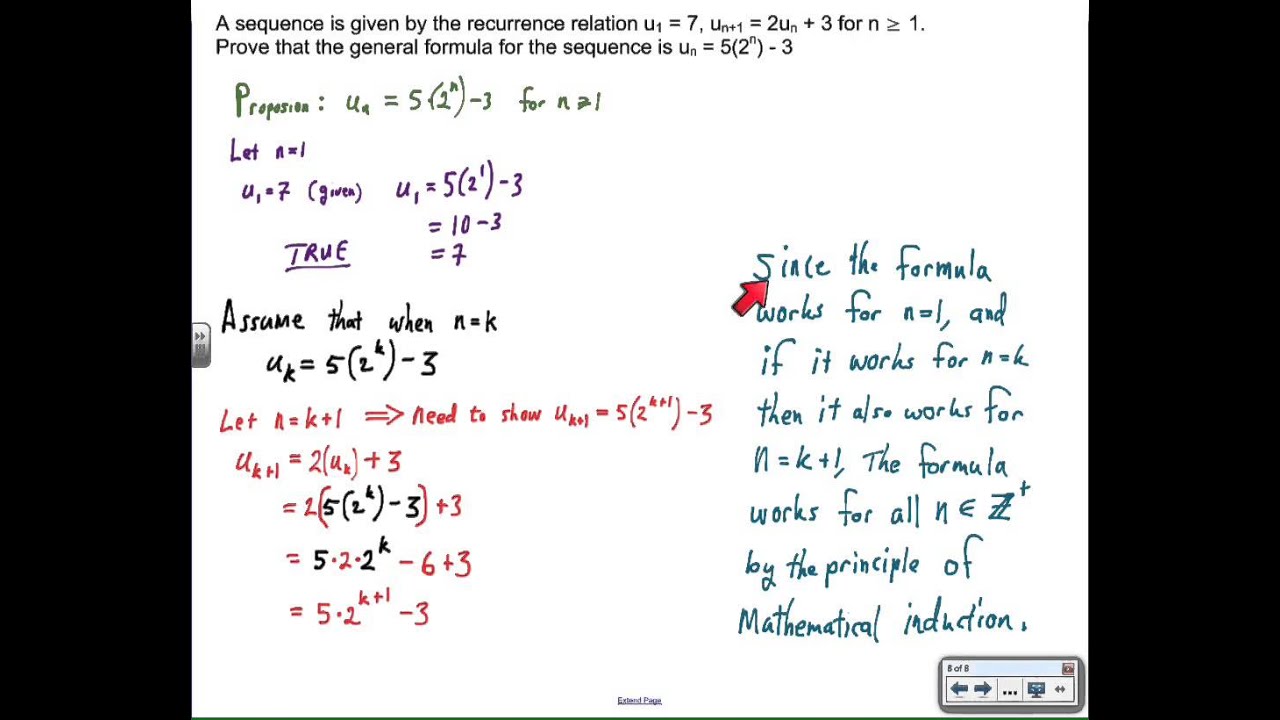
This video screencast was created with Doceri on an iPad. Doceri is free in the iTunes app store. Learn more at http://www.doceri.com
That would help
I'd try to help u step by step but it's 3 am rn
If ur still having an issue until tmrw hmu I'll try to help if i still remember how it works
 oblique rock
Anyone able to help me here? I have no idea how to tackle this question. I'm staring at definitions but it's not helping
 grand totem
Well, the question asks you to prove or disprove the claim. So before you start to actually do that, you should decide on whether you want to prove or disprove it (depending on what you think is true)
It may be a good idea to test some edge cases first (what's S × ∅ for any set S?)
oblique rock
I've seen a proof similar to it in another textbook that proofs the opposite, but I think it's false
hollow tartan
what is the best way to test if a function is well defined
for example if i have $f(x)=\frac{1}{(x-1)}$ the function is said not to be well defined but how do ik
vital dewBOT
arrow891
 vale cairn
Uhhh I don't think this question is well defined basically lol
hollow tartan
vale cairn
Uhhh I don't think this question is well defined basically lol
????
vale cairn
I mean basically typically given a function you want to give the domain and codomain
If you don't give the domain and codomain, then they are usually inferred from context
hollow tartan
vital dew
**arrow891**
 vale cairn
If the domain and codomain are ambiguous then I don't think it makes sense to call the functor well-defined or not really
Okay, yes, so here the domain and codomain have been specified so it's okay
vale cairn
Well, does the inverse of x-1 exist for every real x?
hollow tartan
it's x=1
vale cairn
The point is that you cannot invert 0, so this definition doesn't make sense
vale cairn
Well the point is you can only invert non-zero numbers
So it breaks down when x-1 = 0
Which corresponds to x =1
hollow tartan
which is x=1
okay
but to me
I'm thinking so what x=1
oh wait
if if say x is 2
2 doesn't eqaul 1
then it's not well defined
or did i just make up some logic?
oblique rock
grand totem
It may be a good idea to test some edge cases first (what's S × ∅ for any set S?...
okay so I think if either $A_1 $ or $A_2$ is the empty set we have that the equivalence relation $A_1 \times B \sim A_2 \times B$ doesn't hold since $f: \emptyset \rightarrow A_2 \times B$ is not 1-1
if $B=\emptyset$ then the equivalence relation above holds if $A_1, A_2 \neq \emptyset$
but then to show $f: A_1 \rightarrow A_2$ is 1-1 and onto, it depends on our choice of $A_1$ and $A_2$ right?
freak
how do I use this
grand totem
Maybe the bot is just down, it's alright though I can read it
oblique rock
okay thanks!
grand totem
It's still not clear to me if you're trying to prove the claim or if you're looking for a counterexample to the claim
oblique rock
hmm let me ask my peers
grand totem
Because it doesn't sound like you're completely one the wrong track here but the argument is a bit hard to follow without even knowing beforehand what your argument is showing
oblique rock
I think though if we find a counterexample that should suffice
If we find a counterexample, then if the first equivalence is satisfied, we should find a case that A_1 ~ A_2 doesn't hold to say that the implication doesn't hold for all cases
grand totem
Exactly, so can you think of some choices of A₁, A₂ and B such that A₁ ∼ A₂ does not hold, but A₁ × B ∼ A₂ × B does hold
oblique rock
I was thinking if B=empty set, then I can definitely choose A_1 and A_2 such that the second equivalence doesn't hold
because f: emptyset -> emptyset is bijective right?
grand totem
Yes
grand totem
Unless A₂ is also empty
oblique rock
true, but I'm not sure is it onto? I don't think so right?
but then I have found my counterexample
grand totem
By the 1-1 above I meant that ∅ → A₂ is a bijection iff A₂ is also empty, it is always injective
So since you're looking for a choice of A₂ for which there is no bijection from the empty set, any non-empty set will do
oblique rock
Perfect, thank you ƒor this explanation and help!!
hollow tartan
I have to prove if the followin is reflexive, antireflexive, or neither
The domain of relation P is the set of all positive integers. For x, y ∈ Z+, xPy if there is a positive integer n such that x^n = y.
I say that it's reflexive because if every x is raised to the 1st power then x will always relate to itself.
However, my friend says it's neither becuase she says it only works for n=1. The book agrees with what i said
tame bone
tame bone
can someone help me with this? the task is to say if the funktions are bijective...
?
?
hollow tartan
hollow tartan
I have to prove if the followin is reflexive, antireflexive, or neither
The doma...
can Someone explain why it must be reflexive and that the answer cannot be niether nor antireflexive
nvm she got it
 dreamy fox
Can anyone explain "logic laws," I just watched a 15min video about it,
My notes include indentity, domination, double negation, demorgan's, distrib, absorp, commutivity, inverse, associativity, conditional laws
Then I picked the discrete mathematics by johnsonbaugh
But I only have a 22% charge left on my cellphone
I wonder how someone could use logic laws in the context of a court room or crime scene.
 uncut bear
I know one thing people mix up is that a false statement implying a true statement is not false
chrome lily

Im pretty sure our prof didnt go oveer this yet
but whats the trick here
"separating the final term"
 spare slate
$\sum^{n+1}{k=1} t_k=\sum^{n}{k=1} t_k+t_{n+1}$, which kind of makes sense if you think about it \ \ idk how to go over it, it's kinda self-explanatory
vital dewBOT
Civil Service Pigeon
 little prism
Write out what the sigma notation means
On both sides. Then you'll see it's really the same thing
spare slate
^
chrome lily
vital dew
**Civil Service Pigeon**
following this would my answer by k^2+m+1 then?
spare slate
there shouldn't be an m
 jagged heath
So for this problem how would the expected value theorem be set up? Would the first outcome be something like: (0.97)(600) + (0.03)(0). Where there is a 97% chance that the boat doesn't sink and Alice spent $600 with a 3% chance that the boat sinks with no damage
Image
 dreamy fox
uncut bear
I know one thing people mix up is that a false statement implying a true stateme...
dreamy fox
uncut bear
I know one thing people mix up is that a false statement implying a true stateme...
Thank you.
 icy snow
jagged heath
So for this problem how would the expected value theorem be set up? Would the fi...
icy snow
jagged heath
So for this problem how would the expected value theorem be set up? Would the fi...
I think the insurance becomes a viable choice from 100/1500% chance of capsizing
jagged heath
What do you mean by that? What did you get for the expected value of having insuarace vs not getting insurance
icy snow
Well, why would you even incorporate the 500 that will always be paid into the equation?
So should you not buy insurance when the expected value of not having insurance becomes bigger than the cost of the insurance?
That value becomes bigger than the cost of the insurace at 1/15 percentage chance of capsizing.
Of course I could be wrong
worthy wasp
what do i do for this question?

 hidden brook
worthy wasp
what do i do for this question?
hidden brook
worthy wasp
what do i do for this question?
Hint: induction! Alternatively, think in terms of binary
 gritty crescent
dreamy fox
I wonder how someone could use logic laws in the context of a court room or crim...
gritty crescent
dreamy fox
I wonder how someone could use logic laws in the context of a court room or crim...
I don't think anyone is explicitly using mathematical logic in courtrooms; however, mathematical logic has attempted to formalise our intuitions about reasoning in daily life (it goes way beyond, but this was a historical starting point). In courtroom arguments there's almost always a component of subjectivity which is difficult, if not impossible, to address using hardcoded mathematical formalisms.
dreamy fox
gritty crescent
I don't think anyone is explicitly using mathematical logic in courtrooms; howev...
Alright, alright, but if you use element/object/sub-set
unreal stump
Wdym
 chrome fossil
worthy wasp
what do i do for this question?
chrome fossil
worthy wasp
what do i do for this question?
For the second question, simply use 2 as the counterexample
For the first question, note that the there are 2^n - 1 nonempty subsets, the minimum of the sum of the numbers in the subset is 1 (created by the subset {1})and the maximum is 2^n - 1 (created by the subset {1, 2, 4, …, 2^n}) then show that non of any subsets has the sums of the numbers inside them equal to another subset
This can be shown by the following
Let A and B be the subsets of {1, 2, 4, …, 2^n} such that the sums of the numbers in A and B are equal.
Let 2^a and 2^b be the highest number in A and B
If a > b then the sum of the numbers in A is at least 2^a and the sum of numbers in B is at most 2^(b+1) - 1 <= 2^a - 1 < 2^a hence a <= b. Similarly for a < b we have that a >= b, so a = b.
We then remove 2^a and 2^b from these two subsets, as 2^a = 2^b, the sums of the remaining numbers if A and B must be equal. Repeat the same argument that the second next highest number in A and B are equal. Similarly, the third, fourth, … highest number of the sets A and B are equal. Hence A = B.
 boreal reef
if a mapping is not a function, can it be classified as everywhere defined?
 unique karma
Anyone know how I would get the answer for the last
 red nest
unique karma
Anyone know how I would get the answer for the last
red nest
unique karma
Anyone know how I would get the answer for the last
It seems like the terms of the generating series are (-2x)^n making it a geometric sequence
 young field
spare slate
$\sum^{n+1}_{k=1} t_k=\sum^{n}_{k=1} t_k+t_{n+1}$, which kind of makes sense if ...
young field
spare slate
$\sum^{n+1}_{k=1} t_k=\sum^{n}_{k=1} t_k+t_{n+1}$, which kind of makes sense if ...
Is the t_n+1 inside the summation or outside it? It makes sense if it’s outside
spare slate
Outside
red nest
Hint: Countable unions of countable sets are countable
little prism
you can also try writing down an explicit bijection
there are a couple nice ones here
 wet flame
red nest
Hint: Countable unions of countable sets are countable
wet flame
red nest
Hint: Countable unions of countable sets are countable
what is a countable union?
little prism
a union of countably many sets
worthy wasp
chrome fossil
For the first question, note that the there are 2^n - 1 nonempty subsets, the mi...
cant lie this went right over my head
red nest
wet flame
so if it is countable |N*| = |N| ?
Well sometimes countable means finite or countably infinite, but in our case N* is obviously infinite, so yes
wet flame
yeah
hidden brook
chrome fossil
For the first question, note that the there are 2^n - 1 nonempty subsets, the mi...
Why is the step “show that none of any subsets ...” necessary?
Oh wait nvm I know why lol, it’s to show that each subset maps to a unique sum
Nice idea
 merry schooner
How to answer this?
 worthy wasp
hidden brook
Hint: induction! Alternatively, think in terms of binary
worthy wasp
hidden brook
Hint: induction! Alternatively, think in terms of binary
i got this far

but idk what to do afterwards
hidden brook
worthy wasp
i got this far
so you know that [1, 2^{n+1} - 1] is achievable, then for n + 1, you want to show that [1, 2^{n+2} - 1] is achievable. how would you go about doing that?
worthy wasp
just sub it in?
blazing rose
could someone explain this to me?

I dont have problems with the structure of graphs and how they look like and how they work
but I dont get everything off this notation
worthy wasp
hidden brook
so you know that [1, 2^{n+1} - 1] is achievable, then for n + 1, you want to sho...
idk .-.
hidden brook
worthy wasp
idk .-.
what happens if you add 2^{n+1} to every number in the range [1, 2^{n+1} - 1]?
worthy wasp
hidden brook
what happens if you add 2^{n+1} to every number in the range [1, 2^{n+1} - 1]?
[2^{n+1} +1 , 2^{n+2} -1]
pale epoch
technically yes
but you wouldnt use them "the wrong way"
you can switch the notation if you want, its just that: notation
sure, those are just symbols
you can also write (R,  ,
,  ) if you want
those are just symbols
well, uhh
$(\mathbb R, +, \cdot)$ is a ring but $(\mathbb R, \cdot, +)$ is not
vital dewBOT
Lochverstärker
 pale epoch
so if you talk about a specific + or · the order is important
but as abstract symbols it doesnt matter
yes, the order in the definition does matter (technically)
uhh
yes
ok, according to your definition you have to use + for the abelian group and · for the other operation
pale epoch
pale epoch
you can also write (R, <:sully:651816820122189834>, <:realshit:58607878300250931...
but according to your definition this isnt possible
well, your definition only defines rings as structured with an operation + and another operation ·
but uhh
it really doesnt matter
those are just symbols
its important how they behave
i.e. one of them is the operation of an abelian group and they interact according to distributive law
your definition never writes down a triple like that
or am i missing it
well
just use the only interpretation that makes sense tbh
and you will never see the meaning of + and · switched
because that would be unnecessarily confusing
if those two symbols are used as the ring operations its always like in your screenshot
(technically you can switch them, if you switch them everywhere, they are just symbols, but that would be insane)
it should be known based on placement
but i wouldnt bet on your professor (or anyone) not making a mistake
merry schooner
Guys do u know how to answer this?

 gray sun
I found the answer to this problem through a script simulating it, but how would you do it through induction?


 weary tiger
been stuck at this for few days , google gives much more simple questions, how can i find the formal language of this given automata?

 rustic harness
Hey! Thanks for your answer that day, I'm almost done with the problem and wanted to share :)

 thorny jasper
Please read the following:
"I submitted a result to Princeton's Annals of Mathematics journal!
Title. The paper is a few paragraphs long and deals with what makes mathematical thinking possible in the first place. Its title is, "The Principle of Structural Integrity and its Implications for Mathematical Problem-Solving." I argue that the principle of structural integrity generates every truth (and, by definition, cannot generate falsehood), and since everything can be represented mathematically, including our mental faculties, every mathematical theorem anyone has ever come up with is true on every level of mathematics at the same time. To drive the point home, I use as an example a certain extremely valuable conjecture that crackpots and hacks (but also, I presume, mathematicians -- I don't really know the specific details of the history of mathematics all that well) have tried to solve in endless ways and with infinitely variable methods, but which follows trivially from my axioms. I submitted it without a bibliography because I was too goddamn excited about finally solving a problem that tortured me for a full 8 years.
So yeah. Expect some major excitement very soon."
 foggy linden
Is a single reflective vertex symmetrical?
my understanding is that it should at least have another vertex to connect to fulfill a symmetrical relation.
 winged kelp
is the keyword 'binary relationship' makes me read a≤b as 'a precedes or equals b' and not a is less or equal than b ?
A binary relationship a≤b (read as a precedes or equals b) between two objects is said to be a linear ordering if:

For any a and b, either a≤b or b≤a,
If both a≤b and b≤a it follows that a=b, and
The relationship is transitive: if a≤b and b≤c, this implies that a≤c.
We will say that a<b (read as a precedes b) if a≤b and a≠b.

Given n objects which have a linear ordering, we may order them a1,a2,a3,…,an such that a1≤a2≤a3≤…≤an
also "If both a≤b and b≤a it follows that a=b" is it necessary that it was written this explicitly, wouldn't a=b be the only option left, since a < b and b < a or a < b and a = b or b < a and a = b does not make sense .
sudden minnow
winged kelp
also "If both a≤b and b≤a it follows that a=b" is it necessary that it was writt...
two elements in a binary relation are not necessarily comparable
well that wasnt an answer to this I just realized, but you can also have both a related to b and b related to a and a =/= b
using suggestive notation like < and "precedes" is making it look much weirder than it is
winged kelp
man , i think the overarching problem is, I'm very lost as to how these statements defines a linear order.
sudden minnow
do you know what a binary relation is
and an equivalence relation
idk what source you are using but it looks fishy
winged kelp
not formally, im reading information here and there - i probably take a lil more time into it.
https://ece.uwaterloo.ca/~dwharder/aads/Abstract_data_types/Linear_ordering/ this is the source
University of Waterloo, Department of Electrical and Computer Engineering, Undergraduate Program
https://ece.uwaterloo.ca/~dwharder/aads/Abstract_data_types/Hierarchical_ordering/ they have one for hiearachical ordering as well
University of Waterloo, Department of Electrical and Computer Engineering, Undergraduate Program
sudden minnow
okay using an engineering resource was your downfall
winged kelp
haha - yeah.. my main goal was to learn comp sci abstract data strucutre - but wanted make sense of the matheimatical models there
lol but im defeated.
sudden minnow
if you want to understand why those 3 things define a linear order for a binary relation, you need to understand what binary relations look like when you don't necessarily have those things
and for that you need to know what a binary relation is
and for that you need to learn it from a math textbook, or a wiki page or maybe a youtube lecture, but the way it is explained in that website is really bad
winged kelp
sudden minnow
and for that you need to learn it from a math textbook, or a wiki page or maybe ...
thank you for pointing out the prerequisites and that state of the definitions on the website. i will most likely take that course of action - was hoping for a quick search to wrap those statements around my head, but definitely not the case .
 smol brain
sudden minnow
I did go on that website a bit too hard, anybody with a math background will know what it is talking about and those without one you can't explain to them any better, the core issue is that web page isn't about teaching you math it is about something else
so yeah if you want to actually learn the math, my point stands
winged kelp
sudden minnow
I did go on that website a bit too hard, anybody with a math background will kno...
mhm i agree- site just had expectations from readers. thanks again
sudden minnow
np
 gloomy lava
weary tiger
gloomy lava
weary tiger
been stuck at this for few days , google gives much more simple questions, how can i find the formal language of this given automata?

 tight pebble
I apologise for my poor notation but

 lofty hawk
what are your to-go complexity theory resources?
 solemn zephyr
how many permutations are there on the set {1,…,2n} such that no even number appears by itself?
 neon flower

 formal palm
can someone explain to me why 3a is isomorphic?

 viral crown
is this a quiz or
viral crown
rotate H_1 180 degrees and you're allowed to turn the little egg a bit too since you're not actually fuckin with any connections there
then it's the same as G_1
if you need the functions you can just re-index either as long as it's symmetric (i think - dk for sure but ids y u cant) and just go n-->n
^not sure if that step with the reindexing is allowed but it should just be reversing which i think is okay
formal palm
ok
fierce mason

using permutation with repetition i can get that there are this many different strings, but thats only when all 9 letters are used

any ideas?
stray reef
fierce mason
using permutation with repetition i can get that there are this many different s...
well now count how many there are with 8 and with 7
gonna be a little laborious and involve a little casework based on which letters are missing
 terse kayak
So given a generating function for a sequence a_n, a(x), I know that the generating function for every 2nd term of a_n, ie a_2n, is 0.5(a(sqrt(x))+a(-sqrt(x))),
but is there a general form for the generating function for every nth term, ie a_kn where k is a random integer?
Can't seem to find anything about it online
terse kayak
<@&286206848099549185>
 crystal sandal
Is there a name for catalan numbers with upper bounds? (i mean, just like in catalan numbers you cannot cross x axis but you also cannot have y coordinate greater than some given k at any point)


 cursive echo
Kind of a little thing but can anybody tell me why axiom 4 here doesn't follow the same style as the one above (or any others) in its statement
Why is it just for all n and not for all n in N?
 wet flame
cursive echo
Kind of a little thing but can anybody tell me why axiom 4 here doesn't follow t...
wet flame
cursive echo
Kind of a little thing but can anybody tell me why axiom 4 here doesn't follow t...
n cannot be a natural number since there is no natural number whose successor is 0 so you wouldnt have n in N
cursive echo
wet flame
n cannot be a natural number since there is no natural number whose successor is...
that makes sense gang
vital dewBOT
kunny
 sudden minnow
I dont think you understand what a relation is
a (binary) relation on a set $A$ is a subset of $A \times A$
vital dewBOT
lems
 cursive echo
What is an axiom looking for in the case of zero
 cursive echo
What is an axiom looking for in the case of zero
cursive echo
cursive echo
What is an axiom looking for in the case of zero
I thought a base case would just be using 2 variables ie n^m = (nxn)xm that would work for all values. But I'm not sure after this
sudden minnow
yes, you can have n-ary relations, those would be subsets of $A^n$
vital dewBOT
lems
 sudden minnow
cursive echo
I thought a base case would just be using 2 variables ie n^m = (nxn)xm that woul...
sudden minnow
cursive echo
I thought a base case would just be using 2 variables ie n^m = (nxn)xm that woul...
are you trying to define exponentiation
cursive echo
sudden minnow
are you trying to define exponentiation
Yes with a base case first, and then a recursive definition
I'm not trying to look for a straight up answer I'm just not sure on what a base case is
sudden minnow
do you know the base case for addition? multiplication?
cursive echo
cursive echo
I'm not trying to look for a straight up answer I'm just not sure on what a base...
Or in that case what differentiates a base case from a recursive definition
sudden minnow
a base case is how the recursion stops, base case is part of the recursive definition
cursive echo
sudden minnow
do you know the base case for addition? multiplication?
We were just introduced to the recursives for addition and multiplication
sudden minnow
okay so? do you have their definitions with you?
cursive echo
Ignoring the middle one
 sudden minnow
exponentiation is not so different, so you need to understand the examples you were given first
you probably also have a + 0 = a on AA6?
AA6 and AA8 are the base cases
cursive echo
Yes for adding zero
sudden minnow
AA7 and AA9 are the recursive steps
you only focused on 7 and 9
6 and 8 are equally important
cursive echo
Ohhh ok I see what you mean now by the base case being part of the recursive definition
thank you
sudden minnow
np
vital dewBOT
kunny
 sudden minnow
what is a partial relation of 2 elements
so, we have 2 elements in some set A
and presumably we have a relation, which is a subset of A^2
and you are saying (a,b) is an element of this relation?
please be more clear
vital dewBOT
kunny
Compile Error! Click the reaction for more information.
(You may edit your message to recompile.)
 sudden minnow
no, you are confusing terminologies, your fundamentals are off
if you have a set A, a relation R is a subset of A^2
when we say aRb this is shorthand for $(a,b) \in R$
now that we have this down, we can state the anti symmetry property more clearly:
If A is a set and R is a relation on A, we say that R is anti-symmetric if
$(a,b) \in R \land (b,a) \in R \implies a= b$
vital dewBOT
lems
Compile Error! Click the reaction for more information.
(You may edit your message to recompile.)
 sudden minnow
in shorthand notation,
$aRb \land bRa \implies a=b$
vital dewBOT
lems
 sudden minnow
but don't use the shorthand until you are very clear what a relation stands for, because you still seem to be somewhat confused about it
there is book of proof by Hammack, which probably won't cover everything a discrete math course covers but it will cover most of it
in general, good textbook for getting better at more formal math
np
 verbal crystal
Out of these four, is the top left one the only simple graph?

All of the others have loops or multiple edges if I am understanding correctly
Alright, I figured that was the case. I became thrown off because the following part of the question says to redraw them if they aren't simple to make them simple with "[3/ea = 6]" listed for the points
so I thought that there was at least another one that was simple, but I guess the points might be a typo

 brazen blaze
yes, infinitely many
that is assuming there is even elements to begin with
what are you measuring?
ok,
what is your basis?
what is your specialty?
what is your idea?
what is your thought process?
what are your implications?
because if you have nothing to say might aswell leave it like that
ahhh
that depends if your cartesian product can form a multiplicative ring
yep.
it's basically just a factor of how much your shift is
it's kinda like saying that the real numbers are dense in unique areas and that the further you go away from zero the less factors you can find
sudden minnow
are you trolling @brazen blaze
brazen blaze
sudden minnow
are you trolling <@704522383419113522>
I don't understand how I could be trolling
I'm obviously an expert in this subject
sudden minnow
okay so you are trolling
brazen blaze
I wouldn't say that
I just am not able to see the bigger picture
how would you know more than I do?
sudden minnow
<@&268886789983436800> might wanna take a lot at wtf this guy has been typing out the past hour or so
brazen blaze
I thought you were gonna @ the helpers 😆
 hazy pine
sudden minnow
hazy pine
sudden minnow
what do you mean by non strict order and strict order
okay, that is a strict partial order
no
a non strict partial order is reflexive, asymmetric, transitive
so just the irreflexive swapped with reflexive
when you have a non strict partial order, the equality is built in
when you take the equality out, it becomes strict
 placid token
any math expert available for help in two hours pm me
vital dewBOT
OptimisticPeach

 wicked copper
Hmm perhaps this question would've more appropriate for #groups-rings-fields
sudden minnow
perhaps you say
 cold owl
Is there a closed form for
$$\sum_i^n \binom{2i}{k}$$?
Possibly an easier question: is there a closed form for the same thing, but modulo 4?
vital dewBOT
SomeGirlSofia

 somber heath
cold owl
Is there a closed form for
$$\sum_i^n \binom{2i}{k}$$?
Possibly an easier quest...
somber heath
cold owl
Is there a closed form for
$$\sum_i^n \binom{2i}{k}$$?
Possibly an easier quest...
i = ?
 primal sluice
Excuse me but can anyone help me with proving the flow decomposition theorem? Basically given a flow in a flow network, you can decompose the flow into at most |E| source-to-sink paths where E is the set of edges in the network.
 cold owl
somber heath
i = ?
cold owl
somber heath
i = ?
Ahh sorry! i from 0
 hazy jetty
Can some help me wth these questions

 wicked ruin
vital dew
**SomeGirlSofia**
wicked ruin
vital dew
**SomeGirlSofia**
Probably
I believe any sum can be written in closed form
somber heath
wicked ruin
I believe any sum can be written in closed form
this isn't true
somber heath
cold owl
Is there a closed form for
$$\sum_i^n \binom{2i}{k}$$?
Possibly an easier quest...
probably not
wicked ruin
somber heath
this isn't true
Give me a counterexample
somber heath
wicked ruin
Give me a counterexample
find a closed form of
$$1 + \sum_{i=1}^{2^n} \floor{\left(\frac{n}{\sum_{j = 1}^i \floor{\left(\cos{\frac{(j-1)! + 1}{j}\pi}\right)^2}}\right)^\frac{1}{n}}$$
vital dewBOT
yes yes yes no
 somber heath
or a more easy counter example: $$\sum_{n = 1}^k \frac{1}{n}$$
vital dewBOT
yes yes yes no
 wicked ruin
somber heath
or a more easy counter example: $$\sum_{n = 1}^k \frac{1}{n}$$
wicked ruin
somber heath
or a more easy counter example: $$\sum_{n = 1}^k \frac{1}{n}$$
Idts im sure there is a way to express this in closed form
Why do you think that you can't?
somber heath
wicked ruin
Why do you think that you can't?
because people have tried for the past 2300 years
wicked ruin
vital dew
**yes yes yes no**
Ofc there is no closed form for that bcz there is a floor there making it piecewise, if it wasn't then it probably would be possible
wicked ruin
somber heath
because people have tried for the past 2300 years
Oui and they found a way to reexpress it without a sum
Admitted it isn't the best
wicked ruin
1 sec
haughty garden
vital dew
**yes yes yes no**
Ain’t that ||Willan’s formula|| or something like that? 🤔
wicked ruin
 wicked ruin
somber heath
what?
wicked ruin
somber heath
what?
This is the video i am referring to
somber heath
haughty garden
Ain’t that ||Willan’s formula|| or something like that? 🤔
yes
give me a closed form
wicked ruin
 blazing rose
I think im p aware of what properties to prove, but I struggle a bit with the definition of this field

what is Z3? and do I do the x2 +x + 2 thing with every x of the set?
somber heath
blazing rose
what is Z3? and do I do the x2 +x + 2 thing with every x of the set?
I assume they mean $(\bZ/3\bZ)[x]/\gen{x^2 + x + 2}$
vital dewBOT
yes yes yes no
 stray reef
i think not
looks like a localization to me
at least that is how i would interpret it
blazing rose
somber heath
I assume they mean $(\bZ/3\bZ)[x]/\gen{x^2 + x + 2}$
so without the multiples of 3?
 versed matrix
Find number of ways to write a set with $m$ elements as union of at most total $t$ subsets. where $ t \le m+1$ ( intersection of subsets not need to be empty)
vital dewBOT
Helaplus
 versed matrix
Can someone help me to solve this? Atleast a hint
somber heath
blazing rose
so without the multiples of 3?
do you know group theory
blazing rose
somber heath
do you know group theory
yes
 brave condor
do yall get this

to open it?
i found his theorems, im just not sure how im meant to apply
 regal gate
What is it known about the chromatic number of the plane? i.e., the smallest integer n such that you can color each point of the plane with n colors so that no two points of the same colour are one unit apart.
I think it is known that n>=5
whats the smallest upper bound known? If any?
 civic horizon
 regal gate
oh didntk now it under this name, so I ignored that entry (didnt search too hard I admit)
Thanks
weary tiger
weary tiger
start =1, end = h

yo guys know if i did this correctly? my answer returns correctly fir first 111 test cases(coding it) and after that there seems to be a problem


idk where the 4 number difference is going
you changed the lower bound from 0 to 1 mysteriously on the second formula
weary tiger
weary tiger
you changed the lower bound from 0 to 1 mysteriously on the second formula
yeah made that mistake and changed it later on, the original function has lower bound 1
just wrote it wring
wrong*
since all the terms are constant you can factor it out
they all become multiples of n****
weary tiger
weary tiger
since all the terms are constant you can factor it out
so instead of hnm it becomes nm?
i meant n
weary tiger
weary tiger
so instead of hnm it becomes nm?
 weary tiger
weary tiger
weary tiger
so nsigma(1) = nh? isnt that what i did?
weary tiger
weary tiger
so nsigma(1) = nh? isnt that what i did?
if the upper bound is h, then yes
yeah so i did that for all those cases in the question
sorry i couldn't see the difference from h to n in your picture
weary tiger
weary tiger
sorry i couldn't see the difference from h to n in your picture
thats my bad, sorry
could you use this website to type it out?
https://latexeditor.lagrida.com/
this is the original function

it has no bound variable?
weary tiger
weary tiger
normally it comes with a bound variable, like the "i" in this image
do you happen to have a copy of the original question
weary tiger
weary tiger
do you happen to have a copy of the original question
its a coding question

OH
ok the last line says: Sum((n+i)(m+i), (i, 0, h+1))
weary tiger
weary tiger
this is the original function
this is the equation i got from deducting and it works according to online sigma calculators but i just need to convert it into a non sigma equation
weary tiger
weary tiger
ok the last line says: Sum((n+i)(m+i), (i, 0, h+1))
this is the original formula
 weary tiger
this is the original formula
weary tiger
weary tiger
this is the original formula
how i check if this equation works tho? cause i think they just gave us an example of what an unclosed example means
weary tiger
weary tiger
this is the original formula
well, the last example
 crystal oyster
Given a0 = 2, and an+1 = 3 · an + 4, show that for every n we have
2 + an = 4 · 3n
weary tiger
weary tiger
yo guys know if i did this correctly? my answer returns correctly fir first 111 ...
so this is your model of the problem right
crystal oyster
Does anyone know how to explain how to do this to me
weary tiger
this is the answer im getting (according to test cases n = 3008356, m = 3408563 and h= 2881 and i should be getting 29568895967556908)

so i think the equation is wrong that is given in the question, its prolly just an example
weary tiger
weary tiger
so this is your model of the problem right
yes
crystal oyster
Given a0 = 2, and an+1 = 3 · an + 4, show that for every n we have
2 + an = 4 · 3n
sorry for reposting
weary tiger
weary tiger
this is the answer im getting (according to test cases n = 3008356, m = 3408563 ...
you switched the variables.
just give me a second lmao
weary tiger
weary tiger
this is the original formula
@weary tiger the formula for the pyramid is this one. i know it's used as an example but it's also the solution for the problem.
weary tiger
weary tiger
<@456226577798135808> the formula for the pyramid is this one. i know it's used ...
ill try to find the closed formula for it and see if it works
weary tiger
weary tiger
ill try to find the closed formula for it and see if it works
def pyramid(n, m, h):
    sum = 0
    for i in range(h):
        sum += (n + i) * (m + i)
    return sum

def pyramid_closed_form(n, m, h):
    return n * m * h + \
        n * (h * (h - 1)) / 2 + \
        m * (h * (h - 1)) / 2 + \
        (h * (h - 1) * (2 * h - 1)) / 6

# these are the same
print(pyramid(23, 5, 10))
print(pyramid_closed_form(23, 5, 10))
 weary tiger
```python
def pyramid(n, m, h):
sum = 0
for i in range(h):
sum +...
weary tiger
weary tiger
```python
def pyramid(n, m, h):
sum = 0
for i in range(h):
sum +...
ye i just got the same result, apparently the closed form returns a different answer for the same test case

off by one
rounding error
i got this : return int( n * m * (h) + (n * (h-1) * h)/2 + (m* (h-1)* h)/2 + ((h-1) * h * (2*h-1))/6) and even i tried urs they both produce same result as the other equation i had gotten
weary tiger
weary tiger
rounding error
that may be it, do you know how to not make it rounded
try using round function
the sigma function seems to return the correct function
 weary tiger
try using round function
weary tiger
weary tiger
try using round function
ok, is it like a math.rouund syntax or just round()?
sorry for bothering u with so much work, im just a first year uni student and no professor has taught me this
round is builtin
you can use it without importing packages
weary tiger
weary tiger
round is builtin
i got the same answer as before
oh wait it works, instead of one / like n/2 i did n//2
tysm for ur help
np
 mighty oracle
can someone help with this
 last flicker
That's not discrete math. You probably want #precalculus
 rancid relic

Create logical truth tables with this free truth table generator. This tool helps you get results of boolean logic symbols and expressions quickly. Visit now to find out more!

 night stream
for the question below would i use n^r making it 5^2 = 25

 covert bolt
why are both graphs not isomorphic?
 red nest
covert bolt
why are both graphs not isomorphic?
red nest
covert bolt
why are both graphs not isomorphic?
In graph B, if you delete the edge between 9 and 8 one of the components of the resulting graph has 3 vertices. You can then check that no matter what edge of A you delete this can’t happen. Hence they are not isomorphic
covert bolt
ohh
you mean like deleting the edge between 8 and 9 from graph B will result in 2 graphs with 3 vertices each
which cannot be replicated in graph A
red nest
Yeah
Although I just used something even weaker, which was that one of the 2 graphs has three vertices. Either way works though
 shut lotus
hey do you guys have methods of proofs questions
chrome fossil
night stream
for the question below would i use n^r making it 5^2 = 25
Is "not not equal" here a typo or is it intended
stray reef
covert bolt
why are both graphs not isomorphic?
you could argue as follows: both graphs have exactly two vertices of degree 2, however they aren't adjacent in the top graph but are in the bottom
hollow tartan
I already have the solution to this problem, but I'm confused as to why Bayes theorem is the chosen method for this problem.

Could someone explain to me as to why Bayes' theorem is used here? Are there any key words or phrases that indicate to use this method?
unreal stump
If it's conditional probability, it's always Bayes'
hollow tartan
why is that?
unreal stump
Well what else can you do
hollow tartan
because the conditional probability of an event can be written as
 unreal stump
Well That's Bayes yes
hollow tartan
???
hollow tartan
then where did that interesection go
unreal stump
P(E|F)P(F)=P(F|E)P(E) = P(E \inter F)
hollow tartan
hollow tartan
I already have the solution to this problem, but I'm confused as to why Bayes th...
in the problem, he never solves for intersection
unreal stump
So you eliminate the intersection using this
unreal stump
$P(E|F)=\frac{P(E \cap F)}{P(F)} \
\implies P(E|F) P(F) = P(E \cap F)$
hollow tartan
I kinda see it
vital dewBOT
Drake
 unreal stump
$P(F|E)=\frac{P(F \cap E)}{P(E)} \
\implies P(F|E) P(E) = P(E \cap F)$
vital dewBOT
Drake
 unreal stump
So you have
$P(F|E) P(E) = P(E|F) P(F)$
vital dewBOT
Drake
 unreal stump
And this is Bayes
crystal oyster
Given a0 = 2, and an+1 = 3 · an + 4, show that for every n we have
2 + an = 4 · 3n
Could anyone help with this this, sorry I couldn’t get the Sub-Numbers to text out right
weary tiger
crystal oyster
Could anyone help with this this, sorry I couldn’t get the Sub-Numbers to text o...
can you confirm if by "a0", "an" and "an+1" you mean $a_0, a_n \text{ and } a_{n+1}$?
vital dewBOT
arthur-caruso

 dull haven
im not sure if this belongs here but how do I solve this
 tame bone
has someone of you good knowledge about DFA ? Its part of discrete Maths and I really could need help
or languages and grammar?
chrome fossil
dull haven
im not sure if this belongs here but how do I solve this
Probably compute a few terms then find a pattern then prove said pattern with strong induction
tame bone
tame bone
or languages and grammar?
Give the largest Chomsky type for the following grammars. Give also indicates which language the grammars produce.
- Grammar G := ({S, B, C} , {b, c} , P, S) with
P = {S → bB | cC | c,
B → bB | cC | c,
C → ccC | cc}.
- Grammar G := ({S, T} , {a, b, c} , P, S) with
P = {S → λ | T b | cSc,
T b → bT,
T → a}.
- Grammar G := ({S} , {a, b} , P, S) with
P = {S → a | aSbb}
for example with this
 little ember
can anyone explain me venn diagram
regal gate

A Venn diagram is a widely used diagram style that shows the logical relation between sets, popularized by John Venn (1834–1923) in the 1880s. The diagrams are used to teach elementary set theory, and to illustrate simple set relationships in probability, logic, statistics, linguistics and computer science. A Venn diagram uses simple closed curv...
 vagrant iris
hi guys
can you help pls
Suppose that each of the digits 0, 1, and 2 has exactly 100 occurrences in the decimal notation of a certain integer x. No other digit occurs there. Prove there is no such integer y that x = y^2
weary tiger
any hints on where to start for this?
 vale cairn
contraposition
weary tiger
ty ill give it a shot
chrome fossil
vagrant iris
hi guys
can you help pls
Suppose that each of the digits 0, 1, and 2 has exactly...
x = (0+1+2)*100 = 300 = 3 (mod 9)
hoary orbit
how does 127^2 = 195?

 high carbon
hoary orbit
how does 127^2 = 195?
high carbon
hoary orbit
how does 127^2 = 195?
That reads that it’s equal to 195 (mod 257). What this means is that in terms of the division algorithm, the quotient of 127^2 by 257 doesn’t matter to us, but the remainder is 195.
high carbon
The division algorithm.
At least that’s one quick way. Euclid’s algorithm is a more hands-on method, but I don’t recall the details.
high carbon

 dense granite
in a flow network, does the capacity of an (S,T) cut include the capacity of edges flowing backwards from T to S?
haughty garden
not in its original definition, no. You typically only take the capacity in one direction of the flow
 tawdry steeple
does anyone know of any question banks of divisibility/gcd/integer congruence proofs?
im trying to get some extra practice in, but my text book doesn't have that many exercises
 sick copper
(∃x, y : X × Y . P x ∧ x R y ⇒ Q y) ≡ (∃x : X . ¬(P x)) ∨ (∃y : Y . Q y) ∨ (∃y : Y . (∀x : X . x R y) ⇒ Q y)
X and Y are non-empty sets, both P is a predicate over X, Q is a predicate over Y, and R is a relation from X to Y.
Can anyone help me with how to start 🥲
 weak elk
can yall help me understand, how does 25 | 9^n (9-1+1/3) ?
pale epoch
try to rewrite 9^n (9-1+1/3)
vagrant iris
pls help, how can i find the remainder after dividing the number 3^3^3^3... (2020 occurences of 3) by 46 (look at the file)
 pale epoch
but why
pale epoch
well, (9-1+1/3) = 8 + 1/3 = 25/3
weak elk
so it becomes 9^n * 25 / 3?
weak elk
weak elk
then it becomes 9^n / 3 * (27-3+1)
so its the same?
pale epoch
weak elk
so it becomes 9^n * 25 / 3?
and if you realize that 9 = 3^2, you can do that here
weak elk
3^2n/3 * 25?
pale epoch
yes
weak elk
vagrant iris
pls help, how can i find the remainder after dividing the number 3^3^3^3... (202...
what about this problem
pale epoch
vagrant iris
pls help, how can i find the remainder after dividing the number 3^3^3^3... (202...
inspect for values smaller than 2020, observe what happens, try to explain it
vagrant iris
pale epoch
inspect for values smaller than 2020, observe what happens, try to explain it
u mean 3, 3^3, 3^3^3...? or what
pale epoch
yes
 lusty flame
can someone help me with this question
Please give a concrete example, in English, to show that is not equivalent to , where is a predicate.In other words, your example needs to make it concrete what is , what is and what is .∀x∃yP (x, y) ∃y∀xP (x, y) Px y
@pale epoch
weak elk
pale epoch
yes
thanks man i finally understood it, since n is any natural number, it will always be divisible by 3!
vagrant iris
pale epoch
yes
it doesn't work, there is no regularity between them as far as i know(
pale epoch
vagrant iris
it doesn't work, there is no regularity between them as far as i know(
what did you get?
vagrant iris
pale epoch
what did you get?
Nothing lmao
pale epoch
i mean the sequence of numbers you calculated
3 mod 46, 3^3 mod 46, 3^3^3 mod 46, ...
vagrant iris
pale epoch
3 mod 46, 3^3 mod 46, 3^3^3 mod 46, ...
oh, 3 mod 46 = 3, 3^3 mod 46 = 27, 3^3^3 mod 46 = 13, 3^3^3^3 mod 46 is 19
pale epoch
the last one is wrong
but keep going
do like the first 10 or so before you give up with no pattern
weak elk
lochverstarker
is the answer on the article correct https://math.stackexchange.com/questions/3558102/how-to-compute-333-phantom-bmod-46-for-pow
Mathematics Stack Exchange
What is the remainder of $,3^{3^{3^{:!\phantom{}^{.^{.^.}}}}}!!!$ divided by $46$? The level of powers is $2020$.
First there is no parenthesis so it means 3 power of 3 which is also power ...
pale epoch
probably
there are multiple ways to solve this
once you notice the pattern, you can probably just induct
but like, the solution doesnt matter; i dont know it
its more important how you arrive at it
and in this case you just start doing some work
 scarlet geyser
Guys can anyone teach me how to simplify this? We basically just skimmed boolean algebra, took em like 5 minutes to discuss it, but I found this problem and I wanna learn how to simplify it further, can anyone teach me how?

 restive surge
I’m not sure where to but this, but I assume here might be the best place.
Given some even n, how many different sets to two valid sequences of parenthesis exist where no two ordered subsets of the sequences with the same indices also form valid sequences.
A valid sequence being one where all parenthesis can be paired. Like “(())”, “()(()())”, and “((())())” are valid but “)())((“ and “)(“ are not.
and for example of the second part, {“()(())”, “(())()”} would be counted but {“((()))”, “(()())”} would not be.
weary tiger
scarlet geyser
Guys can anyone teach me how to simplify this? We basically just skimmed boolean...
you can simplify a logic equation the same way you do with a mathematical expression, but for that you need to have basic understanding of alternate representations of boolean terms AKA you search wikis on the "boolean algebra properties" topic
restive surge
Wait I might have to rethink this proof
weary tiger
restive surge
Wait I might have to rethink this proof
you can represent an opening parenthesis as a positive value and closing parenthesis as the same value but negative. then it would be a matter of keeping the total sum of the sequence non-negative as the index increases.
that's how code compilers check if you missed closing/opening brackets in your source-code
 elder berry
restive surge
Given some even n, how many different sets to two valid sequences of parenthesis...
elder berry
restive surge
Given some even n, how many different sets to two valid sequences of parenthesis...
Can you clarify what "...where no two ordered subsets of the sequences with the same indices also form valid sequences." means?
for some reason I'm not understanding the example
(As a side note, the number of ways to arrange the brackets is just ||the catalan numbers, number of Dyck paths|| and perhaps it's easier to count all of the invalid sequences, and subtract from the total)
weary tiger
elder berry
Can you clarify what "...where no two ordered subsets of the sequences with the ...
i think he meant that if you break a sequence into two subsets, both of them are also valid sequences (that's what i got from his second example)
which would turn my argument about the sum of positive/negative terms more general to something like "if the total sum is zero before the sequence is over, you can divide it into two valid subsequences"
restive surge
elder berry
Can you clarify what "...where no two ordered subsets of the sequences with the ...
Yeah I made a mistake with my proof. I guess a way to rectify this could be that: If it is possible to take some pairs of parentheses from the first sequence and some pairs of parentheses from the second list and compare their indices in their respective lists and they’re the same, then it’s invalid.
restive surge
weary tiger
which would turn my argument about the sum of positive/negative terms more gener...
That’s not what I need.
I don’t know how to explain this.
take my example of {“((()))”, “(()())”}. The pairs of the 1st and 5th are both valid.
therefore that set of two sequences is invalid
or maybe {“((((())))(()))()”, “()((((())))(()))”} is also invalid because the pairs at 1/2/5/6/8/9/12/13 can be taken out to both form valid strings.
Huh. With all the invalid sequences I’ve tried I’ve noticed that it always comes in pairs.
even the converse set comes in pairs
night stream
in this question what would be f(n)?

 restive surge
 distant osprey
<@263540492350783489> <@456226577798135808> ^
distant osprey
<@263540492350783489> <@456226577798135808> ^
why tf do you think I would know?
distant osprey
LOOOOOL
distant osprey
restive surge
why tf do you think I would know?
bc youve been answering other ppls discrete maths questions, jeez😭
restive surge
distant osprey
bc youve been answering other ppls discrete maths questions, jeez😭
When did I do that?
even if I was it's been over six hours.
distant osprey
restive surge
even if I was it's been over six hours.
okayy jeez, u can just chill out and say no
sudden minnow
and you can just not ping random people to help for your question in the future
distant osprey
sudden minnow
and you can just not ping random people to help for your question in the future
noted💀
arthur u cn ignore it😭
weary tiger
distant osprey
<@263540492350783489> <@456226577798135808> ^
for question number one you need to understand what an equivalence relation is. there are three prerequisites of a relation before it can be called an equivalence relation
distant osprey
ILYYY OMIGOSH
weary tiger
 distant osprey
so to answer this question ill just say i cant find R because nothing is reflective to 6
weary tiger
distant osprey
so to answer this question ill just say i cant find R because nothing is reflect...
not really. it is only said that these ordered pairs ARE in the relation, not that they are all the pairs
distant osprey
i would have to prove all the other relations?
weary tiger
so you must fill in the blanks, like how (8, 7) is present because (7, 8) is present and the relation is symmetric
distant osprey
ohh
weary tiger
it's a single relation. a set of ordered pairs
you must write out all the pairs, knowing the properties and just some of the pairs
for the second question you must equate both functions, like solving a quadratic
distant osprey
oh i got the second question already
weary tiger
sure
distant osprey
 weary tiger
distant osprey
weary tiger
distant osprey
you just missed the correct way to present the solution, that is, the set of solutions is S = {3, -1}
distant osprey
but it just wants what x is as a real number right?
weary tiger
3 and -1 solve for f(x) = g(x)
distant osprey
ohhh yeah
weary tiger
both are real numbers so all good
distant osprey
true true