#point-set-topology
1 messages · Page 270 of 1
 gritty widget
 coral pawn
How do you prove it?
gritty widget
there's a proof on the wiki page
coral pawn
I feel like there should be a way to do this using Taylor's theorem
coral pawn
@gritty widget How does Hadamard's lemma give us what we need?
Ah wait
I see it
I think
gritty widget
the statement kinda leaves out that you can choose g_i's which equal the partials of f at the point
that's what you need for your problem
 rancid umbra
true or false : finite intersection of compact sets is compact
 orchid forge
if X is hausdorff, then compact sets are closed, finite intersections of closed sets are closed, and a closed subspace of a compact space is compact
so if you want a counterexample you need to look in non-hausdorff spaces at least
rancid umbra
yea, was just asking. it seemed like it should be true at first, but trying to think of counter examples is kinda fun
plus i really dont want to type up my analysis hw rn 
orchid forge
Non hausdorff spaces don't exist imo
rancid umbra
lol
orchid forge

 tough imp
Go fuck yourself pretender king
The monkeys will usurp the throne and claim the crown they deserve
 honest narwhal
It only becomes a space when you start doing etale stuff
orchid forge
Shëf
 winter prawn
why the topology we define in complex plane have to be a disk but in real line we just use interval...?
is it because of the i?
 empty grove
the i?
The euclidean topology is the one induced by the distance function on R^n, because the topology is supposed to capture closeness etc
and the standard distance function on R^2 makes the open balls circular
 uncut surge
Exactly, the real line is fundamentally a one-dimensional object, whereas the complex plane is two-dimensional -- essentially "because of the i"
@winter prawn
winter prawn
thanks both!
 night pivot
Is a second countable, bounded metric space compact?
I think the Hilbert space is second countable, then set the metric to min(1, sqrt(sum((xi-yi)^2))) and then it's bounded but it's not compact?
 wise sigil
night pivot
I think the Hilbert space is second countable, then set the metric to min(1, sqr...
wise sigil
night pivot
I think the Hilbert space is second countable, then set the metric to min(1, sqr...
You can do that with non compact, second countable space
replacing the metric with min(1,...) i mean
night pivot
it must be metrizable first to create a counterexample tho
but yeah I get what the idea is
 flint cove
Sorry if this is a stupid and boring question, but it comes to my mind frequently.
Let $M$ be a compact connected orientable MF. I know that the volume form represents a nontrivial cohomology class because its integral does not vanish.
But how do we know that that's everything, i.e. that $H^{\mathrm{dim}(M)}(M, \mathbb R)$ does not have dimension greater than one?
 gentle ospreyBOT
lux
 flint cove
(I probably should start doing a comprehensive re-learning session of cohomology to fill gaps like this)
night pivot
same too lol don't worry
flint cove
If in my world MFs are without boundary, does that circumvent the problem? :D
But fair point
Does poincare duality work regardless of the coefficient group?
ie Z, Z/p instead of R
empty grove
Compact connected orientable motherfucker
flint cove
Alrighto, tyvm
 blazing geyser
hey i was just wondering if real analysis 1 and abstract algebra 1 would be enough of a prerequisite for taking a course algebraic topology
i didnt take point-set topology but i did have a bit of exposure to it in analysis (e.g. open/closed sets, compactness, int/ext, etc.)
analysis and algebra are the prereqs for algebraic topology at my school but i was just wondering if i would be fine having done just those
orchid forge
theoretically it's possible but i would recommend taking a look at the/a book first
if you can make sense of the first couple chapters of the book on your own then you should be fine, otherwise i'd maybe talk to the professor
blazing geyser
alright yea ill definitely ask about it thx
is the general sequence point-set --> algebraic topology or are they kind of unrelated
orchid forge
that is the usual sequence but you don't use very much point set topology anyway
you just need to be familiar with the basic concepts (topological space, continuous map, open / closed sets, compactness, etc) and maybe a couple theorems
blazing geyser
oh ok cool yea i do remember covering a lot of that in analysis but ill definitely review it
 pearl holly
If we just forget about all the notational bullshit, why can an element in H^pn be written like that?

I understand that it has something to do with the isomorphism H(L x X) = H(L) x H(X) and so the element can be written as a linear combination of elements in H(L) and H(X) tensored with each other but why is the index like it is?
so like why can't I write the element like $\sum_i w_i \otimes \theta_i$ where $\theta$ is the generator of $H^{n-i}(X)$ and $w_i$ is some element of $H^j(L)$?
gentle ospreyBOT
Tokidoki ✓
 pearl holly
and $\alpha \in H^n(X)$ and by some stuff Hatcher did before I get an element $\lambda(\alpha) \in H^{pn}(X)$
gentle ospreyBOT
Tokidoki ✓
 pearl holly
also the indexes don't sum up to np but that should be the case, right?
pearl holly
never mind, I got caught up in the notation lmao
gritty widget
stiefel manifolds consist of orthonormal bases of subspaces and grassmann manifolds consist of subspaces themselves
@cursive flume
 cursive flume
gritty widget
stiefel manifolds consist of orthonormal bases of subspaces and grassmann manifo...
cursive flume
gritty widget
stiefel manifolds consist of orthonormal bases of subspaces and grassmann manifo...
ahh
makes sense
 tight agate
The grassmannian is a quotient of a stiefel manifold
cursive flume
tight agate
The grassmannian is a quotient of a stiefel manifold
how?
by which group action?
tight agate
Whatever the structure group is
cursive flume
what do you mean by structure group here?
tight agate
For example, if you’re looking at the stiefel manifold of orthogonal frames, the. The structure group is O(n)
cursive flume
right
tight agate
Because the O(n) action takes orthogonal frames to orthogonal frames
cursive flume
then stiefel isomorphic to O(N) quotient O(n-k)
but how is this related to grassmannian at all?
tight agate
By quotienting by this action, you’re identifying all choices of basis for a vector space
The grassmannian parameterizes subspace s of a certain dimension
cursive flume
tight agate
By quotienting by this action, you’re identifying all choices of basis for a vec...
with this I agree
tight agate
brb
cursive flume
tight agate
The grassmannian parameterizes subspace s of a certain dimension
but idk how this is related to the discussion with Stiefel
tight agate
@cursive flume the grassmannian G(n, k) is the space of all k-planes in R^n
The stiefel manifold V(n,k) is the space of all orthogonal k-frames in R^n
each k-frame defines a k-dim subspace of R^n, i.e. a point of G(n,k)
so we have a map V(n,k) ----> G(n,k)
The fiber of this map over each point in G(n,k) is the set of all k-frames which span the same k-dimensional subspace of R^n
any two elements in the fiber over a point are related by a unique orthogonal transformation
therefore the fiber over a point is isomorphic (as spaces) to O(k)
so the quotient of V(n,k) by O(k) is G(n,k)
intuitively, we're just identifying all choices of orthogonal bases for each k-plane in R^n
this can be rephrased in the following way
we have a principal O(k)-bundle O(k) ---> V(n,k) ---> G(n,k)
did that make sense @cursive flume?
you can do the same thing with all classical groups by considering frames of the right type
 digital wraith
How should I think of singular homology
Like I know the definition, I just don't have any real intuition for it
orchid forge
Vaguely to me it's just the natural way to take simplicial homology, which is intuitive and geometric, and embed it into any topological space
pearl holly
I like to think that simplicial homology is for computations and singular is for finding nice theorems but in the end they are basically the same thing
But don’t listen to me I’m noob
orchid forge
It kind of skips the process of actually triangulating your space, which you know is arbitrary in the first place
By considering all the maps of simplices into the space at once
flint cove
the main advantage of singular homology is that you don't have to make this arbitrary choice liike in simplicial or cellular homology afaik.
or like the choice of good open cover you usually make in cech cohomology
digital wraith
Right I just don't have much intuition for it
Since you're considering every singular simplex at once, even degenerate ones, yet when you take the quotient you magically get a nice group.
pearl holly
orchid forge
It kind of skips the process of actually triangulating your space, which you kno...
oh crap I didn't see that you responded lmao
but yeah I see
wait did you respond to me?
orchid forge
Nah just talkin
pearl holly
oh lmfao 
flint cove
digital wraith
Since you're considering every singular simplex at once, even degenerate ones, y...
For me this is like with the fundamental group: you don't really care about the degenerate ways you can squash an S¹ into your space, if there's a „qualitatively similar“ way that's way nicer
I wouldn't be surprised if with a smooth structure you would be able to restrict yourself to piecewise smooth simplices, but the quotient would be the same
cursive flume
tight agate
did that make sense <@!603210350736965652>?
yes,that makes sense 
thanks a lot! :untilted:
orchid forge
digital wraith
Right I just don't have much intuition for it
Maybe it would help to make sure you understand the proof that homotopic maps induce isomorphics in homology. That reduces the apparent amount of information in the complex
orchid forge
So like we know continuous maps f : X --> Y act on the singular chain groups in a pretty intuitive way, sending a chain (delta^n --> X) to (delta^n --> X --> Y). If F : delta^n x I --> X is a homotopy with F(x,0)=f and F(x,1)=g, then this delta^n x I itself is almost a simplex since delta^n x I can naturally be subdivided into a bunch of n+1 simplices (e.g., when n=1 you get a square, which is 2 triangles). So a homotopy f ~ g induces an n+1 chain whose boundary is the image of F on the boundary of delta^n x I, which is (delta^n x 0) \cup (delta^n x 1) \cup (boundary of delta^n x I)
That is, the boundary of F is just im f - im g + a boundary
Uh I have no idea about sources tbh, I was supposed to read hatcher but didn't like this part much
digital wraith
How did you learn it then?
orchid forge
Osmosis primarily
digital wraith
The best way
orchid forge
So I guess the intuition is that homotopies are themselves (1 degree higher) singular simplices (chains) that respect the boundary map like this
So the singular chains can be safely quotiented out by homotopies
If you have homotopy equivalent spaces X --> Y, this gives you that the induced maps on singular chain are inverses (hence isomorphisms)
So you can even deform your space itself up to homotopy (equivalence) without any consequence to the homology
Now the complex doesn't seem so bad, because we can homotope our space to resolve many kinds of confusing pathologies, and choose representatives of simplices which are nondegenerate except where constrained by the space (by obstructions to homotopy)
This also justifies our intuition that singular homology reduces to simplicial homology with respect to a triangulation (which is ultimately arbitrary), where we think about a triangulation (if it exists) as a bunch of choices of representatives of singular simplices
So a plausible way you could have "invented singular homology yourself!" would be to start with simplicial, observe that continuous functions X --> Y send an embedded simplex in X to a (not so embedded) simplex in Y, make the observation about homotopies being n+1 simplices with nice boundaries, and then say "oh, I don't need a triangulation at all; homeomorphisms of delta^n to a subset of X can be replaced by any homotopic map." Then you'd check formally that this new definition works even for non-triangulable spaces, and conclude this is better
orchid forge
Not if I do it first
pearl holly

flint cove
Semi-related, is there a wiki / website / book that kinda has a list of spaces together with their homology / homotopy groups, precalculated?
 light sky
there's also https://topology.pi-base.org/spaces
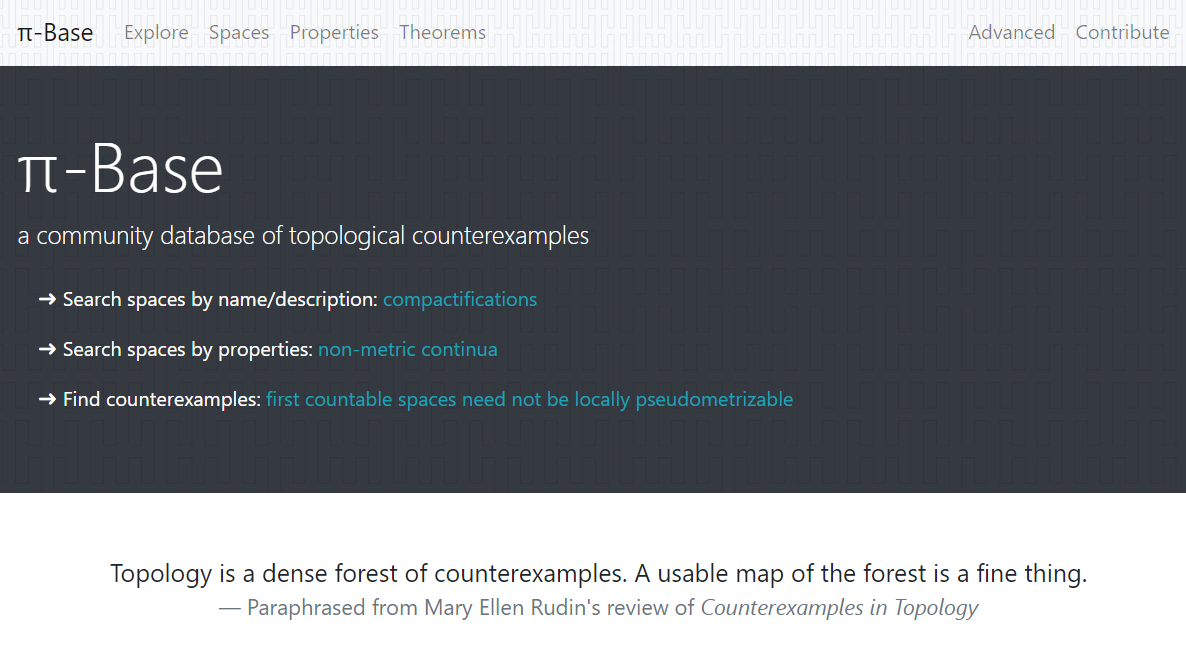
π-Base
A community database of topological theorems and spaces, with powerful search and automated proof deduction.
pearl holly
oof
light sky
but I don't know if it lists homology groups and whatnot -- it's open source though, so you can file a feature request 🙂
flint cove
light sky
there's also https://topology.pi-base.org/spaces
I know about π-base, which was kind of a motivator
pearl holly
pearl holly
https://topospaces.subwiki.org/wiki/
here you just search in the top right corner for the space you want. So if you search for the sphere the (co)homology groups will be listed there
flint cove
pearl holly
here you just search in the top right corner for the space you want. So if you s...
Hm, but already the „projective space“ article has nothing like that
 onyx crow
The biggest table I saw is in the Wikipedia page for homotopy groups of spheres
flint cove
Mrh I know I should just have written „(co-)homology groups“
Because to be really honest and speak from the bottom of my heart, I have yet to find anything that I care less about than homotopy groups of spheres, or of anything, for that matter
(inb4 I radically change interest in a few months and do homotopy theory)
pearl holly
I'm literally getting stuck on every fricking sentence 
and there's so much notation everywhere that I can't ask here because it would take me 5 years to explain the notation
flint cove
you talking homotopy theory? or am I missing context
flint cove
pearl holly
daim the article name is so long

 fair idol
Say I had a euclidean ball. How can I define a vector field that maps any point p to any other point q on the ball?
 haughty anvil
Hey so I got #1 here, it seems to just be Van Aubel's theory. But I'm struggling on b and c.
I have a guess for c but b I'm not really sure. My guess is that nothing would really change right? Because they're being flipped on the 2 perpendicular lines establishe din 1a.

 candid hatch
(TIL "quadrangle" is a word...!)
haughty anvil
Okay on a new question now. I did the first one, struggling on the second.

 obtuse meteor
flint cove
Because to be really honest and speak from the bottom of my heart, I have yet to...
obtuse meteor
flint cove
Because to be really honest and speak from the bottom of my heart, I have yet to...
The homotopy groups of spheres are cool okay ;-;
 bleak path
Hey! Can I steal the channel a bit to ask for thoughts on a T/F question? My gut feel says that this is false, but I don't quite know where to begin attempting to justify it, if anyone could give a pointer or two on what direction to start that would be great

X and Y here are generic non-empty topological spaces
tough imp
It’s totally true
The product of continuous is continuous and by definition of the product topology the image of open is open
bleak path
tough imp
It’s totally true
What about in the case of closed maps then?
closed continuous* maps
tough imp
I’m not sure
I don’t know how closed sets work off the basis for opens off the top of my head
bleak path
Alright, much appreciated anyway!
Just been tricked recently in topology and started to doubt a lot of things
About how if we have the infinite product of (countable) discrete topological spaces, the open set is not necessarily discrete
tough imp
Hahahaha this is pretty epic ngl
It’s used to define a topology in ring theory for a completion of something
Or was it the indiscrete topology on the things you’re taking the product of I forget
gritty widget
geometry
gritty widget
question for you lie group lovers. I want to show that most pairs of rotations in SO3 generate a free group. but I'm only doing this to satisfy my curiosity, so I get to decide what I mean by "most." I don't want to use haar measure, but I would like to show that for fixed A in SO3, and some word w(a,b) in the fee group on a and b, the set of B's satisfying w(A,B)=I is either all of SO3 or it is nowhere dense. hope this makes sense. any ideas?
then the pairs that generate the free group would be a thick subset of (SO3)²
fair idol
Remind me of the definition of a free group plz
rancid umbra
if X and Y are compact and hausdorff and f : X x Y --> R is continuous then is h : X --> R, h(x) = min_{y in Y}(f(x,y)) also continuous?
gritty widget
what is min_y(f(x,y))
rancid umbra
the minimum value of f(x,y) over all y in Y
 vast estuary
Homological algebra goes here or in #groups-rings-fields?
I'm trying to understand where the induced map is coming from, what it is, and therefore I shall compute its ker and coker
 wise sigil
rancid umbra
if X and Y are compact and hausdorff and f : X x Y --> R is continuous then is h...
wise sigil
rancid umbra
if X and Y are compact and hausdorff and f : X x Y --> R is continuous then is h...
yes i think, youd have to use the tube lemma
rancid umbra
damn forgot about that lemma. lemme pull out munkres real quick
rancid umbra
wise sigil
yes i think, youd have to use the tube lemma
hmm. how are you applying it?
wise sigil
we want h(U_x)) subset of (h(x)-epsilon, h(x)+epsilon)
rancid umbra
wait... how are you adding things in X...
wise sigil
Ah shit
rancid umbra
lel
wise sigil
nah still works
every point (x,y) in x x Y is contained in an open set U_(x,y) such that f(U_(x,y)) subset of (f(x,y)-epsilon, f(x,y)+epsilon)
rancid umbra
okay, i buy that
wise sigil
tube lemma goes there
you produce a tube around x x Y
and values of f in this tube vary little
rancid umbra
i see
 coral pivot
Hom alg
rancid umbra
this was actually a question asked on mse and is apparently supposed to be proved with like, basic definitions of continuity
rancid umbra
wise sigil
every point (x,y) in x x Y is contained in an open set U_(x,y) such that f(U_(x,...
wait i have a question. is U(x,y) a subset of X here?
otherwise, how are you looking at the image of that set under h?
because it seems like its a subset of X x Y rn. did you just mean to look at the projection of U(x,y) on X?
wise sigil
rancid umbra
wait i have a question. is U(x,y) a subset of X here?
sorry U(x,y) is a subset of X x Y
Once you have the tube (in the form of V x Y for some open set V in X), just project it to X
rancid umbra
gotcha
ill try and piece this together tomorrow. thanks
i thought it was false for a while, so i spent some time working with some weird but cool compact hausdorff spaces to try and get a c.e.
rancid umbra
i wonder where we're using the hausdorff assumption
vast estuary
rancid umbra
i wonder where we're using the hausdorff assumption
for a moment i thought you're talking about me
rancid umbra
lol
wise sigil
rancid umbra
i wonder where we're using the hausdorff assumption
yeah doesnt look like we use it
rancid umbra
dammit now i wanna go back and look for counter examples for some reason haha
i just dont like that this is true ig
 west delta
T^T help me pls how??
 empty grove
 gentle ospreyBOT
Hausdorff
 empty grove
Whenever you have A subgroup B and C subgroup D,
A map f: B → D that restricts to A → C,
It induces a map B/A → D/C
assuming everything abelian
This is because you take the composite B → D → D/C where the first map is f and the second is the quotient
and this maps A to 0
so factors through the quotient by A
gentle ospreyBOT
Hausdorff
 vast estuary
empty grove
and this maps A to 0
vast estuary
empty grove
and this maps A to 0
hmm why
vast estuary
ahh true
empty grove
also learn to use universal properties already lol
vast estuary
empty grove
so factors through the quotient by A
i don't understand this line
haven't seen "factors through quotient" kinda language before
empty grove
That's the universal property of quotients 
So whenever you have a map X to Y
such that A subset X maps to 0
vast estuary
empty grove
also learn to use universal properties already lol
i haven't learnt these well :/
they didn't do them in our algebra course sadly
where can i read them
empty grove
there is a unique map from X/A → Y such that the composite X → X/A → Y is the original map
empty grove
vast estuary
i haven't learnt these well :/
they didn't do them in our algebra course sadly
w...

I learned from a dedicated cat theory book but I don't think that's the best way to learn if you just want universal properties specifically lol
someone might have good recommendations
vast estuary
ah okay! which book did you pick tho
empty grove
but one thing that is always recommended is looking at the tensor product
empty grove
vast estuary
ah okay! which book did you pick tho
categories for the working mathematician, mac lane. Riehl is the standard recommendation though
vast estuary
empty grove
there is a unique map from X/A → Y such that the composite X → X/A → Y is the or...
hmm so in our case Y = D/C and X = B?
empty grove
yes
vast estuary
empty grove
categories for the working mathematician, mac lane. Riehl is the standard recomm...
oh ok. riehl was scary for me
empty grove
lol mac lane might be scarier
but you need not learn cat theory just to learn about univ props
you will, if you want to prove theorems about uni props in general, since then you need a precise definition of what a uni prop is, but you can get a feel for it without categories and still make your life a lot easier
people usually suggest learning about tensor products to learn how to work with uni props
vast estuary
ohh okay!
empty grove
because it is an example where you really can't work with the explicit construction
empty grove
empty grove
there is a unique map from X/A → Y such that the composite X → X/A → Y is the or...
but this is just first isomorphism theorem lol if you wanna think like that
The first isomorphism theorem is the universal property of the quotient
empty grove
Ye it's slightly different
the phi tilde map exists whenever A is in ker phi
it is an isomorphism iff equality
empty grove
empty grove
the phi tilde map exists whenever A is in ker phi
some books state first isomorphism theorem with this part included
some exclude it
vast estuary
ohhh okay cool stuff
ah man i'm afraid if i don't do anything about it soon, i might just be weak at algebra for life
empty grove
dw once you have universal properties you'll be op
algebra is just universal property spam 
vast estuary
empty grove
Whenever you have A subgroup B and C subgroup D,
A map f: B → D that restricts ...
btw instead of abelian groups here we can think of modules right
more generally
(Z-modules are abelian groups)
 vast estuary
ooo okay!
empty grove
that's not any more general than what you said but sounds cooler 
 quasi forum
And that's all that matters!
 unreal stratus
metallica moment
quasi forum
Okay, so I am learning about covering spaces and I have a question.
The definition says E is a covering space of B if every b in B has a nbhd U evenly covered by the continuous surjection p:E->B.
Out of curiosity? Why does it not say all neighborhoods of b are evenly covered? Why is this distinction in the definition relevant here?
empty grove
If every neighbourhood of b is evenly covered, then B is an evenly covered neighbourhood, so E is a disjoint union of copies of B
Not much to study when the situation is that simple
quasi forum
Ah, I see. Yeah, not very interesting
Okay, final question. If we lift the loop f from (B,x) onto E, then the end points of that path should be in p^-1(x) right? But the endpoints need not be the same point.
empty grove
Yes
quasi forum
Okay cool. That makes sense. Ty
Algebraic topology is a completely different beast from point set. So me asking these simple questions is just me trying to grasp what in the blazes is going on.
Okay, so here is a question. I know the reals evenly covers S^1.
But wouldn't something like [0,1] or [1,3] (really any integer intervals) also evenly cover S^1?
I know the fibers of a point is isomorphic to Z (which is also isomorphic to pi_1(B,b)).
So what makes R so special here?
empty grove
[0,1] doesn't, because the image of 0 doesn't have an evenly covered neighbourhood
quasi forum
Ah, so would it just be half open intervals?
empty grove
yes
There are other covers, like the S^1 → S^1 given by the circle winding around itself n times
Or a disjoint union of any other covers
quasi forum
Okay. But could we still determine what pi_1(B,b) is with any other cover?
empty grove
Connected covers are more important though, because if you have a disconnect cover then its a disjoint union of covers and you can study each on its own
And R is the best connected cover because it is simply connected
And simply connected covers make it really easy to figure out the fundamental group
quasi forum
But isn't something like (0,1] also simply connected?
empty grove
quasi forum
But isn't something like (0,1] also simply connected?
but it is not a cover
(0,a) union (b,1] is not isomorphic to a disjoint union of open intervals
A space can have at most 1 simply connected covering
and for nice enough spaces there is exactly 1
Such a covering is called a universal cover
and it covers all other connected covers of the space
quasi forum
empty grove
(0,a) union (b,1] is not isomorphic to a disjoint union of open intervals
Sorry, but why does this matter? I am not following
quasi forum
Oh, I think I understand
empty grove
if there is an evenly covered neighbourhood, there is an evenly covered basic neighbourhood because open subsets of evenly covered neighbourhoods are also evenly covered
by the same decomposition essentially
quasi forum
That certainly makes sense
pearl holly
Can I ask a dumb question real quick or should I wait?
quasi forum
I can take a break. Go ahead
empty grove
only smart questions are allowed to interrupt
pearl holly
okay bye then 👋
quasi forum
Oh, in that case. Sorry, you can't ask
 quasi forum
empty grove
There are other covers, like the S^1 → S^1 given by the circle winding around it...
quasi forum
empty grove
There are other covers, like the S^1 → S^1 given by the circle winding around it...
Wow, how exciting
empty grove
In fact those are all the connected covers that's even more exciting
empty grove
yeah, circle winding around itself and R. Connected covers of a nice enough space are classified by the Galois correspondence between connected covers and the subgroups of the fundamental group
Any covering p: E → B induces an injective homomorphism on the fundamental groups
So fund grp of E is a subgroup of that of B
And if a universal cover exists, then there is exactly one connected cover corresponding to each subgroup, you can check that the above cover all cases
pearl holly
okay so I have $(S^1 \times K(\mathbb{Z_p}, n)^{\wedge p} )/\mathbb{Z}_p$ where $\mathbb{Z}_p$ acts on $S^1$ by rotating each point by $2 \pi /p$. The action on $K(\mathbb{Z_p}, n)^{\wedge p}$ by $\mathbb{Z}p$ is generated by $T([x_1, \ldots, x_p]) = [x_p, x_1, \ldots, x{p-1}]$. So now, why is $(S^1 \times K(\mathbb{Z_p}, n)^{\wedge p} )/\mathbb{Z}_p = (I \times K(\mathbb{Z_p}, n)^{\wedge p})/(0, x) \sim (1, T(x))$?
quasi forum
That was not a smart question
pearl holly
yo what is the latex command for ~
empty grove
sim
gentle ospreyBOT
Tokidoki ✓
 pearl holly
oh I wrote sym
when I write ^p I mean the smash product p times
and Z_p acts "diagonally" like Z_p(x, y) = (Z_p(x), Z_p(y))
so the relation I get is $(x, y) \sim (e^{2 \pi m/p}x, T^m(y))$ for $m = 1, \ldots, p$. Now I can replace $T^m(y)$ by just $T(y)$ because that's equivalent. But I don't see why I should have $(0, x) \sim (1, T(x))$
gentle ospreyBOT
Tokidoki ✓
 pearl holly
I almost want to say that S^1/Z_p is just S^1 because then I get the relation but that's false right?
empty grove
pearl holly
I almost want to say that S^1/Z_p is just S^1 because then I get the relation bu...
This is true
empty grove
The map S^1 → S^1 given by x maps to x^p maps points of the same equivalence class to the same point, so it factors through the quotient to give a continuous bijection f: quotient to S^1
pearl holly
yeah so you first have an arc and then you identify the endpoints right?
empty grove
quotient is compact (quotient of a compact space) and S^1 is hausdorff so this is a homeomorphism
empty grove
pearl holly
yeah so you first have an arc and then you identify the endpoints right?
yes
pearl holly
yo daim
pearl holly
yo that's really nice
so like continouys bijections in compact hausdorff spaces are homeomorphisms?
is that the thing here?
pearl holly
oh okay
empty grove
so yes in particular when you have compact hausdorff spaces
This is why CompHaus is nice category
I mean one of the reasons lol
pearl holly
yeah I think I remember this from munkres now when you mentioned it
empty grove
and compactly generated spaces capture a lot of the properties of compact hausdorff spaces
and a lot of AT happens in compactly gen spaces
which includes all CW complexes
May has a whole chapter on this
before any homie alg
pearl holly
yeah okay I see. I always thought that S^1/Z_2 is RP^2 because you just identify opposite points but that's also S^1?
oh daim
but that sounds like a lot of point set
empty grove
ye that is S^1
pearl holly
yeah okay I see
pearl holly
oh lmao yeah that's what I meant
pearl holly
empty grove
The map S^1 → S^1 given by x maps to x^p maps points of the same equivalence cla...
but yeah this is really nice
thank you so much!
I just relized that slim'
empty grove
only just began
pearl holly
 📺
📺
 tawdry widget
Is there someone familiar with knot theory? I am struggling to understand the alexander polynomial. It has something to do with the cyclic covering of S^3 “cut along a seifert surface “.here I don’t understand why S^3 cut along F into 2 pieces. Like R^3 with a disk removed remains 1 piece right?

From gtm 175 Lickorish’s An introduction to knot theory page 53. Also I don’t understand why any Seifert surface must have the following form:

 kind cedar
Why is the interval (A,B) not open in the topology induced from f?
 empty grove
induced topology being U is open iff its preimage is open?
kind cedar
I guess so
empty grove
The inverse image of (A,B) should be an open interval along with a singleton
There are 2 points that map to the origin
or wait
what exactly is f?
kind cedar
 kind cedar
f is a one-to-one immersion
empty grove
ye so inverse image of (A,B) is an interval at the left end, an interval on the right end, and pi/2
do you see this?
kind cedar
Yes
empty grove
So pi/2 doesn't have a neighbourhood contained in the preimage
kind cedar
I'm having a hard time understanding what is the induced topology
empty grove
empty grove
induced topology being U is open iff its preimage is open?
should be this
kind cedar
So, the preimage of (A,B) is not open in R, thus (A,B) is not open either?
kind cedar
Ah, Okay, thank you
Another related question then
If V = f(U), the book says the inverse f^-1(V) is not continuous

Once again, I see there is a problem in the point p, but I cannot express it in proper words. How is f-1(V) not continuous?
empty grove
what does (U) mean?
kind cedar
an open set containing p
gritty widget
f^-1 rip open loop and rip bad
empty grove
I mean the brackets
empty grove
oh
right yeah the inverse image of U under f-1 is just the image of U under f
which is V
and V is not open in codomain
because there is no neighbourhood of p in it
empty grove
within f(U)
kind cedar
Bad wording here
kind cedar
No neighborhood V of f(p) with f^-1(V) contained in U
kind cedar
It seems my keyboard is eating the letter f
empty grove
yes
kind cedar
often
empty grove
kind cedar
No neighborhood V of f(p) with f^-1(V) contained in U
but also no neighbourhood V of f(p) is contained in f(U)
and that's what's relevant here
kind cedar
empty grove
therefore f(U) not open
Still confused. Sorry, I'm really slow rn
empty grove
empty grove
but also no neighbourhood V of f(p) is contained in f(U)
see if this clarifies it
kind cedar
Not yet. I don't understand the relationship between "not containing neighborhoods" with being open in this specific case
What is an open set in the codomain?
In this case
empty grove
It has the subspace topology from R^2
basic open neighbourhoods are the balls
any ball around f(p) goes outside f(U)
kind cedar
the preimage of f(V) is not U, but U + something. But isn't this still an open set?
kind cedar
empty grove
any ball around f(p) goes outside f(U)
ah, okay, gimme a minute to think about it
empty grove
no need to look at preimage
kind cedar
empty grove
any ball around f(p) goes outside f(U)
Okay, f(U) is an open interval, containing f(p). V contains points outside f(U). I still can't relate this to V not being open. A set in codomain is open iff it's preimage is open. The preimage of V is U + something...
Not open?
kind cedar
empty grove
f(U) isn't
why?
empty grove
Does the codomain here have the induced topology?
it should have subspace top from R^2
not the induced one
otherwise I don't see why f inverse isn't continuous
kind cedar
I'm not sure, let me read it all again
subspace topology
So, in the subspace topology f^-1 is not continuous, but in the induced topology it is?
empty grove
yes because then f is a homeomorphism by construction
quasi forum
Okay, so I am having a really hard time understanding this proof. I understand the first bit, but I am a bit confused on the 2nd part of it.

Wait I get it. When it says take an element of the open cover, it is talking about one of the sets covering X. For some reason I thought it was talking about elements (which frankly does not make any sense)
 quasi forum
The Lesbeque number is not at all a thing that is obvious to work with.
What are some good indicators for me to be looking at a Lebesque when writing a proof?
 bleak helm
I had to google what it is, which is good because it gave you time to answer your own q 
I guess the main idea is that if you consider small enough balls then they will always be contained in one of the cover sets, so look out for how you can use that
In this case you combined that with the fact that you can cover the space by finitely many balls of arbitrarily small radius
quasi forum
Here is another proof we did with it.
This is why I ask, because I was not expecting the Lesbeque number to appear here. But lo and behold, it has quite a significant role here.
 empty grove
A typical example of its use is when you want to subdivide the unit square into squares, all with the same size, such that they are small enough that a certain condition holds on each
Take cover with small enough balls around each point and then take the uniform size to be a lebesgue number of the cover 🎉
Oh yeah what you're doing is also a good example
Replace square with interval
Well here all the things having the same size doesn't matter I think? I don't see why it does
quasi forum
The importance is that the preimage of U_b is in exactly one of the intervals
Which we can force with the Lesbeque number
empty grove
Do you mean that an interval is in exactly one U_b
Oh is this in the uniqueness check?
quasi forum
No, existence.
quasi forum
empty grove
Do you mean that an interval is in exactly one U_b
Yeah, my bad
pearl holly
Hopf male
empty grove
And also how does lebesgue number imply exactly one?
It just says that there is some
quasi forum
No no, ignore everything I said. I misread it
empty grove
And also you shouldn't write the lebesgue number of a covering, because any number smaller than it also works
It's not a unique number
quasi forum
True. Don't shoot the messenger. I just took notes :p
Hmm, so I am not sure why this diam{x_1,x_2} is relevant

There ya go. I forgot to show what I was actually proving.
Tbh, I'm a bit lost on everything after the Lesbeque number
empty grove
They're just saying that {x1, x2} is contained in an element of the cover
Because the set is smaller than a lebesgue number
quasi forum
Ah okay. So how did that jump to the conclusion that it was in an e/2 ball in Y
Ohhhh, pre images
empty grove
An element of the cover is the preimage of such a ball
quasi forum
I missed that word
So I imagine we want epsilon/2 balls because the diam of {f(x_1),f(x_2)} has to be smaller than 2(e/2)
empty grove
Yes
quasi forum
Alright cool. I am getting it
Kinda wish I had lesbeque numbers when I first learned about compactness (in my metric space only class)
It seems like it woulda been useful
orchid forge
My professor told me that the lebesgue number lemma is the single most important fact of point set topology
Then a year later they put its proof as a freebie on the topology qual
Very epic style
quasi forum
I've learned that Lesbeque is the guy who comes up with ideas you'd never think of but are incredibly useful.
 shy moss
here what means that the group operation in $ pi_n $can be defined by $f+g(x)=\mu(f(x),g(x))$?
 gentle ospreyBOT
Or x1
 shy moss
here what means that the group operation in $ pi_n $can be defined by $f+g(x)=\m...
shy moss
shy moss
here what means that the group operation in $ pi_n $can be defined by $f+g(x)=\m...
i need to prove that $\pi_n(X)$ with the standar definition of $f+g$ is isomorphic to $\pi_n(X)$ with $f+g(x)=\mu(f(x),g(x))$ ?
gentle ospreyBOT
Or x1
 coral pivot
shy moss
here what means that the group operation in $ pi_n $can be defined by $f+g(x)=\m...
coral pivot
shy moss
here what means that the group operation in $ pi_n $can be defined by $f+g(x)=\m...
Right so i dont think they want you to show these are isomorphic
its more like, this is an alternate way we could give this a group structure
Actually nvm these are isomorphic
shy moss
coral pivot
its more like, this is an alternate way we could give this a group structure
so what i have to prove is that $\pi_n$ with the operation $f+g(x)=\mu(f(x),g(x))$ is a group?
gentle ospreyBOT
Or x1
 coral pivot
right sorry i take back what i said i was mistaken
both operations will turn out to be the same
the idea is that in general if you have [Y,X] with Y a coH space (like the spheres) and X a H space, then the operation induced by both are the same
and abelian
this comes from an eckmann hilton type arguement
so i think if you assume pi_n is abelian you can bypass and get an easier arguement
shy moss
thanks
 long coyote
for a given space $X$, define $S_1(X)$ to be the free abelian group with basis all paths $\sigma:I\to X$ and let $S_0(X)$ be the free abelian group with basis $X$. If $x_1,x_0\in X$, show that $x_1-x_0\in im\partial_1$ iff $x_0,x_1$ lie in the same path component of $X$
gentle ospreyBOT
亜城木 夢叶
 long coyote
the reverse direction is obvious, but i stuck on the forward direction
coral pivot
hmm so the hint id give here is
||consider parity of the sum of coefficients coming from boundaries||
gentle ospreyBOT
Nobody
 coral pivot
long coyote
the reverse direction is obvious, but i stuck on the forward direction
coral pivot
long coyote
the reverse direction is obvious, but i stuck on the forward direction
I realize my hint might have been a bit vague, do you want me to clarify
long coyote
please
coral pivot
like, basically look at del_1 acting on some combination of paths. basically you cannot seperate the x_1 and x_0 into coming from two different combination of paths because del_1's image has things whose coefficient sums upto 0
long coyote
i see, thx
quasi forum
So I am learning about the 1 point compactification, and I am not so sure if I understand it visually.
Intuitively/visually, what is the 1 pt compactification of Z_+?
I know it's homeomorphic to that, but I don't understand why
I'm not sure I follow why that is
coral pivot
the way i usually think about these is like, ok the space is not compact because you can go off to infinity basically. So to eliminate that you add in a point at infinity so that if you draw a neighborhood around this point it captures all but finitely many points, and the remaining space is now compact. This is whats happening here, and then they are using the n-> 1/n map to make this look nicer ig
quasi forum
Why every open set containing 0 has infinitely many other points.
Ah okay, that part makes sense
Makes sense: that gives us a finite open cover
Okay, what's another recognizable space to do 1 pt compactification with?
coral pivot
real number line
quasi forum
Okay sure. The complex plane
tight agate
R^n
quasi forum
So say we add this point to the complex plane.
So how do we ensure that a neighborhood of that point contains all but finitely many points?
tight agate
?
wdym
a fact that might help: one-point compactifications are unique up to homeomorphism
quasi forum
I think my issue is I am not understanding the intuition very well
tight agate
can you think of a space of the form R \cup a point which is compact
quasi forum
Yea, I think so
tight agate
what is it
quasi forum
Oh, you want an actual result 
tight agate
it's definitely a space that youve seen before
quasi forum
Honestly, I'm not seeing it
tight agate
alright try working through the construction
as a set, we have R \cup point
what do the open nbhds look like
quasi forum
Oh, this kinda reminds me of the cofinite topology on R
tight agate
what are the nbhds of the extra point
quasi forum
tight agate
what do the open nbhds look like
R\ finitely many points
tight agate
those are open, yes
quasi forum
With our extra point of course
tight agate
but that's not all of them
quasi forum
Well, you can have the space itself
tight agate
what about the space - [0,1]
quasi forum
Ah yes. The nbhds are R-compact set
tight agate
alright, now say I have the sequence a_n = n n>=0
Y is compact, so some subsequence must have a limit
what is the limit
quasi forum
And the only way that'd happen is if it converges to our special point
tight agate
ok, now what about the sequence a_n = -n
quasi forum
Same situation
tight agate
so going in both "directions" takes you to the same point
quasi forum
So all properly divergent sequences now converge to our point
tight agate
can you imagine any space where this sort of thing happens
i.e. going off in both directions takes you to the same point
quasi forum
This makes me think of S^1. It's like wrapping R in a circle, and the thing that tapes it together is our extra point.
tight agate
yup!
the one-point compactification is S^1
now try proving it
we just explicitly wrote down the one-point compactification as some set with a topology on it
quasi forum
Well that seems like a step up :p
tight agate
can you write down a homeomorphism from S^1 to Y
(alternatively, you can just use uniqueness, but this might help when youre learning it for the first time)
quasi forum
x-> e^(i2 pi x), but that isnt injective (so not a homeomorphism)
tight agate
right
tight agate
quasi forum
This makes me think of S^1. It's like wrapping R in a circle, and the thing that...
try using this description
try doing it informally
writing down coordinates is painful
imagine a circle sitting on the real line
or a real line passing through the center of a circle
quasi forum
Okay, I am following
tight agate
tight agate
or a real line passing through the center of a circle
imagine this
now consider all lines passing through the north pole
quasi forum
Ah, this idea again
tight agate
tight agate
imagine a circle sitting on the real line
actually imagine this
quasi forum
Yea, so every line that passes through the north pole passes through exactly one point in the reals
quasi forum
Oh, didnt know there was a name for it
tight agate
so send every point except for the north pole to the corresponding point on the real line
and send the north pole to the extra point in Y
convince yourself that this is continuous
it's clearly a bijection, domain is compact, codomain is hausdorff so it's a homeo
quasi forum
Oh yeah, that nice little theorem
tight agate
you could just write down the inverse
it's the same procedure
now find the one-point compactification of R^n, and try using the uniqueness argument this time
quasi forum
I know the answer is the same idea: S^n
tight agate
yup
quasi forum
This was extremely helpful. Thank you very much
 little hemlock
How would I find a mobius transformation which maps the real line to the circle of radius 1 centered at i and maps the circle of radius 1 centered at -i to itself?
I asked this in #real-complex-analysis earlier but was advised to ask here instead
quasi forum
So here is a question. If two spaces are homeomorphic, do they have the same 1 pt compactification (up to a homeomorphism)?
little hemlock
so, I can find a mobius transformation which maps the real line to the circle of radius one centered at i for example, but there are infinitely many of these mobius transformations, and I'm stuck on guessing which one fixes the circle of radius one centered at -i.
b = 0 is obvious, yea, but i don't think anything else is 
quasi forum

Okay, I am having a hard time understanding this proof. Why does hausdorfness imply the closure of V is compact?
orchid forge
no idea  it's a closed subset of a compact space so it's compact anyway right
the hausdorffness is used to say that C is closed
little hemlock
I don't think infinity can be fixed. The real line has to map to a circle in C
orchid forge
quasi forum
i think (by hausdorff) should be moved after the line $\bar V \subset \bar C = C$
quasi forum
What do you mean exactly?
orchid forge
C bar = C is because X is hausdorff
quasi forum
Doesnt c bar =C since C is closed?
orchid forge
C is closed because X is hausdorff
quasi forum
Oh duh... that's where hausdorfness matters
Also, I have never heard of sub nbhd before. Is it just a nbhd in a nbhd?
 digital peak
I'm looking for a particular construction I guess... In the homotopy category, if we have a parallel pair of maps, we can form a coequalizer:
$$\begin{tikzcd}
P \arrow[r, "l", shift left] \arrow[r, "r"', shift right] & X \arrow[r, "f"] & {<coeq>(l, r)}
\end{tikzcd}$$
the initial object with morphism f such that $f \circ l = f \circ r$.
I'm looking for a sort of generalization: if we have a map $i : B \to J$ embedding a "boundary" into some index space $J$, we can talk about pair of maps going into $X^J$ such that $X^i$ coequalizes them:
$$\begin{tikzcd}
& X^B \arrow[r, "f^B"] & Y^B & B \arrow[d, "i"] \
P \arrow[r, "r"', shift right] \arrow[r, "l", shift left] & X^J \arrow[r, "f^J"'] \arrow[u, "X^i"'] & Y^J \arrow[u, "Y^i"'] & J \
& X \arrow[r, "f"'] & Y &
\end{tikzcd}$$
Then I'm looking for an initial object $Y$ with map $f$ such that $f^J$ coequalizes $l$ and $r$ and makes the square commute.
This object always exists (I think?): we can take an $I \times J \times P$ cylinder and $X$, and glue the $(0, j, p) = l(p)(j)$, $(1, j, p) = r(p)(j)$, $(i, b, p) = l(p)(b) \equiv r(p, b)$.
gentle ospreyBOT
mniip
 digital peak
Does this have a name or maybe this is expressible through other more common constructions?

 gritty widget
hi, do you guys have any advanced lie theory textbook recommendations?
emphasis on advanced
ping me
rancid umbra
digital peak
motivating example I guess?
what drawing app is this?
digital peak
it's just gimp
gritty widget
actually all lie theory textbook recommendations are welcome
 wicked bolt
Hello there. Is it possible to inscribe a Sierpinski's triangle pattern into a circle and scale it accordingly to the radius of the circle?
gritty widget
depending on what exactly you mean, probably yes
sierpinski's outer boundary is a triangle
wicked bolt
So, is it theoretically possible to inscribe fractals into other fractals, if those are made up of regular shapes?
Sure.
I didn't really finish it.
 empty grove
gritty widget
fractals and circles are not real
wicked bolt
Well, it doesn't have to be every non-void triangle;
Just that after n-many iterations, or sort of like, alternate between those.
Lets suppose I did inscribe a fractal into a fractal, but I don't want to define a lineral ratio at which those fractals scale. Like, I want to program two variables which I can control, that define how scaled each fractal is independantly (regarldess of one of them being inscribed). Is that possible?
And the final question is, how do I make iterations of that figure and how should I call it?

If I can do it in MS Paint, is it possible to write down a formula?
 viral atlas
I don't think it would be easy to come up with a nice formula for everything you can draw iteratively
wicked bolt
Well, I just wondered whether I can inscribe that

Into the Sierpinski's triangle. Or at least, inscribe the inverse Sierpinski's triangle into the regular Sierpinski's triangle.
Would be somewhat useful for simulating quantum colours, or at least for ray coloring the neurally denoised game graphics.
wicked bolt
@wooden falconOkay, so suppose I'm inscribing a circle into every void triangle from stage n-2; is the volume approaching 0?
 stone cipher
In Lee book Introduction to topological manifolds defines the regular coordinate ball in this way. I don't understand if r is arbitrary s.t. 0<r<r' or there must be r s.t. 0<r<r' satisfying...

ohh, nvm.. it is the second one.
gentle ospreyBOT
Martin Male
 stone cipher

So $X$ is Baire space if, for every countable collection of open sets $(U_n)$ such that $\overline{U_n}=X$ for all the $n$, we have [\overline{\bigcup_{n}U_n}=X.]
gentle ospreyBOT
RaD0N
 gritty widget
yes
stone cipher
but since $U_1\subset \cup_n U_n$ we have [X=\overline{U_1}\subset \overline{\bigcup_{n}U_n}\subset X,] hence all the topological spaces are Baire space?
gentle ospreyBOT
RaD0N
 empty grove
It should say intersection not union
gritty widget
closure of infinite union is fucky
gritty widget
also wow that's quite the typo
gentle ospreyBOT
Martin Male
 gentle ospreyBOT
Martin Male
 digital peak
wouldn't the coequalizer be just X with the two copies glued together? As for Hom I guess yea that's true
ok and?
gritty widget
hi, trying to prove this.
I started by just saying what the definition of compact is, which means when I choose a collection of open sets that cover K, and finitely many of those open sets still cover K.
The definition of open set involves open balls, but they're not in the direction I'd like, since open means there's an open ball that's a subset of each U_i (see 2nd pic), which is not the direction I need to prove the above statement. Since each ball is a subset than each U_i, I can't conclude that K is a subset of the union of those balls

 digital peak
coequalizers
empty grove
gritty widget
hi, trying to prove this.
I started by just saying what the definition of compa...
Rather than trying to prove a general result here, you have to find a specific cover of K such that the given thing happens
The problem is asking you to prove that there always is a finite open cover of K of a certain form. K is compact. Then you should expect that you start by finding an open cover, such that any finite subcover of it is of the given form
You shouldn't start from a generic open cover and try to prove things about it, because a generic open cover need not have a subcover of that form
gritty widget
Okay, so K is a subset of R^d, which can be written as the infinite union of balls (each of the radius r in natural numbers), centered around a point such as 0... I'll think about how to make that finite. My thought is maybe find the smallest r in the infinite union such that K is a subset, which will make it finite.
gentle ospreyBOT
Nobody
Compile Error! Click the  reaction for more information.
(You may edit your message to recompile.)
 digital peak
are you saying X already satisfies the universal property for coeq(f, f)
I guess that's true
 frigid patrol
I need help computing intersection products of explicit curves in a homology basis of a surface
My surface is the double pentagon which is a genus 2 surface and my homology basis is these particular curves denoted a_1, a_2, a_3, a_4 in this image

How can I compute the intersection product of $a_1 \frown a_2$ for example?
gentle ospreyBOT
nYaminoid
 frigid patrol
I think $a_1 \frown a_2 =1$ because of the following picture:
 gentle ospreyBOT
nYaminoid

 bleak path
Hey, looking for some intuition on Gauss and Mean curvatures of a surface
Firstly, I always see that we have 2 eigenvalues which we get from the first and second fundamental forms, and we use these eigenvalues to describe the 2 kinds of curvatures
First question - is a local surface always describable by 2 curvatures? Sometimes it can be 1, or sometimes none, but in general is it 2?
 worldly cradle
Does anyone have insight how showing [0,1] is a retract of the Real Line?
gritty widget
define a retraction
 plain raven
$\sin$
gentle ospreyBOT
diligentClerk

 minor hornet
If I take two copies of a topological space and identify any point x in the first copy with the point f(x) in the second copy (for some group automorphism f:X->X), does the two copies of X join in a nice way? Ie. does the resulting quotient space have any nice properties?
My first instinct is that they will overlap exactly over each other (perhaps one is reflected/rotated relative to the other) and the resulting quotient space is just X, but idk if its true
 quartz edge
am i wrong in believing that the set of all closed balls forms a basis for a topology in the plane (R^2)?
it's clear that there's a basis nbhd of every point in R^2
and every intersection of basis nbdhs contains another basis nbhd
(namely, the point itself)
this seems to satisfy the requirements for a basis
does the intersection have to strictly contain another basis nbhd
i.e. be a strict superset?
i suppose this isn't "closed balls" it's just closed circular regions
i guess this just generates the discrete topology
which is not a problem
little hemlock
do you mean a basis for the standard topology on R2, or do you mean a basis which generates some topology on R2?
im guessing the latter?
quartz edge
yeah
the latter
i don't care about recovering the usual metric on R^2
just trying to understand bases for topologies
little hemlock
The set of closed balls would contain all singletons, so yea u just get the discrete topology on R2
gritty widget
quartz edge
ok good
little hemlock
well, you would have to allow balls of radius 0
quartz edge
yes
little hemlock
otherwise no basis
quartz edge
right cuz
intersection of two closed balls that touch only at a point
but
i read that the discrete topology is metrizable but does not recover the euclidean metric on R^2
why is this
what metric does it produce
i haven't learned about metrization
little hemlock
the discrete topology can be generated by the discrete metric defined by d(x,x) = 0 and d(x,y) = 1 for all x != y. the topology on a metric space is the topology generated by a basis of open balls radius r > 0. so B(x; 1/2) = {x} is open for each x.
on the other hand, in the euclidean metric, every open ball containing x contains points other than x, so {x} is not open in R2 with the topology coming from the euclidean metric
quartz edge
metrics just have to be positive definite and satisfy triangle inequality right
little hemlock
they have to satisfy symmetry d(x,y) = d(y,x)
gritty widget
How do I show the surface $M:=S^2/\sim$ is not orientable, where $\sim$ is an equivalent relation on unit sphere $S^2$ in $\mathbb{R}^3$ defined by $(x,y,z)\sim (-x,-y,-z)$ for all $(x,y,z)\in S^2\subset \mathbb{R}^3$?
gentle ospreyBOT
weilam06

 cosmic beacon
Let's say I have two spaces $X$ and $Y$ and I know all of their $n$-sheeted path-connected covering spaces, up to isomorphism with basepoints. Is there an ``easy'' way to enumerate the path-connected $n$-sheeted covering space of their wedge sum $X\vee Y$, similarly up to isomorphism with basepoints?
gentle ospreyBOT
Isaiah

 finite heath
empty grove
finite heath
empty grove
 gentle ospreyBOT
Moldilocks ✓
 wise sigil
empty grove
wise sigil
empty grove
yeah it depends on the chart
empty grove
Thanks
gritty widget
why are lines in projective planes required to have at least three points?
gritty widget
There are several different definitions of tensors right? do all those definitions describe the same mathematical object?
 winged badger
gritty widget
why are lines in projective planes required to have at least three points?
winged badger
gritty widget
why are lines in projective planes required to have at least three points?
to get rid of boring examples of projective planes, like a "plane
" where all points except one lie on a single line
gritty widget
gritty widget
There are several different definitions of tensors right? do all those definitio...
I think there is just one general construction
winged badger
gritty widget
I think there is just one general construction
i can think of at least 2
gritty widget
idk I thought just construction for modules is the most general one
 cosmic socket
cosmic beacon
Let's say I have two spaces $X$ and $Y$ and I know all of their $n$-sheeted path...
cosmic socket
cosmic beacon
Let's say I have two spaces $X$ and $Y$ and I know all of their $n$-sheeted path...
I feel like there isn’t just based off S1 V S1
The free product makes things complicated
Essentially you are asking if there is an easy way to index n subgroups of a free product
empty grove
gritty widget
There are several different definitions of tensors right? do all those definitio...
Which tensor/definitions of tensor are you referring to?
shy moss
if X is path connected what exactly is the homomorfism between $\pi_n(X,x_0)$ and $\pi_n(X,x_1)$?
gentle ospreyBOT
Or x1
 empty grove
Take path from x0 to x1, conjugate any element of one group by this path (in the only way that makes sense) to get an element of the other group. Do this backwards to get an inverse map
shy moss
i think that for $f:(I^n, \partial I^n) \rightarrow (X,x_0)$ i can define $\varphi (f)(s_1,..,s_n)=f(3s_1-1,...,3s_n-1)$ when $1/3 \geq s_i \geq 2/3$ for all i
gentle ospreyBOT
Or x1

 weak narwhal
empty grove
Which tensor/definitions of tensor are you referring to?
weak narwhal
empty grove
Which tensor/definitions of tensor are you referring to?
probably using multilinear maps vs arrays
https://en.wikipedia.org/wiki/Tensor_(intrinsic_definition) oh theres also this (in which case yes, it corresponds with multilinear map defn.)
In mathematics, the modern component-free approach to the theory of a tensor views a tensor as an abstract object, expressing some definite type of multilinear concept. Their properties can be derived from their definitions, as linear maps or more generally; and the rules for manipulations of tensors arise as an extension of linear algebra to m...
 sonic hill
Given a finite set { V1, ..., Vn } of vector spaces over a common field F, one may form their tensor product V1 ⊗ ... ⊗ Vn, an element of which is termed a tensor.
Done, and done
gritty widget
sonic hill
Not so fast
weak narwhal
gritty widget
<#496784958430380033>
?
sonic hill
v
Differential geometry, physics and engineering must often deal with tensor fields on smooth manifolds. The term tensor is sometimes used as a shorthand for tensor field. A tensor field expresses the concept of a tensor that varies from point to point on the manifold.
So for example, the metric tensor in general relativity is actually a type (0,2) tensor field over spacetime
gritty widget
weak narwhal
its not bad to ask it here imo
gritty widget
has any read chapter 1 of luries higher algebra
and if so
do you know of an easier reference
weak narwhal
since clifford algebra stuff gets moved into tensor territory
weak narwhal
gritty widget
There are several different definitions of tensors right? do all those definitio...
https://math.stackexchange.com/questions/10282/an-introduction-to-tensors anyways this might help

Mathematics Stack Exchange
As a physics student, I've come across mathematical objects called tensors in several different contexts. Perhaps confusingly, I've also been given both the mathematician's and physicist's definiti...
plain raven
it's funny when people recommend higher algebra for no reason
I saw a stackoverflow post where someone asked about the Dold Kan correspondence and the answer was "Look in higher algebra"
😐
tight agate
gritty widget
has any read chapter 1 of luries higher algebra
yes
tight agate
gritty widget
do you know of an easier reference
no
 fading vale
Is this true on a formal level or just like heuristically

(i assume this is a typo and they mean n > 1 btw)
(a K(pi, n) is an nth-eilenberg maclane space with group pi as you might expect)
fading vale
Idk
Maybe it means like
can be equipped with a riemannian metric
idek if thats true of CP^infty but its all i can think of
like even being a manifold is too weak to say this because loop spaces i think
Frétchet manifold structure moment
I guess thats only true of smooth loop spaces but same different i think
sonic hill
It's probably just saying that there is no simple description or construction of the higher spaces except by attaching arbitrarily high dimensional CW complexes inductively based on what the higher homotopy groups happen to be
Whereas $\bC P^\infty$ is just, well, the inductive limit of $\bC P^n$, or if you like, $\bC^\infty/\bC^\times$
gentle ospreyBOT
Icy001
 cosmic beacon
What would be the induced subgroup of the given 2-sheeted covering space ~X of X = RP2 v T2?

Where ~X is the 2-sheeted covering space obtained by attaching two tori to the 2-sheeted cover of RP^2 (the sphere)
cursive flume

how could I prove ii) formally?
it seems very intuitive,but idk how to write it down formally,I don't have tools
for i) I proved that M1xM2 is a topological space,it is hausdorff,it is second countable and it is locally euclidean
for ii) idk how to write down that the atlas is smooth
cosmic beacon
cosmic beacon
Where ~X is the 2-sheeted covering space obtained by attaching two tori to the 2...
It would be <b,c,aba,aca>, right?
cosmic socket
cosmic beacon
It would be <b,c,aba,aca>, right?
This looks right (mod commutator for b,c)
cosmic beacon
cosmic socket
This looks right (mod commutator for b,c)
Thanks!
gritty widget
cursive flume
for ii) idk how to write down that the atlas is smooth
just show that the transition maps are smooth
(and that you actually cover M_1 x M_2, but that should be obvious)
cosmic beacon
Consider the torus with fundamental group Z^2 = <a,b | [a,b]>. It has 3 isomorphism classes of two-sheeted connected covering spaces, each associated to one of the groups <a^2, b>, <a, b^2>, and <a^2, ba^(-1)> (kernels of 3 possible non-trivial homomorphisms from Z^2 to Z/2Z).
My question is: what does the covering space associated to that last subgroup look like?
gritty widget
These are excellent thank you!
Awh thanks so much this has exactly what I looking for
flint cove
I didn't ask for this but it's amazing, thanks
kind cedar
What' the meaning of "As the zero set of finitely many continuous functions" ??

got it
 true garden
Hello. Why is there no function $f\colon \mathbb{R} \to \mathbb{R}$ that is continuous precisely on a countable dense subset of $\mathbb{R}$?
gentle ospreyBOT
MathPhysics

 coarse night
There is also another way of viewing it. The set of discontinuities of a function is necessarily a F_sigma set. If you want your function to cont only in a countable set (which is F_sigma) and disc at the complement (which is G_delta), is not possible because complement of countable dense subset of R cannot be F_sigma. I would suggest you to look into Abbott-Understanding Analysis for further reading
shy moss
when $A=x_0$, we have that $\pi_n(X,A,x_0)=\pi_n(X,x_0)$?
gentle ospreyBOT
Or x1

 hollow harbor

Blatantly false, any step function is continuous everywhere but the steps. Uniform continuity on a dense set implies continuity on R.
empty grove
slim should hang out more in #groups-rings-fields
coarse night
hollow harbor
Blatantly false, any step function is continuous everywhere but the steps. Unif...
did not get this, can you elaborate?
coarse night

empty grove
everywhere but the steps is a dense subset
coarse night
No i mean there is a function that is cont in Q and disc in Q complement?
empty grove
no rice was contradicting slim who made a stronger statement
which was dropping countability
coarse night
oh i see
 cursive spade
let ~ be the equivalence relation on $S^1$ that identify antipodal points
gentle ospreyBOT
bchaotic
 cursive spade
I am having trouble writing down an explicit homeomorphism between $S^1$ and $S^1 /\sim$
pearl holly
yo moldi already answered this to me before hol up I will link the chat
pearl holly
empty grove
The map S^1 → S^1 given by x maps to x^p maps points of the same equivalence cla...
the same argument applies right?
empty grove
also \sim for ~
pearl holly
don't do \sym
gentle ospreyBOT
bchaotic
 cursive spade
@pearl holly can you explain it
pearl holly
So you have a map from S¹ to S¹ given by x to x² in the complex plane and then by the universal property of quotients it must factor through the quotient. That map will be bijective since the map from S¹ to S¹ is bijective and the projection is surjective and injective. Then you have a continous map from the quotient (compact) to the sphere (Hausdorff) so it is a homeomorphism but this was moldi's argument so maybe moldi can explain better
maybe that's wrong
pearl holly
wait so how do you know that the map froim the quotient is bijective?
ye bchaotic listen to moldi instead
empty grove
so you have s = tp, where s is the squaring map, p is the quotient map, t is the induced map
whenever s is surjective, t is surjective (general fact about such factorings)
pearl holly
oh lmao
empty grove
t is injective because we identified everything that maps to the same thing
cursive spade
I was thinking of first mapping to a helix covers the circle twice identify end points and then to the quotient space of S^1/~
pearl holly
empty grove
whenever s is surjective, t is surjective (general fact about such factorings)
ye I thought that this only holds when s is bijective lmao
empty grove
cat theory book chapter 1 exercises be like
cursive spade
why the squaring map though?
pearl holly
because then it will be constant on the quotient, right? So that allows you to use that property
don't listen to me tho, let moldi answer if moldi want's to
empty grove
ye constant on each equivalence class
squaring like in complex numbers
point at angle t from x axis goes to point with angle 2x
cursive spade
so the squaring so you rap around twice , so x and -x maps to same point ,
but how do we get the existence of t ? @empty grove
empty grove
universal property of set quotients
define [x] maps to sx
check well defined
prove continuity
but
you can prove universal property of quotients once and spam it whenever you see a quotient
10/10 would recommend
empty grove
empty grove
define [x] maps to sx
if you don't wanna do uni props follow this route
cursive spade
 kind cedar
What's the difference between an open neighborhood and a coordinate neighborhood? Can't they be the same
I'm often confused by demonstrations that take an open set and then inside the open set take a coordinate neighborhood. Like... why? Why not just taking the open coordinate neighborhood from the beginning?
Why must I take a V0 which is the intersection of W and V to make the chart? Why not just considering V entirely, or W entirely?

I've seen many other examples which confsued me
\iota is an embedding in V
why do we use the W?
gritty widget
kind cedar
What's the difference between an open neighborhood and a coordinate neighborhood...
open neighborhood = open set containing a usually specified set or point
coordinate neighborhood = open set on which a chart in your atlas is defined
kind cedar
V can be suficiently small to be identical to W, not?
Why not?
Humm, I'm having a hunch
V is small enough to allow adapted charts
those adapted charts may or may not be as big as V
maybe smaller, thus the Ws
But then why define V0 = W intersec V, instead of just using W? Since W must be inside V
gentle ospreyBOT
Jexus Smith
 kind cedar
It's the same
I'm highly confused by some terms.
First, V was defined in S. Then all of a sudden it's a set in N?
Wouldn't it be \iota(V) ?
Neither did the book
Aaah, that helps a lot
that picture changed my life ahaha
I'm seeing everything different now
it's the one I'm taking the example from
hahahaha
Let me check

version 3.0 means???
It must the first edition then
😦
I feel decepted
kind cedar
ahahah it seems so
honest narwhal
This is probably a draft version lol
kind cedar
Ah, that's why there were NO pictures at all and I was super confused
I was hating the book
Now that I have (totally legally) acquired the new edition, things look very different
gritty widget

kind cedar
ahahha
pearl holly
pearl holly
this might be a weird question but why would one ever want to work with the smash product instead of the Cartesian product?
like are there some "benefits" of using the smash product over the Cartesian product?
empty grove
I think it's the product in the category of pointed spaces  Might be wrong
pearl holly
wait hol up I will be back soon
empty grove
Oh it's not
pearl holly
okay I'm back lol
pearl holly
😵💫
coral pivot
smash products is tensor product in pointed space i believe
empty grove
I said the same thing but more precisely
empty grove
Goddamn degenerates
empty grove
empty grove
It's the left adjoint of the internal hom in nice subcategories of Top
This lol
coral pivot
ah oof didnt see that
pearl holly
ye that's over my head lmao
empty grove
pearl holly
but yeah when Hatcher constructs the Steenrod operations he "randomly" switches everything up and starts using smahs products and instead of using the cross product he starts to use the tensor product from nowhere and it just seems weird
coral pivot
if ur that far into hatcher, you should start using a different book
pearl holly
and I went through the construction and it felt like nothing would break if I would just replace everything by the cross product and use the Cartesian product
pearl holly
coral pivot
~~if ur that far into hatcher, you should start using a different book~~
I skipped a BUNCH tho
Max said this was cool so thjat's why
pearl holly
I mean it is cool and the construction is very nice but I just have to go through it a couple more times to truly understand it
pearl holly
pearl holly
and I went through the construction and it felt like nothing would break if I wo...
because things like these appear all the time
He says like "the construction of a certain function will take place cell by cell, so we may get rid of all the unnecessary cells by replacing XxY with X \wedge Y"
something like that
empty grove
Hatcher 😩
cursive flume

so in this problem,I can show that there is a unique topological structure on t^n
do I have to prove that this topology is hausdorff/second countable?
pearl holly
pearl holly
and I went through the construction and it felt like nothing would break if I wo...
maybe this is important for the cell structure
gritty widget
can u link the post
cosmic beacon
cosmic beacon
Consider the torus with fundamental group Z^2 = <a,b | [a,b]>. It has 3 isomorph...
Figured it out (I’ve drawn the lifts of the generators of the torus)
 digital wraith
Hatcher is fine 
fading vale
pearl holly
like are there some "benefits" of using the smash product over the Cartesian pro...
Most of the time the main reason to care is tensor hom adjunction