#point-set-topology
1 messages · Page 208 of 1
 gritty widget

 flint cove
time to transfer
 tight agate
gritty widget
can it hurry up and come out already <:angerysad:602329540131553290>
tight agate
gritty widget
can it hurry up and come out already <:angerysad:602329540131553290>
I'm probably going to buy a hard copy as soon as it comes out
tight agate
gritty widget
can it hurry up and come out already <:angerysad:602329540131553290>
read ch 23 and 24 from a concise course in alg top while you're waiting
flint cove
Yeah, that's kinda what was my starting point :>
tight agate
pretty great starting point
flint cove
Ah, didn't come far enough to notice „a glimpse at the general theory“
until now it just seemed very much restricted to VBs
tight agate
VBs are dope tho
flint cove
I mean I still have to say that I am a bit surprised that the functoriality of B is not very easy to find. Things like this question https://math.stackexchange.com/q/1458470/91103 make it seem like this was common knowledge, and nobody in the comments asked about that construction.

Mathematics Stack Exchange
Given a topological group $G$, we can form its classifying space $BG$; suppose we have chosen some specific construction, say the bar construction. $B$ is a functor - given any homomorphism $G \to ...
 marsh forge
ive found a lot of things in alg top have an issue where like
i cannot google them for the life of me
but i can dig them up in textbooks
flint cove
tight agate
people don't write shit down
In that case I'm glad that I haven't set a deadline for my BS thesis yet, lol
marsh forge
or long manuscripts
tight agate
flint cove
In that case I'm glad that I haven't set a deadline for my BS thesis yet, lol
what's your thesis on?
 sleek thicket
yeah unfortunately it's from an unreleased book, sorry
flint cove
tight agate
what's your thesis on?
characteristic classes and in particular the chern character
sleek thicket
oh he did ask me if I could help him edit it/keep looking at draft copies after the class ends though
That was kind of cool
tight agate
flint cove
characteristic classes and in particular the chern character
from which POV
flint cove
I don't know which POVs there are, but my main guideline is Hatcher
tight agate
there's also the super nice diff geo POV
tight agate
TAKE BACK THE SULLY
marsh forge
i will sully diffgeo however i please
sleek thicket
I think that's what my class ia doing right night
But I got very lost
Turns out not having a textbook+awful diff geo computations is bad
marsh forge
you can remove the first summand
tight agate
chern-weil theory is super nice
flint cove
tight agate
there's also the super nice diff geo POV
that diffgeo view actually the stretch goal, i.e. to give a description both ways and show that they're equivalent
But to give a complete intro do the algtop view will be enough work on its own I think
tight agate
read huybrechts
tight agate
flint cove
that diffgeo view actually the stretch goal, i.e. to give a description both way...
noice
flint cove
Most texts I've read so far do some intro-level talk and at the hard parts do stuff like „we can prove that with spectral sequences“ and you're just like WTF
tight agate
there's another POV via lambda rings and stuff
and you do everything via the splitting principle
which is super nice
flint cove
What are lambda rings?
tight agate
rings + operations which behave like exterior power operations
marsh forge
flint cove
Most texts I've read so far do some intro-level talk and at the hard parts do st...
this is the woke part
tight agate
so for each natural number n, you have a map \Lambda^n: R ---> R
flint cove
Oh, the big lambda.
tight agate
and then these Lambda^n satisfy pretty much all the relations that exterior powers satisfy
yeah and once you have this you can define Adams operations and stuff
flint cove
I've not quite gotten to internalize the splitting principle, but it seemed like embedding H(bundle, A) into H(Σline bundles, A) via the pullback of the flag bundle, which is inherently nicer
What counts as an „Operation“?
flint cove
I've heard of things like Adams operation and „cohomology operations“ in general, but have no Idea what these are
Oh, it's an NT between cohomology functors
nice
tight agate
adams operations are a bunch of operations on K-theory
but these can be defined on any lambda ring
the k-th adams operation acts as the k-th power operation on line bundles
and this determines them
by using the splitting principle
but yeah there's an explicit definition using newton polys and stuff
flint cove
I think I'll keep that in the back of my head for a few weeks when I've understood the splitting principle and the necessary polynomial relations a bit better, but it sounds interesting.
tight agate
I need to read more about this stuff too
once you have the lambda ring formalism set up there are a whole bunch of weird filtrations you get on the ring
and I have no intuition for them
 shut moat
@marsh forge
An understanding of exact sequences and very basic homological algebra would also be good.
if I have zero clue about both of these things, can I still get something out of your talk?
marsh forge
Hm
the issue is that the computations would be largely nonsense
and i think the meat of the talk is actually like, how you go through the computations
rather than the results being that interesting
shut moat
ah, rip
marsh forge
I mean it wont be that long and i wont get mad if you leave in the middle
so no reason not to just show up if youre interested
tight agate
introduction
sleek thicket
You found my secret plan all along :P
sleek thicket
My posts are good
 chrome dew
I'm inspired, I too will give an intentionally bad talk
gritty widget
I'm inspired, I too will give an intentionally bad talk
flint cove
“This talk intentionally left bad”
marsh forge
maybe i should learn how to use inkscape for this
i want to draw out all the SS stuff beforehand
so people dont want to kill themselves trying to keep up w the indicies
gritty widget
just wanna get my definition correct. Is it true that the closure of (GnH) is: R - (GnH)
Where G,H are subsets of R
 river granite
no, that sounds like the complement of G\cap H if both were subsets of R
gritty widget
oh oops
i forgot to mention yeah they are
because im looking at this solution here, and just wondering on this part
 river granite
gee that's some awful notation for the complement
anyhow seems like more of a set-theoretic question than a topology one
gritty widget
hmm i guess it is. well thanks anyway
 jolly ice
I have a question on some basic topology
Proving every bounded perfect set is seperable
I have a proof but need to confirm can someone help me in off topic voice?
Or 384kbs voice
<@&286206848099549185>
 wind portal
How does this point radially inward friends. I thought it would be the negative of this vector field?
 gritty widget
it points inwards because it takes points in the cube S and decreases their magnitude
i.e. makes them go into the origin a little
imagine a box and then a sphere sitting inside, both concentric. if you take a point on the box and then project it to the sphere along the line though the origin, it's going inwards, yeah? (if there's some rigorous definition of "points inwards" that i'm missing that you mean, that isn't just "look where points go and draw arrows," ignore this)
 cloud owl
but the actual function should have a minus sign in
wait no
phi is just a scalar
oh no wait it isn't
it's a vector divided by a scalar
ok so rn for phi(0, 0, 1), it returns (0, 0, 1)
which points outwards, not inwards?
wind portal
That's what I thought but I'm reading @gritty widget explanation
cloud owl
wait no
wind portal
 cloud owl
what comes out of phi isn't the adjustment
it's the end vector
ok, and (0, 0, 1) is on the sphere so that makes sense
ok and for any other vector it just normalises it
this is just a function that normalises a vector
which gives the vector of a point on the sphere
not the change between the point on the cube and the projection on the cube
ok, right, makes sense
i'm too tired for this lol
wind portal
@gritty widget I think I understand 
gritty widget

shut moat
that's lee isn't it :o
 tough hill
sleek thicket
tough hill
sleek thicket
I got invited to come to a stable homotopy theory seminar?!
I'm gonna be so lost lol
 cedar pebble
oh sick
 quasi forum
Okay. So I have questions about this.
- I found out the sets in 3i) are equivalent, however, I believe I am about to come to the conclusion that the relationship for both 3ii) and 3iii) are supersets. How can this be?
 quasi forum
nvm, I think I just concluded that they are all equivalent.
quasi forum
Hold on, is the third one equivalent? If not, I could use some help piecing it together.
 native raptor
sleek thicket
I got invited to come to a stable homotopy theory seminar?!
native raptor
sleek thicket
I got invited to come to a stable homotopy theory seminar?!
oh that's awesome!!
 long coyote
Mathematics Stack Exchange
I'm trying to prove the following :
Let A be a topological space an let $X$ and $Y$ be to connected subsets with $\overline{X}\cap Y \neq \varnothing$ with $\overline{X}$ the closure of $X$ . S...
why does the accepted answer define a continuous function
if we let $x\in\bar{A}\cap B$, then there exists neighborhood x such that x intersets with A is not empty
 gentle ospreyBOT
亜城木 夢叶
 river granite
long coyote
why does the accepted answer define a continuous function
river granite
long coyote
why does the accepted answer define a continuous function
a subset $A$ of a top. space is connected iff every continuous function from $A$ to ${0,1}$ is constant.
gentle ospreyBOT
derivada.schwarziana

 zealous fossil
hi
sleek thicket
hello!
zealous fossil
 zealous fossil
sleek thicket
hello!
zealous fossil
sleek thicket
hello!
stuck on this one
i think this is the right channel for it, I believe
sleek thicket
This is more appropriate for #geometry-and-trigonometry imo
zealous fossil
really i find it to be advanced
zealous fossil
sleek thicket
This is more appropriate for <#326138757474680852> imo
or maybe too hard for that
sleek thicket
It's not really about difficulty, more subject matter
zealous fossil
ah ok i will post it in there, nonetheless do you think u could guide me to the solution?
sleek thicket
sure, I'll think about it
 sacred gust
wait is this an amc problem
sacred gust
oh
zealous fossil
sleek thicket
sure, I'll think about it
thanks boss
 coral gale
is this close to being right

i have a feeling it's really wrong
G is a lie group here
gritty widget
i don't think $\varphi_p$ is the restriction of the projection $G \times M \rightarrow G$ is it?
gentle ospreyBOT
8da | dumbass
 gritty widget
oh, unless you mean something like, there is a commutative square involving $G \times {p}, Orb(p), G\times M, M$, and we wish to show that the map $G \times {p} \rightarrow Orb(p)$ (inverse of $\varphi_p$) is smooth, given that the other maps are smooth
gentle ospreyBOT
8da | dumbass
 coral gale
@gritty widget aaaa i'm so confused
sleek thicket
ive decided partitions of unity are bad actually
huh
that is very cute
brb stealing this and passing it off as my own for clout
tight agate
petthecat
sleek thicket

Just realized "partitions of unity" is an oxymoron 🤯
 Twitter
·
Twitter
·
 sleek thicket
anyways I need to think really hard about why a certain cover admits a partition of unity
and do not see it

bad
oh okay
okay i fucked up yall I stole this from someone else. I am ashamed and will do better in the future. Thank you "Ultrapyknotic set" for pointing this out to me, you are the best of us
Twitter
·
okay so homework time
tight agate
lol
sleek thicket
i thought about doing a notes app apology
but that's too much effort for 10:39pm
here E -> M is a rank k numerable vector bundle
 sleek thicket
,ti shamrock
gentle ospreyBOT
The current time for shamrock is 10:39 PM (PST) on Mon, 01/03/2021.
marsh forge
its too much effort to even proof read
sleek thicket
you don't know fram?
marsh forge
if it looks like that
tight agate
where is she fram
sleek thicket
it's a pretty trivial neighborhood
gentle ospreyBOT
Carly Rae Maxsen
 marsh forge
\[\]
sleek thicket
oh no
gentle ospreyBOT
Carly Rae Maxsen
Compile Error! Click the  reaction for more information.
(You may edit your message to recompile.)
 sleek thicket
oh no
marsh forge
every 3 sentences
sleek thicket
this is not more readable max
marsh forge
it is!
sleek thicket
gentle osprey
**Carly Rae Maxsen**
wtf is this
sleek thicket
yes i understand lol I'm joking that the accidental triggering of the bot makes your messages unreadable
marsh forge
oh
marsh forge
time for Latex Conventions Discourse
marsh forge
if you use double dollarsa
marsh forge
instead of brackets
sleek thicket
why this admits a partition of unity
marsh forge
i will literally kill you
sleek thicket
why would I use double dollars
i have no need for newlines
jk jk i of course use them
shut moat
marsh forge
i will literally kill you
the slash sign is so much effort to reach tho 
marsh forge
pls
sleek thicket
this has been very unhelpful thank you everybody
i am going back to my homework
well you did point out the typo
I removed fram
i do not think a partition of unity exists
gonna need to like
think harder about this
pain
me rn being stuck
 marsh forge
have u considered just boldly asserting it
sleek thicket
no, because I think it is likely false
I only boldly assert things I've already checked
marsh forge
all the more reason
sleek thicket
okay soi guess gentop question
supppose X admits a cover which admits a partition of unity
what does this tell me about X
or about other covers of X
oh no this is very boring
because I can just cover by X
hnnnnng
so a bundle then
with a numerable trivializing cover
 near crypt
So I’ve got this question but I’m gonna give what I know first: a cube orthogonally projected onto a plane from the right angle is essentially a regular hexagon, which can then be divided into three rhombi that represent the three sides.
I discovered I can model an octahedron from the same angle by connecting the midpoints of the faces (because they’re duals) or just by drawing an equilateral triangle “inscribed” (not sure if that’s the right word) in the hexagon.
My question is, how would I go about drawing other Platonic solids from the same angle? As far as I know a tetrahedron is a quadrilateral made of two similar triangles, one the mirror of the other, connected. But I don’t know the exact angle measures or the ratios of sides to each other, both of which are important to know.
Here’s a picture of what I’m talking about:


Pixel art is my medium
Also I did figure out an icosahedron would be really similar to the octahedron, just the triangle in the middle would be shaped differently
coral gale
does this work
 gritty widget
i was thinking something like this diagram
$\begin{tikzcd}
G\cong G \times {p} \arrow{r}{i} \arrow[swap]{d}{\varphi_p^{-1}} & G \times M \arrow{d}{\rhd} \
Orb(p) \arrow{r}{i}& M
\end{tikzcd}$
and presumably that the fact that all other maps besides $\varphi_p^{-1}$ is smooth implies that $\varphi_p^{-1}$ is smooth as well. but i can't say i am good enough at manifolds to know off hand if this is true/how to show it
what is the p map in your diagram? oh, you are saying it is projection
gentle ospreyBOT
8da | dumbass
 gritty widget
yeah i agree
coral gale
but yea same i have no idea if this is justified/how to justify it
oh and yes whoops p is my projection a bit overloaded mb
gritty widget
it looks like lee's ISM page 166, proposition 7.26 has some relevant discussion
actually it looks like it is basically this problem lol
quasi forum
I have a question: why are cl(A) and cl(int(A)) Not necessarily equivalent?
gritty widget
what if A is a closed set with empty interior
quasi forum
So like a set of isolated points?
gritty widget
that works
it doesn't have to be a set of isolated points though, e.g. R x 0 in R^2
it's closed in R^2 so it's its own closure, and its interior is empty so its interior's closure is empty
quasi forum
Ohhhh, I see! That makes a lot of sense.
Thank you. I was struggling with that intuotion. I have one more question
I am not really sure what notions of boundary we can use to solve 3iii)

 median glade
try closure - interior
quasi forum
The thing that throws me off is i) and ii) are equivalent. But iii) is not. I can't wrap my head around the intuition for that
median glade
quasi forum
The thing that throws me off is i) and ii) are equivalent. But iii) is not. I ca...
 quasi forum
Can you explain what's going on here?
median glade
the square is the product of two line segments
the boundary of square is the black square
but the boundary of each line segment is just the two red dots
quasi forum
Sorry, I was studying while I was thinking about this, but I think I understand what you are saying.
So bd(A)xbd(B) would simply just be those 4 dots, where bd(AxB) would be the border of the entire square.
This also doesn't break apart the equalities from i) and ii)
median glade
exactly
quasi forum
How is this?

I mean it gets the job done, but would you say I'm missing any important steps?
gritty widget
this picture is kinda blurry, can you type it in @gentle osprey ?
quasi forum
Let me just get a better picture. LaTeX will take a bit too long right now

Better?
gritty widget
Can someone help with sections on a bundle over a torus? Consider the trivial bundle T^2\times C^2, i want to show that a section of this bundle can be given as two smooth functions on T^2
So i know that a section is a map s:T^2 to T^2\times C^2 such that s(p) lies in the fibre at p

It seems this should be $\eta_i\in C^{\infty}(T^2,\mathbb C)$ but I thought $C^{\infty}(M)$ always meant real functions
gentle ospreyBOT
lime_soup
 gritty widget
Hi, we just started an intro to diff geometry course, and we're parametrizing curves a lot
So I'm wondering, do I need to memorize all of their parametrizations?
Or just the basic ones like ellipse, hyperbola, parabola...?
you'll probably end up working with them enough that you'll remember them
no point in sitting down and trying to memorize various parametrizations of common shapes
okay thanks
 brittle beacon
Hello! This is probably a stupid question but isn't the final topology (https://en.wikipedia.org/wiki/Final_topology) always the discrete topology, since any function from the discrete topology should be continuous? Like if $f:X\to Y$ where X is equipped with the discrete topology and Y is equipped with some other topology then if U is an open subset in Y, we have that $f^{-1}(U)\in P(X)$ so it is open hence f is continuous.
 bitter yoke
It seems that you're reading it backwards? The maps are from Y to X
gritty widget
nice tex
brittle beacon
lol
brittle beacon
I see, idk how I would fix it though
bitter yoke
\url{https://en.wikipedia.org/wiki/Final_topology} $f^{-1}$
gentle ospreyBOT
Zopherus
Compile Error! Click the reaction for more information.
(You may edit your message to recompile.)
 bitter yoke
yea you need the package rip
gentle ospreyBOT
slimvesus
Compile Error! Click the reaction for more information.
(You may edit your message to recompile.)
 gritty widget
\text{https://en.wikipedia.org/wiki/Final_topology}} $ f^{-1} $
\text{https://en.wikipedia.org/wiki/Final_topology}} $f^{-1}$
gentle ospreyBOT
Vanhousen
Compile Error! Click the reaction for more information.
(You may edit your message to recompile.)
 gritty widget
lol
bitter yoke
think its just discord formatting being weird
gritty widget
Am I the only one that likes to pronounce topology with a hard g?
I guess I am
how hard of a g are we talking?
As hard of a g as I am 😎
cloud owl
yes, you are alone and you should feel bad about not being more like me
gritty widget
Can someone help me understand a connection in this context?
As a map from $\Gamma(E)\rightarrow \Omega^1(E)$
gentle ospreyBOT
lime_soup
 gritty widget
So I have a trivial bundle over the torus E=T^2\times \mathbb C^2
Since this is a trivial bundle we can think of any section as s=(s_1, s_2) where s_i are smooth functions from T^2 to C
I want to see that D which maps from sections on E to one forms on E by Ds=D(s_1,s_2)=(ds_1,ds_2) is a connection
but i
not even sure how to see concretely that d is a connection on the trivial bundle
 tough imp
gritty widget
Am I the only one that likes to pronounce topology with a hard g?
tough imp
gritty widget
Am I the only one that likes to pronounce topology with a hard g?
You say topolo-ghee?
gritty widget
I like to say it this way
I am admittedly shy to say it this way in front of other people though
tough imp
D:
gritty widget

in the definition of a conncetion we have this fs
clearly it doesn't mean composition because that doesnt work
I also assume it doesn't mean multiplying
so how does a smooth function act on a section
Oh lol no, I didn't know that, interesting though. I just have a weird inclination towards pronouncing things weird
bitter yoke
@gritty widget I might be misunderstanding, but
at every point on p on M, you get a real number f(p)
so like f \nabla(s) at p is just f(p) \nabla(s)(p)
bitter yoke
right
gritty widget
now the other think, lets say have a trival bundle, the the exterior derivative should be a connection on this
on the trivial bundle our smooth section s will just be a smooth function from M to R
so f*s is again a smooth fuction
so we can indeed act on this by the exterior derivative
where does the vector field come into play?
do we just evaluate the form dfs on the vector field?
 digital peak
how do I extend a smooth function from a closed embedded submanifold to a neighborhood thereof?
gritty widget
smells like partitions of unity
one of your open sets should be ambient manifold setminus closed submanifold ( iirc the "closed" condition just ensures you can choose the neighborhood to which you extend to be the entire ambient space. you don't need to assume closed to extend to just a neighbourhood of the submanifold.)
sleek thicket
Partitions of unity reduces you to a closed set in R^n
Oh or even a closed line segment by taking rank theorem charts
Which is very nice
gritty widget
Is anyone good with bundle stuff?
sleek thicket
If it's about the stuff you're doing above I think I'm learning it right now too
But am not comfy enough to give definitive answers
gritty widget
Can i try ask anyway even for rubber duck purposes?
sleek thicket
Sure
gritty widget
I have a trivial bundle over torus, T^2 \times \mathbb C^2. We will call this C^2
sleek thicket
yup
gritty widget
I have a nice map from the torus into two by two matrices with complex entries defined by
 sleek thicket
sugar are f, g, h ?
 gritty widget
one of your open sets should be ambient manifold setminus closed submanifold ( i...
gritty widget
gritty widget
one of your open sets should be ambient manifold setminus closed submanifold ( i...
But what if my manifold is R, and my SUV manifold is everything except the origin. Then smooth functions on the SUV manifold cannot generally be extended
sleek thicket
And are θ, φ points on the circle?
gritty widget
yeah view the torus as S1 \times S1
sleek thicket
gritty widget
But what if my manifold is R, and my SUV manifold is everything except the origi...
The result in general is that they can be extended to an open set
gritty widget
its not hard to show p^2=p
but I have no idea why this gives a map from the bundle C^2 to C^2
Ah I see, the neighborhood here being the whole suvbmanifold itself
 sinful pecan
matrix multiplication?
sinful pecan
elements of C^2 as 2x1 row vectors
you have a map for every point, which acts fibrewise
gritty widget
If you could introduce a social ranking system here I wold transfer a large amount of my score thank you
if we*
sinful pecan
np
gritty widget
im assuming this map acts fibrewise because p^2=p
but how do we correspond a point on the torus to that matrix?
digital peak
gritty widget
one of your open sets should be ambient manifold setminus closed submanifold ( i...
the question is how to extend it locally at all
I figure if I can extend to an open set, I can extend to the entire manifold by partition of unity
but how do I do that?
digital peak
what
sleek thicket
what do you know about embedded submanifolds?
gritty widget
We are already embedded, so k should be 0 right?
digital peak
the definition
sleek thicket
no 8da, S^2 is embedded in R^3
digital peak
that's about it
sleek thicket
ah, that's trickier
sinful pecan
lime_soup what do you mean correspond a point? The mapping P is a correspondence
gritty widget
Ah, maybe I am getting my definitions mixed up, I thought embedded meant codimension 0
digital peak
frankly we hardly defined what df is
the definition was on the order of "given a chart on here and a chart on there this composite map has full rank jacobian" or something
gritty widget
What i mean is, p is a map from T^2 to Mat(2,\mathbb C)
we want to use this to define a map P on the bundles so we send (theta, phi) , (z,w) to (?,?)(p(theta,phi)*(z,w))
sleek thicket
so what's your definition of embedded submanifold? Topological subspace with the structure of a smooth manifold where the inclusion is an immersion?
gritty widget
does my question make sense (pretend (z,w) is a column vector?
i don't know what we do with the basepoints in our map
sinful pecan
i see, i just read it as (theta, phi) , (z,w) to (theta, phi)(p(theta,phi)*(z,w))
gritty widget
oh okay
digital peak
immersion via jacobian on charts, a submanifold is an image of an injective immersion, an embedding is when the submanifold is homeo to the domain
sleek thicket
cool
gritty widget
I thought there was some way to maybe take the columns in the matrix and turn them into complex numbers and then somehow relate this to a base point
but yeah it it makes more sense that is just the identity onteh base poits
in the base*
sleek thicket
Okay so we can wlog to be in R^n
digital peak
"sure"
sleek thicket
There are nice ways to characterize embedded submanifolds here
But I guess you don't know those
I'm just trying to avoid reproving a bunch of stuff that would simplify this
and failing
digital peak
I mean modulo locality and charts, we can talk about an embedding R^k -> R^m
that much is evident
sleek thicket
Yup
digital peak
showing that "slice coordinates" exist seems nontrivial
sleek thicket
Yeah, it is
gritty widget
how would we prove that the bundle map between $F(TM)\to M$ and $F(TM)\to F(TM)/GL_n(\bR)$ is an iso
sleek thicket
But it's also the nicest way I can think of to do this...
Maybe I'm being a coward though
digital peak
especially since it's like not true if we lose homeo
sleek thicket
well sort of. You can still solve the local problem
digital peak
not in the points where homeo is broken
sleek thicket
I mean that if S <= M then there's a cover of S by S-open subsets {Ui} where Ui is embedded in M
gritty widget
are you sure you have phrased that properly spinsicle?
sleek thicket
but then these may fail to be open in M
gentle ospreyBOT
spinsicle
 sleek thicket
I'll think about this mniip but it seems very irritating
No promises I can figure it out
gritty widget
sorry there we go
sleek thicket
I think you need some kind of slice coordinates thing
By which I mean
You need to apply to inverse/implicit function theorem at some point
I just don't see any way to get local control of an embedding otherwise
gritty widget
why can't mnlip just use a partition of unity?
gritty widget
So we have some f:V to R?
gritty widget
and just so I understand the problem, we have this f:V to R, and we want to extend this to f':M to R where f and f' agree on V?
sleek thicket
no
we have some embedded submanifold N of M
and a smooth function f : N -> R
And we want to find an open set U of M containing N on which there is a smooth extension g : U -> R of f
extending to all of M may not be possible
Consider 1/x on N = R\{0} and M = R
gritty widget
oh okay
digital peak
right
the entire problem asks about Im(f) closed
at which point you readily apply partitions of unity
but you have to extend f to U first
sleek thicket
It's easy if you know things about embedded submanifolds
sleek thicket
I didn't mean that as a diss?
You don't have a lot of tools for working with embedded submanifolds
Mniip I guess my advice is to try and use the IFT
It's the only way to get reasonable info out of something being an embedding
but like, all the ways I can think to apply it end up proving slice coordinates exist
Idk
gritty widget
If i have a map from a manifold into some nxn matrices, is the differential just done entry wise?
For example if I have this map p :T^2 to 2x2 matrices, and here f,g,h:S^1 to \mathbb C
 sleek thicket
Sort of yeah
Think about it as a map into R^n²
And the differential of a map X -> M × N is just given by the direct sum of the differential of X -> M and X -> N, identifying T_(p, q) M×N with T_pM (+) T_qN
gritty widget
Ty
 obtuse meteor
wow some of the stuff you get for free groups
from covering space theory
is really really cool
tight agate
nielsen-schreier?
obtuse meteor
the better version (tm)
which is like a corrolary / computational thing
if you have a map F -> G where F is free
and G is some group
then thinking about the kernel of this map often allows you to construct the universal cover graph explicitly
and grab generators for the kernel
explicitly
near crypt
Well I’m dumb, the tetrahedron turned out to be two 45-45-90 triangles and so it’s just a square
Weird how that works
Thank you for the answers both of you though
 rough obsidian
Hello, can anyone tell me the difference between a basis and a subbasis of a topological space? Thank you!
shut moat
Bases generate topologies via arbitrary unions, subbases generate topologies by arbitrary unions + finite intersections
rough obsidian
shut moat
Bases generate topologies via arbitrary unions, subbases generate topologies by ...
Thanks a lot, may I ask what do you mean with finite intersections? I understand the fact that they generate topologies via arbitrary unions
shut moat
as in, just taking unions is not enough to generate the whole topology with a subbasis
you need to take unions of intersections of the elements of the subbasis
another way to think about it is if you add all the intersections to the subbasis, it becomes a basis
rough obsidian
Okay, but if you intersect elements of a subbasis you get a "smaller" element, then how can it become a basis?
shut moat
For a collection of subsets to be considered a topology, it must be closed under arbitrary unions and finite intersections
A subbasis on its own may not necessarily satisfy the latter condition
By using intersections, you guarantee that this works
shut moat
np!
gritty widget
Does anyone have an idea for this? I'm trying to show that if $\phi: V\rightarrow V$ is a map of symplectic vector spaces (not nesccairly linear). Then
The graph of $\phi$ is a lagrangian subspace of $V\times V$ if and only if $\phi$ is a linear symplectic map
gentle ospreyBOT
lime_soup
 gritty widget
symplectic map means phi pulls back the symp form on V to itself, yeah?
yes
there is this very slick proof which even works in the case of symplectic manifolds

but I'd like to be able to do this concretely as I feel there is something good to understand from doing it concretly
also its actually not clear to me why this proof works
it's worded a little strangely imo
let me attempt to clarify it
gritty widget
gentle osprey
**lime\_soup**
at least in the context of this
(if it holds for a vector space it ought to hold for manifolds by doing everything fiberwise; this is me being lazy)
let's say $\phi\colon V \to V$ is a linear symplectic map. the linearity part says $\Gamma_\phi$ is a subspace of $V \times V$, and since this subspace is isomorphic to $V$ via the map $\gamma \colon v \mapsto (v,\phi(v))$, you get that its of dimension $\frac{1}{2}\dim V \times V = \dim V$. let's write the symplectic form on $V \times V$ as $\Omega = \pi_1^\omega-\pi_2^\omega$. now, we wanna check that $i^\Omega=0$, where $i \colon \Gamma_\phi \hookrightarrow V \times V$ is the inclusion, yeah? it's enough to check that $\gamma^(i^\Omega) = 0$. if we write this out, we get $$ \gamma^i^\Omega = (\pi_1 \circ i \circ \gamma)^\omega - (\pi_2 \circ i \circ \gamma)^\omega = \omega - \phi^\omega = 0, $$ showing that $\Gamma_\phi$ is a lagrangian subspace of $V \times V$.
gentle ospreyBOT
(T*Terra, dqⁱ ∧ dpᵢ)
 gritty widget
i'm trying to be really explicit about the forms and pullbacks involved
ooh
i am
silly
if $L$ is lagrangian, then $L^\perp=L$
also the converse follows from the computation at the end
gentle ospreyBOT
lime_soup
 gritty widget
so L is lagrangian iff the form is identitly zero on L
ah i probably should hvae asked what your definition of lagrangian is lol but it seems like you got it
Thank you very much though
no problem
Is the dog in your profile picture the same dogs that were in Shamrocks previous picture
just for max clarity: the definition of "lagrangian" i had in mind is: sub(space/manifold) of dimension half that of the ambient space onto which the symplectic form of the ambient space/manifold restricts to 0
gritty widget
gritty widget
Is the dog in your profile picture the same dogs that were in Shamrocks previous...
it is not
it's the beastars wolf 
also
If V is a symplectic vector space
then the only lagrangian subspace is 0?
But a presymplectic vector space can have lots of lagrangian subspace?
If V is a symplectic vector space
then the only lagrangian subspace is 0?
i am not sure about this, although to be completely honest i couldn't give you an example right off the top of my head (lee's smooth manifolds book 1000% has something on this)
he does all the usual symplectic linear algebra stuff and also tells you how to find symplectic/isotropic/coisotropic/lagrangian subspaces, in terms of coordinates where the symplectic form looks like the standard one. maybe you can look there?
oh well i guess if you take the usual symplectic form on R^2 you get a lagrangian subspace by looking at an axis LOL
tight agate
gritty widget
If V is a symplectic vector space
x_1, x_2, ..., x_n is a lagrangian subspace
following the usual naming convention
lagrangian subspaces need to have dim n (if the vector space has dim 2n)
gritty widget
what brofibration is saying is exactly the thing in lee i was thinking of 
tight agate
noice
gritty widget
yeah there's an exercise in lee that tells you exactly how to construct nice subspaces of symplectic v spaces using a symp basis
one of them is a lagrangian subspace
gritty widget

tight agate

gritty widget
S^2
tight agate
yes
cotangent bundle
and every projective variety
is simp
right?
yeah they're kaehler
gritty widget
not sure what a projective variety is but i guess so
tight agate
it's a variety
and a closed subscheme of P^n
the kaehler structure can be given by the restriction of the fubini-study metric
i think
and once you have the almost complex structure and a riemannian metric
you can recover the simp form
gritty widget
Does anyone know what this means? I thought a classification would be any subspace spanned by x_i’s in the standard basis

But then

This is given as the classification for coisotropic
And it doesn’t really seem to tell us much about coisotropic spaces?
gritty widget
Okay so i assume the idea is to show if W,W' are isotropic there is and automorphism as above that maps W to W'
I know we can do this for Lagrangian subspaces
as for W Lagrangian, W\times W^* is iso to V
 nimble jolt
@tight agate that's not a bad symp mfld to know, given that locally it's the only one! 🙂
gritty widget
your brain on microlocal analysis
tight agate
broser trick
gritty widget
nimble jolt
<@!351398829238648832> that's not a bad symp mfld to know, given that locally it...
i believe it is spelled simp 🙂
 gritty widget

 gritty widget

 fading vale

gritty widget

tight agate
obtuse meteor
finite sets that look like cw complexes up to algebraic topology
really scare me
what's like
the explicit generator of the fundamental group for this dude
ah you can determine this
with groupoid Van Kampen
what happens if you enforce hausdorffness
gritty widget
but all topological spaces are hausdorff
obtuse meteor
🧠
 sweet wing
gritty widget
but all topological spaces are hausdorff
sweet wing
gritty widget
but all topological spaces are hausdorff
hi i personally dont identify as absolutely flat rings
too flat for me
 little hemlock

 wanton marsh
the first line is the LHS of 3.12 wedged with ek1...ek(n-r)and the second line is the RHS of 3.12 wedged with ek1...ek(n-r)
gritty widget
a bilinear map is positive definite if f(x,x)>0 with equality only when x=0?
I'm actually finding it very hard to find a definition for it but this seems like the only thing that would make sense
as in requiring f(x,y)>0 would not make sense since f(x,-x)=-f(x,x)>0 implies f(x,x)<0
gritty widget
good ol' nlab
gritty widget
gritty widget
as in requiring f(x,y)>0 would not make sense since f(x,-x)=-f(x,x)>0 implies f...
i really like these meta arguements on what a definition should be
assuming the definition is good it cannot mean such and such
shut moat
are there any fun exercises applying point set top (besides manifolds)
topology hw has been a bit grindy and dry lol
marsh forge
go through an algtop book and explain why all the technical conditions are necessary
and then tell me
obtuse meteor
lol
shut moat
obtuse meteor
technical conditions scary
give me the technical conditions for when a CW complex product agrees with the traditional product

marsh forge
after some research
apparently the answer
depends on CH
which is crazy
but if either X,Y is locally finite or if both are locally countable
it works out
obtuse meteor
marsh forge
depends on CH
I hate this I hate this I hate this,,,,
do you have a link???
like holy shit that's so fucked
poll: should I introduce homotopies to my real analysis students next week at the discussion section office hour?
(the context of the discussion section is to give them exposure to other parts of math)
(I've been doing topology bc I'm a nerd)
fading vale
lol faye are u a TA
its not a bad idea but at the same time it might be better to go broad and cover math from lots of different areas than to keep doing topology
up to u tho (and maybe ur students xd)
marsh forge
homotopies are boring imo
unless you learn about like
uses of them
but certainly not really self-motivating
id teach them some group theory or smth
obtuse meteor
I have been teaching them group theory stuff
topic list so far
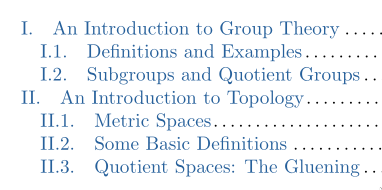
We're doing quotient space today
(Some basic definitions includes topological space + continuous + connectedness, which they're also getting some of in class)
they really like the topology stuff so far. I could cover some elementary number theory or combinatorics if we wanted to?
marsh forge
Do some computability theory
or some dynamics
rotations of the circle is the example that keeps on giving
or expanding maps of the circle
obtuse meteor
idk anything about either of those lol
marsh forge
not 2 late 2 learn
marsh forge
its cool!
The two even intersect
the theory of like ML random points of a computable metric space
is cool stuff
 crimson imp
Hey, guys, is this set simply connected? I’m trying to define a universal cover and need this condition. As I draw it’s a subset of $R^3$ consisting of one of the axis with a bunch of tangent spheres which doesn’t intersect each other
 gentle ospreyBOT
pmorelli
 marsh forge
You can prove it is simply connected
I assume you've seen SvK
if you're doing covering theory
crimson imp
I’m studying covering theory but what do you mean by SvK?
marsh forge
Seifert Van Kampen
marsh forge
interesting
well
it makes computing this pretty straightforward
but to answer your question yes it is simply connected
(and the universal cover of S^2 v S^1 if thats what you are going for)
crimson imp
Ok, I’ll try applying it
crimson imp
marsh forge
(and the universal cover of S^2 v S^1 if thats what you are going for)
Yes, that’s the base space
Thanks!
marsh forge
np
try computing it for just one sphere wedged with the axis
its the same for countably many
but it might be less intimidating
obtuse meteor
you can also do it by applying CW complex stuff
CW complexes are homotopy equivalent to quotienting by a subcomplex
so just identify the line
then this is a wedge of spheres
a sphere is always simply connected
and wedge of simply connected is simply connected
this is how I would do it because I avoid SvK like the plague
marsh forge
obtuse meteor
CW complexes are homotopy equivalent to quotienting by a subcomplex
you mean contractible subcomplex right
fading vale
SvK makes a lot of sense when u think about it in terms of "when do properties of Top get preserved under the fund. groupoid"
before that i always found it kinda unintuitive
sleek thicket
pushie pushie
 sleek thicket
obtuse meteor
poll: should I introduce homotopies to my real analysis students next week at th...
sleek thicket
obtuse meteor
poll: should I introduce homotopies to my real analysis students next week at th...
I have a very good memory of my frosh analysis TA trying to explain de rham cohomology in section when we were doing div/grad/curl
he got yelled at by the professor after the prof found out, apparently
marsh forge
fading vale
SvK makes a lot of sense when u think about it in terms of "when do properties o...
bad take
SvK is like
so visually justifiable
you dont need to think about it w category theory at all
Its just like
fading vale
it is when the intersection is trivial
marsh forge
even nontrivial
fading vale
it never was intuitive to me when it was nontrivial
marsh forge
well i dont think ive seen a text
that explains it well
but the quotient you take is literally like
okay so you have loops in space 1 and space 2
they can interact freely
but what loops should we identify
if you look at a picture and think hard about it
i think you'd come up w exactly the relations induced by SvK
marsh forge
like you're basically identifying things that can be made into eachother
by homotoping them through the intersection
fading vale
ik i have the visual intuition now
marsh forge
?
i dont see how the categorical approach could have given you the visual intuition lol
fading vale
it made me understand the whole picture better and when i went back and thought about it more intuitively it clicked
marsh forge
okay
i think you could have achieved the same result without the detour
but whatever makes it click ig
(this is a good example of the type of thing a lecturer can do better than textbooks, though)
fading vale
¯_(ツ)_/¯
idk seeing the pushout coproduct stuff made it clear to me that we were basically identifying the two copies of the intersection
but i also think maybe hatchers style where it was really long with a lot of exposition kind of obscures the big picture sometimes
fading vale
like the relationship between free products in group and unions in Top was vague to me
seeing it categorified made it really obvious that like oh these are the same so it makes sense that under some conditions one would become the other
fading vale
i dont think its necessary per se but it was good for me
marsh forge
but i think sometimes the niceness of categorical language can prevent people from understanding more fundamental basic/concrete stuff
you went back and understood it
so i dont mean you in particular here
fading vale
honestly if i hadnt done hatcher i dont think dieck would do anything valuable for me
like ur not wrong that the categorical approach alone i think can be a little unhelpful
but having already seen it from the more visual perspective the categorical approach i guess "organizes" it in a way that i find nice
also sometimes its just very neat when the two seem really different but get the same results
like hatcher doing universal covers very directly by constructing them and going for the unwinding loops perspective vs dieck doing that stuff with a fiber sequence of the htpy groups is neat
obtuse meteor
marsh forge
you mean contractible subcomplex right
yah lol
obtuse meteor
marsh forge
you still need SvK
yeah I know
obtuse meteor
sleek thicket
I have a very good memory of my frosh analysis TA trying to explain de rham coho...
based
marsh forge
fading vale
also sometimes its just very neat when the two seem really different but get the...
this is incredibly important
im not anti-categorical stuff
i just feel like a lot of people disregard the concrete stuff
for the abstract nonsense
fading vale
i feel like that would suck
marsh forge
and as a result end up being unable to compute basic stuff
fading vale
i think dieck is enjoyable for me as a second very different perspective on intro AT
not really as a primary or first one
obtuse meteor
I agree that SvK is very visually intuitive
I haven't done groupoid version
haven't needed it
fading vale
the groupoid version is pretty much the same honestly
you just dont have to think about basepoints
obtuse meteor
doesn't it allow you to do ridiculous things tho
marsh forge
no
marsh forge
idk if thats 'ridiculous'
fading vale
it does but like
obtuse meteor
it is to me
marsh forge
it seems 'pathologically overcomplicated'
obtuse meteor
I mean traditional SvK can't do anything like that lol
marsh forge
yes its more general
and good for computing particularly tricky fundamental groups i guess
fading vale
also faye the version of that proof i saw is like
honestly its not that different from the normal covering defn at least intuitively you still use the exp map
it still involves a morphism from the groupoid of R to the groupoid of S^1
sooooooo
fading vale
you dont
marsh forge
i think there aren't that many times where the categorification approach
isnt just like
a better organized version of the same thing
there are a few examples
fading vale
i can send it but the basic idea is that you define a topological groupoid using the covering map from R -> S^1
so its really not that different xd
obtuse meteor
lol
I guess like correct me if I'm misinterpreting
but SvK will tell you that you're like some pushout of groupoids
two of which are an R groupoid
sharing a common 2 point groupoids
and the issue is that like
to compute the pushout
you essentially end up doing the same work?
marsh forge
oh man
this would be
a fun REU project for an apprentice
i feel
give like 3-4 proofs of \pi_1 S^1
obtuse meteor
lol
marsh forge
and compare them
very cute expository that would involve a lot of learning
ill keep it in my back pocket
fading vale
ehhhh like basically the idea is you define a topological groupoid G
like this


you end up with this kind of situation
marsh forge
jesus
fading vale
lmao right

 obtuse meteor
ah this is what I expected then
fading vale
then you take a basepoint
fading vale
yea
obtuse meteor
(tm)
fading vale
its not like awful and you dont have to develop much theory to pull it off but i honestly dont understand why groupoids are so valuable
or why anyone cares that much
the proof of van kampen is like the only thing
obtuse meteor
is there a nice theory of presentations of groupoids?
and like
if you have presentations what happens when you take a pushout?
sleek thicket
topology and groupoids does a theory of presentations
obtuse meteor
this is what makes computing with groups nice
bc like
you can just use presentations for everything you know
and a presentation pops out from SvK
is this proof nicer when you have a theory of presentations?
@sleek thicket here's some meme material--I could technically do two REUs this summer (idk if this is allowed or not, but I could if it's not expressly disallowed)
(this would be helpful bc I need money to pay for college lol)
sleek thicket
I don't think that's a good idea but it is a meme
obtuse meteor
no it's a terrible idea
namely this is bc UMich doesn't have like
a set timeframe
it has to be 8 contiguous weeks with nothing else going on during those weeks
but SMALL is towards the latter half of the summer,,,
and if I started early,,,
sleek thicket
oh yeah u mich got back to my email asking about decisions and told me it'll be like a month until they're finished and I should take u chicago
marsh forge
category memes are okay if you can do the concrete things when its time
fading vale
still think max should start pulling some strings to sneak me in but whatever
marsh forge
theres a great (perhaps apocryphal story)
about a grad student of Peter May's
who was so category pilled
he failed an interview question
that asked him to compute H_*(S^2)
with mayer-vietoris
marsh forge
if you cant
put down dieck
and go do it
lol
you should already have done it before
fading vale
yea
marsh forge
i just mean H_k for all k
fading vale
yea i vaguely remember this
obtuse meteor
I wonder when we'll see Mayer-Vietoris 🥺
sleek thicket
Lee yelled at me on homework for using MV
fading vale
i read the cohomology chapter
marsh forge
why
fading vale
4head
marsh forge
MV is good
sleek thicket
Instead of just looking at it as a polygonal presentation
fading vale
homology and cohomology computations r so fun
marsh forge
gross
sleek thicket
I had a space I wanted to show was the klein bottle
marsh forge
fading vale
homology and cohomology computations r so fun
im basically planning to do a phd in them
fading vale
based
fading vale
ur done w/ apps right?
sleek thicket
"literally just track how it glues"
sleek thicket
no lol
marsh forge
can you even use H_* to identify the klein bottle
sleek thicket
yes
sleek thicket
It was easy to see its a compact surface
 desert bloom
hello

so I got iii.) wrong
and I kind of understand why
I think I have a fundamental misunderstanding
what exactly are the rules for taking the union of two subspaces?
fading vale
wdym "rules"
desert bloom

This is the answer I got
how exactly does the topology of the spaces come together exactly?
lemme think how to phrase this
fading vale
uhh im pretty sure whoever was grading you is wrong because if this was false then literally every topological space would be connected
in fact the defn of disconnectedness is that there exist such an A, B (disjoint, open, non-empty) whose union is X
desert bloom
I don't think its a general case
I think he means that there exist a space such that this is true
fading vale
and furthermore ur example is correct
desert bloom
bad phrasing
fading vale
what did u say then? true?
marsh forge
Can you phrase your question a little more precisely
do you understand the counterexample?
marsh forge
Or why the result should be false in general?
desert bloom
I don't understand anymore
fading vale
but i can see why itd be confusing if you havent learned about the disjoint union topology
desert bloom
wait what?
fading vale
^