#point-set-topology
1 messages · Page 206 of 1
 tough imp
Okay yup
 sleek thicket
anyways I think this is a valid reduction to the case R = Z
break out the cover {U0,...,Ui} of Vi
write down the equalizer condition
tough imp
Right
tough imp
I feel like somehow this wasn’t how they intended to you to go about this but I like it
tough imp
To do what?
sleek thicket
but I realized I was implicitly working over a field
well I have a map O_X(Vi) -> product
in the sheaf condition
right?
tough imp
Like the first map yeah
sleek thicket
yeah
tough imp
Right
sleek thicket
integralness should tell you things about the image
tough imp
Hmm
tough imp
Hmmm
This is a map from an integral domain (if it was integral) into some product
And you’re saying you can’t like map into disjoint parts?
tough imp
I mean I agree
You can probably just do it manually over Z too if for some reason that ends up being easier
I know for defining the segre embedding I reduced to Z
sleek thicket
yeah I mean like
tough imp
But now that I think about it
tough imp
I don’t think I used anything special to Z besides maybe it being integral
sleek thicket
anything to reduce complexity
tough imp
Yeah
Better to know you can do it and then just if at any point you go “if this was Z then...” then well... it is Z
sleek thicket
right lol
sleek thicket
@gritty widget if T is some 2-tensor, is <g, T> anything nice?
 gritty widget
maybe you can write it in like normal coordinates or something and it turns out to be something good
since in normal coordinates centered at a point p, the matrix of g(p) is the identity
idk
sleek thicket
Was hoping it was like a trace somehow
gritty widget
my proof for that problem used normal coordinates lol
sleek thicket
Your problem nerdsniped me
gritty widget
i wouldn't be surprised if it's like a trace or related to the trace
i don't really wanna check rn though
 mossy shoal
Can someone suggest a problem set with solutions for topology
gritty widget
go open up a copy of munkres, you can find solutions online in your brain
 shut moat
is the zarski topology related to the finite complement topology in any way? 
My professor keeps calling the latter the former
wiki pages suggest they're not lol
 marsh forge
idts
shut moat
ty
gritty widget
Oh, but they are the same in dimension 1 or something like that right?
 tight agate
yes, for curves over an alg closed field
(assuming you're working in the classical setup)
all curves over an alg closed field are homeomorphic
in the zariski top
sleek thicket
shut moat
is the zarski topology related to the finite complement topology in any way? <:t...
the zariski topology on the line has closed sets the zero sets of 1-variable polynomials
a set is the zero set of some polynomial iff it is finite
so like if X = {a1,...,an} is some closed set in the cofinite topology then X is the vanishing set of the polynomial p(x) = (x-a1)...(x-an), and conversly the vanishing set of a (one variable) polynomial is finite
but in higher dimensions this is not true. the y-axis {(x,y) : x = 0} is closed in the zariski topology on the plane because it's defined by a polynomial equation, but it isn't finite
gritty widget
is this or abstract-algebra better for algebraic geometry talk
(not trying to say you guys should move, just wondering for my own sake if i need to ask)
 ivory dragon
either fits but i'd probably consider this a better place
#groups-rings-fields generally has a lot of first semester groups/rings/modules stuff
 long coyote
a point $x\inX$ astrong limit pointof $A$ if the intersection $N\cap A$ is infinite for any neighborhood $N$ of $x$. In T1, every open neighborhood $\mathcal{O}$ of $x$ contains infinitely many points of $A$, then $x$ automatically is a strong limit point
 gentle ospreyBOT
亜城木 夢叶
Compile Error! Click the  reaction for more information.
(You may edit your message to recompile.)
 gritty widget
What if the T1 space is finite?
long coyote
T1 has no limit points
gritty widget
\begin{align*}
\mathrm{Vol}(\tilde{M}) = \int_{\tilde{M}} dV_{\tilde{g}} &= \sum_{i=1}^m \sum_{j=1}^k \int_{(\varphi_i \circ \pi)(U_i^j)} ((\varphi_i \circ \pi|{U_i^j})^{-1})^*( \psi{i,j} dV_{\tilde{g}} ), \
&= \sum_{j=1}^k \sum_{i=1}^m \int_{\varphi_i(U_i)} (\varphi_i^{-1})^* \left( (\psi_{i,j} \circ \pi|{U_i^j}^{-1}) (\pi|{U_i^j}^{-1})^dV_{\tilde{g}} \right) \
&= \sum_{j=1}^k \sum_{i=1}^m \int_{\varphi_i(U_i)} (\varphi_i^{-1})^\left( (\psi_{i,j} \circ \pi|_{U_i^j}^{-1}) dV_g \right),
\end{align*}
gentle ospreyBOT
(T*(Terra), -dτ)
 sleek thicket
The sick, degenerate mind of a differential geometer
 pastel linden
one look at those equations and it could literally only be partitions of unity
yucky
(but handy)
speaking of which that reminds me that I wanted to read the PoU section in tu
gritty widget
it's worth it to read the construction at least once
it's very general-topological
and also you can see how second-countability is required in the definition of a manifold to get partitions of unity
(which is also why some authors say that manifolds are paracompact instead, since that also implies existence of pou's)

 nimble jolt
it's just making bumps in R^n and putting them in places.
shut moat
sleek thicket
so like if X = {a1,...,an} is some closed set in the cofinite topology then X is...
ooh, so that explains why he flipped them ig
also partitions of unity are great wtf
they're so slick
sleek thicket
they are based
 tight agate
sheaf cohomology goes brrr
sleek thicket
say $X$ is a space whose topology is coherent with the cover ${X_i}{i \in I}$ and $S$ is a subspace. What condition on $S$ and the $X_i$ are necessary/sufficient for $S$ to have topology coherent with ${S \cap X_i}{i \in I}$? I was hoping it's always true but I can't prove it
gentle ospreyBOT
Shamrock emoji ☘
 sleek thicket
I have a proof in the case each X_i is open but that's useless to me unfortunately
sleek thicket
stuck in gentop hell again
I think if $p : \tilde{X} \to X$ is a covering map with finite fibers then $p$ is closed
gentle ospreyBOT
Shamrock emoji ☘
 sleek thicket
say $C \subseteq \tilde{X}$ is closed
gentle ospreyBOT
Shamrock emoji ☘
 sleek thicket
it suffices to show $p(C) \cap U$ is closed in $U$ for any evenly covered open set $U$
gentle ospreyBOT
Shamrock emoji ☘
 sleek thicket
hmm if the map were normal this would be trivial
I think it actually suffices for me to prove this case but w/e
so okay anyways
$p^{-1}(U) = V_1\cup\ldots\cup V_n$
gentle ospreyBOT
Shamrock emoji ☘
 sleek thicket
$p(C) \cap U$ is closed in $U$ iff $p^{-1}(p(C) \cap U) = (p^{-1}(p(C)) \cap V_1) \cup \ldots \cup (p^{-1}(p(C)) \cap V_n)$ is closed in $p^{-1}(U)$
gentle ospreyBOT
Shamrock emoji ☘
 sleek thicket
or really $p^{-1}(p(C)) \cap V_i$ is closed for some $i$
gentle ospreyBOT
Shamrock emoji ☘
 sleek thicket
figured it out
 median glade
I'm having trouble thinking of a map between CW complexes that isn't cellular 🤔
sleek thicket
Take the antipode map on the circle, where we build the circle by attaching a line segment to one point. The 0 skeleton is sent into the 1 skeleton
this is cellular with respect to another cw structure on the circle
but not the one I've given
I think a rotation by an irrational multiple of π might not be cellular with respect to any cw complex structure but I'm not sure
median glade
Why is this not cellular?
it seems to me that you've just described this situation?

Hmm, so one example I've come up with since is to have a space Y, where you attach a 2 Disk to a point, to make a sphere
and then you have a circle X, from linking a point to itself, which you wrap around this sphere
then you can't find skeleton maps at all
sleek thicket
median glade
What?
Take a point
Attach a line to it to get a circle
The antipode map sends the point you started with to some point in the 1 cell
So it maps the 0 skeleton into something which is not the 0 skeleton
gritty widget
So I've never actually had to explicitly work out an integral on a manifold. Now I realize I do not know how to do it.
If I want to integrate $\omega=sin(\theta)d\theta \wedge d \varphi$ on $S^2$
gentle ospreyBOT
lime_soup
 gritty widget
I'm guessing this is the same as just integrating sin(x)dxdy with the proper limits?
 uncut surge
The general formal procedure for the integration of forms is: Cover your manifold with charts $\psi_U : U \to M$, decompose the form you want to integrate with a partition of unity $\omega = \sum \rho_U \omega$ so that every summand is supported in one of the images of the charts, and then calculate the integrals of the pullback forms $\psi_U^* (\rho_U \omega)$
gentle ospreyBOT
Lartomato
 uncut surge
'cause that last thing is just a form on some open set of $\mathbb{R}^n$ where things can be integrated with yer boy lebesgue
gentle ospreyBOT
Lartomato
 uncut surge
For the sphere, the good thing is that you can cover it with a single chart up to a zero set, using polar coordinates; so you only need to find that chart and pull back your form
uuh, that is the abstract theory in general, once it comes to juggling with explicit expressions like d \theta \wedge d \phi i need to actually start up my brain
uncut surge
I wish, most books I know keep this very abstract, they just always have a single exercise of calculating some spherical integral lmao
Maybe someone else has a book
But I guess the way that d theta and d \phi are defined, they are exactly the forms which, when pulled back to the domain of the domain of spherical coordinates (0, pi) \times (0, 2 \pi), they correspond exactly to "dx" and "dy"
So you were probably right all along
Thinking about it in this level of abstraction even feels a bit silly, because when you write a form on S^2 using the polar coordinates theta and phi, you're never really leaving the chart-description, so you don't really see the pullback at all
gritty widget
uncut surge
Thinking about it in this level of abstraction even feels a bit silly, because w...
ah thank you
No, i do appreciate linking the abstract stuff back to reality
 summer jolt
Hey, I'm trying to get my head around what is the difference between a retraction and a deformation retraction. My definition of retraction is: A continuous map $r: X \rightarrow Z$ s.t. $r(z) = z \in Z, \forall z \in Z$
And for a deformation retraction I was told: A continuous map $h: X \times [0,1] \rightarrow X$ s.t
$$\begin{align}h(x,1) = x \in X, \forall x \in X \
h(x,0) \in Z \
h(z,0) = z , \forall z \in Z
\end{align}
$$
But I'm struggling to interpret these definitions.
gentle ospreyBOT
snypehype46
Compile Error! Click the reaction for more information.
(You may edit your message to recompile.)
 summer jolt
For example in the definition of a retraction are only the points in the subspace Z that are sent to Z. What happens to the points not in Z?
shut moat
gritty widget
Do you know a good book with some examples
Hubbard & Hubbard!
it describes it backwards in terms of parametrizations instead of charts, but it goes through a whole section developing the "chart that covers a manifold up to a zero set" thing
(also only considers submanifolds)
__
clarification: partitions of unity only show up as a tool to prove stoke's thm
summer jolt
@gritty widget ok so would the identity map be a retraction?
On this point, I have some doubts because my definition was: A continuous map $r: X \rightarrow Z$ s.t. $r(z) = z \in Z, \forall z \in Z$. However, I'm confused about the domain. It seems that the domain is Z, but then I don't see how the identity is not a retraction since it doesn't change any point in Z.
gentle ospreyBOT
snypehype46
 summer jolt
Ok right but there is a "for all z in Z", right. So essentially r only concerns itself with Z not the entire space X
 obtuse meteor
my topology professor graded our exams so quickly wow
r has to map all of X into Z
but it has to be the identity on Z
is the restriction
easy disproof is every space retracts to a point trivially
and deformation retract shows homotopy equivalence, and not every space is contractible
I think @summer jolt the thing you want to think about is that deformation retracts have a time parameter
so you can imagine points in X continuously moving to points in Z over time
whereas a retract is sudden
mapping all of S^1 to the point (1, 0) is a retract, because all constant maps are continuous
but you can't make a deformation retract out of this, because you can't envision it happening over time
it would somehow "break" the circle
summer jolt
obtuse meteor
r has to map all of X into Z
Ok this makes sense. So for example (forgetting about continuity for a sec), if X = {0,1} with Z = {1}, then f(x) = 1 is a retraction right but id(x) is not because the codomain is not Z.
obtuse meteor
it's a kinda subtle and hard difference to understand bc it pushes up against visualization in some ways
yes
id : X -> X is a retraction of X onto X
but not a retraction of X onto Z
gritty widget
That's if X is not subset of Z?
obtuse meteor
Z is a subspace of X
gritty widget
Oh okay
summer jolt
Ok and going back to my definition of deformation retraction: A continuous map $h: X \times [0,1] \rightarrow X$ s.t
$$\begin{align}h(x,1) = x \in X, \forall x \in X \
h(x,0) \in Z \
h(z,0) = z , \forall z \in Z
\end{align}
$$
What is the meaning of the first and last condition?
gentle ospreyBOT
snypehype46
Compile Error! Click the reaction for more information.
(You may edit your message to recompile.)
 obtuse meteor
The first condition tells you that h is the identity at time 1
and the last condition is,,,written wrong lol
oh well that's fine actually
there's just an equivalent way to do it I'm pretty sure
 wanton marsh
who is Z
obtuse meteor
the last two conditions guarantee that h is a retract of X onto Z at time 0
marsh forge
coho the difference is that in this defn that he sent
we aren't given a retraction to start with
so theres no need to care about what the htpy does outside of z
because r(x):=h(x,0) is a retraction
obtuse meteor
yeah we give a slightly stronger def in my class
but I think they're equivalent
namely that F_t(z) = z for all t and z in Z
marsh forge
thats normally called a strong def retract iirc
and i dont think its equivalent even up to htpy
but i dont have a counterexample in mind
should be in hatcher ch0 i think
MSE cites Hatcher exercise 6 ch0
sorry for derailing @summer jolt did we answer your question?
obtuse meteor
ahh I see
we only talked about the strong ones
and I just call them deformation retracts so I didn't think about it lol
summer jolt
@marsh forge that was helpful. I will try to draw a picture and post it here to see if I get it.
obtuse meteor
@summer jolt do you know the general definition of a homotopy between two continuous maps?
summer jolt
obtuse meteor
<@!704434692258005102> do you know the general definition of a homotopy between ...
Yes
obtuse meteor
yeah
then a weak deformation retract is just a homotopy from the identity to a retract is a good definition
the three conditions given there
gurantee h_1 is the identity
and h_0 is a retract
marsh forge
def retracts are nice because they let you know that there is an isomorphism on invariants and also that the generators are exactly what you expect bc the retract is a retract
and you dont need strong to get that
A good example is taking an annulus and including S^1 into it
obtuse meteor
yeah, I don't think we've stated it formally
but in computations it has been pretty easy to write down generators after doing a deformation retract
summer jolt
So this would be a deformation retraction right?
 summer jolt
However if I have a hole on one side of the cylinder then I can't do a deformation retraction but could technically still do a retraction
obtuse meteor
yes
summer jolt
Ok I see, what would be h(x,0) here?
obtuse meteor
a projection map
onto the first coordinate (the S^1 coordinate)
which is your retract
have you learned about how retracts interact with pi1?
summer jolt
And h(x,1) is the identity right?
summer jolt
Ok I see, I was kind of confused because the time coordinates seem "reversed"
obtuse meteor
yeah I agree
usually I use the opposite time convention from what your definition was
summer jolt
That makes sense thanks a lot I get it now!
marsh forge
yes
come to the dark side
this channel has been too much smooth stuff lately
we need more topology and less geometry
obtuse meteor
I don't like smooth stuff at all so I am welcome to talk about this a ton :)
obtuse meteor
not yet
obtuse meteor
we're gonna do covering spaces though
marsh forge
its JUST SO NEAT
obtuse meteor
don't know if we'll get galois covering
marsh forge
ah ur close then
obtuse meteor
the class has to do like
marsh forge
you 100% will i think
the whole point of covering theory is to make computing pi_1 easier
obtuse meteor
a lot of stuff bc like quals prep lol
marsh forge
and make computing pi_n trivial
obtuse meteor
here's the course description
Course Description: This course covers the fundamentals of algebraic topology. Topics include fundamental group, covering spaces, simplicial complexes, graphs and trees, applications to group theory, singular and simplicial homology, Eilenberg-Steenrod axioms, Brouwer’s and Lefschetz’ fixed-point theorems. This is one of the basic courses for students beginning study towards the Ph.D. degree in mathematics, and preparation for the corresponding qualifying exam.
We should talk more about topology
marsh forge
Thats a great curriculum
missing higher homotopy groups
but honestly theres not a ton to say about them in a first course other than
they exist
they are abelian
good luck computing them
obtuse meteor
lmao yeah basically that's what our prof said
"take the next alg top course if you want to learn about higher homotopy groups"
marsh forge
heres a fun theorem though
if Y is a cover of X then they share higher homotopy groups
maybe you need X to have some adjectives
obtuse meteor
lol
that is a fun theorem
My brain went gigantamax mode on my topology exam and I remembered a random comment from someone about how covering spaces tell you the subgroups of your fundamental group that someone told me a few months ago or something
which allowed me to answer a True False Question correctly
even though we hadn't covered that
(the question was "There does not exist a cover of S^1 by S^1 wedge S^1")
marsh forge
obtuse meteor
My brain went gigantamax mode on my topology exam and I remembered a random comm...
this is galois covering theory
obtuse meteor
good and based
marsh forge
obtuse meteor
even though we hadn't covered that
covered that
obtuse meteor
yes
marsh forge
Did they give you the expected answer
/ do you have a geometric reason why there isnt one
 sonic hill
Wonder if you can prove that using the idea that the point where the circles join isn’t locally homeomorphic to any point on the circle
obtuse meteor
we didn't have to justify true things
marsh forge
there is nothing you can map that too on S^1
obtuse meteor
bc it's two-dimensional there
I realized my "solution" was wrong because of that
but I couldn't figure out why there couldn't be some weird one
and convinced myself of it from the algebra reason
marsh forge
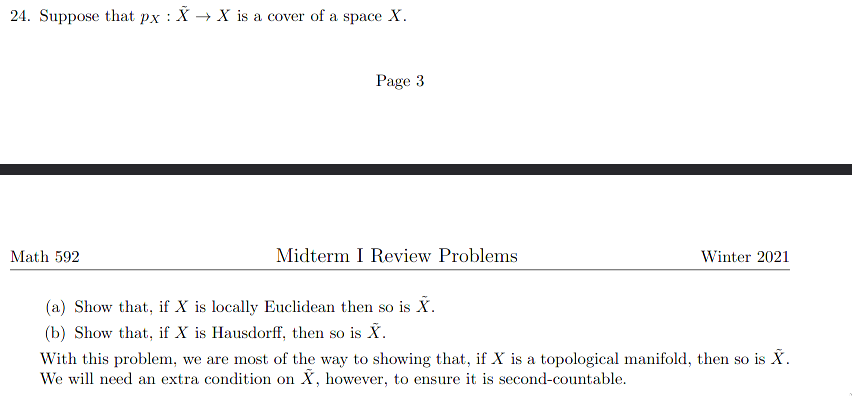
A cover of a manifold should also have to be a manifold because the local homeos should lift local euclideanness
obtuse meteor
(it's obvious geometrically now)
marsh forge
ive never heard that stated but it should be true
obtuse meteor
yeah this was a problem on our study guide actually
marsh forge
you soln was a good one though
marsh forge
although it requires some thought about why pi_1(S^1vS^1) can't be a subgroup of Z
obtuse meteor
 obtuse meteor
yeah abelian
marsh forge
yeah thats easy
obtuse meteor
that's what I thought yeah
obtuse meteor
apparently there's some point set extra condition on your covering space
or else it's not a manifold
probably something like long line covers something that's a manifold
obtuse meteor
yeah it does was to specific problem
marsh forge
I doubt it covers R^2 but maybe im wrong
marsh forge
yeah ur not getting a local homeo
obtuse meteor
sometimes I envision long line as like
a plane with a weird topology
bc long line weird
and there is a bijection
sonic hill
I think of the long line as a line where every increasing sequence converges
 lyric wadi
Hey, so I was wondering if there were any texts which could serve as a good introduction to studying top/pl/diff/btop etc?
For context, I have some knowledge of singular homology/cohomology, de rham cohomology and a very basic acquaintance with stuff like plumbing/fibre bundles etc so feel free to tell me there's so much more I need to understand first (and hopefully some stuff that might be good to read while I'm at it)
lyric wadi
yeah
marsh forge
interesting, no I'm not sure.
I think a good idea is to compare the history of the Poincare Conjecture in all of them
lyric wadi
basically I want to understand what it means that the kirby-siebenmann invariant is an obstruction to lifting
and similar stuff
marsh forge
idk if there is anything that compares them maybe you should write up some notes haha
i'd read it
lyric wadi
fair lol
I guess I'll go bury my head in some category theory and hope stuff starts falling into place
obtuse meteor
I think we weren't intended to like actually do all those for review
just like give each a look and solve the ones which were interesting and stuff
the ones to focus on were true/false and fundamental group calculations
the fact that when you puncture a fundamental polygon you can deformation retract to the boundary of the fundamental polygon and it works with all the gluing
is honestly OP for a lot of these
gritty widget
Can I someone help me with the hodge star operator
I’m comfortable with it abstractly but cannot calculate with it
Say we have \omega=sin(\theta)d\theta wedge d\phi
 heady grove
How would i show this field is axis symmetry

 chrome dew
I'd look at the symmetry of the quadratic surface u dot u = c for a constant c
heady grove
i have a feeling this field has been rotated somehow? it should be 2D
@chrome dew
i think
chrome dew
what you said doesn't seem to have anything to do with what I said
heady grove
yeah i know
Say i rotate this by z->-z, x->-x and y->-y
this gives back the same field
so in symmetric on rotation
heady grove
i dont quite understand why that works
chrome dew
what you're saying is just a special case
it's looking at for what values u is constant
which defines a level surface
symmetries of this level surface are the symmetries of your field
gritty widget
Does anyone know conditions for a one form, such that the integral of that one form does not depend on the choice of path in your space?
If we are in R^n stokes theorem gives us that being closed is sufficient
For the context I am trying to do this
 bitter yoke
These are called exact differential forms I think
gritty widget
Really? I know that A is exact if A=dB
But I don’t see how this implies that the integral of A around a path is constant
Oh
If we are only talking about closed paths then this should work
sleek thicket
Closed should be enough
In fact I think it's equivalent
No, I am lying
I misunderstood the question
Thought it was about homotopy invariance of paths
ISM proves exact iff only integral depends only on endpoints
gritty widget
Ism?

 gritty widget
Would like to see him do a characteristic class book
sleek thicket
Well they're showing up in my bundles class
Today we did stuff with the chern classes
But he's not doing eg the construction of them
So he probably won't write a book on the subject
gritty widget
My manifold knowledge is so strange
I did point set topology
Then moved uni for a masters
And the masters diff geom started with vector bundles, principal bundles and finished with chern-gauss-bonnet theorem
So
I suck at manifolds
gritty widget
Thumb reveal? OwO
sleek thicket
Starting with topological spaces and ending with like, stokes theorem/de rham coho/foliations
gritty widget
Done a good manifolds course in the bachelors
gritty widget
Yeah I’ve used myself
But never taken a course with it
And I’ve done cohomology operations like steenrod squares
But not fundamental group
sleek thicket
Wtf
sleek thicket
That seems like a tough situation
sleek thicket
Nice!
gritty widget
But it is funny
Doing a problem and getting it down to some statements that sounds like it should be true
But I don’t know enough of some bachelor course to know if it is
sleek thicket
Lol
gritty widget
Like lmao I’ve never taken proof based linear algebra
sleek thicket
same lol
sleek thicket
I think of all that stuff in the context of like, modules over a PID
gritty widget
Big ty
heady grove
 gritty widget
Topkek
sleek thicket
this is why honorables should get delete powers again
obtuse meteor
actually this is a great reason why they shouldn't

 little hemlock
Let X be a regularly embedded submanifold of M. What does the pushforward of the inclusion look like? Is it injective with rank equal to dim X?
gritty widget
sounds right
"embedded submanifold" usually means "inclusion is an embedding" (immersion, homeo onto image)
little hemlock
makes sense. Thanks
gritty widget
does anyone have any intuition behind the iso $[\Sigma X, Y]\simeq [X, \Omega Y]$
gentle ospreyBOT
spinsicle
 gritty widget
for like S^ 1 or something
 digital peak
heady grove
digital peak
heady grove
this is how I imagine @cedar pebble
gritty widget
oh, ng is a pothead?
marsh forge
gritty widget
does anyone have any intuition behind the iso $[\Sigma X, Y]\simeq [X, \Omega Y]...
Are you familiar with currying or tensor-hom adjunctions
Another way of writing this is $[X\wedge S^1,Y]=[X,Maps(S^1,Y)]$
gentle ospreyBOT
MaxJ

 cedar pebble
gritty widget
oh, ng is a pothead?
cedar pebble
gritty widget
oh, ng is a pothead?
Yea lmfao
gritty widget
Hi, do you guys have content about the Kay-Wald boundedness theorem ? Intuitive explanation or not too hard proof would be awesome
ivory dragon
where is this coming up? it's a fairly recent result so i doubt there'll be a particularly easy proof
gritty widget
I'm working on a project for a Mathematical course ("mathematics of wave equations of general relativity")
And ... I'm a physicist
So it's quite hard, not to say really hard to try to understand
I didn't find any conference or video lesson either unfortunately
ivory dragon
i skimmed the paper (https://iopscience.iop.org/article/10.1088/0264-9381/4/4/022) and i'll confess i'm not familiar with a lot of the terminology they use, so i'd wager you'd have better luck asking in a space for physics than math
although if anyone here can offer anything it'd certainly be welcome
gritty widget
I'll try that thank you
btw https://arxiv.org/pdf/0811.0354.pdf this is the paper on which I have to work. And I need to focus on the 3. and 4. chapter
 pliant marsh
I'm trying to show that the Zarinski topology on R agrees with the cofinite topology on R. I was wondering if this reasoning is enough?

Furthermore I'm not entirely sure on what "agree" actually means, does it mean that I have to show that all open sets in one topology is open in the other and same with closed sets?
marsh forge
yeah that looks fine
you might want to justify why V(P) is finite
as thats like the main thing
but thats obvious
pliant marsh
alright cool, thanks
gritty widget
nitpick: you may want to amend your first sentence to also include the empty set
pliant marsh
oh yes, will do
gritty widget
also, the logic is slightly weird, "[V(P)] is indeed finite if P is non-zero", but you really want to know that V(P) is always finite and can be made to correspondn to any finite set
what you said implies only that the zariski topology is coarser than the cofinite topology
pliant marsh
Oh I see, so I'd have to do the converse as well?
gritty widget
i guess you can think of it like that
you can certainly do it by "every open set in the cofinite topology is open in the zariski topology" and vice versa. or you can just do it by characterizing all open sets in the cofinite topology and all open sets in the zariski topology, and showing that they are the same (which sounds like the way that you want to do it)
pliant marsh
Hm I think I'll do it the first way, since I have more of an idea of how to do that. What I wrote down is just random thoughts written in a formal manner so I'm not really sure how that corresponds to the second way haha.
gritty widget
the second way essentially amounts to showing that ${{x \in \mathbb{R}: P(x) = 0}: P \in \mathbb{R}[x]} = {A \subseteq \mathbb{R}: |A|<\infty} \cup {\mathbb{R}}$
gentle ospreyBOT
8da
 gritty widget
where you have already pointed out that the LHS is a subset of the RHS
pliant marsh
ah okay I see, thank you I'll go with that then
summer jolt
Hi, I've got a question about the definition of intersection multiplicity for intersections between algebraic curves. This was the definition given to me

I don't quite get what the definition means by the ideal I. In my abstract algebra course,we defined ideals as subsets that are closed wrt addition, negatives and absorbs products. So here what are the ideals generated by f(x,y,1) and g(x,y,1)
marsh forge
smallest ideal containing both
summer jolt
@marsh forge ok so suppose we consider two curves let's say $y^2 z = x^3$ and $y=0$, then what is the ideal?
gentle ospreyBOT
snypehype
 marsh forge
Sorry when it comes to this kind of computation I'd need to be more careful bc I dont think about it often, but the intuition is that you make the ideal by throwing in f,g, and then everything else needed to make it an ideal (for example, you'd have to add f+g, -f,-g, etc)
summer jolt
So all linear combinations of f(x,y,1) and g(x,y,1)?
 west brook
Would anyone like to help me try to formalize the concept of a geometric conjugate?
gritty widget
Does anyone have a good intuition for uniformizers and divisors?
 sweet wing
i only know them through number theory 
gritty widget
do you have a good intuition for them through number theory?
 trail ibex
Maybe just shoot your question and see what comes up ?
 cursive flume
how can one prove the polarization identity for the einstein tensor?
rather: why is the einstein tensor a symmetric bilinear form?
 flint cove
This is not really my topic, but doesn't symmetry follow from symmetry of the ricci tensor and the metric tensor?
And bilinearity since it's a linear combination of 2-tensors
cursive flume
right makes sense
sleek thicket
@fading vale hello
gentle ospreyBOT
Moth | not male

 fading vale
hi shamrock
sleek thicket
locally trivial as in a locally trivial fiber bundle?

 fading vale
uh anyway the part of the proof im confused about
gentle ospreyBOT
Moth | not male
 sleek thicket
sorry I just started an irl thing but I'll look in like 10
gentle ospreyBOT
Moth | not male
 fading vale
(U x {b} i meant obviously)
so i assume he means an automorphism in the slice category over U or something


 fading vale
but then idk how youd extend it
im gonna move on for now and just assume this but if anyone could ping me if they figure it out that would be nice lmao
fading vale
ok wait nvm that was silly
f obviously gives rise to a map on U and then that gives rise to a map f_x U x {x} for any x in [b, c] so u can let the automorphism g be given by the f_x on every U x {x} i think
and then glue phi and g circ psi
yeah nvm u can ignore this i had to work out some kinks in what i described above lmao but it works
sweet wing
gritty widget
do you have a good intuition for them through number theory?
uniformizer -> (π) is prime
divisors -> "factorization but weirder"
fading vale

tom dieck why

what exactly does this mean by "connected principle coverings are the connected coverings with largest possible automorphism group"
didnt this entire discussion assume that p had a G principle covering
without that you cant even define l so i dont see how this says anything about general connected coverings
sleek thicket
Principal coverings probably means normal coverings?
I say this because a covering map is normal iff it's a principal bundle over the group of deck transforms
fading vale
its properly discontinuous with p(gx) = x for g in G, and where the induced action on each fiber is transitive
sooo
idk is that equivalent
i dont remember hatcher 1.3 at all
sleek thicket
Hmm, the second condition should be equivalent to normality
I think the first is just ensuring you get a covering map?
sleek thicket
hmm
fading vale
im mostlyj ust confused because like
sleek thicket
Okay I think I see why I was confused
fading vale
E connected ensures that l is injective right?
uhh i should probably reread and verify that real quick
sleek thicket
I don't see why? Can't you take G = Aut(p) × C2 and let the second factor act trivially?
You'll preserve transitivity and all
(assuming the group of automorphisms acts transitively)
fading vale
i meant like
in this specific context
with G properly discontinuous, p(gx) = p(x), action on the fiber transitive
sleek thicket
Ah I was missing proper discontinuity
fading vale
yeah
i guess im just confused cuz i feel like in the case where you have an arbitrary cover this discussion shouldnt tell us anything at all
the only way the size of the cover comes into play here as far as i can tell would be if l was surjective but not injective
and G principle implies l injective
but like... you need that for l(g) to even be an automorphism
so ??
i feel like this shouldnt tell us anything at all about arbitrary connected coverings
ok another thing since i moved on from that

what are the equivalence classes here? like under what relation?
it sounds like its just identifying the orbits of H but like. arent those just the points of E/H??
i found an answer on MSE god i love that website
 sand void
Give an example of a pair (X, d) which obeys axioms (bcd) of Definition
1.1.2, but not (a)
any examples?
 sand void
we've to show if d(x,y) > 0 can be shown from the rest axioms of a metric
or give an example where d(x,x) = 0, d(y,x) = d(x,y) and triangle inequality holds
but d(x,y) < 0
gritty widget
metric on a singleton space
sand void
could you describe a bit?
gritty widget
not without seeing what definition 1.1.2 is
gritty widget
sand void
could you describe a bit?
d(x, y) > 0 could just never occur, e.g. if all of the points of the space are the same.

 gritty widget
that's not even what you originally asked
gritty widget
anyways the "distinct" part makes my example fail
so you'll have to look for something else
although with these definitions you could do something similar
like ||send everything in a two point space to zero||
cause then a and c and d are trivially satisfied, but you have two distinct points in the space whose d is zero
gritty widget
the first condition isn't an iff, in that picture
in fact the second condition could be rephrased as the converse to the first
so with that in mind
the question is essentially to find a case where all conditions but one direction of that biconditional hold
 violet sonnet
hello! i'd like to work out the positions of these circles but i can't figure it out, been here for a while

i'd like some sort of function $p : \mathbb{N} \to \mathbb{R}^2$ so that $p(i)$ is the position of the i'th circle
gentle ospreyBOT
jn3008

 cloud owl
i don't understand what the initial configuration is
violet sonnet
it's a fractal
cloud owl
yeah but afaik it's really hard to do anything without an initial setup
 cloud owl
what is that
violet sonnet
red is isometric to blue
cloud owl
ok i think i see it better now
violet sonnet
it's the same pattern over and over, rotated and scaled
i guess in a way it is the "initial setup" that's the mystery to be solved
cloud owl
it's still incredibly difficult but now there's somewhere to start
jesus, that's awful, idk how to do this
cloud owl
well it could
violet sonnet
what if we stop at some big circle, and call that the beginning
and the sequence proceeds to infinity as they get smaller
cloud owl
let's just take all the circles with centres on the blue lines
violet sonnet
okay
cloud owl
wow, no, that's just absurdly hard
violet sonnet
the tangency pattern is given by i is tangent to {i-5, i-3, i-2, i+2, i+3, i+5}
cloud owl
i have absolutely no clue what that means
violet sonnet
cloud owl
i have absolutely no clue what that means
what i mean is, if we sort the circles by size, the i'th circle is touching the (i-5)'th and so on..
cloud owl
yes
violet sonnet
I have an image of the circles labelled, but I cannot upload it
not on the phone nor on pc.
should I give up?
wanton marsh
so given 3 circles you want to find the two circles that are tangent to all of them ?
violet sonnet
cloud owl
wow, no, that's just absurdly hard
i've done it

i'm quite proud of myself
it's a recursive function
but it works
 flat raven
violet sonnet
i'm quite proud of myself
flat raven
violet sonnet
i'm quite proud of myself
You shlould be. Good work!
 prisma pebble
what language/program did you code that in?
violet sonnet
thanks! :), so the ratio in between the circles was guessed by trial and error because working it out by hand on paper was way too complicated, like sums of arcsin(sqrt(thing)), ended up being around 0.730001 which is really curious
I coded it in javascript using p5.js @prisma pebble
prisma pebble
whoa, cool
obtuse meteor
#point-set-topology is clearly the favorite channel--see server icon
sleek thicket

fading vale
as it should be
bitter yoke
#advanced-number-theory superiority
sleek thicket
what does number theory have to do with coffee cups???
fading vale
😡
sleek thicket
smh
bitter yoke
the server icon is a picture of an elliptic curve over C
sleek thicket
no it is a cup of coffee, the most fundamental object in topology
and besides "elliptic curve"??? That doesn't sound like it's about numbers at all
Actually I don't know if I mentioned it but I applied to an reu on elliptic curves
Pomona
@shut moat did you have a question?
tight agate
sleek thicket
no it is a cup of coffee, the most fundamental object in topology
no it's foreshadowing
all of us are going to end up being baristas
shut moat
ya but I'm still trying to word it decently
fading vale
tight agate
all of us are going to end up being baristas
hey! some of us are going to end up selling our soul to finance
then when THAT doesnt work out we'll become baristas
shut moat
does the generalization of stoke's theorem to discontinuous forms require currents? the context here is that I'm trying to formally justify some of the stuff we do in electrostatics. $\mathbf{E}$ is a vector field that satisfies $\text{div}\mathbf{E} = \frac{\rho}{\epsilon_0}$. Using this, we then say that $\frac{Q}{\epsilon_0} = \int_V \div \mathbf{E} d^3\mathbf{x} = \int_{\partial V} \Phi_{\mathbf{E}}$. However, we often have charge densities defined only on surfaces. (For instance, a uniform charge density on a sphere). $\rho$ can't be formally regarded as a $3$-form without some dirac delta bullshit. So stoke's theorem seems to break here. Yet we can still charge on and use divergence theorem to show that the electric field in the ball bounded by the sphere is zero, and a $\frac{1}{r^2}$ vector field outside. So presumably there's a variant of stoke's out that \emph{does} work for this problem.
shite
fading vale
lol
gentle ospreyBOT
~S^1
 shut moat
the best thing I've found was stoke's for currents (https://en.wikipedia.org/wiki/Current_(mathematics)), but this feels like overkill (and I'm not sure if this coincides exactly with the way physicists throw around the dirac delta)
sleek thicket
lol I was going to ping double dual but he's already in chat
 tepid depot
Hi
I don't know anything but I would believe it if currents were the rigorous answer
cloud owl
this feels more #multivariable-calculus but is stoke's theorem not curl
tepid depot
No this definitely is advanced
cloud owl
ok
tepid depot
Although actually, if your form defined on the surface may be extended, your ok
I vaguely feel like spivak calc on manifolds deals with these things
sleek thicket
You can always extend it, right? A continuous or smooth section of a vector bundle on a closed subset to a nbhd ?
This is done in ISM I think
shut moat
well, the problem is that the associated \rho isn't smooth
sleek thicket
Ah okay, sorry
shut moat
it's zero inside and outside, and rho on the boundary
sleek thicket
oh that's odd
hmm
you could try writing it as a limit
But you'd need some way to commute the limit and the integral
tepid depot
So like if it's 1/r^2 you'd use an annulus for example
And compute things close to the singularity
Sorry for vagueness lol
obtuse meteor
sleek thicket
and besides "elliptic curve"??? That doesn't sound like it's about numbers at al...
Based opinion
obtuse meteor
tight agate
all of us are going to end up being baristas
I mean tbh not the worst end
tight agate
true
 shut moat
that's a similar issue, but not exactly that
I think it might help if I wrote the specifics of the problem-
You have a charge density $\rho$ on the sphere of radius $R$, so that the amount of charge on a patch $U$ of the sphere is $\int_{U}\rho dS$. To come up with the electric field, you do the following:
Take a sphere of radius$ r < R$. the ball it bounds contains no charge, so $\text{div}\mathbf{E} = 0$ everywhere inside, so there's no flux, and the electric field vanishes.
Then, take a sphere of radius $r > R$. It now contains the charged sphere, so the enclosed charge is Q so the electric field is $\mathbf{E}(\mathbf{x}) = \frac{Q}{4\pi \epsilon_0 |\mathbf{x}|^3}\mathbf{x}$. So the full electric field is defined as this piecewise vector field inside and outside the sphere
gentle ospreyBOT
~S^1
 tepid depot
oh maybe you just want to smoothly approximate this discontinuous thing you have
in the context of physics, i think you would need to carefully look at what your model is assuming. is it valid to have discontinuous charge density?
i’m not a physicist so forgive me if i’m totally not getting it btw
shut moat
we use "lower dimensional" charge densities all the time as dummy systems in intro EM, but it's true that IRL charge densities are always actually 3d distributions
tepid depot
that really makes me think this is just a case of a physicist making an assumption that breaks their own model
and pressing on because they don’t really care
but I would still think smoothly approximating the invalid given is probably the best way to deal with this
shut moat
well, the conclusion is reasonable, I think, and it is a good approximation of putting charge on a plastic sphere or something like that (so I'm not sure if it's breaking the model)
tepid depot
right sure
i think the real physical situation is basically a smooth approximation too right?
flat raven
tepid depot
I vaguely feel like spivak calc on manifolds deals with these things
Was just about to say that
shut moat
tepid depot
but I would still think smoothly approximating the invalid given is probably the...
yeah this seems reasonable given that we physically justify it as a limiting case anyway
shut moat
tepid depot
i think the real physical situation is basically a smooth approximation too righ...
wdym?
tepid depot
ok i don’t know physics very well i think that comment was wrong
this came up in google, seems helpful: https://physics.stackexchange.com/questions/24709/the-discontinuity-of-electric-field
Physics Stack Exchange
''electric field always undergoes a discontinuity when you cross a surface charge $\sigma$'' GRIFFITHS
In the derivation; Suppose we draw a wafer-thin Gaussian Pillbox, extended just barely over the
being more rigorous is reduced to a sentence, which is basically “technically you need to use limits”
presumably because these multivariable calc laws don’t apply when things are discontinuous
so i would see if you can get the same answer with an approach of that nature
stokes theorem applies outside an epsilon neighborhood of the sphere. apply the theorem and send epsilon to 0
shut moat
But integrating while ignoring the discontinuity seems to consistently work well. Doesn't this suggest that there's probably a stronger statement to be made that characterizes problems like these? (without treating them as limits of integrals)
tepid depot
it probably depends on how messy the discontinuity is
it’s very regular in this problem, and any problem you’d actually see in physics
this approach would be correct but yield a more complicated result if the discontinuity was worse
one that might disagree with “ignoring the discontinuity”
marsh forge
maybe S^1 wants to see if there is a version of stokes that captures these nice disconts
i guess
tepid depot
that’s a guess, but you should try and see if you can figure out what conditions make “ignoring the discontinuity” work!
there probably is but idk if it’d be written anywhere
probably “piecewise smooth” is good enough
marsh forge
Yeah i dont even know who i would ask for the folklore lol
tepid depot
i would think
but you have to think about the geometry of the pieces too
“piecewise smooth with piecewise smooth boundaries on each piece”
something like that i bet is good
shut moat
that sounds believable
tepid depot

Mathematics Stack Exchange
When I first learned Stokes theorem, everything is assumed to be smooth to prevent any strange things happen. But to apply to more cases, I may need to use a version of Stokes theorem that holds for
shut moat
oh I didn't know the form can be C^1, the version I've seen requires that both the form and the manifold containing the rough set be C^2 :o
tepid depot
i bet you can use stokes theorem to write down a formula in the case above i discussed
by using epsilon neighborhoods of the discontinuities
that’s probably as general as you can get it
shut moat
yeah that seems reasonable, I'll try and see if I can work out the details of this
ty for the help! 
fading vale
idk if im stupid or what

but like
at the start of the second paragraph "there exists for each x in B an open neighborhood V_x blah blah blah h maps V_x x [i/n, (i+1)/n]..."
h is a map from X x I -> B
so??
this looks vaguely like a typo because lemma 3.2.3 talks about open coverings of what would be X x I in the case of 3.2.2 but even substitute that isnt super clear
since we dont ahve a given cover of X x I and it talks about how the thing is mapped into an open set U that p is trivial over
so ud think that youd have to apply 3.2.3 to the covering \mathcal{U} of B or something where p is trivial over U in \mathcal{U}
fading vale
i like how this channel is just progressively tracking my mental breakdowns as i go through tom dieck
honestly the messages here could be an autobiography
 river granite
petthecat
gritty widget

it's like exercising
but instead of breaking down your muscles and they reform stronger it's your mental
 tidal cedar
It's gonna be the source of a docudrama
sleek thicket
no your mental
tidal cedar
And here we see the killer, known only as Moth, and their notes on why they suddenly snapped and went on a spree that would shock academia to its core
gentle ospreyBOT
spinsicle
 gritty widget
i'm trying to find an \eta so this commutes
gentle ospreyBOT
spinsicle
 gritty widget
i tried using this but it doesn't workkkkkkkk
help thank you n.n
actually i should to this the other way around and then the iso is simpler
 native raptor
hey, anyone able to help me define a left-invariant metric on SU(2)?
so far i've got that the tangent space is diffeomorphic to S^3 x R^3
so i just need to explicitly define a left-invariant global frame right? and then i could equip it with the standard inner product to make it an orthonormal frame?
sleek thicket
makes sense to me
essentially what you're doing is choosing a basis on the tangent space at the identity (= lie algebra), using that to define an inner product on the lie algebra, and then defining the inner product everywhere else by pushing forward along the left translation maps
native raptor
yeah i think i follow that much
maybe my problem is that i'm trying avoid working in coordinates lol
gritty widget
lie groups
coordinates
sleek thicket
you should be avoiding working on coordinates!
native raptor
oh okay good lol
sleek thicket
The whole point of lie groups is that they have nice global structure
native raptor
can i just like. let E_1, E_2, E_3 be some left-invariant global frame
i'm sorry i'm terrible at this
gritty widget
that could work, and then you define the metric to be the one that makes that frame orthonormal
it's probably easier to, as shamrock said, work on the lie algebra and then left translate
(basically the same thing i guess, since left-invariant global frames are obtained by left-translating bases of \mathfrak g)
native raptor
okay i'll try that, thank you!
 frigid patrol
Let G be a lie group. Use the fact that G x G -> G, (g,h) |-> gh is differentiable to show that G -> G, g |-> g^-1 is differentiable.
Hint: ||Use inverse function theorem in a neighborhood of the unit element.||
sleek thicket
Are you posing this problem to us or asking for help?
frigid patrol
Asking for help
Just incase you dont want to use a hint
This is the first exercise in tom Dieck's book
gritty widget
||m(g, i(g)) = m(i(g), g) = e, where m is the multiplication map and i the inversion||
gritty widget
idk it's just the first thing that comes to mind, i've never done the exercise before

You know that inverses exist since G is a group
Define the ‘inverse diagonal’ to be all points (g,g inverse) in G times G
digital peak
is sphere an analytic manifold 
it's gotta be, right? stereographic projection is a rational function
digital peak
S^2
sleek thicket
Then yeah I think it's easiest to think of it as a complex manifold
Which should automatically imply it's real analytic
sleek thicket
frigid patrol
Let G be a lie group. Use the fact that G x G -> G, (g,h) |-> gh is differentiab...
How spoilery of a hint do you want?
sweet wing
CP1 honestly
frigid patrol
sleek thicket
How spoilery of a hint do you want?
Doesnt matter
sleek thicket
Consider the function f(x, y) = (x, xy)
Then f is smooth and h = i(g) is uniquely determined by f(g, h) = (g, e)
sleek thicket
I think so
It comes down to the differential of the multiplication at the identity
And to the differential of a cartesian roduct of two functions
(something of the form of p |-> (φ(p), ψ(p))
frigid patrol
Ok I think the jacobian at the identity is something like
[1 1]
[0 1]
sleek thicket
something like that
wrt any basis for T_(e, e) (G×G) you get by pairing two bases for T_e G
frigid patrol
Oh I realize I miss read the hint and it said to use implicit function thm
sleek thicket
That might work too
We have a relation gh = e
so we can locally solve for h
(that's my idea at least)
frigid patrol
Yeah it's just implicit function thm 
sleek thicket
tbh I don't remember the statement of either the implicit or inverse function theorems
I just think about the rank theorem
digital peak
weird
lie theory starts with a bit of intro top... doesn't mention connectedness. Hw has a connectedness problem
sleek thicket
how do you do lie theory without already knowing topology stuff?
Is it like, matrix groups exclusively?
frigid patrol
connectedness is an importing thing to consider in lie thoery
if your lie group isnt connected, you can quotient out by the connected component of the identity and get a discrete group
thats why most of lie theory is concerned with connected lie groups
digital peak
frigid patrol
if your lie group isnt connected, you can quotient out by the connected componen...
that was the hw problem
digital peak
sleek thicket
how do you do lie theory without already knowing topology stuff?
there isn't a top class at this university 
sleek thicket
This does not answer my question
digital peak
there is a fun anal class that spends the first half building up point set, but just the parts relevant to fun anal
not connectedness
frigid patrol
Why does any nhbd of identity generate the whole connected component of the identity?
@digital peak what book are you using for lie groups
gritty widget
frigid patrol
Why does any nhbd of identity generate the whole connected component of the iden...
i'm thinking like, any point in the identity component can be expressed as exp(v) for some v in the lie algebra (this might be false, i don't know off the top of my head), so then given a neighbourhood of the identity, exp(v/n) is in it for n large enough. then exp(v/n)^n = exp(v)
not confident on that one
shamrock correct me
sleek thicket
Let X be the subgroup generated by that nbhd U of the identity. Then for any g in X we have gU <= X because X is a subgroup and gU is open because left translation by g is a homeomorphism. An open subgroup is automatically closed, because its complement is a union of cosets, which will all be open. Since the connected component of the identity is subgroup containing U it also contains X. By connectedness X is the whole component
It's not a lie group thing
frigid patrol
We dont have exp@gritty widget
sleek thicket
It's a topological group thing
frigid patrol
This is chapter 1
gritty widget
oh ew it's just topology 🤢
sleek thicket
I think you need to assume the nbhd is contained in the connected component of the identity
Additionally
Otherwise take your nbhd to be the whole space
frigid patrol
Thanks rocksham
sleek thicket
gritty widget
i'm thinking like, any point in the identity component can be expressed as exp(v...
Also I don't think the claim about exp is true. I think SL(2,C) is connected but the exponential isn't surjective
gritty widget
the best way to learn is to post the wrong answer thanks shamrock
sleek thicket
lol
frigid patrol
Exp may diverge far away from the original pt
sleek thicket
Mathematics Stack Exchange
I need help figuring out what is wrong with the following proof that the exponential map is not surjective onto $SL(2,\mathbb{C})$. I have an exercise to prove that it IS surjective.
Given $M \in...
I remembered correctly
Not entirely sure that it's connected but uhh probably idk
gritty widget

sleek thicket
shouldn't you be able to riemannian geometry this
Simply find a connected lie group which is not complete under a bi invariant metric

gritty widget
yes then i have to pull out lie groups with bi-invariant metrics out of my ass
e.g. O(n)
gritty widget
sleek thicket
Wait I think I just realized something
gritty widget
sleek thicket
Thinking
I'm being dumb
Lie groups are automatically complete under a bi invariant metric
Right?
I've seriously confused myself
gritty widget
R+
sleek thicket
Because the exponential map exists for all time?
sleek thicket
I mean I've been saying nonsense for like the past 5 minutes
Seriously confused about RG
gritty widget
i believe you are right
sleek thicket
I wonder if I could work as a TA for the manifolds course at my school
It's notoriously hard and faced paced
would probably be a dick move to not just help ppl though
The clientbase is very small
gritty widget
yeah, so complete = some exponential map is defined on the entire tangent space. for a bi-invariant metric, the lie group exponential (defined on all of T_eG) coincides with riemannian exponential
sleek thicket
Yupp
sleek thicket
And lie groups equipped with a left invariant metric are homogeneous
So complete iff complete at a point
gritty widget
do carmo's treatment of completeness is still haunting me
all manifolds are connected 
sleek thicket
aha I remembered correctly!

So a necessary condition for a connected lie group to admit a bi invariant metric is that the exponential map be surjective
right?
gritty widget
yes
sleek thicket
That's p cool
gritty widget
lie group exponential and riemannian exponential at identity (which is onto by lemma) coincide so you're all good 
sleek thicket
oh huh
sleek thicket
Milnor showed that the only lie groups which admit bi invariant metric are direct products of compact and abelian lie groups

I did not know that
Lee mentions it in IRM
gritty widget
that's neat
gritty widget
i might have glanced through it before
i vaguely recall something like that
you probably could read it
hm okay i might have been reading something else
do you know what it;s called
sleek thicket
Something like "on left invariant metrics and curvature"
gritty widget
Curvatures of Left Invariant Metrics on Lie Groups ?
sleek thicket
That's the one

 sleek thicket
Lol
gritty widget
i like to think that spending that long on a problem and slowly convincing myself it was wrong was a good thing
sleek thicket
lmao consider yourself lucky
It happens to me like
Once per class
I think 3/6 of my algebra exams last year had an error
iconic email from my professor
 frigid patrol
:(
sleek thicket

This isn't exhaustive lol
I love Sándor but he did make a lot of mistakes on the problem sets/exams
That's the best one

I ended up working up until the end of the extension
turned an arduous day long exam into an until 3am exam

Lmao
Usually my profs announce it in class and/or on canvas
When I point something out
one time my analysis prof put me on the spot after I pointed out an error before class
And made me do the announcement
(folland's hint was false)
Yeah haha I was a deer in the headlights
 fathom cave
 gentle ospreyBOT
Zero0


 thorny flare
