#groups-rings-fields
406252 messages · Page 711 of 407
 wild solar
 next obsidian
So okay, p(x) - aq(x)/c = r
And so now we can let h(x) = a/c, and r(x) = r
And we see that p(x) = h(x)q(x) + r(x)
This is kinda silly right now since h and r are constants
But this totally works
wild solar
sounds good
next obsidian
So what if q was a constant?
Say q(x) = c
Well now p(x) -aq(x)/c isn’t a constant
but
next obsidian
p(x) - axq(x)/c
Not quite
We need to bump up q’s degree
So it matches p’s degree
wild solar
o right
wild solar
yeah
next obsidian
So I’m gonna introduce some new notation which right now seems silly, but it’ll be useful since the general case will use this
wild solar
next obsidian
So we’ll let p_1(x) = p(x) - axq(x)/c
And h_1(x) = ax/c
Note that p_1 is like, what’s left over from p after step 1
And h_1 was what we had to fudge q(x) by to complete step 1
I introduce this notation since the general process is basically just doing this over and over
But okay, well so p_1(x) = r
So p_1(x) - rq(x)/c = 0
Since q(x) is just c
So we’ll let h_2(x) = r/c
And r(x) = 0
Well now we see that
p(x) = (h_1(x) + h_2(x))q(x) + r(x)
Maybe verify that this actually works
Because if you can see why this works in this case, you’ll be able to understand the general case
Maybe it’s easiest if we write it like this actually:
p(x) - h_1(x)q(x) - h_2(x)q(x) = r(x)
wild solar
next obsidian
Note that p_1 is like, what’s left over from p after step 1
sorry why did you define h1 like this
you type faster than I think
next obsidian
next obsidian
Maybe it’s easiest if we write it like this actually:
p(x) - h_1(x)q(x) - h_2(x)...
Precisely so that this step here works
Let’s look at what happens here
Do this first subtraction first
p(x) - h_1(x)q(x)
This is p_1(x)
Oh actually induction is totally gonna help so sweet
But don’t worry about that right now
wild solar
ummm, sorry, I'm kind of lost
next obsidian
Right so
next obsidian
next obsidian
So we’ll let p_1(x) = p(x) - axq(x)/c
Going back here
I wrote down p_1(x) = p(x) - h_1(x)q(x)
Because I let h_1 = ax/c
And I defined p_1(x) = p(x) - axq(x)/c
wild solar
okay
next obsidian
So the idea was like
Okay, I want to cut p’s degree down by one
So I multiplied q(x) by something [this is what h_1 is] so that h_1(x)q(x) has the same leading term as p(x)
This makes sure that once I subtract them, I get something of lower degree
And I just called that thing of lower degree p_1(x)
wild solar
okay cool
next obsidian
Then I kind of replaced p(x) with p_1(x)
Then said “okay now I want to fudge q(x) by something so it equals p_1(x)”
And this was h_2
So what I ultimately did was, I found h_1 and h_2 such that
p(x) - h_1(x)q(x) - h_2(x)q(x) = 0
Because well I could just look at it this way
[p(x) - h_1(x)q(x)] - h_2(x)q(x)
But this is just
p_1(x) - h_2(x)q(x)
wild solar
next obsidian
Then said “okay now I want to fudge q(x) by something so it equals p_1(x)”
you mean equal p_1(x)-r(x)?
next obsidian
And I know this is 0
wild solar
what happened to r(x)
next obsidian
r(x) in this case will be 0
Because q is a constant, I can’t have deg r(x) < deg q(x)
So it has to be 0
wild solar
ohhhh ok
next obsidian
So did the idea make sense?
It was like, fudge q(x) so that subtracting h_1(x)q(x) from p(x) gives something of lower degree
wild solar
kind of makes sense
next obsidian
Then just keep dividing what’s left over by q(x), then add t all@up
Okay so the general case
It will actually be pretty much the same idea
So the first thing to note is again, if deg q(x) > deg p(x) it’s easy
h(x) = 0, r(x) = p(x)
wild solar
uh huh
next obsidian
Okay so now let’s write
p(x) = ax^n + …
q(x) = cx^m + …
[the … is just the lower degree stuff, they won’t matter] And we know that m <= n
Oh wait
Okay now we’re good
Good so far?
wild solar
yes yes
next obsidian
Cool so step 1:
Let p_1(x) = p(x) - x^{n-m}aq(x)/c
This looks scary, but all I want you to do is pay attention to the leading term (also x^{n-m} makes sense since m <= n)
You’ll see that the leading term cancels each other out, so that p_1(x) has degree < n
wild solar
yeah
next obsidian
Awesome, so we’re almost done
Let h_1(x) = x^{n-m}a/c
So that above equation can also be written as
p_1(x) = p(x) - h_1(x)q(x)
Seems familiar right?
wild solar
yes
next obsidian
So this is where induction simplifies our life
Because p_1(x) has degree < n, we can use induction to get h_2(x) and r(x) such that
p_1(x) = h_2(x)q(x) + r(x)
where deg r(x) < deg q(x)
Does this make sense?
next obsidian
Okay so let’s combine our two equations!
next obsidian
next obsidian
So that above equation can also be written as
p_1(x) = p(x) - h_1(x)q(x)
Taking this and the one we got by induction we see that
h_2(x)q(x) + r(x) = p(x) - h_1(x)q(x)
But now let’s move some stuff and we get
p(x) = (h_1(x) + h_2(x))q(x) + r(x)
So if we let h(x) = h_1(x) + h_2(x) we did it!
wild solar
wow
this is a bit long but I'll read it a few more times to memorize it
thank u so much
next obsidian
The key idea is really this:
- Try to induct
- just find something so that once you fudge q(x) by it, you can match p(x)’s leading term
This lets you subtract the two, and then you end up with something of lower degree, now you just use induction to complete
next obsidian

Also hopefully you can see why we needed a field
In order to match p’s leading term we had to use a/c
But this means needing to be able to write /c
And that’s where the field-ness comes in
But this proof shows you that if q(x) is monic we can do this! Since c = 1
wild solar
then what about integral domains
next obsidian
Or really, all you need is that q(x) has an invertible leading coefficient
wild solar
does R integral domain implies R[x] is ED?
next obsidian
wild solar
then what about integral domains
Won’t work since we can’t divide
Heck no
You can prove this
If R[x] is a Euclidean domain then R is a field
I can’t succinctly really tell you why
But the key is that if R[x] is an integral domain then so is R
So this tells you R is an integral domain at least
Then you can show that it has to have the property that every prime ideal is maximal
wild solar
 I see
I see
next obsidian
But since 0 is prime (since R is an integral domain) this says 0 is maximal
So R is a field
So yeah, idk it needs a bit of commutative algebra, it isn’t too hard
But it isn’t really doable with what you have right now
At least I can’t come up with a proof
next obsidian
next obsidian
wild solar
3Q
Is this supposed to be some face?
wild solar
oh sorry
wild solar
in chinese its pronounced as "thank you"
next obsidian
Oh lmfao
next obsidian
Is that like shi-kyu or something
Wait no
Idk lmfao I’m tryna base it off of knowledge of Japanese but shi is 4 not 3
I guess my guess would be mi-kyu or something but that doesn’t sound right lmao
WAIT
Is it san-kyu
next obsidian
Woooo
wild solar
you learnt some chinese
next obsidian
That’s the same as Japanese
wild solar
wait rly?
next obsidian

Yeah
The number 3 is san in Japanese
And then Q was well
The letter Q in English is pronounced like kyu
next obsidian
I mean idk I thought like
When you romanize Chinese
Q usually is a ch sound
Like qi is chi
wild solar
hahahhahahahhh
wild solar
next obsidian
Like xie is… shea…??
that's how foreigners pronounce it
wild solar
like they would pronounce shea shea ni for xie xie ni
next obsidian
Or something
wild solar
and think that's the right way to say it
next obsidian
Well I know it for sure as hell isn’t pronounced like ksie or something
wild solar
👍
also do u recommend any textbook on rings and fields
we're using Herstein but the exercises aren't very similar to what we get as homeworks or exams
next obsidian
Idk about rings and fields specifically but like
Dummit and Foote I suppose if you’re just looking for exercises
I’m not really aware of stuff that focuses on just rings and fields that isn’t like, a commutative algebra book which is definitely not what you want right now
wild solar
 okay thanks! I have so many subjects this sem and I've been focusing on ode and probability for a while and lacking off on algebra and now I'm panicking...anyway I'll take a look on the book you said >___<
 patent ocean
Yh it’s weird
 chilly radish
Can someone walk me through why the maximal ideal in a commutative, local artinian ring is nilpotent
Actually, I find a proof in this thread
https://math.stackexchange.com/questions/2250105/given-an-artinian-ring-a-mathfrakm-show-that-mathfrakm-is-nilpoten
But I don't understand why from $(x)=(x)\mathfrak m^k$ then can conclude $(x)=(x)\mathfrak m$

Mathematics Stack Exchange
I want to prove the following:
Let $(A, \mathfrak{m})$ be an Artinian local ring. Prove that the maximal ideal $\mathfrak{m}$ is nilpotent.
I think I managed to prove it in the following way:
 cloud walrusBOT
ShiN
 chilly radish
I think I understand the rest of the proof
 terse crystal
cloud walrus
**ShiN**
terse crystal
cloud walrus
**ShiN**
$(x)=(x)m^{k} \subset (x)m \subset (x)$
cloud walrusBOT
Cogwheels of the mind
 chilly radish
ah, of course, thank you
chilly radish
I have two questions. First of all, if I have a division ring $D$ and some finite rank simple \textbf{right} $D$-Module $K$, is the endomorphism ring of \textbf{right} $D$-Endomorphisms going to be isomorphic to $M_n(D)$ or $M_n(D^{op})$?
cloud walrusBOT
ShiN
 chilly radish
I know it's op in the case of left endomorphisms
Secondly, and somewhat related, i'm trying to prove uniqueness in wedderburn-artin. I have gotten to the point where I need to prove that $M_n(D)\cong M_{n'}(D'}$ implies $D'\cong D,n=n'$. It;s clear to me that once i prove $D'\cong D$ the rest will follow. The hint I have says to consider $\operatorname{End}_{M_n(D)}(I)$ for a minimal left ideal $I$, and I want to show that this is isomorphic to $D^{op}$. The natural way would be to define the endomorphisms via left or right multiplication by a scalar matrix, but in the case of left multiplication I don't see why this would be closed under $I$ (Since it's just a left ideal and this would amount to right multiplication), and for right multiplication I don't see why it's linear. I'm actually not sure about surjectivity either (Injectivity is clear) but i'll get there when I get there.
cloud walrusBOT
ShiN
Compile Error! Click the  reaction for more information.
(You may edit your message to recompile.)
 chilly radish
I is an ideal of M_n(D) ofc
 tribal niche
 somber thorn
is that from nlab
 leaden scaffold
what is the wedge?

 stark sigil
Semidirect product?
 sand cradle
Anyone have a proof that ⊕i∈I V_i ≅ ∏i∈I V_i for an indexed collection of vector spaces {V_i|i∈I}
 lethal dune
that's not true if the collection is infinite
 chilly ocean
sand cradle
Anyone have a proof that ⊕i∈I V_i ≅ ∏i∈I V_i for an indexed collection of vecto...
chilly ocean
sand cradle
Anyone have a proof that ⊕i∈I V_i ≅ ∏i∈I V_i for an indexed collection of vecto...
Have you tried latex before?
lethal dune
for finite case, just use dimension argument to show they are iso
 grand sigil

a (0), (p) for p prime
b (0)
c (0), (3)
d (0), ideals that dont meet (3) ?
e (0), every complex number
f same as e?
i think i got like 2 out of 6 right
for d i remember localized ideals has elements x/s where x in Z and s in Z-(3) setminua
I know C is a field and C[x] is PID and because of algebraic closed every polynomial is reducible so every prime ideal might be a linear polynomial
and same reasonings for f
grand sigil
leaden scaffold
what is the wedge?
what is C_p and the other one
leaden scaffold
Cyclic group with p elements
I got it
The other index is specified to be an integer
p^2-1 is a perfect square
grand sigil
oh okay
i forget semidirectnproduct
i just know. its like direct product
but multiplication is based on conjugation action?
something like that
also im bumping sorry

a (0), (p) for p prime
b (0)
c (0), (3)
d (0), ideals that dont meet (3) ?
e (0), every complex number
f same as e?
for d i remember localized ideals has elements x/s where x in Z and s in Z-(3) setminua
I know C is a field and C[x] is PID and because of algebraic closed every polynomial is reducible so every prime ideal might be a linear polynomial
same reasonings for f
next obsidian

Why is the set of power-bounded elements closed under addition?
I can prove it under the assumption that R_0 is a k-subalgebra of R, but it is only defined to be a subring
terse crystal
grand sigil
a (0), (p) for p prime
b (0)
c (0), (3)
d (0), ideals that dont meet (3) ?
e (0)...
a,b correct
c: (2)/(6),(3)/(6)
d: no, contained in (3) so (0) and (3)Z_(3)
e: (0) and (x-a): a from C
f: (0) and (x)/(x^2)
terse crystal
grand sigil
https://media.discordapp.net/attachments/496784958430380033/982841722000265236/i...
What book is it btw?
grand sigil
terse crystal
What book is it btw?
geometry of schemes
yeah for e I meant that
i shouldve written that explicitly instead of way i stated it
terse crystal
Okay thanks
grand sigil
(3)Z_(3) have elements of form 3x/s?
where x in Z and s in 1-(3)?
I definitely need to review localization stuff
terse crystal
Yeah, s in Z \ (3)
grand sigil
yeah thanks for notation clearup
terse crystal
Just the unique maximal ideal of Z_(3)
grand sigil
oh bruh moment
ill think about f more
also unrelated question but what is a good computer algebra system?
im using sagemath atm
but idk what is considered mainstream i just looked it up
grand sigil

Im assuming the first step is looking at 15 mod 7
The next step is taking the result x and writing it as x/7
So the answer would be 1/7
Similarly at the point (5)
0/5
Oh okay this makes sense
oh bruh
i forgot
So first step is 15 mod 7
taking result x
x/1
x is 1
So f is 1
In case of 5
15 mod 5 yields x = 0
0/1 is value of 15
So 15 is 0 at (5) and 1 at (7)
No I am definitely messing something up
I was right the first time
1/7 and 0
Since the second canonical function is field of fractions
bruh im stupid af
next obsidian
😔
grand sigil
Im pretty sure i was right the second time
the canonical map is x -> x/1
what the hell
this is useless map though
nvm def isnt
So final answer is 1/1 and 0/1
chilly ocean
sand cradle
Anyone have a proof that ⊕i∈I V_i ≅ ∏i∈I V_i for an indexed collection of vecto...
How do you define both? They should be precisely the same by definition
For finite family I
terse crystal
grand sigil
So final answer is 1/1 and 0/1
Correct
That’s true for any finite indexed objects in any abelian category finite product coincides with finite coproduct
Infinity case clearly false like category of C vector spaces, coproduct of Z many copies of C is strictly contained in product of Z many copies of C
 wicked zephyr
grand sigil
wicked zephyr
grand sigil
The first answer is 1 (mod 7) and the second is 0 (mod 5). It is important that functions take values in different rings.
grand sigil
wicked zephyr
The first answer is 1 (mod 7) and the second is 0 (mod 5). It is important that ...
uh
i think its just 1/1 and 0/1
why adding mod 7
grand sigil
it will always do nothing lol
wicked zephyr
not always, the thing is that here you are evaluating at maximal ideals
wicked zephyr
Not in the case where we evaluate at (0)
then the functions takes a value in $\b{Q}$
cloud walrusBOT
Potitov06
 grand sigil
o yea
no im sorry
dont see how it matters
the functions should just be f/1 mod nothing
wicked zephyr
Z/0Z is just Z
wicked zephyr
You mean, why is it necessary to take values in the fraction field?
grand sigil
i dont see why that part matters
wicked zephyr
The thing is
grand sigil
unless we mod out by non primes
wicked zephyr
Well, you see the definition of rational functions
For example, the "function" 1/7 is a function in a subset of Spec Z
for example you can evaluate 1/7 at 5, and it gives 3 (mod 5)
(is the inverse of 7 (mod 5) = 2 (mod 5)
grand sigil
slow down
wicked zephyr
1/7 has also a value at (0), it is 1/7\in Q
wicked zephyr
yes, but you will soon define rational functions
wicked zephyr
And then you'll need that def
 runic basalt
I've showed that H∩N is a normal subgroup of H, any ideas of a well defined hom from H/H∩N to G/N?

 proud bear
runic basalt
I've showed that H∩N is a normal subgroup of H, any ideas of a well defined hom ...
proud bear
runic basalt
I've showed that H∩N is a normal subgroup of H, any ideas of a well defined hom ...
try to find a map H->G/N with kernel H\cap N
runic basalt
proud bear
try to find a map H->G/N with kernel H\cap N
thanks, I'll give it a go
runic basalt
proud bear
try to find a map H->G/N with kernel H\cap N
pretty sure i got it thank you so much
 wooden ember
am i being smol brain here? Cant i just take the splitting field of f to make it not irreducible in an extension? Here C is a conic in PG(2,F)

 hot lake
Maybe C has several variables ?
terse crystal
wooden ember
am i being smol brain here? Cant i just take the splitting field of f to make it...
What is a conic? I want to learn about it
And PG(2,F) is the set of 2-dimensional subspaces of F^3?
wooden ember
In this situation a conic is the zero set of a homogeneous degree 2 polynomial within PG(2,F)
wooden ember
hot lake
Maybe C has several variables ?
And you’re right I’m an idiot
Can’t just apply regular field theory to polynomials with multiple variables lmao
wooden ember
terse crystal
And PG(2,F) is the set of 2-dimensional subspaces of F^3?
It’s not just a set it’s a projective space
So points are 1 dimension subspaces and lines 2 dimensional subspaces
Don’t ask me about it though I’m absolutely clueless on the subject it just happened to come up today
terse crystal
So
terse crystal
wooden ember
So points are 1 dimension subspaces and lines 2 dimensional subspaces
Is the underlying set {one-dimensional subspaces of F^3}?
wooden ember
Yup
wooden ember
A projective space, ie it satisfies some extra axioms to a point-line geometry. To be specific it’s a linear space such that every 2 lines meet in exactly one point and there exists 4 colinear points. PG(2,F) is an example of such a space (I’m pretty sure you can define isomorphisms that show all projective spaces are of this type but don’t quote me on that)
And when I say linear space I’m not talking about vector space
I mean that any two points are contained in exactly one line
terse crystal
Oh I see
Since Any two one-dimensional spaces are contained uniquely in a two-dimensional space (generated by them)?
terse crystal
Oh i see, dual of span is intersection?
wooden ember
(You can dually switch around lines and points in any statement on projective space because of this)
wooden ember
terse crystal
Oh i see, dual of span is intersection?
I mean again here im speaking axiomatically, PG(2,F) is a model of this where we consider vector subspaces
So you can talk about projective geometry without referring to the subspaces at all
wooden ember
According to the stuff I saw they call it n-dimensional hypersurfaces, idk if they’d be called cubics
terse crystal
Sorry typed wrong
wooden ember
Oh yeah
terse crystal
I see, thanks
wooden ember
Zero set of*
They aren’t the polynomials themselves
And that’s you need the polynomial to be homogeneous or it wouldn’t be well defined
Here to evaluate the polynomials you take a representative of the 1 dimensional subspace, and it’s well defined if you require it to be zero
terse crystal
? Then what a conic being irreducible or reducible means?this corresponding homogeneous polynomial being irreducible or reducible?
wooden ember
Yeah
Irreducible in any extension of F
Which is where my original confusion came from cause I’m not used to thinking about polynomials in many variables
wooden ember
Making them irreducible allows you to get rid of degenerate cases
Like lines are technically conics
Cause (ax+by+cz)^2 is homogeneous
But not irreducible
Degenerate conics fit the euclidian geometric intuition better
terse crystal
Oh like because V(fg)=V(f) intersection V(g)?
wooden ember
Like every point has a unique “tangent line”
Ie a line that intersects the conic only once
wooden ember
Here I’ll send you the link to the blog I’m following
terse crystal
What book are you reading, about those
wooden ember
Just started today but it’s really cool stuff
terse crystal
Okay
wooden ember

Description: This is an intensive two-week online mini-course where we will learn some applications of finite geometry in Ramsey theory. We will cover some of the recent breakthroughs in graph Rams…
terse crystal
Thanks a lot 😁
wooden ember
And if you want some applications of projective space they’re a natural setting to talk about elliptic curves I’m pretty sure
You can check out “Rational points on elliptic curves”
I’ve only read the first 2 chapters but it’s neat
wooden ember
I think it’s supposed to be pretty important in algebraic geometry too so people knowledgeable on that can tell you about it
chilly radish
cloud walrus
**ShiN**
Compile Error! Click the <:errors:504266556054962196> reaction for more...
Gonna bump.this. I'm still kinda lost
terse crystal
wooden ember
I think it’s supposed to be pretty important in algebraic geometry too so people...
Sure, thank you
Sounds like Morita equivalence
chilly radish
Well, yea, brauer equivalence is a special case of morita equivalence, but I'd like to prove uniqueness using the method I outlined
 agile burrow
chilly radish
Gonna bump.this. I'm still kinda lost
agile burrow
chilly radish
Gonna bump.this. I'm still kinda lost
maybe I'm misinterpreting, but isn't it the case that the product decomposition of a semisimple ring into simple rings is unique? then uniquenss in wedderburn artin follows directly from that. i can outline this if you'd like
chilly radish
well, that's what i'm trying to prove
but I specifically want to prove the uniqueness of the representation of a simple ring as matrices over a division ring
agile burrow
yeah i don't really see how to do it following the hint you mentioned
but i can describe the way I've seen it done if you might find that helpful
chilly radish
I'd appreciate that
agile burrow
hang on, lemme test out the latex bot rq, i'm new here:
let $R = \prod_{i=1}^{m} = \prod_{j=1}^{n} R'_j$
cloud walrusBOT
walter
 agile burrow
oh bet, that's neat
chilly radish
Oh wait, if you mean that the simple components are uniquely determined, then i've already proven that, I just want to show that even further, they're uniquely determined up to isomorphism by the division rings and order of the matrix ring
the way I did it was by taking a simple component in one decomposition, intersecting it with all the simple components in the other and concluding by simplicity that it has to be equal to one of them/
where the intersection with at least one of the simple components has to be nonzero
chilly radish
Is that not what you were going to do?
agile burrow
wait i think it might be the same, i use products instead of intersections
chilly radish
wdym
agile burrow
like you get R_i = \prod R_i R_j', and each factor is either zero or R_i. Not all of them are zero, so there exists some specific R_j' such that R_i = R_i R_j', but R_i R_j' is also a two-sided ideal in R_j', hence it equals R_j'. It follows that R_i = R_j'
agile burrow
here's something that might help with what you're trying to prove: let D be a division ring, V an n-dimensional vector space over D, and R = End_D(V) = M_n(D). Then D is isomorphic to End_R(V)
i think i remember reading something about M_n(D) having a unique simple module, i'll have to think about it a bit more
chilly radish
so that is essentially what i'm after, but I can't seem to prove it
do you have a reference?
agile burrow
the statement i provided or the thing about a unique simple module?
i remember reading some of this in Farb and Dennis' Noncommutative Algebra (which I really need to work through someday)
chilly radish
the statement you provided
agile burrow
yeah that one is definitely in farb and dennis
agile burrow
but the proof for that shouldn't be too bad, there's an obvious injection from D into End_R(V) by sending x to the matrix corresponding to scalar multiplication by x. as for surjectivity, note that V is generated by any non-zero vector v under the action of R, so any endomorphism T is uniquely determined by its action on v. Then to show that Tv = xv for some x in D, just use the projection onto the subspace generated by v
chilly radish
not sure I understand the last part
agile burrow
let p in End_D(V) denote the projection onto the subspace generated by v. Then for an endomorphism T in End_R(V), we have Tv = T(pv) = p(Tv), which is in the subspace generated by v, hence equal to xv for some x in D.
or do you mean you don't get how V is generated by any non-zero vector v
for that, lets say for the sake of simplicity that v = (1, 0, ..., 0). Then for any vector w = (a_1, ..., a_n), consider the matrix M whose first column is (a_1, ..., a_n) and 0 elsewhere, so Mv = w.
chilly radish
agile burrow
let p in End_D(V) denote the projection onto the subspace generated by v. Then f...
It was this, but I understand it now
thanks a lot!
agile burrow
ofc, glad I could help!
i'm trying to remember how to show that D^n is the unique simple module over M_n(D)
well I guess a simple module over M_n(D) has at most n generators or else there's a faithful action of M_n(D) on a submodule of M, but a projection from D^n onto M has kernel in D^n, hence it must be zero since D^n is simple
something like that
 astral galleon
Can anyone have a look at this: http://mathb.in/70886
Confused on what the author means by complement and complement stable
the example I constructed seems to be nice but i'm not sure what he means by those last two words (I highly doubt what I did is correct considering where the problem is coming from)
agile burrow
so if $M_m(D) \cong M_n(D')$, then $D^m \cong D'^n$, hence $End_{M_m(D')}(D^m) \cong End_{M_n(D')}(D^n)$, and $D \cong D'$
cloud walrusBOT
walter
 agile burrow
forgot a D' somewhere but I think that's the general idea
agile burrow
astral galleon
Confused on what the author means by complement and complement stable
the matrices A_i act on C^2 by normal matrix multiplication, and the image of vectors under this multiplication form a subspace V. In particular, V is "stable" under A_i, meaning vectors in V are sent to other vectors in V when multiplied by A_i. If V is not all of C^2, then it has a complementary subspace W such that V \oplus W = C^2. It's not always the case that W is stable under A_i; that is, for any vector w in W, A_i w is also in W
astral galleon
agile burrow
the matrices A_i act on C^2 by normal matrix multiplication, and the image of ve...
ahh kk so the example I came up with works ? I'll have to generlize for the infinite dimesional case and actually do the problem
agile burrow
that's exciting, best of luck!
astral galleon
Oh so I did 🙂
agile burrow
oh i didn't check your example, sorry
didn't realize you were asking a question, i can try to take a look at it later though
chilly radish
chilly radish
yea I think both methods work just as well
@agile burrow I thought about this a bit more and my method would not work. In general you can intersect every component of a product trivially but not intersect the product trivially, that's why you need to take the product there, because it distributes nicely
agile burrow
ah ok that makes sense
chilly radish
what's the field that splits a CSA called? It's not called a 'splitting field', is it
astral galleon
agile burrow
the matrices A_i act on C^2 by normal matrix multiplication, and the image of ve...
ok reread your comment and did a bit of working things out I think this example can be ported over. https://math.stackexchange.com/questions/325020/prove-that-a-set-of-matrices-is-a-subspace. (easy to build a pair of matrices simular to this where it behaves like the identity) I imagine if V is indeed a subspace then one should be able to get the complementary subspace where you get C^{2} back and is indeed stable. The idea I have should work because the idenity matrix one can indeed get a subspace where V+W = entire space. Stability should be achieved via the ideanity matrix. I think the mistake in my first attempt was having the matrices being taken to a powr
Mathematics Stack Exchange
I'm self studying linear algebra and now I'm starting with proofs and so on. I found this exercise and this is the way I prove it. I think it's correct but I'm not sure I mean, what do you think?
...
Maybe I should just stick to the idenity matrix
Update looked in the thread where the problem comes from the idenity matrix does generate an infinite subgroup GL(C) 😩
 pastel cliff
an element of D_8 is technically an operation right
that being a symmetry, and the group operation is composition
oh god he's here
 delicate orchid
there exists a natural group action of D_8 on a square if that's what you mean
oh wait yeah ok
pastel cliff
i mean i was leading up to asking what a group action is
delicate orchid
well in that case that's true for any finite group (maybe infinite?!) cause you can just embed it into some S_n and then all of the group elements are permutations, which are functions
 fiery fern
Hey can someone explain me what i have to do to find T(1) , T(T) , T(T^2),etc... i dont know where i have to plug those value

 pastel cliff
chilly ocean
pastel cliff
pastel cliff
chilly ocean
pastel cliff
gottem
fiery fern
Oh thanks didnt pay attention
pastel cliff
delicate orchid
well in that case that's true for any finite group (maybe infinite?!) cause you ...
anyways ive seen symmetry defined as a group action that preserves the position of vertices (sticking with n-gons)
but "symmetries" are also the actual elements of the dihedral group?
chapter on group actions is later in my book so i could be grossly misunderstanding
delicate orchid
hmmmm
not sure I like that definition
the group action would be a group element acting on a corner to give you another corner of the n-gon but I think of the symmetry (the group element itself) as a "function" (as you said) and the group action "evaluates that function" at a certain corner
I'm not explaining it too well
delicate orchid
I mean your questions are very natural ones to have and understanding the distinction is important
agile burrow
astral galleon
Update looked in the thread where the problem comes from the idenity matrix does...
Unfortunate, this is a really interesting problem though
agile burrow
chilly radish
what's the field that splits a CSA called? It's not called a 'splitting field', ...
Not sure if there's a standard terminology, I've definitely seen splitting field used for the smallest field over which a division algebra is isomorphic to a matrix algebra
So I wouldn't call it a stretch to just use splitting field for CSAs as well
astral galleon
agile burrow
Unfortunate, this is a really interesting problem though
Yeah in the case for r being finite dimensions when r is infinte it looks like the problem may still be salvageable. I did write that in my post but seems from the lack of responses in the twitter thread the infinite dimesional case may not be intrestring 😢
astral galleon
Oh @agile burrow where the problem comes from https://twitter.com/littmath/status/1533564609382305798

Here is an open problem I am very interested in. If you construct three matrices with the properties below, you'll have proven a conjecture of mine (and disproven a conjecture of Grunewald-Lubotzky)!
Likes
251
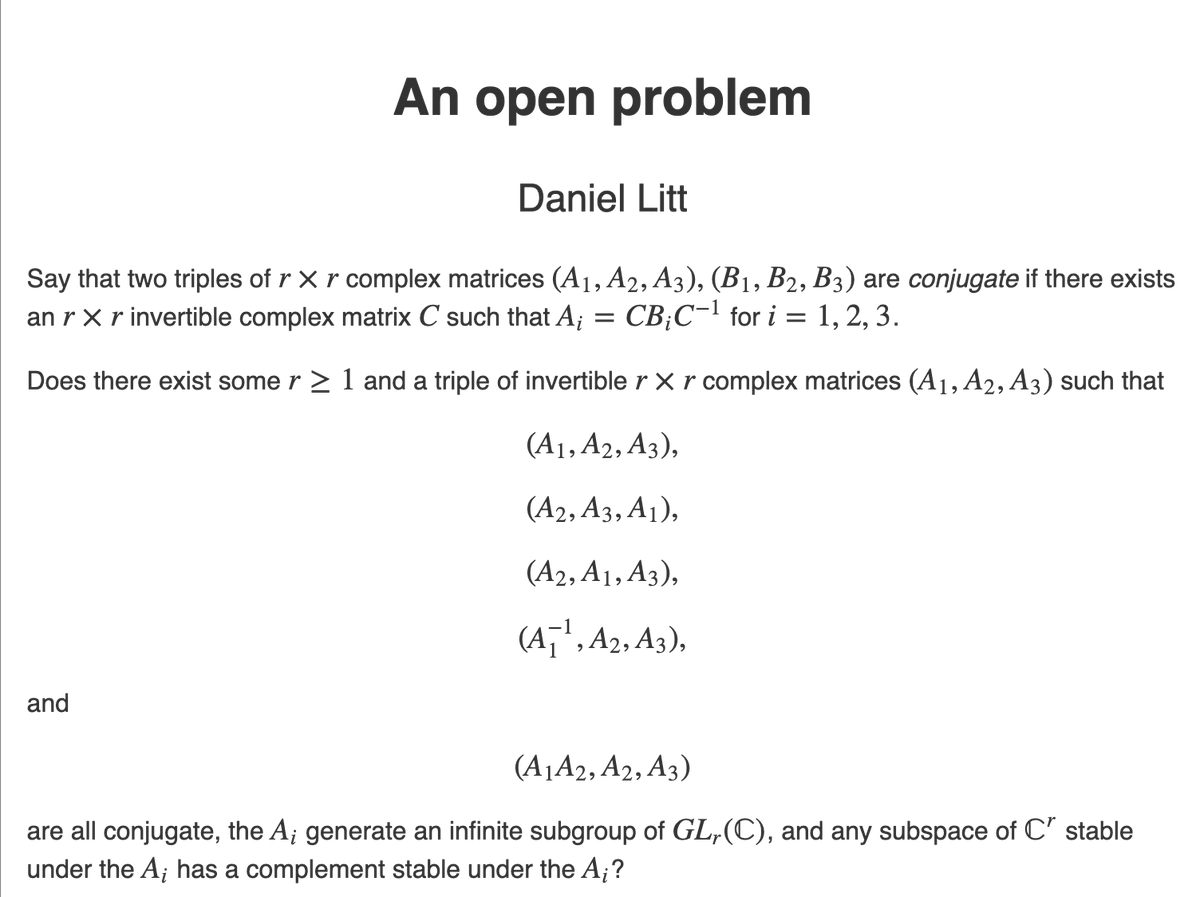
 Twitter
·
agile burrow
Twitter
·
agile burrow
heyy, no wonder this sounded familiar! I saw him give a talk and he mentioned this problem
astral galleon
agile burrow
heyy, no wonder this sounded familiar! I saw him give a talk and he mentioned th...
yeah i've been trying to have a go at it the only case I found what he indeed describes is possible is when r equals infinity
But from doing a bit of googling around it seems the realy money is in the finite dimensional case
agile burrow
yeah i figure that's probably why he's very interested in it lol
astral galleon
when you solve a problem and its not the one people want 😩
@agile burrow would you like to help with it this weekend 🙂
Maybe we could try to show how its not possible in certain cases
agile burrow
not sure how much free time i'll have this weekend, i'll try to ping you if i know ahead of time
astral galleon
kkk also do you know any good examples of infinite dimesional groups with nice subgroups we can test the problem @agile burrow
agile burrow
not off the top of my head, i usually stick to finite dimensions but i can do some poking around
experience has shown me that matrix groups are usually the cleanest
i love linear algebra
astral galleon
which matrix group in paritcular do we need to consider would the projective linear group be a good punch to throw
agile burrow
PGL can be okay, i was thinking more along just GL and SL
astral galleon
Because after thinking about the problem it comes down to showing that our compleement stable does not exist under the A_i
also how would you get A_i to generate an infinite subgroup when for some r you have finitely many elements in your group @agile burrow when r=inf when r is finite its hard
oh wait SL(n,C) is the subgroup of GL(n,C) 😅
astral galleon
@agile burrow that was just me misunderstanding the question I now get a better feeling of it
Yeah then it should not be possible when r=2 since upon mutiplying our matrices A_i the vectors are sent somewhere else no ? @agile burrow
agile burrow
That doesn't necessarily mean the image isn't in the same subspace
astral galleon
ahh kk 👍 we should investigate the case when n is indeed finite
 prisma shuttle
can someone explain to me wut this sentence means
i am having a lot of trouble comprehending wut it is trying to saying

for broader context it is on page 2 in this paper
but idt any of the stuff on page 1 or before it is really that practical
cloud walrusBOT
Zophike1
 agile burrow
it doesn't say infinite dimensional though, it just says infinite
the group GL(r, C) is infinite for all r > 0
i also don't see how it holds for infinite dimensional matrices, do you have an explicit example?
when you say finite dimensional, i presume you mean finitely generated? @astral galleon
which is odd because GL(r, C) is not finitely generated lol
astral galleon
as well as here: https://encyclopediaofmath.org/wiki/Linear_group
astral galleon
agile burrow
the group GL(r, C) is infinite for all r > 0
ahh okay makes sense 😅 must have gotton confused
reviewd the definitions its a set of 2x2 matrices 😅 I need to get some sleep
agile burrow
mm
astral galleon
yeah I see the mistake I made eariler I didn't actually bother to look at the other matrices withen the set 😢
I think we can cheese the question by looking at GL(C) and making sure we have a digonal matrices pluked from the set
@agile burrow friend me on discord so we can work on this 🙂
agile burrow
i accepted your rq
 opaque pilot
I'm trying to show this isn't a homomorphism using the counter example a = (1 2) and b = (2 3). Would this be correct? Specifically how I calculated $\phi(ab)$ and $\phi(a) \phi(b)$
 cloud walrusBOT
Kurama
 opaque pilot
 agile burrow
opaque pilot
I'm trying to show this isn't a homomorphism using the counter example a = (1 2)...
agile burrow
opaque pilot
I'm trying to show this isn't a homomorphism using the counter example a = (1 2)...
this looks correct. perhaps an easier way to see this is that a homomorphism takes the identity to the identity, which this map clearly does not do
opaque pilot
Yep, that makes sense. I actually wanted to practice using cycle notation since Im not familiar with it
But yeah, that is faster
agile burrow
good idea, cycle notation becomes very useful for understanding the symmetric group
opaque pilot
Are all dihedral groups symmetric groups?
next obsidian
Nope
Symmetric groups have order n!
But dihedral groups can have order 2n for any n
opaque pilot
So they are not related at all?
next obsidian
They definitely are
A dihedral group is a subgroup of a symmetric group, which on the one hand sort of says nothing, but this is particularly natural
So actually any finite group is isomorphic to a subgroup of S_|G| via a group action, but that probably doesn’t mean that much to you right now
opaque pilot
dont know what a group action is lol
next obsidian
In the case of D_2n though, this is like, symmetries of an n-gon
You can think about these as special bijections on a set of n-elements, namely thinking of what happens to the vertices
So D_2n ends up being a subgroup of S_n in a really natural way, you can think of S_n as every possible bijection on a set of n-points (in fact this might be your definition)
And D_2n are a special subset (or subgroup if you like) which preserves certain edge relationships
So if you drew out a pentagon and labeled the vertices 1,2,3,4,5; you can’t swap 1 and 4 because you always need 1 and 2 to be next to each other
I can try to clarify what I mean here if some of this is too opaque
 next obsidian
Yeah so imagine if you labeled the top left 1, top right 2, bottom left 3, bottom right 4, but in an absolute sense
So these pictures describe what point goes where
So R_90 is like (2134)
Because A which was 1 now is in position 3
B which was 2 is now in position 1
…
astral galleon
I think the symmetric groups > diheaderal groups in terms of order
next obsidian
But you can see that nowhere on here will you find (13)
This is like if you fixed B and D, but only swapped A and C
So this is why D_8 is a proper subgroup of S_4 because we don’t get all possible permutations / symmetries
We only get the ones that preserve our square
So they’re super connected, just not the same (dihedral and symmetric groups)
opaque pilot
next obsidian
So this is why D_8 is a proper subgroup of S_4 because we don’t get *all* possib...
make sense. this was what I was trying to put into words.
next obsidian
👍
opaque pilot
ty 🙂
next obsidian
 tidal crag
I have a quick question regarding mappings.
Is the mapping from R -> R+ bijective? I wouldn't say so since negative reals would map with the positive reals, disproving that it's one-to-one.
But is there a good way to show this?
next obsidian
First off I think this is better for something like #proofs-and-logic, but you never specified what your map is
There’s definitely bijective maps R -> R^+
tidal crag
It's a mapping of 2 groups, R, and R^+
next obsidian
This isn’t the real numbers?
tidal crag
It is
next obsidian
But again you didn’t specify what your map is
cloud walrusBOT
Jon123276
 tidal crag
I'm trying to understand how this is a bijection, which would lead to showing that this is a isomorphism with (R, +) and (R^+, •).
next obsidian
Dude
You still haven’t said what the map is
You just gave it a name
Like what is phi(x)?
Is it e^x?
tidal crag
Oh wait, i can't read
next obsidian
If so, this maps legit has an inverse
 west sinew
Can someone help me see why the ideal quotient (mZ:nZ) will be qZ, where q=m/hcf(m, n)?
for ref. https://en.wikipedia.org/wiki/Ideal_quotient
next obsidian
You know that every ideal of Z is principal, and is generated by the gcd of the elements in the ideal. If it wasn't q then you should be able to draw some contradiction
astral galleon
the idenity function could work as well for your mapping @tidal crag
chilly ocean

 south patrol
 red drum
Hey everyone, I'm reading a paper about BMS group, but I am blocked at the page 9... If anyone have resources to understand this part to the end I will be gratefull ! It's about the BMS Lie algebra...
west sinew

What is the map j and why is it injective? (This is from Atiyah & MacDonald's Comm. Algebra)
 quartz quiver
In general you can factorize any function into a composition of a surjective and injective function
tidal crag
I'm having a hard time wrapping my head around why the kernel is important...
chilly ocean
tidal crag
I'm having a hard time wrapping my head around why the kernel is important...
do you mean kernel
tidal crag
Yes
chilly ocean
what kind of kernel
Kernel of a map f, which we'll denote by ker(f) is defined as {(x, y) : f(x) = f(y)} and it "measures" injectivity of a given map f
if your map is actually a homomorphism of a group or something like that, then we can replace this with ker(f) = {x : f(x) = 0} where 0 is the identity element
the same is true, this map measures the injectivity of your map f
In general a map f:X to Y is not injective, but by quotienting X/ker(f) and setting p:X to X/ker(f) to be the natural projection, there exist a unique map g such that g(p(x)) = f(x) for x in X, and this map is injective
In algebra, injective homomorphism is usually an isomorphism onto its image, so if we assume that we are working with this kind of context we get what's called the first isomorphism theorem, that is X/ker(f) is isomorphic to im(f) = f(X)
 leaden pulsar
For all (a_1, a_2) , (b_1,b_2)∈R^2 , (a_1,a_2)⚹(b_1,b_2) = (a_1.b_1,a_2.b_2). Prove that <R^2,⚹> is not a group.
help
 untold basin
leaden pulsar
For all (a_1, a_2) , (b_1,b_2)∈R^2 , (a_1,a_2)⚹(b_1,b_2) = (a_1.b_1,a_2.b_2). P...
untold basin
leaden pulsar
For all (a_1, a_2) , (b_1,b_2)∈R^2 , (a_1,a_2)⚹(b_1,b_2) = (a_1.b_1,a_2.b_2). P...
Maybe try to understand first why <R,*> is not a group
leaden pulsar
yeah since every elemnt need to have an inverse, 0 will not have it
breh was it this
untold basin
leaden pulsar
breh was it this
yes
 broken stirrup
This looks life fairly simple proof but what I don't get is how do we claim that [\phi ^ G, X] implies that \phi^G is a character?

I know that for any two characters A,B the 'inner product' [A,B] is a nonnegative number
agile burrow
I've done the first three parts, but I don't see how to define H on morphisms. I'm trying to induce an appropriate morphism to use snake lemma but idek if this is the right approach

I can elaborate on the second and third points if it would be helpful
Edit: I wanna say the proof should be something along the lines of an arrow theoretic proof that cohomology is a functor. The exercise is given under the context that it is a generalization of an earlier exercise where we derived the long exact sequence in cohomology as a consequence of the snake lemma. In particular, there I believe we viewed A is the category of chain complexes and we define dA to be the category whose objects (A, d) consist of a chain complex along with a shift map, or something along those lines
agile burrow
broken stirrup
This looks life fairly simple proof but what I don't get is how do we claim that...
first you should note that \phi^G is a class function. Irreducible characters form a basis for the complex space of class functions and it can be shown that a class function is a character if and only if it is an non-negative integral combination of irreducible characters. I can elaborate on this last point if you'd like
broken stirrup
agile burrow
first you should note that \phi^G is a class function. Irreducible characters fo...
thanks, its clear
opaque pilot
Mathematics Stack Exchange
I want to show that if $g,h\in G$ are group elements with finite coprime orders $m$ and $n$ and $gh=hg$ then the order of $gh$ is $mn$.
We have that
$$
(gh)^{mn}=g^{mn}h^{mn}=1
$$
using $gh=hg$...
Why is that the two elements must commute important in this proof?
chilly ocean
(gh)^{rm} = g^{rm}h^{rm}
(gh)^n = g^n h^n is not true, in general, if g and h do not commute.
opaque pilot
But if they did h^{rm}g^{rm}, since the order of g is m, doesn't g^{rm} = e anyway? So we'd be left with h^{rm} even without commuting
chilly ocean
writing it as h^{rm}g^{rm} also works, but you're still using the fact that g and h commute to do so
opaque pilot
If we write it like this, then we didnt use the assumption of two elements commuting?
chilly ocean
let me say it more explicitly
If $g,h$ are commuting elements of a group, then $$(gh)^n = g^n h^n = h^ng^n$$ for all $n \in \bN$. This is not true in general if $g$ and $h$ do not commute.
cloud walrusBOT
TTerra
 chilly ocean
this is what allows the poster to write (gh)^{rm} = g^{rm}h^{rm} (which also happens to be equal to h^{rm}g^{rm})
opaque pilot
Yep, I understand the fact that G is Abelian makes this (gh)^{rm} = g^{rm}h^{rm} true.
chilly ocean
no, it's not assumed that G is abelian. that certainly makes it true that g and h commute, but it's only assumed that these particular elements commute
opaque pilot
But in the context of the proof, since the order of g is m, does it matter whether they write it like g^{rm}h^{rm} or like h^{rm}g^{rm}? Since g^{rm} = e, the identity. And we'd be left with h^{rm} even if we dont use that g and h commute.
opaque pilot
chilly ocean
no, it's not assumed that G is abelian. that certainly makes it true that g and ...
oh ok, I should be careful with my wording
chilly ocean
i am trying to tell you that you can only make the step that (gh)^{rm} = g^{rm}h^{rm} because g and h commute. this step has nothing to do with the orders of the elements
g^{rm} = e alone (i.e. without assuming commutativity of g and h) does not imply that (gh)^{rm} = g^{rm}h^{rm}, in general
you NEED commutativity to write (gh)^{rm} = g^{rm}h^{rm}, and no other assumption present in the proof will give this to you
opaque pilot
Sorry Im still not understanding. If we do e=(gh)^rm = h^{rm}g^{rm} =h^{rm}, this still shows that n|rm does it not?
next obsidian
You can’t say that (gh)^rm = h^rm•g^rm unless h and g commute
Because (gh)^rm is a priori just
ghghghgh…gh
But now you need to swap a bunch of g’s and a bunch of h’s
 devout crow
yes
but it's not a hard check: C is definitely inside R(i), and you can't make anything in R(i) that's not in C
next obsidian
Chmonkey
 hot abyss
asking about problem 3, i don’t need help with this proof, i just really don’t know how to notate it

i know the generalization would be like, $a_1a_2\dots a_n =e\implies a_na_1\dots a_{n-1}=e\implies a_{n-1}a_na_1\dots a_{n-2}=e…$
cloud walrusBOT
quantum
 hot abyss
i just don’t really know how i would notate something like this
it’s going in like a cycle
 delicate bloom
I think that's fine personally
just say cyclic permutations like you said
you could be more precise, but I feel like it would be less clear
 wise igloo
hot abyss
asking about problem 3, i don’t need help with this proof, i just really don’t k...
wise igloo
hot abyss
asking about problem 3, i don’t need help with this proof, i just really don’t k...
quanty doing group theory now? done with lin alg?
wise igloo
niiiiice
next obsidian
Quantum you want good group theory problems?
lethal dune
wise igloo
my favorite ring is R_69
find all homomorphisms from R_420 to R_69
wise igloo
make me
wise igloo
how tf
agile burrow
agile burrow
I've done the first three parts, but I don't see how to define H on morphisms. I...
bumping this
 hidden haven
There is no snake lemma involved
This is like showing that a map of chain complexes induces a map on homology
You restrict the map to the ker d in the domain
Show that this factors through ker d of the codomain
Then show that im d in the domain maps into im d of the codomain
So there is an induced map ker d/im d of domain to ker d/im d of codomain
agile burrow
hidden haven
You restrict the map to the ker d in the domain
so to make sure I understand this, given a morphism f: (A, d_A) -> (B, d_B), we have d_B o f o ker d_A = 0 hence f o ker d_A factors through ker d_B
hidden haven
yes
agile burrow
hidden haven
Then show that im d in the domain maps into im d of the codomain
and for this one, is it analogously that coker d_B o f o d_A = 0, hence im d_A is mapped into im d_B? i'm kinda bouncing between intuition from a set theoretic level and universal properties here
hidden haven
yep
agile burrow
just trying to reconcile this with the notation in the exercise, i get that we look at the composition ker d_A -> ker d_B -> H(B, d_B) and now I just need to show that this composition precomposed with \overline{d}_A is zero, but this feels different from what we were doing before with the images
i think it stems from me not really understanding what the \overline{d} map is
cloud walrusBOT
Moldilocks1337 ✓
 hidden haven
You proved that you have this commutative diagram right?
im d_A should really go to A but I am just denoting the inclusion into the kernel by that
cloud walrusBOT
Moldilocks1337 ✓
 hidden haven
Here I just took cokernels of the maps on the left
cokernel is an additive functor so you get this induced map H(f)
Maybe you can phrase this as a composition of additive functors, so it is additive. You first map a differential object A to the pair (ker d_A, im d_A) in the category of object subobject pairs, and then apply the quotient functor to this which is also additive
Haven't checked the details in this approach but should work
@agile burrow
broken stirrup
Any hints? RHS is induced character from H intersection K to K, am i right?
 agile burrow
hidden haven
Haven't checked the details in this approach but should work
agile burrow
hidden haven
Haven't checked the details in this approach but should work
ahh ok I think I get it now, tysm
agile burrow
broken stirrup
Any hints? RHS is induced character from H intersection K to K, am i right?
yes, that is what the RHS is saying. as for actually showing equality, do you know the character formulas for restricted/induced characters?
broken stirrup
I know the definition, yes
agile burrow
the computations are kinda annoying but i think that should be a straightforward way to show that it is true
I feel like there should be an alternative way through the fact that induced representations work nicely with respect to towers of subgroups and Frobenius reciprocity
 charred flume
im solving for the splitting field $x^{4}+1$ over Q now the answer that i get is $\mathbb{Q}(\omega, \mathrm{i})$ where $\omega=\frac{\sqrt{2}+i \sqrt{2}}{2}$. But there's an answer online where he gets $\mathbb{Q}(i, \sqrt{2})$. Are they equal?
cloud walrusBOT
Ji
 broken stirrup
i think so
if w is there then its conjugate is also there. Just add them and you get sqrt(2)
charred flume
broken stirrup
if w is there then its conjugate is also there. Just add them and you get sqrt(2...
ok i'll try later
thanks
devout crow
how do you show it's not iso to C
chilly radish
t is transcendental over C by definition
hidden haven
It is not algebraically closed because x^2 - t has no root
hidden haven
It's algebraic closure is isomorphic to C though
devout crow
hidden haven
It's algebraic closure is isomorphic to C though
this is cool
lethal dune
hidden haven
It's algebraic closure is isomorphic to C though
really
hidden haven
Ye algebraically closed fields with some characteristic and transcendence degree are isomorphic
They have the same transcendence degree because same uncountable cardinality
In particular the algebraic closure of the p-adics is also isomorphic to C
lethal dune

hidden haven
I mean algebraic closure after you take p-adic completion
lethal dune
cool
delicate orchid
hmmm
lethal dune
ikr
 lament dawn
What does it mean for a group G to act on X via isometries
I've seen this a few times
devout crow
d(g.x,g.y) = d(x,y) for all x,y in X, g in G
cloud walrusBOT
Migillope
Compile Error! Click the reaction for more information.
(You may edit your message to recompile.)
 lament dawn
Okay yes haha thanks
devout crow
hidden haven
Ye algebraically closed fields with some characteristic and transcendence degree...
is this hard to prove
hidden haven
Not much but you might need some machinery
You take a bijection between the transcendence bases
That gives you an isomorphism of the purely transcendental part
Now you need to extend this to the whole extension
You do this using Zorn's lemma
And to apply Zorn's lemma, you need to know when a field map F → E can be extended to a field map F[a] → E for a algebraic over F
It is exactly when the minimal polynomial of a over F has a root in E (by the first isomorphism theorem)
devout crow
hidden haven
You take a bijection between the transcendence bases
what's the underlying field? the closure of Fp (the closure of Q if p = 0)?
hidden haven
F_p itself
devout crow
oh that makes more sense
hidden haven
It's the same thing
Transcendental over F is equivalent to transcendental over the closure of F
Though ye here you want to start building this isomorphic up from F rather than from closure
No actually it shouldn't matter
devout crow
hmm I don't know enough field theory yet I think
maybe I'll ask again when I know what I'm talking about
hidden haven
F
lethal dune
F_0
 delicate orchid
yeah looks right
pastel cliff
mμ₂rbius sweep
delicate orchid
we need more people like you in the world, nitezba
people I can actually help in here 
pastel cliff
so simpletons
gimme like 3 weeks i'll get to galois theory
i will speedrun dummy and foot
assuming i dont fall asleep first
delicate orchid
I'm currently reading some galois theory notes 
broken stirrup
I failed to show this equality using the definition 😦
 broken stirrup
delicate orchid
people I can actually help in here <:opencry:586078614865444865>
broken stirrup
delicate orchid
people I can actually help in here <:opencry:586078614865444865>
lol Morbius you know character theory maybe you could help me as well xD
delicate orchid
that looks like a semidirect product except you simply stop caring about everything
my first thought is frobenius reciprocity but I don't think that goes anywhere
broken stirrup
You get towers of induced characters looks complicated to me
delicate orchid
ok so $\phi^G(x) = \frac{1}{|H|}\sum_{g \in G} \overline{\phi(gxg^{-1})}$ as per usual, and $\phi_{H \cup K}^K(x) = \frac{1}{|H \cap K|} \sum_{g \in K} \overline{\phi(gxg^{-1}}$ and we want to turn one of these into another
fantastic start
cloud walrusBOT
Wew "Morbeline" Tbh ⊗
 delicate orchid
imagine it's correct
the overline means \overline{phi(x)} = phi(x) x in H 0 otherwise as per usual
first thing is we want to sum over K and we're currently summing over G so is there a way to change that?
hmm
broken stirrup
let's note that g \in HK
delicate orchid
so g is equal to some hk for h in k
so lets split $\phi^G(x) = \frac{1}{|H|}\sum_{g \in G} \overline{\phi}(gxg^{-1}) = \frac{1}{|H|}\sum_{h \in H, k \in K} \overline{\phi}(hkxk^{-1}h^{-1})$
my god my latex today 
bear with me
cloud walrusBOT
Wew "Morbeline" Tbh ⊗
 delicate orchid
ok good enough
now if H and K were disjoint I wouldn't have any problems with splitting $\sum_{h \in H, k \in K}$ into $\sum_{h \in H}\sum_{k \in K}$ but we can't cause they're not necessary disjoint
cloud walrusBOT
Wew "Morbeline" Tbh ⊗
 cloud walrusBOT
Wew "Morbeline" Tbh ⊗
 delicate orchid
at some point the 1/|H| has to turn into 1/|H intersect K| so how does that happen
so many questions
broken stirrup
delicate orchid
so many questions <:devastation:898725325335298088>
I feel like we'll have to use thee fact that |G|=|HK|=|H||K| / |H intersect K|
delicate orchid
oh SHIT yes of course
ok so 1/|H intersect K| = |G|/|H||K| right?
= $\frac{1}{|H|}\frac{|G|}{|K|}$
cloud walrusBOT
Wew "Morbeline" Tbh ⊗
 delicate orchid
now when I see the index of a subset in a group I immediately think of cosets
broken stirrup
and
delicate orchid
and indeed 
broken stirrup
we've simplification of the formula for cosets
i mean sum over transversal T of right cosets
delicate orchid
right cosets of K?
hmm
yeah ok I follow now, and since they're disjoint we can split the sums!
broken stirrup
hmm yes but we don't have orders involving in that one so i try to avoid it
just definition looks more useful
 delicate orchid
I still think the key lies in how they're disjoint
cause that was our main problem before
although I'll keep thinking about that defn, but we really would like the sum to be over K not the transversal
ah ok I think I've got it
nvm
is $\phi^G_k(x) = \frac{1}{|H|}\sum_{g \in G} \overline{\phi}(gxg^{-1}) = \frac{1}{|H|}\sum_{t \in T}\sum_{k \in K} \overline{\phi}(tkxk^{-1}t^{-1})$ valid? as the cosets form a disjoint cover of the group?
cloud walrusBOT
Wew "Morbeline" Tbh ⊗
 delicate orchid
cause if it is then we can just IMMEDIATELY do some trolling and get $\phi^G_k(x) = \frac{|T|}{|H|}\sum_{k \in K}\overline{\phi}(kxk^{-1})$
using the fact that phi bar is a class function
ffs I forgot the sum
cloud walrusBOT
Wew "Morbeline" Tbh ⊗
 delicate orchid
is $\phi^G_k(x) = \frac{1}{|H|}\sum_{g \in G} \overline{\phi}(gxg^{-1}) = \frac{...
delicate orchid
delicate orchid
is $\phi^G_k(x) = \frac{1}{|H|}\sum_{g \in G} \overline{\phi}(gxg^{-1}) = \frac{...
Ok I'm saying we can do this because I said so
broken stirrup
cloud walrus
**Wew "Morbeline" Tbh ⊗**
wait im still not so sure about this let me think xd
delicate orchid
yeah if we know that for sure then I think the result follows
broken stirrup
cloud walrus
**Wew "Morbeline" Tbh ⊗**
so i think this is valid but...
broken stirrup
delicate orchid
using the fact that phi bar is a class function
phi is class function only in H so it doesn't have to be class function?
delicate orchid
broken stirrup
phi is class function only in H so it doesn't have to be class function?
it's 0 outside of H so it doesn't contribute to the sum, so whenever it's non-zero it's a class function
broken stirrup
tysm
 slate mortar
I want to prove that the wedge product on finite free R-module M is a perfect pairing, does someone know where I can find a proof of this?
chilly ocean
Given the vector space $\bR$ over $\bQ$ lets call it V, prove that the dimension of V is non finite.
Does the fact that the cardinality of R mod Q being non-finite suffice as a sufficient explanation?
cloud walrusBOT
simp
 chilly ocean
Does the fact that the cardinality of R mod Q being non-finite suffice as a sufficient explanation?
agile burrow
No because R^2 / R is isomorphic to R , which has non-finite order
chilly ocean
ty bb
agile burrow
you could use some version of a cardinality argument
perhaps something about the cardinality of Q that the cardinality of R does not satisfy...
agile burrow
ah ok
chilly ocean
but tahnk you nonetheless
 young hollow
Getting into some algebra after a while; just making sure I’m approaching this correctly before continuing with the remaining examples:

 slate mortar
young hollow
slate mortar
young hollow
m+i could be greater than n
young hollow
Ah yeah I forgot the “(mod n)
young hollow
Can anyone look over the first portion of this one, please:


Shoot, that should be a “- 1” that got cut off there, not “+1”
slate mortar
Case 1 could be in case 2.b)
chilly ocean
chilly ocean
Does the fact that the cardinality of R mod Q being non-finite suffice as a suff...
No, but you can use this argument: If R was finite dimensional, then |R| = |Q^n| = |Q| for some n.
broken stirrup

I understand that since D is countable, there is a line that doesn't intersect D. Where can i find the proof that there is an angle such that for any positive n, rotation by n\theta doesn't intersect D either?
chilly ocean
broken stirrup
I understand that since D is countable, there is a line that doesn't intersect D...
this is in the plane, right
 chilly ocean
what's the origin then 
do they mean like, origin of R^3, or maybe origin of of R^2 which we project somehow under the stereographic projection, or what
broken stirrup
chilly ocean
do they mean like, origin of R^3, or maybe origin of of R^2 which we project som...
R^3 i believe
yes indeed
chilly ocean
we can always take a plane which contains the line l
then if you look at this circle that you obtained, there is only countable amount of points from D
Suppose that for every theta there exist n such that after rotating n times by angle theta, we get an element d(theta) from D
There can be repeats, d(theta) is in the set of points generated by a countable possible amount of angles
so we get a map from a set of size continuum onto a countable set with countable fibers
this is impossible
so there must be theta with the desired properties
@broken stirrup
wise igloo
Collection of Questions
pastel cliff
any advice? the hint isn't terribly helpful
 delicate orchid
it's a special case of cauchy's theorem so lemme try and think though the proof of that one
pastel cliff
lagrange seems like it would help but it hasnt been introduced yet so cant use that
delicate orchid
I will use whatever I please
and this is a partial converse to lagrange so it's not that useful
pastel cliff
i mean contrapositive would kill it - if there is no element of order two, then the order of the group is not divisible by two so it cant be even, boom proven
delicate orchid
ahhh
no no no this is all massive overkill
watch this shit
|G| = 2n
pair up the elements into pairs like this {g, g^-1} with each element g only being in one pair
since we can put every element must be in a pair, as 2n is even, we must have the identity in a pair
say, {e, a}
hold on I need to think about how to phrase this next part
if a^-1 not equal to a, then a^-1 must be in a pair {g, a^-1} with g not equal to a (as a is already paired up with the identity), but g is (by definition of this pairing) in {g, g^-1} and this is the unique pair that contains g (this uniqueness can be guaranteed by the fact that |G| is even), so we must have a^-1 = g^-1 => a = g, which is a contradiction. Thus we must have a^-1 = a <=> a^2 = e
I think this holds
or: IT'S TRUE BY CAUCHY'S THEOREM NOW LEAVE ME ALONE!!
pastel cliff

 delicate orchid
I'm going to flip my lid
pastel cliff
why are you wearing a lid
delicate orchid
I am a jar
ok I'm gonna go google my proof cause I remember seeing it somewhere
yeah ok good I remembered it right
 pastel cliff
i would not have come up with this 
delicate orchid
I wouldn't've either
see if you can generalise this idea to primes other than 2 though 
 young fiber
delicate orchid
see if you can generalise this idea to primes other than 2 though <:sharkpog:943...
young fiber
delicate orchid
see if you can generalise this idea to primes other than 2 though <:sharkpog:943...
in what way
pastel cliff
dont spoil it bruv
delicate orchid
show that if $p$ divides $|G|$ then there exists an element $g \in G$ with the order of $g$ equal to $p$, cauchy's theorem basically
cloud walrusBOT
Wew "Morbeline" Tbh ⊗
 young fiber
hmm
delicate orchid
yeah I never said it wasn't a challenge
wooden ember
delicate orchid
yeah ok good I remembered it right
This is a weird way to phrase it
You can say things in a much simpler manner by simply saying that the set containing e is a singleton since it’s its own inverse
Hence there must be another singleton, ie an element that is its own inverse (is of order 2)
Now I’m trying to remember how the hell to prove cauchy’s theorem lol
I think you need to do it for abelian groups first and then do something in the quotient by the center or smth like that
Some kind of induction maybe
delicate orchid
||group actions on some weird cartesian product of the underlying group + orb-stab I think||
wooden ember
delicate orchid
||group actions on some weird cartesian product of the underlying group + orb-st...
Ah i see
delicate orchid
||that's the proof I knew  ||
||
||and I think it kind of follows from the partioning idea, we're working in G^2 there so maybe try working in G^p?||
next obsidian
You can deduce it from Sylow
wooden ember
Yeah frobenius ought to work somehow
wooden ember
next obsidian
You can deduce it from Sylow
That’s overkill lmao
next obsidian
delicate orchid
guys I'm gonna prove the trivial group is a subgroup of every group!
using the SYLOW THEOREMS! 
wooden ember
And I can’t remember how to prove sylow either except some weird action shit
delicate orchid
I can barely remember the theorems thank god
wooden ember
I probably don’t remember them in full
next obsidian
How does Sylow proce the trivial group is a subgroup huh?
What if your group is infinite
wooden ember
Check mate
next obsidian
Morbius
wooden ember
next obsidian
What if your group is infinite
Take the intersection of all subgroups
Huh actually if there’s no element of finite order is intersection of all subgroups necessarily trivial ?
delicate orchid
now we're talking
next obsidian
Then no
Subgroups of a cyclic group are totally ordered
So there’s a minimum non-trivial subgroup
wooden ember
Oh I mean never mind you can do it for finite groups yeah
I must be on sleep mode today
 subtle ivy
delicate orchid
now we're talking
subtle ivy
delicate orchid
now we're talking
your profile name and picture make me want to scream. just fyi <3
pastel cliff
that's among the nicer profiles he's had
young hollow

I posted the proof of the well-defined-ness of the operation before, but I’ll link it below since it’s related to the associativity somewhat. Is there any other way to do the associativity than how I did using cases?


I skipped some basic algebra steps (those elementary in R) and the justifications for some steps (due to space).
The key step in case II is noting that an expression of the form [x + [y]] = [x] + y for integral y (by definition)
delicate bloom
I want to say carrying happens to the left, so removing the integer part has no affect on when you do it, that way you can say it inherits associativity from R. Probably there's a more rigorous way of saying it though.
young hollow
Yeah I think this problem took me longer because I was trying to make it more rigorous for a while.. then I decided based on the way they wrote it, maybe it wasn’t what it’s looking for
Also, I guess the third case isn’t entirely “analogous,” but you use the same ‘trick’ of substituting [a+b] + [b+c] for [a+b] and cancelling the [a+b]s that remain using the property in my previous comment

 delicate bloom
opaque pilot
what about when the order is infinite?
delicate bloom
opaque pilot
what about when the order is infinite?
you could suppose it maps to an element of finite order and work out the consequences
opaque pilot

Like this, showing the |g| is finite, so a contradiction to the assumption that |g| = infinite?
delicate bloom
looks reasonable to me
opaque pilot
ty
delicate bloom
yw
young hollow
delicate bloom
I want to say carrying happens to the left, so removing the integer part has no ...
When you say “carrying happens to the left,” can you elaborate, please?
delicate bloom
i can not
delicate bloom
lol
 warm holly
Yo I have a question on existence of orthogonal basis! Let <,>:V x V-> K be a billinear symmetric form over V x V where V is K vector space (characteristic not necessairily différent of 2) if there exist an element v in V such that <v,v> neq 0 can we conclude the existence of orthogonal basis of V?
hidden haven
Do you mean orthonormal
Otherwise <v,v> neq 0 is not needed anyway
Because everything would be orthogonal to everything else if all products are 0
warm holly
Nop I meant orthogonal. But if characteristic is 2 you can’t conclude it no?
hidden haven
What's the definition of an orthogonal basis? Is it a basis (v_i) such that <v_i, v_j> = 0 for i neq j?
warm holly
Yup
hidden haven
Then if the form is always 0, then you have orthogonal basis
Any basis is then orthogonal
warm holly
What I was looking for is weak condition to get an orthogonal basis in vector space over field of char 2