#groups-rings-fields
406252 messages · Page 699 of 407
 delicate orchid
 delicate orchid
no problem boss
 uncut girder
I still need a torsion free normal subgroup of PSL(2,Z) such that the quotient is isomorphic to Aff(F_7)
delicate orchid
very wacky request lol
 latent anvil
What is Aff(F_7)? Polynomials ax+b for a, b in F7 under composition? @uncut girder
delicate orchid
they're usually written as matricies
latent anvil
sure
uncut girder
Affine transformations of the 1 dim vectorspace F_7
delicate orchid
they're the 1 dimensional affine transformations right
yeah ok then they're just those polynomials
uncut girder
latent anvil
What is Aff(F_7)? Polynomials ax+b for a, b in F7 under composition? <@126935813...
Yeah basically.
latent anvil
I just thought this was the most compact way to write affine transformations lol
Okay thinking
uncut girder
Its order is 7*6. You have 7 translations and 6 rotations (6 elements of the multiplicative group), and compositions of them all
delicate orchid
hmmmm
scouring the wikipedia page on affine transformations it says that Aff_n(F) is the semidirect product of F^n and GL(n, F)
might be able to do some meme there
latent anvil
I don't think it's a hugely different perspective
wait isn't PSL(2, Z) the free product of C2 and C3 or something?
Yes
so defining a map from it into Aff should actually be easy
you just use the presentation <x, y | x^2, y^3>
uncut girder
It just so happens that PSL(2,3) is isomorphic to Aff(F_4). So letting Gamma(3) denote the kernel of PSL(2,Z) -> PSL(2,3) given by reduction mod 3, which is a surjective group homo, we see PSL(2,Z)/Gamma(3) is isomorphic to Aff(F_4)
latent anvil
so "Aff(F7) is a quotient of PSL(2,Z)" really means "Aff(F7) is generated by an element of order 2 and an element of order 3"
and this is crunchable
sound good?
delicate orchid
that's a super cool way of doing it
uncut girder
Yes PSL(2,Z) is a free product of Z/2Z and Z/3Z
latent anvil
so the elements of order 2 are f(x) = b - x for any b
a(a(ax + b) + b) + b = a^3 x + a^2 b + a b + b
so f(x) = ax + b satisfies f^3 = id iff a^3 = 1 and a^2 b + a b + b = 0
the third roots of unity mod 7 are 1, 2, 4
if a = 1 then b + b + b = 0, so b = 0, so we're actually f(x) = x
oh and a^2 b + ab + b = (a^2 + a + 1)b
so if a is a nontrivial 3rd root of unity then that's automatically zero
so the elements of order 3 are f(x) = 2x + b and g(x) = 4x + b for b in F7
so maybe f(x) = 1 - x and g(x) = 2x generate the group of affine transformations? just writing out relations we get 1 - 2x = 8 - 2 x = 2(4 - x)
delicate orchid
both 2 and 4 are also solutions to a^2+a+1... spooky 
latent anvil
so the transformation h(x) = 4 - x is in there
latent anvil
delicate orchid
both 2 and 4 are also solutions to a^2+a+1... spooky <:stare:826920038623346729>
yeah, that's bc they're the nontrivial 3rd roots of unity?
x^3 - 1 = (x-1)(x^2 + x + 1)
latent anvil
hmm i'm not sure that 3 x is in there
uncut girder
A set of generators of Aff(F_7) are x+1 and 3x (since 3 is a primitive root mod 7)
uncut girder
Yeah I'm just saying if you can show 3x and x+1 are in the group you are generatign with an element of order 2 and order 3, then you have everything
latent anvil
ah yeah good point sorry
so if we can only start with a coefficient of 2 or 4
how could you get any other coefficients?
oh we start with coefficients of 2 and -1
1 - 2x = 1 + 5x
2(1 - 2x) = 2 + 3x
so if we can get h(x) = x - 2 we've got 3x
oh well any x + b for b ≠ 0 is basically the same
4(1 - 2x) = 4 - 8x = 4 - x
1 - (4 - x) = x + 4
Right?
so there we go, they generate the group
uncut girder
Yoooooo
uncut girder
I'm just gonna write this down and double check everything
uncut girder
latent anvil
f(x) = 2x, g(x) = 1 - x.
g(f(f(g(f(g(f(f(g(f(x)))))))))) = x + 1
Yep this is right
 tall jay
Is it true that the kernel of any f is a subgroup?
uncut girder
tall jay
Is it true that the kernel of any f is a subgroup?
Yep, a normal subgroup in fact
Okay so to answer my original question
Consider the map PSL(2,Z) -> Aff(F_7) given by sending a to 1-x and b to 2x, where a,b generate SL(2,Z) = <a,b| a^2 =b^3 = 1>.
Let K be the kernel of this surjective group homo (we just showed 2x and 1-x generat Aff(F_7).
Then PSL(2,Z)/K is isomorphic to Aff(F_7)

Thanks so much shamrock and wewlads!
latent anvil
Np!
delicate orchid
no worries but I really didn't do anything 
latent anvil
Wait what was the torsion free condition on the subgroup?
I don't know if it's obvious that K is torsionfree, but also this is basically the only way to do this problem right?
tall jay
uncut girder
Yep, a normal subgroup in fact
Even if f is not a homomorphism?
latent anvil
Oh
In that case no
We don't usually use the term kernel unless f is a homomorphism
uncut girder
uncut girder
Consider the map PSL(2,Z) -> Aff(F_7) given by sending a to 1-x and b to 2x, whe...
Can we explicitly describe the kernel of this map?
delicate orchid
I'm trying to come up with some presentation for K to try and see the torsion group
tall jay
uncut girder
f needs to be a homomorphism
For it to be just a subgroup? Not necessarily normal?
delicate orchid
the kernel of any homomorphism is always normal
latent anvil
you can't say anything really in this generality
When the map has no structure
it could be a normal subgroup or a subgroup which isn't normal or just an arbitrary subset
If S is a subset of G then we can define a function f : G -> Z/2Z by f(x) = 0 if x in S and f(x) = 1 if x is not in S. Then the "kernel" of f is S
uncut girder
delicate orchid
I'm trying to come up with some presentation for K to try and see the torsion gr...
One idea is to draw a binary tree, root node is identity, going left is applying 1-x, going right is applying 2x. Then see which left right paths give you identity
delicate orchid
good idea but I have no paper to hand
latent anvil
So we have a normal form for elements of PSL(2,Z)
an alternating product of a and either b or b^2
So if f(x) = 1 - x and g(x) = 2x, we want to understand when a product of f and either g or g^2 is the identity
uncut girder
I'm gonna work out my tree idea
delicate orchid
yeah every other product is non-trivial
due to the nature of it being the free product
latent anvil
well you need to worry about cancelation at the endpoints
delicate orchid
true
latent anvil
if x = aba then x^3 = ab^3a = e
So no it's not just those
Maybe it's better to look at matrices
delicate orchid
ha guess what I was about to post lol
I found that fg^3f(x) was the identity
turns out that's true even before you quotient (i.e. useless)
delicate orchid
no not at all
it's just not helpful
chatters I have located the character table 
latent anvil
So if w^k = 0, can we say w = ava or w = bvb^2 or w = b^2vb?
Like it's a conjugation
delicate orchid
uhhh
latent anvil
Like otherwise stuff won't cancel
delicate orchid
yes yes
yeah that's a result in the free group so it's definitely true in a free product
latent anvil
I think this is true
So then
v is also torsion
So the torsion elements are those of the form x a x^-1 or x b x^-1 or x b^2 x^-1
And these won't be trivial in the image
Bc they're conjugations of the nontrivial elements f, g
@uncut girder I think I have a proof sketch
uncut girder
I'm listening
latent anvil
So if a word is torsion, it has to either
- End and start with a
- End with b and start with b^2
- End with b^2 and start with b
Do you agree?
Otherwise no cancelation can occur
This is if we write the word as an alternating product of a and b or b^2
(which is a unique representation)
uncut girder
latent anvil
This is if we write the word as an alternating product of a and b or b^2
Yep that's clear to me
latent anvil
So iterating this
 pastel cliff
$P = {r+s\pi : r,s \in \mathbb{Q}}$ this isnt closed under multiplication is it (sorry to interject, just wanted super quick confirmation)
latent anvil
A torsion word is of the form x a x^-1, x b x^-1, or x b^2 x^-1
Just keep stripping off these matching endpoints
Right?
 cloud walrusBOT
μ₂ (46/47 🪲)
 uncut girder
latent anvil
Just keep stripping off these matching endpoints
uncut girder
latent anvil
Just keep stripping off these matching endpoints
I'm not sure i understand
latent anvil
So you start with a torsion element w
uncut girder
cloud walrus
**μ₂ (46/47 🪲)**
No its not. Consider pi^2
pastel cliff
uncut girder
No its not. Consider pi^2
thought so, merci 
latent anvil
If w is torsion, so w^k = e, then v^k = (a w a)^k = a w^k a = a a = e
uncut girder
Are you claiming that v is necessarily torsion?
uncut girder
I see
delicate orchid
yeah, say w^k = 0, then (ava)^k = av^ka = 0 <=> v^k = 0
uncut girder
Got it
latent anvil
So repeat this until v is too short to do it anymore
You get that w = x c x^-1 for c in {a,b,b^2}
Maybe you can show this with matrices too idk
Like look at similarity classes of integer matrices which have power I
But this works
uncut girder
Right
latent anvil
And no conjugate of f, g, g^2 in Aff is the identity
So no torsion element is in the kernel
uncut girder
No conjugate of a non identity element of any group is the identity. So does this show that the kernel of any map out of PSL(2,Z) sending a and b to nonidenity elements is torsion free?
latent anvil
Yep!
uncut girder
Awesome! Thanks again shamrock
delicate orchid
ok time to do it by lifting characters
latent anvil
What was the plan for that?
uncut girder
I want to get generators for this kernel.
latent anvil
Woah, if G is a free product of groups Ai then any finite subgroup of G is conjugate to a subgroup of some Ai
I was curious about how stuff generalized
delicate orchid
find the conjugacy classes 1-x and 2x get mapped to in the quotient, lift the characters back up and then look at the values that new character takes and maybe find a representative of the conjugacy class that's clearly torsion/not-torsion free  good lifting practice ngl
uncut girder
uncut girder
I want to get generators for this kernel.
I think doing the tree is my best bet. Or writing a sage program to compute it
delicate orchid
oohhh the group generated by 1-x should be normal isn't that cool
pastel cliff
There are infinitely many positive integers $m$ for which $\mathbb{I}_m$ is a domain. quick interjection again but i can prove this really quickly with just integers modded by a prime right
cloud walrusBOT
μ₂ (46/47 🪲)
 delicate orchid
wtf is I_m
pastel cliff
Z/pZ is a field, and fields are necessarily also integral domains (textbook uses domain interchangeably with integral domain)
stupid fucking textbook notation
integers mod m
delicate orchid
what the fuck
pastel cliff
thank you rotman very cool
delicate orchid
uh then yes that will work
latent anvil
Primes are the only ones that work
 south patrol
Yes using p is even stronger as they are fields
uncut girder
Its true only for m prime
latent anvil
If n = ab then a, b will be zero divisors
delicate orchid
latent anvil
Primes are the only ones that work
wait lemme do the proof
nooooooo
south patrol
Well also finite integral domains are fields lol
latent anvil
Sorry!
uncut girder
All finite integral domains are fields
delicate orchid
foiled once more
latent anvil
Yeah, try to prove that wewlad
delicate orchid
uncut girder
All finite integral domains are fields
trivial ring 
latent anvil
Not an integral domain!
pastel cliff

delicate orchid
there are no non-zero elements :troll: how can they multiply to give 0 :troll:
 delicate orchid
the ideal 0 is prime 
delicate orchid
I know zero non-commutative algebra :(
or algebra in general, I just divine properties from funny character tables - like a wizard reading a spell book
"mmm yess the first column is all 1s this group is abelian yes mmm"
latent anvil
Wair
Fuck
Finite division rings are fields
I just skipped ahead to "this is cool"
I should review character theory
delicate orchid
I need to learn more
 delicate orchid
it's my specialty and I still know nothing
latent anvil
I'm taking quals in 4 months and I need to relearn complex analysis and group theory and galois theory and smooth manifolds stuff lol
delicate orchid
tfw never learnt complex analysis or galois theory
pastel cliff
mood
delicate orchid
and I barely even know what a manifold is
delicate orchid
"locally R^n" yeah cool I guess
I've seen \mathbb{I} to mean "the largest ideal that generates a given variety"
delicate orchid
yeah so like
latent anvil
Just I(X)
delicate orchid
we'd write the weak nullstellensatz as $\mathbb{I}(\mathbb{V}(I)) = \sqrt{I}$
latent anvil
Wild
cloud walrusBOT
Wew "Dreaming Discs" Tbh 💿
 delicate orchid
I think it was so we can keep using I for ideals
latent anvil
Yeah okay I'm on board now lol
delicate orchid
yeah I like it too
uncut girder
Okay, these are the questions I care about. We have K, which is a torsion free normal subgroup of PSL(2,Z) with quotient Aff(F_7).
What i am interested in now is the action of K on the upper half plane via linear fractional transformations.
Question I have is: how many cusps does a this action have (i.e. how many equivalence classes of P^1(Q) are there modulo action of K?). What is the genus of the riemann surface given by quotienting out the upper half plane by the action of K? I want the answers to be 7 and 1 respectively
latent anvil
Yikes
uncut girder
Also, something that might be helpful is answering the following question: is K a congruence subgroup of PSL(2,Z)? Meaning does K contain Gamma(N) for some N? Where Gamma(N) is the kernel of the surjective homomorphism PSL(2,Z) -> PSL(2,Z/N) given by reducing mod N.
delicate orchid
uncut girder
Okay, these are the questions I care about. We have K, which is a torsion free n...
 uncut girder
Yeah I have a big plan. These are all steps in my plan ◉◡◉
delicate orchid
horrifying
latent anvil

Lyrics from "I Have a Special Plan for This World" by Thomas Ligotti spoken by David Tibet
latent anvil
uncut girder
Also, something that might be helpful is answering the following question: is K ...
Okay so my first thought is N=7 lol
This would mean the map into Aff factors through PSL(2,Z/7Z)
Right?
hmm
uncut girder
I think N=7 doesn't work because of of the reason wew pointed out earlier. PSL(2,7) is supposedly a simple group, meaning it has no normal subgroups so it can't have Aff(F_7) as a quotient
delicate orchid
49 !
uncut girder
uncut girder
I think N=7 doesn't work because of of the reason wew pointed out earlier. PSL(2...
It does have Aff(F_7) as a subgroup though, which is misleading lol
 uncut girder
Also, something that might be helpful is answering the following question: is K ...
uncut girder
uncut girder
Also, something that might be helpful is answering the following question: is K ...
BTW this N is called the level
delicate orchid
the fact that you want K to contain gamma(N) rather than the other way around kinda makes me think that we're stuck
unless I'm thinking backways
uncut girder
Okay I've got to go for a while. Thanks for the discussion. This was really helpful. I might be back in a bit
latent anvil
So Γ(N) is stuff of the form
1 + a |b
c |1 + d
For a, b, c, d in NZ?
It would be nice if the map into Aff could be described on the matrix level instead of with generators
uncut girder
latent anvil
So Γ(N) is stuff of the form
1 + a |b
c |1 + d
For a, b, c, d in NZ?
No, it's the matrices that reduce to the identity mod N.
latent anvil
uncut girder
No, it's the matrices that reduce to the identity mod N.
Isn't that the same thing?
delicate orchid
yeah I agree with shamrock
uncut girder
Oh yeah ur right
delicate orchid
lemme tex it
uncut girder
Didn't read it correctly
delicate orchid
$\Gamma(N) = \left{\begin{pmatrix} 1+a&b \ c & 1+d \end{pmatrix} \colon a, b, c, d \in N\bZ\right}$
first try 
cloud walrusBOT
Wew "Devastation" Tbh 💀
 latent anvil
The generators are z + 1 and - 1/z right?
latent anvil
latent anvil
The generators are z + 1 and - 1/z right?
Wait this isn't right z + 1 is infinite order...
Wait no that is the generator
I am confused now
delicate orchid
are we talking about generators of PSL(2, Z)?
delicate orchid
nah it's alright
lemme think about the matricies
(-1 1)
(0 1) is order 3 right
latent anvil
Ah if S(z) = - 1/z and T(z) = z + 1 then ST has order 3
delicate orchid
nah it's order 2
delicate orchid
latent anvil
Ah if S(z) = - 1/z and T(z) = z + 1 then ST has order 3
nice
latent anvil
So as matrices S is {{0,-1},{1,0}} and T is {{1,1},{0,1}}
delicate orchid
ahh I was so close
latent anvil
So let R = ST, then T = S R
So if φ is the map into Aff(F7) we have φ(T) = f g
So φ(T)(x) = 1 - 2x
So if we represent everything by matrices
$$\varphi\left(\begin{bmatrix} 1 & 1 \ 0 & 1\end{bmatrix}\right) = \begin{bmatrix} -2 & 1 \ 0 & 1\end{bmatrix}$$
cloud walrusBOT
tr.deg.Shamroc/k
 latent anvil
$$\varphi\left(\begin{bmatrix} 0 & -1 \ 1 & 0\end{bmatrix}\right) = \begin{bmatrix} 2 & 0 \ 0 & 1\end{bmatrix}$$
cloud walrusBOT
tr.deg.Shamroc/k
 latent anvil
nothing is coming to mind lol
delicate orchid
cloud walrus
**tr.deg.Shamroc/k**
fixed subspace detected
delicate orchid
cloud walrus
**Wew "Devastation" Tbh 💀**
ok so if we can decompose these into the products of those generators you gave that might give us something
yeah cause then if the image of those generators is zero we have that gamma(N) is in K right?
uncut girder
Let me just tell you where I'm going with all this
uncut girder
 latent anvil
Pretty
uncut girder
This is a fundamental domain of Gamma(3)
delicate orchid
latent anvil
well the image of the generators is f and fg
no no I mean, those matrices will be the product of some generators, and when that product is parsed through the homomorphism it might go to zero
it was just an idea
uncut girder
uncut girder
This is a fundamental domain of Gamma(3)
Also recall that PSL(2,Z)/Gamma(3) is isomorphic to Aff(F_4), which is the automorphism group of the tetrahedron
uncut girder
uncut girder
I've colored in parts of the fundamental domain of Gamma(3) so that the colors correspond to faces of a tetrahedron
There are 4 colors, which are the 4 triangular faces. All 4 faces are adjacent of each of the 3 others. This fundamental domain when you identify sides, becomes a sphere with 4 colors, ie a tentrahedron
You identity the left edge with the right edge, the green half circle with the other green half circle, and the blue half circle with the other blue half circle
Can you see how that's a sphere?
Well, with 4 cusps
Idl if any of this is making sense to you. But anyway I want to do this same thing for the heawood map, which is a seven color map on the torus
This one
 delicate orchid
google chrome
uncut girder
uncut girder
This one
The automorphism group of this heawood map is Aff(F_7), which is why I wanted to find a torsion free normal subgroup of PSL(2,Z) with this quotient
Thanks to you, I have such a subgroup, namely K, a certain kernel.
Now I want to plot the fundamental domain for K and actually verify that it has 7 cusps and the quotient surface is genus 1 (a torus)
Here's a question that will aid in plotting the fundamental domain of K in the upper half plane: whats a set of coset representatives for K inside PSL(2,Z)?
(If I have a list of coset representatives, then I can plot fundamnetal domain for K just by taking a union of fundamental domains for PSL(2,Z) transformed by the coset reps)
delicate orchid
wait I can actually do this
coset enumeration
wait NOOOOO I need a presentation of Aff(F_7) ok ok that can be arranged
uncut girder
uncut girder
Here's a question that will aid in plotting the fundamental domain of K in the u...
I will dissappear now, but this is the question I leave you with
delicate orchid
so annoying, coset enumeration would produce exactly what we need but it's circular, we'd need to understand the kernel better for me to be able to do it
specifically I'd need to have a complete representation of Aff(F_7) in terms of the same generators we used for PSL(2, Z) and then I can get you a schreier transversal of the cosets
@uncut girder I know you're gone but if you can get back to me with the above ^ that would be great
I'm too tired to give it a crack myself
uncut girder
Hm
uncut girder
delicate orchid
specifically I'd need to have a complete representation of Aff(F_7) in terms of ...
I see. This would be helpful to know
I'm just gonna keep making my tree
Once I get 7*6 distict elements in my tree, I have representatives for every coset
uncut girder
uncut girder
I'm just gonna keep making my tree
Here's a relation: g(f(g(f(g(f(g(f(g(f(g(f(x))))))))))))=x
where f(x)=1-x and g(x)=2x.
That is, (gf)^6=id in Aff(F_7)
 next obsidian
:)
latent anvil
Is this the only relation you need?
 barren sierra
Weird question
so we have certain finitely generated fields K/F such that
$F = K_0 \subseteq \ldots \subseteq K_n = K$ where $[K_{j}: K_{j - 1}] = 2$
cloud walrusBOT
Spamakin🎷
 latent anvil
not that I know, but 2-radical makes sense to me
barren sierra
It does to me too
It's not that I dislike the name I was just curious if other names may exist since by his own admission the name is made up by him
 chilly ocean
barren sierra
My prof invented a term for these "2-radical"
chilly ocean
barren sierra
My prof invented a term for these "2-radical"
why is it called 2-radical
barren sierra
cause suppose $K / F$ such that $[K:F] = 2$ then $K = F(\sqrt{d})$ for some $d \in F \setminus F^2$
cloud walrusBOT
Spamakin🎷
 barren sierra
so then each of these subfields is generated by adding new square roots
chilly ocean
ih
i only see converse sadly
K:F=2=> |K/F|=2=>?
x in K such that x not in F
and x^2 in F
barren sierra
take some $\alpha \in K \setminus F$ so then $F(\alpha) = K$
cloud walrusBOT
Spamakin🎷
 barren sierra
call $f = x^2 + bx + c$ the minimal polynomial of $\alpha$ over $F$
cloud walrusBOT
Spamakin🎷
 barren sierra
Then $d = b^2 - 4c$
cloud walrusBOT
Spamakin🎷
 barren sierra
and $(2\alpha + b)^2 = b^2 - 4c = d$
cloud walrusBOT
Spamakin🎷
 barren sierra
and by construction $2\alpha + b \not\in F$
cloud walrusBOT
Spamakin🎷
 chilly ocean
barren sierra
take some $\alpha \in K \setminus F$ so then $F(\alpha) = K$
chilly ocean
barren sierra
take some $\alpha \in K \setminus F$ so then $F(\alpha) = K$
why though?
barren sierra
cause we know $[K : F] = 2$
cloud walrusBOT
Spamakin🎷
 latent anvil
F(alpha) is an intermediate field, right?
and it's not F, because alpha isn't in F
so [F(alpha) : F] > 1
right?
barren sierra
yea
latent anvil
I'm talking to icup sorry
barren sierra
oh right 🤡
latent anvil
but 2 = [K : F] = [K : F(alpha)][F(alpha) : F]
so @chilly ocean what can we say about [K : F(alpha)] from this?
latent anvil
but it's not 2
chilly ocean
because the other one is greater than 1
latent anvil
I don't get the last conclusion
chilly ocean
why is it minimal polynomial of K coefficients though?
latent anvil
so we get [K : F(alpha)] = 1 right?
chilly ocean
latent anvil
if it were 2 then [F(alpha) : F] would be 1
yes
latent anvil
latent anvil
so we get [K : F(alpha)] = 1 right?
this tells us K = F(alpha), right?
chilly ocean
yes
i meant alpha has to be in K
because index 1
yea
i intuitively understand why there should be minimal equation of alpha in base field but dont have any exact reasonings
or maybe i do
i definitely do nvm
because adjoining elements means exactly that
they are a root to a polynomial in F coefficients
why does the polynomial have degree less than or equal to index?
i think i know why again
because if [K:F]=n then K/F has n elements. Supposing alpha is not in F then it can have all factors of n besides 1 as possible orders of alpha
and in the case of n=2 it means the only order is 2
So this means that alpha in K/F has order 2
 strong yacht
barren sierra
Is there a standard term for these?
strong yacht
barren sierra
Is there a standard term for these?
The most standard term I've seen is 'field extension of degree 2'
strong yacht
cloud walrus
**Spamakin🎷**
Because of this fact here however, they are also known as quadratic extensions. But some may use quadratic extension in special reference to the base field being the rationals.
barren sierra
strong yacht
The most standard term I've seen is 'field extension of degree 2'
hm these are extensions of degree 2^r
not just 2
strong yacht
Sorry, just woke up and did not read what you said correctly at all
 tough raven
Thanks! This is interesting.
Why does the basis have to consist of irreducibles?
Not sure if these has been answered (or your deadline passed), but
(4) if Hi is the stabiliser of Li in an action τi on a space Vi, H should be the stabiliser of L1 × L2 in the action τ(M)(v1,v2) = ( τ1(M)(v1), τ2(M)(v2) ) on V1 × V2.
I think this does work to turn any set action on a set S into a vector space action, and if a subgroup H is the stabiliser of a subset S', it is also the stabiliser of span(S') in the vector space action.
 bleak abyss
The thing that basically worries me is that you're in principle only allowed to take finite linear combinations
I haven't thought about whether this causes us problems here
tough raven
I don't think it does. What issue are you worried about?
Not getting well-defined linear maps for individual group elements?
Or that it's not a group homomorphism?
bleak abyss
Nah it was more the stabilizer side but let me think this out in detail
Ah I guess I was worried about something different but this should work out
What
What's wrong?
tall jay
This is a follow-up from a question I have before, but if we don't know that f is a homomorphism, we can't say that ker(f) is a subgroup, right?
 fickle brook
@bleak abyss @prisma ibex apparently stabilizer doesnt mean pointwise stabilizer!
it means stabilization as a set!
bleak abyss
Oh
fickle brook
ie the Stab(W) group of all g st W is a g-invariant subspace

also the conj rep isn't faithful
bleak abyss
That probably makes life so much easier lmfaooooo
fickle brook

bleak abyss
So for permutation matrices I think you take the space of vectors the sum of whose entries is 1
Maybe?
 hidden haven
tall jay
This is a follow-up from a question I have before, but if we don't know that f i...
hidden haven
tall jay
This is a follow-up from a question I have before, but if we don't know that f i...
Ye
tall jay
hidden haven
Ye
So if we want to prove the theorem
If f:G->H is a homomorphism, then Ker(f) is a normal subgroup of G,
can we just say that Ker(f) is a subgroup of G, because f is a homomorphism (or do I need to spell tht out)? and then from there, just prove that Ker(f) is normal?
hidden haven
If you have proven that the kernel of a homomorphism is a subgroup then sure
fickle brook
bleak abyss
So for permutation matrices I think you take the space of vectors the sum of who...
is that even a subspace
cause idt it is

hidden haven
Bruh
tough raven
bleak abyss
Nah it was more the stabilizer side but let me think this out in detail
The space of fixed points of a subgroup might end up bigger than you expect (e.g. for finite S_n, fixedpoint space of whole group is non-trivial) but stabilisers of spaces generated by a subset of the original basis are the same.
tough raven
fickle brook
<@301641201382064128> <@375570548316438528> apparently stabilizer doesnt mean po...
Oh
 coral shale
I'm sleepy, when we have group actions, the codomain is a symmetric group right
f : G -> Sym(S)
What's so special about
f : G -> Aut(H)
for some group H
or even f : G -> Aut(G)
coral shale
coral shale
or even `f : G -> Aut(G)`
For example, left/right multiplication wouldn't qualify this because e . x neq e for non-identity x
next obsidian
This lets you form semi direct products
coral shale
 I'm tryna figure out this on my own but I'm not getting too far
A point to a useful resource would be appreciated
barren sierra
Somehow got an 89 on my algebra midterm

This channel has been mad helpful
Glad I'm taking this grad course but fuck it's hard
 pastel cliff
the center of a group will always be a normal subgroup right?
chilly ocean
yes
 untold basin
Hello, can someone help me to find the center of the dihedral group ?
pastel cliff
you know what the center is right
untold basin
Yep
pastel cliff
do you wanna chance a guess based on that
pastel cliff
idk what you meant there
but D_8 has few enough elements that you can just manually find the center
 limber vale
How do i prove the second part of proposition 14? For the first part I just used corollary 12.1and split up the sum. For the second part i tried doing the same but i am left with a double sum (If this is at all the correct approach)


\sum_i\sum_j phi(g_i^-1g_j^-1 g g_jg_i)
I think i might have to now sum over g_jg_i instead of the double sum since phi(g_i^-1g_j^-1 g g_jg_i)=0 if the inside is in H
coral shale
coral shale
A point to a useful resource would be appreciated
@next obsidian if u see this. Still lost 
untold basin
pastel cliff
idk what you meant there
The definition I learnt is that D_n = <sigma, p_n> where sigma is the conjugation application and for all complex z, p_n(z) = e^{i * 2pi/n} * z
So I wrote [x in Z(D_n)] <=> x in D_n and for all d in D_n, dx = xd
x in D_n <=> there exists an m natural >= 1 such that x = a finite product of elements in {sigma, p_n, p_n^{-1}, sigma^{-1}}
pastel cliff
huh
center is the subset of all elements that commute
oh but you're doing D_n not D_8 ig
untold basin
pastel cliff
oh but you're doing D_n not D_8 ig
yes
next obsidian
coral shale
<@146419489083228160> if u see this. Still lost <:blobsweat:584506239661113371>
Idk, in any textbook it should probably talk about semi direct products
 kind jungle
are all Euclidean domain with valuation-> Integral domains?
 lethal dune
definition of ED required ID
uncut girder
I think a presentation of Aff(F_7) is
<p,q | p^7 = q^6 = 1, qp = p^3q>
p(x)=x+1, q(x)=3x
 upper cape
Could anyone help me understand what the question is asking?

I assume it is just going to be showing that some diagram is commutative
but I can't figure out which diagram
chilly ocean
you didn't post the full question
uncut girder
uncut girder
I think a presentation of Aff(F_7) is
<p,q | p^7 = q^6 = 1, qp = p^3q>
Writing f(x) = 1-x and g(x) = 2x, we have
p = gfggf and q = fgfggfgg
upper cape
chilly ocean
you didn't post the full question
oops here's all of it
 chilly ocean
Idk what you are supposed to do
all id know is that you probably use universal property of tensor and then product
so you are trying to show there is isomorphism between W and V* such that V* -> W -> V tensor W -> k = W -> V* -> V tensor V* -> k ?
maybe?
uncut girder
uncut girder
I think a presentation of Aff(F_7) is
<p,q | p^7 = q^6 = 1, qp = p^3q>
@delicate orchid I think this is a presentation of Aff(F_7)
delicate orchid
uncut girder
<@233993116418441216> I think this is a presentation of Aff(F_7)
What was the other group again? PSL(2, Z)? 
delicate orchid
uncut girder
Writing f(x) = 1-x and g(x) = 2x, we have
p = gfggf and q = fgfggfgg
sweet jesus
here we go
 barren sierra
💀 is there any fast way to find this polynomial
 delicate orchid
I was not referring to your galois theory problem
delicate orchid
I was referring to that absolute MONSTER of a coset enumeration
delicate orchid
oh no no no wait a second pepeLaugh oh no no no the cosets they are not finite oh no no no no
barren sierra

strong yacht
I think there is a very small saving you can make, by reducing the polynomial mod 2 ?
@barren sierra
So you don't have to expand out terms that are a multiple of 2 e.g. 2x^2
And irreducible over a finite field iff irreducible over Z (if the coef of the largest power is not a multiple of char of finite field)
Having said that i don't think the direct way is not so bad either (Eisenstein is immediate)
barren sierra
I meant like finding the polynomial
once you find the polynomial then yea rational root or eisenstein is immediate
strong yacht
 barren sierra
hm ya I guess it isn't that much
strong yacht
barren sierra
once you find the polynomial then yea rational root or eisenstein is immediate
Btw wdym by rational root exactly
barren sierra
rational root theorem
strong yacht
Right but this checks if you have a root or not
What if there was a factorisation into irreducible polys that weren't linear?
strong yacht
Although rational root is a good if you need to check a cubic since one of the factors would have to be linear if it were not irreducible
Good to keep in mind
barren sierra
yea
pastel cliff
if i want to show that Z/9Z is not isomorphic to Z/3Z x Z/3Z should i a) show that there are elements of different order or b) make multiplication tables for them
ig the second is a longer version of the first but im really asking like
in general, what's a good way to disprove the existence of an isomorphism
strong yacht
Isomorphisms preserve all the algebraic content of the groups, i.e. they behave identically as groups up to re-naming the elements. So finding an element of an order in one but not the other is good way to disprove isomorphism, or perhaps one of the groups is cyclic and the other one isn't, or perhaps one of them is abelian and the other isn't etc.
uncut girder
delicate orchid
oh no no no wait a second pepeLaugh oh no no no the cosets they are not finite o...
Wdym
There should be finitely many cosets
uncut girder
I could just do this in GAP or Sage probably myself, but I was trying to do it by hand
uncut girder
delicate orchid
here we go <:shiver:934961643643871332>
Whats that
delicate orchid
uncut girder
Whats that
the beginning of my aborted manual coset enumeration attempt
delicate orchid
uncut girder
There should be finitely many cosets


I'm not sure the number of cosets is finite you know
pastel cliff
seems like it's at least 7
delicate orchid
PSL(2, Z) is infinite and Aff(F_7) is finite, implying whatever you're quotienting by must also be infinite as their index is finite (|Aff(F_7)|)
pastel cliff
whats psl
 coral shale
Let Sn. Consider the subgroup isomorphic to Sm which fixes n-m elements.
Sm is a normal subgroup of Sn, correct?
delicate orchid
just look at the character table 🤪
coral shale
I feel like that Sm has something to do with a quotient? But given what you said about Normal subgroups...
delicate orchid
you're wanting to restrict the group action of Sn on the set {1, ..., n} to the set {1, ..., m} to get Sm, correct?
like this is where your intuition is leading you
coral shale
im wanting to glue the fixed points together maybe?
An equivalence relation that leads from Sn to Sm
But that is no Group quotient then
coral shale
coral shale
im wanting to glue the fixed points together maybe?
more than just glue them together
like pin them down in place ig..
delicate orchid
write them as permutation matrices, a projective map should map the representation of Sn to the representation of Sm
if I'm visualising it right
coral shale
That sounds correct
Then fixed points correspond to fixed axes
so project onto origin
delicate orchid
and then you get a split exact sequence if you take those permutation matrices to be over C I think
so you get a nice direct sum meme
delicate orchid
yeah if phi is the projection, then a projective map from the representation "V" of Sn to the representation "U" of Sm gives you that V = ker(phi) \oplus img(phi) = ker(phi) \oplus U
kinda cool
so the representations (which are faithful) are kinda little wholesome direct sums of each other
this might be where your "feels like a quotient" meme comes in I guess?
coral shale
,,V = \ker(\phi) \oplus img(\phi) = \ker(\phi) \oplus U
delicate orchid
anyway that's just an aside it's not that important
cloud walrusBOT
 coral shale
yh well
delicate orchid
I've forgotten what the original question was
delicate orchid
it's definitely not a group quotient
coral shale
I am simultaneously thinking examples to do with Rubiks cube.
The Rubiks Cube group is as usual.
Take the subgroup which fixes Corners, say. This is Normal (pretty sure).
Maybe my confusion comes from not seeing that this is a different kind of fixing
coral shale
Scramble. A move that changes edges only. Unscramble.
Corners will remain the same as they don't interact with edges, hence normal
delicate orchid
thinkin bout the fixed point theorem
there's something relating stabilisers to conjugacy classes I just can't remember it
coral shale
hmm ok i think i at least cleared up the confusion
delicate orchid
ah if y is in the orbit of x then their stabiliser groups are conjugates, ok that's not as useful as I thought it was
coral shale
If you arent fixing an orbit... you won't get a normal subgroup? Is that what I'm thinking?
And if you fix an orbit, you will get a normal subgroup?
Guessing.
delicate orchid
well a normal subgroup is just a union of conjugacy classes
that's where I was thinking
coral shale
Doesnt have to be 'an' orbit oops
delicate orchid
so what's the difference between you're two examples
delicate orchid
on a rubicks cube corners can't get mapped to non-corners right?
delicate orchid
ok ok good
coral shale
whereas in the first example, that is not so
delicate orchid
so yes
yes yes yes
they're all in the same orbit so their stabiliser subgroups are all conjugates
coral shale
So fixing unions of orbits -> Normal subgroup (to check)
coral shale
No paper, i might have a proper think tomorrow
delicate orchid
fix an orbit, then all their stabiliser subgroups are conjugates, meaning that gG_xg^-1 = G_x' for all g in G x in X for some x' in X
it smells normal
coral shale
When I said orbit, I mean some set that is invariant under action by G
Maybe wrong term
yh prolly wrong term, no notes around me
delicate orchid
oh my god what's that thing I've just thought of something and now I can't find it
delicate orchid
the class equation that's it
coral shale
gah i give. Will put on hold until I have my notes with me and paper
delicate orchid
rip
coral shale
Symptoms of not taking group actions seriously the first time round appearing
uncut girder
Welp thanks anyway wew
delicate orchid
sorry I couldn't do it :despaireline:
coral shale
I have all I need to work with tomorrow, should be fine
uncut girder
Consider <a,b|a^2 = b^3 =1>.
Consider the subgroup generated by
R^6, T^7 and R^5T^4RT where
R := ba, T := abab^-1
Question: is this subgroup finite index, normal, torsion free and have quotient isomorphic to Aff(F_7)?
 tribal moss
What is the role of RT^2RT in that description?
uncut girder
We know what R and T are
tribal moss
So R and T are not themselves generators of the subgroup in question?
tribal moss
OK, then it makes more sense.
uncut girder
F i messed up
Let me fix the relations
The last relation should be R^5T^4RT
YES it has the right index

@delicate orchid @latent anvil I got the generators for a normal subgroup of <a,b|a^2=b^3=1> with quotient isomorphic to Aff(F_7)
The subgroup is generated by
R^6, T^7, R^5T^4RT
where R=ba and T=abab^-1
tribal moss
One observation is that all three generators have an even number of a's, so you could rephrase the whole thing in terms of b and c=aba.
latent anvil
nice!
uncut girder
tribal moss
One observation is that all three generators have an even number of a's, so you ...
Thats a good point
latent anvil
let $R = \Z[2^{1/2}, 3^{1/2}, \ldots, n^{1/n},\ldots]$
cloud walrusBOT
tr.deg.Shamroc/k
 latent anvil
@next obsidian found a proof!!!
let $p$ be any prime. I claim the radical of $pR$ cannot be finitely generated. If it were then there would be some natural $N$ such that $f^N \in pR$ for any $f \in r(pR)$. Since $\lim_{k \to \infty} \frac{kN}{p^k} = 0$, there is some $k$ such that $kN < p^k$. Clearly $p^{k/p^k} \in r(pR)$ (since $(p^{k/p^k})^{p^k} = p^k \in pR$) so $p^{kN/p^k} \in pR$. Then we can write $p^{kN/p^k} = a p$ for $a \in R$, so $p^{kN} = a^{p^k} p^{p^k}$, and hence $1 = a^{p^k} p^{p^k - kN}$. Then $p^{p^k - kN}$ is a unit, and since $p^k > kN$ this implies $p$ is also a unit, so $1/p \in R$. But every element of $R$ is an algebraic integer!
cloud walrusBOT
tr.deg.Shamroc/k

 minor badger

I would like some help to compute the radical series of this representation
I get something else compared to the book and Im new to this
cloud walrusBOT
Hausdorff

 median pawn
Just confirming, flat abelian group means flat Z-module, right?
median pawn
Okay yeah
coral shale
What's so imporatant about the Normaliser of a subgroup?

$H\trianglelefteq N_G(H)$
cloud walrusBOT
 coral shale
This is the maximal subgroup of G such that H is a normal subgroup of it, right?
south patrol
Yeah, or the stabiliser of the action of G on H by conjugation
median pawn
 cloud walrusBOT
Hausdorff
 coral shale
group action things
hidden haven
median pawn
Localisations of the underlying ring are flat
Equivalently localisation is an exact functor
π_1 is linear by assumption
ℤ-linear map is the same as abelian group homomorphism
median pawn
hidden haven
ℤ-linear map is the same as abelian group homomorphism
Yes, or Z-module homomorphism
median pawn
hidden haven
Localisations of the underlying ring are flat
I haven't seen this before, could you refer me to somewhere I can find a statement or something?
hidden haven
hidden haven
Equivalently localisation is an exact functor
You might have seen this
S⁻¹R ⊗ -
and
S⁻¹-
are naturally isomorphic functors
So one is exact iff the other one is
 iron vessel
Hey guys, I'm trying to figure out the subgroup lattice of the Galois Group of the polynomial $x^4 + 2x^2 + 2$ over $\mathbb{Q}$.
cloud walrusBOT
Évariste Galois
 iron vessel
I arrived to the conclusion that the splitting field is $L = \mathbb{Q}(\sqrt{-1+i},\sqrt{-1-i})$ and that there is 8 elements in $Gal(L/\mathbb{Q}) \cong D_8$.
However im struggling to draw the subgroup lattice of it
cloud walrusBOT
Évariste Galois
 minor badger
anyone here worked with the GAP program? would like some guadince
 prisma shuttle
minor badger
anyone here worked with the GAP program? would like some guadince
prisma shuttle
minor badger
anyone here worked with the GAP program? would like some guadince
yea i've worked with it before but very limitedly
its really useful for counting the number of homorphisms from a group to another group
and it can also do so up to conjugacy which is also really nice
is there anything in particular u want help on?
minor badger
So i was to use the qpa package, but i cant even define a quiver
prisma shuttle
oops i am not too familar with qpa
but i found thi sonline
hopefully they're helfpul
coral shale
bump actions/orbits stuff #963391851367374868
minor badger
its not group action things
prisma shuttle
minor badger
its not group action things
i think shuri2060 was refering to a different question
pastel cliff
is it just me or are the socratica videos on algebra really damn good
strong yacht
iron vessel
I arrived to the conclusion that the splitting field is $L = \mathbb{Q}(\sqrt{-1...
Some comments (hope this helps): sqrt(-1+i) * sqrt(-1-i) = 2 so you're really dealing with Q(sqrt(-1+i)), sqrt(-1+i) can be written as a+bi so I think you can deal with Q(a, bi)? Then remember the dihedral group is generated by two elements, so think of two automorphisms to write all your automorphisms in terms of, and then write a lattice of subgroups. Then (Galois correspondence) these subgroups correspond to subfields, to figure out which correspond to which find the fixed fields of your automorphism subgroups
Finally replace the groups in your subgroup lattice with the corresponding subfields to get the subfield lattice
 civic tapir
With no additional context, if G is an abelian group, what does the notation G/pG, for p prime, represent?
civic tapir
coral shale
`pg := g + ... + g` p times
Makes sense, thanks
coral shale
There's a reason why G^p might not be a subgroup for non-abelian groups
delicate orchid
zwed mwoduwle
iron vessel
strong yacht
Some comments (hope this helps): sqrt(-1+i) * sqrt(-1-i) = 2 so you're really de...
Alright, Ill try this, thanks 🙂
iron vessel
strong yacht
Some comments (hope this helps): sqrt(-1+i) * sqrt(-1-i) = 2 so you're really de...
Also, do you mean (-1+i)*(-1-i) = 2?
strong yacht
Sorry i think what i wrote was complete nonsense at the start (thinking without paper)
@iron vessel check out Kaplansky's theorem on page 65 it does a full treatment on X^4+aX^2+b
iron vessel
Amazing! Thanks!
 broken stirrup
Hi. Why don't we define the action of R by (rf)(x)=f(rx) but f(xr) in order to show that Hom_Z(R,J) is a unitary left R-module where J is an abelian group?
broken stirrup
 coral shale
https://math.stackexchange.com/questions/4426296/pointwise-stabiliser-of-a-union-of-orbits-is-a-normal-subgroup
I figured out what I wanted to ask earlier, if anyone has any ideas on it
cloud walrusBOT
 coral shale
Looking for a source/reference that mentions this and related results.
south patrol
the action of G on S should restrict naturally to one of G on G.X
which then reduces it to the usual case
unless ofc you want a proof of the usual case as well, with the 'usual' stabiliser?
coral shale
usual case?
south patrol
If G acts on a set S then the stabiliser is a normal subgroup of G, I mean
coral shale
south patrol
I assumed you knew that case and were trying to generalise it, but if you've not seen that then I could explain that too
south patrol
Ah
coral shale
It is?
south patrol
Well have you seen representations?
coral shale
no
coral shale
What's wrong with my notes
south patrol
Oh no I mean so
You can prove this just by brute force but this might be a nice way to view it
Say a group G acts on a set S by the left. This in fact induces a homomorphism ρ: G -> Aut(S), where ρ(g) is the action by g (i.e. ρ(g)(s) = g.s)
coral shale
south patrol
If G acts on a set S then the stabiliser is a normal subgroup of G, I mean
wait could you elaborate. The stabiliser of what is a normal subgroup
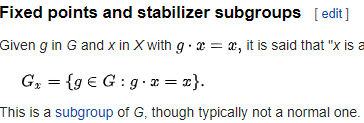 coral shale
Is G_x not a stabiliser of a point?
south patrol
ye it is
south patrol
Uh what am I on about
coral shale
but like, take the symmetries of n points. If you fix 1 point, that gets you S_{n-1}
S_{n-1} is not a normal subgroup of S_{N}
coral shale
yh sure
south patrol
Ok so
To repeat
Say a group G acts on a set S by the left. This in fact induces a homomorphism ρ: G -> Aut(S), where ρ(g) is the action by g (i.e. ρ(g)(s) = g.s)
You can check that's well-defined
coral shale
thats the definition of action I am used to 👌
south patrol
Well yes, but it's also the set of g such that g.s = s for all g
so in fact in your notation, it's the pointwise stabiliser of S
coral shale
oh right
south patrol
And so that proves what you want
(after restriction to an action on G.X and noting you get the same thing)
south patrol
Np
south patrol
I'm not sure what sort of converse you had in mind?
coral shale
uhhhh
If N is a normal subgroup of G and G acts faithfully on S
idk what comes after
N must be some something perhaps
Uhhh perhaps G/N acts faithfully on some subset ???
no wait
G/N acts faithfully on some quotient set of S
I think is the kindof idea but idk
coral shale
cloud walrus
Well initially I kindof wanted to reverse this statement. Saying all normal subgroups must somehow be of this form (probably not true without certain conditions - think I need a faithful action for starters)
south patrol
Well you can let G act on G/N in the natural way and then N ought to be the pointwise stabiliser right
coral shale
yh, N leaves each coset fixed (and is the largest set that does so)
south patrol
gaN = aN for all a in G iff (gN)(aN) = aN for all a in G iff gN = N
coral shale
But more like I want to still let G act on an arbritrary set
The initial statement tells me how I can find Normal subgroups given an action
But it doesn't tell me how to find all of them
south patrol
I'm not really sure what you'd be able to do though
you only have a limited number of actions on any given (finite) set
south patrol
Don't you want the action to not be faithful if you're to find normal subgroups?
coral shale
So if our action is faithful, I feel like we should be able to find all normal subgroups
Well more like - I'm taking a faithful action and then restricting that action onto certain subsets
to find normal subgroups (hopefully all)
south patrol
Ok that makes more sense
coral shale
cloud walrus
Given a faithful action G on S,
N is a normal subgroup of G iff N is the pointwise stabiliser of some union of orbits
is what I want to claim
alternatively,
N is a normal subgroup of G iff N is the kernel of the restriction of the action onto some subset of S
I think these are equivalent
coral shale

I think
If we restrict the action to act on Fix_N(S)
We get there... thinking it through . . .
south patrol
Noic
coral shale
Let G act faithfully on S.
Let N be a normal subgroup of G.
Restrict the action of G to Fix_N(S).
Clearly N is a subgroup of the kernel of this action. Remains to show the other inclusion (if true)
tribal moss
coral shale
Given a faithful action G on S,
> N is a normal subgroup of G iff N is the poin...
How about a group acting on itself by its group operation? There's only one orbit, no matter how many normal subgroups there are.
coral shale
hmmm
That's true.
uh
Does it look like I'm unable to conclude any sort of reverse statement
I thought faithful would be enough but maybe not
tribal moss
On the other hand given G and a normal subgroup N, we can always find an S with a faithful action such that N is a pointwise stabilizer.
(Namely take S to be the disjoint union of G with G/N).
coral shale
hmm a bit baffled (didn't have much intuition for faithful beyond the definition)
I kindof assumed there wouldn't be any point looking at different faithful actions - assumed they all 'look' the same
tribal moss
Faithful just means that different group elements can be told apart from their actions.
In my proposal above, I'm really just interested in the action on G/N, but I get faithfulness artificially by adding in a separate copy of G that it can act on by multiplication.
coral shale
I'm not interested in faithful at all if it isn't a restriction I need to impose
so I suppose I just want the action on G/N
tribal moss
Yeah.
tribal moss
Yes.
coral shale
But there are some faithful actions with multiple orbits, should've spotted that
not sure what to make of that
tribal moss
The group really acts separately on each orbit. Once the action is faithful, it cannot stop being so just by adding additional orbits to S.
coral shale
right.
coral shale
coral shale
alternatively,
> N is a normal subgroup of G iff N is the kernel of the restric...
I'm not sure those 2 earlier statements were equivalent, then
N is a normal subgroup of G iff N is the kernel of the restriction of the action onto some subset of S
This may be true still ... ? (not disproven by your counterexample)
tribal moss
I'm not sure how that restriction of the action is something that has a "kernel" unless the subset is a union of orbits.
A bit more, perhaps: We can create a "universal" S by taking the disjoint union of all the quotients of G. Then by construction, the normal subgroups of G are exactly the pointwise stabilizers of unions of orbits in that particular S.
coral shale
tribal moss
I'm not sure how that restriction of the action is something that has a "kernel"...
Ah true, I just had very specific concrete examples in mind when writing these and failed to spot.
coral shale
tribal moss
A bit more, perhaps: We can create a "universal" S by taking the disjoint union ...
Will have a think - thanks
tribal moss
Even easier to specify is just to let S be the power set of G, with the "obvious" action.
The elements we're really interested are still just the cosets of normal subgroups, but we avoid needing to speak about disjoint unions.
coral shale
Has this something to do with transitivity
We want n-transitive actions for n the size of the group?
nvm no
 mint seal
what's CG?
 lavish nexus
group ring with complex numbers
pastel cliff
can someone explain chinese remainder thm to a 3 year old pls
 upper pivot
pastel cliff
can someone explain chinese remainder thm to a 3 year old pls
upper pivot
pastel cliff
can someone explain chinese remainder thm to a 3 year old pls
not to a 3 yr old but i could try explaning it to u if u wanted
lol
coral shale
make them play zpordle
pastel cliff
upper pivot
not to a 3 yr old but i could try explaning it to u if u wanted
goo goo ga ga
upper pivot
lol, so you want an explanation?
upper pivot
ok so let me first state its origin, in number theory right
so its like, if i had a system of congruence eqn (e.g i told u what a number is mod 2 and 3), how much can i recover about it
right
and the answer is this, if m,n are coprime
and i know what a number is mod m and mod n
then i know what the number is mod mn
that intuitively makes sense right
pastel cliff
yes
upper pivot
right, so now let me state this in a ring theoritic language
if m,n are coprime, Z/(mn) iso Z/m \times Z/n
do u see why this is equivalent to what i said before
upper pivot
nice
pastel cliff
sorry, backtracking a bit
pastel cliff
upper pivot
so its like, if i had a system of congruence eqn (e.g i told u what a number is ...
so it's of interest to consider what information we get about x when we're given x = a mod m and x = b mod n
i know that's probably just a rephrasing but double checking nonetheless
upper pivot
mhm
pastel cliff
oooo and cyclic groups of relatively prime order will have no elements that have the same order
pastel cliff
thank you shuri
upper pivot
lol
upper pivot
upper pivot
if m,n are coprime, Z/(mn) iso Z/m \times Z/n
btw to be clear when i said this i meant it as rings
not just groups
upper pivot
oh i see, well in modern math chinese remainder theorem is a statement about certain quotients of rings in general
pastel cliff
he's a bit of a crank
pastel cliff
upper pivot
if m,n are coprime, Z/(mn) iso Z/m \times Z/n
i can see how this might be true but i cant put it in words
ik that's not real understanding but like
upper pivot
oh so how much about rings do you know
pastel cliff
well i know what they are
i know what an integral domain is but idk why i care about it
upper pivot
oof, what about ideals, or the isomorphism theorems
pastel cliff
i know a lil about ideals but only from very basic lie algebra stuff im doing outside of class
im grappling with first iso alongside this
coral shale
lie algebra
upper pivot
i mean its technically less structure so lol
well let me try my best to explain this ig
pastel cliff
coral shale
lie algebra <:sully:651816820122189834>
my advisor likes it so by the transitive property i like it
upper pivot
so take the map $f:\bZ \longrightarrow \bZ/m \times \bZ/n $ defined by sending $a$ to the class of $[a]$ mod m in the first coordinate, and to the class $[a]$ mod n in the second
cloud walrusBOT
JohnDS
 upper pivot
i.e, $a\mapsto ( a\pmod{m}, a\pmod{n})$
cloud walrusBOT
JohnDS
 pastel cliff
gcd(m,n) = 1?
upper pivot
yeah assume coprime
so what chinese remainder really tells us from like, the original thousand years ago thing
is that, if m,n coprime, then $x=a\pmod{m}$ and $x=b\pmod{n}$ has a solution for any choice of $a,b$
right
cloud walrusBOT
JohnDS
 pastel cliff
should i think of it as something separate from CRT in the context of algebra
upper pivot
well its a specail case
when we say it today it means a more general statement
just want to emphasize that this is a specail case and not the general one
ok, so far so good?
upper pivot
cloud walrus
**JohnDS**
right so what does this tell us?
this tells us the f we defined above is surjective right
because for all pairs (a,b) there is some integer that solves this
so $f:\bZ \longrightarrow \bZ/m \times \bZ/n$ is a surjective homomorphism right
cloud walrusBOT
JohnDS
 upper pivot
what theorem do we like using when we have surjective homomorphisms?
pastel cliff
pastel cliff


im kinda seeing it
wait dumb question
first iso works on rings?
we've barely studied rings lol
upper pivot
yeah its the same theorem basically
next obsidian

Except prove it instead of ask
But yeah you can use the first iso for groups to get you the map
coral shale
the isomorphism theorems extend to a lot of Algebraic structures
next obsidian
And all you need then is to show the map is also a ring hom
coral shale
idk then
next obsidian
It’s a “just do it” kinda thing if you remember what the map is supposed to be you can just compute it and oh wowza it’s a ring map and I already know it’s bijective!
coral shale
universal algebra is the generalisation
upper pivot
btw ping me when ur ready to continue @pastel cliff
pastel cliff
upper pivot
and what is the kernel of this homomorphism?
typing a long thing
upper pivot
i c
pastel cliff
ok im gonna be stupidly verbose for a moment for my own silly brain:
Z/mZ is the set of all cosets of mZ (i.e. mZ + a for all a < m) so it like partitions Z ; the map Z -> Z/mZ where a \mapsto [a] basically just places the integers into the correct element (coset of mZ) in Z/mZ so that we end up with an injective map, and since it's already surjective it's a bijection and it's a homomorphism bc i said so, so first iso applies. same goes for a map Z/nZ and if m and n are coprime then the only elements that would get mapped to the identity in the map Z -> Z/mZ x Z/nZ are elements that are multiples of mn, hence the kernel is Z/mnZ (why doesnt this apply if m,n are not coprime? - if m and n are not relatively prime, then the kernel will be Z/mnZ, as well as Z/kZ, where k is divisibly by both m and n but not a multiple of mn (like 12 = 0 both mod 4 and 6))
sorry that's super rambly
but i also feel like ive now digressed from CRT
upper pivot
yeah excellent
mnZ is exactly the kernel
so to conclude, $\tilde{f}:\bZ/mn \longrightarrow \bZ/m \times \bZ/n$ is an iso due to first iso
cloud walrusBOT
JohnDS
 upper pivot
or $\bZ/mn \cong \bZ/m \times \bZ/n$
cloud walrusBOT
JohnDS
 pastel cliff
ok im gonna be stupidly verbose for a moment for my own silly brain:
Z/mZ is th...
pastel cliff
pastel cliff
ok im gonna be stupidly verbose for a moment for my own silly brain:
Z/mZ is th...
so without realizing it i just explained CRT to myself here...?
upper pivot
yeah lol
pastel cliff
upper pivot
right so ready for the general version over arbritary rings?
pastel cliff
mmmm one minute i need to now write that in my notebook lol
upper pivot
yeah sure lol
pastel cliff
ok this might be a bit lame but for the time being can i "ignore" the thousand year old version of CRT
pastel cliff
cloud walrus
**JohnDS**
and just think of it as this statement
upper pivot
yeah this is def the right way to think of it these days
i was just historically motivating it
as long as you understand like, what this tells u ig
pastel cliff
bc i semi understand that yes, the fact that we can solve systems of eqns modulo coprimes leads us to that statement about isomorphisms mod coprimes
but the bridge between the two things doesnt fully exist in my head yet
pastel cliff
pastel cliff
ok im gonna be stupidly verbose for a moment for my own silly brain:
Z/mZ is th...
even though i do actually get this
as long as that's aight then yes pls continue 
upper pivot
yeah i think thats fine
the general CRT is used a lot so ull get used to it by practice lolz
ok so for a second we r going to go back to the thousand yr old statement, that basically gives us surjectivity of the map right
and basically you can try working out a proof for it, its not too hard iirc, but the main ingrediant is bezouts theorem
i.e if $m,n$ are coprime, then there is $a,b$ such that $am+bn=1$
cloud walrusBOT
JohnDS
 pastel cliff
damn u beat me to it
cloud walrusBOT
JohnDS
 upper pivot
right nice, yeah just wanted to write it out incase u werent like, nt
do u understand what the statement i wrote means
pastel cliff
cloud walrus
**JohnDS**
( ) <=> [ ] ?