#groups-rings-fields
406252 messages · Page 700 of 407
 pastel cliff
ahhh okie
 upper pivot
do u understand what the sum of two ideals is
pastel cliff
this is where things start to get murky
bc most ring stuff i know is selftaught mostly, and not well

upper pivot
i see, well i guess make a guess, what do u think I+J should mean where I,J are ideals
pastel cliff
but i can kinda follow if you wanna just write it out
ok just to be sure im not being silly first
and ideal is like an absorbent subring right
like how a normal subgroup is to a group
i would assume that I+J has that property as well then
upper pivot
yeah, they are precisely the "kernels" if you will. and when we say subring, it doesnt need to have the unit inside it
pastel cliff
okay
so what is the significance of summing two ideals
im assuming it'd be an ideal as well
upper pivot
its just a way to write down a new ideal
its kind of like, the smallest ideal that contains both I and J
yeah let me just tell you what it is
$I+J={i+j: i\in I, j\in J}$
 cloud walrusBOT
JohnDS
 upper pivot
so now does the original statement (m)+(n)=(1) make sense
pastel cliff
not entirely  but i dont wanna take too much of your time
upper pivot
oh well, do you see what I+J means
upper pivot
kinda yeah
so do you see why (m)+(n) is the whole ring (i.e (1))
remember am+bn = 1 for some a,b
pastel cliff
yup definitely hadnt forgotten that, totally 
(m) and (n) then like, uniquely partition the ring ig?
pastel cliff

Mathematics Stack Exchange
I have to prove that if $I\subseteq R$ is an ideal, and $1\in I$, then $I=R,$.
So I know $I\subseteq R$ is an ideal if $a,b\in I$ implies $a+b\in I$, and if $a\in I$, $r\in R$, then $ra\in I$.
I'm
needed this rq
but yeah i loosely see what you mean
upper pivot
right so (m)+(n)=(1) bc we have, am\in (m) and bn \in (n) and am+bn=1 right
so the coprimity gives u this
pastel cliff

upper pivot
let $I,J$ be coprime ideals in $R$, i.e $I+J=R$, then $R/(I\cap J) \cong R/I \times R/J$
 cloud walrusBOT
JohnDS
 upper pivot
but yeah this is like, exactly the same proof as b4
 upper pivot
also remember (m)\cap (n) = (mn) ig
but yeah thats it, thats the CRT
generalized to all rings
upper pivot
mhm
pastel cliff
thank you john gonna let this marinate and come back to it soon
upper pivot
yeah np
pastel cliff
im being asked to prove that the map f:D_8 -> C_2 x C_2 given by f(a) = (c, id) and f(b) = (id, c)
intuitively i can see why this is a homomorphism
but to prove it does it suffice to check f(a^4), f(b^2), and f(ba^3)
we learned early on that those are like the defining/governing relations of D_8
so i figure just checking those should be enough?

 chilly ocean
In proving that a group whose elements are all powers of p must have an order which is a power of p
I argued that |G| = p^a*m, and m must equal 1, otherwise there would be a cyclic subgroup composed of the prime factorization of m, which implies that one of the elements of G is the order of that prime. Thus m = 1 and |G| = p^a
Would that be correct?
 next obsidian
 median pawn
Here "sum" means direct sum, right?
median pawn
Here "sum" means direct sum, right?
No
Direct sum would imply that they intersect trivially
This means sum, as in like N + K = {n + k| n in N, k in K}
In this particular case it does end up being a direct sum I think, because minimal submodules intersect trivially
median pawn
next obsidian
In this particular case it does end up being a direct sum I think, because minim...
Why do minimal submodules intersect trivially?
next obsidian
Think about it a bit more
cloud walrusBOT
Hausdorff
 median pawn
Does that make sense?
median pawn
median pawn
There is no harm in replacing sum by direct sum in (a) and (b) both, then? @next obsidian
next obsidian
Yes
I mean it doesn’t really matter
The result is the same, it’s a finite sum of elements drawing from the minimal submodules
median pawn
Yes, thanks!
 broken stirrup
I'm trying to show that Q is not a projective Z-module. Suppose Q is projective and there is a submodule K such that F=~ K+O Q just like in (iii). If F is a free Z-module, does it imply that Q must be a submodule of F?

 tribal moss
pastel cliff
im being asked to prove that the map f:D_8 -> C_2 x C_2 given by f(a) = (c, id) ...
tribal moss
pastel cliff
im being asked to prove that the map f:D_8 -> C_2 x C_2 given by f(a) = (c, id) ...
What are you trying to prove about that map?
 ember field
If in a semi group G ax=b and ya=b for any a,b in G. Show that such seni group is a group
 mint seal
you can take a and itself for that condition
so for a, there exists x such that ax = a
and there exists y such that ya = a
then you'll want to show the same x works for every a, and is the identity element
once you have the identity, call it e
and take any a and e, as in the condition again
there exists x such that ax = e
ember field
didn't see that thanks man
mint seal
sure
pastel cliff
tribal moss
What are you trying to prove _about_ that map?
is a homomorphism
lol my b
tribal moss
I see. But those two equations don't define a map from D_8 at all unless we also state that the map must be a homomorphism. So what you really need is to prove that the definition manages to the define anything at all.
If is clear that f(a) = (1,0) and f(b) = (0,1) defines a homomorphism from the free group on a and b to C2×C2. But you need to show that when you quotient out some relators in the free group in order to get D8, your homomorphism factors through the quotient.
That is, that everything in the same coset in the free group maps to the same element of C2×C2.
In particular, the relators themselves need to map to the identity in C2×C2.
Then the fundamental theorem on homomorphisms does the rest.
tribal moss
pastel cliff
but to prove it does it suffice to check f(a^4), f(b^2), and f(ba^3)
However ba³ is not a relator for D8. You probably have something like the relation ab=ba³, but the two sides of this are not relators individually. If you rewrite it to aba^(-3)b^(-1) = e, then the LHS will be a relator.
 coral shale
How are the automorphisms/symmetries of the cayley graph related with the automorphisms of the group it represents?
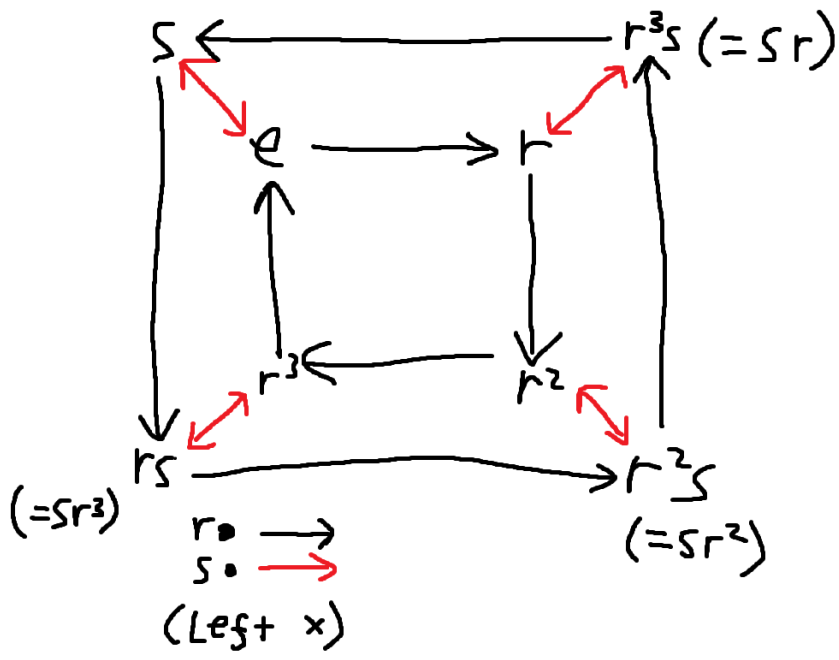
An example 🤔
 wooden ember
i know that cayley graphs are nice with the left multiplication action but apart from that im not too sure if you always can relate symmetries of the graph to automorphisms
well i guess one easy thing you can say is that flipping all the arrows corresponds to the automorphism of taking the inverse of each generator but that's not very interesting
coral shale
😢
tribal moss
If you require symmetries of the Cayley graph to preserve the direction and labeling of the edges, then each of them is uniquely determined by where it takes the identity node. That doesn't sound promising for relating them to group automorphisms.
But if we don't require edge labels to be preserved, then the Cayley graph of the free group on two generators has continuum many symmetries fixing the identity, again far too many to usefully relate to the countably many group automorphisms.
 modern hawk
hi, quick question, is $\mathbb{Z}[x]/(x^n + 1)$ mean the ring of integers which are divisible by $x^n + 1$?
cloud walrusBOT
fisu
 modern hawk
oh
tribal moss
Yeah.
coral shale
tribal moss
But if we _don't_ require edge labels to be preserved, then the Cayley graph of ...
thanks, rip that
coral shale
coral shale
https://i.imgur.com/RexWqu7.png
Was going to try writing down all the automorphisms of this and try to see if there is any kind of correspondance 
But none at all huh
ig I was just after something visual to represent an automorphism
tribal moss
Your dihedral-group example has very few graph symmetries no matter whether we explicitly preserve labels or not. A more interesting finite example might be (C_2)^n. There are (2^n-1)···(2^2-1)(2^1-1) at least 2^(n^2-n) group automorphisms, but I believe just n! graph symmetries ignoring labels but preserving the identity node, or n!2^n graph symmetries in total.
 strong yacht
modern hawk
hi, quick question, is $\mathbb{Z}[x]/(x^n + 1)$ mean the ring of integers which...
strong yacht
modern hawk
hi, quick question, is $\mathbb{Z}[x]/(x^n + 1)$ mean the ring of integers which...
Take n = 2 for the sake of an example. Then Z[x]/(x^2+1) is like adding an element x to Z with the property that x^2 + 1 = 0. In other words, Z[x]/(x^2+1) is nothing more than Z[i]
Since the defining property of i is that i^2 + 1 = 0
(This is not very formal but it gives an intuition into why Z[x]/(x^2+1) is isomorphic to Z[i] = {a + bi : a, b are in Z})
modern hawk
hmm, yea I'm still trying to learn about rings etc so that sounded a little confusing, I'm reading "abstract algebra by david dummit and richard foote"
strong yacht
If I were you, I'd spend a long time thinking about this
This type of thing comes up again and again, you'll be extending fields all day by quotienting out by an "irreducible polynomial"
modern hawk
my entire bachelors thesis will essentially be around this so yeah.. I will.. D: the ring is for ring learning with errors it's essentially for finding the shortest vector in a lattice
so now I'm trying to wrap my head around this without having taken a single abstract algebra course...
modern hawk
strong yacht
Take n = 2 for the sake of an example. Then Z[x]/(x^2+1) is like adding an eleme...
is x then just any number in Z
strong yacht
Nah x is just a formal symbol, it doesn't have any meaning attached to it
modern hawk
oh
strong yacht
Except, when you're quotienting by x^2+1, what you're saying is that x has this property that x^2+1 = 0
modern hawk
I see
strong yacht
So now you've got all the integers, and this new special symbol x
It's a bigger ring than what you started with since it contains all of Z and this new x
coral shale
🤔
Z[x] is a ring that contains all integer polynomials
-5, x+1, x^2+3, ...
each of these things are different.
modern hawk
right
coral shale
x is an indeterminate.
modern hawk
so basically here we simply specify the polynomial it should use
strong yacht
Z is {..., -2, -1, 0, 1, 2, ... }, but which element of Z satisfies x^2 + 1=0?
The answer is none of them do. So we can just chuck in this element and call the ring formed by this Z[x]/(x^2+1)
You can also think of it in terms of polynomials too, I'm just saying that this is an intuitive way that I see the ring Z[x]/(x^2+1)
strong yacht
It really is!
modern hawk
but slowly I'm starting to understand how all of this works
coral shale
if you glue on pi instead, perhaps it will be more obvious (turns out the 2 rings will be isomorphic)
Z[x] is isomorphic to Z[pi]
Z[x]/(x^2+1) is isomorphic to Z[pi]/(pi^2+1)
Z[pi] contains all the integers as usual
as well as 'polynomials in pi'
this means stuff like 1 + pi - 5pi^2
will be in it.
strong yacht
I think that's a potential source of confusion, since pi^2+1 = 0 doesn't look good (pi is typically referring to something else that is transcendental)
modern hawk
I don't know what isomorphic is...
I apparently jumped over the chapter that covered isomorphisism as I wanted to save some time...
coral shale
Then Z[pi]/(pi^2+1) means you take these 'polynomials in pi' mod pi^2+1.
pi^2+1 will be considered to be 0
You cant really skimp out on the concept of isomorphism.
It means 2 algebraic structures are considered to be the same
coral shale
strong yacht
I think that's a potential source of confusion, since pi^2+1 = 0 doesn't look go...
Not really, when you take integers mod n, you are doing the same thing
modern hawk
yea, I just went back and I'm reading about it now
coral shale
mod 5 means multiples of 5 are now all 0
modern hawk
yeah
coral shale
mod pi^2+1 mean all multiples of pi^2+1 are 0.
but back to the original, really we're dealing with x, not pi
but my point is there is no difference in concept.
All multiples of the polynomial x^2 + 1 are now 0
this includes stuff like -10(x-1)(x^2+1)
So the polynomial x + 1 will be the same as the polynomial x + 1 + x^2 + 1 and so on (in the quotient ring you specified)
strong yacht
coral shale
Not really, when you take integers mod n, you are doing the same thing
Apologies yes I think you're right
modern hawk
ohhh
modern hawk
coral shale
All multiples of the polynomial x^2 + 1 are now 0
I didn't somehow realize this was a thing
somehow thought that (x + 1)(x^2 + 1) wouldn't be a multiple of x^2 + 1, didn't cross my mind...
coral shale
truly, Z[x]/(x^2+1) is isomorphic to Z[i], it turns out
modern hawk
sure when doing it with simple numbers it makes sense but polynomials kinda passed me
coral shale
i and -i are exactly the solutions to to x^2+1=0
modern hawk
what's i there though
coral shale
sqrt(-1)
modern hawk
thought it was like x, a formal symbol or w/e
coral shale
it is.
modern hawk
oh...
coral shale
But I'm saying that the 2 rings are isomorphic
because of how x behaves
Z[x]/(x^2+1) === Z[i] === Z[-i]
modern hawk
wait, I'll quickly read up on isomorphisism so I can understand why better
as I thought I understood but now I'm confused again
coral shale
coral shale
Z[x]/(x^2+1) === Z[i] === Z[-i]
You don't have to fully understand this example at the beginning - but it will be important later on
modern hawk
alright, can you explain why they're isomorphic though?
coral shale
If the polynomial you quotient by isn't irreducible, this example breaks
x^2+1 does not factor in Z[x] so it is irreducible
ie. x^2+1 = (x+a)(x+b) for some integer a, b
coral shale
modern hawk
alright, can you explain why they're isomorphic though?
The isomorphism you choose is a + bx -> a + bi
Note all polynomials in Z[x]/(x^2+1) can be written in the form a + bx
If you have 1 + 2x - 3x^2, you can put it in that form by adding on an appropriate multiple of x^2+1
strong yacht
The isomorphism can be seen by sending x to i as well
coral shale
Yeah. Replace every x you see with i
modern hawk
oh I see
strong yacht
The take away intuitive message is that they're the same ring because i is defined by i^2 + 1 = 0 and Z[i] is Z with this i chucked in, and Z[x]/(x^2+1) is defined by chucking in an x into Z with x^2 + 1 = 0: notice I've just merely defined the same ring in a different way
modern hawk
yea, okay that makes sense
thanks for the help, I think I'm starting to wrap my head around this somehow now
 frank fiber
is there a classification of groups of order 1024?
next obsidian
@obsidian sleet were you at Univ of Florida?
 obsidian sleet
i am at university of florida
i know david burrell (he made my latex seminar a pain in the ass to schedule)
hes a computational group theory guy and seeks to classify finite groups of rly fucking big order
his work is very interesting
but i know nothing about it he tried to give a talk on it once and i understood very little
@next obsidian
next obsidian
I C
obsidian sleet
naturally he turns the problem into linear algebra problem
 fast stratus
is a cyclotomic field, extension of Q with a nth root of unity or with all the nth roots of unity?
fast stratus
Thank you... Make senses... I gotta check, if it gives them all for myself!
 south patrol
if you mean a primitive root
mint seal
oh, yes
fast stratus
Yeah, I feel like, I missed something in highschool... what makes $e^{2\pi i / n}$ primitive?
 cloud walrusBOT
Helium
 mint seal
it means by taking powers of it you generate all the roots of unity
mint seal
yup
strong yacht
fast stratus
they form an cyclic group... and it generates it!!!
I'm not sure if you're interested, but this is true for arbitrary fields. The nth cyclotomic extension for an arbitrary field K is the splitting field of t^n - 1 (the 1 here is the multiplicative identity of K, not to be confused with the integer), it's a good exercise to show that the roots of t^n - 1 form a cyclic group.
 white nymph
i feel like maybe im missing something obvious, but i'd like a hint on how to show that if Q_1 direct sum Q_2 is an injective R mod, then so are Q_1 and Q_2.
i have a TFAE theorem regarding injective modules, but I can't seem to figure out which part to use. I feel like this should be easy and follow-your-nose, but im missing something.
 latent anvil
try using the defintion about extending maps along injections. If you have an injection i : M -> N and a map f : M -> Q1, can you get a map g : N -> Q1 with f = g°i?
@white nymph
pastel cliff
does this look okay?
 south patrol
There are counterexamples even if you force rings to have identity tbf
 thorn delta
No there isn’t
 thick abyss
Proving these groups aren't isomorphic: $D_4 \cross \mathbb{Z}3, D{12}, A_4 \cross \mathbb{Z}_2, \mathbb{Z}_2 \cross D_6, S_4, \mathbb{Z}_12 \cross \mathbb{Z}_2$
Is the easiest way finding the number of elements of order 2, and noticing they're different, or is there a nicer way?
cloud walrusBOT
ryаn
 thick abyss
Since that seems to be the tactic used by most people.
 patent girder
Let $H<G$ be a subgroup containing $S_{q_i}$ for some primes $q_i$ and let
$q$ be an other prime dividing $n$. Is it true that $H\cdot Sq$ only
contains $S{q_i}$ and $S_q$ but no other minimal normal subgroup?
cloud walrusBOT
ohNoiAmHere

 fallow plume

is the significance of this proposition that $p(x) \in E$ such that $p(x) \not\in K[x]$ is automatically reducible?
cloud walrusBOT
Thomas


 fallow plume
me who thought i did module theory but hasn't even heard of semisimple
median pawn
fallow plume
me who thought i did module theory but hasn't even heard of semisimple
Well, an R-module is semisimple if it can be written as the direct sum of simple modules
Found the answer here
fallow plume
oh that's not nearly as bad as I thought it'd be
median pawn

Proposition 4.1 says that a module is semisimple iff every submodule is a direct summand
cloud walrusBOT
Hausdorff
 next obsidian
Identify E with a submodule of B, then write B = E (+) M, the splitting map is given by projecting the first coordinate
This is just a general statement for modules, look up what the splitting lemma is
median pawn
next obsidian
Identify E with a submodule of B, then write B = E (+) M, the splitting map is g...
but M need not be equal to C is my problem
next obsidian
It literally is isomorphic
Because both are the cokernel
Also this doesn’t matter, left split = right split
Again, look up what the splitting lemma is
cloud walrusBOT
Hausdorff
 next obsidian
The way that E sits Inside B = E (+) M is via including into the left component
Once you identify E with a submodule this is just what it means to be a direct summand
median pawn
Ah, I see! I'm just confused because there is no reason for the map f (which is what I specified in the original s.e.s.) to equal the inclusion map?
next obsidian
Yes, that’s why you have to just identify E with its image via f
Using the first isomorphism theorem
In reality you’re going to be taking pi and then composing it with f^-1
0 -> E -f> E’ -> E’ (+) C = B
E’ being the image of E, then you take
E’ (+) C -pi> E’ -f^-1> E
This is the splitting map if you want to avoid identifying E with E’
cloud walrusBOT
Hausdorff
 next obsidian
Uhhh… well… I guess?
I feel like writing B = E (+) M is wrong
If that = is supposed to be an internal direct sum
Like as a set B = f(E) (+) M
Where that (+) means {a + b| a in f(E), b in M}
cloud walrusBOT
Hausdorff
 next obsidian
Yeah but those two (+) kinda mean different things like
The right side is an external, the left side is internal
This totally doesn’t matter
But if you’re confused about what’s really going on here it’s worth noting
median pawn
Yep, I understand the difference, but I think we can afford to be loose with notation here
next obsidian
Yeah, I just wanted to be clear what’s really going on

 thorn delta
this would work, yeah. Of course you could also shrink the direct sum to be only over a set of generators of M
 foggy merlin
how hard is the proof of $\mathbb{C} \cong \overline{\mathbb{C}(x)}$ ?
cloud walrusBOT
Dr. J. Stockfish
 foggy merlin
isomorphic just as fields and not as $\mathbb{C}$-algebras
cloud walrusBOT
Dr. J. Stockfish
 pastel cliff
moldilocks
 hidden haven
You need to know about transcendence bases and about when you can extend field homomorphisms
foggy merlin
it's supposed to be a corollary of the result that all uncountable fields with the same charcteristic and the same cardinality are isomorphic.. but this seems like it would require a very ugly proof
edit: *algebraically closed fields
chilly ocean
Suppose i have sequence of groups $A_n \xrightarrow{f_n} A_{n+1}$, if these eventually stablize, i.e, the $f_n$ are isomorphisms after some $n$
cloud walrusBOT
lime_soup
 chilly ocean
is the colimit of this system just whatever group A_N
hidden haven
foggy merlin
it's supposed to be a corollary of the result that all uncountable fields with t...
You need them to be algebraically closed in that theorem
hidden haven
chilly ocean
is the colimit of this system just whatever group A_N
Yes
hidden haven
What is s_i
chilly ocean
hidden haven
Yes
is this obvious
pastel cliff
oh right my prof is a crank using crank notation
hidden haven
chilly ocean
is this obvious
Yes, check the universal property
pastel cliff
s_i = (i,i+1)
hidden haven
pastel cliff
s_i = (i,i+1)
(13)(24)
cloud walrusBOT
The current time for nitezba is 06:13 AM (EDT) on Thu, 14/04/2022.
pastel cliff
guess how much ive slept 
hidden haven
bruh
If you start with the permutation (i,j)
and you conjugate that by some permutation p
Then you get the permutation (p(i), p(j))
 hidden haven
F
foggy merlin
hidden haven
You need them to be algebraically closed in that theorem
ah yeah forgot to menion that
hidden haven
The proof of that isn't too bad
Same uncountable cardinality implies same transcendence dimension
So there is a bijection map of transcendence bases
You extend this to a field homomorphism of the purely transcendental parts
And then everything remaining is algebraic over this
And you need a lemma which says that homomorphisms from a subfield into an algebraically closed field can always be extended
foggy merlin
so you'd just look at C and colsure of C(x) as fields over the algebraic closure of Q in the example I mentioned?
hidden haven
Which you prove by proving it for simple extensions and then using Zorn's lemma
hidden haven
foggy merlin
so you'd just look at C and colsure of C(x) as fields over the algebraic closure...
As fields over Q should be enough
foggy merlin
but this means that the isomorphism cant really be constructed in the general case right?
as this uses zorn's Lemma (or some weakened version of it idk)
foggy merlin
I mean for the mentioned example, can that isomorphism be constructed or be given by some explicit formula?
hidden haven
foggy merlin
I mean for the mentioned example, can that isomorphism be constructed or be give...
No I don't think so
Zorn's lemma is required to prove that Aut(C) is non trivial, and it feels like Aut(C(x) closure) should be non trivial without Zorn's lemma, so they shouldn't be isomorphic without it
Maybe we already used it to prove that C(x) closure exists
foggy merlin
hidden haven
Maybe we already used it to prove that C(x) closure exists
it's usually already used (or some weakened version of it) to prove that an algebraic closure of any field exists
I thought
hidden haven
ye
 chilly radish
hidden haven
Zorn's lemma is required to prove that Aut(C) is non trivial, and it feels like ...
chilly radish
hidden haven
Zorn's lemma is required to prove that Aut(C) is non trivial, and it feels like ...
wait why do you need zorn to prove that Aut(C) is nontrivial? Isn't conjugation clearly a nontrivial automorphism?
chilly radish
oh ok lol
hidden haven
Aut(C) is uncountable
chilly radish
yeye I get what u mean
 hot tinsel
any hints for what such an non-frobenius automorphism looks like

Source: Morandi Fields & Galois Theory
 hot lake
you could try to glue together automorphisms of Z/p^nZ
pastel cliff
moldi & wew lads remember how my prof is a literal fuckster when it comes to grading
just got my first 100 on an exam of my undergrad (and im a junior )
so excited to walk into his office hours and wipe my ass with that exam
next obsidian
I think I’ve only aced a single math test in my entire undergrad lol
frank fiber
is there an implementation in gap of the p-group generation algorithm?
 delicate orchid
pastel cliff
just got my first 100 on an exam of my undergrad (and im a junior <:devastation:...
delicate orchid
pastel cliff
just got my first 100 on an exam of my undergrad (and im a junior <:devastation:...
cracked beyond all recognition
ember field
What's the idea behind for having the condition f(xy)=f(x)f(y) for isomorphism
 sharp sonnet
respecting the group operation
pastel cliff
delicate orchid
cracked beyond all recognition
they call me rad-aline
 shell brook
just want to make sure im not going insane, but in this proof of eisensteins, when they do say "So there is a least integer t", they really mean t = r, right?
\

like by assumption t must be r?
oh wait okay maybe not
Gallian 
delicate orchid
yeah looks like r is just some index for b but t is the minimal integer such that blah blah
oh no there it is again
hold on lemme keep reading
delicate orchid
I don't think it always has to be r is the problem
shell brook
oh is the idea that this handles the case when you have s>r or smth
maybe that inequality is backwards
delicate orchid
well the degree of h is bounded by "n", is n the degree of g? I can't see it defined
shell brook
n is the degree of f sry
delicate orchid
no worries
delicate orchid
ohhh I think it's because p divides b_0 but not b_r there must be some element inbetween them such that it's the largest element p divides
shell brook

delicate orchid
if I'm visualising this polynomial multiplication right anyway
delicate orchid
polynomial multiplication  my one (of seven) weakness(es)
yeah like if you look at the form of a_t then it factors like b_tc_0+p(nonsense) which then leads to a direct contradiction regardless of if t equals r or not
I feel like it's just a bit of an extra general statement, I'm struggling to see it as well
I think it plays into the fact that we have to have p|a_i for i between 0 and n-1
 azure plinth

Okay so guys I am stuck on this problem from character theory, seems like I might be missing something? I can't seem to be making any progress on this. C_x is the conjugacy class of x in G
delicate orchid
that's the lifted character, right?
azure plinth
Hmmm let me think about that. I can see the resemblance, however this was a problem given to us a month ago, when lifted characters wasn't taught to us yet. My point being, sure, I can give some thought to that, and that might lead to a nice and quick solution, but I believe it can be solved without any concepts from the theory of lifted characters, which is what I am wondering about
delicate orchid
yeah I'll need to think about this one
just to confirm this permutation character is the one given by representing G through permutation matrices corresponding to how G acts on X, right?
azure plinth
I believe that's correct
delicate orchid
ok so the character of x would correspond to the number of cosets fixed by left multiplication by x
and the fixed cosets are exactly the ones such that ga_i \in a_iH <=> a_ig \in a_iH - might be something there?
azure plinth
Indeed, that's it. And the RHS is essentially (|G|/|Cx|)/(|H|/|Cx \cap H|), which is neat but I am not quite sure what to make of it
Okay this might lead somewhere
delicate orchid
just trying to get at the connection between x commuting with elements of H and why that would make the number of fixed cosets smaller/larger
azure plinth
This is the quotient of centralisers of x in G and x in H essentially. And ah, go on, by all means. That makes sense and I was thinking about just that right now. That a and g will have to "commute", abusing terminology, in that sense. Which should require g to be in H in addition perhaps?
Essentially that should mean gaH =ahH for some h in H I guess
delicate orchid
that is the implication I was trying to see but I'm not sure if it's true
delicate orchid
azure plinth
Essentially that should mean gaH =ahH for some h in H I guess
I think this is correct
azure plinth
I am trying to think along the quotient of centralisers line for now, hmm...
delicate orchid
I also recalled this which may be of use, X^g is the number of fixed points i.e. the character and and |X/G| is the number of orbits

I think it's burnside's lemma?
azure plinth
I believe it is
delicate orchid
it's giving me some inner product of characters vibes from the 1/|G| and the summing all over G
azure plinth
Oh yes, that it does. Again, I know about inner products of characters now, but it wasn't taught at that point, so there might be a solution without that. But that being said, I wouldn't mind a solution involving inner products either, wouldn't make a difference really
delicate orchid
no worries I think I've found something different
as we discussed before a_iH being fixed implies that ga_i = a_ih, but if g is in H then g is in C_g \cap H = C_g
ah nevermind that's trivial, unfortunately
it does mean that g is in C_{a_i} \cap H though which is a bit more interesting
azure plinth
delicate orchid
it does mean that g is in C_{a_i} \cap H though which is a bit more interesting
Aye, precisely
delicate orchid
ah have you found all of this already
azure plinth
Oh I have been thinking so yeah, some of what we have been talking about :P Anyway, I am thinking of the left cosets of C_H(x) wrt C_G(x), where C_G is the centraliser of x wrt the group G, and similarly we can define C_H
Each coset would have elements ah, where a and h are both in the centraliser of x, so we essentially have a xah=axh=ahx situation
delicate orchid
where a is the coset representative?
azure plinth
Which would make sense, x would fix ahH=aH then
Oh yes
Or more precisely a is in the centraliser of x wrt G
h in that of x wrt H
delicate orchid
I seeeee
So are those elements exactly the ones that fix aH?
Or rather, are they exactly those aH that get fixed
azure plinth
That is the only part of the question that remains to be solved I suppose. We know that these are fixed by x, now we have to show that these are the only ones that get fixed
delicate orchid
Yeah cause then if you do that you’ve basically done it
The number of those cosets is just |C_G|/|C_H| right?
azure plinth
Precisely, it should be quite doable hereon I suppose. And oh yes, in that case it would be that. And that equals the RHS
So xaH= aH = ahH for some h in H
So xa = ah for some h I guess?
delicate orchid
I believe so yeah
delicate orchid
azure plinth
So xaH= aH = ahH for some h in H
You’ll have to say that this holds for all h in H though
So then you can pick a specific h’ such that xa = ah’, the existence of which is guaranteed by xaH = aH
azure plinth
delicate orchid
You’ll have to say that this holds for *all* h in H though
Oh yes, ignore the last ahH thing maybe? And oh that's a better way of going about it, I like that!
azure plinth
delicate orchid
So then you can pick a specific h’ such that xa = ah’, the existence of which is...
I meant this. This should do and thus finish this solution. Dang, thinking out loud and seeking help does wonders. I think we are done with this problem
Thanks a bunch for your help :) I really appreciate it and can sleep better without this gnawing on my mind so to speak :P
delicate orchid
azure plinth
Thanks a bunch for your help :) I really appreciate it and can sleep better with...
No worries, I’m just glad my area of expertise was finally useful
azure plinth
XD And I appreciate it mate
strong yacht
Does anybody have examples or a reference to some examples of determining Galois groups of a polynomial f with coefs in Q by reduction modulo p? I know that the Galois group of f_p (f reduced mod p) is cyclic and embeds in the Galois group of f, and I think you can say a bit more (the lengths of irreducible factors of f_p correspond to a particular permutation with cycle type relating to those lengths in Galois group of f viewed as a subgroup of S_n).
 merry island
a quick and potentially dumb question about Nakayama's Lemma - i've seen two different versions, statement 1 and statement 2 on this page: https://en.wikipedia.org/wiki/Nakayama's_lemma
if i have a proof of statement 2 without using statement 1, is it possible to prove statement 1 or is it actually a stronger result?
In mathematics, more specifically abstract algebra and commutative algebra, Nakayama's lemma — also known as the Krull–Azumaya theorem — governs the interaction between the Jacobson radical of a ring (typically a commutative ring) and its finitely generated modules. Informally, the lemma immediately gives a precise sense in which finitely gener...
 desert dome
Hi, I'm reading through this proof. Could anyone help explain a bit why at least one of P->P' and P' -> P is surjective? Thank you!
 next obsidian
I don’t buy this
I think this is wrong, namely if M = 0 then you can let P = P’, and consider the only map P -> M and P’ -> M
You can factor this using the 0-map,
P -0> P’ -0> M and P’-0> P-0> M
chilly ocean
What does subdomain mean
next obsidian
next obsidian
I don’t buy this
@desert dome
latent anvil
No, bc the map P -> M isn't zero
Also the lifting thing isn't a universal property bc it's not unique
next obsidian
latent anvil
No, bc the map P -> M isn't zero
eh?
latent anvil
we lift φ' along φ to get a map ψ : P -> P' with φ' ° ψ = φ
if ψ = 0 then we'd have φ = 0
yeah?
next obsidian
M = 0
In my example
I'm just showing that this setup isn't sufficient to conclude that one of P -> P' or P' -> P is surjective
latent anvil
Oh I didn't see that lol
desert dome
next obsidian
You can factor this using the 0-map,
P -0> P’ -0> M and P’-0> P-0> M
Yeah I see...
latent anvil
yeah okay I think your example shows that this won't work
desert dome

next obsidian
I don't know if it's possible to conclude that some factorization exists with a surjective mpa
but just invoking the definition of projective modules isn't good enough because of a lack of uniqueness on lifts
desert dome
I see. Thanks!! I'll think about this more 
 mint gulch
Hi

Someone knows how to interpret tge sum that is in the proof?
Phi is a module endomorphis but a_(i, j) is an element on the ideal and then all is multiplied by x_j 🤔
next obsidian
So there’s a couple things
This is actually applying this map to x_j
so the map inside of the parentheses is going to be delta_{ij}phi - a_ij, which means it sends x_j to delta_ijphi(x_j) - a_ijx_j
we can view any scalar as an endomorphism by just multiplying by it
so in total this expression sends x_j to
$\sum_{j=1}^n \delta_{ij}\phi(x_j) - a_{ij}x_j$
cloud walrusBOT
CHMOLUMBIA
 next obsidian
👍
mint gulch
I think he should add at least () then
next obsidian
¯_(ツ)_/¯
It is common practice at a certain point to just drop parentheses
Like when talking about function composition to just write gf
And something like gfx = g•f(x)
next obsidian
It kinda is bad, but once you know that it’s a convention you can usually figure out what is going on by context
Yeah, but one way to think of scalars is as endomorpjism
One way to define an A-module is via a ring map A -> End(M) where the latter is endomorphisms as an abelian group, with multiplication given by composition
The way you do this is, if you have a module structure as you are familiar with, you define f:A -> End(M) by saying f(a) is the endomorphism
a-
Which is to say x -> ax
And conversely given such an f, you can define ax to be f(a)(x)
So really you can think of scalars as endomorphisms in a very very natural way which makes this notation make more sense
mint gulch
Ok. Thank you. I'll continue reading then

 toxic zephyr
in the ring $\bZ^{n\times n}$, would the ideal $(2\bZ)^{n\times n}$ (the set of all matrices with even entries) be generated by $2I$?
cloud walrusBOT
nix
 toxic zephyr
ive only heard my professor talk about principal ideals being generated in commutative rings. 2I does commute with every matrix though... so would this be a principal ideal?
and could i denote it as $(2I)$ or $\langle2I\rangle$?
cloud walrusBOT
nix
 foggy merlin
anyone know a nonabelian group of order 7^9 by chance? or know that there exist none?💀
wait nevermind, I think just using the construction of a nonabeliangroup of order p^3 should work when I product it with some abelian group of order 7^6
 oblique leaf
I have to find what $$\mathbb{F}{q^s}\bigotimes{\mathbb{F}p}\mathbb{F}{q^r}$$ is and then show why
cloud walrusBOT
alyosha
 oblique leaf
I know that for a polynomial of degree m, say r, we have that $$\mathbb{F}{p^n}[X]/\langle r\rangle\cong\bigoplus_i\mathbb{F}{p^n}[X]/\langle r_i\rangle$$ with $$r_i$$ the factors of $$r$$
cloud walrusBOT
alyosha
 oblique leaf
Does anyone know how to proceed?
 lethal dune
is the supposed to be over F_q?
oblique leaf
yes
lethal dune
say V and W are VS over F with dim m and n, then V \otimes W is a vector space over F with dim mn
you can expect the tensor prod to be a vector space to be of dim sr
so try finding a bilinear map from that to F_q^(rs)
might help IDK
say v \in Fq^s be coordinates, same for w\in Fq^r, then try the function vw^T
oblique leaf
hmm but what does that achieve?
because the our tensor product of finite fields isn't in fact isomorphic to F_q^{rs}
it is isomorphic to the direct sum of gcd(m,n) copies of F_{p^l} where l=lcm(m,n)
@lethal dune
lethal dune
then idk
 barren sierra
Why are seperable extensions called seperable
I don't get the name
I feel square free might be a better name
But maybe there's an intuition for these extensions that lead to the name seperable
That I don't quite get
south patrol
according to keith conrad (and ig intuition) it's because the roots all sort of 'separate out'
 uncut girder
If you're a normal subgroup, then you are the only element of your conjugacy class of subgroups, right?
 devout crow
is it more common to write "I is an ideal of R" or "I is an ideal in R"?
tribal moss
"of"
patent girder
Let $H<G$ be a subgroup containing $S_{q_i}$ for some primes $q_i$ and let
$q$ be an other prime dividing $n$. Is it true that $H\cdot Sq$ only
contains $S{q_i}$ and $S_q$ but no other minimal normal subgroup?
I'm fairly sure that the answer is yes, since $S_{q_i}$'s are contained in H. The group specifically that im working is G(m,p,n)
 cloud walrusBOT
ohNoiAmHere
 patent girder
Since the group is defined for primes dividing m, there should be some link there right?
I just can't prove it
strong yacht
barren sierra
Why are seperable extensions called seperable
In my notes, a poly is separable iff its irreducible factors are separable (and for irred polys it means having distinct factors in splitting field), e.g. x^2 (over Q say) is separable but not square free
So separable does not necessarily coincide with square free (which is already a coined term that means something else) depending on your defs
uncut girder
@delicate orchid @latent anvil here's the heawood map obtained as a quotient of the upper half plane by an index 42 torsion free normal subgroup of the modular group
 delicate orchid
uncut girder
<@233993116418441216> <@228562950703546368> here's the heawood map obtained as ...
delicate orchid
uncut girder
<@233993116418441216> <@228562950703546368> here's the heawood map obtained as ...
this is pretty mental in the mind imo
shell brook
$\mathrm{Gal}(\bQ(\sqrt[3]{2}, \sqrt{-3})/\bQ) \cong \bZ_2$?
cloud walrusBOT
jesse
 shell brook
Automorphisms
next obsidian
Is that only for Galois extensions or is it for automorphisms that fix the base field?
It must mean the latter
shell brook
In my course it is for Gal extensions only but I am doing an exam from another version of the course
does this change the answer
next obsidian
Well yeah
Q(cbrt(2)) isn't Galois over Q for example
but assuming that the one you originally asked about is Galois
then it can't be Z_2, because the size of the Galois group has to be equal to the degree of the field extension
and that isn't a degree 2 field extension
next obsidian
I think it's degree 6
shell brook
yeah
next obsidian
But idk if that extension is Galois
shell brook
okay wait my book says Q(cbrt2)/Q is trivial Gal group so it must be the second definition you wrote
shell brook
hm well the exam just says 'Compute the galois group'
next obsidian
anyway, I don't really know the answer
shell brook

next obsidian
shell brook
I thought I could just determine the uatomorphisms independently
and then be like. okay its the product
next obsidian
I think this is true given that like you know a bunch of stuff are Galois
But I am shit at field theory / Galois theory so
idk
desert dome
Hi everyone, I asked about this question yesterday. I discussed it with my friend and our thought is like: from s.e.s, we have M = P/ker(phi) and M = P'/ker(phi'). Then by universal property, we kinda have either P is a submodule for P' or P' is a submodule for P. WLOG, suppose P is a submodule of P', we naturally have a surjection. (The surjection mentioned in the last line is not the same homomorphism as from universal property) I'm still pretty confused, could anyone give me some suggestion? Thanks!
 next obsidian
I don't see how you can conclude that P is a submodule of P' or that P' is a submodule of P
I just think this proof is fundamentally flawed, and that you should ditch it and try to prove it yourself
desert dome
next obsidian
I don't see how you can conclude that P is a submodule of P' or that P' is a sub...
I thought this could come from the s.e.s... but yeah I don't quite get it. Do you have any suggestions about how to approach this problem?
next obsidian
It either
1: Follows from some very general nonsense (not recommended unless you have seen said nonsense)
2: you can define a map adhoc, to define a map from ker phi' (+) P -> ker phi (+) P' it is equivalent to give four maps
P -> ker phi, P -> P', ker phi' -> ker phi, ker phi' -> P'
using the fact that P/ker phi = P'/ker phi' you can figure out a way to just sort of define a map that works
I guess here you do use that you get a map P -> P' and P' -> P
you just don't know that either of them are injective
desert dome
Thanks!! I'll try to figure it out 
next obsidian
Also one more thing I guess
Because P' is projective, surjections onto it split
so you really want to find an SES like this
0 -> ker phi -> P (+) ker phi' -> P' -> 0
you can use all the info you have to make that SES, and then because it's split you get your desired isomorphism
 next obsidian
GL! FWIW this is how I did this problem in the past, and the maps I made are kinda icky, but if you just keep trying to make the maps, you should basically be forced to stumble on the right thing
there's kinda only one way to do this I think
desert dome
Sounds good! 
desert dome
next obsidian
GL! FWIW this is how I did this problem in the past, and the maps I made are kin...
Hey! Sorry to bother again. By universal property, I have nu: P -> P' and nu': P' -> P. I can show that nu(ker phi) is subset of ker phi'. I am currently thinking define the morphism ker phi to P oplus ker phi' as a -> (a, nu(a)). However, I had a hard time thinking of a reasonable morphism from P oplus ker phi' to P'. Do you mind giving me another hint?
next obsidian
To define that map it suffices to give a map P -> P’ and one ker phi’ -> P’
(The map from the direct sun will just add the two things together)
There’s kinda two obvious maps here, but I believe you’ll need a sign change in one side in order to have this actually be an exact sequence
Also one sort of thing that is subtle, I wouldn’t really call it a universal property for projective modules
Universal properties should involve unique maps
But the maps from a projective module are not unique
This is a really important point because it can sometimes complicate things somewhat
desert dome
Thanks! I'll pay attention to that. I'm thinking about adding them together too, but my map P to P' is nu and ker phi' to P' is embedding. However I have a really hard time proving this is surjective
next obsidian
Yeah, so you want to subtract those two maps
In that case you’ll see that this is a chain complex because a goes to (a,nu(a)) which goes to nu(a) - nu(a)
To show that it’s surjective is when you use nu’ I think
And probably to show exactness in the middle as well
desert dome
I see. Thanks!! 
next obsidian
Also
At some point I think you need to take a in P’
Map it to some m in M
Then you know there’s a b in P mapping to m
I think that is needed as well
desert dome
 Thank you! I'll note that
next obsidian
Also @desert dome I came up with an example to show the statement about the projective modules embedding into each other is false
Note that any two modules surject onto 0, so if you could do what that proof tried to do, you’d get that for any two projective modules P,P’ that one of them embeds into the other
In a semisimple ring (like for example CG if you’ve done representation theory) any module is projective
So you can take two nonisomorphic nonzero simple modules and they won’t be able to embed into each other
So that proof is unsalvageable because there’s no way to guarantee that there’s an injection from P to P’ or vice versa
Shamrock gave me a better example that’s more hands on
Consider R = k (+) k, and P = k (+) 0 and P’ = 0 (+) k, both considered a module via the obvious map from R
P and P’ are projective since P (+) P’ = R
But you can see that there’s no way to embed either of P or P’ into the other because of R-linearity
desert dome
 I see. Tysm!! I really appreciate it
strong yacht
next obsidian
And I am shit at determining if extensions are Galois so
One characterisation of Galois extensions is that they are precisely the extensions which "have all the automorphisms they need" i.e. this is a degree six extension, so you want six automorphisms. Proving that it is Z_2 is actually a proof that it isn't a Galois extension (I think)
strong yacht
cloud walrus
**jesse**
This might work: the min poly of $\sqrt[3]{2}$ and $\sqrt{-3}$ are: $x^3 - 2$ and$ x^2 + 3$. The roots of the first min poly are $\sqrt[3]{2}, \sqrt[3]{2}(-0.5+0.5\sqrt{-3}), \sqrt[3]{2}(-0.5-0.5\sqrt{-3})$ and the roots of the second are $\sqrt{-3}, -\sqrt{-3}$. So actually an automorphism is completely determined by where you map $\sqrt{-3}$, and since its min poly is $x^2+3$ you have two choices for that, hence the automorphism group (I don't like the term Galois group for non-Galois extensions) is $\mathbb{Z}_2$.
cloud walrusBOT
Greenman
 strong yacht
This doesn't feel right actually
strong yacht
cloud walrus
**jesse**
Is this statement actually true?
I don't think so, I mean what I wrote is complete nonsense, isn't this the splitting field of x^3-2 so it's Galois (splitting fields are Galois) so it has at least as many auts as its degree (which is 6)?
next obsidian
I just don’t think this is the splitting field of it
The three roots are cbrt(3), wcbrt(3) and w^2cbrt(3) where w is a primitive third root of unity
This has argument 2pi/3
But everything inside of Q(cbrt(3),sqrt(-2)) has an argument a multiple of pi/2
In fact I think this is a proof this isn’t Galois, because this extension isn’t normal
strong yacht
Wait hold on just a small point, did you switch your threes and twos around
next obsidian
I just don’t know how to compute the automorphism group because I suck ass at field theory
Idk did I?
strong yacht
It's cube root 2, and square root -3 right?
strong yacht
I think it may make a difference
next obsidian
You don’t have any multiple of a third root of unity which is all that matters I’m pretty sure
strong yacht

Wolfram Alpha says these are the roots of x^3 - 2 = 0
What you said is correct, but you can write those roots in terms of sqrt(-3)
next obsidian
Wtf
Literally how does that work
Oh I’m so fucking dumb
Yeah
If you just add something to i its argument is no longer pi/2 lmao
I’m so bad at field theory
Yeah idk maybe this is the splitting field lol
strong yacht
next obsidian
I’m so bad at field theory
Same man, I'm highly motivated for Galois theory rn cos of exams and a project
next obsidian
And the Galois group can’t be abelian
Because Q(cbrt(2)) isn’t Galois
And if my memory serves me the only groups of order 6 are S_3 and Z_6
So this pins it down as S_3
strong yacht
Another way I think of seeing it: the Galois group are the permutations of the roots of x^3-2 so embeds in S_3 so must be S_3 (can't be Z_6, that acts on six things)
uncut girder
I have a question.
Say G is a finite group. Consider two surjective homomorphisms
h_1, h_2 : PSL(2,Z) -> G
Suppose that ker(h_1), ker(h_2) are torsion free. Is it true that ker(h_1) = ker(h_2)?
 coarse storm
Any examples of such maps?
 harsh anvil
If I want to use any 2 generators to produce a hamiltonian path through a symmetric group, does anyone have any ideas where I might begin?
delicate orchid
harsh anvil
If I want to use any 2 generators to produce a hamiltonian path through a symmet...
I know of a way to generate any symmetric group from just two elements but I have no idea what a Hamiltonian path is
harsh anvil
delicate orchid
I know of a way to generate any symmetric group from just two elements but I hav...
I think that would be good enough! got a hint?
delicate orchid
harsh anvil
I think that would be good enough! got a hint?
you can generate any symmetric group S_n with a transposition and an n cycle, specifically ||(1,2) and (1, 2, 3, ..., n)||
 cloud walrusBOT
Spamakin🎷
 barren sierra
Obviously then the splitting field is $\mathbb{Q}\left( \frac{1}{\sqrt[4]{2}}(\pm1\pm i) \right)$
cloud walrusBOT
Spamakin🎷
 barren sierra
if I can show this is equal to $\mathbb{Q}(\sqrt[4]{2}, i)$ the degree becomes immediate
cloud walrusBOT
Spamakin🎷
 barren sierra
but showing this equality is proving to be a pain.
One direction is immediate but I can't get the other direction
chilly ocean
Which direction have you proved so far?
barren sierra
very obvious
wooden ember
dont you mean the other direction
chilly ocean
well, now you just need to prove that the generator of the right hand side belongs to the left field
(I'm too lazy to type them out)
I think that the one that you proved is the least obvious of the two
wooden ember
yeah which is why i think you got the inclusion the wrong way around
cause the reverse inclusion is very obvious
wooden ember
yeah then for the other inclusion i can see how the algebra would be tedious
ill pull up some paper and see if i can figure anything out
barren sierra
$\mathbb{Q}\left( \frac{1}{\sqrt[4]{2}}(\pm1\pm i) \right) \subseteq \mathbb{Q}(\sqrt[4]{2}, i) $
this is what I have showed
and yea maybe there's some algebra I am missing but I can't get it to work
wooden ember
just to be sure your +- means the extensions are (1+i)/2^1/4 and (-1-i)/2^1/4 or also (1-i)/2^1/4 and (-1+i)/2^1/4
barren sierra
yea
wooden ember
dont mind my lack of parentheses
barren sierra
4 roots
wooden ember
aight thanks
chilly ocean
well if you multiply any of those roots by i enough times you can get all of them
wooden ember
add these same roots to get 2^(3/4)
then divide the two
and i follows easily
take 1+i/(2^(1/4)) + (-1+i)/(2^1/4) and divide by 2^(3/4)
i think this works
barren sierra
yea once you get 2^(1/4) or i
the other would be easy to get
it checks out
damn
wooden ember
in general with these i think it's good to randomly take products and sums and see what intermediary values you can produce
and only divide by the end
oh if you think about them geometrically i comes straightforwardly as (-1+i)/(2^(1/4)) divided by (1+i)/(2^(1/4))
barren sierra

I must be missing something
how is this not just
i is in L, i is not in K, QED
shell brook
strong yacht
Another way I think of seeing it: the Galois group are the permutations of the r...
Ohh this helps a lot
thank you
shell brook
strong yacht
Another way I think of seeing it: the Galois group are the permutations of the r...
Okay nvm I dont get it
I think an automorphism of this group has to fix cbrt2
like let s be an aut, and since s fixes Q,
2 = s(2) = s((cbrt2)^3) = s(cbrt2)^3
and so s(cbrt2) = cbrt2
So you can only determine the aut by where it sends sqrt(-3), no?
chilly radish
barren sierra
i is in L, i is not in K, QED
This shows the degree is at least 2. Now you have to show that the degree is at most 2
chilly radish
Like it's not 100% immediate but it should be pretty easy
barren sierra
Yea
chilly radish
Just gotta see that putting i in you're not missing any complex algebraic numbers
That you couldn't otherwise write in Q^alg\cap R(i)
barren sierra
Simple contradiction
shell brook
shell brook
like let s be an aut, and since s fixes Q,
2 = s(2) = s((cbrt2)^3) = s(cbrt2)^3
...
guh maybe this is wrong, theres a similar question in my notes that is talking about the gal group of the sf of x^3 - 2/Q
strong yacht
shell brook
like let s be an aut, and since s fixes Q,
2 = s(2) = s((cbrt2)^3) = s(cbrt2)^3
...
What you've written here is mostly correct
But your conclusion does not follow
strong yacht
s(cuberoot2)^3 = 2 does NOT imply s(cuberoot2) = cuberoot2
strong yacht
Yeah but what it does imply is that x^3-2 is fixed by an aut
strong yacht
No probs!
Also here is some good information for you, these types of extensions are called Kummer extensions and are splitting fields of x^n-a
chilly ocean
coomer extensions
strong yacht
Literally realised they sound like coomer extensions yesterday
chilly ocean
does every exact sequence of abelian groups split
or
is there a mild condition on the groups that makes this true
devout crow
chilly ocean
does every exact sequence of abelian groups split
$0 \to \bZ_2 \to \bZ_4 \to \bZ_2 \to 0$ is a nonexample, right?
cloud walrusBOT
xdres
 next obsidian
chilly ocean
is there a mild condition on the groups that makes this true
next obsidian
chilly ocean
is there a mild condition on the groups that makes this true
Not really, you can assume that either the first is injective or the last is projective
But in general, there’s absolutely no reason to expect this, and splitting is measured by an Ext group in some sense
One mild condition I guess is also that the first and third are finitely generated, and the middle is isomorphic to the direct sum of the outer two
Just having the middle be the direct sum does not suffice unless you assume finite generation
chilly ocean
next obsidian
Just having the middle be the direct sum does not suffice unless you assume fini...
wow
i did not expect that
next obsidian
It is a surprising result IMO
But the proof is not too bad
I can’t find a reference for it tho oof
Mathematics Stack Exchange
A homework problem asked to find a short exact sequence of abelian groups
$$0 \rightarrow A \longrightarrow B \longrightarrow C \rightarrow 0$$ such that $B \cong A \oplus C$ although the sequence ...
Check the first answer
 long obsidian
Are subgroups of free groups necessarily free?
long obsidian
Thank you so much!
 languid walrus
well, F[x] is not a field
 cloud walrusBOT
tr.deg.Shamroc/k
 latent anvil
so let's think
the galois group is order 8
we have a non-normal subgroup of order $2$ and a normal subgroup of order $4$
cloud walrusBOT
tr.deg.Shamroc/k
 latent anvil
the auts fixing sqrt(1 + sqrt(2)) and the auts fixing i
bc of the non-normal subgroup of order 2
that rules out Q8 or any abelian group so it's Q8
maybe $\eta = \sqrt{1 +\sqrt{2}} + i$?
cloud walrusBOT
tr.deg.Shamroc/k
 latent anvil
$\eta(\sqrt{1 + \sqrt{2}} - i) - 2 = \sqrt{2}$
cloud walrusBOT
tr.deg.Shamroc/k
 latent anvil
so $\Q(\eta) \subseteq F$ and $\Q(\eta, i) = \Q(\sqrt{1 + \sqrt{2}}, i) = F$
cloud walrusBOT
tr.deg.Shamroc/k
 latent anvil
but $\eta(\eta - 2i) = \sqrt{2}$ so $\Q(\eta, i) = \Q(\eta, \sqrt{2})$
cloud walrusBOT
tr.deg.Shamroc/k
 latent anvil
observe that $\sqrt{1 + \sqrt{2}}\sqrt{1 - \sqrt{2}} = \sqrt{1 - 2} = i$
cloud walrusBOT
tr.deg.Shamroc/k
 cloud walrusBOT
tr.deg.Shamroc/k
 latent anvil
$E = \Q(\eta, \sqrt{1 + \sqrt{2}})$
cloud walrusBOT
tr.deg.Shamroc/k
 latent anvil
$\eta^2 = 1 + \sqrt{2} + 2 i \sqrt{1 +\sqrt{2}} - 1 = \sqrt{2} + 2 i \sqrt{1 +\sqrt{2}}$
cloud walrusBOT
tr.deg.Shamroc/k
 latent anvil
$\eta^2 - \eta = \sqrt{2} - i + (2i - 1) \sqrt{1 +\sqrt{2}}$
cloud walrusBOT
tr.deg.Shamroc/k
 latent anvil
we know $[\Q(\eta, i) : \Q(i)] = [\Q(\eta, i) : \Q(\sqrt{2})] = 4$
cloud walrusBOT
tr.deg.Shamroc/k
 latent anvil
$[\Q(\eta) : \Q(\eta) \cap \Q(i)] = [\Q(\eta) : \Q(\eta) \cap \Q(\sqrt{2})] = 4$
cloud walrusBOT
tr.deg.Shamroc/k
 latent anvil
if $[\Q(\eta) : \Q] = 4$ then $\Q(\eta) \cap \Q(i) = \Q(\eta) \cap \Q(\sqrt{2}) = \Q$
cloud walrusBOT
tr.deg.Shamroc/k

 round jay
Prove that if g and h commute and
gcd(|g|, |h|) = 1, then |gh| = |g| |h|.
Any tips guys?
g and h are elements of a group G
latent anvil
What does it mean for gh to have a certain order (like |gh| = k means what?)
round jay
latent anvil
What does it mean for gh to have a certain order (like |gh| = k means what?)
This means k is the smallest positive integer so that (gh)^k=e
latent anvil
right
round jay
Where e is identity
latent anvil
so what would you need to show in the case k = |g| |h|
round jay
I understand the problem statement, but do not know how to prove it
 lethal cipher
Question: given $G_{i-1}\subset G_i$, why does $[G_{i-1}:G_i]$ being prime imply the quotient group is cyclic?
cloud walrusBOT
dackid
 lethal cipher
If I may, how does Lagranges theorem imply this?
chilly radish
Let a be a nontrivial element of a group of prime order. The order of a is either p or 1 by Lagrange's theorem, but a is not the identity, so the order of a is p
I.e. it generates the group
barren sierra
Given $H \leq G$ then you must have $|G| = [G : H] |H|$
cloud walrusBOT
Spamakin🎷
 chilly radish
So the group is cyclic
barren sierra
set $[G : H]$ prime and it's pretty clear
cloud walrusBOT
Spamakin🎷
 lethal cipher
Oh, of course. Thank you
chilly radish
This doesn't really answer the question in the case that G and H are infinite spamakin
chilly radish
e.g. Z and pZ for p a prime
 lethal cipher
Luckily for us, it's not a bother too much for me rn. I only care about finite groups
chilly radish
Anyways the prime groups being cyclic thing is really important to keep in your back pocket
round jay
latent anvil
so what would you need to show in the case k = |g| |h|
One idea I had was to prove that |h||g| divides |gh|
barren sierra
I'm at the point where I want to show that the degree is at most 2 (showed that it's at least 2). So for contradiction suppose that the degree is greater than 2 meaning there is some element in $\mathbb{Q}^{\text{alg}}$ that is not in $\left( \mathbb{Q}^{\text{alg}} \cap \mathbb{R}\right)(i)$. This element $\alpha$ has a minimal polynomial in $\mathbb{Q}[x]$ with $\alpha$ as a root and then from there not sure where to go.
 cloud walrusBOT
Spamakin🎷
 barren sierra
Can I just say that $\alpha = a + b i$ for some $a, b \in \mathbb{Q}$. Then we have $m(a + bi) + a + b i = a + b i = \alpha$ but $m(a + bi)$ is entirely made of rational numbers and $i$ and so must be in $\left( \mathbb{Q}^{\text{alg}} \cap \mathbb{R}\right)(i)$?
cloud walrusBOT
Spamakin🎷
 barren sierra
oh I thought you were answering my question, I was so lost lol.
chilly ocean
it's a field if and only if alpha is algebraic over F
chilly ocean
barren sierra
oh I thought you were answering my question, I was so lost lol.
i'm also lost trying to answer your question...
languid walrus
i would suggest doing this directly: suppose alpha = a + bi in Q^{alg}. what do you want to show about a and b?
barren sierra
they must be rational
so I know there is a nonzero polynomial m such that m(alpha) = 0
languid walrus
not quite, K = Q^{alg} cap R
chilly radish
You just have to prove every algebraic number is of the form a+bi where a,b are real algebraic
barren sierra
oh
chilly radish
This gives you exactly what you want
You can do this by the contrapositive if you want, or by degree arguments
barren sierra
wdym degree arguments
chilly radish
You know that an element is algebraic iff the extension it generates is finite
You can use that fact
I don't wanna say anymore cuz that would spoil the question
round jay
Can someone help me pls
chilly radish
chilly radish
You know that an element is algebraic iff the extension it generates is finite
Final hint, spoilered ||if a complex number is a root of a polynomial with real coefficients, so is its conjugate, you can use this to show that the real and imaginary parts are elements of an algebraic extension generated by finitely many algebraic elements and hence, algebraic themselves||
chilly ocean
round jay
Can someone help me pls
what have you tried so far?
round jay
chilly ocean
what have you tried so far?
I know that |gh| divides |g||h|
So one idea was to prove the divides relation in the reverse direction
Another idea was to try to prove that lcm(|gh|, |g|) = |gh|
But my issue is that i have no intuition foe this order stuff
 brittle quiver
lethal cipher
Question: given $G_{i-1}\subset G_i$, why does $[G_{i-1}:G_i]$ being prime imply...
brittle quiver
lethal cipher
Question: given $G_{i-1}\subset G_i$, why does $[G_{i-1}:G_i]$ being prime imply...
Do you not need to check that G_i is normal to form the quotient group

 chilly ocean
well, what's something you haven't used yet?
chilly ocean
you're almost there
round jay
So I'm on the right track?
chilly ocean
yes, you just need a few more steps. what can you say about $g^N$?
cloud walrusBOT
Gio
 round jay
I tried to calculate its order
If the statement is true, it must be the case that g to the N is e
So i tried to show that its order is 1
I know the least common multiple between |g| and |h| is their product but idk what to do with that
I feel the remainder of the problem is number theoretical and idk number theory :(
chilly ocean
yes, and to do so we need to use the fact that |g| and |h| are coprime. what can we say about $(gh)^{| g || h |}$?
round jay
I know that's e
cloud walrusBOT
Gio
 round jay
chilly ocean
yes, and to do so we need to use the fact that |g| and |h| are coprime. what can...
round jay
chilly ocean
yes, and to do so we need to use the fact that |g| and |h| are coprime. what can...
It's e
chilly ocean
alright, so $g^{{| g || h |} = h^{- | g || h |}$ correct?
cloud walrusBOT
Gio
Compile Error! Click the  reaction for more information.
(You may edit your message to recompile.)
 chilly radish
round jay
So i tried to show that its order is 1
chilly radish
round jay
So i tried to show that its order is 1
You're on the right track with this
I feel like you might be overcomplicating this gio. What can you say about (g^N)^|g|?
round jay
It's e
round jay
It divides |g|
round jay
Hmm..
chilly radish
Use the fact that g^N=(h^-1)^N
Try to chew on this a bit. Hint: what can you say about the order of an inverse element in general
round jay
It's the same as the order of the element
round jay
I'm in a car right now I have to see when I get home
oblique leaf
Does anyone know what the Galois group of x^4-A over Q(A) is?
I don't even really know what this question is supposed to mean. What is A in this question? A transcendental?
<@&286206848099549185>
chilly radish
That's more of a question to whoever assigned you that question
But i'd wager that yes
A is transcendental
oblique leaf
can you give me a hint about how to proceed? I know how to calculate Galois groups of polynomials over Q: finding the roots, the splitting field, calculating the degree etc.
But I have no idea how to find the Galois group over something like Q(A)
tribal moss
If A is transcendental, then just pretend in your mind that it's pi.
Q(A) is isomorphic to Q(pi) anyway.
oblique leaf
Considering x^4-pi, it seems that it would be irreducible over Q(pi), but im not sure since i know nothing of transcendental extensions ...
tribal moss
And so you can reason e.g. that when you adjoin one fourth root of pi, you also get its negative, but you don't get the other two roots because they are pure imaginary if you map the first root you adjoin to sqrt(sqrt(pi)).
chilly radish
You mean pure imaginary ye tropo?
tribal moss
Yes. Damn keyboard.
oblique leaf
So do you mean that the splitting field would be $$\mathbb{Q}(\pi,\sqrt[4]{\pi},i)$$?
cloud walrusBOT
alyosha
 tribal moss
Yes.
oblique leaf
So then $$x^4-\pi$$ is the irreducible polynomial for both $$\sqrt[4]{\pi}$$ and whatever root involving $$i$$
cloud walrusBOT
alyosha
 tribal moss
±(pi^1/4)i, of course.
tribal moss
No, you have more freedom than that.
oblique leaf
wait actually i think it is 8?
tribal moss
Yes: To specify a Q(pi)-automorphism you can first chose which of the four roots to send pi^1/4 to. Once you have decided that, you get to decide which of the two remaining roots to send (pi^1/4)i to.
But this gives you an explicit description of all the elements of the Galois group, so you can write down how each of them acts on the roots.
oblique leaf
the way we do it for algebraic extensions is that $$x^4-\pi$$ is the irreducible polynomial for $$\sqrt[4]{\pi}$$ so $$[\mathbb{Q}(\sqrt[4]{\pi}:\mathbb{Q}]=4$$ and then $$[\mathbb{Q}(\sqrt[4]{\pi},i):\mathbb{Q}(\sqrt[4]{\pi})]=2$$
cloud walrusBOT
alyosha
 oblique leaf
so the total degree is 8
but I'm not sure this applies to transcendental extensions as well?
tribal moss
The transcendence is all internal to the base field, so that all still works here.
oblique leaf
tribal moss
Yes: To specify a Q(pi)-automorphism you can first chose which of the four roots...
I see what you are saying, but I'm not sure how to justify this since aren't you assuming that the automorphisms keep Q(pi) fixed? I know Q is fixed, but I'm not sure how to prove the same for Q(pi)
tribal moss
By definition the Galois group consists of exactly the automorphisms that keep Q(pi) fixed.
tribal moss
I haven't actually done the calculations myself, but it sounds plausible.
Since an automorphism needs to preserve the "these two roots are each other's negatives" relation.
But it can swap each pair of opposite roots internally, and also interchange the two pairs. That sounds like the symmetries of a square alright.
oblique leaf
yeah i agree
wait, so actually i'm thinking that the question "calculate the galois group of x^4-A over Q(A)" doesn't really depend on what A is at all?
If A is transcendental, you just clarified that all the things for algebraic A still apply
tribal moss
As long as A doesn't already have a square or fourth root.
(I.e. as long as x^4-A is indeed irreducible).
Wait, not quite. It doesn't work that way for x^4+1 over Q.
oblique leaf
what do you mean it doesn't work that way for x^4+1 over Q?
tribal moss
Adjoining just one fourth root of -1 to Q gives you all of them in one go, so the degree of that extension is only 4.
oblique leaf
oh right it is V_4
I don't think there's a general answer to this question if we allow A to be rational, irrational, or transcendental
but lets' say if we just allow A to be irrational or transcendental, it is either the process we just discussed, or A=2nd root or 4th root correct
tribal moss
I think so.
Hmm, of course we'd better not take something like A = 2^(4/3) either, because then x^4-A is still not irreducible over Q(A).
oblique leaf
hmm ok, so it seems more complicated
oblique leaf
tribal moss
The transcendence is all internal to the base field, so that all still works her...
what do you mean here exactly?
"transcendence is all internal to the base field"
tribal moss
In context I think I just meant that the automorphisms we're interested in fix the base field by definition, so the assumed transcendence of A wouldn't give us more relevant automorphisms.
oblique leaf
okok that makes sense
thank you so much! I will clarify with my professor what exactly he wants from us and what A is
chilly ocean
Does anyone here have any tips or resources for how I should approach studying for my abstract algebra final in about 2 weeks? I’d greatly appreciate anything
 tawdry crystal
What is the name of this diagram and what does it mean?
 chilly ocean
are you asking what a commutative diagram is or are you asking about what's going on in this specific one?
shell brook
hey so Im just wondering how to prove c normally. I did it by saying that since $\sigma(\alpha) = \alpha_j, \alpha \neq \alpha_j$, and by obvious argument, $\alpha_j$ is a root of $p(x)$ too. So we get that $R = {\sigma(\alpha) : \sigma \in G}$ is a set of roots for $p(x)$ in $E$. I'm not clear on a nice way to show that $R$ is all of the roots of $p(x)$. Essentially if you suppose $\beta \not\in R$, then you want to show $R' = {\sigma(\beta) : \sigma \in G}$ equals $R$? I think this just boils down to $p(x)$ having finitely many roots but the only argument is really handwavey + bad.
 cloud walrusBOT
jesse
 shell brook
the only argument *i could come up with
also (a) does not make sense to me actually lol
is it just asking s(g(x)) = g(x)?
I mean thats what I showed
Oh wait lmao
Suppose $\beta\not\in R$. Then since p(x) has finitely many roots and no automorphism fixes elements of E, there must be some $\sigma$ such that $\sigma(\beta) = \alpha$. So $\sigma^{-1}(\alpha) = \beta$. Thus $\beta \in R$.
cloud walrusBOT
jesse
