#groups-rings-fields
406252 messages · Page 698 of 407
 delicate orchid
 pastel cliff
oh wait
[x,[y,z]] = [x,y] + [x,z] is false
i think
which means im thinking abt this wrong
delicate orchid
yeah I don't think that follows from the properties
pastel cliff
yeah what i said is wrong but you misread it as something that is right
delicate orchid
[x, [y, z]] = [y, [z, x]] => if [x, [y, z]] = [x, y]+[x, z] then [x, y]+[x, z] = [y, z]+[y, x] = [y, z]-[y, x] => [y, z]+2[y, x] = [y, z]
pastel cliff

also isnt this like... omitting the definition of the lie bracket

like (x,y) -> [x,y] isn't saying much
iirc it's [x,y] = xy - yx
or are these properties enough to guarantee that the only form that satisfies them is xy-yx
delicate orchid
pastel cliff
like (x,y) -> [x,y] isn't saying much
yeah that's just saying it's a binary operation
delicate orchid
pastel cliff
or are these properties enough to guarantee that the only form that satisfies th...
I have absolutely no idea
I doubt it though
pastel cliff

delicate orchid
the theory would be a bit... insubstantial if that was the case
pastel cliff
im not wrong tho am i?? [x,y] = xy - yx??
maybe intro to lie algebras book assumes defn of lie algebra as a prereq
pastel cliff
wdym
pastel cliff
pastel cliff
iirc it's [x,y] = xy - yx
with this definition right
oh wait
it's a few sections down
 neat pollen
if G is a group and there are subgroups H_1 and H_2 of G with H_1 isomorphic to H_2, it it true that H_1 = H_2?
 delicate bloom
nope, look at the klein 4 group
 chilly radish
shit this ended up really long
 cloud walrusBOT
ShiN
 chilly radish
the setup here is less general than it needs to be but if I can understand this case I can understand the more general caes
Ok this is gonna be a bit of exposition but bear with me. Suppose you have the space of multilinear (Taking any number of inputs) and alternating (The image of any set of linearly independent vectors is $0$) functions from $n\times n$ matrices into $n\times n$ matrices. Any such function $G(A_1,\ldots,A_n)$ can be written as
$$G(A_1,\ldots,A_n) = \sum_{i,j}G_{ij}(A_1,\ldots,A_n)e_{ij}$$
Where $e_{ij}$ are the standard basis matrices, and $G_{ij}$ are multilinear alternating forms, in other words, element of the exterior power $\bigwedge^n V^{\ast}$. The space of all such functions can be naturally identified with $\bigwedge(M_n(F)^{\ast}) \otimes M_n(F)$, where $\bigwedge$ here denotes the exterior algebra.
\\
There is a natural action of $PGL(n,F)$ on matrices by conjugation, and hence on functions. This paper is claiming that the $PGL$-Equivariant multilinear alternating maps are those that can be identified with invariant elements of $\bigwedge(M_n(F)^{\ast}) \otimes M_n(F)$ (Where the action on the tensor product is defined in the obvious way), but this doesn't work out when I try to write it down. \\
On one hand, equivariance implies (Where inside the function we conjugate by $g^{-1}$ so that this is indeed an action)
$$G(gA_1g^{-1},\ldots,gA_ng^{-1}) = g^{-1}G(A_1,\ldots,A_n)g$$
On the other hand, if we act on the tensor product (Here I am omitting tensor for convenience) invariance implies
$$
\sum_{i,j}G_{ij}(gA_1g^{-1},\ldots,gA_ng^{-1})g^{-1}e_{ij}g = \sum_{i,j}G_{ij}(A_1,\ldots,A_n)e_{ij}$$
And I just don't see how can conclude from this the equivariance (Originally I had something here that was wrong and told me that the direction of the action was flipped, but now I'm not even really able to see the equivariance)
cloud walrusBOT
ShiN

 chilly ocean
Why is krull dimension 1 not imply all primes are maximal
Is it because 0 is not a prime ideal?
So if krull dimension 1 and integral domain then shouldnt prime imply maximal?
chilly radish
nonzero primes are maximal for krull dimension 1 integral domains. 0 is always prime for integral domains
chilly ocean
yeah thats ehat im saying
but wait a second
you definitely need the ring to be integral domain
otherwise there are primes that arent maximal
like the ones at the base of the chain
chilly radish
true
even nonzero ones, potentially for non-integral domains
but for ID 0 is always at the base so any nonzero prime is maximal since maximal ideals are prime (Maybe you need choice for this something something every ideal is contained in a maximal ideal)
chilly radish
cloud walrus
**ShiN**
since that's resolved, gonna just bump this
chilly radish
nvm solved
 latent anvil
you're welcome shin
 coral shale
Simple extensions, simple groups, any relation in the naming
latent anvil
simple field extension?
i don't really think so ¯_(ツ)_/¯
simple field extensions can have lots of intermediate stuff
latent anvil
so if $F$ is a purely transcendental extension of $k$ and $I$ an ideal of $k[x_1,\ldots,x_n]$ let $I' = I F[x_1,\ldots,x_n]$ we have $\mathrm{ht} I = \mathrm{ht} I'$ and $\mathrm{coht} I = \mathrm{coht} I'$. I can prove this using the identity $\mathrm{ht} I' + \mathrm{coht} I' = n$. Is there a way to do it without appealing to this?
cloud walrusBOT
tr.deg.Shamroc/k
 latent anvil
For the record the height of an ideal is the inf of the heights of all primes containing it and the coheight is the inf of the coheights of all primes containing it, ie dim k[x1,...,xn]/I
 lavish nexus
if M is a finite abelian group show M tensor Q = 0
take any element a tensor p/q = a tensor |a|p/(|a|q) = |a|a tensor p/(|a|q) = 0
and I get a comment why this is enough to show M tensor Q = 0
latent anvil
They might want you to say elements can be sums of simple tensors? I mean they can't really by how tensoring with Q works but that might be their thinking
lavish nexus
eh ok... it seems obvious tho
latent anvil
¯\_(ツ)_/¯
latent anvil
latent anvil
so if $F$ is a purely transcendental extension of $k$ and $I$ an ideal of $k[x_1...
I reduced to the case where F = k(t)
And I can show ht I <= ht I' and coht I <= coht I'
Just by lifting up chains
also we can think of primes in k[x1,...,xn][t] which meet k[t] at 0
when we want stuff containing I for measuring height/coheight
Oh so
wait
Can we show like ht I' + coht I' <= ht I + coht I + 1 or something
Bc we only increased the number of variables by 1
wait...
Can you do noether normalization or something
for the coheight
like spread out y or something
Take primes I' <= q1 < ... < qn
Since k(y)[x1,...,xn] is noetherian each qi is finitely generated, so the denominators of the generators can only mention finitely many polynomials in y, so we get a chain I'' <= q1' < ... < qn' in A = k[y, x1,...,xn]_f with I'' = A cap I' = I A and qi' = qi cap A
But the latter ring is integral over k[x1,...,xn] so coht I = coht I'
and similarly for the height!!
Thanks shamrock!
You're welcome shamrock
 lethal dune
?
latent anvil
?
 next obsidian
Nice job @latent anvil
I really think it’s great to see @latent anvil helping another @latent anvil when they’re struggling
 hidden haven

chilly ocean
Can someone direct me towards a resource which would allow me to build intuition as to how I can identify and use homomorphisms both in abstract algebra and non-algebraic settings?
pastel cliff
Claim: If $G$ is a group and $K \trianglelefteq G$, then there is a homomorphism $G \to G/K$ having kernel $K$
cloud walrusBOT
μ₂ (46/47 🪲)
 pastel cliff
how might i go about proving this
chilly ocean
I understand the mathematical definition of a homomorphism, but I don't have any solid intuition for what it really means/how it operates
pastel cliff
probably your textbook ig?
next obsidian
You’ll be asked to prove lots of things are isomorphic and in the process have to construct homomorphisms
Just continue whatever you’re doing and it’ll come along
pastel cliff
i found that actually proving that homomorphisms preserve identity and inverses was a useful, albeit simple, exercise
drove home the idea of "structure preserving"
 chilly ocean
I would consider the cosets formed by Kg
next obsidian
My man
What’s the most obvious map G -> G/K period
Like literally try to even write down a function
Which isn’t the 0 function
And it’ll be the right one
pastel cliff
g -> gK ?
chilly ocean
I think that that ties into what I'm having issues with—you can construct any function you want and prove that it's a homomorphism
pastel cliff
like literally just the map from elements of G to their cosets in G/K
next obsidian
chilly ocean
I think that that ties into what I'm having issues with—you can construct any fu...
I don’t understand this
chilly ocean
Show that a normal subgroup contains cosets of equal size which partition G then just create a function which maps the elements of G to G/K and the identity to the identity of F/K
next obsidian
Not every set function is multiplicative
chilly ocean
next obsidian
I don’t understand this
For two groups, aren't homomorphisms non-unique?
That's what the tutor at my UC told me today
But he didn't even know the isomorphism/sylow theorems 
next obsidian
Yes they are not unique
chilly ocean
And he was an "abstract algebra tutor"
next obsidian
But I don’t see how this then says “you can construct any function you want and prove that it’s a homomorphism”
Because that isn’t true
chilly ocean
I guess I meant to say that you can construct a function between two groups which is a homomorphism in multiple ways and that this flexibility would allow you to construct the desired group in u2's case
And I didn't totally get that before—I think that I assumed that homomorphisms were unique
chilly ocean
I'm improving 
next obsidian
I don’t mean that in a snarky way
 next obsidian
You didn’t show it’s a group homomorphism
And your last line doesn’t make sense
You’re claiming that the kernel is e and also that phi(e) is the identity, this is implied by the first part
Also the kernel isn’t {e}, it’s all of K
pastel cliff
yeah thought so
oop yeah
ok un segundo
last sentence still feels off

i think my reasoning is ok here but idk if "and K is the identity elt" is necessary
chilly ocean
Let G be an infinite group whose only normal subgroups are the trivial group and
the group itself. Let H be proper subgroup of G. Prove that [G : H] = ∞.
Why is the normal subgroups being only the trivial group and the group itself relevant to this question?
Doesn't it follow from the fact that G is infinite and H is a proper subgroup (can we assume that H is then finite)?—then [G:H] = infinity/finite = infinity
 woven delta
chilly ocean
Doesn't it follow from the fact that G is infinite and H is a proper subgroup (c...
woven delta
chilly ocean
Doesn't it follow from the fact that G is infinite and H is a proper subgroup (c...
We can't assume that H is finite
chilly ocean
Yeah that's what I thought
But I don't think we've learned anything in class that would allow us to prove that [G:H] is infinite then
I gotta think about it more I guess
chilly ocean
In other words, if the index of [G:H] is not infinite, then that implies that G is finite, which is a contradiction?
woven delta
I can give a small hint
chilly ocean
Feels like its more of a fun question than a group theory question
woven delta
I actually know what this is trying to get at I think
chilly ocean
I mean
If [G:H] is finite then H must = G since G is infinite, but H is a proper subgroup of G, so |H| < |G|, so we have a contradiction
Unless I'm blundering again
Can we make any conclusions about division carried out on infinity?
If not then I don't see how we could conclude that H = G
woven delta
Yeah this is much too weak of an argument
There are groups with finite index infinite subgroups
For example 2Z in Z
nZ in Z
Remember countable sets can inject into other countable sets without bijecting!
woven delta
Maybe think of the action of G on the cosets of H
chilly ocean
I am too tired to think clearly
woven delta
woven delta
Maybe think of the action of G on the cosets of H
Do you know what this means?
chilly ocean
Yes, but I'm not totally comfortable working with cosets
Still a bit confused about non-normal cosets I think
But I understand how to use orbit-stabilizer theorem in basic situations
woven delta
woven delta
Maybe think of the action of G on the cosets of H
Well this is the solution to the problem lol
Basically
So think about that for a while maybe
I can give a slightly more detailed sketch if you want
chilly ocean
give me like 5-10 minutes to think about it more
woven delta
I'm about to be in a conference so I'll write spoiler it
chilly ocean

Yeah
I may have to present this in class
So you saved me from embarassing myself
woven delta
||so there are a finite number of cosets, so consider the actions of G on the cosets by left multiplication. An action of G on a set X is the same as a homomorphism from G to S_X (the symmetric group on X) and in this case the set of cosets is finite so we have a homomorphism from G to S_n for some n. Consider the kernel. The kernel is always normal, so in this case it is going to be either G or 0. The kernel being G means there is only one coset of H, which means H is G. The kernel can't be 0 because then you would have an injection from G into S_n, which is impossible||
chilly ocean
woven delta
Okay yeah that was pretty quick to write
And I gave more details than I thought I would
So cool
chilly ocean
Thank you!!!
chilly ocean
I'm planning on trying to think about it a bit more before reading it
After I get some sleep

 dull root
So i know every cubic can be transformed into a depressed cubic with a simple subsitution. The three roots of the general cubic are just the three roots of its depressed form with some shift right?
delicate orchid
going off of wikipedia yes
I noticed you edited your question to one that is far less interesting to answer which is a shame, I was gonna talk about unique factorisation domains and everything
dull root
i realized the original one was wrong
since the subsititon we first made to turn it into depressed cubic is (x - b/3)
or something similar
so its clear the roots would not be the same
 lapis trail
delicate orchid
I noticed you edited your question to one that is far less interesting to answer...
lapis trail
delicate orchid
I noticed you edited your question to one that is far less interesting to answer...
I'll listen
dull root
I have the following question. If we have a depressed cubic $x^3 + px + q \in \mathbb{Q}[x]$, then the splitting field of this cubic, say L, is not necessarily going to be an radical extension of Q. However, I want to show that if I take $\epsilon$ to be a third root of unity, then $L(\epsilon)$ WILL be a radical extension of Q. Cardano's method gives exactly the roots of this depressed cubic, namely if we fixed u+v to be one of the roots
$u + v = \sqrt[3]{\frac{-q}{2} + \sqrt{\frac{q^2}{4} + \frac{p^3}{27}}} + \sqrt[3]{\frac{-q}{2} - \sqrt{\frac{q^2}{4} + \frac{p^3}{27}}}$, the three roots of the depressed cubic are exactly $u + v, \epsilon u + \epsilon^2 v, \epsilon^2 u + \epsilon v$, then
$L(\epsilon) = \mathbb{Q}(u + v, \epsilon u + \epsilon^2 v, \epsilon^2 u + \epsilon v, \epsilon)$, and to show it is a radical extension, we want a radical sequence. The issue I am having is construction this sequence, since u+v to any power will not be in Q, nor does it seem the first term u is even in the extension.
cloud walrusBOT
MasakaBakana
 dull root
Ah, nvm I see why we needed to adjoint the third root of unity now. It guarantees u is in the extension, and we can easily construction a radical sequence then
dull root
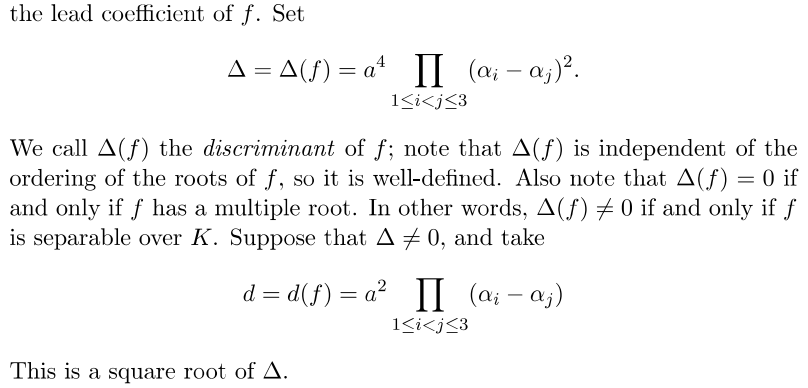
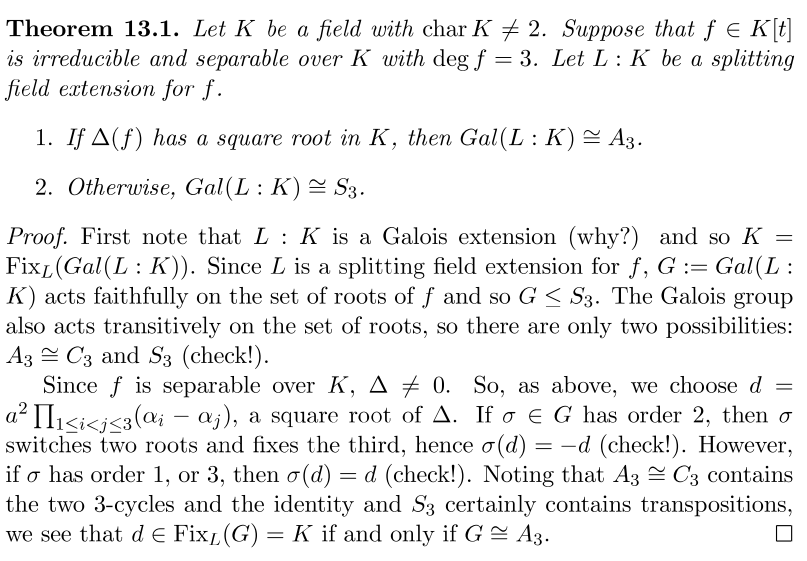
I'm not understanding this line in Dummit and Foote. He states that if the sqare root of the discriminant of this irreducible cubic is in F, then we can adjoin any root to generate the whole splitting field. I don't see why this is obvious, Let a_1, a_2, a_3 be the roots of f. We have that (a_1 - a_2)(a_1 - a_3)(a_2 - a_3) in F. How does adjoining just a_1 to F generate the remaining roots a_2 and a_3? I see that (x-a_1)(x - a_2)(x - a_3) \in F[x] means that a_1a_2a_3 \in F, but is there some easy manipulation I'm not seeing here to get the roots

 dull root
We know G acts on the roots of f transatively since f is irreducible. G is also a subgroup of S_3, and we want to show that if g \in G is not the identity auto, then the order of g = 3. If so, this would give that G is the Z_3 right? Fix g \in G. since the root of the discriminatn is in F, g fixes it, so the idea is that g can not have order 2, because it would flip the sign of the square root of the discriminant
dull root
I have the following question: If I have an Galois extension L/Q such that L/Q has galois group D_4, then L is a radical extension of Q.
We know [L:Q] = 8 since it is a galois extension and D_4 has 8 elements. Moreover L is the splitting field of some degree 8 polynomial (not necessarly irreducible)in Q[x]. The issue is that the polynomial is not irreducible, so I don't exactly see how the galois group is acting on the roots. Does being D_4 give me some useful information? It is clear there is an automorhpism or order 4 and of order 2, but I don't see how to use it
 hot lake
do you have the primitive element theorem ?
dull root
No I do not, but I have an idea that I think works. Does this hold.
So D_4 is generated by rotation r, and a reflection, f. Observe we we have the following chain of subgroups which all have index 2. $1 < \langle r^2 \rangle < \langle r \rangle < D_4$, since r has order 4. Then by the Galois correspondence, this chain correspondences to fields extensions L > L_1 > L_2 > Q where L_2 is a deg 2 extension of Q, L_1 is a deg 2 extension of L_1, and L is a deg 2 extension of L_1.
I know that if L/K is a degree 2 extension, there exists an eleent a \in L such that a^2 \in K, so using this we can get a radical sequence over Q right?
dull root
So I see why L/Q being a galois extension is necessary for this idea, since then we can actually use the galois correspondence. But what if I drop that condition that L/Q is a Galois extension, is there a good counterexmaple of Aut(L/Q) being D_4 but L is NOT a radical extension of Q? We would certainly need an extension which has deg > 8...
 primal sage
silly question guys but if i said [G:H] i would say it as the index of H in G?
next obsidian
Yeah
primal sage
cool thanks

 thorn delta
chilly ocean
Why d'=ud?
thorn delta
chilly ocean
Why d'=ud?
whats your definition of gcd
chilly ocean
Same with abstract algebra textbooks
thorn delta
chilly ocean
Same with abstract algebra textbooks
remind me. in a PID c = gcd(a,b) is equivalent to (c) = (a, b). Is that the definition you have?
in any case, the basic idea is that if d' is another gcd of a and b, then d' divides every other common divisor of a and b, so d' divides d. Similarly, d divides d'.
chilly ocean
@thorn delta
But why u is a unit?
thorn delta
since d and d' divide each other, this means they are associates. And associates differ by a unit
proof. d | d' means d = kd' and d' | d means d' = cd for some c, k in R. But this gives d = kd' = kcd and therefore (kc - 1)d = 0. d is nonzero so kc = 1. This shows that k and c are units
thorn delta
https://math.stackexchange.com/questions/1010070/partition-rectangle-into-finite-number-of-squares
does anyone understand how they get the equality in R \otimes_Q R? There is a bit of a discussion about it in the comments of this MSE thread, but I couldn't follow it.

Mathematics Stack Exchange
For what positive real numbers $x,y$ can an $x\times y$ rectangle be partitioned into a finite number of squares?
When $\dfrac{x}{y}$ is a rational number, it is not hard to see that we can partit...

 light heron
Whoops sorry
light heron
thorn delta
<#488120190538743810> or <#326138737606262786>
You know what it is tho?
thorn delta
its so pixelated im not confident i can even read it
light heron
Go to #prealg-and-algebra
 fickle brook
this is dumb but i cant figure it out despite having a moral obligation to

i can't even figure out what the induced sequence on the tensored modules is
does the map $f: M \to M''$ become $(f \otimes \id) : M \otimes N \to M'' \otimes N$?
cloud walrusBOT
Ann
 fickle brook
and are there supposed to be inclusions vertically from M to M otimes N etc.?
[\begin{tikzcd}
{M'} & M & {M''} & 0 \
{M' \otimes N} & {M \otimes N} & {M'' \otimes N} & 0
\arrow["g", from=1-1, to=1-2]
\arrow["f", from=1-2, to=1-3]
\arrow[from=1-3, to=1-4]
\arrow["{g \otimes id?}", from=2-1, to=2-2]
\arrow["{f \otimes id?}", from=2-2, to=2-3]
\arrow[from=2-3, to=2-4]
\arrow["{??}", from=1-1, to=2-1]
\arrow["{??}", from=1-2, to=2-2]
\arrow["{??}", from=1-3, to=2-3]
\end{tikzcd}]
cloud walrusBOT
Ann
Compile Error! Click the  reaction for more information.
(You may edit your message to recompile.)
 fickle brook
bruh

i cant figure this out even though its supposed to be the simplest thing possible and its driving me crazy
am i even on the right track? wouldn't be surprised if i'm not.
 rustic crown
fickle brook
does the map $f: M \to M''$ become $(f \otimes \id) : M \otimes N \to M'' \otime...
rustic crown
fickle brook
does the map $f: M \to M''$ become $(f \otimes \id) : M \otimes N \to M'' \otime...
yep that's right 
fickle brook
ok but
am i on the right track to show exactness
is there supposed to be a diagram like i drew
or am i big dumdum
rustic crown
not really... as long as N is not an algebra we can't really give a nice map from M --> M tensor N
fickle brook
exactly my thoughts there
i would like to send m ∈ M to m otimes 1 but there is no 1
but ok like.
hm
i need to show that f otimes id is surjective?
rustic crown
the usual way to prove these by using that tensoring is left adjoint to something, so it automatically becomes right-exact
fickle brook
i don't know what left adjoint means i want this shit hands on
given any $m'' \in M''$ can be written as $f(m)$ for $m \in M$, we get that $m'' \otimes n = (f \otimes \id)(m \otimes n)$ hence all elementary tensors lie in the image of $f \otimes \id$ hence $f \otimes \id$ is surjective
cloud walrusBOT
Ann
 fickle brook
is this right?
rustic crown
yep
fickle brook
hrm ok so now i need to prove $\mathrm{im}(g \otimes \id) = \ker(f \otimes \id)$...
cloud walrusBOT
Ann
 rustic crown
right, but working with kernel of a arbitrary tensor product isn't easy
 rustic crown
sorry i have a lecture right now... but i would probably try to show that M'' ⊗ N is the cokernel of the map M' ⊗ N --> M ⊗ N
fickle brook
lethal dune
A is commutative right?
commutative ring with unity
 terse crystal
fickle brook
hrm ok so now i need to prove $\mathrm{im}(g \otimes \id) = \ker(f \otimes \id)$...
terse crystal
fickle brook
hrm ok so now i need to prove $\mathrm{im}(g \otimes \id) = \ker(f \otimes \id)$...
You can prove that $\frac{M \otimes_{A} N}{M’ \otimes_{A} N}$ is isomorphic to
cloud walrusBOT
Cogwheels of the mind
 terse crystal
$M” \otimes_{A} N$ by directly constructing the inverse:
cloud walrusBOT
Cogwheels of the mind
 terse crystal
Let $g:M” \times N \rightarrow \frac{M \otimes_{A} N}{M’ \otimes_{A} N}$ mapping $(x”,y)$ to $\overline{x \otimes y}$ where x is an element of M such that $f(x)=x”$
chilly ocean
lethal dune
A is commutative right?
all rings are
lethal dune
why do you need $\frac{M\otimes N}{M' \otimes N}$ did you mean $\frac{M \otimes N}{g(M')\otimes N}$?
cloud walrusBOT
 lethal dune
what I was thinking is you only need to show that $\frac{M\otimes N}{g(M')\otimes N} \simeq M/g(M')\otimes N$ which can be shown by the map $m\otimes n \mapsto (m+g(M')) \otimes n$
cloud walrusBOT
 lethal dune
chilly ocean
all rings are
lethal dune
chilly ocean
all rings are
have you ever read nil radicals/jacobson radicals over non commutative rings?
the definitions are weird
terse crystal
terse crystal
Let $g:M” \times N \rightarrow \frac{M \otimes_{A} N}{M’ \otimes_{A} N}$ mapping...
You can prove that g is bilinear so the inverse is well-defined
However, how do you type this? I want to add bar on the whole thing but I can only add bar on the otime:
$\bar{x \otimes y}$
cloud walrusBOT
Cogwheels of the mind
 lethal dune
$\overline{x \otimes y}}$
cloud walrusBOT
$\overline{x \otimes y}}$
```Compilation error:```! Extra }, or forgotten $.
l.64 $\overline{x \otimes y}}
$
I've deleted a group-closing symbol because it seems to be
spurious, as in `$x}$'. But perhaps the } is legitimate and
you forgot something else, as in `\hbox{$x}'. In such cases
the way to recover is to insert both the forgotten and the
deleted material, e.g., by typing `I$}'.
Preview: Tightpage -1310720 -1310720 1310720 1310720
[1{/usr/local/texlive/2020/texmf-var/fonts/map/pdftex/updmap/pdftex.map}]``` lethal dune
also your quotient is not defined, as M'xN not a subset of MxN
cloud walrusBOT
Cogwheels of the mind
 lethal dune
the map may not be injective so you can't identify M'xN as a submod of MxN
lethal dune
well so you should use g(M')\otimes N
terse crystal
Quotient of (M otimes N) over (the image of M’ otimes N)
fickle brook
ah fuck
fickle brook
sorry i got distracted 💀
 devout crow
is every ideal in a PID the intersection of finitely many maximal ideals? this seems true but I haven't found a proof
lethal dune
PID => UFD now look at the irred factors of the generator of that ideal
chilly ocean
devout crow
is every ideal in a PID the intersection of finitely many maximal ideals? this s...
did you know prime implies maximal in a pid
also every ideal in a noetherian ring has a primary decomposition
there is probably a nice direct way to shown it tho
next obsidian
devout crow
is every ideal in a PID the intersection of finitely many maximal ideals? this s...
No, consider (4) inside of Z
The issue is that you need to take powers of maximal ideals, in which case this simply turns into taking your ideal (f) and writing down a factorization into irreducibles
Each irreducible component corresponds to a maximal ideal, so you take the right powers of maximal ideals and intersect them
devout crow
oh yeah of course
thanks
does that prove PID => UFD then?
because (a) maximal iff a irreducible
next obsidian
You need more than that
But you can show that UFD =
- prime <==> irreducible
- ascending chain condition for principal ideals
Your argument gives 1), and 2) follows because the ring is Noetherian so you have the ACC for arbitrary ideals
 umbral shale
Little confused with approaching E6
 delicate orchid
you've shown that (a1...an) is always order 2, i.e. (a1...an)^-1 = (a1...an)
so if there's only one element with that property it has to be (a1...an)
umbral shale
That’s for all of G that doesn’t include S. Oh so that basically means we don’t consider pairs of x=x^(-1)
That’s a weird way for a problem to ask we demonstrate that
umbral shale
I am still a bit confused
lapis trail
I'm confused about extension fields of Z_2. I have a root of x^2+x+1 as being (-1+sqrt (3))/2, so would Z_2((-1+sqrt (3))/2) be an appropriate extension field?
lapis trail
Can you just tell me a root and I'll reverse engineer it?
next obsidian
No
lapis trail
Ok
next obsidian
You just assert it exists
lapis trail
Really?
next obsidian
By taking a quotient and looking at the image of x
next obsidian
Yeah you formally make one. I don’t think extensions of finite fields have easily identifiable generators
Like you’re trying to take an element of Q and assert it’s a root
But finite fields don’t embed into Q because they’re positive characteristic and Q is char 0
lapis trail
Right I get it
next obsidian
Also I am bad with finite fields so
Maybe there is a good way to “write down” a root
I just don’t know it lol, I’d say it’s just a root of this polynomial lol
delicate bloom
discrete log problem hard
but there's a generator of the multiplicative group with p^f - 1 elements at least you can pick and just call g if you like
lapis trail
I'm bad too, that's why I'm trying to practice
 south patrol
next obsidian
Like you’re trying to take an element of Q and assert it’s a root
south patrol
next obsidian
Like you’re trying to take an element of Q and assert it’s a root
Sqrt(3) is in Q?
lapis trail
So the best I can say is the elements of Z_(c) where c^2+c+1=0 are 0,1,c,1+c
lapis trail
south patrol
Sqrt(3) is in Q?
Algebraic extension of Q
delicate bloom
yeah if you want to think additively, if you want to think multiplicatively you can say 0, 1, g, g^2
generally for F_q you have 0, 1, g, g^2, g^3, ..., g^(q-2)
next obsidian
south patrol
Sqrt(3) is in Q?
Grrrrrr
delicate bloom
lol
south patrol
Grr
delicate bloom
lapis trail
I'm confused about extension fields of Z_2. I have a root of x^2+x+1 as being (-...
is kinda funny almost looks like a derivative cause -1 + sqrt(3)=0 in F_2 then dividing by 2=0 almost feels like we could do some kind of limit action here with this 0/0 thing 
lapis trail
L'Hopital it 
 rigid cave
next obsidian
Grrrrrr
rigid cave
next obsidian
Grrrrrr
meow 
umbral shale
delicate orchid
you've shown that (a1...an) is *always* order 2, i.e. (a1...an)^-1 = (a1...an)
s...
Hey was there anything else you could possibly elaborate on? Or no
next obsidian
rigid cave
meow <:cat_wink:636407783507492874>
🐯 rawr
rigid cave
🐶 WOOF WOOF
next obsidian
🙈 OooOo AAAaAaa
rigid cave
🐷 oink oink
delicate orchid
God I love this channel
next obsidian
🐝 buzz buzz
rigid cave
🦆 QUACK QUACK
next obsidian
🐴 neigh neigh
chilly radish
Is there a nice description of bar F_p besides union over F_p^n for all n
next obsidian
 rigid cave
🐑 baa baa

 tranquil parcel
mmmm homology
lapis trail
 kernel kernel
coral shale
yall 8 days late to the show
 lethal cipher
Question, how would I show that $\Q(i,\sqrt{2})$ is a splitting field or not?
cloud walrusBOT
dackid
 lethal cipher
I know it isn't the splitting field for either i or root(2), but is that enough?
 prisma ibex
lethal cipher
Question, how would I show that $\Q(i,\sqrt{2})$ is a splitting field or not?
prisma ibex
lethal cipher
Question, how would I show that $\Q(i,\sqrt{2})$ is a splitting field or not?
primitive element theorem
lethal cipher
Okay, so we can take a primitive element, say $\alpha$. How would we show that our field is or isn't a splitting field with that?
cloud walrusBOT
dackid
 hidden haven
lethal cipher
Question, how would I show that $\Q(i,\sqrt{2})$ is a splitting field or not?
hidden haven
lethal cipher
Question, how would I show that $\Q(i,\sqrt{2})$ is a splitting field or not?
I would show that conjugates of the generators are there in the field. Then this is the splitting field of the LCM of the minimal polynomials of generators over ℚ
cloud walrusBOT
Évariste Galois
 coral shale
I think I more or less get what a direct limit is https://en.wikipedia.org/wiki/Direct_limit
and what lim F_{p_n} is...
Does this also define the p-adic numbers?
delicate orchid
p-adics (like all completions) are an inverse limit not a direct limit iirc
coral shale
eli5 the difference? 
if any easy intuition to be had
 sharp sonnet
the difference is the direction of the arrows
so write down your diagram and check where the arrows go 
the p-adic integers are the inverse limit of Z/p^nZ
delicate orchid
sharp sonnet
the difference is the direction of the arrows
yeah it's this but quite literally lol
they're duals to each other
thorn delta
The intuition I have is that inverse limits are more product-like while direct limits are more union-like. This can be made pretty precise too
south patrol
Cat theory is cool
 iron vessel
Anyone could give another hint for (a)? I found that the norm is equal to a, as $f_K^{\alpha} = (x-\alpha)(x-\zeta_n\alpha)\cdots(x-\zeta_n^{n-1}\alpha)$ so the product of its roots is $\alpha^n \zeta_n^{n(n+1)/2} = \alpha^n = a$. However, I am not sure how to continue.
 cloud walrusBOT
Évariste Galois
 hot lake
use that the norm is multiplicative and look at the norm of alpha^n
(also your computation of norm(alpha) is only valid if L = K(alpha) but L might be larger)
 prisma shuttle
Can someone explain why this statement is true
"A polynomial $q\in \mathbb{Z}[t]$ vanishes $\pmod{p}$ only if it lies in the ideal $(p, t^p-t)$."
cloud walrusBOT
JustKeepRunning
 prisma shuttle
yea i know but like
is there a way to rigourlys prove it
i know its intuitively true
delicate orchid
oh it's not if and only if
thank god
ok so if the ideal is a multiple of p i.e. is in the ideal (p) then it trivially vanishes when you take it mod p as kp = 0 mod p
and if the element is a multiple of t^p-t then by fermat's little theorem it goes to 0
every element in that ideal contains at least one of these two factors, so it goes to 0 mod p
if you want a proof of fermat's little theorem I can give you the one I know, if you want
 runic hemlock
you proved the wrong direction I think
delicate orchid
it says only if
runic hemlock
You proved the "if" direction
delicate orchid
I showed the second part of that statement implies the first
runic hemlock
To prove the other direction, assume q=0 mod p. We want to prove that q\in (p, t^p-t).
delicate orchid
for 4 years straight I thought only if was if that's mad
and not once did it impede me
runic hemlock
damn 😦
delicate orchid
you can do the other direction 
runic hemlock
Ok
delicate orchid
and then together we have proven an even stronger result through the power of collaboration 👼
runic hemlock
anyway, we can replace each instance of t^p in q with t, and assume that deg(q)<p.
I will prove that q is the 0 polynomial in Z/p[t].
This is because q has p different roots in Z/p, a field, and has degree <p.
Q.E.D
delicate orchid
swag proof
lethal cipher
Question, I have the fields $\Q(\sqrt[4]{2})$ and $\Q(i\sqrt[4]{2})$ and I know they are conjugates of each other. It now asks me to describe the conjugates of their corresponding groups, and I am not entirely sure what that means here.
cloud walrusBOT
dackid
 lethal cipher
Here are the fixed fields and their corresponding subgroups. I am not entirely sure what describing the conjugates means here.
 lethal cipher
<@&286206848099549185>
chilly ocean
Which automorphisms they correspond to and to describe them by where they map certain elements?
lethal cipher
It's already known what automorphisms map to the respective fixed fields. I've done all that work already
It is saying to ask about the conjugates of the the subgroups, and I am not sure what to do with that
chilly ocean
oh
so there is an automorphism s such that sQ(2^1/4)s^-1=Q(i2^1/4)
and its asking which s i think
lethal cipher
That is sigma
lethal cipher
No no, I mean sigma (which is defined) is that automorphism
chilly ocean
oh lol
lethal cipher
I just haven't shown exactly where it is defined, my bad
chilly ocean
then thats what its asking
no my bad
i didnt notice the first picture until you responded the first time
lethal cipher
So these are conjugate fields of one another, so I believe $a\tau a^{-1}=\sigma^2 \tau$ provided $a\notin \langle \tau \rangle$.
chilly ocean
taua
cloud walrusBOT
dackid
 lethal cipher
there we go
Actually, that's not entirely true. It just wants us to show that the only possible conjugates of the subgroup are the corresponding conjugate fields
pastel cliff
is there any point to thinking about quotient groups as standalone objects?
im looking back over my notes rn and a quotient group G/H is making sense as "G with redundant shit modded out in the context of some mapping"
but idk how right that is
just tryign to build up intuition
 patent crescent
Why does 1 + ... + 1 = n in a ring?
if 1 is the multiplicative identity, I wouldn't think adding it n times would necessarily equal n
 stone fulcrum
pastel cliff
is there any point to thinking about quotient groups as standalone objects?
stone fulcrum
pastel cliff
is there any point to thinking about quotient groups as standalone objects?
Define "standalone"
Often, we look at G/H to tell us something about G
"I want to know about the structure of G, while ignoring the structure caused by H"
stone fulcrum
pastel cliff
im looking back over my notes rn and a quotient group G/H is making sense as "G ...
Yeah that's pretty accurate lol
Mind you, this also allows us to create a new group out of an old one, and that has value as well
stone fulcrum
patent crescent
Why does 1 + ... + 1 = n in a ring?
How do you define n
Do you mean 0?
pastel cliff
stone fulcrum
Define "standalone"
my original idea was a lil silly
Z/3Z is a big grown up
as in it's a quotient group that i can think about without any maps
stone fulcrum
Perhaps that's the problem. You are thinking about it as a group standalone from Z, and that's not really how we created it
Take the integers. Now, ignore differences between elements if they have a difference in 3Z. That's the group
pastel cliff
ok so is it actually appropriate to always think about a quotient group as tied to its original group
ok well i guess that's obv yes
pastel cliff

that's what im trying to get
it's weird i think i understand first iso more than i do quotient groups somehow
stone fulcrum
I'm giving you a roller coaster ride here, haha. "Think about it that way. Now don't think about it that way. Now do"
First iso is beautiful and is very pretty and can help rationalize these, yeah
pastel cliff
ive noticed that much yeah
that's why i was thinking "in the context of a map"
bc noticing that if you have a group homomorphism and mod out the redundant stuff from the domain and also slightly tweak the map, you get an isomorphism
that just makes sense
stone fulcrum
I wonder if I maybe misunderstood the question, haha
pastel cliff
i didnt exactly phrase it great either lol
ok back to the Z/3Z example ig
i understand that that's just the set of the three unique cosets of 3Z
3Z, 3Z + 1, 3Z + 2
stone fulcrum
Yeye. I sometimes like to write them as an infinite vector-like thing. They are:
[0,3,6,9,12...
[1,4,7,10...
[2,5,8,11...
And the negatives are in there too but whatevs
Under coset multiplication, these form a group
pastel cliff
yeah ive proven that to myself ad nauseum
stone fulcrum
Okay cool cool. Then you understand something a lot of students struggle with
pastel cliff
messy notes from the other day
 stone fulcrum
Thinking of the cosets themselves as elements of their own group is tough for people learning group theory
pastel cliff
im trying to make all this cleaner and push it a bit further is all
it's possible that i do understand this and im overthinking....
stone fulcrum
But so necessary as you get Lagrange this way
pastel cliff
but i still feel like im missing something
actually my class taught us lagrange before any of this lol
stone fulcrum
Haha fair enough. Probably a good thing, makes all of group theory a lot easier
pastel cliff
also mildly related but i was reading the first iso thread
is it safe to say that given any group homomorphism you can kinda trivially make it surjective
just by changing the codomain to img(f)
stone fulcrum
Yes. The image is always a group
And yeah, you can see that image as iso to a quotient group
delicate bloom
here's a quick quiz question for you @pastel cliff what's the difference between the kernel of a homomorphism and a normal subgroup?
pastel cliff
well kernel is a normal subgroup
pastel cliff
pastel cliff
messy notes from the other day
i worked through that in the top right of this mess
patent crescent
stone fulcrum
How do you define n
oh wait I don't think my question makes much sense anymore. How about when does ab = a + ... + a (b times)?
delicate bloom
well each a = (1 + ... + 1 (a times)) so you have (1+...+1) + ... + (1+...+1) = a*b
patent crescent
delicate bloom
well each a = (1 + ... + 1 (a times)) so you have (1+...+1) + ... + (1+...+1) = ...
I kind of asked that first part before but I thought it didn't make sense lol
why does a = 1 + ... + 1 a times?
delicate bloom
that's what it is by definition
patent crescent
delicate bloom
that's what it is by definition
but a is not necessarily even a number
it's just some element in the ring isn't it?
delicate bloom
it's the element 1+...+1 (a times)
stone fulcrum
To say "b times" implies that b is an integer
Then of course, ab = a + a + a +... (b times)
If b is not an integer, this question doesn't make much sense
@patent crescent
pastel cliff
yes i will add this element to itself potato times
wait
a quotient group in a way has all the elements of the original grooup
bc cosets of a normal subgroup uniquely partition the group right

a;wehf;kasjdbf;kasdbf;oasf i think i get it
a quotient group is just all the elements of the original group but we put em in cosets so that redundant info can be grouped together in the relevant coset
@stone fulcrum sorry for ping but i wanna double check this asap 👉 👈
stone fulcrum
Yeah that's a good way to see it. We combine elements into "cosets" and these new cosets become the new group elements
pastel cliff
i think that's what i was missing
stone fulcrum
Here's an example of that, which I stole off Google

This is the Cayley table of S3
Except if you ignore the elements, and only look at the colors, it becomes a Cayley table for Z3
Wait, this ain't S3
Well, whatever the logic still counts
 stone fulcrum
It's A4 mod {e, (01)(23), (02)(13), (03)(12)}
The normal subgroup is iso to the klein-4 group
12 element group modded by a 4 element normal subgroup gives that 3 element Cayley table of colors
pastel cliff
Lagrange vine boom
and this all has to be done w nrmal subgroups bc otherwise we dont get the notion of coset multiplication that we need for G/H to be a group right
stone fulcrum
You can still multiply cosets of a non-normal subgroup!
However, these won't form a group.
pastel cliff
stone fulcrum
~~You can still multiply cosets of a non-normal subgroup!~~
is there any use to this
stone fulcrum
We care a lot about pulling the structure out of the group with this procedure, so to try this on something and recover no structure is pretty worthless
So no, not really any use.
Wait no I'm lying
Yeah you were right the first time. Coset multiplication isn't well defined if you don't have a normal subgroup.
hidden haven
pastel cliff
and this all has to be done w nrmal subgroups bc otherwise we dont get the notio...
Yes that is the surface level reason 
hidden haven

pastel cliff
hidden haven
Yes that is the surface level reason <:smugCatto:612338787695067270>
why so cryptic
hidden haven
We don't quotient by normal subgroups so that it becomes a well defined thing, we quotient by them because normal subgroups are quotients
pastel cliff
im still trying to fit the thread stuff into my understanding
hidden haven
An even better thing is that you can actually quotient by any subset just that the quotient by subset is the same as the quotient by the normal subgroup that it generates
pastel cliff
particularly you saying that quotienting is our way of getting an injective map
pastel cliff
i did but ive been doing this stuff for 3 hrs so brain a lil pooped
cloud walrusBOT
The current time for Moldilocks is 04:17 AM (IST) on Sun, 10/04/2022.
hidden haven
Gn lol
 rigid cave

lavish nexus
how do we determine the irrep of D5 /C and /R
/C there is the standard symmetry of pentagon which is 2-d
trivial rep and sign rep so 2 1-d
then 10 - (1+1+2^2) = 4
so either another 2-d or 4 1-d's
what would the 2-d look like
mapping r to rotation clockwise as opposed to counterclockwise?
shouldn't be that cuz then there'd be 2 2-d irrep for D3
but I can't think of 4 other 1-d irreps so has to be 2-d
lavish nexus
oh so rotate by 4pi/5 instead of 2pi/5
 tough raven
In a Dedekind domain, the multiplicative group of fractional ideals is a free abelian group (with the prime ideals as generators). As a subgroup, the multiplicative group of non-zero (fractional) elements upto units is a free abelian group (reference: theorem 4.1 at https://ncatlab.org/nlab/show/principal+ideal+domain#free).
Why does this not imply the Dedekind domain is a UFD? I haven't shown it yet (and shouldn't be able to), but it really seems like it should be (with a basis for the subgroup as the irreducibles, which everything else having a unique factorisation into them). Is there an intuitive reason why this doesn't work out?
chilly ocean
tough raven
In a Dedekind domain, the multiplicative group of fractional ideals is a free ab...
i dont think factorization needs to be unique
but we know it exists
factorization into prime ideals that is
tough raven
In a Dedekind domain factorisation of ideals into prime ideals is unique, though factorisation of elements may not be.
chilly ocean
yeah sorry thats what i meqnt
hot lake
Yes the multiplicative group of fractional elements modulo units is free but that doesn't give unique factorization into primes
When you select a basis for the group you choose some irreducibles as "primes" but some other irreducibles become combinations of primes (with some negative coefficient somewhere)
So basically the two notions of primes don't coincide
hot lake
It doesn't make the integral elements modulo units into a free monoid
lethal dune
you can show this from structure theorem of abelian groups
and noting that for fields, xⁿ=1 has at most n solutions
chilly ocean
@hot lake wheres the dragon from in your pfp
hot lake
A Korean webtoon
chilly ocean
Y is this true
 coral shale
The multiplicative group of Z_p
consists of {1, 2, ..., p-1}
Verify this forms a group using the axioms
More generally, the multiplicative group of Z_n is {0, ...., n-1} - {anything not coprime to n}
chilly ocean
I know that Z_p without 0 is a group but why cyclic
coral shale
To show something is cyclic, you can do so by showing it is generated by a single element
And the generators of Z_p are the primitive roots mod p
I've forgotten why/the proof - but you can try look it up
Mathematics Stack Exchange
In Grove's book Algebra, Proposition 3.7 at page 94 is the following
If $G$ is a finite subgroup of the multiplicative group $F^*$ of a field $F$,
then $G$ is cyclic.
He starts the proof by s...
There probably is a simpler proof for the specific case of n = p
chilly ocean
If the proposition 3.7 is true.. then Z_p is cyclic....
coral shale
check the answers.
And also there are multiple sources which answer your Q if you look it up, so you should be able to find something you can understand
 strong yacht
What is the advantage in thinking about separable field extensions and normal field extensions separately? In my Galois theory course, a couple theorems are proven about separable extensions and normal extensions separately, then a theorem proves that Galois = separable + normal
Beyond the desirability of theorems having the minimal assumptions required for the results to be true, is there a point in considering separable but non normal extensions (or normal but non separable extensions)? The remainder of the course just talks about Galois extensions only
 untold basin
I'm having trouble to answer some questions my prof asks me
For example : Determine all the finite subgroups of C* where C is the complex group with .C
I'm always like "Ok what can I do" I don't really know where to begin with these kind of questions
strong yacht
untold basin
I'm always like "Ok what can I do" I don't really know where to begin with these...
May be helpful to start with the fact that given a field F, its multiplicative group F* is such that all finite subgroups are cyclic
lethal cipher
strong yacht
What is the advantage in thinking about separable field extensions and normal fi...
It is important to note that neither implies the other
The reason they are discussed separately is because they are simply two different concepts
strong yacht
Thanks, I guess from the perspective of Galois theory it is precisely the extensions which are both of those things which are of interest so the individual importance is downplayed in my mind
cloud walrusBOT
dackid
 lethal cipher
Hint: what do automorphisms in the Galois group do to the roots?
lethal cipher
untold basin
For example : Determine all the finite subgroups of C* where C is the complex gr...
Hint, if $H$ is a finite subgroup and $z\in H$, can $|z|<1$ or $|z|>1$?
cloud walrusBOT
dackid
 lethal cipher
Hint: what do automorphisms in the Galois group do to the roots?
lethal cipher
lethal cipher
Hint: what do automorphisms in the Galois group do to the roots?
@strong yacht automorphisms send roots to roots so any alpha of this form is fixed. Therefore, the fixed field of the Galois group is larger than F. But the fixed field being F is another condition for a Galois extension.
This is precisely why separable matters.
untold basin
strong yacht
May be helpful to start with the fact that given a field F, its multiplicative g...
thanks
untold basin
lethal cipher
Hint, if $H$ is a finite subgroup and $z\in H$, can $|z|<1$ or $|z|>1$?
thanks too
I'm kind of struggling but I'll try
lethal cipher
Those two facts will narrow things down immensely
Well, mine was more of a question, but keep in mind that if a group is finite, then the order of all elements must be finite
fickle brook

have this problem
which is quasi-obligatory to solve by tomorrow even though the homework is not graded
i cant really think of what direction i should even be thinking in even for part 1
like i need to come up with an action of GLn and look at whatever subspace the given H stabilizes...?
but i need it to be nontrivial?
and i have no idea how to do that
like
i cant really think of any actions other than the usual action on K^n right now
i had an idea for (6) but it didnt work
prisma ibex
for 3 this should be the action of GL_n on a space of flags
fickle brook
space of flags?
...
...... what about for part 1
surely part 1 ought to be the easiest
prisma ibex
yeah let's do some of them out of order first
In mathematics, particularly in linear algebra, a flag is an increasing sequence of subspaces of a finite-dimensional vector space V. Here "increasing" means each is a proper subspace of the next (see filtration):
    {
    0
    }
    =

      V

        0


    ⊂
...
this should give you 3, and 2 as a special case
prisma ibex
ahh okay yeah you're asking for representations sorry
fickle brook
i feel so dumb right now
i'm asking for representations,y es
also like hold on
the stabilizer of a subspace W is the set of all linear maps that fix every point in W right
not the set of all linear maps under which W is invariant
right?
like
 bleak abyss
Yeah
bleak abyss
My inclination for part 1 is you have GL_n act on the space of nxn matrices
(g,x) -> gxg^{-1}
fickle brook
in the standard action of GLn on K^n, the stabilizer of span [1;1;...;1] is the group of permutation matrices
is that right?
wait no
thats obviously not right thats bullshit
bleak abyss
Then I think D_n is the stabilizer of the subspace of diagonal matrices
prisma ibex
yee
fickle brook
it cant be that simple i REFUSE to believe its that simple
it CANNOT BE THAT SIMPLE
fickle brook
hold on ok
so we want to see which elements of GLn stabilize the subspace of all diagonal matrices
prisma ibex
yeah that's probably the right action to start with and then you're looking at different subspaces to stabilize
bleak abyss
Yup
prisma ibex
yup
bleak abyss
Diagonal matrices all commute with each other
fickle brook
so which matrices commute with every possible diagonal matrix
and something non diagonal will necessarily not?
bleak abyss
I believe so
prisma ibex
yeah
fickle brook
how do i prove that without going into nasty details
bleak abyss
Something something preserve eigenspaces?
fickle brook
what preserves eigenspaces of what
prisma ibex
that or you should be able to do it by direct computation
bleak abyss
Yea
bleak abyss
And now take the standard basis e_1,...,e_n
bleak abyss
Yup, so let's say g commutes with d
Then de_i = \lambda_i e_i, so dge_i = gde_i = \lambda_i ge_i
fickle brook
so let's say our field has at least n elements
so that we can pick out a d with distinct eigenvalues
very strong assumption that i'm very obviously so not allowed to make as to be unthinkable
okay so that must mean g is diagonal. right.
oka
okay
so i think that covers 1
bleak abyss
Yup, and I think you can get around field restrictions by just swapping which diagonal matrices you're thinking about
fickle brook
what about the subspace spanned by id in the same action
bleak abyss
Like oh you wanna preserve e_1, just make e_1 have a different eigenvalue of everything else
bleak abyss
Yeah stabilizer of lambda I is the whole group, you want something for which the stabilizer is exactly D_n
strong yacht
lethal cipher
<@137886064273653760> automorphisms send roots to roots so any alpha of this for...
Thank you, actually in some sense I think your example is pretty much the reason separability is an issue (all char 0 extensions are separable and this is pretty much the only type of pathological example of non-separable for positive char)
fickle brook
i was thinking of part 6
bleak abyss
Oh
fickle brook
the permutation matrices thing
what if i took the span of all pairwise swap permutations
in the conjugation action
would that work
bleak abyss
Honestly wouldn't even surprise me if something like that cuts it
bleak abyss
I'm sleep deprived af so I should apologize in advance if my brain is just fried
fickle brook
couldn't have been that simple for a masters course
prisma ibex
if you replace diagonal matrices with scalar matrices in (1) you should get (6) I think
fickle brook
ng aren't scalar matrices stabilized by everything tho
prisma ibex
hmm
bleak abyss
Scalar matrices commute with everyone yea
fickle brook
$g(\lambda I)g^{-1} = \lambda I$
cloud walrusBOT
Ann
 prisma ibex
yeah sorry
bleak abyss
In principle we can change what GL_n is acting on and it feels a bit odd that the action we came up with for part 1 is gonna do it for 6. Like it could but nothing obvious stands out to me
This feels almost "configuration space" ish
fickle brook
what the flying fuck is a configuration space

i'm going to disappoint my professor tomorrow and it's all going to be my fault
prisma ibex
a space of configurations
bleak abyss
Like, you take a space of tuples. If you don't care about the ordering but you care about everything else
Then I could see permutation matrices being a stabilizer
Maybe like
Okay I'm gonna attempt to think before blurting out stupid shit
bleak abyss
Wait no actually I'm messing this ups till
prisma ibex
hmm
bleak abyss
Hold on lol
I'm a moron
GL_n acts on k^n
The space of vectors whose coordinates are the same
That's what I want
prisma ibex
yeah
bleak abyss
Okay Ann that's my semi-final answer
If g is a permutation matrix and v in span(1,...,1), then ofc gv = v
And if g isn't a permutation matrix then yeah rip
fickle brook
stochastic matrices lol
hold up.
okay so let's try to go back to the very very basics
we have a group G ⊆ GL(V) with V a vector space.
we have a subspace W ⊆ V.
uh. wait no nevermind
i was going to say something but then realized it was stupid and now i dont have a point anymore
 coarse storm
Stabiliser here means H(W) = W?
bleak abyss
Stronger, H(w) = w for each w in W
fickle brook
guhhh
thinking about quantifiers is making my head spin
and giving me flashbacks to game theory
coarse storm
What did we pick for part (1)?
fickle brook
i have no fucking idea. the space of diagonal matrices and the conjugation action of GLn on K^nxn?
bleak abyss
(1) G = GL_n(k) acts on V = M_n(k) by g.x = gxg^{-1}. Then let W be the space of diagonal matrices. Its stabilizer is the group D_n of invertible diagonal matrices.
(6) G = GL_n(k) acts on V = k^n in the natural way. Then the stabilizer of span(1,...,1) is the group of permutation matrices
That's where we're at now
coarse storm
I think... (5) is similar to (6)?
coarse storm
How come?
bleak abyss
The only requirement is on the last column
fickle brook
i think (6) is wrong
bleak abyss
So {{1,0},{1,1}} would stabilize it
fickle brook
[1/2, 1/2; 1/2, 1/2] stabilizes [1; 1]
and is not a perm matrix
hence bad
oh wait
its not in GLn

er
bleak abyss
Oh you scared me for a sec
fickle brook
[0.9, 0.1; 0.1, 0.9]
hows this
also stabilizes [1; 1]
IS in GL2 this time
GL(2,R)
so still rip
bleak abyss
Ah hmmmmm
This is tough damn
Okay a possibly dumb answer for 5
GL_n(k) acts on k^n x k^n
By g.(v,w) = (gv,gw)
Then you take the subspace where v has last coordinate 0, and w is in span(0,...,0,1)
fickle brook
so essentially embed GL_n into GL_2n as g oplus g??
prisma ibex
yeah
fickle brook
hm
that might work
hm.
lets see
for part 4
GLn acts on V which has a subspace W stabilized by H1
and it acts on V' with a subspace W' stabilized by H2
can we just take the direct sum of V and V' with the action in the obvious way
and then the stabilizer of W oplus W' will be H1 cap H2
@prisma ibex @bleak abyss am i being dumdum or does this actually work
prisma ibex
yeah that's exactly right
fickle brook
i should write this shit down
bleak abyss
Perfect
bleak abyss
bleak abyss
Then you take the subspace where v has last coordinate 0, and w is in span(0,......
Actually hmm this doesn't work exactly for 5, it's getting there
But the problem is not any matrix can go in the upper left
It preserves the space of matrices with last coordinate 0 without stabilizing
prisma ibex
you mean for 5?
bleak abyss
Oh oh yeah
prisma ibex
lmfao yeah I was like "HOW IS 4 WRONG"
bleak abyss
Yeah lol Ann's answer for 4 was perfect 😛
prisma ibex
lmfao I wish we could cheat for 2 and 3 and answer with flags

ain't what the question is about, but it should be what the question is about
bleak abyss
Yeah being representations rather than just actions makes life hard
I guess depending on how hard you wanna cheat
C<flags>
prisma ibex
 bleak abyss
You take the space of flags and have that as a formal basis for a vector space
fickle brook
bruh
bleak abyss
The fact that it's an infinite set probably means this doesn't work out as cleanly as it might feel like it does so I'm not insisting on it. Also because it's a complete meme
fickle brook
wait so why doesnt your example for 5 work tho
bleak abyss
My example preserves the subspace (v,w) where v has last coordinate 0 and w in span(0,...,0,1)
But it doesn't exactly stabilize v if the upper left block is just any matrix in GL_{n-1}
fickle brook
oh but it doesnt stabilize it
right
wait what if we tried the conjugation action
er no wait nvm
bleak abyss
Yeah tricky thing about conjugation action is, scalar multiples of the identity commute with everything ever
So if the relevant subgroup H doesn't contain them all it won't cut it
bleak abyss
Actually cheat code for 5
@prisma ibex this time I actually think it's gonna work and this'll be fucking hysterical
Have g act on (k^n) x (k^n) by g.(v,w) = (gv, g^T w)
Or maybe you need an inverse also
(gv, (g^T)^{-1} w)
bleak abyss
Well now our subspace is where both v and w are in span(0,...,0,1)
bleak abyss
Yeah something like that
See the worry with the original idea was that it only forces the last column to be (0,...,0,1)
bleak abyss
But the bottom row can still be fucky
fickle brook
HOLY FUCK
bleak abyss
I think this fixes that?
I'm exhausted so I might be spewing bullshit but I may have hacked it
fickle brook
oh yeah thats right
$g^{-T}e_n = e_n$ is equivalent to $g^Te_n = e_n$ is equivalent to $e_n^Tg = e_n^T$
cloud walrusBOT
Ann
 fickle brook
@bleak abyss can i ask a dumb question
will this still work if the basefield is C
or will we need to take the transjugate instead of just the transpose for whatever reason
prisma ibex
"will it work over C" is the opposite of what you usually ask in rep theory
bleak abyss
I think this works as it stands, the reason you worry about conjugate transpose when dealing with stuff over C is because that's how you make Hermitian inner products positive definite
prisma ibex
oh that's easy, Fontaine's period rings
bleak abyss
Tbh there is kind of a tension
delicate orchid
we talkin about rep theory 👂
fickle brook
prisma ibex
oh that's easy, Fontaine's period rings
whomst?
bleak abyss
Because inner products work better in R than in C by design
But yeah in this case we're not referencing inner products or anything
prisma ibex
fickle brook
whomst?
invert p in the ring of Witt vectors of the valuation ring of the tilt of the perfectoid field C_p
bleak abyss
So my inclination is to say yes. But keep in mind my accuracy levels today have been on par with Weibel so
prisma ibex
yeah that's the precise definition
fickle brook
this reads as if mlab generated it
prisma ibex
sorry I forgot a step, you have to take an adic completion of this at the end
then that's your B^+_dR

it's a horrible mess
but this ring comes up all over the place in p-adic geometry
fickle brook

prisma ibex
why sully lol
 barren sierra

How do I do 8?
Is there a way to leverage 7? You have a = 1 and b = 2 so then a^2 - b = -1 which is not a square in the rationals
strong yacht
Without thinking too much about it, doesn't seem you can use 7 to me exactly because of what you said
The typical way to handle 8 would be to find the obvious polynomial that alpha is a root of, and show that polynomial is irreducible
barren sierra
Oh I can just show it's irreducible
💀
I had the polynomial just forgot about that part
strong yacht
If you have any doubts about why that's enough, that's a good thing, you should make sure you understand all the definitions involved
barren sierra
ye
fickle brook
@bleak abyss @prisma ibex did either of y'all end up coming up with something for part 2 (unitriangular matrices)
prisma ibex
nope
 uncut girder
Is the affine group Aff(F_7) a normal subgroup of SL(2,7)?
barren sierra
strong yacht
If you have any doubts about why that's enough, that's a good thing, you should ...
How do I show that the polynomial is irreducible over the rationals?
it's f(x) = x^4 - 2x^2 - 1
can't use Eisenstein here so I'm not sure how to do this
 languid walrus
given any rational root a/b where gcd(a, b) = 1 we have a divides the constant term and b divides the leading coefficient
languid walrus
yup
barren sierra
ok cool yea that would have been useful for me to remember
strong yacht
I'd like to point out that you can use Eisenstein's criterion here
barren sierra
oh?
lethal cipher
@barren sierra if f(x)=(x-a)^n+pF(x) where p does not divide F(a), and deg(F)<=n, then f(x) isnirreducible over Z
Not sure if you've seen this, but you should think about why I mentioned it
barren sierra
I have never seen it
strong yacht
You can apply Eisenstein to a shift of your polynomial
barren sierra
but I guess i'd use it to rewrite the minimal polynomial into that form
lethal cipher
Hint: if f(x+a) is irreducible the f(x) is irreducible


 lethal cipher
Wait, small problem
strong yacht
barren sierra
these are useful facts
Indeed, there is often a disconnect between theory and solving questions
barren sierra
I mean if these were mentioned in course notes or the textbook it would be nice
strong yacht
I sympathise with that immensely
lethal cipher
The problem is f(x)=(x^2-1)^2-2, which is very close to that form, but I think that x^2 is a problem. However, I think part (b) may be useful here

That one is a bit harder to prove though
barren sierra
Is that from D&F?
lethal cipher
No, David Cox
barren sierra
ah
strong yacht
I'd also like to point out, for some reason when doing past problems or examples, often times +1 and -1 shifts work
lethal cipher
Yeah, I was thinking try that too
barren sierra
I mean I just didn't know that the shift thing was even a thing
strong yacht
Not for any good reason, it is an artificial thing question setters do so that you have a method
barren sierra
lethal cipher
Hint: if f(x+a) is irreducible the f(x) is irreducible
this, it seem useful for this problem.
lethal cipher
Yes, that part is useful
But the x^2 means it is not in that form, which may be a problem
barren sierra
cause there probably is a small a such that Eisenstein just directly applies
barren sierra
lethal cipher
But the x^2 means it is not in that form, which may be a problem
wdym
lethal cipher
$f(x)=x^4-2x-1 \Rightarrow f(x)=(x^2-1)^2+2(-1)$ p=2 is our prime. So f(x) is not quite in that form.
cloud walrusBOT
dackid
 lethal cipher
The shift works wonders though, so just do that
barren sierra
I'll sit down and try to prove that theorem
lethal cipher
It's worth doing, also see if you can try and prove part (b). I think (b) does end up showing that f(x) is irreducible
barren sierra
maybe an automorphism of x -> x + a?
barren sierra
lethal cipher
It's worth doing, also see if you can try and prove part (b). I think (b) does e...
sounds good
delicate bloom
come to think of it since we can write f(x)=g(x^2) and g(x)=x^2-2x-1 we might be able to have shifted that and shown that is irreducible instead which might be moderately easier to do by hand
lethal cipher
Yea, we can easily show g(x) is irreducible with part (a)
delicate bloom
wait second guessing myself, does that even really make sense
if g(x) is irreducible I don't think that implies g(x^2) is irreducible
uncut girder
Okay PSL(2,7) definitely contains Aff(F_7) as a subgroup
lethal cipher
that's why I was hesitant. I'm not sure if g(x) being irreducible implies g(x^2) is irreducible
delicate bloom
yeah fails for g(x)=x-1 with f(x)=g(x^2)=x^2-1=(x+1)(x-1)
strong yacht
What about just f(x) = x? It is irreducible yet f(x^2)=x^2 = x*x
lethal cipher
Also fails, yes
delicate bloom
I thought I recalled some kind of trick for polynomials of the form f(x)=g(x^2)
uncut girder
I think I want to know if PSL(2,7) has Aff(F_7) as a quotient
lethal cipher
oh shoot, (b) also doesn't work. x^2-1 in Z_2 is the same as (x-1)^2, so it is not irreducible in Z_2. So the conditions for (b) aren't met
delicate orchid
uncut girder
I think I want to know if PSL(2,7) has Aff(F_7) as a quotient
"It is known that the simple group G of order 168 is isomorphic to PSL(2,7)"
"simple"
scary
where's the character table