#groups-rings-fields
406252 messages · Page 694 of 407
 pastel cliff
 south patrol
You can just construct an isomorphism G->G and then both statements are part of first iso
 pastel cliff
shuri
can i bother you about quotient stuff
maily why i should give a damn
not quite getting this :(
 coral shale
groups matter because group actions.
not the groups themselves.
Convinced or unconvinced
 coral shale
a group action is a thing u know. y/n?
pastel cliff
i think it's the next section in my book lol
coral shale
read it and come back ig, bai bai 
pastel cliff
then why does my book bother having a section on conjugation, normal subgroups and first iso before these mystical actions you speak of 
coral shale
the motivation for studying groups is cus of actions, in my opinion
But that isn't necessarily introduced early on
nothing wrong with that.
pastel cliff
of course not!!!! why would it be!!!! ahhh!!!!!
coral shale
The motivation for analysis is defining integrals rigorously
I don't think that's done til late.
pastel cliff
fair enough
i think i need to get comfortable with the idea of quotient groups first perhaps
i can regurgitate the defn but that's it
coral shale
I think give it a moment
and look at what a group action is
then come back
The quotient might be a bit easier to motivate with actions
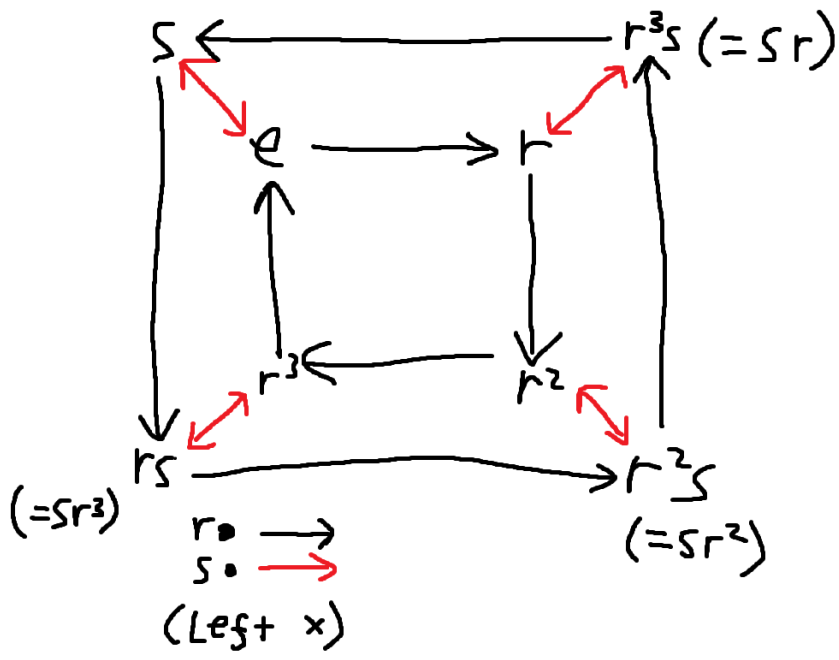
idk if this is harmful or helpful, but for me at least, I find it easier to think of things if there is a picture involved
pastel cliff
i mean same
coral shale
This is the Cayley diagram for D8 (dihedral group of symmetries of square)
I can explain how it works
pastel cliff
looks like im skipping a week of material then brb
pastel cliff
coral shale
I can explain how it works
can we start a thread later
i have some smaller stuff to take care of first
pastel cliff
i like this
coral shale
Like nah - understanding group actions isn't essential but uh, gives more background
pastel cliff
rhetorical question to myself but what about regular (non-normal) subgroups makes this impossible
coral shale
How do I put it, I could probably make an explanation that made sense (that implicitly refers to group actions)
pastel cliff
also quotient groups are like
necessarily tied to first iso right
im assuming the usefulness of this has to do with group actions?
south patrol
pastel cliff
rhetorical question to myself but what about regular (non-normal) subgroups make...
Lol I was about to good 'regular subgroup' cause I'd never heard of the term
pastel cliff

ahhh
that's why we care about H being normal then
it basically gives us the group operation that we need
right?
south patrol
You want that for all x and y, xHyH = xyH which is equivalent to normality of H ye
pastel cliff
 coral shale
whats up :3
coral shale
pastel cliff
right?
Do you know what quotient sets are
If you do, it also helps, if not... well it could be worth checking up (they don't usually teach this before quotient groups, but imo it is worth it)
pastel cliff
,w quotient set
 cloud walrusBOT


 Requested by nitezba#9923
 delicate orchid
thanks wolfram alpha
you useless machine
you just
equivalence relation those bad boys
get a unique partition (pop quiz! prove that each equivalence relation on a set gives you exactly one partition!)
and then take those sets in that partition as elements of your new quotient set!!
and I completely disagree with shuri these are way harder to understand than quotient groups
coral shale
wew refuses to take topology
pastel cliff
unpog
coral shale
Need I say more.
delicate orchid
coral shale
wew refuses to take topology
I (barely) got a first in my topology exam
coral shale
I would view quotienting as 'gluing', idk if you've heard this
delicate orchid
so stick that in your pipe and smoke it
coral shale
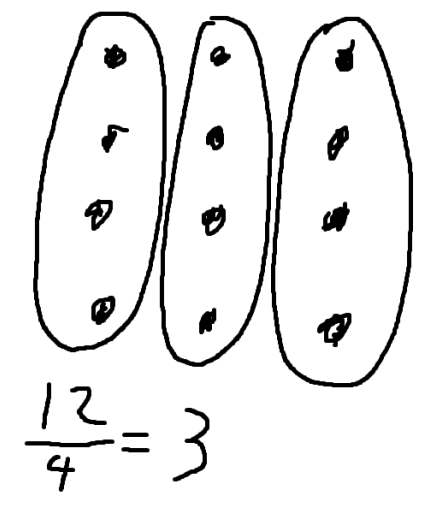
i probably shown u this before
the same idea holds for quotient sets, groups, rings, topologies, etc.
You have your set, you define an equivalence relation which 'glues' points together (each class is now considered to be one object). This is a quotient set.
For quotient groups, you do this on a group, and you want your new object to still be a group (and preserve some of the original structure). It turns out you need the idea of a normal subgroup for this to happen.
delicate orchid
coral shale
the same idea holds for quotient sets, groups, rings, topologies, etc.
hmm almost as this idea is more general than a single category of objects 
 dull root
No this is not true. Any subgroup of an abelian group is normal, but it is not true that a abelian subgroup of some group is normal. An example is S_3, consider a permutation of order two, say (12) and consider the subgroup A = {id, (12)} which is certainly abelian. It is not normal though -- we can consider another order two permutation (13), so (13)A(13) = {id, (23)} \neq A
 chilly ocean
Let E be a number field of degree n and $\alpha\in\mathcal{O}_E$ such that $E=\mathbb{Q}(\alpha)$.
Then $\mathbb{Z}[\alpha]$ should be freely generated as a $\mathbb{Z}$-module by ${1,\alpha,...,\alpha^{n-1}}$ and $\mathcal{O}_E$ should also be a free $\mathbb{Z}$-module of rank n.
Apparently $[\mathcal{O}_E : \mathbb{Z}[\alpha]]$ is always finite. This isn't clear to me, am I missing something completely trivial?
cloud walrusBOT
Gio

 hidden haven
pastel cliff
or should i just go through first iso thread
hidden haven
pastel cliff
or should i just go through first iso thread
Lol just do that I don't got time for today
pastel cliff
pain!
 limber vale
Is there any systematic way to show a subgroup is a normal subgroup?
chilly ocean
what do you mean by systematic?
limber vale
Given a subgroup how do is show it is normal
pastel cliff
try conjugating an arbitrary element and show that it's in the subgroup
a good exercise is to do it on the kernel of a homomorphism
i just did that actually 
limber vale
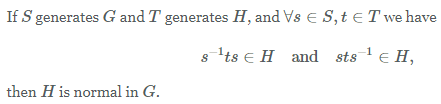
If i have a group generated by a few elements, and a subgroup of this group. Is it sufficient to show that conjugation by the generators is in the subgroup to show the subgroup is normal?
 vestal snow
You could try showing that is the kernel of some group morphism
N is a normal subgroup if and only if it is the kernel of some group homomorphism
chilly ocean
limber vale
If i have a group generated by a few elements, and a subgroup of this group. Is ...
yes that is enough to show that the subgroup is normal, you should try to prove it if you haven't already
coral shale
limber vale
If i have a group generated by a few elements, and a subgroup of this group. Is ...
 limber vale
Hello, i want to find all representations of A4 and their characters, I found three degree one representations (third roots of unity), now i want to find the final one using orthogonality relationships. I did this, but i dont really understand what the result is telling me. I dont fully understand what the tables mean yet

 delicate orchid
I'm not sure your application of the orthogonality relations is quite right
the final row should be 3 -1 0 0 iirc
oh never mind you've just written them in a funny order
for the degree 1 aka linear representations it's very explicit what the table is giving you - those are the values of the representation itself for those conjugacy classes
tbh your question is a bit... open ended lol
 latent anvil
if A is an integral domain and B extends A, what would you call it if ab = 0 implies a = 0 or b = 0 for any a in A, b in B?
B isn't an integral domain but it's like an integral domain...relative to A? lol
 terse crystal
dull root
No this is not true. Any subgroup of an abelian group is normal, but it is not t...
terse crystal
dull root
No this is not true. Any subgroup of an abelian group is normal, but it is not t...
Yes sorry my bad
latent anvil
is there a way to prove this result without using elements? so far @next obsidian and I have figured out that the assumption is equivalent to the map $M/N \to S^{-1}(M/N)$ being injective and that the conclusion is equivalent
[\begin{tikzcd}
N & M \
{S^{-1}N} & {S^{-1}M}
\arrow[hook, from=1-1, to=1-2]
\arrow[hook, from=2-1, to=2-2]
\arrow[from=1-1, to=2-1]
\arrow[from=1-2, to=2-2]
\end{tikzcd}]
being cartesian (a pullback square)
 cloud walrusBOT
Hom(-, Shamrock)
 latent anvil
the proof is like 1-2 lines with elements, I have no idea why we've spent time thinking about this. but if you have any thoughts ping me
 stoic rose
What do you mean by "without elements"?
latent anvil
I mean proving it without saying "let x in N" or "let x in M"
also the localization stuff is unecssary
another way to state it is this: if you have the commutative diagram
[\begin{tikzcd}
&&& 0 \
0 & N & M & L & 0 \
0 & {N'} & {M'} & {L'} & 0
\arrow[from=2-2, to=2-3]
\arrow["a"', from=2-2, to=3-2]
\arrow[from=2-1, to=2-2]
\arrow[from=3-1, to=3-2]
\arrow[from=1-4, to=2-4]
\arrow[from=2-3, to=2-4]
\arrow[from=2-4, to=2-5]
\arrow[from=3-4, to=3-5]
\arrow["c"', from=2-4, to=3-4]
\arrow[from=3-2, to=3-3]
\arrow[from=3-3, to=3-4]
\arrow["b"', from=2-3, to=3-3]
\end{tikzcd}]
then the diagram
[\begin{tikzcd}
N & M \
{N'} & {M'} \
\
\
& {}
\arrow[from=1-1, to=1-2]
\arrow[from=1-2, to=2-2]
\arrow[from=1-1, to=2-1]
\arrow[from=2-1, to=2-2]
\end{tikzcd}]
is cartesian
that's the lemma I want
cloud walrusBOT
Hom(-, Shamrock)
 latent anvil
*commutative diagram with exact rows and c monic
 latent anvil
nice!
stoic rose
(That shows existence of the map X -> N, uniqueness follows from N -> M being monic)
 languid walrus
latent anvil
if A is an integral domain and B extends A, what would you call it if ab = 0 imp...
languid walrus
latent anvil
if A is an integral domain and B extends A, what would you call it if ab = 0 imp...
thinking of B as a module over A, Ann(B) is trivial
maybe not so insightful haha
latent anvil
it's stronger than that, right? like it's Ann(b) is trivial for all b in B
stoic rose
Just "B is a torsion-free A-module"?
latent anvil
yeah that sounds good
The thing I was thinking about this for ended up being the M/N -> S^-1(M/N) injective condition anyways
after suitably generalizing it
 lavish nexus
let f in R a ring, X_f = V(f)^c where V is the set of prime ideals containing f
do we have to use Zorn's lemma to show X_f = Spec(R) -> f is a unit
i.e. can we find a way around using "every ideal \neq (1) is in a maximal ideal"
latent anvil
so you're asking if we can prove "f is not contained in any prime ideal -> f is a unit" without using "every ideal \neq (1) is in a maximal ideal"?
I don't think so tbh
lavish nexus
yeah
latent anvil
well it's slightly weaker
it's only for principal ideals and it's about primes and not maximal
but it's basically the same thing
suppose that you knew "f not contained in any prime ideal -> f is a unit". then you could prove any nonzero ring has a prime ideal by taking f = 0, right?
bc 0 isn't a unit, so it must be contained in some prime ideal, by the contrapositive
so your "X_f = Spec R -> f is a unit" thing is equivalent to "every nonzero ring has a prime ideal"
this is weaker than every ring having a maximal ideal, in that "every nonzero ring has a prime ideal" is equivalent to the ultrafilter lemma over ZF while "every nonzero ring has a maximal ideal" is equivalent to the full axiom of choice (and the ultrafilter lemma is strictly weaker)
but you have to use the fact that every nonzero ring has a prime ideal bc you're basically proving it
lavish nexus
So I can use something weaker than Zorn's to prove it
idk what ultrafilter lemma is gonna look it up
latent anvil
you can use something weaker than zorn's but it's still stronger than ZF
latent anvil
How would you prove the following: If K is a field extention of F and you have an ideal I of F[x1,...,xn] then for any f in F[x1,...,xn] we have f in I iff f in I K[x1,...,xn]?
My proof is incredibly headass
And actually I think it works even if K is just an F-algebra, not necessarily a field (but F still needs to be a field)
 next obsidian
The latter is a faithfully flat extension, so the contraction of the extension is just the original ideal
:^)
latent anvil
bro that is my proof
I think I just proved the thing about ff extensions in a dumb way
I was thinking of it in terms of the big commutative diagram and pullback squares
but all that that's really saying is I^ec = I
lmao
next obsidian
ChmonkaS
latent anvil
I am so insanely dumb
terse crystal
latent anvil
*commutative diagram with exact rows and c monic
What does being Cartesian mean? Pull back? Or push out?
latent anvil
Pullback
terse crystal
Thanks
 simple mulch
A group G cannot be the union of two proper subgroups. Can we reach a contradiction with the fact that both subgroups would have their respective identity element, and both would need to be the identity element in G. However we know there can only be one. So they must be the same and this contradicts the fact that they are disjoint
coral shale
contradicts the fact they are disjoint, where?
simple mulch
Because if 1_H is the identity for H and 1_K is the identity for K (H,K the proper subgroups of G) then 1_H = 1_K in G. So this element belongs to both H and K
coral shale
coral shale
contradicts the fact they are disjoint, where?
.
reread what you wrote
in no place is disjoint a requirement
simple mulch
how so? proper subgroups don't imply their intersection is empty?
oh
LOL
Proper just means H != G and H != {1_G} 😐
I see, I was wondering why I couldn't use this but that's the point
thanks
coral shale
{e} is a proper subgroup
simple mulch
trivial
coral shale
yes
 fickle brook
this feels like it should be easy but it isn't and i'm having a hard time with it
i'm trying to solve a problem involving stable range conditions
let R be a commutative ring. we say that R satisfies the stable range condition sr(m,n) if any unimodular vector of length n can be "shortened" to a vector of length n-1 using at most m(n-1) transvections
a transvection in this case is a matrix that differs from the identity in one off-diagonal element
think elementary row ops
i need to show that sr(m,n) implies sr(m,n+1)
and i was trying to say that like, if my arbitrary unimodular vector of length n+1 contains a unimodular subvector of length n, then maybe it's going to be easyish
but i can't prove that it does and i cannot comprehend how i would even go about doing this if that doesn't happen
to clarify when i say shortening i mean the application of a sequence of transvections to transform a unimodular vector of length n into a unimodular vector of length n-1 with a zero at the end
i feel big stupid for not getting this
ping me if anyone can save me from this hell
<@&286206848099549185>
since its been 15 min
might as well try
@stark sigil you helped me out previously so like... if you wouldnt mind? sorry for the ping but im kind of desperate
 fickle brook
unimodular as in its entries generate the ring
it's urgent because i have a rendezvous with my professor tomorrow and still havent figured this out and am scared to death of disappointing both him and myself
bit of a self imposed deadline in some sense
stoic rose
Multipliying an entry by something is not allowed as an operation, right?
fickle brook
it's not
but multiplication by a unit can be overlooked, afaict
would only require adjusting the transvection factors a bit
did you have an idea that involved that?
stoic rose
If you could do that then you could easily make the last n-1 entries unimodular using by multiplying entry 2 by something and adding to it a multiple of entry 1
cloud walrusBOT
Ann
 stoic rose
Yes
fickle brook
yeah, no, can't do that
stoic rose
When you say generate the whole ring, you mean as an ideal right?
fickle brook
yes of course
 lapis trail
Let E be the algebraic closure of F. When we say every polynomial in F[x] splits in E, what do we mean by "splits?"
 stark sigil
This problem sounds specialized enough that it might be close to your advisor’s area of research
fickle brook
i mean it is
but im supposed to solve it
not come back to him whining that a week wasnt enough for me to make any progress on it whatsoever
stark sigil
I didn’t get anywhere after 5 minutes of thinking
Ok I came up with one thing: if the ideal generated by a subset is principal, you can treat that subset as unimodular for the purposes of zeroing out a coordinate by transvections
Because that subvector is a multiple of a unimodular one
fickle brook
and who said anything about any such ideal being principal
i'm not assuming anything on the ring, ideally not even commutativity!
 tribal moss
I think you just solved the PID case.
stark sigil
The non-commutative case smells like a potential thesis problem
fickle brook
no, i have not solved it in any case whatsoever
i've only "solved" it in the very very specific case where there exists a unimodular subvector of length n
stark sigil
Does your advisor work in noncommutative algebraic geometry 🤯
fickle brook
yes? i think;
still
that doesnt matter for shit
what matters is that i have this problem which i should be able to solve but cannot
stark sigil
Maybe it's just hard?
Hmmm
Your goal is to turn some n-subvector unimodular
Using at most m steps
That's like the only sensible way to proceed
tribal moss
Do you have some examples of rings that satisfy the condition for some particular (m,n) but not others?
fickle brook
stark sigil
Your goal is to turn some n-subvector unimodular
yes, that would seem to be it
stark sigil
You know there exist constants $a_i\in R$ such that $\sum_i a_ix_i=1$, and in the worst case scenario, $\sum_{i\neq j} Rx_i$ is some horrible ideal, but adding the right multiple of $a_j$ turns it into the unit ideal
cloud walrusBOT
Icy001
 stark sigil
The problem of turning the bad ideal into the unit ideal using m transvections might be able to be turned into a sr(m, 1) problem?
stark sigil
This m is some mysterious quantity so if you need to do something in m steps, you probably can't do it concretely
fickle brook
esp. given that i am supposed to show sr(m,1) -> sr(m,2) -> sr(m,3) -> ... is a chain of implications
tribal moss
A field trivially satisfies the condition with m=1. Z doesn't seem to satisfy it for any m. The interesting cases must be somewhere in between.
stark sigil
If that's the idea, then why not use strong induction?
tribal moss
sr(m,1) is trivially impossible, right?
fickle brook
the original idea was that $\mathrm{sr}^m(R)$ could be a quantity s.t. $\mathrm{sr}^m(R) < n$ is equivalent to the condition i labeled as $sr(m,n)$
cloud walrusBOT
Ann
 fickle brook
i am to check that this quantity is well defined
tribal moss
From that context, how confident are you that it is true at all?
fickle brook
?
that what is true?
if sr(m,n) is not true for any n in some ring R then we just set sr^m(R) = infty
tribal moss
I.e. was your task from the prof "it would be nice for our research project if this claim was true; try to see if we can prove it" or "I know a proof that this is true; see if you can find one too".
fickle brook
the task was "prove this implication is true to start with"
"maybe even a stronger version of it is true"
something along those lines...
tribal moss
That still sounds like the first interpretation could still be the intended one.
stark sigil
The fact this doesn't work for integers is pretty funny
fickle brook
and i am sticking to the interpretation wherein i have failed at my job.
i had ONE JOB and i couldnt fucking do it what good am i
stark sigil
What, that's not what research is supposed to be like
 prisma ibex
it's normal to get stuck lol
fickle brook
all ive managed to come up with is "it works in this hyper specific case" do you realize how WORTHLESS that is?
its not even worth telling about
its worse than ahving come up with nothing
fickle brook
am i????
prisma ibex
yes
fickle brook
idk like
this DOESNT FEEL RIGHT
in any way
i cannot conceive of a way to make this in any way acceptable
prisma ibex
I mean keep in mind that I do a good amount of commutative algebra and this problem is like
fickle brook
i had an entire fucking week for this and could not come up with anything
fickle brook
what did i come up with???
tribal moss
That it is hard.
fickle brook
fickle brook
and i was trying to say that like, if my arbitrary unimodular vector of length n...
this?
prisma ibex
I mean you have a specific case
fickle brook
specific cases ain't worth SHIT
prisma ibex
I am also currently very stuck on a commutative algebra thing
for the past month or so
and only have very specific cases worked out
fickle brook
i mean like
tribal moss
Research starts with "we don't know what is true, what is easy and what is hard". Learning that this problem is not easy is progress.
fickle brook
imagine if you were doing graph theory and were trying to prove the handshake lemma and all you could come up with was a count of the edges and degrees for one particular graph you drew on a piece of paper
prisma ibex
so probably what you will do is like, come to your advisor with the specific case you've worked out and then they will probably give you a hint that will get you unstuck on a more general thing
this is normal
fickle brook
Learning that his problem is not easy is progress.
or indicative of me not thinking hard enough lol
fickle brook
fickle brook
imagine if you were doing graph theory and were trying to prove the handshake le...
that's what my finding feels like rn
stark sigil
I can imagine Fermat giving his advisee Fermat's last theorem as a problem to work on
fickle brook

tribal moss
"Oh, work out the details of this, will you. I've done it for n=3 and n=4, we just need to generalize from there".
prisma ibex
you're doing the right thing though, you got a start and have some very specific cases worked out, now you're stuck but that's normal
fickle brook
megachad moment
prisma ibex
this doesn't strike me as an easy problem at ALL
fickle brook
prisma ibex
you're doing the right thing though, you got a start and have some very specific...
some part of me still insists this is nowhere near enough for a week's worth of research. my conclusion feels self-evident to the point of uninteresting obviousness.
prisma ibex
I mean it's pretty normal to make like
ZERO progress in a given week
so nonzero progress is pretty good
tribal moss
Remember Icy's solution for the case of a principal ideal ring too.
prisma ibex
and again this is the first week you're thinking about this
fickle brook
let me tell you what last year was like
last year my family kept fucking hounding me about my research project day after day
no ok like. go back another 2 years
my family would always keep asking me whether i'd made any progress
and i couldn't say that no i hadn't
cause then they would accuse me of laziness in some form
prisma ibex
yeah that's annoying, and probably shows a misunderstanding about the time scale of most math research on their part
this stuff takes a while
prisma ibex
imo if you're like
making an honest attempt, have some cases worked out, come with specific questions
fickle brook
guess i'll just go talk to my prof tomorrow as we agreed, and be prepared to take a massive L
prisma ibex
advisor will be happy
yeah just come prepared with what you have so far and come with questions
that's good
fickle brook
i have a specific question: "can we claim with any measure of certainty that there is a unimodular n-subvector or that one can be achieved in sufficiently few transvections"
prisma ibex
yeah that's good
tribal moss
A good specific question would be to ask for known examples of rings with a nontrivial sr^m.
fickle brook
i have asked for examples of rings with stable rank without the bounded thing
prisma ibex
walk you through an example on the board or something
fickle brook
essentially $sr^{\infty}$
cloud walrusBOT
Ann
 fickle brook
and those would be polynomial rings in n variables
prisma ibex
but yeah again you're making nonzero progress, you're coming with specific questions and you have a few cases worked out, that means you're doing a relatively good job and your advisor should be relatively happy with this
imo only way to really disappoint your advisor is showing up and being like "lol I didn't even make an attempt"
which you clearly didn't do
dull root
I have a question that I am too dumb to see rn. I know $3^{(1/5)}$ is irrational... how do i see that $3^{(2/5)}$ is irrational too
cloud walrusBOT
MasakaBakana
 south patrol
Hint: 3^6/5 is irrational, prove this (follows from what you know) and then try to use this
fickle brook
#prealg-and-algebra better for that thoguh
 deep sky
Why can’t you get every permutation of an octahedron’s face midpoint diagonals with just rotations?
Like, you need reflections for half of them right
Reflections being necessary to extend from A_n to S_n
tribal moss
I think you can. Those diagonals are also the vertex-to-vertex diagonals of a cube, which is easier for me to visualize. If you rotate the cube 180° around an axis perpendicular to two of the diagonals, the other two diagonals are interchanged. So all the transpositions are rotations.
(These axes are also edge-midpoint diagonals in the octahedron).
deep sky
Then the 24 permutations can all be hit
Orbit of 4 for each, stabilizer of 6
My struggle here is in finding all the stabilizer elements.
id, rotation by pi on both the z and one horizontal axis
I guess that can be reversed for a third? But I’m a bit confused on when we consider two rotations the same element or not
Are there others of the five regular polyhedra with similar circumstances in which the rotation group doesn’t cover the full set of permutations? “How many permutations of the diagonals are there? How many of these are elements of the group G?” seems to imply there are some inaccessible permutations to the rotation group
 oblique meadow
I just started studying Abstract Algebra and ran into this. I was hoping someone here could help me get my head around it?
Let $n \geq 3$ be an integer and let $S = {{a,b} : a,b \in {1,2,...,n}, a \neq b}$. Prove that the symmetric group Sym($S$) has a subgroup $H$ such that, $H \cong S_n$ and ${h({1,2}): h \in H} = S$.
cloud walrusBOT
Limitless222
 coral shale
do small n
oblique meadow
Is S just a set of unordered pairs?
 chilly radish
yes
oblique meadow
Ok. Thanks.
delicate orchid
LOL
 coral shale
is the answer 4
delicate orchid
coral shale
is the answer 4
there's 630 if I've done it right
coral shale
so 4. Good to know i still have it in me
delicate orchid
I'm actually gonna write "by inspection, we see that the prime factors are: "
fickle brook
,w factor 32511432987458548736
cloud walrusBOT

 tribal moss
deep sky
My struggle here is in finding all the stabilizer elements.
tribal moss
deep sky
My struggle here is in finding all the stabilizer elements.
The stabilizer of one of the diagonals can only consist of rotations about that diagonal (which permute the other three diagonals cyclically), or one of the 180° rotations that fix the chosen diagonals an one of the others. The whole stabilizer becomes isomorphic to the dihedral group of order 6.
tribal moss
deep sky
Are there others of the five regular polyhedra with similar circumstances in whi...
The icosahedron has 10 face-midpoint diagonals, but not all of them make the same angle with each other -- each diagonal has 3 neighboring diagonals, and a rotation must take neigbors to neighbors. So not all permutations preserve this structure; the ones that don't can't be rotations.
 untold basin
Let G be a group
Let x,y be in G such that ord(y) is finite.
<x> <| <x,y> <=> y * x * y^{-1} in <x>
Can someone help me with <= ?
If someone does, I'll explain my reasoning / what did I try
terse crystal
untold basin
Let G be a group
Let x,y be in G such that ord(y) is finite.
<x> <| <x,y> ...
What does <x> <| <x,y> mean?
I mean this symbol <|
delicate orchid
normal subgroup I'm presuming
untold basin
normal subgroup
terse crystal
That’s trivial true like I give you an example:
To prove H is normal in G=<x_1,…,x_n> we only need to show that for any j, (x_j)H(x_j)^-1 is contained in H
Why? Because any g from G is product of power of x_j, so φ(g) is product of power of φ(x_j) where φ(g) is an automorphism mapping x to gxg^-1
untold basin
My prof introduced a lemma which is <S> <| G <=> for all x in G, for all s in S , x * s * x^{-1} in <S>
I guess I need to use it
delicate orchid
that's like
made it even more trivial than it already was
just sub in S = {x} and G = <x, y>
terse crystal
Yeah. Like now your group <x,y> is generated by x, y. So you only need to consider conjugate operations by x and y
untold basin
Yep so I have to prove that
for all z in <x,y> , z * x * z^{-1} in <x>
delicate orchid
start by assuming yxy^-1 is in <x>
then by considering the cosets of <x,y>/<x> we see that the possible right cosets take the form <x>y^m
but since yxy^{-1} is in <x>, we see that <x>y^m = (y<x>y^-1)y^m = y<x>y^(m-1)... = y^m<x>, so <x> is normal
that's how I'd do it
terse crystal
In other words, given G=<S> , we have that Inn(G)=<φ(s): s from S>
delicate orchid
bringing in inner automorphisms is... silly
delicate orchid
untold basin
Yep so I have to prove that
for all z in <x,y> , z * x * z^{-1} in <x>
yeah so what does that z look like
untold basin
delicate orchid
yeah so what does that z look like
a finite product z = a1 * ... * a_n such that a_i in {x , x^{-1} , y , y^{-1}}
delicate orchid
yup, and obviously if a_i is in x or x^{-1} we can just swap it around - so we can already write
zxz^-1 = a1...a_nxa_n^{-1}...a1^{-1}
and if a_n is x or x^{-1} we can just move that sneaky x in the middle over and they both cancel, same goes for a_{n-1}
and so on
so we can slam the x right up against a y
and get something that looks like a_1...a_kxa_k^-1...a_1^-1 where a_k is in {y, y^-1}
untold basin
What do you think if I try to prove it by induction ?
that step where a_i is x or a_i is x^{-1} is the same as yours
delicate orchid
but if a_kxa_k^-1 is yxy^-1 then you know this is generated by x (cause it's in <x>), so this is just some long string of x's, and then we can repeat the "slamming process" until we just end up with a gigantic string of x's, which is in <x>
that just leaves the case where you get y^-1xy
untold basin
delicate orchid
that just leaves the case where you get y^-1xy
i'm stuck with that
delicate orchid
I mean, it's inverse to y^-1x^-1y
and x^-1 is in <x>
so showing that y^-1xy is in <x> is equivalent to showing y^-1x^-1y is in <x> cause <x> is closed under inverses
untold basin
ok I agree
untold basin
lol really ?
delicate orchid
I mean like this is one of those moments where I'm just like 
untold basin
I feel it xD
delicate orchid
delicate orchid
start by assuming yxy^-1 is in <x>
then by considering the cosets of <x,y>/<x> w...
trying to think about if this works or not
would be nice if it did
ok I think that works now
sometimes u just gotta look at the cosets I guess
I prefer the funny word cancelling approach though 
untold basin
I don't have any intuitions with the cosets
Can you explain how did you manage to think about cosets ?
delicate orchid
a subgroup is normal if and only if it's left cosets are equal to it's right cosets
i.e.
gH = Hg
so I went through that route instead
untold basin
Oh okay I see
delicate orchid
I'm just not 100% sure I can just
write the y's out there like that
actually no, I think I can
(yxy^-1)^n = yx^ny^-1
hold on I'll need some paper
delicate orchid
I'm just throwing random nonsense out now to see if I can collect it together later
ok my coset proof does not work, managed to disprove it lol
not sure how to tackle this further then
WAIT FUCKIN ORD Y IS FINITE?
LMFAOOOOOOOOOOOOOOOOOO
y^-1 = y^n for some n
I'm dyin
delicate orchid
so when you end up with a y^-1xy just rewrite it as y^nxy^-n = y^(n-1)(yxy^-1)y^-(n-1) = y^(n-1)x^my^-(n-1) = y^(n-2)(yxy^-1)^my^-(n-2) = ... and keep cancelling
delicate orchid
untold basin
I forgot that hypotethis
so did I lmfao at least we remembered
thanks for that problem btw that was really fun to think about
delicate orchid
let $n$ be the order of $y$, then $y^{-1}xy = y^{n-1}xy^{1-n} = y^{n-2}(yxy^{-1})y^{2-n} = y^{n-2}x^{m_1}y^{2-n} = y^{n-3}(yx^{m_1}y^{-1})y^{3-n} = y^{n-3}(yxy^{-1})^{m_1}y^{3-n} = y^{n-3}x^{m_1m_2}y^{3-n} = ...$
untold basin
I don't understand the first equality
cloud walrusBOT
Wew "U+2610" Tbh ☐
 delicate orchid
untold basin
I don't understand the first equality
delicate orchid
untold basin
I don't understand the first equality
order of y is finite
y^n = y^-n = 1
multiply on the left by y^n
and multiply on the right by y^-n
tada
untold basin
ok
delicate orchid
then it's just successively applying associativity, yxy^-1 \in <x>, and yx^my^-1 = (yxy^-1)^m (which is also in <x> as <x> is closed under multiplication) recursively
untold basin
yep I understand
delicate orchid
nice!
delicate orchid
yeah for some random m_i
delicate orchid
very cool
delicate orchid
as soon as I saw "finite" order I knew I could somehow swap the ys and y inverses
and then the whole chain of equal signs was just kinda following the trail
exact same "cancelling" happens if you just had y^kx^my^-k as well, just without the multiplying by y^n, y^-n at the start
untold basin
ok so k is just a certain moment
delicate orchid
yeah
delicate orchid
no worries
untold basin
I like how you think ^^
untold basin
xD
cloud walrusBOT

 Requested by Wew Lads Tbh#0864
 weary terrace
Let GLn be the general linear group over the complex field. Define the action of GLn on the group of nilpotent nxn matrices by conjugation.
I wish to classify the orbits under this action. I claim that each orbit contains all nilpotent elements of the same order.
Given A a k-nilpotent matrix (i.e. A^k=0), how do I prove that its orbit contains all k-nilpotent matrices?
 bright marsh
quick question, could someone please explain what "automorphism" is, I get that it's a mapping of something to itself that preserves structure, but that doesn't really tell me much for some reason
what does it even mean by mapping elements to itself?
delicate orchid
it's an isomorphism from the group to itself
i.e.
$\phi \colon G \rightarrow G$ is an isomorphism
cloud walrusBOT
Wew "U+2610" Tbh ☐
 delicate orchid
the go to example is $\phi_h(g) = hgh^{-1}$
cloud walrusBOT
Wew "U+2610" Tbh ☐
 bright marsh
so let's say your function is the inverse function, does that mean that with this function, the multiplicative group on R is automorphic?
cuz ur mapping the elements to it's inverse
wait no on the addition group, not multiplicative group
on N
delicate orchid
N isn't a group, gonna assume you mean Z
delicate orchid
-0 = 0 anyway so that's fine
bright marsh
doesn't that mean that every group is trivially automorphic?
delicate orchid
it's self inverse so it's definitely an isomorphism
bright marsh
cuz you can just use the identity map
delicate orchid
"automorphic" to what
bright marsh
to itself
untold basin
identity ?
delicate orchid
your notation is fine lol
bright marsh
ok so i'm just confused, im tackling this question that asks if matrix transposition and anti transposition in the general linear group is automorphic
delicate orchid
ok, first order of business is to show they're homomorphisms
delicate orchid
yeah
bright marsh
ok yea the matrix transposition is antihomomorphic
not rly sure about the anti transposition though
bright marsh
oh anti transposition is the transposition on the anti diagonal
or the other diagonal
delicate orchid
I thought so
bright marsh
yeeeEE
delicate orchid
I don't know anything about that one, soz
bright marsh
nah no worries
ok let's just focus on the matrix transposition then
it's antihomomorphic
what other condition do I need to show that it's automorphic?
delicate orchid
I'm not even sure it can be an automorphism if it's anithomomorphic
but!
show it's an isomorphism and it maps GL -> GL
bright marsh
oh shit u right

yea this is the question and lowkey, reading this is giving me an aneurysm
but i think i got it
thanks!
i just gotta show the transpostion is antihomomorhic and there's an isomorphism, and H = G to show antiautomorphism
all the anti auto anti auto bs
istg
bright marsh

chilly radish
Not exactly the same but for complex hilbert spaces the riesz rep gives an antilinear isomorphism
Or antiisomorphism if you want
chilly radish
Instead of scalar coming out conjugate comes out
No it's still additive
So really should be called antihomogeneous maybe
Or conjugate homogeneous
chilly radish
Maybe probably riesz rep
delicate orchid
ah no it's not quite the same
if you try and rip a constant out of the inner product of some characters sometimes you get a conjugate
chilly radish
Ah
delicate orchid
I can't quite remember when though, might be when it's multiplying the 2nd term
 barren sierra
ok so this may just be an issue with "damn I am bad at learning math" but we just went over the proof of existance of invarient factor form for modules and like I could follow along but I don't know what I should really take away from reading massive proofs like that. I wouldn't be able to come up with that on my own that's for sure. What should I try to take away? Or should I be trying to memorize how to recreate proofs like that? That just sounds dumb so I presume that's not the goal.
weary terrace
delicate orchid
it's an isomorphism from the group to itself
I might be missing something.. The orbit of A is {XAX^-1 | X in GLn}.
So the question is, does any k-nilpotent matrix C has an X s.t XAX^-1=C.
Conjugation is an isomorphism, thats clear, but it just tells us that for each k-nilpotent matrix C there's an A s.t XAX^-1=C.
I hope I managed to explain myself correctly.
delicate orchid
all nilpotent matricies have determinant 0 right - yeah ok they are cool
barren sierra
does this not just boil down to asking if orbits are always non-empty?
weary terrace
delicate orchid
all nilpotent matricies have determinant 0 right - yeah ok they are cool
Right
 slate mortar
hey, I have a question about the property of some action on sheaves of set, do you think I'm in the right place to ask about it? ^^"
delicate orchid
sheaves might be better for #algebraic-geometry
slate mortar
Ok, ty
delicate orchid
no
unless A is also nilpotent
determiant is a homomorphism so det(XAX^-1) = det(A) = det(C) = 0
slate mortar
Sorry to bother again, I already forgot what's the command to tex something?
slate mortar
Ok thank you
delicate orchid
$\begin{pmatrix} hi \end{pmatrix}$
cloud walrusBOT
Wew "U+2610" Tbh ☐
 delicate orchid
ok I've finally managed to parse your question
weary terrace
delicate orchid
no
Lol
delicate orchid
I no longer think it's no 
weary terrace
I'm not sure what no refers to
I think it's defined as minus infinity
In some places..
weary terrace
Only restriction is that it's nilpotent
delicate orchid
let A = C and X be the identity matrix :troll:
delicate orchid
weary terrace
Only restriction is that it's nilpotent
and yeah, it has to be cause the product is equal to a nilpotent
weary terrace
Sorry, I'm not sure i understand what you're saying. That A is not conjugated to all the other nilpotent matrices of the same order?
delicate orchid
you asked for an X
I'm kinda done thinking for tonight ngl
I imagine there's some change of basis you can do
weary terrace
Just to be clear, my queation is:
Let C be a k-nilpotent matrix, what's X s.t XAX^-1=C
weary terrace
delicate orchid
I imagine there's some change of basis you can do
That's ok, thx#
slate mortar
Sorry to bother AGAIN, but how do I put multiple underscore without discord doing the italic font in between and messing up my tex code?
For instance $\mathrm{Hom}{\mathrm{Sh}X}(f^{-1}\mathcal{G},\mathcal{F}) \cong\mathrm{Hom}{\mathrm{PreSh}Y}(\mathcal{G},f_\ast\mathcal{F})$
cloud walrusBOT
SkyTwX
 delicate orchid
it doesn't actually mess it up
slate mortar
Worst example ever lol
delicate orchid
$a_{b_{c_{d_{e}}}}$
cloud walrusBOT
Wew "U+2610" Tbh ☐
 slate mortar
Maybe it's not the double underscore then, sorry my bad
:sad bad latex noise:
I confirm that I'm just bad at latex lol, ty so much @delicate orchid
pastel cliff
am i correct in saying that a quotient group is a group of groups
and if so what are the elements of something like Z/mZ
obviously it's the cyclic group but i mean like in terms of it being a quotient
chilly ocean
what do you mean by "a group of groups"? a group whose elements are groups?
pastel cliff
i may be stupid ok
my question still kinda stands though, what cosets make up Z/mZ - is it just every xZ, 0=<x<m
 coral shale
I haven't really entertained the idea of a group acting on cosets of some subgroup of it
What do these generally look like...
Me saying vague things 
For example, I considered S3 and {e, (12)}
I figured out S3 acts faithfully on the symmetric group of the 3 cosets (so we have an isomorphism)
coral shale
How do I put it... what's so interesting about this action in general
what does it tell me about this subgroup and its cosets
If the action has a non-trivial kernel, I guess I've found a normal subgroup of the original group
🤔
but idk. I just saw this yesterday when someone was thinking of considering this as an approach to their own Q
coral shale
So, I believe if we have the right cosets, we can consider the action as right multiplication
This always defines an action... I think?
chilly ocean
it does
delicate orchid
yeah ok we're on the same page but I'm gonna use left cause I'm not mental
delicate orchid
idk lol I guess you could get the order out of the orbit stabiliser theorem
chilly ocean
you can use it to prove some things about finite p groups if i recall correctly
delicate orchid
ok that sounds way more interesting
chilly ocean
because the stabilizer of Hg is just the conjugate of the subgroup by the element g
coral shale
ah yeah i found the thing I was staring at yesterday
delicate orchid
hold on shuri I've thought of something wait I might've forgotten it nevermind I've remembered
coral shale
and was wondering what was going on
finite p groups, so it sounds like I have to relearn the Sylow theorems to understand?
chilly ocean
well, the way we did is that we used the action to prove some things about finite p groups and then used those things to prove the Sylow theorems
delicate orchid
delicate orchid
hold on shuri I've thought of something wait I might've forgotten it nevermind I...
if you have a faithful action on the cosets of some subgroup with index k there exists an isomorphism from G into a subgroup of S_k - kinda like a stronger cayley's theorem
now to consider if this action on every normal subgroup is faithful
pastel cliff
is there a non abelian grape group whose subgroups are all normal
chilly ocean
pastel cliff
is there a non abelian ~~grape~~ group whose subgroups are all normal
the quaternion group
coral shale
Ok, so taking S3. {e, (12)} is a subgroup of index 3. And the action is faithful unless I made a miscalc
delicate orchid
it should be faithful
coral shale
well well well, at least it works
delicate orchid
I haven't done group actions in over a year and a half I really need to go back over them
which is ironic cause I'm doing rep theory lol
delicate orchid
me?
coral shale
delicate orchid
if you have a faithful action on the cosets of some subgroup with index k there ...
this
delicate orchid
oh nothing that complicated
if it's a faithful action then each element of G is some distinct permutation of the cosets
there are k cosets
coral shale
ah.
delicate orchid
see when I think about them as permutation matrices it actually makes it easier for me
pastel cliff
chilly ocean
the quaternion group
coral shale
i dont do permutation matrices
delicate orchid
 sharp sonnet
cant you think of group actions as reps anyway
sharp sonnet
cant you think of group actions as reps anyway
and yes, you can
pastel cliff
is there some significance to that
delicate orchid
just take whatever set you're acting on as a basis set for some meme and then map the elements to the corresponding linear transforms
pastel cliff
i forgot the quaternion group exists lol
delicate orchid
delicate orchid
just take whatever set you're acting on as a basis set for some meme and then ma...
(I do this backwards when thinking about group actions)
(My knowledge is that spotty)
coral shale
So in fact like your elementary matrices
for elementary row operations
like some of them at least
I think its the row swapping one
delicate orchid
yeah that's just straight up a permutation matrix
coral shale
oki
delicate orchid
no ifs no buts
coral shale
I'm sure I shall revisit this stuff one day
pastel cliff
ohshit
In group theory, a Dedekind group is a group G such that every subgroup of G is normal.
All abelian groups are Dedekind groups.
A non-abelian Dedekind group is called a Hamiltonian group.The most familiar (and smallest) example of a Hamiltonian group is the quaternion group of order 8, denoted by Q8.
Dedekind and Baer have shown (in the finite a...
these are named
delicate orchid
a non-rigorous way to construct a permutation matrix is to swap the columns of the identity matrix in the way that the permutation tells you to
tribal moss
Nothing.
coral shale
pastel cliff
is there anything cool about hamiltonian groups
delicate orchid
who
pastel cliff
pastel cliff
https://en.wikipedia.org/wiki/Dedekind_group
.
delicate orchid
oh those
pastel cliff
nonabelian dedekind groups
feels kinda random to have name for both abelian and nonabelian versions of these things
 delicate orchid
if you have a non abelian dedekind group is it's commuter trivial
lets have a think
no, it isn't
ok good think
delicate orchid
pastel cliff
what's that...
it's the LEAST abelian type of group
pastel cliff
wdym its commuter
delicate orchid
nothing commutes with anything it doesn't have to
A_5 is the smallest non-trivial perfect group
delicate orchid
ohhh my name's shuri and I know how to spell things
 cloud walrusBOT
 delicate orchid
yeah
coral shale
Or alternative defn
pastel cliff
is that the commutator
coral shale
$[g, h]\defn g^{-1}h^{-1}gh$
cloud walrusBOT
 coral shale
yes
coral shale
cloud walrus
i prefer this one myself
pastel cliff
from now on im just gonna sit in this channel and ask things about random words yall say
coral shale
In the end it "won't matter" which one you go by
delicate orchid
then for the whole fuckin group we get $[G, G] = \langle [x, y] \colon x, y \in G \rangle$
cloud walrusBOT
Wew "U+2610" Tbh ☐
 coral shale

ew wiki uses the 2nd one

anyways, i mean this whenever i use it
This is the commutator of g and h
and is a measure of how close they are to commuting
delicate orchid
delicate orchid
if you have a non abelian dedekind group is it's commuter trivial
huh well that answers that
 coral shale
if it is e, then you know these 2 elements commute
pastel cliff
is there a formal name for a map from a group to itself where each element is just itself
or can i just call it the trivial mapping from G to itself
coral shale
identity map
delicate orchid
trivial mapping, identity mapping
pastel cliff
epicness
delicate orchid
the identity in Aut(G)
coral shale
So the idea of the commutator is ... if we quotient by something to do with commutators......... we end up with an abelian group
 delicate orchid
if only there was a witty short form youtube educational video explaining the abelianisation of a group
coral shale
coral shale
and it turns out this is the 'smallest' thing we can quotient by and end up with an abelian quotient group
Any quotient group which is abelian --- the normal subgroup you quotient by must contain [G, G]
 delicate orchid
that's a disgustingly based way of proving it
pastel cliff
coral shale
like why though
delicate orchid
never mind that
coral shale
I said this before
coral shale
Like honestly I would not like this as a proof
delicate orchid
oh I love it it's funny
coral shale
How is the 1st isomorphism theorem proven?
delicate orchid
uhhhhh UHHH
delicate orchid
u-u-universal uhh--uhh property of the uh-uihhh quotient
coral shale
🤦
pastel cliff
ive been handed a new toy and i will shove it where i like
delicate orchid
I remember doing it in 2nd year
I don't remem-
coral shale
pastel cliff
this look good?
if you write this proof, i wouldnt be convinced you understood the quotient and its structure
 delicate orchid
coral shale
if you write this proof, i wouldnt be convinced you understood the quotient and ...
delicate orchid
coral shale
if you write this proof, i wouldnt be convinced you understood the quotient and ...
very true
do you know why G/{1} should just be G?
pastel cliff
delicate orchid
<:shiver:934961643643871332>
 pastel cliff
coral shale
if you write this proof, i wouldnt be convinced you understood the quotient and ...
pastel cliff
coral shale
if you write this proof, i wouldnt be convinced you understood the quotient and ...
i dont
im working on it tho
coral shale
Well one thing at a time
prove {e} is normal
It is a matter of unravelling definitions
After you do that, use the definition of the quotient group to write down the elements of G/{e}
 delicate orchid
coral shale
prove {e} is normal
delicate orchid
coral shale
prove {e} is normal
yeah do it do it now
pastel cliff
geg^-1 = gg^-1 = e
delicate orchid
without scrolling up to see my one line proof of it
coral shale
k, so {e} is normal
delicate orchid
you need to care about them because of quotients
so if you don't get quotients you don't get why you need to care
delicate orchid
oh I know! sir I know sir! pick me pick me!
pastel cliff
delicate orchid
oh I know! sir I know sir! pick me pick me!

maybe it's the notation that fucks with me
but uhhh
coral shale
yeah it does take some getting used to
coral shale

delicate orchid
ok that's one way of thinking about it
pastel cliff
coral shale
yeah it does take some getting used to
how do you think of it
delicate orchid
maybe I should stop explaining the 1st iso theorem like a cat theorist to noobs
coral shale
,,G/N \defn{gN : g\in G}
cloud walrusBOT
 delicate orchid
bad peg a dodgy
pastel cliff
yeah that
delicate orchid
ok write out gN when N = {e}
coral shale
usually integers modulo whatever
delicate orchid
write the set out buster
coral shale
Z/5Z = {n + 5Z : n in Z}
delicate orchid
coral shale
usually integers modulo whatever
dislike this one cause muh additive notation
but unfortunately it is the best one
coral shale
i think its the easiest go to
pastel cliff
coral shale
If you can't remember it, take some fixed example
been trying to this one with Z/mZ yeah
coral shale
quotienting can be viewed as modding out
coral shale
coral shale
Z/5Z = {n + 5Z : n in Z}
and hopefully this should make sense to you
mZ are all the multiples of m
pastel cliff
my idea of modding is too fixed in integers i think tho
coral shale
And you are adding some remainder on top
delicate orchid
again, I feel like we're getting slightly too handwavey
pastel cliff
or maybe that's not a bad thing
coral shale
sigh yes
pastel cliff
g
delicate orchid
kind of
 delicate orchid
it's ||{g}||
||which in this case might feel pedantic but N is not always just a one element set ||
chilly radish
delicate orchid
maybe I should stop explaining the 1st iso theorem like a cat theorist to noobs
You should explain all the isomorphism theorems in terms of exact sequences
pastel cliff
ok one sec
delicate orchid
chilly radish
You should explain all the isomorphism theorems in terms of exact sequences
bring up the funnier 1st iso theorem
pastel cliff
im gonna go review my notes then come back and try and explain it
chilly radish
What's the funnier one
delicate orchid
 cloud walrusBOT
 coral shale
^ for after you figure it out
delicate orchid
and then
coral shale
its funny cus i cant see it
chilly radish
I can't see it either
chilly radish
Also using 0 when you're in Grp but not in Ab (or a different abelian category)
Unbased
delicate orchid
blame wikipedia not me
 delicate orchid
trivial object
chilly radish
Well yes but you should use 1 in Grp
coral shale
do they really?
delicate orchid
I agree with you, ShiN
coral shale
ive only seen 0 in my brief interaction of these things
including that wikipedia img
delicate orchid
I've only seen 0 as well but you should still use 1
you don't use 0 as the identity in non-commutative memes
so why would you do it in categories of non-commutative things
well, things that aren't strictly commutative, I should say
coral shale
well if you use 0 to represent the trivial object in all cases
chilly radish
I've seen 1 used for exact sequences of groups
coral shale
that is consistent, no?
chilly radish
This is also important because there's some properties of SES that are correct in an abelian category but not Grp
I forgor what
But there are
coral shale
ic
chilly radish
I think it's that splitting lemma doesn't hold
coral shale
so its important to indicate if the cat is abelian or not
chilly radish
It's just notation
coral shale
with the 0 or 1
chilly radish
I mean usually exact sequences only make sense in abelian categories
There's a name for things like Grp
But I forget
delicate orchid
huh I just suddenly understood the snake lemma
coral shale
whos we
delicate orchid
cool
pastel cliff
my class
coral shale
your class is a bit hmmm then
pastel cliff
delicate orchid
little do they know... rings are just a group action on a monoid!!!!!!!!!!!!!
muh hahahahhaa
pastel cliff
coral shale
your class is a bit hmmm then
this fact has been well documented in this channel
delicate orchid
we gettin... 3D...
 coral shale
pastel cliff
this fact has been well documented in this channel
coral shale
pastel cliff
this fact has been well documented in this channel
would u
like a concrete example
to help understand quotient groups
pastel cliff
soon
delicate orchid
yeah doesn't work in Grp tho what's the point
coral shale
reyetvhgni mocmsetu
chilly radish
delicate orchid
yeah doesn't work in Grp tho what's the point
Imagine caring about a non abelian category
Couldn't be me
pastel cliff
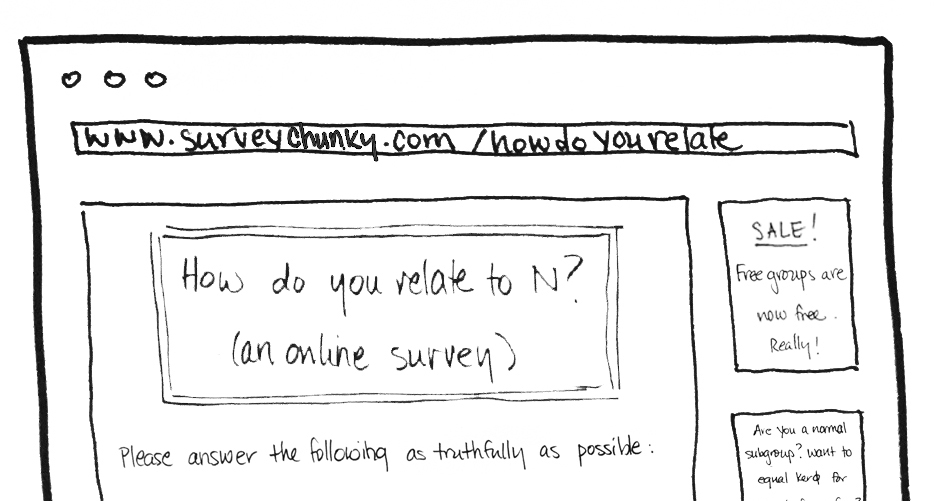
I realize that most of my posts for the past, er, few months have been about some pretty hefty duty topics. Today, I'd like to dial it back a bit and chat about some basic group theory! So let me ask you a question: When you hear the words "quotient group," what do you think of? In case you'd like a little refresher, here's the definition...
reading this
not sure if it's helping or not lmao
delicate orchid
wake up bro new first iso diagram just dropped

 delicate orchid
still very important
you know that funny meme I was working on a few weeks ago of reps of Z_p over finite fields?
fixed point theorem was crucial for the final part of it



 delicate orchid
I think it was that in disguise
coral shale
Uhhh what do i wanna say
pastel cliff
ok quick, when we think of a number a (mod m) we really mean the set of all integers whose remainder is a after dividing by m
coral shale
yes
that is an equivalence class
a over there is.
We perform addition, multiplication, whatever on entire classes
pastel cliff
coral shale
that is an equivalence class
i vividly remember falling asleep during this part of my intro to proofs class lmao
coral shale
(and prove that this is well defined)
coral shale
So like
if a, b are in the same class
we want it to be that
a + c and b + c
are in the same class
and so on
So then we can write [x] + [y], [x] * [y], ... without any ambiguity
So not all operations are well defined
[x]^[y] won't be.
[x]^n is.
pastel cliff
congruence interchangeable with equivalence in this context right
coral shale
yes
In fact, just use 'equivalence'
Congruence is a number theory word
i mean if u are referring explicitly to the equation
$1 \equiv 4\pmod 3$
cloud walrusBOT
 coral shale
This is a congruence I suppose...
$[1]_3=[4]_3$
I think that is technically slightly different from this
cloud walrusBOT
 coral shale
sigh I haven't fully stomached all this orbit stabilizer fixed stuff =.....=
@delicate orchid halp ?
I'm trying to understand the rotation group of a 3D cube
I've figured out there are 24 elements
And the non-trivial ones are determined by the axis of rotation
So I can see what the elements are & their order. But in terms of figuring out the structure of this group... I take it I have to stuff with group actions
Like idk - is thinking about the fixed point stuff above relevant?
sharp sonnet
there is a cheat way and a smart way
sharp sonnet
the cheat way is you take some elements from the group and look at the groups they generate inside your sym(n)
and once you hit the order 24, you are done
sharp sonnet
the "correct" way is to consider the action on the diagonals
coral shale
I see:
3 C4 groups, (x, y, z axes of rotation)
6 C2 groups (midpoint of edges)
4 C3 groups (opposite vertices)
That makes a total of 1 + 3 . (4-1) + 6 . (2-1) + 4 . (3 - 1) = 24 elements
sharp sonnet
yes
now you can view the group as a subgroup of sym(6) because it permutes the faces
and take group elements, compute what they generate inside sym(6) and continue until you hit order 24
and see what you get
coral shale
is there any reason to pick sym 6
sharp sonnet
its small
sharp sonnet
there are less of them than corners or edges
coral shale
ok
coral shale
right ive seen that before vaguely on a gowers blog