I forgot about details. Like we should prove that E={Σab:a from K_1,b from K_2} is an extension of K_1 containing all elements of K_2, and any another field E’ having this property E must be contained in E’ right? We can easily see that E contains K_1 and K_2, and it is contained in E’ for any E’ having such property, I forgot how to prove E is a field
#groups-rings-fields
406252 messages · Page 688 of 407
 terse crystal
 tender mist
Eh, yeah, I was thinking that closure for the inverse is problematic if we don't have algebraic extensions
terse crystal
Wait a second,,, it is defined first as K_1(K_2) (=K_2(K_1) ) right?
Then any element in K_1(K_2) is of the form Σab where a from K_1 and b from K_2
tender mist
Mm, we need fractions of those, otherwise we just have K_1[K_2] right?
terse crystal
Yeah so I wrote () not []
tender mist
So we want to prove that K_1[K_2] = K_1(K_2)
terse crystal
Me neither 😂
tender mist
Oh it's not true in general

Mathematics Stack Exchange
Let $L/K,L'/K$ be field extensions and $\alpha,\beta$ be $K$-bases for $L,L'$ respectively.
Define $A:={xy: x\in\alpha, y\in\beta}$.
How do I prove that $LL'=\mathrm{span}_K(A)$?
I could show th...
terse crystal
Thanks you!got it.
 chilly ocean
tbh never knew proof
why r(p^n)=p
for p a prime ideal and r being the radical of an ideal
my idea is that
x in r(p^n) if x^m in p^n
not 💯 where to go sadly
im guessing its some argument where m<n and then m>=n
wait a second
is it just that p^n a subset of p
so x^m in p
and then we use argument that x or x^m-1 in p
i mean the definition that it is intersection of all prime ideals containing a might work at making it immediately obvious
Also is R-p a saturated set. R a ring, p a prime ideal
I think so because the property of prime means xy not in p implies x not in p, y not in p
So this means xy in A-p implies x,y in A-p
 lavish nexus

why is it by Yoneda?
homD(B,F-) representable with (U, u) means there's a natural isomorphism between hom_D(B,F-) and hom_C(U,-)
isomorphism meaning for every A in ob(C) there is a bijection between hom_D(B,FA) and hom_C(U, A)
I don't see anything to do with Yoneda
context

 broken stirrup

 tribal moss
chilly ocean
I think so because the property of prime means xy not in p implies x not in p, y...
tribal moss
chilly ocean
I think so because the property of prime means xy not in p implies x not in p, y...
That's not the property of being a prime ideal -- it's true for every (two-sided) ideal.
tribal moss
Do you know what the standard Z-module structure on an abelian group is?
broken stirrup
yep
tribal moss
So a Z-module structure is a map Z × A -> A satisfying certain rules.
broken stirrup
any abelian group is trivially a Z-module by the action n*a=na
tribal moss
You're being asked to prove that his is the only map Z × A -> A that satisfies those rules.
broken stirrup
oh in other words, abelian groups can't be seen as different modules right?
tribal moss
That's another way of putting it, yes.
broken stirrup
thanks you Troposphere
 frank fiber
Hi, in gap C2:C4 means a semidirect product, but here C2 is acting on C4 or C4 is acting on C2?

 cloud walrusBOT
Iteribus
 lavish nexus
oh never mind I got it
chilly ocean
tribal moss
That's not the property of being a prime ideal -- it's true for _every_ (two-sid...
yeah
assumption is R is commutative
mb
idk how rules for operations on ideals generalize for non commutative rings

 next obsidian
Does it mean that’s it’s a surjection?
If g:N -> N’’ was a surjection to begin with, then this map is also surjective
So it would make sense at least
 delicate orchid
it usually means surjection
next obsidian
Yeah but it normally looks a lil different
delicate orchid
although the arrow heads are usually touching for a surjection so it's a bit unusual
lavish nexus
yeah that makes sense
thank you
like they're just lazy and didn't write the ->0 part
chilly ocean
oh lol silly question incoming
what is relationship between field of fractions of a local ring (R,m) and R/m
I think we learned that K(R)/m is called a residue field or something
but i dont remember
no wait wait
residue field is R/m
next obsidian
chilly ocean
what is relationship between field of fractions of a local ring (R,m) and R/m
They aren't really that related
both are useful in different situations
chilly ocean
im angry
im stuck on atiyah macdonald 5.2
been stuck for 3 hrs
and homework is due in 18 lol
but really due in 4
since i need to sleep
next obsidian
What’s 5.2 lol
next obsidian
¯_(ツ)_/¯
chilly ocean
profs are aware when you look up answers
next obsidian
For learning purposes, after a few hours IMO. According to your school’s grading policy, I dunno
chilly ocean
ok
5.2 says
A subring of B, and B integral over A, and f:A-> O a ring homomorphism where O is algebraically closed field
Show that f can be extended to B->O
afaik f(A) is a subfield
next obsidian
Yes
chilly ocean
and ker f should be maximal?
next obsidian
The point here is that everything in B is a root of a polynomial in A
chilly ocean
yeah
next obsidian
You can push that polynomial through your map f and get a polynomial in O
next obsidian
x^i is a formal variable
chilly ocean
wait
next obsidian
It just maps to x^i
I just want to turn this polynomial into one with coefficients in O
chilly ocean
x in B integral over A if x^ia_i=0 a_i in A
next obsidian
Not quite
next obsidian
It should be x^n = Sum_0^n-1 a_ix^i
next obsidian
But this is sort of besides the point
If b in B satisfies the polynomial g(x)
You can just apply f to each coefficient
And get a polynomial in O
next obsidian
Right
chilly ocean
i love you man
next obsidian
This makes it a little hard but
chilly ocean
not assuming gender
chilly ocean
b attached?
next obsidian
In this case
Like
assume that B is generated by one element over A
The point is you only have to define the extension on one element
This is easy to do using the previous observation
chilly ocean
yeah
next obsidian
In general B won’t be generated by one element, but you can use Zorn’s
Namely consider sub rings of B
Which extend f
Show by Zorn’s that there’s a maximal subring extending f
And then because you can extend f by one new element
This maximal subring extending f has to be B
Call this maximal subring C
If C ≠ B you could take a b not in C
And extend f to C[b]
And then C isn’t maximal
Does that make sense?
chilly ocean
yeah
next obsidian
This is usually how you have to show maps extend because it’s usually easy to extend a map by one element, but hard to do it with multiple
So you use Zorn’s to handle the rest after you show you can extend by one
chilly ocean
So like A[b_1] in A[b_1,b_2] in … A[b_1,…,b_n] in …
next obsidian
Well we can’t do that because B might not be finitely generated
That’s why you need to appeal to Zorn’s
next obsidian
Yea
You can’t induct up to countable infinity
Only up to arbitrarily high finite
Also, there’s no reason B is even Countably generated
chilly ocean
yeah
next obsidian
(You might be able to use transfinite induction, but idfk, too hard. Just Zorn’s)
chilly ocean
i would like to know what you mean by fant induct to countable infinity
next obsidian
Induction only lets you prove statements for n in N
chilly ocean
yeah
next obsidian
When something is generated by a countably infinite number of things this is too small to ever reach it
You only ever get to prove a statement for a finite n in N
The idea behind induction is you establish the base case to get it started then if you know it for n, you know it for n + 1
So the point is if you need the statement for m in N, well m = (m -1) + 1
So if you knew it for m - 1 you have it for m
But m - 1 = (m - 2) + 1
So if you knew it for m - 2 you’re done
…
Eventually you only need to know it for 0
But you already proved it for 0
This won’t ever get to countable infinity, because countable infinity is not + 1 for any finite number
chilly ocean
yeah
next obsidian
That’s all I mean that you can’t induct up to countable infinity
It can never reach it
chilly ocean
So is adjoining countable elements never defined as a ring? Because using an inductive argument we know for sure that adjoining finite elements is a ring. But we cant use the same argument for a countably inf amount of elements?
Because I know you are allowed to have polynomial rings with infinite indeterminants
So id like to think that adjoining infinite amount of generators is also allowed,m
Or I guess maybe its not that you cant
next obsidian
You can definitely adjoin infinitely many variables
You don’t have to define these things inductively so there’s no issue with that
All you need to do is make sense of a polynomial ring in arbitrary many variables
And then if you want to take specific elements, not formal variables, you just plug those elements into the polynomials
chilly ocean
oh okay that is clear af now
i wonder if it is worth it to learn about these constructions from category theory pov
next obsidian
These aren’t really categorical
next obsidian
I mean you could throw in the word “free algebra” I guess
But these are all concrete algebraic constructions
If you don’t already understand them as is, trying to abstract them won’t do you any good
As a professor once told me, you can’t just abstract all your problems away
At some point, you have to do math
chilly ocean
i c
chilly ocean
@next obsidian did u do this exercise b4
next obsidian
No
next obsidian
Also I think the transfinite induction thing works lmfao
And it’s pretty easy, but you’d have to know what that is
Zorn’s is way easier
chilly ocean
Ive heard of transfinite induction in analysis class
but the mechanics of it are kinda weird imo
next obsidian
Yeah it lets you actually induct up to infinite things
The point here is just that if you have an ordinal which is the union of all smaller ones
We have to define it for that
But let me translate that
chilly ocean
iirc you induct on an inductive argument
next obsidian
Suppose S is a set of generators, and we know that S = U S_i for all proper subsets S_i
Suppose we’ve defined the extension on A[S_i] for all S_i
Then we have to define it on A[S]
But we can do this like… piecewise!
Namely like, if b is in A[S], t exists in some A[S_i]
And then you can send that to where it’s sent in A[S_i]
And blah blah this is well-defined
You’ve probably seen this before in analysis, if you defined a map on X and Y and they’re the same on X\cap Y
You can define a map on X\cup Y
By just saying “pick a set it lives in, map it to whatever that map does”
Then it’s well-defined because they agree on the intersection
In fact to do your Zorn’s argument
chilly ocean
havent used it on sets ever
next obsidian
You had to do this
You had to show if you can extend f to a chain {B_i}
You needed an upper bound
So I assume you defined it on U_i B_i
By doing exactly this
chilly ocean
next obsidian
You can define a map on X\cup Y
is this like the glueing lemma for sheafs?
chilly ocean
it came up in atiyah macdonald
chilly ocean
also im taking diff top rn
next obsidian
Okay
chilly ocean
so the fundemental is there
next obsidian
But yes
This is the idea behind that
Lmao
The point is you can define a function on a cover of your thing
As long as they agree on intersections
Actually idk if the transfinite induction works, I’m not sure that you can force them to agree on intersections
Like they’ll agree over A
But maybe you extended them differently
Whatever, Zorn’s is just way easier lol
chilly ocean
yeah
also v pretty
im impressed that your first instinct was zorns
its been used every chapter in this book so far
next obsidian
I mean when you’ve done a few similar arguments before
It becomes the first thing to go to
I can extend by one element so I know if I can produce a maximal thing it’ll be forced to be all of B
chilly ocean
i wish there was a book like atiyah macdonald but for alg top
next obsidian
So just use Zorn’s to get a maximal thing
I don’t like Atiyah Macdonald lmfao
I prefer Matsumura
But that book is harder
chilly ocean
yeah def
when im more mature ill paruse
i also have to prepare a presentation tomorrow
its on the going down theorem
next obsidian
I mean do you plan to do algebraic geometry or algebraic number theory?
If not there’s no point in going through Matsumura
chilly ocean
im honestly not sure if i enjoy algebraic number theory, but it seems like it is one of the only fields that uses algebraic topology sorta often
chilly ocean
atleast things come up like group cohomology
next obsidian
I mean that’s just homological algebra
chilly ocean
which is only thing ik that comes up
next obsidian
There’s a formalism which kind of puts like the fundamental group in a number theoretic context
But I don’t think that’s really “AT”
chilly ocean
wait what?
next obsidian
It might help to know AT for intuition but you aren’t like doing singular homology or whatever
Yeah
Look up like algebraic fundamental group
Or Grothendieck Galois theory
Or something like that
This is kinda what anabelian geometry is about too
Like number theory is “sorta” about studying Galois groups
Like Gal(Q-bar/Q)
chilly ocean
oh shit
next obsidian
And this has an interesting similarity to like covering spaces
And fundamental groups
chilly ocean
it just generalizes the fact useful for the correspondence to deck transformations of universal covers
chilly ocean
i really guess i never thought of applying anything to schemes
or just spec X
since idk wtf a scheme actually is
chilly ocean
ye
next obsidian
Making it work is complicated, idk how any of it works
I’m attending a conference at the end of April about this stuff
Idk how much I’ll understand tho 
chilly ocean
wait wtf
 lethal dune

next obsidian
Yeah I mean most conferences have funding intended for early career ppl
Mainly grad students and early post docs
But I applied and said I’m a graduating senior
Idk if you’d have much luck if you’re like a sophomore, but I think maybe the organizers are vaguely familiar with me
¯_(ツ)_/¯
next obsidian
I think in general ppl get funding when they apply tho so
It might just be that if you write something that seems vaguely competent they’ll fund you
I’ve only applied to one thing tho so idfk
chilly ocean
also i have unrelated question
next obsidian
Yeh
chilly ocean
idk if ill like algebraic nt because im taking a seminar in it right now, and im not super interested in the results outside of curiosity
i do like topics covered in AT however
chilly ocean
but my problem is that idk any other fields that apply topics covered other than diff top/geo
is geometry what i should be looking at?
next obsidian
I don’t know that geometry really uses AT a ton
At least in algebraic geometry, the classical AT doesn’t work well I think
chilly ocean
sucks like hell
next obsidian
The topologies are incredibly fucked so I think it usually just returns garbage
chilly ocean
and i enjoy commutative algebra right now
next obsidian
I think in differential geometry it’s better though
I don’t really know a lot outside of AG and commutative algebra
But like, there’s obstructions to certain things in diff geo which live in cohomology classes I think
Maybe lookup what a chern class is????
chilly ocean
oh yeah
next obsidian
But like I think you know you can extend stuff when that thing is 0
chilly ocean
thats last topic going to be covered in my diff top class
chilly ocean
and apparently they relate to polynomials?
next obsidian
Which is to say you’re unobstructed
¯_(ツ)_/¯
I think there’s more rich interactions with differential geometry and AT is my point
Also if you want
chilly ocean
im sorta headed in that direction anyways lol
chilly ocean

next obsidian
Which is finding uses in other fields
chilly ocean
that shit has me depressed ngl
next obsidian
So it could be an introduction to that stuff if you want to go that direction
chilly ocean
i dont even know where to start with that
chilly ocean
like how you called it “higher” math
next obsidian
Want to learn about suspensions or some shit, start talking about spectra and model categories maybe
Idfk, i don’t know any AT
Honestly I wouldn’t worry about it
I’ve avoided it until I’ve needed it
And even then I’ve only needed the most literal basics of 2-categories
For stacks
chilly ocean
those are used in ag?
next obsidian
Yeah
chilly ocean
i hate s words
next obsidian
To define stacks you need some 2-categorical notions
(Or at least as I learned it)
But this really isn’t that bad
It’s just like being explicit with natural transformations and stuff
I don’t know anything infinity-categorical
chilly ocean
explicit!
next obsidian
I don’t even know a bullshit definition of the stuff
If it doesn’t interest you I think you can just focus on doing what you find interesting
And if it ever comes up, you should be able to recognize it
chilly ocean
yeah i like that strategy
next obsidian
And you’ll likely be in a situation where it’s easy to learn what you need then and fhere
chilly ocean
i feel like moving based on curosity just hurts me
chilly ocean
what book?
next obsidian
And I just learnt that and immediately used it
Well I used notes by Jarod Alper on stacks and moduli
But that requires knowing quite a bit of AG
But another book on the derived category I’m looking at introduces a bit of 2-categorical stuff
Because it uses it when talking about derived functors
chilly ocean
ive heard of those
next obsidian
And so it’s a situation where like “this is the convenient way to talk about this, so we do”
chilly ocean
i dont know what they are used for
next obsidian
But you just learn a little bit right there
Do you know what the tensor product is?
chilly ocean
ye
next obsidian
So okay you’ve done AT it sounds
So you know why exact sequences are nice
They’re useful!
If you have an exact sequence
0 -> M -> N -> L -> 0
Then if you tensor with say K another module
You only have
M (x) K -> N (x) K -> L (x) K -> 0 exact
What the fuck man!
chilly ocean
ye
next obsidian
But you can “derive the tensor product”
And what I mean is you get these things called Tor
chilly ocean
yeah
next obsidian
Namely Tor^A_i(K,M)
And then you can extend that exact sequence to the left
With like
Tor^1(K,M) -> Tor^1(K,N) -> Tor^1(K,L) -> M (x) K ->…
And it even goes further and further
You get an entire LES like the LES in cohomology you’ve probably seen
And this lets you analyze stuff further
chilly ocean
are derived functors, functor on functors that extend to right or left LES
next obsidian
Yeah
Well
Idk if it’s a functor on a functor
So if you have a left exact functor
Or a right exact functor
It’s an associated sequence of functors which extend exactness
chilly ocean
o
next obsidian
Like what it really is, it’s a collection L^iF
Such that if 0 -> M -> N -> L -> 0 is exact
You have
-> L^iF(M) -> L^iF(N) -> L^iF(L) -> L^i-1(M) -> … exact
So think the LES in cohomology
The thing is
L^0F(M) = F(M)
So like in the lowest degrees it’s just F
This is the left derived functor of F
Because like it goes to the left like what happens in Tor
If F is left exact you get the right derived functors
R^iF
chilly ocean
o
next obsidian
And these like go to the right
chilly ocean
explains tor and ext
next obsidian
So Tor = L^iF
And Ext = R^iHom
Yeah exactly
Those are two special cases
The most useful ones IMO
chilly ocean
ive always been bad at knowing when to apply tor and ext
chilly ocean
i dont have good intuition for homological algebra stuff either rly
when first starting AT i came in with assumption that visual arguments will be used a lot
only to get cucked
but i ended up liking the new way of thinking
next obsidian
Yeah idk
I do algebra pretty formally
So I just think of it algebraically and don’t concern myself with that sort of stuff
My intuition just comes from having dealt with the objects for a long time and having done a lot of algebra lmao
chilly ocean
yeah thats the one thing i like about algebraic number theory
but sadly i dont care about numbers outside of curiosity
next obsidian
Lol
chilly ocean
i need some bonafide career advice sooner or later. I like commutative algebra a lot because I like algebra. I also like topology because the ways they can be generalized and how they model lots of situations. I assumed I would like AT but it sorta removed the explicit aspect that I like about algebra and topologies dont really matter as much at a certain point it seems
Ive tried to talk to profs about it also
and i cant seem to get any actual advice besides trying out courses
atleast im positive that i dont care about algebraic number theory because of prof advice
next obsidian
¯_(ツ)_/¯
There’s commutative algebra used in combinatorics lmao
Or you could try your hand at complex geometry
I don’t know if complex geometry uses commutative algebra explicitly, but it uses sheaf theory if that’s how you want to approach it
And because of GAGA you can use algebraic geometry techniques
And that’s gonna use a lot of commutative algebra
chilly ocean
loo
ill check out combinatorics and complex geo ig
SE should give good book advice
 wooden ember
Am I having a stroke beret
Here*
The functor taking K vector spaces to the free vector space of same dimension on K is naturally isomorphic to the identity by just looking at the functor diagram no?
But I thought natural isomorphisms were meant to signify independence of basis
next obsidian
wooden ember
The functor taking K vector spaces to the free vector space of same dimension on...
What
That’s not even a functor
I mean, how can you even make it a functor?
Also every vector space is the free vector space of dimension itself
So you (I think) are fixing a specific vector space of every dimension
To map your vector spaces to
wooden ember
next obsidian
Also every vector space is the free vector space of dimension itself
But they’re only isomorphic to it no?
Which is my point
next obsidian
But…
No
Literally every vector space is free
They all have bases
Free means that maps from it are isomorphic to maps from the basis as a set into the target
next obsidian
Yeah you’re fixing a vector space of every dimension then
wooden ember
How so
next obsidian
But that doesn’t mean some abstract V isn’t free
You’re picking a specific vector space of every dimension
wooden ember
next obsidian
But that doesn’t mean some abstract V isn’t free
Yeah I agre with this sure
next obsidian
But if V has dimension m, it’s free of dimension m
wooden ember
Ok i see what you mean
next obsidian
But I don’t see how you make this functorial
wooden ember
Why would this disagree with a functor though
wooden ember
Map it to a matrix map in some basis?
wooden ember
Oh right we can’t universally take a basis for each space
We have to pick for every space
next obsidian
Yes
chilly ocean
stupid quick question A subring of B and B integral over A. Is B the integral closure of A in B?
i think yes
next obsidian
chilly ocean
stupid quick question A subring of B and B integral over A. Is B the integral cl...
By definition yes
wooden ember
Makes sense thanks
next obsidian

chilly ocean
is it proper to say integral closure is a local property?
next obsidian
What do you mean?
Integral closure isn’t really a property unless you mean like A being integrally closed in its field of fractions or something
chilly ocean
integrally closed is a property though
like a set can be integrally closed if each of its elements is integral over blah
next obsidian
If you mean integrally closed in your field of fractions then yes
You can show a few things
chilly ocean
yeah thats what id mean by local propert part
next obsidian
Let A’ be the integral closure of A in B
next obsidian
Then S^-1A’ = (S^-1A)’ where the latter is taken inside of S^-1B
For the field of fractions specifically, A = \Cap A_m over all m maximal ideals
And from this one can show A is integrally closed iff A_m is for all maximal ideals iff A_p for all prime ideals
And I think you can probably extract iff S^-1A for all multiplicatively closed sets S
In general tho, I’m not really sure how you want to frame it being a local property
If you want to phrase it as like A_m being integrally closed in B_m for all m in MSpec (or Spec)
next obsidian
next obsidian
Then S^-1A’ = (S^-1A)’ where the latter is taken inside of S^-1B
I think it’s probably true, the A being integrally closed => A_m is integrally closed is true by this formula
And the other direction maybe follows in a way similar to when B = Frac(A) but I’m not sure
chilly ocean
ye is true
i can see intuitively why A=cap A_m
but i didnt come across this in AM
chilly ocean
next obsidian
If you want to phrase it as like A_m being integrally closed in B_m for all m in...
and yea
thats what i meant pmuch
but it can just be any submonoid
next obsidian
Yeah idk
chilly ocean
woah im confused again
integral domain is integrably closed if it is integrably closed in its field of fractions
give example of Z in Q
How can Z be integrably closed in Q. by the definition dont you need Q to be subring of Z and then every element of Z can be written as root of polynomial in Q?
next obsidian
Yeah any UFD is integrally closed
chilly ocean
i should sleep
next obsidian
It’s the other way around
The integral closure of Z inside of Q is Z
That’s the definition of integrally closed
chilly ocean
 next obsidian
You have it reversed
Z integrally closed in Q means the integral closure of Z inside of Q is Z
It doesn’t say anything about Q inside of Z
That isn’t their confusion
next obsidian
chilly ocean
How can Z be integrably closed in Q. by the definition dont you need Q to be sub...
.
chilly ocean
I thought the definition was that A subring of B and B is integrably closed in A if elements of B written as monic polynomial in A coefficients? I thought you need requirement of A being subring of B. So when it saying you need X integrally closed in field of fractions im confused because the field of fractions of X wont be a subring of X usually. Unless it means that the canonical morphism f:X->Frac(X) is integrally closed where this means Frac(X) integrally closed in f(X)?
next obsidian
No
Reread the definition of integrally closed
There’s two notions
For both of these A < B.
B is integral over A if every element of B is the root of a monic polynomial with coefficients in A.
The integral closure of A in B is the set of elements of B integral over A. Then, A is integrally closed in B if A = its integral closure in B
It means that anything in B integral over A is already in A. Aka it’s closed under taking integral elements
chilly ocean
ah okay
I conflated “integrally closed” with “integral over”
thanks for putting me in my place c dawg
or ig in otherwords if A subring B then the maximal subset integral over A is the integral closure and a set is integrally closed over a superset if its the integral closure of the superset
wait the second clause is weird
a ring X is integrally closed in Y if it equals its integral closure in Y
just paraphrasing
 latent vector
can someone give me a hint to show that if E/F is the splitting field for f(x) in F[x], then if f is irreducible, then Gal(E/F) acts transitively on the roots of f
i know i'm supposed to use

@next obsidian
next obsidian
Fix a root alpha
And consider the product of (x - sigma(alpha)) over all sigma in the Galois group
next obsidian
Then you know that the Galois group is transitive on the roots
Any root of f must appear as sigma(alpha)
next obsidian
That’s where the work is to be done
latent vector
it's the same problem. showing that there exists a sigma that takes alpha to any other root...
latent vector
since the action of sigma is on the roots, we have that this polynomial is irreducible over F[x] (IF it even is in F[x]).
and one of the sigmas has to be the identity
so i think i just have to show that it is in F[x]?
chilly ocean
y does this hold

 hot lake
It should be 1=f(b)=ab
latent vector
latent vector
so i think i just have to show that it is in F[x]?
@next obsidian ?
next obsidian
Yes
I don’t see why that argument for it being irreducible means anything tho
You know that it has the same degree as f and alpha is a root of it
next obsidian
So you just need that it’s in F[x]
Figure that out and you’re done
This is where you need that the extension is Galois
I can’t say anymore without just solving it for you
latent vector
uhh my textbook/class has never defined a galois extension
we are using rotman's galois theory
next obsidian
Wtf is your definition of Gal(E/F) then lmao
latent vector
 next obsidian
Hurb
Do you know stuff about intermediate fields and subgroups of the Galois group?
latent vector
I know some stuff about intermediate fields
next obsidian
Like fixed fields and stuff?
next obsidian

Do you know about a correspondence between subgroups of Gal(E/F)
And intermediate field extensions of E and F
latent vector
yeah
latent vector
that it's coefficients are in F
next obsidian
And according to the fundamental theorem of Galois theory
What’s that equivalent to?
latent vector
i have no clue tbh
next obsidian
Well figure that out first
And then apply it here
I really can’t say anything else
What’s your statement of the fundamental theorem?
 next obsidian
Not that one
This isn’t what you need
In mathematics, the fundamental theorem of Galois theory is a result that describes the structure of certain types of field extensions in relation to groups. It was proved by Évariste Galois in his development of Galois theory.
In its most basic form, the theorem asserts that given a field extension E/F that is finite and Galois, there is a one-...
You need this one
latent vector
So for every intermediate extension
F subset of K subset of E
There is a unique subgroup of Gal(E/F) that fixes K?
next obsidian
Yeah
But god damn it, this argument is bad I think
I was trying to prove it for a different kind of extension ugh
latent vector
I was able to prove the converse way easier
next obsidian
I think you do need to use the theorem you originally stated
next obsidian
Yeah
latent vector
so that F(a1) = F(a2) where a1,a2 are roots of f
then try to extend THAT to E
but like
from Q's perspective you can't tell the difference between \pm sqrt(2) in Q(sqrt2)
but if we overextend to R
then we can tell the difference
that's sort of my intuition
but i think the key is that
next obsidian
So like
latent vector
these extensions are simple
next obsidian
You have an isomorphism
F(a1) -> F(a2) sending a1 to a2 already yeah?
Because both are just F[x]/(f(x))
latent vector
yea
next obsidian
So now you can embed both of these into E the splitting field
 next obsidian
Right
next obsidian
I hate books that use Gal
For Aut(E/F)
Gal should be reserved for Galois extensions
Even then, my original argument was bad
latent vector
if i knew what a galois extension was i would agree
 south patrol
Oh yes rotman moment
 oblique leaf
can anyone give me an example of when K1 and K2 are algebraic extensions of F, but the tensor product of K1 and K2 over F is not a field?
next obsidian
Take C and C over R
The tensor product becomes C^2
Try to compute it yourself and see if you can do it
 sour plume
man fields are so weird
is there any definition of a field which does not rely on the thousands of axioms in which they are usually defined
delicate orchid
abelian group acting on another abelian group where the action is distributive
sour plume
delicate orchid
abelian group acting on another abelian group where the action is distributive
doesn't the one abelian group need to be exactly the other abelian group without zero or something
then i can dig it, otherwise i don't know what field is represented by (Z \ 0, *) acting on (Z,+)
delicate orchid
(Z\0, *) is not a group
 sharp sonnet
"is there a way to define fields without the usual axioms?"
"yes, you can do the usual axioms but in more complicated language"
sour plume
yeah i'm also not suuuper satisfied with it
i can accept abelian groups, i think, and things acting on abelian groups
idk, fields seem so incredibly central to many math things that it'd be really cool to have a really succinct definition
i mean i guess this is nice

a field is a "simple" commutative ring with identity then
and a commutative ring with identity is a set with two operations and a whole bunch of commuting diagrams
this is far from a solution to my issue but i guess it moves the goalpost to "why commutative rings with identity"
next obsidian
Wait
sour plume
maybe my question is stupid, too, because the only fields i really care about are R and C, and these can be classified in a lot cooler ways
next obsidian
What’s wrong with commutative ring with every nonzero element invertible?
sour plume
yeah i guess this is okay if you already appreciate commutative rings
i'm still soul-searching if i do
south patrol
lol
next obsidian
And drop the commutative assumption
sour plume
yeah i guess commutativity feels a bit specific, too
when you define commutativity in terms of diagrams you always need to invent this annoying swap-function for example
sour plume
sour plume
maybe my question is stupid, too, because the only fields i really care about ar...
but no i think i'll just accept that i don't actually like fields
 devout crow
sour plume
when you define commutativity in terms of diagrams you always need to invent thi...
devout crow
sour plume
when you define commutativity in terms of diagrams you always need to invent thi...
there's a neat equivalent statement (for commutativity of groups) to "xy = yx for all x,y", which is "the map x |--> x^{-1} is a homomorphism"
sour plume
that is not too bad actually
next obsidian
This map doesn’t exist
as x^-1 doesn’t always exist
You could work this for defining a field by first supposing inverses exist then restricting to the group of units
sour plume
i guess you need to once again require some nonzeroness when applying this to a field
devout crow
yeah i should have said this is for groups
sour plume
which is also really annoying when trying to define a field, you always have to put in "uwu but only for nonzero things" somewhere because things break if you don't
oblique leaf
Does anyone know how to show that if K1 and K2 are algebraic extensions of F and [K1K2:F]=[K1:F][K2:F], then $$K1\bigotimes_F K2$$ is a field?
cloud walrusBOT
alyosha
 oblique leaf
I have struggled for days now, and can only show it assuming K1 and K2 are finite extensions
lethal dune
oblique leaf
I have struggled for days now, and can only show it assuming K1 and K2 are finit...
say $a\in K_1$ and $b\in K_2$ and $a\otimes b \neq 0$ then $a\neq 0$ and $b\neq 0$ so, since they are field, $a^{-1}\otimes b^{-1}$ is the inverse of $a\otimes b$ so every nonzero element has an inverse
cloud walrusBOT
 lethal dune
is there any fault in this argument?
it didn't use [K1K2:F] = [K1:F][K2:F] so I'm guessing it's wrong
oblique leaf
its wrong because I now know the counterexample with C over R
C tensor C over R is not an integral domain
lethal dune
hmm right
oblique leaf
one issue i can see is that i dont know what the inverse would be of a sum of elementary tensors
also i never knew that the inverse of a tensor b is a^-1 tensor b^-1
anyway it doens't matter that much
chilly ocean
anyone know of any quick uses of going down theorem
or an explicit example of it being used
tribal moss
oblique leaf
I have struggled for days now, and can only show it assuming K1 and K2 are finit...
I don't think it is even true in the infinite case. For example, let F=Q and K1 and K2 both be the algebraic numbers.
Then (sqrt2 (×) 1 + 1 (×) sqrt2)(sqrt2 (×) 1 - 1 (×) sqrt2) = 0.
The [K1K2:F] = [K1:F][K2:F] assumption is not strong enough if we allow it to degenerate to infinity = infinity·infinity.
oblique leaf
would it be strong enough if we respect multiplication of cardinal numbers?
tribal moss
No, because cardinal arithmetic has aleph0 = aleph0·aleph0 too.
oblique leaf
okok and your example contradicts that as well correct
tribal moss
Yup.
oblique leaf
sorry i dont know anything about cardinal numbers
but thanks so much i think you are right!
tribal moss
Transfinite cardinal arithmetic is easy as long as it's just addition and multiplication. You have a+b = a·b = max(a,b) as soon as one of a and b is infinite (except for the trivial a·0 and 0·b).
Exponentiation is weird though. Almost everything becomes undecidable.
 coral shale
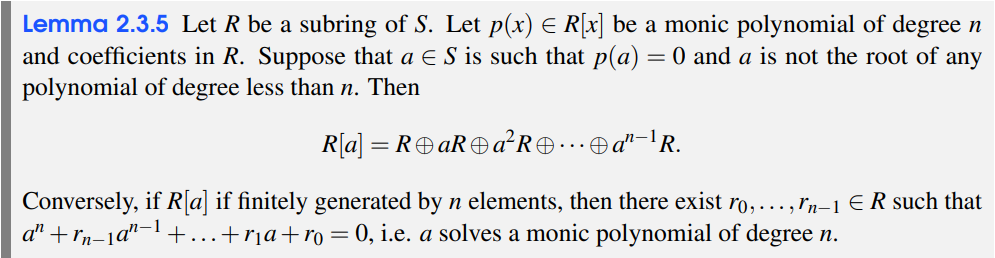

The 2nd is a corollary of the 1st?
ie. the 1st is the stronger result (ignoring the stuff specific to fields)?
Or well idk how to phrase my thoughts lol
I'm just tryna compare the ring and field versions and see which properties were necessary to conclude those statements
Eg. for 1.18, I see in the proof it uses the fact K[t] is a Euclidean Domain, but now I'm thinking this isn't necessary surely
1.18 proof

2.3.5 proof
 frail perch
Question about rep theory: So I know that given a representation of a group G, we have that the tensor square representation decomposes as the sum of 2 subrepresentations (the symmetric and alternating square representations)
What I dont get is, it seems that it is always explictly assumed that the characteristic of the field is 0, and I dont exactly see where this condition is actually used (I can see why one would want to get rid of char 2 though, but I dont see the issue with char p for p>2)
chilly ocean

Near 7th to last sentence starting with By5.14 it says y is integral over p2
5,14 states

I dont see how this is being applied
chilly ocean
nvm
figured out that radical of Bp2 is extension of p2
i meant that extension of radical of p2 is Bp2
terse crystal
frail perch
Question about rep theory: So I know that given a representation of a group G, w...
Because any V, V otimes V is isomorphic to Sym(V) direct product AntiSym(V) and any representation, Sym(V) and AntiSym(V) are invariant under g: for example in sym(V), any x y from V, x otimes y=y otimes x, so g(x) otimes g(y)=g(y) otimes g(x)
frail perch
That I understand, what I dont understand is why the insistence on the assumption that char =0
terse crystal
Oh i see… just to get rid of 2 probably?😂
I also see no reason why it can’t be odd p. I think it can, since 1/2 is well defined…
coral shale
coral shale
https://i.imgur.com/4npOjt4.png
anyone? 
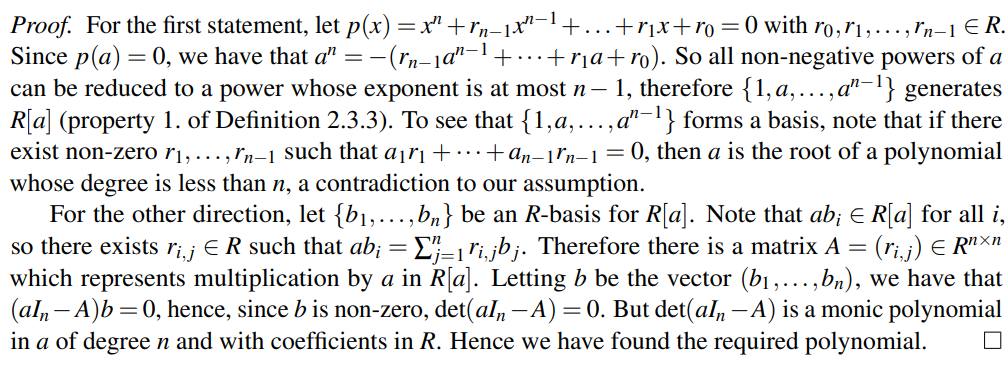
Well in particular, I'm trying to understand this part of the proof of 2.3.5 rn

I haven't rlly seen much of modules apart from the definition
So this usage of matrices just feels sus
idk
In particular A is a matrix with coefficients in R
but aI_n is a matrix with coefficientsin R[a]
I'm uh ??? kinda
So we are working in GL(n, R[a]) to figure out the last bits?
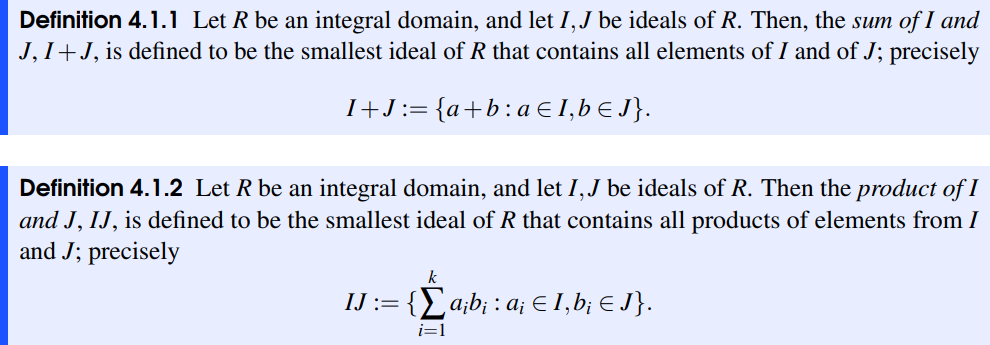
This is precisely the direct sum and tensor product, isn't it?
hot lake
no
I+I = I
and that's different from a direct sum of I and I
tensor product should also be different
though if the intersection of I and J is {0} then I+J is a direct sum of I and J
there is also a natural map from the tensor product of I and J to IJ
but I'm not sure when that would be an isomorphism
coral shale
👌 ty
hot lake
if R = Z/4Z and I=J=2 Z/4Z then IJ = {0} but I tensor J should be nontrivial
but R is not an integral domain so uh
coral shale
hot lake
though if the intersection of I and J is {0} then I+J is a direct sum of I and J
So I n J = {0} doesnt make it a tensor product? 🤔
What would I tensor J be for your example . . .
hot lake
do you have a good reason to be thinking that
coral shale
hot lake
if R = Z/4Z and I=J=2 Z/4Z then IJ = {0} but I tensor J should be nontrivial
hmmm I don't get why I tensor J is nontrivial in your example
coral shale
I tensor J = span{(0, 0), (0, 2), (2, 0), (2, 2)} = {(0, 0), (0, 2), (2, 0), (2, 2)}
Where
(a, b)(c, d) := (ac, bd)
(a, b) + (c, d) := (a+c, b+d)
Right?
hot lake
the tensor product isn't a ring you can't multiply its elements together
and no not that addition
coral shale
hot lake
the rules are (a * c) + (b * c) = (a+b) * c and (a * b) + (a * c) = a * (b+c)
and (r * a) * b = a * (r * b) ( = r * (a * b) to make it into an R-module)
so for example, (0,2) + (0,2) = (0+0,2) = (0,2) so we must have (0,2) = 0
so it's the span of (2,2)
and (2,2) + (2,2) = (4,2) = (0,2) = 0
so as an R-module it's basically the same thing as I and J already
it has a nonzero element that when you add it to itself it's 0
coral shale
ok thanks
hot lake
maybe it's true that when R is an integral domain then I tensor J = IJ though I would have to think on it a little
 south patrol
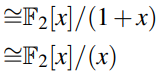
In fact, both are isomorphic to F_2
coral shale
yh thats the next line
south patrol
Sure
coral shale
sigh
uh
the natural f : R/I -> R/J will always be a homomorphism
f(r + I) = r + J
but what's important is to show this is a bijection
right?
wait no
r + I -> r + J might not be well defined. . .
south patrol
south patrol
In fact, both are isomorphic to F_2
I reckon it may be easiest just to do this, at least in my mind
coral shale
coral shale
https://i.imgur.com/PTwR12A.png
No in fact I don't find this fact obvious after all
south patrol
this is just 1st isomorphism theorem
 south patrol
Or consider the evaluation map F2[x] -> F2[x] sending x to x+1
I think that's what you said earlier anyway lol
coral shale
well yeah like how do i put it
this is 'obvious' for this very specific example
but I don't see how I could do it if we had other polynomials
and I had to deduce if they were isomorphic or not
south patrol
Yeah so the way I've seen it done in general is that you can factorise the polynomials, use CRT to get an isomorphism and then apply this
That way you only have to worry about quotients of F[x] by maximal ideals i suppose
 dull root
I have this basic fact that I am not seeing.
If I'm in the lattice Z^2, and I pick a parallelogram which has 4 lattice points as its vertices such that no other lattice pound exists inside or on the boundary of the parallelogram, then the area of the parallelogram is 1.
Equivalently, if I pick the 2 sides of this parallelogram as column vectors then the resultant 2x2 matrix has determinant 1. How do I see the determinant is 1, I'm having trouble translating the condition that there are no other lattice points on the parallelogram to "bound" the coordinates
 dull root
Ah yes, pick's theorem works here
coral shale
0 + 4/2 - 1 = 1 
dull root
But what if I had another lattice on the plane
dull root
If I had another lattice, then it is the linear image of Z^2, however, if I took a similar parallelogram on that lattice it is not true that its preimage in Z^2 is also a parallelogram with 4 lattice pts and no other right? For example, I can shrink or blow up Z^2 by a factor of 1/2 or 2?
coral shale
uhhh can you define lattice for me
you just me a square grid of points right?
Picks theorem holds for those
i dont get what u mean
dull root
We defined a lattice in the plane as a nonsingular linear transform of the integer lattice Z^2, the one we are familiar with. If I know pick's theorem works for Z^2, is there an easy way to see it works for such linear transmations of Z^2?
coral shale
so a linear transform..
you could shear the lattice
stretch it in one coordinate
and you claim the same statement as above works after the transform?
well what to say - the linear transform of the space can be described with a matrix
in particular the determinant of that matrix determines how the area of any shape is scaled
Any linear transformation preserves ratio of areas between any pair of shapes
dull root
ah I see. I also have a similar problem.
If I have a lattice on the plane where the area of the fundamental parallelogram(area of parallelogram determined by the two basis vectors of lattice) is 1, I want to show that there exists two lattice points which are a distance at most $\sqrt{\frac{2}{\sqrt 3}}$ apart.
If we take two lattice points with minimal distance, we can shift them so one of the points is 0, so $u = (x_1,y_1)$ is a lattice point with minimal distance. Then I can find another lattice point $v = (x_2,y_2)$ such that u and v generate the entire lattice, so the area of the parallelogram determined by u,v is 1. Then 1 is the determinant of of the 2x2 matrix where u and v are column vectors ie $1 = \lvert x_1y_2 - x_2y_1 \rvert$. How do I see the distance of u and v is the bound we need?
cloud walrusBOT
MasakaBakana
 dull root
I just don't see where this distance is coming from... it is slightly larger than 1, so intuitively it seems there because the areas are 1
 dull root
whats that?
coral shale
theorem.
dull root
Hmm, it somewhat resembles it, but it seems to have a root 5 in thm. But I think the idea here is supposed to be more elementary, I just can't see it lol
coral shale
no clue sry, try drawing a picture and do some geometry ig
lavish nexus

all of the s_i 's are in S, and a_i's are in R
so a'_i is some product of a_i with the s_i's and is in R
then on the fifth line from the bottom we have t_1u is a root of an equation all of whose coefficients are in R
hence t_1u is in R' the integral closure
but t_1 = product of s_i so is in S. Doesn't this provide us already with the s' we're looking for in line 6?
and what is the point of t_2?
coral shale
 coral shale
south patrol
Or consider the evaluation map F2[x] -> F2[x] sending x to x+1
coral shale
south patrol
Or consider the evaluation map F2[x] -> F2[x] sending x to x+1
Similarly to before I want to say (Z/12Z)[x]/(6+x) === (Z/12Z)[x]/(x)
Can I???
(I don't know why, if yes)
At least, I don't find it obvious why
Is there a more general result I should be seeing here
(Oh just spotted an error from line 1 to line 2, but ignore for now)
 bleak abyss
coral shale
bleak abyss
coral shale
Don't you also need to mod out by x^2 + 30
coral shale
yh yh
south patrol
coral shale
Similarly to before I want to say `(Z/12Z)[x]/(6+x) === (Z/12Z)[x]/(x)`
Yes, it's the exact same result
either the evaluation hom Z12[x] -> Z_12[x] sending x -> x+6, or both iso to Z/12Z by the factor theorem too :)
coral shale
Surely I can't just do this for any 2 polynomials of the same degree
within Z_n[x]
or you're saying I can??
south patrol
not for the same degree no, but these are linear so it's just the factor theorem or equivalent
coral shale
Could you elaborate what you mean by factor thm
south patrol
Oh as in the evaluation map at, say, -6 has kernel (6+x) and is surjective
south patrol
mapping x -> -6
south patrol
i'm confused what you mean
we're taking teh evaluation hom Z_12[x] -> Z_12 which sends x -> -6
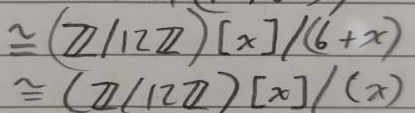
 south patrol
yup you can do that
coral shale
No, I'm asking which you are doing
coral shale
Ok, I'll think about evaluation homomorphism
Yes, I agree it is surjective, hence
By 1st iso, we have Z_12[x]/ker f = Z_12
And ker f = (x + 6)
south patrol
indeed
coral shale
ok ok clocked it
south patrol
:)
coral shale
Now why does this not work for non-linears, thinking. . .
south patrol
But yeah evaluation homomorphisms are really nice with their universal property
coral shale
uhhh for non-linears, the root might not even be in Z_n ?
south patrol
i.e. given a homomorphism A -> B and some b in B, it extends uniquely to a map A[x] -> B sending x -> b
Yeah, the same argument doesn't work
You could have an irreducible polynomial, or smth like x^2, etc
coral shale
Suppose it has a root, we can use the same argument?
We again will have a surjective evaluation map
south patrol
Not with e.g. R[x]/(x^2) and stuff
coral shale
x -> 0, what could go wrong. . .
south patrol
kernel is (x), not (x^2)
south patrol
But you can also (for e.g. commutative rings) use the chinese remainder theorem to split stuff like if you want though.
Like C[x]/(x-2)(x-3)(x-4) is isomorphic to C[x]/(x-2) oplus C[x]/(x-3) etc


 coral shale
i haven't got there yet but ok
south patrol
Oh sure
coral shale
Or I haven't, my class has, I've almost caught up
To prove, it looks like isomorphism thm ? 🤔
Well I will try when I have time 😅
south patrol
Yeah it is the first isomorphism theorem
lavish nexus
Let A be an ideal of R, S a multiplicative submonoid of R
why is A_S = R_S iff A \cap S is nonempty?
next obsidian
A_S is an ideal of R_S, to be equal means that the former contains an invertible element
 upbeat swift
If someone could help, that would be greatly appreciated:
Describe the divisors of zero in F(R).
and describe the invertible elements in F(R)
(F(R) is reals under functions)
We are barely learning rings in my class and I am confused about these two parts specifically
next obsidian
Containing an invertible element becomes exactly the statement that A and S share an element
F(R) = {f:R->R}?
upbeat swift
yes
next obsidian
Well if f•g = 1
First of all, do you know what 1 means in F(R)?
Namely, what function is it?
lavish nexus
next obsidian
Containing an invertible element becomes exactly the statement that A and S shar...
s/s
I see ty
upbeat swift
next obsidian
First of all, do you know what 1 means in F(R)?
f(x)=1
upbeat swift
g(x) = 1/f(x)
upbeat swift
when f does not equal to 0?
next obsidian
Well can you say what you mean?
Do you mean f is not the zero function?
Because that’s the function f(x) = 0 for all x
You need to know more about f in order for 1/f to exist
upbeat swift
I'm not so sure, that's what I am stuck on
next obsidian
Well we need the formula
g(x) = 1/f(x) to be a valid formula for all x in R
This works as long as…?
upbeat swift
f(x) has no zeroes?
next obsidian
Yeah exactly
So the set of units are exactly the functions with no zeroes
Because then 1/f exists
And conversely if 1/f exists, then f can’t have any zeroes
upbeat swift
and this is for the divisors of 0?
next obsidian
No this is for units
Or sorry
Invertible elements
Unit means the same thing as invertible element
upbeat swift
ah okay
next obsidian
So now we want to analyze the zero divisors
So let’s just start with a function that’s non-zero everywhere
Is it possible for f to be a zero divisor?
upbeat swift
I'm not so sure
next obsidian
Well let’s write out the definition of a zero divisor
Let’s suppose it were a zero divisor, then what?
upbeat swift
is the zero divisor a product of two functions that equal 0?