#groups-rings-fields
406252 messages · Page 671 of 407
 delicate orchid
delicate orchid
delicate orchid
my question is why does the trivial centre matter
that must have something to do with the answer
 barren sierra
I presume it helps with showing H injects into H
or showing that the image of said injection is the kernel of the surjection from G to K
delicate orchid
sounds... first iso-y
barren sierra
it does but for that i need a map
delicate orchid
tried the canonical map?
delicate orchid
G -> G/H by g -> gH
or I suppose in this case
K -> G/H by k -> (trivial automorphism, k)H
might work
it's just an idea
delicate orchid
hmm ok
barren sierra
and some sort of injection from H to G
delicate orchid
I'm gonna ignore this bit cause the idea of equivalence classes of automorphisms is horrifying

wait
barren sierra
well that's what outer automorphisms are
barren sierra
ye I'll try this later I guess
delicate orchid
try playing around with the canonical map a bit more
I swear there's something there
barren sierra
what is the canonical map lmao
delicate orchid
delicate orchid
G -> G/H by g -> gH
_ _
barren sierra
oh
delicate orchid
wait a minute, Inn(G) are isomorphic to G/Z(G) right?
so Inn(H) is isomorphic to H
might be able to work with something there
 proud bear
barren sierra
and I can't even think of one from H to G or G to K
proud bear
barren sierra
and I can't even think of one from H to G or G to K
for H->G does mapping x in H to (phi_x,1) where phi_x is conjugation by x work? theta(1)=Inn(H)=[phi_x] i think
delicate orchid
barren sierra
is it?
yeah cause the centre is trivial
barren sierra
proud bear
for H->G does mapping x in H to (phi_x,1) where phi_x is conjugation by x work? ...
lemme think on this
delicate orchid
proud bear
for H->G does mapping x in H to (phi_x,1) where phi_x is conjugation by x work? ...
wait I think it does, we just established that Inn(H) = H so mapping the conjugation/inner automorphisms back to their elements should give us something nice
barren sierra
yea I think I'll play with this and see how far it gets me
I completely forgot G/Z(G) = Inn(G)
delicate orchid
it's a useful one
barren sierra
this class moves so fast that I forget these things
we've done so much group theory and now we're going over ring theory
https://faculty.math.illinois.edu/~rezk/500-sp22/lecture-notes-500-sp22-1.pdf
all this in 5 weeks
(they are very nice notes)
delicate orchid
that's some dense material
barren sierra
ya
proud bear
are you guys going to do modules or field/galois theory after rings too?
barren sierra
proud bear
are you guys going to do modules or field/galois theory after rings too?
ye
proud bear
oof
barren sierra

proud bear
good luck bro
proud bear

barren sierra
this reminds me of the pace of my honors intro proofs course
which went from like "what is a proof" to "we are formally constructing the integers and rationals" in a sem
easier material than this but similar pacing
delicate orchid
barren sierra
ye
Wtf I’m jealous
delicate orchid
I’m having to self teach myself Galois theory slowly 
proud bear
your prof is not good or you are learning it before you take the course?
delicate orchid
There ISNT a course
proud bear

delicate orchid
Thanks to my uni axing stuff like that my algebra skill set is rather uhhh let’s say “concentrated” 
proud bear
delicate orchid
There ISNT a course
there almost isn't a course for that at my uni either. i think 6 people are taking it this term
barren sierra
delicate orchid
I’m having to self teach myself Galois theory slowly <:devastation:8987253253352...
want my prof's notes?
delicate orchid
barren sierra
want my prof's notes?
Nah it’s fine


 echo orbit
I'm really not sure what is meant by "a coset in the quotient C that is fixed by G"
I thought C was a G-module, not a quotient...
 cloud walrusBOT
grist bundle
 echo orbit
Why is it saying "a coset in the quotient C"?
echo orbit
barren sierra
want my prof's notes?
I do, I have to learn this as well. I've seen the topics before but need a refresher
 upbeat swift
Does anyone have an idea as to how to solve this? I'm a bit confused


What it means by Exercise F^^
I understand that
2 and 5 are prime factors of 10
But is that all I have to say?
Or is there more? Just need clarification
echo orbit
2 and 5 being prime factors of 10 just means theres an element of order 2 and another of order 5 in G
by cauchy's theorem
it doesn't mean anything else
but that's only the second sentence of exercise F
you actually have to use the rest of the reasoning
note that e, a, b are all distinct elements
in fact
let a have order 2
let b have order 5
then e != a != b != ab != b^2 != ab^2 != b^3 != ab^3 != b^4 != ab^4
those all form the 10 elements of G
upbeat swift
What's != ?
cloud walrusBOT
grist bundle
 echo orbit
yeah
upbeat swift
Thank you
 ember field
How many group homomorphisms are there from Z/n to itself?
echo orbit
n
 small bison
shouldn't it be like phi(n) or something
 hidden haven
I have never once tried to figure out any computations on any assignments that I have graded  i doubt any graders do lol
echo orbit
hm interesting
hidden haven
small bison
shouldn't it be like phi(n) or something
That's automorphisms
echo orbit
^
ember field
echo orbit
n
i think this true for homomorphisms from Z to Z/n
echo orbit
this is endomorphisms
hidden haven
ember field
i think this true for homomorphisms from Z to Z/n
It's also true here
Hint
 wise igloo
hidden haven
I have never once tried to figure out any computations on any assignments that I...
wise igloo
hidden haven
I have never once tried to figure out any computations on any assignments that I...
really
hidden haven
It's a sticker lol
wise igloo
hidden haven
Hint
high schoolers complain about letters being introduced in math, wait till they see this
echo orbit
lol
wise igloo
"it's algebra bro" "NO THAT FUCKIN ISNT"
echo orbit
moldi do you group cohomology
hidden haven
I know what group cohomology is now but nothing beyond that
wise igloo
I know what a group is!
hidden haven
I gotta read clerk's thread
ember field
hidden haven
It's also true here
You mean like every homomorphism from Z to Z/n gives unique homo from Z/n to Z/n?
hidden haven
Yes
ember field
but how do I know that is all?
hidden haven
Because you can also go back
ember field
no you go back
hidden haven
A map from Z/nZ gives a map from Z
 lavish nexus
problem from yesterday
 ember field
ok thanks very much
lavish nexus
I still don't get the second part
how do you prove x^p-r^p doesn't split when r is not a root of unity
(assuming p is the smallest integer s.t. r^p is in F, otherwise I don't think it is doable at all
hidden haven
What do the roots of x^p - r^p look like
lavish nexus
r*\zeta?
hidden haven
lavish nexus
(assuming p is the smallest integer s.t. r^p is in F, otherwise I don't think it...
Don't need that, since this talks about splitting, not irreducibility
hidden haven
lavish nexus
r*\zeta?
Ye, and F is real
So the only case left to handle is p = 2
That should follow from the discriminant stuff
 chilly ocean
echo orbit
moldi do you group cohomology
chilly ocean
echo orbit
moldi do you group cohomology
idk what its supposed to represent
i did presentation on it
lavish nexus
I'm dum
I kept thinking about splitting into (x-1)*something
1 isn't a root
tyty
chilly ocean
do you know how group cohomology comes to use?
also another question very simple
what do maximal ideals look like in polynomial rings
lavish nexus
(x)
hidden haven
chilly ocean
idk what its supposed to represent
See the group cohomology thread on this channel lol
chilly ocean
lol woops
lavish nexus
actually wait (p,x)
echo orbit
@chilly ocean my only conception of its use is that it can be used to study the fixed points of G-modules
chilly ocean
thats H0 tho
also i learned about localization today
🙂
false
i learned about its applications to alg geometry
hidden haven
Applications 
chilly ocean
we worked with example looking at polynomials A^2
also correct me if im wrong
A is just k[x] for some field k?
or is it always assumed k is C
the type set A for affine space
hidden haven
As a variety, it is k²
chilly ocean
yeah
proud bear
hi moldi 
hidden haven
Hello stain
chilly ocean
oh wtf
i also learned weird stuff
in alg nt
like these different operators on this ring Z_p[[T]]
Z_p power series
and we just finished going over a bunch of operators on this space
the point is that we use this thing called a Mahler transform and connect it back to iwasawa algebra on Z_p
so all the operators on Z_p[[T]] corresponds to some change of a measure in iwasawa algebra
its v confusing atm for me
the last operator we covered is called a logairthmic derivative
oh last thing i learned today but confusingly was about correspondence between Lie Algebras and Lie Groups
proud bear
what's Z_p[[T]]? power series with coefficients in p-adic integers?
chilly ocean
yeah
proud bear
damn
chilly ocean
and there is a topology on it also
hidden haven
Power series in power series 
chilly ocean
afaik Z_p are just p-adica with norm <=1
but i actually dont know
i just black boxed most the proofs
hidden haven
Ye or they are a quotient of the power series ring over F_p
chilly ocean
hidden haven
Ye or they are a quotient of the power series ring over F_p
oh yeah
we went over that
oh ig the types of operators we were going over have a name
called Coleman operators
and they have a heavy relationship to this tower of number fields Q_p(u_p^n) where u_p^n are primitive p^n roots of unity
in each of these fields the unit group have inportance but i dont really remember
we focus a lot on these things called norm compatible sequences in these fields
all in all today was loaded
i wish i had a more directed courseload
 cloud walrusBOT
JustKeepRunning

 prisma shuttle
i get that they get the mapping from the jacobson density theorem (the analogy of CRT for irreps of A) but after that i get lost
and also i don't really get how the finally inequality implies the problem
chilly ocean
what are itreps
chilly ocean
oh
no clue what irreducible representation is
i think i know a representation is a homomorphism from group to GLnR
prisma shuttle
chilly ocean
no clue what irreducible representation is
an irreducible representation is one that has no proper nontrivial subrepresentations
prisma shuttle
chilly ocean
i think i know a representation is a homomorphism from group to GLnR
sort of but you can think of a representation as a k algebra (where k is a field) along with an algebra homomorphism to EndV
chilly ocean
is a subrepresentation a restriction of a representation?
prisma shuttle
chilly ocean
is a subrepresentation a restriction of a representation?
its a subset of the representation where mutliplication by any element of the algebra is closed
sort of like ideals in ring theory
chilly ocean
oh
how can i think of a representation as k->End(V)?
how is k being formedd#
do you mind answering these questions
prisma shuttle
chilly ocean
do you mind answering these questions
no lol its fine
prisma shuttle
its like
how for a ring
you have an additive group structure along with multiplication
like its the two parts that make it up
chilly ocean
yeah
prisma shuttle
so you have the k-vector space V (the algebra)
along with an action (aka. a homomorphism)
if you want to think of it more intuitively
the homomorphism is basically a matrix you associate with the algebra
chilly ocean
so i thought a representatiom of a group G is r:G->GL(n,R) a group homomorphism, but you are saying it can be viewed at a k-algebra with multiplication defined by k->End(V)
oh
are you making it more general?
prisma shuttle
no no like the two definitons mean the same thing
like wut are saying is same as wut i am saying
just like how a group action is just a homomorphism to the symmetric group
chilly ocean
yeah
prisma shuttle
your homomoprhims is the "action" i am referring to
chilly ocean
oh i think i see it
chilly ocean
oh lol no clue as of now
prisma shuttle
yea rep theory has been pretty hard to learn
prisma shuttle
oh that's just direct summing
honestly ima kinda confused about that notation too
chilly ocean
yeah but what is superscript
prisma shuttle
chilly ocean
yeah but what is superscript
exactly
i think it just means it repeated in the direct sum a certain number of times?
chilly ocean
i mean i might have idea where square term coming from?
prisma shuttle
but idk why they have to dirrect sum that too
cuz if it was just raised to the power they wouldn't need the \oplus symbol there
prisma shuttle
chilly ocean
i mean i might have idea where square term coming from?
do u get how we get from the inequality to concluding the problem statement
prisma shuttle
cuz idk how this relates to irreps
chilly ocean
surjection makes it believable
hidden haven
They get dim V² from end V
chilly ocean
oh
prisma shuttle
hidden haven
They get dim V² from end V
could you elabroate
chilly ocean
end(v,v) are nxn matricies
bad phrasing ig
but if u have vextorspace V
the endmorphisms are square matricies with same dim
hidden haven
Oh ok they're phrasing it differently
prisma shuttle
oh i sorta see
hidden haven
V^⊕dim V
hidden haven
This has (dimension V)²
hidden haven
chilly ocean
y is the plus there
This is standard more notation for repeated direct sum
prisma shuttle
wut is a repeated direct sum
chilly ocean
seems redundant
hidden haven
If you remove the plus it is repeated direct product
hidden haven
prisma shuttle
wut is a repeated direct sum
V + V + ... + V lol
chilly ocean
ive seen this betorw
prisma shuttle
wait but if the dim was finite then direct product and direct sum are the same right
so it wouldn't matter?
wait but here some of the dim could be unbounded
hidden haven
Ye
prisma shuttle
tocyem your idea about the matrices being nxn was pretty nice
is it valid for this problem
prisma shuttle
no like the thing about the size of End(v)
chilly ocean
but if you treat everything as a vector space then it makes sense
prisma shuttle
yea it does
idk if that works here though
i feel like the inequality basicaly boils down to the fact that $(a+b+c+d)^2\geq a^2+b^2+c^2+d^2$ if you think about it intuitively
cloud walrusBOT
JustKeepRunning
 prisma shuttle
oh wait yes u are write i am overcomplicating
chilly ocean
like taking dimension of that surjection gives you take inequality immediately
the part that looks weird is just the notation but we understand now
prisma shuttle
also do u know why they use the two headed arrow
chilly ocean
two headed is shorthand for surjection
chilly ocean
lol idk shit
i have no clue what most those objects really are even though you explained
looks interesting though
i think i know a bit tho
and def want to get more invested
chilly ocean
evan chen
ye
i remember seeing that in HS
also another cool thing i learned were how localization makes a DVR and valuation represents number of times another polynomial intersects
 weary cloud
What is the relation between inductively ordered sets and induction? I don't think we can do the usual induction on this set, as we are only guaranteed upper bounds on each chain. So what kind of induction can we do on this set? What are some examples of proofs/applications of such kind of induction? If there is none, why are they called inductively ordered? If someone could point to a resource, that'd be helpful too.
Yours gratefully
 white jackal
What subgroups of Q8 correspond to the subgroups of Q/H under the Correspondence Theorem? H is {1, -1}

can u guys double check my work
prisma shuttle
white jackal
can u guys double check my work
i took a quick look over it and it seems correct o me

also can someone explain the notation here (what does the "opposite multiplication" thing mean?)
like division or smth?
 kind temple
a groups opposite has the same underlying set, but the definition of composition on the opposite group is a x b = b * a if * is the operation on the original group
chilly ocean
Do people remember all those propositions
Does someone have some intuition or vid for cosets?
I'm having a hard time grasping what they are and connecting all the dots in relation to quotient groups
Could someone walk me through an arbitray group... (Z/m8Z, +)?
The quotient groups in this case would be the trivial groups, and what?
kind temple
try looking at cosets of R^2 when viewed as an additive group, and the sub-spaces of R^2 as subgroups. you can actually draw these cosets, and its a good way to think of them in general
chilly ocean
I haven't learned what a sub-space is yet
kind temple
its just a subset of a vector space that is also a vector space
hidden haven
chilly ocean
I'm having a hard time grasping what they are and connecting all the dots in rel...
You could check out the first iso thread
 lethal dune
there's a first iso thread
chilly ocean
que es un first iso thread
 foggy merlin
 hidden haven
Quotients of compact spaces are compact, does that apply here?
foggy merlin
well if it only was asking for compact this would be a simpler question. but I'm asking this for a friend and since I haven't had any algebraic geometry idk what a variety is
and if quotienting by such a group preserves that property
hidden haven
Yeah I'm not sure when a variety is called compact, but if it is when the underlying topological space is compact then yes
Since it's just a topological space with extra structure
foggy merlin
I tried to look it up but didn't really get very far as these words in exactly this order don't seem to be used commonly
ig cuz he may have translated from french
foggy merlin
hidden haven
Yeah I'm not sure when a variety is called compact, but if it is when the underl...
but does that quotient operation also preserve the property of being a variety in that case?
also what I found kind of weird that this was asked in differential geometry and not some other subject, I'd expect that they would just ask this for manifolds there. maybe he means sth else idk?
 sharp sonnet
arent varieties noetherian and thus always compact?
hidden haven

sharp sonnet
the algebro-geometric replacement is completeness
no idea if this is related to the question though 
foggy merlin
sharp sonnet
arent varieties noetherian and thus always compact?
wait what type of variety are we talking about now
sharp sonnet
the type that is studied in algebraic geometry?
foggy merlin
wait but then what topology were you talking about, because that seemed kinda wrong for the euclidean one? or is it not?
foggy merlin
yeah, since my friend was asking this apparently in diffgeo, I assume they talked about the euclidean one? maybe?
sharp sonnet
hm ok but wouldnt you then use the word manifold
foggy merlin
otherwise the question itself would be worded redundantly
sharp sonnet
(and ask in #diff-geo-diff-top)
sharp sonnet
hidden haven
Yeah I'm not sure when a variety is called compact, but if it is when the underl...
my original comment was in reply to this ^and you saying the question is translated
thinking about it in french the word variety is used both for varieties and manifolds
foggy merlin
sharp sonnet
hm ok but wouldnt you then use the word manifold
yes, also I asked there before and no one answered, so I thought I'd ask here today. I already mentioned this seemed kind of odd to me
foggy merlin
sharp sonnet
thinking about it in french the word variety is used both for varieties and mani...
OH
yeah I don't speak french lmao
yeah ok now I know why no one answered lmfao
thanks for clearing that up
 simple valley
I'm asked to show that SES of modules over K[G] always split if G is a finite group and K is a char 0 field
A little lost...
Is this to do with the relationship between free/projective/flat/torsion-free modules?
delicate orchid
Maschke's theorem 😌
cool to know it works for any char 0 field and not just algebraically closed ones
 rustic crown
i can never remember these hypothesis 😵💫
the proof was like averaging the splitting map
so yea it should work as long as char k doesn't divide |G|
delicate orchid
I've got 2 different proofs, both 2 pages long
 lavish nexus
had an abstract exam
complete destruction
Given ζ 25th root of unity
I got |Gal(Q(ζ)/Q)|=20
and there was a 4 cycle
But how do you know if it’s abelian
prisma shuttle
delicate orchid
cool to know it works for any char 0 field and not just algebraically closed one...
wait really
in napkin it says
Let $G$ be a finite group, and $k$ an algebraically closed field whose characteristic does not divide $|G|$. Then $k[G]$ is semisimple
cloud walrusBOT
JustKeepRunning
 prisma shuttle
although not being algebraically closed sounds like a nightmare to work with
 next obsidian
You prove it by taking an avg
The reason you need char 0 IIRC is just so you can divide by |G|
Which is why you can instead assume the characteristic doesn’t divide |G|
At least to my memory
lavish nexus
wait is |Gal(Q(ζ_n)/Q|=φ(n)?
chilly ocean
yeah
lavish nexus
Fuck so it’s just Aut(Z_n)
chilly ocean
uhh idk about that
delicate orchid
prisma shuttle
although not being algebraically closed sounds like a nightmare to work with
I've only looked at it through the lens of representation theory so I've only ever dealt with algebraically closed cases as they make the representations SO much nicer
lavish nexus
I was thinking about the order 5 element in that group
I wrote ζ->ζ^6 but somehow calculated it wrong and thought it wasn’t order 5
rip me
 chilly radish
next obsidian
You prove it by taking an avg
chilly radish
next obsidian
You prove it by taking an avg
What does average mean in this context
 waxen hedge
chilly radish
What does average mean in this context
waxen hedge
chilly radish
What does average mean in this context
Sum over the group and divide par |G|
chilly radish
Ah
barren sierra
we can never have that the n x n matrices over a ring R can have an identity but R itself has no identity right?
 small ingot
All rings have identity
Why is true that every map from a torsion group to a free group is trivial?
barren sierra
small ingot
All rings have identity
no?
prisma shuttle
barren sierra
no?
it depends on what book you are using
barren sierra
for example the ring of even integers
prisma shuttle
some authros do assume all rings have identity
barren sierra
D&F
prisma shuttle
and are commutative
barren sierra
strange
prisma shuttle
yea D&F doens't
D&F basically assume bare minimum
no commutative
no identitty
barren sierra
I see
ember field
is a subgroup of a divislbe group divisible ??
 viscid pewter
nah
consider the trivial subgroup
wait no
it still shouldn't be
ok consider the integers as a subgroup of the rational numbers, there we go
ember field
does divisible for multiplicative group mean every element has an nth root ??
 delicate bloom
yes

 terse crystal
He just means that you need to determine all χ(g) to define χ, and G=S_3 is just an example that he will discuss about…
 rose shard
I started the course groups and rings and this week was my first week and I’m alr struggling bcs the course is in English and I’m native Dutch. Can someone give me an explanation bcs I’m stuck
 next obsidian
What part is unclear?
 mystic bolt
Is someone able to explain the intuition behind what ideals represent, and what factor rings represent? Brushing up on my undergrad stuff and I never really understood the concept, just got bombarded with definitions and proofs
 void cosmos
mystic bolt
Is someone able to explain the intuition behind what ideals represent, and what ...
void cosmos
mystic bolt
Is someone able to explain the intuition behind what ideals represent, and what ...
in your free time
grab paper and pen
and think of ideals in Z
think about divisiblity
prime ideals what are those
etc
you will have fun
and if you get to something just always remember that is just one way of looking at things
i think in algebraic geometry ideals represent points and etc..
next obsidian
Prime ideals do
echo orbit
AG is schizo
next obsidian
The idea behind a quotient is that you want to set certain things to 0. An ideal is just what ends up being spit out if you want what you end up with to still be a ring
I think it’s most instructive to look at things like quotients of polyomil rings
Like R[x]/(x^2 + 1) ≈ C
And what you’re doing here is adding a formal symbol x which at first doesn’t mean anything
But then by quotienting by x^2 + 1 you declare that x^2 +
1 = 0, or really, x^2 = -1
So now x acts like i, it’s a square root of -1, and that’s why you end up with C because the result is just R[i] which is what C is
void cosmos
next obsidian
Prime ideals do
yea
next obsidian
This is why the Gaussian integers is Z[x]/(x^2 + 1) as well
You can do lots of things like adjoining roots of unity to R, irrational numbers to Q, etc etc by this sort of construction
mystic bolt
next obsidian
The idea behind a quotient is that you want to set certain things to 0. An ideal...
That literally just made everything click, thank you
And now I understand the logic behind the fundamental theorem as well
kind temple
how many subgroups of Sn are isomorphic to Sn-1
me and my friend think that it should have n, each being V_k(k) where V_k(k) is the set of all permutations sending k to k
delicate bloom
edge case, S_2 has only 1, not 2 subgroups isomorphic to S_1
I suspect it might be possible for it to have more than n in general though, might be some weird ways of combining elements to make it happen or something, idk, probably an easy way to see that it's not the case by going through and throwing all the standard theorems at it though
kind temple
hmm.
chilly radish
@hidden haven I just remembered but did u end up thinking about the quotient of product thing we were talking about a while ago? It's still kinda bothering me (Ping me when u reply)
next obsidian
kind temple
how many subgroups of Sn are isomorphic to Sn-1
No
Sorry, I should’ve replied to the other one
But there’s (at the very least) an exotic copy of S_5 inside of S_6 not of that form
You use it to construct the outer automorphism of S_6
 next obsidian
Try to compute the dimension of the d x d matrices of trace zero
You should get d^2 - 1, I think you can just do it grabbing the following d^2 - 1 linearly independent matrices
Start at the top left and put a 1 in the top left and a -1 in the bottom right
Or rather like
0 everywhere, and a 1 in exactly one of the spots other than the bottom right
But if you put a 1 in the diagonal, avtually put a -1 in the bottom right
 dreamy fiber
Can someone explain to me, why, in very simple terms (pls or else my IQ can't handle it) that why is it that,
$$Ext_R^1(P, N) = 0 \text{ for all $R$-module M} \implies P is projective$$
Thank you!
cloud walrusBOT
ScarletScorch
 next obsidian
These all have trace 0, and give d^2-1 linearly independent vectors, and clearly [A,A] isn’t everything so it can’t be d^2 dimensional, then the dimension of the quotient is d^2 - (d^2 - 1) = 1
This is almost by definition
A module is defined to be projective if Hom(P,-) is exact, which because it’s left exact means that for any surjection kernel -> M -> N that the map Hom(P,M) -> Hom(P,N) is surjective
But due to Ext’s definition, you know that given such a surjevtion, the sequence
Hom(P,M) -> Hom(P,N) -> Ext^1_R(P,kernel) is exact
By assumption the last module is 0
But then Hom(P,M) -> Hom(P,N) -> 0 exact means the map is surjective
So P is projective
dreamy fiber
This is gonna sound really stupid but
dreamy fiber
next obsidian
But due to Ext’s definition, you know that given such a surjevtion, the sequence...
Why does the definition of Ext tell me this?
next obsidian
Umm…
Well I guess it depends on how you defined Ext
I take it to be a derived functor of Hom in which case it’s like definitional
If you define it as the like n-th homology of blah blah resolutions, apply Hom…
That’s how you make derived functors, but in that case it’s a bit trickier
It isn’t actually that bad but
It requires you to develop some homological algebra
Like idk, what do you know about Ext? The most important thing is the long exact sequence you get from any short exact sequence which is what we applied here
dreamy fiber
Well so our definition followed from Aluffi's book which he just drew a bunch of arrows for a lack of better word
well so his definition is that
next obsidian
Sure but Aluffi then states that you get a long exact sequence for any short exact sequence
kind temple
next obsidian
You use it to construct the outer automorphism of S_6
if u could expand, that would be really cool. idk what outer automorphism is
next obsidian
The fact that this holds and well-definedness is done later
dreamy fiber
wow you are really well acquainted with the book
next obsidian
kind temple
if u could expand, that would be really cool. idk what outer automorphism is
This is from the problem I did 2 years ago constructing the outer automorphism. I construct the faithful representation of S_5, and if you trace out what it does you’ll see it doesn’t fix any of the Sylow-5 subgroups so it doesn’t embed into S_6 as any of the distinguished S_5’s you listed
 next obsidian
dreamy fiber
wow you are really well acquainted with the book
next obsidian
dreamy fiber
wow you are really well acquainted with the book
This is where I learned this material in particular from the first time hahahaha
So I’m familiar with this part of the book a lot more than the rest
dreamy fiber
Thanks so much I think I actually understood it
next obsidian


 novel loom
Let $\mathbf{M}$ be a $2^{N}\times2^{N}$ matrix with complex entries, and write $\mathbf{M}$ in block form as: $\mathbf{M}=\left[\begin{array}{cc}
\mathbf{A} & \mathbf{B}^{\dagger}\
\mathbf{B} & \mathbf{D}
\end{array}\right]$
cloud walrusBOT
ComplexVariable
 novel loom
where $\dagger$ denotes the conjugate transpose, and where all four blocks are $2^{N-1}\times2^{N-1}$. Assume that $\mathbf{M}, \mathbf{A}$, and $\mathbf{D}$ are all Hermitian. If both $\mathbf{A}$ and $\mathbf{D}$ are invertible, does it follow that $\mathbf{M}$ is invertible?
cloud walrusBOT
ComplexVariable
 next obsidian
How can a 2^N x 2^N matrix be a 2x2 matrix of 2^{N-1} x 2^{N-1} blocks?
delicate orchid
Split it into quarters?
next obsidian
Wait
I forgot how adding works
I thought 2^{N-1} = 2^N - 1 for a second
What is wrong with me
delicate bloom
when you do the fast fourier transform too fast
next obsidian
But also idk, it suffices to ask if AD - BB^dagger is invertible I think
But idk if this is true whenever A and D are invertible
But I’m also not totally sure if the adjugate matrix thing works over a noncommutative ring
next obsidian
next obsidian
But also idk, it suffices to ask if AD - BB^dagger is invertible I think
Which is how much you’d know it’s equivalent to look at this
next obsidian
novel loom
where $\dagger$ denotes the conjugate transpose, and where all four blocks are $...
Okay I think I have a counterexample
I’m pretty sure a 2x2 matrix with 1’s in every coordinate satisfy this
And you can scale this up to any size by taking the 2^{N-1} by 2^{N-1} identity matrix for all four blocks
Or uhh… maybe if you go past 2x2 the entire matrix isn’t Hermitian anymore
No I think you’re fine still
novel loom
If it helps, I specifically need N≥2.
next obsidian
hidden haven
chilly radish
<@427909312099385346> I just remembered but did u end up thinking about the quot...
Quotient of product?
 grizzled elm
Can someone check if I messed something up here:\
Determine the splitting field and its degree over $\mathbb{Q}$ for $x^6-4$. \
$x^6-4=(x^3-2)(x^3+2)$, and both $x^3-2$ $x^3+2$ are degree $3$ irreducible polynomials in $\mathbb{Q}$. Hence, $\alpha=2^{1/3}$ is an element of our extension whose minimal polynomial is degree $3$. It also has complex roots of the form $\beta=\alpha\xi$ where $\xi=e^{i\pi/3}$. Notice that $\alpha$ is in the ideal generated by $\beta$ (as $\xi$ is the $6th$ root of unity in $\mathbb{C}$) and so $\mathbb{Q}(2^{1/3}e^{i\pi/3})$ is a splitting field over $\mathbb{Q}$ for $x^6-4$. $\beta$ has minimal polynomial $m_\beta(x)=x^3+2$ in $\mathbb{Q}$, and hence it is a degree $3$ extension.
cloud walrusBOT
Dpao

 gritty sparrow
grizzled elm
Can someone check if I messed something up here:\\
Determine the splitting field...
gritty sparrow
grizzled elm
Can someone check if I messed something up here:\\
Determine the splitting field...
alpha being in the ideal generated by beta is kinda meaningless since the ideal is always the whole field. You have to prove that all roots are in the subfield generated by beta, that is what will allow you to conclude that Q(beta) is splitting field. In fact it is not true that all the roots are generated by beta, I think.
grizzled elm
gritty sparrow
alpha being in the ideal generated by beta is kinda meaningless since the ideal ...
it definitley feels wrong that Beta would or that its degree 3
I think its prob best to go back and consider the polynomial (x^3-2) in $Q(\alpha)[x]$ which is $x^3-\alpha^3=-(\alpha-x)(\alpha^2+\alpha x +x^2)$
cloud walrusBOT
Dpao
Compile Error! Click the  reaction for more information.
(You may edit your message to recompile.)
 grizzled elm
im overcomplicating things and it really is just Q(\alpha,\beta), alpha is not in the subring of beta
since it has 6 roots, should be degree>= 6 so just that alone shows my original is wrong
chilly ocean
is there an easy test to determine whether 2 elements of F_2 freely generate it
I'm trying to prove Out(F2)=GL2(Z) and I already have a surjective homomorphism of monoids End(F2)->(2×2 integer matrices), I just need to check that the intersection of Aut(F2) with the kernel of my map is exactly Inn(F2). this result ends up giving an easy test to determine whether a given endomorphism is an automorphism, but I was wondering if I could go the other direction with that
chilly ocean
I should have been more clear
not the field on 2 elements
the free group on 2 letters
sorry
next obsidian
oh
I think this is probably undecidable if I had to gguess
I think determining when things generate groups is a very hard problem or something
and also F_2 is fucked
¯_(ツ)_/¯
chilly ocean
well if the isomorphism holds (which I know it does) then I do have a test
provided you can look at an automorphism and determine whether it's inner or not
which you can
unless the map I already have is the wrong way to go about the isomorphism Out(F2)=GL2(Z)
but I doubt that since my function is pretty nice
chilly ocean
hahahaha
 patent crescent
When talking about cosets, normal groups, factor groups, I keep seeing notation like an element multiplied by a group. This basically means an element multiplied by any element in the set since we are talking about equivalency classes right?
novel loom
patent crescent
When talking about cosets, normal groups, factor groups, I keep seeing notation ...
Yes.
The idea is that gH represents the set of all elements of the form gh, where h is in H.
In additive notation, this would be g + H, the set of all elements of the form g + h.
You can think of this as the image of H under the map h —> gh
This map is called (left-)translation by g.
patent crescent
Thanks
novel loom
No problem. 🙂
hidden haven
chilly radish
<@427909312099385346> I just remembered but did u end up thinking about the quot...
oh ok I just remembered that as exactness of product lol
I did think about it
And it is true
Or at least I have been reading some weibel and it seems that some arguments also need it
So with that I can't see it not being true
And of course I didn't see any problems with the argument you gave
Ye I remember Weibel includes this as an axiom AB4 which says that product of epis is epi
And proves that R-mod always satisfies it
next obsidian
AB4 :3
chilly ocean
Is there a way to prove that any two distinct elements of order 2 of S3 form S3 besides brute force?
next obsidian
yeah
the subgroup they generate has to have at least 3 elements, but a group containing an element of order 2 has to have order divisible by 2
this means it's stuck at 4 or 6
by Lagrange, 4 is impossible as 4 doesn't divide 6
so you're stuck with the subgroup they generate being order 6, aka the whole thing
chilly ocean
nice
chilly ocean
next obsidian
the subgroup they generate has to have at least 3 elements, but a group containi...
Why do subgroups generated by two distinct elements of order two have an order >= 3?
Oh
Because of Lagrange's
proud bear
chilly ocean
Why do subgroups generated by two distinct elements of order two have an order >...
if x and y are the distinct elements of order 2, then the subgroup generated by x, y will at least contain 1, x and y
chilly ocean
I see
 open pilot
Good proof
chilly ocean
Any hints for proving that if Z/Zm x Z/Zn is cyclic then gcd(m,n) = 1
 inland otter
If gcd isn’t 1 show there cant be a generating element would be my first intuition
Or consider a generating element and try to get to bezout
chilly ocean
Well
I was thinking
Let the generating element be +1 for both m and n
You would still generate the entire group by carrying out the operation lcm(m,n) times
Unless I'm misinterpreting something
next obsidian
Compute the order of (x,y) in any product based on the order of x and y
You need an element of order nm for this group to be cyclic
From there you appeal to Bezout’s lemma
rustic crown
eevee
 coral shale

Is there uh... a more 'obvious' example?
Z[sqrt-13] isnt clearly not a UFD to me D:
rustic crown
okie what about Z[2i]?
coral shale
 Ok, its prolly cus i have to revise the meaning of UFD 😂
rustic crown
ah oops
 next obsidian
I think the “canonical” choice is Z[sqrt(-5)]
This is the example I’ve always seen, but maybe because it’s in Dummit and Foote or something
rustic crown
rustic crown
okie what about Z[2i]?
here we physically removed the element i, so 2 and 2i aren't associates anymore! (as the only units are 1 and -1)
because of this 4 has two "different" factorizations
4 ~ 2 * 2 ~ (2i) * (2i)
hidden haven
How can you remove it physically when it doesn't physically exist?
next obsidian
Yeah it’s imaginary you dingus
 hidden haven
Listen to yourself
coral shale
rustic crown
okie what about Z[2i]?
soooo 2i becomes irreducible. And like you said we have 2i.2i = -2.2
I think I get this D:
delicate orchid
I’m team Z[sqrt(-5)] personally
rustic crown
coral shale
soooo `2i` becomes irreducible. And like you said we have 2i.2i = -2.2
yee, only factor of 2i are like 1 + i, and 1+i is no longer an element of Z[2i]
hidden haven
That's why it's good  have fun trying to recall what the number in the root was when you write your next exam
coral shale
D:
next obsidian
6 = 2•3 = (1 + sqrt(-5))(1 - sqrt(-5))
next obsidian
For 13, you can write 14 = 7•2 = (1 + sqrt(-3))(1 - sqrt(-3))
rustic crown
so like -3 and -4 are bad because they aren't integrally closed in their field of fractions... but -5 and -13 are even worse
coral shale
next obsidian
6 = 2•3 = (1 + sqrt(-5))(1 - sqrt(-5))
oh u do aa-bb = (a-b)(a+b)
rustic crown
you can't fill in the "holes" to make it a UFD
next obsidian
Wut
rustic crown
but Z[2i] or Z[sqrt(-3)] are pretty close to UFD
next obsidian
How do you even quantify that
rustic crown
just need to add fill that missing i and (-1 + sqrt(-3))/2
rustic crown

next obsidian
In more classical language
rustic crown
next obsidian
Or the ideal class group
yea this..
rustic crown
the class number for -3 and -4 are 1
next obsidian
Okay well the Picard group is the same thing as ideal class group 
What’s the class number
rustic crown
size of the class group
rustic crown
class number for -5 is 2 i think
coral shale
I feel like I'm meant to know this stuff D:
next obsidian
Like the clas group is always non-empty and trivial iff UFD right?
No, this is algebraic number theory
delicate orchid
coral shale
I feel like I'm meant to know this stuff D:
Ofc you’re not
coral shale
I am doing alg nt rn
next obsidian
Oh
rustic crown
like it's much more fundamental to have your ring be integrally closed in its fraction field to make it a UFD
rustic crown
which is why i used Z[2i] instead of Z[sqrt(-5)]
rustic crown
next obsidian
Wait but still, I thought the ideal class group being trivial iff UFD
yea that's true
next obsidian
But if
coral shale
delicate orchid
It’s not a UFD, I think
So does this always work out? what if a^2 - b^2 = (a+b)(a-b) gives you a prime 🤔
next obsidian
rustic crown
the class number for -3 and -4 are 1
doesn’t this mean they’re a UFD
rustic crown
like class group of a number field K is the ideal group thingy of O_K
and O_K is automatically integrally closed
hidden haven
coral shale
I feel like I'm meant to know this stuff D:
This stuff is all useless, I don't know any of it and yet I'm perfectly happy ignoring det whenever he talks about this
rustic crown
people don't care about non-integrally closed things ig
coral shale
hidden haven
This stuff is all useless, I don't know any of it and yet I'm perfectly happy ig...
they ask me if this blob is a UFD in the exam and im like 'wut'
D:
next obsidian
Was that only about integrally closed domains that the ideal class group says that
 weak oriole
rustic crown
like it's much more fundamental to have your ring be integrally closed in its fr...
weak oriole
rustic crown
like it's much more fundamental to have your ring be integrally closed in its fr...
why
Prove it
rustic crown
it's pretty much same as the rational root theorem proof
next obsidian
I’m using scheme theory 🥸
delicate orchid
hidden haven
This stuff is all useless, I don't know any of it and yet I'm perfectly happy ig...
Idk the class group is kinda... swagtastic
hidden haven
🤓
rustic crown
AG hard 
next obsidian
hidden haven
🤓
AG headass 🤓
I was looking at Utah’s old quals and one problem was to show C[x] is integrally closed
Lol
Like the first thing you learn when you learn what integrally closed means
Is that UFDs are integrally closed
Easy test headass 🤓
next obsidian
I think it’s probably easy to see using the R1 and S2 thing maybe
For Noetherian rings
weak oriole
what's R1 and S2 thingy
next obsidian
Uhh
Don’t worry about it, but if you want look up Serre’s criterion for normality
Actually it’s just
Easy
No need to bust out anything fancy lol
weak oriole
one more adjective for a ring 
next obsidian
If R is normal, then consider an element of the fraction field of R[x] integral over R[x]
Then it’s also integral over K[x], and K[x] is a UFD so it’s normal
So the coefficients of its min poly live in K
But now you can like
There’s that thing about for a normal ring R, if you have an algebraic extension L of K = frac(R)
Oh holy crap nvm this might be hard
Okay I think this is hard
coral shale
🤔
next obsidian
I looked it up in the stacks project
At least as they present it, it’s very nontrivial
You have to do clever stuff to reduce to the Noetherian case and then use the notion of almost integral
coral shale
$\bZ[\sqrt{n}]$ for $n\in\bZ$
$$(a+\sqrt n)(a-\sqrt n) = a^2-n = a^2+(-n)$$
The difference between 2 consecutive squares is odd, so an $a$ can always be found to make this factorisable in 2 different ways.
I have to then think if $(a+\sqrt n) ,(a-\sqrt n)$ may be units
cloud walrusBOT
Shuri2060
 coral shale
Is this the right approach for the basic stuff we discussed earlier? 🤔
Also, I should probably make n non-square
rustic crown
you would also need to check for the irreducibility of the factors, which can be hard to generalize to weird values of n
coral shale
rustic crown
you would also need to check for the irreducibility of the factors, which can be...
If the factors are reducible, that is fine right? It is only a problem if they are units
(I am trying to show I can find a number that can be split in 2 different ways)
rustic crown
yea it's fine... but you wouldn't know the two factorizations are "essentially different" unless you factorize them completely into irreducibles
coral shale
ahhh I see.
coral shale
and this is precisely what happens when n = -2, I suppose
rustic crown
yea it has to cuz Z[sqrt(-2)] is a UFD :p
(2 + a)(2 - a) = 6 = 2 * 3
where a = sqrt(-2)
both are just specializations of the factorization
a * a * (1 + a) * (1 - a)
 wooden ember
If I quotient the free group on n generators by the product of those generators do I obtain the free group on n-1 generators?
I really need this to be true but I’m struggling to show it
I think it works right can’t I just take the first n-1 generators? They generate themselves and generate the inverse of the nth one so things should work right?
(Well this only show it’s a quotient of a free group on n-1 generators I suppose)
rustic crown
in think your case it's fine either ways...
we can easily define maps in both directions g : F_n/N --> F_{n-1} and f : F_{n-1} --> F_n/N
checking injectivity of f directly is hard, but you've already checked the surjectivity of f, which is enough to prove that the two compositions are identities on the respective groups.
gf = 1 is easy
and fgf = f follows, and since f is surjective fg = 1
coral shale
What is the process of quotienting here 👀
We have <a1, ..., an>
Is it <a1, ..., an | any permutation of the product a1...an > ?
rustic crown
i think we're quotienting by a fixed product, say a1...an
and by that we mean quotienting by the smallest normal subgroup containing a1...an
coral shale
Thanks, will explore this idea 👀
rustic crown
rustic crown
in think your case it's fine either ways...
we can easily define maps in both di...
but in general if you wanna show something satisfies "no further relations" it's easier to act by the group on some nice object and show that any new relation won't act via identity so everything's good.
(although i've only seen one concrete example of this while showing PSL_2(Z) is isomorphic to C2 * C3)
terse crystal
 terse crystal
wooden ember
If I quotient the free group on n generators by the product of those generators ...
terse crystal
wooden ember
If I quotient the free group on n generators by the product of those generators ...
I think it works, using subgroups of commutators in the picture, maybe you can check it for me
TG’/G’ is also the kernel because any Πa_i^s_i in the kernel, where a_i is the equivalence class of x_i, we must have that s_i=s_n for every 1<=i<=n-1 therefore all s_i are equal
 lapis trail
 terse crystal
lapis trail
terse crystal
lapis trail
What is n?
lapis trail
*of degree n
terse crystal
Also monic polynomials right?
terse crystal
lapis trail
I could adjust the formula if it were to be just monic
Please adjust it
lapis trail
Ok
terse crystal
Just by removing (p-1) in your picture?
terse crystal
Then no, I don’t think it’s true. I calculated that number of monic irreducible polynomials of degree 3 over Z/pZ is p^3-p-C(p,3)-(p+2)C(p,2)
lapis trail
$p^n-{p \choose n}(p-1)$
cloud walrusBOT
seth.delacroix
 lapis trail
For monic
But let me think about what youbsaid
*said
It's an exercise in my book
cloud walrusBOT
Cogwheels of the mind

 terse crystal
prisma shuttle
what does the line over teh second term mean here
terse crystal
prisma shuttle
what does the line over teh second term mean here
Conjugate
terse crystal
Conjugate of a+bi=a-bi
prisma shuttle
wait but like wut would happen if codomain wasn't C
then would there be a more general definition that could be used
delicate orchid
you'd use a different inner product
terse crystal
Don’t know, I only know that in C that bar means conjugate
delicate orchid
it's definitely complex conjugate in this context
lemme think
I think over R and Q you'd just use the fact that $\overline{a}=a$ and just write the inner product without the bar
cloud walrusBOT
Wew Lads Tbh ✓
 delicate orchid
for finite fields I have no clue
terse crystal
cloud walrus
**Cogwheels of the mind**
You can test it, like p=2, your result will be 8, mine is 2 which is the case: x^3+x^2+1 and x^3+x+1
rustic crown
lapis trail
There is a nice theorem which is pretty useful here.
[
x^{p^n} - x = \prod_{d | n} (\text{monic irreducibles of degree }d)
]
if you take degree of both sides, you get
[
p^n = \sum_{d | n} d \cdot N(d)
]
where $N(d)$ is the number of monic irreducibles of degree d.
use mobius inversion if you want a formula for it.
cloud walrusBOT
det
 terse crystal
Oh that’s brilliant… I thought I had to calculate for each n using induction or something 😂
terse crystal
terse crystal
Sorry made a mistake at the final line, G’ cup K =G’ cup T, not T cup K.
coral shale
rustic crown
and by that we mean quotienting by the smallest normal subgroup containing a1......
with this kinda thingy from earlier, what goes wrong with this kinda thinking ---
$$\langle a, b\mid a^2, b^4, aba^{-1}b^{-1}\rangle \cong \langle a, b\rangle / \langle a^2, b^4, aba^{-1}b^{-1}\rangle$$
cloud walrusBOT
Shuri2060

 rustic crown
right, you take the smallest normal subgroup containing it
not just the smallest subgroup
coral shale
But like uhhh
rustic crown
yea it's pretty eww to work with
coral shale
How do I put my thoughts into words...
rustic crown
unless there are some nice actions or finiteness conditions
coral shale
Like what's missing??? 😄
coral shale
coral shale
I have to add the forward and backward conjugates by each of the generators to this to get the smallest normal subgroup?
rustic crown
probably conjugates by each element and not just each generator
coral shale
but each element is made from the generators
I think you generate the forward/backward conjugates of everything
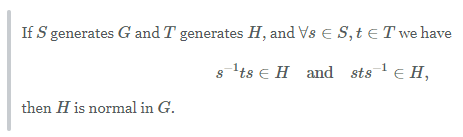
uhhh im looking at this result i saw on stack
rustic crown
yea but this lets you iterate the conjugation operation
a in H then gag' in H then hgag'h' in H
just a and gag' might not be enough is what i'm trying to say
 rustic crown
only thing presentations are good to work with are constructing map from them :p
coral shale
It is implied
you quotient a, b
over the smallest normal subgroup containing the relations
rustic crown
yea that's the definition
rustic crown
there are free algebras just like free groups
and construction of tensor product is like a presentation
coral shale
rustic crown
there are free algebras just like free groups
does this go into category theory... or not that direction of thinking
terse crystal
presentation are different in things other than groups, like finitely presented module, it involves other stuffs like exact sequences.
rustic crown
coral shale
does this go into category theory... or not that direction of thinking
at that level, category theory will be more language than any substantial theorem
and you can of course say the same in a different language
coral shale
ok  . No clue what category is except a generalisation of algebra, somehow
rustic crown
so like a free commutative ring on n things is the polynomial ring Z[x1, ..., xn]
a presentation would be a quotient of this
terse crystal
It’s everywhere, like Jacobson basic algebra discusses category theory in volume 2 chapter 1
Limit and colimit aren’t defined generally though, but the rest is ok
rustic crown
i really like the description Aluffi gives 
 terse crystal
Gtm 211 Lang’s algebra also has category theory I think, but I remember it appears in the last few chapters
rustic crown
things, and things that go from things to things
it starts getting fun when you introduce more things that go between those things which were things going from things to things
coral shale
rustic crown
i really like the description Aluffi gives <:eeveeKawaii:556858499930259471>
that's enlightening, thanks
coral shale
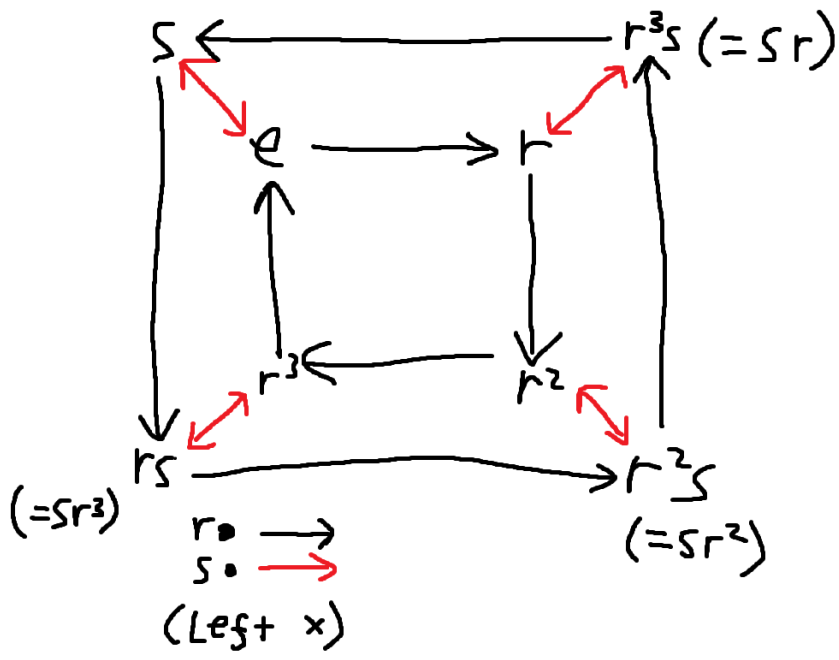
For a general cayley graph
Is there an 'easy' way to visualize the right multiplication version
Like... uh...
idk how to describe it - but if you looked at just this, it's not 'obvious' what right multiplication does to an element
And so I don't find it obvious what conjugation does
chilly ocean
IS THAT A FUCKING YONEDA LEMMA
hidden haven
Did someone summon me?
coral shale
hidden haven
It's not yoneda lol
coral shale
wait wait i think I have an idea vaguely, can't put it in words much
chilly ocean
I see a square inside a square + arrows I think yoneda
terse crystal
So Whenever you see three objects six arrows then you think grothendieck…
hidden haven
If arrows are left multiplication, then right multiplication by x is all the arrows out of x
coral shale
So like I treat x as e
I basically consider x^-1(G)
I think
I think I kinda got it
hidden haven
Nice
coral shale
wasnt until recently i realised there are pictures for things u do in group theory
terse crystal
I don’t see the point. I draw a Cayley diagram when I want to use some algebraic topology on it not because I need to visualize anything…
chilly ocean
arrows 
coral shale
😦
coral shale
terse crystal
I don’t see the point. I draw a Cayley diagram when I want to use some algebraic...
idk, I feel like it's nice to visualize what these things are............
my way of seeing math
hidden haven
Nice
terse crystal
I see
hidden haven
They should make math 2 in which everything has a diagram calculus
wise igloo
Nice
hidden haven

terse crystal
Then he might enjoy diagrammatic algebra
chilly ocean
dramatic algebra for short
coral shale
Me see words :
wise igloo
diaphragm algebra
terse crystal
We use Auto spelling… I can never spell diagrammatic myself
hidden haven
If anyone hasn't seen the proof of eckmann hilton by notation tricks I highly recommend doing that
 plush wasp
diagrammatic
hidden haven
hidden haven
If anyone hasn't seen the proof of eckmann hilton by notation tricks I highly re...
This has no prereqs btw
And is a very short proof on wikipedia 😌
terse crystal
hidden haven
If anyone hasn't seen the proof of eckmann hilton by notation tricks I highly re...
In what book?
hidden haven
Wikipedia has it, titled as 2-dimensional proof
Actually how about I just send screenshots
terse crystal
Oh I see,thanks
terse crystal
hidden haven
Actually how about I just send screenshots
Please
rustic crown
hidden haven
If arrows are left multiplication, then right multiplication by x is all the arr...
wait i don't get this
lavish nexus
wut

 rustic crown
coral shale
you apply x^-1 on the graph
rustic crown
coral shale
you apply x^-1 on the graph
on the right?
coral shale
wait i was thinking about conjugation
hidden haven
That second identity is called interchange identity
hidden haven
rustic crown
wait i don't get this
Idk maybe I don't remember what a cayley graph is lol
hidden haven
hidden haven
This is how you show that higher homotopy groups are abelian
And that 2 dimensional notation is extremely useful in category theory with some modification
rustic crown
if the graph is corresponding to left multiplication you could only multiply the whole graph on right to preserve all the arrows and stuff
rustic crown
oh i kinda see now 🙈
 rustic crown
yea that's liek multiplying the whole graph on the right by r^-1
so it means if we multiply this new red graph on the right with r we get the old graph
coral shale
So if we want to know what (r^3s)r is................... (which should be r^2s)
We look at where r^3s is now (marked in red)
Which is what r^2s is on the old graph (the answer)
rustic crown

coral shale
So the red graph is more suitably called (G)r^-1
I see . heheh
Ok that makes total sense now 😄
The group/graph G acts on the left on r^-1 to make the red group/graph
lapis trail
If p(x) is irreducible then the ideal generated by p(x) is maximal. Is the best strat to show F[x] mod p(x) is a field? F is a field btw
lethal dune
F is field then F[x] is UFD so irreducible => prime => maximal ideal
probably easier
lapis trail
Thanks
coral shale
R[[X]] is defined to be the infinite series in X with coeffs in R
Can we make sense of this in any way with the original defn of
R[X]
delicate orchid
it's the completion of R[x] I believe
so it turns out we really did just let n -> infinity
 spice whale
it's a superset of R[X]
delicate orchid
the ring of formal power series over X (with coefficients in R)
spice whale
what happens if we do F2[[X]]/(1+X+X²+X³+...)
delicate orchid
I have no idea
I'm not 100% familiar with the actual ring operations I will be honest
I know addition is term-wise but multiplication?!??!
oh ok it is like polynomials
cool


 delicate orchid
oh for gods sake
 coral shale
obvsly same thing
spice whale
 delicate orchid
R^N doesn't really have ring strucutre on it
and what if it's R[[X,Y]]?!?!
might get craaazzzyyy
spice whale
split it into R[[X]][[Y]] like usual
coral shale
it does
the functions from N to R
does have a ring structure?
You can add them times them
delicate orchid
point is R^N doesn't tell you how many terms it's in
delicate orchid
coral shale
the functions from N to R
these are just the sequences in R
delicate orchid
so.... yes.... cause R[[X]] is a ring