#groups-rings-fields
406252 messages · Page 669 of 407
 pastel cliff
 delicate orchid
tinky mfin dinky
 hidden haven
How am I supposed to pronounce it though
I was on call with saketh today
and I was totally telling him how cool the user called nitezba was
and I couldn't figure out how to pronounce it 
pastel cliff
that is a problem i have with it but i got nothing better for now 
in other words idk it was just the closest thing to a made up word i could come up with if that makes sense
bad lore tbh
 hidden haven
goldilocks but not quite


 lethal dune

hidden haven
I mean not like you can do much with all the security around me 
lethal dune
I can just wait for 2024
hidden haven

 crisp badge
What does it mean for a group to be soluble-by-(locally finite)? I assume it means soluble with successive quotients being locally finite?
 coral shale
Which of these properties is 'inherited' for a polynomial ring in 1 variable? Is there something I can refer to (or is it 'obvious' to think about) 🤔
I know K[X] is euclidean for a field K and not much else.
crisp badge
Polynomial ring over a UFD is a UFD
hidden haven
Integrally closed, UFD, PID, ED, field, alg closed field are not inherited
Oh wait
I thought inherited meant by subset
crisp badge
For PID, think about Z
hidden haven
PID isn't inherited
crisp badge
^
hidden haven
ED isn't either
crisp badge
crisp badge
What does it mean for a group to be soluble-by-(locally finite)? I assume it mea...
Also @hidden haven , do you know if this is what this means?
hidden haven
no clue but your guess seems legit
crisp badge
And yeah, you can also see ED with Z
Z is an ED, Z[X] is not a PID
And fields it's easy to see it's not inherited
Same with ACF
Because k[X] has no inverse for X
No matter what k is
And even if you take K(X), algebraic closure isn't inherited
hidden haven
The GCD domain one seems annoying and same for integrally closed
Well the only characterisations I know of those are GCDs exist and field of fractions is integral closure so maybe they are easier with some better theorems
crisp badge
I feel like I've been neglecting this server, I've barely been active recently
Now I'm gonna slink back to lurking in #foundations while looking at pseudo-finite groups
coral shale
D: lots to think about
Thanks for the insights every1

 pastel cliff
but yeah moldi id be curious if you can figure out my name from username
only not pointing it out myself cuz ive said my uni here before and then it becomes a lil to easy to guess
 coarse storm
Can't be their real name. There is an i in there.
pastel cliff

hidden haven
pastel cliff
professor insists on using matrices for everything
pastel cliff

lethal dune

pastel cliff
i mean i like that he's using an example for shit like the symmetric group
pastel cliff
but he doesnt say as much "general" stuff as id like
lethal dune
u mean nxn matrix for elements of Sn?
pastel cliff
yeah
hidden haven
permutation matrices?
lethal dune
F
lethal dune
lethal dune
I already like him
I take it back then
pastel cliff
like why do i have to deal with matrices when it's just permutations
and i can call them permutations
lethal dune
yes because they make computation easier harder
pastel cliff
the matrices or just calling them permutations?
i feel like just saying permutations would be easier to grasp idk
lethal dune
following curriculum is a pain for me
pastel cliff
i mean yeah, most learning in all my classes is done outside of class anyways
 chilly radish
The (intuitive) explanations of the tensor-hom adjunction I've seen talk about how bilinear maps from U x V are actually the same as maps U to Hom(V,-), and the universal property gives us the adjunction. In that case, why is the adjunction not between Hom and -\oplus V? Is the latter not a functor? Or is there some other reason?
Oh wait nvm
I understand
The reason is that the morphisms from U \oplus V are simply linear and not bilinear, so it can't be an adjunction in the category R mod (or bimodules or whatever)
Tensor allows you to basically treat bilinear maps as R-linear
That's like, the big idea right
hidden haven
The adjunction is between - ⊗ V and Hom(V, -)
So I didn't get what conclusion you came to
hidden haven
chilly radish
The reason is that the morphisms from U \oplus V are simply linear and not bilin...
Ye this is right, the bilinear maps are not morphisms in R-mod
chilly radish
hidden haven
The adjunction is between - ⊗ V and Hom(V, -)
I just meant why the adjunction is not between direct sum and Hom
But the reason is the maps aren't correct
hidden haven
oh direct sum
chilly radish
But tensor lets you 'cheat' by treating bilinear maps as R-linear
hidden haven
Ye
chilly radish
And the universal property tells you this correspondence is well-defined
Between R-linear maps out of tensor and maps U->Hom(V,-)
 tribal moss
Isn't Hom defined as the adjoint to tensor?
hidden haven
tribal moss
Isn't Hom _defined as_ the adjoint to tensor?
Depends on which way you wanna go I suppose
Hom first seems more natural to me idk
Who wants to work with the construction of the tensor more than they want to
tribal moss
I suppose I'm asking which other definition is there (in a general monoidal category)?
hidden haven
Because if you start with hom first then you can easily get that both are bifunctors
hidden haven
tribal moss
I suppose I'm asking which _other_ definition is there (in a general monoidal ca...
Oh ye in that case yes
You define internal hom that way
hidden haven
Wait I guess if you define tensor using bilinear maps then it's fine that it's a bifunctor
Probably
I can't see a proper categorical way to say this though, you treat bilinear maps as maps M → hom(N, -) if you already have hom
chilly radish
Exactly
hidden haven
How do you talk about bilinear maps without hom 
Learning cat theory makes you worse at math
chilly radish
Lmao
hidden haven
Anyway one of my favourite theorems about adjunctions is that an adjoint of a bifunctor can be made into a bifunctor

Like hom(V, -) has left adjoint - ⊗ V
And hom is a bifunctor
chilly radish
Ohhh
hidden haven
Then there's a unique way to make V ↦ - ⊗ V into a functor
chilly radish
Cool
hidden haven
And by currying, this makes tensor a bifunctor
hidden haven
hidden haven
Then there's a unique way to make V ↦ - ⊗ V into a functor
This isn't even uniqueness up to isomorphism lmao
It's straight up uniqueness up to equality
chilly radish
Oh wow
hidden haven
Because the up to isomorphism part already happens in choosing each adjoint lmao
pranked
chilly radish
Lmao
 frank fiber
let $G$ be a group , $a,b\in G$ and $\langle a,b\rangle$ the subgroup of $G$ generated by $a$ and $b$, suppose $a^pb^p \in [\langle a,b\rangle, \langle a,b\rangle]$, this implies $a^pb^p=1$?
 cloud walrusBOT
Or x1
 hidden haven
G = S_3, a = (12), b = (23), p = 1 doesn't work I think
lethal dune
what does [a, b] mean? commutator subgroup gen by of a and b?
tribal moss
Typically just the commutator itself.
frank fiber
lethal dune
what does [a, b] mean? commutator subgroup gen by of a and b?
subgroup generated by conmutators
tribal moss
aba^-1b^-1
frank fiber
hidden haven
G = S_3, a = (12), b = (23), p = 1 doesn't work I think
sorry, G is a p-group

 chilly ocean
You forgot D_3 moldi 
hidden haven
The group of symmetries of a 1.5-gon? I think that one's abelian
 lavish nexus
the 1.5-gon
the gon between a circle and a half circle
tribal moss
I don't see a problem. Is the subgroup of O(2) generated by a 240° rotation and a reflection.
 wooden ember
cloud walrus
**Or x1**
wooden ember
cloud walrus
**Or x1**
This makes me see that I remember do little on p groups
I can’t think of any tools to help tackle this 
Why must we forget things we don’t do so easily
hidden haven
Was it worth classifying simple groups
 fallow plume
If R is a Noetherian ring and I an ideal (tho Ig you could possibly generalize this to modules maybe), is there a finite number of maximal ideals containing I?
I thought about trying to prove this for a proof (not like I could've used it anyways) but I'm not actually sure if it's true or not and can't find anything on it
lethal dune
fallow plume
If R is a Noetherian ring and I an ideal (tho Ig you could possibly generalize t...
finite number? there's only one maximal ideal containing I
oh nvm
fallow plume
lethal dune
finite number? there's only one maximal ideal containing I
I always thought "a maximal ideal" does not imply there's a unique one
hidden haven
Seems false you can try correspondence theorem
fallow plume
fallow plume
If R is a Noetherian ring and I an ideal (tho Ig you could possibly generalize t...
With unity*
fallow plume
Thanks Moldi! And damn
I am not good at pointing out counter examples
Lmao
Ngl tho I now hate knwoing that minimal prime ideals are finite but maximals aren't (containing I)
coarse storm
"Suppose it is true. Then it would be a famous theorem. It is not. Therefore it is false. QED."
fallow plume
LMFAO well played
lavish nexus
when I see some people justify why a-b=c
Pf: the full name of c is the full name of a minus the full name of b
Because ergo therefore
pastel cliff
coarse storm
"Suppose it is true. Then it would be a famous theorem. It is not. Therefore it ...
 lavish nexus
ah yes proof by tautology
fallow plume
"Constrait"
fallow plume
LOL
 next obsidian
I have an upgraded version of proof by logic
Declare yourself to be a strong anti-constructivist, and so you don’t believe that one needs to actually explicitly construct a proof if one knows it exists
And thus, by virtue of this problem being on this problem sheet, it must be a true fact, and this was established via a proof at some point in time so we know a proof exists
QED
pastel cliff
declare yourself a chmonkey
chilly ocean
S_4 can be generated by two elements?
yes
What would those elements be?
not much choice lol
I thought you needed n-1 elements to generate S_n
In fact you can generate S_n with 2 elements
(12) and (12...n)
wtf
yea lol
S_4 is the set of all permutations of 4 elements
12 shouldn't be there???
What am i misunderstanding

?
(12) is notation
1 maps to 2
2 to 1
(12....n)
Oh
ok

Mathematics Stack Exchange
Show that $S_n$ is generated by the set $ { (12),(123\dots n) } $.
I think I can see why this is true. My general plan is (1) to show that by applying various combinations of these two cycles yo...
Well
Do you have any hints for how to prove that D_24 is not isomorphic to S4 then
Cause my idea was to prove that they required different amounts of generators
Tho I now know that that is false
just a hint cause I would like to largely figure it out myself for pedagogy
Not sure how to show that but perhaps looking at orders of elements?
Maybe there are more elements of order say 2 or 3 in one of the groups
That's a good idea
There are elements of big orders in D_24
 dense pumice
yea, theres an element of order 12 in D_24 but elements in S_4 have order at most 4 (because of cycle decomposition)
 viscid pewter
^
 patent girder
 chilly ocean
Okay
I am once again confused on a basic concept
My confusion is thus: Take all the permutations of S_3: {(1, 2, 3), (1, 3, 2), (2, 1, 3), (3, 1, 2), (2, 3, 1) (3, 2, 1)}. Is (1, 3, 2) == (2, 1, 3) == (3, 2, 1) and (1, 2, 3) == (3, 1, 2) == (2, 3, 1) since all that matters is what numbers are the right of what numbers?
dense pumice
yes
chilly ocean
But then, wouldn't s_3 only have two elements?
 prisma shuttle
no
dense pumice
what abt (1,2)?
prisma shuttle
becaue (1,2) is in it as well
prisma shuttle
chilly ocean
I generated that set with (123) and (12)
well if you have (12) you can obviously generate (12)...
chilly ocean
Okay
I believe that I understand now
Wait
But S_3 can be generated by (12) and (123)
prisma shuttle
yes it can
chilly ocean
But (12) and (123) only give the elements which I previously listed
prisma shuttle
that's the generating set
but you asked for the whole set
not the generators
unless i misunderstood u
chilly ocean
No, this is a separate question
prisma shuttle
wait so you are asking like why is the generating set correct?
chilly ocean
My question is how can I generate the set you listed with (12) and (123)
prisma shuttle
(0) = (12)(12)
(12) = (12)
wait no not (12) and (123)
should be (12) and (132) i think
 worthy haven
chilly ocean
My confusion is thus: Take all the permutations of S_3: {(1, 2, 3), (1, 3, 2), (...
worthy haven
chilly ocean
My confusion is thus: Take all the permutations of S_3: {(1, 2, 3), (1, 3, 2), (...
You're confusing two diferent notations here. The first notation is cycle notation; in cycle notation, if $\sigma = (123)$ means that $\sigma(1) = 2, \sigma(2) = 3$ and $\sigma(3) = 1$. In the notation you're using for that set, $\sigma = (1, 2, 3)$ refers to the permutation with $\sigma(1) = 1, \sigma(2) = 2, \sigma(3) = 3$; $(1, 3, 2)$ refers to the permutation $\sigma$ with $\sigma(1) = 1, \sigma(2) = 3$ and $\sigma(3) = 2$
cloud walrusBOT
Nick
 tribal moss
In cycle notation (12) and (123) do indeed generate all of S3. But (12) and (132) also generates all of it.
worthy haven
so in the notation you wrote, $(1, 2, 3) = ()$, $(1, 3, 2) = (23)$, $(3, 1, 2) = (132)$, $(2, 3, 1) = (123)$, $(2, 1, 3) = (12)$ and $(3, 2, 1) = (13)$
cloud walrusBOT
Nick
 worthy haven
just converting your notation (which my class called one row notation) to cycle notation
chilly ocean
I had never heard of row notation
I shouldn't have used commas
I was referring to cycle notation
worthy haven
the cycles you wrote are not the elements of $S_3$
cloud walrusBOT
Nick
 worthy haven
Well, you only wrote 2 of them
you missed lots
$S_3 = {(), (12), (13), (23), (123), (132)}$
cloud walrusBOT
Nick
 worthy haven
You are correct that in cycle notation, $(123) = (312) = (231)$ and that $(132) = (213) = (321)$
cloud walrusBOT
Nick
 chilly ocean
I wasn't carrying out my cycle notation operations correctly
worthy haven
it's a general convention to put the smallest number first - there's no mathematical reason, it's just easier to read and compute and it's nice to have some standard
chilly ocean
Yeah, I had some confusion as to how to compose cycle notation expressions...
worthy haven
As an example, for $(12) \circ 123) \circ (23) \circ (12)$, if I wanted to find out where $1$ went, I would start in the rightmost bracket; that sends $1$ to $2$. Then in the next bracket over, $2$ gets send to $3$. The in the next bracket, $3$ gets sent to $1$, and finally, in the last bracket, $1$ gets sent to $2$, so the final result is $2$. Whatever you get out of some permutation is what you stick into the next one, and remember, if something doesn't appear in a cycle, the permutation fixes it; $(12)$ applied to $3$ just gives you $3$.
cloud walrusBOT
Nick
 worthy haven
for the same $(12) \circ (123) \circ (23) \circ (12)$, if I wanted to find out where $2$ goes, I would see tha the rightmost cycle sends $2$ to $1$, the next one sends $1$ to $1$, the next one sends $1$ to $2$, and the last one sends $2$ to $1$, so I just get $1$
cloud walrusBOT
Nick
 worthy haven
in particular, this tell you that $(12) \circ (123) \circ (23) \circ (12) = (12)$, since it's a permutation that sends $1$ to $2$ and $2$ to $1$, so it must send $3$ to $3$; see if you can verify this by trying the composition
cloud walrusBOT
Nick

 neat valley
Are there any nice homology lemmas I can appeal to that gives me the middle column is exact

Everything other row & column is already
FWIW these are modules over a PID, all are free except B, C, & D
lavish nexus

I think I’ve sorted out the rest but why is E a normal extension of F?
In proof line 6-7 seems to require E/F normal
neat valley
neat valley
wait this is just the Horseshoe lemma nvm lol
 white jackal
Can anyone help me with the process of solving this problem using First iso theorem?
 lavish nexus
what is the obvious map from C* to R*
white jackal
ummmm
lavish nexus
(Unrelated question) if A B C are fields, A normal over B, B normal over C, is A normal over C?
white jackal
yes
prisma shuttle
basically for this question you just want to use first iso directly
like in that form
so you need a mapping which has an image of $\mathbb{R}^{\times}$ and a kernel of $S^1$
cloud walrusBOT
JustKeepRunning
 lavish nexus
Think about it this way what’s the one thing common for all S1
Because they’re in the kernel you’re mapping them all to the same thing
prisma shuttle
no
chilly ocean
damn
lavish nexus
φ:C* to R*
prisma shuttle
S1 is the pre-image (or the fiber) of the identity coset
chilly ocean
yo you in my class?
white jackal
so i have to prove homomorphism between C and R, prove surjectivity and well defined right?
prisma shuttle
white jackal
so i have to prove homomorphism between C and R, prove surjectivity and well def...
don't think about it like this
generally u just think of an intutive mapping (literally the reason ppl call this a natural mapping in ring theory)
and then worry about the technical details later
ok the mapping should be ||natural log of magnitude||
white jackal
to start my proof i would start it as "phi: C -> R by phi(S1) = 1"
cloud walrusBOT
JustKeepRunning
 white jackal
where did the ln come from?
prisma shuttle
oh wait wait
chilly ocean
 lavish nexus
no you don’t need ln it’s to R*
prisma shuttle
i think my homomorphism might be wrong
white jackal
phi: C -> R by phi(x) = 1?
lavish nexus
That would make the whole C kerφ
white jackal
im fucking lost
lavish nexus
Because all elements of S1 has norm 1 we map all elements of S1 to 1
Therefore for any other element x what do we map it to
Just take a wild guess
tribal moss
lavish nexus
That would make the whole C kerφ
No, in the case of the norm, phi: C\{0} -> (0,infty)
lavish nexus
oh crap
white jackal
to prove homomorphism can i do this? since z is in C then let x be in C also. Then phi(zx) = phi(x)phi(z)?
tribal moss
white jackal
Can anyone help me with the process of solving this problem using First iso theo...
Uhm ... reading closer, the claim in that task is not even true. C×/S¹ doesn't have an element of order 2, but R× does (namely -1), so they can't be isomorphic.
In order to get a true statement, what you can prove is that the the quotient is isomorphic to the multiplicative group of positive (not merely nonzero) reals.
lavish nexus
🤦♂️
ln
No nvm
(Unrelated question) if A B C are fields, A normal over B, B normal over C, is A normal over C?
chilly ocean
that problem is super hard
 sturdy marsh
lavish nexus
(Unrelated question) if A B C are fields, A normal over B, B normal over C, is A...
sturdy marsh
lavish nexus
(Unrelated question) if A B C are fields, A normal over B, B normal over C, is A...
no
lavish nexus
sturdy marsh
no
ty
lavish nexus
This damn lecture note I have is just ridiculous at this point
 upbeat juniper
I get a headache every time I look through dummit and foote 😵💫
fallow plume
@upbeat juniper better than not having it tho 😭
our prof banned D&F for the midterm and replaced it with his own book
and what really sucked was we all used D&F for the group theory term, and he decided to put quite a bit on the test
and i didn't care for trying to scan for group theory results that I've never read on a timed test :,)
chilly ocean
Visual Group Theory by Nathan Carter is amazing
highly recommend reading that before taking abstract algebra to provide an intuition as to what abstract algebra even is
fallow plume
personally what I did was I read Galliean's Contemporary Abstract Algebra
and that was enough to set me up for D&F
upbeat juniper
fallow plume
<@!275628620725092354> better than not having it tho 😭
our prof banned D&F for...
I did learn group theory from D&F and it's a good introductory book. the galois theory part just left a sour taste in me for some reason
 long obsidian
Suppose I have some linear subspace V of R^n and also an automorphism t.
Will dim(t(V))=dim(V)?
fallow plume
long obsidian
Suppose I have some linear subspace V of R^n and also an automorphism t.
Will ...
I think this might've been more appropriate for #linear-algebra, but yes. Recall that an automorphism is a bijection and a homomorphism (which in this case is a linear transformation)
long obsidian
Got you
But also, I forgot to add that t is an automorphism of R^n , not necessarily V. Does that matter?
fallow plume
Nah, linear transformations/homomorphisms preserve subspaces (which are normal subgroups)
long obsidian
Wait, what do you mean by preserve subspaces?
fallow plume
Bijection between subspaces by t
And it preserves containment (lattice isomorphisn theorem)
upbeat juniper
long obsidian
Suppose I have some linear subspace V of R^n and also an automorphism t.
Will ...
if no then there is a nontrivial kernel in V hence R^n
long obsidian
Thanks guys
next obsidian
fallow plume
Nah, linear transformations/homomorphisms preserve subspaces (which are normal s...
Wait what?
No they don’t, it’ll send a subspace to an isomorphic sub space but it doesn’t preserve it, you can shift it around
You can take the automorphism of K^2 swapping two basis vectors
fallow plume
next obsidian
No they don’t, it’ll send a subspace to an isomorphic sub space but it doesn’t p...
Yea this is what I mean. It's still an isomorphic subspace before and after
Sorry if there's multiple interpretations
next obsidian
Okay this isn’t what preserve normally means
It usually means that it either doesn’t affect the subspace, so it’s the identity
fallow plume
Dym like identity
next obsidian
Or that t(V) = V
fallow plume
Gotcha
 trim grove
i am confused while writing the structure of C[x]/<x^2+1>, any help?
next obsidian
That polynomial factors
trim grove
next obsidian
That polynomial factors
like c[x]/<x-i> x c[x]/<x+i> ?
trim grove
next obsidian
How did you get there?
crt
trim grove
next obsidian
Now what are each of those quotients?
tbh , this is what make me confuse every time, i cant write the structires of quotients
trim grove
next obsidian
What’s C[x]/<x>
C
next obsidian
Why do you know that?
trim grove
next obsidian
Why do you know that?
just rembered this
next obsidian
Try to think of a proof
trim grove
next obsidian
Try to think of a proof
ok so i have to make an iso form C[x] to C
next obsidian
Well not an iso
But a surjective morphism
With kernel <x>
This is just appealing to the first isomorphism theorem
trim grove
next obsidian
But a surjective morphism
my bad yes it should be surjective
next obsidian
Let’s think a little more broadly tho
When we mod out by x
What we’re saying is “we’re gonna set x = 0”
Right?
trim grove
next obsidian
What we’re saying is “we’re gonna set x = 0”
polynomials with zero at 0?
next obsidian
Idk what that means
I’m just talking about the idea behind quotients
We’re setting the thing we’re quotientinf to by 0
Is the idea
Like R/I is what you get when you set I = 0
Everything in I is now 0
And we kinda turn our equality based on if the difference lies in I
trim grove
next obsidian
And we kinda turn our equality based on if the difference lies in I
ok in case of c[x]/<x-i> , we are considiring like x-i=0 or x= i?
next obsidian
Yup
Exactly
But we can express that idea via a map C[x] -> C right?
The idea being “x = i”
I mean if I have a polynomial p(x) in C[x]
And I want to send it to a number in C
Along the ideas of “x = i”
trim grove
next obsidian
I mean if I have a polynomial p(x) in C[x]
whose factor is (x-i)?
next obsidian
What’s the easiest way to do that?
No
Any polynomial
I want to make a map C[x] -> C
With the idea in mind “x = i”
trim grove
i am thinking
next obsidian
I mean
Think back to like when you weee much much younger
And you have a polynomial in algebra class
What do you do with polynomials?
Think of it like you’re in analysis class, calculus or something
A polynomial is a function right?
And what do you do with functions?
Or even way way more explicit
If your hw said
“Compute the value of x^2 + 3x + 2 at x = 5”
What do you do?
trim grove
put x=5 in place of x
next obsidian
Is that actually what you did?
You replaced x with x = 5?
(x = 5)^2 + 3(x = 5) + 2?
trim grove
(5)^2+3(5)+2
trim grove
yup
next obsidian
next obsidian
But we can express that idea via a map C[x] -> C right?
So like back to this
What’s the map C[x] -> C we want which has the idea “x = i”
trim grove
wait so that means value of polynomial at x = i?
trim grove
yesss
next obsidian
Right, constants
trim grove
every elemnet in C has preimage
next obsidian
I mean
That’s just the definition of surjective lol
It’s not an argument for it being surjective
But we have constants
Any number is a degree 0 polynomial which maps to itself
What’s the kernel?
If p(i) = 0
trim grove
next obsidian
What’s the kernel?
every polynomial that have x-i as factor
trim grove
hmmm, intresting
trim grove
similaly for other part
next obsidian
right
trim grove
does this concept works for all?
next obsidian
Yes
trim grove
quotients?
next obsidian
If you have
Well
Of the form
C[x]/<x - a>
You just look at C[x] -> C
p(x) -> p(a)
And then it’s surjective with kernel <x-a>
trim grove
does this work for any R/I?
trim grove
next obsidian
Not really
okk
next obsidian
What if R is like 2x2 matrices
Then none of what we did makes any sense
There’s no polynomials anywhere
trim grove
Ok , Thankyou @next obsidian , This is very much clear to me
next obsidian

 desert dome
Hey, I saw this symbol in dummit, could anyone tell me what it means?  (F = Q(sqrt(2), sqrt(3)))

 latent anvil
It's the norm. If you have a finite field extension F/K then N_{F/K} is a function F -> K given by N_{F/K}(a) = determinant of (multiplication of a)
multiplying by a is a K-linear function F -> F, and F is a K-vector space so we can take a determinant and get a number in K
if F/K is galois then it's also the product of all galois conjugates of a
er that's not exactly right sorry
$N_{F/K}(a) = \prod_{\sigma \in \mathrm{Gal}(F/K)} \sigma(a)$. it is a product of conjugates but you can get repetition
cloud walrusBOT
Shamorck
 next obsidian
Swagonkey
desert dome
I see. Thank you!!
next obsidian
latent anvil
multiplying by `a` is a `K`-linear function `F -> F`, and `F` is a `K`-vector sp...
Oh one thing here
This isn’t well-defined!
It’s well-defined up to the square of the determinant of a change of basis matrix
But at least over Q, this number is the square of a unit inside of Z, which means it’s forced to be 1
Or wait
I think the norm is well-defined
It’s the trace that isn’t?
I think the norm is actually well-defined FML
latent anvil
what?
are you concerned that the determinant of a linear transformation isn't defined without a choice of basis?
next obsidian
I think the trace is too now 
One of these things is not-well defined I swear
It’s well-defined up to some square of a unit given by a change of basis matrix
latent anvil
det(P A P^-1) = det(A) for any P, so det doesn't depend on change of basis
next obsidian
It’s the like trace form
I swear there’s something like uh
Take a basis, look at the thing with alpha_ialpha_k
Oh yes!
Okay
Hurb so what it is is
Take a basis {alpha_i}
Make a matrix where M_ij = trace(alpha_ialpha_j)
The trace of the map given by multiplying by alpha_ialpha_j
Then the determinant of this is an important number which is only well-defined up to det^2 of a change of basis matrix
this number is non-zero iff the extension is separable
AAAAAAAA
 waxen hedge
next obsidian
this number is non-zero iff the extension is separable
waxen hedge
next obsidian
this number is non-zero iff the extension is separable
Thats the discriminant
You are talking about the discriminant of the trace form
 weary cloud
Can someone help: https://math.stackexchange.com/questions/4382724/dimension-of-tensor-product-space-should-be-leq-dimv-dimw ?
Mathematics Stack Exchange
Let $V$ and $W$ be two vector spaces of dimensions $m$ and $n$ over the same field $F$.
$V \otimes W$ is defined as the vector space of equivalence classes of vector space($F(V \times W)$) with bas...
hidden haven
weary cloud
Can someone help: https://math.stackexchange.com/questions/4382724/dimension-of-...
This is wrong
 hidden haven
(a+b, c+d)
~ (a+b, c) + (a+b, d)
~ (a, c) + (b, c) + (a, d) + (b, d), so you are missing the middle 2 terms in that
Bilinearity behaves a lot like multiplicative distributivity
Because distribution of multiplication is equivalent to saying that multiplication is a bilinear function
weary cloud
hidden haven
(a+b, c+d)
~ (a+b, c) + (a+b, d)
~ (a, c) + (b, c) + (a, d) + (b, d), so you are...
Still, the following statements remain valid if each equivalence class can be represented as (v,w). So this must mean that each class can't be represented as (v,w) ?
hidden haven
Yep
Not every tensor is a pure tensor
A general element is always a linear combination of these pure tensors
coral shale
When you talk about permuting polygons in dihedral groups
Are we permuting the vertices or the positions
I'm in a muddle rn D:
hidden haven
Can you give more context
coral shale

How would you write this permutation (which isnt in the dihedral group, was explaining what you cant have)
1 -> 2
2 -> 4
3 -> 3
4 -> 1
Is my instinct
You are saying 'vertex 1 maps to where vertex 2 was'
hidden haven
Ye or more succinctly we would write (124)
coral shale
Right, and you don't think about 'positions' at all
hidden haven
Ye I guess
coral shale
1 -> 4
2 -> 1
3 -> 3
4 -> 2
hidden haven
I think of positions still but you don't need to perhaps
coral shale
I can then write down the inverse correctly
hidden haven
Ye
coral shale
If you think of positions, I think u get muddled up no?
wait no im still in a muddle
hidden haven
I think of it as the element at the first position goes to the element at the fourth position
coral shale
coral shale
I read somewhere one way of thinking is 'correct'
Correct in the sense that one will be confused what the dihedral group is meant to be
I think permuting vertices will confuse this
Right right I think you need to think of your 'rotations and reflections' invariant with respect to the vertices
Those actions act on the space
If those actions at on the space, you are interested in permuting positions, not vertices
god 
hidden haven
😵💫
delicate orchid
coral shale
1 -> 4
2 -> 1
3 -> 3
4 -> 2
Oh lord why we writing permutations backways this ain’t how the baby Jesus decreed
coral shale
what I wrote was crap before being enlightened
delicate orchid
hidden haven
I think of it as the element at the first position goes to the element at the fo...
And yet moldi agreed....
hidden haven
what
delicate orchid
I read (124) as 1->2->4->1
hidden haven
That one was the inverse
delicate orchid
Ok good
hidden haven
L
delicate orchid
Cause I do know of some people who do actually write it backwards like that
Apparently it “makes composition nicer”
hidden haven

delicate orchid
You can think of it as either, both work
Although if you think about it as permitting vertices you have to chose some arbitrary labelling
Which is smelly
coral shale
It won't.
or at least it won't work like you want it to
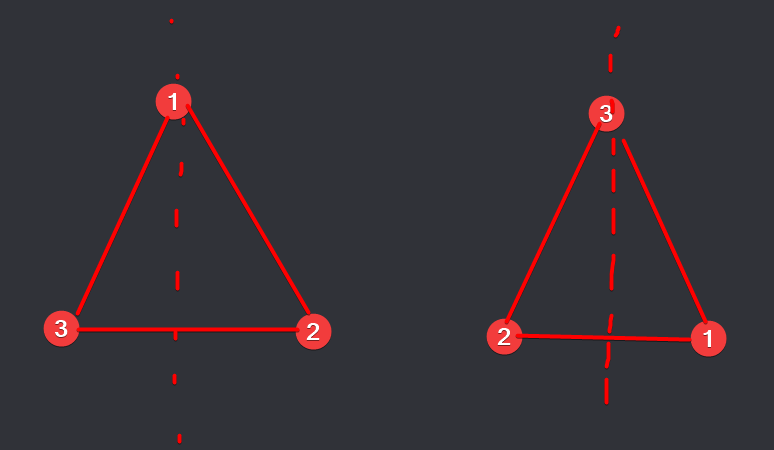
@delicate orchid We want to consider these 2 reflections the same
If we consider how they permute the vertices, they aren't.
delicate orchid
Yes which is why having to arbitrarily pick a labelling smells
But once you fix a labelling for the identity position it’s consistent
weary cloud
In exterior algebra's construction why do we take quotient with respect to the ideal generated by ($x \otimes x$) rather than just taking equivalence classes of the relation $v\otimes w = -w \otimes v$ ? Also, is there some general way of converting from ideals to relations that represent those ideals?
cloud walrusBOT
Life(3.14159265)
 next obsidian
There’s issues if 2 is not invertible, namely the universal property won’t be satisfied
Take for example char 2, then you’d end up with the symmetric algebra
weary cloud
next obsidian
There’s issues if 2 is not invertible, namely the universal property won’t be sa...
why will 2 not be invertible, if it is in the field?
next obsidian
Well, this is a more general construction that one can do, even over a ring
But also, 2 could be 0 even in a field
If the characteristic is 2
weary cloud
Sorry I am very beginner.. can you please tell what is the universal property here?
next obsidian
Well, if we’re dealing with just the exterior product for now, it’s that alternating maps factor uniquely through it
When you go the algebra itself, I don’t quite remember off the top of my head
Bht it’s something about factoring certain maps into a ring I think
hidden haven
From x ⊗ x ≡ 0 you can get the other one by taking x = v + w
But you can't go the other way if 2 is not invertible as  said
said
ie the ideal generated by the relations v ⊗ w = - w ⊗ v doesn't contain x ⊗ x necessarily
And 2 not invertible means that you could have a field that looks like ℤ/2ℤ
frank fiber
what is an example of non regular group which is the direct product of regular groups?
 uncut girder
Can someone give me some intuition as to what group cohomology is measuring?
H^k(G,M) where G is an abstract group and M is G-module
sturdy marsh
uncut girder
Can someone give me some intuition as to what group cohomology is measuring?
there are many ways to interpret some of the low degree cohomology groups, but the original motivation behind group cohomology is to compute the cohomology of spaces like BG in a purely algebraic way
uncut girder
Hm
 chilly ocean
Where are you stuck? @median valve did you try a direction of the first part of the proof yet?
 median valve
chilly ocean
Where are you stuck? <@603965701988024361> did you try a direction of the first ...
median valve
chilly ocean
Where are you stuck? <@603965701988024361> did you try a direction of the first ...
Thank you for the reply. I am actually stuck in the first part.
Since there 1-1 correspondance, it is evident that 2 is equivalent to 1
However, I can't go in the other direction
chilly ocean
median valve
Thank you for the reply. I am actually stuck in the first part.
Since there 1-...
It's evident to you that 2 implies 1 you mean maybe?
median valve
chilly ocean
It's evident to you that 2 implies 1 you mean maybe?
Umm ... no. It is evident that 1 implies 2
Because
chilly ocean
ok you said "evident that 2 is equivalent to 1" so you can see why I wasn't sure what you meant lol
median valve
 median valve
chilly ocean
ok you said "evident that 2 is equivalent to 1" so you can see why I wasn't sure...
median valve
chilly ocean
ok you said "evident that 2 is equivalent to 1" so you can see why I wasn't sure...
Oh my bad. I am really new to this subject.
chilly ocean
All good!
chilly ocean
median valve
Umm ... no. It is evident that 1 implies 2
what onto function did you construct from B to A, out of curiosity?
median valve
chilly ocean
what onto function did you construct from B to A, out of curiosity?
One second

Something like this?
🙂
chilly ocean
Sure, but can you express the function in terms of elements of B and A? not explicitly of course but just in terms of set theory stuff
if you mean you're taking the things in B that weren't in the image/range of f and sending them to some random thing in A, and reversing f otherwise, then I agree
median valve
chilly ocean
Sure, but can you express the function in terms of elements of B and A? not expl...
I honestly don't know how to do that 😦
chilly ocean
ok that's fine! I think the picture you sent gives us something to work with
so if f:A->B was sending D to 1, B to 2, C to 3, that's 1-1 so we start there
median valve
Oh one second
chilly ocean
and we can reverse that mapping to get something that is almost a function but not really since we left out some elements
median valve
Is that 1-1?
chilly ocean
in this case we left out 4
median valve
Let me check my definition once more
chilly ocean
D to 1, B to 2, C to 3 is one to one yes
median valve
Indeed, it is an injective function!
chilly ocean
nice
chilly ocean
chilly ocean
in this case we left out 4
back to this, we have something that is almost a function from B to A but we left out 4, so we map it to some thing in A, doesn't matter what it is
median valve
Yep
chilly ocean
and the resulting thing is an onto function since sending y to x when f(x) = y guarantees that we get all x in A, because f is a function
and we are allowed to send y to x in this well defined way because f is injective
Ok that's the first direction, you probably understood it intuitively but I wanted to write the sketch out a little more concretely
median valve
Could you give me a second please 🙂
I'm trying to digest this real quick
"and the resulting thing is an onto function since sending y to x when f(x) = y guarantees that we get all x in A, because f is a function"
So this is a 1-1 correspondance
 chilly ocean
that is yeah
 chilly ocean
whats the last thing there
chilly ocean
null?
median valve
Yeah that won't make sense
Yeah that won't make sense

Now this is a onto function
chilly ocean
this isn't a function
but with the arrows reversed then it's onto from the numbers to the letters
chilly ocean
its good practice lel
 chilly ocean
other way around the way you've drawn it
median valve
Got it. g:\alpha onto beta
chilly ocean
the first set that appears in that notation is the source (domain), second is the target (codomain)
just for the record
median valve
Thank you!
chilly ocean
🙏
median valve
Now how would I prove that g can be equivalent to a 1-1 correspondance function?
Coz that's what the question asks
chilly ocean
are we still doing (1) implies (2)?
median valve
chilly ocean
are we still doing (1) implies (2)?
Oh
But I thought we settled that
My bad
chilly ocean
no I'm asking xD
idk what you did on your own so just want to know what to help ya with
median valve
chilly ocean
idk what you did on your own so just want to know what to help ya with
Sure. One second.

The above is a 1-1 correspondance and it seems pretty evident it is a onto function
I mean there is nothing to prove here, since there is a known defintion -

This is taken from Sipser's notes, unless I am reading it wrong
chilly ocean
this is all true
although I can't see it applying very much to what you want to show
maybe intuition of how things might fail to be a bijection/1-1 correspondence, that might be good
chilly ocean
of course, I enjoy it 😄
well if a function is 1-1 but not onto what does that mean about the codomain
median valve
Lemme try to draw this out
It means that there is an element in the co-domain that nothing maps to

Something like this
chilly ocean
yeah
median valve
Nice!
chilly ocean
so if you wanted to construct a function that goes the other way around, and is onto, that extra element has to go somewhere
you can reverse all the arrows to begin with, but 4 has no place to go so we don't have a function yet
but send 4 to anywhere, and now we have a function
median valve
Ah!
chilly ocean
and by the earlier argument I gave it has to be onto
median valve
Yep!
chilly ocean
(since the original function was 1-1)
ok I think that direction is a closed case tbh
So onto (2) implies (1), starting off with some g that we know is onto from B to A, we want to find an f:A->B injective
median valve
chilly ocean
and by the earlier argument I gave it has to be onto
I don't see how it is onto
4 is still not going anywhere
median valve

Oh yes
I can send it somewhere and then it becomes a onto function. f(beta) onto (alpha)
chilly ocean
and since the arrows came from every element of alpha, reversing them makes the resulting function (after sending the orphaned elements somewhere) onto
chilly ocean
nice nice
maybe you will be inspired to try (2) implies (1) on your own, I'd give it a try
median valve
okay, lemme think about it
I'll ping you if I don't get it after some thinking
I sincerely appreciate your help
chilly radish
For future reference this kind of question fits in #proofs-and-logic
 foggy merlin

 barren sierra
how do I show (c)

I know how to do (d) if I have (c) but (c) doesn't even make intuitive sense to me
I know that C_n is generated by a single element, call it a, and thus the map from C_n to hat(C_n) is determined by where a goes
but then for that to be a homomorphism wouldn't we need to map a to some element of the same order in C^x?
also does (d) have to be done with induction or can I just argue that directly without induction?
the induction isn't hard but it just seems obvious given parts (b) and (c)
dense pumice
barren sierra
but then for that to be a homomorphism wouldn't we need to map *a* to some eleme...
yep, eg what's an element of order 3 in C^x?
dense pumice
barren sierra
also does (d) have to be done with induction or can I just argue that directly w...
ig you should at least state b holds for finite number of products instead of just 2
barren sierra
Hm ok I'll just do the induction then
 thorn delta
barren sierra
but then for that to be a homomorphism wouldn't we need to map *a* to some eleme...
thorn delta
barren sierra
but then for that to be a homomorphism wouldn't we need to map *a* to some eleme...
the order of the image of a will divide the order of a
thorn delta
the idea here is you want to find a cyclic generator for G hat
too tired to think rn, but the idea is probably just like, roots of unity
thorn delta
you have certain constraints on what a hom phi : Cn --> C^x can be as well. Like phi(a)^n = 1 so |phi(a)| = 1, i.e. you know the image of phi is in the circle group, so this is sort of crying out roots of unity
ok i slep 💤
barren sierra

very confused as to what this is even asking
cause it says define a homomorphism
and then it
defines it?
like k in K = gH for some g and so we map theta(k) to conj_g | H
oh do I just have to show that's a homomorphism?
then why say "show how to define a homomorphism"?
chilly ocean
Any Favorite quotient groups?
barren sierra
the one in the problem I sent
I mean I kinda find it funny that inner automorphisms are actually automorphisms of a group
but outer automorphisms aren't automorphisms
they're equivalence classes of the group of automorphisms by the group of inner automorphisms
ok cool
that doesn't sound too bad but that's shit wording lol
 dusty sapphire
Is Aut(D_4) is isomorphic to D_4 where D_4 is dihedral group of order 8?
and except n=4, order of Aut(D_n) is n*phi(n) for n>2 right
chilly ocean
Maybe
 sly crescent
How hard is it to determine the structure of a group generated by two finite groups intersecting in some shared subgroup?
prisma shuttle
both
 full panther
👍
pastel cliff
in a group, since we dont know for sure if it's commutative or not, do we always need to perform operations left to right?
 carmine fossil
Wdym,group operation is always associative so the order doesn't matter

 kind temple
word hard
 kind temple
yea, school be taking a lot
 small karma
does anyone knows the importance of fundamental theorem of abelian group i have to prepare that topic for viva but idk its real life application
tried searching but couldnt find anything
lavish nexus
it classifies all finite abelian groups
chilly ocean
the real life application is the application to math
small karma

pastel cliff
guys help
every time i have to ready the word “abelian” my brain automatically appends a  to the end
i blame wew lads
kind temple
abeliana
pastel cliff
abelian gr-
 river nebula
Anybody remember any quick example of some ideal which is strictly greater than its contraction extension?
 lilac trench
Does this make sense?
so a general element of R[x,y] looks like ax^i y^j which is contained in (x,y) which means that (x,y) really contains any polynomial and so (x,y) = R[x,y]
btw (x,y) is the ideal generated by x and y
 inland otter
lilac trench
**Does this make sense?**
so a general element of R[x,y] looks like ax^i y^j whi...
inland otter
lilac trench
**Does this make sense?**
so a general element of R[x,y] looks like ax^i y^j whi...
Your ideal doesn’t contain constant terms
lilac trench
oh crap
river nebula
yeah
I mean it obviously depends on the map, the ideal i mean
But i just can't see right now why they wont be equal
hidden haven
lilac trench
**Does this make sense?**
so a general element of R[x,y] looks like ax^i y^j whi...
A general element is a sum of terms like that
inland otter
river nebula
Anybody remember any quick example of some ideal which is strictly greater than ...
Consider Z[i] and the ideal generated by 1+i, its contraction to Z is (2), and its extension is (2) again
lilac trench
hidden haven
A general element is a sum of terms like that
yeah i realized that afterwards
river nebula
Is this definiton incorrect?
 hidden haven
Looks fine
river nebula
inland otter
Consider Z[i] and the ideal generated by 1+i, its contraction to Z is (2), and i...
Thanks, we can even use Z[x] right?
inland otter
Id think so yeah
Its just that richard borcherds talks abt this exampr on his yt channel
hidden haven
(x,2) becomes (2) 😌
inland otter
And i find the example cute
river nebula
hidden haven
(x,2) becomes (2) 😌
I feel like this is easier to visualise
 frail zealot
inland otter
Its just that richard borcherds talks abt this exampr on his yt channel
frail zealot
inland otter
Its just that richard borcherds talks abt this exampr on his yt channel
this youtube channel looks awesome 
inland otter
Its awesome to complement a pdf you’re reading
This dude truly has the understanding of a god and the way he presents different subjects is so nice
coral shale
Defn 2.1 the curve is notated E/K. Is that notation, or is there actually some kind of quotient at work here???

K is just a field.
E has not been referred to before this.
tribal moss
Looks like it's just notation.
coral shale
😢 pain
tribal moss
Like how e.g. a field extension F/K is also just notation, not a quotient at work.
 prisma thunder
Let
$$G = \left\langle a,b , \big| , a^2, b^2, abab^{-1}a^{-1}b^{-1} \right\rangle.$$
What is $G$ isomorphic to?
cloud walrusBOT
eM
 coral shale
tribal moss
Like how e.g. a field extension F/K is also just notation, not a quotient at wor...
coral shale
tribal moss
Like how e.g. a field extension F/K is also just notation, not a quotient at wor...
Ah really? My lecturers use F : K for that
prisma thunder
I get the elements $e, a, b, ab, (ab)^2$, which is a group of order 5 (prime), hence only isomorphic to Z_5, but if this the case, $G$ must be abelian, which I'm not sure how to derive from the relations.
tribal moss
prisma thunder
I get the elements $e, a, b, ab, (ab)^2$, which is a group of order 5 (prime), h...
The group can't possibly have order 5 since there are elements of order 2.
prisma thunder
Yes.
coral shale
Figure from this if any of the elements you've written are the same
as well as convince yourself you haven't 'missed' out any elements
For example, can't aba be in there?
coral shale
coral shale
a^2 = b^2 = abab'a'b' = e
(corrected typo)
tribal moss
Since a²=b²=e you can get rid of the ^-1 on a and b.
coral shale
If you have been introduced to cayley graphs, I think drawing one would be handy 🤔
tribal moss
Shuri, why are you squaring the abab'a'b' relation?
coral shale
cus im blind
coral shale
coral shale
~~(corrected typo)~~
(corrected the typo that wasn't there in the first place)
tribal moss
Further, since a and b are their own inverses, everything of the form abab..ba is its own inverse too.
But the last relation also tells us that bab is an inverse of aba, so these must be equal,
prisma thunder
Hmm
e,a,b,ab,ba,aba
Thinking if I can reduce this any further
Oh wait, this might be S_3 then
chilly ocean
No, it's D_3
prisma thunder
chilly ocean
No, it's D_3
Aren't...they...isomorphic?
chilly ocean
 tribal moss
One reason to call the result D3 is that <a,b|a²,b²,(ab)^n> in general produces dihedral groups.
coral shale
I have yet to read up formally on group presentations --- is it possible to write down a 'bad' presentation
I've kindof convinced myself that it's not --- just the presentation can be simplified, worst case (I am visualizing it in terms of cayley graph)
For example, if you write <a,b | a^2, a^3, b^8, ab^6> , then that is just <b|b^2> I believe
wooden ember
Depends what you mean on a bad presentation
I mean if you write a presentation for a group using more generators than necessary that’s already not great
Ideally you have the minimal amount of relations and generators
coral shale
yh sure - but I mean more like writing something that isn't a group
tribal moss
It always end up as a group, by definition.
wooden ember
Yeah no matter what relations you write your presentation is valid
tribal moss
The worst thing that can happen is that you get the trivial group back if your relations are inconsistent.
wooden ember
Yeah exactly
pastel cliff
is the correct negation of this that there exists some group G where the equality holds
 chilly ocean
Can someone help me on this last time I posted this, it had a typo

You want to define a homomorphism from C to R such that the kernel is complex numbers of abs value 1 
pastel cliff
chilly ocean
exists G and elements a and b such that \neq
are u 100% positive bout dis one
chilly ocean
negation of this statement? I think so
coral shale
yes
pastel cliff
bleh aight
it's just phrased weird to me for some reason idk
the question not you
also are inverses in a group unique?
chilly ocean
Hmm
chilly ocean
pastel cliff
also are inverses in a group unique?
try proving this and see what fails
chilly ocean
chilly ocean
You want to define a homomorphism from C to R such that the kernel is complex nu...
Idk how to do that
Not many such functions come to mind, its a natural one
pastel cliff
chilly ocean
try proving this and see what fails
acutally ig dihedral group again
chilly ocean
? why
pastel cliff
if tau is flipping a square across y = -x then it's inverse could be tau as well as tau^3 and so on
chilly ocean
in dihedral groups inverses are unique
 proud bear
i mean it is. it just equals tau
kind temple
chilly ocean
Can someone help me on this last time I posted this, it had a typo
r u sure that it’s R^+ and not R^x?
chilly ocean
its supposed to be R^x
kind temple
okay
chilly ocean

is this a good start
No its supposed to be R^x
not R^+
why
because it wouldnt be true with +
it was x in original problem
you drew over it lmfao
yeah
i know
the professor updated it
its a+ now

wait
it was a x before and he said it doesnt work lol

the + is in the actual problem
pastel cliff
i got it!
chilly ocean
wait actually I misread the problem I think, I thought z -> |z| would work but its not surjective obviously
 chilly ocean
It shouldve been R^*_+
chilly ocean
chilly ocean
wait actually I misread the problem I think, I thought z -> |z| would work but i...
what are my steps in order to solve these type of questions
like idek what to do bruh
proud bear
chilly ocean
It shouldve been R^*_+
isn't that the same as R^+ 
 prisma thunder
They both look like the positive real numbers to me 🤷♀️
chilly ocean
R^+ has negatives
delicate orchid
pastel cliff
lets go
pastel cliff
i think id seen the proof somewhere before so not that hard
chilly ocean
proud bear
isn't that the same as R^+ <:thonkeyes:513055606316335120>
I dont think so, there might be problems with things because of -1 and 1
pastel cliff
but still cool :)
chilly ocean
its >0
chilly ocean
chilly ocean
its R +
It should be R^*_+ im pretty sure
proud bear
chilly ocean
I dont think so, there might be problems with things because of -1 and 1
idk man. R^+ is positive reals to me. R^* is nonzero reals
delicate orchid
catfan is right
chilly ocean
proud bear
idk man. R^+ is positive reals to me. R^* is nonzero reals
R^* is reals but with different operation
R^+
R^+ is reals with addition
proud bear
wtf
delicate orchid
R^* is the group of units in R you muppets
chilly ocean
R^*_+ are positive reals with multiplication
proud bear
bruh. never seen that notation
prisma thunder
Oh right
delicate orchid
if you really want to be pedantic it should be notated (R^*_+, *)
prisma thunder
Yeah nvm you're right
The placing of the + on superscript vs subscript confused me
hidden haven
chilly ocean
I actually spoiled the solution in previous msgs idk feels like you didnt read them
pastel cliff
moldi awoogens
hidden haven
I just have an exquisite first isomorphism sense
delicate orchid
find a funny map
chilly ocean
moldi question
prisma thunder
little funny map lol
chilly ocean
how many maps are there that would prove this?
delicate orchid
ah that's a fun homomorphism to visualise actually
chilly ocean
Like is there just one?
hidden haven
Prove what
chilly ocean
the isomorphism
hidden haven
I didn't read the conversation I just saw you say first iso
chilly ocean
C*/S^1 = R^*_+
delicate orchid
$\bC^{\times}/S^1 \cong \bR^{\times}_+$
cloud walrusBOT
GM Wew Lads Tbh ✓
 hidden haven
||You define C* → that thing by norm I suppose||
delicate orchid
hidden haven
||You define C* → that thing by norm I suppose||
SPOILERS
delicate orchid
this one is particularly easy to visualise
chilly ocean
bro idek how to use that diagram
pastel cliff
ben
delicate orchid
chilly ocean
yeah I was wondering if thats the only one?
||the choice of norm is arbitrary, I think it works for any norm||
hidden haven
Idk that's the only obvious thing that comes to mind
hidden haven
delicate orchid
||the choice of norm is arbitrary, I think it works for any norm||
That norm here needs to be multiplicative
chilly ocean
oh fun fact comes to mind
hidden haven
Otherwise not group map
delicate orchid
hidden haven
That norm here needs to be multiplicative
ah just realised the problem is that S^1 as a set changes with the norm as well 
chilly ocean
there are only 2 C automorphism without zorn and c^c with zorn
delicate orchid
multiple problems
hidden haven
delicate orchid
ah just realised the problem is that S^1 as a set changes with the norm as well ...
No, S¹ is a fixed thing regardless of norm choice
delicate orchid
hidden haven
No, S¹ is a fixed thing regardless of norm choice <:monkey:651816857153699840>
not with how they've defined it, right?
prisma thunder
Kinda reminds of that problem where we want to show $\mathrm{GL}_n(\mathbb{R})/\mathm{SL}_n(\mathbb{R}) \cong \mathbb{R}^*$