#groups-rings-fields
406252 messages · Page 642 of 407

 cyan marten
 lethal dune
ok can I say something about the intersection of pillow groups? if say |P| = p t...
lethal dune
ok can I say something about the intersection of pillow groups? if say |P| = p t...
There is a stronger congruence for n_p if you can control the maximum cardinality of the intersection of two p-groups: If this is s, then
n_p = 1 (mod p^k / s)
Where of course |G| = p^k * (something not divisible by p)
 cyan marten
Yes, because it's the cardinality of intersection of two p-subgroups
lethal dune
seems interesting
cyan marten
This can be used to force s to be small, and then to force the number of elements of order p to "explode" and eventually to conclude that n_p must be 1 after all
lethal dune
ngl that looks complicated
cyan marten
Well, as you said when we have just p (not p^k for k > 1), we can find out exactly how many elements are there
As we did in the 105 case to conclude that either H or K was normal
If k > 1, I don't think we can really do that in general because of the nontrivial overlaps possible (maybe inclusion-exclusion?)
lethal dune
yeah that makes it complicated
cyan marten
But suppose we know that, if there are no nontrivial overlaps, n_p must be 1
lethal dune
so in general can we say anything about the intersection of the pillow groups?
cyan marten
cyan marten
There is a stronger congruence for n_p if you can control the maximum cardinalit...
Yeah, we know that the maximum cardinality s makes this work.
There is also a theorem that says if the p-Sylow subgroups are abelian, then there are two of them whose intersection equals the intersection of all of them!
That is, S n T = the intersection of all p-Sylow subgroups, for some p-Sylow subgroups S, T.
cyan marten
Are you looking for something specific?
lethal dune
not specific, just looking for some facts that I might have missed/over looked
anyway thanks for you time, I really appreciate it
cyan marten
This problem?
cyan marten
lethal dune
anyway thanks for you time, I really appreciate it
You are welcome! Also check Isaacs' Finite Group Theory
If you are looking for similar results
lethal dune
ok ok
 trim grove
i have to find a one one homomorphism form cyclic group of order 8 $\mathbb{C}_8$ to $S_5$
but as we know that by isomorphism theorem $\mathbb{C}_8}$ will be isomorphic to some subgroup of $S_5$ , but here C8 has element of order $8$ but S5 does not have element of order $8$ so there exist no one one homomorphism , is my solution correct?
 cloud walrusBOT
TheStudent
Compile Error! Click the  reaction for more information.
(You may edit your message to recompile.)
 cyan marten
trim grove
i have to find a one one homomorphism form cyclic group of order 8 $\mathbb{C}_...
cyan marten
trim grove
i have to find a one one homomorphism form cyclic group of order 8 $\mathbb{C}_...
Yes
 wooden ember
So wasn’t sure where to fit this question but on on elf my linear algebra exercises we used some simple algebraic means to get the values for cos(2pi/5), sin(2pi/5), cos(2pi/10) and sin(2pi/10) which gives us the first 5th and 10th root of unity (made use of some polynomials). Now an optional question is to construct the first 5th root of unity USING THIS INFORMATION (not via the standard construction of a regular pentagon) and I’m a bit lost as to how to go about it
The only very unsatisfactory thing I could come up with is to use some generic techniques to construct the rationals and roots I need that make up my sine and cosine
But that seems like more than is needed
 weak oriole
wooden ember
So wasn’t sure where to fit this question but on on elf my linear algebra exerci...
weak oriole
wooden ember
So wasn’t sure where to fit this question but on on elf my linear algebra exerci...
I don't understand what construct means here


 median pawn
Spoiler/Solution: ||Take u = b^2 + b -1||
wooden ember
||u=ba||
median pawn
wooden ember
||u=ba||
but ||ba may not be a unit, right?|| that's the fun part
wooden ember
median pawn
but ||ba may not be a unit, right?|| that's the fun part
oh right i didnt read that part lol
 lethal cipher
Question about rings: is it true that if ac=ab, then c=b? If not, why not?
lethal cipher
Okay fair. And I guess Z_n has some counter examples since they have zero divisors
 hidden haven
Yes
lethal cipher
Welp, it was a fun thought while it lasted
lethal cipher
The converse is trivial...
hidden haven

Not a zero divisor → you can cancel a?
Well I guess it kinda is

Thank you dackid, very cool
lethal cipher
No, I guess I misunderstood. The converse of my thing was if b=c, then ab=bc. I thought that's what you were referring to, and no duh :p
hidden haven
oh lol
lethal cipher
Hmm, so why is your claim true. It is not obvious to me
hidden haven
Cancellation of a is equivalent to saying that the abelian group homomorphism which is multiplication by a is injective
wooden ember
lethal cipher
Hmm, so why is your claim true. It is not obvious to me
$ab=ac \implies a(b-c)=0$
cloud walrusBOT
𝓛ittle ℕarwhal ✓
 wooden ember
since a is not a zero divisor we must have b-c=0 so b=c
hidden haven
 🙈 👊
🙈 👊
 sorry
lethal cipher
sorry
lethal cipher
Oh duh... no zero divisors means the ring is an integral domain 🤦♂️
lethal dune

 wind locust
heya
hidden haven
lethal cipher
Oh duh... no zero divisors means the ring is an integral domain 🤦♂️
We aren't saying no zero divisors though
Only that a isn't one
wind locust
the proof for part 2) would've still worked if p weren't prime, right?

sorry for the basic question i've turned my brain into mush today
drank too much coffee
yea i think it works
 chilly ocean
Yeah I dont think it uses p being prime
 hybrid lichen
can someone help me with this?

I couldnt show that S3 x Z is a solvable group
I just need this part
wind locust
well, S_3 and Z are both solvable groups, no? Then S3 x Z, being a finite direct product of solvable groups, must be solvable itself
hybrid lichen
yes youre right
I can write a solvable series for S3
but cant write for Z
do you have any examples?
wind locust
i think the normal series Z, {0} should work
hybrid lichen
thank you so much, that really helped
wind locust
no problem, although i only self-studied solvable groups so i might have made a very stupid mistake
hybrid lichen
no your statements are totaly true
hybrid lichen
thank you!
wind locust
you are welcome
wooden ember
hybrid lichen
do you have any examples?
Solvability is weaker than being abelian: in particular every abelian group is solvable (by the trivial normal series)
Nilpotent groups are also solvable if you’ve seen those
hybrid lichen
wooden ember
Nilpotent groups are also solvable if you’ve seen those
thank you so much
lethal cipher
hidden haven
We aren't saying no zero divisors though
True, I just didnt immediately realize this obvious connection
 broken stirrup

Hi, why finiteness o I implies that weak direct product and direct products are the same
 next obsidian
Weak direct product is where only finitely many of the things are not identity
Direct product is when you don’t have this restriction
The two differ for infinite products because a function that is not the identity on anything exists in the direct product but not the weak one
But in the finite case, the condition “finitely many of the things are not identity” is automatically satisfied
broken stirrup
thank you
hidden haven
Always, assuming that by (R/(a))/(b) you mean (R/(a))/(b+(a)), because b is not an element of R/(a)
This is one of the isomorphism theorems I think, or at least follows easily from the first one
 long obsidian
I'm reading something demonstrating that there is no such $\mathbb{Z}$ submodule M such that $\mathbb{R}\cong M \bigoplus \mathbb{Z}$.
They start by saying if so then $M\cong \mathbb{R}/ \mathbb{Z}$ by the "five lemma". I looked this up and it had to do with homology. Is there an obvious reason this would be so? I can kinda squint my eyes and believe it but it's not rigorous
cloud walrusBOT
fajitas
 long obsidian
Of R
 woven delta
Okay so we have 2 short exact sequences, $$0\to \mathbb{Z}\to M\times \mathbb{Z}\to M\to 0$$ and $$0\to \mathbb{Z}\to \mathbb{R}\to \mathbb{R}/\mathbb{Z}\to 0$$
cloud walrusBOT
'quid
 woven delta
The isomorphism between MxZ and \mathbb{R} induces an isomorphism between the quotients
(you have to pick the map from Z to be the image of 0\times Z)
long obsidian
🤔
I think I see what you're saying.
woven delta
I don't really see where the five lemma comes in here, but it's not hard to show the isomorphism
long obsidian
I didn't know stuff like that could be done with diagrams
woven delta
If f is your isomorphism from M\times Z and R, then your map from M to R is m \mapsto [f(m,0)]. Your map from R to M will be [r] \mapsto \pi_1(f^{-1}(r))
You just have to verify that the isomorphism actually makes sense
[r] means the equivalence class of r in R/Z
long obsidian
By makes sense does that mean the function is well defined on an equivalence class?
woven delta
Sorry I forgot that we are projecting onto the first coordinate
The point is that if you have 2 elements $p$ and $q$ in the same equivalence class you need to show $\pi_1(f^{-1}(p)=\pi_1(f^{-1}(q)$
cloud walrusBOT
'quid
 long obsidian
Im seeing the quaternions be represented as $Q_8=<a, b|a^4=e, a^2=b^2, ba=a^{-1} b>$ what do the bars mean?
cloud walrusBOT
fajitas

 small bison
it just separates the generators from the relationship the generators satisfy
 wild sapphire
Can someone help me with polynomial ideals? I feel like I kinda understand the analogy to group cosets and stuff, but I dont really understand what kind of elements would be in a polynomial factor ring
like R[x]/<x^2+1>
I understand that this is a factor ring "modded out" by the ideal generated by x^2+1, and <x^2+1> I believe is the set of all P(x)*(x^2+1) for all P(x) in R[x]... i think
 upper cape
Is normal closure the same as galois closure?
chilly ocean
wild sapphire
like R[x]/<x^2+1>
I understand that this is a factor ring "modded out" by the i...
it's like R[x] but you pretend x also satisfies x^2 + 1 = 0
long obsidian
small bison
it just separates the generators from the relationship the generators satisfy
I can tell that commas separate the generators but I'm not sure how to interpret a^2=b^2 as a generator, it's an equation with two variables
wild sapphire
chilly ocean
it's like R[x] but you pretend x also satisfies x^2 + 1 = 0
yeah, it like "wraps around" like I'm modding out by x^2 + 1. So if I wanted to find a multiplicative inverse of a function like x+1, I'd need to find what function I could multiply to make it "wrap around" to one?
Like, isn't there a notion of congruence classes or something to be noted? I'm having trouble understanding what would be in a congruence class
small bison
long obsidian
I can tell that commas separate the generators but I'm not sure how to interpret...
that's a relation
not a generator
wild sapphire
maybe it's just that I'm not understanding when to use each binary operation, cause it's a ring and all
long obsidian
Ohhhh now I see how it reads. I could have preferred (a,b) such that but oh well 😢
Maybe it's just an awkward thing to denote
 next obsidian
Which one
If it’s the second, you just define a map A -> J by sending (i,j) to j
It’s just projection
 barren sierra
is it?
hm
yea the second
but then how is I = ker(that map)?
so I have some function f: A -> I x J which I know to be isomorphic
I have some projection function g: I x J - > J
define phi: A -> J such that a maps to g(f(a))
but I need I to be the kernel of phi
to get A/I isomorphic to J
ker(phi) means phi(a) = 0
so then I need f(a) = (0, 0)
 thorn delta
nope, you just need f(a) to be in the kernel of g
barren sierra
hm
ok then I need f(a) = (i, 0)
but how can I guarantee that
do I have some way to know that f(I) = (I, 0)
(scuffed notation but you get the idea)
long obsidian
What is an orbit decomposition?
I'm looking at what seems to be a proof that any nontrivial finite p group G has nontrivial center. Say |G|=p^k. They say that the center consistent of all fixed points of the group action of conjugation and write G=C(G)UO_1 U O_2U... U 0_l and call this an "orbit" decomposition. Never heard of such a thing
thorn delta
@barren sierra all of these objects are supposed to be rings, right? How are we defining multiplication on I \oplus J?
barren sierra
they're rings and I is an idea of R
but we know nothing about J right?
I \oplus J is direct product
so isn't that coordinatewise multiplication?
thorn delta
Maybe. Do your rings not need an identity?
 obtuse kernel
is the purpose of the primary decomposition theorem to preface other canonical forms like jordan and rational?
thorn delta
barren sierra
do I have some way to know that f(I) = (I, 0)
yea spam idk this is not obvious
 thorn delta
yea, so there are polys r,s such that r(x)q(x) + s(x)d(x) = 1. So you want start something like that
Here's some direction:
Specifying a map $$f : K[x]/(q(x)) \oplus K[x]/(d(x)) \to K[x]/(p(x))$$ is the same as specifying a map $f_1 : K[x]/(q(x))) \to K[x]/(p(x))$ and a map $f_2 : K[x]/(d(x)) \to K[x]/q(x)$ and these two maps are specified by maps
$K[x] \to K[x]/(p(x))$ whose kernels contain $(q(x))$ and $(d(x))$ respectively.
cloud walrusBOT
kxrider
 thorn delta
@barren sierra if what i said above makes no sense I can come up with a different way of explaining maybe
barren sierra
Oh hm
I was trying to go the other way
so I have a map like that
it's just that proving that that map is surjective
or rather the reverse
not sure how to use the gcd = 1 part
I have $$\phi: K[x]/(p(x)) \rightarrow K[x]/\langle q(x) \rangle \oplus K[x]/ \langle d(x) \rangle$$
next obsidian
This is the chinese remainder theorem
thorn delta
im assuming spam doesn't have CRT
cloud walrusBOT
Spamakin🎷
 next obsidian
It’s just the same idea
barren sierra
wait no I do
thorn delta
lmao oof
barren sierra
I just forgot it exists
ok lemme try now
once I prove phi is surjective it's just 1st iso thrm go br
or no
thorn delta
well you have to prove the kernel is what you want it to be
and iirc this will use gcd = 1
barren sierra
$$\phi: K[x] \rightarrow K[x]/\langle q(x) \rangle \oplus K[x]/ \langle d(x) \rangle$$
cloud walrusBOT
Spamakin🎷
 cloud walrusBOT
Spamakin🎷
 thorn delta
do you have a candidate map for phi yet?
barren sierra
just the quotient maps
for q and d respectively
and then proving my desired kernel is ez
 latent night
(a) R has no nonzero nilpotent elements
(b) a^2 = 0 implies a = 0
Show that both a and b imply that all idempotents are central
How would I do this? My understanding is that the question is asking me to show that in a ring where either a) or b) holds, any idempotent e, will commute with all other elements in the ring? er = re for all r \in R
Is this correct?
next obsidian
Wtf lol
I mean (a) implies (b)
So I don’t get this
But yeah, I guess you just want to use (b) to show what you said
Actually
Aren’t (a) and (b) equal lmfao
 delicate bloom
yes
next obsidian

latent night
next obsidian
Aren’t (a) and (b) equal lmfao
I know
They are equivalent
That was part 1 of. The question. The second part was the idempotent central thing
next obsidian
I guess my initial idea was to look at (er -re)^n
If this is 0 then er-re = 0
But I think it isn’t good enough to just square it, I did the computation i my head
delicate bloom
might be useful to consider that e^2=e means we have the zero divisors 0=e(1-e) and (1-e) is also idempotent
in commutative rings it's kind of a fun fact to use $(ae+b(1-e))^n = a^ne+b^n(1-e)$ which might be somewhat helpful to consider
cloud walrusBOT
Merosity
 delicate bloom
trying to draw a connection to the idea of using (er-re)^n here, dunno
 coarse storm
I am guessing we are supposed to somehow construct a nilpotent element from idempotents?
next obsidian
Yeah like if e isn’t 1 or 0 (which are central)
Then what mero said is the main fact I know
But it gives a zero divisor
latent night
Wait isn't it really trivial then? e being not 1 or 0 means it's a non zero zero divisor contradicts a)
So the only idempotents in a ring where a) holds are 0 and 1 which obviously are in the centre. Am I missing something?
delicate bloom
I think that's conflating zero divisors with nilpotent elements
nilpotent elements are zero divisors but not all zero divisors are nilpotent
latent night
Ah, sorry. I forgot the question lol
delicate bloom
yeah I made the same mistake earlier when thinking about i(1-i)=0 earlier too for a moment
delicate bloom
coarse storm
I am guessing we are supposed to somehow construct a nilpotent element from idem...
maybe as a test case of this idea, how would we go about using 3 and 4 in Z/6Z to create a nilpotent element which ends up being exactly 0? Or is the fact that this is already a commutative ring from the start not really useful enough for a test ring
coarse storm
Ooh. I think you are supposed to consider e r (1-e).
delicate bloom
nice that does it
coarse storm
Sssh. Let them work it out!
coarse storm
Yea, thanks. That was an interesting question!
delicate bloom
actually just gonna delete it cause it's simple enough, no need to force someone to resist temptation
coarse storm
Glad we got there in the end. Would've bothered me the whole day otherwise!
delicate bloom
trying to think if there are any rings I like where this has some interesting consequences now lol
coarse storm
A potential ring to consider might be generated by
- The upper triangular matrices with all-ones diagonal
- Lower dimensions of the same form embedded as
diag(M, 0)for idempotents,
I think this satisfies the nilpotency restriction.
long obsidian
I'm reading about the classification of groups of order 20. take G a group of order 20. By sylows theorem there is a single sylow 5 group, say H. Take a sylow 2-group N. It is clear that N and H are disjoint and that G=NH.
What isn't clear to me is why the solution says that G should be the semi direct product of N and H. How is the semi direct product relevant here?
hidden haven
Whenever you have a normal subgroup N of G and another subgroup H with NH = G and N intersection H = {1}, G becomes a semi direct product of N and H. This is because the 2 conditions say that you can write any element of G uniquely as nh for n in N and h in H, so you immediately know G as a set, and just need to know the multiplication. You need to know 3 things: the multiplication in N, the multiplication in H, and how elements of N commute past the elements of H, and then you would know G entirely. And this is the whole point of a semi direct product, so you might be able to deduce the rest from whatever definition of the semi direct product you have
Those 3 things would give you all the information because then if you want to multiply (mg)(nh) = m(gn)h with g,h in H and m,n in N
Then you can commute g and n to get another element n'h' using whatever semi direct equations you have, and then this is again in the canonical nh form
delicate bloom
coarse storm
A potential ring to consider might be generated by
- The upper triangular matric...
the upper triangular matrices won't work because we have matrices that are nonzero that have A^2=0 with A != 0
coarse storm
Hm... May be over a field then? The all-ones diagonal should stop it going to zero.
delicate bloom
well it's a ring, so we can subtract one matrix from the other to remove the diagonal
coarse storm
Oh right. Forgot about addition. Woops!
delicate bloom
yup lol
cyan marten
Given groups N and H, the semidirect products (with N normal) all arise from elements of Hom(H, Aut N). But we actually quotient by something here - so when do homeomorphisms f, g : N --> Aut H determine the same group structure?
When constructing CW complexes, two attaching maps that are homotopic give homotopy equivalent complexes. So maybe something similar happens here?
One result in this direction is when H is cyclic and the images of f ans g are conjugate, so in this case semidirect products are in one-to-one correspondence with conjugacy classes of elements of Aut N whose order divides |H|, or something similar.
long obsidian
hidden haven
Whenever you have a normal subgroup N of G and another subgroup H with NH = G an...
Thank you!! Now it makes sense why it arises
chilly ocean
Can anyone with big cyclotomic brain muscles guide me through getting a nice form for the sequence, letting p be prime and $\omega = e^{2\pi i/p}$,
$a_n = 1/p \sum_{m=0}^{p-1} (\omega^m -1)^n$ for $n= 0, 1, 2, \cdots$
cloud walrusBOT
zd
 delicate bloom
https://math.stackexchange.com/questions/1021046/sum-zetap-1-zeta-1n/3924616#3924616
might be worth looking at, I'll think about it more but I doubt it
chilly ocean
delicate bloom
https://math.stackexchange.com/questions/1021046/sum-zetap-1-zeta-1n/3924616#392...
Hehe the source of this is actually the guy whose book I'm reading, and I used the same trick to show that this is just a simple case (t=1) of that and by his algebraic integer magic he does in the same chapter you can show that this expression has arbitrarily large powers of p as n grows
But finding the exact values for that sequence is a toughie for me rn
delicate bloom
idk what you want past that sum representation, but that's already in the question and I rederive a more general version in that answer I came up with there too
which book are you referring to, as far as I knew I came up with that on my own lol
chilly ocean
Kurt Mahler, introduction to p-adic numbers and their functions
delicate bloom
I have it, where in there is it
that's a pretty fun book imo I don't remember much algebra stuff in there though
chilly ocean
Pages 53-58
It's the 1973 version which was randomly in my community college library lol
delicate bloom
I don't see anything like that there
chilly ocean
And this is for problem 2, the stuff about a_n being null shows that the function is continuous
delicate bloom
it's chapter 5 the decomposition of Q_g into p-adic fields for my version
chilly ocean
And so I just need to get a nice form for the sequence itself
Oh yeah I think it's a different version
This is in the continuous functions chapter
All the stuff for proving theorem 2
"Cyclotomic extensions of Q" and then "the algebraic integer gamma" basically have that same proof which is really cool that you recreated it yourself lol
Er rather the more general idea where some function is periodic with period a power of p
Btw I love this stuff and I think we chatted ages ago and you inspired me to eventually check p-adic stuff out and here I am finally more than halfway through this book lol
delicate bloom
basically I just noticed it by coincidence since to make an indicator function on some open ball in Z_p I realized I could make it two ways, either as its series or as basically a little thing with a p-th root of unity
chilly ocean
Oh nice 
delicate bloom
I'm still not seeing it in my version let me check the year I guess lol
ah this is the second edition 1981
chilly ocean
I gotchu
delicate bloom
maybe it got removed or something idk, what's the name of the chapter
it's one of the problems at the end of that chapter you're saying?
chilly ocean
Yeah
delicate bloom
chapter 8 is First properties of continuous g-adic functions
chilly ocean
Huh lol there must be a lot more in that version
This version is small, only 87 pages
But dense af of course
delicate bloom
then 9 is The interpolation series of a g-adic function
so it's gotta come after that I guess since that's the Mahler series lol
oh well, weird, they sound like fairly different books maybe I can find the first edition by other means
delicate bloom
chilly ocean
Btw I love this stuff and I think we chatted ages ago and you inspired me to eve...
glad to hear it btw 😎
oh I found it
chilly ocean
I saw the thing at the end of your se post and I had something similar in my notes for just grabbing the sequence without going into cyclotomic shit

Honestly either one, with or without the roots of unity, I can't really figure out how to get the sequence
delicate bloom
actually I think what I proved was more general, it's just I didn't want to over generalize for my answer cause it was long enough
chilly ocean
Yeah you did with any power of p I think
delicate bloom
but really there's nothing special about p^t Z_p
you can go further and do a+p^t Z_p for an arbitrary ball of center a with radius p^-t
delicate bloom
chilly ocean
Honestly either one, with or without the roots of unity, I can't really figure o...
wait which sequence are you talking about
looks like you have it right there a_n = ... already
chilly ocean
For the expansion of f(x) = 1 when |x|_p<=1/p and 0 when |x|_p = 1 (f defined on p-adic integers)
The a_n yeah
Oh I was playing around in Wolfram and noticed it seems to be 1,-1,1,-1,...+/- 1, a_p, 1, ... And weird shit happens at a_{kp}
delicate bloom
what I do in my answer is take finite differences of it with this representation $$f(x)=\frac{1}{p}\sum_{k=0}^{p-1}\omega^{kx}$$
cloud walrusBOT
Merosity
 delicate bloom
the key is $\nabla (1+a)^x = a (1+a)^x$ so you can just iterate $\nabla^n (1+a)^x = a^n (1+a)^x$ and then plug in $x=0$ to get $a^n$
cloud walrusBOT
Merosity
 chilly ocean
That is a wacky function, what is that?
chilly ocean
The nabla?
delicate bloom
oh just means backwards finite difference
delicate bloom
$\nabla f(x)=f(x+1)-f(x)$
cloud walrusBOT
Merosity
 delicate bloom
cloud walrus
**Merosity**
delicate bloom
cloud walrus
**Merosity**
does this representation make sense or did I pull it from thin air
chilly ocean
Oh yeah ok so a_n is originally defined as those successive differences anyway
So if you know how to get those from the function itself then you're good
delicate bloom
yeah, exactly
just depends on knowing this representation
maybe worth just saying $f(x)=\omega^x = \omega^{x_0}$ is a continuous function of x that only depends on the first digit, I think in an earlier chapter they say $g(x)=x_0$ is a continuous function too
cloud walrusBOT
Merosity
 delicate bloom
x_0 meaning the first digit
chilly ocean
So how would you do that for my f(x), it's not really in that form involving (1+a)^x I don't think is it or am I buggin
Also unfortunately the '70s edition seems kinda sparse so that wasn't in there
delicate bloom
I think you're misunderstanding me, I'm saying your f(x) is that and is in that form
w=1+a
I just wrote it that way cause it's the lazier way to write it with (1+a)^x instead of a^x
chilly ocean
So we're just doin w = (1+(w-1)) right
chilly ocean
Right ok
delicate bloom
here it doesn't really matter but as a bit of trivia, |w-1|<1 if w is a p power root of unity
chilly ocean
It seems knowing some discrete calculus really helps for messing with continuous p-adic stuff occasionally
delicate bloom
well it kinda matters for other reasons for the divisibility aspect ofc
yeah I suppose so
I just knew from in the past playing around with linear recurrence relations that this kinda thing held true
it's sorta one of those simple cases, the other being knowing that $$\nabla x^{\underline{n}} = n x^{\underline{n-1}}$$
cloud walrusBOT
Merosity
 delicate bloom
here this is the falling factorial
basically it's just like two mimicing cases to the derivative cases
e^{kx} with derivative k e^{kx} was the first and this one is like the power rule
chilly ocean
Gaming
delicate bloom
the quick way to derive this power rule is to write it as the rule for generating pascal's triangle with binomial coefficients
subtract one to the other side: $$\binom{x+1}{n}-\binom{x}{n} = \binom{x}{n-1}$$
cloud walrusBOT
Merosity
 chilly ocean
Right I think I saw a mathologer vid about this stuff
delicate bloom
idk what he covered, but hopefully how to derive stuff like 1+2+...+n = n(n+1)/2 and others by this method
chilly ocean
delicate bloom
the key is $\nabla (1+a)^x = a (1+a)^x$ so you can just iterate $\nabla^n (1+a)^...
Does the fact there's a kx in there rather than an x change anything? I can see how the 1/p and the sum don't affect anything since taking differences is linear so we can still work inside the sum, but the kx thing seems like we need more
delicate bloom
it's a matter of perspective
really it adds nothing if you think of it as (1+a)^k being raised to the x
delicate bloom
it's not really a rule, you can derive it yourself
h(x)=c*b^x now try to simplify h(x+1)-h(x)
chilly ocean
Ok brb
delicate bloom
you should have gotten ||nabla h(x) = (b-1) * h(x)|| and so now if b=w^k you have ||nabla h(x) = (w^k-1) h(x)||
chilly ocean
Yeah with the k on the inside which just brings me back to the original expression for a_n trollgesad
F
chilly ocean
I mean it is cool since it's a much more intuitive way of finding that expression
I just want to get explicit values, it looks like there will be a nice form for this
Potentially
delicate bloom
you're confusing me
chilly ocean
I mean the explicit values of the a_n if you were to write it out as a sequence or piecewise function of n with "simpler" form
lethal cipher
A sum of zeros mayhaps
delicate bloom
do you have some other form you know about that you're trying to get it to look like?
chilly ocean
Wolfram is giving me interesting results, if you plug n in for some particular p you get a periodic sequence 1,-1,1,-1.. except at n divisible by p, where it's either 0 or spits out some strange integer
Which gives me some confidence that maybe it can be written as a periodic/piecewise thing
I guess you're right that the author was probably fine with the form we had it in, but now I'm just honestly curious haha
Wait that doesn't make any sense I forget what I plugged in actually, it shouldnt be that since a_n needs to get bigger and bigger powers of p
 delicate bloom
well the indicator function is 0 except when it's 1 every multiple of p, that's part of it
I wouldn't mind playing around further with it I just was making sure I understood what your goal was that's all
chilly ocean
Yeah I guess I had it from the start if either of those forms are fine, the one with binomial coeffs or the one with roots of unity
The outline you gave for using differences right away is super nice, that's my big takeaway from this lol
delicate bloom
yeah, I guess maybe work out in general when $f(x)=\chi_{a+p^k\bZ_p}(x)$, indicator function on the set $a+p^k\bZ_p$
cloud walrusBOT
Merosity
 delicate bloom
it's actually maybe worth thinking about this in terms of properties of the mahler series itself of how to translate
$$\chi_{a+p^k\bZ_p}(x) = \chi_{p^k\bZ_p}(x-a)$$
cloud walrusBOT
Merosity
 chilly ocean
I figured out the thing btw, it was Wolfram fucking up with the roots of unity one-- the equivalent binomial sum worked fine (checked divisibility for large p^t)
You need to give it specific values of p or else it will do some insane shit
I left p as a variable and plugged n in and my boi Wolfram lost its marbles
delicate bloom
heh you hate to see it
 smoky ivy
Let $\mathbb{K}$ be a field such that $#\mathbb{K} \notin \mathbb{N}$ and $V$ be a vector space over $\mathbb{K}$. Let also $n \in \mathbb{N}$ and $U_1, \hdots, U_n$ be subspaces of $V$ such that $U_i \neq V$ for all $i \in {k \in \mathbb{N} \mid 1 \leq k \leq n}$. Show that
$$\bigcup_{i=1}^{n} U_{i} \neq V$$
cloud walrusBOT
lewis
 smoky ivy
I'm not really sure on what to do, my first intutition is to prove it by contradicition. So assume that $$\bigcup_{i=1}^{n} U_{i} = V$$
holds true. Maybe inducing over $n$ is what I should be aiming for next? But I have no idea on how to approach this.
cloud walrusBOT
lewis
 hidden haven
Reduce to the case where V is finite dimensional. Then subspaces of V are zero sets of some multivariable polynomials over K. Their union will then be the zero set of the product of these polynomials, but over an infinite field, no non zero polynomial can be uniformly zero, so the union can't be everything
There might be a simpler proof
smoky ivy
How would I do that
hidden haven
Which part
smoky ivy
reducing it to the case where V is finite dimensional.
hidden haven
Suppose you have an infinite dimensional space which is union of U_1 to U_n which are proper subspaces. Then for each U_i, choose a vector v_i not in U_i. Then W = span {v_i} is finite dimensional but it's still a union of proper subspaces W ∩ U_i
smoky ivy
I think I've got this step
But what do I do next
and actually, could you expand on the part why W would be finite dimensional
is it because we're assuming that the union of all proper subspaces is V
hidden haven
It is spanned by finitely many vectors
smoky ivy
oh, so the span is referring to all "v_i's"
hidden haven
smoky ivy
But what do I do next
The stuff I wrote right after that with polynomials
Yes
smoky ivy
so W = span{v_1, ..., v_n}
hidden haven
Yes
hidden haven
Yes
smoky ivy
or the union of U_1, ..., U_n \ U_i
smoky ivy
oh, okay
yeah
what about this part W ∩ U_i
what you wrote
could you expand on this
hidden haven
You have those subspaces of W for each i
They are all proper
Because the ith one misses v_i
And there union is W
smoky ivy
subspaces of W? isn't the span of v_i a subspace itself
are you maybe referring to the vector space V?
hidden haven
Subspaces can have subspaces
smoky ivy
yeah
smoky ivy
im not sure whether i got this step 100%, so we have subspaces of W
hidden haven
U_i ∩ W are subspaces of W
smoky ivy
Because U_i is a subspace itself?
hidden haven
If you haven't seen this then you can try to prove this it's pretty easy
smoky ivy
and the intersection of two subspaces
hidden haven
U_i is subspace of V
smoky ivy
are subspaces?
hidden haven
Intersection of 2 subspaces is subspace of both
I need to sleep now. If you have other questions, other people should be able to help
smoky ivy
okay...thank you
 covert storm
I am having difficulties solving a problem, i have to show that if K* is the multiplicative group of a field K, and H = {a^2; a ∈ K*}, then H=K * if the characteristic of K is 2
that's the text of the problem

if H is a subgorup of K* it means that H is contained in K*, so i think i have to show that K * is contained in H but i don't know how
 amber stag
Use Frobenius map
wild sapphire
Can someone tell me what these elements are? I understand that it's like narrowing in all the congruency classes of polynomials F[x] mod p(x) to just those congruent to constant values. I know it's a subfield
But I'm wondering how I would go and add or multiply two of these elements? Like what would the notation look like?
 amber stag
They are added and multiplied just like polynomials, but they are subject to an additional relation p(x)=0. For example, if p(x)=x^2+1, then whenever you see x^2, replace it by -1
wild sapphire
hmm, so addative and multiplicative closure is just really as simple as showing the operations. And like same with multiplicative inverses? Like E is kinda just the field F
?
amber stag
addative and multiplicative closure is just really as simple as showing the operations
I think so.
Like E is kinda just the field F
I'd say E is more like the polynomial ring F[x] in your example
chilly ocean
looking for guidance. thanks.
 woven delta
So you need to show the 3 axioms for equivalence relations
$x\sim x$, $x\sim y \implies y\sim x$ and $x\sim y, y\sim z\implies x\sim z$
cloud walrusBOT
'quid
 woven delta
Why is the first one true?
chilly ocean
I think we should use this method. but I don't know how
 woven delta
I'm assuming the equivalence relation is defined by $x\sim y$ if $f(x)=f(y)$
cloud walrusBOT
'quid
 chilly ocean
woven delta
I'm assuming the equivalence relation is defined by $x\sim y$ if $f(x)=f(y)$
chilly ocean
woven delta
I'm assuming the equivalence relation is defined by $x\sim y$ if $f(x)=f(y)$
I was also thinking the same, but it's not the correct solution.
 chilly ocean
I think we should use this method. but I don't know how
chilly ocean
chilly ocean
I think we should use this method. but I don't know how
this is what tutor guided me. I have no idea how to apply it to that.
barren sierra
Ok so for the second part of this problem suppose we have $\sigma: A \to I \oplus J$ as our given isomorphism. Also define $\Omega: I \oplus J \to J$ such that $(i, j) \mapsto j$ as a projection function. I want to use the first isomorphism theorem and so have defined a map $\phi: A \to J$ such that $\phi(a) = \Omega(\sigma(a))$. However in proving the kernal of $\phi$ is $I$ I need that $\sigma(I) = { (i, 0) \in I \oplus J }$ which is where I am stuck. Any ideas?
 cloud walrusBOT
Spamakin🎷

 sturdy marsh
sigma is an iso
so the kernel of phi is iso to the kernel of omega
@barren sierra
barren sierra
hm
well yes
but the kernel of omega is the set of all ${ (i, 0) \in I \oplus J }$
cloud walrusBOT
Spamakin🎷
 sturdy marsh
yup
barren sierra
which I already said
sturdy marsh
the preimage of that under sigma is I
barren sierra
what
thorn delta
You can say $J \simeq A/\sigma(I)$ but a priori you don't have $A/I \simeq A/\sigma(I)$
cloud walrusBOT
kxrider
 barren sierra
yea so I need $\sigma(I) = I$
cloud walrusBOT
Spamakin🎷
 sturdy marsh
you dont
cloud walrusBOT
Spamakin🎷
 barren sierra
this I need this
sturdy marsh
you dont
sturdy marsh
youre trying to show that A/I is iso to J right?
barren sierra
I mean I'd like to agree but I don't see how that is
barren sierra
yea
thorn delta
sturdy marsh
A/I is iso to A/sigma(I)
to me this is like saying Z/2Z \simeq Z/Z because 2Z is iso to Z
cloud walrusBOT
Spamakin🎷
 cloud walrusBOT
Spamakin🎷
 sturdy marsh
thorn delta
to me this is like saying Z/2Z \simeq Z/Z because 2Z is iso to Z
sturdy marsh
thorn delta
to me this is like saying Z/2Z \simeq Z/Z because 2Z is iso to Z
the difference here is that the iso 2Z --> Z isnt coming from an automorphism of Z
barren sierra
@sturdy marsh thanks you're the 🐐
sturdy marsh
maybe they mean internal direct sum
barren sierra
cause you can easily see ker(sigma) is I x {0}
wdym internal?
direct sum is coordinate wise
sturdy marsh
the iso I + J ---> A is induced by the inclusion maps
woven delta
Yeah I would hope they mean internal direct sum
barren sierra
We never made the specification of internal or external
woven delta
I feel like the statement as it's made may be false
Actually if it meant the internal sum that wouldn't really make sense because they use the oplus symbol to mean the regular direct sum previously
thorn delta
previously where?
thorn delta
oh yea
barren sierra
I asked my prof on our class forum but idk when they'll answer
woven delta
Yeah it may just be a mistake, it seems too hard given the level of the first part of the question
Also is J an ideal or a ring?
Does A have a unit?
sturdy marsh
no
woven delta
That makes sense
woven delta
It can't because you need both factors to have a unit
In order for a product to have a unit
sturdy marsh
the first copy of R has a unit (1,0)
woven delta
Im saying in I \oplus J, I doesn't have a unit
barren sierra
2nd isomorphism theorem doesn't apply right?
sturdy marsh
woven delta
Im saying in I \oplus J, I doesn't have a unit
take I = R x {0}, J = {0} x R in RxR
both I and J have identity elements
theyre idempotents in R x R
woven delta
Oh I'm being dumb
I totally forgot that you can decompose rings as products of ideals a lot (eg Chinese remainder theorem)
woven delta
barren sierra
I asked my prof on our class forum but idk when they'll answer
Okay yeah I think you should just wait for a reply from the professor
sturdy marsh
to produce a counterexample, we need a ring which does have many automorphisms
Hmmmmm
sturdy marsh
is there a ring automorphism from M_2(k) ---> M_2(k) which takes the ideal of matrices with only 0s in the 2nd column to the ideal with only 0s in the first column
okay
let R be an infinite product of Z s
let I = (0,1,1,1,1,..)
let J = 0
I + J is iso to I which is iso to R
woven delta
Gross
sturdy marsh
but R/I = Z
woven delta
Yeah I think that works
sturdy marsh
that should do it
thorn delta
sturdy marsh
to produce a counterexample, we need a ring which does have many automorphisms
is the intuition for this just that if A has enough automorphisms, then there is one that maps an ideal "I" to something which is not "I"
woven delta
I don't like J=0 though
sturdy marsh
why
woven delta
Idk it feels a bit cheesy
 sturdy marsh
yeah
barren sierra
Wouldn't you need {(0, 1, 0, ...) , (0, 0, 1, 0, ...) ...} etc
woven delta
It is funny that I knew what you meant even though you wrote something totally different
Intuition is pretty funny
barren sierra
does it have to be infinite btw?
woven delta
Yes
sturdy marsh
yeah
barren sierra
I can't see why it has to be
like infinite product of Zs
why not a product of 5 Zs
sturdy marsh
I mean other counterexamples might exist
woven delta
Because otherwise I won't be isomorphic to the infinite product
sturdy marsh
yeah because it's infinite we have R \simeq I
woven delta
That's a standard counterexample, I've seen it used a bunch of times
barren sierra
I'll remember it for sure
but to me it's one of those things now that "will use in future, couldn't have come up with it"
woven delta
Also knowing how to use infinity like that comes from seeing it being used before
barren sierra
yea just don't have that "seeing it being used before"
woven delta
Well now you have
sturdy marsh
"find M such that M \simeq M + M" is a pretty common algebra problem
 sturdy marsh
:partyblob:
 sturdy marsh
nitro
barren sierra
sturdy marsh
"find M such that M \simeq M + M" is a pretty common algebra problem
hm I'll have to think on this one
sturdy marsh
same idea
barren sierra
well 2 is not infinite which makes things harder
sturdy marsh
2?
barren sierra
M + M has 2 coordinates
vs the chosen counterexample above which has infinitely many coordinates
woven delta
Try using the example above as M
It's not too hard to make it work
(M has coordinates indexed by the naturals, M+M has coordinates indexed by pairs of naturals)
 fallow plume
Could someone explain to me why $N_G(N_G(P)) = N_G(P)$ is a contradiction in this post:
cloud walrusBOT
Thomas
 cloud walrusBOT
Thomas
 fallow plume
oh wow I'm dumb

 fallow plume
chilly ocean
specifically this part
fallow plume
chilly ocean
specifically this part
If something is in the preimage of a value, then they get mapped to the same value.
 chilly ocean
I know. but the proof requires this part:
chilly ocean
chilly ocean
I think we should use this method. but I don't know how
this part
I just don't know how to use this template into that question.
this was my answer but it was rejected
 chilly ocean
I think we should use this method. but I don't know how
chilly ocean
chilly ocean
I think we should use this method. but I don't know how
tutor said I should use this method
fallow plume
Gotcha, well just to be really thorough, they're both sets so we're going to say we have an object $a\in [x]$.
If $a \in [x]$ you need to show that $a$ is in the preimage of $f(a)$, which is ofc definition of preimage.
This shows that $[x] \subseteq f^{-1}(f(x))$.
Now you assume you have $a \in f^{-1}(f(x))$, which isn't necessarily $a = x$ either.
Show that $a \in [x]$ by the definition of the relation.
This implies $f^{-1}(f(x)) \subseteq [x]$.
cloud walrusBOT
Thomas
 fallow plume
@chilly ocean hope this helps a bit but feel free to followup
chilly ocean
yes helped a lot. thanks for sharing your idea.
chilly ocean
chilly ocean
this was my answer but it was rejected
but anyways, what do you think about this answer?
fallow plume
chilly ocean
but anyways, what do you think about this answer?
I'm a bit confused because it seems like you're assuming that $[x] = f^{-1}(f(x))$ without proving it. You unfortunately can't just show that $[a] = [b]$.
cloud walrusBOT
Thomas
 chilly ocean
good point. thanks.
fallow plume
Np! Good luck
 past temple
how do i show that additive functors preserve the direct sum?
given the definition of additive functors given here
 thorn delta
yea it should suffice to show that F(M oplus N) has the universal property of F(M) oplus F(N)
 dense mulch
I have a super quick question if I can PM someone? Don't want to interrupt this discussion but it's kinda timely lol (it's in the scope of intro to abstract lol)
thorn delta
prob just ask, there's not much discussion going on atm
past temple
thorn delta
yea it should suffice to show that F(M oplus N) has the universal property of F(...
wait is the universal property of F(M) oplus F(N)
the property that like
includions and projections
compose to be the identity
etc
?
thorn delta
nah, universal property of the direct sum
 thorn delta
ye
lethal cipher
@chilly ocean Just a quick addition. The terminology is a bit off.
Equivalence classes are NOT the same as a partition. But, the set of the equivalence classes on a relation form a partition.
It is a small, but notable difference.
 dense mulch
I want to show
φ: ℤ -> ℤ
x |-> -x is an automorphism.
I’ve shown the bijectivity of φ but need to show that it preserves products. How would I do so? Is the operation just multiplication because we’re in ℤ? I’d assume there’s more to that because of the exact operation I’ve chosen
lethal cipher
Are you talking a ring automorphism?
If so, it isn't true
In any ring automorphism, 1 must always map to itself (this is part of the definition)
 tribal moss
It's a group automorphism of (Z,+).
lethal cipher
In (Z,+), then it is a group automorphism and products dont matter
tribal moss
Or it could be a module automorphism over Z.
thorn delta
past temple
includions and projections
(this might make things easier actually, but basically, the idea is that you want to show that the injection/projection maps in the image of F satisfy the same relations that characterize F(M) oplus F(N) up to unique isomorphism)
lethal cipher
I am not familiar with what a module automorphism is.
past temple
thorn delta
(this might make things easier actually, but basically, the idea is that you wan...
ok yeah i have that
thats what i was talking about
the images of the inclusion and projection maps
satisfy the properties
tribal moss
lethal cipher
I am not familiar with what a module automorphism is.
Then that's probably not the interpretation you want to show. :-)
past temple
that you would expect
of inclusions and projections
and like
i get the logic that like
the direct sum
is the unique (up to isomorphism) object
such that this should be true
but idk how to show it
@thorn delta

like this definition right?
lethal cipher
tribal moss
Then that's probably not the interpretation you want to show. :-)
Well, tbf, it wasn't my question :p
tribal moss
Whoops, apologies.
lethal cipher
But the way they are presenting their question makes me think they are being introduced to homomorphisms/isomorphisms.
Module homomorphisms seem a bit advanced.
dense mulch
Oh yes, I meant group automorphisms
So the operation is addition then?
Is that because x -2x = -x? Because we’re working in Z? Or neither
thorn delta
past temple
like this definition right?
yeah. and if A is some R-module with maps p_k, i_k satisfying all of those things, then A is the biproduct of A1, A2, ..., An
 subtle ivy
so i usually like to prove all the theorems i come across in texts myself, but i notice that for some theorems in algebra, that is sort of hard to do. for example, i thought the "proof" of the classification of rotation groups in R^3 was sort of unmotivated
im just curious if anyone else feels this way sometimes.
woven delta
To expect yourself to be able to do that in general is kind of silly tbh, and can actually be kind of a hindrance to your progress
At least in my experience
tribal moss
It's still a good idea to attempt proofs of each claim oneself, if only to get a more vivid feel for what is simple and what is deep.
 tardy scaffold
i love fields
lethal cipher
dense mulch
So the operation is addition then?
No, it is because Z is not a group under multiplication?
Is the inverse of 3,4,5,... in Z?
When we talk about Z with respect to groups, it is always referring to addition. This is true for R,Q, and C (0 has no inverse).
lethal dune
is R/Q × Q isomorphic to R, +?
it might actually be true if we consider it as a VS over Q

next obsidian
Pretty sure as a Q vector space it’s just already iso to R
Something something I think it’s uncountable dimension over Q
lethal dune
so isomorphic? can't think of why it should not be but still unsatisfactory
like one of those C \symeq R
 rustic crown
it's the standard vector space thing that every exact sequence splits
0 --> W --> V --> V/W -->0
we start with a basis of W and extend it to a basis of V, now everything other than the basis of W spans a subspace of V isomorphic to V/W
lethal dune
so this gives R/Q ~ R
rustic crown
that is true... but it gives V = W (+) V/W
if you forget about it and think how would one show that any two vector spaces are isomorphic, all we have to do is show that they have same dimension
of course this isomorphism will be very whacky
R is isomorphic to R x Q
rustic crown
finding a complement is equivalent to giving a one-sided inverse of W --> V. so a map V --> W such that W --> V --> W is identity.
 small karma
 rustic crown
there are loads of choices for this, and if there is a nice looking one, then we're heppi
small karma
small karma
how do i prove or disprove this
rustic crown
is D2 a thing?
lethal dune
maybe count the elements, idk
small karma
rustic crown
is D2 a thing?
idk lol cant find anything in book or even online. this is a question from a last year test at my college .
having trouble with external product of Dihedral group in general
since D group isnt even isomorphic to Z
idk how to proceed in this
lethal dune
is there a way to re arrange semi direct prods??
rustic crown
i'm assuming D_2 is yet another name for Z_2 x Z_2... but in that case don't both sides have different sizes
left is (3 * 4) * 4 and right is (12 * 2) * 4
small karma
rustic crown
left is (3 * 4) * 4 and right is (12 * 2) * 4
yeah
but its a 9 marks question for some reason
so im assuming there should be something more to it
lethal dune
I think D2 is just Z2
lethal dune
I can't think of 4 different action on a line
hidden haven
I was thinking of defining it by the same relations as Dn
lethal dune
delicate bloom
yeah it has 4 elements
lethal dune
yeah, D2 is something else lol
chilly ocean
quick advice question, if there is any algebra book worth memorizing, which one should it be.
delicate bloom
rotating 180 degrees and reflecting
hidden haven
The polygon symmetry thing is just visualisation sort of
chilly ocean
like memorize in entirety
lethal dune
delicate bloom
rotating 180 degrees and reflecting
but both are same?
delicate bloom
no, one reflects keeping vertices fixed in line of reflection
rotation exchanges vertices
rustic crown
think of the line having two sides, top side is colored red and bottom is blue
hidden haven
But in the problem they are asking if the groups are isomorphic so I'd assume that they'd at least have the same cardinality
 delicate bloom
hidden haven
But in the problem they are asking if the groups are isomorphic so I'd assume th...
delicate bloom
hidden haven
But in the problem they are asking if the groups are isomorphic so I'd assume th...
maybe that's the proof that they're not isomorphic 
hidden haven
lethal dune
<:monkaS:585602880434864138>
Think of Dn as < r, s | s², r^n, rsrs >
rustic crown
delicate bloom
no, one reflects keeping vertices fixed in line of reflection
one could argue that reflection is identity >.<
delicate bloom
well the 'top' and 'bottom' side exchange
lethal dune
rustic crown
one could argue that reflection is identity >.<
yes that's what I was thinking
delicate bloom
like, I realize a digon doesn't exist but that's how you picture it with like a bent sides
lethal dune
but generator relation gives 4
hidden haven
Because generator relation thing things of reflection as non identity
delicate bloom
the "polygon" with 2 sides is not a line segment
hidden haven
The polygon thing is an action of D_n on the polygon
small karma
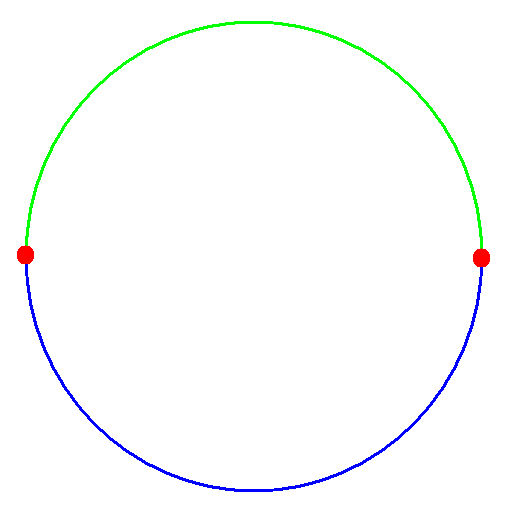 hidden haven
delicate bloom
https://upload.wikimedia.org/wikipedia/commons/2/2b/Digon_on_circle.png
hidden haven
delicate bloom
https://upload.wikimedia.org/wikipedia/commons/2/2b/Digon_on_circle.png
Oh nice you could do this with every Dn
delicate bloom
yeah
hidden haven
Except D1 😫
lethal dune
Thinking Dn analytically
small karma
Express G = Aut(U(81)) as a direct product of cyclic groups. Find the number elements
of order 6 in G.
delicate bloom
|D_n| = 2n is the hill I will die on
rustic crown
D_0 
lethal dune
D_-1
hidden haven
rustic crown
D_1 as well >.<
You'd have to color the different parts differently even though they lie on the same segment
small karma
in this ques i gotta turn u into z first then use the aut(z) = u(n) formula rightt
hidden haven
Or are you thinking of some other way
delicate bloom
a mobius side
small karma
then turn it again in to cyclic form and find the number of elements
delicate bloom
it still is like a coin with a front and back
lethal dune
but for Dn n>2 we don't think of edges going forward and backward with a different color, otherwise we'll get another set of rotation of the edges?
delicate bloom
so instead of 'reflection' you can still do the flip in R^3
lethal dune
like then another xZ2 factor?
delicate bloom
but rotation 360 degrees for D_1 is the identity
that's how you can visualize D_1 having actually 2 elements legitimately
lethal dune
yeah wiki says the same
delicate bloom
like on all odd sided polygons, draw a line through a vertex and the center of the opposite edge, then rotate it 180 degrees in 3D space -> that looks like the reflection in R^2
lethal dune
so I'll have believe
small karma

one more ques

should i take it as g, + or g , x
its not specified so im confused
isnt it supposed to be specified
whether its for additive mod or multiplicative mod
 paper flint
Do you have extra conditions on G here?
small karma
paper flint
Do you have extra conditions on G here?
no this is the whole questioin
paper flint
For an arbitrary group, you would just consider its group operation
small karma
yeah multiplicative seems easy for this
small karma

so i was able to transform this into z2 x z18 but since order isnt relatively prime i rearranged it into z4 x z9
and was able to find 2 elements of order 6 after that
am i correct?
hidden haven
Z2 is cyclic
small karma
bcz order of z2 and z2 is not relatively prime
hidden haven
epic pfp btw 😎
small karma
considering z2 z2 and z9
hidden haven
yeah probably
small karma
hidden haven
epic pfp btw 😎
small karma
hidden haven
you can't combine this into a Z4 x Z9
btw why is that?
hidden haven
in general Zm x Zn is isomorphic to Zmn iff m and n are coprime. You can show that
the element with the largest order has order the lcm of m and n
which is mn iff gcd is 1
lethal dune
can anyone check these facts for me |U(81)| = φ (81)=3³2 and |aut(U(81))| = ϕ (3³2)=3²2•1?
😣
small karma
hidden haven
in general Zm x Zn is isomorphic to Zmn iff m and n are coprime. You can show th...
so 4 and 9 are coprimes. but they will form lets say z36 which has a highest order element as 36 but z4xz9 will also form a highest element of order 36 lcm (4 and 9) are 36
small karma
yes
oh
z2 and z18 will have a element of highest order as 18
but z9 and z4 will have a highest order of 36
hidden haven
yes
 sly storm
Hello. If we knew the structure of p-groups completely, then we could classify all finite groups?
small karma

Q-29 i know there will be 4 subgroups of order 3 and one of them will be (3,1)
But how do i find others
rustic crown
finding subgroups of order 3 is same as finding elements of order 3 as groups of order p are cyclic.
notice that distinct subgroups of order 3 intersect trivially. each contains 2 elements of order 3, so number of elements of order 3 = 2 * (number of subgroups of order 3)
so do you see how you can find elements of order 3?
small karma
Basically elements of order 3 = pi(3) * no of subgroups
But i need to find the subgroups
Idk how to find all
rustic crown
so let's give it a try... if (a, b) has order 3 what does this tell you about a and b?
small karma
One i can find by 9/3 <3> and 3/3 <1> so (3,1) is one subgroup of order 3
small karma
rustic crown
so let's give it a try... if (a, b) has order 3 what does this tell you about a ...
They are divisble by 3
?
rustic crown
divisible isn't the word.... (3, 1) has order 3 right
small karma
rustic crown
since the components of direct products don't interact with each other
small karma
Yes
rustic crown
we would get that 3 kills both a and b
small karma
They interact with themselves
rustic crown
so possibilities of a are {0, 3, 6} and for b are {0, 1, 2}
small karma
Yes
rustic crown
but both can't be 0 together
small karma
Yes
small karma
Yes
rustic crown
does this tell you what the other subgroups are?
rustic crown
we can have 0 in the first slot as well 
rustic crown
(3, 0) and (6, 0)
(3, 1) and (6, 2)
(3, 2) and (6, 1)
(0, 1) and (0, 2)
these are the 8 elements
small karma
Yes
rustic crown
(elements in the same row generate the same subgroup)
rustic crown
yep!
small karma
Thanks
rustic crown
more precisely subgroup generated by those elements


 sly storm
Hello. If we knew the structure of p-groups completely, then we could classify all finite groups?
lethal dune
that classification is already done I believe
lethal dune
yeah I meant simples 
rustic crown
idk if we can say anything more than like nilpotent groups
which are direct products of their sylow subgroups
lethal dune

I though we already know the groups upto isomorphism of order pⁿ
not just abelian but non abelian as well
rustic crown
woah really?
lethal dune
i thought so
rustic crown
i never went past p^3 
weak oriole
lethal dune
I though we already know the groups upto isomorphism of order pⁿ
Just 2^n gets very crazy
weak oriole
lethal dune
I though we already know the groups upto isomorphism of order pⁿ
So idt this is true
lethal dune
chilly ocean
lethal cipher
<@456226577798135808> Just a quick addition. The terminology is a bit off.
Equiv...
great. thanks for mentioning it.
hidden haven
lethal cipher
<@456226577798135808> Just a quick addition. The terminology is a bit off.
Equiv...
Every partition can be realised as a partition into equivalence classes of some relation though
next obsidian
No we don’t
There’s a book on groups of order p^n
That’s is humongous
And it goes up to… n = 6? 7??
rustic crown

next obsidian
Okay so the book I’m thinking of is 2^n
And this was like pre-computer widespread usage
But it goes up to n = 6
And is like 170 pages
I think there’s some 4 billion groups of order 1024
Or something like that
So we super do not know them
next obsidian
Lot of variance there
I think even from abelian groups there’s quite a lot that can go on
Something like, number of partitions of the integer 6 is what’s going on
Anyway like for what we know, almost every group is of order some power of 2
I’m sure asymptotically it goes to 100%
Well
I bet

Mathematics Stack Exchange
In Algebra: Chapter 0, the author made a remark (footnote on page 82), saying that more than 99% of groups of order less than 2000 are of order 1024.
Is this for real? How can one deduce this resu...