#groups-rings-fields
406252 messages · Page 604 of 407
 oblique river
so now what are algebraic functions on U? well, all our usual polynomials are
but now we have things like 1/x
that isn't defined at 0 but it is defined on U!
 urban acorn
I see
oblique river
in general you can form any rational function of the form f(x)/x^n
urban acorn
over polynomials which are potentially 0 on our closed set
okay
so
the second question I have about schemes
was about the construction of general schemes
so, presumably, a scheme is a topological space such that for each element there is some neighborhood of it homeomorphic to an open subset of an affine scheme? and then also with a sheaf and a requirement for that sheaf to be compatible with the sheaves on the affine schemes
are there requirements like the space being second-countable? like for example is often required of manifolds
so they don't become uninteresting aggregates of egregious amounts of space
oblique river
I think of those requirements as more just like
analog of the definition of a manifold
as "locally looks like R^n"
urban acorn
so like a manifold is a topological space that locally looks like R^n, a scheme is a sheaf that locally looks like Spec(R)?
oblique river
a scheme is a "locally ringed space" which looks locally like Spec(R)
a "locally ringed space" is "a topological space with a sheaf that satisfies some extra property"
urban acorn
the problem is for topological spaces I can actually imagine geometrically how for some point the space looks like R^n, and I can't do that for sheaves
I guess that's something that I'll need to learn this more rigorously before I understand
oblique river
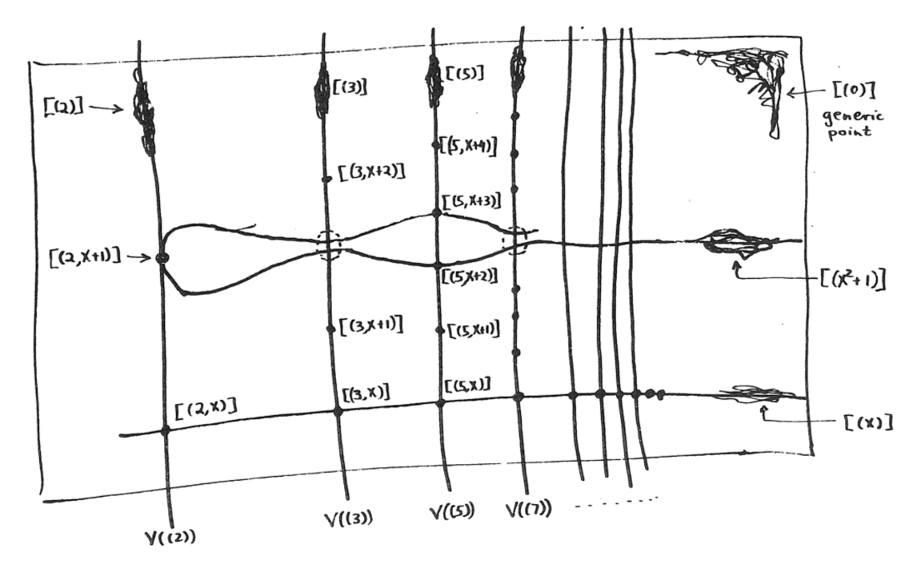
yeah, so that is a really good question in general and something which takes getting used to in algebraic geometry. for example, what should Spec Z[x] look like?
it's much bigger than just Z. While (x-a) is a prime ideal for each a in Z, there are a lot more prime ideals, like (3) or (7, x^2 + 1)
this is why it's a good idea (in my personal opinion) to learn about the case of curves over C and R first
so that you get a good intuition for how to translate geometry into algebra and vice versa
so that when you start reading things like "let R be a ring and consider the scheme Spec(R)" you have some kind of picture you can go back to
urban acorn
I see
oblique river
when i think about htis stuff a lot of times i do just squint and try to imagine the case of like, C or R
urban acorn
to you, do schemes feel like natural geometric objects the same way that manifolds are?
do you think algebraic geometry is geometry?
oblique river
hmm, so in thinking about that question i'm reminded of a quote from von neumann (i think) which is soemthing along the lines of "in math you never understand things, you just get used to them"
chm please
go easy
urban acorn
I like that quote, but it's only true in a certain way
 next obsidian
Just gonna put in my bit then leave, I don't see geometry in this stuff, that Von Neumann quote is definitely how I feel about it
but some ppl def see a lot of geometry, I wish I could see what they see
oblique river
ok phew sry chm i assumed yuou were gonna come in and start blasting him with crazy AG stuff
urban acorn
lmao
next obsidian
That's probably just because I'm not too visually oriented and also how I went about learning it
I think going slow and working up rather than just going Scheme + adjectives Hartshorne exercises brrrrrrrrrrrrrrrrr is better
oblique river
so like, I do think there is a spectrum (heh) of geometric visualization
on one end, if you're doing like, varieties over C, then yeah that's very geometric
and there are also theorems which relate like
"properties of V as an analytic space" to "properties of V as a scheme"
so you can get really concrete geometrically there
next obsidian
Yeah
oblique river
but if your rings are like, not at all like C
next obsidian
Complex geometry is like
oblique river
then that becomes a little farther from classical "geometry"
urban acorn
that reminds me of something someone said to explain to a layman how mathematicians think about higher dimensional spaces
oblique river
yeah that's a good analogy I think
next obsidian
There's still stuff that's like
reminscient enough that you can kinda make some sense
urban acorn
"when you hear 'n dimensional space', you imagine a 3 dimensional space and say 'n dimensional space' in your head very loudly"
oblique river
yeah hahaha
like nobody really can visualize 25-dimensional space
but you can visualize geometry in 3-dimensional space
next obsidian
like if you're familiar with a bit of manifolds you might know what a bundle is, and they exist in AG too
oblique river
and you can prove theorems about how 25-dimensional geometry is similar to/different from 3D geometry
and that kind of helps you "visualize"
urban acorn
yeah
next obsidian
so you can pretend to know what a like P1-bundle over something is and P1 is something you can... sorta visualize and then bundle is kinda like, something you can visualize
oblique river
here is a "visualization" which will make no sense to you but maybe more sense to chmonkey
urban acorn
I recently managed to sort of visualize the 3-sphere
 next obsidian
Bruh
I have seen this so many times and know what all the info is
but it does nothing for me
next obsidian
This doesn't really help me think about it very much haha
urban acorn
it looks pretty cool visually
next obsidian
Yeah for me I see Z[x] as a polynomial ring and start thinking of a lot of polynomials and like the lattice structure of the prime ideals
oblique river
I mean, here's how I think it's kind of a helpful visualization
the krull dimension of Z[x] is 2
and here is a visualization which looks 2-dimensional
urban acorn
I like the fact that Z[x] represents the forgetful functor
oblique river
that's a very algebro-geometric statement!
you already ahve the mind of an algebraic geometer :^)
urban acorn
lol
next obsidian
"object is just functor"
urban acorn
lmao
next obsidian
already on your way to defining a redacted because buncho will yell at me
jk, but that's actually useful, just not really much at first IMO
I think a lot of ppl will say AG is __ but it doesn't become really become like __ until a lot of time has passed
this may or may not be true of other fields
oblique river
what chm is trying to say is that the perspective "Z[x] represents the forgetful functor" isn't useful until it becomes useful
at which point it becomes very useful
next obsidian
yeah
I just didn't get much out of trying to think all categorical and abstracty and functory
until it necessitated it
oblique river
yeah
going back to what knida started this convo
I think AG does have a bad reputation as being like
urban acorn
 oblique river
super fancy and abstract and stuff
urban acorn
I only understand like a third of this but lmao
oblique river
but really a lot of the ideas are concrete
and rooted in complex geometry
and starting there and building up I think is pretty accessible
next obsidian
Buncho UW has a complex geometry class this winter but you need like RG and bundles course and stuff to take it I thinjk
so I am very sad
oblique river
aww thats too bad
next obsidian
I might still try to take it anyway, but I have wanted to learn complex geometry for a while
It sorta makes sense given who's teaching it and that they taught RG and bundles last year in a topics sequence
but it sucks taht if you didn't take that sequence you kinda are SOL next year
urban acorn
I don't know anything yet, but this interplay between the "spaces" and purely algebraic rings fascinates me
next obsidian
I feel like GAGA (the thing buncho mentioned which basically translates complex AG to complex geometry / analytic spaces) is like
the purest form of that
it relates things which are like by all means spaces, even without having to stretch your brain at all to consider these weird AG "spaces" as actual spaces
to... well those weird AG "spaces" which are reflecting all this ring info
oblique river
urban acorn
I don't know anything yet, but this interplay between the "spaces" and purely al...
me too :^)
next obsidian
Like here's a thing that's cool is that for people doing complex AG sometimes it's really beneficial to know a lot of complex analysis because you can just solve the AG problem with complex analysis
And there's tricks you can do to reduce problems to statements over C and that stuff always blows my mind, C is really this magical object IMO
urban acorn
it's weird that all of this structure can be obtained just by playing with definitions and rules for manipulating symbols
oblique river
formalism moment
next obsidian
I feel like if you mean how sometimes things can be easier to solve in different contexts, even though the things are "equivalent" this shows up a lot I think, which is really cool and I like it too
Algebraic groups and Hopf algebras are super related like this as well, and sometimes it's easy to look at something in the algebraic group context, other times the Hopf algebra perspective is better. So you can take your pick on how to solve something, then you just have to translate it back over
urban acorn
what are algebraic groups?
next obsidian
It's like a Lie group
but for varieties
So a lot of things you know are algebraic groups. A lot of matrix groups for example
oblique river
i.e. "it's a group but it's also a variety at the same time, and the structure of G as a group is compatible with its structure as a variety in some technical way"
next obsidian
Like SLn, GLn, etc
It's cool because varieties are really geometric because they are embedded in affine space and the group structure is kinda like automorphic ways to shift them around
I mean at the most basic level K^n is an algebraic group because you can literally just add points together
urban acorn
aha
I remember hearing something about cubic curves
and finding the point between two points
is that related?
oblique river
elliptic curves?
urban acorn
maybe
next obsidian
Elliptic curves are an algebraic group
next obsidian
That sounds like maybe what you are thinking of
you can grab two points and kinda like... produce this new point
and there's a point at infinity which is the identity
I forget the process but there's a geometric way to do it by drawing some lines and finding some intersection
 upper pivot
Yeah draw a line and find the third intersection, and then reflect it along x axis.
urban acorn
are the curves symmetric over the x axis?
oblique river
well
upper pivot
Right so you can reduce cubics to something called Weierstrass normal form, which is
oblique river
yeah john is explaining
next obsidian
you don't even need an x^2 term right?
urban acorn
is a rational transformation the equivalent of an affine transformation in projective space?
upper pivot
Yeah you can get rid of the x^2
next obsidian
I think you only need linear substitutions?
upper pivot
I don’t remember but I think that may be true
next obsidian
so you replace x and y with polynomials in x and y
or like... introduce two new variables X and Y
set x to a polynomial in X and Y, and y to one in X and Y and then you get something like
Y^2 = aX^3 + bX + c
upper pivot
The transformation steps are a bit tedious lol
next obsidian
yeah
urban acorn
and this is true for C^2? or for a general field? or what?
next obsidian
I think char 3 is an issue too
upper pivot
But yeah like the theory of this is really cool
next obsidian
as in all modern ones are based on elliptic curves I think
 sad moment
upper pivot
sad moment
upper pivot
Sadge
urban acorn
sed
upper pivot
There’s a really cool function called the weierstrass p function
urban acorn
so chm's ex's curves formed an algebraic group?
next obsidian
no
she really liked elliptic curves
and I learned everythignn I know about them form her
upper pivot
That allows you to go between Torii and elliptic curve, and in fact the elliptic curve inherits the group structure from the torii through this map.
urban acorn
oh :(
upper pivot
Anyhow I’ll let u guys go back to talking about the general theory lol
urban acorn
okay then
can I change ax^2 + bxy + cy^2 + h into Ax^2 + Cy^2 + H through an affine change of coordinate?
 terse crystal
like I said , yes
urban acorn
what are some examples of affine schemes that are really pathological? what is it about the underlying rings? what kind of schemes do - say - integral domains produce?
yeah, but do you have just a simple construction of what A and C would be?
cause I didn't follow the explanation involving orthogonal and symmetric matrices
and it's probably unnecessarily high-powered for what I want
maybe later I'll look into that perspective
oblique river
urban acorn
what are some examples of affine schemes that are really pathological? what is i...
there is a geometric analog of being an integral domain but it's a little complicated
but basically it means that you're irreducible topologically
something like two lines crossing is not irreducible because it has two proper closed pieces whose union is the whole space
for example, if you take the ring C[x]/((x-1)(x-2))
V((x-1)(x-2)) is the union of two points so it's not irreducible
and correspondingly that ring is not an integral domain
urban acorn
so, x-1 isn't 0
and x-2 isn't 0
but (x-1)(x-2) is zero
and corresponding to that
the point "1" isn't closed, the point "2" isn't closed", but their union is?
urban acorn
my bad
urban acorn
okay
oblique river
a more complicated example is C[x,y]/(xy)
well, still not too complicated, just 2D instead of 1D
that's not an integral domain
and correspondingly V(xy) is the union of the x- and y-axes
i.e. the union of two proper closed subsets
so you can think of irreducible as like "only having one piece"
urban acorn
okay
oblique river
and that's the geometric version of being an integral domain
urban acorn
are the details of the definition of a sheaf tedious?
oblique river
i thought they were a little tedious, but they're all easily-motivated if you think about like, functions on a manifold
or even like, functions on any topological space
basically, let X be a topological space and for any open set U of X, let F(U) be the ring of real-valued functions on U
then F (i.e. the assignment of open set to ring) is a sheaf on X
the sheaf axioms basically say things like
if f: U --> R and g: V --> R are two functions which agree with each other ont he intersection U cap V
then you can glue them together to get a new function (U union V) --> R
(also i'm not saying "continuous" anywhere but i'm thinking of continuous functions)
another sheaf axiom says that
if {U_i} is an open cover of some set U and f is a function on U to R
and if the restriction of f to each U_i is the zero function
then f itself is the zero function
I think both of these are pretty "obvious" statements about continuous functions
and that's basically what the sheaf axioms are
just abstracted a little bit
urban acorn
I see
 median pawn
well phi(f) = phi(g) means f and g are in the same coset, so f(0) = g(0) right
aaaa so every coset has an element of the complex field associated to it
i need to show that T: X/M --> C given by T(f) = f(0) is an isomorphism, right?
urban acorn
Would you say that the structure of a scheme describes the notion of a "space that has polynomials"?
terse crystal
oblique river
but basically it means that you're irreducible topologically
Being Integral means being irreducible and reduced I think. spec(C[x]/(x^2)) is irreducible while the underlying ring isn’t integral
urban acorn
median pawn
well phi(f) = phi(g) means f and g are in the same coset, so f(0) = g(0) right
a...
exactly
oblique river
yes tha'ts why I said "basically", you'll see the previous thing I said was that "it's a ltitle complicated geometrically"
since being reduced isn't something you can see as a topological space
my omission of detail is intentional
in any case
oblique river
urban acorn
Would you say that the structure of a scheme describes the notion of a "space th...
I would say that the structure of a scheme is more like "algebraic functions on a space"
need not be polynomials, remember the example from earlier
U = C \ {0}
and f(x)/x^n
oblique river
I mean again I would say they're motivated by rational functions in general
ti's just that the only rational functions which have no poles (i.e. are defined on all of C) are polynomials
but like, you can also look at something like
C[x,y]/(y^2 = x + 1) or something
urban acorn
how about on fields that aren't algebraically closed?
oblique river
on V(y^2 - x - 1) you have this function called y
which you can think of as being equal to sqrt(x + 1)
urban acorn
so, for example, consider 1/(x^2 + 1) as a function on R
oblique river
so you also kind of get algebraic functions in the mix
yeah so things are funky over non algebraically closed fields
as a function on Spec R[x], x^2 + 1 does have a "zero"
namely, Spec R[x] has a point corresponding to the maximal ideal (x^2 + 1)
and if you evaluate the "function" x^2 + 1 at that point, you get 0
so 1/(x^2 + 1) isn't actually an algebraic function on Spec R[x]
oblique river
while Spec C[x] can really be thought of as just the complex numbers (along with the point corresponding to the 0 ideal which we kinda mentioned earlier)
Spec R[x] is "bigger" than just R
urban acorn
that R doesn't cover enough of the spectrum of R[x]
oblique river
what do you mean by that? :o
oh wait I see
yeah in analogy with the thing earlier
oblique river
haha i hadnt thought of it that way but yes in some sense that is true
a field k is in bijection with Spec k[x] (again ignoring this special point (0)) if and only if k is algebraically closed
err, by "in bijection with" i mean via the map a --> (x-a)
urban acorn
yeah
oblique river
there exists some bijection between R and Spec R[x] becuase both sets have the same cardinality haha
 maiden ocean
i believe we call that "algebraic geometry"
oblique river
hahahaha
urban acorn
we don't allow hate speech in here
maiden ocean

urban acorn

anyway
so, given some scheme
we have the ring associated to the entire space
is that functorial?
oblique river
just to be clear you can only ask that for affine schemes
but yes there is an equivalence of categories
between commutative rings and affine schemes
 gritty sparrow
No, you can ask that for any scheme, and the answer is yes it is functorial (we’re talking about global sections right?)
oblique river
yes global sections, and yes you are right you can ask for any scheme, that's my bad
urban acorn
okay, I was confused
oblique river
i was specifically thinking of that equivalence which breaks down if you try to extend to all schemes
urban acorn
alright
oblique river
sorry about that
urban acorn
so, it's still functorial, but not an equivalence?
oblique river
yes
urban acorn
huh, pretty cool
oblique river
as an example, if you look at projective space
the only functions on projective space are constants
like on P^1 let's say
so the "ring of functions" would just be C
or R or whatever your base field is
gritty sparrow
urban acorn
huh, pretty cool
Even cooler, it has an adjoint. It is the spectrum functor of a ring
oblique river
but like, the functions on a point are also just the constants
urban acorn
not a lot of information then
oblique river
yes, but the entire scheme knows more than just "global functions"
the scheme knows things like "what are the fucntions on this open set"
urban acorn
yeah
oblique river
and that tells apart P^1 from just a point
here's another sort of weird example which kind of shows how the scheme structure can remember things that the topology cant
the spectrum of any field K is just a point, topologically
since any field only has one prime ideal
urban acorn
right
maiden ocean
non reduced rings 
oblique river
but the schemes Spec C and Spec R (for example) are different
because the functions on Spec C are C
and the functions on Spec R are R
so even though these are both just points, the scheme remembers more
also things like
there is a ring hom R --> C (just inclusion) but no ring hom the other way
which means there is a scheme map Spec C --> Spec R but not the other way
urban acorn
what are morphisms between schemes?
oblique river
the easy answer is "functions which preserve all of the relevant structures"
urban acorn
lmao
oblique river
but like once you prove all the things you just see that
for affine schemes at least
morphisms from Spec S --> Spec R are in bijection with ring homs R --> S
like, you can define "morphism of scheme" in some complicated way, and then prove for affine schemes that it reduces to that
urban acorn
Is the Zariski topology appropriate to think of as a topology in the same sense that, say, the topology of a ball describes its geometric structure?
oblique river
hmm im not sure i know what you mean
urban acorn
or is it just an important collection of sets that satisfies properties that happen to be formally analogous?
so, the open set definition for topological spaces
is introduced to formalize some definition
oblique river
so the zariski topology by itself is very coarse
urban acorn
of spaces that are "squishy" and don't preserve distances, but preserve the way the space is "attached" to itself
oblique river
but if your rings aren't topologized in a nice way then there's not really any other option
like let's say you wanted to work with curves over the field Z/pZ
urban acorn
and that are the most general setting for continuity
oblique river
or over some really weird field
urban acorn
so my question was
does the Zariski topology really describe that kind of geometric structure on affine schemes?
or is it just a collection of important subsets for algebraic reasons
oblique river
hmm so let me try to give two answers and i hope that some combination of the two is satisfying
urban acorn
that happen to formally resemble the closed sets of a topological space as in the initial intuition
oblique river
-
it's kind of hard to talk about the geometry of schemes if you only look at the topological space. so i guess like, the topological space by itself is more of a nice template for you to build a sheaf on. that said, there are some theorems about recovering the "usual geometry" on a complex variety from the "zariski geometry" of it, so there is still useful information encoded in the zariski topology
-
sort of in the other direction, I would say that open sets in the zariski topology are actually meaningful in comparison to more general topological spaces or manifolds. for nice topological spaces (hausdorff plus some other kind of separation condition), the closed subsets of X are exactly the subsets of X which are zero sets of some continuous function. Now let X be an affine scheme and replace "continuous function" with "algebraic function" and the exact same statement is true
that's kind of a geometric thing -- what are the zero sets of functions? in the manifold world you talk about continuous functions and in the scheme world you talk about algebraic functions
but in both cases, the open sets (or, well, their complements, the closed sets) capture exactly that kind of geometry of where functions can be 0
urban acorn
hmm
it's like a beautiful but sort of unholy relationship between geometry and algebra
but yeah, these are good answers
oblique river
i'm glad that they were somewhat useful haha
also
ive been sitting here for a while im gonna get up for a bit
if you have more questions you can DM me or just @ mention me and i'll try to get back to you at some point
urban acorn
alright, thanks, I probably will tomorrow cause it's pretty late for me right now
oblique river
sounds good, and gn
 bleak perch
quick question, what are the units in in z mod p, where p is some prime?
urban acorn
bleak perch
quick question, what are the units in in z mod p, where p is some prime?
all non zero elements of Z/pZ are units
i.e. Z/pZ is a field
bleak perch
gotcha thanks
terse crystal
Figured it out. The former has a surjection to S_3 while the latter doesn’t
 weary terrace
Hi.
Let G be a group and N a subgroup of G. Can we say that the number of conjugacy classes of G that are contained in N equals the number of conjugacy classes of N?
I mean, obviously each conj class of G contained in N is a conj class of N.
What about the other direction? Does any conj class of N a conj class of G contained in N?
 mild laurel
No, this isn't true. Consider the subgroup {e, (1 2)} inside of S_3.
 dusty river
Conjugacy classes of that are still the conjugacy classes of S_3 intersected with it though
It's just that in general they could become finer
Things that were conjugates could no longer be conjugates
I think C_3 inside S_3 is an example. It has 2 conjugacy classes of S_3 contained in it, {e} and {(123),(132)}, but when you look at it as a subgroup then all the conjugacy classes become singletons
dusty river
mild laurel
No, this isn't true. Consider the subgroup {e, (1 2)} inside of S_3.
Oh you were giving a counterexample to the converse, nvm
So both are false
mild laurel
Yeah sorry I should've specified
weary terrace
@mild laurel So,to be certain, a conj class of N will be {(1 2)}, but if we conjugate with the elements of G we have a larger class. Thus the converse claim is false.
What if N=ker \rho for some \rho:G->GL(V) (kernel of a representation)?
then ker \rho is a niormal subgroup
normal
dusty river
Since it's a normal subgroup, the conjugacy classes are either disjoint or contained
But after that they could still be finer I imagine?
C_3 in S_3 is normal, not sure if it's a kernel of a representation
mild laurel
Any normal subgroup is the kernel of some representation
dusty river
Oh then that's a counterexample
mild laurel
Just look at the regular representation of G acting on G/H
dusty river
Idk any representation stuff lol
mild laurel
Yeah
 novel parrot

i have aquestion
if j is number of initial zeros
why is j1 =1
j2 =2
is this maybe .. a typo
mild laurel
j1 is the number of initial zeroes plus one I guess
Look at part (a) again, they define j1 to be the position of the first nonzero entry in row 1
novel parrot
i thought j1 was a column
mild laurel
I mean sure, j1 specifies which column the first nonzero entry in row 1 is
Which is why j1 = 1
weary terrace
Say G (a group) has n\cdot l conjugacy classes and G/N \cong Z/nZ (N is a normal subgroup of G). I want to prove N has l conjugacy classes.
So I know that G is a disjoint union of its n \cdot l conjugacy classes and that N has n cosets (equivalently conjugacy classes, since it's Z/nZ). G also equals a disjoint union of the cosets of N. How do I connect the dots?
 crimson falcon
Oh nice, gonna do that, thanks a lot for the exercices and the effort really appreciate it!
novel parrot

i have got to question 19 now
im looking at the second matrix
but i am getting something slightly different
i have 5 in row 2 column 5 instead of 2
weary terrace
weary terrace
Say G (a group) has n\cdot l conjugacy classes and G/N \cong Z/nZ (N is a normal...
Up
terse crystal
There are 3 conjugacy classes of S_4 that are contained in A4 but A4 has 4 conjugacy classes. And all 3 cycles form one conjugacy class of S_4 but also form 2 conjugacy classes of A_4
terse crystal
weary terrace
Say G (a group) has n\cdot l conjugacy classes and G/N \cong Z/nZ (N is a normal...
Difficult to read...
terse crystal
novel parrot
i have 5 in row 2 column 5 instead of 2
I also got 5
weary terrace
I'll try latex:
Say G (a group) has $n\cdot l$ conjugacy classes and $G/N \cong \mathbb Z/n\mathbb Z$ (N is a normal subgroup of G). I want to prove N has $l$ conjugacy classes.
So I know that G is a disjoint union of its $n \cdot l$ conjugacy classes and that N has n cosets (equivalently conjugacy classes, since it's $\mathbb Z/n\mathbb Z$). G also equals a disjoint union of the cosets of N. How do I connect the dots?
 cloud walrusBOT
RiesZ
 weary terrace
terse crystal
Difficult to read...
weary terrace
terse crystal
Difficult to read...
Is it more readable now? Or did you refer to the wording?
terse crystal
weary terrace
Is it more readable now? Or did you refer to the wording?
If N is not trivial then the number of conjugacy classes is greater than 1
And btw I don’t know what do you mean by saying N has n cosets it makes sense to me if you say G/N has n cosets
terse crystal
cloud walrus
**RiesZ**
Sorry I mistook L as 1
weary terrace
terse crystal
And btw I don’t know what do you mean by saying N has n cosets it makes sense to...
Best said |G/N|=n
Is it correct to say that if $g_i g_j^{-1}\in N$ then $C_{g_i}=C_{g_j}$ , where $g_i,g_j\in G$ and $C_{g_i},C_{g_j}$ are the conjugacy classes of $g_i,g_j$ respectively?
cloud walrusBOT
RiesZ
 weary terrace
If so, we have a bijection between the set of conj classes and cosets
terse crystal
cloud walrus
**RiesZ**
I am constructing a counterexample. If a group G has n conjugacy classes, then the direct product of G and itself has n^2 conjugacy classes but not 2n conjugacy classes
Making sense?
GΠG/G is isomorphic to Z/2Z
I just need to find a G here who has even number of conjugacy classes then the counterexample is found
G=A_4
weary terrace
terse crystal
I am constructing a counterexample. If a group G has n conjugacy classes, then t...
Is it isomorphic to Z/2?
Did you mean a direct product here?
terse crystal
weary terrace
Did you mean a direct product here?
Yes
terse crystal
weary terrace
Is it isomorphic to Z/2?
Yes , there exists only one group that has order 2 which is Z/2Z
terse crystal
weary terrace
Did you mean a direct product here?
G can be viewed as a normal subgroup of GΠG,G={(g,1):g from G}
weary terrace
Sorry I must be missing something basic.. |A_4||A_4|/|A_4|=|A_4| \neq 2
Did you mean N instead of G in the denominator?
terse crystal
I made a mistake,rethinking
terse crystal
cloud walrus
**RiesZ**
It might be correct I am proving that G is isomorphic to the direct product of N and Z/nZ since if N has j conjugacy classes N Π Z/nZ has nj conjugacy classes.
weary terrace
That's a cool approach, didn't think about it
terse crystal
It is isomorphic right? G/N is generated by a element xN of order n then I map (h,k) to x^k multiplied by h where h is from N
weary terrace
Seems easy though:
each g\in G equals g_i\cdot n for some n\in N and g_i is a transversal of G/N
I hope lol
sounds right
I think its a morphism too
thanks very much! I'll dig into it
terse crystal
Not done yet...
weary terrace
how come?
terse crystal
It is correct if I can find such x which has order n itself and x is contained in Z(G)
Other wise that map won’t be a homomorphism
weary terrace
Is it not enough to say that x\in Z/nZ? as a transversal of course
It follows from the isomorphism G/N=Z/nZ
I would, however, check if the map is well defined
terse crystal
Not enough you see the map mapping (k,h) to x^k h is a homomorphism means that x itself has order n and x^khx^st=x^(k+s)*(ht)
So you need to find a x having order n such that G/N is generated by xN also x is commutative with any element of N
So your statement still could be false I need to try to find counterexample again
weary terrace
Oh I see.. Like that:
https://math.stackexchange.com/questions/2768685/is-g-isomorphic-to-fracgh-times-h

Mathematics Stack Exchange
Let $G$ be a group and $H$ a normal subgroup. Is $G$ necessarily isomorphic to $\frac{G}{H}\times H$?
terse crystal
Yes so generally those representatives from cosets of G/N themselves should form a group isomorphic to G/N also those representatives should be commutative with any element of N.
only in that case G is isomorphic to the direct product of N and G/N
weary terrace
So if I get it correctly, I have to add more info in order to make my claim correct?
terse crystal
weary terrace
So if I get it correctly, I have to add more info in order to make my claim corr...
Yes the condition I gave is correct I think and I think I have found a counterexample of the original statement
S_8 has 22 conjugacy classes
Wiki said A_8 has 14 conjugacy classes
If we believe Wikipedia then that is a counterexample
terse crystal
terse crystal
Yes so generally those representatives from cosets of G/N themselves should form...
If this holds then the number of conjugacy classes of G is equal to the multiplication of the numbers of conjugacy classes of G/N and N respectively.
weary terrace
Thank you for the effort @terse crystal, I appreciate it.
I do have extra info but I'm not sure if it helps here.
N=ker \rho where \rho:G->GL(V) is a representation of G.
So the original question I'm trying to answer is:
Let $G$ be a group, $\rho:G \rightarrow \textrm{GL}(V)$ a one-dimensional representation of $G$ and $N=\ker \rho$. $G/N \cong \mathbb Z/n\mathbb Z$ and $G$ has $n\cdot l$ irreducible representations, $l\in \mathbb N$. Prove that $N$ has $l$ irreducible representations.
cloud walrusBOT
RiesZ
 terse crystal
weary terrace
So the original question I'm trying to answer is:
Let $G$ be a group, $\rho:G \r...
terse crystal
weary terrace
So the original question I'm trying to answer is:
Let $G$ be a group, $\rho:G \r...
clearly false...
Since I can use the same counterexample
Notice that sign is an one dimensional representation of S8 whose kernel is A8
Where sign is a map from G to nonzero elements of C (=GL(C)) mapping even permutations to 1 odd permutations to -1
weary terrace
Yeah, very nice.
I have extra info regarding tensor powers of \rho but I feel like I've been spamming here all day 😛
 frank fiber
why this series is normal?

 chilly radish
Group generated by the commutator of 2 normal subgroups is normal, then by induction all the gammas are normal I think
 wispy pivot
Is there a list of curated exercises from D&F that a college course assigned for their group theory course? Looking to self-study D&F but given that it has an overabundance of problems I'm looking for some guidance on which ones to prioritize.
I found this example for Harvard's Rings courses (Math 123) that uses D&F. But from my understanding their groups course doesn't assign problems from the text.
https://svasey.github.io/academic-homepage-may-2020/123-spring-2020/
 unreal portal
wispy pivot
Is there a list of *curated* exercises from D&F that a college course assigned f...
unreal portal
wispy pivot
Is there a list of *curated* exercises from D&F that a college course assigned f...
what parts of dummit and foote in particular? The book is massive and has enough material for like 3 courses
this uses dummit and foote, but they have custom exercises. But they also have the exercises and solutions on the page
Introduction to Abstract Algebra Math 350 Fall 2017 Syllabus
this also looks good, they give specific problems from D&F to solve
If you google "syllabus dummit and foote" I'm sure you can find a bunch of others
wispy pivot
unreal portal
https://math.dartmouth.edu/~auel/courses/350f17/syllabus.html
hey thanks this looks really good
wispy pivot
unreal portal
If you google "syllabus dummit and foote" I'm sure you can find a bunch of other...
hmm kk i did try once but didn't find anything helpful in the couple page...
 fickle tapir
for closed under addition, if x,y in S then x in F_i and y in F_J. if x and y are in the same field, then we know its closed under addition and multiplication
but what if F_I != F_J?
maiden ocean

Is this proof even correct...?
How can we say that a_i is in A_n-ki
we dont know anything about what xi or ai xi is
because just because the sum of the a_i x_i is dim n doesnt mean that each individual a_i x_i is necessarily dim n
oblique river
a and x_i are both homogeneous
and wlog we can take the a_i to also be homogeneous
just split each a_i into its homogeneous parts
so a_ix_i is also homogeneous. if it's not of degree n it must be cancelled out by some other term which is also not of degree n
(or some other collection of terms)
basically just, you can ignore all of the terms which aren't degree n because you know they must all cancel out with each other
cloud walrusBOT
add
Compile Error! Click the  reaction for more information.
(You may edit your message to recompile.)
 novel parrot

is the first ordering x1 > x2 > ... > xn?
or what does first choose an ordering actually mean?
<@&286206848099549185>
unreal portal
novel parrot
The first order can be any permutation of x1 through xn. You first sort by total degree, then by this lex order on the variables
novel parrot
ok
i dont understand ordering
we look at the variables backwards
and the first smaller exponent is our larger monomial yes?
unreal portal
so you go backwards through the variables until you find a variable where the corresponding exponents aren't the same
novel parrot
ok and which is our larger monomial
after checking backwards
m1 = x_1 > x_n = m2 because m1 has 0 for exponent on x_n yea?
unreal portal
doing it in words like this confuses me
this is how my notes has grevlex defined

these vectors just correspond to the exponents, so (4,7,1) corresponds to $x_1^4x_2^7x_3$
cloud walrusBOT
cgodfrey
 novel parrot
ok yea in the second example the total degree is same
and the last position is smaller
so we let that monomial be larger
unreal portal
yeah
unreal portal
yeah the wording in your screenshot is a little confusing
cloud walrusBOT
ActiveChapter
 novel parrot
$x_1x_2^4 >_{graded lex} x_1x_2^3$
cloud walrusBOT
ActiveChapter
 unreal portal
novel parrot
$x_1x_2^3 >_{grevlex} x_1x_2^4$
unreal portal
novel parrot
$x_1x_2^3 >_{grevlex} x_1x_2^4$
I think this one is wrong. Both grevlex and grlex first sort by total degree, so both would have $x_1x_2^4$ be greater
cloud walrusBOT
cgodfrey
 novel parrot
oh yeha
unreal portal
to give a fuller example, this is what you would get ordering a polynomial under each ordering

(ignore the typo in the second term of grlex)
novel parrot

unreal portal

anyone recognize valuation or how tf they get -1 and 0 for these examples
googling valuation of laurent polynomial doesn't come up with anything useful
looks like it's the smallest exponent 
mild laurel
yes thats right
 cursive temple
im not sure how to prove that given y'^2 = 0 then yx'^2 = 0 for some nilpotent x'

i guess i could just write y' = f(x) + g(x)y and x' = f(x_1)+g(x_1)y_1 and then just try to smash everything together
i just hope there is a nicer solution
cursive temple
cursive temple
im not sure how to prove that given y'^2 = 0 then yx'^2 = 0 for some nilpotent x...
All nilpotent x' i mean
novel parrot

How can i show that two minimal basis have unique amount of generators?
$(LT(h_1), \cdots , LT(h_m)) = LT(I) = (LT(g_1), \cdots, LT(g_n))$
cloud walrusBOT
ActiveChapter
 novel parrot
how to show thaat n = m?
<@&286206848099549185>
$LT(h_1) = q_1LT(g_1) + q_2LT(g_2)$ and $LT(h_2) = q_3LT(g_2)$
cloud walrusBOT
ActiveChapter
 novel parrot
LT(h_2) doesnt divide LT(h_1) here right?
 thorny flame
How do I tell if a permutation is odd or even?
dusty river
Write its cycle structure. An n cycle is odd iff n is even
thorny flame
what is n representing?
 scarlet estuary
the length of the permutation in cycle notation
thorny flame
(3 2 1) would be 3?
dusty river
Yes
thorny flame
so (3 2 1) is even?
dusty river
Yes
thorny flame
Is there a proof or is it true by definition?
dusty river
If you decompose it into a composition of 2 cycles l
You'll get an even number of them
scarlet estuary
this can be proved via a very quick inductive argument
using whatever definition of parity you prefer
dusty river
Counting inversions
thorny flame
What about permutation of 1 to 3
dusty river
(1 3)?
thorny flame
it's a cyclic permutation
dusty river
(1 2 3)?
thorny flame
3 -> 2
2 -> 1
1 -> 3
dusty river
Are you asking why what namington wrote works
thorny flame
yes
dusty river
Try applying those 2 transpositions on a 3 element set
Or like symbolically composing
scarlet estuary
it seems you forget how products/compositions of cycles work
dusty river
Whichever one you prefer
scarlet estuary
when i write (3 2)(2 1)
these are evaluated right-to-left
so lets follow each element
1 is sent to 2 by (2 1) and then 2 is sent to 3 by (3 2), so 1 is sent to 3
2 is sent to 1 by (2 1) and then 1 is unaffected by (3 2), so 2 is sent to 1
3 is unaffected by (2 1) and then 3 is sent to 2 by (3 2), so 3 is sent to 2
hence we have 1 -> 3, 2 -> 1, 3 -> 2
this is equivalent to (3 2 1)
thorny flame
oh right
1 - > 1 -> 2
2 -> 3 -> 3
3 -> 2- > 1
scarlet estuary
in your case, (3 2) (2 1) (1 3), this is actually a different permutation
for example, 1 is sent to 3, unaffected, and then sent to 2
so 1 -> 2
2 is unaffected, then sent to 1, then unaffected
so 2 -> 1
3 is sent to 1, then sent to 2, then sent to 3
so 3 -> 3 (ie 3 is unchanged)
so (3 2)(2 1)(1 3) actually is just (2 1)
scarlet estuary
careful
products of cycles are read right-to-left
not left-to-right
(by 99% of textbooks at least)
it doesnt matter here but it does in some cases
thorny flame
I'm israeli so we read everything left to right.
So it may explain it.
scarlet estuary
well, it may be different in different sources
but i dont think ive seen a textbook that uses left-to-right
¯_(ツ)_/¯
chilly radish
thorny flame
I'm israeli so we read everything left to right.
So it may explain it.
Just fyi we still use the same convention (right to left) in israel
But uhh, hebrew is written right to left aswell
Cycle multiplication is just funny looking function composition
scarlet estuary
the confusing thing is that cycles are internally read left-to-right but externally composed right-to-left
it makes some sense when you realize its just a way of representing function composition
but its still kinda weird
thorny flame
chilly radish
But uhh, hebrew is written right to left aswell
כן, טעות שלי
Right, so is it only the perumtation right to left or also the action sequence
?
chilly radish
חחחחח
thorny flame
for example ( 1 2 3 ) would be (1 2) (1 3)
And so the actions would be
1 -> 3
2 -> 1
3 -> 2
And the latter
1 -> 2 -> 2
2 - > 1 -> 3
3 -> 3 -> 1
Or am I making a mistake?
chilly radish
The cycles themselves are left to right, but their composition is right to left
So the first one would simply be 1->2->3
Second would be
1->3->3
2->2->1
3->1->2
thorny flame
huh
chilly radish
And the last one is equivalent to (321)
If you wanna decompose (123) into transpositions you could do (12)(23)
thorny flame
I see thanks
chilly radish
Ok so i'm trying to prove the five lemma, I have a proof but it's a bit messy and idk if there's a more succinct proof. Anyways I also wanna make sure i'm not being dumb. Suppose there is a commutative diagram of groups with exact rows
$$\begin{tikzcd}
{A_1} & {A_2} & {A_3} & {A_4} & {A_5} \
{B_1} & {B_2} & {B_3} & {B_4} & {B_5}
\arrow["{i_1}", from=1-1, to=1-2]
\arrow["{i_3}", from=1-3, to=1-4]
\arrow["{i_4}", from=1-4, to=1-5]
\arrow["{i_2}", from=1-2, to=1-3]
\arrow[from=2-1, to=2-2]
\arrow[from=2-2, to=2-3]
\arrow[from=2-3, to=2-4]
\arrow["{j_4}"', from=2-4, to=2-5]
\arrow["{f_5}", from=1-5, to=2-5]
\arrow["{f_4}", from=1-4, to=2-4]
\arrow["{f_3}", from=1-3, to=2-3]
\arrow["{f_2}", from=1-2, to=2-2]
\arrow["{f_1}", from=1-1, to=2-1]
\arrow["{j_2}"', from=2-2, to=2-3]
\arrow["{j_3}"', from=2-3, to=2-4]
\arrow["{j_1}"', from=2-1, to=2-2]
\end{tikzcd}$$
Suppose $f_2,f_4$ are surjective and $f_5$ is injective, then $f_3$ is surjective.
cloud walrusBOT
ShiN
 chilly radish
Let $y \in B_3$, consider $j_3(y)$. $f_4$ is surjective, so there is some $z \in A_4$ such that $f_4(z)=j_3(y)$. From exactness $j_3(y)\in \text{ker}j_4$, so from commutativity we have
$$j_4f_4(z)=f_5i_4(z) \Rightarrow 1=f_5(i_4(z))$$
Since $f_5$ is surjective, it follows that $i_4(z)=1$, then from exactness $z \in \text{ker}i_4 = \text{im}i_3$, so there exists some $w \in A_3$ such that $i_3(w)=z$, then we have that $f_4(i_3(w))=f_4(z)=j_3(y)$, then from commutativity
$$f_4i_3(w)=j_3f_3(w) \Rightarrow j_3(y)=j_3(f_3(w)) \Rightarrow j_3(y\cdot f_3(w)^{-1})=1$$
Again from exactness, this implies that $y\cdot f_3(w)^{-1} \in \text{im}j_2$, so there is some $\ell \in B_2$ such that $j_2(\ell)=y\cdot f_3(w)^{-1}$.
From the surjectivity of $f_2$, it then follows that there is some $\ell' \in A_2$ such that $f_2(\ell') = \ell$. Finally, from the commutativity of the diagram we have:
$$j_2f_2(\ell') = f_3i_2(\ell') \Rightarrow y\cdot f_3(w)^{-1}=f_3(i_2(\ell')) \Rightarrow f_3(w\cdot i_2(\ell')) = y$$
So finally $f_3$ is surjective as required.
cloud walrusBOT
ShiN

 burnt trout
Wow-
chilly radish
Oop I just noticed that the final multiplication is reversed but it doesn't really matter
 lunar spruce

How do I conclude from right side that f(b^-1a)=e? This is a proof of homomorphie theorem
 south patrol
Is f here a group homomorphism?
south patrol
in general we have that f(g^-1) = f(g)^-1 if f is a homomorphism
and if f(a) = f(b) then e = f(a)f(b)^-1
hopefully that gets you started
south patrol
nice
dusty river
chilly radish
Let $y \in B_3$, consider $j_3(y)$. $f_4$ is surjective, so there is some $z \in...
That's pretty standard (I only looked at the outline not the details but they look kinda correct)
But what's not standard is
5 lemma for non abelian groups 
chilly radish
Yea?
I mean it was in the context of the category of chain complexes of abelian groups
But I read it holds in Grp aswell
So why not
dusty river
Ye but 
chilly radish
I mean yea I prefer additive notation too

 chilly radish
I mean exactness can be a thing in not-abelian categories right?
Why is that weird to consider
dusty river
Idk I just never saw it before but like not all monics are kernels, since not all subgroups won't be normal, and you can't always take cokernels
Also in abelian categories, an equivalent definition of exact is cokernels being coimages
So you would have to make a choice while defining exactness for non abelian categories, as to which one of the 2 definitions you want to keep
Idk I'm just making stuff up
chilly radish
Ok just checking i'm not dumb again. Suppose I have abelian groups $A,B,C$ such that $\sfrac{B}{A}\cong C$, then I have $B \cong C \oplus A$ since $B \cong \sfrac{B}{A}\oplus A \cong C \oplus A$ right?
cloud walrusBOT
ShiN
 cloud walrusBOT
ShiN
 chilly radish
feels like it should be tho
dusty river
It's not, take B = Z and A = 2Z
dusty river
It does happen in certain nice situations for example when B/A is a free abelian group or more generally any projective abelian group
chilly radish
I'm trying to show smth in homology
i'll try thinking about it a bit more than
then*
 ionic ingot
simple question, just want to clarify but - when asked to give examples a subgroup, and it isn't clarified whether it is cyclic or abelian or non-abelian, is there something we should assume?
for example if asked to give an example of "a subgroup of order 7 in the symmetric group S7 of degree 7" i would say H = < (1 2 3 4 5 6 7) >
would that fit the condition?
dusty river
Yeah any subgroup good
ionic ingot
great
how could i come up with an example of a subgroup of order 14 in the symmetric group S7 of degree 7?
dusty river
What does degree 7 mean here?
urban acorn
that it constitutes the full set of symmetries of a set of 7 elements
south patrol
i assume you could just remove the 'of degree 7' there lol
dusty river
 viscid pewter
ionic ingot
how could i come up with an example of a subgroup of order 14 in the symmetric g...
viscid pewter
ionic ingot
how could i come up with an example of a subgroup of order 14 in the symmetric g...
consider the factors of 14
urban acorn
I wonder what <(1 2), (1 2 3 4 5 6 7)> is
south patrol
that is S7 i believe
viscid pewter
actually yeah it doesn't work
dusty river
urban acorn
I wonder what <(1 2), (1 2 3 4 5 6 7)> is
Ye S7
urban acorn
welp
viscid pewter
in that case i don't think it exists
south patrol
because (1...7)^-1(12)(1...7) is either (23) or (71) depending on your convention for permutations i think lol
just keeps cycling round to get all transpositions
dusty river
What is the number of conjugates of the sylow p subgroups in an order 14 group
urban acorn
is <(1 2 3 4 5 6 7)> maximal in S7?
ionic ingot
south patrol
i assume you could just remove the 'of degree 7' there lol
essentially, yeah. it's just there to reaffirm the S7.
dusty river
If we can prove that one of the 2 things is normal then we'll have a semi direct product
south patrol
the number of 7 subgroups is isomorphic to 1 mod 2 i think and the number of 2 subgroups is 1 mod 7 iirc lol
dusty river
And I think a semi direct product shouldn't be possible
ionic ingot
i am so confused rn lol
south patrol
using sylow is probs a bit ott here aha
urban acorn
dusty river
What is the number of conjugates of the sylow p subgroups in an order 14 group
1 I think
for n_7
viscid pewter
dusty river
If we can prove that one of the 2 things is normal then we'll have a semi direct...
well <(12)> is surely normal, i think?
i haven't even touched group theory in ages
urban acorn
and 1 or 7 for n_2
dusty river
Wait so if group is m*p^n, then sylow p subgroup has number of conjugates 1 mod p and a factor of m right?
urban acorn
yeah
dusty river
viscid pewter
well <(12)> is surely normal, i think?
Not in S7
south patrol
i'm pretty sure <(12)> is not normal as a normal subgroup must be a union of conjugacy classes
ionic ingot
ionic ingot
how could i come up with an example of a subgroup of order 14 in the symmetric g...
can it be H = < (1 2), (1 2 3 4 5 6 7) >
urban acorn
yeah it's not normal
viscid pewter
oh
dusty river
ionic ingot
can it be H = < (1 2), (1 2 3 4 5 6 7) >
Nope
south patrol
and the conjugacy classes of S7 are just permutations of a given length
ionic ingot
dusty river
Nope
why not?
dusty river
ionic ingot
can it be H = < (1 2), (1 2 3 4 5 6 7) >
That is all of S7
south patrol
that is S7
viscid pewter
that generates the whole thing, yeah
dusty river
Because you can do a bubble sort kinda thing
viscid pewter
i don't think it's possible
dusty river
To rearrange everything as needed
viscid pewter
because it's just like
the group can't be cyclic
but if it's not cyclic then it's surely gotta have an element of order 2 and an element of order 7?
ionic ingot
i don't think it matters whether its cyclic or not
urban acorn
You should be looking at the way <(1 2 3 4 5 6 7)> sits in S7
ionic ingot
it just says subgroup
urban acorn
okay, I figured it out
ionic ingot
urban acorn
You should be looking at the way <(1 2 3 4 5 6 7)> sits in S7
hmm okay waiy
urban acorn
I found a subgroup of order 14
viscid pewter
fuck
urban acorn
and it's the permutations of the 7 vertices
south patrol
yeah i was going to say, usually there's a sexy interpretation for these sort of things
viscid pewter
ok i'm bad ignore me
urban acorn

viscid pewter
i should have seen that
south patrol
permutations of 7 vertices having a subgroup corresponding to the symmetries of a heptagon ig?
and then you can find generators by drawing a diagram or something, lol, if you're lazy like me
urban acorn
yeah
dusty river
Or like something along those lines
Actually not isomorphic to that
The cycle should be (7135642)
viscid pewter
def not, that's not disjoint cycles
dusty river
Ye
viscid pewter
no?
urban acorn
<(1234567), (27)(36)(45)>
south patrol
yeah typo sorry
ionic ingot
urban acorn
<(1234567), (27)(36)(45)>
so this is a subgroup of order 14 of S7?
urban acorn
yeah
south patrol
visualising a heptagon properly did not go well
viscid pewter
nononono
urban acorn
I have not seen that notation before.
south patrol
i've not seen that notation myself, i thought () would refer to identity if anything
urban acorn
south patrol
i've not seen that notation myself, i thought () would refer to identity if anyt...
same
viscid pewter
(1234567) is 1 -> 2, 2 -> 3, etc.
urban acorn
but i'd just write the identity as 1
south patrol
i write identity as e ¯_(ツ)_/¯
dusty river
ionic ingot
(1234567) can also be written as (), yeah?
(123) means 1 → 2 → 3 → 1
dusty river
urban acorn
but i'd just write the identity as 1
But the group is abelian 
south patrol
the username
viscid pewter
am i missing a joke
south patrol
look at the username of the person coldilocks responded to lol
dusty river
"all groups are abelian"
ionic ingot
ahhh OOP yeah identity y'all are right, sorry
ionic ingot
urban acorn
<(1234567), (27)(36)(45)>
thank you!!!
south patrol
i wonder when learning basic cat theory is useful for abstract algebra lol
it seems many theorems have cute interpretations but then idk if that's actually helping me or if i'm just going 'lol diagram cool'
dusty river
It's really useful in Atiyah Macdonald
south patrol
Oh sure, commutative algebra?
dusty river
Ye
ionic ingot
i know this is a group, but i'm pretty sure it's not an abelian group because matrix multiplication is not commutative, but i think it's best to find examples for these kind of things. can anyone help me with an example of matrices A and B?
 urban acorn
south patrol
i wonder when learning basic cat theory is useful for abstract algebra lol
urban acorn
south patrol
i wonder when learning basic cat theory is useful for abstract algebra lol
I'm just starting to learn category theory, but I find it's a very nice tool in a more organizational way, and for thinking of things in a slightly different perspective
like, you don't have to worry about the internal construction of what R[x] looks like with formally introducing indeterminates and such
south patrol
urban acorn
I'm just starting to learn category theory, but I find it's a very nice tool in ...
Sure, that's cool
urban acorn
and you don't need to worry about constructing F_n as much
because it's simpler to see them as having certain universal properties
south patrol
urban acorn
and you don't need to worry about constructing F_n as much
in what way? sorry i'm too noobie to see how that would help with stuff like F_n
ah
urban acorn
a morphism F_n -> G is the same thing as an n-tuple of elements of G
That characterizes F_n up to isomorphism
viscid pewter
ionic ingot
i know this is a group, but i'm pretty sure it's not an abelian group because ma...
(1, 0; 0, 1)
(14, 0; 0, 14)
south patrol
oh sure, that's cool ^
ionic ingot
viscid pewter
(1, 0; 0, 1)
but then 0 isn't part of the {1, 4, 7, 13} ? or is it considered to be because modulo stuff
viscid pewter
?
ionic ingot
viscid pewter
(14, 0; 0, 14)
and 14 isn't part of modulo 15 i'm p surw
viscid pewter
what are you on
urban acorn
everything is part of modulo 15 lol
cloud walrusBOT
Ravage
 urban acorn
it just collapses some time, so it's not so much that 17 doesn't exist mod 15, but rather it does exist, but it's redundant to write it because it's equal to 2 which is simpler to write
south patrol
ionic ingot
but then 0 isn't part of the {1, 4, 7, 13} ? or is it considered to be because m...
that is the identity which has determinant 1 which is in {1,4,7,13}
urban acorn
14 does exist, and in a very nice way: it's equal to -1. In particular, it is a unit.
viscid pewter
urban acorn
14 does exist, and in a very nice way: it's equal to -1. In particular, it is a ...
yeah, this is how i found examples so fast, because i was thinking (-1, 0; 0, -1) squared = i
ionic ingot
yes
dusty river
south patrol
i wonder when learning basic cat theory is useful for abstract algebra lol
One use that you might be able to appreciate is that an abelian group A isn't just isomorphic to 0 ⊕ A, it's also naturally isomorphic. This means that any exact sequence of abelian groups remains exact when you take ⊕ of every group in it with the trivial group with maps replaced with appropriate thing on the new component
This is kind of a trivial example
south patrol
lol nice
south patrol
i am realising there's plenty more stuff to learn first though, I've only going into second year aha
ionic ingot
viscid pewter
(1, 0; 0, 1)
okay wait but in this case AB = BA but i'm trying to prove that's false
viscid pewter
oh, right
ionic ingot
that it's not always equal
south patrol
Try matrices with just elements 0 or 1
Pretty sure even some of those don't commute
But don't want to give it all away so I'll leave it at that
urban acorn
maybe try (1 0; 0 2) and (0 1; 1 0)
I haven't even checked if they're in the group
but my intuition is that they are and they don't commute
viscid pewter
determinants are wrong
ionic ingot
south patrol
Try matrices with just elements 0 or 1
maybe ( 1 0, 0 1) and (1 1, 0 1)
viscid pewter
first one isn't in the group
viscid pewter
ionic ingot
maybe ( 1 0, 0 1) and (1 1, 0 1)
identity always commutes
watch this tho
south patrol
the first matrix is the identity and so it'll commute with each matrix
ionic ingot
ah fuck
viscid pewter
A = (1, 1; 1 0) and B = (1, 0; 1, 1) don't commute
gritty sparrow
urban acorn
but my intuition is that they are and they don't commute
Wouldn’t have expected this from you given your username
viscid pewter
and both have determinant 1
viscid pewter
urban acorn
okay then, change the second one to (1 0; 0 4)
that's a diagonal matrix, surely it commutes?
thought they were the centre
south patrol
Well that just proves these matrices don't form a group /s
gritty sparrow
Diagonal matrices may not commute
urban acorn
viscid pewter
thought they were the centre
the center are diagonal matrix where all the entires across the diagonal are the same
viscid pewter
really?
urban acorn
for the record, they commute with each other, but not necessarily with other elements of the group
south patrol
yeah
dusty river
Saketh you missed lean today 
ionic ingot
i'm confused?
ionic ingot
viscid pewter
A = (1, 1; 1 0) and B = (1, 0; 1, 1) don't commute
so this doesnt work?
viscid pewter
no, it does work
gritty sparrow
dusty river
Saketh you missed lean today <:screams:586436594379259914>
I was asleep
viscid pewter
i was saying someone else's example didn't work but it does
ionic ingot
aight bet
ionic ingot
viscid pewter
AB = (2, 1; 1, 1); BA = (1, 1; 1, 2) if i can multiply things mentally
i got AB = (2 1, 1 0) and BA= (1 1, 2 1)
 rancid narwhal
Is the map $g \mapsto (x \mapsto gxg^{-1}) where $g \in GL$ surjective? Was unsure. Trying to use the first isomorphism theorem to show the isomorphism between PGL and GL(non-zero multiplies of identity).
cloud walrusBOT
Ravage
Compile Error! Click the reaction for more information.
(You may edit your message to recompile.)
 urban acorn
to ask whether a map is surjective you have to specify the codomain
If the codomain is the automorphism group of GL, then the answer is generally no
when I googled PGL it was just defined as GL/Z(GL)
so, what definition of PGL are you working with?
south patrol
Are there any nice things you can do once you know about "the" (up to isomorphism/permutation) composition series of a group? The notes I've been reading just prove Jordan-Hölder and leave it at that, lol
Ig maybe it's just something you can use to show groups are not isomorphic and maybe useful in galois theory or smth
oblique river
It is useful in galois theory, and more generally whenever groups pop up
it's useful to know if a group is solvable or not
which means that all of the terms in its composition series are cyclic
you're right that there's not too much you can say just about solvable groups, but they are important when getting applied
south patrol
Cheers, yeah I'm aware of the link to solvable groups and ig it's natural this would lead to them, but thanks - idk any Galois theory and I suppose I'd see the series more when I do some of that :)
oblique river
south patrol
Cheers, yeah I'm aware of the link to solvable groups and ig it's natural this w...
yep! in fact, galois theory is where the name "solvable group" comes from. it has to do with solving polynomials using radicals.
i.e. "if p(x) is a polynomial then when can we express the roots of p(x) just using basic operations and radicals"
the quadratic formula is how you do it for quadratic polynomials, but not all polynomials can be solved using radicals like that, and that's got something to do with solvable groups
south patrol
yup sweet :)
ironically i learnt some stuff through Arnold's famous 'abel's theorem in problems' and was introduced to those ideas and solvable groups too early, very cool to see it again now i actually know some theory lmao
i still don't quite know the link to Abels' theorem with Galois theory but it's cool hehe, cheers
(nice profile picture)
oblique river
thank you :^)
you'll get there -- for better or for worse there is a lot of background in galois theory that you need to build up before you get to solvable groups
but i think the journey is very nice
south patrol
indeed, at my uni it's third year i believe and i'm only going into second lol
south patrol
oblique river
but i think the journey is very nice
sweet :)
oblique river
I also took it as a 3rd year student
south patrol
oh sure, cool
maiden ocean
@oblique river uhh so i just read ur explanation of AMs proof of some stuff about graded rings yesterday and im a little confused
oblique river

maiden ocean
is there a reason that, say, a + b = x in A_n implies a and b are themselves homogeneous
oblique river
no
for example (x + 1) + (x - 1) = 2x is homogeneous but neither summand is homogeneous
but you can always break up a and b into their homogeneous parts
like a = sum a_k and b = sum b_k
maiden ocean
i guess i dont see why in generality we can say that the non homogeneous terms have to cancel
Like in polynomials it makes sense
But for a general graded ring 
oblique river
the degree-k part of a + b is just a_k + b_k
a general graded ring A is still the direct sum of each of its pieces
meaning every a in A can be written as a sum of a_k where a_k in A_k
and if you add two things in the same homogeneous piece, you stay in that homogeneous piece
oblique river
yeah like, A is a direct sum of the A_i
maiden ocean
because otherwise it seems like you could have like A_1 subset A_2 so something could be of degree 1 and 2
oblique river
like writing somthing like A = B \oplus C necessarily means that B and C (as subsets of A) intersect just at 0
I mean, you could take the direct sum of something with itself
A \oplus A
maiden ocean
Oh ok this makes more sense lol
oblique river
but then you distinguish between the first copy of A and the second
like $\bR^2 = \bR \oplus \bR$
cloud walrusBOT
Buncho Bananas
 oblique river
yeah, except in some really degenerate cases, the homogeneous pieces aren't going to be ideals by themselves
like, $A_1$ isn't going to be an ideal of $A = \oplus_{i \geq 0} A_i$, but $\oplus_{i > 0} A_i$ will be
cloud walrusBOT
Buncho Bananas
 oblique river
(again unless it's a very degenerate scenario)
oblique river
yeah np
maiden ocean

oblique river
I know that like, it's scary to tell yourself "whenever i see a Z-graded ring I'm going to imagine polynomials" but honestly that's not a bad strategy
i mean, you do have to be careful, not everything is exactly like polynomials. for example you could just not have any terms of degree 1
the ring $\bC[t^2, t^3]$ is a graded ring with no elements of degree 1
cloud walrusBOT
Buncho Bananas
 oblique river
(it's the ring of polynomials without a linear term)
oblique river
that might feel like a weird ring but it's actually isomorphic to $\bC[x,y]/(x^2 - y^3)$ which maybe looks more reasonable
cloud walrusBOT
Buncho Bananas
 oblique river
the isomorphism is x = t^3 and y = t^2
maiden ocean
Yeah i mean that makes sense, affixing t^2 gets you polynomials of degree 2 and affixing t^3 gets you polynomials of degree 3 so the graded structure is given by constant, homogeneous polys of degree 2, and homogeneous polys of deg 3
oblique river
that's right
(and then products of them can have higher degrees)
but yeah one of the nice things about graded rings is that you can in many cases just pretend that everything is homogeneous
like in this case, we have "x = a sum of terms" and if x is homogeneous we can WLOG assume that all of the terms on the right are also homogeneous, cuz each term on the right can be written uniquely as a sum of homogeneous things
and then since we know that each homogeneous piece is "disjoint" from the rest, you automatically know that all of the terms on the right which aren't of the correct degree must cancel
oblique river

maiden ocean
ok now i can finally stop being lazy and finish this chapter 
 ivory dust
Any thoughts?


First of all suppose H is not trivial {e} group w order 1 otherwise we are done,
gcd(ord(G)/ord(N), ord(H)) = 1 and ordN and ordH divide ordG by lagrange
means ordN and ordH share common factor
is what i have so far
oh ord(G/N) = ord(G)/ord(N) aswell (not sure if this is thm or just property of coset order)
dusty river
ivory dust
oh ord(G/N) = ord(G)/ord(N) aswell (not sure if this is thm or just property of ...
Yeah this is pretty much Lagrange, this is how it's proved
Suppose there were some element x which were in H but not in N
You can do what you said with this x and find a common factor
Well not exactly what you said
But look at the order of x in all the groups involved and you'll get something
ivory dust
okie thanks
 chilly ocean
What is this question asking, and can someone help me explain the process of the proof thanks

 stone fulcrum
Hard to answer this as you do have a proof in front of you. Do you know what it means for g to be a generator? Do you know what "f(gh) = f(h)" means?