#groups-rings-fields
406252 messages · Page 568 of 407
 past temple
 golden pasture
past temple
how do i find the splitting field of x^4 - 7 over F_5
golden pasture
past temple
how do i find the splitting field of x^4 - 7 over F_5
attach every root?
 next obsidian
compute how big it is
 thorn delta
Looking for confirmation on this: so F/K really doesn't need to be Galois? I could prove this when F is galois over K, but when F/K is not galois, it seems like this changes things quite a bit

when $G = \operatorname{Gal}(F/K)$ and $F/K$ is galois, you can do $\operatorname{Gal}(LM/M) \simeq G_M/G_{LM} = G_M/G_L\cap G_M$ and apply second isomorphism theorem.
 cloud walrusBOT
kxrider
 thorn delta
also, to show that $LM/M$ is finite galois, i showed that $\operatorname{Gal}(F/LM)$ is normal in $\operatorname{Gal}(F/M)$. But this relies on $F/M$ being finite Galois, which would (usually) rely on $F/K$ being finite galois
cloud walrusBOT
kxrider

 magic owl

Anyone who explains why the first sentence under the chart is true
I will buy you a drink or coffee of your choice should we ever be colocated
magic owl
I found it and am now ordering myself a drink of my choice thanks me
 latent anvil
Aww
I wanted to think about it and claim my drink
But there was analysis chatter happening
 chilly ocean
shamrock prefers analysis over u max
magic owl
it ends up being pretty technical
 river nebula
Hi, I'd just proved that every Noetherian module is finitely presented, I wanted to check if the converse is true but I can't get anywhere.
Are all finitely presented modules Noetherian?
latent anvil
No
Consider your favorite non noetherian ring
as a module over itself
It's finitely presented
but not noetherian
river nebula
thanks, i should have thought of that
thorn delta
Suppose F/K is a field extension and L and M are intermediate fields with L/K finite Galois. How do I show LM/M is finite Galois?
chilly ocean
I think you can say: write L=K(a1,..., an). Then LM is generated over M by a1,..., an, so LM/M is a finite extension. Now to show that it is galois, let us use the definition that an extension is galois if it is the splitting field of a separable polynomial. We can just use the same polynomial that makes L/K galois to show that LM/M is galois.
thorn delta
Makes sense. But It seems kind of nontrivial that LM is generated by M and the roots of the separable polynomial
thorn delta
ok yea i see it. If u1, ..., un are the roots of the separable polynomial f, we see that L = K(u1, ..., un) \subset M(u1, ..., un) as well as M \subset M(u1, ..., un) so LM \subset M(u1, ..., un). The other inclusion holds since the ui are elements of L.
thanks!
 untold sapphire
can anyone who is good at Homological Algebra help me understand this paper:
arXiv.org
An explicit combinatorial minimal free resolution of an arbitrary monomial
ideal $I$ in a polynomial ring in $n$ variables over a field of characteristic
$0$ is defined canonically, without any...
thorn delta
im trying to show that no finite field K is algebraically closed. Suppose |K| = p^n. If f = x^{p^n} - x + 1, then f has no roots in K, but also f(x) = 1 for all x in K. So does f count as a nonconstant polynomial?
 final pasture
thorn delta
im trying to show that no finite field K is algebraically closed. Suppose |K| = ...
final pasture
thorn delta
im trying to show that no finite field K is algebraically closed. Suppose |K| = ...
no it doesn't, your proof work
another polynomial would be product(a € K, (x-a)) + 1 (and it also work with finite rings, since it doesn't require any multiplicative order existence  )
)
thorn delta
"no it doesn't" as in f = x^{p^n} - x + 1 is nonconstant?
 delicate bloom
final pasture
another polynomial would be product(a € K, (x-a)) + 1 (and it also work with fin...
delicate bloom
final pasture
another polynomial would be product(a € K, (x-a)) + 1 (and it also work with fin...
it's not "another", they're equal $\prod_{a \in K} (x-a) +1 = x^{p^n}-x+1$
cloud walrusBOT
Merosity
 final pasture
thorn delta
"no it doesn't" as in f = x^{p^n} - x + 1 is nonconstant?
final pasture
thorn delta
"no it doesn't" as in f = x^{p^n} - x + 1 is nonconstant?
yes it's nonconstant
final pasture
cloud walrus
**Merosity**
(yh you're right, bad wording, they're the same polynomial but ""my presentation" makes it obvious that it works in any ring)
thorn delta
thanks!
One more question. For a field extension $F/K$ and intermediate fields $L,M$ with $L/K$ finite Galois, I have been trying to show that $$Gal(LM/M) \simeq Gal(L/L\cap M).$$ At first I tried a second isomorphism theorem argument, but I could only make it work assuming that $F/K$ was finite Galois. Now, I have the following set-up. There is a homomorphism $$Gal(LM/M) \to Gal(L/L\cap M)$$ given by restricting automorphisms of $LM/M$ to $L$. Its not hard to see this map is injective, but I have been having some trouble proving surjectivity. Since the base field shrinks in the image, i don't really see how you're supposed to be able to extend automorphisms of $L/L\cap M$ to $LM/M$. Any ideas?
cloud walrusBOT
kxrider
 thorn delta
Oh yea, and LM/M is finite Galois (also follows from L/K being finite Galois). That is probably needed somewhere.
so... from the proof that LM/M is finite galois, I know that LM is the splitting field of the same separable polynomial as L/K. Also, I believe the separable polynomial for L/K is a separable polynomial for L/L cap M. Therefore we can extend an automorphism L/L cap M to an automorphism LM/L cap M, but i don't know if this extension fixes M a priori
thorn delta
hmm no what i've said isn't quite right. We can't extend these automorphisms at all as far as i can see
 vestal snow
How are exact sequences defined in categories where the objects might not be sets and the morphisms might not be set functions?
latent anvil
is the category abelian?
in an abelian category if you have f : A -> B and g : B -> C such that gf = 0 you can juggle universal properties to get h : im f -> ker g such that A -> im f -> ker g -> B equals f. Exactness of A -> B -> C says h is an isomorphism
vestal snow
So I get what ker means, but what is the notion of im in arbitrary categories?
latent anvil
The image is the kernel of the cokernel
latent anvil
I think aluffi's chapter on homological algebra goes through all this in depth
latent anvil
(not telling you you should know this, just giving a reference)
vestal snow
I'm trying to prove that right adjoint implies left exact
latent anvil
In an abelian category?
vestal snow
Yes
latent anvil
nice
vestal snow
Is this true?
latent anvil
Yes
so the thing to note here
Is that left/right exactness really say you preserves kernels/cokernels
vestal snow
Is it still true if I replace abelian with "coker and ker" exist
latent anvil
Yes
Well actually hang on
I think you need F to be additive
just to back up
I think you'll need F(0) = 0
otherwise things could break down
vestal snow
Wait I have a question
latent anvil
Sure
vestal snow
 latent anvil
yup
vestal snow
I'm trying to generalize this
But it doesn't specify that the right adjoint functor is additive
latent anvil
This feels slightly incorrect...maybe I'm missing something
Oh I am missing something
Adjointness implies you preserves 0
vestal snow
Okay gotcha
latent anvil
Because it implies you preserve either the terminal or the initial object
Sorry, wrong name
The right generalization of this is that left adjoints preserve colimits and right adjoint preserve limits
and kernels and cokernel are particular kinds of limits and colimits
latent anvil
sure
vestal snow
Let 0 -> A -> B -> C be exact
It's easy to prove that a right adjoint functor maps 0 to 0
Using the kernel thing
latent anvil
Sure
vestal snow
So 0 -> F(A) -> F(B) is exact
latent anvil
Although the proof I have in mind of the kernel thing relies on 0 mapping to 0
F(0) = 0 because 0 is both the limit and the colimit of the empty diagram
vestal snow
But I can't show that F(A) -> F(B) -> F(C) is also exact
vestal snow
latent anvil
Although the proof I have in mind of the kernel thing relies on 0 mapping to 0
I proved it differently
latent anvil
Don't think about it like this
0 -> A -> B -> C is exact iff A -> B is a kernel of B -> C
prove this lemma
now your statement about kernels applies directly
vestal snow
latent anvil
0 -> A -> B -> C is exact iff A -> B is a kernel of B -> C
Shouldn't it be 0 -> A -> B -> C is exact iff A -> B is a kernel of B -> C and A -> B has kernel 0?
latent anvil
You can show that kernels are monomorphisms
more generally equalizers are monomorphisms in any category
and monomorphism = has kernel 0 in an abelian category
Let me see if chmonkey proved this in his notes
vestal snow
Don't worry about it
latent anvil
Kk
cloud walrusBOT
Yes

 rustic crown
Say N is the normalizer of P and C is the centralizer. Then by definition, g in N means that gPg' = P
this gives you a map, N --> Aut_{Grp}(P)
the kernel of this map is, g in N such that gag' = a for each a in P, that is kernel is the centralizer
Hence N/C is isomorphic to a subgroup of Aut(P) = Aut(Z/pZ) = Z/(p-1)Z
so the index [N:C] divides both |G| and (p-1)
if a prime q divides |G| then q >= p and hence doesn't divide p-1, thus [N:C]=1 as we wanted
 hot lake
what if |P| > p ?
rustic crown
in that case |Aut(P)| = p^(n-1)(p-1), and gcd(|G|, p^(n-1)(p-1)) = p^(n-1)
so ig [N:C] could be a proper divisor |P| in general?
oh wait i assumed P iso to Z/p^n Z 🤦♂️
hot lake
well they did say that P is cyclic
rustic crown
I read that "|P| = p" somehow... something is wrong with me >.<
hot lake
since P is cyclic, it is abelian so P is contained in C, so [N:C] can't be divisible by p
rustic crown
oh yes that works
 rigid cave
Is there any program that can give me a description of the split conjugacy class of 5-cycles in A5?
Like a program that can print out all 5 cycles?
golden pasture
GAP probably
 molten silo
Anyone know how to prove e

 viscid pewter
find the additive inverse of -r
molten silo
its r
rustic crown
but its also -(-r)
molten silo
i need to show -(-r) + r =0
viscid pewter
no you don't
hot lake
no
 spice lance
hi! this might be a super basic question but how can I show that G is isomorphic to R?
 chilly ocean
u mean G
viscid pewter
well can you see intuitively what the isomorphism actually is
spice lance
chilly ocean
u mean G
oh yes G sorry
spice lance
viscid pewter
well can you see intuitively what the isomorphism actually is
yup i was thinking of just mapping real numbers to a hahaha but i'm not sure if this is right or how to put it mathematically
spice lance
yup i have to show that the function is bijective and that f(x * y) = f(x) * f(y)
spice lance
spice lance
yup i was thinking of just mapping real numbers to a hahaha but i'm not sure if ...
but i'm not sure how to put this into mathematical terms for the proof hahaha
spice lance
okay thank you so much!!
cloud walrusBOT
Fiwam
 spice lance
viscid pewter
let f: R -> G be like f(a) = (1, a; 0, 1)
spice lance
viscid pewter
let f: R -> G be like f(a) = (1, a; 0, 1)
hi how do i show that this is bijective? haha does it suffice to just say that for the matrices to be equal, the two variables must be equal?
 old lava
show its injectiive, then show its surjective
spice lance
yes sorry i'm not really sure how to prove either really sorry
untold sapphire
Well, to show surjectivity, how would you show that you can get any real number using your map?
What choices do you have for the domain ?
E.g. g : G -,> R given by g(1, a, 0, 1) = a
(hint: there is only one variable you can choose the value of!)
old lava
spice lance
yes sorry i'm not really sure how to prove either really sorry
for injectivity, all you need to prove is that the only element that maps to the identity is the identity. For surjectivity, show that for every element in the codomain, you can find an element in the domain that maps to it
 celest brook
draw the cayley table
:<)
@spice lance if you can prove you can express any matrix in GL2(R) as an upper triangular matrix, you got your isomorphism
cloud walrusBOT
Fiwam

 unique juniper
rustic crown
this gives you a map, N --> Aut_{Grp}(P)
unique juniper
rustic crown
this gives you a map, N --> Aut_{Grp}(P)
sorry, i didnt completely understand
rustic crown
so for g in N, you get an automorphism on P, given by a --> gag'
gag' in P, as P is normal in N
unique juniper
ok
rustic crown
i misread the question, so yea Aut(P) = Aut(Z/p^nZ) = (Z/p^nZ)*
unique juniper
oh ok
rustic crown
and so |Aut(P)| = (p-1) *p^(n-1)
since N/C is (like) a subgroup, it cardinality divides that of Aut(P)
unique juniper
yes
rustic crown
but N is a subgroup of G, so |N| has to divide |G| and so [N:C] divides both |Aut(P)| and |G|
but notice that P is cyclic, in particular abelian, hence the centralizer contains P
P <= C <= N
this means that p doesn't divide [N:C]
Now if q was any other prime divisor of [N:C] then it divides |G|, which would mean q > p and it would also need to divide |Aut(P)| = (p-1) * p^(n-1)
but this this simply can't happen
[N:C] has no prime divisor! so it must be 1
unique juniper
rustic crown
this means that p doesn't divide [N:C]
why?
rustic crown
rustic crown
P <= C <= N
intuitively, the sylow P subgroup has all the p in it... so N and C have both maximum power of p allowed to them, i.e. |P| divides |N| and |C| but |N|/|P| and |C|/|P| can't be divisible by p
hence their quotient sin't divisible by p
unique juniper
okay yes
rustic crown
another way to see this is,
[G:P] = [G:N] [N:C] [C:P]
rustic crown

 mystic jungle
how would I show Z/nZ is abelian? im trying to show ring axioms to be true
rustic crown
so what are the elements of Z/nZ?
mystic jungle
can we say that the sum of Z/nZ is Z/nZ so coset of p + coset of q is closed in Z/nZ
Z/nZ = { coset of 0, coset of 1, ...., coset of n-1}
rustic crown
mystic jungle
can we say that the sum of Z/nZ is Z/nZ so coset of p + coset of q is closed in...
what do you mean by "sum of Z/nZ is Z/nZ"
mystic jungle
like sum of elements in this set is also in the set
rustic crown
yep, you need that for to even say its a group, when we say an operation on a set X, we mean a function from X*X --> X, so being closed is already there in the definition!
mystic jungle
do i have to show that there exists additive identity of zero element and then negative of a to show Z/nZ is abelian
rustic crown
in our case, for Z/nZ, the operation is defined as [a] + [b] = [a+b]
rustic crown
mystic jungle
do i have to show that there exists additive identity of zero element and then n...
so have you shown that Z/nZ is a group?
if not, yep you need to do that.
rustic crown
rustic crown
in our case, for Z/nZ, the operation is defined as [a] + [b] = [a+b]
(you need to verify here that this operation is well defined, i'm using the notation [a] for the coset of a)
mystic jungle
coset of p + coset of q = coset of p + q is well defined cause (p + nZ) + (q + nZ) = (p+q) + nZ and for any a,b in Z we have coset of a = coset of b <=> a-b=nk for some k in Z
rustic crown
so it seems like you know how to quotient a group by a normal subgroup, and that the result is a group again.
so only thing remaining to verify here is that this is abelian, and that follows from the fact Z is abelian.
[a]+[b] = [a+b] = [b+a] = [b] + [a]
mystic jungle
i have to show addition is associative in the set right
rustic crown
technically yes, but all that is already done with you construct the quotient group
mystic jungle
so for additive identity of zero element we have [p] + [e] = [p] implies [p + e] = [p] but what does that say about e
rustic crown
e must be a multiple of n
mystic jungle
mmm so n | e but how would i use that to find the negative of [p]
rustic crown
[-p] works right!
 prime cloak
Hello guys quick question if we have an endomorphism u how can we show that there exists a polynomial that cancels u (P(u)=0) ?
rustic crown
endomorphism of what? finite dimensional vector space?
prime cloak
yes
rustic crown
yep you can do that!
say V was a vector space over the field k with dimension n. Then The dimension of End(V) is n^2
do you see this? All we need is that End(V) is also a finite dimensional vector space.
using that we can say, {id, u, u^2, ......} must be linearly dependent! the linear dependence gives you a polynomial which u has to satisfy!
prime cloak
what is End ?
rustic crown
set of endomorphisms V --> V
that set naturally acquires a k-vector space structure
mystic jungle
Let G be a group and H a subgroup of G,
relation 1: relation ~ on G defined by a ~ b if ab^-1 in H
relation 2: relation ~ on G defined by a ~ b if a^(-1)b in H
are these the same?
 carmine fossil
Yes
prime cloak
rustic crown
yep you can do that!
ok thank you but concretly what does the polynomial look like ?
rustic crown
well not a lot from this argument, you just get that it satisfies some polynomial, and the degree of this polynomial could be upto n^2
untold sapphire
rustic crown
using that we can say, {id, u, u^2, ......} must be linearly dependent! the line...
Very nice
rustic crown
you can make this better tho, using Cayley Hamilton Theorem
carmine fossil
carmine fossil
Yes
Actually,This is wrong
If ab^-1 is in H,that doesn't imply (a^-1)b is in H
unless b^-1 h b is an element of H for all b and all h in H
rustic crown
rustic crown
you can make this better tho, using Cayley Hamilton Theorem
that theorem says that if you write the endomorphism as a matrix, then look at the characteristic polynomial, the endomorphism has to satisfy it.
carmine fossil
@mystic jungle
prime cloak
ok
mystic jungle
hmm
prime cloak
but last question (Id,u,...,u^p) has a dimension of p+1 ??
and L(E) has a dimension of n**2
carmine fossil
If the 2 relations are same,We call H a normal subgroup of G
prime cloak
what makes it linearly dependant
mystic jungle
cant i say som,ething like this
for a,b in G since H is subgroup of G we have a ~ b iff ab^-1 in H iff (ab^-1)^-1 in H iff ba^-1 in H iff a^-1b in H iff a ~ b ?
rustic crown
prime cloak
but last question (Id,u,...,u^p) has a dimension of p+1 ??
oh we don't now if that is dimension p+1, there could already be some linear dependence
but we are not putting a bound on p
in particular
(1, u, ...., u^(n^2)) are n^2+1 vectors in a n^2 -dimensional vector space End(V0
hence they have to be linearly dependent.
mystic jungle
carmine fossil
ba^-1 in H doesn't imply a^-1 b in H
is there stronger counterexample using equivalence classes or is this reasoning good enough
carmine fossil
I mean literally take any group and a non normal subgroup
You will found a counterexample
Try S_5 and H=<(1,2)>
past temple
I'm struggling on this field theory question
suppose we have a field K and an autormophism of K of infinite order sigma
Let F be the fixed field of K by sigma
how do i show that K/F is a normal extension
 waxen hollow
Hi guys. How I can find all composition series for D12? (Dihedral 12)
waxen hollow
<@&286206848099549185>
latent anvil
Try to find a normal subgroup of D12. Try to find a normal subgroup between that and all of D12, and one between that and the identity. Repeat
Oh wait all composition series? Not all composition factors?
More annoying
is this a group of order 12 or order 24?
waxen hollow
Well, order 24
latent anvil
Sure
waxen hollow
I did for C30, if you want. But it didnt help me that much for D12
latent anvil
so this essentially comes down to "find all normal subgroups of D12"
and then look at all the ways they fit together
Which is messy
are you 100% sure you're supposed to find all composition series? Not just one?
waxen hollow
Yeah, it is all composition series
latent anvil
hmm
Then yeah I don't know a good way to do this. The first step would be to find all normal subgroups
waxen hollow
I thought maybe the way was: find one -> jordan-holder then find all isomorphism and permutations between
latent anvil
I don't think there's a way to do that, but I might be mistaken
I mean if you find one series
This gives you information about others
So I guess to start, let's try to find one normal series
consider the element r^6
This is central, right?
It commutes with all elements of the group
waxen hollow
r^6 means D6?
latent anvil
Oh sorry the presentation I'm thinking of is <r, f|r^12 = 1, f^2 = 1, frf = r^-1>
So r is a rotation by 2π/12
Does what I said make sense?
waxen hollow
yeah, sure
latent anvil
Then D12/<r^6> will be the dihedral group of order 12, I think
So normal subgroups of D12 containing r^6 are the same as normal subgroups of D6
waxen hollow
i see
latent anvil
Idk, I don't see any nice ways to do this
Other than just very explicitly thinking about what subgroups exist
Maybe you can compute the conjugacy classes of D12 and use the fact that normal subgroups are unions of conjugacy classes?
waxen hollow
yeah, I understand you, I don't know why my teacher asked to look for something like that
latent anvil
It seems like an unpleasant problem
 waxen hollow
You're right, S5 is almost simple
Thank you
How I can proceed from A5? For me the unique composition series is C_1 < A_5
Doesnt seems right for me
chilly ocean
You just prove that A5 is simple right?
latent anvil
Yes
waxen hollow
 When I saw order 120, I would never have imagined it would just be this one.
Well, do you know any method to check how many series exists for G arbitrary?
chilly ocean
plug it into sage
latent anvil
Plug it into GAP
 rose axle
can someone help me compute
namely I have no idea what the tensor product of modules does
nvm
 oblique river
@rose axle did you figure it out or still have a question?
untold sapphire
For then Tensor Product the best way to think of it is in terms of a Universal Property
I.e. it's the module through which every billinear map from M x N factors
vestal snow
@latent anvil A follow up question from yesterday's discussion: A sequence is defined to be exact if the (category theoretic) kernel of a map is the same as the (category theoretic) image of the previous right?
latent anvil
sort of
if gf = 0, there's a natural map im f -> ker g
you require that this specific map be an isomorphism
equality is way too strong, the objects image and kernel are only well defined up to unique isomorphism
vestal snow
Yeah that's what I meant
the (category theoretic) kernel of a map satisfied the same universal property of the (category theoretic) image of the previous
vestal snow
latent anvil
equality is way too strong, the objects image and kernel are only well defined u...
Is this it?
 sturdy marsh
yeah that works
vestal snow
So since right exact functors preserve limits, wouldn't that mean that they preserve exact sequences?
instead of just left exact
which I know isn't true, but I don't see why exactly this proof does not apply
sturdy marsh
sorry I had to leave for a sec
right exact functors do not preserve limits
right adjoints commute with limits
you might be confusing the two
vestal snow
Ah my bad
I meant right adjoint preserve limits
and so they should preserve both the image and kernel
and thus, they should preserve exact sequences
instead of just left exact
rustic crown
but image = ker (coker)
right adjoints may not preserve coker
wait did it get it backward?
sturdy marsh
no you got it right
rustic crown
this is confusing 
sturdy marsh
vestal snow
and so they should preserve both the image and kernel
try writing this out properly
sturdy marsh
vestal snow
and thus, they should preserve exact sequences
the image is a limit, but not quite in the way you need it to be in order to make this argument work
vestal snow
I see
sturdy marsh
it can also be written as a colimit
vestal snow
So is it something like Im(f) = lim(something(f)) where something does not commute with the right adjoint functor
sturdy marsh
actually im not even convinced that it is a limit anymore
you should be mapping out of it
vestal snow
 vestal snow
Thanks det
This really cleared up something that had been bothering me for the past few days
rustic crown
i was confused why it was a limit >.<
sturdy marsh
image is pretty weird
ker and coker are easier to work with
as ker is just a limit
and coker is a colimit
latent anvil
yeah image is the limit of a certain diagram
Since it's ker coker
And ker is a limit
But the thing in that diagram involves coker
So like given f : A -> B, im f is the equalizer of B -> coker f
So F(im f) is the equalizer of F(B) -> F(coker f)
And the issue is that you can't do anything with F(coker f)
Brofib was saying this but I wanted to make it 100% explicit
vestal snow
Shamrock can you help me out?
I'm trying to prove 0 -> A -> B -> C is exact iff the kernel of A -> B is 0 -> A and the kernel of B -> C is A -> B
golden pasture
(thats kinda by definition right?)
vestal snow
vestal snow
the (category theoretic) kernel of a map satisfied the same universal property o...
Using this definition of exactness
Here's what I've done so far
golden pasture
ahh
vestal snow
Assume that the sequence is exact
golden pasture
yea the image is kinda finicky to play with
vestal snow
First I want to show that 0 -> A is the kernel of A -> B
Since we know that the kernel of A -> B is the image of 0 -> A by exactness
it suffices to show that the image of 0 -> A is 0 -> A
That is, there is a map monic map $m:0\rightarrow A$ and a map $e: 0 \rightarrow 0$ such that $me=0$ and it is initial with this property
cloud walrusBOT
Have a Banana, Bitch
 latent anvil
ah sorry banana
vestal snow
Obviously, m and e must both be 0
latent anvil
i wasn't looking at this channel
latent anvil
this is redundant
the kernel of A -> B is 0 -> A and the kernel of B -> C is A -> B
the second statement implies the first
probably easier to show that first, simplifies the problem
vestal snow
You're right but I'm trying to prove the first directly
Just to make sure I understand this stuff
% https://tikzcd.yichuanshen.de/#N4Igdg9gJgpgziAXAbVABwnAlgFyxMJZABgBoAmAXVJADcBDAGwFcYkRiQBfU9TXfIRTkK1Ok1bsAgt14gM2PASIiALGIYs2iEAEkA5LL6LBK0sQ0TtHbmJhQA5vCKgAZgCcIAWyQiQOCCQARhpNSR0vQxpGegAjGEYABX4lIRB3LAcACxwQGhx6LEZ2LIgIAGsjEA9vJDJ-QMQQ8S12Th43Tx9EeoDfaLiE5JNlHQzs3NCrNqqa7t7GgGYp1p0YAF52uTmkZYbg-MLinVKKvJbwkC9N2a7d-Ma-eLAoJFUATmisMGsoejgsvZbFwgA
\begin{tikzcd}
& & 0 \arrow[dd, "m=0", hook] \arrow[dddd, dashed, bend left=49] \
& & \
0 \arrow[rr, "0"] \arrow[rrdd, "0"'] \arrow[rruu, "e=0"] & & A \
& & \
& & I' \arrow[uu, "m'"', hook]
\end{tikzcd}
A simple visual editor for creating commutative diagrams.
cloud walrusBOT
Have a Banana, Bitch
 vestal snow
We somehow need to prove that the dotted map (which must be the 0 map) makes the diagram commute
That is, m' 0 = 0
latent anvil
yeah i mean
vestal snow
Oh wait
latent anvil
composition is bilinear
m' circ 0 = m' circ (0 + 0) = (m' circ 0) + (m' circ 0)
so m' circ 0 = 0
vestal snow
Yeah I realized that I messed something up while writing it out
I was trying to prove that there is a map from I' to 0 (which must be 0) such that 0*0=m
I drew the dotted map the other way around in my notebook
Which is why I was having problems with that
I can't believe I spent 30 mins on something just because of a misplaced arrow
latent anvil
it happens
vestal snow
@latent anvil This turned out to be much easier than I thought
Thanks for helping me out
Both directions of the proof are basically proving Im(A -> B) = A -> B
vestal snow
latent anvil
👍
Just making sure I got the main idea. The proof is essentially proving that if f: A -> B is monic, then its image is itself
And when we prove the analogous statement for left adjoint functors, the proof will essentially be proving that if g: B -> C is epic, then its coimage is itself
 wooden ember
Counter example to unit conjecture has been found
chilly ocean
vestal snow
% https://tikzcd.yichuanshen.de/#N4Igdg9gJgpgziAXAbVABwnAlgFyxMJZABgBoAmAXVJADcB...
May you teach me how make it?
vestal snow
chilly ocean
May you teach me how make it?
If you go on https://tikzcd.yichuanshen.de you can learn it pretty easily
A simple visual editor for creating commutative diagrams.
vestal snow
Can exact sequences be defined in terms of cokernels and coimages instead of images and kernels?
unique juniper
im trying to find out amount of finite abelian groups of order 100 there are up to isomorphism
shall i first get it into invariant factors?
and then decompose each of those into elementary divisors?
lol
why monkas me

carmine fossil
Ye,That should work
unique juniper
is this the best way tho?
hot lake
probably
unique juniper
im reading this from d&f and theres no proofs and kinda confusing
hot lake
it's probably as bothersome as getting the shape of the prime factorisation of every integer up to 100
old lava
it's not too bad, you just have to look at either elementary divisors or prime factors
d&f gives an example of doing stuff like that for certain orders
unique juniper
so for order 100
old lava
like d&f gives this example for groups of order 180

just apply the same principle
but for 100
instead
chilly ocean
that moment when poros did this exact exercise
unique juniper
yeah i did that
But now, how do i get the elementary divisors from the invariant factors?
old lava
you just said you wanted to find number of finite abelian groups of order 100
you don't need to get the elementary divisors
for that
you only need to use either invariant factors or elementary divisors
not both
unique juniper
oh
old lava
they're just two different approaches
unique juniper
right so theres 4
old lava
unique juniper
But now, how do i get the elementary divisors from the invariant factors?
also, for future reference, to do this you just prime factor each invariant factor
unique juniper
ok
old lava
Z_50 for example, 50 = 5^2 * 2, so Z_50 = Z_2 x Z_{5^2} = Z_2 x Z_25
unique juniper
ok
the lecture notes dont mention invariant factors
hmmm
my teacher completely ignores this stuff
carmine fossil
I mean does anyone care about classifying groups?
old lava

hot lake
oh I thought the question was about the groups of order up to 100, and not the groups of order 100
rose axle
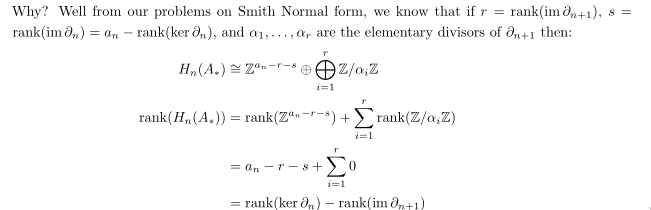
sanity check--if I have free abelian groups A and B a free subgroup then the rank of A/B is is rank(A) - rank(B)
yeah you can do this with like
smith normal form
I just did this
 spiral wolf
Is this true:
Z^2/(5Z x 10Z) = Z/5Z x Z/10Z
viscid pewter
i think they're isomorphic, yes?
spiral wolf
Is it true in general? Say AxB/CxD = A/C x B/D
Is it true in general? Say AxB/CxD = A/C x B/D
old lava
spiral wolf
Is it true in general? Say AxB/CxD = A/C x B/D
(assuming C is normal in A, D is normal in B) you can construct a homomorphism AxB to A/C x B/D which sends (a, b) to (a mod C, b mod D). It's obviously surjective, and looking at the kernel and using first isomorphism theorem gives you the desired result
spiral wolf
Awesome, thank you
 sinful mirage

how did the prof conclude that phi=0 or phi is injective given the ker phi relations?
chilly ocean
That is quite a chicken scratch
chilly ocean
Just that I can't read it, basically the left of "ker phi = U" I can't make out
sinful mirage
ahh,the statement is: phi:v_1->v_2. v_1,rho_1 v_2,rho_2 are irreducible reps. then if v_1 is irreducible(by a previous proposition), it follows that either ker phi=V_1 or ker phi={0}
my question is,how does ker phi=v_1 imply phi=0 and how does ker phi=0 imply phi is injective
hot lake
ker phi = {x in V1 | phi(x) = 0}
sinful mirage
ahhhhhh
lol
fml
and how about the second statement?
ker phi=0=> phi is injective
hot lake
if phi(x) = phi(y) then phi(x-y) = 0
are you doing representations of finite groups without ever doing linear algebra ?
sinful mirage
hot lake
are you doing representations of finite groups without ever doing linear algebra...
i had linear algebra course taught by a physicist and now doing rep of finite groups with a mathematician

hot lake
ah
my condolences
usually those things are drilled into you in a linear algebra course
sinful mirage
hot lake
if phi(x) = phi(y) then phi(x-y) = 0
wait so the definition of injective is if phi(x)=phi(y)=> x=y
where did you use the ker phi=0 condition?
hot lake
it's used when you go from phi(x-y) = 0 to x-y = 0
sinful mirage
ahh lol this is because phi(x-y)=0 implies x-y is in ker(f), but ker(f)=0 => x-y=0
ok yes,i see now,this was way easier than I thought thanks!
by the way @hot lake do you maybe know an 'intuitive' or 'physicist friendly' reference on rep of finite groups? We are following Fulton Harris but it's a speedrun/mega abstract for me, not having strong math background
hot lake
well fulton harris is my goto reference
I know chemists have a pretty warped notion of groups
idk about physicists
sinful mirage
we physicists are not used to def thrm proof rather computations
hot lake
also you usually do a course about groups before doing representations of finite groups
so that you have lots of example of groups
yeah they do proof theorem definition instead
and to get a feel of how groups work and how rich they can get
sinful mirage
how is this a consequence of schur's lemma?

the statement is that if v1,v2 are irreducible reps, phi:v_1->v_2, phi is in hom{G}(v_1,v_2), then it is either invertible or zero. I proved that,but then this should be a consequence of that( i can't see why)
sturdy marsh
What exactly are you trying to prove?
@sinful mirage
are you trying to prove that Hom_G(v_1, v_2) = C for irreps v1 and v2?
scratch that
sinful mirage
so I have proven Schur's lemma, which states let v_1,v_2 be irreducible reps, and phi:v_1->v_2 in hom_{g}(v_1,v_2). then it is either invertible or zero
sturdy marsh
okay
sinful mirage
now my professor said something further(which is a corrolary of Schur's lemma apparently). If there is another homomorphism, $\phi'$ which is either zero or invertible, then $\phi'=\lambda \phi$, with lambda in C
cloud walrusBOT
ProphetX

 sinful mirage
this is how she proved it,but I can't really follow

i'm ok with first line. what does it mean to form 'that map over c?'
and why does it have an eigenvalue surely?
sturdy marsh
any linear operator on a complex vector space has an eigenvalue
jordan form
but yeah anyway, Hom_G(v_1, v_2) is a division algebra over C
C is algebraically closed
so it is iso to C
which means that any two isos are the same up to multiplying by a constant
sturdy marsh
sturdy marsh
but yeah anyway, Hom_G(v_1, v_2) is a division algebra over C
this is by Schur's lemma
sinful mirage
wait,so I looked up jordan canonical form and now I see why it must have an eigenvalue
why does that imply that the map is not invertible?
sturdy marsh
ok I think I see what they were going for
phi ^-1 phi' has eigenvalue alpha
i.e. phi^{-1} phi' - alpha I is not invertible
so phi' - alpha phi is not invertible (multiplying by phi)
so it is zero (by Schur)
sinful mirage
sturdy marsh
i.e. phi^{-1} phi' - alpha I is not invertible
does that follow from eigenvalue equation being satisfied and taking determinant and that being 0?
sturdy marsh
Perhaps a cleaner way is to prove that a division algebra over an algebraically closed field must be the field
Hom(blah, blah) is a division algebra over C by schur
and you're done
sinful mirage
sturdy marsh
Hom(blah, blah) is a division algebra over C by schur
can you please show why this is true?
i'm not familiar with the term division algebra
sinful mirage
which operations would I need to define on hom to make it an algebra?
explicitly
hom_.. is just a set at that point
sturdy marsh
pretty much ring + compatible scalar multiplication
sturdy marsh
sinful mirage
hom_.. is just a set at that point
it's a C[G]-module
sinful mirage
sturdy marsh
it's a C[G]-module
would you have patience to write out the operations explicitly? I can't see it: I know that a module is a vector space over a ring, but my problem is, I do not know how to define the operations on the set itself to make it into such structure
(sorry if this is trivial,i'm coming from a physics background )
sinful mirage
what i mean is to define + and times for hom_G(v_1,v_2) like here
 sturdy marsh
can you put an R-mod structure on Hom(M, N)
sinful mirage
to see how it gives rise to a structure of module using only the +,times on v_1,v_2
so I know Hom(M,N) is a vector space by pointwise multiplication
ohh Hom_{g}(M,N) is a subset of Hom(M,N), because we allow only specific linear maps? then I can use the same pointwise multiplication and addition to get a vector space structure on Hom_{g}(M,N)?
sturdy marsh
sturdy marsh
Hom(blah, blah) is a division algebra over C by schur
I might have screwed up, this is true when blah = blah
v_1 and v_2 are different reps
nvm
this proof doesnt work
sinful mirage
btw,another related question: does this definition for the tensor product seem right?

are the operations defined ok?(i could not find them explicitly in books and tried constructing myself)
sturdy marsh
this isnt the notation im used to
sinful mirage
how would you define the tensor product of two vector spaces?
I can't find a satisfactory answer on the internet,where the operations would be explicitly written out such that to prove that the tensor prod inherits the vector space structure from the 2 vector spaces
sturdy marsh
sinful mirage
yes,I saw this,but I can't really comprehend it
sturdy marsh
umm
sinful mirage
what does 'the free vector space' mean?
F(VXW)
and how to show that the quotient vector space is a vector space,i.e. how does it inherit the structure from the other 2? what is the + and times on the quotient space?
sturdy marsh
okay, you should probably read up on quotients, it's essential to "define" tensor products
but very roughly, you do all the operations on representatives
if [v] and [w] are elements of the quotient
then [v]+[w]:= [v+w]
and scalar mult is given by alpha [v] = [alpha \cdot v ]
and this doesnt depend on choice of representatives
sinful mirage
naively am i allowed to think the + and times are inherited from the field?
or they are from the vector spaces
sturdy marsh
from the vector space, yes
this stuff is worth reading in detail
quotients turn up a lot
sturdy marsh
pretty much any algebra book should do quotients
dummit and foote for example
you can get away with defining tensor products of vector spaces in a weird way but I'm not sure if that's the best way to learn about them
but if V has a basis e_i
and W has a basis f_j
then V (x) W is a vector space on the basis e_i (x) f_j
sinful mirage
ahh and then i add two elements accordingly, (a+_v b,c+_w d)?
and multiply lambda(e_1,f_2)=(lambda dot_v e_1, lambda dot_w e_2)?
sturdy marsh
it's just a vector space on that basis. If it makes you comfortable, set g_{ij} = e_i (x) f_j
then elements of the vector space are F-linear combinations a_ij g_ij
and then a_ij g_ij + b_ijg_ij = (a_ij + b_ij)g_ij
sinful mirage
sturdy marsh
and then a_ij g_ij + b_ijg_ij = (a_ij + b_ij)g_ij
yes this is what I was looking for
thanks! 😄
chilly ocean
Wow! Why do mathematicians have to make things so difficult!
sinful mirage
chilly ocean
Wow! Why do mathematicians have to make things so difficult!
they make things precise and clear 😅 if I ask a mathematician why why why he can always point me to an axiom if he has enough patience
it's just my physics background not having developed seeing clearly
sturdy marsh
this is not a good definition of the tensor product
for example, you seem to be interested in representations
this doesnt work
if you want to tensor representations
sinful mirage
sturdy marsh
for example, you seem to be interested in representations
yes,i'm doing finite group rep theory atm
sinful mirage
sturdy marsh
if you want to tensor representations
yes this is why I wanted to define the tensor product
sturdy marsh
okay you certainly should read about how quotients work
and then read about tensor products of modules
they said representations
so you certainly want to be able to take tensor products of modules
sinful mirage
we're gonna cover rep theory of finite groups then do ver bit of lie group rep theory and classification of complex semisimple lie algebras
so the tensor product of representations will appear often? So far the prof just defined it
 sinful mirage
it's a vector space over a ring(as I know it)
I know there are some fancy other ways to define it (some mathematical physicist told me,but i didnt understand anything of that)
sturdy marsh
no that's pretty much it
sinful mirage
only in differential geometry
in other courses no
first heard the definition of the module $\Gamma(TM)$
cloud walrusBOT
ProphetX
 sinful mirage
basis is not always guaranteed
for vector spaces it can be proven that having a basis is equiv to zorn lemma/axiom of choice
sturdy marsh
the dummit section on tensor products is very good
the exercises in that section should give you some intuition on how to work with them
chilly ocean
@ poros
 unique berry
I need a little help with this.
If I is an ideal of a commutative unitary ring R. Prove I is maximal iff R/I is a field
 unique berry
Ideals in a field?
chilly ocean
maybe a question i ought to have asked before that is, what's the relation between ideals in a quotient ring and ideals in the original ring?
unique berry
They're the same elements just one is a set of cosets right??

 ocean magnet
that comes from (a^k)^s=e
final pasture

The order of a^k will be the smallest x such that (a^k)^x = e
if you already know that (a^k)^s = e
then |a^k| must be atleast equal to s, and may be smaller


 maiden ocean
i found a proof for the reverse direction but it feels incorrect? or rather too strong 
so I feel like i messed up
final pasture
how si S^-1A defined ? {a € A | exists s € S, sa € A} ? 

 final pasture
oh lol
maiden ocean
with respect to a multiplicatively closed subset S
final pasture
yeah ok 
maiden ocean
anyway then for s in S, s/1 is in S^{-1} Ann(M) so that should imply that s is in Ann(M), no?
 dapper nebula
I think you are going 2 far
because the backward direction is just the unraveling of the definition
maiden ocean
i guess
i mean its not like its any harder im just kind of worried im incorrect
actually
doesnt going directly from the defn not work
because you can get like x/1 = 0/1 so xu = 0
but you dont know that u is in the annihilator
just that it annihilates a single element of M
i guess this is where you write x in terms of the generators but that seems like more effort than just using that annihilator commutes with formation of fractions
actually ok
is there a non trivial finitely generated module M with trivial module of fractions?
i guess restating this: if S is multiplicatively closed can you have a non-trivial finitely generated module M with Ann(M) cap S non-empty but not containing 1
golden pasture
Z/2 and {1,2,4,...} ?
sturdy marsh
yeah, or just any torsion abelian group localized at (0)
moth you might be overthinking this
if you have generators x_1 ... x_n
find s_i which kill x_i
and multiply them
maiden ocean
ik but im trying to see where im going wrong
with my other proof
like i can do it manually but id like to figure out what is wrong with what i am doing
sturdy marsh
which proof
sturdy marsh
cloud walrus
**Moth**
this one?
maiden ocean
if S^{-1}M = 0 then S^{-1}Ann(M) = Ann(S^{-1}M) = S^{-1}A
next obsidian
unless you're now onto something else
maiden ocean
i know how to do it another way chmonkey i am just trying to figure out why this one is wrong
next obsidian
wtf is S^-1Ann(M) lol
maiden ocean
module of fractions
next obsidian
like localizing it as an ideal?
maiden ocean
wrt multiplicatively closed subset S
idk maybe
AM says localizing at p is ring of fractions of A wrt S = A - p prime
next obsidian
yes
maiden ocean
so i assume it is the same concept
maiden ocean
M is finitely generated
chilly ocean
final pasture
then |a^k| must be atleast equal to s, and may be smaller
Cant it be like that the order is k and then after you raise it to K then you get e and e^s is just e and s may be anything at all
 chilly ocean
Ohh wait no I got it I mistook order of a^k for order of a
next obsidian
wait so what's the problem you run into?
maiden ocean
so my thought was that if S^{-1}M = 0 then the annihilator is all of S^{-1}A right
next obsidian
yeh
next obsidian
sure
maiden ocean
ok i guess actually im not clear on the details here. do we have to do like for s in S, s/1 = x/t for x in Ann(M), t in S?
we cant just say that s itself is in Ann(M)?
next obsidian
well for Ann(M) you're only dealing with A
next obsidian
okay?
maiden ocean
so s/1 in S^{-1}Ann(M) does not necessarily imply s is in Ann(M)?
next obsidian
right
maiden ocean
okay i think that makes sense
next obsidian
I think it does in the finite case over an integral domain
err... I guess like where you're acting faithfully
actually no
if s/1 is in S^-1Ann(M) = Ann(S^-1M), for any x in M, you know that
s/1x/1 = 0 so that sx/1 = 0 which implies there's a u in S such that usx = 0
but even if you assume integral domain, acting without zero divisors, blah blah
I don't think you can ever conclude sx = 0
maiden ocean
yeah i think i get it
well the thing i wanna prove still follows pretty easily from this because xu in Ann(M) and xu - su = 0 so xu in S
and S cap Ann(M) is non-empty
thank u 
next obsidian
I didn't really do anything other than say random unhelpful things
thank shamrock instead
latent anvil
 next obsidian
Max
latent anvil
Ah yeah
next obsidian
I don't wanna cause a stir tho
You know how ppl have done gimmick names after some of the active users
maiden ocean

next obsidian
we have had a shamrock variant, an ultra variant, a buncho variant
there was a moonbears variant
We should have a Chmonkey variant where you just put Ch in front of it
so I become ChChmonkey
Moth is Chmoth
Sham is Chamrock
latent anvil
nope
golden pasture
is chow group ChCh_i then
 vital fossil
what does it mean to say C-infinity is an algebra? does that just mean C-infinity is a ring?
latent anvil
it's a ring with a vector space structure
Where the ring and scalar multiplication interact correctly
so if c is a scalar and x, y are in the ring, c(xy) = (cx)y = x(cy)
vestal snow
Suppose $U$ and $V$ are universal constructions on a category $C$. Then prove that $U(A) \cong V(B)$ implies $coU(A)\cong coV(B)$ if $coU(A)$ and $coV(B)$ exist
cloud walrusBOT
Have a Banana, Bitch

 chrome hinge
Yup, it can also be understood as a vector space with an extra operation $\cdot : V \times V \longrightarrow V$
cloud walrusBOT
Maikel
 vestal snow
Here's my proof
$U(A)$ and $V(B)$ are the initial or final objects in some category $D$. $coU(A)$ must be the initial or final object in $D^{op}$ and same for $coV(B)$.
cloud walrusBOT
Have a Banana, Bitch
 vestal snow
Is this a valid proof?
final pasture
(why don't you ask in #category-theory ? )
vestal snow
I didn't even know we had a channel for that
final pasture
oh lol, then now you know, ig it's more suited for ct questions than #groups-rings-fields
vestal snow
Thanks
unique juniper
$R = {m + b\sqrt{2} | m,n \in \mathbb{Z}}$
cloud walrusBOT
Yes
 unique juniper
Show $1+ \sqrt{2} $ has infinite order in $R^{\times}$
cloud walrusBOT
Yes
 chilly ocean
Yeah (especially if it says R^*, it cannot be anything else)
unique juniper
ok ty
rustic crown
(the action should be closed if you expect nice things)
viscid pewter
In D8 since the three subgroups of order 2 are abelian, if an element x isn't in the center of D8, the order of the centraliser of x is 4
i don't quite see how the second bit follows from the first
ok so by orbit-stabiliser wrt. conjugation, |number of conjugates of x| = |G : centraliser of x|
so they say the order of the centraliser is either 4 or 8, essentially
implying the number of conjugates of any x is either 1 or 2
... but i don't see how that relates to the subgroups
so if gxg-1 != hxh^-1, uhhh (h-1g)x(h-1g)-1 != x? so what
carmine fossil
centralizer of x contains {1,r^2,x}. So there are atleast 4 elements in centralizer (x)
Since x is not in centre,centralizer order is not 8
So order of centralizer is 4(since centraliser(x) is a group)
@viscid pewter
carmine fossil
Also, Literally every single group of order 2 is abelian
viscid pewter
yes ik
it was basically just a quote
... in fact i still don't see how the order 2 subgroups have anything to do with it
vestal snow
@latent anvil When we were trying to prove that right adjoint implies left exact, we used 0 -> A -> B -> C exact iff Ker(B -> C) = A -> B. Would the analogous statement be A -> B -> C -> 0 is exact iff coker(A -> B) = B -> C?
rustic crown
(looks good to me)
vestal snow
rustic crown
(looks good to me)
Are you replying to my question?
rustic crown
yea
old lava
vestal snow
<@!228562950703546368> When we were trying to prove that right adjoint implies l...
wasn't it ker(B->C) = im(A->B)
next obsidian
You can make the statement with the cokernel
old lava
no I don't mean the cokernel part
I mean the first part where they say ker(B->C) = A->B
maiden ocean
vestal snow
<@!228562950703546368> When we were trying to prove that right adjoint implies l...
yes, you can see this explicitly by using the first isomorphism theorem: if we let f: A -> B, g: B -> C then ckr(f) = B/Im(f) = B/ker(g) = Im(g)
the second equality is equivalent to exactness at B
latent anvil
moth, I think this is in an abelian category
sinful mirage
can someone give hints for c)?

i should check that it is a homomorphism, but I am not given rho(sigma2)
I can deduce it using rho(tau)=rho(sigma1 sigma2)=rho(sigma1)rho(sigma2), but then this seems to be backwards thinking,i already am assuming that it is a homomorphism 😦
hot lake
yeah you have to deduce rho(sigma2) from rho(sigma1) and rho(tau)
sinful mirage
but why am i allowed to do that?
this means that i assume that it is a homomorphism(what i want to prove)
hot lake
a representation is supposed to be a group morphism from G to GL(V)
you want to verify that you can fill the unknown values
so that it is a group morphism
sinful mirage
ah so I can deduce rho(sigma2) and verify that all relations of a homomorphism are met,given rho(sigma1) and rho(sigma2)
right?
hot lake
well you need to find rho of all the group elements
then check the remaining relations that need to hold
hot lake
btw that's faster if you know a presentation of the group
so you don't have a million cases to do
sinful mirage
what i mean is i am finding the rho of all group elements by supposing it is a homomorphism
is that allowed?
hot lake
yes
sinful mirage
if it would say find a homomorphism which has this elements would make sense
but it asks me to check whether this is a homomorphism or not
hot lake
that will force your rho to fulfill some of the constraints of being a morphism
sinful mirage
hot lake
that will force your rho to fulfill some of the constraints of being a morphism
yes
hot lake
but there will still be some leftover to check even after that
sinful mirage
oh ok im actually not that far,i will first check those and then see what is left over
hot lake
here for example, you can use 4 of the constraints to find the remaining 4 values of rho
and you will be left with 36-4 = 32 cases to check if you really wanted to be exhaustive
32 is a lot but since GL(V) is associative it is not actually needed to check them all one by one, that's why having a presentation of G is nice
it lets you cut down on the number of things to check
sinful mirage
what is a presentation?
hot lake
it's a set of generators and a set of relations on them that completely describe the group

 viscid pewter
as a general thing, if things hold for the generators, they often hold for the rest of the group
so like instead of finding the matrices for each of the elements direct
you could just find the matrices for the generators, and combine them in the same way that you combine the generators to get the rest of the group's elements
sinful mirage
viscid pewter
you could just find the matrices for the generators, and combine them in the sam...
right this is what i wanted to do
supposing rho is a homomorphism
but @hot lake said there will be freedom left after this
if I have the matrix rep of all elements of the group
(supposing rho is a homomorphism)
viscid pewter
oh um
hot lake
knowing rho(tau) and rho(sigma1) is enough to find rho of all the rest but then you still have to check that it's a morphism
you oculd have some random stuff for tau and sigma1
viscid pewter
well if you have like two groups, and you have a presentation for one, and you have elements in the other that fulfil the presentation for the first, there's at least a homomorphism i think
hot lake
and things would most likely break
somewhere
you have to check that things don't break
viscid pewter
well if they're both the maximal order that the presentation allows, or whatever, idk
sinful mirage
hot lake
knowing rho(tau) and rho(sigma1) is enough to find rho of all the rest but then ...
what do you mean by having to check its a morphism?
thats only the fact that rho(ab)=rho(a)rho(b) for all a,b in G
ahhhhhhhhhh i see
there are 36 cases because the group has 6 elements, and ab can take 36 values
omg
i only checked 4 by constructing the elements
now i see your point
and what is the alternative of not checking all this?
hot lake
you check that they satisfy what the presentation says to satisfy
sinful mirage
rho(sigma1 sigma1)=rho(e)=rho(sigma2 sigma2)?
hot lake
and the one that they gave you
sinful mirage
ok great
hot lake
well rather
hot lake
rho(sigma) rho(sigma1) = rho(e)
sinful mirage
hot lake
rho(sigma) rho(sigma1) = rho(e)
ah ye
hot lake
and rho(sigma2) rho(sigma2) = rho(e)
sinful mirage
yse now i know what to check
but i cant see why checking this would suffice for all 36 cases
hot lake
because the fact that it's a presentation means that you can deduce all the identities you want from those 3 relations and associativity
so if you can check those 3 relation on the image of rho side
you automatically have associativity because GL(V) is a group so associative
so any identity that is true in G has to be true on the image of rho side
sinful mirage
hot lake
because the fact that it's a presentation means that you can deduce all the iden...
ok so here's a probably trivial statement i cant see
given the presentation on the group,if the presentation is true in image too(i.e. on rep)
why does it follow that all rep elements can be obtained using them?
hot lake
a presentation is generators + relations
sinful mirage
so if i am given the generators+relations satisfied in the group G
and I check that some relations hold for the rep
why does it follow that all representatives can be obtained using the relation on rep?
ohhh
is it because then the images of generators behave as the generators( the same way) thus they generate all images too? @hot lake
the thing is that they can be any objects as long as they satisfy those relations is what i understand
hot lake
since the generators generate the group, any group element can be written as a composition of them
so there is always some way to build rho of the group element
and if there are two ways, then there is a relation in the original group ; that relation is a consequence of the relations given in the presentation
so if your rho(gi) satisfies those relations from the presentation, then it follows that the two ways to build it give the same result
sinful mirage
yes,now it makes sense,thanks!
 quaint tree
A bit of a general question, but what sorts of things are typically covered in a second undergraduate abstract algebra course?
As in, the one that's just vaguely called "abstract algebra II" and whose course description is "a continuation of the material from abstract algebra I"
chilly ocean
I think usually stuff like topics in groups/rings/modules/fields that were skipped in a first course, in particular galois theory is not typically covered in a first course. And maybe some commutative algebra type stuff
quaint tree
Oh cool, so that's basically what I want to take, then.
I'm planning out my courses for next year and didn't know whether to take a vague "abstract algebra II" or try to get an independent study in Galois theory in.
chilly ocean
But the contents of such a course probably depends on the school, so maybe it is good to check if it matters to you
quaint tree
I mean, I'm sure I'd be interested either way. I used to be the kind of person who said that I wanted to learn as much math as is humanly possible, and while I still think that's a good goal, I just didn't realize how much math there is out there and realize that I'll have to be a bit choosier about it at some point down the line.
cloud walrusBOT
Yes
 unique juniper
how do i exactly determine the elements of this?
 wind steeple
Z_2 = Z/2Z ?
unique juniper
yes
unique juniper
ok
chilly ocean
Well, every coset in this thing can be represented by a degree <= 1 polynomial
 keen bloom
I'm a Math major (Undergrad only) turned software engineer but I'm trying to apply some of the concepts that I learned in my degree to my work. One of the things we discussed in Abstract Algebra, and that I'm sure everyone in here is aware of is "idempotence", e.g. that if
if f(a) = b, then f(b) = b
Is there a concept of "partial" idempotence for functions of higher arity? E.g.,
if f(a, b) = c, then f(a, c) = c
I've been jokingly calling this "spiritually" idempotent (as in points to the spirit of idempotence), but I was wondering if there was more appropriate terminology. I've also referred to this as f is idempotent over b, but that may also be confusing and wrong.
unique juniper
chilly ocean
Well, every coset in this thing can be represented by a degree <= 1 polynomial
right yes i see
so ig its just 0 1 x and x+1
chilly ocean
keen bloom
I'm a Math major (Undergrad only) turned software engineer but I'm trying to app...
I guess "idempotent over b" sounds sort of correct in that this property is equivalent to the idempotence of the functions $b \mapsto f(a, b)$ for each a
cloud walrusBOT
8da 💕
 keen bloom
chilly ocean
I guess "idempotent over b" sounds sort of correct in that this property is equi...
keen bloom
chilly ocean
I guess "idempotent over b" sounds sort of correct in that this property is equi...
I suspected as much, I was just wondering if there was a more formal definition/terminology of such behavior of f.
chilly ocean
It sounds sort of similar to things like "the function (x, y) mapsto f(x, y) is said to be lipschitz in the second coordinate if y mapsto f(x, y) is lipschitz for each x" (or maybe we only say this if there is a fixed lipschitz constant uniformly over all x?)
keen bloom
I suspect, in my documentation, I'll refer to this as
f is idempotent over
bfor each a in A.
old lava
firstly, it makes no sense to think of x^2 as an element of the quotient
it's a REPRESENTATIVE of an element in the quotient
unique juniper
yeah
old lava
next, the coset that x^2 represents is the same as the coset containing x^2 + (x^2 + 1) = 1
you can always just eliminate all the powers of x higher than 1 by adding/subtracting multiples of x^2+1
to find a representative with degree < 2
unique juniper
ok
chilly ocean

Why must each cyclic subgroup have 4 elements?
Is it because a subgroup of order 10 has four generators?
unique juniper
wdym
chilly ocean
But it does, 1 3 7 9 in Z10
 shut halo
I'm trying to show that the generators of a semi-simple Lie Algebra are traceless. What I know that if I have $[T_a, T_b] = f^c {ab} T_c$ then we must have that $f^c{ab} Tr(T_c) = 0$ since the tr(AB) = tr(BA) is always zero but not quite sure how to proceed from here.
cloud walrusBOT
snypehype
 chilly ocean

How did they get that x^20=1
What does an element of U(100)=Z2 x Z20 look like?
Something like (1,19) maybe
For sure, and now what happens if we take it to ^20 (or more like multiply by 20 since we are working in additive groups)?
It becomes (0,0) right?
Yeah, and this makes sense right?
Bruh😭
old lava
it becomes 1, 1
chilly ocean
Something times 20 is divisible by 2, and sometimes times 20 is divisible by 20
Yea
How does this imply 1 tho
chilly ocean
old lava
it becomes 1, 1
I guess this depends on what we mean by 1
old lava
I know exactly 0 people in existence who write U(100) additively
chilly ocean
For sure, but we are talking about additive group Z2 x Z20
Wait so x^20=(0,0) how is (0,0) 1
help pls
Poros just meant (0,0) is the identity in Z2 x Z20. And that in the isomorphism Z2 x Z20 = U(100) the element (0,0) would map to 1 in U(100)
Ohhh thank you
vestal snow
maiden ocean
yes, you can see this explicitly by using the first isomorphism theorem: if we l...
- I want to avoid taking quotients because we're they might not exist in our category
- the definition of exact I'm using is ker(f_i) is isomorphic to Im(f_{i-1}) so I don't think we can say that B/Im(f) is isomorphic to B/Ker(g)
maiden ocean
Yeah sorry I wasn't aware that you were working in a general abelian category
or preabelian or whatever idk there are like 12 conditions
regular??
 prisma ibex
there is some general abstract nonsense about which kinds of categories the various isomorphism theorems are valid in
this is certainly true for Abelian categories but also true for much weaker categories
iirc this is true for protomodular categories in the sense of Borceaux/Bourne
next obsidian
vestal snow
1) I want to avoid taking quotients because we're they might not exist in our ca...
It’s actually common to write things as a quotient for cokernels in abelian categories precisely because the first iso holds in them. But yes, in general you’d wanna avoid them
vestal snow
vestal snow
<@!228562950703546368> When we were trying to prove that right adjoint implies l...
Can someone help me work this out i detail?
right adjoint implies left exact was pretty straightforward
But since the definition of exact sequences is given in terms of kernels and images and left adjoints preserve cokernels, I can't prove that left adjoint implies right exact
latent anvil
Did your first proof happen in an arbitrary abelian category?
Or just in eg the category of modules
vestal snow
arbitrary abelian category
Give me a sec. I'll type up my proof for the first one
Taking a quiz so it might be more like 30 mins
next obsidian
If it happened in an arbitrary abelian category I'm pretty sure the other one follows by duality
more generally, I think you should just show that right adjoints preserve limits
or I guess in this case that a left adjoint preserves colimits
But either way, the other follows by duality
vestal snow
Duality just seems really weird in this case
vestal snow
vestal snow
<@!228562950703546368> When we were trying to prove that right adjoint implies l...
I'm sure it works, but I think working out the details of the duality argument would boil down to proving this