#groups-rings-fields
406252 messages · Page 407 of 407 (latest)
 next obsidian
 somber goblet
where each point has a residue field of different characteristic
next obsidian
But like if you do stuff over Z you will end up in the mixed characteristic case as soon as you localize
Mixed characteristic rings are local rings where the char of the ring is different from that of the residue field
next obsidian
Equivalently, it’s rings which do not have a field inside of them
All mixed char rings end up being char (0,p) or (p^n,p)
And regular rings are integral domains so they are all (0,p)
They show up in arithmetic mostly
Or if you’re sick like me
somber goblet
next obsidian
And regular rings are integral domains so they are all (0,p)
oh i see makes sense
so the stalks of Spec ℤ are mixed characteristic, for instance
next obsidian
Sure
The local rings, or stalks of the structure sheaf
But in some sense Spec Z like, interpolates over all mixed char and equicharacteristic
When you look over all points
somber goblet
wdym? like because it has a generic point with residue field ℚ?
next obsidian
Yeah
And you can go over all characteristics
But this is something an arithmetic person knows more about
somber goblet
very cool, i see
 vernal vector
Can someone tell me how the Variable Elimination Theorem relates to how you can use the Grobner basis of ideals I = (f_1, f_2,.. f_n) to basically do Gaussian elimination on the system of polynomial equations f_1 = 0, f_2 = 0,.. f_n = 0 to solve it? Like i feel like i have somewhat of an idea of how it is related. But just, it is kinda vague.
Like i know basically you can do this trick to solve a system of polynomial of equations. To reduce it to an equivalent system of equations with the new polymonial rely of less and fewer variables.
Like f_1 = x^2 + y^2 + z^2 - 1 = 0, f_2 = x^2 - y + x^2 = 0, f_3 = x - z = 0
Can be reduced to g_1 = 4z^4 + 2z^2 - 1 = 0, g_2 = -y + 2x^2 = 0 and g_3 = x - z = 0.
And since basically you have the last polynomial only rely on variable z, you can solve it normally and sub it to the other equations. However, I still really don't get how Gronber basis of I = (f_1, f_2, f_3) and the variable elimination theorem help in getting to here
 granite notch
Hey guys, I wanted to know is this stand for infinite cyclic group and how we prove it
Anyone know hwo to solve this question?
 elfin wraith
granite notch
Anyone know hwo to solve this question?
elfin wraith
granite notch
Anyone know hwo to solve this question?
What’s the question? Did you mean to post an image or something?
elfin wraith
It’s really not clear to me what you’re asking, sorry.
Are you asking if there is an infinite cyclic group, and if subgroups of a cyclic group are also cyclic?
 foggy tartan
you learned about the infinite cyclic group in grade school, it's more commonly called Z
if you realize some cyclic group G as comprising powers of a principal element x in G, then the subgroup generated by any element (or set of elements) of G will only consist of powers of x, so must be cyclic
 flat anvil
foggy tartan
you learned about the infinite cyclic group in grade school, it's more commonly ...
flat anvil
foggy tartan
you learned about the infinite cyclic group in grade school, it's more commonly ...
Same energy as "you learned about fields in grade school, its called R"
 bitter fog
"Prove that every group of even order contains an element of order two."
Can anyone help me get started
bitter fog
granite notch
The subgroup of cyclic group also the cyclic gry
Let G be a cyclic group and so $G=\langle g\rangle.$ We need to prove that subgroups of G are also cyclic. Suppose H is a subgroup, if $H={id}\implies H=\langle id\rangle$ and $H= G\implies H=\langle g\rangle$. Now, let $H\neq G,{id}.$ Now there exists a $g^k$ with $1\leq k \leq n-1$ with $n = |G|$. Let $m = \min{k\neq 0|g^k\in H}$. We prove that $H = \langle g^m\rangle$. Let $g^k\in H, k\geq m$. so $k = mq+r$ with $q\geq 0$ and $m-1\geq r\geq 0$. Let $r\neq0\implies g^m \in H\implies g^{-m}\in H \implies (g^{-m})^{q} = g^{-mq}\in H$ Now because $g^{mq+r}\in H$ and $g^{-mq}\in H \implies g^{mq+r}\cdot g^{-mq}=g^r\in H$ Contradiction, because m is minimal. So $r=0\implies g^k=g^{mq}=(g^m)^q\implies H = \langle g^m\rangle$.
 cloud walrusBOT
arachi

 languid trellis
bitter fog
"Prove that every group of even order contains an element of order two."
languid trellis
bitter fog
"Prove that every group of even order contains an element of order two."
Pair elements up with their inverses then count
granite notch
bitter fog
Let G be a cyclic group and so $G=\langle g\rangle.$ We need to prove that subgr...
I c your proof
And I'm not sure how this proof extends to the infinite cyclic group
bitter fog
granite notch
I c your proof
I was also working on in just now
granite notch
Your question is the motivation make me think this question
languid trellis
You tell me
granite notch
No for no generator?
languid trellis
I don't understand
bitter fog
Theres no singular element in R that can generate every element of R
bitter fog
no
Really, the only cyclic groups (up to isomorphism) are $\mathbb{Z}$ and $\mathbb{Z}/n\mathbb{Z}$
cloud walrusBOT
arachi
 bitter fog
Where Z is infinite and Z/nZ finite
granite notch
I learn a little of group theory for a long time ago
And i forgot part of them
Btw how you type this latex efficiently
bitter fog
wdym
bitter fog
granite notch
I learn a little of group theory for a long time ago
Im studying this right now, https://github.com/vendramin/group/blob/main/notes.pdf
GitHub
Group theory (VUB). Contribute to vendramin/group development by creating an account on GitHub.
granite notch
bitter fog
Really, the only cyclic groups (up to isomorphism) are $\mathbb{Z}$ and $\mathbb...
How to type this format quick
bitter fog
if u use latex then you have to put it between $$
bitter fog
bitter fog
Im studying this right now, https://github.com/vendramin/group/blob/main/notes.p...
it starts from 0 and everything is explained very well
flat anvil
granite notch
How to type this format quick
Check the pins in #latex-help i think
bitter fog
Prove that every group of even order contains an element of order two. Let G be a group of even order. Then $G={id}\cup{g}\cup{g_1,g_1^{-1},\dots}$ The last set always comes in pairs of an element and its inverse. So the elements of that set must have an even order > 2. The identity has order one, so therefore g must have order 2, otherwise |G| wouldn't be even anymore.
@languid trellis
Is this right?
next obsidian
You have the right idea but you need to write it differently
languid trellis
You need to justify that decomposition more. I agree with you that it can be decomposed in a way, but at this stage you've essentially assumed your conclusion.
next obsidian
Also what you’ve said isn’t quite true
A group can have more than a single element of order 2
You can’t justify that each of those g_i come in pairs
cloud walrusBOT
arachi

 south patrol
next obsidian
A group can have more than a single element of order 2
south patrol
next obsidian
A group can have more than a single element of order 2
Prove it
next obsidian
Technology hasn’t gotten that far
 delicate orchid
south patrol
Prove it
delicate orchid
south patrol
Prove it
It follows from the CFSG
elfin wraith
south patrol
Prove it
You expect me to count to 4?? Are you mad???
Typical elitism in maths
bitter fog
"prove that a group with finitely many subgroups is finite"
I started with trying to prove the contrapositive
So if G is infinite, then G has an infinite amount of subgroups
idk what to do
next
 tribal moss
Perhaps look just at the cyclic subgroups, and show there must be infinitely many of those.
bitter fog
but what if every element of G has a finite order
tribal moss
Then every cyclic subgroup will be finite.
And each element of G will be in at least one of them.
bitter fog
wdym?
elfin wraith
Theres still infinitely many of them, but also ignore me, its not particuarly helpful here I dont think
Tropos hint is good
 tough raven
south patrol
Prove it
tough raven
south patrol
Prove it
MFW F_2-vector spaces
tribal moss
<@&268886789983436800> (scam, already gone).
south patrol
delicate orchid
It follows from the CFSG
Ah ok
tribal moss
Inspired by conversation above: Can a group have a nonzero but even number of order-2 elements?
It's easy to see it would have to be infinite and nonabelian, and with a bit more footwork also that it cannot have exactly 2 order-2 elements. But that footwork doesn't feel promising for generalizing.
 quiet pelican
tribal moss
Inspired by conversation above: Can a group have a nonzero but _even_ number of ...
quiet pelican
tribal moss
Inspired by conversation above: Can a group have a nonzero but _even_ number of ...
No
It can’t, this was actually an exercise (albeit a hard one) in our first year groups
elfin wraith
Something to do with the order of their product right? I vaguely remember doing this at one point
quiet pelican
Fix an order 2 element a (if there are no order 2 elements, we’re done)
Let X be the set of order 1 and 2 elements that commute with a
Let Y be the set of order 2 elements that don’t commute with a
You can verify that the following is an order 2 bijection from the set of order 1 and 2 elements to itself with no fixed points (and hence the number of order 1 and 2 elements is even, so the number of order 2 elements is odd)
If b \in X, send b to ab
If b \in Y send b to aba
quiet pelican
elfin wraith
Something to do with the order of their product right? I vaguely remember doing ...
Are you thinking of the exercise where every element in the group is order 2?
elfin wraith
Possibly yeah
quiet pelican
quiet pelican
Fix an order 2 element a (if there are no order 2 elements, we’re done)
Let X be...
Assuming the number of order 2 elements is finite of course
If it’s infinite the question doesn’t make sense
tribal moss
quiet pelican
Fix an order 2 element a (if there are no order 2 elements, we’re done)
Let X be...
Neat, thanks.
 kind temple
bitter fog
Prove that every group of even order contains an element of order two. Let G be ...
kind temple
bitter fog
Prove that every group of even order contains an element of order two. Let G be ...
the relation x ~ y iff x = y or x = y^{-1} is an equivalence relation on a group.
 balmy wraith
bitter fog
"prove that a group with finitely many subgroups is finite"
balmy wraith
bitter fog
"prove that a group with finitely many subgroups is finite"
Lagrange’s theorem
delicate orchid
How do you plan on using Lagrange’s theorem here
flat anvil
bitter fog
"prove that a group with finitely many subgroups is finite"
-# My ahh tried to think of power sets here but idk if that helps
 vocal pebble
You can take the cyclic subgroups generated by every element, the collection is finite, each member is finite, so the group is finite
 rocky cloak
Finite union of finite sets is finite!
 vestal jay
Could someone help me with the "Conclude..." part? What I know as the commutator subgroup is for elements a,b in G aba^-1b^-a in [G,G]. Theorem 7.12 refers to the universal property of quotient groups and the proposition is about the definition of product in a category
 next obsidian
I don’t see how that could be the correct thing for the proposition
But this just comes down to the definition of ^ab
Or I guess F^ab
languid trellis
I was going to say, surely the abelianisation is defined to be F/[F,F]?
next obsidian
You should show that G/[G,G] for any group G has the property it uniquely factors maps from G into abelian groups
south patrol
so does G
next obsidian
As an abelian group
Fuck you potato
Chain that with F(A) uniquely giving rise to maps from maps A into any group
And you end up having a sentence that is isomorphic to what defines F^ab
 noble nexus
I would imagine F^{ab} here means the free abelian group on A
so here you're just showing that the abelianization of the free group is the free abelian group
 frail shoal
does there exist a group G and a subgroup N such that [G : N] = 2, the map G -> G/N does not split, and G has exactly 3 normal subgroups
noble nexus
3 nontrivial or 3 total
 azure cairn
frail shoal
does there exist a group G and a subgroup N such that [G : N] = 2, the map G -> ...
azure cairn
frail shoal
does there exist a group G and a subgroup N such that [G : N] = 2, the map G -> ...
Z4?
 velvet hull
frail shoal
does there exist a group G and a subgroup N such that [G : N] = 2, the map G -> ...
velvet hull
frail shoal
does there exist a group G and a subgroup N such that [G : N] = 2, the map G -> ...
How are you counting the subgroups?
Because the quaternion group is the smallest example of a non split SES and it sounds like that’s what you’re looking for here
cloud walrusBOT
 azure cairn
and then you have $N = \angled{x^2} \cong \bZ_2$
cloud walrusBOT
 frail shoal
ok i just realized i made a few oopsies
frail shoal
noble nexus
3 nontrivial or 3 total
3 total
frail shoal
azure cairn
Z4?
yea that works
frail shoal
velvet hull
Because the quaternion group is the smallest example of a non split SES and it s...
that has a lot more than 3
even if we count nontrivial only, we have <-1>, <i>, <j>, <k>
anyway im sorta XY-ing so the fact Z/4 works actually doesnt resolve my question, so i need to be more precise
frail shoal
frail shoal
does there exist a group G and a subgroup N such that [G : N] = 2, the map G -> ...
does there exist an infinite family of such groups G
frail shoal
frail shoal
anyway im sorta [XY-ing](https://en.wikipedia.org/wiki/XY_problem) so the fact Z...
if yall want i can un-XY and just share what im thinking about, but, ill do that later
rocky cloak
frail shoal
does there exist a group G and a subgroup N such that [G : N] = 2, the map G -> ...
Z/4
frail shoal
my excuse is tunnel vision
frail shoal
doesnt that split
rocky cloak
Right, you didn't want the map to split
frail shoal
yea
 swift root
those darn semidirect products
frail shoal
frail shoal
if yall want i can un-XY and just share what im thinking about, but, ill do that...
ok yea so my motivation is this:
I've been thinking about the connected components of Grp / G as a preorder, given a particular group G. here G = Z/2
rocky cloak
frail shoal
I've been thinking about the connected components of Grp / G as a preorder, give...
Everything maps to the identity on Z/2 though
 dull ginkgo
swift root
those darn semidirect products
dull ginkgo
swift root
those darn semidirect products
Zamn
frail shoal
frail shoal
I've been thinking about the connected components of Grp / G as a preorder, give...
I've managed to prove that, given a particular surjective group hom 𝛗: G → Z/2, we can always take some g ∈ G such that g ∉ ker 𝛗 and we get a group hom <g> → Z/2 that's also surjective
dull ginkgo
That’s some twisted shit. Never crosses my mind
frail shoal
rocky cloak
Everything maps to the identity on Z/2 though
well the 0 map always pulls back to other 0 maps
the interesting behavior is surjections
rocky cloak
But there's only one connected component
frail shoal
frail shoal
I've managed to prove that, given a particular surjective group hom 𝛗: G → Z/2,...
the hard part is going the other way, and my gut tells me that there should be a large class of groups you can't go the other way
frail shoal
rocky cloak
But there's only one connected component
oh ok i mean like. strongly connected
oops
i see the confusion now
rocky cloak
Okay, then I think I understand what you're thinking of
frail shoal
when G = Z there is only finitely many classes cuz each subgroup of Z is projective
rocky cloak
So then Z -> Z/2 and Z/2^i -> Z/2 should all be relevant
frail shoal
yea i agree
rocky cloak
So the restriction of just 3 normal subgroups is very strong
frail shoal
it would feel weird if these are the only classes but idk much in-the-weeds group theory
frail shoal
rocky cloak
So the restriction of just 3 normal subgroups is very strong
yea definitely not the only way a unique example could arise
i was just tryna brainstorm what could go wrong
rocky cloak
Q8 -> Z/2 and I guess most groups that are not semidirect product with Z/2^i should also give you something
Feel like all the generalized quaternion groups should give you different things as well
frail shoal
rocky cloak
Q8 -> Z/2 and I guess most groups that are not semidirect product with Z/2^i sho...
ok yea that makes sense
 dire wren
12c, this doesn't look like a group action to me
In particular I can take phi maps everything to the identity automorphisms, and conjugation doesn't associate?

Am I wrong?
Or do you guys think serge meant x1(phi(h1)(x2))
I just realised the qn numbers were cut off, the c problem just below (semi)direct product
rocky cloak
dire wren
Or do you guys think serge meant x1(phi(h1)(x2))
This is the standard formula at least. So presumably just an extra superscript slipt in
dire wren
K, thx
 torpid radish
Are there something like 'free fields' just like free groups and free modules?
I tried to come up with some constructions but I failed
quiet pelican
torpid radish
Are there something like 'free fields' just like free groups and free modules?
There shouldn’t be free fields
tribal moss
No, that's not possible.
torpid radish
Aha
quiet pelican
What characteristic would they be?
You can’t have a map between fields of different characteristic
In general, the category of fields tends to be very badly behaved, and a lot of standard ‘categorical* constructions don’t exist for fields
tribal moss
A free field on {*} would be a field F with a distinguished element x such that for every field K and every k in K there is a unique field morphism F ->K that takes x to k.
Even if we only consider fields of a fixed characteristic, that still wouldn't work because both k=0 and k=1 would need to be possible.
torpid radish
quiet pelican
You can’t have a map between fields of different characteristic
Ah ok I got it now
torpid radish
tribal moss
A free field on {\*} would be a field F with a distinguished element x such that...
Thanks for help!! :)))
tribal moss
Intuitively, one might expect Q(x,y,z) to be "more or less" what a free (characteristic 0) field generated by {x,y,z} ought to be -- but that doesn't match the categorical concept of "free" as left adjoint to a forgetful functor. It's not even functorial in the first place: there's no field morphism from Q(x,y) to Q(x), even though there are set morphisms {x,y}->{x}.
torpid radish
It feels that fields are extremely restrictive when it comes to their morphisms.
 wraith cargo
torpid radish
It feels that fields are extremely restrictive when it comes to their morphisms.
wraith cargo
torpid radish
It feels that fields are extremely restrictive when it comes to their morphisms.
They're all injective or trivial!
tribal moss
They're all injective, period.
wraith cargo
Unfortunately due to my religious views I believe in the existence of trivial morphisms
kind temple
wraith cargo
Unfortunately due to my religious views I believe in the existence of trivial mo...
you don’t require 1 to go to 1?
torpid radish
wraith cargo
Unfortunately due to my religious views I believe in the existence of trivial mo...
What a sweet religion! But sadly I can not believe it :))
elfin wraith
wraith cargo
Unfortunately due to my religious views I believe in the existence of trivial mo...
My UG algebra course beat this into me, and despite requiring 1 to go to 1 now (like a normal person) I can’t stop myself from throwing in the word nontrivial
south patrol
elfin wraith
My UG algebra course beat this into me, and despite requiring 1 to go to 1 now (...
😔
dull ginkgo
elfin wraith
My UG algebra course beat this into me, and despite requiring 1 to go to 1 now (...
URing morphisms have that constraint right
Or you know
Ring
Not just random number generator
south patrol
Lol
rocky cloak
kind temple
you don’t require 1 to go to 1?
Or they mean something else than us when they talk about the field with one element
somber goblet
dull ginkgo
URing morphisms have that constraint right
yeah
 tardy hedge
Given a ring map f: R->S and a unit s in S there is a unique map R[x,x^-1]->S sending x to s and restricting to f on R, right?
Would this just be called the universal property of laurent polynomial extensions or something
quiet pelican
tardy hedge
Given a ring map f: R->S and a unit s in S there is a unique map R[x,x^-1]->S se...
Yes
Just define it in the obvious way
quiet pelican
tardy hedge
Would this just be called the universal property of laurent polynomial extension...
I’d probably call it something like this if you asked me to give you a name, but I don’t think it has a standard name
tardy hedge
Ok, yeah cause I want to use this but im not sure if I should give it a name or how I should phrase it I guess
south patrol
tardy hedge
Would this just be called the universal property of laurent polynomial extension...
If you want it's like uh the poly ring R[x] has the universal property that like a map R[x] -> S "is the same as" a map R -> S along with a choice of s in S. And then you combine this with universal property of localisation at an element
(I guess okay that last bit maybe needs some care in the noncommutative setting but x is central so should be chill)
also as it is important: another way to state this is that R[x, x^-1] corepresents the "group of units" functor -- often denoted Gm or (-)^x -- from R-algebras to groups (and more precisely, the bijection Hom(R[x, x^-1], S) -> Gm(S) is given by evaluation at x)
somber goblet
this should also have to do with R[x, x^-1] being the free group algebra on one generator
noble nexus
tardy hedge
Given a ring map f: R->S and a unit s in S there is a unique map R[x,x^-1]->S se...
This is basically just the universal property of polynomial rings combined with the localization
or polynomial rings + the quotient, whichever you prefer
Since R[x,x^{-1}] is either the localization of R[x] at x or the quotient of R[x,y] by the ideal generated by xy-1 (and yx-1 if noncom)
kind temple
are the prufer p-groups the only infinite groups whose proper subgroups are finite?
rocky cloak
kind temple
are the prufer p-groups the only infinite groups whose proper subgroups are fini...
There's also Tarski's monsters
kind temple
rocky cloak
There's also Tarski's monsters
wow. what a name
is there a classification of such groups?
 rotund aurora
rocky cloak
There's also Tarski's monsters
rotund aurora
rocky cloak
There's also Tarski's monsters
is there an easier example? I mean, Tarski gives a very strong counter-example (the proper subgroups are all Z/pZ)
kind temple

okay, so they are the only infinite abelian groups whose proper subgroups are finite
this might be an interesting exercise to try and prove
rocky cloak
Yeah the Prüfer groups are the only abelian ones shouldn't be too hard to see
rotund aurora
kind temple
Tarski is finitely generated
kind temple
rotund aurora
Tarski is finitely generated
i find this kind of bizarre
rocky cloak
Generated by just 2 elements even
rotund aurora
for the abelian case, you can reduce to the torsion p-primary case. Then consider the sequence C_0 subset C_1 subset ... where C_n is the set of p^n-th roots of unity in G. If each C_n is cyclic you are done. If one is not cyclic, then all starting at some level n are not cyclic. You should be able to find a subsequence of the C_i consisting of nested cyclic subgroups, which violates the hypothesis. Idk if this is immediate, but I think you can do it by some sort of combinatorial compactness argument + the structure of finite abelian p groups
ie, like say C_1=Z/pZ oplus Z/pZ. Idk if it's obvious that one of these parts should have p^n roots for all n, but you should be able to change the decomposition so that this holds
rotund aurora
rotund aurora
is there an easier example? I mean, Tarski gives a very strong counter-example (...
Apparently Tarski groups are periodic
rocky cloak
Every element has order p
rotund aurora
Your question is known as Schmidt's problem. The first example was so that every proper subgroup had prime order. I'm not sure if they meant prime order for a fixed prime p, and idk if there's an implication. Didn't look any further.
https://www.mathnet.ru/php/archive.phtml?wshow=paper&jrnid=im&paperid=1668&option_lang=eng this is not the first paper, but it's short and in English
This is the first paper https://www.mathnet.ru/php/archive.phtml?wshow=paper&jrnid=dan&paperid=42623&option_lang=eng It's in Russian but it's just 3 pages. Idk if it's self-contained
rocky cloak
I thought you said Tarski monster. Anyway it's clear from the definition that the group is periodic
rotund aurora
what does periodic mean?
rocky cloak
Every element having finite order
rotund aurora
I thought it meant there exists some n such that g^n=1 for all g
rocky cloak
Okay, I see.
Then that's interesting I guess
rotund aurora
idk if this implication holds, forget what I said about periodicity, I misread
 copper kestrel
Why does $$\prod_{i=1}^{n} A_i = \bigoplus_{i=1}^{n}A_i$$ only work for a finite number of abelian groups?
cloud walrusBOT
tabby tabby
 tribal moss
Are you asking for an intuitive way to look at it, or for a more rigorous argument that the same group won't satisfy the universal properties of both product and coproducts?
It's also relevant for answering to know just how you're defining \prod versus \bigoplus here. By universal properties or by concrete constructions? (Perhaps one of each?)
 verbal valley
copper kestrel
Why does $$\prod_{i=1}^{n} A_i = \bigoplus_{i=1}^{n}A_i$$ only work for a finite...
verbal valley
copper kestrel
Why does $$\prod_{i=1}^{n} A_i = \bigoplus_{i=1}^{n}A_i$$ only work for a finite...
Elements of $\prod_{i=1}^{\infty} A_{i}$ are infinite sequences $(a_{i})$ where $a_{i}$ lives in $A_{i}$. Elements of $\bigoplus_{i=1}^{\infty} A_{i}$ are infinite sequences $(a_{i})$ where $a_{i}$ lives in $A_{i}$ for all $i$ and all but finitely many of the $a_{i}$ are zero.
cloud walrusBOT
millie :3
 verbal valley
with finite products and direct sums the "all but finitely many are zero" condition does nothing, but obviously there are infinite sequences where infinitely many terms are nonzero, and those live inside the product but not the direct sum
copper kestrel
tribal moss
Are you asking for an intuitive way to look at it, or for a more rigorous argume...
mostly intuitive, i do not know any category theory so idk what coproducts are
tribal moss
Okay.
copper kestrel
cloud walrus
**millie :3**
ohhhhhh
copper kestrel
verbal valley
with finite products and direct sums the "all but finitely many are zero" condit...
that makes sense! thank you so much
tribal moss
One way to justify the all-but-finitely-many condition is that the direct sum is supposed to be the smallest subgroup that contains each of the summands.
So since we can get a subgroup without allowing inifinitely many nonzero elements, we should.
copper kestrel
tribal moss
One way to justify the all-but-finitely-many condition is that the direct sum is...
oh i see!
bitter fog
what's y'alls favorite group
wraith cargo
bitter fog
what's y'alls favorite group
F_1
wraith cargo
bitter fog
its impossible to have a field with one element
In mathematics, the field with one element is a suggestive name for an object that should behave similarly to a finite field with a single element, if such a field could exist. This object is denoted F1, or, in a French–English pun, Fun. The name "field with one element" and the notation F1 are only suggestive, as there is no field with one el...
Read it and weep bucko
 fickle dirge
bitter fog
its impossible to have a field with one element
fickle dirge
bitter fog
its impossible to have a field with one element
my professor said I don't see an issue with allowing a field with one element 😅
bitter fog
wraith cargo
https://en.wikipedia.org/wiki/Field_with_one_element
quite fascinating..
frail shoal
bitter fog
what's y'alls favorite group
(Z, +) is the first one my brain came up with when i asked it for a "group"
honestly it's quite nice so ill accept this answer it gave me
 marsh fulcrum
Friendly reminder that spurs are NOT relegated and will play the next season in the Premier League
Glory Glory Tottenham Hotspur
 fading acorn
bitter fog
what's y'alls favorite group
fading acorn
bitter fog
what's y'alls favorite group
Hodge Galois group
 karmic moat
wraith cargo
F_1
karmic moat
wraith cargo
F_1
i think im going to be sick
 velvet tusk
bitter fog
what's y'alls favorite group
velvet tusk
bitter fog
what's y'alls favorite group
$(Z_{1},+_{1})$
cloud walrusBOT
chudcel
 tribal moss
Is that the 1-adic integers?
 chilly radish
They have residue field F_1
somber goblet
do p-adics have residue field F_p at all points
rocky cloak
somber goblet
do p-adics have residue field F_p at all points
There's only one closed point.
At the generic point I quess you would say the residue field is Q_p (so just the field of fractions)
somber goblet
rocky cloak
There's only one closed point.
At the generic point I quess you would say the ...
how about the residue field at the localizations?
rocky cloak
somber goblet
how about the residue field at the localizations?
What is "the localizations"?
Z_p has two prime ideals: (p) and (0)
somber goblet
oh, i see
oh yeah that makes sense
right
what's $\operatorname{Frac} \bZ_p / (p)$?
cloud walrusBOT
lexi
 rocky cloak
somber goblet
what's $\operatorname{Frac} \bZ_p / (p)$?
rocky cloak
somber goblet
what's $\operatorname{Frac} \bZ_p / (p)$?
It's Fp = Z/pZ
somber goblet
right ok
i need to get more familiar with p-adics
i view Z_p as like the space of jets at (p) in Spec Z
frail shoal
somber goblet
i view Z_p as like the space of jets at (p) in Spec Z
what's a jet
somber goblet
generalized taylor series
frail shoal
ah yea i agree w that perspective
somber goblet
but all expansions of integers are finite series
so ig you have the p-adic metric, then take the completion of that metric space to get the p-adic integers
frail shoal
but yea a key fact about Z_p is that it's a local ring
it's very similar in shape to how k[[x]] is local for a field k
somber goblet
right, since these are the analog to formal power series for Spec Z instead of Spec k[x]
somber goblet
(at least i think)
frail shoal
it makes sense
somber goblet
iirc you can put an 'x-adic metric' on k[[x]]
frail shoal
Z and k[x] are often compared cuz they behave very similarly
somber goblet
yeah i think PIDs behave very similarly geometrically
frail shoal
somber goblet
iirc you can put an 'x-adic metric' on k[[x]]
yea the way i think of it is that x is like 0.01 or something
not literally but it's how i picture it
somber goblet
is each $k[x]/(x^n)$ local?
cloud walrusBOT
lexi
 frail shoal
yea
somber goblet
somber goblet
yeah i think PIDs behave very similarly geometrically
smooth curves or something
frail shoal
the projective limit of the rings k[x]/(x^n) is k[[x]]
so dually, Spec k[[x]] is the direct limit (i.e. kinda like a nested union) of Spec k[x]/(x^n)
idk what this really means for AG cuz im not an AG-er but
somber goblet
oh right i almost forgot CRing is just AffSch but backwards
yeah i think the construction here is $\varprojlim_{n \in \bN} R/\mathfrak m^n$
cloud walrusBOT
lexi
 frail shoal
the arrow is correct
somber goblet
this is fun
my impression of the p-adic integers is that they're like the integers with certain nicer properties
and like Q_p's analytic properties play nicer with its algebraic properties than R
wait wtf Z_p is the unit ball in Q_p
chilly radish
somber goblet
is each $k[x]/(x^n)$ local?
Quotient of a local ring is local
rocky cloak
k[x]/(x^n) = k[[x]]/(x^n)
frail shoal
somber goblet
my impression of the p-adic integers is that they're like the integers with cert...
i agree
chilly radish
frail shoal
so dually, Spec k[[x]] is the direct limit (i.e. kinda like a nested union) of S...
This isn't true, Spec does not preserve colimits
chilly radish
It preserves limits, as in, colimits of rings get sent to limits of affine schemes
It's a contravariant functor
frail shoal
somber goblet
wait wtf Z_p is the unit ball in Q_p
that sounds right i think
frail shoal
chilly radish
It preserves limits, as in, colimits of rings get sent to limits of affine schem...
ah oh well
lexi disregard what i told you
i spread lies on the internet
chilly radish
In general, an infinite coproduct of affine schemes is not necessarily affine
somber goblet
chilly radish
It preserves limits, as in, colimits of rings get sent to limits of affine schem...
ok yeah that makes sense
somber goblet
chilly radish
In general, an infinite coproduct of affine schemes is not necessarily affine
why wouldn’t it be Spec of the corresponding infinite product? i thought there was an equivalence of categories
swift root
somber goblet
why wouldn’t it be Spec of the corresponding infinite product? i thought there w...
duality between AffScheme and CRing
karmic moat
affine schemes are quasicompact, but an infinite coproduct of affine schemes need not be quasicompact
swift root
but this just means that infinitary coproducts in AffScheme do not correspond to infinitary coproducts in Sch
rocky cloak
chilly radish
This isn't true, Spec does not preserve colimits
Depends a little what is meant by Spec.
Spec(lim R) is off course the colimit in the category of affine schemes.
In this particular case I believe it also happens to be the colimit in the category of schemes, but this is not expected in general.
And it is not the colimit in the category of (locally) ringed spaces, or topological spaces
tough raven
Is there a free perfect group?
azure cairn
tough raven
Is there a free perfect group?
trivial group 
tough raven
on 1 or preferably even 2 generators
azure cairn
i assume not then
frail shoal
rocky cloak
Depends a little what is meant by Spec.
Spec(lim R) is off course the colimit i...
is there anything we can say about filtered colimits?
rocky cloak
frail shoal
is there anything we can say about filtered colimits?
The category of affine schemes is just the opposite category of commutative rings, so there filtered colimits correspond to cofiltered limits.
Otherwise, you can't really say much I don't think.
rocky cloak
tough raven
Is there a free perfect group?
Like free in the category of perfect groups?
tough raven
TBH it's a curiosity question so IDK
tough raven
rocky cloak
Like free in the category of perfect groups?
I suspect this does not exist but a proof would be cool.
Also could be a free object in a suitably "enhanced" category (say, perfect group equipped with an operation mapping each element to a sequence of pairs whose commutators multiply to that element). In the latter case, the hope would be for the free object to be described in terms of more familiar groups.
rocky cloak
I guess the symmetric groups are perfect should probably give you enough lieway to prove that the free group on one generator would need to be Z which isn't perfect.
tough raven
Wait is perfect not [G, G] = G?
frail shoal
perfect means everything is a commutator, right?
tough raven
I meant [G, G] = G if not.
tough raven
frail shoal
perfect means everything is a commutator, right?
Product of commutators.
But yes.
frail shoal
ohhh
chilly radish
tough raven
Wait is perfect not [G, G] = G?
Yea
rocky cloak
I meant An, not symmetric group
Anyhoot simpler:
Say G is freely perfect generated by x, then compare identity and conjugation by something in C(x)
tough raven
tough raven
Also could be a free object in a suitably "enhanced" category (say, perfect grou...
For example, suppose we want a free "group with functions l, r such that for all x, x = [l(x), r(x)]" (which is stronger than being perfect). Then the answer is "obviously" to start with a free group, adjoin two generators for every element (not just every generator!), satisfying the appropriate relation, and repeat countably many times. But this seems completely intractable without some kind of simplification.
frail shoal
tough raven
Product of commutators.
ah ok so it's like, trivial abelianization?
in which case every nontrivial free group does map onto Z yea
send all the generators to 1
tough raven
Yes... so?
Ah, you mean to prove that no free group (on more than zero generators) is perfect.
True.
frail shoal
tough raven
For example, suppose we want a free "group with functions l, r such that for all...
ohh i see what u mean now tho
like
free (perfect group)
not
perfect (free group)
that is interesting
rocky cloak
rocky cloak
Anyhoot simpler:
Say G is freely perfect generated by x, then compare identity...
Generalizing this:
For any such free group, mod out xy^-1 for any pair of generators. Then you would get a free group on one generator
(quotient of prefect group is perfect)
frail shoal
tough raven
For example, suppose we want a free "group with functions l, r such that for all...
so by abstract nonsense such a free construction would be nontrivial iff there exists nontrivial "strongly perfect" groups
idk the actual name for them
so i made it up
tough raven
tough raven
For example, suppose we want a free "group with functions l, r such that for all...
I could also consider a version where I only do this for the generators. This doesn't have a very clear universal property (that is simpler than its presentation), but does have a slightly more understandable description: for a set S, let p_S: Free(S) → Free(S ⨯ {0, 1}): e_s ↦ [e_{s,0}, e_{s,1}], where e_s is the generator corresponding to s ∈ S. Then the group produced by the above procedure is the colimit Free(S) → Free(S ⨯ {0, 1}) → Free(S ⨯ {0, 1}^2) → ..., where the maps are p's.
rocky cloak
frail shoal
idk the actual name for them
I don't think it would be trivial, it just wouldn't satisfy the universal property of being free.
The value of l(x) and r(x) wouldn't be determined by x
frail shoal
i mean idk the name of what im calling strongly perfect
every elt. is a commutator, as opposed to a product of them
rocky cloak
Even if you're a commutator you may be a commutator in several different ways
somber goblet
rocky cloak
Depends a little what is meant by Spec.
Spec(lim R) is off course the colimit i...
oh right, so it’s the colim in AffSch but not necessarily in Sch or Top
frail shoal
rocky cloak
Even if you're a commutator you may be a commutator in several different ways
that's true but also unavoidable because [1, g] = 1 for all g
huh it doesn't even seem to have a name in a conjecture about it

anyway im realizing i have genuinely no intuition for what commutators look like
 plain nebula
This might be a bit out there but what do you guys (abstract algebraist?) imagine in your head when you think of rings? Like do you just see equations, do you have mental visualizations?
quiet pelican
frail shoal
anyway im realizing i have genuinely no intuition for what commutators look like
Wdym by “look like”
frail shoal
plain nebula
This might be a bit out there but what do you guys (abstract algebraist?) imagin...
i visualize Z on the number line
quiet pelican
plain nebula
This might be a bit out there but what do you guys (abstract algebraist?) imagin...
I mostly see a lot of lattices and topological spaces
But that’s because I do geometric group theory lol
plain nebula
@frail shoal @quiet pelican do you care to elaborate? The lattices and topological spaces make more sense to me but what exactly does that mental picture mean for you? Like how are the ring properties expressed?
for keith, why Z on the numberline for rings compared to (insert your other mental visualization for fields)?
frail shoal
admittedly i visualize Q on a number line too

i think i literally just said the first ring that came to my head as it came to me
i can give a more thoughtful answer though
plain nebula
hahaha, fair enough. is it like an actual visual picture that you can describe? (I come from games so visualize Z vs Q vs R is a number line with different quantization where R is on fire to represent my hate love for floating point)
i realize this might sound super woo-woo but it's dawning on me how many people don't have any visual imagery and I just can't fathom that (aphantasia).
quiet pelican
plain nebula
<@431523235960717322> <@900064040536129616> do you care to elaborate? The latti...
The ring axioms fall into place because I visualise operations as either rotation + scaling or as homeomorphisms respectively
frail shoal
i think i dont have a uniform way of visualizing rings, but i think i have different ways of visualizing them depending on the context of them
off the top of my head:
- often i view small ones like Z adjoined some algebraic integers as a subset of the complex plane
- when i thought about Z[x] i just saw a line but this time it was the abelian group Z ⊕ xZ ⊕ x²Z ⊕ ..., each group was a point on the line
- when i thought about the ring of continuous functions from [0, 1] to R, i just saw [0, 1]
i have aphantasia so actually i am the worst person to be giving answers rn
but i have my own way of "visualizing" even if it's not visual so eh
quiet pelican
frail shoal
off the top of my head:
- often i view small ones like Z adjoined some algebraic...
The lattice PoV is related to the first one here
plain nebula
quiet pelican
The ring axioms fall into place because I visualise operations as either rotatio...
like this? ignore the possible errors, i'm still learning abstract algebra
 frail shoal
this looks AI 😭
quiet pelican
plain nebula
like this? ignore the possible errors, i'm still learning abstract algebra
Im not spending my time troubleshooting obvious AI generated content
frail shoal
frail shoal
this looks AI 😭
unless it's just some megabrain perspective i never seen
plain nebula
@frail shoal you are blowing my mind on the aphantasia and math. I had a head trauma a couple of years back and could not do even simple addition until my visual cognition came bacl
frail shoal
it's weird because i don't see what i imagine but it takes up space
but i often think with my hands a lot tbf
 cursive spindle
I don't have a uniform answer to "how to visualize rings"
plain nebula
quiet pelican
Im not spending my time troubleshooting obvious AI generated content
lol, i'm not asking you to trouble shoot AI content. This for me from my notes (and yes, I used ChatGPT)
frail shoal
just be warned AI isn't good at doing math just yet
well ok ik how ironic that sounds but. it's hard to explain
cursive spindle
For rings like k[x] or quotients of it as k[x]/(y^2-x^3-x-1) you can relate them to geometric objects
plain nebula
sigh, there's a difference between "hey AI generate notes for me" vs "hey chatgpt, draw a sphere and torus and draw these lines, etc"
it's helped retrain my visual cognition by drawing then getting a higher version but that's tangential
frail shoal
plain nebula
like this? ignore the possible errors, i'm still learning abstract algebra
ok so explicitly what happened here is that the AI was told to visualize a "ring" from algebra. so it pulled up factual statements about rings, yes they have +, -, ×, closure, etc., but then, it tried to relate that to the English definition of a ring, which is actually pretty unrelated often. so it ended up sorta being slop that doesn't really have any insight, despite locally looking plausible
plain nebula
lol, that's exactly the opposite of what I just said I did
frail shoal
actually there's an ironic theorem that says there's no natural ring structures on nontrivial compact connected topological spaces, which tend to be ring-like in shape
😭
plain nebula
it's like a memory technique for remembering stuff. what made me wonder if other people did stuff similar as legit mathematicians vs. someone who studies it without any formal training
frail shoal
the word "ring" comes from the same roots as the phrase "crime ring"
so it's more like a gang of numbers ready to beat u up
if u had to visualize it as a ring
 tall igloo
frail shoal
so it's more like a gang of numbers ready to beat u up
tall igloo
frail shoal
so it's more like a gang of numbers ready to beat u up
how do you multiply elements of a gang
cursive spindle
somber goblet
you can visualize rings as affine schemes <:sotrue:826971355542192148>
noncommutative rings:
tall igloo
somber goblet
so long as they're commutative
so a ring
frail shoal
somber goblet
you can visualize rings as affine schemes <:sotrue:826971355542192148>
i totally forgor, i agree this is a good perspective
frail shoal
tall igloo
how do you multiply elements of a gang
carefully
frail shoal
plain nebula
it's helped retrain my visual cognition by drawing then getting a higher version...
but yeah tbh it's fine to have this visual of a ring as long as it helps u
somber goblet
frail shoal
i totally forgor, i agree this is a good perspective
i think it can provide insight into some specific constructions and things
quiet pelican
somber goblet
you can visualize rings as affine schemes <:sotrue:826971355542192148>
(You can’t visualise affine schemes well unless they’re varieties)
cursive spindle
grout <----
frail shoal
i wont judge, "mind palaces" are a common way to memorize stuff
next obsidian
Grout
somber goblet
cursive spindle
grout <----
yeah i was going to mention
plain nebula
quiet pelican
(You can’t visualise affine schemes well unless they’re varieties)
like how do you (personally) then "think" about them?
frail shoal
frail shoal
i wont judge, "mind palaces" are a common way to memorize stuff
ultimately these are abstract ideas and having some grounding, regardless of how rigorous it is, can be nice
if u wanna imagine rings as donuts homer simpson eats then that works equally well tho
plain nebula
ofcourse ofcourse! I'm not suggesting skipping the rigor but more probing about literal intuition
quiet pelican
plain nebula
like how do you (personally) then "think" about them?
There are explicit subsets of the reals (resp complex numbers) that you can think about
But I’d need to explain AG 101 for you to get it
somber goblet
quiet pelican
(You can’t visualise affine schemes well unless they’re varieties)
i think i can visualize (some) non-variety schemes pretty well, like Spec Z
plain nebula
quiet pelican
There are explicit subsets of the reals (resp complex numbers) that you can thin...
fair enough. so in your head you just recall the equations and formulas? (you don't need to tell me the details)
somber goblet
somber goblet
i think i can visualize (some) non-variety schemes pretty well, like Spec Z
and i do use this POV to think about things like tensor products
frail shoal
quiet pelican
(You can’t visualise affine schemes well unless they’re varieties)
well you can always choose a ring to use to probe its points
cursive spindle
For affine schemes you have to adapt a different POV of visualizing
tall igloo
for me personally i dont really conceptualize rings in terms of those equations and formulas. its just that ive seen enough examples and played with them enough times to develop a mental model for them, in the same way one does for stuff in the real world
quiet pelican
frail shoal
like R is a great probe
Yeah but it’s also one that only really works if you’re using varieties
The standard probes mostly only wörk for varieties
 tidal schooner
The Rising Sea by Vakil has a bunch of hand-drawn pictures of affine schemes, including ones that aren't varieties
cursive spindle
For things like number theoretic rings you often are forced to relate the visualization to function fields
plain nebula
tall igloo
for me personally i dont really conceptualize rings in terms of those equations ...
fascinating. so the mental model like a "feeling" or is it something that can be put into words? This also breaks my mind when I came across that quantamagazine article about blind mathematicians
cursive spindle
It's very weird the first time you see Spec Z drawn but later on you kinda just get used to it lol
frail shoal
for a lot of rings btw i do just visualize it by its "ring presentation", i.e. i literally just think "these are the generators and they satisfy these equations"
somber goblet
yea i do that a lot also
frail shoal
this is sorta connected to the affine scheme perspective tho admittedly
tall igloo
yeah i'd say its more of a feeling, but of course i can also put it into words. its an interesting thing where if i have to write down the formal definition of a mathematical object, i can sometimes forget some of the axioms but still use them in practice without any problem
quiet pelican
Group presentations are cute
tall igloo
like a while ago i had to write down the definition of a functor for some reason or another, and forgot to write down that it sends identities to identities. but i have no problem using that fact in practice, its just that i dont have all the axioms memorized in a way i can easily access in my brain but can still use these things
cursive spindle
I would compute pi_1 of R^3\K all day cuz of this
quiet pelican
99% of a group theorist’s job exists because group presentations are the most horrible bastards to get your hands on
There is even a theorem which says this
It’s called “none of the following are computable: the word problem, the conjugacy problem, the isomorphism problem”
somber goblet
sometimes it's just easier to recall definitions and things by thinking about the elements of the ring as functions
but that might be just me
plain nebula
somber goblet
sometimes it's just easier to recall definitions and things by thinking about th...
heh, that's the only way I think of them but I think that's only true for Lie groups?
cursive spindle
If I forget some axiom of an algebraic structure I try to think about examples I know and from there I'd remember
somber goblet
yeah same
plain nebula
this has been eye opening. thx everyone. I think i need to re-valuate my whole worldview
somber goblet
quiet pelican
It’s called “none of the following are computable: the word problem, the conjuga...
i think it's very cool that the word problem is not computable
quiet pelican
It is evil
frail shoal
tall igloo
like a while ago i had to write down the definition of a functor for some reason...
the brainrot answer is that identity is 0-ary composition
tall igloo
TRUE
quiet pelican
Like, it’s obvious that you should be able to encode a general turing machine in a presentation
I think doing so is messier
tall igloo
wdym brainrot that is just correct
frail shoal
it's one of those nlab-isms that help guide me but feel pretentious and unhelpful when i say them out loud
tall igloo
thats just a normal-ism to me (just a glimpse into how nlab my brain is)
cursive spindle
Category theory is more unhelpful than helpful for me
quiet pelican
frail shoal
it's one of those nlab-isms that help guide me but feel pretentious and unhelpfu...
I think it’s less an nlabism and more a UAism
And you do UA so
somber goblet
category theory helps me remember things
tall igloo
oh also another remark, ive been led to believe (at least some) other people also just develop mental models that are divorced from the formalized axioms, because ive had professors in class go like - and in case you forgot, because i did, X object has Y property in the definition
azure cairn
tall igloo
like a while ago i had to write down the definition of a functor for some reason...
me with vector spaces and groups
actually i remembe rgroup axioms
i could not recite the axioms of a vector space unless i recalled group axioms
somber goblet
like it's way easier to remember the definition of a presheaf as a contravariant functor
tall igloo
i definitely forget which group axioms you need and what comes for free once you have the rest
plain nebula
tall igloo
oh also another remark, ive been led to believe (at least some) other people als...
oh my god my vector analysis professor would always say "What news does this function have to report?"; it just clicked that he was being (imaginatively) literal
tall igloo
somber goblet
like it's way easier to remember the definition of a presheaf as a contravariant...
unless you are hartshorne and declare a presheaf (say of abelian groups) must be valued as 0 at the empty set for some reason
quiet pelican
tall igloo
i definitely forget which group axioms you need and what comes for free once you...
I don’t think any of them are free unless you count left and right sided inverses/identites as 4 axioms
cursive spindle
I have to say though diagrams definitely help me remember things
cursive spindle
But throwing out words in the wild is not helpful
tall igloo
hang on let me look at the group axioms and remember what i was thinking of
okay i forgot what i was talking about
somber goblet
i just remember the magma -> semigroup -> monoid -> group progression
tall igloo
but i can give another example - for rings you don't need to require that the addition group is abelian, that comes for free
quiet pelican
cursive spindle
But throwing out words in the wild is not helpful
A monad is a monoid…
cursive spindle
quiet pelican
A monad is a monoid…
I have one that's worse
azure cairn
tall igloo
hang on let me look at the group axioms and remember what i was thinking of
maybe that the identity axiom is redundant with the associativity + inverse axiom?
quiet pelican
cursive spindle
I have one that's worse
A group is a one object groupoid?
cursive spindle
Nope
tall igloo
or another example - you don't need to require holomorphic functions be C^1, that comes for free once they are differentiable
cursive spindle
Something about gcd
quiet pelican
azure cairn
maybe that the identity axiom is redundant with the associativity + inverse axio...
It’s not (as long as you modify the inverse axiom to account for having no identity axiom)
tall igloo
quiet pelican
A group is a one object groupoid?
theyre calling it the best definition in all of mathematics
quiet pelican
tall igloo
theyre calling it the best definition in all of mathematics
I murder people who think that’s a good definition unironically :3
azure cairn
tall igloo
theyre calling it the best definition in all of mathematics
LMAO
my textbook author, aluffi,
one of the best algebraists actually
tall igloo
lowkey it is a useful definition / identification
azure cairn
he's so good at algebra
simply one of the best algebraists, maybe ever
some people are saying it, very smart people, top of the top
azure cairn
he writes a textbook, and let me tell you, it's not like these other books. total disasters, confusing, long, NOBODY understands them.
that's what we're dealing with here. winning in algebra. tremendous algebra. huge.
tall igloo
we're going to build a Wall finiteness obstruction group
tall igloo
based
cursive spindle
quiet pelican
A group is a one object groupoid?
The terminal cone over the diagram {a,b} in the category of Z under divisibility
frail shoal
the best part was showing it to my number theory prof and watching his face contort
aluffi is a master ragebaiter
azure cairn
frail shoal
aluffi confidently writes that 0 is prime
in notes from the underground or ch0
frail shoal
azure cairn
in notes from the underground or ch0
notes from the underground at least
i forgor for ch0
tall igloo
if not prime why generate prime ideal
cursive spindle
Late stage category theory is developing the schizophrenic mindset of viewing anything as yoneda
tall igloo
that sounds like a description of late stage category theory in terms of what it does to others...
tall igloo
tall igloo
if not prime why generate prime ideal
(of course it is obvious that all rings are integral domains (and Noetherian, and commutative, and-))
flat anvil
grout-rings-fields lmfao
somber goblet
whats an example of a non-noetherian ring
is k[[x]] non-noetherian
i feel like k[[x]] is a weird ring
azure cairn
 cursive spindle
somber goblet
whats an example of a non-noetherian ring
cursive spindle
somber goblet
whats an example of a non-noetherian ring
Almost all examples of rings you come across are Noetherian
cursive spindle
azure cairn
Love how this one is always the example for a lot of things
cursive spindle
somber goblet
i feel like k[[x]] is a weird ring
Why do you think so?
somber goblet
azure cairn
oh nice
somber goblet
cursive spindle
Why do you think so?
well, it's not finitely generated, is it?
as a k-algebra
frail shoal
somber goblet
is k[[x]] non-noetherian
nah all its ideals are of the form (x^n)
cursive spindle
k[[x]] is noetherian
somber goblet
it's a PID?
frail shoal
somber goblet
as a k-algebra
this is true but unrelated
frail shoal
somber goblet
it's a PID?
yea
somber goblet
frail shoal
nah all its ideals are of the form (x^n)
this feels cursed
cursive spindle
k[[x]] is nicer than k[x] in some sense
somber goblet
damn
frail shoal
it's like how Z_p is nicer than Z in some sense (wrt that prev convo where you said smn to this effect)
somber goblet
wait
frail shoal
its unit group is way bigger
somber goblet
a finitely-generated algebra over a noetherian ring is noetherian, right?
frail shoal
that sounds right but the converse isn't true i believe
dont quote me on whether that's right tho cuz im not super familiar with noetherian stuff
for a familiar example, Q is not finitely generated as a Z-algebra
somber goblet
yeah, makes sense
frail shoal
but Q is a field, which is the nicest possible ring
somber goblet
yeah
lol is there anything with more algebraic structure than an algebraically closed field
cursive spindle
F_1
frail shoal
somber goblet
lol is there anything with more algebraic structure than an algebraically closed...
i think a famous fact of model theory is that ACF_0 is a complete theory
in other words, every algebraically closed field of char 0 agrees on every sentence of first order logic
somber goblet
yeah
i guess that sort of makes sense; the only FOL sentences you can form in a field are about polynomials with integer coefficients
quiet pelican
frail shoal
i think a famous fact of model theory is that ACF_0 is a complete theory
Grp is a complete theory :3
frail shoal
somber goblet
i guess that sort of makes sense; the only FOL sentences you can form in a field...
yea that sounds roughly correct
this isn't a direct answer to ur question tbf
cuz like you can always add more structure
but it's the nicest possible ring in that sense
cursive spindle
There's something in cat theory which says fields are not nice
somber goblet
yeah, it's not really a question with an objective answer
well yeah fields don't have products
field is a bad category
tribal moss
For maximal niceness, assume you're working in an algebraically closed ordered field. You can do all sorts of things then.
cursive spindle
somber goblet
well yeah fields don't have products
Yeah
idk that sounds like a feature to me
frail shoal
i think i once listened to a talk about "hardy fields" and they're kinda fascinating
cursive spindle
Another man's trash is other man's beauty type shit
tall igloo
cursive spindle
k[[x]] is noetherian
messed up
cursive spindle
is it not
cursive spindle
why so
cursive spindle

tall igloo
i think just like, k[x] feels like a more finite object to me than k[[x]]
somber goblet
it doesnt deserve to be a PID
frail shoal
frail shoal
i think i once listened to a talk about "hardy fields" and they're kinda fascina...
they're fields whose elements are C^1 functions on R, but we only care about "eventual" behavior, which allows us to have that sweet, sweet, division structure. but also we can differentiate the elements too, which is kinda wild
ok im going on a side tangent
idk much about them but they're kinda a fascinating idea in the vein of "what if we had MORE structure"
frail shoal
somber goblet
what's its inverse?
try to construct its inverse in k[x]/(x^n) for each n
somber goblet
i remember calc ii
 cursive spindle
somber goblet
it doesnt deserve to be a PID
cursive spindle
somber goblet
it doesnt deserve to be a PID
How about Z_p?
frail shoal
frail shoal
try to construct its inverse in k[x]/(x^n) for each n
i think there's something called "hensel's lemma" which gives general answers to these kind of questions
idk it that well tho
somber goblet
$\frac{1}{x+1} = 1 - x + x^2 - x^3 + \cdots$ right 🔥
cloud walrusBOT
lexi
 frail shoal
but tl; dr usually we can piece together an inverse by approximating it step by step
(same for in padic land)
frail shoal
frail shoal
i think there's something called "hensel's lemma" which gives general answers to...
hensel's lemma generalizes this to any polynomial root, i.e. we construct approximations to stuff like √2
iirc the main obstruction usually is that it has to exist in the residue field
cursive spindle
C[[z-x]], F_p[[z-x]] and Z_p are all on a similar vein
somber goblet
yeah ok
i believe that
is this true just when k is alg closed or for arbitrary fields k
k[[x]] being pid
frail shoal
any field k
cursive spindle
Part of why you should think they are nicer is because in these scenarios you're describing local behavior
Local behavior is nicer than global one
tall igloo
wdym by thick?
frail shoal
chunky
cursive spindle
Petition to call this channel algebraic-geometry-2
frail shoal
wait
frail shoal
frail shoal
wait
nvm
swift root
somber goblet
or wait it has two points
it has one point that can geometrically be "seen"
also know as a geometric point
frail shoal
is it weird if i see the non-maximal primes as like encoding incidence structure
somber goblet
frail shoal
nah just one i think
one closed point ?
swift root
somber goblet
one closed point ?
yes
somber goblet
incidence structures are cool
swift root
frail shoal
is it weird if i see the non-maximal primes as like encoding incidence structure
is it a coordinizable lattice?
lol
frail shoal
a what
cursive spindle
now i won't understand this discussion
swift root
frail shoal
a what
lattice isomorphic to the lattice of subspaces of some projective space
admittedly dont know much about those
swift root
swift root
is it a coordinizable lattice?
its a joking question anyways because prime ideals dont form a lattice
somber goblet
generic points are awesome
frail shoal
swift root
lattice isomorphic to the lattice of subspaces of some projective space
oh nice
swift root
theyre like necessary additional information the spectrum carried, since you enlarge the context to all rings
thats how i see it at least
the maximal spectrum only works for fg k-algebras over an alg closed field
somber goblet
i feel like generic points tell you about birational properties
swift root
prime spectrum is what you get when you force every nontrivial ring to have at least one "point"
swift root
somber goblet
i feel like generic points tell you about birational properties
dont know much about those
somber goblet
or at least the data at the generic point does
somber goblet
swift root
dont know much about those
properties determined up to isomorphism of open subsets
somber goblet
wait is this even in the 7-adic integers
frail shoal
ok i should give u some hints
somber goblet
oh it is isn't it
frail shoal
nvm u might got it
somber goblet
since 3 mod 7 is 3
frail shoal
yes
somber goblet
it has to have an inverse
frail shoal
frail shoal
exercise: explicitly compute 1/3 in the 7-adics
hint: ||compute the inverse mod 7, then mod 49, etc., then try to find the pattern||
swift root
somber goblet
since 3 mod 7 is 3
aint no way
somber goblet
shocking ik
frail shoal
confession: i dont know it off the top of my head. ill compute it along side u rn
but in secret so u gotta learn still
somber goblet
im trying to think about this in terms of power series
cursive spindle
Idk 1/3 in 7-adics on top of my head
frail shoal
tbh im scared of anyone who does
cursive spindle
but deltoid ur a number theorist you should know
frail shoal
this is like that stereotype of mathematicians being able to multiply large numbers in their head but both more accurate but also inaccurate still
somber goblet
ok i found some inverses
using fermat's little theorem
wait
whoops i need to use euler's thm
silly
frail shoal
second hint: it should be like long division, but different
somber goblet
oh im just using some code to calculate the residues here lol
frail shoal
yknow what valid

work smarter not harder
anyway the answer should be, in power series form: ||5 + 4 * 7 + 4 * 7^2 + 4 * 7^3 + ...||
actually funny enough i think this is how sagemath displays p-adics
somber goblet
i get 5, 33, 229, 1601, 11205, ... for my inverses...
frail shoal
that looks correct
tribal moss
Then write those in base 7.
somber goblet
ohhh
frail shoal
frail shoal
actually funny enough i think this is how sagemath displays p-adics
ok yea i just checked our answers against sagemath and yea
thankfully this one isnt that bad

it's kinda funny how short the code is cuz sagemath already has it all set up with its library magic 
on the other hand, i think writing the code on your own without using a CAS prolly works just as well as working it out by hand for getting a sense of how padics work
anyway tbh i intended for it to have a period of more than 1, i sorta made an oopsie, i just picked some random small primes
sagemath tells me 1/5 is kinda gnarly
but it has a period of 4 🙁 come on why cant i have a cute period length
cursive spindle
Blame the number theorists
frail shoal
true
ok now compute -1/48 in the 7-adics  totally didnt engineer this number to work out nicely
somber goblet
...444445?
yay
idk how to formally connect this to the power series view 
idk if there's a way to connect this to differentials and stuff
frail shoal
somber goblet
idk how to formally connect this to the power series view <:thonk:40657573256390...
try multiplying it by 3
by hand using the school agorithm
i.e. 5 times 3 is 15 = 2 * 7 + 1, carry the 2
somber goblet
yeah ik, i was just thinking about stuff like zariski cotangent space and wondering if there's a way to view p-adics as power series in that sense
frail shoal
oh yea fair i wish i had a perspective like that too
wide point 😋
the issue is i once asked my friends about this and got complicated answers
in terms of the tangent space perspective i only really understand k[x]/x^2
i gtg (eepy)
somber goblet
gnn
i think this gets into formal geometry (scary)
i might ask along these lines in #algebraic-geometry
 vestal trench
grout
azure cairn
quiet pelican
I murder people who think that’s a good definition unironically :3
whats wrong with it btw
i think its sensible
quiet pelican
azure cairn
whats wrong with it btw
It’s a completely useless definition if you actually care about studying groups
azure cairn
quiet pelican
It’s a completely useless definition if you actually care about studying groups
thats fair
its a good viewpoint though
like defining a group by its axioms and then showing it is a one object groupoid
or vice versa
quiet pelican
azure cairn
its a good viewpoint though
What is it actually useful for though?
Except giving an example of a groupoid
frail shoal
somber goblet
gnn
nah im just a napper
azure cairn
whyd they fix the channel name
frail shoal
quiet pelican
It’s a completely useless definition if you actually care about studying groups
well, i disagree, although only mildly:
- we can motivate G-actions and G-equivariant maps by looking at functors from BG, and group actions are fundamental to studying groups
- group cohomology can be motivated by studying the simplicial complex corresponding to BG
on the other hand, you study groups for a living, and i dont, so i can't really argue too much given you're ultimately the more experienced one
azure cairn
quiet pelican
What is it actually useful for though?
Except giving an example of a groupoid
group actions are functors then?
azure cairn
frail shoal
well, i disagree, although only mildly:
- we can motivate G-actions and G-equiv...
awesome thanks for stealing the only point i knew of </3
azure cairn
azure cairn
group actions are functors then?
but yeah you get to view groups and group actions actively (by how they act with other structures) rather than passively (their structure as a specialized set)
rip pseudo
frail shoal
yea i get why pseudo was banned but i miss her too
thankfully she's active in the affinoid union now
azure cairn
what is the affinoid union
frail shoal
math server im from
azure cairn
is it public ?
frail shoal
yes
azure cairn
send invite? :3
frail shoal
idk if im allowed but it's googleable
azure cairn
okay
frail shoal
:3c
quiet pelican
frail shoal
well, i disagree, although only mildly:
- we can motivate G-actions and G-equiv...
For 2, we don’t really think of group homology that way
We just think of it as studying the homology of the unique CW complex with fundamental group G and trivial higher homotopy
frail shoal
oh yea i just remembered it's called the "nerve" of a category
azure cairn
frail shoal
:3c
mutual servers increased from 1 to 2
frail shoal
yea it's neat that group cohomology is the cohomology of the nerve of the group
if im not wrong
frail shoal
quiet pelican
For 2, we don’t really think of group homology that way
We just think of it as s...
ok that's fair but the nerve of BG is a canonical way to construct it in a sense
admittedly. i dont do much algetop so i could be speaking out of my ass
but it's the perspective that made group homology most motivated from my POV
tall igloo
azure cairn
like defining a group by its axioms and then showing it is a one object groupoid
groupoid*
azure cairn
tall igloo
groupoid*
um
i forgot the difference :3
<---- fake category theorist/algebraist
tall igloo
a monoid is a one object category, a groupoid is a category where all morphisms are invertible
azure cairn
ah i see
tall igloo
so a one object groupoid is a specific type of monoid where all the morphisms are invertible
azure cairn
!
azure cairn
frail shoal
ok that's fair but the nerve of BG is a canonical way to construct it in a sense
-# note how she didn't reply to our shared idea of #1 :3
tall igloo
#1 is actually super goated lol
azure cairn
speaking in these channels give me fomo cuz im not actively learning algebra 
cat theory as well ig
frail shoal
ok i do wanna clarify my tone that im just saying this stuff in a friendly way, i dont wanna sound like im trying to start a fight
with that being said
azure cairn
ye but it makes me want to continue reading aluffi even though i cant 
tall igloo
frail shoal
ok i do wanna clarify my tone that im just saying this stuff in a friendly way, ...
lol how is this starting a fight
frail shoal
i think im always overly self conscious of it
idk i dont wanna gang up on mico and say her perspective is bad
tall igloo
i guess the way i think about this is like
its a bad idea if your goal is to study groups as has been said, and by extension its a bad definition if you want to study groups via group actions
but
its excellent if you want to study other stuff that isnt a group via group actions
azure cairn
everyone thinks about things differently, its very possible a definition/description of a structure may not resonate with one person but resonate with another
tall igloo
tall igloo
its excellent if you want to study other stuff that isnt a group via group actio...
i guess at least like, non-discrete stuff
azure cairn
tall igloo
its a bad idea if your goal is to study groups as has been said, and by extensio...
this is true as well, i don't think it's a very relevant definition in an intro algebra class
tall igloo
like idk group actions are useful in homotopy theory and then you have to scratch your head and wonder what a group action on a spectrum is because spectra dont have elements that can be permuted
so its just a functor from the category BG into Sp and thats huge
and then viewing it as a category is nice because then you can take (homotopy) orbits and fixed points as (homotopy) colimits/limits of the diagram indexed by the (oo-category given by the nerve of the) category BG
and there's really cool stuff one can say about when these lims/colims agree that has to do with the fact this simplicial set (nerve of BG) is even better, it is a Kan complex
anyways this whole story is invisible if the definition of a group action is permuting elements in a thing, so viewing group actions as functors can be very fruitful
frail shoal
tall igloo
and then viewing it as a category is nice because then you can take (homotopy) o...
oh yea we also get adjoints to these by abstract nonsense
frail shoal
tall igloo
yeah like orbits -| constant diagram -| fixed points
one of my fav adjunctions
tall igloo
(certainly when there are elements one can permute, it is obvious that life is much nicer when one is able to study the group action on the elements. my point isnt that we Must view group actions as functors but just that it can buy you a lot to do so in less discrete cases)
 dense mica
i'm gay
tall igloo
frail shoal
one of my fav adjunctions
love me some colim -| constant diagram -| lim
or even better, LKE -| composition -| RKE
also i just realized the channel description (not name) still says grout 💀
frail shoal
tall igloo
or even better, LKE -| composition -| RKE
whao, i usually seen it written as Lan and Ran
azure cairn
im currently banned from meta discussion but im SURE there was a massive argument there if the channel names were changed back so quickly
frail shoal
but ultimately it doesn't matter im just speaking out loud
tall igloo
i would write Lan_F G in math text lol, just saying LKE and RKE as informal abbreviations
although if i were based i would write LKan and RKan
frail shoal
that makes sense
frail shoal
azure cairn
im currently banned from meta discussion but im SURE there was a massive argumen...
tl; dr it ended up being an innocent mistake I'd say
joke that didn't land
😔
azure cairn
was I right?
frail shoal
yea essentially
azure cairn
ok well idk people already got upset that they complained about the foundations channel name and mods did nothing
and then 1.5 weeks later they do shit with the names of active channels
tall igloo
aw the foundations name was cute
quiet pelican
frail shoal
tl; dr it ended up being an innocent mistake I'd say
I feel like this gives mods a level of benefit of the doubt that they’ve repeatedly shown themselves undeserving of over the past couple months
azure cairn
someone complained it was unindexable
tall igloo
ah fair
quiet pelican
tall igloo
aw the foundations name was cute
And also a nightmare if you wanted to refer to the channel, or use a screen reader
tall igloo
yeah those are very good reasons to change it back i agree
and more important than being cute lol
lol ngl i didnt know there was a meta discussion channel... i only check things in the advanced math channels 💀
azure cairn
tall igloo
lol ngl i didnt know there was a meta discussion channel... i only check things ...
it's my personal shitposting channel
tall igloo
i thought that was any channel when a universal property gets mentioned
azure cairn
tall igloo
i thought that was any channel when a universal property gets mentioned

this server is my personal shitposting server
frail shoal
anyway i vaguely recall there are groupoid limits that are computed differently than group limits and this results in interesting stuff but i kinda forgor
azure cairn
unfortunately this means i will be banned in 3 months give or take
frail shoal
frail shoal
anyway i vaguely recall there are groupoid limits that are computed differently ...
the good news is i found the original message that this is vagueposting about
tall igloo
oh?
frail shoal
someone once sent this to me
and i think i got humbled
i never did think about it later....
tall igloo
ah and here you are trying to compute the pullback in groupoids i assume?
frail shoal
yea
azure cairn
frail shoal
that +1 mutual server event is the reason why i can read the context for these messages
frail shoal
anyway atlantis is in tau now so they can see exactly how i floundered 🥀
damn u scooped me
frail shoal
😳
tall igloo
tall igloo
idk how 2-things work
i only have some 1-knowledge and \infty-ideas but nothing in between
tall igloo
ah okay i dont think this is lax pullback
but the 2-pullback it seems nlab calls this
tall igloo
yup exactly
i should get my hands dirty working with groupoids some day. ive been told van kampen follows (messily) from a simpler version about fundamental groupoids
frail shoal
i think i been shown a demo of this with covering a circle by two lines that overlap at two points
idk the deets
i just remember them being like "yo you can do this"
azure cairn
tall igloo
i should get my hands dirty working with groupoids some day. ive been told van k...
i think the funny meme in pdf format i sent you earlier actually covers this
 somber goblet
oh how nice R/J inherits an I-adic topology from R
tall igloo
yeah ive been told that + covering space theory are the two best known ways to compute pi_1 (S^1) but its like
 somber goblet
i wonder if this is a topological quotient
azure cairn
tall igloo
yeah ive been told that + covering space theory are the two best known ways to c...
analysis v algebra
tall igloo
azure cairn
ah nice
somber goblet
this reminds me of sheaves
tall igloo
of course this is trivial these days as an average toddler one can find on the street will tell you that S^1 is a compact object in the \infty-category of anima and so mapping out of it preserves filtered colimits
somber goblet
sheaf of fundamental groupoids
somber goblet
$\bigcap_{n = 0}^\infty I^n = {0}$ for proper ideals $I$ right
cloud walrusBOT
lexi
 tall igloo
wait if its noetherian is that even true? like the I^n's will stabilize and the intersection will be some I^n
wait no thats the wrong direction
tall igloo
yeah so what i said works for artinian rings i think then
somber goblet
well wait
this works in Z, right
because I = (a) and eventually a^n > m for any m
somber goblet
this is some commie alg bs
you just need the right combo of 'sane ring' conditions
tall igloo
let R be a ring for which this is true
tall igloo
everything is nakayama lemma
somber goblet
commalg = i blackbox
tall igloo
i react true to cope with commalg final coming up
somber goblet
glup
azure cairn
good luck !
tall igloo
garcias
azure cairn
garcias
tall igloo
 azure cairn
LMFAO?
azure cairn
tall igloo
https://cdn.discordapp.com/attachments/1484980074146037992/1484987288026091702/g...

 tall igloo
how do you think i got it
azure cairn
 tall igloo
 somber goblet
most on-topic #groups-rings-fields discussion
tall igloo
hey we were just takling about rings lmao
ignore the earlier oo-categorical digressions
frail shoal
update
i think the concept apparently is equivalent to this:
given a group G and subgroups H ⊆ G, K ⊆ G, then we have an action of H × K on G by sending g to hgk^-1
somber goblet
that makes sense
frail shoal
it's kinda wild to me how this generalizes several different common concepts at once
😭
kind temple
frail shoal
given a group G and subgroups H ⊆ G, K ⊆ G, then we have an action of H × K on G...
do you mean H x K^op?
frail shoal
prolly
kind temple
h’(hgk^{-1})k’^{-1} is not the same as (h’h)g(kk’)^{-1}
so you have H as a left action and K as a right action
or a K^op left action
and you should be able to generalize further to having homomorphisms H —> G and K—> G
 potent lynx
what is a set
 spark plank
isn't that more for #proofs-and-logic
 slow egret
A collection of elements
slow egret
A set with axioms
spark plank
group axioms
slow egret
ya
slow egret
A group with two operations defined
 earnest valley
Wrong channel ?
 covert vector
I guess we can add a notice to the top of the higher math category, where we expect you to be more serious here
slow egret
Ive never heard of a measure @potent lynx
 stone fulcrum
Wtf there's a higher math section
potent lynx
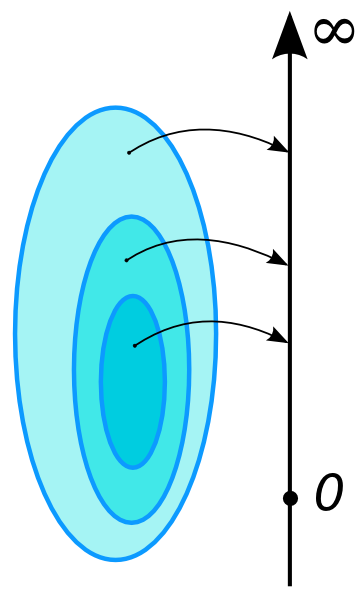
In mathematical analysis, a measure on a set is a systematic way to assign a number to each suitable subset of that set, intuitively interpreted as its size. In this sense, a measure is a generalization of the concepts of length, area, and volume. A particularly important exa...
slow egret
Oh nice
 valid elbow
because there's many other things that aren't real, say complex numbers (a+bi), quaternions (a+bi+cj+dk), octernions (8 different special directions, it will make more sense if you have learned about vectors), and so on...
without complex numbers, there would be no solution to xx = -1,
I haven't run into quaternions yet, probably due to not working witrh geometry/topology much (if at all).
 chilly ocean
I mean, why do we give a special role to the real numbers?
valid elbow
because it's the basic, standard type, where nothing else would exist without it i guess
spark plank
tbh should've extended everything via ordinals instead
who needs real numbres when u have infinities
covert vector
the field of real numbers R is the only (Archimedean) complete ordered field up to isomorphism
@chilly ocean
covert vector
depending on your definition of complete, you can omit the "Archimedean" part
chilly ocean
Great answer you got there
 hot folio
question: is a*b = |a - b| an operation on on N
solution : This is an operation, because it uniquely maps every ordered pair (a,b) ∈ N×N to N.
i don't understand what this means
it uniquely maps every ordered pair (a,b) ∈ N×N to N.
 woeful sand
integration is considered a linear transformation ?