#help-0
1 messages · Page 765 of 1
 shadow mango
 inland shale
yeah im blind
shadow mango
substitute
inland shale
sorry
shadow mango
yeah
inland shale
ok
tysn
tysm
bro
shut up
mind ur own buisness
smh
ur story is sussy baka
thats how u know ur a 3rd grader
moron
oH mY gOd SuSsY bAkA
tlike shut up that phrase is for idiots istg its so annoying
 spark zenith
$\frac {5}{6}x$
 ocean sealBOT
Avocadoman
 spark zenith
inland shale
thats how u know ur a 3rd grader
spark zenith
inland shale
thats how u know ur a 3rd grader
Ok
inland shale
smfd
ocean sealBOT
Avocadoman

 shell widget
@inland shale smfd?
 alpine sable
Can I use this channel?
shell widget
yes
 spark zenith
alpine sable
spark zenith
alpine sable
I dont do your homework
shell widget
@spark zenith He didnt ask you to
alpine sable
What a troll
spark zenith
shell widget
<@!689178685240115217> He didnt ask you to
Idc
 remote heron
alpine sable
remote heron
alpine sable
did you factor 2x-1 as 2(2x-1)?
spark zenith
shell widget
<@&268886789983436800>
just pinged 4 dude
alpine sable
What do you mean jan
 small bear
you forgot to change the sign of the 6, you have -5x-(-6)
small bear
second fraction, numerator
alpine sable
Why is it -(-6)?
remote heron
2(2x-1)-(5x-6) = 4x-2-5x**+**6
the negative gets distributed to the entire numerator
not just the first term
alpine sable
I see
remote heron
you can factor out the negative before you combine to avoid the problem, and turn it into addition
but this can create sign errors too lol
alpine sable
Ah sad
So whenever I have to combine and it has two negative I jusy change it to a positive?
remote heron
well the negative before the fraction applies to the whole thing is the problem
nothing is really being changed
remote heron
so $-\frac{5x-6}{6}$
ocean sealBOT
jan Niku
 remote heron
this is the same as $-\left( \frac{5x}{6} - \frac{6}{6}\right)$
ocean sealBOT
jan Niku
 remote heron
sound reasonable?
just splitting on that sign
the same process you did above in your solution, but backwards, instead of combination its splitting
remote heron
like $-\left( \frac{5x}{6} - \frac{6}{6}\right) = \frac{-5x}{6} + \frac{6}{6}$
ocean sealBOT
jan Niku
 remote heron
the negative sign is really a factor of negative one
so it follows the distributive property too, just like all numbers
well all products i guess
alpine sable
ocean seal
**jan Niku**
is this = to -5x+6/6?
remote heron
it is, id really really use parens in what youre typing
but it is if i get what you mean
remote heron
- ( (5x-6)/6 )
this is how id type it
is this what you mean?
$\frac{4x-2}{6} + (-1)\left( \frac{5x}{6} + \frac{6}{6} \right)$
ocean sealBOT
jan Niku
 remote heron
this is what i mean with the factor, btw
maybe written this way its more clear what is happening
just like $a(b+c) = ab+ac$
ocean sealBOT
jan Niku
 remote heron
critically nothing is changing, its just distributive property in action
alpine sable
thanks for the help
remote heron
np 

 glass lichen
alpine sable
f(6) = 11 doesn't make any sense
glass lichen
alpine sable
f(6) = 11 doesn't make any sense
how come it doesnt?
alpine sable
idk if thats the right answer tho
glass lichen
it is
alpine sable
or am i over thinking it
 wary badge
Anyone Need my Help?
 elfin talon
remote heron
the negative sign is really a factor of negative one
elfin talon
remote heron
the negative sign is really a factor of negative one
Yeah, -x is short for -1x, -(x-y) is short for -1(x-y), which if you distribute you’re gonna get -x+y
alpine sable
ok i was scaring myself this is my first pre-calc quiz lol
@glass lichen thanks man
elfin talon
alpine sable
f(6) = 11 doesn't make any sense
Just substitute in-line rather than doing it mentally if you’re in doubt
alpine sable
alright
elfin talon
elfin talon
Just substitute in-line rather than doing it mentally if you’re in doubt
f(6) = 6^2 - 4(6) - 1 = 36 - 24 - 1= 11
 shell widget
Yes, because for every "x" value, there is at most one "y" value.
 hot wedge
hey this is only gonna take a second, but what specific math topic is this?
 shell widget
Could be factorization/quadratic expressions
alpine sable
Ok, thanks
 topaz scaffold
Rational functions maybe too
 summer adder
can i use this channel ?
topaz scaffold
Yea sure
alpine sable
hot wedge
hey this is only gonna take a second, but what specific math topic is this?
Do polynomial division for that
topaz scaffold
It's not the ones where x is dependent of y
hot wedge
alpine sable
Do polynomial division for that
what i do there is just plug in each answer choice for x and see what equals to 0 
topaz scaffold
So where the y value has no effect on the x
topaz scaffold
hot wedge
what i do there is just plug in each answer choice for x and see what equals to ...
You could factor the top
topaz scaffold
summer adder
right ?
I'm unsure about b tbh
topaz scaffold
I think there might be a possible dependence for b
Again, I'm not completely sure so don't take my word for it lol
topaz scaffold

summer adder
Central Theorem Limit:
The sampling distribution of the mean approximately
follows a normal distribution if the sample size is large.---->true
The sampling distribution of the mean follows approximately
a normal distribution if the standard error of the sampling distribution is small.---->true
The mean of the sampling distribution of means
is exactly equal to the population mean.------>false
topaz scaffold
I'm heading to lunch soon so I won't be answer tho
Hopefully someone else can help

 strange raven
I'm currently learning abstract algebra as a physics major who is weak at proofs
I'm like goddamn anxious
Very much anxious

 undone dock
If you plug it in you get$(-3)^2 - 4(-3) -1$
ocean sealBOT
K.
 alpine sable
crap
 last moth
Does this mean this channel is free now? I am having a trouble understanding a bit more advanced problem. I am reading der Warden's Algebra to get to know modern abstract Algebra.
In a paragraph about determinants it is defined elegantly as a polylineal antisymmetric form of vector space over a given field o. And one of the intermediate equalities puzzles me, specifically that it always equals 1 for the vectors of the basis, i.e. $D(x_i) = 1$. However I am struggling to prove this without using the representation as list of elements of o, in which case proof is trivial as a sum $\sum \pm x^i y^j z^k\cdot \ldots$ has only a single non-zero term. Is there a way to prove this without going to this representation? I have troubles with this because it gives a circular dependency since you assume that determinant will be the same for in any transformed basis, but you use this property (det=1) to prove basis invariance. Thank you!
ocean sealBOT
Artej

 dreamy cedar
You should probably ask questions like these in #groups-rings-fields
Most of the people advanced enough to answer these questions dont usually check these channels
last moth
will do, thanks, sorry I am new to this server
 late monolith
The area of a square is: 50x (2 above x) - 180xy
(2 above y) + 162y (4 above y). Calculate the perimeter of said square
I need some help, pls
shadow mango
late monolith
The area of a square is: 50x (2 above x) - 180xy
(2 above y) + 162y (4 above y...
you have two equations over here, are both of these values of the area?
sharing a picture of the question would be helpful if possible
late monolith
shadow mango
sharing a picture of the question would be helpful if possible
A picture would be the same (Im spanish) I just translate it to english.
late monolith
shadow mango
are those two equations the area of the same square?
Yes same square
ocean sealBOT
Mochi
 shadow mango
@late monolith right?
shadow mango
cool shall we proceed?
shadow mango
um this is the same eqn you have....we still have to find the perimeter-
late monolith
im dumb then
shadow mango
late monolith
The area of a square is: 50x (2 above x) - 180xy
(2 above y) + 162y (4 above y...
we have to calculate the perimeter, I just rewrote the area eqn for it to be clear
late monolith
shadow mango
we have to calculate the perimeter, I just rewrote the area eqn for it to be cle...
oh ok
shadow mango
that's the question isn't it
late monolith
yeah find the perimeter
shadow mango
cool
now let the side of our square be "a"
then $a^{2} = 50x^{2} - 180xy^{2} + 162y^{4}$
ocean sealBOT
Mochi
 late monolith
k
shadow mango
hence $a = \sqrt{50x^{2} - 180xy^{2} + 162y^{4}}$
ocean sealBOT
Mochi
 shadow mango
now we have to factorise the equation to get "a" (which is the side of our square)
do you think you can try that?
late monolith
50x - 180 xy + 162y (2 above y)
shadow mango
no-
late monolith
pain
shadow mango
its in the form $x^{2} - 2xy +y^{2}$ right?
ocean sealBOT
Mochi
 alpine sable
@spark zenith thanks? 😆
shadow mango
late monolith
Is that it?
$a = \sqrt{50x^{2} - 180xy^{2} + 162y^{4}}$
ocean sealBOT
Mochi
 shadow mango
$a = \sqrt{(5\sqrt{2}-9\sqrt{2})^{2}}$
ocean sealBOT
Mochi
 shadow mango
$a = 5\sqrt{2}-9\sqrt{2}$
ocean sealBOT
Mochi
 shadow mango
that's the side of your square
I presume you can find the perimeter on your own now?
late monolith
Yea thx
shadow mango
np
alpine sable
how do I prove convergence here? (direct comparison)

 kindred herald
What's this "tg" term?
alpine sable
tan
kindred herald
I'd use small-angle approximation maybe... that way, you get rid of the tg and interpret the tg-inner part as a small value in radians
and then the ratio test
 undone sentinel
 alpine sable
kindred herald
I'd use small-angle approximation maybe... that way, you get rid of the tg and i...
alpine sable
kindred herald
I'd use small-angle approximation maybe... that way, you get rid of the tg and i...
ok thanks

Where does 81/4 come from?
20 + 1/4 is not 81/4 is it?
kindred herald
it is. expand fraction by 4
alpine sable
kindred herald
it is. expand fraction by 4
Sorry could you show me?
kindred herald
yeah. Every number is a "fraction". Therefore, you can always expand.
20 = 20/1 = 20 * 4 / 4
ocean sealBOT
Edwin25
 alpine sable
How do you use the bot
ocean sealBOT
Edwin25
 alpine sable
$\latex$
ocean sealBOT
Fractal Morality
$\latex$
```Compilation error:```! Undefined control sequence.
<recently read> \latex
l.55 $\latex
$
The control sequence at the end of the top line
of your error message was never \def'ed. If you have
misspelled it (e.g., `\hobx'), type `I' and the correct
spelling (e.g., `I\hbox'). Otherwise just continue,
and I'll forget about whatever was undefined.``` alpine sable
?

 sharp sable
<@&286206848099549185>
 uncut tapir
Do you know what the 5 number summary is?
alpine sable

Khan Academy accepts this answer for the x-intercept 5/3, 0
it does not accept 1.666, 0
why?
they are the same thing, right?
 supple prawn
alpine sable
they are the same thing, right?
supple prawn
alpine sable
they are the same thing, right?
They are slightly different, 5/3 is exact while 1.666 isn't.
Think of it like writing 1/3 as 0.333, what do you get if you multiply 0.333 • 3? It should equal 1 if they were the same thing.
 glass field
in your book or online you can look up "polynomial division" and/or "long division"
 crimson obsidian
so, let's say there's a betting game.
$50 in the pot so far.
I can contribute any dollar amount I want. My probability of winning is my bet divided by the pot's total size. So if I contribute $10, I have a 1/6 chance of winning (since the pot is now $60).
From what I understand, there is no ideal bet size for one individual bet. In other words, my expected value is the same at any amount. Is this right?
 mystic sinew
bro theres another question still active
 mortal void
what took so long to tell, i didnt did it with bad intentions
mortal void
mystic sinew
bro theres another question still active
happy now, man
mystic sinew
I wasn't talking to you?
uncut tapir
sharp sable
Q2 and Q3
Yes. Min, lower quartile, median, upper quartile and max
ocean sealBOT
MEOWBRO 父
 crimson obsidian
so, let's say there's a betting game.
$50 in the pot so far.
I can contribute any dollar amount I want. My probability of winning is my bet divided by the pot's total size. So if I contribute $10, I have a 1/6 chance of winning (since the pot is now $60).
From what I understand, there is no ideal bet size for one individual bet. In other words, my expected value is the same at any amount. Is this right?
 sleek yarrow

I am losing my mind with this question
I have spent a solid 25 minutes on it
Can I have any help
mortal void
mystic sinew
I wasn't talking to you?
oh no, and here i deleted my all asked question
mortal void
sleek yarrow
the first one is a polynomial functions
cause there x's value is 0
and second one aswell
 ivory otter
glass lichen
chain rule
ivory otter
glass lichen
chain rule
how do i know when to use Chain rule lol
glass lichen
when it's a composition of functions
glass lichen
yes.....
when it's a composition of functions you use the rule for it
like how you use power rule for a power function
ivory otter
i see ok
glass lichen
alternatively $\ln(2x^3)=\ln(2)+3\ln(x)$
ocean sealBOT
Mosh
 ivory otter
ima stick to chain
glass lichen
Ok...
alpine sable
im having trouble in linalg rn - i've been going in circles on this problem a few times now, could someone point me in the right direction/ first step with this? dont give me the answer, i wanna figure it out
 mortal void
can someone help me on question 2
alpine sable
How do you simplify a^3+b^4/a^3+b^3
glass lichen
alpine sable
im having trouble in linalg rn - i've been going in circles on this problem a fe...
well 1st step is to, quite easily, note that $x_5=0$
alpine sable
wasn't there like a rule where you can combine them
ocean sealBOT
Mosh
 alpine sable
glass lichen
well 1st step is to, quite easily, note that $x_5=0$
alpine sable
glass lichen
well 1st step is to, quite easily, note that $x_5=0$
i got that part, i just didn’t know what to do from there lmao
do i just substitute that for all x5s?
glass lichen
yes, so you have the reduced system
$x_1-4x_3=8 \ x_2+7x_3-x_4=2$
ocean sealBOT
Mosh
 glass lichen
so you can then note that x_1 and x_2 will depend on x_3 and x_4
(alternatively, x_1 and x_2 are the pivot columns)
so x_3 and x_4 have to be free columns, since x_5 is already dealt with and they arent pivots
ivory otter
Hi mosh
"when it's a composition of functions"
thats when you said i can use chain rule
but what confuses me here is
doesnt 2x count as a function
so shouldnt sin(2x) also be able to be solved using chain rule?
alpine sable
ocean seal
**Mosh**
ah okay cool gochu, so i dont need a finite answer for each variable? do i just define them in terms of each other?
@glass lichen
glass lichen
Yes, you define them by the free variables
alpine sable
okay cool makes sense - tysm
glass lichen
So you have a plane of solutions, which you parameterized by the free variables
alpine sable
glass lichen
So you have a plane of solutions, which you parameterized by the free variables
those are some big words for sure
ah okay gochu
makes more sense now lmao im j kinda dumb
day 2 into linalg so im not there yet
glass lichen
But yeah, the things that aren't pivots are your free variables
alpine sable
bet 
 astral harbor


Why did they set the alternative hypothesis as h1:p<0.08? Why not p>0.08? The question didn't give us any claim to test so how did they use p<0.08?
 weary grove
Hello, I have a question
glass field
nice
weary grove

So I have this

Here is what I done
The right answer is

So the first part with the 7/100 is correct
But the second one not
And I don't know why
Do someone have an idea ?
weary grove
<@&286206848099549185>
alpine sable
 weary grove
alpine sable
weary grove
alpine sable
Lmao I was asking a question ahaha
But I think no one is connected (Or no one wants to solve my problem)
 mossy agate
just use the identity and then make sin(a+b/2) and cos(a-b/2) zero this should give u the solutions
@weary grove use sinA + sinB = 2sin(a+b/2)cos(a-b/2)
 pastel schooner
If I know angle A, D, and B. how do I find BD? I also only have side AB. Isnt there a ratio of angle and side to angle and side.

I was thinking about using side AB (which is known as 3) with angle D which is 90 degrees. To find side BD with known A value of 53.1 degrees
weary grove
mossy agate
<@!343148381670998027> use sinA + sinB = 2sin(a+b/2)cos(a-b/2)
I'm pretty sure there's more simple
We used to do these exercise without these formula
I think I just did a stupid mistake somewhere
Cuz I have one of the two solutions
 plush quest
Idk where to start lol
 pastel schooner
plush quest
Idk where to start lol
pastel schooner
plush quest
Idk where to start lol
PEMDAS is your best friend.
P is the first step
which is parenthesis
plush quest
Ya
 pastel schooner
Correct
plush quest
Ok
pastel schooner
So you get 9 - 2 + 3x = 6 + 2x - 5 - x
Now you Combine Like Terms
so you put the x's together and the numbers without a variable
pastel schooner
On the left side of the equation of 9 - 2 + 3x
you would combine 9 and -2 and leave 3x
plush quest
Ok
pastel schooner
so left side becomes 7 + 3x
plush quest
Ok
plush quest
Ok
pastel schooner
and combine 2x and -x to become just x
cause 2x - x = x
so you get 1 + x on the right side
now including both left and right you get:
7 + 3x = 1 + x
 low topaz
Is a pies Circumference over its Diameter equal to π
plush quest
Inverse operation of 7 now?
pastel schooner
now you make one side a variable, and the other side a number without a variable
7 + 3x = 1 + x so you minus 7 on the left and right to cancel 7
which gives you 3x = (1-7) + x
which is 3x = -6 + x
you minus the other x on the right side to the left side
so you get 3x - x = -6
which is 2x = -6
plush quest
Wait hold on
 uncut tapir
I guess so. You're basically saying that even though you have brackets around the second term you can still group the x^2 terms together
 valid kite
uncut tapir
I guess so. You're basically saying that even though you have brackets around th...
valid kite
uncut tapir
I guess so. You're basically saying that even though you have brackets around th...
i was just so nervopus cuz if i got that wrong i would have to redo everything xd
i knew it was right
I JUST had to double check-
 high lintel
hello, could someone please help and explain this to me?
 uncut tapir
Yeah, it's like a mass balance almost. You have two constraints at play, the total volume has to equal 10L and the concentration has to equal 20%
Your volume constraint is solved by just saying that if I add x litres of the 5% solution I need 10-x litres of the 40% solution
This always adds up to 10 with 0<=x<10
Then how to solve for the concentration? The mass you have in the 20% solution needs to equal the mass added from the 5% and 40%. You can see the mass added would equal concentration times volume
Hopefully this information explains the equation more, now you just have to solve it using standard algebra
 strong minnow
Hi I have a quick question that I may be over complicating. Suppose there are 8 pens in my book bag. Five are blue and 3 are black. If I reach in and randomly pull out a pen.
E: I pull out a blue pen F: I pull out a black pen
E and F would be complementary events correct ? My thinking because they have nothing in common and make up everything that could possible happen.
Please let me know if there is a flaw in my logic
 placid zinc
Yes. You are 100% likely to do one of those two things.
 cinder mantle
^
 fierce niche
is there any good courses/sites to learn math? (math in general)
 slender marten
TLMaths on YouTube is good.
alpine sable
Use the Distribution Property to rewrite and evaluate each expression.
6(525)
 wraith wraith
@mossy snow can u help me
alpine sable
How do you use the distributive property to rewrite and evaluate 8*1.5
@bitter juniper
Are we allows to ask stats questions
 minor anchor
alpine sable
How do you use the distributive property to rewrite and evaluate 8*1.5
minor anchor
alpine sable
How do you use the distributive property to rewrite and evaluate 8*1.5
1.5 is seperatable (is that a word??) into 1 and .5 (because 1 + .5 is 1.5), so 8 x 1.5 is the same as (8 x 1) + (8 x .5), so just add those together to get your answer.
x=* cuz two asterisks make italics and idk how to use latex lmao
 unborn dome
can someone help me out with this?

 oak chasm
@unborn dome Do you know how to calculate speed?
Like if I go 1/2 a mile in 3 hours, how fast am I going?
oak chasm
Well, they tell you above where you put in the answer.
ocean sealBOT
Chai T. Rex
 oak chasm
What is my change in position?
unborn dome
figured it out its just 69. 09 when you just plug in the equation @oak chasm
of 4.9(T)^2
for both t's
but the second part is a bit troubling

i dont want to say its getting closer to 70
or 69
68.60
 smoky urchin
ok this is kinda dumb but are all expressions with domain the set of all real numbers considered polynomials?
oak chasm
@unborn dome Yes, that's right. Velocity is the derivative of position, so you can either use a derivative or the derivative limit.
@smoky urchin No, 2ⁿ isn't a polynomial, but it can have the domain of all real numbers.
oak chasm
No problem.
 subtle elbow
can someone help
 placid zinc
15 for the first year
15(0.8) for the second year
15(0.8)² for the third year
ect
 languid stirrup
 subtle elbow
placid zinc
15 for the first year
15(0.8) for the second year
15(0.8)² for the third year
ec...
subtle elbow
placid zinc
15 for the first year
15(0.8) for the second year
15(0.8)² for the third year
ec...
i dont understand
placid zinc
What is not making sense about my explanation? What did you expect the second year to be?
alpine sable
i need help
i need dis to be algerbric expression: 3 times the sum of r and d squared increased by 2 times the sum of r and d squared
placid zinc
Channel is busy @alpine sable
alpine sable
placid zinc
Channel is busy <@456226577798135808>
k, sorry
subtle elbow
placid zinc
Channel is busy <@456226577798135808>
i just dont understand to be blatant.
the response you gave is confusing me
alpine sable
is it busy rn?
ok i think i can use it
my question is
I'm still confused about 9+10
what is the point of the descartes rule of signs?
placid zinc
Knowing the number of positive roots
alpine sable
i mean you only figure out the number of possible roots for positive, negative, and imaginary
alpine sable
placid zinc
Knowing the number of positive roots
so? you still need to find the roots itself
placid zinc
Do you?
placid zinc
Depends what your problem is. There's many circumstances where you may not care what the roots actually are, but are happy to know if they're positive or not
alpine sable
ok..... another question. what if a root of the polynomial is 0? would you have to factor it first before using the rule of signs?
placid zinc
Control theory has a problem like this, a system is "in control" if all roots are negative, which you can check with this theorem
alpine sable
alpine sable
ok..... another question. what if a root of the polynomial is 0? would you have ...
.
alpine sable
placid zinc
Even without factoring
but it wouldn't tell you if the root is 0 right?
placid zinc
No it wouldn't.
alpine sable
then wouldn't the whole thing be messed up
placid zinc
"Whole thing"?
alpine sable
like say there were 2 positive roots and 2 negative roots
of a 5th degree polynomial
you wouldn't know if the last root was 0 or imaginary
placid zinc
But you would know how many positive and negative roots there are
alpine sable
yes
placid zinc
Indeed, rule of signs won't give you absolutely everything
alpine sable
but shouldn't there be a way to know if a root is 0 too?
placid zinc
But for pretty little effort, it does give you a lot
 west bronze
checking if 0 is a root is easy, then you can just factor out the term of x with multiplicity and apply the criterion to the remaining polynomial
alpine sable
west bronze
checking if 0 is a root is easy, then you can just factor out the term of x with...
yes this was what i was asking
west bronze
alpine sable
but shouldn't there be a way to know if a root is 0 too?
you put in 0
alpine sable
placid zinc
But for pretty little effort, it does give you a lot
true
alpine sable
west bronze
you put in 0
oh wait im dumb you can do that pretty easily too
wait what do you mean "with multiplicity"
i know what multiplicity means just not in this case
west bronze
f(x) = x and f(x) = x^2 both have 0 as a root, but the 2nd one has "multiplicity 2" because you have to factor out x twice to get rid of it
for x^2 it makes sense to count 0 as a root twice
if you know complex numbers, this leads to the fundamental theorem of algebra, that a polynomial of degree d has exactly d roots where you count them with multiplicity
alpine sable
yes, i know that
alpine sable
west bronze
if you know complex numbers, this leads to the fundamental theorem of algebra, t...
yup i got that
but wdym by factoring with multiplicity
west bronze
consider f(x) = x^2 + x^3, it has 0 as a root but if you factor it as x*(x + x^2) the thing in the parentheses still has 0 as a root
to get rid of it you have to factor it as x^2*(1 + x), then the thing in parentheses only has -1 as a root
alpine sable
ah i see
so when you say factoring with multiplicity you just mean to factor out the x's as much as possible
if you can factor out x^2 then factor it out, rather than just x
right?
west bronze
yeah, there's a better way to describe it but I don't know how much you know and it requires more advanced stuff
alpine sable
west bronze
yeah, there's a better way to describe it but I don't know how much you know and...
i know everything up till algebra 2. in algebra 2, i know good chunk of it and i know some precalc too
barely any precalc tho
west bronze
this is stuff I encountered in ring theory
alpine sable
ok but i have no idea what that is
west bronze
upper undergraduate level I guess
alpine sable
nope
im not even in high
A particle of charge q0 is located at x=a y=b, and particle of same charge is located at x=-a and y=b. find electric force on particle of charge q* located at origin
Someone help me please
west bronze
maybe ask the physics server
west bronze
it's linked in #old-network
placid zinc
Both particles put a force on the particle on the origin
alpine sable
i should do more science
placid zinc
You may have an equation for that force?
F = kc1c2/r²
Or something I don't remember it great
alpine sable
Uh
alpine sable
alpine sable
A particle of charge q0 is located at x=a y=b, and particle of same charge is lo...
This is all the information I was given
placid zinc
Oh shi I did use c when q would be better
glass lichen
$F_E=\frac{kqQ}{r^2}$
ocean sealBOT
Mosh
 placid zinc
Ignoring the other particle for now, what force does the particle at (a,b) put on the origin?
alpine sable
I meant charge
placid zinc
More like, what's the magnitude of that force?
alpine sable
Yes
A particle of charge q0 is located at x=a y=b, and particle of same charge is located at x=-a and y=b. find electric force on particle of charge q* located at origin
Hm
glass lichen
Also if you haven't drawn a diagram... do so
alpine sable
K is Coulomb’s constant
alpine sable
glass lichen
Also if you haven't drawn a diagram... do so
;-;
 rapid grove
@last sage u good?
 last sage
rapid grove
<@604363948950814730> u good?
last sage
rapid grove
<@604363948950814730> u good?
Why
rapid grove
With the question

 wary stream
,rotate
ocean sealBOT
 last sage
Help or no
oak chasm
@last sage What are the possible arrangements of 3, 5, and 7?
There are 357, 375, 537, 573, 735, and 753, right?
last sage
Yea
oak chasm
OK, so you fill them in to the blanks on the card on the right side of your problem, right?
Like the card has 753 as the arrangement.
last sage
Yea
oak chasm
Sorry, fixed a mistake above.
That means to take the absolute value of what's inside.
The absolute value leaves the value alone if it's not negative.
If it's negative, it takes away the negative sign.
|3| = 3
|0| = 0
|-5| = 5
last sage
Ohh
oak chasm
See how it leaves it alone if it's not negative and gets rid of the negative if it is negative?
last sage
Yea
oak chasm
OK, so here's what you can do.
Take the arrangements we got earlier.
Fill each of them into the blanks and get the final number after taking the absolute value.
last sage
What blanks
oak chasm
|-35.7|
|-37.5|
and so on
last sage
 last sage
Yea
last sage
Ya
alpine sable
his mistake was ignoring the absolute value sign
oak chasm
OK, what if they fill in 357?
alpine sable
then it's the smallest number
oak chasm
What does that look like when it's filled in?
alpine sable
|-35.7|
oak chasm
@alpine sable One of the rules is to not just give the answer.
alpine sable
what grade are you in
last sage
There are 357, 375, 537, 573, 735, and 753,
alpine sable
what grade are you in rex
last sage
|-35.7|
last sage
35.7
alpine sable
35.7
last sage
|-37.5|??
last sage
37.5
oak chasm
Good.
Now fill in the blank and then take the absolute value for the rest of the arrangements.
Write down the blank-filled part. Write down the absolute value.
Go to the next one.
Find out what the lowest value is.
oak chasm
OK, good.
So, that's the answer to the lowest value.
Now, what did the student do wrong?
They picked 753, right?
Why did they pick that?

 oak chasm
@alpine sable Sorry, channel is busy.
alpine sable
oh mb
oak chasm
Right.
So, when you fill in 357, you get |-35.7|, right?
And the value of that is 35.7, right?
So, if you fill in 357, the value the card shows is 35.7.
Fill in all the arrangements. See what the absolute values are. Find out what the lowest absolute value is.
That's the lowest value the card can show.
Does that make sense?
last sage
Hmm
wary badge
@alpine sable we will not help u in exams
last sage
What do I write
oak chasm
What was the arrangement with the lowest absolute value?
wary badge
Guys don't Help those who asks answers for their exams if u did then u broke a rule
last sage
35.7
last sage
wary badge
Guys don't Help those who asks answers for their exams if u did then u broke a r...
She been teaching me
alpine sable
wary badge
<@456226577798135808> we will not help u in exams
its homework wtf???
and i already got the question right
and i asked why
wary badge
last sage
She been teaching me
:sus:
oak chasm
@last sage Good, so that's the lowest value you can get on the card (when you fill it in with 357).
wary badge
alpine sable
and i already got the question right
Aren't u are lying?
alpine sable
why would i ask for the proof of an answer if i was cheating on an exam
last sage
So I write 35.7
alpine sable
why does that make any semblance of sense
oak chasm
@last sage Yes, that's the lowest value the card can show, right?
last sage
Yea
wary badge
alpine sable
why would i ask for the proof of an answer if i was cheating on an exam
Ok I trust u
last sage
Sorry I was confused
oak chasm
No problem.
alpine sable
wary badge
Ok I trust u
pog
oak chasm
@last sage Now for part A, what did the student do wrong when they chose 753?
last sage
I put the mistake was ignoring the absolute value sign
oak chasm
OK, that sounds good.
last sage
If you plot the point -8.85 on a number line, would you place it to the left or right of -8.8? Explain.
 oak chasm
No, I mean, how does the number line get written?
You write a line that goes left to right, right?
Then you write the numbers from left to right, right?
 last sage
Middle is 0 left is negative right is positive
oak chasm
Right, so the farther left you go, the lesser the numbers are, right?
last sage
I thinks
oak chasm
And the farther right you go, the greater the numbers are, right?
Well, look at the number line I put above.
Start at 5.
Go left.
All the numbers are less than 5, right?
4 then 3 then 2 then 1.
last sage
Ok
last sage
Yes
oak chasm
So, is -8.85 less than -8.8 or is -8.85 greater than -8.8?
last sage
Greater
oak chasm
Why do you think so?
last sage
Because 8.80 is less
oak chasm
OK, now let's think about -2 and -1 on the number line.
2 is greater than 1, right?
But how is it when they're negative?
The number line goes -3, -2, -1, 0, 1, 2, 3, right?
So, -2 is left of -1, which means it's less.
2 is right of 1, which means it's greater.
See how the number line shows that it's backwards with negative numbers?
last sage
Yes
oak chasm
OK, so is -8.85 less than -8.8 or greater than it?
Remember that negative numbers are in backwards order: -3, then -2, then -1 instead of 1, then 2, then 3.
last sage
Lesss
oak chasm
Is lesser to the left or to the right?
last sage
Left
oak chasm
OK, there's your answer.
oak chasm
You're welcome. You too.
 stable coyote
Anyone here know ODEs?
alpine sable
Can you represent $2^{x+c}$ as a dilation instead of a translation?
ocean sealBOT
Jeed
 oak chasm
@stable coyote I don't, but some do. Find an empty #questions channel and ask your question or try in #multivariable-calculus.
@alpine sable What does a dilation do to the graph?
alpine sable
stretches/compresses, thats why I dont think its possible
oak chasm
Vertically or horizontally?
alpine sable
it can be either
oak chasm
OK, vertically, you multiply the entire expression by something.
alpine sable
yeah
oak chasm
Horizontally, you multiply the x part by something.
ocean sealBOT
Chai T. Rex
 alpine sable
yeah I know that, but how do you dilate the function so its the same as a translation
doesn't seem possible
oak chasm
A vertical dilation can't move the minimum value up or down.
You can, however move the thing to the left or right.
ocean sealBOT
Chai T. Rex
 oak chasm
A vertical dilation will move the original graph to the left or right by the exponent on 2 you multiply the entire output by.
Does that make sense?
 tight locust
dilation
alpine sable
oh, im just trying to think why a vertical dilation is equivalent to a translation parallel to x, its not like that in any other functions I've studied
alpine sable
ohhh, right
 astral dagger
stable coyote
Anyone here know ODEs?
astral dagger
stable coyote
Anyone here know ODEs?
post your question on #multivariable-calculus , maybe I can help you
oak chasm
That doesn't happen with many functions.
astral dagger
I hope
 chrome spade
Hello i have a question about probability, im not sure how conditional probability works
 alpine sable
@alpine sableThe difference occurs because vertical dilations occur when we scale the output of a function, whereas horizontal dilations occur when we scale the input of a function.
chrome spade
I don't understand why to get P(T|C') we calculate it as 1- P(T' | C')
why is it not 1-P(T|C)?
oak chasm
Well, P(A|B) means to use B as the universe and get P(A).
So, P(A') = 1 - P(A) in a universe.
So, P(A') in the universe of B is also 1 - P(A) in the universe of B.
So, P(A'|B) = 1 - P(A|B).
Does that make sense?
@chrome spade
wary badge
degree of f(x) = 0 is undrfined? why explain
placid zinc
What would you rather it be?
alpine sable
studying for a test + really bad at math, wondering how to do this properly? dont rlly know how to use powers + these

like idk where the -4x and the +1 came from in the answer
i assume he multiplied -1 by -1 cuz powers and got the +1
lesson name?
but for the 4x^2 - 4x i dont know
wary stream
You FOIL
alpine sable
doesnt have one just picked it up from notes
wary stream
F: First, I: Inner, O: Outer, L: Last
wary stream
$$2x*2x = 4x^2$$
ocean sealBOT
dldh06
 alpine sable

works like that
i see
hm
i thought 2x . 2x would end up being just 4x
is it cuz of the power that it becomes 4x^2?
wary stream
And $$(2x*-1)+(-1*2x) = -4x$$
ocean sealBOT
dldh06
 wary stream
alpine sable
i thought 2x . 2x would end up being just 4x
wary stream
alpine sable
i thought 2x . 2x would end up being just 4x
No, it's x^2
$$x*x = x^2$$
ocean sealBOT
dldh06

 civic sable
Sorry y'all, does anyone have the join link/button to the server? My friend wants to get in
alpine sable
civic sable
Sorry y'all, does anyone have the join link/button to the server? My friend want...
civic sable
alpine sable
https://discord.gg/AhEJ2bzh
ahh thank u sm
alpine sable
ok so, 2x-1^2
2x x 2x = 4x^2
-1 x -1 = +1
and then for the 4x in the middle
alpine sable
ocean seal
**dldh06**
not sure how to get this one
wary stream
Don't use x as multiplication signs, it gets confusing
ocean sealBOT
dldh06
 wary stream
 dawn galleon
😮
alpine sable
o ok
astral dagger
wary stream
Star
also (\cdot) is a good choice
ocean sealBOT
SubGui
 wary stream
alpine sable
not sure how to get this one
wary stream
alpine sable
not sure how to get this one
The outer terms plus the inner terms
alpine sable
right so yeah 2x * 2x = 4x^2, then the -1 * -1 its +1
uh lemme see
never used FOIl
wary stream
FOIL
alpine sable
speaking of foil I have one foil question too
I’ll wait
so would the outer term be the power? cuz theres no 2nd equation
astral dagger
alpine sable
speaking of foil I have one foil question too
go to #help-4
it's free
wary stream
$$(a + b)(c + d)$$
The outer terms would be a and d while the inner terms are b and c
$$(2x-1)(2x-1)$$ So the outer is 2x and -1 while the inner is -1 and 2x
ocean sealBOT
dldh06
 alpine sable
okay
so if it was (3x-1)^2
id do 3x * 3x for 9x^2
-1 * -1 for +2
but then i still need the middle number
which is
alpine sable
ocean seal
**dldh06**
.
wary stream
$$(3x-1)^2=(3x-1)(3x-1)$$
ocean sealBOT
dldh06
 alpine sable
so the middle number is -6x just checked on calculator
still need to figure out the process hoe
wary stream
We told you, the FOIL method
alpine sable
can i just add the 1st term together?
wary stream
No
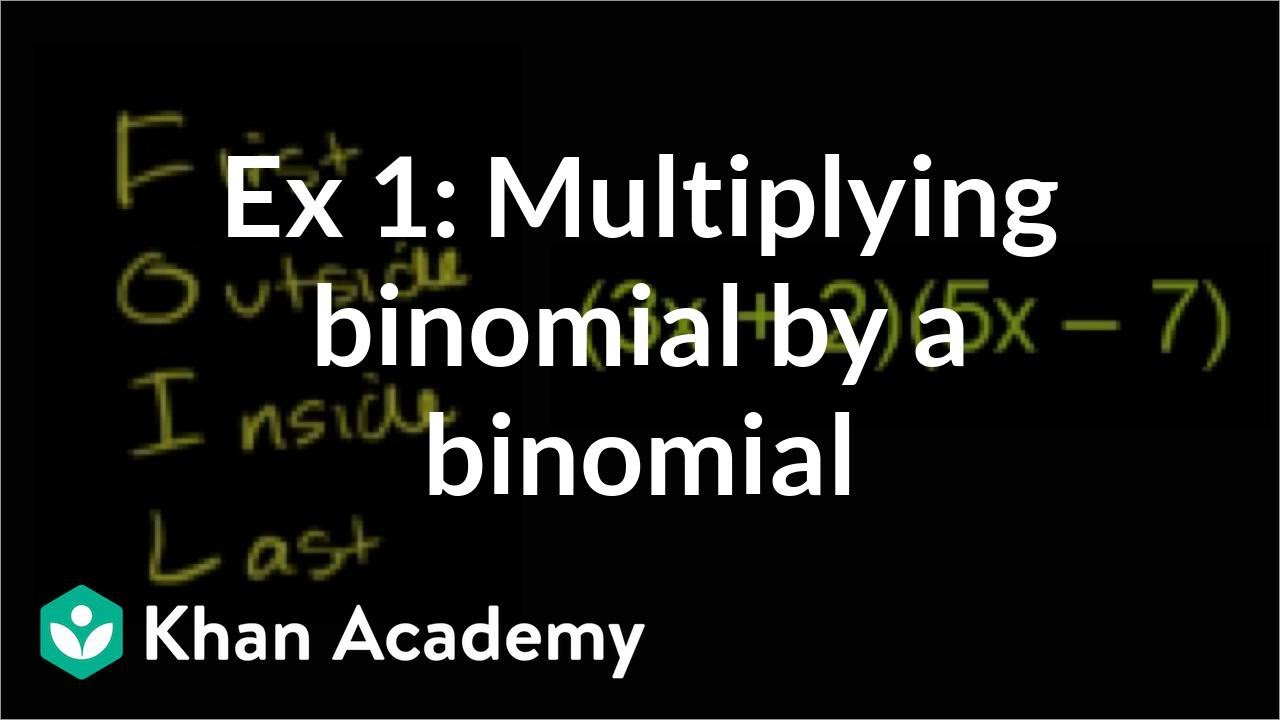
Multiply (3x+2)*(5x-7)
Practice this lesson yourself on KhanAcademy.org right now:
https://www.khanacademy.org/math/algebra/introduction-to-polynomials-and-factorization/multiplying-polynomials-by-binomials/e/multiplying_expressions_0.5?utm_source=YT&utm_medium=Desc&utm_campaign=AlgebraI
Watch the next lesson: https://www.khanacademy.org/math/...
Here's a video on the FOIL method
alpine sable
does it show an example with a power only
yeah ive done this method before
but like
not really with the powers
3x * 2 = 9x^2
-1 * 2 = +1 i got this from the foil method by using the powers for each term
wary stream
The concept of FOIL works with multiplying a binomial and binomial
alpine sable
but in terms of how he got the -6x
wary stream
If you understand how FOIL works, you just apply it with $$(3x-1)(3x-1)$$
ocean sealBOT
dldh06
 alpine sable
wait i think i might get it
(3x-1)(3x-1)
3x * 3x = 9x^2
3x * -1 = -3x
-1 * 3x = -3x
-1 * -1 = 1
9x^2 -3x - 3x + 1 combine the like terms (i think theyre called) and you get -6x
so 9x^2 - 6x + 1
wary stream
Yes
alpine sable
bruhhh
i never expected to figure that out
now i gotta somehow hope it sticks in my head for my test
thanks
wary stream
I mean, it's the FOIL method
alpine sable
the reason i didnt get it is because
ig i didnt visualize it right
(3x-1)(3x-1)
when i did it like this its a lot easier instead of just multiplying each term by 2
 wary stream
Is that the whole question?
 radiant ferry
yea pretty much
wary stream
What exactly is the goal?
wary stream
Oh, you need to figure out what operations to use to get 11?
radiant ferry
yea
radiant ferry
what has he done?
wary stream
I'm confused now
radiant ferry
 gaunt magnet
he called me a dick
gaunt magnet
he called me a dick
oh damn
radiant ferry
wary stream
I'm confused now
yes but my brain was melting
wary stream
radiant ferry
yes but my brain was melting
I meant to Usman
wary stream
radiant ferry
Not exactly 100% sure, but found this site, it helps solve it for you
https://www.dcode.fr/missing-operators-equation-solver
Tool/Solver to solve fill the blanks calculations where the operators are missing. A calculation/equation with blanks is a mathematical exercise consisting of finding the missing operation (addition, subtraction, multiplication, division).
radiant ferry
hmm
 west hearth
Why can lhopital’s rule be applied multiple times
 wind quest
is the surface area of an ellipsoid hard to derive?
radiant ferry
wary stream
Not exactly 100% sure, but found this site, it helps solve it for you
https://ww...
HOLY SHEET THIS IS AMAZING
THANKKKYOUUUU
 void grove
Question 11 A
 wary stream
Do you know how to find average?
void grove
Yes
shadow mango
Can you show what formula or method you use to find it?
void grove
So I add the given numbers then divide
wary stream
Divide by what exactly?
void grove
The amount of numbers
wary stream
And that is?
void grove
for q 11?
wary stream
Yes
shadow mango
huh?
void grove
Divide by 2
shadow mango
no no
wary stream
What? No
void grove
See Im very stupid
shadow mango
Here they ask to find the average of a number 'x' and 10
they've already found the average to be 30
void grove
Yes
wary stream
Average is founded by, the sum of the values, divided by how many terms there are
void grove
Correct @wary stream
shadow mango
yup so you substitute here
our values are x and 10
average = 30
wary stream
Some value and 10 give an average of 30, what is that value?
shadow mango
yeah
 naive musk
how to solve this? what would be the answer?

 rigid smelt
try to solve the inequality seperately
solve (x^2+ax-2)/(x^2+x+1)<2 and (x^2 +ax-2)/(x^2+x+1)>-3 and then combine the solutions
naive musk
rigid smelt
try to solve the inequality seperately
i tried but i was not able to reach the answer
rigid smelt
show your work?
naive musk
yes i just solved the each part and i got these but after that i'm not sure what to do
 rigid smelt
use quadratic formula
naive musk
 rigid smelt
and the fact that the coefficient a of ax^2 + bx + c determines the concavity of the parabola shape
oh actually nvm
a better way is
naive musk
yes it wull be an upside open parabola without touching the x axis
naive musk
rigid smelt
a better way is
okey
rigid smelt
a mistake to be more specific
rigid smelt
naive musk
this one is not true
oh nvm
miscalculated
ok so, heres a thing, the both of these quadratics are facing upwards correct?
so a fact is that there will always exist an x such that its sign is positive
now the question however wants that for every x it is positive
naive musk
rigid smelt
ok so, heres a thing, the both of these quadratics are facing upwards correct?
yes
rigid smelt
so basically, think about the graph, the parabola will always stay in the positive y region if it never crosses the x-axis
naive musk
yes
rigid smelt
meaning the quadratic will always be positive if it has no roots
naive musk
yes no real roots
rigid smelt
so how do you make sure that the quadratic has no roots?
naive musk
rigid smelt
so how do you make sure that the quadratic has no roots?
because it is strictly greater than zero
rigid smelt
i know that but how do we make sure that happens?
what do we use to restrict a?
||hint: discriminant||
naive musk
rigid smelt
||hint: discriminant||
ah yea !
rigid smelt
so, just make sure that the discriminant of both quadratics are always less than 0
and thats your condition for a
shell widget
Yes
naive musk
yes
naive musk
thanks @rigid smelt

 waxen spruce
Hello, is the 3b1b and ocw enough to learn linera algebra?
 nimble cave
alpine sable
nimble cave
alpine sable
middle term splitting
alpine sable
alpine sable
Try breaking the 17y into 2 other things
shadow mango
alpine sable
split 17y into two things
waxen spruce
i think u factor it by groupoing
alpine sable
it said something about pq
And 15x2
This is not the answer. but the answer format should be something like this
 alpine sable
waxen spruce
(15y+2)(y+1)
alpine sable
waxen spruce
(15y+2)(y+1)
Yes
 split oriole
alpine sable
split oriole
alpine sable
Try middle term split
 ionic jewel
waxen spruce
Hello, is the 3b1b and ocw enough to learn linera algebra?
ionic jewel
waxen spruce
Hello, is the 3b1b and ocw enough to learn linera algebra?
yes, but I'd grab a textbook too for practice problems and such
alpine sable
alpine sable
This is not the answer. but the answer format should be something like this
Yes
nimble cave
wait no it won't work
waxen spruce
ionic jewel
yes, but I'd grab a textbook too for practice problems and such
ty ty may i ask how u learned it o
nimble cave
the factor will be (15y+2) (y+1)
alpine sable
OHH I GET IT NOW
ionic jewel
waxen spruce
ty ty may i ask how u learned it o
i took a course at my high school, but I've watched both of your mentioned lectures/series
alpine sable
Thanks for the middle term split formula.. I searched it up
waxen spruce
ionic jewel
i took a course at my high school, but I've watched both of your mentioned lectu...
What grade did u take the course
ionic jewel
12
ionic jewel
i think most math oriented people do it either then or first year of college
waxen spruce
True
waxen spruce
Ok thats good im in 10th grade and I like Math
ionic jewel
precalc?
alpine sable
waxen spruce
I took precalc in 9th
how is that possible lol
ionic jewel
yeah okay that's faster than me so you are fine
waxen spruce
alpine sable
how is that possible lol
I did geo in summer
waxen spruce
ionic jewel
yeah okay that's faster than me so you are fine
Bet
alpine sable
what about Algebra 1 & 2??
ionic jewel
bunch of people in my school just were a year ahead
alpine sable
I did Geo in summer too
waxen spruce
alpine sable
what about Algebra 1 & 2??
i took alg 1 in 7th and in 8th i did alg 2
waxen spruce
ionic jewel
bunch of people in my school just were a year ahead
Yea its commonplace where i am
alpine sable
Wait wth those actually count?
ionic jewel
precalc is a stupid class anyways
waxen spruce
ionic jewel
precalc is a stupid class anyways
Fr
waxen spruce
alpine sable
Wait wth those actually count?
Wym yea
alpine sable
I mean if the teacher is good then the class can be good
ionic jewel
no
waxen spruce
alpine sable
I mean if the teacher is good then the class can be good
rare
ionic jewel
like I'm convinced i learned nothing that class, wish i was just a year ahead
speaking of being far ahead in math i knew a guy that took differential equations in 9th grade then started college math at the local college
waxen spruce
All i remmebr is limacon
waxen spruce
ionic jewel
speaking of being far ahead in math i knew a guy that took differential equation...
🧠 ???? wtf
alpine sable
ionic jewel
speaking of being far ahead in math i knew a guy that took differential equation...
What the f
 glacial hedge
