#geometry-and-trigonometry
1 messages · Page 97 of 1
 lime crownBOT
 worthy eagle
You asked the same question in help forum, did it get deleted somehow?
 wary edge
Closed it because i found that i can put it here instead
worthy eagle
Oh
You don't need to find slope.
x/c + y/d = 1 is equation of the line in terms of x-intercept c and y-intercept d.
So in this case it becomes x/(-2) + y/4 = 1
y/4-x/2=1
Coordinates of points A and B are given, just put the value of x and y according to their coordinates and solve for a and b.
 fierce orchid
just use the intercept form
 remote sigil
Bro can someone help me with my geometry test
fierce orchid
remote sigil
Bro can someone help me with my geometry test
uhh show
remote sigil
fierce orchid
uhh show
Look in “help-6”
 silent plank
the test itself, no
study for it yes
remote sigil
silent plank
the test itself, no
study for it yes
Yeah I meant this
 twin escarp
can anyone pls help with this

 dark sparrow
twin escarp
can anyone pls help with this
dark sparrow
twin escarp
can anyone pls help with this
do you still need help with this?
twin escarp
dark sparrow
do you still need help with this?
yes please i have no clue how to solve it
dark sparrow
ok let's see
can you tell me what kind of segment PQ is in relation to circle C on the diagram?
looking for a word here.
twin escarp
radius i think
dark sparrow
"you think"? why the uncertainty?
twin escarp
most likely radius
dark sparrow
...ok let's not
yes, it is the radius, and there is no reason whatsoever to be doubting that. ok?
anyway
now that that's out of the way,
what can we say about PQ and l?
a tangent to the circle and a radius to the point of contact are...?
(again, looking for a word here).
 fringe parcel
Gradient of line PQ is 1/2 since the product of gradients of perpendicular line is -1.
dark sparrow
fringe parcel
Gradient of line PQ is 1/2 since the product of gradients of perpendicular line ...
!nosols
lime crownBOT
fringe parcel
Gradient of line PQ is 1/2 since the product of gradients of perpendicular line ...
As a helper, please do not give out answers that could be copied as a homework solution. Have the student work through the problem themselves and guide them along the way.
dark sparrow
i was gonna guide him to that.
and have him get to it himself, since @twin escarp said he had no clue about this problem.
twin escarp
oh yeah the gradient perpendicular of the line is 1/2
but the main issue is using the constant k to form a quadratic equation
twin escarp
yes
dark sparrow
can you write down the gradient of line PQ in terms of k, using the coordinates of P and Q? @twin escarp
fringe parcel
@dark sparrow Yes
dark sparrow
@fringe parcel may i politely ask you not to interrupt me here btw? i would like to continue helping OP myself.
twin escarp
dark sparrow
can you write down the gradient of line PQ **in terms of k**, using the coordina...
yes ill try that
dark sparrow
ok, do it and ping me once you have a result.
do not simplify your equation until instructed!
twin escarp
This is what I got so far is it any good?
 dark sparrow
the was you handwrite your k it almost doesn't look like a k
aside from that it is correct. but factorizing k^2 - 2k to k(k-2) was useless.
fringe parcel
 dark sparrow
fringe parcel
dark sparrow
fringe parcel
!nosols
lime crownBOT
fringe parcel
As a helper, please do not give out answers that could be copied as a homework solution. Have the student work through the problem themselves and guide them along the way.
twin escarp
Here
 dark sparrow
ok good
fringe parcel
May I ask helping students by solving questions is it a crime?
twin escarp
so for b it says find a equation for c
dark sparrow
but do write your k's a bit neater so that you don't run into an issue with k being misread as 12.
dark sparrow
fringe parcel
May I ask helping students by solving questions is it a crime?
it is not a crime but it is against server policy.
and i have reminded you of it, now twice
twin escarp
dark sparrow
but do write your k's a bit neater so that you don't run into an issue with `k` ...
ok
dark sparrow
twin escarp
so for b it says find a equation for c
yes
capital C though not lowercase c
twin escarp
yes captial C
dark sparrow
k is positive and k^2 - 3k - 10 = 0.
find the value of k.
do you see how to do that?
twin escarp
Value of k is 5
 twin escarp
no not yet
dark sparrow
now that you know k = 5, you can work out the actual coordinates of P and Q.
do that.
twin escarp
Here’s what I got
 dark sparrow
you meant Q(3,15) surely
twin escarp
no for y on p its actually 13
dark sparrow
that is a three?
you would benefit from working on your handwriting!
oh, nevermind, i was looking in the wrong place.
this is a very bad k though

anyway
P is (-1, 13) and Q is (3, 15).
twin escarp
yes
dark sparrow
P is the center of your circle and PQ is its radius.
do you see how to write down the equation of the circle?
twin escarp
x^2 y^2 ?
dark sparrow
$x^2y^2$ is not an equation.
 somber coyoteBOT
Ann
 dark sparrow
you're missing a lot from it, for sure.
twin escarp
x^2 + y^2 i meant
dark sparrow
x^2 + y^2 still isn't an equation.
and it is still missing a lot of info.
can you state the general form for the equation of a circle?
twin escarp
wait is it actually (x-a)^2 + (y-b)^2 = r^2
 upper karma
Can anyone help me
 dark sparrow
twin escarp
wait is it actually (x-a)^2 + (y-b)^2 = r^2
dark sparrow
twin escarp
wait is it actually (x-a)^2 + (y-b)^2 = r^2
that's the general one, yes.
dark sparrow
upper karma
Can anyone help me
you might wanna open a help channel or help-forum thread for this rn
dark sparrow
twin escarp
wait is it actually (x-a)^2 + (y-b)^2 = r^2
can you tell me what the letters a, b and r stand for here
twin escarp
a and b are the centre of the circle r is the radius
dark sparrow
a and b are the coordinates of the center, and r is the radius.
ok, so let's start with the last of these.
what is the radius of your circle?
fringe parcel
@upper karma First draw the line y=x-1
twin escarp
dark sparrow
what is the radius of your circle?
i dont really know?
dark sparrow
P is (-1, 13) and Q is (3, 15).
the radius is the distance between these two points.
do you know how to find the distance between two points?
yes or no
twin escarp
yes do you use y^2-y^1 over x^2-x^1
dark sparrow
no.
it should be _ not ^, but also what you wrote is the formula for the gradient.
while i want you to find the distance.
twin escarp
dark sparrow
while i want you to find the **distance**.
ok give me a sec
Is it 2 root 5?
 dark sparrow
ok, yes, it is 2 sqrt(5).
that is your radius.
now,
the center of your circle is P.
the radius is 2 sqrt(5).
write down the equation of C by filling in this template:
(x-a)^2 + (y-b)^2 = r^2
where (a,b) are the coordinates of P
and r is the radius
twin escarp
That’s what I got
 dark sparrow
$(2\sqrt{5})^2$ not just $2\sqrt{5}$.
somber coyoteBOT
Ann
 dark sparrow
also remove the C=.
you can replace the equals sign in C= with a colon so it reads as C : if you want though.
upper karma
fringe parcel
<@456226577798135808> First draw the line y=x-1
What's that
fringe parcel

After drawing the line you draw perpendicular bisectors from each point of the triangle to obtain the new triangle.
 visual flume
 lime crownBOT
What step are you on?
1. I don't know where to begin.
2. I have begun but got stuck midway.
3. I got an answer but I was told that it's wrong.
4. I got an answer and would like my work checked.
5. I have a question about someone else's work/solution.
6. I have completed the problem and don't need help anymore. Thank you.
7. None of the above

 warm tendon
ignore the two 5m on the sides of the bottom triangle, the 5m should be in the middle perependicular to AC
can someone help me with this 3d word problem

 worthy eagle
Use Pythagoras on ABG and BCG
@warm tendon
Ayo your figure also wrong G perpendicular to AC 5 m away, AG=5m
Using Pythagoras
5⁵=5⁵+x²
x=0
On left and on right, x=0
This contradicts that AB = 2x = 20m
warm tendon
the 5m on both sides is wrong
the 5m in the middle is the correct one
yeah the figure is wrong cause i took it from someone else
so i said ignore the two 5 metres on both sides
 worthy eagle
warm tendon
so i said ignore the two 5 metres on both sides
worthy eagle
warm tendon
so i said ignore the two 5 metres on both sides
Oh sorry I didn't see the text with image
worthy eagle
fringe parcel
This is wrong
h+5 ≠ perpendicular
It was a 3d figure not a 2d

@warm tendon
 past crag
!noping
lime crownBOT
Please do not ping individual helpers unprompted.
 pallid dragon
ABCD is kite , |BC| = |DC| what is the value of x? I need help please
 pallid dragon
 obsidian harness
https://discord.com/channels/268882317391429632/948777486018285638/1373970696111...
obsidian harness
https://discord.com/channels/268882317391429632/948777486018285638/1373970696111...
maybe like this but i should ask this my teacher

 summer cradle
pallid dragon
maybe like this but i should ask this my teacher
summer cradle
pallid dragon
maybe like this but i should ask this my teacher
how do you get those values?
 minor crow
worthy eagle
minor crow
worthy eagle
Thank you for the explanation, but how did you get from the line highlighted in green to the next, and from the line in red to the next?
 worthy eagle
minor crow
Thank you for the explanation, but how did you get from the line highlighted in ...
worthy eagle
minor crow
Thank you for the explanation, but how did you get from the line highlighted in ...
Green to Red: squared on both sides, on RHS, used the identity (A-B)²=A²+B²-2AB
minor crow
worthy eagle
Green to Red: squared on both sides, on RHS, used the identity (A-B)²=A²+B²-2AB
Oh yeah, I see that now. Thank you for the help. 🙂
And then the next line you just moved everything non x related to the other side
worthy eagle
Red to blue: "-x²" cancels on both sides,
875=400+1200-40√...
875-400-1200=-40√...
-725=-40√...
725/40 = √...
Yeah
minor crow
Yea thank you so much
worthy eagle

minor crow
warm tendon
worthy eagle
Thanks for the explanation
 fringe parcel
To find Angle BAD we can use the fact that the angle subtended at the circumference is half the angle subtended at the center.
To find Angle DCB we can use the fact that opposite angles in a cyclic quadrilateral add up to 180°

 cunning current
whats the best way to memorize formulas? On my exam im going to have like half of them but I have to memorize alot which I only originally memorized cause I did it right before the test
 honest oxide
cunning current
whats the best way to memorize formulas? On my exam im going to have like half o...
honest oxide
cunning current
whats the best way to memorize formulas? On my exam im going to have like half o...
think of words that go with it
 feral wind

 mental canopy
im not sure how they got to the result 145.5mA

they're doing l1-l2 from something but im not sure what
fringe parcel
Add the 2 phasors as follows: (100cos(45) +50cos( 15)) +i(100sin(45) +50sin(15)) and finally find the magnitude and the phase.
mental canopy
fringe parcel
Add the 2 phasors as follows: (100cos(45) +50cos( 15)) +i(100sin(45) +50sin(15))...
we didn't learn imaginary numbers for this
fringe parcel
You resolve 100 <45°into x and y components as x component=100cos 45 and y component =100sin 45. You do the same to 50<15°. Then add x components and also add y components.To find phase use tan^-1(y/x), to find magnitude use √( x^2 +y^2).
 green nest
can anyone help me solve this? i have the entire height of the cone which is 6, theres a sircle cut inside which has an area of 225pi and the entire volume of the cone is 2800pi, i need to find the radius of the bottom and too of the cone, i tried a few ways and nothing seems to work.
 fringe parcel
@green nest Use the formula V=1/3 πr^2 h
green nest
what does ^ mean?
times?
also mb i explained it badly
its a cut cone?
idk what the english word is but it has a radius on the top too
fringe parcel
@green nest r^2 means r raised to the power of 2
 pale sentinel
green nest
what does ^ mean?
pale sentinel
green nest
what does ^ mean?
exponentiation
fringe parcel
Does it mean it's a frustum of a cone.
green nest
fringe parcel
Does it mean it's a frustum of a cone.
yes yes
but theres another line exactly in the middle of the cone with a radius of 15
hold on i can draw it properly
fringe parcel
Paste the original question here please.
green nest
fringe parcel
Paste the original question here please.
alright
The height of a truncated cone is 12cm, the area of the median parallel section is 225Picm^2 and the volume is 2800Picm^3. Determine the radius of the bases.
fringe parcel
V=1/3 π(R^2 +R.r +r^2) h,use this to form the first equation ,where V is the volume of the frustum and R and r are the radii of lower and upper bases respectively.
green nest
I did, but then i got stuck with R and r, and i couldnt find any way to get those from that or anything else given
got to 700 = R^2 + R*r + r^2
then i got stuck and couldnt find any way to continue
fringe parcel
The radius of the median section is (R+r)/2,so the area of the median section is π( radius of the median section)^2,use this to find the second equation.
green nest
fringe parcel
The radius of the median section is (R+r)/2,so the area of the median section is...
OOOH
thank you
 echo sigil
Does anyone know how to solve this?
Bisectors AA1 and BB1 are drawn in triangle ABC.Prove that the distance from any point M of the segment A1B1 to the line AB is equal to the sum of the distances from M to the lines AC and BC.
obsidian harness
it's like an extension of Viviani's theorem it seems
 obsidian hornet
echo sigil
Does anyone know how to solve this?
Bisectors AA1 and BB1 are drawn in triangle ...
obsidian hornet
echo sigil
Does anyone know how to solve this?
Bisectors AA1 and BB1 are drawn in triangle ...
Just use bisector definition
honest oxide
echo sigil
Does anyone know how to solve this?
Bisectors AA1 and BB1 are drawn in triangle ...
Yes
lime crownBOT
As a helper, please do not give out answers that could be copied as a homework solution. Have the student work through the problem themselves and guide them along the way.
 reef narwhal
Can anyone help me? I have to do a 10-minute oral in maths and I'm doing it on Gabriel's horn , but it's too short.
 grave pond
Please don't crosspost the same question between all the pre-university channels.
 crisp folio
hi
peles help me
I have a problem. I'm trying to solve time flexibility with math. We have a vision of a series of numbers that are repeating or a series of decimal numbers that are not divisible by anything at all.
p= 2X *9m =- 11
11 -= 0m + mp2 - 29 = 2.7580088765936458
OM = 0 -9 *1.2 + 0.4
mp = 8 + 7 * 78 - 3
and
x =?
m == X-2 * 82 ms
grave pond
Please don't crosspost the same question between all the pre-university channels. I cannot follow exactly what you're saying, but it looks like responses should probably be in #prealg-and-algebra.
reef narwhal
Could someone who knows something about geometry please explain to me how Toricelli managed to calculate the volume of Gabriel's trumpet using Cavalieri's principle?
I really need help please
grave pond
reef narwhal
Could someone who knows something about geometry please explain to me how Torice...
You've read the description at https://en.wikipedia.org/wiki/Gabriel's_horn#In_De_solido_hyperbolico_acuto?
reef narwhal
grave pond
You've read the description at <https://en.wikipedia.org/wiki/Gabriel%27s_horn#I...
Its not about cavalieri principle
grave pond
I think it's more a kind of handwavy analogue -- but Cavalieri probably didn't use modern standards of rigor when stating the principle, so it may be a matter of interpretation whether it's the principle itself or an analogue in use.
Instead of parallel flat cross-sections, Toricelli cut the horn into cylindrical shells and then stacked flat circles of the same area as each shell to form a cylinder. The stacked circles directly form half of an application of Cavaleri -- and the cylindrical shells at least morally have the properties one expects to be able to use it: each shell is of uniform thickness (or, differently speaking, the perpendicular distance between a cylindrical cross-section and its neighbor cylinders is the same everywhere), and that uniform distance is also how closely spaced the circles are stacke to make the cylinder.
(An interesting observation one can make from a modern perspective is that one doesn't need to muck around with volumes of revolution in order to make a shape with infinite surface area and finite volume. Just consider, for example the volume of R^3 satisfying:
0 <= y <= 1
x >= 0
0 <= z <= 2^(-floor(x+1))
whose volume easily sums to 1, but even just its bottom surface is infinite).
 terse laurel
can someone remind me how to convert between degress and radians
 compact lodge
can someone mind explaining the basic of trig and how i do it ?
grave pond
terse laurel
can someone remind me how to convert between degress and radians
pi radians is 180 degrees
terse laurel
ok
 ruby oasis
 ruby oasis

 sleek pendant
#help-21|아리스킨충1 pls
 flint nymph
Is there a formula for this that I can know? I saw these type of questions would appear when studying. So, there might be a common solution for all of them. With the only difference being the actual numbers.
Example Question (The actual numbers could change):
A photo measuring 32 cm x 40 cm is attached to the cardboard, so that each on the left and right remains 4 cm and the remaining top = remaining bottom = p cm. If the photo and carton similarity, the p-value is...
obsidian harness
flint nymph
Is there a formula for this that I can know? I saw these type of questions would...
hopefully I'm interpreting this right
so the cardboard width is 32 + 4 + 4 = 40 cm
now if the height of the cardboard is h
by similarity (length ratios of similar shapes)
32 cm by 40 cm, and 40 cm by h cm
you must have 40/32 = h/40
solve for h
oh and then you have h = 40 + 2p, so you know p
flint nymph
Alright, thanks for the explanation. For clarification, I'm going to share the image that's usually included with these kind of questions.
Ah, I'm sorry. I misremembered. It turns out these kinds of questions usually doesn't have an image attached to them. I checked both of my worksheets as well as the ebook, and yep, there's no image on all those questions.
Okay, I'm just going to try to understand your explanation here. If I have any questions, may I ping you?
obsidian harness
flint nymph
Okay, I'm just going to try to understand your explanation here. If I have any q...
pls don't ping me
just ask your follow-up questions in this channel and I or someone else will answer
flint nymph
Explanation Steps (Please correct me if I'm wrong here, thanks!):
- Determine the width and height of the photo. Seeing as the height is usually the bigger value between the two, then the 40 cm is picked as the height.
- Add the width of the photo with the remaining numerical value on both sides. For example, the 32 (the width of the photo) is added with the remains of 4 + 4 for the left and right.
- Cross multiplication of Photo Height/Photo Width = Unknown Cardboard Height (i.e h)/Cardboard Width.
- Do all the required multiplication and eventually division as well to get the unknown (i.e h) value.
- Finally, calculate the Cardboard Height = Photo Height + 2 x p to get the unknown numerical value between the two Heights.
worthy eagle
(x+2dx)/x=(y+2y)/y
1+2dx/x=1+2dy/y
dx/x=dy/y
In your example, 4/32=p/40
p=160/32=5
x=length of photo
y=height of photo
dx=how far is the photo from left or right side of cardboard
dy=how far is the photo from top or bottom of cardboard
Just use dx/x=dy/y and get answer
This is the trick or shortcut to find the answer of this type of question @flint nymph
 grizzled lion
if anyones here this one equations flipping me off and its basic geometry 💔
worthy eagle
grizzled lion
if anyones here this one equations flipping me off and its basic geometry 💔
!da2a
lime crownBOT
grizzled lion
if anyones here this one equations flipping me off and its basic geometry 💔
No need to ask “Can I ask…?” or “Does anyone know about…?”—it’s faster for everyone if you just ask your question! See https://dontasktoask.com/
grizzled lion
i have to basically find the parallel lines which ive found one i just dont know how to find the other one
 pale sentinel
"The other one"?
pale sentinel
If you've got a straight line and a point not on that line, there exists exactly one parallel line that goes through that point
Or do you mean you have to draw them, and you can't draw the other one?
(because you already have the equations of both lines)
grizzled lion
it says writing the equation of the libe in slope intercept form passing through the point and parallel to the given line and to graph both lines on the same graph
pale sentinel
Right... and the straight line in the question?
grizzled lion
these are ones i finished
 somber coyoteBOT
 pale sentinel
grizzled lion
these are ones i finished
pale sentinel
grizzled lion
these are ones i finished
Right - so you just haven't drawn the line $y + 3 = -\frac{4}{3} (x-1)$
somber coyoteBOT
Waes (Wires)
 grizzled lion
how can i make that fit the y=mx+b formula
pale sentinel
Subtract 3 from both sides, expand the brackets and simplify
grizzled lion
the brackets are the distribution of multiplication
y+3=-4/3(x-1)
y+3=-4/3x+4/3
subtracting 3 by both sides (multiplying 3 on the right side to get a common denominator)
y=-4/1x+1
i think?
nvm
i see the solution but i dont know how to get to there
somber coyoteBOT
Waes (Wires)
 pale sentinel
@grizzled lion
 rich kite

this is sus
Its for a cube whose circumscribed sphere has radius
and for a given point in its three-dimensional space with distances
from the cube's eight vertice
 visual dawn
What do you mean "indian" scammer?
visual dawn
So you're assuming they're Indian because you don't like them?
I'll keep that in mind.
Thanks for the ping.
 safe pebble
but why did you take it serious ? its a joke
jokes not allowed here?
& i actually like indians theyre friendly ive been to india bruh
visual dawn
You could show that by not making racist comments about Indians. No action will be taken for now.
 fading crater

Can someone explain this to me?
The second one.
Nevermind, actually. I solved it.
I'm just braindead, took me time to get it.
 rotund hemlock
visual dawn
You could show that by not making racist comments about Indians. No action will ...
rotund hemlock
visual dawn
You could show that by not making racist comments about Indians. No action will ...
🤓☝️
dark sparrow
rotund hemlock
🤓☝️
takes a lot of balls to nerd-emoji a message from a moderator.
 regal kraken
dark sparrow
takes a lot of balls to nerd-emoji a message from a moderator.
regal kraken
dark sparrow
takes a lot of balls to nerd-emoji a message from a moderator.
in a mathematics discord server as well ☠️
 shut solstice
Hello guys, Can you help me with this interesting question
So in the picture we can see the cylinder with a radius of 6 √ 3 and with full height of 30 , and it's filled with water as you can see in the first picture
in the second picture, it is tilted by 30 degrees and the water inside is also tilted, but it does not spill
The task is to find the height of the water
 grave pond
By symmetry, that must be the average of the largest and smallest side length wetted by the water in the tilted state.
dark sparrow
,rccw
somber coyoteBOT
 shut solstice
Hello guys, Can you help me with this interesting question
So in the picture we...
shut solstice
shut solstice
Hello guys, Can you help me with this interesting question
So in the picture we...
To clarify, in the problem you need to find the height of the water in the first figure, but there may be an error in the problem where 6 √ 3 is diameter not a radius of cylinder
grave pond
As drawn here, it looks neither like a diameter nor like a radius. Best to let the explicit words decide.
 rancid pasture
Hey guys, i got this problem : cos 2x - cos x = 2, i just used some formula, and switched place and i arrived at 2cos^2 x -cos x -3 = 0 here i just did delta which is 25, i arrived at 3/2 for cos x wich i deemed impossible and cos x= -1 , i arrived at x= pi +2kpi and -pi +2kpi (with k belonging to Z) and with that i just wrote that it is kpi. The teacher asked for the solutions between [0;2pi[ so i just wrote 0 and pi but my teacher said that 0 is not right somehow, can soemone enlighten me?
grave pond
If you plug x=0 into cos 2x - cos x, do you actually get 2?
dark sparrow
rancid pasture
Hey guys, i got this problem : cos 2x - cos x = 2, i just used some formula, and...
{pi + 2kpi | k ∈ Z} ∪ {-pi + 2kπ | k ∈ Z} = just {pi + 2kpi | k ∈ Z}, not all multiples of pi.
rancid pasture
grave pond
If you plug x=0 into cos 2x - cos x, do you actually get 2?
Fair point, i don’t usually look at that after doing the formulas
grave pond
Instead of formula-crunching, I would note that cos 2x is at most 1 and cos x is at least -1.
So the only way their difference can be 2 is if cos2x = 1 and cosx=-1.
cosx=-1 happens only once between 0 and 2pi, so the only thing to check is whether that gives cos2x=1 or not.
rancid pasture
dark sparrow
{pi + 2kpi | k ∈ Z} ∪ {-pi + 2kπ | k ∈ Z} = just {pi + 2kpi | k ∈ Z}, not all mu...
I cannot write that as kpi? Like isn’t pi + 2kpi the same thing beside from that 0 then
grave pond
pi+2kpi cannot be 0, but it also cannot be 2pi or 4pi or 6pi or ... hopefully you see a pattern.
rancid pasture
OH YEAH i am stoopid, thanks y’all
dark sparrow
rancid pasture
I cannot write that as kpi? Like isn’t pi + 2kpi the same thing beside from that...
nope, i think you are confusing it with if the other solution family was just kpi
 novel belfry
Im failing geometry
 still jackal
k
worthy eagle
,rccw
somber coyoteBOT
 worthy eagle
Don't need to tell
 manic narwhal
somber coyote
manic narwhal
somber coyote
Height of water in first figure is 21
Tilted water height (smallest one ) is 12 in second figure
manic narwhal
worthy eagle
Don't need to tell
U were doing wrong
Then again ur concept to come with volume of half cylinder was good
I immediately got ans then
worthy eagle
somber coyote
Here angle between the base and diagonal is 60° and then you solve it and get h=21
 empty yew
Does the cosine law reduce to the Pythagorean theorem if the angle is 90 degrees?
 cunning lion
yes
empty yew
can the cosine law be applied to other angles of the right triangle? If yes, will it be consistent with the Pythagorean theorem of that triangle? @cunning lion
I tried that and it's working(just for the confirmation)
cunning lion
the cosine law can be applied to any angle of any triangle
any geometric law applied correctly should give you the same results
empty yew
cunning lion
any geometric law applied correctly should give you the same results
ok and thank you!
 mystic umbra
you can prove it for all three types of scalene triangles: acute, right angled, obtuse so it will hold true  so obviously it will hold true for all triangles
shut solstice
manic narwhal
Height of water in first figure is 21
Thank you very much bro
It would be great if you could show me all the calculation you did
I didn't understand it at all
manic narwhal
somber coyote

Somehow u should find blue indicating part volume
And then find whole cylinder volume
Then do subtract whole volume to blue one
The resultant volume will give u height
manic narwhal
somber coyote
To find blue part volume
Use this concept
worthy eagle

Volume of blue part = Half of volume of red cylinder
Volume of water in cylinder = Volume of entire cylinder - Volume of blue part
 torpid current
,help
somber coyoteBOT
I can't DM you! Do you have DMs disabled?
torpid current
,help
somber coyoteBOT
A brief description and guide on how to use me was sent to your DMs!
Please use ,list to see a list of all my commands, and ,help cmd to get detailed help on a command!
torpid current
,list
somber coyoteBOT
My commands!
Use ,ls to obtain a briefer listing, and use ,help <cmd>to view detailed help for a particular command, or ,help to view general help.
If you still have questions, talk to our friendly support team here.
LaTeX Rendering
Render LaTeX code and configure rendering options.
tex: Render LaTeX code.
ctan: Searches the ctan
texdoc: Searches the texdoc
autotex: Toggle whether your LaTeX is automatically rendered.
preamble: View or modify your LaTeX preamble.
texconfig: View or modify your personal LaTeX rendering options.
guildpreamble: View or modify the guild's default LaTeX preamble
Guild Admin
Guild administration
config: View and set the guild configuration.
rmrole: Deletes the provided role
disable: Disable commands in this guild.
editrole: Create or edit a server role.
autoclean: Automatic deletion of messages in the current channel.
forgetrolesfor: Forget stored persistent roles for one or all members.
Page 1/4
torpid current
,calc 3/1 x m2 =-1
somber coyoteBOT
The following error occured while calculating:
Error: Invalid left hand side of assignment operator = (char 10)
dark sparrow
torpid current
,calc 3/1 x m2 =-1
this bot's ,calc command is not an equation solver.
torpid current
dark sparrow
this bot's `,calc` command is **not** an equation solver.
Ohh okay
torpid current
dark sparrow
this bot's `,calc` command is **not** an equation solver.
How do we use this bot
dark sparrow
mostly for LaTeX rendering (writing math pretty) and for querying wolfram alpha with ,w
shut solstice
worthy eagle
oh now i got it. thank you very much guys
worthy eagle
torpid current
,calc 3/1 x m2 =-1
,w (3/1)*x = -1
somber coyoteBOT


 Requested by shubham1029
worthy eagle
Requested by shubham1029
worthy eagle
Replace x with m2 and you get your answer
still jackal
,w (3/1)*x = -1
somber coyoteBOT

 Requested by cr7xhaaland._91903
 unkempt path
how do you ask questions here
grave pond
still jackal
just keep a comma and 'w' before your query
 cobalt scarab
still jackal
just keep a comma and 'w' before your query
cobalt scarab
still jackal
just keep a comma and 'w' before your query
You drunk mate?
still jackal
better lad
 knotty quiver
that's a command for a wolfram alpha query
somber coyoteBOT
Monkey•D•Luffy
 somber coyoteBOT
Monkey•D•Luffy
 cunning lion
arccos is a decreasing function, applying any decreasing function to an inequality reverses it
empty yew
cunning lion
arccos is a decreasing function, applying any decreasing function to an inequali...
ohh i remember it thank you
empty yew
cunning lion
arccos is a decreasing function, applying any decreasing function to an inequali...
Is reversing not standard for non-monotonic functions?
cunning lion
increasing functions preserve an inequality, decreasing functions reverse it, non-monotonic functions just don't play nice with inequalities at all
empty yew
cunning lion
increasing functions preserve an inequality, decreasing functions reverse it, no...
ohh thank you so much
do monotonicity have anything to do with continuity?
cunning lion
well it's known that monotonic functions can only have jump discontinuities, and they can have at most countably many
empty yew
Is it possible for a function to be both monotonic and periodic?(I am asking this because every trig functions are periodic and non-monotonic but every inverse trig are monotonic and aperiodic)
cunning lion
any nonstrictly monotonic and periodic function would have to be constant. i don't think there's such a thing as a strictly monotonic and periodic function at all
empty yew
cunning lion
any nonstrictly monotonic and periodic function would have to be constant. i don...
what do you mean by nonstrictly here?
cunning lion
a nonstrictly increasing function is one such that x < y implies f(x) ≤ f(y)
a strictly increasing function is one such that x < y implies f(x) < f(y)
apply analogous definitions for decreasing
empty yew
cunning lion
a nonstrictly increasing function is one such that x < y implies f(x) ≤ f(y)
a s...
ohh i see
Thank you so much, cloud!
maybe good night, cloud!

 deft sail
worthy eagle
Would you mind telling how you got 2z=180?
deft sail
worthy eagle
Would you mind telling how you got 2z=180?
Transversal Angle Relationships Î think
 bold bear
Hai
I gave myself a real challenging question earlier that I can’t divine the answer to
Suppose a square and circle, of the same area, share centres. The section in yellow (as per the diagram) has area 1.2. Determine the area of the square.

 upper echo
bold bear
Suppose a square and circle, of the same area, share centres. The section in yel...
upper echo
bold bear
Suppose a square and circle, of the same area, share centres. The section in yel...
r=2a/sqrt(pi)
cos(theta)=sqrt(pi)/2
the area of the yellow segment = theta * r^2 - a^2 * tan(theta)
then just solve it with respect to a^2 (you can write it in terms of arccos(sqrt(pi)/2).
So the area of the square is 530.117471...
bold bear
upper echo
r=2a/sqrt(pi)
cos(theta)=sqrt(pi)/2
the area of the yellow segment = theta * r^2...
530????
upper echo
approximately
bold bear
Why’s it so big lmao
upper echo
bc the yellow part (which is 12) is small as compared to the square
bold bear
I mean it’s not really right to approach these things visually im aware but you’re sure 530 of those tiny little parts can fit inside the square?
upper echo
Yep, I'm sure. The side of the square is just around 23
Oh, you say the area 1.2 not 12
upper echo
then the area of the square is 39.75881...
upper echo
bold bear
So it’s 53
nope
bold bear
Oh
bold bear
upper echo
then the area of the square is 39.75881...
Thanks for the answer
upper echo
wait a bit Ill check my computation
upper echo
bold bear
So it’s 53
yes, of course it is 53.0117471...
sorry, that 39 was incorrect
bold bear
upper echo
yes, of course it is 53.0117471...
sorry, that 39 was incorrect
No prob
That’s an interesting lil problem I posited
And a very nice answer you gave
upper echo
bold bear
And a very nice answer you gave
This is exact value for the area if you are interested
 bold bear
upper echo
This is exact value for the area if you are interested
bold bear
upper echo
This is exact value for the area if you are interested
Walk me through this a lil?
upper echo
bold bear
Walk me through this a lil?
worthy eagle
deft sail
Transversal Angle Relationships Î think
Your answer is correct but I want to confirm that you used correct method to get to that answer.
Do you mean that you think sum of vertically opposite angles is 180° and you used this to find z?
 stoic ocean
I have a quick question . The Volume of the whole cone is 128 pi cm3 and I know the raport of the whole volume and the volume of the trunk that I sectioned is 1/7 . How can I find the volume of the sectioned part ?

 worthy eagle
stoic ocean
worthy eagle
stoic ocean
Cross multiply
stoic ocean
Yes but it does ‘t make sense the smaller one get’s a bigger volume
I tried checkinf for any mistakes
but i don’t see any
worthy eagle
Then i think your ratio is wrong, maybe you meant 7:1
stoic ocean
Nope my question says 1:7
worthy eagle
Send the original question
stoic ocean
If you can translate it from Romanian to English
stoic ocean

 worthy eagle

It says ratio of volume of the bodies obtained is 1:7. It means the ratio of volume of the cone obtained to the volume of frustum is 1:7.
stoic ocean
Oh , so the small cone basically not the whole volume?
worthy eagle
What is the issue the 2nd cone obtained can have less volume than the frustum
worthy eagle
stoic ocean
Oh , so the small cone basically not the whole volume?
Yee
There can be 2 answers
If you consider ratio of cone to frustom = 1:7 or frustom to cone 1:7
stoic ocean
I solved it , I got the volume of the frustom of the cone 112
worthy eagle
Both are possible, in english translation it said ratio of bodies, so both are the cases
worthy eagle
Ok gl
stoic ocean
Thx
deft sail
worthy eagle
Your answer is correct but I want to confirm that you used correct method to get...
Yeah
worthy eagle
deft sail
Yeah
That's wrong. Sum of vertically opposite angles is not always 180°
It was in this case particularly, but it's not in general.
You can't use that to get 2z=180
knotty quiver
,rccw
somber coyoteBOT
Couldn't find an attached image in the last 10 messages.
knotty quiver
last 10 messages.
I see
 zealous pike
Does anyone has any tips to solve 67? I'm clueless about how to approach it
 obsidian harness
zealous pike
Does anyone has any tips to solve 67? I'm clueless about how to approach it
obsidian harness
zealous pike
Does anyone has any tips to solve 67? I'm clueless about how to approach it
well, if O is the origin
then angle QOP = pi/6 + pi/6 = pi/3
R has an angle of pi/2, so angle POR = pi/2 - .... ?
yeah and then QOP and POQ are both isosceles triangles, so that means they are congruent triangles from this
zealous pike
obsidian harness
yeah and then QOP and POQ are both isosceles triangles, so that means they are c...
Is the triangle important to solve this or can I solve it without considering triangles?
obsidian harness
zealous pike
Is the triangle important to solve this or can I solve it without considering tr...
that explains why PQ = PR
if you can figure that out then the rest of the reasoning is unrelated
just distance formula PQ = PR then, well for PQ you don't need the formula
zealous pike
I see. I was able to see that 2y = sqrt(x² + (y-1)²)
obsidian harness
zealous pike
I see. I was able to see that 2y = sqrt(x² + (y-1)²)
then it's a bit more algebra
$2y = \sqrt{(x^2 + y^2) - 2y + 1} \implies 4y^2 = (2 - 2y)^2$
somber coyoteBOT
south
 obsidian harness
also don't forget y > 0
so actually you can do difference of two squares
$(2y)^2 = (2 - 2y)^2 \implies (2y + 2 - 2y)(2y - 2 + 2y) = 0$
somber coyoteBOT
south
 zealous pike
obsidian harness
$(2y)^2 = (2 - 2y)^2 \implies (2y + 2 - 2y)(2y - 2 + 2y) = 0$
zealous pike
obsidian harness
$(2y)^2 = (2 - 2y)^2 \implies (2y + 2 - 2y)(2y - 2 + 2y) = 0$
With that we get to y = 1/2?
obsidian harness
zealous pike
With that we get to y = 1/2?
mhm
so yes, sin(pi/6) = 1/2
and you can use the relation x^2 + y^2 = 1 to find cos(pi/6)
zealous pike
From here it is easy to see that x = sqrt(3)/2
obsidian harness
mhm
that's a fairly creative approach
I've seen something new, other than "half an equilateral triangle" and boom
zealous pike
Indeed. I've learned how to prove the sin and cosine for those angles with the right triangle, then I bumped into this one
And got curious
obsidian harness
q68 is also nice
 obsidian harness
no worries!
 dusty torrent
hey guys I have a question about trig proofs so I've been struggling a lot lately, and I just dont know what to do onto the next step
any tips?
worthy eagle
dusty torrent
hey guys I have a question about trig proofs so I've been struggling a lot latel...
!da2a
lime crownBOT
dusty torrent
hey guys I have a question about trig proofs so I've been struggling a lot latel...
No need to ask “Can I ask…?” or “Does anyone know about…?”—it’s faster for everyone if you just ask your question! See https://dontasktoask.com/
dusty torrent
my bad im used to ti
dusty torrent
 pure knoll
ill pay someone 20 dollars to do my geometry work
pure knoll
ill pay someone 20 dollars to do my geometry work
bruh
what is it even about
pure knoll
circles and areas
worthy eagle
!noans
lime crownBOT
The purpose of this server is to help you learn, not to hand out answers. Do not ask someone to give you the answer directly.
 solid spire
ruby oasis
solid spire
ruby oasis
is the answer 12 degrees?
worthy eagle
solid spire
is the answer 12 degrees?
6 days
Bro was checking 6 days old messages for what reasons
solid spire
worthy eagle
Bro was checking 6 days old messages for what reasons
i was just looking through preuni channels out of curiosity
i normally have these channels removed from my list
 oak laurel
Does anyone have some good websites to study for Geometry finals?
obsidian harness
oak laurel
Does anyone have some good websites to study for Geometry finals?
Khan Academy
 trim herald
Ayuda / Help please
 dark sparrow
@trim herald what's that blob next to point B? is it meant to be a right angle marker?
 lone plinth
trim herald
Ayuda / Help please
lone plinth
trim herald
Ayuda / Help please
Can you translate the question in English "exactly" as it is written?
lone plinth
oak laurel
Does anyone have some good websites to study for Geometry finals?
These are questions, solutions and explanations on Mathematics standardized tests/exams:
https://successexams.appspot.com/
Look for the topic: Geometry and solve each topic under the exam.
Check back often as contents are updated frequently.
If you have any question regarding any solution/explanation, please ask.
Feel free to share with others.
dark sparrow
Find the area of the shaded region if AOB and COD are circular sectors, where theta = 2pi/9 and BC = 3 m.
@lone plinth why the quote marks around the word exactly?
 trim herald
dark sparrow
<@1019222728982659072> what's that blob next to point B? is it meant to be a rig...
trim herald
dark sparrow
<@1019222728982659072> what's that blob next to point B? is it meant to be a rig...
yes
right angle
lone plinth
dark sparrow
<@1373122456553914451> why the quote marks around the word _exactly_?
By "exactly", I mean that there should be no error in the translation.
dark sparrow
ok but what was the purpose of enclosing the word in quote marks
@trim herald ok let's see
trim herald
lone plinth
By "exactly", I mean that there should be no error in the translation.
can you help me, please?
dark sparrow
do you know how to find the area of one circular sector
dark sparrow
well step 1 is to recall how to find the area of a sector
like the formula
bc your region is clearly sector COD minus sector AOB
trim herald
dark sparrow
well step 1 is to recall how to find the area of a sector
Ok, I got it
trim herald
dark sparrow
bc your region is clearly sector COD *minus* sector AOB
yes
could you do it on paper :/

dark sparrow
trim herald
could you do it on paper :/
!noans
lime crownBOT
trim herald
could you do it on paper :/
The purpose of this server is to help you learn, not to hand out answers. Do not ask someone to give you the answer directly.
dark sparrow
it's not going to make sense without having done step 1 first tbh
trim herald
I already did step 1
dark sparrow
ok can you show me
trim herald
the drawing or what? So far you've only told me that the shaded area is the difference between the total and the smaller part.
trim herald
if the formulas for the area of a circular sector are known
lone plinth
trim herald
can you help me, please?
Do you know the formula for the area of a sector if the angle is in RAD?
 narrow tendon
Is this the math III section?
obsidian harness
narrow tendon
Is this the math III section?
what is math III?
the channel description here is: "euclidean geometry, coordinate geometry, trigonometry"
narrow tendon
Oh thanks, I have to study algebra 2 for next year
obsidian harness
narrow tendon
Oh thanks, I have to study algebra 2 for next year
#prealg-and-algebra then
stoic ocean
In this cube I know that AB = 30 cm . And that the highlighted part down has a volume of 9liters . How much liters do I need to add to fill the whole cube ?

I guess it is double but idk how to prove
Nvm I figured it out
fringe parcel
Find the Volume of the cube first in litres the subtract 9l.
I need help on this guys.
 idle goblet

@chrome token
haver functions were used in ancient navigation apparently and are still used in spherical geometry
 arctic hatch
Yo guys I have a question, pls help
How can we calculate the surd form answer easily in these type of question?

@everyone
please someone pls help
How can we calculate the surd form answer easily in these type of question?
 mystic umbra
!noping especially everyone
lime crownBOT
Please do not ping individual helpers unprompted.
empty yew
Is $\sqrt{1-\sin(x)}=\sin(\frac{x}{2})-\cos(\frac{x}{2})$?If yes, how?
somber coyoteBOT
Monkey•D•Luffy

 void inlet
you gotta put a modulus around the expression on the right hand side
empty yew
void inlet
you gotta put a modulus around the expression on the right hand side
yea but how?
void inlet
are you asking about how there is a modulus or how the expression has come?
cunning lion
,align \ab(\sin \frac x2 - \cos\frac x2)^2 &= \sin^2 \frac x2 + \cos^2 \frac x2 - 2\sin\frac x2 \cos\frac x2 \
&= 1 - \sin x
somber coyoteBOT
cloud
 cunning lion
so we have [ \abs*{\sin \frac x2 - \cos\frac x2} = \sqrt{1 - \sin x} ]
somber coyoteBOT
cloud
 empty yew
somber coyote
**cloud**
empty yew
somber coyote
**cloud**
oh thank you!
arctic hatch
arctic hatch
How to clculte surd form in this question??
obsidian harness
arctic hatch
How to clculte surd form in this question??
which part?
dark sparrow
arctic hatch
How to clculte surd form in this question??
is your A key broken
knotty quiver
-# LaTeX would be helpful in that situation
-# ,tex How to c^^61lcul^^61te surd form in this question??
empty yew
,tex c^^6lcul^^6te @knotty quiver
somber coyoteBOT
Monkey•D•Luffy
 obsidian harness
empty yew
,tex c^^6lcul^^6te <@696770836320878612>
obsidian harness
empty yew
,tex c^^6lcul^^6te <@696770836320878612>
cul in French....
empty yew
obsidian harness
cul in French....
 (Anyway I don't convey that in french)
 delicate topaz
arctic hatch
delicate topaz
arctic hatch
I read through everyone else's responses and i genuinely feel like they forgot about special triangles
Part A here is specifically focusing on triangle ADC
And its a 30-60 right triangle and has specific proportions ||1:sqrt3:2 where each part cooresponds to short leg, long leg, hypotenuse||
I took a quick google on what the hell surd form was as i mever heard of it, and its basically simplify your radicals
Ex) $\sqrt8$ would be $2\sqrt2$
somber coyoteBOT
Pai
 delicate topaz
This whole problem uses special right triangles
Even the trig problem in part C requires the use of special right triangles when setting up the proportion of sin15
Then from there you need to numerically rationalize the denominator (as in make the denominator be an integer by multiplying numerator and denominator with a specific squareroot so that the denominator becomes the squareroot of a perfect square)
arctic hatch
delicate topaz
This whole problem uses special right triangles
Even the trig problem in part C ...
Can dm pls??
delicate topaz
arctic hatch
Can dm pls??
Absolutely 😁
knotty quiver
empty yew
,tex c^^6lcul^^6te <@696770836320878612>
what's this. it's 61, not just 6
empty yew
arctic hatch
Can dm pls??
Is dm really required?😂
delicate topaz
empty yew
Is dm really required?😂
I dont mind
A private one on one can help so that its easier to understand if youre the type of person who cant listen to several people at once
Sometimes a person cant function when they have to listen to multiple outputs 🤣
empty yew
delicate topaz
I dont mind
A private one on one can help so that its easier to understand if yo...
If you've ever get the helpful role, you can't function as there are many dms lol
lone plinth
arctic hatch
Are you good with this question, or do you still need help with it?
 timber storm
Can someone please help me out with this problem
 delicate topaz
lone plinth
Are you good with this question, or do you still need help with it?
delicate topaz
lone plinth
Are you good with this question, or do you still need help with it?
He is currently asleep. But i did give him a very general walkthrough for it. Inwas about to post here so other people can view it too 🧡
delicate topaz
arctic hatch
lone plinth
delicate topaz
Looks like you did several questions for him.
For Number (3.), is it okay if I post my solution? May I have your permission?
I understand he wanted you to work with him. Hence, I ask for your permission.
delicate topaz
lone plinth
Looks like you did several questions for him.
Oh the first bit of it was some examples bc he had never used the special right triangle ratios and needed some extra practice with radicals
But the actual problems just had a step by step guide on what to look at and what to use without providing the actual work
delicate topaz
lone plinth
For Number (3.), is it okay if I post my solution? May I have your permission?
I'm down for seeing the solution
I dont mind you dming me so that unicorn can still work it out himself
 halcyon vale
timber storm
Can someone please help me out with this problem
halcyon vale
timber storm
Can someone please help me out with this problem
Hello, I just joined this server. As I recall, since BH is perpendicular to AC, 3x+5x must be equal to 90°, that is, 8x=90, which results in x being 11.25°, meaning ABC is a right triangle.
lone plinth
halcyon vale
Hello, I just joined this server. As I recall, since BH is perpendicular to AC, ...
What theorem did you use to justify your statement? Prove that Angle ABC is a right angle.
halcyon vale
lone plinth
What theorem did you use to justify your statement? Prove that Angle ABC is a ri...
Complementary angles formed by perpendicular lines, I was also surprised, it must be taken into account that the graph is only illustrative, the demonstration is mathematical
lone plinth
What are the complementary angles in context? What are the perpendicular lines in which those complementary angles are formed?
halcyon vale
lone plinth
What are the complementary angles in context? What are the perpendicular lines i...
It doesn't have a name like "theorem of...", But you could call it: "Property of complementary angles formed by a perpendicular altitude."
It's something that I didn't even know, but when using the value of 11.25 in X, I added all the sides of the different triangles that are formed in the exercise, and indeed they all give me 180°
lone plinth
May you show your work? Please specify the triangle (s)
halcyon vale
lone plinth
May you show your work? Please specify the triangle (s)
I just analyzed and started to investigate more because I remember hearing this and well I'm not using a relationship that has nothing to do with it, the original exercise is a scalene triangle and I'm using the theorem of the height of the leg to solve this and well I realize that it is not the correct method, that is to say the value in x works for me because I'm literally changing the figure, that's why the values match but I don't realize that my theorem is only valid as long as it is a right triangle but not in my solution it is wrong
Mb
worthy eagle
timber storm
Can someone please help me out with this problem
tan5x/AH = tan3x/HC
tan5x/tan3x = AH/HC
AH×tanx = HC×tan2x
AH/HC = tan2x/tanx
→ tan5x/tan3x = tan2x/tanx
→ tan5x tanx = tan2x tan3x
Now, use formula to convert this mess in terms of tanx and get your answer.
I am not even touching this, who gives tan 5x in paper bruh
Could there be an easier way to this?
empty yew
,, \arctan(1-x^2 - 1/x^2)+\arcsin(x^2 + 1/x^2 -1)
somber coyoteBOT
Monkey•D•Luffy

 edgy axle
how can you find the angle in trig
 hoary totem
edgy axle
how can you find the angle in trig
hoary totem
edgy axle
how can you find the angle in trig
in what context
whats the problem
if thats ur sole question the only answer i can give is "use the arctrig functions"
for example if sin(a) = 0.4 then
a = arcsin(0.4) + 2nπ = 0.4115 + 2nπ rad
or
a = π - arcsin(0.4) + 2nπ = 2.7301 + 2nπ rad
upper echo
empty yew
,, \arctan(1-x^2 - 1/x^2)+\arcsin(x^2 + 1/x^2 -1)
that expression in arcsin is always greater than 1 in absolute value. So, if x is real then your formula makes no sense.
empty yew
upper echo
that expression in arcsin is always greater than 1 in absolute value. So, if x i...
 upper echo
empty yew
upper echo
empty yew
x^2+1/x^2-1>=2-1=1. So arcsin is undefined.
oh wait
x=1
and x=-1
so they are the only possible values
then it is arctan(-1)+arcsin(1)=-pi/4+pi/2=pi/4
empty yew
upper echo
so they are the only possible values
thank you i can carry on from here
but how do you find that this expression is always greater than or equal to one?
upper echo
you can use AG inequality x^2+1/x^2>=2sqrt(x^2/x^2)=2.
empty yew
upper echo
you can use AG inequality x^2+1/x^2>=2sqrt(x^2/x^2)=2.
oh i see
lone plinth
worthy eagle
Could there be an easier way to this?
I think "easier" is a relative term. I'm not sure if I would say "easier", but would you like to see the solution?
worthy eagle
lone plinth
I think "easier" is a relative term. I'm not sure if I would say "easier", but w...
Yes

 lone plinth
worthy eagle
I am really waiting sir
lone plinth
worthy eagle
I am really waiting sir
Here you go, Sir.
This is the detailed solution:
Number (10.) on
https://examssuccess.appspot.com/MATHEMATICS/Trigonometry.html#one-twenty
Please let me know if you have any questions on the solution.
I'm not here 24/7 but will answer questions when I come here.

 sinful cradle
Hi! Can someone help me out with these two problems?


 slow pasture
sinful cradle
Hi! Can someone help me out with these two problems?
slow pasture
sinful cradle
Hi! Can someone help me out with these two problems?
its true tho lol
you answered correctly
 unkempt topaz
sinful cradle
unkempt topaz
sinful cradle
Ohhh okay haha lol thank you so much though!
One more question, I just wanted to clarify if I got these correct too, I’m not rlly sure

 delicate topaz
sinful cradle
One more question, I just wanted to clarify if I got these correct too, I’m not ...
delicate topaz
sinful cradle
One more question, I just wanted to clarify if I got these correct too, I’m not ...
Yeah, youre correct
Aside from actually knowing the definition of skew, you can use process of elimination as the indicated segments are not perpendicular nor are they coplanar
Hope that helps
sinful cradle
delicate topaz
Yeah, youre correct
Aside from actually knowing the definition of skew, you can ...
Got it! Thanks!
 weary drift
$\trig$
somber coyoteBOT
ロケットジャンプ
Compile Error! Click the  reaction for more information.
(You may edit your message to recompile.)
 weary drift
enjoy my trig sheet v2
weary drift
somber coyote
**ロケットジャンプ**
Compile Error! Click the <:errors:504266556054962196> reaction for ...
delicate topaz
weary drift
enjoy my trig sheet v2
Thats extremely helpful. Thanks rocket 🧡
 untold void
 worthy eagle
@lone plinth did you make that website?
empty yew
sinful cradle
One more question, I just wanted to clarify if I got these correct too, I’m not ...
Isn't the q1 the two lines are parallel?
they two lines AB and GH are coplanar and not intersect
empty yew
weary drift
$\trig$
Is that command only used by you?
weary drift
everyone can make their own texit commands via ,preamble
empty yew
weary drift
everyone can make their own texit commands via ,preamble
Oh i see but why does it show compile error(If it is very technical nvm)
weary drift
idk but idc as long as it renders fine
delicate topaz
empty yew
they two lines AB and GH are coplanar and not intersect
Theres no plane connecting the two segments, at least not one drawn in. Unless i'm looking at the prism incorrectly, AB would be the front and top edge of a box while GH would be at the bottom and back side
Does that make sense?
empty yew
delicate topaz
Theres no plane connecting the two segments, at least not one drawn in. Unless i...
the plane in which they are parallel is not shown but it lies in that space
can you see it?
delicate topaz
empty yew
the plane in which they are parallel is not shown but it lies in that space
Yes, thats true and i can see it, but i'm under the assumption we only need to look at whats given to us by the figure
empty yew
Do they tell that the plane of the rectangles are the only planes in that space?
I mean in that question
If it is then you're correct
delicate topaz
It doesnt say. Theres usually directions above the box that contains the problems
But i'm assuming it might be high school or general math college (basically high school from what my friends had shown me in the past)
So i dont think itd make the student add in extra junk unless it says to
empty yew
delicate topaz
So i dont think itd make the student add in extra junk unless it says to
I don't think someone will learn parallel lines with only some planes provided!
but anyways I don't wanna argue
delicate topaz
empty yew
I don't think someone will learn parallel lines with only some planes provided!
Theres 6 different planes provided though 😅
Nah thats fair though
I guess whenever OP gets bavk to check your reply they can answer, right?
Thats still good insight to have though
And i did consider that when i first glanced the problem
But i have learned that theres room for overthinking if you dont look at the multiple choice options closely
empty yew
I have seen the options, and we only need to know whether there is a limited number of planes or not.
worthy eagle
sinful cradle
One more question, I just wanted to clarify if I got these correct too, I’m not ...
Question 1 , option 1st should be correct. They are coplanar, parallel, and aren't skew.
But let's leave it, you can just check the answer key after that.
lone plinth
worthy eagle
<@1373122456553914451> did you make that website?
Yes Sir.
Hosted by Google (because of the subdomain: appspot.com)
But, it is not free. Google charges me for it.
 stuck nest
Sinx^2+cosx^2=3
delicate topaz
stuck nest
Sinx^2+cosx^2=3
Is that sin(x²) or (sinx)²? And same for cosine
stuck nest
Sinx.sinx
worthy eagle
Isn't it 1 
stuck nest
Yes its 1
delicate topaz
Cool. I was thinking why it wasnt =1 but i had to clarify where the squared was first
stuck nest
delicate topaz
Cool. I was thinking why it wasnt =1 but i had to clarify where the squared was ...
Bro i just randonly writed something
dont take it serious pls
delicate topaz
Theres other channels if you want to mess around though. I dont think this and the other two channels where you said geom was better was really appropriate for randomness tbvh
Like you could have gone to #chill to do that 🤷♀️
dark sparrow
stuck nest
Bro i just randonly writed something
#bots or #latex-testing or #chill
 noble urchin
Hi guys, i wanted to know how to solve this problem, can anyone explain
 delicate topaz
I could be wrong, but because there is a square inscribed the circle, the square's vertices evenly cuts the circle and the measure of the arcs are equal
hoary totem
noble urchin
Hi guys, i wanted to know how to solve this problem, can anyone explain
chords of equal length subtend equal angles at the center
obsidian harness
noble urchin
Hi guys, i wanted to know how to solve this problem, can anyone explain
By SAS the four triangles JNK, KNL, LNM, NMJ are congruent
The radii are all equal
Hence mLM = angle LNM = 360/4 = 90
Due to sum of angles around a point
upper karma
what is the best book that is comprehnsive for highschool geometry
 maiden brook
upper karma
what is the best book that is comprehnsive for highschool geometry
maiden brook
upper karma
what is the best book that is comprehnsive for highschool geometry
aops intro to geometry
 dark atlas
upper karma
what is the best book that is comprehnsive for highschool geometry
dark atlas
upper karma
what is the best book that is comprehnsive for highschool geometry
honestly its pretty easy to memorize mosty of it its mostly just memorize distance & midpoint formulas, and memorize Surface area, area and volume formulas, that's pretty much it besides common sense like angle ab+angle bc= angle ac
 frigid spruce
can someone teach me the basic approach whenever you see a question that has trig 2 and asks you something like
$0 \leq x \leq k\pi$ \ \
$\cos (4x) \cdot \sin (x) + 2 \sin ^2 (2x) = 1$ \
How many roots of x are there?
ah i cant even
use
somber coyoteBOT
Red.
 frigid spruce
should i ask this in some help channel or
cuz this feels like
im asking for
sources or what to study
more than help with a specific question
i mean questions LIKE that
not just that question
thats just one that I couldn't solve and I was stumped
the answer was like 9
 signal vapor
Simplify by taking sin² term to th other side
frigid spruce
i mean what'd that achieve
surely
okay so
$\cos (4x) \cdot \sin (x) = 1 - 2 \sin ^2 (2x)$
somber coyoteBOT
Red.
 frigid spruce
1-2sin^2 sounds familiar
from something
i dont got my trig 2 down very well
idk what am i supposed to know here
i know cos(2x) / cos(a+b)
and sin(2x) / sin (a+b)
therefore also tan(2x) or tan(a+b)
sure actually
ill ask this in help ig
 tender fulcrum
frigid spruce
from something
tender fulcrum
frigid spruce
from something
cos2x identity
so essentially the RHS is equal to cos4x
 tribal rose
Did I do something wrong here?
 worthy eagle
Nothing wrong @tribal rose
tribal rose
Thank you!
 main spindle
Requesting help on this quadrilateral problem
 worthy eagle
main spindle
Requesting help on this quadrilateral problem
worthy eagle
main spindle
Requesting help on this quadrilateral problem
What other information do you get from the figure other than that it is a parallelogram
main spindle
worthy eagle
What other information do you get from the figure other than that it is a parall...
m<1 = 3y - 6
worthy eagle
*two adjacent congruent sides
main spindle
Oh yeah they're adjacent
main spindle
A rectangle?
worthy eagle
Yea
worthy eagle
A rectangle with congruent adjacent side is called
worthy eagle
main spindle
That fills the first blank
That's not complete
main spindle
Just pointing it out
main spindle
worthy eagle
A rectangle with congruent adjacent side is called
A square
worthy eagle
That's the answer
main spindle
Got it
worthy eagle
You could do this one more way.
- Parallelogram with adjacent congruent sides means it's a rhombus.
- Rhombus with 1 right angle means it's a square.
main spindle
Yes that method works as well
worthy eagle
You know x,y,z?
main spindle
Yeah, I figured how to solve them
worthy eagle
Ok
 rugged silo
can someone help me

I rlly don't understand geometry,I've asked her if she could dumb it down a little for me but she refuses
delicate topaz
rugged silo
Happy to help
This first part here you're showing is pretty straight forward
Go ahead click the dots on the ruler to place it over segment WY and share another SS
maiden brook
rugged silo
I rlly don't understand geometry,I've asked her if she could dumb it down a litt...
who’s “she”
delicate topaz
maiden brook
who’s “she”
Probably the teacher
 delicate topaz
start with with drawing a coordinate plane and then draw a triangle to match that cosine
think unit circle
empty yew
mystic umbra
sin²x+cos²x=1
also check for the quadrants if you use this relation.
dark sparrow
 charred berry
do you still need help with this
empty yew
With telescopic summation I got $\tan^{-1}((n+1)^2)+\tan^{-1}(n^2)+\tan^{-1}(1)+\tan^{-1}(0)$
 somber coyoteBOT
Monkey•D•Luffy
 empty yew
Here I get $\pi - \frac{\pi}{4}$
somber coyoteBOT
Monkey•D•Luffy
 empty yew
since arctan x approaches pi/2 as x approaches infinity
but can we use the identity $\arctan(x)+arctan(y)=arctan\left(\frac{x+y}{1-xy}\right)$?
somber coyoteBOT
Monkey•D•Luffy
 frigid spruce
this is insulting

nanananah
i aint gonna accept this
trig 0/4
im insulted
im deaddd
 daring geyser
trig
 empty yew
worthy eagle
Split it up into trig1 and trig2
empty yew
worthy eagle
Split it up into trig1 and trig2
Ping him not the bot
cunning lion
<@&268886789983436800>
empty yew
worthy eagle
Split it up into trig1 and trig2
What do you mean really?
Do you mean like two images?
or
trig levels
??
 unborn sparrow
anyone here?
worthy eagle
empty yew
What do you mean really?
Into two images
empty yew
worthy eagle
Into two images
I see I too want that
weary drift
worthy eagle
Split it up into trig1 and trig2
but i want everything in one place
,tex \trig
somber coyoteBOT
ロケットジャンプ
 weary drift
somber coyote
**ロケットジャンプ**
weary drift
somber coyote
**ロケットジャンプ**
 graceful talon
somber coyote
**ロケットジャンプ**
graceful talon
somber coyote
**ロケットジャンプ**
two pins?
idk how much they differ but i think they're similar
empty yew
graceful talon
two pins?
This is a more comprehensive list of trig identities than the previous one lol!
graceful talon
I see
weary drift
it also has better formatting
 ancient sky
I'm not sure if this would be the correct channel for this sort of question, but I'm curious how they cooked up the red underlined relation.
Is this just a fact about angles of a triangle (that I am unaware of)? I'm not sure what to google to find this idea either
 worthy eagle
ancient sky
I'm not sure if this would be the correct channel for this sort of question, but...
worthy eagle
ancient sky
I'm not sure if this would be the correct channel for this sort of question, but...
It's saying if you draw a line AD perpendicular to BC, then angle ABC = 90°±BAD
In case of acute triangle, ADB=90°, so ABC = 180°-90°-BAD = 90°-BAD.
In case of obtuse angle, the altitude AD will lie outside the triangle as angle B is obtuse.
So, BAD + ADB + ABD = 180°
BAD + 90° + (180°-ABC) = 180°
BAD + 90° - ABC = 0
ABC = 90° + BAD
 worthy eagle
worthy eagle
worthy eagle
Relate with this figure what I wrote for case of obtuse triangle ABC.
ancient sky
worthy eagle
It's saying if you draw a line AD perpendicular to BC, then angle ABC = 90°±BAD...
goated, thankyou so much
 empty kayak
Can someone help me with b please
 obsidian harness
empty kayak
Can someone help me with b please
obsidian harness
empty kayak
Can someone help me with b please
$\cos x \cot x - \cos x \cot(3x - 50) = 0$, so if you now factor, either $\cos x = 0$, or $\cot x - \cot(3x - 50) = 0$
somber coyoteBOT
south
 empty kayak
What should I do after that?
I get cos-1(0)=90
And then how do I solve to the cot part?
 mellow pollen
u got a level tmr too?
worthy eagle
cot x = cot 3x-50
When is this true? Think and apply the condition for 0<x<180
dark sparrow
worthy eagle
cot x = cot 3x-50
When is this true? Think and apply the condition for 0<x<180
$\cot(x)=\cot(3x)-50$
somber coyoteBOT
Ann
 dark sparrow
is this what you wrote?
worthy eagle
no cot(3x-50)
worthy eagle
somber coyote
**south**
i thought it would be clear from here 🥶
mellow pollen
empty kayak
Yah 😭
bro dww itll be fine, i gotta deal w further maths next year too 😭
mellow pollen
gonna do last minute revision tmr too so we should be good
mellow pollen
empty kayak
Good luck Brodie
ahaha thanks
and good luck tmr as well
i just hope we dont get some bs questions
 viral nimbus
Can anyone give me a full explanation n not js the workin?


 plucky crag
the triangle inequality states: the sides sum of a and b must be greater than or equal to the hypotenuse. being equal to creats a degenerate triangle, where the two sides fall in line with the hypotenuse. this fits all the trig laws and is therefore a triangle. does it have any uses? or any cool properties that i would be able to use in high school maths
just anything to help or like that i should know about degenerate triangles?
plucky crag
viral nimbus
Can anyone give me a full explanation n not js the workin?
for the last one, if you use rules for parrallel lines such as Vertically opposite angles are the same, and corresponding angles are the same, angles along a straight line add to 180 degrees. therefore angle ECD is 37. angle CED is 76. therefore CDE is 67 (angles add to 180 degrees) as vertically opposite angles are the same x is 67 degrees. in problems like this just look for common rules such as these
mellow pollen
@empty kayak how did ur exam go
empty kayak
It was great
Honestly was pretty easy imo
I couldn’t do the integration question tho 😭
I tried u sub and by parts and it didn’t work out for me
I was honestly tweaking out
@mellow pollen what about you?
mellow pollen
yeah it was rlly easy
which integration question do u mean
the last one?
bc u sub worked for me
 urban hamlet
Idk if this is the right channel to ask this, but does anyone have any book recommendations for geometry? I am teaching geometry over the summer and I thought it would be fun to get some historical background
 dusty current
obsidian hornet
urban hamlet
Idk if this is the right channel to ask this, but does anyone have any book reco...
dusty current
obsidian hornet
urban hamlet
Idk if this is the right channel to ask this, but does anyone have any book reco...
Euclid's Elements) Ok, for serious: Geometry revisited (Coxeter Greitzer), Geometry in figures (A.Akopyan), lemmas in olympiad geometry(there’s no need to introduce), some additional historical content: Blez Pascal thoughts, Viktor Tebo problem series in American Monthly magazine, should be enough.
obsidian harness
 whole thorn
im struggling in that sine cosine and tan
whole thorn
im struggling in that sine cosine and tan
Khan Academy and org chem tutor on YT
zealous pike
I wonder if it wants me to come to a conclusion through the equation. My answer for a is that the equation allows to say that the areas of the light blue shaded parts is equal to the dark blue shaded triangle.
I + II + IV + V = II + III + IV
I + V = III + (IV + II) - (IV + II)
I + V = III
is this the only conclusion there is for that?

 olive agate

In geometry, the lune of Hippocrates, named after Hippocrates of Chios, is a lune bounded by arcs of two circles, the smaller of which has as its diameter a chord spanning a right angle on the larger circle. Equivalently, it is a non-convex plane region bounded by one 180-degree circular arc and one 90-degree circular arc. It was the first curv...
grave pond
zealous pike
I wonder if it wants me to come to a conclusion through the equation. My answer ...
You've concluded (correctly) that they are equal. That's the strongest imaginable conclusion about "how they compare".
grave pond
Just give your algebraic argument there.
zealous pike
So far it has only showed simple axioms on angles so I dunno anything about how that's related to the link the guy above sent or how they are equal. But if the author says so then thats it for now
grave pond
I think the Wikipedia link was just meant to show as an aside that the diagram is a somewhat famous configuration and suggest an argument for why the problem is right about I+II+IV+V = II+III+IV in the first place (which you were not asked to answer).
olive agate
The link was just to inform you that this is a historically important exercise. An early version of what became in Euclid the areas of similar shapes on the catheti of a right triangle summing to the area of the similar shape on the hypotenuse was used in the first conserved proof (extant) in history and your Alhazen version has that as a special case
grave pond
It's a shame that Hippocrates's proof has not survived. Today we can say relatively quickly that each of the semicircles (I+II), (II+III+IV), and (IV+V) has an area that is the same fraction of the square of its diameter, and then apply the Pythagorean theorem to the right triangle III -- but "same fraction" would not have been easy to say in the style of that period.
olive agate
grave pond
It's a shame that Hippocrates's proof has not survived. Today we can say relativ...
Ok, what's known is from a commentary to Aristotle's Physics by Simplicius of Cilicia with reports of Eudemos of Rhodes reporting of Hippocrates of Chios. The screenshots are of the video https://www.youtube.com/watch?v=nNtCv25kQIU?t=690 where a likely proof of the times is sketched


Lectures on philosophy of mathematicians
Lecture 4: The long view
Date and Time:2024-07-09,9:30-11:30 Beijing time (UTC+8)
Speaker: Prof. Colin McLarty (Case Western Reserve University, USA)
grave pond
Unfortunately those screenshots just seem to assert that "the segment on the base equals the sum of those on the sides". Which is true, but doesn't really tell us how Hippocrates argued for that fact.
olive agate
grave pond
Unfortunately those screenshots just seem to _assert_ that "the segment on the b...
No, but do watch the video, the relevant five minutes are interesting
zealous pike
I'm seeking to learn whatever is needed to be able to understand that stuff
grave pond
I'm not going to watch an 2-hour video just to figure out what "the relevant five minutes" are.
olive agate
grave pond
I'm not going to watch an 2-hour video just to figure out what "the relevant fiv...
I gave the 690 second mark to you...
grave pond
When I click on the video it starts at 0:00 / 1:51:04.
olive agate
grave pond
When I click on the video it starts at 0:00 / 1:51:04.
read the link
grave pond
If you have a point to make that you would like me to know about, I invite you to make that point here. ¯_(ツ)_/¯
olive agate
grave pond
If you have a point to make that you would like me to know about, I invite you t...
ok, the crux is the isosceles case is so much easier Hippocrates could do the argument we use today
grave pond
The only thing that looks easier to me is how to establish the a²+b²=c² relation for the triangle. The problems with speaking about the relation between the circular segments and the corresponding squares seem to be the same.
olive agate
grave pond
The only thing that looks easier to me is how to establish the a²+b²=c² relation...
The inscription in a semicircle in the screenshot doesn't entice you?
grave pond
This one? No, it doesn't seem so show anything about how to reason about the ratios without having numbers for them (which the Greeks didn't).
 olive agate
grave pond
olive agate
grave pond
In this one

 simple vigil
olive agate
olive agate
In this one
simple vigil
olive agate
olive agate
In this one
Ok, trying to keep things in a thread is futile it seems, so I'll yield @grave pond
grave pond
olive agate
The inscription in a semicircle in the screenshot doesn't entice you?
At exactly 13:55 the lecturer says: "he doesn't say why".
olive agate
grave pond
At exactly 13:55 the lecturer says: **"he doesn't say why"**.
ok, I see you don't subscribe to the Zeuthen view
grave pond
And then he goes on to speak about the Pythagorean theorem, but the Pythagorean theorem speaks about squares summing up to each other, not about circular segments summing up to each other.
I don't know what "the Zeuthen view" is.
zealous pike
Is the only way to develop good geometry intuition doing thousands of exercises?
grave pond
Maybe non thousands, but at least scores. That's the only way in any kind of mathematics.
olive agate
grave pond
I don't know what "the Zeuthen view" is.
But maybe you do https://link.springer.com/article/10.1007/s00407-015-0169-5
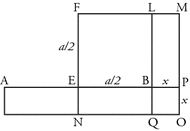
SpringerLink
Archive for History of Exact Sciences - The geometrical algebra hypothesis was once the received interpretation of Greek mathematics. In recent decades, however, it has become anathema to many. I...
grave pond
A paywalled article, really? Again, if you have a point to make, make it here.
urban hamlet
obsidian hornet
Euclid's Elements) Ok, for serious: Geometry revisited (Coxeter Greitzer), Geom...
Thank you! I’ll check those out!
olive agate
grave pond
A paywalled article, really? Again, if you have a point to make, make it _here_.
Privilege can’t see that kind of thing, sorry. Zeuthen on Wikipedia then. He was both a mathematician and a math historian
grave pond
Are you claiming that https://en.wikipedia.org/wiki/Hieronymus_Georg_Zeuthen contains anything of relevance for Hippocrates?
olive agate
grave pond
Are you claiming that <https://en.wikipedia.org/wiki/Hieronymus_Georg_Zeuthen> c...
The point I am making is that you could ascribe intelligence to the ancients
grave pond
I think you're just being bellingerent for conflict's sake here. If you have point to make, make it rather than hiding behind links to obscure sources outside the chat.
olive agate
grave pond
I think you're just being bellingerent for conflict's sake here. If you have poi...
There’a an aspect of that on both sides I think. But to me you seem to discount the possibility that there was a proof we’d accept today at the time
grave pond
But to me you seem to discount the possibility that there was a proof we’d accept today at the time
How on earth do you form that conclusion?
olive agate
Ok. As I said above, this is not the forum, especially since you take things out of thread all the time. For the sake of the forum, I yield
grave pond
Speaking of "yield" definitely makes you sound aggressive, like talking in a chat is a game that aims at finding a winner ...
And this is the channel the server has for talking about geometry, even ancient geometry.
olive agate
Ok if this really is the forum, what makes you say Hippocrates couldn’t talk about other similar figures than squares on the right triangle?
grave pond
Nothing makes me say that, and I didn't say that.
grave pond
I said that we don't know how Hippocrates got from a statement about sum of squares to a statement about sum of circular segments because his writings where he made that connection have not survived.
olive agate
He might not even have gone from squares
grave pond
The more to lament that we don't know how he did it, right?
olive agate
We agree at last!
arctic hatch
@meager raft This guy is very good at maths
 meager raft
 arctic hatch
Teach trigonometry
zealous pike
grave pond
I said that _we don't know how_ Hippocrates got from a statement about sum of sq...
Can't we assume that it was by similar methods as those used by Aristotle to approximate the area of a parabola?
Wait, was it Aristotle who did that or was it Erasthotenes
Neither
It was Archimedes
Exhaustive approximation of curves with squares and rectangles seems to have been very common back then, idk
grave pond
Wikipedia states that the method of exhaustion started with Antiphon, who was a contemporary of Hippocrates, "although it is not entirely clear how well he understood it". If Hippocrates had explained that involved, it feels like Simplicius would probably have chosen that to gush about instead of the comparatively simple adding/subtraction of areas that comes after.
zealous pike
 interesting
If we use the knowledge on mathematics by the context they had back then, wouldn't it be possible to simulate or approximate his idea?
Most demonstrations about that theorem uses notation and knowledge that were polished much later in history, which may make room for confusion.
grave pond
grave pond
It's a shame that Hippocrates's proof has not survived. Today we can say relativ...
Hmm, perhaps I was overly skeptical about how easy it would be to speak about equal proportions in the language of antiquity. Euclid, a century or two later, does prove (via exhaustion) that all circles have the same ratio to the squares of their diameters (proposition XII.2) and has shown earlier how to add or subtract such proportions (e.g. proposition V.19).
zealous pike
Although it may be considerably hard to come up with something as smart as that
zealous pike
grave pond
Hmm, perhaps I was overly skeptical about how easy it would be to speak about eq...

lime crownBOT
No need to ask “Can I ask…?” or “Does anyone know about…?”—it’s faster for everyone if you just ask your question! See https://dontasktoask.com/
past crag
,iamnotstudying
somber coyoteBOT
Removed the studying! role from you.
fading crater
How do i find where on the trigononometric circle the intended value? For example:

 zealous pike
fading crater
How do i find where on the trigononometric circle the intended value? For exampl...
zealous pike
fading crater
How do i find where on the trigononometric circle the intended value? For exampl...
Are you using radians?
zealous pike
fading crater
It's just equations now.
3x = π/6
Isn't it x = π/18?
3π/18 = π/6
sin(π/6) = 1/2
fading crater
zealous pike
sin(π/6) = 1/2
I mean, it makes sense to me, not that i would know.
zealous pike
fading crater
I mean, it makes sense to me, not that i would know.
For that, it is good to know at least the standard terminal points and their values for sine or cosine. If you know a value x for sine to become 1/2, then u are half way done
Like, for sine 5x = 1/2
We know that sine x is 1/2 when x = π/6. can we find a value x so that 5x =π/6
?
fading crater
zealous pike
Like, for sine 5x = 1/2
We know that sine x is 1/2 when x = π/6. can we find a ...
But there is no 5x.
It's only 3x.
zealous pike
It was just an example
fading crater
Oh, okay.
zealous pike
The logic is the same though. Which value x so that 3x = π/6?
fading crater
Well, it comes down to being sin3x = 1/2.
zealous pike
Isn't that what you are trying to solve?
fading crater
Yes, but i don't know how?
fading crater
No.
zealous pike
Oke
zealous pike
fading crater
No.
Do you already know that Sin = opposite side / hypotenuse?
If you do, it may be simpler to understand this. Trigonometry of right triangles is also sort of possible to apply here
fading crater
zealous pike
Do you already know that Sin = opposite side / hypotenuse?
Kind of.
zealous pike
fading crater
Kind of.
Can you already convert radians to degrees?
fading crater
zealous pike
Can you already convert radians to degrees?
Like pi=180° for example?
zealous pike
Yes
fading crater
Yes, i do.
zealous pike
fading crater
Yes, i do.
Let's say we have an equilateral triangle whose sides are 2 units. What happens if we divide that triangle in 2 with a perpendicular line from its tip to the base? What kinds of triangle do we end up with
fading crater
Two right angled triangles?
zealous pike
fading crater
Two right angled triangles?
That's right. Let's call the base = b, height = h and hypotenuse = a. What are their units in the new right triangle
?
fading crater
Sides?
zealous pike
No
It depends actually
Let's start this by finding the lengths of the sides. Before we've split the triangle, the sides were 2 units each.
With it split, what length is the base now?
zealous pike
Right
The base is 2× 1/2, half of what it was before. Base = 1
What about the hypotenuse?
upper karma
help
 fading crater
zealous pike
What about the hypotenuse?
fading crater
zealous pike
What about the hypotenuse?
Hypotenuse is the same length as 2 new bases
zealous pike
fading crater
Hypotenuse is the same length as 2 new bases
That's right
Can you tell what angles that triangle has? You can do so either in radians or in degrees
fading crater
60° - 90° - 30°?
zealous pike
That's right. You got this
Therefore, if we know that sin is the ratio of the opposite side by the hypotenuse, do you understand how sin(30°) = 1/2?
zealous pike
You don't understand now, but you are in the right way. You can do this