#internals-and-peps
1 messages · Page 128 of 1
 verbal escarp
to a dict of lambdas
which can be useful if you have 3 or more boolean vars and you need to cover all different cases
 flat gazelle
Yeah, that's more or less what pattern matching does in rust
flat gazelle
Just with a lot faster hash than a full tuple
Yeah, in python it's only in isolated cases, and can't ever do it automatically
verbal escarp
i think most of the times cases are degenerate
like a list of "if bla: return" as a preamble of sorts and the "real" code is actually in the "end-else" if you'd write it all out
guess that's also what match/case boils down to
btw, i'm just working on a prototype for pip-auto-install.. mapping inherently recursive ideas to global singleton expressions with side-effects is pretty difficult 😐
it would all be so much easier if imports were only allowed on the module global level
if that was the case, i could just replace __import__ when a package is installed and imported and reset after, just like it's doable with the cwd
but instead, i basically need to keep track of the context in which something is imported, replace __import__ by a kind of decorated version which checks from where the import call is being made to be able to replace the call any time in the future by the appropriate version
only to be able to use pip and venv and simplify the heck out of the code
😵💫
@paper echo all your fault :p
 paper echo
😂☠️
 magic python
some_list : tuple[str, int, str] = []
apparently this is not ok - having run with mypy --strict i get: Incompatible types in assignment (expression has type "List[<nothing>]", variable has type "Tuple[str, int, str]"), I was under the impression that type-hinting a data structure like lists / dicts at creation was an ok thing to do though.
some_list = [] shuts mypy up, but i lost information about what this list is going to contain.
clearly i've missed a point somewhere 🤔
 charred pilot
maybe you wanted list[tuple[...]]?
magic python
🤦♂️ yes lol
i was thinking, i swear i've done this loads... thought something had been added to strict
verbal escarp
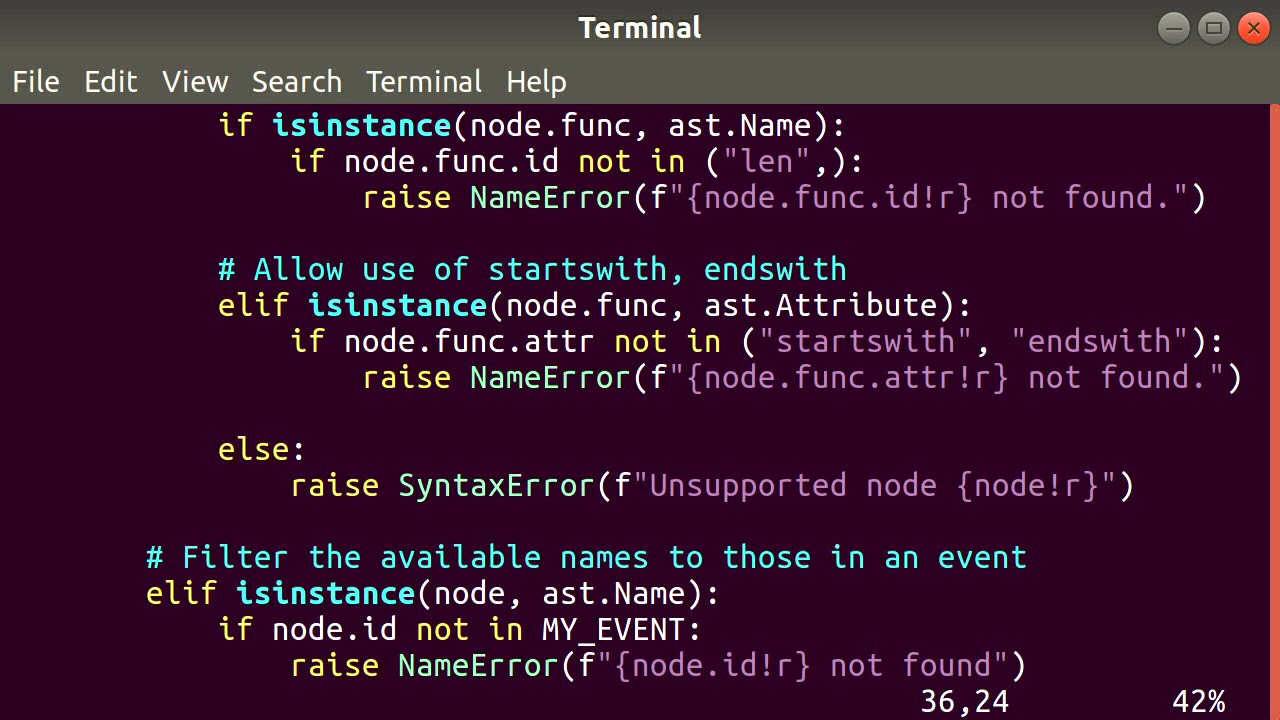
apropos AST and eval(), this presentation should be mandatory: https://www.youtube.com/watch?v=7e-2nUqnNqE
Tim Savage
Allow your users to supply queries or define rules using Python syntax and safely eval them. Processing an AST into safely executable code.
https://2019.pycon-au.org/talks/safely-eval-python-syntax-using-the-ast-module
PyCon AU, the national Python Language conference, is on again this August in Sydney, at the International Convent...
really cool and crazy what they came up with
magic python
how's one supposed to test / check whether a line has a trailing comment?
eg something like: line = "for i in 'this is # a test #': # pylint: disable=one,two" , i thought about using regex, but feel it could be pretty messy, and this sort of thing must be solved.
verbal escarp
magic python
how's one supposed to test / check whether a line has a trailing comment?
read the line and split at '#'?
magic python
verbal escarp
read the line and split at '#'?
Have you looked at the example
I don't know how "read the line and split at #" makes sense here? If there can be multiple pound signs etc, after splitting, then what?
magic python
verbal escarp
either parse the line yourself or use a python parser and look at the CST
Ok, idk how id write a parser
magic python
verbal escarp
https://libcst.readthedocs.io/en/latest/why_libcst.html
I'll check this, thanks.
What's the approach, read characters while the CST says it's a valid line?
Hmm no, BC it wouldn't be valid for the first few chars I guess
 ancient solstice
hi guys, can anyone help me by reading my project idea and give me some feedback about the project ?
magic python
@verbal escarp do you have any experience with that module? It seems that It wont parse a single line of python, eg 'for i in 'this is # a test #': # pylint: disable=one,two' will throw an error from cst.parse_*, so i'm not sure if i can parse line by line, or have to evaluate a whole file at once etc.
i was intending to iterate over a file line by line, maybe this won't work tho 🤔
 main ginkgo
is there any easier way to test out changes to cpython's grammar than to recompile it every time?
 brave badger
magic python
<@!500372058186842123> do you have any experience with that module? It seems tha...
brave badger
magic python
<@!500372058186842123> do you have any experience with that module? It seems tha...
libcst requires that the string that you pass to it is well-formed Python code
magic python
brave badger
libcst requires that the string that you pass to it is well-formed Python code
yeah seems that way, hm
brave badger
magic python
yeah seems that way, hm
This is probably what you want:
See also: https://libcst.readthedocs.io/en/latest/nodes.html#libcst.IndentedBlock
>>> py = """
... for i in 'this is # a test #': # pylint: disable=one,two
...   pass
... """
>>> libcst.parse_module(py).body[0].body.header
TrailingWhitespace(
    whitespace=SimpleWhitespace(
        value=' ',
    ),
    comment=Comment(
        value='# pylint: disable=one,two',
    ),
    newline=Newline(
        value=None,
    ),
)
Although it might be better to use the builtin visitors instead. Likewise, this is straying a bit off-topic for the channel.
magic python
brave badger
Although it might be better to use the builtin visitors instead. Likewise, this ...
which channel is this on-topic for
brave badger
Help channels would be more appropriate
magic python
but of the channels, which is most appropriate?
obviously questions aren't strictly asked in help channels
brave badger
We don't have a topical channel strictly dedicated to parsing/static analysis, help channels serve as a catch-all
magic python
yeah i know there's a not a single one - but idk if it'd be more estoteric / software-design etc
verbal escarp
isn't "advanced-discussion" a catch-all for discussing advanced topics like parsing? ^^ not sure if a help-channel would be better suited tbh
but no, i haven't used libcst extensively
 sacred yew
see channel topic
verbal escarp
would there be any benefit if modules were lazily loaded and any ideas how this could be achieved?
 tender goblet
not sure whether this is the place to post, but...
Hello, I'm a novice Python programmer (have started learning the language about a year ago) and have recently found out about sets (the data structure). I've noticed that one do things with sets that can't otherwise be done with structures such as lists (like, for example, subtracting one set from another: set1 - set2 works, while list1 - list2 doesn't).
My questions are:
Aren't sets just strictly better? If not, what are the upsides/downsides?
I'm posting here in the hopes of gleaning some info that can't easily be found via a quick google search.
verbal escarp
they are different, and since they don't keep insertion order, they have some big drawbacks
charred pilot
but also upsides. sets have way faster membership tests
verbal escarp
yep.. but since you can't index them, otherwise nice features like random.sample don't work on sets
charred pilot
it works for now, but it's deprecated
verbal escarp
tender goblet
~~not sure whether this is the place to post, but...~~
Hello, I'm a novice Pyth...
you could implement __sub__ for lists if you really need it yourself 😉
it's just not very well defined what list1 - list2 means in general
main ginkgo
verbal escarp
would there be any benefit if modules were lazily loaded and any ideas how this ...
what degree of laziness? load individual module members only when needed or load the whole module when needed?
tender goblet
verbal escarp
it's just not very well defined what list1 - list2 means in general
oh, I meant that typing something like
list1 = [1, 2, 3, 4]
list2 = [3, 4]
print(list1 - list2)
doesn't work :P
thanks for the info, btw
verbal escarp
main ginkgo
what degree of laziness? load individual module members only when needed or load...
i'm wondering that myself. i'm guessing individual members would make most sense?
 peak spoke
how would that deal with dynamic assignments?
(i.e. even things like changing an attr after the obj is created)
verbal escarp
tender goblet
oh, I meant that typing something like
```
list1 = [1, 2, 3, 4]
list2 = [3, 4]
p...
class foo(list):
    def __sub__(self, other):
        return [x for x in self if x not in other]


L1 = foo([1,1,2,2,3,4,4,5])
L2 = [2,3]

print(L1 - L2)
 undone hare
Do you know what those are?
undone hare
Do you know what those are?
seriously? 😉
undone hare
Actually, this channel is for discussion related to the development of the language itself, would you mind grabbing an help channel please? #❓|how-to-get-help if you don't know how
peak spoke
sets were the start of their question
undone hare
Okay, I will learn to read
main ginkgo
verbal escarp
i'm wondering that myself. i'm guessing individual members would make most sense...
hmm.. one way it could be done is using an import hook to rewrite modules' ast to use a toplevel getattr (see pep 562), or a module proxy with a getattribute and setattribute. the biggest challenge with this would probably be figuring out which members reference other members and inserting the correct stuff to handle that. as for benefits, one use that comes to mind is for monkey-patching a particularly huge module that you cant easily rewrite.
main ginkgo
verbal escarp
i'm wondering that myself. i'm guessing individual members would make most sense...
or modules that can use a lot of memory if loaded in all at once
verbal escarp
main ginkgo
hmm.. one way it could be done is using an import hook to rewrite modules' ast t...
like tensorflow or numpy?
would it make any sense to load those lazily?
main ginkgo
verbal escarp
would it make any sense to load those lazily?
not sure, would have to check how much they can be manipulated at the python level
verbal escarp
do you have an example where it might be beneficial so i can do some experiments maybe?
main ginkgo
hmm.. cant think of any good examples atm but if i do will let you know
verbal escarp
excellent
main ginkgo
iirc older versions of pyqt had a much larger memory footprint
there's one pyqt module that loads in absolutely every thing
they improved the laziness of that on their side i think
 nova iris
verbal escarp
```python
class foo(list):
def __sub__(self, other):
return [x for x...
nova iris
verbal escarp
```python
class foo(list):
def __sub__(self, other):
return [x for x...
when i saw that, it reminded me of set builder notation
and then i realized- comprehensions were literally inspired by set builder notation
 stuck valley
verbal escarp
you could implement `__sub__` for lists if you really need it yourself 😉
stuck valley
verbal escarp
you could implement `__sub__` for lists if you really need it yourself 😉
hail satan
I reckon you could just replace the builtin list class.
Definitely.
main ginkgo
!e
import forbiddenfruit

def list_sub(self, other):
  other_set = set(other)
  return [
    i for i in self
    if i not in other_set
  ]

forbiddenfruit.curse(list, '__sub__', list_sub)

print([4, 3, 1, 2, 5] - [1, 2, 2, 3])
 fallen slateBOT
@main ginkgo :white_check_mark: Your eval job has completed with return code 0.
[4, 5]
forbiddenfruit always ready for cursing needs
main ginkgo
theres also @pliant tusk 's fishhook module
 dusty verge
I assume it works by mungling around with the c data?
 pliant tusk
yea
dusty verge
Interesting stuff
 main lynx
anybody have experience with writing/maintaining "safety-critical" python software? i'm hearing a lot of dogma about it being bad, but when i look around the reasons i see for not using Python don't really track
 visual shadow
safety critical... safety in what sense? could you elaborate?
flat gazelle
main lynx
anybody have experience with writing/maintaining "safety-critical" python softwa...
Highly critical software uses formal verification and other related methods to ensure that the code is correct. This is much easier to do with C/java since there are advanced tools for it.
verbal escarp
stuck valley
hail satan
lol.. I probably wouldn't use this approach myself to implement __sub__ with its O being n², but if the question is whether there might be a reasonable and doable definition/implementation - yeah, why not ^^
stuck valley
verbal escarp
lol.. I probably wouldn't use this approach myself to implement `__sub__` with i...
check fishhook in #esoteric-python
verbal escarp
flat gazelle
Highly critical software uses formal verification and other related methods to e...
i'm thinking that it might be rather easy to get there with python if only a subset of the language features is allowed, like going all-functional
verbal escarp
stuck valley
check fishhook in <#470884583684964352>
maybe do AST analysis to check
urgs.
sorry, wasn't for you :p
unhooks the message
stuck valley
helo
verbal escarp
yo
one could use the type annotations in the AST to define preconditions/postconditions in the sense of the hoare calculus
then it might be feasible to prove the correctness of individual modules before they are executed
https://en.wikipedia.org/wiki/Hoare_logic - something like that, yeah
Hoare logic (also known as Floyd–Hoare logic or Hoare rules) is a formal system with a set of logical rules for reasoning rigorously about the correctness of computer programs. It was proposed in 1969 by the British computer scientist and logician Tony Hoare, and subsequently refined by Hoare and other researchers. The original ideas were seeded...
it wouldn't be "gradual typing" anymore, but "gradual verification" 🙂
way cooler 😉
only drawback i can think of would be that the annotation used for verification would probably be incompatible with the established notation
oh, heh. not even
a: "int # 0 < a < 10"
nobody expects the comment in the annotation!
vscode happily evaluates a to be int
i loved hoare calculus in CS.. good times ^^
very nice
not as in-depth as i was suggesting, but it looks like a good place to start
 rigid vapor
!e
print('Hello world!')
fallen slateBOT
@rigid vapor :white_check_mark: Your eval job has completed with return code 0.
Hello world!

main lynx
thanks, being able to prove correctness was the only valid-smelling reason, but sounds like there are solutions to that too
verbal escarp
main lynx
thanks, being able to prove correctness was the only valid-smelling reason, but ...
what do you mean?
main lynx
wrt reasons to not use python in critical path of cars, robots, etc.
magic python
When running mypy it seems that it's possible to get a set of errors (mypy <path> --strict --show-error-codes). If you then add type: ignore[<code>] to these and rerun mypy there can be different errors, which weren't picked up on the first run.
I'm just wondering if this is expected? I'd prefer them to all appear on a single run, but perhaps that isn't possible I'm not sure.
An example of this happening is for this file: https://github.com/raphaelvallat/pingouin/blob/master/pingouin/utils.py
When first run the set of errors don't say anything about the missing annotations on the functions, but when the _initial_set of errors are ignored, the missing function annotation errors are raised by mypy, I don't really understand why it works like this 🤔
verbal escarp
ah. cool 🙂 well, iirc there's a lot going on with python in the robot space anyway already for some time now
main lynx
yes, that's where i'm encountering the dogma of python being a bad choice, despite it already being widely used, sometimes very poorly
verbal escarp
okay, makes sense
main lynx
if you're building a robot on linux, at the end of the day it's gonna be making the same system calls as a c++ implementation of the same task
magic python
here are examples of the initial errors generated, and then the errors generated having ignored the initial errors: https://zerobin.net/?04ff8bb17e473be0#ciK8p1zT29zWK4Cv7Y+YuSiVq1F5sDqo0+96+qbarGY=
this might just be how it works and the only way it can work, idk
main lynx
and the OS is gonna schedule it much the same
verbal escarp
main lynx
and the OS is gonna schedule it much the same
well, i can think of a single big issue why you wouldn't want to use python in mission-critical systems
 little yoke
hey can you do web related stuff in python (things like receiving https requests etc)?
magic python
@little yoke #web-development
little yoke
magic python
<@!673564338287673345> <#366673702533988363>
ty
verbal escarp
@faint quail it's the garbage collection, that might mess with real-time responsiveness
main lynx
ok, i've looked at this too, and it's possible to prove that a program has no circular references and turn off the gc
verbal escarp
main lynx
ok, i've looked at this too, and it's possible to prove that a program has no ci...
TIL 🙂
main lynx
that is one of the touted reasons though
verbal escarp
then i couldn't think of any other reason why python couldn't work in that space
if you can make python gc-less without running into issues and prove its correctness.. holy crap
magic python
actually i get different mypy results depending on whether i do mypy . and mypy <path to single file>
 stiff crypt
Idk if it's okay to place it here or in the help channels.
 main lynx
i think more specific tools for proving the gc never removed anything could go a long way
esp. when compared to c++ which basically uses the same reference-counting approach without any standard gc
verbal escarp
stiff crypt
Idk if it's okay to place it here or in the help channels.
you can use pyinstaller to turn your whole python project into an exe, yes
verbal escarp
@faint quail if you want to tackle that, i'll be rooting for ya ^^
main lynx
thanks for the chat 👋
verbal escarp
cya
stiff crypt
verbal escarp
you can use pyinstaller to turn your whole python project into an exe, yes
Ohhh I see. But I'm still curious about what professionals use when they release something made in python, like do they also use pyinstaller (which I guess not) or do they have their own way to do it. Or like they develop GUIs and other things in other languages and then just implement the python backend or something
verbal escarp
stiff crypt
Ohhh I see. But I'm still curious about what professionals use when they release...
what professionals?
stiff crypt
Like python app devs/software engineers/etc
verbal escarp
that doesn't make any sense 😉
stiff crypt
I mean you write the code in .py right?
And then from a .py, how will you give it to the consumers/users when youre done making/developing it
verbal escarp
if you're talking about professionals, you need to think of the area of application, platform you want to deploy to etc
stiff crypt
Ohhhh, let's say it's a windows app
verbal escarp
like games, medical applications, web apps, data science, lab equipment..
windows app can be anything from ms excel manipulation, scientific applications..
data from the large hadron collider is evaluated in python just the same as F1 chassis design
and you probably wouldn't say those aren't professsionals
stiff crypt
Yaya, my terms are misleading but I get your point
verbal escarp
you had consumer software in mind, right?
stiff crypt
verbal escarp
you had consumer software in mind, right?
Yes yes
verbal escarp
well, you can use pyqt with pyinstaller to make an exe and nobody would guess they're running a python app 🙂
stiff crypt
verbal escarp
windows app can be anything from ms excel manipulation, scientific applications....
these are in .py too right? are these executed via command prompt? or in an ide like pycharm?
stiff crypt
verbal escarp
well, you can use pyqt with pyinstaller to make an exe and nobody would guess th...
Ohhhhh, the gui is written from Python too?
verbal escarp
you can have it either way, yes
verbal escarp
stiff crypt
Ohhhhh, the gui is written from Python too?
pyqt is a hybrid, so yes, but not really ^^
the qt framework isn't written in python, but you as developer only write python
stiff crypt
the "qt" part is somewhat related to QT creator?
stiff crypt
Ohhhh, we've used qt creator as an ide for c++ but havent used it that much outside of writting/running codes
stiff crypt
verbal escarp
if you're talking about professionals, you need to think of the area of applicat...
So in short, you can just use straight up .py files when working on a company/something on private projects right? And then just deal with the .exes when you are working on something that you intend to give off as consumer software?
verbal escarp
sure, you can wrap up your python code as an exe and deploy it, no problem
stiff crypt
"deploy" is the technical term?
verbal escarp
sure
stiff crypt
sorry I'm an incoming 2nd year comsci student but still a veryvery noobie
thank you!
verbal escarp
np ^^
you can ask for more specifics in #tools-and-devops i guess that's the more appropriate channel for that
that channel is dedicated to questions on deployment
stiff crypt
I've seen some of our seniors' works, thesis, machine problems, etc. Some of them are made in python, their source codes are included in their papers but I cannot understand them at the moment, I started to wonder how can they make a .py file into something more consumer-friendly, as our homework and projects the last schoolyear were just text-based/console-based and some file manipulation. Thank you for clearing up some things in my mind!
verbal escarp
well, most thesis code isn't meant to be user friendly, just sits on github and is run via terminal - and isn't well designed python code either
most of the times you'd probably want something like a web-app or like the bot here
evaluate code and run it against some tests from a web form
really depends on who's the consumer ^^
you might be interested to check out some low/no-code environment, just to get an idea of what's possible
stiff crypt
I've also read somewhere that python isnt really optimized for like py-to-exe stuffs
verbal escarp
python isn't optimized for anything other than cobbling readable code together, quickly
magic python
I'm still wondering about this: #internals-and-peps message
presumably there's a good reason, I don't understand why though
main lynx
is there a config file in . it might be reading?
verbal escarp
main lynx
is there a config file in . it might be reading?
no idea.. but i did have another thought on why "gradual verification" would be a big win to python
pharmaceutical production and other medical applications that are close to patients need to be as error-proof as possible. usually that would mean rigorous development and excessive testing, but verification could change that game
(ironically, most pharmaceutical production machines run windows..)
if you could validate the correctness of critical modules (even if they are function-only), that would open python up for use in another very important industrial sector
 gleaming rover
verbal escarp
if you could validate the correctness of critical modules (even if they are func...
gleaming rover
verbal escarp
if you could validate the correctness of critical modules (even if they are func...
I don't think this is possible
without restricting Python's functionality
AFAIK
reflection screws up formal proofs
but I would be happy to be corrected by someone who knows what they're talking about...
verbal escarp
add pre-/post conditions in annotations, restrict python to a subset, like functions only and check the AST
i don't see why that couldn't work
gleaming rover
verbal escarp
i don't see why that couldn't work
yeah, it could
verbal escarp
i wished i had more experience in AST manipulation, it seems to be key to a lot of very useful areas
 swift imp
verbal escarp
i wished i had more experience in AST manipulation, it seems to be key to a lot ...
swift imp
verbal escarp
i wished i had more experience in AST manipulation, it seems to be key to a lot ...
I've recently used it for a large code refactor at work. Its amazing. Especially if using 3.9 which has ast.unparse to return it back to valid python code. We did a huge refactor of like 20k lines.
swift imp
The refactor was huge because when the library was first written the original creator was really allergic to OOP. We refactored it by making classes that encapsulated a lot of the procedural code (which was very patterned and cookie cutter copy and pastes).
Basically we defined "check lists" of code that fit a certain pattern per their AST traversal. When identified we transformed it and used it to create classes through AST. Then we dumped the ast of the classes into valid code and wrote to a file.
Each ast.AST object has a body attribute that is a list holding more ast.AST objects. You can add or remove to that list.
verbal escarp
that sounds scary and awesome
how did you figure out how to work with the AST in that way?
are there tutorials for those kinds of manipulations?
swift imp
I would dump an object using ast.parse and then snoop around the resultant object's help/dict. After sometime when I felt comfortable I started looking more at the documentation.
swift imp
Yeah. I learn the best through experimentation and then going back and reading the docs
main ginkgo
swift imp
Each `ast.AST` object has a `body` attribute that is a list holding more `ast.AS...
not all of them, you can see which ones do by checking the grammer https://docs.python.org/3/library/ast.html#abstract-grammar
and in some like Expression body is a single node
 fickle osprey
hey guys just a general question about hardware for ML. So if i have a basic LSTM with attention layers and beam search algorithm which i want to train and evaluate on multiple datasets ranging between size 500mb to 4gb size (before pre-processing) whats the hardware i would need? For example within cloud how much ram and what kind of gpus i would need for quick training (ideally within 4/5 hours)
2) For fine tuning GPT Models (124M layer) on a 2.6gb dataset (before pre-processing) what kind of gpu + ram i would need. Goal is to finetune and evaluate within 10 hrs.
3) GPT NEO Model. For this how much ram and computational power i would need considering dataset size is 8GB. Goal is to train within 24 hrs.
*sorry fine tune not train
sacred yew
fickle osprey
thanks posted there.
 cyan elbow

 raven ridge
This server is for the Python programming language. You can ask about that in an off-topic channel, or on a different server.
!ot
fallen slateBOT
Off-topic channels
There are three off-topic channels:
• #ot0-psvm’s-eternal-disapproval
• #ot1-perplexing-regexing
• #ot2-never-nester’s-nightmare
Their names change randomly every 24 hours, but you can always find them under the OFF-TOPIC/GENERAL category in the channel list.
Please read our off-topic etiquette before participating in conversations.
 surreal sun
Why is it that today of all days I’m finding a crap ton of usecases for metaclasses
I used to have zero uses for them
 deft pagoda
you seen the cool enum metaclass?
peak spoke
what usecases did you find? I've used a metaclass once so farm in normal code
deft pagoda
!e
from itertools import count

class IncrDict(dict):
    def __init__(self, start=0, step=1):
        self.counter = count(start, step)

    def __missing__(self, key):
        if key.startswith('__'):
            raise KeyError(key)

        self[key] = next(self.counter)
        return self[key]

class EnumMetaclass(type):
    def __prepare__(*args, **kwargs):
        start = kwargs.get('start', 0)
        step = kwargs.get('step', 1)
        return IncrDict(start, step)

class Enum(metaclass=EnumMetaclass):
    def __init_subclass__(cls, **kwargs):
        """Pull kwargs from class def"""

class Fruit(Enum, start=10, step=15):
    APPLE
    BANANA
    KIWI

print(Fruit.APPLE, Fruit.BANANA, Fruit.KIWI)
@deft pagoda :white_check_mark: Your eval job has completed with return code 0.
10 25 40
this is my favorite use of metaclasses --- taking over the namespace with __prepare__
you can do neat tricks, like add in a class-specific method decorator in prepare and then remove it in __new__ for some real magic class definitions
surreal sun
peak spoke
what usecases did you find? I've used a metaclass once so farm in normal code
Well, I thought I had something but I already messed up lmao
i was trying to get the first value defined in an init using a metaclass but that failed
Since I was trying to have the user have the first value defined in an init be the one they want to use for most dunder methods, then implement dunder methods in the metaclass itself, but I could just use inheritance for that too
surreal sun
deft pagoda
this is my favorite use of metaclasses --- taking over the namespace with `__pre...
So __prepare__ would override any previous classes with the same namespace?
deft pagoda
i don't know what you mean about previous classes
in the above example, the names APPLE, BANANA, KIWI aren't even defined, but the namespace is built out of this weird IncrDict instead of a normal dict, so name errors are caught and assigned some default value
deft pagoda
you can build weird alternatives to dataclasses with this method:
In [37]: from q import q

In [38]: class Point(q):
    ...:     x, y
    ...:

In [39]: Point(1, 2)
Out[39]: Point(x=1, y=2)
same thing, x and y aren't even defined, but they're assigned default values anyway -- in this case they're made part of the __init__ and __repr__
surreal sun
!e ```py
class Attrs(dict):
def init(self, dct: dict):
self.values_dct = dct
def __missing__(self, key):
    if key not in self.values_dct.keys():
        raise KeyError

    self[key] = self.values_dct.get(key)
    return self[key]
class AttrDefinition(type):
def prepare(*args, **kwargs):
return Attrs(kwargs)
class Dataclass(metaclass=AttrDefinition):
def init_subclass(cls, **kwargs):
pass
class Foo(Dataclass, x=1, y=2):
x
y
print(Foo.x)
tried this, and it works@surreal sun :white_check_mark: Your eval job has completed with return code 0.
1
TIL about prepare
surreal sun
this is amazing lmao
deft pagoda
this is the source for q weirdness: https://github.com/salt-die/q/blob/main/q/q.py
main ginkgo
deft pagoda
you can do neat tricks, like add in a class-specific method decorator in prepare...
this sounds interesting, what would be a concrete example?
deft pagoda
i experimented with a class-specific decorator here: https://github.com/salt-die/nurses/blob/master/nurses/widgets/widget.py#L51-L62
But I don't do this anymore my current tui library
fallen slateBOT
nurses/widgets/widget.py lines 51 to 62
class Observer(type):
"""
This metaclass simply drops the `bind_to` decorator into the class dict.
`bind_to` allows one to quickly bind functions to attributes in the class body - these attributes
will be turned into Observables by the decorator.
"""
def __prepare__(name, bases):
return { "bind_to": BindMagic }
def __new__(meta, name, bases, methods):
del methods["bind_to"]
return super().__new__(meta, name, bases, methods)```which looks like this in a class definition: https://github.com/salt-die/nurses/blob/master/nurses/widgets/widget.py#L152-L158
fallen slateBOT
nurses/widgets/widget.py lines 152 to 158
@bind_to("top")
def _set_pos_hint_y(self):
    self.pos_hint = None, self.pos_hint[1]

@bind_to("left")
def _set_pos_hint_x(self):
self.pos_hint = self.pos_hint[0], None```so now, class instance attributes top and left will be converted to properties that call these methods when __set__
it's super magical and was mostly an experiment, but maybe for some other framework it could be useful as a time saver
verbal escarp
i'd prefer attrs with annotations, if i need a class that only holds x and z i take namedtuple, which is magical enough
deft pagoda
attr.s i.s a bi.t un.readabl.e
but i don't think namedtuples are magical, i think that should be the preference whenever possible
verbal escarp
namedtuples are extremely magical if you have a closer look
deft pagoda
i've looked at the source
peak spoke
yeah I'd definitely consider a dynamically created class magical
deft pagoda
i mean, it's just a tuple with properties that are itemgetters
peak spoke
the class it creates is simple, but I wouldn't say the process used to get there is
flat gazelle
The concept of eval for dynamically created types is as old as eval, I would hesitate to call it magic. It's more just an application of dynamic typing
nova iris
deft pagoda
!e
```py
from itertools import count
class IncrDict(dict):
def __init__(sel...
ah, see, you did the same thing as i did - creating a superclass solely for overwriting default object.__init_subclass__ behaviour so kwargs can be inserted
i was always searching for a solution to this, it seemed as if this quick and dirty fix was too un-elegant
but i guess it iz what it iz
deft pagoda
you can do it with an __init__ instead in the metaclass, but i also wanted a normal class wrapper
nova iris
>>> wait()
Traceback (most recent call last):
File "<pyshell#6>", line 1, in <module>
wait()
TypeError: cannot create 'generator' instances
```aww white nexus
I've been thinking about it, and in comparison to other languages, I think the fact that python requires a pass statement since it doesn't have brackets helps make code more readable.
Requiring pass means that its impossible to write a class without intentionally not putting anything in it.
 grave jolt
I don't really know where pass would be useful
In an empty class you can replace pass with a docstring
or a no-op expression like ...
verbal escarp
... is not nothing
white nexus
(What does ... do?)
verbal escarp
it's an object
 spice pecan
It's Ellipsis, one of the most notable uses is skipping array dimensions in numpy
grave jolt
... is understood as "missing implementation" in protocols/abstract classes by type checkers
spice pecan
IMO pass is a fairly explicit way of saying "This is, and should remain, empty"
verbal escarp
i think it's the only no-op code that isn't an object
spice pecan
I'm pretty sure it's the only legitimate no-op, yeah
white nexus
spice pecan
IMO `pass` is a fairly explicit way of saying "This is, and *should remain*, emp...
An exemption of that if there is a comment above it that starts with TODO... or similar.
 unkempt rock
Anyone good at packages and imports  #help-apple
spice pecan
white nexus
An exemption of that if there is a comment above it that starts with TODO... or ...
I'd use ... in that case
As suggested by @fix error#1642 earlier
white nexus
I have a bunch of raise NotImplementedError while I work on a file, what is the difference?
spice pecan
... is missing implementation, pass is intentionally empty
grave jolt
I think pass is just a syntactic limitation of Python, I haven't seen it in other languages
spice pecan
raise NotImplementedError would be ideal
 south raft
... returns class ellipsis
verbal escarp
NotImplemented is an alternative
white nexus
grave jolt
I think `pass` is just a syntactic limitation of Python, I haven't seen it in ot...
yeah, that was implied/stated in my original statement 😄
verbal escarp
but it's also an object, which may or may not have performance implications
spice pecan
NotImplemented has a very specific meaning
grave jolt
verbal escarp
but it's also an object, which may or may not have performance implications
If you're worried that ... is more expensive than pass, it's not
spice pecan
spice pecan
`NotImplemented` has a very specific meaning
It's what you return from a dunder if you don't know how to interact with a certain type and want to let it decide
grave jolt
grave jolt
If you're worried that `...` is more expensive than `pass`, it's not
!e
import dis

def foo():
    pass

def bar():
    ...

dis.dis(foo)
dis.dis(bar)
@grave jolt :white_check_mark: Your eval job has completed with return code 0.
001 |   4           0 LOAD_CONST               0 (None)
002 |               2 RETURN_VALUE
003 |   7           0 LOAD_CONST               0 (None)
004 |               2 RETURN_VALUE
What about methods/functions that don't have meaning yet, but exist as a sort of todo?
spice pecan
Ideally, raise NotImplementedError()
white nexus
ah, so what I already do 😛
spice pecan
With an appropriate docstring whenever possible, or a TODO comment
grave jolt
yeah, if you put ... or pass while you're working on it, you might get a sneaky None somewhere
white nexus
right
spice pecan
... is typically used in stubs, pass generally seems to be used as an intentional no-op that's supposed to stay that way
deft pagoda
i've written a few while loops where the important bit was the condition and so the body of the while was pass
white nexus
I have one file that has pass since it works how it is, but still needs additional features (think subclass, that doesn't have anything to improve on yet)
white nexus
deft pagoda
i've written a few `while` loops where the important bit was the condition and s...
so just waiting for the condition to become true?
deft pagoda
yep, usually this involves conditions that have side effects
paper echo
deft pagoda
i've written a few `while` loops where the important bit was the condition and s...
:= ftw
deft pagoda
yep, but also other things like: https://github.com/salt-die/nurses_2/blob/main/examples/tetris/tetris/tetris.py#L462-L467
fallen slateBOT
examples/tetris/tetris/tetris.py lines 462 to 467
def drop_current_piece(self):
    """
    Drop piece.
    """
    while self.move_current_piece(dy=1):
pass```i also have elif chains with pass!
paper echo
Oh that's interesting
deft pagoda
fallen slateBOT
examples/tetris/tetris/tetris.py lines 351 to 357
if self._lock_down_task.done():
    pass
elif self.move_reset < MOVE_RESET:
    self._lock_down_task.cancel()
    self.move_reset += 1
else:
return False```this is so you can handle most cases with an else
main ginkgo
similar idea with for too, sometimes you might only care about the last item of an iterable so could get it like this:
for item in some_iterable:
  pass

# item is now set to the last item in the iterable
i've use this before too
main ginkgo
really clean way to find an item in an iterable that fulfills a condition too e.g.
for item in some_iterable:
  if meets_some_condition(item):
    break
I would prefer filter and next for that
 astral gazelle
That looks like what any does
deft pagoda
well, if you only need one item, then filter is more work
the for loops that search for something often have an else block for me
for item in some_iterable:
  if meets_some_condition(item):
    break
else:
  item = None
I'd really dislike if I stumbled upon a while loop like that, and would have to look into the condition to see if it's not busy waiting for no reason
main ginkgo
astral gazelle
That looks like what `any` does
any will always return a bool rather than the item itself
peak spoke
for the other things just use itertools/more-itertools
deft pagoda
peak spoke
I'd really dislike if I stumbled upon a while loop like that, and would have to ...
what do you mean, waiting for no reason
paper echo
main ginkgo
`any` will always return a bool rather than the item itself
reduce(lambda x,y: x or y, ...)
paper echo
peak spoke
I'd really dislike if I stumbled upon a while loop like that, and would have to ...
Same, i prefer next((x for x in stuff if foo(x, y)), None) but ideally wrapped in a function. Clearer intent (to me) than a for loop
deft pagoda
but it's a while loop
peak spoke
deft pagoda
what do you mean, waiting for no reason
a tight loop like that will eat up the thread so waiting for a condition like that can be costly without knowing what exactly is going on, and at least from my view the condition should be doing simple work
peak spoke
if you're running you have a thread
paper echo
deft pagoda
but it's a while loop
Oh sorry i meant to respond to the other one
deft pagoda
are we being really pedantic, or is there some point i'm missing
paper echo
peak spoke
if you're running you have a thread
The idea is that the function in the while does nontrivial work
peak spoke
and a tight loop will consume all of the cpu time made available to it, which I'd suspect the while ...: pass to be
deft pagoda
^
peak spoke
I think I'd prefer the break
paper echo
Yeah, i would probably write it that way if i wrote it for work
"At home" i like salt's idea
deft pagoda
while True:
    if not self.move_current_piece(dy=1):
        break
seems worse to me
paper echo
Or make the name very very clear
deft pagoda
but w/e
paper echo
Instead of move_current_piece call it game_loop or something
And the latter function would call the former
deft pagoda
it's not a game_loop though, it literally tries to move the piece downwards, but returns False if the movement fails
paper echo
Fair
As long as you put a comment in there I think it's fine
while self.move_current_piece(dy=1):
    # Loop ends if no moves are left
    pass
...
dy
i mean the entire function is called drop_piece i hope that's clear what it's doing
HAS NO ONE PLAYED TETRIS
nova iris
surreal sun
So ``__prepare__`` would override any previous classes with the same namespace?
no, __prepare__ initializes the class namespace with optional initial values, and it could be populated later on
you can check out my class creation flowchart to see :P https://github.com/Objectivitix/ccc-flowchart it has some information on that
nova iris
deft pagoda
this is my favorite use of metaclasses --- taking over the namespace with `__pre...
OH WAIT I JUST REALIZED - since the class body execution happens before type.__new__ eventually yeets the original namespace made by __prepare__ and keeps a mappingproxy copy, you can do these cool tricks! i was confused for a sec lol
nova iris
deft pagoda
or mappingproxy
but damn, that hack is nice!
love to see some good uses of metaclasses and stuff lol
nova iris
does anyone know why generators have a function call overhead, but stuff like lists don't?```py
import cProfile
cProfile.run('sum([i * 2 for i in range(10000)])')
5 function calls in 0.001 seconds
Ordered by: standard name
ncalls tottime percall cumtime percall filename:lineno(function)
1 0.001 0.001 0.001 0.001 <string>:1(<listcomp>)
1 0.000 0.000 0.001 0.001 <string>:1(<module>)
1 0.000 0.000 0.001 0.001 {built-in method builtins.exec}
1 0.000 0.000 0.000 0.000 {built-in method builtins.sum}
1 0.000 0.000 0.000 0.000 {method 'disable' of '_lsprof.Profiler' objects}
cProfile.run('sum((i * 2 for i in range(10000)))')
10005 function calls in 0.003 seconds
Ordered by: standard name
ncalls tottime percall cumtime percall filename:lineno(function)
10001 0.002 0.000 0.002 0.000 <string>:1(<genexpr>)
1 0.000 0.000 0.003 0.003 <string>:1(<module>)
1 0.000 0.000 0.003 0.003 {built-in method builtins.exec}
1 0.001 0.001 0.003 0.003 {built-in method builtins.sum}
1 0.000 0.000 0.000 0.000 {method 'disable' of '_lsprof.Profiler' objects}
```as i understand it, the list would be transformed into an iterator and next() will be called on it 10000 times as well, so i'm a bit confused
here's stack overflow's answer, but this only explains generators' inefficiency

why don't list comps have this overhead as well? they're implicitly transformed into list_iterators, no?
 proud anvil
The number of calls are different though 1(LC) compared to 5000001 in generator expression, this is most because sum is consuming the iterator hence has to call its next method 500000 + 1 times(last 1 is probably for StopIteration to end the iteration). For a list comprehension all the magic happens inside its code object where the LIST_APPEND helps it in appending items one by one to the list, i.e no visible calls for cProfile. @nova iris

Stack Overflow
Currently I was learning about generators and list comprehension, and messing around with the profiler to see about performance gains stumbled into this cProfile of a sum of prime numbers in a large
paper echo
Ironic considering your username!
Python has a lot of "fast paths" for special cases
These usually bypass the object and method lookup system for exactly this purpose, eliminating or reducing the overhead of a function call
https://youtu.be/qCGofLIzX6g fun talk that explains some of these cases

https://youtu.be/s5_5XmmwMx8 I haven't watched this one but the title looks fun

Speaker: David Wolever
Python's fantastic until it isn't. This talk dives into some of the surprising implementation details of CPython, then explains exactly how they could be discovered from first principles.
Attendees will leave with some dangerous Python trivia, and the tools they'll need to uncovery their own trivia when surprises stri...
nova iris
proud anvil
*The number of calls are different though 1(LC) compared to 5000001 in generator...
oh... okay, thank you!
white nexus
is this a python bug?
in 3.9 and below
Union[T, None]turns intoOptional[T]
in 3.10T | Nonedoes not get turned intoOptional[T]
 boreal umbra
white nexus
is this a python bug?
boreal umbra
white nexus
is this a python bug?
Where is this from
grave jolt
!e
from typing import Union, Optional
print(Union[int, None])
print(Optional[int])
@grave jolt :white_check_mark: Your eval job has completed with return code 0.
001 | typing.Optional[int]
002 | typing.Optional[int]
]e
from typing import Union, Optional
print(Union[int, None])
print(Optional[int])
print(int | None)
 fiery pilotBOT
@grave jolt :white_check_mark: Your eval job has completed with return code 0.
001 | typing.Optional[int]
002 | typing.Optional[int]
003 | int | None
hmmm
grave jolt
boreal umbra
Where is this from

peak spoke
should it be changed to Optional? The union types are their own type separate from typing's Unions, even if they are practically the same thing
boreal umbra
@peak spoke why is that?
grave jolt
peak spoke
should it be changed to Optional? The union types are their own type separate fr...
But Union does result in an Optional
peak spoke
grave jolt
But `Union` _does_ result in an `Optional`
Yes, but a | None is not an Union, it's an instance of UnionType; I don't think it'd make sense to convert that to a generic alias or whatever the internal class typing uses is. With Optional it's "converted" because Optional is actually an Union with None and it's just specialcased in the string representation
white nexus
grave jolt
<:this:470903994118832130>
this came across when using discord.py, and wondering what if I used from __future__ import annotations, then used the new | operator.
So a command definition goes from the first to the second below:
async def edit(self, ctx: Context, message: Union[discord.Message, None] = None, *, content: str) -> None:
async def edit(self, ctx: Context, message: discord.Message | None = None, *, content: str) -> None:
The problem is that it results in this error:
TypeError: unsupported operand type(s) for |: 'type' and 'NoneType'
grave jolt
white nexus
this came across when using discord.py, and wondering what if I used `from __fut...
Are you on Python 3.10?
white nexus
no, was using 3.8, with from __future__ import annotations
The code is valid, but that is an error with discord.py internally caused by the Union
peak spoke
The feature doesn't exist before 3.10, postponing the annotation evaluation isn't going to change that
white nexus
peak spoke
The feature doesn't exist before 3.10, postponing the annotation evaluation isn'...
yeah, it exists
or, partially
wat
white nexus
uh
grave jolt
@white nexus from __future__ import annotations just defers the evaluation of annotations, it doesn't add | to types
fallen slateBOT

A tool to automatically upgrade syntax for newer versions.
white nexus
guess its technically a bug with this ¯_(ツ)_/¯
grave jolt
@white nexus ```py
''.join([str(i) for i in range(3)]) # ''.join(str(i) for i in range(3))
Why change for a slower variant 😔half of these changes aren't even necessary though, this'll just mess with git blame
white nexus
grave jolt
<@!717983911824588862> ```py
''.join([str(i) for i in range(3)]) # ''.join(str(...
why is it slower?
grave jolt
white nexus
why is it slower?
Internally, CPython does this (pseudocode):
if is_list(arg) or is_tuple(arg):
    items = arg.internal_array
else:
    items = collect_items_from_iterable_into_array(arg)
 naive saddle
I'd assume that the generator protocol has some overhead + list comprehensions are implemented directly via opcodes internally skipping the iteration protocol
grave jolt
grave jolt
Internally, CPython does this (pseudocode):
```py
if is_list(arg) or is_tuple(ar...
the generator will be immediately exhausted, so it's just extra overhead with no benefit
naive saddle
!e
import dis
def f(): return [str(i) for i in range(5)]
print(dis.dis(f))
@naive saddle :white_check_mark: Your eval job has completed with return code 0.
001 |   2           0 LOAD_CONST               1 (<code object <listcomp> at 0x7f73b91337c0, file "<string>", line 2>)
002 |               2 LOAD_CONST               2 ('f.<locals>.<listcomp>')
003 |               4 MAKE_FUNCTION            0
004 |               6 LOAD_GLOBAL              0 (range)
005 |               8 LOAD_CONST               3 (5)
006 |              10 CALL_FUNCTION            1
007 |              12 GET_ITER
008 |              14 CALL_FUNCTION            1
009 |              16 RETURN_VALUE
010 |
011 | Disassembly of <code object <listcomp> at 0x7f73b91337c0, file "<string>", line 2>:
... (truncated - too many lines)
Full output: https://paste.pythondiscord.com/azulexetih.txt?noredirect
 sturdy timber
grave jolt
<@!717983911824588862> ```py
''.join([str(i) for i in range(3)]) # ''.join(str(...
sturdy timber
grave jolt
<@!717983911824588862> ```py
''.join([str(i) for i in range(3)]) # ''.join(str(...
In cases where I wouldn't care about speed (most cases) I'd consider it similar to something like print(("hello world")), less brackets just makes it look cleaner imo.
grave jolt
I guess
Actually, CPython can perform an optimization if join is used on a literal
but it doesn't
verbal escarp
peak spoke
should it be changed to Optional? The union types are their own type separate fr...
I'd say that Optional should be deprecated in favor of Union
because None is not the one-and-only default
we also got the PEP suggesting user-defined sentinels
then we'd get stuff like int | sentinel("nothing") or something like that

 lament sinew
verbal escarp
because None is not the one-and-only default
lament sinew
verbal escarp
because None is not the one-and-only default
It's by far the most common one, easily enough to justify having Option as a short hand for Union
verbal escarp
what happened to the suggestion to add ? as syntax shorthand for Optional?
lament sinew
never heard of it, but I hate it already.
verbal escarp
iirc it came from GvR
lament sinew
wouldn't be the first hateful thing about python to come from him.
verbal escarp
if Union with None is so special to warrant an Optional, you can make it an extra syntax as well
not really much of a difference
lament sinew
do you feel like adding an extra type to a package and adding new syntax to the whole language are ways to solve a problem that differ widely in scale?
might as well ask for special syntax to make http requests
or regexes
verbal escarp
typing isn't just any package
deft pagoda
this annoys me, i created my own sentinel function a few months ago
i didn't know there was a reference implementation
verbal escarp
deft pagoda
this annoys me, i created my own sentinel function a few months ago
i implemented my own sentinel as an Enum.. welcome in the club 😉
deft pagoda
mine's a function that builds out a functionality based on abcs or passed in namespace
verbal escarp
sounds convoluted :p
fallen slateBOT
sacks/primitives/sentinel.py lines 4 to 11
def sentinel(name='', default=None, repr='SENTINEL', abc=None, methods=None, attrs=None):
"""
Build a better sentinel!
* Modifying attributes of this object does nothing (with no errors).
* Abstract methods in `abc` (an abstract base class) not provided in `methods` will return `default`.
* If a value in `methods` is `"identity"` a property that returns the sentinel will be provided.
* If a value in `methods` is `"default_iter"` a default iterator will be provided.
* If a value in `methods` is a subclass of `Exception` a default function that raises will be provided.```alternatively a class decorator @sentinel would make sense --- and would reduce the complexity of this function signature
magic python
I feel as though it could be made more clear that a Sequence in mypy should be something that contains order (which is why a set isn't a sequence)
 prime estuary
I'm not sure if that's MyPy's job exactly, it's a generic name used in the docs to refer to things with a similar API to lists: https://docs.python.org/3/glossary.html#term-sequence
The Sequence ABC does more directly imply that indexing is require by implementing index(), count() etc.
prime estuary
magic python
I feel as though it could be made more clear that a Sequence in mypy should be s...
If you want to wrap your head around the ABC taxonomy, there's a nice table at the top of collections.abc with the required methods for each and the inheritance:
https://docs.python.org/3/library/collections.abc.html
For your example, note the common class for both sets , lists and dicts is Collection.
magic python
@prime estuary oh, good points I wasn't aware of this 🙂
 solar haven
Hello! Quick question: Where do you put annotations in init? In the method signature like def __init__(self, x: int) or in the body like def __init__(self, x): self.x: int = x?
grave jolt
solar haven
Hello! Quick question: Where do you put annotations in __init__? In the method s...
Those have different meaning. If you don't put an annotation in __init__, the type checker will think that it accepts Any as that parameter.
solar haven
Oh, __init__.__annotations__ is empty. Can I ask how should a class be annotated? Is the first one enough?
 elder blade
deft pagoda
i didn't know there was a reference implementation
elder blade
deft pagoda
i didn't know there was a reference implementation
I looked at it while making mine 😉.
That said, it's literally just an object subclass with a repr and all Final typings out there
I did have to type it as Any though, otherwise all types would be x: Union[MissingType, str] = MISSING
nova iris
verbal escarp
https://www.python.org/dev/peps/pep-0661/
This is very interesting, I've never used much sentinel values and usually people just go with an object object, but this could be quite useful
elder blade
nova iris
This is very interesting, I've never used much sentinel values and usually peopl...
It is indeed very useful
https://c.tenor.com/FrZln65w7JAAAAAM/snob-rich.gif

 candid pelican
hello friends i need some help with this class...
class RequireToken:
    def __init__(self, function):
        self.function = function

    def __call__(self, *args, **kwargs):
        if request.args.get('token') == SECRET_KEY:
            return self.function(self, *args, **kwargs)
        return {'message': None}
how can i pass as parameter to this decorator?
paper echo
@candid pelican pass the parameters in __init__ and rewrite __call__ to be a decorator.
i assume this is for flask (because of the request global)
from functools import wraps

import flask

class RequireToken:
    def __init__(self, secret_key):
        self.secret_key = secret_key

    def __call__(self, function):
        @wraps(function)
        def wrapper(*args, **kwargs):
            if flask.request.args.get('token') == SECRET_KEY:
                return function(self, *args, **kwargs)
            return {'message': None}
        return wrapper


app = flask.Flask(__name__)

@app.route("/users", list-u)
@RequireToken(SECRET_KEY)
def list_users():
    ...
(you might want to return 401 if the secret key is missing or invalid)
paper echo
yeah, this is hard to search for and there probably isn't a single authoritative guide or howto doc for it
i can't remember where i first learned it
there might be a good stackoverflow question on class-based decorators
candid pelican
i see
can you explain for which reason you are using that decorator wraps i deleted it and nothing changed
@wraps(function)
def wrapper(*args, **kwargs):
    if flask.request.args.get('token') == SECRET_KEY:
        return function(self, *args, **kwargs)
    return {'message': None}
return wrapper
thanks hehe
a quicky question can i make multiples decorators in a single class???
do you have some article abt it or smth??
paper echo
candid pelican
a quicky question can i make multiples decorators in a single class???
no, a class instance can only have one __call__ method. but you can create other methods/properties that return other decorators!
candid pelican
oh i c
paper echo
!eval ```python
class Fancy:
def init(self, val1, val2):
self.val1 = val1
self.val2 = val2
def deco1(self, func):
    def wrapper(*args, **kwargs):
        print('Value:', self.val1)
        result = func(*args, **kwargs)
        print('Result:', result)
        return result
    return wrapper

def deco2(self, func):
    def wrapper(*args, **kwargs):
        print('Value:', self.val2)
        result = func(*args, **kwargs)
        print('Result:', result)
        return result
    return wrapper
@Fancy(5, 10).deco1
def f(x, y):
return x + y
@Fancy(5, 10).deco2
def g(x, y):
return x - y
f(5, 10)
g(5, 10)
@paper echo :white_check_mark: Your eval job has completed with return code 0.
001 | Value: 5
002 | Result: 15
003 | Value: 10
004 | Result: -5
i don't see much value in staticmethods in general
candid pelican
look
class Security:
    def __init__(self, secret_key):
        Securitykey = secret_key

    @staticmethod
    def require_token(function):
        @wraps(function)
        def wrapper(*args, **kwargs):
            if request.args.get('token') == Security.key:
                return function(*args, **kwargs)
            return {'message': None}
        return wrapper
now i can pass my key just a single time and use the decorator like:
security = Security(SECRET_KEY)

@security.require_token
def foobar():
  pass
That's a weird way of doing it, why using a class attribute (which btw is never set)?
class Security:
    def __init__(self, secret_key):
        self.key = secret_key

    def __call__(self, function):
        @wraps(function)
        def wrapper(*args, **kwargs):
            if request.args.get('token') == Security.key:
                return function(*args, **kwargs)
            return {'message': 'Invalid authentication'}
        return wrapper
```That's how I'd do itWell, it depends
 static hinge
You should also return 403
candid pelican
yeh
i will do it
i don't wanna return a invalid message i wanna return wrong data
......
paper echo
you can still return the wrong data, but with a 401 or 403
undone hare
Http status codes indicates how the request went
200 means "OK", everything went fine
candid pelican
but theoretically it was successful
undone hare
401 is "Unauthorized" for example, or 404 "Not found"
undone hare
candid pelican
but theoretically it was successful
It isn't, you didn't get the expected data because your authorisation was wrong
candid pelican
ic
paper echo

The HTTP 401 Unauthorized client error status response
code indicates that the request has not been applied because it lacks valid
authentication credentials for the target resource.
HTTP response status codes indicate whether a specific HTTP request has been successfully completed. Responses are grouped in five classes:
undone hare
The Wikipedia list is quite nice, I would recommend you to read through them at some point https://en.m.wikipedia.org/wiki/List_of_HTTP_status_codes
This is a list of Hypertext Transfer Protocol (HTTP) response status codes. Status codes are issued by a server in response to a client's request made to the server. It includes codes from IETF Request for Comments (RFCs), other specifications, and some additional codes used in some common applications of the HTTP. The first digit of the status ...
paper echo
this is also #web-development material now
undone hare
I guess MDN also works but is more technical
candid pelican
class Security:
    def __init__(self, secret_key):
        self.key = secret_key

    def __call__(self, function):
        @wraps(function)
        def wrapper(*args, **kwargs):
            if request.args.get('token') == self.key:
                return function(*args, **kwargs)
            return {'message': 'Invalid.'}, 401
        return wrapper
like that???
paper echo
self.key, not Security.key
Security.key would be an attribute on the Security class itself, self.key is an attribute on the self object, i.e. the current instance of the Security class
candid pelican
i forgot it lol now is right???
verbal escarp
it's all relative 😉
unkempt rock
Is there a way to use contextlib.nullcontext in 3.6? Importing future or something?
peak spoke
define your own
there's probably a backport somewhere but for something as simple as that I wouldn't bother
unkempt rock
I guess it would be as simple as ```py
class mynullcontext:
def init(self, file):
self.file = file
def __enter__(self):
    return self.file

def __exit__(self, *args):
    pass
Why not just do
@contextmanager
def nullctx(a):
    yield a
Or I could copy the original https://github.com/python/cpython/blob/7f1c330da31c54e028dceaf3610877914c2a4497/Lib/contextlib.py#L732 
fallen slateBOT
Lib/contextlib.py line 732
class nullcontext(AbstractContextManager, AbstractAsyncContextManager):```didn't know about that decorator 
paper echo
flat gazelle
Why not just do
```py
@contextmanager
def nullctx(a):
yield a
```
Need this for sys.stdin
Too lazy to set up Click...
elder blade
Create a Click app that creates a Click app
unkempt rock
flat gazelle
Why not just do
```py
@contextmanager
def nullctx(a):
yield a
```
Mypy complains about no enter or exit unless I cast this 
boreal umbra
unkempt rock
Mypy complains about no enter or exit unless I cast this <:ababa:428944327822278...
did you tell mypy to FUCK OFF?
unkempt rock
I used cast, is there a better way 
boreal umbra
unkempt rock
I used cast, is there a better way <:vvThink:580599869639622657>
I think you can actually instruct mypy to ignore certain things via comments, but I don't use mypy explicitly. Just whatever pycharm and our linters tell me to do.
paper echo
elder blade
Create a Click app that creates a Click app
Honestly yes
paper echo
unkempt rock
Mypy complains about no enter or exit unless I cast this <:ababa:428944327822278...
Might as well post the play link
 south monolith
I'm trying to import stuff from flask , for example render_template
but if I do from flask import render_template the compiler can't find it
the only thing I can do is from flask.templating import render_template
This applies to most other packages, like Blueprint
Does anybody know how to fix this?
paper echo
I've had that issue with some packages at various times (eg scipy), and I never really knew what caused it
 quiet python
south monolith
so did you have to import all packages by including the module name?
quiet python
south monolith
so did you have to import all packages by including the module name?
yes, because the functions / classes are located within the submodules for your specific case so you'll always have to do it, which is true for other libraries as well such as tensorflow, sklearn, and scipy
south monolith
quiet python
yes, because the functions / classes are located within the submodules for your ...
in the video I'm following, the youtuber didn't have to change his import statements like I do
raven ridge
that sounds like there's an incorrect flask/__init__.py
south monolith
In the flask __init__.py file, it has from werkzeug.utils import redirect as redirect
raven ridge
what do you see if you do:
import flask
print(flask)
I'm not able to do from flask import redirect, I have to type from werkzeug.utils import redirect
that's unbelievably redundant
ok I'll try that
>>> print(flask) <module 'flask' from 'C:\\Users\\Sean\\AppData\\Local\\Programs\\Python\\Python39\\lib\\site-packages\\flask\\__init__.py'>
raven ridge
ok, that seems reasonable - is that __init__.py the one you were just reading from?
what error do you get if you do from flask import render_template, exactly?
south monolith
PyCharm has a message that says Unresolved reference 'render_template'
I haven't been able to run my project for a while today. All of my code is unorganized, because I'm following a tutorial and I'm at the stage where I implement blueprints
raven ridge
well, forget what pycharm says - if you run the code, does it work?
south monolith
Hmm, let me try that
This will take a few minutes, since there are a lot of imports
surreal sun
So I was working with asyncio, and I used await asyncio.gather, though even though all the coroutines finished their handling, the event loop was just idling and taking its time even after all the coroutines were done running, so it adds a second or two to the execution of my code, anyone know why?
And it's only when I change the parameters to add a new function to the asyncio.gather
south monolith
sorry @surreal sun I'm not done yet
surreal sun
My bad
quiet python
south monolith
in the video I'm following, the youtuber didn't have to change his import statem...
they might be running a different version of flask
check the video release date
grave jolt
what happened on python-dev?
south monolith
@raven ridge after a long time of tedious editing
I finally ran my code
And it works...
PyCharm has been lying straight to my face
I can't believe this
raven ridge
That makes more sense than the imports not working, frankly 😄
That means it's a question for #editors-ides though
I've never used pycharm and can't help much about what it's getting wrong.
south monolith
This is the most annoying issue I've ever experienced
In my short career of coding
raven ridge
Maybe it's using the wrong site-packages directory or something
south monolith
That... is an issue I will deal with later
So frustrating lmfao
That's enough for today
Thank you SO MUCH @raven ridge I never would've considered that PyCharm was lying to me... I thought I could trust him
surreal sun
^ For this, it said initially that it was asyncio._overlapped.GetQueuedCompletionStatus but now it says something else entirely
You're good!
grave jolt
grave jolt
what happened on python-dev?
I read through it, it was rather entertaining and absurd.
paper echo
raven ridge
Maybe it's using the wrong site-packages directory or something
in my case i always assumed it was related to c extensions
geez is this sulla guy ok?
verbal escarp
grave jolt
I read through it, it was rather entertaining and absurd.
link?
grave jolt
verbal escarp
link?
verbal escarp
heh.. i haven't scrolled down far enough to see the popcorn-worthy parts of that link at first
wow
a single mod who doesn't exercise their power to keep people from jumping at each other's throats..
 jovial flame
Don't piss of Terry I think, I'm not too far down the link yet
paper echo
verbal escarp
a single mod who doesn't exercise their power to keep people from jumping at eac...
It does look like that user was eventually banned
verbal escarp
really? i thought the mod said they didn't want to do anything.. oh well 🙂
@paper echo hey btw 🙂
just to let you know, we're currently in the process of cleaning up the justuse code, refactoring and removing everything that doesn't contribute to functionality
i hope in the end we'll have a pip-auto-install that "just works" as was the idea
(although at first pip wasn't part of the vision, but oh well)
after that we can hopefully release a new version that actually keeps its promise regarding auto-installation, and then we can finally tackle P2P distribution of packages 🙂
nova iris
today i finally understood the meaning of "flat is better than nested"
so, in my quest to completely understand generators and explore some advanced features, i stumbled upon the "delegating to a subgenerator" feature
and this is the semantically equivalent code that was documented in the pep: https://paste.pythondiscord.com/zeyofudeyo.py
so RESULT = yield from EXPR is equivalent to all of that convoluted crap
understanding absolutely nothing, i yeeted it into an IDE and finally made the code tons more readable, with comments everywhere https://paste.pythondiscord.com/agicizoduv.py
but still, HOLY CRAP, this INSANELY nested logic with a COPIOUS amount of try/except clauses really made me think lmao
it's like trying to make your brain wrap around a tesseract
verbal escarp
and thus, "syntactic sugar" was invented
nova iris
verbal escarp
and thus, "syntactic sugar" was invented
lmao 🤣
yeah, that one line of code is syntactic sugar for an absolute monstrosity
everyone prefers r = yield from iterable than this https://paste.pythondiscord.com/agicizoduv.py
verbal escarp
just what i was meditating over during a shower today
nova iris
you were meditating subgenerators during a shower? respect
verbal escarp
"oh no, more syntax to learn! damn, lua is so much better because it's so little syntax to learn! oh crap, now i need to invent constructs for everything! python's approach is actually not that bad - there's greatness in mediocrity!"
that's basically the gist of my meditation
nova iris
verbal escarp
"oh no, more syntax to learn! damn, lua is so much better because it's so little...
lol
verbal escarp
less exclamation marks, more water
well, i was pondering how an influx of people from diverse backgrounds will change python, what it'll mean in terms of programming language paradigms, how it's a good thing that python never claimed to be the fastest, smallest, whatever language..
i think there's a lot of potential for python, even growing the more people are getting involved early on, which will inevitably lead to more complex syntax, but i think the way python is going, it won't necessarily lead to a steeper learning curve
which is quite exceptional
flat gazelle
practicality over purity is a great line
yes, .get() is unpythonic and you should use exceptions, no, exceptions aren't always the correct solution.
paper echo
flat gazelle
yes, .get() is unpythonic and you should use exceptions, no, exceptions aren't a...
.get()is unpythonic and you should use exceptions
who says


imo, use .get if you expect the thing to not be there sometimes, use try if the thing really is supposed to be there but someone might have f'ed it up
flat gazelle
unpythonic may be a strong word
but python does use exceptions for a lot more things than the name would suggest
StopIteration is not what I would call an exception in any sense of the word
paper echo
heh, StopIteration
imagine if python had lisp-style conditions!
import os, sys

def main():
    use_debug = bool(os.environ.get('DEBUG', '').strip())
    try:
        api_key = os.environ['API_KEY']
    except KeyError;
        print('API_KEY is not set!', file=sys.stderr)
        return 1

if __name__ == '__main__':
    sys.exit(main())
i would say that both of these are pythonic in their place
flat gazelle
yeah, exceptions just aren't readable enough to be useful for simple things like alternatives
but well,
try:
    debug = bool(os.environ['DEBUG'].strip())
except KeyError:
    debug = False
```is also an option, it's just kind of worseyou could definitely find python purists arguing for it
paper echo
yep that's definitely worse imo
side note thing that i'm still upset about: when StopIteration is raised from calling .send() on a generator, it doesn't contain the generator's return value the way it would if you call next() on it
flat gazelle
oh wow, that seems bug report worthy
paper echo
wait, i might be wrong
i am pretty sure i had this happen somewhere
!e ```python
def gen():
yield 5
yield 10
return 'hi'
g1 = gen()
next(g1)
next(g1)
try:
next(g1)
except StopIteration as exc:
print(exc)
g2 = gen()
g2.send(None)
g2.send(None)
try:
g2.send(None)
except StopIteration as exc:
print(exc)
@paper echo :white_check_mark: Your eval job has completed with return code 0.
001 | hi
002 | hi
that works fine, maybe the issue was elsewhere
however it would be nice if you could tell next to return the StopIteration value
nova iris
omg i keep on finding the most obscure objects imaginable lmao

interesting: the iterator of a dictionary has the same type as the iterator of a dictionary key view

i mean, i guess they should both have the same behaviour so it's not surprising
interesting anyways
 obsidian tapir
yes that's why
for key in dictionary: ...
is same as
for key in dictionary.keys(): ...
Yeah, it was the new mod who did it 😅
nova iris
am i the only one who thinks python is a little inconsistent with how it handles unreachable code? for example, in py3.10, a pattern like this is invalid:py match 1: case x: pass case y: pass and raises SyntaxError, because case y is unreachable. BUT, let's now look at functions:py def foo(): return 1 return 2 and```py
def foo2():
raise Exception
raise ZeroDivisionError
but it might be implementation detail, though, since errors like these in functions perhaps can't be detected during compile time?
flat gazelle
I don't think a syntax error can be an impl detail, but ye, unreachable code in pretty much all other non-trivial cases in non-deterministic, whereas it can be easy to make a mistake in patterns
it is somewhat inconsistent though, that I won't contradict
nova iris
flat gazelle
I don't think a syntax error can be an impl detail, but ye, unreachable code in ...
i agree, unreachable patterns is probably way easier and more efficient to detect than the other cases
 stone field
There's actually a use case for unreachable code in Python, believe it or not. The simplest way to implement a generator that immediately raises StopIteration (or the async equivalent of it, AsyncStopIteration) is the following:
def generator():
    return
    yield
wtf ^^
nova iris
stone field
There's actually a use case for unreachable code in Python, believe it or not. T...
hm, that is interesting - so the interpreter would parse it as a generator, and it would have the raising mechanism as well, super cool!
i never thought of that
pliant tusk
isnt py generator = lambda:(yield from ()) or py def generator(): yield from () simpler?
stone field
yield from cannot be put inside an async generator
pliant tusk
ah didnt know that
 spark magnet
pliant tusk
isnt ```py
generator = lambda:(yield from ())
``` or ```py
def generator():
yi...
spark magnet
pliant tusk
isnt ```py
generator = lambda:(yield from ())
``` or ```py
def generator():
yi...
also, yield from is newer than yield, so there was a time when that wasn't available for making an empty generator.
 terse hill
When it comes to standard libraries for python, how come the most optimal data structure isnt used like binomial or fibonannci heap for heapq module:, both can insert in O(1) time (amortized and not) as opposed to O(log n) for a binary heap

i get that the delete-min is amortized for fibonacci
but it seems even bionmial heap would be better then binary
paper echo
nova iris
am i the only one who thinks python is a little inconsistent with how it handles...
there used to be a special case in the parser so that any code inside if False: wouldn't even be parsed. i remember when they took it out there was some debate as to whether it should be removed or not
nova iris
paper echo
there used to be a special case in the parser so that any code inside `if False:...
oh wow. why did they take it out?
paper echo
consistency i guess
nova iris
ah, i see
elder blade
It was used for static type checking for example
Which has now been superseded by if TYPE_CHECKING
dusty verge
nova iris
am i the only one who thinks python is a little inconsistent with how it handles...
Wait what, is python getting switch statements
elder blade
Pattern matching*
nova iris
dusty verge
Wait what, is python getting switch statements
match statements, and yes, they're coming in 3.10
some people dislike the double indentation
but i actually like it lol
python: hey guys, you can now parenthesize context managers! check this out:```py
with (
CtxManager1() as example1,
CtxManager2() as example2,
CtxManager3() as example3,
):
...
also python: ```py
match [1, 2, (3, 4, "hi")]:
    case (
        [int(x), y, (3, _, z)]
        if 1 <= y <= 6
    ):

SyntaxError: invalid syntax
gosh i never thought about it.
dusty verge
Yeah I agree, the case ( ) stuff feels kinda obfuscating*
nova iris
paper echo
`match` is... not
lol
nova iris
dusty verge
Yeah I agree, the `case ( ) ` stuff feels kinda obfuscating*
how is it obfuscating? if you have a case line that is too long, wouldn't you want to separate the pattern and the guard onto different lines?
stone field
terse hill
When it comes to standard libraries for python, how come the most optimal data s...
Because the fibonacci heap is only sound on paper. When you start considering real programs, other forms of heaps beat them in terms of performance due to many factors. The major one is that other implementations can be expressed in contiguous memory, i.e. arrays, while the fibonacci heap has to go around chasing pointers. The memory use is also larger and sparse. A heap implemented in terms of an array could fit snugly inside the L1 cache of a CPU, and referencing it is hundreds of times faster than seeking to main memory to find pointers. Though since heapq module is implemented in pure python regardless, it would be an interesting case study.
dusty verge
Oh, wait the syntaxerror is due to the newline?
I thought it was due to the unpacking
peak spoke
doesn't heapq have a C implementation with python only used for some parts of the interface and as a fallback like with json etc.?
nova iris
dusty verge
I thought it was due to the unpacking
no lol, (expression if expression) is not valid in python
nova iris
dusty verge
Oh, wait the syntaxerror is due to the newline?
no, it's due to the parentheses
raven ridge
peak spoke
doesn't heapq have a C implementation with python only used for some parts of th...
Yes
deft pagoda
i remember theres some cool private functions in heapq
oh, max heap functions
secret tech
candid pelican
i saw a so interesting code in javascript ....
const keys = {
  ArrowUp() {
    console.log('ArrowUp')
  },

  ArrowDown() {
    console.log('ArrowDown')
  }
}

document.addEventListener('keydown', (event) => {
  if (keys[event.key])
    keys[event.key]()
})
it's useful to avoid repeat some ifs statements... there's some way to do it in python???
charred pilot
yes, you can do basically the exact same thing
candid pelican
but how to declare a function inside a dict??
charred pilot
you can't make a def, but you can either use a lambda or just reference a previously defined function
candid pelican
i can but to complex stuff??
 charred wagon
That isn't valid syntax in JS. But I see what you're getting at. Python has anonymous functions and first-class functions so yes, it can be done in Python
candid pelican
charred wagon
That isn't valid syntax in JS. But I see what you're getting at. Python has anon...
why not??
charred wagon
Because objects need to have key value pairs, but that code isn't doing that
astral gazelle
its
ArrowDown: () => {}
ArrowDown: function() {}
in python it'd be something like
def go_up():
  print("going up !")

def go_left():
  print("going left !")

commands = dict(up=go_up, left=go_left)

I = get_next_event() # or something

commands[I]()
no
i just forgot the ","
nova iris
>>> foo(*(1,), 2, d=4, *(3,), e=5, f=6)
{'a': 1, 'b': 2, 'c': 3, 'd': 4, 'e': 5, 'f': 6}
```what happened to posargs before kwargs 😔python's call grammar is really weird
candid pelican
i think that i could use an class
class Keys:
    def __init__(self):
        self.keys = {
            'arrow_up': self.arrow_up,
            'arrow_down':self.arrow_down
        }

    def arrow_up(self):
        print('arrow_up')

    def arrow_down(self):
        print('arrow_down')

allowed_keys = Keys()
allowed_keys.keys['arrow_up']()
look it
but it is so big
paper echo
nova iris
```py
>>> foo(*(1,), 2, d=4, *(3,), e=5, f=6)
{'a': 1, 'b': 2, 'c': 3, 'd': 4, '...
this looks alphabetical
keys = dict(
    arrow_up=lambda: print('arrow_up'),
    arrow_down=lambda: print('arrow_down'),
)
def complex_function():
    ...

keys = dict(
    arrow_up=complex_function,
    ...
)
i found this way to:
class Keys:
    def __getitem__(self, key):
        return Keys.__dict__[key]

    def arrow_up():
        print('arrow_up')

    def arrow_down():
        print('arrow_down')

allowed_keys = Keys()
allowed_keys['arrow_up']()
the best way i think
sacred yew
charred wagon
Because objects need to have key value pairs, but that code isn't doing that
nope that's valid
candid pelican
yes it is
sacred yew
it's a es6 feature
candid pelican
i didn't know that
sacred yew
nova iris
paper echo
this looks alphabetical
well, i did order the parameters in alphabetical order
but the point is python's grammar for calls have this section:```ebnf
starred_and_keywords ::= ("" expression | keyword_item)
("," "" expression | "," keyword_item)*
which means that you can put single-asterisk iterable unpacking after keyword arguments
so the actual call order is:```
func(<posargs or *something>, <kwargs or *something>, <**something or kwargs>)
i wonder why this particular feature exists
 static bluff
nova iris
python's call grammar is really weird
static bluff
nova iris
python's call grammar is really weird
I concur. I'm sure some of the jedi masters on here will have something to say on the matter, but this does seem like an oversight
Maybe it was included as a matter of flexibility
Are you finished? I popped on here to ask about my own thing, but I don't want to derail your discussion
nova iris
static bluff
Maybe it was included as a matter of flexibility
hm, i'm really trying to think of a scenario where we would want to insert a single-asterisk unpacking AFTER a keyword argument
nova iris
static bluff
Are you finished? I popped on here to ask about my own thing, but I don't want t...
sure! ask away, i just wanted to share my thoughts :D
static bluff
nova iris
sure! ask away, i just wanted to share my thoughts \:D
Please feel free to weigh in
A while back I built what I refer to in my mind as a totally-overkill lexer for Python code
Really, it was a meta-lexer that built lexers from grammars. It was highly configurable, state-based and worked using callbacks written directly into the grammar
Later on I spoke to the guy who actually wrote the tokenize.py module in the standard library. He chuckled when he saw my code, because it was totally over-engineered. The lexer he wrote was an off-the-cuff quick and dirty support module for Python's fancy new PEG parser
paper echo
nova iris
which means that you can put single-asterisk iterable unpacking after keyword ar...
TIL you could do this
nova iris
static bluff
Later on I spoke to the guy who actually wrote the `tokenize.py` module in the s...
i can't even build lexers, so you making a meta-lexer is already super impressive :P
paper echo
!e ```python
def f(a, b=1, *args, **kwargs):
return a, b, args, kwargs
print(f(1, b='oops', *(9,9,9), **{'x':5}))
@paper echo :x: Your eval job has completed with return code 1.
001 | Traceback (most recent call last):
002 |   File "<string>", line 3, in <module>
003 | TypeError: f() got multiple values for argument 'b'
lol, the first 9 likely went into the b slot
wait no
i'm pure confusion what
static bluff
nova iris
i can't even build lexers, so you making a meta-lexer is already super impressiv...
Thanks! Though the hardest part was actually dissecting the ridiculously unsemantic code that most python lexers are built with. Its really just a big, tightly sequenced regex pattern
nova iris
static bluff
Thanks! Though the hardest part was actually dissecting the ridiculously unseman...
yeah, reading other code is sometimes quite hard, especially if it's something similar to regex lol
paper echo
nova iris
lol, the first `9` likely went into the `b` slot
well the point is, look at the signature for f
nova iris
today i dissected delegating subgenerator code
paper echo
i suspect this was just to allow people to put *args at the end for cosmetic reasons
nova iris
paper echo
well the point is, look at the signature for `f`
yeah, b is a pos-or-kwarg
nova iris
paper echo
i suspect this was just to allow people to put `*args` at the end for cosmetic r...
*args? but that's the function param
wait, i'm going to show you something
paper echo
i mean in the signature
nova iris
>>> def foo(a, b, c, *, d):
        print(a, b, c, d)

>>> foo(1, 2, d=4, *(3,))  # works
1 2 3 4
>>> foo(b=2, *(1, 3), d=4)
Traceback (most recent call last):
  File "<pyshell#20>", line 1, in <module>
    foo(b=2, *(1, 3), d=4)
TypeError: foo() got multiple values for argument 'b'
``` @paper echo this is super weird!somehow, when you use an iterable unpacking like this after a pos-or-kwarg, it ignores that b already has an argument
wait actually, it might not be so weird after all
because foo(1, 3, b=2, d=4) is definitely an error
so perhaps the behaviour is the same?
nova iris
paper echo
i suspect this was just to allow people to put `*args` at the end for cosmetic r...
OH WAIT I UNDERSTAND WHAT YOU MEAN NOW
yep, that makes sense
but in that case, weird stuff could arise like the unexpected behaviour above
@paper echo i got it!
First, a list of unfilled slots is created for the formal parameters. If there are N positional arguments, they are placed in the first N slots.
this is the reason why
no matter what order the args are in the parens
posargs have priority
paper echo
yeah that makes sense
the parameter list and arg list are handled separately
good info
nova iris
this part of the documentation has tons of stuff to dive into https://docs.python.org/3/reference/expressions.html#calls
nova iris
paper echo
yeah that makes sense
bruh the documentation explicitly states our problem 🤣
A consequence of this is that although the
*expressionsyntax may appear after explicit keyword arguments, it is processed before the keyword arguments (and any**expressionarguments – see below). So:
paper echo
yeah makes sense
it just gets "hoisted" to the front of the list, and the ability to put it in the back is purely for cosmetic reasons
still, TIL
verbal escarp
i find it a good practice to use * and / explicitely now that they are available
and avoid pos-and-kw-args
static bluff
Hey, yeah, what's the slash do in signatures? I only saw it for the first time a week ago
verbal escarp
pos-args-only / pos-and-kw-args * kw-args-only
static bluff
O.o That seems like overkill to me
But I suppose they put a lot of thought into it, so who am I to comment
verbal escarp
it's nicely symmetric
charred wagon
It hasn't been out for too long but so far I've only used it once
grave jolt
static bluff
O.o That seems like overkill to me
It's useful when you want to take arbitrary arguments
def render(template, **kwargs): ...
render("index.html", template="foo", something="bar")
"Error: two arguments provided for 'template'"

def render(template, /, **kwargs): ...
render("index.html", template="foo", something="bar")  # works
I think it lends itself well to functions with overloads, which is precisely what my 1 use case was
verbal escarp
i like to design my signatures with very few pos-only args and the rest kw-only
grave jolt
grave jolt
It's useful when you want to take arbitrary arguments
```py
def render(template,...
I also used it in Protocols for callables, so that they don't have to have the exact argument names, which makes them a direct upgrade from Callable[..., ...]
Foo = Callable[[Foo, Bar], Baz]

class Foo(Protocol):
    def __call__(self, /, foo: Foo, bar: Bar) -> Baz:
        ...
that does sound like a good idea for consistency
static bluff
grave jolt
that does sound like a good idea for consistency
And context. Something like open obviously takes a filename or path as its first parameter, but everything else being named specifically just makes life easier in the same way that typehints do
verbal escarp
static bluff
And context. Something like `open` obviously takes a filename or path as its fir...
exactly
static bluff
Anyway, I popped on here originally to discuss lexing
grave jolt
Yeah, the purpose of kwargs is that you don't do javascript-style or C-style f(true, false, false, undefined, null)
static bluff
I guess... I don't really know how to start 😐
A while back I built a way-over-engineered lexer. It was lots of fun and great experience
grave jolt
what do you need to lex?
static bluff
But I'm thinking about dusting that project off and I feel like I could use a point in the right direction
verbal escarp
whats the question? 😄
grave jolt
maybe you should open a help channel, not sure if this is the right place to talk about lexers
static bluff
For kicks, I want to build my own language, much like Python. I'd like to have at least the foundation of the interpreter up and running in three years, when I start year 4 and compiler design
static bluff
grave jolt
maybe you should open a help channel, not sure if this is the right place to tal...
If I did, someone would tell me its far to advanced a topic; that the people who roll through help channels mostly deal with simple syntax issues and the like
And I'm more interested in best practice. You guys are the people to talk to about that
static bluff
verbal escarp
whats the question? 😄
Anyway. I guess I'm having trouble feeling out how much too much
grave jolt
Help channels are for all kinds of questions. This channel is more about meta-stuff about Python, like general best practices and language features.
nova iris
charred wagon
It hasn't been out for _too_ long but so far I've only used it once
isn't it out in 3.8? forgot
static bluff
I actually spoke with the guy who wrote the built in tokenize.py module and he told me it was written in haste, a quick and nasty support module for python's fancy new PEG parser
And it shows in the code. Its a bit of a mess. So, I sat down and built a way better lexer that is apparently, totally overkill
grave jolt
I guess you can look at how pypy does tokenization (although it seems kinda cryptic to me)
static bluff
I just feel a bit lost. I'm not sure what I need and what I don't. And Then there is actual implementation — some people on here believe that for something this low level a pure-functional approach is best
verbal escarp
i feel you. there are a couple of core modules that are just badly written/designed
static bluff
This lexer looks very similar to the tokenize.py lexer. After a lot of testing and refactoring, I discovered that this lexer works by repeatedly matching against a large, carefully sequenced regex pattern built from many subgroups. After detecting what kind of token is 'next', it applies five operations: check for termination and inject EOF token if needed; enforce indentation rules, detect parenthetical mismatch, create the token, and one other. Can't quite remember off the top of my head
verbal escarp
i don't know how to fix them though, there seems to be a gigantic backlog of PRs for cpython
static bluff
The salient point I deduced from this is that this huuuuuuuuge heuristic that most tokenizers use, if-this-token-and-some-state-is-this-then-do-that can be boiled down to callbacks attached to specific tokentypes — with flags on the lexer being set by certain token types also to assist in logic
verbal escarp
yeah, sounds reasonable
i'd have tried to make it work with nested FSMs, but that's just me ^^
static bluff
So thats what I did, I built a grammar which contained tokentypes by regex-pattern, with callbacks or other state mechanics embedded in tokens as needed. Not unlike a PEG parser
static bluff
verbal escarp
i'd have tried to make it work with nested FSMs, but that's just me ^^
That's what I would have done if I were building a one-off. But the idea was to build a lexer-generator that works with a lexer grammar. That way I could write different grammars for my language itself, for my language's regex engine, for the meta-grammar, and any other sub/utility language I needed
verbal escarp
so you wrote a kind of DSL for lexers
not a bad idea, i think i remember seeing something like that somewhere in python
static bluff
So yeah. Thats what I did. I ended up having a roaring argument with someone on this channel about storing state as attributes on the lexer instead of having all of that information existing as local values in a function. Something about scope leak and purity, and it haunts me to this day
Based on all this, I was hoping for some sage advice to get my started up again 😐 I feel lost
verbal escarp
heh
sorry to hear
well, just as a nudge - how about combining lexing with the AST?
static bluff
A single grammar that contains the protocols for both lexing and parsing? (for that specific DSL)
verbal escarp
as discussed the other day, it looks like analyzing and manipulating the AST is key to many interesting future applications, so maybe it's conceivable to have a language for AST-manipulations
couldn't get more meta than that 😉
static bluff
XD I actually had that thought, sorta, the other day
About exposing my language's interpreter much like Python exposes its import machinery. That gets tricky though because if the language itself is mutable, then it can't effectively debug itself
I guess you'd need an independent, immutable metalanguage
verbal escarp
kind of, yeah
yeah, that's probably the most appropriate name for the thing
a metalanguage
static bluff
I guess the main thing that is still haunting me
verbal escarp
well, since that discussion the other day, i've been pondering about a good approach to GP on the AST, so maybe that's a primer/reason d`être for a meta-language
static bluff
TOKENTYPE('SOME_TOKEN')    :    'some_regex_pattern'
  STATE_CHANGE('some_state', True)
  CALLBACK('some_callback', arg1=0, arg2='string')

STATE('some_state', False) # False is initial/default value
``````py
class MetaLexer(type):

  def __init__(lexer_class, tokentypes, states):

     lexer_class.TOKENTYPES = tokentypes
     lexer_class.STATE_DEFAULTS = states

class SpecificLexerClass(metaclass=MetaLexer):

  def __init__(self):

    self.states = copy.copy(self.STATE_DEFAULTS)

  def some_callback(self, arg1: int, arg2: str):

    if arg1 > 0:
      self.states.some_state = arg2
Forgive me, I've been away from Python a few weeks, taking a chance to get some last minute gaming in before school starts XD
The person I had the argument with took issue with: using inheritance in this way to attach the actual functions named in the grammar to the lexer; storing states on the lexer as attributes instead of being local within a singular create_token function; using a callback-centric approach to begin with
verbal escarp
static bluff
```
TOKENTYPE('SOME_TOKEN') : 'some_regex_pattern'
STATE_CHANGE('some_st...
looks almost like the FSM framework i wrote a while ago
static bluff
Oh?
verbal escarp
i didn't have lexing in mind for it, but it has some resemblance
static bluff
So nothing about this raises any real red flags for you
verbal escarp
not really a big fan of metaclasses 😉
but no, not really red flags
i'd use enums, if possible
static bluff
Oh?
verbal escarp
you don't know about https://docs.python.org/3/library/enum.html?
static bluff
Only vaguely
verbal escarp
i can very much recommend it
static bluff
Just that they are unique values, potentially bitwise enabled
verbal escarp
for instance you could have your TOKENTYPE as an enum etc
the states, too
would probably simplify a lot of code
it did for me
also IDEs reward you with autocompletion and static type checking
verbal escarp
verbal escarp
not really a big fan of metaclasses 😉
having said that, i'm almost certain enums themselves use metaclasses.. so maybe i am a fan afterall 😉
verbal escarp
static bluff
Okay, thank you!
yeah, np
static bluff
In a similar vein
Is a hand built parser designed to handle input character by character faster?
I know that it's possible to completely bypass the lexing step. Parsing seems to be case-by-case type problem. Have you all any wisdom regarding a good ratio of speed and maximal readability?
 magic nova
there's very few areas where I'd ever prioritize parsing performance over the readability of my lexer/grammar/parser/parser generator. In most languages, what you're doing after the parsing is going to dominate the time, unless it's like parsing big json blobs
static bluff
magic nova
there's very few areas where I'd ever prioritize parsing performance over the re...
So how would you go about building a lexer, from an object oriented perspective
The only pythonic lexers for python source code I've found tackle it from a purely functional perspective. The generate_token[s] function is always a single, massive heuristic that checks the current position in the source code against a big regex pattern and then from that, checks which group(s) in the regex pattern are matched. Using that and some other state variables it does a bunch of logic and produces a token
I find this approach horribly ugly and quite hard to read. Its also next to impossible to extend short of rewriting the whole function
On the other end, there's PLY/SLY/Lark which is abstracted to the point of only supplying the regex patterns for tokens and the grammar for the AST
 summer forge
What do you guys think about the tricks to use private access in Python?
Do you think it shouldn't be done?
grave jolt
summer forge
What do you guys think about the tricks to use private access in Python?
what kind of tricks?
prefixing private stuff with _ is the prevailing pattern in Python, usually it's good enough
there's also __ which serves a different purpose (preventing collisions)
summer forge
I've seen some people using decorators to achieve private access
raven ridge
the very few times when I need more than just the underscore convention, I use Cython to make actually private privates. Pretty much only when the user could crash the interpreter or something by touching the privates. Which is a case that basically only comes up when you are already working with extension modules.
grave jolt
raven ridge
the _very_ few times when I need more than just the underscore convention, I use...
!e

def f():
    pass
f.__code__ = f.__code__.replace(co_consts=())
f()
@grave jolt :warning: Your eval job has completed with return code 139 (SIGSEGV).
[No output]
I, uh - what?
surreal sun
grave jolt
there's also `__` which serves a different purpose (preventing collisions)
I heard it is also used for name mangling, but what is name mangling
charred pilot
usually it's for inheritance
grave jolt
surreal sun
I heard it is also used for name mangling, but what is name mangling
!e
class A:
    def __very_private(self):
        return 42

print(A.__dict__)
@grave jolt :white_check_mark: Your eval job has completed with return code 0.
{'__module__': '__main__', '_A__very_private': <function A.__very_private at 0x7fb7e13588b0>, '__dict__': <attribute '__dict__' of 'A' objects>, '__weakref__': <attribute '__weakref__' of 'A' objects>, '__doc__': None}
it's a way to allow you to add a new private attribute to an existing class that has already been subclassed by other users, without any risk of clashing with a private attribute that the other user added to their subclass already.
grave jolt
raven ridge
I, uh - what?
Just a silly example of how to crash the interpreter by touching some "private stuff"
raven ridge
ah, I see.
 floral quiver
Hey guys, random thought. Wouldn't it be cool if there could be expresions embeded in unformated strings? Like you know how you can do:
exampleStr = f"The tournament '{name}' is {'individual' if teamSize == 1 else 'in teams of '+teamSize}"
The problem is that you couldn't do that sort of things if the variable teamSize doesn't exist on the exampleStr's context. What I mean is that it would be could if you could do like:
exampleFormat = "The tournament '{name}' is { teamSize | 'individual' if teamSize == 1 else 'in teams of '+teamSize}"
exampleString = exampleFormat.format(name='Supreme Championship', teamSize=3)
# "The tournament 'Supreme Championship' is in teams of 3"
# But no, it actually throws error
!e Why are wildcard imports only allowed at the module level? ```py
def f():
from random import *
@unkempt rock :x: Your eval job has completed with return code 1.
001 |   File "<string>", line 1
002 | SyntaxError: import * only allowed at module level
I would have thought it is only syntactic sugar for from random import seed, randrange, randint, choice, ... and all the rest
charred wagon
IIRC something similar was brought up in a discussion here like a week ago. PEP 227 was mentioned.
Yeah it actually mentions that the PEP would eventually lead to such star imports becoming errors https://www.python.org/dev/peps/pep-0227/#import-used-in-function-scope
raven ridge
unkempt rock
I would have thought it is only syntactic sugar for `from random import seed, ra...
Because local variables of a function are known statically, and module imports occuring when the function is called are done dynamically
!e ```py
def func():
y = 1
# from random import *
print(func.code.co_varnames)
@raven ridge :white_check_mark: Your eval job has completed with return code 0.
('y',)
What would you expect that to print if the import were uncommented? Note that we've never called the function, so it has never executed the import, and if the random module has never been imported there's no way to know what names are in it.
Heck, there's not even any guarantee that it would have the same names in it every time it's imported, thanks to reload() or the fact that sys.modules is writable.
charred wagon
Do you know why it was never in the language spec to begin with?
raven ridge
Nah, that I couldn't say. Beyond that it's a good thing that it's not, since it would make static analysis harder, and prevent optimizations, and so on
charred wagon
It may have been in anticipation for something like pep 227
It's ancient knowledge at this point
elder blade
charred wagon
Yeah it actually mentions that the PEP would eventually lead to such star import...
Dear God I thought this was a PEP for strict ES6-style let variables
charred wagon
I'm not familiar with those
Oh I am I just didn't know it was es6. Anyway what gave you that impression?
elder blade
The name 😅.
function test() {
    for (const i of [1, 2, 3]) {
        let my_var = i;
        break;
    }
    console.log(my_var);  // 'my_var' isn't defined
}
I feel like you can call that statically nested scopes
pliant tusk
!e ```py
load_addr = type(m:=lambda n,s:lambda v:s(v)or n)(
(M:=m.code).replace(
co_code=M.co_code.replace(b'\x87',b'\x88',1)
),{}
)(r:=iter(range(2**63-1)),r.setstate)
print(load_addr(id(1)))```
fallen slateBOT
@pliant tusk :white_check_mark: Your eval job has completed with return code 0.
1
@languid yoke ^ even smaller
 languid yoke
That doesn't look the sort of thing that can continue to shrink much.
verbal escarp
floral quiver
Hey guys, random thought. Wouldn't it be cool if there could be expresions embed...
you mean like f"The tournament '{name}' is {'individual' if teamSize == 1 else f'in teams of {teamSize+1}'}" ?
your example exampleStr = f"The tournament '{name}' is {'individual' if teamSize == 1 else 'in teams of '+teamSize}" doesn't parse
verbal escarp
floral quiver
Hey guys, random thought. Wouldn't it be cool if there could be expresions embed...
oh, you meant like templating
Stack Overflow
I am using template strings to generate some files and I love the conciseness of the new f-strings for this purpose, for reducing my previous template code from something like this:
template_a = "...
well, since PEP 501 still is "deferred", you're stuck momentarily with constructs like ```python
def fstr(template):
return eval(f"f'{template}'")
why not make a function like
def template(team_size):
    return f"The tournament '{name}' is {'individual' if team_size == 1 else f'in teams of {team_size+1}'}"
too little confusing 😉
well, point is, you need an outer function to defer evaluation
flat gazelle
ye, it would be nice to have sth like the JS fun`hello ${world}`
but I think a function is adequate enough for enough usecases that isn't a massive issue
verbal escarp
i'm wondering if you could turn normal strings into f-strings on the fly
flat gazelle
I would really really avoid eval and similar constructs when dealing with string interpolation
verbal escarp
no, where's the machinery behind f-strings?
elder blade
pliant tusk
!e ```py
load_addr = type(m:=lambda n,s:lambda v:s(v)or n)(
(M:=m.__code__)....
Ummm, what's that?
verbal escarp
maybe it's possible to just call an internal function to evaluate a normal string as f-string
flat gazelle
I don't think so without just calling eval with extra steps
the machinery is part of the parser IIRC
flat gazelle
JoinedStr(values=[FormattedValue(value=Name(id='a', ctx=Load()), conversion=-1), Constant(value=' b '), FormattedValue(value=Constant(value=5), conversion=97)]))
verbal escarp
ast ast ast ast ast :p
yeah, i found tests for cpython on github, test_fstring.py
GitHub
The Python programming language. Contribute to python/cpython development by creating an account on GitHub.
hmm..
muahaha
i got it
pattern = (f"The tournament '{name}' is {'individual' if teamSize == 1 else f'in teams of {teamSize +1}'}" for _ in iter(int, 1))
to evaluate, next(pattern)
oh, oops. that walrus operator.. nvm ^^
verbal escarp
pattern = lambda: f"The tournament '{name}' is {'individual' if teamSize == 1 else f'in teams of {teamSize +1}'}"
yeah, you could
grave jolt
verbal escarp
but it doesn't involve infinite generators :p
languid yoke
elder blade
Ummm, what's that?
It exploits an optimisation to allow you to access any address in the Python interpreter, without needing ctypes.
grave jolt
verbal escarp
but it doesn't involve infinite generators :p
pattern = iter(lambda: f"The tournament '{name}' is {'individual' if (foo := teamSize == 1) else f'in teams of {teamSize +1}'}",0)
i wouldn't call that "esoteric" ;p
the problem is a real one, even got a PEP and all
elder blade
I am pretty excited about it, it's gonna be cool
verbal escarp
grave jolt
ah
flat gazelle
yeah, this is without a doubt a useful feature, and we should probably have it in some form
verbal escarp
although, i must say my lambda is elegant
flat gazelle
ye, lambdas for deferred evaluations aren't an API I would hate
verbal escarp
possibly the nicest application i've seen
grave jolt
Why not just make a defed function? is that too verbose?
verbal escarp
i'd say too verbose, yeah
in this case, there's not even a signature to annotate or anything
unkempt rock
verbal escarp
https://github.com/python/cpython/blob/8e832fb2a2cb54d7262148b6ec15563dffb48d63/...
        # Add a bound __format__ method to the 'y' instance, but not
        #  the 'x' instance.
comments have one space at the first line, interesting
verbal escarp
not really interesting. if you run black and sourcery in vscode like me and accidentally stumble into stdlib modules, it's usually accompanied with a flood of code quality suggestions
as a core dev once said "one should not view the stdlib as the paragon of good code"
brave badger
Python could definitely use some shedding (heh) of 30 years worth of baggage
grave jolt
verbal escarp
as a core dev once said "one should not view the stdlib as the paragon of good c...
I refuse to look at re again
verbal escarp
brave badger
Python could definitely use some shedding (heh) of 30 years worth of baggage
to be fair, the python's constantly shedding
the rate old stuff is deprecated is quite high
verbal escarp
i'd say that's actually one of the things python is better than most other languages
brave badger
The feature creep is not as bad as that of C++, sure
Then again, the number of languages that hold the status of its [parent language], but done right is common enough that I can expect it happening to Python few years off
verbal escarp
everyone has 20/20 hindsight, but only few are willing and able to change things, especially if it means breaking backwards compatibility
i feel it's almost engrained in python that deprecation is part of the release cycle and viewed as a good thing
paper echo
brave badger
Then again, the number of languages that hold the status of `its [parent languag...
I don't know any of these languages
Other than maybe Zig
Maybe kotlin is kinda like java done right
Otherwise idk, nothing is new and everything is bad and has baggage
pliant tusk
elder blade
Ummm, what's that?
It leverages some bugs in cpython to be able to load python objects from any address