#tools-and-devops
1 messages · Page 80 of 1
 rapid sparrow
and refactorization is succesfully made. Thanks. This importing problem was like... following me more than a year xD
no resource was telling this little trick necessary for understanding to resolve it
rapid sparrow
how do u use rabbitmq with celery? libraries are outdated
probably I should go for redis then again
I wished to go for rabbitmq due to it often asked in employment
 wooden ibex
rapid sparrow
how do u use rabbitmq with celery? libraries are outdated
wooden ibex
rapid sparrow
how do u use rabbitmq with celery? libraries are outdated
use pika library as recommended with RabbitMQ
rapid sparrow
wooden ibex
use pika library as recommended with RabbitMQ
Thanks
 brazen forge
I didn't know you could interactively debug Dockerfiles.
https://github.com/ktock/buildg
GitHub
Interactive debugger for Dockerfile, with support for IDEs (VS Code, Emacs, Neovim, etc.) - GitHub - ktock/buildg: Interactive debugger for Dockerfile, with support for IDEs (VS Code, Emacs, Neovim...
 thorny shell
I've used "dive"; it's kinda handy

GitHub
A tool for exploring each layer in a docker image. Contribute to wagoodman/dive development by creating an account on GitHub.
brazen forge
does dive allow you to step through the build process?
because that's what I was looking for
my build was failing intermittently and I wanted to check what could be causing it
 tawny temple
It just lets you inspect the contents for each layer
If you want to debug the build process you could simply start a container from an intermediate layer.
No special tools needed.
 lethal yarrow
whats dev ops and is it relatively easy to learn if you know py? and how useful is it? ty 🙂
 gentle solstice
to learn devops, you need to learn programming and server administration
i.e. linux
and networking
and containers/virtualization
rapid sparrow
lethal yarrow
whats dev ops and is it relatively easy to learn if you know py? and how useful ...
DevOps is about automating maintaining processes
DevOps is about having Infrastructure as a Code.
DevOps is about providing scalability and reliability of infrastructure
DevOps is about automating testing and deployment
rapid sparrow
lethal yarrow
whats dev ops and is it relatively easy to learn if you know py? and how useful ...
How useful is it? One DevOps guy can replace hundreds of System Administrators
Google developer Joseph Bironas:
if we are engineering processes and solutions that are not automatable, we continue having to staff humans to maintain the system. If we have to staff humans to do the work, we are feeding the machines with the blood, sweat, and tears of human beings. Think The Matrix with less special effects and more pissed off System Administrators.
is it relatively easy to learn if you know py? Knowing Py or any other script fiting language, is only one step out of many on the road to learn it
Common tools to learn for infrastructure as a code: Linux, Gitlab CI, Docker, Docker-compose, Terraform, Ansible, Kubernetes
Working with cloud providers, small ones and big ones like AWS in a code manner
Also a lot of auxilary tools, logging, monitoring, load balancing, CDN solutions, and anything else needed for infra
Some people say DevOps is a Yaml developer due to all tools except Terraform and Docker being all in Yaml xD
just kidding though. Technically tools like Pulumi is still not Yaml too
rapid sparrow
lethal yarrow
whats dev ops and is it relatively easy to learn if you know py? and how useful ...
It is nice to know even you are just a single dev. Because you can throw out of a head how to test and deploy infrastructure.
brazen forge
rapid sparrow
Some people say DevOps is a Yaml developer due to all tools except Terraform and...
docker-compose.yml 
rapid sparrow
brazen forge
docker-compose.yml <:pithink:652247559909277706>
dockerfile is not yaml ;b docker-compose is still a separate tool
brazen forge
I know, just teasing the point 🥴
 stuck badger

 civic grove
rapid sparrow
Some people say DevOps is a Yaml developer due to all tools except Terraform and...
civic grove
rapid sparrow
Some people say DevOps is a Yaml developer due to all tools except Terraform and...
Yaml programmers then /s
 rancid schoonerBOT
Hey @sullen path!
It looks like you tried to attach file type(s) that we do not allow (.yaml). We currently allow the following file types: .gif, .jpg, .jpeg, .mov, .mp4, .mpg, .png, .mp3, .wav, .ogg, .webm, .webp, .flac, .m4a, .csv, .json.
Feel free to ask in #community-meta if you think this is a mistake.
 sullen path
I have the following yaml file which is github workflow, which I want to run with some steps on every release, but on release it doesn't work. Any idea or help regarding
name: Syncronize files between repositories
on:
push:
branches:
- v*.*
tags:
- v*.*
release:
types:
- "created"
- "deleted"
jobs:
sync-kamarotos-deployment:
name: Syncronize deployment yaml to dependant librabries
runs-on: self-hosted
# Check if the PR is not made from a fork of the repository (security)
if: github.event.release.action == 'released' || github.event.pull_request.head.repo.full_name == github.repository
env:
 hollow vortex
could someone give me a quick summary of what will happen if i do git reset --hard HEAD in my repo im scared
my understanding is that it won't delete my files since i opened this branch but it'll forget i've made all the commits i've made locally is that right?
wait no i dont want a hard reset
thorny shell
it'll throw away, irretreivably, any changes that you haven't staged or committed
hollow vortex
so if i want to leave my files alone but revert commit history to my remote, do i just do --soft instead?
thanks very much for replying by the way!
thorny shell

I've never done "--soft" but that sounds right. Make a fresh clone, and experiment there.
hollow vortex
ok :(
thorny shell
and ffs back up what you've got right now, if you're worried about losing it!!
 finite fulcrum
thorny shell
it'll throw away, irretreivably, any changes that you haven't staged or committe...
finite fulcrum
thorny shell
it'll throw away, irretreivably, any changes that you haven't staged or committe...
there's always the reflog after a wrong reset
you'd have to mess up very bad to actually lose data
hollow vortex
im scared that even if i back up before a screwup, putting thing back will still be a pain
finite fulcrum
the only things that can't be restored are unstaged changes I believe
hollow vortex
do any of these reset commands touch ignored files
untracked seems to be the more applicable word
wait no maybe its not
finite fulcrum
they only touch tracked files
hollow vortex
ok ok
thorny shell
geez just make a backup.
finite fulcrum
git doesn't do anything with untracked files
finite fulcrum
on github, how do I hide my primary email, while having a secondary public one that'd be used for things like co-authors? I thought I had it but apparently the "public email" on the public profile settings page only affects how it appears on the profile
checking with the api, the primary email I want hidden has "public" visibility while the one I want to be public has null
tawny temple
I don't believe it's possible unless you use their noreply email as the secondary one.
The primary email seems like an all-or-nothing deal.
There aren't any granular controls for which email is used for what.
 toxic hill
I've tried searching google for an answer but I haven't really found what I'm looking for, maybe it's not a thing but I just wanna ask here for a double measure. So I made a python script that just accepts an id for a public google spreadsheet file through the console and stores it temporarily and just returns some output in the console based on that spreadsheet.
This is meant to be shared with people who don't have coding stuff so I've been trying to look for some sort of free online python webhost thing and put my code there for other people to run on their own browsers. I've found one called Pythonanywhere but that one requires people to sign-up and i just want to make this as easy as possible. There any alternative?
I think this is the right question for this channel.... I hope...
Or some other simple solution other than web hosting, I'm all ears
emphasis on the free part though, I'm a broke teenager XD
 short peak
@toxic hill, do you want it to create permanent links or user can get there and paste the code?


replit
Write and run Python code using our Python online compiler & interpreter. You can build, share, and host applications right from your browser!
toxic hill
short peak
<@380174760858091520>, do you want it to create permanent links or user can get ...
I was thinking of the first
Hmmm
Looking at that replit one rn
toxic hill
short peak
<@380174760858091520>, do you want it to create permanent links or user can get ...
Thanks, Replit works perfectly for what I need
 queen pendant
Hey everybody !
 rapid sparrow
 red locust
does it mean anyone can push to this??
red locust
does it mean anyone can push to this??
not exactly
it means Anyone can read it, and anyone can Fork it, and offer a Pull Request to it
red locust
how do i know if my push can change main repo??
rapid sparrow
red locust
https://www.atlassian.com/git/tutorials/comparing-workflows/forking-workflow this guide metnions different workflows. So called Forking Workflow
Atlassian
A breakdown of the Git Forking Workflow. Learn how git fork can help teammates and collaborators work better together.
rapid sparrow
red locust
how do i know if my push can change main repo??
oh you mean from fork to main repo?
red locust
yup
rapid sparrow
ergh. 🤔 if you aren't collaborator, then you just can't change main repo
unless you open Pull Request in GUI, from your Fork into Main repo
you can see in git remote -v
where you push the code
it will be to your fork
if you wil try to main repo, you will get denied if you aren't collaborator or owner
red locust
and in setting>danger zone is it only a visibility setting?
rapid sparrow
red locust
and in setting>danger zone is it only a visibility setting?
Public / Private? Yes and a bit of No
your repo can be also in Organization group, which would make private repo in it a bit different regulated obviously
all members of organization will see
red locust
i think its pretty easy to get fired isnt it??
after pushing some bs by mistake lmao?
rapid sparrow
red locust
i think its pretty easy to get fired isnt it??
after pushing some bs by mistake ...
provide an example of sutiation in more detail/steps
there are certain policies/culture things that prevent a lot of issues
red locust
yes i thought so, but like as a student in a project we can do blunders
 rare osprey
I have an AWS practice question I need some help with
A business operates an application that collects data from its consumers through various Amazon EC2 instances. After processing, the data is uploaded to Amazon S3 for long-term storage. A study of the application reveals that the EC2 instances were inactive for extended periods of time. A solutions architect must provide a system that maximizes usage while minimizing expenditures.
Which solution satisfies these criteria?
A. Use Amazon EC2 in an Auto Scaling group with On-Demand instances.
B. Build the application to use Amazon Lightsail with On-Demand Instances.
C. Create an Amazon CloudWatch cron job to automatically stop the EC2 instances when there is no activity.
D. Redesign the application to use an event-driven design with Amazon Simple Queue Service (Amazon SQS) and AWS Lambda.
I'm not sure whether it's A or D based on the context here. Any kind of help would be appreciated
thorny shell
I think all of those could be true, although A is by far the simplest
I had the vague sense that "auto-scaling groups" were deprecated, but who knows
rapid sparrow
rare osprey
I have an AWS practice question I need some help with
A business operates an ap...
AWS Lambda is not required to be paid for inactive stuff. Paying as much as you used only
highly likely the asnwer
thorny shell
the trouble with D is that it'll take a fair amount of time and effort to do, and unless they've found a good programmer who works for free, it'll add to the expense.
rapid sparrow
fair enough
thorny shell
so: how many$ will it cost to do D, and how many $ per year will it wind up saving, and is that benefit worth the cost? Who knows? This is why business is hard 🤣
rare osprey
thorny shell
so: how many$ will it cost to do D, and how many $ per year will it wind up savi...
I know, option A just made sense.
During inactive hours it'll just scale down to the lowest limit
Redesigning just doesn't make sense to me here
But overall what would be the best answer for this question?
rapid sparrow
Auto scaling groups... other providers don't even have stuff like that 🤔 only big three providers have it.
That's why I should use AWS xD
a wet dream, to have kubernets auto scaling node pools 😁
if only it was cheap though... it is not cheap to have it in AWS 😦
70$+ per month just for initial minimal instance of AWS EKS
thorny shell
rare osprey
But overall what would be the best answer for this question?
what does "best" mean?
if it means "which answer does the quiz consider correct" ... I have no idea
if it means "which would you do in reality" ... it depends 🤣
if this stuff were easy, everybody'd be doing it.
rare osprey
thorny shell
what does "best" mean?
idk man, if your life depended on this question, what'd you pick?
thorny shell
A
I'd guess that that's the answer the quiz wants
🤷
otoh, the quiz is probably published by some company that makes its money doing AWS training, so they might well want D since that will require you to learn a bunch of tech and maybe give them some money 🙂
rare osprey
thorny shell
otoh, the quiz is probably published by some company that makes its money doing ...
lmao
anyway, thanks
thorny shell
actually A might not be simplest:
- auto-scaling groups might well be deprecated;
- they might be harder to use than I think they are (I've never actually used them)
 wide gulch
Hello im trying to develop a python parser for large mongodb files. Anybody have experience in such a thing?
rapid sparrow
wide gulch
Hello im trying to develop a python parser for large mongodb files. Anybody have...
parser of mongodb files by python? wait what? Why not to use python mongodb clients? https://pymongo.readthedocs.io/en/stable/tutorial.html
 solemn ravine
hey @civic hound , it's me, alkk. i have checked mapbox for some of their products alr but i have severe limitations. firstly, there's no tool for me to accurately "map" out the road, neither is there an API that can plot out streets, highways with their respective shapes/traffic light etc. without this i suppose there should be a great change of the project's approach, which is just to focus on the characteristics of most roads, highways etc, and make my own "tracks" with imitated features of real roads and combine them. The catch is, there is a finite end to this generation and that is the "finishing line". The cars can use whatever way they choose as long as they get there it's fine
solemn ravine
solemn ravine
hey <@172395097705414656> , it's me, alkk. i have checked mapbox for some of the...
the characteristics of most roads include junctions and multiple exits and that they have multiple ways to reach a place. my plan is to create some of this but not too branched out. If the cars reach one of the more remote branches, the generation will stop and the car eliminated etc. then my project will be more on the characteristics of neural networks and explain compare/contrast human driving behaviour and this network etc
(if anyone wondering i got explicit permission from eivl to ping)
 sterile mural
Is there a (consistent) way to determine if your code is running inside a Kubernetes container or not?
I'm thinking
import os
def in_kube():
    return bool(os.getenv('KUBERNETES_SERVICE_HOST'))
I almost hope there isn't.
But like you, I'd assume that some environment variable is the way to do it.
rapid sparrow
sterile mural
Is there a (consistent) way to determine if your code is running inside a Kubern...
try
import os
print(os.environ)
it should recount all existing stuff
as a theoretical question, we could try detecting availability of Kubernetes API (what was its port?)
even if we are denied of its access, we still should be able to detect its existence
plus some DNS things could be a hint.
wooden ibex
sterile mural
Is there a (consistent) way to determine if your code is running inside a Kubern...
Not easily and there is no reason to do so.
rapid sparrow
sterile mural
Is there a (consistent) way to determine if your code is running inside a Kubern...
Remembered. There is actually guaranteed way if u can deploy some security kubernetes permissions along side of it. .... Anyway better to check drone CI kubernetes self hosted runner for inspiration
But u know... What would be the point to do it, when we can just set env var?
Okay. There is indeed no point to do it then
sterile mural
wooden ibex
Not easily and there is no reason to do so.
Just trying to minimize local dev config
 mystic void
sterile mural
Just trying to minimize local dev config
mystic void
sterile mural
Just trying to minimize local dev config
how so? Can you expand a bit on the problem you are trying to solve?
sterile mural
mystic void
how so? Can you expand a bit on the problem you are trying to solve?
Writing a program that will (eventually) run inside an AKS cluster(cron or triggered); and because (networking/auth) - has two different code paths depending on where it's running. I find it easier to debug locally; so having the program auto-detect (and adjust it's code path) depending where you're running is... convenient. Also; removing "Just do this..." from coworkers plates when setting up a new dev-environment is always a bonus.
wooden ibex
sterile mural
Writing a program that will (eventually) run inside an AKS cluster(cron or trigg...
Yea, you have software design issue
Everything should run the same everywhere
sterile mural
That's not realistic. Windows vs Linux as an example, a program may work on both but handle paths differently. You write shims to smooth the translation so it's not something you constantly have to take into account - and that's what I'm doing.
mystic void
sterile mural
That's not realistic. Windows vs Linux as an example, a program may work on both...
The difference is that the shim is outside of the program, not inside.
In the case of k8s, you could observe that one of the strength is the container is immutable and is the same, whether you run it on a dev box through docker/podman or on a cluster. The main difference is the environment will provide the information around it
That avoids any sense of "magic" and makes it easier to have a consistent and reproducible behavior
It's also detailed in the twelve factor apps (although I have a strong disdain for their specific emphasis on env variable, but that's a different topic)
wooden ibex
sterile mural
That's not realistic. Windows vs Linux as an example, a program may work on both...
COmpletely realistic, plenty of people do it all the time.
thorny shell
sterile mural
Writing a program that will (eventually) run inside an AKS cluster(cron or trigg...
if its destination is an AKS cluster, maybe spend some effort getting it running in minikube
 haughty anvil
Is there a way for git to not convert the line endings for a single file or directory in a repo?
The situation I have is that there's a csv file in a repo that requires Windows style line endings (long story). However, by making git use Windows style line endings for the whole repo, it results in entire-repo changing commits (multiple devs + OneDrive... also long story).
The only solution I found is to use .gitattributes and to define the file or directory as a binary. But this feels kludgy and prevents using git diff. Is there a better option?
brazen forge
you can also specify the line ending in .gitattributes, I think
haughty anvil
brazen forge
you can also specify the line ending in .gitattributes, I think
So, upon re-reading, I guess I missed the last part of the documentation where it shows how to set that per search string.
*.csv text eol=crlf
Thanks for the info and the nudge.
 frosty ferry
Any experienced DevOps Engineer and/or any Data Engineer could speak a little about daily work computer, I am taking courses in both devops and data engineering and I have a MacBook Pro and a windows and now I am thinking about getting a dedicated Linux laptop
Any thoughts?
thorny shell
I probably qualify as one or both of those things. I personally use a mac.
and homebrew, of course
brazen forge
frosty ferry
Any experienced DevOps Engineer and/or any Data Engineer could speak a little ab...
both of those can run Linux VMs where you run your actual software like Docker, Kubernetes (if need be), and actual distros like Ubuntu or Fedora. so I don't think you really need to buy a dedicated laptop. it's up to you if you prefer it over a VM.
thorny shell
My last few jobs have provided the laptop anyway
they offer a choice, and probably 90% of the developers choose Macs, 8% Windows, and 2% Linux
frosty ferry
thorny shell
they offer a choice, and probably 90% of the developers choose Macs, 8% Windows,...
so my M1 macbook shoud do the job
thorny shell
yep
brazen forge
yep. though keep in mind, older versions of tools and Docker images may not work natively on M1, so you'll need to use rosetta for those and specify platform: linux/amd64 for Docker images
thorny shell
every virtualization thing that I use now works on the M1, but multipass didn't for a long time
docker works fine (or as well as it ever did on x86)
virtualbox isn't available and probably never will be, but I don't miss it
parallels works fine
brazen forge
I meant, older tools/images
thorny shell
[I mean I personally disagree with many of its choices, but it works as well as its own designers intended it to]
 fickle ocean
Not sure if this the right channel. But may anyone give a hint what is considered as best practice for handling versioning (setting version) for a in git contained package?
brazen forge
fickle ocean
Not sure if this the right channel. But may anyone give a hint what is considere...
do you mean how to auto increment the version number as per semver, calver, etc.?
fickle ocean
The general handling. But what you said is also part of my question 🙂
in c++ i used git hooks and tags for incrementing versions.
thorny shell
I've never found a uniform way of doing this.
I always want git commit IDs baked into my software, and always wind up "rolling my own"
fickle ocean
But maybe in python there are some tools which would allows the same.
thorny shell
maybe. Never found any but I haven't looked in a while.
brazen forge
there's pre-commit for doing git hooks since that's what you're already familiar with
!pypi pre-commit
rancid schoonerBOT

A framework for managing and maintaining multi-language pre-commit hooks.
thorny shell
where I work there is a way of figuring out "which git commit corresponds to the version of code currently running" but it's quite complex
fickle ocean
for my c++ projects i just added a semantic version that has a git shortrev appended and a "dirty" append when changes were made in the repository. And the version is generated on build.
brazen forge
we just chuck in a file with the gitsha in the container
thorny shell
that'd be fine
that'd be less fine, since that file wouldn't be easily available to us when we're digging through logs
we could however teach our software to emit a log containing the content of that file, at startup
fickle ocean
and additional to that the micro part of the version is increased on every commit. If minor or major part has not changed.
brazen forge
thorny shell
that'd be less fine, since that file wouldn't be easily available to us when we'...
we do also use the gitsha as the version of the release in Sentry
the gitsha file is only for Sentry to pick it up for initialization
now that I think about it we could just set an environment variable for Sentry init to pick it up ¯_(ツ)_/¯
thorny shell
we don't use sentry but probably have something similar
fickle ocean
I decided to use https://pypi.org/project/setuptools-scm/ now for versioning my package. It's a lttle bit different to what use for my c++ but it brings everything i need.
thorny shell
oooh that looks perfect
 vocal quiver
There is a base folder and a backend folder, if I create a pipenv env for the base folder is it possible to tell pipenv to put the Pipfile and pipfile.lock in the backend folder? because it keeps recreating a pipfile in the base folder which I dont want (because the project is a monorepo)
 flint hemlock
not sure if this is the right place to ask. but if I want to have python respect K8s pod memory limits, should I be using the resource library to set a limit on processes (and all children when they start up) on RLIMIT_AS or RLIMIT_RSS?
because I've been reading https://medium.com/@eng.mohamed.m.saeed/memory-working-set-vs-memory-rss-in-kubernetes-which-one-you-should-monitor-8ef77bf0acee and https://stackoverflow.com/questions/3043709/resident-set-size-rss-limit-has-no-effect/33525161#33525161 , it seems that RLIMIT_AS is virtual memory and K8 according to the blog post seems to be indicating that what it checks for is RSS (+/- another measurement)
 vague silo
flint hemlock
not sure if this is the right place to ask. but if I want to have python respect...
vague silo
flint hemlock
not sure if this is the right place to ask. but if I want to have python respect...
the k8s pod memory limit will cause the container to get abruptly killed when it hits the limit, and is standard practice in k8s, i think rlimit will just cause an error in python itself (MemoryError)
 deep estuary
yep you don't need to configure anything application side
short peak
for vscode, do you know any extension that provides "copy breadcrumb" feature - https://github.com/Microsoft/vscode/issues/71453 ?

GitHub
I need to traverse JSON structures quite a lot at this time, and copying the path to a particular field would save quite a lot of time. It would be really nice to be able to simply copy the content...
just realized there's an #editors-ides , gonna ask there
 soft brook
I'm having some troubles uninstalling homebrew (as its been acting somewhat funky when installing anything), but I'm getting this syntax error when trying to run /usr/bin/ruby -e "(curl -fsSL https://raw.githubusercontent.com/Homebrew/install/master/uninstall)"

 flat path
soft brook
I'm having some troubles uninstalling homebrew (as its been acting somewhat funk...
flat path
soft brook
I'm having some troubles uninstalling homebrew (as its been acting somewhat funk...
If you're using bash you'll want to add a dollar sign before the embedded opening parenthesis so it'll be evaluated as a shell command (and not part of the code passed to ruby)
flint hemlock
vague silo
the k8s pod memory limit will cause the container to get abruptly killed when it...
@vague silo @deep estuary hmm the thing is the goal is kinda wanting to avoid k8s from killing the pod entirely and wanting to error on the python side. but there does seem to be a difference in at what point k8s would have jumped in to OOM vs when python would complain when I use resource to limit (RLIMIT_AS; following https://carlosbecker.com/posts/python-docker-limits/; I think it's due to the difference between checking RSS vs checking vmem).
more specifically, with a pod that's running my fastapi app that wraps around an xgboost model (no UI or db, just barebones app), it doesn't really run into mem issues unless maybe a huge request gets sent to it. but with limiting RLIMIT_AS (and no changing the pod mem limit in k8s config), I start seeing memory errors a lot more
e.g. upon request it sends a request to our security service to validate the attached token but it can't make the connect in the limited RLIMIT_AS case due to not being able to allocate memory for the connection.
upon profiling, RSS usage is fairly low (like not close to pod mem limit), and the only mem stat that's close to the set pod mem limit is VmSize from /proc/self/status
soft brook
flat path
If you're using bash you'll want to add a dollar sign before the embedded openin...
Thanks!!
 heavy knot
I wanted to make a project which uses c++ and go-lang functions in python but how shall i go by connecting them so they work in real time
vague silo
flint hemlock
<@196989358165852160> <@165023948638126080> hmm the thing is the goal is kinda w...
i have no experience in that area unfortunately, sorry :( I think the sanest thing you could do would be checking the input payload size
brazen forge
heavy knot
I wanted to make a project which uses c++ and go-lang functions in python but ho...
I think you can leverage cffi for that, but I don't really have hands-on experience with that, so can't say for sure. maybe #c-extensions would be a better place to ask.
heavy knot
Okie
 hearty delta
Hello peeps, how are you doing?
I am currently designing and PoCing a tool to do monitoring by capturing values from a function being monitoring, I am blocked at a very singular step.
Indeed I would like capture/fetch/read vairable within the scope of a monitored function at execution, then do data processing to these captured variable's values before writing them to a Database. My problem is finding an elegant and simple way of capturing the variables and their values
here are the threads I found but they suggest pretty outdated solutions :
- https://stackoverflow.com/questions/9186395/python-is-there-a-way-to-get-a-local-function-variable-from-within-a-decorator
- https://code.activestate.com/recipes/577283-decorator-to-expose-local-variables-of-a-function-/
is there a more elegant/up to date way of doing this variables capture? I have stuck with this for the past 2 weeks :p

Stack Overflow
I'd like to read an object method's local value from a decorator that wraps it.
I've got access to the function and func_code from within the decorator but it seems all I can get out of it is the...
 worn pilot
@viral marlinare you here and do you have some time?
 viral marlin
worn pilot
<@212644551926611969>are you here and do you have some time?
viral marlin
worn pilot
<@212644551926611969>are you here and do you have some time?
I'm just about to step into a meeting, but if you post your question I'm sure others can help
 lone inlet
looking for a modern feel terminal like zsh for mac but for windows
i know there is zsh for windows but it just looks like any other oldschool terminal
thorny shell
zsh is a shell, not a terminal
windows has a very nice terminal called "Windows Terminal"
you can run zsh on windows, sorta, via WSL. Dunno if you can use it to start windows programs though.
powershell is also an option
worn pilot
so, the way that works... is, there are terminal "emulators" which "paints" a picture of a terminal screen... and the terminal program makes it work like a terminal.
this is a separate program from these:
- zsh (a shell)
- bssh (also a shell, but a different shell)
- the python REPL
any one of the three programs at the bottom, can attach to anything that is a terminal (the windows terminal would be an example of that)
a terminal, will do two basic things: receive keystrokes from the user, and send them to whatever the termainal is attached to (examples: zsh, bash, python)
the other thing the terminal does, is receive keystrokes from the program it's attached to (like zsh, bash or python) and display those keystrokes on the terminal so that the user can see the messages being sent by the attached programs (such as zsh, bash or python)
@lone inletafter seeing/reading all this, did you have questions?
@lone inletnote that this model of operation, has been around since the 70s at the latest
thorny shell
the other thing the terminal does, is receive keystrokes from the program
it receives characters from the program, not keystrokes
 worn pilot
that'll work 🙂
I wanted to emphasize the "sameness" of the input from, and output to, the program the terminal is attached to
lone inlet
worn pilot
<@675813988604313658>note that this model of operation, has been around since th...
K I understand
so let me update my qeustion then
is there a bash or zsh terminal that has a buetiful interface like the zsh terminal found on mac
 worn pilot
@lone inletthe "traditional" interface from any terminal, or anything "pretending" to be a terminal, is character-by-character, from the terminal to the shell (or to something like python, which is sorta like a shell, but is not actually referred to as a shell
@lone inletthat said, there can be other interfaces, like the one you mention runs on mac
worn pilot
@lone inletit's possible that the shell itself could do this
(given proper configuration)
thorny shell
lone inlet
is there a bash or zsh terminal that has a buetiful interface like the zsh termi...
I'd google "powershell prompt"

Medium
Want to make the basic PowerShell window visually appealing? Then this guide is for you.
[ok, full confession: I googled "pimp my powershell prompt"]
 velvet spire
 worn pilot
@lone inletso I think that each shell can (or cannot) make the prompt "prettier" the way you requested earlier. This means, you'd have to write (or use already written) configuration for the particular shell you use, and if you switch to a different shell and you wanted similar prompt decoration, you'd have to configure that shell too, and -very- likely, that configuration would happen using a different syntax, that you would have to read up and learn about
 subtle quarry
lone inlet
subtle quarry
lone inlet
Check Starship or oh-my-posh
https://starship.rs/
https://ohmyposh.dev/

Starship is the minimal, blazing fast, and extremely customizable prompt for any shell! Shows the information you need, while staying sleek and minimal. Quick installation available for Bash, Fish, ZSH, Ion, Tcsh, Elvish, Nu, Xonsh, Cmd, and Powershell.
A prompt theme engine for any shell.
Scotts blog post on this is nice too https://www.hanselman.com/blog/my-ultimate-powershell-prompt-with-oh-my-posh-and-the-windows-terminal
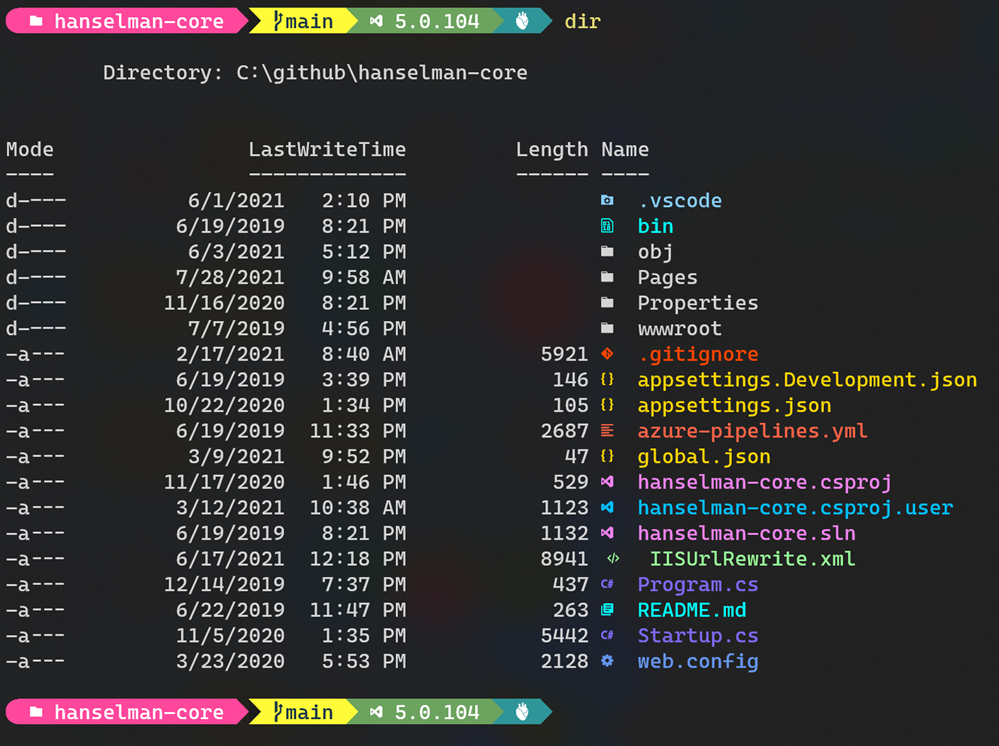
I've long blogged about my love of setting up a nice terminal, getting the ...
 ionic crescent
im trying to commint my project to github and it says email not confirmed when i have confirmed it
 crisp wing
@astral apex Pretty much the only redeeming quality I guess about GCP is Firebase
Which in itself is already treaded on by AWS Amplify and Azure App Service
So I guess that's not helping much with Google
 prisma ridge
Aws runs like half the internet, I'd just go w/ it
crisp wing
More mature than Azure too
crisp wing
prisma ridge
Aws runs like half the internet, I'd just go w/ it
I still can't help but to think AWS is like a big and intimidating Swiss Army power tools though
With it y'know, having tons of services under its belt
Both being good and bad
deep estuary
Azure my fave
rapid sparrow
Can I change default Python version with just env var?
i think it should be possible 🤔
deep estuary
rapid sparrow
Can I change default Python version with just env var?
what do you mean "default"
do you mean using py on windows or something?
rapid sparrow
deep estuary
what do you mean "default"
i mean i wish in my kubuntu, python3.10 as default instead of python3.8 inside Vscode terminal
deep estuary
what are you running in vscode to bring python up
rapid sparrow
well, i would not mind having python3.10 default in general, but I fear my OS would break if i change it
rapid sparrow
deep estuary
what are you running in vscode to bring python up
just a script not requiring any third party libs
deep estuary

Configuring Python Environments in Visual Studio Code
rapid sparrow
plus i would not mind if my venv automatically was generated with python3.10
deep estuary
do you mean through this?
right but if you run python3.10 you will get 3.10 and python3.8 for 3.8
i'm trying to understand what you want to default here
do you mean just running python generally?
brazen forge
you could also just alias it
rapid sparrow
i am trying to have python/python3 as python3.10
brazen forge
or symlink
rapid sparrow
brazen forge
you could also just alias it
yeah, except vscode is not reading alias
or is it reading 🤔
brazen forge
so symlink?
rapid sparrow
brazen forge
so symlink?
i am afraid it will break OS
ubuntu is highly dependnded on python
deep estuary
it should work with 3.10 if it's defaulting to 3.8
rapid sparrow
i'll go with alias
deep estuary

Gist
update-alternatives for python3 on Ubuntu. GitHub Gist: instantly share code, notes, and snippets.
brazen forge
symlinking python3 to a newer version will break it?
short peak
I use pyenv for specifically that scenario
deep estuary
this is one way of doing it with update-alternatives
rapid sparrow
brazen forge
symlinking python3 to a newer version will break it?
a high chance it will break.
Those experiments i would better do in virt desktop
deep estuary
update-alternatives is a nicer way of symlinking and keeping things in order
short peak

In this step-by-step tutorial, you'll learn how to install multiple Python versions and switch between them with ease, including project-specific virtual environments, even if you don't have sudo access with pyenv.
deep estuary
pyenv is a decent way of doing it as well
rapid sparrow
short peak
https://realpython.com/intro-to-pyenv/
nice, but looks to be outdated way to go with it.
If i need multiple python versions with installed libs, i would just go having docker-compose dev env setup and hooking IDE vscode into container
it is more reliable changing OS python version to multiple ones
in my situation i just wish changing default python, so it would be used by default for anything new
thanks. i just went with alias as sufficient and reliable(to not break OS) solution to my case
rapid sparrow
short peak
https://realpython.com/intro-to-pyenv/
definitely memorized for the future though. looks really nice 🤔
deep estuary
rapid sparrow
nice, but looks to be outdated way to go with it.
If i need multiple python vers...
pyenv is not outdated
still very actively maintained
civic grove
pyenv + poetry 😉
short peak
civic grove
pyenv + poetry 😉
exactly 🙂
wooden ibex
If you are using VSCode, DevContainers rock and best way to roll. Don't have to fiddle with poetry, conda, anaconda, burmese, virtualenv or whatever other crazy package manager that exists. Just pip install and away you go.
thorny shell

Get started with development Containers in Visual Studio Code
rapid sparrow
wooden ibex
If you are using VSCode, DevContainers rock and best way to roll. Don't have to ...
Exactly!

 topaz stirrup
Hey everyone.
For the past few months, I've been working on a static code analysis orchestration tool named Statue. This tool can help you run multiple formatters and linters with different arguments on different files and directories.
Most of you probably use pre-commit for that purpose. While pre-commit is an awesome tool, Statue solves that problem with a different approach.
You can see the tool in Github:
https://github.com/saroad2/statue
If anyone has a question about the tool, feel free to send me a private message!
And of course, if you use the tool and you find it helpful, please give it a star in Github 😄
GitHub
Orchestration tool for static code analysis. Contribute to saroad2/statue development by creating an account on GitHub.
rapid sparrow
topaz stirrup
Hey everyone.
For the past few months, I've been working on a static code analy...
Firstly there is Tox tool
Secondly, they should be called from CI
Everything else is not reliable
topaz stirrup
rapid sparrow
Secondly, they should be called from CI
Hey Darkwind. Thanks for the feedback, but I kindly disagree.
Tox doesn't provide some of the features presented by pre-commit and Statue. You can read in the documentation some of the features Statue provides
topaz stirrup
rapid sparrow
Secondly, they should be called from CI
As for that, you want to be able to run you linters locally and not via CI. You can't rely fully on CI for that.
rapid sparrow
topaz stirrup
As for that, you want to be able to run you linters locally and not via CI. You ...
🤔 basically i wish to have a simplified way to call all those scripts
so, argparse / click and etc
 topaz aspen
Why isn't there a 3.10.2 python docker image (here : https://hub.docker.com/_/python ).
I assumed (wrongly, but not sure why) that all versions of python would be available as an image.
Python is an interpreted, interactive, object-oriented, open-source programming language.
rapid sparrow
topaz stirrup
Hey Darkwind. Thanks for the feedback, but I kindly disagree.
Tox doesn't provi...
btw... I kind of experienced same problem with having uniform way calling all those extra scripts
just finished making answer for fun
from types import SimpleNamespace

import utils

class InputDataFactory(utils.AbstractInputDataFactory):

    @staticmethod
    def register_cli_arguments(argpase_reader: utils.ArgparseReader) -> utils.ArgparseReader:
        return argpase_reader \
            .add_argument("--cli_argument", type=str, default="example")

    @staticmethod
    def register_env_arguments(env_reader: utils.EnvReader) -> utils.EnvReader:
        return env_reader.add_arguments(
            env_argument1=env_reader["PWD"],
            env_argument2=env_reader.get("NOT_EXISTING_VAR", "default_value"),
        )

class MyScripts(utils.AbstractScripts):
    input_data_factory = InputDataFactory

    @utils.registered_action
    def build(self, input_: SimpleNamespace):
        self.shell(f"echo {input_.cli_argument}")

    @utils.registered_action
    def print(self, input_: SimpleNamespace):
        self.shell(f"echo {input_.env_argument1}")

    @utils.registered_action
    def example(self, input_: SimpleNamespace):
        args = input_.cli_reader \
            .add_argument("--argument", type=int, default=456) \
            .get_data()
        self.shell(f"echo debug_{args.argument}")

if __name__=="__main__":
    MyScripts().process()
I made a small library that using argparse, allows me to run commands like
python3 scripts.py build
python3 scripts.py example --argument=123
basically python version of makefile, with easy registering values from env and cli inputted into it
I hope that it would give me ability to register commands to call all those build/linters/tests in a more uniform manner
This is kind of FITTING solution for me, because i can all in inform way my linting/tests and etc scripts from CI
that is first thing i wish to have
topaz aspen
rapid sparrow
I made a small library that using argparse, allows me to run commands like
```py...
is this pure fun - or something you'd use in a work environment ?
brazen forge
topaz aspen
Why isn't there a 3.10.2 python docker image (here : https://hub.docker.com/_/py...
it's there tho?
rapid sparrow
topaz aspen
is this pure fun - or something you'd use in a work environment ?
tempted to use in a work environment. I really missed having thing exactly like this. It is exactly i need in order to have self-documented version of python makefile, that i can call from CI
topaz aspen
brazen forge
it's there tho?
isn't there Nox i ctrl f'd for 3.10.2 and didn't see anything
brazen forge
Python is an interpreted, interactive, object-oriented, open-source programming language.
topaz aspen
rapid sparrow
tempted to use in a work environment. I really missed having thing exactly like ...
isn't Nox like tox but with .py instead of .ini ?
rapid sparrow
topaz aspen
isn't Nox like tox but with .py instead of .ini ?
not really a thing i wish. Nox does more than it is necessary for me, and less than needed.
My regular workflow assumes running tests from a built docker image, that i save and reuse in testing/staging/prod environment
topaz aspen
rapid sparrow
not really a thing i wish. Nox does more than it is necessary for me, and less t...
nox doesn't play nice with an image ? I've not used it much, only a hello world version i guess
rapid sparrow
topaz aspen
nox doesn't play nice with an image ? I've not used it much, only a hello world ...
https://nox.thea.codes/en/stable/ according to wiki it makes stuff with venv to launch itself. That's already not needed, it is handled at docker level
topaz aspen
ah ok, makes sense. Tox does a similar thing with building venvs as well afaik?
rapid sparrow
topaz aspen
is this pure fun - or something you'd use in a work environment ?
The only thing is missing, to have registration of cli variables in a way that is not giving away implementation details 🤔 yet being super powerful
I'll adjust this detail and then it would be ideal for my usage
rapid sparrow
topaz aspen
ah ok, makes sense. Tox does a similar thing with building venvs as well afaik?
yeah, it should be doing as far as i remember
it makes sense to use when u wish easily running tests in multiple python environments at the same time i guess
Github Actions CI run in Matrix mod essentially
rapid sparrow
topaz aspen
ah ok, makes sense. Tox does a similar thing with building venvs as well afaik?
We could adjust it to fit docker env 🤔 Making stuff like
ARG python_version
FROM python:python_version
and then building and launching our image with different build arg of docker
it is more powerful way to have it because
Venv is only venv. Docker image is having all OS dependencies, including installable binary files that can be needed by venv
 real hedge
Greetings all. I'm looking for a python library for validating verifying email addresses.
rapid sparrow
real hedge
Greetings all. I'm looking for a python library for ~~validating~~ verifying ema...
Regex email formula: https://regexr.com/3e48o
^[\w-\.]+@([\w-]+\.)+[\w-]{2,4}$
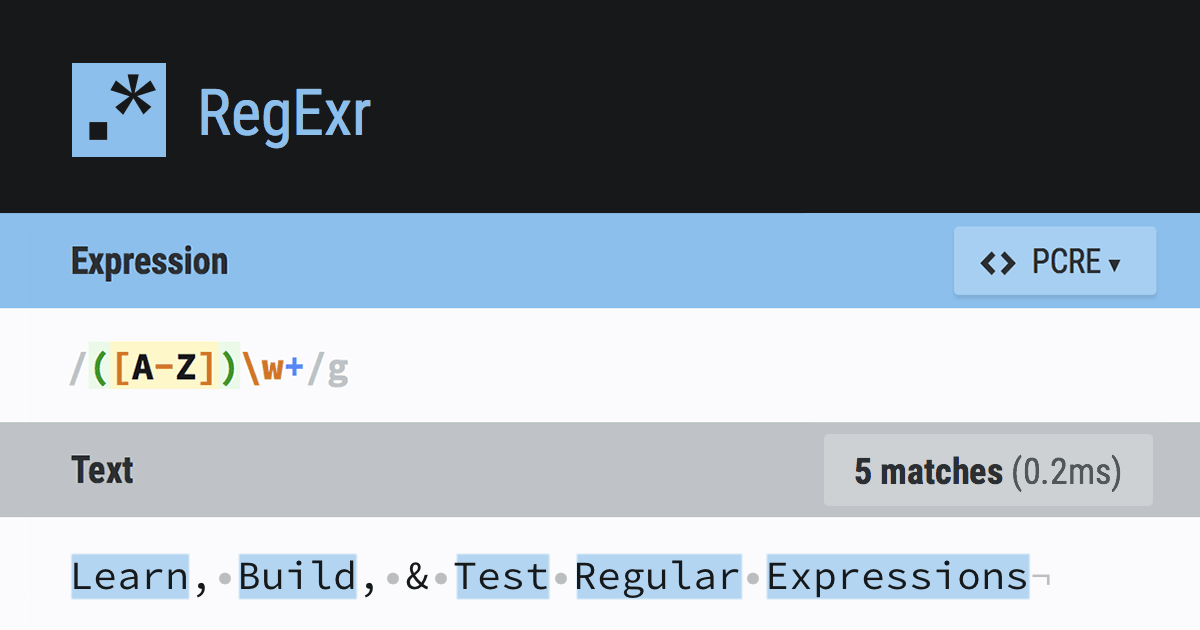
RegExr
RegExr is an online tool to learn, build, & test Regular Expressions (RegEx / RegExp).
real hedge
rapid sparrow
Regex email formula: https://regexr.com/3e48o
`^[\w-\.]+@([\w-]+\.)+[\w-]{2,4}$`
No wait, my mistake, I meant verifying an email address
rapid sparrow
real hedge
No wait, my mistake, I meant verifying an email address
That it really exists?
rapid sparrow
real hedge
No wait, my mistake, I meant verifying an email address
Write your own small solution, while using sendgrid to send email with URL containing JWT token.
- Generate JWT token, validated by your Secret, and JWT contains user ID/email
- by sendgrid send to user email with URL link to your rest API endpoint and JWT as query Param
- verify incoming JWT with your Secret, read which user ID/email. Mark as verified
wooden ibex
topaz aspen
Why isn't there a 3.10.2 python docker image (here : https://hub.docker.com/_/py...
Nope! If security problem, it might be removed.
rapid sparrow
real hedge
No wait, my mistake, I meant verifying an email address
Updated to full algorithm above
real hedge
rapid sparrow
Updated to full algorithm above
I'm far too lazy, So i'll go with sendgrid i've been using mailgun for awhile though.
rapid sparrow
real hedge
I'm far too lazy, So i'll go with `sendgrid` i've been using `mailgun` for awhil...
Mail provider is not important, as long as it provides nearly unlimited API level limits to send email programmatically
rapid sparrow
topaz aspen
is this pure fun - or something you'd use in a work environment ?
https://pypi.org/project/darklab-utils/ yay, my first pypi package published

now i can reuse it between my repos xD
considering how it fits my workflow (at 100% matching), i think i would use it everywhere i can xD
wooden ibex
<@&831776746206265384> spam
 steady rivet
has anyone worked with cibuildwheel before?https://pypi.org/project/cibuildwheel/
 eternal wave
how can I do that I am asked in the terminal how often it should be repeated and when it is finished it makes a brake