#questions-2
1 messages · Page 54 of 1
 plain umbra
So in the context of ordering something and being asked this:
sonst -> aside from what you already ordered
noch -> still/yet, as in, your order continues, it's not finished yet
etwas -> something
 clever hare
That's very helpful. I feel more confident constructing sentences with it now. Thank you very much! I hope you have a great day, night, or evening! ~🌟
 dawn finch
Hi guys, sorry to disturb you but im looking for a language course institution. It would be geuninely helpful if any of you guys can suggest me a good deutsche sprachschule. thanks in advance!
 spark ibex
dawn finch
Hi guys, sorry to disturb you but im looking for a language course institution. ...
spark ibex
dawn finch
Hi guys, sorry to disturb you but im looking for a language course institution. ...
Where u from? Goethe is pretty consistent with the quality globally
 pulsar sand
@hushed dawn This is a very interesting expression. It is being used (at least where I live). So let's explore this sentence. Usually a bank is something that you think of being something that is secure, successful and something you can rely on in some way. This expression is used to indicate ironically that the person is the exact opposite. Same goes for "Du bist mir ja ne Marke" > Can be used to say "You are acting weird" -> Eine Marke usually stands for a specific quality. Hence, this person has some "special" (weird) qualities.
 fervent kernel
Was ist der unterschied zwischen entgegennehmen und bekommen?
pulsar sand
fervent kernel
Was ist der unterschied zwischen entgegennehmen und bekommen?
Ich nehme ein Paket entgegen (I accept a parcel) // Ich bekomme ein Paket (I receive a parcel) both are synonyms 🤷♂️
 sacred terrace
fervent kernel
Was ist der unterschied zwischen entgegennehmen und bekommen?
sacred terrace
fervent kernel
Was ist der unterschied zwischen entgegennehmen und bekommen?
"entgegennehmen" is more formal and primarily being used when you receive physical objects of any sort but also immaterial things like get well wishes. "bekommen" is like the get in english
 hushed dawn
pulsar sand
<@293808309843132418> This is a very interesting expression. It is being used (a...
hushed dawn
pulsar sand
<@293808309843132418> This is a very interesting expression. It is being used (a...
Thank you for the explanation
 unkempt stirrup
i was looking through the translation of a german song i was vibing to and got kinda confused by this site’s translation
google translate says “Lass die Musik an” means “Leave the music on,” which is what i initially thought too, but this site with the full english lyrics says it’s “Crank up the music”
is this just a translation based on preserving the figurative feeling rather than the literal meaning of the words? or are both literal meanings correct in german? or is one just wrong


 icy flax
unkempt stirrup
i was looking through the translation of a german song i was vibing to and got k...
icy flax
unkempt stirrup
i was looking through the translation of a german song i was vibing to and got k...
I find google more precise. Afaik crank up is making sth louder, turning the sound up, it is different.
dawn finch
spark ibex
Where u from? Goethe is pretty consistent with the quality globally
Ohh ill try to consider that. Just one more question to ask, is there any decent sprachshule in leipzig. Sorry for asking questions like this cuz im new to germany and i do not know much about it.
unkempt stirrup
icy flax
I find google more precise. Afaik crank up is making sth louder, turning the sou...
yeah, it is different, which is why i was confused it would translate into such different meanings. guess ill go with my gut and say that the site is wrong
 brave flint
unkempt stirrup
yeah, it is different, which is why i was confused it would translate into such ...
brave flint
unkempt stirrup
yeah, it is different, which is why i was confused it would translate into such ...
is that the official translation?
or a machine translation?
it might be because the translator thought
Crank it up sounds better than
Leave it on
spark ibex
dawn finch
Ohh ill try to consider that. Just one more question to ask, is there any decent...
No idea
 old roost
Das weiß ich eigentlich nicht. Woher .... du das denn?
It's about information of some news. what verb fit? mitbekommen? kriegen?
 limpid trout
what's the most natural rendition of something like english's "I hope you sleep well too."?
"Ich hoffe, du wirst auch gut schlafen."?
 charred harbor
Probably “ich hoffe du schläfst auch gut” I’d imagine
 crisp marlin
limpid trout
what's the most natural rendition of something like english's *"I hope you sleep...
crisp marlin
limpid trout
what's the most natural rendition of something like english's *"I hope you sleep...
“ich hoffe, dass du auch gut schläfst” würd ich sagen :))
limpid trout
can someone clarify to me the specifics of when people typically don't use the grammatical future tense?
 long whale
limpid trout
can someone clarify to me the specifics of when people typically don't use the g...
long whale
limpid trout
can someone clarify to me the specifics of when people typically don't use the g...
It's easier to say when we do use it: mostly for promises and threats. 🌻
limpid trout
that is good to know
charred harbor
crisp marlin
“ich hoffe, dass du auch gut schläfst” würd ich sagen :))
The “that” doesn’t really correspond with the English
But eh
I guess which one’s better is a matter of personal opinion hahah
hushed dawn
dazukommen vs hinzufügen ??
long whale
hushed dawn
dazukommen vs hinzufügen ??
intransitive vs. transitive
 cerulean torrent
I am studying A2 and came across verb beraten(to advice). I thought it is similar to danken and saw an example Tom hat mich beraten. But i was thinking like this: Tom hat mir beraten (used mir as it answers who rather what) and logic similar to ich danke dir. Can anyone help me what I am missing here to understand.
 south zenith
cerulean torrent
I am studying A2 and came across verb beraten(to advice). I thought it is simila...
south zenith
cerulean torrent
I am studying A2 and came across verb beraten(to advice). I thought it is simila...
You’re not really missing anything tbf, it’s just that danken requires to object to be dative and beraten requires an accusative object
cerulean torrent
south zenith
You’re not really missing anything tbf, it’s just that danken requires to object...
So i just need to by heart. Is there any logical reasoning behind this?
south zenith
If there is I don’t know it, but a lot people remember it by like the saying in English “thanks to you” bc a lot of people learn the dative case as like “to you”
 outer edge
Hi why is it Mehrmals die Woche and not Mehrmals in der Woche?
Why is the option of month in dative but the option of week not?
 south zenith
cerulean torrent
So i just need to by heart. Is there any logical reasoning behind this?
south zenith
cerulean torrent
So i just need to by heart. Is there any logical reasoning behind this?
Be- words also tend to be accusative as far as I know
south zenith
outer edge
Hi why is it Mehrmals die Woche and not Mehrmals in der Woche?
Why is the option...
I think “die Woche” used like this is a bit colloquial as far as I’ve been told, but the reason Woche is accusative and Monat is not is just the presence of the article “in”. you even said “mehrmals in der Woche” which is dative bc of the in
 teal cliff
south zenith
I think “die Woche” used like this is a bit colloquial as far as I’ve been told,...
teal cliff
south zenith
I think “die Woche” used like this is a bit colloquial as far as I’ve been told,...
idk mehrmals in der woche sounds wrong to me
 plush pelican
outer edge
Hi why is it Mehrmals die Woche and not Mehrmals in der Woche?
Why is the option...
plush pelican
outer edge
Hi why is it Mehrmals die Woche and not Mehrmals in der Woche?
Why is the option...
I'm not sure why you say "mehrmals die Woche", but I think it's kind of colloquial maybe?
cerulean torrent
south zenith
You’re not really missing anything tbf, it’s just that danken requires to object...
I just got into a comparison btw raten and beraten. Raten(to advice) usually comes with what advice given (accusative - answering was) and to whom(dative answering who). while beraten usually stops with who the advice is given making the person who receive advice Dative. z.B. ich berate dich
south zenith
teal cliff
idk mehrmals in der woche sounds wrong to me
It does to me too honestly I’m only used to a definitive amount like zweimal in der Woche
teal cliff
id also say zweimal die woche there tbh
plush pelican
teal cliff
id also say zweimal die woche there tbh
When writing formally for a test, would you say that? Also, are you a native speaker?
teal cliff
plush pelican
When writing formally for a test, would you say that? Also, are you a native spe...
uh yes, im from austria
teal cliff
plush pelican
When writing formally for a test, would you say that? Also, are you a native spe...
hmm good question tbh lol
lemme google just so i dont tell you anything thats factually incorrect
south zenith
Yea ik people say that too, I’ve been told that’s pretty colloquial tho
 plush pelican
Interesting 🤔
plush pelican
teal cliff
What about "zweimal pro Woche" vs. "zweimal die Woche"? Do you see a difference between those?
long whale
teal cliff
idk mehrmals in der woche sounds wrong to me
It's fine, though.
long whale
plush pelican
What about "zweimal pro Woche" vs. "zweimal die Woche"? Do you see a difference ...
To me, at least, there is none. 🌻
plush pelican
So you'd say "zweimal die Woche" is perfectly fine on a test, too?
teal cliff
long whale
It's fine, though.
wirklich? es klingt komisch irgendwie... idk vielleicht weil ich in meinem alltag fast nur dialekt rede .... egal.
teal cliff
plush pelican
So you'd say "zweimal die Woche" is perfectly fine on a test, too?
i probably have written this on a test b4 lol
plush pelican
teal cliff
wirklich? es klingt komisch irgendwie... idk vielleicht weil ich in meinem allta...
Wie wäre es mit "zweimal unter der Woche", 🤣
teal cliff
long whale
It's fine, though.
actually youre right
ich weiß nicht warums zuerst so falsch geklungen hat....
plush pelican
plush pelican
Wie wäre es mit "zweimal unter der Woche", 🤣
Echt jetzt: ist das falsch?
long whale
plush pelican
Echt jetzt: ist das falsch?
Total. 🤷
 teal cliff
unter der woche gehe ich nie früh schlafen 😭
plush pelican
 long whale
plush pelican
Ich habe zum Beispiel einige Kommentare gefunden...
long whale
plush pelican
Ich habe zum Beispiel einige Kommentare gefunden...
Yeah, seems you can find examples for any wrong thing under the sun.
teal cliff
deutsch ist mir zu schwierig; muss ich ganz ehrlich sein 😭
 wet dawn
Das Leben ist zu kurz .... 🙂
plush pelican
So you can say that you do something "unter der Woche", but not that you do it two times "unter der Woche"?
long whale
But "unter der Woche" means as much as "not at the weekend"
teal cliff
long whale
Yeah, seems you can find examples for any wrong thing under the sun.

wirklich wth
 teal cliff
plush pelican
Würdest du "zweimal unter der Woche" sagen?
teal cliff
plush pelican
Würdest du "zweimal unter der Woche" sagen?
nein lol
teal cliff
plush pelican
Würdest du "zweimal unter der Woche" sagen?
das klingt komisch
teal cliff
teal cliff
wirklich wth
der rest ist umgangssprache.... ich glaub ich muss deutsch lernen
💀
teal cliff
long whale
But "unter der Woche" means as much as "not at the weekend"
it just means during the week ..... 😭
long whale
plush pelican
So you can say that you do something "unter der Woche", but not that you do it t...
DWDS agrees it's süddeutsch - probably the reason I'm familiar with it. 🤷
long whale
teal cliff
it just means during the week ..... 😭
Yeah, but as opposed to the weekend, right?
"Unter der Woche habe ich abends keine Zeit" -> I don't have time in the evening Mon - Fri, right?
teal cliff
long whale
"Unter der Woche habe ich abends keine Zeit" -> I don't have time in the evening...
ja... true

 teal cliff
ich bin auch überfragt; es klingt komisch
zweimal die woche klingt am besten bis jetzt tbh
xD
plush pelican
Even found a Tagesspiegel article 😮

It's difficult as a foreign language learner, telling the difference between usages of the language that you're not familiar with versus what's just a common mistake people make.
Auf jeden Fall danke @teal cliff @long whale
teal cliff
immer gerne lol
long whale
plush pelican
It's difficult as a foreign language learner, telling the difference between usa...
I feel you. 
 quasi quarry
if it's a common mistake then it may as well just be part of the language
teal cliff
... right
 twin robin
Hallo! Ich habe eine Frage. Gibt es ein Unterschied zwischen: "Ich dachte wir wären Freunde" und "Ich dachte wir Freunde wären"? (Normally word order isn't too confusing for me but this one's been giving me trouble... thank you in advance!)
 valid knoll
twin robin
Hallo! Ich habe eine Frage. Gibt es ein Unterschied zwischen: "Ich dachte wir wä...
valid knoll
twin robin
Hallo! Ich habe eine Frage. Gibt es ein Unterschied zwischen: "Ich dachte wir wä...
The first one is correct.
plush pelican
twin robin
Hallo! Ich habe eine Frage. Gibt es ein Unterschied zwischen: "Ich dachte wir wä...
Inserting the appropriate commas would help:
Ich dachte, wir wären Freunde.
Ich dachte, dass wir Freunde wären.
You need "dass" for the second sentence in order for it to be correct.
As you can see, each sentence is actually made up of 2 clauses.
 sleek bone
Is this sentence grammatically correct?
"Ich hatte gestern irgendeinen Teller."
 dense obsidian
sleek bone
Is this sentence grammatically correct?
"Ich hatte gestern irgendeinen Teller."
dense obsidian
sleek bone
Is this sentence grammatically correct?
"Ich hatte gestern irgendeinen Teller."
yes
sleek bone
dense obsidian
yes
Dankeschön
 rotund shadow
 obtuse creek
Could someone help with with understanding the word “fällt“
I understand it in the context of falls, but outside of it’s literal definition it’s used in completely different contexts that all seem unrelated
sacred terrace
obtuse creek
Could someone help with with understanding the word “fällt“
I understand it in ...
Yeah? Things like these are very common in many languages?
You have to be more specific what bothers you
obtuse creek
sacred terrace
Yeah? Things like these are very common in many languages?
That’s exactly why I asked. It’s a highly contextual / idiomatic based approach. Which is best taught through the lens of a native speaker more immersed in the trivialities and irregularities of the language
AI or other resources just couldn’t construct the greatest understanding for me
I want to better understand common phrases and perhaps someone could offer a better approach to internalization and recognition of its versatile application
sacred terrace
Well "fallen" means falling or dropping. The issue I see for people who learn, is "gefallen" = "like" which is also the past tens form of "fallen"= "to fall" or "anfallen" which means "occuring". There are also "zerfallen" which means "deteriote", wegfallen, zufallen etc.
There are also many cases like "Fällt dir das schwer?" = "Do you have a hard time with it?" Where it might look confusing to learners
obtuse creek
Oder es fällt mir ein
Oder es fällt auf
Oder mir fällt nichts ein
Oder was fällt dir ein
Oder 😭😭
Es gibt so viele Möglichkeiten
long whale
obtuse creek
Oder es fällt mir ein
But surely, the same is true for every common German verb? Their meaning often changes, sometimes quite drastically, in a way it can't be deduced from its components, depending on their prefix. I'm afraid it's the same as in English or any other language I know of: these verbs have to be memorized one by one, over time, intentionally, or via input. 🌻
 pure walrus
how do germans say "can" ( like coke can) and "jar"
long whale
pure walrus
how do germans say "can" ( like coke can) and "jar"
You just need to scroll down to the 2nd entry here, i.e. I. under can²: https://de.pons.com/übersetzung/englisch-deutsch/can?bidir=1
And here's the entry for "jar": https://de.pons.com/übersetzung/englisch-deutsch/jar
pulsar sand
pure walrus
how do germans say "can" ( like coke can) and "jar"
Coca-Cola Dose, Cookie jar = Keksdose
 lilac granite
Hey guys, i'm not sure if this is quite the right channel for this so apologies for that.
i'm an absolute beginner, as in, i don't speak german at all besides a few popular words. how do i go on about being somewhat fluent in maybe the next one year? i'm thinking doing a sort of alphabet -> basic grammar -> the more advanced stuff kind of progression, which is kind of how i was taught english at school (it's not my first language). would this be ideal or should i go for something else? if yes, can someone point me to any resources which are similar to this?
i know #resources exists but i took a look at it but it's kind of overwhelming (💀) and nothing seems to quite match up to what i'm looking for. any help is appreciated
plain umbra
lilac granite
Hey guys, i'm not sure if this is quite the right channel for this so apologies ...
faq beginner
 stoic mauveBOT
How to get started
The simplest way to learn German is to find topics you don’t understand yet and search for explanations of them. This list provides you with a guide for which topics to learn if you are completely new to German. Type the topic into Google (or YouTube) and start learning!
Introduction
1: Alphabet (especially ä, ü, ö and ß)
2: Basic greetings (hello, goodbye, etc.)
Part 1 - Simple Sentence
1: Noun gender & plurals
2: Nominative case (What are cases?)
3: Nominative pronouns (I, you, he, she, etc.)
4: Verbs in present tense
5: Definite/indefinite articles
6: Accusative case (for nouns)
7: Accusative pronouns
8: Word order of simple sentences
9: How to ask questions
See Part 2 on the next page.
Tips
- Always learn the gender of a noun when you learn a new noun
- Learn to use a translation dictionary (e.g. dict.cc, leo.org)
- Use
>faq resourcesto see our list of German learning resources - For listening and pronunciation practice, try watching movies or videos (incl. YouTube)
- You can listen to pronunciation for words on websites like dict.cc, forvo.com, and others
- Practice writing sentences every day (and asking people to correct them)
- Ask as many questions as possible
- Don’t be scared to make mistakes!!!! If you don’t let yourself make mistakes, you will never be able to learn German
Page 1/2
plain umbra
faq nicos
stoic mauveBOT
Nicos
Nicos Weg is a free online program aimed at helping people learn German. It includes video, audio, text, grammar explanations, notes, vocabulary, and exercises. It also includes very useful cultural and bureaucratic information, such as how to open a bank account, while teaching you the relevant grammar and vocabulary.
It’s fairly popular and well-recommended, but keep in mind that you can’t learn a language with only one resource, even if it’s a good one!
You can find the courses here: https://learngerman.dw.com/en/overview/
You can also see various other courses for learners by dw.com here: https://www.dw.com/en/learn-german/s-2469/
plain umbra
@lilac granite Check out these two things and see how it goes for you.
lilac granite
oooh that seems good, i'll chekc it out, thanks!
fervent kernel
Hi, ich brauche hilfe für die Übersetzung eines Satzes.
"You dont have to rush it, if you are not ready to break up with him"
Wie würdet ihr das übersetzen?
Ich würde sagen : "Ihr müsst euch nicht beeilen, wenn ihr noch nicht bereit seid, euch zu trennen."
twin robin
plush pelican
Inserting the appropriate commas would help:
Ich dachte, wir wären Freunde.
Ic...
thank you!
long whale
fervent kernel
Ich würde sagen : "Ihr müsst euch nicht beeilen, wenn ihr noch nicht bereit seid...
Your German sentence works, but you do realize its meaning is significantly different from the one of your English sentence, don't you?
English version: if you (singular) aren't ready to break up with him, vs. German version: if the two of you aren't ready to break up with each other.
 hybrid shore
Hallo zusammen, hat jemand den Telc C1 hochschule übungstest 3 und 4? Wenn ja, könnten Sie mich bitte privat erreichen?
fervent kernel
long whale
English version: if you (singular) aren't ready to break up __with him__, vs. Ge...
Can you help me with the translation please?
long whale
fervent kernel
Can you help me with the translation please?
I thought I had? 
fervent kernel
long whale
I thought I had? <:flooshed:705425254159482970>
I mean to german
long whale
fervent kernel
I mean to german
I'd thought pointing out the exact nature of the problem might help. 😅 So, to break up = sich trennen, vs. to break up with somebody = sich von jemandem trennen
fervent kernel
Is this a good way to rephrase "Das Hauptproblem ist, dass"?
Das Hauptproblem liegt daran, dass...
teal cliff
fervent kernel
Is this a good way to rephrase "Das Hauptproblem ist, dass"?
Das Hauptproblem li...
darin *
long whale
fervent kernel
Is this a good way to rephrase "Das Hauptproblem ist, dass"?
Das Hauptproblem li...
Das H. besteht darin, dass... ;)
fervent kernel
Much thanks
fervent kernel
Can I use sich with um zu instead of using damit?
For example
Um sich der Körper auf die Verarbeitung des Zuckers zu vorbereiten.
Instead of saying "damit sich der Körper auf die Verarbeitung des Zuckers vorbereitet.
 glass hawk
fervent kernel
Can I use sich with um zu instead of using damit?
For example
Um sich der Körper...
glass hawk
fervent kernel
Can I use sich with um zu instead of using damit?
For example
Um sich der Körper...
In the absence of a subject, you have to use ‘um ... zu’. But aye, you can use ‘sich’ in an ‘um ... zu’ clause. ‘Damit’ requires a subject within the clause.
long whale
fervent kernel
Can I use sich with um zu instead of using damit?
For example
Um sich der Körper...
Look, this bit is not enough. The 1st part of the sentence is necessary, okay? But in all likelihood, using "um... zu..." is not going to be possible, because you can never use it when a sentence has 2 different subjects.
Your suggestion is entirely incorrect, however.
fervent kernel
long whale
Look, this bit is not enough. The 1st part of the sentence is necessary, okay? B...
Die Geschmacksrezeptoren leiten die Information über die Zuckeraufnahme sofort an das Gehirn weiter, damit...
long whale
Ich trainiere täglich, damit ich den Wettkampf gewinne can be changed into Ich trainiere täglich, um den Wettkampf zu gewinnen because the subject is the same.
Ich trainiere dich täglich, damit du den Wettkampf gewinnst can not be changed into a sentence using "um... zu..."
@fervent kernel
fervent kernel
Yeah, got it.
Different subjects. First sentence die Geschm... and the second one der Körper
Thanks
fervent kernel
Mit den archäologischen Grabungen in Marathon, bei denen 1890 die Gräber der Athener, die in der Schlacht gefallen waren...
I can't tell why it's gefallen waren. Why not wurden?
Incase the rest if the sentence is important
Mit den archäologischen Grabungen in Marathon, bei denen 1890 die Gräber der in der Schlacht gefallenen Athener freigelegt wurden, kam diese Erzählung – wahrscheinlich eine Erfindung des vierten vorchristlichen Jahrhunderts – wieder in Erinnerung.
I know one focuses on the result and the other one on the action. Still can't tell
long whale
fervent kernel
I know one focuses on the result and the other one on the action. Still can't te...
In this particular case, there is only one possibility, ever. Think: which auxiliary does "fallen" require?
fervent kernel
Sein
long whale
fervent kernel
Sein
And can you make it transitive?
i.e. can it have an Akkusativobjekt? If the answer is no, and if it doesn't have a Dativobjekt, either, then in all probability, it is one of those verbs which do not accept the passive.
long whale
fervent kernel
No
werden + past participle of "fallen" is simply unthinkable. Also, you may not be aware, but "fallen" is a verb specifically used for soldiers dying in a war: Mein Großvater ist im Krieg gefallen = My grandfather died in the war (and it's understood from the verb he was a soldier, i.e. he did not die from some illness, or starve to death).
plush pelican
long whale
i.e. can it have an *Akkusativobjekt*? If the answer is no, and if it doesn't ha...
And by "passive", you mean Vorgangspassiv?
There are some intransitive verbs that can at least do Zustandspassiv
https://dict.leo.org/grammatik/deutsch/Wort/Verb/Kategorien/Genera/NoPassiv2.xml?lang=de
Einige intransitive Verben mit Dativobjekt oder Präpositionalobjekt können allerdings ein Zustandspassiv ohne Subjekt bilden, z. B. helfen, nützen, dienen, verzeihen, vergeben oder sorgen für.
Beispiele
Mit diesem Rat ist ihm nicht geholfen.
Den Angestellten ist mit einer Lohnsenkung sicher nicht gedient.
Wenn du es bereust, ist dir verziehen.
Für die Unterbringung der Gäste ist bereits gesorgt.
LEO.org: Ihr Wörterbuch im Internet für Englisch-Deutsch Übersetzungen, mit Forum, Vokabeltrainer und Sprachkursen. Natürlich auch als App.
clever hare
What translator do you use for German? Or what website do you recommend to know about for learning?
long whale
clever hare
What translator do you use for German? Or what website do you recommend to know ...
This is an excellent, free course: https://learngerman.dw.com/en/learn-german/s-9528 I'd warmly recommend using a dictionary instead of a translator, but if you do need one, use deepl.com
DW Learn German
 jade hawk
Kann ich "I don't care about that" durch "Ich kümmere mich um das nicht" ausdrücken? Oder nur "das kümmert mich nicht"?
 glossy trench
,,das ist mir egal“ oder nur ,,ist mir egal“ funktioniert gut :))
long whale
jade hawk
Kann ich "I don't care about that" durch "Ich kümmere mich um das nicht" ausdrüc...
I'd say the above works in pretty much any informal context.
 unique bronze
glossy trench
,,das ist mir egal“ oder nur ,,ist mir egal“ funktioniert gut :))
unique bronze
glossy trench
,,das ist mir egal“ oder nur ,,ist mir egal“ funktioniert gut :))
Is it rude to say "es ist egal für mir" or something " I don't care about it". Is there a kinder way to say it?
glossy trench
“Ist mir egal“ can be used for many things. For example: „möchtest du lieber malen oder spielen?“ „ist mir egal“. So here it means ,,You can decide“ or something like that. But if you want do say ,,I don’t care about you“ it would be ,,Du bist mir egal“ which is pretty rude, yes
 shrewd fern
unique bronze
Is it rude to say "es ist egal für mir" or something " I don't care about it". I...
shrewd fern
unique bronze
Is it rude to say "es ist egal für mir" or something " I don't care about it". I...
a bit funny andu nprofessoinal way is "es ist mir wurst"
"mir ist es egal" can sound not-rude if you say it in the right tone too
 spiral loom
Does "zocken" necessarily mean "to gamble" or can it be for example "Ich zocke Minecraft" to mean "I play Minecraft"?
unique bronze
shrewd fern
a bit funny andu nprofessoinal way is "es ist mir wurst"
Ist Wurst sausage?
shrewd fern
yup lol
shrewd fern
spiral loom
Does "zocken" necessarily mean "to gamble" or can it be for example "Ich zocke M...
yeah younger people almost exclusively use "zocken" for playing video games
spiral loom
Yeah I found that phrase in a reel for "Ich zocke Roblox" but my teacher corrected me for saying zocken because she said it meant exclusively to gamble
shrewd fern
spiral loom
Yeah I found that phrase in a reel for "Ich zocke Roblox" but my teacher *correc...
yeah thats not really correct
in essays or smth youd obviously say "ich spiele roblox"
but for unprofessional conversations, you can and commonly do say "ich zocke roblox"
spiral loom
Oh okay, thanks <3
shrewd fern
yw!
shrewd fern
unique bronze
So we are saying "it's my sausage"
"its my sausage" would be "es ist meine wurst", "mir" roughly means "to me" usually
"gib mir das salz" = "give me the salt", or "give to me the salt" literally translated
unique bronze
shrewd fern
"its my sausage" would be "es ist meine wurst", "mir" roughly means "to me" usua...
Omg now the Dativ Case is becoming more clear now
Thanks

shrewd fern
yw!!
 delicate tiger
spiral loom
Yeah I found that phrase in a reel for "Ich zocke Roblox" but my teacher *correc...
delicate tiger
spiral loom
Yeah I found that phrase in a reel for "Ich zocke Roblox" but my teacher *correc...
that would be correct 30 years ago, but the computer/console gaming meaning has been added since
spiral loom
delicate tiger
that would be correct 30 years ago, but the computer/console gaming meaning has ...
Yeah, i guess, true
I saw that word in a dictionary so I found it quite amusing because words like "spielen" really get boring after a while (I mean like, while learning a new language)
 serene mountain

Why is habe and ich reversed in this instance?
I thought it was only for questions
charred harbor
V2 language, verb has to be in second spot
serene mountain
charred harbor
V2 language, verb has to be in second spot
V2?
charred harbor
serene mountain
V2?
Yeah, verb second word order
serene mountain
charred harbor
Yeah, verb second word order
I do not think I've learnt that yet. Thank you anyways 😄
hushed dawn
eng verknüpft mit vs eng verbunden mit ?
long whale
hushed dawn
eng verknüpft mit vs eng verbunden mit ?
Depends on context. 🤷 You couldn't use the 1st if you wanted to say someone has a very close relationship with other people, e.g. family members, but the 2nd would work just fine.
plush pelican
serene mountain
V2 word order is simple.
It means, in main clauses the conjugated verb (the verb that is matched to the subject, in this sentence "habe") must stay in position 2, no matter what.
Ich habe jetzt ein großes Problem.
Jetzt habe ich ein großes Problem.
So it's not that "habe" and "ich" switched places, it's that "jetzt" and "ich" switched places. "habe" stayed where it always was, in position 2, but "jetzt" and "ich" switched places between position 1 and position 3.
You can put any number of things in position 1; it does not have to just be the subject there
Ich habe heute mit meinem Bruder im Park gespielt.
Heute habe ich mit meinem Bruder im Park gespielt.
Mit meinem Bruder habe ich heute im Park gespielt.
Im Park habe ich heute mit meinem Bruder gespielt.
Putting something other than the subject in position 1 is known as Topikalisierung, topicalization. You do this because you want to sort of emphasize the thing in position 1 in a way, because it is the "topic" of the sentence, the thing that the sentence is revolving around.
Bob: Hast du meinen Hund gesehen?
Frank: Deinen Hund habe ich nicht gesehen.
Here, Bob talks about "my dog". That becomes the focus of the conversation, so Frank then puts it in position 1 as the topic when he answers.
Deinen Hund habe ich nicht gesehen = Ich habe deinen Hund nicht gesehen.
These sentences are mostly equivalent, the only difference is emphasis; by moving things around, you are emphasizing or deemphasizing things.
When something else is in position 1, the subject has to go somewhere else. But because German has V2 word order (where the conjugated verb has to remain in position 2), the subject cannot simply move to position 2. Instead, it usually moves to position 3 after the verb.
Occasionally, the subject can also come much later in the sentence, as well.
 rain talon
What does juckt mean here? i know its the verb to itch but it doesn't make sense with that translation
 rain talon
serene mountain
I do not think I've learnt that yet. Thank you anyways 😄
rain talon
serene mountain
I do not think I've learnt that yet. Thank you anyways 😄
Maybe you already know but Duolingo will not teach you grammar at any point
delicate tiger
rain talon
What does *juckt* mean here? i know its the verb to itch but it doesn't make sen...
 plush pelican
rain talon
Ah
And what does that mean? I never hear English speakers use this
plush pelican
rain talon
Ah
And what does that mean? I never hear English speakers use this
It's perhaps an older saying, but it does get used. Basically, "I don't give a shit" or idgaf (I don't give a fuck), but politer. Literally, it's like, "this thing does not affect me at all (so I do not care about it.)"
plush pelican
rain talon
What does *juckt* mean here? i know its the verb to itch but it doesn't make sen...
"I'M XX YEARS OLD AND I LOOK BETTER [than you]" Ok, idgaf? (It's) Great, how women actively help put down other women and serve them up again with ideals because "one's not allowed to look like that at 30!" Am I right?
They're basically complaining about beauty standards for women and how other women help reinforce these toxic beauty standards, and saying that whole situation is bullshit.
rain talon
plush pelican
> "I'M XX YEARS OLD AND I LOOK BETTER [than you]" Ok, idgaf? (It's) Great, how w...
Thanks!
 split umbra
serene mountain
split umbra
serene mountain
What section and unit is the in?
 exotic dagger
serene mountain
exotic dagger
serene mountain
because of time verb change his second position and subject at 3 rd place…
Manchmal , letzetmal , selten all this time words sentence verb am 2nd position
serene mountain
split umbra
What section and unit is the in?
Section 2, Unit 1 and then it's the book symbol (fourth one down)
serene mountain
rain talon
Maybe you already know but Duolingo will not teach you grammar at any point
Indeed so but I am primarily trying to use it to learn vocab
serene mountain
plush pelican
When something else is in position 1, the subject has to go somewhere else. But ...
God bless, thank you for such a lengthy explanation
 frigid perch
I discovered a new word gerade: "Dabei", seems to be extrimely versetile and diverse. Can anyone give simple and brief examples of it's usage??!??!
icy flax
frigid perch
I discovered a new word gerade: "Dabei", seems to be extrimely versetile and div...
"dabei" is one of the "da-words". They come from early age for a german. When they are just living their first days, they start calling "da" this "da" that surely and pointing.
Dabei is used to make a sentence complete. It usually has a implicit meaning "ich war schon dabei dir zu helfen": "I was already (on my way to that) to help you".
Weil du dabei bist, kannst du mir einen Glass holen.
It is sure versatile. It has similar usage like "dafür", "damit", "dagegen".
long whale
frigid perch
I discovered a new word gerade: "Dabei", seems to be extrimely versetile and div...
Basically... no. This involves about 2 grammar chapters. Best watch a video about wo- and da-compounds. I think Herr Antrim's made one. 🌻 If you show us the sentence you found it in, we can try to explain what it means in this case.
long whale
icy flax
"dabei" is one of the "da-words". They come from early age for a german. When th...
As to your truly exotic explanation, please note English used to have the same kind of thing, these days mostly used in legalese: therewith, thereupon, thereby, etc.
plush pelican
frigid perch
I discovered a new word gerade: "Dabei", seems to be extrimely versetile and div...
Ich helfe dir beim Abwasch.
I help you with the washing up.
Ich helfe dir dabei.
I help you with it.
Er braucht zum Bahnhof nicht weit zu gehen, er wohnt nahe dabei.
He doesn't need to go far for the train station, he lives nearby.
Er ist sehr beschäftigt, aber dabei immer freundlich.
He's very busy, but always friendly.
Ich habe versucht, einen Marathon zu laufen, obwohl ich nie für einen Marathon trainiert habe. Dabei habe ich mich verletzt.
I tried to run a marathon, although I've never trained for a marathon. I injured myself in the process.
Ich bin gerade dabei, das Zimmer aufzuräumen.
I'm (currently) cleaning up the room.
There's...multiple uses of "dabei"
and sometimes, it's hard to translate it back into English.
long whale
Yup. That's about 5 out of the 13 listed by Pons. 😅
frigid perch
plush pelican
Ich helfe dir beim Abwasch.
I help you with the washing up.
Ich helfe dir dabei...
wow
o
k
glass hawk
long whale
As to your truly exotic explanation, please note English used to have the same k...
Aye, I can vouch for that being a great connection for English speakers to use. Some are more common than others (I'd say half of them feel completely archaic, a quarter particularly lofty but not archaic, and a quarter perfectly normal for formal use).
Thereby, therein, thereof, thereabout(s), and thereafter (and hereby/whereby equivalents for the most part) at least are fairly normal to hear in more formal contexts even outwith legalese (in UK/Scottish English at the very least). Before I made the connection, I found da- and wo-words confounding. And then it was like a lightswitch—clarity! @frigid perch
plush pelican
- dabei = da + bei = bei + das (so, "dabei" is an entire prepositional phrase with both preposition and noun)
- dabei = geographically "by it", next to something in terms of location
- dabei = a sort of "however", a concessive thing that modifies the first sentence and says, "he is busy, but (in contrast to expectations) he's always friendly (when he's doing whatever he's doing)
- Dabei = while doing that thing, so while I was trying to run the marathon (I injured myself)
- "Ich bin gerade dabei, X zu tun" = I'm currently doing X (literally like, "I am currently on it, doing the X")
icy flax
long whale
As to your truly exotic explanation, please note English used to have the same k...
Wirklich meine ist diese Erklärung leider nicht, Susana. Ich hab persönlich keine echte Erfahrung mit so jungen Deutschen, hehe. Den Link schaffe ich nun aus meinem Land iwie nicht aufrufen zu können, aber der muss dieser sein:
https://yourdailygerman.com/da-words-meaning-german/
Ich fands komikartig und dennoch super hilfreich wie er es erklärt hat (:
Seitdem bleibt diese gute Erklärung im Kopf fest. Grammatikalisch wäre die Erklärung wohl lang und wenn wir noch spezifische Fälle betrachten würden sogar länger, wobei Argus hat ne riesige Arbeit abgeliefert, ne? 😊
icy flax
plush pelican
1) dabei = da + bei = bei + das (so, "dabei" is an entire prepositional phrase w...
i just heard "3)" also used with "aber dafür".
Ich weiß nichts von Fußballtipps aber dafür habe ich einen Podcast zu empfehlen.
Maybe this contrast is due to aber and not exactly due to dabei or dafür or darum. Was sagst du, @plush pelican?
plush pelican
icy flax
i just heard "3)" also used with "aber dafür".
> Ich weiß nichts von Fußballtipp...
I say that it's not me who said it, it's DWDS: https://www.dwds.de/wb/dabei#d-1-2-2
icy flax
Ich meinte eher was du darüber denkst, also nach deiner Meinung gefragt. Oft lese ich von diesen Quellen und für scheint es so, als würden sie Wasser und H2O unterscheiden wollen, aber vielleicht bin ich zu grob um diese feinen Details zu merken..
plush pelican
I'm surprised by this word order in a Tagesschau article:
https://www.tagesschau.de/ausland/amerika/trump-immunitaet-reaktionen-100.html
Shouldn't that be, "sollte er vor Strafverfolgung geschützt sein"?
Is this a weird usage of Nachfeld? Except "sein" comes after "vor Strafverfolgung"?
 old roost
Dieser Lehrer konnte den Schülern Geschichte wirklich nahebringen. Is nahebringen here means the story is enjoyable for the students?
plush pelican
old roost
Dieser Lehrer konnte den Schülern Geschichte wirklich nahebringen. Is nahebringe...
Here, "Geschichte" = history as a school subject
plush pelican
plush pelican
Here, "Geschichte" = history as a school subject
The teacher could really bring history to life for the students, make them appreciate history, help them understand it better.
I doubt it
old roost
plush pelican
Here, "Geschichte" = history as a school subject
yes history, does nahebringen here means the students interest in the history or no, the students may not interest in it the teacher just bring them closer to history
plush pelican
old roost
yes history, does nahebringen here means the students interest in the history or...
Wiktionary says:
[1] verständlich und so interessant machen
You make the subject understandable and thus interesting
old roost
plush pelican
Wiktionary says:
> [1] verständlich und so interessant machen
You make the su...
Thank you!
plush pelican
I mean, if I knew what it was, I wouldn't have asked about it 😅
There are several things in German that translate to the Gerund in English. But as far as I can tell, no, it doesn't resemble any of those things
Hammer's German Grammar 11.6 lists several things under the title, "Englisch constructions with the -ing form", aka Gerunds
- A nominalized verb, like "das Zuhören", "das Singen", etc.
It's clearly not that.
- An Infinitivsatz with zu, like "Ich verlasse mich darauf, ihn zu Hause zu finden" = I rely on finding him at home.
It's clearly not that.
- certain dass clauses: "Er gab zu, dass er das Fenster zerbrochen hatte" = He admitted having broken the window
It's clearly not that.
- sometimes a verb in German has to be shifted into a Gerund in English:
"Wer kocht bei Ihnen zu Hause?" = Who does the cooking at your house?
It's not that.
- using the conjunctions "indem" or "dadurch, dass"
Er rettete sich dadurch, dass er aus dem Fenster sprang
Er rettete sich, indem er aus dem Fenster sprang
= He saved himself by jumping out of the window.
It's not that.
- using "um...zu..." Infinitivsätze or zum + nominalized verb. This equals "for + (verb)'ing"
It's not that.

- "anstatt..zu..." Infinitivsätze for "instead of (verb)'ing"
It's not that.
- "on + (verb)'ing"
It's not that. No "als" or "beim"

you get the idea
jade hawk
Sind "voraus", "voran" und "vorn/vorne" dasselbe? Wann meint man "in front/ahead"
long whale
jade hawk
Sind "voraus", "voran" und "vorn/vorne" dasselbe? Wann meint man "in front/ahead...
No, they aren't. The first 2 indicate movement, the last position. I'm afraid your question is therefore only answerable in context.
jade hawk
okay ich werde mir den Teil über Bewegung merken
 crude tusk
- Ich treffe meinen Freund.
- Ich treffe mich mit meinem Freund.
do they have a difference?
does the 1st means that they passed accidentally?
long whale
crude tusk
1. Ich treffe meinen Freund.
2. Ich treffe mich mit meinem Freund.
do they have...
To me, yes, that is exactly what the difference is. "jemanden treffen" = to accidentally run into somebody; "sich mit jemandem treffen" = to meet by mutual agreement
crude tusk
Thanks
Is it normal if i use genitive case when talking (literally talking)? I've heard natives often avoid using genitives in conversation with other people
 coarse veldt
yes you use it, but some people are too "faul" to do it
Example: Das ist das Auto meines Mannes
you would say that when natively speaking
plain umbra
crude tusk
Is it normal if i use genitive case when talking (literally talking)? I've heard...
Yeah, any kind of genitive you learn in beginner levels should be fine to use in speaking. Some of the more advanced stuff like C1 level grammar, that might have some things you should not use so much in speaking.
 whole portal
plush pelican
I'm surprised by this word order in a Tagesschau article:
https://www.tagesscha...
whole portal
plush pelican
I'm surprised by this word order in a Tagesschau article:
https://www.tagesscha...
I don't find it weird at all, it just puts the focus on geschützt a bit more imo. The "vor Strafverfolgung" characterizes the "geschützt" so "geschützt vor Strafverfolgung" becomes something similar to an Adjective
That's how it makes sense in my mind at least, I don't know any specific rules/regularities around this
long whale
plush pelican
I'm surprised by this word order in a Tagesschau article:
https://www.tagesscha...
I'm surprised you're surprised. This is your beloved Nachfeld again, isn't it? Seems it's getting busier by the minute. 😓
crude tusk
- Die Kinder sollen im Haus bleiben
- Die Kinder sollten im Haus bleiben
What is the difference?
whole portal
- is either a suggestion/wish or in the past
sacred terrace
crude tusk
1. Die Kinder sollen im Haus bleiben
2. Die Kinder sollten im Haus bleiben
- the kids are to stay at home 2. the kids should stay at home
coarse veldt
crude tusk
1. Die Kinder sollen im Haus bleiben
2. Die Kinder sollten im Haus bleiben
- the kids should stay at home
- the kids shouldve stayed at home
crude tusk
Some answers on the internet also says that sentence number 2 could be used to be more polite. Is that true?
sacred terrace
depending on context
sacred terrace
crude tusk
Some answers on the internet also says that sentence number 2 could be used to b...
No, they mean differently depending on context
sacred terrace
It's like "are to" and "should". There are nuances in their meaning and depending on context different messages are being said
south zenith
Sollen either means you don’t know and are assuming or it’s more like an obligation than a suggestion
coarse veldt
south zenith
Sollen either means you don’t know and are assuming or it’s more like an obligat...
but you can also suggest with "sollen"
"Sollen in wir ins Kino?" = should we go to the cinema
sacred terrace
"Sollen" is "are to be" and "should" depending on context. "Sollten" is "Konjunktiv 2" which is being used when you repeat statement that are not yours or statments that might not be true
south zenith
If the object is unspecified you’d use das ig, if it’s about people you’d use der/die accordingly and if it’s a bout a specified object you match gender
Oh, yea I’d use das
sacred terrace
Can you give an example what you mean?
 acoustic breach
You mean:
Der/die Lernende?
As far as I remember, Partizip 1/2 cannot be directly a noun
It can be an adjective
sacred terrace
Yeah well in those examples you'd need to adjust the noun and the articles depending on the gender of thepersons
sacred terrace
Der Lernende (männlich), die Lernende (weiblich), die Lernenden (Plural)
acoustic breach
Adjective: eingeladen
der eingeladene Mann -> der Eingeladene
die eingeladene Frau -> die Eingeladene
Yes
With the corresponding adjective ending
Ein Deutscher, der Deutsche
Eine Deutsche, die Deutsche
Die Deutschen
sacred terrace
I really don't envy people who have to learn german
south zenith
I imagine it has to do with when communicating with people who don’t speak your language it’s easy to point at a noun and say what it is, not so much with actions/adjectives
sacred terrace
Makes sense
fervent kernel
Deutsch und Russisch gelten als verwandt, haben sie doch eine gemeinsame Ursprache.
Why is "haben" in the first position?
 jaunty flame
I wonder if the conjunction is omitted (or can be).
long whale
fervent kernel
Deutsch und Russisch gelten als verwandt, haben sie doch eine gemeinsame Ursprac...
It's basically the same thing - although far more literary/unusual - as omitting the "wenn": Wenn ich reich wäre, würde ich um die Welt reisen -> Wäre ich reich, würde ich um die Welt reisen, resp. Ich würde um die Welt reisen, wenn ich reich wäre -> Ich würde um die Welt reisen, wäre ich reich.
In this case, there's an omitted "da": ... da sie eine gemeinsame Ursprache haben.
If I were you, I definitely wouldn't worry about this. Note it under sth like: this can happen, but is not not for active use. 🌻
fervent kernel
Thank you
long whale
@plush pelican Pinging you in case you haven't come across the above construction yet/you're interested. 🌻
plush pelican
long whale
I'm surprised you're surprised. This is your beloved Nachfeld again, isn't it? S...
But it can't be Nachfeld, can it?
If it were just Nachfeld, it would be
geschützt sein (vor Strafverfolgung).
Because Nachfeld is after all the verbs.
I would say yes, but a complement of both verbs
vor etwas (geschützt sein.)
The way Hilarious described it, it's like (geschützt vor etwas) is almost a complement of "sein"
The best explanation I have is moving (vor Verfolgung) back to emphasize it
Moving things into Nachfeld isn't done much in formal German compared to colloquial German.
sacred terrace
I'm sorry but are you still having the same issue?
plush pelican
sacred terrace
I'm sorry but are you still having the same issue?
Trying to decipher the logic behind a sentence I saw on Tagesschau, if that's what you mean by "the same issue"
sacred terrace
"Solange er in offizieller Funktion handele, sollte er geschützt vor Strafverfolgung sein" You suggested "sollte er vor Strafverfolgung geschützt sein" which is also correct
 plush pelican
I'm surprised by this word order in a Tagesschau article:
https://www.tagesscha...
plush pelican
plush pelican
I'm surprised by this word order in a Tagesschau article:
https://www.tagesscha...
.
plush pelican
sacred terrace
"Solange er in offizieller Funktion handele, sollte er geschützt vor Strafverfol...
Right, my question is why is the version they put correct?
Is (vor Strafverfolgung) moved later in the sentence to emphasize it more?
Hilarious suggested (geschützt vor Strafverfolgung) + sein is like (adjective) + sein
Susana suggested Nachfeld, but as far as I know, it can't be that, because (vor Strafverfolgung) is still coming before "sein", and the Nachfeld comes after the verbs
sacred terrace
Ok, there are various different options
"sollte er geschützt vor Strafverfolgung sein"
"sollte er vor Strafverfolgung geschützt sein"
"sollte er geschützt sein vor Strafverfolgung "
uhh
the thing is ""sollte er geschützt sein"
completes the sentence
plush pelican
sacred terrace
completes the sentence
right, so then the last option would be Nachfeld
"sollte er geschützt sein (vor Strafverfolgung)"
the 2nd option is what I know to be normal
what the heck is the 1st option?
sacred terrace
I am reading it up to explain it. What we have here is a "teilsatz" and I am trying to figure out whether the rules are different there
plush pelican
I've seen it, 😄
my example?
Konjunktiv 1 replaced by Konjunktiv 2 (reported speech), present tense
Er ist vor Strafverfolgung geschützt.
Er soll vor Strafverfolgung geschützt sein ("soll" = reported claim by jemand)
Er sollte vor Strafverfolgung geschützt sein.
sacred terrace
The Teilsatz "sollte er geschützt vor Strafverfolgung sein" can be used alone as a statement
"Er sollte geschützt vor Strafverfolgung sein"
"Er sollte vor Strafverfolgung geschützt sein"
"Er sollte geschützt sein vor Strafverfolgung"
It's basically the normal "word order" rules?
"geschützt" ist an adjective
long whale
sacred terrace
"geschützt" ist an adjective
Ehh... it's Zustandspassiv, isn't it?
long whale
plush pelican
But it can't be Nachfeld, can it?
If it were just Nachfeld, it would be
geschü...
Well, whatever it is, and fwiw, I'd have used your version over the one used in the article. 🤷
sacred terrace
The Zustandspassiv would be the whole sentence. Geschützt by itself is an adjective
long whale
sacred terrace
The Zustandspassiv would be the whole sentence. Geschützt by itself is an adject...
Excuse me, but this seems nonsensical. If the past participle is needed to form Zustandspassiv, how can it be an adjective?
sacred terrace
Why do you need it? "Er ist/ wird geschützt" is a perfectly fine sentence
pulsar sand
plush pelican
Konjunktiv 1 replaced by Konjunktiv 2 (reported speech), present tense
Er ist v...
Imo this should be: (They said) Sie sagten er sei vor Strafverfolgung geschützt. (when you're telling someone else about something/Konjunktiv 1)
"Sollen" is not used in this context. it is used to indicate a request or order: Er sagte zu ihr, sie solle sich beeilen.
long whale
pulsar sand
Imo this should be: (They said) Sie sagten er sei vor Strafverfolgung geschützt....
I think that's a misunderstanding...
pulsar sand
long whale
I think that's a misunderstanding...
Achso es begann noch weiter oben. My bad 😄
 vernal ermine
Guten Abend Freunde!
Wo kann ich mehre vocabulary studieren?
Wo könnte ich diese Wörter finden?
pulsar sand
vernal ermine
Wo könnte ich diese Wörter finden?
google: A1 Vocabulary German pdf // Anki Decks freely available online (even tho you have to rely on the source for them to be correct) or make your own
plush pelican
pulsar sand
Imo this should be: (They said) Sie sagten er sei vor Strafverfolgung geschützt....
Yeah, there's a longer quote you missed.
They're reporting someone else's speech, and I think they're also using "sollen" in the sense of "reporting someone's claim"

Solange er in offizieller Funktion handele, sollte er geschützt vor Strafverfolgung sein.
Er ist geschützt = he is protected.
Er soll geschützt sein = he is allegedly protected.
Er sollte geschützt sein = he is allegedly (according to the justices) protected.
But maybe I'm wrong about the "sollen"
The English lines up pretty well, though:
As long as he acts in an official capacity, he should be protected from criminal prosecution.
plush pelican
sacred terrace
The Zustandspassiv would be the whole sentence. Geschützt by itself is an adject...
What do you even mean by this.
But yeah, this is what I think the sollen is
Maybe?
pulsar sand
yeah it's conditional use: If he acted accordingly, he should/would be protected. I was confused as I thought you simply wanted to use reported speech in Konjunktiv 1
pulsar sand
hushed dawn
Entgeistert und fassungslos
yes
pulsar sand
Er liest das Buch -> Das Buch würde gelesen werden. -> Yes
plush pelican
pulsar sand
Er liest das Buch -> Das Buch würde gelesen werden. -> Yes
That's Futur, right? If it were Präsens, it would just be "würde", oder?
pulsar sand
habe + werden doesn't make sense grammatically, as it combines the perfect tense structure with the passice voice formation. the correct way to express the passive voice in the subjunctive mood: Konjunktiv 2 is: würde + partizip 2 + werden. (Partizip 2 of "lesen" is "gelesen") -> Das Buch würde + gelesen + werden.
old roost
got a quick question. Is Durchsage = Ansage or there's slight difference?
pulsar sand
old roost
got a quick question. Is Durchsage = Ansage or there's slight difference?
Ansage = Ankündigung (Announcement, Statement, Message)
Durchsage = Mitteilung (Message) durch ein Medium (Radio, Lautsprecher) - message through some sort of technical device /medium . This would be a slight difference, but they can also be used as synonyms. 🤯
old roost
pulsar sand
Ansage = Ankündigung (Announcement, Statement, Message)
Durchsage = Mitteilung (...
I see
plush pelican
The "werden" is included in "würde". Double werden is Passiv Futur
plush pelican
pulsar sand
habe + werden doesn't make sense grammatically, as it combines the perfect tense...
You didn't answer if that was Präsens or Futur
 tiny scaffold
Isn't it conditional? I would do something, not I will do something
plush pelican
Compare:
Ich bin gegangen.
Ich wäre gegangen.
"wäre" is the Konjunktiv of "sein", you don't need an extra "sein" at the end
Das Buch wird gelesen werden. = The book will get read.
Das Buch würde gelesen werden.
The boom would get read.
Das Buch wird gelesen.
The book gets read.
Das Buch würde gelesen.
The book would get read (here, the English is a bit muddled, I think)
But I know this isn't necessarily obvious, because the Grammatik Aktiv B2-C1 book had some exercises where the answers in the back were... interesting
I had a thread asking natives about this and got... 7 different opinions
But there is a German teacher guy who has videos who says it's just "würde" for Konjunktiv 2 Passiv Präsens
Why are you talking about Zustandspassiv?
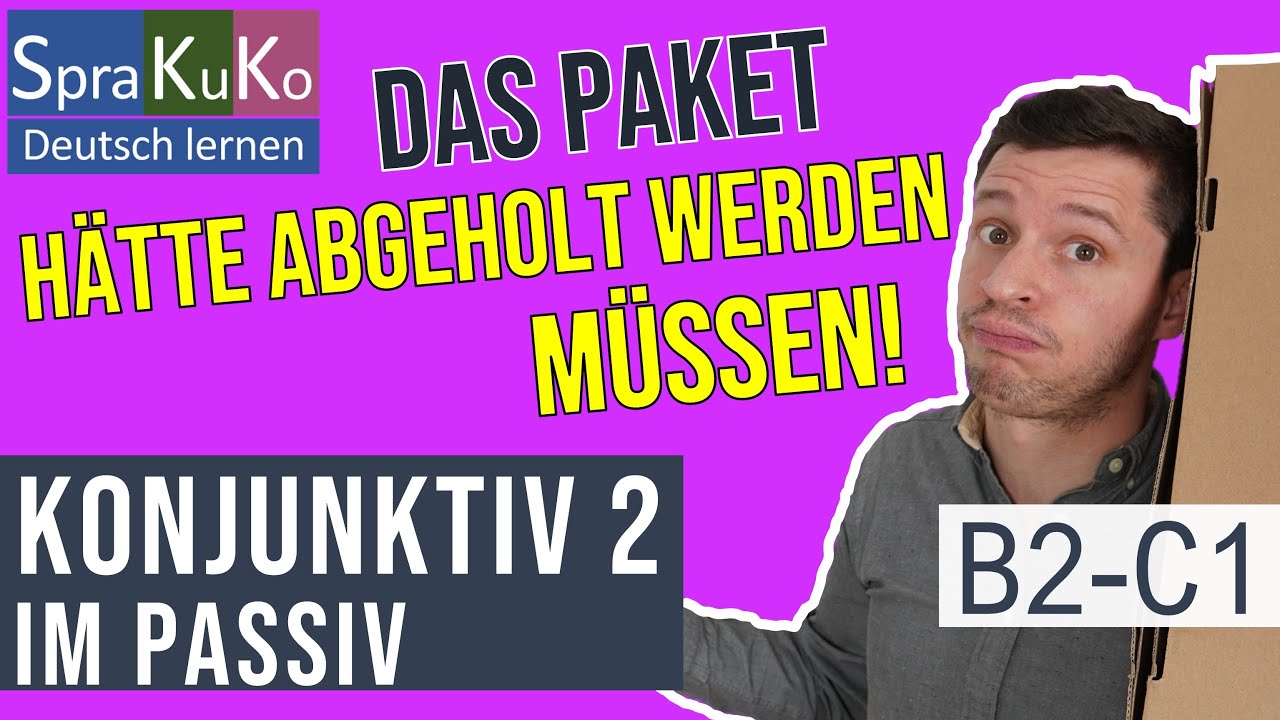
In diesem Video lernen Sie den Konjunktiv 2 Passiv in der Gegenwarts- und Vergangenheitsform. Außerdem lernen Sie, wie man den Konjunktiv 2 im Passiv mit Modalverben bildet. Einfache Beispiele erleichtern das Verständnis, farblich hervorgehobene Strukturen helfen, die Formen des Konjunktivs 2 im Passiv zu verstehen.
Inhalt / Content:
- Wie bild...
Just because there's "wäre" doesn't mean Zustandspassiv
I said "Ich wäre gegangen"
That's Konjunktiv 2 Perfekt Aktiv. It's not Passiv
Hint: if it is passiv, you can turn the subject into an accusative object with the verb and make an active sentence out of it
Er geht mich?
Ich -> mich
Gehen is the verb
That doesn't work
That's not passiv
Das Buch wird gelesen
Ich lese das Buch.
This is passive
plush pelican
plush pelican
https://youtu.be/MKIsi7nNVDs?si=k_4OhBS7AnAQQ-kE
@signal cipher check out this video
Well, this is an advanced topic. I believe I've told you before, more advanced topics tend to be only in German. 🤷♂️
 pure crescent
did you get an answer for this yet?
 near folio
Ich habe vor eine Weile darüber auf Englisch geschrieben, falls du Interesse hast: https://germanlearningresources.blogspot.com/2018/03/modal-verbs-in-subjunctive-in-passive.html
This article covers how to build the passive voice in German in the Subjunctive mood with modal verbs.
pure crescent
So as I see it, kommen+ some verbs of movement is a stylistic choice to emphasize the "coming in" part of the motion.
Ich flattere in das Zimmer = I flutter into the room
Ich komme in das Zimmer geflattert = I flutter into the room, but with more emphasis on the moment I come in
Ich schwebe zu dir rüber = I glide towards you
Ich komme zu dir rübergeschwebt = I glide towards you but with more emphasis on the "coming" part of the motion
plush pelican
near folio
Ich habe vor eine Weile darüber auf Englisch geschrieben, falls du Interesse has...
Where's Konjunktiv 2 Passiv Präsens ohne Modalverb?
near folio
This article covers how to build the passive voice in German in the various available tenses and moods.
pulsar sand
plush pelican
You didn't answer if that was Präsens or Futur
Präsens: Das Buch wird gelesen. // Future: Das buch wird gelesen werden.
plush pelican
pulsar sand
Präsens: Das Buch wird gelesen. // Future: Das buch wird gelesen werden.
in Konjunktiv 2
Das Buch würde gelesen. = Präsens
Das Buch würde gelesen werden. = Futur
oder?
plush pelican
near folio
hier: https://germanlearningresources.blogspot.com/2018/03/passive-voice-tenses-...
Very nice, thanks
pulsar sand
plush pelican
in Konjunktiv 2
Das Buch würde gelesen werden = Präsens // Das Buch würde gelesen werden werden. Future
plush pelican
pulsar sand
Das Buch würde gelesen werden = Präsens // Das Buch würde gelesen werden werden....
🤔 That doesn't look right...
 acoustic tendon
oh boy i love where this is going
pulsar sand
plush pelican
🤔 That doesn't look right...
Notice the question was about passiv... For active: Er würde das Buch lesen (Präsens) // Er würde das Buch lesen werden. (Future)
plush pelican
Er würde das Buch lesen werden?
pulsar sand
plush pelican
Er würde das Buch lesen werden?
yes, you noticed this sounds awkward, which is exactly why Germans typically use the present tense forms of Konjunktiv II to express both present and future.
plush pelican
This contradicts what I've read in sources on how to construct the tense
pulsar sand
plush pelican
This contradicts what I've read in sources on how to construct the tense
ok
serene mountain
What is more commonly used between Student and Schüler?
Secondly, what's the best way to be able to write German letters that are not found in the English language like ü for example on the keyboard?
Do people use external apps or something
delicate tiger
Student - only university (or similar higher education like Fachhochschule)
Schüler - school
">faq keyboard" in #botchannel
serene mountain
🙏 @delicate tiger
rain talon

For phrase 10, would it be incorrect to say für wen ? Or is wen only for questions?
And I wonder if 12 can also be formulated like this
Der Freund, über den du mir gestern erzählt hast, hat sich vor kurzem scheiden lassen
I know they're not 1:1 synonym but I wonder if they express the same thing
delicate tiger
rain talon
For phrase 10, would it be incorrect to say *für wen* ? Or is wen only for quest...
"...für welche die Gegner..."
 rigid heron
Do you think if I buy this as a lunch bag to use at the staff fridge at work people will not steal my shit?

 strange leaf
rigid heron
Do you think if I buy this as a lunch bag to use at the staff fridge at work peo...
strange leaf
rigid heron
Do you think if I buy this as a lunch bag to use at the staff fridge at work peo...
💀
rigid heron
strange leaf
💀

 shut leaf
rigid heron
Do you think if I buy this as a lunch bag to use at the staff fridge at work peo...
shut leaf
rigid heron
Do you think if I buy this as a lunch bag to use at the staff fridge at work peo...

 sleek notch
Hallo
teal cliff
Ich bin am essen can express something like that but ... I honestly don't quite understand your question
plain umbra
Those kind of questions are more like language evolution type questions and aren't really suited to questions channels here.
You would be better off to use #languages as it's more of a linguistics thing.
fervent kernel
Befürchtigen werden vor allem gegenüber der Einwanderung von "Armutsflüchtlingen" geäußert.
I'm trying to write this sentence in active but the second part is a bit confusing
Would the sentence be correct if it's formed like this "Befürchtigen vor allem... werden..."?
delicate tiger
"werden" is part of the passive and no longer needed if you switch to active
rain talon
rain talon
And I wonder if 12 can also be formulated like this
> Der Freund, über den du ...
Up
Also, how do I know when to use "womit, worüber, ..." or "mit denen, über die, ... " ?
plush pelican
"am" from "to be" in English
"Ich bin am Kochen" in German
The German "am" is a preposition contraction, "an + dem"
I don't think it's related at all to the English "to be", it's just coincidental that they look alike.
But I'm not a linguist. If you really want to know, you'd need to ask a professor who has studied the history of the evolution of both languages, which you won't find in this server, as far as I know.
plush pelican
rain talon
Also, how do I know when to use "womit, worüber, ..." or "mit denen, über die, ....
Well, one time is with questions:
Womit hast du die Prüfung geschrieben?
Mit einem Bleistift.
That's only the wo- compound words (colloquially, you could use "mit was", but officially that's not correct)
If you're talking relative clauses, I believe Hammer's German Grammar has a section on this
With questions:

In relative clauses, "womit/worüber" etc. are used where "was" can be used as a relative pronoun, and there is a preposition situation. Hammer's explains when you use "was" below:


 hushed dawn
Lohn vs einkommen vs Gehalt?
plush pelican
hushed dawn
Lohn vs einkommen vs Gehalt?
Did you try googling this?
Gehalt = salary
Lohn = (hourly) wage
Einkommen = income
hushed dawn
plush pelican
Did you try googling this?
https://www.faire-integration.de/de/article/368.was-...
Ok und was ist mit Einkommen ? Wie ist das anders von Gehalt (salary) ?
rain talon
plush pelican
In relative clauses, "womit/worüber" etc. are used where "was" can be used as a ...
Thanks for your detailed answer but I question should have been more precise
If I want to say "The knife I've cut the tomatos with is ancient" I don't know if both sentences below are correct
Das Messer, womit ich die Tomaten geschnitten habe, ist uralt
Das Messer, mit dem ich die Tomaten geschnitten habe, ist uralt
?
plush pelican
hushed dawn
Ok und was ist mit Einkommen ? Wie ist das anders von Gehalt (salary) ?
"income" can be from any number of sources, but salary or wages are your income from your work as a worker
hushed dawn
Ahh i get it now , thank you Argus
plush pelican
rain talon
Thanks for your detailed answer but I question should have been more precise
If...
Again, the rule was: If you can use "was" as a relative pronoun, you use "womit", and the pages I linked explain when you can use "was"
Das Messer, was ich gekauft habe, ist uralt.
That ain't right. Maybe you could do that colloquially, but definitely not on a test.
rain talon
I don't really get it. Was can't be used in Dativ so how would that work here ?
plush pelican
plush pelican
In relative clauses, "womit/worüber" etc. are used where "was" can be used as a ...
Hammer's lists 4 times when you can use "was". Take a look at the pages
rain talon
I read but I don't see how it relates to my case unfortunately
plush pelican
I will give corresponding examples
rain talon
Oh sorry I didn't see the last page!
Ok so from what I understand both are correct? 😊
plush pelican
rain talon
Ok so from what I understand both are correct? 😊
what?
rain talon
Both sentences I wrote are correct according to the last page you screenshoted
plush pelican
- neuter indefinites like "alles, etwas, nichts"
- nominalized neuter adjectives referring to something indefinite "das Richtige, das Erste, das Beste"
- the demonstrative "das"
- referring back to the whole clause.
Which of these do you think "das Messer" counts as?
rain talon
 plush pelican
rain talon
plush pelican
rain talon
"das Messer" is not "etwas" or "nichts"
rain talon
It says most frequently, not only
 rain talon
So which do you think it is cause I don't understand what you're getting to : womit, mit dem, or something else?
plush pelican
mit dem
rain talon
Okay so the excerpt I cited then
plush pelican
 rain talon
Now I'm just confused 😊
plush pelican
don't use "womit/worin" etc. to refer back to a specific noun
only use it in 1 of the 4 times when you could use "was"
When referring back to:
-
neuter indefinites like "alles, etwas, nichts"
Alles, wofür ich gekämpft habe, war falsch. -
nominalized neuter adjectives referring to something indefinite "das Richtige, das Erste, das Beste"
Das Beste, woran ich mich erinnern kann, ist der Sommer 1947. -
the demonstrative "das"
Ich habe das, wovon du gesprochen hast. -
referring back to the whole clause.
Er hat seine Prüfung bestanden, worüber ich mich freue.
rain talon
Thank you
fervent kernel
Do I have to put a comma when using "sowohl... als auch..."
For example
Megacities bestimmen aber sowohl ihre eignen Zukunft als auch die unseres Planeten.
Do I have to put a comma after "Zukunft"?
delicate tiger
"eignen" typo
fervent kernel
Thanks
 grave forge
Hi! I have a beginner question: when we say "Ich bin [profession]", Is it better to say it without an article?
i. e.: Ich bin Kellnerin. VS _ Ich bin eine Kellnerin_. Is there any convention?
delicate tiger
in general no article
grave forge
delicate tiger
in general no article
Oh, okay thanks! Is there any reason for this? Because if I "translate" it to English and Spanish without article it sounds a little bit weird at first
grave forge
Okay! Danke
serene mountain
Which is better for 'A water is two Euro's':
Ein Wasser ist zwei Euro
Oder
Ein Wasser kostet zwei Euro
 woeful mural
Ein Wasser ist zwei Euro
This would be the colloquial/slang way to say it
Ein Wasser kostet zwei Euro
This is the gramatically correct way to say it
icy flax
Alle Probleme liegen gerade brach.
Laut DWDS bedeutet es "unbestellt/unbebaut". Bedeutet es also einfach dass es kein Problem gibt, oder eher dass sie doch existieren, aber man hat sie nicht erwünscht?
icy flax
woeful mural
Ein Wasser ist zwei Euro
This would be the colloquial/slang way to say it
Ein W...
also, "Ding ist zwei Euro" ist nicht Umgangssprache aber Alltagssprache, oder?
 gusty silo
icy flax
> Alle Probleme liegen gerade brach.
Laut DWDS bedeutet es "unbestellt/unbebaut"...
gusty silo
icy flax
> Alle Probleme liegen gerade brach.
Laut DWDS bedeutet es "unbestellt/unbebaut"...
Ist für mich ganz klar »keiner arbeitet an den Problemen«
 robust glade
icy flax
also, "Ding ist zwei Euro" ist nicht Umgangssprache aber Alltagssprache, oder?
robust glade
icy flax
also, "Ding ist zwei Euro" ist nicht Umgangssprache aber Alltagssprache, oder?
Die meisten Deutschen sagen "Es kostet", als Verkäufer kann man auch sagen: "Das macht 2€"
woeful mural
icy flax
also, "Ding ist zwei Euro" ist nicht Umgangssprache aber Alltagssprache, oder?
Ich hab nie zwischen Umgangssprache und Alltagssprache umterschieden
Meiner Erfahrung nach wird beides oft verwendet
Aber dann halt nur im Mündlichen
plush pelican
I don't believe it is
Or rather, it's hypothetical, which can also talk about the past or present
it'd be nice if German kept its tenses straighter, 😅
I don't think so?
3 forms:
- Past subjunctive = present tense
- Pluperfect subjunctive = past tense
- Conditional = everything else, including also stuff in the present or past sometimes 😅

You really should get a copy of Hammer's German Grammar if you don't have one already
It's quite useful, 😄
plush pelican
There is, it turns out. But it's kind of rare: https://deutschegrammatik20.de/2019/08/29/leserfrage-wie-heissen-die-formen-des-zustandspassivs-mit-modalverb/
They say that the Präsens and Präteritum forms occur, but all the rest are quite rare (especially Futur 2, which they say isn't worth even learning, as even natives won't be able to build it.)
What's interesting is I didn't learn this as "Zustandspassiv mit Modalverb"
Die Geschäfte müssen geschlossen sein
I learned that as, "subjektive Bedeutung des Modalverbs"
at least for "müssen"
the subjektive Bedeutung is, yeah
They say in the link that
Die Geschäfte müssen geschlossen sein
is Zustandspassiv with modalverb.
but again, I learned that as "subjektive Bedeutung des Modalverbs"
one sec
I guess the difference is Zustandspassiv, like all Passiv, has a Partizip 2?
Peter muss krank sein. = subjektive Bedeutung
Das Geschäft muss geschlossen sein = Zustandspassiv mit Modalverb
But then how do you say a guess about the business being closed?
"The business must be closed" = I am pretty sure, but not 100%, that it is closed. 90-95% sure
DeepL seems to have trouble telling whether you mean "must" = needs to be or "must" = guess
it keeps suggesting "Das Geschäft muss geschlossen werden" = the business needs to be closed.
which is neither subjektive Bedeutung nor Zustandspassiv
As I said, that can help tell the difference some of the time. But then how do you say that you are guessing the business is closed?
Das Geschäft muss .....
Das Geschäft kann ....
It seems like there would be an overlap, where without Partizip 2, it's clearly just subjektive Bedeutung.
But with Partizip 2, it could be Zustandspassiv or subjektive Bedeutung
Peter muss krank sein. = no Partizip 2, must be subjektive Bedeutung des Modalverbs
Das Geschäft muss geschlossen sein. = Partizip 2, but could be Zustandspassiv mit Modalverb or subjektive Bedeutung des Modalverbs
Das Geschäft hat schließen müssen?
no, that's just Perfekt, it had to close 🤔
I don't think I've ever seen anything with "Das Geschäft ist geschlossen müssen."
I don't think that can be right
also, in the first one, "muss"
"müsst" is for "ihr"
robust glade
"Das Geschäft müsste geschlossen sein" und "Das Geschäft ist geschlossen"
robust glade
robust glade
"Das Geschäft müsste geschlossen sein" und "Das Geschäft ist geschlossen"
Oder eher "das Geschäft hat geschlossen"
plush pelican
robust glade
"Das Geschäft müsste geschlossen sein" und "Das Geschäft ist geschlossen"
But there's not just "müsste"
Peter muss krank sein.
Peter müsste krank sein.
Peter dürfte krank sein.
Peter könnte krank sein.
What about "muss", but in subjektive Bedeutung?
robust glade
plush pelican
But there's not just "müsste"
"sein" is also a verb. Together it works
plush pelican
robust glade
"sein" is also a verb. Together it works
What I mean is, "müsste" is only 1 option for subjektive Bedeutung des Modalverbs.
What about the other options, specifically "muss"?
robust glade
"Peter muss krank sein" means "Peter has to be ill". "Peter müsste krank sein" means that he could be ill
plush pelican
Also, "kann"
plush pelican
robust glade
"Peter muss krank sein" means "Peter has to be ill". "Peter müsste krank sein" m...
You're missing my question
plush pelican
robust glade
"Peter muss krank sein" means "Peter has to be ill". "Peter müsste krank sein" m...
"The business must be closed" = I am guessing that the business is closed, and I have a high certainty that is true, but I don't know it 100%
robust glade
Yes
plush pelican
How do you say that with "muss"?
Peter muss krank sein.
Das Geschäft muss geschlossen sein.
oder?
robust glade
Yes
plush pelican
so "Das Geschäft muss geschlossen sein" = subjektive Bedeutung des Modalverbs?
But the website was saying it was Zustandspassiv mit Modalverb
Do you understand the problem now?
robust glade
Wait, i have to google whar a Modalverb is
robust glade
Can you write the sentence as the website explained it?
plush pelican

-
In Deutschland müssen Geschäfte nach 20 Uhr geschlossen sein.
-
Es ist 21 Uhr. Die Geschäfte müssen geschlossen sein.
Welche von diesen Sätzen ist eine Vermutung, und welche ist eine Tatsache?
Ich verstehe es so, dass der zweite Satz eine Vermutung ist. Das wäre dann "subjektive Bedeutung des Modalverbs" und nicht Zustandspassiv mit Modalverb. Aber die Form ist diesselbe.
robust glade
There is just more information, they mean the same.
plush pelican
Beide sind Tatsachen und eben keine Vermutungen?
der zweite Satz ist nicht wie "Peter muss krank sein"?
"Peter muss krank sein" = eine Vermutung, subjektive Bedeutung des Modalverbs
robust glade
Im ersten Satz ist es ziemlich sicher, dass die Geschäfre geschlossen sind, im 2ten geht man sehr stark davon aus, dass auch sie geschlossen sind, es ist aber nur "Normalerweise" so
plush pelican
robust glade
Im ersten Satz ist es ziemlich sicher, dass die Geschäfre geschlossen sind, im 2...
der zweite Satz ist also doch eine Vermutung = subjektive Bedeutung des Modalverbs?
Vielleicht würde es dir helfen, die Seite über "subjektive Bedeutung des Modalverbs" zu sehen

"müssen" ist eine sehr sehr sichere Vermutung, aber eben eine Vermutung
Oder, es kann sowas sein, 😅
Aber wenn man von "Zustandspassiv mit Modalverben" spricht, ist es keine Vermutung.
Das Haus ist gebaut. = Zustandspassiv.
Das Haus muss gebaut sein. = Zustandspassiv mit Modalverb (angeblich)
hushed dawn
the positioning of "sich" confuses me , my teacher told me that in a mainclause is "sich" written after the name given.
But this sentence is the opposite "Heute hat sich dieses Verhältnis genau umgedreht"
And what about the Nebensätze, is it any different ? can someone explain itt
plain umbra
hushed dawn
the positioning of "sich" confuses me , my teacher told me that in a mainclause ...
So... basically I would summarise it by saying that reflexive pronoun tends to go as early as possible (not including pos 1 of a main clause). However, if there is a pronoun subject, the pronoun subject will come before the reflexive pronoun.
That's not a rule btw, but rather just a description of what usually happens.
old roost
can anyone give me an sentence example of schaffen präteritum shaffte and schuf?
plain umbra
old roost
can anyone give me an sentence example of schaffen präteritum shaffte and schuf?
Wir schafften es.
Wir schufen es.
Okay, just kidding. Here are some examples:
Wir schafften es, das Projekt nach Plan abzuschließen.
Wir schufen die Beihilfe, um talentierte Kinder zu unterstützen.
hushed dawn
plain umbra
So... basically I would summarise it by saying that reflexive pronoun tends to g...
understood, thank you
long whale
hushed dawn
or is there some differences ?
Well, I feel the 1st is only used in "um jemandes Gunst buhlen", usually specifically in the context of politicians trying to entice voters, and it's not meant positively. Otherwise, it's extremely dated.
 worthy flower
Duden = Wörterbuch?
robust glade
Duden=Verlag für Wörterbücher
long whale
worthy flower
Duden = Wörterbuch?
To Germans, "der Duden" is what "Merriam-Webster" is to US-Americans, or "the Oxford dictionary" is to the British.
shrewd fern
worthy flower
Duden = Wörterbuch?
duden is a very big brand/company that makes dictionaries and stuff
dictionary is wörterbuch
literally "book of words"
shrewd fern
long whale
To Germans, "der Duden" is what "Merriam-Webster" is to US-Americans, or "the Ox...
was weißtn duden 
long whale
shrewd fern
was weißtn duden <:mewhenmarmaruri:1107274198012923965>
Very funny. Theia, would you mind terribly not pinging me with stuff like this?
shrewd fern
pfft 😭 okay
worthy flower
shrewd fern
duden is a very big brand/company that makes dictionaries and stuff
danke schön
 rose leaf
hello, i don't understand the difference between these sentences and which one to use, can someone help?
- Auf jeden Fall werde ich morgen kommen.
- Ich werde auf jeden Fall morgen kommen.
- Ich komme auf jeden Fall morgen.
long whale
rose leaf
hello, i don't understand the difference between these sentences and which one t...
There is no difference. Except the 3rd version seems far more idiomatic to me.
We don't usually use the future with "werden" when a specific time ("morgen") is mentioned.
 lofty basin
hello, I've found a new word called ''Ordnung'', what does it mean exactly and how can I use it in a sentence?
It means order but which meaning? Can someone help please?
long whale
lofty basin
hello, I've found a new word called ''Ordnung'', what does it mean exactly and h...
Perhaps check https://de.pons.com/übersetzung/deutsch-englisch/Ordnung first. If that doesn't help, feel free to ping me, okay? 🌻
Übersetzung Deutsch-Englisch für Ordnung im PONS Online-Wörterbuch nachschlagen! Gratis Vokabeltrainer, Verbtabellen, Aussprachefunktion.
lofty basin
Ohh yes that helped alot, thanks!
 wicked crown
who is familiar with Anschreiben and Lebenslauf?
dense obsidian
wicked crown
who is familiar with Anschreiben and Lebenslauf?
Don't use meta questions. Just ask your question. 🙂
wicked crown
dense obsidian
Don't use meta questions. Just ask your question. 🙂
https://nometa.xyz/
it's not just one. i want to ask about opinions on my Anschreiben
dense obsidian
Then ask them. Many people here are familiar with "Lebenslauf" and "Anschreiben."
long whale
wicked crown
it's not just one. i want to ask about opinions on my Anschreiben
Well, then post it. 🤷
dense obsidian
wicked crown
here?
Sure, why not? 🙂 You can also create a thread in #942470380692590632 if it's a more complicated one.
wicked crown
dense obsidian
Sure, why not? 🙂 You can also create a thread in <#942470380692590632> if it's ...
i'll do the second one
ty
 eager vale
kann ich einfach angemessen durch adäquat ersetzen, um den Satz schöner zu machen?
oder klingt es zu komisch?
pulsar sand
eager vale
oder klingt es zu komisch?
Klingt adäquat 👌
 ebon vault
Warum ist bar im diesem Satz ein Adjektiv?
 long whale
ebon vault
Warum ist bar im diesem Satz ein Adjektiv?
long whale
ebon vault
Warum ist bar im diesem Satz ein Adjektiv?
What did you expect it to be? 🤔
ebon vault
long whale
What did you expect it to be? 🤔
It isn't a noun in english?
long whale
ebon vault
It isn't a noun in english?
So...? English and German don't map 1:1, they are both languages in their own right. "bar" is an adjective in German (and also a preposition, albeit a rarely used one).
ebon vault
long whale
So...? English and German don't map 1:1, they are both languages in their own ri...
And why it isn't treated like a noun in the example?
serene mountain
woeful mural
Ein Wasser ist zwei Euro
This would be the colloquial/slang way to say it
Ein W...
Dankeschön
serene mountain
'Der Salat kostet wirlich sieben Euro' = The salad really costs seven Euros
Is there any reason why kostet and wirlich are swapped over compared to the English translation?
long whale
serene mountain
'Der Salat kostet wirlich sieben Euro' = The salad really costs seven Euros
Is ...
*wirklich - Yes. The conjugated verb must be in Pos. 2 in a main clause...
serene mountain
long whale
*wir**k**lich - Yes. The conjugated verb **must** be in Pos. 2 in a main clause....
🙏 and thank you for pointing out the spelling mistake
icy flax
woeful mural
Ich hab nie zwischen Umgangssprache und Alltagssprache umterschieden
Bitte, korrigiere mich wenn ich was nicht ganz verstehe, aber ich nehme an, dass "Umgangssprache" sowas wie "slang" ist. Das bedeutet, diese Wörter sind speziell nur für eine spezifische Gruppe, zB eine Generation oder Skaters/Surfers. Wenn man sagt, dass was "Alltagssprache" ist, verstehe ich, dass ich es mit quasi jedem benutzen kann, wobei es nicht besonders schön, förmlich und "dem besten Standard" entspricht.
woeful mural
Ach so meinst du das
icy flax
Deswegen wollte ich so sehr wissen, ob wenn ich "das isr 2 Euro" sage, ältere Leute würden mein Deutsch schlecht finden, oder einfach nicht ganz "förmlich" aber es passt schon
Ist ja Alltagsdeutsch
Jeder sagt es sowieso selbsr wenn es nicht GAAAAnz korrekt ist
woeful mural
In dem Fall beides. Diese Konstruktion ist Teil der Umgangssprache und wird oft im Alltag verwendet
woeful mural
icy flax
Deswegen wollte ich so sehr wissen, ob wenn ich "das isr 2 Euro" sage, ältere Le...
ältere Leute würden das auf jeden fall schlecht finden
aber so ist das halt. Wenn die Merken du bist kein Muttersprachler sind die standards auf einmal ganz hoch
icy flax
woeful mural
ältere Leute würden das auf jeden fall schlecht finden
Dankeee
plush pelican
long whale
What did you expect it to be? 🤔
In the sentence, there's a preposition "in" followed by an adjective and not a noun? Where's the object of the preposition?
Is there an omitted noun? Except if that were the case, "bar" would be declined, wouldn't it?
Ich habe noch 100 Euro in barem [Geld].
long whale
plush pelican
In the sentence, there's a preposition "in" followed by an adjective and not a n...
*X Euro in barem Geld or X Euro bares Geld or X Euro Bargeld - Hmm... It occurs to me it's not the only instance of "in" followed by an undeclined adjective, although they are capitalized in "Haben Sie dieses Hemd auch in Rot?" or in the fixed expression "Dasselbe in Grün". 🤔
plush pelican
long whale
*X Euro in bar**em** Geld or X Euro bar**es** Geld or X Euro Bargeld - Hmm... It...
in barem Geld, yes
So do you think there's an omitted noun here, or why does it make sense to have preposition + adjective and that's it?
Looking at Hammer's, turns out "bar" has another interesting scenario it's used in


"bar" is one of those adjectives that, when used with "sein" and a noun, control the case of the noun, specifically making it Genitive
Seine Handlungsweise war bar aller Vernunft.
Sadly, that's the only time Hammer's mentions "bar"
long whale
Well, yes, it's also a preposition (2nd entry on DWDS) but I'm unsure how this is relevant in the context of your question?
plush pelican
preposition?
long whale
plush pelican
preposition?
Sure. One requiring Genitiv, meaning "ohne".
plush pelican
I just meant, "here's a time when bar is used as an adjective, and it's weird"
plush pelican
long whale
Sure. One requiring Genitiv, meaning "ohne".
They say it's an adjective here, and DWDS lists it as an adjective in both entries?
long whale
plush pelican
They say it's an adjective here, and DWDS lists it as an adjective in both entri...
Yes, I see. Interesting.
plush pelican
long whale
Yes, I see. Interesting.
I asked on reddit, and someone linked this: https://dict.leo.org/grammatik/deutsch/Rechtschreibung/Regeln/Gross-klein/Nominalisierung.html?lang=de#id=4.1.4.3.d
Where it's seemingly another instance of German being dumb and ignoring its own rules about Nominalisierung.


I say "another instance"; the thing I always think of is how it's "etwas Gutes, etwas Neues" but then "etwas anderes" kleingeschrieben 💢
In other words:
"bar" is being used like a noun here, except it's a "fixed expression" where it's not capitalized like a noun, for...reasons...
and it's also not declined for...reasons...
even though nominalized adjectives are supposed to still be declined...
plush pelican
plush pelican
I just love how the overall header is "words used as nouns get capitalized"
and then the specific subsection is, "except here. Here, they remain uncapitalized...for reasons..."
Btw: Turns out Hammer's does talk about this, but I missed it when searching for "bar" earlier

 random heath
Why do I hear Germans say Alter so often when something goes south
long whale
random heath
Why do I hear Germans say Alter so often when something goes south
Same as "Oh man!"
in English, I mean.
plush pelican
long whale
Same as "Oh man!"
Is it a shortening of "Alter Schwede!"?
random heath
Thank you!
robust glade
plush pelican
Is it a shortening of "Alter Schwede!"?
Es hat auf jeden Fall die gleiche Bedeutung
Natürlich nur im Zusamnenhang und nicht übersetzt
long whale
plush pelican
Is it a shortening of "Alter Schwede!"?
No idea. I mean, "Alter" is like "dude" in contemporary colloquial German, so... 🤷
 mossy sphinx
scheisse ich mache immer noch fehler in der possessivgrammatik
 copper orchid
"Das ist die Katze, der ich die beste Bewerbung gegeben habe" Why is it der ich not die ich?
oh wait is geben immer plus dat?
 small ridge
Yup. Cuz you're describing something you did to the cat, in this case you gave the cat a rating.
Der Dativ gehört in der Grammatik zu den Kasus (deutsch Fällen). Sein Name rührt daher, dass eine typische Funktion des Dativs ist, den Empfänger des Gegebenen zu bezeichnen. Das Wort Dativ ist entlehnt aus lateinisch (casus) dativus, zu lat. dare „geben“ und lat. datum „Gegebenes“.
Für den Dativ wird im Deutschen die Frage Wem? benutzt, er heiß...
plush pelican
copper orchid
oh wait is geben immer plus dat?
Ich gebe dir den Ball.
The person (or animal) who receives the thing being given is in dative.
The thing being given is in accusative.
"die beste Bewerbung" = Akkusativ
der = (Dativ, Feminin)
long whale
copper orchid
"Das ist die Katze, der ich die beste Bewerbung gegeben habe" Why is it der ich ...
die Bewertung = rating; die Bewerbung = application (e.g. for a job) ;)
robust glade
long whale
die Bewer**t**ung = rating; die Bewer**b**ung = application (e.g. for a job) ;)
@long whale wie kann man bestimmte Buchstaben markieren? Geht das nur auf der Pc Version?
long whale
robust glade
<@612557923192799249> wie kann man bestimmte Buchstaben markieren? Geht das nur ...
No idea. Try typing 1 or 2 * before and after a word.
delicate tiger
test (*) test (**) test (~~) ||test|| (||)
long whale
test ( __ ) 😄
hushed dawn
er gab mir die Hand bei "X" .
usual way to say someone helped me ?
long whale
hushed dawn
er gab mir die Hand bei "X" .
usual way to say someone helped me ?
Not to my knowledge, no.
fervent kernel
test
long whale
I think it's just a literal translation from English? In German, I'd just find this confusing.
fervent kernel
test
fervent kernel
long whale
I think it's just a literal translation from English? In German, I'd just find t...
Same
dense obsidian
hushed dawn
er gab mir die Hand bei "X" .
usual way to say someone helped me ?
That doesn't work. There is "jemandem zur Hand gehen" though.
 iron rune
I have read many times that German word order is able to have the object come before the subject, but all examples I have seen so far either use a pronoun, or have the object be a masculine noun. What if both nouns are feminine or neuter? zB : "Die Katze biss die Frau" or "Das Kaninchen biss das Mädchen" or a mixture of genders "Die Katze biss das Mädchen"? Can the object come first in any of these cases, and if so, how would you know it's the object? Thanks!
long whale
iron rune
I have read many times that German word order is able to have the object come be...
If you can't tell which one's the object and which one's the subject, the subject will have to come first.
Don't forget - apart from grammar, there is also always context. Plus, there's usually a pretty good reason for putting the object in Pos. 1, e.g. if there's some confusion as to who exactly got bitten: Person pointing: Den Mann hat der Hund gebissen! = This man's the one who got bitten! -> This kind of word order is not the default one, see?
Default word order means: subject either in Pos. 1 or 3, but usually before its objects.
iron rune
long whale
If you can't tell which one's the object and which one's the subject, the subjec...
if gender doesn't make the object clear, such as with two feminine nouns, would one use the passive voice: "Die Frau wurde von der Katze gebissen" (Hope I got that right)
long whale
iron rune
if gender doesn't make the object clear, such as with two feminine nouns, would ...
Given that a woman biting a cat would be rather unusual (putting it mildly), you wouldn't have to use Passiv. And yes, you got that right. 💐
As I said above: you need very specific, rather unusual context for putting the object before the subject at all.
iron rune
long whale
As I said above: you need very specific, rather unusual context for putting the ...
I wish this was expressed in the many articles I have come across; I was getting the impression that rearranging the sentance for emphasis was commonplace.
so much is stated without proper context, and misleads learners like me.
long whale
iron rune
I wish this was expressed in the many articles I have come across; I was getting...
Yeah, but the operative word here is "emphasis" - you need a reason to say "This is the man who got bitten by the dog" instead of "The man got bitten by the dog", don't you?
Or rather: The dog bit the man.
iron rune
long whale
Yeah, but the operative word here is "emphasis" - you need a *reason* to say "Th...
So, if given a reason to emphasize the object over the subject, when both nouns are feminin/neuter, are there any words that can specify which noun is the object, allowing it to come first in the active voice? This is the last thing I am wondering on this topic. Thanks for all your help.
long whale
iron rune
So, if given a reason to emphasize the object over the subject, when both nouns ...
If you feel a) special emphasis is necessary and b) you think there's a chance you might be misunderstood, you'd just use Passiv.
iron rune
long whale
If you feel a) special emphasis is necessary and b) you think there's a chance y...
That answers everything I have on the topic. Danke sehr!
fervent kernel
Saw this somewhere
Gekommen bin ich nach Deutschland.
Would this be a natural way to say it?
long whale
fervent kernel
Saw this somewhere
Gekommen bin ich nach Deutschland.
Would this be a natural wa...
Depending on context, it might be. E.g. if someone said they originally wanted to go somewhere else, but ended up in Germany instead. It's definitely not default/normal word order, if that's what you mean.
fervent kernel
long whale
Depending on context, it might be. E.g. if someone said they originally wanted t...
It was an introduction to a presentation(Mündliche Prüfung)
One student started by saying
Ich bin x. Geboren bin ich in Y und
gekommen bin ich nach Deutschland seit...
long whale
fervent kernel
It was an introduction to a presentation(Mündliche Prüfung)
One student started ...
Meh. Looks as if they were bending over backwards to avoid beginning another sentence with "ich" - which is fine in German, definitely when introducing yourself. Also, please note "seit" doesn't work in this context! Ich lebe/bin seit X Jahren in Deutschland vs. Ich bin vor X Jahren nach Deutschland gekommen.
-> not at all natural.
fervent kernel
long whale
Meh. Looks as if they were bending over backwards to avoid beginning another sen...
This helps thanks
I'll stick to the basics...
 long whale
serene mountain
long whale
serene mountain
Instead? Just removing the preposition? No!
serene mountain
long whale
Instead? Just removing the preposition? No!
Why though
long whale
serene mountain
Why though
For pretty much the same reason you can't say "I feel Apfelschorle" if you want to drink one. 👀
serene mountain
Surely Lust though is the like part?
delicate tiger
"Lust auf etwas haben" is the construction, it just is
serene mountain
So does auf always come after Lust in every instance?
Yep this is the exact line of thought I had prior to coming here 😆
Ok, secondly if I said 'Ich habe Durst. Ich habe eine Apfelschorle.' - Is this correct in German?
long whale
serene mountain
Ok, secondly if I said 'Ich habe Durst. Ich habe eine Apfelschorle.' - Is this c...
Depends on what you're trying to say. If you mean "I'll have/I'm having an Apfelschorle" - No, definitely not. It just means "I've got an Apfelschorle", maybe in the fridge or in my backpack"
serene mountain
If they were connected, the eine would become a dativ to einer correct?
serene mountain
long whale
Depends on what you're trying to say. If you mean "I'll have/I'm having an Apfel...
Yeah, the second phrase is exactly what I meant
long whale
apple juice mixed with carbonated mineral water = die Apfelschorle @fervent kernel
serene mountain
What about 'Ich habe Durst, und ich habe eine Apfelschorle.'
Or is that a non sentence?
But surely I am the subject in that instance
And therefore nominativ
Leaving the object I guess (the apple juice) being the dativ?
Yeah, what about the eine Apfelschorle?
Also, I am using this as reference to my thinking above: #questions message
long whale
Bitte korrigiere/korrigiert mich, wenn es falsch ist/nicht stimmt.
Mich korrigiere simply doesn't work
long whale
Depends on the verb. "Mich stört es nicht, wenn du viele Fragen stellst [but maybe it does bother other people]". An imperative, however... No. Not possible.
Ah - wait, come to think of it... "Mich lass in Ruhe!" - but this really emphasizes the "mich", as in "Go bother somebody else, if you must, but do leave me alone!"
But strangely enough, I feel this wouldn't work with other verbs... 🤔 Mich stör nicht feels completely weird to me.
serene mountain
So just to clarify, it would be a nominativ for the apple juice?
long whale
serene mountain
So just to clarify, it would be a nominativ for the apple juice?
No. When you have something, that something is always going to be in Akkusativ.
serene mountain
serene mountain
What about 'Ich habe Durst, und ich habe eine Apfelschorle.'
Ok, so I would be the nominativ and the apple juice in this instance would be the akkusativ?
long whale
Also, you've already got "ich", which is Nominativ. And only a couple of verbs (sein & werden) get Nominativ on both sides.
serene mountain
serene mountain
Ok, secondly if I said 'Ich habe Durst. Ich habe eine Apfelschorle.' - Is this c...
As these are two separate sentences, the apple juice would be nominativ*?
Or does it carry over between sentences?
long whale
And what about "ich"? 🥹
serene mountain
long whale
And what about "ich"? 🥹
Well, it's best to clarify to make sure ahah
Thank you for the explanation. So if I did lets say 'Ich bin klein. Ich koche eine Tomate' would the tomato be an akkusativ or nominativ?
long whale
serene mountain
Thank you for the explanation. So if I did lets say 'Ich bin klein. Ich koche ei...
ich... ich... ich...! 😿
serene mountain
long whale
ich... ich... ich...! 😿
I know but I want to double check
There seems to be so many exceptions to so many rules
So despite the fact they are two separate phrases, I still use the akkusativ?
Ah ok
I understand
I thought it was just haben being the exception
Honestly, I wish this language was easier sometimes 🥲
Yeah, completely new to cases. Studied French and a bit of Italian and from memory you never had to do cases
The hardest part was just verb conjugations tbh in my opinion
I guess German one ups on French though for only have one ending for regular verbs
long whale
*aus gutem Grund ;)
serene mountain
I 100% did not use Google translate just then to understand at least half of what you said 😂
Specifically the reason, although and native
serene mountain
long whale
Use deepl.com, at least.
I'm on my phone in bed but yes I normally do use it
plush pelican
serene mountain
I'm on my phone in bed but yes I normally do use it
DeepL has an app
 round maple
Hello! I'm in my first week of learning German so forgive me if these are incredibly basic questions
"Die first einhalten" apparently means "meet a deadline" but when each word is literally translated it comes to "comply with the period"; is this just the German way of saying "meet a deadline"?
long whale
round maple
"Die first einhalten" apparently means "meet a deadline" but when each word is l...
first Frist - yes.
round maple
I ask because another word for "meet" is treffen, but that seems to be in a more social stance
Ah, autocorrect, thank you
Frist means yes?
long whale
round maple
"Die first einhalten" apparently means "meet a deadline" but when each word is l...
The answer to this question of yours is "yes".
round maple
Ah, thank you!
round maple
This is going to be lengthy, apologies in advance
I was trying to figure out how to say "would you like to meet for breakfast", and used Google translate to do so. It went from "Würde" to "würdest du" to "möchtest du". I guess my first question would be why does it change from "würdest du gerne " to "möchest du" aside from the obvious "it's less words"?
 coral drift
round maple
I was trying to figure out how to say "would you like to meet for breakfast", an...
coral drift
round maple
I was trying to figure out how to say "would you like to meet for breakfast", an...
Google translate does that sometimes but both work, I personally would use möchtest du
round maple
It then switches from möchtest to möchten in "möchten sie gerne", then to the further "möchten sie sich treffen". Why the switch from möchtest to möchten, when the meanings respectively are "would like" and "want"? On the topic of the added "sich" the translation seems to be the same as sie (when translated), what's the reason for adding "sich" into a sentence when "sie" already addresses the other party?
coral drift
"Sie sich" is more formal
round maple
Gotcha gotcha
What is the direct translation for "zum"? It appears to be "to the", so I'm curious how it fits into "meet for breakfast"
In the case of "zum Früchstüch treffen"
And in the full sentence of "Möchten sie sich zum Früstüch treffen?"
(This is how Google translate advised me to say the sentence)
coral drift
Yea that’s ok
"Möchtest du dich" would be informal
round maple
So "Möchtest du dich zum Früstüch treffen?"
coral drift
Ye
round maple
Thank you thank you
charred harbor
round maple
So "Möchtest du dich zum Früstüch treffen?"
Frühstück
charred harbor
coral drift
Yea that’s ok
"Möchtest du dich" would be informal
There were a few errors in the original sentence
hushed dawn
Zugang is used for places
Zugriff is used for other things
Is this correct? what about Zutritt ?
long whale
hushed dawn
Zugang is used for places
Zugriff is used for other things
Is this correct? wha...
I think there's considerable overlap between "Zugang" and "Zugriff", but "Zugang" is what I'd use for data, internet sites, etc. "Zugriff" is sth I mostly associate with policemen arresting people. "Kein Zutritt" is what it usually says on doors leading to rooms which aren't open to the general public. Please note other native speakers might disagree.
hushed dawn
I want to say craving for sweets
Verlangen nach or Biegerde nach
Which is more common or both are acceptable ?
long whale
hushed dawn
I want to say craving for sweets
Verlangen nach or Biegerde nach
Which is more c...
Spelling: Begierde - Both would be acceptable, but I think we usually say "Gier".
hushed dawn
"Doch glücklicherweise gibt es gegen die trübe Winterstimmung eine ebenso einfache wie Erfolg versprechende Therapie: Licht."
What role does "wie" here play ?
old roost
Warte, ich will mein Hemd ___ . Ich habe es verkehrt herum getragen. what's the suitable verb here, umkehren? umdrehen? umkrempeln?
 rare jetty
old roost
Warte, ich will mein Hemd ___ . Ich habe es verkehrt herum getragen. what's the ...
rare jetty
old roost
Warte, ich will mein Hemd ___ . Ich habe es verkehrt herum getragen. what's the ...
I'd say umdrehen
long whale
hushed dawn
"Doch glücklicherweise gibt es gegen die trübe Winterstimmung eine ebenso einfac...
ebenso X wie Y = as X as Y
stoic mauveBOT
@onyx vigil, please read the Roles section in #getting-started for info on how to join VC and more.
delicate tiger
reading helps
long whale
 misty gust
for an oral exam
misty gust
for an oral exam
Googling in German will probably help: mündliche Prüfung B1.1 🌻
serene mountain
plush pelican
DeepL has an app
Dankeschön
plain umbra
delicate tiger
reading helps
Yes, please direct people to read the channel itself rather than spoonfeeding them the info.
brave flint
Es sieht so aus, als wenn wir alle beste Freunde wären.
My textbook says als wenn is the answer, but I thought it should be als ob.
I looked online and it said als wenn is colloquial and ob seems more formal?
Is there any other difference?
long whale
brave flint
> Es sieht so aus, als wenn wir alle beste Freunde wären.
My textbook says als w...
I'd have said the answer was definitely "ob" (and I'd also expect this would get marked in an exam...)
No, what other difference would there be?
 ruby scaffold
Hat jemand eine Idee, wie schwierig es ist, um B1 allein zu erreichen?
Für das A1 und A2 hab ich einen offline Kurs besucht, aber das Wetter im Sommer ist total heiß und finde ich nicht online Kurse.
long whale
ruby scaffold
Hat jemand eine Idee, wie schwierig es ist, um B1 allein zu erreichen?
Für das...
https://learngerman.dw.com/en/learn-german/s-9528 "schwierig" is relative - it's certainly do-able, if that's what you mean. 🌻
DW Learn German
ruby scaffold
long whale
https://learngerman.dw.com/en/learn-german/s-9528 "schwierig" is relative - it's...
Yes, do-able i guess IS the word i am looking for. I thought this was a German only Channel and i didnt know the word for IT. Thank you!
Thanks for the Link, i'll Check IT Out.
long whale
do-able = machbar ;)
brave flint
long whale
I'd have said the answer was definitely "ob" (and I'd also expect this would get...
just ob or als ob?
brave flint
long whale
No, what other difference would there be?
im not sure either. the book wasnt very clear
long whale
brave flint
just ob or als ob?
Oops, "als ob", of course...
brave flint
long whale
Oops, "als ob", of course...
thanks! 😊
delicate tiger
plain umbra
Yes, please direct people to read the channel itself rather than spoonfeeding th...
That person triggered the bot three times in two channels and didn't seem to stop
plain umbra
delicate tiger
That person triggered the bot three times in two channels and didn't seem to sto...
Okay, good to know. Please direct people to read the channel itself rather than spoonfeeding them info. Even in the case where they trigger the bot and don't seem to stop.
hushed dawn
sich verpflichten zu vs sich an etw halten ?
commit vs adhere to ? but both are same meaning ? or am i mistaken ?
plush pelican
I mean, I think in both English and German, to commit to something is stronger than to merely adhere to something
adhering to something is just "I'm fulfilling this obligation currently".
committing to something is making a specific promise of "I will definitely fulfill this obligation...even if there might be something that makes me want to stop fulfilling it."
hushed dawn
understood, thanks
 safe robin
Can I say “Ich nicht will einschlafen“ oder “Ich will nicht einschlafen“
delicate tiger
please ask only in one channel
robust glade
safe robin
Can I say “Ich nicht will einschlafen“ oder “Ich will nicht einschlafen“
"ich will nicht einschlafen" works
 midnight stump
Any good apps for learning German
 pale leaf
duolingo?
tiny scaffold
pale leaf
duolingo?
faq duo
stoic mauveBOT
Duolingo
Duolingo is a decent resource to start with if you're a complete beginner, but it's neither efficient nor comprehensive!
What Duolingo will teach you about grammar is very limited, and none of the systems they use will help you practise much of it.
You can learn some vocabulary with it, but their method (based on the concept of spaced repetition) doesn't work for everybody, and the way Duolingo teaches is not very effective compared to the amount of time it requires from you.
So, if you find it useful, by all means keep using it, but remember not to fall for its gamification of language learning, and move past it when it stops being beneficial. Ignore the streaks.
In any case, keep in mind that Duolingo is not enough to learn a language, ever.
If you're looking for guidance or alternatives, check out >faq beginner in our #botchannel .
tiny scaffold
midnight stump
Any good apps for learning German
faq nicos
stoic mauveBOT
Nicos
Nicos Weg is a free online program aimed at helping people learn German. It includes video, audio, text, grammar explanations, notes, vocabulary, and exercises. It also includes very useful cultural and bureaucratic information, such as how to open a bank account, while teaching you the relevant grammar and vocabulary.
It’s fairly popular and well-recommended, but keep in mind that you can’t learn a language with only one resource, even if it’s a good one!
You can find the courses here: https://learngerman.dw.com/en/overview/
You can also see various other courses for learners by dw.com here: https://www.dw.com/en/learn-german/s-2469/
 oak shuttle
which is the proper way to say "I love you too"?
Ich lieben dich auch
Ich lieben dich zu
long whale
oak shuttle
which is the proper way to say "I love you too"?
Ich lieben dich auch
Ich lieb...
Neither. Please check
faq Präsens
stoic mauveBOT
Conjugation
Präsens (Present Tense)
When you use a verb in a sentence (or clause), you have to conjugate it (change the form) to match the subject of the sentence (or clause).
For example, in English, we write I eat but he/she eats. The verb has a different ending! The concept is the same in German, except German has more endings.
The first thing you need to know in order to conjugate verbs is: which ending fits which subject? Here is a simple verb “trinken” (to drink) as an example:
trinken
ich trinke
du trinkst
er/sie/es trinkt
wir trinken
ihr trinkt
sie trinken / Sie trinken
(Note: the conjugation for sie (they) and Sie (formal you) is always the same)
Vowel/Stem Changes
There are a few variations and exceptions, but the most important is vowel changes (also called stem changes). Some verbs get a vowel change, which only affects the du and er/sie/es forms of the verb. (However, modal verbs and wissen have their own special pattern, which also has a vowel change in the ich form.)
Example: ich schlafe, du schläfst
Other Changes
There are various other differences but I can’t describe them all here, so please read these websites or use Google to find more information: https://www.vistawide.com/german/grammar/german_verbs_present_tense.htm
https://www.thoughtco.com/german-present-tense-verbs-4074838
http://www.dartmouth.edu/~deutsch/Grammatik/PresentTense/Present.html
long whale
If you give the verb (lieben) its proper ending, the 1st will work, the 2nd won't.
oak shuttle
whats the proper ending to the verb in the context provided? I assumed that was the proper ending (I'm a very new beginner, using duo)
tiny scaffold
oak shuttle
whats the proper ending to the verb in the context provided? I assumed that was ...
Who is doing the action? It's you, so you should use the ''ich'' form. Follow the FAQ and try it out
 humble nymph
hallo, ich habe eine frage
was ist die unterschied zwischen erschaffen und schaffen
long whale
humble nymph
hallo, ich habe eine frage
was ist die unterschied zwischen erschaffen und schaf...
erschaffen is mostly just used for god creating the world/mankind, etc. schaffen can be used for artists creating things, but is mostly used for "to manage; to make it (to somewhere/sth)" Does this help?
shrewd fern
oak shuttle
whats the proper ending to the verb in the context provided? I assumed that was ...
i'd suggest using other methods of learning than duolingo, duolingo teaches very little, or even zero grammar and just kinda throws volcabulary at you
also, check the thing that susana got from the bot 😭
 midnight cedar
Is it normal to be able to read at B1 level but listening seems barely A2 and writing/speaking even worse? Or this indicates something is wrong with my self study method? I am very bad at output somehow... Can I expect the rest to catch up if I keep reading and listening to stuff or do I need to somehow focus on writing and speaking? it's very hard for me to practice those on my own because I'm doing self study and don't have anyone to talk to or correct me most of the time
long whale
midnight cedar
Is it normal to be able to read at B1 level but listening seems barely A2 and wr...
It's perfectly normal! If you think about it, this even happens in your native language, to some extent, unless you're an exceptionally gifted writer.
midnight cedar
long whale
It's perfectly normal! If you think about it, this even happens in your native l...
This makes sense, actually. You're right that most people can read better than they can speak or write even in their mother language
long whale
Ehh... no. You'll never really catch up (see above). And if you want to be able to speak and/or write, then this is what you'll have to practice. You don't really need anyone to talk to (although finding a language partner is usually not all that difficult if you put in a little effort, either in #1065443550004781067 or on some other site). Talking to yourself works really well. If you run out of things to say, I recommend reading something really short, a story, a joke in German, trying to fully understand it, then imagining re-telling it to a friend in German. You'll very quickly find out where your problems are. ;)
midnight cedar
makes me feel a lot better
plush pelican
midnight cedar
Is it normal to be able to read at B1 level but listening seems barely A2 and wr...
How much are you practicing each skill? Listening, reading, writing, and speaking are all separate skills. They benefit somewhat from another, but you still need to do each of them and work on each one specifically.
midnight cedar
plush pelican
How much are you practicing each skill? Listening, reading, writing, and speakin...
Reading books is the main way I learn German and get new vocabulary for 5 or 6 hrs a day. Then I try to watch 2-3 hrs of shows or podcasts and music. Writing I do a daily journal or practice exam but not much speaking :/ other than rehearsing phrases or the exercises on Nico's Weg
How can I better practice speaking without a partner?
plush pelican
midnight cedar
Reading books is the main way I learn German and get new vocabulary for 5 or 6 h...
First off, getting your writing corrected would be good
or you can try reddit.com/r/WriteStreakGerman
As to speaking:
You can search for a speaking partner here, or on
reddit.com/r/LanguageExchange
OR, you can practice talking to yourself doing your daily routine. Try to describe what you're doing. Don't know a word? look it up!
midnight cedar
Yes this was also my thinking. I struggled too much with vocabulary to do any other sort of immersion (even children's media too hard). But now that the reading has granted me sufficient vocabulary I'm wanting to actually apply it better
I didn't try to read out loud (do most reading in library) but I think this is a good idea to try for practicing alone. Especially with written dialogue
plain umbra
While I don't see an issue with delaying speaking (aside from taking longer to learn it), I think if you delay listening then there's possibilities to make it harder for you to learn pronunciation. Because when we read, we develop a pronunciation of the word in our minds. If you develop the wrong pronunciation by not listening enough, you may get some bad habits that create more work later.
humble nymph
long whale
erschaffen is mostly just used for god creating the world/mankind, etc. schaffen...
ja viel dank
fervent kernel
Dieser Bus fährt über Steinplatz
Why über and not zum?
long whale
fervent kernel
Dieser Bus fährt über Steinplatz
Why über and not zum?
"zu/m/r" = destination ;) Does this answer your question? 😄
long whale
fervent kernel
Random question
So Steinplatz can't be the last stop, right?
Precisely. (That's why I went wink and smile)
fervent kernel
Aha
Thanks
fervent kernel
Is "Als führende" used as a synonym of darüber hinaus/außerdem?
long whale
fervent kernel
Is "Als führende" used as a synonym of darüber hinaus/außerdem?
Definitely not.
rain talon
I'm in Germany rn, people in shops keep asking me if I need help but I don't understand the sentence
It's something with "alles Recht"
Do you know what they might be saying?
long whale
rain talon
I'm in Germany rn, people in shops keep asking me if I need help but I don't und...
Yes, I saw that in the other channel, and no, I have no idea. "[Ist] A/alles recht?" is sth waiters often ask when they want to know whether everything's all right.
midnight cedar
When forming the informal Imperativ I've seen both this:
Mach nichts!
and
Mache nichts!
sometimes with e sometimes without
both are right, or?
robust glade
midnight cedar
When forming the informal Imperativ I've seen both this:
Mach nichts!
and
Mache ...
I personally would just use "Mach nichts". Idk if the other sentence works, but this one is mostly used
hushed dawn
"Bezüglich des genauen Datums des Anfangs kommt der 20 Januar in Frage."
is this a professional way of saying that i will be free by 20 January ?
robust glade
hushed dawn
is this a professional way of saying that i will be free by 20 January ?
It sounds good, but i dont really understand what you try to say with "Anfangs"
long whale
hushed dawn
is this a professional way of saying that i will be free by 20 January ?
If you mean sth like "I can start working on...", I'd go for "Ich könnte die Arbeit bei Ihnen/in Ihrer Einrichtung/in Ihrem Unternehmen am 20. Januar 2025 aufnehmen"
hushed dawn
robust glade
It sounds good, but i dont really understand what you try to say with "Anfangs"
so they asked me about the beginning date of a praktikum
robust glade
hushed dawn
so they asked me about the beginning date of a praktikum
Ah ok, then @long whale s version is very good
hushed dawn
okay, thank you
plush pelican
midnight cedar
When forming the informal Imperativ I've seen both this:
Mach nichts!
and
Mache ...
There's a rule for when you have to add the -e for the du imperative:

-
Weak verbs whose stem end in -t or -d
Bete! Rede! -
Verbs like rechnen or atmen, whose stem ends in -m or -n
Rechne! Atme! -
Verbs ending in -eln and -ern.
Wandere! Sammle! -
Strong verbs with a vowel change in the imperative cannot receive an -e
Wirf! Gib! Iss!
Otherwise, it's optional whether to add -e or not
midnight cedar
plush pelican
Otherwise, it's optional whether to add -e or not
This is a very in-depth explanation. Thanks. The grammar book I have didn't explain this at all
long whale
midnight cedar
This is a very in-depth explanation. Thanks. The grammar book I have didn't expl...
I agree, Argus went to a lot of trouble over this. However, they shortened the bit about the verbs whose stem ends in -m or -n. Unfortunately, the explanation given in the German text isn't very helpful, either, at least not to a learner. I'd recommend having a look at the individual verb conjugation in these cases.
round maple
Just a quick question, is it preferable to say "Die zwei Katzen" when saying "The two cats" or "Die beiden Katzen"? The app I'm using says the direct translation is "The both cats" but automatically switches it to the latter? But continues with numbers when it's 3 and up?
sacred terrace
"Die zwei Katzen" is the default
There are various ways to say that, same as in english. Like "The pair of cats?" "Both of these cats?" etc
round maple
Vielen Dank! That makes much more sense
Would "Die beiden Katzen" essentially be "Both of the cats" then?
round maple

Does Deutch not us the possessive apostrophe, such as in "These are X's"?
"Beide Katzen sind X's"
Or would it be more appropriate to say, "Beide Katzen gehören zu X"
 daring fern
We do use it but it's a little weird
gusty silo
third option: plain dative
daring fern
GENITIV ❤️
gusty silo
with either sentence, but it's more markedly colloquial with the first
round maple
Gotcha gotcha
gusty silo
So either
Beide Katzen gehören mir/dir/ihm/ihr/Michael/Anna/etc
or
Beide Katzen sind mir/dir/ihm/ihr/dem Michael/der Anna/etc.
daring fern
round maple
"Beide Katzen sind X's"
Example:
Beide Katzen sind Jakobs.
No Apostroph
Beide Katzen sind Silas'
With Apostroph
gusty silo
(the inclusion of the article with names depends on where you live but i think it's weltfremd not to tell learners about it)
round maple
Unwordly?
daring fern
daring fern
Example:
Beide Katzen sind Jakobs.
No Apostroph
Beide Katzen sind Silas'
With...
If the word ends on s, z, x or ß in the GENITIV you use it, if not you don't
round maple
So very akin to how if an English word/name ends with an S, it comes after rather than before
Except in this case it's excluded if it lacks
gusty silo
round maple
Unwordly?
world not word, it means out of touch
round maple
Sorry, Google had translated it to "unwordly" so I was mildly confused 😭
icy flax
Wenn man die Meinung nicht äußern will, sagt man "ich bleib lieber abseits"?
In letzter Zeit höre ich abseits irgendwie über all
daring fern
Eher nicht, das sagst du zum Beispiel, wenn du sagst ich bleibe abseits von xy, also nicht in der Nähe.
Abseits Hörste oft wegen EM (Kack Britten, so unverdient)
icy flax
A: "... und hier kommt Müller, schoss , schoß außerhalb des Strafraums uuuunndd, A B S E I T S!!!"
B: "So schaffen wir nicht zur Finale"
So, @daring fern ?
fervent kernel
What would be the most appropriate word or expression for the English word “like” as used in relation or comparison. I.e. “he is like him” “it’s like that time…”
gusty silo
wie is what we'd say there
Er ist wie er (okay, sounds extremely redundant hm 🙃) and Es ist wie damals, als...
fervent kernel
Ah, alles klar. Danke schön!
 unreal elbow
hello, hilfst mir mit diese werde bitte? ist das korekt? vielen danke _/_
 plush pelican
unreal elbow
hello, hilfst mir mit diese werde bitte? ist das korekt? vielen danke _/\_
plush pelican
unreal elbow
hello, hilfst mir mit diese werde bitte? ist das korekt? vielen danke _/\_
"da" is a subordinating conjunction, like "weil". You have to change the word order when you use it
unreal elbow
plush pelican
"da" is a subordinating conjunction, like "weil". You have to change the word or...
vielen danke fur ihnen helfen. could you show me how do i construct this 3rd sentence correctly?
 swift bough
Da es heute heiß ist, gehe ich schwimmen.
plush pelican
Anfang der 1980er Jahre zog es den aus einer Entertainerfamilie stammenden Clooney ins Filmgeschäft, wo er zunächst trotz der vermittelnden Hilfe seiner Tante Rosemary nur Rollen in zweitklassigen Pilotfilmen amerikanischer Fernsehserien erhielt, die mangels Erfolgs auf eine Episode beschränkt blieben.
Is this sentence correct?
What drew Clooney into the film business? "Es"? This is the start of a new paragraph and the prior paragraph has nothing to do with it.
robust glade
plush pelican
> Anfang der 1980er Jahre zog es den aus einer Entertainerfamilie stammenden Clo...
Yes, its correct
plush pelican
robust glade
Yes, its correct
How is it to be understood?
It is like an impersonal thing, "Es zog den Clooney ins Filmgeschäft" = He was drawn into the film business = Clooney wurde ins Filmgeschäft gezogen?
What does the "es" stand for?
whole portal
plush pelican
What does the "es" stand for?
"Es zog ihn dorthin" means something caused him to be drawn towards the place
Or the thing
So in this case this might be best translated with "... who came from a family of entertainers, was drawn to the film business .."
plush pelican
whole portal
"Es zog ihn dorthin" means *something* caused him to be drawn towards the place
So it is kind of like a Passiversatz?
whole portal
Uh
plush pelican
Das Buch lässt sich gut lesen
Man kann das Auto reparieren
Die Miete ist zu überweisen
things where you avoid mentioning a specific subject doing the action (and thus it resembles passive), but there is no usage of "werden", there is no accusative object that has been transformed into a nominative subject, so it's not actually passive.
whole portal
I mean you could replace the es with an actual reason so I suppose it's similar
plush pelican
You can replace "Man" with an actual person
Does this "es zog ihn dorthin" kind of thing, does it happen with other verbs and an impersonal "es"?
whole portal
I was gonna say that I cannot think of anything else rn so I'm not sure how much this is a "thing" or just a one off thing
plush pelican
well, that's annoying 😅
Nothing a language learner likes more than completely arbitrary one-off situations that cannot be explained by a rule or predicted beforehand
Hammer's German Grammar does mention some usages of "impersonal es"

 whole portal
Well the es trieb ihn is just es zog ihn again
plush pelican
isn't that like "push" versus "pull"?
whole portal
But yeah it's used to convey the vague feeling of being drawn towards something for a multitude of reasons
Hmm yes I think you can make an argument that es trieb ihn may imply being more affected by external factors to go to a place than the place itself so "it drove him towards" vs "he was drawn towards", however I think the end result is also similar enough for them to be used not that strictly
I was thinking about the "Es schreibt sich" ("Es lebt sich ganz gut hier.") case earlier but I kinda assumed the sich makes the situation more clear but it still is a weird construction if you don't know it then ig
plain umbra
plush pelican
I think the relevant one is rather (a) referring to impersonal verbs, as in the referenced section here:
 plain umbra
whole portal
I was thinking about the "Es schreibt sich" ("Es lebt sich ganz gut hier.") case...
plain umbra
whole portal
I was thinking about the "Es schreibt sich" ("Es lebt sich ganz gut hier.") case...
Yes, reflexive is listed for this topic as its own subcategory.
plain umbra
whole portal
I was gonna say that I cannot think of anything else rn so I'm not sure how much...
In case it's useful, here are a bunch of other examples in the same general category of impersonal verbs with "es" subject.


 whole portal
I feel like Es zieht and Es zieht mich are still notably different? The book gives it an extra paragraph too
plain umbra
whole portal
I feel like Es zieht and Es zieht mich are still notably different? The book giv...
Yes, but those are examples of the broader category of impersonal verbs with "es". The one that I replied to Argus with is the specific subcategory containing "es zieht mich".
The main point is that German uses "es" subjects a lot and there are many different variations of how that's used. Whereas in English we have a more limited usage of that.
whole portal
The older German thing is also true for some of these, "Es juckt mich" feels dated to me
But that might be just me
plain umbra
whole portal
The older German thing is also true for some of these, "Es juckt mich" feels dat...
I think you misunderstood that bit. It's not saying those things are outdated. It's saying that, for example, in older German it would be "Mich friert" but that's now more often used as "Es friert mich".
And in saying that, I'm not claiming what you wrote is not true, but simply that the book isn't saying that there.
whole portal
Yes but I am saying that some of these "newer" forms might also be a bit dated or literary which makes them less common in everyday language, at least some - the reflexive is very common on the other hand
Being less common implying being "harder"
plain umbra
whole portal
Yes but I am saying that some of these "newer" forms might also be a bit dated o...
Oh okay, sorry, I thought you were commenting on what the book says.
whole portal
No problem
 lavish hamlet
Are there any websites that can test me on what I have learned in German? I’ve been learning A1 for about a month and I was wondering if I was really absorbing what I learned
Especially on topics like irregular verbs, possessive pronouns, sample sentences for my level, stuff like those
https://deutsch-lernen.zum.de/wiki/Interaktive_Übungen
You guys think this is a good website for that? Used it for a while and it’s kinda nice
ZUM Deutsch Lernen
Die meisten interaktiven Übungen, die man hier findet wurden mit LearningApps und H5P erstellt. Auf unseren Seiten findet man zur technischen Umsetzung und zu didaktischen Fragen weitere Informationen:
long whale
lavish hamlet
Are there any websites that can test me on what I have learned in German? I’ve b...
Hmm... It's a valid concern. But testing before the end of a level... not sure. Let me ask you: are you using any kind of flashcard system?
lavish hamlet
Yea, I use Anki. I’ve gathered some flashcards for verbs, adjectives, nouns and some sentences. The only thing that sucks is that I gotta live with the 40 card limit before it charges me for premium
long whale
lavish hamlet
Yea, I use Anki. I’ve gathered some flashcards for verbs, adjectives, nouns and ...
And you always have the English version come up first? (Assuming your flashcards are German/English ones)
lavish hamlet
Mostly. There’s a few decks that have both English or German come up but the ones I’ve made always have English come up
long whale
lavish hamlet
Mostly. There’s a few decks that have both English or German come up but the one...
All good, then. I can warmly recommend writing variations of sentences you've learnt, preferably by hand. Oh, and also, if you aren't using those already, the DW courses are free and excellent: https://learngerman.dw.com/en/learn-german/s-9528
DW Learn German
plain umbra
lavish hamlet
Are there any websites that can test me on what I have learned in German? I’ve b...
Here are some free worksheets and some include answers so you can use that to test yourself on specific topics: https://www.nthuleen.com/teach/grammar.html
Grammar worksheets for teaching German - Arbeitsblätter zum Thema Grammatik für den Deutschunterricht.
lavish hamlet
long whale
All good, then. I can warmly recommend writing variations of sentences you've le...
Thanks! When do you think I should do a lesson or two? Everyday?
long whale
lavish hamlet
Thanks! When do you think I should do a lesson or two? Everyday?
Can't answer that, since I don't know about your goals/reasons/time-line. 🤷
lavish hamlet
plain umbra
Here are some free worksheets and some include answers so you can use that to te...
Hmm I should do an exercise every time I finish a lesson right? For example, after learning about imperatives, I should take a test on them right?
lavish hamlet
long whale
Can't answer that, since I don't know about your goals/reasons/time-line. 🤷
Alright. Thanks so much!
plain umbra
lavish hamlet
Hmm I should do an exercise every time I finish a lesson right? For example, aft...
You don't have to take a test. You should practice them. Remember that typically the process is like this: you learn something, then practice it for a while, and then the test comes later after you feel familiar with the topic.
Basically a test is just a way to set yourself a deadline to learn a certain thing and then check if you learned it or if you need more practice.
lavish hamlet
plain umbra
Basically a test is just a way to set yourself a deadline to learn a certain thi...
To set a deadline? Hmm I’ve never thought of it that way
plain umbra
lavish hamlet
To set a deadline? Hmm I’ve never thought of it that way
Sure. It doesn't have to be a time-based deadline. It can just be a checkpoint that when you reach a certain point or feel like you learned a certain topic well enough, you can use a test as a way to feel like you officially completed that task or see if you still need more time to work on it.
lavish hamlet
I’ll keep that in mind. Thanks so much too!
 dim bobcat
is there any german term/phrase for like "tit for tat"
plush pelican
dim bobcat
is there any german term/phrase for like "tit for tat"
Have you tried looking this up in an English-German dictionary?
misty gust
ruby scaffold
Hat jemand eine Idee, wie schwierig es ist, um B1 allein zu erreichen?
Für das...
keine*
 south vine
Hallo wie geht es Ihnen ?
unreal elbow
south vine
Hallo wie geht es Ihnen ?
mir geht es gut, und du?
is this word correct? "Ich muss um nacht sie lehrbuche lesen"
jaunty flame
Only questions here, guys. 🙂 you can chat in #beginner-german or #german-only