#questions-2
1 messages · Page 39 of 1
 plush pelican
I suppose when it's "an jdn. richten" something is sent, then?
whereas "auf etw./jdn. richten", it's just "focused on", as you said earlier
nothing is necessarily sent
maybe?
Surprisingly, no one seems to have asked about this on GuteFrage or Quora or anything
 long whale
plush pelican
I suppose when it's "an jdn. richten" something is *sent*, then?
long whale
plush pelican
I suppose when it's "an jdn. richten" something is *sent*, then?
I feel it might be more the expectation of getting something back after "richten an"?
 rare jetty
The dialect from the screenshot is from Vorarlberg (the allemanic part of austria)
plush pelican
rare jetty
The dialect from the screenshot is from Vorarlberg (the allemanic part of austri...
I didn't know Austria had an allemanic part, 😅
 whole portal
plush pelican
nothing is necessarily sent
whole portal
plush pelican
nothing is necessarily sent
Yeah no, I'm not sure what made you think that
My first thought with etw. auf jmd. richten was something along the lines of pointing a death ray at someone
plush pelican
whole portal
My first thought with etw. auf jmd. richten was something along the lines of poi...
Aiming a gun at someone is not the same as shooting them
whole portal
Huh
I didn't say shoot
I just don't see etw. auf jmd. richten ever have the meaning of sending something, an and auf seem very distinct here
funny how both anrichten and aufrichten are words of their own btw
plush pelican
whole portal
I just don't see etw. auf jmd. richten ever have the meaning of sending somethin...
But... I said it seemed like auf isn't sending something?
whole portal
Which to me implies that before that you thought it did
I'm confused about the confusion
 whole portal
plush pelican
maybe?
whole portal
plush pelican
maybe?
You didn't seem very confident maybe I am misreading this
plush pelican
"maybe?" Indicates that this overall thing is a proposed distinction that I'm not confident about
But I never said "auf" meant sending something; quite the opposite
whole portal
So where did you see the similarity then
plush pelican
How much more of the prior conversation do you want me to quote back to you, or would you like to just go back and read it?
whole portal
I did
I think I was looking at this from the wrong angle
I don't know where you found these originally, I suppose if you only have a few example it's not instantly clear
My bad
plush pelican
auf jdn. richten and an jdn. richten both seem to work in a figurative sense.
But apparently, they have mutually exclusive uses in the figurative sense.
I'm trying to figure out where that line lies
Hence my proposed distinction
whole portal
They work differently in non-figurative senses, no?
plush pelican
Can you use "an jdn. richten" in a non-figurative sense? I didn't see that
whole portal
well I actually wasn't sure about what you meant with that, yeah, I assumed you meant just "addressing a person" vs "addressing a topic"
plush pelican
I mean, if you're addressing a topic, you aren't turning to face a topic
There's not a topic in the room that you can face towards
whole portal
Yes, that's the figurative one but would you count addressing a person as figurative too?
plush pelican
Are you turning to face them or simply talking about them?
whole portal
about?
plush pelican
Figurative
whole portal
I think I am missing a meaning of the word about here
plush pelican
If my anger is directed at you, I don't have a physical object called "anger" that I am pointing at you
whole portal
etw. an jemanden richten means you are talking to that person
plush pelican
Oh, so you are turning to face them?
whole portal
Yes
plush pelican
If you literally face towards them, that's literal, no?
whole portal
I'm still not sure if we are discussing the basic meaning of the phrase or some nuance
whole portal
plush pelican
If you literally face towards them, that's literal, no?
I'd think so
plush pelican
So there is some literal usage of "an etw./jdn. richten", then 🤔
whole portal
yeah, that's what I would associate with it first tbh
In your example sentence, the "Verantwortungsbewusstsein" just kinda gets personified, the book is addressing/talking to that part of them/their conscience
I think to address, maybe appeal to is a fine translation
(and auf etw. richten is just point, direct, focus towards)
 icy flax
Eines Tages schaffe ich auch, eine solche hocheffiziente Antwort zu gestalten. Wenn K1, dann ein fakultativer einleitender Hauptsatz und der Rest voll in K1 außer* wenn K1 = Präsens, was dann K2 verlangt 

Geil, huh?! Finde ich auch super toll 🤓
long whale
icy flax
Eines Tages schaffe ich auch, eine solche hocheffiziente Antwort zu gestalten. W...
*außer wenn K1 = Präsens ;)
long whale
icy flax
Eines Tages schaffe ich auch, eine solche hocheffiziente Antwort zu gestalten. W...
Na ja, der einleitende Satz ist nicht fakultativ. Z.B. funktioniert es nicht so, wie Du es ursprünglich formuliert hattest: Ich glaube, sie habe gesagt... -> Ich glaube, die Autorin sagt/meint (o.ä.), sie habe...
 grim wind
er hat es mir gestern geschrieben
Or
er hat es gestern mir
geschrieben
Or
gestern hat er es mir geschrieben
long whale
grim wind
er hat es mir gestern geschrieben
Or
er hat es gestern mir
geschrieben
Or
ges...
1 or 3
grim wind
Ok thank u
 vernal ermine
Can I know what is the difference between all, alle, alles ? bitte
long whale
alle sind da = everybody is here
alles ist da = everything is here
all[e] meine Bücher = all of my books
mit all[en] meinen Büchern = with all of my books
alle Bücher = all books
mit allen Büchern = with all books
vernal ermine
long whale
all[e] meine Bücher = all of my books
So does this "all "acts as an adjective in this sentence?
 kind knoll
Alles is not an adjective
long whale
vernal ermine
long whale
mit all**en** Büchern = with all books
But I see declension as that of a adjective in that sentence.
I am just confused only with all.
Does anyone have a good sentence to explain it clearly.
 gloomy tartan
In Zukunft könnte es neue Technologien geben, die Einfluss auf die Erderwärmung nehmen können
I saw this sentence in a grammar book. Can you really say in Zukunft? I've only heard in der Zukunft
long whale
gloomy tartan
*In Zukunft könnte es neue Technologien geben, die Einfluss auf die Erderwärmung...
Yes, you can. It's a bit as if you could say "future-ly" in English. ;) -> If you want to say sth like "I want to travel to the future", you'd have to use the def. article: Ich möchte in die Zukunft reisen. Resp. "I desire/wish for a better future for my children" = Ich wünsche mir eine bessere Zukunft für meine Kinder.
gloomy tartan
long whale
Yes, you can. It's a bit as if you could say "future-ly" in English. ;) -> If yo...
Danke! But it that case, writing "in der Zukunft" in my sentence would have the same meaning, right?
long whale
vernal ermine
Does anyone have a good sentence to explain it clearly.
all[+ optional ending] + def. article/possessive determiner etc. + noun
vernal ermine
@long whale how we tell "all types of films "in german?
vernal ermine
long whale
all[+ **optional** ending] + __def. article/possessive determiner etc.__ + noun
Vielen Dank
I feel this " all "acts like that of dies-,welch-.
long whale
gloomy tartan
Danke! But it that case, writing "in der Zukunft" in my sentence would have the ...
Nnn... not quite. Basically, "in Zukunft" = künftig ~ [in the upcoming time, counting] from now on; i.e. in the time given to me/you/us; in the near future. "in der Zukunft" = in the far future, possibly many, many years after all of us are dead. So, if you said sth like "Okay, I got a bad grade in this exam. From now on, I'll study more", "in Zukunft" would be an excellent choice. "in der Zukunft" would sound quite strange - at least to me. 🌻
long whale
vernal ermine
<@612557923192799249> how we tell "all types of films "in german?
There is a noun right after "all" -> "all-" requires the appropriate ending.
vernal ermine
long whale
There is a __noun__ right after "all" -> "all-" requires the appropriate ending.
So can it be " Alle Typen von Filme.?
long whale
vernal ermine
So can it be " Alle Typen von Filme.?
No. Please use https://www.deepl.com/translator#en/de/all types of movies !!
vernal ermine
long whale
No. Please use https://www.deepl.com/translator#en/de/all%20types%20of%20movies ...
Sorry.
@long whale Thanks a lot.
 south zenith
would Filme aller Art also work
vernal ermine
south zenith
would Filme aller Art also work
I didn't studied like this form without preposition with noun in the front.
south zenith
its using the genitive ending and is more akin to 'films of all kinds' ig
vernal ermine
south zenith
its using the genitive ending and is more akin to 'films of all kinds' ig
But I feel articles comes before filme according to genitiv.
south zenith
the 'aller' is acting kind of like an article hier, 'Filme' can be whatever case i need depending on the sentence
'Dort gibt es Filme aller Art' - Filme is accusative, aller Art is genitive
vernal ermine
south zenith
the 'aller' is acting kind of like an article hier, 'Filme' can be whatever cas...
I understand now. Thanks 🤝
icy flax
long whale
Nnn... not quite. Basically, "in Zukunft" = künftig ~ [in the upcoming time, cou...
Dank Dir, dieser Unterschied war mir fremd.
Susana, eine Frage um Wahrnehmung/Nuancen zwischen normalem und gehobenem Deutsch. Wenn man "des Weiteren" statt "außerdem" zum Beispiel sagt, geht man damit das Risiko ein, dass der Empfänger dich als zu förmlich und deswegen auch distanziert -- vielleicht sogar snob/arrogant -- empfinden kann? Wenn ich mich solche Fragen stelle, denk ich an meine Sprache, und trotz der Subjektivät glaub ich, ich würde in dieser Person keinen freundlichen warmen Menschen einsehen.
long whale
icy flax
Dank Dir, dieser Unterschied war mir fremd.
Susana, eine Frage um Wahrnehmung/N...
*eine Frage zur Wahrnehmung der Nuancen; der Empfänger der andere; der Gesprächspartner; snobistisch; wenn ich mir solche Fragen stelle; einsehen sehen - I'm definitely the wrong person for this. A lack formality might have a negative influence on how I perceive a person, never the opposite. 🤷
icy flax
Vielen Dank!
 limpid trout
just checking: would a dependant clause with "und" connecting verbs be structured like [Subject Object Verb "und" Object Verb]? i.e.
"Spinnen Georg, der in einer Höhle wohnt und täglich über 10.000 Spinnen isst, ist ein Ausreißer."
long whale
limpid trout
just checking: would a dependant clause with "und" connecting verbs be structure...
Since the "und" connects 2 parts of a relative clause here, subordinate clause word order (conjugated verb shifted to the end) applies to both parts. 🌻
limpid trout
so, was that right?
long whale
limpid trout
so, was that right?
Was the sentence correct? Yes. 🌻
limpid trout
thank you! danke schön
 upbeat lily
Any usage difference between
Kannst du mir (bitte) die Uhrzeit sagen
Und
Wie spät ist es?
Both = what time is it
🤔 Is one more used than the other
Or something

Or are they always interchangeable
long whale
upbeat lily
Any usage difference between
Yes, they both work, and they both mean the same, but... eh... basically, I'd say it's like the difference between "Could you please tell me the time of the clock?" and "What time is it?"
upbeat lily
I see Danke
grim wind
Is this correct
Mein Bruder wohnt glaube ich in diesem Haus
plush pelican
grim wind
Is this correct
Mein Bruder wohnt glaube ich in diesem Haus
put commas around "glaube ich"
grim wind
Which one is more correct
Ich glaube mein Bruder in diesem House wohnen
plush pelican
You're not conjugating the verb correctly, which is probably because you don't realize that that is 2 separate clauses, not one
you need commas, my dude
With "glauben", the clause after it can be either a main clause or a dependent clause. But if it's a dependent clause, you need the "dass" in it.
Ich glaube, dass mein Bruder in diesem Haus wohnt.
Ich glaube, mein Bruder wohnt in diesem Haus wohnen.
In the second clause, "mein Bruder" is the subject, "wohnen" is the main verb that has to be conjugated to match "mein Bruder"
 dense lion
Gibt es ein deutsches Wort für "Babysitting"
Ich hab einen kleinen Bruder (1 Jahr) Ich sag es meine Freunde, wenn ich zum Beispiel zu Hause viel zu tun habe(dass ich babysitten muss) Ist der Satz (Ich muss babysitten) so inhaltlich korekt? oder falsch?
 ember lotus
dense lion
Gibt es ein deutsches Wort für "Babysitting"
Ich hab einen kleinen Bruder (1 Ja...
ember lotus
dense lion
Gibt es ein deutsches Wort für "Babysitting"
Ich hab einen kleinen Bruder (1 Ja...
You could also use aufpassen auf (+ Akk.) I’d say, but babysitten is also correct.
long whale
dense lion
Gibt es ein deutsches Wort für "Babysitting"
Ich hab einen kleinen Bruder (1 Ja...
"Ich muss babysitten" is perfectly correct. (The rest of your sentence has a few issues, though.)
 weak jacinth
Oh shoot sry both are meant to use Sie, I wanted to ask if the different placement of bitte would change anything
 echo sleet
weak jacinth
Oh shoot sry both are meant to use Sie, I wanted to ask if the different placeme...
echo sleet
weak jacinth
Oh shoot sry both are meant to use Sie, I wanted to ask if the different placeme...
I mean I'd say no in writing
Tho the "bitte" attached at the end feels like the person saying this forgot to be formal at first
it feels like smt you attached just to sound more formal
long whale
weak jacinth
Oh shoot sry both are meant to use Sie, I wanted to ask if the different placeme...
see Namureta's post - it doesn't change anything, meaning-wise, if that's what you meant. 🌻
 modest chasm
Kann mir jemand erklären das: "Ich bin zum Bahnhof gefahren." aber " Ich habe den Sohn zum Bahnhof gefahren"
Meine Lektorin hat dieses Beispiel gezeigt, aber ich habe das nicht verstanden
long whale
modest chasm
Kann mir jemand erklären das: "Ich bin zum Bahnhof gefahren." aber " Ich habe de...
If you use a verb like fahren or fliegen transitively, i.e. with a direct object/Akkusativobjekt, the auxiliary changes from "sein" to "haben".
Look at the 1st sentence: is there an Akkusativobjekt? No! -> auxiliary is "sein" (as per usual)
Look at the 2nd sentence: is there an Akkusativobjekt? Yes! - auxiliary is "haben"
modest chasm
long whale
If you use a verb like fahren or fliegen *transitively*, i.e. with a direct obje...
Ah, danke, das macht Sinn jetzt
gloomy tartan
How would you with Perfektpartizip II of müssen (gemusst) say, "He had to go home early"?
Er hat gemusst, früh nach Hause gehen?
Or maybe Er hat früh nach Hause gehen müssen? (not gemusst though)
long whale
gloomy tartan
How would you with Perfektpartizip II of müssen (gemusst) say, "He had to go hom...
Outside of grammar books (and in dialect), you wouldn't/won't. You just use Präteritum for the modal. Modal verbs require an infitnitive without "zu", btw.
long whale
gloomy tartan
Or maybe *Er hat früh nach Hause gehen müssen*? (not gemusst though)
Yes, that one works.
gloomy tartan
long whale
Yes, that one works.
Thanks man! That sort of sentence with two infinitive verbs is freaking awesome!
long whale
(Still not really used, though.)
weak jacinth
echo sleet
I mean I'd say no in writing
Tho the "bitte" attached at the end feels like the ...
oooh, Ich sehe. Danke schön! Du kannst sehr gut eklären : )
Warum ist es geschreiben als "Kannst du mir bei den Hausaufgaben helfen." in meine Goethe Anki Cards. Ist nicht es "Kannst du mir mit den Hausaufgaben helfen"? Vielen dank 🙂
long whale
weak jacinth
Warum ist es geschreiben als "Kannst du mir *bei* den Hausaufgaben helfen." in m...
Warum ist es geschreiben als steht "Kannst du mir bei den Hausaufgaben helfen." in meinen Goethe Anki Cards. Ist es nicht... - No. It's usually "jemandem bei etwas helfen" for "to help somebody with something". If you want to say sth like "You helped me a lot by [answering my questions]", "Du hast mir damit (by-this/with-this) sehr geholfen" is what we'd say. ;)
weak jacinth
long whale
Warum ~~ist es geschreiben als~~ **steht** "Kannst du mir bei den Hausaufgaben h...
ooh, so in this specific context u cant just direct-translate "help me with" to "helfen mir mit-"? U must always use "bei"?
long whale
weak jacinth
ooh, so in this specific context u cant just direct-translate "help me with" to ...
Some people do use "mit" instead of "bei" (English interference?). I'd say the Goethe-version is the preferred one in Standard German, though. 🤷
 acoustic breach
weak jacinth
Warum ist es geschreiben als "Kannst du mir *bei* den Hausaufgaben helfen." in m...
acoustic breach
weak jacinth
Warum ist es geschreiben als "Kannst du mir *bei* den Hausaufgaben helfen." in m...
Btw, "i see" (as in " I understand") cannot be translated as "ich sehe"
Sorry, wrong ping
acoustic breach
weak jacinth
oooh, Ich sehe. Danke schön! Du kannst sehr gut eklären : )
This
long whale
Is the spelling error in your nick intentional? @acoustic breach
long whale
Now it works.
acoustic breach
Ah thank you for pointing out!
limpid trout
very specific miscellaneous query
in the event of Futur II with a Modalverb
what exactly happens with word placement?
plush pelican

Deutsche Grammatik 2.0
Formbildung des Futurs II der Modalverben
Das Futur II der Modalverben wird mit dem Präsens des Hilfsverbs werden und den drei Infinitiven des Hilfsverbs haben
Futur II Aktiv mit Modalverb = Präsens von werden + Infinitiv von haben + Infinitiv Vollverb + Infinitiv Modalverb
Beispiel:
Präsens – Futur II
Er kann das Auto kaufen. – Er wird das Auto haben kaufen können.
Peter muss am Wochenende arbeiten. – Peter wird am Wochenende haben arbeiten müssen.
Sie will das nicht glauben. – Sie wird das nicht haben glauben wollen.
Ihr Vater darf das nicht wissen. – Ihr Vater wird das nicht haben wissen dürfen.
Apparently, I was wrong; wow, this is fun
I think Ersatzinfinitiv stuff is at play here
With the modal verbs and a few others, they belong to a group of "Ersatzinfinitiv" verbs or "double infinitive" verbs, which messes with order of verbs a bit:
 brave gust
"Sie fragt, wann der Kurs anfängt". oder "Sie fragt, wann der Kurs fängt an" ?
plush pelican
brave gust
"Sie fragt, wann der Kurs anfängt". oder "Sie fragt, wann der Kurs fängt an" ?
anfängt
if the verb is going to the end anyway, you put them together again
brave gust
ohhh ok ok thank you
limpid trout
plush pelican
With the modal verbs and a few others, they belong to a group of "Ersatzinfiniti...
see what confuses me is that the perfekt seems to take priority over modals usually
i.e. "ich habe das spielen können"
which makes my brain want to go "ich werde das spielen können haben"
plush pelican
limpid trout
see what confuses me is that the perfekt seems to take priority over modals usua...
Right, that makes sense
The problem is precisely the Ersatzinfinitiv shit I mentioned earlier
it moves around where you put the helping verb "haben"
Let's use a simpler tense and shit and talk about Ersatzinfinitiv in a Nebensatz (dependent clause).

You can see that once again, the helping verb "haben" is being put before those two verbs, the main verb and the modal verb
So those 2 verbs are sort of bound together, both in infinitive form, hence the name "double infinitive"
and then "haben" gets put before them
If we then go back to the Futur 2 stuff:
Er wird das Auto haben kaufen können.
Again, we're seeing those two verbs, the main verb and the modal verb, both in infinitive form, and the "haben" gets put before them.
limpid trout
but most places specify that it's the subordinate clause-
unless Futur werden works vaguely like a subordinate clause but with an infinitive?
plush pelican
It's the modal verb that causes this double infinitive stuff
the "können" or "wollen" or whatever
regardless of what form it's in, it messes with things
Do you know about the concept of the verbal bracket?
limpid trout
haven't heard it mentioned by name before
plush pelican
Well, you know there's 2 spots to put verbs in a main clause, right?
There's "position 2" and then "near the end where a bunch of verbs pile up"
kind knoll
my favorite grammar rule, the "near the end where a bunch of berbs pile up"
plush pelican
Those spots have names:
position 2 is the "linke Satzklammer" (left verbal bracket)
"near the end where a bunch of verbs pile up" is the "rechte Satzklammer" (right verbal bracket)
They're called this, because they sort of make a bracket around most of the sentence:
Ich kann [ heute morgen mit meinem Bruder im Park ] spielen.
"kann" is in the linke Satzklammer
"spielen" is in the rechte Satzklammer
When you have more than 2 verbs, stuff usually piles up in the right one in reverse order.
Ich werde1 meinem Bruder geholfen3 haben2.
I will1 have2 helped3 my brother.
The linke Satzklammer is tiny, it can only hold one conjugated verb. Everything else gets shoved into the rechte Satzklammer
In the case of separable verbs, the linke Satzklammer isn't even big enough to fit all of that verb in it, and so the prefix has to be chopped off and sent to the rechte Satzklammer.
Ich fange heute an.
So you can see that there's a general idea of "this one spot where the conjugated verb or helping verb or whatever is, and then this other spot that holds all the other stuff."
Ich habe mit ihm gespielt.
Ich habe mit ihm spielen können.
When you have an Ersatzinfinitiv in a Nebensatz, for example:
Er hat gesagt, dass er das Kind nicht hat weinen hören.
You can think of that as being like, "well, 'haben' can't go into the linke Satzklammer in the Nebensatz (because there is none)...so why don't we just scooch it and put it just to the left of the rechte Satzklammer", with (weinen hören) being in the rechte Satzklammer.
Er hat gesagt, dass er das Kind nicht hat (weinen hören).
And I suppose the idea is the same for Futur 2: "werden" is taking up the linke Satzklammer, so again the "haben" has to go somewhere. But because of the modal verb, you've got this double infinitive, the main verb and the modal verb both in infinitive and bound together, and so once again, we end up putting "haben" just to the left of the rechte Satzklammer.
Er wird das Auto haben (kaufen können).
But you know, practically speaking, Futur 2 is incredibly rare, let alone Futur 2 with a modal verb, so you would almost never even have to think about a sentence like this.
 tall brook
.
limpid trout
see the reason i was asking is because was trying to make my way on my own to an even more useless "tense": Futur II + Modalverb + Passiv
brave gust
"BIS der Bus endlich kommt, muss er etwa 15 Minuten an der Bushaltestelle warten. "oder "BEVOR der Bus endlich kommt, muss er etwa 15 Minuten an der Bushaltestelle warten."
plush pelican
limpid trout
see the reason i was asking is because was trying to make my way on my own to an...
You like a challenge, I see 😅
I found a website talking about that: https://blog.leo.org/2019/12/06/passiv-futur-ii-mit-modalverb/
Question:
For Futur 2 in passive with modal verb there are varying indications of the form:
I know that Futur 2 is rather seldom used in daily life; however we need the grammatical form for the test. Can you please help me.
Answer:
Good day Mrs. S,
The passive of Futur 2 with modal verb is not merely "rather seldom" used, but rather barely ever used. Accordingly, in my opinion it doesn't make sense to use this form in a test. Most German speakers, if they are even able to, can build the form only after long hestitating and much doubt. In order to be sure, even I had to derive this form, for I get into a muddle with all the verb forms trying to do it spontaneously. However, as you have posed the question, I will attempt to answer it:

Blah blah blah, then we get to this, where they show the active version of the tenses first, and then the passive versions:
 long whale
feeling dizzy
plush pelican
and finally:
With this approach, the passive future 2 with modal verb can theoretically be computed, for it is never actually used. That can be the reason why you find other forms in the internet. In grammar, in the end, that which is right, is that, which is used. It's not possible to say here what is actually "usual".
Usual is here much more (As Futur 2 serves mostly to express an assumption):
Er hat wahrscheinlich operiert werden müssen.
Man hat ihn vermutlich operieren müssen.
Friendly greetings
Dr. Bopp
 long whale
❤️ Dr. Bopp ❤️
limpid trout
most intriguing
danke schön
brave gust
"BIS der Bus endlich kommt, muss er etwa 15 Minuten an der Bushaltestelle warten. "oder "BEVOR der Bus endlich kommt, muss er etwa 15 Minuten an der Bushaltestelle warten."
help
bevor or bis
long whale
brave gust
"BIS der Bus endlich kommt, muss er etwa 15 Minuten an der Bushaltestelle warten...
Seems strange to me using "bevor/before" - you wouldn't say "he has to wait before the bus arrives", either, would you? 🤔
plush pelican
long whale
Seems strange to me using "bevor/before" - you wouldn't say "he has to wait befo...
I mean, maybe?
"Bob has such a stressful morning. He has to wake up at 5 am, get dressed, then walk an hour and a half to the bus stop. Before the bus finally comes, he has to (then) wait 15 further minutes at the bus stop."
This is another area I need to work on. Idk that I ever use "bis" as a conjunction when writing; I need to internalize its usage more
long whale
plush pelican
I mean, maybe?
"Bob has such a stressful morning. He has to wake up at 5 am, g...
Why doesn't Bob just leave the house 10 minutes later? - The thing is... "Pumpkin, you have to wait at the bus stop until Mommy arrives!" right? Why is it that this one definitely doesn't work with "before" - or does it?
plush pelican
long whale
Why doesn't Bob just leave the house 10 minutes later? - The thing is... "Pumpki...
I don't know why, but I think you're right that "before" doesn't work there.
limpid trout
before: prior to a condition becoming true
until: during the duration where a condition is false
long whale
Mostly idle curiosity, but do you happen to know whether there's a special name for those strange verb pairs like trinken/tränken, futtern/füttern, saugen/säugen?
@plush pelican
plush pelican
long whale
Mostly idle curiosity, but do you happen to know whether there's a special name ...
Verben mit Vokalwechsel? 😅
That's probably not the official word, but you do see people call them that
Die etwa 200 unregelmäßigen und starken Verben stellen zahlenmäßig nur eine kleine Gruppe dar; die meisten davon gehören jedoch zum Grundwortschatz.
long whale
plush pelican
Verben mit Vokalwechsel? 😅
Oh. Oops. No, no, nothing whatsoever to do with that.
Der Bauer trinkt Bier vs. Der Bauer tränkt die Kühe (er gibt ihnen Wasser/etwas zu trinken). Der Junge futtert Chips (~ gobbles/is gobbling chips) vs. Der Junge füttert die Hunde. Das Baby saugt am Fläschchen vs. Die Hundemutter säugt die Welpen (lets her puppies... ehh... no idea. "suckles"?)
long whale
Yup.
plush pelican
So verbs that get a Vokalwechsel/change in order to apply to animals instead?
long whale
tränken/füttern/säugen = to give (drink/food/milk)
plush pelican
Can the receiver be a human?
long whale
plush pelican
Can the receiver be a human?
I'm not sure the animals aren't co-incidental. There might be more of these, I just can't think of any. Apparently, https://www.dwds.de/wb/säugen is just obsolete for humans now.
plush pelican
Yeah, I wasn't aware that this was a whole category of verbs, so I have no idea what they're called
long whale
plush pelican
Yeah, I wasn't aware that this was a whole category of verbs, so I have no idea ...
Well, it occurred to me today that these seemed to be interesting pairs, and since there isn't just one of them - oh, do you think: fallen/fällen, too? I thought there might be a name for this. 🤷
long whale
plush pelican
https://www.sprachlog.de/2009/11/16/kausativa/
Yay!
🏅
Thank you, Argus! ❤️ Wanting to say "Wow, this is so cool, isn't it?" should probably make me feel terminally nerdy, but, oh, well.
 high flume
Guys hello I'm new here and been learning German for a while now, I'm not sure what is the difference between question servers but here is my question:
I've been learning German on Duolingo and here is the sentence
I can never sleep on New Year's Eve.
My answer: Ich kann nie an Silvester schlafen
Correct one (according to duolingo): Ich kann an Silvester nie schlafen.
I'm still not sure how flexible German is, so is my answer wrong or it should have been accepted?
long whale
high flume
I'm still not sure how flexible German is, so is my answer wrong or it should ha...
This may or my not help: https://cdn.discordapp.com/attachments/221709483284496394/1195460354084458557/Wortstellung_German_word_order.png?ex=65cfc1b6&is=65bd4cb6&hm=ece8881f4812846655468fad6f823a65bed130743631317a0dabc3875f0e96c7&
 plush pelican
I suppose "an Silvester" won't ever count as a Verbgefährte? 😄
long whale
IMO, in this case, duolingo is right - your version seems... odd to me.
plush pelican
long whale
This may or my not help: https://cdn.discordapp.com/attachments/2217094832844963...
@high flume You might want to learn about the concept of "TeKaMoLo", which is the "neutral" order of adverbs in a sentence
That's shown here with the "Temporal, Kausal, Modal, Lokal" stuff
There's also the "Verbgefährte" category near the end of the sentence, which is frustratingly kind of vague
Long story short: Word order in German is...complicated 😅
I've been learning for a while and I still mess it up occasionally
kind knoll
I never learnt these tbh, i just glossed over them
high flume
oof, well let me check TeKaMoLo thingy
plush pelican
Here's a page on Verbgefährte
 high flume
Thank you again, I will be working on these topics
Sometimes I get suspicious of duolingo's trustiness, I am still new at German but I didn't really think mine was wrong xd
plush pelican
high flume
Sometimes I get suspicious of duolingo's trustiness, I am still new at German bu...
Sometimes, Duolingo is wrong
But a lot of the time, the issue is that there is some grammar topic which Duolingo has failed to teach you
which is what makes Duolingo so frustrating
plush pelican
Yeah, you should use Duolingo as a supplement to something else, and that something else should be what you use to learn the grammar
kind knoll
Or, don't use duolingo at all 
high flume
kind knoll
Or, don't use duolingo at all <:peepohappy2:927333473033785415>
any suggestions for better alternatives?
kind knoll
Die Welle, Easy German, i heard good things about babel, anki, textbooks
high flume
thank you, I will be checking those
plush pelican
high flume
any suggestions for better alternatives?
Nicos Weg from DW Learn German: https://learngerman.dw.com/en/nicos-weg/c-36519789

DW Learn German
It's easy to learn German online with DW's free German course "Nicos Weg." For beginners and level A1 beginners with prior knowledge.
long whale
@plush pelican do you happen to know of any issues re the above website? Why don't people recommend this more?
plush pelican
long whale
<@216341703915864064> do you happen to know of any issues re the above website? ...
🤷♂️ I've never used it before.
long whale
I came across it today, because it was mentioned on some official website I found when looking for info about DSH.
kind knoll
I think its because there's no English version and the design is a,bit outdated
acoustic breach
Someone asked for a translation of this sentence :
This is a problem for me and my friends to talk about
I would say: das ist ein Problem, worüber ich und meine Freunde reden sollen
But this is probably a little off in terms of tone and slight nuance (maybe?), so would this work?
Das ist ein Problem für mich und meine Freunde zu reden
The problem with this is that the Präposition "über" is lacking
acoustic breach
acoustic breach
Someone asked for a translation of this sentence :
This is a problem for me and...
@runic wing
 runic wing
danke.
 wet halo
acoustic breach
Someone asked for a translation of this sentence :
This is a problem for me and...
wet halo
acoustic breach
Someone asked for a translation of this sentence :
This is a problem for me and...
Ich denke eher er will damit ausdrücken, dass er Probleme hat mit seinen Freunden darüber zu reden
"Es ist ein Problem für mich, mit meinen Freunden darüber zu reden" wäre meine Übersetzung
acoustic breach
Ich denke nicht. Er meinte, dass das Problem für ihn und seine Freunde ist, und über dieses Problem sollen sie reden
"That's a problem for us to talk about"
wet halo
Dann ist deins schon richtig
acoustic breach
wet halo
Dann ist deins schon richtig
Auch die Zweite? (Das ist ein Problem für mich und meine Freunde zu reden)
wet halo
Darüber zu reden ist ein Problem für mich und meine Freunde.
Würde besser passen
Über das Problem zu sprechen ist schwierig für mich und meine Freunde... usw
wet halo
acoustic breach
Auch die Zweite? (Das ist ein Problem für mich und meine Freunde zu reden)
Das ergibt nicht wirklich einen Sinn
acoustic breach
wet halo
Über das Problem zu sprechen ist schwierig für mich und meine Freunde... usw
Eh das wurde nicht gemeint😅
Die Bedeutung ist eher "das ist ein Thema" statt "ein Problem"
wet halo
Achso sorry
acoustic breach
Ungefähr wie "Das ist ein Thema, worüber man reden soll"
wet halo
Bin zu müde dir da n guten Satz zu geben
acoustic breach
Alles gut xd
plush pelican
When speaking in sci-fi terms, what do you call the various alien "races"? I know "Rassen" basically isn't used anymore, except to mean like, dog breeds
long whale
plush pelican
When speaking in sci-fi terms, what do you call the various alien "races"? I kno...
Correct. Hard to answer in general. Just name them? Marsianer verstehen sich nicht mit Venusiern. Es kommt stets zu Konflikten, wenn Aliens unterschiedlicher Herkunft aufeinandertreffen. Bei einer Konferenz der UA (United Aliens) sitzen alle Arten von Aliens nebeneinander: Triklopen von Pluto, Oktopoden von Elkoprah, etc.
Instead of "Herkunft" you could use "Gestalt" (if they're physically different), or "unterschiedliche Typen von Aliens".
Der Alien, den ich gerade vor mir hatte, gehörte zu einem ganz anderen Typus als alle anderen, die ich je getroffen hatte.
long whale
acoustic breach
Someone asked for a translation of this sentence :
This is a problem for me and...
No, Das ist ein Problem für mich und meine Freunde zu reden is 100% non-viable. I'd slightly rephrase your 1st suggestion: Über dieses Problem sollten meine Freunde und ich uns [einmal/demnächst/unbedingt] unterhalten OR Meine Freunde und ich sollten dieses Problem diskutieren. Please note it's customary to always mention the other person first in German: ich und Tom -> Tom und ich
acoustic breach
long whale
No, ~~Das ist ein Problem für mich und meine Freunde zu reden~~ is 100% non-viab...
@runic wing
acoustic breach
long whale
No, ~~Das ist ein Problem für mich und meine Freunde zu reden~~ is 100% non-viab...
Is there an explanation for why it doesn't work? I know that there is a structure (irrc) "noun + zu Infinitiv" like "der Schatz ist nirgendwo zu finden" (the treasure is nowhere to be found).
Is it not applicable here?
long whale
acoustic breach
Is there an explanation for why it doesn't work? I know that there is a structur...
Yup, the one about the treasure works. But - please keep in mind I'm anything but an authority on grammar, okay? - as far as I know, the subject of the main/introductory clause is also the subject of the infinitive clause in German -> Es ist ein Problem für mich und meine Freunde [miteinander] zu reden = My friends and I have problems talking to each other, i.e. the problem is the talking.
rare jetty
plush pelican
When speaking in sci-fi terms, what do you call the various alien "races"? I kno...
Spezies
(ist eine Möglichkeit)
acoustic breach
long whale
Yup, the one about the treasure works. But - please keep in mind I'm anything bu...
Thank you!!
weak jacinth
acoustic breach
Btw, "i see" (as in " I understand") cannot be translated as "ich sehe"
Ooh wait so is it Ich verstehe ?
long whale
weak jacinth
Ooh wait so is it Ich verstehe ?
Exactly. 🌻
weak jacinth
Ich verstehe nau, danke schön 🙂
 fringe void
plush pelican
rare jetty
Spezies
fringe void
plush pelican
rare jetty
Spezies
"Sie waren also eine der schnellsten Spezies in der Galaxis beim Erfinden der Raumfahrt"?
 warped oriole
plush pelican
"Sie waren also eine der schnellsten Spezies in der Galaxis beim Erfinden der Ra...
warped oriole
plush pelican
"Sie waren also eine der schnellsten Spezies in der Galaxis beim Erfinden der Ra...
Möchtest du sagen, dass sie schnell fortschritt beim Erfinden gemacht haben oder einer der ersten waren, die Raumfahrt betrieben haben?
runic wing
long whale
Yup, the one about the treasure works. But - please keep in mind I'm anything bu...
Danke sehr viel!
 torpid lark
Halloooo
warped oriole
plush pelican
One of the first to invent spaceflight
Dann würde ich das lieber so schreiben: "Sie waren eine der ersten Spezies in der Galaxis, die die Raumfahrt entwickelten."
Oder so ähnlich.
Gibt bestimmt noch schönere Wege das zu schreiben.
 jade hawk
Is übrigens abbrieviated to something like übr just like by the way is to btw?
 pure crescent
jade hawk
Is `übrigens` abbrieviated to something like `übr` just like `by the way` is to ...
pure crescent
jade hawk
Is `übrigens` abbrieviated to something like `übr` just like `by the way` is to ...
no
 tiny scaffold
Rub a düb dübz
plush pelican
pure crescent
übs
Sounds like "oops" in a German accent 🤣
tiny scaffold
My German friend writes "yup" as "jap" 😂
jade hawk
it would be ueb instead, ü takes too much effort to write
 charred harbor
plush pelican
Sounds like "oops" in a German accent 🤣
charred harbor
plush pelican
Sounds like "oops" in a German accent 🤣
Wübsi düsi
 lament merlin
can "eltern" be used for anyone older than you or is it just your grandparents
long whale
lament merlin
can "eltern" be used for anyone older than you or is it just your grandparents
Neither. It's exclusively for your parents.
lament merlin
long whale
Neither. It's exclusively for your __parents__.
oh i assumed it was a german version of english "elders"
plush pelican
What's the English version of "elders"? 😄
long whale
lament merlin
oh i assumed it was a german version of english "elders"
Those may well have the same root, now that you mention it. 🌻
plush pelican
Do you call anyone older than you an "elder"?
lament merlin
plush pelican
Do you call anyone older than you an "elder"?
not most but i would define those older than me as my elders
plush pelican
Even a woman who's like 40 and you're 35?
lament merlin
plush pelican
Even a woman who's like 40 and you're 35?
ya
plush pelican
This usage of "elders" is not familiar to me, as a native speaker
Except perhaps in the set phrase "respect your elders", but usually that mostly means your parents/grandparents, and it's a set phrase.
lament merlin
plush pelican
This usage of "elders" is not familiar to me, as a native speaker
i blame it on reginal dialects like alot of people dont use folk anymore
plush pelican
Which region are you from?
lament merlin
plush pelican
Which region are you from?
USA, Midwest, Indiana
and even here its not common
plush pelican
You'd call an older coworker an "elder" to her face?
lament merlin
plush pelican
You'd call an older coworker an "elder" to her face?
i would define her that way but i personnaly wouldnt adress her as elder as there are more fitting things to call her
plush pelican
Would you call her an elder when speaking to someone else about her?
lament merlin
plush pelican
Would you call her an elder when speaking to someone else about her?
if we were talking about our reltive ages than ya
plush pelican
Or when would you actually use the word "elder" for her?
No, that's "older"
And that's a comparative
lament merlin
plush pelican
Or when would you actually use the word "elder" for her?
if i was describing her age compared to mine i would she is my elder
plush pelican
When would you use "elder" as a noun to talk about her?
lament merlin
plush pelican
When would you use "elder" as a noun to talk about her?
proably never
ive never used it for my grandparents i define them as my elder but i dont say it to them
plush pelican
"she is my elder" I recognize, but that's again a comparative really
lament merlin
plush pelican
"she is my elder" I recognize, but that's again a comparative really
ya thats what im saying
plush pelican
lament merlin
ive never used it for my grandparents i define them as my elder but i dont say i...
..when do you say "elder(s)" as a noun?
lament merlin
plush pelican
..when do you say "elder(s)" as a noun?
"she/he/they is my elder" "I am your elder"
plush pelican
I see
 calm kernel
guys someone is sending a meme on my dms the whole time thats says ''swans in mei arch'' or smt like that it was a twitch girl can someone explain what is means?
echo sleet
calm kernel
guys someone is sending a meme on my dms the whole time thats says ''swans in me...
Look dm
plush pelican
calm kernel
guys someone is sending a meme on my dms the whole time thats says ''swans in me...
It means they're trying to catfish you, most likely
And/or get you to subscribe to their Twitch
 red palm
"Abends, wenn Julien im blauen Anzug erschien, war
nie von Geschäften die Rede."
"Eines Tages nach der morgendlichen Besprechung__, in
schwarzem Anzug__ und über Geschäfte, amüsierte Julien
den Marquis so sehr, daß dieser ihn zwei Stunden
bei sich behielt und ihm unbedingt mehrere Geldscheine
geben wollte, die sein Strohmann eben von der
Börse gebracht hatte."
"Es gilt nicht dem Mann
im schwarzen Anzug, und es würde dem Benehmen
sehr schaden, das Sie bei dem Mann im blauen Anzug
so gütig dulden."
Why is it "in schwarzem Anzug" in the second one, but "im schwarzen/blauen Anzug" in the other ones? It feels kinda the same, it is dative in all cases. It is probably super simple but I have been thinking and I can't find a solution.
I know that the ending for dative adjectives when nothing is used before the adjective is -em, -er, -em, -en, but I don't understand why in one place is "im" and the other "in".
long whale
red palm
"Abends, wenn Julien __im blauen Anzug__ erschien, war
nie von Geschäften die Re...
im blauen/schwarzen Anzug = dressed in the blue/black suit; in blauem/schwarzem Anzug = blue-suited/black suited -> the 2nd version has neither a def. or an indef. article, so, possibly, Julian has lots of blue or black suits.
This seems a literary text, so, they just used the 2 different versions to vary a bit - the interesting thing is the changing colour of Julian's suit here, not the question of whether he has only the 1 suit of each colour, or lots of them.
red palm
yeah, as I said, it was something super easy (tbh this is kinda basic) but for some reason I couldn't see it because I was thinking of more complicated stuff...
he has only one blue suit but more black suits, so it makes sense
long whale
-> you're right, they amount to the same thing. It's just that the adjective declension has to change, according to where or not there is an article.
red palm
yeah, what annoys me the most is that I have read this stuff and I knew it but for some reason I had thought about this passage the whole night (I read it yesterday) and not even once I thought that this would be the solution.
it's like "in the black suit" vs "In a black suit" in English, it's pretty simply, I am so annoyed now
anyway, thank you and sorry for wasting your time
long whale
red palm
anyway, thank you and sorry for wasting your time
No, no, don't worry, this kind of thing happens to everyone learning a language. You're very welcome. 🌻
long whale
 fervent kernel
What's the passive form ?
fervent kernel
What's the passive form ?
Try in English... 😹
long whale
fervent kernel
I'm confused myself tbh
Look, there are exceptions, but basically, a verb needs a direct object for the passive voice to work. How much sense would Jack is being gone on a trip [by his parents] make?
fervent kernel
long whale
Look, there are exceptions, but basically, a verb needs a direct object for the ...
Oh so that's how passiv is
Vielen dank, prost
long whale
I (subject) am eating the apple (direct object/Akkusativobjekt -> The apple (now the subject) is being eaten [by me]
 final marlin
*Frost
The apple is eating/devouring me. --> I am being eaten/devoured by the apple.

long whale
missing the emoji for the man-eating apple
plush pelican
fervent kernel
What's the passive form ?
You know that Basementality is giving a lesson on passive right now, right?
kind knoll
Come on in we are still in the beginning bud
fervent kernel
plush pelican
You know that Basementality is giving a lesson on passive right now, right?
I joined very late
kind knoll
its still exercise one
plush pelican
fervent kernel
I joined very late
I believe afterwards, the recording will be available for rewatching
fervent kernel
plush pelican
I believe afterwards, the recording will be available for rewatching
Where?
I'm busy rn so could be useful
plush pelican
I forget where I saw them before
 plush pelican
sorry
fervent kernel
plush pelican
sorry
It's ok you atleast gave me some info, I'm grateful for it
long whale
fervent kernel
Where?
#985224391849807872 I think 🤔
 fervent kernel
long whale
<#985224391849807872> I think 🤔
fervent kernel
long whale
<#985224391849807872> I think 🤔
Thank you. May you achieve everything in your life good man/woman 👍
vernal ermine
fervent kernel
What's the passive form ?
Is being gone to a trip by Jack. But the sentence you gave is also wrong. better is Jack made a trip.
fervent kernel
vernal ermine
Is being gone to a trip by Jack. But the sentence you gave is also wrong. bette...
Hey, are you indian?
And thanks for the info
long whale
vernal ermine
Is being gone to a trip by Jack. But the sentence you gave is also wrong. bette...
I think I'd already asked you before to refrain from "correcting" other users' English. Would you rather be told the same thing by a moderator? 🌻
 fathom raft
long whale
I think I'd already asked you before to refrain from "correcting" other users' E...
fathom raft
long whale
I think I'd already asked you before to refrain from "correcting" other users' E...
Ate and left no crumbs 🔥
charred harbor
vernal ermine
Is being gone to a trip by Jack. But the sentence you gave is also wrong. bette...
"Jack made a trip" isn't idiomatic in English either fwiw
vernal ermine
long whale
I think I'd already asked you before to refrain from "correcting" other users' E...
He didn't understand how to make passiv in English then how he can understand in German?
vernal ermine
long whale
Try in English... 😹
Moreover you only told to make it in English.
 vague rain
Hallo, I've been learning adjektives recently and have also tried watching some videos but im still pretty confused, ive also used this chart which has been very helpful
^
my question is why you use "elektronischen" here instead of "elektronische"
Schalte alle elektronischen Geräte aus.
 plain umbra
vague rain
Hallo, I've been learning adjektives recently and have also tried watching some ...
plain umbra
vague rain
Hallo, I've been learning adjektives recently and have also tried watching some ...
faq adjective declension
 stoic mauveBOT
Adjective Declension
A Brief Guide to Memorizing German Noun and Adjective Declension by Basementality
https://docs.google.com/document/d/1jWl5-kkqF3FQLDzrz8XLBJj7hvPFQK7MT5SYEDGK65E/edit
plain umbra
vague rain
my question is why you use "elektronischen" here instead of "elektronische"
Sc...
Can you explain your reason for why you think it should be -e?
Maybe the part you're confused about is alle?
Alle acts like definite article in adjective declension.
vague rain
so it works as if it was "die" ?
plain umbra
Yes.
vague rain
ok that explains it... because ive pretty much memorized this graph other than genetiv because i havent got to that yet

and i kept looking at the plural of akkusativ
but yeah that explain it vielen dank 🙂
plain umbra
vague rain
ok that explains it... because ive pretty much memorized this graph other than g...
This chart is missing the indefinite declension for plural.
Check this one out to be sure you understand it all: http://germanforenglishspeakers.com/adjectives/adjective-declensions/
German adjectives work just like English ones, except that they take on case endings when they come right before a noun: Der Hund ist groß und braun.The dog is big and brown. Der große braune Hund bellte mich an.The big … Continue reading →
vague rain
plain umbra
This chart is missing the indefinite declension for plural.
this bit?
 plain umbra
vague rain
this bit?
plain umbra
vague rain
this bit?
Yeah.
vague rain
yep i got them! 🙂 vielen dank
 lapis vessel
Hii
Can anyone gimme some tips to pass the listening part of the German exam?
long whale
lapis vessel
Hii
Can anyone gimme some tips to pass the listening part of the German exam?
Practice listening...? E.g. by using sites like https://deutschlernerblog.de/hoerverstehen-deutsch-uebungen-zum-hoerverstehen-a1-bis-c2/ 🌻
lapis vessel
ahh okayy ty
 outer edge
hi, in this phrase:
Ich weiß, dass es sehr schwer ist in einem neuen Land.
would it be wrong to say instead:
"Ich weiß, dass es sehr schwer in einem neuen Land ist"
?
 candid sapphire
outer edge
hi, in this phrase:
Ich weiß, dass es sehr schwer ist in einem neuen Land.
woul...
candid sapphire
outer edge
hi, in this phrase:
Ich weiß, dass es sehr schwer ist in einem neuen Land.
woul...
No, that's not wrong. The second sentence would sound even better ^^
outer edge
oh
thanks
kind knoll
outer edge
hi, in this phrase:
Ich weiß, dass es sehr schwer ist in einem neuen Land.
woul...
because we have a subordinate clause with dass here, the verb is at the end
long whale
outer edge
hi, in this phrase:
Ich weiß, dass es sehr schwer ist in einem neuen Land.
woul...
I think you'd usually go for "Ich weiß, dass es in einem neuen Land sehr schwer ist", though. 🌻
 finite mason
Hallo ich habe eine kleine Frage
Ich glaube ich verstehe den Unterschied zwischen "bei" und "mit" wenn es sich um Personen handelt (Wie "Ich esse mit/bei meinen Eltern"), aber wie funktioniert diesen Unterschied wenn es sich auf Ideen oder Gegenstände bezieht?
Nämlich, ich habe den Satz "Kannst du mir morgen bei dem (beim) Umzug helfen?" gehört, aber ich verstehe nicht ob (oder wie) dass nicht "mit dem Umzug helfen" sein kann.
Danke :)
long whale
finite mason
Hallo ich habe eine kleine Frage
Ich glaube ich verstehe den Unterschied zwisch...
English interference... 🍪 Have a look at this, please: #questions-2 message
finite mason
Achso macht Sinn
Aber deshalb kann ich auf keinem Fall "mit dem Umzug helfen" sagen? Ich glaube ich habe es auch schon mal gehört
Auch wie "mir mit den/bei den Hausaufgaben helfen"
long whale
Yes, some native speakers use it that way.
If you'd read 2 posts down, you'd have seen #questions-2 message
finite mason
Also am I supposed to be speaking English in this channel?
long whale
finite mason
Also am I supposed to be speaking English in this channel?
You're welcome to ask in German, of course.
finite mason
Yeah I did read the whole interaction but I guess I'm trying to find out whether there is an actual difference in meaning between the two ways of saying it
Cause choices between similar words like these are often completely arbitrary but then are also occasionally conducive to a surprisingly large difference in meaning
 worldly hound
Hi, I have a question. Does it sound natural if I put the subject of the sentence in one of the later parts of the sentence in German? Or do you have to keep the subject in first position?
plush pelican
worldly hound
Hi, I have a question. Does it sound natural if I put the subject of the sentenc...
You do not have to have the subject in position 1, and indeed very often the most natural sentence has the subject somewhere else
kind knoll
You can change it's location yes, here are some examples
Das weiß ich nicht
Im Winter war ich krank
Mit meinen Freunden bin ich immer zufrieden
worldly hound
what about very complex sentences where it's easy to lose the subject if you're not paying a lot of attention?
plush pelican
Putting something other than the subject in position 1 is known as "topicalization" (Topikalisierung), you are making the other thing the "topic" of the sentence and putting a bit of a spotlight on it.
Ich habe einen Hund. Den Hund liebe ich.
worldly hound
oh yeah I see
plush pelican
worldly hound
what about very complex sentences where it's easy to lose the subject if you're ...
I mean, native speakers generally don't have trouble picking out the subject
kind knoll
worldly hound
what about very complex sentences where it's easy to lose the subject if you're ...
Could you provide an example?
worldly hound
"Intimately linked to the history of the city and, more generally, to that of Franco-German relations, German studies were institutionalized as early as 1872."
Trying to translate this right now
I'm wondering where I should put the subject "german studies"
what I'm struggling with is german syntax
 kind crag
There needs to be period before German studies or else it's a run-off sentence
plush pelican
kind knoll
Could you provide an example?
Hammer's has a hell of a sentence as an example for the subject coming very late in the sentence.
Glücklicherweise wartet nun in Wien an jeder Ecke ein Kaffeehaus
Fortunately waits now in Vienna on every corner a coffeeshop
kind knoll
"Die Germanistik ist eng mit der Geschichte der Stadt und ganz allgemein mit der Geschichte der deutsch-französischen Beziehungen verbunden und wurde bereits 1872 institutionalisiert." Is how I would personally write it
kind knoll
plush pelican
Hammer's has a hell of a sentence as an example for the subject coming *very* la...
Did he get that from the aspekte textbook? i couldve sworn i read that 2 days ago there
plain umbra
kind crag
There needs to be period before German studies or else it's a run-off sentence
No, not true.
worldly hound
kind knoll
"Die Germanistik ist eng mit der Geschichte der Stadt und ganz allgemein mit der...
yess I was thinking about putting the subject in first position exactly like you did here
so it sounds more natural like this, right?
kind knoll
Thats quite a sentence to translate as an A level language learner no?
kind crag
plain umbra
No, not true.
Holy shit you're right it's just a really long transition "word"
kind knoll
I mean, sentence structure is quite ambitious in german, you can get away with many different structures
worldly hound
kind knoll
Thats quite a sentence to translate as an A level language learner no?
I'm trying to learn German in a very short period of time so I'm really diving right into it lmao
plush pelican
kind knoll
Did he get that from the aspekte textbook? i couldve sworn i read that 2 days ag...
Aspekt may have gotten it from Hammer's. Hammer's was originally published in like the 1970s, it predates Aspekt
plain umbra
worldly hound
Trying to translate this right now
When you translate, you don't have to mimic the word order of the sentence you're translating.
If you want to put the subject first, feel free.
worldly hound
kind knoll
How much time you got?
5-7 months
plush pelican
kind knoll
I thought hammer was a person in this server lmao
"Hammer's German Grammar" is the title of the book, 😅
worldly hound
plain umbra
If you want to put the subject first, feel free.
okay! got it, but keep in mind that I'm not translating literature, does this still apply then?
kind crag
Yes
worldly hound
kind knoll
what level is required from you
B2-C1 so very advanced
kind crag
Zen gave some examples
plain umbra
worldly hound
okay! got it, but keep in mind that I'm not translating literature, does this st...
Yeah. Translations are about communicating meaning, not words.
plain umbra
Sometimes you have to completely rephrase a sentence to translate it properly.
worldly hound
And my current level is A1... honestly hahah
kind knoll
B2 is def feasable, i went from a1 to b2 in 7 months (low b2)
plush pelican
worldly hound
B2-C1 so very advanced
You need B2-C1 in 5-7 months?
Good fucking luck
kind knoll
kind crag
Zen gave some examples
of?
worldly hound
kind crag
Like a lot
I know don't worry! I need to learn german for college so it's not just a passtime, I'm taking it seriously
kind crag
Because a jump from A1 to B2 took me around 8 months of constant studying
And I mean 2-4 hours of studying every day
kind knoll
If only i didnt waste the first 2 months on duolingo
plush pelican
Are you currently studying like 4+ hours a day, every day? Beacuse that's the pace you'll need in order to hit that goal
kind knoll
yeah i studied a minimum of 4 hours a day to get to b2
worldly hound
kind crag
And I mean 2-4 hours of studying every day
I was about to ask that haha thanks for sharing! Can you tell me a little bit about your methods?
kind knoll
LOTS OF ANKI AND INPUT
kind crag
A grammar book and Anki are the two resources I used then I exposed myself to a lot of German media
worldly hound
plush pelican
Are you currently studying like 4+ hours a day, every day? Beacuse that's the pa...
yes I spend long hours studying everyday
worldly hound
kind crag
A grammar book and Anki are the two resources I used then I exposed myself to a ...
I'm only missing a grammar book then haha
kind crag
I would read a article every day by month 4, whether it be politics, scientific, etc
kind crag
worldly hound
I'm only missing a grammar book then haha
Want me to give you the one I used for free?
kind knoll
i recommend grammatik aktiv a1-b1 and aspekte neu b1+ lehr und arbeitsbuch
kind crag
I used Collin's easy dictionary
kind knoll
i like spekte neu b1+ because it helps u with the gap between b1 and b2
kind crag
And I can give you a grammar drills book as well
plush pelican
kind crag
Want me to give you the one I used for free?
Piracy is not allowed on this server.
kind crag
I literally bought the book
worldly hound
kind crag
Want me to give you the one I used for free?
absolutely! thank you so much
plush pelican
Are you going to physically ship it to them?
kind crag
No
worldly hound
wait let me write them down
plush pelican
So you're going to give them a digital copy, for free?
kind crag
Yes
plush pelican
That's piracy
kind crag
Because I imported a PDF of it
The Kindle app allows me to transfer it into an EPUB file
plush pelican
Feel free to do what you want in your DMs, I'm just telling you that according to the rules of this server, you're not allowed to advocate piracy
worldly hound
If it's not allowed don't do it!
worldly hound
plush pelican
Feel free to do what you want in your DMs, I'm just telling you that according t...
no problem, we'll follow them rules
actually the sentence I'm trying to translate is longer than what I sent you guys earlier
kind crag
plush pelican
Feel free to do what you want in your DMs, I'm just telling you that according t...
Yes I know
@worldly hound Could you accept my friend request
I have DMs turned off you can unfriend me
worldly hound
sorry I got distracted, sure!
long whale
finite mason
Cause choices between similar words like these are often completely arbitrary bu...
Correct. In the sentences you suggested (e.g. bei/mit dem Umzug), there is no difference, and it wouldnt matter. But yes, I can think of sentences where IMO only one would really work.
 dense forum
Hallo, Leute! Ich habe meine Antwort für diese Übung korrigiert, aber jetzt ich bin verwirrt. Zum Beispiel, im D, warum kann man nicht “müssen” schreiben?


(Sorry… I know my german’s still very broken. Should I explain my issue in english instead?)
long whale
dense forum
Hallo, Leute! Ich habe meine Antwort für diese Übung korrigiert, aber jetzt ich ...
You mean why can't you write "Sie müssen nicht viel essen"? Because instead of "You mustn't/are not allowed to eat a lot", it would mean "You don't have to eat a lot, i.e. there is no obligation."
long whale
dense forum
(Sorry… I know my german’s still very broken. Should I explain my issue in engli...
No, asking in German is fine. 🌻
dense forum
long whale
You mean why can't you write "Sie müssen nicht viel essen"? Because instead of "...
But that’s what confused me. If you want to get thinner, you mustn’t eat lots of food, right?
long whale
dense forum
But that’s what confused me. If you want to get thinner, you mustn’t eat lots of...
Look, just accept that modal verbs are totally weird, both in English and in German. To Germans, it doesn't make much sense the way English works. Think: must = obligation. So: must not = absence of obligation, right? Ehh, no! must not = no permission
While in German: müssen = obligation. nicht müssen = absence of obligation. dürfen = permission. nicht dürfen = no permission
dense forum
Ah, modal verbs are not as bad as english pronounciations
But, I see!
ohhhhh
It makes so much sense now
Thank you so much!
vernal ermine
Can I know what is the actual difference between Ferien und Urlaub?
vernal ermine
vernal ermine
Can I know what is the actual difference between Ferien und Urlaub?
@long whale sister, do you have any idea? 🤔
kind knoll
Feiern is to celebrate, Urluab is vacation
vernal ermine
kind knoll
Feiern is to celebrate, Urluab is vacation
Ferien bro.
kind knoll
Ferien is when your school or university or employer is taking a break, Urlaub is when you take time off for yourself
vernal ermine
Which word we use for sick leave?
kind knoll
I believe that would be the verb, krankenschreiben, which you use when calling in sick
long whale
kind knoll
I believe that would be the verb, krankenschreiben, which you use when calling i...
*jemanden krankschreiben
e.g. Der Arzt hat mich krankgeschrieben (the doctor put me on sick leave) vs. Ich bin krankgeschrieben (I have a doctor's certificate saying I'm sick)
vernal ermine
Consider a situation in a class, where you were telling your mam that I want to take leave. So which word you use here to denote '' Leave''.
kind knoll
Ich habe mich krankgemeldet, would that be correct? As in i called in sick
long whale
vernal ermine
Consider a situation in a class, where you were telling your mam that I want to ...
What does "mam" mean?
vernal ermine
long whale
What does "mam" mean?
Madam
long whale
The teacher? You just ask them for permission to go home because [reason].
vernal ermine
long whale
The teacher? You just ask them for permission to go home because [reason].
Yeah, close to that.
vernal ermine
long whale
The teacher? You just ask them for permission to go home because [reason].
I have a family function tomorrow. Please grant me leave for two days. -----> I am asking the word for " leave" in this sentence.
plush pelican
vernal ermine
Consider a situation in a class, where you were telling your mam that I want to ...
"mam" isn't used to mean a teacher in English, or at least not in American English.
The only usage of it that I know of is a regional form of "mom", so "my mam" = my mother
vernal ermine
plush pelican
"mam" isn't used to mean a teacher in English, or at least not in American Engli...
Agree bro.
vernal ermine
kind knoll
Ferien is when your school or university or employer is taking a break, Urlaub i...
Vielen Dank ❤
long whale
vernal ermine
I have a family function tomorrow. Please grant me leave for two days. -----> I...
To my knowledge, there is no word for that. It wouldn't work, anyway. It's most unlikely a student would be allowed to stay away from school for a reason like this. And as long as you're under 18, you'd have to hand in a note from your parents - who'd wisely decide not to tell the school why you weren't going to be there. They and you would just have to lie and claim you'd been sick. 🤷
vernal ermine
long whale
To my knowledge, there is no word for that. It wouldn't work, anyway. It's most ...
I am in working group, in that situation which word is best when asking to an employer?
plush pelican
Dict.cc suggests "jdm. die Erlaubnis erteilen, etwas zu tun" = "to grant someone leave to do something"
Could you say "Können sie mir bitte die Erlaubnis dafür erteilen?"?
long whale
plush pelican
Dict.cc suggests "jdm. die Erlaubnis erteilen, etwas zu tun" = "to grant someone...
Yes.
plush pelican
Would it sound weird/unidiomatic?
kind knoll
plush pelican
Dict.cc suggests "jdm. die Erlaubnis erteilen, etwas zu tun" = "to grant someone...
I've seen also jemanden für etwas beurlauben?
long whale
plush pelican
Would it sound weird/unidiomatic?
As I tried to explain, the whole situation is kind of...
long whale
kind knoll
I've seen also jemanden für etwas beurlauben?
It's an excellent word, yes... Not sure it's common for students, though. 🤔
plush pelican
long whale
As I tried to explain, the whole situation is kind of...
I mean, imagine a situation where you do ask for leave
Like in the military or something, I guess
Would it work there?
long whale
plush pelican
Would it work there?
Yes, exactly!
plush pelican
Danke
long whale
I think it can also be used when someone is under suspicion - when somebody in the government (or employed by the government) is sent home while their conduct is being investigated or sth. (The usual one would be "vom Dienst suspendiert", but that kind of sounds as if they're convinced of some wrongdoing, so... 🤷
long whale
vernal ermine
I am in working group, in that situation which word is best when asking to an...
You ask your employer/HR to grant/give you X days off work -> Urlaub -> 2 Tage Urlaub OR 2 Urlaubstage
vernal ermine
long whale
You ask your employer/HR to grant/give you X days off work -> Urlaub -> 2 Tage U...
Vielen Dank sister.
fervent kernel
Cola zu trinken ,ist das beste ,was ich je gemacht habe .
What does 'je' mean in this sentence
And how can i use it ?
kind knoll
je translates to ever, drinking cola is the best thing i have ever done
fervent kernel
Oh ok
Understood thx
long whale
fervent kernel
Cola zu trinken ,ist das beste ,was ich je gemacht habe .
What does 'je' mean in...
Please note there is no space before a punctuation mark in German, it's inserted after the punctuation mark (just like in English): Cola zu trinken__,__ ist das Beste__, was ich je gemacht habe.__ 🌻
fervent kernel
long whale
Please note there is no space before a punctuation mark in German, it's inserted...
Didn't notice that before
Thanks
warped oriole
@fervent kernel
Je is the short form of jemals. Jemals means ever but ever also means immer but immer also means always. And je can also mean per but per can also mean pro. Je and desto also means the. (Je schneller desto mehr -> the faster the more) 🤔🫠
fervent kernel
warped oriole
<@456226577798135808>
Je is the short form of jemals. Jemals means ever but eve...
Danke schön
plush pelican
This is transcribed from a video I was listening to. Should the bolded section be in Plusquamperfekt instead of Perfekt? I've heard that people often replace Plusquamperfekt with Perfekt in speech:
Meine absolute Topmutprobe in meinem Leben bisher war, dass ich damals bei der Mittelstufe, als wir alle unseren Abschluss gefeiert haben, da bin ich aufgetreten vor der gesamten Schule, und da war ich, glaube ich, 15, und habe noch nie auf einer Bühne gestanden und habe noch nie vor Leuten gesungen, und das war so crazy, weil, es ist so viel schwerer vor Menschen zu singen, die man kennt, als dass man vor fremden Leuten spielt
plush pelican
Zwischen dem 18. und dem Anfang des 20. Jahrhunderts war die Blütezeit der literarischen Salons. Das waren Treffen von Autoren und anderen Intellektuellen im privaten Rahmen, zu denen stets Frauen einluden – gebildete, meist reiche, oft adelige Frauen. Sie versammelten meist die geistige Elite einer Stadt um sich.
What is happening with the clause with "einluden"?
These were meetings of authors and other intellectuals in private rooms, to which women always invited?
I feel like it should be "zu denen Frauen stets eingeladen waren/wurden", or have I misunderstood it?
plain umbra
plush pelican
> Zwischen dem 18. und dem Anfang des 20. Jahrhunderts war die Blütezeit der lit...
I think it's just not meant to be a full clause.
More like an adjective phrase tacked on the end.
plush pelican
plain umbra
More like an adjective phrase tacked on the end.
an adjective phrase for "Treffen"?
Das waren zu denen stets Frauen einluden Treffen?
but "einluden" is Präteritum, not Partizip 2?
Can you do a Partizipialsatz like that?
plain umbra
Yeah, that's true. But it reads to me as something of the same effect. Not sure if I have seen it before though.
Well I could be wrong but I guess how it comes across to me is that they want to say that the authors and intellectuals are inviting the women but stylistically dropping the subject pronoun.
But I will be interested to hear what a native speaker can say about it.
Unless what it's saying is actually that the women organised the events and invited the people.
vernal ermine
Guten Tag Freunde
What we call it as an Öko-Duell?
pure crescent
vernal ermine
Guten Tag Freunde
What we call it as an Öko-Duell?
What do you mean? "What is the meaning of 'Öko-Duell'?"?
pure crescent
plush pelican
> Zwischen dem 18. und dem Anfang des 20. Jahrhunderts war die Blütezeit der lit...
Those were meetings of authors and other intellectuals in a private setting always hosted by women
literally: to which always women invited
vernal ermine
pure crescent
What do you mean? "What is the meaning of 'Öko-Duell'?"?
Yes bro, I didn't understand meaning. There is no good explanatory word for that in English.
plush pelican
pure crescent
Those were meetings of authors and other intellectuals in a private setting alwa...
Really? hosted?
Is this listed in a dictionary anywhere as a meaning?
Maybe I'm dumb, I don't see this on Duden, Wiktionary, or DWDS as a definition
pure crescent
zu etwas einladen is not listed in any dictionary? 🙂
that's sad
literally it's invite someone
but the spirit in that sentence is closer to hosting a party
nowadays one adds an ein
Ich lade dich zu meinem Geburtstag ein.
but old timey it's left out
Die Damen luden den König zum Tee.
plush pelican
pure crescent
zu etwas einladen is not listed in any dictionary? 🙂
zu etwas einladen is listed, but not with a meaning of "to host something"
or maybe I just don't see it/don't understand it?
plush pelican
pure crescent
nowadays one adds an ein
Ich lade dich zu meinem Geburtstag ein.
but old tim...
Those...sentences have a completely different meaning, that's just "invite" not "host", no?
The other thing I'm confused about:
"Ich lade dich zu meinem Geburtstag ein",
there's 3 nouns there: 1) the subject, 2) the person being invited, 3) the event they are invited to.
In the relative clause, I see only 2 nouns:
"zu denen stets Frauen einluden"
- Frauen, 2) denen
I assume "denen" = the event they are invited to (Treffen), meaning "Frauen" has to be the subject, but then that means we're missing who the women are inviting, we're missing the direct object
long whale
plush pelican
Those...sentences have a completely different meaning, that's just "invite" not ...
This translation of yours is 100% correct: These were meetings of authors and other intellectuals in private rooms, to which women always invited - As already pointed out by nova, in the past, "einladen" did not require a direct object (and ein- was also optional), that's why there there's only the event (Treffen, zu denen) and the subject/hosts (Frauen). Historically, this made sense: when the king or duke was celebrating, e.g. a wedding, there was no specific number of seats - the whole family of so-and-so got invited, including everyone who happened to be visiting the so-and-sos at the time of the wedding. The invitations to these salons in the original sentence were also kind of vague (or could be): if you were a good friend of the lady of the house, you didn't have to wait for an invitation, you just showed up. And if you had a distinguished or at least amusing friend from another town or country staying with you, the lady hosting the salon would have been happy to receive this friend of yours as well.
plush pelican
long whale
This translation of yours is 100% correct: These were meetings of authors and ot...
Thanks for the explanation.
Now for harder bit: How can I as a learner figure this out for myself next time?
The only intransitive use of "einladen" that I found was equivalent to another meaning of "invite" or perhaps "encourage", not "host"
〈in übertragener Bedeutung:〉 der schöne Platz lädt zum Verweilen ein (gehoben; veranlasst dazu)
die herrlichen Wälder laden zu ausgedehnten Spaziergängen ein
If this is the kind of stuff I need to understand to be C1 level ... 
long whale
plush pelican
The only intransitive use of "einladen" that I found was equivalent to another m...
Frankly, I'd say it's more like C2. Also, I'm not sure what you're complaining about. 😄 You did manage to figure it out perfectly well, all on your own, just by parsing the sentence. And I'd say this intransitive usage you found is exactly the same as in your original sentence. I can't quote an exact sentence right now, but I assure you, 100+ years ago, hearing somebody say sth like "Ah, Frau XY lädt zum Tee" wouldn't have been in any way unusual. 🤷
plush pelican
long whale
Frankly, I'd say it's more like C2. Also, I'm not sure what you're complaining a...
No, I didn't. Nova explained it
I thought it was missing a word and it meant women were invited to the meetings, rather than the ones hosting them
The literal English translation that I gave originally doesn't make sense in English, to be clear
long whale
plush pelican
No, I didn't. Nova explained it
Nope. This perfect translation was in your original post. :D
long whale
plush pelican
The literal English translation that I gave originally doesn't make sense in Eng...
Yes, I'm aware.
plush pelican
But ...
plain umbra
long whale
Nope. This perfect translation was in your original post. :D
Basically I think it's just hard for a learner to tell if the Frauen is meant to be subject or object. At least that's what I couldn't decide reading it.
plush pelican
I didn't understand the word as it was used here. The fact that my literal translation was "right" did not allow me to get the actual meaning
Also: this appeared on one of those free online tests, this one was a C1 test
long whale
plush pelican
I didn't understand the word as it was used here. The fact that my literal trans...
You know, our minds work differently, so, I can't help you there, I'm afraid. I read a lot of books, I come across a weird-looking sentence, I go: hmmm... I get the basic meaning: events with people from the world of literature, women. If I come across a similar sentence again at some point, or realize by reading more about those events "Ah, so, those were always hosted by women! 💡" my mind will kind of note it down under "interesting, but probably unusual usage", and I'm fine with that. 🤷
plush pelican
long whale
You know, our minds work differently, so, I can't help you there, I'm afraid. I ...
The question on the test specifically asked about women, and I happened to guess correctly despite misunderstanding the sentence
long whale
plush pelican
The question on the test specifically asked about women, and I happened to guess...
Ooof! This came up in a test?
plush pelican
plush pelican
Also: this appeared on one of those free online tests, this one was a C1 test
.
long whale
plush pelican
For fun
Totally get why you'd to that (find tests irresistible), but... let me ask you: was this a test by a language school or sth?
plush pelican
I think so
SLA-Basel
Deutsch Online-Einstufungstest für das Sprachniveau C1. SLA bietet Ihnen zudem Online-Deutsch-Einstufungstest für A1, B1 und B2. Testen Sie Ihr Nievau!
long whale
plush pelican
I think so
Mm. So, they purposely set out to find a sentence like that. Trying to get people to think "OMG! I'd thought I didn't need a course! But I totally failed this!" rushes to register for expensive course
plush pelican
Of course, I don't think it tested my knowledge properly; most questions had only 2 or 3 multi choice options, so it's pretty easy to game the test
Ooh, apparently they offer something above an Intensivkurs, called a "Super-Intensivkurs", never seen that before
Ah, it's only 3 hours 15 minutes per day
That's actually less time than a regular Intensivkurs, no?
Whereas their "Intensivkurse" are 3 hours a day, and 1 week shorter?
I like how they seem to offer bigger titles that correspond to fewer actual hours...
long whale
plain umbra
Basically I think it's just hard for a learner to tell if the Frauen is meant to...
Trust me, I get why the sentence is hard for a non-native speaker - I can even imagine a lot of (perhaps not very well-read) native speakers going "Hey! This doesn't work!" 🍪 As I told Argus above, I suspect this particular sentence was chosen on purpose to make people feel they needed a course - obviously at this particular language school. ;)
plain umbra
long whale
Trust me, I get why the sentence is hard for a non-native speaker - I can even i...
Yeah, makes sense.
jade hawk
Should I switch to Bekannte, Kollege and all that stuff instead of constantly saying Freund? Freund's more for people you have deeply bonded with, yeah?
pure crescent
jade hawk
Should I switch to Bekannte, Kollege and all that stuff instead of constantly sa...
Yeah
That's an intercultural difference too though - people in other cultures more easily consider someone a German would call a Bekannter a Freund. and vice versa I guess. So if you think someone's your friend even if y'all haven't spoken about the meaning of life yet, do call them Freund without hesitation 😂
jade hawk
Nah I'm polish, we have a similar hierarchy. The word przyjaciel for someone you have deep friendship with, then for someone you just know you'd use kolega (sounds similar, huh?) or znajomy
pure crescent
kolega 🥲 yeah. being a Freund IMO implies a certain high threshold of duties and privileges (and intimacy) being crossed in the relationship on both sides. I'll always try my best to help a Freund move, for example, but a Bekannter I'll only help with it if I don't have anything better to do.
nobody at work is my friend. Though Arbeitsfreunde is a term for colleagues you get along with really well and who might even become Freunde.
jade hawk
I'm also curious about this "declined as adjective" that I see in Collins dictionary once in a while, in words describing people. Does this mean that I should use for example von Bekanntem in dativ or einen Bekannten in akkusativ?
 pure crescent
jade hawk
I'm also curious about this "declined as adjective" that I see in Collins dictio...
pure crescent
jade hawk
I'm also curious about this "declined as adjective" that I see in Collins dictio...
Ich gebe meinem Bekannten ein Buch. (Dativ)
Ich habe einen Bekannten. (Akkusativ)
jade hawk
Oh like that, thanks
vernal ermine
vernal ermine
Guten Tag Freunde
What we call it as an Öko-Duell?
Does anybody know about it?
@long whale Sister do you have any idea?
long whale
vernal ermine
Does anybody know about it?
Context?
vernal ermine
long whale
Context?
I read under the topic umweltfreundlich.
One of the exercise, they gave the heading Das Öko-duell. and I was asked to choose the best thing for day to day activities.
long whale
vernal ermine
One of the exercise, they gave the heading Das Öko-duell. and I was asked to c...
Well, do you know the meaning of the English word "duel"?
vernal ermine
long whale
Well, do you know the meaning of the English word "duel"?
Yes, it means fight.
long whale
vernal ermine
Yes, it means fight.
Yes. So, presumably "das Öko-Duell" means sth like "Whose life-style is better from an ecological point of view? Who does more/tries harder to protect the world from climate-change?"
vernal ermine
long whale
Yes. So, presumably "das Öko-Duell" means sth like "Whose life-style is better f...
So, does Öko-duell is against the environment?
long whale
vernal ermine
So, does Öko-duell is against the environment?
No! Please try to pinpoint what exactly you don't understand about the answer I gave you.
vernal ermine
long whale
No! Please try to pinpoint what exactly you don't understand about the answer I ...
Does Öko-duell (eco- duel) and umweltfreundlich (eco- friendly) are same.
long whale
vernal ermine
Does Öko-duell (eco- duel) and umweltfreundlich (eco- friendly) are same.
Duell (it's a noun, das Duell) - No. It's an activity. Like... Question 1: Do you always use public transport, or do you drive a car? - Jack Victor: I always use public transport. - Frosty Bell: I drive a car. -> Jack Victor gets 10 points, Frosty Bell gets 0 points. Question 2: Do you read e-books or paper books? - Jack Victor: E-books. - Frosty Bell: Paper books. -> 10 points for Jack Victor, 0 points for Frosty bell. Result of the duel is Jack Victor: 20 points, Frosty Bell 0. Jack Victor has won the eco-duel!
vernal ermine
long whale
**D**uell (it's a noun, das Duell) - No. It's an activity. Like... Question 1: D...
Now I understand very much clearly. Thank you very much sister 😊👍
 pearl knot
what does ziehen or durch ziehen exactly means here? :
"durch ein paar Kneipen ziehen"
long whale
pearl knot
what does ziehen or durch ziehen exactly means here? :
"durch ein paar Kneipen z...
"a (small-ish) pubcrawl". "durch" is a preposition here (since it's in front of a noun), definitely not part of the verb.
jade hawk
Well I am no longer confident in my potential B1 skills but I assume this "was [...] angeht" pertains to this 10th(!) Duden definition on the 2nd screenshot, yes? Is this a common expression?


so its more of a I feel confident concerning my B1 skills (or to maybe make this sound better, Concerning my B1 skills, I feel confident about them) instead of the about used in the screenshot
long whale
jade hawk
Well I am no longer confident in my potential B1 skills but I assume this "was [...
Yes. - Please define "common"... It's definitely not uncommon.
jade hawk
common = used often enough for me not to disregard it like a 1 häufigkeit bar duden entry
long whale
jade hawk
common = used often enough for me not to disregard it like a 1 häufigkeit bar du...
Ah. No, it's definitely worth memorizing.
limpid trout
are there any less formal or just generally more common ways of writing out/parsing the word forms of numbers? like the way the hyphen is often skipped out on english double digit numbers, i.e. "twenty-two" → "twenty two"
or is the most common way to write something like 777.777 in word form just the still-unspaced "siebenhundertsiebenundsiebzigtausendsiebenhundertsiebenundsiebzig"
?
whole portal
That would be how its written but realistically that never ever happens
fervent kernel
Anyone explains how to use this table?
 plain umbra
fervent kernel
Anyone explains how to use this table?
plain umbra
fervent kernel
Anyone explains how to use this table?
It simply shows you what the definite article is for specific gender-case combinations.
So when you use a noun in a sentence, determine the gender of the noun and what case is required, and then use the corresponding article.
fervent kernel
plain umbra
So when you use a noun in a sentence, determine the gender of the noun and what ...
Is there a lot of cases?
How do you distinguish each cases?
plain umbra
The cases are nominative, accusative, dative and genitive.
The cases basically depend on the role the noun is playing in the sentence. There isn't a simple rule to follow but rather several rules that you need to learn.
As a total beginner, the first one you learn is that the subject is nominative.
Do you know what a subject is?
fervent kernel
plain umbra
As a total beginner, the first one you learn is that the subject is nominative.
I'm new to German languages?
I assume the subject is people or thing.
plain umbra
fervent kernel
I'm new to German languages?
I assume the subject is people or thing.
The subject is the person/thing that does the action.
Like "the man sleeps" or "the dog runs". In these, the man and the dog are the subjects.
If you have "the man eats the apple" then "the man" is the subject and "the apple" is the object.
In German, as a beginner, you start with:
subject = nominative
object = accusative
It's actually not that simple and there are exceptions and other rules you will have to learn later.
But just to get familiar with the ideas of cases, you can start with just that.
For simple sentences with just subject - verb - object.
So for example, can you write "the man eats the apple" in German?
fervent kernel
plain umbra
The subject is the person/thing that does the action.
Is there any sites to learn German Grammar that is pretty esay to pick up?
fervent kernel
plain umbra
So for example, can you write "the man eats the apple" in German?
Der Mann essan der Apple
plain umbra
fervent kernel
Is there any sites to learn German Grammar that is pretty esay to pick up?
faq nicos
stoic mauveBOT
Nicos
Nicos Weg is a free online program aimed at helping people learn German. It includes video, audio, text, grammar explanations, notes, vocabulary, and exercises. It also includes very useful cultural and bureaucratic information, such as how to open a bank account, while teaching you the relevant grammar and vocabulary.
It’s fairly popular and well-recommended, but keep in mind that you can’t learn a language with only one resource, even if it’s a good one!
You can find the courses here: https://learngerman.dw.com/en/overview/
You can also see various other courses for learners by dw.com here: https://www.dw.com/en/learn-german/s-2469/
plain umbra
fervent kernel
Der Mann essan der Apple
Do you know about verb conjugation?
fervent kernel
plain umbra
Do you know about verb conjugation?
I do not know. What does that mean?
plain umbra
fervent kernel
I do not know. What does that mean?
When you use a verb in a sentence, you change the ending based on the subject.
Like in English we say "I eat" but "the man eats".
Eat vs eats.
faq present tense
stoic mauveBOT
Conjugation
Präsens (Present Tense)
When you use a verb in a sentence (or clause), you have to conjugate it (change the form) to match the subject of the sentence (or clause).
For example, in English, we write I eat but he/she eats. The verb has a different ending! The concept is the same in German, except German has more endings.
The first thing you need to know in order to conjugate verbs is: which ending fits which subject? Here is a simple verb “trinken” (to drink) as an example:
trinken
ich trinke
du trinkst
er/sie/es trinkt
wir trinken
ihr trinkt
sie trinken / Sie trinken
(Note: the conjugation for sie (they) and Sie (formal you) is always the same)
Vowel/Stem Changes
There are a few variations and exceptions, but the most important is vowel changes (also called stem changes). Some verbs get a vowel change, which only affects the du and er/sie/es forms of the verb. (However, modal verbs and wissen have their own special pattern, which also has a vowel change in the ich form.)
Example: ich schlafe, du schläfst
Other Changes
There are various other differences but I can’t describe them all here, so please read these websites or use Google to find more information: https://www.vistawide.com/german/grammar/german_verbs_present_tense.htm
https://www.thoughtco.com/german-present-tense-verbs-4074838
http://www.dartmouth.edu/~deutsch/Grammatik/PresentTense/Present.html
plain umbra
See this for an example of how it works in German.
So when you say "the man eats" in German, you say "der Mann isst".
The nominative form of apple is der Apfel.
But in this sentence it's the object.
So the sentence is: Der Mann isst den Apfel.
fervent kernel
plain umbra
So the sentence is: Der Mann isst den Apfel.
What are the meterial learning for A1 level?
I tried Nico but it won't work because. I feel learning Nico series that are too slow pace.
plain umbra
fervent kernel
What are the meterial learning for A1 level?
I tried Nico but it won't work beca...
Then you can just look up the topics at your own pace.
faq beginner
stoic mauveBOT
How to get started
The simplest way to learn German is to find topics you don’t understand yet and search for explanations of them. This list provides you with a guide for which topics to learn if you are completely new to German. Type the topic into Google (or YouTube) and start learning!
Introduction
1: Alphabet (especially ä, ü, ö and ß)
2: Basic greetings (hello, goodbye, etc.)
Part 1 - Simple Sentence
1: Noun gender & plurals
2: Nominative case (What are cases?)
3: Nominative pronouns (I, you, he, she, etc.)
4: Verbs in present tense
5: Definite/indefinite articles
6: Accusative case (for nouns)
7: Accusative pronouns
8: Word order of simple sentences
9: How to ask questions
See Part 2 on the next page.
Tips
- Always learn the gender of a noun when you learn a new noun
- Learn to use a translation dictionary (e.g. dict.cc, leo.org)
- Use
>faq resourcesto see our list of German learning resources - For listening and pronunciation practice, try watching movies or videos (incl. YouTube)
- You can listen to pronunciation for words on websites like dict.cc, forvo.com, and others
- Practice writing sentences every day (and asking people to correct them)
- Ask as many questions as possible
- Don’t be scared to make mistakes!!!! If you don’t let yourself make mistakes, you will never be able to learn German
Page 1/2
fervent kernel
plain umbra
Then you can just look up the topics at your own pace.
This is A1 grammar level?
plain umbra
fervent kernel
This is A1 grammar level?
It's the first part of A1, yes.
fervent kernel
plain umbra
It's the first part of A1, yes.
Are there any sites to refer the list of grammars in the table above?
plain umbra
fervent kernel
Are there any sites to refer the list of grammars in the table above?
Yes, many. Just google the topics and they will come up.
fervent kernel
plain umbra
It's the first part of A1, yes.
how many are Grammar parts for A1?
plain umbra
fervent kernel
how many are Grammar parts for A1?
What do you mean?
fervent kernel
stoic mauve
I mean how many parts are there?
fervent kernel
plain umbra
It's the first part of A1, yes.
As you said it
plain umbra
fervent kernel
I mean how many parts are there?
Just use this list instead: https://docs.google.com/document/d/1Kz1Xqx0sFXAWys-Mgfhjc-M8JDCMtoeeGXcg5-orP_A/edit

Google Docs
fervent kernel
plain umbra
Just use this list instead: https://docs.google.com/document/d/1Kz1Xqx0sFXAWys-M...
thanks you a lot.
 polar mica
Hallo habe ich eine Frage. Ich weiss es nicht was in dem Satz, das Verb nicht in zweitens Platz ist ?
"Als sie die Nachricht erfuhren,...."
Sorry I try to speak German a little bit, tell me if i said total nonsense please x)
plush pelican
polar mica
Hallo habe ich eine Frage. Ich weiss es nicht was in dem Satz, das Verb nicht in...
The rule about the verb being in position 2 is for main clauses (Hauptsätze).
Dependent clauses (Nebensätze) have a different word order.
You can tell it is a Nebensatz, because it has a subordinating conjunction (nebenordnende Konjunktion), "als"
Here is a playlist on word order in German:
https://youtube.com/playlist?list=PLKCEuz6wxDQkpEHEB85W2jlJzbStuBMft&si=H7sM_2D952M-uxSx
YouTube
In this playlist you can find all information about the German sentence structure. Starting with the basics you need to know in a main clause (Hauptsatz), fo...


 polar mica
Ooooh danke schon 🙂
kind knoll
plush pelican
Here is a playlist on word order in German:
https://youtube.com/playlist?list=PL...
Shoutout to this guy for getting me through the a levels
 stiff cliff
kind knoll
Shoutout to this guy for getting me through the a levels
stiff cliff
kind knoll
Shoutout to this guy for getting me through the a levels
Is it good to start with?
kind knoll
absolutely
stiff cliff
kind knoll
absolutely
Ok
charred harbor
vernal ermine
Now I understand very much clearly. Thank you very much sister 😊👍
I know you’re trying to be polite but “sister” isn’t really used this way (it’s not like “bro”)
vernal ermine
charred harbor
I know you’re trying to be polite but “sister” isn’t really used this way (it’s ...
Then how can we call a women?
plush pelican
vernal ermine
Then how can we call a women?
Usually, you just say "Thank you very much" without anything else, regardless of the person's gender
Optionally, you could say "Thank you very much, sir" (for a man) or "Thank you very much, ma'am" (for a woman), but these forms are in my opinion somewhat old
You wouldn't really use them on the internet
maybe in a formal situation
vernal ermine
So how would you call your sister? @plush pelican
plush pelican
vernal ermine
So how would you call your sister? <@216341703915864064>
I'd use her name, 😅
If I were thanking my sister, I would just say, "Thanks" or "Thank you very much"
charred harbor
Unless you're extraordinarily distant from your sister I think "Thank you very much" is a bit weird
plush pelican
You know, you don't really use the word "brother" or "sister" all that much, except when explaining to someone that "She's my sister"
vernal ermine
plush pelican
I'd use her name, 😅
If she is elder than you?
charred harbor
Doesn't matter
plush pelican
We do not make such distinctions about age
English-speaking countries are generally much more egalitarian/much less hierarchical
plush pelican
plush pelican
You know, you don't really use the word "brother" or "sister" all that much, exc...
Now, "bro" is different than "brother".
"Bro" = "dude", it is a general positive term for a friend or acquaintance, regardless of whether they are related to you or not, and indeed, you can even call girls "bro"
although that will sometimes be a little weird if it is not first established that you call everyone "bro"
and "bro" is slang, so you don't use it outside of casual situations
vernal ermine
Actually I used sister to make it polite.
I think there is no other way of being poliite.
plush pelican
vernal ermine
Actually I used sister to make it polite.
Right, I understand what you were thinking, but we don't use "sister" in that way
there is "ma'am", but depending on who you are talking to, that can make it sound like you think the woman is old and thus be insulting (women prefer to be thought of as young)
on the internet, I would just say "Thank you very much"
vernal ermine
plush pelican
on the internet, I would just say "Thank you very much"
This is like a greetings.but how about a lady who doesn't likes me. How can I call her?
plush pelican
vernal ermine
This is like a greetings.but how about a lady who doesn't likes me. How can I c...
What is the situation where you are thanking a woman that doesn't like you?
Do you know the woman, or is she a stranger? Are you speaking on the internet, or real life?
I think "Thank you very much" works in almost every situation 🤔
vernal ermine
plush pelican
Do you know the woman, or is she a stranger? Are you speaking on the internet, o...
On internet bro. But it would also be helpful if you tell about it in real situation also.
plush pelican
If you're talking on the phone or in person, one alternative is, "Thank you for your time"
like, the time they spent talking to you and/or trying to help you
vernal ermine
plush pelican
I think "Thank you very much" works in almost every situation 🤔
I am not asking about thanking. Just calling a person.
charred harbor
vernal ermine
This is like a greetings.but how about a lady who doesn't likes me. How can I c...
You wouldn't
It's not something we do
plush pelican
Is this a service worker, like you are talking to someone from a business?
vernal ermine
plush pelican
You want to know how to say hello or how to say goodbye?
Like for some help / clarification.
plush pelican
vernal ermine
Like for some help / clarification.
I'm not sure I understand what you're asking for. Try giving a very specific example
charred harbor
plush pelican
I'm not sure I understand what you're asking for. Try giving a very specific exa...
They're asking how you should address someone you're not close to.
plush pelican
Well, if you are interrupting someone who is doing something else, you would generally say, "Excuse me", and optionally you can add on "Excuse me, sir" or "Excuse me, ma'am", so then you could say
"Excuse me, ma'am, could you help me? I'm trying to locate the nearest ATM" or something
Interrupting someone can be seen as rude, so in that situation, it is more helpful to add "sir" or "ma'am", but you also have the risk of:
- using ma'am to a woman who thinks she is not that old, and is thus insulted by you using "ma'am"
- misgendering someone (thinking someone is a man, when they are really a woman, and you say "sir" instead of "ma'am", and they get mad that you have used the form for the wrong gender)
vernal ermine
plush pelican
I'm not sure I understand what you're asking for. Try giving a very specific exa...
What about asking a question to her in this server. How will you ask politely?
plush pelican
vernal ermine
What about asking a question to her in this server. How will you ask politely?
Have you spoken with them before?
or are they a complete stranger?
charred harbor
In the context of a Discord server using sir/ma’am is weird as well as most other forms of address
Typically you’d either just say their name or say nothing at all
plush pelican
"(Name), could you please help me, I don't understand what the word X means"
Yeah, using "sir" or "ma'am" is usually too formal for the internet
note that pinging someone (doing @ name) has its own rules of etiquette; as a general rule, do not ping people that you do not know very well/are not friends with, unless you are replying to an earlier message of theirs
vernal ermine
Thanks for clarification @plush pelican @charred harbor
 devout rain
What is the correct way to say: "We're going to the club"?
Wir gehen zum Club.
Wir gehen in den Club
 glacial heron
can someone explain to me when we use filler words such as ,,ja'' , ,,mal'' and ..so''. I see them in every single sentence that i come across
speech obviously
plush pelican
glacial heron
can someone explain to me when we use filler words such as ,,ja'' , ,,mal'' and ...
Modal particles, aka "flavor words". Think of them as the spices of a sentence. They are not the meal itself, but rather something that "enhances the flavor"
"ja" is roughly like, "it is of course known, that"
When talking about a guy who is one-armed, you might be like, "Es wäre ja ein bisschen schwierig für dich, schwimmen zu gehen." .... cause he has one arm. This is common knowledge, both I as the speaker and he as the receiver knows this information
Sorry, first example that came to my mind 😅
long whale
glacial heron
can someone explain to me when we use filler words such as ,,ja'' , ,,mal'' and ...
Best not to worry about when to use them. Being able to identify them as filler words is important, since pretty much all of them also have a "real" meaning. 🌻
plush pelican
Oh yeah, it's worth pointing out: modal particles are like a B2/C1-level topic
long whale
devout rain
What is the correct way to say: "We're going to the club"?
Wir gehen zum Club.
W...
If you're going inside, it's usually the 2nd. 🌻
dense forum
Could someone help me out, please?
In the sentence “Um 13.00 Uhr _ die Kinder aus der Schule _. (zurückkommen)”, why can’t one write “Um 13.00 Uhr kommt die Kinder aus der Schule zurück”?
long whale
dense forum
Could someone help me out, please?
In the sentence “Um 13.00 Uhr _ die Kinder au...
"am" is not the right preposition for "at 1 o'clock". - Please tell me what the subject of this sentence is, and whether it's singular or plural?
dense forum
Whoops. I transcribed it wrong
From the context of this text, there seem to be multiple children
But wait, so the conjugation changes depending on the context in which “Die Kinder” is said?
long whale
dense forum
But wait, so the conjugation changes depending on the context in which “Die Kind...
In this respect, German works exactly like English: the verb must be conjugated in accordance with the subject.
Das Kind (subject) geht (3rd person singular Präsens) zu Fuß nach Hause = The child walks home [on foot]
vs.
Die Kinder (subject) gehen (3rd person plural Präsens) zu Fuß nach Hause = The children walk home [on foot]
dense forum
I see…
long whale
Oops, the verb is declined conjugated - brain fart.
dense forum
Thanks so much :’)
long whale
dense forum
I see…
You just get more forms in German than in English, that's all. ;)
dense forum
long whale
Oops, the verb is ~~declined~~ conjugated - brain fart.
Happens to the best of us
dense forum
long whale
You just get more forms in German than in English, that's all. ;)
Not that bad, Portuguese has like 20 tenses
long whale
dense forum
Not that bad, Portuguese has like 20 tenses
Ah, good - no, by "more forms" I mean: English just differentiates 3rd person singular from all the others, German has more conjugated forms.
But then, so does Portuguese, probably (I only speak Spanish).
dense forum
By the way; is it common to say “Ich muss die Waschmaschine abmachen”?
dense forum
long whale
Ah, good - no, by "more forms" I mean: English just differentiates 3rd person si...
Yep yep
long whale
dense forum
By the way; is it common to say “Ich muss __die Waschmaschine **abmachen**__”?
Wrong verb: ausmachen (= turn off)
dense forum
I transcribed it wrong again ;x;
The right verb is anmachen
long whale
Because "abmachen" would be like "disconnect" - so, ehh, yeah, it would work. Just doesn't happen that often...
 dense forum
long whale
Because "abmachen" would be like "disconnect" - so, ehh, yeah, it would work. Ju...
dense forum
long whale
Because "abmachen" would be like "disconnect" - so, ehh, yeah, it would work. Ju...
Yeah
Thanks a lot!!
long whale
dense forum
By the way; is it common to say “Ich muss __die Waschmaschine **abmachen**__”?
And yeah, it's extremely common, in spoken German. The formal verb would be "einschalten" or "anschalten".
fervent kernel
dense forum
Yeah
Guten Morgen, meine Herzogin
 unique steppe
Herr Marks ist ....... professor -- welche article heir?
ein order der
long whale
unique steppe
Herr Marks ist ....... professor -- welche article heir?
ein order der
Please don't ask the same question in more than 1 channel - people won't realize it's been answered/discussed elsewhere -> waste of time and effort. 🌻
unique steppe
OK
 errant pond
hi i have a question what does mean "wie es nur geht " with some example please
 rustic thunder
errant pond
hi i have a question what does mean "wie es nur geht " with some example please
rustic thunder
errant pond
hi i have a question what does mean "wie es nur geht " with some example please
With the little German I know I can do a minimal translation of "how it just goes"
That's my best guess
Basically my best guess is "it is what it is"?
errant pond
i translate it on google the meaning is " as much as"
that why im confused and asking here
rustic thunder
For me google translate said "only possible"
Thats why I don't usually like Google translate
I try to stay away from it unless I'm trying to make a sentence not make sense by translating it through 10 different languages
warped oriole
errant pond
hi i have a question what does mean "wie es nur geht " with some example please
Context please
warped oriole
errant pond
hi i have a question what does mean "wie es nur geht " with some example please
Where did you find this? For me it sounds weird to say.
plush pelican
warped oriole
Context please
Probably as part of a phrase like, "Wir müssen so schnell fahren, wie es nur geht" or something.
Basically, as fast as possible
warped oriole
plush pelican
Probably as part of a phrase like, "Wir müssen so schnell fahren, wie es nur geh...
Ohhhh yes you are right. Didn't think about that
plush pelican
I've heard something like that on the YouTube channel of some Rettungsdienst guy
dense forum
Hi! Could someone help me out please?
On the subject of Imperativ, I've come across a dialog that looks like this:
"Ich fühle mich schlecht."
"Dann geh doch nach Hause."
Is the word "doch" necessary in order for the sentence to be grammatically correct, and still have the same meaning?
fervent kernel
dense forum
Hi! Could someone help me out please?
On the subject of Imperativ, I've come acr...
You can also say: "Dann geh nach Hause."
dense forum
fervent kernel
You can also say: "Dann geh nach Hause."
So, effectively, there's no difference?
long whale
dense forum
So, effectively, there's no difference?
Effectively - no. However, we dislike giving direct commands. We almost always feel the need to add some "softener", to make an imperative sound more like a suggestion. That's what "doch" is for, here. ;)

 brave flint
long whale
Effectively - no. However, we dislike giving direct commands. We almost always f...
brave flint
long whale
Effectively - no. However, we dislike giving direct commands. We almost always f...
warum gibt es manchmal Sätze wie „geh du nach Hause“?
long whale
brave flint
warum gibt es manchmal Sätze wie „geh __du__ nach Hause“?
It's an interesting question. I'm not sure. Probably for the same reason they exist in English? "You go home, I'll finish up here" - ? Softening the imperative/command? Pointing out I just mean you, not myself? You tell me. 🌻
 terse sail
Whats the difference between jeder and alle
Not when we use them with a name
Just alle or jeder
Are they like everyone and everybody
 steady wyvern
terse sail
Are they like everyone and everybody
steady wyvern
terse sail
Are they like everyone and everybody
more like just every but in different context i think
south zenith
terse sail
Are they like everyone and everybody
jeder specifies that the task applies to each person individually
Alle bauen ein Schiff -- can mean everyone is working together to build one ship
Jeder baut ein Schiff -- means everyone is each building their own ship
terse sail
Ok now I get it thanks
icy flax
Ein wohlmeinender Parteikollege schrieb mir in einer Mail, dass ich öffentlich zu perfekt auftreten würde, zum Beispiel in Talkshows. Ich solle doch hier und da mal Fehler machen oder eine Schwäche zeigen, das würde meine Chancen erhöhen, weil ich dann sympatischer und menschlicher wirken würde.
Hi, @long whale! 😺
Einmal hab ich von dir gelernt, ich sollte nicht einfach "sollen" als eine direkte Übersetzung für "should" hinnehmen. Generell wenn ich "should" als eine Empfehlung meine, lieber "sollten" benutzen. Hier in diesem Zusammenhang fehlt mir die Fähigkeiten dieses "solle" zu verstehen, wenn es nicht genau "should" bedeutet. Gibt es da eine Nuance, die ich nicht einsehen kann? Ich vermute, dieses "solle" könnte da wegen der indirekten Rede sein, aber dann frage ich mich, wie der Autor stattdessen sollten im Sinne von "should" da verwenden könnte, vielleicht "ich solle einen Fehler machen sollen"? ||oder hat diese Frage keinen Sinn?||
plush pelican
icy flax
> Ein wohlmeinender Parteikollege schrieb mir in einer Mail, dass ich öffentlich...
Hier ist es Konjunktiv 1, oder? Wegen "reported speech"
whole portal
yea
plush pelican
Darum die "würde" in allen anderen Sätzen. Konjunktiv 2 als Ersatz für Konjunktiv 1
whole portal
Er meinte, ich solle ...
plush pelican
Indikativ wäre "Ich soll", nicht "Ich solle"
whole portal
Theoretisch könnte es im ersten Satz glaube ich auch "auftrete" lauten aber das ist nicht so typisch
plush pelican
whole portal
Theoretisch könnte es im ersten Satz glaube ich auch "auftrete" lauten aber das ...
How do you do reported speech to differentiate between "sollen" and "sollten"?
Ich soll = ich solle
Ich sollte = ich sollte?
whole portal
Yeah I think so, sollte stays as it is
plush pelican
So this can't be "sollten", then, because it is Konj. 1 solle?
whole portal
Yeah I think so, the original person said Sie sollen and not Sie sollten
plush pelican
Isn't "Sie sollen" kind of harsh, though?
whole portal
(or the author mixed something up :p)
whole portal
plush pelican
Isn't "Sie sollen" kind of harsh, though?
it is 🤷♀️
Well it's also not impossible it's more of a paraphrased reported speech
So the uh
How do you even say Parteikollege in English
party colleague seems odd to me
plush pelican
whole portal
Well it's also not impossible it's more of a paraphrased reported speech
So solle could = sollten?
whole portal
Well whatever they said, the gist might just have been something like "please be more human" and they made sollen out of it
Yeah thinking about it more the idea of sollen is less harsh than the actual word 🤔
So my theory is that the other person asked them/suggested to be more human and open to weakness and they paraphrased it and used sollen which then via K1 turned into solle.
plush pelican
whole portal
So my theory is that the other person asked them/suggested to be more human and ...
How convenient, that they "paraphrased" in a way that made the other person sound meaner
whole portal
no
That's the part that's difficult to explain
Let's say you made a mistake on an exam and your teacher said something like
"Hey, lass dir bei solchen Aufgaben lieber etwas mehr Zeit und lies die Aufgabenstellung gründlicher."
and you would report that to someone else saying something like
"Er hat gesagt, dass ich mir mehr Zeit nehmen soll."
(which is typical in everyday language since K1 is often dropped)
that to me doesn't imply the teacher said "Du sollst dir mehr Zeit nehmen." which would be very harsh indeed
plush pelican
whole portal
Let's say you made a mistake on an exam and your teacher said something like
"H...
Oh, I think I've seen about this in my Übungsgrammatik
"Du sollst Frau Kümmel sofort zurückrufen
Weiterleitung eines Auftrags
(Frau Kümmel) bittet dich..."
So "sollen" can be used when conveying the wishes of someone else, even if they didn't actually say "sollen"?
whole portal
yes
plush pelican
But...Konjunktiv 1 is the exact reported speech, just converted to Konjunktiv 1, right?
Why do both?
Like, I would think you would either be like "er soll Frau Kümmel zurückrufen ...." or you would say, "Frau Kümmel hat gefragt, ob er sie zurückrufen könne", but not mixing in "sollen" in Konjunktiv 1 when that wasn't what was said?
Like, if you said, "Frau Kümmel hat gefragt, ob er sie zurückrufen solle"... well, that's a totally different meaning, isn't it?
whole portal
Yeah that would be different
 rapid zodiac
Was ist der unterschied zwischen abwaschen und geschirr spülen
long whale
rapid zodiac
Was ist der unterschied zwischen abwaschen und geschirr spülen
*Geschirr spülen (capitalization of nouns is not optional in German) - I think they are used in different regions, but both mean the same thing. 🌻
rapid zodiac
long whale
***G**eschirr spülen (capitalization of nouns is not optional in German) - I thi...
which one is used in austria
long whale
rapid zodiac
which one is used in austria
I have no idea. 🤷
long whale
rapid zodiac
which one is used in austria
It also doesn't really matter, since people will understand what you mean, either way.
long whale
plush pelican
But...Konjunktiv 1 is the exact reported speech, just converted to Konjunktiv 1,...
I think this is about "soll/sollen" being used for "to be supposed to", if that helps any?
icy flax
whole portal
Yeah I think so, sollte stays as it is
So:
A: B, du solltest X tun.
B: A sagte, ich sollte X tun.
Ich hab die Frage länger als nötig formuliert. Sorry, alle. Danke für die Erklärung, @plush pelican und @whole portal
Im Endeffekt ist sollen, wie Susana beigebracht hat, nie "should" im Sinne davon, jemandem etwas zu empfehlen.
"to be supposed to"
 scenic siren
Jetzt müssen wir ans andere Ende des Zuges
Why would you say "an das" if Ende is feminine?
 night dagger
scenic siren
> Jetzt müssen wir ans andere Ende des Zuges
Why would you say "an das" if Ende ...
night dagger
scenic siren
> Jetzt müssen wir ans andere Ende des Zuges
Why would you say "an das" if Ende ...
Ende is neutral, das Ende
@scenic siren if you’re ever unsure use the dictionaries mentioned here
faq definition
stoic mauveBOT
What does this word mean?
The best way to understand the meaning of a word is to use a dictionary. Monolingual dictionaries such as dwds.de, de.wiktionary.org and duden.de will often provide the most accurate definitions and examples for a word. If you are not yet comfortable with using a monolingual dictionary, bilingual dictionaries are also an option (dict.cc, dict.leo.org, pons.com).
The key here is to empower yourself to find the answer on your own. Using the many examples provided in dictionaries like DWDS, Wiki and Duden can help you confidently understand the word, and how to use it. If you still have trouble; don't worry! You can use #questions, #questions-2 or the #942470380692590632 to ask someone for further clarification.
scenic siren
thank you
 valid veldt
dense forum
valid veldt
dense forum
Question. Apart from noun gender, is there a difference between Kein and Keine?
south zenith
not definition-wise
kein is always based on noun (gender/plural) and case
 delicate pawn
There is a sentence in my Deutsch book that says "Du müsstest mal aufräumen!". I watched a video about Konjunktiv but I don't understand what "müsstest" is supposed to mean in this sentence. Can anyone explain pls?
Also what does "mal" mean in this sentence?
long whale
delicate pawn
There is a sentence in my Deutsch book that says "Du müsstest mal aufräumen!". I...
Konjunktiv 2 is often used for politeness.
delicate pawn
So... when I wrote that I'd had only watched the first half of the video but after wathching the second half ig it's a polite way to tell someone that they should do something
yeah exactly
thanks

 hushed yoke
Wie kann ich TestDaF bestehen?
long whale
hushed yoke
Wie kann ich TestDaF bestehen?
Please don't post the same question in more than one channel. 🌻
 pseudo fog
So my german friends are telling me that "Ich bin Süßigkeiten gegesen" is wrong and "Ich habe Süßigkeiten gegesen" is the correct version. Apparently "Ich habe ohne Geschwister aufgewachsen" is also wrong and I should use "bin". WHY? I am so confused. I dont study grammar when I learn languages but this time Im kind of curious. Send help
If I dont understand, I'll probably just save your reply and put it in a box to learn later
long whale
pseudo fog
So my german friends are telling me that "Ich bin Süßigkeiten gegesen" is wrong...
Please check >faq Präteritum in #botchannel (I think the answer might be on page 2) and feel free to come back here for further questions afterwards. 🌻
As a side note, I'd be interested to know what languages you've learnt so far. I'm told learning grammar is kind of a shortcut when learning German.
plush pelican
pseudo fog
So my german friends are telling me that "Ich bin Süßigkeiten gegesen" is wrong...
- German does not do progressive aspect stuff.
In English, we might say, "I am swimming". In German, they just say, "I swim", they use a simple tense.
Ich schwimme. = I swim.
Ich schwimme. = I am swimming.
If you mean to say, "I am eating sweets", it's just "Ich esse Süßigkeiten"
pseudo fog
I know that, and my intention is to say "I ate sweets"
long whale
Yes, that's what the faq is for. ;)
plush pelican
If you mean to say, "I ate sweets", you again have the same problem, which is that German doesn't distinguish stuff.
Ich aß Süßigkeiten = I ate sweets.
Ich habe Süßigkeiten gegessen = I ate sweets.
The first version is Präteritum
The second version is Perfekt
Both of these are past tense, and they have the exact same meaning, they are just formed differently and used in different contexts.
pseudo fog
I dont even know what aß is
plush pelican
it is "essen", but in the Präteritum tense and conjugated for "ich"
like "ate"
I eat. = Ich esse.
I ate. = Ich aß.
 long whale
pseudo fog
I hate grammar, but thank you
long whale
pseudo fog
I hate grammar, but thank you
Have you tried languagetransfer.org - ? I think it was made for you. ;)
pseudo fog
I use verbformen
plush pelican
pseudo fog
I use verbformen
Well, you can see it there as well
pseudo fog
 plush pelican
pseudo fog
plush pelican
pseudo fog
Ah, see, this is why I don't like Verbformen, it's using English names for the tenses
pseudo fog

 plush pelican
@pseudo fog Do you know about Perfekt tense to begin with? How to form it? "Ich habe gespielt"?
pseudo fog
plush pelican
<@901810398464966736> Do you know about Perfekt tense to begin with? How to form...
I dont study grammar like you people do, I just immerse the language
I figured out how the past works
 distant sonnet
plush pelican
Ah, see, this is why I don't like Verbformen, it's using English names for the t...
distant sonnet
plush pelican
Ah, see, this is why I don't like Verbformen, it's using English names for the t...
It also has German names for the tenses? I currently have it on German
pseudo fog
but how exactly it works, god forbid
plush pelican
distant sonnet
It also has German names for the tenses? I currently have it on German
apparently, it varies depending on if you're using verbformen.com or verbformen.de?
distant sonnet
@pseudo fog are you on verbformen .de? 🤔
distant sonnet
plush pelican
apparently, it varies depending on if you're using verbformen.com or verbformen....
Most likely, yeah
pseudo fog
no, com
distant sonnet
Try .de 
It should show the German names of the tenses
Konjugation Verb essen: im Präsens, Präteritum, Konjunktiv, Perfekt, ... viele Beispiele, Grammatik, Regeln erklärt, Übersetzung, Übungen, Bedeutung und kostenlose Downloads.
plush pelican
pseudo fog
I dont study grammar like you people do, I just immerse the language
Well, you see now the issue with never studying grammar, is when you go to actually produce German, you don't know how to do it
pseudo fog
it doesn't matter since I have a german app on my phone
pseudo fog
plush pelican
Well, you see now the issue with never studying grammar, is when you go to actua...
Not true
Plus, I am only a beginner and have been studying for less than a year
even less than one month
plush pelican
pseudo fog
Not true
My mistake, so you do know how to figure out if it's "haben" or "sein" with Perfekt tense?
pseudo fog
No, that would be highly specific
plush pelican
Oh, so you don't know how to do it, then?
pseudo fog
and I am a beginner. Look, get off your high horse and understand that your way isn't better. Let me live
plush pelican
I am trying to tell you that studying grammar occasionally would make this a lot easier for you
And there are ways to learn grammar that aren't so terrible
pseudo fog
well, "occasionally" I do
but I don't do it systematically
makes the language learning boring
plush pelican
I like this YouTube channel. Check out these videos:
https://www.youtube.com/watch?v=cWFjOK9sfBw
https://youtu.be/5vG9ofF0EHk?si=stpU-YGZXIvDosao
pseudo fog
thats why I gave up on Japanese
long whale
... to choose a language with even more grammar (as far as I know)? 🤔
charred harbor
German grammar is more difficult I think
pseudo fog
long whale
... to choose a language with even more grammar (as far as I know)? 🤔
Languages are more than grammar
charred harbor
pseudo fog
I figured out how the past works
The problem is that there are some verbs like sitzen/stehen/liegen where both sein and haben are valid and the difference is regional, and I don’t think it’s even really possible to learn stuff like this without formal study.
Or other regional differences, for that matter
pseudo fog
I think that would only be useful for language nerds
And you learn about differences though experience
I am not saying that studying grammar is bad, it is actually extremely useful when you are not quite able to get the pattern
In my view, if you study grammar from the beginning without first just immersing yourself with the language and letting your brain try to figure out how things work, it makes the learning process dull.
outer edge
Hi why does it say "in den Geldautomaten"? why wouldn't it be "in dem Geldautomat"?

wait
i think it's Akk because the "in" is in response to a "wohin", but why does it say "Geldautomaten" then?
long whale
outer edge
wait
i think it's Akk because the "in" is in response to a "wohin", but why does...
Correct, that's the reason for why it's Akkusativ. For why the "Automat" gets a weird-looking ending, please see >faq N-Deklination in #botchannel 🌻
outer edge
thanks
fervent kernel
Are those two sentences grammatically correct ?
Er wird 7 Jahre alt .
In der Zukunft werde ich ein Fußballspieler sein .
And if so, why don't we also add sein at the end of the first sentence?
long whale
fervent kernel
Are those two sentences grammatically correct ?
Er wird 7 Jahre alt .
In der Zuk...
Both are technically correct. Because "werden" is an interesting verb. I works as a "full" verb, meaning "to become, to get, to turn" (1st sentence: He's turning 7; He's getting to be 7), and it also works as an auxiliary for Futur (and also for Passiv). If you asked me whether the second sentence is idiomatic, i.e. "Would a native speaker say this?", I'd say "Probably not."
I'd go for "Ich werde Fußballspieler" (using the full verb) = I'm becoming a soccer player, or rather "Ich will Fußballspieler werden" = I want to become a soccer player
fervent kernel
This helped thx
 abstract flame
Can anyone classify thise 9 prepositions by Akk and Dat?
long whale
abstract flame
Can anyone classify thise 9 prepositions by Akk and Dat?
If you haven't yet found the answer, check #questions message 🌻
vague rain
hallo, warum benutze ich "verschiedenen" hier und nicht "verschiedene": der Bundestag besteht aus verschiedenen Parteien." ?
long whale
vague rain
hallo, warum benutze ich "verschiedenen" hier und nicht "verschiedene": der Bund...
What case is required by the verb ("bestehen aus")? 🌻
vague rain
is it accusative?
long whale
vague rain
is it accusative?
Guessing is an extremely bad idea. Check a dictionary, instead. Such as https://de.pons.com/übersetzung/deutsch-englisch/bestehen+aus 🌻
vague rain
so the answer was dativ
long whale
vague rain
so the answer was dativ
Correct. Does that answer your initial question? If not, here's the relevant table: https://language-easy.org/wp-content/uploads/2019/12/German-Adjective-Endings.jpg
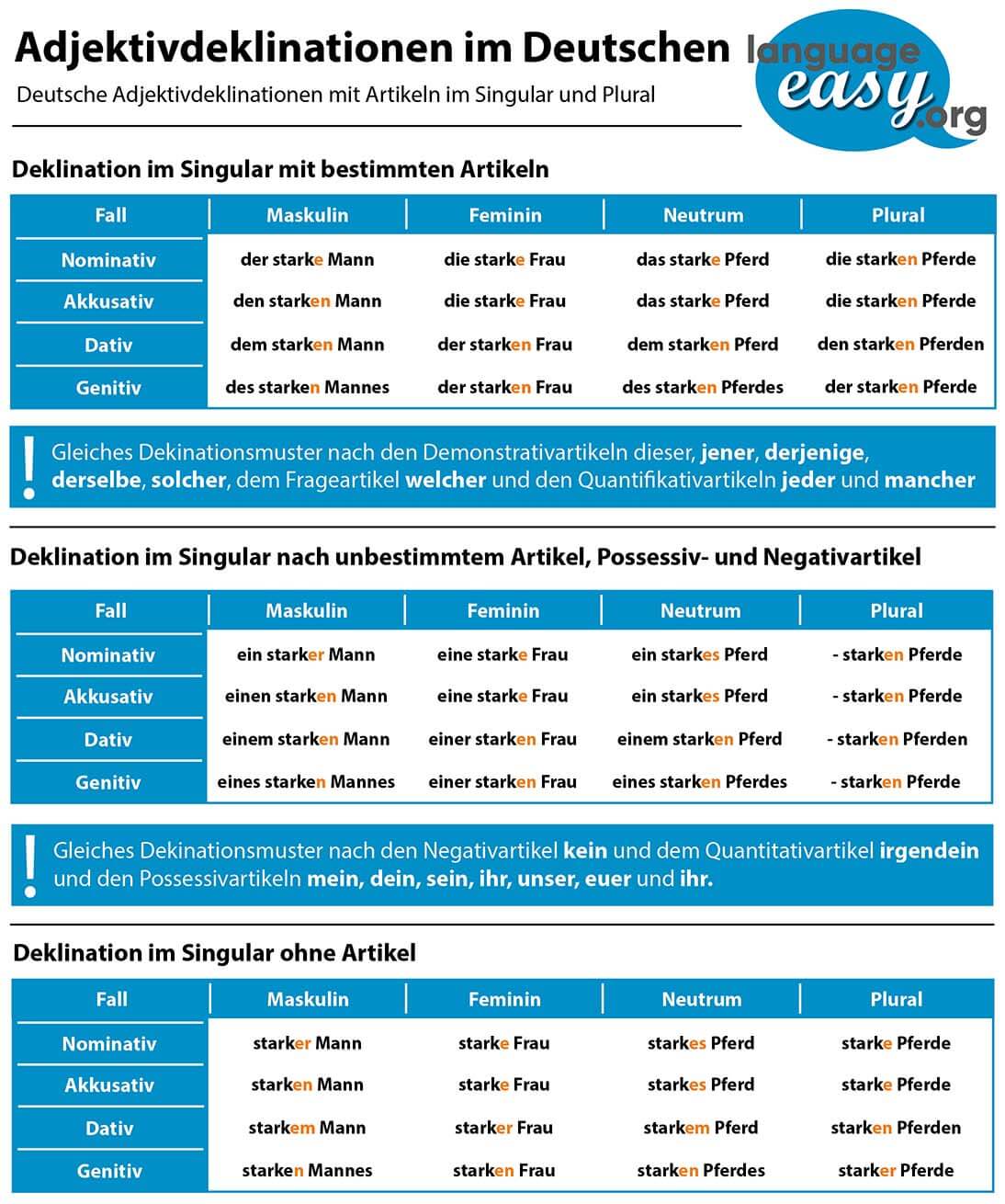 vague rain
yes that answers to it 🙂 vielen dank
 edgy helm
hello what do the letters on the right of der Gruß mean?
 long whale
edgy helm
hello what do the letters on the right of der Gruß mean?
long whale
edgy helm
hello what do the letters on the right of der Gruß mean?
It's the short form of showing what the plural of "der Gruß" looks like: "die Grüße" (German plurals are awfully irregular. That's why it makes sense to include it on flashcards.)
vernal ermine
Friends, I have one simple question. If you see a rechnung mit 25,99 Euro. Will you consider it as 2thousand 5 hundred ninety nine euro ?
night dagger
vernal ermine
Friends, I have one simple question. If you see a rechnung mit 25,99 Euro. W...
no, that is 25 euros and 99 cents
fervent kernel
During the conversation, I was curious about how German people talk about time, party.
vernal ermine
night dagger
no, that is 25 euros and 99 cents
Then how they will write in a rechnung with a value of 2 thousand 5 hundred ninety nine euro?
 deep thicket
vernal ermine
Then how they will write in a rechnung with a value of 2 thousand 5 hundred nin...
deep thicket
vernal ermine
Then how they will write in a rechnung with a value of 2 thousand 5 hundred nin...
2599€ or 2599,00€
vernal ermine
deep thicket
2599€ or 2599,00€
Vielen Dank
 delicate tiger
2.599€ if you want to separate them
vernal ermine
I have another question : why we use " Stimmt so " ?
vernal ermine
delicate tiger
2.599€ if you want to separate them
Is it common to separate?
deep thicket
vernal ermine
I have another question : why we use " Stimmt so " ?
meinst du "stimmt das so?"
deep thicket
vernal ermine
Is it common to separate?
its usually seperated on bills i think
i don't think it matters when you write it though
it's more professional
you can use it if you want to
vernal ermine
deep thicket
meinst du "stimmt *das* so?"
Yes I want to know about it.
Often I see it in dialogue but I don't know about it.
deep thicket
it just means "is that right?"
delicate tiger
vernal ermine
I have another question : why we use " Stimmt so " ?
when paying a bill, instead of/as a tip you say "Stimmt so": you are tipping all the change