#questions-2
1 messages · Page 20 of 1
 mint herald
 plain umbra
The charts at the top and bottom are correct. I have no idea what the middle text is talking about though.
Is it just a summary of the two charts?
mint herald
Yeah
plain umbra
Oh okay. Then yeah, it's correct.
mint herald
Danke
mint herald
plain umbra
Oh okay. Then yeah, it's correct.
Also one more question when is the sentence "dative"
plain umbra
Sentences don't have cases. Nouns and pronouns have cases.
So a sentence can't be dative, but something in the sentence can be dative.
mint herald
My wordings apologies but yeah that
How do you know that something in the sentence is dative or accusive or whatnot
 fervent kernel
yoooo an admin
mint herald
plain umbra
When do you use nominative?
Well when you are introducing an object to the sentence
Like
Das haus
Or Der berg
plain umbra
Do you know about the idea of subject and object?
fervent kernel
plain umbra
When do you use nominative?
I don't even know this as a native speaker LMAO
mint herald
plain umbra
Do you know about the idea of subject and object?
Object yes
Subject not really sure (ich nicht weiß)
Object is like: (You/Him/Her/It/Them/They) etc.
Or that's a subject idk
plain umbra
mint herald
Object yes
Subject not really sure (ich nicht weiß)
Object is like: (You/Him/He...
The subject is the person/thing that does the action.
When you conjugate the verb in the sentence, how do you know what ending the verb gets?
plain umbra
Yes. "du" and "ich" are the subject in those examples. They're the person doing the action and you change the verb ending based on them.
The subject is always nominative.
mint herald
Ahh i understand
plain umbra
The objects in the sentence (there can be several) are accusative and/or dative, depending on a few things.
Technically they can also be genitive but you don't have to learn that until later.
mint herald
Yeah it's hurting my brain a little
plain umbra
All good. I will just give you the basics.
There are 2 things which can have object: verbs or prepositions.
You should take your time to learn prepositions... it can take some time since you have to memorise them. But I will give you an example just so you get the idea.
If you use the preposition "mit", it's a dative preposition, which means its object is always dative.
So like for example: mit dem Auto (with the car)
So that's one example of when to use dative. You just memorise "mit" always goes with dative.
And as for verbs... about 95% of the time, or maybe more, the object of the verb will be accusative. You can learn the exceptions later, but just start with that.
So for example: Ich sehe einen Hund. I see a dog.
The subject (ich) is nominative. The object (einen Hund) is accusative.
You're just beginning so don't worry about prepositions or complicated sentences yet.
Just start with these simple sentences like [subject] [verb] [object]
mint herald
Ahh alright then
plain umbra
Don't rush yourself, okay? Spend some time with these basic sentences before adding new info.
mint herald
Ich trinke wasser
Like that?
plain umbra
You really want to get comfortable because if you go too fast, you will feel lost.
plain umbra
mint herald
Ich trinke wasser
Like that?
Yes exactly. Try one that has articles.
mint herald
plain umbra
Don't rush yourself, okay? Spend some time with these basic sentences before add...
Yeah I'm a fast learner and i think I'm going too fast 💀
plain umbra
Try this: The man has a dog. The woman sees a car.
mint herald
Die frau seht ein Auto?
I don't know 💀
 long whale
mint herald
Die frau seht ein Auto?
I don't know 💀
long whale
mint herald
Die frau seht ein Auto?
I don't know 💀
Check verb form on verbformen.de ;)
plain umbra
All good. Take your time with it.
Keep in mind, nouns must be capitalised in German.
long whale
And as Basmentality said, you need to add in the article: a car ;)
mint herald
plain umbra
Keep in mind, nouns must be capitalised in German.
I will remember but is the sentence grammatically correct?
plain umbra
mint herald
I will remember but is the sentence grammatically correct?
Wrong form for the verb.
mint herald
So it's seiht?
plain umbra
sieht
mint herald
Does it work with other verbs too?
plain umbra
Some verbs have spelling changes in the du and er/sie/es forms. Some don't.
You have to learn it for each verb.
They're called vowel changes.
mint herald
I forgot 💀
 stoic mauveBOT
Conjugation
Präsens (Present Tense)
When you use a verb in a sentence (or clause), you have to conjugate it (change the form) to match the subject of the sentence (or clause).
For example, in English, we write I eat but he/she eats. The verb has a different ending! The concept is the same in German, except German has more endings.
The first thing you need to know in order to conjugate verbs is: which ending fits which subject? Here is a simple verb “trinken” (to drink) as an example:
trinken
ich trinke
du trinkst
er/sie/es trinkt
wir trinken
ihr trinkt
sie trinken / Sie trinken
(Note: the conjugation for sie (they) and Sie (formal you) is always the same)
Vowel/Stem Changes
There are a few variations and exceptions, but the most important is vowel changes (also called stem changes). Some verbs get a vowel change, which only affects the du and er/sie/es forms of the verb. (However, modal verbs and wissen have their own special pattern, which also has a vowel change in the ich form.)
Example: ich schlafe, du schläfst
Other Changes
There are various other differences but I can’t describe them all here, so please read these websites or use Google to find more information: https://www.vistawide.com/german/grammar/german_verbs_present_tense.htm
https://www.thoughtco.com/german-present-tense-verbs-4074838
http://www.dartmouth.edu/~deutsch/Grammatik/PresentTense/Present.html
mint herald
I kinda know the
ich spiele
Du spielst
Es/sie/er spielt
Wir spielen
Ihr spielt
Sie/sie spielen
I memorize it
The question is the verbs
Why is sehe
Seiht
@plain umbra
plain umbra
It has a vowel change.
plain umbra
The vowel changes from "e" to "ie" in du and er/sie/es forms.
ich sehe
du siehst
er/sie/es sieht
wir sehen
ihr seht
sie sehen
plain umbra
Yes, some will change to an umlaut.
But don't stress about memorising every verb's forms.
The best thing is to learn how to look it up.
Try out verbformen.de as Susana suggested earlier.
mint herald
I will
plain umbra
Or if you have a dictionary you prefer, you can see if it has verb forms. A lot of dictionaries do but not all.
Once you get comfortable with looking up word info quickly, you will be a lot less stressed about memorising everything.
fervent kernel
plain umbra
Or if you have a dictionary you prefer, you can see if it has verb forms. A lot ...
can i join any study group?
mint herald
For now I'm collecting these


 plain umbra
fervent kernel
can i join any study group?
plain umbra
fervent kernel
can i join any study group?
You mean the VCs? Yes.
 snow surge
why all rooms are locked? 😫
long whale
snow surge
why all rooms are locked? 😫
Read #getting-started ;)
 elder tusk
I was watching some movie or something and a guy slaps another guy and the guy who got slapped friends tell him something which I didn't pick up but from context I'd assume it meant something on the lines of I wouldn't let that be
Or something
Like you have to do something back
long whale
elder tusk
I was watching some movie or something and a guy slaps another guy and the guy w...
Yes...? Meaning you'd like me to look into my 🔮 to find the expression for you? ;)
long whale
Das würde ich mir nicht gefallen lassen probably.
 carmine crag
"Und pass gut auf die Dinge im Korb auf."
I am trying to read simple stories in German and this sentence confused me. Why is auf used twice in this sentence and why is the second one at the end?
 dreamy sluice
aufpassen is one word which is splitted here
into pass .... auf
and the "second" auf is the preposition
carmine crag
So it gets bumped to the end to avoid saying auf twice in a row then?
dreamy sluice
the verb just get splitted, as a German I also do not know why
 whole portal
the verb gets split, that's why the auf is at the end, that's normal
the other auf is just the preposition and therefore before the object
carmine crag
Ok, vielen dank an alle!
dreamy sluice
Kein Problem
 crystal gorge
can someone help me with my homework?
this is pretty urgent and i really need help finishing them
plain umbra
crystal gorge
can someone help me with my homework?
Sure, people can certainly give you some guidance. They can't solve it for you though.
crystal gorge
plain umbra
Sure, people can certainly give you some guidance. They can't solve it for you t...
thats exactly what i need, sorry if i made it sound like that haha
plain umbra
crystal gorge
thats exactly what i need, sorry if i made it sound like that haha
All good. We get many people asking for help cheating here but it's against server rules.
But if you're just stuck on a topic, feel free to explain the details.
crystal gorge
plain umbra
But if you're just stuck on a topic, feel free to explain the details.
so i don't really know what to do here

theres an example above but i just don't really know how to put it correctly grammatically
 wise pendant
crystal gorge
so i don't really know what to do here
wise pendant
crystal gorge
so i don't really know what to do here
Seems like conversation starters to practice talking with a mate.
You are probably supposed to write reactions to every sentence.
plain umbra
crystal gorge
so i don't really know what to do here
It seems like they just want you to give a sensible reply to the comment.
crystal gorge
plain umbra
It seems like they just want you to give a sensible reply to the comment.
the problem is the grammar, not sure if my sentence is grammatically correct
plain umbra
Feel free to write them and people can correct them or give tips.
crystal gorge
i'll list a few here, yeah?
plain umbra
Sure. I can't correct them right now but if you post them then most likely someone will help out.
crystal gorge
Aber du siehst müde aus
Ja, du weißt, ich habe nicht geschlafen
Woher hast du das ganze Geld?
Ich komme gerade vom der Bank
Hast du Brot gekauft?
Nein, ich habe es vergessen
 spring crest
 icy flax
crystal gorge
Aber du siehst müde aus
Ja, du weißt, ich habe nicht geschlafen
-
Woher hast du...
icy flax
crystal gorge
Aber du siehst müde aus
Ja, du weißt, ich habe nicht geschlafen
-
Woher hast du...
von* der Bank (weil der Artikel schon korrekt und da ist)
fervent kernel
I am wondering, is it better to learn grammar before words in a language?
Because memorizing words in most Germanic and Romance languages seems almost pointless when so many of them are the same
I feel like grammar, common phrases, and then practicing those two are way more valuable than any amount of knowledge of the vocab
 past anchor
fervent kernel
I feel like grammar, common phrases, and then practicing those two are way more ...
past anchor
fervent kernel
I feel like grammar, common phrases, and then practicing those two are way more ...
Ich habe zuerst Grammatik gelernt, bevor ich Wörter gelernt habe.
plain umbra
fervent kernel
I am wondering, is it better to learn grammar before words in a language?
You don't learn one before the other. You learn both at the same time.
 verbal girder
also, it's more like one aspect helps the other, you learn some vocab so you can understand some grammar (or the value of) and with the new grammar you learn some new vocab that unlocks some more grammar that unlocks some more vocab ☯️
plain umbra
fervent kernel
I feel like grammar, common phrases, and then practicing those two are way more ...
I will add also: rather than memorising a bunch of words, the first vocab-related skill to learn as a beginner is just how to find information about words.
Like how to use a dictionary, how to check verb conjugations, stuff like that.
verbal girder
the holy grail of learning a language is when you can start reading it
fervent kernel
verbal girder
the holy grail of learning a language is when you can start reading it
^ speaking it*
verbal girder
... is the goal of learning
fervent kernel
when I learned english I just ignored understanding speech until I could read and write well lmao
 teal basin
Hello, I would like to know the difference between these connectors: 1. der bus kam nicht, deshalb bin ich zu spat. 2. der bus kam nicht, also ich bin zu spat. 3. der bus kam nicht, sodass ich zu spat bin.
long whale
teal basin
Hello, I would like to know the difference between these connectors: **1.** der ...
zu spä/spaet gekommen - 1 and 3 are correct, 2 is not (you'd have to change word order, same as after "deshalb"). No difference in meaning. ;)
Please note the dots on the Umlaut are not just decorative - you can not just drop them. At least insert an extra E if you can't type it. :)
teal basin
long whale
Please note the dots on the *Umlaut* are not just decorative - you can not just ...
Yea, I know I'm just lazy 🙂
 dense obsidian
teal basin
Yea, I know I'm just lazy 🙂
dense obsidian
teal basin
Yea, I know I'm just lazy 🙂
do you also use B for ß?
verbal girder
that key is 8roken for me i use a 8
fervent kernel
verbal girder
that key is 8roken for me i use a 8
schei8e
elder tusk
How would you say chest out?
As in shoulders back chest out for example
How would you say the whole thing basically
dense obsidian
Schultern zurück, Brust raus!
 quartz plume
how should I ask for a hair cut? "Konnen Sie mir die Haare schneiden" is it correct?
dense obsidian
quartz plume
how should I ask for a hair cut? "Konnen Sie mir die Haare schneiden" is it corr...
yes, but "können", not "konnen".
quartz plume
I does not have that Umlaut
dense obsidian
use oe then. "koennen"
fervent kernel
Hallo.... vielen Dank für dir Gruppe
 steep yoke
fervent kernel
when I learned english I just ignored understanding speech until I could read an...
steep yoke
fervent kernel
when I learned english I just ignored understanding speech until I could read an...
mm taking notes for learning german.. i have APD so ive been worried being so slow at learning how to understand hearing speech but this seems like a better route for me 🙌
stoic mauveBOT
German letters
Being able to type German letters is quite important!
- Schon = already. Schön = beautiful.
- Mutter = mother. Mütter = mothers.
How to? There are several options.
🔸 Use a program like AutoHotkey. Download the program from https://www.autohotkey.com/ and read the pinned message in #resources for instructions on how to set it up. It can be used with any keyboard layout and the hotkeys can be customised.
🔸 US International layout: this is basically just a US keyboard layout with extra characters, so if you're using a US-style keyboard or something similar, the transition is very easy! Everything stays as you know it, except that some of the symbol keys can be used to create the special characters. For example " + a = ä. You can also do RightAlt + s = ß.
To use US International on Windows, look for the Region & Language options and switch your selected keyboard layout to US International.
🔸 If you're on Mac, on most systems you can press and hold a letter to show several variants including umlauts. You can type ß by pressing Option + B.
See the next page for more alternatives.
Page 1/2
 tender pilot
steep yoke
mm taking notes for learning german.. i have APD so ive been worried being so sl...
tender pilot
steep yoke
mm taking notes for learning german.. i have APD so ive been worried being so sl...
What does APD stand for
elder tusk
tender pilot
What does APD stand for
Auditory processing disorder
 paper crest
wie sagt man "I watched the video while drinking coffe" auf Deutsch? Vielleicht Ich habe das video geshen während ich kaffee trank?
 errant egret
paper crest
wie sagt man "I watched the video while drinking coffe" auf Deutsch? Vielleicht...
errant egret
paper crest
wie sagt man "I watched the video while drinking coffe" auf Deutsch? Vielleicht...
Ich habe das Video geschaut, während ich Kaffee getrunken habe
paper crest
errant egret
Ich habe das Video geschaut, während ich Kaffee getrunken habe
danke
 elfin breach
errant egret
Ich habe das Video geschaut, während ich Kaffee getrunken habe
elfin breach
errant egret
Ich habe das Video geschaut, während ich Kaffee getrunken habe
can you say "Ich habe das Video beim Kaffeetrinken geschaut"?
paper crest
errant egret
Ich habe das Video geschaut, während ich Kaffee getrunken habe
alles in unserem burger-shop für sie kostenlos
errant egret
elfin breach
can you say "Ich habe das Video beim Kaffeetrinken geschaut"?
Yeah, that is correct aswell
paper crest
errant egret
Yeah, that is correct aswell
which one is more casual
like you would say in a daily conversation with friends
errant egret
Ich habe das Video beim Kaffeetrinken geschaut is more casual I would say, but there is not a huge difference
fervent kernel
is this wrong 🙃

the commas behind the coordinating conjunctions 😭
im trying to explain this to my teacher but i always seem to find contradictory info
imma cry
 tranquil flower
fervent kernel
imma cry
tranquil flower
fervent kernel
imma cry
Ok, mach das 

Duden
Das Komma ist ein Gliederungszeichen. Es wird im Deutschen in erster Linie nach grammatischen Gesichtspunkten gesetzt. Man kann drei Regelgruppen unterscheiden, vgl. Punkte 1–3. Zum Gewicht dieser Regeln vgl. Punkt 4. 1. Das Komma steht zwischen den Teilen von Reihungen (Aufzählungen) (D 100-103, D 108)
 kindred anchor
Du bist eines misfit
Why there is es infront of ein? Isn't (du bist ein mistfit) enough? Because I see that Genitiv in this case is useless.
 undone verge
Yeah I could be wrong but that just seems like a mistake or typo to me
long whale
kindred anchor
Du bist _eines_ misfit
Why there is _es_ infront of _ein_? Isn't (du bist ein mi...
It is indeed a typo. ;)
 boreal swift
What is the right way to order a coffee
- Ich möchte bitte einen Kaffee
- Ich hätte gerne einen Kaffee
- Ich würde gerne einen Kaffee
plain umbra
boreal swift
What is the right way to order a coffee
1) Ich möchte bitte einen Kaffee
2) Ich...
2 is the best. 1 is okay but 2 is more polite.
Not sure about 3, never heard that.
long whale
boreal swift
What is the right way to order a coffee
1) Ich möchte bitte einen Kaffee
2) Ich...
In addition to what Basementality said, 3 is simply wrong. It's missing the verb: Ich würde gerne einen Kaffee trinken (but that's just a statement: you'd like to have a coffee. You wouldn't really use that to ask a waiter for coffee.
boreal swift
long whale
In addition to what Basementality said, 3 is simply wrong. It's missing the verb...
Ok, got it! So is ,,würde´´ always used with an infinitive verb?
boreal swift
long whale
Yes.
danke
 scenic saddle
hey i have a question what is the article of "Cappuccino" or is Cappuccino have an article
 charred harbor
scenic saddle
hey i have a question what is the article of "Cappuccino" or is Cappuccino have ...
charred harbor
scenic saddle
hey i have a question what is the article of "Cappuccino" or is Cappuccino have ...
der Cappuccino
scenic saddle
thank you
paper crest
wie kann ich this is how i got where i am auf deutsch sagen?
long whale
paper crest
wie kann ich this is how i got where i am auf deutsch sagen?
Please don't ask the same question in more than one channel. :)
paper crest
long whale
Please don't ask the same question in more than one channel. :)
warum nicht? die leute hier sind hilfriech
long whale
paper crest
warum nicht? die leute hier sind hilfriech
Because people won't realize a question has been answered elsewhere -> waste of time and effort. :)
 grand mortar
Die Frage ist nicht sehr klar,
long whale
Deepl will render an excellent result for this question. I can vouch for that. :)
paper crest
long whale
Because people won't realize a question has been answered elsewhere -> waste of ...
das ist mir egal, ich lerne von jedem etwas anderes
long whale
paper crest
das ist mir egal, ich lerne von jedem etwas anderes
Would you prefer to be told by a moderator? 🤔
paper crest
long whale
Would you prefer to be told by a moderator? 🤔
...
icy flax
"Download läuft... noch 1 Dateien"
Zumal daser* Singular doch einfach die Datei heißt, muss da daser* Plural sein, nur weil der Programmierer den Text nicht hat aktualisieren lassen, wenn es zur letzten Datei gekommen ist, oder?
long whale
icy flax
> "Download läuft... noch 1 Dateien"
Zumal d~~as~~er* Singular doch einfach die ...
Yup, of course. :D
*der Plural, btw. ;)
kindred anchor
Ich kann nicht auf jemand warten, der auf einer Schnecke reitet.
This is a sentence from a fantasy book and I wonder if jemand in this case is correctly set.
Could there be also typos in books?
long whale
kindred anchor
Ich kann nicht auf _jemand_ warten, der auf einer Schnecke reitet.
This is a se...
Weirdly, yes. While I'd always use the declined form (here: jemanden), apparently, not declining "jemand" is fine. 🤷
kindred anchor
Even DeepL says it should be jemanden
long whale
kindred anchor
Could there be also typos in books?
Unfortunately, yes. (Ever since almost all publishing houses decided to save on the post of editors, almost all books are positively riddled with typos. 😡)
long whale
kindred anchor
Even DeepL says it should be _jemanden_
Well, it's definitely not wrong. :)
kindred anchor
Oh, okey. Thank you!!
 wise sand
Er hat kaum Fähigkeiten in Videospielen, findet aber trotzdem irgendwie einen Weg, sie zu genießen x).
is that sentence grammatically correct, and how about the punctuation and comma usage?
 gusty silo
it's grammatical and all, but Fähigkeiten seems very unidiomatic to me there
you mean he's not good at video games, right?
long whale
wise sand
Er hat kaum Fähigkeiten in Videospielen, findet aber trotzdem irgendwie einen We...
Grammatically and punctuation-wise, it's fine. Doesn't sound overly idiomatic to me, but not being into video games, I feel unable to come up with a better suggestion.
wise sand
gusty silo
you mean he's not good at video games, right?
he has barely any skills at video games, yes
I don't want to use an anglicism
gusty silo
skills as an anglicism would also be unidiomatic there
wise sand
damn xD
gusty silo
I'd simply say "Er ist (zwar) nicht sehr gut in Videospielen, ..."
wise sand
oh, that actually sounds neat, with the "zwar"
I always have trouble using "zwar" in adequate contexts
gusty silo
mhm i can imagine that to be a bit troublesome to figure out
wise sand
Thanks a lot, sir
 oblique gyro
Hallo ...Kann mir jemand mit Testmaterialien für die telc b1-Prüfung helfen?
 rancid osprey
I’m over 200 flashcards in and I realized should I be learning the plurals as well as the genders?
Should I go back and start updating them
 glass hawk
rancid osprey
I’m over 200 flashcards in and I realized should I be learning the plurals as we...
glass hawk
rancid osprey
I’m over 200 flashcards in and I realized should I be learning the plurals as we...
Couldn't hurt if you have an efficient way of updating them. For nouns, I always made sure to show the article, noun, genitive singular, and plural. It sounds a lot, but honestly I found after a short adjustment period it was no harder and I felt much more sure of how to use them.
Something like that is what I went with.

 plush pelican
rancid osprey
I’m over 200 flashcards in and I realized should I be learning the plurals as we...
plush pelican
rancid osprey
I’m over 200 flashcards in and I realized should I be learning the plurals as we...
you definitely must learn the genders with every noun.
plural would be good, but gender is a must
kindred anchor
Are gab and gäbe forms of Präteritum of the initial verb geben and are interchangeable?
gusty silo
gab is Präteritum of geben, gäbe is Konjunktiv 2. not interchangeable
kindred anchor

I saw (gäbe) besides (gab) and I thought they were similar!
Thank you
Another question, I have been reading a book lately, namely Die unedliche Geschichte and I encounter some words that I can't find in Google. For example, glichen. Is it the same as gleichen or they are distiguished?
gusty silo
kindred anchor
Another question, I have been reading a book lately, namely _Die unedliche Gesch...
wir/sie glichen is the Präteritum and Konjunktiv 2 of the verb gleichen 'to be similar to'
(same pattern there as schleichen-schlichen 'to sneak, were sneaking/sneaked', pfeifen-pfiffen 'to whistle, were whistling/whistled', schmeißen-schmissen 'to throw, were throwing/threw' and so on)
 reef moss
kindred anchor
Another question, I have been reading a book lately, namely _Die unedliche Gesch...
reef moss
kindred anchor
Another question, I have been reading a book lately, namely _Die unedliche Gesch...
Although this doesn't apply in this instance, be aware that the older you go into literature, that you are bound to find non-existent conjugations of words. Lenz for example has the word frug (fragte) and die schwarze Spinne has a lot of Swiss vocab that is difficult for even native speakers
undone verge
Sie antworten auf meine Frage
 steel patrol
What do you guys call hash browns in German? (They're not quite Pfannkuchen, and DeepL tried to suggest that the name could be Rösti, but the image search of that doesn't really look accurate to me either.)
 long whale
steel patrol
What do you guys call hash browns in German? (They're not quite Pfannkuchen, and...
long whale
steel patrol
What do you guys call hash browns in German? (They're not quite Pfannkuchen, and...
We don't call them anything because they don't exist/aren't made in Germany, at least not in German households. What we have and make and eat are either Kartoffelpuffer or Rösti. ;)
gusty silo
qualifies as Kartoffelpuffer as far as i'm concerned
steel patrol
long whale
We don't call them anything because they don't exist/aren't made in Germany, at ...
Dang it, the British making me look silly 😄 That'll do then, thank you!
long whale
steel patrol
Dang it, the British making me look silly 😄 That'll do then, thank you!
Mm... don't even think about asking about Yorkshire Pudding. In that case, we don't even have anything remotely like it. :D
gusty silo
or custard. i've just given up on finding a word or description for custard
(granted, i'm not a great cook, maybe someone who cooks more knows something)
steel patrol
long whale
Mm... don't even think about asking about Yorkshire Pudding. In that case, we do...
Guess I'll just have to come to Germany and eat lots of local baked goods, for... research purposes :))
long whale
gusty silo
or custard. i've just given up on finding a word or description for custard
Depending on its consistency, it's just either Vanillepudding or Vanillesauce, isn't it? 🤔
gusty silo
i think so too but i've never confirmed this thought
steel patrol
gusty silo
or custard. i've just given up on finding a word or description for custard
Appartently it could be either "Vanillesauce" or "Eiercreme" or a couple other things? Idk either, to be fair.
long whale
gusty silo
i think so too but i've never confirmed this thought
Trust meee... ;)
gusty silo
oki :p
long whale
steel patrol
Appartently it could be either "Vanillesauce" or "Eiercreme" or a couple other t...
"Eiercreme"... 👀
 wise pendant
steel patrol
What do you guys call hash browns in German? (They're not quite Pfannkuchen, and...
wise pendant
steel patrol
What do you guys call hash browns in German? (They're not quite Pfannkuchen, and...
They are called Rösti-Ecken (as seen in these images)


I would have used Rösti as well to describe them.
Pfannkuchen, Kartoffelpuffer and all the other alternative names mean definitely something different imo
fervent kernel
Hallo ! Ich möchte ein gut Deutsch haben, aber ich habe kein Idee was ich kann arbeit.
Ich habe Deutsch mit Schule gelernt, aber ich habe kein Deutsch Klass und ich weiss nicht was ich kan für ein B2/C1 haben (mein Ziel ist Kommuniziert im Schweizerdeutsch in ein gut Deutsch)
wise pendant
fervent kernel
Hallo ! Ich möchte ein gut Deutsch haben, aber ich habe kein Idee was ich kann a...
Wichtig ist dabei vor allem täglich Input zu bekommen. das kann zum Beispiel sein Deutsche Bücher zu lesen, Podcasts zu hören, Videos zu gucken, Social Media zu nutzen, Nachrichten zu lesen, Gespräche mit Muttersprachler zu führen, etc.
Es geht darum das Gehirn zu trainieren.
fervent kernel
wise pendant
Wichtig ist dabei vor allem **täglich** Input zu bekommen. das kann zum Beispiel...
Ja aber zum Beispiel mit mein English ich bin B2 mit schreiben, hören, unsw. Alles Tage, aber ich habe viel Fehler wann ich sprache oder schreiben und ich denken es ist vielleicht nicht die besste Wahrscheinlichkeit
wise pendant
fervent kernel
Ja aber zum Beispiel mit mein English ich bin B2 mit schreiben, hören, unsw. All...
Input ist sehr wichtig. Glaube mir. Wenn du Deutsch in deinen Alltag integrierst machst du richtig gut Fortschritt!
Wenn du explizit reden können willst, kannst du auch regelmäßig Gespräche führen mit Muttersprachlern oder Sachen laut vorlesen, Selbstgespräche führen oder Muttersprachlern nachsprechen in Videos oder Podcasts.
plush pelican
kindred anchor
Another question, I have been reading a book lately, namely _Die unedliche Gesch...
Chances are, if you're reading in a book and you don't know a verb, it's a Präteritum form of a verb that you either don't know or aren't recognizing.
Try this website: https://conjugator.reverso.net/conjugation-german-verb-glichen.html
You can search for verbs, and regardless of which form it's in, it should find it. At least for common verbs. Some rare verbs it might not know.
fervent kernel
wise pendant
Input ist sehr wichtig. Glaube mir. Wenn du Deutsch in deinen Alltag integrierst...
Woher kann ich mit Muttersparchlern sprechen ? Und ich habe nicht so virl zu sagen
Und denkst du lernen Wortschatz auswendig ist ein gut Idee ?
long whale
fervent kernel
Woher kann ich mit Muttersparchlern sprechen ? Und ich habe nicht so virl zu sag...
VC here. There's also #1065443550004781067 Or, you could try to find a language partner somewhere like conversationexchange.com - You can find lists of possible conversation topics on the internet. - Learning vocab is usually part of language learning, yes.
wise pendant
fervent kernel
Und denkst du lernen Wortschatz auswendig ist ein gut Idee ?
Ja, Wörter lernen kann sehr viel helfen. Vor allem mit Karteikartenprogrammen wie Anki.
fervent kernel
wise pendant
Ja, Wörter lernen kann sehr viel helfen. Vor allem mit Karteikartenprogrammen wi...
Was wörter muss ich lernen ?
wise pendant
Am besten lernst du die häufigsten Wörter die vorkommen können.
ZB mit so einer Liste:
https://ankiweb.net/shared/info/912352287
Es ist immer besser eine längere Liste am Anfang zu wählen, als später eine zweite zu finden.
@fervent kernel
fervent kernel
wise pendant
Am besten lernst du die häufigsten Wörter die vorkommen können.
ZB mit so einer ...
Und ich möchte die Schweizerdutsch zu lernen, denkst du ich muss ein Deutsch Niveau in Deutsch haben am ersten um die Schw. zu lernen ?
wise pendant
fervent kernel
Und ich möchte die Schweizerdutsch zu lernen, denkst du ich muss ein Deutsch Niv...
Lerne am besten erstmal Standarddeutsch und Schweizerdeutsch kannst du dann in der Schweiz immernoch lernen, wenn du da bist.
Die meisten Schweizer können nämlich auch Standarddeutsch
 sleek pulsar
long whale
We don't call them anything because they don't exist/aren't made in Germany, at ...
sleek pulsar
long whale
We don't call them anything because they don't exist/aren't made in Germany, at ...
Aw that's a bummer, hash browns are good
 iron hound
Which word order works more?
 long whale
iron hound
Which word order works more?
long whale
iron hound
Which word order works more?
The alternative they suggest sounds a lot more idiomatic to me.
fervent kernel
"im bett wird geschlafen"
Can someone please help me make sense of this sentence?
 spiral falcon
fervent kernel
"im bett wird geschlafen"
Can someone please help me make sense of this sentence...
spiral falcon
fervent kernel
"im bett wird geschlafen"
Can someone please help me make sense of this sentence...
"one sleeps in bed" / "a bed is made for sleeping" is how i'd translate it
fervent kernel
spiral falcon
"one sleeps in bed" / "a bed is made for sleeping" is how i'd translate it
like, the grammar of the sentece
steel patrol
fervent kernel
like, the grammar of the sentece
It's the passive voice, so it's placing the focus on the bed itself rather than who may or may not be sleeping in one.
fervent kernel
what is the "im" for though?
steel patrol
Contraction of in + dem
fervent kernel
why is in needed
steel patrol
You can't just say "Bett wird geschlafen", it's in a/the bed
dense obsidian
You could say "In dem Bett wird geschlafen." though.
 deep thicket
fervent kernel
why is in needed
deep thicket
fervent kernel
why is in needed
im is short for in dem, so you need the "in" in order for it to make sense
fervent kernel
But why do you.use an "in" in the sentnce in the first place?
deep thicket
you just say it like that
"ich liege im bett"
im bett
"sie liegt in meinem bett"
 nocturne scaffold
Can someone give me an example of dative case not mentioning an animal/person? I'm looking in books and online and it's all: ''Ich gebe dir...'' or ''Er gab dem Mann...''
verbal girder
it usualy involves a living being
gusty silo
Ich sitze auf einem Stuhl
?
or do you think prepositions are cheating here :p
Ich säge dem Baum den Ast ab
nocturne scaffold
verbal girder
it usualy involves a living being
thank you
nocturne scaffold
gusty silo
Ich sitze auf einem Stuhl
?
also thank you
i was just confused
because i thought an indirect object can be anything, but wouldnt make sense without a presposition
thanks for clearing it up ❤️
steel patrol
nocturne scaffold
because i thought an indirect object can be anything, but wouldnt make sense wi...
You can also use it without a preposition afaik, for example: "Ich habe den Computer fallen lassen, aber ihm (dem Computer) ist nichts passiert! - I dropped the computer, but nothing happened to it (the computer)"
dense obsidian
gusty silo
Ich säge __dem Baum__ den Ast ab
your examples involve a living being. "Ich"
gusty silo
🤔 i guess, but it's not the dative
how about "Der Wind bläßt dem Baum die Blätter von den Ästen."
"The wind blows to the tree(weird to translate to english directly like this) the leaves off the branches" (and von den Ästen is technically also a dative)
nocturne scaffold
thank you 🙏
im tryna get my head around it since im learning german cases for the first time today
much help ❤️
dense obsidian
gusty silo
how about "Der Wind bläßt dem Baum die Blätter von den Ästen."
did you go to elementary school before 1996?
i'm pretty sure it's bläst and they changed it in the rechtschreibreform
gusty silo
dense obsidian
did you go to elementary school before 1996?
oops, no it's just a typo
(since the contrast between sharp and soft s is neutralised in this position, i sometimes misspell words like that)
dense obsidian
i think ß is never used after a "langer vokal"
dense obsidian
well im confused nwo
gusty silo
but bläßt is long, so
dense obsidian
yeah it's wrong
dense obsidian
do you know a word with ß that has a short vowel in front of it?
gusty silo
no, no, in the modern orthography, there are none
dense obsidian
there you have your eselsbrücke 😉
gusty silo
🙃 you misunderstand me
gusty silo
modern german spelling dictates, except if you're in switzerland where you always write ss instead of ß, the following:
              sharp s           soft s
short vowel     ss      (doesn't normally occur)
long vowel      ß                  s
Auf einen kurzen Vokal folgt nach korrekter Rechtschreibung das Doppel-s; auf einen langen Vokal oder eine Verbindung aus zwei Vokalen folgt "ß":
gusty silo
but the spoken sharp-s/soft-s distinction is neutralised before another consonant or at the end of a word.
so i made a spelling mistake
dense obsidian
Schluss oder Schluß?
gusty silo
Schluss, as the vowel is short
 ruby ferry
hi! this is more of a manners question than anything else, but right now i am emailing my mentor teacher who will be hosting me on my exchange year in Austria. if she starts using du and my first name, should i reply to her with du and her first name, or continue to use Sie? she seems very friendly and the conversation is not too formal, just information and greetings, but i dont want to come across as impolite to the lady who will be employing me! thank u!!
verbal girder
its up to you, but its safer to go with Sie till they correct you
long whale
ruby ferry
hi! this is more of a manners question than anything else, but right now i am em...
Knowing how old each of you is would help me to answer this. ;)
ruby ferry
ah, im not sure how big the gap is but she is definitely older than me! so that is why im tempted to stick to Sie, but i dont know what the rules are so i wasnt sure what is considered ok to do :)
long whale
ruby ferry
ah, im not sure how big the gap is but she is definitely older than me! so that ...
Yes, in that case I'd go with what make me a sadwitch said: just stick to "Sie" - if she'd prefer you to use informal address, it's up to her to tell you. (The older person/the one higher in "rank" is the one to suggest informal address.)
verbal girder
ultimately its a matter of manners *and respect,
if you feel like youd need to give someone respect (unelss they are around your age or younger) you would adress them with certain distance ( the formal adressions)
if you feel like disrespecting/or respect is irelevant you would use informal adression
actually, you could even use formal adression to distance yourself from someone (indirect disrespect) (but the informal way is more direct and violent lol)
fervent kernel
hi
ruby ferry
ok that makes sense! thank you to both of you 
mint herald
Wann tun ich benutze
"Ob"
"Ab"
"Andere"
"Ander"
long whale
mint herald
Wann tun ich benutze
"Ob"
"Ab"
"Andere"
"Ander"
Perhaps try https://de.pons.com/übersetzung/deutsch-englisch/ob - ?
mint herald
long whale
Perhaps try https://de.pons.com/%C3%BCbersetzung/deutsch-englisch/ob - ?
It helped but there's no Ander there
long whale
mint herald
It helped but there's no Ander there
Because it's not a word. It needs an ending, like "andere"
mint herald
Ahh
long whale
Or "anders" if that's what you meant.
 acoustic breach
I wanted to say that "sicher sein" would be correct, with or without the Reflexiv
Ohne oder mit dem Reflexiv geht der Satz <- would this be correct ?
I could say "es ist richtig, egal ob es das Reflexiv hat", but just want to ask if the above would be usable
fervent kernel
Hi guys, I've got a problem with "lassen" grammar.
Is this sentence correct?
"Darüber hinaus könnte andere Option sein, dass viele diesen Lebensmittel einfrieren lassen können
whole portal
fervent kernel
Hi guys, I've got a problem with "lassen" grammar.
Is this sentence correct?
"D...
No
What are you trying to say
fervent kernel
whole portal
What are you trying to say
I wanna say that a lot of these food can be freezed, but I also want to use lassen grammar
whole portal
Viele Lebensmittel lassen sich einfrieren.
fervent kernel
can someone simply explain me accusative and dative
and other cases
I tried youtube but
I think I need some confirmation
spiral falcon
Nominative = wer oder was? As the "Ich" in "ich heiße Desiree"
Accusative = wen oder was? As the " dich" in "ich liebe dich"
Dative = wem oder was? As the "dir" in "ich gebe dir das Buch"
Genitive = wessen? As the "mein" in "Das ist mein Hund"
https://yourdailygerman.com/german-cases-accusative-dative/ maybe this helps
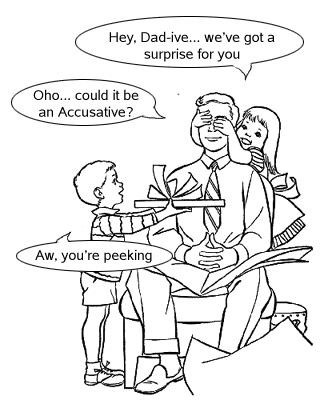
Accusative and Dative are the main challenge with German cases. Today, we'll learn their core ideas and collect the most common verbs for each.
 random loom
Nominativ: The main actor of the sentence
Genitiv: Additional information about who is owning something or to what somebody/something belongs
Dativ: Indirect object, like to whom you are giving or sending something
Akkusativ: direct object, if you're giving or sending something to somebody, then that something is your Akkusativ
most prepositions come along with the Dativ or Akkusativ or can be used with both (different meaning then), a few ones come along with the Genitiv
the Dativ is also used sometimes to express certain feelings
Dativ: Mir ist heiß. = It's so hot right now!
Nominativ: Ich bin heiß. = I am hot a.k.a. super attractive.
Dangerous to confuse these two = )
 sleek bone
"Nur weiß ich, das es eklig schmekt."
Ist das ein richtiger Satz?
 proven sphinx
sleek bone
"Nur weiß ich, das es eklig schmekt."
Ist das ein richtiger Satz?
proven sphinx
sleek bone
"Nur weiß ich, das es eklig schmekt."
Ist das ein richtiger Satz?
"Ich weiß nur, dass es eklig schmeckt."
So schreibt man es richtig.
"dass" und "das" sollte man nicht verwechseln, obwohl das wohl der häufigste Rechtschreibfehler bei Muttersprachlern ist. 😅
"dass" ist eine Konjunktion/Subjunktion und "das" ist ein Relativpronomen. "das" kann natürlich auch vieles anderes sein, aber dort wird es normalerweise nicht mit "dass" verwechselt.
Das ist das Land, das ich kenne. --> Relativpronomen
Ich weiß, dass es so ist. --> Konjunktion
Ein Relativpronomen bezieht sich immer direkt auf ein Wort im vorherigen Hauptsatz.
sleek bone
Danke. Ich habe aber gedacht, dass ich der Haupsatz wechseln kann.
proven sphinx
sleek bone
Danke. Ich habe aber gedacht, dass ich der Haupsatz wechseln kann.
Man kann die Position des Hauptsatzes wechseln, ja.
"Dass es eklig schmeckt, weiß ich."
"Ich weiß, dass es eklig schmeckt."
Meinst du sowas?
sleek bone
proven sphinx
Meinst du sowas?
Ja.
proven sphinx
sleek bone
Ja.
Achte aber immer darauf, dass das Verb im Hauptsatz immer direkt nach dem Komma kommt, wenn du mit dem Nebensatz anfängst. Es ist sehr einfach, das zu vergessen. 😅
Das heißt also, dass "Dass es eklig schmeckt, ich weiß." immer falsch ist. Das Verb "weiß" muss hier nach dem Komma kommen, wie du oben sehen kannst.
sleek bone
proven sphinx
Das heißt also, dass "Dass es eklig schmeckt, ich weiß." _immer_ falsch ist. Das...
Das ist neu für mich. Danke für diese Information. Es wird mir beim Bilden von Sätzen sehr helfen.
proven sphinx
sleek bone
Das ist neu für mich. Danke für diese Information. Es wird mir beim Bilden von ...
Du weißt vielleicht bereits, dass das Verb im deutschen Hauptsatz immer an zweiter Stelle kommt. Das gehört eigentlich auch dazu, obwohl es nicht sofort ersichtlich ist.
"Dass es eklig schmeckt, weiß ich." könnte schließlich einfach durch "Das weiß ich" ersetzt werden und der Satz würde immer noch mehr oder weniger das Gleiche bedeuten.
Der ganze Nebensatz nimmt also hier die "erste Stelle" ein, sozusagen.
 storm mulch
Konjugieren Sie das Verb sein im Präsens und Bilden Sie die Sätze.
- Sprachen-sprechen- welche-du?
- du-wohnen- wo?
- sein-Studenten-wir.
Hello guys pls help to do this
long whale
storm mulch
Konjugieren Sie das Verb sein im Präsens und Bilden Sie die Sätze.
1. Sprachen...
Please don't post the same question in more than 1 channel. :)
storm mulch
long whale
Please don't post the same question in more than 1 channel. :)
Sorry
steel patrol
storm mulch
Konjugieren Sie das Verb sein im Präsens und Bilden Sie die Sätze.
1. Sprachen...
Have a go yourself first mate
We'll correct you
 regal heath
storm mulch
Konjugieren Sie das Verb sein im Präsens und Bilden Sie die Sätze.
1. Sprachen...
regal heath
storm mulch
Konjugieren Sie das Verb sein im Präsens und Bilden Sie die Sätze.
1. Sprachen...
- Welche Sprachen sprichst du?
2.Wo wohnst du?
3.Wir sind Studenten
storm mulch
regal heath
1. Welche Sprachen sprichst du?
2.Wo wohnst du?
3.Wir sind Studenten
Thank you very much
 flint nimbus
Kann man Die ist eine große Katze sagen? (Die = sie)
undone verge
yes
flint nimbus
my friend who is native german said no native german would ever say it like that
 vapid cosmos
flint nimbus
my friend who is native german said no native german would ever say it like that
vapid cosmos
flint nimbus
my friend who is native german said no native german would ever say it like that
You can say it theroetically, but its almost never used practically
flint nimbus
do you have a better example of where das and die could be used kind of interchangeably? I think i remember being told there were such cases - in that they technically mean different things, but cash out to the same meaning
vapid cosmos
Hmm maybe "Sie, da hinten." and "Die, da hinten"
it means "She, over there"
Second example is kinda adressed indirectly
plain umbra
flint nimbus
my friend who is native german said no native german would ever say it like that
For what reason though?
undone verge
flint nimbus
my friend who is native german said no native german would ever say it like that
like what?
sounds totally normal to me.
with 'die'
plain umbra
I think there are a few factors that come into it.
flint nimbus
plain umbra
For what reason though?
just because it sounds wrong to him
plain umbra
Like you're more often using this die/der/das to point out a specific thing rather than refer to it casually.
Like "that one".
And if you're introducing/describing the object for the first time, you're using "das" instead.
flint nimbus
right, so the usage would rarely if ever overlap
flint nimbus
oh i thought that was what you were saying
plain umbra
Can you please clarify what you're asking?
flint nimbus
like "das ist eine große Katze" and "die ist eine große Katze"
plain umbra
Correct. Those are different things.
You see a cat and you point it out to your friend: Das ist eine große Katze.
You were already talking about the cat and add some comment: Sie/die ist eine große Katze.
"Das ist ..." is just what you use whenever you introduce a new thing.
Or explain what something is.
"Was ist das?" "Das ist ..."
flint nimbus
right, i see
fervent kernel
plain umbra
You see a cat and you point it out to your friend: Das ist eine große Katze.
You...
Could you expand on the difference between using "sie" and "die" here, is there an English equivalent? When would it be more appropriate for you to use "sie" rather than "die"?
 golden dome
In English it would be either "She is a big cat." or "It is a big cat." But the main thing in German is here that "Sie/die ist ..." sticks together without belonging to the noun "Katze".
fervent kernel
fervent kernel
Could you expand on the difference between using "sie" and "die" here, is there ...
In this context you could use both for the same meaning. However, you would use "sie" if it's a female cat. Also there's so many scenarios where you would use Der Die Das or who knows what, it would take long to go over thru every scenario but a few examples:
There's many cats, your friend asks "Which one is the prettiest?" and you say "Die da!" = "That one!" since a cat's article is "Die"
Your friend is telling you about how much care he puts into the cats fur and you tell him "Sie sieht sehr schön aus" = "She looks very pretty", however this only applies if the car would be a female. The "sie" in this context would literally translate to "she" and that would be like that in most of the times
In the end, you use "sie" because it's a female cat and "die" because it's the cats article
golden dome
The simple thing is: "Sie/die/es ist" belongs together. It does not depend on "eine Katze".
So the best is to use "Es/Das ist ..." It will always be correct.
fervent kernel
fervent kernel
In this context you could use both for the same meaning. However, you would use ...
Thanks for the detailed explanation 🙂
fervent kernel
golden dome
The simple thing is: "Sie/die/es ist" belongs together. It does not depend on "e...
tbh this confuses me what do you mean by "belong together"
golden dome
Subject and verb are "Es ist". Here you have KNG Kongruenz.
You can always say "Das/Es ist -ein/der Mann -eine Frau/die Frau -ein Kind/das Kind"
golden dome
fervent kernel
tbh this confuses me what do you mean by "belong together"
The pronoun "es" appears as a formal, i. H. largely functionless and meaningless subject and stands with the verb "ist".
Of course you can use "Sie/die" instead but then you already have to know the genus.
 mild prawn
Can anyone help me with German hw? I'll pay you fr. I need this done within a time frame
whole portal
This server is not there to do your homework for you
What we can assist with is acquiring the necessary skills to do them yourself.
Please also refrain from posting in more than one channel simultaneously.
mild prawn
I wish I could but I can't cause I'm doing other finals thats why
long whale
undone verge
sounds totally normal to me.
Really? I'd say "Das ist eine große Katze" 🤔
long whale
mild prawn
Can anyone help me with German hw? I'll pay you fr. I need this done within a ti...
faq homework
stoic mauveBOT
How to ask a question
If you want something corrected, you can put it in a Google Doc and share a link with permission level »can suggest« in #writing .
Don't ask us to translate something for you outright: that takes professional time and effort and we're not here for that. You can try your luck with deepl.com.
For single words, use dict.cc or another dictionary, it'll be quicker.
If you want to know if/how a word can be used, provide some context to help us understand the situation.
Don't ask us to do your homework or exams for you! Show us your best attempt at something and try to pinpoint what exactly you don't understand.
undone verge
long whale
Really? I'd say "Das ist eine große Katze" 🤔
I agree with basementality that it totally depends on the situation
Das ist eine große Katze <- I'm looking at a cat I just noticed and commenting on it
Die ist eine große Katze <- seems like following information for a cat that has already been mentioned/the topic of convo
long whale
undone verge
Das ist eine große Katze <- I'm looking at a cat I just noticed and commenting o...
Well... I suppose... maybe other native speakers disagree with me on this? But I really can't see/hear myself saying this. If it's clear we're talking about a cat: Die ist groß, yes. But not "Die ist eine große Katze". "... bla-bla-bla und es ist eine große Katze", yes. 🤷
 lean ledge
yeah im on Susanas side here
it just sounds weird with "Die"
maybe correct idk but noone would ever say it like that
whole portal
Siding with the others, 'die' is weird.
'Sie' is a possibility if you wanna talk about a known cat
But that's kinda it
I'm afraid I do not speak or read korean.
past anchor
Es ist ein Hund. Er ist groß. Der ist groß.
Es ist eine Katze. Sie ist groß. Die ist groß.
Es ist ein Kind. Es ist groß. Das ist groß.
past anchor
whole portal
I'm afraid I do not speak or read korean.
Okay.
 misty ginkgo
Hallo "Gehört das dir nicht?"
Why is das (akk) placed before dir (dat) here?
 cobalt oriole
misty ginkgo
Hallo "Gehört das dir nicht?"
Why is das (akk) placed before dir (dat) here?
cobalt oriole
misty ginkgo
Hallo "Gehört das dir nicht?"
Why is das (akk) placed before dir (dat) here?
Das is referring to an object like „das Buch“. It would change to „Gehört der dir nicht?“ if you were to talk about an umbrella (der Regenschirm). It has nothing to do with the Akkusativ.
misty ginkgo
cobalt oriole
Das is referring to an object like „das Buch“. It would change to „Gehört der di...
Ohh but it says that the order should be
Nominativ + Verb + Dativ + Akkusativ
Shouldnt it be" Gehört dir das nicht?"
cobalt oriole
misty ginkgo
Ohh but it says that the order should be
Nominativ + Verb + Dativ + Akkusativ
...
The standard word order in German is typically "Nominative + Verb + Dative + Accusative." However, in the specific sentence "Gehört das dir nicht?" the word order is slightly different. The placement of "das" at the beginning of the sentence emphasizes the object and expresses surprise or emphasis. It is a way to draw attention to the object. The alternative formulation "Gehört dir das nicht?" is also correct and follows the standard word order. Both versions are acceptable, but the emphasis and context may vary slightly. German allows for flexible word order, and there are not so strict rules that must be applied to every sentence. The meaning of a sentence can change depending on word order and emphasis.
misty ginkgo
cobalt oriole
The standard word order in German is typically "Nominative + Verb + Dative + Acc...
Oh i see! So the word order like in my example, is more of a suggestion?
acoustic breach
misty ginkgo
Hallo "Gehört das dir nicht?"
Why is das (akk) placed before dir (dat) here?
Actually,
"Das" here is Nominativ
Das (Nom) gehört dir
long whale
misty ginkgo
Ohh but it says that the order should be
Nominativ + Verb + Dativ + Akkusativ
...
Yes. Precisely. 😽
misty ginkgo
acoustic breach
Actually,
"Das" here is Nominativ
omg youre right, I overlooked that
Now it makes sense
Vielen Dank an alle!!
plain umbra
cobalt oriole
The standard word order in German is typically "Nominative + Verb + Dative + Acc...
Dative before accusative is true for accusative nouns, but if it's an accusative pronoun, the pronoun goes first.
misty ginkgo
plain umbra
Dative before accusative is true for accusative nouns, but if it's an accusative...
but the order is not fixed, only a suggestion?
long whale
misty ginkgo
but the order is not fixed, only a suggestion?
Well, you'll hear a sentence like the one in your original post, but you won't see it written -> in that respect, the order is fixed, yes.
 ripe dust
How important is a B1 to B2 certificate in German? For example, for admission to universities in Austria.
misty ginkgo
long whale
Well, you'll *hear* a sentence like the one in your original post, but you won't...
You mean "Gehört das dir?"
long whale
misty ginkgo
You mean "Gehört das dir?"
In your original post, it was "Gehört das dir nicht?", but - yeah. ;)
misty ginkgo
long whale
In your original post, it was "Gehört das dir nicht?", but - yeah. ;)
Oh wait, why wouldnt it be seen written?
I though it was the "proper" order
long whale
misty ginkgo
I though it was the "proper" order
It isn't, I'm afraid. 🤷
misty ginkgo
long whale
It isn't, I'm afraid. 🤷
Sorry, then what is?
long whale
misty ginkgo
Sorry, then what is?
Gehört dir das nicht?
misty ginkgo
oh I thought the Subjekt should be as close as possible to the verb : o
long whale
misty ginkgo
oh I thought the Subjekt should be as close as possible to the verb : o
Yes, that's a very good rule. Frankly, I'm not quite sure why the Dativ pronoun pushes the subject towards the end in this case, but it does. 😳 Let me see if @reef moss knows the answer...
Or maybe @undone verge ?
misty ginkgo
long whale
Yes, that's a very good rule. Frankly, I'm not quite sure why the Dativ pronoun ...
Ohhhh that's interesting, never heard that before
plush pelican
misty ginkgo
oh I thought the Subjekt should be as close as possible to the verb : o
Found the explanation in Hammer's German Grammar. First, Table 19.9, describing word order in a sentence:

Second 19.4.1:
(a) Pronouns are usually the first elements in the verbal bracket
and
(b)

I guess I should link (a) as well:

pronouns are typically unstressed and for this reason occupy the least prominent position within the verbal bracket.
earlier in the sentence = older information = less important
later in the sentence = newer information = more important
So, unless the pronoun is being emphasized, it has a tendency to be pushed to the left because it's unimportant, which overrides the tendency that the subject is generally close to the verb
long whale
plush pelican
So, unless the pronoun is being emphasized, it has a tendency to be pushed to th...
Brilliant, thank you so much! 😅
plain umbra
misty ginkgo
but the order is not fixed, only a suggestion?
They are pretty much fixed, yes. Could an exception exist? Perhaps. But for you as a learner/beginner, you can think of it as fixed.
plain umbra
long whale
Well, you'll *hear* a sentence like the one in your original post, but you won't...
Just to clarify, that's not the grammar rule in question for the message you replied to. They were asking about the order of akk vs dat, but the example sentence is nom and dat.
Basically the main point is that sometimes people simplify "dative before accusative" and forget that it matters whether they're pronouns or nouns, since that changes the order.
With nominative it's a bit less consistent I think (as seen in argus' post above).
long whale
Well, I was trying to kind of tactfully point out that another native speaker may have thought this order was correct because it does occur in spoken German... 🤷
plain umbra
long whale
Well, I was trying to kind of tactfully point out that another native speaker ma...
Even with accusative and dative?
long whale
plain umbra
Even with accusative and dative?
Ehh... depending on whether one of the pronouns is an "es", I think so. 🤔 Ich gebe es dir ✅ Ich gebe dir es ❌ Ich gebe dir das... is not sth I'd write, but yeah, I can hear myself saying this.
To clarify: Ich gebe dir es isn't just wrong, grammar-wise - it's something I don't think a native speaker would ever say.
plain umbra
Thanks.
misty ginkgo
plush pelican
So, unless the pronoun is being emphasized, it has a tendency to be pushed to th...
Ah okay danke. I'd like to ask if this is just a special case? d.h. i wont encounter this often
plush pelican
misty ginkgo
Ah okay danke. I'd like to ask if this is just a special case? d.h. i wont encou...
You will encounter it often, is what I'm saying. If the object is a pronoun but the subject isn't, the object will tend to come first, unless it's being specifically emphasized for some reason, because pronouns tend to precede the noun subject (unless the subject is also a pronoun.)
Did you see the chart?
misty ginkgo
plush pelican
You **will** encounter it often, is what I'm saying. If the *object* is a pronou...
I did, am just not absorbing it rn hahahah but ill come back to it later. Danke !! 🙏
 willow hemlock
Is there a general meaning for the prefixes of Trennbare Verben, like in english where (un, in, de) each have a meaning (example: possible ≠ impossible)?
plush pelican
willow hemlock
Is there a general meaning for the prefixes of Trennbare Verben, like in english...
A lot of them have multiple potential meanings: http://www.dartmouth.edu/~deutsch/Grammatik/Wortbildung/Separables.html
 versed wasp
Was ist der unterschied zwischen mit dem problem beschäftigen und sich mit dem problem befassen !? kannst du auch ein beispiel für jeden Ausdruck zeigen?
proven sphinx
versed wasp
Was ist der unterschied zwischen mit dem problem beschäftigen und sich mit dem p...
They're both the same, as far as I'm aware.
"sich mit dem Problem befassen" is perhaps a bit more idiomatic.
"Ich muss mich immer mit dem Problem befassen, dass meine Mitarbeiter zu spät zur Arbeit kommen." (I always have to deal with the problem that my co-workers arrive late for work.)
For an example sentence.
reef moss
plush pelican
So, unless the pronoun is being emphasized, it has a tendency to be pushed to th...
This is exactly what I wanted to say. It really depends on what what you want to emphasize. Nonetheless, verbs that demand dative tend to like the dative object close. Otherwise, it sounds just sounds different in the best case or basically wrong in the worst case (Ich gebe den Tisch einem Mann) @long whale @misty ginkgo
 gusty silo
weil du die Hilfe von denen willst, letzten Endes
jmdn rufen meint, dass du die Aufmerksamkeit von jemandem willst
(egal ob am Telefon oder nicht)
 gritty kite
There's something I'm just not sure about, is the word "Bruder" generally disliked by Germans? If so why and what else can you say to express a similar meaning in English (bro, dude, etc..)
whole portal
I mean it's not necessarily but you don't actually talk to people like that usually
can be quite rude if you aren't close to that person
gusty silo
in terms of words to address someone with a similar feeling to bro/dude, i think Alter/Dicker(/alternative spellings closer to pronunciation like Digger/Dicka/Digga)/Kumpel/Keule/Ker(le) are generally more common (notwithstanding the fact that some are regional)
Bruder does also occur in this use though, it's not not a thing. just not as common, like yoshi said
gritty kite
Ok thanks, both of you, appreciated 🙏
fervent kernel
However out of all of those Bruder is the most pleasant one to say actually
Going up to strangers saying "Alter ..." or like "Digga ..." would be much more rude than saying "Bruder"
fervent kernel
Close friends or family it really doesn't matter
As for strangers we don't have a friendly way of saying "Dude"
At least I can't think of any
Maybe "Kumpel"? or "Kollege"?
gusty silo
i mean most people in society in general don't address each other or strangers with any of these, do they
the use of any of these skews towards younger and/or more working class people, i think
fervent kernel
gusty silo
i mean most people in society in general don't address each other or strangers w...
In my city they do, and in most parts of Frankfurt too
But we don't talk about Frankfurt 🤣
gusty silo
m fair, i'm a village person (also hessia though)
fervent kernel
Frankfurt is Germany's worst city
When it comes to formal, friendly and nice interactions
It is hard to not surround yourself with bad company in the more populated areas in that city
fervent kernel
I dont think so. I have lived in frankfurt for 2 years and have friends from there. they are all decent people
sleek bone
Welches von diesen beiden ist richtig?
"Lass uns Schmetterlinge sein."
Oder
"Seien wir Schmetterlinge."
Lol i couldn't find a better sentence.
long whale
sleek bone
Welches von diesen beiden ist richtig?
"Lass uns Schmetterlinge sein."
Oder
"Se...
They're both correct, grammar-wise, but neither would actually be used in spoken German (not unless you'd like to sound as if you were in a Shakespearean play). ;)
plush pelican
long whale
They're both correct, grammar-wise, but neither would actually be used in spoken...
Or in a math equation?
Let X be 5 and Y be 7
I remember something about Konjunktiv I being used there
 feral jewel
Is there any way to add audio to words automatically in Anki? I want to make some flashcards but I don't have audio recordings for the words myself
long whale
feral jewel
Is there any way to add audio to words automatically in Anki? I want to make som...
Please don't post the same question in more than one question channel. You might have a better chance of getting this one answered in #general , I'd say. 🤔 (And if you do get a good answer, please let me know - it just never occurred to me that adding audio automatically might be possible. ;) )
feral jewel
long whale
Please don't post the same question in more than one question channel. You might...
Sorry, will do. I thought the other channel was busy
 kindred smelt
sagt man 'ich werde geholfen' oder 'mir wird geholfen'?
long whale
kindred smelt
sagt man 'ich werde geholfen' oder 'mir wird geholfen'?
Only the 2nd is correct. ;)
kindred smelt
Okay, danke
fervent kernel
Maybe it's a deficiency in my reading material but is Konjunktiv I relatively rare? or I am just not "noticing" it? I feel like it compromises only 5-10% of what I read
 delicate tiger
https://www.youtube.com/watch?v=2XxNoQ8V0eY "Da werden Sie geholfen" only works in ads 😉 (don't use when speaking/ in exams)

"Hier werden Sie geholfen", Werbespot für Service-Auskunft 11880 mit Verona Pooth,
delicate tiger
fervent kernel
Maybe it's a deficiency in my reading material but is Konjunktiv I relatively ra...
95% of its use is in news/reporting
whole portal
wait
was the idea of the ad that you keep it in mind more because she makes a grammatical error?
long whale
whole portal
was the idea of the ad that you keep it in mind more because she makes a grammat...
I'd say so, yes.
plush pelican
kindred smelt
sagt man 'ich werde geholfen' oder 'mir wird geholfen'?
"helfen" as a verb requires dative for its objects, and when you convert an active sentence "Er hilft mir" into a passive sentence with no subject ("Mir wird geholfen"), you keep dative objects in dative.
If it had been a verb demanding an accusative object, that's when you convert the object into nominative case. "Sie verletzt den Mann" becoming "Der Mann wird verletzt".
plush pelican
whole portal
was the idea of the ad that you keep it in mind more because she makes a grammat...
How cruel for language learners
kindred smelt
plush pelican
"helfen" as a verb requires dative for its objects, and when you convert an acti...
I'd heard you were supposed to keep the indirect object in dative as in 'mir wird es gegeben', but I wasn't sure about verbs like helfen where the dative is the only object of the sentence
So is the construction with the nominative really never used, or is it used colloquially?
 sand sail
Can somebody explain me why dont we use zu for up satze
 long whale
sand sail
Can somebody explain me why dont we use zu for up satze
long whale
sand sail
Can somebody explain me why dont we use zu for up satze
"up satze" - ? Modal verbs like müssen (here: muss) require a plain infinitive, one without zu. ;)
long whale
kindred smelt
I'd heard you were supposed to keep the indirect object in dative as in 'mir wir...
No, it's simply wrong. If people do use Sie werden geholfen colloquially, it's only ever in invisible quotation marks, because of this one particular advertisement. :)
sand sail
I mean quadrat lol, thank you
whole portal
Once upon a time, the birds came to the conclusion that they would need a king.
or needed a king
Yeah you can usually replace the K2 form with infinitiv + würden
fervent kernel
ich schaue gerade Dramatizeme Deutsch auf Youtube, aber ich finde die geschichte ein bisschen komisch. Gibt es andere Youtube channel mit leicht und besser Getschichte mit Deutsche subtitles zu schauen?
 storm tulip
Silly beginner question but how would you say “have a great day”
vapid cosmos
storm tulip
Silly beginner question but how would you say “have a great day”
there are no silly questions, In german its "Habe einen schönen Tag"
storm tulip
vapid cosmos
there are no silly questions, In german its "Habe einen schönen Tag"
I appreciate you! Danke!
vapid cosmos
storm tulip
I appreciate you! Danke!
Bitte
fervent kernel
storm tulip
Silly beginner question but how would you say “have a great day”
to add to Strandspeck’s answer, I’ve learnt to say “Schönen Tag noch” at the start/middle of someone’s shift (i.e in the supermarket/ bank etc)
vapid cosmos
fervent kernel
to add to Strandspeck’s answer, I’ve learnt to say “Schönen Tag noch” at the sta...
Yes thats also a way of saying it
plush pelican
kindred smelt
So is the construction with the nominative really never used, or is it used coll...
What do you mean?
Ah. As Susana said, there was apparently some ad with intentionally wrong grammar
ruby ferry
hi :) is there a german equivalent to the english idiom 'xyz is a bed of nails' as in like a situation is really difficult to endure?
im writing an essay and translating between 3 languages so its all getting a bit lost lol i cant remember
long whale
ruby ferry
hi :) is there a german equivalent to the english idiom 'xyz is a bed of nails' ...
More context might help... 🤔
ruby ferry
i am writing an essay on the book mutterzunge, and im talking about how she uses the phase 'Liebe ist ein Hemd aus Feuer' which is a direct translation of a turkish idiom which i think sort of is equivalent to 'love is a bed of nails' in english (i dont speak turkish but my friends do)? so i was going to mention in my essay that the author uses the phrase rather than a german equivalent, so i was wondering if there actually was a german equivalent to that particular idiom
if there isnt an equivalent i can still use the point in my writing im sort of a bit curious now as well
long whale
ruby ferry
if there isnt an equivalent i can still use the point in my writing im sort of a...
Oof... "Keine Rose ohne Dornen", maybe?
plush pelican
long whale
Oof... "Keine Rose ohne Dornen", maybe?
"Every rose has its thorn" exists in English as well, FYI
flint nimbus
Ja, es waren nur zwei Wochen.
how come it's waren? I interpret it as agreeing with the plural of zwei Wochen. But why does it agree with zwei Wochen and not es?
regal heath
i dont really get the question, what else would you put there?
or what were your ideas?
flint nimbus
regal heath
or what were your ideas?
i would've expected war, instead of waren
because it agrees with es
regal heath
its waren because Wochen is plural
flint nimbus
but why does it agree with zwei Wochen, rather than es?
for example if i say "Ich hilft Ihren", i don't conjugate hilft to Sie
regal heath
ich hilft sie is completely wrong
flint nimbus
yes sorry
regal heath
you would say ich helfe ihr
thats wrong too
you have to conjugate the hilft
would be helfe
regal heath
sorry man it could be bc i am just stupid but i really dont get ur question 💀
maybe ask some1 else for help sorry
flint nimbus
Ja, es waren nur zwei Wochen.
this is the original sentence.
In this sentence, waren is a verb. Verbs in german conjugate depending on their subject, unless they're in their infinitive form. You said waren is conjugated to third person plural because its subject is zwei Wochen. My question is: why not es? Es seems to me to be the more natural subject in that sentence, rather than zwei Wochen, which is how it's conjugated now. If it were conjugated with es in mind, that is, third person singular, then it would be war, rather than waren.
regal heath
well the subject in a sentence always answers the questions „who?“ or „what?“. This is not a great example sentence for that but you could basically ask yourself the question „what is?“ two weeks „is“
but i understand why you think es ist the subject
regal heath
regal heath
well the subject in a sentence always answers the questions „who?“ or „what?“. T...
on the other hand you could technically also answer the question with „es“ ist
so i think you just have to think what makes more sense here
flint nimbus
but it would sound wrong to say es war nur zwei Wochen?
regal heath
it would not only sound wrong it is wrong gramatically
to say war you would have to add smth like „für“ before the zwei wochen
flint nimbus
ok i see, thank you!
long whale
flint nimbus
but it would sound wrong to say es war nur zwei Wochen?
In case this didn't get cleared up: the "es" is a so-called "dummy subject" here. "sein/war/waren" requires Nominativ on both sides, right? And there have to be 2 things in Nominativ in the sentence. But we've only got "verb + 2 Wochen", that's not enough to make a sentence. Solution: throw in an "es". (That's the way German grammar "thinks". I realize it's different in English. But then, we also say "Das sind meine Eltern" instead of Die sind meine Eltern, see?)
 winter zinc
Hi, can someone please explain why is it "haben" here and not " habe"?
"Besonders gut haben mir das Römisch-Germanische Museum und das Museum Ludwig gefallen."
 tropic thistle
winter zinc
Hi, can someone please explain why is it "haben" here and not " habe"?
"Besond...
tropic thistle
winter zinc
Hi, can someone please explain why is it "haben" here and not " habe"?
"Besond...
The two museums are being taken together as the subject of gefallen
fervent kernel
Hallo, kann mir jemand helfen?
Wie kann ich diesen Satz mit (zu, als dass) nutzen?
dieses smartphone ist sehr teuer, es wird kein Verkaufshit.
fervent kernel
fervent kernel
Hallo, kann mir jemand helfen?
Wie kann ich diesen Satz mit (zu, als dass) nutz...
You want to use all 3?
Dieses Smartphone ist zu teuer, ich befürchte dass es kein Verkaufshit wird.
maybe?
dense obsidian
fervent kernel
Hallo, kann mir jemand helfen?
Wie kann ich diesen Satz mit (zu, als dass) nutz...
Dieses Smartphone ist zu teuer, als dass es [...]
 green parrot
Hi. "Leider koennen wir nur vier Tage bleiben, freuen uns aber trotzdem schon sehr darauf" can someone please make me understand the second part. i dont get it.
and why the second clause also start with freuen, isnt verb supposed to be last in this case
 digital jasper
Should I learn the german alphabet besides the special characters or is it pointless
whole portal
digital jasper
Should I learn the german alphabet besides the special characters or is it point...
Wdym
 keen hawk
I think German's alphabet is the same as English except for the umlauts and the eszett
whole portal
Are you already familiar with the latin alphabet ...?
It's both the latin script yes
keen hawk
You mean how the letter's names are pronounced?
keen hawk
I also have no clue
Like English but more German
whole portal
Well
In that case it's not too bad of an idea to learn the letter names or rather the pronounciation of each letter
While it's not that simple still, you can get a lot more information about the pronounciation of a word from the written form in German compared to English
Altho you'll probably learn that automatically on the side
keen hawk
At least German makes an effort to be phonetically consistent
whole portal
Yeah until the french words come in
keen hawk
Wait what
digital jasper
What do you mean
whole portal
The most common situation where a word in German will break the pronounciation rules is when it's a french word we just took
digital jasper
Do you have an example?
whole portal
Trikot
The end is just pronounced as a long O
Kaserne
The a is short (should be long because no ss)
Dies ist eine Liste von Gallizismen, d. h. von Wörtern französischer Herkunft, die in der deutschen Sprache benutzt werden. Beim Benutzen und Erlernen von im Deutschen und Französischen ähnlicher oder scheinbar ähnlicher Worte müssen Scheingallizismen und falsche Freunde beachtet werden.
Die französischen Wörter stammen zum Teil ihrerseits aus a...
Have fun
It's not just french ofc, you can also see it with english and slavic influences
keen hawk
“Möchtest du am Sonntag in der Kirche gehen?”
Is this correct
whole portal
keen hawk
“Möchtest du am Sonntag in der Kirche gehen?”
Is this correct
Welllllll
It's not grammatically wrong
"Do you wanna walk inside the church on sunday?"
I don't think that's what you wanted to say
keen hawk
I don’t get this language
dense obsidian
whole portal
It's not grammatically wrong
are you sure it's not wrong?
whole portal
keen hawk
I don’t get this language
in die -> Akkusativ (f) -> into the
in der -> Dativ (f) -> inside the
So you probably want die, not der.
keen hawk
whole portal
So you probably want die, not der.
Ah, vielen dank
Also when should I start learning past and future tenses
charred harbor
Future tense is easy af but past tense is more tricky
I’d advise learning the latter asap
keen hawk
charred harbor
Future tense is easy af but past tense is more tricky
"Ich werde ins Kino gehen"
Is that correct
charred harbor
keen hawk
"Ich werde ins Kino gehen"
Is that correct
It is now xD
It’s worth bearing in mind that in German people often just use the present tense in place of future tense when context makes it obvious
So it’s not like people use werden every single time they want to refer to something in the future
It’s just a way to do it more directly
Example
-> Warte. Ich tu es
-> Wait. I’ll do it
long whale
green parrot
Hi. "Leider koennen wir nur vier Tage bleiben, freuen uns aber trotzdem schon se...
It's just 2 main clauses connected by a comma. Since the subject is the same in both, they dropped it in the 2nd: [wir] freuen uns aber... Does that help?
plain umbra
@narrow flame Can you explain more about what you're trying to learn right now and your obstacles?
 devout rampart
i get what you are trying to say
 narrow flame
That are correct
devout rampart
it comes kinda natural
plain umbra
"Making sentences that are correct" is a huge topic though. You have to start small with small topics and simple sentences.
devout rampart

The German sentence structure can be a quiet confusing topic for German Students. In this video (Satzbau Part I) you can learn the basics of the the German sentence structure, which is all about the main clause, in German: "Hauptsatz". The focus of this video is on the subject (subjekt) and the verb (Verb). In which position you have to put the ...
plain umbra
Some sentences are really difficult, even a native speaker would struggle. So you won't be able to write every single type of sentence right away.
devout rampart
es ist sehr interessant
narrow flame
plain umbra
Some sentences are really difficult, even a native speaker would struggle. So yo...
Yes but I hate verbs and all that sht
plain umbra
For example, the first things you need to learn are noun gender, nominative case and present tense verbs.
narrow flame
Iike u have to put it at the end
devout rampart
narrow flame
Yes but I hate verbs and all that sht
you mean all of the funny|| painful|| exceptions with cases and everything
narrow flame
But how do ik it its a verb
plain umbra
narrow flame
Yes but I hate verbs and all that sht
The most likely reason that you're struggling is that you're trying to rush and learn everything at once. You need to slow right down and stick to one or two things at a time.
So take a breath, let go of your hate, and check your knowledge on the basics: subject (nominative case) and present tense.
devout rampart
does anyone have notes about what @narrow flame is struggling with?
narrow flame
Idc i just want to learn how to build sentences
devout rampart
it would be useful for me as well
plush pelican
narrow flame
But how do ik it its a verb
- By learning vocabulary, including verbs
- By learning conjugation (there's a standardized way of conjugating verbs. It doesn't apply to every verb, but most verbs look something like it.)
- By learning how sentences are structured. Verbs have specific spots in a sentence, so you can expect to find verbs there, if you know where to look.
But this is all a bit superfluous: as Base said, work your way through the grammar (that YourGermanTeacher YouTube channel is quite good for this, they even break down the grammar topics according to level so you can learn them in order), and you'll learn over time how sentences fit together and thus how all this works.
narrow flame
Ich werde gehe in die supermarket
plain umbra
narrow flame
Idc i just want to learn how to build sentences
I'm trying to help you with that but it seems you are not interested in listening.
You're trying to skip ahead to the end. You need to start at the start.
narrow flame
plain umbra
I'm trying to help you with that but it seems you are not interested in listenin...
Why
plain umbra
narrow flame
Why
Because, the reason you're not absorbing these ideas is because you are trying to learn every rule at the same time.
They're very easy if you learn them one at a time, but not if you try to learn them all magically in one go.
plush pelican
narrow flame
Ich werde gehe in die supermarket
- You only conjugate 1 verb per sentence.
- Hauptsätze (independent clauses) have specific spots where you put verbs. the conjugated verb goes in position 2, the others go to the end in reverse order. The YourGermanTeacher videos explain all this.
devout rampart
narrow flame
Ich werde gehe in die supermarket
i think it is zu
narrow flame
plain umbra
Because, the reason you're not absorbing these ideas is because you are trying t...
Wdym
devout rampart
narrow flame
Wdym
your learning too much
long whale
narrow flame
Why
Because, sadly, a lot of the trickier, more bothersome bits of German grammar appear right at the start -> it takes a lot longer until you're able to string 3 words together correctly in German than it does in many other languages. 😽
 dire hearth
plain umbra
They're very easy if you learn them one at a time, but not if you try to learn t...
dire hearth
plain umbra
They're very easy if you learn them one at a time, but not if you try to learn t...
Totally this. I can only say simple things in the present tense at the moment. It can be frustrating sometimes but it's the way you learn
plain umbra
narrow flame
Wdym
"How to write a sentence" is not just one rule. It can be dozens of rules and ideas all at once.
Let me show you an example.
faq beginner
stoic mauveBOT
How to get started
The simplest way to learn German is to find topics you don’t understand yet and search for explanations of them. This list provides you with a guide for which topics to learn if you are completely new to German. Type the topic into Google (or YouTube) and start learning!
Introduction
1: Alphabet (especially ä, ü, ö and ß)
2: Basic greetings (hello, goodbye, etc.)
Part 1 - Simple Sentence
1: Noun gender & plurals
2: Nominative case (What are cases?)
3: Nominative pronouns (I, you, he, she, etc.)
4: Verbs in present tense
5: Definite/indefinite articles
6: Accusative case (for nouns)
7: Accusative pronouns
8: Word order of simple sentences
9: How to ask questions
See Part 2 on the next page.
Tips
- Always learn the gender of a noun when you learn a new noun
- Learn to use a translation dictionary (e.g. dict.cc, leo.org)
- Use
>faq resourcesto see our list of German learning resources - For listening and pronunciation practice, try watching movies or videos (incl. YouTube)
- You can listen to pronunciation for words on websites like dict.cc, forvo.com, and others
- Practice writing sentences every day (and asking people to correct them)
- Ask as many questions as possible
- Don’t be scared to make mistakes!!!! If you don’t let yourself make mistakes, you will never be able to learn German
Page 1/2
plain umbra
See this list of topics?
devout rampart
how long would it take to learn all of this?
plush pelican
Well, I've been learning German for 3 years, so...
plain umbra
This is a list of topics just to learn how to make a simple sentence. It doesn't take long, it's not complicated, but you need to learn all these things and understand them.
devout rampart
plush pelican
Well, I've been learning German for 3 years, so...
how long do you spend in a week?
narrow flame
Wgats plurar
plain umbra
devout rampart
how long would it take to learn all of this?
By all do you mean total fluency or just how to make a basic sentence?
plain umbra
narrow flame
Wgats plurar
Plural means more than one. So like in English the plural of "dog" is "dogs".
devout rampart
plain umbra
By all do you mean total fluency or just how to make a basic sentence?
how to get through the mess which is called a1 grammar
narrow flame
Whats the 2nd one
narrow flame
plain umbra
Plural means more than one. So like in English the plural of "dog" is "dogs".
Hund hunden????
devout rampart
i spent about 5-10 hours in a week as i am decently free
narrow flame
Idk
plain umbra
devout rampart
how to get through the mess which is called a1 grammar
Everyone will be different. Some people absorb grammar really easily (especially if they have experience with language learning or linguistics), and on the other end, some people find grammar really intimidating and have some psychological blocks that they have to work through before they feel comfortable.
devout rampart
die hunde
plush pelican
devout rampart
how long do you spend in a week?
It depends, but at a minimum, I try to:
- review flashcards for vocab (15-25 minutes)
- write a short post on r/WriteStreakGerman (coming up with a topic takes me forever, but the actual writing...idk, 20-30 minutes?)
I additionally quite often will do multiple of the following:
- Read casually a subreddit in German a bit
- Watch a video or TV episode in German
- Listen to a podcast episode in German
- Lately I've been trying to read an actual book in German...slowly.
And once a week I speak for an hour with another German learner, in German.
narrow flame
Hellooo
devout rampart
plush pelican
It depends, but at a minimum, I try to:
1) review flashcards for vocab (15-25 m...
Wow!
plush pelican
devout rampart
die hunde
Don't forget to capitalize nouns, it's a part of the spelling
plain umbra
For the average person, I think 3 months is a reasonable goal (for the grammar of A1). But it's totally fine to slow down and take longer if you are someone who finds these ideas confusing.
narrow flame
What are nominative cases
plush pelican
narrow flame
What are nominative cases
Go watch the video on it, my dude: https://youtu.be/I7vsv8DN9EE
What is a German case? What is nominative? What's the nominative meaning? How do you determine the nominative? What are the German articles? For all these questions you will find answers in this video. German nominative case explained.
First I will tell you all the German cases, explain you what a case is and what's the meaning of nominative. ...
devout rampart
it appears in the dictionary
like
der hund
but there is also something called the accusative case, which is something like: Ich sehe DEN hund
long whale
devout rampart
but there is also something called the accusative case, which is something like:...
Very good. Just please try to remember capitalization of nouns is not optional in German: der Hund, ich sehe den Hund. 🧁
devout rampart
long whale
Very good. Just please try to remember capitalization of nouns is not optional i...
i always forget, thanks
narrow flame
plush pelican
Go watch the video on it, my dude: https://youtu.be/I7vsv8DN9EE
Oh ok ik this
 uneven mulch
Can someone please review my answers from goethe past papers and help me correct any mistakes? would really appreciate feedback on how i could have done better as well.

 narrow flame
faq beginner
stoic mauveBOT
How to get started - Part 2
Please make sure to read Part 1 before starting Part 2!
Part 2 – Beyond a Simple Sentence
1: Conjunctions (coordinating and subordinating)
2: Subordinate clause word order
3: Dative case
4: Dative verbs
5: Verbs with two objects (e.g. geben)
6: Prepositions (accusative, dative, and two-way)
7: Spoken past tense (Perfekt)
8: Written past tense (Präteritum)
9: Genitive case
10: Relative clauses
11: Adjective declension
Tips
- Make sure to practice writing and reading simple texts
- Some of these concepts are confusing to start with, so it’s a good idea to ask for help in #questions when you’re unsure
- You should use a declension chart to help with declension to start with, because you won’t be able to memorize it straight away
- After you feel confident with creating sentences, you can start learning the adjective declension properly by using the command >faq adjective declension and reading the guide provided
Page 2/2
sleek pulsar
Warum "schlau" hier und nicht "klug"?
 long whale
sleek pulsar
Warum "schlau" hier und nicht "klug"?
long whale
sleek pulsar
Warum "schlau" hier und nicht "klug"?
You'd have to ask the author. On a colloquial level, "schlau" and "klug" can be seen as synonyms. Otherwise, "schlau" tends to have a bit of a negative meaning, to be clever in a rather devious way. "klug", on the other hand tends more towards "wise".
sleek pulsar
Ah ok, I didn't know about that distinction, that's cool! Danke schön!
 old girder
Is a Feinschmecker like a food critic?
 gusty tangle
Someone who likes eating good food
verbal girder
who doesn't
gusty tangle
yes but like hes picky
 acoustic breach
is this sentence correct?
nachdem ich Deutsch angefangen zu lernen habe, …
gusty silo
acoustic breach
is this sentence correct?
nachdem ich Deutsch angefangen zu lernen habe, …
if your goal is to express yourself normally, i recommend "nachdem ich Deutsch angefangen habe zu lernen", because that definitely is grammatical and more normal.
but i feel like i cannot actually tell if it's really ungrammatical or just unusual (for that matter i'm not even sure i can confidently say i'd reject this if i heard it in speech, or that i might never say it. but it's not a phrasing i think of as normal, so seeing it actually written i'm confused but inclined to reject it)
acoustic breach
acoustic breach
is this sentence correct?
nachdem ich Deutsch angefangen zu lernen habe, …
Hmm now i think of it
I probably mixed Englisch grammar into it
delicate tiger
"Nachdem ich angefangen habe Deutsch zu lernen..."
acoustic breach
Two Sprachgefühle came together
gusty silo
delicate tiger
"Nachdem ich angefangen habe Deutsch zu lernen..."
yeah that's probably the most normal one
acoustic breach
delicate tiger
"Nachdem ich angefangen habe Deutsch zu lernen..."
I know that, but my first instinct was to write what I asked there, hence I was curious
gusty silo
this sentence kills me a bit with which variants i'd accept or not 😅
acoustic breach
delicate tiger
"Nachdem ich angefangen habe Deutsch zu lernen..."
Ill just go with this then
Thank you!
gusty silo
yes do, it's the most normal version
long whale
I... kind of only half agree. 🤔 Shouldn't it be either "Nachdem ich angefangen hatte Deutsch zu lernen..." or "Als/Seit ich angefangen habe Deutsch zu lernen..." - ?
(depending on what the 2nd part of the sentence is like, of course. Not that those are interchangeable!)
acoustic breach
According to what I know, so long the Zeitform in Nachdem part is earlier (more into the Vergangenheit) than the next sentence, it would be ok
(My intended sentence was using Perfekt for Nachdem, then Präsens for the next)
gusty silo
long whale
I... kind of only half agree. 🤔 Shouldn't it be either "Nachdem ich angefangen ...
hm valid point!
acoustic breach
I was joking in one of the channels, saying my throat having problems after learning german (referring to the "r"
Nachdem ich angefangen habe, Deutsch zu lernen, hat mein Hals Probleme
gusty silo
swap nachdem for seit(dem) i'd say, mhm
acoustic breach
I see
long whale
acoustic breach
According to what I know, so long the Zeitform in Nachdem part is earlier (more ...
Yeah. "seit" is what I'd use instead of "nachdem" (and: habe ich Probleme mit dem Hals OR habe ich Halsschmerzen)
acoustic breach
Danke 
 fast island
What is the best way to say "Indeed" in a casual conversation?
whole portal
tatsächlich, in der Tat
fast island
Dankeschön
whole portal
allerdings
gusty silo
wirklich as well
 final sand
I have heard that "lieben" is not used like "love" is in English, that is, both to love someone romantically and like something a lot, but rather just to love someone romantically. Is this true, and if so, how would you say that you really like something in German?
gusty silo
i suppose not never, but it is rarer. more often you just use gern(e) haben or mögen with some intensifying adverb (sehr, richtig, dolle, whatever)
or if you're talking about loving to do something, you can similarly just add sehr/richtig gerne to the verb that stands for the action you like doing, instead of having to add a verb to express that
(which differs from english in a way that misleads people into thinking gerne were a verb occasionally, which it really really isn't)
oh, clarification: gerne haben is mostly (and the similar phrasing lieb haben only) used for liking/loving people, not as often things. mögen is normal for either.
So even when talking about actually loving someone, German doesn't use lieben as often as English does.
(many, if not most, german dialects infact don't really use lieben as a verb, sometimes straight-up not having the verb)
@final sand
final sand
gusty silo
<@882758255212920903>
Danke! This helps a lot!
Is "hat mir gefallen" used often?
gusty silo
final sand
Danke! This helps a lot!
Is "hat mir gefallen" used often?
it's very common when talking about experiences that you liked, yes. movies or books or activities you've done (sports), or for that matter holiday's you've been on, museums and parks you've visited
plush pelican
gusty silo
oh, clarification: *gerne haben* is mostly (and the similar phrasing *lieb haben...
What do they use to say "love" if they don't have the verb at all? just "Ich habe Schokolade lieb?" xD
undone verge
You can say that
undone verge
do it yourself
long whale
What about 4? I'm sure you can do 4, easily.
Try to look up those words you don't know.
spiral falcon
I feel like this question has a mistake in it:
It's supposed to be MICH not MIR 🙂 "jemanden anrufen" goes with Akkusativ

 rare jetty
He has been warned before, Susana. It's a test and he was trying to cheat, so you better not help him
Also he's left/got kicked now
long whale
spiral falcon
I feel like this question has a mistake in it:
It's supposed to be MICH not MIR ...
I'd say your feeling is right. :D
spiral falcon
außer, man ist Schwabe, dann steht anrufen mit Dativ 😄
long whale
spiral falcon
außer, man ist Schwabe, dann steht anrufen mit Dativ 😄
Berliner/Brandenburger, meinst Du? 😄
rare jetty
spiral falcon
außer, man ist Schwabe, dann steht anrufen mit Dativ 😄
I han dir ogrufa
spiral falcon
rare jetty
I han dir ogrufa
so isches, aber i dät "d'r" schreibe
rare jetty
Ha noi, des isch uffem Handy so e gschäft
gusty silo
Mei jetz werd scho eam Froekanoal Schwäwisch geschwasst, schlemm eas haure ;P
rare jetty
gusty silo
Mei jetz werd scho eam Froekanoal Schwäwisch geschwasst, schlemm eas haure ;P
schlemm eas haure
Das hab ich nicht verstanden 🤔
rare jetty
gusty silo
Mei jetz werd scho eam Froekanoal Schwäwisch geschwasst, schlemm eas haure ;P
Schwäbisch goes inderneschenell
gusty silo
rare jetty
> schlemm eas haure
Das hab ich nicht verstanden 🤔
schlimm ist's heute
rare jetty
Haure wie "heute" oder "heuer"?
gusty silo
heute
eu ist in einigen Wörtern au (zB nau statt neu), t zwischen Vokalen wird generell r
 calm kernel
Wenn ich wählen können hätten / Wenn ich hätten wählen können
Welche ist richtig? Ich habe die zweite Verwendung gehört und jetzt bin ich ein bisschen verwirrt
ist das denn eine Ausnahme?
nvm so präge ich mir das ein
die Menschen (plural) --> genitiv -> der Menschen

wurde das falsch geschrieben oder habe ich schuld?
long whale
calm kernel
die Menschen (plural) --> genitiv -> der Menschen
... of the other person (singular)
calm kernel
achso danke
 fallow glen
I realised my weakest point in learning (speaking and listening) German so far is how the last verb is all the way back, I got lost and fell off from the context every, single, time . My brain was mentally fixated on english sentence order lol (rip)
So, how do I manage this? 😩
glass hawk
fallow glen
I realised my weakest point in learning (speaking and listening) German so far i...
It'll come with time and exposure. Say sentences aloud in a non-pressured environment (narrate what you're doing in your own house to yourself), take it slow and get it right. Recite sentences to yourself. Do it enough and it becomes easier to formulate them in real time during a conversation. I struggled with this a lot myself (and often I'll still trip up halfway through a sentence when I suddenly realise I need a different sentence structure to express the thought I'm midway through expressing).
undone verge
fallow glen
I realised my weakest point in learning (speaking and listening) German so far i...
it gets better over time. The more 'second nature' the constructions and words become to you, the less your head will get jumbled on the way to the end. i had a lot of trouble with this, too, losing my way in the middle of a sentence, or forgetting what I even wanted to say by the time it came to put the verb at the end of a nebensatz 🙂 it rarely happens anymore
glass hawk
There's a give and a take though. Honestly, I don't think it's the word thing in the world to express yourself with bad grammar during a conversation to keep the conversation going, though obviously there's a limit to how bad the grammar can be before comprehensibility becomes an issue. But yeah, what I'm trying to say is address it deliberately as you study, but don't let it stress you out too much in conversation
fallow glen
Vielen danke alles für deine Beratung. Correct me if I butchered it ;)) I struggle to listen to german vids only because of the cursed verb placement ahahaha. I'll surely recite what stuff I do (especially while playing games.)
calm kernel
fallow glen
I realised my weakest point in learning (speaking and listening) German so far i...
verb is at the end in my native language so i can relate to german D: but that's like the only common thing, so yeah
 spark fox
If I wanted to say “because it is much more eventful than my country” would it be “Weil es viel erlebnisreciher ist als mein Land” or “weil es viel erlebnisreicher als mein Land ist”?
plush pelican
calm kernel
die Menschen (plural) --> genitiv -> der Menschen
To add some more: https://de.m.wiktionary.org/wiki/Mensch
Apparently "Menschen" has N-Deklination, and doesn't have an -s added on in Genitiv singular, since it already added the -en for N-Deklination?
calm kernel
plush pelican
To add some more: https://de.m.wiktionary.org/wiki/Mensch
Apparently "Menschen"...
oh of course
i forgot that there thats prob why i was so confused ty for the clarification
glass hawk
plush pelican
To add some more: https://de.m.wiktionary.org/wiki/Mensch
Apparently "Menschen"...
Although there are still some nouns with N-Deklination that like to still add the genitive "-s" just to be a pain >_<
plush pelican
glass hawk
Although there are still some nouns with N-Deklination that like to still add th...
WHAT
glass hawk
plush pelican
WHAT
acoustic breach
plush pelican
To add some more: https://de.m.wiktionary.org/wiki/Mensch
Apparently "Menschen"...
words with N deklination still have s for singular genitiv
but i didnt know that menschen is an exception
plush pelican
glass hawk
https://de.wiktionary.org/wiki/Friede z.B.
 acoustic breach
words with N deklination still have s for singular genitiv
but i didnt know that...
acoustic breach
acoustic breach
words with N deklination still have s for singular genitiv
but i didnt know that...
oh wait im wrong
glass hawk
acoustic breach
words with N deklination still have s for singular genitiv
but i didnt know that...
Seems to go either way. Affe is another exception
https://de.wiktionary.org/wiki/Affe
acoustic breach
Journalisten has no s
Namens does
wth?
plush pelican
des Namens
des Typs OR des Typen
des Türken
des Experten
des Kollegen
des Bären
des Drachen
des Herzens OR des Herzes
des Autisten
des Christen
des Automaten
des Kandidaten
des Bauern
des Idioten
glass hawk
acoustic breach
Journalisten has no s
Namens does
wth?
What I meant was animals, the male version often takes N-Deklination but no genitive -S. I don't know why I thought of professions instead of animals
plush pelican
It seems like most take no -S? 🤔
glass hawk
This is interesting haha. All I knew is that there were two separate patterns with N-Deklination, and I learn them on a case-by-case basis, but I never really thought about how frequent one is compared to the other
acoustic breach
plush pelican
des Namens
des Typs OR des Typen
des Türken
des Experten
des Kollegen
des Bären
...
btw Herzen is an exception to the whole thing cuz its neutral and only for genitive
plush pelican
dem Herzen?
acoustic breach
(in terms of singular)
plush pelican
 plush pelican
I like how even within "Singular 1", there's 2 ways of doing dative xD
glass hawk
Ahh, German 
proven sphinx
plush pelican
I like how even *within* "Singular 1", there's 2 ways of doing dative xD
To be fair, they're not used the same way. Singular 1 is used for the heart in a more figurative sense, whereas Singular 2 is used for the heart in the literal sense as the organ.
plush pelican
proven sphinx
To be fair, they're not used the same way. Singular 1 is used for the heart in a...

 verbal girder
Auch hatte er ihn wohl einen Muggel genannt, was immer das sein mochte.
what sort of Nebensatz is this? thank you.
 knotty wraith
verbal girder
> Auch hatte er ihn wohl einen Muggel genannt, __was immer das sein mochte.__
wh...
knotty wraith
verbal girder
> Auch hatte er ihn wohl einen Muggel genannt, __was immer das sein mochte.__
wh...
should be a Fragewortsatz
out of interest is with a question mark at the end
that often makes it clear
 plush oracle
if i'm saying something like "While most consider tomatoes to be vegetables, they are fruits" or some other similar use of "while", is während a correct conjunction to use? and does it assume genitive case after or no because it isn't being used as a preposition?
undone verge
Während is good and no, as you said since in this case it is a conjunction it doesn’t take genitive like a preposition
long whale
spark fox
If I wanted to say “because it is much more eventful than my country” would it b...
Apart from the spelling error, you'll usually see the 1st form - comparisons usually come after the verb. ;)
misty ginkgo
Hallo, is "auch wenn" and "obwohl" interchangeable?
long whale
misty ginkgo
Hallo, is "auch wenn" and "obwohl" interchangeable?
No...
misty ginkgo
long whale
No...
wieso?
long whale
misty ginkgo
wieso?
Wir gehen ins Kino, auch wenn du nicht mitkommst (even if/in case) vs. Wir gehen ins Kino, obwohl du nicht mitkommst (it's clear you aren't coming with us)
misty ginkgo
long whale
Wir gehen ins Kino, auch wenn du nicht mitkommst (even if/in case) vs. Wir gehen...
ohhhh i thought auch wenn expresses more contrast than obwohl
anyway, danke!
ruby ferry
im trying to do Nominalisierungen... why is this wrong 😭

i feel like this is not wrong but maybe i am not understanding the concept fully
long whale
ruby ferry
im trying to do Nominalisierungen... why is this wrong 😭
I know this is not wrong, and I'd say I do understand the concept, so... 🤷 You could try "Aufgrund..." - maybe the stupid programme only accepts 1 solution?
ruby ferry
i think it does only accept one 😭 im glad to hear thats not incorrect at least haha thank you
ruby ferry
long whale
I *know* this is not wrong, and I'd say I do understand the concept, so... 🤷 Yo...
it wanted 'einer' rather than 'der' 💔 thank u :)
long whale
ruby ferry
it wanted 'einer' rather than 'der' 💔 thank u :)
Jeez... Here, have a large
🧁
plush pelican
ruby ferry
im trying to do Nominalisierungen... why is this wrong 😭
What program is this?
ruby ferry
plush pelican
What program is this?
i think actually sprachkulturkommunikation.com is where you will find the exercises
fervent kernel
I assume there's a pattern or a rule here
"Wir gehen durch den Wald** hin__durch__**"
"Er kommt um die Ecke her__um__"
why repeat the preposition?
glass hawk
fervent kernel
I assume there's a pattern or a rule here
"Wir gehen durch den Wald** hin__durch...
My instinct is that they're simply separable verbs. Hindurchgehen, herumkommen. Not 100% on that though, always ready for a quirk to stick the boot in 😛
fervent kernel
if you would translate those into English what would they mean:
"We go into through the forest"??
"He comes around about the corner"??
plush pelican
fervent kernel
I assume there's a pattern or a rule here
"Wir gehen durch den Wald** hin__durch...
"um etwas herumgehen" just translates to "go around sth"
fervent kernel
figured as much, it's just the repetition that's freaking me out
plush pelican
You know languages don't translate one to one, right?
Ich erinnere mich an meinen Bruder.
I remember my brother.
fervent kernel
plush pelican
You know languages don't translate one to one, right?
well that sounded a bit condescending
plush pelican
I mean it literally
Some people don't know that
For example, in the above sentence the verb requires a reflexive pronoun in German, but it doesn't need one in English
fervent kernel
well I happen to know that it doesn't infact translate one-to-one but I also know that sometimes there are illogical reasons why languages do certain stuff hence why asked
plush pelican
Illogical reasons?
Every language has a logic to it, we just don't necessarily know the logic behind it
plush pelican
Sometimes you'd need to be a linguist to know the logic. Or sometimes it goes back so far even the linguists don't know why. But there's always a logic to it.
At least, that's been my experience
fervent kernel
tbh I didn't ask here to get a lesson about linguistics, I wanted to know if there was the reason for the repetition. That's it. Because in Arabic such repetition would mean emphasizing the manner, maybe it's the same in German maybe it's completely different that was my question. What does it mean exactly and how does it differ from "Wir gehen durch den Wald" If you happen to know the answer please do enlighten me.
plush pelican
That's a reasonable concern.
"herumgehen" is a separable verb that needs the preposition "um" to work. As far as I know, it's not to doubly emphasize anything, it's just how the verb works. Certain verbs require certain prepositions, they are paired up, and form a single unit when it comes to meaning.
Like the "sich an etwas erinnern." Why not "auf" or "mit" or any other preposition?
I don't know the exact reason, but with that verb, it requires that preposition as part of its functioning.
Btw, there's also the circumposition "um etwas herum"
 cunning igloo
plush pelican
fervent kernel
tbh I didn't ask here to get a lesson about linguistics, I wanted to know if the...
cunning igloo
plush pelican
fervent kernel
tbh I didn't ask here to get a lesson about linguistics, I wanted to know if the...
Durch den Wald gehen would mean you're going through it, instead of around it.
I forgot about your other sentence, "wir gehen durch den Wald hindurch."
I'm not familiar with that verb
fervent kernel
@plush pelican I found this:
 plush pelican
fervent kernel
<@216341703915864064> I found this:
plush pelican
fervent kernel
<@216341703915864064> I found this:
Weird that it calls it an adverb
What section of Hammer's is that?
plush pelican
I know that sometimes "mit" acts as a separable verb prefix with like "mitgehen" and sometimes it acts as an adverb (that was a question on r/German recently).
But I didn't think all separable verb prefixes could be thought of as adverbs
past anchor
plush pelican
What section of Hammer's is that?
Liest du nur dieses Buch für deutsche Lehrbücher?
Ich bin neugierig.
plush pelican
past anchor
Liest du nur dieses Buch für deutsche Lehrbücher?
Ich habe kein Lehrbuch, aber das ist kein Lehrbuch, eher ein Nachschlagebuch, oder?
Man wäre überrascht, wie viele Ressourcen es im Internet gibt, wenn man danach sucht 😄
plush pelican
past anchor
Liest du nur diese Nachschlagebuch?
Nein, ich lese viele Webseiten. Aber dieses Buch ist sehr hilfreich; es hat fast immer wenigstens etwas über ein Thema zu sagen.
past anchor
plush pelican
Nein, ich lese viele Webseiten. Aber dieses Buch ist sehr hilfreich; es hat fast...
Also, liest du nur diese Nachschlagebuch außer Webseiten?
plush pelican
past anchor
Also, liest du nur diese Nachschlagebuch außer Webseiten?
Ich habe ansonsten keine echten Bücher, wenn du das meinst.
Eigentlich ist dieses Nachschlagebuch ein PDF 😄
past anchor
plush pelican
Eigentlich ist dieses Nachschlagebuch ein PDF 😄
Ja. Hahaha. Danke.
plush pelican
Ich habe eigentlich andere PDFs, Lehrbücher, aber ich bin faul und habe sie nicht durchgearbeitet
plush pelican
past anchor
Es ist also richtig, nur dieses Buch des PDFs zu lesen, oder?
Es kommt drauf an, was das Ziel ist
Dieses Buch eignet sich schlecht fürs Unterrichten einer Sprache
Wie gesagt, es ist ein Nachschlagebuch, kein Lehrbuch
past anchor
Ja.
plush pelican
Aber ich habe YouTube-Kanäle geschaut, die die Grammatik erklären. Ich habe Nico's Weg teilweise gemacht. Ich habe Duolingo und Seedlang benutzt, und viele andere Dinge nebenbei. Wenn man das alles richtig machen will, sollte man aber wohl ein Lehrbuch benutzen, mit einer Lehrerin xD
steel patrol
Can I say "Kätzchenlein"? That is, can a double diminutive be used for 1 word?
dense obsidian
steel patrol
Can I say "Kätzchenlein"? That is, can a double diminutive be used for 1 word?
That's not a word.
steel patrol
dense obsidian
That's not a word.
I mean, you know how instead of just "Katze" you can say "Kätzchen" to cutify it? The two common diminutive suffixes are -chen and -lein, so I was wondering if you can use both together to make a noun extra cute.
dense obsidian
steel patrol
I mean, you know how instead of just "Katze" you can say "Kätzchen" to cutify it...
You can't. You can say Kätzlein or Kätzchen, but not Kätzchenlein.
steel patrol
dense obsidian
You can't. You can say Kätzlein or Kätzchen, but not Kätzchenlein.
Ok, just wanted to be sure, thank you 👍
acoustic breach
Are these nouns correctly constructed?
Ich verbessere mein Deutsch-Sprechen
Sprachenlernen/Deutschlernen macht mir Spaß
long whale
acoustic breach
Are these nouns correctly constructed?
Ich verbessere mein *Deutsch-Sprechen*
...
The first one sounds/looks quite awkward to me. "mein mündliches Deutsch" is what I'd say. I'd also preferably say "Es macht mir Spaß, Sprachen/Deutsch zu lernen". But yes, they're all possible/correct, I suppose.
spark fox
long whale
Apart from the spelling error, you'll usually see the 1st form - comparisons usu...
Oh yeah sorry for the mistake didn’t see it 😅😅 thank you tho!
acoustic breach
long whale
The first one sounds/looks quite awkward to me. "mein mündliches Deutsch" is wha...
Danke!
 static wren
Hallo!
Kannst du mir helfen, bitte? Ich habe diese Phrase "an den Lippen hängen" gelesen aber ich weiß nicht, was diese Phrase bedeutet. Vielleicht kann jemand erklären und ein Beispielsatz geben? Vielen Dank!
past anchor
an jemandes Lippen hängen (einer bzw. einem Sprechenden konzentriert, gespannt zuhören [und sie bzw. ihn dabei anblicken])

Ich habe es auf Duden online gefunden. Schlag Lippe auch in deinem Wörterbuch nach. Dann kannst du es auch finden.
static wren
Vielen Dank!
past anchor
Bitte.
 jaunty jetty
i was practicing my Akkusativ and making a sentence by pretending i'm having a chat with someone and maybe someone can tell me to improvise it because I knew I still feel a bit off this one. Viele Dank!
"Heute gehen Sie um 8 Uhr in den Park"
"Ohne dich, geh'n Sie heut' Nacht in den Park nicht"
"Möchtest du gehst zu den Park?"
"bei Sie?"
long whale
jaunty jetty
i was practicing my Akkusativ and making a sentence by pretending i'm having a c...
The first says "Today, you (formal) are going to the park at 8" and it's fine, grammar-wise.
The 2nd doesn't make any sense at all, since "ohne dich" = without you (informal), you (formal) aren't going into the park tonight - you can't mix formal and informal in 1 sentence like that. For word order with "nicht", please see https://learnoutlive.com/german-negation-nicht/ The 3rd is off, grammar-wise: a modal verb (möchten/möchtest) requires a plain infinitive, not another conjugated verb, and zu den Park doesn't work, since "zu" is a Dativ preposition, just like "bei" - the 4th doesn't work.
 clever harbor
Would "Es stellt die Geschichte einer Familie, die zerrüttet war, dar." be correct?
 lethal shale
Hey, weiß jemand, wo ich ein Beispiel für einen Aufsatz für DSD 2 finden kann? Ich meine den ganzen zusammenhängenden Text
long whale
clever harbor
Would "Es stellt die Geschichte einer Familie, die zerrüttet war, dar." be corre...
According to some grammar books, yes. However, these days, we don't really like having the separable prefix dangling there, all on its own, at the very end of a sentence, after a comma. Also, you may want to describe the family simply by using "zerrüttet-" as an adjective (don't forget the appropriate ending, please!) instead of using a relative clause. ;)
clever harbor
long whale
According to some grammar books, yes. However, these days, we don't really like ...
So would it be preferrablt to say "Es stellt die Geschichte einer zerrütteten Familie dar."?
long whale
clever harbor
So would it be preferrablt to say "Es stellt die Geschichte einer zerrütteten Fa...
Sounds better to me, yes. ;)
clever harbor
Vielen dank!
plush pelican
long whale
According to some grammar books, yes. However, these days, we don't really like ...
Can't you also have the relative clause after the "dar", so:
"Es stellt die Geschichte einer Familie dar, die zerrüttet war"
?
I suppose that sounds worse than using zerrüttet as an adjective?
long whale
plush pelican
Can't you also have the relative clause after the "dar", so:
"Es stellt die Ges...
🤔 That's what I said, didn't I?
long whale
plush pelican
I suppose that sounds worse than using zerrüttet as an adjective?
Well, yes, IMO, it's better with the adjective than the relative clause. But if you do put in the relative clause, you'd at least have to pull the prefix forwards.
plush pelican
long whale
🤔 That's what I said, didn't I?
You said it was wrong to leave it on its own after the relative clause, not that it was right to put the relative clause after "dar".
long whale
plush pelican
You said it was wrong to leave it on its own after the relative clause, not that...
So... where else could you put "dar"? 🤔
plush pelican
long whale
So... where else could you put "dar"? 🤔
You gave the alternative of having an adjective rather than a relative clause
long whale
True.
plush pelican
It seems obvious to you as a native that saying, "well, you can't put the dar after the relative clause [therefore you should put it before]", but it's not obvious to the learner, especially since you gave a different alternative that might've been the only correct alternative.
long whale
I see. Yes, I'm sure you're right. :)
plush pelican
Sometimes you have to spell things out for us, Susana 😛
long whale
plush pelican
Sometimes you have to spell things out for us, Susana 😛
Right. 😄 Also, the relative clause isn't wrong, it's just that when there's such an obvious/easy way of avoiding it, I would. ;)
misty ginkgo
Hallo, I was answering an online exercise about deshalb:
- Ich bin böse, weil ich auf die Party nicht gehen darf.
The answer: Ich darf nicht auf die Party. Deshalb bin ich böse.
Shouldnt it be: Ich darf nicht auf die Party gehen. ?
 lunar void
misty ginkgo
Hallo, I was answering an online exercise about deshalb:
1. Ich bin böse, weil ...
lunar void
misty ginkgo
Hallo, I was answering an online exercise about deshalb:
1. Ich bin böse, weil ...
Not necessarily, but your version works too
misty ginkgo
lunar void
Not necessarily, but your version works too
Why did gehen get removed?
 crude sun
I'm learning zweiteilige konnektoren and confused about "where can I put adjective ?" Is this sentence grammatically correct :
"Ich kann weder fließend Gitarre spielen, noch kann ich Klavier spielen."
plush pelican
misty ginkgo
Why did gehen get removed?
Hammer's German Grammar 15.1.2(f):

Basically, it's considered so obvious that you're allowed to leave out the verb of motion in those cases.
long whale
crude sun
I'm learning zweiteilige konnektoren and confused about "where can I put adjecti...
It's grammatically correct, yes. I'd say "gut" instead of "fließend", but mostly, where you put "gut" will influence the meaning of the sentence. Yours says you can't play the guitar well, and you can't play the piano, either -> I'd take that to mean you can play the guitar, just not very well, and that you can't play the piano at all.
misty ginkgo
plush pelican
Basically, it's considered so obvious that you're allowed to leave out the verb ...
danke!!
crude sun
long whale
It's grammatically correct, yes. I'd say "gut" instead of "fließend", but mostly...
Okay thnxx... so where to put the konnektoren and the adjective is depends on the meaning I want to make ?
long whale
crude sun
Okay thnxx... so where to put the konnektoren and the adjective is depends on th...
I'd say so, at least in this case. If you wanted to say you aren't good at either, you'd usually say: Ich kann weder Gitarre noch Klavier gut spielen ;)
crude sun
long whale
I'd say so, at least in this case. If you wanted to say you aren't good at eithe...
Super! Danke schön
 plucky furnace
This is Perfekt?
„Denken Sie, dass er Julia ermordet haben könnte?”
long whale
plucky furnace
This is Perfekt?
„Denken Sie, dass er Julia ermordet haben könnte?”
No. It's a modal verb in KII + Perfekt (a C1/C2 grammar topic)
 normal sluice
long whale
No. It's a modal verb in KII + Perfekt (a C1/C2 grammar topic)
normal sluice
long whale
No. It's a modal verb in KII + Perfekt (a C1/C2 grammar topic)
wait, isnt it subjektive modalverben? like when you express die vermutung
undone verge
yes
old girder
Is “Nee” commonly used ? Are there other words like it?
 misty saddle
old girder
Is “Nee” commonly used ? Are there other words like it?
misty saddle
old girder
Is “Nee” commonly used ? Are there other words like it?
Yeah, and there are lots of other ones, which partly depend on region. https://www.atlas-alltagssprache.de/runde-1/f10/
whole portal
old girder
Is “Nee” commonly used ? Are there other words like it?
yeah, the word "nein" isn't actually all that common compared to things like "nö" or "nee"
In spoken language obviously
whole portal
misty saddle
Yeah, and there are lots of other ones, which partly depend on region. https://w...
Okay maybe I'm blind, where are the nöö dots?
There's a single one below Würzburg huh
Seems like a methodic error to me though
undone verge
in my experience nö and nee are both very widely used (cannot speak for southern germany).
misty saddle
Yeah, me too. Have you ever filled one of their surveys? Iisat with my friend in my WG (german) while he did one once, and there were bunches of times where he wanted to put in more than one answer, but couldn't
 lyric python
