#questions-2
1 messages · Page 8 of 1
 ashen cairn
zb sich sehnen nach+dat, but sich vorbereiten auf+akk
both verbs with "sich"
you should pay attention to the preposition, it is part which most often indicates the case
 fervent kernel
ashen cairn
"sich" is just part, which shows that this verb is reflexive
fervent kernel
ashen cairn
"sich" is just part, which shows that this verb is reflexive
But I don't think, I can use whichever I want. In some cases, it changes. For example;
vorstellen sich (Akk): to intoduce themself
vorstellen sich (Dat): to imagine
Ich vorstelle mich...
Ich vorstelle mir...
That's the part I wonder
ashen cairn
fervent kernel
But I don't think, I can use whichever I want. In some cases, it changes. For ex...
What's your native language?
 dry bolt
Hello, i just started learning german and i don't understand when i have to use Die and when Der
ashen cairn
It's difficult to me to explain, because my native language has same grammar with german
We have 4 ways when we use reflexive verbs
maybe this article helps https://www.germanlw.com/reflexive-verbs-with-sich-in-akkusative-and-dative/

German Language Workshop
Author: Jadranka Bokan There are 4 scenarios when we are talking about reflexive verbs in German: 1) real reflexive verbs appear always WITH the reflexive pronoun sich: ich freue mich auf die Ferien; ich erinnere mich an meine Kindheit. Other examples: sich bemühen, sich bewerben, sich ereignen etc. The above verbs cannot be used without “sich” ...
ashen cairn
dry bolt
Hello, i just started learning german and i don't understand when i have to use ...
It depends on the gender of the noun
 dry bolt
ashen cairn
It depends on the gender of the noun
dry bolt
ashen cairn
It depends on the gender of the noun
Thank you!
 golden cradle
fervent kernel
But I don't think, I can use whichever I want. In some cases, it changes. For ex...
golden cradle
fervent kernel
But I don't think, I can use whichever I want. In some cases, it changes. For ex...
it changes
indeed
sich etw. vorstellen (Akk): to imagine sth.
sich jdm. vorstellen (Dat): to intoduce oneself to smn.
(yes, I’m sure what I said was correct, but I think you read it differently than I meant it)
 timid vector
golden cradle
> it changes
indeed
*
sich etw. vorstellen (Akk): to imagine sth.
sich jdm. vor...
timid vector
golden cradle
> it changes
indeed
*
sich etw. vorstellen (Akk): to imagine sth.
sich jdm. vor...
other way around @fervent kernel
 acoustic breach
fervent kernel
Ich vorstelle mich...
Ich vorstelle mir...
acoustic breach
fervent kernel
Ich vorstelle mich...
Ich vorstelle mir...
This is how i understand this verb: the verb "vor + stellen" means "to place something before/in front"
Ich stelle mich dir vor: i place myself in front of you (i introduce myself to you)
Ich stelle dir meinen Freund vor: I place my friend in front of you (I introduce my friend to you)
Ich stelle mir ein Auto vor: I place a car in front of me (I imagine a car)
Stell dir ein Auto vor: place a car in front of you (please imagine a car)
 proven sphinx
acoustic breach
This is how i understand this verb: the verb "vor + stellen" means "to place som...
proven sphinx
acoustic breach
This is how i understand this verb: the verb "vor + stellen" means "to place som...
I was just about to correct you on the second sentence. 😂
acoustic breach
Luckily i spotted it quick😂
 plain umbra
acoustic breach
This is how i understand this verb: the verb "vor + stellen" means "to place som...
plain umbra
acoustic breach
This is how i understand this verb: the verb "vor + stellen" means "to place som...
Some people whom i met in the server dont consider sich vorstellen as reflexive. Not sure if it's up to debate but well, depends on your interpretation
I don't think it's up for debate. It is reflexive.
proven sphinx
Any verb with "sich" is reflexive.
acoustic breach
plain umbra
> Some people whom i met in the server dont consider sich vorstellen as reflexiv...
Then ill remove that part of the message to avoid any complicated discussion at the moment
 night dagger
Dictionaries are usually good for confirming these things 99.99% of the time.
plain umbra
acoustic breach
Only for "imagine", correct?
I've always seen both meanings (introducing and imagining) listed as reflexive in any dictionary or grammar source I've seen.
acoustic breach
plain umbra
I've always seen both meanings (introducing and imagining) listed as reflexive i...
Same but their (the some ppl i met) thought that (which i find convincing) that the "sich" at "introducing " is like this:
Ich stelle dir/ihm/meinem Freund meine Familie: i introduce my family
Would it still count as "reflexiv" in this?
(im currently challenging dictionaries  )
)
 acoustic breach
I see
Ok i think i got what " being reflexiv " means
night dagger
Context is king as always though.
proven sphinx
As someone who has studied translation, context is the only thing that does matter.
It’s the main reason why machine translation still has a long way to go, since they suck at context.
Really, every time someone asks “How do you translate this word into German?”, it’s pretty much a meaningless question without any context, unless it’s something really obvious.
 jolly jackal
1
 fair orbit
what is the difference between nein and kein and nicht
fervent kernel
fair orbit
what is the difference between nein and kein and nicht
Nein = no
Kein = no (ex: Ich habe keine Milch means I have no milk)
Nicht = not
fair orbit
fervent kernel
Nein = no
Kein = no (ex: Ich habe keine Milch means I have no milk)
Nicht = not
so nein is basically to answer yes or no questions?
fervent kernel
fair orbit
so nein is basically to answer yes or no questions?
Yep
fair orbit
alright thanks
fervent kernel
 young atlas
Or would you say kein Problem?
young atlas
Or would you say kein Problem?
Kein Problem
young atlas
Ok danke
fervent kernel
Bitte schön
fervent kernel
acoustic breach
This is how i understand this verb: the verb "vor + stellen" means "to place som...
I've never thought about that way. Danke 👍
But my question was how I can know which verb takes Akk or Dativ for their "sich" part. Vorstellen was just an example
 long whale
fervent kernel
I've never thought about that way. Danke 👍
But my question was how I can know ...
long whale
fervent kernel
I've never thought about that way. Danke 👍
But my question was how I can know ...
It's usually like this: if the verb has a "real" direct object/Akkusaativobject, the reflexive (the "sich" part) will be in Dativ: Ich wasche die Wäsche (Akkusativobjekt), ich wasche mich (Akkusativobjekt), but: ich wasche mir (Dativ) die Hände (Akkusativobjekt). For the exceptions to this "rule", look up "Verben mit doppeltem Akkusativ" (verbs with double Akkusativ). Consolation prize: there are no verbs with double Dativ. ;) "sich vorstellen" is a particularly tricky verb. However, it works as you'd expect it to, judging by its English translation: Bitte stelle mich deiner Mutter vor (Please introduce me (Akk) to your mother (Dat)) vs. Ich stelle mir einen Rolls Royce vor (I'm imagining a RR (Akk) to myself (Dat))
fervent kernel
long whale
It's usually like this: if the verb has a "real" direct object/Akkusaativobject,...
A perfect explanation 👍 Danke schön 😊
plain umbra
fervent kernel
A perfect explanation 👍 Danke schön 😊
Also you can just look in the dictionary and it should tell you which case it is.
long whale
What Basementality said is a very good idea, anyway, since many German verbs require a certain preposition, too - just like English verbs. ;)
fervent kernel
Gibt es irgendeine Übersetzung von "was going to" auf Deutsch außer "wollte"? "Wollte" klingt für mich nicht 100% richtig.
z.B: "I was going to call you but I forgot". Dieser Satz klingt (für mich), dass eine Person das geplannt hat aber die Person hat vergessen. Die Übersetzung vom Satz ist "Ich wollte dich anrufen" laut DeepL. Das klingt wie die Person nicht das geplannt habe. Das war ein Wille.
Das könnte vielleicht ich sein, der falsch verstehet 😅 Ich möchte mich sicher sein. Gibt "wollte" die gleiche Bedeutung?
 undone verge
fervent kernel
Gibt es irgendeine Übersetzung von "was going to" auf Deutsch außer "wollte"? "W...
undone verge
fervent kernel
Gibt es irgendeine Übersetzung von "was going to" auf Deutsch außer "wollte"? "W...
you could say 'ich wollte' , sounds totally normal to me.
'Ich hatte vor, dich anzurufen, aber...' could also work
fervent kernel
undone verge
you could say 'ich wollte' , sounds totally normal to me.
'Ich hatte vor, dich ...
The English translation is "I wanted to". So for me, it doesn't cover the meaning 100%. (I'm not sure though). But if it's okay for German then done 🙂 I just wanted to be sure
undone verge
is english your native language? Maybe it's just where I'm from, but it also sounds very normal to me in english (I wanted to call you, but I forgot; I meant to call you, but I forgot)
fervent kernel
undone verge
is english your native language? Maybe it's just where I'm from, but it also sou...
No, it's not, but for me the difference is:
"Was going to" sounds like I intended to do that. I planned to do that.
"Wanted to" sounds like I just wanted it. It wasn't planned. I just thought about it
Maybe I'm wrong. (Highly, I guess 😄)
long whale
fervent kernel
The English translation is "I wanted to". So for me, it doesn't cover the meanin...
Well, whatever the difference in meaning, whether real or imaginary, it's what we'll most often say in German, what sounds most natural to me. ;)
 narrow pier
Hallo, nur um sicherzugehen, es gibt keine Lösungsblätter zu den Arbeitsblättern auf ( islcollective ). Ich muss hilf von dieser Gruppe bekommen? oder mich selbst mit meiner Lösung vertrauen?
 thorn pelican
fervent kernel
No, it's not, but for me the difference is:
"Was going to" sounds like I intende...
thorn pelican
fervent kernel
No, it's not, but for me the difference is:
"Was going to" sounds like I intende...
want to is indeed intention whereas going to is generally for more concrete plans, promises, and arrangements
however an important thing to note is as you've porbably already found, there's no 1:1 match between english and german tenses
'going to' is specifically a future form that german lacks entirely, so you're not going to find a perfect match for it
fervent kernel
thorn pelican
want to is indeed intention whereas going to is generally for more concrete plan...
Yes, there's not always 1:1 match and when that happens, I just wanna be sure. My German is still not good enough to decide if the things I translate work or not, but I'm learning 🙂
 night gazelle
Is Die geistes- und sozialwissenschaftliche Forschungsinstitut a good word for Research Insitute for Social Studies and Humanities?
narrow pier
narrow pier
Hallo, nur um sicherzugehen, es gibt keine Lösungsblätter zu den Arbeitsblättern...
.
long whale
night gazelle
Is Die geistes- und sozialwissenschaftliche Forschungsinstitut a good word for R...
Only if you check the gender of "Institut" ;)
night gazelle
lol
didn't expect to literally get only the gender wrong from this complicated, long-ass german word
narrow pier
sorry, but I wonder why my message have not got any reply, is it because its in english? or its incomprehensible? #questions-2 message
undone verge
Muss ich Hilfe von dieser Gruppe bekommen? Oder soll ich mir meine eigene Lösung vertrauen? <-- I think this is grammatically okay but I still think the last question sounds a bit convoluted
narrow pier
undone verge
Muss ich Hilfe von dieser Gruppe bekommen? Oder soll ich mir meine eigene Lösung...
okay, so let me clarify, in resources, I found (islcollective ) for German grammer worksheets, but I could not find solutions, so I asked, what should I do? is there really no solutions to the worksheets? and should I then ask this verber to help with my solutions if they are not right or trust the rules I know
narrow pier
undone verge
Muss ich Hilfe von dieser Gruppe bekommen? Oder soll ich mir meine eigene Lösung...
and for the convulated sentence you say, deepl s suggestions is this ( oder sollte ich meinen eigenen Lösungen vertrauen )
undone verge
narrow pier
and for the convulated sentence you say, deepl s suggestions is this ( oder soll...
yeah that sounds better to me
 shadow portal
hi
fervent kernel
hi whats the question
acoustic breach
Ich möchte sagen, dass ich nicht nur meine Haare schneiden, sondern ich wasche auch die Haare
Kann ich "ich wasche meine Haare nicht nur" sagen ("nicht nur" am Ende), um die Ambiguität, dass ich vielleicht jemandes Haare auch schneiden, zu vermeiden?
fervent kernel
to be honest, I do not understand your question
if you want to say i want to not only cut my hair but also wash it i would say sth like this
Ich wasche nicht nur meine Haare, sondern schneide sie auch.
 fallow spire
acoustic breach
Ich möchte sagen, dass ich nicht nur meine Haare schneiden, sondern ich wasche a...
fallow spire
acoustic breach
Ich möchte sagen, dass ich nicht nur meine Haare schneiden, sondern ich wasche a...
"ich wasche meine haare nicht nur" stimmt soweit ich weis nicht, aber "ich wasche nicht nur meine haare" stimmt auf jeden fall
@acoustic breach your profile name is incorrect "wie gehts" is ok, but "ich bin gut" is incorrect, "mir geht es gut" währe besser
acoustic breach
Hmm ok
Eigentlich wollte "ich wohne nicht nur in Malaysia (sondern ich lebe auch da)" schreiben. Wenn man logisch denkt, meine ich natürlich nicht, dass ich "nicht nur in Malaysia, sondern auch in Singapur", aber die Ambiguität ist noch da. Kann man es vermeiden, ohne den zweiten Teil zu schreiben?
acoustic breach
fallow spire
<@706920018092359690> your profile name is incorrect "wie gehts" is ok, but "ic...
Ja, deshalb das Kreuz am Ende
Ich bin gut ❌
Ich könnte mich nicht länger benennen
fallow spire
acoustic breach
Ja, deshalb das Kreuz am Ende
ok, jez ferstehe ich...
acoustic breach
Wollte "mir geht es gut✅" schreiben
fallow spire
*das kreuz
fervent kernel
Was ist eine Ambiguität?
Höre das Wort zum aller ersten mal
Achso zweideutigkeit
fallow spire
fervent kernel
Was ist eine Ambiguität?
würde ich auch geren wissen
acoustic breach
Auf Englisch sagt man Ambiguity, wenn es richtig wäre?
fervent kernel
Beispiel: Löffel denke ich
können hasenohren sein oder das gerät zum essen
oder Rock
kann die Genre sein aber auch das Kleidungsstück
acoustic breach
Ja
fallow spire
😂 ist ja erstaunlich simpel
fervent kernel
Ich hätte jetzt auch gedacht es wäre etwas komplexeres
acoustic breach
fervent kernel
Achso zweideutigkeit
Ok ich merke mir dieses Wort😂
 uneven sparrow
Ich schaue der Dokumentarfilm dass du hab mir vorgeschlangst (is this correct?)
 delicate tiger
case for "Dokumentarfilm", "dass", word order
||Ich schaue den Dokumentarfilm||, ||den du mir vorgeschlagen hast|| try yourself first before checking
uneven sparrow
delicate tiger
||Ich schaue den Dokumentarfilm||, ||den du mir vorgeschlagen hast|| try yoursel...
I got it so wrong 🫣. Thanks for being so pedagogic 🙂
narrow pier
hello, how do you say sentences like these in german ( say what ) in contexts like ( say what, yesterday I learned how to ride a bike )
in Kurdish we use ( say what ) but I do not know for english
my question is, what do you say in German before telling them about something, like ( guess what, you are not coming to the party )
fervent kernel
narrow pier
hello, how do you say sentences like these in german ( say what ) in contexts li...
guess what, you are not coming to the party
is this a question?
I feel like it should be
"let me guess, you are not..."
 nova sparrow
From how I understand your text, I think it could be:
also, Du wirst nicht zur Pary kommen (können) {weil ich Dich nicht eingeladen habe}
oder
Hör mal, Du wirst nicht...
Weißt Du was, Du wirst nicht zur Party kommen...
narrow pier
fervent kernel
guess what, you are not coming to the party
is this a question?
no, its more like a follow up sentence to the main sentence
narrow pier
nova sparrow
From how I understand your text, I think it could be:
also, Du wirst nicht zur P...
yesss, sentences like ( Hör mal ), are there many sentences like that, because when I am righting sentences like right now, that sentence is coming to my mind very often, and I want to use different phrases ( I also use " sag was " ) like " hör mal " is it correct
narrow pier
fervent kernel
guess what, you are not coming to the party
is this a question?
thank you, your sentence also works actually but I did not mean that
fervent kernel
narrow pier
thank you, your sentence also works actually but I did not mean that
anladım kanki çok iyisin
sen çok iyi birisin
nova sparrow
narrow pier
hello, how do you say sentences like these in german ( say what ) in contexts li...
Off topic: hast Du den Film Rheingold von Fatih Akim schon gesehen?
narrow pier
nova sparrow
Off topic: hast Du den Film Rheingold von Fatih Akim schon gesehen?
nein, ist es ein guter Film?
narrow pier
fervent kernel
anladım kanki çok iyisin
why are you answering me in that language 
nova sparrow
Hab ihn gestern gesehen und bin begeistert,
außdem denke ich, es waren einige Deiner Landsleute im Kino, und am Ende hat der ganze Saal geklatscht! @narrow pier
fervent kernel
narrow pier
why are you answering me in that language <:flooshed:705425254159482970>
ney
narrow pier
Ist das nicht normal im Kino Deutschlands? Und meine sie dass, es viele Kurden im Kino an diesem Tag gibt? Ja, Also, falls du sagst, ob es normal ist, dass Kurden am Ende der Filmen klatschen
nein, das ist nicht üblich 
narrow pier
nova sparrow
Hab ihn gestern gesehen und bin begeistert,
außdem denke ich, es waren einige D...
Wie wusstest du, dass sie Kurden sind? bist du mit der kurdischen Sprache etwas vertraut?
nova sparrow
Nein, aber sie haben manche Dialoge wiederholt/ mitgesprochen 😄
Das könnte ich nciht 😮
narrow pier
#questions-2 message (sorry, but I did not get an answer  )
)
nova sparrow
Und die Familie des Hauptdarstellers sind Kurden 🙂
narrow pier
nova sparrow
Nein, aber sie haben manche Dialoge wiederholt/ mitgesprochen 😄
Es ist unglaublich, wie viele Kurden in Deutschland sind. Einige andere leute haben das auch gesagt
golden cradle
narrow pier
https://discord.com/channels/221708975698083841/707679115590762587/1036331949909...
weißt du, = you know,
guck mal,
schau mal,
(a)also, (es ist so:)
mal kurz,
hey du,
narrow pier
darf ich fragen wo wohnst du, oder wenn du das Privat behalten wollen/ wenn du diese Information für sich behalten möchte, kann du es mir im DM schreiben oder nur es nicht senden
golden cradle
hey, übrigens,
nova sparrow
narrow pier
yesss, sentences like ( Hör mal ), are there many sentences like that, because w...
sorry:
Sag was is incorrect here
sometimes you can use:
sag mal....
nova sparrow
narrow pier
darf ich fragen wo wohnst du, oder wenn du das Privat behalten wollen/ wenn du d...
In der Nähe von Stuttgart, und dort war ich im Kino 😄
golden cradle
wo wohnst du?
in der Nähe von
ach cool, ich auch
nova sparrow
Schorndorf!
narrow pier
golden cradle
weißt du, = you know,
guck mal,
schau mal,
(a)also, (es ist so:)
mal kurz,
hey ...
can you give some examples for them, in my head only ( hör mal ) and ( weißt du ) would work, when you want to tell something to someone. I can not get how would I use the others
narrow pier
golden cradle
hey, übrigens,
hey, übrigens, ich habe gestern den neuen 007 Film gesehen und ~~es ~~ **er ** /*der * war so geil ( klingt es gut ? )
narrow pier
nova sparrow
sorry:
Sag was is incorrect here
sometimes you can use:
sag mal....
thank you
narrow pier
nova sparrow
In der Nähe von Stuttgart, und dort war ich im Kino 😄
Oh cool, schön
golden cradle
narrow pier
hey, übrigens, ich habe gestern den neuen 007 Film gesehen und ~~es ~~ **er **...
ich würde der war so geil sagen (der Film)
*007-Film
nova sparrow
some people even use:
Und zwar (at the beginning of their speech)
narrow pier
golden cradle
ich würde _der war so geil_ sagen (der Film)
I have heard from someone, that ( der ) for contexts like this, when replacing pronouns, is umgangssprachlich, have I got this right?
golden cradle
Folgendes:
narrow pier
like its informal, but my sentence is also informal
narrow pier
golden cradle
_Folgendes:_
what ?
narrow pier
golden cradle
ich würde _der war so geil_ sagen (der Film)
or I should use ( er ) instead of ( es ) but that is not common in spoken german language
golden cradle
nein, das klingt komisch, weil der Film keine Person ist
nova sparrow
narrow pier
I have heard from someone, that ( der ) for contexts like this, when replacing p...
I would even say it's spoken language (vs. written language)
narrow pier
golden cradle
nein, das klingt komisch, weil der Film keine Person ist
But I can not say that in a german exam???
golden cradle
you can
narrow pier
please I am confused??
golden cradle
it is as you said: not common in spoken lang
fervent kernel
nova sparrow
I would even say it's spoken language (vs. written language)
well a politician wouldn't speak like that in a formal setting, so I think formal versus informal is quite fitting
narrow pier
nova sparrow
I would even say it's spoken language (vs. written language)
so its okay to use in exams but in not in written language as ( effct aber Alt ) said?
nova sparrow
narrow pier
so its okay to use in exams but in not in written language as ( effct aber Alt )...
I would say yes but I'm not a member of the examination crew!
narrow pier
golden cradle
it is as you said: not common in spoken lang
ok thank you, Ich war so vewirrt über das, weil selbst in deutschen Kursbüchern wie " Menschen A2.1 ) sie haben **der **sttat **er **für personalpronomen verwendet. Außerdem habe ich gesagt, aber das ist informell
golden cradle
deine Anführungszeichen finde ich jetzt aber verwirrend. Wäre vlt. einfacher, wenn du die normal verwendest: mit Leerzeichen nur auf einer Seite
ah Kursbüchern meinst du haha
narrow pier
golden cradle
deine Anführungszeichen finde ich jetzt aber verwirrend. Wäre vlt. einfacher, w...
ist es jetzt besser?
narrow pier
golden cradle
deine Anführungszeichen finde ich jetzt aber verwirrend. Wäre vlt. einfacher, w...
Ja 
narrow pier
golden cradle
deine Anführungszeichen finde ich jetzt aber verwirrend. Wäre vlt. einfacher, w...
Also, habe ich eine grammatische fehler gemacht, wie immer? oh, ich habe sogar ein Rechtschreibungsfehler gemacht
golden cradle
narrow pier
ok thank you, Ich war so vewirrt über das, weil selbst in deutschen Kursbüchern ...
Außerdem habe ich gesagt, aber das ist informell
der Teil verwirrt mich noch
narrow pier
additionaly I said, " but to use such thing, its not fomal" or " but that is informal "
Warum wenn ich Sätze auf Deutsch schreibe, hat es immer viele fehler 
btw is there an alternativ word to the word hat, the one that is white
 deft perch
I'd say "..., mache ich immer viele Fehler"
golden cradle
hat es für gibt es ist übrigens nur Umgangssprache, wäre in der Prüfung also wohl nicht nutzbar
sind immer viele Fehler drin
narrow pier
deft perch
I'd say "..., mache ich immer viele Fehler"
I reformulated the sentence, its fine now, no?
narrow pier
golden cradle
_hat es_ für _gibt es_ ist übrigens nur Umgangssprache, wäre in der Prüfung also...
I think u should use brackets
deft perch
Sätze is plural, then it'd be "haben sie/die"
golden cradle
narrow pier
I think u should use brackets
hm! Danke für den Tipp! 🙂
deft perch
narrow pier
ok thank you, Ich war so vewirrt über das, weil selbst in deutschen Kursbüchern ...
Ich war so zu vewirrt über das darüber, weil es selbst in deutschen Kursbüchern selbst wie Menschen A2.1 so ist**:** sie haben der sttat er für als personalpronomen verwendet. Außerdem habe ich gesagt, aber das ist informell. Deswegen habe ich gesagt, dass das nicht formell ist.
I might be a bit weird I just tried to fix as I could
undone verge
deft perch
Ich war ~~so~~ zu vewirrt ~~über das~~ darüber, weil es ~~selbst~~ in deutschen ...
so verwirrt was already fine, zu doesn't improve it. darüber, selbst is now in the wrong position
deft perch
Well tbh I'm not sure about the usage of "so" but I rather use it only in (so, dass) sentences
undone verge
so can be used like 'das war so wild'
ich war so verwirrt
if you say 'ich war zu verwirrt' it is hanging. It feels like you're going to follow it up with some condition that was affected by you being too confused.
but that isn't the case here, so it doesn't really work
deft perch
Then it can be used like so in English?
undone verge
in this particular sense
not in the causal sense
just as a quick Erklärung: selbst was in the right position before. 'selbst in X...'. It means 'even in these books!'
deft perch
Alright then, to make stuff clear about darüber place
ich bin damit zufrieden, dass ...
ich bin zufrieden damit, dass ...
The first would be correct, right?
And selbst comes before its object, am I right?
Selbst ein Kind kann diese Aufgabe machen.
undone verge
deft perch
Alright then, to make stuff clear about darüber place
> ich bin damit zufrieden,...
I think technically both are possible
the sentence with selbst is right
deft perch
undone verge
I think technically both are possible
If both are correct then darüber position would still be correct I guess
Am I wrong
 vital iris
Hallo Freunde, was ist der Unterschied zwischen Auftrag und Anweisungen ?
undone verge
deft perch
If both are correct then darüber position would still be correct I guess
Am I wr...
in what context?
do you mean in the corrected text? The position there should be fine I believe
undone verge
vital iris
Hallo Freunde, was ist der Unterschied zwischen Auftrag und Anweisungen ?
Auftrag is like an order/assignment. Anweisungen are instructions/directions
deft perch
undone verge
in what context?
Ich bin darüber verwirrt | Ich bin verwirrt darüber
It's the same idea of zufrieden damit I assume, both would be correct
vital iris
undone verge
Auftrag is like an order/assignment. Anweisungen are instructions/directions
Thank you
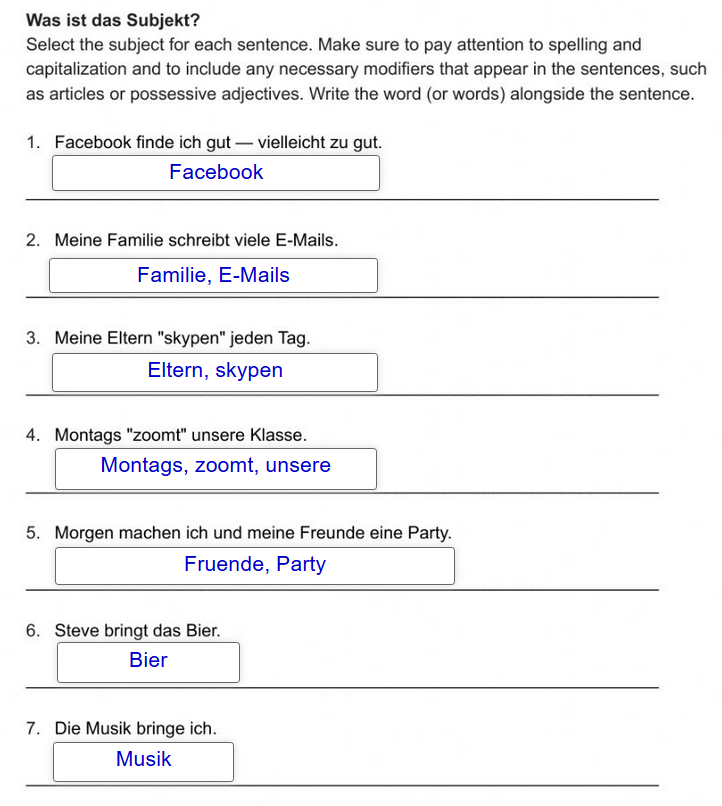 plain umbra
 flat ruin
Could someone verify if I picked the subjects correctly?
flat ruin
Could someone verify if I picked the subjects correctly?
Not quite.
Do you know how to identify the subject?
flat ruin
nein 😦
plain umbra
Okay, so, the subject is the person/thing who is doing the action.
And it can also help to look at the verb. The verb ending changes based on the subject.
So for example "Facebook finde ich gut".
Who/what is doing the action here? What kind of subject do you need to have the verb form "finde"?
golden cradle
Meine Familie
 plain umbra
flat ruin
You need a person
plain umbra
flat ruin
You need a person
Sorry, what do you mean by "you need a person"?
And sorry for the late reply, I was busy.
flat ruin
plain umbra
And sorry for the late reply, I was busy.
No problem. I actually understood and finished the assignment haha. Thanks 😊
plain umbra
Np.
 worthy igloo
wie wird „auserkoren“ heutzutage benutzt? ich habe es in einem Let's Play von Zelda gesehen, und Wiktionary sagt, es ist veraltet
nova sparrow
worthy igloo
wie wird „auserkoren“ heutzutage benutzt? ich habe es in einem Let's Play von Ze...
in this case Wiktionary is right you don't really use it:
ich habe ihn/sie (aus)gewählt
acoustic breach
Eine sehr einfache Frage
Sind "danke dir auch" und "danke auch dir" richtig?
long whale
acoustic breach
Eine sehr einfache Frage
Sind "danke dir auch" und "danke auch dir" richtig?
The 1st is a reply to somebody thanking you, e.g. for the bottle of wine you brought to dinner. The 2nd is what I'd say if someone had also helped me, along with somebody else (whom I'd already thanked).
acoustic breach
Danke @long whale !
narrow pier
many people especially in the ninety eighties were reading comics and its was really popular at that time --> viele Menschen haben vor allem in den achtziger Jahren Comics gelesen, und sie waren damals sehr beliebt
many people especially in the ninety eighties read comics and its was really popular at that time ---> Viele Menschen, vor allem in den achtziger Jahren, lasen Comics, und sie waren damals sehr beliebt ( hello are these translations of deep l true? ) and if yes, what is really the difference between ( were reading and read ) in the sentences above, and what are their equivallences in German, if it exists
like how would do talk about an action in german that happend in the past or let me rephrase.
are there many different ways to talk about past in german except ( plusquamperfekt, perfekt and präterium )
long whale
Same as in Präsens, you can use adverbs to show the continuous tense: "gerade" and/or "dabei sein, etwas zu tun". We only use those to show something is/was happening at the same time as something else, though. In your example, it makes no difference to us, i.e. the German translation of "were reading" is the same as for "read (past simple)"
narrow pier
long whale
Same as in Präsens, you can use adverbs to show the continuous tense: "gerade" a...
can you give an example with dabei sein and etwas zu tun if you can please. I want to see the contexts
long whale
Ich war gerade dabei, die Fenster zu putzen, als das Telefon klingelte.
narrow pier
long whale
Same as in Präsens, you can use adverbs to show the continuous tense: "gerade" a...
My senteces turned like this ( In den achtziger Jahren ~~hat ~~ haben viele Menschen Comics gelesen ) or ( In den achtziger Jahren lasen viele Menschen Comics )
long whale
*haben hat
Yes, but the choice between Perfekt and Präteritum has nothing to do with continuous tense.
@narrow pier
narrow pier
long whale
*haben ~~hat~~
oh okay, thank you so much. is this correct. I can not put this into to deepl since I am also unsure about how I say it in English ( Ich war gerade beim Wasser trinken, als mein Vater mich schlug )
long whale
narrow pier
oh okay, thank you so much. is this correct. I can not put this into to deepl si...
No. :)
narrow pier
long whale
No. :)
it would not even work? thanks
long whale
narrow pier
it would not even work? thanks
You might hear it (not sure), but... it isn't really acceptable in Standard German, no.
narrow pier
sorry its not on leo or deepl but another word for Computerspiele is zocken? I might have the spelling wrong. but there is a word for vediogames in German?
long whale
narrow pier
sorry its not on leo or deepl but another word for Computerspiele is zocken? I m...
"zocken" is a very colloquial verb for "to play [computer games]" and for "to gamble" ;)
narrow pier
long whale
"zocken" is a very colloquial **verb** for "to play [computer games]" and for "t...
danke
narrow pier
undone verge
yes 🙂
danke
 vast bluff
yes you are correct, it is short for Amerikaner and if it has a positive, negative or neutral connotation depends on the context and the person
 nimble viper
vast bluff
yes you are correct, it is short for Amerikaner and if it has a positive, negati...
nimble viper
vast bluff
yes you are correct, it is short for Amerikaner and if it has a positive, negati...
What I always thought it meant a french person, like ami in french
Aja
vast bluff
nimble viper
What I always thought it meant a french person, like ami in french
nah but its pronounced more like ammi
timid vector
it's like yank
worthy igloo
was ist der Unterschied zwischen „Wicht“ und „Zwerg“?
undone verge
imp vs. dwarf, I think
very weird to me now that 'wicht' is the beginning of 'wichtig' the same way 'imp' is the beginning of 'important' 😂 I wonder if that's etymologically connected
worthy igloo
undone verge
very weird to me now that 'wicht' is the beginning of 'wichtig' the same way 'im...
haha well, “important” is completely latinate and the real structure is import•ant
“From the same root as Gewicht (“weight”), thus pertaining to wiegen (“to weigh”). See also gewichtig, a (formal or elevated) synonym of wichtig. Weight is often used as a metaphor for importance; compare German schwerwiegend (“serious, grave”), as well as English weighty, heavy.”
apparently this is the etymology of wichtig
v interesting
undone verge
worthy igloo
“From the same root as Gewicht (“weight”), thus pertaining to wiegen (“to weigh”...
yeah, so I guess like none of the 4 words are related at all 😂 what a great coincidence
worthy igloo
if Zwerg is dwarf then is gnome just Gnom?
fervent kernel
worthy igloo
if Zwerg is dwarf then is gnome just Gnom?
yes
undone verge
I mean, Gartenzwerg = garden gnome
I think there's a lot of overlap with these small fake creatures
fervent kernel
There are also some regional oddities, e.g. bavaria compared to northern germany
long whale
worthy igloo
was ist der Unterschied zwischen „Wicht“ und „Zwerg“?
While I fully agree with there being a lot of overlap, "Wicht" can have a very negative connotation, which the other words lack.
golden cradle
worthy igloo
wie wird „auserkoren“ heutzutage benutzt? ich habe es in einem Let's Play von Ze...
ja, auserwählt, aber sehr theatralisch/dramatisch – The Chosen ONE, die Held*in der jeweiligen Story
golden cradle
undone verge
very weird to me now that 'wicht' is the beginning of 'wichtig' the same way 'im...
haha ja lustige Beobachtung!!
golden cradle
undone verge
I think there's a lot of overlap with these small fake creatures
fake
Someone’s cruisin’ for a ||gnomin’
||
 forest sentinel
Hey guys
I have a sentence, where I have to insert af relative pronoun, but I am unsure.
Ida, _______ (dessen/deren/der) Eltern nichts von ihrer Verhaftung wussten,
wurde nicht verurteilt.
I am pretty sure that in english the sentence should like:
"Ida, whos parents didn't know anything about her arrest, were not sentenced."
The problem I have is seeing, if the relative pronoun should be in plural or singular.
Any help is appreciated❤️
 fervent scroll
masculine, neuter -> dessen
feminine, plural -> deren
forest sentinel
But which one should it be then?
Doesn't "der" also refer to feminine, when it is dative?
timid vector
forest sentinel
Doesn't "der" also refer to feminine, when it is dative?
deren is not der
but regardless both refer to feminine so 🤷
 real rivet
forest sentinel
Hey guys
I have a sentence, where I have to insert af relative pronoun, but I am...
real rivet
forest sentinel
Hey guys
I have a sentence, where I have to insert af relative pronoun, but I am...
In that case you use deren.
Singular, Female, Genetiv
fervent scroll
üm is not a thing, you probably mean um
um + Uhr
im + Monat/Jahreszeit
am + Tag/Tageszeit
um 4 Uhr
um halb 7
im Juni
im Frühling
am Sonntag
am Abend
am 17. [siebzehnten] Januar
Ausnahme: in der Nacht
golden cradle
am Tag
fervent scroll
im Jahr 2022
golden cradle
(in 2022)
other aspects of im & um:
im = in the
um X zu Yen = for Ying X / in order to Y X
um X herum = around X
fervent kernel
Hallo zusammen 🙂 Ich brauche Hilfe über einige Sätzen auf Englisch (nur der fettgedruckte Teil). Mein Deutsch ist nicht gut genug zu übersetzen (und ich möchte mich sicher sein 🙂 )
Hier sind der Sätzen:
"What if he won't come here?"
"What about him/her/the nature/the others...?"
Ich habe dies schon einmal gefragt aber etwas klingt mir nicht gut. Wie kann man diese Let's-Sätze übersetzen?
"Let's write this down"
"Let's finish this work first"
Ich habe gehört, dass die Übersetzungen wie "sollen wir schreiben", "sollen wir die Arbeit fertig machen" sind, aber weiß nicht. Ich kann nicht das Let's-Gefühl fühlen 😄
 cyan berry
Hey can i have someone's help in dm ? Its beginner level and i only have a few questions.
 rocky sorrel
cyan berry
Hey can i have someone's help in dm ? Its beginner level and i only have a few q...
rocky sorrel
cyan berry
Hey can i have someone's help in dm ? Its beginner level and i only have a few q...
If you still need help, sure.
rocky sorrel
fervent kernel
Hallo zusammen 🙂 Ich brauche Hilfe über einige Sätzen auf Englisch (nur der fet...
"What if he won't come here?"
// Was, wenn er nicht (her) kommt?
"What about him/her/the nature/the others...?"
// Was ist mit ihm/ihr/der Natur/den anderen?
"Let's write this down"
// Lasst uns das aufschreiben.
"Let's finish this work first"
// Lasst uns die Arbeit erst zu Ende bringen.
"sollen wir schreiben"
// Should we write?
"sollen wir die Arbeit fertig machen"
// Should we finish the work ?
Hope that'll help you @fervent kernel
timid vector
rocky sorrel
**"sollen wir schreiben"**
```
// Should we write?
```
**"sollen wir die Arbe...
Sollen better translates to "Are we supposed to" but in this case we actually still use the near-archaic "Shall we" in English, it's asking the other person/people if they want to do something
i.e Shall we go out to eat?
Sollen wir essen gehen?
no idea if it's common in german to say it like that but that's what he was asking about
 agile osprey
Guys... I know I shouldn't be asking something like this but... Can someone help me with a quick exam? I need it for school...
timid vector
Against the rules to help with tests, sorry mate
 frank wadi
would it be wise to learn the grammar first and once I have a semi decent hold on it transition over to sites like duolingo to boost your vocabulary, or should i still stay away from it?
 midnight isle
frank wadi
would it be wise to learn the grammar first and once I have a semi decent hold o...
midnight isle
frank wadi
would it be wise to learn the grammar first and once I have a semi decent hold o...
The best way from my perspective is to learn grammar and at the same time collect your vocabulary. There's a lot of books out there that can allow you to that level by level
rocky sorrel
timid vector
Sollen better translates to "Are we supposed to" but in this case we actually st...
Thx, I shall work on my English.
fervent kernel
rocky sorrel
"**What if** he won't come here?"
```
// Was, wenn er nicht (her) kommt?
```
"...
That helps a lot, thank you 🙂 but now I have another question abou that "let's" part. There's another usage of "let" in English. So, I just wonder if these translation are correct.
"Let me help you (for your homework)" -> "Lass mich dir (bei deinen Hausaufgaben) helfen"
"Let me check" -> "Lass mich überprüfen"
This is what I learned, and now the "let's" translation are with "Lasst" if I understand correctly?
 inner torrent
let's= lasst uns, let me= lass mich, etc.
inner torrent
fervent kernel
That helps a lot, thank you 🙂 but now I have another question abou that "let's"...
That's correct, but "Lass mich überprüfen" always needs an object. If you don't have a regular one you just say "Lass mich das überprüfen!". "Lass mich überprüfen": you can't say this I think, or it's not common at least
But it's true, "Let's go" would be "Lasst uns gehen." Note: You can also say "Lass uns gehen". That might be weird because "lass" is actually only for Singular, but in that combination (let's) it works.
Important: I'm not a teacher or even an expert, I'm just some random Native. I'm just telling you what I know. So, it might be incorrect, but it's the way we use the language.
fervent kernel
@inner torrent danke schön 🙂
 flat swallow
Does anyone know of any online college that offers German as a foreign language? Google is giving me the run around with this question.
plain umbra
flat swallow
Does anyone know of any online college that offers German as a foreign language?...
Best channel for such questions in #1033125270217048246
flat swallow
My bad, thx 👌🏼
 dim grove
Can someone translate a video into English it’s around 8 seconds long
long whale
dim grove
Can someone translate a video into English it’s around 8 seconds long
Please try yourself, first. If you show us what you have, we can help you with the rest. ;)
fervent kernel
what are the best online english-german dictionaries?
golden cradle
https://dict.cc
you may be interested in #resources
Englisch-Deutschwörterbuch (Übersetzer): Von Benutzern erweiterbares Wörterbuch für die Englisch-Deutsch-Übersetzung. Weitere Wörterbücher für andere Sprachen ebenfalls verfügbar!
fervent kernel
wie kann ich "be quiet" höflich in Deutsch sagen?
 tame beacon
Seien Sie bitte still.
fervent kernel
warum nicht "Sein Sie bitte still"?
timid vector
fervent kernel
warum nicht "Sein Sie bitte still"?
Imperativ
it is a command (but not so harsh)
there are different conjugations for Imperativ
fervent kernel
timid vector
Imperativ
ja, genaue, aber in imperativ sage ich zum Beispiel: Kommen Sie bitte
timid vector
yes sein is a special verb
it is Seien
because the root is "sei"
basically every form of sein is irregular and must be memorized unfortunately
tame beacon
My music teacher likes to say: "So, du hast jetzt mal Sendepause."😂
tame beacon
timid vector
basically every form of sein is irregular and must be memorized unfortunately
yup, exactly
fervent kernel
timid vector
basically every form of sein is irregular and must be memorized unfortunately
kann ich sagen: "Seien Sie glücklich bitte"?
 static juniper
Die Arbeit, bei der ihr mir helfen wollt, ist sehr schwer. is it correct?
Could i get a short run down on why der is used in ", bei der ihr mir helfen wollt"
static juniper
fervent scroll
Dativ
is there a way to detect dativ more easily in relativpromonen, having trouble with it sometimes.
fervent kernel
"Es gibt ein Problem. Im Stiegenhaus liegen immer wieder große Mengen von kostenlosen vor unseren Postkästen. Seien Sie bitte so nett und schließen Sie die Haustür immer ab. Vielen Dank für Ihre Mithilfe." I dont understand the meaning of this sentence. Why is it requiered to lock the door for? What does it has to do with the pile of newspapers in front of the mailboxes?
I still dont understand the connection...
 tropic thistle
static juniper
is there a way to detect dativ more easily in relativpromonen, having trouble wi...
tropic thistle
static juniper
is there a way to detect dativ more easily in relativpromonen, having trouble wi...
i think it's a combination of reviewing which prepositions are likely to take the dative (either dative-only or two-way: here bei should tip you off to expect a dative somewhere in the area) as well as making sure that you are familiar with the forms, so that you consider it as a possibility (which can be combined with noting common verbs that often take dative complements or objects -- e.g. helfen, geben, versprechen...)
tropic thistle
fervent kernel
"Es gibt ein Problem. Im Stiegenhaus liegen immer wieder große Mengen von kosten...
the delivery people who bring the advertisement flyers generally don't have the key (as a mailperson would), so if you make sure the door is locked, the people bringing the advertisement flyers may have a harder time getting in
fervent scroll
vor dem Fenster?
 olive ravine
fervent kernel
der Bildschirm steht vom Fenster, correct?
olive ravine
fervent kernel
der Bildschirm steht vom Fenster, correct?
"Der Bildschirm steht vor dem Fenster" is correct, but the shorter form"vorm"(=vor dem), would be also possible, however it has a worser language style
fervent kernel
olive ravine
"Der Bildschirm steht vor dem Fenster" is correct, but the shorter form"vorm"(=v...
now what about?: "der Bildschirm steht vor dem Fenster auf dem Tisch"
olive ravine
fervent kernel
now what about?: "der Bildschirm steht vor dem Fenster auf dem Tisch"
Correct👍, but don't forget the capital letter at the beginning and the punctuation in the end
fervent kernel
Danke schön
 steel patrol
Sagt man üblicherweise, dass man gute Laune hat oder dass man in guter Laune ist?
proven sphinx
steel patrol
Sagt man üblicherweise, dass man gute Laune *hat* oder dass man in guter Laune *...
Eher das Erste.
proven sphinx
steel patrol
Gut gelaunt sein geht auch, oder?
Ja, das geht auch.
 glass jungle
Hey guys! Is anyone here familiar with WG castings? I need some help writing an email for this… and I’m struggling 🥲
 rare jetty
@final marlin
golden cradle
glass jungle
Hey guys! Is anyone here familiar with WG castings? I need some help writing an ...
yeah very (from the room providing side)
I have compiled a few pages of tips for searchers: https://bit.ly/DAsearch

Google Docs
looking for accommodations, particularly as a student in Darmstadt (last updated 2019-01-05) Automatische Übersetzung dieser Liste: translate.google.com/translate?u=https://docs.google.com/[…] This accommodation search tip list is available and updated online. You're welcome to improve it th...
glass jungle
Thank you so much 😊
 final marlin
rare jetty
<@599471534289059840>
final marlin
rare jetty
<@599471534289059840>
Ich kann kein Deutsch.
rare jetty
final marlin
Ich kann kein Deutsch. <:hey:476373794491990019>
Ach so
 granite crystal
Hallo💋💋💋
 shut briar
Was ist die offizielle in gebrauch Wort für Procrastination auf Deutsch? Oder benutzt man Procrastination
 upbeat thicket
shut briar
Was ist die offizielle in gebrauch Wort für Procrastination auf Deutsch? Oder be...
upbeat thicket
shut briar
Was ist die offizielle in gebrauch Wort für Procrastination auf Deutsch? Oder be...
Prokrastination oder etwas aufschieben
golden cradle
auch: Aufschieberitis; Prokrastinieren
rare jetty
English or German please
 thorny jacinth
what is english
rare jetty
A language 
fervent kernel
English is an unofficial term common in the colonial nation of Britain, referring to the language American
 safe plaza
fervent kernel
English is an unofficial term common in the colonial nation of Britain, referrin...
safe plaza
fervent kernel
English is an unofficial term common in the colonial nation of Britain, referrin...
Best definition I've ever seen
 distant urchin
faq dativ
 stoic mauveBOT
When do I use the dative case?
The dative case has a great number of usages, many of which are idiomatic, but is mainly used:
- to mark the indirect object of many transitive verbs (the indirect objectis that which receives the result of an action)
Ich habe dir ein Bier gekauft.
Sie gibt dem Mann das Buch.
Er zeigte ihm seinen Führerschein.
- to mark the object of some transitive verbs:
Dir fehlen die richtigen Materialien.
Es fällt mir bestimmt gleich wieder ein.
Das gefällt ihr gar nicht.
- after some prepositions:
Ich komme aus den USA.
Komm mit mir.
Ich lerne seit vielen Jahren Deutsch.
The following prepositions are always followed by the dative case:
aus, außer, bei, gegenüber, mit, nach, seit, von, zu
- after two-way prepositions when they do not indicate movement:
Das Bild hängt jetzt an der Wand.
Er joggt im Wald. (he is jogging in the woods)
Sie steht vor mir.
- to show possession, mainly of clothing or body parts:
Ich habe mir in die Finger geschnitten.
Er hat ihr die Nase gebrochen.
Die Mütze fiel mir vom Kopf.
- with many adjectives:
Ich war mir nicht sicher.
Ist dir kalt? (See >ex impersonal verbs for why there is no subject here.)
Er ist seinem Bruder sehr ähnlich.
Page 2/2
golden cradle
distant urchin
>faq dativ
distant urchin
golden cradle
<#248530603165614080>
sorry. ty for letting me know.
stoic mauveBOT
See a listed FAQ with >faq [name]
:small_blue_diamond: Absentive
Aliases: Absentiv
:small_blue_diamond: Accusative
Aliases: Akkusativ
:small_blue_diamond: Adjective Declension
Aliases: Adjektivdeklination, Adjective endings
:small_blue_diamond: Anki
Aliases: Flashcards
:small_blue_diamond: Beide vs. Beides
Aliases: Beides vs. Beide, Beides, Beide
:small_blue_diamond: Best way to learn German
Aliases: Fastest way to learn, Learn fast, Most efficient way to learn, Learn efficiently, Best way to learn, Learn German fast
:small_blue_diamond: Can anyone teach me German
Aliases: Private tutors, Teach me, Teach me German, Teach German, Private lessons, Private teachers
:small_blue_diamond: Cases
Aliases: Grammatical case, Case
:small_blue_diamond: CEFR levels
Aliases: CEFR, CERF
:small_blue_diamond: Conjugation
Aliases: Konjugation, Praesens, Verbs, Verb conjugation, Present tense, Präsens
:small_blue_diamond: Contractions
Aliases: Verschmelzung, Schmelzwort, Vom
:small_blue_diamond: DACH
:small_blue_diamond: Dative
Aliases: Dativ
:small_blue_diamond: Doch
:small_blue_diamond: Duolingo
Aliases: Duo
Page 1/5 (61 entries)
distant urchin
So, I am very stuck on Relative Pronouns. I struggled with Dativ quite a bit, so I have a hard time identifying when and if I should be using dative relative pronouns in a sentence. I've got a homework assignment and I don't want to say a good portion of them are dative, but it feels like they are.
I'd appreciate some assistance if at all possible.
golden cradle
what kind of assistance were you @distant urchin?
distant urchin
golden cradle
what kind of assistance were you <@210934294338732032>?
i was hoping someone could sit with me in a voice chat and not tell me the answers, but guide me and confirm whether I got it correct or if its not right and why that may be.
golden cradle
👍 gl
If no one volunteers, you can always type your stuff in here
distant urchin
i guess I can just put it here.

so, i think this is dative because im pretty sure gegeben is a dative verb
golden cradle
what are the objects?
distant urchin
the telefonummer is the indirect object, I am the direct object. since I am the one being given something.
and wouldnt he be the subject since he is executing the action
golden cradle
distant urchin
and wouldnt he be the subject since he is executing the action
yeah
golden cradle
distant urchin
the telefonummer is the indirect object, I am the direct object. since I am the ...
care to teach me about direct and indirect objects? /gen
I can build and identify correct sentences with very good precision, but my explicit understanding of the grammar is very lacking
undone verge
distant urchin
so, i think this is dative because im pretty sure gegeben is a dative verb
gegeben is a verb that takes an accusative and a dative object. 'mir' is already dative here. who is the number being given to? to me (mir).
number is the accusative object
in 'english' terms, 'mir' is the indirect object and die Telefonnummer is the direct object
golden cradle
are direct and indirect obj. basically translations for acc. & dative?
undone verge
kinda (but not really). It is better to call them dative and accusative objects
and I assume that is how Sinking is using them
distant urchin
I honestly had to really refresh myself for this so ive been trying to cram a lot in, im certain my understanding is everywhere. with this
but for relative pronouns, it requires me to know what case I am in, so I would think that it seems dative, but would I refer to "die telefonummer" as dative in the subordinate clause? because it seems accusative in the first half, but swaps to dative in the second half.
undone verge
it isn't dative in the second clause, just for the record
distant urchin
so I am really confused as to what should be the key i am looking for when determining the correct relative pronoun to use.
oh? its not?
undone verge
it should be 'die Telefonnummer, die er mir gegeben hat, funktioniert nicht'
undone verge
distant urchin
oh? its not?
I explain why in the above message
distant urchin
oooh. that makes sense. i did hear dativ refers more to the beneficiary of an object.
is "bei" always dative?
undone verge
yes
distant urchin
undone verge
yes
thank you. i appreciate the explanation.
nimble viper
,,Sitzt der Schmerz noch tief?"
Würde man hier geläufig 'sitzen' sagen oder gibt es geläufigere/bessere/gemütlichere Verben dazu?
bzgl eines Herzschmerzens
Auch: Ist gebrauchen (Verb) sogar metaphorischer als nutzen, wenn es drum geht, dass man eine Sache was tun lässt?
zB ich hab hierbei 'gesunden Menschenverstand gebrauchen'
night dagger
nimble viper
,,Sitzt der Schmerz noch tief?"
Würde man hier geläufig 'sitzen' sagen oder gib...
erstens: ja, "ist" oder "sitz" passt.
zweitens: "brauchen" kann mehr oder weniger "verwenden" bedeuten.
zB: Könntest du dieses Wörterbuch brauchen? - Could you use this dictionary?
golden cradle
nimble viper
Auch: Ist gebrauchen (Verb) sogar metaphorischer als nutzen, wenn es drum geht, ...
metaphorisch würde ich das nicht nennen, aber lyrischer, jawohl. Effektvoller
nimble viper
night dagger
erstens: ja, "ist" oder "sitz" passt.
zweitens: "brauchen" kann mehr oder wenige...
Ich dachte das wäre: Könntest du dieses Wörterbuch gebrauchen?
 jaunty flax
faq akkusativ
stoic mauveBOT
When do I use the accusative case?
The accusative case is mainly used:
- to mark the direct object of many transitive verbs
Ich lese einen Roman.
Er hat die schöne Frau ermordet.
Sie besitzen kein Auto.
- after some prepositions
Danke für deine Hilfe!
Ohne dich kann ich nicht leben.
Sie hatten keine Einwände gegen den Plan.
The following prepositions are always followed by the accusative case:
bis, durch, für, gegen, ohne, um
- to indicate movement in a particular direction in two-way prepositions
Er steigt auf den Gipfel.
Sie hängt das Bild an die Wand.
Ich gehe gleich ins Bett. (ins = in das)
- by adverbials of time and measurement
A definite length or point in time:
Ich habe den ganzen Tag geschlafen.
Sie kommt nächste Woche zurück.
A measurement:
Das Kind ist vier Jahre alt.
Das Tier ist einen Meter groß.
Expressing distance with verbs of motion:
Ich ging die Treppe hinauf.
Ich lief den ganzen Weg zu Fuß.
- in common greetings and wishes
Guten Morgen/Tag/Abend!
Gute Besserung!
Herzlichen Glückwunsch!
Here there is an implicit verb such as 'wünschen', where the greeting/wish is the direct object.
Page 2/2
nimble viper
Das würde meine ursprünglich Frage besser betreffen
night dagger
nimble viper
Ich dachte das wäre: Könntest du dieses Wörterbuch gebrauchen?
guck mal dwds
night dagger
immer gern
 clever harbor
Is "Wie soll ich reagieren?" = "How should I react?" (future)
"Wie sollte ich reagieren?" = "How should I have reacted?" (past)
nova sparrow
clever harbor
Is "Wie soll ich reagieren?" = "How should I react?" (future)
"Wie sollte ich re...
What's the question here?🤔
Maybe the 2nd could also be
Wie hätte ich reagieren sollen...
 torn egret
clever harbor
Is "Wie soll ich reagieren?" = "How should I react?" (future)
"Wie sollte ich re...
torn egret
clever harbor
Is "Wie soll ich reagieren?" = "How should I react?" (future)
"Wie sollte ich re...
Its "how should i react" if u wanna say "how should i have reacted" you say "wie hätte ich reagieren sollen?"
proven sphinx
clever harbor
Is "Wie soll ich reagieren?" = "How should I react?" (future)
"Wie sollte ich re...
That's not how it works. Both refer to a possible future event.
"sollte" is just more hypothetical "sollen".
clever harbor
Thank you all
clever harbor
proven sphinx
"sollte" is just more hypothetical "sollen".
When should Sollten be used over Sollen
proven sphinx
clever harbor
When should Sollten be used over Sollen
"sollen" is kind of more like an order and "sollte" is more of a suggestion.
So "sollen" is often translated as "to be supposed to" in English.
Du sollst nicht dorthingehen! = You're not supposed to go there!
Whereas "Du solltest nicht dorthingehen" is more of a suggestion, as in "You shouldn't go there".
clever harbor
proven sphinx
Du sollst nicht dorthingehen! = You're not supposed to go there!
What then would be the different between sollen and dürfen?
proven sphinx
clever harbor
What then would be the different between sollen and dürfen?
"dürfen" means "to be allowed to". It's similar but not quite the same.
Du sollst das nicht machen! (I don't want you to do that)
Du darfst das nicht machen! (It's against the law)
"sollen" often refers to what the speaker wants and "dürfen" to be what is generally allowed in society.
"Er soll nicht hierherkommen" (I don't want him to come here)
"Er darf nicht hierherkommen" (His mom grounded him or he's under some restraining order that bans him from coming here)
clever harbor
proven sphinx
"sollen" often refers to what the speaker wants and "dürfen" to be what is gener...
Danke dir für die Erklärung :)
 weary ruin
This might be a stupid question, but is duolingo a good learning source or are there better sites?
proven sphinx
faq Duolingo
stoic mauveBOT
Duolingo
Duolingo is a decent resource to start with if you're a complete beginner, but it's neither efficient nor comprehensive!
What Duolingo will teach you about grammar is very limited, and none of the systems they use will help you practise much of it.
You can learn some vocabulary with it, but their method (based on the concept of spaced repetition) doesn't work for everybody, and the way Duolingo teaches is not very effective compared to the amount of time it requires from you.
So, if you find it useful, by all means keep using it, but remember not to fall for its gamification of language learning, and move past it when it stops being beneficial. Ignore the streaks.
In any case, keep in mind that Duolingo is not enough to learn a language, ever.
If you're looking for guidance or alternatives, check out >faq beginner in our #botchannel .
proven sphinx
@weary ruin
weary ruin
Dankeschön!
weary ruin
faq babbel
stoic mauveBOT
FAQ not found. Try >explain all.
proven sphinx
I suppose there's not a FAQ for everything. 😅
worthy igloo
was bedeutet "zushulden" auf Englisch?
Bis zu ihrer Anklage hate sie sich kaum etwas zuschulden kommen lassen.
nova sparrow
worthy igloo
was bedeutet "zushulden" auf Englisch?
*Bis zu ihrer Anklage hate sie sich kaum...
never comitted a crime; no records; white vest...
and kaum means only little things
golden cradle
worthy igloo
was bedeutet "zushulden" auf Englisch?
*Bis zu ihrer Anklage hate sie sich kaum...
von
schuld(ig) = guilt(y)
worthy igloo
danke euch drei! @nova sparrow @delicate tiger @golden cradle
was bedeutet hier "spitze"? wiktionary sagt "great, awesome"
 golden cradle
worthy igloo
was bedeutet hier "spitze"? wiktionary sagt "great, awesome"
golden cradle
worthy igloo
was bedeutet hier "spitze"? wiktionary sagt "great, awesome"
wiktionary hat Recht
kommt denke ich von
die Spitze = the peak
andere Synonyme: klasse, großartig
 solar haven
Hallo, Leute.
Das ist gut nur für die Sprache lernen anfangen.
tell me please how to make this sentence correctly and at the same time save all 3 verbs (ist, lernen, anfangen)praying_dog
 lavish marlin
@fervent kernel what are you trying to express?
fervent kernel
What are you talking about
lavish marlin
what is the sentence you posted in #general trying to say?
in any case, the personal pronoun that goes with "man" is "sein"
Man muss seine Tasche hier lassen
fervent kernel
You ( second person plural) have to take in your 70 liter bag a compass, etc..
lavish marlin
"Ihr müsst"
fervent kernel
Thank you
lavish marlin
or "Ihr solltet" if it's just advice
fervent kernel
So it is:
Schliesslich müsst Ihr in euer 70 Liter Rucksack einen Kompass, eine Wanserkarte, ein Zelt und einen Schlafsack nehmen
?
fervent kernel
Schliesslich müsst ihr in euren 70 Liter Rucksack packen einen Kompass, eine Wanderkarte, ein Zelt und einen Schlafsack.
Then?
lavish marlin
it's "euren", the "e" disappears:
"euren", "eurer", "eurem"
long whale
fervent kernel
Schliesslich müsst ihr in euren 70 Liter Rucksack packen einen Kompass, eine Wan...
The infinitive has to come last, or at least after the first direct object in the list.
lavish marlin
ah yes, you have to use the same word order as in your previous sentence
fervent kernel
That's what I also thought
lavish marlin
yeah, I didn't express myself clearly with my example, sorry about that
fervent kernel
In my previous sentence i said
Vergesst ihr nicht eure Wanderhütte und Handschuhe und besonders eure Wanderstöcke.
Is it correct?
lavish marlin
if you use the imperative you don't mention the object
"Vergesst nicht..."
at least for du and ihr
it's still there for Sie
"Vergessen Sie nicht..."
lavish marlin
at the end
fervent kernel
Okay thanks
lavish marlin
fervent kernel
Vergesst ihr nicht eure Wanderhütte und Handschuhe und besonders eure Wanderstöc...
and in this case "nicht" should be at the end
fervent kernel
So for the first sentence we have : Schliesslich müsst ihr in euren 70 Liter Rucksack einen Kompass, eine Wanderkarte , ein Zelt und einen Schlafsack packen
lavish marlin
👍
fervent kernel
Is this sentence correct now that i corrected it :
Dann in Bezug auf das Kochen : nehmt Sandwiches und Wasser für die Picknicks .
@lavish marlin
lavish marlin
looks good
maybe "mitbringen" would fit better though
"bringt .... für die Picknicks mit"
is Picknicks supposed to be plural?
lavish marlin
yes
lavish marlin
fervent kernel
Dann in Bezug auf das Kochen : nehmt Sandwiches und Wasser für die Picknicks .
Also I'm not sure about "Kochen". You could use "Essen" instead, unless I misunderstood and you meant cooking
 ivory forge
Hallo , ich habe eine Frage. Was bedeutet das 'abends abschalten' ?
lavish marlin
could you provide more context?
fervent scroll
isn't it like relax?
lavish marlin
It could mean "To disconnect (from electricity, social media etc.) at evening" (in order to relax) or it could mean "To turn off an electronic device at evening"
"abends" means that it happens regularly at evening
ivory forge
lavish marlin
could you provide more context?
Here's the paragraph I'm trying to translate: Um „Leisure Sickness“ zu verhindern, müssen wir unsere Einstellung zu uns selbst
ändern, erklärt Carsten Watzl: „Man sollte sich von dem Gedanken lösen, dass man nur
dann gemocht wird, wenn man möglichst viel leistet.“ Wenn man das geschafft hat,
kann man auch etwas gegen den Stress tun: häufiger Pausen machen, abends
abschalten und auch mal Nein sagen. Dann kann der Urlaub kommen – ganz ohne
„Freizeitkrankheit“.
lavish marlin
then the first meaning would fit better
ivory forge
Relax ?
fervent scroll
 lavish marlin
fervent scroll
lavish marlin
fervent scroll
"unwind" is a good translation
ivory forge
@lavish marlin @fervent scroll I am so appreciate , thank you 🙏
golden cradle
solar haven
Hallo, Leute.
Das ist gut nur für die Sprache lernen anfangen.
tell me please h...
please reference the OP when you crosspost
golden cradle
ivory forge
Hallo , ich habe eine Frage. Was bedeutet das 'abends abschalten' ?
unwind in the evening
golden cradle
ivory forge
Here's the paragraph I'm trying to translate: Um „Leisure Sickness“ zu verhinder...
(i like this content^^)
ivory forge
golden cradle
(i like this content^^)
I can send you the PDF if you want to read the whole thing
golden cradle
ivory forge
Here's the paragraph I'm trying to translate: Um „Leisure Sickness“ zu verhinder...
ah in that context, i’d use switch off (just a small optimization)
golden cradle
ivory forge
I can send you the PDF if you want to read the whole thing
i don’t think i’ll get around to reading it, but if you have it at hand why not!^^
lavish marlin
Actually, it would be better not to post the same question in multiple channels in the first place. That way people won't have to respond to a question that has already been answered. You have to remember that people are doing this in their free time and sometimes getting an answer might take a bit - but feel free to repost it after a while if you think that people might not see it (for example, if no one responded and people would have to scroll up to see the question)
@solar haven
solar haven
lavish marlin
Actually, it would be better not to post the same question in multiple channels ...
Okay, of course. Sorry.
long whale
fervent kernel
I have a question
Whatever your question is, please do not cross-post. :)
fervent kernel
long whale
Whatever your question is, please do not cross-post. :)
yes ofc
so
basically
i wanted to present some places with interests during a hike
and i said
Die Interessen
but it sounds weird
so what could I use
long whale
If you keep posting like this, you will be automatically banned (because the bot will think you're spamming). Just saying.
fervent kernel
ah okay 😭
long whale
fervent kernel
but it sounds weird
That's because it is. You wouldn't use "das Interesse/die Interessen" for "point/s of interest".
fervent kernel
long whale
That's because it is. You wouldn't use "das Interesse/die Interessen" for "point...
yes but idk what to use instead i fetched for it on Linguee
But I didn't find much of an answer
you vould say An diesem ort ist eines der Interessanteren dinge zb.das museum oder
long whale
fervent kernel
yes but idk what to use instead i fetched for it on Linguee
You can enter a full sentence into deepl - that will def. help. ;)
golden cradle
(a subtype of POIs: sights = Sehenswürdigkeiten)
fervent kernel
In order to bring the subject I asked a question : Was sind die Interessen dieser Wanderung?
long whale
fervent kernel
In order to bring the subject I asked a question : Was sind die Interessen diese...
see above
golden cradle
ig
interessante(n) Stellen/Plätze/Orte/Punkte
i might even use DeepL myself for this tho, lol
fervent kernel
golden cradle
(a subtype of POIs: sights = Sehenswürdigkeiten)
It seems great thank you for your precious help
So is this question better :
Was sind die Sehenswürdigkeiten dieser Wanderung?
long whale
fervent kernel
you vould say An diesem ort ist eines der Interessanteren dinge zb.das museum od...
Frankly, if you said that, I'd assume the whole place was quite, quite boring. 🤷 As in: There's nothing much worth seeing there, but one of the less boring/more interesting places is the museum. ;)
long whale
fervent kernel
Was sind die Sehenswürdigkeiten dieser Wanderung?
Much better. I'd have said "auf dieser Wanderung" (during this hike), but for a beginner, yours would work. ;)
fervent kernel
long whale
Much better. I'd have said "auf dieser Wanderung" (during this hike), but for a ...
Thank you!
Is it correct to say
Die Sehenswürdigkeiten auf dieser Wanderung sind sehr zahlreich
bcs the place of the verb doesn't seem right
long whale
fervent kernel
Die Sehenswürdigkeiten auf dieser Wanderung sind sehr zahlreich
Placement of verb is fine. The sightseeing spots need to be in plural, though.
fervent kernel
long whale
Placement of verb is fine. The sightseeing spot**s** need to be in plural, thoug...
yes 😊
nova sparrow
fervent kernel
Die Sehenswürdigkeiten auf dieser Wanderung sind sehr zahlreich
It would sound smoother from this thought:
There are many/numerous POI's ...
nova sparrow
Points of Interests 😄
nova sparrow
Try it with
Es gibt ... in the beginning
nova sparrow
fervent kernel
Es gibt viele Sehenswürdigkeiten auf dieser Wanderung ?*
You're welcome 😄
fervent kernel
If I say : Zuerst, wir mehrere historische Denkmäler besichtigen können
is the place of the verb correct?
nova sparrow
fervent kernel
is the place of the verb correct?
put the verb as early as possible 🙂
and leave the comma away
fervent kernel
Zuerst können wir mehrere historische Denkmäler besichtigen
Is this sentence correct :Zum Beispiel das berühmte Schloss Neuschwanstein , das von LLudwig II. von Bayern erbaut im 19. Jahrhundert wurde.
because long phrases are kinda tricky to me
nein
Wait i will write you the cooret sentences
thanks 🙂
Zum Beispiel das berühmte Schloss Neuschwanstein, wurde von ludwig dem 2 im 19 Jahrhundert erbaut.
ludwig dem 2 aus bayern iam sorry
Thank you for your help ^^
no problem
fervent kernel
fervent kernel
no problem
Do we always have to put the verb as early as possible?
yeah kind of but sometimes in other tenses its different but now i would say yes
and for the past tense
for example
Dieser Ort hat Walt Disney für die Kreation des Dornröschen Schlosses inspiriert
i put the verbal base in the beginning
the auxiliar i mean
and the other at the end
yeah the sentense is right
long whale
fervent kernel
Do we always have to put the verb as early as possible?
In a main clause, the [conjugated part of the] verb must always be in Pos. 2 ;)
Nothing to do with tenses.
fervent kernel
okay
but you cant always put the verb in the front its different in tenses or do i missed st ?
long whale
fervent kernel
but you cant always put the verb in the front its different in tenses or do i mi...
Please show me an example where #questions-2 message doesn't apply. ;)
In whichever tense.
fervent kernel
fervent kernel
Zum Beispiel das berühmte Schloss Neuschwanstein, wurde von ludwig dem 2 im 19 J...
should I say when i'm talking dem zweiten ?
long whale
fervent kernel
should I say when i'm talking dem zweiten ?
In Dativ, yes.
long whale
fervent kernel
I have a question when do we know when to use either in or im?
faq contractions
stoic mauveBOT
Contractions
A contraction (Verschmelzung or Schmelzwort) is a shortened form of a word or group of words created by omitting letters and sounds. Common examples of contractions in English are:
I'm = I am
won't = will not
let's = let us
-'re = are (e.g. we're walking home)
Contractions are often used in German, especially with prepositions and definite articles that take the accusative or dative (never the genitive). For example, zu dem is often shortened to zum, as seen here:
Pferd geht zum Zahnarzt.
Some contractions with prepositions are so common (see below) that they are effectively manadatory in normal speech. Writing the full form has the effect of emphasising the definite article, indicating that you are referring to a specific object. For example:
Pferd geht zu dem Zahnarzt, der ihm gestern empfohlen wurde.
Common contractions in German
These contractions are used very often and are acceptable in formal German.
ans = an das
am = an dem
beim = bei dem
im = in dem
ins = in das
vom = von dem
zum = zu dem
zur = zu der
Additionally, the pronoun es is often contracted when it comes directly after the verb in certain set phrases. For example, the greeting Wie geht es dir? is often contracted to Wie geht's dir?
Contractions in informal German
Contracting the article das to -s in prepositions is very commonly used in informal, spoken German, and sometimes appears in formal German in set phrases.
aufs = auf das
durchs = durch das
fürs = für das
übers = über das
ums = um das
unters = unter das
Contracting the article dem to -m is relatively common in spoken German with almost all prepositions. For example:
hinterm = hinter dem
überm = über dem
unterm = unter dem
Contracting the other articles can also occur, but this is relatively rare.
golden cradle
fervent kernel
you vould say An diesem ort ist eines der Interessanteren dinge zb.das museum od...
maybe you meant interessantesten
 cold iris
Can someone tell me what's being said in German at this timestamp? It sounds like "Er ist/erst ein älterer Mann kann helfen" but that's ungrammatical nonsense.
It's right after "Nach den Russischen Besatzern sind Uniformen nicht gern gesehen"

In der Ostukraine zeigt sich das ganze Ausmaß der russischen Schreckensherrschaft. Viele Landstriche sind auf Jahre unbewohnbar. Nur wenige Menschen trauen sich zurück in ihre Heimatdörfer. Zu groß ist die Angst, dass die Russen wiederkommen. SPIEGEL TV-Reporter Andreas Lünser und Kameramann Jochen Blum berichten aus den befreiten Gebieten.
Tru...
golden cradle
*Erst ein …
cold iris
golden cradle
*Erst ein …
That's something I thought too but it didn't make sense to me either. What does it mean in English? the verb seems in the wrong place but idk i am confused
long whale
cold iris
That's something I thought too but it didn't make sense to me either. What does ...
Übersetzung Deutsch-Englisch für erst im PONS Online-Wörterbuch nachschlagen! Gratis Vokabeltrainer, Verbtabellen, Aussprachefunktion.
golden cradle
the order in English is diff as well:
Only an older man can help.
long whale
The [conjugated part of the] verb is in Pos. 2 - as it should be, in any main clause. ;)
cold iris
long whale
The [conjugated part of the] verb is in Pos. 2 - as it should be, in any main cl...
ahh becuase "Erst ein älterer Mann" is the first part. Ok
golden cradle
long whale
The [conjugated part of the] verb is in Pos. 2 - as it should be, in any main cl...
oh true lol
cold iris
Thanks both of you
golden cradle
the erst(/only) kinda means eventually,
long whale
Isn't it pretty much the same in English as in German? We talked to X, Y and Z. It was only when we started talking to this older man that we got help - no?
cold iris
long whale
Isn't it pretty much the same in English as in German? We talked to X, Y and Z. ...
Yeah that works
jaunty flax
if you were to say "is mine" would "ist meine" be correct?
nova sparrow
jaunty flax
if you were to say "is mine" would "ist meine" be correct?
gehört mir ...
golden cradle
correct?
depending on context yeah. The referenced property has to have female grammatical gender.
but even then usually you’ll want Bernie’s translation
long whale
jaunty flax
if you were to say "is mine" would "ist meine" be correct?
Depends on the gender of the thing which is yours.
jaunty flax
what would be the difference between a feminine/masculine noun then?
or would it only be correct if its neutral?
long whale
jaunty flax
or would it only be correct if its neutral?
die Tasche -> meine; der Stift -> meiner; das Handy -> mein[e]s
jaunty flax
long whale
die Tasche -> meine; der Stift -> meiner; das Handy -> mein[e]s
thank u!
golden cradle
MEINS!
nova sparrow
long whale
die Tasche -> meine; der Stift -> meiner; das Handy -> mein[e]s
or (for all)
gehört mir
golden cradle
der Ring -> mein Schatz
nova sparrow
golden cradle
MEINS!
Sei doch nicht so gierig 😉
golden cradle
-.-’tschuldigung
nova sparrow
golden cradle
der Ring -> mein Schatz
my precious!
long whale
a) they'd still need to know the gender (der/die/das gehört mir), and b) I'd say one is about as common as the other, don't you think?
nova sparrow
long whale
a) they'd still need to know the gender (der/die/das gehört mir), and b) I'd say...
Of course you are right 👍 ❤️
golden cradle
actually no, i disagree ||||
nova sparrow
golden cradle
actually no, i disagree ||<:blobsweat:793528309861974016>||
tell us!
golden cradle
do i dare to?!
nova sparrow
golden cradle
do i dare to?!
🤣
golden cradle
after Susana’s hint i’m realizing that ig in everyday life ist meins would be much more normal to say even.
i was just so taken with your sinngemäße translation that i didn’t notice – thanks for the reality check, Susana! 
(i’d actually swallow the is(t):
Das’ meins.
or even closer to reality: Des’ meins.
)
night dagger
golden cradle
(i’d actually swallow the **is(t)**:
> Das’ meins.
or even closer to reality: D...
Woher kommste nochmal?
nova sparrow
golden cradle
after Susana’s hint i’m realizing that ig in everyday life **ist meins** would b...
depending on the region you are in maybe
g'hört mir 😄
golden cradle
night dagger
Woher kommste nochmal?
Darmstadt bei Frankfurt, Hessen
night dagger
achso
ergibt Sinn
ich frag, weil meine Freundin so gut wie immer "des" statt "das" sagt 
nova sparrow
night dagger
ich frag, weil meine Freundin so gut wie immer "des" statt "das" sagt <:loleyes:...
Sie kommt eher aus dem Süden Deutschlands?
night dagger
also BW
nova sparrow
night dagger
also BW
dann macht des Sinn 😄
night dagger
nova sparrow
dann macht des Sinn 😄
genau ;)
golden cradle
meins ist eher so dös, das ö ~~ wie in Köpper, aber much less engaged ’xD
night dagger
ich hab das mehrmals in dieser Region bemerkt
nova sparrow
Aber um Ehrlich zu sein, auch in Bayern wird aus das schnell des 😉
nova sparrow
night dagger
also BW
Du kennst den Weißwurstäquator?
golden cradle
the Bockwurst Belt
nova sparrow
golden cradle
~~the Bockwurst Belt~~
I'm not so sure 🤔
golden cradle
 i wasn’t stating an assertion, just a random pun mashed up from Weißwurstäquator and Bible Belt
long whale
golden cradle
<:blobsmilesweat2:612481919736741888> i wasn’t stating an assertion, just a rand...
Doesn't work too well, since the Bible Belt consists of several states, i.e. it's an area, and a pretty big one, right? While der Weißwurstäquator is just a line/river separating North from South. ;)
night dagger
nova sparrow
Du kennst den Weißwurstäquator?
na kar, den Aldi-Äquator auch :)
long whale
Also, equating Weißwurst and Bockwurst is just... sacrilege. Heinous.
golden cradle
what do you expect from a vegan
long whale
golden cradle
what do you expect from a vegan
Nah, that isn't food, that's culture! :D
nova sparrow
night dagger
na kar, den Aldi-Äquator auch :)
Aber der Aldi-Äquator ist deutlich nördlicher!
golden cradle
long whale
Doesn't work too well, since the Bible Belt consists of several states, i.e. it'...
what river is it?
long whale
Der Main
golden cradle
kennich!
ok, nicht gut genug. Fließt der durch Frankfurt od— ok ja tut er lol – Frankfurt/Main.
ich bin so unglaublich schlecht in Geographie, das schlägt dem Fass den Boden aus! 
long whale
Apparently there are various... interpretations, though: https://de.wikipedia.org/wiki/Weißwurstäquator 🤯
golden cradle
golden cradle
ok, nicht gut genug. Fließt der durch Frankfurt od— ok ja tut er lol – Frankfur...
das würde heißen, ich lebe im Weißwurstbelt, hab ich aber nicht mitbekommen
also ich meine, in Darmstadt wird nicht viel Weißwurst~~ gegessen ~~-Kultur gelebt
nova sparrow
golden cradle
also ich meine, in Darmstadt wird nicht viel Weißwurst~~ gegessen ~~-Kultur gele...
Immerhin haben sie Glühwein dort !!!
 nova sparrow
Na, ich weiß nicht 🤔
golden cradle
wo denn möglicherweise nicht?
nova sparrow
golden cradle
wo denn möglicherweise nicht?
na im Norden, da gibt's dann Grog!
 urban oxide
Wir gehen an einem Park vorbei, dann sehen wir...
Warum ist es "an einem Park" hier und nicht akkusativ?
urban oxide
Bitte klingen Sie mir wenn Sie antworten
cold iris
urban oxide
> Wir gehen an einem Park vorbei, dann sehen wir...
Warum ist es "an einem Park...
I'm not a native speaker but from what I see on Duden, when vorbeigehen is paired with the preposition "an" it just seems to be a rule that it's dative. But i'm not 100% sure.
 cold iris
Guess I was right. Yeah it's separable
urban oxide
I also remember seeing Gehen wir zum/zur X vorbei
so it seems like vorbeigehen generally takes dative no matter the preposition
Thanks! :)
cold iris
urban oxide
so it seems like vorbeigehen generally takes dative no matter the preposition
well zu is always dative. But I saw some examples on Duden that were akkusativ
cold iris
oh wait
urban oxide
cold iris
well zu is always dative. But I saw some examples on Duden that were akkusativ
can you please share those examples
cold iris
urban oxide
can you please share those examples
nevermind I think I was mistaken. It seems to be dative always
cold iris
np
narrow pier
Hallo leute, das ist eine Aufzählungpunkt auf Wekipedia vom Thema ( Adjektivdeklination )
° abgeleitete Adjektive auf -er (die Türme des Bremer Doms; Zweierbeziehung; in den achtziger Jahren)
so my question is, how can I say or define that ( achtziger ) is adjektiv, what is its indication, like what does it describe, the time?
and what does really ( Zweierbeziehung ) mean?
nova sparrow
narrow pier
Hallo leute, das ist eine Aufzählungpunkt auf Wekipedia vom Thema ( Adjektivdekl...
achtziger Jahre describes (as you wrote) the time: which years? the eighties, not the seventies, nor the nineties
Zweierbeziehung: relationship between 2
long whale
Zweierbeziehung = romantic relationship, as between a couple
nova sparrow
long whale
Zweierbeziehung = romantic relationship, as between a couple
I thought about: has it always to be a romantic relationship? 🤔
long whale
If it were a time span, as in "for 80 years", "over 80 years", the number wouldn't be declined: achtzig Jahre
long whale
nova sparrow
I thought about: has it always to be a romantic relationship? 🤔
To my knowledge, unless otherwise specified, it refers to a love-thing, yes.
The examples provided by DWDS seem to bear this out: https://www.dwds.de/wb/Zweierbeziehung
nova sparrow
long whale
To my knowledge, unless otherwise specified, it refers to a love-thing, yes.
Ofc it's the first, that comes to mind 😃
Thanks for the clarification -> (as always) 🥰
narrow pier
nova sparrow
achtziger Jahre describes (as you wrote) the time: which years? the eighties, no...
Vielen dank
narrow pier
long whale
To my knowledge, unless otherwise specified, it refers to a love-thing, yes.
So in the ( die Türme des Bremer dorms) this kind of is a sign of love, or what does the sentence really mean by ( relationship between two) the only relationship they have is they are joined together and only destructiom tears them apart😂
nova sparrow
narrow pier
So in the ( die Türme des Bremer dorms) this kind of is a sign of love, or what ...
No there is no romantic relationship between the 2 towers 😉 🤔 (I suppose)
The example refers to the Dom of Bremen and its towers
long whale
narrow pier
So in the ( die Türme des Bremer dorms) this kind of is a sign of love, or what ...
Huh? Those were just examples for adjectives ending in -er: Bremen (German city), adjective for things/people pertaining to Bremen: Bremer
Better example: Swiss cheese = Schweizer Käse (der Käse) vs. Swiss chocolate = Schweizer Schokolade (die Schokolade)
Pertaining to the country/Of the country/Typical for the country of Switzerland (die Schweiz)
narrow pier
long whale
Huh? Those were just examples for adjectives ending in -er: Bremen (German city)...
I do not get you sorry, I asked my question according to deepls tanslation
 long whale
narrow pier
I do not get you sorry, I asked my question according to deepls tanslation
long whale
narrow pier
I do not get you sorry, I asked my question according to deepls tanslation
I don't get you, either. The towers of the Bremen Dome (not Dorm) don't have anything to do with "Zweierbeziehung". 🤷
nova sparrow
narrow pier
I do not get you sorry, I asked my question according to deepls tanslation
Dom, from latin Domus (house) -> a specific church (afaik) where a bishop resides
golden cradle
nova sparrow
na im Norden, da gibt's dann Grog!
owo echt jetzt?
Grog klingt für mich wie etwas, was nur früher und in einer englischsprachigen Region getrunken wurde.
Und was ist Grog eigentlich genau? (kannst mich auch gerne einfach googeln schicken hehe)
(und moinmoin übrigens)
nova sparrow
golden cradle
owo echt jetzt?
*Grog* klingt für mich wie etwas, was nur früher und in einer en...

DWDS
Grog – Schreibung, Definition, Bedeutung, Etymologie, Synonyme, Beispiele | DWDS
nova sparrow
golden cradle
owo echt jetzt?
*Grog* klingt für mich wie etwas, was nur früher und in einer en...

ohh, falsche seite

Spiekeroog ist nicht wirklich England 🤣
golden cradle
was gelernt^^
insb. auch woher groggy kommt :DD
nova sparrow
golden cradle
was gelernt^^
insb. auch woher **groggy** kommt :DD
👍 🤓
golden cradle
nova sparrow
Spiekeroog ist nicht wirklich England 🤣

(Admiral Vernon aber, von dem wohl der Name stammt:
Man bringt die Bezeichnung mit dem englischen Admiral Vernon in Verbindung, der 1740 seinen Matrosen befiehlt, den Rum nur mit Wasser vermischt zu trinken. Einer bis ins Ende des 18. Jhs. zurückgehenden Überlieferung zufolge trug dieser Admiral wegen seines Rocks aus Kamelhaar (engl. grogram ‘grober Stoff, Mischgewebe aus Seide und Wolle’, nach frz. gros grain ‘starker Seidenstoff’, eigentlich ‘grobes Korn’, vgl. lat. grossus ‘dick, grob’, grānum ‘Korn, Kern’) den Spitznamen Old Grog, der auf das Getränk übertragen wird.
)
Essenzielles Grundwissen hier bitte alle mitschreiben


ah ja grad hab ich bisschen klarere Erinnerung: Grog ist ein Piratengetränk! (Oder?)
Piratengetränk bitte auch auf die Vokabellisten 
nova sparrow
Wobei Admiral < -> Pirat!!!
golden cradle
ikr!! verrückt!
nova sparrow
Ich denke das Problem bei der frühen Seefahrt generell ist, Wasser lange genug haltbar zu machen und Alkohol hilft da 😮
Mir kommt da das Lied "Wir lagen vor Madagaskar" in den Sinn 🤔
golden cradle
nova sparrow
Wobei Admiral < -> Pirat!!!
 golden cradle
nova sparrow
Ich denke das Problem bei der frühen Seefahrt generell ist, Wasser lange genug h...
golden cradle
nova sparrow
Ich denke das Problem bei der frühen Seefahrt generell ist, Wasser lange genug h...
🤯
Rum wie Wasser trinken!
eh aber bist du sicher? Das kann doch nicht gesund sein
nova sparrow
golden cradle
eh aber bist du sicher? Das kann doch nicht gesund sein
Nee, sicher bin ich nicht, war ja nicht dabei 🤷♂️
golden cradle
schade, war bestimmt lustig!!
narrow pier
nova sparrow
Dom, from latin Domus (house) -> a specific church (afaik) where a bishop reside...
Thank you
fervent kernel
Is this sentence well-written : Es gibt auch die beeindruckenden Ruinen der Burg Eisenberg , die im 14. Jahrhundert erbaut wurde.
golden cradle
ja, bloß kein Leerzeichen vor dem Komma
nova sparrow
golden cradle
ja, bloß kein Leerzeichen vor dem Komma
Eagle-eye!
golden cradle
Es gibt klingt mir allerdings ein bisschen holprig. Wenn du mehr Kontext gibst, können wir die Fomulierung vlt. noch optimieren
long whale
golden cradle
**Es gibt** *klingt* mir allerdings ein bisschen holprig. Wenn du mehr Kontext ...
Hey, the guy's green, i.e. a beginner. ;) Plus, depending on context, it wouldn't even sound clumsy.
golden cradle
nova sparrow
Eagle-eye!
ganz vielen lieben Dank! Das ist tatsächlich eine Stärke aber auch eine große Schwäche° von mir, mein Sinn fürs Detail.
° daher tut mir was Positives dazu total gut 
narrow pier
long whale
I don't get you, either. The towers of the Bremen Dome (not ~~Dorm~~) don't have...
When I do not understand a word like this its very strange to me, so what does ( Zweierbeziehung ) in " Die Türme des Bremer Doms;Zweierbeziehung;in den achtziger Jahren )
What relationship does the word describe, also I looked at some sentences in DWDs, it just means realtionship, but in my sentence , it confuses me. Also I think if a word confuses me that much, I should just look at DWDS, if I can not understand just move on ? Because there are so many words I do not know ?
nova sparrow
narrow pier
When I do not understand a word like this its very strange to me, so what does (...
die Türme des Bremer Doms Zweierbeziehung achtziger Jahre
golden cradle
long whale
Hey, the guy's green, i.e. a beginner. ;) Plus, depending on context, it wouldn'...
oh, würdest du also tendenziell abraten, bei Anfänger*innen Wortwahl-Optimierungen anzubieten?
golden cradle
long whale
Hey, the guy's green, i.e. a beginner. ;) Plus, depending on context, it wouldn'...
grün ist ja erst mal unklar; A(nfänger*innen 😉 ) sind purpur. Aber ist es deine Erfahrung hier, dass v.a. A-ler*innen sich keine Sprachniveau-Rolle geben?
long whale
golden cradle
oh, würdest du also tendenziell abraten, bei Anfänger*innen Wortwahl-Optimierung...
Judging from my own language learning experience, yes.
golden cradle
golden cradle
ganz vielen lieben Dank! Das ist tatsächlich eine Stärke aber auch eine große S...
ist glaube ich guter Rat, Susana, besonders für mich – danke schön!^^
cw: schlüpfriger Witz
The … Dome … don't have anything to do with "Zweierbeziehung"
||mit einer Ausnahme:
Was ist der größte Dom der Welt?||
||Kölner Dom – 1.200 Sitzplätze.
Was ist der kleinste Dom der Welt?||
||Kondom – 1 Stehplatz|| scnr
 narrow pier
nova sparrow
die Türme des Brem**er** Doms Zwei**er**beziehung achtzig**er** Jahre
narrow pier
nova sparrow
die Türme des Brem**er** Doms Zwei**er**beziehung achtzig**er** Jahre
Those are all adjectives?
Why does wekipedia use that hard level of vocabulary, I could not even fully understand the english 
golden cradle
narrow pier
When I do not understand a word like this its very strange to me, so what does (...
Zweierbeziehung = relationship among 2 participants
Dreierbeziehung = relationship among 3 participants (e.g. polyamoric)
and so on
(the relationship will typically be romantic (/sexual) but not necessarily)
long whale
narrow pier
Those are all adjectives?
Why does wekipedia use that hard level of vocabulary...
Yes, they are all adjectives. Remember? That was the title of the article: adjectives ending in -er
golden cradle
but not necessarily
like it could also be something abstract, like the relatedness of words
narrow pier
golden cradle
oh, würdest du also tendenziell abraten, bei Anfänger*innen Wortwahl-Optimierung...
Is it okay if I ask what wortwahl optimierung is? I am sorry 😅
narrow pier
golden cradle
Zweierbeziehung = relationship among 2 participants
Dreierbeziehung = relationsh...
Dabke
Danke
golden cradle
ofc always! That’s literally what we’re here for haha!
in this case you can simply translate the constituent words literally: word choice optimization
narrow pier
nova sparrow
die Türme des Brem**er** Doms Zwei**er**beziehung achtzig**er** Jahre
Wth?
 golden cradle
ofc always! That’s literally what we’re here for haha!
in this case you can sim...
golden cradle
golden cradle
ofc always! That’s literally what we’re here for haha!
in this case you can sim...
by optimization i tried to express that the (potential) improvement is only small – not important
golden cradle
narrow pier
Wth?
Bremen + -er = Bremer = aus Bremen
Genitiv (?)
 glass hawk
golden cradle
grün ist ja erst mal unklar; A(nfänger*innen 😉 ) sind purpur. Aber ist es dein...
glass hawk
golden cradle
grün ist ja erst mal unklar; A(nfänger*innen 😉 ) sind purpur. Aber ist es dein...
Grün ist einfach die beste Farbe; wenn ich sie behalten kann, gebe ich die Sprachniveau-Rolle gerne auf. 😛
narrow pier
Oh okay, I understood from your message you sent to sussana, saying ( you advise against using hard words against beginners learning German
narrow pier
golden cradle
Bremen + -er = Bremer = aus Bremen
Genitiv (?)
Vielen dank
golden cradle
narrow pier
Oh okay, I understood from your message you sent to sussana, saying ( you advise...
huh, me? Which msg was that?
ah, ig you paraphrased a bit
makes sense tho at second reading, yeah 👍 🙂
stoic mauveBOT
When do I use the genitive case?
The genitive case is mainly used:
- to link nouns, especially when showing possession
Dies ist der größte Bahnhof der Welt.
Die Hälfte des Kuchens gehört mir.
Es gibt noch einen Strahl der Hoffnung.
For proper names, the order is reversed and an 's' is attached to the proper name as long as it does not end with an 's' sound.
Deutschlands längster Fluss ist der Rhein.
- to mark the object of very few transitive verbs
Empfindliche Haut bedarf besonderer Pflege.
Heute gedenkt die Nation des Jahrestages der Verfassung.
Wir harren einer Antwort.
- after some prepositions
The following prepositions are commonly followed by the genitive case in written German, but usually with the dative case in spoken German:
(an)statt, trotz, während, wegen
Prepositions denoting position are usually followed by the genitive case:
außerhalb, innerhalb, oberhalb, unterhalb, jenseits
A great number of prepositions that are only used in formal German, such as:
angesichts, bezüglich, einschließlich, fernab, infolge, namens, seitens, zugunsten
- by adverbials of indefinite time
Eines Tages werde ich Deutsch beherrschen.
Sonntags sind wir meist unterwegs.
Eines Nachts hörte ihr Vater sie weinen.
Note the declension in the last sentence. Although it is die Nacht, it assumes a similar form as the rest.
Page 2/2
fervent kernel
Hallo, ich bin Franzose. Könnte mir bitte jemand helfen, ein Audio in Allement zu verstehen?
golden cradle
stoic mauve
ok, anscheinend ist Bremer nicht Genitiv (?)
golden cradle
fervent kernel
Hallo, ich bin Franzose. Könnte mir bitte jemand helfen, ein Audio in Allement z...
bienvenu*e ! 🙂
für mich kommt’s auf die Länge an, aber wir können ja mal anfangen
narrow pier
golden cradle
huh, me? Which msg was that?
oh, würdest du also tendenziell abraten, bei Anfänger*innen Wortwahl-Optimierungen anzubieten?
long whale
golden cradle
ok, anscheinend ist **Bremer** nicht Genitiv (?)
Nope. It's an adjective. A special case, those -er adjectives relating to places, since they don't get declined.
fervent kernel
- wollen Sie etwas verkaufen? oder 2. wollen Sie was verkaufen?
golden cradle
beides. 2 ist salopp
fervent kernel
- was machen Sie da? oder 2. was machen denn Sie da?
golden cradle
oh, hast du salopp schon selbst nachgeschlagen? Magst du die Antwort teilen?^^
1 gut
2 geeeht, aber besser: *Sie denn
denn Sie würde das Sie betonen, also was machen gerade Sie da und nicht jemand anderes
 fading jungle
Can someone pls tell me akkusativ nd nominativ
and also that der den die das pls
timid vector
golden cradle
oh, hast du **salopp** schon selbst nachgeschlagen? Magst du die Antwort teile...
Was genau bedeutet salopp eigentlich? Bei Bedeutungen heißt es nur umgangssprachlich, oder?
timid vector
fading jungle
Can someone pls tell me akkusativ nd nominativ
and also that der den die das p...
go to #botchannel and type >faq Nominativ
or Akkusativ
and also gender
long whale
timid vector
Was genau bedeutet salopp eigentlich? Bei Bedeutungen heißt es nur umgangssprach...
I think "informal" is a pretty good translation.
golden cradle
timid vector
Was genau bedeutet salopp eigentlich? Bei Bedeutungen heißt es nur umgangssprach...
& @fervent kernel
salopp ist ein Adjektiv in der Bedeutung von „unbekümmert zwanglos, die Nichtachtung gesellschaftlicher Formen ausdrückend“.
es kann also respektlos wirken, wenn man mit der angesprochenen Person kein gutes persönliches Verhältnis hat
ist also auch gut für Freundschafts-Countersignaling geeignet
narrow pier
in Nummerierungssystemen für Abschnitte und Kapitel: weiter mit A [gelesen: groß A]; vereinzelt: Bad mit warm Wasser)[29]
what does this really mean, that in this situation, no declension for adjektiv needed
@long whale sorry some messages came after my question that why I ping you
fervent kernel
Entschuldingen Sie @long whale , what are the questions to be asked to recognize a Dative of Accusative case?
long whale
fervent kernel
Entschuldingen Sie <@612557923192799249> , what are the questions to be asked to...
I'm not quite sure what you mean. Do you think you could give me an example?
narrow pier
fervent kernel
Entschuldingen Sie <@612557923192799249> , what are the questions to be asked to...
its ( Wem ) oder ( Was )
I know you asked susana
that might be the answer though, to know what object is the dativ
@fervent kernel
fervent kernel
long whale
I'm not quite sure what you mean. Do you think you could give me an example?
for example, why is it: "Ich gebe ihm (der Mann) ein Geschenk" and not "Ich gebe ihn (der Mann) ein Geschenk"
long whale
fervent kernel
for example, why is it: "Ich gebe ihm (der Mann) ein Geschenk" and not "Ich gebe...
You can think of it as "To whom (indirect object -> Dativ) do I (subject, Nominativ) give a present (direct object -> Akkusativ)?" However, in the end, it's kind of... arbitrary. Some verbs require Dativ, and the list is not that long. ;)
fervent kernel
should I say : Die positiven Aspekte auf dieser Wanderung sind sehr zahlreich instead of Die positiven Aspekte dieser Wanderung sind sehr zahlreich?
long whale
fervent kernel
should I say : Die positiven Aspekte auf dieser Wanderung sind sehr zahlreich in...
I'd go with the 2nd.
fervent kernel
Okay thanks
and is this sentence correct :
ist das richtig?: Bei ihnen fühle ich immer sehr gut
Ausserdem werden wir wunderbare Ausblicke auf die Alpen geniessen.
i feel like something is missing
long whale
fervent kernel
ist das richtig?: Bei ihnen fühle ich immer sehr gut
No, the verb is reflexive: sich fühlen
long whale
fervent kernel
Ausserdem werden wir wunderbare Ausblicke auf die Alpen geniessen.
If you're talking about the Alps, please don't say "alpine Berge". It sounds... strange. Say "die Alpen" instead.
fervent kernel
is it good now ?
fervent kernel
long whale
No, the verb is reflexive: sich fühlen
bitte Schreiben Sie der richtig Satz
long whale
fervent kernel
bitte Schreiben Sie der richtig Satz
Why? What's the reflexive for "ich"?
How would you say "I'm washing myself" in German?
fervent kernel
nein
what would be the correct form of this sentence? "Bei ihnen fühle ich immer sehr gut"
 charred harbor
fervent kernel
bitte Schreiben Sie der richtig Satz
charred harbor
fervent kernel
bitte Schreiben Sie der richtig Satz
den richtigen*
long whale
fervent kernel
what would be the correct form of this sentence? "Bei ihnen fühle ich immer sehr...
And instead of spoon-feeding you the answer, I'm trying to get you to write a correct sentence yourself. ;)
 fervent kernel
just out of curiosity, is there also dative reflexive?
fervent kernel
long whale
How would you say "I'm washing *myself*" in German?
ich wasche mich
fervent scroll
fervent kernel
just out of curiosity, is there also dative reflexive?
yeah
when there's another accusative object
ich wasche mir die Hände
long whale
fervent kernel
ich wasche mich
Nice. So, now insert it after "ich" in your original sentence, and it's fine. ;)
fervent kernel
ich fühle mich sehr gut bei Ihnen
but then the translation to English would be a bit weird: I feel myself very well by your side
One would just say: I feel very well by your side
fervent scroll
yes, when you translate sentences, you don't just translate them word by word
because different languages express things differently
fervent kernel
true
 urban musk
Not comfortable with sharing a google doc, but if someone could correct this small paragraph, that would mean the world to me 🙏 May I send it through here via just text?
 dusty scaffold
are there any mistakes?
 proven sphinx
dusty scaffold
are there any mistakes?
proven sphinx
dusty scaffold
are there any mistakes?
"jungen" should be in lower case in the title, and the last sentence sounds a bit odd, even though it's grammatically correct. Maybe it should be more something like: "und schickten Geld nach Afrika, zum Beispiel."
dusty scaffold
proven sphinx
"jungen" should be in lower case in the title, and the last sentence sounds a bi...
Okay, thanks
urban musk
I'm only eight weeks into german class, but here's something I would like to see corrected, I would appreciate it
Meine Eltern heißen (redacted name) und (redacted name). Meine Mutter ist dreiundvierzig Jahre alt und mein Vater ist siebenundvierzig Jahre alt. Sie wohnen bei (redacted city). Meine Mutter ist Geschäftsinhaber und mein Vater ist Ingenieur. Mein Vater spielt gern Videospiele und manchmal am freitagabends wir spielen zusammen. Unser Lieblingsvideospiel ist „World of Warcraft.“ Dieser Herbst spielen wir zusammen nicht. Meine Mutter gern lesen. Manchmal reisen wir. Ich habe mehr Hobbys als meine Eltern. Die nur Geschwister habe ich ist einen Bruder und er auch Videospiele spielen. Er heißt (redacted name) und er ist sechzehn Jahre alt. Er macht nichts und wohnen mit die Familie. Wir haben auch einen Hund und zwei Katzen. Sie sind mein Lieblings. Unser Leben ist nicht sehr interessant und selten fantastisch, aber wir sind oft fein und nie zu miserabel.
proven sphinx
urban musk
I'm only eight weeks into german class, but here's something I would like to see...
Meine Eltern heißen (redacted name) und (redacted name). Meine Mutter ist dreiundvierzig Jahre alt und mein Vater ist siebenundvierzig Jahre alt. Sie wohnen in (redacted city). Meine Mutter ist Geschäftsinhaberin und mein Vater ist Ingenieur. Mein Vater spielt gern Videospiele und manchmal am Freitag Abend spielen wir zusammen. Unser Lieblingsvideospiel ist „World of Warcraft.“ Diesen Herbst spielen wir aber nicht mehr zusammen. Meine Mutter liest gerne. Manchmal reisen wir auch. Ich habe mehr Hobbys als meine Eltern. **Ich habe **einen einzigen Bruder, der auch Videospiele spielt. Er heißt (redacted name) und er ist sechzehn Jahre alt. Er macht nichts und wohnt zusammen mit der Familie. Wir haben auch einen Hund und zwei Katzen. Sie sind meine Lieblingstiere. Unser Leben ist nicht sehr interessant und selten fantastisch, aber uns geht es gut und wir sind nie zu miserabel.
urban musk
Okay I see how it is LMAO
Vielen danke 🙏 💖
proven sphinx
urban musk
Okay I see how it is LMAO
Vielen danke 🙏 💖
Be careful about the case endings in particular.
urban musk
Those are the killers haha
proven sphinx
And it was surprisingly hard to correct your "wir sind fein". You were obviously trying to say "we are fine", but "fein" means something else in German. It means like "fancy/sophisticated".
Oh, wait. "Uns geht es gut". That was it.
jemanden gut gehen = to be fine
urban musk
Ooooh ja okay I'll keep that in mind then, danke. Hopefully it isnt too bad progress for eight weeks of learning
proven sphinx
urban musk
Ooooh ja okay I'll keep that in mind then, danke. Hopefully it isnt too bad prog...
No, it's very impressive for someone who's only been learning German for eight weeks! Great job! Keep at it. 😄
urban musk
Thats the best thing I heard ever, danke for your service 🙏
proven sphinx
urban musk
Thats the best thing I heard ever, danke for your service 🙏
Just one more thing, it's very hard to translate "as my only sibling" into German, since German doesn't have a perfect word for "sibling". I think it's best for you to just say "I only have a brother". I corrected it in the text above.
urban musk
Oh wow I didnt get that impression while learning about family things in this chapter but thank you for letting me know
narrow pier
proven sphinx
Just one more thing, it's _very_ hard to translate "as my only sibling" into Ger...
Does not Geschwester work for sibling?
proven sphinx
urban musk
Oh wow I didnt get that impression while learning about family things in this ch...
Yeah, "sibling" is a very useful word in English that sadly doesn't exist in many other languages. 😅
proven sphinx
narrow pier
Does not Geschwester work for sibling?
"Geschwister" means "siblings" in the plural.
urban musk
Dang really? Thats cool to know though!
narrow pier
proven sphinx
"Geschwister" means "siblings" in the plural.
Is also comes in singular, ne ?
You are right, sorry, its Geschwester
 urban musk
Yeah I intended for the sentence to read: "The only siblings I have is a brother and he also plays video games."
But...
now I see that doesnt read perfectly either ☠️
proven sphinx
narrow pier
Is also comes in singular, ne ?
You are right, sorry, its Geschwester
Ehhhh, it's almost never used in the singular. It feels weird.
urban musk
Love how my english is already deteriorating
narrow pier
proven sphinx
Ehhhh, it's almost never used in the singular. It feels weird.
So never say in German I have a sibling, just if you wanted ,say in plural, damn, I have used that beforey thank you
proven sphinx
urban musk
Yeah I intended for the sentence to read: "The only siblings I have is a brother...
It wouldn't work in German because "siblings" is plural, so you'd expect another plural to follow.
"Die einzigen Geschwister, die ich habe, sind mein Bruder Peter und meine Schwester Anna."
This would work.
But it doesn't work with just one sibling.
urban musk
Well I sure wish I was taught this haha, but maybe we'll cover it in the future
proven sphinx
narrow pier
So never say in German I have a sibling, just if you wanted ,say in plural, damn...
You just directly say whether you have a brother or a sister.
urban musk
We havent gotten to anything advanced ofc, but I'm impressed with how much has been covered still
proven sphinx
"Hast du Geschwister?"
"Ich habe nur einen Bruder."
That's how that conversation would go in German.
narrow pier
proven sphinx
You just directly say whether you have a brother or a sister.
Yeah, I get it now thank you,
Ich begreife es jetzt danke
Passt hier begriefen?
narrow pier
proven sphinx
"Hast du Geschwister?"
"Ich habe nur einen Bruder."
That's how that conversatio...
Macht Sinn ( as in makes semse, Idk if it exists in German)
proven sphinx
narrow pier
Yeah, I get it now thank you,
Ich begreife es jetzt danke
Passt hier begriefe...
Ja, das passt schon.
proven sphinx
narrow pier
Macht Sinn ( as in makes semse, Idk if it exists in German)
It does exist, but some people take issue with it, since they perceive it as an anglicism.
More "correct" would be "Sinn ergeben".
urban musk
Oh yeah that would be a bit in bad tastes huh
proven sphinx
urban musk
Oh yeah that would be a bit in bad tastes huh
However, those people are fighting a losing battle because it's extremely common.
nova sparrow
urban musk
We havent gotten to anything advanced ofc, but I'm impressed with how much has b...
Whent talking about siblings and you only have a brother (or a sister) it's sufficient to mention mein(e) einzige(r) Bruder/Schwester and you've got it covered 😄
proven sphinx
Yes, exactly.
urban musk
proven sphinx
However, those people are fighting a losing battle because it's _extremely_ comm...
I hear German mix up english into their German sometimes as well (I could be wrong). I can see how something like that would easily be done out of mere ignorance but I already thought of how translating sayings directly doesnt quite work and will avoid doing so
proven sphinx
urban musk
I hear German mix up english into their German sometimes as well (I could be wro...
Yeah, I'd advise against using it, since many teachers might still take issue with it.
nova sparrow
urban musk
I hear German mix up english into their German sometimes as well (I could be wro...
Yeah, Denglisch is quite common 😦
urban musk
I'm less worried about my grade and more worried about respect, but ty for letting me know it could impact my grade 🙏
I really like my professor and bet she would take issue with it; she really knows her stuff.
proven sphinx
urban musk
I'm less worried about my grade and more worried about respect, but ty for letti...
There have been dozens of articles written about whether "Sinn machen" is correct or not. It's a hot-button issue right now. 😂
So yeah, just say "Sinn ergeben" and be on the safe side.
urban musk
I will take note of that
nova sparrow
Or avoid it comletely by saying:
das ist logisch
Ich verstehe
Alles klar
proven sphinx
Ja, aber kein Mensch sagt das, Alter.
urban musk
Lmao
nova sparrow
proven sphinx
Ja, aber kein Mensch sagt das, Alter.
better now?
proven sphinx
Yeah, a bit. 😂
But "Ich verstehe" is more like "I see" and "alles klar" is "all right". Not exactly the same as "Makes sense".
nova sparrow
proven sphinx
Ja, aber kein Mensch sagt das, Alter.
therefore: das ist logisch!
urban musk
Thank you all for your inputs once again <3
 cedar violet
hallo ich bin finn, i started learning german yesterday and im not sure if im doing well, i know about 20-30 words but understand some words in sentences because they sound like english. Does anyone have any tips?
urban musk
I'm only eight weeks in, but I would double check those words you think you know bc they sound like english, because some words sound like such in english but mean different things in German, even some very basic words such as "Wo."
I would probably do that first and foremost
cedar violet
yeah
thank you!
do you want to be friends and practice together? i have another friend whos good at german too
urban musk
Another things is you've got to find something that works for you specifically. For instance, I learn via college classes because I need that pressure and discipline and I know this about myself very well
cedar violet
oh alright
urban musk
Haha I'm not in this server too much (though I do want to be!) but I probably wont be the best learning partner simply bc I'm not that good at maintaining conversations lol. I have my own circles to tend to and beyond that would stress me out a bit 😭 I do wish you luck on your journey and maybe we can vc in here sometime for learning ;)
cedar violet
thank youuu :D
urban musk
Are you self-learning?
I think 20-30 words is fine for a day! Definitely going to want a way to learn grammar though bc that's very important
We use a nice book called Treffpunkt Deutsch in class :) it has vocabulary and grammar and such
and culture/history lessons!
undone verge
cedar violet
hallo ich bin finn, i started learning german yesterday and im not sure if im do...
faq beginner
stoic mauveBOT
How to get started
The simplest way to learn German is to find topics you don’t understand yet and search for explanations of them. This list provides you with a guide for which topics to learn if you are completely new to German. Type the topic into Google (or YouTube) and start learning!
Introduction
1: Alphabet (especially ä, ü, ö and ß)
2: Basic greetings (hello, goodbye, etc.)
Part 1 - Simple Sentence
1: Noun gender & plurals
2: Nominative case (What are cases?)
3: Nominative pronouns (I, you, he, she, etc.)
4: Verbs in present tense
5: Definite/indefinite articles
6: Accusative case (for nouns)
7: Accusative pronouns
8: Word order of simple sentences
9: How to ask questions
See Part 2 on the next page.
Tips
- Always learn the gender of a noun when you learn a new noun
- Learn to use a translation dictionary (e.g. dict.cc, leo.org)
- Use
>faq resourcesto see our list of German learning resources - For listening and pronunciation practice, try watching movies or videos (incl. YouTube)
- You can listen to pronunciation for words on websites like dict.cc, forvo.com, and others
- Practice writing sentences every day (and asking people to correct them)
- Ask as many questions as possible
- Don’t be scared to make mistakes!!!! If you don’t let yourself make mistakes, you will never be able to learn German
Page 1/2
urban musk
Fancy!
 low marlin
Welche Präpositionen soll ich verwenden und warum?
Beschwerst du dich - der Deutschen Post?
Beschwert ihr euch - den schlechten Service?
 nimble hearth
hat jemand Zeit und Interesse, meine kurze Deutscharbeit zu korrigieren?
delicate tiger
low marlin
Welche Präpositionen soll ich verwenden und warum?
Beschwerst du dich - der De...
nova sparrow
low marlin
Welche Präpositionen soll ich verwenden und warum?
Beschwerst du dich - der De...
was findest Du denn zu sich beschweren für Möglichkeiten?
nova sparrow
low marlin
Welche Präpositionen soll ich verwenden und warum?
Beschwerst du dich - der De...
Oh, nicht in mehreren Kanälen gleichzeitig posten!
low marlin
nova sparrow
Oh, nicht in mehreren Kanälen gleichzeitig posten!
Okay, entschuldigen
narrow pier
proven sphinx
More "correct" would be "Sinn ergeben".
Danke
narrow pier
proven sphinx
It does exist, but some people take issue with it, since they perceive it as an ...

narrow pier
proven sphinx
Ja, aber kein Mensch sagt das, Alter.
Mein Leherer hat immer ( logisch ) gesagt, ich denke er wollte das mit beibringen. Amsonsten warum sagt er ( logisch ), wenn es selten ist
fervent kernel
Is this sentence correct? : Zuerst in die Schlösser Neuschwanstein und Hohenschwangau gibt es viele Touristen, die die Ruhe stören.
long whale
fervent kernel
Is this sentence correct? : Zuerst in die Schlösser Neuschwanstein und Hohenschw...
No. "in" + Dativ. The [conjugated part of the] verb must be in Pos. 2. And are you sure you need/want "zuerst" (at first)?
fervent kernel
Erstens gibt es in den Schlössern Neuschwanstein und Hohenschwangau viele Touristen , die die Ruhe stören.
Yes bcs i'm establishing a list
Is that correct now?
fervent kernel
okay
long whale
fervent kernel
Erstens gibt es in den Schlössern Neuschwanstein und Hohenschwangau viele Touris...
No comma after "Erstens"
fervent kernel
 long junco
since you are talking about two Schlösser, its "in den Schlösser**n**"
long junco
since you are talking about two Schlösser, its "in den Schlösser**n**"
Can you explain me why ?
long junco
Quote: " Im Dativ Plural bekommen alle Nomen die Endung -n."
Its because you are talking about plural
fervent kernel
Okay thank you ^^
cold iris
I saw someone on /r/de say "Ich war am Wochenende wandern und..."
Is that grammatical or is it a colloquial thing? As far as I was aware, German doesn't have an exact equivalent to the english "I am/was hiking" etc.
or maybe they left out a "beim" or something
tropic thistle
it strikes me as a form of the absentive, for which there is a faq: >faq absentiv — it's not a feature of the formal written language, but occurs in speech (and informal writing)
cold iris
tropic thistle
it strikes me as a form of the absentive, for which there is a faq: `>faq absent...
Hmm ok I'll check that out. Danke


 fair plank
Yes, say zu beginn not in beginn
dusty scaffold
fair plank
Yes, say zu beginn not in beginn
thanks
nimble viper
man kann ja mal reden = there's something to be said about that ?
Dieser Spruch oder so scheint aufzutauchen, wenn's um Beziehungen oder Attraktivität geht
eg. Ich weiß immer noch nicht ob er mitgeht, man kann ja mal reden
Or might it be = people talk (rumours spread) ?
long whale
nimble viper
man kann ja mal reden = there's something to be said about that ?
More like "let's see what s/he says [if/when we get around to talking aobut it]", I'd say. More or less. 🤔
Or just "We'll talk about it [eventually], I guess" 🤷
nimble viper
long whale
Or just "We'll talk about it [eventually], I guess" 🤷
thanks!
 sand bronze
Which case do I have to use with the verb “Essen”?
long whale
sand bronze
Which case do I have to use with the verb “Essen”?
Please don't ask the same question in more than 1 channel. People may not realize a question has been answered elsewhere (as it has) -> waste of time and effort. Also, please be careful: essen = to eat (verb), (das) Essen = food/dish
narrow pier
hello, ( Die Kinder sind heute laut ) this is what is in the vedio
( Die Kinder sind laut heute ) This is what I think is right?
are both of these correct?
but I think time adjectives never come at end of sentence, and also a teacher told me that the essence of the sentence always opens and closes the sentence, so for example, in my sentence, the essence is ( Die Kinder sind laut ) meaning laut have to come at end, it must close the sentence, is this true`?
long whale
narrow pier
hello, ( Die Kinder sind heute laut ) this is what is in the vedio
( Di...
Your reasoning is correct: Die Kinder sind heute laut. ;)
narrow pier
long whale
Your reasoning is correct: Die Kinder sind heute laut. ;)
ok thank you so much💟
narrow pier
Der kleine Hund des lustigen Arztes bringt dem alten Mann den roten Apfel.
the genetiv part ( des lustigen Artzes ), is it considered seperate part of the subject?
meaning ( Der kleine Hund des lustigen Arztes ) is not one element, right?
des lustigen Arztes is object? I am not sure. Danke für die Mithilfe
long whale
narrow pier
Der kleine Hund des lustigen Arztes bringt dem alten Mann den roten Apfel.
the...
Yes, the Genitiv part is considered a part of the subject. In English, it would be the same: The funny doctor's small dog brought...
Therefore, I think you could consider it as 1 element.
narrow pier
long whale
Yes, the Genitiv part is considered a part of the subject. In English, it would ...
Herzlichen dank. Ich mochte mich vergewissern, dass ich es richtig erfasst habe
Would erfassen wrk here?
And I use deepl for ( to make sure ) ot sure if its Richtig
narrow pier
But it has to be in past like (I wanted to do that)
I wanted to make sure
narrow pier
long whale
*m**ö**chte - yes.
Why präsens sorry
long whale
-> wollte (ich mochte = I liked)
narrow pier
Ok so Ich wollte mich vergewissern, dass ich es richtig erfasst habe
narrow pier
long whale
-> wollte (ich mochte = I liked)
And präsens would not really fit well, since I wanted to do that, ❤️
long whale
*vergewissern - yes.
(I see "mochte" where it doesn't work, I automatically assume it ought to have been "möchte", that's all. ;) )
narrow pier
long whale
*vergewisser**n** - yes.
ja
 rare silo
is this phrase correct : "ich fahre nicht allein mit dem Auto" ?
fallow spire
rare silo
is this phrase correct : "ich fahre nicht allein mit dem Auto" ?
jea
but "alleine" would be better
long junco
its the second one, although Salami is feminine so its "Nimm die Salami aus der Packung"
it is definetly feminine
no joke
I googlet it as well, for me it says its both but i have NEVER heard "der Salami" in my entire life xD
the Duden says feminine and masculine so..
Kein Ding
 raven matrix
Is this sentence grammatically correct: Der nachttisch ist zwischen dem bett und der kommode.
charred harbor
The grammar is looking good but you should be capitalising the nouns
fervent scroll
no
it's between both of them
not just the bed
zwischen is also the preposition of the Kommode
long junco
"zwischen wem oder was?"
raven matrix
Is this grammatically correct: Auf dem Nachttisch steht eine Lampe, ein Wecker und zwei Kerzen
tame beacon
raven matrix
Is this grammatically correct: *Auf dem Nachttisch steht eine Lampe, ein Wecker ...
I'd say 'stehen' instead of 'steht' maybe? But I'm not quite sure
raven matrix
tame beacon
I'd say 'stehen' instead of 'steht' maybe? But I'm not quite sure
I also think it is stehen, because it is plural. However, word grammar corrector insists on steht. If someone could clarify please 😭
tame beacon
raven matrix
I also think it is stehen, because it is plural. However, word grammar corrector...
Hm, that's weird, perhaps it's an exception, I don't know
https://www.spiegel.de/kultur/zwiebelfisch/zwiebelfisch-gebrochener-marmorstein-a-421134.html
Well, that's interesting

Drafi Deutscher ist tot. Viel zu früh ist der Titan der deutschen Unterhaltung von der Bühne abgetreten. Ein trauriger, aber zugleich würdiger Anlass, eine Lanze für den deutschen Schlager zu brechen. Vor allem für eine grammatisch heftig umstrittene Liedzeile.
So 'stehen' would be correct
raven matrix
tame beacon
So 'stehen' would be correct
why?
tame beacon
raven matrix
why?
Because the subject is plural
Auf dem Nachttisch stehen eine Lampe, ein Wecker und zwei Kerzen.
fervent kernel
long whale
You can think of it as "To whom (indirect object -> Dativ) do I (subject, Nomina...
Does this explanation also work to understand why here is accusative? : "Ich kenne sie (Paula) schon lange."
long whale
fervent kernel
Does this explanation also work to understand why here is accusative? : "Ich ken...
"kennen" requires Akkusativ, yes, if that's what you're asking...
 viral obsidian
Hey
fervent kernel
long whale
"kennen" requires Akkusativ, yes, if that's what you're asking...
is "sie" an direct object?
in that sentence
long whale
fervent kernel
is "sie" an direct object?
Yes. You can even see it in the English version: I have known her (not: she) for a long time. ;)
fervent kernel
long whale
Yes. You can even see it in the English version: I have known **her** (not: ~~sh...
so, can I say?: "Ich glaube dich (akk) kein Wort"
long whale
fervent kernel
so, can I say?: "Ich glaube dich (akk) kein Wort"
Ehhh - no. "glauben" is one of the Dativ verbs: jemandem (Dativ) etwas (Akk) glauben. As I said, it's pretty arbitrary, and you'll have to check a dictionary
fervent kernel
Danke schön
fervent kernel
Kann ich sagen: "ich fühle mir kein Progress machen"?
nova sparrow
fervent kernel
Kann ich sagen: "ich fühle mir kein Progress machen"?
no
try sth like
Ich habe das Gefühl, ...
Ich glaube, ...
golden cradle
alla, ich find’s grad richtig krass, dass deepl nicht weiß, was du coup heißt (weißt du): https://www.deepl.com/translator#auto/auto/du coup
Obwohl das so omnipräsent ist. Aber für Umgangssprache hat deepl dann vlt. einfach eine miserable Datenbasis.
 nova sparrow
fervent kernel
Ich glaube mir kein Progress machen...
nova sparrow
fervent kernel
Ich glaube mir kein Progress machen...
Try tro substitute progress and think about mir
long whale
golden cradle
alla, ich find’s grad richtig krass, dass deepl nicht weiß, was **du coup** heiß...
Ist es? Omnipräsent? Wo?
nova sparrow
long whale
Ist es? Omnipräsent? Wo?
bei mir hat sich der "du coup" auch noch nicht vorgestellt 🤣
oder vielleicht ist es ja eine sie? 🤔
golden cradle
long whale
Ist es? Omnipräsent? Wo?
The informal French adverb du coup, pronounced "due coo," is one of those little details of language that pop up everywhere but leave people at a loss to explain. You'll rarely see it taught in any French class, but if you eavesdrop on a conversation in France, you might hear it in every other sentence.
(— https://www.thoughtco.com/du-coup-vocabulary-1371191 )

ThoughtCo
This lesson covers the French expression "du coup" and, as a result, you will learn to speak more idiomatic French.
golden cradle
nova sparrow
bei mir hat sich der "du coup" auch noch nicht vorgestellt 🤣
oder vielleicht is...
weiß ich auch nicht, hab mich nicht getraut zu fragen
nova sparrow
so it's like communque / magari in italian? 🤔
long whale
golden cradle
> The informal French adverb du coup, pronounced "due coo," is one of those litt...
I see... Well, one of the problems might be that deepl - like any native speaker - works best when given context. ;) Another might be that if it's used mainly as a filler in spoken French, deepl hasn't come across it often enough? (No idea how it works, tbh) 🤷
golden cradle
yeah
 cunning patio
can someone please tell me how to say, hi my name is mia what is your name.
long whale
cunning patio
can someone please tell me how to say, hi my name is mia what is your name.
If you'd just like a quick translation, please use deepl.com ;)
Otherwise, please try yourself, first.
 plush pelican
How would you pluralize my name in German? This page (https://www.deutschplus.net/pages/s-Verdoppelung) says when a noun ends in -us, you add an -se, so "Argusse"?
I'm trying to talk about how in Greek Myth, there are multiple Arguses
 tiny parrot
When do you use "Wenn" and "Wann"
 wise pendant
tiny parrot
When do you use "Wenn" and "Wann"
wise pendant
tiny parrot
When do you use "Wenn" and "Wann"
Wann - question
Wenn - condition
tiny parrot
wise pendant
Wann - question
Wenn - condition
Ohhh, ok i got it. thank tou!
wise pendant
You're welcome 😁
 coral cape
Wenn spiele ich Fußball, habe ich Knöchelschmerzen. Brauchen ich Pflaster?
does anyone happen to know how accurrate this is?
delicate tiger
word order in the first part, verb form in the second sentence