#questions-2
1 messages · Page 4 of 1
 scenic sun
 nimble viper
Das ist wohl eine Frage….
 shut briar
Ist rosarot malen eine Redewendung? Ich finde das nicht aber cari von Easy German hat das gesagt
 timid vector
in which episode?
 nimble sphinx
shut briar
Ist rosarot malen eine Redewendung? Ich finde das nicht aber cari von Easy Germa...
nimble sphinx
shut briar
Ist rosarot malen eine Redewendung? Ich finde das nicht aber cari von Easy Germa...
etw. rosarot malen -> etw. schön malen -> eine unschöne/schlechte sache als gut darstellen -> so tun als wäre etwas nur gut, obwohl es gar nicht so ist
o. ä. je nach kontext
 long whale
shut briar
Ist rosarot malen eine Redewendung? Ich finde das nicht aber cari von Easy Germa...
long whale
shut briar
Ist rosarot malen eine Redewendung? Ich finde das nicht aber cari von Easy Germa...
Yes, it can be. Although in German, we usually say "etwas durch eine rosa Brille sehen/betrachten" -> to see/paint things in an overly optimistic way, being blind to someone's/something's faults. ;)
 sweet wasp
Wann sagen wir nutzen und wann benutzen? Sind die austauschbar?
long whale
sweet wasp
Wann sagen wir nutzen und wann benutzen? Sind die austauschbar?
Not really. "nutzen" isn't used that often. It's more of a legal term. Like, you're allowed to live in a friend's flat while they're out of town: du darfst die Wohnung nutzen. Or a car. Or a garden. But not really much else. ;)
sweet wasp
long whale
Not really. "nutzen" isn't used that often. It's more of a legal term. Like, you...
Thank you 😊
 lament ingot
Bedeutet "Abstand halten von" und "Abstand nehmen von" gleich?
 narrow pier
hello, is the genetiv correct,
( Die Gewinner des Lesewettbewerbs erhielten Sachpreise und Einladungen zum landesweiten Wettbewerb im April )
korrigiert mich bitte
 fervent kernel
Is it odd to use Subjunctive 1 in daily speeches
 undone verge
if it is used in the proper way, it is not odd.
fervent kernel
E.g. Sie sagte, dass er ihr nicht glaube
undone verge
yep, would be fine
you will also hear that without K. 1
but it is not weird to speak properly (also not weird to not use it in everyday convo, if that makes sense)
 junior flame
For saying: "I will keep my fingers crossed" we use the expression "Ich werde Ihnen die Daumen drūcken", what does Ihnen imply here, does it make any sense?
undone verge
'for you'
'ich drücke dir die Daumen' it is just part of the construction, the dative pronoun
narrow pier
undone verge
'for you'
can you correct mine, please?
narrow pier
narrow pier
hello, is the genetiv correct,
( Die Gewinner des Lesewettbewerbs erhielten Sac...
.
fervent kernel
undone verge
you will also hear that without K. 1
Can you give me an example for that? I just started reading this topic
fervent kernel
narrow pier
hello, is the genetiv correct,
( Die Gewinner des Lesewettbewerbs erhielten Sac...
This looks fine to me
Genitive tense is correct
undone verge
fervent kernel
Can you give me an example for that? I just started reading this topic
someone could say 'sie sagte, dass er ihr nicht glaubt'
narrow pier
fervent kernel
This looks fine to me
Thank you so much,
how can I know, if its ( die Gewinner des Lesewettbewerbs or Lesewettbewerbes)
fervent kernel
undone verge
someone could say 'sie sagte, dass er ihr nicht glaubt'
That's what i would say i misunderstood you lol 🤦♂️
undone verge
narrow pier
Thank you so much,
how can I know, if its ( die Gewinner des Lesewettbewerb**s*...
monosyllabic words most often take -es, whereas words with multiple syllables take -s
narrow pier
undone verge
monosyllabic words most often take -es, whereas words with multiple syllables ta...
understood thanks
scenic sun
Hello, can i say both of them? or it's not common in German
** als offizielles Gründungsjahr gilt das jahr 1995**
** 1995 gilt als offizielles Gründungsjahr der Firma**
scenic sun
und was bedutet (unter einem Namen weltberühmt werden)? gibt es auch beispiel?
und auch (als Forschungszentrum dienen)?
 fallow spire
scenic sun
Hello, can i say both of them? or it's not common in German
** als offizielles G...
fallow spire
scenic sun
Hello, can i say both of them? or it's not common in German
** als offizielles G...
you can say both
fervent kernel
Würde man sagen "Die Korrektur meines Lehrers an meiner Übung" oder eine andere Präposition als "an"?
nimble sphinx
entweder "von" oder am besten ganz ohne Präposition :)
nimble sphinx
scenic sun
und was bedutet (unter einem Namen weltberühmt werden)? gibt es auch beispiel?
das bedeutet, dass jmnd/etw weltweit berühmt geworden ist, und währenddessen den gemeinten Namen getragen hat
nimble sphinx
scenic sun
und auch (als Forschungszentrum dienen)?
etwas "dient als Forschungszentrum", wenn es als Forschungszentrum genutzt wird
fervent kernel
nimble sphinx
entweder "von" oder am besten ganz ohne Präposition :)
Also, "Die Korrektur meines Lehrers meiner Übung", wobei "meiner" ist auch genitivisch, ist der beste?
nimble sphinx
jo, schon. Ich würde zwar eher sagen "Die von meinem Lehrer korrigierte Übung" oder etwas in der art, weil zwei mal "meine[s/r]" direkt hintereinander klingt doch etwas komisch, aber wenn "meines Lehrers" unbedingt drin sein muss, dann müsste das so am ehesten passen
fervent kernel
nimble sphinx
jo, schon. Ich würde zwar eher sagen "Die von meinem Lehrer korrigierte Übung" o...
Alles klar, danke!
nimble sphinx
yo
 winter niche
Ich lese gerade ein Buch, in dem ich die Konstruktion [Bewegungsverb] (wie gehen, klettern) + auf + Zielort (akk) + zu am Ende ziemlich oft sehe. Kommt es nur bei manchen Verben vor? Oder handelt es sich eigentlich um eine richtige Konstruktion, die man generell beim Sprachgebrauch aufbauen kann?
Beispiele:
"Sie kletterte los auf das Tor zu"
"Sie ging auf ihn zu"
undone verge
afaik this is a separable verb: auf etw/jdn. zugehen
and I would assume the same for 'auf etw. zuklettern'
winter niche
auf jdn. zugehen gibt's schon, stimmt
 whole portal
Not sure if you would find zuklettern in a dictionary but it's pretty clear what it means so yeah
winter niche
Aber bei zuklettern bin ich mir nicht sicher ob das ja bestimmt geht
undone verge
the germans sometimes 'copy' a construction to express the same idea with a slightly different verb
whole portal
yea we do
winter niche
whole portal
Not sure if you would find zuklettern in a dictionary but it's pretty clear what...
Die Bedeutung lässt sich ziemlich leicht ableiten, natürlich. Ich frage nur, ob es etwas ist, dem ich in der Sprache generell begegnen mag
winter niche
undone verge
the germans sometimes 'copy' a construction to express the same idea with a slig...
Achso, interessant
whole portal
I mean this is fairly harmless we definitely do it with more abstract things sometimes if we lack a better word
winter niche
Ich würde dann davon auch ausgehen, dass es vom Kontext abhängig ist
undone verge
better than harmless 🙂 it's great and creative haha
winter niche
Klingt auch etwas schick/literarisch
Aber vielleicht kommt es mir so vor weil ich es im Buch zum ersten Mal gesehen hab
Danke btw
shut briar
timid vector
in which episode?
Janusz im Krankenhaus, eine der letzten Episode
long whale
shut briar
Janusz im Krankenhaus, eine der letzten Episode
*Episoden ;)
shut briar
nimble sphinx
etw. rosarot malen -> etw. schön malen -> eine unschöne/schlechte sache als gut ...
Ja das passt dem Kontext auch. Ich frage mich aber warum ich das nicht am Internet finden konnte. Ist es so umgangssprachlich?
shut briar
long whale
Yes, it can be. Although in German, we usually say "etwas durch eine rosa Brille...
I see a little difference between the two but I'm not sure if it's right.
Rosarot malen: Man weiß dass etwas nicht gut ist, aber man darstellt es für seine eigenen Zwecke
Durch eine rosa Brille sehen: Man ist selbst nicht bewusst, dass die Dinge nicht wirklich so sind wie er sie sehe
Liege ich richtig?
shut briar
long whale
*Episode**n** ;)
Danke! 😭
long whale
Basically, yes. * Man stellt es für seine eigenen Zwecke so dar; Man ist sich selbst nicht bewusst, dass die Dinge nicht wirklich so sind, wie man sie sieht ;)
@shut briar
And no, it isn't really that colloquial.
Look, no umgagssprachlich here: https://www.dwds.de/wb/rosarot#d-1-1
(Once you've started using German "man", you can't just suddenly switch to "er" - it simply doesn't work.)
shut briar
long whale
Basically, yes. * Man stellt es für seine eigenen Zwecke so **dar**; Man ist **s...
Darstellen ist trennbar! German is still so elusive 😭 But thanks Susana, my classes are out and no one has corrected me in ages! Not that my professors give a shit
shut briar
long whale
(Once you've started using German "man", you can't just suddenly switch to "er" ...
I see, I'll keep it in mind
nimble sphinx
shut briar
Ja das passt dem Kontext auch. Ich frage mich aber warum ich das nicht am Intern...
schwer zu sagen warum es im internet nicht zu finden ist. vielleicht ist es einfach zu selten, als dass jemand darüber schreiben würde.
shut briar
long whale
Look, no *umgagssprachlich* here: https://www.dwds.de/wb/rosarot#d-1-1
I see. Also I was googling rosarot malen directly, but it was under rosarot. I get so overwhelmed by this website i swear. To understand something i have to understand million other things. I should start using it though now that I'm officially B2 ( still feel like A2 )
long whale
More cupcakes, then... And yes, it would be a very good idea. It does get easier, the more you use it, I promise. 😘
 dense geode
Ich spreche Deutsch nicht gut. So, sent this to a friend and said he didn't understand, kinda new to german. But doesn't this just mean basically, "i don't speak german well"
long whale
It does (although you might want to spell it "deutsch").
 sage tendon
Is your friend German?
dense geode
Oop, was typing too fast my bad lol, and i'm not sure if they speak german natively, but they know the language a significant amount i think
timid vector
would be weird to not understand it if they really know german unless they're just messing w you
dense geode
They probably are -·-
shut briar
Ich versuche, eine Übersetzung für Humbling zu finden
Im Wörterbuch gibt es demütigend und erniedrigend, was eher negativ sind
long whale
shut briar
Im Wörterbuch gibt es demütigend und erniedrigend, was eher negativ sind
And "humbling" is not negative?
shut briar
long whale
And "humbling" is not negative?
Hmm, I am also a bit confused about it now. When your arrogance is decreased due to some event, and you become more humble, that should be positive no?
long whale
It's definitely positive for those around the arrogant person, yes. But for the person who's being humbled... 👀
shut briar
This is more of an English question i guess, i might have been using the word wrong all this time
 upbeat thicket
etwas bringt jemanden auf den Boden der Tatsachen zurück
Maybe?
Susana please judge my attempt at finding a fitting translation 
You are so wise
shut briar
I'm actually writing a book review, the book I'm reading is quite sad, so I wanted to express that it is humbling...reading about the experiences of the characters make me feel rather down to earth...a little soft maybe?

So not humiliating
As suggested by the dictionary
long whale
I think... I might use "dämpfen". What exactly did it "dampen down" in you, Merry?
But yes, "eine Lektüre, die einen demütig werden läßt" might work well.
@shut briar
shut briar
long whale
I think... I might use "dämpfen". What exactly did it "dampen down" in you, Merr...
Well, I'm finding it hard to explain, but I've tried articulating it in my mind, so I'll try
Demütig feels very negative, and in this case, their very real and tragic experiences damped down my arrogance, makes me feel more kind I guess I could say? And that's very positive for me... Like if this stuff could happen, my problems are nothing, wow it's hard
I translated humbling into my language and all definitions had the negative sense of the word, but there was also 'to make soft', and the word used for soft was the one we use for actions and behaviours and not for objects
upbeat thicket
What about: Das Buch hat mich auf Grund der realen und tragischen Erfahrungen bescheidener werden lassen?
shut briar
Aah! Yes!
upbeat thicket
That is the opposite of arrogant
shut briar
So i think in English humbling and humble have different connotations, so I was translating the wrong word
Bescheiden fits, but is there a different version of it I can use for the book? Like not modest but modest-making? @upbeat thicket
upbeat thicket
I am afraid that a fitting verb does exist. There is „bescheiden“ as a verb but I have never heard/used it
I would work with paraphrasing : Das Buch hilft, bescheidener zu werden
 real rivet
I feel like demütig works better in this context.
Bescheiden is mostly associated with money.
Bescheiden is more the counterpart to gierig (greedy)
shut briar
real rivet
Bescheiden is more the counterpart to gierig (greedy)
Are you sure? All translations in the dictionary are really negative
 fervent kernel
shut briar
Hmm, I am also a bit confused about it now. When your arrogance is decreased due...
fervent kernel
shut briar
Hmm, I am also a bit confused about it now. When your arrogance is decreased due...
You mean something like a reality check?
upbeat thicket
real rivet
I feel like demütig works better in this context.
Bescheiden is mostly associate...
Oh really? I thought of bescheiden as a general way of living
bescheiden <-> überheblich (rather than gierig)
shut briar
@fervent kernel hmm not quite. I guess you can try imagining the time you heard someone's life story that was filled with suffering and pain and that made you a bit quiet. Atleast for a while. That feeling. Like for a while you wouldn't talk or think about, say your favourite TV show, or something passive agressive your colleague said, maybe you would have a little smile on your face when something good happens instead of glee.....i guess i should not write the review at all 😂, this is becoming very abstract
fervent kernel
upbeat thicket
es hat dich ernüchtert?
Haha das wollte ich auch vorschlagen aber :Bedeutungen: [1] Psyche: negative Umstände so wahrnehmend / realisierend, dass die Hoffnung genommen wird, dass sich diese negativen Umstände bessern werden. Synonyme: [1] desillusionierend, enttäuschend.
fervent kernel
shut briar
<@456226577798135808> hmm not quite. I guess you can try imagining the time you ...
Hmm dunno
Having a new outlook on life
Resetting your priorities?
Can't believe there isn't a German word to express this
shut briar
upbeat thicket
oder auf den Boden der Tatsachen zurückgeholt?
That won't work cause it implies that life is tragic as a rule and it's not about one person's particular experiences any more.
shut briar
fervent kernel
Hmm dunno
Having a new outlook on life
Resetting your priorities?
Yup, that's what I mean. But as for the word, I really need a single one, that expresses the state and not my reaction to that state
 shut briar
Although, ernüchtern... Hmm @fervent kernel are you sure it wouldn't work? The English translation is sobering and that feels closer to what I want to say
shut briar
upbeat thicket
Maybe just say: Das Buch war sehr „humbling“
😂😂yeah it seems that's what I would going to have to do
upbeat thicket
dict.leo.org is translating „humbling“ as ernüchternd
fervent kernel
But in use it seems to be similar to enttäuschend
 upbeat thicket
Hm… I always thought it means to be faced / confronted with reality again but not always in a negative way
fervent kernel
upbeat thicket
Hm… I always thought it means to be faced / confronted with reality again but no...
Ye I kinda thought that too before I looked it up
Maybe some people use it that way
Wait did you guys try out Demut?
 shut briar
upbeat thicket
Hm… I always thought it means to be faced / confronted with reality again but no...
shut briar
upbeat thicket
Hm… I always thought it means to be faced / confronted with reality again but no...
Me too actually, how can all of us use it in that way but be wrong?
fervent kernel
 upbeat thicket
Why use words honestly? Just draw your feelings 
fervent kernel
Yeah language can get complicated if you go deep into it 😕
shut briar
upbeat thicket
Why use words honestly? Just draw your feelings <:peepocry:811330685658202202>
I am horrible at drawing 🥲
Humbleness
Humility
Demut
These are all positive. But their P1 versions are not?
Humbling
Humiliating
Demütigend
Wow 😣
upbeat thicket
Basically 
fervent kernel
demütigend comes from demütigen/ Demütigung though
It's like Demut is a different word that sounds the same?
shut briar
fervent kernel
It's like Demut is a different word that sounds the same?
But the adjective for Demut is demütig, that's just like demütigen
fervent kernel
No demütig and demütigen are different things though
shut briar
Yeah just like humble and humbling ne?
 shut briar
Btw if you travel for the first time and realise that there are so many other ways of living and being, what would you call that feeling? Auf Deutsch oder Englisch
fervent kernel
Hahaha you experience interesting feelings
shut briar
Haha I think it's very normal. Like the way you see and experience the world isn't the only one and isn't the only right one
And I'm asking cause i feel ernüchtern would fit here
And i realised that it's the exact same feeling as that sad book one
fervent kernel
shut briar
Btw if you travel for the first time and realise that there are so many other wa...
Is that a feeling of being fascinated by all the new things or do you mean someone who realises he knows nothing
shut briar
Well, it's again the feeling of arrogance leaving you, because you see other ways people can be in this world, so not so much as you know nothing, but you don't know everything.
@fervent kernel
Btw guys, there is this guy who made a dictionary called Dictionary of obscure sorrows, where he invented words to fill in the gaps for these feelings we all have, but don't have names for them. It's totally worth checking it out
fervent kernel
I mean you could use ernüchternd here i think
shut briar
Hmm i think i will
 viral jolt
auswerten is more like analyse, and bewerten to assess/estimate (a worth)
narrow pier
Hello,
Martina bringt der Freundin von ihrem Bruder etwas mit
( so I search, mitbringen and bringen, they both use Akkusativ ) but why is here ( der Freundin ) dativ?
 delicate tiger
"jemandem (dat) etwas (akk) mitbringen"
narrow pier
delicate tiger
"jemandem (dat) etwas (akk) mitbringen"
thank you
scenic sun
Abkühlend wirken Kann jemanden ein satz mit dieser Wörtwendung machen?
delicate tiger
"An einem heißen Sommertag kann eine Dusche abkühlend wirken"
scenic sun
delicate tiger
"An einem heißen Sommertag kann eine Dusche abkühlend wirken"
Vielen Dank ❤
 sage canyon
Alles wurde geschnitten, alles war geschnitten.
I sense there are two different passive forms here. But do both mean the same thing "everything was cut?"
delicate tiger
Vorgangspassiv/Zustandspassiv
fervent kernel
i thought mahlzeit is meal
but is it true its some cultural thing people say to each other before/after eating?
fervent kernel
where i read that explicitely states its not used as bon appetit lmao
 blissful wigeon
It's been told to me by german natives that it's bon appetit, but I might be wrong or it might be regional
I've heard it used as such though
undone verge
fervent kernel
but is it true its some cultural thing people say to each other before/after eat...
you are more likely to hear it around lunch/breaktime at work
upbeat thicket
fervent kernel
but is it true its some cultural thing people say to each other before/after eat...
Usually around 11-12 o'clock
it is often used at work to wish others a blessed lunch
sometimes also at home
 polar marten
hello guys, can anyone give me advice on how to improve speaking german by myself?
 pulsar elk
@upbeat thicket hey lena check DM please
upbeat thicket
pulsar elk
<@401464710614089728> hey lena check DM please
please use a translator for such things
pulsar elk
upbeat thicket
please use a translator for such things
well google translate is wrong lol
 pulsar elk
upbeat thicket
Then try DeepL.com <:katze_guckt:1001142530525638766>
pulsar elk
upbeat thicket
Then try DeepL.com <:katze_guckt:1001142530525638766>
Well idk if its gonna be right whole sentence
It gives me
Sie
I want du
pulsar elk
upbeat thicket
Then try DeepL.com <:katze_guckt:1001142530525638766>
It gives me Sie but i want Du :<
Nvm
I got it now thank u so@much
fervent kernel
whats the difference between star and stern?
undone verge
in german, 'Star' means a celebrity
anything relating to the actual shape 'star' or the things out in space is 'Stern'
fervent kernel
danke
does notwending mean important as in necesary, or is it just a synonym of nötig
narrow pier
Hi, so there is this topic in the German tets about ( Bio essen ) which you have to do a Presentation about, and In the book I am reading, it did a ( Presentation sample ) and it describes it like :
we live in Italy, and my mom always makes sure to buy fresh food and she does not buy Bio essen
but is not bio essen meant as fresh food??
like the topic is ( ist Bio-Essen besser ), so you would have to compare it to non bio, meaning not fresh,
but in the solution it compares Bio essen with fresh food?
undone verge
narrow pier
Hi, so there is this topic in the German tets about ( Bio essen ) which you have...
Bio Essen = organic food
sage tendon
Yeah bio means organic, has more regulations than „regular“ fresh food or doesn’t have to be fresh
narrow pier
undone verge
Bio Essen = organic food
but does organic food count as fresh, genuinely asking
undone verge
narrow pier
but does organic food count as fresh, genuinely asking
I would say 'fresh food' is produce (fruits and veggies, fresh meats, etc). As WürstelGamer mentioned: organic food can be fresh but doesn't have to be. There's also plenty of boxed and jarred and canned organic foods
and vice versa: there is non-organic fresh food
narrow pier
I though in the presentation, you would have to argue between (organic) and (unorganic)
I do not know which analogy to use, but like organic and unorganic are opposite, not organic and fresh
narrow pier
undone verge
I would say 'fresh food' is produce (fruits and veggies, fresh meats, etc). As W...
Thank you, I think the presentation was easier to do, to talk about fresh food, rather that the differences between organic and unorganic, as I did, which was very difficult for me
narrow pier
sage tendon
Yeah bio means organic, has more regulations than „regular“ fresh food or doesn’...
👍
sage tendon
Bio products are usually more expensive maybe the mum doesn’t like that. Supposedly more nutritious and environmentally friendlier
narrow pier
sage tendon
Bio products are usually more expensive maybe the mum doesn’t like that. Suppose...
oh yeah, I was surprised, cause I thought they mean ( my mom always get fresh food , never Bio ) meaning its not fresh, but as @undone verge mentioned, some of them are not always fresh
 balmy sentinel
quick question, how can uou tell the difference between feminine, masculine, and nueter?
viral jolt
balmy sentinel
quick question, how can uou tell the difference between feminine, masculine, and...
faq gender
 stoic mauveBOT
Grammatical gender
German nouns are sorted in three different genders: masculine, neuter and feminine. These have nothing to do with sex or social gender.
The first thing genders will influence are articles like der, das, die. Each word has its own and you better get it right: some words that look identical can have different meanings depending on the gender they're used with. For example:
die Band = the (musical) band,
der Band = the (book) volume,
das Band = the tape.
Some words, mainly trademarks and loanwords, have multiple acceptable genders while having no change in meaning:
der Jogurt = das Jogurt
das Virus = der Virus
These may vary by region or colloquiality.
💢 But WHY, German, WHY ⁉
Gender is actually quite useful! Since sentence structure is less rigid than in English, grammatical case helps you tell the various elements apart (with some practice), and that works through genders: each gender has its own forms, which makes everything a little less ambiguous. Besides, as you've seen with Band above, it allows us to make up words with different meanings that look the same but are not ambiguous, and if that's not magic, I don't know what is. ✨
🙀 But how am I supposed to tell them apart? 🙀
Check out >explain gender patterns. 😉
viral jolt
do >explain gender patterns in #botchannel next. but mostly, you have to memorise the genders. sometimes you'll notice patterns and be able to make a guess.
fervent kernel
is "einsteigen" correct verb to mean getting into a building,please?
 charred fog
no
fervent kernel
so could you say which one is correct,please
charred fog
instead you could use "ein Gebäude betreten'' or ''in ein Gebäude treten''
fervent kernel
thanks ❤️
delicate tiger
charred fog
instead you could use "ein Gebäude betreten'' or ''in ein Gebäude treten''
second one is outdated to wrong (first one is correct)
 last hearth
"in ein Gebäude treten" sounds a wee lil bit like "in einen Haufen Hundekacke treten"
sage canyon
Es gibt viele Präpositionen plus Verben optionnen, die in Deutsch existiert.
Zum beispiel: bei + ertappen + sich = to catch oneself doing something/to find oneself doing something
Kann man Da-Komposita mit der richtige Präposition benutzen, wenn man diese Bedeutung mit Wo/Da-Komposita machen willst?
(in english: will using the right preposition for a verb's preposition in da or wo komposita still unlock the same combination, but with the slightly changed meaning that goes with using wo or da composita?" or is it simply completely different?)
Zum beispiel: Ich ertappe mich dabei
undone verge
yes
although it should be in reference to something already mentioned or about to be mentioned
sage canyon
so there should be a preceding sentence saying the object, like relative pronouns?
undone verge
not really like a relative pronoun, but yes, 'dabei' on its own doesn't have any meaning
sage canyon
longer question then: I have this sentence:
Ich ertappe mich dabei, wie ich sie anstarrte, was blödsinnig war, ich hatte sie schließlich schon eine Milliarde Mal gesehen.
(this is the start of a paragraph)
is this then grammatically incorrect?
there is nothing in the previous sentence referencing what this person catches themself doing
paragraph
undone verge
blödsinnig
otherwise the part with 'ich ertappe mich dabei' is fine, since it is immediately followed by what you caught yourself doing
sage canyon
Okay, good, the book I'm reading is still grammatically correct Deutsch
sometimes I'm worried since it's a translation from English
Das macht sinn
fallow spire
sage canyon
sometimes I'm worried since it's a translation from English
Translatinos are nearly fully correct
sage canyon
really, German translations are almost always to that good a standard for everything?
can I ask why/or what makes it so?
and what about stuff like netflix german dubs of English shows?
undone verge
sage canyon
really, German translations are almost always to that good a standard for everyt...
translations that are written by native speakers (books, film dubs, even most subs) are almost always correct.
Ofc translation is a bit of an 'art,' so sometimes things might be phrased slightly differently, but you can be pretty sure that the german you hear or read there is correct.
i.e. without grammatical errors and idiomatic
sage tendon
how to join vc
stoic mauveBOT
@sage tendon, please read the Roles section in #getting-started for info on how to join VC and more.
fallow spire
sage canyon
really, German translations are almost always to that good a standard for everyt...
i read harry potter, and everything was correct. i wached netflix and nothing was sticking out. i say nearly, because sometimes there are translation mistakes (one or two times per book)
timid vector
luckily german is a language with absolutely no shortage of translated from English media
whether it be movies or books or comics or games etc
fervent kernel
"Natürlich kannst du auch manuell Spielernamen eintragen."
I encountered this sentence on reverso context and I wonder why I sometimes see such syntaxes that don't seem to stress right things.
Wouldn't it be much better if the "auch manuell" came right before "eintragen", since it is what the sentence stresses?
long whale
fervent kernel
"Natürlich kannst du auch manuell Spielernamen eintragen."
I encountered this s...
Look, it's a short sentence, so, people are unlikely to miss its point, whichever way you phrase it. If you wanted to really stress "manuell" (although, frankly, I don't see why you would), you could put it first: Manuell kannst du Spielernamen natürlich auch eintragen. I'd prefer the version you suggested, btw. Not because of stress, but because it would be the default version. ;)
narrow pier
hello,
(für + Akkusativ ), this being said, can I summarize it for myself and say
für + ( den, einen , keinen, meinen, deinen, seinen, ihren, seinen, unseren, euren )
I do not know now for sure, if there is something else, but like when, ( für ) with used with a maskulin noun, I wrote all possible pronouns, that would be used
fervent kernel
long whale
Look, it's a short sentence, so, people are unlikely to miss its point, whicheve...
Hmm ok thx
narrow pier
I have a question please
what is ( nächte or andere ) words like these called, are they considered as adjektives, ? how I can I search for them seperately
?
long whale
narrow pier
I have a question please
what is ( nächte or andere ) words like these called, ...
Look up Indefinitpronomen (for ander- or manch-)
der, die, das Nächste (if that's what you meant) is a nominalized adjective, and is declined like an adjective.
narrow pier
long whale
Look up *Indefinitpronomen* (for ander- or manch-)
Ok, thanks you
narrow pier
long whale
der, die, das Nächste (if that's what you meant) is a nominalized adjective, and...
I did not dig deep into these, but saw it in ( bis nächsten Montag .... ) so I guess its an adjektiv here
long whale
narrow pier
I did not dig deep into these, but saw it in ( bis nächsten Montag .... ) so I ...
It is always an adjective. You just left out the "s" in your original post - a confusing mistake, since "[die] Nächte" = nights
narrow pier
long whale
It is always an adjective. You just left out the "s" in your original post - a c...
that makes a huge difference, Vielen dank
sage canyon
narrow pier
hello,
(für + Akkusativ ), this being said, can I summarize it for myself and s...
Yes, that's correct, but that's only masculine accusative pronouns. Feminine and neutral are the same as nominative though.
Remember adjective endings are different too
-en for masc and plural, -e for feminine, -es for neutral (in accusative)
RESE NESE MRMN (only use this for the pronoun endings and adjectives alone though, because adjectives are different)
fervent kernel
Gibt es ein Adjektiv zum Bezeichnung der allen deutschsprechenden Leute, ungeachtet vom Land (kann Deutschland, Österreich, Schweiz oder was sein)? Würde "deutsch" vielleicht passen, weil all diese Leute letzendlich "Deutsch" sprechen?
 near folio
fervent kernel
Gibt es ein Adjektiv zum Bezeichnung der allen deutschsprechenden Leute, ungeach...
near folio
fervent kernel
Gibt es ein Adjektiv zum Bezeichnung der allen deutschsprechenden Leute, ungeach...
deutschsprachig? Zum Beispiel: Mona ist eine deutschsprachige Sängerin.
https://de.wiktionary.org/wiki/deutschsprachig
sage canyon
vielleicht deutschsprachige Welt? Ich habe das gehört...
undone verge
fervent kernel
Gibt es ein Adjektiv zum Bezeichnung der allen deutschsprechenden Leute, ungeach...
deutschsprachiger Raum heißt es
fervent kernel
fervent kernel
By the way, is that a common term for the purpose i've mentioned?
I would say so
 tame beacon
fervent kernel
Gibt es ein Adjektiv zum Bezeichnung der allen deutschsprechenden Leute, ungeach...
tame beacon
fervent kernel
Gibt es ein Adjektiv zum Bezeichnung der allen deutschsprechenden Leute, ungeach...
Österreicher solltest du nicht "deutsch" nennen, die können das als Beleidigung auffassen.
Wie bereits von manchen erwähnt, wäre "deutschsprachig" ein passendes Wort
fervent kernel
tame beacon
Österreicher solltest du nicht "deutsch" nennen, die können das als Beleidigung ...
Good to know, thanks
fervent kernel
Where can I find short/mid stories in german at a specific level? (A2/B1)
long whale
fervent kernel
Where can I find short/mid stories in german at a specific level? (A2/B1)
German Short Stories for Beginners by Olly Richards
fervent kernel
long whale
German Short Stories for Beginners by Olly Richards
What level is it
long whale
fervent kernel
What level is it
Somebody who's A1 assured me they were too difficult for them.
 maiden badge
fervent kernel
Where can I find short/mid stories in german at a specific level? (A2/B1)
maiden badge
fervent kernel
Where can I find short/mid stories in german at a specific level? (A2/B1)
Maybe try https://german.net/reading/
They specify the level and have simple test for each story
fervent kernel
maiden badge
Maybe try https://german.net/reading/
They specify the level and have simple tes...
Not that short lol
maiden badge
fervent kernel
Not that short lol
oh well XD
fervent kernel
Something with a plot
maiden badge
Luca will zu einer Hochzeit gehen, und Bea will klettern gehen.
Should I use "und" or "aber" in this sentence? I can't decide
undone verge
have you tried german kids books
undone verge
maiden badge
Luca will zu einer Hochzeit gehen, und Bea will klettern gehen.
Should I use "un...
it depends what you want to say
if these interests contradict, then you may pick aber.
If you're simply listing what 2 people want to do, und is fine.
(note: no comma before und there)
fervent kernel
undone verge
have you tried german kids books
Grimm brothers is too old right?
undone verge
yes
fervent kernel
Or can I read modern versions
undone verge
I wouldn't really pick fairy tales, as those aren't kids books
ofc if they interest you definitely read them, but I meant actual kids stories/kids books
'oh wie schön ist panama' stuff like that
maiden badge
undone verge
(note: no comma before und there)
So when I use "und" to connect phrases, there's no comma needed? I thought it only applied for listing stuffs
undone verge
generally speaking no comma before und
maiden badge
Gotcha. Danke schön
timid vector
undone verge
generally speaking no comma before und
hm? you always put a comma between to independent clauses linked by a Konjunktion, no?
the no comma is for when und is linking words like "rot und blau" or smth
undone verge
timid vector
hm? you always put a comma between to independent clauses linked by a Konjunktio...
not that I know of 👀
timid vector
that's how I learned it but who knows maybe that's that American education at it again
undone verge

contify - die Textagentur
Setzt man vor "und" ein Komma? Wenn ja, wann genau? Alle Antworten, Regeln und Tipps bei contify.de » jetzt reinlesen & Grammatik-Profi werden
fervent kernel
Question for natives or advanced speakers: how often do you guys hear the word "Furt"? Do you know what it means without having to check it out on a dictionary?
maiden badge
timid vector
the no comma is for when und is linking words like "rot und blau" or smth
my Netzwerk Neu A1 book confirm this. I'm an idiot and blindly add coma following my habit 😓
 fervent kernel
is feststellen just determine or is it another word without a real english translation
 delicate willow
fervent kernel
is feststellen just determine or is it another word without a real english trans...
delicate willow
fervent kernel
is feststellen just determine or is it another word without a real english trans...
You will rarely find words with a 1-to-1 correspondence. Check out usage examples on Linguee https://www.linguee.com/german-english/translation/feststellen.html
Some of them correspond to determine, some do not.

Linguee.com
Many translated example sentences containing "feststellen" – English-German dictionary and search engine for English translations.
fervent kernel
delicate willow
You will rarely find words with a 1-to-1 correspondence. Check out usage example...
but its roughly determine/locate?
charred fog
it has a lot of meanings
it's not useful to try to boil it down to one or two words in english
undone verge
ascertain is a pretty good one
 kindred anchor
Hey guys!
which one is more appropriate to say: ,,man muss weitermachen und die Vergangenheit vergessen" or ,,man muss weitermachen und die Vergangenheit ZU vergessen"
is the modal verb controls both verbs? ,,weitermachen" and ,,vergessen"?
whole portal
The second one is just wrong
 hearty blaze

If this is referring to the group of words with 'der' as their definite article, shouldn't this say ' "der" Wörter ' ?
or can you also say it like this?
delicate willow
hearty blaze
The image says Wörten and as far as I can tell, it is not a valid inflection of Wort at all.
hearty blaze
can't you say something like "in anderen Worten"?
obviously it doesn't work in this context
delicate willow
Now you dropped the umlaut, so it is a different word form.
hearty blaze
oh, i see what you mean
but if you change it to "Wörter", it would make sense right?
delicate willow
Yep, der Wörter is the genitive plural form.
For example, you could say "die Bedeutung der Wörter" for "the meaning of the words".
whole portal
or den Worten
timid vector
hearty blaze
but if you change it to "Wörter", it would make sense right?
|| @delicate willow ||
it doesn't make sense here with Wörter
Wörter - random individual words (chicken, red, door, carpet)
Worte - Words as in "he has a way with words / he spoke some words at the funeral"
in other words, ... = anders gesagt oder mit anderen Worten
tame beacon
fervent kernel
Question for natives or advanced speakers: how often do you guys hear the word "...
I never heard this word in Standard German tbh
sage canyon
Er macht sowas mit links.
this sentence has defeated DeepL: "He does something like that with left."
the original phrase in English is "He can do stuff like that."
is this wrong, or is there some idiomatic thing going on here?
I swear I've seen mit links used in a pop song before
delicate willow
timid vector
|| <@236204711391264770> ||
it doesn't make sense here with Wörter
Wörter - ran...
Right. I thought we were discussing word formation, der Wörter and den Worten are both valid forms. Not interchangeable, of course.
undone verge
sage canyon
Er macht sowas mit links.
this sentence has defeated DeepL: "He does something...
it means '(so easy) you could do it with your left hand'
fervent kernel
"Die Musik war geprägt von einem neuen Lebensgefühl."
I've encountered this sentence. Would the sentence be any better or worse if the passivised subject (the von group) were to be placed before "geprägt"?
I wonder under what situations this happens, where it's intuitional to a learner like me that predicative should come last but actually doesn't
long whale
fervent kernel
"Die Musik war geprägt von einem neuen Lebensgefühl."
I've encountered this sen...
IMO, the past participle would probably have come last in formal writing, or if the writer hadn't been trying to give the "feel" of spoken/informal language.
I'd recommend writing according to the rules you've been taught - less chance of things going wrong. ;)
fervent kernel
long whale
IMO, the past participle would probably have come last in formal writing, or if ...
I understand, thanks 
 flat jacinth
What's the difference between "erschrecken", "beängstigen", and "verängstigen"?
As far as I know, "verängstigen" and "beängstigen" are for threat, crisis, pandemic, inflation
for example
"Die Pandemie verängstigt / beängstigt die Menschen"
long whale
"erschrecken" is for sudden frights, things which make you gasp, like someone jumping at you, shouting "Boo!"
flat jacinth
long whale
"erschrecken" is for sudden frights, things which make you gasp, like someone ju...
owh... as for the other two verbs?
they're the same, right?
can they also be used for sudden frights?
long whale
Mm... I mean, yes, they're all verbs, but we usually use "beängstigend" as an adjective, meaning "frightening", and "verängstigt" as an adjective, meaning "frightened". For the pandemic, I think we'd usually use a passive construction, as in "Die Menschen sind/waren durch die Pandemie verängstigt". And no, for sudden frights, we'll use "erschrecken".
@flat jacinth
flat jacinth
owhh... so the two verbs are rarely used in verb form
timid vector
long whale
"erschrecken" is for sudden frights, things which make you gasp, like someone ju...
do germans say boo too
flat jacinth
But, if I want to say
"The creepy dolls are scaring the childrens"
"erschrecken" doesn't fit here
But "verängstigen" and "beängstigen" are used in passive form and adjective respectively
Which verb would fit then?
long whale
flat jacinth
But, if I want to say
"The creepy dolls are scaring the childrens"
"erschrecke...
Die unheimlichen Puppen machen den Kindern Angst/erschrecken die Kinder (why wouldn't "erschrecken" fit here?)
flat jacinth
long whale
Die unheimlichen Puppen machen den Kindern Angst/erschrecken die Kinder (why wou...
owh, I thought "erschrecken" is supposed to be for sudden frights
long whale
flat jacinth
owh, I thought "erschrecken" is supposed to be for sudden frights
So? Kids take a look at dolls and go "Gahhh!" 🤷
lament ingot
sage canyon
Er macht sowas mit links.
this sentence has defeated DeepL: "He does something...
He does this kind of thing with his left hand.
Yep, it made DeepL say something extremely dirty. 😂
delicate tiger
sage canyon
Er macht sowas mit links.
this sentence has defeated DeepL: "He does something...
 narrow pier
sage canyon
RESE NESE MRMN (only use this for the pronoun endings and adjectives alone thoug...
narrow pier
sage canyon
RESE NESE MRMN (only use this for the pronoun endings and adjectives alone thoug...
Hello, hello, this looks like a rule to remember the Adjektiv endings, which I have a great problem with, I cannot understand the rule, could you elaborate it a bit please?
timid vector
narrow pier
Hello, hello, this looks like a rule to remember the Adjektiv endings, which I h...
does this help?
 long whale
Genius! :D Why did they leave out S ER ES ER for Genitiv, though? 🤔
timid vector
long whale
Genius! :D Why did they leave out S ER ES ER for Genitiv, though? 🤔
no idea, in my experience programs for learners tend to leave out genitiv because it's seen as "difficult"
in my school if you actually made it to your fourth year of german, that's when they would teach it to you
we also learn the cases in that order instead of the normal german n>g>d>a
sage canyon
narrow pier
Hello, hello, this looks like a rule to remember the Adjektiv endings, which I h...
RESE NESE MRMN SRSR is what I learned for the full thing 🙂
it's not actually the adjective endings, it's the pronoun endings + adjectiv endings when the adjective has no pronoun.
(see the chart above, it's pretty clear)
narrow pier
timid vector
does this help?
Yes it helps very much , thank you
charred fog
timid vector
no idea, in my experience programs for learners tend to leave out genitiv becaus...
genitive is the easiest case to understand the use of
not the most useful though
but certainly not difficult
sage canyon
when von exists in Deutsch, yeah
charred fog
timid vector
we also learn the cases in that order instead of the normal german n>g>d>a
makes sense, I can't sleep well at night knowing this is the standard way to show noun cases in order
it has zero logic
timid vector
charred fog
genitive is the easiest case to understand the use of
I mean I'm not the one creating the programs here 😂
sage canyon
we learned nom acc dat gen in my school
charred fog
sage canyon
we learned nom acc dat gen in my school
yep, that's the most common order for learning materials
narrow pier
Hello so, in ( ein
Kleines Kind hat meine Geldbörse geklaut ) , so you here, If I use kein here ( Nein, kein kleines Kind hat meine Geldbörse geklaut ) I would decline the kein, based on teh rules I have learned before, meaning adjektiv declension does not effect any declension of the words that come before it
timid vector
kein declines exactly like ein with a k before it
and the adjectives after it work the same too
narrow pier
charred fog
ein kleines Kind
Sorry, for the mistake, tried to explain my question
charred fog
narrow pier
Sorry, for the mistake, tried to explain my question
yeah what Yaxom said was right
declination with kein is the exact same as with ein but with just a k before
narrow pier
timid vector
and the adjectives after it work the same too
Ok thank you, but sorry you meant the adjektiv declines just like the ( ein ), but I am afraid that, thats not the case, most of the time
 long whale
No. That's not what they meant at all!
timid vector
nope pretty positive adjectives after kein and ein all work the same
ein schnelles Auto -> kein schnelles Auto usw
undone verge
the point of confusion is most likely that 'ein' can't act in plural while 'kein(e)' can
timid vector
that's true though that is on the table in the middle right
charred fog
narrow pier
Ok thank you, but sorry you meant the adjektiv declines just like the ( ein ), b...
the kein you're seeing on the table is just for demonstration purposes with plural since you can't use an indefinite article with plurals
long whale
timid vector
nope pretty positive adjectives after kein and ein all work the same
Yes, yes, of course. I think OP had concluded the endings of the indef. article would be the same as those of the adjective - which of course they aren't.
 half bloom
quick question, how do i say "to click" in german?
undone verge
klicken
half bloom
like on a computer
narrow pier
timid vector
nope pretty positive adjectives after kein and ein all work the same
I can understand you now, sorry for the confusion, Ich bin Todmüde jetzt, deswegen meine Fokus ist schlecht
half bloom
thanks
 mild reef
Halloo, wenn ich sag unserer stufe wie kann ich verstehen, unserer ist akkusativ oder dativ ? Zum Beispiel ; Dass ihr nicht auf unserer Stufe seid.
long whale
mild reef
Halloo, wenn ich sag unserer stufe wie kann ich verstehen, unserer ist akkusativ...
Think: what is the question here: is it "Where are you (not)?" or is it "Where to...?/Towards where...?"
mild reef
long whale
Think: what is the question here: is it "Where are you (not)?" or is it "Where t...
can you explain a little bit i don't understand anything
long whale
Well, just think, in English: what's the right question for "I'm on your level" - ?
Just do me the favour, will you? ;)
mild reef
ich hab verstanden dankeee
 sour sandal
wenn er stress hat, setze er sich voll ruhig abfährt in einen park zwischen bäumen und lauscht dem singen der vögel
I want to say, he likes to sit down
But with Abfahrt
] übertragen, Hilfsverb sein, auf jemanden/etwas abfahren: sehr gerne mögen
fervent kernel
Einer meiner Lieblingskomponisten hatte den Namen "Anton von Webern", aber wegen der 1919 österreichischen Abschaffung der Adelstitel veränderte sich sein Name zu nur "Webern" ohne "von".
Ich frage mich, könnte das "n" in "Webern" wegen der dativischen Inflektion nach der Preposition "von"? Wie auf Englisch "of the Webers"
timid vector
so scheints mir
delicate tiger
fervent kernel
Einer meiner Lieblingskomponisten hatte den Namen "Anton von Webern", aber wegen...
denke nicht
 plain umbra
@light hornet So basically cases show what job a noun or pronoun does in a sentence.
 light hornet
I dont get how sentences dont got for cases
plain umbra
Do you know in English about subject and object?
light hornet
Yeah
plain umbra
Cases are German's version of subject and object, basically.
 obsidian fiber
light hornet
I dont get how sentences dont got for cases
obsidian fiber
light hornet
I dont get how sentences dont got for cases
A bunch of words can "replace" cases
But sentences aren't cases
plain umbra
So a whole sentence can't have a case, but individual nouns/pronouns can have them.
light hornet
Oh ok ok I get it
plain umbra
light hornet
Oh ok ok I get it
Okay, no problem. Do you still want to know about how to use dative?
obsidian fiber
It's a subordinate clause, which exist in German too
light hornet
plain umbra
Okay, no problem. Do you still want to know about how to use dative?
Yeah if don't mind helping me out
plain umbra
Sure, no problem. Do you know already how to use nominative and accusative?
light hornet
I know nominative and i know dativ but I just need a few touches to stick it into my head
I heard if u learn dativ then accusative is easier
plain umbra
Ah, actually you usually learn it the other way around.
You usually start with nominative and accusative and only learn dative after you feel comfortable with the first two.
light hornet
Oh really
light hornet
Ok can u tell me about dativ since I already started with it?
delicate willow
Uhh, why wouldn't you learn them all at once? I don't think sequencing helps here.
plain umbra
So the basic idea is that nominative is for the subject and accusative and dative are the objects.
light hornet
Or is it better I stop and start with accusative?
plain umbra
light hornet
Or is it better I stop and start with accusative?
Up to you.
obsidian fiber
light hornet
Oh really
Because in basic communication usually accusative is used more
plain umbra
But when you get to accusative and dative, they have very similar roles anyway. So what you mostly have to learn is when to use accusative vs when to use dative.
light hornet
plain umbra
Up to you.
Oh ok I'll go with accusative then 👌🏽
light hornet
plain umbra
But when you get to accusative and dative, they have very similar roles anyway. ...
Ok got it 🤝🤝
plain umbra
You can most easily learn it in two categories: objects of verbs and objects of prepositions.
Basically you learn the topic of prepositions totally separately because they have all their own rules.

This is a diagram I made, which helps you to see the different rules for accusative and dative.
It might look a bit complicated at first but it's pretty simple.
Basically you look at if you have a verb or a preposition, and then you look at what kind of verb or preposition it is.
 hoary wind
Krasses Diagramm Oida
light hornet
Ok ill take this save this pic and work with it and start with accusative rn
plain umbra
No problem.
light hornet
Thank you so much for your time🙏🏽
plain umbra
No problem, feel free to ask again if you get stuck.
light hornet
Ok 🤝🤝🤝
plain umbra
delicate willow
Uhh, why wouldn't you learn them all at once? I don't think sequencing helps her...
It's usually not very productive for the majority of beginners to learn everything at once, because it's very overwhelming. It's too much new information to process at once, so people get really confused and stuck trying to learn everything at once. Breaking it down into small pieces and making sure you understand each of the pieces is necessary for most learners.
But if your native language already has cases and they're used in a very similar way, you might be able to learn it quickly.
delicate willow
Well, yeah, it's not productive to learn everything at once, but I'm talking about learning the grammatical cases specifically — for example, I was really confused when I encountered der with a feminine noun until I discovered that this is what happens in Genitiv and Dativ. Because I initially focused on Nominativ and Akkusativ only.
obsidian fiber
I just understand them since I took a look into German grammar
delicate willow
Yeah, eventually I stopped reading tutorials which don't give complete information (and therefore generate confusion when you encounter anything that doesn't fit into their simplified framework) and started reading Duden.
obsidian fiber
Ehem Duolingo issues
obsidian fiber
delicate willow
Yeah, eventually I stopped reading tutorials which don't give complete informati...
I read grammar books
plain umbra
delicate willow
Well, yeah, it's not productive to learn everything at once, but I'm talking abo...
Everyone learns differently. What I said applies to the majority of learners I've met and helped, but yes, it won't apply to everyone. It's good to always think about what works best for you, as you go through the learning process.
delicate willow
plain umbra
Everyone learns differently. What I said applies to the majority of learners I'v...
Can't really argue with that because you're speaking from experience.
Personally, I find Krashen's argument quite compelling that everyone acquires language in the same way (via comprehensible input). So I think the point of learning grammar is to make input more easily comprehensible. To that end, sequencing grammatical cases doesn't help much, as you are very likely to find all four of them in a text.
plain umbra
delicate willow
Can't really argue with that because you're speaking from experience.
Personall...
This is off topic for #questions-2 . You will need to go to #languages if you want to discuss this kind of thing.
 smoky palm
Does "gegen Bezahlung" mean "for a fee"? The translations I've seen are conflicting x.x
 patent knoll
smoky palm
Does "gegen Bezahlung" mean "for a fee"? The translations I've seen are conflict...
patent knoll
smoky palm
Does "gegen Bezahlung" mean "for a fee"? The translations I've seen are conflict...
ehehe ^^
yeah, it can mean both "for a fee" and also something like "being against payment" although tbh I'm not sure it would be used very often in this form, with the latter meaning
dict.cc mentions "gegen Bezahlung einer Gebühr" as being against the payment of a fee, so there's that
smoky palm
patent knoll
ehehe ^^
yeah, it can mean both "for a fee" and also something like "being agai...
Ok, just wanted to be sure whether this guy wants to pay me or not X3
 patent knoll
from the context, that would be a yes
smoky palm
Alright thank you ^^
hearty blaze

isn't "Menschen" the plural form of Mensch? So the sentence should be "Er hat mit keinen Menschen darüber gesprochen"?
delicate willow
hearty blaze
it's also the inflected form of the singular because it's a weak masculine noun
hearty blaze
im sorry, what's inflected singular form mean?
delicate willow
if it's not in Nominativ, then it is inflected
long whale
hearty blaze
faq N-Deklination
stoic mauveBOT
Weak Nouns
Weak nouns are called this way because they receive the same endings as adjectives inflected with weak endings. They take an additional ending -n in every case except nominative singular. This is also known as N-Declension and affects almost exclusively masculine nouns.
Nominativ: der Junge, die Junge__n__
Genitiv: des Junge__n__, der Junge__n__
Dativ: dem Junge__n__, den Junge__n__
Akkusativ: den Junge__n__, die Junge__n__
Some nouns end with a suffix -en to make the pronunciation easier:
der Mensch, den Mensch__en__
‼ Das Herz is the only non-masculine (neuter) noun with N-Declension❣
So how do we recognize these nouns? We can divide them into 3 big groups:
- nouns of Greek and Latin origin,
- nouns ending with
-e(most of these refer to people or animals), - other random German nouns (Mensch, Herr, Student, Nachbar, Prinz etc.)
Another way to divide the groups could be:
- nouns denoting male beings in general (der Bauer, der Knabe, der Herr, der Junge, der Kunde etc.)
- nouns indicating nationality or religious affiliation (der Chinese, der Russe, der Türke, der Jude, der Katholik, der Protestant)
- nouns designating male beings and ending in the foreign suffixes (
-ant,-arch,-ast,-ege,-ent,-ist,-oge,-om,-oph,-ot: der Kollege, der Student, der Psychologe, der Polizist, der Philosoph)
‼ der Käse and words ending with -ee aren’t weak nouns.
Genitive of Weak Nouns
You might have noticed from the examples above that weak nouns don’t have the additional -s in genitive like other masculine nouns.
Some exceptions are das Herz and nouns of group 3 that don’t refer to people nor animals (Name, Wille, Glaube, Buchstabe etc.), which take both the -n and -s endings.
Example: der Name, des Name__ns__.
delicate willow
hearty blaze
im sorry, what's inflected singular form mean?
Words as listed in the dictionary are in their Nennform, that's Nominativ for nouns, Prädikativ for adjectives, and Infinitiv for verbs. When the word changes to perform a certain grammatical function, it is considered inflected (if it's a noun or adjective) or conjugated (if it's a verb). For example,
sehen – Infinitiv (Nennform)
ich sehe – Indikativ, 1. Person, Singular (this verb was conjugated to agree with the subject)
So when I say that Menschen is the inflected form, I mean that it's in Akkusativ, Dativ, or Genitiv (i.e. anything but Nominativ)
nimble viper
Ich weiß nicht, wo du steckst < Bedeutet das, dass der Fragesteller nicht weiß, wie es dem anderen geht?
nimble sphinx
Der Fragesteller weiß nicht wo der andere ist/wo sich der andere befindet
bzw der, der das gesagt hat
weiß nicht wen du mit fragesteller meinst
nimble viper
Auf Englisch sagt man also 'Where are you at?' und das kann manchmal tatsächlich eine Frage der geistigen Gesundheit der anderen Person sein
nimble sphinx
ah lol, hab ich gar nicht gewust. Ne auf deutsch heißt das eigentlich nicht wie es einem geht
nimble viper
Ich dachte als ginge sowas hier ab
nimble sphinx
sowas sagt man z. B. wenn man jamanden sucht und den anderen nicht finden kann
nimble viper
Ach so, also nie metaphorisch so verwendet
nimble sphinx
so weit ich weiß nicht
nimble viper
Danke!
nimble sphinx
yo! :)
nimble sphinx
nimble viper
Ach so, also nie metaphorisch so verwendet
mir fällt grad folgendes ein: Stell dir eine Situation vor, in der du mit einem Freund Hausaufgaben erledigst. Ihr arbeitet aber nicht zusammen an den Aufgaben, sondern löst sie in Einzelarbeit. Dann könntest du ihn irgendwann mal fragen: "Und, wo steckst du gerade?". Wie du dir vorstellen kannst, fragst du ihn wo - bei welcher Aufgabe - er ist. Metaphorischer als wie in diesem Beispiel wird's eigentlich aber nicht benutzt.
nimble viper
nimble sphinx
mir fällt grad folgendes ein: Stell dir eine Situation vor, in der du mit einem ...
Ah cool, ja ich kann mir sowas vorstellen
Werdes ausprobieren wenn die Chance kommt
nimble sphinx
haha genial! :D viel erfolg
narrow pier
.
hello , in ( Ich habe keine Schwestern ) , I really do not understand why its ( N- declined )?
sage tendon
It’s just plural of Schwester
narrow pier
sage tendon
It’s just plural of Schwester
thank you so much, my mistake, sorry
narrow pier
hello is this information correct ( Akkusativ exits when we have 2 people or two things ) like
Das Kind sieht einen Hund
so this means, when we have only one object its Akkusativ, but I am not sure about this info
timid vector
No that's not true
there's verbs that only have one object and take dative
and some that even take nominative
timid vector
narrow pier
hello is this information correct ( Akkusativ exits when we have 2 people or two...
but the large majority take accusative, so it's best to check but you can assume accusative if you don't have a chance to look it up and be right most of the time
narrow pier
timid vector
but the large majority take accusative, so it's best to check but you can assume...
ok, thank you
narrow pier
timid vector
and some that even take nominative
thankfully these are few, and I know them, but the dativ verbs, I must remember them
one question, there are some verbs that can have two objects ( akk. and dativ ) like ( geben, bringen, schreiben, erzählen, erklären, kochen, zeigen ), is it necessary to memorize these, or just the dativ verbs
narrow pier
timid vector
but the large majority take accusative, so it's best to check but you can assume...
so theres four categories ( verbs that can take both ** Akk. and Dativ**
verbs that only take dativ
and verbs that only take akkusativ
verbs that only take genetiv ( I have not really looked into this )
long whale
narrow pier
so theres four categories ( verbs that can take both ** Akk. and Dativ**
I'm afraid it doesn't work quite that... neatly. The only thing you can be sure of is: there are no verbs requiring double Dativ (or double Genitiv, I suppose).
timid vector
it's pretty intuitive which take both but yeah you can learn them by heart as well
also the genitiv verbs are fairly rare and advanced
narrow pier
long whale
I'm afraid it doesn't work quite that... neatly. The only thing you can be sure ...
Ok, thank you
narrow pier
timid vector
it's pretty intuitive which take both but yeah you can learn them by heart as we...
vielen Dank
fervent kernel
"Die Entscheidung tritt vom Moment seiner Ansage in Kraft."
I've encountered this sentence. Shouldn't it be "ihrer Ansage" because "Die Entscheidung" is weiblich?
long whale
fervent kernel
"Die Entscheidung tritt vom Moment seiner Ansage in Kraft."
I've encountered th...
No. If a man was making the "Ansage" -> seiner. If it was a woman -> ihrer. If it was made by several people -> ihrer.
das Auto (neuter), but: my brother's car = sein Auto. my sister's car = ihr Auto
fervent kernel
Oh, okay! I thought it was referring to the "announcement of the decision", it's definitely rather referring to a male person making the announcement. thankss
charred fog
timid vector
and some that even take nominative
huh?
oh I looked it up and they're sein, bleiben, and heißen
never even thought about that, always just seemed intuitive
narrow pier
how can I say this in German ( That a great way to put it that way ) I use this in English when someone summarizes a topic, or says very Great speech,
light hornet
Hi yall
I have a question how hard is it to studhy the separable verbs? And what are they?
viral jolt
i wouldn't say there's any more difficult to study compared to regular verbs or even regular words. they're called "trennbares Verb", and they're (probably) countless.
light hornet
So are u saying it's difficult?
 tranquil bough
Which is correct? I heard somewhere that some Nebensätze have the Trennenverben actually zusammen, but I'm not sure
Obwohl nach Regen aus sah, gingen wir zum Baden
or
Obwohl nach Regen aussah, gingen wir zum Baden
viral jolt
light hornet
So are u saying it's difficult?
never found it any different from memorising any word/verb
light hornet
Oh ok got it
viral jolt
tranquil bough
Which is correct? I heard somewhere that some Nebensätze have the Trennenverben ...
the structure would be obwohl ... aussah, but i'm not sure if the second sentence makes any sense. it should be missing something. where did you get it from?
tranquil bough
It's from an exercise book, the sentences are untouched, I just have to add Obwohl and restructure the words a bit
It goes as shown:
Es sah nach Regen aus. Trotzdem gingen wir zum Baden
I forgot to add Es
my bad!
But yeah, it would be zusammen? Is this for every single separable verb in Nebensätze?
Are there some other rules like this?
Since this is the first time I'm hearing about this, even though I've used Nebensätze for some time
viral jolt
tranquil bough
But yeah, it would be zusammen? Is this for every single separable verb in Neben...
yes
tranquil bough
Dope, any other rules like this? Good to know Ausnahme ?
timid vector
charred fog
oh I looked it up and they're sein, bleiben, and heißen
and werden
viral jolt
tranquil bough
Dope, any other rules like this? Good to know Ausnahme ?
in any case if the verb is sent to the last position, than separable verbs will sit like that together
tranquil bough
Can you think of any other situations that would send the verb at the back, außer Nebensätze
?
viral jolt
not really no
 vast violet
narrow pier
how can I say this in German ( That a great way to put it that way ) I use this ...
vast violet
narrow pier
how can I say this in German ( That a great way to put it that way ) I use this ...
schön gesagt/zusammengefasst
narrow pier
tranquil bough
Which is correct? I heard somewhere that some Nebensätze have the Trennenverben ...
Hi, so I am not sure, but would it not be better to say ( obwohl nach Regen aus sah, trotzdem gingen wir zum Baden ) like adding the ( trotzdem )
narrow pier
vast violet
schön gesagt/zusammengefasst
Thank you
long whale
narrow pier
Hi, so I am not sure, but would it not be better to say ( obwohl nach Regen aus ...
No, that doesn't work at all. Mind you, there is the "es" missing after "Obwohl" in OP's sentence.
narrow pier
tranquil bough
It's from an exercise book, the sentences are untouched, I just have to add Obwo...
Welche Kursbuch/Lehrbuch benutzt du, wenn ich fragen darf?
narrow pier
long whale
No, that doesn't work at all. Mind you, there is the "es" missing after "Obwohl"...
Will it not have this meaning ( although it looked like it was about to rain, but we still went Swimming ),or any other acrivity
But I mean the (trotzdem ) corresponds to ( still ), no?
narrow pier
long whale
No, that doesn't work at all. Mind you, there is the "es" missing after "Obwohl"...
In JustJerichos second sentence, he used ( trotzdem ) did not see that
long whale
narrow pier
Will it not have this meaning ( although it looked like it was about to rain, bu...
But you'd still need to write "aussah" (1 word, not 2), and you'd have to put "trotzdem" in a different spot: after the subject. Not to mention the "es". ;)
narrow pier
Obwohl es nach Regen aussah, trotzdem wir gingen Schwimmen
.
That Does not sound right
long whale
Yeah. That's because "trotzdem" is in the wrong spot. As I said.
narrow pier
It would be gingen wir schwimmen
long whale
That, too, yes.
narrow pier
long whale
Yeah. That's because "trotzdem" is in the wrong spot. As I said.
You said after subject, but that did not workout for me
narrow pier
long whale
That, too, yes.
So there are two variations
delicate willow
Obwohl es nach Regen aussah, gingen wir trotzdem schwimmen?
long whale
schwimmen - yes.
narrow pier
Why the question mark
delicate willow
Because I'm asking if it's the right structure
narrow pier
delicate willow
Because I'm asking if it's the right structure
Oh ok thanks
long whale
Mind you, adding in trotzdem after obwohl feels rather colloquial to me. I'd avoid that in writing.
narrow pier
long whale
Mind you, adding in *trotzdem* after *obwohl* feels rather colloquial to me. I'd...
I saw it on Sicher B2, but maybe, its not always right to use
long whale
narrow pier
I saw it on Sicher B2, but maybe, its not always right to use
Mm... did they list that under "speaking" or under "writing"? Because I'd be a bit surprised if had been the latter...
narrow pier
long whale
Mm... did they list that under "speaking" or under "writing"? Because I'd be a b...
Unfortunately I Can't find it right now, on emwhich page it was, but I think it was under an Overview of the those two words, the exercise was, in one example to just use ( obwohl ) and in the second one to use ( both ), and it explained it like it was your choice to use (trotzdem) or not
.
I think it was from the arbeitsbuch von Menschen B1, I am not sure
delicate willow
What's the subject in "Mir ist kalt"?
 balmy venture
"Mir" (edit : it isn't)
timid vector
no the subject is es
sage tendon
Es ist mir kalt
timid vector
a dative word can never be the subject in german
balmy venture
oh ok nvm
delicate willow
There's no es in the quoted sentence though. I guess you could say it's implied. Does that also work with "Mir ist nichts passiert"?
sage tendon
👍
 mint pewter
wie kann ich z.B. das Adjektiv und Substantiv von einem Verb finden?
nimble sphinx
mint pewter
wie kann ich z.B. das Adjektiv und Substantiv von einem Verb finden?
meinst du sowas wie essen -> essend und essen -> das Essen ?
scenic sun
Hello, we were asked to form passive sentences and this one was there
1951 • zum ersten Mal • indische Gerichte • im Haus Hiltl • anbieten
my answer was ** 1951 wurden indische Gerichte zum ersten Mal im Haus Hiltl angeboten**
but the answer i got is 1951 wurden zum ersten Mal indische Gerichte im Haus Hiltl angeboten
isn't both correct?
nimble sphinx
yes
scenic sun
thank you for the quick answer
nimble sphinx
np
but notice, that the second sentence uses the sentence-parts in the order you wrote above them @scenic sun
scenic sun
nimble sphinx
but notice, that the second sentence uses the sentence-parts in the order you wr...
these are just example to show us how it's being built
but overall both are correct as you said
nimble sphinx
scenic sun
but overall both are correct as you said
yes
scenic sun
which is required to know how to build it up
nimble viper
Kann es auf Deutsch gesagt werden, dass eine Person sich sozusagen an ein Totschlagargument klammert wenn sie keinen guten Grund präsentiert, warum sie etwas nicht machen soll?
long whale
nimble viper
Kann es auf Deutsch gesagt werden, dass eine Person sich sozusagen an ein Totsch...
It's... rather creative. :D I mean, ein Totschlagargument is one which makes any comeback/counter-argument impossible. So, you wouldn't have to cling to it, right?
*Kann man auf Deutsch sagen...
nimble viper
long whale
It's... rather creative. :D I mean, *ein Totschlagargument* is one which makes a...
Okay, thanks 🙂 Yes I forgot about that interaction
Man könnte sich eher auf besagtes Argument verlassen, oder?
long whale
nimble viper
Man könnte sich eher auf besagtes Argument verlassen, oder?
You could also say "sich an einen Strohhalm klammern": https://www.dwds.de/wb/rettender Strohhalm ;)
delicate willow
How do I determine the stressed syllable in damit, dafür, etc?
long whale
delicate willow
How do I determine the stressed syllable in *damit*, *dafür*, etc?
Meaning: DAmit -> with this vs. daMIT -> so that
delicate willow
long whale
Meaning: DAmit -> with this vs. daMIT -> so that
Thanks, same thing for dafür I assume?
long whale
delicate willow
Thanks, same thing for dafür I assume?
Yup.
delicate willow
Hm, having a hard time conceptualizing this. Here are two example sentences, the stressed syllable (as read by a voice actor) is in bold:
"Dafür wirst du bezahlen!" – "You'll pay for this!"
"Habt ihr einen Beweis dafür?" – "Do you have proof (of this)?"
In both cases dafür means "for/of this", not "so that"
long whale
delicate willow
In both cases *dafür* means "for/of this", not "so that"
Yeah... stress ought to be on the 1st in both cases. I think it might be because of sentence stress it got changed in yor 2nd example, though - I mean, I guess that might have kind of confused the issue.
patent knoll
I keep thinking of this too rn but all I can think of is that this is for the sake of expressivity. Not sure if there's some further distinction between them. There's also no such difference in all prepositional adverbs (or whatever they are called). I haven't heard anyone say, for example, womit, it's always womit. same with dagegen. have never heard anyone ever say dagegen in normal speech, unless they really really emphasized whatever "da" refers back to.
mint pewter
nimble sphinx
meinst du sowas wie essen -> essend und essen -> das Essen ?
z.B verb: anfangen Nomen: Der Anfang Adjektiv: anfäglich
delicate willow
mint pewter
z.B verb: anfangen Nomen: Der Anfang Adjektiv: anfäglich
anfänglich
 dry olive
woher weiß man, ob er Konjunktiv 1 oder 2 benutzen sollte, wenn er eine ‘als [konjunktives Verb]…’ Formulierung anwendet?
zB steht jetzt in meinem Buch ‘…die Ärztin hatte ganz selbstverständlich das portugiesische Wort benützt - als könne [konj 1] es für diese Sache kein anderes Wort geben’ - doch ich denke mir, dass es öfter mit Konjunktiv 2 konstruiert wird? oder, aus meinem Gedächtnis ist das meine Vermutung
timid vector
mint pewter
z.B verb: anfangen Nomen: Der Anfang Adjektiv: anfäglich
https://en.m.wiktionary.org/wiki/anfangen -> Derived/Related terms
fervent kernel
What does "in trockene Tücher legen" mean? I heard it In a video but am not sure about the meaning
Pls ping if you answer
fervent kernel
are teilnehmen/sich beteiligen/mitteilen all the same?
delicate tiger
fervent kernel
What does "in trockene Tücher legen" mean? I heard it In a video but am not sure...
https://de.wiktionary.org/wiki/in_trockenen_Tüchern etwas ist in trockenen Tüchern, aber "legen" ist sehr ungewöhnlich bis falsch
fervent kernel
delicate tiger
<https://de.wiktionary.org/wiki/in_trockenen_T%C3%BCchern> etwas ist in trockene...
Danke)
delicate tiger
fervent kernel
Danke)
"etw in trockene Tücher bringen" geht auch
fervent kernel
delicate tiger
"etw in trockene Tücher bringen" geht auch
ist das ein Sprichwort?
 swift karma
fervent kernel
are teilnehmen/sich beteiligen/mitteilen all the same?
swift karma
fervent kernel
are teilnehmen/sich beteiligen/mitteilen all the same?
no they aren't, "teilnehmen" just means that you are like attend a meeting or you are participating in a tournament. "sich beteiligen" means that you are doing something active, so if you are contributing in a lesson. "mitteilen" just means, that you are giving some information to someone, like "Er teilt ihr mit, dass sie zu Frau Seidel gehen soll"
swift karma
fervent kernel
ist das ein Sprichwort?
ja
delicate tiger
fervent kernel
ist das ein Sprichwort?
hast du dir den Wiktionary Link angeguckt?
fervent kernel
swift karma
no they aren't, "teilnehmen" just means that you are like attend a meeting or yo...
danke
fervent kernel
delicate tiger
hast du dir den Wiktionary Link angeguckt?
huh zu spät gesehen
fervent kernel
hello there !
i've got 1 doubt, what is the difference between "erstellen" and "schaffen"
thanks =D
nimble sphinx
mint pewter
z.B verb: anfangen Nomen: Der Anfang Adjektiv: anfäglich
naja, es gibt auch "anfangend". Ich glaube es gibt keine feste Regel, wie du von "anfangen" auf "anfänglich kommst
timid vector
every single verb can add a -d on the end and make Partizip I (except sein -> seiend)
nimble sphinx
yes, anfangen->anfänglich is a bit special. there usually is nothing like this for other verbs: example: halten->hältlich doesn't exist.
but it's quite funny
since there are a lot of similar words, when you build words this way
wohnen->wöhnlich (gewöhnlich)
but holen->höltlich is just creepy hahaha
timid vector
yes -lich is the adverbial suffix like -ly in english, but it of course doesn't work for every word
nimble sphinx
nimble sphinx
wohnen->wöhnlich (gewöhnlich)
or wohnlich, a very nice word
nimble sphinx
nimble sphinx
yes, anfangen->anfänglich is a bit special. there usually is nothing like this f...
btw, here "erhältlich" exists
nimble sphinx
nimble sphinx
or wohnlich, a very nice word
at least very nice sounding, very comfy sounding
bc thats kinda what it describes, but it also sounds that way :)
timid vector
knusprig is one of my favorite words because it sounds so knusprig
nimble sphinx
uuuh yeah, very nice one :)
 idle laurel
here! ‘vom zweiten März bis zum dritten April’
plain umbra
idle laurel
here! ‘vom zweiten März bis zum dritten April’
Can you give an example?
Do you mean adverbs like "guten Morgen"?
idle laurel
why is it dritten and zweiten yeaaa
plain umbra
Ah okay.
This is because of the prepositions von and zu.
They are dative prepositions.
idle laurel
ahh thank you!!
means time usually holds the nominativ case without bis and zu?
eg: der März?
plain umbra
idle laurel
means time usually holds the nominativ case without bis and zu?
A noun by default (like in a dictionary) is in nominative case, yes.
But as an adverb without prepositions, time adverbs are either accusative or genitive.
For example "jeden Tag" is accusative, same as gute Nacht, guten Morgen, etc.
You can read more here: https://www.dartmouth.edu/~deutsch/Grammatik/Zeit/Time.html
charred fog
plain umbra
For example "jeden Tag" is accusative, same as gute Nacht, guten Morgen, etc.
gute Nacht and guten Morgen aren't the same
they're shortened versions of "Ich wünsche dir eine/n gute/n Nacht/Morgen"
patent knoll
but they are still all in accusative. jeden Tag, gute Nacht, guten Morgen and so fort.
delicate willow
timid vector
every single verb can add a -d on the end and make Partizip I (except sein -> se...
I'd say that it is the infinitive form of sein that is the exception rather than its participle.
plain umbra
charred fog
they're shortened versions of "Ich wünsche dir eine/n gute/n Nacht/Morgen"
Oh okay, sure.
delicate willow
The root is sei, which you can see in its imperative, for instance, "Sei nicht dumm!"
The infinitive is formed as the root + -en, the participle as the root + -end. So that would be *seien and seiend respectively, but this verb is irregular so the e is removed from the infinitive, resulting in sein.
 sand bronze
Can I ask a question about something that I seriously dont understand?
timid vector
that's why the channel is here, yup
sand bronze
Okay så basically
I have to use personal pronouns in this sentence, two sec

i litterally dont know if i even understood it right
I have to use personal pronouns in stead of their names
timid vector
The prince finds sleeping beauty and gives her a kiss
well the personal pronouns in the green are correct
so if you did that gj
sand bronze
Thanks! So here is my question
I have to talk about what is speciel about nr. 7? So I'm thinking about maybe bc i need to use accusative with gibt?
timid vector
it's probably because geben takes an accusative and a dative object
so you use both
- ihr (dative pronoun for sie)
- einen Kuss (accusative)
he gives a kiss to her
sand bronze
Oooh, that makes sense!
I'll try and say that, if it wasn't what my teacher was thinking I'll just take it anyway. As long as I learn shit
 humble whale
Is German a good language to speak?
long whale
humble whale
Is German a good language to speak?
In which respect?
humble whale
to American.
hoary wind
humble whale
Is German a good language to speak?
Depends on your personal goals
humble whale
Okay
scenic sun
Hello, Any explanation why we used gar kein here?
Eigentlich bin ich gar kein so besonders abenteuerlicher typ
undone verge
gar kein emphasises the not, so he's not at all that kind of guy
scenic sun
undone verge
gar kein emphasises the not, so he's *not at all* that kind of guy
Shouldn't Nicht be used here in this case?
undone verge
usually if you're negating a noun you use 'kein'
@scenic sun
to bend a more german english translation 'he is no such (kind of) guy'
scenic sun
undone verge
usually if you're negating a noun you use 'kein'
I actually thought Bin is the negated object not typ
undone verge
bin is a verb
scenic sun
Alright got it, thanks for helping buddy.
idle laurel
hi! “Danke für die Einladung”, danke here is not from the verb Danken right?
undone verge
Dank ist die wohlwollende Erwiderung empfangener Hilfe, auch selbstverständlicher Leistungen; sie gilt als eine allgemeine ethische Forderung an den Menschen. Dankbarkeit ist ein Gefühl oder eine Haltung in Anerkennung einer materiellen oder immateriellen Zuwendung, die man erhalten hat oder erhalten wird. Sie ist zu unterscheiden von der Pflich...
Laut Wikipedia ist 'danke' vom Dank abgeleitet.
 ripe sorrel
"während meines lebens" why is it in genitive here? The writer could have said "während meinen leben" am i right is there something that i dont understand
This is the full sentence: Während meines Lebens als ärztlicher Berater in Fällen von seelischen Erkrankungen
timid vector
it could never be "meinen Leben" because there is no case that Leben could take the ending -en
but während just takes genitive, that's how it works as a preposition
timid vector
it's already a noun, never though about it but it probably is a nominalized verb (from leben)
timid vector
all capitalized words are nouns in german (except if the first word of the sentence is capitalized it might not be a noun since every word gets capitalized to start a sentence)
and np
ripe sorrel
Im sorry but i have another question about another part of the sentence
"in Fällen von seelischen Erkrankungen"
When i checked the meaning of "Fällen" it meant: to make, to come, to precipitate
But in this sentence it means "cases"
timid vector
yeah rhats another rule- plural nouns in dative take an -n whenever possible
ripe sorrel
Ok thx 💜
narrow pier
Hello , can you correct my text please ( Mrin Bruder hat mich jetzt abgerufen um mir mitzuteilen dass Leute, die interesse für die Deutsche Sprache haben, treffen sie sich ab und zu in City Star Cafe und unterhalten. Außerdem ihre Deutsch verbessern. Die meisten von ihnen sind Lehre darüber hinaus haben viele informationen über die Sprache. Ich kann in die Meetings teilnehmen und Auf Deutsch reden ! nicht nur diese Versammlungen verbessern meine Sprachkentnisse sondern auch befreunde ich viele Schlaue Person, die Deutsch sprechen. Schließlich werde ich keine Probleme haben, in die Mündlichen Teil der Prüfung zu bestehen. Fazit ist, ich weiß jetzt und bin sicher dass ich auf dem richtigen Weg bin )
narrow pier
ripe sorrel
What does "nichts auszusagen" mean?
From no context and translating litereally it means ( having nothing to say ) or ( don't you have anything to say? )
ripe sorrel
narrow pier
From no context and translating litereally it means ( having nothing to say ) or...
Context: Ich machte es mir zur strengen Aufgabe, nichts auszusagen, was ich nicht aus meiner Erfahrung belegen und beweisen konnte.
Can you also translate this whole sentence for me please?
plain umbra
ripe sorrel
Can you also translate this whole sentence for me please?
Check out DeepL for translating sentences from German.
ripe sorrel
Ok thank you 💜
plain umbra
Feel free to ask if there's something about the translation that you want to know more about.
ripe sorrel
Sure
dry olive
dry olive
woher weiß man, ob er Konjunktiv 1 oder 2 benutzen sollte, wenn er eine ‘als [ko...
ich möchte gern diese Frage wiederholen :)
das fragliche Buch (in der weiteren Erläuterung unter meiner Frage) kommt auch vorm Rechtschreibreform her
 devout nebula
Hallo
 remote pike
Ich schreibe ein Lied , das die ganze/gesamte Nation es kennen wird .. which is better to use here (gesamt oder ganz) and why
 rugged swift
remote pike
Ich schreibe ein Lied , das die ganze/gesamte Nation es kennen wird .. which is ...
rugged swift
remote pike
Ich schreibe ein Lied , das die ganze/gesamte Nation es kennen wird .. which is ...
Ich glaube es ist egal, Hauptsache du machst "es" weg
...das die ganze Nation kennen wird.
long whale
dry olive
das fragliche Buch (in der weiteren Erläuterung unter meiner Frage) kommt auch v...
This does not work. I'm not sure what you were trying to say.
undone verge
dry olive
ich möchte gern diese Frage wiederholen :)

Duden
Hätte, würde, könnte – in diesem Artikel erklären wir kompakt anhand von Beispielen, wann der Konjunktiv I und wann der Konkjunktiv II zu gebrauchen ist. Außerdem verraten wir Ihnen, was es mit „Potenzialis“ und „Irrealis“ auf sich hat. Entnommen ist der Text unserem Titel Ja wie denn nun? Sprachliche Zweifelsfälle und ihre Lösung.
Laut Duden kann man Konkjunktiv 1 nicht nur für indirekte Rede sondern auch für irreale Vergleichssätze und Wünsche benutzen. Aber heutzutage benutzt man für das letztere öfter K.II. Das Phänomen sehe ich vor allem in alten Büchern.
dry olive
long whale
This does not work. I'm not sure what you were trying to say.
(es wurde vor 1996 veröffentlicht)
dry olive
undone verge
Laut Duden kann man Konkjunktiv 1 nicht nur für indirekte Rede sondern auch für ...
dankeschön!!
long whale
dry olive
(es wurde vor 1996 veröffentlicht)
Yes, so, it was published before the orthograpic reform? Not sure where you got the "vorm... her" from, it wouldn't work under any circumstances. "von X her" = either means something originated/started in X, or it means something like "from". 🤷
dry olive
ich dachte es mir einfach aus 😭
 covert flax
When should "n-deklination" be used?
undone verge
faq n-deklination
stoic mauveBOT
Weak Nouns
Weak nouns are called this way because they receive the same endings as adjectives inflected with weak endings. They take an additional ending -n in every case except nominative singular. This is also known as N-Declension and affects almost exclusively masculine nouns.
Nominativ: der Junge, die Junge__n__
Genitiv: des Junge__n__, der Junge__n__
Dativ: dem Junge__n__, den Junge__n__
Akkusativ: den Junge__n__, die Junge__n__
Some nouns end with a suffix -en to make the pronunciation easier:
der Mensch, den Mensch__en__
‼ Das Herz is the only non-masculine (neuter) noun with N-Declension❣
So how do we recognize these nouns? We can divide them into 3 big groups:
- nouns of Greek and Latin origin,
- nouns ending with
-e(most of these refer to people or animals), - other random German nouns (Mensch, Herr, Student, Nachbar, Prinz etc.)
Another way to divide the groups could be:
- nouns denoting male beings in general (der Bauer, der Knabe, der Herr, der Junge, der Kunde etc.)
- nouns indicating nationality or religious affiliation (der Chinese, der Russe, der Türke, der Jude, der Katholik, der Protestant)
- nouns designating male beings and ending in the foreign suffixes (
-ant,-arch,-ast,-ege,-ent,-ist,-oge,-om,-oph,-ot: der Kollege, der Student, der Psychologe, der Polizist, der Philosoph)
‼ der Käse and words ending with -ee aren’t weak nouns.
Genitive of Weak Nouns
You might have noticed from the examples above that weak nouns don’t have the additional -s in genitive like other masculine nouns.
Some exceptions are das Herz and nouns of group 3 that don’t refer to people nor animals (Name, Wille, Glaube, Buchstabe etc.), which take both the -n and -s endings.
Example: der Name, des Name__ns__.
narrow pier

Hello, so If I say, I see that wall in back ground that has black lines over it, and I find that design beautiful,
I do not know how to describe the wall in German but here we go ( Im Hintergrumd sehe ich eine weiße Wand mit Schwarzen Strichen darüber hinaus finde ich ihn sehr elegant )
Korriegiert mich bitte
delicate tiger
eine weiß gekachelte Wand / a white tiled wall
fervent kernel
"Frag mich wie viele Nutzer wir rausgehen lassen weil wir mit diesem Admin nicht stoppt."
Ich habe gerade diesen Satz auf #german-only geschrieben. Wie würde es besser sein oder wie ist es falsch (Kurzforme oder Weglassen akzeptiert)?
Not: "Admin" ist ein Meme
delicate tiger
fervent kernel
"Frag mich wie viele Nutzer wir rausgehen lassen weil wir mit diesem Admin nicht...
I have no Idea what that is supposed to mean
near folio
narrow pier
Hello, so If I say, I see that wall in back ground that has black lines over it,...
Im Hintergrund sehe ich eine weiße Wand mit schwarzen Strichen (oder: eine weiß gekachelte Wand). Darüber hinaus finde ich ihn sie sehr elegant.
 atomic sorrel
narrow pier
Hello, so If I say, I see that wall in back ground that has black lines over it,...
atomic sorrel
narrow pier
Hello, so If I say, I see that wall in back ground that has black lines over it,...
Im Hintergrund sehe ich eine weiße Wand mit Schwarzen Strichen linien. darüber hinaus finde ich ihn sehr elegant schön
undone verge
atomic sorrel
Im Hintergrund sehe ich eine weiße Wand mit Schwarzen ~~Strichen~~ linien. darüb...
worauf bezieht sich 'ihn' im zweiten Satz? (schwarzen kleingeschrieben, Linien groß)
narrow pier
finde ich sie ? ( If I say I find the wall beautiful, I have to use ihn, and if I talk about the design of the wall then I would say , ich finde es schön, but
narrow pier
near folio
Im Hintergru**n**d sehe ich eine weiße Wand mit **s**chwarzen Strichen (oder: ei...
But by ( ich finde sie sehr elegant ) you meant ( die Strichen ) right,
near folio
narrow pier
finde ich sie ? ( If I say I find the wall beautiful, I have to use ihn, and if ...
Du findest die Wand elegant. Die Wand = weiblich = sie.
narrow pier
And that makes more sense I guess
narrow pier
near folio
Du findest die Wand elegant. Die Wand = weiblich = sie.
Oh sorry
Entschuldigung 😅
atomic sorrel
undone verge
worauf bezieht sich 'ihn' im zweiten Satz? (schwarzen kleingeschrieben, Linien g...
"den rest habe ich gerade erst bemerkt und dann nicht übersetzt
narrow pier
atomic sorrel
Im Hintergrund sehe ich eine weiße Wand mit Schwarzen ~~Strichen~~ linien. darüb...
Linien oder Strichen, this was a question in my head ?
narrow pier
undone verge
worauf bezieht sich 'ihn' im zweiten Satz? (schwarzen kleingeschrieben, Linien g...
Hello, is at that context , you would spell ( die schwarzen ) small, because Strichen comes in front of it, but if in the second sentence I say ( die Schwarzen fimde ich elegant ) then Thats called Nominalized Adjectives , Ja ?
undone verge
narrow pier
Hello, is at that context , you would spell ( die schwarzen ) small, because Str...
yes, if the noun were Schwarzen you would capitalise it. but if it is an adjective you do not.
narrow pier
undone verge
yes, if the noun were Schwarzen you would capitalise it. but if it is an adjecti...
Thank you, and are Linien and Strichen in that context interchangeable
undone verge
I would use Streifen (stripes) or Linien
narrow pier
undone verge
I would use Streifen (stripes) or Linien
👍, Danke Dir
fervent kernel
delicate tiger
I have no Idea what that is supposed to mean
"I wonder how many users we make leave because we won't stop with this Admin thing"
undone verge
worthwhile sentence tbh
fervent kernel
fervent kernel
"I wonder how many users we make leave because we won't stop with this Admin thi...
How would one say this in German? 🥺
 south zenith
Ich würde sagen
'Ich frage mich wie viele Nutzer verlassen weil wir mit diesem Admin-Ding nicht aufhören'
near folio
fervent kernel
"Frag mich wie viele Nutzer wir rausgehen lassen weil wir mit diesem Admin nicht...
(ich) frage(e) mich, wie viele Nutzer wir dazu gebracht haben, uns zu verlassen, weil wir mit diesem Admin-Ding nicht aufhören.
vielleicht so etwas. Damit bin ich nicht ganz zufrieden, aber ich bin mir nicht ganz sicher, was du ausdrücken willst.
south zenith
i dont really know how to say 'we make leave' in this sense, but its not needed either
upbeat thicket
fervent kernel
"I wonder how many users we make leave because we won't stop with this Admin thi...
Ich frage mich, wie viele Nutzer wir zum Verlassen des Servers bringen, weil wir nicht mit dieser Admin-Sache aufhören.
fervent kernel
upbeat thicket
Ich frage mich, wie viele Nutzer wir zum Verlassen des Servers bringen, weil wir...
Klingt sehr gut und kurz, danke!
fervent kernel
near folio
(ich) frage(e) mich, wie viele Nutzer wir dazu gebracht haben, uns zu verlassen,...
Thanks
delicate tiger
fervent kernel
Klingt sehr gut und kurz, danke!
"tönt" und ausschließlich 🇨🇭
fervent kernel
Besser? 🇩🇪
narrow pier
delicate tiger
eine weiß gekachelte Wand / a white tiled wall
❤️
Hello, If I am looking at a picture and deacribing things, can I use ( Außerdem and darüber hinaus ) in my speech or those are used in writing not speaking
 night dagger
narrow pier
Hello, If I am looking at a picture and deacribing things, can I use ( Außerdem ...
night dagger
narrow pier
Hello, If I am looking at a picture and deacribing things, can I use ( Außerdem ...
Both are fine when speaking.
narrow pier
..
. And please, what great alternatives are out there for ( und ), I also know sowohl ... Als auch .., but that does not always work
night dagger
umd?
narrow pier
night dagger
Both are fine when speaking.
They are usually used when you want to add more information, or when you said too many things or said at end od speech, right?
narrow pier
night dagger
umd?
Entschuldigung, Ich bin auf sem Handy, und mache viele Rechtschreibungsfehler
night dagger
They translate loosely to "additionally", "furthermore", etc. - so, when you want to add more information.
narrow pier
night dagger
They translate loosely to "additionally", "furthermore", etc. - so, when you wan...
Oh ok, thanks
night dagger
narrow pier
Oh ok, thanks
Np, check the faq I just used in #questions. It has some info about dictionaries, translators, etc - will be very helpful.
narrow pier
night dagger
Np, check the faq I just used in <#221709483284496394>. It has some info about d...
Oh yeah totally they sure help, but I had problems with this word and now I can understand them
narrow pier
night dagger
Np, check the faq I just used in <#221709483284496394>. It has some info about d...
Obwohl ich habe sie nachgeschaut, hatte ich sie nicht völlig verstanden
Jetzt ist alles 👍
long whale
narrow pier
Hello, If I am looking at a picture and deacribing things, can I use ( Außerdem ...
"außerdem" is fine both in speaking and in writing. And if it's for an oral exam, "darüber hinaus" is also fine (although it's otherwise mostly used in writing).
narrow pier
long whale
"außerdem" is fine both in speaking and in writing. And if it's for an oral exam...
Vielen dank
narrow pier
long whale
"außerdem" is fine both in speaking and in writing. And if it's for an oral exam...
Ich war vorher unsicher ob man sie in Sprechen benutzt
vast violet
upbeat thicket
Ich frage mich, wie viele Nutzer wir zum Verlassen des Servers bringen, weil wir...
kann man "dazu bringen, den Server zu verlassen" sagen oder klingt das unidiomatisch
whole portal
Nö, das klingt ganz gewöhnlich
 pine comet
can someone explain the difference between bahnstation, bahnof and u-bahnstation
ping me if u reply
long whale
pine comet
can someone explain the difference between bahnstation, bahnof and u-bahnstation
die Station = stop (where you can get on/off public transport); der Bahnhof = the train station, usually with some sort of building (which would remain, even if no trains stopped there). The U stands for "Underground/Untergrund". Hope this helps. Please note capitalization of nouns is not optional in German.
narrow pier
Hello, does tag questions in German exist ( beruflich bist du Artzt, bist du nicht ?
In English : You are a Doctor for a living, aren't you ?
long whale
narrow pier
Hello, does tag questions in German exist ( beruflich bist du Artzt, bist du nic...
No. I mean, you can tag on "... nicht?" or "... oder?" but nothing else.
narrow pier
Can you give an exaple, and is it a Serious topic, like the cases in German to learn, or its informal and not good to use
long whale
narrow pier
Can you give an exaple, and is it a Serious topic, like the cases in German to l...
It's totally informal.
narrow pier
long whale
It's totally informal.
Herzliches dank
long whale
Herzlichen Dank - Bitte, gern.
pine comet
when to use dein and deine? shouldnt it be deine in this case because maria is female?
 patent knoll
it is dein because it refers to the Beruf, not to Maria ^^ @pine comet
here's also a list with all of them for you. since the question is in second person (because the question is asking Maria something) dein is used. and since Beruf is masculine and singular and in nominative (because of the structure of the sentence), it stays dein
https://language-easy.org/wp-content/uploads/2019/09/Possessive-Pronouns-Tab-1.jpg
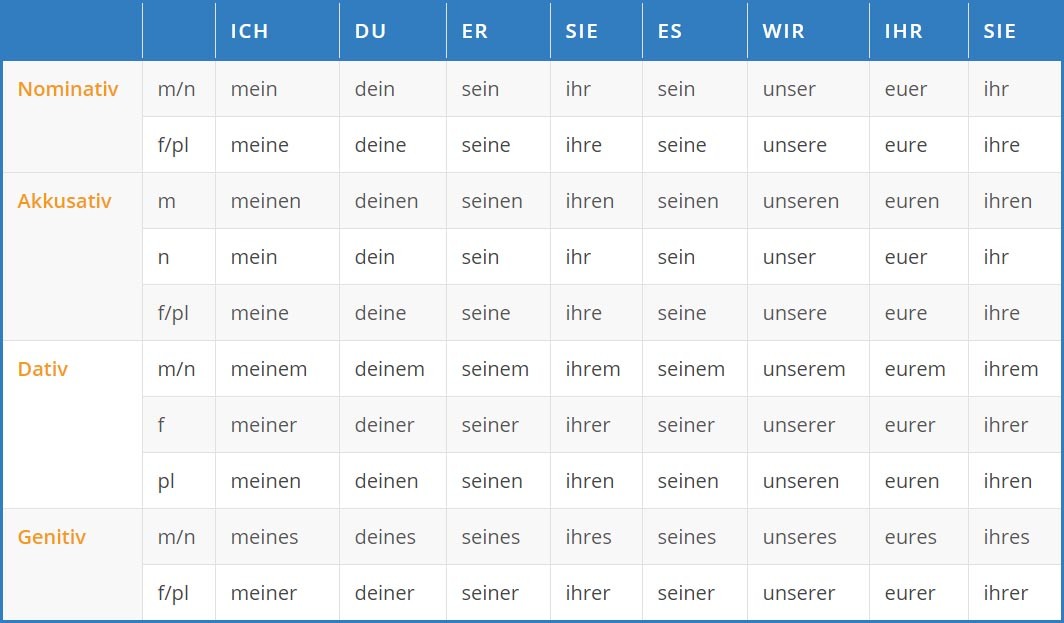
 scenic sun
man kann einen schulabschluss nachholen
is there a proper translation for this? i mean nachholen meaning
timid vector
make up/catch up
atomic sorrel
You can catch up on a graduation
timid vector
but I'm sure there are exceptions like always
atomic sorrel
not sure if thats right
timid vector
Basically, I think you would preferably say "school work" in english, since you don't really fall behind in a graduation
or just "on your schooling"
scenic sun
well let's wait a native then
timid vector
I mean they'll literally say the same thing (which you could have also found using any dictionary) but aight
 modest marten
I don't think there is a literal translation that fits the meaning exactly. "make up"/"catch up" is a good general translation, but in this case I would rather use something like (capturing the meaning, not word-by-word translation):
"It's (always) possible to finish [school/a school degree] [later/at a later time]."
If the translation should be more literal, I would probably use something along the lines of:
"One can (always) get a school degree afterwards."
I would use something different than "make up"/"catch up" because those to me have connotations I wouldn't want to have in the phrase.
"make up" for me goes too far in the direction of "make up for it", like rectifying a clear mistake.
"catch up" sound too much like a competition to me.
Both are connotations "nachholen" can have, but does not have to have and does not have in this circumstance.
fervent kernel
Gibt es Probleme oder Verbesserungsfähigkeite mit diesen Sätzen?
-> Die Gäste lächelten aufgeregt den Koch an, als er die Pfanne mit dem Omelett darin hochhielt.
-> Sie schnitt sich dann zwei Scheiben Brot ab und nahm die Nutella aus dem Schrank.
-> Schmidthaushalt kaufen ihr Gewürz immer im Supermarkt, welcher aus irgendeinem Grund zurzeit jeden Tag noch mehr berühmter wird. (vielleicht in diesem Satz kann "aus irgendeim Grund" nach "wird" gestellt werden?)
-> John war wegen Paris sehr besorgt, aber er ist dann seltsamerweise irgendwo total anders hingegangen: Berlin.
-> Wir haben das Menüschild angeguckt und bei der Kassiererin bestellt, was wir zu unserem Essen zu Trinken möchten.
modest marten
fervent kernel
Gibt es Probleme oder Verbesserungsfähigkeite mit diesen Sätzen?
**->** Die Gäs...
Ich schlage vor:
-> Die Gäste lächelten aufgeregt den Koch an, als er die Pfanne mit dem Omelett darin hochhielt.
-> Sie schnitt sich dann zwei Scheiben Brot ab und nahm die Nutella aus dem Schank.
-> Haushalt Schmidt (?) kaufen ihr Gewürz immer im Supermarkt, welcher aus irgendeinem Grund zurzeit jeden Tag noch berühmter wird.
-> John war wegen Paris sehr besorgt, aber er ist dann seltsamerweise irgendwo total anders hingegangen: Berlin.
-> Wir haben das Menüschild angeguckt und bei der Kassiererin bestellt, was wir zu unserem Essen zu Trinken möchten.
fervent kernel
modest marten
Ich schlage vor:
-> Die Gäste lächelten aufgeregt den Koch an, als er die Pfann...
Vielen Dank ⭐
timid vector
modest marten
I don't think there is a literal translation that fits the meaning exactly. "mak...
catch up doesn't have any implications of a competition (outside of maybe running? at least it definitely doesnt when talking about work/sleep etc), it simply means you got a little behind (missing assignments, you were absent etc) and are finishing work faster to get back to your current assignments
nachholen - etwas Versäumtes nachträglich erledigen (from dwds)
catch up - do tasks that one should have done earlier
narrow pier
Hello I have a question
( Der ideale Freitzeitsport ist meiner Ansicht nach Jogging )
I noticed something, so do these have the same meaning ( Meine Meinung nach = Meine Ansicht nach ) , and if I may ask why was in the first sentence ( meiner Ansicht and not meine Anischt ) why did it become dativ, in my example ?
long whale
narrow pier
Hello I have a question
( Der ideale Freitzeitsport ist meiner Ansicht nach Jog...
"nach" requires Dativ, whether it's used as a preposition (nach der Party) or as a postposition "meiner Meinung/Ansicht nach".
narrow pier
I have not heard that ( postposition ),
Wie kann ich es nachachauen,
Does it just simoly apply that nach comes at end and it affects the declension of the pronoun or noun before it ?, One other quetion please
In this sentence ( heutzutage sieht man fast jedes Kind mit einem eigenen Handy ) So I looked up dclenaion of ( eigenen ) and its original,it Nominiativ was ( eigene ) with articles of course, but my question is, does the preposition affects the declension both of the thing ( ein and eigene )
Like if there is a prepostion in the sentence, to what extent does it affects the nouns and pronouns before it
?
long whale
Both prepositions and postpositions (rare and mostly optional) affect everything attached to the noun they refer to.
@narrow pier
The only exceptions are adverbs/adverbial adjectives describing other adjectives: Nach diesem unglaublich lauten Konzert war ich fast taub. "unglaublich/incredibly" describes how loud the concert was, because it wasn't an incredible concert, right? so, "unglaublich" doesn't get declined in this case. Does that make sense?
narrow pier
So you are saying, if a preposiotion exists it can change the case of the all things realted to it ( nouns, adjectives, prouns, and articles ) but in your example, "unglaublich" was not declined, because it describes another adjectiv
I understood it like this, but can I say, that ( unglaublich ) in your sentence, can be a (gradpartikel ) righ?, Gradpartikels, also decribe adjectives, if I remember correctly
long whale
narrow pier
So you are saying, if a preposiotion exists it can change the case of the all th...
Mm... I thought Gradpartikeln were the ones which never change, like "sehr", but yes, if that helps you, then cosider it a Gradpartikel here. :)
narrow pier
hello, what is this connector called in German, I know there must be a word ,
example ( Stuttgart is a City with a lot of mountains ), but ( München in contrast, or on the other hand is flat )
I though I would use ( anderenfalls ) or ( auf der anderen Seite ), but I am not sure and ( auf der anderen Seite ) is a part of (zweiteilige Konnektor ), I am not sure if it will work, just using it alone
undone verge
you could say 'wohingegen' or 'während', for example
 fiery dock
my flash cards say "guck' mal" for "look at this"
what is the ' here, or should it just be "guck mal"
undone verge
it's not a word for word translation
and the apostrophe isn't necessary to my knowledge
fiery dock
what does it mean?
undone verge
idk if it's a typo or supposed to replace the e that sometimes comes on the end of imperatives
narrow pier
undone verge
you could say 'wohingegen' or 'während', for example
Thank you, the wohingegen sound very good, so my words, as I have thought won't work
narrow pier
undone verge
it's not a word for word translation
Stuttgart hat viele Schöne Hügel, wohingegen ist München eine Flache Stadt ( it wont change word order right?, )
is this example correct`?
long whale
narrow pier
Stuttgart hat viele Schöne Hügel, wohingegen ist München eine Flache Stadt ( i...
No. it's not correct. And yes, it will!
upbeat thicket
narrow pier
Stuttgart hat viele Schöne Hügel, wohingegen ist München eine Flache Stadt ( i...
Olympiaberg ?
long whale
Also, "In Stuttgart gibt es viele schöne Hügel"
long whale
upbeat thicket
*Olympiaberg* ?
Yeah, let's just not get into it, shall we?
upbeat thicket
Es ist zumindest erwähnenswert.
narrow pier
long whale
No. it's not correct. And yes, it will!
könntest du mich korrigieren
bitte
narrow pier
long whale
Also, "In Stuttgart gibt es viele **s**chöne Hügel"
yes, Rechtsschreibungsfehler , Vielen dank
long whale
Word order does change -> you can correct it yourself.
narrow pier
long whale
Also, "In Stuttgart gibt es viele **s**chöne Hügel"
I formed my sentence, according to this one on google (1936 musste die evangelische Kirche wegen Bergschäden abgerissen werden, wohingegen der Friedhof erhalten blieb. )
narrow pier
long whale
Word order does change -> you can correct it yourself.
I changed it, how is it now?
I just wnated to learn the word, not the whole grammer, thats they I asked for correction
I will learn it faster that way
long whale
narrow pier
I formed my sentence, according to this one on google (1936 musste die evangelis...
Oh no, you did not. Where is the verb in the wohingegen-clause? - If you changed anything, please link to it. :)
narrow pier
upbeat thicket
*Olympiaberg* ?
I think you mean, there are also mountains in München and it is not flat, but I am very sorry, I extracted that sentence, from Easy German, so I can not argue
long whale
narrow pier
I just wnated to learn the word, not the whole grammer, thats they I asked for c...
The word itself is of no use whatsoever to you, if you can't use it, because you don't know what kind of word it is, what kind of grammar it requires...
narrow pier
Stuttgart hat viele schöne Hügel, wohingegen München eine Flache Stadt ist( in wohingegen clause, I changed "ist " to second position, the only problem I saw
long whale
narrow pier
Stuttgart hat viele schöne Hügel, wohingegen München eine Flache Stadt ist( in w...
And there is still the same mistake in it. "wohingegen" requires subordinate clause word order.
narrow pier
long whale
The word itself is of no use whatsoever to you, if you can't use it, because you...
Maybe thats a mistake, but I am doing it all the time, I am trying to do some studiyng, but end up, having a though, or noticing a grammer topic, that is not my level, and at the end, I lost my precious time 
narrow pier
long whale
And there is still the same mistake in it. "wohingegen" requires subordinate cla...
you mean, ( Nebensatz ) right?, well I changed it to that now
long whale
No problem. I will now refrain from wasting any more of your precious time. :)
narrow pier
oh
I did not mean that
I think I said something rude, Ich Entschuldige mich sehr
@long whale
I did not mean to say any offensive things, sorry
upbeat thicket
narrow pier
I think you mean, there are also mountains in München and it is not flat, but I ...
Ah well 🙂
fervent kernel
Why is hinterher afterwards if hinter=behind?
charred fog
fervent kernel
Why is hinterher afterwards if hinter=behind?
can you give an example sentence where it means that?
fervent kernel
Vor der Prüfung habe ich so viel gelernt. Hinterher habe ich vieles wieder vergessen.
charred fog
well why is a difficult question
I guess that ties into how we view time as related to physical space and how that connects to how we talk about time
I mean, vor means both in front of and before
fervent kernel
"i stand in front of x"
"i stand before x"
thats different
charred fog
fervent kernel
"i stand in front of x"
"i stand before x"
thats different
what?
fervent kernel
nvm
charred fog
fervent kernel
Vor der Prüfung habe ich so viel gelernt. Hinterher habe ich vieles wieder verge...
I mean like "ich stehe vor dem Haus" and how the word was used here are both uses of it
 reef geyser
warum "Würd' so gerne tauchen bis zum Grund" und nicht "Würd' so gerne tauchen bis dem Grund" ?
south zenith
reef geyser
warum "Würd' so gerne tauchen bis zum Grund" und nicht "Würd' so gerne tauchen b...
'bis zu-' is a fairly common phrase and the 'zu' isnt necessary a lot of the time
though when you dont use 'zu', like in your second example, it wouldnt be dative, but nominative 'bis der Grund'
however, id say 'bis zum' is better suited there since it is talking in a physical/spatial sense
reef geyser
thank u so much . good explanation
south zenith
both can work
'Ich gehe zum Museum' and 'Ich gehe ins Hotel' arent wrong either
fervent kernel
Ah, danke
south zenith
only note i would make is that it is 'ins' because both are neuter | 'ins' = 'in das'
das Hotel and das Museum
if the noun is not neuter it is not 'das'
masculine = in den
feminine = in die
 charred harbor
Neither “in den” nor “in die” have abbreviations
Only “in das”
Realistically “in das” is almost always contracted
fervent kernel
Ja, ich verstehe
More generally, if i was saying that I was going to the Hotel, it would be far more common to use ins rather than zum correct?
charred harbor
They have different meanings
south zenith
ins literally means in the, so you wouldnt use it if you are not actually going into the hotel, but just to the building
charred harbor
“Ich gehe zum Hotel” means you go to it but you don’t necessarily go into it (you could go into it, or you could just stand in front of it)
“Ich gehe ins Hotel” specifically means you enter inside the building
fervent kernel
Dankeschön, that makes sense
south zenith
bis means 'until'
to 'zum Hotel' means 'to the hotel'
'bis zum Hotel' means 'until (you get to) the hotel'
it would mean your going, but stop when you get to the hotel
'fahre bis zum Hotel'
charred harbor
It’s honestly the same thing but with “bis” expressing a limit/end-point
fervent kernel
Viele dank, alles gut
 amber agate
I'm doing an exercise where I should fill a preposition mit Dativ.
I can't figure out the following sentence:
____ Regen mag ich nicht joggen.
What do you think is the answer?
undone verge
Do you understand what the sentence 'should' say?
amber agate
undone verge
Do you understand what the sentence 'should' say?
I don't like jogging in rain.
Right?
undone verge
yeah exactly 🙂 so now you just need to figure out what preposition you need to use to say 'in the rain' in german
I think technically there's two options and I'm actually not 100% sure which works 'best' here. Option 1 is very very similar to how you'd say it in english (i.e. in the rain --> in + dative article + Regen)
Another common way to talk about weather in German is with the preposition 'bei'
 vital iris
Hez guys what is the difference betwwen fertigkeit and fähigkeit
i also found the word geschick
long whale
vital iris
Hez guys what is the difference betwwen fertigkeit and fähigkeit
Fertigkeit = skill; Fähhigkeit = ability. Please note capitalization of nouns isn't optional in German.
amber agate
undone verge
Another common way to talk about weather in German is with the preposition 'bei'
I see. That's what I was missing. I also thought that I could use in but since the exercise was about prepositions in dativ only, I could not use it. Thank you so much
long whale
amber agate
I see. That's what I was missing. I also thought that I could use `in` but since...
I think you're missing something else: if the question is "Where?/Wo?", Dativ is obligatory with Wechselpräpositionen. Yes, jogging is a movement, but you wouldn't be jogging towards the rain. ;)
amber agate
I don't get what you mean by the last sentence
Yes, jogging is a movement, but you wouldn't be jogging towards the rain.
Also, how does my answer says anything about not using dativ with Wechselpräpositionen? It wasn't at all about Wechselpräpositionen, or was it?
long whale
Ah, you were not supposed to use Wechselpräpositionen at all, is that it? In that case, yes, "bei" was was your only choice. :) Otherwise "Im Regen mag ich nicht joggen", resp. "Im Regen jogge ich nicht gern" would have worked. ;)
@amber agate
amber agate
long whale
Ah, you were not supposed to use *Wechselpräpositionen* at all, is that it? In t...
Yes, I wasn't supposed to use Wechselpräpositionen. I'm sorry if my message was a bit confusing. Anyway, thank you for the additional information 🙂
narrow pier
Hello, I have a question, its from Audio of German exams,
die Frage : Welche Sendung folgt auf die Nachrichten
a- Eine Musiksendung
b-Nachrichten aus Össtereich
c-Eine Sendung aus der Politik
and you must listen to the audio, to get answer, here is that Part that answers the question
" Sie hören jeztz die 19-Uhr-Nachrichten. wegen der aktuellen politischen Ereignisse beginnt unsere musikalische Reise durch Österreich etwa 40 Minuten später. Im Anschluss an die Nachrichten folgt stattdessen die Sondersendung von Radio Direkt zum Besuch des französischen Staatspräsidenten in Berlin. Unser Korrespondent Christian Ziegler Sie direkt aus Berlin.
so my question is ( Was folgt auf die Nachrichten ) means , what comes after the news, and in the Audio it says " Im Anschluss an die Nachrichten folgt stattdessen die ....... " so Im Anschluss, " does this also mean, following that?,
in my opinion the Answer would be ( c ) after I looked at the transcription many times, can someone help me please?
long whale
narrow pier
Hello, I have a question, its from Audio of German exams,
*die Frage : Welche S...
Yes, answer C is correct. :)
narrow pier
long whale
Yes, answer C is correct. :)
Im Anschluss = folgt ( is this true )
long whale
narrow pier
Im Anschluss = folgt ( is this true )
Yes, same as "anschließend" -> it's what comes next. ;)
fervent kernel
modest marten
Ich schlage vor:
-> Die Gäste lächelten aufgeregt den Koch an, als er die Pfann...
Übrigens wollte ich fragen:
"Sie schnitt sich zwei Scheiben Brot ab" mit der "abschneiden" Form würde besser passen, weil der Aktor der Aktion die resultierenden Brotscheiben bekommt?
Wäre das dafür eine gute Erklärung, die Unterschied zwischen "schneiden" und "abschneiden"?
long whale
fervent kernel
Übrigens wollte ich fragen:
"Sie schnitt sich zwei Scheiben Brot **ab**" mit d...
Not the person you were asking, but to my knowledge, the "ab-" implies there is a considerable bit left. If I'm cutting a whole loaf into slices, I might say "Ich schneide das [ganze] Brot in Scheiben". If I were cutting a slice of cake for you (off the whole rest of the cake), I'll say "Ich schneide dir eine Scheibe/ein Stück Kuchen ab" Does that help?
BTW, here's something about prefixes you may find helpful/interesting: https://www.dartmouth.edu/~deutsch/Grammatik/Wortbildung/Separables.html#ab
fervent kernel
long whale
Not the person you were asking, but to my knowledge, the "ab-" implies there is ...
wow, that makes a lot of sense with regards to the meaning of the preposition!
thanks
i will check that source out now, too
narrow pier
long whale
Yes, same as "anschließend" -> it's what comes next. ;)
thank you, I will look them , but one question , " Im Anschluss " can it be used alone?, or it must come with "folgen" as in my example (Im Anschluss an die Nachrichten folgt stattdessen die Sondersendung)
amber agate
I don't quite understand why mit isn't used in the following sentence instead of bei.
Bei dem Projekt hilft mir Paul und sein Bruder.
Any idea?
long whale
narrow pier
thank you, I will look them , but one question , " Im Anschluss " can it be used...
It's like "next", I'd say...
long whale
amber agate
I don't quite understand why `mit` isn't used in the following sentence instead ...
Because it's usually "jemandem bei etwas helfen" (mit/with is what happens in English)
amber agate
long whale
Because it's usually "jemandem *bei* etwas helfen" (mit/with is what happens in ...
Thank you. That's interesting. I would naturally say mit because of the direct translation from English. I guess I have to remember this one
narrow pier
Hello
Does discord give thr Opputunity to send voice messages?
Its will be very helpful, if We can do this here in this server, when asking a question
Or if not possible, using Vocaroo here,
night dagger
narrow pier
Or if not possible, using Vocaroo here,
Vocaroo is what people use for #pronunciation, so I would just use that.
narrow pier
is that channel, only for pronounciation, or it can be used for other things
night dagger
narrow pier
is that channel, only for pronounciation, or it can be used for other things
It’s a channel to check your pronunciation :)
narrow pier
night dagger
It’s a channel to check your pronunciation :)
Danke Dir
( here Dir has to be capitalized, because I am directly talking to you, right? )
my teacher said all personal pronouns like( ich, du er/sie/es, wir, ihr sie/Sie ) these has to be capitalized, when you are writing a letter, and you are speaking to the person directly, like for example asking them something
night dagger
narrow pier
( here Dir has to be capitalized, because I am directly talking to you, right? )
Technically, yes, because this is what you would see in professional emails and the like. However, we’re using discord, it’s very casual - you don’t have to capitalize Du, Dir, etc. only the actual formal case: Sie, Ihnen…
narrow pier
night dagger
Technically, yes, because this is what you would see in professional emails and ...
I know Discord is casual, but I would have to do that in a test, Thank you so much
Verstanden
 zinc dock
Hallo an alle.
( Rund ums Auto )
Warum " ums " endet mit " s"
 rare jetty
Its basically just short for "um das"
Like in English when you unite "it" and "is" to "it's"
zinc dock
rare jetty
Like in English when you unite "it" and "is" to "it's"
Perfekt, denke für dir.
night dagger
zinc dock
Perfekt, denke für dir.
Btw, you will see these contractions quite a bit; sometimes they are colloquial, and sometimes they are not colloquial at all, rather, quite necessary to sound more natural.
"kannste" - "kannst du", this would be an example of colloquial language use; not necessary to speak this way at all.
"vom Baum" - "von dem Baum", this would be an example where it's normally much more idiomatic to use "vom" rather than "von dem". If you were to say "von dem Baum", that would indicate more specificity to a specific tree.
fervent kernel
@night dagger what shows /books did you read when you started geman that helped you learn a ton
night dagger
fervent kernel
<@408327221464399884> what shows /books did you read when you started geman that...
Everything possible.
fervent kernel
Yes good anything u recommend though
night dagger
fervent kernel
Yes good anything u recommend though
Everything on Netflix and ZDF.
I would recommend Mord mit Aussicht, Der Tatortreiniger, Kleo, Phoenix.
Tribes of Europa, Dark.
Biohackers.
How to sell drugs online fast.
Anything you can get your hands on, watch it and see if you like it :).
zinc dock
night dagger
Btw, you will see these *contractions* quite a bit; sometimes they are colloquia...
Das ist super
Vielen Dank
night dagger
zinc dock
Das ist super
Vielen Dank
kein Ding
 oblique shoal
Hallo 🙋♀️ Ich habe eine Frage..
Why does verb (lassen) here is konjugated differently
- Lass uns jetzt die Hausaufgabe machen.
- Lasst uns etwas kochen.
Dankeschön im Voraus🙏
timid vector
lass (du) ...
lasst (ihr) ...
oblique shoal
timid vector
lass (du) ...
lasst (ihr) ...
I see! I always confused at this part especially when they leave it blank😂👍 thanks!
night dagger
Lassen used to be my least favorite word 😂.
oblique shoal
Eep you are right about that! They can come in many forms😭 and I avoided using it in certain situations
charred fog
night dagger
Btw, you will see these *contractions* quite a bit; sometimes they are colloquia...
I remember I saw a really good table for preposition + article contractions but I'm not sure where it is
I'll send it if I find it
@zinc dock here
 fervent kernel
Ich möchte meine große Wohnung gegen eine klein**__ere __**tauschen
Where did this "ere" come from?
Is there a table for this?
charred fog
fervent kernel
Ich möchte meine große Wohnung gegen eine klein**__ere __**tauschen
--
Where did...
-er at the end of an adjective means the exact same as it does in English
kleiner = smaller
and then the -e is added on because of regular declension rules in accusative feminine (feminine because the word "Wohnung" is implied already, it's "gegen eine kleinere (Wohnung)" but it sounds better omitted because it's already very obvious from context)
fervent kernel
ja
danke schön
 charred fog
fervent kernel
ja
danke schön
charred fog
fervent kernel
ja
danke schön
not sure why you circled that, that's neuter and the example is feminine
nimble viper
fervent kernel
I was learning for 2 hours and im little bit tired
These adjective tables are a headache, no worries. Hopefully you get it soon and never have to use it again
eig imo absolute torture those tables are