#botchannel
1 messages · Page 211 of 1
 tender trellis
 lean flickerBOT
CEFR levels
If you see something like A1, B2 or C1, these represent the proficiency of a speaker in a language they're not native in, and are called CEFR levels. They are valid for any language, not only German!
Roughly speaking, A levels are beginners and C levels are experts. Remember that CEFR level are self-assessed and indicative!
You can see more specific names and descriptions on the Wikipedia page:
https://en.wikipedia.org/wiki/Common_European_Framework_of_Reference_for_Languages
🗨 How do I know what level I am?
If the table on Wikipedia is too generic for you, you can try using this one here:
https://rm.coe.int/168045bb52
Just check each column one at a time: if you can do all it describes, move to the next column. Your level is the highest where you can do the most things.
Alternatively, you can use this questionnaire to estimate your level more accurately:
https://www.laits.utexas.edu/fi/sites/laits.utexas.edu.fi/files/Self Assessment Checklist European.pdf
tender trellis
faq cefr a1
lean flickerBOT
FAQ not found. I found the following similar entry: CEFR (1)
Select one of the values in the brackets to directly open the suggested FAQ.
tender trellis
faq cefr 1
lean flickerBOT
FAQ not found. I found the following similar entry: CEFR (1)
Select one of the values in the brackets to directly open the suggested FAQ.
 manic quiver
faq beginner
lean flickerBOT
How to get started - Part 2
Please make sure to read Part 1 before starting Part 2!
Part 2 – Beyond a Simple Sentence
1: Conjunctions (coordinating and subordinating)
2: Subordinate clause word order
3: Dative case
4: Dative verbs
5: Verbs with two objects (e.g. geben)
6: Prepositions (accusative, dative, and two-way)
7: Spoken past tense (Perfekt)
8: Written past tense (Präteritum)
9: Genitive case
10: Relative clauses
11: Adjective declension
Tips
- Make sure to practice writing and reading simple texts
- Some of these concepts are confusing to start with, so it’s a good idea to ask for help in #questions when you’re unsure
- You should use a declension chart to help with declension to start with, because you won’t be able to memorize it straight away
- After you feel confident with creating sentences, you can start learning the adjective declension properly by using the command >faq adjective declension and reading the guide provided
Page 2/2
 oak bane
faq negation
lean flickerBOT
Negation
Negations or negative sentences in German are formed with either kein or nicht.
You use kein if you want to negate nouns with an indefinite article or without an article, for example:
(1) Ich besitze kein Auto. (I don't own a car.)
(2) Ich habe keinen Hunger. (I'm not hungry.)
‼ kein is always placed right before the noun you want to negate. Also note that you need to decline kein.
If you want to negate anything else you use nicht, for example:
(3) Ich schlafe nicht. (I don't sleep.) [verb]
(4) Ich habe gestern nicht geduscht. (I didn't shower yesterday.) [verb]
(5) Ich gehe nicht gerne schwimmen. (I don't like to go swimming.) [adverb]
(6) Es ist nicht heiß. (It's not hot.) [adjective]
(7) Ich habe nicht dich, sondern ihn gerufen. (I didn't call you, but him.) [pronoun]
(8) Das ist nicht Peters Fahrrad, sondern meins. (This isn't Peters bicycle, but mine.) [proper noun]
(9) Der Zug kommt nicht um 18 Uhr an. (The train doesn't arrive at 6pm.) [preposition]
(10) Ich habe nicht das Essen bezahlt, sondern die Getränke. (I didn't pay for the food, but for the drinks.) [definite article]
‼ Note that nicht almost always comes before the word it negates, unless you want to negate a verb.
If that's the case, it depends on the tense of the verb and on whether there is an auxiliary verb or not. nicht is placed right after the verb if the verb is in present or past tense. For compound tenses or when the sentence has an auxiliary it is placed before the verb.
🌟 Confused by the terminology? See >ex Grammar terms
 ruby forum
faq beginner
lean flickerBOT
How to get started
The simplest way to learn German is to find topics you don’t understand yet and search for explanations of them. This list provides you with a guide for which topics to learn if you are completely new to German. Type the topic into Google (or YouTube) and start learning!
Introduction
1: Alphabet (especially ä, ü, ö and ß)
2: Basic greetings (hello, goodbye, etc.)
Part 1 - Simple Sentence
1: Noun gender & plurals
2: Nominative case (What are cases?)
3: Nominative pronouns (I, you, he, she, etc.)
4: Verbs in present tense
5: Definite/indefinite articles
6: Accusative case (for nouns)
7: Accusative pronouns
8: Word order of simple sentences
9: How to ask questions
See Part 2 on the next page.
Tips
- Always learn the gender of a noun when you learn a new noun
- Learn to use a translation dictionary (e.g. dict.cc, leo.org)
- Use
>faq resourcesto see our list of German learning resources - For listening and pronunciation practice, try watching movies or videos (incl. YouTube)
- You can listen to pronunciation for words on websites like dict.cc, forvo.com, and others
- Practice writing sentences every day (and asking people to correct them)
- Ask as many questions as possible
- Don’t be scared to make mistakes!!!! If you don’t let yourself make mistakes, you will never be able to learn German
Page 1/2
 vast gazelle
faq beginner
 latent talon

 candid coral

 unique canopy
faq cefr
 static blade
star random Trax
lean flickerBOT
 Trax
Trax
:star: 3 - `#lessons`
[Jump to post](#lessons message)
when no one toots your horn you have to fart yourself
Message ID: 696114691058958387
·
static blade
hmmmm
 nova gust
star random Fercho
lean flickerBOT
 Ph
Ph
:star2: 7 - `#general`
[Jump to post](#general message)
trax evasion
Message ID: 788087159722082324
·
nova gust
star random nikyq
lean flickerBOT
nova gust
star random nikyq
lean flickerBOT
 nikyq
nikyq
:star: 4 - `#general`
[Jump to post](#general message)
Mail me senpai
Message ID: 848186917593940022
·
nova gust
star random nikyq
lean flickerBOT
nikyq
:star: 4 - `#general`
[Jump to post](#general message)
are you a vergeigen?
Message ID: 922169525066166312
·
lean flickerBOT
 xverwirrte
:star: 3 - `#german-only`
[Jump to post](#german-only message)
Das hänge ich mir an die Wand

Message ID: 931840965524733962
·
nova gust
star random xverwirrte
lean flickerBOT
xverwirrte
:star2: 9 - `#general`
[Jump to post](#general message)
You are Bulli's Fan. Considering that, you should be familiar with being shocked and disappointed:AA_Hana_Shrug:
Message ID: 932657830010433557
·
nova gust
star random camie
lean flickerBOT
 camie
camie
:star: 5 - `#general`
[Jump to post](#general message)
one with a car inside
Message ID: 929713297719197756
·
nova gust
star random camie
lean flickerBOT
camie
:star: 4 - `#general`
[Jump to post](#general message)
i would never hit my sister 🥺 i would bite her instead
Message ID: 841673804479594526
·
 humble walrus
star random
lean flickerBOT
 maple
maple
:star: 4 - `#general`
[Jump to post](#general message)
liquefy me daddy
Message ID: 592793994732240996
·
 wide orbit
faq cefr
lean flickerBOT
CEFR levels
If you see something like A1, B2 or C1, these represent the proficiency of a speaker in a language they're not native in, and are called CEFR levels. They are valid for any language, not only German!
Roughly speaking, A levels are beginners and C levels are experts. Remember that CEFR level are self-assessed and indicative!
You can see more specific names and descriptions on the Wikipedia page:
https://en.wikipedia.org/wiki/Common_European_Framework_of_Reference_for_Languages
🗨 How do I know what level I am?
If the table on Wikipedia is too generic for you, you can try using this one here:
https://rm.coe.int/168045bb52
Just check each column one at a time: if you can do all it describes, move to the next column. Your level is the highest where you can do the most things.
Alternatively, you can use this questionnaire to estimate your level more accurately:
https://www.laits.utexas.edu/fi/sites/laits.utexas.edu.fi/files/Self Assessment Checklist European.pdf
wide orbit
faq C1
lean flickerBOT
FAQ not found. Try >explain all.
 winged sedge
faq cepr
lean flickerBOT
FAQ not found. Try >explain all.
winged sedge
faq cper
lean flickerBOT
FAQ not found. Try >explain all.
winged sedge
faq cefr
lean flickerBOT
CEFR levels
If you see something like A1, B2 or C1, these represent the proficiency of a speaker in a language they're not native in, and are called CEFR levels. They are valid for any language, not only German!
Roughly speaking, A levels are beginners and C levels are experts. Remember that CEFR level are self-assessed and indicative!
You can see more specific names and descriptions on the Wikipedia page:
https://en.wikipedia.org/wiki/Common_European_Framework_of_Reference_for_Languages
🗨 How do I know what level I am?
If the table on Wikipedia is too generic for you, you can try using this one here:
https://rm.coe.int/168045bb52
Just check each column one at a time: if you can do all it describes, move to the next column. Your level is the highest where you can do the most things.
Alternatively, you can use this questionnaire to estimate your level more accurately:
https://www.laits.utexas.edu/fi/sites/laits.utexas.edu.fi/files/Self Assessment Checklist European.pdf
lean flickerBOT
CEFR levels
If you see something like A1, B2 or C1, these represent the proficiency of a speaker in a language they're not native in, and are called CEFR levels. They are valid for any language, not only German!
Roughly speaking, A levels are beginners and C levels are experts. Remember that CEFR level are self-assessed and indicative!
You can see more specific names and descriptions on the Wikipedia page:
https://en.wikipedia.org/wiki/Common_European_Framework_of_Reference_for_Languages
🗨 How do I know what level I am?
If the table on Wikipedia is too generic for you, you can try using this one here:
https://rm.coe.int/168045bb52
Just check each column one at a time: if you can do all it describes, move to the next column. Your level is the highest where you can do the most things.
Alternatively, you can use this questionnaire to estimate your level more accurately:
https://www.laits.utexas.edu/fi/sites/laits.utexas.edu.fi/files/Self Assessment Checklist European.pdf
tender trellis
faq beginner
lean flickerBOT
How to get started - Part 2
Please make sure to read Part 1 before starting Part 2!
Part 2 – Beyond a Simple Sentence
1: Conjunctions (coordinating and subordinating)
2: Subordinate clause word order
3: Dative case
4: Dative verbs
5: Verbs with two objects (e.g. geben)
6: Prepositions (accusative, dative, and two-way)
7: Spoken past tense (Perfekt)
8: Written past tense (Präteritum)
9: Genitive case
10: Relative clauses
11: Adjective declension
Tips
- Make sure to practice writing and reading simple texts
- Some of these concepts are confusing to start with, so it’s a good idea to ask for help in #questions when you’re unsure
- You should use a declension chart to help with declension to start with, because you won’t be able to memorize it straight away
- After you feel confident with creating sentences, you can start learning the adjective declension properly by using the command >faq adjective declension and reading the guide provided
Page 2/2
 pine hatch
faq beginner
lean flickerBOT
How to get started - Part 2
Please make sure to read Part 1 before starting Part 2!
Part 2 – Beyond a Simple Sentence
1: Conjunctions (coordinating and subordinating)
2: Subordinate clause word order
3: Dative case
4: Dative verbs
5: Verbs with two objects (e.g. geben)
6: Prepositions (accusative, dative, and two-way)
7: Spoken past tense (Perfekt)
8: Written past tense (Präteritum)
9: Genitive case
10: Relative clauses
11: Adjective declension
Tips
- Make sure to practice writing and reading simple texts
- Some of these concepts are confusing to start with, so it’s a good idea to ask for help in #questions when you’re unsure
- You should use a declension chart to help with declension to start with, because you won’t be able to memorize it straight away
- After you feel confident with creating sentences, you can start learning the adjective declension properly by using the command >faq adjective declension and reading the guide provided
Page 2/2
 dreamy moon
star random Anwenden
lean flickerBOT
No entries found.
dreamy moon

 wet locust

candid coral

lean flickerBOT
 Bottfried W. Leibniz
:star: 3 - `#general`
[Jump to post](#general message)
"oIdA I BiMs 1S BrOoB No aNiMeS BiDdE"
Message ID: 651084372610646028
·
candid coral
star random Bottfried W. Leibniz
lean flickerBOT
Bottfried W. Leibniz
:star: 3 - `#general`
[Jump to post](#general message)
haha hecke is a masterbaiter
Message ID: 653697197594116106
·
dreamy moon
play Around the World
lean flickerBOT
Daft Punk - Around The World (Official Music Video Remastered) [00:04:02] added to the queue.
dreamy moon
play Spannende musik
lean flickerBOT
SPANNENDE MUSIK! - [NO COPYRIGHT!] - PERFEKT FÜR VIDEOS! [00:08:28] added to the queue.
dreamy moon
play über denn wolken
lean flickerBOT
Reinhard Mey - Über den Wolken [00:03:52] added to the queue.
 violet trail
e
dreamy moon
play über denn wolken
lean flickerBOT
Reinhard Mey - Über den Wolken [00:03:52] added to the queue.
dreamy moon
play Spannende musik
lean flickerBOT
SPANNENDE MUSIK! - [NO COPYRIGHT!] - PERFEKT FÜR VIDEOS! [00:08:28] added to the queue.
latent talon

dreamy moon
play Spannende musik
lean flickerBOT
SPANNENDE MUSIK! - [NO COPYRIGHT!] - PERFEKT FÜR VIDEOS! [00:08:28] added to the queue.
dreamy moon
play klatschen
lean flickerBOT
Klatschen! In schwarz weiß [00:00:09] added to the queue.
lean flickerBOT
SPANNENDE MUSIK! - [NO COPYRIGHT!] - PERFEKT FÜR VIDEOS! [00:08:28] added to the queue.
dreamy moon

National anthem of the United States of America - The Star-Spangled Banner (English/German lyrics)
► T-Shirt - https://amzn.to/3G83k5I
► Hoodie - https://amzn.to/3wAmU7y
► Cap - hhttps://amzn.to/3wHONcN
► Book - https://amzn.to/3LyosTT
► Top Products - https://amzn.to/3wyVG1k
Support Us: https://www.paypal.me/JRvideos - Thank You!
Th...
lean flickerBOT
Nationalhymne der USA - Das sternenbesetzte Banner (EN/DE Text) [00:04:13] added to the queue.
dreamy moon
 lean flickerBOT
Deutsche Nationalhymne mit Gesang und Text [00:01:16] added to the queue.
dreamy moon

Unser neues Album "Läuft bei Euch" ist ab sofort bei uns im Shop: http://www.wiseguys-shop.de, auf Amazon: http://amzn.to/1MDvpCj, iTunes: http://www.umgt.de/tjSrgT und Spotify: http://spoti.fi/1MVOooB zu kaufen.
Du bist auf der Suche nach den Noten zu unseren Songs? Dann kannst Du dir unter http://www.meinsongbook.de dein eigenes und individue...
lean flickerBOT
Wise Guys - Deutsche Bahn [00:03:43] added to the queue.
dreamy moon
skip
dreamy moon
Unser neues Album "Läuft bei Euch" ist ab sofort bei uns im Shop: http://www.wiseguys-shop.de, auf Amazon: http://amzn.to/1MDvpCj, iTunes: http://www.umgt.de/tjSrgT und Spotify: http://spoti.fi/1MVOooB zu kaufen.
Du bist auf der Suche nach den Noten zu unseren Songs? Dann kannst Du dir unter http://www.meinsongbook.de dein eigenes und individue...
lean flickerBOT
Wise Guys - Deutsche Bahn [00:03:43] added to the queue.
dreamy moon
skip

The official video "SPACEMAN" by Electric Callboy feat. FiNCH!
Stream the song here: https://electriccallboy.lnk.to/Spaceman-Single
Subscribe to our YouTube channel:
https://www.youtube.com/c/electriccallboy?sub_confirmation=1
http://electriccallboy.com
▬▬▬▬▬▬▬▬▬▬▬▬▬▬▬▬▬▬▬▬▬▬▬▬▬▬▬▬▬
• Merch EU: http://electriccallboy.bravado.de
• Merch US: htt...
lean flickerBOT
Electric Callboy - SPACEMAN feat. @FiNCH (OFFICIAL VIDEO) [00:03:36] added to the queue.
candid coral

Hören sie Verkehrsgeräusche, beobachten Sie eine Kreisverkehr und schlafen Sie dabei ein.
Perfekt zum einschlafen, entspannen, meditieren und lernen. Und generell zum abschalten und entspannen.
Aber auch um dabei Yoga zu machen.
Wenn dir meine Videos gefallen lass bitte ein Daumen nach oben und Kommentar da.
Und vergiss nicht zu abonnieren.
A...
lean flickerBOT
Nachts in der Stadt- Verkehrsgeräusche [00:31:05] added to the queue.
dreamy moon
play Autobahn kraftwerk
lean flickerBOT
Kraftwerk Autobahn full [00:22:43] added to the queue.
dreamy moon
skip
lean flickerBOT
Skip vote added. 1/2 votes required to skip.
candid coral
skip
dreamy moon

Provided to YouTube by Century Media
Spaceman · Electric Callboy · FiNCH
Spaceman
℗ 2022 Century Media Records Ltd. under exclusive license from Electric Callboy
Released on: 2022-04-08
Associated Performer: Electric Callboy feat. FiNCH
Composer, Lyricist: Nico Sallach
Composer, Lyricist, Mixing Engineer, Producer, Recording Engineer: Da...
lean flickerBOT
Spaceman [00:03:10] added to the queue.
dreamy moon
skip
candid coral
play hochzeitsmusik
lean flickerBOT
Hochzeitsmusik - Die Nr.1 Hochzeit-Musik - #Weddingmusic [00:07:14] added to the queue.
candid coral
skip
lean flickerBOT
The bot is not playing any songs.
dreamy moon
play hochzeitsmusik
lean flickerBOT
Hochzeitsmusik - Die Nr.1 Hochzeit-Musik - #Weddingmusic [00:07:14] added to the queue.
 zenith crane
faq cefr
lean flickerBOT
CEFR levels
If you see something like A1, B2 or C1, these represent the proficiency of a speaker in a language they're not native in, and are called CEFR levels. They are valid for any language, not only German!
Roughly speaking, A levels are beginners and C levels are experts. Remember that CEFR level are self-assessed and indicative!
You can see more specific names and descriptions on the Wikipedia page:
https://en.wikipedia.org/wiki/Common_European_Framework_of_Reference_for_Languages
🗨 How do I know what level I am?
If the table on Wikipedia is too generic for you, you can try using this one here:
https://rm.coe.int/168045bb52
Just check each column one at a time: if you can do all it describes, move to the next column. Your level is the highest where you can do the most things.
Alternatively, you can use this questionnaire to estimate your level more accurately:
https://www.laits.utexas.edu/fi/sites/laits.utexas.edu.fi/files/Self Assessment Checklist European.pdf
 hushed wolf
faq beginner
lean flickerBOT
How to get started
The simplest way to learn German is to find topics you don’t understand yet and search for explanations of them. This list provides you with a guide for which topics to learn if you are completely new to German. Type the topic into Google (or YouTube) and start learning!
Introduction
1: Alphabet (especially ä, ü, ö and ß)
2: Basic greetings (hello, goodbye, etc.)
Part 1 - Simple Sentence
1: Noun gender & plurals
2: Nominative case (What are cases?)
3: Nominative pronouns (I, you, he, she, etc.)
4: Verbs in present tense
5: Definite/indefinite articles
6: Accusative case (for nouns)
7: Accusative pronouns
8: Word order of simple sentences
9: How to ask questions
See Part 2 on the next page.
Tips
- Always learn the gender of a noun when you learn a new noun
- Learn to use a translation dictionary (e.g. dict.cc, leo.org)
- Use
>faq resourcesto see our list of German learning resources - For listening and pronunciation practice, try watching movies or videos (incl. YouTube)
- You can listen to pronunciation for words on websites like dict.cc, forvo.com, and others
- Practice writing sentences every day (and asking people to correct them)
- Ask as many questions as possible
- Don’t be scared to make mistakes!!!! If you don’t let yourself make mistakes, you will never be able to learn German
Page 1/2
 dusk vale
faq beginner
lean flickerBOT
How to get started
The simplest way to learn German is to find topics you don’t understand yet and search for explanations of them. This list provides you with a guide for which topics to learn if you are completely new to German. Type the topic into Google (or YouTube) and start learning!
Introduction
1: Alphabet (especially ä, ü, ö and ß)
2: Basic greetings (hello, goodbye, etc.)
Part 1 - Simple Sentence
1: Noun gender & plurals
2: Nominative case (What are cases?)
3: Nominative pronouns (I, you, he, she, etc.)
4: Verbs in present tense
5: Definite/indefinite articles
6: Accusative case (for nouns)
7: Accusative pronouns
8: Word order of simple sentences
9: How to ask questions
See Part 2 on the next page.
Tips
- Always learn the gender of a noun when you learn a new noun
- Learn to use a translation dictionary (e.g. dict.cc, leo.org)
- Use
>faq resourcesto see our list of German learning resources - For listening and pronunciation practice, try watching movies or videos (incl. YouTube)
- You can listen to pronunciation for words on websites like dict.cc, forvo.com, and others
- Practice writing sentences every day (and asking people to correct them)
- Ask as many questions as possible
- Don’t be scared to make mistakes!!!! If you don’t let yourself make mistakes, you will never be able to learn German
Page 1/2
 narrow girder
faq beginner
lean flickerBOT
How to get started - Part 2
Please make sure to read Part 1 before starting Part 2!
Part 2 – Beyond a Simple Sentence
1: Conjunctions (coordinating and subordinating)
2: Subordinate clause word order
3: Dative case
4: Dative verbs
5: Verbs with two objects (e.g. geben)
6: Prepositions (accusative, dative, and two-way)
7: Spoken past tense (Perfekt)
8: Written past tense (Präteritum)
9: Genitive case
10: Relative clauses
11: Adjective declension
Tips
- Make sure to practice writing and reading simple texts
- Some of these concepts are confusing to start with, so it’s a good idea to ask for help in #questions when you’re unsure
- You should use a declension chart to help with declension to start with, because you won’t be able to memorize it straight away
- After you feel confident with creating sentences, you can start learning the adjective declension properly by using the command >faq adjective declension and reading the guide provided
Page 2/2
dusk vale
faq resources
lean flickerBOT
Resources
 worthy bramble
play Spannende musik
lean flickerBOT
SPANNENDE MUSIK! - [NO COPYRIGHT!] - PERFEKT FÜR VIDEOS! [00:08:28] added to the queue.
worthy bramble
play hochzeitsmusik
lean flickerBOT
Hochzeitsmusik - Die Nr.1 Hochzeit-Musik - #Weddingmusic [00:07:14] added to the queue.
worthy bramble
skip
Unser neues Album "Läuft bei Euch" ist ab sofort bei uns im Shop: http://www.wiseguys-shop.de, auf Amazon: http://amzn.to/1MDvpCj, iTunes: http://www.umgt.de/tjSrgT und Spotify: http://spoti.fi/1MVOooB zu kaufen.
Du bist auf der Suche nach den Noten zu unseren Songs? Dann kannst Du dir unter http://www.meinsongbook.de dein eigenes und individue...
lean flickerBOT
Wise Guys - Deutsche Bahn [00:03:43] added to the queue.
lean flickerBOT
1-hour of real moaning with orgasms (ASMR)! [01:01:18] added to the queue.
lean flickerBOT
"Tum Hi Ho" Aashiqui 2 Full Song With Lyrics | Aditya Roy Kapur, Shraddha Kapoor [00:04:28] added to the queue.
 tropic pelican
faq anki
lean flickerBOT
Flashcard Tips
When creating flashcards it is not enough to just have a single german word on one side, and a single word translation on the other side of the card. You want to provide details that match your learning style and help you better understand what the word means.
For nouns
At the very least, include the gender and the plural form. E.g. Der Mann | Die Männer or Der Mann -:er Whichever form helps you recognise the plural ending and any vowel changes. You may also want to add a note for weak masculine nouns. (See >explain N-Declension.)
For verbs
Include the infinitive, the preterite (simple past) and the past participle (perfect form). E.g. rennen | rannte | gerannt or for a separable verb anrufen | rief an | angerufen. For irregular verbs, you may want to list all present tense conjugations. You may also want to include if the verb uses haben or sein as its auxiliary.
For all words
Adding an example sentence is important for helping you understand the usage and context of a word (dwds.de and linguee.com are good sources of example sentences). You may also want to add multiple translations for words that have multiple meanings. E.g. Die Auflage can mean both a requirement, and the edition of a book. You may also want to try picture cues or audio recordings (possible sources for voice recordings include dict.cc, linguee.com, duden.de, and wiktionary.de).
Close Passages
Flashcards based on close passages can be a very effective way to learn new vocabulary. E.g. put Ich kaufe Lebensmittel im [blank] ein. on one side of the flashcard, and Ich kaufe Lebensmittel im *Markt* ein; der Markt, die Märkte - market. This places vocabulary in context to help you understand its meaning and usages, and also provides you with whole phrases that help jolt your memory when trying to remember an individual word.
Recall vs. Reproduction
Flashcards are most effective when they train your ability to reproduce knowledge. I.e. Seeing the word Baum and recognising it as tree is a lot less effective than being able to look at a picture of a tree and know it means der Baum. Taking that a step further you want to be able to also know that that while die Struktur also means 'tree', it doesn't actually mean the plant. When creating flashcards, try to design them with these concepts in mind. E.g. Using minimal or no flashcards that show you a german word and ask you to recall what it means in english, and instead focus on the other way around: giving you an english word and asking you to recall what it means in german.
Page 2/2
 lusty beacon
lean flickerBOT
lusty beacon
lean flickerBOT
CEFR levels
If you see something like A1, B2 or C1, these represent the proficiency of a speaker in a language they're not native in, and are called CEFR levels. They are valid for any language, not only German!
Roughly speaking, A levels are beginners and C levels are experts. Remember that CEFR level are self-assessed and indicative!
You can see more specific names and descriptions on the Wikipedia page:
https://en.wikipedia.org/wiki/Common_European_Framework_of_Reference_for_Languages
🗨 How do I know what level I am?
If the table on Wikipedia is too generic for you, you can try using this one here:
https://rm.coe.int/168045bb52
Just check each column one at a time: if you can do all it describes, move to the next column. Your level is the highest where you can do the most things.
Alternatively, you can use this questionnaire to estimate your level more accurately:
https://www.laits.utexas.edu/fi/sites/laits.utexas.edu.fi/files/Self Assessment Checklist European.pdf
tender trellis
faq cefr
lean flickerBOT
CEFR levels
If you see something like A1, B2 or C1, these represent the proficiency of a speaker in a language they're not native in, and are called CEFR levels. They are valid for any language, not only German!
Roughly speaking, A levels are beginners and C levels are experts. Remember that CEFR level are self-assessed and indicative!
You can see more specific names and descriptions on the Wikipedia page:
https://en.wikipedia.org/wiki/Common_European_Framework_of_Reference_for_Languages
🗨 How do I know what level I am?
If the table on Wikipedia is too generic for you, you can try using this one here:
https://rm.coe.int/168045bb52
Just check each column one at a time: if you can do all it describes, move to the next column. Your level is the highest where you can do the most things.
Alternatively, you can use this questionnaire to estimate your level more accurately:
https://www.laits.utexas.edu/fi/sites/laits.utexas.edu.fi/files/Self Assessment Checklist European.pdf
humble walrus
sessions
lean flickerBOT
Upcoming Sessions
:calendar: Want to add our sessions schedule to your Google calendar?
:small_blue_diamond: (Your time: <t:1654358400>) held by BobGamer | Maximilian
[ID: 190] (AdvancedReading)
Leserunde Nr. 4 zu "Der neunte Arm des Oktopus"
Recommended level(s):


:small_blue_diamond: (Your time: <t:1654448400>) held by Taiquann
[ID: 193] (AdvancedReading)
Leserunde auf Deutsch: Die drei ??? - Toteninsel
Recommended level(s):
:small_blue_diamond: (Your time: <t:1656687600>) held by Trax
[ID: 196] (Activities)
We'll be watching Peppa Wurz. The activity session will open 15 minutes before. I might oversleep, in which case pretend I'm on time when I do show up.
Recommended level(s):

Type `>session info [ID#]` e.g. `>session info 3` for more detail about a specific session.
 muted epoch
lean flickerBOT
muted epoch
lean flickerBOT
German commands
:small_blue_diamond: **lookup** <target> <phrase>
Translates the given phrase into the specified target language using dict.cc. Specify either en or de as targets.
:small_blue_diamond: **noun** <noun>
Provides a link to the declension of the given noun.
:small_blue_diamond: **verb** <infinitive>
Provides a link to the conjugation of the given infinitive.
:small_blue_diamond: **words**
A command that helps you train vocabulary using dict.cc.
Page 15/20 (20 entries)
 urban rover
faq beginner
lean flickerBOT
How to get started
The simplest way to learn German is to find topics you don’t understand yet and search for explanations of them. This list provides you with a guide for which topics to learn if you are completely new to German. Type the topic into Google (or YouTube) and start learning!
Introduction
1: Alphabet (especially ä, ü, ö and ß)
2: Basic greetings (hello, goodbye, etc.)
Part 1 - Simple Sentence
1: Noun gender & plurals
2: Nominative case (What are cases?)
3: Nominative pronouns (I, you, he, she, etc.)
4: Verbs in present tense
5: Definite/indefinite articles
6: Accusative case (for nouns)
7: Accusative pronouns
8: Word order of simple sentences
9: How to ask questions
See Part 2 on the next page.
Tips
- Always learn the gender of a noun when you learn a new noun
- Learn to use a translation dictionary (e.g. dict.cc, leo.org)
- Use
>faq resourcesto see our list of German learning resources - For listening and pronunciation practice, try watching movies or videos (incl. YouTube)
- You can listen to pronunciation for words on websites like dict.cc, forvo.com, and others
- Practice writing sentences every day (and asking people to correct them)
- Ask as many questions as possible
- Don’t be scared to make mistakes!!!! If you don’t let yourself make mistakes, you will never be able to learn German
Page 1/2
 willow drift
faq beginner
lean flickerBOT
How to get started - Part 2
Please make sure to read Part 1 before starting Part 2!
Part 2 – Beyond a Simple Sentence
1: Conjunctions (coordinating and subordinating)
2: Subordinate clause word order
3: Dative case
4: Dative verbs
5: Verbs with two objects (e.g. geben)
6: Prepositions (accusative, dative, and two-way)
7: Spoken past tense (Perfekt)
8: Written past tense (Präteritum)
9: Genitive case
10: Relative clauses
11: Adjective declension
Tips
- Make sure to practice writing and reading simple texts
- Some of these concepts are confusing to start with, so it’s a good idea to ask for help in #questions when you’re unsure
- You should use a declension chart to help with declension to start with, because you won’t be able to memorize it straight away
- After you feel confident with creating sentences, you can start learning the adjective declension properly by using the command >faq adjective declension and reading the guide provided
Page 2/2
dreamy moon
play Around the world
lean flickerBOT
Daft Punk - Around the World (Official Audio) [00:07:10] added to the queue.
Not enough members to play songs. Bye.
dreamy moon
play Around the world
lean flickerBOT
Daft Punk - Around the World (Official Audio) [00:07:10] added to the queue.
tender trellis
explain n-declension
lean flickerBOT
Weak Nouns
Weak nouns are called this way because they receive the same endings as adjectives inflected with weak endings. They take an additional ending -n in every case except nominative singular. This is also known as N-Declension and affects almost exclusively masculine nouns.
Nominativ: der Junge, die Junge__n__
Genitiv: des Junge__n__, der Junge__n__
Dativ: dem Junge__n__, den Junge__n__
Akkusativ: den Junge__n__, die Junge__n__
Some nouns end with a suffix -en to make the pronunciation easier:
der Mensch, den Mensch__en__
‼ Das Herz is the only non-masculine (neuter) noun with N-Declension❣
So how do we recognize these nouns? We can divide them into 3 big groups:
- nouns of Greek and Latin origin,
- nouns ending with
-e(most of these refer to people or animals), - other random German nouns (Mensch, Herr, Student, Nachbar, Prinz etc.)
Another way to divide the groups could be:
- nouns denoting male beings in general (der Bauer, der Knabe, der Herr, der Junge, der Kunde etc.)
- nouns indicating nationality or religious affiliation (der Chinese, der Russe, der Türke, der Jude, der Katholik, der Protestant)
- nouns designating male beings and ending in the foreign suffixes (
-ant,-arch,-ast,-ege,-ent,-ist,-oge,-om,-oph,-ot: der Kollege, der Student, der Psychologe, der Polizist, der Philosoph)
‼ der Käse and words ending with -ee aren’t weak nouns.
Genitive of Weak Nouns
You might have noticed from the examples above that weak nouns don’t have the additional -s in genitive like other masculine nouns.
Some exceptions are das Herz and nouns of group 3 that don’t refer to people nor animals (Name, Wille, Glaube, Buchstabe etc.), which take both the -n and -s endings.
Example: der Name, des Name__ns__.
dreamy moon
 lean flickerBOT
Fortnite battle pass song [00:00:21] added to the queue.
dreamy moon
play Around the world
lean flickerBOT
Daft Punk - Around the World (Official Audio) [00:07:10] added to the queue.
dreamy moon
skip
dreamy moon
Paveier - Leev Marie - der neue Sessionshit der Paveier, erschienen auf Karneval der Stars 45
Download: https://itunes.apple.com/de/album/leev-marie/id1050680671?i=1050680905
Neues über die Paveier gibt´s hier:
http://www.facebook.com/Paveier/
lean flickerBOT
Paveier - Leev Marie (offizielles Video) [00:04:52] added to the queue.
candid coral

dreamy moon

Aus dem aktuellen Album "14" - anhören: http://www.brings.com
+++DOWNLOADEN++
►►iTunes: http://bitly.com/15DJcpM
►►Amazon MP3: http://amzn.to/1ubr4Il
lean flickerBOT
BRINGS: POLKA POLKA POLKA (Offizielles Video) [00:03:44] added to the queue.
dreamy moon

Das offizielle Musikvideo zum Song "Pirate" von der kölschen Newcomerband KASALLA. www.etjittkasalla.de - www.facebook.de/etjittkasalla
(c) by Pavement Records 2011, Kamera: Chris Caliman, Olli Freuwörth, Regie: Chris und Mark Caliman / caliman bros., Licht: Olli Freuwörth, Schnitt: Jan Bihl, Musik / Text: Flo Peil, Bastian Campmann, Claudio Pa...
lean flickerBOT
KASALLA - PIRATE (et offizielle Video) [00:04:09] added to the queue.
dreamy moon
 lean flickerBOT
Bläck Fööss - Die Mösch [00:03:19] added to the queue.
lean flickerBOT
Drink doch eine met [00:04:22] added to the queue.
 unique cedar
faq cefr C
lean flickerBOT
FAQ not found. I found the following similar entry: CEFR (1)
Select one of the values in the brackets to directly open the suggested FAQ.
unique cedar
faq cefr Level C
lean flickerBOT
CEFR levels
If you see something like A1, B2 or C1, these represent the proficiency of a speaker in a language they're not native in, and are called CEFR levels. They are valid for any language, not only German!
Roughly speaking, A levels are beginners and C levels are experts. Remember that CEFR level are self-assessed and indicative!
You can see more specific names and descriptions on the Wikipedia page:
https://en.wikipedia.org/wiki/Common_European_Framework_of_Reference_for_Languages
🗨 How do I know what level I am?
If the table on Wikipedia is too generic for you, you can try using this one here:
https://rm.coe.int/168045bb52
Just check each column one at a time: if you can do all it describes, move to the next column. Your level is the highest where you can do the most things.
Alternatively, you can use this questionnaire to estimate your level more accurately:
https://www.laits.utexas.edu/fi/sites/laits.utexas.edu.fi/files/Self Assessment Checklist European.pdf
unique cedar
purpose Level C
lean flickerBOT
Information about Level C
Level C
Members with this role indicate that they have C1 to C2 level proficiency in German, which generally means that they are conversationally fluent.
Use the corresponding button in #850404908946423828 to get this role.
Enter >faq cefr in #botchannel to learn more about what these levels mean.
dreamy moon

Provided to YouTube by Universal Music Group
Du... (Bes die Stadt) · Bläck Fööss
Best Of... Zum Dräume!
℗ 2002 Pavement Records
Released on: 2003-01-01
Composer: Uli Roever
Composer: Michael Korb
Author: Karl Friedrich Biermann
Author: Ralph Gusovius
Author: Günter Lückerath
Author: Hartmut Priess
Author: Wilhelm Schnitzler
Author: Peter Sc...
lean flickerBOT
Du... (Bes die Stadt) [00:04:21] added to the queue.
candid coral
tts de Nach dem stutzen des Rhabarberbarbarabarbarbarenbarts geht der Rhabarberbarbarabarbarbarenbartbarbier meist mit den Rhabarberbarbarabarbarbaren in die Rhabarberbarbarabarbarbarenbartbarbierbierbar
tts de zu Rhabarberbarbarabarbarbarenbartbarbierbierbarbärbel um sie mit zur Rhabarberbarbarabar zu nehmen um mit etwas Rhabarberbarbarabarbarbarenbartbarbierbier von Rhabarberbarbaras herrlichem Rhabarberkuchen zu essen
tts de Nach dem stutzen des Rhabarberbarbarabarbarbarenbarts geht der Rhabarberbarbarabarbarbarenbartbarbier meist mit den Rhabarberbarbarabarbarbaren in die Rhabarberbarbarabarbarbarenbartbarbierbierbar
dreamy moon
help
lean flickerBOT
Purpose commands
:small_blue_diamond: **📒 purpose** <input>
Gives information about a role or channel.
Page 6/20 (20 entries)
dreamy moon
purpose curator
lean flickerBOT
Information about Curator
Curator
Curators produce and/or edit learning content on the server, such as the FAQs or the tasks posted in #study-tasks.
They have access to the #curators channel to discuss such content. This role can only be given by a moderator.
 pulsar oriole
faq anki
lean flickerBOT
Anki
What is Anki?
Anki is a free and very versatile flashcard program that is often used for learning new vocabulary. You can import spreadsheets to quickly create your own flashcards, and you can add your own images and audio for highly custom flashcard decks. You can also access and use a wide range of community created and shared flashcard decks all for free*.
Note: Anki uses a method of learning called spaced repetition. Flashcards and spaced repetition are one of many techniques used for language learning. However, we all learn differently and while these methods work for many people, they may not necessarily work for you. Give it a try, but don’t be disheartened if these methods aren’t right for you. Even if flashcards and spaced repetition work for you, don’t forget to incorporate other forms of practice. E.g. try using your new vocabulary to write your own practice sentences.
Where To Get It
It is available here on PC, Mac, Linux, iPhone, and Android. You can also find the browser AnkiWeb version here.
Manually adding basic cards is quite simple, but making custom templates is a bit more complex. Basementality has put together this handy guide for making custom card types and decks. You can also find Anki’s documentation / instruction guide here.
*The iPhone app AnkiMobile costs $24.99 USD on the iTunes store. The Android app and all other platforms are completely free. The mobile browser version of AnkiWeb is still available for free on iPhones.
See the next page for some helpful tips on creating your flashcards.
Page 1/2
 wooden frost
sessions
lean flickerBOT
Upcoming Sessions
:calendar: Want to add our sessions schedule to your Google calendar?
:small_blue_diamond: (Your time: <t:1654358400>) held by BobGamer | Maximilian
[ID: 190] (AdvancedReading)
Leserunde Nr. 4 zu "Der neunte Arm des Oktopus"
Recommended level(s):
:small_blue_diamond: (Your time: <t:1654448400>) held by Taiquann
[ID: 193] (AdvancedReading)
Leserunde auf Deutsch: Die drei ??? - Toteninsel
Recommended level(s):
:small_blue_diamond: (Your time: <t:1656687600>) held by Trax
[ID: 196] (Activities)
We'll be watching Peppa Wurz. The activity session will open 15 minutes before. I might oversleep, in which case pretend I'm on time when I do show up.
Recommended level(s):
Type `>session info [ID#]` e.g. `>session info 3` for more detail about a specific session.
 cold shard
faq anki
lean flickerBOT
Anki
What is Anki?
Anki is a free and very versatile flashcard program that is often used for learning new vocabulary. You can import spreadsheets to quickly create your own flashcards, and you can add your own images and audio for highly custom flashcard decks. You can also access and use a wide range of community created and shared flashcard decks all for free*.
Note: Anki uses a method of learning called spaced repetition. Flashcards and spaced repetition are one of many techniques used for language learning. However, we all learn differently and while these methods work for many people, they may not necessarily work for you. Give it a try, but don’t be disheartened if these methods aren’t right for you. Even if flashcards and spaced repetition work for you, don’t forget to incorporate other forms of practice. E.g. try using your new vocabulary to write your own practice sentences.
Where To Get It
It is available here on PC, Mac, Linux, iPhone, and Android. You can also find the browser AnkiWeb version here.
Manually adding basic cards is quite simple, but making custom templates is a bit more complex. Basementality has put together this handy guide for making custom card types and decks. You can also find Anki’s documentation / instruction guide here.
*The iPhone app AnkiMobile costs $24.99 USD on the iTunes store. The Android app and all other platforms are completely free. The mobile browser version of AnkiWeb is still available for free on iPhones.
See the next page for some helpful tips on creating your flashcards.
Page 1/2
humble walrus
remind 2022-8-1 test
lean flickerBOT
:x: The given time could not be parsed.
lean flickerBOT
Okay @humble walrus. You will be reminded in 2 months, 2 hours and 46 minutes.
tender trellis
faq cefr
lean flickerBOT
CEFR levels
If you see something like A1, B2 or C1, these represent the proficiency of a speaker in a language they're not native in, and are called CEFR levels. They are valid for any language, not only German!
Roughly speaking, A levels are beginners and C levels are experts. Remember that CEFR level are self-assessed and indicative!
You can see more specific names and descriptions on the Wikipedia page:
https://en.wikipedia.org/wiki/Common_European_Framework_of_Reference_for_Languages
🗨 How do I know what level I am?
If the table on Wikipedia is too generic for you, you can try using this one here:
https://rm.coe.int/168045bb52
Just check each column one at a time: if you can do all it describes, move to the next column. Your level is the highest where you can do the most things.
Alternatively, you can use this questionnaire to estimate your level more accurately:
https://www.laits.utexas.edu/fi/sites/laits.utexas.edu.fi/files/Self Assessment Checklist European.pdf
 noble rose
faq beginner
lean flickerBOT
How to get started - Part 2
Please make sure to read Part 1 before starting Part 2!
Part 2 – Beyond a Simple Sentence
1: Conjunctions (coordinating and subordinating)
2: Subordinate clause word order
3: Dative case
4: Dative verbs
5: Verbs with two objects (e.g. geben)
6: Prepositions (accusative, dative, and two-way)
7: Spoken past tense (Perfekt)
8: Written past tense (Präteritum)
9: Genitive case
10: Relative clauses
11: Adjective declension
Tips
- Make sure to practice writing and reading simple texts
- Some of these concepts are confusing to start with, so it’s a good idea to ask for help in #questions when you’re unsure
- You should use a declension chart to help with declension to start with, because you won’t be able to memorize it straight away
- After you feel confident with creating sentences, you can start learning the adjective declension properly by using the command >faq adjective declension and reading the guide provided
Page 2/2
latent talon
faq n-deklination
lean flickerBOT
Weak Nouns
Weak nouns are called this way because they receive the same endings as adjectives inflected with weak endings. They take an additional ending -n in every case except nominative singular. This is also known as N-Declension and affects almost exclusively masculine nouns.
Nominativ: der Junge, die Junge__n__
Genitiv: des Junge__n__, der Junge__n__
Dativ: dem Junge__n__, den Junge__n__
Akkusativ: den Junge__n__, die Junge__n__
Some nouns end with a suffix -en to make the pronunciation easier:
der Mensch, den Mensch__en__
‼ Das Herz is the only non-masculine (neuter) noun with N-Declension❣
So how do we recognize these nouns? We can divide them into 3 big groups:
- nouns of Greek and Latin origin,
- nouns ending with
-e(most of these refer to people or animals), - other random German nouns (Mensch, Herr, Student, Nachbar, Prinz etc.)
Another way to divide the groups could be:
- nouns denoting male beings in general (der Bauer, der Knabe, der Herr, der Junge, der Kunde etc.)
- nouns indicating nationality or religious affiliation (der Chinese, der Russe, der Türke, der Jude, der Katholik, der Protestant)
- nouns designating male beings and ending in the foreign suffixes (
-ant,-arch,-ast,-ege,-ent,-ist,-oge,-om,-oph,-ot: der Kollege, der Student, der Psychologe, der Polizist, der Philosoph)
‼ der Käse and words ending with -ee aren’t weak nouns.
Genitive of Weak Nouns
You might have noticed from the examples above that weak nouns don’t have the additional -s in genitive like other masculine nouns.
Some exceptions are das Herz and nouns of group 3 that don’t refer to people nor animals (Name, Wille, Glaube, Buchstabe etc.), which take both the -n and -s endings.
Example: der Name, des Name__ns__.
 dusk ice
lean flickerBOT
dusk ice
lean flickerBOT
Best way to learn German
Should I study all these skills every day?
If you want to study them all every day, you can, but some people may find it easier to focus on particular skills on particular days. For example, on Monday you might choose to do a lot of writing practice, and then on Tuesday you might plan some conversation practice with some speaking partners.
If you try to cover too many different things in one day, then you might be jumping around all over the place and not able to focus on each individual task. It’s also a really good idea to have a different schedule or set of tasks each day to keep things from getting boring. So setting a special schedule or set of tasks for each day of the week - like the Monday writing day, or every Friday you do some grammar exercises followed by watching TV shows, or any other combination you like – is a really good way to go.
How much time should I dedicate to studying?
Everyone has a different schedule and everyone learns at a different pace. It is recommended to study every day, preferably for 30 minutes or more, but taking 1-2 days off is okay. More important is how many hours you study in a week.
A casual pace will be roughly around 5-8 hours a week, a steady pace would be around 10-14 hours a week, and a fast pace (around the same pace as a university subject) will be 15-20 hours a week.
Anything less than 5 hours and you may find it hard to keep improving steadily (but feel free to try it and see how it works for you), while studying one subject for over 25 hours a week may quickly lead to burnout.
How you choose to spread those hours out over the week is not that important; for example, if you have a lot of time on the weekend but not during the week, it’s fine to do short study sessions on weekdays and then dedicate a bunch of time on Saturday and Sunday.
Page 2/2
 random portal
faq cefr
lean flickerBOT
CEFR levels
If you see something like A1, B2 or C1, these represent the proficiency of a speaker in a language they're not native in, and are called CEFR levels. They are valid for any language, not only German!
Roughly speaking, A levels are beginners and C levels are experts. Remember that CEFR level are self-assessed and indicative!
You can see more specific names and descriptions on the Wikipedia page:
https://en.wikipedia.org/wiki/Common_European_Framework_of_Reference_for_Languages
🗨 How do I know what level I am?
If the table on Wikipedia is too generic for you, you can try using this one here:
https://rm.coe.int/168045bb52
Just check each column one at a time: if you can do all it describes, move to the next column. Your level is the highest where you can do the most things.
Alternatively, you can use this questionnaire to estimate your level more accurately:
https://www.laits.utexas.edu/fi/sites/laits.utexas.edu.fi/files/Self Assessment Checklist European.pdf
latent talon

wooden frost
sessions
lean flickerBOT
Upcoming Sessions
:calendar: Want to add our sessions schedule to your Google calendar?
:small_blue_diamond: (Your time: <t:1654358400>) held by BobGamer | Maximilian
[ID: 190] (AdvancedReading)
Leserunde Nr. 4 zu "Der neunte Arm des Oktopus"
Recommended level(s):
:small_blue_diamond: (Your time: <t:1654448400>) held by Taiquann
[ID: 193] (AdvancedReading)
Leserunde auf Deutsch: Die drei ??? - Toteninsel
Recommended level(s):
:small_blue_diamond: (Your time: <t:1656687600>) held by Trax
[ID: 196] (Activities)
We'll be watching Peppa Wurz. The activity session will open 15 minutes before. I might oversleep, in which case pretend I'm on time when I do show up.
Recommended level(s):
Type `>session info [ID#]` e.g. `>session info 3` for more detail about a specific session.
candid coral
sessions
lean flickerBOT
Upcoming Sessions
:calendar: Want to add our sessions schedule to your Google calendar?
:small_blue_diamond: (Your time: <t:1654358400>) held by BobGamer | Maximilian
[ID: 190] (AdvancedReading)
Leserunde Nr. 4 zu "Der neunte Arm des Oktopus"
Recommended level(s):
:small_blue_diamond: (Your time: <t:1654448400>) held by Taiquann
[ID: 193] (AdvancedReading)
Leserunde auf Deutsch: Die drei ??? - Toteninsel
Recommended level(s):
:small_blue_diamond: (Your time: <t:1656784800>) held by Trax
[ID: 197] (Activities)
We'll be watching more Peppa Wurz, and The Voice Germany. The activity session will open 15 minutes before.
Recommended level(s):
Type `>session info [ID#]` e.g. `>session info 3` for more detail about a specific session.
 willow spindle
faq abki
lean flickerBOT
FAQ not found. Try >explain all.
willow spindle
explain all
lean flickerBOT
See a listed FAQ with >faq [name]
:small_blue_diamond: absentive
Aliases: absentiv
:small_blue_diamond: Accusative
Aliases: Akkusativ
:small_blue_diamond: Adjective Declension
Aliases: adjective endings, Adjektivdeklination
:small_blue_diamond: Anki
Aliases: flashcards
:small_blue_diamond: beginner 2
:small_blue_diamond: Beide vs. Beides
Aliases: Beides vs. Beide, Beides, Beide
:small_blue_diamond: Best way to learn German
Aliases: learn fast, learn German fast, learn efficiently, best way to learn, fastest way to learn, most efficient way to learn
:small_blue_diamond: birthdays
:small_blue_diamond: Cases
Aliases: case, grammatical case
:small_blue_diamond: CEFR levels
Aliases: lvl, CEFR, cerf
:small_blue_diamond: conjugation
Aliases: praesens, präsens, present tense, verbs, verb conjugation, Konjugation
:small_blue_diamond: Contractions
Aliases: Verschmelzung, vom, Schmelzwort
:small_blue_diamond: DACH
:small_blue_diamond: Dative
Aliases: Dativ
:small_blue_diamond: doch
Page 1/4 (59 entries)
lean flickerBOT
Anki
What is Anki?
Anki is a free and very versatile flashcard program that is often used for learning new vocabulary. You can import spreadsheets to quickly create your own flashcards, and you can add your own images and audio for highly custom flashcard decks. You can also access and use a wide range of community created and shared flashcard decks all for free*.
Note: Anki uses a method of learning called spaced repetition. Flashcards and spaced repetition are one of many techniques used for language learning. However, we all learn differently and while these methods work for many people, they may not necessarily work for you. Give it a try, but don’t be disheartened if these methods aren’t right for you. Even if flashcards and spaced repetition work for you, don’t forget to incorporate other forms of practice. E.g. try using your new vocabulary to write your own practice sentences.
Where To Get It
It is available here on PC, Mac, Linux, iPhone, and Android. You can also find the browser AnkiWeb version here.
Manually adding basic cards is quite simple, but making custom templates is a bit more complex. Basementality has put together this handy guide for making custom card types and decks. You can also find Anki’s documentation / instruction guide here.
*The iPhone app AnkiMobile costs $24.99 USD on the iTunes store. The Android app and all other platforms are completely free. The mobile browser version of AnkiWeb is still available for free on iPhones.
See the next page for some helpful tips on creating your flashcards.
Page 1/2
dreamy moon
play Around the world
lean flickerBOT
Daft Punk - Around the World (Official Audio) [00:07:10] added to the queue.
dreamy moon
skip
unique cedar
purpose Level B
lean flickerBOT
Information about Level B
Level B
Members with this role indicate that they have B1 to B2 level proficiency in German, which generally means that they understand and can easily form simple sentences and use some advanced grammar.
Use the corresponding button in #850404908946423828 to get this role.
Enter >faq cefr in #botchannel to learn more about what these levels mean.
 formal wadi
faq beginner
lean flickerBOT
How to get started
The simplest way to learn German is to find topics you don’t understand yet and search for explanations of them. This list provides you with a guide for which topics to learn if you are completely new to German. Type the topic into Google (or YouTube) and start learning!
Introduction
1: Alphabet (especially ä, ü, ö and ß)
2: Basic greetings (hello, goodbye, etc.)
Part 1 - Simple Sentence
1: Noun gender & plurals
2: Nominative case (What are cases?)
3: Nominative pronouns (I, you, he, she, etc.)
4: Verbs in present tense
5: Definite/indefinite articles
6: Accusative case (for nouns)
7: Accusative pronouns
8: Word order of simple sentences
9: How to ask questions
See Part 2 on the next page.
Tips
- Always learn the gender of a noun when you learn a new noun
- Learn to use a translation dictionary (e.g. dict.cc, leo.org)
- Use
>faq resourcesto see our list of German learning resources - For listening and pronunciation practice, try watching movies or videos (incl. YouTube)
- You can listen to pronunciation for words on websites like dict.cc, forvo.com, and others
- Practice writing sentences every day (and asking people to correct them)
- Ask as many questions as possible
- Don’t be scared to make mistakes!!!! If you don’t let yourself make mistakes, you will never be able to learn German
Page 1/2
tender trellis
resource
 grizzled solar
faq beginner
lean flickerBOT
How to get started - Part 2
Please make sure to read Part 1 before starting Part 2!
Part 2 – Beyond a Simple Sentence
1: Conjunctions (coordinating and subordinating)
2: Subordinate clause word order
3: Dative case
4: Dative verbs
5: Verbs with two objects (e.g. geben)
6: Prepositions (accusative, dative, and two-way)
7: Spoken past tense (Perfekt)
8: Written past tense (Präteritum)
9: Genitive case
10: Relative clauses
11: Adjective declension
Tips
- Make sure to practice writing and reading simple texts
- Some of these concepts are confusing to start with, so it’s a good idea to ask for help in #questions when you’re unsure
- You should use a declension chart to help with declension to start with, because you won’t be able to memorize it straight away
- After you feel confident with creating sentences, you can start learning the adjective declension properly by using the command >faq adjective declension and reading the guide provided
Page 2/2
 candid wasp
help
lean flickerBOT
Help commands
:small_blue_diamond: **help** [term]
Displays help information for modules and individual commands. The optional argument term is the search term to use. If no value is provided, the bot will display a list of all available modules. Otherwise, it will attempt to find information about the given term.
Page 1/20 (20 entries)
lean flickerBOT
Bans commands
:small_blue_diamond: **isbanned** <user>
Checks whether the given user is banned.
Page 20/20 (20 entries)
candid wasp
faq
lean flickerBOT
:x: The required argument name is missing.
:x: You must be connected to a voice channel to use the play command.
dreamy moon

Ein Song über die Mitternachtsformel - auch a-b-c-Formel oder große Auflösungsformel genannt, mit deren Herleitung.
Kamera: http://www.youtube.com/DjDoniLuRa
DorFuchs T-Shirts: http://www.DorFuchs.de/t-shirts/
DorFuchs auf Facebook: http://www.facebook.com/DorFuchs
DorFuchs auf YouTube: http://www.youtube.com/DorFuchs
DorFuchs auf Twitter: ht...
lean flickerBOT
Mitternachtsformel (a-b-c-Formel) (Mathe-Song) [00:02:42] added to the queue.
dreamy moon

Anwendung und Herleitung der pq-Formel zum Lösen quadratischer Gleichungen als Ohrwurm.
Patreon: https://www.patreon.com/DorFuchs
T-Shirts: http://www.DorFuchs.de/t-shirts/ (auch mit einem "MINUS P HALBE"-Motiv!)
Facebook: http://www.facebook.com/DorFuchs
YouTube: http://www.youtube.com/DorFuchs
Twitter: http://www.twitter.com/DorFuchs
Website:...
lean flickerBOT
p-q-Formel (Die Lösungsformel) (Mathe-Song) [00:02:31] added to the queue.
dreamy moon
skip
Anwendung und Herleitung der pq-Formel zum Lösen quadratischer Gleichungen als Ohrwurm.
Patreon: https://www.patreon.com/DorFuchs
T-Shirts: http://www.DorFuchs.de/t-shirts/ (auch mit einem "MINUS P HALBE"-Motiv!)
Facebook: http://www.facebook.com/DorFuchs
YouTube: http://www.youtube.com/DorFuchs
Twitter: http://www.twitter.com/DorFuchs
Website:...
lean flickerBOT
p-q-Formel (Die Lösungsformel) (Mathe-Song) [00:02:31] added to the queue.
dreamy moon
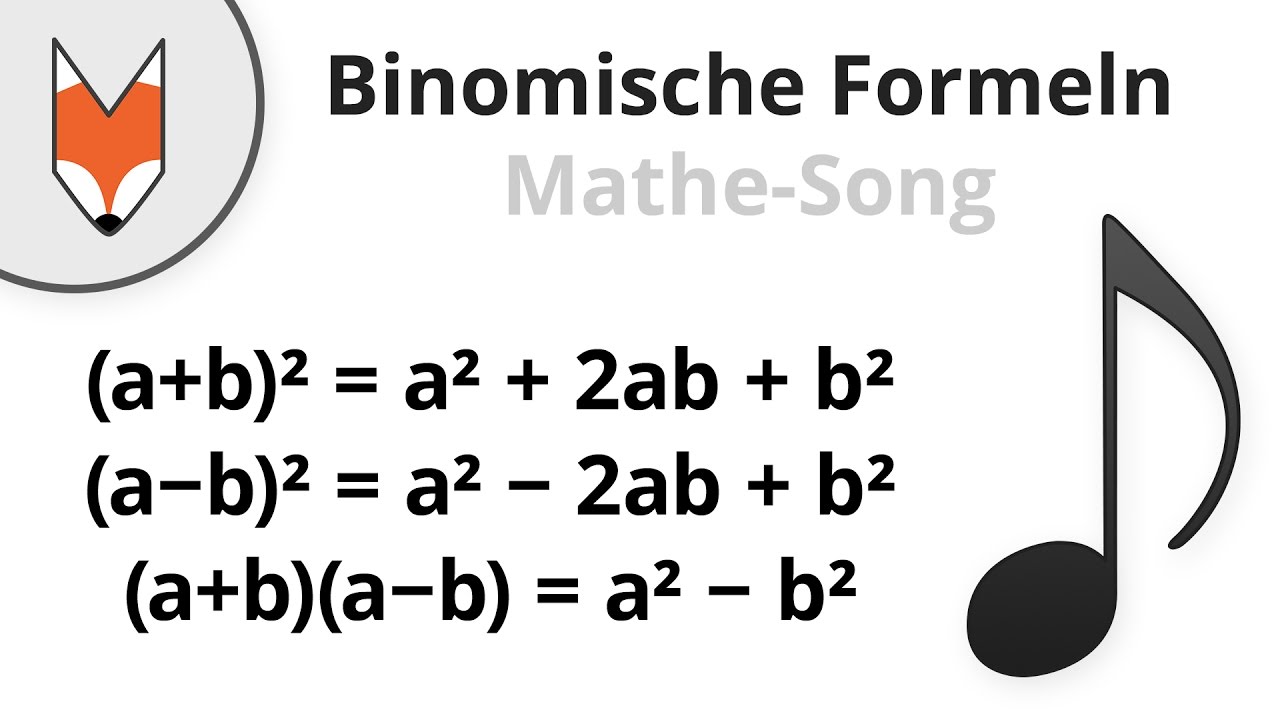
Ein Song zu den Binomischen Formeln, inclusive Herleitung.
Patreon: https://www.patreon.com/DorFuchs
T-Shirts: http://www.DorFuchs.de/t-shirts/
Facebook: http://www.facebook.com/DorFuchs
YouTube: http://www.youtube.com/DorFuchs
Twitter: http://www.twitter.com/DorFuchs
Website: http://www.DorFuchs.de/
weitere Mathe-Songs:
http://www.youtube.com...
lean flickerBOT
Binomische Formeln (Mathe-Song) [00:02:23] added to the queue.
dreamy moon

Nach diesem Song sollte jeder die Ableitung vom Sinus kennen.
Playlist mit weiteren Erklärungen: https://www.youtube.com/playlist?list=PL542920k_cOrDQTT-XK84Sus8sVJggYFG
Patreon: https://www.patreon.com/DorFuchs
T-Shirts: http://www.DorFuchs.de/t-shirts/
Facebook: http://www.facebook.com/DorFuchs
Instagram: https://www.instagram.com/dor.fuchs/
...
lean flickerBOT
Kombinatorik (Mathe-Song) [00:04:15] added to the queue.
dreamy moon
play Die Ableitung vom Sinus ist der Kosinus (Mathe-Song)
lean flickerBOT
Die Ableitung vom Sinus ist der Kosinus (Mathe-Song) [00:03:57] added to the queue.
dreamy moon
skip
 lyric gazelle
faq cefr
lean flickerBOT
CEFR levels
If you see something like A1, B2 or C1, these represent the proficiency of a speaker in a language they're not native in, and are called CEFR levels. They are valid for any language, not only German!
Roughly speaking, A levels are beginners and C levels are experts. Remember that CEFR level are self-assessed and indicative!
You can see more specific names and descriptions on the Wikipedia page:
https://en.wikipedia.org/wiki/Common_European_Framework_of_Reference_for_Languages
🗨 How do I know what level I am?
If the table on Wikipedia is too generic for you, you can try using this one here:
https://rm.coe.int/168045bb52
Just check each column one at a time: if you can do all it describes, move to the next column. Your level is the highest where you can do the most things.
Alternatively, you can use this questionnaire to estimate your level more accurately:
https://www.laits.utexas.edu/fi/sites/laits.utexas.edu.fi/files/Self Assessment Checklist European.pdf
 barren holly
faq beginner
lean flickerBOT
How to get started - Part 2
Please make sure to read Part 1 before starting Part 2!
Part 2 – Beyond a Simple Sentence
1: Conjunctions (coordinating and subordinating)
2: Subordinate clause word order
3: Dative case
4: Dative verbs
5: Verbs with two objects (e.g. geben)
6: Prepositions (accusative, dative, and two-way)
7: Spoken past tense (Perfekt)
8: Written past tense (Präteritum)
9: Genitive case
10: Relative clauses
11: Adjective declension
Tips
- Make sure to practice writing and reading simple texts
- Some of these concepts are confusing to start with, so it’s a good idea to ask for help in #questions when you’re unsure
- You should use a declension chart to help with declension to start with, because you won’t be able to memorize it straight away
- After you feel confident with creating sentences, you can start learning the adjective declension properly by using the command >faq adjective declension and reading the guide provided
Page 2/2
grizzled solar
faq cefr
lean flickerBOT
CEFR levels
If you see something like A1, B2 or C1, these represent the proficiency of a speaker in a language they're not native in, and are called CEFR levels. They are valid for any language, not only German!
Roughly speaking, A levels are beginners and C levels are experts. Remember that CEFR level are self-assessed and indicative!
You can see more specific names and descriptions on the Wikipedia page:
https://en.wikipedia.org/wiki/Common_European_Framework_of_Reference_for_Languages
🗨 How do I know what level I am?
If the table on Wikipedia is too generic for you, you can try using this one here:
https://rm.coe.int/168045bb52
Just check each column one at a time: if you can do all it describes, move to the next column. Your level is the highest where you can do the most things.
Alternatively, you can use this questionnaire to estimate your level more accurately:
https://www.laits.utexas.edu/fi/sites/laits.utexas.edu.fi/files/Self Assessment Checklist European.pdf
 mighty rose
faq beginner
lean flickerBOT
How to get started
The simplest way to learn German is to find topics you don’t understand yet and search for explanations of them. This list provides you with a guide for which topics to learn if you are completely new to German. Type the topic into Google (or YouTube) and start learning!
Introduction
1: Alphabet (especially ä, ü, ö and ß)
2: Basic greetings (hello, goodbye, etc.)
Part 1 - Simple Sentence
1: Noun gender & plurals
2: Nominative case (What are cases?)
3: Nominative pronouns (I, you, he, she, etc.)
4: Verbs in present tense
5: Definite/indefinite articles
6: Accusative case (for nouns)
7: Accusative pronouns
8: Word order of simple sentences
9: How to ask questions
See Part 2 on the next page.
Tips
- Always learn the gender of a noun when you learn a new noun
- Learn to use a translation dictionary (e.g. dict.cc, leo.org)
- Use
>faq resourcesto see our list of German learning resources - For listening and pronunciation practice, try watching movies or videos (incl. YouTube)
- You can listen to pronunciation for words on websites like dict.cc, forvo.com, and others
- Practice writing sentences every day (and asking people to correct them)
- Ask as many questions as possible
- Don’t be scared to make mistakes!!!! If you don’t let yourself make mistakes, you will never be able to learn German
Page 1/2
barren holly
faq beginner
lean flickerBOT
How to get started
The simplest way to learn German is to find topics you don’t understand yet and search for explanations of them. This list provides you with a guide for which topics to learn if you are completely new to German. Type the topic into Google (or YouTube) and start learning!
Introduction
1: Alphabet (especially ä, ü, ö and ß)
2: Basic greetings (hello, goodbye, etc.)
Part 1 - Simple Sentence
1: Noun gender & plurals
2: Nominative case (What are cases?)
3: Nominative pronouns (I, you, he, she, etc.)
4: Verbs in present tense
5: Definite/indefinite articles
6: Accusative case (for nouns)
7: Accusative pronouns
8: Word order of simple sentences
9: How to ask questions
See Part 2 on the next page.
Tips
- Always learn the gender of a noun when you learn a new noun
- Learn to use a translation dictionary (e.g. dict.cc, leo.org)
- Use
>faq resourcesto see our list of German learning resources - For listening and pronunciation practice, try watching movies or videos (incl. YouTube)
- You can listen to pronunciation for words on websites like dict.cc, forvo.com, and others
- Practice writing sentences every day (and asking people to correct them)
- Ask as many questions as possible
- Don’t be scared to make mistakes!!!! If you don’t let yourself make mistakes, you will never be able to learn German
Page 1/2
barren holly
faq resources
lean flickerBOT
Resources
grizzled solar
faq babble
lean flickerBOT
FAQ not found. Try >explain all.
grizzled solar
explain all
lean flickerBOT
See a listed FAQ with >faq [name]
:small_blue_diamond: Duolingo
Aliases: duo
:small_blue_diamond: Eszett
Aliases: Scharfes S, ẞ, ß
:small_blue_diamond: FAQ
:small_blue_diamond: Formal and informal speech
Aliases: duzen vs. siezen, Sie, Du vs. Sie, siezen, du, informal, formal, du vs sie
:small_blue_diamond: Gender patterns
:small_blue_diamond: Genitive
Aliases: Genitiv
:small_blue_diamond: German letters
Aliases: german keyboard, keyboard
:small_blue_diamond: Grammar terms
Aliases: Glossary, Grammatical terms
:small_blue_diamond: Grammatical gender
Aliases: genders, der-die-das, gender
:small_blue_diamond: How to ask a question
Aliases: Translation, Homework
:small_blue_diamond: How to get started
Aliases: Starting out, beginner
:small_blue_diamond: How to use writing
:small_blue_diamond: Impersonal Verbs
Aliases: unpersönliche Verben, impersonal es
:small_blue_diamond: IPA
Aliases: Pronunciation, Sound transcription, International Phonetic Alphabet
:small_blue_diamond: lessons
Aliases: sessions, activities
Page 2/4 (59 entries)
barren holly
faq resources
lean flickerBOT
Resources
grizzled solar
faq resources
lean flickerBOT
Resources
 visual arrow
emojistats user @visual arrow
lean flickerBOT
User Emoji Stats for szew#5248
Total Amount Of Emoji Uses
546
Total Amount Of Emoji Reaction Uses
180
Top Emojis
- (186 uses, 34%, 0.5 uses/day)
 (80 uses, 15%, 0.53 uses/day)
 (42 uses, 8%, 0.11 uses/day)
 (33 uses, 6%, 0.09 uses/day)
 (31 uses, 6%, 0.08 uses/day)
 (30 uses, 5%, 0.12 uses/day)
 (24 uses, 4%, 0.3 uses/day)
 (18 uses, 3%, 0.73 uses/day)
 (15 uses, 3%, 0.04 uses/day)
 (10 uses, 2%, 0.03 uses/day)
Top Reaction Emojis
- (31 uses, 17% 0.21 uses/day)
- (20 uses, 11% 0.05 uses/day)
 (12 uses, 7% 0.03 uses/day)
- (11 uses, 6% 0.03 uses/day)
 (8 uses, 4% 0.33 uses/day)
- (7 uses, 4% 0.09 uses/day)
 (6 uses, 3% 0.02 uses/day)
 (6 uses, 3% 0.02 uses/day)
- (6 uses, 3% 0.12 uses/day)
- (5 uses, 3% 0.01 uses/day)
 fresh wigeon
faq beginner
lean flickerBOT
How to get started
The simplest way to learn German is to find topics you don’t understand yet and search for explanations of them. This list provides you with a guide for which topics to learn if you are completely new to German. Type the topic into Google (or YouTube) and start learning!
Introduction
1: Alphabet (especially ä, ü, ö and ß)
2: Basic greetings (hello, goodbye, etc.)
Part 1 - Simple Sentence
1: Noun gender & plurals
2: Nominative case (What are cases?)
3: Nominative pronouns (I, you, he, she, etc.)
4: Verbs in present tense
5: Definite/indefinite articles
6: Accusative case (for nouns)
7: Accusative pronouns
8: Word order of simple sentences
9: How to ask questions
See Part 2 on the next page.
Tips
- Always learn the gender of a noun when you learn a new noun
- Learn to use a translation dictionary (e.g. dict.cc, leo.org)
- Use
>faq resourcesto see our list of German learning resources - For listening and pronunciation practice, try watching movies or videos (incl. YouTube)
- You can listen to pronunciation for words on websites like dict.cc, forvo.com, and others
- Practice writing sentences every day (and asking people to correct them)
- Ask as many questions as possible
- Don’t be scared to make mistakes!!!! If you don’t let yourself make mistakes, you will never be able to learn German
Page 1/2
 neon jay
sessions
lean flickerBOT
Upcoming Sessions
:calendar: Want to add our sessions schedule to your Google calendar?
:small_blue_diamond: (Your time: <t:1654182000:F>) held by Trax
[ID: 198] (Activities)
We'll be watching more Peppa Wurz, and The Voice Germany. The activity session will open 15 minutes before.
Recommended level(s):
:small_blue_diamond: (Your time: <t:1654358400:F>) held by BobGamer | Maximilian
[ID: 190] (AdvancedReading)
Leserunde Nr. 4 zu "Der neunte Arm des Oktopus"
Recommended level(s):
:small_blue_diamond: (Your time: <t:1654448400:F>) held by Taiquann
[ID: 193] (AdvancedReading)
Leserunde auf Deutsch: Die drei ??? - Toteninsel
Recommended level(s):
Type `>session info [ID#]` e.g. `>session info 3` for more detail about a specific session.
candid coral
ex all
lean flickerBOT
See a listed FAQ with >faq [name]
:small_blue_diamond: Swiss German
Aliases: gsw
:small_blue_diamond: Switzerland
Aliases: Schweiz, CH
:small_blue_diamond: Two-way prepositions
Aliases: two way prepositions, dual prepositions
:small_blue_diamond: Umlauts
Aliases: Umlaute, Umlaut, ä, ö, ü
:small_blue_diamond: Usage of Konjunktiv II
Aliases: KII 1
:small_blue_diamond: Usage of zu
Aliases: um zu
:small_blue_diamond: Verbs with prepositions
Aliases: verb prepositions, pferd's verb list
:small_blue_diamond: Vorgangspassiv
:small_blue_diamond: Weak Nouns
Aliases: N-Declension, N-Deklination, weak noun
:small_blue_diamond: weil, denn, da
:small_blue_diamond: What does GLaD mean?
Aliases: GLaD
:small_blue_diamond: wissen und kennen
Aliases: wissen vs. kennen, kennen vs. wissen
:small_blue_diamond: Word Order for Nouns & Pronouns
:small_blue_diamond: Word Order for Verbs
Aliases: word order verbs, word order of verbs
Page 4/4 (59 entries)
dreamy moon

MC HomoSapiensSapiens · Käptn Peng, Die Tentakel von Delphi
Das nullte Kapitel
℗ Kreismusik
Released on: 2017-05-19
Composer: Boris Nielsen
Author: Käptn Peng
Composer: Moritz Bossmann
Composer: Peter Bartz
Composer: Shaban
Music Publisher: Wintrup Musikverlage
Auto-generated by YouTube.
lean flickerBOT
MC HomoSapiensSapiens [00:05:06] added to the queue.
dreamy moon
Provided to YouTube by Believe SAS
Identitetris (feat. Käptn Peng, Lemur) · Pavlidis
Identitetris
℗ Kreismusik
Released on: 2016-11-11
Author: Benjamin Pavlidis
Author: Käptn Peng
Author: Lemur
Composer: Shaban
Featured Artist: Käptn Peng
Featured Artist: Lemur
Music Publisher: Wintrup Musikverlage
Auto-generated by YouTube.
lean flickerBOT
Identitetris (feat. Käptn Peng, Lemur) [00:05:22] added to the queue.
 viscid elm
play around the world
lean flickerBOT
Daft Punk - Around the World (Official Audio) [00:07:10] added to the queue.
dreamy moon
play around the world
lean flickerBOT
Daft Punk - Around the World (Official Audio) [00:07:10] added to the queue.
lean flickerBOT
Started a session for Activities!
wooden frost
group end activities
lean flickerBOT
Activities session ended.
wooden frost
group start Activity
lean flickerBOT
:x: Group Activity not found.
Try >groups to see a list of all groups or >group joinall to join all available groups.
wooden frost
group start activities
lean flickerBOT
Started a session for Activities!
humble walrus
sessions
lean flickerBOT
Upcoming Sessions
:calendar: Want to add our sessions schedule to your Google calendar?
:small_blue_diamond: (Your time: <t:1654182000:F>) held by Trax
[ID: 198] (Activities)
We'll be watching more Peppa Wurz, and The Voice Germany. The activity session will open 15 minutes before.
Recommended level(s):
:small_blue_diamond: (Your time: <t:1654358400:F>) held by BobGamer | Maximilian
[ID: 190] (AdvancedReading)
Leserunde Nr. 4 zu "Der neunte Arm des Oktopus"
Recommended level(s):
:small_blue_diamond: (Your time: <t:1654448400:F>) held by Taiquann
[ID: 193] (AdvancedReading)
Leserunde auf Deutsch: Die drei ??? - Toteninsel
Recommended level(s):
Type `>session info [ID#]` e.g. `>session info 3` for more detail about a specific session.
 native musk
explain gender patterns
lean flickerBOT
**Neuter words (das)**
- nominalised verbs (das Leben, das Lesen)
- metals (das Gold, das Kupfer)
- babies and cubs (das Baby, das Lamm)
- diminutives in
-chen/-lein(das Hündchen) - words ending in:
---mentdas Experiment, das Sakrament
---ma(usually of Greek origin) das Komma, das Thema
Page 3/4
 vital kindle
purpose Level A
lean flickerBOT
Information about Level A
Level A
Members with this role indicate that they have a level of proficiency in German up to and including A2, which generally means that they are starting out with German or have some understanding of the basics.
Use the corresponding button in #850404908946423828 to get this role.
Enter >faq cefr in #botchannel to learn more about what these levels mean.
wooden frost
session create Activities 2022-06-03 8:00 PT Pigs, trains and more singers will be what we're watching.
lean flickerBOT
Okay @wooden frost. Your session has been scheduled for <t:1654268400>. The session ID is: 199
wooden frost
sessions
lean flickerBOT
Upcoming Sessions
:calendar: Want to add our sessions schedule to your Google calendar?
:small_blue_diamond: (Your time: <t:1654358400:F>) held by BobGamer | Maximilian
[ID: 190] (AdvancedReading)
Leserunde Nr. 4 zu "Der neunte Arm des Oktopus"
Recommended level(s):
:small_blue_diamond: (Your time: <t:1654448400:F>) held by Taiquann
[ID: 193] (AdvancedReading)
Leserunde auf Deutsch: Die drei ??? - Toteninsel
Recommended level(s):
Type `>session info [ID#]` e.g. `>session info 3` for more detail about a specific session.
:warning: Please note that you should always attempt to schedule your sessions at least 24 hours before they're due to start, in order to give participants enough time to plan ahead.
wooden frost
sessions
lean flickerBOT
Upcoming Sessions
:calendar: Want to add our sessions schedule to your Google calendar?
:small_blue_diamond: (Your time: <t:1654268400:F>) held by Trax
[ID: 199] (Activities)
Pigs, trains and more singers will be what we're watching.
Recommended level(s):
:small_blue_diamond: (Your time: <t:1654358400:F>) held by BobGamer | Maximilian
[ID: 190] (AdvancedReading)
Leserunde Nr. 4 zu "Der neunte Arm des Oktopus"
Recommended level(s):
:small_blue_diamond: (Your time: <t:1654448400:F>) held by Taiquann
[ID: 193] (AdvancedReading)
Leserunde auf Deutsch: Die drei ??? - Toteninsel
Recommended level(s):
Type `>session info [ID#]` e.g. `>session info 3` for more detail about a specific session.
 lapis seal

2PM(투피엠) "HANDS UP" M/V
Download 2PM "Hands Up" on itunes: http://itunes.apple.com/us/album/hands-up/id445176088
2PM Official Facebook: http://www.facebook.com/2pm.jype
2PM Official Twitter: http://www.twitter.com/follow_2pm
2PM Official Fan's: http://fans.jype.com/2PM
2PM Official Homepage: http://2pm.jype.com
Copyrights 2011 ⓒ JYP Entertain...
lean flickerBOT
2PM "HANDS UP" M/V [00:03:47] added to the queue.
lapis seal
stop
lean flickerBOT
:x: This command can only be used by a moderator.
 stuck ermine

Violin - Rusanda Panfili
Piano - Donka Angatscheva
Recorded live in Bank Austria Salon, Vienna
17.03.2016
Support my future videos and my art through Patreon: https://www.patreon.com/rusandapanfili
lean flickerBOT
Jules Massenet - Meditation from Thais for Violin and Piano [00:05:23] added to the queue.
lapis seal
vol 100
lean flickerBOT
:speaker: Music player volume set to 100.
lapis seal

“Tom's Diner” von Suzanne Vega - AnnenMayKantereit (featuring Giant Rooks) Cover
Unseren Kanal hier abonnieren: http://bit.ly/AMK_abonnieren
Wir gehen auf „Tut gut wieder hier zu sein“ Clubtour 2022. Tickets: https://shop.krasserstoff.com/annenmaykantereit
07.05.22 Potsdam Waschhaus
08.05.22 Hamburg UE&G
10.05.22 Bielefeld Ringlo...
lean flickerBOT
Tom's Diner (Cover) - AnnenMayKantereit x Giant Rooks [00:04:34] added to the queue.
lapis seal

La Fiamme performs the haunting contemporary piece from s03e05
lean flickerBOT
Mozart In The Jungle - Amy Fisher Opera [00:03:51] added to the queue.
lapis seal
queue
lean flickerBOT
The bot is not playing any songs.
lapis seal
La Fiamme performs the haunting contemporary piece from s03e05
lean flickerBOT
Mozart In The Jungle - Amy Fisher Opera [00:03:51] added to the queue.
lapis seal
Recording session video for the recording of the Now You See Me soundtrack
"Now You See Me"
"Spellbound"
Download this song and album at: http://tinyurl.com/llaadnu
Director: Aris Stoulil
Now You See Me director: Louis Letterier
Glassnote Records
Lionsgate Films
https://instagram.com/briantylermusic
http://briantyler.com
https://twitter.com/Bri...
lean flickerBOT
Now You See Me (HD) - Brian Tyler [OFFICIAL] [00:02:05] added to the queue.
lapis seal
skip

Various – Mozart in the Jungle, Season 3 (An Amazon Original Series Soundtrack) – Amy Fisher (performed by Ana María Martínez)
Listen to the MOZART IN THE JUNGLE, SEASON 3 soundtrack here: http://soundtracks.lnk.to/MozartintheJungle
ABOUT MOZART IN THE JUNGLE SEASON 3:
Mozart in the Jungle is a half-hour comedic drama based on the critically a...
lean flickerBOT
Ana María Martínez - Amy Fisher (Pseudo Video) [00:05:05] added to the queue.
lapis seal

Riccardo Broschi - "Ombra fedele anch'io" - Répétitions au Collège Varèse du concert "Farinelli / Les 20 ans des Talens Lyriques".
Les Talens Lyriques, Christophe Rousset, Ann Hallenberg (mezzo soprano).
Paris, Mai 2011.
lean flickerBOT
Broschi Ombra fedele anch'io - Répétitions Les Talens Lyriques [00:04:26] added to the queue.
lapis seal
Riccardo Broschi - "Ombra fedele anch'io" - Répétitions au Collège Varèse du concert "Farinelli / Les 20 ans des Talens Lyriques".
Les Talens Lyriques, Christophe Rousset, Ann Hallenberg (mezzo soprano).
Paris, Mai 2011.
lean flickerBOT
Broschi Ombra fedele anch'io - Répétitions Les Talens Lyriques [00:04:26] added to the queue.
lapis seal

Provided to YouTube by Atlantic Records
The Schuyler Sisters · Renée Elise Goldsberry · Phillipa Soo · Jasmine Cephas Jones · Leslie Odom Jr. · Original Broadway Cast of Hamilton
Hamilton
℗ 2015 Hamilton Uptown, LLC under exclusive license to Atlantic Recording Corporation
Producer: Ahmir Thompson
Conductor, Keyboards: Alex Lacamoire
Orchest...
lean flickerBOT
The Schuyler Sisters [00:03:07] added to the queue.
lapis seal

Victoria OST - from the PBS Series Victoria
-Video Upload powered by https://www.TunesToTube.com
lean flickerBOT
Victoria - The Suite [00:03:27] added to the queue.
lapis seal

Provided to YouTube by CDBaby
The Shape of Things to Come · Bear McCreary
The Music of Battlestar Galactica for Solo Piano, Vol. One
℗ 2011 Bear McCreary
Released on: 2011-09-21
Auto-generated by YouTube.
lean flickerBOT
The Shape of Things to Come [00:02:47] added to the queue.
dreamy moon
play Around the world
lean flickerBOT
:x: The bot is already active in a different channel.
lapis seal

Spirited Away OST- The Dragon Boy / The Bottomless Pit [HQ] Soundtrack Joe Hisaishi
lean flickerBOT
Spirited Away OST- The Dragon Boy / The Bottomless Pit [HQ] [00:04:01] added to the queue.
lapis seal

► Get our albums: https://smarturl.it/TPG_ALBUMS
► WE'RE ON TOUR! https://smarturl.it/tpgtour
► TPG APPAREL: http://smarturl.it/tpgapparel
► DOWNLOAD THIS SONG: https://smarturl.it/wondersalbum
► GET THE SHEET MUSIC: https://smarturl.it/WONDERS_sheet-music
► SHOP OUR AMAZON STORE! https://smarturl.it/tpgonamazon
► Apple ...
lean flickerBOT
Kung Fu Piano: Cello Ascends - The Piano Guys (Wonder of The World 1 of 7) [00:04:16] added to the queue.
lapis seal
skip
This "Steven Sharp Nelson Suite" was composed by Emmy Award Winner Sam Cardon, specifically for the Lyceum Music Festival, for Steven Sharp Nelson. It premiered on July 30th at the 2011 Lyceum Music Festival at the Zermatt Resort in Midway, Utah. The students range from age 13-21!
More information can be found at www.LyceumMusicFestival.com...
lean flickerBOT
Steven Sharp Nelson Suite with Lyceum Music Festival Orchestra (with intro) [00:07:30] added to the queue.
lapis seal

Provided to YouTube by BWSCD Inc
Opera Fight · Son Lux · Surrija · yMusic
Everything Everywhere All at Once
℗ 2022 A24 Music
Released on: 2022-04-08
Main Artist: Son Lux
Featured Artist: Surrija
Featured Artist: yMusic
Producer: Son Lux
Associated Performer: yMusic
Auto-generated by YouTube.
lean flickerBOT
Opera Fight [00:02:17] added to the queue.
 lean flickerBOT
AI - Voice [00:05:16] added to the queue.
lapis seal

Lyrics and music: Božo Vrećo
Music production: Billain https://www.facebook.com/BillainSystems
Video: Spektroom https://www.facebook.com/studio.spekt...
Camera: Nikola Blagojević & Danko Bevanda
Editing: Danko Bevanda & Billain
Animation: David Watson
Hair: Studion EN
Make up: Maja Koristović Talović
Styling: Božo Vrećo
Props: Dina Ćerić
Ligh...
lean flickerBOT
Božo Vrećo x Billain - Sahtijan [00:04:44] added to the queue.
lapis seal

Provided to YouTube by Columbia Local
Stefania (Kalush Orchestra) · KALUSH
Stefania (Kalush Orchestra)
℗ 2022 Columbia under exclusive license of ENKO
Released on: 2022-02-07
Composer: Tymofii Muzychuk
Mastering Engineer, Mixing Engineer: Anton Chilibi
Composer: Ihor Didenchuk
Composer: Vitalii Duzhyk
Lyricist: Ivan Klimenko
Lyricist: Ole...
lean flickerBOT
Stefania (Kalush Orchestra) [00:03:00] added to the queue.
 acoustic apex
faq beginner
lean flickerBOT
How to get started - Part 2
Please make sure to read Part 1 before starting Part 2!
Part 2 – Beyond a Simple Sentence
1: Conjunctions (coordinating and subordinating)
2: Subordinate clause word order
3: Dative case
4: Dative verbs
5: Verbs with two objects (e.g. geben)
6: Prepositions (accusative, dative, and two-way)
7: Spoken past tense (Perfekt)
8: Written past tense (Präteritum)
9: Genitive case
10: Relative clauses
11: Adjective declension
Tips
- Make sure to practice writing and reading simple texts
- Some of these concepts are confusing to start with, so it’s a good idea to ask for help in #questions when you’re unsure
- You should use a declension chart to help with declension to start with, because you won’t be able to memorize it straight away
- After you feel confident with creating sentences, you can start learning the adjective declension properly by using the command >faq adjective declension and reading the guide provided
Page 2/2
:x: The required argument prompt is missing.
:x: The bot is already active in a different channel.
lapis seal

(C) & (P) Gramofon 2013
Producent: Edin Zubčević
Božo Vrećo - vokal
Dino Šukalo - gitara, mandolina
Adis Sirbubalo - harmonika, klavir
Edvin Hadžić - kontrabas
Anes Beglerbegović - udaraljke
Narodna pjesma / arr. Sirbubalo, Hadžić, Šukalo
Snimio: Eric Bajramović u MC Pavarotti Mostar od 2. do 5. maja 2013
Miks i mastering: Johannes Wohll...
lean flickerBOT
HALKA - Kiša bi pala [00:04:58] added to the queue.
lapis seal

Prva emisija uživo: Nina Kraljić pjeva "Wicked Game" (izvedba Chrisa Isaaca)
Live show 1: Nina Kraljić (participant Eurovision Song Contest 2016) performing "Wicked Game" by Chris Isaac
#timjacques
#TheVoiceHRT
Website: voice.hrt.hr
Twitter: https://twitter.com/TheVoiceHRT
Facebook: https://www.facebook.com/TheVoiceHRT
Instagram: http://instagr...
lean flickerBOT
Nina Kraljić: "Wicked Game" - The Voice of Croatia - Season1 - Live1 [00:02:19] added to the queue.
:x: The bot is already active in a different channel.
lapis seal

Dimash Kudaibergen - kazakh singer from Kazakhstan.
Part 1 of I Am a Singer (Chinese reality show)
lean flickerBOT
Dimash Kudaibergen - SOS d'un terrien en détresse [00:05:23] added to the queue.
lapis seal

Our version of the classic song 'Feeling Good'
Performed by: Kathryn Shinnick and Christina Katsimbardis (violin), Ben Caddy (viola) and Sidney Harvey (cello)
Available for weddings and events in Perth and WA
lean flickerBOT
Feeling Good - Dolce Ensembles [00:03:33] added to the queue.
tender trellis
faq beginner
lean flickerBOT
How to get started - Part 2
Please make sure to read Part 1 before starting Part 2!
Part 2 – Beyond a Simple Sentence
1: Conjunctions (coordinating and subordinating)
2: Subordinate clause word order
3: Dative case
4: Dative verbs
5: Verbs with two objects (e.g. geben)
6: Prepositions (accusative, dative, and two-way)
7: Spoken past tense (Perfekt)
8: Written past tense (Präteritum)
9: Genitive case
10: Relative clauses
11: Adjective declension
Tips
- Make sure to practice writing and reading simple texts
- Some of these concepts are confusing to start with, so it’s a good idea to ask for help in #questions when you’re unsure
- You should use a declension chart to help with declension to start with, because you won’t be able to memorize it straight away
- After you feel confident with creating sentences, you can start learning the adjective declension properly by using the command >faq adjective declension and reading the guide provided
Page 2/2
 split zinc
play around the world
lean flickerBOT
:x: The bot is already active in a different channel.
 left abyss
faq beginner
 modern pulsar
faq beginner
lean flickerBOT
How to get started
The simplest way to learn German is to find topics you don’t understand yet and search for explanations of them. This list provides you with a guide for which topics to learn if you are completely new to German. Type the topic into Google (or YouTube) and start learning!
Introduction
1: Alphabet (especially ä, ü, ö and ß)
2: Basic greetings (hello, goodbye, etc.)
Part 1 - Simple Sentence
1: Noun gender & plurals
2: Nominative case (What are cases?)
3: Nominative pronouns (I, you, he, she, etc.)
4: Verbs in present tense
5: Definite/indefinite articles
6: Accusative case (for nouns)
7: Accusative pronouns
8: Word order of simple sentences
9: How to ask questions
See Part 2 on the next page.
Tips
- Always learn the gender of a noun when you learn a new noun
- Learn to use a translation dictionary (e.g. dict.cc, leo.org)
- Use
>faq resourcesto see our list of German learning resources - For listening and pronunciation practice, try watching movies or videos (incl. YouTube)
- You can listen to pronunciation for words on websites like dict.cc, forvo.com, and others
- Practice writing sentences every day (and asking people to correct them)
- Ask as many questions as possible
- Don’t be scared to make mistakes!!!! If you don’t let yourself make mistakes, you will never be able to learn German
Page 1/2
left abyss
a*
lapis seal

REMASTERED IN HD! UP TO 4K!!
No Doubt's official music video for 'Don't Speak'.
Watch more No Doubt Remastered music videos: https://youtube.com/watch?v=wt1YkGO2Ieo&list=PLxx7QQsKXxSE18FNAJUSwCC5YDm8B7tW4&index=3
Revisit more 90's music videos: https://www.youtube.com/watch?v=xGytDsqkQY8&list=PLjF50Dlp9iembnFdfoZaqIoYZ0zBm7utR
Watch more rema...
lean flickerBOT
No Doubt - Don't Speak (Official 4K Music Video) [00:05:01] added to the queue.
 quick basin
faq conjugation
lean flickerBOT
conjugation
Präsens (Present Tense)
When you use a verb in a sentence (or clause), you have to conjugate it (change the form) to match the subject of the sentence (or clause).
For example, in English, we write I eat but he/she eats. The verb has a different ending! The concept is the same in German, except German has more endings.
The first thing you need to know in order to conjugate verbs is: which ending fits which subject? Here is a simple verb “trinken” (to drink) as an example:
trinken
ich trinke
du trinkst
er/sie/es trinkt
wir trinken
ihr trinkt
sie trinken / Sie trinken
(Note: the conjugation for sie (they) and Sie (formal you) is always the same)
Vowel/Stem Changes
There are a few variations and exceptions, but the most important is vowel changes (also called stem changes). Some verbs get a vowel change, which only affects the du and er/sie/es forms of the verb. (However, modal verbs and wissen have their own special pattern, which also has a vowel change in the ich form.)
Example: ich schlafe, du schläfst
Other Changes
There are various other differences but I can’t describe them all here, so please read these websites or use Google to find more information: https://www.vistawide.com/german/grammar/german_verbs_present_tense.htm
https://www.thoughtco.com/german-present-tense-verbs-4074838
http://www.dartmouth.edu/~deutsch/Grammatik/PresentTense/Present.html
dreamy moon
play around the world
lean flickerBOT
:x: The bot is already active in a different channel.
lapis seal

Provided to YouTube by The Orchard Enterprises
Agape · Nicholas Britell
If Beale Street Could Talk (Original Motion Picture Score)
℗ 2018 Lakeshore Records
Released on: 2018-11-09
Producer: Nicholas Britell
Auto-generated by YouTube.
lean flickerBOT
Agape [00:02:56] added to the queue.
lapis seal

A video to acompany the music of the incomparable duo that is Ella Fitzgerald and Louis Armstrong
lean flickerBOT
Summertime Ella Fitzgerald and Louis Armstrong [00:04:58] added to the queue.
lapis seal

CALL ME BY YOUR NAME is a sensual and transcendent tale of first love, based on the acclaimed novel by André Aciman, written by Oscar® nominee James Ivory and starring Armie Hammer (The Man from U.N.C.L.E, On the Basis of Sex) and Timothée Chalamet (Lady Bird, Little Women). Its soundtrack is a mix of 80s pop, classical compositions & songs by s...
lean flickerBOT
Sufjan Stevens - Visions of Gideon (From "Call Me By Your Name" Soundtrack) [00:04:09] added to the queue.
lapis seal

The Shannara Chronicles Müzik
lean flickerBOT
Two Steps From Hell - Amaria | The Shannara Chronicles İlk Bakış Comic-Con 2015 Müzik [00:03:16] added to the queue.
lapis seal

Starboy ft. Daft Punk (Official Video)
Taken from the new album Starboy
http://theweeknd.co/StarboyYD
Connect with The Weeknd:
http://www.facebook.com/theweeknd
http://instagram.com/theweeknd
https://soundcloud.com/theweeknd
https://twitter.com/TheWeeknd
https://www.theweeknd.com
Directed by Grant Singer
Produced by Julien LeMaitre & Nina ...
lean flickerBOT
The Weeknd - Starboy ft. Daft Punk (Official Video) [00:04:33] added to the queue.
lapis seal

Provided to YouTube by RCA Red Seal
Dilmano, Dilbero · Vesselina Kasarova · Traditional · Cosmic Voices from Bulgaria
Bulgarian Soul
℗ 2003 BMG Ariola Classics GmbH
Released on: 2003-09-05
Producer: Wolfram Graul
Recording Engineer: Siegbert Ernst
Chorus Master: Vania Moneva
Adapter: Krassimir Kyurkchiyski
Auto-generated by YouTube.
lean flickerBOT
Dilmano, Dilbero [00:01:53] added to the queue.
lapis seal

Provided to YouTube by RCA Red Seal
Day mi, Bozhe, krila lebedovi (Give Me, Oh God, the Wings of a Swan) · Vesselina Kasarova · Cosmic Voices from Bulgaria · Traditional
Bulgarian Soul
℗ 2003 BMG Ariola Classics GmbH
Released on: 2003-09-05
Producer: Wolfram Graul
Recording Engineer: Siegbert Ernst
Chorus Master: Vania Moneva
Adapter: Kra...
lean flickerBOT
Dilmano, Dilbero [00:01:53] added to the queue.
lapis seal
Provided to YouTube by RCA Red Seal
Day mi, Bozhe, krila lebedovi (Give Me, Oh God, the Wings of a Swan) · Vesselina Kasarova · Cosmic Voices from Bulgaria · Traditional
Bulgarian Soul
℗ 2003 BMG Ariola Classics GmbH
Released on: 2003-09-05
Producer: Wolfram Graul
Recording Engineer: Siegbert Ernst
Chorus Master: Vania Moneva
Adapter: Kra...
lean flickerBOT
Dilmano, Dilbero [00:01:53] added to the queue.
lapis seal
skip
skip
skip

Provided to YouTube by Altafonte
Dilmano Dilbero · Laboratorium Pieśni
Rasti
℗ 2019 Soliton
Released on: 2019-02-09
Composer: traditional
Lyricist: traditional
Auto-generated by YouTube.
lean flickerBOT
Dilmano Dilbero [00:03:40] added to the queue.
lapis seal

Label and copyright : City Records & Biber
Zabranjeno svako kopiranje video i/ili audio snimaka i postavljanje na druge kanale!
Music : Tradicional - Biber
Lyrics : Tradicional
Arr : Biber (Rastko Aksentijevic,Bojan Vasic,Milorad Kocic,Goran Simpraga)
Video : Nebojsa Babic (Orange studio)
Model : Ivana Stankovic
Vokal : Jelena Tomasevic
Kaval ...
lean flickerBOT
BIBER - Gde Si Bilo Jare Moje feat. Jelena Tomasevic (official video 2004) [00:04:05] added to the queue.
 hasty jolt
purpose Level A
lean flickerBOT
Information about Level A
Level A
Members with this role indicate that they have a level of proficiency in German up to and including A2, which generally means that they are starting out with German or have some understanding of the basics.
Use the corresponding button in #850404908946423828 to get this role.
Enter >faq cefr in #botchannel to learn more about what these levels mean.
lapis seal

Provided to YouTube by Sony Music Entertainment
Inspiration · Aziza Mustafa Zadeh
Aziza Mustafa Zadeh
℗ 1991 Sony Music Entertainment (Germany) GmbH
Mastering Engineer, Mixing Engineer, Producer: Reinhard Karwatky
Composer: Vagif Mustafa Zadeh
Producer: Ingo Werner
Mastering Engineer: Werner Roth
Mastering Engineer: Adrian v. Ripka
Auto...
lean flickerBOT
Inspiration [00:04:39] added to the queue.
candid coral
remind 30m
lean flickerBOT
Okay @candid coral. You will be reminded in 30 minutes.
lean flickerBOT
@candid coral, 30 minutes ago
You asked to be reminded about ""
[Jump to message](#botchannel message)
Reminder created
·
zenith crane
faq cefr
lean flickerBOT
CEFR levels
If you see something like A1, B2 or C1, these represent the proficiency of a speaker in a language they're not native in, and are called CEFR levels. They are valid for any language, not only German!
Roughly speaking, A levels are beginners and C levels are experts. Remember that CEFR level are self-assessed and indicative!
You can see more specific names and descriptions on the Wikipedia page:
https://en.wikipedia.org/wiki/Common_European_Framework_of_Reference_for_Languages
🗨 How do I know what level I am?
If the table on Wikipedia is too generic for you, you can try using this one here:
https://rm.coe.int/168045bb52
Just check each column one at a time: if you can do all it describes, move to the next column. Your level is the highest where you can do the most things.
Alternatively, you can use this questionnaire to estimate your level more accurately:
https://www.laits.utexas.edu/fi/sites/laits.utexas.edu.fi/files/Self Assessment Checklist European.pdf
 hushed mason
faq beginner
lean flickerBOT
How to get started
The simplest way to learn German is to find topics you don’t understand yet and search for explanations of them. This list provides you with a guide for which topics to learn if you are completely new to German. Type the topic into Google (or YouTube) and start learning!
Introduction
1: Alphabet (especially ä, ü, ö and ß)
2: Basic greetings (hello, goodbye, etc.)
Part 1 - Simple Sentence
1: Noun gender & plurals
2: Nominative case (What are cases?)
3: Nominative pronouns (I, you, he, she, etc.)
4: Verbs in present tense
5: Definite/indefinite articles
6: Accusative case (for nouns)
7: Accusative pronouns
8: Word order of simple sentences
9: How to ask questions
See Part 2 on the next page.
Tips
- Always learn the gender of a noun when you learn a new noun
- Learn to use a translation dictionary (e.g. dict.cc, leo.org)
- Use
>faq resourcesto see our list of German learning resources - For listening and pronunciation practice, try watching movies or videos (incl. YouTube)
- You can listen to pronunciation for words on websites like dict.cc, forvo.com, and others
- Practice writing sentences every day (and asking people to correct them)
- Ask as many questions as possible
- Don’t be scared to make mistakes!!!! If you don’t let yourself make mistakes, you will never be able to learn German
Page 1/2
hushed mason
faq resources
lean flickerBOT
Resources
humble walrus
sessions
lean flickerBOT
Upcoming Sessions
:calendar: Want to add our sessions schedule to your Google calendar?
:small_blue_diamond: (Your time: <t:1654268400:F>) held by Trax
[ID: 199] (Activities)
Pigs, trains and more singers will be what we're watching.
Recommended level(s):
:small_blue_diamond: (Your time: <t:1654358400:F>) held by BobGamer | Maximilian
[ID: 190] (AdvancedReading)
Leserunde Nr. 4 zu "Der neunte Arm des Oktopus"
Recommended level(s):
:small_blue_diamond: (Your time: <t:1654448400:F>) held by Taiquann
[ID: 193] (AdvancedReading)
Leserunde auf Deutsch: Die drei ??? - Toteninsel
Recommended level(s):
Type `>session info [ID#]` e.g. `>session info 3` for more detail about a specific session.
 supple pawn
faq cefr
lean flickerBOT
CEFR levels
If you see something like A1, B2 or C1, these represent the proficiency of a speaker in a language they're not native in, and are called CEFR levels. They are valid for any language, not only German!
Roughly speaking, A levels are beginners and C levels are experts. Remember that CEFR level are self-assessed and indicative!
You can see more specific names and descriptions on the Wikipedia page:
https://en.wikipedia.org/wiki/Common_European_Framework_of_Reference_for_Languages
🗨 How do I know what level I am?
If the table on Wikipedia is too generic for you, you can try using this one here:
https://rm.coe.int/168045bb52
Just check each column one at a time: if you can do all it describes, move to the next column. Your level is the highest where you can do the most things.
Alternatively, you can use this questionnaire to estimate your level more accurately:
https://www.laits.utexas.edu/fi/sites/laits.utexas.edu.fi/files/Self Assessment Checklist European.pdf
 rocky schooner
faq beginner
lean flickerBOT
How to get started - Part 2
Please make sure to read Part 1 before starting Part 2!
Part 2 – Beyond a Simple Sentence
1: Conjunctions (coordinating and subordinating)
2: Subordinate clause word order
3: Dative case
4: Dative verbs
5: Verbs with two objects (e.g. geben)
6: Prepositions (accusative, dative, and two-way)
7: Spoken past tense (Perfekt)
8: Written past tense (Präteritum)
9: Genitive case
10: Relative clauses
11: Adjective declension
Tips
- Make sure to practice writing and reading simple texts
- Some of these concepts are confusing to start with, so it’s a good idea to ask for help in #questions when you’re unsure
- You should use a declension chart to help with declension to start with, because you won’t be able to memorize it straight away
- After you feel confident with creating sentences, you can start learning the adjective declension properly by using the command >faq adjective declension and reading the guide provided
Page 2/2
 meager locust
ex beginner
lean flickerBOT
How to get started
The simplest way to learn German is to find topics you don’t understand yet and search for explanations of them. This list provides you with a guide for which topics to learn if you are completely new to German. Type the topic into Google (or YouTube) and start learning!
Introduction
1: Alphabet (especially ä, ü, ö and ß)
2: Basic greetings (hello, goodbye, etc.)
Part 1 - Simple Sentence
1: Noun gender & plurals
2: Nominative case (What are cases?)
3: Nominative pronouns (I, you, he, she, etc.)
4: Verbs in present tense
5: Definite/indefinite articles
6: Accusative case (for nouns)
7: Accusative pronouns
8: Word order of simple sentences
9: How to ask questions
See Part 2 on the next page.
Tips
- Always learn the gender of a noun when you learn a new noun
- Learn to use a translation dictionary (e.g. dict.cc, leo.org)
- Use
>faq resourcesto see our list of German learning resources - For listening and pronunciation practice, try watching movies or videos (incl. YouTube)
- You can listen to pronunciation for words on websites like dict.cc, forvo.com, and others
- Practice writing sentences every day (and asking people to correct them)
- Ask as many questions as possible
- Don’t be scared to make mistakes!!!! If you don’t let yourself make mistakes, you will never be able to learn German
Page 1/2
wooden frost
group start activities We will Pig in 10 + 2 Minutes
lean flickerBOT
:x: Group activities We will Pig in 10 + 2 Minutes not found.
Try >groups to see a list of all groups or >group joinall to join all available groups.
wooden frost
group start activities
lean flickerBOT
Started a session for Activities!
 ebon pawn
Turn off ping
dreamy moon

“Around the World” is taken from “Homework” available on all platforms: https://daftpunk.lnk.to/Homework
Subscribe to the official Daft Punk YouTube channel: https://daftpunk.lnk.to/subscribeonY
Watch more videos of Daft Punk: https://daftpunk.lnk.to/listenY
Listen to Daft Punk’s Essentials here: https://daftpunk.lnk.to/essentials
Written and...
lean flickerBOT
Daft Punk - Around the World (Official Audio) [00:07:10] added to the queue.
 amber bridge
faq begineer
 dull sparrow
faq beginner
lean flickerBOT
How to get started
The simplest way to learn German is to find topics you don’t understand yet and search for explanations of them. This list provides you with a guide for which topics to learn if you are completely new to German. Type the topic into Google (or YouTube) and start learning!
Introduction
1: Alphabet (especially ä, ü, ö and ß)
2: Basic greetings (hello, goodbye, etc.)
Part 1 - Simple Sentence
1: Noun gender & plurals
2: Nominative case (What are cases?)
3: Nominative pronouns (I, you, he, she, etc.)
4: Verbs in present tense
5: Definite/indefinite articles
6: Accusative case (for nouns)
7: Accusative pronouns
8: Word order of simple sentences
9: How to ask questions
See Part 2 on the next page.
Tips
- Always learn the gender of a noun when you learn a new noun
- Learn to use a translation dictionary (e.g. dict.cc, leo.org)
- Use
>faq resourcesto see our list of German learning resources - For listening and pronunciation practice, try watching movies or videos (incl. YouTube)
- You can listen to pronunciation for words on websites like dict.cc, forvo.com, and others
- Practice writing sentences every day (and asking people to correct them)
- Ask as many questions as possible
- Don’t be scared to make mistakes!!!! If you don’t let yourself make mistakes, you will never be able to learn German
Page 1/2
 stone terrace
faq beginner
lean flickerBOT
How to get started
The simplest way to learn German is to find topics you don’t understand yet and search for explanations of them. This list provides you with a guide for which topics to learn if you are completely new to German. Type the topic into Google (or YouTube) and start learning!
Introduction
1: Alphabet (especially ä, ü, ö and ß)
2: Basic greetings (hello, goodbye, etc.)
Part 1 - Simple Sentence
1: Noun gender & plurals
2: Nominative case (What are cases?)
3: Nominative pronouns (I, you, he, she, etc.)
4: Verbs in present tense
5: Definite/indefinite articles
6: Accusative case (for nouns)
7: Accusative pronouns
8: Word order of simple sentences
9: How to ask questions
See Part 2 on the next page.
Tips
- Always learn the gender of a noun when you learn a new noun
- Learn to use a translation dictionary (e.g. dict.cc, leo.org)
- Use
>faq resourcesto see our list of German learning resources - For listening and pronunciation practice, try watching movies or videos (incl. YouTube)
- You can listen to pronunciation for words on websites like dict.cc, forvo.com, and others
- Practice writing sentences every day (and asking people to correct them)
- Ask as many questions as possible
- Don’t be scared to make mistakes!!!! If you don’t let yourself make mistakes, you will never be able to learn German
Page 1/2
tender trellis
help alphabet
lean flickerBOT
No command or module called alphabet found.
humble walrus
faq beginner
lean flickerBOT
How to get started
The simplest way to learn German is to find topics you don’t understand yet and search for explanations of them. This list provides you with a guide for which topics to learn if you are completely new to German. Type the topic into Google (or YouTube) and start learning!
Introduction
1: Alphabet (especially ä, ü, ö and ß)
2: Basic greetings (hello, goodbye, etc.)
Part 1 - Simple Sentence
1: Noun gender & plurals
2: Nominative case (What are cases?)
3: Nominative pronouns (I, you, he, she, etc.)
4: Verbs in present tense
5: Definite/indefinite articles
6: Accusative case (for nouns)
7: Accusative pronouns
8: Word order of simple sentences
9: How to ask questions
See Part 2 on the next page.
Tips
- Always learn the gender of a noun when you learn a new noun
- Learn to use a translation dictionary (e.g. dict.cc, leo.org)
- Use
>faq resourcesto see our list of German learning resources - For listening and pronunciation practice, try watching movies or videos (incl. YouTube)
- You can listen to pronunciation for words on websites like dict.cc, forvo.com, and others
- Practice writing sentences every day (and asking people to correct them)
- Ask as many questions as possible
- Don’t be scared to make mistakes!!!! If you don’t let yourself make mistakes, you will never be able to learn German
Page 1/2
humble walrus
faq Nominative case
lean flickerBOT
When do I use the nominative case?
The nominative case is mainly used:
- to mark the subject of the finite verb
Ich lese einen Roman.
Der Mann hat die schöne Frau ermordet.
Sie besitzen kein Auto.
- for the predicate complement of copular verbs (a verb that links the subject to the object)
Eine Maus ist ein kleines Tier.
Wir wurden gute Freunde.
Du bleibst immer mein Freund.
- for nouns or pronouns used in isolation, such as in exclamations or when addressing people
Ein schöner Tag heute, nicht?
So geht es nicht, du Idiot.
Ach meine Güte!
Page 2/2
humble walrus
faq nominative
lean flickerBOT
When do I use the nominative case?
The nominative case is mainly used:
- to mark the subject of the finite verb
Ich lese einen Roman.
Der Mann hat die schöne Frau ermordet.
Sie besitzen kein Auto.
- for the predicate complement of copular verbs (a verb that links the subject to the object)
Eine Maus ist ein kleines Tier.
Wir wurden gute Freunde.
Du bleibst immer mein Freund.
- for nouns or pronouns used in isolation, such as in exclamations or when addressing people
Ein schöner Tag heute, nicht?
So geht es nicht, du Idiot.
Ach meine Güte!
Page 2/2
humble walrus
faq Nominative case
lean flickerBOT
Nominative
The nominative case (der Nominativ) is one of the four cases of the German language. A case affects how a noun or noun phrase is inflected, and indicates the role of the noun or noun phrase in a clause.
How do I decline in the nominative case?
Definite articles: der, die, das
Indefinite articles: ein, eine, ein
Personal pronouns:
ich - I
du - you
er - he
es - it
sie - she/they
wir - we
ihr - you guys
Sie - (formal) you/you guys
For a full explanation, including adjectives, see >explain adjective declension
Page 1/2
humble walrus
explain adjective declension
lean flickerBOT
Adjective Declension
A Brief Guide to Memorizing German Noun and Adjective Declension by Basementality
https://docs.google.com/document/d/1jWl5-kkqF3FQLDzrz8XLBJj7hvPFQK7MT5SYEDGK65E/edit
 frozen warren
faq cefr
lean flickerBOT
CEFR levels
If you see something like A1, B2 or C1, these represent the proficiency of a speaker in a language they're not native in, and are called CEFR levels. They are valid for any language, not only German!
Roughly speaking, A levels are beginners and C levels are experts. Remember that CEFR level are self-assessed and indicative!
You can see more specific names and descriptions on the Wikipedia page:
https://en.wikipedia.org/wiki/Common_European_Framework_of_Reference_for_Languages
🗨 How do I know what level I am?
If the table on Wikipedia is too generic for you, you can try using this one here:
https://rm.coe.int/168045bb52
Just check each column one at a time: if you can do all it describes, move to the next column. Your level is the highest where you can do the most things.
Alternatively, you can use this questionnaire to estimate your level more accurately:
https://www.laits.utexas.edu/fi/sites/laits.utexas.edu.fi/files/Self Assessment Checklist European.pdf
latent talon
purpose blüwüleinchen
lean flickerBOT
:x: 'blüwüleinchen' is not a channel or a role.
 humble remnant
faq start
lean flickerBOT
FAQ not found. Try >explain all.
candid coral
humble remnant
>faq start
try >faq beginner
humble remnant
faq beginner
lean flickerBOT
How to get started
The simplest way to learn German is to find topics you don’t understand yet and search for explanations of them. This list provides you with a guide for which topics to learn if you are completely new to German. Type the topic into Google (or YouTube) and start learning!
Introduction
1: Alphabet (especially ä, ü, ö and ß)
2: Basic greetings (hello, goodbye, etc.)
Part 1 - Simple Sentence
1: Noun gender & plurals
2: Nominative case (What are cases?)
3: Nominative pronouns (I, you, he, she, etc.)
4: Verbs in present tense
5: Definite/indefinite articles
6: Accusative case (for nouns)
7: Accusative pronouns
8: Word order of simple sentences
9: How to ask questions
See Part 2 on the next page.
Tips
- Always learn the gender of a noun when you learn a new noun
- Learn to use a translation dictionary (e.g. dict.cc, leo.org)
- Use
>faq resourcesto see our list of German learning resources - For listening and pronunciation practice, try watching movies or videos (incl. YouTube)
- You can listen to pronunciation for words on websites like dict.cc, forvo.com, and others
- Practice writing sentences every day (and asking people to correct them)
- Ask as many questions as possible
- Don’t be scared to make mistakes!!!! If you don’t let yourself make mistakes, you will never be able to learn German
Page 1/2
candid coral

lean flickerBOT
Upcoming Sessions
:calendar: Want to add our sessions schedule to your Google calendar?
:small_blue_diamond: (Your time: <t:1654351200:F>) held by TakTak🐄 #BulliistDoof [LotM]
[ID: 200] (Reading)
Bergkristall - reading for beginners with focus on comprehension and basic pronunciation.
Recommended level(s):
:small_blue_diamond: (Your time: <t:1654358400:F>) held by BobGamer | Maximilian
[ID: 190] (AdvancedReading)
Leserunde Nr. 4 zu "Der neunte Arm des Oktopus"
Recommended level(s):
:small_blue_diamond: (Your time: <t:1654437600:F>) held by TakTak🐄 #BulliistDoof [LotM]
[ID: 201] (Reading)
Bergkristall - reading for beginners with focus on comprehension and basic pronunciation.
Recommended level(s):
:small_blue_diamond: (Your time: <t:1654448400:F>) held by Taiquann
[ID: 193] (AdvancedReading)
Leserunde auf Deutsch: Die drei ??? - Toteninsel
Recommended level(s):
Type `>session info [ID#]` e.g. `>session info 3` for more detail about a specific session.
Upcoming Sessions
:calendar: Want to add our sessions schedule to your Google calendar?
:small_blue_diamond: (Your time: <t:1654351200:F>) held by TakTak🐄 #BulliistDoof [LotM]
[ID: 200] (Reading)
Bergkristall - reading for beginners with focus on comprehension and basic pronunciation.
Recommended level(s):
:small_blue_diamond: (Your time: <t:1654358400:F>) held by BobGamer | Maximilian
[ID: 190] (AdvancedReading)
Leserunde Nr. 4 zu "Der neunte Arm des Oktopus"
Recommended level(s):
:small_blue_diamond: (Your time: <t:1654437600:F>) held by TakTak🐄 #BulliistDoof [LotM]
[ID: 201] (Reading)
Bergkristall - reading for beginners with focus on comprehension and basic pronunciation.
Recommended level(s):
:small_blue_diamond: (Your time: <t:1654448400:F>) held by Taiquann
[ID: 193] (AdvancedReading)
Leserunde auf Deutsch: Die drei ??? - Toteninsel
Recommended level(s):
Type `>session info [ID#]` e.g. `>session info 3` for more detail about a specific session.
 vague field
faq beginner
lean flickerBOT
How to get started - Part 2
Please make sure to read Part 1 before starting Part 2!
Part 2 – Beyond a Simple Sentence
1: Conjunctions (coordinating and subordinating)
2: Subordinate clause word order
3: Dative case
4: Dative verbs
5: Verbs with two objects (e.g. geben)
6: Prepositions (accusative, dative, and two-way)
7: Spoken past tense (Perfekt)
8: Written past tense (Präteritum)
9: Genitive case
10: Relative clauses
11: Adjective declension
Tips
- Make sure to practice writing and reading simple texts
- Some of these concepts are confusing to start with, so it’s a good idea to ask for help in #questions when you’re unsure
- You should use a declension chart to help with declension to start with, because you won’t be able to memorize it straight away
- After you feel confident with creating sentences, you can start learning the adjective declension properly by using the command >faq adjective declension and reading the guide provided
Page 2/2
 placid glade
lean flickerBOT
placid glade
lean flickerBOT
How to get started
The simplest way to learn German is to find topics you don’t understand yet and search for explanations of them. This list provides you with a guide for which topics to learn if you are completely new to German. Type the topic into Google (or YouTube) and start learning!
Introduction
1: Alphabet (especially ä, ü, ö and ß)
2: Basic greetings (hello, goodbye, etc.)
Part 1 - Simple Sentence
1: Noun gender & plurals
2: Nominative case (What are cases?)
3: Nominative pronouns (I, you, he, she, etc.)
4: Verbs in present tense
5: Definite/indefinite articles
6: Accusative case (for nouns)
7: Accusative pronouns
8: Word order of simple sentences
9: How to ask questions
See Part 2 on the next page.
Tips
- Always learn the gender of a noun when you learn a new noun
- Learn to use a translation dictionary (e.g. dict.cc, leo.org)
- Use
>faq resourcesto see our list of German learning resources - For listening and pronunciation practice, try watching movies or videos (incl. YouTube)
- You can listen to pronunciation for words on websites like dict.cc, forvo.com, and others
- Practice writing sentences every day (and asking people to correct them)
- Ask as many questions as possible
- Don’t be scared to make mistakes!!!! If you don’t let yourself make mistakes, you will never be able to learn German
Page 1/2
 halcyon solstice
faq cefr
lean flickerBOT
CEFR levels
If you see something like A1, B2 or C1, these represent the proficiency of a speaker in a language they're not native in, and are called CEFR levels. They are valid for any language, not only German!
Roughly speaking, A levels are beginners and C levels are experts. Remember that CEFR level are self-assessed and indicative!
You can see more specific names and descriptions on the Wikipedia page:
https://en.wikipedia.org/wiki/Common_European_Framework_of_Reference_for_Languages
🗨 How do I know what level I am?
If the table on Wikipedia is too generic for you, you can try using this one here:
https://rm.coe.int/168045bb52
Just check each column one at a time: if you can do all it describes, move to the next column. Your level is the highest where you can do the most things.
Alternatively, you can use this questionnaire to estimate your level more accurately:
https://www.laits.utexas.edu/fi/sites/laits.utexas.edu.fi/files/Self Assessment Checklist European.pdf
candid coral
remind 2022-06-04 12:00 CET
lean flickerBOT
Okay @candid coral. You will be reminded in 46 minutes and 30 seconds.
lean flickerBOT
@candid coral, 46 minutes and 29 seconds ago
You asked to be reminded about ":NM_peepoBigSmile:"
[Jump to message](#botchannel message)
Reminder created
·
 cunning nexus
faq best way to learn
lean flickerBOT
Best way to learn German
There isn’t only one “best” way to learn German, especially since different methods work better for different people. However, this FAQ will outline the main aspects of learning efficiently, which you can cater to your needs.
If you’re a beginner, type >faq beginner in #botchannel to see our beginner guide.
Cover all skills
There are many combinations of activities you can use to study and practice a language. How do you know which combinations are suitable? The key is to make sure you cover each of the main skills with at least one activity. Some activities only train one skills, while some train multiple – either is fine, as long as all the 6 skills are covered somewhere in your studies.
The skills
• Reading
• Writing
• Listening
• Speaking
• Grammar
• Vocabulary
Which resources should I use?
It doesn’t really matter which resources you use, as long as you can follow along, and the information is correct and reliable. If you have any doubts about whether a resource is correct, feel free to ask. You do not need to find just one resource and stick to it – in fact, to learn best, it’s recommended that you use a large variety of resources and switch between them when needed.
Type >faq resources in #botchannel to see our list of resources.
On the next page
• Should I study all these skills every day?
• How much time should I dedicate to studying?
Page 1/2
cunning nexus
faq beginner
lean flickerBOT
How to get started - Part 2
Please make sure to read Part 1 before starting Part 2!
Part 2 – Beyond a Simple Sentence
1: Conjunctions (coordinating and subordinating)
2: Subordinate clause word order
3: Dative case
4: Dative verbs
5: Verbs with two objects (e.g. geben)
6: Prepositions (accusative, dative, and two-way)
7: Spoken past tense (Perfekt)
8: Written past tense (Präteritum)
9: Genitive case
10: Relative clauses
11: Adjective declension
Tips
- Make sure to practice writing and reading simple texts
- Some of these concepts are confusing to start with, so it’s a good idea to ask for help in #questions when you’re unsure
- You should use a declension chart to help with declension to start with, because you won’t be able to memorize it straight away
- After you feel confident with creating sentences, you can start learning the adjective declension properly by using the command >faq adjective declension and reading the guide provided
Page 2/2
 topaz shadow
faq best way to learn
lean flickerBOT
Best way to learn German
Should I study all these skills every day?
If you want to study them all every day, you can, but some people may find it easier to focus on particular skills on particular days. For example, on Monday you might choose to do a lot of writing practice, and then on Tuesday you might plan some conversation practice with some speaking partners.
If you try to cover too many different things in one day, then you might be jumping around all over the place and not able to focus on each individual task. It’s also a really good idea to have a different schedule or set of tasks each day to keep things from getting boring. So setting a special schedule or set of tasks for each day of the week - like the Monday writing day, or every Friday you do some grammar exercises followed by watching TV shows, or any other combination you like – is a really good way to go.
How much time should I dedicate to studying?
Everyone has a different schedule and everyone learns at a different pace. It is recommended to study every day, preferably for 30 minutes or more, but taking 1-2 days off is okay. More important is how many hours you study in a week.
A casual pace will be roughly around 5-8 hours a week, a steady pace would be around 10-14 hours a week, and a fast pace (around the same pace as a university subject) will be 15-20 hours a week.
Anything less than 5 hours and you may find it hard to keep improving steadily (but feel free to try it and see how it works for you), while studying one subject for over 25 hours a week may quickly lead to burnout.
How you choose to spread those hours out over the week is not that important; for example, if you have a lot of time on the weekend but not during the week, it’s fine to do short study sessions on weekdays and then dedicate a bunch of time on Saturday and Sunday.
Page 2/2
nova gust
faq best way to learn
lean flickerBOT
Best way to learn German
There isn’t only one “best” way to learn German, especially since different methods work better for different people. However, this FAQ will outline the main aspects of learning efficiently, which you can cater to your needs.
If you’re a beginner, type >faq beginner in #botchannel to see our beginner guide.
Cover all skills
There are many combinations of activities you can use to study and practice a language. How do you know which combinations are suitable? The key is to make sure you cover each of the main skills with at least one activity. Some activities only train one skills, while some train multiple – either is fine, as long as all the 6 skills are covered somewhere in your studies.
The skills
• Reading
• Writing
• Listening
• Speaking
• Grammar
• Vocabulary
Which resources should I use?
It doesn’t really matter which resources you use, as long as you can follow along, and the information is correct and reliable. If you have any doubts about whether a resource is correct, feel free to ask. You do not need to find just one resource and stick to it – in fact, to learn best, it’s recommended that you use a large variety of resources and switch between them when needed.
Type >faq resources in #botchannel to see our list of resources.
On the next page
• Should I study all these skills every day?
• How much time should I dedicate to studying?
Page 1/2
 rough fable
faq beginner
lean flickerBOT
How to get started - Part 2
Please make sure to read Part 1 before starting Part 2!
Part 2 – Beyond a Simple Sentence
1: Conjunctions (coordinating and subordinating)
2: Subordinate clause word order
3: Dative case
4: Dative verbs
5: Verbs with two objects (e.g. geben)
6: Prepositions (accusative, dative, and two-way)
7: Spoken past tense (Perfekt)
8: Written past tense (Präteritum)
9: Genitive case
10: Relative clauses
11: Adjective declension
Tips
- Make sure to practice writing and reading simple texts
- Some of these concepts are confusing to start with, so it’s a good idea to ask for help in #questions when you’re unsure
- You should use a declension chart to help with declension to start with, because you won’t be able to memorize it straight away
- After you feel confident with creating sentences, you can start learning the adjective declension properly by using the command >faq adjective declension and reading the guide provided
Page 2/2
latent talon
sessions
lean flickerBOT
Upcoming Sessions
:calendar: Want to add our sessions schedule to your Google calendar?
:small_blue_diamond: (Your time: <t:1654351200:F>) held by TakTak🐄 #BulliistDoof [LotM]
[ID: 200] (Reading)
Bergkristall - reading for beginners with focus on comprehension and basic pronunciation.
Recommended level(s):
:small_blue_diamond: (Your time: <t:1654358400:F>) held by BobGamer | Maximilian
[ID: 190] (AdvancedReading)
Leserunde Nr. 4 zu "Der neunte Arm des Oktopus"
Recommended level(s):
:small_blue_diamond: (Your time: <t:1654437600:F>) held by TakTak🐄 #BulliistDoof [LotM]
[ID: 201] (Reading)
Bergkristall - reading for beginners with focus on comprehension and basic pronunciation.
Recommended level(s):
:small_blue_diamond: (Your time: <t:1654448400:F>) held by Taiquann
[ID: 193] (AdvancedReading)
Leserunde auf Deutsch: Die drei ??? - Toteninsel
Recommended level(s):
Type `>session info [ID#]` e.g. `>session info 3` for more detail about a specific session.
 desert mural
sessions
lean flickerBOT
Upcoming Sessions
:calendar: Want to add our sessions schedule to your Google calendar?
:small_blue_diamond: (Your time: <t:1654351200:F>) held by TakTak🐄 #BulliistDoof [LotM]
[ID: 200] (Reading)
Bergkristall - reading for beginners with focus on comprehension and basic pronunciation.
Recommended level(s):
:small_blue_diamond: (Your time: <t:1654358400:F>) held by BobGamer | Maximilian
[ID: 190] (AdvancedReading)
Leserunde Nr. 4 zu "Der neunte Arm des Oktopus"
Recommended level(s):
:small_blue_diamond: (Your time: <t:1654437600:F>) held by TakTak🐄 #BulliistDoof [LotM]
[ID: 201] (Reading)
Bergkristall - reading for beginners with focus on comprehension and basic pronunciation.
Recommended level(s):
:small_blue_diamond: (Your time: <t:1654448400:F>) held by Taiquann
[ID: 193] (AdvancedReading)
Leserunde auf Deutsch: Die drei ??? - Toteninsel
Recommended level(s):
Type `>session info [ID#]` e.g. `>session info 3` for more detail about a specific session.
topaz shadow
faq best way to learn
lean flickerBOT
Best way to learn German
There isn’t only one “best” way to learn German, especially since different methods work better for different people. However, this FAQ will outline the main aspects of learning efficiently, which you can cater to your needs.
If you’re a beginner, type >faq beginner in #botchannel to see our beginner guide.
Cover all skills
There are many combinations of activities you can use to study and practice a language. How do you know which combinations are suitable? The key is to make sure you cover each of the main skills with at least one activity. Some activities only train one skills, while some train multiple – either is fine, as long as all the 6 skills are covered somewhere in your studies.
The skills
• Reading
• Writing
• Listening
• Speaking
• Grammar
• Vocabulary
Which resources should I use?
It doesn’t really matter which resources you use, as long as you can follow along, and the information is correct and reliable. If you have any doubts about whether a resource is correct, feel free to ask. You do not need to find just one resource and stick to it – in fact, to learn best, it’s recommended that you use a large variety of resources and switch between them when needed.
Type >faq resources in #botchannel to see our list of resources.
On the next page
• Should I study all these skills every day?
• How much time should I dedicate to studying?
Page 1/2
humble walrus
faq anki
lean flickerBOT
Anki
What is Anki?
Anki is a free and very versatile flashcard program that is often used for learning new vocabulary. You can import spreadsheets to quickly create your own flashcards, and you can add your own images and audio for highly custom flashcard decks. You can also access and use a wide range of community created and shared flashcard decks all for free*.
Note: Anki uses a method of learning called spaced repetition. Flashcards and spaced repetition are one of many techniques used for language learning. However, we all learn differently and while these methods work for many people, they may not necessarily work for you. Give it a try, but don’t be disheartened if these methods aren’t right for you. Even if flashcards and spaced repetition work for you, don’t forget to incorporate other forms of practice. E.g. try using your new vocabulary to write your own practice sentences.
Where To Get It
It is available here on PC, Mac, Linux, iPhone, and Android. You can also find the browser AnkiWeb version here.
Manually adding basic cards is quite simple, but making custom templates is a bit more complex. Basementality has put together this handy guide for making custom card types and decks. You can also find Anki’s documentation / instruction guide here.
*The iPhone app AnkiMobile costs $24.99 USD on the iTunes store. The Android app and all other platforms are completely free. The mobile browser version of AnkiWeb is still available for free on iPhones.
See the next page for some helpful tips on creating your flashcards.
Page 1/2
 valid granite
sessions
lean flickerBOT
Upcoming Sessions
:calendar: Want to add our sessions schedule to your Google calendar?
:small_blue_diamond: (Your time: <t:1654437600:F>) held by TakTak🐄 #BulliistDoof [LotM]
[ID: 201] (Reading)
Bergkristall - reading for beginners with focus on comprehension and basic pronunciation.
Recommended level(s):
:small_blue_diamond: (Your time: <t:1654448400:F>) held by Taiquann
[ID: 193] (AdvancedReading)
Leserunde auf Deutsch: Die drei ??? - Toteninsel
Recommended level(s):
:small_blue_diamond: (Your time: <t:1654963200:F>) held by BobGamer | Maximilian
[ID: 202] (AdvancedReading)
Fortgeschrittene Leserunde Nr. 5 zu "Der neunte Arm des Oktopus"
Recommended level(s):
Type `>session info [ID#]` e.g. `>session info 3` for more detail about a specific session.
 cursive vapor
play shakira africa
lean flickerBOT
Shakira - Waka Waka (This Time for Africa) (The Official 2010 FIFA World Cup™ Song) [00:03:31] added to the queue.
tender trellis
 last herald
Celine 3x
tender trellis
play céline 3x
lean flickerBOT
GAZO - CELINE 3x [00:02:54] added to the queue.
lean flickerBOT
Fleetwood Mac - Go You Own Way [00:03:44] added to the queue.
The Rocky Horror Picture Show (full album) [00:45:32] added to the queue.
candid coral
purpose 122777548391186432
lean flickerBOT
:x: '122777548391186432' is not a channel or a role.
candid coral
purpose Bulli
lean flickerBOT
So far, scientists have not been able to find any.
candid coral

 feral river
faq beginner
lean flickerBOT
How to get started
The simplest way to learn German is to find topics you don’t understand yet and search for explanations of them. This list provides you with a guide for which topics to learn if you are completely new to German. Type the topic into Google (or YouTube) and start learning!
Introduction
1: Alphabet (especially ä, ü, ö and ß)
2: Basic greetings (hello, goodbye, etc.)
Part 1 - Simple Sentence
1: Noun gender & plurals
2: Nominative case (What are cases?)
3: Nominative pronouns (I, you, he, she, etc.)
4: Verbs in present tense
5: Definite/indefinite articles
6: Accusative case (for nouns)
7: Accusative pronouns
8: Word order of simple sentences
9: How to ask questions
See Part 2 on the next page.
Tips
- Always learn the gender of a noun when you learn a new noun
- Learn to use a translation dictionary (e.g. dict.cc, leo.org)
- Use
>faq resourcesto see our list of German learning resources - For listening and pronunciation practice, try watching movies or videos (incl. YouTube)
- You can listen to pronunciation for words on websites like dict.cc, forvo.com, and others
- Practice writing sentences every day (and asking people to correct them)
- Ask as many questions as possible
- Don’t be scared to make mistakes!!!! If you don’t let yourself make mistakes, you will never be able to learn German
Page 1/2
feral river
help
lean flickerBOT
Help commands
:small_blue_diamond: **help** [term]
Displays help information for modules and individual commands. The optional argument term is the search term to use. If no value is provided, the bot will display a list of all available modules. Otherwise, it will attempt to find information about the given term.
Page 1/20 (20 entries)
 summer lintel
faq resources
lean flickerBOT
Resources
 chilly quiver
explain all
lean flickerBOT
See a listed FAQ with >faq [name]
:small_blue_diamond: Swiss German
Aliases: gsw
:small_blue_diamond: Switzerland
Aliases: Schweiz, CH
:small_blue_diamond: Two-way prepositions
Aliases: two way prepositions, dual prepositions
:small_blue_diamond: Umlauts
Aliases: Umlaute, Umlaut, ä, ö, ü
:small_blue_diamond: Usage of Konjunktiv II
Aliases: KII 1
:small_blue_diamond: Usage of zu
Aliases: um zu
:small_blue_diamond: Verbs with prepositions
Aliases: verb prepositions, pferd's verb list
:small_blue_diamond: Vorgangspassiv
:small_blue_diamond: Weak Nouns
Aliases: N-Declension, N-Deklination, weak noun
:small_blue_diamond: weil, denn, da
:small_blue_diamond: What does GLaD mean?
Aliases: GLaD
:small_blue_diamond: wissen und kennen
Aliases: wissen vs. kennen, kennen vs. wissen
:small_blue_diamond: Word Order for Nouns & Pronouns
:small_blue_diamond: Word Order for Verbs
Aliases: word order verbs, word order of verbs
Page 4/4 (59 entries)
 frosty pollen
faq cefr
lean flickerBOT
CEFR levels
If you see something like A1, B2 or C1, these represent the proficiency of a speaker in a language they're not native in, and are called CEFR levels. They are valid for any language, not only German!
Roughly speaking, A levels are beginners and C levels are experts. Remember that CEFR level are self-assessed and indicative!
You can see more specific names and descriptions on the Wikipedia page:
https://en.wikipedia.org/wiki/Common_European_Framework_of_Reference_for_Languages
🗨 How do I know what level I am?
If the table on Wikipedia is too generic for you, you can try using this one here:
https://rm.coe.int/168045bb52
Just check each column one at a time: if you can do all it describes, move to the next column. Your level is the highest where you can do the most things.
Alternatively, you can use this questionnaire to estimate your level more accurately:
https://www.laits.utexas.edu/fi/sites/laits.utexas.edu.fi/files/Self Assessment Checklist European.pdf
oak bane
faq gender patterns
lean flickerBOT
Gender patterns
Unfortunately, many German words don't have immediately clear clues that reveal it, but thankfully, many common words do follow patterns that reveal their gender.
In general, you are advised to learn the article together with the word (and its plural!).
Plural forms always use die and follow plural declension rules, which are the same for all genders (yay 🎉).
For compound words, remember that only the last word matters.
Type >explain grammatical gender for an explanation on grammatical gender.
Here's a list of patterns to recognise word gender.
Note that exceptions may apply.
Page 1/4
lean flickerBOT
Gender patterns
Unfortunately, many German words don't have immediately clear clues that reveal it, but thankfully, many common words do follow patterns that reveal their gender.
In general, you are advised to learn the article together with the word (and its plural!).
Plural forms always use die and follow plural declension rules, which are the same for all genders (yay 🎉).
For compound words, remember that only the last word matters.
Type >explain grammatical gender for an explanation on grammatical gender.
Here's a list of patterns to recognise word gender.
Note that exceptions may apply.
Page 1/4
 upbeat compass
faq all
lean flickerBOT
See a listed FAQ with >faq [name]
:small_blue_diamond: absentive
Aliases: absentiv
:small_blue_diamond: Accusative
Aliases: Akkusativ
:small_blue_diamond: Adjective Declension
Aliases: adjective endings, Adjektivdeklination
:small_blue_diamond: Anki
Aliases: flashcards
:small_blue_diamond: beginner 2
:small_blue_diamond: Beide vs. Beides
Aliases: Beides vs. Beide, Beides, Beide
:small_blue_diamond: Best way to learn German
Aliases: learn fast, learn German fast, learn efficiently, best way to learn, fastest way to learn, most efficient way to learn
:small_blue_diamond: birthdays
:small_blue_diamond: Cases
Aliases: case, grammatical case
:small_blue_diamond: CEFR levels
Aliases: lvl, CEFR, cerf
:small_blue_diamond: conjugation
Aliases: praesens, präsens, present tense, verbs, verb conjugation, Konjugation
:small_blue_diamond: Contractions
Aliases: Verschmelzung, vom, Schmelzwort
:small_blue_diamond: DACH
:small_blue_diamond: Dative
Aliases: Dativ
:small_blue_diamond: doch
Page 1/4 (59 entries)
 unborn hornet
faq beginner
lean flickerBOT
How to get started
The simplest way to learn German is to find topics you don’t understand yet and search for explanations of them. This list provides you with a guide for which topics to learn if you are completely new to German. Type the topic into Google (or YouTube) and start learning!
Introduction
1: Alphabet (especially ä, ü, ö and ß)
2: Basic greetings (hello, goodbye, etc.)
Part 1 - Simple Sentence
1: Noun gender & plurals
2: Nominative case (What are cases?)
3: Nominative pronouns (I, you, he, she, etc.)
4: Verbs in present tense
5: Definite/indefinite articles
6: Accusative case (for nouns)
7: Accusative pronouns
8: Word order of simple sentences
9: How to ask questions
See Part 2 on the next page.
Tips
- Always learn the gender of a noun when you learn a new noun
- Learn to use a translation dictionary (e.g. dict.cc, leo.org)
- Use
>faq resourcesto see our list of German learning resources - For listening and pronunciation practice, try watching movies or videos (incl. YouTube)
- You can listen to pronunciation for words on websites like dict.cc, forvo.com, and others
- Practice writing sentences every day (and asking people to correct them)
- Ask as many questions as possible
- Don’t be scared to make mistakes!!!! If you don’t let yourself make mistakes, you will never be able to learn German
Page 1/2
 quartz rose
faq relativpronomen
lean flickerBOT
FAQ not found. Try >explain all.
quartz rose
help
lean flickerBOT
German commands
:small_blue_diamond: **lookup** <target> <phrase>
Translates the given phrase into the specified target language using dict.cc. Specify either en or de as targets.
:small_blue_diamond: **noun** <noun>
Provides a link to the declension of the given noun.
:small_blue_diamond: **verb** <infinitive>
Provides a link to the conjugation of the given infinitive.
:small_blue_diamond: **words**
A command that helps you train vocabulary using dict.cc.
Page 15/20 (20 entries)
 fervent cairn
faq beginner
lean flickerBOT
How to get started
The simplest way to learn German is to find topics you don’t understand yet and search for explanations of them. This list provides you with a guide for which topics to learn if you are completely new to German. Type the topic into Google (or YouTube) and start learning!
Introduction
1: Alphabet (especially ä, ü, ö and ß)
2: Basic greetings (hello, goodbye, etc.)
Part 1 - Simple Sentence
1: Noun gender & plurals
2: Nominative case (What are cases?)
3: Nominative pronouns (I, you, he, she, etc.)
4: Verbs in present tense
5: Definite/indefinite articles
6: Accusative case (for nouns)
7: Accusative pronouns
8: Word order of simple sentences
9: How to ask questions
See Part 2 on the next page.
Tips
- Always learn the gender of a noun when you learn a new noun
- Learn to use a translation dictionary (e.g. dict.cc, leo.org)
- Use
>faq resourcesto see our list of German learning resources - For listening and pronunciation practice, try watching movies or videos (incl. YouTube)
- You can listen to pronunciation for words on websites like dict.cc, forvo.com, and others
- Practice writing sentences every day (and asking people to correct them)
- Ask as many questions as possible
- Don’t be scared to make mistakes!!!! If you don’t let yourself make mistakes, you will never be able to learn German
Page 1/2
fervent cairn
faq resources
lean flickerBOT
Resources
 pure token
lean flickerBOT
pure token
lean flickerBOT
Server Emoji Stats
Total Amount Of Emoji Uses
234984
Total Amount Of Emoji Reaction Uses
63624
Top Emojis
 (23108 uses, 10%, 62.21 uses/day)
 (18920 uses, 8%, 50.93 uses/day)
- (15001 uses, 6%, 40.38 uses/day)
- (13263 uses, 6%, 86.4 uses/day)
 (10640 uses, 5%, 28.64 uses/day)
- (10299 uses, 4%, 27.73 uses/day)
- (9889 uses, 4%, 26.62 uses/day)
 (6847 uses, 3%, 18.43 uses/day)
 (5471 uses, 2%, 21.73 uses/day)
- (5357 uses, 2%, 14.42 uses/day)
Top Reaction Emojis
- (4499 uses, 7% 12.11 uses/day)
- (4020 uses, 6% 26.19 uses/day)
 (3625 uses, 6% 9.76 uses/day)
- (3109 uses, 5% 8.37 uses/day)
- (2995 uses, 5% 8.06 uses/day)
- (2929 uses, 5% 7.89 uses/day)
 (2847 uses, 4% 7.66 uses/day)
- (2603 uses, 4% 7.01 uses/day)
- (2014 uses, 3% 5.42 uses/day)
- (1978 uses, 3% 5.32 uses/day)
valid granite
emojistats
lean flickerBOT
Server Emoji Stats
Total Amount Of Emoji Uses
234995
Total Amount Of Emoji Reaction Uses
63632
Top Emojis
- (23108 uses, 10%, 62.21 uses/day)
- (18920 uses, 8%, 50.93 uses/day)
- (15001 uses, 6%, 40.38 uses/day)
- (13264 uses, 6%, 86.4 uses/day)
- (10640 uses, 5%, 28.64 uses/day)
- (10299 uses, 4%, 27.73 uses/day)
- (9890 uses, 4%, 26.62 uses/day)
- (6847 uses, 3%, 18.43 uses/day)
- (5472 uses, 2%, 21.73 uses/day)
- (5357 uses, 2%, 14.42 uses/day)
Top Reaction Emojis
- (4499 uses, 7% 12.11 uses/day)
- (4021 uses, 6% 26.19 uses/day)
- (3625 uses, 6% 9.76 uses/day)
- (3109 uses, 5% 8.37 uses/day)
- (2997 uses, 5% 8.07 uses/day)
- (2929 uses, 5% 7.88 uses/day)
- (2847 uses, 4% 7.66 uses/day)
- (2603 uses, 4% 7.01 uses/day)
- (2014 uses, 3% 5.42 uses/day)
- (1978 uses, 3% 5.32 uses/day)
 rustic linden
cefr A
lean flickerBOT
:white_check_mark: Your current CEFR role has been replaced with Level A.
humble walrus
faq cases
lean flickerBOT
Cases
Cases
German has four grammatical cases (der Fall or der Kasus in German): nominative, accusative, dative, and genitive. A case alters a noun, pronoun, adjective, etc., in some way to mark its grammatical function in a phrase, clause, or sentence. For example, the main function of the nominative (der Nominativ) case is to mark the subject in a sentence:
Ich liebe die deutsche Sprache!
In this sentence, the pronoun ich represents the first person subject and is in the nominative case. Every noun, pronoun, adjective, etc. has form in every case and it is very important to learn all of them. For example, the accusative form of ich is mich:
Die deutsche Sprache liebt mich!
See >explain adjective declension to get started on that. Don't get discouraged by how much there is, it takes some time master.
To see an explanation of the usages of every case, see their individual articles:
>explain nominative
>explain accusative
>explain dative
>explain genitive
candid coral
faq nicos
lean flickerBOT
nicos
Nicos Weg is a free online program aimed at helping people learn German. It includes video, audio, text, grammar explanations, notes, vocabulary, and exercises. It also includes very useful cultural and bureaucratic information, such as how to open a bank account, while teaching you the relevant grammar and vocabulary.
It’s fairly popular and well-recommended, but keep in mind that you can’t learn a language with only one resource, even if it’s a good one!
You can find the courses here: https://learngerman.dw.com/en/overview/
You can also see various other courses for learners by dw.com here: https://www.dw.com/en/learn-german/s-2469/
 cobalt flower
sessions
lean flickerBOT
Upcoming Sessions
:calendar: Want to add our sessions schedule to your Google calendar?
:small_blue_diamond: (Your time: <t:1654437600:F>) held by TakTak🐄 #BulliistDoof [LotM]
[ID: 201] (Reading)
Bergkristall - reading for beginners with focus on comprehension and basic pronunciation.
Recommended level(s):
:small_blue_diamond: (Your time: <t:1654448400:F>) held by Taiquann
[ID: 193] (AdvancedReading)
Leserunde auf Deutsch: Die drei ??? - Toteninsel
Recommended level(s):
:small_blue_diamond: (Your time: <t:1654963200:F>) held by BobGamer | Maximilian
[ID: 202] (AdvancedReading)
Fortgeschrittene Leserunde Nr. 5 zu "Der neunte Arm des Oktopus"
Recommended level(s):
Type `>session info [ID#]` e.g. `>session info 3` for more detail about a specific session.
lean flickerBOT
:x: No such role exists. Possible roles are: Level A, Level B, Level C.
 bitter knot
cefr All
lean flickerBOT
:x: No such role exists. Possible roles are: Level A, Level B, Level C.
bitter knot
faq beginner
lean flickerBOT
How to get started
The simplest way to learn German is to find topics you don’t understand yet and search for explanations of them. This list provides you with a guide for which topics to learn if you are completely new to German. Type the topic into Google (or YouTube) and start learning!
Introduction
1: Alphabet (especially ä, ü, ö and ß)
2: Basic greetings (hello, goodbye, etc.)
Part 1 - Simple Sentence
1: Noun gender & plurals
2: Nominative case (What are cases?)
3: Nominative pronouns (I, you, he, she, etc.)
4: Verbs in present tense
5: Definite/indefinite articles
6: Accusative case (for nouns)
7: Accusative pronouns
8: Word order of simple sentences
9: How to ask questions
See Part 2 on the next page.
Tips
- Always learn the gender of a noun when you learn a new noun
- Learn to use a translation dictionary (e.g. dict.cc, leo.org)
- Use
>faq resourcesto see our list of German learning resources - For listening and pronunciation practice, try watching movies or videos (incl. YouTube)
- You can listen to pronunciation for words on websites like dict.cc, forvo.com, and others
- Practice writing sentences every day (and asking people to correct them)
- Ask as many questions as possible
- Don’t be scared to make mistakes!!!! If you don’t let yourself make mistakes, you will never be able to learn German
Page 1/2
candid coral
play fahrstuhlmusik
lean flickerBOT
Die beste Fahrstuhlmusik oder entspannende Lounge instrumental Aufzug [01:00:20] added to the queue.
candid coral
skip

Die Nachdenk Melodie in einer 10 Minuten Version!!
Viel Spaß beim Nachdenken und Kommentieren!
lean flickerBOT
Nachdenk Melodie 10 min [00:10:02] added to the queue.
upbeat compass
stop
lean flickerBOT
Queue cleared and disconnected from the VC. Bye.
 proud obsidian
rude
 prime fjord

visual arrow
faq
lean flickerBOT
:x: The required argument name is missing.
visual arrow
faq beginner
lean flickerBOT
How to get started
The simplest way to learn German is to find topics you don’t understand yet and search for explanations of them. This list provides you with a guide for which topics to learn if you are completely new to German. Type the topic into Google (or YouTube) and start learning!
Introduction
1: Alphabet (especially ä, ü, ö and ß)
2: Basic greetings (hello, goodbye, etc.)
Part 1 - Simple Sentence
1: Noun gender & plurals
2: Nominative case (What are cases?)
3: Nominative pronouns (I, you, he, she, etc.)
4: Verbs in present tense
5: Definite/indefinite articles
6: Accusative case (for nouns)
7: Accusative pronouns
8: Word order of simple sentences
9: How to ask questions
See Part 2 on the next page.
Tips
- Always learn the gender of a noun when you learn a new noun
- Learn to use a translation dictionary (e.g. dict.cc, leo.org)
- Use
>faq resourcesto see our list of German learning resources - For listening and pronunciation practice, try watching movies or videos (incl. YouTube)
- You can listen to pronunciation for words on websites like dict.cc, forvo.com, and others
- Practice writing sentences every day (and asking people to correct them)
- Ask as many questions as possible
- Don’t be scared to make mistakes!!!! If you don’t let yourself make mistakes, you will never be able to learn German
Page 1/2
 sly citrus
faq beginner
lean flickerBOT
How to get started
The simplest way to learn German is to find topics you don’t understand yet and search for explanations of them. This list provides you with a guide for which topics to learn if you are completely new to German. Type the topic into Google (or YouTube) and start learning!
Introduction
1: Alphabet (especially ä, ü, ö and ß)
2: Basic greetings (hello, goodbye, etc.)
Part 1 - Simple Sentence
1: Noun gender & plurals
2: Nominative case (What are cases?)
3: Nominative pronouns (I, you, he, she, etc.)
4: Verbs in present tense
5: Definite/indefinite articles
6: Accusative case (for nouns)
7: Accusative pronouns
8: Word order of simple sentences
9: How to ask questions
See Part 2 on the next page.
Tips
- Always learn the gender of a noun when you learn a new noun
- Learn to use a translation dictionary (e.g. dict.cc, leo.org)
- Use
>faq resourcesto see our list of German learning resources - For listening and pronunciation practice, try watching movies or videos (incl. YouTube)
- You can listen to pronunciation for words on websites like dict.cc, forvo.com, and others
- Practice writing sentences every day (and asking people to correct them)
- Ask as many questions as possible
- Don’t be scared to make mistakes!!!! If you don’t let yourself make mistakes, you will never be able to learn German
Page 1/2
tender trellis
faq resources
lean flickerBOT
Resources
visual arrow
faq resources
lean flickerBOT
Resources
candid coral
>faq [...]
 pseudo flare
faq resources
lean flickerBOT
Resources
candid coral
lean flickerBOT
Romantic Mood Music | Candlelight | Smooth Easy Listening Music [01:00:00] added to the queue.
dreamy moon
candid coral
>play https://www.youtube.com/watch?v=m9EUZmvIYh0
Verräter.... kein Rund um die Welt 😭
tender trellis
faq beginner
lean flickerBOT
How to get started
The simplest way to learn German is to find topics you don’t understand yet and search for explanations of them. This list provides you with a guide for which topics to learn if you are completely new to German. Type the topic into Google (or YouTube) and start learning!
Introduction
1: Alphabet (especially ä, ü, ö and ß)
2: Basic greetings (hello, goodbye, etc.)
Part 1 - Simple Sentence
1: Noun gender & plurals
2: Nominative case (What are cases?)
3: Nominative pronouns (I, you, he, she, etc.)
4: Verbs in present tense
5: Definite/indefinite articles
6: Accusative case (for nouns)
7: Accusative pronouns
8: Word order of simple sentences
9: How to ask questions
See Part 2 on the next page.
Tips
- Always learn the gender of a noun when you learn a new noun
- Learn to use a translation dictionary (e.g. dict.cc, leo.org)
- Use
>faq resourcesto see our list of German learning resources - For listening and pronunciation practice, try watching movies or videos (incl. YouTube)
- You can listen to pronunciation for words on websites like dict.cc, forvo.com, and others
- Practice writing sentences every day (and asking people to correct them)
- Ask as many questions as possible
- Don’t be scared to make mistakes!!!! If you don’t let yourself make mistakes, you will never be able to learn German
Page 1/2
 clear vine
faq beginner
lean flickerBOT
How to get started
The simplest way to learn German is to find topics you don’t understand yet and search for explanations of them. This list provides you with a guide for which topics to learn if you are completely new to German. Type the topic into Google (or YouTube) and start learning!
Introduction
1: Alphabet (especially ä, ü, ö and ß)
2: Basic greetings (hello, goodbye, etc.)
Part 1 - Simple Sentence
1: Noun gender & plurals
2: Nominative case (What are cases?)
3: Nominative pronouns (I, you, he, she, etc.)
4: Verbs in present tense
5: Definite/indefinite articles
6: Accusative case (for nouns)
7: Accusative pronouns
8: Word order of simple sentences
9: How to ask questions
See Part 2 on the next page.
Tips
- Always learn the gender of a noun when you learn a new noun
- Learn to use a translation dictionary (e.g. dict.cc, leo.org)
- Use
>faq resourcesto see our list of German learning resources - For listening and pronunciation practice, try watching movies or videos (incl. YouTube)
- You can listen to pronunciation for words on websites like dict.cc, forvo.com, and others
- Practice writing sentences every day (and asking people to correct them)
- Ask as many questions as possible
- Don’t be scared to make mistakes!!!! If you don’t let yourself make mistakes, you will never be able to learn German
Page 1/2
 spice garnet
faq beginner
lean flickerBOT
How to get started
The simplest way to learn German is to find topics you don’t understand yet and search for explanations of them. This list provides you with a guide for which topics to learn if you are completely new to German. Type the topic into Google (or YouTube) and start learning!
Introduction
1: Alphabet (especially ä, ü, ö and ß)
2: Basic greetings (hello, goodbye, etc.)
Part 1 - Simple Sentence
1: Noun gender & plurals
2: Nominative case (What are cases?)
3: Nominative pronouns (I, you, he, she, etc.)
4: Verbs in present tense
5: Definite/indefinite articles
6: Accusative case (for nouns)
7: Accusative pronouns
8: Word order of simple sentences
9: How to ask questions
See Part 2 on the next page.
Tips
- Always learn the gender of a noun when you learn a new noun
- Learn to use a translation dictionary (e.g. dict.cc, leo.org)
- Use
>faq resourcesto see our list of German learning resources - For listening and pronunciation practice, try watching movies or videos (incl. YouTube)
- You can listen to pronunciation for words on websites like dict.cc, forvo.com, and others
- Practice writing sentences every day (and asking people to correct them)
- Ask as many questions as possible
- Don’t be scared to make mistakes!!!! If you don’t let yourself make mistakes, you will never be able to learn German
Page 1/2
 rancid edge
faq cefr
lean flickerBOT
CEFR levels
If you see something like A1, B2 or C1, these represent the proficiency of a speaker in a language they're not native in, and are called CEFR levels. They are valid for any language, not only German!
Roughly speaking, A levels are beginners and C levels are experts. Remember that CEFR level are self-assessed and indicative!
You can see more specific names and descriptions on the Wikipedia page:
https://en.wikipedia.org/wiki/Common_European_Framework_of_Reference_for_Languages
🗨 How do I know what level I am?
If the table on Wikipedia is too generic for you, you can try using this one here:
https://rm.coe.int/168045bb52
Just check each column one at a time: if you can do all it describes, move to the next column. Your level is the highest where you can do the most things.
Alternatively, you can use this questionnaire to estimate your level more accurately:
https://www.laits.utexas.edu/fi/sites/laits.utexas.edu.fi/files/Self Assessment Checklist European.pdf
 daring kelp
@tender trellis
desert mural
faq past tense
lean flickerBOT
Perfekt
How to form the Perfekt tense
The Perfekt tense is formed by combining an auxiliary verb (haben or sein) with the past participle form of the main verb.
For example, if I want to write the past tense of “essen”/“to eat”, such as in the English sentence “I ate”, I first need to know the auxiliary verb that goes with essen (which happens to be haben), and the past participle form of essen (which is gegessen).
I can then combine them with the usual verb conjugation and word order rules, as such:
Ich habe gegessen. -> I ate. / I have eaten.
Ich habe das Brot gegessen. -> I ate the bread. / I have eaten the bread.
How to determine the past participle?
Just look it up in the dictionary! There are a few general patterns you can also learn about, but a dictionary will pretty much always list the past participle somewhere near the verb itself.
When to use haben and when to use sein as the auxiliary verb?
The basic rules are:
• Transitive verbs (verbs which take an accusative object) use haben
• Intransitive verbs which describe a change of location or change of state use sein
• Other intransitive verbs use haben
This may not be a 100% reliable set of rules, so if in doubt, you can always use a dictionary to verify the correct auxiliary. Also note that there are a few regional variations.
Page 2/2
 hoary creek
faq present tense
lean flickerBOT
conjugation
Präsens (Present Tense)
When you use a verb in a sentence (or clause), you have to conjugate it (change the form) to match the subject of the sentence (or clause).
For example, in English, we write I eat but he/she eats. The verb has a different ending! The concept is the same in German, except German has more endings.
The first thing you need to know in order to conjugate verbs is: which ending fits which subject? Here is a simple verb “trinken” (to drink) as an example:
trinken
ich trinke
du trinkst
er/sie/es trinkt
wir trinken
ihr trinkt
sie trinken / Sie trinken
(Note: the conjugation for sie (they) and Sie (formal you) is always the same)
Vowel/Stem Changes
There are a few variations and exceptions, but the most important is vowel changes (also called stem changes). Some verbs get a vowel change, which only affects the du and er/sie/es forms of the verb. (However, modal verbs and wissen have their own special pattern, which also has a vowel change in the ich form.)
Example: ich schlafe, du schläfst
Other Changes
There are various other differences but I can’t describe them all here, so please read these websites or use Google to find more information: https://www.vistawide.com/german/grammar/german_verbs_present_tense.htm
https://www.thoughtco.com/german-present-tense-verbs-4074838
http://www.dartmouth.edu/~deutsch/Grammatik/PresentTense/Present.html
winged sedge
faq Gender pattern
lean flickerBOT
FAQ not found. I found the following similar entries: gender (1), Gender patterns (2)
Select one of the values in the brackets to directly open the suggested FAQ.
winged sedge
faq Gender patterms
lean flickerBOT
FAQ not found. I found the following similar entries: gender (1), Gender patterns (2)
Select one of the values in the brackets to directly open the suggested FAQ.
winged sedge
faq Gender patterns
lean flickerBOT
Gender patterns
Unfortunately, many German words don't have immediately clear clues that reveal it, but thankfully, many common words do follow patterns that reveal their gender.
In general, you are advised to learn the article together with the word (and its plural!).
Plural forms always use die and follow plural declension rules, which are the same for all genders (yay 🎉).
For compound words, remember that only the last word matters.
Type >explain grammatical gender for an explanation on grammatical gender.
Here's a list of patterns to recognise word gender.
Note that exceptions may apply.
Page 1/4
tender trellis
Die Reaktionen funktionieren nicht
tender trellis
faq Gender patterns
lean flickerBOT
**Feminine words (die)**
- many words ending in
-e(die Nase, die Kiste) - words ending in:
---in(feminine professions/roles): die Verkäuferin, die Lehrerin
---eidie Fischerei, die Bäckerei
---schaftdie Mannschaft, die Gemeinschaft
---heit/-keitdie Freiheit, die Gerechtigkeit
---ungdie Bedeutung, die Achtung
---iondie Aktion, die Religion
---ikdie Logistik, die Logik
---anzwords of classical origin: die Allianz, die Toleranz
---urdie Natur, die Kultur
---tätdie Professionalität, die Kriminalität
Page 4/4
 full tapir
faq cefr
lean flickerBOT
CEFR levels
If you see something like A1, B2 or C1, these represent the proficiency of a speaker in a language they're not native in, and are called CEFR levels. They are valid for any language, not only German!
Roughly speaking, A levels are beginners and C levels are experts. Remember that CEFR level are self-assessed and indicative!
You can see more specific names and descriptions on the Wikipedia page:
https://en.wikipedia.org/wiki/Common_European_Framework_of_Reference_for_Languages
🗨 How do I know what level I am?
If the table on Wikipedia is too generic for you, you can try using this one here:
https://rm.coe.int/168045bb52
Just check each column one at a time: if you can do all it describes, move to the next column. Your level is the highest where you can do the most things.
Alternatively, you can use this questionnaire to estimate your level more accurately:
https://www.laits.utexas.edu/fi/sites/laits.utexas.edu.fi/files/Self Assessment Checklist European.pdf
tender trellis
faq beginner
lean flickerBOT
How to get started
The simplest way to learn German is to find topics you don’t understand yet and search for explanations of them. This list provides you with a guide for which topics to learn if you are completely new to German. Type the topic into Google (or YouTube) and start learning!
Introduction
1: Alphabet (especially ä, ü, ö and ß)
2: Basic greetings (hello, goodbye, etc.)
Part 1 - Simple Sentence
1: Noun gender & plurals
2: Nominative case (What are cases?)
3: Nominative pronouns (I, you, he, she, etc.)
4: Verbs in present tense
5: Definite/indefinite articles
6: Accusative case (for nouns)
7: Accusative pronouns
8: Word order of simple sentences
9: How to ask questions
See Part 2 on the next page.
Tips
- Always learn the gender of a noun when you learn a new noun
- Learn to use a translation dictionary (e.g. dict.cc, leo.org)
- Use
>faq resourcesto see our list of German learning resources - For listening and pronunciation practice, try watching movies or videos (incl. YouTube)
- You can listen to pronunciation for words on websites like dict.cc, forvo.com, and others
- Practice writing sentences every day (and asking people to correct them)
- Ask as many questions as possible
- Don’t be scared to make mistakes!!!! If you don’t let yourself make mistakes, you will never be able to learn German
Page 1/2
 signal turret
faq cefr
lean flickerBOT
CEFR levels
If you see something like A1, B2 or C1, these represent the proficiency of a speaker in a language they're not native in, and are called CEFR levels. They are valid for any language, not only German!
Roughly speaking, A levels are beginners and C levels are experts. Remember that CEFR level are self-assessed and indicative!
You can see more specific names and descriptions on the Wikipedia page:
https://en.wikipedia.org/wiki/Common_European_Framework_of_Reference_for_Languages
🗨 How do I know what level I am?
If the table on Wikipedia is too generic for you, you can try using this one here:
https://rm.coe.int/168045bb52
Just check each column one at a time: if you can do all it describes, move to the next column. Your level is the highest where you can do the most things.
Alternatively, you can use this questionnaire to estimate your level more accurately:
https://www.laits.utexas.edu/fi/sites/laits.utexas.edu.fi/files/Self Assessment Checklist European.pdf
 spare gate
sessions
lean flickerBOT
Upcoming Sessions
:calendar: Want to add our sessions schedule to your Google calendar?
:small_blue_diamond: (Your time: <t:1654963200:F>) held by BobGamer | Maximilian
[ID: 202] (AdvancedReading)
Fortgeschrittene Leserunde Nr. 5 zu "Der neunte Arm des Oktopus"
Recommended level(s):
Type `>session info [ID#]` e.g. `>session info 3` for more detail about a specific session.
spare gate
help
lean flickerBOT
Meme 2/2 commands
:small_blue_diamond: **petdog** <member>
Pets the given member's dog.
:small_blue_diamond: **shootcat** <member>
Shoot the given member's cat, like the monster you are.
:small_blue_diamond: **shootdog** <member>
Shoot the given member's dog, like the monster you are.
Page 9/20 (20 entries)
spare gate
shootcat @agile tendon
lean flickerBOT
spare gate
>shootcat <@687248924033155114>
You have shot @agile tendon's cat.
lean flickerBOT
Bans commands
:small_blue_diamond: **isbanned** <user>
Checks whether the given user is banned.
Page 20/20 (20 entries)
lean flickerBOT
group 1/3
Commands for the bot's group system. You can use these to join and leave groups.
Group moderators can also start sessions, ping members and manage group membership.
:small_blue_diamond: **group announce** <group name> <announcement>
**Alias: **group ping
Makes a group announcement in the group with the given name, pinging every member in this group.
The bot will create an embed containing the specified announcement and ping the members automatically.
:small_blue_diamond: **group assign** <group name> <members>
Adds all of the provided members to the group with the given name.
:small_blue_diamond: **group end** <group name>
Ends the session of the group with the given name, deleting all of its channels.
Note that the deleted channels' contents cannot be restored later.
:small_blue_diamond: **group info** <group name>
Displays information about the group with the given name.
:small_blue_diamond: **group join** <group name>
**Short alias: **sub
Adds you to the group with the given name.
Use >group list to see a list of all groups that you can join.
Module: Groups
spare gate
group list
lean flickerBOT
These groups are currently accessible
BotGames
No description provided.
Science
STEM-related topics.
Type >sub to join a group or >group joinall to join all available groups .
spare gate
help session
lean flickerBOT
session 1/2
**Alias: **lesson
Commands for the bot's session scheduling system.
Group moderators can edit and delete existing sessions for their group.
:small_blue_diamond: **session cancel** <id>
**Aliases: **session delete, session remove
Cancels the session with the given id. Use >session list to get the IDs of all sessions.
:small_blue_diamond: **session create** <group name> <time> <description>
**Alias: **session new
Create a new session for the group with the specified group name. Specify a group name, a time in a short time format (e.g., 1y, 7w, 2mo, 1h30m) or a long format (e.g, 2020-12-31 23:59 CET), and a brief description of your session.
:small_blue_diamond: **session edit** <id> <description>
**Alias: **session description
Replaces the description of the session with the given id.
:small_blue_diamond: **session editlevel** <id>
**Aliases: **session editcefr, session addlevel, session addcefr
Changes the recommendedLevel of the session.
:small_blue_diamond: **session info** <id>
Shows all posts for the session with the given id.
Module: Session Schedule
lean flickerBOT
:x: The required argument name is missing.
lean flickerBOT
FAQ not found. Try >explain all.
 fading sandal
faq ich habe
lean flickerBOT
FAQ not found. Try >explain all.
fading sandal
faq heiße
lean flickerBOT
FAQ not found. Try >explain all.
 violet spoke
faq command
lean flickerBOT
FAQ not found. Try >explain all.
violet spoke
faq command
lean flickerBOT
FAQ not found. Try >explain all.
violet spoke
explain all
lean flickerBOT
See a listed FAQ with >faq [name]
:small_blue_diamond: absentive
Aliases: absentiv
:small_blue_diamond: Accusative
Aliases: Akkusativ
:small_blue_diamond: Adjective Declension
Aliases: adjective endings, Adjektivdeklination
:small_blue_diamond: Anki
Aliases: flashcards
:small_blue_diamond: beginner 2
:small_blue_diamond: Beide vs. Beides
Aliases: Beides vs. Beide, Beides, Beide
:small_blue_diamond: Best way to learn German
Aliases: learn fast, learn German fast, learn efficiently, best way to learn, fastest way to learn, most efficient way to learn
:small_blue_diamond: birthdays
:small_blue_diamond: Cases
Aliases: case, grammatical case
:small_blue_diamond: CEFR levels
Aliases: lvl, CEFR, cerf
:small_blue_diamond: conjugation
Aliases: praesens, präsens, present tense, verbs, verb conjugation, Konjugation
:small_blue_diamond: Contractions
Aliases: Verschmelzung, vom, Schmelzwort
:small_blue_diamond: DACH
:small_blue_diamond: Dative
Aliases: Dativ
:small_blue_diamond: doch
Page 1/4 (59 entries)
visual arrow
and then just do fe. >faq accusative
violet spoke
faq accusative
lean flickerBOT
Accusative
The accusative case (der Akkusativ) is one of the four cases of the German language. A case affects how a noun or noun phrase is inflected, and indicates the role of the noun or noun phrase in a clause.
How do I decline in the accusative case?
Feminine and neuter nouns and adjectives are the same as nominative. Masculine determiners, adjectives, and weak nouns gain an -en ending::
Ich esse den/einen/keinen kleinen Apfel.
Personal pronouns differ for:
ich --> mich
du --> dich
er --> ihn
wir --> uns
ihr --> euch
For a full explanation see >explain adjective declension
Page 1/2
 sly condor
purpose german-only
lean flickerBOT
Information about german-only
german-only
🇩🇪 :flag_at: :flag_ch: :flag_be: :flag_lu: :flag_li: Please only talk in German here. :)
 tiny sleet
faq beginner
lean flickerBOT
How to get started - Part 2
Please make sure to read Part 1 before starting Part 2!
Part 2 – Beyond a Simple Sentence
1: Conjunctions (coordinating and subordinating)
2: Subordinate clause word order
3: Dative case
4: Dative verbs
5: Verbs with two objects (e.g. geben)
6: Prepositions (accusative, dative, and two-way)
7: Spoken past tense (Perfekt)
8: Written past tense (Präteritum)
9: Genitive case
10: Relative clauses
11: Adjective declension
Tips
- Make sure to practice writing and reading simple texts
- Some of these concepts are confusing to start with, so it’s a good idea to ask for help in #questions when you’re unsure
- You should use a declension chart to help with declension to start with, because you won’t be able to memorize it straight away
- After you feel confident with creating sentences, you can start learning the adjective declension properly by using the command >faq adjective declension and reading the guide provided
Page 2/2
lean flickerBOT
Resources
latent talon
hoary creek
explain all 2
lean flickerBOT
See a listed FAQ with >faq [name]
:small_blue_diamond: Duolingo
Aliases: duo
:small_blue_diamond: Eszett
Aliases: Scharfes S, ẞ, ß
:small_blue_diamond: FAQ
:small_blue_diamond: Formal and informal speech
Aliases: duzen vs. siezen, Sie, Du vs. Sie, siezen, du, informal, formal, du vs sie
:small_blue_diamond: Gender patterns
:small_blue_diamond: Genitive
Aliases: Genitiv
:small_blue_diamond: German letters
Aliases: german keyboard, keyboard
:small_blue_diamond: Grammar terms
Aliases: Glossary, Grammatical terms
:small_blue_diamond: Grammatical gender
Aliases: genders, der-die-das, gender
:small_blue_diamond: How to ask a question
Aliases: Translation, Homework
:small_blue_diamond: How to get started
Aliases: Starting out, beginner
:small_blue_diamond: How to use writing
:small_blue_diamond: Impersonal Verbs
Aliases: unpersönliche Verben, impersonal es
:small_blue_diamond: IPA
Aliases: Pronunciation, Sound transcription, International Phonetic Alphabet
:small_blue_diamond: lessons
Aliases: sessions, activities
Page 2/4 (59 entries)
hoary creek
faq Gender patterns
lean flickerBOT
**Masculine words (der)**
- profession/role names (der Verkäufer, der Lehrer)
- many elements of time (der Tag, der Monat, der Winter)
- cardinal directions (der Norden, der Süden)
- words ending in:
---igder König, der Teig
---lingder Neuling, der Schwächling
---antder Praktikant, der Elefant
---ismusder Faschismus, der Sozialismus
Page 2/4
dreamy moon
play Around the World :D
lean flickerBOT
Daft Punk - Around the World (Official Audio) [00:07:10] added to the queue.
 timid lotus
faq beginner
lean flickerBOT
How to get started - Part 2
Please make sure to read Part 1 before starting Part 2!
Part 2 – Beyond a Simple Sentence
1: Conjunctions (coordinating and subordinating)
2: Subordinate clause word order
3: Dative case
4: Dative verbs
5: Verbs with two objects (e.g. geben)
6: Prepositions (accusative, dative, and two-way)
7: Spoken past tense (Perfekt)
8: Written past tense (Präteritum)
9: Genitive case
10: Relative clauses
11: Adjective declension
Tips
- Make sure to practice writing and reading simple texts
- Some of these concepts are confusing to start with, so it’s a good idea to ask for help in #questions when you’re unsure
- You should use a declension chart to help with declension to start with, because you won’t be able to memorize it straight away
- After you feel confident with creating sentences, you can start learning the adjective declension properly by using the command >faq adjective declension and reading the guide provided
Page 2/2
timid lotus
lean flicker
well reading time
candid coral
emojistats user 122777548391186432
lean flickerBOT
User Emoji Stats for Bulli#4671
Total Amount Of Emoji Uses
7155
Total Amount Of Emoji Reaction Uses
150
Top Emojis
- (1363 uses, 19%, 8.8 uses/day)
 (1001 uses, 14%, 2.68 uses/day)
- (756 uses, 11%, 2.03 uses/day)
 (732 uses, 10%, 1.96 use/day)
 (537 uses, 8%, 1.44 use/day)
- (464 uses, 6%, 1.24 use/day)
- (442 uses, 6%, 1.19 use/day)
- (334 uses, 5%, 0.9 uses/day)
- (310 uses, 4%, 0.83 uses/day)
 (249 uses, 3%, 0.67 uses/day)
Top Reaction Emojis
 (17 uses, 11% 0.05 uses/day)
- (17 uses, 11% 0.05 uses/day)
- (15 uses, 10% 0.04 uses/day)
- (15 uses, 10% 0.1 uses/day)
- (13 uses, 9% 0.03 uses/day)
- (8 uses, 5% 0.02 uses/day)
- (7 uses, 5% 0.02 uses/day)
- (6 uses, 4% 0.02 uses/day)
 (5 uses, 3% 0.01 uses/day)
- (4 uses, 3% 0.01 uses/day)
candid coral
emojistats user 598621390542995465
lean flickerBOT
User Emoji Stats for xverwirrte#0420
Total Amount Of Emoji Uses
7791
Total Amount Of Emoji Reaction Uses
1206
Top Emojis
- (1613 uses, 21%, 10.41 uses/day)
- (1520 uses, 20%, 4.08 uses/day)
- (1075 uses, 14%, 2.88 uses/day)
- (459 uses, 6%, 1.23 use/day)
- (419 uses, 5%, 1.12 use/day)
- (381 uses, 5%, 1.02 use/day)
- (335 uses, 4%, 0.9 uses/day)
- (313 uses, 4%, 0.84 uses/day)
- (221 uses, 3%, 0.59 uses/day)
- (170 uses, 2%, 0.67 uses/day)
Top Reaction Emojis
- (296 uses, 25% 0.79 uses/day)
- (229 uses, 19% 1.48 use/day)
- (115 uses, 10% 0.31 uses/day)
- (82 uses, 7% 0.22 uses/day)
- (78 uses, 6% 0.21 uses/day)
- (72 uses, 6% 0.19 uses/day)
- (49 uses, 4% 0.13 uses/day)
 (25 uses, 2% 0.07 uses/day)
- (25 uses, 2% 0.07 uses/day)
- (23 uses, 2% 0.06 uses/day)
latent talon
faq ipa
lean flickerBOT
IPA
The International Phonetic Alphabet is a system for writing sounds regardless of the language: one sound will have only one letter for it, so it's really helpful for learning pronunciation in any language without relying on approximations.
IPA has a lot of symbols, but you don't need to learn them all.
🔸 What are those // and [] I see around?
Symbols in slashes (like /r/) represent so-called phonemes, units of sound. Each phoneme can be pronounced in different ways depending on where it is in the word. For example, the phoneme /r/ is pronounced [ʁ] in most situations, but [ɐ] after vowels. As you can see, square brackets (like [ʁ]) represent actual sounds. Finally, pointy brackets like ⟨r⟩ represent how a sound is written, which can vary from language to language.
Example: ⟨sprechen⟩ /sprεçən/ [ʃpʁε.çn̩]
🔸 So how to learn it?
All you need to learn is the few symbols used by the language you're interested in. For German, you can look up the relevant letters on Wikipedia: https://en.wikipedia.org/wiki/Help:IPA/Standard_German. Notice the Help:IPA/Language_Name pattern in the URL.
There, you will find a table of symbols with an approximation, but you can also click on each specific symbol to learn exactly how to pronounce it studying the Features section, for example: https://en.wikipedia.org/wiki/Voiceless_palatal_fricative#Features
🔸 Which IPA letters are important for German?
Sounds you are likely to have trouble with are ⟨x⟩, ⟨ç⟩, ⟨ʁ⟩, ⟨ɐ⟩ and several vowels. These are all described in the Wiki link above.
You can use this website to transcribe German words if your dictionary doesn't give an IPA transcription:
http://tom.brondsted.dk/text2phoneme/
hoary creek
faq Gender patterns
lean flickerBOT
**Feminine words (die)**
- many words ending in
-e(die Nase, die Kiste) - words ending in:
---in(feminine professions/roles): die Verkäuferin, die Lehrerin
---eidie Fischerei, die Bäckerei
---schaftdie Mannschaft, die Gemeinschaft
---heit/-keitdie Freiheit, die Gerechtigkeit
---ungdie Bedeutung, die Achtung
---iondie Aktion, die Religion
---ikdie Logistik, die Logik
---anzwords of classical origin: die Allianz, die Toleranz
---urdie Natur, die Kultur
---tätdie Professionalität, die Kriminalität
Page 4/4
tender trellis
faq cefr
lean flickerBOT
CEFR levels
If you see something like A1, B2 or C1, these represent the proficiency of a speaker in a language they're not native in, and are called CEFR levels. They are valid for any language, not only German!
Roughly speaking, A levels are beginners and C levels are experts. Remember that CEFR level are self-assessed and indicative!
You can see more specific names and descriptions on the Wikipedia page:
https://en.wikipedia.org/wiki/Common_European_Framework_of_Reference_for_Languages
🗨 How do I know what level I am?
If the table on Wikipedia is too generic for you, you can try using this one here:
https://rm.coe.int/168045bb52
Just check each column one at a time: if you can do all it describes, move to the next column. Your level is the highest where you can do the most things.
Alternatively, you can use this questionnaire to estimate your level more accurately:
https://www.laits.utexas.edu/fi/sites/laits.utexas.edu.fi/files/Self Assessment Checklist European.pdf
timid lotus
faq cefr
lean flickerBOT
CEFR levels
If you see something like A1, B2 or C1, these represent the proficiency of a speaker in a language they're not native in, and are called CEFR levels. They are valid for any language, not only German!
Roughly speaking, A levels are beginners and C levels are experts. Remember that CEFR level are self-assessed and indicative!
You can see more specific names and descriptions on the Wikipedia page:
https://en.wikipedia.org/wiki/Common_European_Framework_of_Reference_for_Languages
🗨 How do I know what level I am?
If the table on Wikipedia is too generic for you, you can try using this one here:
https://rm.coe.int/168045bb52
Just check each column one at a time: if you can do all it describes, move to the next column. Your level is the highest where you can do the most things.
Alternatively, you can use this questionnaire to estimate your level more accurately:
https://www.laits.utexas.edu/fi/sites/laits.utexas.edu.fi/files/Self Assessment Checklist European.pdf
 last falcon
faq
lean flickerBOT
:x: The required argument name is missing.
last falcon
faq Beginner
lean flickerBOT
How to get started
The simplest way to learn German is to find topics you don’t understand yet and search for explanations of them. This list provides you with a guide for which topics to learn if you are completely new to German. Type the topic into Google (or YouTube) and start learning!
Introduction
1: Alphabet (especially ä, ü, ö and ß)
2: Basic greetings (hello, goodbye, etc.)
Part 1 - Simple Sentence
1: Noun gender & plurals
2: Nominative case (What are cases?)
3: Nominative pronouns (I, you, he, she, etc.)
4: Verbs in present tense
5: Definite/indefinite articles
6: Accusative case (for nouns)
7: Accusative pronouns
8: Word order of simple sentences
9: How to ask questions
See Part 2 on the next page.
Tips
- Always learn the gender of a noun when you learn a new noun
- Learn to use a translation dictionary (e.g. dict.cc, leo.org)
- Use
>faq resourcesto see our list of German learning resources - For listening and pronunciation practice, try watching movies or videos (incl. YouTube)
- You can listen to pronunciation for words on websites like dict.cc, forvo.com, and others
- Practice writing sentences every day (and asking people to correct them)
- Ask as many questions as possible
- Don’t be scared to make mistakes!!!! If you don’t let yourself make mistakes, you will never be able to learn German
Page 1/2
 terse lintel
faq präpositionen
lean flickerBOT
FAQ not found. Try >explain all.
terse lintel
faq präpositionen mit dativ
lean flickerBOT
FAQ not found. Try >explain all.
terse lintel
faq präposition
lean flickerBOT
FAQ not found. Try >explain all.
rustic linden
lessons
 flat pewter
faq begginer
lean flickerBOT
How to get started
The simplest way to learn German is to find topics you don’t understand yet and search for explanations of them. This list provides you with a guide for which topics to learn if you are completely new to German. Type the topic into Google (or YouTube) and start learning!
Introduction
1: Alphabet (especially ä, ü, ö and ß)
2: Basic greetings (hello, goodbye, etc.)
Part 1 - Simple Sentence
1: Noun gender & plurals
2: Nominative case (What are cases?)
3: Nominative pronouns (I, you, he, she, etc.)
4: Verbs in present tense
5: Definite/indefinite articles
6: Accusative case (for nouns)
7: Accusative pronouns
8: Word order of simple sentences
9: How to ask questions
See Part 2 on the next page.
Tips
- Always learn the gender of a noun when you learn a new noun
- Learn to use a translation dictionary (e.g. dict.cc, leo.org)
- Use
>faq resourcesto see our list of German learning resources - For listening and pronunciation practice, try watching movies or videos (incl. YouTube)
- You can listen to pronunciation for words on websites like dict.cc, forvo.com, and others
- Practice writing sentences every day (and asking people to correct them)
- Ask as many questions as possible
- Don’t be scared to make mistakes!!!! If you don’t let yourself make mistakes, you will never be able to learn German
Page 1/2
flat pewter
faq resources
lean flickerBOT
Resources
cold shard
faq passiv
lean flickerBOT
Passive Voice
In English and German, a verb can have one of two voices which describe the relationship between the verb and the subject. These voices are the active voice and passive voice.
Typically, we use the active voice, where the subject is the doer or agent of the action. For example:
The man eats the apple.
In this sentence, the agent (the man) is acting upon (by eating) the object (the apple).
In the passive voice, the subject is the receiver or patient of the action. This typically places the emphasis on the patient or action, and the agent can be left out altogether if it is unknown or irrelevant. For example, the above sentence converted into the passive voice becomes:
The apple is being eaten.
In this example, the patient (the apple) is being acted upon (by being eaten) by an unknown agent.
Vorgangspassiv and Zustandspassiv
German offers two passive forms: the Vorgangspassiv and the Zustandspassiv. The Vorgangspassiv refers to the process of an action, while the Zustandspassiv refers to the state of an action. The Vorgangspassiv is more often used and relates closely to the active voice. See >explain Vorgangspassiv for an explanation of the Vorgangspassiv, and see >explain Stative Passive for an explanation of Zustandspassiv.
See Also
https://bit.ly/2Nqu84t (dartmouth university)
https://bit.ly/3sSXs9A (leo.org)
https://bit.ly/2RyEodX (Passive Voice on Pferd's blog)
cold shard
explain Vorgangspassiv
lean flickerBOT
Vorgangspassiv
Vorgangspassiv
The Vorgangspassiv is formed with werden as the finite/conjugated verb and the past participle of the main verb (or action verb) in the active voice sentence.
For example, when we translate The man eats the apple., we get:
Der Mann isst den Apfel.
When this sentence is converted into its passive voice equivalent, several things happen:
- The finite verb becomes the equivalent conjugation for werden.
isst-->wird - The main verb is then converted into its past participle and placed at the end of the clause, when possible.
isst-->gegessen - The accusative object becomes the (nominative) subject.
den Apfel-->Der Apfel - The subject is indicated with the preposition
vonor simply left out altogether.Der Mann-->(vom Mann)
Putting this together, we create the passive voice sentence:
Der Apfel wird (vom Mann) gegessen.
‼ Only the accusative object of a verb can become the subject in a passive sentence. This means verbs that govern a dative, genitive, or prepositional object can never become the subject. Instead, the object remains as it was.
For example, the verb helfen governs a dative object. An example with it in an active sentence would be:
Der Mann hat dem Kollegen geholfen.
When converted to the passive voice, dem Kollegen does not change case:
Dem Kollegen wurde (vom Mann) geholfen.
This applies equally to verbs that govern genitive and prepositonal objects:
Der Toten wurde gedacht.
Über das Thema wird kaum gesprochen.
Tenses & Moods
Present: Der Apfel wird gegessen.
Simple Past: Der Apfel wurde gegessen.
Future: Der Apfel wird gegessen werden.
Present Perfect: Der Apfel ist gegessen worden.
Past Perfect: Der Apfel war gegessen worden.
Future Perfect: Der Apfel wird gegessen worden sein.
See Also:
https://bit.ly/2Quvo8q (Pferd's blog)
cold shard
explain Zustand
lean flickerBOT
FAQ not found. I found the following similar entry: Zustandspassiv (1)
Select one of the values in the brackets to directly open the suggested FAQ.
cold shard
explain Zustandspassiv
lean flickerBOT
Stative Passive
Stative Passive (Zustandspassiv)
The passive voice with werden (Vorgangspassiv) refers to the process of an action; it indicates that an action is taking place. The resulting state of this action can be indicated with a different version of the passive voice called the Stative Passive (Zustandspassiv). This form uses sein instead of werden as its auxiliary verb. For example:
Das Fenster ist zerbrochen. (The window is broken)
Transitive verbs that are valid in the Vorgangspassiv can typically be used in the Zustandspassiv and vice versa. The Zustandspassiv, however, tends to prefer verbs that have a clear end state, such as: zerstören, öffnen, schließen.
Vorgangspassiv vs Zustandspassiv
The difference between the two passive voice forms is best illustrated with an example:
Der Tresor war verschlossen, aber wir haben nicht gesehen, wie er verschlossen wurde.
The safe was locked but we did not see how it was locked.
In the first clause, the state of the safe is being discussed. The process of locking the safe was completed and the safe reached a condition of being locked. The last clause concentrates on the process of locking the safe, namely how it was done. The safe has somehow reached a state of being locked, but this process was not observed.
As the Vorgangspassiv discusses a process, it often relates to the English progressive aspect, but this is never true for the Zustandspassiv. For example, the English sentence:
The product is being packed.
Can be translated as:
Die Ware wird verpackt.
But cannot be translated as:
Die Ware ist verpackt.
This loses the implication of a process, which the English progressive aspect and Vorgangspassiv possess. Instead, this sentence indicates that this process is complete and the product is now packed. Thus, it would be an acceptable translation for:
The product has been packed.
 calm stone
faq cefr
lean flickerBOT
CEFR levels
If you see something like A1, B2 or C1, these represent the proficiency of a speaker in a language they're not native in, and are called CEFR levels. They are valid for any language, not only German!
Roughly speaking, A levels are beginners and C levels are experts. Remember that CEFR level are self-assessed and indicative!
You can see more specific names and descriptions on the Wikipedia page:
https://en.wikipedia.org/wiki/Common_European_Framework_of_Reference_for_Languages
🗨 How do I know what level I am?
If the table on Wikipedia is too generic for you, you can try using this one here:
https://rm.coe.int/168045bb52
Just check each column one at a time: if you can do all it describes, move to the next column. Your level is the highest where you can do the most things.
Alternatively, you can use this questionnaire to estimate your level more accurately:
https://www.laits.utexas.edu/fi/sites/laits.utexas.edu.fi/files/Self Assessment Checklist European.pdf
calm stone
sessions
lean flickerBOT
Upcoming Sessions
:calendar: Want to add our sessions schedule to your Google calendar?
:small_blue_diamond: (Your time: <t:1654963200:F>) held by BobGamer | Maximilian
[ID: 202] (AdvancedReading)
Fortgeschrittene Leserunde Nr. 5 zu "Der neunte Arm des Oktopus"
Recommended level(s):
Type `>session info [ID#]` e.g. `>session info 3` for more detail about a specific session.
 placid spire
faq cefr
lean flickerBOT
CEFR levels
If you see something like A1, B2 or C1, these represent the proficiency of a speaker in a language they're not native in, and are called CEFR levels. They are valid for any language, not only German!
Roughly speaking, A levels are beginners and C levels are experts. Remember that CEFR level are self-assessed and indicative!
You can see more specific names and descriptions on the Wikipedia page:
https://en.wikipedia.org/wiki/Common_European_Framework_of_Reference_for_Languages
🗨 How do I know what level I am?
If the table on Wikipedia is too generic for you, you can try using this one here:
https://rm.coe.int/168045bb52
Just check each column one at a time: if you can do all it describes, move to the next column. Your level is the highest where you can do the most things.
Alternatively, you can use this questionnaire to estimate your level more accurately:
https://www.laits.utexas.edu/fi/sites/laits.utexas.edu.fi/files/Self Assessment Checklist European.pdf
placid spire
faq beginner
lean flickerBOT
How to get started
The simplest way to learn German is to find topics you don’t understand yet and search for explanations of them. This list provides you with a guide for which topics to learn if you are completely new to German. Type the topic into Google (or YouTube) and start learning!
Introduction
1: Alphabet (especially ä, ü, ö and ß)
2: Basic greetings (hello, goodbye, etc.)
Part 1 - Simple Sentence
1: Noun gender & plurals
2: Nominative case (What are cases?)
3: Nominative pronouns (I, you, he, she, etc.)
4: Verbs in present tense
5: Definite/indefinite articles
6: Accusative case (for nouns)
7: Accusative pronouns
8: Word order of simple sentences
9: How to ask questions
See Part 2 on the next page.
Tips
- Always learn the gender of a noun when you learn a new noun
- Learn to use a translation dictionary (e.g. dict.cc, leo.org)
- Use
>faq resourcesto see our list of German learning resources - For listening and pronunciation practice, try watching movies or videos (incl. YouTube)
- You can listen to pronunciation for words on websites like dict.cc, forvo.com, and others
- Practice writing sentences every day (and asking people to correct them)
- Ask as many questions as possible
- Don’t be scared to make mistakes!!!! If you don’t let yourself make mistakes, you will never be able to learn German
Page 1/2
 weak agate
faq beginner
lean flickerBOT
How to get started - Part 2
Please make sure to read Part 1 before starting Part 2!
Part 2 – Beyond a Simple Sentence
1: Conjunctions (coordinating and subordinating)
2: Subordinate clause word order
3: Dative case
4: Dative verbs
5: Verbs with two objects (e.g. geben)
6: Prepositions (accusative, dative, and two-way)
7: Spoken past tense (Perfekt)
8: Written past tense (Präteritum)
9: Genitive case
10: Relative clauses
11: Adjective declension
Tips
- Make sure to practice writing and reading simple texts
- Some of these concepts are confusing to start with, so it’s a good idea to ask for help in #questions when you’re unsure
- You should use a declension chart to help with declension to start with, because you won’t be able to memorize it straight away
- After you feel confident with creating sentences, you can start learning the adjective declension properly by using the command >faq adjective declension and reading the guide provided
Page 2/2
 valid flax
faq beginner
lean flickerBOT
How to get started
The simplest way to learn German is to find topics you don’t understand yet and search for explanations of them. This list provides you with a guide for which topics to learn if you are completely new to German. Type the topic into Google (or YouTube) and start learning!
Introduction
1: Alphabet (especially ä, ü, ö and ß)
2: Basic greetings (hello, goodbye, etc.)
Part 1 - Simple Sentence
1: Noun gender & plurals
2: Nominative case (What are cases?)
3: Nominative pronouns (I, you, he, she, etc.)
4: Verbs in present tense
5: Definite/indefinite articles
6: Accusative case (for nouns)
7: Accusative pronouns
8: Word order of simple sentences
9: How to ask questions
See Part 2 on the next page.
Tips
- Always learn the gender of a noun when you learn a new noun
- Learn to use a translation dictionary (e.g. dict.cc, leo.org)
- Use
>faq resourcesto see our list of German learning resources - For listening and pronunciation practice, try watching movies or videos (incl. YouTube)
- You can listen to pronunciation for words on websites like dict.cc, forvo.com, and others
- Practice writing sentences every day (and asking people to correct them)
- Ask as many questions as possible
- Don’t be scared to make mistakes!!!! If you don’t let yourself make mistakes, you will never be able to learn German
Page 1/2
 crisp panther
faq beginner
lean flickerBOT
How to get started - Part 2
Please make sure to read Part 1 before starting Part 2!
Part 2 – Beyond a Simple Sentence
1: Conjunctions (coordinating and subordinating)
2: Subordinate clause word order
3: Dative case
4: Dative verbs
5: Verbs with two objects (e.g. geben)
6: Prepositions (accusative, dative, and two-way)
7: Spoken past tense (Perfekt)
8: Written past tense (Präteritum)
9: Genitive case
10: Relative clauses
11: Adjective declension
Tips
- Make sure to practice writing and reading simple texts
- Some of these concepts are confusing to start with, so it’s a good idea to ask for help in #questions when you’re unsure
- You should use a declension chart to help with declension to start with, because you won’t be able to memorize it straight away
- After you feel confident with creating sentences, you can start learning the adjective declension properly by using the command >faq adjective declension and reading the guide provided
Page 2/2
 plain atlas
faq cases
lean flickerBOT
Cases
Cases
German has four grammatical cases (der Fall or der Kasus in German): nominative, accusative, dative, and genitive. A case alters a noun, pronoun, adjective, etc., in some way to mark its grammatical function in a phrase, clause, or sentence. For example, the main function of the nominative (der Nominativ) case is to mark the subject in a sentence:
Ich liebe die deutsche Sprache!
In this sentence, the pronoun ich represents the first person subject and is in the nominative case. Every noun, pronoun, adjective, etc. has form in every case and it is very important to learn all of them. For example, the accusative form of ich is mich:
Die deutsche Sprache liebt mich!
See >explain adjective declension to get started on that. Don't get discouraged by how much there is, it takes some time master.
To see an explanation of the usages of every case, see their individual articles:
>explain nominative
>explain accusative
>explain dative
>explain genitive
 bitter garden
faq cefr
lean flickerBOT
CEFR levels
If you see something like A1, B2 or C1, these represent the proficiency of a speaker in a language they're not native in, and are called CEFR levels. They are valid for any language, not only German!
Roughly speaking, A levels are beginners and C levels are experts. Remember that CEFR level are self-assessed and indicative!
You can see more specific names and descriptions on the Wikipedia page:
https://en.wikipedia.org/wiki/Common_European_Framework_of_Reference_for_Languages
🗨 How do I know what level I am?
If the table on Wikipedia is too generic for you, you can try using this one here:
https://rm.coe.int/168045bb52
Just check each column one at a time: if you can do all it describes, move to the next column. Your level is the highest where you can do the most things.
Alternatively, you can use this questionnaire to estimate your level more accurately:
https://www.laits.utexas.edu/fi/sites/laits.utexas.edu.fi/files/Self Assessment Checklist European.pdf
 true sluice
faq beginner
lean flickerBOT
How to get started
The simplest way to learn German is to find topics you don’t understand yet and search for explanations of them. This list provides you with a guide for which topics to learn if you are completely new to German. Type the topic into Google (or YouTube) and start learning!
Introduction
1: Alphabet (especially ä, ü, ö and ß)
2: Basic greetings (hello, goodbye, etc.)
Part 1 - Simple Sentence
1: Noun gender & plurals
2: Nominative case (What are cases?)
3: Nominative pronouns (I, you, he, she, etc.)
4: Verbs in present tense
5: Definite/indefinite articles
6: Accusative case (for nouns)
7: Accusative pronouns
8: Word order of simple sentences
9: How to ask questions
See Part 2 on the next page.
Tips
- Always learn the gender of a noun when you learn a new noun
- Learn to use a translation dictionary (e.g. dict.cc, leo.org)
- Use
>faq resourcesto see our list of German learning resources - For listening and pronunciation practice, try watching movies or videos (incl. YouTube)
- You can listen to pronunciation for words on websites like dict.cc, forvo.com, and others
- Practice writing sentences every day (and asking people to correct them)
- Ask as many questions as possible
- Don’t be scared to make mistakes!!!! If you don’t let yourself make mistakes, you will never be able to learn German
Page 1/2
 sharp cliff
faq cefr
lean flickerBOT
CEFR levels
If you see something like A1, B2 or C1, these represent the proficiency of a speaker in a language they're not native in, and are called CEFR levels. They are valid for any language, not only German!
Roughly speaking, A levels are beginners and C levels are experts. Remember that CEFR level are self-assessed and indicative!
You can see more specific names and descriptions on the Wikipedia page:
https://en.wikipedia.org/wiki/Common_European_Framework_of_Reference_for_Languages
🗨 How do I know what level I am?
If the table on Wikipedia is too generic for you, you can try using this one here:
https://rm.coe.int/168045bb52
Just check each column one at a time: if you can do all it describes, move to the next column. Your level is the highest where you can do the most things.
Alternatively, you can use this questionnaire to estimate your level more accurately:
https://www.laits.utexas.edu/fi/sites/laits.utexas.edu.fi/files/Self Assessment Checklist European.pdf
 languid timber
faq resources
lean flickerBOT
Resources
hoary creek
faq explain all
lean flickerBOT
FAQ not found. Try >explain all.
hoary creek
explain all
lean flickerBOT
See a listed FAQ with >faq [name]
:small_blue_diamond: Limited Permissions
Aliases: vc pending, vc-pending
:small_blue_diamond: Negation
Aliases: kein, nicht
:small_blue_diamond: nicos
Aliases: nicos weg
:small_blue_diamond: Nominative
Aliases: Nominativ
:small_blue_diamond: Omission of movement verbs
:small_blue_diamond: Passive
Aliases: Passiv
:small_blue_diamond: Past Tense
:small_blue_diamond: Prepositions of Place Part 1
Aliases: Nach-In-Auf-Zu
:small_blue_diamond: Resources
Aliases: resource list
:small_blue_diamond: roles
:small_blue_diamond: seeing verbs
Aliases: schauen, sehen
:small_blue_diamond: so und also
:small_blue_diamond: Stative Passive
Aliases: Zustandspassiv, statal passive
:small_blue_diamond: Structure of Konjunktiv II
Aliases: KII 2
:small_blue_diamond: Study Vocabulary
Aliases: unterrichten, lernen, beibringen, studieren
Page 3/4 (59 entries)
 wild yacht
faq
lean flickerBOT
:x: The required argument name is missing.
 lone mauve
faq beginner
lean flickerBOT
How to get started
The simplest way to learn German is to find topics you don’t understand yet and search for explanations of them. This list provides you with a guide for which topics to learn if you are completely new to German. Type the topic into Google (or YouTube) and start learning!
Introduction
1: Alphabet (especially ä, ü, ö and ß)
2: Basic greetings (hello, goodbye, etc.)
Part 1 - Simple Sentence
1: Noun gender & plurals
2: Nominative case (What are cases?)
3: Nominative pronouns (I, you, he, she, etc.)
4: Verbs in present tense
5: Definite/indefinite articles
6: Accusative case (for nouns)
7: Accusative pronouns
8: Word order of simple sentences
9: How to ask questions
See Part 2 on the next page.
Tips
- Always learn the gender of a noun when you learn a new noun
- Learn to use a translation dictionary (e.g. dict.cc, leo.org)
- Use
>faq resourcesto see our list of German learning resources - For listening and pronunciation practice, try watching movies or videos (incl. YouTube)
- You can listen to pronunciation for words on websites like dict.cc, forvo.com, and others
- Practice writing sentences every day (and asking people to correct them)
- Ask as many questions as possible
- Don’t be scared to make mistakes!!!! If you don’t let yourself make mistakes, you will never be able to learn German
Page 1/2
 raven lodge
faq beginner
lean flickerBOT
How to get started
The simplest way to learn German is to find topics you don’t understand yet and search for explanations of them. This list provides you with a guide for which topics to learn if you are completely new to German. Type the topic into Google (or YouTube) and start learning!
Introduction
1: Alphabet (especially ä, ü, ö and ß)
2: Basic greetings (hello, goodbye, etc.)
Part 1 - Simple Sentence
1: Noun gender & plurals
2: Nominative case (What are cases?)
3: Nominative pronouns (I, you, he, she, etc.)
4: Verbs in present tense
5: Definite/indefinite articles
6: Accusative case (for nouns)
7: Accusative pronouns
8: Word order of simple sentences
9: How to ask questions
See Part 2 on the next page.
Tips
- Always learn the gender of a noun when you learn a new noun
- Learn to use a translation dictionary (e.g. dict.cc, leo.org)
- Use
>faq resourcesto see our list of German learning resources - For listening and pronunciation practice, try watching movies or videos (incl. YouTube)
- You can listen to pronunciation for words on websites like dict.cc, forvo.com, and others
- Practice writing sentences every day (and asking people to correct them)
- Ask as many questions as possible
- Don’t be scared to make mistakes!!!! If you don’t let yourself make mistakes, you will never be able to learn German
Page 1/2
 hollow pilot
faq beginner
lean flickerBOT
How to get started
The simplest way to learn German is to find topics you don’t understand yet and search for explanations of them. This list provides you with a guide for which topics to learn if you are completely new to German. Type the topic into Google (or YouTube) and start learning!
Introduction
1: Alphabet (especially ä, ü, ö and ß)
2: Basic greetings (hello, goodbye, etc.)
Part 1 - Simple Sentence
1: Noun gender & plurals
2: Nominative case (What are cases?)
3: Nominative pronouns (I, you, he, she, etc.)
4: Verbs in present tense
5: Definite/indefinite articles
6: Accusative case (for nouns)
7: Accusative pronouns
8: Word order of simple sentences
9: How to ask questions
See Part 2 on the next page.
Tips
- Always learn the gender of a noun when you learn a new noun
- Learn to use a translation dictionary (e.g. dict.cc, leo.org)
- Use
>faq resourcesto see our list of German learning resources - For listening and pronunciation practice, try watching movies or videos (incl. YouTube)
- You can listen to pronunciation for words on websites like dict.cc, forvo.com, and others
- Practice writing sentences every day (and asking people to correct them)
- Ask as many questions as possible
- Don’t be scared to make mistakes!!!! If you don’t let yourself make mistakes, you will never be able to learn German
Page 1/2
 errant crypt
faq beginner
lean flickerBOT
How to get started - Part 2
Please make sure to read Part 1 before starting Part 2!
Part 2 – Beyond a Simple Sentence
1: Conjunctions (coordinating and subordinating)
2: Subordinate clause word order
3: Dative case
4: Dative verbs
5: Verbs with two objects (e.g. geben)
6: Prepositions (accusative, dative, and two-way)
7: Spoken past tense (Perfekt)
8: Written past tense (Präteritum)
9: Genitive case
10: Relative clauses
11: Adjective declension
Tips
- Make sure to practice writing and reading simple texts
- Some of these concepts are confusing to start with, so it’s a good idea to ask for help in #questions when you’re unsure
- You should use a declension chart to help with declension to start with, because you won’t be able to memorize it straight away
- After you feel confident with creating sentences, you can start learning the adjective declension properly by using the command >faq adjective declension and reading the guide provided
Page 2/2
 silver tusk
faq cefr
lean flickerBOT
CEFR levels
If you see something like A1, B2 or C1, these represent the proficiency of a speaker in a language they're not native in, and are called CEFR levels. They are valid for any language, not only German!
Roughly speaking, A levels are beginners and C levels are experts. Remember that CEFR level are self-assessed and indicative!
You can see more specific names and descriptions on the Wikipedia page:
https://en.wikipedia.org/wiki/Common_European_Framework_of_Reference_for_Languages
🗨 How do I know what level I am?
If the table on Wikipedia is too generic for you, you can try using this one here:
https://rm.coe.int/168045bb52
Just check each column one at a time: if you can do all it describes, move to the next column. Your level is the highest where you can do the most things.
Alternatively, you can use this questionnaire to estimate your level more accurately:
https://www.laits.utexas.edu/fi/sites/laits.utexas.edu.fi/files/Self Assessment Checklist European.pdf
 raven thistle
faq beginner
lean flickerBOT
How to get started - Part 2
Please make sure to read Part 1 before starting Part 2!
Part 2 – Beyond a Simple Sentence
1: Conjunctions (coordinating and subordinating)
2: Subordinate clause word order
3: Dative case
4: Dative verbs
5: Verbs with two objects (e.g. geben)
6: Prepositions (accusative, dative, and two-way)
7: Spoken past tense (Perfekt)
8: Written past tense (Präteritum)
9: Genitive case
10: Relative clauses
11: Adjective declension
Tips
- Make sure to practice writing and reading simple texts
- Some of these concepts are confusing to start with, so it’s a good idea to ask for help in #questions when you’re unsure
- You should use a declension chart to help with declension to start with, because you won’t be able to memorize it straight away
- After you feel confident with creating sentences, you can start learning the adjective declension properly by using the command >faq adjective declension and reading the guide provided
Page 2/2
tender trellis
faq cefr
lean flickerBOT
CEFR levels
If you see something like A1, B2 or C1, these represent the proficiency of a speaker in a language they're not native in, and are called CEFR levels. They are valid for any language, not only German!
Roughly speaking, A levels are beginners and C levels are experts. Remember that CEFR level are self-assessed and indicative!
You can see more specific names and descriptions on the Wikipedia page:
https://en.wikipedia.org/wiki/Common_European_Framework_of_Reference_for_Languages
🗨 How do I know what level I am?
If the table on Wikipedia is too generic for you, you can try using this one here:
https://rm.coe.int/168045bb52
Just check each column one at a time: if you can do all it describes, move to the next column. Your level is the highest where you can do the most things.
Alternatively, you can use this questionnaire to estimate your level more accurately:
https://www.laits.utexas.edu/fi/sites/laits.utexas.edu.fi/files/Self Assessment Checklist European.pdf
latent talon
stats
lean flickerBOT
Server Command Stats
Total Amount Of Command Invocations
68246
Top Commands
:first_place:: info (10287 uses)
:second_place:: faq (8366 uses)
:third_place:: tts (5953 uses)
:medal:: reason (4377 uses)
:medal:: play (4075 uses)
Top Commands Today
:first_place:: faq (17 uses)
:second_place:: info (16 uses)
:third_place:: wörtle (9 uses)
:medal:: warn note (5 uses)
:medal:: reason (3 uses)
Top Command Users
:first_place:: @proud obsidian (12237 uses)
:second_place:: @upbeat compass (7380 uses)
:third_place:: @desert mural (6093 uses)
:medal:: @prime fjord (5331 uses)
:medal:: @proper ibex (2746 uses)
Top Command Users Today
:first_place:: @desert mural (19 uses)
:second_place:: @upbeat compass (8 uses)
:third_place:: @proud obsidian (5 uses)
:medal:: @latent talon (5 uses)
:medal:: @dapper beacon (4 uses)
Successful Invocations
100%
Successful Invocations Today
100%
latent talon
help stats
lean flickerBOT
stats
Shows statistics about the command usage of the server.
This includes the total amount of invoked commands, the top 5 users who invoked the most commands, the top 5 channels with the most command invocations and the rate of successful invocations.
:small_blue_diamond: **stats channel** <channel>
Shows statistics about the command usage for the given channel.
This includes the total amount of invoked commands in the specified channel, the top 5 commands used in the specified channel, the top 5 users who invoked the most commands in the specified channel and the rate of successful invocations.
:small_blue_diamond: **stats command** <command>
Shows statistics about the command usage for the given command.
This includes the total amount of invocations of the specified command, the top 5 channels the specified has been used in the most, the top 5 users who used the specified command most, and the rate of successful invocations.
For subcommands the command group has to be specified too.
:small_blue_diamond: **stats**
Shows statistics about the command usage of the server.
This includes the total amount of invoked commands, the top 5 users who invoked the most commands, the top 5 channels with the most command invocations and the rate of successful invocations.
:small_blue_diamond: **stats user** <user>
Shows statistics about the command usage for the given user.
This includes the total amount of invoked commands by the specified user, the top 5 commands and channels used by the specified user and the rate of successful invocations.
Module: Stats
latent talon
stats command wörtle
lean flickerBOT
Server Command Stats For Command >wörtle
Total Amount Of Command Invocations
3222
Top Channels
:first_place:: #962353044849320037 (3218 uses)
:second_place:: #tea-word-game (2 uses)
:third_place:: #962352996107304970 (1 use)
:medal:: #🤖-lazy-town-🤖 (1 use)
Top Channels Today
:first_place:: #962353044849320037 (9 uses)
Top Users
:first_place:: @candid coral (508 uses)
:second_place:: @dapper beacon (502 uses)
:third_place:: @rare sierra (312 uses)
:medal:: @latent talon (162 uses)
:medal:: @upbeat compass (150 uses)
Top Users Today
:first_place:: @dapper beacon (4 uses)
:second_place:: @candid coral (2 uses)
:third_place:: @latent talon (2 uses)
:medal:: @keen iris (1 use)
Successful Invocations
100%
Successful Invocations Today
100%
lean flickerBOT
Server Command Stats For tedi#4509
Total Amount Of Command Invocations
511
Top Commands
:first_place:: wörtle (162 uses)
:second_place:: faq (48 uses)
:third_place:: session list (36 uses)
:medal:: purpose (31 uses)
:medal:: semantle similar (28 uses)
Top Commands Today
:first_place:: faq (2 uses)
:second_place:: wörtle (2 uses)
:third_place:: stats command (1 use)
:medal:: stats user (1 use)
:medal:: help (1 use)
Top Channels
:first_place:: #botchannel (172 uses)
:second_place:: #962353044849320037 (164 uses)
:third_place:: #general (95 uses)
:medal:: #980102894483288134 (36 uses)
:medal:: #962352996107304970 (11 uses)
Top Channels Today
:first_place:: #botchannel (4 uses)
:second_place:: #general (2 uses)
:third_place:: #962353044849320037 (2 uses)
Successful Invocations
99%
Successful Invocations Today
100%
latent talon
faq
lean flickerBOT
:x: The required argument name is missing.
latent talon
faq all
lean flickerBOT
See a listed FAQ with >faq [name]
:small_blue_diamond: absentive
Aliases: absentiv
:small_blue_diamond: Accusative
Aliases: Akkusativ
:small_blue_diamond: Adjective Declension
Aliases: adjective endings, Adjektivdeklination
:small_blue_diamond: Anki
Aliases: flashcards
:small_blue_diamond: beginner 2
:small_blue_diamond: Beide vs. Beides
Aliases: Beides vs. Beide, Beides, Beide
:small_blue_diamond: Best way to learn German
Aliases: learn fast, learn German fast, learn efficiently, best way to learn, fastest way to learn, most efficient way to learn
:small_blue_diamond: birthdays
:small_blue_diamond: Cases
Aliases: case, grammatical case
:small_blue_diamond: CEFR levels
Aliases: lvl, CEFR, cerf
:small_blue_diamond: conjugation
Aliases: praesens, präsens, present tense, verbs, verb conjugation, Konjugation
:small_blue_diamond: Contractions
Aliases: Verschmelzung, vom, Schmelzwort
:small_blue_diamond: DACH
:small_blue_diamond: Dative
Aliases: Dativ
:small_blue_diamond: doch
Page 1/4 (59 entries)
candid coral
latent talon
<@598621390542995465> 👀
Stalker smh
latent talon
not my fault that your name is first on the list
candid coral
latent talon
not my fault that your name is first on the list
same
 median leaf
'>faq beginner'
winged sedge
faq beginner
lean flickerBOT
How to get started
The simplest way to learn German is to find topics you don’t understand yet and search for explanations of them. This list provides you with a guide for which topics to learn if you are completely new to German. Type the topic into Google (or YouTube) and start learning!
Introduction
1: Alphabet (especially ä, ü, ö and ß)
2: Basic greetings (hello, goodbye, etc.)
Part 1 - Simple Sentence
1: Noun gender & plurals
2: Nominative case (What are cases?)
3: Nominative pronouns (I, you, he, she, etc.)
4: Verbs in present tense
5: Definite/indefinite articles
6: Accusative case (for nouns)
7: Accusative pronouns
8: Word order of simple sentences
9: How to ask questions
See Part 2 on the next page.
Tips
- Always learn the gender of a noun when you learn a new noun
- Learn to use a translation dictionary (e.g. dict.cc, leo.org)
- Use
>faq resourcesto see our list of German learning resources - For listening and pronunciation practice, try watching movies or videos (incl. YouTube)
- You can listen to pronunciation for words on websites like dict.cc, forvo.com, and others
- Practice writing sentences every day (and asking people to correct them)
- Ask as many questions as possible
- Don’t be scared to make mistakes!!!! If you don’t let yourself make mistakes, you will never be able to learn German
Page 1/2
winged sedge
faq beginner
lean flickerBOT
How to get started
The simplest way to learn German is to find topics you don’t understand yet and search for explanations of them. This list provides you with a guide for which topics to learn if you are completely new to German. Type the topic into Google (or YouTube) and start learning!
Introduction
1: Alphabet (especially ä, ü, ö and ß)
2: Basic greetings (hello, goodbye, etc.)
Part 1 - Simple Sentence
1: Noun gender & plurals
2: Nominative case (What are cases?)
3: Nominative pronouns (I, you, he, she, etc.)
4: Verbs in present tense
5: Definite/indefinite articles
6: Accusative case (for nouns)
7: Accusative pronouns
8: Word order of simple sentences
9: How to ask questions
See Part 2 on the next page.
Tips
- Always learn the gender of a noun when you learn a new noun
- Learn to use a translation dictionary (e.g. dict.cc, leo.org)
- Use
>faq resourcesto see our list of German learning resources - For listening and pronunciation practice, try watching movies or videos (incl. YouTube)
- You can listen to pronunciation for words on websites like dict.cc, forvo.com, and others
- Practice writing sentences every day (and asking people to correct them)
- Ask as many questions as possible
- Don’t be scared to make mistakes!!!! If you don’t let yourself make mistakes, you will never be able to learn German
Page 1/2
tender trellis
faq beginner
lean flickerBOT
How to get started
The simplest way to learn German is to find topics you don’t understand yet and search for explanations of them. This list provides you with a guide for which topics to learn if you are completely new to German. Type the topic into Google (or YouTube) and start learning!
Introduction
1: Alphabet (especially ä, ü, ö and ß)
2: Basic greetings (hello, goodbye, etc.)
Part 1 - Simple Sentence
1: Noun gender & plurals
2: Nominative case (What are cases?)
3: Nominative pronouns (I, you, he, she, etc.)
4: Verbs in present tense
5: Definite/indefinite articles
6: Accusative case (for nouns)
7: Accusative pronouns
8: Word order of simple sentences
9: How to ask questions
See Part 2 on the next page.
Tips
- Always learn the gender of a noun when you learn a new noun
- Learn to use a translation dictionary (e.g. dict.cc, leo.org)
- Use
>faq resourcesto see our list of German learning resources - For listening and pronunciation practice, try watching movies or videos (incl. YouTube)
- You can listen to pronunciation for words on websites like dict.cc, forvo.com, and others
- Practice writing sentences every day (and asking people to correct them)
- Ask as many questions as possible
- Don’t be scared to make mistakes!!!! If you don’t let yourself make mistakes, you will never be able to learn German
Page 1/2
tender trellis
faq cefr
 tawdry knot
faq beginner
lean flickerBOT
How to get started - Part 2
Please make sure to read Part 1 before starting Part 2!
Part 2 – Beyond a Simple Sentence
1: Conjunctions (coordinating and subordinating)
2: Subordinate clause word order
3: Dative case
4: Dative verbs
5: Verbs with two objects (e.g. geben)
6: Prepositions (accusative, dative, and two-way)
7: Spoken past tense (Perfekt)
8: Written past tense (Präteritum)
9: Genitive case
10: Relative clauses
11: Adjective declension
Tips
- Make sure to practice writing and reading simple texts
- Some of these concepts are confusing to start with, so it’s a good idea to ask for help in #questions when you’re unsure
- You should use a declension chart to help with declension to start with, because you won’t be able to memorize it straight away
- After you feel confident with creating sentences, you can start learning the adjective declension properly by using the command >faq adjective declension and reading the guide provided
Page 2/2
tawdry knot
faq cefr
lean flickerBOT
CEFR levels
If you see something like A1, B2 or C1, these represent the proficiency of a speaker in a language they're not native in, and are called CEFR levels. They are valid for any language, not only German!
Roughly speaking, A levels are beginners and C levels are experts. Remember that CEFR level are self-assessed and indicative!
You can see more specific names and descriptions on the Wikipedia page:
https://en.wikipedia.org/wiki/Common_European_Framework_of_Reference_for_Languages
🗨 How do I know what level I am?
If the table on Wikipedia is too generic for you, you can try using this one here:
https://rm.coe.int/168045bb52
Just check each column one at a time: if you can do all it describes, move to the next column. Your level is the highest where you can do the most things.
Alternatively, you can use this questionnaire to estimate your level more accurately:
https://www.laits.utexas.edu/fi/sites/laits.utexas.edu.fi/files/Self Assessment Checklist European.pdf
candid coral
faq nicos
lean flickerBOT
nicos
Nicos Weg is a free online program aimed at helping people learn German. It includes video, audio, text, grammar explanations, notes, vocabulary, and exercises. It also includes very useful cultural and bureaucratic information, such as how to open a bank account, while teaching you the relevant grammar and vocabulary.
It’s fairly popular and well-recommended, but keep in mind that you can’t learn a language with only one resource, even if it’s a good one!
You can find the courses here: https://learngerman.dw.com/en/overview/
You can also see various other courses for learners by dw.com here: https://www.dw.com/en/learn-german/s-2469/
 lean flickerBOT
Klatschen! In schwarz weiß [00:00:08] added to the queue.
dreamy moon
play Around the world
lean flickerBOT
Daft Punk - Around The World (Official Music Video Remastered) [00:04:02] added to the queue.
dreamy moon
@heady wolf
 heady wolf
play something about us
lean flickerBOT
Daft Punk - Something About Us (Official Video) [00:03:49] added to the queue.
 lean flickerBOT
Childish Gambino - Redbone (Official Audio) [00:05:27] added to the queue.
lean flickerBOT
Sockosophie [00:07:07] added to the queue.
 vocal sequoia
play the outsiders in the cold
lean flickerBOT
Boxplot & The Outsiders - In The Cold [00:04:32] added to the queue.
 lean flickerBOT
The Curious Case of Benjamin Button (2008) Trailer #1 | Movieclips Classic Trailers [00:01:51] added to the queue.
heady wolf
play benjamin the elephant theme
lean flickerBOT
Benjamin Blümchen (1988) (Deutsch) | Retro Themes [00:01:31] added to the queue.
 lean flickerBOT
Eli Preiss - LVL UP (prod. Tschickgott) [00:02:42] added to the queue.
 lean flickerBOT
Eminem - My Name Is (Official Music Video) [00:04:09] added to the queue.
latent talon
faq dass
lean flickerBOT
FAQ not found. Try >explain all.
lean flickerBOT
See a listed FAQ with >faq [name]
:small_blue_diamond: absentive
Aliases: absentiv
:small_blue_diamond: Accusative
Aliases: Akkusativ
:small_blue_diamond: Adjective Declension
Aliases: adjective endings, Adjektivdeklination
:small_blue_diamond: Anki
Aliases: flashcards
:small_blue_diamond: beginner 2
:small_blue_diamond: Beide vs. Beides
Aliases: Beides vs. Beide, Beides, Beide
:small_blue_diamond: Best way to learn German
Aliases: learn fast, learn German fast, learn efficiently, best way to learn, fastest way to learn, most efficient way to learn
:small_blue_diamond: birthdays
:small_blue_diamond: Cases
Aliases: case, grammatical case
:small_blue_diamond: CEFR levels
Aliases: lvl, CEFR, cerf
:small_blue_diamond: conjugation
Aliases: praesens, präsens, present tense, verbs, verb conjugation, Konjugation
:small_blue_diamond: Contractions
Aliases: Verschmelzung, vom, Schmelzwort
:small_blue_diamond: DACH
:small_blue_diamond: Dative
Aliases: Dativ
:small_blue_diamond: doch
Page 1/4 (59 entries)
heady wolf
play eli preiss warum
lean flickerBOT
Eli Preiss feat. beslik meister - Aba Warum (prodbypengg) [00:03:17] added to the queue.
heady wolf
play eli preiss game
lean flickerBOT
Eli Preiss - ENDBOSS (prodbypengg) [00:03:50] added to the queue.
latent talon
help
lean flickerBOT
Generic 2/2 commands
:small_blue_diamond: **serverinfo**
Shows information about the current guild.
:small_blue_diamond: **showcolor** <hex code>
Shows an image of the given color hex code.
Page 11/20 (20 entries)
latent talon
serverinfo
lean flickerBOT

German Learning and Discussion <a:partner:736180501668298783>
Created
2016-09-03 19:12 (5 years, 9 months and 5 days ago)
Channels
 Text: 78 (41 locked)
 Voice: 18 (3 locked)
Members
 78149
78149
Boosts
 Level 3 (23 boosts)

 turbid olive
serverinfo
lean flickerBOT
German Learning and Discussion <a:partner:736180501668298783>
Created
2016-09-03 19:12 (5 years, 9 months and 5 days ago)
Channels
Text: 78 (41 locked)
Voice: 18 (3 locked)
Members
78149
Boosts
Level 3 (23 boosts)
heady wolf
play eli preiss cash cash
lean flickerBOT
Eli Preiss - ENDBOSS (prodbypengg) [00:03:50] added to the queue.
lean flickerBOT
Eli Preiss - GLÜHHEISSE WÜSTE (prod. 2WOEAZY) [00:02:48] added to the queue.
heady wolf
play play
lean flickerBOT
Alan Walker, K-391, Tungevaag, Mangoo - PLAY (Alan Walker's Video) [00:03:14] added to the queue.
heady wolf
play
lean flickerBOT
:x: The required argument prompt is missing.
lean flickerBOT
The bot is not playing any songs.
heady wolf
play ok
lean flickerBOT
Robin Schulz – OK (feat. James Blunt) (Official Music Video) [00:03:36] added to the queue.
 lean flickerBOT
German commands
:small_blue_diamond: **lookup** <target> <phrase>
Translates the given phrase into the specified target language using dict.cc. Specify either en or de as targets.
:small_blue_diamond: **noun** <noun>
Provides a link to the declension of the given noun.
:small_blue_diamond: **verb** <infinitive>
Provides a link to the conjugation of the given infinitive.
:small_blue_diamond: **words**
A command that helps you train vocabulary using dict.cc.
Page 15/20 (20 entries)
heady wolf
shootcat
lean flickerBOT
:x: The required argument member is missing.
heady wolf
faq leibniz
lean flickerBOT
FAQ not found. Try >explain all.
heady wolf
explain all
lean flickerBOT
See a listed FAQ with >faq [name]
:small_blue_diamond: absentive
Aliases: absentiv
:small_blue_diamond: Accusative
Aliases: Akkusativ
:small_blue_diamond: Adjective Declension
Aliases: adjective endings, Adjektivdeklination
:small_blue_diamond: Anki
Aliases: flashcards
:small_blue_diamond: beginner 2
:small_blue_diamond: Beide vs. Beides
Aliases: Beides vs. Beide, Beides, Beide
:small_blue_diamond: Best way to learn German
Aliases: learn fast, learn German fast, learn efficiently, best way to learn, fastest way to learn, most efficient way to learn
:small_blue_diamond: birthdays
:small_blue_diamond: Cases
Aliases: case, grammatical case
:small_blue_diamond: CEFR levels
Aliases: lvl, CEFR, cerf
:small_blue_diamond: conjugation
Aliases: praesens, präsens, present tense, verbs, verb conjugation, Konjugation
:small_blue_diamond: Contractions
Aliases: Verschmelzung, vom, Schmelzwort
:small_blue_diamond: DACH
:small_blue_diamond: Dative
Aliases: Dativ
:small_blue_diamond: doch
Page 1/4 (59 entries)
heady wolf
play something
lean flickerBOT
The Beatles - Something [00:03:08] added to the queue.
heady wolf
play gluhheisse wuste
lean flickerBOT
Eli Preiss - GLÜHHEISSE WÜSTE (prod. 2WOEAZY) [00:02:48] added to the queue.
heady wolf
play berliner
lean flickerBOT
Berliner - Krapfen - Kreppel - Pfannkuchen selber machen [00:12:02] added to the queue.
 lean flickerBOT
WE JUST GOT A LETTER 💌 - Ricky Berwick [00:00:28] added to the queue.
lean flickerBOT
Blue's Song Adventures! 🌈 w/ Rainbow Puppy & Josh! | 60 Minute Compilation | Blue’s Clues & You! [00:59:39] added to the queue.
heady wolf
play bernie the dinosaur
lean flickerBOT
:x: The requested track is longer than 1h30m and cannot be played.
lean flickerBOT
Jay & Jane - Ditto (prod. by Penacho) [00:02:13] added to the queue.
lean flickerBOT
Eli Preiss, makko - Nimmasatt (prodbypengg) [00:02:52] added to the queue.
dreamy moon
why i hacking you xD
 dreamy moon
heady wolf
play doomsday
lean flickerBOT
Architects - "Doomsday" [00:05:02] added to the queue.
heady wolf
play mr doom doomsday
lean flickerBOT
Doomsday [00:04:59] added to the queue.
lean flickerBOT
Little Sis Nora - MDMA [Official Music Video] [00:02:31] added to the queue.
heady wolf
play mr doom
lean flickerBOT
MF DOOM "Mm.. Food" [FULL ALBUM] [00:49:10] added to the queue.
dreamy moon
lean flickerBOT
Doomsday [00:04:59] added to the queue.
 visual shadow
purpose german-only
lean flickerBOT
Information about german-only
german-only
🇩🇪 :flag_at: :flag_ch: :flag_be: :flag_lu: :flag_li: Please only talk in German here. :)
visual shadow
purpose german-only
lean flickerBOT
Information about german-only
german-only
🇩🇪 :flag_at: :flag_ch: :flag_be: :flag_lu: :flag_li: Please only talk in German here. :)
visual shadow
purpose german-only
lean flickerBOT
Information about german-only
german-only
🇩🇪 :flag_at: :flag_ch: :flag_be: :flag_lu: :flag_li: Please only talk in German here. :)
 marsh thunder
purpose german-only
lean flickerBOT
Information about german-only
german-only
🇩🇪 :flag_at: :flag_ch: :flag_be: :flag_lu: :flag_li: Please only talk in German here. :)
 undone ravine
purpose german-only
lean flickerBOT
Information about german-only
german-only
🇩🇪 :flag_at: :flag_ch: :flag_be: :flag_lu: :flag_li: Please only talk in German here. :)
 upper thicket
 ionic wigeon
faq beginner
lean flickerBOT
How to get started - Part 2
Please make sure to read Part 1 before starting Part 2!
Part 2 – Beyond a Simple Sentence
1: Conjunctions (coordinating and subordinating)
2: Subordinate clause word order
3: Dative case
4: Dative verbs
5: Verbs with two objects (e.g. geben)
6: Prepositions (accusative, dative, and two-way)
7: Spoken past tense (Perfekt)
8: Written past tense (Präteritum)
9: Genitive case
10: Relative clauses
11: Adjective declension
Tips
- Make sure to practice writing and reading simple texts
- Some of these concepts are confusing to start with, so it’s a good idea to ask for help in #questions when you’re unsure
- You should use a declension chart to help with declension to start with, because you won’t be able to memorize it straight away
- After you feel confident with creating sentences, you can start learning the adjective declension properly by using the command >faq adjective declension and reading the guide provided
Page 2/2
latent talon
faq cefr
lean flickerBOT
CEFR levels
If you see something like A1, B2 or C1, these represent the proficiency of a speaker in a language they're not native in, and are called CEFR levels. They are valid for any language, not only German!
Roughly speaking, A levels are beginners and C levels are experts. Remember that CEFR level are self-assessed and indicative!
You can see more specific names and descriptions on the Wikipedia page:
https://en.wikipedia.org/wiki/Common_European_Framework_of_Reference_for_Languages
🗨 How do I know what level I am?
If the table on Wikipedia is too generic for you, you can try using this one here:
https://rm.coe.int/168045bb52
Just check each column one at a time: if you can do all it describes, move to the next column. Your level is the highest where you can do the most things.
Alternatively, you can use this questionnaire to estimate your level more accurately:
https://www.laits.utexas.edu/fi/sites/laits.utexas.edu.fi/files/Self Assessment Checklist European.pdf
 boreal maple
faq beginner
lean flickerBOT
How to get started
The simplest way to learn German is to find topics you don’t understand yet and search for explanations of them. This list provides you with a guide for which topics to learn if you are completely new to German. Type the topic into Google (or YouTube) and start learning!
Introduction
1: Alphabet (especially ä, ü, ö and ß)
2: Basic greetings (hello, goodbye, etc.)
Part 1 - Simple Sentence
1: Noun gender & plurals
2: Nominative case (What are cases?)
3: Nominative pronouns (I, you, he, she, etc.)
4: Verbs in present tense
5: Definite/indefinite articles
6: Accusative case (for nouns)
7: Accusative pronouns
8: Word order of simple sentences
9: How to ask questions
See Part 2 on the next page.
Tips
- Always learn the gender of a noun when you learn a new noun
- Learn to use a translation dictionary (e.g. dict.cc, leo.org)
- Use
>faq resourcesto see our list of German learning resources - For listening and pronunciation practice, try watching movies or videos (incl. YouTube)
- You can listen to pronunciation for words on websites like dict.cc, forvo.com, and others
- Practice writing sentences every day (and asking people to correct them)
- Ask as many questions as possible
- Don’t be scared to make mistakes!!!! If you don’t let yourself make mistakes, you will never be able to learn German
Page 1/2
 low hinge
faq beginner
lean flickerBOT
How to get started
The simplest way to learn German is to find topics you don’t understand yet and search for explanations of them. This list provides you with a guide for which topics to learn if you are completely new to German. Type the topic into Google (or YouTube) and start learning!
Introduction
1: Alphabet (especially ä, ü, ö and ß)
2: Basic greetings (hello, goodbye, etc.)
Part 1 - Simple Sentence
1: Noun gender & plurals
2: Nominative case (What are cases?)
3: Nominative pronouns (I, you, he, she, etc.)
4: Verbs in present tense
5: Definite/indefinite articles
6: Accusative case (for nouns)
7: Accusative pronouns
8: Word order of simple sentences
9: How to ask questions
See Part 2 on the next page.
Tips
- Always learn the gender of a noun when you learn a new noun
- Learn to use a translation dictionary (e.g. dict.cc, leo.org)
- Use
>faq resourcesto see our list of German learning resources - For listening and pronunciation practice, try watching movies or videos (incl. YouTube)
- You can listen to pronunciation for words on websites like dict.cc, forvo.com, and others
- Practice writing sentences every day (and asking people to correct them)
- Ask as many questions as possible
- Don’t be scared to make mistakes!!!! If you don’t let yourself make mistakes, you will never be able to learn German
Page 1/2
 ruby pawn
faq cefr
lean flickerBOT
CEFR levels
If you see something like A1, B2 or C1, these represent the proficiency of a speaker in a language they're not native in, and are called CEFR levels. They are valid for any language, not only German!
Roughly speaking, A levels are beginners and C levels are experts. Remember that CEFR level are self-assessed and indicative!
You can see more specific names and descriptions on the Wikipedia page:
https://en.wikipedia.org/wiki/Common_European_Framework_of_Reference_for_Languages
🗨 How do I know what level I am?
If the table on Wikipedia is too generic for you, you can try using this one here:
https://rm.coe.int/168045bb52
Just check each column one at a time: if you can do all it describes, move to the next column. Your level is the highest where you can do the most things.
Alternatively, you can use this questionnaire to estimate your level more accurately:
https://www.laits.utexas.edu/fi/sites/laits.utexas.edu.fi/files/Self Assessment Checklist European.pdf
ruby pawn
faq all
lean flickerBOT
See a listed FAQ with >faq [name]
:small_blue_diamond: absentive
Aliases: absentiv
:small_blue_diamond: Accusative
Aliases: Akkusativ
:small_blue_diamond: Adjective Declension
Aliases: adjective endings, Adjektivdeklination
:small_blue_diamond: Anki
Aliases: flashcards
:small_blue_diamond: beginner 2
:small_blue_diamond: Beide vs. Beides
Aliases: Beides vs. Beide, Beides, Beide
:small_blue_diamond: Best way to learn German
Aliases: learn fast, learn German fast, learn efficiently, best way to learn, fastest way to learn, most efficient way to learn
:small_blue_diamond: birthdays
:small_blue_diamond: Cases
Aliases: case, grammatical case
:small_blue_diamond: CEFR levels
Aliases: lvl, CEFR, cerf
:small_blue_diamond: conjugation
Aliases: praesens, präsens, present tense, verbs, verb conjugation, Konjugation
:small_blue_diamond: Contractions
Aliases: Verschmelzung, vom, Schmelzwort
:small_blue_diamond: DACH
:small_blue_diamond: Dative
Aliases: Dativ
:small_blue_diamond: doch
Page 1/4 (59 entries)
lean flickerBOT
Best way to learn German
Should I study all these skills every day?
If you want to study them all every day, you can, but some people may find it easier to focus on particular skills on particular days. For example, on Monday you might choose to do a lot of writing practice, and then on Tuesday you might plan some conversation practice with some speaking partners.
If you try to cover too many different things in one day, then you might be jumping around all over the place and not able to focus on each individual task. It’s also a really good idea to have a different schedule or set of tasks each day to keep things from getting boring. So setting a special schedule or set of tasks for each day of the week - like the Monday writing day, or every Friday you do some grammar exercises followed by watching TV shows, or any other combination you like – is a really good way to go.
How much time should I dedicate to studying?
Everyone has a different schedule and everyone learns at a different pace. It is recommended to study every day, preferably for 30 minutes or more, but taking 1-2 days off is okay. More important is how many hours you study in a week.
A casual pace will be roughly around 5-8 hours a week, a steady pace would be around 10-14 hours a week, and a fast pace (around the same pace as a university subject) will be 15-20 hours a week.
Anything less than 5 hours and you may find it hard to keep improving steadily (but feel free to try it and see how it works for you), while studying one subject for over 25 hours a week may quickly lead to burnout.
How you choose to spread those hours out over the week is not that important; for example, if you have a lot of time on the weekend but not during the week, it’s fine to do short study sessions on weekdays and then dedicate a bunch of time on Saturday and Sunday.
Page 2/2
ruby pawn
"30 minutes a day" haha yeah right I have nothing else to do with my life
silly text thingy
faq beginner
lean flickerBOT
How to get started
The simplest way to learn German is to find topics you don’t understand yet and search for explanations of them. This list provides you with a guide for which topics to learn if you are completely new to German. Type the topic into Google (or YouTube) and start learning!
Introduction
1: Alphabet (especially ä, ü, ö and ß)
2: Basic greetings (hello, goodbye, etc.)
Part 1 - Simple Sentence
1: Noun gender & plurals
2: Nominative case (What are cases?)
3: Nominative pronouns (I, you, he, she, etc.)
4: Verbs in present tense
5: Definite/indefinite articles
6: Accusative case (for nouns)
7: Accusative pronouns
8: Word order of simple sentences
9: How to ask questions
See Part 2 on the next page.
Tips
- Always learn the gender of a noun when you learn a new noun
- Learn to use a translation dictionary (e.g. dict.cc, leo.org)
- Use
>faq resourcesto see our list of German learning resources - For listening and pronunciation practice, try watching movies or videos (incl. YouTube)
- You can listen to pronunciation for words on websites like dict.cc, forvo.com, and others
- Practice writing sentences every day (and asking people to correct them)
- Ask as many questions as possible
- Don’t be scared to make mistakes!!!! If you don’t let yourself make mistakes, you will never be able to learn German
Page 1/2
latent talon
remind 1min test
lean flickerBOT
Okay @latent talon. You will be reminded in 1 minute.
lean flickerBOT
@latent talon, 59 seconds ago
You asked to be reminded about "test"
[Jump to message](#botchannel message)
Reminder created
·
ruby pawn
7: Spoken past tense (Perfekt)
8: Written past tense (Präteritum)
You what
Y'know I used to think German was relatively simple
latent talon
remind 1m test again
lean flickerBOT
Okay @latent talon. You will be reminded in 1 minute.
ruby pawn
sussy
lean flickerBOT
@latent talon, 59 seconds ago
You asked to be reminded about "test again"
[Jump to message](#botchannel message)
Reminder created
·
candid coral

latent talon
remind 1m sus
lean flickerBOT
Okay @latent talon. You will be reminded in 1 minute.
@latent talon, 59 seconds ago
You asked to be reminded about "sus"
[Jump to message](#botchannel message)
Reminder created
·
latent talon
remind 1m notification test
lean flickerBOT
Okay @latent talon. You will be reminded in 1 minute.
@latent talon, 59 seconds ago
You asked to be reminded about "notification test"
[Jump to message](#botchannel message)
Reminder created
·
 haughty plank
faq beginner
lean flickerBOT
How to get started
The simplest way to learn German is to find topics you don’t understand yet and search for explanations of them. This list provides you with a guide for which topics to learn if you are completely new to German. Type the topic into Google (or YouTube) and start learning!
Introduction
1: Alphabet (especially ä, ü, ö and ß)
2: Basic greetings (hello, goodbye, etc.)
Part 1 - Simple Sentence
1: Noun gender & plurals
2: Nominative case (What are cases?)
3: Nominative pronouns (I, you, he, she, etc.)
4: Verbs in present tense
5: Definite/indefinite articles
6: Accusative case (for nouns)
7: Accusative pronouns
8: Word order of simple sentences
9: How to ask questions
See Part 2 on the next page.
Tips
- Always learn the gender of a noun when you learn a new noun
- Learn to use a translation dictionary (e.g. dict.cc, leo.org)
- Use
>faq resourcesto see our list of German learning resources - For listening and pronunciation practice, try watching movies or videos (incl. YouTube)
- You can listen to pronunciation for words on websites like dict.cc, forvo.com, and others
- Practice writing sentences every day (and asking people to correct them)
- Ask as many questions as possible
- Don’t be scared to make mistakes!!!! If you don’t let yourself make mistakes, you will never be able to learn German
Page 1/2
haughty plank
faq cefr
lean flickerBOT
CEFR levels
If you see something like A1, B2 or C1, these represent the proficiency of a speaker in a language they're not native in, and are called CEFR levels. They are valid for any language, not only German!
Roughly speaking, A levels are beginners and C levels are experts. Remember that CEFR level are self-assessed and indicative!
You can see more specific names and descriptions on the Wikipedia page:
https://en.wikipedia.org/wiki/Common_European_Framework_of_Reference_for_Languages
🗨 How do I know what level I am?
If the table on Wikipedia is too generic for you, you can try using this one here:
https://rm.coe.int/168045bb52
Just check each column one at a time: if you can do all it describes, move to the next column. Your level is the highest where you can do the most things.
Alternatively, you can use this questionnaire to estimate your level more accurately:
https://www.laits.utexas.edu/fi/sites/laits.utexas.edu.fi/files/Self Assessment Checklist European.pdf
 regal wraith
faq beginner
lean flickerBOT
How to get started
The simplest way to learn German is to find topics you don’t understand yet and search for explanations of them. This list provides you with a guide for which topics to learn if you are completely new to German. Type the topic into Google (or YouTube) and start learning!
Introduction
1: Alphabet (especially ä, ü, ö and ß)
2: Basic greetings (hello, goodbye, etc.)
Part 1 - Simple Sentence
1: Noun gender & plurals
2: Nominative case (What are cases?)
3: Nominative pronouns (I, you, he, she, etc.)
4: Verbs in present tense
5: Definite/indefinite articles
6: Accusative case (for nouns)
7: Accusative pronouns
8: Word order of simple sentences
9: How to ask questions
See Part 2 on the next page.
Tips
- Always learn the gender of a noun when you learn a new noun
- Learn to use a translation dictionary (e.g. dict.cc, leo.org)
- Use
>faq resourcesto see our list of German learning resources - For listening and pronunciation practice, try watching movies or videos (incl. YouTube)
- You can listen to pronunciation for words on websites like dict.cc, forvo.com, and others
- Practice writing sentences every day (and asking people to correct them)
- Ask as many questions as possible
- Don’t be scared to make mistakes!!!! If you don’t let yourself make mistakes, you will never be able to learn German
Page 1/2
tender trellis
explain gender patterns
lean flickerBOT
**Neuter words (das)**
- nominalised verbs (das Leben, das Lesen)
- metals (das Gold, das Kupfer)
- babies and cubs (das Baby, das Lamm)
- diminutives in
-chen/-lein(das Hündchen) - words ending in:
---mentdas Experiment, das Sakrament
---ma(usually of Greek origin) das Komma, das Thema
Page 3/4
 restive wadi
faq beginner
lean flickerBOT
How to get started - Part 2
Please make sure to read Part 1 before starting Part 2!
Part 2 – Beyond a Simple Sentence
1: Conjunctions (coordinating and subordinating)
2: Subordinate clause word order
3: Dative case
4: Dative verbs
5: Verbs with two objects (e.g. geben)
6: Prepositions (accusative, dative, and two-way)
7: Spoken past tense (Perfekt)
8: Written past tense (Präteritum)
9: Genitive case
10: Relative clauses
11: Adjective declension
Tips
- Make sure to practice writing and reading simple texts
- Some of these concepts are confusing to start with, so it’s a good idea to ask for help in #questions when you’re unsure
- You should use a declension chart to help with declension to start with, because you won’t be able to memorize it straight away
- After you feel confident with creating sentences, you can start learning the adjective declension properly by using the command >faq adjective declension and reading the guide provided
Page 2/2
 oblique pasture
help
lean flickerBOT
Voice commands
:small_blue_diamond: **nowplaying**
Displays the currently playing song and its remaining duration.
:small_blue_diamond: **play** <prompt>
Queues a song to be played by the music bot. This command will only work if you are connected to a voice channel that has at least two members.
The given prompt can be either a YouTube link or a query that will be used to search YouTube and fetch the first result.
Please note that playing any sort of nationalistic, war-related songs, songs that violate our rules or abusing the feature in any way will get you blacklisted.
:small_blue_diamond: **queue**
Displays the songs that are in the song queue.
:small_blue_diamond: **skip**
Votes to skip the currently playing song.
For a skip vote to pass, more than a half of the members in the currently playing voice chat (rounded up) must vote for the skip.
:small_blue_diamond: **upcoming**
Displays the upcoming song and its remaining duration.
Page 5/20 (20 entries)
 opaque pendant
faq beginner
lean flickerBOT
How to get started
The simplest way to learn German is to find topics you don’t understand yet and search for explanations of them. This list provides you with a guide for which topics to learn if you are completely new to German. Type the topic into Google (or YouTube) and start learning!
Introduction
1: Alphabet (especially ä, ü, ö and ß)
2: Basic greetings (hello, goodbye, etc.)
Part 1 - Simple Sentence
1: Noun gender & plurals
2: Nominative case (What are cases?)
3: Nominative pronouns (I, you, he, she, etc.)
4: Verbs in present tense
5: Definite/indefinite articles
6: Accusative case (for nouns)
7: Accusative pronouns
8: Word order of simple sentences
9: How to ask questions
See Part 2 on the next page.
Tips
- Always learn the gender of a noun when you learn a new noun
- Learn to use a translation dictionary (e.g. dict.cc, leo.org)
- Use
>faq resourcesto see our list of German learning resources - For listening and pronunciation practice, try watching movies or videos (incl. YouTube)
- You can listen to pronunciation for words on websites like dict.cc, forvo.com, and others
- Practice writing sentences every day (and asking people to correct them)
- Ask as many questions as possible
- Don’t be scared to make mistakes!!!! If you don’t let yourself make mistakes, you will never be able to learn German
Page 1/2
tender trellis
faq beginner
lean flickerBOT
How to get started
The simplest way to learn German is to find topics you don’t understand yet and search for explanations of them. This list provides you with a guide for which topics to learn if you are completely new to German. Type the topic into Google (or YouTube) and start learning!
Introduction
1: Alphabet (especially ä, ü, ö and ß)
2: Basic greetings (hello, goodbye, etc.)
Part 1 - Simple Sentence
1: Noun gender & plurals
2: Nominative case (What are cases?)
3: Nominative pronouns (I, you, he, she, etc.)
4: Verbs in present tense
5: Definite/indefinite articles
6: Accusative case (for nouns)
7: Accusative pronouns
8: Word order of simple sentences
9: How to ask questions
See Part 2 on the next page.
Tips
- Always learn the gender of a noun when you learn a new noun
- Learn to use a translation dictionary (e.g. dict.cc, leo.org)
- Use
>faq resourcesto see our list of German learning resources - For listening and pronunciation practice, try watching movies or videos (incl. YouTube)
- You can listen to pronunciation for words on websites like dict.cc, forvo.com, and others
- Practice writing sentences every day (and asking people to correct them)
- Ask as many questions as possible
- Don’t be scared to make mistakes!!!! If you don’t let yourself make mistakes, you will never be able to learn German
Page 1/2
lean flickerBOT
:x: The required argument name is missing.
 viscid urchin
faq beginner
lean flickerBOT
How to get started - Part 2
Please make sure to read Part 1 before starting Part 2!
Part 2 – Beyond a Simple Sentence
1: Conjunctions (coordinating and subordinating)
2: Subordinate clause word order
3: Dative case
4: Dative verbs
5: Verbs with two objects (e.g. geben)
6: Prepositions (accusative, dative, and two-way)
7: Spoken past tense (Perfekt)
8: Written past tense (Präteritum)
9: Genitive case
10: Relative clauses
11: Adjective declension
Tips
- Make sure to practice writing and reading simple texts
- Some of these concepts are confusing to start with, so it’s a good idea to ask for help in #questions when you’re unsure
- You should use a declension chart to help with declension to start with, because you won’t be able to memorize it straight away
- After you feel confident with creating sentences, you can start learning the adjective declension properly by using the command >faq adjective declension and reading the guide provided
Page 2/2
viscid urchin
faq resources
lean flickerBOT
Resources
 torpid mural
faq cefr
lean flickerBOT
CEFR levels
If you see something like A1, B2 or C1, these represent the proficiency of a speaker in a language they're not native in, and are called CEFR levels. They are valid for any language, not only German!
Roughly speaking, A levels are beginners and C levels are experts. Remember that CEFR level are self-assessed and indicative!
You can see more specific names and descriptions on the Wikipedia page:
https://en.wikipedia.org/wiki/Common_European_Framework_of_Reference_for_Languages
🗨 How do I know what level I am?
If the table on Wikipedia is too generic for you, you can try using this one here:
https://rm.coe.int/168045bb52
Just check each column one at a time: if you can do all it describes, move to the next column. Your level is the highest where you can do the most things.
Alternatively, you can use this questionnaire to estimate your level more accurately:
https://www.laits.utexas.edu/fi/sites/laits.utexas.edu.fi/files/Self Assessment Checklist European.pdf
hoary creek
faq sessions
lean flickerBOT
lessons
Lessons
The lessons held on the server don’t have a consistent schedule, because we allow lesson hosts to choose their own times and days. Lessons are held in the Lessons voice channel along with the #lessons text channel. Everyone is welcome to listen to the lessons even if they don’t wish to participate.
You can subscribe to a specific group to get pings whenever a session is announced. The current lesson groups are:
- Reading: Read and translate German texts together.
- AdvancedReading: Like Reading but aimed at B2+ speakers.
- Grammar: Lesson about a specific grammar topic.
- Activities: Speaking practice, learning games, or things that don’t fit in the other categories.
Subscribe by getting the roles from #850404908946423828!
Lesson Hosting
Lesson hosting is a voluntary role and we welcome any members who are interested to host their own sessions. If you’re interested in running a session, feel free to create a ticket in #report-issue and discuss it with a <@&305455824174710787>.
Even if you feel inexperienced or have no idea what to run a session about, we’re always happy to provide guidance and teach people how they can hold learning sessions.
humble walrus
help
 tepid timber
faq negotiation
tender trellis
faq beginner
lean flickerBOT
How to get started
The simplest way to learn German is to find topics you don’t understand yet and search for explanations of them. This list provides you with a guide for which topics to learn if you are completely new to German. Type the topic into Google (or YouTube) and start learning!
Introduction
1: Alphabet (especially ä, ü, ö and ß)
2: Basic greetings (hello, goodbye, etc.)
Part 1 - Simple Sentence
1: Noun gender & plurals
2: Nominative case (What are cases?)
3: Nominative pronouns (I, you, he, she, etc.)
4: Verbs in present tense
5: Definite/indefinite articles
6: Accusative case (for nouns)
7: Accusative pronouns
8: Word order of simple sentences
9: How to ask questions
See Part 2 on the next page.
Tips
- Always learn the gender of a noun when you learn a new noun
- Learn to use a translation dictionary (e.g. dict.cc, leo.org)
- Use
>faq resourcesto see our list of German learning resources - For listening and pronunciation practice, try watching movies or videos (incl. YouTube)
- You can listen to pronunciation for words on websites like dict.cc, forvo.com, and others
- Practice writing sentences every day (and asking people to correct them)
- Ask as many questions as possible
- Don’t be scared to make mistakes!!!! If you don’t let yourself make mistakes, you will never be able to learn German
Page 1/2
 restive glade
faq all
lean flickerBOT
See a listed FAQ with >faq [name]
:small_blue_diamond: absentive
Aliases: absentiv
:small_blue_diamond: Accusative
Aliases: Akkusativ
:small_blue_diamond: Adjective Declension
Aliases: adjective endings, Adjektivdeklination
:small_blue_diamond: Anki
Aliases: flashcards
:small_blue_diamond: beginner 2
:small_blue_diamond: Beide vs. Beides
Aliases: Beides vs. Beide, Beides, Beide
:small_blue_diamond: Best way to learn German
Aliases: learn fast, learn German fast, learn efficiently, best way to learn, fastest way to learn, most efficient way to learn
:small_blue_diamond: birthdays
:small_blue_diamond: Cases
Aliases: case, grammatical case
:small_blue_diamond: CEFR levels
Aliases: lvl, CEFR, cerf
:small_blue_diamond: conjugation
Aliases: praesens, präsens, present tense, verbs, verb conjugation, Konjugation
:small_blue_diamond: Contractions
Aliases: Verschmelzung, vom, Schmelzwort
:small_blue_diamond: DACH
:small_blue_diamond: Dative
Aliases: Dativ
:small_blue_diamond: doch
Page 1/4 (59 entries)
 foggy portal
faq cefr
lean flickerBOT
CEFR levels
If you see something like A1, B2 or C1, these represent the proficiency of a speaker in a language they're not native in, and are called CEFR levels. They are valid for any language, not only German!
Roughly speaking, A levels are beginners and C levels are experts. Remember that CEFR level are self-assessed and indicative!
You can see more specific names and descriptions on the Wikipedia page:
https://en.wikipedia.org/wiki/Common_European_Framework_of_Reference_for_Languages
🗨 How do I know what level I am?
If the table on Wikipedia is too generic for you, you can try using this one here:
https://rm.coe.int/168045bb52
Just check each column one at a time: if you can do all it describes, move to the next column. Your level is the highest where you can do the most things.
Alternatively, you can use this questionnaire to estimate your level more accurately:
https://www.laits.utexas.edu/fi/sites/laits.utexas.edu.fi/files/Self Assessment Checklist European.pdf
latent talon
faq resources
lean flickerBOT
Resources
lapis seal

[MV] Zion.T _ Babay (feat.Gaeko)
*English subtitles are now available. :D
(Please click on 'CC' button or activate 'Interactive Transcript' function)
After his single album 'Click Me' in 2011, he has been working with Dynamic Duo, Primary, Simon.D and other famous artists. Zion.T also showed his talent as a producer through Infinite H.
Primar...