#archived-code-general
1 messages · Page 282 of 1
 merry stream
can you explain more? do I do that using events?
that's what I do currently for that type of situation
 latent latch
yeah, pretty much using events. Update damage, and everything that's subscribed to that property should recalculate and apply it to that ability.
WoW had snapshotting for the longest, and there were cases where you pop all your ability increases (that lasted for like 5 seconds) and people found ways to keep lingering effects ongoing forever.
PoE had snapshotting long ago, specifically used for summoning
 wicked scroll
latent latch
WoW had snapshotting for the longest, and there were cases where you pop all you...
wicked scroll
latent latch
WoW had snapshotting for the longest, and there were cases where you pop all you...
It still does but only for some things, because that gameplay is fun (but not something they wanted everyone to have to deal with always)
 little meadow
yep, yep, it's a common thing - first you use snapshotting, then you try to get away from it 😄
wicked scroll
whynotboth
merry stream
latent latch
yeah, pretty much using events. Update damage, and everything that's subscribed ...
so i could have a "mutliplier" on each damage effect that would take a percentage of the player damage
so if I want an ability to do 90% base damage i could set it to 90
latent latch
merry stream
so if I want an ability to do 90% base damage i could set it to 90
What I've done is pick out a few modifiers, flat, percentage, and additional percentage. All abilities have their own internal modifiers, but when you apply other sources you'd just append to that ability's modifiers but keep track of them in a list
then force a recalc of that ability specifically to cache
merry stream
so loop through each list and apply it in whatever order, ie inc% first then more%. Do you think these "internal modifiers" should be on the ability itself or the DamageEffect
since not every ability would even do damage or anything related to increased percentages
latent latch
flat -> percentage -> additional percentage
merry stream
yes
latent latch
if an ability shouldnt do damage then don't flag it as having damage, so it wont subscribe to damage
merry stream
so have these events subscribe on the ability SO itself?
then if it's a damaging ability, it passes that damage to the DamageEffect?
latent latch
right, each ability will subscribe to your modifier handler
latent latch
yeah, craft it internally, but have tags on it still to tell it what extra modifiers (from your handler) it can subscribe to
merry stream
enum as the tags?
latent latch
enum flags
latent latch
it's quick enum comparison
for when you have tons of flags
better known as bitwise enum (probably have used them for layer masks)
 heady iris
a "flags" enum has values of 1, 2, 4, 8, 16, ...
merry stream
so I can use logical operations on them?
heady iris
you can turn on or off 32 different bits
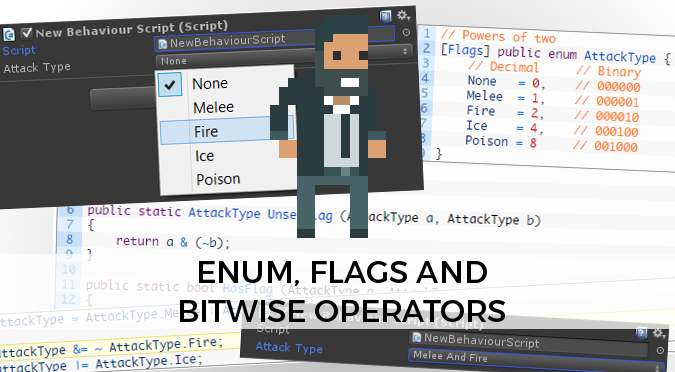 heady iris
this is very performant when compared to, say, a list of IDs
is there a way to check if I'm leaking things from UnityEngine.Pool object pool?
latent latch
latent latch
https://www.alanzucconi.com/2015/07/26/enum-flags-and-bitwise-operators/
good for adding those fluff tags like FIRE damage increases. Grouping modifiers by these fluff tags would require some more setup, such that you aren't just comparing by stat tags, but an additional fluff tag comparison operation for all modifier objects (for that specific stat)
heady iris
just seeing the number of objects that have been allocated would be sufficient
if the number goes up forever, i'm forgetting to return something
 lean sail
heady iris
just seeing the number of objects that have been allocated would be sufficient
lean sail
heady iris
just seeing the number of objects that have been allocated would be sufficient
https://docs.unity3d.com/ScriptReference/Pool.ObjectPool_1.CountAll.html should be able to use this
latent latch
merry stream
so loop through each list and apply it in whatever order, ie inc% first then mor...
The ability itself only really needs a static value for stuff like damage, as I don't see much of a reason to add %modifiers there, but that's up to how you want to do it. PoE does do some extra internal modifiers depending on abilities, but those usually have some requirements to it (close range bonus).
heady iris
lean sail
<https://docs.unity3d.com/ScriptReference/Pool.ObjectPool_1.CountAll.html> shoul...
ah, i just realized my problem
GenericPool doesn't actually derive ObjectPool. It has an internal ObjectPool<T> in it
i'm going to copy-paste this thing and expose the object pool
lean sail
heady iris
GenericPool doesn't actually derive ObjectPool. It has an `internal` `ObjectPool...
do you still have to pass in a create function? if so you could have a counter that increments in there
heady iris
nah, GenericPool just uses () => new T() as the create function
but all I need to do is make CoolerGenericPool that exposes what I need
 quaint rock
any reason to not just define the create yourself in ObjectPool<T>
quaint rock
assume it was designed for Go's but well it does not care how you create things and lets you provide the function for that
 dense estuary
I need to make functionality for a radar in unity, what are some ways I can get references to objects within a chosen range of the player? I was thinking of something like getting a reference to all objects with a certain layer in the scene, then check if they are in a within a certain distance from the player (by using distance formula or sumn), then transfer that information to a 2D plane for displaying on a map.
I feel one issue with that idea is I would constantly have references to everything in the specified layer
Which may cause performance issues
 leaden ice
dense estuary
I need to make functionality for a radar in unity, what are some ways I can get ...
leaden ice
dense estuary
I need to make functionality for a radar in unity, what are some ways I can get ...
I need to make functionality for a radar in unity, what are some ways I can get references to objects within a chosen range of the player?
Physics.OverlapSphere
dense estuary
leaden ice
> I need to make functionality for a radar in unity, what are some ways I can ge...
Oh, that might work, but I need a way to not account for the y axis.
leaden ice
dense estuary
Oh, that might work, but I need a way to not account for the y axis.
OverlapCapsule is simpler actually
basically you just do a really tall capsule with the chosen radius
tall enough to cover all possible y positions
 ornate perch
I have an odd coding / unity question. Is there any way for me to hold a list of prefabs in a scriptable object? I continue to get Type Mismatch in the field instead of the actual prefab itself
leaden ice
ornate perch
I have an odd coding / unity question. Is there any way for me to hold a list of...
Yes a regular List will work
List<WhateverType>
 ripe mountain
Hey all im following a brackeys tutorial and ive gotten to a part where he explains that we want our character to look the way we are travelling but mine seems to be walking sideways lol.
leaden ice
as long as WhateverType is a script you have on all the prefabs, or is GameObject itself.
ornate perch
Sure, i guess ill have to try a list itself instead of an array
leaden ice
ripe mountain
Hey all im following a brackeys tutorial and ive gotten to a part where he expla...
which side of the thing did you put your eyes on?
leaden ice
ornate perch
Sure, i guess ill have to try a list itself instead of an array
List or array will work
either one
ornate perch
it still gave Type mismatch hm
ripe mountain
leaden ice
which side of the thing did you put your eyes on?
i had just stuck em on on facing the z axis
 cosmic rain
ornate perch
it still gave Type mismatch hm
cosmic rain
ornate perch
it still gave Type mismatch hm
Share the code🤷♂️
leaden ice
ripe mountain
i had just stuck em on on facing the z axis
Show screenshots and show the code
leaden ice
ornate perch
it still gave Type mismatch hm
show code
ornate perch
its nothing special lol. I just have a test array for now, and my prefab is a game object with the script CapturePoint on it
 leaden ice
ornate perch
its nothing special lol. I just have a test array for now, and my prefab is a ga...
leaden ice
ornate perch
its nothing special lol. I just have a test array for now, and my prefab is a ga...
show the full script
ripe mountain
yup sure

 leaden ice
ripe mountain
yup sure
leaden ice
ripe mountain
yup sure
your Atan2 call is wrong
it's y, x. Double check that against brackeys
ornate perch
leaden ice
show the full script
sure but there isn't anything in here that should cause something like that
 cosmic rain
ornate perch
sure but there isn't anything in here that should cause something like that
cosmic rain
ornate perch
sure but there isn't anything in here that should cause something like that
The whole script means including the usings
leaden ice
ornate perch
sure but there isn't anything in here that should cause something like that
This might

how about capturePoints = FindObjectsOfType<CapturePoint>();
ornate perch
cosmic rain
The whole script means including the usings
there aren't any usings beyond the normal ones
ornate perch
leaden ice
This might
i can try but that isn't being called in the editor
leaden ice
and when you drag it, it immediately says type mismatch?
ornate perch
yes
leaden ice
try restarting Unity
ornate perch

 leaden ice
Also just to make sure - CapturePoint is a MonoBehaviour class?
ripe mountain
leaden ice
it's y, x. Double check that against brackeys
His actually says X,Z but i was playing around with it too see if thats whats wrong (x,z also doesnt work)
leaden ice
ripe mountain
His actually says X,Z but i was playing around with it too see if thats whats wr...
z, x would be correct
ornate perch
leaden ice
Also just to make sure - CapturePoint is a MonoBehaviour class?
at its base its a monobehavior. Its CapturePoint : Objective -> Objective : MonoB
dense estuary
leaden ice
or https://docs.unity3d.com/ScriptReference/Physics.OverlapCapsuleNonAlloc.html
I have an issue where OverlapCapsuleNonAlloc makes me need to select a single layer via the index int value, but I might need multiple layers.
leaden ice
dense estuary
I have an issue where OverlapCapsuleNonAlloc makes me need to select a single la...
it doesn't make you select a layer index
that's a layer mask parameter
you give it a LayerMask
public LayerMask myMask;``` ripe mountain
leaden ice
z, x would be correct
ripe mountain
leaden ice
z, x would be correct
He goes right and left fine now but he looks backwards when going forwards and forwards when going backwards
leaden ice
dense estuary
LayerMask converts implicitly to int
Trust me, pass a layermask in
ornate perch
leaden ice
try restarting Unity
Restart sadly didnt change anything
 leaden ice
dense estuary
leaden ice
dense estuary
it returns an int
(the number of colliders it found)
not a bool
you can't do if (int)
only if(bool)
 dense estuary
oh, sorry.
dense estuary
leaden ice
it returns an int
also, unity is saying there is no reference to the object in the Log method. Here is my code currently: ```cs
private void Update()
{
Physics.OverlapCapsuleNonAlloc(transform.position - scannerVertical, transform.position + scannerVertical, scannerRange, results, layerMask);
Debug.Log(results.Length);
}```
oh wait, its because the results variable isnt being assigned isnt it, its just kinda there because I have the overlap logic, but it isnt doing anything.
Would it be better for me to use the normal OverlapCapsule instead?
cosmic rain
ornate perch
Take a screenshot of the CapturePoint prefab.
Just to make sure, you're not dragging in objects from the scene hierarchy, do you?
 thick terrace
dense estuary
Would it be better for me to use the normal OverlapCapsule instead?
thick terrace
dense estuary
Would it be better for me to use the normal OverlapCapsule instead?
i think you're just using the nonalloc version wrong? results.Length doesn't give you the number of results, it gives you the size of your results buffer, so if you don't check the return value you don't know how many items there are in it
ornate perch
cosmic rain
Take a screenshot of the CapturePoint prefab.
i think i figured it out. I didnt realize you couldn't assign stuff in a scene.
it works if i use the prefab from my project
cosmic rain
ornate perch
i think i figured it out. I didnt realize you couldn't assign stuff in a scene.
Yes, things outside of the scene can't reference things inside of the scene, as they don't exist(outside of the scene)
ornate perch
which is unfortunate, beacuse i want the versions of the prefabs in the scene
yeah so i dont think there is an answer i haven't already solved
will just need to write in a new thing in the level to have a scene name to load when its selected
dense estuary
thick terrace
i think you're just using the nonalloc version wrong? `results.Length` doesn't g...
What is the perk of using NonAlloc instead of the other one?
 somber nacelle
dense estuary
What is the perk of using NonAlloc instead of the other one?
somber nacelle
dense estuary
What is the perk of using NonAlloc instead of the other one?
the fact that it is not allocating
dense estuary
If I need to access the positions of objects in a overlap capsule, would it be better to use the normal one?
somber nacelle
why? the non alloc method provides that information too
latent latch
always non-alloc :)
dense estuary
How would I use the nonalloc method similar to how I'm doing this? cs private void Update() { Collider[] scanned = Physics.OverlapCapsule(player.transform.position - scannerVertical, transform.position + scannerVertical, scannerRange, layerMask); foreach (Collider i in scanned) { // Create icon on scanner screen // Move icon to current position // Delete icons that are nolonger there. } }
somber nacelle
heady iris
you pre-allocate an array to store results in
the method tells you how many items it actually found
it's not reassigning the array (that's impossible)
dense estuary
heady iris
you pre-allocate an array to store results in
I'm sorry, I'm a little lost. Please explain.
heady iris
private Collider[] overlapResults;

void Awake() {
  overlapResults = new Collider[16];
}

void Update() {
  int hits = Physics.OverlapCapsuleNonAlloc(player.transform.position - scannerVertical, transform.position + scannerVertical, scannerRange, overlapResults, layerMask);

  for (int i = 0; i < hits; ++i) {
    Debug.Log($"Hit #{i}: {hits[i]}");
  }
}
https://docs.unity3d.com/ScriptReference/Physics.OverlapCapsuleNonAlloc.html
If you get 16 hits, you don't know if there were actually 16 things in the area, or if there were more than 16 and you ran out of space in the buffer
cosmic rain
dense estuary
I'm sorry, I'm a little lost. Please explain.
Before everything else, do you understand what a memory allocation is?
dense estuary
cosmic rain
Before everything else, do you understand what a memory allocation is?
Setting away space for data
to save for later
heady iris
dense estuary
How would I use the nonalloc method similar to how I'm doing this? ```cs
private...
notice how Physics.OverlapCapsule returns a Collider[]
this means that it has to allocate a new array each time you run it
dense estuary
heady iris
notice how `Physics.OverlapCapsule` returns a `Collider[]`
Yes
heady iris
you probably then use the array once and throw it out
so it gets garbage-collected later
cosmic rain
dense estuary
Setting away space for data
Well, it's not wrong, but you're missing the point.
Memory allocation is when you tell the system(or the app, depending on stuff), that this address in memory is gonna be occupied by something. It involves checking if it's not occupied already and notifying stuff to not occupy it later. In C# reference types are allocated on the heap and are subject to GC(garbage collector), so it also involves some logic with the GC, like keeping track of the referencing objects and stuff. That's why memory allocation in C# is relatively expensive. So instead of allocating stuff every update, you would do it once in awake for example and keep on using the same allocated object, just overwriting it's fields.
Normal Overlap method creates a new array under the hood which is a memory allocation. Non alloc version, fills the array that you pass in instead, so it doesn't allocate anything.
heady iris
Garbage collection is a non-trivial cost and can cause some very nasty hangs if it takes too long.
That's why the profiler has a "GC Alloc" column.
that shows you how much heap memory your code is asking for each frame
cosmic rain
That's true, but there's also a tendency to exaggerate it's costs. If you allocate just a few bytes every frame, it's not critical. Any kind of optimization should come from profiling and identifying a problem first.
While caching might seem like a perfect solution with no downsides, it's not. It makes your app consume memory. If you rarely ever use all the preached space, your app just uses more memory for no reason.
heady iris
indeed
cosmic rain
Then you get games that require 32GB RAM for no particular reason
dense estuary
cosmic rain
Well, it's not wrong, but you're missing the point.
Memory allocation is when yo...
Ohhhh, I had no idea that that was how memory worked in C#, thank you, that is incredibly useful information. That explains a lot.
That all makes much more sense
heady iris
heady iris
```cs
private Collider[] overlapResults;
void Awake() {
overlapResults = new ...
one easy way to reduce that cost is to just make that array static
you're not multi-threading, so it's impossible for two methods to try to use the array simultaneously
now you've got one array that every single instance of your method re-uses
 proper trellis
ok so like
how would i get RenderSettings to serialize in a json

its a type, so it wont work
cosmic rain
dense estuary
Ohhhh, I had no idea that that was how memory worked in C#, thank you, that is i...
We barely just scrapped the surface of memory management in C#. There's a lot more to it. I suggest checking the C# manual at some point, as it covers it properly.
proper trellis
heady iris
so yeah, you can't serialize it
well anything i can do to get it at least kinda working
heady iris
I presume you want an instance of RenderSettings
proper trellis
heady iris
I presume you want an instance of `RenderSettings`
yeah
 dreamy wave
How do I make it so that in my VR game, when I pick up a book, how do I make it open automatically to just one page? I'm not gonna end up having multiple so just the one.
 rigid island
dreamy wave
How do I make it so that in my VR game, when I pick up a book, how do I make it ...
rigid island
dreamy wave
How do I make it so that in my VR game, when I pick up a book, how do I make it ...
do you have a book already with page separated?
or are you doing UI for the page
dreamy wave
Rn I don't, but I do plan on modelling my own with the pages being their own separate objects.
dreamy wave
rigid island
or are you doing UI for the page
physical object you can grab
lean sail
this would mostly just be animation work then
heady iris
how do I make it open automatically to just one page
animate the book opening!
i'm unclear what the problem is
dreamy wave
ah alr. Would it need any coding like lets say, I code it to so like if book is grabbed, then open page
something like that
latent latch
you can probably do it all with the animator
dense estuary
cosmic rain
We barely just scrapped the surface of memory management in C#. There's a lot mo...
For making a radar (technically a minimap), would it be bad to clear something made last frame and make a new version of it at a different position?
I have this: cs private void Update() { int hits = Physics.OverlapCapsuleNonAlloc(player.transform.position - scannerVertical, player.transform.position + scannerVertical, scannerRange, results, layerMask); for (int i = 0; i < hits; i++) { Debug.Log($"Hit #{i}"); } foreach (Collider i in results) { // Clear and Create icon on scanner screen // Move icon to current position CreateAndClear(i.transform.position); } }
heady iris
Destroying and instantiating icons every single frame will be producing a lot of garbage
But it's a perfectly valid place to start
cosmic rain
We're not sure what you mean by "clear and create" too. Are you actually referring to instantiating?
dense estuary
cosmic rain
We're not sure what you mean by "clear and create" too. Are you actually referri...
Yes
I was planning on deleting all of the icons, then creating new ones at the new positions. I was also thinking it would be messy.
cosmic rain
Start with that and see if it causes any issues(profile the method for example and see how much GC it allocates). Then make a decision wether you need to optimize it or not.
A pool of icons might be a better approach, but it's up to you to decide wether it's worth the effort or not.
cosmic rain
proper trellis
cant figure it out
Why are you trying to serialize a type? What's the goal?
dense estuary
cosmic rain
Start with that and see if it causes any issues(profile the method for example a...
Would using a for loop be the best way to destroy the icons? Since they are child gameobjects of the plane this script is attached to.
proper trellis
cosmic rain
Why are you trying to serialize a type? What's the goal?
rendersettings is different
its pretty much just the environment tab in lighting settings
it even updates properties depending on current scene
i wanna serialize it and store it in a json so i can load it externally later
heady iris
okay, but you don't want to serialize a type
the problem is that all of its properties are static
proper trellis
heady iris
okay, but you don't want to serialize a type
i mean serialize the data in it
the data is never gonna be modified after its saved, so i just need the data
heady iris
You can instruct it to serialize something's static fields
ah, and you're using Json.NET, so there you go
I'm not so sure about deserialization
cosmic rain
dense estuary
Would using a for loop be the best way to destroy the icons? Since they are chil...
What other options do you have?
dense estuary
I can't think of any, but I am experiencing a problem
cosmic rain
proper trellis
its pretty much just the environment tab in lighting settings
Is it unity type? Or your own?
dense estuary
Currently I am getting an error saying at line 43: "Object reference not set to an instance of an object". Here is my script: https://hastebin.com/share/ilitizuqol.csharp
Hastebin is a free web-based pastebin service for storing and sharing text and code snippets with anyone. Get started now.
proper trellis
cosmic rain
Is it unity type? Or your own?
unity
heady iris
dense estuary
Currently I am getting an error saying at line 43: "Object reference not set to ...
Share the entire script.
The line numbers are off because you excluded the using directives
cosmic rain
proper trellis
unity
Ok, then you definitely shouldn't try to serialize it.
proper trellis
cosmic rain
Ok, then you definitely shouldn't try to serialize it.
i meant the data in it
cosmic rain
If you need to save the data in it, store it in an instance of your own type.
proper trellis
cosmic rain
If you need to save the data in it, store it in an instance of your own type.
i tried that and it just wouldn't work
idk why
heady iris
you will need to copy the data you need out of it
dense estuary
heady iris
The line numbers are off because you excluded the `using` directives
Oop, sorry, here: https://hastebin.com/share/egadosibaf.csharp
Hastebin is a free web-based pastebin service for storing and sharing text and code snippets with anyone. Get started now.
proper trellis
just would always error about smth
cosmic rain
proper trellis
i tried that and it just wouldn't work
Wdym? What errors exactly?
heady iris
there's no reason you can't just make your own class to hold the data and serialize it
proper trellis
i remember one was just a "null reference exception" like nothing else just that
heady iris
dense estuary
I have this: ```cs
private void Update()
{
int hits = Physics.OverlapCapsule...
Your foreach loop is wrong
proper trellis
another was smth with json encoding, it seems to freak out abt colors
heady iris
OverlapCapsuleNonAlloc returns the number of hits
It doesn't change the length of the array (that would be impossible)
heady iris
heady iris
```cs
private Collider[] overlapResults;
void Awake() {
overlapResults = new ...
You need to use a for loop to iterate over the valid indices.
cosmic rain
proper trellis
i remember one was just a "null reference exception" like nothing else just that
This is a very simple error. You should be able to solve it if you're asking in this channel.
heady iris
A foreach loop will give you every item in the array, including items that were never assigned to by OverlapCapsuleNonAlloc
cosmic rain
proper trellis
another was smth with json encoding, it seems to freak out abt colors
Share the error details.
proper trellis
cosmic rain
Share the error details.
i deleted the script with the intent of starting from scratch
as it was already becoming too much of a problem
then i asked here
cosmic rain
proper trellis
i deleted the script with the intent of starting from scratch
Well, you can't serialize a type and definitely not one that unity didn't intend to be serialized.
heady iris
well, we can't tell you very much if you deleted everything
proper trellis
heady iris
well, we can't tell you very much if you deleted everything
actually hold up
i think i still have the script
found it
thats the class i made
dense estuary
heady iris
You need to use a for loop to iterate over the valid indices.
So I would put the CreateAndClear method in the for loop and get rid of the foreach loop? How would I plug the Colliders into CreateAndClear()?
heady iris
dense estuary
So I would put the CreateAndClear method in the for loop and get rid of the fore...
Yes.
proper trellis
proper trellis
thats the class i made
for the exporting, literally just created a new entry in the json export using new DimensionRenderSettingsObject() since CopySettings() wouldn't work
heady iris
If the overlap finds 5 items, it will only write 5 items into the array
You must not try to do anything with the rest of the array.
cosmic rain
proper trellis
found it
Please share the code correctly!code
 tawny elkBOT

Posting code
📃 Large Code Blocks
Use links to services like:
https://gdl.space/, https://paste.ofcode.org/, https://hatebin.com/, https://paste.myst.rs/, https://hastebin.com/
📃 Inline Code
Surround code with three backquotes. Not quotation marks.
To format as C#, add cs to the first line:
```cs
// Your code here
```
Add a comment with a line number if there is an error message.
proper trellis
cosmic rain
Please share the code correctly!code
Hastebin is a free web-based pastebin service for storing and sharing text and code snippets with anyone. Get started now.
heady iris
do not derive DimensionRenderSettingsObject from UnityEngine.Object
just make it a plain old class
don't derive DimensionRGBColor from it either
proper trellis
heady iris
do not derive `DimensionRenderSettingsObject` from `UnityEngine.Object`
ight did that
still cant copy over the data due to due this???

cant figure it out
dense estuary
heady iris
You must not try to do anything with the rest of the array.
How?
heady iris
dense estuary
How?
by writing a for loop that only iterates over the valid indices
heady iris
heady iris
```cs
private Collider[] overlapResults;
void Awake() {
overlapResults = new ...
Look at what my script does.
dense estuary
whats the difference between ++i and i++?
heady iris
nothing in this case
dense estuary
oh
heady iris
I just use prefix by force of habit
dense estuary
sorry
cosmic rain
proper trellis
still cant copy over the data due to due this???
Share the line that is underlined
dense estuary
OH
heady iris
The overlap method stores each collider it hits into the array. That's all it does.
dense estuary
I GET IT
heady iris
So if it doesn't fill the array, you have random trash left in it
proper trellis
cosmic rain
Share the line that is underlined
SceneRenderSettings = DimensionRenderSettings.CopySettings(),
 toxic bramble
Does anyone have a key door system
dense estuary
heady iris
So if it doesn't fill the array, you have random trash left in it
So I would do CreateAndClear but instead of i in the perenthesis I would do results[i]?
cosmic rain
proper trellis
```cs
SceneRenderSettings = DimensionRenderSettings.CopySettings(),
```
CopySettings is not a static method, yet you try to use it as one.
heady iris
dense estuary
So I would do CreateAndClear but instead of `i` in the perenthesis I would do `r...
Yes.
 spring creek
toxic bramble
Does anyone have a key door system
spring creek
toxic bramble
Does anyone have a key door system
Likely many people do.
What have you tried and what are you struggling with?
In essence you just enable a bool or store a value and check it when you are near a door. So learning about trigger colliders should be enough to get it working
dense estuary
That makes so much sense
Thank you so much!
Ill work more on that tomorrow. I got to go to bed I have exams.
proper trellis
cosmic rain
CopySettings is not a static method, yet you try to use it as one.
YES OMG I GOT IT WORKING

thx
proper trellis
proper trellis
YES OMG I GOT IT WORKING
ok rq
any way to have the SceneRenderSettings table entry be conditional-based, currently doesn't export if there's no external lightingsettings and i wanna fix that
code:
bool hasLightingSettings = descriptor.SceneLightingSettings != null;
var dimensionDescriptor = new
{
    Name = descriptor.Name,
    Author = descriptor.Author,
    Description = descriptor.Description,
    SpawnPoint = descriptor.SpawnPosition.name,
    TerminalPoint = descriptor.TerminalPosition.name,
    SceneLightingSettings = descriptor.SceneLightingSettings,
    SceneRenderSettings = DimensionRenderSettings.CopySettings(),
    Addons = new
    {
        SlipperyObjects = descriptor.Addons.SlipperyObjects.Select(go => go.name).ToList(),
        ExtraTerminals = descriptor.Addons.ExtraTerminals.Select(go => go.name).ToList(),
        TriggerEvents = triggerEventsData
    }
};
basically, table has entry if true, isn't true, entry isn't there
i have a workaround, but i wanna know if theres a more elegant solution
cosmic rain
proper trellis
basically, table has entry if true, isn't true, entry isn't there
Serialized data has to have a predefined structure. You can't add/remove stuff from it dynamically. Unless it's elements of an array or something.
You could have 2 separate classes for with and without lighting data. Or just make the lighting data uninitialized and use some kind of bool to store it's state.
proper trellis
cosmic rain
Serialized data has to have a predefined structure. You can't add/remove stuff f...
i mean the dimensionDescriptor, i wanna have it export different depending on if this is empty or not
 cosmic rain
Then make a check. If it's null serialize DataWithoutLighting. If it is not, serialize DataWithLighting.
proper trellis
cosmic rain
Then make a check. If it's null serialize DataWithoutLighting. If it is not, ser...
yeah i know i can just export two different tables in one if statement
i just wanna know if i can essentially have an if statement in the table, so i dont need to do that
cosmic rain
Or serialize DataWithLighting, but a bool hasLightingData inside to determine whether to serialize/deserialize that part.
What tables are you talking about? This is not a carpentry discord.
proper trellis
cosmic rain
What tables are you talking about? This is not a carpentry discord.
dimensionDescriptor
its a table if im right
cosmic rain
Just kidding. But the use of tables is not appropriate here as you serialize objects.
It's not.
proper trellis
oh wait is it an array
cosmic rain
What's the type?
Ah, I see
It's an anonymous type
In either case, it's an object, not a table.
proper trellis
cosmic rain
In either case, it's an object, not a table.
oh
cosmic rain
But to answer your question, no you can't use a bool inside, as it's basically an initialization of the object.
proper trellis
oh ight
cosmic rain
You'll need an explicit type if you want to add some logic like if statements
 faint nimbus
would it be possible to generate a plane only when interacting on an item? or is it better to put planes but invisible on every item? but the problem is, the plane should be in a different layer mask, not sure if i could do that on non physical coded planes
I want to make something like this, maybe not planes

I was thinking if it is possible to make them appear or generate only when interacting, (no physical mesh), or would not possible, and I just have to put them on every clutch/lever for the car?
 orchid abyss
how to use collider variable outside oncollision enter?
 cosmic rain
faint nimbus
I was thinking if it is possible to make them appear or generate only when inter...
cosmic rain
faint nimbus
I was thinking if it is possible to make them appear or generate only when inter...
Wdym by "no physical mesh"?
faint nimbus
cosmic rain
Wdym by "no physical mesh"?
in coded form like .plane or something similar (dont know the exact variable)
like how we can make invisible non physical circles for groundcheck and set the radius
cosmic rain
faint nimbus
in coded form like .plane or something similar (dont know the exact variable)
You could issue a command buffer draw call, but I don't think it's gonna be worth the effort. Much simpler if you have it in the scene on a singleton or something and just enabled and position it correctly when needed
faint nimbus
ah okok, by singleton, is like the interactor in the main camera? from how i understand, it stores the mesh but will only move the mesh thingy to the item?
cosmic rain
faint nimbus
ah okok, by singleton, is like the interactor in the main camera? from how i und...
By singleton I just mean that you have one of these objects in the scene and reuse it for any scenario that you need.
Singleton pattern might make it easier to access it, but it's not necessary.

 hasty canopy
orchid abyss
how to use collider variable outside oncollision enter?
hasty canopy
orchid abyss
how to use collider variable outside oncollision enter?
- Pls atleast keep your code indented before posting
- collider is a local variable from oncollisionenter so it won't be available to use outside of that scope.
You can store its value by creating a global variable to use it from other functions
orchid abyss

cosmic rain
orchid abyss
how to use collider variable outside oncollision enter?
Holy moly. I didn't notice that.😱
spring creek
I feel like the ide should automatically fix that? I am so used to my linter though, not sure what is there by default
Clippy ❤️
cosmic rain
It should be fixing that by default. I'm not sure why it doesn't for them. Maybe they don't ever use Tab to autocomplete
 sudden portal
I'm currently building a turn based game. 2 Teams, Player and Enemy. Player is controlled by the user, Enemy is controlled by algorithm.
There are several characters per team. The order in which they have their turn is based on each characters "initiative" value (similar to games like HoMM, BG, DoS, etc.).
My current approach: in instantiation, create an array of all Characters and order this array based on the initiative value. The turns cycle through each element of the array and then starting back at 0 again.
I feel like this approach might limit me in the future (spawning new enemies during runtime, removing enemies, etc.). Any ideas how to implement this more solidly?
 fervent furnace
havent played HoMM BG DoS before.......
but i guess you mean the game cycle is based on some value on character not player->enemy->player->enemy....?
 knotty sun
sudden portal
I'm currently building a turn based game. 2 Teams, Player and Enemy. Player is c...
knotty sun
sudden portal
I'm currently building a turn based game. 2 Teams, Player and Enemy. Player is c...
how often does a characters initiative value change
sudden portal
Initiative values are static and determined before scene launch.
@fervent furnace yes exactly.
fervent furnace
i wonder what if
eg a turn of character with value 10 just passed but a new character with value 8 is inserted? (assume the turn started from less value first)
ie a new character with smaller value is inserted after a turn of character with higher value just passed
knotty sun
then I think I would just use a linked list of characters, that will be easy and quick to change should you need to at run time
sudden portal
@knotty sun You mean "LinkedList<T> Class"? What's the difference to a regular List for my project? Looks promising!
cosmic rain
I mean,even a regular list would work
sudden portal
@fervent furnace Either re-calculate the list or only have new characters in the next cycle (after all other characters had their turn once)
cosmic rain
You can just insert new characters into the list in the right place
knotty sun
sudden portal
<@556797857584381953> You mean "LinkedList<T> Class"? What's the difference to a...
Not quite, I would implement it myself. But yes, this will work for you. The benefit is it allows you to read the List in a specific order and maintain that order in an organised way
fervent furnace
linked list itself is useless, never see the real use case of "regular" linked list (tree or graph or open hash table uses linked list but they not just a linked list), unless you have a additional hash map for random O(1) access and double linked list for O(1) remove/add
btw list will works, but i wonder who can take action after insertion? the next character right after the higher value's one or the new inserted character or or restart the game loop or other strategy? you may need an additional pointer to next character right after the higher value's one, not just insert
sudden portal
Thanks for the insights everyone. I will implement a List and see if it works well for me.
@fervent furnace Interesting thought - I think having a bigger cycle where all characters go through once makes sense here. Newly instantiated characters only work in the next cycle.
Instantiating them in the same may create too many edge cases
knotty sun
sudden portal
Thanks for the insights everyone. I will implement a List and see if it works we...
Question: Do you envisage having duplicate initiative values or will they be unique?
sudden portal
@knotty sun I will have duplicate initiative values. I already created functionality that iterates through all Characters with the same Initiative value and randomly orders them in their initiative Level.
knotty sun
sudden portal
<@556797857584381953> I will have duplicate initiative values. I already created...
then I would suggest making your initiative a Tuple (int level, int position)
sudden portal
@knotty sun why? and what would level / position mean in this case?
knotty sun
so level is the initiative value and position is the sequence of that character within that initialive
it gives you a unique key for each character
sudden portal
I see thanks for your input!
What's the best approach to re-order an existing list? Say I want to move element [6] between [3] and [4] for example?
knotty sun
that is where linked list shine.
update [3] to point to [6] and [6] to point to [4]
job done
sudden portal
I just read that a linkedList is not index based. I can still access each element using listName.ElementAt(n), right?
where n is the index
knotty sun
sudden portal
I just read that a linkedList is not index based. I can still access each elemen...
yes you can, see the Extension methods in the docs
although you should never need to do that if you use that class
cosmic rain
sudden portal
I just read that a linkedList is not index based. I can still access each elemen...
Maybe start with a regular list. I wouldn't use linked list unless it was justified performance wise.
And it rarely is.
sudden portal
Guess I will try both approaches and play around a bit. It's just for learning purposes anyway.
using a regular list, what would you recommend for my question?
What's the best approach to re-order an existing list? Say I want to move element [6] between [3] and [4] for example?
clearing and re-populating maybe?
cosmic rain
sudden portal
using a regular list, what would you recommend for my question?
> What's the bes...
List has Remove/Add/Insert methods and many more. I suggest looking up the documentation for all the available API.
 chilly surge
Actually feels like link list could be nice for this case, with an index based data structure like list where you keep track of the current character via index, inserting a new character prior to the index means you also have to manually shift the index by one to keep it in the proper location, and same for removal. It wouldn't be a problem for linked list since you are always traversing by next pointer than by index.
sudden portal
Would List
var store = listName[6|
listName.RemoveAt(6)
listName.Insert(4, store)
not work in my case?
 molten timber
is there anyone that could help me with my problem when i press E or mouse0 on the weapon i want to pick up it just goes invisble when its picked up and it still shoots and stuff
cosmic rain
molten timber
is there anyone that could help me with my problem when i press E or mouse0 on t...
Sounds like an issue for #💻┃code-beginner
sudden portal
cosmic rain
Do note that indices would shift after inserting/removing
You mean initial index 4 is then 5, 5 is then 6 and so on?
cosmic rain
sudden portal
You mean initial index 4 is then 5, 5 is then 6 and so on?
If you insert before 4, yes.
cosmic rain
molten timber
could you help me dlich
If you share your issue details and code properly.
molten timber
yeah i could screen share if you got time
but i am gonna be muted
but i will hear you
@cosmic rain
 magic briar
Hello. I hope this problem includes to this channel. I have TextMeshPro on canvas and I change text in runtime. That's not a problem, but how to make some letter/words bigger/thicker than others when the words (sentence) are created by one textMeshPro object? I tried applying bold to words by $, but I need make it more visible
cosmic rain
molten timber
yeah i could screen share if you got time
No screen sharing. I've replied in beginner code.
molten timber
@sudden portal i am in school
molten timber
cosmic rain
No screen sharing. I've replied in beginner code.
ok will do
cosmic rain
magic briar
Hello. I hope this problem includes to this channel. I have TextMeshPro on canva...
Tmp supports rich text tags:
https://docs.unity3d.com/Packages/com.unity.textmeshpro@4.0/manual/RichText.html
magic briar
cosmic rain
Tmp supports rich text tags:
<https://docs.unity3d.com/Packages/com.unity.textme...
Oh. I see. Thank you!
cosmic rain
molten timber
<@209684227720085505>
Share !code properly
tawny elkBOT
Posting code
📃 Large Code Blocks
Use links to services like:
https://gdl.space/, https://paste.ofcode.org/, https://hatebin.com/, https://paste.myst.rs/, https://hastebin.com/
📃 Inline Code
Surround code with three backquotes. Not quotation marks.
To format as C#, add cs to the first line:
```cs
// Your code here
```
Add a comment with a line number if there is an error message.
molten timber
do you want everything
 dense tusk
boi
molten timber
like that?
dense tusk
lmao all good
cosmic rain
molten timber
do you want everything
The relevant code. Responsible for equipping the weapon.
molten timber
i wrote new code below where i put the new code
ive got a stomach feeling its doesnt have anything to do with the code since ive got no errors or warnings
dense tusk
all my fellas, i'm trying to have my player transition to a location which i have designated with an empty game object so it's easy to adjust the position. in the player script, i'd like to do something like
//Player controller script
if (player click triggerobject)
{
  Trigger();
}

if (enterPosition != null)
playerTransform.position = enterPosition.position;
enterPosition is a Transform which i would like to update whenever a new trigger object is interacted with. i have an abstract class script set up, and i'd like to update what should be saved to enterPosition from the override method, but i'm scratching my head at how to do that.
//Door trigger script
  public override void Trigger()
  {
      playerControl.enterPosition = doorEnterPos;
  }
i've tried a few variations of this, but haven't gotten it to work yet
cosmic rain
molten timber
ive got a stomach feeling its doesnt have anything to do with the code since ive...
Don't have much time now, but logic bugs are rarely accompanied by errors and warnings.
molten timber
not to rush you but if you could just take 4 min to hop in a screen share in a call so i can show you my problem
cosmic rain
molten timber
not to rush you but if you could just take 4 min to hop in a screen share in a c...
If I don't have time to look at the code, I definitely don't have time for a screen share.
dense tusk
just taking a glance at your issue @molten timber , i'm wondering if it might be this little part here
if (leftoverQuantity > 0 && openSlot)
{
    openSlot.setItem(itemToAdd);
    itemToAdd.currentQuantity = leftoverQuantity;
    itemToAdd.gameObject.SetActive(false); //specifically this part
}
that itemToAdd.gameObject.SetActive(false); line might be why it's invisible: it's being set to inactive
cosmic rain
molten timber
https://paste.ofcode.org/36QEpu4wcVMgzNLGSRjncVE
I don't see any code related to equipping the gun... I assume it's in the WeaponManager..?
 nocturne wyvern
Hi, I wark with UnityWebRequest and I always get this error
{"message":"Validation failed: deviceId must be a string, adaptyId must be a string","error":"Bad Request","statusCode":400}
Cysharp.Threading.Tasks.UnityAsyncExtensions+UnityWebRequestAsyncOperationAwaiter.GetResult () (at
String that used as body in request on first screen

 lean sail
dense tusk
all my fellas, i'm trying to have my player transition to a location which i hav...
lean sail
dense tusk
all my fellas, i'm trying to have my player transition to a location which i hav...
you likely dont want that playerControl.enterPosition to be so public, but what doesnt specifically work? You should show the actual code instead of pseudo code because what youve posted doesnt really make sense, you are calling Trigger() in a player controller script which is unrelated to your door trigger script
I would do something like, click on the object, try to get a component or check its layer which indicates this is something that you may enter. Then within the player controller script, assign enterPosition (which shouldnt be named Position)
 stable kayak
does anyone have an elegant solution to auto tiling?
molten timber
dense tusk
just taking a glance at your issue <@642306561389363220> , i'm wondering if it m...
so all i gotta do is make it true?
sudden portal
molten timber
so all i gotta do is make it true?
You probably don't want to make it false to begin with
molten timber
hahah
 thin aurora
nocturne wyvern
Hi, I wark with UnityWebRequest and I always get this error
{"message":"Valida...
thin aurora
nocturne wyvern
Hi, I wark with UnityWebRequest and I always get this error
{"message":"Valida...
Your question revolves around an endpoint that is not related to your code
If you are certain the error is not the case, I can only assume the endpoint does something wrong
molten timber
i dont understand when i add an layer to an weapon or something random i goes invisble from my game
can someone help me with that please
thin aurora
Perhaps you supplied the parameters incorrect?
nocturne wyvern
thin aurora
Perhaps you supplied the parameters incorrect?
via postman this is works correct
 thin aurora
nocturne wyvern
via postman this is works correct
thin aurora
nocturne wyvern
via postman this is works correct
Perhaps log the body created in the request and validate it is valid json + the actual body you expect
Maybe that Parse method that is used does something wrong
molten timber
i dont understand when i add an layer to an weapon or something random i goes invisble from my game
can someone help me with that please
nocturne wyvern
thin aurora
Perhaps log the body created in the request and validate it is valid json + the ...
 thin aurora
molten timber
i dont understand when i add an layer to an weapon or something random i goes in...
thin aurora
molten timber
i dont understand when i add an layer to an weapon or something random i goes in...
Stop spamming the same message please
thin aurora
nocturne wyvern
That looks fine. Maybe you can place a breakpoint before sending the request and see if the body is still correct? https://unity.huh.how/debugging/debugger
I can't think of a reason why this would be wrong. Perhaps the quoting is formatted wrong but I don't see why that would happen
 floral notch
Hello all,
Is there a way to detect collisions without a rigidbody? The collisions are very erratic due to it and I want to code the "physics" of them by hand. I only want the boxcollider to tell me WHEN it has collided
knotty sun
floral notch
Hello all,
Is there a way to detect collisions without a rigidbody? The collis...
simple answer, no
floral notch
Dang
I just want to make tiles that behave differently when you touch them
not make it so they cause weird collisions
thin aurora
If your geometry remains this simple you could make each box take custom bounds rather than adding a collider, and you check those instead
Keep in mind that doing this can be horrible if every single box keeps checking these things, and you should definitely have some type of blockmap that tells which box "might" collide with something
floral notch
thin aurora
Keep in mind that doing this can be horrible if every single box keeps checking ...
That could work. What's the standard way people do it? This surely can't be it, when you collide into a wall in platformers, you don't stutter and change direction
am I missing something obvious
thin aurora
Sorry, no idea. This is better suited for another channel
floral notch
which one
floral notch
knotty sun
simple answer, no
do you happen to know the standard way this is done?
knotty sun
floral notch
do you happen to know the standard way this is done?
there is no such thing as 'standard' everything depends on what you are trying to achieve. As you have provided no information about your setup, what you are doing and what you are trying to achieve it is impossible to provide you with information
floral notch
knotty sun
there is no such thing as 'standard' everything depends on what you are trying t...
I'm just trying to make a tilemap where each different tile behaves differently when you touch it
collisions seem to make it like you're physically smacking the tile
and it applies a force against you
knotty sun
yes, imagine running into a brick wall irl
floral notch
knotty sun
yes, imagine running into a brick wall irl
Yes but is it not possible to have a tile that detects a collision without also applying a force?
knotty sun
yes, they are called triggers
floral notch
Oh interesting. I can see that option on my player box collider but not on the tilemap collider
does it only work with box
ripe mountain
Hi everyone is there any videos that will help me add into my game where if the character touches a object it adds 1 to the score?
knotty sun
floral notch
Oh interesting. I can see that option on my player box collider but not on the t...
I think you will find it does
https://docs.unity3d.com/Manual/class-TilemapCollider2D.html
 floral notch
knotty sun
I think you will find it does
https://docs.unity3d.com/Manual/class-TilemapColli...
floral notch
knotty sun
I think you will find it does
https://docs.unity3d.com/Manual/class-TilemapColli...
ohh I see it now. So will the trigger allow me to detect collisions without a rigidbody then?
because right now it seems to not work without it
knotty sun
no, you still need the rigidbody2d
knotty sun
floral notch
ohh I see it now. So will the trigger allow me to detect collisions without a r...
nocturne wyvern
thin aurora
That looks fine. Maybe you can place a breakpoint before sending the request and...
I see alse this errors
 knotty sun
ripe mountain
Hi everyone is there any videos that will help me add into my game where if the ...
knotty sun
ripe mountain
Hi everyone is there any videos that will help me add into my game where if the ...
there are 1,000's on YT
floral notch
knotty sun
https://docs.unity3d.com/Manual/CollidersOverview.html
Please read
This seems to say at least one object must need a rigidbody. But it still won't remove the erratic behaviour and "trigger" removes any collision at all
I feel like I'd be better off just handwriting the collision logic
it's really simple anyway
and I wouldn't need to mess with colliders
orchid abyss
why do i always get "type mismatch" when assigning my player attribute manager to a prefab?

 warped condor
My team and I have a fairly sizeable project containing mostly class lib projects that we use across all of our different games. At the moment we're just copying and pasting the entire shared lib folders into each of our games however we'd really like to centralise these shared lib folders and store them in a seperate VCS enviroment. What's the best way to go about this (i.e what should our .csproj files look like so they can be referenced by the unity project root .sln file and be built and compiled into our exe, apk etc.) How can we reference the unity engine and editor dlls in your shared librar csproj files (I've tried already inside VS but I keep getting an error saying the unity dlls are invalid or are unsupported). Also VS doesn't seem to like my project referncing .NET framework 4.7.1 which is what the current version of out unity installation uses
thick terrace
warped condor
My team and I have a fairly sizeable project containing mostly class lib project...
you can compile your shared code as a separate managed plugin, but normally it's easier to import the source files straight into the unity project and let unity compile it! for one thing, if you use it on multiple games, it's a huge headache to build different DLLs for multiple different unity versions
my preferred way to do it is to put a package manifest (https://docs.unity3d.com/Manual/upm-manifestPkg.html) in the shared module and check it out into each game's Packages folder so it shows up as an embedded package
cosmic rain
orchid abyss
why do i always get "type mismatch" when assigning my player attribute manager t...
Scene objects can't be referenced outside of the scene.
warped condor
thick terrace
my preferred way to do it is to put a package manifest (https://docs.unity3d.com...
That sounds sensible. Shame there isn't a better approach for separation but this should work for our needs. Thanks
thick terrace
warped condor
That sounds sensible. Shame there isn't a better approach for separation but thi...
worth mentioning that if you're using a VCS that has a feature like git submodules, it works really nicely for that - you can also reference a repo by URL in the project manifest but unfortunately that only works with git iirc
warped condor
We've recently migrated over to unity's built-in VCS to try and have a more unified development experience within unity (also it's easier for our artists)
thick terrace
that's the one that used to be plastic right? i think it'd be an "xlink" in plastic?
 wise geyser
Does anyone has some knowledge on how to send live view from secondary camera into pop up style second window? Multi-display is not what I'm looking for
 ember lance
When making custom UI for my scripts is there an easy way to make a field that has a scrollbar
This only make that


And yes I know I shouldn't write a zero there was testing stuff
 hexed pecan
ember lance
This only make that
hexed pecan
ember lance
This only make that
Slider instead of floatfield
ember lance
hexed pecan
Slider instead of floatfield
Thank uuuuuuu
 placid summit
If I inherit from a UGUI monobehaviour and add some new inspector variables they do not show up, what is the easiest way to fix that?
 elfin tree
Hey! I'm trying to make the tower in the middle of that big range collider clickable, I've had no success using OnMouseEnter (because the range collider will always block it and be the raycast target instead) and using Raycasting with ignore on the "Tower Range" layer doesn't work either, for some reason it entirely ignores the "Tower" layer and hits the "Terrain" layer (plane) for some reason
What would be the proper way of doing this, or is there anything that I tried that should work?
 heady iris
What does your hierarchy look like?
hexed pecan
placid summit
If I inherit from a UGUI monobehaviour and add some new inspector variables they...
What are you inheriting from? Pretty sure youre not supposed to extend Unity UI classes
thick terrace
placid summit
If I inherit from a UGUI monobehaviour and add some new inspector variables they...
it probably has a custom editor, a lot of them do, so you'd need to create a subclass of its editor too
heady iris
hexed pecan
What are you inheriting from? Pretty sure youre not supposed to extend Unity UI ...
I've done this several times!
you probably just need to add a custom editor, yes
for example, I subclassed Button to allow it to target multiple graphics (instead of just one)
placid summit
thick terrace
it probably has a custom editor, a lot of them do, so you'd need to create a sub...
yes you are right - I need to extend the custom editor
heady iris
using UnityEditor.UI;
using UnityEditor;

[CustomEditor(typeof(MultiGraphicButton))]
public class MultiGraphicButtonEditor : ButtonEditor
{
    public override void OnInspectorGUI()
    {
        base.OnInspectorGUI();

        EditorGUILayout.PropertyField(serializedObject.FindProperty("targets"));

        serializedObject.ApplyModifiedProperties();
    }
}
Ah ok, that sounds handy. I was thinking of something else then
heady iris
yeah, the UGUI classes are (reasonably) friendly to extension
placid summit
I have to do it for circular hit detection - the rectangular-only is a bit rubbish!
 sudden stump
From a scale of 1 to 10, how screwed up is this?
public class Health : MonoBehaviour
{
public int currentHealth;
public int maximumHealth;
// Start is called before the first frame update
void Start()
{
currentHealth = maximumHealth;
}
public void TakeDamage(int damageValue)
{
currentHealth -= damageValue;
if (currentHealth <= 0)
{
currentHealth = 0;
Destroy(gameObject);
if (GetComponent<DamageOwner>() != null)
{
Destroy(GetComponent<DamageOwner>().damageOwner.gameObject.GetComponent<DamageOwner>());
}
}
}
public void HealHealth(int healValue)
{
currentHealth += healValue;
if (currentHealth > maximumHealth)
currentHealth = maximumHealth;
}
}```
```cs
public class DamageOwner : MonoBehaviour
{
public GameObject damageOwner;
void DestroyScript()
{
if (damageOwner == null)
{
Destroy(this);
}
}
}```
```cs
public class DamageOnCollision : MonoBehaviour
{
public int damageAmount;
void OnCollisionStay2D (Collision2D other)
{
if (other.gameObject.GetComponent<Health>() != null)
{
other.gameObject.GetComponent<Health>().TakeDamage(damageAmount);
if (other.gameObject.GetComponent<DamageOwner>() != null)
{
other.gameObject.GetComponent<DamageOwner>().damageOwner = gameObject;
}
else
{
other.gameObject.AddComponent<DamageOwner>();
other.gameObject.GetComponent<DamageOwner>().damageOwner = gameObject;
}
}
}
}``` covert swift
im making a horror game and i used the render texture and raw image to get a pixelated look. But the issue is that when i change the volume that has the post processing overrides, it does not come to the render texture? how can i fix this?(i used the URP template).
the post processing effect does not come the the pixelated look
sudden stump
@placid summit That bad?
placid summit
sudden stump
<@422737402113818635> That bad?
You can definitely use les GetComponent - like other.gameObject.AddComponent<DamageOwner>()?.damageOwner = gameObject and cache other.gameObject. But I would use less micro components and have 1 Person Component that can always reference other smaller ones
leaden ice
sudden stump
From a scale of 1 to 10, how screwed up is this?
```cs
public class Health : Mon...
this makes me want to die GetComponent<DamageOwner>().damageOwner.gameObject.GetComponent<DamageOwner>()
you also don't need .gameObject in anything in DamageOnCollision
and you should use intermediate variables instead of constantly calling GetComponent over and over
 soft shard
covert swift
im making a horror game and i used the render texture and raw image to get a pix...
soft shard
covert swift
im making a horror game and i used the render texture and raw image to get a pix...
Does the camera that is updating your render texture have the correct layers your post processing volume is using?
leaden ice
Learn about TryGetComponent too
sudden stump
leaden ice
and you should use intermediate variables instead of constantly calling GetCompo...
This was actually done on purpose
leaden ice
Why
sudden stump
I didn't know whether the code was going to stay or not, since this is still the prototyping phase
leaden ice
Why would you write the code bad intentionally
sudden stump
So I just wanted to write something as quickly as possible
sudden stump
leaden ice
Why would you write the code bad intentionally
It's pretty easy to get rid of the GetComponent hell with a variable
But it wouldn't matter if the actual code was bad, I'd just end up deleting it
So is GetComponent the only issue here?
leaden ice
Anyway why ask for a code review with code you haven't already cleaned up
leaden ice
sudden stump
So is GetComponent the only issue here?
no there's a ton of unecessary stuff
not just the GetComponents
the .gameObjects too
sudden stump
leaden ice
Anyway why ask for a code review with code you haven't already cleaned up
This is for the architecture, as in how the scripts connect with each other
The other stuff that's just bad reading could be changed, I have little experience with Unity's methods since I only studied C# (not even to a good degree, intermediate if we're really pushing it)
leaden ice
sudden stump
This is for the architecture, as in how the scripts connect with each other
This would be better done with an event:
if (GetComponent<DamageOwner>() != null)
{
Destroy(GetComponent<DamageOwner>().damageOwner.gameObject.GetComponent<DamageOwner>());
}``` tired elk
Hey ! Is there a way to tell if a SerializedPropertyChangedEvent is the one triggered at the initialization of a PropertyField so that I don't react to it? Apparently it is triggered when data binding happen
sudden stump
leaden ice
This would be better done with an event:
```cs
if (GetComponent<Dama...
Any reason why?
leaden ice
so you don't have this weird hard dependency between the scripts
sudden stump
Hmm, actually that's a good point. Another thing to read up on (or just use C#'s events)
leaden ice
Yes I mean C# events
placid summit
Does anyone really use such micro size components? - you will have to do so many GetComponent calls that are not super fast. Just have a Main player/enemy etc component and if required have cached references from within that to others.
sudden stump
placid summit
Does anyone really use such micro size components? - you will have to do so many...
It seems better to make a more modular system... when done right
leaden ice
placid summit
Does anyone really use such micro size components? - you will have to do so many...
The "slowness" of GetComponent is definitely overhyped
sudden stump
And I don't see the point in making 20 components then keeping a main Player/Enemy/Object one for calling stuff
covert swift
soft shard
Does the camera that is updating your render texture have the correct layers you...
i dont use the post precessing volume. i use the volume compoment built in urp
 leaden ice
I have never seen someone come in here with a framerate issue and the reason for it was GetComponent
It's a non-issue
sudden stump
^
Besides, my game's going to have low poly and textures, and those are the worst for performance
placid summit
ok that is good - depends of type of game of course
covert swift
covert swift
i dont use the post precessing volume. i use the volume compoment built in urp
@soft shard
 oblique spoke
sudden stump
Any reason why?
oblique spoke
sudden stump
Any reason why?
Storing combat result information in Health is probably fine too
ripe mountain
Hey all i want a bottle of water to randomly spawn when you hit the first one but it doesnt work, im following it from a tutorial

 sudden stump
oblique spoke
Storing combat result information in Health is probably fine too
sudden stump
oblique spoke
Storing combat result information in Health is probably fine too
Could work, that way I won't have to go through this hell just to keep track of who damaged who
ripe mountain
can you see anything wrong?
sudden stump
But it might make it so that some objects have variables that you won't ever use
Well, assuming I was making a bigger game
Think this is fine for now
oblique spoke
sudden stump
But it might make it so that some objects have variables that you won't ever use
I would go for a few extra variables over the work of managing DamageOwner component.
soft shard
covert swift
i dont use the post precessing volume. i use the volume compoment built in urp
AFAIK, the camera will only render post effects, regardless if its from the "Volume" component or Post Process components, based on layers
 scarlet shoal
Hi, this I believe was meant in the general context of C#, not Unity, but I'm still curious to hear from you:
File Traversal: Traverse the directory tree, starting with the specified path. Will you
prefer a single-threaded or a multi-threaded approach? What are the tradeoffs?
Would it actually be worth it to multithread file traversal?
In situations where you don't know how many files and catalogs you'll encounted this sounds to me like asking for trouble. In addition, file traversal is IO
I can't really see there being much benefit in doing this, unless you have the most optimistic scenario where the number of threads somehow aligns with the number of folders and you don't spend a lot of time waiting for free threads. Is my reasoning wrong here?
thin aurora
ripe mountain
Hey all i want a bottle of water to randomly spawn when you hit the first one bu...
Please Debug your code and see if the methods are triggered by using Debug.Log and checking your console for output.
Additionally place a log inside both if-statements to see if they are entered.
https://unity.huh.how/debugging/logging/how-to
Also, tag comparison should use CompareTag, as your IDE most likely is suggesting.
https://docs.unity3d.com/ScriptReference/GameObject.CompareTag.html
elfin tree
Anyone knows why this code DOES hit the layerMask it should be ignoring?
 thick terrace
elfin tree
Anyone knows why this code DOES hit the layerMask it should be ignoring?
thick terrace
elfin tree
Anyone knows why this code DOES hit the layerMask it should be ignoring?
because despite common sense, LayerMask.NameToLayer returns a layer index, not a layer mask 😔
elfin tree
thick terrace
because despite common sense, `LayerMask.NameToLayer` returns a layer index, not...
And is the solution 1 << LayerMask.NameToLayer ?
thick terrace
i think that should do it yeah
hexed pecan
elfin tree
And is the solution `1 << LayerMask.NameToLayer` ?
Or LayerMask.GetMask
Also your mask seems inverted
elfin tree
LayerMask.GetMask("Tower Range"); correct?
hexed pecan
It doesn't ignore those layers. It's the opposite - it includes only the layers in the mask
elfin tree
Oh nice, okay.. that's probably my issue
Seems like that was it, still have few things to fix to be completely sure though
tyvm
latent latch
 gusty aurora
How to know when a prefab is instantiated ?
Some callback that gets called when a prefab is dragged from the project into the hierarchy ?
gusty aurora
In the editor I mean, outside play mode
They get called with [ExecuteInEditMode], but that's pretty clunky
Also they get called every single time I start and exit play mode =X
I'm looking a simple callback OnPrefabInstantiated or similar
latent latch
I would try them out just because the behaviour of these instances are kinda less intuitive
for these callbacks
because I know ScriptableObjects and methods like Awake() have some funky behaviour (in the editor)
otherwise yeah, make an ExecuteInEditor script
could be its own separate component you can just tack onto stuff
gusty aurora
It feels so ultra mega clunky
I can't believe there is no simple callback when a prefab is instantiated
elfin tree
Is there a way to ignore certain layer for OnMouseEnter and similar methods?
thick terrace
elfin tree
Is there a way to ignore certain layer for OnMouseEnter and similar methods?
if you want more control than this i think you have to do the raycasting yourself
 elfin tree
Do you know if something on the Ignore Raycast Layer will detect collisions?
leaden ice
elfin tree
Is there a way to ignore certain layer for OnMouseEnter and similar methods?
Use IPointerEnterHandler instead and then you can use the mask on the Physics Raycaster component https://docs.unity3d.com/Packages/com.unity.ugui@1.0/manual/script-PhysicsRaycaster.html
 late lion
gusty aurora
Some callback that gets called when a prefab is dragged from the project into th...
late lion
gusty aurora
Some callback that gets called when a prefab is dragged from the project into th...
If you specifically want to know when something gets dragged and dropped into the hierarchy, there's this:
https://docs.unity3d.com/ScriptReference/DragAndDrop.AddDropHandler.html
elfin tree
leaden ice
Use IPointerEnterHandler instead and then you can use the mask on the Physics Ra...
Interesting, will give that a try, feel like I went away from IPointerEnterHandler for some reason, hopefully not true anymore
hexed pecan
elfin tree
Seems like that was it, still have few things to fix to be completely sure thoug...
Btw you can use the ~ operator to invert a mask. So if you want to ignore Tower Range, you can do ~LayerMask.GetMask("TowerRange")
Or make a serialized field and assign it in the inspector if that's possible
elfin tree
hexed pecan
Btw you can use the ``~`` operator to invert a mask. So if you want to ignore T...
very good to know
elfin tree
leaden ice
Use IPointerEnterHandler instead and then you can use the mask on the Physics Ra...
how would that look? i'm a bit confused by what you mean looking at the doc
do you mean a global setting or really specific to that one IPointerEnterHandler?
 leaden ice
elfin tree
how would that look? i'm a bit confused by what you mean looking at the doc
do y...
leaden ice
elfin tree
how would that look? i'm a bit confused by what you mean looking at the doc
do y...
the Physics Raycaster component (which you should have on your camera) has a layermask in the inspector
that will be applied to the raycasts it does in order to call OnPointerEnter on things
so you can exclude objects like that
likewise for the Graphic Raycaster on your Canvas (for UI elements)
(these are also accessible via script, if needed)
elfin tree
ahhh in my case it's in a canvas so i'll use graphic raycast
leaden ice
OnMouseEnter doesn't work for UI stuff at all that's why I assumed you were talking about physics
but yeah same deal on the Graphic Raycaster
leaden ice
elfin tree
ahhh in my case it's in a canvas so i'll use graphic raycast
All Graphic elements also have a "Blocks Raycast" or "Raycat Target" checkbox as well
elfin tree
I'm probably missing something but I have the following, the green collider blocks raycasts (ipointerenter) on ui
and i've set my blocking mask to not be blocked by the "Tower Range" (green collider) layer
it's still blocking though (removing the green collider will make the pointerenterhandler trigger)

 leaden ice
elfin tree
I'm probably missing something but I have the following, the green collider bloc...
leaden ice
elfin tree
I'm probably missing something but I have the following, the green collider bloc...
What's "the green collider"?
Is this an actual physics collider?
elfin tree
leaden ice
Is this an actual physics collider?
ye, that somehow blocks ui
leaden ice
elfin tree
ye, that somehow blocks ui
yeah that'd be via the physics raycaster
exclude it on the physics raycaster
elfin tree
somewhat confusing but makes sense
i hope it wont break anything else
oh wow.. adding physics raycaster to my camera does break things, i'll see if i can figure out why
it seems to break some of my Physics.Raycast
leaden ice
shouldn't
but also the multiple raycasters disambiguate which is in "front" by distance
so distance to the camera is another lever you have here
 swift falcon
hey thanks i will look into the action map asset, sounds interesting
elfin tree
leaden ice
shouldn't
oh man.. when it shouldn't but it does haha
i'll see if I can figure it out
i mean it only breaks one of my other raycasts so that's interesting
the one here
        private void Broken() {
                _ray = _mainCamera.ScreenPointToRay(Input.mousePosition);
                if (Physics.Raycast(_ray, out _hit, 1000f, groundLayerMask)) {
                    if (!_toBuild.activeSelf) _toBuild.SetActive(true);
                    _toBuild.transform.position = _hit.point;

                    if (Input.GetMouseButtonDown(0)) {
                        // if left-click
                        BuildingManager m = _toBuild.GetComponentInChildren<BuildingManager>();
                        if (m.hasValidPlacement) {
                            m.SetPlacementMode(PlacementMode.FIXED);

                            // shift-key: chain builds
                            if (Input.GetKey(KeyCode.LeftShift) || Input.GetKey(KeyCode.RightShift)) {
                                _toBuild = null; // (to avoid destruction)
                                _PrepareBuilding();
                            }
                            // exit build mode
                            else {
                                _buildingPrefab = null;
                                _toBuild = null;
                            }
                        }
                    }
                } else if (_toBuild.activeSelf) _toBuild.SetActive(false);
            }
        }
 icy depot
is Transform.Find generally as costly as GameObject.Find and the such? so I don't use it every frame and stuff
oh but i found a neat workaround for not using ti every frame so might not matter
soft shard
swift falcon
hey thanks i will look into the action map asset, sounds interesting
Its very helpful for multi device input, I would suggest a channel on YouTube called "samyam" who has a great playlist on the Input System package, the docs also have a "How do I...?" page for common uses
elfin tree
leaden ice
but also the multiple raycasters disambiguate which is in "front" by distance
mind expanding on that or linking something about it?
seems inverted or something like that
oh wow, actually in my case, raycast only works OUTSIDE game view
(so lets say my pointer leaves game view, the object that should appear starts showing)
soft shard
icy depot
is Transform.Find generally as costly as GameObject.Find and the such? so I don'...
Generally, any kind of "find" operation is going to be expensive since it usually has to traverse a large list, and generates garbage doing so (same with GetComponent), it is certainly best to avoid doing those types of calls in Update/every frame, and caching your references when possible is usually a better alternative in something like Start/Awake or on an event
elfin tree
i have a pretty weird issue, so i have raycast code that works perfectly, but if i add a Physics Raycaster to my Camera, it stops working but ONLY when the cursor is inside game view
removing the Physics Raycaster solves the issue (but i need it)
in other words: lets say my pointer leaves game view, the object that should appear starts showing at seemingly the right place inside game view
leaden ice
elfin tree
i have a pretty weird issue, so i have raycast code that works perfectly, but if...
show your raycast code
icy depot
soft shard
Generally, any kind of "find" operation is going to be expensive since it usuall...
I'll cache all of my stuff in a nice dictionary so i can access it with string then!
leaden ice
elfin tree
https://discord.com/channels/489222168727519232/763495187787677697/1215340247227...
Can you debug it and see which part is failing with the raycaster active?
Is the raycast not hitting? Is the code not running at all?
 grave tundra
If I have a parent object and a child mesh... and I want to rotate the parent object... how can i make sure it rotates around the center of the mesh rather than (0,0)?
elfin tree
leaden ice
Is the raycast not hitting? Is the code not running at all?
it's not hitting, in the code below the debug.log only shows when cursor is outside game view
 leaden ice
elfin tree
it's not hitting, in the code below the debug.log only shows when cursor is outs...
leaden ice
elfin tree
it's not hitting, in the code below the debug.log only shows when cursor is outs...
but do you know if the raycast is even happening at all?
Put a log before the raycast
elfin tree
ohh
leaden ice
like maybe this whole function is inside something like:
if (!EventSystem.current.IsPointerOverGameObject())```which would explain everything
elfin tree
it is
leaden ice
yep
makes sense
because with the physics raycaster now the event system sees the physics objects
elfin tree
i mean, there's an inverted if
 leaden ice
elfin tree
it's not hitting, in the code below the debug.log only shows when cursor is outs...
leaden ice
elfin tree
it's not hitting, in the code below the debug.log only shows when cursor is outs...
The most elegant solution is replace this custom raycast with IPointerEnterHandler etc
elfin tree
leaden ice
because with the physics raycaster now the event system sees the physics objects
ahhh
 versed spade
Would it be a good idea to make a seperate script under my player object for movement and then another for combat?
spring creek
versed spade
Would it be a good idea to make a seperate script under my player object for mov...
Yeah
elfin tree
oof i wish that part was my code, will see what i can do it's not too complex i think
ty!
versed spade
Just was thinking. "God I wouldn't want to read this again" if I put it all in one script lol
spring creek
Separation of Responsibilities is pretty powerful.
sudden stump
versed spade
Would it be a good idea to make a seperate script under my player object for mov...
Very good for maintainability and modularity
elfin tree
solution was rather simple actually, just removing that condition to hide the preview when hovering ui
i can just code it myself if i ever need that
sudden stump
The only real issue is that you're gonna have to keep track of what each script is referencing, but if your code structure is good this is usually not a big deal and it's definitely faster to find what DealDamage.cs is referencing compared to searching for it in a huge class
soft shard
icy depot
I'll cache all of my stuff in a nice dictionary so i can access it with string t...
If that works for your usecase thats probably fine, the downside with strings as a key though is that they can be easily mistyped or changed, if I need other scripts to access references, I usually make a public property for them and pass a private cached variable, though if the dictionary is private (as in other classes dont need access to it), you probably could just have the references without a key-value
icy depot
soft shard
If that works for your usecase thats probably fine, the downside with strings as...
i dont get what the private cached variable and the references without a key-value parts really mean.. but I get the typo part! And letting other scripts access my dictionary may be a bit tricky
oblique spoke
versed spade
Would it be a good idea to make a seperate script under my player object for mov...
I would start with things that could be used by AI objects. I generally separate "Player" stuff from functionality of the object.
soft shard
icy depot
i dont get what the private cached variable and the references without a key-val...
If other scripts dont need to access your dictionary, then I dont think you would need a dictionary, you can just store the references directly and access them from through variables, a dictionary provides a key-value, where you access the value of data, through a key as the "index", but if the script the dictionary will exist in is the only one using it, that extra organization might add more complexity
And by a "private cached variable" I mean something like this:
public class SomeScript : Mono
{
public SomeReference CachedVar {return cachedVar;} //the private cached var is now accessed pubically from other scripts
[SerializeField] SomeReference cachedVar; //now the reference can be set in the inspector and access is private

//void Start() {cachedVar = FindObjectOfType<SomeReference>();} //this can be avoided entirely because of the above
}
If SomeScript needs to use something that would otherwise be stored in your dictionary, it can just call cachedVar or whatever the specific cache is, if something outside the class needs to access it, they can use the public property instead
icy depot
it adds complexity? well maybe.. i kinda just wanted the strings so it seems nice and blue
easy to see and stuff
 hard viper
having a dictionary means you have to manage the dictionary to keep it up to date
which is doable, but means more juggling than just not having to do that
swift falcon
soft shard
Its very helpful for multi device input, I would suggest a channel on YouTube ca...
is it good to use when your main input is left mouse click?
 somber sparrow
Making a first person shooter, and made this script to move the gun between hipfire and sights positions. it works fine until i press right click while the gun is transistioning, when it starts to shoot back and forth between the position i clicked at and the position it was moving to. How can i fix this?

 swift falcon
as example i want to create a Point and click adventure, where almost everything needs to bind mouse click left
grave tundra
I have two points A and B.... I want to create a third point that is in the direction from A->B with distance d... but I also want to move it a distance d2 in an orthogonal direction... what math am i missing?
 tall salmon
Hi! i have a problem where i have a gameobject that instantiates another one, this one takes the rotation as a guide to where to go and also takes it as speed, does someone know how i can do it only take it as the vector it should follow and not the speed? (here is screenshot of code for reference)
 leaden ice
tall salmon
Hi! i have a problem where i have a gameobject that instantiates another one, th...
leaden ice
tall salmon
Hi! i have a problem where i have a gameobject that instantiates another one, th...
normalize the vector and multiply by the desired speed
Vector2 direction = mouseWorldPosition - transform.position;
rb2dBullet.velocity = direction.normalized * speed;```rotation isn't a great name for it since it's a direction vector. A rotation would be captured in a Quaternion or a float representing an angle around the z axis for example
tall salmon
so i should do direction instead?
leaden ice
I think it's a better name for what that is
tall salmon
i thought it might mess up if i try to rotate anything later on
but since its just a mini game for learning i didnt think twice
 mellow sigil
grave tundra
I have two points A and B.... I want to create a third point that is in the dire...
mellow sigil
grave tundra
I have two points A and B.... I want to create a third point that is in the dire...
What you're missing depends on what you already have
leaden ice
tall salmon
what does normalized do?
gets a normalized version of the vector
tall salmon
and what is that?
leaden ice
a normalized vector is a vector with length 1
tall salmon
ohhhhhhh
rigid island
yeamb lol 🚶
tall salmon
wouldnt it be v3 (4,4,4) normalized 1,1,1?
leaden ice
The idea is you can think of a normalized vector as basically representing only a direction and not a magnitude. So you can multiply it with any number to get the same direction with any magnitude you want
grave tundra
@mellow sigil I think I can just do offsetPos = new Ray2D(Vector2.zero, Vector2.Perpindicular(myDir)).GetPoint(distance);
tall salmon
leaden ice
The idea is you can think of a normalized vector as basically representing only ...
yea yeah
very helpfull
ty my man
leaden ice
tall salmon
wouldnt it be v3 (4,4,4) normalized 1,1,1?
no the length of 1, 1, 1 is sqrt(3)
tall salmon
sqrt?
tall salmon
hmmm wait
lemme think rq
new vector 2 = 15 , 7.5
vector 2 but normalized would be 1, 0.5
tall salmon
oh
leaden ice
pythagorean theorem gets you the length
rigid island
tall salmon
wouldnt it be v3 (4,4,4) normalized 1,1,1?
its .58 .58 .58 🙂
 simple egret
You take the squares of all the vector's axes (X, Y, Z), you add them, and square root the result. That's your length (magnitude)
 tall salmon
OHHHH
simple egret
No, it's a circle around the origin, not a square
leaden ice
Yes you can think of a normalized vector as a vector on the unit circle
 simple egret
A normalized 2D vector pointing 45° has X and Y at 0.707 or something
leaden ice
so - preserve the direction of the vector but get the one on the unit circle
and that's normalization
tall salmon
okay
so it would be like a way to make it always be the same without taking in account the distance from point 0 to point x in case it is the same direction?
tall salmon
the red is the normalized

right?
those are two different vectors and the red symbolizes the normalized part of each one
leaden ice
yes exactly
tall salmon
yay
leaden ice
normalized versions of them
quaint rock
very useful when you only care about the direction
or want to move something in a direction, since a normalizedVector * 5 would be 5 units in its direction
somber sparrow
hi, im making a first person shooter, and made this script to move the gun between hipfire and sights positions. it works fine until i press right click while the gun is transistioning, when it starts to shoot back and forth between the position i clicked at and the position it was moving to. How can i fix this?

 rigid island
somber sparrow
hi, im making a first person shooter, and made this script to move the gun betwe...
rigid island
somber sparrow
hi, im making a first person shooter, and made this script to move the gun betwe...
what are you coding in ohmy..
!ide
tawny elkBOT
💡 IDE Configuration
If your IDE is not autocompleting code
or underlining errors, please configure it.
Select one:
• Visual Studio (Installed via Unity Hub)
• Visual Studio (Installed manually)
• VS Code
• JetBrains Rider
• Other/None
somber sparrow
rigid island
what are you coding in ohmy..
im on chromebook
rigid island
somber sparrow
im on chromebook
how are you using unity on a chomebook..
rigid island
just cause you can doesn't mean you should
also how are you even running Unity on chromebook
somber sparrow
anyways idk how to fix that i think the two coroutines are conflicting because they are the same speed but because of the insights bool they shouldn't be able to be triggered at the same time
 wide dock
somber sparrow
hi, im making a first person shooter, and made this script to move the gun betwe...
wide dock
somber sparrow
hi, im making a first person shooter, and made this script to move the gun betwe...
Simply block any transitioning if there is already one in progress
somber sparrow
wide dock
Simply block any transitioning if there is already one in progress
how?
wide dock
boolean or null check a Coroutine variable
rigid island
store coroutine inside variable
rigid island
somber sparrow
huh ive never heard of hat
StartCoroutine returns a Coroutine
somber sparrow
and i can check if a coroutine is already active?
rigid island
somber sparrow
and i can check if a coroutine is already active?
check if its not null
only assign it null when the coroutine is done
somber sparrow
what is the code for that?
wide dock
private Coroutine m_transition;

...
private void Update()
{
  ...
  if (m_transition == null)
  {
    m_transition = StartCoroutine(Foo());
  }
}

private IEnumerator Foo()
{
  ...
  m_transition = null;
}```that basically
 eager tide
does anyone have a beer drinking script
spring creek
eager tide
does anyone have a beer drinking script
Probably.
What have you tried and what isn't working
It's gonna be unique to how your game works, so we of course can't just make code for you (and this is a place of learning, so that isn't allowed anyway)
leaden ice
eager tide
does anyone have a beer drinking script
no but I have written many scripts while drinking beer
eager tide
im trying to make consumable but i dont know how
spring creek
eager tide
im trying to make consumable but i dont know how
There are tons of ways
Depends
leaden ice
you'd have to define exactly what that means
does it just disappear
do you need an animation of the drtinking happening
does it have some effect on the character?
spring creek
It's as simple as reducing an int by one when you call Drink()
leaden ice
or increasing it
spring creek
And as complex as an entire inventory system with animations and side-effects
Well, could be even more complex than that
eager tide
like where you press on it with F and it drinks it with an animation
spring creek
eager tide
like where you press on it with F and it drinks it with an animation
Make an animation and play it when you press f
rigid island
interface <- consumable
spring creek
It's still to vague to help with imo
leaden ice
eager tide
like where you press on it with F and it drinks it with an animation
which part of this are you stuck on
basically - tackle it piece by piece
eager tide
Im trying to make it consumable like for it to dissapear when i press a button on it
leaden ice
yeah you said that, multiple times
rigid island
eager tide
Im trying to make it consumable like for it to dissapear when i press a button o...
still unclear which part you are struggling with though or what you have so far
so many different ways to do this its hard to answer definitely , you have to break down each part into smaller parts and tackle it that way
eg .
how to Do F press Key?
how to detect objects?
how to run method when found object etc.
spring creek
eager tide
Im trying to make it consumable like for it to dissapear when i press a button o...
Destroy(object)
elfin tree
Is there a way in a double switch case to disregard the second value, something like this?
 somber nacelle
elfin tree
Is there a way in a double switch case to disregard the second value, something ...
somber nacelle
elfin tree
Is there a way in a double switch case to disregard the second value, something ...
Just add another case line for the second case
elfin tree
somber nacelle
Just add another case line for the second case
I think I meant this

if that,s the right syntax
leaden ice
yes discard should work
somber nacelle
Ah yeah I misunderstood what you wanted. That is correct
elfin tree
thanks
dense estuary
How can I make an object instantiate at a position relative to its parent object. Currently my script is instantiating objects at the positions of detected objects instead of its position being dependant on the parent gameobject. Would I need to project on a plane to align them?
latent latch
If you set the parent when instantiating then its local positional values will be relative to the parent
dense estuary
latent latch
If you set the parent when instantiating then its local positional values will b...
Yes, but currently the object I am instantiating is spawning at the position of the object detected. Although the coordinates of the instance are relative to the parent. My goal is to make the instance position along the local x and y coordinates along a plane.
quaint rock
also if its not a child and you want to relative to a other object its just addation
otherObjectPos + relativeOffset
latent latch
dense estuary
Yes, but currently the object I am instantiating is spawning at the position of ...
Just zero out the local positional vector if you want it to spawn at the parent
even if you parent an object, if it already has an offset that just translate into a local offset
(another reason to make sure you prefabs don't have positional values)
leaden ice
dense estuary
How can I make an object instantiate at a position relative to its parent object...
use theParent.TransformPoint(desiredLocalPosition) to get the position to pass into Instantiate
soft shard
swift falcon
is it good to use when your main input is left mouse click?
If your entire game is literally only 1 input and you dont plan on supporting other devices like controllers, then maybe not, if you do plan to have other inputs or those inputs should be used by different devices or you just want control over input through events instead of polling in Update, then it can be useful and has a lot of nice built in features like toggling, rebinding, activating after some time has been held, normalizing raw input values, input states, etc - though in general, I would say its far better than the default input system, and since its become stable, I have personally only used the "new" input system in every project no matter how small just due to how flexible and scalable it is to work with
 clear oriole
Does anyone know how to access nvidias dlss mode in script
cosmic rain
clear oriole
Does anyone know how to access nvidias dlss mode in script
Not sure if it's possibly to set directly, but you could probably define several hdrp assets that have different config of dlss and switch between them.
 ivory cove
Hi! So I recently have been working on an action buffer system just so the player doesn't have to perfectly time back to back actions. This is what I have so far for my system. The only problem I have with it is it's precision. For example, when I input an attack in the middle, I want the 2nd attack to occur 0.3f after the first attack ends (or a value extremely close to 0.3f). However, currently the variance is around 0.01 I want the variance to be lower. I did some research and I've come to realize that Unity's Invoke method is not extremely precise. Is this true? If so, I was looking for some extremely timing precise alternatives!

 cosmic rain
It's more about the update loop. User code executes at certain place in the update loop(frame). The next time it executes is on the next frame, so .016ms later assuming 60 fps. You can't really control precise execution within these 0.016ms and shouldn't need to, because it wouldn't really have any impact on the game.
heady iris
yes, you don't get ultra-precise timers
that would require unity to be able to interrupt whatever is happening to run your code
cosmic rain
Sure, there's stuff like late update too, but you don't know how far in the frame that is executed.
heady iris
don't use realtimeSinceStartup for gameplay purposes
ivory cove
heady iris
don't use realtimeSinceStartup for gameplay purposes
would time.time work fine?
heady iris
Yes. That should be the default.
ivory cove
got it thank you!
Out of curiosity, when do you usually use realtimeSinceStartup if not for gameplay?
heady iris
I haven't used it recently at all
ivory cove
I see I see I'll do some research on that then xd
cosmic rain
In the docs they provide an example of using it for an fps counter
latent latch
public abstract class StorableHandler : MonoBehaviour { }

public abstract class StorableHandlerUI : MonoBehaviour
{
  StorableHandler storableHandler; //UIManager should have references to both the slots and the inventory (StorableHandler)
  List<SlotUI> slots;

  public Init()
  {
    //init slots and bind events
    slot.OnDroppedEvent += (fromIndex, toIndex)
        => OnDropCallback(fromIndex, toIndex);
  }

  protected void OnDropCallback(SlotUI slotFrom, SlotUI slotTo)
  {
    //how should I be getting the SlotFrom inventory reference?
  }
}

public class SlotUI : MonoBehaviour, IDragHandlers, IPointerHandlers
{
    //public StorableHandlerUI StorableHandlerUI <--- seems like I need some bi-direction reference binding
    public event Action<SlotUI, SlotUI> OnDroppedEvent;

    public virtual void OnDrop(PointerEventData eventData)
    {
        //We should swap objects between slots here, which also happens between different inventories
        foreach (Component component in eventData.pointerDrag.GetComponents<Component>())
        {
            if (component is SlotUI slotUI && slotUI.StorableHandlerUI != null)
            {
                OnDroppedEvent?.Invoke(slotUI, this);
                return;
            }
        }
    }
}```
So, I've been redoing a lot more inventory logic and there's one thing I'm trying to understand and it's how I should have stuff reference when it comes to decoupling objects. My idea is to just bind my slots by events, which works out well until I get to my method of object swapping between inventories/managers. The only way I can think of managing this is by giving each slot a bi-directional reference, but that feels like doing everything by events here becomes obsolete and I should just then call by method.It works fine if I just swap between slots in the inventory itself, but it becomes a problem when introducing swapping between different inventories.
cosmic rain
latent latch
```cs
public abstract class StorableHandler : MonoBehaviour { }
public abstract...
I was recently working on an inventory-ui binding as well. The way I have it setup is that when I bind a certain inventory to ui, I subscribe the inventory ui to the actual inventory SlotChanged event as well as populate the UI inventory with InventorySlotUI elements that hold an index to the bound InventorySlot. So the Inventories communicate with each other by events/method calls, but the slots are controlled from the UI/actual inventory class respectively. The UI/actual slots only communicate with their ui/actual inventory respectively.
 royal wigeon
I'm trying to make a setting menu where you can change the framerate, and I'm stuck on 2 buttons. How would I turn V-Sync on, and how would I also let the user select an "Uncapped" frame rate?
 little meadow
targetFrameRate of 2 might be a tiny bit low 😛
royal wigeon
little meadow
targetFrameRate of 2 might be a tiny bit low 😛
That just means I don't know what to set it.
little meadow
-1 is for uncapped (check the docs to confirm though) and there's a separate property for v-sync
royal wigeon
little meadow
-1 is for uncapped (check the docs to confirm though) and there's a separate pro...
The docs don't really explain it though.
And I don't know how to set V-Sync, based off players moniters hertz
little meadow
okay... I'll give you links, but honestly this should be a quick google away
royal wigeon
I've tried for the past 20 minutes
little meadow
https://docs.unity3d.com/ScriptReference/Application-targetFrameRate.html - explains target frame rate and what -1 is and different platforms and everything
https://docs.unity3d.com/ScriptReference/QualitySettings-vSyncCount.html - v-sync
royal wigeon
little meadow
<https://docs.unity3d.com/ScriptReference/Application-targetFrameRate.html> - ex...
It doesn't explain how to get the player's monitor's hertz though, and change that to a vSyncCount
little meadow
so, ready what vSyncCount does and what its values mean
royal wigeon
What are you asking?
little meadow
I'm not asking, you are 😛
I'm telling you to read the docs, they're explaining everything
cosmic rain
royal wigeon
It doesn't explain how to get the player's monitor's hertz though, and change th...
The second link does. Read it...
When you use vSyncCount, Unity calculates the target frame rate by dividing the platform's default target frame rate by the value of vSyncCount. For example, if the platform's default render rate is 60 fps and vSyncCount is 2, Unity tries to render the game at 30 frames per second.
Wait so if a player has a monitor with hertz of 75, it will do (PlayerMonitorHertz / Vsynccount), which means if I set it to 1, then it will just use the players montior hertz right?
cosmic rain
Yes
royal wigeon
Thanks, for me reading complicated docs like that is kinda hard.
cosmic rain
This is far from being a complicated doc😬
If you find it hard to understand, break it down to parts and research the terms that you don't know.
It's a good way of learning.
royal wigeon
cosmic rain
The second link does. Read it...
```
When you use vSyncCount, Unity calculates t...
Well I saw here that is said "Platform", so I thought it meant the build's set frame rate, not the users.
cosmic rain
Platform referes to the device that they run the game on, i.e. windows PC, Linux, PS5, Android, etc...
royal wigeon
cosmic rain
Platform referes to the device that they run the game on, i.e. windows PC, Linux...
Thanks for that.
 dawn nebula
Got this code snippet. Anyone know where Delta.Multiply is from? Is that a Unity thing?
 leaden ice
Not a Unity thing
dawn nebula
leaden ice
Not a Unity thing
Shit, then it could be…. Anything >_>
Well, hope the creator responds then.
dense estuary
heady iris
Yes.
I got the radar working mostly. Here
 dense estuary
You mean like, a variable is only visible in unity if?
heady iris
This won't change whether the field is serialized, but NaughtyAttributes provides an attribute that conditionally shows the field in the inspector
leaden ice
If you mean conditionally shown in inspector, then yes
conditionally serialized, no
Anyway use NaughtyAttributes https://dbrizov.github.io/na-docs/attributes/meta_attributes/show_hide_if.html
heady iris
It's a third party asset.
leaden ice
editor plugin, yes
leaden ice
Well you could write the custom property drawer the same way the plugin does
Unity Editor was made to be extensible
heady iris
oh right, just a custom property drawer (:
A custom editor for the entire component could make sense, though
in case you're unfamiliar:
- a property drawer defines how to draw a single property in the inspector
- a custom editor defines how to draw an entire component
 faint hornet
Hey everyone I need help with coming up with a solution for:
Storing a connected “pattern” of connected tiles from a specific tile as the origin/pivot point.
And two, comparing that connected pattern to another identical connected pattern. (With or without rotational symmetry)
If someone has a solution or better yet a post or forum with a similar solution to study.
leaden ice
faint hornet
Hey everyone I need help with coming up with a solution for:
Storing a connecte...
Just a List<Vector2Int> would do it for a basic solution
or HashSet of them
with two hashsets you know you can check if they're the same pattern with something like:
bool IsSamePattern(HashSet<Vector2Int> a, HashSet<Vector2Int> b) {
  return a.Count == b.Count && a.IsSubsetOf(b);
}```How would this work exactly? I’m not understanding, even with the code?
leaden ice
as for rotational symmetry I suppose you could just make a function to rotate the set and then test for this pattern sameness for each orientation
leaden ice
faint hornet
How would this work exactly? I’m not understanding, even with the code?
it's just a set of positions
the code checks if the two sets contain exactly the same positions
the positions are assumed to be expressed as "local" positions from a pivot point
faint hornet
leaden ice
it's just a set of positions
In relation to a chosen position though.. like imagine a group of water tiles that make up the shape of a lake.. now how to find the same lake in a different position even if the rotation is different
leaden ice
faint hornet
In relation to a chosen position though.. like imagine a group of water tiles th...
well let's not worry about the rotation being different yet
that can be solved later
start with just the first part of the problem
can ytou explain the use case more?
are we talking about just a pattern of positions?
Or like, specific tiles as in a Tilemap
if you mean a certain pattern of tiles in a tilemap, that's essentially identical to a substring text search problem
You could use standard algorithms for example https://en.wikipedia.org/wiki/Boyer–Moore_string-search_algorithm
fervent furnace

In graph theory, an isomorphism of graphs G and H is a bijection between the vertex sets of G and H
    f
    :
    V
    (
    G
    )
    →
    V
    (
    H
    )


{\displaystyle f\colon V(G)\to V(H)}
such that any two vertices u and v of G are adjacent in G if and o...
faint hornet
leaden ice
can ytou explain the use case more?
It’s for a tile based puzzle game.
Not a tile map. But am looking for a solution with a vector2int based..
Imagine for example a tile with the number “5”. That tile will need to contain 5 tiles including itself as a group of orthogonal connected tiles.
But if there are two “5” on the grid and I want the player to try to create identical groups. I needs to check that.
I suppose checking that is kinda easy but I want to engineer it in a way that is easily packaged to check for other characteristics like symmetry/color/etc
fervent furnace
you are not asking for pattern matching but search if there exists another subgraph in your tilemap which is same for some given subgraph
btw since it is tile based so you can use translation and rotation to see if two sets of vertices match.
leaden ice
that feels like a better answer than mine!
faint hornet
fervent furnace
you are not asking for pattern matching but search if there exists another subgr...
So yes, I’m struggling to convey what I’m looking for. But yes, if I already knew what this problem was called I would have googled it already.
And to respond to your answer, that link is so confusing to me lol
leaden ice
Are you familiar with graph theory yet?
You'll really want to be, if you're making a tile based... anything game
faint hornet
leaden ice
Are you familiar with graph theory yet?
Not so much but reading it totally makes more sense now but I’m struggling on how to structure it in Unity.
dense tusk
dense tusk
all my fellas, i'm trying to have my player transition to a location which i hav...
well i figured out the problem. i whole thought i assigned references in the inspector, and lo, i did not
sometimes all you need is to come back with a fresh set of eyes
faint hornet
faint hornet
So yes, I’m struggling to convey what I’m looking for. But yes, if I already kne...
So reading more about this I would create a system that looks at a tile to the left (example) of center, checks to see if it is “connected” if it is, it stores a relation to it?
Wouldn’t this be over kill? Many tiles will contain the same data even though it’s not needed.. especially on an orthogonal grid..? @leaden ice
cosmic rain
faint hornet
So reading more about this I would create a system that looks at a tile to the l...
Your actual graph should only contains the nodes that actually exist, so there shouldn't be redundant data.
faint hornet
cosmic rain
Your actual graph should only contains the nodes that actually exist, so there s...
Sure, but what about four tiles connect into a square. There are 8 different data points, right?
faint hornet
cosmic rain
4 tiles = 4 nodes
*2 because of relationships
cosmic rain
So are you counting relationships or nodes?
Each node would have several relationships(edges), but the total count of nodes wouldn't change.
faint hornet
Both but can’t it be simplified to something like 4
cosmic rain
Sure it can. A node is an object. It can have all kinds of properties, for example a list of edges. Each edge references 2 nodes that it connects.
Or you could have the edges as references to the connected nodes instead. The concept doesn't change.
fervent furnace
you can store all AABBs, offset, vertices count of all connected components, then check if one AABB X can be rotated and translated to another AABB Y and vertices count is the same, if yes, then try to map the vertices of X to Y by apply the same translation and rotation
faint hornet
In the “2x2 square” example. You can either save the data with relationships which is 2 per tile in example. But can’t you do a string like “bottom left to bottom right to top right to top left?
faint hornet
cosmic rain
Or you could have the edges as references to the connected nodes instead. The co...
So how would I actually write code for that to work? I’m a beginner. What’s the process look like
cosmic rain
First of all, what does a graph has to do with a grid or tiles? Is it an indispensable part of the mechanic that you want to implement?
faint hornet
fervent furnace
you can store all AABBs, offset, vertices count of all connected components, the...
Ahhh I see, using translation of position.. I like this idea
cosmic rain
Or, I guess, I'm not entirely sure what the question is.
A graph is simple:
Graph
{
    Node[] nodes
}
Node
{
    Node[] neighbors/connectedNodes;
}
Then you can do whatever you want with it.
faint hornet
So checking the same amount of relations is the first check to prevent unnecessary calcs. Then if the same translate the pivot position to the other position, subtract the difference from all verts and compare… this works without symmetry though easily. Rotational seems complicated
faint hornet
cosmic rain
A graph is simple:
```cs
Graph
{
Node[] nodes
}
Node
{
Node[] neighbors/...
Oh I see. Then it stacks like a tree.. how would you use rotational symmetry on nodes?
faint hornet
cosmic rain
A graph is simple:
```cs
Graph
{
Node[] nodes
}
Node
{
Node[] neighbors/...
But I also need to know the direction right? If it has 2 connected nodes, I would need a check to see the direction of them yes? Or easier way
cosmic rain
faint hornet
Oh I see. Then it stacks like a tree.. how would you use rotational symmetry on ...
I've no clue what a "rotational symmetry node" is.
faint hornet
cosmic rain
I've no clue what a "rotational symmetry node" is.
No. rotational symmetry on the entire tree of nodes.. all nodes make up a body of orthogonal adjacent verts. I want to check if that “shape” is the same as the other shape with or without symmetry
cosmic rain
faint hornet
But I also need to know the direction right? If it has 2 connected nodes, I woul...
Sure, you could check the direction with connectedNode.position - this.position. maybe even cache it as a key/value of a dictionary that contains the neighbors.
faint hornet
cosmic rain
Sure, you could check the direction with `connectedNode.position - this.position...
I have an example game that performs this task that I want. Should I share that with you to help understand?
cosmic rain
Comparing graphs might be tricky.
cosmic rain
faint hornet
I have an example game that performs this task that I want. Should I share that ...
If it's a video, sure.
faint hornet
cosmic rain
If it's a video, sure.
Are you aware of the pixel puzzle game “taiji”?
cosmic rain
Nope
faint hornet
https://youtu.be/Og4zPwrhb5w?feature=shared
Go to 36:00 flat.
Look at the shapes with a “/“ symbol. They are rotational symmetrical

Taiji, developed by Matthew VanDevander, with music by Grzegorz Bednorz, is a puzzle game in the style of The Witness.
Explore an abandoned island and solve over 400 puzzles!
This playlist:
https://www.youtube.com/watch?v=MB5W_QgmBwQ&list=PL-6OfVGjf7cusu4YALsev03RNl-UA7MhL
#taiji #puzzle #letsplay
@cosmic rain
@cosmic rain did you see it at 36min?
cosmic rain
faint hornet
<@209684227720085505> did you see it at 36min?
Yes, but I don't really understand what's going. All I can say, that it if you need to match a certain pattern, perhaps just compare grids.
Or 2d arrays
spring creek
I see that they seem to be the SAME rotation, but it didn't look symmetrical to me..
It honestly looked Asymmetrical
Edit: I get it now
faint hornet
cosmic rain
Yes, but I don't really understand what's going. All I can say, that it if you n...
Ok quickly, look at the thumbnail of the video. See the Taiji logo? Blue L and white L? They are flipped and the “dot” in the L’s is rotational symmetrical.
Think of the dot as the pivot point. And then I need to store the shape relative to the pivot and then rotate the shape to see if It matches
faint hornet
cosmic rain
Yes, but I don't really understand what's going. All I can say, that it if you n...
Comparing grids makes no sense in this case.
faint hornet
spring creek
~~I see that they seem to be the SAME rotation, but it didn't look symmetrical t...
they are rotated. and symetrical ( not symetrical in relation to the other, just symetrical). i know it's hard to see if you arent familiar with the game. but when he solves it, pause. the unshaded cells also count as their own shape as well. every symbol "/" has to be the same shape doesnt matter if its rotated
spring creek
faint hornet
they are rotated. and symetrical ( not symetrical in relation to the other, just...
See my edit. I already got it. I thought you meant the / themselves were rotated
cosmic rain
So they have an opposite rotation, but the same shape
faint hornet
cosmic rain
So they have an opposite rotation, but the same shape
well yes, more specifically they can have a 90, 180, -90 degree rotation and still count as long as the symbol in the same is relative to the rest of the shape
cosmic rain
You'd need to iterate the nodes and rotate their position relative to the pivot point.
faint hornet
cosmic rain
You'd need to iterate the nodes and rotate their position relative to the pivot ...
ok. so? lol
faint hornet
spring creek
See my edit. I already got it. I thought you meant the / themselves were rotate...
awesome lol
i will draw a small example very quickly..
spring creek
So... comparing grids seems exactly like how to do it..
faint hornet
look at this. so both shapes are the same as a "shape" but also relative to their "dot"

@cosmic rain @spring creek @leaden ice
cosmic rain
Assuming you know the position of the node, you can rotate the grid and compare to the other shape.
Compare, rotate. Repeat 3 times, then compare again, if it was not equal in any of the instances, it's not equal.
faint hornet
cosmic rain
Assuming you know the position of the node, you can rotate the grid and compare ...
rotate the whole grid? isnt their something better? what if this becomes more complex with more shapes and differnt types of dots. how can i save these shapes separatly and then rotate them when i want to compair them?
save just the shape and its data related to the dot.
cosmic rain
Well, you'd need some way to isolate a shape into a separate grid
faint hornet
cosmic rain
Well, you'd need some way to isolate a shape into a separate grid
i want to use Vector2Int if possible. not a grid. just positions and relations
cosmic rain
I mean, you have a grid there initially already.
Besides, using Vector2Int and disregarding the whole grid is gonna make things more complicated
It's definitely not impossible. With graphs you can do it the way you want, but I think tis gonna be more complex than just comparing grids.
faint hornet
wait, hold up, there has to be a way of doing it the way im talking about. imagine this grid with only the two dots. no colors.
when the player clicks "check" i want to scan the grid for all "dots" then start comparing if the shapes are the same. is there an easier way? i'm not understanding
fervent furnace
storing the relation mean you want to introduce one more mapping to form the edge, probably get thing worse since you still need to map those edges by translation and rotation
faint hornet
i dont understand
cosmic rain
faint hornet
wait, hold up, there has to be a way of doing it the way im talking about. imagi...
You get each shape on your grid and put them on their own grid with the dot being the center. Then you rotate the grid and compare to another similar grid. The comparison is straightforward. Just loop through the grid and check if a position corresponds to a position of the other grid.
faint hornet
cosmic rain
You get each shape on your grid and put them on their own grid with the dot bein...
that makes sense that it would work, it just seems so not elegant lol seems like a "let me whip this up real fast" kinda solution. no disrespect lol
cosmic rain
The simplest solution is often the best solution
fervent furnace
eg if you have a shape (X means nothing)
BAA
XAX
and you want to store some relations eg position relative to B and you get 0,0 1,0 2,0 1,1
then you have another shape
XC
CB
XC
you get 0,-1 -1,0 0,0 0,1
you still need to apply translation and rotation to those "relation"
wait, can they match each other.....just in case the pivot is not the same
faint hornet
fervent furnace
eg if you have a shape (X means nothing)
BAA
XAX
and you want to store some rela...
bro what is this BAA XAX stuff lol sounds educated but you are speaking to someone who clearly is not educated in this way. very difficult to follow you
fervent furnace
imagining the letters are inside a grid
faint hornet
cosmic rain
The simplest solution is often the best solution
so just put them in seperate grids with the pivot in center then start checking all 4 rotations of the grid until it either matches or none of them match?
fervent furnace
you can read my AABB solution.....should be slightly faster by filtering the AABB
faint hornet
fervent furnace
imagining the letters are inside a grid
where in the grid?
faint hornet
fervent furnace
you can read my AABB solution.....should be slightly faster by filtering the AAB...
is AABB just some arbitrary combination of imaginary shape? i don't understand AABB in relation too? all i see is a two pair
fervent furnace
https://ychef.files.bbci.co.uk/624x351/p0102gs2.jpg
RRX
RRX
GGX
PGG
the leftmost 3 columns, X means empty again


Stack Overflow
Hi I'm making a voxel game in Java and while researching all the different things I'd need to learn, I noticed that a lot of games use AABB for collision detection. And then I remembered seeing AAB...
faint hornet
fervent furnace
https://ychef.files.bbci.co.uk/624x351/p0102gs2.jpg
RRX
RRX
GGX
PGG
the leftmos...
ah ok i see what you mean now.
faint hornet
fervent furnace
eg if you have a shape (X means nothing)
BAA
XAX
and you want to store some rela...
so back to this, now i don't understand the array of integers. can you explain that
fervent furnace
array of vector2
position relative to B
ie if you add the position of B and the element then you get the position of another tile
faint hornet
0,0 1,0 2,0 1,1
B is pivot, then B +1, then B + 2, etc?
faint hornet
fervent furnace
wait, can they match each other.....just in case the pivot is not the same
and i=to answer this, they can not match if pivot is not the same ( even if the shape is identical)
fervent furnace
(0,0) , (1,0) , (2,0) , (1,1)
BEF
XGX
E position is position of B + (1,0)
F position is position of B + (2,0)
faint hornet
fervent furnace
(0,0) , (1,0) , (2,0) , (1,1)
BEF
XGX
E position is position of B + (1,0)
F posi...
ok yes i understand. and how do you apply rotation to this array?
faint hornet
fervent furnace
(0,0) , (1,0) , (2,0) , (1,1)
BEF
XGX
E position is position of B + (1,0)
F posi...
just to be completly sure:
G position is position B + (1,-1) ?
fervent furnace
rotate the vectors in the array
eg
XX AX
BA to BX , offset of A to B (1,0) will become (0,1)
yes, G position is position B + (1,-1), mb
faint hornet
fervent furnace
rotate the vectors in the array
eg
XX AX
BA to BX , offset ...
ok so what if the shape is not rectangular instead looks like this:
X = empty
A = connected
P = pivot
XAAAP
XXAXX
XXXXX
----
PXXXX
AXXXX
AAXXX
AXXXX
XXXXX
thes two shapes are correct. imagine without X's
how to rotate this?
here without X's
AAAP
 A
----
P
A
A A
A```try all possible rotations (4), or use AABB (4,2) vs (2,4) then only two rotations
AAAP
XAXX
will be bounded by 4 x 2 (columns x row) AABB and
PX
AX
AA
AX
will be bounded by 2 x 4 AABB
i type X because letters seems to be aligned better
faint hornet
keep in mind, the shape to draw is up to the player.. so it could have a dimention of 6x2 or 9x3 (with some empty cells of course)
faint hornet
fervent furnace
try all possible rotations (4), or use AABB (4,2) vs (2,4) then only two rotatio...
so i would first do a check to find all connected cells.. then get the dimentions from that. eg 3x5
i could then compair dimentions first, if they are differnt flip them and compair again.. if the same, then start cycling through the matrix?
fervent furnace
Yes
Though i would suggest you keep a list of AABB and each time you add/ remove tile then see if two or more connected component can be merged/ separated and merge/ split the AABB
 hollow escarp
its giving me an error CS1503 any fixes?
using UnityEngine;
namespace GenshinImpactMovementSystem
{
public class Player : MonoBehaviour
{
private PlayerMovementStateMachine movementStateMachine;
    private void Awake()
    {
        movementStateMachine = new PlayerMovementStateMachine();
    }

    private void Start()
    {
        movementStateMachine.ChangeState (movementStateMachine.IdlingState)();
    }

    private void Update()
    {
        movementStateMachine.HandleInput();

        movementStateMachine.Update();
    }

    private void FixedUpdate()
    {
        movementStateMachine.PhysicsUpdate();
    }
}
}
spring creek
hollow escarp
its giving me an error CS1503 any fixes?
using UnityEngine;
namespace GenshinIm...
Where is it giving the error and what does the error say?
spring creek
hollow escarp
its giving me an error CS1503 any fixes?
using UnityEngine;
namespace GenshinIm...
Oh, and don't crosspost.
One channel per question
It is DEFINITELY not #archived-code-advanced 😸
cosmic rain
hollow escarp
its giving me an error CS1503 any fixes?
using UnityEngine;
namespace GenshinIm...
- Share the !code properly. Refer to the bot message below.
- Configure your ide properly. Refer to the next bot message.
- Learn to read and understand the error message. No one remembers the errors by their code, but the message should provide enough info to fix the error.
- The issue is a simple syntax error. If your ide is configured properly, you would see it underlined.
tawny elkBOT
Posting code
📃 Large Code Blocks
Use links to services like:
https://gdl.space/, https://paste.ofcode.org/, https://hatebin.com/, https://paste.myst.rs/, https://hastebin.com/
📃 Inline Code
Surround code with three backquotes. Not quotation marks.
To format as C#, add cs to the first line:
```cs
// Your code here
```
Add a comment with a line number if there is an error message.
cosmic rain
!ide
tawny elkBOT
💡 IDE Configuration
If your IDE is not autocompleting code
or underlining errors, please configure it.
Select one:
• Visual Studio (Installed via Unity Hub)
• Visual Studio (Installed manually)
• VS Code
• JetBrains Rider
• Other/None

 quartz folio
cosmic rain
quartz folio
cosmic rain
Ah I see you fixed the syntax error(was basing my reply on the screenshot in the advanced channel).
knotty sun
please do not cross post
 autumn magnet
knotty sun
please do not cross post
autumn magnet
knotty sun
please do not cross post
ok
 glossy wave
in ECS, how do I move an entity in its forward axis? LocalTransform.Translate is giving me trouble
 cosmic rain
glossy wave
in ECS, how do I move an entity in its forward axis? LocalTransform.Translate is...
cosmic rain
glossy wave
in ECS, how do I move an entity in its forward axis? LocalTransform.Translate is...
Well, what are the errors?
glossy wave
 cosmic rain
Judging by the coloring, Forward is probably a method, so you need to call it properly.
cosmic rain
glossy wave
Yep. Looks like what I said