#fpga
1 messages · Page 1 of 1 (latest)
 ionic spoke

Archivos y diseños en: https://hackaday.io/project/186616-demo-encoder-panel-for-testing-with-fpga
Consigue tu #FPGA #AlhambraII en: https://alhambrabits.com/
y que ¡Que las FPGAs libres te acompañen!
Visita: https://roble.uno/
Música: https://bartlebeats.bandcamp.com/track/carpeter
 plucky helm
@stark trench what fpga are you using?
 stark trench
Ice5lp4k, it’s too small to do any 32bit soft cores
plucky helm
👍
stark trench
I think the smallest 32bit soft core is 8000lut
plucky helm
generally the cores aren't the problem because the risc-v compiler handles that bit. its the peripherals that are tougher to support
stark trench
There’s also no substantial native usb IP core as far as I am aware for the ICE5LP line
plucky helm
I bet it is too small
stark trench
Yeah, just 3520LUT
plucky helm
I always wanted to treat those smaller lut fpgas as stemma qt devices
I have a mach xo2 board for that
plucky helm
yup yup
dual hardened I2C iirc so you can have one be the "bootloader" and other be the user code one
stark trench
Yup, pretty nifty all things considered
I’m working on this feather right now

The version I’m waiting for boards for has SPI flash which means it could be a pretty valuable stack up with circuitpython devices if I can develop enough useful examples
 wise roost
stark trench
The hardened I2C makes it a pretty cool candidate
wise roost
stark trench
The hardened I2C makes it a pretty cool candidate
Do you have an i2c peripheral template or going from scratch?
stark trench
wise roost
Do you have an i2c peripheral template or going from scratch?
Lattice provides an I2C template
stark trench
I’m looking To gauge interest in the my fpga feather, so I set up a web page to collect interest: https://oakdev.tech
Oak Development Technologies
Discover the IcyBlue Feather, a low power FPGA development board in a familiar feather format. Featuring a Lattice Semi ICE5LP4K FPGA.
 soft mauve
@stark trenchIf you wanted a RISC-V core, I believe this one might fit. 🙂 Looks like under 1200 LUTs (but probably not a lot of RAM available, but might be fun). https://github.com/BrunoLevy/learn-fpga/blob/master/FemtoRV/README.md
 west salmon
Hey folks. I'm still chipping away at learning FPGA and digital circuit design, in between work, renovations, and other projects. I have a few questions for anyone who feels like sharing thoughts:
-
One of my goals is to create some FOSH I3C Basic v1.1.1 (and possibly other protocol) modules that can be mixed and matched to suit an implementation's needs (ex. I3C Target w/ ADC, I3C Controller with SPI<->I3C bridge). As I continue to learn, it's becoming clear that many of the components are pretty simple. The one that I'm not too certain about yet is a command look-up-table for I3C Common Command Codes. I'm mainly a software/Linux guy so, trying to figure out what would be the right "primitive" for such a component. It should be immutable, so, a form of ROM. A bunch of logic gates seems like it might suffer from undue levels of complexity both for implementation and physical creation. What would be the go-to structure for such a thing in the FPGA/ASIC/IC world?
-
I know that it can be a bit of a sensitive topic in some FPGA-centric venues but, what are your thoughts on mature, useable High-Level Synthesis libraries/implementations that are licensed in a friendly manner (actual HLS, not new-school RTL like Amaranth or Chisel? FPGAs have been available on PCI-E cards for the server market for years and even in smartphones. For hobbyists, makers, and small manufacturers, FPGAs for function acceleration seems like a good, low-cost way to extend the functionality and performance for MCUs and SBCs.
-
Talking about Amaranth and Chisel, any thoughts on pros/cons? To me Amaranth being a Python library is a pro but, the fact that must of the UCB RISC-V implementations are in Chisel makes me contemplate diving on there.
 silk verge
west salmon
Hey folks. I'm still chipping away at learning FPGA and digital circuit design, ...
silk verge
west salmon
Hey folks. I'm still chipping away at learning FPGA and digital circuit design, ...
Since FPGAs are often built out of units containing look-up tables, it's not hard to provide ROM-like functionality. It's often more compact and easier to read as well. I went to the trouble of implementing a 7-segment decoder as logic functions, but a ROM-based version would have been short and easy to read. I somewhat suspect (but haven't verified) that the resulting fuse map would be the same either way.
 pallid rain
stark trench
I’m looking To gauge interest in the my fpga feather, so I set up a web page to ...
pallid rain
stark trench
I’m looking To gauge interest in the my fpga feather, so I set up a web page to ...
This is cool, @stark trench! It would be interesting to compare notes (or war stories) sometime! 🙂
stark trench
pallid rain
This is cool, <@728676724522352733>! It would be interesting to compare notes (...
For sure! I really need to get a blog post together about it
pallid rain
Anytime. We did a Feather-format FPGA board a couple of years ago that has done pretty well. SAMD51 and MAX 10 scarcity has made them challenging to manufacture the last 1.5 years. However, we are still able to keep building small lots of them.
stark trench
Samd51 is a great companion for the max 10
 glossy void
Does anyone have experience with efinix fpgas? They’re pretty well stocked and seem to be pretty cost effective.
stark trench
glossy void
Does anyone have experience with efinix fpgas? They’re pretty well stocked and s...
I’ve not used them but I’ve heard good things
 karmic forge
how realistic would it be to have a board in the same kind of footprint and cost as cheaper micro controller, but for a smaller FPGA instead?
stark trench
karmic forge
how realistic would it be to have a board in the same kind of footprint and cost...
Like an Itsy Bitsy/Pro Micro size board?
karmic forge
I was thinking feather, pi zero, stick on a breadboard size
stark trench
Oh gotcha
This is an fpga feather I’m making

Has a small 3520 LUT lattice ICE5LP4K on it
Is that like what you’re thinking?
karmic forge
yeah, that conversation was part of why I asked, can't remember where on the price list that chip is though
I know there are a bunch of ICE chips in the sub $20 range though
stark trench
The ice5lp4k is in the $8 single range
There is a 1K variant that is ~$6 for a single
karmic forge
yay, reasonable price ... I know the $50-$100 dev boards are reasonably priced for what they are, I just don't want to throw that much at testing the viability of testing the viability of an idea lol
stark trench
For this it would be simple enough to set this up with a flash chip that you could program with an off board ft232h programmer
Since ft232h bare chips are back ordered until mar/April next year
karmic forge
ooh, it's a not bga lol
stark trench
Yeah, QFN is super nice to work with
karmic forge
I saw some really cute 4x4 bga chips in the listings
karmic forge
I bet they'd work brilliantly for making replacement boards for stuff that's impossible to get hold of anymore, like some of the more niche 74 logic chips ... well, maybe not in voltage levels though
stark trench
karmic forge
I bet they'd work brilliantly for making replacement boards for stuff that's imp...
Voltage level translators could help with that
karmic forge
yup
 vast moat
The Tang Nano boards are another option for cheap FPGAs development.
Those use Gowin chips.
glossy void
karmic forge
how realistic would it be to have a board in the same kind of footprint and cost...
https://www.crowdsupply.com/jungle-elec/fireant is $38 and feather-sized. Not exactly the best FPGA around, either, but these are actually not unobtainium these days, which is rare for FPGAs...

Crowd Supply
A low-cost, thumb-sized, breadboard-friendly FPGA dev board for makers and hardware designers
stark trench
I was also reminded recent of FoMu which Adafruit has in stock. Not a ton of GPIO but great for getting started
 long bridge

The company has come up with a coding language that is aimed squarely at electrical engineers and how they work.
stark trench
Making a small test board for trying to do an fpga dev board with an FT2232D as the SPI flash programmer

Still have a bunch of things to put on but so far so good
stark trench
progress
 long bridge
would this scale to high speed applications? Like 32 bytes per clock
stark trench
long bridge
would this scale to high speed applications? Like 32 bytes per clock
It might, just depends on how good your initial synthesis is and whatnot
 light quarry
Hey guys I am a rookie . I am interested in fpga .
Any resources pls.
To get start with.
stark trench
light quarry
Hey guys I am a rookie . I am interested in fpga .
Highly suggest checking out Shawn Hymel’s Introduction to FPGA videos
ICE Stick or IceBreaker FPGA boards are great entry points
silk verge
IceStudio is a fairly good way to get started. Also look at the 8bitplayground web site
oops, misremembered, it's 8bitworkshop.com and offers a nice FPGA simulator
stark trench
Oh and EDAPlayground.com as well
silk verge
Oh, I didn't know about that one, thanks!
plucky helm
there are some feather ice40 up5k in production from @wet planknick on twitter: https://twitter.com/whatnick/status/1588769414895534080

40 ice40 Feathers are now in the over at @PCBWayOfficial , looking forward to them being available on the store. #fpga #Electronics

 Twitter
·
stark trench
plucky helm
there are some feather ice40 up5k in production from <@335395963038597132>nick o...
Twitter
·
stark trench
plucky helm
there are some feather ice40 up5k in production from <@335395963038597132>nick o...
The UP5K can host that risc-v soft usb core like the FoMu can, right?
plucky helm
it can but this feather design doesn't connect the usb lines to the fpga afaik
stark trench
Ah okay, just uses a flash chip for storing the program i imagine
plucky helm
¯_(ツ)_/¯
stark trench
Putting my SystemVerilog pants back on to write a test bench for my 8-bit CPU. Brings back good memories

 molten hemlock
Wow. I haven't done chip design in something like 30 years (back when we used stone knives and bear skins😄). I can only imagine the learning curve I'd need to catch up with the latest tech.
stark trench
molten hemlock
Wow. I haven't done chip design in something like 30 years (back when we used st...
You should look at the next TinyTapeOut. You can design a chip with the Wokwi drag and drop editor or use an HDL.
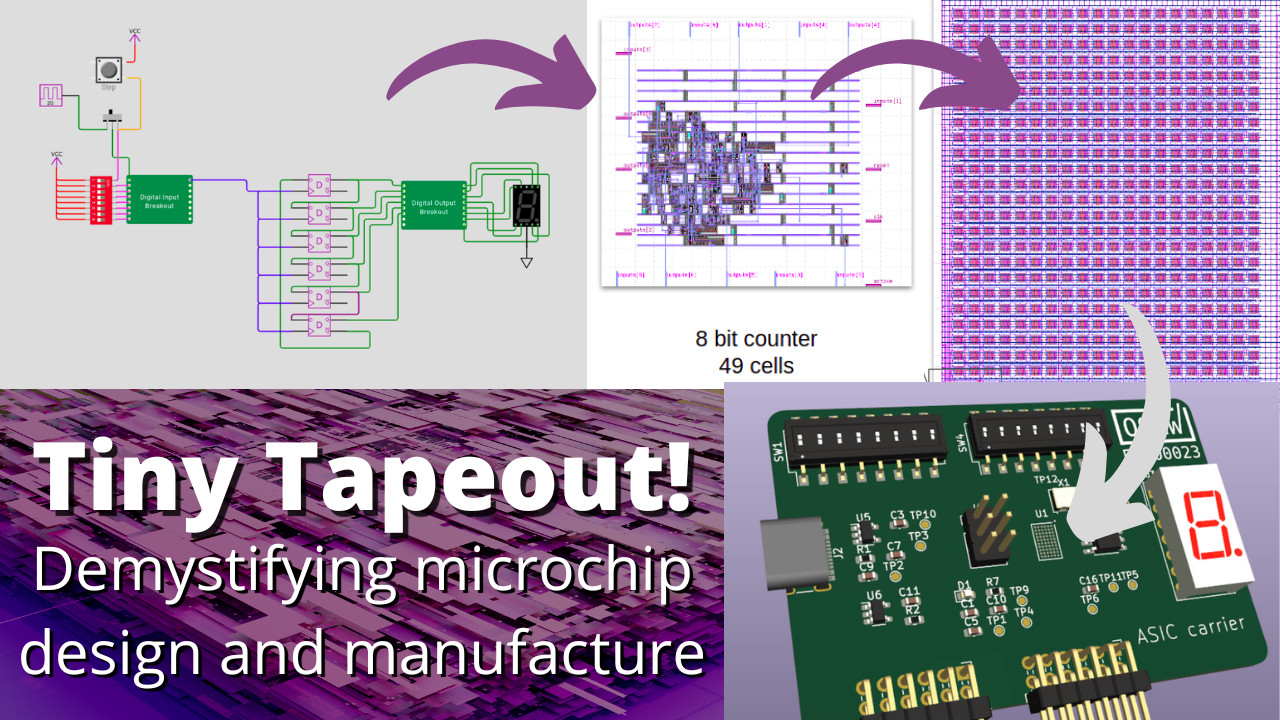
Quicker, easier and cheaper than ever to make your own chip!
molten hemlock
stark trench
https://tinytapeout.com/
I'm definitely more comfortable with schematics than HDL. Been ages since I used VHDL. I'll check it out. Thanks!
stark trench
molten hemlock
I'm definitely more comfortable with schematics than HDL. Been ages since I used...
There’s also a discord with help channels. You can do VHDL, Verilog, Chisel, Amaranth(spelling might be off on this).
 sand finch
How much does getting custom silicon made cost?
 mellow socket
i dont know about a custom design, but according to what i've been told at university you can buy some FPGA test boards for ~200$, and you can "program" them with your VHDL designs.... as many times as you want (?)
for complex designs it's most likely a pain, but i actually enjoyed making basic stuff with VHDL
we also used a software(was it Vivado HLS?) that took your C function and convert it to a hardware design to implement it, and you didnt have to make almost anything, just setting a couple of options if you wanted to, i cant even begin to imagine how hard coding that tool has been
stark trench
sand finch
How much does getting custom silicon made cost?
These open source eFabless shuttles are paid for by Google
And other sponsors. Tiny TapeOut is $100
Pretty low barrier
sand finch
Oh wow
 zealous veldt
Do you think someone could implement https://imihajlov.tk/blog/posts/eth-to-spi/ in an FPGA or GF180MCU/SKY130?
Building a 10BASE-T Ethernet transceiver (receiver and transmitter) with discrete logic chips
stark trench
zealous veldt
Do you think someone could implement https://imihajlov.tk/blog/posts/eth-to-spi/...
Probably on GF180 or SKY130
There’s probably a better Ethernet implementation for FPGA
 tropic cipher
are there any SoCs like the Zynq that are accessible to hobbyists?
glossy void
tropic cipher
are there any SoCs like the Zynq that are accessible to hobbyists?
Not at the moment, most hobbyist projects I know of tend to pair an fpga with a microcontroller separately, kinda like spartan edge accelerator? Zynq is probably as accessible as you can get, as a Cora z7 dev board is around 150
For smaller projects, a soft core processor might be the way to go?
vast moat
tropic cipher
are there any SoCs like the Zynq that are accessible to hobbyists?
On the smaller scale there's the QuickLogic EOS S3, which is available in a Feather form factor. It's similar to a Zynq in that it's a MCU plus FPGA fabric in one chip, plus some extra DSP stuff.
stark trench
vast moat
On the smaller scale there's the QuickLogic EOS S3, which is available in a Feat...
I thought the Zynq was an A7 CPU not an MCU?
You can run Debian on a Zynq chip
The quicklogic chip is a good suggestion though. I’ve always wanted to try one
vast moat
stark trench
I thought the Zynq was an A7 CPU not an MCU?
Yes, you're correct, I meant "similar" in terms of being a hard processor plus FPGA, but if you're looking for a Linux system FPGA SoC, the Zynq is about the lowest end you can get already.
stark trench
Yeah, at $150 you’re lucky to get an A9 (thought it was an A7)
I wish there were more low end MCU+FPGA options
I had an idea for an M0+ and a lattice ice40 board. I got the PCBs but never assembled them
vast moat
stark trench
I wish there were more low end MCU+FPGA options
Same. Others I'm aware of include the SmartFusion 2 and one of the GOWIN variants.
stark trench
I might try to mix the RP2040 and an Ice40 and set up the RP2040 to do parallel data bus capabilities with the fpga
Do some serious off chip DSP stuff
tropic cipher
stark trench
I thought the Zynq was an A7 CPU not an MCU?
fwiw at least the one I’ve used has a couple R5s too. But yeah running Linux + FPGA is the part I find most interesting
stark trench
Yeah, the MPSoC and RFSoC have small RF controllers
Getting into the $1000+ ultrascale SoCs
vast moat
Those are fun chips. I used them on a previous project (for work, not personal).
glossy void
Minimal Linux builds could run on FPGA soft cores IIRC
Even Linux feels like it comes in tiers these days.
stark trench
We use MPSoC where I work. Nothing like not wanting to break the FPGA dev board that costs almost a years salary 🙂
tropic cipher
Yeah we use MPSoCs too. I usually do software stuff but I thought I’d branch out and try and learn enough of Vivado to make the SFP+s show up in Linux
stark trench
But yeah, an RP2040 with a small <10k LUT FPGA would be fun
Especially with PIO on the RP2040.
tropic cipher
How many LUTs does it take to implement a Linux capable soft core
glossy void
I’m surprised nobody’s built tiny fpga feather wings or something. Spartan edge accelerator looked pretty cool…
stark trench
glossy void
I’m surprised nobody’s built tiny fpga feather wings or something. Spartan edge ...
 glossy void
tropic cipher
How many LUTs does it take to implement a Linux capable soft core
glossy void
tropic cipher
How many LUTs does it take to implement a Linux capable soft core
Depends on whose LUTs we’re talking. Different FPGAs use different size LUTs haha
stark trench
I made a feather
glossy void
Oh right, that was a thing.
stark trench
Still working on the final version if I could just get FT232HQ
glossy void
I was thinking something that stacked on an esp32 or rp2040 feather, but that’s probably still doable
glossy void
tropic cipher
How many LUTs does it take to implement a Linux capable soft core
One particular example: https://github.com/YosysHQ/picorv32

GitHub
PicoRV32 - A Size-Optimized RISC-V CPU. Contribute to YosysHQ/picorv32 development by creating an account on GitHub.
stark trench

this one doesn't require an FT232HQ, just needs a button, regulators, and the FPGA. and a feather to program it of course
you get, all the GPIO
is this what you were thinking @glossy void
stark trench
I should order the PCB for it, it's only like $9 from OSHPark
then i just need to get up enough money to order the 1.2V and 2.5V LDOs, and the FPGA
might be able to harvest an FPGA from one of my other boards.
alrighty, ordered. thanks for helping me remember I had this board done lol
stark trench
glossy void
That is neat.
if you're interest in one, I could send you one. I just need to make sure the design works first. If it does, I can let you know cost.
stark trench
lol, I know that feeling
glossy void
Gotta get through my current FPGA coursework first haha
stark trench
I'm having to work OT to cover the basics right now while my wife goes to school, not to mention I'm trying to do 2 grad classes lol...
so my tinker time is limited
stark trench
stark trench
Assuming this board works, I’m planning to put a few up on my Tindie shop if anyone is interested.
stark trench
I’ll share a link when I have a product page up
stark trench
I think I’m going to also make an optional programming feather board with a 2MB flash chip and an FT232H to program the flash. Maybe do a set of jumpers to either use flash or program the fpga directly.
stark trench
It lives!

The final prototype, it works
I am really pushing the limits on recycling chip’s between prototypes though lol
The only new parts on this are the SPI flash, the FPGA (I think I cooked the last one) and the RGB LED
stark trench
Now to wait until April to get more FTDI chips
glossy void
Phew that's not a cheap board though
stark trench
glossy void
Phew that's not a cheap board though
Yeah, cost to make it worth while with recent price increases in parts is just.. insane
Orange crab went up $60 in cost for their latest run
$159 vs the $99 it used to be
I’m trying to ease the pain with a preorder pricing but it’s still.. a lot considering if I could have got the parts 6 months ago it would have been $10-15 cheaper than the preorder pricing
stark trench
glossy void
Phew that's not a cheap board though
Just curious from your perspective, what is a comfortable price point?
glossy void
I haven't really done a thorough comparison of FPGA features, but I'm currently looking in the 30-50 range to start
TinyFPGA and FireAnt come to mind atm
 atomic leaf
stark trench
Just curious from your perspective, what is a comfortable price point?
atomic leaf
stark trench
Just curious from your perspective, what is a comfortable price point?
Hmm can you reply my question in #general-chat
stark trench
glossy void
TinyFPGA and FireAnt come to mind atm
Gotcha.. yeah hard to compete with those prices.
My BOM is like.. $28
glossy void
Lol I don't think you should
stark trench
But I can’t buy at the quantity that one bit squared can lol
glossy void
I should be saving up some money to get something nice when I need it
stark trench
If I could buy full reels of parts, yeah, I could definitely get the BOM down to close to $15, then a $45 price point would be easier
I don’t have $15k laying around though lol..
Im considering a crowdsupply campaign though
 opal bramble
stark trench
It lives!
opal bramble
stark trench
It lives!
are you planning to make this open hardware?
stark trench
yeah, I'm working on documentation and everything currently
opal bramble
cool. very nice board.
stark trench
thanks! It's been a long time coming with this parts shortage
opal bramble
rp2040 + ice40up5k
same core motivation... chip shortage and a way to replace ftdi
for some specific use cases
stark trench
ah yeah, I've got a samd21 SoF (System on a feather) with an ICE5LP4K as well I need to circle back to
ICE5LP4K can be programmed over SPI so it's a prime candidate for any micro that can open an SD card and push hex files.
I might make one with an RP2040 too for the feather format too
opal bramble
i have several feathers ("master" boards) so your board could have several applications.
stark trench
I have an ICE Featherwing too with all the GPIO broken out in the works
waiting on PCB currently
designed to be a cheap way to add an FPGA to your setup
opal bramble
cool, all i can say a lot of people have though about this (1% inspiration) and 99% transpiration (routing it , going to all the fab process or getting a stinky blink LED to glow).
nice work.
stark trench
thanks, I thoroughly enjoy the process
opal bramble
i will buy one...
stark trench
opal bramble
i will buy one...
someone did an RP2040 and a UP5K game system

GitHub
3D games console based on RP2040 and iCE40 UP5k. Contribute to Wren6991/PicoStation3D development by creating an account on GitHub.
stark trench
it's pretty cool to see all the different options
opal bramble
but when it's a open hardware there more options to customize it and contribute back.

GitHub
Raspberry Pi PICO board + Lattice iCE40 FPGA's. Contribute to tinyvision-ai-inc/pico-ice development by creating an account on GitHub.
again... that might not fit all use cases.
I'm a newbie
stark trench
yeah, thankfully there's lots of options coming out
I'm using the FTDI chip because i'm attempting to maintain compatibility with the Lattice tools for programming, but I am exploring more low cost options like SAMD21 which are coming back in stock and also the RP2040 due to it's prolific availability and large FLASH storage options
and the featherwing of course to be the cheapest option.
opal bramble
if we could only emulate MPSSE (FT232H emulation) in a mcu
without all the legal stuff
stark trench
there is some emulation being explored on WCH chips
opal bramble
yep
stark trench
but at the moment it's dubious
opal bramble
i think that's being done for the icebraker
stark trench
I also am hesitant to use WCH chips because i'm just not sure if WCH will be around long term. the industry already struggles to have enough people to run the industry that we have.
opal bramble
i think that basic emulation is done for CH32V307
stark trench
yeah, I had seen that
I may try it out on a test run
the biggest thing that I don't care for with the FT232H is that it's huge. it and it's components take up half the space on a feather.
I've slimmed down as many components on it as I can and still allow it to function reliably
but it's still a lot
the whole IcyBlue feather is done on two layers too which is kind of a miracle some days.
opal bramble
yeah. I PM you... as all of this might be adding noise to the fgpa channel
stark trench
nah, it's on topic
plus this channel is lightly trafficked so it's not an issue. mostly just me posting stuff lol
mellow socket
stark trench
nah, it's on topic
and people like me can still read the conv and just maybe learn a little bit
stark trench
mellow socket
and people like me can still read the conv and *just maybe* learn a **little** b...
I’m glad you’ve been able to learn even just a little. My desire is to always help as much as I can and hopefully learn myself along the way
mellow socket
stark trench
I’m glad you’ve been able to learn even just a little. My desire is to always he...
i've even made some basic FPGA things at university, but i didn't know (some) they can be configured over SPI, i thought a MCU+FPGA PCB would need a computer hooked into it
i guess it doesnt make much of a difference as you still need some tooling on the PC to generate the binary(or whatever it is) file to program it, but having a specialized piece of hardware is always a cool thing
last thing i made was a module to compute inverse square root of a 3D vector, but it was "cheating" as we used a Vivado tool that made the FPGA design based on some C code (definitely an amazing piece of engineering)
the hardest i've written myself was a state machine iirc
stark trench
mellow socket
i've even made some basic FPGA things at university, but i didn't know (some) th...
My thought was you always needed expensive tools but developing this board has show that isn’t the case. Hoping to be one of the small voices in the crowd moving open hardware forward
My digital systems design class was all vhdl based, I didn’t even know Vivado could convert C code into a bitstream
mellow socket
stark trench
My thought was you always needed expensive tools but developing this board has s...
if im not mistaken, a classmate bought a similar board to the one we were using for like 60€ with buttons and LEDs and some other stuff to test
but to be honest, i dont recall if it was a FPGA-based thing or a weird-MCU-based for a subject where we wrote some assembly
stark trench
Probably a Spartan or Atrix7 based board
mellow socket
im pretty sure we had spartans at class, Zynq7 something could it be?
stark trench
Which honestly, I think they use FT232H based programming too
Actually looks like Diligent makes their own USB-JTAG interface (likely another FPGA) to program the Artix7
Digilent Basys 3 Artix-7 FPGA Trainer Board: Recommended for Introductory Users https://a.co/d/9XEO2zj

Digilent Basys 3 Artix-7 FPGA Trainer Board: Recommended for Introductory Users
Like this one?
mellow socket
mellow socket
im pretty sure we had spartans at class, Zynq7 something could it be?
i laughed a lot on the 1st class, teacher is a great guy
he proceeds to give an almost 2 hour explanation on how to use Vivado HLS to convert C into a hardware design, load the design into the board, and write some code to use the peripheral we just made from the main CPU, then he says something like "now you can gladly tell your parents you made an LED blink" 🤣
mellow socket
stark trench
Digilent Basys 3 Artix-7 FPGA Trainer Board: Recommended for Introductory Users ...
i honestly dont remember
stark trench
hahaha, nice
opal bramble
the "good" aspect of FTDI is their throughput. Based on my understanding, a current MCU implementation cannot fast enough (right now)
stark trench
yeah, like 2 seconds to program the SPI flash on the IcyBlue for the FTDI chip
stark trench
The first feather wing for the IcyBlue FPGA

A play on the classic digital design lab of making a traffic light controller.
I wanted it to kind of look like a road
ah whoops forgot some labels
much better 🙂
 silk verge
Encouraging early results in my notion of implementing DDS in an FPGA using fractional division. fctr is the fractional division counter, you can see how it has one more clock occasionally like on the right, bctr is an ordinary binary counter (for comparison). fled is the fractional counter LED output and bled is the binary counter LED output.
 silk verge
Adding a sine lookup table (a quarter of the wave, the rest is built by mirroring that piece in various axes), the idea is to take the constructed value ("wave" in this picture) and squirt it out an SPI port to an outboard DAC chip
 plucky helm
@silk verge what produced that output visualization?
silk verge
8bitworkshop.com has a nice FPGA simulator that also does a variety of useful visualizations
stark trench
The IcyBlue feather first round is finished in assembly, smoke testing, and programming testing. Five only going to early supporters!

 sand finch
Glad all of the first batch works!
stark trench
Curious if anyone would be interested in an open source core developer board. It would have a good bit of SPI flash (8MB more than likely), 32KB (256kbit) SRAM, some status LEDs, RGB LED for fun, some status LEDs for output and probably a second USB port.
sand finch
I have theoretical interest, but FPGAs are currently far from my reach
 sand finch
heh
 jaunty bone
Does icy40 integrate hard processor on it?
stark trench
no, but there are soft cores available that can run on them
jaunty bone
Aww
stark trench
1BitSquared is working on an Itsy Bitsy FPGA that runs a small RISC-V soft core
it has the slight upgrade UP5K to do that.
and the UP5K is pin compatible with the ICE5LP4K I'm using which means just a simple change to the silk and there's a bigger FPGA available without really any major changes.
jaunty bone
My idea was if it was hard processor + FPGA fabric it could have really nice accelerator applications
stark trench
I am working on a board that combines the RP2040 and an ICE40
jaunty bone
Idk if there is any hls software yet but that might be good for edge ai or sth
stark trench
in the feather format too
it's a bit rough right now, i've got to change some pin assignments around
 jaunty bone
My idea was to use strength of both words with tight integration
Maybe open up possibilities for open source hls applications
stark trench
I see the RP2040 as a great companion because of the PIO capabilities. you could have near real time transfer between the FPGA and the RP2040
jaunty bone
By tight integration i meant like custom instructions or custom inputs to instruction alu or data injection to data path
 jaunty bone
Maybe those probably done easier and more efficiently with soft core
stark trench
Perhaps, there’s some applications to come as microcontrollers are getting more featured
jaunty bone
Good luck on your journey. I wanted to share my thoughts and see your vision
stark trench
I want to make them more accessible so people can see the potential of FPGA in their projects
I am attempting to highlight those capabilities in this CrowdSupply campaign. Emphasizing things like off chip integer DSP which can be particularly fast on FPGA
jaunty bone
I own a very powerful FPGA but still unable to find anything to use it with
jaunty bone
Other than replicate my digital lecture projects which was the most fun and enthusiastic thing I've done for a long time
stark trench
The blank canvas of FPGA make them hard
jaunty bone
You can make everything, but what do you do that can't be done otherwise?
stark trench
We live in a world where we expect electronics to just be one thing. When you tell someone they can make something do most anything they can think of, it breaks them.
jaunty bone
jaunty bone
You can make everything, but what do you do that can't be done otherwise?
Can't really answer this question.
I hope I can some day soon because next year is my thesis 😅
stark trench
Well, the point of doing it ourselves is because there’s a chance we could it better
But actually realizing what we want on an fpga can be difficult
I’m hoping to make it easier
Well, not easier but more accessible
Easier is a misnomer
sand finch
Is CrowdSupply kinda like Kickstarter, where people fund you and then get one of the thing? And is this FPGA Feather something that I can use with 0 FPGA experience? Lol
stark trench
sand finch
Is CrowdSupply kinda like Kickstarter, where people fund you and then get one of...
CrowdSupply is like kickstarter though I think you can commit to more than one if you want. This feather will be hopefully accessible to people with 0 experience
I’ll be working on tutorials, videos, examples, etc..
sand finch
I’ve known about FPGAs and the fact they can be super flexible… but never had a project where someone said “you should consider an FPGA instead of an MCU”. And I don’t want to have one just for the sake of having one XD I have enough things I bought without a reason
stark trench
They’re worth knowing how to use in the very least. There’s some good niche applications for them where microcontrollers are not as well suited.
One add on feather wing I’m working on is a traffic light control board which will help with teaching state machines and sequential logic design, and such.
sand finch
They can do certain specific tasks much much more quickly than an MCU, right? Kinda like how a GPU has limited instruction sets compared to a CPU but can do some operations much faster since it had many more cores/pipelines?
stark trench
Right, you can do integer DSP work for instance
sand finch
Ohhh, nice
stark trench
And doing it off chip makes it so you can utilize your MCU more fully for the tasks that it’s suited for like data collection
Integer DSP will be a more advanced example that I’ll be working on
sand finch
Wait, what’s integer DSP? My brain for some reason thought you meant Deep Packet Inspection
stark trench
Digital Signal Processing
The ICE5LP4K has 4 DSP blocks
16bit multiplication with 32Bit accumulators
sand finch
Ah
stark trench
Only downside of the 4K model is it doesn’t have an embedded PWM IP
So you have to make your own PWM IP
stark trench
And now we have examples to run on the iCE5LP4K FPGA 😄 https://github.com/skerr92/ice5lp4k_examples

GitHub
Examples for iCE5LP4K FPGA: BRAM, SPI, flash, DSP, and other basic examples - GitHub - skerr92/ice5lp4k_examples: Examples for iCE5LP4K FPGA: BRAM, SPI, flash, DSP, and other basic examples
forked from an iCE40HX8K examples repository and modified to build for the iCE5LP4k 🙂
 hollow jacinth
stark trench
Right, you can do integer DSP work for instance
hollow jacinth
stark trench
Right, you can do integer DSP work for instance
an FPGA can do things in parallel and because they are arrays of gates, you can essentially emulate chips, if your FPGA is big enough
oops I meant to respond to the one above that, sorry
glossy void
I guess it’s probably simpler to think of a microcontroller being used to represent a sequence of instructions, while an fpga is used to represent a physical logic circuit. There is a lot of overlap as microcontrollers get faster and fpgas get increased access to digital peripherals, but traditionally that’s the distinction between the two.
 scenic marsh
I have really been getting into understanding system architecture. I was thinking about building out a limited 286 computer. I want to use a physical 286 processor and implement the rest in an FPGA. Is there anything that would make this unreasonably hard for a newcomer?
stark trench
scenic marsh
I have really been getting into understanding system architecture. I was thinkin...
There’s a slight learning curve for HDL languages, has your learning path had you do anything with Verilog or VHDL?
scenic marsh
stark trench
There’s a slight learning curve for HDL languages, has your learning path had yo...
I am a 100% noob as far as HDL languages go. I have good beginners level understanding of digital circuits. I have been researching which (verilog or VHDL) to start with.
stark trench
If you’re familiar with C/C++, Verilog tends to be a good place to start
You might start with a small FPGA and work through some examples or free courses to build up confidence and knowledge
Digital VLSI Design with Verilog: A Textbook from Silicon Valley Polytechnic Institute https://a.co/d/8NzaYAl

This book is structured as a step-by-step course of study along the lines of a VLSI integrated circuit design project. The entire Verilog language is presented, from the basics to everything necessary for synthesis of an entire 70,000 transistor, full-duplex serializer-deserializer, including syn...
This book has come highly recommended to me in the past
A little pricy, but springer published books tend to be very thorough
scenic marsh
Ok, that makes sense. Is verilog compatible across diffren FPGAs?
scenic marsh
Awesome
stark trench
Along with other brands too
scenic marsh
Yea I think verilog will be a good start for me as even though I do not use C a lot I understand it pretty well
Thank you for the info.
stark trench
Best of luck 🙂 I’m looking forward to seeing your progress
 gloomy kettle
stark trench
Digital VLSI Design with Verilog: A Textbook from Silicon Valley Polytechnic Ins...
gloomy kettle
stark trench
Digital VLSI Design with Verilog: A Textbook from Silicon Valley Polytechnic Ins...
 stark trench
oldie but goodie
gloomy kettle
There's another that seems well recommended.
Not much use to me though, well above my skills. Lol
stark trench
some people (like myself) do well with going about things the absolute hardest way lol
gloomy kettle
I can get the principles of it, just not the practical.. I don't have a codey-braining thing.
silk verge
scenic marsh
I have really been getting into understanding system architecture. I was thinkin...
You have given me an evil idea. The grandaddy of all the X86 CPUs is the Intel 8008, which was crammed into an 18-pin package, so it multiplexes its address, data, and I/O buses on the same pins. I had been musing on how best to unpack that information, and an FPGA would be a one-chip solution.
scenic marsh
I've had some very similar thoughts about my 8088.

Making the sockets for the 286s is kind of a PITA
 wise ingot
Hello! I just realized this channel is a thing!
wise ingot
scenic marsh
I am a 100% noob as far as HDL languages go. I have good beginners level underst...
https://hdlbits.01xz.net/ is pretty good as far as verilog tutorials go
silk verge
i8008 socket is pretty easy.

This isn't the original, it's the 8008-1, which can manage 800kHz
scenic marsh
silk verge
i8008 socket is pretty easy.
That is impressively small.
I'm looking at these breakout boards on ebay I'm leaning towards the Cyclonell as I need 40ish IO pins for the processor and then some more for external components.
 silk verge
I was never able to get Quartus to run, so I've pretty much overlooked Xilinx chips
scenic marsh
I might just stay on brand with something that has some support with https://www.adafruit.com/product/451

For every day projects, microcontrollers are low-cost and easy to use. But when you have a project that needs raw power and high speed you may want to check out FPGAs (Field Programmable ...
glossy void
silk verge
I was never able to get Quartus to run, so I've pretty much overlooked Xilinx ch...
Isn't Quartus Altera? Xilinx uses Vivado.
silk verge
I never got Vivado to work either.
silk verge
It was a pleasant surprise when tannewt pointed me to modern open source FPGA tools. Installing IceStudio/fomu/apio is easy and quick, and supports modern operating systems.
wise ingot
silk verge
I never got Vivado to work either.
FYI, That's what I do before running the installer to get vivado to install on debian-based systems: https://support.xilinx.com/s/article/63794?language=en_US
I know you've found something that works, but I just wanted to let you know in case you need, for some reason, to try this again in the future
silk verge
That article came out after I gave up on the Vivado Linux port as a bad job. Previously, it had tried (and failed) to support a big complicated GUI interface that apparently only worked with one particular graphics configuration which I didn't have. Seeing ncurses in the prerequisites implies they may have moved to a CLI version which would be a much simpler approach.
wise ingot
It is possible to interface with it both via the GUI, and via a CLI. However, the primary interface mode remains GUI-based.
https://docs.xilinx.com/r/en-US/ug911-vivado-migration/Equivalent-Makefile-Used-in-the-Vivado-Design-Suite ... shows how to interface with it using Makefiles
I have no idea if they've done something weird that prevents it from working if it can't instantiate the GUI though
...Hang on, I can actually test that
Yeah, it works just fine from an ssh shell w/o X forwarding, so it shouldn't need the GUI
scenic marsh
Are there any distinct drawbacks to using the Altera Cyclone IV for someone that is new to FPGA? As far as modern tooling and support? I understand it's a bit older.
stark trench
scenic marsh
Are there any distinct drawbacks to using the Altera Cyclone IV for someone that...
I don’t believe so. A majority of Verilog and VHDL is the same as it was back when the IV came out.
Most anything you do on it should work on most other platforms
wise ingot
As long as it's supported by the latest versions of the tooling, you should be fine
(and even be able to use the latest systemverilog/vhdl features supported by said tooling, if you want to do so!)
stark trench
But even then, using old tooling is still very plausible
I wish yosys supported SV 😦
wise ingot
stark trench
I wish yosys supported SV 😦
It does, as long as you pay
stark trench
?
wise ingot

See Tabby CAD Datasheet (this page) for details on Tabby CAD Suite; see OSS CAD Suite GitHub for details on OSS CAD Suite.
The subscription would only be attractive to engineering companies, but, worth knowing it's an option
(and probably cheaper than many commercial EDA suites, especially if you want to do formal)
stark trench
Yeah
I guess they have to financially support their efforts
Which makes sense since the world doesn’t run on high fives and ramen bowls
Would be cooler if it did though
stark trench
Yeah
GitHub
SystemVerilog support for Yosys. Contribute to antmicro/yosys-systemverilog development by creating an account on GitHub.
I did find this
wise ingot
huh. I wonder how well it supports SVA
stark trench
🤷♂️
wise ingot
stark trench
🤷♂️
FYI, vanilla yosys does support a small subset of SV. And this project seems to get at least some use within the community:
https://github.com/zachjs/sv2v

GitHub
SystemVerilog to Verilog conversion. Contribute to zachjs/sv2v development by creating an account on GitHub.
I also found this press release regarding the project you linked to
https://antmicro.com/blog/2022/02/simplifying-open-source-sv-synthesis-with-the-yosys-uhdm-plugin/
stark trench
Interesting
wise ingot
Which SV features do you most frequently use?
stark trench
Personally, I like interfaces and logic data types
wise ingot
Who doesn't? (Especially logic datatypes)
I like SVA because formal verification and would like to look into the more OOP stuff to use with UVM (systematic functional verification)
stark trench
Yup
wise ingot
Vivado seems to have precompiled UVM, so it's a matter of finding a decent book/tutorial/whatever
Though admittedly I'm probably one of the few people working with FPGAs who are obsessed enough with verification to want to learn formal
(outside of probably medical applications or designs that will eventually be ported to ASIC-land)
wise ingot
So, I've got this Cmod a7-35t. Their sample XDC does not include any input/output delay constraints (set_output_delay/set_input_delay). I have no knowledge or access to their board designs. Am I out of luck, or are there any sensible values I could input?
(say, 20% of the clock cycle available for IO, which is the default for openlane)
I guess I could contact digilent about this. Any suggestions?
I essentially only care about the UART
wise ingot
The board uses the FT2232H UART. I've been trying to find the timing characteristics for the TXD and RXD pins in the datasheet, but, unless I've been missing something obvious, I haven't found anything!
https://eu.mouser.com/datasheet/2/163/DS_FT2232H-1621240.pdf this is the datasheet I'm using
vast moat
wise ingot
The board uses the FT2232H UART. I've been trying to find the timing characteris...
I'm not really sure what information you're looking for. Are you concerned about rise/fall times on the UART lines?
wise ingot
vast moat
I'm not really sure what information you're looking for. Are you concerned about...
I'm looking for the setup and hold times of the lines, as well as their output delays
vast moat
wise ingot
I'm looking for the setup and hold times of the lines, as well as their output d...
So I don't reeeeeally understand. UART is asynchronous, not clocked, so there's not really any edge that you'd be able to measure setup and hold times against. And output delays would be also kind of meaningless... the delay between receiving a USB packet and the pin changing?
wise ingot
vast moat
So I don't reeeeeally understand. UART is asynchronous, not clocked, so there's ...
You know what? You're actually right.
I managed to completely forget about this 🙃
Thanks!
vast moat
LOL, cool...
wise ingot
Yeah, I got some tunnel vision while specifying the timing constraints
wise roost

I wonder if I can install a macOS toolchain for this and see if I can make it do something? Anything? Unlikely as it doesn't look anything like an ESP32!!!! ...
scenic marsh
It's so little!! STEP-MX02

 glad bough
thoughts on the arty s7 50 spartan 7?
 left steeple
scenic marsh
It's so little!! STEP-MX02
left steeple
scenic marsh
It's so little!! STEP-MX02
I see is available in china only? How'd you procure it?
stark trench
left steeple
I see is available in china only? How'd you procure it?
Aliexpress?
Oh wait Tindie says it’ll ship to the US https://www.tindie.com/products/evoinmotion/fpga-development-board-step-mxo2/
Tindie
The STEP-MXO2 Dev Board is a small, breadboard friendly 40-pin DIP form factor board built around Lattice MachXO2 FPGA.
scenic marsh
left steeple
I see is available in china only? How'd you procure it?

eBay
Find many great new & used options and get the best deals for STEP-MXO2 (Lattice) FPGA development board at the best online prices at eBay! Free shipping for many products!
left steeple
Thanks 😄
wise ingot
@gloomy kettle I flicked through the preview of this in google books, and it felt genuinely fresh and engaging. I encourage you to take a look at it if you're ever interested in FPGAs:
(this stray ping courtesy of you sharing your ancient FPGA book the other month, and my random memory for these kinds of things)
gloomy kettle
I would be interested, but there's something of a skill issue involved. 😅
wise ingot
I still encourage you to take a look :)
gloomy kettle
Certainly.
Just got a lot on my plate right now, including trying to get into Kubernetes.
wise ingot
Sadly, I don't have anything to recommend for that
gloomy kettle
Just going to throw Rancher Harvester on my server box and see where that leads me. 🙂
wise ingot
Yeah, trial by fire is probably the only way when it comes to kube thing
*things, but "kube thing" is a hilarious typo and I'm keeping it
gloomy kettle
Checks out. 😁 👍
But, yeah... I'm not doing anything serious with it.
I'll just get Nginx/PHP + SQL running.. Host my own WordPress site. 🙂
 oblique rivet
gloomy kettle
Just got a lot on my plate right now, including trying to get into Kubernetes.
oblique rivet
gloomy kettle
Just got a lot on my plate right now, including trying to get into Kubernetes.
Kubernetes is awesome when it works and infuriating when it doesn’t. I swear its error messages are some of the most unhelpful things around
gloomy kettle
It's ok... I've worked on Windows. 😛
wise ingot
gloomy kettle
But, yeah... I'm not doing anything serious with it.
I'll just get Nginx/PHP + S...
Kube is massive overkill for that ;P
gloomy kettle
For sure, but it's also something of an industry standard...
What I'm hosting on it doesn't matter so much, just learning how to build it all.
wise ingot
Makes sense
We need a help-with-kubernetes channel so that you can share your little adventure
Or you could setup a good old block. I miss reading those
gloomy kettle
Video blog on YT. 🙂
wise ingot
Honestly, I miss written blogs
gloomy kettle
Yeah, but I'd need a website to put it on. 😛
wise ingot
I mean, blogspot (!) is still a thing
gloomy kettle
Ohh, I don't do 3rd party hosting. 😄
wise ingot
That totally makes sense. I'm still surprised *.blogspot.com URLs resolve after all those years
gloomy kettle
lol
I used to have a blog on Geocities and Netfirms, way back when...
Back when I could be bothered to write really bad HTML. 😛
wise ingot
these days you can write markdown and have a static site generator do all the heavy lifting
gloomy kettle
I think WordPress will be better for me.
Having a prebuilt site allows me to focus on the SysAdmin things instead.
wise ingot
wordpress is more of a netsec minefield than serving a bunch of static html though
wise ingot
I hope you'll enjoy the project! Feel free to share updates over at #general-chat
stark trench
wise ingot
https://www.colognechip.com/programmable-logic/gatemate/ 🤔
Looks like a nice chip
I wonder if the tool chain is open source
wise ingot
stark trench
I wonder if the tool chain is open source
IIRC partially so. I think the par is closed-source
wise ingot
stark trench
I wonder if the tool chain is open source
Yeah, looks like toolchain is yosys except for the pnr which is their own design
https://www.colognechip.com/docs/ug1002-toolchain-install-latest.pdf
stark trench
Oh nice
stark trench
Yeah
wise ingot
Apparently olimex is building a devboard
stark trench
👀
wise ingot

Guess what new OSHW board is cooking at Olimex? CologneMateA1 is 20K CPE and 5Gbps SerDes and Spartan7 like performance, but comes with completely open source toolchain #fpga #colognematea1 #oshw
Likes
147
 Twitter
·
stark trench
Twitter
·
stark trench
I want to do things the hard way and make my own dev board lol
wise ingot
I don't have The Skills[TM]
Though starting with a 6-layer design would be very on-brand for me xD
Jokes aside, I'd get a devboard if it were inexpensive enough
Mainly for the curiosity factor, plus, y'know, European chip (design, dunno where their fab is)
stark trench
Yeah, definitely understand the curiosity point
wise ingot
got any ideas for whenever the next openmpw lottery comes?
stark trench
Trying to finish up my CPU design testing
wise ingot
I'm still learning uvm. It's kinda hard to do it at a satisfactory pace, given how I've got rl obligations to fulfill 😅
kinda irrelevant for openmpw though, because systemverilog
stark trench
Totally understand the obligations part lol
My schedule changed up so now I have to commute 😥
wise ingot
Hope it at least means better opportunities for ya
 umbral seal
Got myself a Step FPGA board too. Dunno when I'll tinker with it but I'm excited. Also came with tons of headers. Lol.
 wise ingot
umbral seal
Got myself a Step FPGA board too. Dunno when I'll tinker with it but I'm excited...
wise ingot
umbral seal
Got myself a Step FPGA board too. Dunno when I'll tinker with it but I'm excited...
Enjoy! To be able to get started with FPGAs, you'll need to know some fundamentals of digital design and a hardware description language. As far as fundamentals of digital design go, the textbooks are quite expensive, so I'd recommend going to your local library and checking out whichever introductory one they have. Anything is fine, since these days the internet can help answer a lot of questions. If you need to buy, I recommend going on google books and checking out previews to see which one better fits your learning style. You will also need to learn a hardware description language to be able to express your circuits in code. Many digital design textbooks cover both, and I personally recommend verilog; https://hdlbits.01xz.net/wiki/Step_one is a good tutorial.
Most people learn both at the same time
umbral seal
Thanks for the pointers. Lurking here finally got me to give FPGAs a shot, though getting started on learning materials does seem harder at a glance. I've seen verilog in quite a lot of places I checked and the language is easy to follow so I'll start with that.
wise ingot
umbral seal
Thanks for the pointers. Lurking here finally got me to give FPGAs a shot, thoug...
Although I haven't checked it out myself, many people have sang the praises of https://www.nand2tetris.org/ for learning digital design. Another good resource is https://nandland.com/.
silk verge
The book "Designing Game Hardware in Verilog" is pretty accessible, and the 8bitworkshop.com website it points to has a nice FPGA simulator, and is free to use.
wise ingot
Thinking about it now, getting started with FPGAs is kind of non-trivial, isn't it...?
(And I feel "kind of non-trivial" may be an understatement)
glossy void
It is not at all trivial. Most general programming lessons start with your typical “hello world” but it doesn’t really apply in the context of fpgas.
wise ingot
Yeah, it's easy to forget when it's been some time. I am not going to claim to even remotely be an expert, but I literally had nothing to suggest here aside from "learn digital design first"
Perhaps high-level synthesis (or some of the newer HDLs, like amaranth or spinalhdl) makes it easier? I wouldn't know, I have never used it.
(If anyone has, feel free to chime in! I'm curious too)
wise ingot
There's also this course by the linux foundation, but it teaches the (admittedly non-standard) translation-level verilog:
https://training.linuxfoundation.org/training/building-a-riscv-cpu-core-lfd111x/
Create a RISC-V CPU with modern open source circuit design tools, methodologies, and microarchitecture, all from your browser.
stark trench
glossy void
It is not at all trivial. Most general programming lessons start with your typic...
While we don’t get hello world, we certainly get blink 🙂 which is equally as inspiring
wise ingot
Blink is the hello world for most microcontroller things
But, unlike in MCU-land, understanding why your blink did what it did requires more effort
Though TBF this is because it requires one to consider a level of abstraction below that of a CPU running code
@stark trench , I think an FPGA blink tutorial that actually explains the underlying elements (flip-flop, adder, comparator) at a high level, would be a nice pack-in with your FPGA boards
stark trench
I was talking about button input triggers led to light up
But yeah, a good breakdown would end up being helpful
wise ingot
stark trench
I was talking about button input triggers led to light up
Yeah, that's definitely easier to understand
silk verge
I remember my first FPGA blink. 25MHz clock in, a whole string of dividers, output to LED pin.
wise ingot
In mine, I had just used a large enough counter and changed the LED status when it overflowed
I think my clock in was about 25MHz too EDIT: Checked it, my board at the time had a 32MHz clock, which, for the purposes of blink, I had just piped into my design
 bleak osprey
wise ingot
I don't have The Skills[TM]
Though starting with a 6-layer design would be very...
bleak osprey
wise ingot
I don't have The Skills[TM]
Though starting with a 6-layer design would be very...
what's interesting with that FPGA is they specifically call out it is able to use on a 4 layer board
 wise ingot
bleak osprey
what's interesting with that FPGA is they specifically call out it is able to us...
wise ingot
bleak osprey
what's interesting with that FPGA is they specifically call out it is able to us...
No worries, I can't do a 4-layer board either :P
bleak osprey
It is cheaper to have mistakes : D
wise ingot
That's certainly right :P
silk verge
That's kind of impressive for a BGA package. I've done 4-layer boards before, they're not that big a deal.
There were ... other reasons it was expensive to have mistakes with those boards.
stark trench
Lattice Avant-E chips are available for order on Digi-Key and the cheapest on is $200 🙂
Supports even DDR5!
Wow, really cool.
That’s the advanced datasheet
(Advanced being that released ahead of launch I guess?)
One cool feature I’m seeing is the HPIO (High Performance I/O) and being able to configure for a bunch of different RF front ends.
vast moat
Nice, thanks for the info! 25G serdes, sweet...
bleak osprey
good luck trying to use those their high speed IO that you need to purchase their IP for a couple thousand to use it.
stark trench
Yeah… until Yosys reverse engineers it and includes it in their oss-cad-suite lol
stark trench
bleak osprey
good luck trying to use those their high speed IO that you need to purchase thei...
It is a midscale commercial FPGA so it’s kind of expected that things would be license locked
Until someone reverse engineers it of course
silk verge
That just doesn't make sense to me - do they want to sell chips or not?
stark trench
Lattice seems to be far more open to individual use licensing though
wise ingot
Xilinx is too, as long as you want to pay the $3k :>
stark trench
silk verge
That just doesn't make sense to me - do they want to sell chips or not?
They want to sell to deep pocketed companies
wise ingot
The prices of the latest high-end FPGAs are dizzying
silk verge
As I'm fond of pointing out (and doing), hobbyists often spec orders for large companies
stark trench
And telecom
silk verge
Also networking
stark trench
They have a huge part of the Avant FPGA focused around 5G/edge acceleration
stark trench
I’m interested in the RF front end parts of it
I hope they have some ISM IP front ends available
Like LoRa stuff
wise ingot
I mean, at that point, you could write your own IP core
stark trench
I’d have to spend money on the books for RF synthesis in my Amazon cart right now lol
Like $300 worth of books
bleak osprey
silk verge
That just doesn't make sense to me - do they want to sell chips or not?
exactly
wise ingot
You can get xilinx's https://www.rfsocbook.com/ for the low low price of your PII
silk verge
I guess that's why it's spelled like "Facebook"
wise ingot
I mean, it's "only" name/email/org name, but, ... yeah
silk verge
I do have a genuine corporate email address for such purposes
But I'm not a fan of Xilinx
stark trench
Because they want to mill every dollar?
wise ingot
Their latest update weighs 100GB
stark trench
At least icecube2 is like 2GB
But it won’t start on my system anymore.. which is fine because I have been using yosys lately
wise ingot
TIL intel FPGAs have hard floating-point DSP blocks
stark trench
Yeah, fancy stuff in the new chips
They can do 400G routing through the fabric
Which is bonkers to me
wise ingot
That... probably isn't cheap :P
stark trench
Oh no, not at all

Intel
Intel Agilex® 7 devices deliver industry-leading fabric and IO speeds, ideal for the most bandwidth- and compute-intensive applications.
wise ingot
It's funny how one of the applications of intel FPGAs are "soft" gaming consoles
stark trench
They have some demos of 400G and 800G NICs
wise ingot
The MiSTer thing is altera-based
stark trench
Only $11k for their I Series that does 400GbE lol
And you even get a one year license of their Quartus Prime Pro software
stark trench
I mean, why would anyone buy eval hardware without access to the software to develop on it 🙂
wise ingot
they could at least bundle a part-locked version
wise ingot
obligatory tang nano 20k announcement link
https://wiki.sipeed.com/hardware/en/tang/tang-primer-20k/primer-20k.html
Certainly competitive for the price, but not sure about the toolchain
wise ingot
Huh.. There appears to be some form of native yosys support
https://github.com/YosysHQ/apicula
https://github.com/YosysHQ/nextpnr#nextpnr-gowin
stark trench
wise ingot
obligatory tang nano 20k announcement link
https://wiki.sipeed.com/hardware/en/t...
Oh I forgot to share this the other day, thanks for reminding me that this happened
wise ingot
stark trench
Oh I forgot to share this the other day, thanks for reminding me that this happe...
No problem!
mellow socket
looking for recommendations on a cheap(ish) board to play around with FPGA whose tools aren't a pain to install and/or use
not sure if they all use same languages.... but i do have some experience manually writing VHDL and using the pain in the *** Vivado HLS -or whatever it was called- to convert C into a hardware definition (amazing tool, terrible interface)
 heavy arrow
mellow socket
looking for recommendations on a cheap(ish) board to play around with FPGA whose...
heavy arrow
mellow socket
looking for recommendations on a cheap(ish) board to play around with FPGA whose...

All of the FPGA tools are pretty painful.
As far as cheap-ish boards are concerned, there are definitely ones out there under $100. Digilent does Xilinx, TerasIC does Intel, and there are some open source Lattice boards.
You might want to take a look at YosysHQ if you want to try out an open FPGA toolchain.
opal bramble
it depends what you consider cheap and not a pain to get the tools.
this board
it's $35usd.... open source ( hardwared and software)... uses a raspberry rp2040 and fpga ice40
heavy arrow
One note: iCE40 is on the small end for FPGAs. Lattice also makes the ECP5 family which IIRC is also supported by yosis.
Also, I don't think yosis supports VHDL without doing a paid license.
mellow socket
opal bramble
it's $35usd.... open source ( hardwared and software)... uses a raspberry rp204...
that sounds nice, lets read the link ^^
wise ingot
mellow socket
looking for recommendations on a cheap(ish) board to play around with FPGA whose...
Also look at https://blog.yosyshq.com/p/colorlight-part-1/

YosysHQ Blog
A dive into a popular low-cost ECP5 development board by Chris Lasocki
heavy arrow
lol
wise ingot
heavy arrow
Also, I don't think yosis supports VHDL without doing a paid license.
Let's hope the bot lets me post this time
heavy arrow
It exists, but they themselves say it is experimental. I wouldn't expect it to work without taking a serious deep dive.
wise ingot
heavy arrow
It exists, but they themselves say it is experimental. I wouldn't expect it to w...
It seems their official distribution includes the ghdl plugin
Never noticed because I don't use VHDL
wise ingot
aki?
heavy arrow
(she works for YosysHQ)
wise ingot
Ah
If you try it, let me know how it worked out for you, so that I know what to tell people
(I don't know a word of VHDL)
silk verge
I find the open source tools pretty easy to install and use. You can install IceStudio if you want the whole graphical experience, or Fomu or apio if the command line version will do. There's a range of nice boards available from the TinyFPGA BX to boards with built-in buttons and lights like the Nandland Go and the 1BitSquared iCEBreaker
silk verge
mellow socket
looking for recommendations on a cheap(ish) board to play around with FPGA whose...
They don't all use the same language, the main ones are Verilog and VHDL.
wise ingot
mellow socket
looking for recommendations on a cheap(ish) board to play around with FPGA whose...
Oh btw, if you hate traditional hdls, feel free to look at some alternatives, such as
https://github.com/amaranth-lang/amaranth
or
https://spinalhdl.github.io/SpinalDoc-RTD/master/index.html
https://github.com/JulianKemmerer/PipelineC is another option
glad bough
big +1 for amaranth. it backs onto yosys and makes getting your gateware onto a variety of FPGAs extremely easy.
wise ingot
glad bough
big +1 for amaranth. it backs onto yosys and makes getting your gateware onto a ...
I've never used amaranth. Would you mind elaborating a bit on the benefits compared to writing (system)verilog? Does it make metaprogramming your design easier?
glad bough
wise ingot
I've never used amaranth. Would you mind elaborating a bit on the benefits compa...
Yes — vastly, since you're just writing Python, so "metaprogramming" is just programming. (And to be clear, Python isn't something I've used in earnest for many years, but it was extremely worth getting back into it for Amaranth.) I find a lot of the design decisions made in it make a bit more sense/aren't done that way because of a decision made in the 80's; it feels a bit easier to decompose and integrate into wider tooling (for me!). All this to be taken with a grain of salt — I'm relatively novice.
wise ingot
glad bough
Yes — vastly, since you're just writing Python, so "metaprogramming" is just pro...
Thanks for the input! My main concern with writing in something like amaranth is "debugging" the design; Since it's all transpiled to verilog anyway, I feel trying to understand what the tool did with your code, and then what the synthesizer did with that code, would add an additional layer of complexity compared to directly writing in verilog. Of course, the same argument could be made (and I'm sure it was made, when they were a new development) for writing code in compiled higher-level languages versus directly writing in assembly :)
I will definitely take a look at amaranth sometime in the future though
glad bough
Yeah, that's a very understandable concern! (But I think you make a good point at the assembly vs. HLL comparison, too.)
 deft river
mellow socket
looking for recommendations on a cheap(ish) board to play around with FPGA whose...
deft river
mellow socket
looking for recommendations on a cheap(ish) board to play around with FPGA whose...
I've used the GoWin IDE a little bit and like it. They will give you a free license, but you do have to have to ask to renew it each year. I did get one marketing phone call after I renewed, but it wasn't pushy. You can get a Tang Nano for about $10 from AlliExpress or a Tang Nano 9k for $15... The only thing that is a bit clunky is I had to use openFPGALoader instead of uploading from the IDE.
vast moat
The Tang Nano 20k was just released too.
silk verge
The site doesn't give system requirements, which is often code for "DOS only"
wise ingot
deft river
I've used the GoWin IDE a little bit and like it. They will give you a free l...
FYI, there is at least some support for gowin fpgas in yosys/nextpnr
wise ingot
silk verge
The site doesn't give system requirements, which is often code for "DOS only"
Do you think a place-and-route flow could run in a dos box? :P
heavy arrow
PLD/GAL and some CPLD software did exactly that.
silk verge
I don't think I'm qualified to answer that
deft river
silk verge
The site doesn't give system requirements, which is often code for "DOS only"
Was that about GoWin IDE? It supports both Windows and Linux... I've only used the Linux version
silk verge
Yeah, I was asking about the GoWin IDE. They don't seem to have a page that gives the system resources, and I was unwilling to create an account just to see what the download options might be.
deft river
One really nice thing is the Schematic Viewer... It lets you explode the design down to the individual gates/wires...
 wise ingot
deft river
One really nice thing is the Schematic Viewer... It lets you explode the desig...
wise ingot
deft river
One really nice thing is the Schematic Viewer... It lets you explode the desig...
I think most FPGA solutions should be able to do that. With yosys, look into show or write_json and https://github.com/nturley/netlistsvg
deft river
I guess the difference is a lot of cmd line tools vs a integrated package. cmd line tools great for automation, but I find the IDE easier for learning...
wise ingot
deft river
I guess the difference is a lot of cmd line tools vs a integrated package. cmd...
Seriously, whatever works for you -- I'm not going to get into a holy war about whether a Bosch drill is better than a Makita :)
deft river
Not trying to convert you either... Just giving my personal experience... Opensource tools are great...
wise ingot
didn't take it that way, and I'm no oss purist -- I use xilinx vivado
stark trench
wise ingot
Seriously, whatever works for you -- I'm not going to get into a holy war about ...
ryobi for people like me who are cheap lol
wise ingot
stark trench
ryobi for people like me who are cheap lol
Yeah, those were just the first two brands that came to mind at the time of writing that comment :P
stark trench
I like to occasionally prod ChatGPT for how it handles requests for Verilog, here’s a decent one. Not great but it’s not terrible either.
wise ingot
stark trench
I like to occasionally prod ChatGPT for how it handles requests for Verilog, her...
Semi-related: efabless are running an AI competition. I'm really curious to see the results
stark trench
Oh same, I saw some cool posts about chips being fabbed from it
wise ingot
More related: https://www.youtube.com/watch?v=6vC3t_soJok + , of course, the original paper

https://arxiv.org/abs/2305.13243
00:00 Intro
01:21 Hardware security
02:54 How long have they been using AI to generate Verilog
05:26 Methodology
17:40 Humans in the loop
21:21 Some designs already taped out on TinyTapeout 3
26:49 How to contact
wise ingot
stark trench
Oh same, I saw some cool posts about chips being fabbed from it
I don't think the competition has been judged yet
though I haven't been following too closely
stark trench
wise ingot
I don't think the competition has been judged yet
I’m talking about ones that have been submitted already. Not that they’ve actually been fabbed
wise ingot
@stark trench , the list of submissions has been released
https://mailchi.mp/efabless/community-poll-ai-generated-open-source-silicon-design-challenge
 frozen flower
My Advanced Digital System Design grad course just had it's midterm, kudos to you folks that do this 😭
stark trench
frozen flower
My Advanced Digital System Design grad course just had it's midterm, kudos to yo...
We’re you able to do any practice on the IcyBlue feather?
frozen flower
Not yet, it's been tough with the intensity and schedule of summer classes. I have a couple days this week so hoping to soon. At the very least I will in a couple weeks when the class is done!
wise ingot
frozen flower
My Advanced Digital System Design grad course just had it's midterm, kudos to yo...
I hope you'll be able to enjoy FPGAs regardless.
frozen flower
Phew, other than the exam I'm free! Any good ideas for beginner friendly projects to use an FPGA for? I looked into strengths vs MCs but am struggling to find an application that fits what I would realistically do.
Bonus if it's for that sweet sweet IcyBlue Feather!
stark trench
frozen flower
Phew, other than the exam I'm free! Any good ideas for beginner friendly projec...
I have some examples put together that I’m slowly adding to: https://github.com/skerr92/ice5lp4k_examples

GitHub
Examples for iCE5LP4K FPGA: BRAM, SPI, flash, DSP, and other basic examples - GitHub - skerr92/ice5lp4k_examples: Examples for iCE5LP4K FPGA: BRAM, SPI, flash, DSP, and other basic examples
Might give you a jumping point. I’m working on a CPU that can be fed instructions from an external microcontroller or device
wise ingot
stark trench
Might give you a jumping point. I’m working on a CPU that can be fed instruction...
Why feed it instructions off an external device when the FPGA is full of BRAMs that can be used for that purpose?
(Then you can have a controller to allow the user to externally rewrite the BRAM)
stark trench
It’s more of a practice in writing byte code
But there will be a version that will be able to be programmed into BRAM blocks. I just need more pins exposed
wise ingot
stark trench
But there will be a version that will be able to be programmed into BRAM blocks....
More... pins? But the block RAMs are internal, so any potential problems would be in the routing, not in the exposed pins. Unless you're making a tinytapeout thing, in which case, yeah, 8 pins aren't enough 😅
(I have probably misunderstood something)
stark trench
well, actually thinking about it. if I remove the frame from being read off physical pins I could just use those pins as the write interface to put a program in memory
glad bough
how many pins do you use to write? :D
wise ingot
stark trench
well, actually thinking about it. if I remove the frame from being read off phys...
Yeah, having an internal program BRAM and exposing an SPI/AXI/I2C/whatever programming interface sounds like a better plan
stark trench
currently, the frame is like... 16 bits wide?
so I could really free up pins writing to BRAM chunks
glad bough
right, i see!
yeah! and like ningen suggested, you can use a handful of pins for the interface and have a lot freed up too
even for just receiving them directly without involving RAM, doing a UART-like thing is very low-friction and frees up heaps
stark trench
Indeed
There’s a SPI example too in my examples repo so really I could just receive chunks of data and have a larger continuous chunk of memory
glad bough
oh! incidentally. i decided to start publishing my notes as i've been learning fpga stuff. here is the most recent: https://notes.hrzn.ee/posts/0002-untangling-cycles/ maybe the things i write will be helpful to someone!
wise ingot
glad bough
oh! incidentally. i decided to start publishing my notes as i've been learning f...
Nice! It's... not trivial to get into FPGAs, so the more write-ups the better
glad bough
yes, that's been my feeling about it too!
wise ingot
If you don't mind me asking, which FPGA manufacturer are you using?
glad bough
i do my prototyping with an icebreaker and an orangecrab! so both lattice.
wise ingot
I presume you're using the opensource toolchain?
glad bough
yes! the first note actually is the one that covers this ^_^ https://notes.hrzn.ee/posts/0001-hdl-toolchain-source/
Charlotte's notes
A fairly detailed guide on building and installing a gateware toolchain in a self-contained and repeatable way.
recently had cause to do it a LOT
wise ingot
Are you using the DDR on the orangecrab?
glad bough
it's what i'm planning to look at trying next week!!
i've just finished around with a lot of messing around with BRAM (and SPRAM on iCE40)
wise ingot
I'm wondering how you'd do it with the opensource tools. Normally, you need to instantiate a closed-source & encrypted IP to interface with it
"Normally"
glad bough
hmm, interesting! i'm looking at the moment at the pins it's mapped to on the orangecrab—it's a much bigger interface than i've dealt with before! i guess my plan was just to start there and see if i can get it to do anything at all. then probably look for others' experiences/success reports/etc., if i'm not getting far with datasheets or so.
ah, here we are
GitHub
Small footprint and configurable DRAM core. Contribute to enjoy-digital/litedram development by creating an account on GitHub.
wise ingot
Please don't directly interface with the DDR
Yeah, find some IP, like the one above :P
glad bough
wise ingot
Please don't directly interface with the DDR
:D
that's using litex, which is not what i'm using, but it's enough of a start.
ah yeah
GitHub
Small footprint and configurable DRAM core. Contribute to enjoy-digital/litedram development by creating an account on GitHub.
there's quite a bit there, but not beyond porting >_>
wise ingot
Just find some core that is written in, say, verilog, and interfaces the DDR to some known protocol, say, wishbone or AXI
Then write to the "bus" from amaranth and just instantiate the core
glad bough
hm, yeah. ^_^ that's easy!
wise ingot
It seems this IP core you linked fits the bill
It says it has an AXI-Memory Mapped or Wishbone interface
glad bough
right :3 the reason i talk about porting is because i'm using amaranth, which has a shared parent with litex, so it's not out of the question to get it such that i could instantiate it directly. but i think i will probably do as you say first, at least to quickly get it going (and e.g. make sure that my board's DDR is actually fine!)
wise ingot
It looks like litedram has been used with this board
https://github.com/orangecrab-fpga/orangecrab-hardware/issues/19

GitHub
@pdp7 has commented on the prototype r0.2 board he's got: the crab gets quite hot to the touch when running litex vexriscv... is that expected? I've noticed this too with my testing, the SD...
glad bough
yes, that's actually how i found the link
wise ingot
Ooh nice
glad bough
(googled 'ddr3 orangecrab' and that came up — this is the "look for others' experiences/success reports/etc." step!)
wise ingot
Looking forward to hearing that you got it to work!
glad bough
^_^ will report back!
silk verge
I think the last time I installed FPGA tools, I did it with pip install apio
glad bough
:3 yes. (I should mention that too!) My guide is targeted at those wanting builds from source to enable getting the exact versions you want, and to make debugging the tools themselves easier—to learn how they work, or to work on them.
stark trench
I feel pretty good with Verilog but sometimes when making a large design, something isn’t right where it will just not synthesize any of the design. I’m picking up this book to brush up on Verilog to design better Verilog by Example: A Concise Introduction for FPGA Design https://a.co/d/7hINOXJ

A practical primer for the student and practicing engineer already familiar with the basics of digital design, the reference develops a working grasp of the verilog hardware description language step-by-step using easy-to-understand examples. Starting with a simple but workable design sample, inc...
wise ingot
stark trench
I feel pretty good with Verilog but sometimes when making a large design, someth...
What helped me in the beginning was to go through the (back then it was ISE, this link goes to the vivado one though) synthesis manual, and look at the suggested code templates for each element https://docs.xilinx.com/viewer/book-attachment/jNBGJlxHewT1x7uxXwxN3A/~J0TB6toqCtuDOA05rWmrg . Then, it's a matter of sketching out the design's constituent parts before writing the HDL, and writing the "right" invocations to get the "components" you want
stark trench
Yeah, that’s fine. I want a physical book
wise ingot
That's valid
I just pointed them out in case you need something to supplement it with
stark trench
I appreciate it
Yosys and nextpnr are not always clear as to why something gets optimized out and what gets made which is a little bit frustrating to me
wise ingot
Sometimes you'll get that with other tools too, with the post-synth simulation not matching the behavioral one w/o any warnings
stark trench
I’m planning on breaking out my SystemVerilog test bench book too because I need to brush up on
stark trench
No, it doesn’t
wise ingot
Which I have no idea whether it supports abv
stark trench
But I have an EDA Playground account and access to Synopsis
wise ingot
ooh yeah that'll do it :P
vivado also supports uvm if you're interested in that
and want something local for (xilinx) fpgas
stark trench
Yeah, I don’t have any Xilinx fpga unfortunately
I’d love to have one on hand but it just isn’t feasible at the moment
silk verge
What helped me in the beginning (back in the PAL days) was the fuse maps showing what each of the 5892 bits did.
 wise ingot
stark trench
I’d love to have one on hand but it just isn’t feasible at the moment
wise ingot
stark trench
I’d love to have one on hand but it just isn’t feasible at the moment
I completely understand 🍻
Re: yosys, I've found that sometimes this helps: https://yosyshq.readthedocs.io/projects/yosys/en/latest/cmd/debug.html
(you prolly know, but I'm pointing it out just in case)
wise ingot
silk verge
What helped me in the beginning (back in the PAL days) was the fuse maps showing...
Were there HDLs back then, or did you manually specify which fuses to blow?
stark trench
wise ingot
I completely understand 🍻
Re: yosys, I've found that sometimes this helps: htt...
Yeah, I really should spend more time going through it
Just need to find more time
silk verge
wise ingot
Were there HDLs back then, or did you manually specify which fuses to blow?
There were HDLs, so you had a choice. They were wonky DOS-only command line tools (PALASM, in my case) that I ended up running under windows for workgroups 3.1.3 under WINE on a SparcStation 1. My distaste for DOS tools existed then too, but the spectre of hand-deriving the equations for a few thousand fuses provided sufficient motivation to use the wretched PALASM so I could use an HDL. Still, knowing what was going on under the hood was useful for learning how to express my logic in a way that would fit in the device.
TIL that MMI had released the PALASM source code (in ForTran!) in the 1980s! How I wish I'd known that then! However, now that I do, I can compile PALASM to run on a modern OS. http://www.brouhaha.com/~eric/retrocomputing/mmi/palasm/palasm24.for
AMD produced an enhanced follow-on to PAL (their "V" series) in 1983 with the 22V10. They then acquired MMI in 1987, and then spun off the business as Vantis in 1996, which in turn was acquired by Lattice in 1999.
wise ingot
silk verge
There were HDLs, so you had a choice. They were wonky DOS-only command line tool...
Oof, that's quite the house of cards of tools. Has your distaste for DOS tools carried over to CLI tools in general, or did it just stay there?
silk verge
No, I have no issues with CLI tools, I use them a lot.
wise ingot
Yeah, the DOS shell was/is its special brand of evil
stark trench
Info: Device utilisation:
Info:              ICESTORM_LC:   687/ 3520    19%
Info:             ICESTORM_RAM:    12/   20    60%
Info:                    SB_IO:    20/   96    20%
Info:                    SB_GB:     4/    8    50%
Info:             ICESTORM_PLL:     0/    1     0%
Info:              SB_WARMBOOT:     0/    1     0%
Info:             ICESTORM_DSP:     0/    4     0%
Info:           ICESTORM_HFOSC:     0/    1     0%
Info:           ICESTORM_LFOSC:     1/    1   100%
Info:                   SMCCLK:     0/    1     0%
Info:                   SB_I2C:     0/    2     0%
Info:                   SB_SPI:     0/    2     0%
Info:           SB_LED_DRV_CUR:     0/    1     0%
Info: SB_RGB_DRV: 0/ 1 0%``` latest statistics on a CPU designcalled the DungV
It’ll be available on GitHub probably this weekend
stark trench

GitHub
experimental open source CPU with instruction decoder, ALU (add, sub, and, or, not, xor, rotL,rotR), multiplier, divider, etc.. - GitHub - skerr92/DungV: experimental open source CPU with instructi...
wise ingot
stark trench
https://github.com/skerr92/DungV/
Nice! I hope you enjoyed making it!
stark trench
It’s still a WIP and it was nice to see the logic cell count grow as I added each feature 🙂
wise ingot
How's the timing?
stark trench
I still need to evaluate in sim
I have two more math operations to add (multiplication and division) which will round out ALU operations.
I probably need to add some flexibility for determining memory size. Maybe also make the memory dual port rather than single port.
wise ingot
stark trench
I have two more math operations to add (multiplication and division) which will ...
It's not pipelined, right?
stark trench
Yeah, it’s single cycle
wise ingot
Well, at least it's not multi-cycle sequential
stark trench
It won’t be terribly great at fast speeds, so if I want a faster core it will need to be pipelined
wise ingot
The first CPU I built was pretty similar, but it was not RISC-V
stark trench
Mine doesn’t necessarily follow RISC-V
It’s a 17 instruction set that will hopefully be the basis for OASIS
wise ingot
DungV made me think it was RISC-V. I haven't looked at the RISC-V ISA (yeah, I know, it's, like, 10 years old at this point, but...... yeeeeah), so I did not take notice
I did give your design a quick read though
stark trench
Yeah, Amazon next day
Building at 681 cells for what I pushed up, femtoV is under 1000 cells for integer only so it makes me think I’m in a good ballpark
Anyway, need me some sleep 🙂
wise ingot
Nite!
(I wanted to ask why you're using ===, since that'd only be used when comparing w/. X or Z which is not synthesizeable anyway, so == is fine, feel free to tell me when you wake up and have time)
silk verge
stark trench
I have two more math operations to add (multiplication and division) which will ...
Division seems like the difficult one to me.
stark trench
silk verge
Division seems like the difficult one to me.
Yeah, division is hard if you don’t want to just do by 2 division which is just bit shifting to the right.
stark trench
adding multiplication and division just increased my design by 2 lol
well, more than than
681 cell up to 1601
no DSP blocks used surprisingly
stark trench
I can technically
i'd have to specify them
which wouldn't be terribly hard
Info: Device utilisation:
Info:              ICESTORM_LC:  1601/ 3520    45%
Info:             ICESTORM_RAM:    12/   20    60%
Info:                    SB_IO:    20/   96    20%
Info:                    SB_GB:     6/    8    75%
Info:             ICESTORM_PLL:     0/    1     0%
Info:              SB_WARMBOOT:     0/    1     0%
Info:             ICESTORM_DSP:     0/    4     0%
Info:           ICESTORM_HFOSC:     0/    1     0%
Info:           ICESTORM_LFOSC:     1/    1   100%
Info:                   SMCCLK:     0/    1     0%
Info:                   SB_I2C:     0/    2     0%
Info:                   SB_SPI:     0/    2     0%
Info:           SB_LED_DRV_CUR:     0/    1     0%
Info: SB_RGB_DRV: 0/ 1 0%```there's the statistics
wise ingot
stark trench
I can technically
I think you can do synth_ice40 -dsp
stark trench
Info: Device utilisation:
Info:              ICESTORM_LC:  1295/ 3520    36%
Info:             ICESTORM_RAM:    12/   20    60%
Info:                    SB_IO:    20/   96    20%
Info:                    SB_GB:     6/    8    75%
Info:             ICESTORM_PLL:     0/    1     0%
Info:              SB_WARMBOOT:     0/    1     0%
Info:             ICESTORM_DSP:     1/    4    25%
Info:           ICESTORM_HFOSC:     0/    1     0%
Info:           ICESTORM_LFOSC:     1/    1   100%
Info:                   SMCCLK:     0/    1     0%
Info:                   SB_I2C:     0/    2     0%
Info:                   SB_SPI:     0/    2     0%
Info:           SB_LED_DRV_CUR:     0/    1     0%
Info: SB_RGB_DRV: 0/ 1 0%```there we go
1 DSP block
and 300 less LC
wise ingot
It's 16bit, so not that surprising if it's 18x18
stark trench
Yeah, I’d gather at least that
This design would probably use more cells if I switched to high speed osc
stark trench
Oh, the timing analysis from the build?
wise ingot
yeah
stark trench
Info: Max frequency for clock 'clk': 4.14 MHz (PASS at 0.01 MHz)

Info: Max delay <async>     -> posedge clk: 7.47 ns
Info: Max delay posedge clk -> <async> : 5.73 ns```4.14MHz
Using a 10kHz clock
This feels pretty good tbh
wise ingot
That was quite... a pessimistic SDC :P
If you try increasing your frequency constraint, it might make the pnr algo work harder and give you better timings
stark trench
I specified the LF OSC in the design, it only supports up to 48MHz for the HF OSC. I’d probably get better results building for a faster FPGA
wise ingot
The CPU I made at the time went up to 50MHz on the spartan3
But I remember simpler designs could go up to 100-something MHz
stark trench
Yeah, low processing routing can do up to 100MHz
48MHz for me though 🙂
That’s what you get with an $8 FPGA
Vs a $25 one
Spartan3 chip is $20+
Anyway, I’m very happy my design builds and uses a reasonable number of cells
wise ingot
stark trench
Anyway, I’m very happy my design builds and uses a reasonable number of cells
yup, that's the spirit! You don't have a jump or conditional jump instruction, right?
that'd be the next thing to add imo
stark trench
Not yet, but it’s in the docket
stark trench
I think it might? I’m not super familiar
wise ingot
Me neither
In the second CPU I designed, I made every instruction capable of being executed conditionally by adding a guard and condition field to the instructions
wise ingot
I'm thinking of getting a mango pi (1) for the novelty of a pink PCB (I've never seen one in person, only green, black, red and white), and (2) to have an excuse to learn more about risc-v
Or this little more affordable board: https://www.aliexpress.com/item/1005004895791296.html
stark trench
Yeah, would be a great opportunity to learn it
wise ingot
(I remember WCH having some equally affordable ones that also did USB host, they probably decided to increase the price for them)
Ah, the ones that do USB host go for EUR14. Fairly reasonable
stark trench
Yeah, not too bad
stark trench
silk verge
Division seems like the difficult one to me.
Turns out it was as easy as doing q <= operandA / operandB;
Lol
wise ingot
O_O Yosys can synthesize a divider?
stark trench
Apparently
wise ingot
I somehow doubt the gatelevel sim is gonna work
stark trench
Verilog and system Verilog support division
wise ingot
Yeah, but I'm not sure the operator is synthesizable
stark trench
Let me put my Mac on charge and I’ll tell you for certain if commenting it out changes design size
wise ingot
(If you want to make sure it actually synthesizes, you can write_verilog after the synth pass, and do gatelevel sim with your testbench and the written verilog file, by passing techlibs/ice40/cells_sim.v to icarus verilog)
stark trench
commenting it out reduced design size from 1295 to 700
so.. I imagine it just takes a lot of cells to do it.
wise ingot
hmmm... Does it work if the divisor isn't a power of 2?
stark trench

from the yosys docs
it's integer division and won't return more than the floor of the operation
stark trench
wise ingot
(If you want to make sure it actually synthesizes, you can write_verilog after t...
do you have an example of this usage?
build:
    yosys -p "synth_ice40 -dsp -top top -json $(filename).json" $(filename).v
    nextpnr-ice40 --u4k --package sg48 --json $(filename).json --pcf $(pcf_file) --asc $(filename).asc
    icepack $(filename).asc $(filename).bin
this is my current build command.
I need to write the test bench still
wise ingot
stark trench
do you have an example of this usage?
FYI, I tested division using that, it worked O_O. yosys is mad science :P
Here's my flow:
read_verilog div.v
synth_ice40 -top div
write_verilog div_synth.v```
And then, in bash:
```bash
iverilog -g2012 ~/oss-cad-suite/share/yosys/ice40/cells_sim.v div_synth.v div_tb.v
...This does a simulation of the synthesized design at the FPGA logic cell level
FYI, contents of div.v
module div (input [7:0] a, b,
            output reg [7:0] c);
    always @(*)
        c = a/b;
endmodule
div_tb.v
module div_tb();
    reg [7:0] a, b;
    wire [7:0] c;
    initial begin
        $dumpfile("test.vcd");
        $dumpvars(0, div_tb);
        #1;
        a = 8'd120;
        b = 8'd30;
        #1;
        a = 8'd90;
        b = 8'd20;
        #1;
        a = 8'd100;
        b = 8'd3;
        #1;
        $finish();
    end
    div div0(a, b, c);
endmodule
wild, huh?
after getting basic test benches up and working, I want to start working on making an MPW submission
but I also want more features too, so no timeline 😛
wise ingot
stark trench
wild, huh?
You know what's wilder? Starting from 2022.1, vivado supports synthesizing combinational division for any divisor
stark trench
😮
FPGA are awesome
and verilog
and HDLs in general
they're a pain to learn, but once you know them.. wow can you do some cool stuff
wise ingot
TBF, I would not use whatever / infers in a production design. It'd probably be best to design a pipelined division for obvious reasons
stark trench
probably fine for an FPGA though
wise ingot
Probably not if you want to push the timings
stark trench
i'm not terribly concerned about it being super fast given that the FPGA itself isn't that fast.
heavy arrow
Verilog is... painful. SystemVerilog is much better, but still more C-like than I prefer. For synthesis I've had the best experience with VHDL.
wise ingot
SV contains significant QOL improvements, yeah
stark trench
VHDL will give you back what you put in. Right, Wrong, or Indifferent
wise ingot
I've never used VHDL. Would you mind elaborating how it's better for synthesis?
stark trench
if you specify something wrong, it'll synth it. and you won't know why it doesn't work.
verilog/SV likely will just optimize it out
I do appreciate VHDL for letting you just do whatever.
or, this has been my experience with VHDL anyway
Verilog has been more frustrating to me because what flies in VHDL doesn't necessarily fly in Verilog...
heavy arrow
stark trench
verilog/SV likely will just optimize it out
I disagree here. It's actually the opposite. (System)Verilog will allow you to do pretty much whatever, and there are usually 3 or 4 ways to do things that can introduce a number of ambiguities. VHDL is very verbose, but it also forces you to be much more explicit.
You don't want any ambiguities in a hardware design.
stark trench
I’ve tried to design in Verilog how I design in VHDL and often end up with 1 cell designs
I learned VHDL first
heavy arrow
stark trench
Verilog has been more frustrating to me because what flies in VHDL doesn't neces...
Again, I've found this to be the opposite. Verilog implies a lot of things that VHDL forces you to specify explicitly.
wise ingot
IME verilog is an exercise in satisfying the synthesizer's pattern-matching to get the thing you need
stark trench
Different experiences yield different perspectives
wise ingot
I have not tried VHDL, so I don't have an opinion one way or the other
heavy arrow
wise ingot
IME verilog is an exercise in satisfying the synthesizer's pattern-matching to g...
Just like C with an optimizing compiler.
stark trench
heavy arrow
Again, I've found this to be the opposite. Verilog implies a lot of things that ...
I don’t really think we are saying anything different at the core. I don’t disagree with what you’re saying. Just the perspective on it is a little different
wise ingot
heavy arrow
Just like C with an optimizing compiler.
The comparison is apt
(If you don't mind me asking, are you manually ticking off the "turn pinging off" option every time you write a reply, or is there an option somewhere I could set?)
heavy arrow
wise ingot
IME verilog is an exercise in satisfying the synthesizer's pattern-matching to g...
And that is also one of the biggest pitfalls of verilog: people tend to write it as if it were C or C++. But an HDL is not a programming language. There are procedural elements in both, but that is for testbench design.
Another big difference is that Verilog is weakly typed.
While implicit conversions are often convenient, they can also result in issues that are extremely difficult to track down.
wise ingot
(Also automatic bit width expansions/truncations)
Thankfully, most synthesis programs will spit a warning for that
.....most of the time
stark trench
wise ingot
Thankfully, most synthesis programs will spit a warning for that
Yosys does, lots of warnings lol..
Anyway, with my design.. the next thing I’ll be doing is writing a python script that will generate a random program that will pull from a list of commands, registers, memory locations, etc.. and do stuff
silk verge
wise ingot
You know what's wilder? Starting from 2022.1, vivado supports synthesizing combi...
Interesting. I've been building fractional frequency dividers in FPGAs, now I'm wondering if I can leverage that functionality. Not that it's a big change, the frequency dividers are only a few lines of code.
stark trench
Have that build with the design via an initialization
A reverse decade counter is technically a frequency divider 🙂
Or any counter really
wise ingot
stark trench
Anyway, with my design.. the next thing I’ll be doing is writing a python script...
you could integrate it with cocotb and do a full instrumented constrained random verification
stark trench
True, very true
stark trench
wise ingot
TBF, I would not use whatever `/` infers in a production design. It'd probably b...

GitHub
Yosys Open SYnthesis Suite. Contribute to YosysHQ/yosys development by creating an account on GitHub.
It’s combinatorial
Someone in the 1bitsquared discord mentioned that 16 bit division would use 256 intermediary wires 😬
ABC would also not optimize to route efficient, but route fast so you lose some speed in execution and take a penalty on space
I’ll probably switch to sequential division
wise ingot
stark trench
I’ll probably switch to sequential division
Nice job looking that up! Switching to sequential division sounds like a good idea, even for the learning experience
stark trench
Yeah, all you’re really doing is a for loop and subtracting until you’re at zero or less than
heavy arrow
You want a pipelined state machine, not a for loop.
stark trench
True
I was just saying in general you can achieve division by subtracting till you can’t anymore 😛
Not that it’s an efficient design
heavy arrow
stark trench
I was just saying in general you can achieve division by subtracting till you ca...
Even then you wouldn't write that as a for loop. It's just a couple of registers, a subtractor, a counter, and some control logic.
wise ingot
for loops are not synthesizable outside generate blocks
And even then the purpose is different
heavy arrow
That's exactly my point.
stark trench
heavy arrow
Even then you wouldn't write that as a for loop. It's just a couple of registers...
I’m referring to in software, you can achieve division. I’m not suggesting using a for loop on hardware.
I’ll probably just do software division and save the speed penalty on hardware
wise ingot
stark trench
I’m referring to in software, you can achieve division. I’m not suggesting using...
The main point is that you're designing and implementing stuff, and that you're enjoying yourself while doing it. The worst thing that would have happened even if you, or anyone else reading this, were to write a for loop, would be that the end result would not work in hardware (and in the post-synth sim), in which case you would simply find out why after some amount of looking up
Also, sorry for the misunderstanding! :)
stark trench
wise ingot
The main point is that you're designing and implementing stuff, and that you're ...
I know this, I probably should have been more clear from the start that I was in no way suggesting doing division on hardware with a for loop.
heavy arrow
If you are wanting to see how to implement division in software, there are a variety of ways to do it. Unless you are dealing with bignums (i.e. massive variable length integers) you probably don't need a for loop.
stark trench
removing division and enabling ABC9, we get up to 44.11MHz but fails on the HS OSC:
Info: Max frequency for clock 'clk': 44.11 MHz (FAIL at 48.00 MHz)

Info: Max delay <async>     -> posedge clk: 6.11 ns
Info: Max delay posedge clk -> <async> : 6.39 ns```and this is about as close as I can get it with the PLL:
Info: Max frequency for clock 'clk_$glb_clk': 43.81 MHz (PASS at 43.52 MHz)

Info: Max delay <async>              -> posedge clk_$glb_clk: 6.81 ns
Info: Max delay posedge clk_$glb_clk -> <async> : 6.18 ns```Nice!
stark trench
changed the counter that drives the RGB (because every processor needs RGB) to a 32 bit counter, so it slowed down a few MHz. so I decided to go with a safe 24MHz
wise ingot
You know what? I'm actually laughing atm in front of my computer, because of the prospect of a literal RGB CPU
stark trench
Not super fast, but faster than most 8 bit microcontrollers.
wise ingot
GAMER VERILOG
stark trench
I just need to add some jmp instructions and it should be a nicely rounded instruction set and CPU 🙂
heavy arrow
wise ingot
GAMER VERILOG

wise ingot
heavy arrow
<:balden3Facepalm:816150128230006904>
Sorry! Blame the RGB
stark trench
then all that's left is a programming interface (probably SPI), GPIO controller, maybe a PWM peripheral. I2C
heavy arrow
wise ingot
Sorry! Blame the RGB
 plucky gull
stark trench
changed the counter that drives the RGB (because every processor needs RGB) to a...
plucky gull
stark trench
changed the counter that drives the RGB (because every processor needs RGB) to a...
can you make the colour depend on clock speed? Like literally red = faster? 😆
 wise ingot
Oh, speaking of sleep, I wonder if you can fit ✨ INTERRUPTS✨
stark trench
possibly?
I'd need to find a good example
I've technically already have a counter, so it might not be hard.
at least for software interrupts or even hardware interrupts might not be hard.
wise ingot
I mean, the simplest way would be to jump to the memory location specified in a fixed location (say, fff0 or something) when an interrupt signal arrives
The programmer would have to set up the pointers to a valid interrupt service routine
Also an instruction to turn interrupts on or off, and a Non-Maskable Interrupt that can't be ignored
6502-style :P
silk verge
stark trench
Someone in the 1bitsquared discord mentioned that 16 bit division would use 256 ...
256 intermediary wires/signals sounds like a lot, but they’re mainly notional and don’t necessarily take up physical resources (depending on the FPGA, its implementation, and what the router comes up with).
stark trench
silk verge
256 intermediary wires/signals sounds like a lot, but they’re mainly notional an...
It just ends up meaning on the fpga that we’re going to use about 2x the wires in cells which is basically what happened
glad bough
stark trench
Someone in the 1bitsquared discord mentioned that 16 bit division would use 256 ...
o/ ^_^
wise ingot
glad bough
o/ ^_^
 stark trench
@wise ingot you would be happy to know that I have added jump instructions to the DungV core 🙂
I'm making a version that uses the wishbone bus and going to write a test suite around it
and also, make it submittable for MPW shuttles
super exciting 🙂
wise ingot
stark trench
super exciting 🙂
Exciting indeed!
Do you think it could fit in a tt mux slot?
stark trench
Maybe a 4x2 if I don’t use wishbone
Biggest issue I see if DFF ram
Okay, probably wouldn’t work directly on TT
I have a hankering to make a crosslink dev board
There’s some open source support for it too
Probably this one: https://www.digikey.com/en/products/detail/LIF-MD6000-6JMG80I/6173869
wise ingot
stark trench
I have a hankering to make a crosslink dev board
how many layers would that need?
wise ingot
oof.
stark trench
Fanout shouldn’t be terrible
I’m going to through some external parallel SRAM on it
Luckily it’s only 80 BGA on a 6.5x6.5mm package
wise ingot
stark trench
Especially for routing the MIPI interface
hmmm... Isn't MIPI super-NDA'd?
stark trench
Nah, just export controlled I believe
wise ingot
I might be confusing it with another protocol, then
stark trench
Yeah
wise ingot
So, I guess that in theory I could do things with MIPI, if I cared and if I had the proper board.
:P
stark trench
I’m thinking of making a dev board for that crosslink. I think it’d be fun
wise ingot
Why don't you ship the icyblue feather first?
Sounds like a good way to get funding to build the second devboard to me
stark trench
IcyBlue is nearing launch
I’d be making the CrossLink for me personally. No plans to sell it
wise ingot
Ah, cool.
wise ingot
stark trench
I’d be making the CrossLink for me personally. No plans to sell it
Crosslink sounds like something a fancy gym would offer :P
stark trench
Yeah, kind of funny to me
wise ingot
Also cross-linking is what formaldehyde does
stark trench
I’m interested in it because of the price, and fabric speed
1.2G across the fpga fabric
6Gbps for camera interface
wise ingot
I'm not surprised. High-speed signaling devboards command $$$
stark trench
Yup!
6L with a 4 wire kelvin test from JLC should be sufficient
My dev costs will probably be like.. probably $80-100
For parts and stuff
wise ingot
stark trench
6L with a 4 wire kelvin test from JLC should be sufficient
funny story, kelvin test makes me think of somebody submerging the board in a hot water bath for some reason