 sinful mantle

#fpga
1 messages · Page 3 of 1
 plucky helm
(I got the chip responding over i2c last night too.)
 remote sky
Yay FPGA channel
 pseudo moat
Yah! I guess this channel is off to a gate start!
 vast moat
AbsoLUTely!
remote sky
It will likely get a muxed reaction..
 west bison
🎉
west bison
hey @plucky helm, just started watching your video, not sure if you've seen this or addressed it later in the video, but this might come in handy for your 7400 project https://github.com/TimRudy/ice-chips-verilog/tree/master/source-7400

GitHub
IceChips is a library of all common discrete logic devices in Verilog - TimRudy/ice-chips-verilog
plucky helm
@west bison nice! I was hoping to use nmigen for it though
remote sky
Actually converting (manually) from Verilog implementations to nmigen ones is good practice IMHO
 lyric vortex
@plucky helm does nmigen needs the diamond tool from lattice to make bitstreams for it?
And also, I have my board connected via i2c but the scan halts my poor trinket and I have to reset it.
Haven't been able to find a working version of adafruit_jtag to test the other examples.
plucky helm
@lyric vortex yes, you'll need diamond
the i2c can be disabled if loaded another way
I can find my jtag stuff later. I was able to erase it with jtag
lyric vortex
What I couldn't find was the adafruit_jtag library. The one on github seems like a fork of the tiny a programmer.
plucky helm
ya, that's what I started with
 glad bough
Hey guys just wanted to know if there's any FGPA simulator online web browser based ?? I am new to FGPAs
 silk verge
http://8bitworkshop.com/ has a nice one
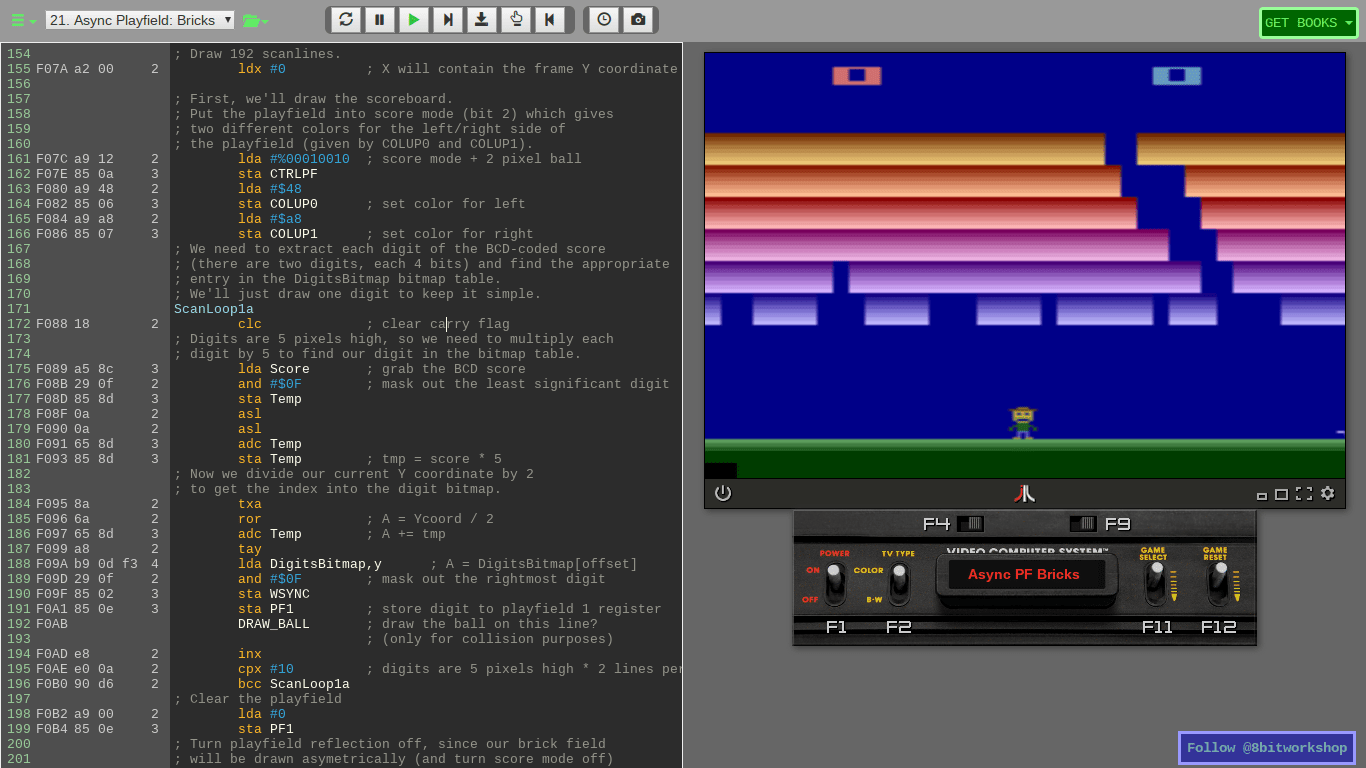
8bitworkshop
Learn how classic game hardware worked. Write code and see it run instantly.
 stark trench
Edaplaygound is good too
 hazy karma
I like EDA playground. One really nice thing is that they also have a user example database.
https://www.edaplayground.com/playgrounds?searchString=&language=&simulator=&methodologies=&_libraries=on&_easierUVM=on&curated=true&_curated=on&_csrf=0501cde2-6ec5-44f9-b94a-0eca9cdc1717
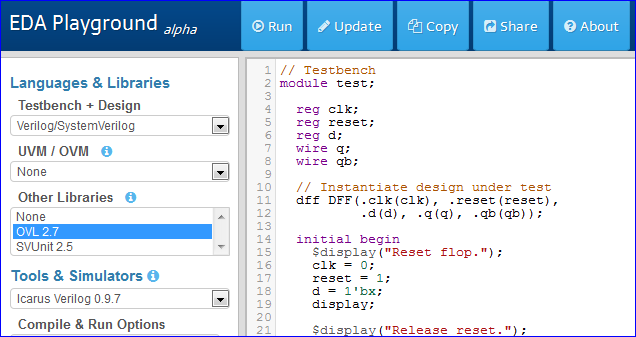
Edit, save, simulate, synthesize SystemVerilog, Verilog, VHDL and other HDLs from your web browser.
They support the major HDLs
stark trench
Yeah, I use EDAPlayground for my graduate Systems Verification class
hazy karma
I still wish there was something a bit more like Arduino for FPGAs. In the sense of an universal platform with lots of open-source libraries that are easy to integrate
silk verge
The Arduino people have been working toward that. The idea was that people could program their MKR Vidor 4000 with the Arduino IDE fairly simply.
The IceStudio project has done a good job of giving a graphical way to program FPGAs, and it does come with a selection of libraries and examples, and is extendable, so you can create your own blocks with Verilog in them and connect them with the existing ones.
Here's the IceStudio screen, showing one of their examples
hazy karma
That would already be a great improvement
lyric vortex
If anyone needs any help getting started with Icestudio, glad to help.
 robust lagoon

GitHub
An RV32I verilog soft core. Contribute to bit-hack/rv32i_verilog development by creating an account on GitHub.
I have it booting on an Lattice HX8K evaluation board
It takes up about 5k LUTs and can run up to 17Mhz as projected by NextPNR
I'd be very grateful for feedback and things that I should learn about and improvements
I had to clock the CPU on the positive edge and the RAM on the negative edge to keep the signals stable during the read/write phases, but this feels like a sign i'm doing something wrong.
The code for the HX8K board is here: https://github.com/bit-hack/rv32i_verilog/blob/master/eval8k/eval8k.v
GitHub
An RV32I verilog soft core. Contribute to bit-hack/rv32i_verilog development by creating an account on GitHub.
I'd love to get better with FPGAs so any advice would be appreciated
 muted sentinel
Hello
can someone here help me understand a detail about wishbone granularity?
If I attach a memory with 64 bit width and 8bit granularity, then the address would reference 64 bit wide segments, right? becuase the selection of each 8bit slice is done via the sel lines?
plucky helm
@muted sentinel I'd suggest asking in the 1bitsquared discord. there are more fpga folks there
 small prism
hello guys, i am searhing this days how can i have data transfer between pc and fpga (nexys2)
do you have any ideas?
stark trench
@small prism you might try to use a serial to USB adapter
I’m not very familiar with the nexys2 though so I would have to see what kind of interfaces it has.
 final bronze
@small prism I think you have to use the UART port. the Nexys 2 doesn't really have any high speed IO. not even USB IIRC.
small prism
I am trying to take data from fpga
I have already the fft but I need the communication
 wide dagger
small prism
I have already the fft but I need the communication
wide dagger
small prism
I have already the fft but I need the communication
You can use UART. There is also a special interface called Digilent Adept.
 cinder stump
Has anyone else had the problem where, when using the VGA, their monitor displays "Input not supported" or just a black screen?
I've already checked my clock speed, and I'm pretty sure it's at 25 MHz. Everything simulates correctly (using Vivado/writing Verilog), but when I push to board I have problems.
vast moat
I'd say that's par for the course in getting video to work for the first time. All sorts of timing subtleties in the sync signals, etc. I don't suppose you have an oscilloscope to check what the board is putting out?
cinder stump
Nope. Ended up figuring out my problem- clock speed was wrong, and I was putting the wrong outputs in the wrong places.
stark trench
Hey there FPGA peeps! I’m looking for 1 maybe 2 people to send some beta boards to who would be interested in helping develop a good software interface for programming ICE40 fpga with SPI/i2c.
silk verge
Nicer than IceStudio/IceStorm?
stark trench
More of a bare metal kind of approach using MCU for programming the FPGA
More focused on how someone could load the bitstream via SPI/i2c with circuitpython
Scott was working on a library for it though I haven’t looked to see how far he’s made it with it
silk verge
CircuitPython? Now there's an avenue I hadn't considered.
 grizzled aurora
Whats a fpga
wide dagger
grizzled aurora
Whats a fpga
Field Programmeble Gate Array
 floral ocean
 full mortar
@stark trench sounds really awesome, don't have time right now but truly fun!
stark trench
🙂
 grim cradle
Anyone knows about storing | saving | calculating a matrix value in fpga ? or have some good references to this ?
vast moat
"2D array" is probably what you'd want to search for: https://www.chipverify.com/verilog/verilog-arrays-memories
grim cradle
vast moat
"2D array" is probably what you'd want to search for: https://www.chipverify.com...
ahh sorry for the reply, thanks for the reference 😄
 finite moon
stark trench
Hey there FPGA peeps! I’m looking for 1 maybe 2 people to send some beta boards ...
finite moon
stark trench
Hey there FPGA peeps! I’m looking for 1 maybe 2 people to send some beta boards ...
Do you still want someone to test the boards? If so, I’d like to give it a try.
stark trench
Yeah! Send me an email: hello@oakdev.tech I’m hoping to have beta boards sent out by the end of January
finite moon
Will do. Anything specific I should include in the email?
stark trench
Your name and interest in beta testing the boards
I’ll follow up when it’s time to send the boards to get your address
finite moon
@stark trench I’ve sent the email. Just wanted to let you know.
stark trench
finite moon
<@728676724522352733> I’ve sent the email. Just wanted to let you know.
I saw, I was going to reply soon with more details
finite moon
stark trench
I saw, I was going to reply soon with more details
Hi @stark trench . I was wondering if you could please dm me whenever you get a chance to reply to the email ?
Thank you.
stark trench
👍🏻
stark trench
@finite moon response email sent
 burnt lantern
Normally I don't share GoFundMe campaigns, but this one is very relevant to this community. Claire Wolf is the original author of Yosys, Icestorm, NextPNR, and other free/open source tools for FPGA programming. She founded a company, with someone she later found out was an abusive, racist bigot, who eventually fired her and anyone else on the team who hadn't already quit, and now he's using the non-compete due to her being a shareholder to prevent her from continuing work on the projects that she had started. Some friends have started a GoFundMe (with her blessing) for a legal defense fund to help extricate herself from this mess: https://www.gofundme.com/f/help-claire-wolf-defend-her-lifes-work

gofundme.com
Author of YoSys, Project IceStorm, NextPNR, PicoRV32 - Founder of the Opensour… James Walmsley needs your support for Help Claire Wolf Defend her Life's Work
I wrote up a thread with a little more explanation and links to original sources: https://twitter.com/unlambda/status/1357472995778981888

Claire does some really important and foundational work in free software logic synthesis, and she's being taken advantage of and prevented from doing more work by an unscrupulous, abusive, and racist former business partner.
This campaign is being run by friends with her consent https://t.co/4f1IqhlFrM
 Twitter
·
silk verge
Twitter
·
silk verge
Seems like that GoFundMe is no longer accepting donations for some reason. I wonder if it's practical to buy her shares so she's no longer a shareholder.
 frosty cypress
"The organizer has currently disabled new donations to this fundraiser."
 trim pivot
Looks like she's now able to pursue more openFPGA development: https://twitter.com/oe1cxw/status/1357689234308661250?s=20

UPDATE
Thank you all for your outpouring support and love! I'm so incredibly touched by all your messages.
He has signed the documents today morning that finally resolve the non-compete issue.
But it's your love (and that legal defense fund y'all created) that set me free.
Likes
348
Twitter
·
 limber dirge
Any suggestions for a starter kit for learning FPGA?
stark trench
What kind of computer do you have?
That will mostly determine your options because some board tool chains only work on windows systems
In terms of just learning HDLs, EDAPlayground is a great tool
silk verge
The Nandland Go board is nice, includes buttons, a pair of 7-segment displays, and a VGA output. It can be programmed using IceStorm (or IceStudio) on any modern computer.
 cyan tree
I have a DE0-Nano which has a few buttons, LEDs, dip switches, A/D converter, 32MB SRAM, an EEPROM, and 100 or so GPIO pins, and a USB blaster. I'm using Quartus Prime Lite on a Linux VM to program it (it also runs on Windows, not Mac). Not much in the way of documentation, though, and the tools take some getting used to. Most books etc I found so far are about the Xilinx toolchain, not the Intel / Altera one for by this board. I was a complete FPGA beginner when I got this board, but not a beginner in general; if you haven't done any kind of development at all, then maybe this board isn't the best choice because you'll have to figure out a lot of stuff for yourself w.r.t. the programming tools, the simulator, etc.
limber dirge
Thank you for the suggestions.
limber dirge
I've got a Nandland Go board on the way. <Sitting in front of door like Scott Pilgrim waiting on their package now.>
limber dirge
Yay! Nand Go Board arrived. I'm impressed with the build.
silk verge
I like mine, and after about two weeks of learning, was able to output a VGA signal
glad bough
;) that's a nice pattern.
 obsidian iron
Looks like a flashback to old TV test patterns!
check spedometer
Oh, he's at 88MPH - it likely IS an old TV test pattern! 😄
lyric vortex
Yuck. m-labs just copyrighted "nmigen" 😦
obsidian iron
Bleh. Could try copyrighting (or copylefting?) nrnigen and go for the keming (kerning) confusion?
 thin heron
silk verge
I like mine, and after about two weeks of learning, was able to output a VGA sig...
thin heron
silk verge
I like mine, and after about two weeks of learning, was able to output a VGA sig...
nice. what rez/refresh did you get to?
silk verge
I was aiming low to start with, and leveraging the built-in 25MHz clock on the Go board, so 640x480. Figured I'd get that working, then go higher.
cyan tree
Nice, I'm trying to build my own UART from scratch. All I have to show for it right now is SD!xsa,FN?213 and other junk on the receiving end. 😉
cyan tree
This would be a lot easier to debug if I had an oscilloscope or a logic analyzer.
silk verge
You might be able to capture debugging info with the microcontroller you're (presumably) using with it
cyan tree
Yeah I'm using an Arduino so I'm writing some code to capture what actually gets sent.
cyan tree
Haha amazing, the reason it didn't work was that I had misread the pinout on the Arduino and mixed up RX and TX. What a n00b thing to do. The good thing is: I managed to verify that the FPGA does the right thing and all the timing is correct, so it wasn't really a waste of time. But still 🤦♂️
silk verge
That sounds like something I would do: get the complicated part right and goof on something simple.
cyan tree
It just goes to show that bugs are in your head, not in the code.
 ivory arch
Dazzelite is an easy to build project that uses a low cost FPGA board to displays multi colored patterns of light, on a ring of 24 LEDs. One can use the default display patterns or, create your own, no software knowledge required. Take a look at the video https://vimeo.com/516437596 or dive right into the project https://github.com/ggrummer/Dazzelite

Vimeo
Dazzelite uses a tri-color LED ring to produce different light displays. Dazzelite is programmable, so the displays are only limited by your imagination.

GitHub
Ring of tri-color LED lights controlled via an FPGA using a few simple instructions - ggrummer/Dazzelite
lyric vortex
stark trench
I saw that. Pretty cool
cyan tree
Is there really much benefit to programming FPGAs with C++? It seems like the wrong kind of abstraction to me (but so does Verilog / VHDL to a large extent).
stark trench
Interesting enough, Verilog is very much like C
cyan tree
I've heard other people say that, but I don't see it. Some of the syntax is a bit C-ish but the rest is more Pascal-like.
stark trench
All the time I’ve worked with Verilog has felt very much like C, but I’ve never used Pascal. I will say that a number of academic books teaching Verilog does mention that Verilog was designed to be comfortable for C programmers
cyan tree
Pascal uses the begin / end syntax. I wonder why Verilog doesn't use { } if making C programmers feel at home is one of its goals. The main issue I have with these languages is that you can't just learn the language, you also need to understand how it maps its constructs to the hardware. It seems like you can choose better language constructs if you know the hardware will be an FPGA (but of course Verilog + VHDL weren't designed exclusively for FPGAs). As someone with a programming background, I would have preferred it if the languages looked less like a programming language.
stark trench
You’re not wrong in that regard
I feel HDLs got far too abstracted
But none the less, it’s what we have to work with. At least some tools will give us block diagram representations of our HDLs to make hardware designers feel better 🙂
cyan tree
I'm only a n00b but I spend a lot of time looking at the RTL to see if the code I wrote actually makes sense (and then sometimes it still doesn't because the optimizer decides to remove things because the RTL violates some kind of constraint that apparently applies to FPGAs).
It's fun learning about this stuff but the tools seem suboptimal.
stark trench
Vivado is pretty good, but layered abstraction in HDL design is important
I was taught that you always build off the smallest logical components first and then build it into your top level
It’s time consuming and frustrating but that’s why FPGA designers make the big bucks
cyan tree
Yeah that makes sense. The main challenge for me is to figure out what the proper design patterns are. General textbooks on digital design are a bit misleading in that regard because they don't really go into the limitations that FPGAs have (such as only being able to clock a flip-flop using an actual clock, not any arbitrary signal).
stark trench
Yeah, and designing a clock divider block isn’t the most straight forward either
glad bough
Nix!
stark trench
@waxen nebula syntax and structure of Verilog was modeled after C. You can see as far back as 2003 that the parallels are made. https://www.embedded.com/the-c-programmers-guide-to-verilog/

Now that hardware is designed in high-level languages, the fields of hardware and software development are beginning to merge. Here's an introduction
cyan tree
I think some of that may be justifications made after the fact (Verilog goes back to the mid 1980s).
stark trench
Doubtful
It first appeared in the 80s, but a majority of its history started when Cadence bought it.
C and FORTRAN are considered the primary influences of Verilog development
cyan tree
It doesn't really matter to me one way or the other, but it doesn't look like C and doesn't work like C, so /shrug. (I mean it looks more like C than VHDL does.)
stark trench
As well as SystemVerilog sinc they merged early 2000s
It actually does have a number of similarities to C like syntax, structure, and a simple preprocessor
Sure it doesn’t use {} but I write a lot of C in my day job and have done a bit with Verilog/SystemVerilog and it’s pretty easy to jump back and forth
I do like VHDL more though for actual FPGA work. Verilog/SystemVerilog are great for simulation though
Last comment slightly unrelated
cyan tree
What's the reason you like VHDL better? It just feels like more typing but the same functionality to me, but I haven't used it enough to make a proper judgement.
stark trench
It’s more verbose so it tends to be more literal. And the routing in VHDL is a little more efficient
Many professional FPGA designers would probably argue the last point but at least for what I’ve done it’s been better.
cyan tree
I'll need to give it fair chance I guess. 😄 Still need to try SystemVerilog too.
stark trench
Verilog/SystemVerilog are essentially the same
cyan tree
Not in Quartus 😉
I'm just a learner too.
That just happened to be the FPGA development board I bought 😄
That's way out of my league for now.
stark trench
Spartan 6 would put you in the realm of the basys 2 board
I’ve mostly used Xilinx boards but I’m trying to get into designing my own FPGA dev boards
Right now I have two boards based on the Lattice Semi ICE5LP QFN package fpga
stark trench
They are easy board design wise, but the biggest issue is finding open tool chain support for the smaller FPGAs
I’m attempting to figure out doing DAP to program the feather wing I’ve made and that appears to function
Lattice tool chain requires a lattice programmer
Those are pricy
Last I looked, over $200
I’m trying to program without having to buy an expensive programming tool
But I’m also optimistic that I might be able to use the SPI Driver that Adafruit sells
stark trench
FT232R can be bit banged for jtag with diamond programmer
Finding this out as I redownload Diamond Programmer and try to use SPI Driver
Which apparently doesn’t have a compatible FTDI chip
But the FT232RL on my Mega Sapling is
So I’m following a guide from OpenOCD to build a PCB with a FT232RL to program my Lattice Wing FPGA feather wing
stark trench
$0.45 more than the ft232r. not a bad option
looks like the ft232h is also an option for cheaper than $4
stark trench
mostly just exploring and developing digital designs
i'm starting a efabless semiconductor company with my background in computer engineering, digital design, and VLSI
FPGA are a great way to develop devices initially and create proof of concept designs.
efabless means i just make the design and have the fabrication outsourced
it's the same as far as i am aware
i'll be designing basic asics for Visible Light Communication devices that operate using free space optics
efab appears to be a company that created an open workflow for asic design and production
efabless and Skywater semi are working with Google to provide more open source chip fabriaction and design
vast moat
Very cool. I did some long-distance FSOC work before.
stark trench
if you follow the guidelines for Skywater & Google's process, it's free
but your project has to be selected for it
they use 150 or 145nm process
it has to be by nature
but it can still be a for profit company
I'll be developing the designs in HDLs and probably do some super basic planning using mosfets if i'm feeling edgy
it's pretty similar to IR communication
well, that depends
at it's simplest, would be a transmitter which would be high speed/ high resiliency IC to drive an LED or LED network
generally VLC uses OOK
which is on and off keying
it uses varying levels of intensity to represent 1's and 0's
yeah
but VLC isn't limited to that, you can perform all kinds of modulation schemes with VLC
you can stimulate multiple parts of the spectrum
and remember that visible light is very broad
and not all green, blue, red, amber, etc... leds are the same wavelength
so you can do FM,AM,QAM even
but complexity increases costs
and implementation
but transmission is mostly SDM
software defined modulation
the receiver is where it gets tricky
my team has reworked an open source design that is basically our study point
this design isn't a custom silicon chip though
just a combination of ICs and software
3 people
not yet open, but once i finalize my company filings in the coming weeks then we'll be working on our first major revision of said open source design and whatnot.
we've completed phase 1 of a NASA funded SBIR, applied for phase 2
there really isn't a custom VLC IC yet
it's mostly amalgamation of various ICs
SBIR Small Business Investigative Research? let me check the acronym
innovative rearch*
the main sponsor company gets the funding
but we basically use the funding to buy materials and whatnot
yeah, the team i'm on, myself and another guy are unpaid supporters for phase 1, but phase 2 we actually will get to be paid 😛
And this time around, my company will be paid for contributions for PCB design consulting while my company uses the funds received from those contributions to fund the semiconductor development
not currently, it's still very much in the infancy stage. getting development boards acquired/built and set up
stark trench
we are aiming at cubesats and space IoT applications
we're planning for high speeds. though our technology is using LEDs rather than lasers, so our target speeds are more conservative since they are intended for low power space applications
stark trench
just communication between satellites
aside from massive powerful lasers and powerful RF comms, there isn't any reliable way to use LEDs to communicate to the ground
but the idea is to make it easier to communicate between satellites
stark trench
Probably similar but with the exception that depending how on the wavelengths you chose, you don’t have to deal with EMI
stark trench
Given the right frequency yes
vast moat
Fortunately it's relatively easy to filter out a DC background against a fast-changing communication signal as long as the sunlight isn't saturating your photodetector.
stark trench
It’s also beneficial to remember the dominant wavelength of sunlight in space. It’s much different than we experience on earth due to filtering through our atmosphere.
You can look this up, but most research indicates that the sun doesn’t produce nearly as much between the longer wavelengths of purple and the shorter wavelengths of green.
Our sun’s dominate range of visible light is the Red to Yellow-green spectrum and then UV side of purple
Our project lead has a Ph.D and has helped author/peer review such research so...
He’s also been working with VLC & space applications of such for well over 10 years.
Well, VLC is all about filtering known spectrum
There’s IEEE standards on VLC already
Lol
VLC/FSO
Nah, just parameters for communication protocols
It’s part of the IEEE 802 communications standard
Yeah, but you can use “used” bands
Because VLC creates fluctuations in intensity, you look for those signals represented as micro voltage changes
Apparently, but don’t worry too much, we have working prototypes so far and are making them better. Hopefully we’ll have a few cubesats in space by the end of the year
We’re working on a mission to test our basic system which is really fun 🙂
We’re looking at testing between 0.25km and 2km
They will travel in a small constellation
In LEO
Yeah
We don’t anticipate it working at distances greater than 5km
Nah, the goal is supporting robust communication between satellites in a constellation
Radiation hardened ICs are not necessary for short term missions
It’s just horribly cost prohibitive to try an use them on something that will be in space <6 months
You just kind of deal with it. You can add shielding to the PCB with say noise sensitive components
We’ll use the watchdog and rebooting method
They estimate that cube sats in LEO experience radiation related reboots every 3 weeks

Space Exploration Stack Exchange
I'm curious to know the various ways that cubesat electronics can be protected from the effects of cosmic rays or solar events while in LEO. How different are the components used in cubesats from s...
This a pretty good thread lol
Yeah, xinabox is probably what my team is using
They also have a ground station kit to go with it
I need to get more equipment. There’s a cube sat conference that happens about 50 minutes north of me every year
Hope they’ll have it this year
vast moat
Depends on how tiny. Sunlight photons would be basically a Poisson source of noise, so you can calculate how much it varies on the > MHz time scale. It tends to be fairly favorable to be able to electrically reject a DC level and just keep the high-speed signal on top of it.
It's the same principle used with TV remotes. Even if you have sunlight shining on the receiver, it can still pick up the command coming from a little LED because it's flashing at 38kHz and the TV is looking specifically for that frequency.
Yep, exactly. You know the overall intensity of sunlight, and it's coming from randomly-generated photons, so the noise level you see in a detector (which might pretend to be a 0->1 bit if it happens very fast) would be due to that.
There are single-photon receivers like avalanche photodetectors. Usually you wouldn't want a receiver that sensitive and fast, though. Optical communication usually uses many photons per bit, but there are some very long-range systems which care about single photons.
Amusingly, you can actually send more than one bit per photon if you're careful about timing exactly when you send and receive it.
stark trench
We actually use PIN diodes
They behave much better than avalanche diodes in terms of FSO
Less likely to be saturated too quickly and have a higher tolerance for environmental light source interference
Single photon detectors are where we are moving, but they are very expensive right now as the technology is still very new
stark trench
There are two that we are using currently
I don’t have links or remember the part number off the top of my head
They are on Digi-Key though
But basically we are just doing simplex communication at around 400kbps
silk verge
I didn't think photomultiplier technology was particularly new, but perhaps you had some other single photon sensor in mind
stark trench
silk verge
I didn't think photomultiplier technology was particularly new, but perhaps you ...
New in the sense that it hasn’t hit a mass market potential yet
And they are really expensive
 viscid anvil
Hi, I was wondering if anyone has experience or knowledge about using a spartan 7. I was thinking of trying to use one that is of the bga variety, but I never soldered one before. I have a reflow oven....
vast moat
viscid anvil
Hi, I was wondering if anyone has experience or knowledge about using a spartan ...
They shouldn't be any different to solder than any other BGA chip of similar pitch. But you might want to get started with an existing dev board rather than jumping straight to a custom PCB, unless of course you have a good reason to need it.
stark trench
Definitely practice with cheaper BGA components
Lattice Semi make some affordable BGA fpga chips
But you could even start cheaper with BGA LDO or boost converters or SPI Flash chips
lyric vortex
Not sure if this are widely known, the eFPGA part is new to me. But in the same format as de fomu, this is a cortex m4 with an eFPGA (embedded).
https://www.crowdsupply.com/quicklogic/qomu

Crowd Supply
An MCU + eFPGA dev kit with 100% vendor-supported open source tools that fits inside your USB port
vast moat
The EOS S3 is a cute chip, yeah. It also has a low-power DSP core. There's a QuickFeather board available in a more full-featured form factor.
lyric vortex
Nice price, seems like a nice board.
viscid anvil
Does anyone know the commercial license cost for vivado?
Is there a cheapper ide for vhdl?
$3k?!
vast moat
Do you really need a commercial license? You'll often get a limited license with an FPGA eval board, and some Xilinx chips are supported by the free Vivado version.
stark trench
Most all eval boards are supported with Vivado

Xilinx
ISE® WebPACK™ design software is the industry´s only FREE, fully featured front-to-back FPGA design solution for Linux, Windows XP, and Windows 7.
There’s also this
It would probably work on an RPi
It supports up to Zynq-7000 which is pretty cool
viscid anvil
Yup, I've used the webpack, but I plan on selling some stuff and I'm thinking I need to purchase the commerical license.....
stark trench
Don’t buy it until you’re actually selling
Typically there’s grace periods for small companies
Because basically if you buy it now, you have a huge capital expenditure that you have to make up for, rather than purchasing the license out of existing revenue which is easier to justify on your balance sheet
For instance, I’m riding out the length of my fusion360/eagle cad student license
Because it’s $400 a year after it expires
viscid anvil
stark trench
Don’t buy it until you’re actually selling
Yup, that's my plan too. I'm just figuring out the starting costs of this latest venture.
viscid anvil
If you create something that requires some firmware, then the IDE that created it should have a commercial license. YOur selling the thing + the firmware....so yeah.
silk verge
There are companies that use stuff like Eclipse to build their IDEs, then violate the Eclipse license by not open-sourcing the IDE.
viscid anvil
Since the thing I'm working on will have a foucus on the 'special sauce,' I'm inclined to keep things on the up and up..
 copper laurel
Anyone knows if FPGA can modify itself? Ping when answer
 drowsy herald
@copper laurel I think what you mean is, can an FPGA dynamically change its circuitry to implement a new logic design, without reprogramming it? If that's what you mean, then the answer is no. The good news is that you can code your design such that signals will be routed to different circuitry under different circumstances. Does that answer your question?
stark trench
Yeah, unless the FPGA is on a SoC/SoM it’s static.
Some FPGA program from FLASH, so it’s possible that it could have different stages or functionality depending on how the FLASH is programmed. But it’s still not “change itself” it still requires some prompting
copper laurel
That's what I needed. But now it's irrelevant cuz I know I can make filter after quantisation, no need to limit it before sampling
 limber badger
-
VHDL course- brand new course about VHDL language.
https://www.udemy.com/course/learn-vhdl-from-the-beginning-for-fpga-and-cpld-development/?couponCode=E7E7C0C0397346299649 -
VIVADO course - learn how to connect the VHDL files to xilinx FPGA design and load your FPGA from zero.
https://www.udemy.com/course/vivado-learn-from-the-beginning-and-with-pcie-full-project/?couponCode=DCA39C98474970DB5AC5 -
Flash memory VHDL course - advanced vhdl course, learn how to read/write and configure a flash memory and work the Quad SPI protocol from you FPGA and store data to the flash memory.
https://www.udemy.com/course/fpga-vhdl-coding-qspi-nor-flash-memory-from-zero-to-hero/?couponCode=944FFE5C230FF9C6BDEC -
Arduino course - learn how to build Iron Man arm with voice recognition and more usable arduino modules!
https://www.udemy.com/course/arduino-build-your-own-bionic-arm-with-voice-recognition/?couponCode=39FF76E88D839B845609 -
Fifo course - learn how to use VIVADO fifo modules and the method and uses of a Fifo.
https://www.udemy.com/course/vivado-regular-fifo-vs-axi-fifo/?couponCode=560F41FF9AE8BB6F99D4

Udemy
Learn how to code in VHDL from zero for FPGAs and CPLDs of Xilinx / Altera(Intel) / Lattice and Microsemi

Udemy
FPGA development with Vivado design suite to design Xilinx FPGA FROM ZERO using VHDL or VERILOG language!

Udemy
Learn how to Read/Write and work with QSPI Flash Memory with FPGA using VHDL code & Simulate with Modelsim from scratch!

Udemy
Learn Arduino by building a 3d printed Iron Man Arm with Voice Recognition, Accelerometer, Sounds, and more electronic

Udemy
Learn what FIFO is and how to use FIFO IP Cores of Vivado Xilinx FPGA tool
The iron man arm coming with adafruit sound board so you can put jarvis inside
limber badger
FREE Coupon to My VHDL Udemy course for subscribers only, coupons page will open right after subscription!!!
Valid for 3 days only so hurry up(don't forget to review the course 🙂
https://ofer293.wixsite.com/fpga-vivado-vhdl

Fpga,Vivado & VHDL
 hollow orbit
I just got VexRiscV to run on a xc7z010clg400-1 at 366MHz. I figured out how to control the bandgap voltage reference on it too. The Xilinx data2mem dump bitstream commands mode outputs information on some of the registers required to control it.
this is the data2mem partial output after changing CTL1 and Mask registers using prjxray

you can set mask to 0x3e7dc
and CTL1 to 0x3e7dc
and then change the VCCAUX voltage to 3.3V and VCCP to something between 2.1 and 2.2V.
The FPGA will need lots of extra cooling if you want to attempt doing this.
PicoRV32 ran at 633MHz too.
really simple logic might run at over 1GHz too.
I tested this on a EBAZ4205 FPGA board.
mostly because they are really inexpensive in case something burns up.
GitHub
Information on how to overvolt and overclock Zynq FPGA logic (Don't use on larger Zynq FPGAs because they might burn up or have reduced lifespan) NO WARRANTY - Overvolting and Overclockin...
stark trench

Fully open-source wifi implementation for use on FPGA SDRs: https://t.co/Krvd3gjGpA Very cool stuff!
 Twitter
·
Twitter
·
 dull nexus
Does anyone have any experience with one of these?
https://www.xilinx.com/products/som/kria/kv260-vision-starter-kit.html

Xilinx
The development platform for Kria K26 SOMs, the KV260 is built for advanced vision application development without requiring complex hardware design knowledge. Power supply sold separately.
dull nexus
This channel doesn't seem to be very active
silk verge
That seems to be the case. I didn't reply to your question as I don't have experience with either of those. I've kind of set aside FPGA stuff for a while, as I got some discouraging comments on another Discord.
 sand finch
I haven't ventured into FPGAs at all
vast moat
They're fun, but very different in how you have to think about coding.
 gloomy kettle
I do have a Cyclone II, but I've not used it at all.
cyan tree
I've still got some FPGA projects planned but they take a lot of time.
gloomy kettle
I'd like to play around with some Z80 stuff, but I have no idea. lol
cyan tree
You mean with a real Z80 or reimplement the Z80 using an FPGA?
gloomy kettle
Both
cyan tree
Well, my suggestion would be to buy some books from the 1980s and 1990s, or look on archive.org. For example, I have Microcomputers and Microprocessors by Uffenbeck and it explains how to design a system around the Z80.
 glossy void
What kind of development boards do people usually start with? I see a couple of lattice ice40 or something on crowdsupply, and have also considered a lichee tang?
vast moat
I usually start with a vendor eval board, to get more official support and documentation. Lattice has some fairly inexpensive options for their chips.
silk verge
The Z80 is a 5V CPU, almost all FPGAs have 3.3V (or lower) I/O signals, so you'd probably need logic level shifters between the FPGA and Z80. You'd probably need some additional logic to control the direction of signal flow through the shifters as well, but you can probably stuff most of that logic onto the FPGA, but likely not quite all of it.
dull nexus
silk verge
That seems to be the case. I didn't reply to your question as I don't have expe...
Oh..... Bummer
dull nexus
sand finch
I haven't ventured into FPGAs at all
||I got that for free||
I'm excited about getting it, but no idea how to use it
west bison
silk verge
The Z80 is a 5V CPU, almost all FPGAs have 3.3V (or lower) I/O signals, so you'd...
it's not too hard to add level shifters
this board is fully 5v compatible https://github.com/daglem/reDIP-SID

GitHub
MOS 6581/8580 SID FPGA emulation platform. Contribute to daglem/reDIP-SID development by creating an account on GitHub.
cyan tree
You may also be able to configure the FPGA to use 5V on the I/O pins.
silk verge
I don't know of an FPGA that supports 5V I/O, but it would be nice to find one (especially if it's a brand with an open source toolchain)
cyan tree
I thought my Cyclone could but it looks like it's only 3.3V and lower. (It's fixed to 3.3V on my dev board anyway.)
vast moat
stark trench
https://www.renesas.com/us/en/about/press-room/renesas-enters-fpga-market-first-...
That's awesome, thanks for posting!
 left steeple
Yeah that's very cool
silk verge
An FPGA vendor offers decent software for FPGA development, that's a welcome development!
 versed atlas
stark trench
*renesas has entered the chat*
versed atlas
stark trench
*renesas has entered the chat*
This is interesting. Do they have any development kits available?
stark trench
Not sure
versed atlas
glossy void
What kind of development boards do people usually start with? I see a couple of ...
The ICEstick from Lattice is a good board to get started with FPGAs.
https://youtu.be/lLg1AgA2Xoo - This YouTube series explains how to use with open source software. I was able to get things to work following the video

A field-programmable gate array (FPGA) is an integrated circuit (IC) that lets you implement custom digital circuits. You can use an FPGA to create optimized digital logic for things like digital signal processing (DSP), machine learning, and cryptocurrency mining. Because of the FPGA’s flexibility, you can often implement entire processors usin...
versed atlas
dull nexus
I'm excited about getting it, but no idea how to use it
https://youtu.be/lLg1AgA2Xoo - Check this out. I liked his explanations
A field-programmable gate array (FPGA) is an integrated circuit (IC) that lets you implement custom digital circuits. You can use an FPGA to create optimized digital logic for things like digital signal processing (DSP), machine learning, and cryptocurrency mining. Because of the FPGA’s flexibility, you can often implement entire processors usin...
dull nexus
versed atlas
https://youtu.be/lLg1AgA2Xoo - Check this out. I liked his explanations
Cool! I'll check it out
versed atlas
The Arty S7-50 FPGA board from Digilent is also a good starter board. You use the free Vivado tools to work with it. I just got my PMOD OLEDrgb working with it. As I had spent time earlier understanding the process, getting this to work took just ~30 mins.
glad bough
gloomy kettle
I'd like to play around with some Z80 stuff, but I have no idea. lol
I spent a lot of time in the retro computer Google group last year when I purchased the z180 (Z80) computer kits from Steven Cousins on Tindie. I have two retro z80 computers that I soldered together from him and both kits work well. https://www.tindie.com/stores/tindiescx/

He sells an I/O kit for the ones with a bus. https://www.tindie.com/products/tindiescx/sc129-digital-io-module-kit-for-rc2014/ I have one of these, but I haven't put it together, yet. I'd like to interface with my breadboard CMOD A7 FPGA from Digilent, but Vivado is beating me up right now. 🙂

Tindie
This is a simple digital I/O module with 8 inputs and 8 outputs
 soft mauve
RIght on. Vivado can be somewhat "brutal". 😅 Stick with it. 🙂
silk verge
I tried for a long time to get Vivado to work, finally gave up and went with IceStorm.
glad bough
silk verge
I tried for a long time to get Vivado to work, finally gave up and went with Ice...
I have a TinyFPGA that I've used iceStorm with. I like the tools better, but I need the I/O that the CMOD A7 exposes. I'm not quite ready to make my own boards, yet. ICE Storm was very easy to get up and running. I may also order an Alchitry CU from DigiKey (assuming they're in stock). I have a Mojo from back when Alchitry was named Embedded Micro. It's a shame that Justin hasn't been more involved in the community. He made great tutorials and I really liked where the Mojo was headed.
silk verge
I started with a NandLand Go board, I've looked at the Alchitry ones, but ended up getting some of the other Lattice evaluation boards from Digikey. I'm also wondering if I can repurpose one of the ColorLight 5A-75B boards designed to run LED panels.
I've had good luck with the OneBitSquared iCEBreaker board as well.
glad bough
It seems that SparkFun has the CU in stock. That one has a lot of I/O and works with IceStorm. I just ordered one along with the expansion board. The additional Qwik connector will come in handy, I'm sure.
I remember almost buying the NandLand Go board. He had some great tutorials on YouTube, but I couldn't seem to find anything current.
silk verge
The Nandland support in IceStudio was partial, but workable, they've since improved it. After playing with it for a couple of weeks, I was able to use it to generate a VGA signal
 glad bough
Awesome!
silk verge
The iCEBreaker board has PMOD modules available to produce VGA, HDMI, and assorted other peripherals
glad bough
That's why I'm trying to get a lot of IO. I'd like to make a video synthesizer and I'm going to use the ADV7125 High Speed Video DAC
silk verge
Heh, I'm trying to reproduce the old Atari Visual Music
glad bough
I got a pong game working on the Mojo using a "repurposed" VGA cable from an old CRT monitor I found on the side of the road.
VGA is a lot of fun because you have to learn about the different clock domains
I bought the HDMI shield for my Mojo, but I recently reinstalled my Windows and I don't know if I'm up for installing ISE WebPack again.
silk verge
I tried it that way, and was admonished by the experts to stay away from that, and stick with a single clock domain and synchronize everything to that.
glad bough
It makes sense, you can do a lot in the cycles between scanlines
I'm just wondering what the difficulties of a 24-bit color space will be compared to the 8-bit color space I was playing with before. I created my own resistor DAC, but this time, I want to use the real thing.
silk verge
I had plenty of time to do stuff, since I could leverage the "everything in parallel" nature of FPGAs. I would hope a similar situation would apply to 24-bit color.
glad bough
I got so frustrated with Vivado this week that I broke out my Trinket M0 just to remind me that electronics is supposed to be fun.
Do you have any links to your FPGA projects online?
silk verge
Not yet, I was having fun with it for a couple of weeks and making all the beginner mistakes then got some really insulting feedback online and put it all on a shelf.
glad bough
I don't interact with the FPGA community. Mostly because it's all academic and they obviously know more than I do about it. I don't expect them to be able to converse deeply in the things that I've been doing for the past 20 years, so I guess they don't expect me to converse in things they've been doing for 4.
soft mauve
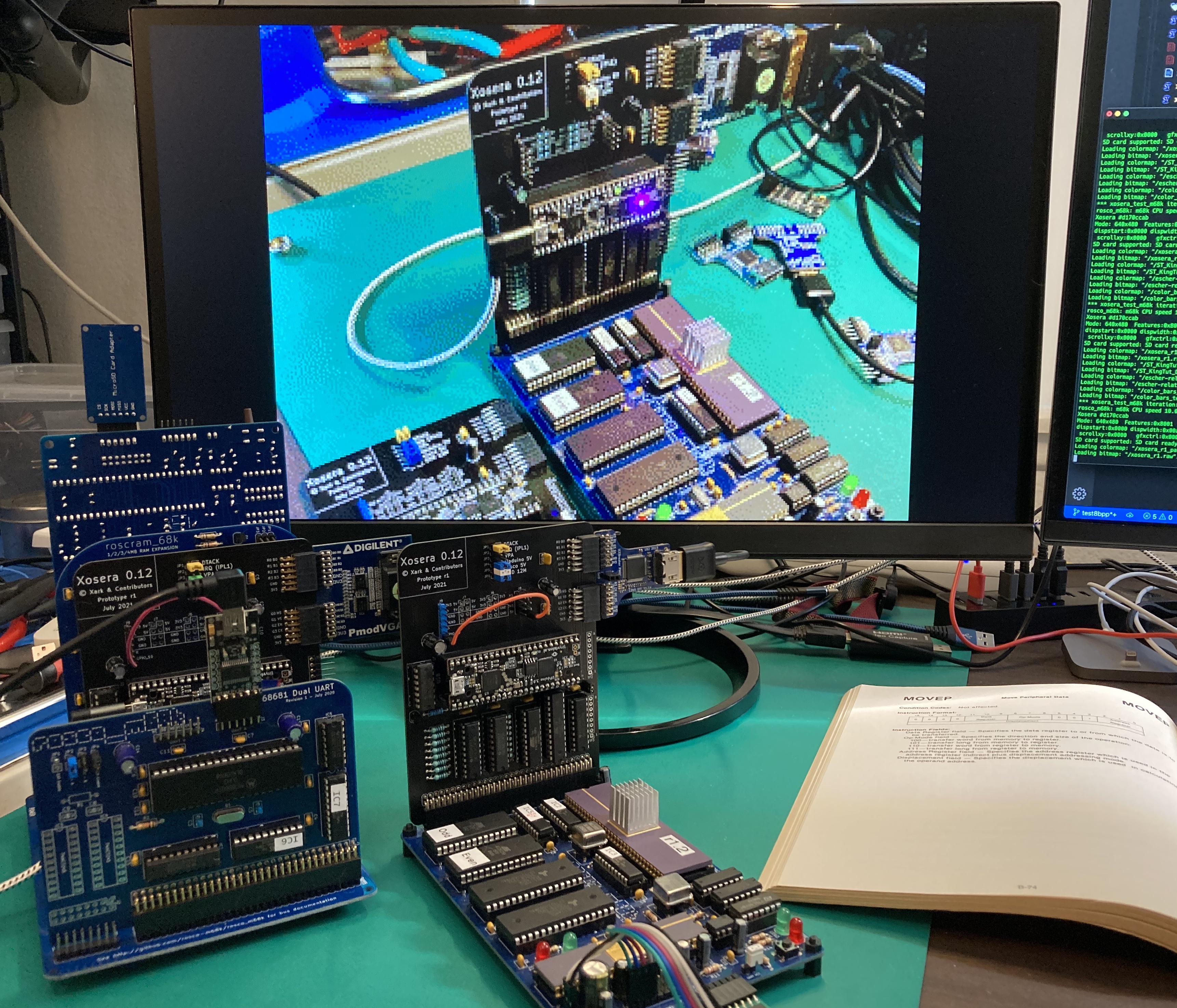
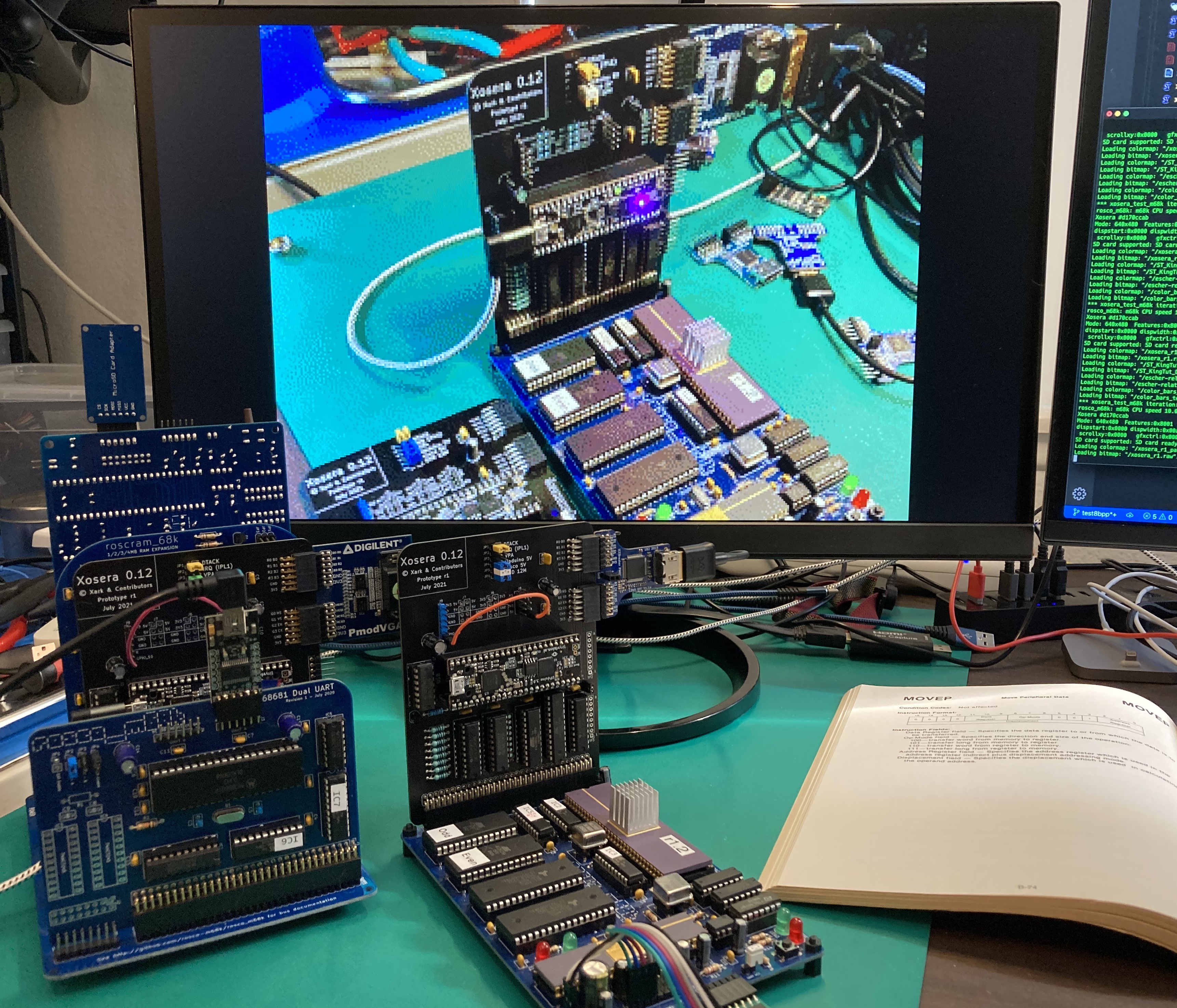
There are at least a few "hobbyist friendly" FPGA Discords etc. out there I've found. 🤔 Here is my FPGA VGA "retro video card" project, using all open-source tools and iCE40UP5K FPGA. This is to add Amiga/AtariST like video capabilities to UART based 68000 Tindie computer kit (and eventually write a little "demoscene" demo for it). 😅 I'd say it is about 90% done. The next step is to add some Amiga-like audio (FPGA is only 86% full...). 🙂 https://hackaday.io/project/173731-xosera-fpga-based-retro-video-graphics https://raw.githubusercontent.com/XarkLabs/Xosera/master/pics/Xosera_self_portrait.jpg
 glad bough
That is incredible!
@soft mauve Very inspiring. I just fired up my Linux machine and got ISE working so I could start working with my old Mojo FPGA again. I recently purchased the HDMI/RAM shield and I'm going through the demos online now. I could never get ISE installed on Windows 11. In Linux, it just worked.
soft mauve
Nice. ISE is what I started with. A bit of a pain (especially vs open tools), but still very workable. 🙂
glad bough
I'm having better luck with ISE than I did with Vivado (and Vitis). I think it's mostly due to Justin Rajewski's Lucid editor. I really like the work he's doing with the Alchitry Labs editor. It's basically an HDL that "cross compiles" to Verilog. Even if I don't end up using the Lucid in the final project, I like the Verilog that it generates. It can do neat things like "arrays" of D-Flip-Flops. It's a bit more intuitive to my software developer brain. I was able to find an Alchitry AU on Amazon tonight, so I ordered it. I'm looking forward to using Lucid with a more powerful Artix A7 board.
soft mauve
Cool. I was an initial Mojo backer, but that was before Lucid. I did play with an early version of Lucid, but by that time I was already doing VHDL (mostly). This current project is my first "significant" Verilog one.
I am not a big fan of Vivado... 😅
glad bough
I just finished my first Synthesizer "demo" with the Mojo. It was pretty easy using the HDMI (DVI) encoder component built into the Alchitry Labs Editor.
hdmi.red = hdmi.y[7:0] / hdmi.x[3:0] + frame.q;
hdmi.green = hdmi.x[7:0] * hdmi.y[3+:7] - (frame.q << 1);
hdmi.blue = hdmi.y[7:0] ^ hdmi.x[7:0];
That makes a really neat horizontal swirling pattern
stark trench
Neat
 quick rampart
henlo, where can i ask a question regarding using my adafruit motor shield with a de0nano fpga
i'm trying to communicate to the PCA9685 but have no clue how to do it
thanks and sorry
 grand orbit
quick rampart
i'm trying to communicate to the PCA9685 but have no clue how to do it
grand orbit
quick rampart
i'm trying to communicate to the PCA9685 but have no clue how to do it
The PCA9685 is an I2C peripheral, so whatever you are loading on the fpga needs to support I2C.
quick rampart
i agree just is there perhaps a tutorial somewhere or anyone that did it with an altera board
vast moat
To be honest it's a bit of a design mismatch to be controlling a servo driver over I2C with an FPGA. Normally you'd use a microcontroller for that, or else have the FPGA generate the raw PWM signals itself. So you probably won't find too many specific tutorials on it.
 long bridge
do companies usually use fpgas to prototype cpus, gpus, network cards, storage devices and basically everything on the motherboard?
vast moat
Yes, it's a common step in developing what will turn into custom silicon. However, it's often in a test scenario rather than having a real working equivalent, since FPGAs will be limited in clock rate and logic capacity.
long bridge
say I want to build my own fpga board. What would the process look like? Would it be straight forward to place the components together?
stark trench
long bridge
say I want to build my own fpga board. What would the process look like? Would i...
Usually. You will need a USB bridge chip that can either write via SPI or JTAG or other programming interfaces
You could get away with just hooking up a ft232h board from Adafruit though
vast moat
long bridge
say I want to build my own fpga board. What would the process look like? Would i...
You would use one of the EDA CAD tools to design the board, such as Kicad, Eagle, Altium, etc. It would let you create a circuit schematic and then the physical board layout, drawing the appropriate wires to connect everything correctly. Then you would send the design off to a PCB fabrication house, with or without having them also solder on the chips. This is all possible to do, but there's obviously a bit of a learning curve depending on how complex of a FPGA you want to use and how much circuit design you are familiar with.
long bridge
stark trench
You could get away with just hooking up a ft232h board from Adafruit though
thanks, that seems useful
long bridge
vast moat
You would use one of the EDA CAD tools to design the board, such as Kicad, Eagle...
so how complex do you think something like https://www.xilinx.com/products/boards-and-kits/ek-v7-vc707-g.html would be to design from scratch?

Xilinx
The Virtex®-7 FPGA VC707 Evaluation Kit is a full-featured, highly-flexible, high-speed serial base platform using the Virtex-7 XC7VX485T-2FFG1761C and includes basic components of hardware, design tools, IP etc.
vast moat
long bridge
so how complex do you think something like https://www.xilinx.com/products/board...
Order of magnitude, it would take a very experienced senior hardware engineer about a month to design.
(Less-experienced engineers wouldn't be able to deal with the high-speed stuff at all.)
long bridge
vast moat
(Less-experienced engineers wouldn't be able to deal with the high-speed stuff a...
so speed is a big factor? Well maybe I dont understand hardware design lol but I thought it was mostly to do with size and number of functionality
vast moat
long bridge
so speed is a big factor? Well maybe I dont understand hardware design lol but I...
Yes, high-speed circuits (GHz and above) bring their own issues, since it's no longer just "I need a wire connecting A to B", but you have to take into account the precise length of the wires, and the width of the traces versus the thickness of the circuit board, etc. Very easy to get wrong, and when you mix those constraints with everything else going on in a complex circuit board, it turns into quite a design challenge.
 burnt bolt
Anyone here that can help with some verilog syntax?
vast moat
burnt bolt
Anyone here that can help with some verilog syntax?
The rule of thumb is to just ask your question rather than waiting for an expert to volunteer, who may or may not know the answer anyway.
burnt bolt
ok lol fair thanks for the advice
ok so
trying to make a signed magnitude to two complement converter module
this is what I have so far

I want to flip the bits, add 1 and change the MSB back to 1 but idk how to change the MSB
syntactically
vast moat
burnt bolt
I want to flip the bits, add 1 and change the MSB back to 1 but idk how to chang...
I think you're looking for the curly-brace concatenation syntax, likeassign temp = { 1'b1, SM[W-2:0] };which would replace the MSB of SM with a 1.
burnt bolt
Oh I should explain
I am getting an error because I am assigning twice
I can try that too tho
Error (10028): Can't resolve multiple constant drivers for net "temp[2]" at "myfile.v"
Error (10029): Constant driver at "myfile.v"
that's the error with my code
with urs i get something else
I tried this
module SM2TC
    #(parameter W = 11)   // Default bit width
  (input [W-1:0] SM,            // Signed-magnitude input
   output [W-1:0] TC        // Two's complement output
  );

  wire [W-1:0]temp;
  assign temp[W-2:0] = (~SM[W-2:0] + 1'b1);
  assign temp = { 1'b1, SM[W-2:0] };
  assign TC = SM[0] == 1 ? temp : SM[W-1:0];


endmodule
I didn't mean for you to use my line verbatim, I was just demonstrating the syntax.
burnt bolt
oh
 west salmon
Ok. I'm new to FPGAs (haven't yet picked one up) but have a bit of a crazy idea that I wanted to run by those that have a lot more knowledge than I.
Here's my situation:
I'm redesigning a KB controller board so that I can remove dependency on jumpers to route signals from my GPIO pins (board was originally a monolithic MCU <-> KB breakout/interface board but I needed SPI, which screwed everything up). So, I'm looking at reducing waste and increasing usefulness of the PCB as production runs are 3 board minimums. To this end, I want to be able to dynamically change the signal routing for the majority of GPIO pins on the board.
At this time, I've settled on likely using a number of multi-channel analog switch ICs that provide the equivalent to SPDT physical switches. Most ICs that I'm saying are limited to 2-4 individually-addressable channels. This means close to 20-25 ICs in order to cover all GPIO. That's a lot of chips.
So, I'm wondering if a low-cost, low-power FPGA of some sort may be able to cover this use case. Note that this is purely hobby use, not intended for profit.
My requirements would be:
- 3.3v supply
- low enough current draw to be useful in BLE applications
- reconfigurable via SPI (allows the MCU to self-configure - ok if needs to be implement)
- 35+ GPIOs to the MCU
- 70+ possible endpoints on PCB to map to
- routed signal to be input/output agnostic
- surface mount, if discrete IC
- low-profile, if a supporting board is needed
Does this sort of use case seem like something that can be done in a relatively low-priced FPGA or similar device (actual logic units necessary is miniscule)? One of my reasons for exploring this possibility is the desire to implement more complex things like RISC-V softcores, so getting acquainted with the rolling is definitely needed.
vast moat
west salmon
Ok. I'm new to FPGAs (haven't yet picked one up) but have a bit of a crazy idea ...
The "input/output agnostic" part may be problematic, since FPGAs generally work on digital logic rather than having that sort of analog-switch functionality. Would it be sufficient to have the input/output direction be configurable, or do you really need to be simultaneously bidirectional?
west salmon
vast moat
The "input/output agnostic" part may be problematic, since FPGAs generally work ...
Configurable would be perfectly fine. The main need is that the MCU pins can be mapped as input or output, as needed for the application.
vast moat
west salmon
Configurable would be perfectly fine. The main need is that the MCU pins can be ...
Gotcha, that sounds pretty feasible, then. For low power, you might consider Lattice. This chip might be suitable, for instance, as it's got about 200 I/Os and can be programmed over SPI. It's a BGA package, but the pin pitch is relatively generous, and they have a TQFP version if you can drop down to about 100 I/Os. https://www.latticestore.com/products/tabid/417/categoryid/9/productid/355/searchid/1/default.aspx?searchvalue=ice40hx8k*
silk verge
As a bonus, there are open source tools for programming Lattice chips
west salmon
Thank you, very much @vast moat and @silk verge ! I'm planning to go with low temp solder paste and toaster oven for as many components as reasonable so, BGA may even be feasible, if I'm adventurous. TQFP would probably be better idea though.
$11.40? Standby current measured in μA? Tons of I/O and more LUTs than I know what to do with? AND has an open-source toolchain? Brilliant. Thank you both again very much. This is going to be a fun rabbithole to venture down.
 ionic spoke
west salmon
Thank you, very much <@382380426628562955> and <@348911944486486016> ! I'm plann...
ionic spoke
west salmon
Thank you, very much <@382380426628562955> and <@348911944486486016> ! I'm plann...
You're gonna love this: https://icestudio.io/
Icestudio Open Source FPGA design tool website
long bridge
how would one connect multiple fpga chips into one larger chip? Lets say I want to upload an SoC design to an fpga, would it make sense to place 4 of these https://au.mouser.com/ProductDetail/Lattice/LAMXO1200E-3TN100E?qs=p%2Fkho2dxmzjk9fLGgT6kSQ%3D%3D on a pcb
vast moat
long bridge
how would one connect multiple fpga chips into one larger chip? Lets say I want ...
It would be difficult to make them act the same as one larger FPGA, since the signal routing between the chips would be very restricted by the number of pins. You'd have to be explicit about the communication interfaces between them in your design. They might expose a common memory bus, for example, so one chip could handle the CPU core and other chips could be memory-mapped peripherals for it.
long bridge
vast moat
It would be difficult to make them act the same as one larger FPGA, since the si...
do you think an fpga chip like https://au.mouser.com/ProductDetail/Lattice/LAMXO1200E-3TN100E?qs=p%2Fkho2dxmzjk9fLGgT6kSQ%3D%3D is big enough to store 8 cortex A72 cores? Maybe a few of those chips with some interconnect system like intel quickpath? Then like you say one could route the io/mmio and lpddr ram from the fpga cluster
vast moat
long bridge
do you think an fpga chip like https://au.mouser.com/ProductDetail/Lattice/LAMXO...
No, definitely not. That's quite a small FPGA in terms of the number of LUTs, and a Cortex A72 core is pretty large. (And you probably will not be able to get a license for that core anyway.) Even if it would fit, it would clock at a fairly slow rate, too. You'd unfortunately need to be targeting much more expensive FPGAs for a project like that.
long bridge
vast moat
No, definitely not. That's quite a small FPGA in terms of the number of LUTs, an...
i looked for more info on large scale hardware simulation on fpgas and saw an open source cpu core https://github.com/OpenXiangShan/XiangShan. Apparently it takes up 40-50% of the LUTs on a vu19p fpga. It costs anywhere between 50-100k. Just for one core, wow.
The fpga https://www.digikey.com/en/products/detail/amd-xilinx/XCVU19P-2FSVA3824E/11588539.
vast moat
long bridge
i looked for more info on large scale hardware simulation on fpgas and saw an op...
Sounds about right, yeah. Things like the smaller RISC-V cores are hobbyist-accessible, but dealing with the high-performance stuff is a game for big companies.
silk verge
There are some high performance choices out there (I've seen open FPGA implementations of PowerPC and Sparc CPUs, for instance)
glad bough
When you complain electronics is expensive because of your 600$ weller soldering station and someone pull out their FPGA that costs as much as a 2019 masey ferguson medium power farm tractor 🤣
stark trench
stares at $200k Ultrascale Zynq MPSoC FPGAs
glad bough
ok I was wrong, weller BGA/SMT Rework system 2.3KW 40000 usd 😦
stark trench
Lol
stark trench
This is probably of interest to people doing FPGA work and considering doing a custom ASIC on Skywater shuttles: https://github.com/siliconcompiler/siliconcompiler

GitHub
A modular build build system hardware. Contribute to siliconcompiler/siliconcompiler development by creating an account on GitHub.
Basically converts HDLs like Verilog files into layouts for silicon production
stark trench
Is there value with providing an external clock source for an fpga? I know some require it (the lattice fpga I’m using doesn’t)
Or would it be better to offer it on an expansion board?
vast moat
Yes, I'd generally assume that most FPGA boards would come with a crystal, unless the internal oscillator was really good.
stark trench
vast moat
Yes, I'd generally assume that most FPGA boards would come with a crystal, unles...
What do you think is a good off chip crystal?
I know the Spartan 7 chips used on the Basys 3 boards by Diligent have 100MHz crystals paired with them
vast moat
I think the Lattice chips likely have PLLs, right, so the exact frequency generally wouldn't matter very much?
vast moat
I'd check the PLL input range. 32kHz would probably be too low for most multipliers.
stark trench
Or something like a 12MHz like on some other boards I’ve seen
I did see that the lattice reference boards tap the 12MHz crystal used on the FTDI fifo chip
silk verge
TinyFPGA BX uses an outboard 16MHz oscillator
stark trench
I thought about that too. Seems like a good idea to reduce overall BOM. Internal osc on the ICE5LP devices is pretty good from my gathering
Also, for such a small fpga, is it worth adding SPI flash for programming? 2MB is like $0.60 a pop
silk verge
I think it's volatile, so you'd have to get the programming into it somehow. I think having it autoload from flash would be worth the cost.
vast moat
Looks like the Ultra series does have internal nonvolatile configuration memory, so flash would be optional.
stark trench
Yeah, not sure if the ICE5LP4K falls into the NVM category of ICE40 Ultra is the thing.
vast moat
Seems so, according to Lattice's product table: https://www.latticesemi.com/Products/FPGAandCPLD/iCE40Ultra
(Crazy-small packages on those...)
 bleak osprey
NVM is one time programmable only on ICE5LP4K
Also believe that TinyFPGA BX using external clock is because USB clock accuracy requirement
vast moat
bleak osprey
NVM is one time programmable only on ICE5LP4K
Good catch. I get tripped up by that a lot across their product line.
stark trench
Yeah, I figured that was the case because I got an error saying memory wasn’t clean 🙂
west salmon
Ok. So, I'm going back and forth on FPGA Dev boards at the moment. I have nearly purchased an iCEBreaker (iCE40UP5k, I think), which seems like a great introductory board but... then I found the SparkFun Quicklogic Thing Plus. It has a Quicklogic EOS S3 chip, which combines a Cortex M4F with an embedded FPGA with ~2.4k logic cells with some other goodies on a Feather board.
I'm a bit torn now - the iCEBreaker has about 2x the fabric size from, what I can tell, but the Quicklogic chip has a vendor-supported FOSS toolchain, which I'd like to support, but they only are offering rather small FPGA capacities (fine for starting but, worried about being able to apply learnings to bigger RV64, etc projects in the future).
Any thoughts? Should I get one over the other initially (likely to get something with the QL chip at some point to support good vendor behavior, if nothing else)?
stark trench
west salmon
Ok. So, I'm going back and forth on FPGA Dev boards at the moment. I have nearly...
Icebreaker can be used with yosys or even IceCube and Diamond programmer from Lattice so it’s fairly well supported
I’ve not used the quicklogic SoC so I’m not sure how easy the quicklogic tools are to use
west salmon
Cool. I think I'll grab an iCEBreaker first then. Much appreciated.
silk verge
I started with a Nandland Go board, then moved to an iCEBreaker before I ended up putting FPGA development aside for a while.
west salmon
And then I ended up getting a Fomu instead 🤣 . Same chip as the iCEBreaker but no real I/O. Thinking that will have to see if I can convince it to use the USB pins as a UART or SPI at some point but, if nothing else, it'll make me focus on more of the FPGA-specific concepts.
stark trench
So many choices out there
silk verge
Fomu does have a nice installer. I generally go with that, apio, or IceStudio.